AI-Driven Multi-Objective Optimization for Cost-Effective Design of Passive-Oriented Nearly Zero-Energy Building in Chengdu


Abstract
1. Introduction
2. Methods
2.1. Pareto Selection
2.2. Objective Function
2.3. Passive Energy-Saving Technology Variables
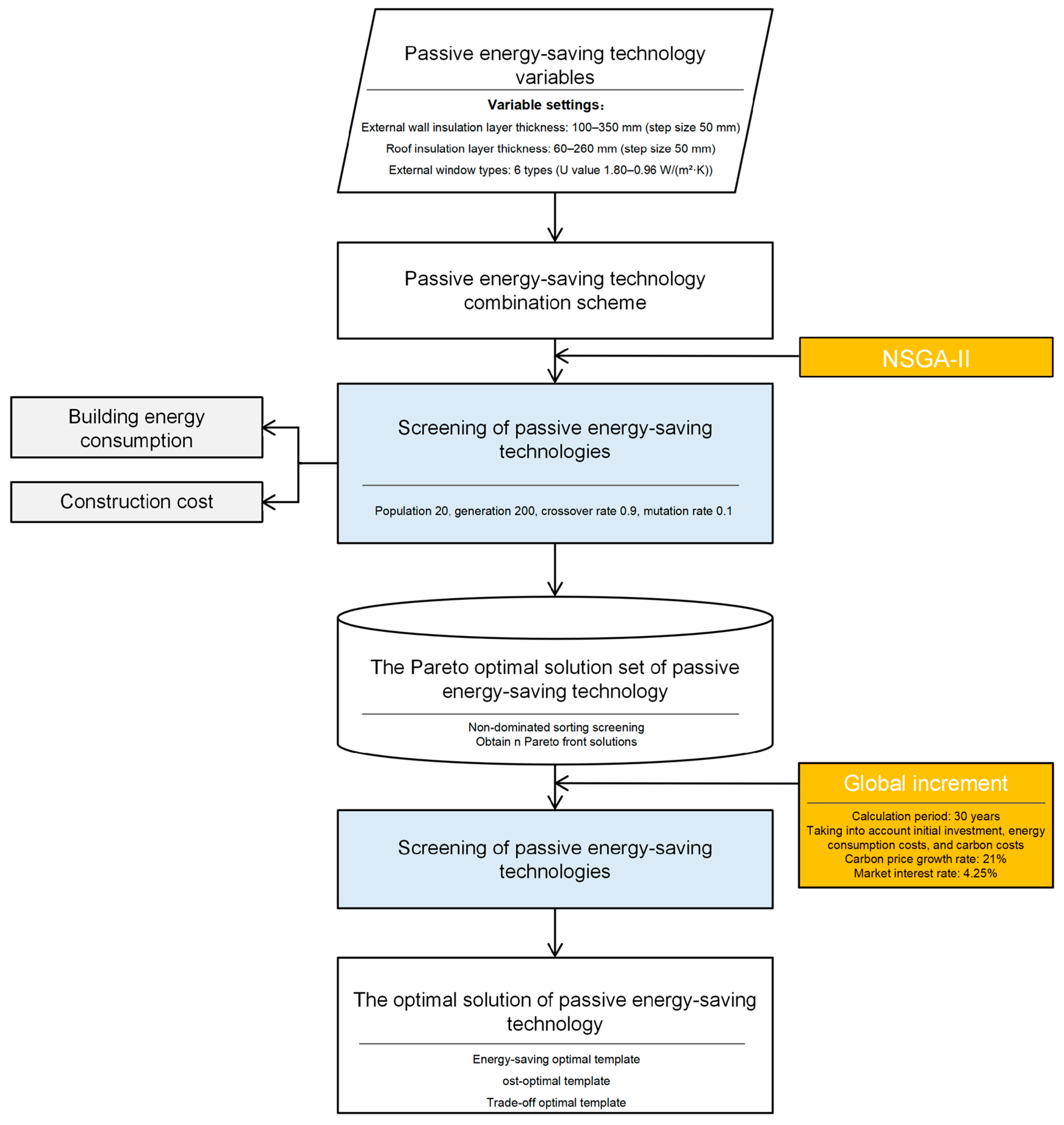
2.4. Technical Process
2.5. Project Design

| Parameter Category | Method | Performance Parameters | Basis |
|---|---|---|---|
| wall | 5 mm Cement mortar + 100 mm EPS + 200 mm Reinforced concrete | 0.37 W/(m2·K) | the software setting results within the requirements of DB51/T 5027-2024 [46] |
| roof | 5 mm Cement mortar + 50 mm EPS + 100 mm Reinforced concrete | 0.58 W/(m2·K) | the software setting results within the requirements of DB51/T 5027-2024 [46] |
| window | 4mmlow-E + 6mmair + 4mmlow-E | 1.8 W/(m2·K) | - |
| the heat dissipation of the human body | convective heat dissipation:60 W/people latent heat dissipation: 40 W/people total heat dissipation:100 W/people | ASHRAE 55 | |
| air tightness | general | n50 = 4 h−1 | DB51/T 5027-2024 [46] |
| penetration model | Wind-driven | - | |
| external shading | N/A | - | - |
| equipment system | household air source heat pump air conditioner + chiller refrigeration and air conditioning | COP = 2.8, EER = 3.6 | GB 55015-2021 [50] |
| ventilation | no mechanical ventilation, natural ventilation 1.5 h−1 | DB51/T 5027-2024 [46] | |
| natural ventilation control logic | on-off conditions: indoor temperature > 26 °C and outdoor temperature < 26 °C closing conditions: indoor temperature ≤ 24 °C or outdoor temperature ≥ 26 °C ventilation period: all year round | - | |
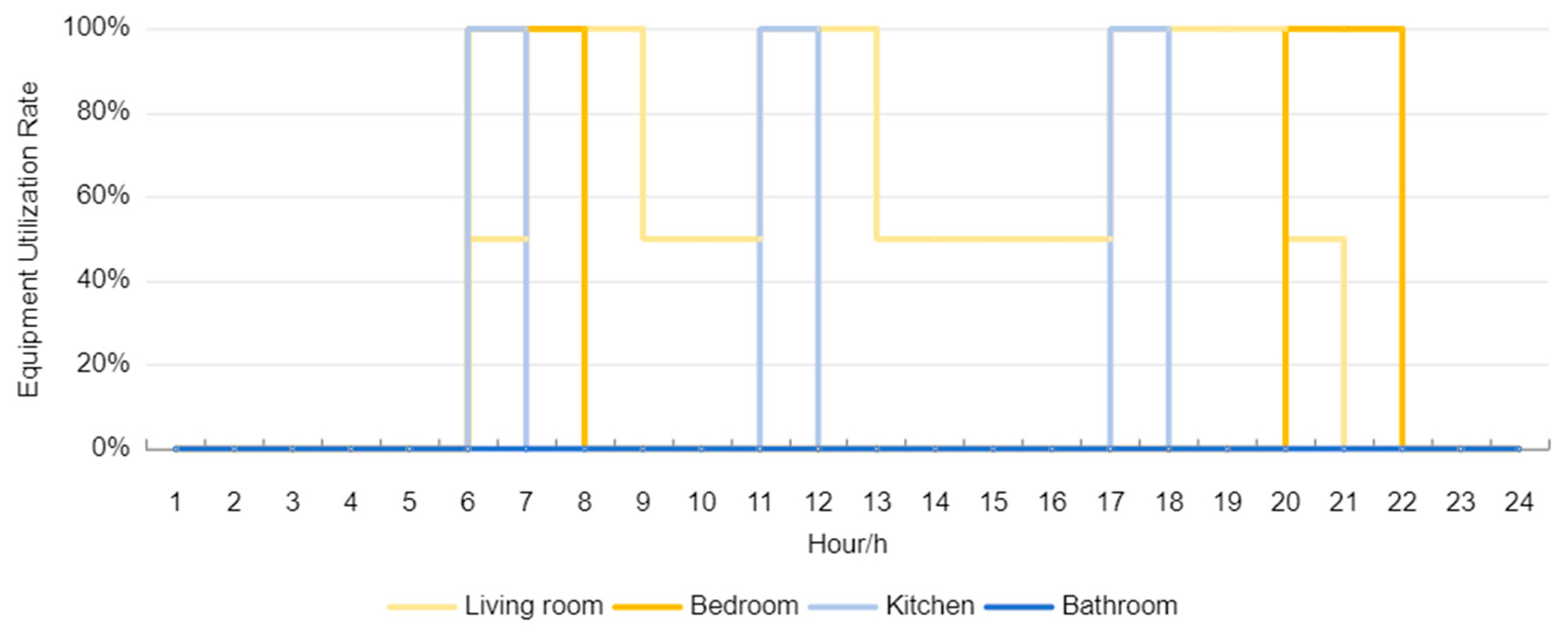
| indoor equipment | 7.5 W/m2 | - | |
| indoor lighting | 5 W/m2 | GB/T 50034-2024 [49] | |
| thermostat Setpoints | design temperature: heating 18 °C, refrigeration 26 °C Deadband: ±1 °C | DB51/T 5027-2024 [46] | |
3. Results
3.1. Variable Settings and Ranges
3.2. Selection of Passive Energy-Saving Technologies
4. Discussion
4.1. Comprehensive Evaluation of Passive Energy-Saving Technologies
4.2. Incremental Investment Cost and Annual Energy Savings Benefit
4.3. Convergence and Randomness Verification
4.4. Limitations
5. Conclusions
Author Contributions
Funding
Data Availability Statement
Acknowledgments
Conflicts of Interest
References
- United Nations. Paris Agreement. 2015. Available online: https://www.un.org/zh/documents/treaty/FCCC-CP-2015-L.9-Rev.1 (accessed on 31 December 2025).
- Wang, H. Research on the Fiscal Policy Path and Effects for Synergistically Promoting the Transformation from Near-Zero Carbon Emissions to Zero Carbon Emissions Project in Shanxi Province. Shanxi Financ. Tax 2024, 12, 40–42. Available online: https://kns.cnki.net/kcms2/article/abstract?v=kMXxFLy7TFW1i0bKd5cdExCV16_psJsneD2KHgkyCa_VpeWWFEwJ-fkwEQm6DOvrPywDBbsKd7YVuv01OuhxXQyDhlvg9OM__-u9qaZE6dNFlKtGhyRHPGN0owTu6-5VJBIK-mZqPpx_9e6klPNcbsycexk8WdJEUonL1jE0GG-QP9hWsZuVPQ==&uniplatform=NZKPT&language=CHS (accessed on 12 December 2025).
- IPCC. Climate Change 2014: Mitigation of Climate Change: Working Group III Contribution to the IPCC Fifth Assessment Report; Cambridge University Press: Cambridge, UK, 2015. [Google Scholar]
- OIES. Unpacking China’s 2060 Carbon Neutrality Pledge. 2023. Available online: https://www.oxfordenergy.org/wpcms/wp-content/uploads/2020/12/Unpacking-Chinas-carbon-neutrality-pledge.pdf (accessed on 12 December 2025).
- Jia, Z.; Lin, B. How to achieve the first step of the carbon-neutrality 2060 target in China: The coal substitution perspective. Energy 2021, 233, 121179. [Google Scholar] [CrossRef]
- He, J.-K. Global low-carbon transition and China’s response strategies. Adv. Clim. Change Res. 2016, 7, 204–212. [Google Scholar] [CrossRef]
- Luo, J.; Yu, J. Facing the Policy Challenges of Climate Change: Assessing China’s Strategy and Actions in International Environmental Crisis Communication. Commun. Humanit. Res. 2024, 33, 205–212. [Google Scholar] [CrossRef]
- Shi, L.; Xu, D.; Li, X.; Huang, L.; Li, Y.; Huang, T.; Yang, Y. The Impact Characteristics of Common Low-Carbon Design Methods on Reducing Carbon Emissions in Industrial Plant Buildings in Architectural Design. Buildings 2025, 15, 974. [Google Scholar] [CrossRef]
- Qin, H.; Yu, Z.; Li, T.; Liu, X.; Li, L. Heating Control Strategy Based on Dynamic Programming for Building Energy Saving and Emission Reduction. Int. J. Environ. Res. Public Health 2022, 19, 14137. [Google Scholar] [CrossRef]
- Schwartz, Y.; Raslan, R.; Mumovic, D. Implementing multi objective genetic algorithm for life cycle carbon footprint and life cycle cost minimisation: A building refurbishment case study. Energy 2016, 97, 58–68. [Google Scholar] [CrossRef]
- Wu, D.; Liu, C. The Design and Innovation of Passive House: A Case Study and Inspirations from the Winning Works of 2014 Passive House Award. New Archit. 2016, 74–79. [Google Scholar] [CrossRef]
- Liang, X.; Huang, Y. Energy-saving Potential of Building Envelope Retrofitting in Subtropical Climate Zones Under the Goal of Carbon Peaking. Build. Energy Effic. 2023, 51, 24–31. [Google Scholar] [CrossRef]
- GB/T 51350-2019; Technical Standard for Nearly Zero Energy Buildings. Ministry of Housing and Urban-Rural Development of the People’s Republic of China: Beijing, China, 2019.
- Wang, C. Optimization technology for the envelope structure of nearly zero energy buildings in extremely cold regions. Sichuan Cem. 2025, 6, 123–124, 130. [Google Scholar] [CrossRef]
- Yang, Y.; Li, X.; Yao, Z.; Yu, A.; Wang, M. Impact of Facade Photovoltaic Retrofit on Building Carbon Emissions for Residential Buildings in Cold Regions. Buildings 2025, 15, 3762. [Google Scholar] [CrossRef]
- Zhou, J.; Liu, Y.; Tang, Y.; Wang, Y.; Zhang, D. Design Practice and Demonstration of Near-Zero Energy Consumption Buildings in Low-carbon Parks in Cold Regions: A Case Study of Building 8 in Haichen Park. Constr. Sci. Technol. 2024, 3, 59–61. [Google Scholar] [CrossRef]
- Xue, Y. Application of Near-zero Energy Consumption Building Technology in the Northwest China—An Example of an Office Building in Lanzhou New District. Green Build. 2024, 50–53, 114. [Google Scholar] [CrossRef]
- Wu, D.; Liu, L.; Li, X.; Liu, C. Research on the Technologies of Passive Low Energy Buildings on the Basis of Multi-0bjective Optimization Method by Taking Cold Zone Residential Buildings for Example. J. S. China Univ. Technol. (Nat. Sci. Ed.) 2018, 46, 98–104, 120. [Google Scholar] [CrossRef]
- Feng, F.; Li, X.; Xue, L. Analysis of Influencing Factors of Green Building Energy Consumption Based on Design Builder. Anhui Archit. 2020, 27, 158–159, 195. [Google Scholar] [CrossRef]
- Pang, B.; Qian, C. Analysis of the impact of exterior wall insulation materials on the energy consumption of high-rise Residential buildings based on Design Builder simulation. Hous. Real Estate 2021, 6, 139–140. Available online: https://kns.cnki.net/kcms2/article/abstract?v=kMXxFLy7TFWtRK5qVyguAuTz6Hqj7Gm_9OXmPnRXKrRy5J9XeSKGltSGVN-sIT1jnpdCnHz4VIfMVYPEc8nSywsOh9gqo5CPCveG1azIJpGAOVAJvYLEmC8WIg1vhmItZqSp3WpaTN25BhSedeO0pSkwGmbPca001vVEZd4mynQeZ5ehtxE1wQ==&uniplatform=NZKPT&language=CHS (accessed on 12 December 2025).
- Zhen, X.; Li, S.; Zhang, Y.; Jiao, R.; Wu, W. Research on multi-objective optimization of envelope structures for nearly zero-energy buildings in Northwest China. Integr. Intell. Energy 2024, 46, 81–90. [Google Scholar] [CrossRef]
- Zhang, Y.; Liu, X.; Jiao, Y. Energy-saving Design of Rural Prefabricated Houses in Cold Regions Based on DesignBuilder. Build. Energy Effic. 2025, 53, 135–142. [Google Scholar] [CrossRef]
- Li, Q.; Liu, L.; Zheng, X. Analysis on the Energy-Saving Factors of Small Residential Buildings in Analysis on the Energy-Saving Factors of Small Residential Buildings in. Urban Archit. 2025, 22, 142–145. [Google Scholar] [CrossRef]
- Bavarsad, F.S.; Mohajerani, M.; Tywoniak, J.; Yuan, J. Multi-objective optimization framework to achieve near-zero energy building in the Czech Republic for future climatic conditions. Sustain. Futur. 2026, 11, 101599. [Google Scholar] [CrossRef]
- Xu, J.; Fang, T.; Wang, Y.; Wang, Z.; Han, X. Optimization of a Design Process and Passive Parameters for Residential Nearly Zero Energy Building Envelopes Based on Energy Consumption Targets. Buildings 2025, 15, 3785. [Google Scholar] [CrossRef]
- Witte, M.J.; Henninger, R.H.; Glazer, J.; Crawley, D.B. Testing and Validation of a New Building Energy Simulation Program. In Proceedings of the Seventh International IBPSA Conference, Rio de Janeiro, Brazil, 13–15 August 2001. [Google Scholar]
- Murata, T.; Ishibuchi, H. MOGA: Multi-Objective Genetic Algorithms. In Proceedings of the 1995 IEEE International Conference on Evolutionary Computation, Perth, WA, Australia, 29 November–1 December 1995; IEEE: Piscataway, NJ, USA, 1995; Volume 1, p. 289. [Google Scholar]
- IEA. Energy Performance of Buildings (Directive 2002/91/EC)—Policies. Available online: https://www.iea.org/policies/712-energy-performance-of-buildings-directive-200291ec (accessed on 30 December 2025).
- Waddell, C.; Kaserekar, S. Solar Gain and Cooling Load Comparison Using Energy Modeling Software. In Proceedings of the Fourth National Conference of IBPSA, New York, NY, USA, 11–13 August 2010. [Google Scholar]
- Wang, L.; Han, R. Thermal Comfort Improvement of a University Dormitory in Tianjin in Summer. Build. Energy Effic. 2018, 130–133. [Google Scholar] [CrossRef]
- Meng, X.; Yan, B.; Gao, Y.; Wang, J.; Zhang, W.; Long, E. Factors affecting the in situ measurement accuracy of the wall heat transfer coefficient using the heat flow meter method. Energy Build. 2015, 86, 754–765. [Google Scholar] [CrossRef]
- Ye, X.; Lu, J.; Zhang, T.; Wang, Y.; Fukuda, H. Improvements in Energy Saving and Thermal Environment after Retrofitting with Interior Insulation in Intermittently Cooled Residences in Hot-Summer/Cold-Winter Zone of China: A Case Study in Chengdu. Energies 2021, 14, 2776. [Google Scholar] [CrossRef]
- Zhao, L.; Huang, Z.; Qian, W. Numerical Simulation Analysis of Different Cases of Exterior Wall Insulation System. J. Anhui Univ. Technol. (Nat. Sci.) 2013, 30, 266–269+307. Available online: https://kns.cnki.net/kcms2/article/abstract?v=kMXxFLy7TFURD_SNqLtLEN3W5ar5i49Z052DxBYLcB17KuObCj840AeSmVEpulnl-k4u72uoRyKDF7tFIqjiOsJRZX6irKwWw8pD-w6T4JGFWAFOfwZZUDqksz85E-PX2VQ6cQ2zi7FLTsg7fgqpV2F8rFUTNEyH4SjRRFbBIGcGF9i2L4CSCw==&uniplatform=NZKPT&language=CHS (accessed on 27 February 2026).
- Jiang, C.; Fan, D.; Xiao, Y. Research on Heat Transfer Relationship and Load Distribution Characteristics of Embedded Air-Conditioning Room under Heating Conditions. Refrig. Air Cond. 2021, 35, 483–489. Available online: https://kns.cnki.net/kcms2/article/abstract?v=kMXxFLy7TFWhcrOnfaHa6iI3FP8qHz09BU7PKpgNiVJsVxc6tqlSf8RY-U_5D3b5JC5Uv7eD2hI0VYko4B-bIITpxJO_shlHToIvIc6tfQ5TjC8ISKIlYwQ7VnXOvYF9v26gHnb7iN2F8NQWzAg8znhBosFzg8h17tVQaoVoufmETYZzCgJIag==&uniplatform=NZKPT&language=CHS (accessed on 26 February 2026).
- Zhou, H.; Chen, G.; Zhou, X.; Xie, D. Study on Energy Saving Parameters of the External Windows of Passive Buildings in Hot Summer and Cold Winter Region. Urban Archit. 2023, 20, 1–5+15. [Google Scholar] [CrossRef]
- Xia, Y.; Li, P.; Liu, Z. Selecting and Evaluating Energy-Saving Technology of Exterior Window in Severe Cold Region. Low Temp. Archit. Technol. 2019, 41, 15–18+24. [Google Scholar] [CrossRef]
- Zhang, J.; Han, W.; Ma, Z.; Du, Q.; Zhu, Y. Carbon Emission Calculation and Emission Reduction Strategies for Office Building During the Materialization Stage. J. Xi’an Univ. Technol. 2025, 41, 118–127. Available online: https://kns.cnki.net/kcms2/article/abstract?v=kMXxFLy7TFUwte-QvMj0ObJSyI4V9VkRdpEGYG_EW_TCKk7yiCSSneiYyY_wNCSlq7N-mKbhZtPROmGrLOsuPW1nj_9mWolS2E1ZvDw2_hyzPOix97-qWXyCraWlGJI1KQvVPy-TXsfpBaa7wyHw1ZUUBZWgPK5VBTjA6VB34Sb2E-f4qAUM7Q==&uniplatform=NZKPT&language=CHS (accessed on 9 January 2026).
- Cui, Y. Research and Engineering Demonstration on Energy-Saving Retrofit Technology for Building Envelope Structures; China Architecture & Building Press: Beijing, China, 2014; ISBN 978-7-5123-6039-6. [Google Scholar]
- Wilson, L. Home Heat Loss—An Introduction, Shrink That Footprint. 2022. Available online: https://shrinkthatfootprint.com/home-heat-loss/ (accessed on 4 April 2026).
- Ma, H.; Zhang, Y.; Sun, S.; Liu, T.; Shan, Y. A comprehensive survey on NSGA-II for multi-objective optimization and applications. Artif. Intell. Rev. 2023, 56, 15217–15270. [Google Scholar] [CrossRef]
- Belhous, M.; Mastouri, H.; Radoine, H.; Kaitouni, S.I.; Benhamou, B. Multi-objective Optimization of the Thickness of the Thermal Insulation and the Windows Area of a House in Benguerir, Morocco. In Proceedings of the 2021 9th International Renewable and Sustainable Energy Conference (IRSEC), Benguerir, Morocco, 23–27 November 2021; IEEE: New York, NY, USA, 2021; pp. 1–6. [Google Scholar]
- DesignBuilder Software Ltd. Product Overview. Available online: https://designbuilder.co.uk/software/product-overview (accessed on 30 December 2025).
- EnergyPlus. Available online: https://energyplus.net/ (accessed on 30 December 2025).
- ANSI/ASHRAE Standard 140-2004; Standard Method of Test for the Evaluation of Building Energy Analysis Computer Programs. American Society of Heating, Refrigerating and Air-Conditioning Engineers, Inc.: Peachtree Corners, GA, USA, 2004.
- Yang, F.; Zhou, H.; Chen, J.; Sun, Y.; Wang, D.; Sun, F.; Zhang, L. Energy-Saving Performance and Optimization Study of Adaptive Shading System—A Case Study. Buildings 2025, 15, 1961. [Google Scholar] [CrossRef]
- DB51/T 5027-2024; Design Standard for Energy Efficiency of Residential Buildings in Sichuan Province. Ministry of Housing and Urban-Rural Development of the People’s Republic of China: Beijing, China, 2025.
- Qi, T.; Xu, Q.; Wang, B.; Hu, L. Analysis on Energy Consumption for Residential Buildings in Hot Summer and Cold Winter Region. Build. Sci. 2013, 29, 23–26. [Google Scholar]
- EnergyPlus. Weather Data by Location. Available online: https://energyplus.net/weather-location/asia_wmo_region_2/CHN/CHN_Sichuan.Chengdu.562940_SWERA (accessed on 30 December 2025).
- GB/T 50034-2024; Building Lighting Design Standards. China Architecture & Building Press: Beijing, China, 2024.
- GB 55015-2021; General Code for Energy Efficiency and Renewable Energy Application in Buildings. China Architecture & Building Press: Beijing, China, 2021.
- Dadras, Y.; Mostafazadeh, F.; Kavgic, M.; Ghobadi, M. Evaluating simplified building models’ sensitivity to climate data for energy retrofit optimization. Build. Environ. 2026, 287, 113885. [Google Scholar] [CrossRef]
- Dadras, Y.; Mostafazadeh, F.; Kavgic, M.; Ghobadi, M. Enhancing building energy optimization efficiency: A performance analysis of simplification approaches. J. Build. Eng. 2025, 105, 112559. [Google Scholar] [CrossRef]
- Dadras, Y.; Mostafazadeh, F.; Kavgic, M. Impact of Modeling Simplification on Energy Simulation Speed and Accuracy Considering Climate Change: A Case Study of a Dormitory Building. CIB Conf. 2025, 1, 171. [Google Scholar] [CrossRef]
- Zhao, J.; Du, Y. Multi-objective optimization design for windows and shading configuration considering energy consumption and thermal comfort: A case study for office building in different climatic regions of China. Sol. Energy 2020, 206, 997–1017. [Google Scholar] [CrossRef]
- Eiben, A.E.; Smit, S.K. Parameter tuning for configuring and analyzing evolutionary algorithms. Swarm Evol. Comput. 2011, 1, 19–31. [Google Scholar] [CrossRef]
- Hamdy, M.; Hasan, A.; Siren, K. A multi-stage optimization method for cost-optimal and nearly-zero-energy building solutions in line with the EPBD-recast. Energy Build. 2013, 56, 189–203. [Google Scholar] [CrossRef]
- Ascione, F.; Bianco, N.; De Stasio, C.; Mauro, G.M.; Vanoli, G.P. A new methodology for cost-optimal analysis by means of the multi-objective optimization of building energy performance. Energy Build. 2015, 88, 78–90. [Google Scholar] [CrossRef]
- Pikas, E.; Thalfeldt, M.; Kurnitski, J. Cost optimal and nearly zero energy building solutions for office buildings. Energy Build. 2014, 74, 30–42. [Google Scholar] [CrossRef]
- Kauder, E. History of Marginal Utility Theory; Princeton University Press: Princeton, NJ, USA, 1965; Available online: https://www.jstor.org/stable/j.ctt183pkm1 (accessed on 9 January 2026).
- Hua, M. Research on Energy Conservation Renovation of Rural House Construction Structures in Southern Jiangsu Region—Taking a Rural House in Wuxi as an Example. Urban Archit. 2025, 22, 65–69. [Google Scholar] [CrossRef]
- Jain, H.; Deb, K. An Evolutionary Many-Objective Optimization Algorithm Using Reference-Point Based Nondominated Sorting Approach, Part II: Handling Constraints and Extending to an Adaptive Approach. IEEE Trans. Evol. Comput. 2014, 18, 602–622. [Google Scholar] [CrossRef]
- Srinivas, N.; Deb, K. Muiltiobjective Optimization Using Nondominated Sorting in Genetic Algorithms. Evol. Comput. 1994, 2, 221–248. [Google Scholar] [CrossRef]


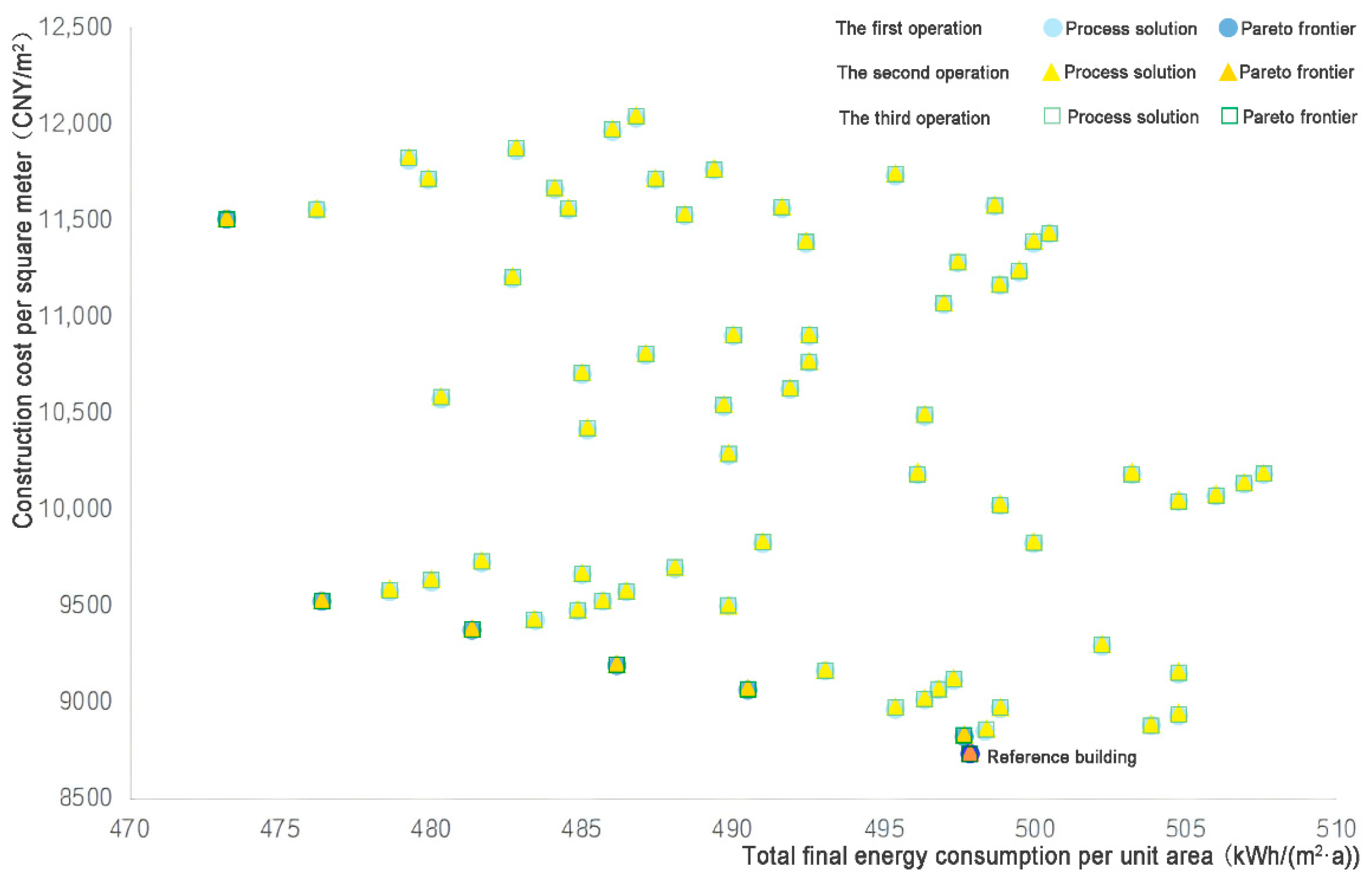
| Variable Type | Configuration Description | Parameter [W/(m2·K)] | Initial Investment Cost CNY/m2 |
|---|---|---|---|
| wall | the thickness of the insulation layer is 100~350 mm (increasing by 50 mm) | 0.37–0.11 | 600 (for every 50mm increase, the cost increases by 50 CNY/m2) |
| roof | the thickness of the insulation layer is 60~260 mm (increasing by 50 mm) | 0.58–0.16 | 500 (for every 50 mm increase, the cost increases by 50 CNY/m2) |
| window | 4 mm low-E + 6 mm air + 4 mm low-E | 1.80 | 270 |
| 4 mm low-E + 10 mm air + 4 mm low-E | 1.46 | 400 | |
| 6 mm low-E + 10 mm air + 6 mm low-E | 1.45 | 1300 | |
| 6 mm low-E + 10 mm Ar + 6 mm low-E | 1.21 | 1500 | |
| 6 mm low-E + 10 mm air + 3 mm Transparent + 10 mm air + 6 mm low-E | 1.14 | 2200 | |
| 6 mm low-E + 10 mm Ar + 3 mm Transparent + 10 mm Ar + 6 mm low-E | 0.96 | 2500 |
| Demand Selection | The Thickness of the Wall Insulation Layer | The Thickness of the Floor Insulation Layer | Type of Window |
|---|---|---|---|
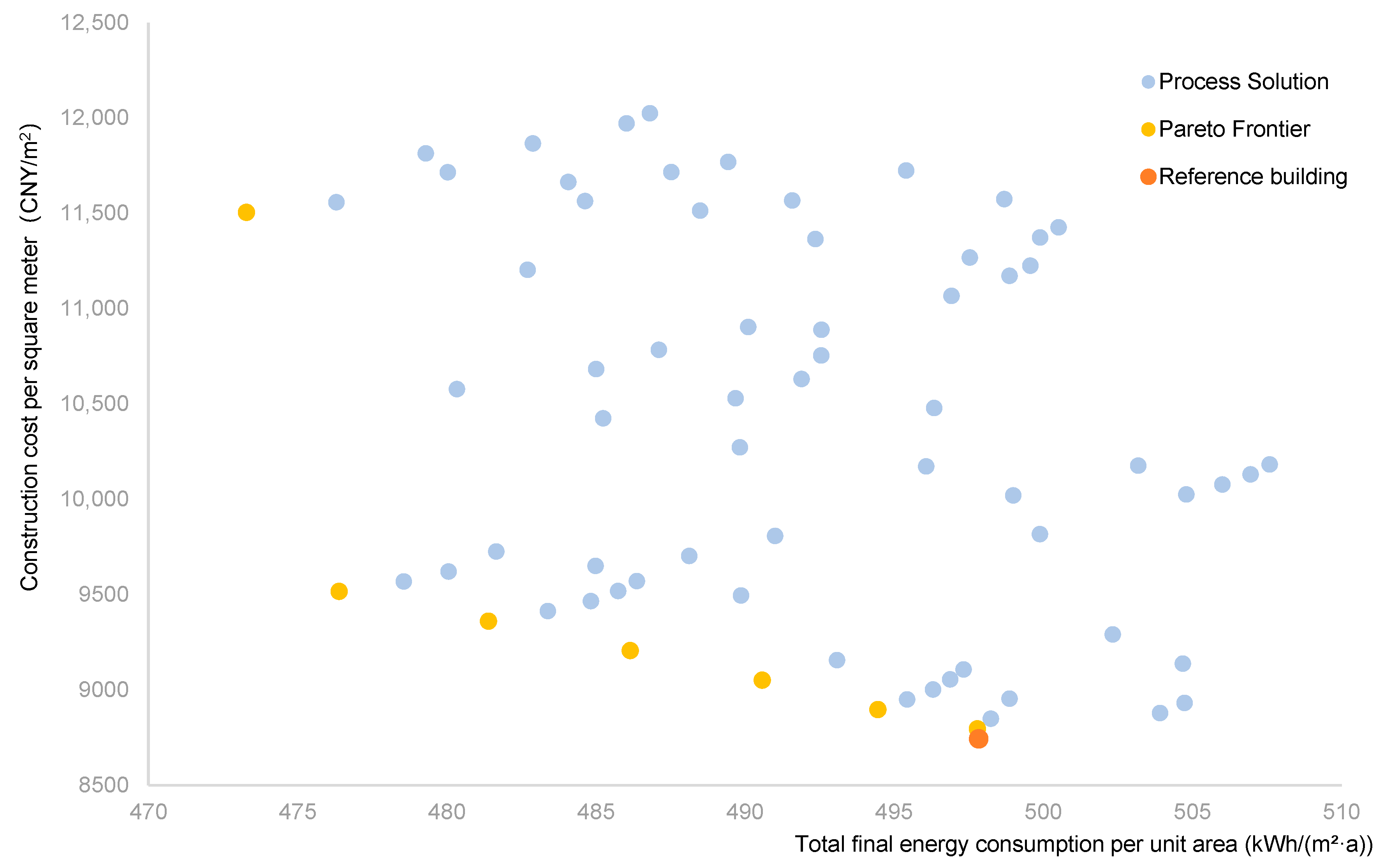
| optimal energy conservation | 350 mm | 60 mm | 6 mm low-E + 10 mm air + 3 mm Transparent +10 mm air + 6 mm low-E |
| optimal cost | 350 mm | 60 mm | 4 mm low-E + 6 mm air + 4 mm low-E |
| optimal trade-off | 350 mm | 60 mm | 4 mm low-E + 6 mm air + 4 mm low-E |
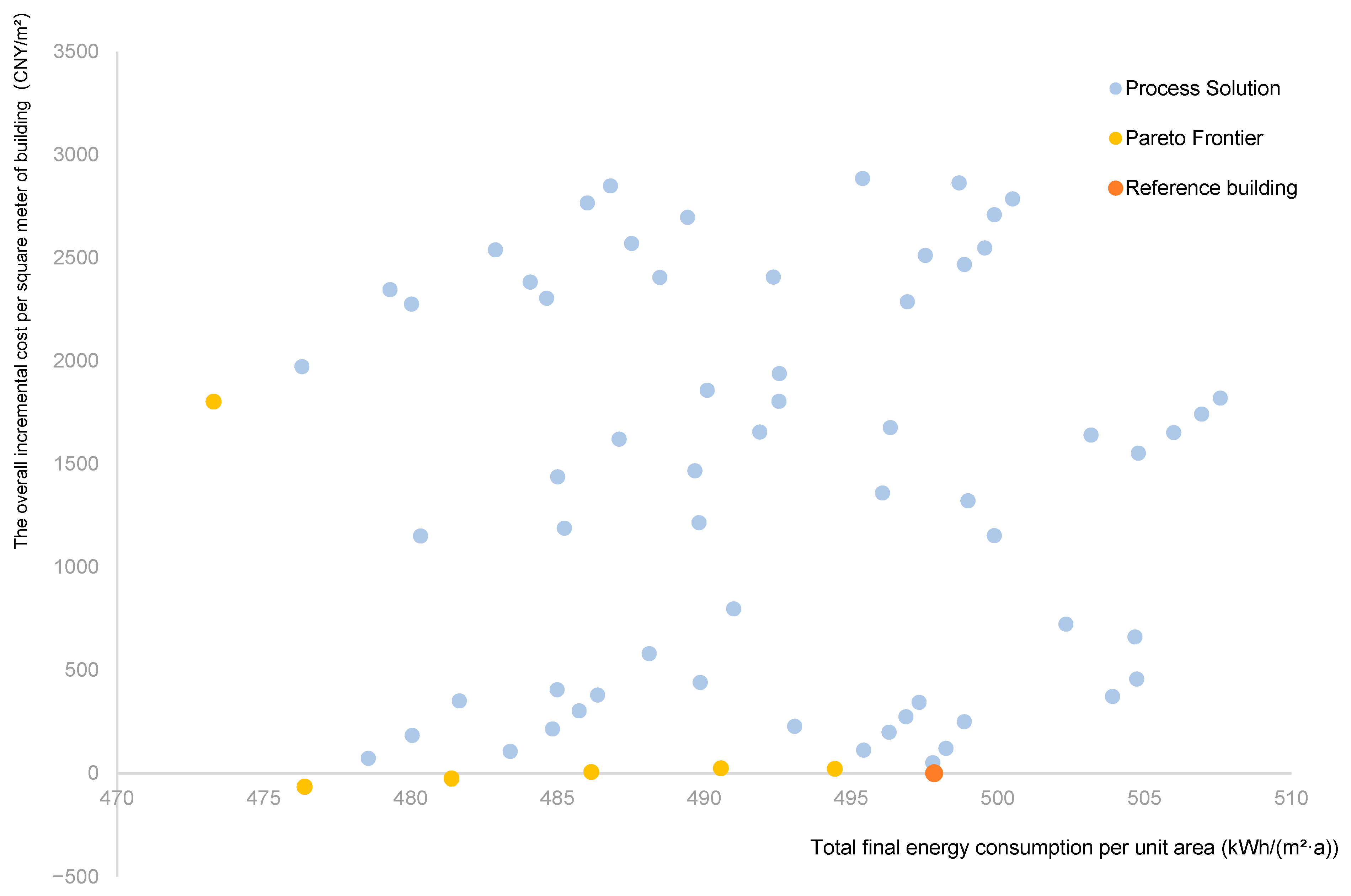
| The Thickness of the Wall Insulation Layer (mm) | The Thickness of the Floor Insulation Layer (mm) | Type of Window | Total Final Energy [kWh/(m2·a)] | Incremental Investment Cost (CNY/m2) | Annual Energy-Saving Benefits [CNY/(m2·a)] | Static Payback Period (Years) |
|---|---|---|---|---|---|---|
| 100 | 60 | 4 mm low-E + 6 mm air + 4 mm low-E | 497.8 (Reference building) | - | - | - |
| 300 | 60 | 4 mm low-E + 6 mm air + 4 mm low-E | 481.4 | 200 | 8.856 | 22.58 |
| 350 | 60 | 4 mm low-E + 6 mm air + 4 mm low-E | 476.4 (optimal cost and optimal trade-off) | 250 | 11.556 | 21.63 |
| 350 | 60 | 6 mm low-E + 10 mm air + 3 mm Transparent +10 mm air + 6 mm low-E | 473.3 (optimal energy conservation) | 2180 | 13.23 | 164.78 |
| 250 | 60 | 4 mm low-E + 6 mm air + 4 mm low-E | 486.2 | 150 | 6.264 | 23.95 |
| 200 | 60 | 4 mm low-E + 6 mm air + 4 mm low-E | 490.6 | 100 | 3.888 | 25.72 |
| 150 | 60 | 4 mm low-E + 6 mm air + 4 mm low-E | 494.6 | 50 | 1.728 | 28.94 |
| 100 | 110 | 4 mm low-E + 6 mm air + 4 mm low-E | 497.7 | 50 | 0.054 | 925.93 |
Disclaimer/Publisher’s Note: The statements, opinions and data contained in all publications are solely those of the individual author(s) and contributor(s) and not of MDPI and/or the editor(s). MDPI and/or the editor(s) disclaim responsibility for any injury to people or property resulting from any ideas, methods, instructions or products referred to in the content. |
© 2026 by the authors. Licensee MDPI, Basel, Switzerland. This article is an open access article distributed under the terms and conditions of the Creative Commons Attribution (CC BY) license.
Share and Cite
Wang, C.; Jiang, Q.; Kong, J.; Liu, C.; Hu, W.; Kurnitski, J. AI-Driven Multi-Objective Optimization for Cost-Effective Design of Passive-Oriented Nearly Zero-Energy Building in Chengdu. Buildings 2026, 16, 1604. https://doi.org/10.3390/buildings16081604
Wang C, Jiang Q, Kong J, Liu C, Hu W, Kurnitski J. AI-Driven Multi-Objective Optimization for Cost-Effective Design of Passive-Oriented Nearly Zero-Energy Building in Chengdu. Buildings. 2026; 16(8):1604. https://doi.org/10.3390/buildings16081604
Chicago/Turabian StyleWang, Chunjian, Qidi Jiang, Jingshu Kong, Cheng Liu, Wenjun Hu, and Jarek Kurnitski. 2026. "AI-Driven Multi-Objective Optimization for Cost-Effective Design of Passive-Oriented Nearly Zero-Energy Building in Chengdu" Buildings 16, no. 8: 1604. https://doi.org/10.3390/buildings16081604
APA StyleWang, C., Jiang, Q., Kong, J., Liu, C., Hu, W., & Kurnitski, J. (2026). AI-Driven Multi-Objective Optimization for Cost-Effective Design of Passive-Oriented Nearly Zero-Energy Building in Chengdu. Buildings, 16(8), 1604. https://doi.org/10.3390/buildings16081604