Layered Spatial Articulation and Base Spatial Graph: Formalizing Structural Preconditions of Architectural Spatial Analysis

Abstract
1. Introduction
1.1. Research Background
1.2. Research Objective and Methodological Position
1.3. Structure of the Research
- Section 2 examines historically recognized architectural spaces through selected precedents, demonstrating that architectural space cannot be reduced to a single defining criterion. It then introduces East Asian timber-framed housing as a reference case, through which the coexistence of heterogeneous spatial conditions within a single structural system can be observed. This analysis shows that spatial objects cannot be assumed as given, but must be structurally constituted.
- Section 3 presents the methodological framework of the study by formulating a procedure for the layered articulation of spatial conditions and constructs analytically determinable spatial objects based on plan-encoded information. It then organizes these articulated entities into a base spatial graph, establishing the structural domain upon which subsequent analysis operates.
- Section 4 formalizes graph-domain operations on this determined structure. It distinguishes structural transformation, semantic annotation, and graph representation, and specifies the conditions under which topology is preserved or altered.
- Section 5 discusses the analytical implications, scope, and limitations of the proposed framework and evaluates its relationship to existing graph-based spatial analysis methods.
2. Implicit Conditions of Historically Recognized Architectural Space
2.1. Diversity of Historically Recognized Architectural Spaces
2.2. Structural Articulation of Spatial Conditions and Case Selection
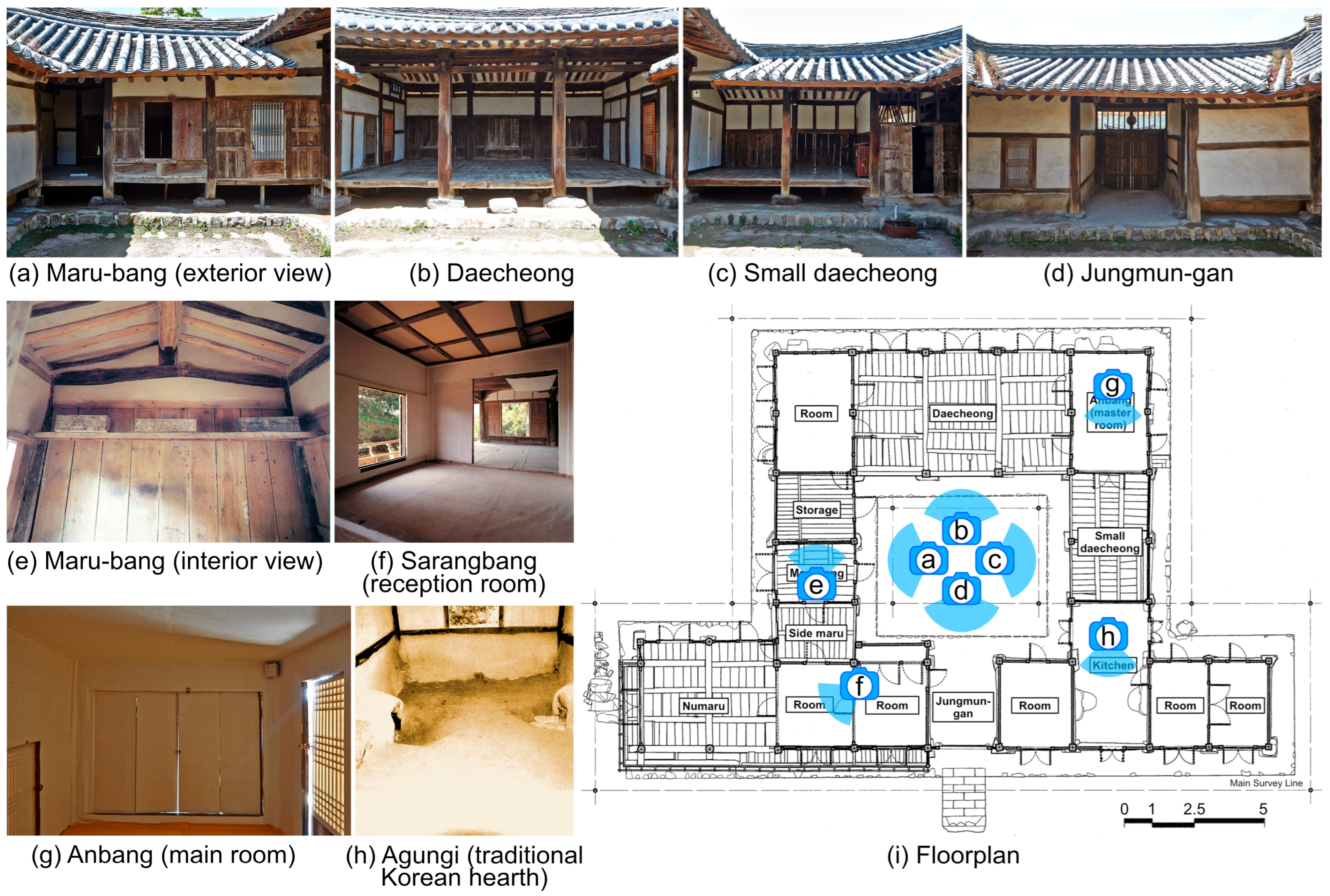
2.3. A Reference Case for Observing Spatial Conditions: Gwangajeong
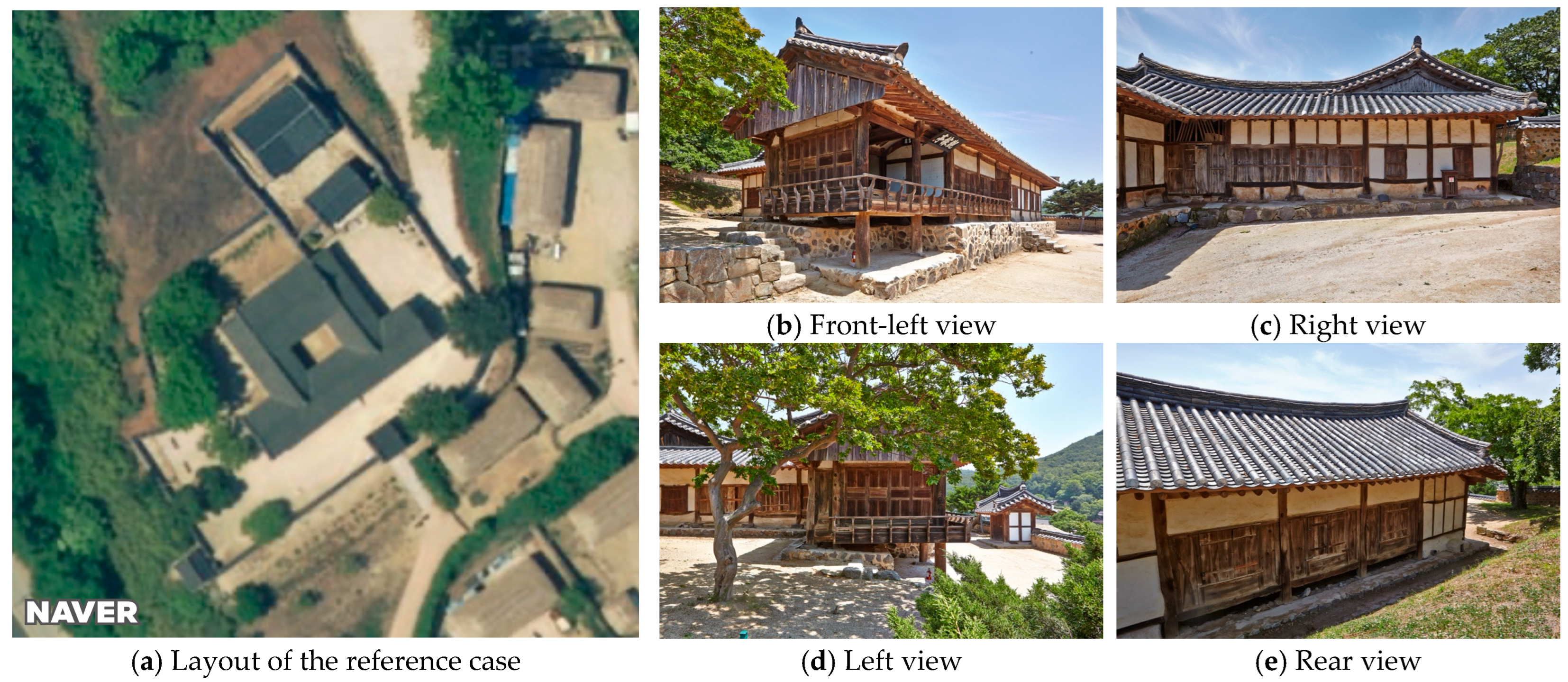
- Enclosed ondol rooms (spaces with heated floor systems);
- The daecheong (main wooden-floored hall);
- Subsidiary wooden-floored spaces, including the numaru (raised wooden platform) and small daecheong;
- The kitchen;
- The entrance gate space;
- Inner and outer courtyards.
2.4. Observed Spatial Conditions in the Reference Case
2.4.1. Observational Dimensions for Comparing Spatial Conditions
2.4.2. Differentiation Across Major Spaces in Gwangajeong
2.4.3. Methodological Implications
3. Methodological Framework: Layered Spatial Articulation and Base Graph Construction
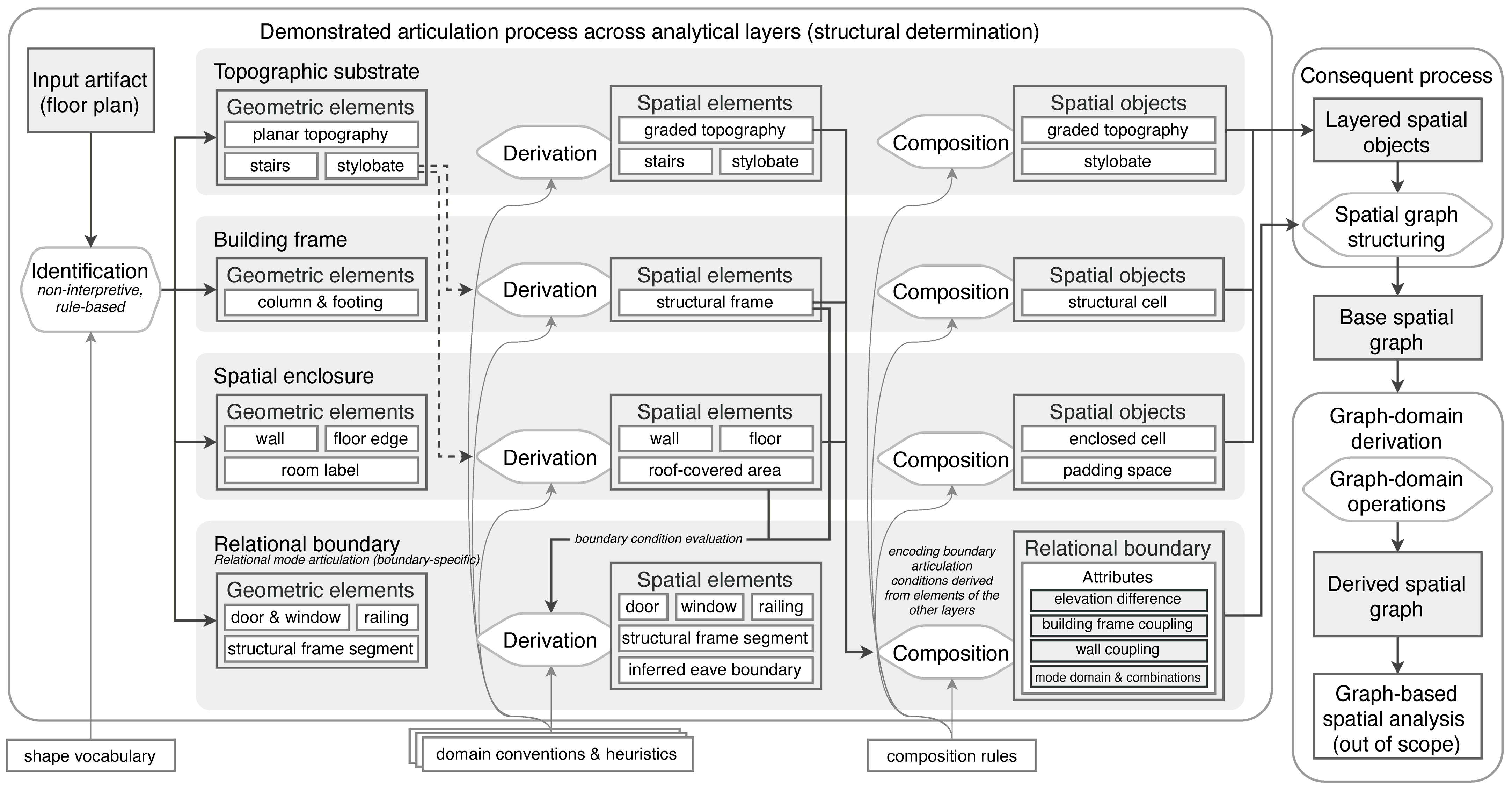
3.1. Analytical Structure of the Methodological Framework
3.2. Layered Spatial Articulation
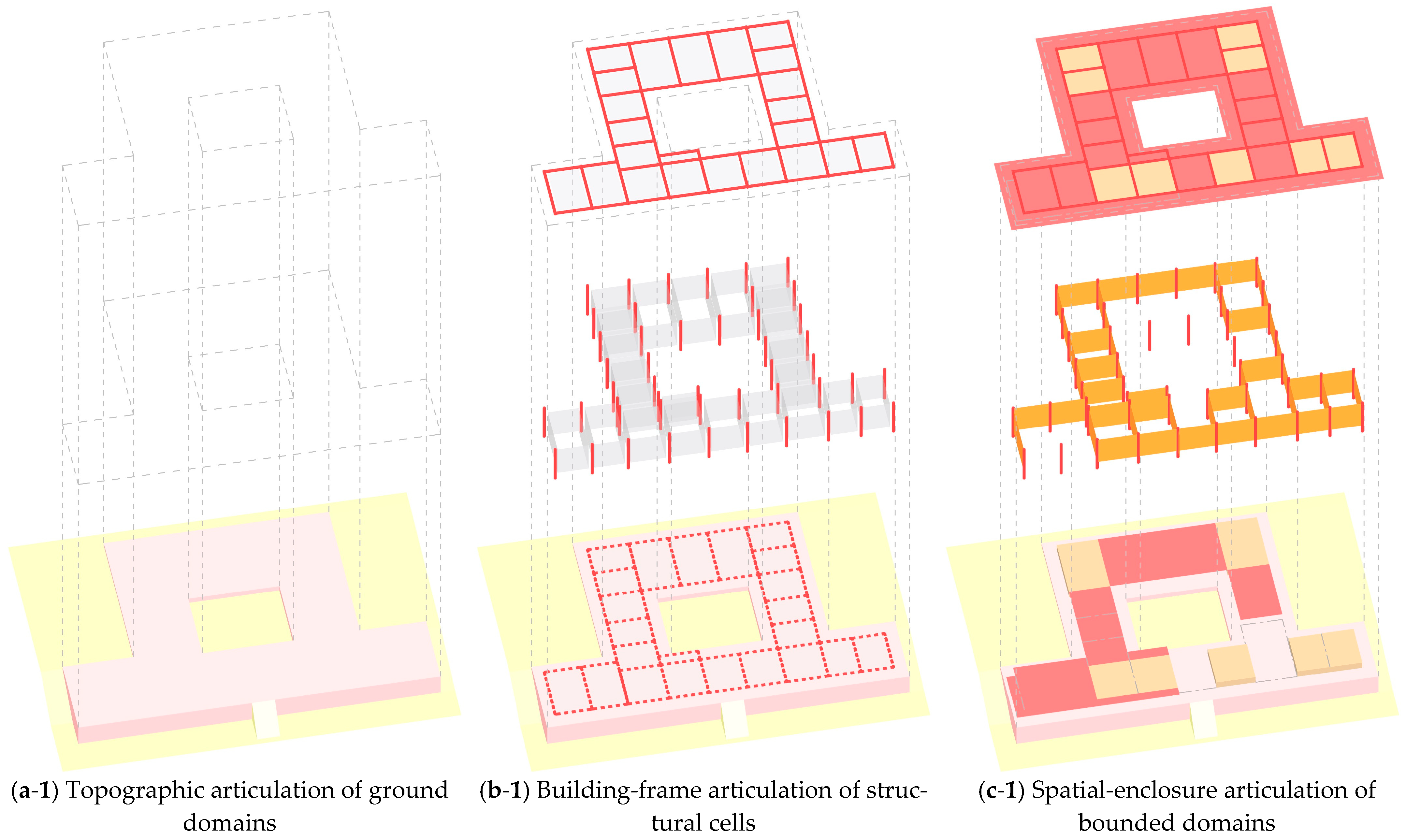
3.2.1. Conceptual Structure of Layered Spatial Articulation
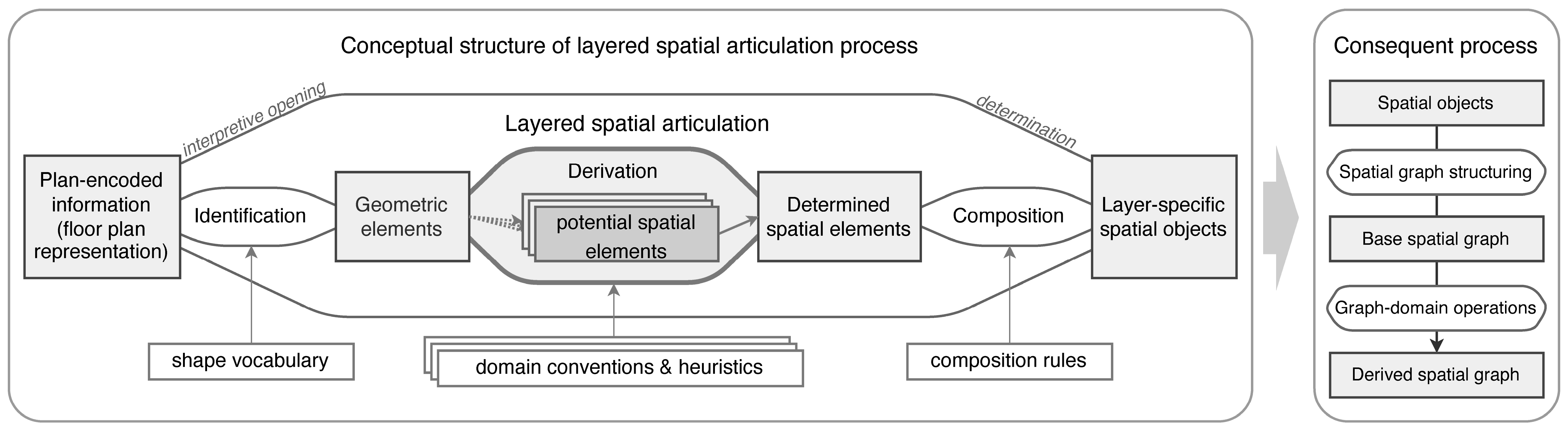
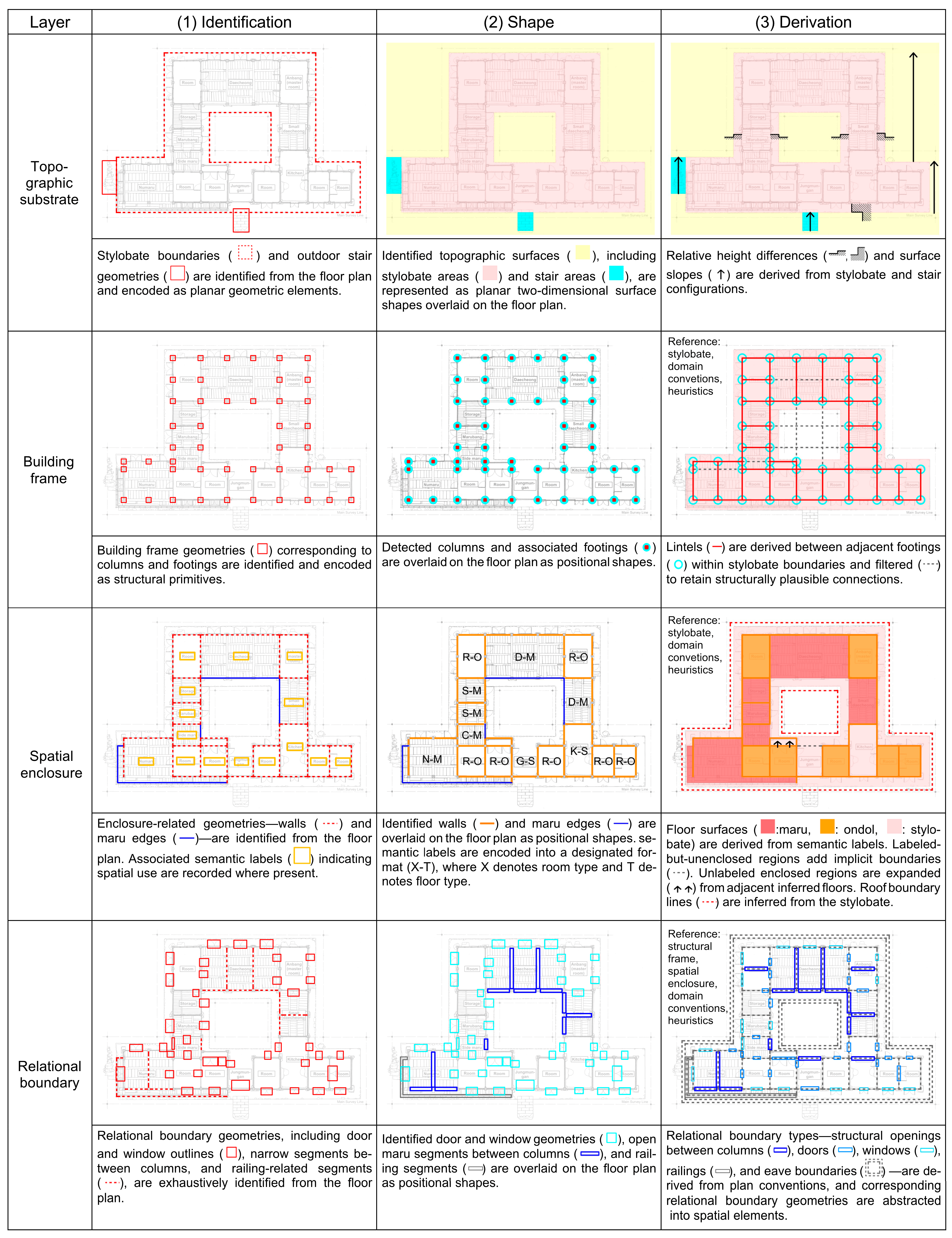
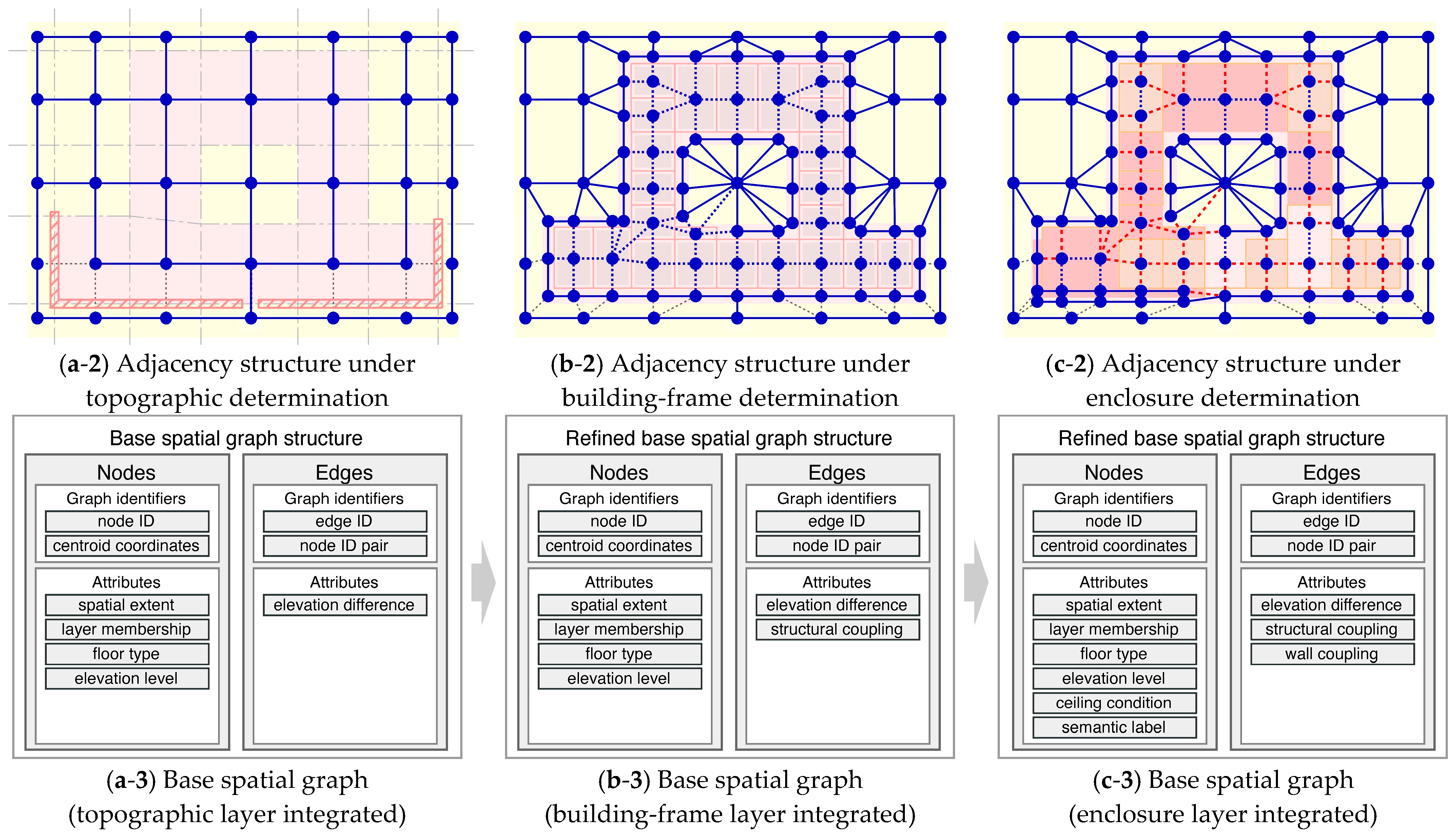
- The topographic substrate layer, articulating ground continuity and elevation;
- The building frame layer, articulating modular spatial capacity;
- The spatial enclosure layer, articulating bounded or partially bounded extents;
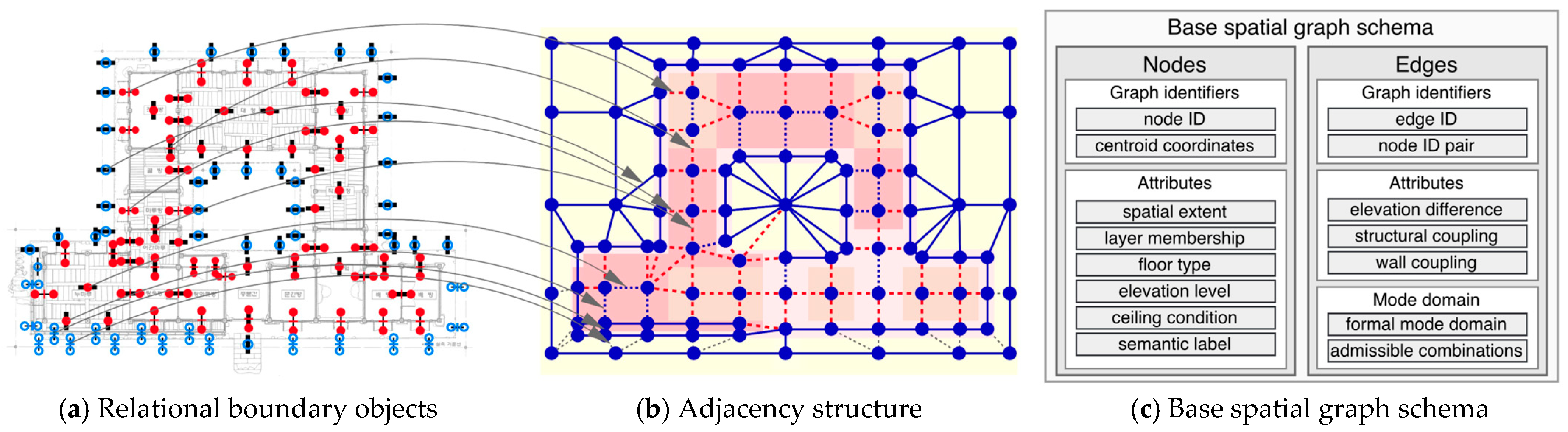
- The relational boundary layer, articulating boundary devices that condition admissible relational modes.
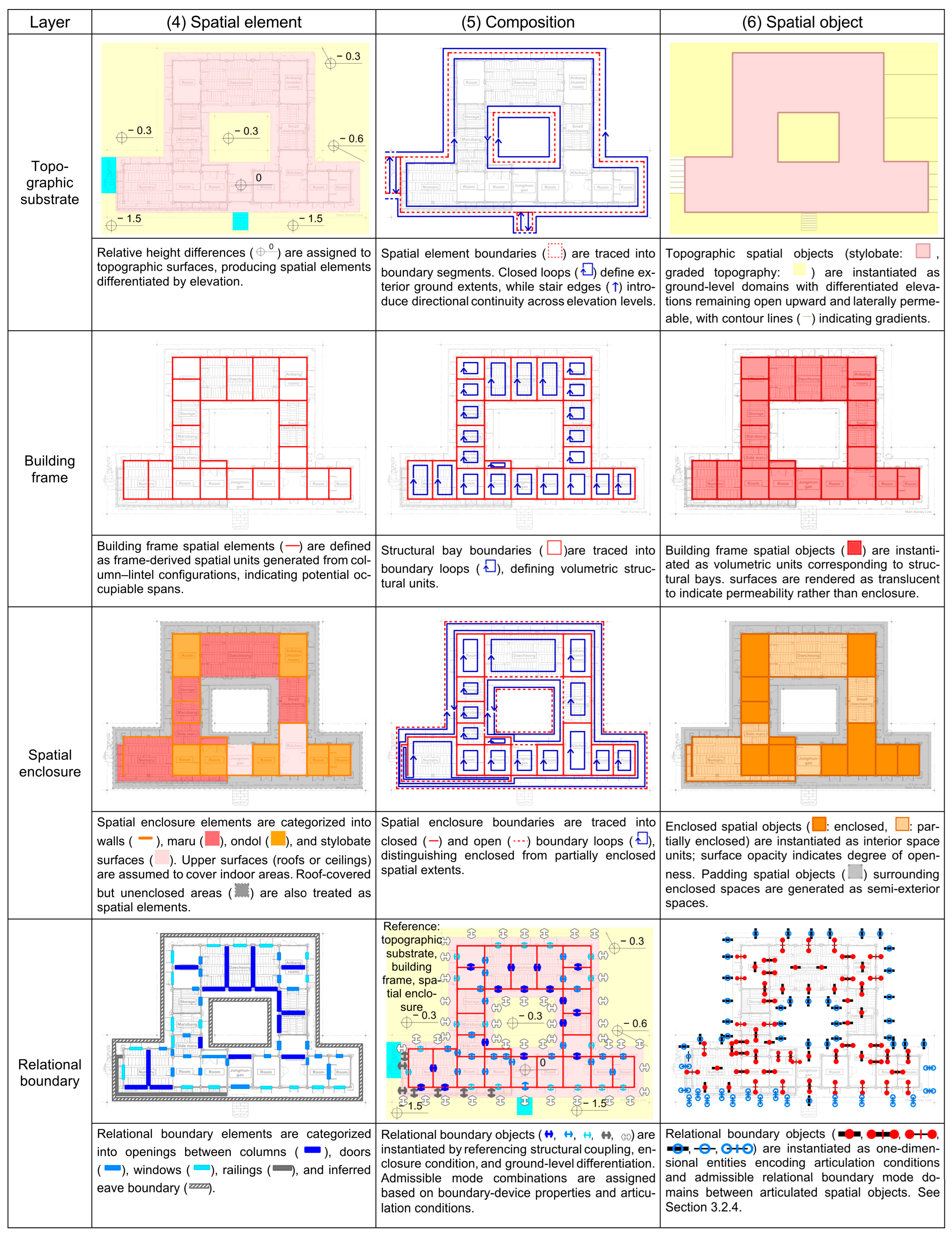
3.2.2. Articulation Procedure Across Layers
- Boundary elements are identified as geometric primitives corresponding to structurally or materially defined edges in the plan.
- Closed loops are established when boundary elements form continuous enclosure under layer-specific structural conditions.
- Spatial objects are instantiated from closed loops or from structurally supported open domains that satisfy layer-specific conditions.
- Relational boundary objects are determined by admissible mode combinations rather than geometric configuration alone.
- Inter-layer reference is permitted only when necessary to resolve geometric indeterminacy, without collapsing distinctions between layers.
3.2.3. Structured Articulation and Controlled Inter-Layer Reference
3.2.4. Relational Boundary Layer and Admissible Mode Determination
- During identification, boundary-related geometries—such as openings, gates, railings, thresholds, and topographic discontinuities—are extracted from plan-encoded information.
- During spatial derivation, these geometries are interpreted under explicit analytical criteria and associated with boundary correspondences between articulated spatial objects.
- During composition, the derived elements are instantiated as relational boundary objects, each linking a specific pair of spatial objects.
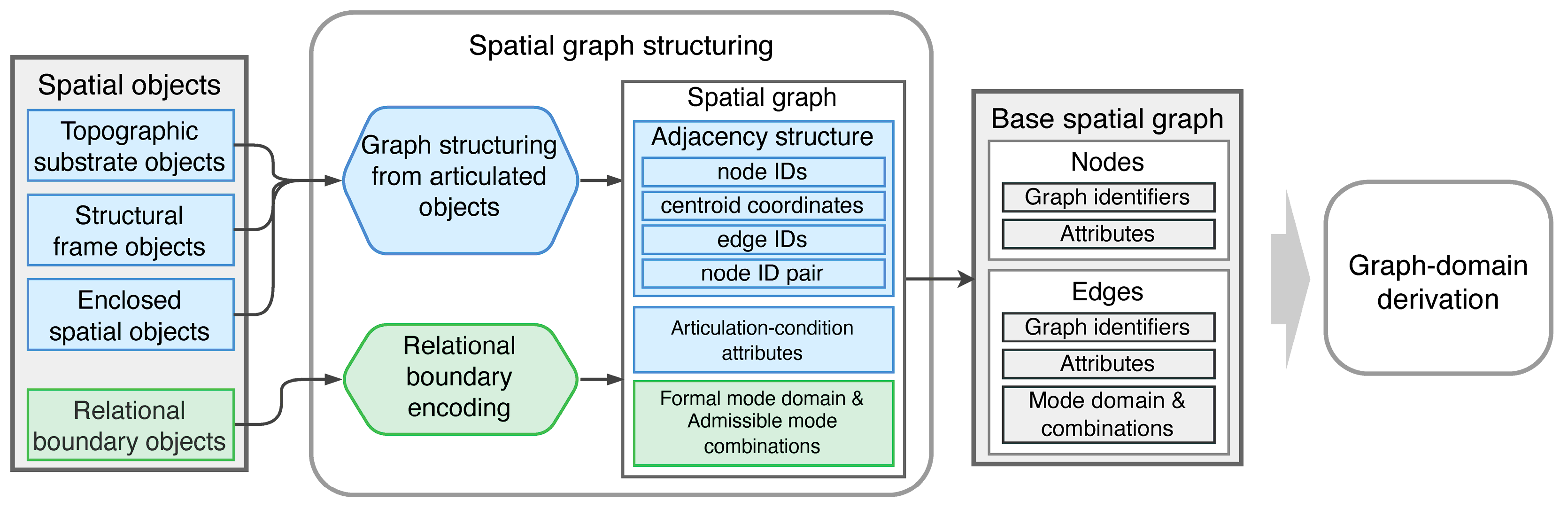
3.3. Spatial Graph Structuring and Completion of the Base Spatial Graph
3.3.1. Conceptual Structure of Spatial Graph Structuring
3.3.2. Executed Spatial Graph Structuring
- the full node set determined by layered spatial articulation,
- the complete edge set derived from shared boundary correspondences,
- articulation condition attributes associated with nodes and edges.
3.3.3. Edge-Level Encoding and Completion of the Base Spatial Graph
- a structurally determined topological structure,
- node-level articulation condition attributes,
- edge-level articulation condition attributes,
- admissible relational boundary-mode combinations.
4. Base Spatial Graph and Graph-Domain Operations
4.1. Base Spatial Graph
4.1.1. Structural Definition
4.1.2. Attribute and Mode Structure
4.1.3. Induced Relational Scope
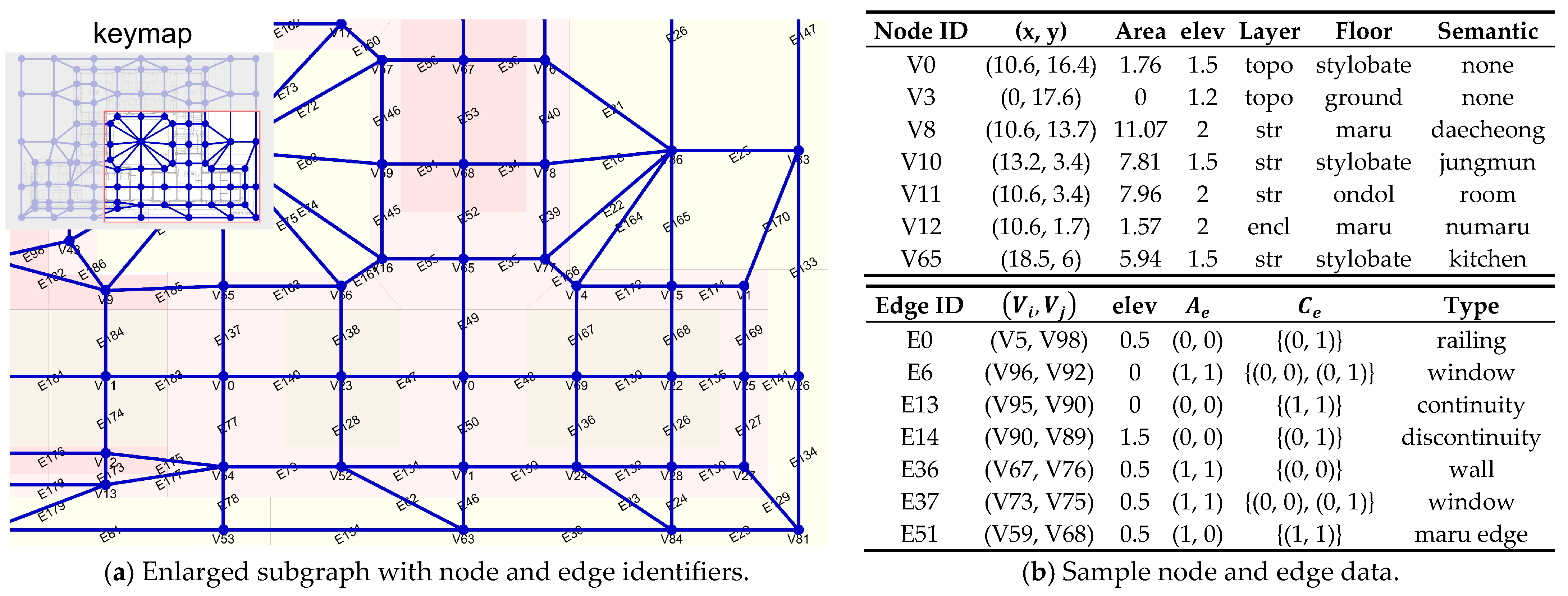
4.1.4. Reference Case Instantiation
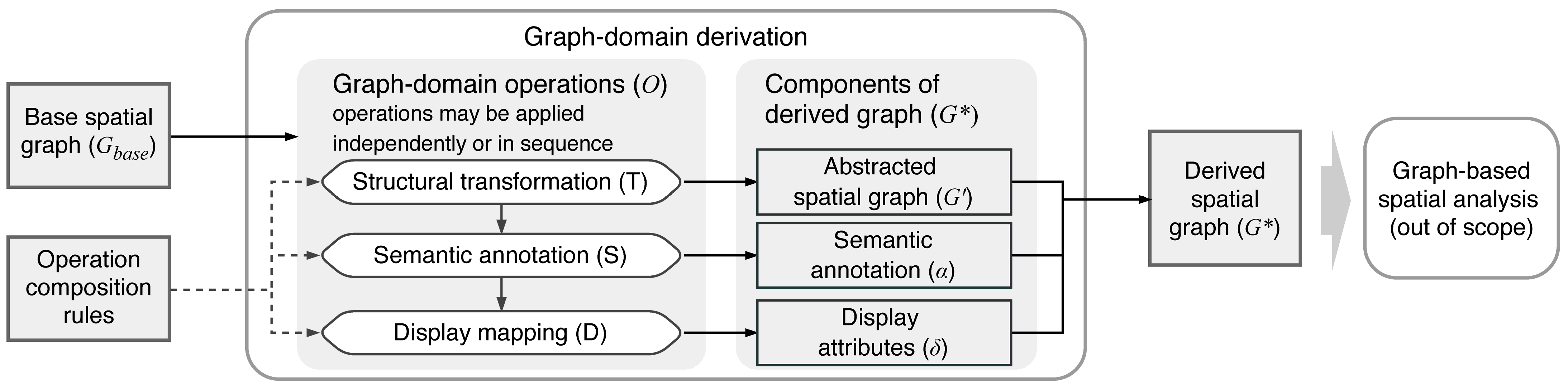
4.2. Graph-Domain Operations
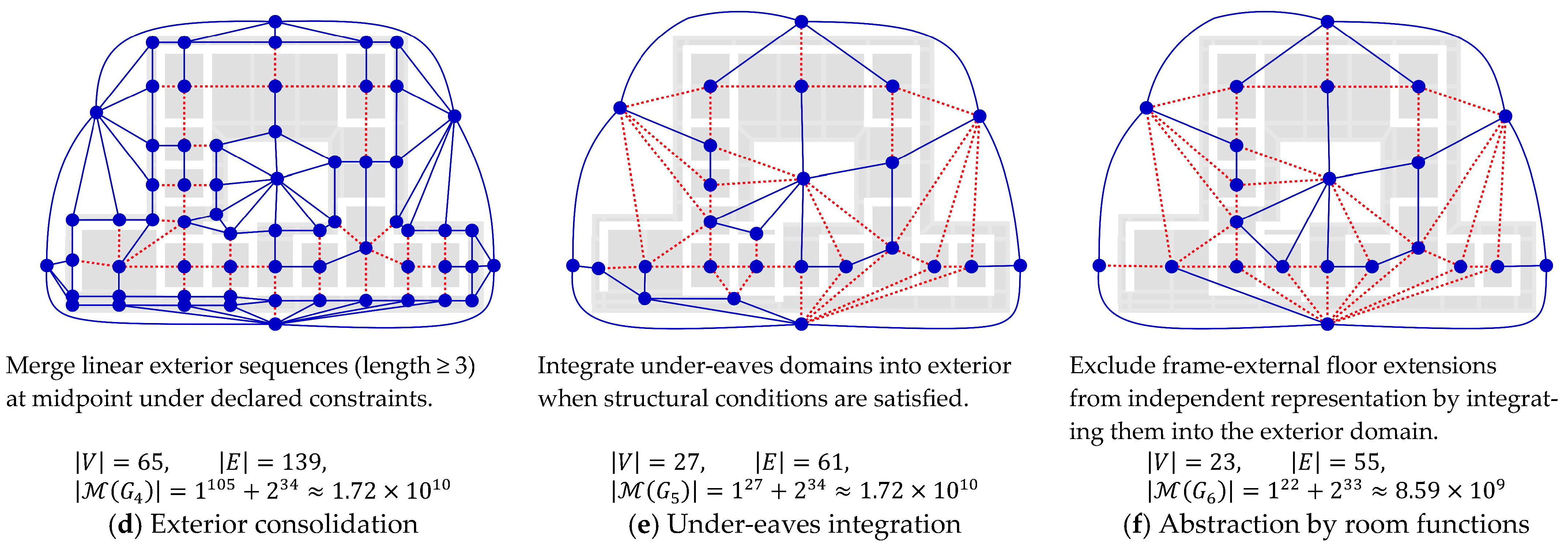
- Structural transformations (T) modifies graph topology by altering the node set, the edge set, or both.
- Semantic annotations (S) preserves topology and operates on the relational layer defined by admissible mode combination sets Ce, introducing annotation without modifying structural identity.
- Display mapping (D) assigns display attributes to the graph, specifying how structural or semantic properties are rendered without altering topology or admissible mode sets.
4.3. Structural Transformation
4.3.1. Structural Transformation Definition
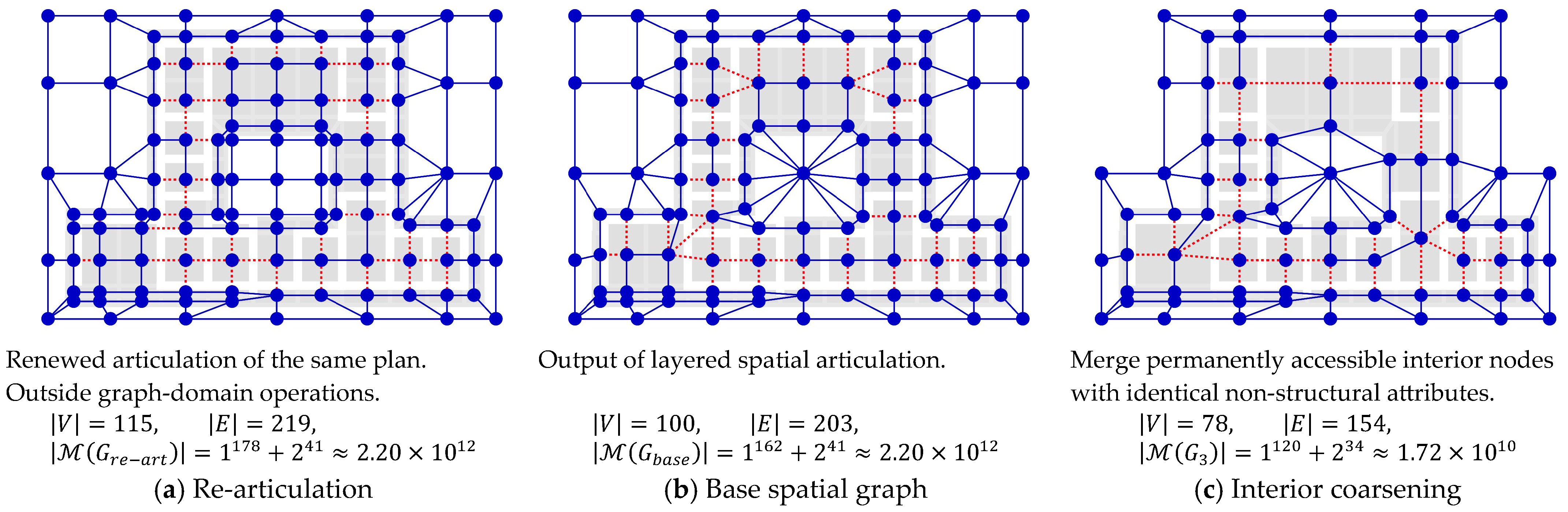
4.3.2. Structural Transformation Mechanism
4.3.3. Structural Consequence
4.3.4. Structural Transformations and Abstraction Levels
4.4. Semantic Annotation
4.4.1. Semantic Annotation Definition
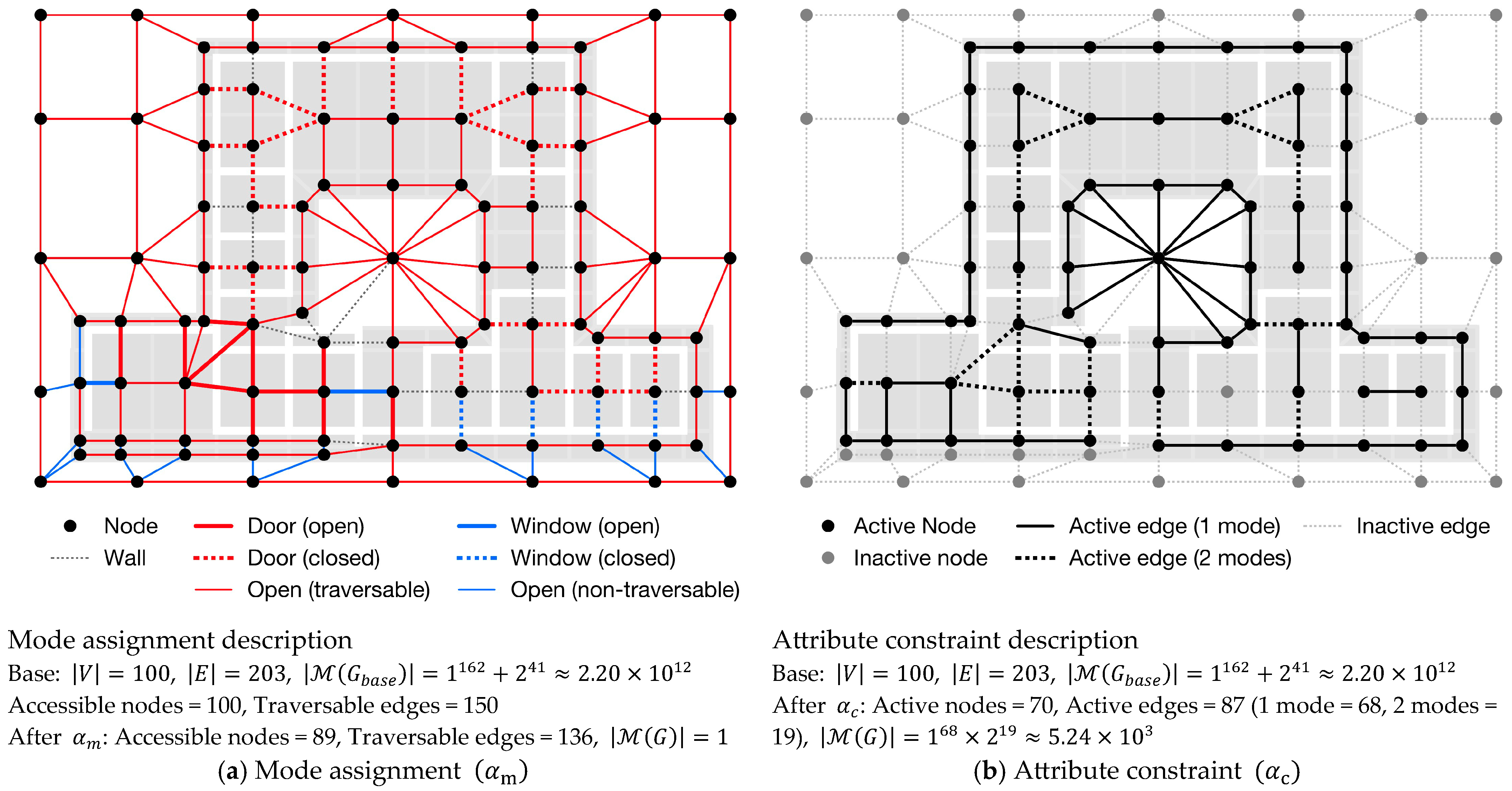
4.4.2. Mode Assignment Annotation
4.4.3. Attribute Constraint Annotation
4.4.4. Structural Invariance of Semantic Operations
4.4.5. Semantic Annotation Demonstration
4.5. Display Mapping
4.5.1. Display Mapping Definition
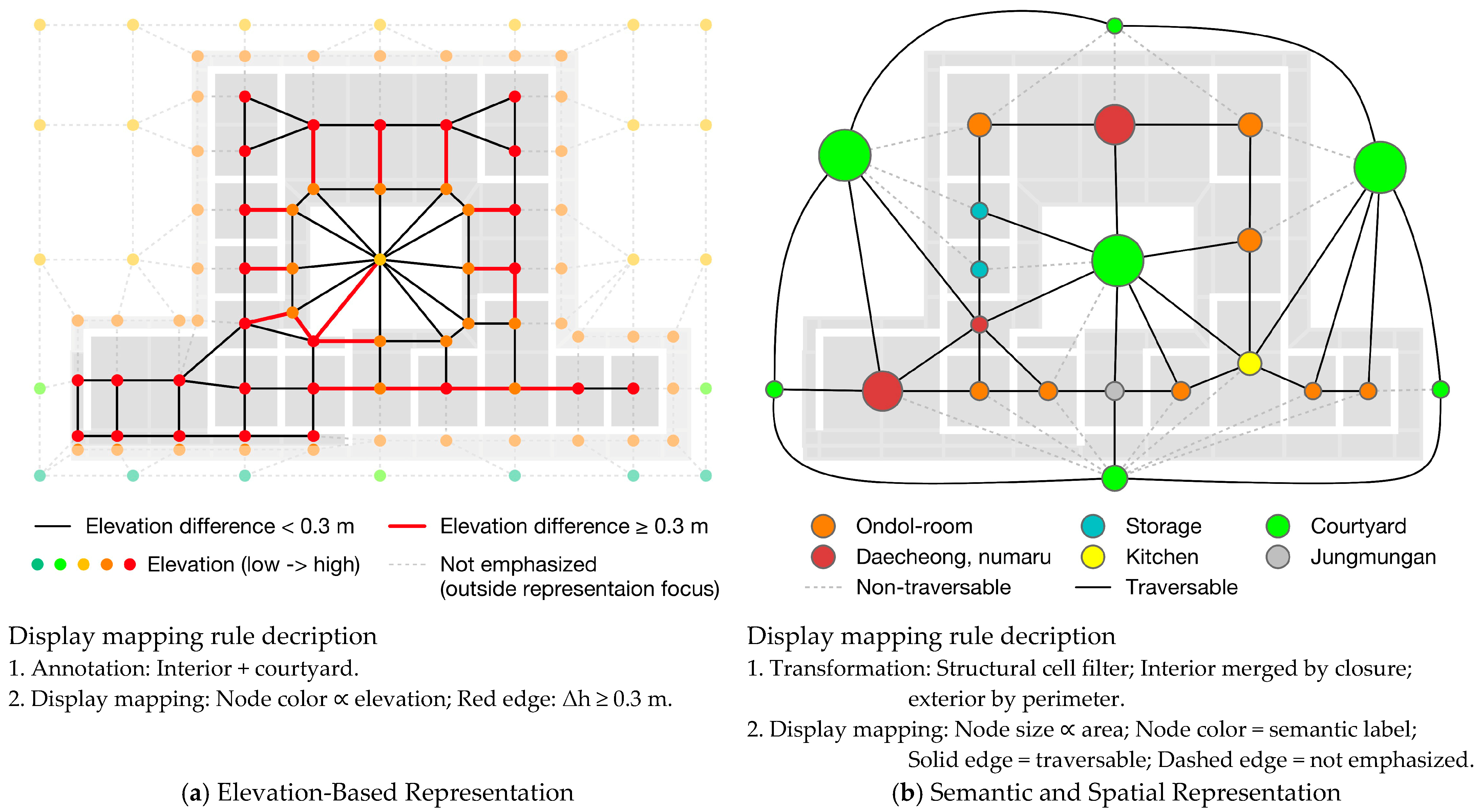
4.5.2. Display Mapping Mechanism
4.5.3. Operation Order and Composition
4.5.4. Display Mapping Demonstration
5. Discussion
5.1. Structural Determination Precedes Relational Abstraction
5.2. Analytical Coherence and Structural Grounding
5.3. Structural Consequence and Analytical Compatibility
6. Conclusions
Author Contributions
Funding
Data Availability Statement
Conflicts of Interest
References
- Hillier, B.; Hanson, J. The Social Logic of Space; Cambridge University Press: Cambridge, UK, 1984; ISBN 978-0-521-36784-4. [Google Scholar]
- Hillier, B. Space Is the Machine: A Configurational Theory of Architecture; Electronic; Space Syntax: London, UK, 2007; ISBN 978-0-9556224-0-3. [Google Scholar]
- Choi, J.; Kim, M.; Byun, N. Quantitative Analysis on the Spatial Configuration of Korean Apartment Complexes. J. Asian Archit. Build. Eng. 2013, 12, 277–284. [Google Scholar] [CrossRef] [Scilit]
- Kim, J.; Kwak, D. Extraction of Spatial Genetic Characteristics and Analysis of 1930s Korean Urban Hanok Based on Application of Space Syntax. J. Asian Archit. Build. Eng. 2022, 21, 197–210. [Google Scholar] [CrossRef] [Scilit]
- Kim, J. The Issue of Carrier Space and the Spatial Characteristics of Edo Middle-Lower Samurai Residences from a Space Syntax Perspective: Reinterpreting Spatial Evolution in Modern Japanese Urban Housing. J. Asian Archit. Build. Eng. 2025. early access. [Google Scholar] [CrossRef] [Scilit]
- Li, K.J.; Lee, J.Y. Basic Concepts of Indoor Spatial Information Candidate Standard IndoorGML and its Applications. J. Korea Spat. Inf. Soc. 2013, 21, 1–10. [Google Scholar] [CrossRef] [Scilit]
- OGC. OGC® INDOORGML, version 1.1; 19-011R4; Open Geospatial Consortium: Arlington, VA, USA, 2020.
- OGC. OGC IndoorGML 2.0 Part 1—Conceptual Model, version 2.0; 22-045r5; Open Geospatial Consortium: Arlington, VA, USA, 2025.
- Shekhar, S.; Xiong, H.; Zhou, X. (Eds.) Encyclopedia of GIS; Springer International Publishing: Cham, Switzerland, 2017; ISBN 978-3-319-17884-4. [Google Scholar]
- March, L.; Steadman, P. The Geometry of Environment: An Introduction to Spatial Organization in Design, 1st ed.; Routledge: London, UK, 2020; ISBN 978-1-000-69111-5. [Google Scholar]
- Peponis, J.; Wineman, J.; Rashid, M.; Kim, S.H.; Bafna, S. On the Description of Shape and Spatial Configuration inside Buildings: Convex Partitions and Their Local Properties. Environ. Plan. B Plan. Des. 1997, 24, 761–781. [Google Scholar] [CrossRef] [Scilit]
- Gimenez, L.; Robert, S.; Suard, F.; Zreik, K. Automatic Reconstruction of 3D Building Models from Scanned 2D Floor Plans. Autom. Constr. 2016, 63, 48–56. [Google Scholar] [CrossRef] [Scilit]
- Knechtel, J.; Rottmann, P.; Haunert, J.-H.; Dehbi, Y. Semantic Floorplan Segmentation Using Self-Constructing Graph Networks. Autom. Constr. 2024, 166, 105649. [Google Scholar] [CrossRef] [Scilit]
- Lu, Z.; Wang, T.; Guo, J.; Meng, W.; Xiao, J.; Zhang, W.; Zhang, X. Data-Driven Floor Plan Understanding in Rural Residential Buildings via Deep Recognition. Inf. Sci. 2021, 567, 58–74. [Google Scholar] [CrossRef] [Scilit]
- Lee, J.H.; Ostwald, M.J.; Zhou, L. Socio-Spatial Experience in Space Syntax Research: A PRISMA-Compliant Review. Buildings 2023, 13, 644. [Google Scholar] [CrossRef] [Scilit]
- Netto, V.M. ‘What Is Space Syntax Not?’ Reflections on Space Syntax as Sociospatial Theory. URBAN Des. Int. 2016, 21, 25–40. [Google Scholar] [CrossRef] [Scilit]
- Alexander, C.; Ishikawa, S.; Silverstein, M.; Jacobson, M. A Pattern Language: Towns, Buildings, Construction; Center for Environmental Structure Series; Oxford University Press: New York, NY, USA, 1977; ISBN 978-0-19-501919-3. [Google Scholar]
- Ching, F.D.K. Architecture: Form, Space, & Order, 4th ed.; Wiley: Hoboken, NJ, USA, 2014; ISBN 978-1-118-74513-7. [Google Scholar]
- Björk, B.-C. A Conceptual Model of Spaces, Space Boundaries and Enclosing Structures. Autom. Constr. 1992, 1, 193–214. [Google Scholar] [CrossRef] [Scilit]
- Fletcher, B.S. (Ed.) Sir Banister Fletcher’s a History of Architecture; Architectural Press: Oxford, UK, 1996. [Google Scholar]
- Perrault, C. Les Dix Livres D’architecture de Vitruve, 2nd ed.; Chez Jean Baptiste Coignard: Paris, France, 1684. [Google Scholar]
- Laugier, M.-A. Essai sur L’architecture, 2nd ed.; Chez Duchesne: Paris, France, 1755. [Google Scholar]
- Liang, S. A Pictorial History of Chinese Architecture: A Study of the Development of Its Structural System and the Evolution of Its Types; Fairbank, W., Ed.; MIT Press: Cambridge, MA, USA, 1984; ISBN 0-262-12103-4. [Google Scholar]
- Kim, D. Palaces of Korea; Korean Culture Series; Hollym International Corp: Elizabeth, NJ, USA, 2006; ISBN 978-1-56591-225-0. [Google Scholar]
- Kim, D. History of Korean Architecture; Tisher, G.A., Ed.; University of Kyonggi Press: Suwon-si, Republic of Korea, 2013; ISBN 978-89-86922-68-4. [Google Scholar]
- Cultural Heritage Administration of Korea. Gwangajeong (觀稼亭): Architectural Survey Report; Cultural Heritage Administration of Korea: Daejeon, Republic of Korea, 2001; p. 274. [Google Scholar]
- Seo, H.W.; Kim, Y. Dismantlement of Traditional Hanok Space and Emergence of Modern Hanok. J. Asian Archit. Build. Eng. 2022, 21, 173–186. [Google Scholar] [CrossRef] [Scilit]
- Mitchell, W.J. The Logic of Architecture: Design, Computation and Cognition, 6th ed.; MIT Press: Cambridge, MA, USA, 1998; ISBN 978-0-262-13238-1. [Google Scholar]
- Diestel, R. Graph Theory, 5th ed.; Graduate Texts in Mathematics; First Softcover Printing; Springer: Berlin/Heidelberg, Germany, 2018; ISBN 978-3-662-53621-6. [Google Scholar]








| Case | Spatial Basis | Recognized Spaces | Enclosure Type | Access Mode |
|---|---|---|---|---|
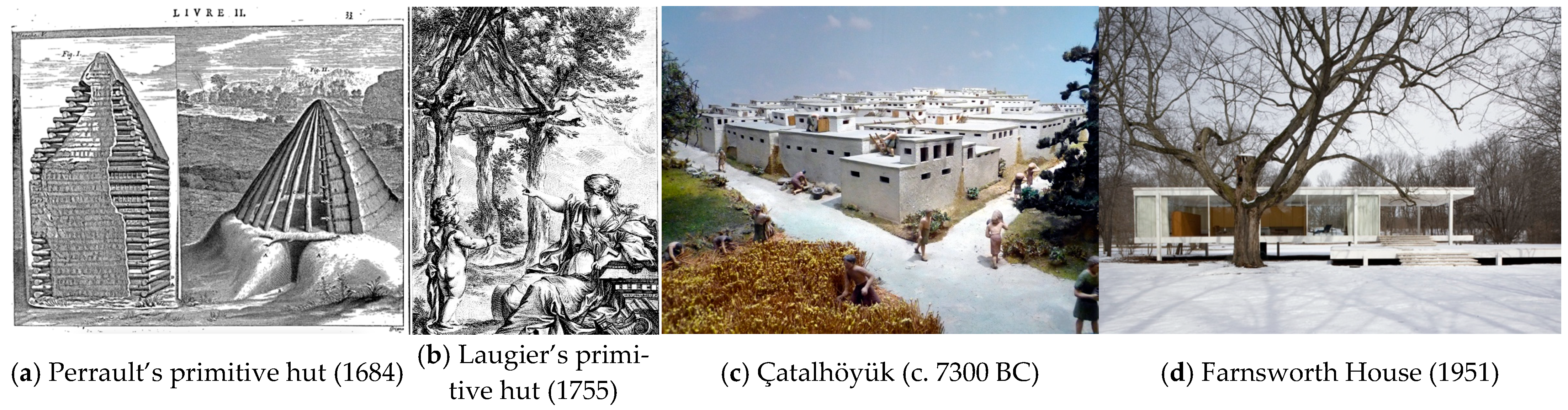
| Perrault’s primitive hut (1684) | Topographic enclosure beneath a roof structure | Enclosed interior space | Fully enclosed | At ground level |
| Laugier’s primitive hut (1755) | Exposed building frame under a roof | Space articulated by structural frame | Structurally open | Ground level |
| Çatalhöyük (c. 7300 BC) | Opaque enclosing shell defining interior and roof-level spatial domains | Enclosed interior cells; courtyard; roof-level space | Mixed (enclosed interior, open roof) | Multi-level (roof access) |
| Farnsworth House (1951) | Elevated horizontal planes organized by a vertical building frame | Glazed interior; terrace; elevated platform | Enclosed (visually permeable) | Elevated platform access |
| Spatial Type | Upper Surface | Floor Condition | Lateral Enclosure | Spatial Domain Character | Associated Activities |
|---|---|---|---|---|---|
| Ondol room | Ceiling | Ondol | Walls | Clearly defined | Sleeping, living |
| Daecheong | Roof | Wooden | Open/variable | Mixed interior–exterior | Staying, passage |
| Side maru | Roof | Wooden | Open | Attached/partial | Multi-purpose |
| Marubang | Roof | Wooden | Walls | Clearly defined | Storage |
| Kitchen | Roof | Stylobate | Walls | Semi-exterior | Cooking, heating |
| Jungmungan | Roof | Stylobate | Partial (gate) | Semi-exterior | Passage, buffering |
| Under-eaves | Eaves | Stylobate | Open | Defined by upper surface | Passage |
| Courtyard | None | Earth | None | Enclosed exterior | Multi-purpose |
| Boundary Articulation Conditions | Relational Mode Domain | Admissible Mode Combinations | Notation | Example | |||
|---|---|---|---|---|---|---|---|
| Topographic Condition | Building Frame Coupling | Lateral Enclosure Coupling | Accessibility Modes | Open-Air Modes | |||
| level | true | true | {0, 1} | {0} | {(0, 0), (1, 0)} | ●=|=● | door |
| {0} | {0, 1} | {(0, 0), (0, 1)} | ●-|-● | window | |||
| false | {1} | {1} | {(1, 1)} | =●= | open bay | ||
| {0} | {1} | {(0, 1)} | -●- | railings | |||
| false | false | {1} | {1} | {(1, 1)} | =○= | eave boundary | |
| {0} | {1} | {(0, 1)} | -○- | railings | |||
| true | {0, 1} | {1} | {(0, 1), (1, 1)} | ○=|=○ | main gate | ||
| discontinuous | false | false | {0} | {1} | {(0, 1)} | ○-|-○ | retaining wall |
Disclaimer/Publisher’s Note: The statements, opinions and data contained in all publications are solely those of the individual author(s) and contributor(s) and not of MDPI and/or the editor(s). MDPI and/or the editor(s) disclaim responsibility for any injury to people or property resulting from any ideas, methods, instructions or products referred to in the content. |
© 2026 by the authors. Licensee MDPI, Basel, Switzerland. This article is an open access article distributed under the terms and conditions of the Creative Commons Attribution (CC BY) license.
Share and Cite
Lee, D.; Yoo, J. Layered Spatial Articulation and Base Spatial Graph: Formalizing Structural Preconditions of Architectural Spatial Analysis. Buildings 2026, 16, 1536. https://doi.org/10.3390/buildings16081536
Lee D, Yoo J. Layered Spatial Articulation and Base Spatial Graph: Formalizing Structural Preconditions of Architectural Spatial Analysis. Buildings. 2026; 16(8):1536. https://doi.org/10.3390/buildings16081536
Chicago/Turabian StyleLee, Daegeon, and Jaewoo Yoo. 2026. "Layered Spatial Articulation and Base Spatial Graph: Formalizing Structural Preconditions of Architectural Spatial Analysis" Buildings 16, no. 8: 1536. https://doi.org/10.3390/buildings16081536
APA StyleLee, D., & Yoo, J. (2026). Layered Spatial Articulation and Base Spatial Graph: Formalizing Structural Preconditions of Architectural Spatial Analysis. Buildings, 16(8), 1536. https://doi.org/10.3390/buildings16081536