1. Introduction
Recycled aggregate concrete (RAC) facilitates the upcycling of construction waste by substituting natural aggregates with crushed, cleaned, and graded waste concrete. Driven by the escalating scarcity of non-renewable resources such as natural sand and cement, the promotion of RAC offers a sustainable pathway for the modern concrete industry [
1,
2]. However, extensive literature indicates that RAC typically exhibits inferior mechanical performance compared to natural aggregate concrete (NAC). These deficiencies are primarily attributed to microstructural heterogeneities, including residual mortar, porous interfacial transition zones (ITZs), and inherent microcracks, which collectively result in reduced compressive strength and ductility [
3,
4,
5]. Furthermore, the mechanical properties of RAC are highly sensitive to the aggregate replacement ratio and internal material structure, with distinct performance fluctuations observed at varying replacement levels [
6,
7]. Such intrinsic structural deficiencies inherently constrain the widespread adoption of RAC in primary load-bearing components [
8]. In practical engineering scenarios, RAC members frequently suffer from varying degrees of initial damage prior to strengthening, which significantly dictates their residual performance. This degradation is often induced by long-term service loading [
9], construction-related vibrations [
10], or environmental stressors such as freeze–thaw and wet-dry cycles [
11]. This pre-existing damage not only compromises the load-carrying capacity and ductility of RAC members but may also trigger premature shifts in failure modes, thereby complicating the effectiveness of subsequent strengthening measures. Consequently, evaluating the mechanical response of RAC under diverse initial damage levels and investigating its behavior under external confinement are essential for reliable strengthening design and structural safety assessments.
To mitigate the mechanical deficiencies of RAC, carbon fiber-reinforced polymer (CFRP) has emerged as an effective solution for structural rehabilitation due to its high strength-to-weight ratio and corrosion resistance. The concept of FRP-confined concrete as a composite structural system was first proposed by Mirmiran [
12], sparking extensive global research into its confinement mechanisms. Dey et al. [
13] demonstrated that as axial stress increases, the lateral expansion of the concrete core activates the FRP jacket, generating circumferential tensile stresses that provide passive confinement. Notably, research indicates that the ultimate strain measured during FRP rupture is typically lower than the material’s theoretical tensile limit, a phenomenon known as the strain efficiency factor [
14,
15,
16]. Furthermore, the efficacy of this confinement is highly dependent on cross-sectional geometry, with circular columns exhibiting superior performance compared to square or rectangular counterparts due to a more uniform confining pressure distribution [
17,
18]. Recent advancements have further extended the application of FRP confinement to innovative materials and construction methodologies. For instance, investigations into FRP-confined 3D-printed ultra-high-performance concrete (UHPC) highlight that FRP wrapping significantly mitigates the interlayer defects inherent in 3D printing, with the loading direction relative to the printing layers being a critical factor in confinement efficiency [
19]. Additionally, in composite systems such as CFRP-confined, UHPC-confined high-strength steel columns, the confinement not only enhances the axial strength but also addresses the strain incompatibility between high-strength steel and the brittle concrete matrix [
20]. CFRP jackets have been shown to significantly improve the bond-slip behavior between steel rebars and low-strength concrete by constraining localized dilation [
21]. While numerous constitutive models have been developed to predict the stress–strain behavior of FRP-confined NAC, their applicability to damaged RAC remains inadequately verified. Various researchers have proposed trilinear models [
22,
23] or parabolic-linear relationships [
24] to capture the mechanical response of confined elements. More complex unified models have introduced parameters such as section aspect ratios and corner radii to enhance predictive accuracy [
25,
26]. However, research focusing on CFRP-confined RAC, especially under high replacement ratios and initial damage conditions, is still limited. Preliminary evidence suggests that while low-replacement RAC behaves similarly to NAC, high-replacement variants (e.g., 100%) exhibit a significantly lower second-branch slope and reduced strength, despite showing larger ultimate axial strains [
27,
28,
29]. This discrepancy underscores the urgent need for a refined constitutive model that accounts for the coupling effects of aggregate replacement and pre-existing damage.
Initial damage fundamentally modifies the mechanical properties of concrete, characterized primarily by significant reductions in elastic stiffness and peak compressive strength. Research by Wu et al. [
30] and Ma et al. [
31] reported that while pre-damage severely compromises these initial properties, its impact on the ultimate compressive strain remains relatively negligible. Similarly, Tijani et al. [
32] observed that pre-existing degradation adversely affects the peak compressive strength capacity of the concrete matrix. However, the extent of this performance loss is closely linked to the level of external confinement; for instance, Guo et al. [
33] demonstrated that while pre-damage markedly reduces the strength of columns confined with one or two CFRP layers, the application of three layers can effectively offset this negative impact. These findings suggest that the mechanical response of concrete is highly sensitive to confinement stiffness, where robust lateral restraint can successfully mitigate the deleterious effects of initial structural defects. This mitigating effect is also observed in natural sustainable materials; for example, FRP jackets have been shown to alter the failure modes and significantly enhance the load-bearing capacity of structural bamboo tubes, effectively constraining local buckling even in the presence of natural nodes and hollow sections [
34].
The advancement of damage constitutive models offers a robust analytical framework for simulating the micro-level degradation and evolution within complex cementitious matrices. Considering the intrinsic complexities of recycled aggregates, such as the porous nature of residual mortar, developing models for confined damaged RAC is an essential yet often overlooked endeavor. Li et al. [
35] utilized stochastic damage theory to elucidate the compressive constitutive relationship of high-performance concrete (HPC) within the 60–80 MPa strength range. Similarly, comprehensive tests on FRP-confined UHPC in circular columns have refined the understanding of confinement efficiency, identifying specific confinement ratio thresholds required to avoid abrupt stress reduction and ensure sufficient ductility in ultra-dense matrices [
36]. Furthermore, Cao et al. [
37] established an analysis-oriented stress–strain model for FRP-confined pre-damaged concrete by integrating a wide range of experimental data and considering factors like cross-sectional geometry and corner radii. In addition to analytical frameworks, advanced predictive techniques such as machine learning-driven solutions and reliability analysis are increasingly being utilized to characterize CFRP-confined concrete systems [
38]. While employing these damage models designed for high-performance or specialized materials can provide critical design references for RAC applications, their implementation in the specific domain of CFRP-confined damaged RAC remains relatively scarce. This research gap underscores the necessity of establishing a refined theoretical model to facilitate the reliable performance assessment of sustainable recycled concrete structures.
Despite extensive research on confined concrete, the mechanical synergy between CFRP and pre-damaged RAC remains poorly understood. Specifically, the current literature predominantly focuses on pristine specimens, leaving a critical knowledge gap regarding how pre-existing cracks in RAC influence the subsequent confinement activation of CFRP. Firstly, the axial stress–strain characteristics and failure mechanisms of RAC with high aggregate replacement ratios exhibit unique behaviors that deviate significantly from those of NAC; however, existing predictive models are largely based on NAC, rendering them inadequate for capturing the enhanced lateral expansion of damaged RAC. Secondly, the interactive mechanism between pre-existing damage and confinement efficacy is insufficiently characterized, particularly lacking a quantitative correlation between the initial damage degree and the residual confinement potential provided by varying CFRP layers. Thirdly, most prevailing constitutive models are calibrated for undamaged or low-replacement RAC, resulting in a critical lack of unified design guidelines capable of accurately predicting the performance degradation under complex pre-damage scenarios. Finally, the scarcity of microscopic damage evolution simulations hinders the development of high-fidelity analytical tools for structural assessment. These limitations collectively create a theoretical disconnect between idealized laboratory testing and real-world structural rehabilitation, highlighting an urgent need for refined mechanical evaluations and robust predictive methodologies.
To address these specific theoretical and practical gaps, this study systematically investigates the axial compressive response of CFRP-confined RAC prisms subjected to varying levels of initial damage. Using RAC prisms as the primary research subjects, monotonic axial compression tests were executed to evaluate the impact of pre-damage levels (S1, S2, and S3) on structural integrity. Following the simulation of initial damage, the specimens were retrofitted with circumferential CFRP wraps to examine the restorative effects of confinement. The experimental matrix was designed to quantitatively elucidate the coupled influences of aggregate replacement ratios, concrete strength grades, and the number of CFRP layers on the recovery of load-carrying capacity and ductility. The unique scientific contribution and novelty of this research lie in its systematic quantification of the confinement efficiency degradation under the synergistic effects of high replacement ratios (up to 100%) and severe initial structural damage. By moving beyond idealized laboratory conditions, this work provides a more authentic representation of real-world structural rehabilitation and offers a newly developed constitutive model that uniquely integrates a damage-dependent modification factor derived from the proposed index. This advanced analytical framework specifically addresses the inherent unreliability of conventional models when applied to degraded sustainable structures by accurately capturing the specific mechanical degradation behaviors characteristic of structural-grade RAC under initial damage, providing critical theoretical guidance for the precision retrofitting of green construction.
2. Test Design
2.1. Specimen Design
As shown in
Table 1, a total of 48 CFRP-confined specimens and 6 ordinary RAC specimens were designed. All specimens were cast as 100 × 100 × 300 mm square prisms with sharp corners. This specific geometry was intentionally selected to represent the most adverse confinement conditions typically found in existing rectangular reinforced concrete columns that lack corner rounding. Utilizing square prisms allows for a conservative evaluation of the lower bound of CFRP-strengthening effectiveness in practical engineering. Four factors were considered for these prism specimens: concrete strength grades (C40 and C50), recycled aggregate replacement ratios (30%, 40%, and 50%), initial damage levels (0, 1, 2, and 3), and the number of CFRP confinement layers (1 and 3). The selection of 30%, 40%, and 50% replacement ratios was designed to capture the “critical transition zone” of RAC mechanical properties. While a 0% replacement ratio (natural aggregate concrete) serves as a traditional baseline, and a 100% replacement ratio maximizes recycled material utilization, current structural design guidelines for load-bearing elements typically restrict the RA replacement to below 50% to prevent excessive stiffness degradation. By focusing on this high-granularity range (30–50%), this research provides more targeted data for engineering scenarios where safety and carbon reduction must be balanced, especially when coupled with pre-existing structural damage.
2.2. Constituent Materials
2.2.1. Recycled Aggregate Concrete
The recycled aggregate concrete for this experiment was cast at the Engineering Research Center of Wuhan University of Science and Technology. The mixing materials, including P.O 42.5 ordinary Portland cement, sand, natural coarse aggregate, recycled coarse aggregate, and water, were provided by Huaxin Cement Co., Ltd. (Wuhan, China), and mixed mechanically. Two mix designs, in accordance with standard [
39], were used to prepare C40 and C50 recycled concrete. To support the reproducibility of these results,
Table 2 details the comprehensive mix design, which includes cement content, water-binder ratio, aggregate proportions, and superplasticizer dosage. To eliminate the influence of the high water absorption of the recycled coarse aggregate (RCA) on the mix proportions, all coarse aggregates were pre-conditioned to a saturated surface-dry (SSD) state before the mixing process. All RAC mixtures were prepared using a polycarboxylate-based superplasticizer to ensure target workability and dense compaction of the matrix.
2.2.2. Coarse Aggregate
The recycled coarse aggregate was obtained by manually crushing, sieving, washing, and air-drying C30 waste concrete specimens from the research center. Both natural coarse aggregate and recycled coarse aggregate have particle sizes ranging from 5 to 20 mm. The apparent density, water absorption, and crushing index of the two coarse aggregates were determined according to standard [
40], and the values are 2840 kg/m
3 and 2614 kg/m
3, 0.50% and 7.85%, 3.33% and 8.9%, respectively. The RCA was processed through four key steps. First, coarse RCA fragments were manually crushed and sieved to retain particles. Notably, a significant amount of attached mortar remained bonded to the original aggregates. Given the remarkably high water absorption of the RCA (7.85% compared to 0.50% for NCA), the attached mortar content is estimated to be highly significant according to established empirical relationships in the literature [
41,
42]. This high content of residual mortar dictates the weaker microstructural characteristics of the resulting RAC. After air-drying for 48 h to eliminate moisture fluctuation, the RCA were pre-soaked and brought to a SSD condition to account for their high water absorption (7.85%). This conditioning ensured that the effective water-cement ratio remained stable during the subsequent mixing process. Finally, the processed RCA was transferred to a rotating mixer. A 10 min mixing cycle ensured the uniform distribution of particle sizes, achieving the homogeneity required for the experimental plan [
43].
2.2.3. Superplasticizer
The HF-based polycarboxylate superplasticizer was sourced from Guizhou Hengfan New Technology Development Co., Ltd. (Guiyang, China). The water reduction rate is 25–30%, with a yellow-brown liquid appearance, and the dosage is 0–1% [
44].
2.2.4. Water
Tap water was used for sample preparation. As RAC absorbs more water with an increase in the amount of coarse aggregate [
45,
46], an additional amount of water equivalent to 4% of the coarse aggregate mass was added.
2.2.5. CFRP
The CFRP was produced by Jiajian Doctor Shanghai Building Technology Co., Ltd. (Wuxi, China) with a strength grade of II, and its mechanical properties are shown in
Table 3, which meet the design requirements for strengthening materials according to current standards [
47].
2.2.6. Structural Glue
The impregnating resin was produced by Jiajian Doctor Shanghai Building Technology Co., Ltd. (Shanghai, China). The resin model is JN-C3P, which has strong bonding and penetration capabilities, wide adaptability, and can cure with various types of fiber materials at temperatures above 5 °C. It possesses good physical and chemical properties, and meets the standards for Grade A impregnating resin as specified in the “Technical Specification for Safety Appraisal of Engineering Structural Strengthening Materials” (GB50728-2011) [
48].
2.3. Method of Axial Pre-Damage Simulation
Based on existing methods for defining initial damage in concrete from previous studies [
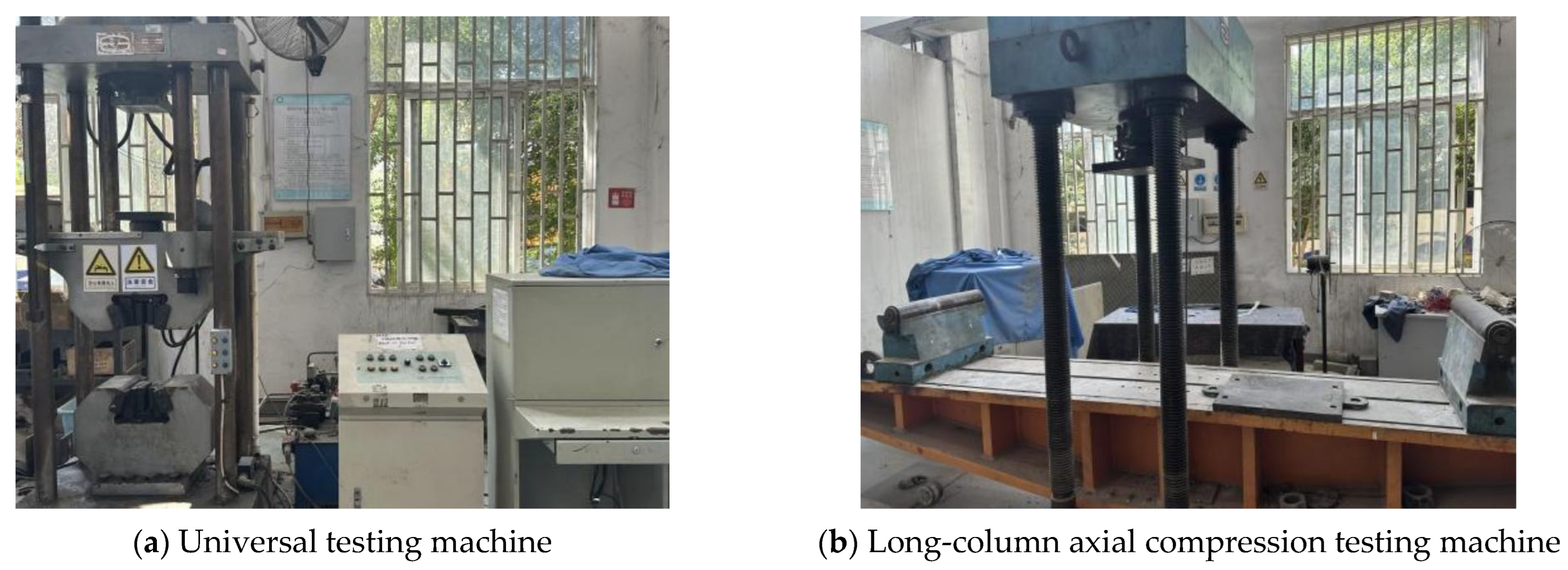
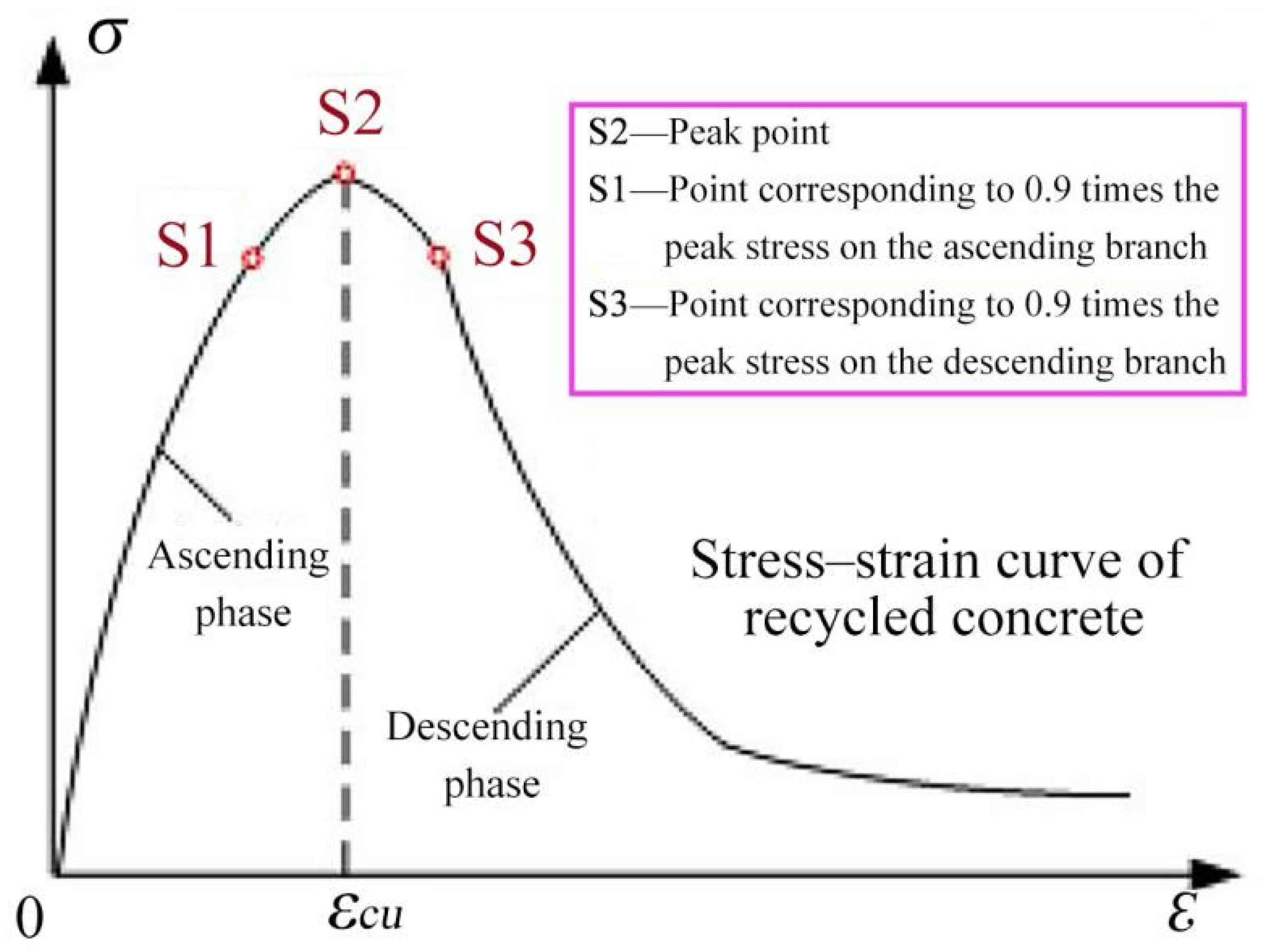
31], this study employed a standardized axial compression loading-unloading protocol conducted via a 1000 kN electronic universal testing machine at the Civil Engineering Experimental Center of Wuhan University of Science and Technology. To ensure specimen alignment, a pre-load of 2.0 kN was applied before formal testing. Characteristic stress levels on the recycled concrete axial stress–strain curve were adopted as quantitative thresholds, as illustrated in
Figure 1. To ensure the repeatability of the induced damage, all specimens were loaded in a displacement-controlled mode at a constant rate of 1 mm/min. The unloading phase was executed at a constant rate of 2 mm/min until a residual load of approximately 2.0 kN was reached to maintain specimen stability. Specifically, unloading after loading to 0.9 f′
co in the ascending branch is defined as the first damage level (S1, representing micro-crack initiation); unloading after reaching the peak stress and entering the descending branch at 0.9 f′
co (at a strain of approx. 1.2 ℇ
co) is defined as the second damage level (S2, representing macro-crack coalescence); and unloading at the point where the stress dropped to 0.9 f′
co further along in the descending branch (at a larger strain of approx. 2.0 ℇ
co) is defined as the third damage level (S3, representing severe structural degradation). The target stress levels for each group were calibrated based on the average compressive strength of control specimens to minimize experimental dispersion across different replacement ratios.
A total of 36 recycled concrete specimens were subjected to axial compression loading-unloading at three quantitative stress levels (S1, S2, S3). By precisely controlling the maximum stress and deformation reached during loading, microcrack initiation and propagation inside the specimens could be induced without causing macroscopic failure, thereby forming different levels of initial damage. This method has been widely used in pre-damage studies of concrete and recycled concrete [
49]. The quantitative characterization of the damage was further evidenced by the monitoring of residual axial strain upon unloading, which served as a physical indicator of the internal damage density.
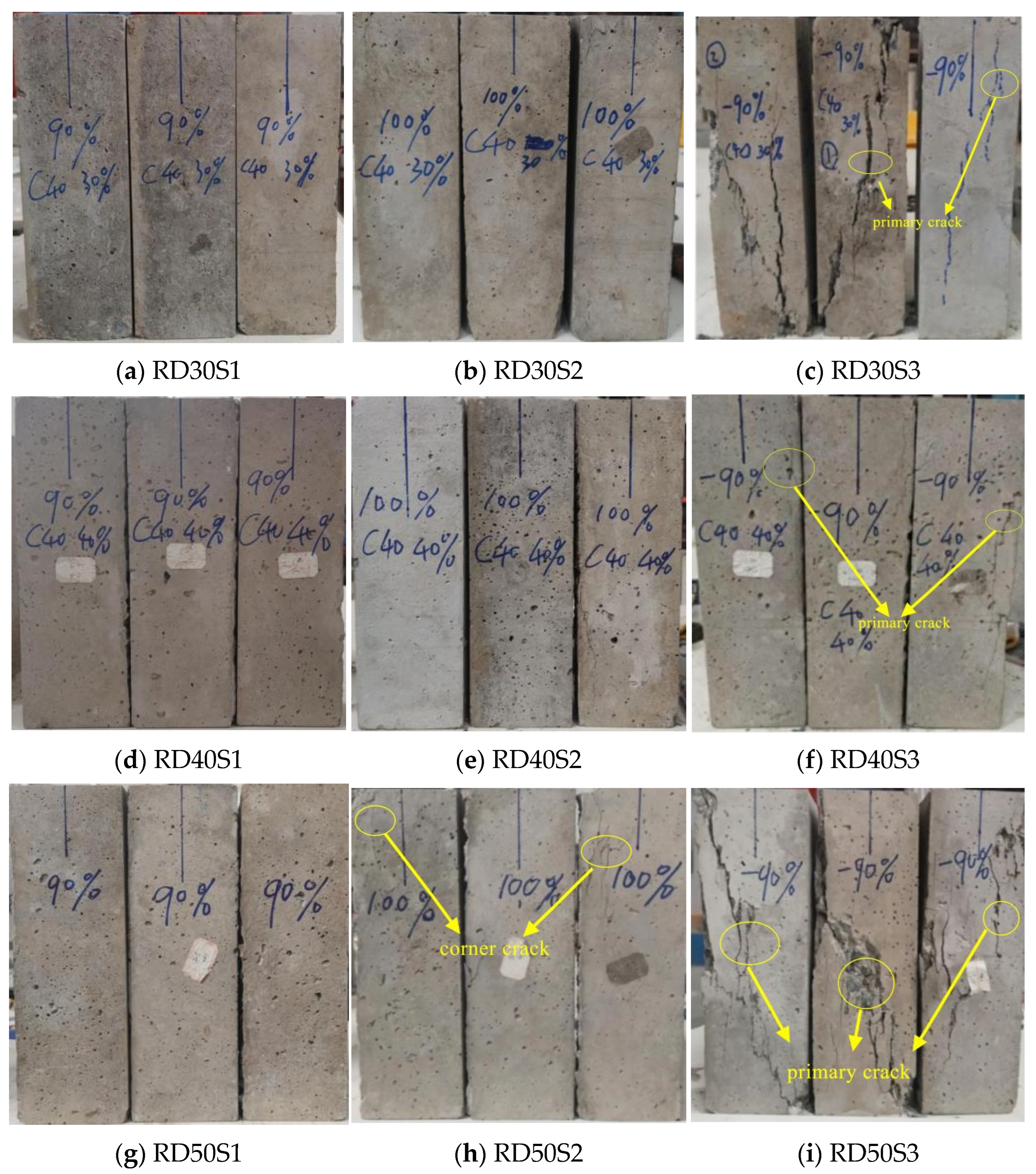
Figure 2 shows the pre-damage states of specimens with different replacement ratios at the C40 grade.
Surface observations of the specimens revealed that initial cracks primarily appeared in the corner regions at the ends. As the axial load increased, the cracks gradually extended in both depth and width, indicating significant stress concentration in the corner region, which is consistent with the findings of Wang et al. [
50]. Upon further loading, fine cracks extended downward, accompanied by minor cracking sounds, and gradually merged with midsection cracks, forming a main diagonal crack.
As the content of RCA increased, all specimens still exhibited similar macroscopic failure modes during axial compression loading, where cracks primarily originated in the corner regions at the ends and gradually extended toward the center of the specimen, ultimately forming a main diagonal crack. However, the increase in recycled coarse aggregate content significantly lowers the axial compression level required for crack initiation and damage development and accelerates the crack propagation and damage evolution process. This is primarily attributed to the weak interfaces commonly present between the old and new mortar in recycled concrete, including the cement-recycled aggregate interface and the interface transition zone between the old mortar and old aggregate within the recycled coarse aggregate. These interfaces have higher pore numbers and defect levels than natural aggregates, creating more potential weak zones. As the recycled coarse aggregate content increases, this additional weakening effect is further amplified.
At the S1 damage level, no obvious cracks appeared on the surface of the specimens; as the damage intensified, the cracks in S2 and S3 specimens increased in length and width, accompanied by surface concrete spalling and localized fragmentation. It should be noted that an exploratory group of high-strength concrete specimens (C60 grade, totaling 12 specimens) was initially prepared alongside the C40 and C50 groups. However, these C60 specimens were more prone to sudden failure during the pre-damage loading phase compared to the normal-strength groups, particularly exhibiting more pronounced brittle characteristics under high replacement rates. Consequently, achieving the controlled initial damage levels (S1–S3) was not feasible, leading to the premature failure of these specimens before CFRP wrapping. As a result, the entire batch of 12 C60 specimens was discarded, and their data were excluded from the analysis. This exclusion was systemic rather than selective; the remaining 48 specimens (C40 and C50 groups) successfully completed all testing protocols. These remaining configurations constitute a fully complete and systematic parametric matrix, ensuring that the overall integrity and reliability of the parametric analysis are perfectly preserved without any cherry-picking of data.
2.4. CFRP Wrapping Scheme
To study the effect of CFRP on the axial mechanical properties of pre-damaged recycled concrete (RC) columns, all pre-damaged specimens underwent surface treatment before CFRP wrapping. The treatment steps include cleaning loose debris and dust from the surface, repairing severely damaged areas with fast-setting mortar, and then curing the specimens for 7 days under standard curing conditions. After curing, the surface of the specimens was polished to ensure good contact between the CFRP and the concrete surface. The CFRP wrapping scheme is designed as follows:
(1) Carbon fiber fabric cutting and impregnation
The carbon fiber fabric was cut according to the specimen dimensions, leaving a 100 mm overlap to ensure tight wrapping. The resin A and B components were mixed in the specified ratio and evenly applied to both sides of the carbon fiber fabric. A layer of impregnating resin was first brushed onto the concrete surface, followed by wrapping the carbon fiber fabric onto the specimen’s surface. During the wrapping process, gaps were minimized between the carbon fiber fabric and the concrete surface, and excess resin was squeezed out to ensure a tight bond between the confinement layer and the specimen.
(2) Number of confinement layers and grouping
For specimens with different recycled aggregate replacement ratios, each group consists of 3 specimens, with 1 and 3 layers of CFRP confinement, to investigate the effect of the number of layers on axial performance.
(3) End reinforcement
To prevent localized failure at the ends of the specimens during axial loading, a 30 mm wide carbon fiber fabric was applied for reinforcement at both ends. End reinforcement was performed after the overall wrapping was completed, using the same procedure as the main wrapping to ensure uniform stress distribution.
(4) Quality control
After wrapping, the adherence of the CFRP to the concrete surface, overlap length, and integrity of the end reinforcement were checked to ensure that the confinement effect is uniform and reliable.
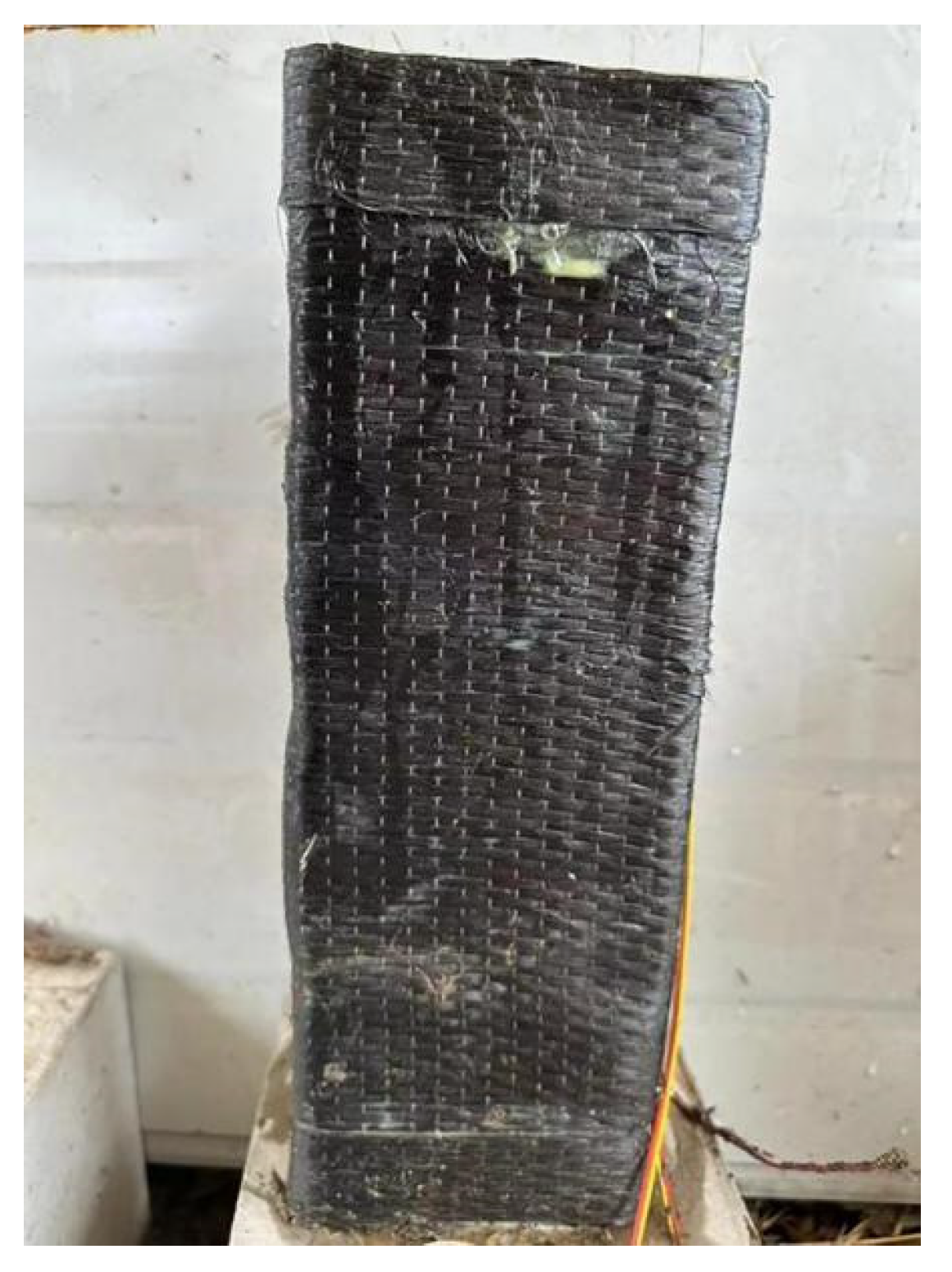
Figure 3 shows the appearance of the specimens after the CFRP wrapping was completed. This confinement scheme effectively improves the axial mechanical properties of pre-damaged recycled concrete columns and provides a reliable experimental basis for subsequent loading tests.
2.5. Experimental Setup and Loading Scheme
The experiments were conducted at the Engineering Research Center of Wuhan University of Science and Technology. The pre-damage tests were carried out on a universal testing machine with a range of 1000 kN, using displacement control, following the relevant provisions of the “Standard for Mechanical Performance Testing of Ordinary Concrete” [
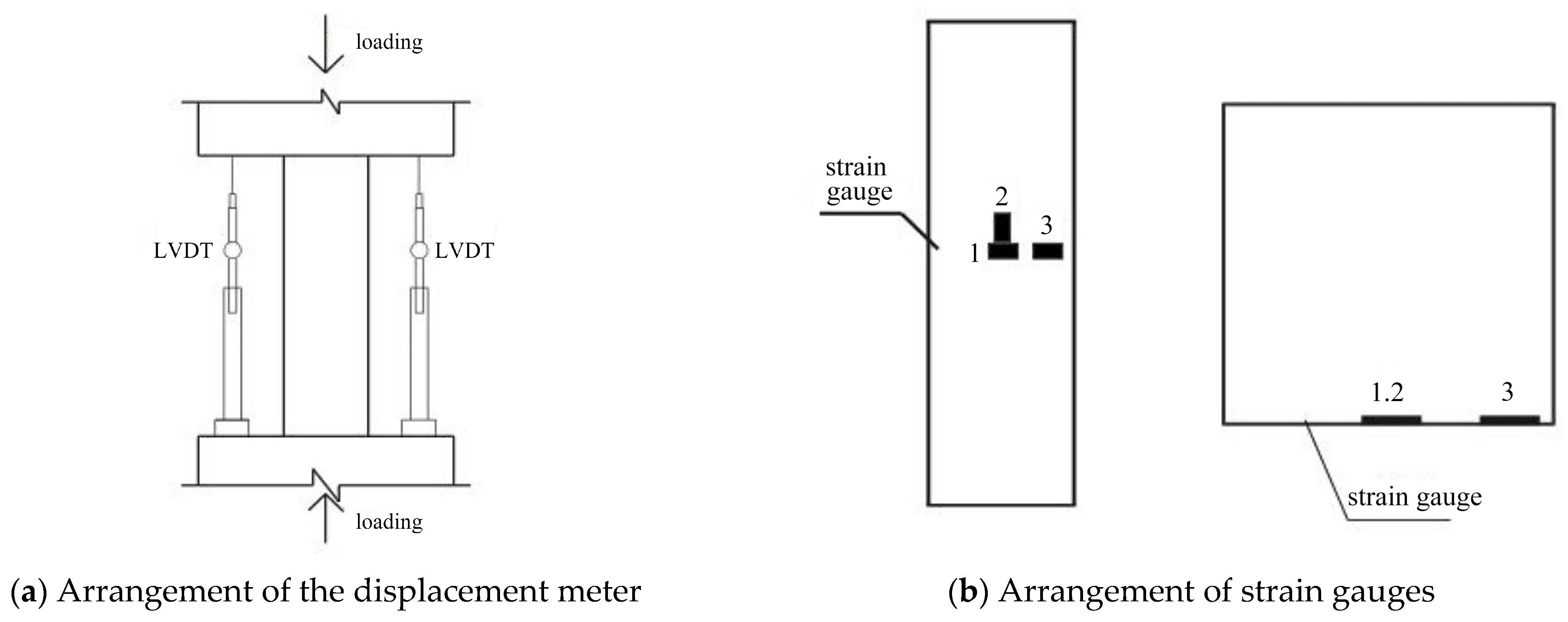
51] (GB/T50081-2019). The specific loading method was as follows: when the specimen’s bearing capacity was between 0 and 200 kN, the loading speed was 0.15 mm/s; when the bearing capacity was between 200 and 350 kN, the loading speed was 0.1 mm/s; and when the bearing capacity exceeded 350 kN, the loading speed was 0.05 mm/s. CFRP-confined specimens were tested on a long-column testing machine with a range of 2000 kN, and the loading rate was 2 kN/s. The loading setup is shown in
Figure 4.
During the experiment, axial pressure was read using the pressure sensor of the testing machine; axial strain was obtained using two displacement sensors (LVDTs) placed on both sides of the specimen, with the displacement gauges placed between the upper and lower pressure plates of the testing machine. Circumferential strain was measured using strain gauges adhered to the middle of the specimen. Considering that the CFRP confinement in square specimens is uneven, resulting in stress concentration, strain gauges were placed at different locations in the middle of the specimen to measure the variation in strain along the column cross-section. The strain gauges used were of model BX120-5AA, with a grid size of 5 mm × 3 mm. The loading arrangement and strain gauge layout are shown in
Figure 5.
3. Results and Discussion
3.1. Failure Mode Analysis
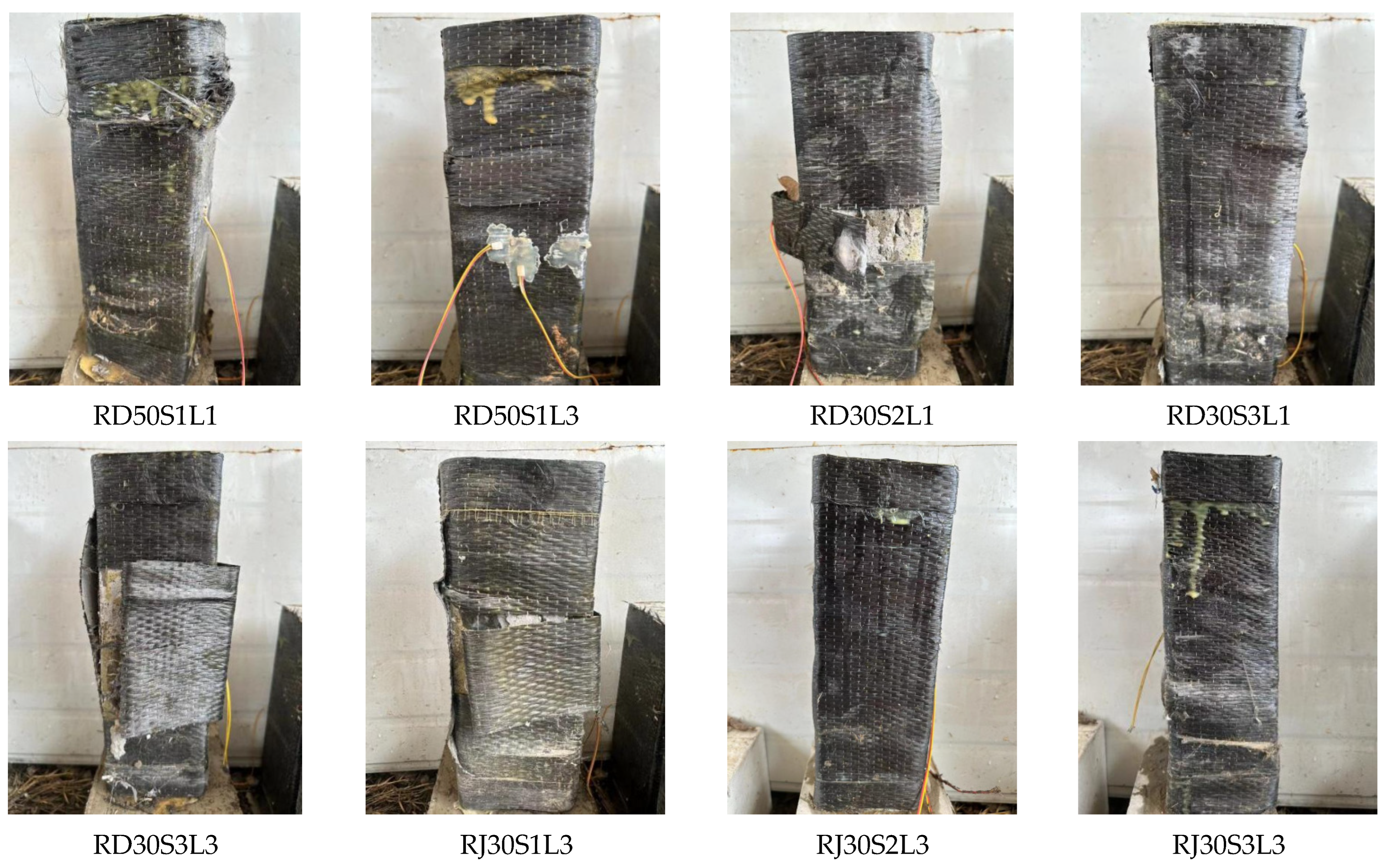
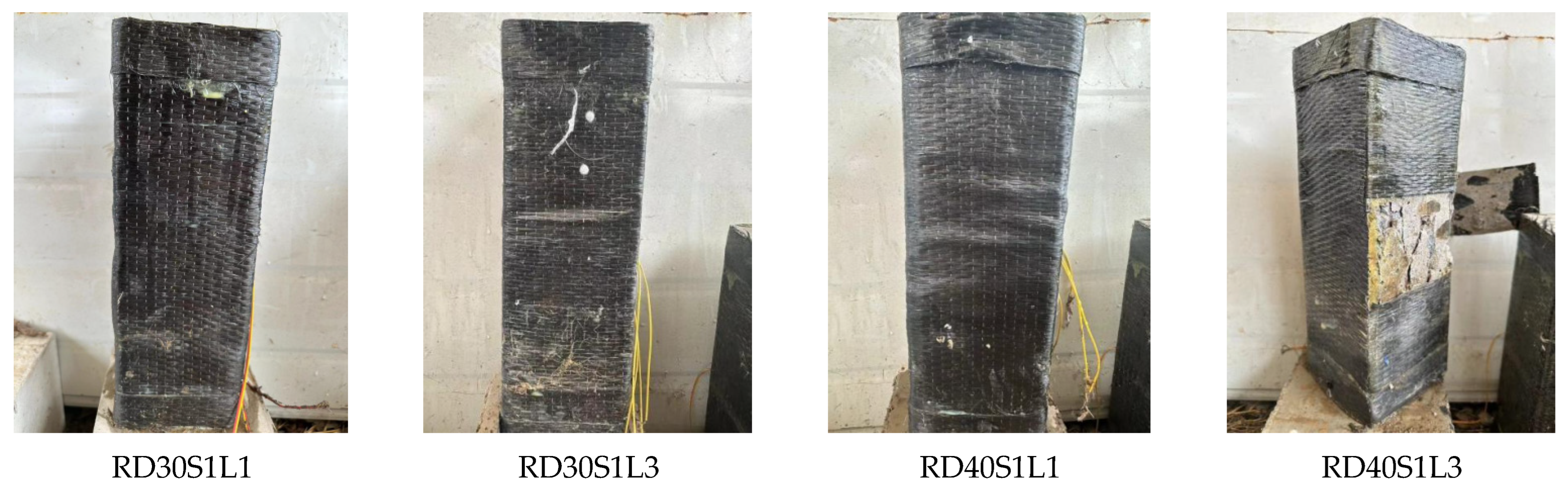
The typical failure mode of CFRP-confined damaged recycled concrete specimens is shown in
Figure 6. In the early stages of loading, there were no noticeable phenomena on the surface of the specimen. As loading continued, a tearing sound from the fibers was heard, and with the increase in load, the carbon fiber at the corner area began to slip out. Eventually, the fibers fractured, and the specimen’s bearing capacity rapidly decreased, exhibiting a typical brittle failure mode.
This failure process can be explained by the non-uniform internal stress distribution characteristic of FRP-confined prismatic sections. According to the recent study by Zeng et al. [
52], who utilized digital pressure-sensing films to directly measure axial stress, the stress distribution in square columns is highly heterogeneous. Their findings revealed significant stress concentrations in the corner regions, with discrepancies between measured stresses and theoretical predictions reaching up to 56% at these locations. In our study, the rupture of the CFRP jacket consistently initiated at the corners, which directly aligns with these localized high-stress zones identified via pressure-film measurements.
This phenomenon is further intensified in this study because the square specimens were prepared with sharp corners (r = 0). The absence of corner rounding amplifies the “arching action” within the cross-section, where the non-uniform confining pressure significantly reduces the effective confined area. These 90-degree edges act as stress risers that subject the CFRP fibers to localized shear and kinking effects, leading to premature rupture at these focal points. This mechanism provides a fundamental explanation for the relatively low strain utilization ratios observed in our tests (typically ranging from 0.04 to 0.48), as the sharp corners essentially trigger localized failure at a fraction of the material’s theoretical tensile capacity.
The damage degree of the internal RAC increased with the number of fiber layers, because more CFRP layers provided greater circumferential confinement force, leading to more complete internal recycled concrete fragmentation and a more pronounced conical failure. Furthermore, the initial damage exacerbates the non-uniformity of the stress field. The pre-existing cracks in the RAC core promote uneven lateral dilation, forcing the CFRP jacket to bridge these discontinuities. This interaction intensifies the pressure at the corners prematurely, explaining why the confinement efficiency is more sensitive to geometry in damaged specimens than in pristine ones. The rupture surface of the carbon fiber fabric typically occurs in the corner area, indicating a stress concentration phenomenon in the corner region.
3.2. Analysis of the Stress–Strain Behavior
3.2.1. Stress–Strain Analysis of C40 and C50 Recycled Concrete with Different Replacement Ratios
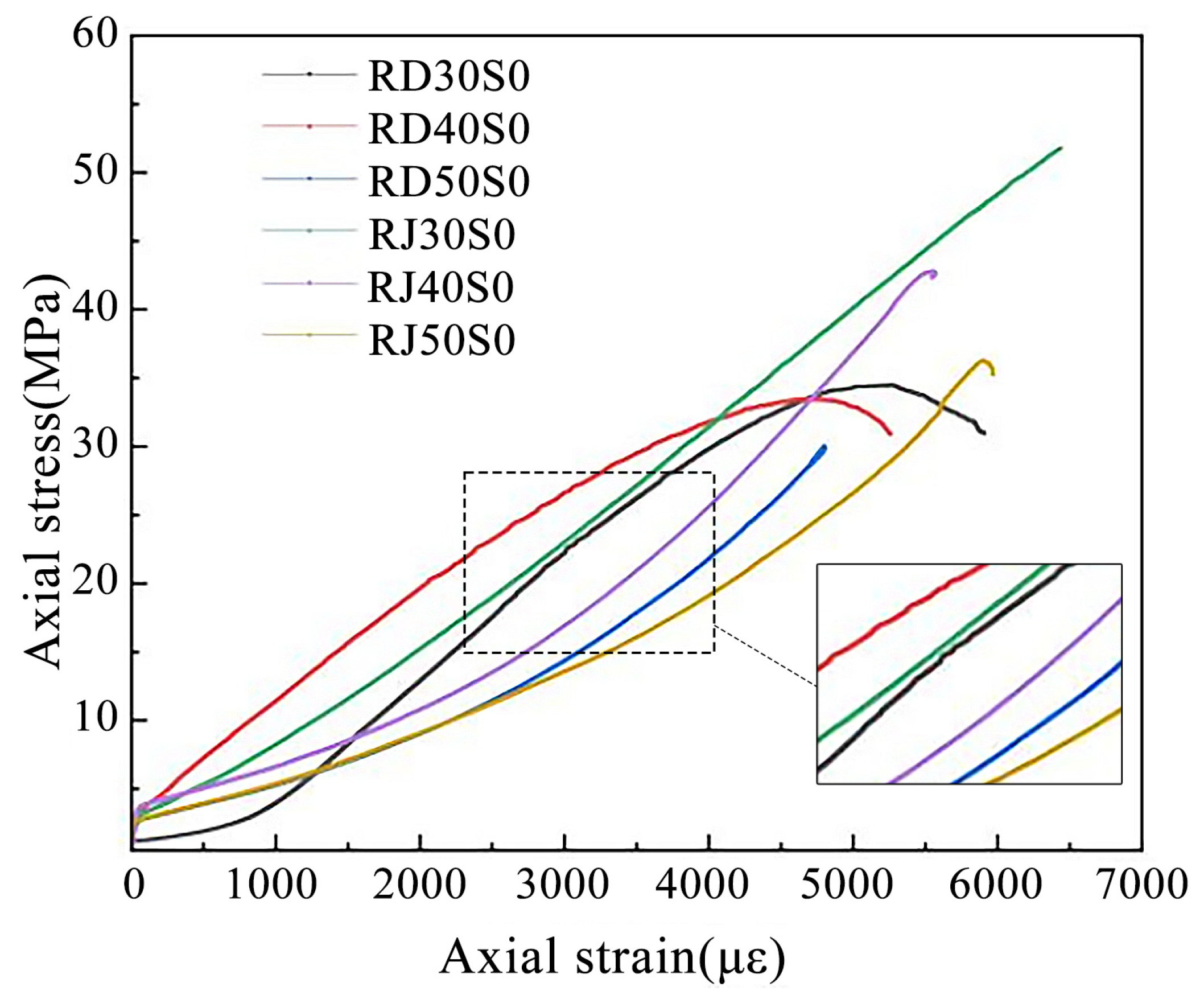
The axial stress–strain curves for C40 and C50 recycled concrete specimens with different recycled aggregate replacement ratios are shown in
Figure 7. The results show that the recycled aggregate replacement ratio significantly affects the mechanical response of recycled concrete.
In the early stages of loading, the stress–strain relationship for specimens with different replacement ratios was consistent, with axial strain increasing linearly with axial stress, indicating that different replacement ratios have a minor effect on the mechanical properties during the elastic phase. As the loading level increases further, the specimens gradually enter the nonlinear stage, and the effect of the recycled aggregate replacement ratio begins to emerge: for both C40 and C50 specimens, the axial peak stress decreases as the recycled aggregate replacement ratio increases.
The test results also show that increasing the concrete strength grade significantly enhances the overall load-bearing capacity of recycled concrete, but increasing the recycled aggregate replacement ratio amplifies its weakening effect. For example, in the C40 specimens, the peak strength of RD50S0 decreases by approximately 13% compared to RD30S0; in the C50 specimens, the peak strength of RJ50S0 decreases by 29.98% compared to RJ30S0, indicating that high-strength recycled concrete is more sensitive to the recycled aggregate replacement ratio.
The axial compression test results for recycled concrete specimens with different strength grades and replacement ratios are summarized in
Table 4. It can be seen that for low-strength recycled concrete, both peak stress and ultimate stress decrease as the recycled aggregate replacement ratio increases; however, in high-strength specimens, the ultimate stress of high replacement ratio specimens slightly increases. While this contradicts the typical degradation trend of RAC, this phenomenon can be attributed to the competing internal mechanisms of the multi-phase RAC matrix. First, the old mortar attached to the recycled aggregates possesses a significantly higher water absorption capacity. During the mixing process, the absorption of mixing water by these aggregates locally reduced the effective water-to-cement (
w/c) ratio of the newly formed cement paste, thereby enhancing the local matrix strength [
53]. Second, the crushed recycled coarse aggregates generally exhibit a rougher surface texture and more angular shapes compared to natural aggregates, which enhances the mechanical interlocking and friction at the new ITZ [
54]. Under specific high replacement configurations, these strengthening mechanisms temporarily outweighed the inherent porosity defects of the recycled aggregates, leading to the anomalous strength retention.
Therefore, as the recycled aggregate replacement ratio increases, the brittle characteristics of recycled concrete become more pronounced, and the ultimate failure point appears earlier, especially in high-strength specimens.
3.2.2. Stress–Strain Analysis of CFRP-Confined Recycled Concrete Specimens with Different Recycled Aggregate Replacement Ratios
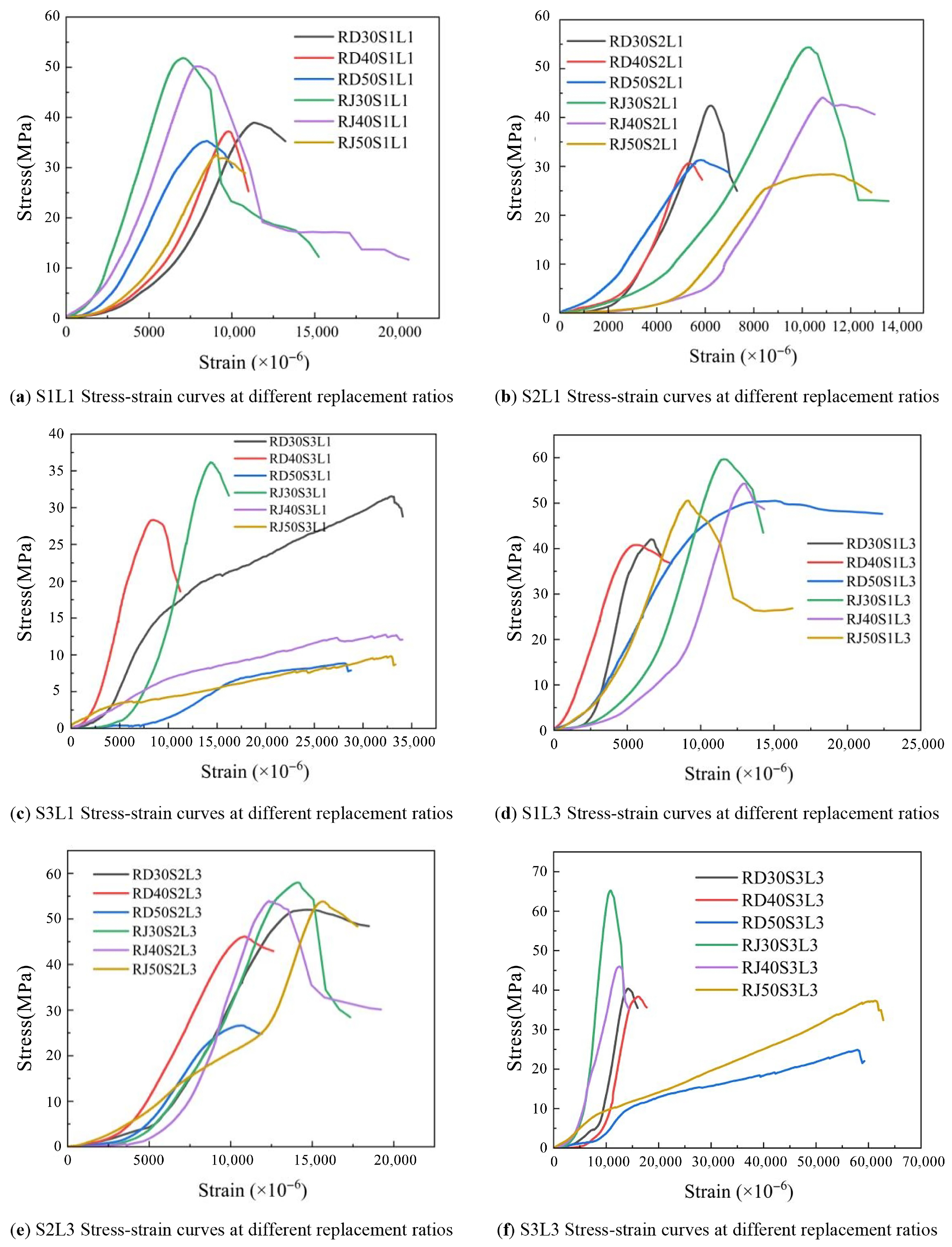
The axial stress–strain curves of recycled concrete specimens with three different recycled aggregate replacement ratios and varying CFRP confinement layers are shown in
Figure 8. The results show that, under the same initial damage level, the peak load-bearing capacity and deformation ability of the specimens decrease as the recycled aggregate replacement ratio increases. When both the replacement ratio and initial damage level are high, some specimens lose load-bearing capacity prematurely during loading, and the CFRP confinement effect is not fully utilized, with typical curves shown in
Figure 8c,f.
The above phenomenon indicates that the introduction of recycled aggregate weakens the integrity of the concrete matrix to some extent, making it difficult for the lateral confinement provided by CFRP to effectively translate into improved axial load-bearing capacity.
This phenomenon can be mechanistically interpreted through the interaction between the degraded RAC matrix and the non-uniform confining pressure. According to the pressure-film measurements and FEA results reported by Zeng et al. [
52], the axial stress distribution in square-section columns is highly heterogeneous, with significant stress concentrations at the corners and “under-confined” zones at the flat sides. In specimens with high replacement ratios and severe initial damage, the porous ITZs and pre-existing crack networks lead to an accelerated and uneven lateral dilation of the core. This non-uniform expansion further intensifies the “arching effect,” where the effective confined area is significantly reduced. Consequently, the CFRP jacket is forced to resist localized high-pressure zones prematurely, leading to corner stress concentrations that exceed the material’s limits before the full potential of the confinement is activated.
In comparison, specimens with lower replacement ratios exhibit better ductility characteristics, but after the peak point, they often experience a rapid stress drop, showing more distinct brittle failure characteristics. Furthermore, increasing the concrete strength grade can alleviate the adverse effects caused by the recycled aggregate replacement ratio to some extent. High-strength recycled concrete specimens show more significant improvements in both load-bearing capacity and ultimate deformation capacity, indicating that the matrix strength plays an important role in regulating the effectiveness of CFRP confinement. A stronger matrix provides better internal cohesion, which helps mitigate the stress gradients across the section and ensures a more stable transition of lateral pressure to the CFRP jacket, as substantiated by the stress distribution theories in non-circular sections [
55]. The axial compression test results for different conditions are summarized in
Table 5 and
Table 6. Axial strain under compression is taken as positive, and hoop strain under tension is taken as positive. f’
cc and f’
cu represent the peak stress and ultimate stress of CFRP-confined intact specimens, with corresponding strains ε
cc and ε
cu. f’
cc,d and f’
cu,d are the peak and ultimate stress of CFRP-confined damaged recycled concrete specimens, with corresponding strains ε
cc,d and ε
cu,d. ε
fe is the measured CFRP fracture strain, and ε
fu is the CFRP ultimate tensile strain.
Due to the extensive test matrix encompassing 48 distinct CFRP-confined configurations in this study, one specimen was tested per condition. The experimental reliability is validated by the consistent macroscopic trends observed across the entire parameter space. The systematic strength evolution rules, without erratic scatter, confirm the robustness of the testing protocol and the validity of the data.
3.2.3. Stress–Strain Analysis of CFRP-Confined Damaged Recycled Concrete Specimens with Different CFRP Layers
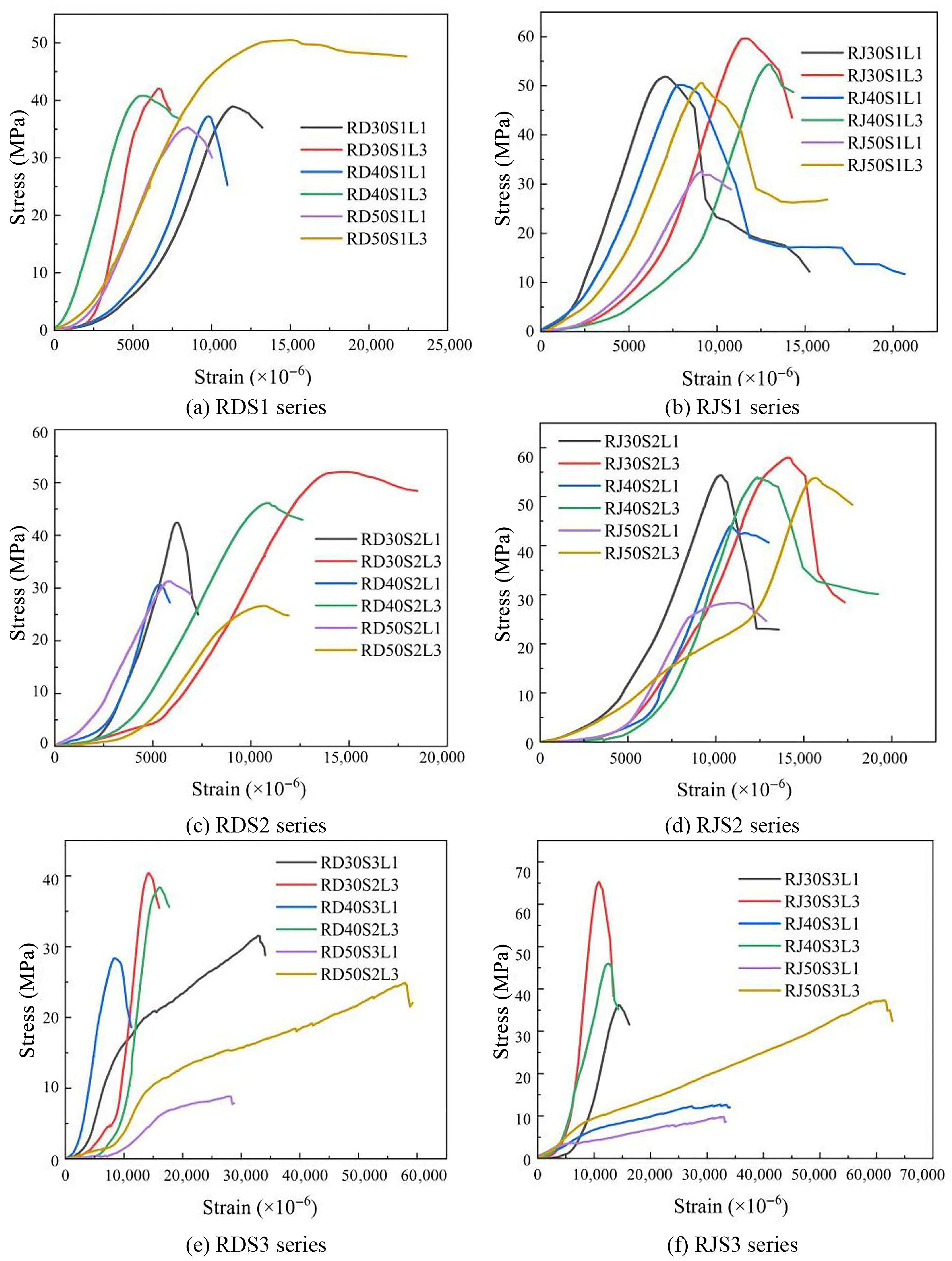
The stress–strain curves of CFRP-confined initial damage recycled concrete specimens with different CFRP layers are shown in
Figure 9. As the number of CFRP layers increased, the load-bearing capacity of the specimens significantly improved. The compressive strengths of the strongly confined specimens RD50S1L3, RJ50S2L3, and RJ30S2L3 were 1.43, 2.0, and 1.84 times those of the specimens with a single layer of confinement at the same damage level, respectively. Therefore, the confinement effect of CFRP influences the peak strength of the specimens. As the pre-damage level increases, the peak strength of the specimens decreases significantly. For the specimens at the S3 level, high replacement ratio specimens lose load-bearing capacity internally, and the increase in confinement does not lead to improved performance. However, there is no clear pattern observed in the ultimate strain. From the figure, it can be observed that with the increase in pre-damage level, the ultimate strain of the specimens under the same conditions shows no significant difference.
3.2.4. Microstructural Evolution and Damage Mechanism
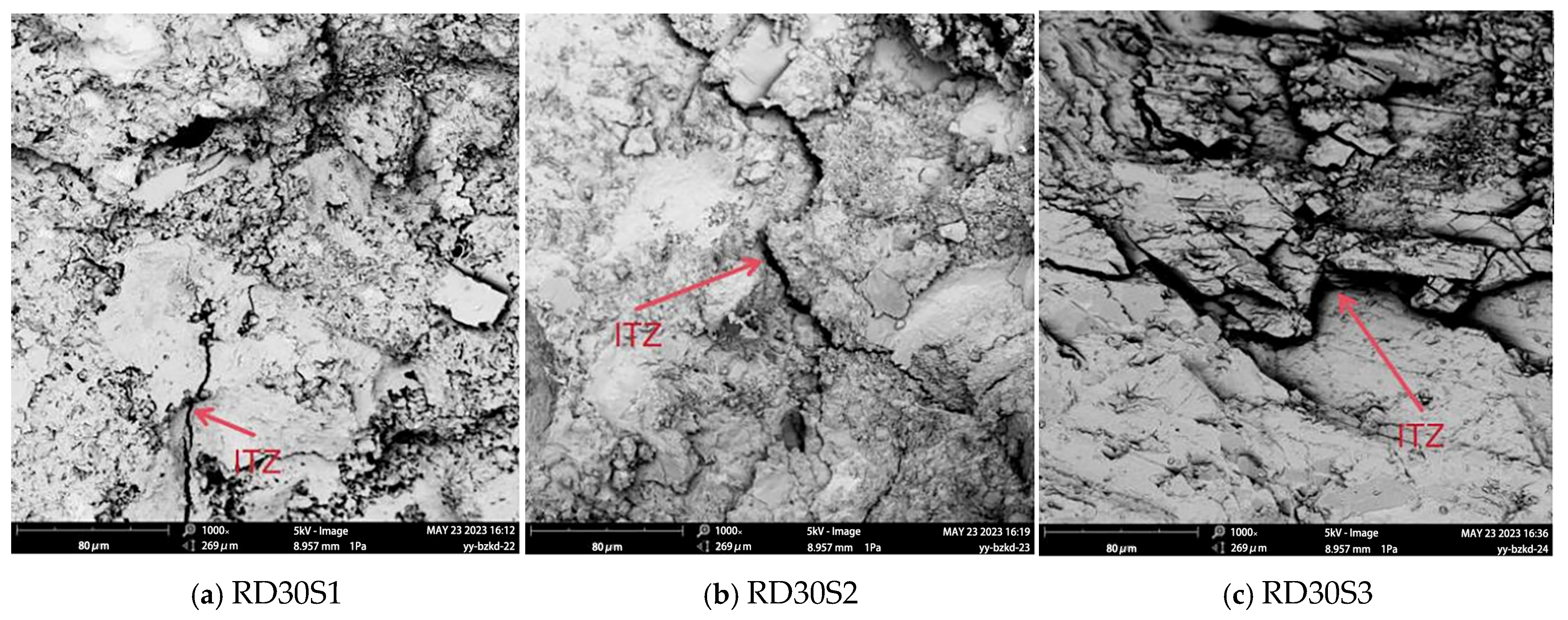
To provide direct evidence, scanning electron microscopy (SEM) was performed on representative samples from the RD30 series. Samples (2–3 mm) were extracted from crushed fragments, soaked in alcohol for 15 min to stop hydration, dried, and gold-coated for observation at 1000× magnification at the State Key Laboratory of Precision Blasting, Jianghan University. The results are presented in
Figure 10. As shown in
Figure 10a (RD30S1), the matrix is relatively dense with a narrow ITZ and sufficient hydration products. However, as the axial pre-damage increases (
Figure 10b,c), micro-cracks propagate and the ITZ widens significantly. Particularly in RD30S3 (
Figure 10c), the separation of residual mortar from the aggregate and the formation of large pores are clearly observed. These observations confirm that higher initial damage weakens the internal bonding, providing a mechanistic basis for the observed macroscopic strength degradation.
3.3. Parameter Influence Analysis
To analyze the impact of key parameters on the mechanical performance of CFRP-confined recycled concrete prisms, the effective fracture strain ε
fe of CFRP is defined as the average value of the local fracture strains, and its calculation can be expressed as
where ε
fu is the ultimate tensile strain of CFRP, and K
ε is the effective utilization factor. Experimental results show that the K
ε for intact specimens is approximately 0.43, while for damaged specimens, due to pre-damage effects, the K
ε drops to 0.15, indicating that pre-damage significantly reduces the confinement efficiency of CFRP. The effective fracture strain of square prisms is lower than that of cylindrical specimens due to stress concentration. Furthermore, as the recycled aggregate replacement rate increases or the number of CFRP layers decreases, the effective fracture strain of the specimens decreases, indicating that these parameters significantly affect the confinement effectiveness.
It is noted that minor fluctuations in experimental results (e.g., peak strength and strain) are observed across certain parameter combinations. This experimental scatter is primarily attributed to the inherent heterogeneity of RAC and the stochastic nature of pre-damage, specifically the random distribution of old adhered mortar and micro-cracks. Despite these variations, the average results of the triplicate specimens per group maintain a coefficient of variation (COV) within a reasonable range (generally below 12%), ensuring the statistical reliability of the observed trends.
3.4. Comparative Discussion on Broadened Replacement Ratios
To contextualize the findings of this study across the full spectrum of aggregate replacement, the mechanical responses of the 30–50% RAC specimens are compared with recent literature investigating CFRP-confined 0% (NAC) and 100% RAC.
A recent comprehensive study by Xu et al. [
56] on CFRP-confined RAC columns demonstrated that a 0% NAC baseline exhibits superior plastic deformation capacity. As the RCA replacement ratio increases to 100%, despite the confinement provided by CFRP, the ultimate axial and hoop strains decrease drastically by up to 19.6% and 39.3%, respectively. This indicates that full aggregate replacement (100% RAC) significantly compromised the ductility and deformation capacity of the composite column, causing it to fail prematurely after entering the plastic section. Furthermore, Xu et al. concluded that specimens with a 50% replacement ratio strike the optimal balance, showing the best overall axial compression performance.
To further address the lack of a direct 0% NAC experimental baseline and to rigorously quantify the relative strength degradation caused by recycled aggregates, a normalized comparison using literature datasets was incorporated. Since absolute stress values cannot be directly compared due to inherent differences in unconfined concrete strength (f
co), key results were reformulated using the normalized strength enhancement ratio (f
cc/f
co). As summarized in
Table 7, established data on comparable 1-layer CFRP-confined square NAC columns from literature [
57] was adopted as the 0% replacement benchmark.
As presented in
Table 7, the conventional NAC baseline exhibited a strength enhancement ratio of 1.19. In comparison, the RAC specimens in the current study (30–50% replacement, without initial damage) demonstrated highly comparable enhancement ratios ranging from 1.04 to 1.16. This normalized comparison explicitly clarifies the performance benchmarking: the confinement efficiency of CFRP on RAC is only marginally lower than that on conventional concrete. This minor reduction is fundamentally attributed to the heightened porosity and the weaker ITZ inherent in recycled aggregates, which lead to a more heterogeneous lateral expansion and slightly diminish the “effective confinement area” provided by the CFRP jacket.
By comparing these extremes and the normalized ratios, it becomes evident that the 30–50% replacement range investigated in this study represents the most structurally viable and safe threshold for practical engineering. It effectively avoids the severe brittleness and excessive strain reduction characteristic of 100% RAC, while successfully bridging the moderate internal defects to achieve a ductility comparable to standard NAC. Therefore, expanding the replacement ratio beyond 50%, especially in the presence of initial structural damage, is neither structurally recommended nor the focus of the current pre-damage evaluation framework.
3.5. Discussion on Confinement Mechanics and Shape Effect
The experimental results and parameter analyses, including the broadened replacement ratios discussed above, clearly demonstrate that CFRP confinement significantly enhances the performance of RAC specimens. However, to fully contextualize these findings within the broader literature, a deeper analytical comparison with classical FRP confinement theories is essential. The combined effect of initial damage and recycled aggregates fundamentally alters the confinement efficiency, which can be interpreted through the following three key parameters:
(1) Effective Lateral Confinement Pressure (f
l,a) and Confinement Ratio: In square prisms, the confining pressure is naturally non-uniform due to the “arching action.” This geometric effect implies that only the concrete core within the parabolas connecting the four corners is effectively confined, resulting in a reduced effective confinement area (A
e). To theoretically quantify this geometric inefficiency, the shape efficiency factor (K
α) is introduced, which represents the ratio of A
e to the total cross-sectional area (A
c). For a square section, it is expressed as
where b is the side length and r is the corner radius. In this study, as the specimens were prepared with sharp corners (r = 0), K
α reaches its theoretical minimum of 0.33, implying that approximately 67% of the core remains effectively unconfined. Pre-existing micro-cracks from initial damage disrupt this concrete arch, leading to a severe reduction in actual lateral pressure. To contextualize this, the confinement ratio (f
l,a/f’
co) was evaluated against classical thresholds that separate weak and strong confinement. Based on the reduced effective lateral pressure, the 1-layer CFRP confined damaged RAC specimens unequivocally fall into the weak confinement regime, mathematically explaining their distinct softening branches. Even for 3-layer specimens, the compromised core integrity hinders them from achieving the ideal strong confinement typically seen in intact normal concrete.
(2) Strain Efficiency Factor (K
ε): As established in
Section 3.3, the observed K
ℇ dropped drastically from 0.43 (for intact specimens) to 0.15 for damaged RAC specimens. The square geometry exacerbates this reduction, as the CFRP layers experience significant stress concentrations at the corners. The high porosity of RAC and initial damage induce severe, premature localized dilation under compression. Such non-uniform expansion causes extreme stress concentrations at the corners, triggering premature rupture of the CFRP jacket well before the average strain reaches its ultimate tensile capacity.
(3) Confinement Stiffness (Kl): Due to the inherently lower elastic modulus of RAC, the core exhibits an accelerated transverse expansion, which “activates” the CFRP confinement stiffness earlier than in normal concrete. However, the structurally compromised core cannot withstand the rapidly increasing lateral reaction forces. As a result, the damaged core crushes prematurely before the full confinement stiffness of the CFRP layers can be thoroughly mobilized.
In summary, the mechanical degradation mechanisms discussed above explain why classical models, which assume an intact and homogeneous core, tend to overestimate the strengthening effect for damaged RAC. This theoretical limitation underscores the necessity of developing a damage-based constitutive model specifically tailored for these specimens.
4. Damage-Based Constitutive Model
The derivation of the proposed constitutive model follows a rigorous three-step procedure: (1) defining quantitative damage assessment indicators (
Section 4.1); (2) establishing baseline analytical models for intact RAC through extensive database regression (
Section 4.2); and (3) mathematically coupling the damage indicators into the baseline framework to derive the final damage-based equations (
Section 4.3).
4.1. Damage Assessment Indicators
Considering the adverse impact of initial axial damage on the mechanical performance of CFRP-confined RAC, the damage evolution parameter d
c from the “Code for Design of Concrete Structures” [
58] was introduced to quantitatively account for the weakening effect of damage. Based on the mechanical model of intact CFRP-confined recycled concrete prisms, damage influence coefficients α
d and β
d are introduced to modify the strength and strain at the turning and ultimate points.
In the analysis of parameter influence, the action mechanism of the damage evolution parameter can be summarized as
where f’
c,d and ε
cc,d represent the strength and strain at the turning point, and α
d and β
d characterize the damage weakening effect. Experimental results show that damaged specimens fail before CFRP reaches the ultimate tensile strain, and the effective utilization rate significantly decreases, especially for square prisms, where the stress concentration at the corners results in more significant damage weakening.
Secondly, to assist in analyzing the initial damage levels, this study introduces two types of indicators for conceptual representation:
(1) Area-based damage evaluation indicator
The ratio of the area enclosed by the concrete stress–strain curve and the horizontal axis (SOBC) to the area enclosed by the tangent of the stress–strain curve at the origin and the horizontal axis (SOAC) is used to measure the initial damage level.
(2) Secant modulus-based damage evaluation indicator
By establishing the relationship of the secant modulus at unloading points in the concrete stress–strain curve, the damage evolution parameter is defined to quantitatively express the internal damage of the concrete.
Furthermore, the CFRP confinement effectiveness is influenced by the cross-sectional geometry and the strength of confinement: When FRP confines cylindrical concrete, its confinement stress is uniformly distributed along the section. When FRP confines square prisms, the lateral confinement force was highly heterogeneous. As quantitatively substantiated by recent pressure-film measurements and finite element predictions [
59], this geometry induces an “arching effect,” leading to a highly uneven axial stress distribution characterized by severe stress concentrations at the corners and reduced effective confinement along the flat sides. The CFRP-confined concrete is influenced by varying confinement strength, with differences in the stress–strain curves, such as the presence or absence of a softening phase. Previous studies typically use the confinement ratio (CR), which is the ratio of the lateral confinement stress f
lf of FRP to the peak stress f
c of an unconfined column, to measure the strength of confinement. For specimens with strong confinement, the load can continue to increase to the ultimate point after reaching peak load, while weakly confined specimens decrease after reaching peak load. The CFRP confinement effect is significantly improved under strong confinement, with concrete ductility being effectively enhanced, providing reference values for α
d and β
d. Through these indicators, this study can systematically quantify the impact of initial damage on the mechanical performance of CFRP-confined recycled concrete, providing a theoretical basis for the establishment and validation of subsequent constitutive models.
4.2. Establishment of Baseline Models for RAC
To establish the axial compressive constitutive relationship for CFRP-confined recycled aggregate concrete prisms, this study initially referenced classic constitutive models for FRP-confined concrete—including the Zhao Tong [
60], Jing Denghu [
61], Wu Gang [
62], Youseef [
63], Wei [
26], and Wang Daiyu [
64] models—which systematically characterize the transition point strength, ultimate strength, and stress–strain behavior of cylindrical and rectangular columns. Acknowledging the disparities in material properties—specifically lower strength and higher porosity—between RAC and ordinary concrete, this study utilized the frameworks of these models to benchmark calculated values against experimental data, with the resulting error analysis presented in
Table 8 and
Table 9.
4.2.1. Transition-Point Strength and Strain Models
For FRP-confined specimens, strong confinement refers to the condition in which the stress–strain curve continues to harden after reaching the turning point until failure, without exhibiting a softening branch. In contrast, under weak confinement, the stress–strain curve descends after the turning point, forming a distinct softening branch. When establishing constitutive models for this type of specimen, particular attention should be paid to the parameters at the turning point. The turning-point strength and strain are denoted as f’cc and εcc, respectively.
Previous studies have shown that, in general, before FRP-confined concrete reaches the turning point on the stress–strain curve, the lateral deformation of the internal concrete is relatively small, and the load-bearing capacity is primarily carried by the concrete itself. At this stage, the confinement effect of FRP has not yet been activated. Therefore, prior to the turning point, the lateral confinement provided by FRP does not influence the turning-point strength or strain.
The model proposed by Wang Daiyu [
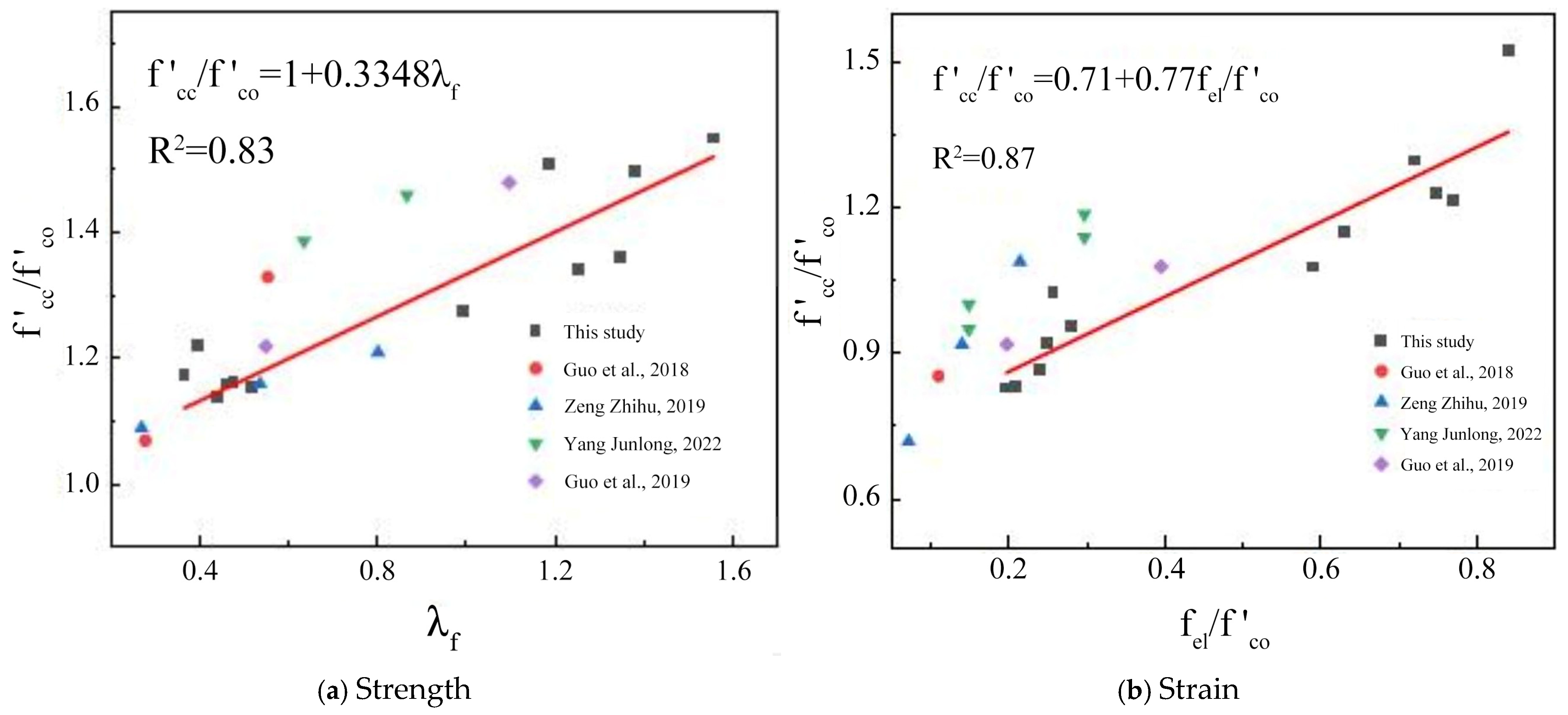
64] considers multiple factors such as corner radius, cross-sectional shape, and the number of FRP confinement layers, demonstrating good adaptability. As indicated by the prediction accuracy in the previous section, the prediction error of this model is relatively small. Therefore, this paper references this model and conducts regression analysis of the turning point strength and strain using both experimental data and data from existing literature, with the fitting results shown in
Figure 11.
The final calculation formulas for the turning point strength and strain of CFRP-confined recycled concrete prisms are as follows:
As shown in
Figure 11b, the data dispersion of the turning point strain is greater than that of the strength data. This is because the specimens selected from the domestic and international experimental data have differences in cross-sectional shape and material properties, leading to some error in the selection of the turning point.
4.2.2. Ultimate-Point Strength and Strain Models
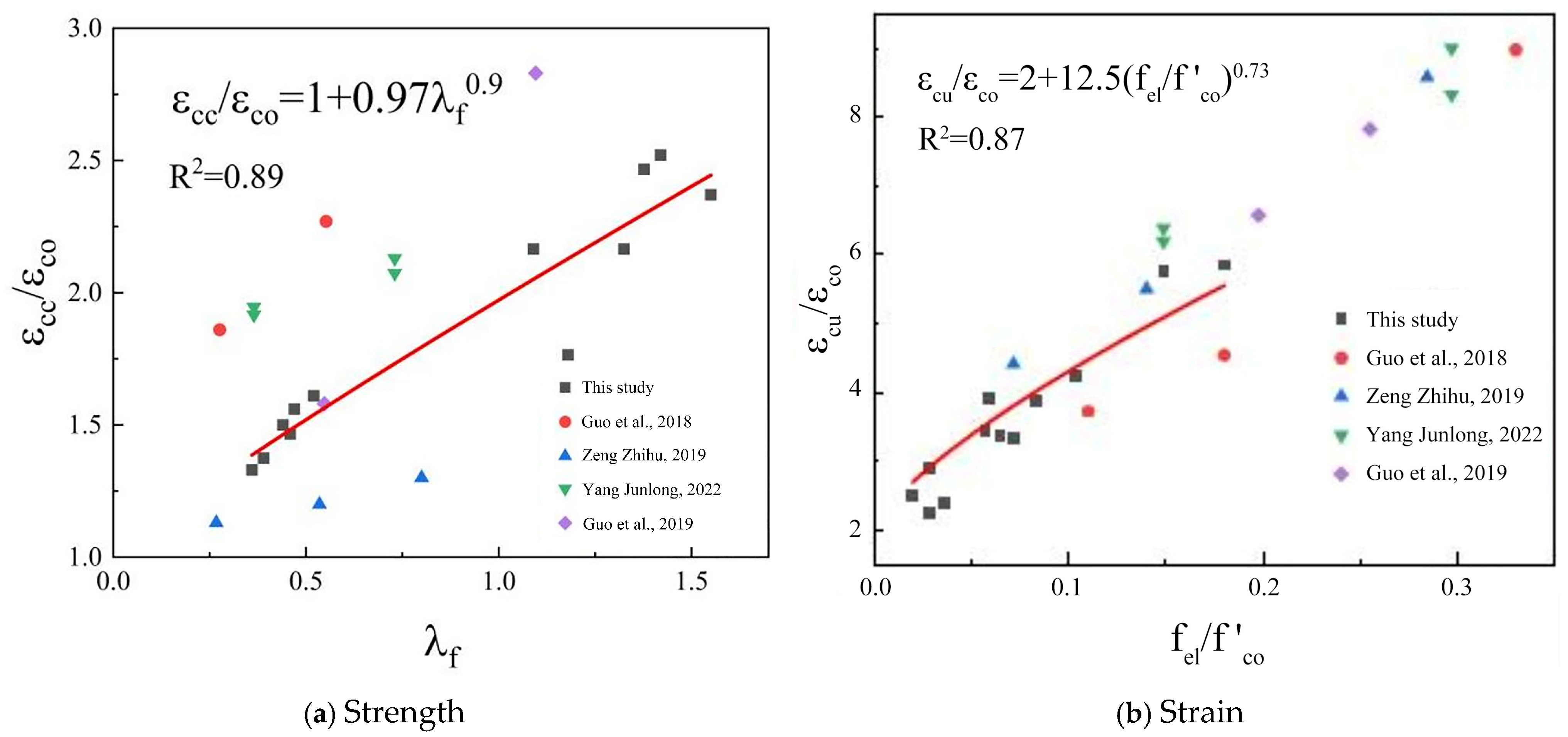
By combining experimental data with domestic and international experimental data, a regression analysis of the turning point strength and strain was performed, and the fitting results are shown in
Figure 12.
The regression analysis yields the following calculation formulas for the limit point strength and strain of CFRP-confined recycled concrete prisms:
4.2.3. Baseline Stress–Strain Model
Based on the experimental data decomposition results in
Section 3, the specimens in this study are mainly in weak confinement conditions, with a small number of specimens exhibiting a strengthening phase in their stress–strain curves. This paper references the stress–strain relationship model proposed by Wu Gang et al. [
62], which demonstrates good adaptability and can be applied to both strong and weak confinement scenarios, making it more suitable for the present study. The stress–strain relationship is given by:
4.2.4. Model Validation and Comparison
To comprehensively quantify the predictive accuracy of the proposed model against existing formulations, multiple statistical error metrics, specifically the average absolute error (AAE) which serves as the widely adopted relative form of the mean absolute error (MAE), root mean square error (RMSE), coefficient of determination (R2), along with the mean and standard deviation (SD) of the prediction-to-test ratios were calculated for four critical state parameters: transition point strain (εcc,d), transition point strength (f’cc,d), ultimate strain (εcu,d), and ultimate strength (f’cu,d). Furthermore, graphical comparisons of the predicted versus experimental results were plotted to visualize the error distribution characteristics.
As detailed in
Table 10 and
Figure 13, the comparative analysis reveals that several existing models exhibit severe predictive deviations. Mechanistically, empirical models such as those by Wang et al. [
64] and Wei et al. [
26] were calibrated primarily for natural aggregate concrete or circular columns. Consequently, they fail to account for the heightened porosity and pre-existing micro-cracks in RAC, overestimating the uniform confinement efficiency in square sections and leading to substantial strain distortions.
In contrast, by introducing a physically calibrated shape factor and tailoring the confinement coefficients specifically for RAC, the proposed baseline model significantly improves predictive accuracy. It achieves a favorable AAE for ultimate strength (25.7%), notably outperforming existing models such as Wang Daiyu et al. [
64] (56.4%) and Wei et al. [
26] (38.7%). Furthermore, the model reasonably captures the transition strength with an AAE of 10.8% and the highest R
2 value of 0.66 among all evaluated models.
While the theoretical ultimate strain prediction exhibits a larger AAE (156%) and corresponding high RMSE and SD—a systematic deviation also observed in the Jing Denghu model (148%)—this discrepancy highlights an inherent limitation in the current model formulation rather than solely reflecting the physical truncation of capacity prior to full CFRP rupture. Specifically, the current mathematical framework lacks explicit mechanisms to fully account for the complex stress concentrations and premature crushing characteristic of square RAC specimens. To address this deficiency, future model refinements should incorporate explicit CFRP rupture criteria and geometry-dependent strain efficiency factors. Nevertheless, supported by the acceptable overall consistency in capturing the transition states the proposed model systematically provides a more reliable full-range constitutive trajectory compared to empirical models that over-fit this prematurely truncated ultimate strength at the expense of overall structural logic.
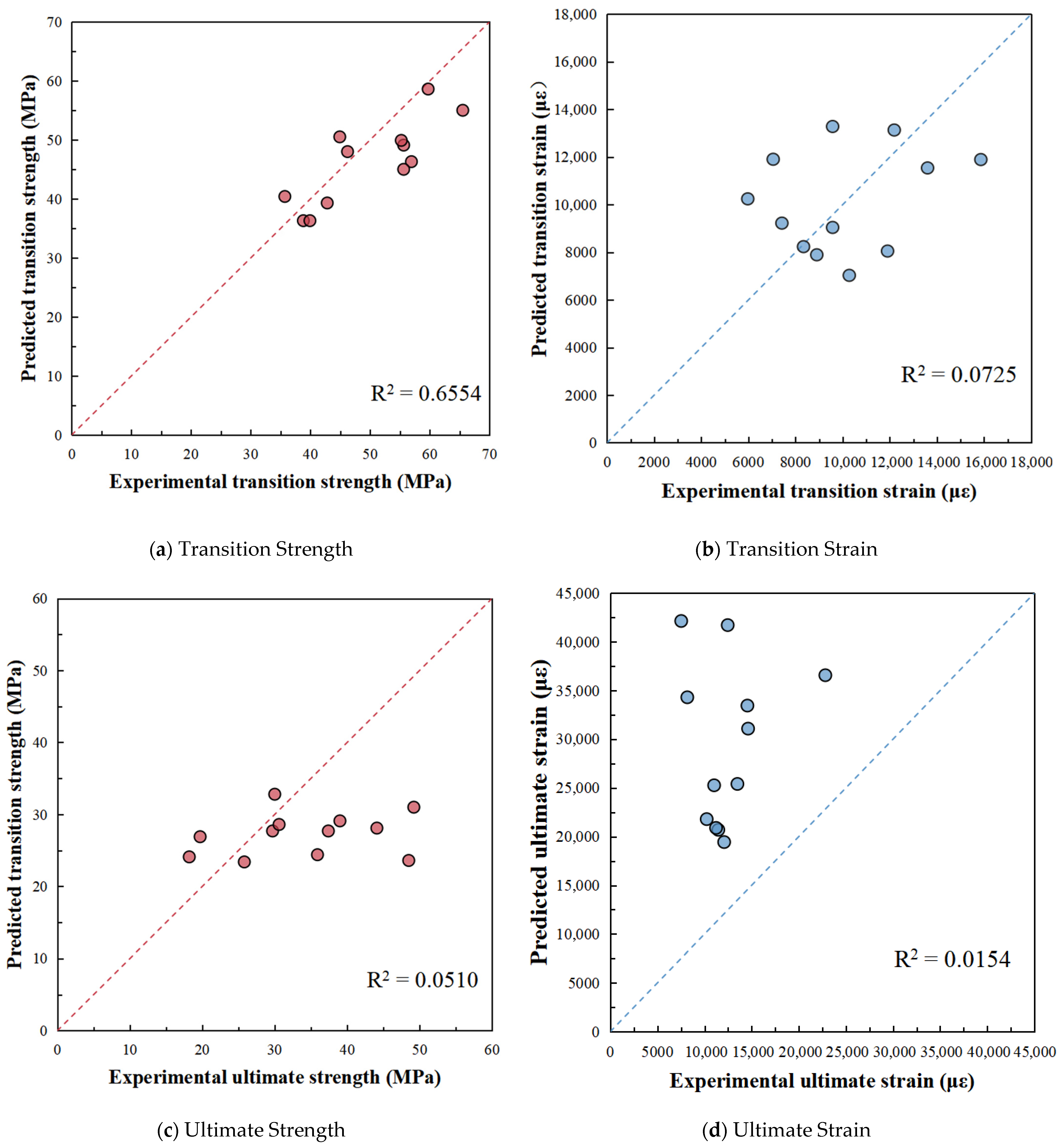
A diagnostic residual analysis was performed on the undamaged specimens (S0) to explicitly address the statistical evaluation of the model, including the root cause of the significant error (AAE ≈ 156%) in predicting the ultimate strain. As depicted in
Figure 14a,b, the transition strength predictions are evenly distributed around the ideal baseline without systematic bias. Although the statistical metrics yield an R
2 of approximately 0.66 indicating a moderate rather than highly precise correlation, this level of variance is physically inevitable due to the inherent heterogeneity of recycled coarse aggregates and the highly non-uniform confinement of square sections. In sharp contrast, the ultimate strain exhibits massive dispersion. This graphical evidence confirms that predicting the ultimate state of CFRP-confined square columns is intrinsically challenging. The extreme scatter is primarily driven by premature FRP rupture at the sharp corners, which exists independently of any initial damage.
Furthermore, to completely address the risk of circular validation and to explicitly define the applicability boundaries of the proposed constitutive model, an independent external dataset from a recently published study was utilized for blind validation. The experimental data of CFRP-confined square RAC columns (without initial damage) was extracted from a recent study by Xu et al. [
56] published in Construction and Building Materials.
Two representative square specimens, S50F1 (50% RCA, 1 layer CFRP) and S100F1 (100% RCA, 1 layer CFRP), were selected for the blind prediction. The external unconfined concrete strengths (fco) were exceptionally low, reported as 14.5 MPa and 14.0 MPa, respectively. These values, along with the corresponding CFRP material properties (tf = 0.167 mm, Efrp = 242 GPa) from the literature, were directly inputted into the proposed constitutive model under the assumption of an intact state (without initial damage).
The proposed model predicted the ultimate compressive strengths (fcc,pre) to be 19.08 MPa and 18.58 MPa, respectively. When compared to the actual experimental ultimate strengths reported in the literature (fcc,exp = 35.54 MPa and 30.20 MPa), the model yielded conservative predictions with relative deviations of −46.3% and −38.5%. It is essential to explicitly define the intended scope of the proposed model, which is primarily targeted at structural-grade RAC applications (e.g., 30–60 MPa). The ~14 MPa dataset utilized here falls significantly outside this intended application domain. Consequently, this exercise is strictly reframed as an out-of-domain validation.
The observed deviations (≈38–46% underprediction) do not reflect a lack of robust predictive capability within the model’s intended scope; rather, they are a direct manifestation of out-of-domain behavior. The baseline RAC used in the external dataset was extremely weak (approx. 14 MPa), which leads to severe and premature lateral expansion under compression. This extreme dilation over-activates the CFRP jacket, resulting in unusually high strength enhancement ratios (fcc/fco) of 2.45 and 2.16 for square columns, which are rarely observed in standard engineering practices. In contrast, the proposed constitutive model was strictly calibrated based on structural-grade concrete. By explicitly distinguishing between model performance within and beyond its intended scope, this out-of-domain validation highlights the physical boundaries of the proposed equations. Future research will focus on incorporating additional independent datasets within the structural-strength range to further demonstrate in-domain predictive performance.
Therefore, when a model calibrated for structural-grade applications is applied to an exceptionally low-strength material, it naturally yields conservative predictions. This deviation serves as an instructive external validation: it demonstrates that the proposed model does not blindly overfit numerical datasets. Instead, it strictly adheres to the mechanical boundaries of structural-grade concrete, ensuring that structural designs based on this model will consistently remain on the safe and conservative side when encountering substandard materials in practical engineering.
4.3. Development of the Damage-Based Constitutive Model
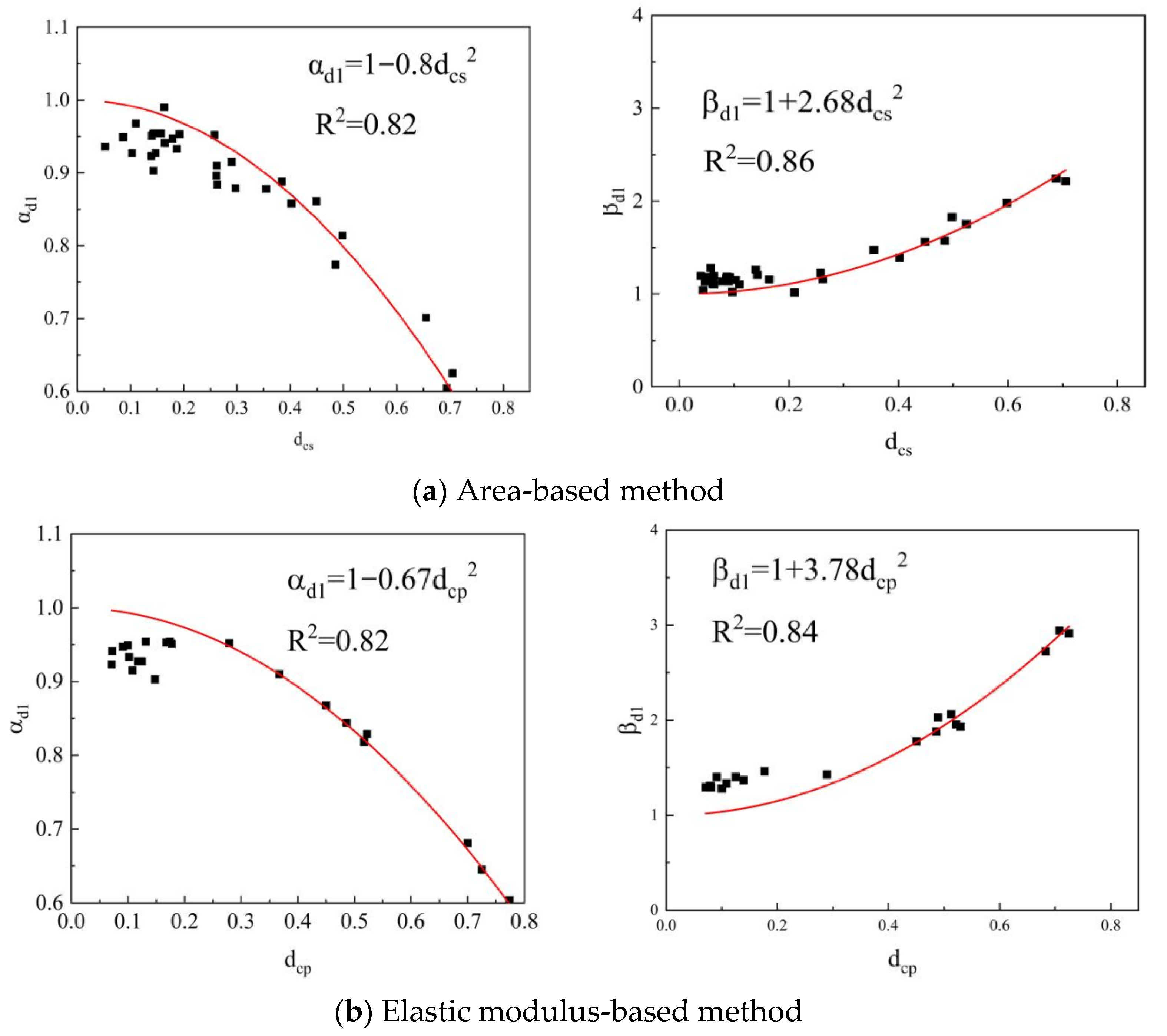
To verify the accuracy of the established constitutive model for CFRP-confined damaged recycled concrete prisms, both the area method and the elastic modulus method were used to quantitatively assess the damage degree of the specimens. According to the experimental data, as the damage degree increases, the turning point strength shows a decreasing trend, while the turning point strain increases with the increase in damage degree. This indicates a clear correlation between the influence coefficients α
d1 and β
d1 for the turning point strength and strain and the damage evolution parameter (
Table 11 and
Table 12).
Through regression analysis of the experimental data, the quantitative expressions for α
d1 and β
d1 corresponding to the damage evolution parameter were obtained. The fitting results are shown in
Figure 15.
When comparing the two damage evaluation methods, it was found that the fitting accuracy of the area method and the elastic modulus method was similar, but the elastic modulus method is simpler in computation, making it more suitable for practical engineering applications. Therefore, this paper recommends using the elastic modulus method as the damage evaluation index. The turning point strength and strain of CFRP-confined damaged recycled concrete prisms can be expressed as
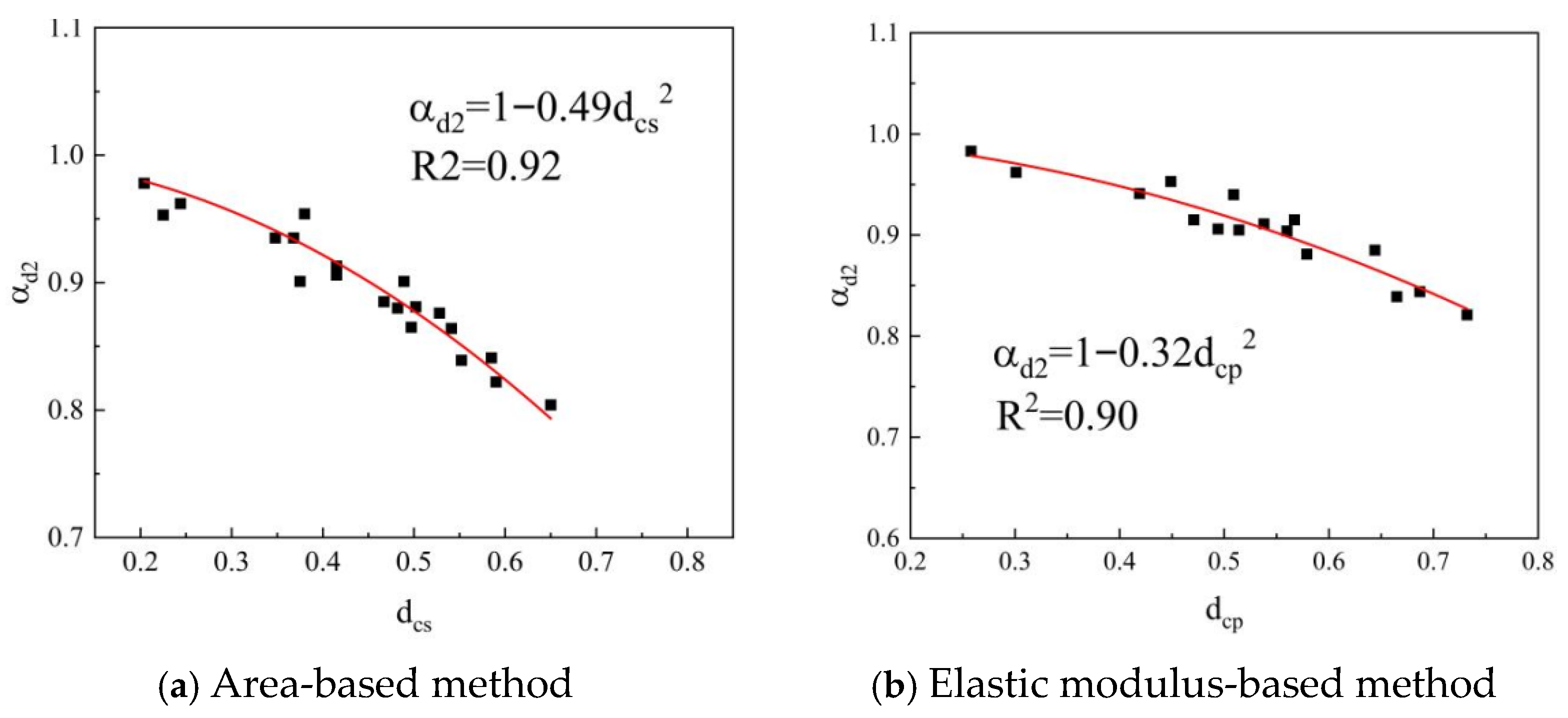
In the limit point analysis, the regression results show that the influence coefficient α
d2 for the limit point strength has a certain correlation with the damage evolution parameter (
Figure 16). The specific fitting expressions for α
d2 and the damage evolution parameter are
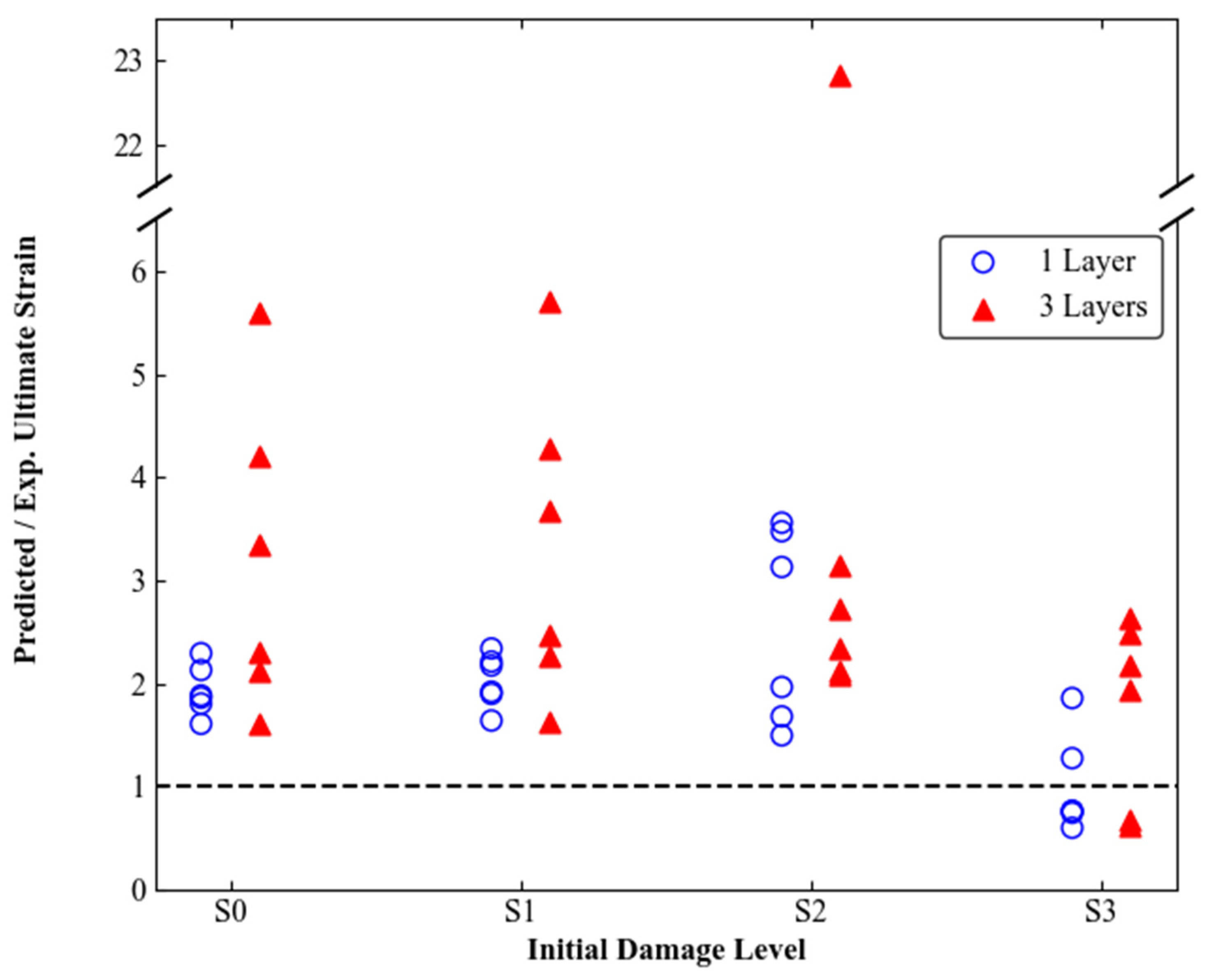
The influence coefficient β
d2 for the limit point strain shows no significant change with the damage evolution parameter and can be approximated as β
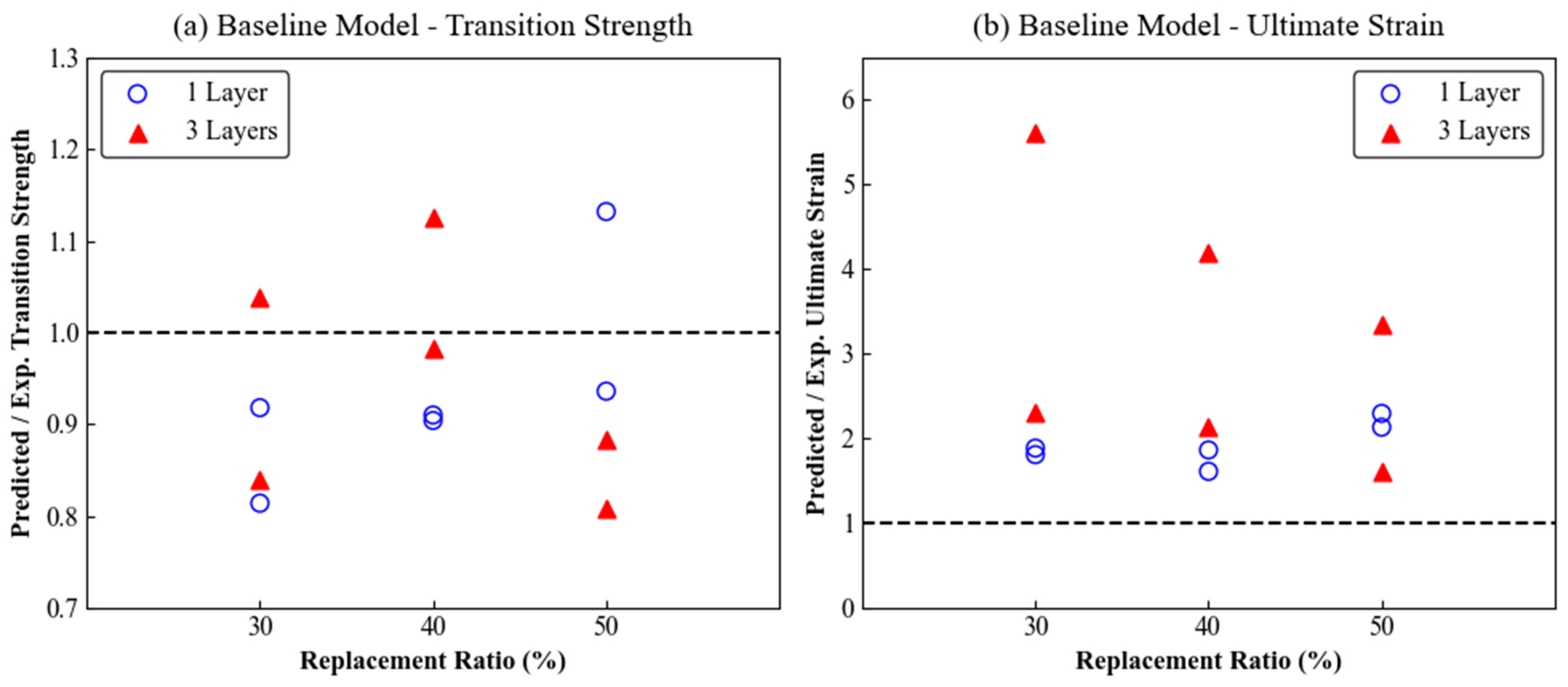
d2 = 1. To explicitly justify this assumption and analyze the prediction bias with respect to the damage level, a comprehensive residual analysis was conducted across all 48 specimens (
Figure 17). The broken-axis scatter plot highlights a highly non-monotonic and stochastic trend. For levels S0 to S2, predictions generally overestimate the experimental strains due to premature FRP rupture. Conversely, at the severe damage level (S3), the highly crushed concrete core develops massive plastic deformation, causing the residual ratios to drop below 1.0.
Because the ultimate strain does not follow a monotonic degradation rule with respect to initial damage, coupling it with a unified damage reduction factor is mathematically inappropriate. It must be explicitly acknowledged that the inability to accurately predict the ultimate strain (AAE ≈ 156%) is a significant formulation deficiency of the current empirical model, reflecting the extreme dispersion inherent to the coupled effects of square geometry and severe internal damage.
Therefore, preserving β
d2 = 1 is the most physically sound choice. Using the elastic modulus method as the damage degree evaluation index, the specific expressions for the limit point strength and strain of CFRP-confined damaged recycled concrete prisms are finally formulated as
Finally, to establish the complete continuous constitutive model for the damaged specimens, the derived characteristic parameters accounting for initial damage (f’
cc,d, ℇ
cc,d, f’
cu,d, ℇ
cu,d from Equations (9) and (11)) are substituted back into the baseline stress–strain framework previously established in
Section 4.2.3. The complete proposed damage-based constitutive equation for CFRP-confined RAC prisms is mathematically formulated as
While Equations (7) through (11) are derived through mathematical regression, the introduced damage influence coefficients (e.g., αd1, βd1 and αd2) are not merely empirical fitting parameters; they are strictly grounded in the physical deterioration mechanisms of the RAC core. From a micromechanical perspective, the initial damage (quantified by the parameter dc) reflects the pre-existing crack density and the severe degradation of the ITZ between the recycled aggregates and the mortar matrix. Under axial compression, this pre-existing internal crack network disrupts the uniform lateral dilation of the concrete core. Consequently, this premature and localized lateral expansion severely reduces the “effective confinement area” provided by the CFRP jacket.
Furthermore, in the context of square prisms, this physical degradation is exacerbated by the cross-sectional geometry. The pre-existing damage amplifies the severe stress concentrations at the sharp corners, causing the weakened ITZ to slide and fail earlier. This geometrical “arching effect” leads to a highly uneven lateral stress distribution and a drastically reduced effective confinement area along the flat sides. In the proposed mathematical formulation, this mechanically driven loss of confinement efficiency is explicitly embedded and quantified by the systematic degradation of the modification factors αd and βd, successfully bridging the gap between macroscopic empirical formulas and microscopic physical mechanisms.
Based on the above analysis, this paper constructs a CFRP-confined constitutive model for recycled concrete prisms with initial damage and compares the predicted stress–strain relationships at the inflection and limit points with the experimental data. The results show that the model can accurately reflect the axial mechanical properties of specimens under different damage states, with good fitting results, thereby validating the model’s reliability in describing the compressive behavior of CFRP-confined damaged recycled concrete prisms.
However, it should be noted that the current model is calibrated based on laboratory-scale specimens (100 × 100 × 300 mm). Compared to cylindrical columns, the confinement efficiency in these square sections is inherently lower due to the ‘shape effect,’ as sharp corners induce stress concentrations and reduce the effectively confined concrete core. Due to the potential size effects inherent in quasi-brittle materials like RAC, the confinement efficiency might be slightly lower in full-scale structural columns where aggregate distribution and crack propagation are more stochastic. Therefore, while this model provides an acceptable theoretical framework, a size-dependent reduction factor is recommended when applying these findings to large-scale engineering structures to ensure conservative design.
Beyond theoretical validation, the proposed constitutive model offers a practical tool for the performance-based retrofitting of actual engineering structures. In engineering practice, the initial damage levels (S1–S3) of existing RAC columns can be correlated with in situ non-destructive testing (NDT) techniques, such as ultrasonic pulse velocity, to quantify the internal stiffness degradation. Once the damage state is identified, structural engineers can utilize the proposed stress–strain equations to predict the enhanced compressive behavior. More importantly, by integrating our model with current FRP design guidelines, engineers can inversely calculate the required CFRP layers (e.g., the confinement ratio) necessary to safely restore the target load-bearing capacity and ductility of degraded RAC columns.
4.4. Parametric Sensitivity Analysis
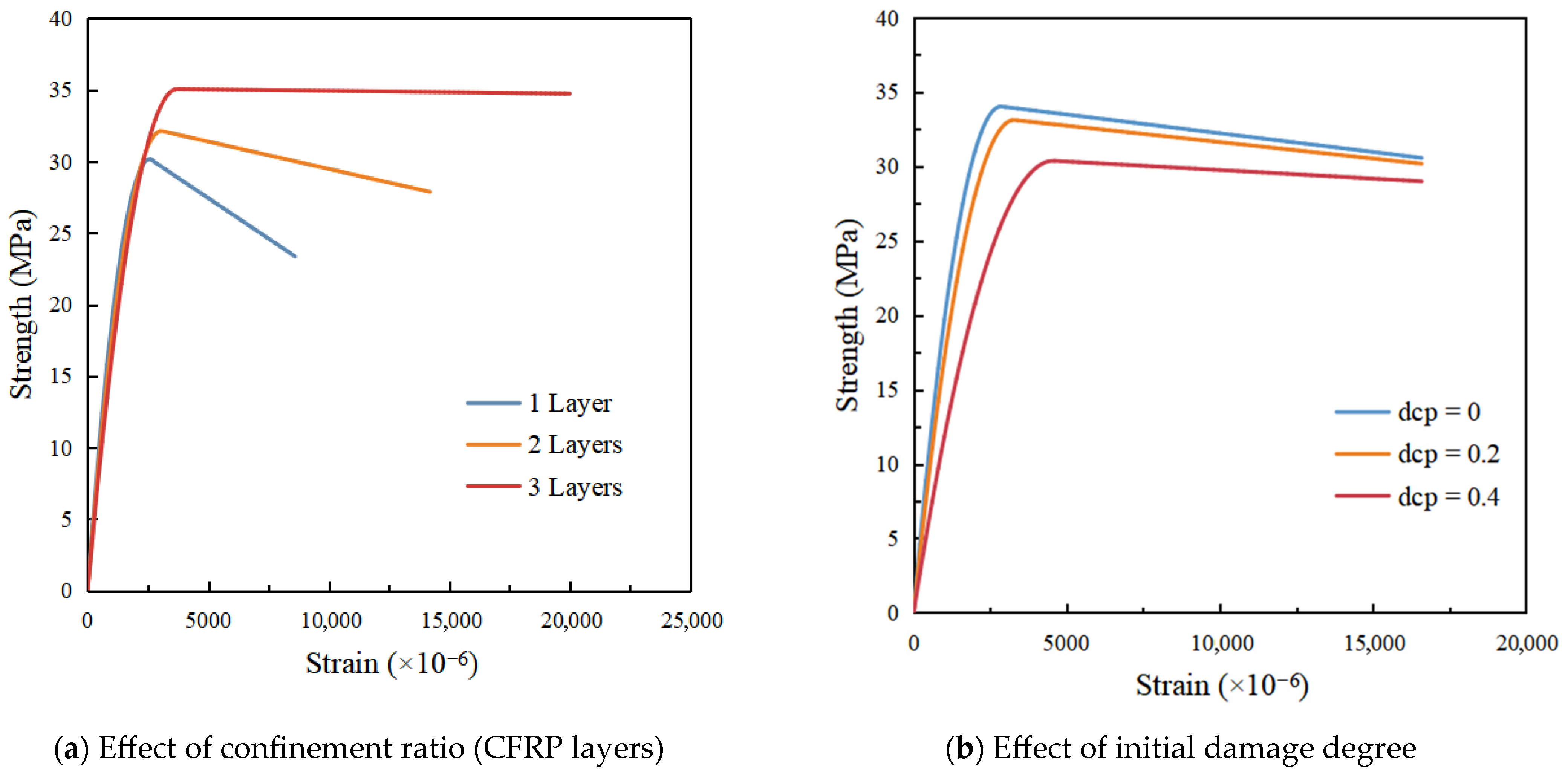
To theoretically validate the mathematical robustness and physical consistency of the proposed constitutive model beyond the specific experimental calibration points, a comprehensive parametric sensitivity analysis was conducted. A virtual baseline square RAC column was configured with an unconfined concrete strength of 30 MPa. The theoretical stress–strain responses generated by the proposed model under varying confinement ratios and initial damage levels are plotted in
Figure 18.
As illustrated in
Figure 18a, with the initial damage state kept constant (Damage = 0.2), increasing the number of CFRP layers (from 1 to 3 layers) systematically enhances both the ultimate strength and the ultimate strain. The theoretical curves accurately capture the delayed rupture and higher post-transition slopes associated with stronger confinement, which strictly obey the classical physical laws of FRP-confined concrete. Conversely, as shown in
Figure 18b, under a constant confinement level (2 layers of CFRP), an increase in the initial damage variable (from 0 to 0.4) mathematically leads to a pronounced degradation in the initial elastic modulus (stiffness) and a lower transition strength. This generated trend perfectly reflects the physical reality that pre-existing micro-cracks severely impair the initial stiffness and accelerate the lateral expansion of the RAC core.
The highly logical and smooth theoretical trajectories demonstrated in this sensitivity analysis strongly substantiate the mathematical robustness and reliability of the proposed constitutive model within its defined domain of applicability.
It should be noted that the proposed model is currently calibrated and validated within a specific experimental scope. Its applicability is limited to CFRP-confined square RAC columns with a replacement ratio of 30–50% and specific initial damage degrees. Extrapolating this model to circular columns, fully recycled aggregate concrete (100% replacement), or other types of FRP jackets would require further experimental validation.
5. Conclusions
This research systematically evaluates the synergistic effects of recycled aggregate replacement ratios, concrete strength, and initial damage on the axial compressive performance of CFRP-confined RAC. Based on monotonic axial compression tests of 54 prisms, the investigation elucidates the interplay between confinement intensity and pre-existing degradation. The primary findings derived from the experimental results and theoretical modeling are summarized as follows:
(1) Microstructural Degradation and Sensitivity to Aggregate Replacement
The compressive strength of unconfined RAC exhibits a significant decline as the RA replacement ratio increases, heavily depending on the matrix strength. In the C40 series, the load-carrying capacity decreased by 8.5% when the replacement ratio was raised from 30% to 50%, whereas this reduction escalated to 14.3% in the C50 series. Microstructural analysis via SEM reveals that higher replacement ratios decrease surface smoothness and widen the ITZ due to impaired cement hydration, fundamentally weakening internal bonding.
(2) Confinement Efficiency and Strain Enhancement
CFRP confinement serves as an effective mechanism to enhance deformation capacity, though its efficiency varies. For the C40 series, the transition point strains of 1-layer and 3-layer confined specimens increased by 1.04 to 1.27 times relative to unconfined prisms. In the C50 series, strains increased by 1.1 to 1.4 times at lower replacement ratios; however, at the 50% replacement level, the extreme brittleness of the RAC core triggered premature failure, limiting the strain increase to merely 0.98 to 1.05 times. This indicates that external confinement cannot completely overcome the severe internal brittleness of high-grade, high-replacement RAC.
(3) Impact of Initial Damage on Restorative Capacity
Initial damage significantly compromises the load-bearing restorative efficiency of the CFRP jacket. Under 3-layer confinement in the C40 series, the transition strength ratios of pre-damaged specimens (S1, S2, S3) relative to the undamaged unconfined concrete dropped precipitously as the replacement ratio increased. The ratios were 1.20, 1.12, and 1.09 at 30% replacement, declining to 1.08, 1.02, and 1.01 at 40%, and plummeting to 1.02, 0.71, and 0.65 at 50%. These quantified limits demonstrate a definitive performance ceiling where supplementary lateral confinement cannot mitigate the deleterious effects of severe coupled damage.
(4) Constitutive Modeling Incorporating Initial Damage
A refined damage-based constitutive model for CFRP-confined RAC was established through a rigorous three-step procedure: (1) defining quantitative damage assessment indicators; (2) establishing a baseline analytical model for intact RAC; and (3) mathematically coupling the damage indicators into the baseline framework. Statistical evaluation confirms that the baseline model significantly outperforms existing empirical formulations, achieving an acceptable AAE of 25.74% for ultimate strength and 10.84% for transition point strength. While its theoretical ultimate strain prediction exhibits a larger AAE (156.40%)—mechanistically attributed to the premature local crushing of square RAC specimens—this baseline establishes a reasonable foundation for predicting strength capacities. By integrating the damage parameters into this calibrated baseline framework, the final constitutive equations effectively translate the physical severity of initial degradation into acceptable mechanical trajectories for structural performance assessment. To ensure proper engineering use, the model’s applicability is strictly constrained by the experimental scope: sharp-cornered square prisms, normal-strength RAC (C40–C50), and replacement ratios of 30–50%, 1 to 3 layers of CFRP confinement, and initial damage states ranging from intact to severe (S0–S3). Given the severe stress concentrations inherent in sharp-cornered geometries, the model likely yields conservative lower-bound predictions for circular or rounded-corner sections. Conversely, extrapolation to high-strength RAC (>C50) should be avoided, as the model may overestimate ductility due to the pronounced brittleness observed in preliminary tests of higher-grade specimens. These defined boundaries ensure the model remains a robust and reliable tool within its validated design space.
While the proposed model demonstrates acceptable predictive capability for strength and transition states, its current validation relies primarily on the internal S0 control dataset. This approach was methodologically necessary to maintain material consistency and isolate the effects of initial damage without introducing external RAC material “noise.” However, due to the current unavailability of an independent experimental dataset for CFRP-confined structural-grade RAC (e.g., 30–60 MPa) with initial damage, the external validation utilizing a 14 MPa dataset is strictly reframed as an out-of-domain exercise. Consequently, expanding the structural-strength database to execute a rigorous in-domain external validation and further comprehensively verify the model’s generalizability remains a critical future objective. Furthermore, to bridge the gap between laboratory prototypes and practical applications, future investigations must prioritize the evaluation of size effects and long-term durability. Expanding this research to large-scale reinforced RAC members under complex loading scenarios and diverse environmental stressors is essential to fully unlock the potential of CFRP-confined RAC in sustainable, low-carbon engineering practices.