


Abstract
To investigate the effects of incorporating nanomaterials—carbon nanotubes (CNTs) and graphene oxide (GO)—on the axial compressive mechanical properties of alkali-activated recycled aggregate concrete (AARAC) after high-temperature exposure, this study designed 51 sets of specimens with recycled coarse aggregate replacement rate, nanomaterial content, and temperature as the main parameters. Compression tests were conducted to analyze the failure mode and strength variation in AARAC specimens after heating. In addition, microscopic tests, including X-ray diffraction, scanning electron microscopy, and computed tomography (CT scanning), were performed to analyze the microstructural characteristics of the post-heated AARAC specimens. The results indicate that as the replacement rate of recycled coarse aggregate increased from 0% to 100%, the residual compressive strength after exposure to 600 °C decreased from 33.6 MPa to 19 MPa. When 0.1 wt% of CNTs is added, the compressive strength of AARAC after exposure to a high temperature of 600 °C increases by approximately 30.4% compared to that of AARAC without nanomaterial addition. When 0.1 wt% of CNTs and 0.05 wt% of GO are added, the compressive strength after exposure to a high temperature of 600 °C increases by approximately 44.3%, while the size of scattered fragments upon failure increased, and the failure mode appeared more complete. Microscopic test results indicate that the high-temperature treatment did not cause significant changes in the main phase composition of AARAC. The synergistic effect of the nanomaterials CNTs and GO can fully utilize their functions as nucleation sites, pore fillers, and crack bridging agents. By strengthening the Interfacial Transition Zone between the recycled coarse aggregate and the cement paste, refining the Matrix Pore Structure, dispersing local thermal stress, and suppressing the propagation of high-temperature cracks, the mechanical properties of AARAC after high-temperature exposure can be effectively maintained.
1. Introduction
With the rapid economic development in China, the amount of construction waste is continuously increasing, and it is estimated to reach 3.084 billion tons by 2032 [1]. The disposal of construction waste through dumping and landfilling not only results in resource wastage but also causes environmental pollution. To promote the recycling and utilization of construction waste, the application of recycled concrete presents a significant approach [2,3].
Recycled concrete transforms construction waste into new building materials, directly contributing to the development of a circular economy and green infrastructure [4,5]. However, due to the high porosity and water absorption capacity of recycled aggregates, the mechanical properties of recycled concrete are relatively poor [6,7,8,9,10]. The aluminosilicate gel produced by the alkali activation reaction can quickly fill the pores of recycled aggregates, and alkali-activated binders can continuously optimize the microstructure of the ITZ, resulting in a stronger bond between the AARAC matrix and the aggregates [11,12,13,14,15,16]. Therefore, this study attempts to optimize recycled concrete using an alkali-activated cementitious system, which may alleviate the mechanical performance shortcomings caused by the inherent defects of recycled coarse aggregates. Meanwhile, AARAC is an inorganic composite material formed through a cementitious reaction activated by an alkaline activator, with recycled coarse aggregates as the skeletal phase and ground granulated blast-furnace slag and fly ash as cementitious precursors, followed by setting and hardening. This material enables the resource utilization of industrial solid waste and has certain energy-saving and environmental protection benefits. However, the practical application of AARAC is still constrained by several technical bottlenecks, such as significant material brittleness, poor deformation adaptability, and cracking induced by shrinkage stress. Studies have shown that CNTs can form a three-dimensional network within the cement matrix and suppress microcrack propagation through a bridging effect. Thus, the incorporation of CNTs as nano-fiber reinforcements can effectively mitigate the aforementioned defects [17,18,19]. GO, as a layered nanomaterial with a high specific surface area and active surface functional groups, exhibits multiple modification capabilities [20]. Its incorporation into AARAC enables micro-pore filling, skeleton enhancement, and crack bridging, thereby improving the mechanical properties of concrete [21,22,23,24]. Meanwhile, CNTs tend to re-aggregate in an alkaline environment. GO, on the other hand, can not only disperse CNT aggregates through π-π stacking interactions, but also inhibit their re-aggregation by relying on its two-dimensional layered structure [25]. Moreover, the functional groups on the surface of GO can enhance the binding force between graphite oxide nanosheets and the gel phase, thereby promoting the stress percolation effect and improving the mechanical properties of the sample [26].
In addition to bearing quasi-static loads at ambient temperatures, concrete structures may also be subjected to accidental actions such as fire and explosion. High temperatures degrade the performance of concrete materials, resulting in reduced load-bearing capacity and increased risk of structural instability [27,28,29]. Consequently, the study of residual compressive strength evolution of concrete after exposure to elevated temperatures has attracted significant attention in the field of construction materials. Compared with ordinary concrete, recycled concrete exhibits a greater reduction in compressive strength after exposure to high temperatures [30,31]. The compressive strength of alkali-activated concrete after exposure to high temperatures is generally superior to that of ordinary concrete. However, when the temperature exceeds 600 °C, its compressive strength will sharply decline [32,33]. Therefore, enhancing the compressive strength of alkali-activated recycled aggregate concrete after high-temperature exposure is expected to provide assistance in expanding the engineering application scenarios of this type of recycled building materials. Many scholars have discovered through research that the addition of nanomaterials can effectively enhance the high-temperature mechanical performance of concrete [34]. CNTs, owing to their unique one-dimensional tubular structure and ultra-high thermal conductivity, can reconstruct the internal heat conduction network of the material, significantly improving thermal diffusivity. This enhanced heat transfer capability reduces thermal stress gradients in high-temperature environments and suppresses the initiation and propagation of microcracks [35,36]. The bridging effect of GO and its ability to enhance the formation of hydration products can inhibit the expansion rate of harmful pores at high temperatures, thereby delaying the thermal damage process [37,38,39,40,41].
Most of the aforementioned studies have focused on the high-temperature mechanical performance of either alkali-activated recycled concrete or nanomaterial-modified concrete, whereas little research has been conducted on the combined effects of CNTs and GO on the post-fire compressive behavior of AARAC. Therefore, this study experimentally investigates the axial compressive mechanical properties of AARAC incorporating CNTs and GO, both individually and in combination, after exposure to elevated temperatures. Advanced characterization techniques such as SEM and CT scanning are used to analyze the microstructure, aiming to explore the influence mechanism of nanomaterials on the mechanical performance of AARAC after high-temperature exposure. The findings are intended to provide scientific support for the broader application of recycled concrete materials.
2. Experimental Overview
2.1. Raw Materials
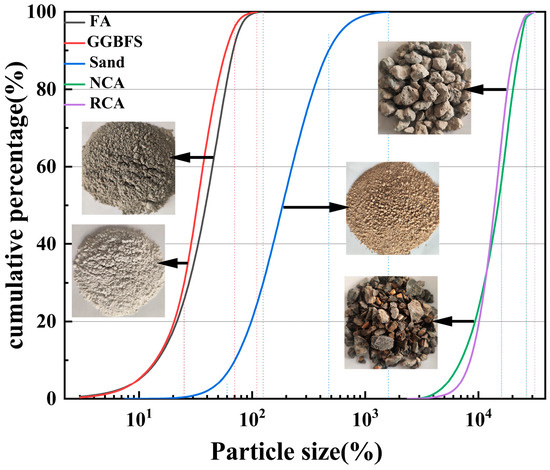
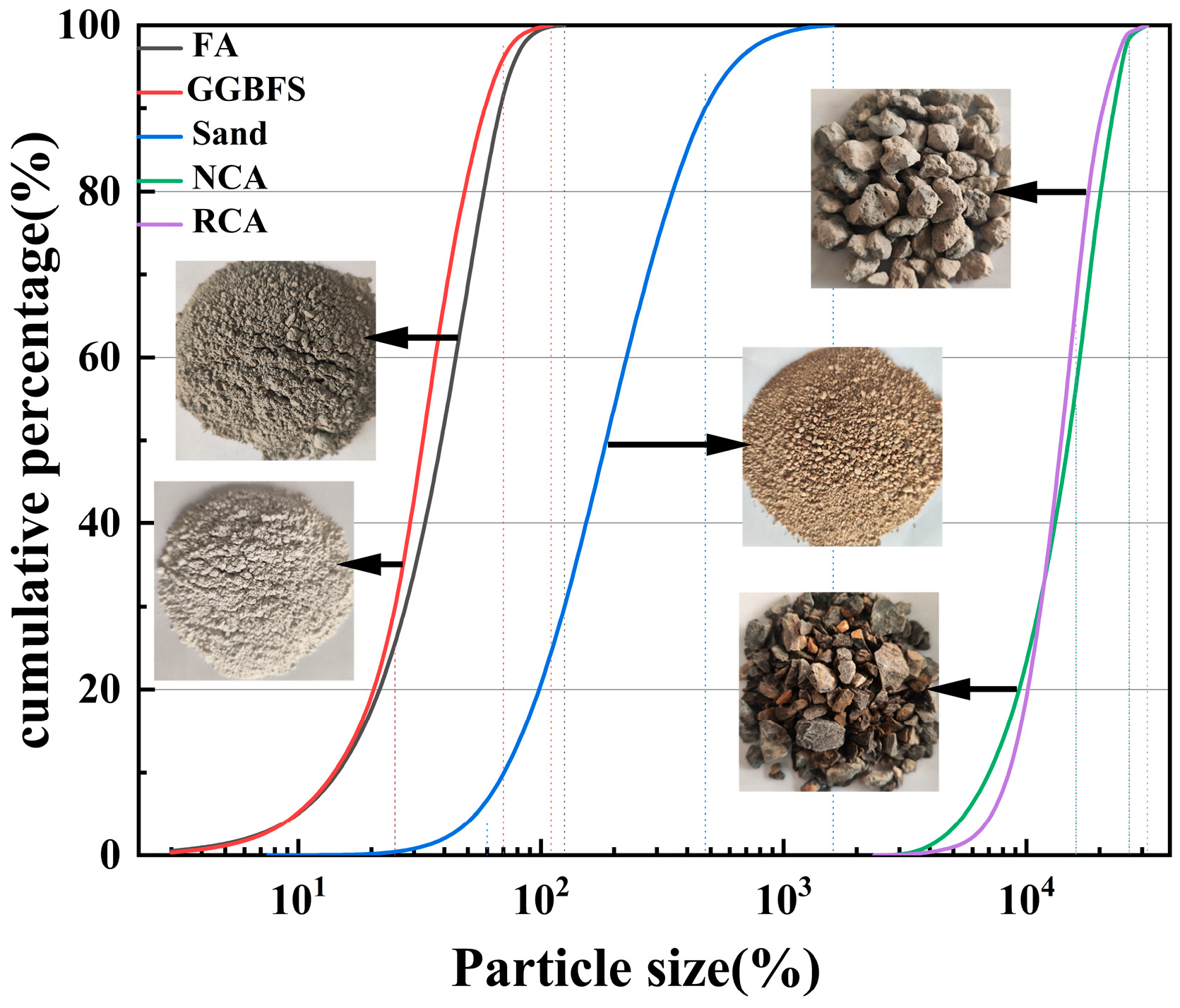
The fine aggregate used in this study was natural river sand, with an apparent density of 2560 kg/m3 and a fineness modulus of 2.7. The coarse aggregates included two types: natural coarse aggregate (NCA) and recycled coarse aggregate (RCA). The NCA was crushed stone with a particle size ranging from 5 mm to 25 mm, while the RCA was derived from construction waste in Beijing, processed through crushing and screening to obtain recycled concrete coarse aggregates with a particle size also ranging from 5 mm to 25 mm. The physical and mechanical properties of these aggregates are listed in Table 1. The cementitious materials were S95-grade ground granulated blast-furnace slag (GGBFS) and Class I fly ash (FA). Their chemical composition and physical properties are listed in Table 2. The particle size distribution and appearance characteristics of the raw materials are shown in Figure 1.
Table 1.
Physical properties of natural and recycled coarse aggregates.
Table 2.
Chemical composition and physical properties of GGBFS and FA.
Figure 1.
Particle Size Distribution Curves and Appearance Characteristics of Raw Materials.
The alkali activator used in the experiment was a mixed solution, and we got that by combining sodium silicate and water, with a mass concentration of 40% and a modulus of 1.2. The prepared alkali activator was allowed to stand at 20 °C for 24 h. The water reducer was a retarding naphthalene sulfonate formaldehyde condensate (R-NSF). The CNTs, as a nanomaterial, had a purity greater than 98%, an outer diameter of 8–15 nm, and a length of 0.5–2 μm, with a black powder appearance. The GO, another nanomaterial, had a purity greater than 95%, a thickness of 3.4–8.0 nm, a number of layers of 1–2, and a specific surface area of 100–300 m2/g, with a dark brown powder appearance.
2.2. Mix Proportion Design and Sample Preparation
To investigate the effects of CNTs and GO on the mechanical performance of AARAC after high temperature at various RCA replacement rates, the mix proportions of AARAC for this experiment were designed based on DB37/T 5176-2021 [42], along with references [43] and [44]. The main design parameters were as follows: 80% GGBFS content, 20% FA content, a water-binder ratio of 0.42, an alkali activator modulus of 1.2, an alkali equivalent of 5%, and RCA replacement rates of 0%, 50%, and 100%. Since excessive dosage of CNTs and GO tends to cause aggregation in the concrete matrix, leading to non-uniform dispersion and consequently reduced strength of the concrete. Considering both cost–benefit efficiency and the findings reported in previous studies [45,46,47,48,49,50,51,52], this study selected two nanomaterial incorporation schemes: single incorporation of 0.1 wt% CNTs and hybrid incorporation of 0.05 wt% GO and 0.1 wt% CNTs. A total of nine mix proportions were designed, as shown in Table 3. We prepared 27 cube specimens with a side length of 100 mm for the cube compressive strength test at room temperature, 81 cube specimens with the same side length for the cube compressive strength test under high-temperature conditions, and 45 cube specimens of the same size for the CT scanning test in accordance with the mix proportion. The compressive strength of AARAC after high-temperature exposure is shown in Table 4.
Table 3.
Mix proportions of AARAC.
Table 4.
Influence of High-Temperature Exposure on the Compressive Strength of AARAC.
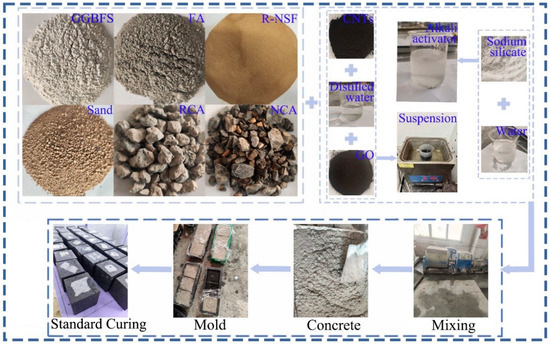
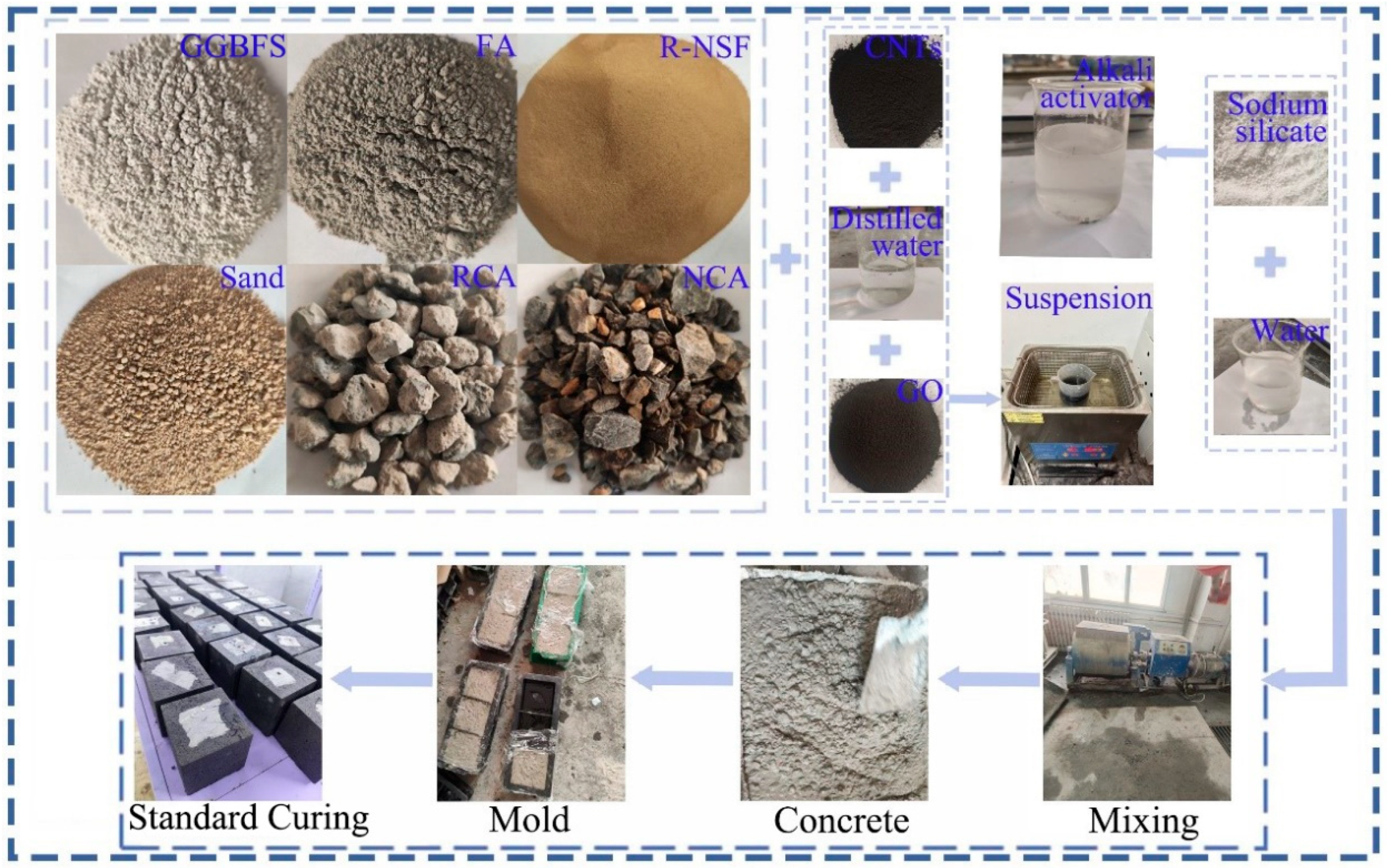
A concrete mixer with a capacity of 100 L (Wuxi Xigong Test Instrument Co., Ltd., Wuxi, China) was used for mixing the concrete. Prior to concrete mixing, CNTs and GO suspensions needed to be prepared in advance: the weighed CNTs and GO were added into a beaker, then distilled water was added according to the specified ratio and stirred with a glass rod for 10 min. Subsequently, the beaker was placed into a water bath ultrasonic cleaner (Qingdao Weisite Electronic Purification Equipment Co., Ltd., Qingdao, China), set at an ultrasonic power of 300 W, and subjected to ultrasonic treatment for 60 min to prepare a uniform and stable CNTs and GO suspension. After the nanomaterials are dispersed, a glass rod is used to pick up a small amount of the dispersed liquid and drop it into clear water. The liquid should spread evenly in the water without any visible agglomerated particles. At this point, it is considered that the dispersion is complete and can be used for subsequent experiments. Then, the CNTs and GO suspensions are added to the prepared alkali activator and stirred for 10 min before being used. Next, all raw materials were weighed according to the mix proportion. First, the natural coarse aggregates. Reclaimed coarse aggregates that have been pre-soaked for 5 min, fine aggregates, and cementitious materials were added into the mixer and stirred for 3 min; Pour the water and the treated alkaline activator into the well-mixed solid material and stir for 3 min. The resulting fresh concrete was poured into pre-prepared molds and then placed on a vibration table for vibration treatment for 3 min to eliminate internal air bubbles. Finally, the specimens with molds were placed under laboratory conditions for 24 h of static standing, then demolded. After that, the specimens were placed in a standard curing room maintained at a temperature of (20 ± 2) °C, a relative humidity of over 95%, and an atmospheric pressure of approximately 101.3 kPa for 28 days of curing. The preparation process of AARAC specimens is shown in Figure 2.
Figure 2.
Preparation process of AARAC specimens.
2.3. Experimental Methods
2.3.1. Heating Test
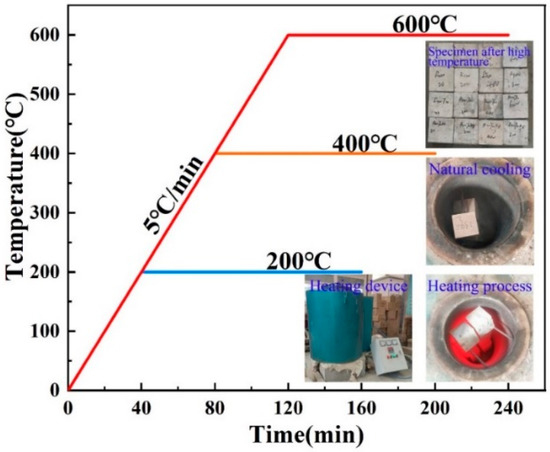
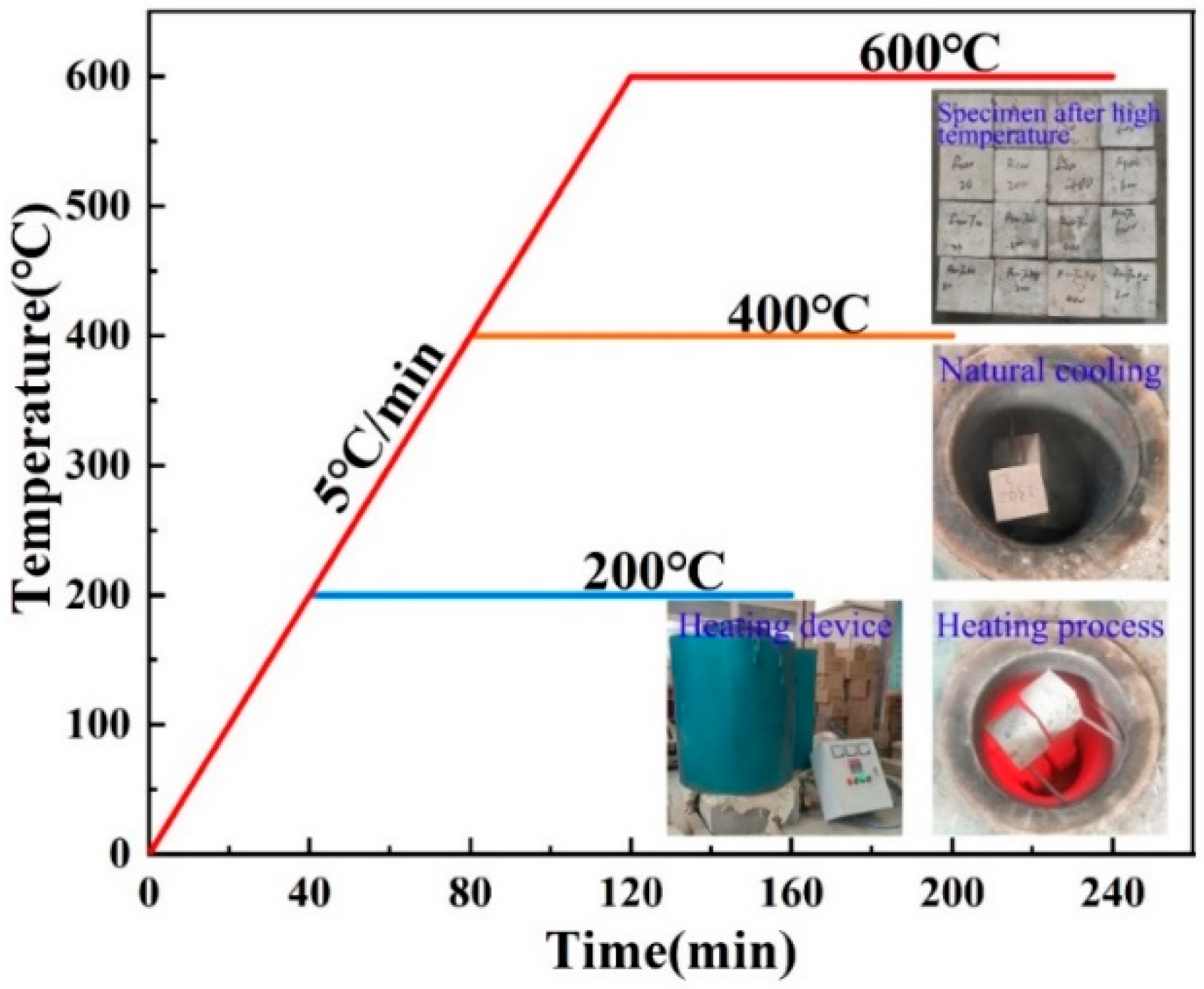
After 28 days of curing, the specimens were transferred to an environment with a temperature of 18–26 °C and a relative humidity of 40–60% and left to stand for 7 days to ensure their surfaces were dry. The heating apparatus used was a new energy-saving electric furnace oven (Zesheng Industrial Electric Furnace Factory, Dongtai, China). In this study, the heating system selected was based on the heating methods described in relevant literature [54,55]. The dried specimens were placed on an iron stand in the high-temperature furnace and heated at a rate of 5 °C/min. This heating rate was very close to the recommended heating rate by RILEM [56]. According to the experimental design, batch heating tests were conducted at target temperatures of 200 °C, 400 °C, and 600 °C, with heating times of 40 min, 80 min, and 120 min respectively. The heating curves are shown in Figure 3. To ensure uniform temperature distribution inside the specimens, after the temperature inside the furnace rose to the target temperature, it was maintained at a constant temperature for 2 h. Then, the furnace door was opened, and the specimens were taken out after being naturally cooled to room temperature.
Figure 3.
Heating curve.
2.3.2. Mechanical Property Test
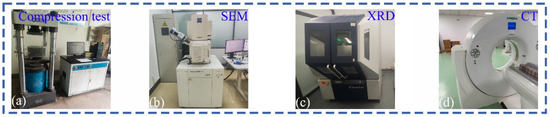
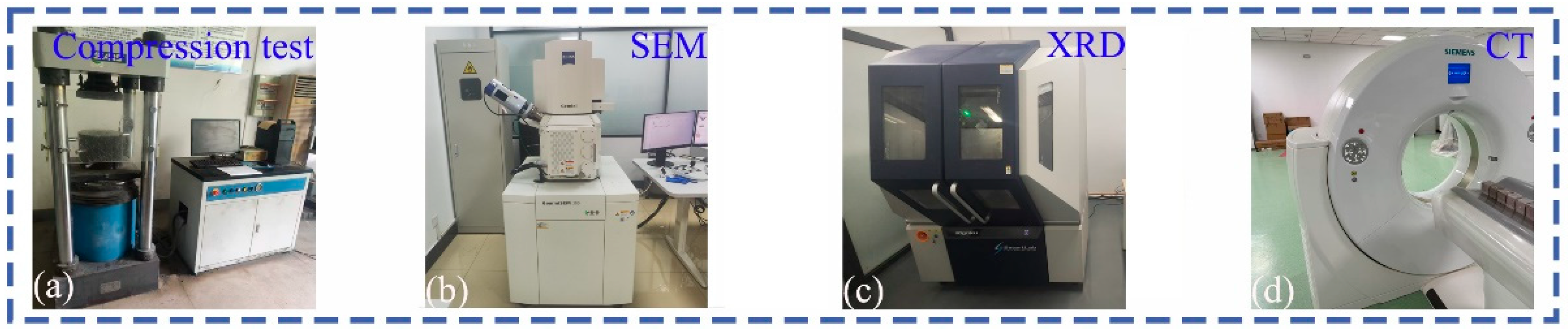
In accordance with the concrete compressive strength testing method specified in GB/T 50081-2019 [53], compression tests were conducted on AARAC specimens after 28 days of curing using a 30 T electro-hydraulic servo compression testing machine (SANS Testing Machine Co., Ltd., Shanghai, China), with the loading rate set at 10 kN/s. The average value of the measured compressive strength of three specimens in each group was taken as the representative compressive strength value of that group. The testing equipment used is shown in Figure 4a.
Figure 4.
Experimental apparatus: (a) 30 T electro-hydraulic servo compression testing machine, (b) ZEISS GeminiSEM 300 scanning electron microscope, (c) Rigaku SmartLab X-ray diffractometer, (d) Simmons Somatom Definition AS 64 medical CT system.
2.3.3. Microscopic Characterization
From the tested specimens, typical failure zones containing crack propagation zones and the aggregate-mortar interface were selected. Using a precision cutting machine (Shanghai Wujiu Automation Co., Ltd., Shanghai, China), samples with dimensions of approximately 5 mm × 5 mm × 1.5 mm were cut either perpendicular or parallel to the crack propagation direction. The samples were dried in a 60 °C oven for 24 h and subsequently cleaned with ethanol to remove surface dust. A 5–10 nm gold film was sputter-coated onto the sample surfaces, and their microstructures were observed using a ZEISS GeminiSEM 300 scanning electron microscope (Carl Zeiss AG, Oberkochen, Germany). The equipment used is shown in Figure 4b.
For X-ray diffraction (XRD) analysis, central fragments of the specimens were first cleaned of impurities, crushed, ground into powder, and passed through a 200-mesh sieve. The sieved powder was immersed in ethanol to terminate hydration and then dried to constant weight in a 60 °C oven. The Empyrean X-ray diffractometer (Rigaku Corporation, Tokyo, Japan) was set to a scanning speed of 5°/min with a 2θ range of 5–85° for phase analysis. The equipment used is shown in Figure 4c.
2.3.4. CT Scanning
Based on the peak load P obtained from the mechanical tests, three loading states—0, 0.5P, and P—were selected for CT scanning. The scans were performed using a Simmons Somatom Definition AS 64 medical CT system, installed at Shandong Jianzhu University. Loose particles on the specimen surface were brushed off prior to scanning. The scanning parameters were set to 80 kV and 200 mAs, and a cross-section at 0.5H (H = specimen height) was scanned. The equipment used is shown in Figure 4d.
3. Experimental Results and Analysis
3.1. Failure Modes
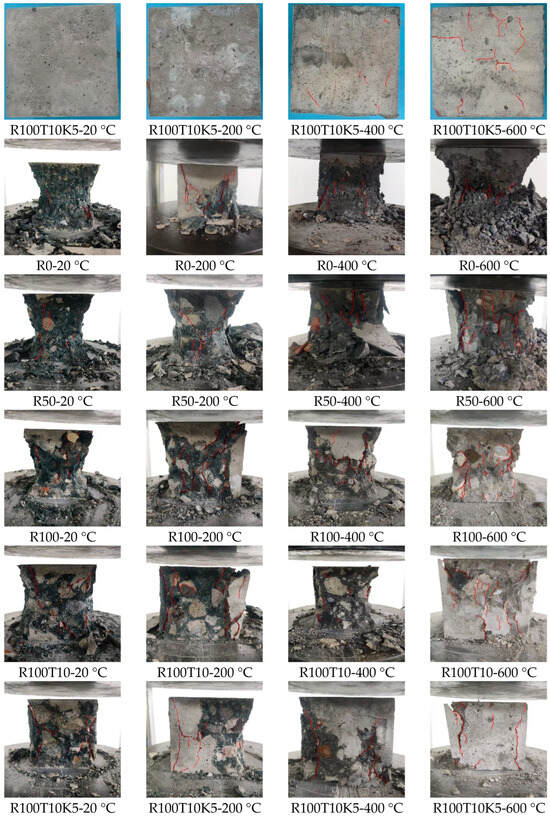
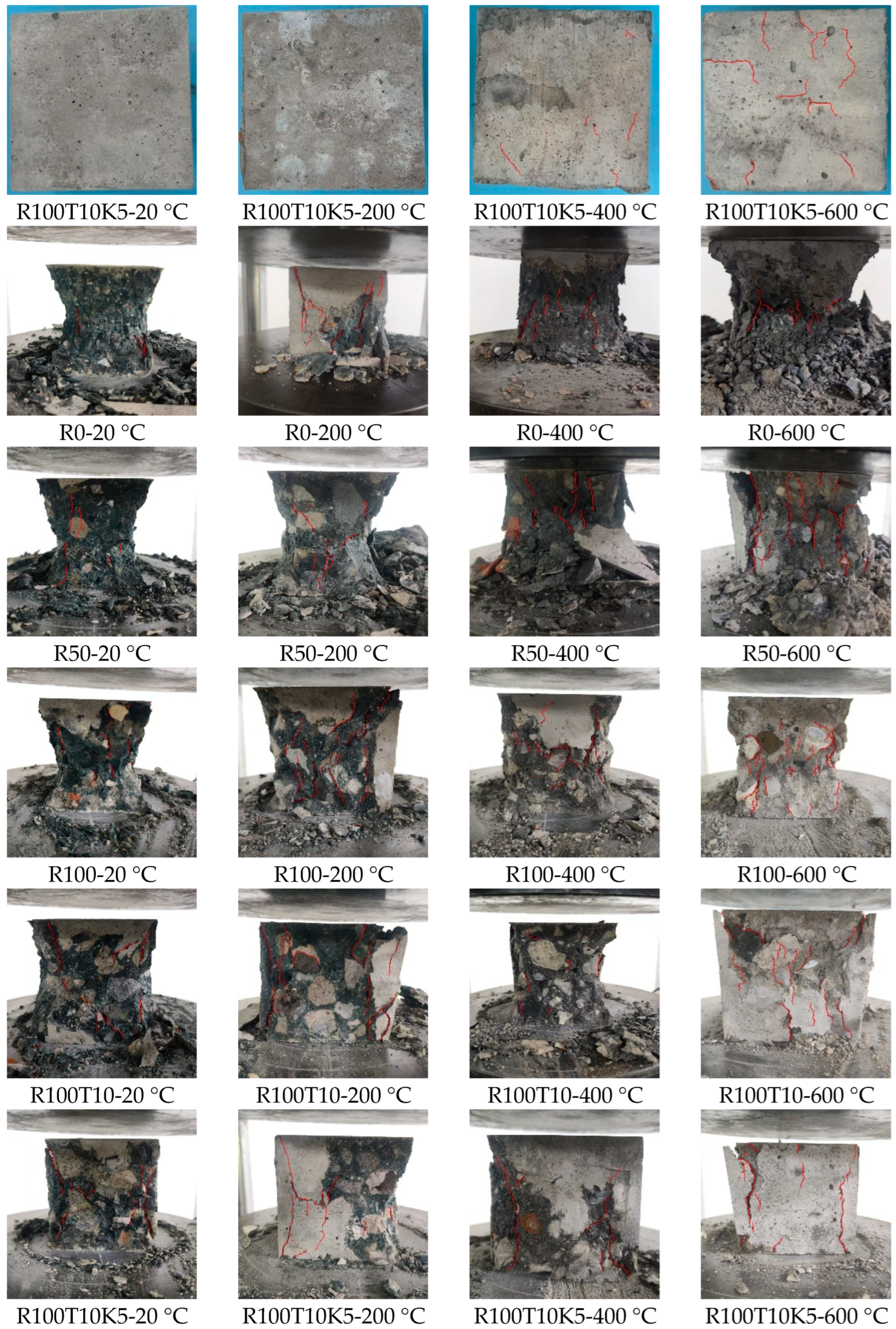
The failure modes of AARAC specimens after high-temperature exposure are shown in Figure 5. As the temperature rose, the appearance of the specimen gradually changed from the gray color at room temperature to a grayish-white color, and micro cracks appeared on the surface of the specimen. At room temperature, with an increase in the recycled coarse aggregate replacement rate, AARAC specimens failed more rapidly, and the fracture paths became more complex. Cracks developed within the ITZ between new and old mortar, within the new mortar, and inside the recycled coarse aggregate, resulting in fragmented and scattered failure. After heating to 200 °C, no visible cracks appeared on the specimen surface before loading; however, cracks initiated and propagated under compression. Surface spalling and delamination occurred, with concrete fragments scattering and a sharp cracking sound upon failure, followed by a near-complete loss of load-bearing capacity. The failure was brittle, with crushed specimens typically forming a double-conical shape, distinct separation between aggregates and mortar, and relatively large fragments. At 400 °C, microcracks appeared on the specimen surface. At 600 °C, surface spalling and corner loss were observed. Under compression, specimens exhibited pronounced deformation, rapid crack propagation, muffled failure sounds, severe segregation between aggregate and paste, and numerous small fragments with pulverized mortar adhering to the fracture surfaces. It can be seen from the fracture surface morphology of specimen R100 after exposure to 600 °C that high temperature leads to the formation of numerous pores in the old mortar attached to the surface of recycled coarse aggregates, resulting in significant structural loosening. Moreover, obvious cracks appear at the interface between the old mortar and the new mortar, as well as between the core of the aggregates. This might be the reason why the compressive strength of the AARAC specimens with high recycled coarse aggregate replacement rate decreases more significantly after the high-temperature treatment. Compared with the AARAC specimens without adding nanomaterials CNTs and GO, the cracks in the specimens with added nanomaterials develop relatively slowly during the compression process. The fragments scattered during the crushing are larger, and some specimens exhibit shear failure characteristics, with relatively complete failure patterns.
Figure 5.
Compressive failure modes of AARAC specimens after high-temperature exposure.
3.2. Compressive Strength Results and Analysis of AARAC After High-Temperature Exposure
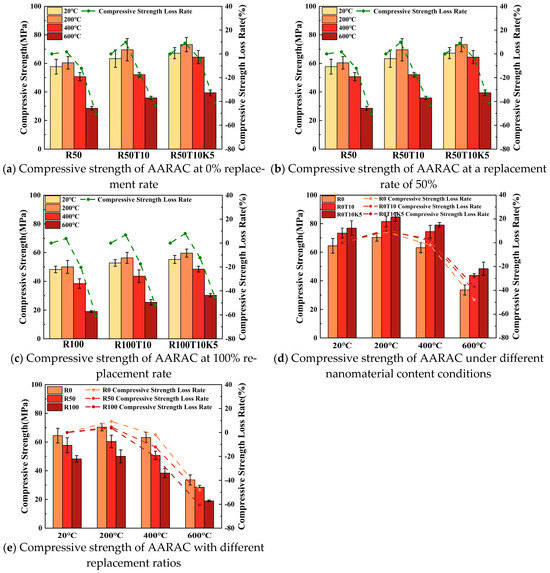
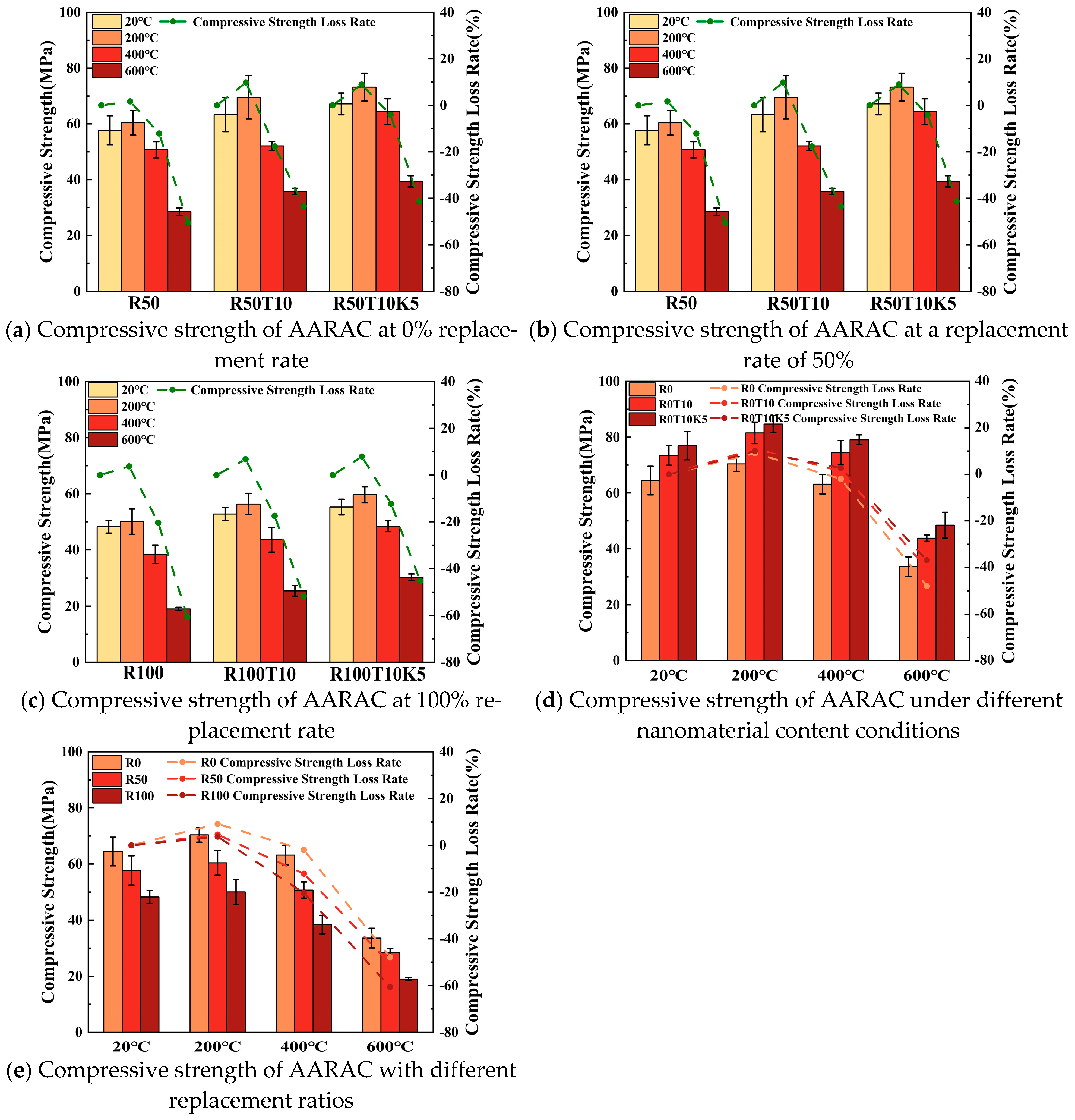
Figure 6a shows the compressive strength results of AARAC specimens with a 0% recycled coarse aggregate replacement rate under different temperature conditions. At room temperature, specimen R0 exhibited a compressive strength of 64.47 MPa, with residual strengths of 109.2%, 98%, and 52.1% of the control after exposure to 200 °C, 400 °C, and 600 °C, respectively. With the addition of 0.1 wt% CNTs, R0T10 had a room-temperature compressive strength of 73.42 MPa, and residual strengths of 111%, 101.4%, and 59.7% after heating. When 0.05 wt% GO was also incorporated, R0T10K5 reached 76.97 MPa at room temperature, with residual strengths of 110%, 102.8%, and 63% after exposure to the same temperatures.
Figure 6.
Compressive strength results of AARAC specimens.
Figure 6b shows the compressive strength results of AARAC specimens with a 50% recycled coarse aggregate replacement rate under different temperature conditions. At room temperature, specimen R50 exhibited a compressive strength of 57.72 MPa, with residual strengths of 104.6%, 87.9%, and 49.4% of the control after exposure to 200 °C, 400 °C, and 600 °C, respectively. With the addition of 0.1 wt% CNTs, R50T10 had a room-temperature compressive strength of 63.31 MPa, and residual strengths of 109.8%, 82.3%, and 56.5% after heating. When 0.05 wt% GO was also incorporated, R50T10K5 reached 67.18 MPa at room temperature, with residual strengths of 109.0%, 95.9%, and 58.6% after exposure to the same temperatures.
Figure 6c shows the compressive strength results of AARAC specimens with a 100% recycled coarse aggregate replacement rate under different temperature conditions. At room temperature, specimen R100 exhibited a compressive strength of 48.24 MPa, with residual strengths of 103.7%, 79.6%, and 39.4% of the control after exposure to 200 °C, 400 °C, and 600 °C, respectively. With the addition of 0.1 wt% CNTs, R100T10 had a room-temperature compressive strength of 52.77 MPa, and residual strengths of 106.7%, 82.6%, and 48.3% after heating. When 0.05 wt% GO was also incorporated, R100T10K5 reached 55.27 MPa at room temperature, with residual strengths of 107.9%, 87.7%, and 54.8% after exposure to the same temperatures.
Figure 6d shows the compressive strength results of AARAC specimens with different nanomaterial dosages under high-temperature exposure. After 600 °C, the strength loss rates of specimens R0, R0T10, and R0T10K5 were 47.2%, 40.3%, and 37%, respectively, indicating that the incorporation of CNTs and GO can partially mitigate the sharp reduction in compressive strength caused by high temperature. This is attributed to the substantial size discrepancy between CNTs and gel particles, which enables CNTs to be effectively encapsulated within the gel (C-A-S-H and N-A-S-H [57]) networks. Acting as bonding bridges, CNTs tightly connect the newly formed gel phases, thereby constructing a denser and more robust composite microstructure [58]. This unique structure may enhance the thermal stability of the gels and reduce their degree of decomposition. In addition, CNTs and GO can penetrate microscopic pores and initial microcracks in the alkali-activated concrete, providing bridging and filling effects that hinder the formation and propagation of cracks and pores during heating [59,60].
Figure 6e shows the compressive strength results of AARAC specimens with different recycled coarse aggregate replacement rates under various temperature conditions. It can be seen that as the replacement rate increases, the reduction in compressive strength after high-temperature exposure becomes more pronounced. This is mainly because the old mortar attached to recycled coarse aggregates has lower hardness, a rougher surface, and higher porosity, resulting in weaker bonding at the interface with the new mortar and making the material more prone to microcrack initiation. Under high-temperature exposure, combined with the destructive effect of internal vapor pressure, these microcracks further propagate, causing more severe damage and a greater loss in compressive strength.
In summary, with the increase in temperature, the compressive strength of AARAC specimens with different mix ratios all exhibits a characteristic of first strengthening and then deteriorating. Before the temperature reaches 200 °C, the cubic compressive strength of the specimens exhibits an upward trend compared to that at room temperature, which is consistent with the research findings reported by Zhang et al. [61] and Gao et al. [62]. This phenomenon occurs because a moderately elevated temperature provides additional activation energy for the system, effectively promoting further geopolymerization reactions [63,64]. As a result, more C-A-S-H (calcium-aluminum-silicate-hydrate) gel and N-A-S-H (sodium-aluminum-silicate-hydrate) gel are generated and accumulated, refining internal pores and enhancing the structural compactness of the matrix, thereby contributing positively to strength development. Meanwhile, 200 °C has not yet reached the critical temperature that induces significant thermal damage and microcrack formation. At this temperature, the strengthening effect of thermal curing dominates, while high-temperature deterioration remains insignificant. Consequently, the compressive strength of the specimens shows a slight increase. This phenomenon is consistent with the findings reported in previous studies [65,66,67,68].
After being subjected to a high temperature of 200 °C, the compressive strength gradually decreases. This is because high-temperature exposure triggers the decomposition of gels in alkali-activated recycled concrete and causes an increase in its internal porosity, ultimately leading to the deterioration of the material’s mechanical properties. Due to their excellent mechanical and structural characteristics, carbon nanotubes (CNTs) can effectively mitigate the adverse effects described above [69,70]: on the one hand, CNTs provide nucleation sites to promote gel formation, thereby refining the pore network of the matrix and enhancing structural compactness; on the other hand, CNTs can form bridges across the two ends of microcracks, relying on their excellent tensile toughness to bear the tensile stress generated by crack propagation and prevent microcracks from connecting and developing into macroscopic cracks [71,72]. This dual action mechanism helps alkali-activated recycled concrete maintain high compressive strength and good structural integrity even after being subjected to high temperatures. This observation is consistent with the findings reported in the literature [73]. When CNTs are mixed into alkali-activated recycled concrete, the alkaline environment tends to reduce their dispersion degree, resulting in the re-agglomeration of CNTs [74,75]. As a two-dimensional nanomaterial with both high toughness and hydrophilicity, GO can adsorb CNTs through π-π stacking interactions when compounded with one-dimensional linear CNTs [25,76]. This not only efficiently exfoliates CNT agglomerates but also blocks secondary agglomeration, improving the dispersion uniformity of CNTs in the suspension. In addition, during ultrasonic treatment, GO nanosheets can act as “nano-cutters” to shorten the length of CNTs. Therefore, adding GO to CNT suspensions can simultaneously achieve dispersion optimization and size regulation of CNTs [77,78]. Du et al. [79] confirmed through zeta potential tests that the dispersion stability of the hybrid system is superior to that of systems containing only GO or CNTs. With excellent dispersibility and a reasonable size distribution, the GO-CNT system can give full play to its functions of providing nucleation sites, filling pores and bridging cracks. This result is similar to those reported in previous studies [80,81]. This in turn strengthens the interfacial transition zone of recycled aggregates, refines the pore structure of the matrix, disperses local thermal stress and inhibits the propagation of high-temperature-induced cracks, ultimately effectively maintaining the mechanical properties of AARAC after high-temperature exposure.
3.3. Analysis of Microscopic Test Results
3.3.1. XRD Analysis
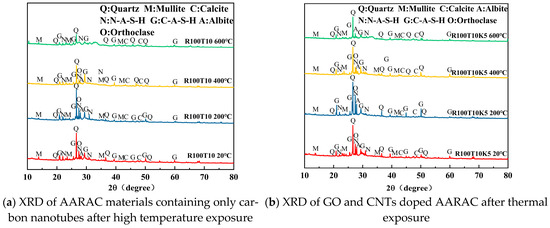
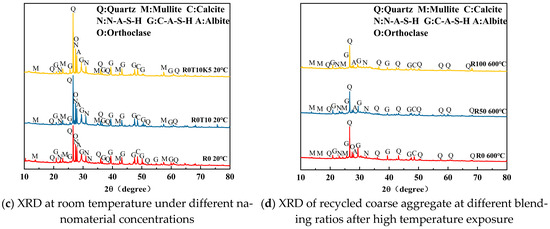
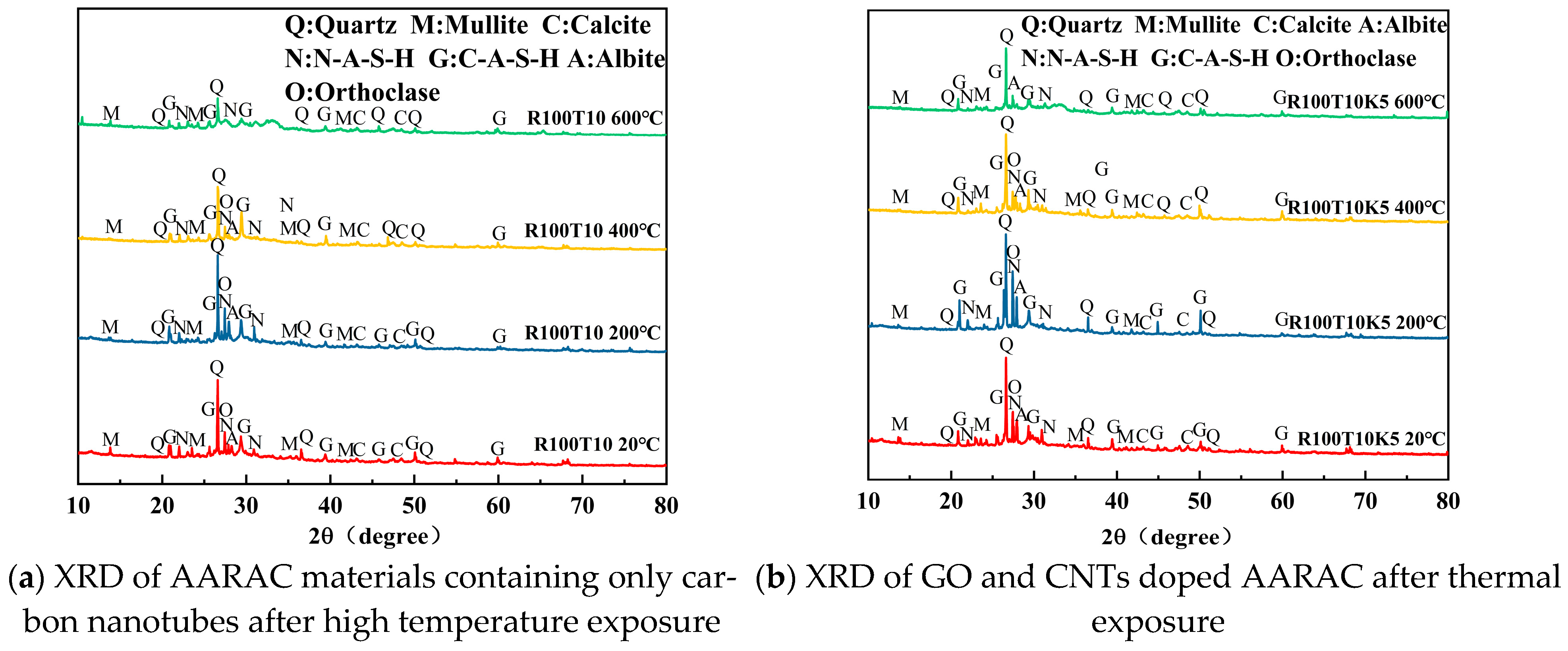
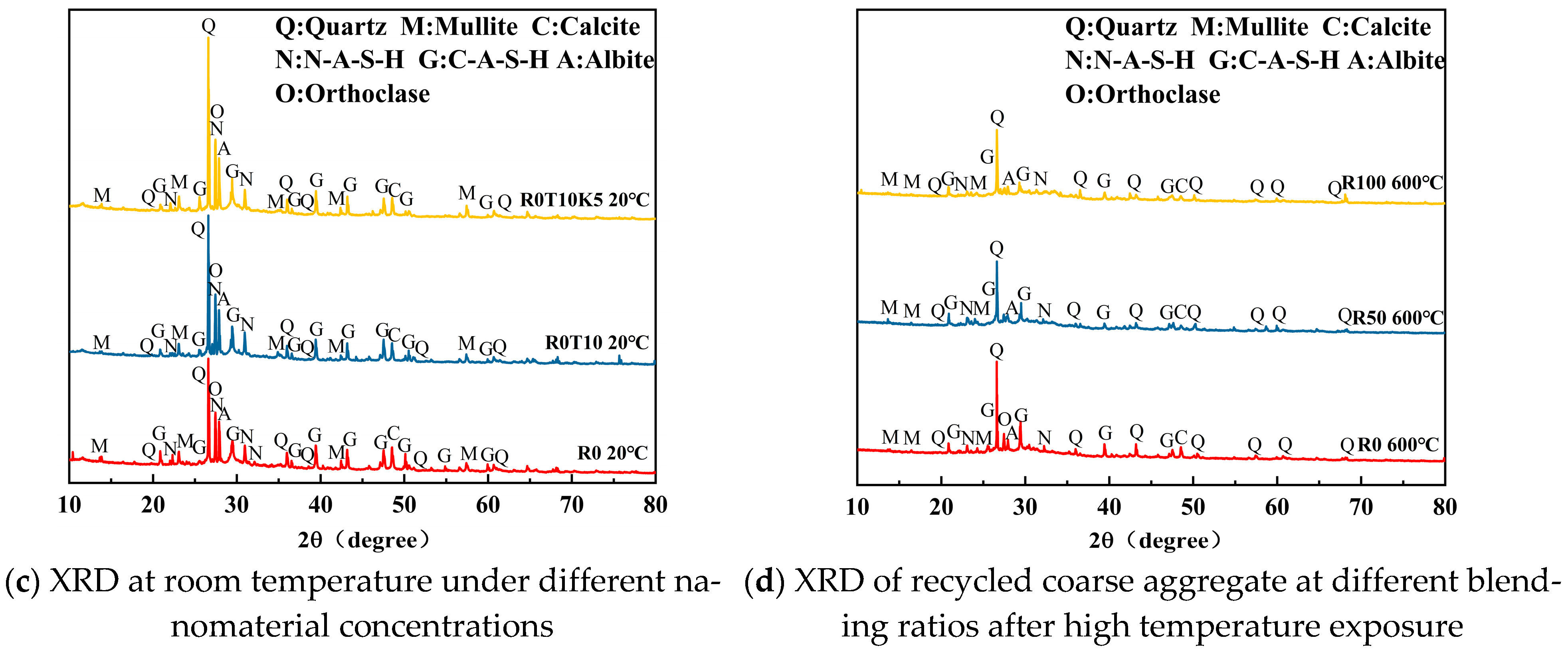
Figure 7 presents the XRD test results of AARAC specimens. It can be observed from the figure that within the temperature range of 200 °C to 600 °C, the main phase composition of AARAC does not undergo a significant change. After exposure to high temperatures, the phases of AARAC are mainly composed of quartz (SiO2), N-A-S-H gel, C-A-S-H gel, mullite (Al6Si2O13), orthoclase (KAlSi3O8), albite (NaAlSi3O8) and calcite (CaCO3). As indicated in the diffractogram, the hydration products of AARAC are concentrated in the 2θ range of 20–50°. Compared with AARAC under room temperature conditions, temperature variations affect the hydration reaction inside the specimens, leading to slight differences in the peak intensities of each characteristic peak in the XRD diffractograms after exposure to different temperatures.
Figure 7.
XRD test results of AARAC specimens.
As shown in Figure 7a,b, under the condition of 200 °C, the thermal curing effect effectively promotes further geopolymerization reactions, generating larger quantities of C-A-S-H and N-A-S-H gels and increasing the gel content in the system. Consequently, the characteristic peaks of C-A-S-H and N-A-S-H gels in the XRD patterns are stronger than those of specimens cured at room temperature, which macroscopically manifests as an increase in compressive strength. This result is consistent with the conclusions reported in the literature [66]. Meanwhile, the peak intensities of the characteristic diffraction peaks for orthoclase and albite are also enhanced [82]. The nanomaterials CNTs and GO can combine with C-A-S-H and N-A-S-H gels to form a special structure; furthermore, the dense network structure of C-A-S-H and N-A-S-H gels themselves endows them with excellent high-temperature stability [83,84]. Therefore, a considerable amount of C-A-S-H and N-A-S-H gels still remain in AARAC after being subjected to 400 °C, which supports AARAC in maintaining relatively high compressive strength even after exposure to 400 °C high temperature. In the XRD pattern at 600 °C, the peak intensities of the characteristic peaks of C-A-S-H and N-A-S-H gels decrease significantly. This is mainly because this temperature is far beyond the stable temperature threshold of these two gels, causing violent evaporation of moisture inside the specimens. This evaporation triggers the decomposition of C-A-S-H and N-A-S-H gels, resulting in the destruction of the microstructure and a sharp decline in the strength of AARAC after high-temperature exposure.
It can be seen from Figure 7c that with the addition of nanomaterials CNTs and GO, the characteristic diffraction peaks of the gels are enhanced. This is due to the nanoscale property of CNTs and GO, which can provide high-energy nucleation sites for the formation of C-A-S-H and N-A-S-H gels, thereby promoting the formation of these gels. Therefore, at the macroscale level, the compressive strength of the specimens exhibits a significant improvement after the incorporation of 0.1 wt% CNTs and 0.05 wt% GO.
As observed in Figure 7d, with the increase in the replacement rate of recycled coarse aggregate (RCA), the peak intensities of the characteristic peaks of the gels gradually decrease after exposure to 600 °C. The main reason is that defects such as the high porosity of RCA reduce the compactness of AARAC. Under high temperature, moisture is lost rapidly, which aggravates the dehydration and decomposition of the gels. Therefore, at the macroscopic level, the specimens with a high replacement ratio of recycled coarse aggregate suffer a more significant loss of compressive strength after exposure to high temperatures.
3.3.2. SEM Analysis
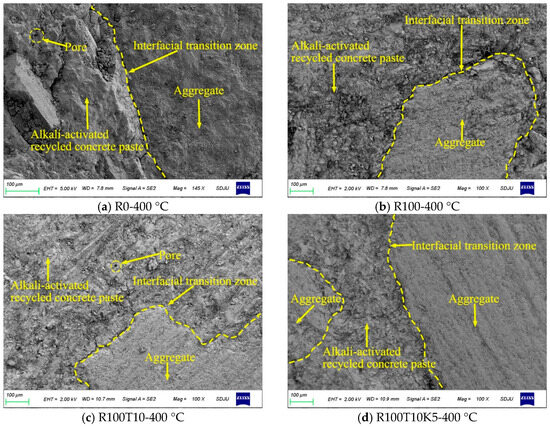
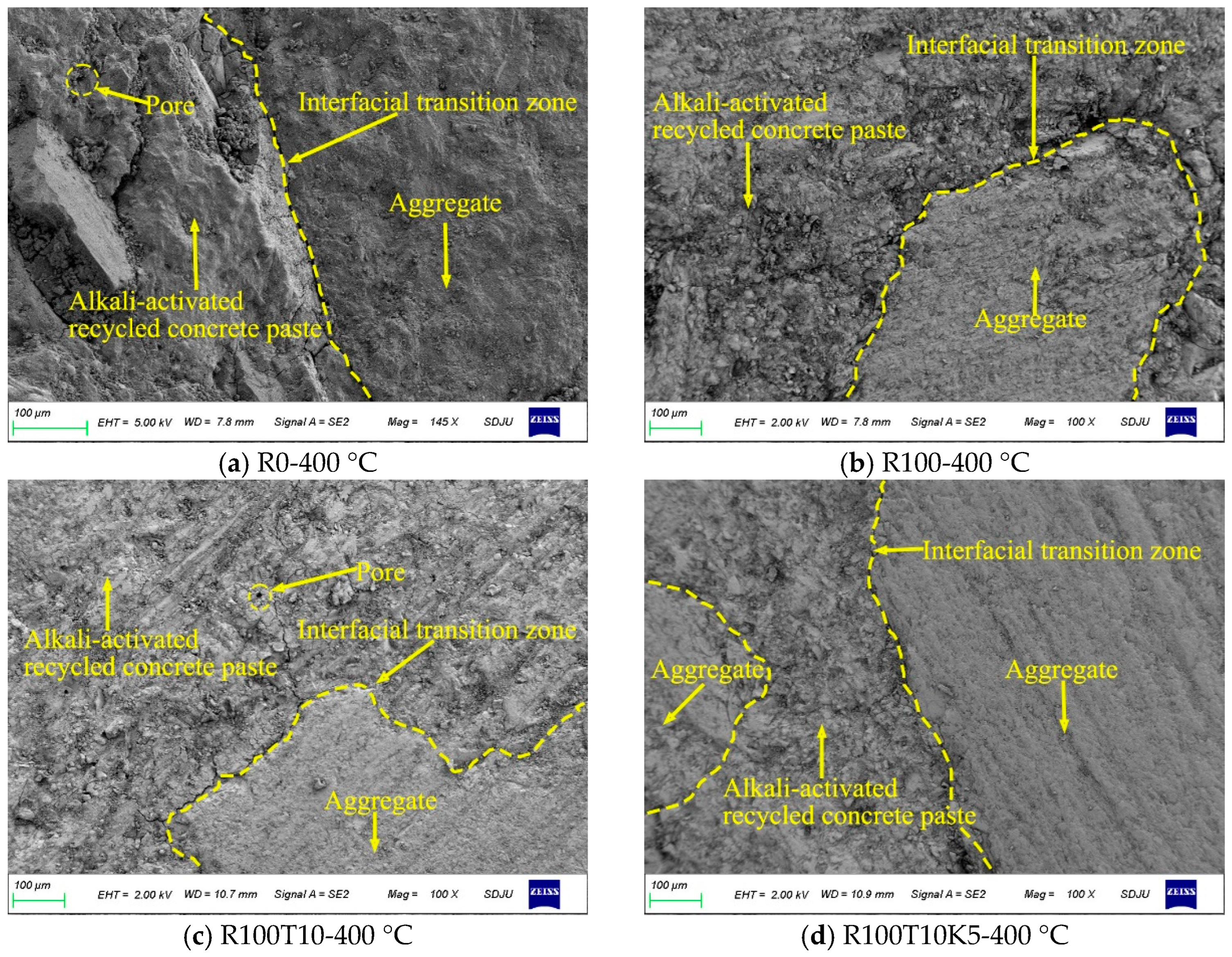
Figure 8 displays SEM images of R0, R100, R100T10, and R100T10K5 specimens after exposure to 400 °C. As shown in Figure 8a,b, compared to R0, the ITZ in R100 has a looser structure due to the inherent defects of high porosity and water absorption in recycled aggregates.
Figure 8.
SEM test results of ITZ in AARAC specimens: (a) Natural coarse aggregate specimen, (b) Full recycled coarse aggregate specimen, (c) Full recycled coarse aggregate specimen mixed with CNTs, (d) Full recycled coarse aggregate specimen mixed with both CNTs and GO.
In addition, due to the difference in thermal expansion between the old and new mortars attached to the RCA, as well as the fact that the hydration products in the old mortar are more prone to high-temperature decomposition, the compressive strength of AARAC with a high RCA replacement rate deteriorates more significantly after high-temperature exposure. It can be observed from Figure 8c,d that CNTs and GO can significantly improve the structural compactness of the ITZ, thereby endowing AARAC with better macroscopic mechanical properties.
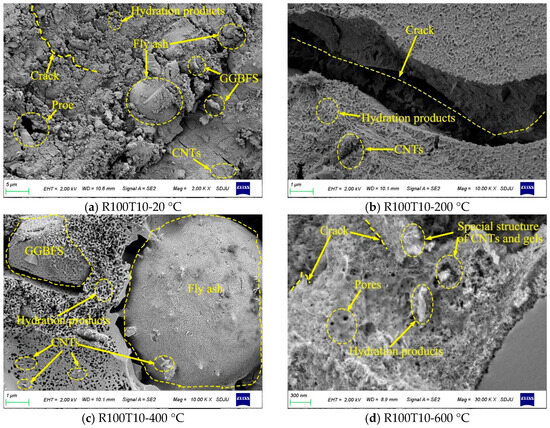
Figure 9 SEM images of specimens R100T10 after heating at 20 °C, 200 °C, 400 °C, and 600 °C. As shown in Figure 9a–d, the nanomaterial CNTs are intertwined and agglomerated in the alkali-activated concrete matrix, providing more nucleation sites and a sound structural framework for the formation of C-A-S-H and N-A-S-H gels. These C-A-S-H and N-A-S-H gels can form a structure similar to a three-dimensional network. It can be observed from Figure 9b that after heating at 200 °C, the components of the main hydration products do not decompose. By comparing Figure 9a,b, it can be observed that thermal curing effectively activates the reactivity of fly ash and S95-grade ground granulated blast furnace slag, thereby promoting more complete geopolymerization reactions and generating additional C-A-S-H and N-A-S-H gel products. The increase in gel content effectively fills the pores within the matrix and significantly improves the compactness of AARAC. As shown in Figure 9c, after exposure to 400 °C, although CNTs suppress the initiation and propagation of microcracks to some extent due to their bridging effect and excellent high-temperature stability, small pores still appear within the matrix under high-temperature conditions. In addition, Zhang et al. [85] reported that CNTs can serve as release channels for high-temperature steam, thereby effectively reducing the damage caused by high-pressure steam to the matrix. This may explain why CNT-modified specimens still maintain relatively high compressive strength after exposure to 400 °C. As seen in Figure 9d, after heating at 600 °C, the hydration products exhibit a cracked amorphous structure due to the dehydration and decomposition of C-A-S-H and N-A-S-H gels. However, the nanomaterial CNTs distributed therein still play a bridging role. This finding is similar to the results reported in the literature [86,87]. However, Zhang et al. [85] and Sikora et al. [88] reported that CNTs may undergo combustion at temperatures around 600 °C, thereby losing their crack-bridging effect.
Figure 9.
SEM test results of AARAC specimens with CNTs after exposure to different temperatures: (a)20 °C, (b) 200 °C, (c) 400 °C, (d) 600 °C.
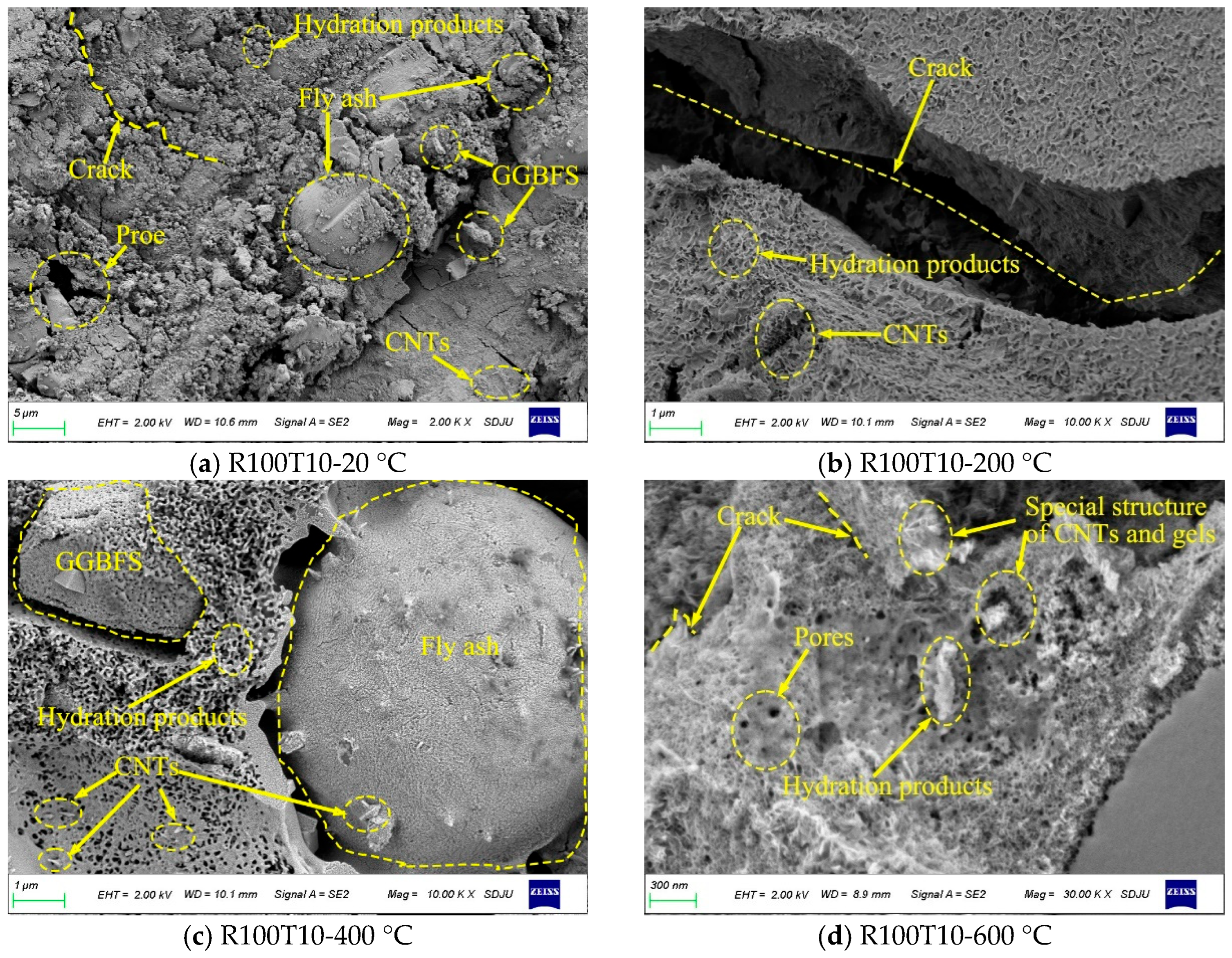
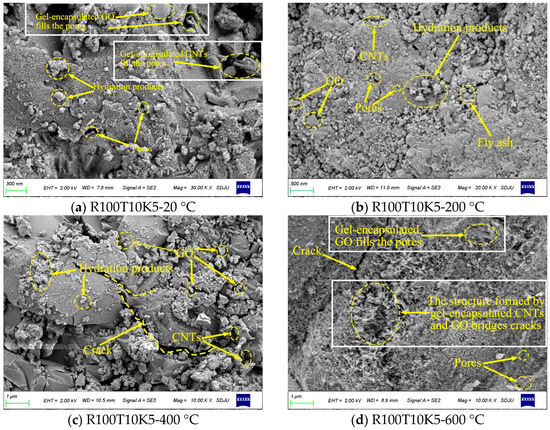
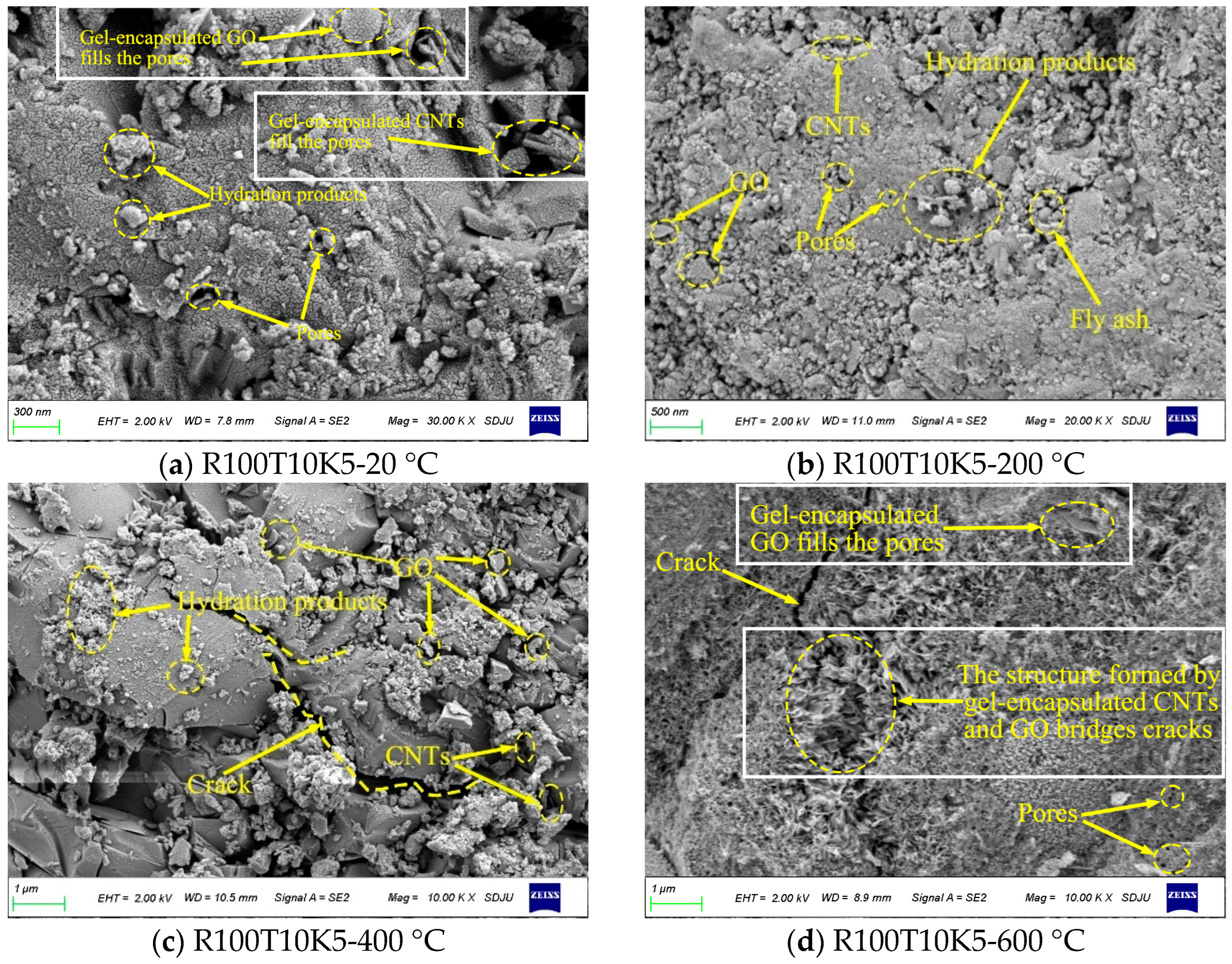
Figure 10 SEM images of specimens R100T10K5 after heating at 20 °C, 200 °C, 400 °C, and 600 °C. It can be seen from Figure 10a that, the gels nucleate on the surfaces of GO and CNTs, acting as nucleation sites, and subsequently grow and fill the pores within the matrix. Compared with the specimens incorporating CNTs alone, the uniform dispersion of nanomaterials (GO and CNTs) in the matrix of alkali-activated recycled concrete enables the two-dimensional lamellar GO and the interspersed one-dimensional linear CNTs to form a special interwoven cross-linked structure. In addition, Lu et al. [89] reported that GO can chemically bond with CNTs, forming an interlocked spatial structure described as [CNTs-GO-CNTs], enabling loads to be simultaneously transferred and shared by GO and CNTs. This synergistic structure improves the mechanical properties of GO- and CNTs-modified cementitious composites. The C-A-S-H and N-A-S-H gels coat the surface of this network more densely, indicating that the addition of GO optimizes the dispersion state of CNTs and promotes gel formation [80,81]. By comparing Figure 10a and Figure 10b, it can be observed that under thermal curing, the R100T10K5-200 °C specimen forms a denser gel structure at the microscale. Comparing Figure 9c with Figure 10c shows that after exposure to 400 °C, the R100T10-400 °C specimen exhibits obvious micropores within the matrix, whereas the R100T10K5-400 °C specimen maintains a relatively dense structure due to the synergistic modification of GO and CNTs. As shown in Figure 10d, the special cross-linked structure formed by GO and CNTs remains intact even after exposure to 600 °C, continuously providing crack-bridging reinforcement. This structure can effectively maintain the macroscopic mechanical properties and structural integrity of the specimens by dispersing local thermal stress and inhibiting the propagation of microcracks. This observation is also consistent with the findings reported by Gao et al. [86].
Figure 10.
SEM test results of AARAC specimens with CNTs and GO after exposure to different temperatures: (a) 20 °C, (b) 200 °C, (c) 400 °C, (d) 600 °C.
3.4. Analysis of CT Scanning Test Results
3.4.1. Analysis of CT Test Results of AARAC After Exposure to Different Temperatures
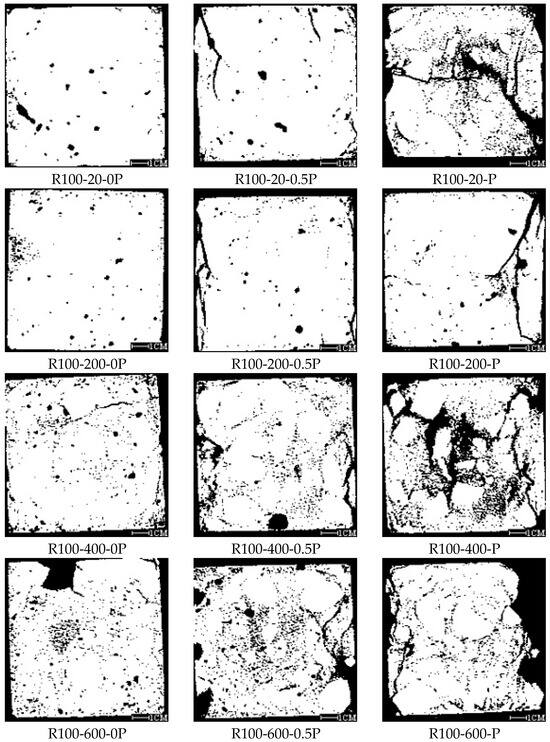
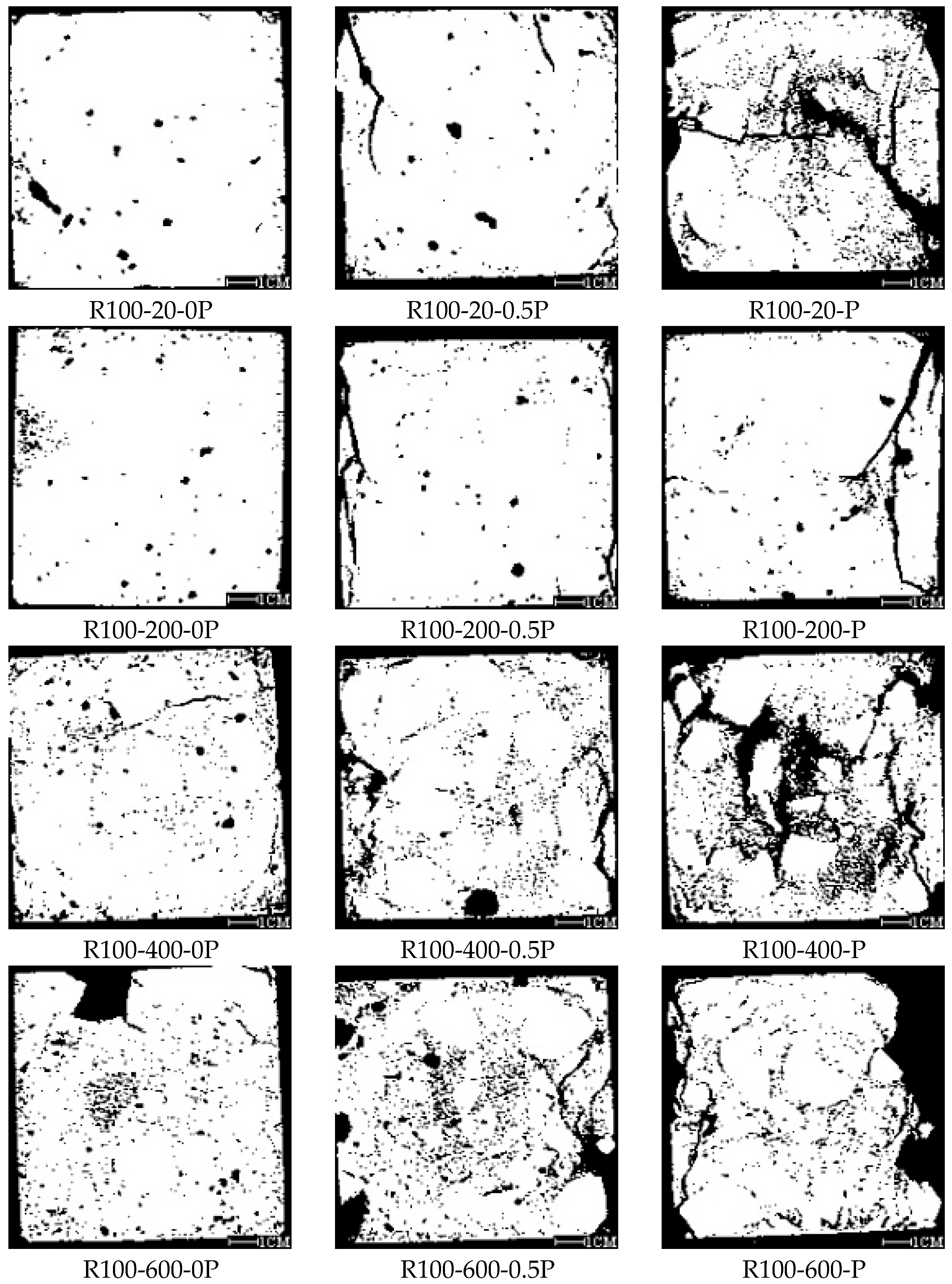
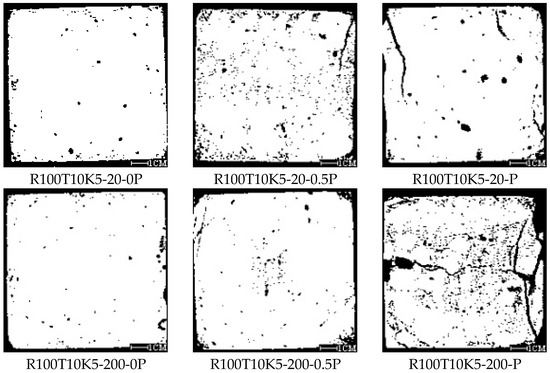
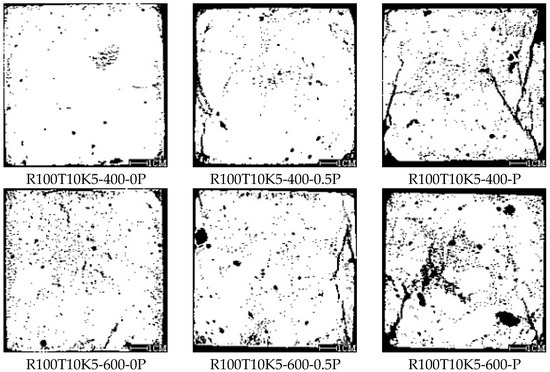
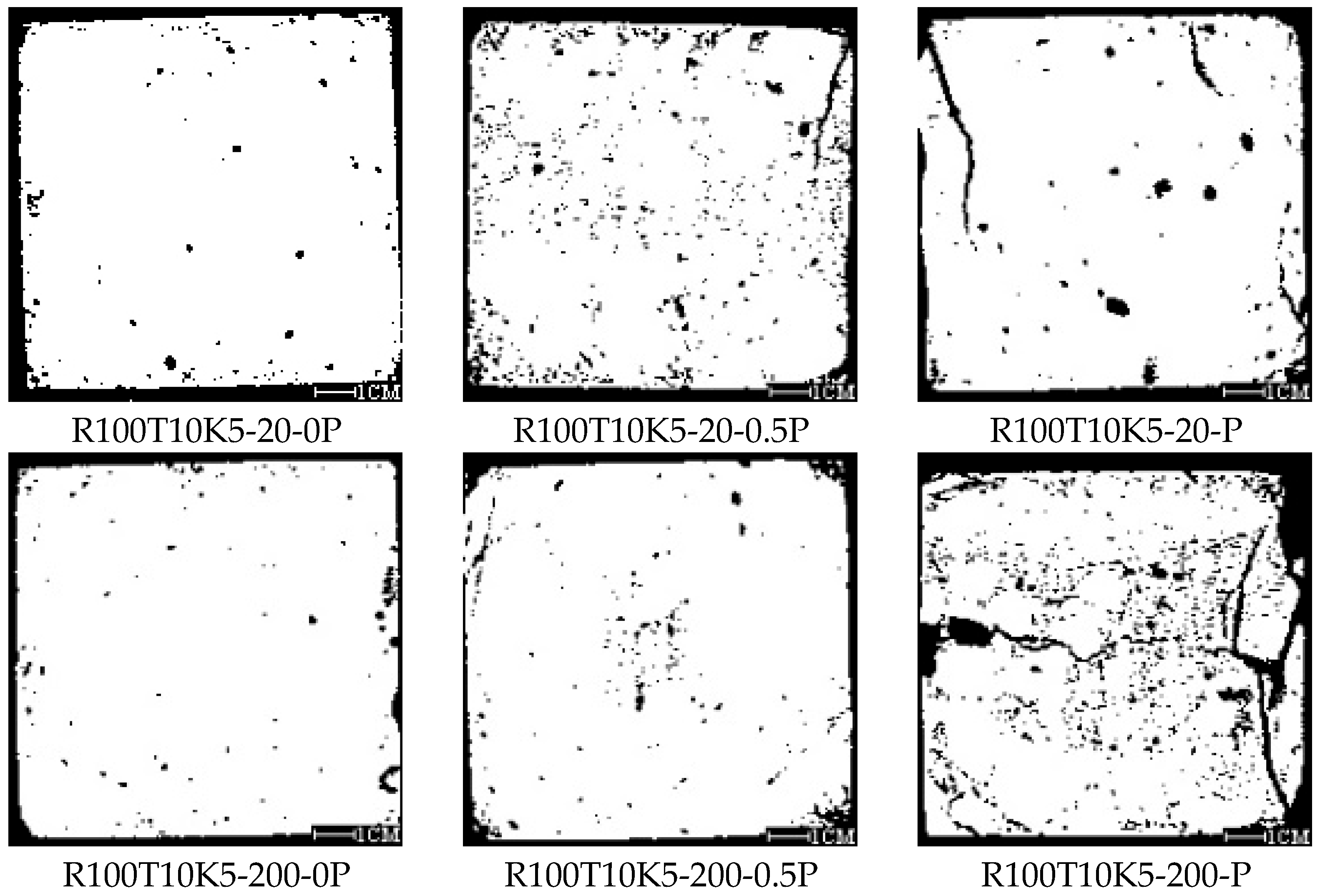
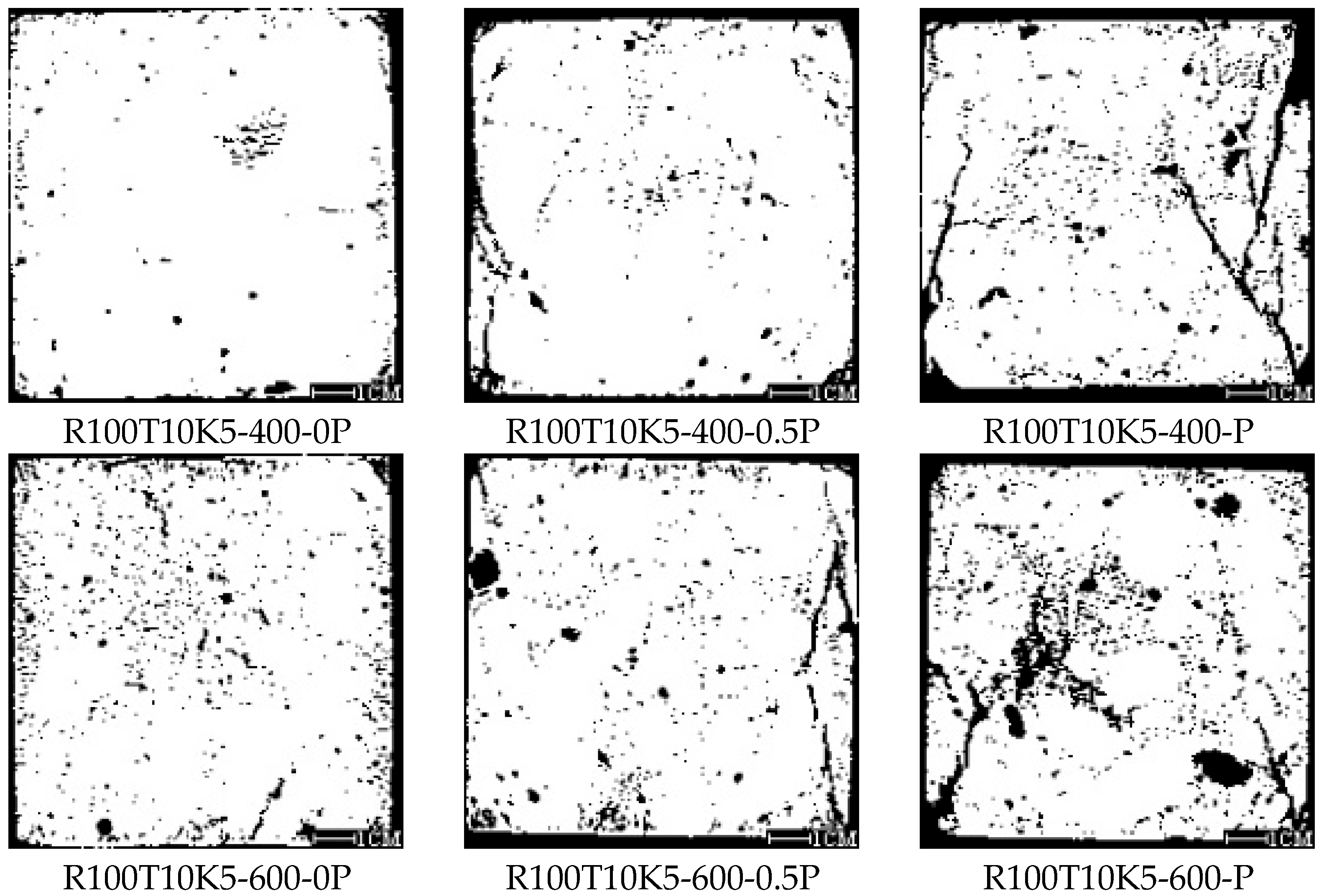
In this study, binarization processing was performed on CT scan images. This method converts CT grayscale images carrying multi-gradient grayscale information into black-and-white binary images composed of two types of pixels: target areas and background areas, thus achieving accurate identification and differentiation of micro-defects such as internal cracks and pores in concrete. The image binarization was completed by means of the threshold segmentation method in Photoshop, where the white pixel areas in the images represent the undamaged regions of mortar and aggregates, and the black pixel areas represent the damaged regions composed of pores and cracks. Figure 11 shows the CT binary images of AARAC with 100% recycled coarse aggregate replacement ratio after exposure to different high temperatures and under different loads. In this study, 0P, 0.5P, and P represent zero load, 0.5 times the peak load, and the peak load, respectively. All specimens used in the test are standard cubic specimens with a side length of 100 mm.
Figure 11.
Binary CT images of AARAC after exposure to different temperatures and under different compressive loads.
By comparing the CT images of R100-200-0P and R100-20-0P, it can be observed that after exposure to 200 °C, high temperature does not cause pore expansion. Instead, the thermal curing effect promotes gel formation, filling and refining the original large pores and capillary pores, thereby reducing pore size and producing a more uniform pore distribution [66,67,68]. This is reflected in the CT binarized image as a decrease in the proportion of the damaged area represented by black pixels. In addition, the distribution of black pixels becomes more uniform. When reaching 0.5P, the increase in the number of pores and the extent of crack expansion within the specimen matrix are both lower than those at room temperature. When reaching the peak load P, the expansion of the main crack is constrained by the dense paste, and the structural integrity is better than that of the specimens at room temperature.
By comparing the CT images of R100-400-0P and R100-20-0P, it can be observed that under 400 °C, the number of pores increases within the specimen due to differences in the thermal expansion coefficients between aggregates and mortar, as well as dehydration and decomposition of gels. Microcracks appear at the aggregate-mortar interface [66]. When reaching 0.5P, the microcracks at the aggregate-mortar interface expand under loading. When reaching the peak load P, compared with the R100-20-P specimen, cracks inside the R100-400-P specimen continue to propagate and interconnect, forming a main crack that penetrates the entire specimen, and the crack propagation path becomes more complex.
By comparing the CT images of the R100-600-0P and R100-20-0P specimens, it can be observed that after being exposed to 600 °C, the number of pores increases sharply, macroscopic cracks are densely distributed, and the proportion of the damaged area rises significantly. When reaching 0.5P, load-induced cracks initiate synchronously at multiple weak points inside the specimen and propagate in a dispersed manner, without forming a continuous main crack yet. When reaching the peak load P, under loading, the mortar and aggregates on the specimen surface disintegrate and spall, indicating that the gel decomposes after exposure to 600 °C high temperature, resulting in the loosening of the concrete structure. This is consistent with the findings of Usman Kankia et al. [90].
3.4.2. Analysis of CT Test Results of AARAC with Different Recycled Coarse Aggregate Replacement Rates
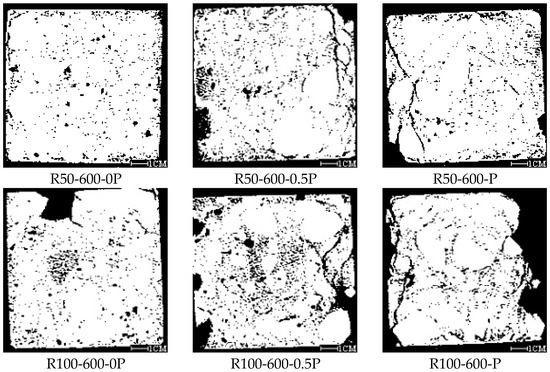
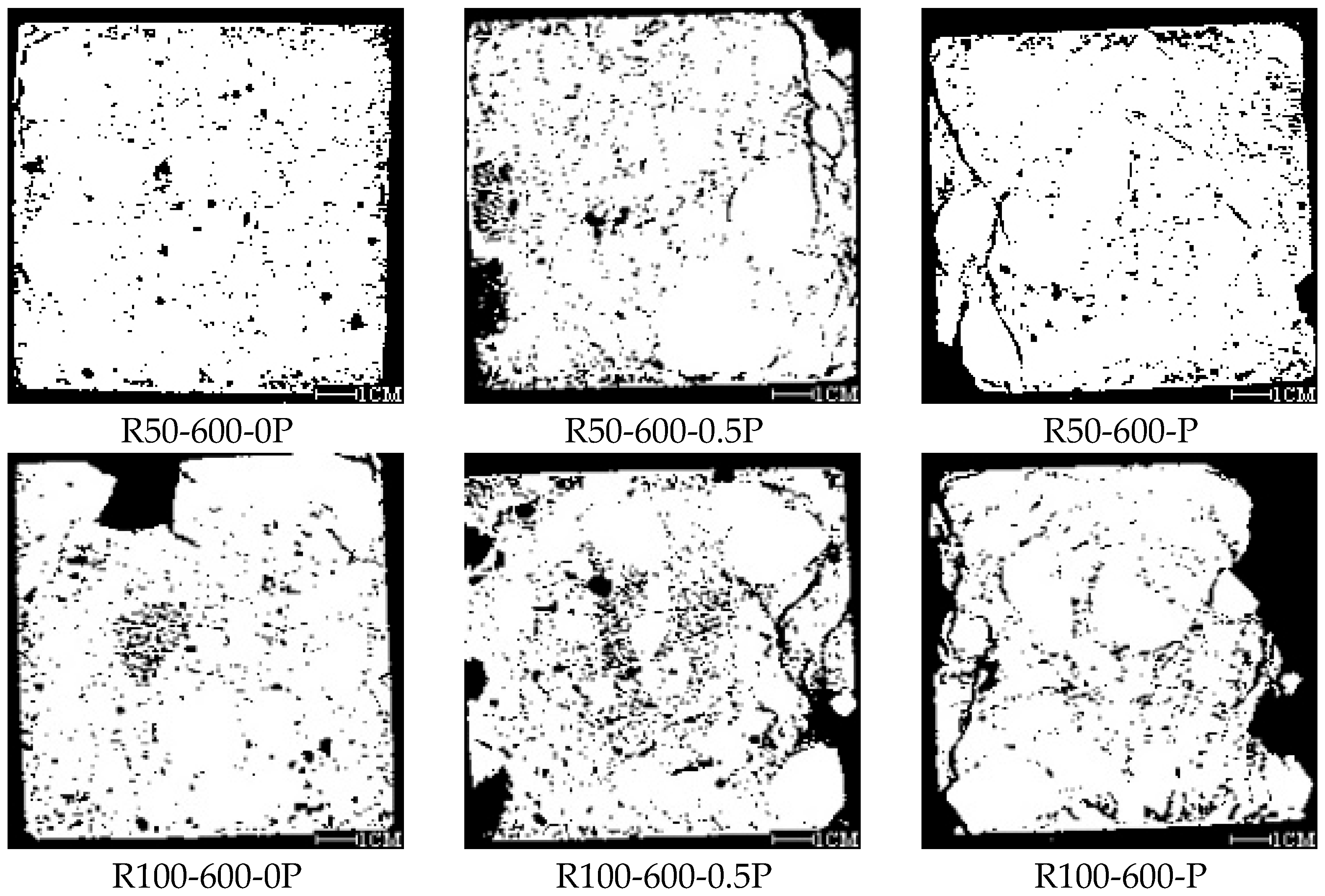
Figure 12 presents the CT binarized images of specimens with recycled coarse aggregate replacement ratios of 50% and 100% after exposure to 600 °C and different loading levels. As shown in Figure 12, a comparison of the CT binary images of specimens with 50% and 100% recycled coarse aggregate replacement ratios after exposure to 600 °C high temperatures indicates that the number of internal pores and crack width of R100 specimens after high-temperature exposure are significantly greater than those of R50 specimens. This is because R100 specimens are completely prepared with recycled coarse aggregates, and the proportions of their internal original pores, microcracks and old mortar layers on the aggregate surface are all higher than those of R50 specimens. Under the action of high temperature at 600 °C, the internal stress generated by the thermal expansion of air and moisture in the porosity accelerates the expansion and penetration of porosity, while the difference in the coefficient of thermal expansion between the old mortar and the aggregate core induces the formation of interface cracks. Therefore, the internal damage of the R100-600 °C specimen is more severe than that of the R50-600 °C specimen, which is macroscopically reflected by a higher compressive strength loss rate. This observation is consistent with previous studies [91,92]. However, Kou et al. [93], Zega et al. [94], and Di Maio et al. [95] reported that the relative residual compressive strength of recycled aggregate concrete is higher than that of natural aggregate concrete. The similar thermal expansion coefficients at the interface between old and new mortar lead to better compatibility, reducing micro- and macro-cracking within the cement mortar and resulting in higher residual strength.
Figure 12.
Binary CT images of AARAC with 50% and 100% recycled coarse aggregate replacement ratios after exposure to different compressive loads.
3.4.3. CT Test Result Analysis of AARAC with Nanomaterials
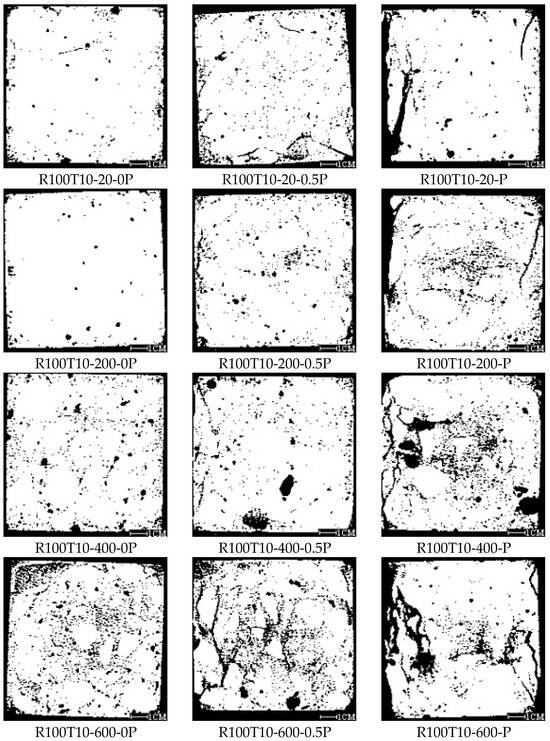
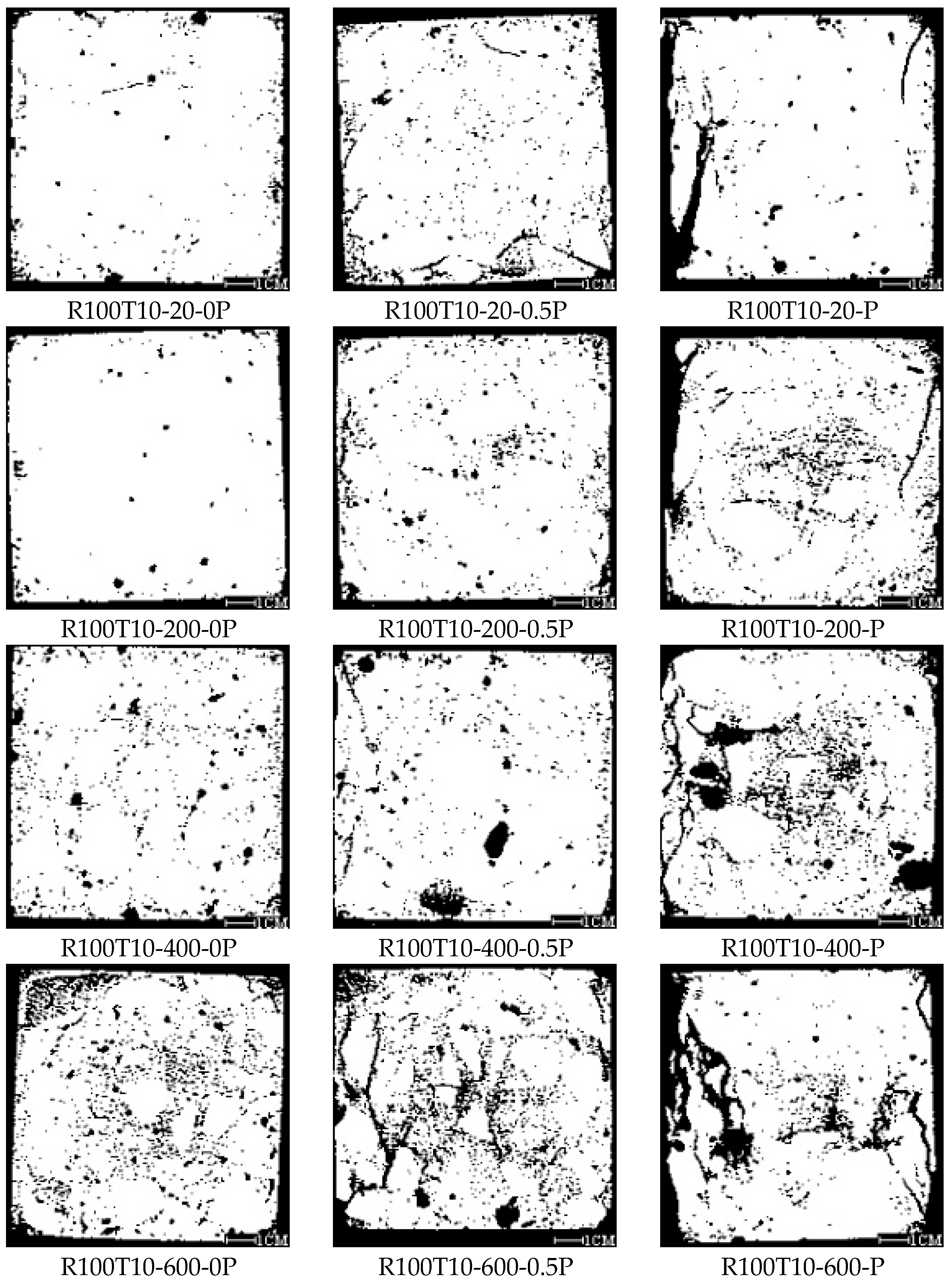
Figure 13 shows the CT binarized images of AARAC containing 0.1 wt% CNTs after exposure to different temperatures and loading levels. As shown in Figure 13, compared with the R100-20-0P specimen, the addition of CNTs reduces the number of pores, decreases pore size, and produces a more uniform pore distribution. At room temperature, when loaded to the peak load P, the main crack width is smaller and the fracture fragments are larger. The CT scanning results showed that after the temperature was raised to 200 °C, the number of internal pores decreases and the structure becomes denser, while internal cracks remain short and uniformly distributed after compression. At 400 °C, compared with the R100-400-0P specimen, the crack width at the internal interface of the R100T10-400-0P specimen decreased. At 600 °C, compared with the R100-600-P specimen, although the mortar and loose aggregates fell off inside the material of the R100T10-600-P specimen, it still had a relatively complete structure. The specimens with only CNTs addition exhibit superior damage degree and structural stability at room temperature and all high-temperature stages compared with the specimens without nanomaterials. This is because CNTs can serve as high-energy nucleation sites for gel, inducing directional formation of gel and increasing the content of the concrete cementitious material phase. At the same time, they can fill the initial porosity of the concrete, refine the porosity structure, and improve the density of the concrete. In addition, CNTs, due to their ultra-high aspect ratio, they can bridge across microcracks, relying on excellent tensile toughness to effectively hinder microcrack propagation; this conclusion is consistent with the findings of Baloch et al. [96].
Figure 13.
Binary CT images of AARAC with 0.1 wt% CNTs addition after exposure to different temperatures and compressive loads.
Figure 14 shows the CT binarized images of AARAC containing 0.1 wt% CNTs and 0.05 wt% GO after exposure to different temperatures and compressive loads. As shown in Figure 14, compared with the specimens that only added nanomaterial CNTs, when both nanomaterial CNTs and GO were added simultaneously, the proportion of damage in the CT scanning images at room temperature was lower, mostly consisting of uniformly distributed small pores. After a 200 °C eating process, there were very few cracks inside the specimens and the degree of damage was significantly reduced, with excellent structural integrity. From the CT image of the R100T10K5-400-0P specimen, it can be observed that after exposure to 400 °C, pore initiation and propagation occur only in the old mortar attached to the recycled coarse aggregate surface, while no obvious pores appear in the new mortar. From the CT image of the R100T10K5-600-P specimen, crack branching can be observed after compression, while the overall structural integrity of the specimen remains relatively intact. This may be attributed to the special cross-linked network formed by the synergistic interaction between GO and CNTs, which effectively anchors crack tips. Compared with the specimens with single CNTs addition, the specimens with combined CNTs and GO addition show lower damage degree and better structural integrity at room temperature and all high-temperature stages. This phenomenon is attributed to the synergistic modification effect of one-dimensional CNTs and two-dimensional GO. The incorporation of GO not only significantly improves the dispersion uniformity of CNTs, thereby fully realizing their modification efficiency, but also, through the combined effect of nucleation and surface active groups, further induces the formation of cementitious material inside the specimen, reduces porosity, and suppresses crack propagation. Moreover, CNTs and GO can intertwine with cementitious material in the concrete matrix to form a special cross-linked structure, significantly enhancing the structural toughness of the concrete. In summary, high temperatures increase the number of pores in concrete and promote crack propagation. Under the combined effects of gel decomposition, high-temperature steam pressure, and aggregate degradation, initial pores continue to expand and interconnect, gradually developing into microcracks and ultimately forming macroscopic cracks. The degree of pore growth and crack propagation follows the order: CNTs-GO hybrid specimens < CNTs-only specimens < specimens without nanomaterials. This indicates that the combined incorporation of CNTs and GO effectively suppresses pore growth and crack propagation at high temperatures, thereby improving the post-fire mechanical performance and structural stability of AARAC, which is consistent with the findings reported by Kaur et al. [97].
Figure 14.
Binary CT images of AARAC with 0.1 wt% CNTs and 0.05 wt% GO addition after exposure to different temperatures and compressive loads.
4. Conclusions
Through the research, the main conclusions obtained in this paper are as follows:
- (1)
- An increase in the replacement rate of recycled coarse aggregates will significantly reduce the compressive strength of AARAC specimens at high temperatures. When the replacement rate increases from 0% to 100%, the compressive strength loss rate of AARAC without nanomaterial addition increases from 47.9% to 60.6% after exposure to 600 °C. The distribution of cracks in the specimens after compression becomes more dense, and the fragmentation during failure is more thorough.
- (2)
- The incorporation of nanomaterials CNTs and GO can effectively improve the axial compressive mechanical properties of AARAC after high temperature. Both provide high-energy nucleation sites, micropore filling, and crack bridging, refining the porosity structure inside the concrete and inhibiting the microcrack propagation at high temperature. The combined modification effect of CNTs and GO is optimal. After exposure to 600 °C, the residual compressive strength of the combined specimens with 100% recycled coarse aggregate replacement rate increased by approximately 14.5% compared with the single CNTs specimens. Based on this, it is recommended to adopt the combined CNTs and GO approach to improve the mechanical performance of AARAC after high temperature.
- (3)
- Analysis indicates that the phase composition of AARAC after different temperature treatments is similar. As the temperature increases, the peak intensities of the C-A-S-H gel and N-A-S-H gel features show a trend of increasing at first and then decreasing. The incorporation of nanomaterials can increase the peak values of the gel features and effectively inhibit the gel decomposition caused by high temperature. SEM testing shows that the nanomaterials CNTs and GO improve the microstructure of the AARAC specimen through bridging and filling effects, significantly enhancing the compactness of the ITZ. After high-temperature exposure, the special cross-linked structure formed by nanomaterials CNTs and GO with gel is not completely destroyed, effectively maintaining the macroscopic mechanical properties and structural integrity of the specimens.
- (4)
- The CT scanning results show that after adding nanomaterials CNTs and GO, the proportion of pores and cracks within the AARAC specimen significantly decreases. The improvement of the internal structure is beneficial for reducing the macroscopic damage degree of the specimen after high-temperature exposure.
- (5)
- This study attempts to improve the mechanical properties of AARAC by incorporating the nanomaterials CNTs and GO, providing a preliminary technical approach for sustainable construction practices that integrates solid waste utilization, low-carbon environmental protection, and high-temperature safety potential. AARAC, primarily composed of industrial and construction solid waste, still exhibits good compressive mechanical properties and structural integrity after exposure to 600 °C following synergistic modification with nanomaterials. In the future, these findings may offer limited reference for green building construction and promote the advancement of solid waste resource utilization and carbon reduction goals in the construction industry.
Author Contributions
C.L.: Conceptualization, Methodology, Software, Validation, Formal analysis, Data collation, Writing—manuscript, Writing—review and editing, Visualization. Y.W.: Investigation, Data collection, Data interpretation, Writing—review and editing. Y.G. (Yali Gu): Methodology, Writing, Review, and Editing. Y.G. (Ya Ge): Methodology, Writing, Review, and Editing. All authors have read and agreed to the published version of the manuscript.
Funding
This work was supported by the National Natural Science Foundation of China under Grant no. 52278507, the Natural Science Foundation of Shandong Province under Grant no. ZR2022ME160, Kashi University Research Startup Funding Project (Grant No. GCC2025ZK-021), University-level research project (cultivation) (2025) 21022.
Data Availability Statement
Data will be made available on request.
Acknowledgments
The authors gratefully acknowledge the support of the following institutions. We sincerely thank Henan Borun Casting Materials Co., Ltd. for supplying the S95-grade ground granulated blast-furnace slag and Class I fly ash used in the experiments; Suzhou Tanfeng Technology Co., Ltd. for providing high-purity CNTs and GO; and Dongtai Zesheng Industrial Electric Furnace Factory for supplying the energy-efficient electric furnace equipment for the high-temperature tests. In addition, we acknowledge Shandong Jianzhu University for providing access to the SEM, XRD, and CT testing platforms, which were essential for the microstructural characterization in this study. Finally, we express our sincere gratitude to all individuals and organizations who contributed to this research.
Conflicts of Interest
The authors declare no conflict of interest.
References
- Gao, X.; Yuan, Y.; Wang, Y.; Yang, T.; Chen, T. Prediction of construction waste generation in China based on grey model and management recommendations. Sustainability 2025, 17, 1711. [Google Scholar] [CrossRef] [Scilit]
- Quedou, P.G.; Wirquin, E.; Bokhoree, C. A sustainable approach in using construction and demolition waste materials in concrete. World J. Eng. 2021, 18, 826–840. [Google Scholar] [CrossRef] [Scilit]
- Xiao, J.Z.; Ma, X.W.; Liu, Q.; Zhang, H.H.; Duan, Z.H. Evolvement and research progress of concept for full recycled concrete. J. Archit. Civ. Eng. 2021, 38, 1–15. [Google Scholar] [CrossRef]
- Singh, S.; Singh, S.K.; Mahgoub, M.; Mir, S.A.; Kanga, S.; Kumar, S.; Kumar, P.; Meraj, G. Evaluating Recycled Concrete Aggregate and Sand for Sustainable Construction Performance and Environmental Benefits. CivilEng 2024, 5, 461–481. [Google Scholar] [CrossRef] [Scilit]
- Peng, Y.; Cai, S.; Huang, Y.; Chen, X.-F. Recycled Aggregates for Sustainable Construction: Strengthening Strategies and Emerging Frontiers. Materials 2025, 18, 3013. [Google Scholar] [CrossRef] [Scilit]
- Piccinali, A.; Diotti, A.; Plizzari, G.; Sorlini, S. Impact of Recycled Aggregate on the Mechanical and Environmental Properties of Concrete: A Review. Materials 2022, 15, 1818. [Google Scholar] [CrossRef] [Scilit]
- Khan, M.S.; Khan, M.I.; Choudhry, R.M.; Khahro, S.H.; Memon, Z.A. Performance analysis of fiber reinforced recycled aggregate concrete at elevated temperatures using response surface methodology. Sci. Rep. 2025, 15, 12916. [Google Scholar] [CrossRef] [Scilit]
- Verian, K.P.; Ashraf, W.; Cao, Y. Properties of recycled concrete aggregate and their influence in new concrete production. Resour. Conserv. Recycl. 2018, 133, 30–49. [Google Scholar] [CrossRef] [Scilit]
- Panghal, H.; Chaudhary, S.; Kumar, A. Enhancing sustainable concrete performance: Dual treatment of recycled coarse aggregates for improved strength and durability. Eur. J. Environ. Civ. Eng. 2025, 29, 3225–3256. [Google Scholar] [CrossRef] [Scilit]
- Ramalingam, M.; Sivamani, J.; Narayanan, K. Performance studies on recycled aggregate concrete with treated recycled aggregates. Waste Dispos. Sustain. Energy 2023, 5, 451–459. [Google Scholar] [CrossRef] [Scilit]
- Zheng, W.Z.; Zou, M.N.; Wang, Y. Literature review of alkali-activated cementitious materials. J. Build. Struct. 2019, 40, 28–39. [Google Scholar] [CrossRef]
- Jing, H.; Zhang, W.; Liu, X.; Xu, C. Fly ash sinking beads and-slag based one-part alkali-activated recycled concrete: Mechanical properties and microstructure. Mater. Today Commun. 2025, 42, 111167. [Google Scholar] [CrossRef] [Scilit]
- Xie, J.; Chen, W.; Wang, J.; Fang, C.; Zhang, B.; Liu, F. Coupling effects of recycled aggregate and GGBS/metakaolin on physicochemical properties of geopolymer concrete. Constr. Build. Mater. 2019, 226, 345–359. [Google Scholar] [CrossRef] [Scilit]
- Wang, H.; Nie, D.; Li, P.; Wang, D.; Wang, C.; Liu, W.; Du, S. Effect of recycled concrete aggregate with different degrees of initial alkali–aggregate reaction damage on the mechanical behavior and porosity of self-compacting recycled aggregate concrete. Constr. Build. Mater. 2023, 363, 129797. [Google Scholar] [CrossRef] [Scilit]
- Gopalakrishna, B.; Dinakar, P. An innovative approach to fly ash-based geopolymer concrete mix design: Utilizing 100% recycled aggregates. Structures 2024, 66, 106819. [Google Scholar] [CrossRef] [Scilit]
- Chen, S.; Lu, P.; Bie, Y.; Wang, L.; Guo, L. Mechanical properties and micro mechanism of alkali-activated tannery sludge/fly ash composite cement-based recycled concrete. Constr. Build. Mater. 2023, 391, 131813. [Google Scholar] [CrossRef] [Scilit]
- Lu, Y.; Zhou, P.; Wu, C.; Li, J.; Zhu, D. Influence of granulated blast furnace slag and functionalized multi-walled carbon nanotubes on the mechanical properties and microstructural mechanisms of lithium slag-based geopolymers. Constr. Build. Mater. 2025, 493, 143111. [Google Scholar] [CrossRef] [Scilit]
- Su, Z.; Hou, W.; Sun, Z. Recent advances in carbon nanotube-geopolymer composite. Constr. Build. Mater. 2020, 252, 118940. [Google Scholar] [CrossRef] [Scilit]
- Yang, Z.; Liu, Z.; Li, F.; Lu, Y.; Li, S. Effect of multi-walled carbon nanotubes on durability of high-strength slag-based geopolymer. Ceram. Int. 2023, 49, 11936–11949. [Google Scholar] [CrossRef] [Scilit]
- Yan, Y.; Tian, L.; Zhao, W.; Lazaro, S.A.M.; Li, X.; Tang, S. Dielectric and mechanical properties of cement pastes incorporated with magnetically aligned reduced graphene oxide. Dev. Built Environ. 2024, 18, 100471. [Google Scholar] [CrossRef] [Scilit]
- Yan, S.; He, P.; Jia, D.; Yang, Z.; Duan, X.; Wang, S.; Zhou, Y. Effect of reduced graphene oxide content on the microstructure and mechanical properties of graphene–geopolymer nanocomposites. Ceram. Int. 2016, 42, 752–758. [Google Scholar] [CrossRef] [Scilit]
- Wang, W.; Zhong, Z.; Kang, X.; Ma, X. Physico-mechanical properties and micromorphological characteristics of graphene oxide reinforced geopolymer foam concrete. J. Build. Eng. 2023, 72, 106732. [Google Scholar] [CrossRef] [Scilit]
- Yu, L.; Wu, R. Using graphene oxide to improve the properties of ultra-high-performance concrete with fine recycled aggregate. Constr. Build. Mater. 2020, 259, 120657. [Google Scholar] [CrossRef] [Scilit]
- Maglad, A.M.; Zaid, O.; Arbili, M.M.; Ascensão, G.; Șerbănoiu, A.A.; Grădinaru, C.M.; García, R.M.; Qaidi, S.M.A.; Althoey, F.; de Prado-Gil, J. A Study on the Properties of Geopolymer Concrete Modified with Nano Graphene Oxide. Buildings 2022, 12, 1066. [Google Scholar] [CrossRef] [Scilit]
- Zhang, C.; Ren, L.L.; Wang, X.Y.; Liu, T. Graphene oxide-assisted dispersion of pristine multiwalled carbon nanotubes in aqueous media. J. Phys. Chem. C 2010, 114, 11435–11440. [Google Scholar] [CrossRef] [Scilit]
- Lin, Y.; Du, H. Graphene reinforced cement composites: A review. Constr. Build. Mater. 2020, 265, 120312. [Google Scholar] [CrossRef] [Scilit]
- Xiao, J.; König, G. Study on concrete at high temperature in China—An overview. Fire Saf. J. 2004, 39, 89–103. [Google Scholar] [CrossRef] [Scilit]
- Georgali, B.; Tsakiridis, P.E. Microstructure of fire-damaged concrete. A case study. Cem. Concr. Compos. 2005, 27, 255–259. [Google Scholar] [CrossRef] [Scilit]
- Khoury, G.A. Effect of fire on concrete and concrete structures. Prog. Struct. Eng. Mater. 2000, 2, 429–447. [Google Scholar] [CrossRef] [Scilit]
- Da Silva, J.B.; Pepe, M.; Toledo Filho, R.D. High temperatures effect on mechanical and physical performance of normal and high strength recycled aggregate concrete. Fire Saf. J. 2020, 117, 103222. [Google Scholar] [CrossRef] [Scilit]
- Bui, N.K.; Satomi, T.; Takahashi, H. Effect of mineral admixtures on properties of recycled aggregate concrete at high temperature. Constr. Build. Mater. 2018, 184, 361–373. [Google Scholar] [CrossRef] [Scilit]
- Zhang, H.Y.; Kodur, V.; Qi, S.L.; Cao, L.; Wu, B. Development of metakaolin–fly ash based geopolymers for fire resistance applications. Constr. Build. Mater. 2014, 55, 38–45. [Google Scholar] [CrossRef] [Scilit]
- Manzoor, T.; Bhat, J.A.; Shah, A.H. Performance of geopolymer concrete at elevated temperature−A critical review. Constr. Build. Mater. 2024, 420, 135578. [Google Scholar] [CrossRef] [Scilit]
- Laí, L.; Caetano, H.; Santiago, A. Review: Effects of nanoparticles in cementitious construction materials at ambient and high temperatures. J. Build. Eng. 2021, 35, 102008. [Google Scholar] [CrossRef] [Scilit]
- Shahpari, M.; Bamonte, P.; Mosallam, S.J. An experimental study on mechanical and thermal properties of structural lightweight concrete using carbon nanotubes (CNTs) and LECA aggregates after exposure to elevated temperature. Constr. Build. Mater. 2022, 346, 128376. [Google Scholar] [CrossRef] [Scilit]
- Lu, H.; Yao, Y. Spalling mechanism of carbon nanotube concrete at elevated temperature. Constr. Build. Mater. 2022, 314, 125594. [Google Scholar] [CrossRef] [Scilit]
- Huang, K.; Jing, H.; Gao, Y.; Yu, Z.; Chen, M.; Sun, S. Study on the properties of graphene oxide reinforced cement-based materials at high temperature. Constr. Build. Mater. 2024, 421, 135704. [Google Scholar] [CrossRef] [Scilit]
- Ren, B.; Bai, E.; Luo, X.; Wang, T.; Wang, Z. Impact mechanical properties and pore structure of graphene oxide concrete at high temperature. J. Build. Eng. 2024, 85, 108593. [Google Scholar] [CrossRef] [Scilit]
- Rao, P.T.; Prakash, J.; Alexander, R.; Shinde, M.J.; Dasgupta, K. Role of graphene oxide infusion in concrete to elevate strength and fire performance in construction concrete. Diam. Relat. Mater. 2024, 147, 111269. [Google Scholar] [CrossRef] [Scilit]
- Krishna, R.S.; Mishra, S.; Sethy, N.; Mustakim, S.M.; Boopathy, R.; Rawat, S.; Qureshi, T.S. Impact of high-temperature exposure on the thermal and physio-mechanical performance of graphene-reinforced geopolymer composites. Constr. Build. Mater. 2025, 489, 142285. [Google Scholar] [CrossRef] [Scilit]
- Han, S.; Hossain, M.S.; Ha, T.; Yun, K.K. Graphene-oxide-reinforced cement composites mechanical and microstructural characteristics at elevated temperatures. Nanotechnol. Rev. 2022, 11, 3174–3194. [Google Scholar] [CrossRef] [Scilit]
- DB37/T 5176–2021; Mix Design Specification of Recycled Concrete. Shandong Provincial Market Supervision Administration: Jinan, China, 2021.
- Li, B.; Yu, S.; Gao, B.; Li, Y.; Wu, F.; Xia, D.; Chi, Y.; Wang, S. Effect of recycled aggregate and steel fiber contents on the mechanical properties and sustainability aspects of alkali-activated slag-based concrete. J. Build. Eng. 2023, 66, 105939. [Google Scholar] [CrossRef] [Scilit]
- Li, B.; Wu, F.; Xia, D.; Li, Y.; Cui, K.; Wu, F.; Yu, J. Compressive and flexural behavior of alkali-activated slag-based concrete: Effect of recycled aggregate content. J. Build. Eng. 2023, 67, 105993. [Google Scholar] [CrossRef] [Scilit]
- Kanagaraj, B.; Anand, N.; Lubloy, E.; Andrushia, D. Influence of Multi-walled Carbon Nanotube (MWCNT) on flexural behavior and microstructure characteristics of geopolymer concrete beams. Case Stud. Constr. Mater. 2024, 20, e03317. [Google Scholar] [CrossRef] [Scilit]
- Da Luz, G.; Gleize, P.J.P.; Batiston, E.R.; Pelisser, F. Effect of pristine and functionalized carbon nanotubes on microstructural, rheological, and mechanical behaviors of metakaolin-based geopolymer. Cem. Concr. Compos. 2019, 104, 103332. [Google Scholar] [CrossRef] [Scilit]
- Rovnaník, P.; Šimonová, H.; Topolář, L.; Schmid, P.; Keršner, Z. Effect of carbon nanotubes on the mechanical fracture properties of fly ash geopolymer. Procedia Eng. 2016, 151, 321–328. [Google Scholar] [CrossRef] [Scilit]
- Abbasi, S.M.; Ahmadi, H.; Khalaj, G.; Ghasemi, B. Microstructure and mechanical properties of a metakaolinite-based geopolymer nanocomposite reinforced with carbon nanotubes. Ceram. Int. 2016, 42, 15171–15176. [Google Scholar] [CrossRef] [Scilit]
- Naskar, S.; Chakraborty, A.K. Effect of nano materials in geopolymer concrete. Perspect. Sci. 2016, 8, 273–275. [Google Scholar] [CrossRef] [Scilit]
- Zhou, G.; Zhu, H.; Yang, Q. High-temperature performance of mortar reinforced with graphene–carbon nanotube hybrids. Sci. Prog. 2026, 109, 00368504261427673. [Google Scholar] [CrossRef] [Scilit]
- Gholampour, A.; Ozbakkaloglu, T. Waste-based mortars containing glass powder, GGBS, lead smelter slag and foundry sand reinforced with graphene oxide. Mag. Concr. Res. 2022, 74, 1189–1203. [Google Scholar] [CrossRef] [Scilit]
- Pan, Z.; He, L.; Qiu, L.; Korayem, A.H.; Li, G.; Zhu, J.W.; Collins, F.; Li, D.; Duan, W.H.; Wang, M.C. Mechanical properties and microstructure of a graphene oxide–cement composite. Cem. Concr. Compos. 2015, 58, 140–147. [Google Scholar] [CrossRef] [Scilit]
- GB/T50081-2019; Standard for Test Methods of Concrete Physical and Mechanical Properties. China Architecture & Building Press: Beijing, China, 2019. (In Chinese)
- Arce, A.; Komkova, A.; Papanicolaou, C.G.; Triantafillou, T.C. Performance-Based Design of Ferronickel Slag Alkali-Activated Concrete for High Thermal Load Applications. Materials 2024, 17, 4939. [Google Scholar] [CrossRef] [Scilit]
- Zhou, B.; Ma, Q.; Guo, R.; Li, P. Chloride Permeability of Alkali-Activated Slag Concretes after Exposure to High Temperatures. Materials 2024, 17, 1028. [Google Scholar] [CrossRef] [Scilit]
- RILEM TC 129-MHT. Test methods for mechanical properties of concrete at high temperatures—Compressive strength for service and accident conditions. Mater. Struct. 1995, 28, 410–414. [Google Scholar] [CrossRef] [Scilit]
- Yang, J.; Li, D.; Fang, Y. Synthesis of Nanoscale CaO-Al2O3-SiO2-H2O and Na2O-Al2O3-SiO2-H2O Using the Hydrothermal Method and Their Characterization. Materials 2017, 10, 695. [Google Scholar] [CrossRef] [Scilit] [PubMed]
- Xie, Y. Enhanced mechanical and thermal performance of high-strength engineered geopolymer composites reinforced by hybrid polyethylene fibres and carbon nanotubes. Constr. Build. Mater. 2025, 472, 140884. [Google Scholar] [CrossRef] [Scilit]
- Chen, X.; Xiang, H.; Li, S.; Cheng, Z. Tensile properties and microstructure of lightweight engineered geopolymer composites containing PVA fibers and multi-walled carbon nanotubes (MWCNTs) after high-temperature exposure. Constr. Build. Mater. 2025, 474, 141154. [Google Scholar] [CrossRef] [Scilit]
- Lu, L.; Zhao, P.; Lu, Z. A short discussion on how to effectively use graphene oxide to reinforce cementitious composites. Constr. Build. Mater. 2018, 189, 33–41. [Google Scholar] [CrossRef] [Scilit]
- Zhang, H.; Li, L.; Yuan, C.; Wang, Q.; Sarker, P.K.; Shi, X. Deterioration of ambient-cured and heat-cured fly ash geopolymer concrete by high temperature exposure and prediction of its residual compressive strength. Constr. Build. Mater. 2020, 262, 120924. [Google Scholar] [CrossRef] [Scilit]
- Gao, M.; Zhu, H.; Wang, M.; Yin, Z.; Wu, Q.; Li, Z.; Liu, Z.; Jing, G. Study on the high-temperature resistance of metakaolin-fly ash-based geopolymers. Fuller. Nanotub. Carbon Nanostruct. 2024, 32, 1140–1150. [Google Scholar] [CrossRef] [Scilit]
- Sarker, P.K.; Kelly, S.; Yao, Z. Effect of fire exposure on cracking, spalling and residual strength of fly ash geopolymer concrete. Mater. Des. 2014, 63, 584–592. [Google Scholar] [CrossRef] [Scilit]
- Liao, Y.; Cai, Z.; Deng, F.; Ye, J.; Wang, K.; Tang, S. Hydration behavior and thermodynamic modelling of ferroaluminate cement blended with steel slag. J. Build. Eng. 2024, 97, 110833. [Google Scholar] [CrossRef] [Scilit]
- Tang, S.; Cai, R.; He, Z.; Cai, X.; Shao, H.; Li, Z.; Yang, H.; Chen, E. Continuous microstructural correlation of slag/superplasticizer cement pastes by heat and impedance methods via fractal analysis. Fractals 2017, 25, 1740003. [Google Scholar] [CrossRef] [Scilit]
- Tu, W.; Fang, G.; Dong, B.; Hu, Y.; Zhang, M. Behaviour of alkali-activated fly ash-slag paste at elevated temperatures: An experimental study. Cem. Concr. Compos. 2024, 147, 105438. [Google Scholar] [CrossRef] [Scilit]
- Chan, C.L.; Zhang, M. Behaviour of strain hardening geopolymer composites at elevated temperatures. Cem. Concr. Compos. 2022, 132, 104634. [Google Scholar] [CrossRef] [Scilit]
- He, R.; Dai, N.; Wang, Z. Thermal and mechanical properties of geopolymers exposed to high temperature: A literature review. Adv. Civ. Eng. 2020, 1, 7532703. [Google Scholar] [CrossRef] [Scilit]
- Coleman, J.N.; Khan, U.; Blau, W.J.; Gun’ko, Y.K. Small but strong: A review of the mechanical properties of carbon nanotube–polymer composites. Carbon 2006, 44, 1624–1652. [Google Scholar] [CrossRef] [Scilit]
- Ruoff, R.S.; Qian, D.; Liu, W.K. Mechanical properties of carbon nanotubes: Theoretical predictions and experimental measurements. Comptes Rendus Phys. 2003, 4, 993–1008. [Google Scholar] [CrossRef] [Scilit]
- Fu, Q.; Zhou, Z.; Wang, Z.; Huang, J.; Niu, D. Insight into dynamic compressive response of carbon nanotube/carbon fiber-reinforced concrete. Cem. Concr. Compos. 2022, 129, 104471. [Google Scholar] [CrossRef] [Scilit]
- Khater, H.M.; Abd el Gawaad, H.A. Characterization of alkali activated geopolymer mortar doped with MWCNT. Constr. Build. Mater. 2016, 102, 329–337. [Google Scholar] [CrossRef] [Scilit]
- Chousidis, N.; Zeris, C. Carbon nanotube reinforcement for cementitious Composites: Advancing thermal stability, mechanical strength and durability in fire-resistant concrete. J. Build. Eng. 2025, 111, 113587. [Google Scholar] [CrossRef] [Scilit]
- Chen, S.J.; Wang, W.; Sagoe-Crentsil, K.; Collins, F.; Zhao, X.L.; Majumder, M.; Duan, W.H. Distribution of carbon nanotubes in fresh ordinary Portland cement pastes: Understanding from a two-phase perspective. RSC Adv. 2016, 6, 5745–5753. [Google Scholar] [CrossRef] [Scilit]
- Rajabipour, F.; Sant, G.; Weiss, J. Interactions between shrinkage reducing admixtures (SRA) and cement paste’s pore solution. Cem. Concr. Res. 2008, 38, 606–615. [Google Scholar] [CrossRef] [Scilit]
- He, L.; Tjong, S.C. Aqueous graphene oxide-dispersed carbon nanotubes as inks for the scalable production of all-carbon transparent conductive films. J. Mater. Chem. C 2016, 4, 7043–7051. [Google Scholar] [CrossRef] [Scilit]
- Gao, Y.; Jing, H.; Zhou, Z.; Chen, W.; Li, L.; Shi, X. Graphene oxide-assisted multi-walled carbon nanotube reinforcement of the transport properties in cementitious composites. J. Mater. Sci. 2020, 55, 603–618. [Google Scholar] [CrossRef] [Scilit]
- Gao, Y.; Jing, H.W.; Chen, S.J.; Du, M.R.; Chen, W.Q.; Duan, W.H. Influence of ultrasonication on the dispersion and enhancing effect of graphene oxide–carbon nanotube hybrid nanoreinforcement in cementitious composite. Compos. Part B Eng. 2019, 164, 45–53. [Google Scholar] [CrossRef] [Scilit]
- Du, Y.; Yang, J.; Thomas, B.S.; Li, L.; Li, H.; Shaban, W.M.; Chong, W.T. Influence of hybrid graphene oxide/carbon nanotubes on the mechanical properties and microstructure of magnesium potassium phosphate cement paste. Constr. Build. Mater. 2020, 260, 120449. [Google Scholar] [CrossRef] [Scilit]
- Yang, K.; Tang, Z.; Li, W.; Long, Z.; He, J.; Ma, G.; Li, Y.; Xiang, Y.; Xie, Y.; Long, G. A comprehensive review on the toughening technologies of cement-based materials: From multiscale materials to advanced processes. Constr. Build. Mater. 2024, 456, 139274. [Google Scholar] [CrossRef] [Scilit]
- Xiang, B.; Yang, G.; Cheng, R.; Zhang, Z.J.; Zhu, J.; Zhou, Y.; Liu, F.H.; Song, J.W. Synergistic effect of MWCNTs and GO as a reinforcing phase on copper slag-based cement composites. Sci. Rep. 2025, 15, 13283. [Google Scholar] [CrossRef] [Scilit]
- Hamisi, H.; Chambua, S.T.; Mansouri, S.; Majdoubi, H.; Jande, Y.A.C.; Tamraoui, Y.; Hilonga, A. Compressive strength optimization of the ambient-cured metakaolin-based geopolymer mortar using the Taguchi design approach. Constr. Build. Mater. 2025, 475, 141248. [Google Scholar] [CrossRef] [Scilit]
- Pan, Z.; Tao, Z.; Cao, Y.F.; Wuhrer, R.; Murphy, T. Compressive strength and microstructure of alkali-activated fly ash/slag binders at high temperature. Cem. Concr. Comp. 2018, 86, 9–18. [Google Scholar] [CrossRef] [Scilit]
- Jia, Z.; Chen, C.; Shi, J.; Zhang, Y.; Sun, Z.; Zhang, P. The microstructural change of C-S-H at elevated temperature in Portland cement/GGBFS blended system. Cem. Concr. Res. 2019, 123, 105773. [Google Scholar] [CrossRef] [Scilit]
- Zhang, L.; Kai, M.; Liew, K. Evaluation of microstructure and mechanical performance of CNT-reinforced cementitious composites at elevated temperatures. Compos. Part A Appl. Sci. Manuf. 2017, 95, 286–293. [Google Scholar] [CrossRef] [Scilit]
- Gao, F.; Tian, W.; Cheng, X. Evaluation of pore deterioration of carbon nanotubes reinforced concrete exposed to high temperatures based on CT technique. J. Build. Eng. 2022, 61, 105300. [Google Scholar] [CrossRef] [Scilit]
- Baloch, W.L.; Khushnood, R.A.; Khaliq, W. Influence of multi-walled carbon nanotubes on the residual performance of concrete exposed to high temperatures. Constr. Build. Mater. 2018, 185, 44–56. [Google Scholar] [CrossRef] [Scilit]
- Sikora, P.; Abd Elrahman, M.; Chung, S.Y.; Cendrowski, K.; Mijowska, E.; Stephan, D. Mechanical and microstructural properties of cement pastes containing carbon nanotubes and carbon nanotube-silica core-shell structures, exposed to elevated temperature. Cem. Concr. Compos. 2019, 95, 193–204. [Google Scholar] [CrossRef] [Scilit]
- Lu, Z.; Hou, D.; Meng, L.; Sun, G.; Lu, C.; Li, Z. Mechanism of cement paste reinforced by graphene oxide/carbon nanotubes composites with enhanced mechanical properties. RSC Adv. 2015, 5, 100598–100605. [Google Scholar] [CrossRef] [Scilit]
- Usman Kankia, M.; Baloo, L.; Danlami, N.; Zawawi, N.A.; Bello, A.; Muhammad, S.I. Microstructural analysis and compressive strength of fly ash and petroleum sludge ash geopolymer mortar under high temperatures. Sustainability 2023, 15, 9846. [Google Scholar] [CrossRef] [Scilit]
- Jiang, Y.; Tam, V.W.; Jiang, C.; Le, K.N. A review on mechanical properties and durability of recycled coarse aggregate concrete exposed to elevated temperatures. Renew. Sustain. Energy Rev. 2025, 217, 115730. [Google Scholar] [CrossRef] [Scilit]
- Shaikh, F.U.A. Mechanical properties of concrete containing recycled coarse aggregate at and after exposure to elevated temperatures. Struct. Concr. 2018, 19, 400–410. [Google Scholar] [CrossRef] [Scilit]
- Kou, S.C.; Poon, C.S.; Etxeberria, M. Residue strength, water absorption and pore size distributions of recycled aggregate concrete after exposure to elevated temperatures. Cem. Concr. Compos. 2014, 53, 73–82. [Google Scholar] [CrossRef] [Scilit]
- Zega, C.J.; Di Maio, A.A. Recycled concrete made with different natural coarse aggregates exposed to high temperature. Constr. Build. Mater. 2009, 23, 2047–2052. [Google Scholar] [CrossRef] [Scilit]
- Zega, C.J.; Di Maio, A.A. Recycled concrete exposed to high temperatures. Mag. Concr. Res. 2006, 58, 675–682. [Google Scholar] [CrossRef] [Scilit]
- Baloch, W.L.; Khushnood, R.A.; Memon, S.A.; Ahmed, W.; Ahmad, S. Effect of elevated temperatures on mechanical performance of normal and lightweight concretes reinforced with carbon nanotubes. Fire Technol. 2018, 54, 1331–1367. [Google Scholar] [CrossRef] [Scilit]
- Kaur, R.; Kothiyal, N.C. Positive synergistic effect of superplasticizer stabilized graphene oxide and functionalized carbon nanotubes as a 3-D hybrid reinforcing phase on the mechanical properties and pore structure refinement of cement nanocomposites. Constr. Build. Mater. 2019, 222, 358–370. [Google Scholar] [CrossRef] [Scilit]

Disclaimer/Publisher’s Note: The statements, opinions and data contained in all publications are solely those of the individual author(s) and contributor(s) and not of MDPI and/or the editor(s). MDPI and/or the editor(s) disclaim responsibility for any injury to people or property resulting from any ideas, methods, instructions or products referred to in the content. |
© 2026 by the authors. Licensee MDPI, Basel, Switzerland. This article is an open access article distributed under the terms and conditions of the Creative Commons Attribution (CC BY) license.