Article

Modeling Early Warning Evaluation of Greenwashing Behavior in Building Materials Enterprises Under Negative Public Opinion


by
Xingwei Li
,
Sijing Liu
,
Bei Peng
and
Congshan Tian
*
College of Architecture and Urban–Rural Planning, Sichuan Agricultural University, Chengdu 611830, China
*
Author to whom correspondence should be addressed.
Buildings 2026, 16(7), 1460; https://doi.org/10.3390/buildings16071460
Submission received: 9 March 2026 / Revised: 1 April 2026 / Accepted: 5 April 2026 / Published: 7 April 2026
(This article belongs to the Section Construction Management, and Computers & Digitization)

Abstract

Existing studies on greenwashing have primarily focused on post-incident supervision, with limited attention given to proactive mechanisms. This study aims to develop an early warning evaluation model for greenwashing behavior in building materials enterprises exposed to negative public opinion. The main findings are as follows: (1) Drawing on actor network theory, gray system theory, the analytic network process, and gray fuzzy comprehensive evaluation, this study constructs an early warning evaluation model for greenwashing behavior in building materials enterprises. This model comprises 5 first-level dimensions and 20 s-level indicators, integrating key stakeholders (i.e., government, negative public opinion, media, the public, and enterprise) and is validated through case analysis. (2) Government dimension: Environmental regulation intensity emerges as the most critical indicator. (3) Negative public opinion dimension: Attention is the most critical indicator. (4) Media dimension: Media visibility ranks as the most critical indicator. (5) Public dimension: Public sentiment is the most influential indicator. (6) Enterprise dimension: The environmental performance level is the most critical indicator. This study offers both theoretical and practical foundations for the early warning, monitoring, and governance of enterprise greenwashing, contributing to the advancement of sustainable development and transparent environmental communication in the building materials industry.

1. Introduction

Globally, construction activities consume 32% of total energy and generate 34% of CO2 emissions, whereas the building materials (BM) industry, as a key component of the construction industry, contributes approximately 18% of global emissions [1]. These data highlight the environmental responsibility of the BM industry in promoting green transformation. However, the lack of regulation has become a major obstacle to the industry’s green transformation. In fact, two cement enterprises in the United States were fined a total of US$1.3 million by the federal government for violating the Clean Air Act. In Massachusetts, a contractor was fined up to $11 million for illegally dumping several tons of contaminated fill material during a highway project and falsifying reports. In China, the construction industry emits 5.13 billion tons of CO2, nearly half of the country’s energy-related emissions; of these, carbon emissions from the BM industry reach 2.72 billion tons [2]. As a foundational industry for the nation, the BM industry has driven economic development while also posing significant environmental challenges. For example, China Hualing Steel has consistently adhered to the production philosophy of ecological priority and green development, emphasizing its commitment to sustainable development. However, in 2023, Southern Weekend singled it out as a greenwashing enterprise, criticizing the severe mismatch between its environmental image and actual performance. Specific issues include numerous air pollution incidents, suspected falsification of monitoring reports, and failure to adequately disclose environmental fines and other environmental violations. In response, relevant government departments issued 19 fines to the enterprise, with a total fine amount exceeding 5.27 million yuan. These issues highlight significant risks in the enterprise’s environmental governance, in stark contrast to its promoted green development philosophy. This finding indicates that, despite government penalties for environmental violations by building materials enterprises (BMEs), environmental pollution issues remain unresolved at their core.
The existing research on the governance of greenwashing by enterprises has focused on three main aspects: the government, the media, and public supervision. For example, Qu et al. [3] constructed a tripartite game-theoretic framework to explore the subnational governance of greenwashing behavior (GWB) by enterprises under noncentralized regulatory regimes. Yang et al. [4] employed empirical methods to deconstruct regulatory–media interactions in enterprise GWB. Jin et al. [5] examined how enterprise GWB responds to energy policy uncertainty, with three moderators: governmental oversight, media scrutiny, and public engagement. Obviously, the governance of greenwashing by enterprises is usually promoted jointly under the supervision of multiple parties. However, despite the supervision of multiple parties, greenwashing by enterprises continues unabated and even tends to spread to other industries [6]. There are multiple reasons for this. First, there is collusion between the media and enterprises for commercial gain, leading to some reports being inaccurate or biased [7]. Second, the public has access to a variety of information channels but lacks the ability to effectively discern and verify the authenticity of information about enterprises [8]. Third, although the government has the ability to investigate the actual situation of enterprises, the enormous amount of human, financial, and material resources required for such investigations makes it difficult to sustain and deepen the actual work. In addition, the lack of effective communication and interaction mechanisms between the government, the media, and the public makes it difficult to form a joint force to regulate greenwashing by enterprises.
Fortunately, this problem can be effectively solved by detecting and curbing GWB in enterprises as soon as it arises, thereby preventing its spread at the source. Therefore, the key to improving the government governance of GWB in enterprises lies in early warning. Research has shown that, once the GWB of enterprises is identified by the public or stakeholders, it is very likely to trigger negative public opinion (NPO) [9]. Furthermore, given their powerful monitoring capabilities, NPO has become a focus of attention for the public and academia, providing important means of early warning and governance for GWB by enterprises. In terms of monitoring capabilities, NPOs actually have three major advantages. First, NPO can have a certain deterrent effect on enterprises, thereby prompting them to strengthen their self-management and ensure compliance in their operations [10]. Second, the public’s ability to perceive greenwashing should be improved. Optimized NPO supervision develops public critical faculties for interrogating enterprise environmental portrayals [11]. Third, NPO can help the government effectively supervise greenwashing by enterprises, thereby reducing the burden on the government in environmental governance [12]. These findings show that the NPO can play an important role as a key medium for the government, media, and public to jointly supervise GWB by enterprises. Therefore, this study takes the NPO as its research perspective and, on the basis of actor network theory, uses the analytic network process (ANP) and gray fuzzy comprehensive evaluation (GFCE) methods to construct a government-led early warning mechanism for GWB in BMEs.
The scientific problems solved in this study are as follows: (1) How can the GWB of BMEs be warned? (2) What is the warning mechanism for GWB in BMEs? The research contributions are as follows: (1) This study contributes to and expands the body of research on early warning mechanisms for GWB. In light of the limitations of the previous literature, which focused primarily on influencing factors and governance measures, this study shifts the research perspective to the preemptive early warning stage. By constructing an enterprise early warning model based on negative public opinion, this study reveals the underlying early warning mechanisms for GWB, thereby offering a new perspective for research in this field. (2) This study innovatively incorporates actor network theory to construct an early warning analytical framework integrating non-human actors (negative public opinion) with human actors (i.e., enterprise, media, public, and government). This lays a theoretical foundation for subsequent model development. (3) In this study, five representative BM subindustries (i.e., cement, steel, panels, glass, and coatings) were selected for case validation. This not only confirmed the effectiveness of the early warning evaluation model but also provided new evidence from the BMEs for understanding GWB. Thus, it achieved an organic integration of theoretical construction, methodological innovation, and empirical validation, expanding the practical boundaries of related research. At the theoretical level, this study innovatively introduces actor network theory into the analysis of GWB in BMEs, offering a novel research perspective. At the practical level, the constructed early warning model and analytical framework provide regulators with actionable methods for identifying and preventing such behaviors.
The remaining structure comprises the following: Section 2 is a literature review; Section 3 involves the construction of an early warning evaluation model and a fuzzy evaluation matrix; Section 4 presents case analyses; Section 5 includes a discussion and outlook; and Section 6 concludes with conclusions and implications.

2. Literature Review

2.1. Theoretical Basis

2.1.1. Research on NPO and Early Warning of GWB by Enterprises

Research on enterprise early warning systems began with the monitoring of survival risks. Early studies primarily focused on financial distress and bankruptcy prediction [13,14,15]. For example, Kitowski et al. [16] explored the limitations of logistic regression models. As the scope of risk dimensions expanded, scholars began to introduce dynamic monitoring tools. For instance, Ayvaz et al. [17] utilized LSTM neural networks to conduct forward-looking predictions of economic crises. However, existing early warning indicator systems rely heavily on lagging financial data or explicit safety incident indicators [18]. For compliant risks such as GWB, which are highly covert and deceptive, these systems lack the sensitivity to detect them effectively. In the field of environmental governance, research on GWB has yielded substantial findings, primarily focusing on its driving factors and ex post governance measures [3,4,5]. Although governance measures are being continuously strengthened, there is a significant gap in academic focus. Existing research largely focuses on how to punish such behavior after it occurs while neglecting how to issue early warnings during the incubation phase. Since GWB is typically cloaked in a legitimate and compliant green narrative, traditional government regulation often suffers from time lags [6]. This leaves room for research into the development of a multistakeholder-based early warning mechanism. When government regulation faces the challenge of information asymmetry, a social oversight system centered on the NPO is viewed as a critical supplement. Reference [19] notes that the NPO serves as a vital external pressure source that influences enterprise decision-making dynamics. By attracting media attention and public engagement, NPO can effectively overcome enterprise information barriers. However, in the current literature, the role of the NPO is largely confined to that of protesters or information disseminators. No study has yet systematically transformed NPO monitoring data into quantifiable early warning signals and integrated them into an early warning evaluation model for GWB. Among all industries, the BM industry has become a hotspot for GWB because of its long supply chains and the difficulty in intuitively discerning the environmental attributes of its products [20]. Although some scholars have begun to focus on the green transition of this industry, research specifically targeting early warning systems for GWB in BMEs remains virtually nonexistent.
In summary, the literature presents significant gaps in three dimensions: early warning assessment methods, the transformation of social oversight capabilities, and industry-specific applications. This study aims to bridge this gap by integrating the oversight capabilities of NPO to construct an early warning model for GWB in BMEs based on NPO.

2.1.2. Actor Network Theory

Actor network theory (ANT) provides a decentralized perspective for studying social systems involving multiple actors, emphasizing that society is a dynamic network constructed through continuous interaction between multiple actors [21]. For example, Tang et al. [22] integrated human and non-human actors based on ANT to construct a collaborative governance framework and scale for construction waste management. The core concepts of ANT include three main concepts: actors, networks, and translation. Actors refer to entities with the ability to act in social interactions, including humans such as the public, enterprises, and governments, as well as nonhuman factors such as the media and the NPO. Networks represent the complex social systems formed by these actors through interaction, negotiation, conflict, and cooperation [23]. Translation describes the process through which different actors influence, understand, and adjust to each other during interaction, promoting the continuous evolution of the network. Taking the sale of products by enterprises as an example, a building materials enterprise claimed on its official WeChat public account that its products were green and sustainable, but consumers discovered that this was false advertising, triggering conflict with the NPO. After media reports, negative sentiment spreads rapidly, even attracting the attention of the government. From the perspective of ANT, this reflects the interactions among diverse actors in greenwashing perceptions. NPO and nonhuman factors such as the media, together with human actors, construct a dynamic social cognitive network that influences the formation, dissemination, and exposure of GWB.
Therefore, in this study, ANT is used to analyze the factors that influence GWB in BMEs, and an early warning indicator system for GWB in BMEs is constructed. Through this theory, this study explores how relevant actors transform their own interests into content within the network when GWB occurs in BMEs, as well as their underlying motivations, to better predict GWB in enterprises.

2.1.3. Gray System Theory

The core idea of gray system theory (GST) is to reveal the internal laws of a system through limited data and information, thereby enabling the prediction, analysis, and decision making of system behavior [24]. This theory has two main characteristics: First, it can perform effective analysis and calculation even when there are a small number of data samples [25]; second, it is easy to calculate and can be quantified [26]. For example, Pour’s gray prediction model, which is based on the GST and combines the Von Bertalanffy growth equation and AI optimization, has significantly improved the short-term prediction performance of energy [27]. In the study of GWB in BMEs, relevant data and information are rarely released and difficult to obtain, making accurate measurement of most early warning indicators in the early warning process difficult. In addition, the current early warning level assessment of GWB often relies on expert scoring, but this method is susceptible to expert subjectivity in terms of knowledge and experience, leading to incomplete and biased assessment results while also increasing the subjectivity of the assessment. Therefore, the GST, as a tool that can assist in processing incomplete information, has the potential to compensate for this deficiency. This method can not only assist in the calculation of the difficult-to-quantify GWB of enterprises but also effectively reduce the interference of the subjective factors of experts, thereby improving the accuracy and scientific nature of GWB assessment and early warning. On this basis, this study proposes the use of the GST to compensate for the shortcomings of existing methods and enhance the early warning capabilities of the GWB of BMEs.
Although there is still room for optimization in models based on the GST, overall, the GST has significant advantages in addressing practical problems such as insufficient information and missing data and is particularly suitable for early warning and assessment of GWB by enterprises. Furthermore, most early warning indicators for GWB in BMEs are difficult to quantify and are usually obtained through expert scoring, which is easily influenced by subjective factors and prone to bias. The GST can not only effectively process partial or ambiguous information but also reduce subjective interference from experts and improve the objectivity and scientific nature of the assessment. Therefore, this study uses the GST to construct an early warning evaluation model to enhance the identification and management of GWB by enterprises.

2.2. Selection of Indicator

As a high-energy-consuming and high-polluting industry, greenwashing is particularly prevalent in the BM industry. Therefore, it is particularly important to establish an early warning mechanism for greenwashing in BMEs. Early warning mechanisms for greenwashing in BMEs include monitoring, identifying, and preventing false environmental protection commitments or misleading information that may appear in environmental protection propaganda, product certification, and production processes. Research has shown that NPO can effectively help the government and other regulatory agencies monitor GWB. On the basis of this perspective, this study constructed a warning indicator system for GWB in BMEs and developed a corresponding warning evaluation model. This system can effectively help the government and the public identify and prevent GWB in BMEs and enhance the ability to supervise the environmental protection publicity of enterprises. The warning indicator system for GWB in BMEs is shown in Table 1.
(1) Negative public opinion: A mediator for translating non-human actors
GWB in BMEs is exposed through the NPO, which also serves as an intermediary connecting diverse actors within the online ecosystem. It is not only the result of negative public evaluations spreading online but also a vehicle for the flow of information regarding these enterprises’ GWB. During this process, the reach of the NPO directly determines the breadth of information coverage, thereby triggering even greater public attention to the issue [28,29]. If this sustained surge in attention is not effectively managed, it will prolong the duration of the NPO and may even trigger an increase in the incidence of secondary NPO [30,31]. For BMEs, the NPO is not only a reputational crisis but also a key driver compelling them to adjust their governance practices.
(2) Media: Gatekeepers and hubs of information
As the primary agents overseeing GWB in BMEs, the media fulfill the functions of information gathering, processing, and dissemination. Within the online ecosystem, the speed of media reporting determines how quickly incidents of GWB in BMEs enter the public eye, while media visibility reflects the reach of such reports in the online environment [33,34]. The social impact of these reports is further influenced by the media’s authority; the involvement of highly authoritative media outlets often enhances the credibility of the information [32]. Moreover, media sentiment—as an emotional orientation—shapes the underlying tone of public opinion, determining whether oversight reporting leans toward objective disclosure or critical judgment, thereby guiding the direction of public sentiment [33].
(3) Public: holders of environmental values and agents of feedback
The public (primarily users of social media platforms) serves as a vital social force in monitoring GWB. The public’s behavioral preferences stem from their inherent environmental values [38]. These values determine the threshold of their expectations regarding enterprise environmental responsibility. When enterprise behavior fails to meet these expectations, the public develops a perception of GWB [37]. This perception serves as the psychological foundation for triggering subsequent chain reactions. This perception further translates into the intensity of public sentiment (such as anger or disappointment) and ultimately manifests as the intensity of public actions, such as liking, sharing, or filing complaints [35,36]. Through real-time interaction with the government and the media, the public not only safeguards its own environmental rights but also provides data support and a foundation of public opinion for the government to dynamically adjust regulatory policies.
(4) Enterprise: The decision makers in strategic choices
BMEs serve as both the logical starting point and the primary entities responsible for GWB. Their decision-making processes are significantly influenced by internal governance structures. Managerial risk preference determines whether a company adopts an aggressive or conservative stance when facing environmental costs [39]. Moreover, from a capital constraint perspective, the proportion of green investors exerts oversight on management, encouraging them to focus on long-term value rather than short-term profit seeking [40]. These two internal drivers collectively determine the technological direction and environmental performance of building materials companies. This is specifically reflected in the level of investment in green innovation and the resulting environmental performance [20,41]. If BMEs choose to substitute substantive green investments with false advertising, it will trigger subsequent NPO risks.
(5) Government: Rule makers and guardians of environmental order
As the official regulatory authority, the government serves as a decisive force in curbing GWB in BMEs and protecting the ecological environment. By dynamically adjusting the stringency of environmental regulations (such as laws and regulations) and the level of government subsidies (such as policy incentives), the government can establish an incentive and constraint mechanism that combines rewards and penalties [33,42]. Moreover, regional environmental regulatory capacity determines whether these policies can be effectively implemented, while the degree of optimization of the regional business environment provides BMEs with an external environment conducive to compliant operations [20]. As an authoritative source of information trusted by the public, the government plays a guiding role in the evolution of NPO. Through collaborative interaction with the media and the public, it achieves the governance of GWB in BMEs and provides systematic early warnings.

2.3. Theoretical Framework

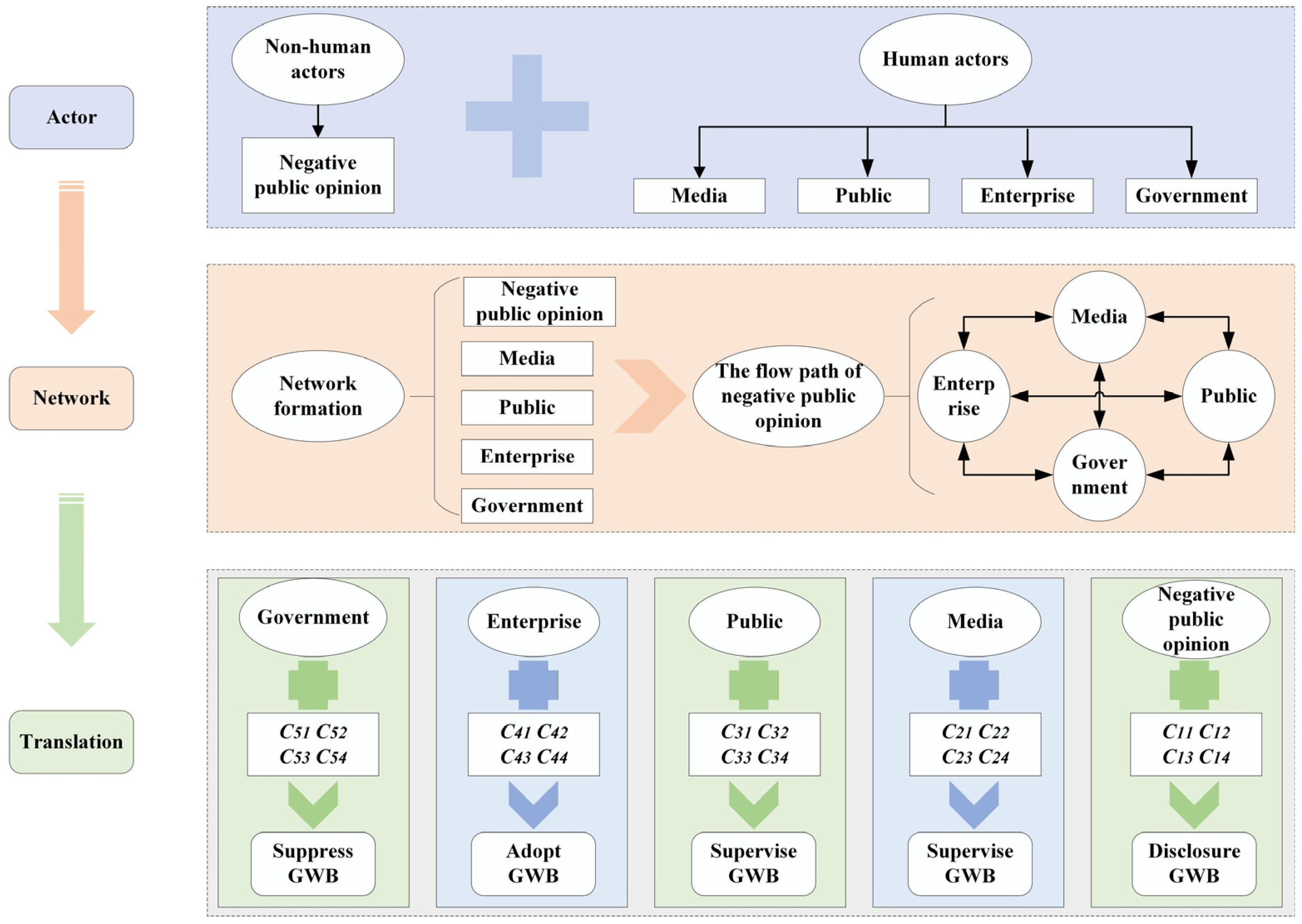
This study adopts ANT as its analytical framework, aiming to construct a dynamic and operational early warning framework for GWB. First, at the level of actor identification, this study overcomes the limitations of traditional approaches that focus solely on human actors by constructing a heterogeneous network that encompasses human actors—such as government, enterprise, the media, and the public—as well as NPO, a key non-human actor [22]. Second, regarding the underlying logic of indicator selection, this study defines NPO as translational intermediaries within this actor network. In accordance with ANT’s concept of translation, the supervisory efficacy of human actors must be represented and transmitted through NPO as non-human actors [21]. Finally, the selection of early warning indicators is not a mere isolated aggregation of data from various sources but rather captures the trajectories of interaction among heterogeneous elements on the basis of network logic. This transforms hidden GWB into observable early warning signals. Therefore, this study employs ANT to construct an early warning indicator system for GWB in BMEs. A diagram of the theoretical framework of this study is shown below (Figure 1).
Specifically, whether BMEs engage in greenwashing depends primarily on their internal decision-making mechanisms, including C41 and C42. This tendency manifests externally as C43 and C44. Externally, governments supervise and constrain such greenwashing through C51, C52, C53, and C54. Simultaneously, the media and the public constitute significant oversight forces: media disclosure accuracy depends on C21, C22, C23, and C24; the public provides the informational foundation for media through C31, C32, C33, and C34. Negative public opinion, as the key medium connecting the “enterprise–media–public–government” network, further influences the actions and interactive effects of all the parties through C11, C12, C13, and C14.

3. Constructing an Early Warning Evaluation Model

Although machine learning and logistic regression are widely used in risk prediction, in this study, the ANP-GFCE hybrid model was selected because of the unique characteristics of GWB in BMEs. The reasons are as follows. First, GWB samples are scarce, making it difficult to achieve the training scale required for deep learning [43]. Second, GWB is influenced by a complex interplay of multiple factors, such as policy and NPO, and the relationships between indicators are not independent; thus, the ANP can effectively capture these networked associations [44]. Finally, compared with purely statistical models, CFCE can minimize subjective bias in expert scoring, making the evaluation results more scientifically sound in environments with small sample sizes and high ambiguity [45]. A detailed comparison with traditional predictive models is shown in Table 2.
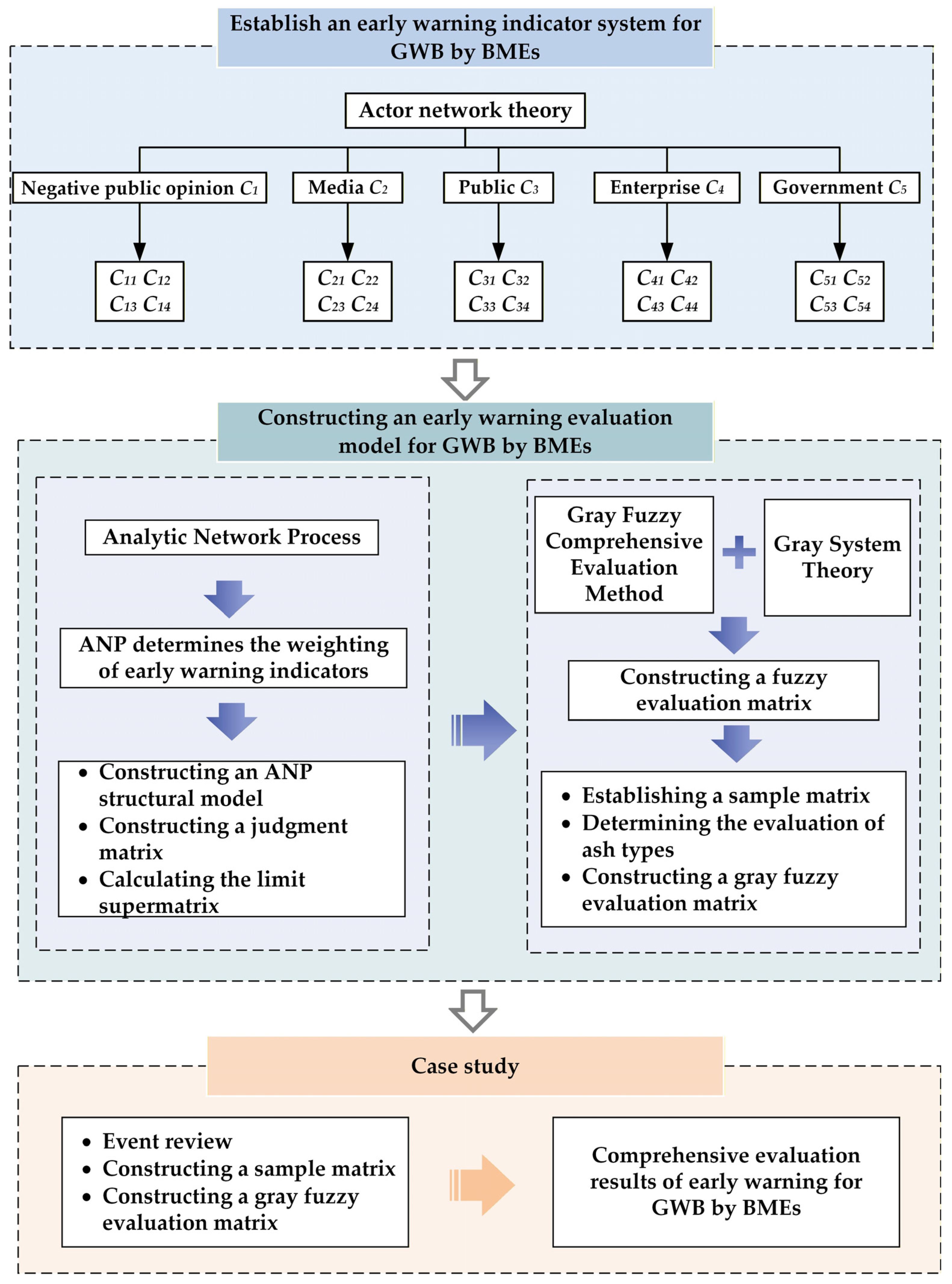
Drawing on ANT, this study selected four evaluation indicators from five dimensions, namely, NPO, media, the public, enterprises, and the government, to construct an early warning indicator system for the GWB of BMEs, as shown in Table 1. In this study, the ANP is subsequently used to calculate the degree of advantage of each indicator level, and the overall weight of each indicator level is derived. To increase the practicality of the model, this study further combined the GFCE to calculate the early warning level. Finally, typical cases of greenwashing in the BM industry were selected for verification to validate the effectiveness and operability of the method. The specific operation is shown in Figure 2.

3.1. ANP Determines the Weighting of Early Warning Indicators

The ANP is a decision-making tool developed on the analytic hierarchy process (AHP). The traditional AHP focuses primarily on the relationships between elements at different levels, with relatively simple operations, but it overlooks the mutual influence between elements. In contrast, the ANP emphasizes the relationships between elements and highlights the network structure formed by such mutual influence. The structure of the ANP can be divided into two levels: the control layer and the network layer. The control layer primarily reflects the influence relationships between different levels, whereas the network layer demonstrates the interactions between elements at the same level. The flexibility of this network structure makes the ANP an ideal tool for solving complex decision-making problems, especially when there are dependencies or feedback relationships between elements [44]. In the assessment of GWB in BMEs, various influencing factors do not exist in isolation but interact and are fed back to each other. Therefore, in this study, the ANP is used to assess the mutual influence of these factors, which more effectively captures their complexity and dynamism.

3.1.1. Constructing an ANP Structural Model

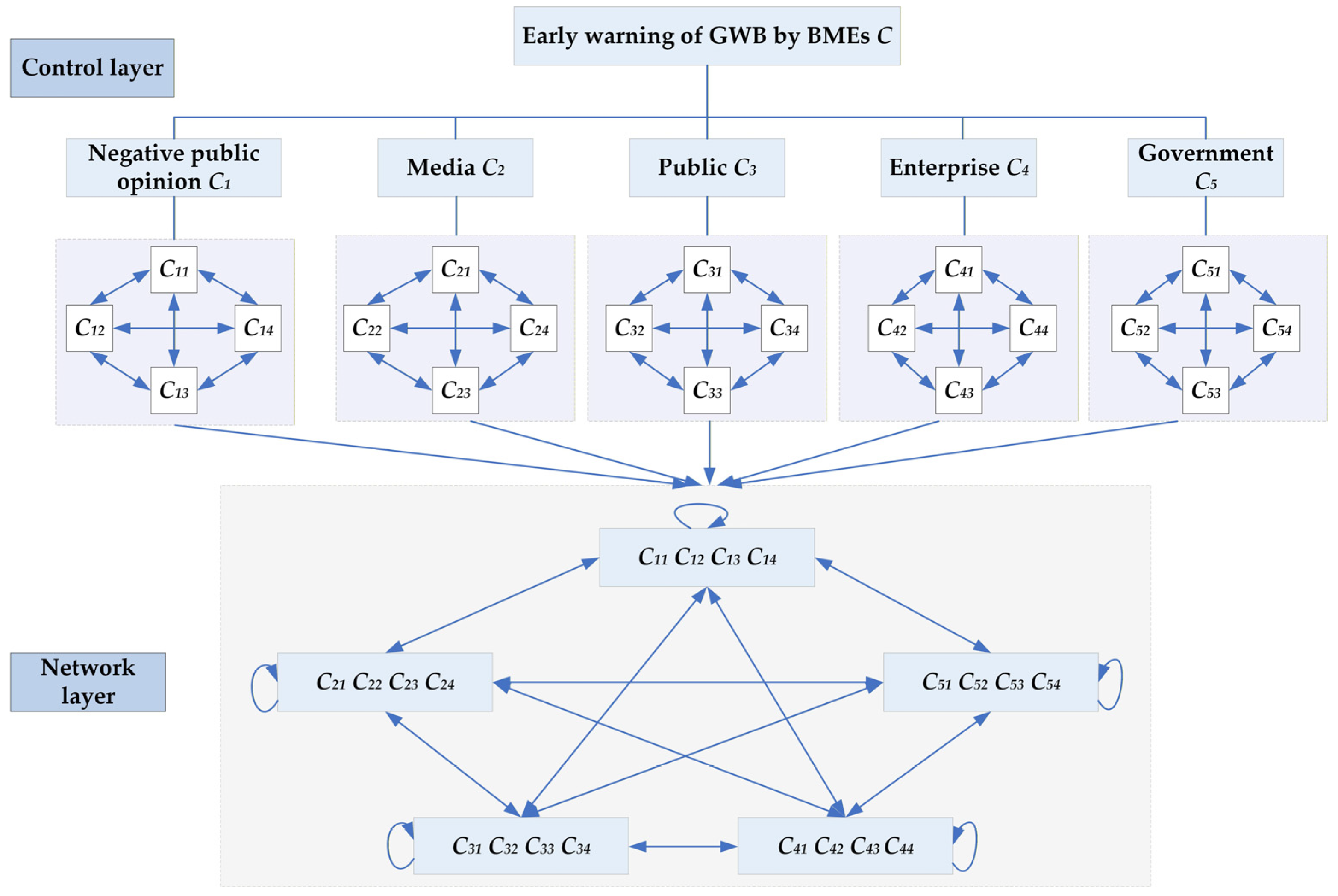
First, with respect to the content of Table 1, this study sets a control layer, such as the NPO and media. Second, at the network level, these include the spread of the NPO and media authority. The statistical results reveal a total of five first-level dimensions and 20 s-level indicators. Finally, through expert questionnaire (Appendix A) surveys combined with relevant basic knowledge, this study summarizes the element relationship matrix and further constructs the ANP structural model, as shown in Figure 3. To ensure the quality of the questionnaire and the validity of the research, this study employed the Delphi method to conduct at least three iterations of expert feedback and revisions on the distributed questionnaires until a consensus was reached.
The emergence and development of greenwashing in BMEs is a complex dynamic system involving the combined influence of the NPO, media, the public, enterprises, and the government. Greenwashing incidents in BMEs often become triggers for NPO, causing conflicts between the public and enterprises. In the process of the formation and development of these conflicts, NPO has attracted widespread public attention and spread.
The longer, the greater the likelihood of a secondary NPO for BMEs. When multiple media outlets focus on the same NPO event, its visibility and authority significantly increase. In addition, the media’s favorable impressions of NPO events involving enterprises directly affect public opinion, which in turn affects the public’s trust in and attitudes toward enterprises. The public is the key factor in generating NPO. Under the strong influence of the NPO, the public’s perception of greenwashing by enterprises has gradually increased, especially among groups that are sensitive to environmental issues. As NPO events develop, their emotional reactions become stronger, and their online and offline actions increase accordingly. Therefore, when faced with NPO, BMEs must take this seriously and take effective measures to reduce their impact on the enterprise’s image and public trust. Compared with managers with high risk preferences, managers with low risk preferences are more likely to recognize the potential damage of the NPO to the enterprise’s goodwill and image. In addition, government subsidies are usually linked to the level of green innovation and the environmental performance of enterprises. When green institutional investors notice this trend, they will put pressure on enterprises to improve their green innovation and environmental performance. Moreover, as the main controllers of NPO and regulators of enterprise misconduct, the government needs to focus on optimizing the business environment in the region and improving regional environmental regulatory capabilities. To this end, the intensity of environmental regulations has increased accordingly to ensure that enterprise behavior is in line with sustainable development goals.

3.1.2. Constructing a Judgment Matrix

Drawing on Figure 1, this study analyzed the mutual influence between element groups. On this basis, a pairwise comparison judgment matrix was constructed. This study subsequently uses a 1–9 scale combined with an expert questionnaire (Appendix B) to calculate the degree of advantage between each element. Since the experts’ preliminary judgments may deviate from the actual situation, this study uses the Delphi method to correct the expert questionnaire. Through multiple rounds of questionnaire surveys, experts are prompted to repeatedly evaluate the data, thereby improving the accuracy of the judgment.

3.1.3. Calculating the Limit Supermatrix

Drawing on the ANP, all the constructed judgment matrices must pass the consistency test to ensure that the consistency ratio (CR) meets the following condition: CR = CI/RI < 0.1. Next, in this study, the supermatrix and weighted supermatrix were constructed, and then the weighted supermatrix was stabilized to obtain the limited supermatrix. Finally, the column vector of the limit supermatrix is the weight vector W of the early warning indicators of the GWB of BMEs. In view of the relatively complex calculation process of the ANP, this study used Super Decision 3.2 software to perform the corresponding calculations, and the results are shown in Table 3.

3.2. Constructing a Fuzzy Evaluation Matrix

The combination of the GST and fuzzy evaluation methods has formed the GFCE, which is a new evaluation method. Its main advantage is that it can effectively evaluate objects or phenomena with fuzzy factors in situations where information is insufficient [45]. By using the GFCE method, the bias caused by the subjective preferences of experts can be eliminated. In addition, this method can handle factors that are difficult to calculate via precise mathematical models, making the evaluation results more realistic and reliable. Therefore, in this study, the GFCE method was used to assess the early warning level of GWB in BMEs.

3.2.1. Establishing a Sample Matrix

In this study, T experts were invited to evaluate the GWB of BMEs from the perspective of second-level indicators. Each expert is required to score each second-level indicator on the basis of their own relevant knowledge and examples. Specifically, the first expert scores the first second-level indicator as d11, the second second-level indicator as d21, and so forth. The Tth expert will score the first second-level indicator as d1t and the nth second-level indicator as dnt. By organizing the collected expert scoring data, a sample matrix D will ultimately be obtained, which will facilitate further analysis and research on the GWB of BMEs.
D = d 11 d 12 d 1 t d 21 d 22 d 2 t d n 1 d n 2 d n t

3.2.2. Determining the Evaluation of Ash Types

By reading the relevant materials, this study divides the early warning levels of GWB in BMEs into the following four levels: extremely severe, severe, relatively severe, and generally severe, represented by the symbols V = {V1, V2, V3, V4}, assigned scores of 4, 3, 2, and 1, respectively. Interlevel scores: 3.5, 2.5, 1.5. Regarding the setting of early warning thresholds, this study follows the logical framework proposed by Memmedova and Ertuna [46], calibrated to account for the empirical characteristics of the BM industry. The specific criteria are as follows: (1) Based on the principle of equidistance in fuzzy set theory, this study divides the total score space into four early warning intervals. (2) By setting intermediate early warning thresholds of 3.5, 2.5, and 1.5, the evaluation results can be ensured to have high distinguishability within the fuzzy membership functions, thereby avoiding overlap and interference between different early warning levels. (3) Prior to formal modeling, this study conducted a preliminary questionnaire survey of 10 experts. Statistical results indicate that, when building materials enterprises engage in substantive greenwashing, the mean of their comprehensive early warning scores is distributed across the four risk intervals. Therefore, this study set intermediate early warning thresholds of 3.5, 2.5, and 1.5. The calculation formulas for the early warning levels of the GWB of BMEs are as follows:
(1) The first gray category V1 (extremely severe) is set to V1 ∈ [4,∞]
f 1 d i j = d i j / 4 d i j 0 , 4 1     d i j 4 , 0     d i j 0 ,
(2) The second gray category V2 (severe) is set to V2 ∈ [0, 3, 6]
f 2 d i j = d i j / 3 d i j 0 , 3 6 d i j / 3 d i j 3 , 6 0 d i j 0 , 6
(3) The third gray category V3 (relatively severe) is set to V3 ∈ [0, 2, 4]
f 3 d i j = d i j / 2 d i j 0 , 2 4 d i j / 2 d i j 2 , 4 0 d i j 0 , 4
(4) The fourth gray category V4 (generally severe) is set to V4 set to [0, 1, 2]
f 4 d i j = 1 d i j 0 , 1 2 d i j / 1 d i j 1 , 2 0 d i j 0 , 2

3.2.3. Constructing a Gray Fuzzy Evaluation Matrix

Through expert questionnaires (Appendix C), we obtained the early warning level evaluation matrix D for the GWB of BMEs. The specific calculation steps for the gray fuzzy evaluation matrix R are as follows. First, matrix D was transposed to obtain matrix A. Second, each piece of data in matrix A was substituted into the whitening weight function for calculation. Third, the gray evaluation weight r was derived from the normalized whitening results. Finally, the gray evaluation weights r of different indicators were integrated to obtain the GFCE matrix R of the early warning indicators of the GWB of BMEs.
R = r 11 r 12 r 1 n r 21 r 22 r 2 n r n 1 r n 2 r n n

3.3. Comprehensive Evaluation Results

Drawing on the experimental design of this study, first, through the distribution of expert questionnaires, the global weight of each second-level indicator was calculated via the ANP to integrate the weight vector W. Next, through the analysis of examples by experts, the sample matrix D was obtained, and the GFCE method was used to obtain the evaluation matrix R of the early warning indicators of the GWB of BMEs. Finally, according to the early warning level classification mentioned above, the early warning level evaluation criterion for the GWB of BMEs was set as G = (4,3,2,1). In this study, the evaluation results of the early warning level of the GWB of BMEs were ultimately calculated via the following formula:
Z = G ( W R ) T

3.4. Sensitivity Analysis

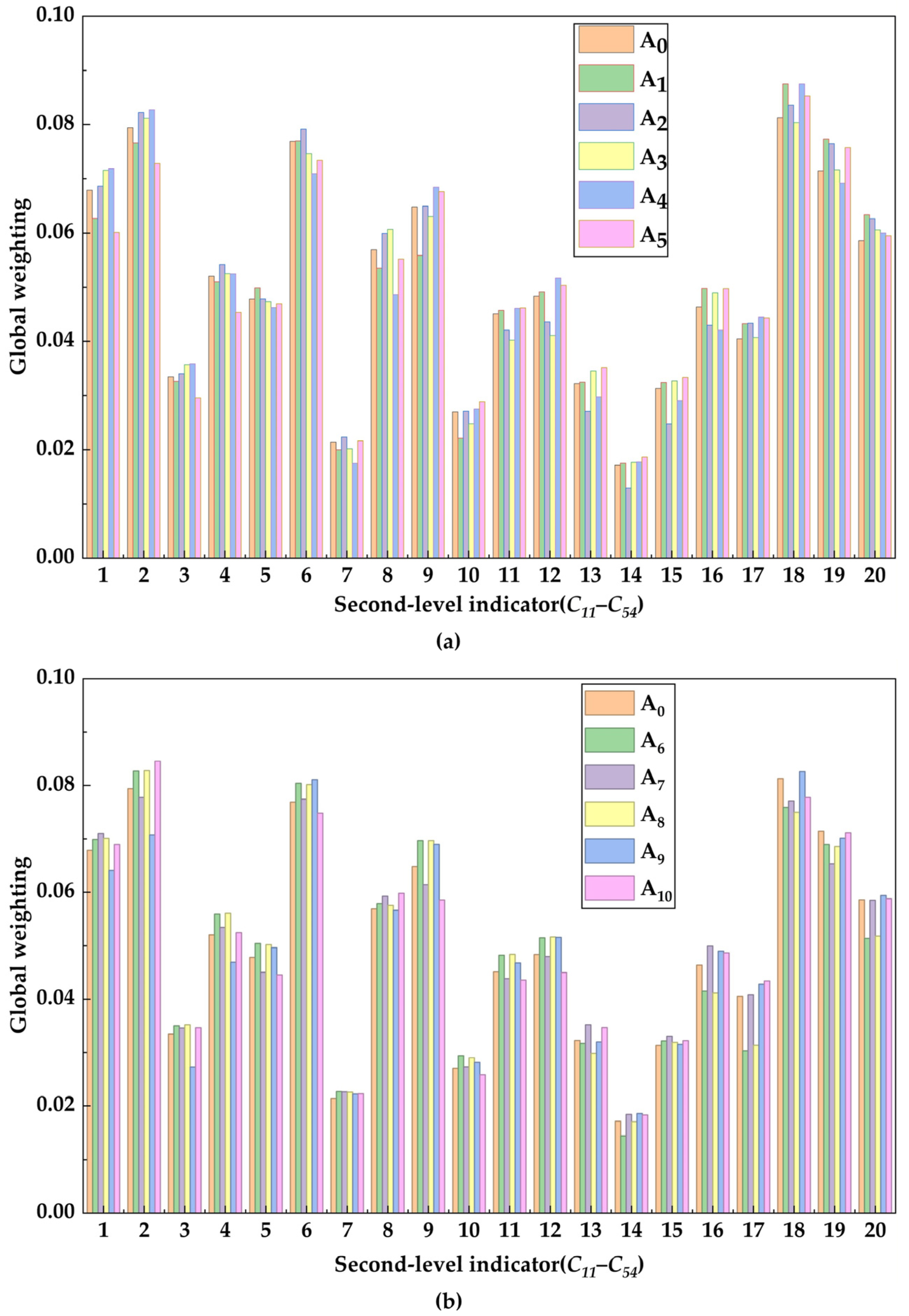
To test the robustness of the evaluation results with respect to the expert weight settings, this study employed the leave-one-out method for sensitivity analysis, a technique widely used in fields such as structural equation modeling that rely on expert ratings [47]. The basic logic involves sequentially excluding individual experts and recalculating the results to observe the degree of change. The specific steps of this study are as follows: (1) In the previous calculations, a decision matrix based on 10 experts with equal weights (0.1 each) was constructed, and the extreme weights for each indicator were obtained using Super Decision 3.2 software. (2) The experts were removed one by one (T = 1, 2, …, 10), after which the judgment matrix was reconstructed such that the remaining 9 experts were assigned equal weights (each 1/9), and the calculation of the extreme weights was repeated. (3) The results of the 11 scenarios were compared; if the calculation results changed significantly after a particular expert was removed, the expert’s opinion was sensitive to the indicator weight results. This is illustrated in Figure 4 below.
In the figure above, A0 in Figure 4a,b represents the maximum weight values calculated by the 10 experts in the initial state. A1 through A10 represent the maximum weight values calculated by the remaining 9 experts after experts 1 through 10 were removed one by one. Figure 4a,b show that, when the scores of a single expert are excluded, the distribution of weights for each secondary indicator, when compared to the original results, exhibits only slight deviations but maintains a consistent overall trend, demonstrating high stability. Therefore, the errors caused by the subjectivity of expert scoring have a minimal impact on the research results, and the output is robust. Consequently, the output of this model is robust and suitable for further discussion.

4. Case Study

Drawing on the research by Li et al. [48], this study employed a purposive sampling strategy to ensure that the sample was both comprehensive and representative. First, tests were conducted on typical cases to ensure the model’s rationality and operability [49]. Second, when enterprises are selected, this study tends to choose those with industry representativeness and high status, especially those that outwardly advocate for green development but actually engage in GWB, to test the model’s ability to warn of GWB. Finally, A, B, C, D and E Enterprise were selected as case enterprises on the basis of their significant positions in the industry. Although they possess green concepts, some of their behaviors are representative of greenwashing, effectively reflecting the difference between green appearances and actual behaviors, thereby verifying the practicality and accuracy of the model.

4.1. Event Review

The data on the case enterprises in this study were sourced from their official websites, government bulletins, or media reports.
Case 1: A Enterprise was established in 1997. As a leading enterprise in the cement industry, the A Enterprise has vigorously promoted a sustainable development strategy of green energy, intelligent production, and a circular economy in recent years, attempting to establish a green benchmark for the industry. However, questions from public and environmental organizations continue to persist. First, between 2020 and 2023, Conch Cement and related enterprises received multiple environmental penalties, with a total fine of more than 1 million yuan, which stands in stark contrast to its image as an environmental protection model enterprise. Second, its ESG report selectively disclosed key environmental data, which experts questioned as greenwashing that concealed the true environmental situation. In addition, at the 2023 environmental impact assessment hearing for Lushan Conch, residents jointly protested, reflecting the public’s crisis of confidence in the enterprise’s environmental protection commitments.
Case 2: B Enterprises is a globally leading modern conglomerate founded in 1978 with steel as its core business. In manufacturing, the enterprise extensively adopts intelligent and clean production technologies, having implemented internationally advanced sinter flue gas purification, waste heat recovery, and smart energy management systems at its major production bases. This ensures that its key pollutant emission concentrations not only fall far below China’s ultralow emission standards but also meet world-class benchmarks. However, the enterprise has also faced multiple environmental compliance issues. In 2009, two environmental impact assessment reports commissioned were criticized by the Ministry of Environmental Protection for quality deficiencies, with one report triggering public complaints due to omitted noise source analysis. In 2015, it was ordered to be rectified and fined by the Shanghai Environmental Protection Bureau for severe exceedances of nonmethane hydrocarbon emissions in exhaust gases. In 2024, the national Yangtze River Economic Belt ecological warning documentary for “directly discharging untreated washing wastewater into inland lakes, causing water pollution.”
Case 3: C Enterprise, a panel manufacturer established in 1978, has long been committed to providing high-quality wood materials for home living, high-end customization, and green construction. Recognized for its product quality and environmental commitments, the enterprise has earned honor, including “China Well-Known Trademark” and “China Environmental Labeling Product Certification.” However, a significant gap exists between the enterprise’s environmental practices and its public pledges. Since 2013, persistent complaints from nearby residents regarding emissions from production processes have indicated longstanding environmental impacts that remain unaddressed. In July 2018, C Enterprise had its membership revoked by the Alashan SEE Ecological Association for failing to effectively oversee supplier compliance and neglecting its environmental responsibilities. By 2022, the enterprise faced an additional 410,000 yuan fine for procedural violations, including operating without environmental impact approval and commencing production before environmental facilities passed final inspection.
Case 4: D Enterprises was founded in 1665 with the support of the French royal family and has been a leader in the glass manufacturing industry. For decades, the enterprise has placed sustainable development at the core of its strategy, committed to driving the green transformation of the construction industry through technological innovation. Recognized for its outstanding innovation capabilities and dedication to sustainability, it has been repeatedly honored as one of the “World’s Most Ethical Companies” and stands as a model for green industry transition. However, D Enterprise faces repeated environmental compliance issues. In 2013, an environmental inspection revealed excessive sulfur dioxide emissions. In 2014, it was placed under special supervision by environmental authorities because of environmental violations. As recently as November 2024, publicly disclosed complaints from local residents highlighted severe dust pollution from production processes. These incidents reveal a gap between its environmental practices and its publicly stated sustainability commitments.
Case 5: E Enterprise, a paint manufacturer founded in the United States in 1866, has long been dedicated to providing high-performance coating products for the construction, industrial, and home sectors. Through its commitment to environmental innovation and product quality, the enterprise has earned a market reputation for “American Quality” and continues to drive the global coating industry toward healthier, more sustainable practices. However, E has repeatedly violated environmental regulations: In March 2016, it was ordered to cease illegal activities and fined for breaching air pollution control management systems. In December 2017, it faced penalties for failing to implement effective containment measures at waste paint residue storage sites, resulting in leaks, and for lacking identification labels on hazardous waste. In April 2018, it was fined 100,000 yuan for failing to conduct production processes involving volatile organic compound (VOC) emissions in enclosed spaces. Just two months later, the enterprise faced further penalties for issues such as nonenclosed exhaust emissions and improperly sorted industrial solid waste storage. This series of environmental violations stands in stark contrast to its promoted image of sustainable development.
The selection of case studies adhered to theoretical sampling principles. First, industry representativeness was ensured, with selected enterprises covering subsectors of the building materials industry such as cement, steel, panels, glass, and paint. Additionally, emphasis was placed on information accessibility, as all the case enterprises were publicly listed entities whose disclosed data provided a reliable foundation for the research. The five ultimately selected enterprises collectively form a diverse and representative analytical sample, enhancing the generalizability of the research conclusions. The participating enterprises are listed in Table 4.

4.2. Constructing a Sample Matrix

Following Sharma’s [50] approach, an online survey targeting professionals in the building materials industry and the field of environmental management was conducted between December 2024 and June 2025. The selection of experts strictly adhered to at least one of the following criteria. (1) Extensive practical experience in the management and operations of building materials enterprises. (2) Relevant academic achievements in the field of GWB research (3) The background of environmental regulation within the building materials industry. (4) Long-term focus should be placed on green building materials and GWB issues. On the basis of the requirements for the expert sample as determined by the ANP, a panel of 10 experts was ultimately invited to form the review panel, comprising 3 academic researchers, 3 government officials, 2 corporate managers, and 2 representatives from the general public. Detailed information on the interviewed experts is provided in Table 5.
In this study, enterprise A is taken as an example. The experts combined actual cases of GWB in BMEs and established the A Enterprise sample matrix D1 according to the early warning level scoring criteria. The sample matrices D2, D3, D4, and D5 for B, C, D, and E Enterprise are provided in Appendix D.
D 1 = 3.5 3 4 4 3 1 3.5 4 3 3 4 3.5 3 4 4 2 3 4 3 2 3 3 2 3 2 1.5 4 3 1 1 4 3.5 3 2 4 1.5 4 3 1 1 4 3 2.5 4 1 1 3 2 4 1.5 3.5 3.5 3 3 2 1.5 2.5 1 2 1 3.5 2.5 2 1 2 1 2 1.5 2 1 4 3 1.5 3 4 1 3.5 3.5 3 2 4 2 3 3 4 3.5 4 4 4 3 3.5 1.5 4 3 3 2.5 3.5 4 3 3 4 2 3 4 4 1.5 3 3.5 2 3 4 2.5 3 3 3 1.5 2.5 4 2 1 3 3 1.5 2 4 1 4 3 3 2 3.5 1 3.5 2 2.5 1 2 4 2 2 4 2 3.5 4 3 2 1.5 3 4 3 4 2 4 4 4 1 2.5 3.5 4 2 3.5 1.5 1 4 2.5 1.5 2 2 4 2 4 3.5 4 4 3 3.5 3 3.5 3 3 4 3 2 3 3.5 3 3.5 2.5 2 3 3.5 1.5 2 3 1.5 2 1.5 1 1 2

4.3. Constructing a Gray Fuzzy Evaluation Matrix

Although the GFCE is simple to calculate, owing to the large amount of data, this study used MATLAB R2021b software to assist in the calculation and obtain the enterprise A matrix R1. The GWB early warning evaluation results R2, R3, R4, and R5 for B, C, D, and E enterprises are presented in Appendix E.
R 1 = 0.4000 0.4000 0.1500 0.1500 0.4123 0.3975 0.1903 0 0.2235 0.2824 0.3294 0.1647
Table 6 details the results.

4.4. Comprehensive Evaluation Results of Early Warning for GWB in BMEs

First, the warning level evaluation criterion for the GWB of BMEs is known to be G = (4,3,2,1). This study then calculates the warning index weights for the GWB of BMEs via the ANP method: W = (0.067887, 0.079410, 0.033454, 0.052039, 0.047804, 0.076903, 0.021414, 0.056911, 0.064825, 0.027011, 0.045114, 0.048351, 0.032246, 0.017147, 0.031318, 0.046370, 0.040476, 0.081264, 0.071457, 0.058602). Next, on the basis of the fuzzy evaluation matrix, matrices R1, R2, R3, R4, and R5 are obtained. Finally, applying Formula (7) yields Z1 = 3.0065, Z2 = 3.0163, Z3 = 2.8387, Z4 = 2.8245, and Z5 = 2.7382. Therefore, this study concludes that all selected case enterprises exhibit severe GWB, which is consistent with the actual findings.
In accordance with the warning level classification criteria for GWB in BMEs (extremely severe: ≥3.5 points; severe: 2.5–3.5 points; relatively severe: 1.5–2.5 points; generally severe: ≤1.5 points), the five BMEs studied are distributed as shown in Table 7 below.

5. Discussion and Outlook

5.1. Discussion

In the early warning indicator system for the GWB of BMEs, the weights of each first-level dimension are as follows: government (M1 = 0.251798), NPO (M1 = 0.232790), media (M1 = 0.203032), public opinion (M1 = 0.185300), and enterprises (M1 = 0.127080) (Table 3). These findings indicate that, compared with the media, public opinion, and the enterprises themselves, the government and NPO have a significantly greater effect on the GWB of enterprises. This conclusion is consistent with the findings of Xu et al. [20], who noted that the government can effectively curb greenwashing by enterprises through optimizing the business environment and strengthening environmental regulation. Although there is currently a lack of empirical evidence concerning the impact of NPO, existing research indicates that NPO is an important external factor influencing managerial decision making [51]. These findings also indirectly show that an NPO can influence managers’ decisions, thereby reducing the GWB of enterprises. In comparison, the media and the public have less influence on GWB in enterprises, which play a certain supervisory role, but not enough to completely curb GWB among enterprises [4]. Finally, enterprises themselves have the least influence on GWB. This is mainly because, in pursuit of high profits and high returns, enterprises are willing to risk government penalties and continue to engage in GWB. The following analysis is based on the above five first-level dimensions.
From the government dimension, the overall weights of the second-level indicators are as follows in descending order: environmental regulation intensity (M2 = 0.081264), regional environmental supervision capacity (M2 = 0.071457), regional business environment optimization (M2 = 0.058602), and government subsidy intensity (M2 = 0.040476). Therefore, from the perspective of the NPO, environmental regulations have the greatest effect on the GWB of enterprises. As Sun and Zhang [52] noted, without government regulation, it is difficult for enterprises to control greenwashing effectively, and environmental regulations can play a key role in curbing it. In comparison, government subsidies have less of an effect on enterprise greenwashing. Rooted in government–enterprise information asymmetry, some enterprises use greenwashing to gain legitimacy and obtain environmental subsidies [53]. Therefore, to allocate government subsidies reasonably and ensure their effectiveness, the government needs to strengthen supervision to prevent enterprises from exploiting policy loopholes.
Drawing on the analysis of NPO, the overall weights of the second-level indicators are as follows: NPO attention (M2 = 0.079410), NPO dissemination (M2 = 0.067887), duration of NPO (M2 = 0.052039), and incidence of secondary NPO (M2 = 0.033454). These findings show that the attention and spread of NPO profoundly affect the GWB of enterprises. The main reason for this is that the NPO easily attracts widespread public attention, thereby damaging the image of the enterprise and reducing its profits [19]. The wider the audience is, the greater the impact. In addition, NPO spreads rapidly through the media, not only prompting the public to be more vigilant but also attracting the attention of the government, thereby curbing GWB by enterprises to a certain extent [54]. Therefore, the NPO advances both GWB governance research and regulatory practice.
From the media dimension, the overall weights of the second-level indicators are, in descending order, media visibility (M2 = 0.076903), media reporting speed (M2 = 0.056911), media authority (M2 = 0.047804), and media favorability (M2 = 0.021414). According to previous studies, the government has a significant restraining effect on GWB by enterprises, but government regulation alone cannot completely curb GWB. Therefore, the influence of the media on enterprise GWB is investigated. The results show that media visibility and reporting speed have a more significant effect on the GWB of enterprises. Wang et al. [55] reported that, when the government and media cooperate more closely, greenwashing by enterprises is effectively curbed, the level of enterprise governance is significantly improved, and cooperative governance is achieved. This is based mainly on two aspects: On the one hand, the media improves information transparency with visibility, making it easier for the public to learn about GWB by enterprises and inspiring public resistance; on the other hand, the media reports quickly and can provide relevant information to the government in a timely manner, enhancing regulatory capabilities [33]. Therefore, the governance of greenwashing by enterprises depends not only on government supervision but also on the joint participation of the media and other stakeholders. This multiparty collaboration can more effectively supervise enterprise behavior and maximize the effectiveness of supervision.
For the public dimension, the overall weights of the second-level indicators are as follows: public sentiment intensity (M2 = 0.064825), public environmental preferences (M2 = 0.048351), public perception of greenwashing (M2 = 0.045114), and public behavior intensity (M2 = 0.027011). As mentioned above, the media, with its wide visibility and fast reporting speed, can serve as an important channel for providing the government with information on greenwashing by enterprises. However, media information may be influenced by enterprises’ bribes, leading to biased reporting on enterprises and thus misleading the government’s supervision of GWB by enterprises [7]. Therefore, this study incorporates public factors to explore their impact on the GWB of enterprises. The results show that the intensity of public sentiment has a significant effect on the GWB of enterprises. Specifically, Liu et al. [56] reported that, when the public discovers that an enterprise is engaging in greenwashing, it is likely to cause public resentment and stimulate negative emotions. Moreover, Zhang and Sun [35] reported that the stronger the fluctuations in public sentiment are, the greater the likelihood that they affect the goodwill of enterprises. Therefore, intensified public sentiment is correlated with greater reputational harm, which in turn indirectly affects the GWB of enterprises through reputational pressure.
For the enterprise dimension, the overall weights of the second-level indicators are as follows: environmental performance level (M2 = 0.046370), manager risk preference (M2 = 0.032246), green innovation level (M2 = 0.031318), and the green institutional investor shareholding ratio (M2 = 0.017147). Given that the NPO and the media are external supervisory mechanisms, this study also examines the impact of internal factors on GWB from an internal perspective. The results show that environmental performance levels and managerial risk preferences significantly affect GWB. Zhang et al. [41] support this conclusion, suggesting that environmental performance levels are negatively correlated with GWB. Moreover, Yue and Li [39] reported that increased media attention can significantly curb GWB in enterprises, whereas managers’ risk preferences can actively enhance this curbing effect. These findings show that to more effectively curb GWB among enterprises, external supervision and internal control mechanisms need to work together.

5.2. Outlook

This study has several limitations. First, although the ANP method was used to calculate indicator weights and the GFCE method was combined with it for early warning level assessment, the model has a certain degree of subjective dependence. Expert scoring and judgments may be influenced by bias, affecting the objectivity of the results. Second, the sample selection is limited, is primarily based on a few typical BMEs, and has not been validated for applicability in other industries or enterprises of different scales, thereby restricting the generalizability of the model. Third, the early warning model developed in this study is applicable primarily to enterprises with known greenwashing issues; its ability to predict enterprises that have not engaged in greenwashing remains limited. Additionally, the model lacks validation with large-scale, diverse data in practical applications, and its stability and reliability need to be improved. Future research should integrate AI to collect NPO data in real time, establish a dynamic monitoring system, and increase the timeliness and accuracy of early warnings. Additionally, the scope of the sample should be expanded, and multimethod fusion should be explored to enhance predictions, thereby providing more scientific decision-making support for enterprise green governance.

6. Conclusions and Implication

6.1. Conclusions

Drawing on ANT, this study constructed an early warning indicator system for the GWB of BMEs and used the ANP method to determine the weights of indicators at various dimensions. To reasonably classify the early warning levels when GWB occurs in enterprises, this study combines the GFCE method to construct a fuzzy matrix for comprehensive analysis and calculation of GWB in enterprises and finally derives the corresponding early warning levels.
(1) This GWB early warning evaluation model comprises five primary dimensions and twenty secondary indicators, incorporating stakeholders such as the government (M1 = 0.251798), negative public opinion (M1 = 0.232790), the media (M1 = 0.203032), the public (M1 = 0.185300), and enterprises (M1 = 0.127080). Finally, calculations revealed that the GWB early warning levels for BMEs such as A, B, C, D, and E are severe. These findings indicate that all the BMEs selected for this study face a high risk of greenwashing. A comparison of the environmental penalty records of the selected enterprises in recent years with their carbon neutrality commitments and actual actions revealed that the model’s assessment results align well with the actual situation, thereby validating the model’s effectiveness.
(2) Government dimension: Environmental regulation intensity (M2 = 0.081264) emerges as the most critical indicator, followed by regional environmental regulatory capacity (M2 = 0.071457), the optimization of the regional business environment (M2 = 0.058602), and government subsidy intensity (M2 = 0.040476). Therefore, the key to determining whether BMEs engage in GWB lies in assessing the strength of local environmental regulation intensity and regional environmental regulatory capacity. These two factors directly shape the costs and risks associated with fraudulent environmental claims and serve as core variables influencing enterprise decision making.
(3) Negative public opinion dimension: Attention (M2 = 0.079410) is the most critical indicator, followed by dissemination (M2 = 0.067887), duration (M2 = 0.052039), and incidence of secondary NPO (M2 = 0.033454). The covert nature of GWB poses significant challenges for its identification. Therefore, evaluation systems must incorporate the NPO as a dynamic early warning indicator, prioritizing those instances that trigger widespread public skepticism. Such public opinion effectively serves as an early warning evaluation model, bridging regulatory gaps caused by information asymmetry and assisting in the identification of potential GWB.
(4) Media dimension: Media visibility (M2 = 0.076903) ranks as the most critical indicator, followed by media reporting speed (M2 = 0.056911), media authority (M2 = 0.047804), and media favorability (M2 = 0.021414). Therefore, the early warning evaluation model should prioritize monitoring the volume of media visibility as the trigger for the highest alert level. The media reporting speed and media authority should subsequently assess severity, whereas media favorability can be excluded from the initial response.
(5) Public dimension: Public sentiment intensity (M2 = 0.064825) is the most influential indicator, followed by public environmental preferences (M2 = 0.048351), public perception of greenwashing (M2 = 0.045114), and intensity of public behavior (M2 = 0.027011). Therefore, the early warning evaluation model must place the intensity of public sentiment at the core of its highest alert level, with a focus on fluctuations that breach critical thresholds. This early warning indicator can keenly capture collective skepticism within the public discourse, effectively compensating for the lag in administrative oversight and providing crucial evidence for identifying potential GWB in BMEs.
(6) Enterprise dimension: Environmental performance level (M2 = 0.046370) is the most critical indicator, followed by managerial risk preference (M2 = 0.032246), green innovation level (M2 = 0.031318), and the shareholding ratio of green institutional investors (M2 = 0.017147). Therefore, the fundamental basis for triggering the highest-level GWB warning for BMEs lies in the evaluation of their environmental performance level. This metric interacts with enterprises’ management risk preference and green innovation level: the former defines the severity of the issue, whereas the latter two provide supplementary assessment dimensions at the levels of motivation and capability. In contrast, the shareholding ratio of green institutional investors has a lower decision-making weight in the preliminary assessment.

6.2. Policy Implication

First, efforts should be made to transition GWB regulation from blanket oversight to trigger-based regulation. The research findings indicate that the intensity of government environmental regulation has the highest weight among all the secondary indicators. Therefore, regulatory authorities should avoid conducting indiscriminate administrative inspections and instead apply the ANP-GFCE early warning model developed in this study to existing environmental monitoring platforms. By conducting real-time classification of greenwashing scores for building materials enterprises, they can achieve the optimal allocation of regulatory resources. Second, a socialized early warning and response strategy driven by the NPO should be established. Given the significant weight of NPO attention and the intensity of public opinion in the indicator system, it is recommended that government and industry associations jointly develop a real-time online sentiment monitoring system based on natural language processing. This system should not only capture negative information but also identify potential greenwashing risks in a timely manner by quantitatively analyzing the rate of sentiment fluctuations. By improving public reporting incentive mechanisms and media disclosure systems requiring the use of real names, public participation can be transformed from passive post-event feedback to active pre-event monitoring, thereby addressing the shortcomings of government regulation caused by information lag. Third, BMEs should incorporate these early warning indicators into their internal compliance systems. Environmental performance levels, as the most critical endogenous indicators, determine the fundamental ability of BMEs to resist greenwashing incentives. BMEs should adopt the evaluation system developed in this study as an internal audit tool and establish a compliance self-inspection system covering raw material traceability, low-carbon certification, and consistency in information disclosure. By linking improvements in environmental performance to executive performance evaluations, BMEs can shift from passively responding to regulation to proactively creating a green premium.

Author Contributions

X.L.: Conceptualization, methodology, writing—original draft, supervision, project administration; S.L.: methodology, validation, formal analysis, investigation, resources, data curation, writing—original draft, writing—review and editing, visualization; B.P. and C.T.: formal analysis, visualization, writing—review and editing. All authors have read and agreed to the published version of the manuscript.

Funding

This work was supported by the National Natural Science Foundation of China (grant number 72204178).

Data Availability Statement

The data that support the findings of this study are available from the corresponding author upon reasonable request.

Conflicts of Interest

We declare that we have no financial and personal relationships with other people or organizations that can inappropriately influence our work, and there is no professional or other personal interest of any nature or kind in any product.

Abbreviations

The following abbreviations are used in this manuscript:
BMBuilding materials
GWBGreenwashing behavior
NPONegative public opinion
ANPAnalytic network process
GFCEGray fuzzy comprehensive evaluation
ANTActor network theory
GSTGray system theory
AHPAnalytic hierarchy process
VOCVolatile organic compound

Appendix A. Questionnaire 1

Appendix A provides the foundation for constructing the ANP model described in Section 3.1.1; the relationships between indicators are established through expert surveys.
The top row of the table represents the affected factors, while the top column represents the influencing factors. When you believe a column element influences a row element, enter “1” in the corresponding cell. If you believe that there is no influence or that the relationship is unclear, enter “0”.
Table A1. Interrelationships among factors influencing GWB in BMEs.
C11C12C13C14C21C22C23C24C31C32C33C34C41C42C43C44C51C52C53C54
C110
C12 0
C13 0
C14 0
C21 0
C22 0
C23 0
C24 0
C31 0
C32 0
C33 0
C34 0
C41 0
C42 0
C43 0
C44 0
C51 0
C52 0
C53 0
C54 0

Appendix B. Questionnaire 2

Appendix B details the data sources used to derive the extreme hypermatrix in Section 3.1.3; the weights of the indicators are calculated through expert surveys.
The scoring criteria for GWB in BMEs across various indicators utilize a 1–9 scale, as detailed in Table A2.
Table A2. Scoring criteria for greenwashing indicators at different levels in BMEs.
Scale CijRepresentative Meaning
1The importance of factor i is equal to that of factor j.
3The importance of factor i is slightly greater than that of factor j.
5The importance of factor i is significantly greater than that of factor j.
7The importance of factor i is markedly greater than that of factor j.
9The importance of factor i is extremely greater than that of factor j.
2,4,6,8The scale value corresponds to the intermediate state between the above two judgments.
ReciprocalIf the importance of factor j is compared with that of factor i, then Cji = 1/Cij.
Below is an example comparing the first-level dimension C1 and second-level indicators C11, C12, C13, and C14.
(1) Comparison among first-level dimensions.
Table A3. Determination of dominance among the first-level dimensions under the C1 criterion.
C198765432123456789
C4 C3
C4 C2
C4 C5
C4 C1
C3 C2
C3 C5
C3 C1
C2 C5
C2 C1
C5 C1
(2) Comparison among second-level indicators.
Table A4. Assessment of dominance among second-level indicators under C11 criteria.
C1198765432123456789
C13 C12
C13 C14
C12 C14
C22 C24
C22 C21
C24 C21
C31 C34
C31 C33
C31 C32
C34 C33
C34 C32
C33 C32
C53 C54
C53 C52
C54 C52
Table A5. Assessment of dominance among second-level indicators under C12 criteria.
C1298765432123456789
C13 C11
C13 C14
C11 C14
C22 C23
C22 C24
C22 C21
C23 C24
C23 C21
C24 C21
C31 C34
C31 C33
C31 C32
C34 C33
C34 C32
C33 C32
C44 C41
C44 C43
C41 C43
C53 C54
C53 C52
C54 C52
Table A6. Assessment of dominance among second-level indicators under C13 criteria.
C1398765432123456789
C11 C12
C11 C14
C12 C14
C22 C23
C22 C21
C23 C21
C31 C33
C31 C32
C33 C32
C53 C54
C53 C52
C54 C52
Table A7. Assessment of dominance among second-level indicators under C14 criteria.
C1498765432123456789
C13 C11
C13 C12
C11 C12
C22 C23
C22 C24
C22 C21
C23 C24
C23 C21
C24 C21
C31 C34
C31 C33
C31 C32
C34 C33
C34 C32
C33 C32
C53 C54

Appendix C. Questionnaire 3

Appendix C presents the degree of greenwashing under the secondary indicator dimensions for the case enterprise; the greenwashing levels are calculated through expert surveys.
Please evaluate the warning level of GWB in BMEs from the perspective of the following second-level indicator and enter the scores in Table A8.
Table A8. Early warning level scores for GWB in BMEs.
First-Level DimensionSecond-Level IndicatorEarly Warning Level Rating
C1C11
C12
C13
C14
C2C21
C22
C23
C24
C3C31
C32
C33
C34
C4C41
C42
C43
C44
C5C51
C52
C53
C54

Appendix D. Sample Matrices (i.e., D2, D3, D4, D5)

Appendix D presents a statistical table of scores assigned by ten experts based on the questionnaire in Appendix C.
D 2 = 2 3 2 2 3.5 3 1.5 2 1 4 3 4 1 2 4 4 2 3 2 4 2 1 3 1 3 3 3 3 2 2 4 4 2 3 3.5 3 4 2 3 4 4 4 3 4 4 3 4 2 3 4 3 3 2 3 3.5 2.5 3 3 2 3 3 2 2 3 1 3 1 3 4 4 3 3 3 4 4 1 3 2 3 4 4 3 2 4 3.5 4 4 1 3 3 4 2 1 3 3 4 4 1 2 2 3 3 2 2 4 4 2 2 1 2 3 4 2 3 4 3 3.5 4 3 4 3 2 1 3 4 3 2 2 3 3 2 3 1 2 1.5 2 1.5 1 2 3 3 3 2 3 2 4 3 1 1 3 2 2 2 2 1 2.5 3 2 2 4 4 3 2 3 2.5 3 3 3 3 2.5 3 4 3 3 4 4 4 3 2 4 3 4 2 2 3 2 2 2 1 4 3 3 2 2 2 2.5 2 1 3 3
D 3 = 2 1 3 2 2 3.5 4 3 2 1 4 1 2 3 4 4 3 4 1 1 3 2 2 2 3.5 3.5 4 3 3 4 4 2 1 4 4 4 3 2 2 4 3 2 3 3 3 4 2 3 3 1 3 1 2 2 2.5 3.5 3 1 1 1 3 1 1 2 1 1 2 2 2 3 2 2 3 3 1.5 4 2.5 3 2 4 4 1 2 3 3 4 4 1 3 1 4 1 1 3 3 3.5 3 2 2 1 2 2 2 3 3.5 4 2 2 1 4 3 2 2 3 3 4 3 4 3 4 2 1 2 2 1 4 2.5 1 3 3 2 2 1 1 1 2 3 1 2 3 2 1 3 3 1.5 3 4 2 1 3 2 1 2 3 2 1.5 3 2 2 4 3 1 2 3 3 3 3 3 3 3 2 1 2 3 3 4 4 4 2 1 3 1 2 3 2.5 3.5 2.5 4 1 1 3 2 2 3 1.5 2.5 1 3 2 1
D 4 = 2 3 3 4 2.5 2 2 3 3 2 2 3 2 3.5 3 2 2 2 3 3 1 2 2 2 2 1 2 2 2 2 1 2 2 2 2 1 1 2 2 2 2 1 3 4 3 1 2 3 3 2 2 1 1 3 2.5 1 2 2 2 2 2 2 1 1 2 1 2 1 2 2 3 2 2 3 3 2 3 2 3 2 3 4 3 3 3 2.5 3 2 2 3 1 3 3 3 2.5 2 3 1 2 3 1 2 3 1.5 2 1.5 3 1 3 2 3 2 2 2 3.5 2.5 3 2 3 3 2 3 3 3 3 2.5 2 2 3 4 1 1 2 4 2.5 1 1 1 2 4 3 2 4 3 3 2 2 3 3 2 2 3 3 2 2 2 2 2 2 2 1 4 3 2 2 1 1 3 2 2 1 3 4 4 3.5 2.5 2 2 4 2 3 2 2 3 3 2.5 3 2 4 2 2 1 1 1 2.5 1.5 2 1 3 4
D 5 = 2 1 1 2 3 1.5 2 2 2 3 2 1 2 2 4 2 3 3 3 3 2 2 2 1 2 3 1 1 2 2 1 1 1 1.5 2 1 2 2 1 2 3 3 3 3 3.5 1.5 4 2 2 3 2 1 3 2 2 1 3 1 2 3 2 1 2 2 4 1 2 3 2 2 2 2 2 3 3 1.5 2 2 1 2 1 2 1 1.5 4 1.5 1 2 1 1 1 1 1 1 3 1.5 2 1 1 2 2 2 1 2 4 1.5 2 3 1 3 3 3 2 3 2 2 3 2 2 2 2 2 1 3.5 3 3 3 2 3 3 2 2 2 1 2 2 2 1 2 3 2 2 3 2 4 3 4 3 3 2 2 1 2 3 3 2 4 2 1 2 2 3 2 1 2 1 4 3 1 2 4 2 3 4 4 3 4 2 3 2 4 1 3 3.5 3 3 2 1 4 2 3 1 2 2 1 2 2 2 2 3

Appendix E. Greenwashing Warning Evaluation Results for BMEs (i.e., R2, R3, R4, R5)

Appendix E presents the greenwashing early warning evaluation results for the case enterprise, derived from Appendix D and the calculation formula in Section 3.2.2.
Table A9. Early warning evaluation results for GWB by B Enterprises (R2).
Second-Level IndicatorExtremely SevereSevereRelatively SevereGenerally Severe
C110.28570.33330.30950.0714
C120.36710.35440.22780.0506
C130.26240.34980.29660.0913
C140.41230.39750.19030
C210.46260.40530.13220
C220.31820.40910.27270
C230.31200.35200.24000.0960
C240.36590.39020.19510.0488
C310.40130.38220.16560.0510
C320.32230.33060.24790.0992
C330.30120.33730.31330.0482
C340.42320.41260.16420
C410.30230.37210.27910.0465
C420.22010.29340.34750.1390
C430.29180.35800.25680.0934
C440.26520.32220.36540.0472
C510.33330.41380.25290
C520.43590.41030.15380
C530.30120.33730.31330.0482
C540.26760.35670.33020.0455
Table A10. Early warning evaluation results for GWB by C Enterprises (R3).
Second-Level IndicatorExtremely SevereSevereRelatively SevereGenerally Severe
C110.28030.32600.29820.0954
C120.34470.32340.17870.1532
C130.36590.39020.24390
C140.39130.34780.20870.0522
C210.31270.38610.25480.0463
C220.23440.29690.28120.1875
C230.20930.27910.32560.1860
C240.32270.36650.28690.0239
C310.32230.33060.19830.1488
C320.28030.32600.25050.1431
C330.31160.33400.30550.0489
C340.37650.40490.21860
C410.25440.30770.29590.1420
C420.20930.27910.32560.1860
C430.27590.33660.27010.1174
C440.26520.32220.34180.0707
C510.30340.40450.24720.0449
C520.32230.33060.24790.0992
C530.28030.32600.25050.1431
C540.24140.32180.32180.1149
Table A11. Early warning evaluation results for GWB by D Enterprises (R4).
Second-Level IndicatorExtremely SevereSevereRelatively SevereGenerally Severe
C110.30750.37910.31330
C120.29250.37480.33270
C130.20930.27910.41860.0930
C140.19840.26460.39690.1401
C210.28120.34380.28120.0937
C220.21470.28630.35980.1393
C230.18750.25000.37500.1875
C240.28300.37740.33960
C310.32820.40690.26490
C320.26760.35670.28460.0911
C330.23080.30770.32310.1385
C340.29770.38170.32060
C410.31790.39310.28900
C420.24020.25460.25870.2464
C430.31270.38610.30120
C440.25190.33590.41220
C510.24900.30040.30830.1423
C520.35000.35000.25000.0500
C530.30750.37910.31330
C540.22710.27090.28690.2151
Table A12. Early warning evaluation results for GWB by E Enterprises (R5).
Second-Level IndicatorExtremely SevereSevereRelatively SevereGenerally Severe
C110.22540.30060.35840.1156
C120.29180.35800.30350.0467
C130.20930.27910.37210.1395
C140.17090.22790.34180.2593
C210.32810.39060.25780.0234
C220.23080.30770.32310.1385
C230.24900.30040.35570.0949
C240.23610.31480.38000.0691
C310.19350.22580.29030.2903
C320.17090.22790.29470.3065
C330.25440.30770.31950.1183
C340.27270.36360.36360
C410.29250.37480.28680.0459
C420.22010.29340.39380.0927
C430.33330.38100.28570
C440.25980.31500.33070.0945
C510.24900.30040.30830.1423
C520.38910.38490.22590
C530.32250.34890.23120.0974
C540.23080.30770.36920.0923

References

  1. The United Nations Environment Programme. Global Status Report for Building and Construction 2024/2025; The United Nations Environment Programme: Nairobi, Kenya, 2025; Available online: https://www.unep.org/resources/report/global-status-report-buildings-and-construction-20242025 (accessed on 28 June 2025).
  2. China Association of Building Energy Efficiency. China Urban and Rural Development Sector Carbon Emissions Research Report (2024 Edition); China Association of Building Energy Efficiency: Beijing, China, 2025; Available online: https://www.cabee.org/site/content/25288.html (accessed on 28 June 2025).
  3. Qu, W.; Wu, H.; Qu, G.; Yin, J.; Cao, J. Analysis of multi-agent greenwashing governance in China: A stochastic evolutionary game perspective. J. Clean. Prod. 2025, 492, 144729. [Google Scholar] [CrossRef]
  4. Yang, X.; Liu, B.; Liu, Z.; Zhang, J.; Sun, Q. Does environmental uncertainty increase the likelihood of greenwashing? The roles of government subsidies and media attention. Corp. Soc. Responsib. Environ. Manag. 2025, 32, 2616–2629. [Google Scholar] [CrossRef]
  5. Jin, Y.; Li, H.; Lu, J. How does energy policy uncertainty perception affect corporate greenwashing behaviors? Evidence from China’s energy companies. Energy 2024, 306, 132403. [Google Scholar] [CrossRef]
  6. Li, X.; Li, J.; Shen, Q. Infection mechanism of greenwashing behavior of construction material enterprises under multi-agent interaction. Dev. Built Environ. 2024, 17, 100321. [Google Scholar] [CrossRef]
  7. Wang, W.; Dong, Y.; Huang, X.; Sun, X.; Ma, D. Governance of greenwashing in product circulation: From the perspective of commercial bribery. Ann. Oper. Res. 2025, 350, 1253–1282. [Google Scholar] [CrossRef]
  8. Boedijanto, F.J.O.; Delina, L.L. Potentials and challenges of artificial intelligence-supported greenwashing detection in the energy sector. Energy Res. Soc. Sci. 2024, 115, 103638. [Google Scholar] [CrossRef]
  9. Chen, T.; Yin, X.; Peng, L.; Rong, J.; Yang, J.; Cong, G. Monitoring and recognizing enterprise public opinion from high-risk users based on user portrait and random forest algorithm. Axioms 2021, 10, 106. [Google Scholar] [CrossRef]
  10. Fei, H.; Zhu, J. Analysis of the influence of online public opinion on corporate brand value: An efficient way to avoid unexpected shocks from the internet. Systems 2024, 12, 337. [Google Scholar] [CrossRef]
  11. Cao, K.; Liu, H.; Yang, J.; Riaz, M. Under the wave of environmentalism: How public attention unmasks the green-washing disguise of corporations. J. Environ. Manag. 2025, 383, 125318. [Google Scholar] [CrossRef]
  12. Chai, S.; Wei, M.; Tang, L.; Bi, X.; Yu, Y.; Yang, J.; Jie, Z. Can public opinion persuade the government to strengthen the use of environmental regulation policy tools? Evidence from policy texts. J. Clean. Prod. 2024, 434, 140352. [Google Scholar] [CrossRef]
  13. Zhu, W.; Zhang, T.; Wu, Y.; Li, S.; Li, Z. Research on optimization of an enterprise financial risk early warning method based on the DS-RF model. Int. Rev. Financ. Anal. 2022, 81, 102140. [Google Scholar] [CrossRef]
  14. Yan, H.; Liu, C.; Yang, X.; Feng, K. Real-Time Digital Twin–Driven 3D Near-Miss Detection System at Construction Sites. J. Constr. Eng. Manag. 2025, 151, 04025021. [Google Scholar] [CrossRef]
  15. Zhu, R.; Ding, Q.; Yu, M.; Wang, J.; Ma, M. Early warning scheme of COVID-19 related internet public opinion based on RVM-L model. Sustain. Cities Soc. 2021, 74, 103141. [Google Scholar] [CrossRef] [PubMed]
  16. Kitowski, J.; Kowal-Pawul, A.; Lichota, W. Identifying symptoms of bankruptcy risk based on bankruptcy prediction models—A case study of Poland. Sustainability 2022, 14, 1416. [Google Scholar] [CrossRef]
  17. Ayvaz, E.; Kaplan, K.; Kuncan, M. An integrated LSTM neural networks approach to sustainable balanced scorecard-based early warning system. IEEE Access 2020, 8, 37958–37966. [Google Scholar] [CrossRef]
  18. Cong, X.; Ma, L.; Wang, L.; Šaparauskas, J.; Górecki, J.; Skibniewski, M.J. The early warning system for determining the “Not in My Back Yard” of heavy pollution projects based on public perception. J. Clean. Prod. 2021, 282, 125398. [Google Scholar] [CrossRef]
  19. Liang, C.; Zhu, L.; Zeng, J. Analysis on the impact of media attention on energy enterprises and energy transformation in China. Energy Rep. 2024, 11, 1820–1833. [Google Scholar] [CrossRef]
  20. Xu, T.; Sun, Y.; He, W. Government digitalization and corporate greenwashing. J. Clean. Prod. 2024, 452, 142015. [Google Scholar] [CrossRef]
  21. Müller, W.; Leyer, M.; Degirmenci, K.; Barros, A. Designing EV charging networks from a city perspective: A conceptual analysis. Energy Policy 2025, 198, 114516. [Google Scholar] [CrossRef]
  22. Tang, L.; Wu, T.; Li, Q. Construction and optimization strategy for collaborative governance of construction waste resource utilization. KSCE J. Civ. Eng. 2025, 29, 100034. [Google Scholar] [CrossRef]
  23. Schneider-Kamp, A.; Franco, P.; Bajde, D.; Ørholm Nøjgaard, M. (Dis)entangling actor-network theory and assemblage theory in consumer and marketing scholarship: A review and future directions. J. Mark. Manag. 2024, 40, 1634–1665. [Google Scholar] [CrossRef]
  24. Domenteanu, A.; Crișan, G.A.; Frăsineanu, C.; Delcea, C. Exploring grey systems in uncertain environments: A bibliometric analysis of global contributions and research themes. Sustainability 2025, 17, 2764. [Google Scholar] [CrossRef]
  25. Qin, Y.; Xie, N.; Wang, Y. Capacity assessment for single batch machine production with interval grey processing time. Grey Syst. Theory Appl. 2025, 15, 403–424. [Google Scholar] [CrossRef]
  26. Mohamed, B.; Marzouk, M. Post-adaptive reuse evaluation of heritage buildings using multi-criteria decision-making techniques. J. Build. Eng. 2025, 99, 111485. [Google Scholar] [CrossRef]
  27. Pour, S.H.; Fard, O.S.; Zeng, B. A grey prediction model based on Von Bertalanffy equation and its application in energy prediction. Eng. Appl. Artif. Intell. 2025, 143, 110012. [Google Scholar] [CrossRef]
  28. Li, Q.; Du, Y.; Li, Z.; Hu, J.; Hu, R.; Lv, B.; Jia, P. HK–SEIR model of public opinion evolution based on communication factors. Eng. Appl. Artif. Intell. 2021, 100, 104192. [Google Scholar] [CrossRef]
  29. Yang, M.J.; Zhu, N. Online public opinion attention, digital transformation, and green investment: A deep learning model based on artificial intelligence. J. Environ. Manag. 2024, 371, 123294. [Google Scholar] [CrossRef]
  30. Chen, T.; Yin, X.; Yang, J.; Cong, G.; Li, G. Modeling multi-dimensional public opinion process based on complex network dynamics model in the context of derived topics. Axioms 2021, 10, 270. [Google Scholar] [CrossRef]
  31. Liu, X.; Zhao, J.; Liu, R.; Liu, K. Event history analysis of the duration of online public opinions regarding major health emergencies. Front. Psychol. 2022, 13, 954559. [Google Scholar] [CrossRef]
  32. Chung, M. Not just numbers: The role of social media metrics in online news evaluations. Comput. Hum. Behav. 2017, 75, 949–957. [Google Scholar] [CrossRef]
  33. Li, W.; Li, W.; Seppänen, V.; Koivumäki, T. Effects of greenwashing on financial performance: Moderation through local environmental regulation and media coverage. Bus. Strategy Environ. 2023, 32, 820–841. [Google Scholar] [CrossRef]
  34. Guo, H.; Yan, X.; Niu, Y.; Zhang, J. Dynamic analysis of rumor propagation model with media report and time delay on social networks. J. Appl. Math. Comput. 2023, 69, 2473–2502. [Google Scholar] [CrossRef] [PubMed]
  35. Zhang, J.; Sun, J. Green talk or green walk: Chinese consumer positive word-of-mouth to corporate environmental actions in polluting industries. Sustainability 2021, 13, 5259. [Google Scholar] [CrossRef]
  36. Wang, D.; Walker, T. How to regain green consumer trust after greenwashing: Experimental evidence from China. Sustainability 2023, 15, 14436. [Google Scholar] [CrossRef]
  37. Sun, Y.; Shi, B. Impact of greenwashing perception on consumers’ green purchasing intentions: A moderated mediation model. Sustainability 2022, 14, 12119. [Google Scholar] [CrossRef]
  38. Yu, P.; Zeng, L. The impact of consumer environmental preferences on the green technological innovation of Chinese listed companies. Sustainability 2024, 16, 2951. [Google Scholar] [CrossRef]
  39. Yue, J.; Li, Y. Media attention and corporate greenwashing behavior: Evidence from China. Financ. Res. Lett. 2023, 55, 104016. [Google Scholar] [CrossRef]
  40. Wang, Y.; Hu, F.; Wang, Y. Analyst coverage and greenwashing: Evidence from Chinese A-share listed corporations. Int. Rev. Econ. Financ. 2024, 94, 103423. [Google Scholar] [CrossRef]
  41. Zhang, K.; Pan, Z.; Janardhanan, M.; Patel, I. Relationship analysis between greenwashing and environmental performance. Environ. Dev. Sustain. 2023, 25, 7927–7957. [Google Scholar] [CrossRef]
  42. Zhang, K.; Pan, Z.; Zhang, K.; Ji, F. The effect of digitalization transformation on greenwashing of Chinese listed companies: An analysis from the dual perspectives of resource-based view and legitimacy. Front. Environ. Sci. 2023, 11, 1179419. [Google Scholar] [CrossRef]
  43. Ge, Y.; Zhang, R.; Wang, Z.; Yan, B.; Tao, J.; Song, Y.; Mu, L.; Su, H.; Chen, G. Optimization of Gompertz model with machine learning towards applicable and accurate simulation of anaerobic digestion. Energy 2025, 333, 137395. [Google Scholar] [CrossRef]
  44. Bojórquez-Tapia, L.A.; Pedroza-Páez, D.; Hernández-Aguilar, B. Incorporating scientific and traditional ecological knowledge into social impact assessment. Environ. Impact Assess. Rev. 2025, 114, 107947. [Google Scholar] [CrossRef]
  45. Wang, C.; Qiu, X.; Shen, H.; Rao, C. Evaluation mechanism of urban green competitiveness via a gray fuzzy comprehensive evaluation model. Ecol. Indic. 2025, 175, 113510. [Google Scholar] [CrossRef]
  46. Memmedova, K.; Ertuna, B. Development of a fuzzy Likert scales to measure variables in social sciences. Inf. Sci. 2024, 654, 119792. [Google Scholar] [CrossRef]
  47. Pek, J.; MacCallum, R.C. Sensitivity analysis in structural equation models: Cases and their influence. Multivar. Behav. Res. 2011, 46, 202–228. [Google Scholar] [CrossRef] [PubMed]
  48. Li, H.; Zhao, Z.; Cao, Y.; Su, L.; Zhang, Y.; Zhao, J. Servitization in the construction industry: A multiple case study from a value-adding perspective. J. Bus. Ind. Mark. 2025, 40, 116–135. [Google Scholar] [CrossRef]
  49. Chen, X.; Liu, S.; Liu, R.W.; Wu, H.; Han, B.; Zhao, J. Quantifying Arctic oil spilling event risk by integrating an analytic network process and a fuzzy comprehensive evaluation model. Ocean Coast. Manag. 2022, 228, 106326. [Google Scholar] [CrossRef]
  50. Sharma, R. Unveiling the effects of the Corporate Sustainability Reporting Directive (CSRD) on company sustainability reporting practices: A case of German companies. Sustain. Account. Manag. Policy J. 2025. ahead of print. [Google Scholar] [CrossRef]
  51. Zheng, H.; Zhang, J. The dark side of network public opinion: Evidence from ESG ratings. J. Clean. Prod. 2024, 476, 143748. [Google Scholar] [CrossRef]
  52. Sun, Z.; Zhang, W. Do government regulations prevent greenwashing? An evolutionary game analysis of heterogeneous enterprises. J. Clean. Prod. 2019, 231, 1489–1502. [Google Scholar] [CrossRef]
  53. Liu, G.; Fang, Y.; Qian, H.; Ding, Z.; Zhang, A.; Zhang, S. Incentive or catering effect of environmental subsidies? Evidence from ESG reports on greenwashing. Int. Rev. Financ. Anal. 2025, 103, 104242. [Google Scholar] [CrossRef]
  54. Pan, F.; Diao, Z.; Wang, L. The impact analysis of media attention on local environmental governance based on four-party evolutionary game. Ecol. Model. 2023, 478, 110293. [Google Scholar] [CrossRef]
  55. Wang, W.; Sun, Z.; Zhu, W.; Ma, L.; Dong, Y.; Sun, X.; Wu, F. How does multi-agent govern corporate greenwashing? A stakeholder engagement perspective from “common” to “collaborative” governance. Corp. Soc. Responsib. Environ. Manag. 2023, 30, 291–307. [Google Scholar] [CrossRef]
  56. Liu, M.; Luo, X.; Lu, W.Z. Public perceptions of environmental, social, and governance (ESG) based on social media data: Evidence from China. J. Clean. Prod. 2023, 387, 135840. [Google Scholar] [CrossRef]
Figure 1. Theoretical framework.
Buildings 16 01460 g001
Figure 2. Research framework.
Buildings 16 01460 g002
Figure 3. ANP structural model.
Buildings 16 01460 g003
Figure 4. Sensitivity analysis from A0 to A10.
Buildings 16 01460 g004
Table 1. Early warning indicator system for the GWB of BMEs.
First-Level DimensionSecond-Level IndicatorIndicator DescriptionSource
Negative public opinion (C1)NPO dissemination (C11)The number of reposts, likes, and comments on the NPO incident itself.[28]
NPO attention (C12)Number of visits to the NPO incident itself.[29]
Incidence of secondary NPO (C13)After an NPO incident occurs, the probability of secondary NPO occurring.[30]
Duration of NPO (C14)The duration of NPO events from their emergence to their dissipation.[31]
Media (C2)Media authority (C21)The degree to which the public accepts media content after an NPO incident occurs.[32]
Media visibility (C22)The number of reports on major online platforms regarding NPO incidents.[33]
Media favorability (C23)Emotional trends in media reporting tone following NPO incidents.[33]
Media reporting speed (C24)The speed of media response to NPO incidents after they occur.[34]
Public (C3)Public sentiment intensity (C31)The intensity of the public’s emotional response to an NPO incident after it occurs.[35]
Intensity of public behavior (C32)The intensity of public behavior and activity online and offline following the occurrence of an NPO incident.[36]
Public perception of greenwashing (C33)The public’s perception and judgment of false advertising or exaggerated claims made by enterprises or their products in relation to environmental protection and green issues.[37]
Public environmental preferences (C34)Public environmental concern or willingness to pay.[38]
Enterprise (C4)Managerial risk preference (C41)Total assets/net assets are used to measure managers’ risk appetite.[39]
Shareholding ratio of green institutional investors (C42)Measured by green institutional investors’ shareholding proportion.[40]
Green innovation level (C43)Green patent share.[20]
Environmental performance level(C44)Ratio of environmental funds to revenue.[41]
Government (C5)Government subsidy intensity (C51)Ratio of government subsidies to operating costs.[42]
Environmental regulation intensity (C52)The strictness of government policies, laws and regulations on environmental protection.[33]
Regional environmental regulatory capacity (C53)The comprehensive ability of local governments or relevant departments to supervise and manage the environment within a certain area.[20]
Optimization of the regional business environment (C54)Improving the business environment for enterprises in a certain region and enhancing the region’s overall competitiveness through a series of measures and policy adjustments.[20]
Table 2. Comparison of the ANP-GFCE with traditional forecasting models.
FeaturesLogistic RegressionMachine Learning ModelsANP-GFCE
Data requirementsA large sample size is needed, and the data must follow a normal distributionA large amount of labeled data is requiredHighly robust to small sample sizes and sparse data
Relationships between indicatorsThe variables are independent of one anotherIdentifies correlations but lacks a logical explanationCharacterizing the feedback relationships between indicators using ANP
ExplanatoryStrongerWeakStrong
Applicable scenariosA clear linear relationshipComplex patterns in big dataRisk assessment of uncertainty
Table 3. Weighted score table.
First-Level DimensionWeighting (M1)Second-Level IndicatorGlobal Weighting (M2)
C10.232790C110.067887
C120.079410
C130.033454
C140.052039
C20.203032C210.047804
C220.076903
C230.021414
C240.056911
C30.185300C310.064825
C320.027011
C330.045114
C340.048351
C40.127080C410.032246
C420.017147
C430.031318
C440.046370
C50.251798C510.040476
C520.081264
C530.071457
C540.058602
Table 4. Enterprises participating in this study.
Enterprise NamePrimary BusinessCountryListing StatusIndustry Characteristics
ACementChinaYesHigh-energy-consumption, high-emission industries.
BSteelChinaYesBelongs to heavy industry.
CPanelChinaYesKey industries for formaldehyde release.
DGlassFranceYesThe production process involves high temperatures and pollutants.
EPaintUnited StatesYesMajor chemical users, directly linked to indoor air quality and organic compound emissions.
Table 5. Basic information on the experts interviewed.
Field of StudyNumber of ExpertsTotal Years of Work (Research)Level of Familiarity with GWB in BMEs
Academic researcher315–20 yearsVery familiar
Government officials35–10 yearsVery familiar
Representatives of the general public23–6 yearsVery familiar
Business managers220–30 yearsVery familiar
Table 6. Early warning evaluation results for GWB in BMEs (R1).
Second-Level IndicatorExtremely SevereSevereRelatively SevereGenerally Severe
C110.40000.40000.15000.0500
C120.41230.39750.19030
C130.27590.33660.27010.1174
C140.32790.35630.26720.0486
C210.32230.33060.22310.1240
C220.27060.32940.28240.1176
C230.21810.27500.34180.1650
C240.34970.36810.20860.0736
C310.44900.40780.14320
C320.37650.40490.19430.0243
C330.37190.38020.22310.0248
C340.31740.35930.25150.0719
C410.31740.35930.25150.0719
C420.28480.31520.30300.0970
C430.37190.38020.22310.0248
C440.40970.35240.18500.0529
C510.29510.31150.29510.0984
C520.43400.42770.13840
C530.34910.40240.24850
C540.22350.28240.32940.1647
Table 7. Early warning evaluation results for GWB in BMEs.
Enterprise NamePrimary BusinessGreenwashing Score (Z)Warning LevelGrade Explanation
ACement3.0065SevereThe score falls between severe and extremely severe, leaning closer to the severe category.
BSteel3.0163SevereThe score is slightly higher than A Enterprise, both falling within the severe category.
CPanel2.8387SevereThe score falls between severe and relatively severe, leaning closer to the severe category.
DGlass2.8245SevereThe score is slightly lower than C Enterprise, both falling within the severe category.
EPaint2.7382SevereAmong the five enterprises, it scored the lowest but still falls into the severe category.
Disclaimer/Publisher’s Note: The statements, opinions and data contained in all publications are solely those of the individual author(s) and contributor(s) and not of MDPI and/or the editor(s). MDPI and/or the editor(s) disclaim responsibility for any injury to people or property resulting from any ideas, methods, instructions or products referred to in the content.