1. Introduction
The Machinery Directive 2006/42/EC has been one of the main regulations concerning the harmonisation of Essential Health and Safety Requirements (EHSRs) for machinery within the European Union [
1,
2]. The directive, in addition to providing for the free movement of machinery within the internal market, equally ensures a high level of protection for workers and users in the EU [
3,
4,
5,
6]. Among the product directives that may have an impact in terms of “work environments”, whether “Industrial” or “Construction Site”, the Machinery Directive is the most recurrent: consider the checks that an employer or those responsible for ensuring the safety of operators on a construction site must carry out. The construction industry is a vital sector that plays a crucial role in the development and maintenance of infrastructure, buildings, and other civil engineering projects [
7]. However, it is also one of the most hazardous industries, with a high risk of accidents and injuries due to the use of heavy machinery and equipment [
8]. The transition to a new regulatory framework can pose challenges for stakeholders, as they need to adapt their practices and ensure compliance with the updated requirements. Effective communication and training are essential to facilitate a smooth implementation process and maintain high safety standards [
9]. Certainly, the first interested parties will be machinery manufacturers along with importers, distributors and—where applicable—authorised representatives [
10,
11]. These are complemented by “logistics service providers” (especially for non-professional products). In the work environment, the employer’s interest remains, as they have a regulatory obligation to provide workers with machinery that complies with the relevant EU product legislation: the obligations to verify new machinery compliance will need to be adapted to the conformity criteria set out in the new provisions of the Machinery Regulation [
10,
11,
12,
13,
14]. The role of employers in ensuring the safety of their workers is crucial, as they are responsible for providing a safe working environment and adhering to relevant regulations [
15]. The employer—as a machinery user—will also need to consider the new Machinery Regulation as one of the main parameters for risk assessment for machines purchased/procured after 20 January 2027, or for those they may “substantially” modify. This naturally also applies to employers operating on construction sites and to those whose role is to ensure site safety for the various companies involved. Risk assessment is a fundamental process in the construction industry, as it helps identify potential hazards and implement appropriate control measures to mitigate risks [
16]. There are also other figures whose interest in the New Machinery Regulation plays a significant role, including “designers of workplaces and workstations”, “maintenance personnel” and “machinery installers”. The latter are particularly relevant for machinery used on construction sites. Indeed, recital (69), relating to specific categories of machinery, highlights that “the proper installation of lifting machinery is essential to ensure the compliance with applicable essential health and safety requirements”. Proper installation and maintenance of machinery are crucial factors in ensuring worker safety, as they can prevent accidents and equipment failures.
Installation therefore plays a fundamental role, as incorrect installation of products falling within the scope of the new Machinery Regulation can affect the initial conformity assessed by manufacturers, reducing compliance with EHSRs. It is therefore evident that all parties involved have an interest in preparing to become familiar with regulations such as the new Machinery Regulation, even though it will not be fully applicable until 20 January 2027. Adequate training and familiarisation with the new regulatory framework are essential for all stakeholders to ensure a smooth transition and maintain high safety standards on construction sites [
10,
17,
18,
19].
In this context, a significant contribution comes from the recent scientific literature. Beneduce et al. [
11] propose a methodology to assess the acceptable operating areas of remanufactured machines, taking into account both safety requirements and the original structural performance, thus concretely addressing the concept of “substantial modification” mentioned in the new Regulation. This approach supports extending the lifecycle of machinery within a circular economy framework while maintaining the required safety standards.
Another important overview is provided by Sidani et al. [
20], who offer a comparative review of safety practices and emerging technologies in high-risk sectors, with a particular focus on the construction industry. The authors highlight how the adoption of advanced technological solutions—intelligent sensors, predictive analytics, and automated systems—is already significantly improving safety management on construction sites, reducing accidents and enhancing operational efficiency.
Neupane et al. [
21], in their comprehensive review on data-driven machinery fault detection, highlight the growing relevance of machine learning approaches for early identification of failures. Their study maps existing methodologies, datasets, and implementation challenges (e.g., noisy data, model generalizability), offering guidance for integrating predictive diagnostics into safety assurance systems. Such tools can be critical in risk assessments under the new Machinery Regulation, especially for machinery operating in high-risk sectors like construction.
Additionally, recent regulatory analyses [
22] reveal that digital documentation under the new Regulation is not optional: all lifecycle phases—from design to decommissioning—must be tracked via standardised electronic formats. Key requirements include unique identifiers for safety components, clear supply-chain traceability, and comprehensive digital records for technical documentation. This level of digital rigour enhances accountability and allows a faster response in case of failures or inspections.
Finally, the AI Act (Regulation (EU) 2024/1689) intersects with machinery safety by challenging existing liability and responsibility structures—particularly in cases where AI systems autonomously manage work processes [
23]. Legal scholars underscore that when AI takes on managerial roles in equipment operation, it becomes vital to clarify employer liability, product liability, and the impact of decisions made by autonomous systems. This convergence demands that employers update both risk assessments and training programmes to include AI systems’ operational logic and their implications for workplace safety.
From a regulatory and practical perspective, the transition towards the new Regulation (EU) 2023/1230 represents more than a simple reform: it is a leap into the digital era. Intertek (2025) notes that the new Regulation addresses crucial topics such as AI, cybersecurity, digital documentation, and lifecycle-related risks, making the purely paper-based models of previous directives obsolete. Moreover, the shift from directive to Regulation implies immediate harmonisation across all Member States, with no possibility for divergent transpositions.
Aims of the Study
The forthcoming application of Regulation (EU) 2023/1230 makes it necessary to examine in advance how the legal framework governing machinery is changing and what these changes may mean for the construction sector. Construction site machinery remains essential for the performance of building and infrastructure activities, while at the same time representing a significant source of occupational risk. For this reason, the replacement of Directive 2006/42/EC with a directly applicable Regulation is particularly relevant, especially because the new framework introduces provisions that respond not only to traditional mechanical hazards but also to technological developments linked to digitalisation, artificial intelligence, connected devices, and cybersecurity.
Within this context, the present study investigates the main innovations introduced by Regulation (EU) 2023/1230 and considers their significance for construction site machinery and for the actors involved in its design, manufacture, distribution, installation, use, and maintenance. The study is intended to clarify the regulatory transition now underway and to highlight why an early understanding of the new requirements is important before the Regulation becomes fully applicable in January 2027. Particular attention is paid to the evolution of safety requirements, to the redefinition and strengthening of operators’ responsibilities, and to the challenges associated with the integration of emerging technologies into machinery used on construction sites.
This study is therefore guided by the following research questions:
RQ1. Which changes introduced by Regulation (EU) 2023/1230 are most relevant when compared with Directive 2006/42/EC in relation to construction machinery?
RQ2. In what ways do the new provisions affect the safety framework applicable to the principal types of machinery used on construction sites?
RQ3. What consequences may the new Regulation have for the main actors involved in the construction sector, particularly in terms of compliance, responsibility, and risk management?
RQ4. How do technological developments such as artificial intelligence, digital connectivity, and cybersecurity reshape the regulatory approach to machinery safety in the construction field?
In line with these questions, the objectives of the study are
to examine the transition from Directive 2006/42/EC to Regulation (EU) 2023/1230;
to identify the principal regulatory innovations introduced by the new framework;
to analyse the implications of these innovations for construction site machinery;
to discuss the consequences of the new Regulation for the different actors involved in the construction sector;
to highlight the importance of understanding the new legal framework before its full application in January 2027.
The practical application of this study lies in supporting construction-sector stakeholders—especially employers, safety coordinators, installers, procurers, and machinery users—in understanding in advance how Regulation (EU) 2023/1230 may affect machinery procurement, conformity verification, risk assessment, training, installation, maintenance, and site safety management before its full applicability in January 2027.
Following this introductory section and the presentation of the aims of the study,
Section 2 presents the background with a literature review.
Section 3 outlines the regulatory evolution leading from the previous legislative framework to the adoption of Regulation (EU) 2023/1230.
Section 4 presents the new Machinery Regulation in greater detail, with specific attention to economic operators, the main innovations introduced, artificial intelligence, and the related risk perspective.
Section 5 provides a comparative analysis between Directive 2006/42/EC and Regulation (EU) 2023/1230.
Section 6 then focuses on the main categories of construction site machinery considered in this study, namely lifting machines, earthmoving machines, concrete mixers and truck mixers, and circular saws and clippers.
Section 7 discusses the implications of the new regulatory framework for construction machinery, while
Section 8 examines emerging technologies, with particular reference to artificial intelligence, IoT, and cybersecurity. Finally,
Section 9 presents the Discussion, and
Section 10 sets out the main Conclusions of the study.
2. Background
The literature on machinery safety in construction has progressively moved beyond a purely technical or compliance-based perspective and now increasingly addresses the broader interactions among regulation, lifecycle management, digitalisation, and emerging intelligent technologies. Earlier studies established risk assessment as the core principle for achieving safer machinery within the European framework, emphasising that safety should be embedded in design, conformity assessment, and preventive hazard control rather than treated as a corrective issue after products are placed into service [
24]. This foundational perspective remains important because it provides the conceptual basis for understanding why the transition from Directive 2006/42/EC to Regulation (EU) 2023/1230 is not merely a formal legal update, but part of a wider reconfiguration of machinery governance.
A first strand of the literature examines the evolution of the European machinery framework and its implications for safety and sustainability. Beneduce et al. show that the new Machinery Regulation strengthens the connection between machinery safety and lifecycle strategies such as remanufacturing, particularly through the concept of substantial modification [
11]. Their contribution is especially relevant because it frames sustainability-oriented interventions not as automatically beneficial, but as acceptable only where safety performance is reassessed in legal and technical terms. In parallel, broader studies on CE marking and European harmonisation in the construction sector indicate that EU product regulation has increasingly moved towards clearer allocation of responsibilities, stronger traceability requirements, and a more explicit integration of wider policy objectives, including sustainability [
25]. Taken together, these contributions suggest that machinery safety must now be read within a broader governance logic that combines market harmonisation, technical compliance, and lifecycle accountability.
A second line of research concerns construction safety more generally and shows that the field has gradually shifted from reactive accident prevention towards predictive and data-driven approaches. Recent bibliometric evidence confirms that construction safety research increasingly focuses on artificial intelligence, digital twins, robotics, sensors, computer vision, wearables, and connected monitoring systems [
26]. This evolution is significant because it suggests that the safety of machinery can no longer be interpreted only in terms of conventional mechanical hazards. Instead, machinery is increasingly embedded in digital systems where software, connectivity, interoperability, and data integrity may directly affect operational safety. At the same time, the available literature also shows that technological innovation has developed more rapidly than the corresponding legal and organisational discussion, leaving unresolved questions about implementation, verification, and practical accountability.
This technological shift should also be understood within the broader digital transformation of the construction sector. Recent studies show that smart construction is increasingly characterised by the integration of artificial intelligence, digital twins, augmented reality, and other smart technologies capable of supporting planning, monitoring, work tracking, and decision-making across multiple project phases [
27,
28,
29]. In this perspective, construction equipment is no longer treated merely as an isolated physical asset, but rather as a connected and information-rich component of a wider digital production and safety ecosystem. This broader interpretation is particularly relevant for the present study because it helps explain why the new Machinery Regulation should be read not only as a legal update, but also as part of an ongoing transition towards more connected, automated, and digitally mediated construction environments.
Within the construction domain, several studies have examined the risks associated with specific categories of machinery and have highlighted the systemic nature of equipment-related hazards. Research on earthmoving equipment, for example, shows that safety outcomes are shaped not only by machine characteristics, but also by interactions among operators, materials, site layout, visibility, organisational decisions, and changing environmental conditions [
30]. Notably, this literature reports that operational and monitoring issues are widely discussed, whereas government and regulatory roles remain less explored [
30]. This gap is particularly relevant for the present study because it suggests that, although many operational risk factors are already known, the specific implications of the new Machinery Regulation for construction machinery have not yet been addressed in an integrated way.
A further strand of the literature addresses the contribution of digital technologies and AI to safety improvement in construction. Studies in this area argue that predictive analytics, machine learning, intelligent sensing, and automated monitoring can support earlier detection of hazards, reduce worker exposure, and strengthen proactive safety management [
26,
30]. However, the literature is far from uncritical. Agapiou’s review on responsible AI in construction highlights that the adoption of AI in health and safety management raises unresolved socio-legal issues, particularly in regard to liability, transparency, accountability, and the adaptability of existing legal frameworks [
31]. This is highly relevant for machinery used on construction sites because the increasing use of software-based safety functions, connected controls, and machine learning systems challenges regulatory approaches originally developed for more stable and mechanically defined risk profiles.
More recent contributions reinforce this trend by showing that AI-enabled safety systems are becoming increasingly operational through image-based monitoring, computer vision, and data-driven recognition of hazardous site conditions [
27,
32]. At the same time, broader review studies indicate that intelligent methods are being applied not only to site safety, but also to process optimisation, predictive analysis, and digitally assisted control of construction and building operations. Taken together, these studies suggest that the relevance of AI for machinery safety lies not only in autonomous or semi-autonomous functions embedded in the machine itself, but also in the wider safety ecosystem surrounding its use, including visual monitoring, sensor-supported interpretation, and real-time support to risk management.
This concern is reinforced by recent studies on highly automated off-road machinery under Regulation (EU) 2023/1230. The literature shows that, although the new Regulation is explicitly intended to address the risks arising from automation and AI integration, there is still a lack of sufficiently clear guidance for declaring and assessing safety in highly automated machinery contexts [
33]. Such uncertainty is particularly important in construction, where machinery operates in unstable, congested, and continuously changing environments, and where human–machine interaction remains central even when advanced automation is introduced. As a result, the literature suggests that the regulatory update is both necessary and timely, while also indicating that many of its practical implications are still being clarified.
The literature also provides useful evidence on the limits of regulation when not accompanied by effective implementation capacity. The post-analysis of Directive 92/57/EEC [
34] in the Swedish construction industry found that the introduction of new formal responsibilities and management arrangements did not automatically produce a clear reduction in accident rates over the period examined [
35]. This does not mean that regulation is ineffective, but rather that legal innovation alone is insufficient unless it is accompanied by organisational preparedness, professional competence, training, enforcement, and adaptation in everyday practice. This point is crucial for the present article. Regulation (EU) 2023/1230 is already in force, but its general application to economic operators will begin only on 20 January 2027; therefore, there is still limited practical evidence of full implementation in the construction sector.
For this reason, an anticipatory analysis is justified. The current literature has addressed several relevant dimensions separately: machinery risk assessment, construction accident prevention, AI-based safety tools, remanufacturing, digitalisation, and the broader evolution of EU regulatory frameworks. However, fewer studies have directly connected these dimensions within the specific context of construction machinery and the forthcoming application of Regulation (EU) 2023/1230. In particular, the literature still lacks an integrated discussion of how the new framework may affect construction machinery in relation to stakeholder responsibilities, substantial modification, digital documentation, AI-enabled functions, and cyber-related safety risks. This gap aligns closely with the aims of the present study, which seeks to clarify the regulatory transition, identify the principal innovations of the new framework, analyse their implications for construction-site machinery, examine the consequences for the actors involved in the sector, and stress the importance of understanding the new legal regime before its full application in January 2027.
Accordingly, the present article does not claim to evaluate a mature and already stabilised regulatory practice. Rather, it positions itself as an interpretative and preparatory contribution developed at a stage in which the new framework is legally established but not yet fully applicable in day-to-day market operations. This temporal position is also a methodological limit because concrete examples of full compliance under the new regime remain necessarily limited. At the same time, it is precisely this transitional condition that makes the analysis useful: by examining the regulatory shift before full applicability, the study contributes to early understanding, anticipatory compliance awareness, and a more informed discussion of how construction stakeholders may need to prepare for the forthcoming legal and technological changes.
3. Regulatory Evolution
Directive 89/392/EEC required transposition by 1 January 1992, with entry into force in a transitional regime on 1 January 1993 and entry into force in a definitive regime on 1 January 1995 [
36]. It was transposed into Italian law with Presidential Decree No. 459 of 24 July 1996, published in the Official Gazette on 6 September 1996 and entered into force on 21 September 1996 [
9].
This was followed by Directive 98/37/EC, a republication of the text of Directive 89/392/EEC as amended by Directives 91/368/EEC, 93/44/EEC and 93/68/EEC [
37] (Italy, like other States, did not transpose Directive 98/37/EC).
The more well-known Directive 2006/42/EC required transposition by 29 June 2008 with entry into force on 29 December 2009; it was transposed into Italian law with Legislative Decree No. 17 of 27 January 2010, published in the Official Gazette on 19 February 2010 and entered into force on 6 March 2010 [
38,
39].
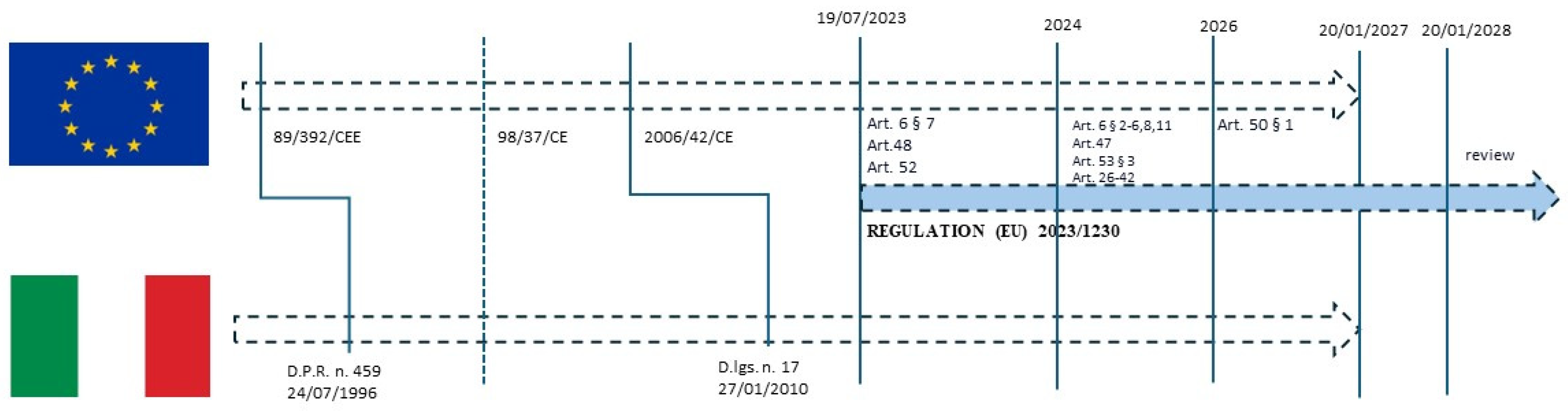
As can be seen from
Figure 1, some articles of EU Regulation 2023/1230 enter into force before the reference date of 20 January 2027, which is the date when the Regulation becomes applicable to economic operators [
40]:
Paragraph 7 of Article 6 and Articles 48 and 52 to facilitate the expansion of the list of high-risk potential machines in July 2023. Article 52 also provides for early entry into force for procedures already in progress.
Articles 26 to 42: concerning conformity assessment bodies with effect from January 2024, these articles do not contain provisions directly applicable to economic operators.
Article 6, paragraphs 2 to 6 and 11, Articles 47 and 53, paragraph 3, from July 2024: this allows for the amendment and supplementation of Annex I with the list of dangerous machines.
Article 50, paragraph 1, concerning the issuance of Member States’ rules on penalties applicable in case of violation of the EU Machinery Regulation from October 2026.
Article 53 provides that by 14 July 2028 and every four years thereafter, the Commission shall submit to the European Parliament and the Council a report on the evaluation and review of the Regulation. These reports shall be made public.
Figure 1.
Evolution of safety machinery in Europe and Italy.
Figure 1.
Evolution of safety machinery in Europe and Italy.
4. New Machinery Regulation 2023/1230
The New Machinery Regulation was officially published on 29 June 2023. Except for a few articles, it entered into force on 19 July 2023. Its effective application, to give the Member States of the European Union time to adapt, will take place from 20 January 2027, i.e., 42 months after its entry into force. Therefore, for machines made available and placed on the market up to 19 January 2027, i.e., until the day before the application of the Regulation, the 2006 Machinery Directive still applies.
The general objectives that the New Machinery Regulation aims to achieve compared to the Directive are (1) better coverage of risks arising from new technologies placed on the market such as Artificial Intelligence, the Internet of Things, collaborative robotics, and remotely supervised machines and redefine the scope compared to the Machinery Directive, in order to also identify emerging technologies; (2) to introduce new requirements for high-risk machines; (3) to review the list of high-risk machines indicated in Annex IV of the Machinery Directive; (4) to reduce costs related to paper documentation (both environmental and material costs); (5) introduce IT security in order to ensure a secure connection between control systems and management networks; (6) avoid interpretative uncertainties regarding the Regulation. There are also specific amendments, including amendment to some EHSRs (applicability to quasi-machines, protection against alteration, psychological stress and illustrative and promotional publications). The concept of “substantial modification” is introduced, art. 3, point 16 together with the introduction of regulations for the figures of the importer and distributor with reference to Decision (EU) 768/2008 [
41] and in accordance with—and drawing on its definitions and concepts-the provisions of Regulation (EU) 2019/1020 [
42]. New safety components are introduced, including software and related CE marking if it performs safety functions. The definition of “mandatary” and the related aspects that can be delegated to it are clarified.
The structure of the New Machinery Regulation consists of articles and annexes. The Regulation has fifty-four articles, i.e., twenty-five more articles than the Machinery Directive, and the same twelve annexes as the Directive. The number of Recitals is significant, increasing from 30 in the Directive to 86 in the Machinery Regulation.
The scope of the New Machinery Regulation does not include all equipment but only machinery and accessories necessary or supporting the operation of the machinery falling within its scope.
Specifically, the scope of the New Machinery Regulation is as follows and is indicated in Article 2, paragraph 1: Machinery, Interchangeable equipment, Safety components, Lifting accessories, Chains, ropes and webbing, Removable mechanical transmission devices, Partly completed machinery.
Article 2, paragraph 2, lists the exclusions, i.e., all those machines or tools not included in the New Machinery Regulation (see
Table 1).
Attention must also be paid to the intended use of a machine, as this factor could be a discriminant of whether it falls within the scope. For example, in the case of a household appliance, such as a washing machine, this could fall within the scope of the New Machinery Regulation depending on its use. A product designed as a household appliance remains excluded even if it is used in an industrial setting; conversely, machinery intended for industrial contexts must comply with the Regulation regardless of occasional domestic use.
For the Machinery Regulation, economic operators are understood to mean the manufacturer, the authorised representative, the importer, and the distributor of machinery, related products, and partly completed machinery. Therefore, this includes all entities that, within the European Union, carry out acts of placing machinery on the internal market, putting it into service, or making it available on the market, hereby confirming the approach set out in Regulation (EU) 2019/1020 [
42], which governs market surveillance and product compliance in the European Union.
It is worth noting the new development concerning the role of the “distributor,” which represents one of the main innovations of the new EU legislation. A distributor is defined as any entity, other than the manufacturer or importer, which supplies machinery.
Under the current Machinery Directive, the provisions of Regulation 2019/1020 [
42] complement those already established by the Directive, particularly by strengthening market surveillance obligations, monitoring, and compliance of products placed on the EU market. However, Regulation 2019/1020 clarifies and more precisely defines the roles of economic operators (manufacturers, importers, distributors) and their obligations, which were less detailed or not explicitly provided for in Directive 2006/42/EC.
Once the distributor has been identified, their obligations can be outlined. The first and most general obligation is to ensure compliance with the Machinery Regulation; therefore, distributors must have adequate knowledge of the legislation applicable to machinery.
This strengthening of the distributor’s role implies increased attention by companies in the construction sector, both during the procurement phase of machinery for their own activities and for those companies—very often present in this sector—that, in addition to their direct activities, also deal with the distribution of machinery for the construction industry.
Users of machinery, especially employers, will also be affected by the application of the New Machinery Regulation, as the obligations to verify machinery compliance will have to be aligned with the conformity criteria set out in the new regulatory provisions.
Another specific example concerns EHSR 1.7.4.2, which introduced, under letter (v), the following obligation: “information on the necessary precautions, devices and means for the immediate and gentle rescue of persons.” This explicit requirement in the New Regulation mandates that such information be specific, for example with regard to the management of a medical emergency affecting an operator inside the control cabin of a tower crane.
This amendment is consistent with requirement 1.6.2, which provides that, in the case of machinery or related products into which persons must enter for operation, adjustment, maintenance, or cleaning purposes, access points must be appropriately sized and designed to allow the use of rescue equipment and to ensure that emergency assistance can be provided effectively.
To define the scope of application of the New Machinery Regulation, one must understand how a machine is defined by EU Regulation 1230/2023.
From this definition provided by the Regulation, it can be deduced that the two discriminating factors for understanding whether a piece of equipment is a machine are the motive force and the moving parts.
Regarding construction sites, as reported below, there are many pieces of equipment with moving parts and with a non-human motive force, such as cranes, construction saws, rebar benders, etc.
Furthermore, all machines that cease to function once human or animal force is interrupted do not fall within the scope of application (as also described in the exclusions indicated in Article 2, Paragraph 2).
Article 3 states that machines also include all equipment with the characteristics described in Article 3, Paragraph 1, installed in a means of transport or in a building; even if it can only function once after being installed.
For all the requirements of the New Machinery Regulation to be met, it is necessary to follow the process that leads to CE marking and EU declaration of conformity. With this marking and declaration, the manufacturer attests that the machine in question is suitable and compliant with all requirements and that the conformity assessment procedure has been carried out. By affixing the CE marking and EU declaration of conformity, the manufacturer declares, under their responsibility, compliance with all prescriptions and with the EHSRs provided for in the Directive and/or the New Machinery Regulation.
A manufacturer cannot affix the CE marking to, or issue an EU declaration of conformity for, a machine that lacks protective measures and therefore does not satisfy the EHSRs. All EHSRs are listed in Annex III (instead in the Machinery Directive they are found in Annex I), and they indicate the characteristics that machines must have in order to guarantee the health and safety of those who use them and the environment in which they are located.
The main stakeholders involved in relation to construction machinery, together with the practical implications of Regulation (EU) 2023/1230 for each of them, are summarised in
Table 2.
4.1. Economic Operator
Under the Machinery Regulation, the term economic operator refers to the manufacturer, the authorised representative, the importer, and the distributor of machinery, related products, and partly completed machinery. It therefore encompasses all entities that, within the European Union, carry out acts of placing machinery on the internal market, putting machinery into service, or making machinery available on the market.
It is worth noting a key novelty concerning the role of the distributor, which constitutes one of the main innovations of the new EU legislation. A distributor is defined as any entity other than the manufacturer or importer that supplies machinery.
Under the current Machinery Directive, the provisions of Regulation (EU) 2019/1020 complement those already laid down in the Directive, particularly by strengthening obligations relating to market surveillance, oversight, and product compliance for machinery placed on the EU market. Regulation (EU) 2019/1020 also clarifies and better defines the roles of economic operators (manufacturers, importers, distributors) and their respective obligations, which were either less-detailed or not explicitly provided for in Directive 2006/42/EC.
Once a distributor is identified, their obligations can be outlined. The first and most general obligation is to ensure, as far as relevant, compliance with the Machinery Regulation; consequently, distributors must possess adequate knowledge of the legislation applicable to machinery. This reinforcement of the distributor’s role requires increased attention from companies in the construction sector, both in the procurement phase of machinery for their own operations and for those companies—frequently present in the sector—that, in addition to their direct activities, are engaged in the distribution of machinery for construction purposes.
Machine users, in particular employers, will also be affected by the implementation of the New Machinery Regulation, as the obligations to verify machinery compliance will have to be aligned with the conformity criteria laid down in the new provisions. Furthermore, the requirements of the New Regulation must also be known and taken into account by installers, particularly in view of Section 1.7.4 of Annex III for machinery.
Recital (69), referring to specific categories of machinery—particularly lifting machinery, which is typical of the construction sector—emphasises that “the proper installation of lifting machinery is essential to ensure the compliance with applicable essential health and safety requirements.”
A further specific example concerns EHSR 1.7.4, which introduces under point (v) the following obligation: “information on the necessary precautions, devices and means for the immediate and gentle rescue of persons.” This explicit requirement in the New Regulation mandates that such information be specific; for example, it should address procedures for assisting an operator who experiences a sudden illness inside the control cabin of a tower crane.
4.2. Innovations of the New Machinery Regulation
Before addressing specific requirements, it is useful to identify the innovations—particularly those relating to risks—that characterise the new Machinery Regulation.
Of particular significance in this regard is Recital (12), which also contains a specific reference to construction sites.
In summary, the main general innovations concern the following:
IoT, connectivity, and cybersecurity: the introduction of obligations for protection against unauthorised access and cyberattacks, as well as new provisions on the safety of network-connected machinery, including a specific EHSR (1.2.9) on protection against alteration.
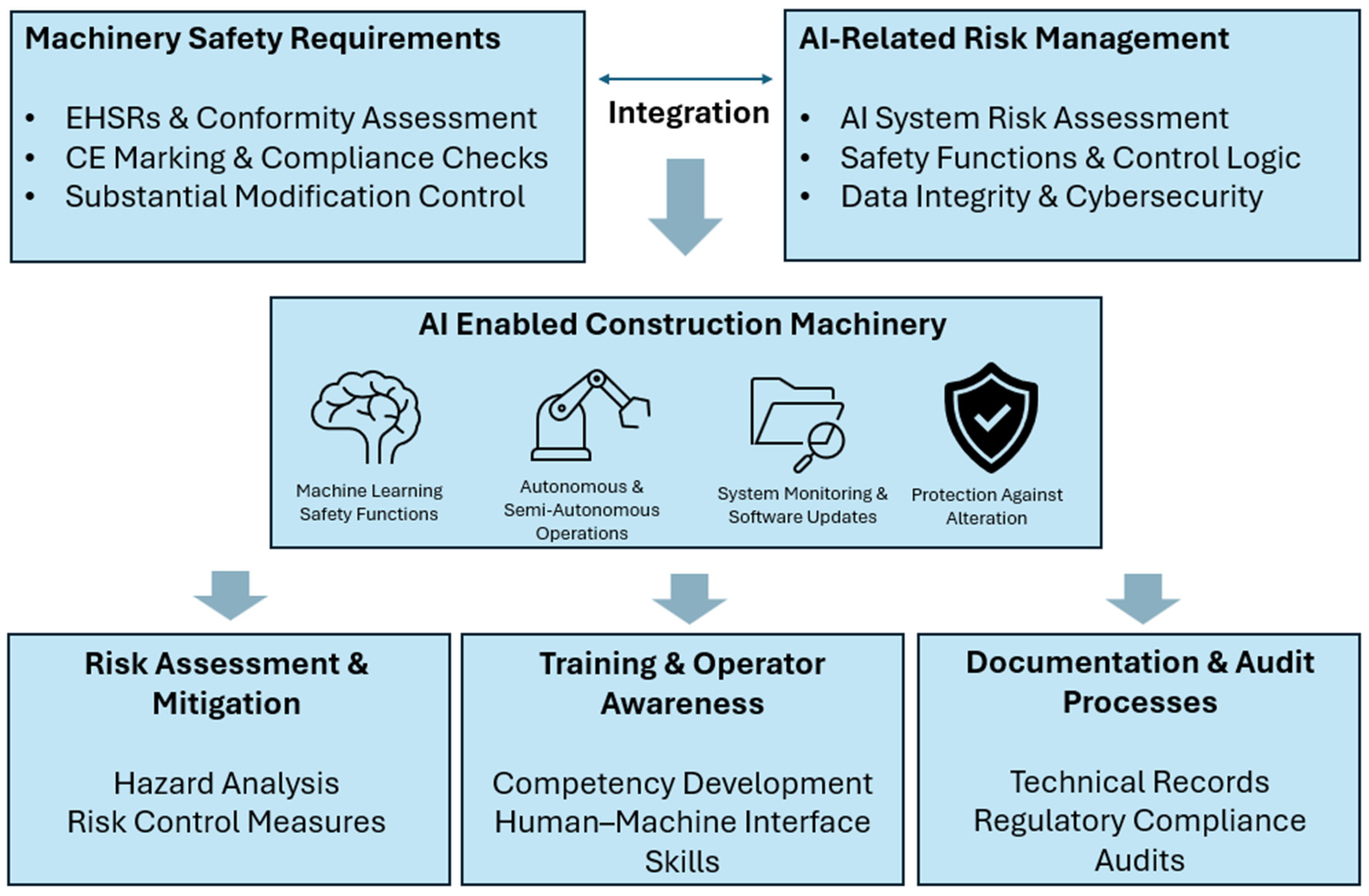
AI and machine learning: the relevance of this innovation is also evident from Annex I, “Categories of machinery or related products to which a procedure referred to in Article 25(2) shall be applied” which lists so-called dangerous machines, including the following: “Machinery that has embedded systems with fully or partially self-evolving behaviour using machine learning approaches ensuring safety functions that have not been placed independently on the market, in respect only of those systems.”
The concept is reiterated in Annex II, “Indicative list of safety components,” where point 19 has been introduced: “Safety components with fully or partially self-evolving behaviour using machine learning approaches ensuring safety functions.”
Currently, the market already offers machinery—such as certain excavators—that employ artificial intelligence for semi-autonomous operations. Some of these features include automated digging and grading, enhanced efficiency, and reduced operator fatigue.
While the current Machinery Directive does not contain a specific and direct EHSR on this matter, the New Machinery Regulation will address it more comprehensively. For this reason, both manufacturers of construction machinery and users must take these requirements into account—manufacturers, because they will be required to declare compliance with specific requirements (and, in certain cases, may need to involve notified bodies), and users, because many clients may begin to request evidence of compliance in relation to certain machine features under the new Regulation, potentially specifying in long-term tender documents conformity with Regulation (EU) 2023/1230 once it becomes applicable on 20 January 2027.
The principal innovations introduced by Regulation (EU) 2023/1230, together with their relevance for construction machinery and the stakeholders concerned, are summarised in
Table 3.
4.3. Artificial Intelligent
With regard to AI, the analysis has a dual basis since the current European regulatory framework for machinery and artificial intelligence rests on two main pillars: Regulation (EU) 2023/1230 on machinery and Regulation (EU) 2024/1689 on artificial intelligence [
45,
46,
47]. From 2027, any party designing, manufacturing, or placing on the market machinery incorporating AI systems will be required to ensure compliance with both regulations, guaranteeing safety, the protection of fundamental rights, and technological innovation.
The two regulations have different timelines but are directly interlinked. Moreover, Regulation (EU) 2024/1689 [
23], being adopted prior to the new Machinery Regulation, still refers to the current Directive 2006/42/EC. For AI systems typically used in construction companies and on construction sites, there will be no significant periods of non-overlap, given that Regulation (EU) 2024/1689 establishes a transitional period for high-risk AI systems—when integrated into regulated products—until 2 August 2027, i.e., a few months after the full application of the Machinery Regulation on 20 January 2027.
At present, the market—rightly or wrongly—offers machinery promoted as AI-enabled. This is of particular relevance for clients, employers in the construction sector, and safety coordinators, as machinery marketed for this sector is classified as high-risk and therefore subject to stringent requirements.
In Annex I to Regulation (EU) 2024/1689, the first entry is “Directive 2006/42/EC of the European Parliament and of the Council of 17 May 2006 on machinery and amending Directive 95/16/EC (OJ L 157, 9.6.2006, p. 24)”.
This clearly demonstrates the need for the above-mentioned actors in the construction sector to exercise particular caution when procuring, hiring, or operating AI-enabled machinery on site, without first carrying out—even if only at a preliminary level—an assessment of its safety implications.
Naturally, the obligations arising from this analysis primarily concern manufacturers of AI-enabled machinery rather than users; however, it is advisable that the latter be able, at a minimum, to raise appropriate questions to assess the reliability of any AI-equipped machine being offered.
In particular, as indicated in Technical Report ISO/IEC TR 5469:2024—the first ISO/IEC document addressing AI and functional safety systems, which will be followed by ISO/IEC TS 22440—different classes of AI technologies are identified, including various levels of use:
Level Ax: AI technology used in a safety system;
Level Bx: AI technology used during the development phase;
Level C: AI technology used to support safety functions;
Level D: AI technology that is not part of a safety function.
Accordingly, if a machine incorporates AI but does not perform any safety function, the matter falls under Level D, and no related safety issue arises in this respect. For other cases, further case-by-case analysis is required, at least to determine the supplier’s level of awareness regarding the issue.
Currently, the market offers many products advertised as incorporating AI-based functionalities, such as systems capable of monitoring operations in real time, including machine and crane movements, and of promptly detecting the presence of individuals, such as pedestrians, in order to trigger safety measures aimed at protecting them.
In a case such as this, a coordinator who must assess the reliability of the system should raise certain questions that relate to the EU AI Regulation (AI Act) and the new Machinery Regulation (EU 2023/1230), which—as previously noted—are closely interconnected, especially for machines that integrate high-risk AI systems, where they coexist by imposing complementary safety and compliance requirements. The AI Act classifies AI systems embedded in machinery as high-risk, requiring conformity assessments by third parties; therefore, a description such as the example provided must imply verifications—at least documentary ones—by the coordinator.
4.4. Risks
As it is impossible to report all the EHSRs, only some are presented and summarised as examples, particularly those deemed most relevant for construction site machines:
Risks associated with falling objects: when a machine is connected to risks arising from falling objects and materials, it must be designed and equipped, if dimensions allow, with suitable anchorage points to receive a protective structure against such risk with an adequate deformation limit. In order to verify this, the manufacturer is responsible for the necessary tests.
Noise: The machine must be designed and produced in such a way as to minimise the level of noise produced, considering any technical limitations. Where possible, barriers should be installed to limit the noise level, particularly at the source of the noise.
Vibration: As with noise, the machine must be designed and produced in such a way as to minimise the vibrations produced, considering any technical limitations. Where possible, barriers should be installed to limit the propagation of vibrations, particularly at the source of the vibrations.
Fire: The machine must be designed and constructed in such a way as to avoid any type of fire or overheating of the machine itself. This is particularly important for machines that produce or use gases, fumes, dust, vapours and any other type of substance that could trigger combustion.
Before examining the amendments to the EHSRs in detail, we highlight the main changes in relevance to all machinery, including those in the construction sector:
Testing of safety functions 1.1.2 (e)
Avoidance of strenuous working postures or movements and manual efforts exceeding the operator’s capacity 1.1.6 (b)
Use of AI to adapt the human–machine interface 1.1.6 (f) and responses (e.g., verbal or non-verbal) 1.1.6 (g)
Protection against corruption (for software and connected machinery) 1.1.9
Cyber resilience of control systems (including reasonably foreseeable malicious attacks) 1.2.1; traceability of interventions and software updates
Traceability of interventions and software updates in control systems 1.2.1
Use of artificial intelligence in control systems, risk assessment, data recording, reliability, and safety
Avoidance of contact risk in cases of human–machine interaction or coexistence in a shared space (when the AI safety function is activated) 1.3.7
Appropriate sizing of machine access 1.6.2
Hand-held or hand-guided machines equipped with exhaust outlets for fumes 2.2.1
Additional information on vibration levels for hand-held or hand-guided machinery in the instructions for use 2.2.1.1 (a) and (b)
Seats concerning seat belt reminders or the inhibition of the use of certain mobile machinery when the seat belt is not worn 3.2.2
Supervisory function of an autonomous mobile machine 3.2.4
Autonomous and remote-controlled mobile machinery 3.3.3
Filtration of hazardous substances for operators of ride-on mobile machinery applying such substances 3.5.3
Risk of contact with live overhead power lines on mobile machinery 3.5.4
Alternative solutions to ‘hold-to-run’ type control devices for lifting machinery 6.2
Moreover, compared to Annex I of the Directive, substantial changes—sometimes even substantial—have been made to some EHSRs. The new definitions concerning machines used on construction sites are summarised and explained below, to define the state of the art when the New Machinery Regulation will effectively come into force.
Seats 3.2.2: Machines must be designed or equipped with a restraint system to keep people on the seat or within the intended protective structure, in case of risk of crushing the operator or other persons transported in the machine, or even in case of machine rollover. Furthermore, the New Machinery Regulation, in addition to the Machinery Directive, adds that a visual and audible signal must be emitted at the driving position to warn the driver when in the driving position and the restraint system is not in use. For example, an earthmoving machine, from 2027 onwards, must be designed so that, if the operator is not using the seat belt, they must be alerted by a sound and a visual signal on the control panel; it must not be possible to move the machine where there is a significant risk of overturning or lateral rollover and no restraint system is used.
Supervisory function 3.2.4: In all machines where operation is autonomous, a supervisory function must still be provided, so that information can be received remotely from the machine. The supervisory function must only allow remote stop and start functions or move the machine to a safe position and place it in a safe state to avoid potential risks. The New Machinery Regulation specifies that these actions are only allowed if the supervisor directly or indirectly sees the movement and work area of the machine, and if the protective devices are operational. The supervisor must constantly receive information from the machine, so that they can actively supervise it and have a complete and accurate view of the position and movement made by the machine. The information provided by the machine must warn the supervisor of unforeseen or dangerous situations, so that they can intervene in person. Finally, the most important requirement defined in point 3.2.4 of Annex III is that a machine with an inactive supervisory function must not be able to operate.
Risk of contact with overhead power lines under tension 3.5.4: Machines, depending on their height, must be designed and constructed to avoid contact. When such risk cannot be completely avoided for people operating near the machine, the latter must be designed and constructed in such a way as to prevent any electrical danger.
Article 3 of the new Machinery Regulation provides the definition of a safety component. It is defined as “a physical or digital component, including software, of a product within the scope of this Regulation, which is designed or intended to fulfil a safety function and which is independently placed on the market, the failure or malfunction of which endanger the safety of persons, but which is not necessary in order for that product to function or for which normal components may be substituted in order for that product to function”.
Safety components that are placed on the market separately, and therefore not sold together with the machine to which they will be attached, fall within the scope of the New Machinery Regulation. In the case where a safety component is incorporated into the machine, it is considered part of the machine, as the machine is already part of it. The indicative list of safety components is indicated in Annex II. Below are summarised the safety components most commonly used in machines employed on construction sites:
Guards for removable mechanical transmission devices.
Protective devices to detect the presence of persons.
Logic units to ensure safety functions.
Load and movement control devices for lifting machines.
Restraint systems to keep people on the seat.
Emergency stop devices.
Discharge systems to prevent the formation of electrostatic charges.
Energy limiters and safety devices.
Systems and devices designed to reduce noise and vibration emissions.
Protective structures in case of rollover.
Moreover, the New Machinery Regulation, as can be seen from the definition of safety component, also considers software as safety components. This choice stems from the digitalisation of machines and the future use of artificial intelligence or other emerging digital technologies. Annex II indicates as safety components software that ensures safety functions and safety components equipped with a fully or partially self-evolving behaviour that use machine learning approaches that ensure safety functions.
In the construction site, the most commonly performed operations using machines are the handling and lifting of loads. In the construction site, as well as in other workplaces, to lift a load it is necessary for the machine to be equipped with a lifting accessory. For example, a clamp, a fork or a balance beam with a chain, a hook, a rope, and a strap. Lifting accessories, as previously written, fall within the scope of both the Machinery Directive and the scope of the New Machinery Regulation. We will therefore analyse the definitions and prescriptions that the New Machinery Regulation reports for these accessories. Article 3 defines lifting accessories as components or equipment, not connected to lifting machines, which allow the load to be gripped, arranged between the machine and the load or on the load itself, or intended to become an integral part of the load and to be placed on the market separately, including slings and their components.
Subsequently, the New Machinery Regulation gives the definitions of chains, ropes and belts in order to differentiate the various lifting accessories into different categories. Still in Article 3 of Regulation (EU) 2023/1230 we find the following definitions:
Chains: chains designed and constructed for lifting purposes as an integral part of lifting machines or lifting accessories.
Ropes: ropes designed and constructed for lifting purposes as an integral part of lifting machines or lifting accessories.
Belts: belts designed and constructed for lifting purposes as an integral part of lifting machines or lifting accessories.
Differently, interchangeable equipment in the construction site is usually used for soil movement or for specific operations. For example, a demolition hammer for an excavator is interchangeable equipment, as it is possible to use different demolition hammers on the excavator depending on the type and size of the excavation to be carried out. In particular, in Article 3 of Regulation (EU) 2023/1230 we find the following definition: Interchangeable equipment: a device which, after the putting into service of a machine or an agricultural or forestry tractor, is assembled to that machine or that agricultural or forestry tractor by the operator in order to change its function or bring a new function, provided that this equipment is not a tool.
Lifting accessories and interchangeable equipment, being within the scope of application, must obligatorily be accompanied by the declaration of conformity and instructions. In particular, the instructions must include the technical characteristics of the machine on which the interchangeable equipment or lifting accessory can be used. Furthermore, the methods of assembly and disassembly of the equipment or accessory must be indicated with indications of the maintenance to be carried out.
For example, in the construction site, a potentially fatal risk could be the fall of a suspended load following breakage due to the excessive overload of a lifting accessory. Before lifting the load, it is appropriate to check that such a load is suitable to be lifted by the accessory in the instructions, which must be present on site.
After defining the scope of application of the New Machinery Regulation, and therefore which types of machines and accessories are part of the scope of application of the Regulation, Article 3 also defines the placing on the market and putting into service. Article 3 of Regulation EU 1230/2023 defines placing on the market as “ the first making available of a product within the scope of this Regulation on the Union market”. From this definition it can be deduced that a machine will have to comply with the provisions provided by the New Machinery Regulation only if it will be marketed within the European Union. A machine produced within the European Union, but intended for marketing in a non-EU country, and therefore not placed on the European market, will not have to comply with the provisions of the New Machinery Regulation (it is recalled that “machine” always means a machine falling within the scope of application of Regulation EU 1230/2023). Conversely, a machine that is produced in a country that is not part of the European Union, but is subsequently placed on the European market, will have to comply with all the rules imposed by the Regulation. To summarise this concept, it can be stated that all machines and accessories that are made available in the European territory, the New Machinery Regulation applies, regardless of whether they were manufactured inside or outside the European Union.
Article 3 of the New Machinery Regulation, following the definition of placing on the market, also gives the definition of putting into service. Article 3 defines putting into service as “ the first use, for its intended purpose, in the Union, of machinery or related products “.
The Regulation, like the Directive, adds this definition of putting into service to the definition of placing on the market to regulate a possible case that can occur during the process of production and use of a machine or related product. Think of a machine produced within the European Union but not marketed. This is the case of a machine built for own use. These machines, when used and therefore put into service within the European Union, must comply with the requirements imposed by the New Machinery Regulation.
Particular attention must also be paid to machines that cannot be completed at the place of production but will be completed at the user’s premises. In this case, the machine must comply with the New Machinery Regulation only after the installation is completed. The declaration of conformity (technical document that will be analysed below) must be issued only after this phase. The user will be able to use the machine only after installation.
Article 5 of the Regulation provides the possibility for Member States of the European Union to prescribe provisions to ensure that workers responsible for installing the machine work safely. These provisions may concern the use of personal protective equipment, necessary training, machine verification or other. However, it is essential that these provisions do not imply the modification of machines with respect to the provisions of the Regulation. For example, in Annex VII of Legislative Decree 81/08 [
48], the frequency to which lifting machine checks are subjected is indicated. For example, a crane used in the construction sector with a capacity of more than 200 kg must be checked with a frequency of at least one year. This provision applies only in Italian territory and is consistent with the New Machinery Regulation as it does not provide for any modification to the machine.
Subsequently, the obligations that machine distributors must comply with are indicated in Article 15 of the New Regulation. Summarising what is written in that article, before making a machine available on the market, the distributor must ensure that
The CE marking has been affixed to the machine;
The machine is accompanied by the declaration of EU conformity;
The manufacturer and/or the economic operator have complied with their obligations indicated previously (indicated in Articles 10 and 13 of the Regulation);
The machine is accompanied by instructions for use.
Furthermore, if the machine does not comply with the New Machinery Regulation, he must immediately take action to make such machine compliant. If this is not possible, he must withdraw it from the market by informing the competent authorities in the countries where the machine has been sold, indicating the reason for non-compliance and providing information on the possible risks that this non-compliance could cause (as also indicated under the manufacturer’s obligations).
Finally, Article 18 of the New Machinery Regulation adds a clarification regarding the manufacturer. Any person, whether natural or legal, (person other than manufacturer, distributor and importer) is considered a manufacturer if
Makes a substantial modification that has an impact on the safety of the machinery or related products;
Makes substantial modifications that impact only on the safety of a machine or related product part of a set of machines affected by the modification as demonstrated by the risk assessment for which that person is responsible.
Any person, whether natural or legal, who carries out one of the actions listed above must therefore comply with the obligations that the New Machinery Regulation provides for the manufacturer, indicated in Article 10.
Manufacturers, before placing the machine on the market, must ensure that the machine meets all the EHSRs. Subsequently, they must draw up the technical documentation and the declaration of conformity. Once this is done, the machine will be marked with the CE marking and can therefore be freely placed on the European market.
Therefore, at the time of placing on the market or putting into service of the machine, the manufacturer declares the conformity of the machine to the New Machinery Regulation.
The minimum mandatory contents that the technical documentation must have are indicated in Annex IV. Summarising this annex, technical documentation must contain
a complete description of the machine or related product and its intended use;
the documentation relating to the risk assessment including the applicable RES;
drawings and design and manufacturing schemes of the machine or related product;
the reports and/or results of design calculations, tests, inspections and examinations carried out to verify the compliance of the machine or related product
a description of the means used by the manufacturer during the production of the machine or related product;
the source code or programming logic of the safety-related software in order to demonstrate the conformity of the machine or related product;
the results of research and tests on components, accessories or on the machine or related product; carried out by the manufacturer to establish whether the machine or related product, as a result of its design or construction, can be assembled and put into service safely.
It should be noted that the technical documentation is made available to the market surveillance authority and not to the user
The CE marking must be affixed to the machine in such a way as to be clearly visible, legible and indelible. Moreover, the following must be indicated on the machine: the name and address of the manufacturer, model and serial number, and the year of construction.
5. Comparative Analysis: Directive vs. Regulation
The New Machinery Regulation, in place of the Directive, allows for the simultaneous entry into force of the new product provisions in all Member States, thereby eliminating any potential delays or errors in transposition (as can occur with a Directive that must be transposed by Member States). The new Regulation has updated the EHSRs, taking into account new technologies and the risks associated with them. Regulation (EU) 2023/1230 was adopted by the European Parliament and the Council of the European Union with the aim of further harmonising machinery safety regulations and improving the protection of workers and consumers. It establishes EHSRs for the design and manufacture of machinery, promoting innovation and the competitiveness of European industry.
From 2027 onwards, Directive 2006/42/EC, as previously mentioned, will become obsolete. After analysing its main contents, it is therefore useful to precisely define the most substantial differences between Directive 2006/42/EC and Regulation (EU) 2023/1230. These differences are also partially reported in the correlation table found in Annex XII of the New Machinery Regulation. The main differences are listed in
Table 4 and
Table 5.
6. Construction Site Machines
Construction site machines represent one of the fundamental elements in the construction sector, having become indispensable elements for the execution of building and infrastructure works thanks to the technological process. Machines are designed to perform a wide range of tasks, such as load handling and earthmoving.
Among the most common construction site machines are excavators, cranes, concrete mixers and concrete trucks, and bench saws. Although construction site machines are indispensable for efficiency and productivity on construction sites, they also involve several significant risks to the safety of operators and anyone in the vicinity. For this reason, it is essential that the safety measures indicated in the EHSRs (Annex III of Regulation (EU) 2023/1230) are implemented, and that all operators using them are adequately trained and instructed to prevent accidents and injuries, to ensure a safe workplace. The training required for workers who will use the machines present on the construction site is indicated in the State-Regions Agreement of 22 February 2012 and 17 April 2025. In this agreement, we find the methods by which the training must be carried out and the duration for each individual machine. Generally, the training includes both a practical and a theoretical module, with increasing duration as the complexity and potential risks that the machine can cause increase. The objective of this agreement is to ensure that operators using this equipment have the necessary skills to work safely, reducing the risk of workplace accidents and increasing awareness of the risks associated with the use of such machines.
The main types of machinery on construction sites that fall within the scope of the New Machinery Regulation are (a) lifting machines (e.g., tower cranes, gantry cranes, mobile cranes, derrick cranes, overhead cranes, winches), (b) earthmoving machines, (c) concrete mixers and truck mixers, and (d) circular saws and clippers. These types will be discussed in the following sections.
The main categories of construction-site machinery considered in this study, together with their associated risks and regulatory relevance, are summarised in
Table 6.
6.1. Lifting Machines
Lifting machines constitute an essential component in the construction sector, playing a crucial role in operational efficiency. These machines, which include cranes, forklifts, elevating work platforms and hoists, are designed to lift safely and precisely, transport and position heavy materials and equipment. Among the main lifting machines are (1) tower cranes: mainly used on construction sites for the construction of tall buildings, characterised by a horizontal jib that can rotate 360 degrees; (2) mobile cranes: mounted on tracked vehicles or trucks, offering great mobility and versatility, being able to easily move between different work sites; (3) truck-mounted cranes: cranes mounted on trucks that can be easily transported and used on different construction sites to lift and move heavy materials; (4) elevating work platforms: equipment that allows operators to work safely at different heights, including aerial platforms, scissor lifts and articulated boom platforms; (5) hoists and winches: used to lift and lower loads in confined spaces or for maintenance work, available in manual or electric versions.
The use of lifting machines has greatly improved the efficiency of operational processes on construction sites, reducing the time and effort required to move heavy materials. However, the use of these machines requires adequate operator training to ensure workplace safety.
The tower crane is one of the most commonly used machines on a construction site, due to the frequent need to move loads from one point to another. The tower crane falls within the scope of the New Machinery Regulation and therefore must comply with all its provisions.
The movements that a tower crane can perform are of four types:
Rotation: in general, there are two types of rotation that a tower crane can perform. The first is a high rotation, i.e., when the jib and the counterweight jib rotate around the vertical tower, which becomes the axis of rotation. The tower in this case does not rotate but remains stationary. The other possible rotation is the low rotation, i.e., when the jib, the counterweight jib and the tower rotate around the base of the crane. In this type of rotation, the vertical tower rotates.
Horizontal translation: this is a movement that occurs along the axis of the jib, by means of a trolley that modifies the jib itself, changing (in the presence of a load on the jib) the moment and therefore, as will be seen later, the load factor.
Vertical lifting: this is a movement that occurs by raising and lowering the hook attached to the jib trolley. This movement is necessary to hook a load at a “x” level and lift it until reaching a “y” level.
Translation: in the case of rail-mounted tower cranes, as the name suggests, these can move on a previously installed rail. During this movement, to avoid various risks, such as the risk of overturning of the machine, any other movement is blocked, and the jib must be positioned as close as possible to the tower.
In Annex III of the New Machinery Regulation, as already written in the previous chapters, all possible risks that a machine can generate are listed. We will therefore now analyse which of these risks indicated in the Regulation could occur using a tower crane, or simply its presence on the construction site.
The risk condition that most often unfortunately occurs is the risk of overturning of the crane, being a machine with a relatively unstable configuration, and having to lift very heavy loads at high altitudes.
The risk of overturning can be generated by various factors such as failure of the support surface, incorrect handling of loads, error during installation, collapse of the structure due to a structural failure, impact of the jib against obstacles, high wind speed.
To prevent the risk of overturning, once the possible causes have been analysed, preventive measures must be taken to ensure that this does not happen. First, before the crane is installed, a preliminary investigation of the ground must be carried out to determine whether the installation site is suitable to avoid subsidence. All instructions provided by the manufacturer (the instructions are mandatory, as required by the Machinery Regulation) must be followed. Furthermore, in the event of the presence of other cranes on the construction site, interference between them must be avoided. To avoid overturning due to wind, the manufacturer of the crane must have indicated in the instructions the maximum wind speed that the crane can withstand. Once the wind has reached or exceeded that speed, the jib must be disconnected from the tower, so that the jib is free to rotate and position itself according to the direction of the wind. In this way, the wind will impact a smaller surface area of the crane, and the possibility of overturning will be drastically reduced. As a precaution, the crane is left free to rotate even during the night hours.
The second most frequent risk, derived from the use of this machine, is the fall of materials from above. This risk is very dangerous not only for the operator, but especially for the workers present on construction sites who do not use the crane, as they often do not realise that they are under a suspended load.
This risk is usually due to the handling of loads that are not properly slung, incorrect manoeuvres by the operator, resulting in impacts and breakage of the lifting ropes.
To prevent the risk of falling objects from above, the load must first be properly slung, and the lifting accessories must be used correctly. It is also necessary to periodically check the ropes and verify the means and accessories for slinging loads. It should be remembered that, in addition to chains, ropes and webbing, lifting accessories are defined in Article 3 of the New Machinery Regulation. Therefore, these elements must be accompanied by a declaration of conformity and instructions (as required by Annex III of Regulation (EU) 2023/1230 and currently Annex I of the 2006 Directive). These instructions provide the manufacturer’s technical specifications for these accessories, including instructions for use and assembly and disassembly procedures. They also include all the necessary information for the maintenance and safe use of the equipment, which must then be included by the user as the employer in the periodic inspections (as required by Title III of Legislative Decree 81/08) [
48].
Another possible risk, which mainly concerns the assembly and disassembly phases of the crane, is the risk of falling from above [
49]. Workers carrying out these phases are required to use the existing equipment. If these are not available, workers must use third category personal protective equipment (it should be noted that the use of third category personal protective equipment requires having passed a training course). Furthermore, workers assigned to assembly and disassembly are required to use the anchor points, ladders or other protective elements placed on the vertical tower of the crane. These elements must be installed if technically possible in accordance with the EHSRs set out in Annex III of the New Machinery Regulation.
In addition to workers assigned to assembly and disassembly, the risk of falling from above also affects the operator using the crane. To prevent this risk, the efficiency of the access ladder and its protective cage must be maintained.
Workers near the crane, with rotation at the base, are exposed to the risk of crushing due to the movement of the ballast or base load. To prevent this risk, barriers must be placed and marked at the base of the crane, making it inaccessible during movements.
Another possible risk is electrical risk. This type of risk is due to the approach or contact of the crane jib with an unprotected overhead power line. The crane must be installed in compliance with the distances from power lines, or if this is not possible, barriers must be installed to protect the electrical cables. In addition, the electrical risk can be caused by incorrect grounding against atmospheric discharges.
In addition, cranes are equipped with safety devices called limiters that intervene when the load or manoeuvre stresses the crane with efforts that it is unable to withstand with a certain degree of safety. Like the limiters, limit switches come into operation to limit the lifting height, the travel of the trolley or the translation.
The instruction booklet of the crane must be accompanied by a load diagram, which relates the maximum liftable load of the crane and the distance of the jib. This data is provided by the manufacturer, with reference to the tip load (the maximum load at the most critical point), and the maximum load. The last point to analyse regarding the tower crane concerns the lifting accessories and chains, ropes and webbing, all of which fall within the scope of the New Machinery Regulation. If the loads handled by the crane are not properly slung, they can detach or come out of the load assembly with the risk of materials falling from above, with the consequent possible crushing of workers and damage to property and structures. It is therefore of fundamental importance to choose the type of slinging and the correct securing of the load. Loads must be secured to a sling (directly connected to the lifting hook) which vary according to the type of load. The slings can be made of chains, steel ropes or fibres. They are distinguished into single slings or pendants, ring slings, multiple slings, or spreaders, lifting beams, or spreader beams.
Steel rope slings are accessories to whose ends terminals are attached that allow the connection between the load and the crane hook. Steel ropes are composed of bundles of metal wires, wound together in a precise order. The primary elements are the wires which, wound helically, form the strands. The strands in turn are wound together around a core to form a rope. The core can be a textile fibre (natural or artificial) or another strand. Steel slings must be carefully stored dry and lubricated regularly and must not be left on the ground exposed to the risk of being damaged by wheels or tracks.
Chain slings are made of special alloy steel chains or can be simple mesh or with a cross-piece. It is absolutely forbidden to weld the chains because they do not ensure a secure hold.
Fibre slings can be made of synthetic or natural fibres. Artificial fibres offer greater guarantees of safety in use and versatility. Particular attention must be paid during the use and storage of fibre chain slings to maintain their strength characteristics over time. Proper use and maintenance of fibre slings ensure considerable durability. It is not advisable to use synthetic fibre slings in the presence of high temperatures because they can be damaged and compromise safety.
The accessories present on the construction site for load handling can be forks used for pallets, buckets for handling debris, inert materials and concrete, cages for handling pallets using the fork, baskets for handling small materials and equipment, metal bins for handling inert materials and bricks, big bags (large bags) used in combination with special spreader beams, for handling loose materials.
When using multiple slings, the loads must be hooked with as acute a vertex angle as possible. The greater the angle, the greater the effort that the slinging accessories must withstand and the capacity of the sling varies as the vertex angle varies.
Furthermore, it is recalled that, as required by the New Machinery Regulation, the crane must be accompanied by the declaration of conformity, where the manufacturer indicates compliance with technical standards. The instructions for use must be written in the target country’s language, and must be followed for the transport, assembly, disassembly, adjustment and maintenance of the crane.
The inspection log must accompany the crane throughout its life and must be kept updated by the employer.
On construction sites, in addition to the tower crane, there may also be other lifting machines. They are separated into lifting machines and lifting installations. Lifting machines are generally divided into three different categories: jib lifting machines (with the gripping device suspended from a trolley that moves around a jib), bridge lifting machines (with the gripping device suspended from a trolley that moves along a bridge), and rope lifting machines (with the gripping device suspended from a trolley that moves along ropes fixed to support structures). The main jib lifting machines, in addition to the tower crane, are
Portal cranes: These are usually used in the industrial sector. They consist of a portal-shaped frame on which an overhead travelling crane runs. They can lift very heavy loads, compared to a tower crane thanks to their high stability, but due to the shape of their structure they are less mobile and therefore rarely used on construction sites;
Mobile cranes (or truck-mounted cranes): These are cranes mounted on a truck with an independent jib capable of moving with or without a load without the need for fixed runways. They rely on gravity for stability;
Derrick cranes: These consist of a fixed, guyed mast and a movable jib that can also rotate around a vertical axis; at the top of this are the sheaves for lifting loads.
The main bridge lifting machines are bridge cranes. They are very similar to portal cranes, with the difference that the frame runs on rails. For the same reasons listed above, bridge cranes are also mainly used in the industrial sector. Other bridge lifting machines are gantry cranes and semi-gantry cranes.
Finally, the main rope lifting machines are winches. Winches are machines often found on construction sites, especially on sites where there is scaffolding. They are used for lifting lighter loads than those that a crane can lift. They are usually anchored at the top level of a scaffolding, so that they can lift and transport the equipment or materials needed for work at every level of the scaffolding.
Finally, among the lifting machines, although not intended for lifting loads but rather for lifting people, we find mobile elevating work platforms (usually abbreviated as MEWPs). Their purpose is to allow workers to be lifted so that they can carry out work at height. When using a mobile elevating work platform, the worker using it must be attached to the platform by means of category III personal protective equipment.
6.2. Earthmoving Machines
Earthmoving machinery refers to all the machines used to carry out earthmoving operations, such as excavation. Among the main earthmoving machines are wheeled excavator, tracked excavator, rope excavator with dredging bucket, rope excavator with clamshell bucket, wheel loader, loader with fork arms, wheel loader with grapple, tracked loader, tracked articulated hauler, tracked backhoe loader, and wheeled backhoe loader.
Among the machines listed above, the ones most commonly used on construction sites are the tracked backhoe loader and the excavator. Backhoe loaders consist of a front loader, generally with low pushing force. They are usually used for loading soil or other material onto another vehicle. If used for excavation work, they are usually able to work only if the section and direction of the excavation is constrained, for example excavations for the construction of pipelines, water networks or excavation work for laying pipes. Due to the characteristics of the machine, it is difficult to use for large earthworks. As required by the EHSRs, the operator’s driving position must be adequately soundproofed to protect the operator from noise risk; the protective cab must be suitable to protect the operator from possible overturning of the machine and from falling objects; finally, suitable seats and a proper operator restraint system must be provided in the cab.
Excavators can carry out excavations to a considerable depth, which is why they are used for earthworks or foundation excavations, thanks to their ability to maintain almost vertical excavation walls. They can also be equipped with interchangeable equipment to perform other types of work. For example, they can be fitted with demolition hammers capable of demolishing concrete or various types of rock. They are also able to transport materials using lifting ropes. Loads must always be secured by means of a chain or other lifting device to the loading ring usually positioned at the bottom of the excavator bucket; under no circumstances should the sling of the item to be lifted be secured to a tooth of the digging bucket because it could easily come loose, causing the lifted item to fall to the ground.
During the use of earthmoving machinery, the main risks include
Overturning or rollover of the vehicle with the risk of crushing bystanders or the operator themselves;
Risk of people or objects being struck in the forward or reverse travel of the vehicle in the work area (tunnels, construction sites, etc.);
Burial and cave-ins due to collapse of the excavation face or ground subsidence;
Shearing of ground workers during rotation of the arms or articulation of the undercarriage or rotation of the superstructure;
Electrocution from contact with overhead or buried power lines;
Fire and explosions from contact with buried services;
Risks arising from poor operation or maintenance of the vehicle (vibration, noise, etc.);
Risks arising from the projection of material and falling material from above;
Risks arising from the surrounding environment (dust, etc.);
Risks arising from improper use of the vehicle, for example when the machine is used for demolition work without specific equipment or without a protective cab, due to the risk of material falling on the vehicle or cab;
Slips, trips and falls at the same level when getting on or off the vehicle;
Risks arising from impacts, blows, crushing and entrapment caused by structural failures during maintenance or repair work;
Risks arising from impacts, blows, crushing and entrapment caused by contact with the working parts during excavation and earthmoving.
6.3. Concrete Mixers and Truck Mixers
The concrete mixer is one of the most widespread machines in construction and on construction sites. It is a machine used for mixing aggregates, using binders such as cement and water to create various types of mortars or concretes. The two types of concrete mixers that will be analysed are the concrete mixer and the truck mixer. The difference between the two is that with the former, the mortar or concrete is produced directly at the work site, while with the latter, the concrete is produced at a special plant and arrives at the construction site already mixed. Both types fall within the scope of the New Machinery Regulation. The concrete mixer consists of a metal frame, accompanied by wheels to allow it to be towed. It is equipped with an electric motor driving the drum via a drive belt that allows the rotation of the drum, i.e., the container into which water, binders and aggregates are poured. Through the rotation of the drum, these elements are mixed to obtain concrete or mortar, depending on the elements used and their proportion during mixing. Inside the drum, mechanical blades are also placed to aid mixing. The control elements of this machine (start, stop and emergency stop) are in a small electrical panel. According to the EHSRs of the New Machinery Regulation, these controls must be adequately protected to prevent accidental starts. Like any machine, it is a potential source of risk for workers. The possible accidents that the concrete mixer can cause are due to incorrect positioning on the construction site, overturning of the concrete mixer, impacts, cuts and abrasions resulting from contact with moving parts and electrical risk.
To avoid these risks, the first precaution is to position the concrete mixer in a suitable location within the construction site. An ideal solution could be to position it near the loading and unloading area for materials, to facilitate the mixing of mortar and concrete, avoid interference with other work, and be close to the construction site’s electrical panel.
If this machine is within the operating radius of a crane, since the latter involves the risk of falling materials from above, an overhead protective deck must be constructed at the location where the concrete mixer is positioned.
The concrete mixer operates on electric power. It is equipped with a power cable that must be connected to the construction site’s electrical panel. To protect workers from possible electrocution, this cable must be positioned so as not to be damaged by other workers moving around the construction site or by vehicles. Furthermore, it must not obstruct traffic and, above all, must not come into contact with water.
It should also be remembered that the machine must be accompanied by instructions for use and maintenance and must bear the CE marking with which the manufacturer declares the machine to be in conformity with the Machinery Directive (and from 2027 with the New Machinery Regulation).
The truck mixer, on the other hand, is used on larger construction sites when it is necessary to transport large quantities of concrete from the production site to the construction site, ensuring that the transported material remains workable at the time of delivery. Therefore, unlike the concrete mixer, the concrete is not mixed on the construction site but at a special plant. The advantages provided by the truck mixer are the larger quantities of concrete that can be transported and a discharge system that allows the concrete to be directed in various directions. It also allows pouring at heights above the level at which the truck mixer is located. Its main components are
Rotating drum: This is the most characteristic part of the truck mixer, consisting of a cylinder capable of rotating horizontally, to properly mix the transported concrete. To further aid mixing, helical blades are placed inside the drum. The drum is also equipped with a mixing system to ensure that the concrete remains homogeneous and properly hydrated during transport;
Drum discharge: This consists of an opening to which a chute is connected that allows the concrete to be directed to the desired point. It can be adjusted to control the discharge rate as well;
Cab: This is the station where the driver is located, which also houses the controls for driving the vehicle and controlling the drum. As indicated in the New Machinery Regulation, the cab must have a seat and an operator restraint system that comply with the EHSRs.
Like other construction site machines, the truck mixer can pose significant risks to workers, such as falling materials from above if the concrete spills from the drum, or possible vibrations and noise produced by the machine. The most significant risk is workers being struck or crushed. This occurs when the traffic flow on the construction site has not been properly planned or the health and safety plan does not indicate how vehicles must move within the construction site, or when the provisions of the health and safety plan are not followed.
6.4. Circular Saws and Clippers
The circular saw and the chop saw, also known as a cut-off saw, are machines used on construction sites for cutting objects such as tiles, blocks, wooden planks and others. They both consist of a bench on which the material rests and a blade necessary for cutting. The difference between the two types of machines is that in the circular saw the blade is placed directly on the bench, while in the chop saw it is placed on an arm positioned above the bench; therefore, it is necessary to move the arm to make the cut. These machines, due to their nature, are very dangerous, especially when the guards are improperly removed. Possible accidents are caused by the contact between the operator and the blade, electrical risks and the projection of materials during cutting.
The risk that causes the greatest harm is obviously the contact between the operator and the blade, as this could easily lead to the amputation of a limb and even the death of the operator. To prevent this, the machine must be equipped with an adjustable guard that protects the worker from direct contact with the blade and from the projection of materials. This guard is movable, allowing the blade to be exposed only during cutting. These guards must not be removable, and this prohibition must be indicated on the machine. Often the guards are incorrectly removed as they can seemingly slow down the work, exposing the worker using the saw to a very high risk. The machine must also be equipped with an emergency stop control, as required by both the Machinery Directive and the New Machinery Regulation.
Due to the high level of danger, the New Machinery Regulation—taking up concepts already present in the 2006/42/EC Machinery Directive—provides for specific provisions for this category of machines. In Annex I of the Regulation, precisely in Part B of the Annex, we find a list of machines, including various types of circular saws. Part of the list is reproduced below:
“Circular saws (single- or multi-blade) for working with wood and material with similar physical characteristics or for working with meat and material with similar physical characteristics, of the following types:
sawing machinery with fixed blade(s) during cutting, having a fixed bed or support with manual feed of the workpiece or with a demountable power feed;
sawing machinery with fixed blade(s) during cutting, having a manually operated reciprocating saw-bench or carriage;
sawing machinery with fixed blade(s) during cutting, having a built-in mechanical feed device for the workpieces, with manual loading and/or unloading;
sawing machinery with movable blade(s) during cutting, having mechanical movement of the blade, with manual loading and/or unloading.”
These machines must comply with one of the procedures indicated in Article 25, paragraph 3. This paragraph of the Regulation indicates how the conformity assessment of the machine must be carried out by the manufacturer or the responsible entity, as indicated in Annex I. Article 25 offers several possibilities for assessing the conformity of the machine. For example, one of these conformity assessment procedures is indicated in Annex VI (Internal production control) of the New Machinery Regulation and is summarised as follows:
Preparation of the technical documentation indicated in Part A of Annex IV (technical documentation for machinery and related products);
The manufacturing process must ensure the conformity of the machine with the technical documentation prepared;
CE marking and EU declaration of conformity;
EU declaration of conformity for each machine model and made available to the national authorities, together with the technical documentation, for at least ten years from the date on which the machine was placed on the market.
7. Implications for Construction Machinery
As already noted in several sections, the new Machinery Regulation has both direct and indirect impacts on the construction sector.
As clarified, the obligation to comply with Safety Requirements rests with the machinery manufacturer and not with the user; however, knowledge of certain related aspects is of fundamental importance for the user.
If the user is aware of the manufacturers’ obligations, they can hold them accountable in the event of non-compliance and can, in any case, use machinery and equipment on site in an increasingly safe manner.
The importance of machinery—unfortunately also significant in terms of construction site safety—is summarised in the latest Italian National Institute for Insurance against Accidents at Work—INAIL report [
50].
The document indicates that reports of suspected non-compliance are concentrated primarily in specific categories of machinery, with machine tools, construction and building-site machinery, lifting platforms, food industry machinery, and cranes representing the most frequently reported groups. This pattern is consistent with the findings of earlier surveys. The report also highlights a further characteristic of the construction sector in relation to fatal accidents. In this context, agricultural and forestry machinery account for 13.8% of the reports, while construction and building-site machinery, industrial trucks, and lifting platforms each represent 11.1% of the reported fatal cases.
The report also indicates the Safety Requirements that were not met. Therefore, it is possible to analyse which ones were not satisfied specifically within the construction sector: CEN/TC 151—Construction site and building machinery.
In general, the trend of surveillance activities is as follows: Compliant 45, Non-compliant 152, Brought into compliance 93.
Of greater interest is the grouping of Essential Requirements under the Machinery Directive found to be non-compliant or brought into compliance.
The data show that the most frequent non-compliance issues relate primarily to mechanical risks—particularly those associated with guards and protective devices—followed by deficiencies in warnings, marking and instructions, and control systems, while other areas such as maintenance, workstation safety, stability, and electrical risks appear with significantly lower incidence.
From the analysis of the ER Groups shown in the table, together with what was previously reported and included in the annex, it can be understood that the modification of ERs under the New Regulation also aims, in part, to provide more detailed specifications for some ERs that are most frequently found to be non-compliant.
From an accident-prevention perspective, as indicated in the INAIL document “Trend of workplace accidents and occupational diseases (2023)” in the construction sector, machinery plays a significant role [
51].
In fact, with respect to the triggering event that caused the accident, it emerges that fewer than one case out of four (23.4% over the five-year period) occurs as a result of loss of control of a machine or piece of equipment, which in 40% of cases is an object being carried or moved. Another one in four cases (23.2%) is caused by body movement under physical strain and, in just over half of these cases, involves a misstep with twisting of the leg or ankle.
The impact of the New Regulation on machinery currently in use in construction/site work does not imply direct costs since the Regulation applies to the first placing of machinery on the market.
What can currently be analysed, first and foremost, is compliance with the ERs of the Machinery Directive for all machinery present on site, thereby acting as a precursor to market surveillance activities carried out by judicial authorities.
If non-compliance with certain EHSRs is identified, steps should be taken to involve the manufacturer to bring the machinery into compliance, also in light of the provisions of the New Machinery Regulation.
From a cost perspective, non-compliance related to failure to meet an EHSR should be borne by the manufacturer as part of activities already required.
More generally, the impact will become more significant when construction sites begin to include machinery with more advanced and safer technologies alongside machinery that does not have the same technological level and whose safety performance could—if compared with newer equipment—be considered obsolete and “less” safe.
The obligation to update would partly derive from legislation: for example, in Italy, under Article 2087 of the Civil Code (which establishes an “open” safety obligation requiring continuous updating of preventive measures in line with available technical and scientific developments to achieve the highest level of safety technologically possible), in conjunction with Legislative Decree 81/08, Articles 18 and 28 [
48]. Therefore, the Consolidated Health and Safety Act (Legislative Decree 81/2008) and Article 2087 of the Civil Code constitute the legal framework obliging employers to update safety measures in line with technical and scientific progress to ensure the protection of health and safety in workplaces, including construction sites.
Any need for adaptation would also derive—not only from regulatory significance—but also from specific risk assessments related to construction site operations. This would involve both company-level functions (employer) and site-specific roles (Design Phase Coordinator, Construction Phase Coordinator, Works Manager and/or Client).
Table 7 summarises the EHSR-related topics that are of particular relevance for machinery used on construction sites.
Surveillance Evidence and Updated EHSRs for Construction Machinery
To complement the regulatory implications discussed above, it is useful to consider additional evidence derived from market-surveillance activities and technical reports concerning construction and site machinery. This evidence does not provide a full empirical assessment of Regulation (EU) 2023/1230, which is not yet fully applicable, but it helps identify the areas in which the updated framework is likely to become particularly significant in practice.
A first relevant distinction emerges from the 11th INAIL report on market-surveillance activities under the Machinery Directive [
50], when comparing cranes (TC 147) and construction/site machinery (TC 151). Although both categories are highly relevant in safety terms, they display markedly different reporting profiles. Cranes account for 274 reports, with periodic verification representing the main trigger of control activity (149 cases, 54.4%), followed by surveillance activity (70 cases, 25.5%). By contrast, construction and site machinery account for 330 reports, and their profile is dominated by workplace surveillance (177 cases, 53.6%) and non-fatal accidents (125 cases, 37.9%), while periodic verification plays only a marginal role (7 cases, 2.1%). Both categories are also associated with fatal accidents: 12 cases for cranes, corresponding to 7.4% of the fatal accidents recorded in the report, and 18 cases for construction/site machinery, corresponding to 11.1%.
The compliance picture is equally significant (see
Table 8). These figures confirm that both cranes and construction/site machinery remain highly exposed to non-compliance issues, although the overall rate appears particularly severe for construction/site machinery.
The pattern of violations is also different and helps refine the interpretation of the practical impact of the new Machinery Regulation.
These surveillance patterns are particularly relevant in the light of Regulation (EU) 2023/1230 because they suggest that the practical impact of the new framework will be strongest precisely where traditional non-compliance patterns intersect with revised or newly introduced EHSRs. In the source material used for the present analysis, the EHSRs originally highlighted in red were those considered especially significant because the new Regulation introduces new wording, stronger obligations, or entirely new requirements, thus potentially increasing the importance of those requirements also for future market-surveillance findings.
From this perspective, some modifications appear especially relevant to construction machinery:
EHSR 1.1.2 now expressly allows users, where relevant, to verify machine safety functions and requires the provision of the equipment, accessories, and functional testing procedures necessary to do so safely.
EHSR 1.1.6 has been expanded both in ergonomic terms and in relation to machines with fully or partially self-evolving behaviour and variable levels of autonomy, with explicit attention to the adaptation of the human–machine interface and the comprehensibility of machine actions.
EHSR 1.1.9 is entirely new and introduces the requirement of protection against alteration, covering connected devices, remote communication, hardware transmitting relevant signals or data, critical software, and the need to identify installed software and collect evidence of legitimate or illegitimate intervention or software modification.
EHSR 1.2.1 has been significantly expanded so that control systems must resist both service stresses and external influences, including reasonably foreseeable malicious third-party actions; it also introduces stronger provisions concerning safety-function limits, traceability of safety software versions, and self-evolving or autonomous control logic.
EHSR 1.3.7 now explicitly addresses not only contact with moving parts, but also psychological strain and the broader human–machine interaction dimension in shared spaces.
EHSR 1.6.2 strengthens rescue-related requirements by requiring access points to be dimensioned and adapted for rescue equipment when persons may need to enter the machine for operation, adjustment, maintenance, or cleaning.
EHSR 1.7.4 reinforces the role of digital documentation, while 1.7.4.2 is expanded by adding rescue-related information, information on non-ionising radiation, and detailed information on emission, capture, filtration, and discharge of hazardous substances.
EHSR 3.2.2 strengthens seat-related safety for mobile machinery.
In addition, the source material also highlights the growing importance of
Section 3 on mobility-related risks for autonomous machines and remote supervision stations, and of the new EHSR 3.5.4, which specifically addresses the risk of contact between mobile machinery and live overhead power lines.
A further useful contribution comes from another INAIL report [
52], which provides machine-specific technical sheets indicating which EHSRs were reported during surveillance activities. The summary includes the following: diamond wire saw (1.3.3, 1.3.8.2, 1.7.4), hydraulic drilling rig (1.3.1), mini-excavator (1.2.2), plastering machine (1.4.2.1), marble sawing machine (1.4.1), bridge saw for stone materials (1.4.1, 1.2.2), concrete mixer (1.5.5,
1.7.4.1(c)), self-loading spreader (1.3.7,
1.6.1), mixing pump (1.3.1), forming machine (IS) (
1.1.2(b), 1.3.3), vertical mortar mixer (1.3.7), compact track loader (3.6.1), concrete product forming and overturning machine (1.4.1), skid steer loader (3.2.1, 3.6.1), concrete mixing bucket (
1.3.7, 1.4.1), wheeled loader (4.2.1.4), vertical crawler drill (1.3.8.2), and spreader (1.3.7, 1.5.15).
The EHSRs reported below in italics and bold correspond to those that, in the new Regulation, have been modified or supplemented by relevant innovations, thereby making the requirement even more significant and potentially increasing the number of findings reported through market-surveillance activities.
Taken together, these data reinforce the argument developed in this chapter. The new Machinery Regulation does not make traditional risks less relevant; rather, it overlays them with stronger or new requirements in areas such as control integrity, digital documentation, rescue, human–machine interaction, software traceability, protection against alteration, and mobility-related risks. In practical terms, this means that the impact of Regulation (EU) 2023/1230 in construction will likely emerge most clearly where recurring non-compliance patterns already exist and where those patterns now interact with more technologically sensitive EHSRs. For construction-sector stakeholders, this confirms that the practical value of early understanding lies not only in compliance at the time of placing machinery on the market, but also in procurement, document verification, maintenance, risk assessment, site coordination, and the interpretation of machine-specific hazards under an updated regulatory logic.
8. Emerging Technologies (AI, IoT, Cybersecurity)
As has been seen, the update to the Directive provides for the following timelines:
Entry into force: 19 July 2023
Some of the application dates listed, ranging between 2023 and 2026, are relevant only to Member States and the Commission.
The transitional period provided for under the new Regulation is 42 months (three and a half years); therefore, the date of application for manufacturers will be from 20 January 2027.
It should be noted that there will be no voluntary application of the Machinery Regulation by manufacturers before 2027. In some areas of the construction machinery sector, it is rumoured that early adaptation would be advisable; however, this is true only for technical and operational aspects. The related EU Declaration of Conformity (formerly the EC Declaration of Conformity) cannot be issued before that date.
It will certainly be appropriate for machinery manufacturers—including those in the construction sector—and machinery users in the same sector to be fully informed about the changes and to prepare to manage machinery with new risks, as well as the related new technologies and requirements needed to control such risks.
In fact, among the various objectives of the New Regulation—besides ensuring the proper functioning of the market, creating a level playing field for economic operators, and promoting innovation and safety—are the following:
It is therefore evident that users, in particular, may have a strong interest in those EHSRs whose explicit aim is the safety of these emerging digital technologies, both at the procurement stage and during operation.
Furthermore, the introduction of certain specific EHSRs—even if not related to emerging technologies—such as EHSR 3.5.4 “Risk of contact with live overhead power lines” in Chapter 3, Supplementary EHSRs to Address Risks Arising from the Mobility of Machinery or Related Products, will be of assistance to construction site safety personnel (such as the Safety Coordinator during the Execution phase). This is because “Depending on their height, mobile machinery or related products shall, where relevant, be designed, constructed and equipped, so as to prevent the risk of contact with an energised overhead power line or the risk of creating an electric arc between any part of the machinery or an operator driving the machinery and an energised overhead power line.”
The provisions concerning modifications must also be duly considered by construction-sector operators, who often tend to make changes while on site.
According to the Regulation’s definition in Article 3(16): “‘substantial modification’ means a modification of machinery or a related product, by physical or digital means after that machinery or related product has been placed on the market or put into service, which is not foreseen or planned by the manufacturer, and which affects the safety of that machinery or related product, by creating a new hazard, or by increasing an existing risk, which requires:
(a) the addition of guards or protective devices to that machinery or related product the processing of which necessitates the modification of the existing safety control system; or
(b) the adoption of additional protective measures to ensure the stability or mechanical strength of that machinery or related product”.
While under the Machinery Directive substantial modifications could already be identified—albeit through a more complex process—the new definition makes identification more straightforward, and thus more open to verification, both by those responsible for internal site safety and by enforcement authorities.
The concept of substantial modification also involves the employers of companies operating on site, since under the Machinery Regulation, anyone who makes a substantial modification becomes the “manufacturer” and must therefore comply with all the obligations set out in Article 10 (new CE marking, new assessment) and assumes full legal responsibility for compliance.
With regard to instructions for use, compliance with the relevant EHSRs (such as 1.7.4, 1.7.4.1, and 1.7.4.2) is of significant importance for construction-sector users. Article 3(17) defines “instructions for use” as “the information, provided by the manufacturer when the machinery or related product is placed on the market or put into service, to inform the user of the machinery or related product, of the intended and proper use of that machinery or related product, as well as information on any precautions to be taken when using or installing the machinery or related product, including information on the safety aspects, and on how to keep that machinery or related product safe, and to ensure that it remains fit for purpose during its entire lifetime”.
This further underscores the importance of instructions for use, which should not—as too often happens—be generic and non-specific to the machine (or related product), but should instead be an indispensable tool for employers, users, and operators.
This heightened emphasis, along with the explicit reference to both intended use and reasonably foreseeable misuse, is particularly important in the construction sector to prevent common situations in which interchangeable equipment is used in unintended ways.
It is therefore crucial that those involved in construction sites are aware not only of the changes that the new Regulation introduces into document management—such as
Declaration: EU Declaration of Conformity.
Marking: more detailed requirements, including any additional markings referring to other EU acts and specific information on safe use and handling by lifting equipment.
Instructions: to be provided in the greatest possible detail, including in digital format.
But also of the new provisions in the EHSRs, so that they are prepared to verify compliance and interact with the manufacturer through specific requests regarding any EHSR on which the employer of the construction company or the Coordinator has doubts.
As an example of how this issue should be addressed, consider the work of the CEN and/or CLC Workshop human–robot collaborative construction system for shotcrete digitisation and automation through advanced perception, cognition, mobility and additive manufacturing skills, which examines a specific case.
The project is described as an innovative robotic system with advanced perception, cognition, and digitisation capabilities and makes use of “an inspection and reconnaissance mobile manipulator (IRR) with cognitive perception capabilities”.
Although the project does not address safety-related issues, it nonetheless provides a good example of technologies now emerging in the construction sector. The stated objectives (as set out in the working document) include “autonomous decision-making processes” among others.
It is clear, therefore, that such technologies will have a significant impact on the construction sector and site management. Stakeholders (clients/contractors, coordinators) will thus need to take into account the manufacturer’s obligations in order to issue a declaration of conformity for such products.
The “Related activities” section of the document cites both the current Machinery Directive and the New Machinery Regulation, as well as standards including the following:
ISO 10218:2011, Robots and robotic devices—Safety requirements for industrial robots (Part 1: Robots; Part 2: Robot systems and integration).
ISO 3691:2023, Industrial trucks—Safety requirements and verification (Part 4: Driverless industrial trucks and their systems).
The system in question involves both a “robot” and an “industrial truck”, making the application of standards complex—particularly the ISO 10218 series. Regardless of the applicability of ISO 10218, this case nonetheless provides an example of a specific EHSR that will require concrete application in relation to cybersecurity.
As previously noted, this issue is also addressed through EHSR 1.2.9 of the New Machinery Regulation on protection against alteration. Such requirements will also be reflected in harmonised technical standards once available; indeed, the new 2025 edition of ISO 10218-1 includes at point 5.1.16: “Cybersecurity: A cybersecurity threat assessment shall be conducted. If the cybersecurity threat assessment identifies that a threat can result in safety risk(s), cybersecurity measures shall be provided to prevent unauthorised access to the control system of the robot plus its hardware, software, application software, and related configuration data.”
These aspects will therefore need to be fully addressed by manufacturers but must also be understood—at least in principle—by users (such as those procuring machinery for a site or those managing site safety) in order to ensure and verify the suitability of work equipment provided to their workers.
The growing integration of artificial intelligence into construction machinery requires that safety be interpreted through a broader framework combining traditional machinery requirements with AI-related risk management considerations. In this perspective, compliance can no longer be understood solely in terms of conventional mechanical safety, as increasing attention must also be paid to software-related functions, data integrity, cybersecurity, and the reliability of automated or semi-autonomous operations.
Figure 2 summarises this interaction by showing how conventional machinery safety requirements and AI-related risk management converge in AI-enabled construction machinery and generate corresponding needs in terms of risk assessment and mitigation, operator training and awareness, and documentation and audit processes.
9. Discussion
This discussion critically examines the main implications of Regulation (EU) 2023/1230 for the construction sector by considering not only its expected regulatory benefits, but also the practical challenges of implementation, the technological implications associated with AI and cybersecurity, the preparedness of the industry, and possible unintended consequences.
The discussion of the results can be usefully framed around the research questions set out at the beginning of this study. First, with regard to RQ1, the analysis confirms that the transition from Directive 2006/42/EC to Regulation (EU) 2023/1230 is not limited to a formal legislative replacement. Rather, it reflects a broader regulatory reorganisation that is particularly significant for construction machinery. The comparison carried out in the previous sections shows that the new framework introduces a more articulated structure, clearer allocation of responsibilities among economic operators, revised and expanded Essential Health and Safety Requirements, and a more explicit treatment of digital and technological issues, including artificial intelligence, connected systems, and protection against alteration. In this sense, the most relevant change is not only the extension of the legal text itself, but the shift towards a regulatory model better suited to machinery that operates in increasingly digital, connected, and high-risk environments [
10,
11]. While the new Regulation provides a more comprehensive and technologically updated framework than Directive 2006/42/EC, its implementation may prove demanding in practice, especially for actors operating in fragmented and operationally variable construction contexts [
30].
With reference to RQ2, the study shows that the new provisions affect the safety framework of construction machinery in different ways depending on the machinery category considered. For lifting machines, the new Regulation reinforces the importance of installation, rescue-related information, and control of risks linked to falling loads and interaction with surrounding workers. For earthmoving machinery, the updated framework becomes particularly relevant where mobile equipment is combined with new control logics, AI-supported functions, visibility issues, and contact risks in dynamic environments. For concrete mixers and truck mixers, the implications concern not only conventional mechanical and electrical hazards but also the broader issue of safe operation in a crowded and changing construction-site context. For circular saws and similar equipment, the Regulation confirms the centrality of guarding, emergency devices, and conformity assessment for inherently dangerous machines. Overall, the results suggest that the new framework strengthens the connection between general regulatory provisions and the specific operational risks associated with different categories of construction-site equipment [
26].
In relation to RQ3, the consequences for stakeholders appear to be one of the most relevant outcomes of the analysis. The manuscript highlights that the new Regulation affects not only manufacturers but also importers, distributors, employers, installers, maintenance personnel, and those responsible for site safety [
6]. This is particularly important in the construction sector, where machinery is rarely a purely passive product and is instead part of a wider operational chain involving procurement, installation, maintenance, adaptation, and daily site supervision. A key implication of the Regulation is therefore the broadening of practical responsibility. While conformity remains primarily a manufacturer’s duty, the revised framework increases the need for other actors to understand at least the basic regulatory logic of machinery compliance, especially when they procure machinery, verify documentation, assess risks on site, or intervene on machinery after it has been placed on the market. This emerges particularly clearly in the case of substantial modification, which may transfer obligations and legal responsibility to the actor performing it.
The answer to RQ4 also emerges clearly from the analysis. Artificial intelligence, digital connectivity, and cybersecurity do not simply add new technical features to machinery but reshape the way machinery safety must be interpreted. The manuscript shows that the Regulation addresses risks that were not explicitly framed in the same way under Directive 2006/42/EC, including protection against cyber-related alteration, software-related safety functions, traceability of interventions, autonomous and remote-controlled machinery, and supervisory functions. In the construction sector, this is especially relevant because machinery is used in environments characterised by interaction between operators, bystanders, moving vehicles, suspended loads, and changing work conditions. As a result, the integration of AI and connected technologies requires safety to be assessed not only in mechanical terms but also in relation to software behaviour, reliability of control systems, data integrity, and the suitability of documentation and verification procedures [
31].
At the same time, the results of this study also suggest that the expected advantages of the new Regulation should be discussed together with the practical challenges of implementation. One of the clearest benefits of the new framework is the greater capacity to address emerging risks and to reduce interpretative uncertainty by means of a directly applicable Regulation rather than a Directive subject to national transposition. Likewise, the clarification of stakeholder roles, the strengthening of traceability, and the revision of the Essential Health and Safety Requirements may support a more robust and updated approach to machinery safety in construction. However, these same developments may generate a more complex compliance environment. The expansion of documentary obligations, the more explicit role of distributors and installers, the management of software and digital safety components, and the possible legal consequences of substantial modification all require a higher level of regulatory awareness than may previously have been necessary in many construction settings.
A further issue concerns industry readiness. The manuscript already points out that construction machinery is highly relevant from both the safety and accident-prevention perspective, and that non-compliance continues to emerge especially in relation to mechanical risks, guards, instructions, and control systems. This suggests that the sector may potentially benefit from the increased precision of the new Regulation. At the same time, however, it also indicates that implementation cannot be assumed to be immediate or uniform. The transition period up to January 2027 offers time for adaptation, yet the actual ability of construction companies to prepare will likely vary according to their size, organisational structure, technical culture, and familiarity with compliance processes. This is particularly important where older machinery will continue to coexist with newer equipment incorporating more advanced functions. In such circumstances, the challenge is not only legal compliance but also operational alignment, training, and the management of different safety levels within the same site [
6].
The question of costs and burdens of implementation should also be considered critically. The manuscript already notes that the Regulation does not generate direct retroactive costs for machinery already in use, since its application concerns machinery placed on the market under the new legal regime. Nevertheless, the study also makes clear that the impact may become more significant as construction sites begin to include more technologically advanced machinery, new documentation requirements, and updated expectations regarding compliance and safety performance. In this context, even where direct legal costs fall mainly on manufacturers, the construction sector may still face indirect burdens linked to verification, procurement choices, internal training, adaptation of risk assessments, and the practical interpretation of new requirements. In this respect, the benefits associated with traceability, digital records, and cybersecurity protection must be balanced against the additional economic and organisational burdens that these requirements may generate, particularly for smaller firms and less structured construction operators.
The analysis also raises the issue of possible unintended consequences, especially in relation to AI-enabled and digitally connected machinery. The more machinery incorporates self-evolving behaviour, supervisory functions, remote-control logic, or software-based safety components, the more difficult it may become for non-manufacturer actors to assess compliance in practical terms. The manuscript already notes that, in many cases, users and coordinators may need at least to ask the right questions and carry out preliminary documentary checks before relying on machinery marketed as AI-enabled. This signals a possible asymmetry between technological innovation and the actual capacity of site-level actors to evaluate it. In other words, innovation may improve performance and safety in principle, but it may also create new areas of uncertainty if knowledge, training, and verification tools do not evolve at the same pace. This may create areas of legal uncertainty, particularly where responsibility must be allocated among manufacturers, software providers, employers, maintenance personnel, or other actors involved in the machinery lifecycle.
Overall, the discussion confirms that the new Machinery Regulation has the potential to improve the governance of construction machinery by offering a more updated and technologically aware regulatory framework. At the same time, the results show that its effectiveness will depend not only on the legal quality of the new provisions, but also on the preparedness of stakeholders to interpret and apply them in real construction settings. The manuscript therefore supports a balanced conclusion: Regulation (EU) 2023/1230 may strengthen safety, consistency, and technological adequacy, but these benefits will fully materialise only if they are accompanied by effective familiarisation with the new framework, targeted training, careful risk assessment, and a realistic understanding of the practical burdens associated with implementation before and after January 2027. Accordingly, the effectiveness of the new framework will depend not only on its legal and technical robustness, but also on the actual preparedness of construction stakeholders to adopt it in practice. If this transition is not adequately supported by training, guidance, and operational familiarisation, some of the intended regulatory benefits may be reduced by uneven implementation, interpretative uncertainty, and other unintended consequences.
10. Conclusions
Currently, machines are regulated by Directive 2006/42/EC, also known as the Machinery Directive. All machines present on a construction site, which fall within the scope of this directive, must comply with the requirements set out therein. However, technological progress in recent years has led the European Union to issue a new Machinery Regulation in 2023: Regulation (EU) 2023/1230. Also known as the New Machinery Regulation, it entered into force on 19 July 2023, twenty days after its publication in the Official Journal of the European Union, but will be applicable from 20 January 2027, replacing and repealing the previous Machinery Directive.
The objective of this work was to illustrate the main novelties that Regulation (EU) 1230/2023 will introduce compared to Directive 2006/42/EC with reference to construction machinery. The main machines used on construction sites were analysed with reference to the risks they can produce. Legislative Decree 81/08 provides that this task, in the case where more than one company is present on the construction site, also falls to the Safety Coordinator as well as the employers of the companies.
The analysis carried out in this study shows that the new Regulation should not be understood merely as a formal legislative replacement, but as a broader regulatory update intended to address both traditional machinery-related hazards and emerging risks linked to digitalisation, artificial intelligence, connectivity, and cybersecurity.
The analysis carried out in this work highlights the importance of a thorough understanding of the new regulatory framework by all stakeholders involved in the construction sector, including manufacturers, employers, safety coordinators, and workers themselves [
53,
54,
55,
56]. Effective communication and training on the new requirements will be crucial to ensure a smooth transition and maintain high safety standards on construction sites [
49,
57,
58,
59].
At the same time, the potential benefits of Regulation (EU) 2023/1230 should be considered together with the practical challenges of implementation. The new framework may improve consistency, traceability, and the regulatory treatment of technologically advanced machinery, but these advantages will materialise only if stakeholders are adequately prepared to interpret and apply the new provisions in real construction settings. This is particularly important in a sector characterised by heterogeneous firms, mixed machinery fleets, and operational contexts in which compliance must be translated into procurement choices, document verification, risk assessment, installation, use, and maintenance.
The aspects analysed for the New Machinery Regulation in this paper have dealt with specific aspects of “current machines”; however, it is worth remembering—as mentioned previously—that one of the reasons that led to a new Regulation is also linked to the need to assess the impacts due to “new digital technologies, like artificial intelligence, the Internet of things and robotics, raises new challenges in terms of product safety”.
This aspect, although it does not yet seem to be widespread in the construction sector, will certainly be of interest in the future. Technologies are evolving and cases where machines are used for strenuous and/or remote operations controlled by the operator (e.g., 2.4 GHz radio link up to 300 m) are already present on the market.
As new technologies continue to emerge and be integrated into construction machinery, it will be essential to closely monitor their potential impacts on worker safety and adapt the regulatory framework accordingly. Proactive measures, such as risk assessments and the development of appropriate safety guidelines, will be necessary to mitigate any unforeseen risks arising from these technological advancements [
60,
61,
62,
63].
The next step will be to make these machines increasingly “autonomous”, able to operate and move autonomously and, probably, to incorporate self-learning functions [
64]. It will therefore be necessary to monitor, as required by regulations, the emergence of new risks.
On the basis of the analysis developed in this study, several practical recommendations can be proposed. First, construction-sector stakeholders should promote early familiarisation with the new Machinery Regulation rather than waiting for its full applicability in January 2027. Second, companies should strengthen training and internal awareness, especially with regard to substantial modification, digital documentation, software-related safety functions, and protection against alteration. Third, procurement and machinery-selection processes should increasingly include documentary and technical verification criteria capable of considering not only traditional conformity aspects, but also connected systems, AI-enabled functions, and cybersecurity-related safety implications. Finally, greater coordination should be encouraged between product compliance and occupational safety management, so that the new Machinery Regulation is taken into account not only by manufacturers, but also by those responsible for procurement, risk assessment, training, and site safety organisation.
This study also presents some limitations. First, it is based on a qualitative and interpretative analysis of the legislative framework and of its implications for construction machinery, rather than on an empirical assessment of machinery already placed on the market under a fully applicable Regulation (EU) 2023/1230 regime. Second, although the Regulation entered into force in 2023, its full application to economic operators will start only on 20 January 2027; therefore, the paper cannot rely on a mature body of implementation practices, enforcement cases, or consolidated judicial interpretation. Third, the analysis cannot yet draw on a broad set of real-world case studies concerning AI-enabled, connected, or partially autonomous construction machinery operating under the new framework. These limits do not reduce the relevance of the study, but they do define its scope as mainly anticipatory and interpretative.
These limitations also indicate several directions for future research. A first line of investigation should concern empirical assessment after January 2027, in order to verify how manufacturers, importers, distributors, employers, and safety coordinators actually interpret and apply the new requirements in construction contexts. A second line of research should focus on specific categories of machinery, particularly lifting machinery, earthmoving equipment, and machinery incorporating digital or AI-based functions. A third line of inquiry should examine more closely the relationship between machinery regulation, occupational safety obligations, and AI governance, especially in situations involving remote operation, self-learning functions, and shared responsibility among multiple actors. Finally, future studies should analyse the preparedness of construction companies, especially SMEs, and the effectiveness of guidance and training tools intended to support the transition towards the new legal framework.
In conclusion, the present study should be read as a preparatory contribution developed in a transitional phase, that is, before the full applicability of Regulation (EU) 2023/1230. Precisely because the new framework is not yet fully operational in practice, there is value in clarifying in advance its principal innovations, its implications for construction machinery, and the responsibilities that different stakeholders may face. In this sense, the paper aims to support an early and more informed understanding of the new regulatory scenario, in line with the objectives set out at the beginning of the study.




 ,
,