1. Introduction
The construction industry is a vital part of Turkey’s economy and accounts for a significant share of public investment. Public institutions and organizations in Türkiye that are governed by public law, overseen by the government, or use public funds must comply with the Public Procurement Law No. 4734, enacted in 2003, when acquiring goods, services, or construction projects.
Construction tenders for a wide range of building projects including structures, highways, airports, shipyards, bridges, tunnels, metros, viaducts, sports facilities, infrastructure, pipelines, communication lines, energy transmission lines, dams, and power plants along with maintenance, repair, restoration, landscaping, demolition, and reinforcement works, are carried out by public entities such as the Ministry of Environment, Urbanization and Climate Change; the Ministry of Justice; municipalities; the Ministry of Agriculture and Forestry; the Ministry of National Education; the Ministry of Youth and Sports; the Ministry of National Defense; higher education institutions; state economic enterprises; investment monitoring and coordination directorates; the Ministry of Transport and Infrastructure; the Ministry of Culture and Tourism; and the Ministry of Health, all governed by the stipulations of Law No. 4734. This law requires contracting authorities to ensure transparency, competition, fair treatment, reliability, confidentiality, public oversight, timely and proper project delivery, and efficient use of resources [
1]. In 2024, government agencies in Türkiye issued 130,345 tenders for goods, services, and construction projects, awarding contracts worth nearly
$68 billion, though 20,434 tenders were canceled. These cancellations highlight challenges faced during the tendering process. From the perspective of contracting authorities, such cancellations undermine confidence, cause project delays, lead to inefficient use of resources, increase administrative workload, and disrupt public services [
2].
Contracting authorities have the authority to cancel tenders according to Articles 16 (“Cancellation of the tender before the bidding deadline”) and 39 (“Rejection of all bids and cancellation of the tender”) of Public Procurement Law No. 4734 [
1]. Under Article 16, a tender may be canceled before the submission deadline if there are non-correctable issues in the tender documents that prevent the process from continuing. In such cases, the reason for cancellation must be promptly communicated to all applicants. Article 39 grants the tender commission the discretion to reject all bids and cancel the tender, even after evaluating the bids. After cancellation, the contracting authority can restart the procurement process upon reassessing the reasons for cancellation. These provisions permit cancellation at different points in the procurement cycle, either before or after bid submission.
Public construction tenders are conducted under one of three legally defined procedures: open tender, restricted tender, and negotiated procedure. The open tender process allows all eligible firms to submit bids. The restricted process includes a pre-qualification stage and allows participation only by shortlisted candidates; it is typically used for projects that require technical expertise or advanced technology, or for projects where the estimated cost exceeds the legally defined threshold (around USD 15 million for construction works in 2026) [
3]. In this case, at least five firms must be invited, and at least three valid bids must be submitted; otherwise, the tender is canceled. The negotiated procedure is used only in special circumstances, such as when no bids are received through other procedures, during natural disasters or emergencies, or for defense and security-related procurements. Announcement periods and procedural requirements are governed by Article 13, depending on the procurement method, estimated cost, and threshold value.
The Public Procurement Authority (KIK) is the regulatory agency responsible for ensuring the effective and consistent enforcement of Public Procurement Law No. 4734. Affiliated with the Ministry of Treasury and Finance and based in Ankara, KIK oversees the integrity and standardization of public procurement processes. Its statutory responsibilities include reviewing and resolving bidder complaints, issuing standard tender documents and model contracts, regulating tender announcement procedures, and maintaining records of suspended or debarred entities’ contractors.
KIK has also developed and operates the Electronic Public Procurement Platform (EKAP), which functions as the primary digital infrastructure for public procurement in Türkiye. EKAP provides comprehensive data on tender notices, bidding documents, complaint submissions, tender outcomes, regulatory board decisions, debarred companies, and electronic bidding processes. Consequently, it serves as the main repository of information regarding goods, services, and construction procurements conducted by public entities. Despite this institutional framework, roughly one in six public tenders in Türkiye is canceled each year. A systematic review of the literature reveals a lack of empirical studies specifically analyzing the factors behind construction tender cancellations in Türkiye. Furthermore, contracting authorities have limited analytical evidence about the main reasons for cancellations, which hampers their ability to develop effective preventative measures [
4]. Prior research has emphasized the need for further exploration of inefficiencies within procurement processes [
5,
6].
To address this gap, the present study analyzes 2483 construction tenders canceled in 2024 under Law No. 4734, using frequency analysis to classify cancellations by reasons, procurement method, timing, province, sectoral code, and contracting authority. The dataset was obtained from EKAP. Additionally, factors influencing the likelihood of cancellation among 16,105 construction tenders announced in 2024 were examined using weighted logistic regression analysis conducted in SPSS 27.0.
Transaction costs are defined as responses to inefficiencies in the organization of transactions in uncertain environments [
7,
8]. In public procurement, both the employer and the contractor incur costs associated with information gathering, negotiation, monitoring, and implementation. These costs occur both before and after the tender process. Pre-contract expenses include searching for contractors, preparing specifications, evaluating bidders’ offers, and negotiating contract terms [
4]. Post-transaction costs include expenses for arbitration, dispute resolution, and contract renegotiation. In such cases, high transaction costs can discourage bidders [
9]. When uncertainty is high in complex tasks such as public procurement contracts, fewer bidders tend to participate. Consequently, these services may lead to higher transaction costs due to increased contractual risks and may raise the likelihood of the tender being cancelled. By evaluating effective contract management that reduces risks and transaction costs, the importance of strengthening institutional capacity can be emphasised.
In developing countries, many tenders are canceled due to weak institutional capacity. Despite laws and regulations governing tenders, the tender process is often disrupted for various reasons. Therefore, enhancing institutional capacity will ensure more efficient use of public resources and more effective public service delivery. Douh [
10] recommends dividing the tender process into five stages to reduce cancellations in developing countries.
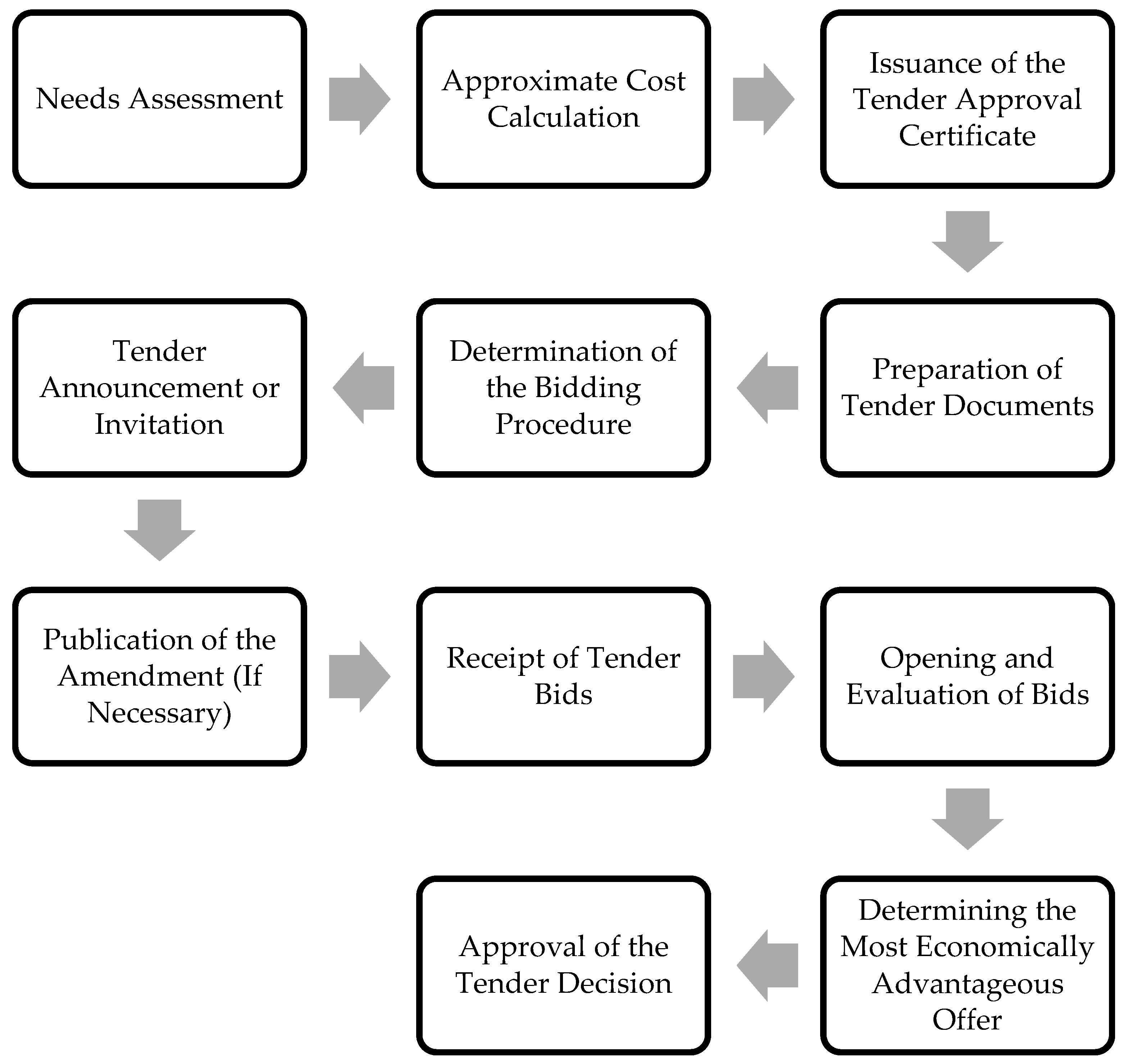
A review of the existing literature shows that studies mainly focus on transparency, efficiency, and competition in public procurement. However, there has been limited exploration of tender cancellations with respect to transaction costs and institutional capacity. This study analyzes the reasons for the cancellation of construction tenders in Türkiye, examining them from the perspectives of institutional capacity and transaction costs. Additionally, this study helps identify the main causes of cancellations in construction tenders and supports institutions in taking a proactive approach to address these issues. The analysis suggests that transaction costs and institutional capacity may play an important role in tender cancellations. Additionally, administrative actions like economic decrees and elections tend to increase the number of cancellations. A flowchart of the construction tender process under Law No. 4734 is shown in
Figure 1.
2. Literature Review
Numerous international studies have highlighted the need for further research on inefficiencies in public procurement processes [
5,
6]. Despite the extensive body of literature on public procurement systems, relatively few studies specifically analyze the reasons for the cancellation of construction tenders [
11,
12]. Identifying and addressing these causes is crucial for ensuring the successful completion of procurement processes by reducing problems that may occur both before and after tendering [
13,
14]. Tender cancellations adversely affect the performance of the parties involved, leading to inefficiencies and higher transaction costs [
15,
16,
17]. Both contracting authorities and bidders incur transaction costs before and after the tender process [
18,
19,
20], including information search, negotiation, contract preparation, and monitoring and enforcement [
21]. Countries with strong digital coordination capabilities generally experience lower transaction costs [
22]. Uncertainty is widely recognized as a major factor driving transaction costs [
23]. In conditions of heightened uncertainty, contractual risks and the probability of cancellation increase, thereby requiring higher transaction costs [
4].
Administrative and financial capacity are crucial for achieving successful procurement outcomes [
4]. Regarding administrative capacity, the number of procurement staff, the expertise of specialists, and the availability and quality of training programs and guidance materials are especially important [
24]. A study conducted in Romania found an 18% shortage of qualified public procurement experts [
25]. Effective management of public procurement relies on process organization, human resources, financial capacity, and the quality of governance [
26]. Several governments have emphasized the importance of investing in administrative capacity to ensure sound procurement management [
27,
28]. Efforts to improve human resource skills and provide additional training enhance institutional performance [
29]. However, institutional capacity still often receives inadequate attention in many settings [
30]. Without sufficiently trained procurement personnel, effective public procurement remains unachievable [
14].
Personnel are central to the smooth operation of public procurement. As the process becomes increasingly complex, it is not enough for personnel to only understand the legal framework. They also need to be knowledgeable about risk management. Additionally, implementing certification, training, and reward systems is recommended to build institutional capacity [
31]. The National Public Procurement Strategy (2023–2027) aims to improve data on the number of professionals in public procurement and the training they receive [
32].
Principal-agent theory further highlights structural challenges in public procurement. The goals of principals and agents often conflict, and information asymmetry limits the principal’s ability to fully monitor the agent’s actions and goals [
33]. In 2016, the Polish government reformed its public procurement system in line with EU directives to reduce information asymmetry between contracting authorities and contractors. However, information asymmetry persists in public procurement and can lead to significant performance problems, possibly resulting in tender cancellations. This asymmetry is mutual: both contracting authorities and contractors may face informational disadvantages. While the administration understands its service needs, it might lack the expertise to develop effective procurement strategies or accurately translate expectations and requirements into technical specifications [
34].
Evidence from developing countries further highlights the extent of tender cancellations. In 2024, cancellation rates were reported at 29.67% in Brazil and 10.49% in Slovakia. The main causes included specification changes, administrative decisions, and budget adjustments [
35,
36].
3. Materials and Methods
This study explores the reasons for the cancellation of construction tenders and the factors that influence the likelihood of such cancellations, from the perspectives of institutional capacity and transaction costs. To do this, 2483 construction tenders canceled in 2024 were examined. Public institutions and organizations that use public funds carry out their construction, service, and goods procurement through a centralized digital platform called the Electronic Public Procurement Platform (EKAP). The tender information, documentation, and results published on EKAP are thorough and officially verified. Contract values and reasons for cancellation are publicly available on this platform, ensuring data accuracy and reliability.
The tenders analyzed in this study were obtained from EKAP. To address the research objectives, canceled construction tenders were categorized based on their stated cancellation reasons using frequency analysis. The categorization followed the previously defined cancellation reasons in the EKAP system. Additionally, factors influencing the likelihood of cancellation among 16,105 construction tenders announced on EKAP in 2024 were examined using weighted logistic regression analysis conducted in SPSS 27.0.
In the regression model, the dependent variable shows whether a tender was canceled (1) or completed (0). The reference category is tender completion. The independent variables include region, type of administration, month, and tender procedure. Regional classification was based on the province of the contracting authority, grouping Türkiye’s 81 provinces into seven geographical regions to allow for consistent comparison. The regions are used exactly as they are to facilitate comparison of tender results. The administration type was identified using the 50 categories defined in the EKAP system. However, 18 administrations were excluded from the regression analysis because they either did not conduct construction tenders in 2024 (e.g., the Supreme Court, the Council of State, the Ministry of Foreign Affairs, the Council of Judges and Prosecutors, the Constitutional Court, the Ministry of Industry and Trade, and others) or operated under a newly established ministry name (Ministry of Environment, Urbanization and Climate Change, etc.). The type of administration served as a measure of institutional capacity because some administrations regularly organize training, seminars, and symposiums for their procurement staff. Additionally, some administrations employ both larger staff numbers and more experienced personnel in their procurement units. As a result, this study also evaluates institutional capacity from an administrative perspective. However, in Türkiye’s public procurement system, different types of administrations (e.g., central government ministries, municipalities, public institutions) systematically differ in organizational scale, budget size, level of professionalization, internal control mechanisms, and access to technical procurement expertise. Therefore, in this study, the type of administration functioned as a structural indicator rather than a direct measure of institutional capacity, and aspects such as staff numbers, expert quality, training, and guidance materials were not addressed.
The month variable was divided into 12 periods. The tender procedure was categorized into three groups: open tender, restricted tender, and negotiated procedure. Additionally, the frequency of canceled tenders was calculated in SPSS by procedure, administration, timing, sector, and province.
This study addresses the following research questions:
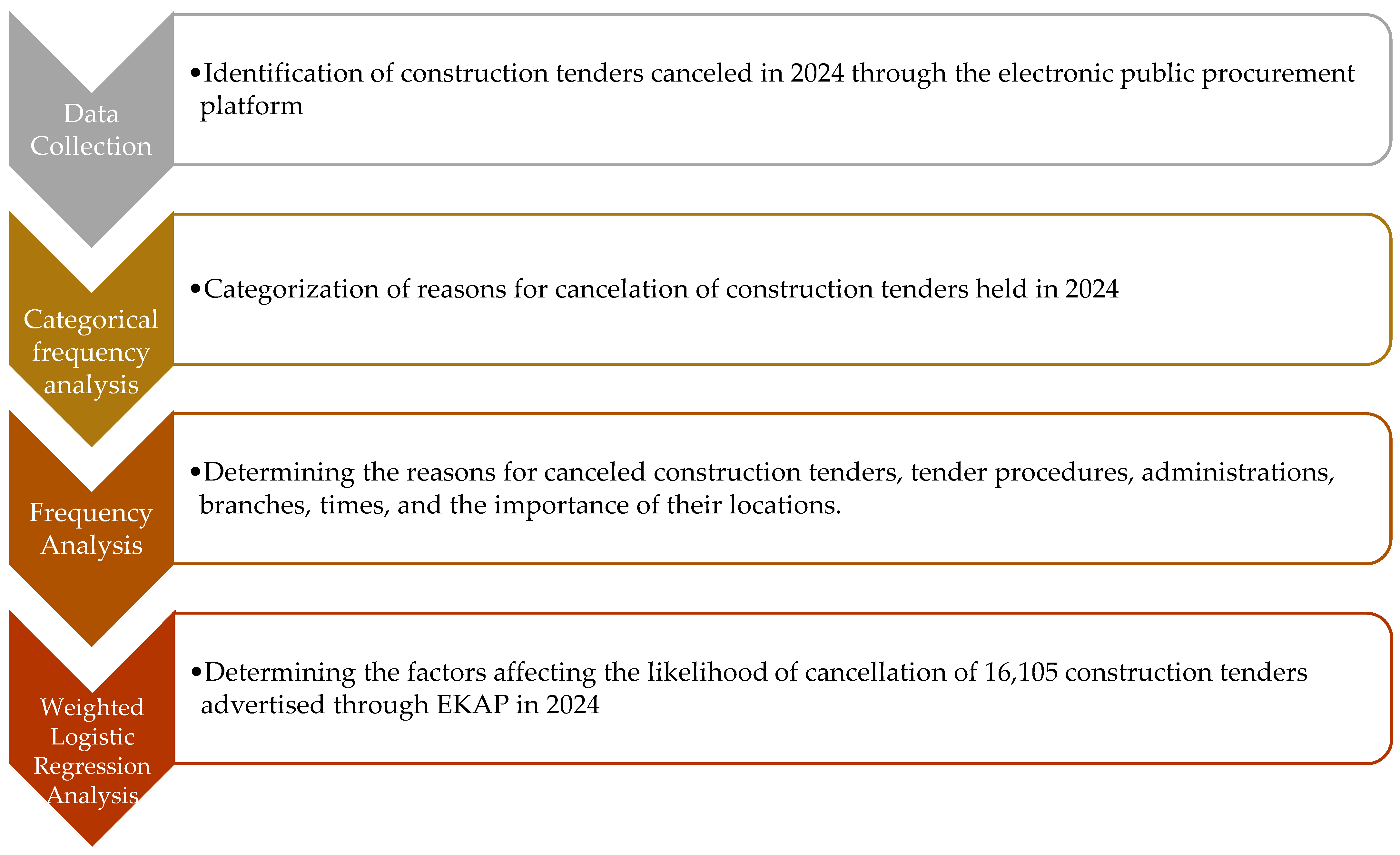
Furthermore, the study’s classification consistency was reviewed by three public procurement experts, resulting in the final version of the table. Additionally, to verify the classification’s validity, 10% of the cancellation reasons were randomly selected. The review of this 10% sample showed that the administrative reasons cited in the categories were 100% consistent, thus confirming the reliability of the coding. A summary of the methodology is shown in
Figure 2.
5. Discussion
Tender cancellations can largely be attributed to transaction cost economics. They aim to prevent uncertainty and high transaction costs that could arise later from factors such as unclear technical specifications, changes in quality and quantity, constraints on institutional capacity, inflation, and legislative changes. When the reason for cancellation arises, if the transaction costs of the tender process and contract management outweigh the cancellation costs, it becomes economically unwise for the government to proceed with the tender.
Similarly, in high-transaction-cost purchases, the likelihood of tender cancellation may be higher. In such cases, administrations can reduce transaction costs by using template contracts and specifications [
4]. Pavel [
38,
39] discusses the connection between transaction costs and public procurement, including expenses for preparing tender documents, managing the tender process, legal fees, restarting canceled procedures, contract modifications, and costs related to cancellations and delays. He also estimated that transaction costs in Slovak public procurement ranged from 0.25% to 5.6% of the contract value [
40]. Pavel [
39] estimated that the average transaction cost per participant in the Czech Republic was 0.4% of the contract value. Considering the chances of winning the tender, he estimated that a winning company spends 4.6% of the contract value on transaction costs for both the winning bid and unsuccessful bids. Grega et al. [
41] highlighted that the high number of canceled tenders in public procurement in Slovakia and the Czech Republic raises the average transaction costs.
The substantial impact of the contracting authority variable in the empirical analysis can be attributed to variations in institutional capacity, encompassing the quality of human resources, the efficacy of organizational processes, the adoption of information technologies, the sufficiency of financial resources, and the effectiveness of governance. Institutions that do not have enough power produce bad rules, lack sufficient competition and oversight, and have contracts that do not work. The Mediterranean area is more likely to be cancelled than the Eastern Anatolia area. This is also because various groups are better at different things. An institution’s competence is not just based on how many people work there or how much money they have. It also includes how well departments collaborate, technical skills, training, and contract management. These results are consistent with the findings of Carter et al. [
4], which demonstrated a negative correlation between institutional capacity and cancellation risk. Every additional staff member reduces the likelihood of cancellation by 3.2 percentage points. Institutional competency, often recognized as a pivotal factor in procurement failures, underscores the necessity of personnel experience and ability for efficient process management [
42,
43,
44].
When teams specializing in preparing specifications and external independent technical evaluations are not involved, information asymmetry arises from the principal-agent theory perspective. Faced with this problem, the principal wants to cancel the tender to avoid greater contract risk. Here, the principal does not find it economically rational to enter a contract and cancel the tender. The principal’s failure to correctly define their needs leads to poor contracting, and similarly, healthy contracts cannot be established in cases of cost uncertainty.
The real data shows that bids made through the negotiated process are 97.3% less likely to be canceled than those made through open tenders. This is because only experienced companies can participate in private, specialized negotiation processes. The open tender process, on the other hand, allows many people to participate, even if they are not very skilled at what they do. The likelihood of cancellation may increase in this method because companies participating in the tender may lack the necessary technical and financial qualifications and may be unable to submit valid bids.
There were more completions in July than in January because official unit price listings are updated only once a year, in the first few months. This makes it easier to anticipate how much products will cost.
In 2024, a total of 2483 construction tenders in Türkiye, conducted under Law No. 4734, were canceled for various reasons. This number represents 15.42% of all construction tenders held in Türkiye in 2024. Things like these have been happening throughout the world. Between 2017 and 2021, 1365 of Denmark’s 5558 public procurement auctions were called off. This was 18.8% of all the bids for the building [
4].
The cancellation of tenders due to bids significantly exceeding the estimated cost undermines the efficient use of public resources and the continuity of services. In recent years, sudden increases in material and labor costs due to economic factors such as market fluctuations, exchange rates, and inflation have caused bids for many tenders to far exceed estimated costs. This leads to tender cancellations and delays in public services [
45]. In Türkiye public procurement system, unit price schedules are prepared in advance by each authorized public institution within a centrally coordinated regulatory framework. They are periodically revised to reflect inflation. In the final months of the year, tender documents prepared for construction projects are often issued in the new year without updating the unit prices. In such cases, the inflation update made at the beginning of the year results in a temporal mismatch, causing the approximate bid costs to be exceeded or leading to insufficient participation in the tender. A lack of competition among firms, where only a few companies participate in the tender, also leads to higher prices. Additionally, if the terms of the specifications and contract are unclear and burdensome, for example, if no price escalation clause is included, contractors may submit higher bids to account for potential risks during the project [
46]. According to Article 39 of the Public Procurement Law, if all bids are significantly above the estimated cost, the tender is canceled. These results are consistent with findings from surveys and interviews conducted in Slovakia, which indicate that insufficient competition leads to inefficiency [
43].
The issue of “no valid bids being submitted” originates from deficiencies in the qualification documents required by the authority, missing signatures or seals, outstanding social security (SGK) or tax debts, or incorrect bid bonds. For tenders with an estimated cost below the threshold of 26,684,211 TL (the threshold for construction works in 2026 is 686,924,429 TL), Article 13 of Law No. 4734 states that the tender date must be at least 21 days after the announcement, a period that authorities often extend to 30 days. However, the short interval between the tender announcement and the bidding deadline often prevents firms from making adequate preparations [
47]. Changes in the nature or quantity of a tender often result from inadequate pre-tender preparation. Failing to conduct proper technical and financial analysis before the tender can lead to subsequent changes in the project’s scope. A common problem is the lack of coordination among technical personnel preparing architectural, structural, and mechanical projects when creating tender documents, which hampers the successful conclusion of the tender. Additionally, poor coordination among public institutions can lead to subsequent modifications to project details. These cancellations waste public time and resources and demotivate businesses. Additionally, project modifications impact labor and material costs, which in turn affect the tender process [
48]. These results are consistent with the causes of tender cancellations in Denmark, which include bids exceeding the estimated cost, errors in tender documents, and a lack of bidders [
4].
The technical specification is a fundamental document that defines the scope, nature, and technical details of the tendered work, aiming to meet the needs of the contracting authority. In construction works, the incorrect or incomplete preparation of the specification, the use of vague and ambiguous language, technical demands that are inconsistent with market conditions, contradictions between tender documents, incomplete definitions, and non-compliance with relevant standards and legislation create uncertainty for potential contractors, lead to objections, and frequently result in the cancellation of the tender.
In construction tenders, not only the technical and administrative specifications but also other supplementary documents such as the draft contract, schedule of quantities, project files, summary of quantities, and bills of quantities are integral parts of the tender process. The incompleteness, inaccuracy, or inconsistency of these documents may result in the cancellation of the tender [
49,
50,
51]. For the public procurement system to operate in line with the principles of transparency, competition, and efficiency, the tender documents must be complete and consistent. However, neglecting documents that are not part of the technical and administrative specifications but are vital to the tender process results in the cancellation of many tenders. The main document deficiencies leading to cancellation include incomplete or incorrectly prepared draft contracts, deficiencies in project and implementation drawings, failure to include project drawings, contradictions between the tender notice and the documents, works included in the schedule of quantities but not in the technical specifications, and inconsistencies in the estimated cost calculations. Such deficiencies make it difficult for contractors to formulate their prices and lead to uncertainty and complaints. A study in Poland emphasized that most problems in construction tenders arise from hasty, careless, and thoughtless tender preparation, incorrect reading and preparation of necessary documents, and insufficient knowledge of the existing legal provisions on public procurement [
52]. In Greece, a study on reducing risks in public procurement highlighted the need to professionalize the workforce [
53].
Article 10 of the Law covers the documents demonstrating the economic, financial, professional, and technical competence of candidates and bidders. These include documents proving no tax and SGK debt, chamber of commerce/industry registration, work experience certificates, balance sheets and turnover documents, documents related to organizational structure, and criminal records. The documents required under Article 10 can make it difficult for participants to understand the process fully, and obtaining them from multiple institutions can be time-consuming and complex. Similarly, Khoso et al. [
54] found that construction projects in Pakistan had entered a modern phase, but contractors were not sufficiently prepared to meet the demands. Also, new business owners who are not familiar with the tender process or the risks of making mistakes when collecting documents by hand may submit incomplete or incorrect documents, which could lead to the tender being canceled.
With the Public Procurement Authority’s digitalization efforts, the electronic evaluation of tenders has accelerated. In this process, bids are received through EKAP, and pre-qualification and bid evaluation are conducted via the system. Many construction tenders have been canceled due to bids that do not comply with the tender specifications, the submission of incomplete or incorrect documents, failure to meet technical qualification criteria, and a lack of training among evaluation personnel [
54,
55]. The development of an e-procurement system for the Nigerian public sector has been highlighted as a means to automate the procurement evaluation process, thereby reducing human error and procurement cancellations and facilitating decision-making [
56]. In line with international organizations’ recommendations, developing countries are strengthening their e-procurement systems [
21]. Many researchers argue that electronic purchasing systems are an excellent tool for reducing transaction costs [
57,
58,
59,
60]. Furthermore, according to a study conducted in Slovakia, frequent legislative changes increase excessive transaction costs [
43].
Tenders are being canceled as a result of complaints filed with the administration by contractor companies regarding errors by the tender commission in its evaluation and scoring [
61].
Tenders are also canceled as a result of complaints filed by contractor firms with the contracting authority over errors made by the tender commission in the evaluation and scoring. Cancellations of construction tenders “Due to a Change in the Tender Procedure” highlight weaknesses in the planning stage of the Turkish public procurement system. Selecting an inappropriate tender procedure for the nature of the work triggers irreversible legal proceedings after the tender announcement, making cancellation decisions inevitable. These findings align with the literature emphasizing that selecting an appropriate tender procedure in developing countries reduces cancellations [
10].
There were also many political and regulatory issues in 2024. The Presidential Circular on Austerity Measures (No. 2024/7) and the local elections on March 31 led many individuals to modify their plans. Due to changes in the budget and in how things are operated, it was important to review the current procurement procedures again [
62,
63].
6. Conclusions
Although the Public Procurement Law No. 4734 determines the principles and procedures for tenders conducted by public institutions and organizations in Türkiye, many construction tenders are canceled for various reasons. These cancellations lead to time loss, cost increases, and project delays. This study looked into why construction tenders in Türkiye were canceled in 2024. Implementing the suggested steps for the 19 reasons for cancellation may make it easier to manage future tenders. The main reasons for cancellation are that all bids were significantly above the expected cost and that no bidders submitted a tender.
The highest number of cancellations occurred in the open tender procedure, and the month with the most cancellations was March. Furthermore, the administrations with the most tender cancellations are municipalities, other special budget organizations, and provincial special administrations. While Ankara had the highest number of canceled tenders, Balıkesir had the highest cancellation rate among construction tenders. An analysis of the OKAS codes for the canceled construction tenders in 2024 shows that “Partial or complete construction and civil engineering works” (building construction, sports facilities, bridges, viaducts, railways, tunnels, underpasses, highways, prefabricated structures, airports, etc.) ranks first. Additionally, the identified cancellation reasons and proposed solutions may guide both contracting authorities and bidding contractors, potentially reducing the number of cancellations.
According to the weighted logistic regression analysis, the tender procedure, administration, time, and region were found to be effective in tender cancellations. In addition, addressing tender cancellations could help assess institutional capacity, support the completion of tender processes, and facilitate the management of transaction costs. Based on the results obtained, the following recommendations regarding public procurement have been made.
Project engineers should be subject to regular training on legislation, specifications, and the tender system
Coordination should be ensured among the technical personnel preparing the architectural, structural, and mechanical projects when preparing tender documents.
Tender announcement periods should be sufficient to allow firms to prepare for the tender.
A pre-check before a second team must conduct the tender.
Regular training and information seminars on the tender process and bid bond arrangements should be organized, especially for small and medium-sized enterprises.
Construction tenders should not be initiated before the zoning plan processes are finalized (objection and lawsuit processes are completed).
The preparation of technical specifications should involve expert engineers, architects, and technical personnel.
The study is limited to empirical data from Türkiye; future research could compare these results with those from developing countries with similar economic indicators to Türkiye. Limitations of the study in terms of transaction costs: inflation volatility, number of bidders, and renegotiations. Another limitation of our study is that institutional capacity is measured administratively. Therefore, we are unable to assess the importance of individual skills and competencies within the procurement unit.
The data were obtained from the Electronic Public Procurement Platform (EKAP)
https://ekapv2.kik.gov.tr/ (accessed on 14 June 2025), which contains all information on tenders issued by public institutions and organizations in Türkiye. The open data on this platform was obtained through data-mining methods. The dataset contains construction bids that occurred between 1 January 2024, and 31 December 2024. The most important items documented were the tender number, date, province, administration, tender method, bid type, anticipated cost, tender status, cancellation date, reason for cancellation, contract amount, tender branch codes, tender type, contract price, and tender scope.
Since public institutions in Turkey are required to enter tender data into this platform accurately and completely, there is no erroneous or inconsistent data in the data cleaning process. The dataset is limited to construction tenders only. The authorities conducting the tenders are classified into institutional categories, such as municipalities, the Ministry of Health, and the Ministry of National Education.