Article

Determinants of Public Construction Tender Cancellations in Türkiye

by
Hasan Bakırcı
1,* and
Mehmet Nurettin Uğural
2
1
Department of Construction, Hilvan Vocational School, Harran University, Şanlıurfa 63300, Turkey
2
Department of Civil Engineering, Istanbul Kultur University, Istanbul 34158, Turkey
*
Author to whom correspondence should be addressed.
Buildings 2026, 16(7), 1327; https://doi.org/10.3390/buildings16071327

Submission received: 27 January 2026 / Revised: 19 March 2026 / Accepted: 25 March 2026 / Published: 27 March 2026
(This article belongs to the Section Construction Management, and Computers & Digitization)

Abstract

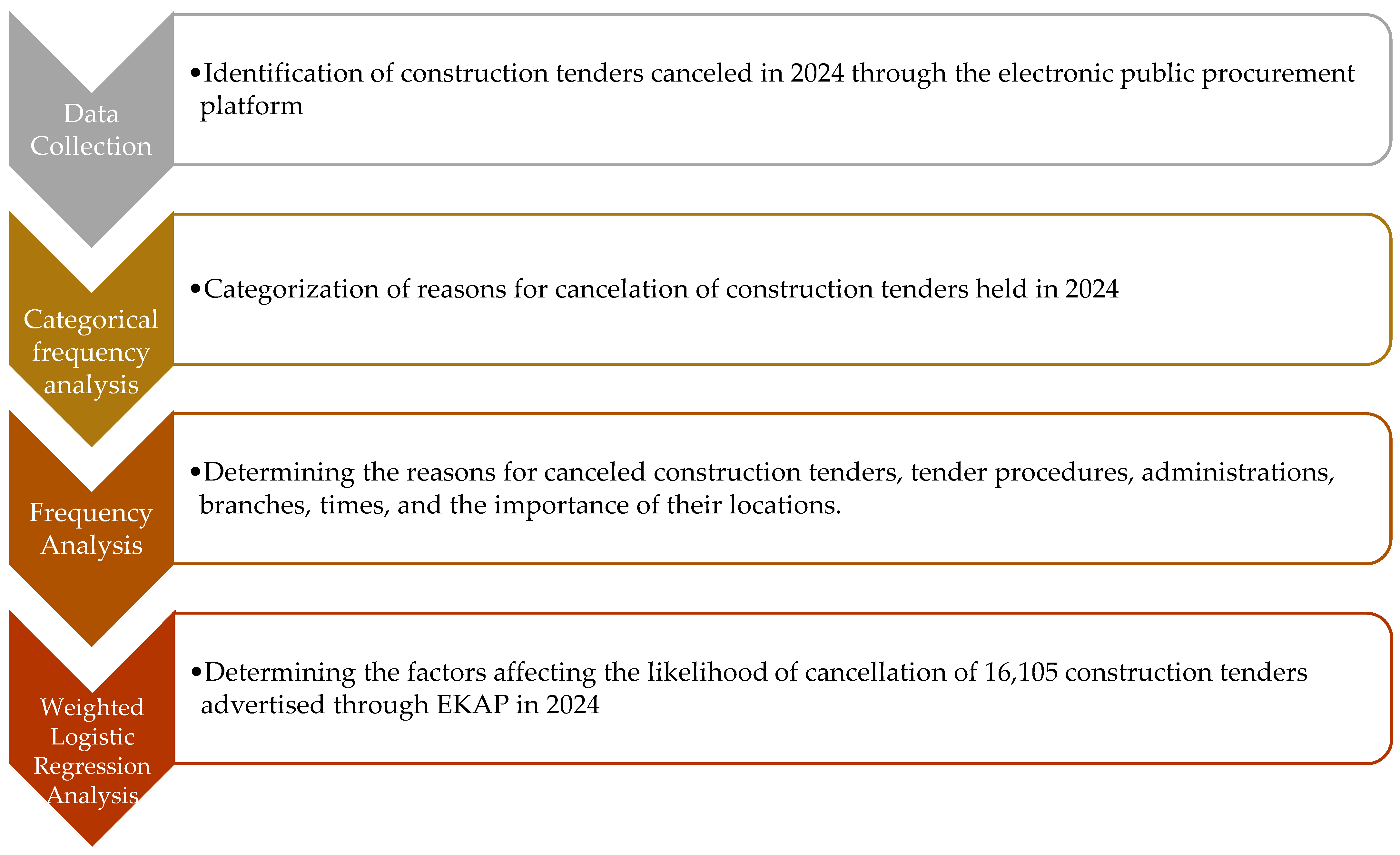
Many construction tenders conducted by public institutions and organizations are canceled for various reasons, leading to project delays, resource inefficiencies, and disruptions to public services. This research aims to analyze the reasons for construction tender cancellations and the factors that influence the likelihood of cancellation, with a focus on institutional capacity and transaction costs. The cancelled tenders were obtained from the Electronic Public Procurement Platform (EKAP), which is officially used by public bodies. A total of 2483 construction tenders canceled in 2024 were analyzed. This figure represents 15.44% of the construction tenders conducted in Turkey in 2024. The construction tenders examined were subjected to a categorical frequency analysis using administrative reason codes. Additionally, weighted logistic regression was used to identify factors associated with the likelihood of cancellation among the 16,105 construction tenders held in 2024. According to the analysis results, region, type of administration, time, and tender type have a statistically significant impact on cancellation. The primary causes for cancellation include bids substantially above the estimated cost, the absence of submitted tenders, and the issuance of a published circular. The municipal elections held in March 2024 and the accompanying circular have led to an increase in tender cancellations. Inadequate institutional capacity may lead to uncertainty in the process; this, in turn, may result in the suspension of tenders and a rise in transaction costs. In this context, strengthening institutional resilience can be seen as a facilitator in resolving many issues. The factors that lead to tender cancellations and the suggested approaches can offer useful guidance for both the administration and contractors in normalizing processes. Furthermore, public authorities might consider investments to enhance institutional capacity to reduce the risk of tender cancellations.
Keywords: public tender; construction tenders; tender cancellation; public procurement law; transaction cost economics; institutional capacity public tender; construction tenders; tender cancellation; public procurement law; transaction cost economics; institutional capacity