Article

An Automatic Update Framework for As-Designed Pipeline BIM Model Based on Laser Scanning Point Cloud


College of Civil Engineering, Tongji University, Shanghai 200092, China
*
Author to whom correspondence should be addressed.
Buildings 2026, 16(7), 1295; https://doi.org/10.3390/buildings16071295
Submission received: 27 February 2026 / Revised: 21 March 2026 / Accepted: 22 March 2026 / Published: 25 March 2026
(This article belongs to the Section Construction Management, and Computers & Digitization)

Abstract

Accurately reconstructing Mechanical, Electrical and Plumbing (MEP) systems from laser-scanned point clouds is often hindered by structural occlusions, sensor noise, and extreme scale imbalance between large pipes and small fittings. This study presents a hybrid framework, driven by both knowledge and data, for automated pipeline BIM updating. To tackle scale variance, we implement a coarse-to-fine segmentation strategy using Density-Based Spatial Clustering of Applications with Noise (DBSCAN) to isolate pipeline instances before segmentation with PointNeXt. Furthermore, a logic-based refinement module integrates geometric and topological priors from the design BIM to correct coordinate deviations in incomplete datasets. Finally, graph isomorphism analysis enables automated topological mapping between unstructured point cloud instances and structured BIM components. Experimental results from a dense shopping center case study demonstrate that the framework achieves a semantic segmentation mIoU of 74.45% and reduces the average spatial coordinate error to within 7 mm. Notably, the automated workflow compressed the modeling time from 3–5 days to approximately 3 h, offering a robust solution for digital twin-oriented facility management.

1. Introduction

1.1. Background

BIM has become a key enabler for efficient lifecycle management in the architecture, engineering, and construction (AEC) industry, especially when integrated with Internet of Things (IoT) technologies for real-time data acquisition and facility operation optimization. In smart construction, enriched BIM models are increasingly required to support the performance monitoring and maintenance of MEP systems [1]. However, as-designed BIM models often deviate from as-built conditions due to construction tolerances and on-site modifications, which significantly degrades the reliability of BIM-based MEP management. In practice, updating BIM models to match as-built conditions is often performed manually based on component specifications and installation records. This process is labor-intensive and inefficient, particularly in complex MEP environments. To address these limitations, scan-to-BIM technologies have emerged as a vital research domain. By leveraging laser scanning and photogrammetry, these methods capture dense point clouds that accurately represent as-built geometry [2,3]. However, raw point clouds lack semantic and topological information and cannot be directly used in engineering practice [4]. This makes the conversion of point clouds into structured BIM models an important research direction.
Although a variety of MEP automated modeling methods based on point clouds have been proposed [5,6,7], many of them rely primarily on local geometric features, such as surface normals, curvatures, point density distributions, or the simple geometric fitting of planar and cylindrical primitives. While these features are computationally efficient, they often fail to distinguish adjacent components with similar shapes or to handle incomplete observations caused by occlusion and measurement noise. As a result, such methods may exhibit limited robustness, where robustness refers to the ability to maintain reliable segmentation and parameter inference performance under challenging MEP conditions, including dense spatial arrangements and scale imbalances between large pipes and small fittings. Moreover, existing approaches often treat point cloud interpretation and BIM reconstruction as largely data-driven processes, with insufficient exploitation of prior information embedded in as-designed BIM models, such as component dimensions, connectivity constraints, and network topology. This separation between design knowledge and as-built sensing data can lead to cumulative geometric errors, fragmented component recognition, and inconsistent topological relationships in the reconstructed models. Consequently, achieving accurate and automated synchronization between as-designed and as-built pipeline BIM models in complex MEP environments remains a significant challenge. Therefore, there is a clear need for an integrated scan-to-BIM framework that combines robust semantic segmentation, reliable geometric parameter inference, and topology-aware model updating by effectively incorporating prior design information.
To address the above limitations, this study seeks to explore how an automated scan-to-BIM updating process for pipeline systems can be realized with improved robustness, accuracy and efficiency in complex MEP environments. In particular, this research investigates how reliable semantic understanding of densely arranged and partially occluded pipeline point clouds can be achieved, how geometric parameters of as-built components can be accurately inferred by integrating point cloud observations with prior knowledge embedded in as-designed BIM models, and how topology-consistent correspondence between design components and as-built pipeline instances can be established to support automated model updating.
Guided by these research considerations, the objective of this study is to develop an integrated scan-to-BIM framework for automatically updating as-designed pipeline BIM models using laser-scanned point cloud data. The proposed framework incorporates prior design information and combines three key processes: point cloud semantic segmentation, geometry parameter extraction, and topology-driven BIM reconstruction. Through this integrated workflow, a reliable mapping relationship between design components and as-built pipeline instances can be established, enabling efficient synchronization between the digital BIM model and the physical environment. By reducing dependence on manual interventions and improving modeling fidelity, the proposed approach aims to enhance the practicality of scan-to-BIM techniques for complex MEP management scenarios.
The primary contribution of this research is a hybrid knowledge–data-driven framework that overcomes the inherent limitations of laser scanning in cluttered MEP environments through a three-fold novelty. First, the framework employs a coarse-to-fine semantic strategy by integrating DBSCAN as a spatial focus mechanism before PointNeXt classification to address scale imbalances and ensure the recognition of small fittings. Second, it introduces logic-based coordinate refinement by utilizing as-designed BIM models as geometric and topological priors to correct coordinate deviations caused by sensor noise and occlusion. Finally, the research achieves automated topological mapping by applying graph isomorphism to bridge the semantic gap between unstructured as-built data and structured as-designed components, thereby enabling a fully closed-loop parametric update.

1.2. Related Works

1.2.1. Point Cloud Segmentation

Point cloud segmentation is a basic step of the scan-to-BIM workflow, because it directly determines the accuracy of the subsequent reconstruction process [8]. However, due to the complexity of the installation environment of construction equipment, the semantic segmentation of the MEP system faces great challenges. In a three-dimensional environment constructed by densely arranged pipes, air ducts, and pipe fittings, point cloud data is usually highly cluttered, with serious occlusion and geometric changes [9]. Although the traditional manual segmentation method takes full advantage of manual experience, it is not only time-consuming when processing large-scale point cloud data but also easily affected by subjective errors [10]. Therefore, the development of automated segmentation technology in a complex MEP environment has become a key research direction.
In the early research of point cloud automatic segmentation, the mainstream method mainly relies on geometric features, such as regional growth, graph-based methods, and model fitting [11]. These traditional techniques usually use local geometric properties such as surface normal vectors, curvature, and flatness to cluster spatially continuous points into meaningful fragments. Although this method has the advantages of high computational efficiency and strong interpretability, it exposes its limitations when dealing with MEP facilities with high geometric complexity. Due to over-reliance on predefined feature descriptors, these methods are very vulnerable in the face of noise, incomplete data, and irregular component geometry [12]. In addition, traditional methods struggle to capture the high-level semantic relationship between components, often producing fragmented results that still require a large number of manual corrections [13].
The rise in deep learning has completely changed the technical pattern of point cloud segmentation. It allows the model to learn hierarchical feature representation directly from the original three-dimensional coordinates without relying on explicit feature engineering [14]. PointNet architecture [15] proves that deep neural networks can directly process unordered point sets, learn to replace constant features through symmetric functions, and capture local and overall geometric patterns at the same time. On this basis, PointNet++ [16] realizes hierarchical feature learning by introducing the set abstraction layer so that the network can gradually aggregate features from local neighborhoods with different spatial resolutions so as to capture multi-scale geometric structures. This hierarchical design has proved to be particularly effective in handling MEP segmentation tasks, because the scale of MEP components varies greatly, from small pipe fittings to large ventilation ducts [17,18]. Subsequent research has further enhanced these architectures through various innovations, including the construction of dynamic diagrams in DGCNN [19] and the attention mechanism in the Point Transformer [9,20]. In addition, PointNeXt [21] further improves the PointNet++ framework with advanced training techniques and scalable model scaling to surpass more complex models. These enhancements lead to significant gains in both segmentation accuracy and computational efficiency.
Although the deep learning architecture has made significant progress, the unique characteristics of the building equipment environment still bring continuous challenges when applying it to MEP point cloud segmentation. Transformer-based architecture uses the self-attention mechanism to model the long-range dependencies between points. By explicitly capturing global context information, it has recently shown superior performance in dealing with obscured and messy MEP scenarios [20]. However, the quadratic computational complexity of the attention mechanism limits its scalability when dealing with large-scale point clouds [22]. In addition, there is the problem of category imbalance in the MEP dataset. For example, slender pipelines occupy the vast majority of point clouds, while there is a serious shortage of small but crucial components such as valves, elbows, and tees, which brings significant difficulties in training robust segmentation models [23]. This imbalance often leads to the inability to identify small components that are crucial for complete BIM reconstruction, although the network can obtain high overall accuracy through the correct classification of dominant categories [24].
In the field of MEP, the challenge of insufficient training data is particularly serious. This is mainly because the manual annotation of point cloud data is not only time-consuming and energy-intensive but also has a high professional threshold. In the face of this bottleneck, researchers began to extensively explore synthetic data generation and domain adaptive technology. Specifically, the BIM model can be an important source of synthetic training data. By simulating laser scanning, large-scale point cloud data can be generated [25]. The research of Yue et al. [26] shows that using such synthetic data to enhance the real MEP point cloud can significantly improve the segmentation robustness of the model at different construction sites. At the same time, there are also studies committed to the development of semi-supervised and self-supervised learning paradigms, which aim to use techniques such as pseudo-labeling, consistent regularization, and comparative learning to extract meaningful feature representations from a large number of unlabeled point clouds so as to further alleviate the dependence on manual annotation [27,28].
In addition to architectural innovation and data enhancement, recent studies have gradually realized that, due to the structural characteristics of pipeline networks and the availability of a priori knowledge, the pure end-to-end deep learning method may not be the best solution to the MEP segmentation task [29]. The hybrid method of integrating geometric preprocessing and deep learning has become a promising research direction. This kind of method can take full advantage of traditional geometric analysis and modern deep learning [30]. For example, density-based clustering algorithms such as DBSCAN [31] can effectively decompose complex scenes into component instances, thus alleviating the problem of scale imbalance and enabling the network to focus more on fine-grained semantic segmentation in local areas. Similarly, the graph representation method of the topological relationship between components has also been proven to effectively improve the consistency of segmentation results by applying connection constraints in the reasoning process [32,33].

1.2.2. Geometry Parameter Identification

Parameter identification is a key step after segmentation. Its task is to extract geometric attributes such as size, coordinates and orientation from the point cloud to provide support for parametric BIM reconstruction. As a bridge between the original point cloud and the semantic model, the accuracy of parameter identification directly determines the usability of the final BIM model [34]. For this reason, the relevant technology has gradually developed from early manual measurement and rule-based geometric fitting to today’s more automated learning-driven methods to effectively cope with complex geometric forms in the real MEP environment.
Early research mainly relied on the method of combining artificial feature extraction and geometric element fitting. Among these traditional methods, the Random Sample Consensus (RANSAC) algorithm has attracted much attention because of its strong robustness to outliers and noise [34]. The RANSAC-based method is widely used to fit geometric components such as cylinders and planes to the divided point clouds so as to extract parameters such as pipe diameter, center axis, and connector orientation [35]. The research of Bosché [36] and others verified the effectiveness of cylindrical element fitting in monitoring completed MEP components. The results show that when geometric parameter extraction is integrated with the design of the BIM model, it can support automated deviation detection.
Although traditional geometric fitting methods have the advantage of high computational efficiency, they still expose their limitations when facing real MEP systems. This kind of method usually requires a large number of manual parameter tuning and relies on predefined geometric elements, which are relatively fragile when dealing with irregular components [37,38]. Take cylindrical fitting as an example: this method is effective in dealing with straight pipe sections, but it is often difficult to achieve accurate parametric expression in the face of complex pipe fittings such as variable diameter pipes, flanges, valves, and pumps, because the geometric irregularity of these components violates the simple element assumption. Ahmed et al. [39] pointed out that traditional fitting-based methods often fail to capture the geometric details of pipe connections, especially when the point cloud is incompletely covered due to occlusion.
In light of the above limitations, research in recent years has gradually turned to data-driven methods, using deep learning to achieve parameter extraction without explicit geometric modeling. The neural network-based method [15,16] can learn the complex mapping relationship between the original point cloud geometry and parametric representation directly from the training data, effectively bypassing the need for artificial design feature descriptors. In addition, in recent years, the point cloud complement network [25,40] has emerged as a new paradigm for dealing with incomplete geometric data. Such generation models can infer missing surface areas from local observations and reconstruct complete component geometry.
Recent studies have gradually realized that the combination of rule-based geometric analysis and deep learning-based feature extraction shows better performance than a single method [41,42]. The incorporation of designed BIM model as geometric prior knowledge constitutes a significant advancement, substantially enhancing the accuracy and robustness of extraction. [43]. This method establishes a correspondence between the segmented point cloud instance and the designed BIM component, retrieves the standard size and connection information from the design model, and uses it as a guide to complete the parameter extraction process [35,44].

1.2.3. Automatic Modeling

The ultimate goal of the scan-to-BIM workflow is to transform the segmented and parameterized point cloud data into a semantically rich BIM model. However, the automatic modeling of completed pipelines is still full of challenges. The difficulty lies in how to ensure geometric accuracy and topological connectivity in complex MEP systems.
The early automatic modeling method mainly relies on the retrieval strategy based on the component library. Its core idea is to match the divided point cloud component with the parameterized template stored in advance in the library [5]. This method usually uses the geometric similarity measurement to identify the BIM family that matches the most and then fit the template to the point cloud data by optimizing the size parameters. Although computationally efficient for standard components, template-based methods often fail to handle the geometric complexity of real-world MEP facilities. As a result, the generated models frequently suffer from disconnections or geometric inconsistencies, violating basic connectivity constraints [44].
Recognizing the above limitations, follow-up research gradually focuses on reconstruction strategies with topology perception capabilities, which can model the connection between pipeline components. The graph-based representation method has become an effective paradigm for coding pipeline network topology, in which the node represents a single component and the edge represents the physical connection relationship [32,33]. By expressing the reconstruction task as a graph-matching problem between the as-built point cloud topology and the designed BIM topology, this method can establish a stable correspondence even in the case of local occlusion or geometric deviation.
The latest research recognizes that using the design of BIM models as a priori knowledge can achieve better results. The method does not rely entirely on point cloud observation to reconstruct the MEP system but fully explores the information contained in the design model, including the standard component size, pipe diameter, and connection type, to constrain and guide the reconstruction process [43,44]. Through the dual matching of geometry and topology, this method establishes a correspondence between the segmented point cloud instance and the designed BIM component and then retrieves the standard parameters from the design model to correct the systematic error in the extraction results [36]. This hybrid strategy effectively balances the relationship between data-driven and knowledge-driven.

2. Materials and Methods

2.1. Research Framework

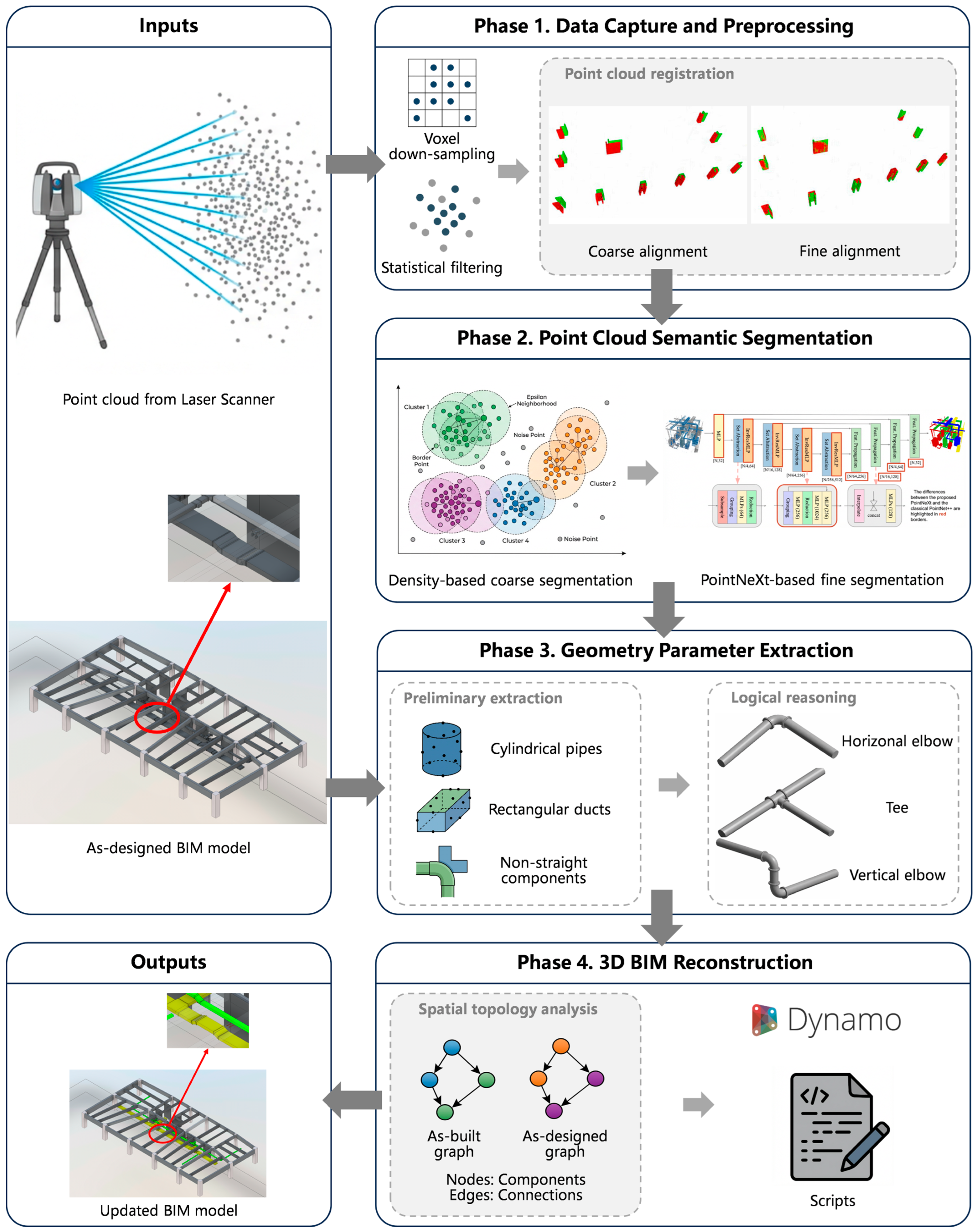
This study proposes a novel framework to automatically update an as-designed pipeline BIM model with laser-scanned as-built point clouds. As shown in Figure 1, the framework uses data acquired from a laser scanner as input. After point cloud preprocessing, DBSCAN and PointNeXt perform semantic segmentation of the pipeline-related point clouds. On this basis, parameter extraction with logical reasoning derives the geometric parameters of the as-built pipelines, while spatial topology analysis is used to establish a one-to-one mapping between point cloud instances and BIM components. Finally, these as-built parameters are used to automatically update the as-designed BIM model, thereby generating an up-to-date as-built pipeline BIM. The details of each step are presented in the following sections.

2.2. Data Capture and Preprocessing

High-fidelity data acquisition is a prerequisite for accurate scan-to-BIM updating, because the quality of the input data directly determines the reliability of geometric extraction and topological analysis. In the MEP scenario, high-density and accurate laser scanning can ensure the reliable identification of pipe geometry and connection relationships, thus improving the robustness of BIM updates [45]. This study uses a terrestrial laser scanner (TX5, Trimble Inc., Sunnyvale, CA, USA) to obtain the as-built data of the MEP system; its detailed technical specifications are summarized in Table 1. In light of the complex arrangement of pipes, there is a large number of occlusions and messy interferences, and single-station scanning often cannot completely capture the geometric shape. For this reason, we adopt a multi-station scanning strategy. The layout of the scanning station is carefully planned to ensure that there is at least a 30% overlap between adjacent scans, which not only ensures sufficient features required for point cloud registration but also maximizes coverage of the covered pipe surface.
After the data acquisition is completed, there will inevitably be a large amount of redundant information and sensor noise in the original point cloud, which not only affects the computing efficiency but may also reduce the segmentation accuracy. Therefore, we systematically preprocess the raw data. First of all, for the problem of uneven distribution of point cloud density, that is, the regional points near the scanner are dense but sparse in the distance, we use a grid filter with a voxel size of 10 mm for down-sampling. This step not only significantly reduces the amount of data but also makes the point cloud distribution more uniform, ensuring that the subsequent deep learning network focuses on geometric features rather than density changes. Then, we apply the Statistical Outlier Removal (SOR) filter [46] to eliminate sparse noise caused by laser beam divergence. The filter eliminates those points that deviate from the global mean by more than two standard deviations by calculating the average distance between each point and its 20 nearest neighbors. Finally, a clean and lightweight point cloud is obtained to prepare for subsequent semantic processing.
The last step of preprocessing is to align the as-built point cloud with the coordinate system of the designed BIM model. Since the MEP component itself is a target to be updated and may have deviated from the design position, it cannot be used as a reference for registration. For this reason, we choose walls, columns, and other structural elements as alignment standards. These components are generally considered to have high construction accuracy and a high degree of coincidence with the design model. We adopt a registration strategy from coarse to fine to convert the point cloud to the design coordinate system. First, use the Fast Global Registration (FGR) [47] algorithm based on Fast Point Feature Histograms (FPFHs) [48] to calculate the initial transformation matrix. Subsequently, the Point-to-Plane Iterative Closest Point (ICP) algorithm [49] is used to refine the registration results. The above registration process continues to be iterated until the Root Mean Square Error (RMSE) between the point cloud and the designed BIM model converges to within 5 mm, thus providing an accurate spatial benchmark for subsequent tasks [50].

2.3. Point Cloud Semantic Segmentation

After aligning the as-built point cloud to the designed BIM coordinate system, we obtain a complete but unstructured geometric expression of the MEP scene. The core challenge at this stage is how to convert these primitive coordinates into semantic objects. However, due to the length of pipelines, the huge scale difference between large pipes and small pipes, and their extremely dense spatial distribution, the segmentation of the MEP environment faces significant difficulties. Therefore, if single-stage deep learning segmentation is directly used for the whole scene, the calculation is often expensive and error-prone.
In order to alleviate the above limitations, we adopt a semantic segmentation strategy from coarse to fine, which combines density-based clustering and deep learning. Specifically, the DBSCAN [31] algorithm is first used to decompose the scene into independent pipeline instances to suppress mutual interference between objects. Subsequently, each instance is entered into the PointNeXt [21] network for fine-grained point-by-point classification. This two-stage design improves the sampling balance at different scales and significantly improves the division robustness in severely obscured MEP scenarios.

2.3.1. Density-Based Coarse Segmentation

In the coarse stage, we apply DBSCAN to partition the global point cloud into spatially separated pipeline instances. DBSCAN identifies dense regions as clusters and treats sparse points as noise, which is suitable for laser-scanned MEP scenes where pipeline surfaces are densely sampled, while different pipeline runs are typically separated by small gaps.
Given a point set P = p i R 3 , DBSCAN defines a neighborhood radius ε for each point p i as N ε p i = p j P   |   p j p i ε . A point is regarded as a core point if N ε p i M i n P t s , where M i n P t s is the minimum number of points required to form a dense region. Clusters are expanded from core points through density reachability, while points not reachable from any core point are labeled as noise. The value of ε is selected according to the minimum clearance between adjacent pipelines and the local point spacing after down-sampling so that points belonging to the same physical pipe remain connected, whereas adjacent pipes are separated. The value of M i n P t s is chosen to remove isolated outliers while retaining partially occluded segments and is empirically determined based on the expected number of points within a small surface patch.
To reduce scene complexity and improve sampling balance, this study first applies the DBSCAN algorithm to segment the global point cloud into independent pipeline instances. DBSCAN identifies clusters by locating points that satisfy a minimum density criterion, controlled by the neighborhood radius (ϵ) and the minimum number of points. In MEP systems, pipelines are densely arranged but usually separated by small spatial gaps. By setting ϵ according to the minimum design clearance, DBSCAN cluster points from the same physical pipeline run into a single instance while discarding isolated noise. This separation allows each pipeline segment to be processed independently in the subsequent stage, avoiding feature interference from adjacent and unrelated structures.

2.3.2. PointNeXt-Based Fine Segmentation

After DBSCAN divides the scene into independent pipeline instances, we still need to carry out fine-grained semantic understanding at the component level to support subsequent parameter extraction and topological reconstruction. For this reason, this study inputs the pipeline instances obtained from clustering into the PointNeXt for point-by-point classification, so as to convert the instance-level point cloud clusters into BIM components that can be directly used in engineering. Considering the typical composition of the MEP piping system, we have defined eight target categories: exhaust pipes, exhaust elbows, exhaust tees, air pipes, air elbows, air tees, water pipes, and water tees. This classification system not only covers the main pipeline and pipe fitting types in the target scenario but also maintains semantic consistency with the subsequent parameter extraction modules.
In order to build a robust model suitable for severely covered and messy MEP environments, we collected data from twelve different construction sites using a Trimble TX5 terrestrial laser scanner (as shown in Table 1 in Section 2.2) and reorganized into various spatial layouts to simulate different installation conditions. The specific practice is to manually combine the collected-component point cloud into a variety of spatial layouts, such as parallel arrangement, cross layout, layered layout, and partial occlusion. We adopt standard data enhancement methods, including random rotation and translation, to improve the adaptability of the model to different scanning angles. In addition, we also added Gaussian noise to simulate the common ranging error in ground laser scanning. This process resulted in a dataset comprising 1070 training instances and 286 test components. The final dataset is shown in Table 2, which aims to alleviate the dominant problem of long, straight pipe sections and ensure that small pipe fittings such as elbows and tees can be fully sample characterized.
Direct PointNeXt segmentation of the complete scene is easily affected by the scale imbalance problem, because large-diameter pipes often occupy a dominant position in the sampling process. This will lead to sparse sampling of small pipe fittings and trigger the fragmentation of the boundary area. To alleviate this problem, we adopt an instance-based input strategy. Each pipeline instance generated by DBSCAN is transferred and aligned to the local coordinate system and then resampled to 8192 points. This sampling size was selected to ensure stable feature learning and to mitigate the scale imbalance commonly observed in complex MEP environments. In particular, a smaller number of points may lead to insufficient geometric representation of small pipeline fittings such as elbows and tees, whereas a larger number would significantly increase computational cost and GPU memory consumption without notable improvement in segmentation performance. Therefore, following common practices in instance-level point cloud semantic segmentation studies, a fixed input size of 8192 points was adopted to balance geometric detail preservation and computational efficiency. This method ensures that even small components can retain sufficient point density and geometric details, thus improving the stability of local neighborhood feature learning and enhancing the separability between the straight pipe section and the pipe fitting.
We employ PointNeXt to capture fine-grained geometric features through its hierarchical architecture and inverted residual blocks. By leveraging enhanced local aggregation, the network effectively learns the linear directionality of straight pipe sections alongside the intricate curvature variations in fittings such as elbows and tees. The subsequent feature propagation layers restore the feature map to the original resolution through hierarchical fusion, assigning semantic labels to each point.

2.4. Geometry Parameter Extraction

This section aims to extract geometry parameter descriptions such as axis, endpoint, size, and orientation from the split as-built point cloud to prepare for subsequent BIM updates. Considering the inevitable problems of scanning noise, surface omission, and local occlusion in the ceiling space, we adopt a two-stage strategy. First, preliminary parameter extraction is carried out for each segmentation instance based on geometric elements. Subsequently, by integrating the logical reasoning module of prior knowledge from the design model, the parameter correction of the connection constraint is carried out. Finally, a set of parameters that meet the connection consistency is output, which can be directly mapped to BIM for model updates.

2.4.1. Preliminary Extraction Based on RANSAC

In the preliminary extraction stage, we adopt customized geometric fitting algorithms for the morphological characteristics of different pipeline components. The choice of fitting method is guided by the classification system established in the semantic segmentation stage to ensure that each component type can be processed with the geometric element that matches the most.
In practice, the three-dimensional laser scanning method on the ground leads to the missing data on the upper surface. For cuboidal pipes, we use the RANSAC algorithm to obtain the plane equations of the lower surface and two sides. Next, according to the oriented bounding box algorithm after plane projection, the range of the plane point cloud is extracted as dimension parameters and endpoint coordinates. For a cylindrical pipe, we fit a cylinder to the pipe and then extract the coordinates of the start and endpoints based on the central axis of the cylinder based on the RANSAC algorithm. Therefore, the endpoint coordinates and section dimensions of all pipes need only be analyzed from the RANSAC results.

2.4.2. Correction Based on Logical Reasoning

In this study, the as-designed BIM model is introduced, so we have obtained the dimensions of the pipe connectors. Due to the parameter extraction error, we cannot connect the components correctly according to the pipeline coordinates extracted in the previous stage. Consequently, we propose a logic-based reasoning method to correct pipe coordinates based on connection relationships. In the first step, we distinguish pipe connectors into horizontal elbows, upper and lower elbows, and tees. Then, we infer the center coordinates of each connector, apply a bounding box algorithm to calculate the longest edge, and detect all endpoints in a sphere with the longest edge as the radius and the connector center as the sphere center. After confirming the endpoints, we exploit specific mathematic logical reasoning to attain the final updated pipeline parameters.
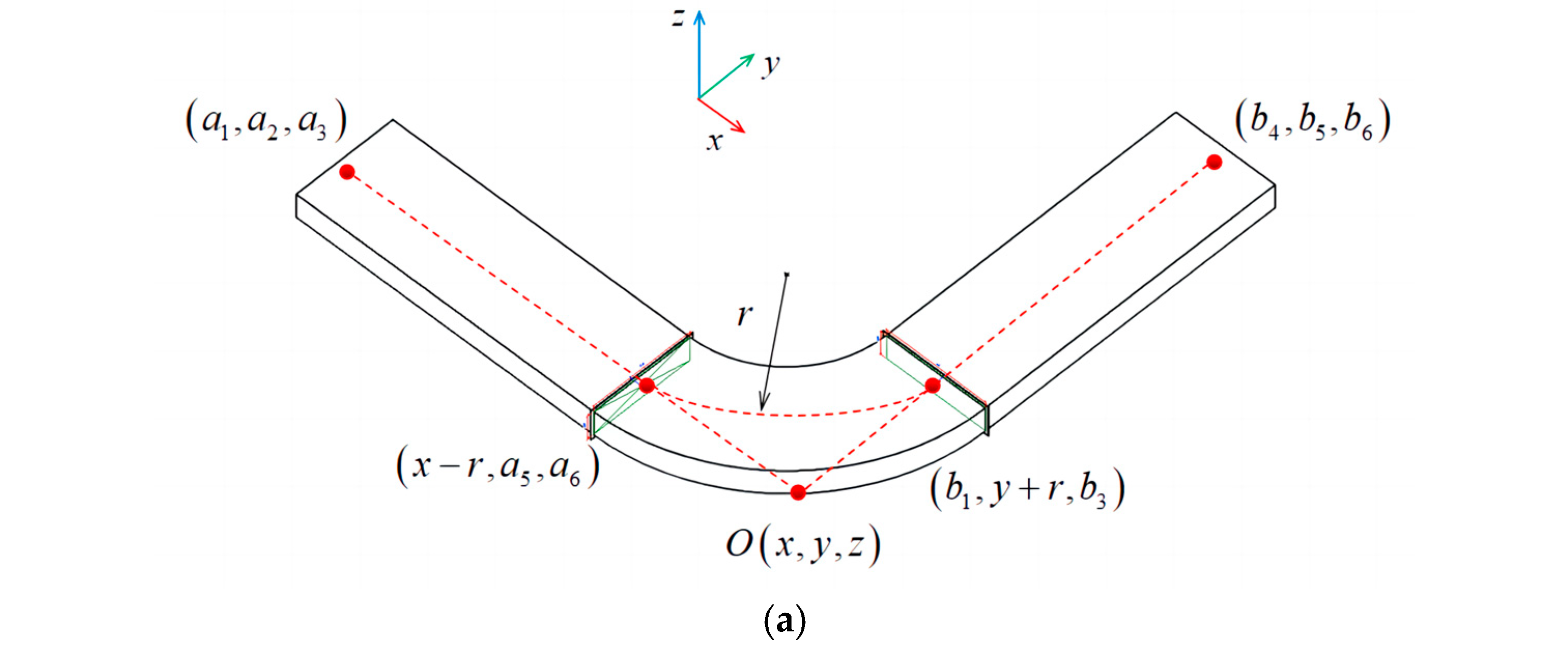
If two pipes are connected by a horizontal elbow, we first extend the central axis of the two pipes. Then, we calculate the intersection of the two center axes, which can be thought of as the center coordinates of the elbow. Next, we correct the endpoint coordinates of the two pipes by analyzing the known radii in Figure 2a. The final coordinate formulas are shown below, where r represents the standard elbow radius from the as-designed model; x and y represent the calculated horizontal elbow center coordinates; and a 5 , a 6 , b 1 and b 3 represent the original endpoint coordinates.
( x r ,   a 5 ,   a 6 )
( b 1 ,   y + r ,   b 3 )
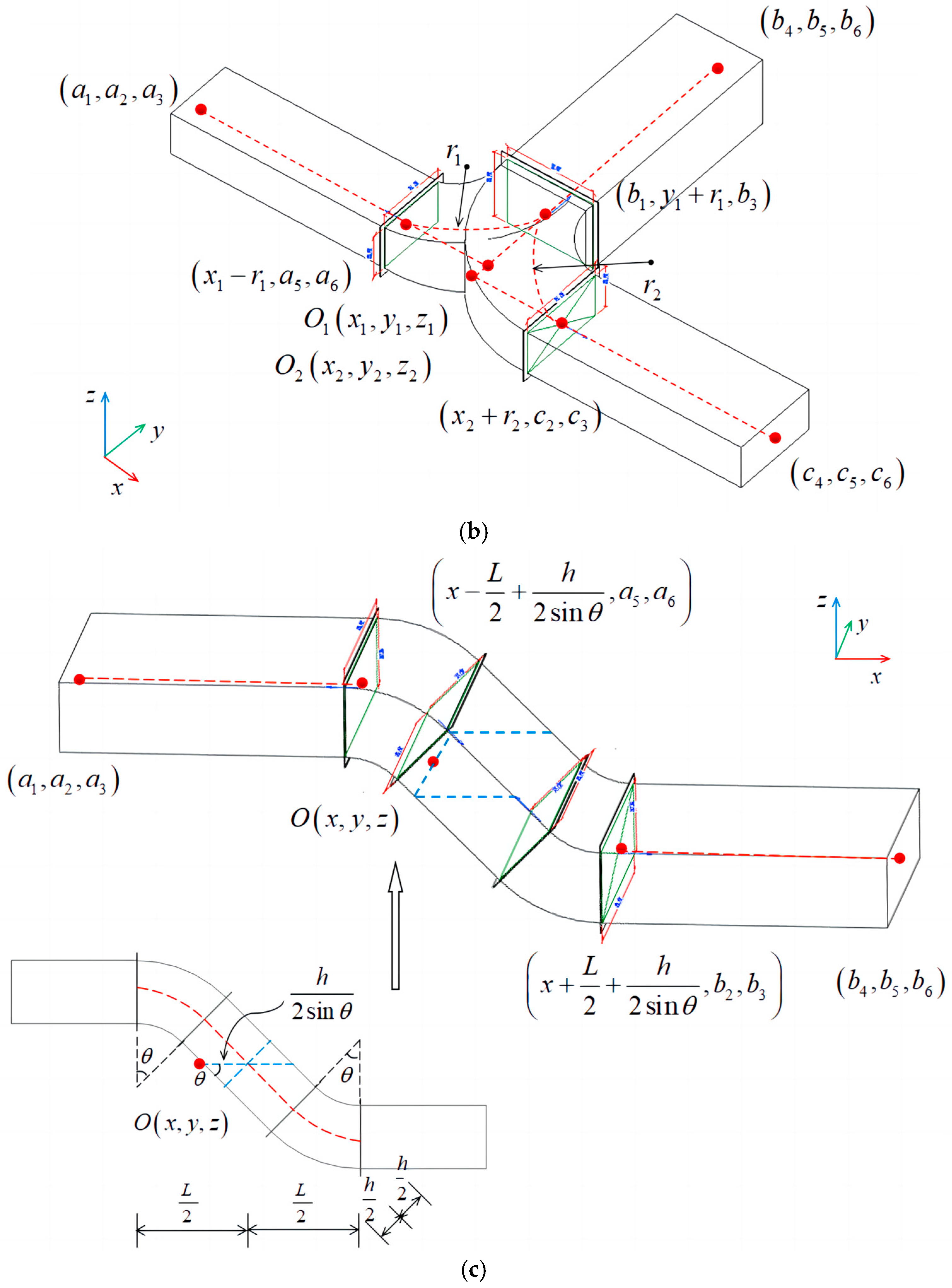
If two pipes are connected by a tee, we first find the three pipe endpoints around the tee and distinguish the three pipes into two main pipes on a straight line and a separate branch pipe. Then, we find the two intersection points of the central axis of the branch pipe and the central axis of each main pipe, respectively. Next, we match the two radii with the intersection and pipe, so the pipe endpoint coordinates are corrected by analyzing the known radii, as shown in Figure 2b. The inference formulas are as follows: r 1 and r 2 are two known radii of the tee in the as-designed model; x 1 , x 2 and y 1 are the calculated center coordinates of the tee; and a 5 , a 6 , b 1 , b 2 , c 2 and c 3 represent the endpoint coordinates.
( x 1 r 1 ,   a 5 ,   a 6 )
( b 1 ,   y 1 + r 1 ,   b 3 )
( x 2 + r 2 ,   c 2 ,   c 3 )
If two pipes are connected by upper and lower elbows, we first calculate the horizontal plane between the upper and lower pipes by deriving the central axis of the two pipes. Then, we exploit the RANSAC algorithm to extract the cuboidal extent of the elbow horizontal section based on the horizontal plane. Next, we extract the line perpendicular to the tube axis at the edges of the horizontal plane and take their midpoints as standard points, as Figure 2c shows. Afterwards, we correct the endpoint coordinates using the formulas. L , h , and θ represent the horizontal distance, height, and curve angle of the upper and lower elbows, respectively, in the as-designed model; x represents the calculated standard coordinate of the elbow; and a 5 , a 6 , b 2 , and b 3 represent the original coordinates.
x L 2 + h 2 s i n θ ,   a 5 ,   a 6
x + L 2 + h 2 s i n θ ,   b 2 ,   b 3
The logical reasoning module processes all detected connections in the pipeline network. For each connection node, the module first retrieves the corresponding connector type and its standard size from the as-designed BIM model, then applies the corresponding reasoning rules, and updates the endpoint coordinates of the pipeline accordingly. When the same pipeline involves multiple corrections, the corrections will be carried out sequentially, and the final coordinates are calculated according to the weighted average of the confidence of each connecting node. This iterative optimization process transmits geometric constraints to the entire network, effectively eliminating the cumulative error.

2.5. 3D BIM Reconstruction

The final stage of the proposed framework aims to bridge the semantic gap between the as-built point cloud data and the as-designed BIM model. The process includes two steps including spatial topology analysis and parametric BIM update. Spatial topology analysis uses the graph theory method to establish a robust two-way mapping relationship between the completed geometric instance and the designed BIM component. On this basis, the parametric BIM update uses this mapping relationship to automatically drive the modification and update of the BIM family through the visual programming interface.

2.5.1. Spatial Topology Analysis

We regard the pipeline components in the BIM model and the point cloud as directed graphs and apply the graph isomorphism analysis with the following rules to generate the component correspondence. Specifically, both the as-designed model and the as-built pipeline point cloud are composed of pipelines and connectors. We can consider them as directed graphs, where vertices represent components and directed edges connect from pipes to connectors.
G r a p h s   G 1 =   V 1 ,   E 1     a n d   G 2 =   V 2 ,   E 2     a r e   i s o m o r p h i c   i f
1 .   t h e r e   i s   a   b i j e c t i o n   f   f r o m   V 1   t o   V 2
2 .   t h e r e   i s   a   b i j e c t i o n   g   f r o m   E 1   t o   E 2   t h a t   m a p s
e d g e     v ,   u     t o     f u ,   f v  
In logical reasoning, we choose a certain connector in the point cloud segmentation results and find the corresponding pipes around it. On this basis, we continue to find the other connectors these pipes connect to and so on in order to generate a directed graph of as-built pipeline point clouds. Nonetheless, we also require a spatial topology relation of the as-designed pipeline BIM model for graph isomorphism. We take the IFC Building Information Model into account, which is derived from the as-designed model, including the relationships of all pipeline components. Then, we generate a directed graph in the same way. In this way, two directed graphs are ready. We apply graph isomorphism [51] to achieve a one-to-one matching relationship table. It is a way to traverse all vertices and directed edges to get the optimal solution. The rules are as follows: V represents vertices, and E represents edges. Through the above method, we get the component mapping relationships for parametric programming.
C = {   V S =   V G ,   A l l   d i f f e r e n t   X V S  
{ A l l o w e d A s s i g n m e n t s   X v 1 ,   X v 2 ,   E G :     v 1 ,   v 2 E S
{ F o r b i d d e n A s s i g n m e n t s X v 1 ,   X v 2 ,   E G :     v 1 ,   v 2 E S

2.5.2. Parametric BIM Update

To enable automated updating of the pipeline BIM model, a parameter-driven modeling strategy is adopted across both the design and completion stages.
During the design stage, statistical parameter tables are established according to the pipeline design drawings and modeling specifications. Different pipeline types are categorized based on their geometric characteristics. Rectangular ducts (e.g., ventilation pipelines) are defined by cross-section width, height and axis coordinates, while cylindrical pipelines (e.g., water supply and drainage systems) are characterized by radius and axis parameters. These predefined geometric rules provide a reference framework for subsequent parameter extraction from point-cloud data. Meanwhile, a dedicated parametric family library of pipeline fittings is developed in Revit (version 2021) to accommodate the diversity of component types used in practical MEP installation. Since supplier-provided products and site-fabricated fittings may differ from standard templates, the customized family library ensures that automatically generated BIM components are consistent with real engineering conditions.
At the completion stage, terrestrial laser scanning is used to capture the as-built pipeline environment. After point cloud preprocessing, semantic segmentation, and geometric parameter extraction, spatial topology analysis is conducted to establish correspondence between point cloud instances and components in the as-designed BIM model.
Finally, using the Dynamo (version 2.6) visual programming platform, the extracted geometric parameters and the predefined statistical tables are automatically imported into the BIM environment. Based on the established mapping relationships, corresponding pipeline components are instantiated or updated by assigning parameters such as start coordinates, end coordinates, and size to predefined family templates. Non-geometric attributes, including material specifications, are inherited from the as-designed BIM model. Consequently, the updating process focuses on refining spatial configuration and connectivity, while preserving predefined engineering specifications.

3. Results

To verify the feasibility of our framework, a case study of standard floor A1# of a shopping center was selected for this study. The situation was complicated, because, in a dense area, 16 pipes were heavily occluded, five pipe segments exhibited severe overlap in the scanner view, and eight connectors were partially occluded. In addition, the whole scene contained eight kinds of pipeline components including air pipes, air elbows, air tees, exhaust pipes, exhaust elbows, exhaust tees, water pipes, and water tees. The space in the selected case was very narrow, so the pipelines were dense, and it was difficult to scan and analyze the as-built pipeline. In this practice, the feasibility of our study to update the pipeline BIM model based on the as-built pipeline point cloud and the as-designed model was verified.

3.1. Point Cloud Collection and Processing

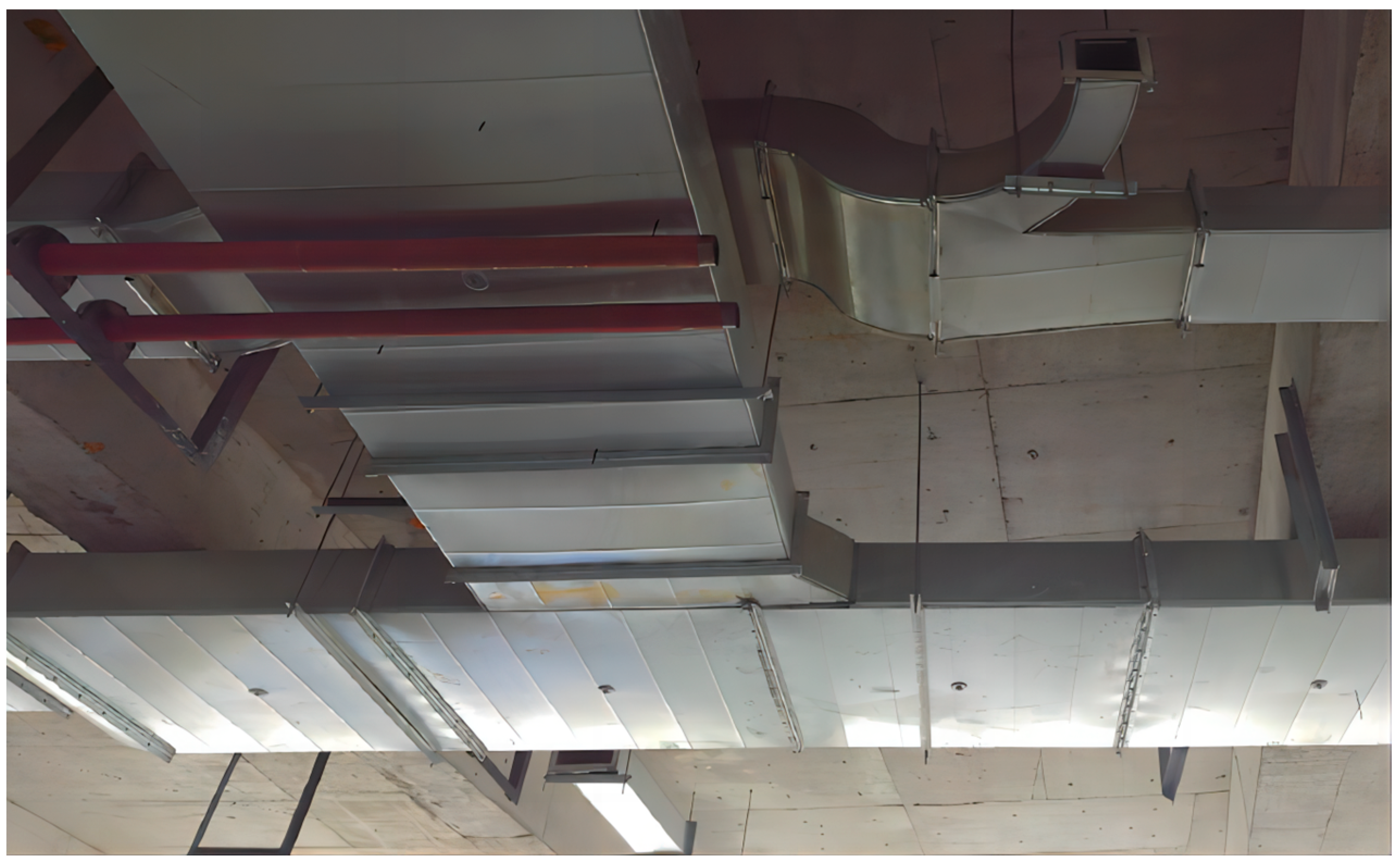
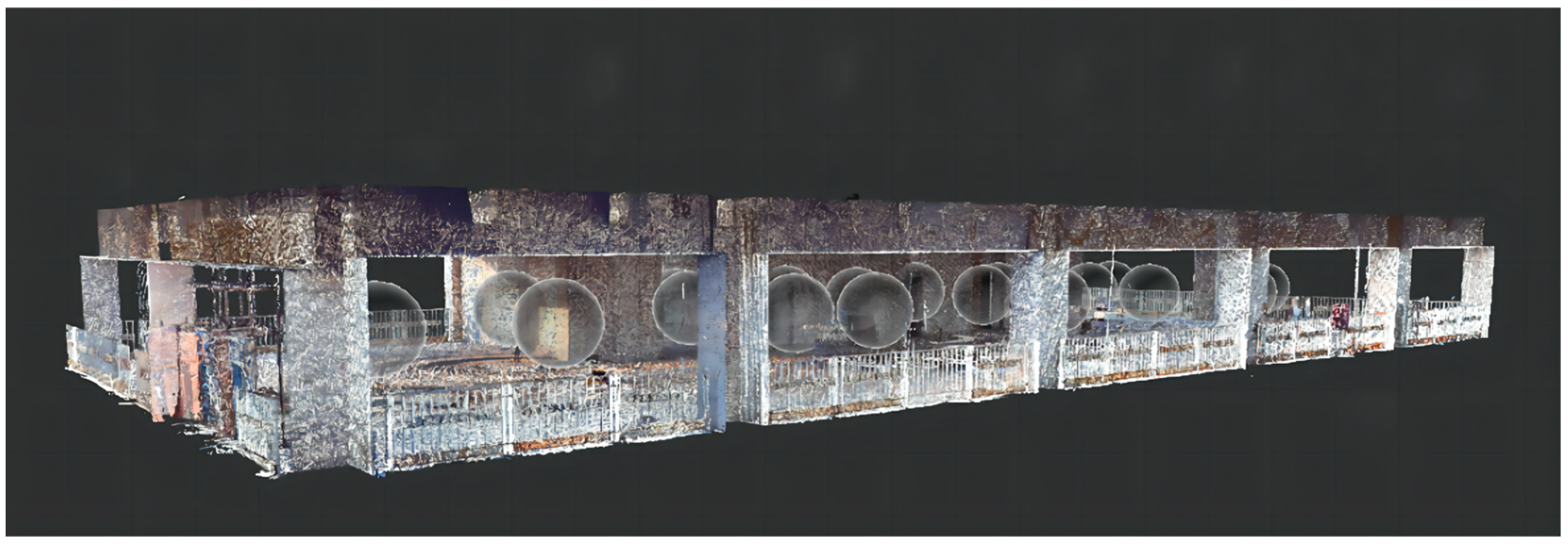
Considering the overall distribution of pipelines at the standard layer in Figure 3, we designed a reasonable station arrangement. We scanned the as-built pipeline site with the Trimble TX5 Scanner, then registered and stitched the point clouds obtained at each station. Figure 4 shows the final point cloud after the multi-station comprehensive combination.
As a first step, we performed voxel down-sampling and statistical filtering algorithms to build a sparse point cloud with little noise. According to the high-density point cloud data output by the scanning device, the grid size was set to 0.01 in voxel down-sampling, the number of neighborhood search points was 20, and the standard deviation multiple was 2 in the statistical filtering algorithm.
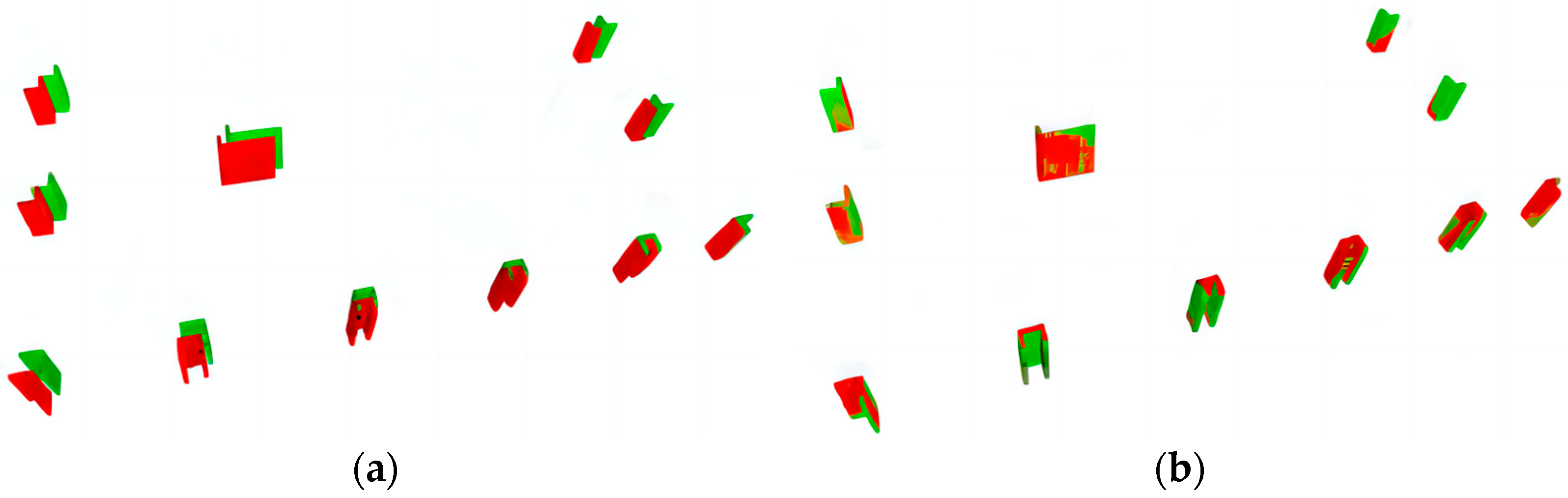
For coordinate alignment, we manually separated the point cloud into walls, columns, and pipes. Walls and columns were assumed to be strictly installed according to the design drawings, so we could use them to obtain the transformation matrix between the point cloud and the as-designed BIM model. We first converted the as-designed BIM model into the surface point clouds of walls and columns. They were then registered with the as-built pipeline point cloud by collaborative methods including FGR coarse registration and ICP fine registration. Combined with the thresholds in the previous study [52], it was observed that the registration targets were relatively scattered and required a highly accurate registration result. So, we decided that the distance threshold for FGR was 0.2, the distance threshold for ICP was 2, and the number of iterations was 1000. Figure 5a shows the results of FGR, and Figure 5b shows the results of ICP after FGR. The experiment showed that ICP fine registration and FGR coarse registration were more effective. The Root Mean Square Error (RMSE) between the original point cloud and the target point cloud was 0.16 m after FGR, which was reduced to 9.97 × 10⁻³ m after ICP on the basis of FGR. At this point, we obtained the sparse pipeline point cloud and coordinate system transformation matrix for the following stage.

3.2. Point Cloud Segmentation

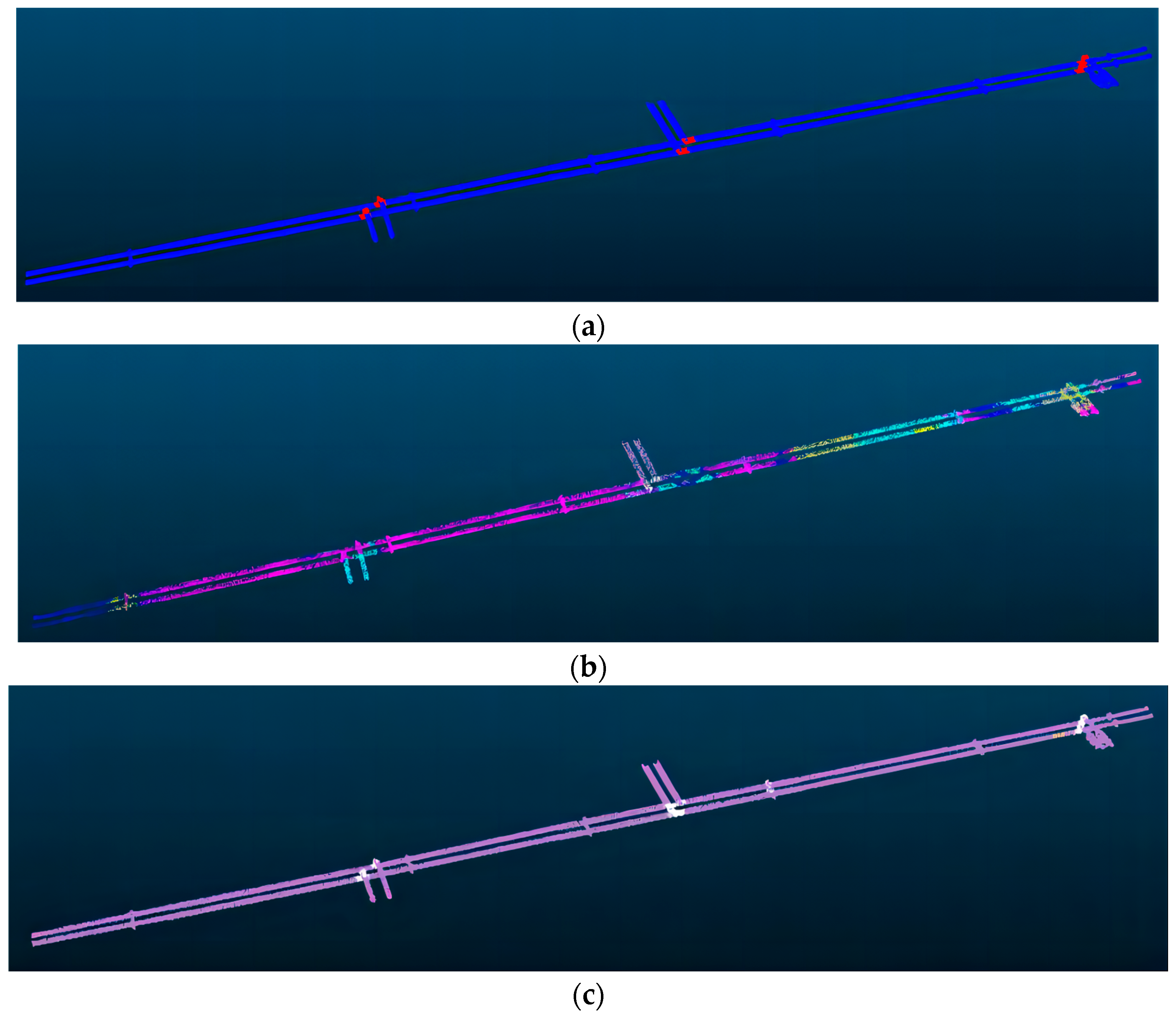
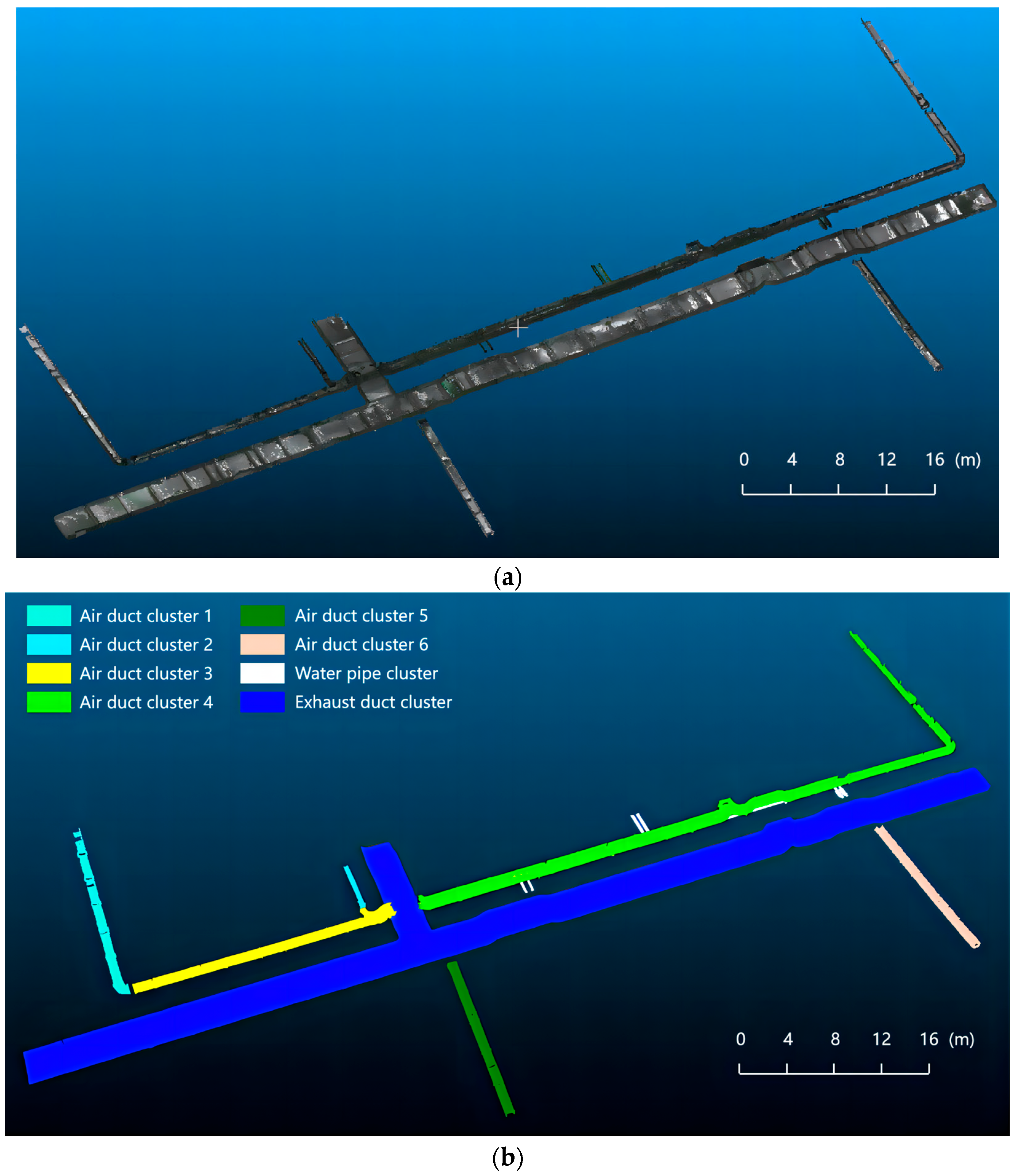
Before the PointNeXt semantic segmentation, we first performed the DBSCAN clustering algorithm on the registered as-built pipeline point cloud to effectively separate the complex pipelines into different instances, which could distinguish pipelines with large size distances well. This was a prominent innovation in point cloud segmentation in complex pipeline scenes. Considering the point density and pipeline characteristics, the sample neighborhood of the DBSCAN algorithm was 0.025, and the threshold for the sample number of the neighborhood was 20. The input point cloud and preliminary segmentation results are shown in Figure 6. The point cloud was divided into eight parts, and 1185 noise points were filtered out. As illustrated in Figure 6b, different colors represent distinct pipeline clusters, including multiple air duct branches, a water pipe cluster, and an exhaust duct cluster, as indicated in the legend. This instance-level clustering effectively separates adjacent pipeline runs in the dense MEP environment and provides a clear spatial basis for subsequent fine semantic segmentation.
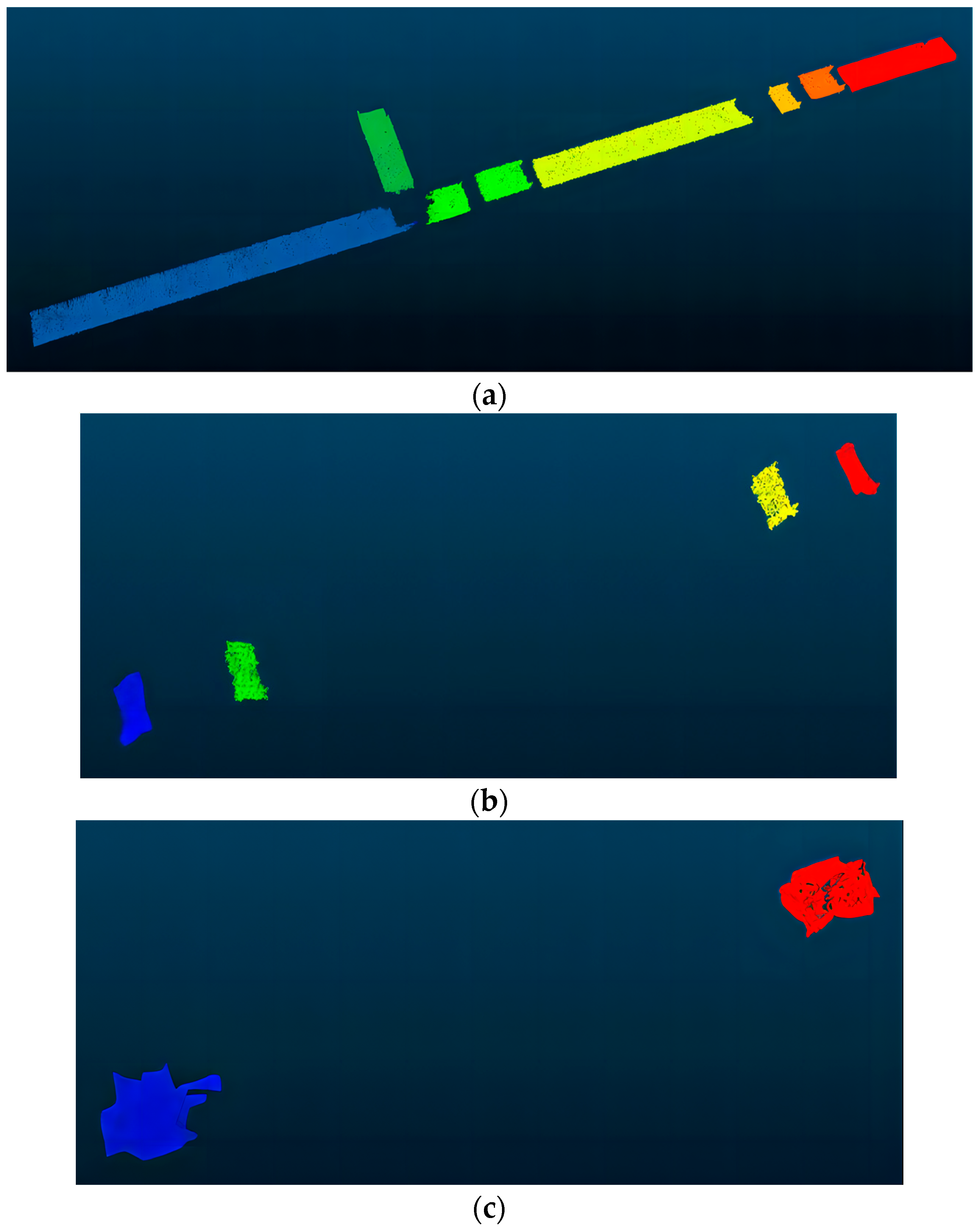
After testing a large number of parameter value combinations, for PointNeXt, we referred to related research [21] and analyzed the dense and complex characteristics of the pipeline. Finally, we configured the AdamW optimizer with the following settings: batch_size = 16; learning_rate = 0.001; max_epoch = 800; and weight_decay = 1 × 10⁻⁴. The overall accuracy of the PointNeXt network performance could be assessed at 95.85%. The final segmentation results of water pipelines are shown in Figure 7. By comparing Figure 7b with Figure 7c, it is evident that the proposed method incorporating DBSCAN significantly reduces noise and misclassification in complex boundary areas. While the standard PointNeXt struggles to distinguish adjacent small fittings from main pipes due to scale variance, our method successfully preserves the geometric integrity of elbows and tees, resulting in sharper and more consistent segmentation boundaries.

3.3. Geometry Parameter Extraction

In this practice, diverse types of components varied widely in size. We used corresponding DBSCAN parameters to segment pipeline instances into different components for parameter extraction. Then, we carried out the PointNeXt semantic segmentation for each pipeline instance to achieve the ideal segmentation of pipeline components. Figure 8 shows the case instance segmentation results of exhaust pipelines.
Furthermore, the target extraction geometric parameters were endpoint coordinates and section dimensions. In detail, we divided the pipes into cuboidal pipes and cylindrical pipes. For cuboidal pipes, which mainly referred to exhaust pipes and air pipes, we exploited the RANSAC algorithm to obtain three plane equations of pipes by setting the minimum sample number in RANSAC to 3. For exhaust pipes, model parameters included the distance threshold of 0.025, the interior point threshold of 1000, the initial iteration of 10,000, and the model accuracy of 0.99. For air pipes, model parameters included the distance threshold of 0.02, the interior point threshold of 1000, the initial iteration of 10,000, and the model accuracy of 0.99. Thus, three plane equations were obtained for each pipe, while further procedures were required to calculate the specific parameters. Noise was unavoidable due to measurement errors and the occlusions of point clouds. Therefore, we considered the maximum length and height as section dimensions through the oriented bounding box algorithm, and the width referred to the distance between two planes. For cylindrical pipes, especially water pipes, we directly utilized the RANSAC algorithm for cylindrical fitting, setting the distance threshold to 0.005 and the number of iterations to 2000. As a consequence, it was simple to obtain approximate endpoint coordinates and section dimensions.
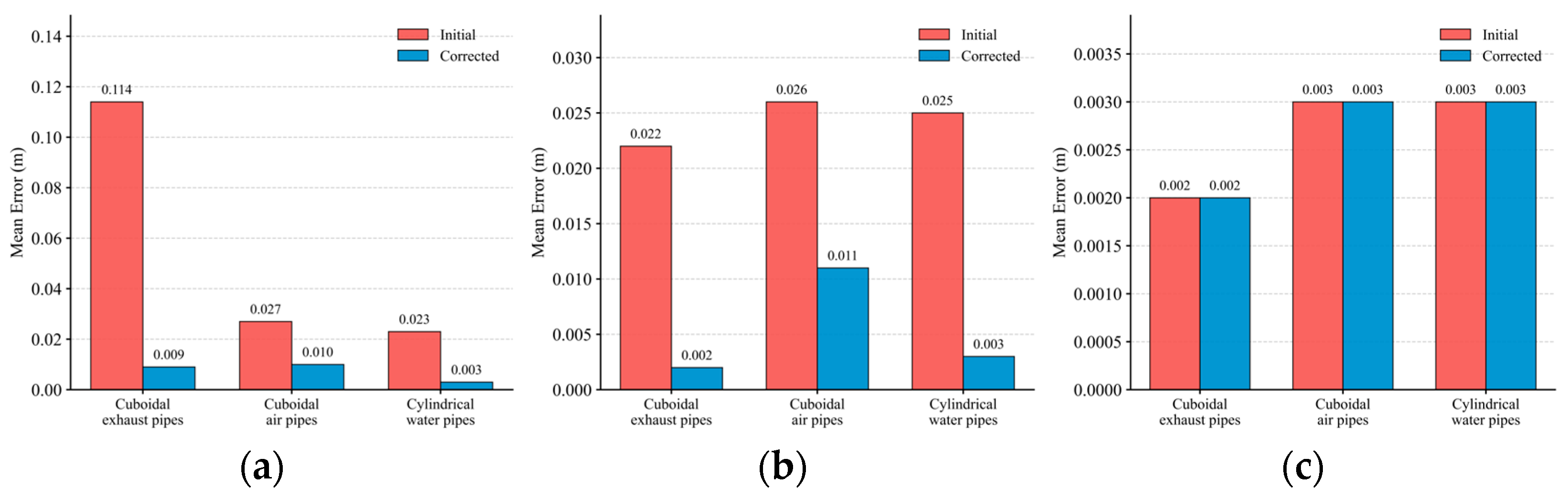
However, the pipes were not aligned with the adjacent connectors because the extraction was only based on a single pipe in the conventional method. As a result, logical reasoning is performed to correct pipe endpoints by analyzing the relationships between pipes and connectors. This step focused on the known parameters of pipeline connectors, which were exploited to correct pipe coordinates through mathematical calculation and logical analysis. The spatial coordinate errors, especially the errors in x and y directions, were significantly reduced, as shown in Table 3. This demonstrates that applying logical reasoning based on the as-designed model significantly improved the accuracy of the pipeline coordinates and also enabled the complete connection between components.

3.4. 3D BIM Reconstruction

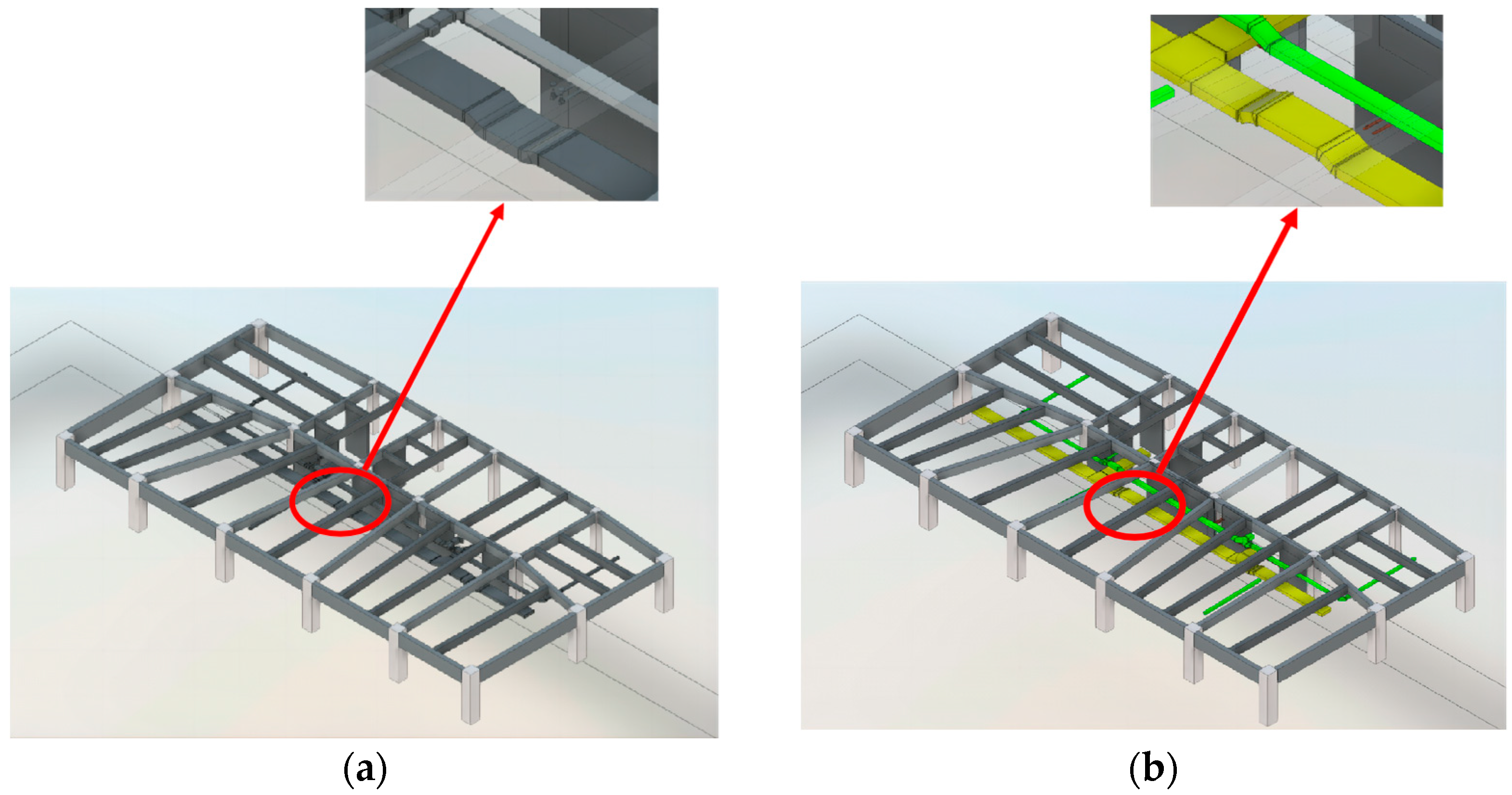
To generate one-to-one matching relationships between components in the model and point cloud instances, graph isomorphism was applied. Firstly, we prepared two graphs for the directed graphs. One of the graphs was the as-built pipeline point cloud obtained by logical reasoning, and the other was obtained from the as-designed BIM model. Then, we executed graph isomorphism analysis to generate the correspondence of components and subsequently updated the model by changing parameter values. This mechanism enables efficient parameter updating, which could also be used for future MEP management. As shown in Figure 9, discrepancies between the actual installation of pipelines and the original design layout are evident. The updated as-built BIM model corrects these deviations, which can be clearly observed in the magnified regions. In Figure 9b, the highlighted yellow and green elements represent MEP components and are used to distinguish them from the structural framework while illustrating the updated pipeline positions.

3.5. Modeling Efficiency and Precision

Engineering practice has verified the high modeling efficiency of the proposed framework. Manual modeling required 3–5 days to complete the pipeline system, while the automated approach accomplished the same work in just three hours. When analyzing a large number of areas, the framework could provide powerful support for the construction of MEP-integrated management systems.
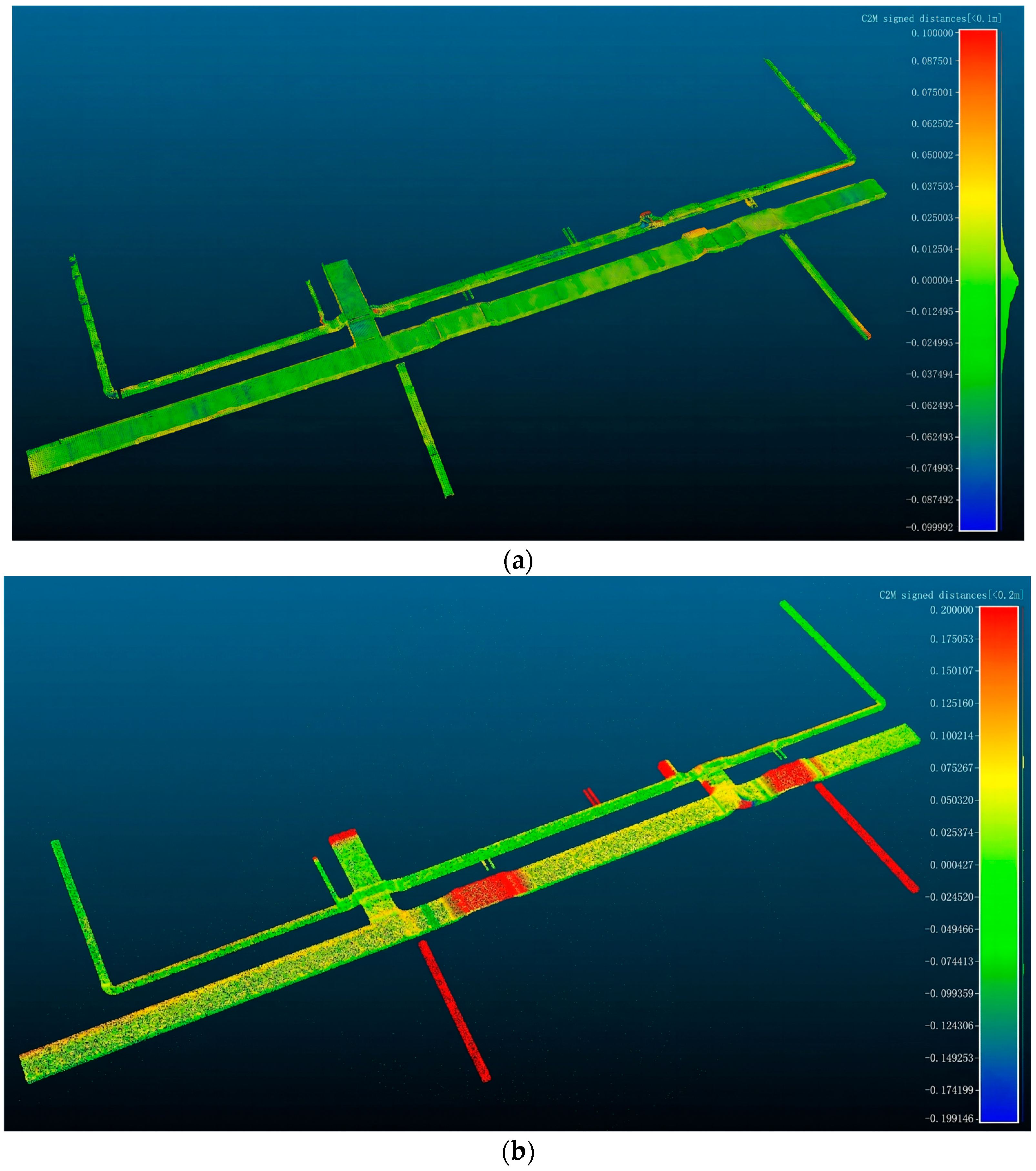
The updated BIM model, through parametric modeling, closely matched the laser scanning point cloud, as shown in Figure 10a. The red threshold is set to an error greater than 0.1 to indicate the point cloud deviation. In general, point cloud deviations followed a normal distribution. A deviation of more than 90% of the points was less than 0.03 m, and the average deviation was only 0.0046 m. For the MEP-integrated management platform, an error for the updated BIM model was acceptable within 2%, according to industry standards [53], so we believe that the updated BIM model for our framework can meet the requirement of MEP systems.

4. Discussion

4.1. Discussion of Results

4.1.1. Pipeline Components Segmentation

Through comparison with the direct slicing method [6] and the fused method [54], we proposed a targeted pipeline point cloud segmentation approach especially for pipes and connectors, with high segmentation accuracy in MEP scenarios. We innovatively apply DBSCAN to initially segment different pipelines before PointNeXt instance segmentation. DBSCAN was utilized to distinguish pipeline instances with large differences in size preliminarily, and then PointNeXt was introduced for precise component segmentation. This integrated point cloud segmentation approach enabled small-sized pipelines to not be overlooked in the PointNeXt process. During training, we fortified the dataset, preparing 1070 training component point clouds and 286 test pipeline components.
To quantitatively evaluate the semantic segmentation performance, the predicted labels generated by the PointNeXt model were compared with manually annotated ground truth labels in the test dataset. Standard evaluation metrics, including precision, recall, and IoU, were calculated for each pipeline component category. In addition, average values across all categories were computed to reflect the overall segmentation performance of the model. To further verify the effectiveness of the proposed coarse-to-fine segmentation strategy, comparative experiments were conducted under identical training settings using PointNeXt with and without the DBSCAN preprocessing step. The results are summarized in Table 4. As shown in Table 4, the precision, recall, and IoU of point cloud PointNeXt segmentation with DBSCAN have been greatly improved, showing the obvious value of the DBSCAN initial segmentation.
A c c u r a c y = T P + T N T P + T N + F P + F N
P r e c i s i o n = T P T P + F P
R e c a l l = T P T P + F N
I o U = A B A B
where TP = correctly labeled points; TN = correctly unlabeled points; FP = incorrectly labeled points; FN = incorrectly unlabeled points; A = prediction area; and B = true area.

4.1.2. Parameter Extraction

It could be seen that the point cloud segmentation accuracy of pipes was not very high, so we could not directly update the pipeline BIM model. In this section, we adopted a novel parameter extraction method for pipeline point clouds, which included preliminary RANSAC extraction and logical reasoning correction. In the first stage, we exploited the RANSAC algorithm as a method for the approximate extraction of pipeline endpoints, but this was obviously not accurate enough for some components. Therefore, we utilized logical reasoning to correct the coordinates by analyzing the connection relationship between pipes and connectors on the basis of the connector’s geometric information in as-designed models. We compared the results and found that the average coordinate errors in the initial x and y directions dropped from 0.055 m and 0.024 m to only 0.007 m and 0.005 m (Figure 11). Compared to the deviation of 0.025 m reported in a past study [6], our framework’s superiority of logical reasoning was quite obvious. In general, the errors in all directions were less than 0.01 m, which allowed us to obtain a satisfactory modeling accuracy.

4.1.3. Modeling Efficiency

In engineering instances, workers typically use time-consuming manual modeling methods to update pipeline parameters. We tested and compared the time cost of manual modeling against our framework. Thus, we proved that the efficiency has been greatly improved. The modeling time cost was reduced from 3–5 days to just 3 h, and the modeling error was only 0.013%. The results demonstrate the effectiveness of the proposed updating strategy for the pipeline BIM model, which was new progress for scan-to-BIM in pipeline scenarios.

4.2. Comparison with Other Methods

Recent advances in scan-to-BIM research have explored transformer-based point cloud segmentation architectures, which improve global feature modeling and contextual understanding in large-scale scenes. However, their computational complexity and memory requirements may limit their applicability in dense indoor MEP environments with severe occlusions and scale imbalances.
In addition, several studies have proposed end-to-end BIM reconstruction pipelines that attempt to directly generate parametric models from raw point cloud data. Although such approaches show promising automation potential, they often rely on large-scale annotated datasets and may struggle to guarantee geometric connectivity and engineering interpretability.
In contrast, the proposed framework adopts a hybrid strategy that integrates instance-level segmentation, geometric reasoning, and topology-driven BIM updating using prior design information. This design improves robustness in cluttered pipeline scenarios while maintaining modeling efficiency and parametric consistency.

4.3. Generalizability and Application

Although the proposed framework is validated through a case study in a dense indoor MEP environment, its methodological design exhibits potential generalizability to a wider range of engineering scenarios. The hybrid knowledge–data-driven strategy allows the framework to adapt to different pipeline configurations, installation conditions, and scanning resolutions by integrating both geometric observations and prior BIM information. This characteristic is particularly important for practical applications where construction environments vary significantly in spatial complexity and data completeness.
From an engineering perspective, the framework can be extended to larger-scale projects, such as multi-floor commercial buildings or industrial facilities, provided that appropriate data management and hierarchical processing strategies are adopted. By decomposing large scenes into manageable spatial units and maintaining topology consistency across zones, the proposed approach can support efficient model updating in extensive pipeline networks.
Furthermore, the ability to automatically synchronize as-built conditions with BIM models has important implications for facility lifecycle management. Updated BIM models can serve as reliable information carriers for maintenance scheduling, performance monitoring and asset management. In addition, the integration of periodically acquired point cloud data with parametric BIM updates provides a technical pathway for developing dynamic digital twin systems, enabling more responsive and data-driven building operation strategies.

4.4. Limitations and Future Work

Despite the promising performance demonstrated in this study, several limitations should be acknowledged. First, the accuracy of the proposed framework still depends on the quality and completeness of laser-scanned point cloud data. In environments with severe occlusions, narrow installation spaces, or limited scanning accessibility, incomplete geometric observations may affect the stability of semantic segmentation and parameter inference.
Second, the current method relies on the availability of an as-designed BIM model to provide geometric dimensions and connectivity constraints for logical reasoning-based parameter refinement. In scenarios such as renovation projects or legacy buildings, where design information is missing or outdated, the effectiveness of the framework may be reduced. Future research may explore data-driven topology inference methods or probabilistic reasoning approaches to alleviate this dependency.
Third, when applied to large-scale engineering projects, challenges related to computational efficiency and data integration may arise. The processing of massive point cloud datasets and the maintenance of consistent topological mapping across multiple spatial zones require further methodological development. Cloud-based computing strategies and hierarchical scene modeling may offer promising solutions to improve scalability.
Future work will also focus on enhancing the adaptability of the framework to more diverse MEP component types, including irregular connectors and concealed pipelines embedded within structural elements. In addition, integrating real-time sensing technologies and automated data acquisition workflows could further support continuous BIM updating and facilitate the practical implementation of digital twin systems in smart facility management.

5. Conclusions

The MEP-integrated management system based on BIM models has practical significance in construction projects; it is vital to update the as-built pipeline information for the BIM model. Aiming at the cumbersome method of manual modeling and the complexity of extracting pipeline parameters from point clouds, we propose a novel scan-to-BIM framework that effectively addresses bottlenecks in MEP pipeline modeling by integrating established algorithms with prior design knowledge. The primary achievement of this research lies in transforming traditional data-driven fitting into a robust, closed-loop automated workflow that ensures both geometric precision and semantic consistency.
The experimental results from the complex case study validate the effectiveness of our technical innovation. First, the coarse-to-fine semantic strategy, which utilizes DBSCAN as a spatial focus mechanism before PointNeXt classification, successfully overcomes the challenge of scale imbalance in dense environments. This approach prevents small fittings from being overwhelmed by massive pipe sections, significantly improving the average IoU from 48.25% to 74.45%. Second, the introduction of logic-based coordinate refinement leveraging as-designed BIM priors proves to be superior to purely data-driven methods in handling sensor noise and occlusions. By treating the MEP system as a constrained network, the framework reduced spatial coordinate errors to within 0.007 m, achieving a level of precision necessary for reliable facility management. Finally, the graph isomorphism-based topological mapping bridges the semantic gap between unstructured scans and structured models. This mapping enables the automated update of parametric BIM families through visual programming, effectively reducing the total modeling time from 3–5 days to approximately 3 h, which is instrumental for MEP-integrated management.
Beyond methodological contributions, the proposed framework has important practical implications for engineering applications. Automated synchronization between as-built pipeline conditions and BIM models can enhance the reliability of lifecycle information management, supporting maintenance planning, asset monitoring, and so on in facility management. Furthermore, the integration of periodic laser scanning with automated BIM updating provides a feasible pathway toward dynamic digital twin implementation in building environments. By enabling continuous alignment between physical assets and their digital representations, the proposed approach can contribute to more intelligent and data-driven infrastructure management systems.
In the future, there is still room for improvement to further advance this scan-to-BIM framework. First, we can strengthen the dataset by collecting more pipelines from engineering practices. This can significantly improve the efficiency and enhance the robustness of the model in different scenarios. In addition, we have not considered the pipelines which are inside the walls. If a section of a pipeline is in a secondary structure, it is difficult for us to update their parameters well. Afterwards, we can supplement certain algorithms for logical reasoning to infer the position of hidden pipelines. In addition, it is necessary to optimize the parametric modeling process such as modeling special-shaped connectors, enriching the accessory family library, which can be continuously improved with the application of the framework. Although there is still room for improvement in some aspects, it has significantly improved the update efficiency of the pipeline BIM model and played an important role in promoting MEP management.

Author Contributions

Conceptualization, X.W. and B.Y.; methodology, X.W. and B.Y.; software, X.W.; validation, X.W., B.Y. and T.L.; formal analysis, X.W.; investigation, X.W.; resources, B.Y.; data curation, T.L.; writing—original draft preparation, X.W.; writing—review and editing, B.Y.; visualization, X.W. and T.L.; supervision, B.Y.; project administration, B.Y.; funding acquisition, B.Y. All authors have read and agreed to the published version of the manuscript.

Funding

This research received no external funding.

Data Availability Statement

The raw data supporting the conclusions of this article will be made available by the authors on request.

Acknowledgments

During the preparation of this work, the authors used Gemini 3 Pro and ChatGPT 5.3 to improve readability and language. After using this tool, the authors reviewed and edited the content as needed and take full responsibility for the content of the publication.

Conflicts of Interest

The authors declare no conflicts of interest.

Abbreviations

The following abbreviations are used in this manuscript:
BIMBuilding Information Modeling
MEPMechanical, Electrical and Plumbing
AECArchitecture, Engineering and Construction
IoTInternet of Things
DBSCANDensity-Based Spatial Clustering of Applications with Noise
RANSACRandom Sample Consensus
SORStatistical Outlier Removal
FGRFast Global Registration
FPFHFast Point Feature Histograms
ICPIterative Closest Point
RMSERoot Mean Square Error
HVACHeating, Ventilation, and Air Conditioning
IFCIndustry Foundation Classes
GUIDGlobal Unique Identifier
DFSDepth-First Search
IoUIntersection over Union
MAEMean Absolute Error
DGCNNDynamic Graph Convolutional Neural Network
SLAMSimultaneous Localization and Mapping

References

  1. Chen, Y.; Luo, X. Indoor Scan-to-BIM Workflows: Progress, Challenges, and Future Directions (2014–2024). Autom. Constr. 2026, 181, 106578. [Google Scholar] [CrossRef]
  2. Valero, E.; Bosché, F.; Bueno, M. Laser Scanning for BIM. ITcon 2022, 27, 486–495. [Google Scholar]
  3. Baqersad, J.; Poozesh, P.; Niezrecki, C.; Avitabile, P. Photogrammetry and Optical Methods in Structural Dynamics—A Review. Mech. Syst. Signal Process. 2017, 86, 17–34. [Google Scholar] [CrossRef]
  4. Zbirovský, S.; Nežerka, V. Open-Source Automatic Pipeline for Efficient Conversion of Large-Scale Point Clouds to IFC Format. Autom. Constr. 2025, 177, 106303. [Google Scholar] [CrossRef]
  5. Patil, A.K.; Holi, P.; Lee, S.K.; Chai, Y.H. An Adaptive Approach for the Reconstruction and Modeling of As-Built 3D Pipelines from Point Clouds. Autom. Constr. 2017, 75, 65–78. [Google Scholar] [CrossRef]
  6. Wang, B.; Yin, C.; Luo, H.; Cheng, J.C.P.; Wang, Q. Fully Automated Generation of Parametric BIM for MEP Scenes Based on Terrestrial Laser Scanning Data. Autom. Constr. 2021, 125, 103615. [Google Scholar] [CrossRef]
  7. Li, X.; Gan, V.J.L.; Li, K.; Li, M. High-Precision 3D BIM Reconstruction for Mechanical, Electrical and Plumbing Components Using Terrestrial Laser Scanning and LiDAR Point Clouds. J. Build. Eng. 2025, 112, 113661. [Google Scholar]
  8. Patil, J.; Kalantari, M. Automatic Scan-to-BIM—The Impact of Semantic Segmentation Accuracy. Buildings 2025, 15, 1126. [Google Scholar]
  9. Jing, S.; Cha, G.; Maru, M.B.; Yu, B.; Park, S. Improved Building MEP Systems Semantic Segmentation in Point Clouds Using a Novel Multi-Class Dataset and Local–Global Vector Transformer Network. J. Build. Eng. 2024, 96, 110311. [Google Scholar] [CrossRef]
  10. Armeni, I.; Sax, S.; Zamir, A.R.; Savarese, S. Joint 2D-3D-Semantic Data for Indoor Scene Understanding. arXiv 2017, arXiv:1702.01105. [Google Scholar]
  11. Sun, Y.; Zhang, X.; Miao, Y. A Review of Point Cloud Segmentation for Understanding 3D Indoor Scenes. Vis. Intell. 2024, 2, 14. [Google Scholar] [CrossRef]
  12. Xie, Y.; Tian, J.; Zhu, X.X. Linking Points with Labels in 3D: A Review of Point Cloud Semantic Segmentation. IEEE Geosci. Remote Sens. Mag. 2020, 8, 38–59. [Google Scholar] [CrossRef]
  13. Vosselman, G.; Gorte, B.G.; Sithole, G.; Rabbani, T. Recognising structure in laser scanner point clouds. Int. Arch. Photogramm. Remote Sens. Spat. Inf. Sci. 2004, 46, 33–38. [Google Scholar]
  14. Guo, Y.; Wang, H.; Hu, Q.; Liu, H.; Liu, L.; Bennamoun, M. Deep learning for 3d point clouds: A survey. IEEE Trans. Pattern Anal. Mach. Intell. 2020, 43, 4338–4364. [Google Scholar] [CrossRef] [PubMed]
  15. Qi, C.R.; Su, H.; Mo, K.; Guibas, L.J. Pointnet: Deep learning on point sets for 3d classification and segmentation. In Proceedings of the IEEE Conference on Computer Vision and Pattern Recognition (CVPR 2017), Honolulu, HI, USA, 21–26 July 2017; pp. 652–660. [Google Scholar]
  16. Qi, C.R.; Yi, L.; Su, H.; Guibas, L.J. Pointnet++: Deep hierarchical feature learning on point sets in a metric space. In Proceedings of the 31st International Conference on Neural Information Processing Systems (NIPS 2017), Long Beach, CA, USA, 4–9 December 2017; pp. 5099–5108. [Google Scholar]
  17. Agapaki, E.; Brilakis, I. CLOI-NET: Class segmentation of industrial facilities’ point cloud datasets. Adv. Eng. Inform. 2020, 45, 101121. [Google Scholar] [CrossRef]
  18. Yin, C.; Wang, B.; Gan, V.J.L.; Wang, M.; Cheng, J.C.P. Automated semantic segmentation of industrial point clouds using ResPointNet++. Autom. Constr. 2021, 130, 103874. [Google Scholar] [CrossRef]
  19. Wang, Y.; Sun, Y.; Liu, Z.; Sarma, S.E.; Bronstein, M.M.; Solomon, J.M. Dynamic graph cnn for learning on point clouds. ACM Trans. Graph. 2019, 38, 146. [Google Scholar] [CrossRef]
  20. Zhao, H.; Jiang, L.; Jia, J.; Torr, P.H.S.; Koltun, V. Point transformer. In Proceedings of the IEEE/CVF International Conference on Computer Vision (ICCV), Montreal, QC, Canada, 10–17 October 2021; pp. 16259–16268. [Google Scholar]
  21. Qian, G.; Li, Y.; Peng, H.; Mai, J.; Hammoud, H.; Elhoseiny, M.; Ghanem, B. PointNeXt: Revisiting PointNet++ with Improved Training and Scaling Strategies. Adv. Neural Inf. Process. Syst. 2022, 35, 23192–23204. [Google Scholar]
  22. Lai, X.; Liu, J.; Jiang, L.; Wang, L.; Zhao, H.; Liu, S.; Qi, X.; Jia, J. Stratified transformer for 3d point cloud segmentation. In Proceedings of the IEEE/CVF Conference on Computer Vision and Pattern Recognition (CVPR), New Orleans, LA, USA, 18–24 June 2022; pp. 8500–8509. [Google Scholar]
  23. Son, H.; Kim, C.; Kim, C. Fully Automated As-Built 3D Pipeline Extraction Method from Laser-Scanned Data Based on Curvature Computation. J. Comput. Civ. Eng. 2015, 29, B4014003. [Google Scholar] [CrossRef]
  24. Zhang, Z.; Sabuncu, M. Generalized cross entropy loss for training deep neural networks with noisy labels. In Proceedings of the Advances in Neural Information Processing Systems (NeurIPS), Montreal, QC, Canada, 3–8 December 2018; Volume 31, pp. 8778–8788. [Google Scholar]
  25. Yue, H.; Wang, Q.; Yan, Y.; Huang, G. Deep Learning-Based Point Cloud Completion for MEP Components. Autom. Constr. 2025, 175, 106218. [Google Scholar] [CrossRef]
  26. Yue, H.; Wang, Q.; Huang, H.; Xia, X.; Fang, H.; Cheng, J.C.P. Enhancing Semantic Segmentation of MEP Scenes with Deep Learning and BIM-Generated Synthetic Point Clouds. Adv. Eng. Inform. 2025, 68, 103723. [Google Scholar] [CrossRef]
  27. Xu, X.; Lee, G.H. Weakly Supervised Semantic Point Cloud Segmentation: Towards 10× Fewer Labels. In Proceedings of the 2020 IEEE/CVF Conference on Computer Vision and Pattern Recognition (CVPR), Seattle, WA, USA, 13–19 June 2020; IEEE: New York, NY, USA, 2020; pp. 13703–13712. [Google Scholar]
  28. Hou, J.; Graham, B.; Niesner, M.; Xie, S. Exploring Data-Efficient 3D Scene Understanding with Contrastive Scene Contexts. In Proceedings of the 2021 IEEE/CVF Conference on Computer Vision and Pattern Recognition (CVPR), Nashville, TN, USA, 20–25 June 2021; IEEE: New York, NY, USA, 2021; pp. 15582–15592. [Google Scholar]
  29. Chen, K.; Lu, W.; Peng, Y.; Rowlinson, S.; Huang, G.Q. Bridging BIM and Building: From a Literature Review to an Integrated Conceptual Framework. Int. J. Proj. Manag. 2015, 33, 1405–1416. [Google Scholar] [CrossRef]
  30. Maalek, R.; Lichti, D.D.; Ruwanpura, J.Y. Automatic Recognition of Common Structural Elements from Point Clouds for Automated Progress Monitoring and Dimensional Quality Control in Reinforced Concrete Construction. Remote Sens. 2019, 11, 1102. [Google Scholar] [CrossRef]
  31. Schubert, E.; Sander, J.; Ester, M.; Kriegel, H.P.; Xu, X. DBSCAN Revisited, Revisited: Why and How You Should (Still) Use DBSCAN. ACM Trans. Database Syst. 2017, 42, 19. [Google Scholar] [CrossRef]
  32. Landrieu, L.; Simonovsky, M. Large-Scale Point Cloud Semantic Segmentation with Superpoint Graphs. In Proceedings of the 2018 IEEE/CVF Conference on Computer Vision and Pattern Recognition, Salt Lake City, UT, USA, 18–23 June 2018; IEEE: New York, NY, USA, 2018; pp. 4558–4567. [Google Scholar]
  33. Wang, L.; Huang, Y.; Hou, Y.; Zhang, S.; Shan, J. Graph Attention Convolution for Point Cloud Semantic Segmentation. In Proceedings of the 2019 IEEE/CVF Conference on Computer Vision and Pattern Recognition (CVPR), Long Beach, CA, USA, 15–20 June 2019; IEEE: New York, NY, USA, 2019; pp. 10288–10297. [Google Scholar]
  34. Schnabel, R.; Wahl, R.; Klein, R. Efficient RANSAC for Point-Cloud Shape Detection. Comput. Graph. Forum 2007, 26, 214–226. [Google Scholar]
  35. Kalasapudi, V.S.; Turkan, Y.; Tang, P. Toward Automated Spatial Change Analysis of MEP Components Using 3D Point Clouds and As-Designed BIM Models. In Proceedings of the 2014 2nd International Conference on 3D Vision, Tokyo, Japan, 8–11 December 2014; IEEE: New York, NY, USA, 2014; pp. 145–152. [Google Scholar]
  36. Bosché, F.; Ahmed, M.; Turkan, Y.; Haas, C.T.; Haas, R. The Value of Integrating Scan-to-BIM and Scan-vs-BIM Techniques for Construction Monitoring Using Laser Scanning and BIM: The Case of Cylindrical MEP Components. Autom. Constr. 2015, 49, 201–213. [Google Scholar]
  37. Maalek, R.; Lichti, D.D.; Ruwanpura, J.Y. Robust Segmentation of Planar and Linear Features of Terrestrial Laser Scanner Point Clouds Acquired from Construction Sites. Sensors 2018, 18, 819. [Google Scholar] [CrossRef]
  38. Yureidini, A.; Kerrien, E.; Cotin, S. Robust RANSAC-Based Blood Vessel Segmentation. In Proceedings of the Medical Imaging 2012: Image Processing, SPIE, San Diego, CA, USA, 14 February 2012; Volume 8314, pp. 474–481. [Google Scholar]
  39. Ahmed, M.F.; Haas, C.T.; Haas, R. Automatic detection of cylindrical objects in built facilities. J. Comput. Civ. Eng. 2014, 28, 04014009. [Google Scholar] [CrossRef]
  40. Yuan, W.; Khot, T.; Held, D.; Mertz, C.; Hebert, M. Pcn: Point completion network. In Proceedings of the 2018 International Conference on 3D Vision (3DV), Verona, Italy, 5–8 September 2018; pp. 728–737. [Google Scholar]
  41. Poux, F.; Neuville, R.; Nys, G.-A.; Billen, R. 3D Point Cloud Semantic Modelling: Integrated Framework for Indoor Spaces and Furniture. Remote Sens. 2018, 10, 1412. [Google Scholar] [CrossRef]
  42. Xu, Y.; Tong, X.; Stilla, U. Voxel-Based Representation of 3D Point Clouds: Methods, Applications, and Its Potential Use in the Construction Industry. Autom. Constr. 2021, 126, 103675. [Google Scholar] [CrossRef]
  43. Tang, P.; Huber, D.; Akinci, B.; Lipman, R.; Lytle, A. Automatic Reconstruction of As-Built Building Information Models from Laser-Scanned Point Clouds: A Review of Related Techniques. Autom. Constr. 2010, 19, 829–843. [Google Scholar]
  44. Ma, Z.; Liu, S. A Review of 3D Reconstruction Techniques in Civil Engineering and Their Applications. Adv. Eng. Inform. 2018, 37, 163–174. [Google Scholar]
  45. Wang, B.; Chen, Z.; Li, M.; Wang, Q.; Yin, C.; Cheng, J.C.P. Omni-Scan2BIM: A ready-to-use Scan2BIM approach based on vision foundation models for MEP scenes. Autom. Constr. 2024, 162, 105384. [Google Scholar] [CrossRef]
  46. Rusu, R.B.; Cousins, S. 3D Is Here: Point Cloud Library (PCL). In Proceedings of the 2011 IEEE International Conference on Robotics and Automation, Shanghai, China, 9–13 May 2011; IEEE: New York, NY, USA, 2011; pp. 1–4. [Google Scholar]
  47. Zhou, Q.-Y.; Park, J.; Koltun, V. Fast global registration. In Proceedings of the European Conference on Computer Vision (ECCV), Amsterdam, The Netherlands, 11–14 October 2016; pp. 766–782. [Google Scholar]
  48. Rusu, R.B.; Blodow, N.; Beetz, M. Fast Point Feature Histograms (FPFH) for 3D Registration. In Proceedings of the 2009 IEEE International Conference on Robotics and Automation, Kobe, Japan, 12–17 May 2009; pp. 3212–3217. [Google Scholar]
  49. Wang, F.; Zhao, Z. A Survey of Iterative Closest Point Algorithm. In Proceedings of the 2017 Chinese Automation Congress (CAC), Jinan, China, 20–22 October 2017; pp. 4395–4399. [Google Scholar]
  50. Zha, Y.; Chen, M.; Lu, S. Research on point cloud registration of industrial parts based on FGR-ICP algorithm. J. Phys. Conf. Ser. 2021, 1941, 012014. [Google Scholar]
  51. Cordella, L.P.; Foggia, P.; Sansone, C.; Vento, M. A (Sub)Graph Isomorphism Algorithm for Matching Large Graphs. IEEE Trans. Pattern Anal. Mach. Intell. 2004, 26, 1367–1372. [Google Scholar] [CrossRef] [PubMed]
  52. Huang, X.; Wang, Y.; Li, S.; Mei, G.; Xu, Z.; Wang, Y.; Zhang, J.; Bennamoun, M. Robust Real-World Point Cloud Registration by Inlier Detection. Comput. Vis. Image Underst. 2022, 224, 103556. [Google Scholar] [CrossRef]
  53. Yang, X.; Del Rey Castillo, E.; Zou, Y.; Wotherspoon, L.; Tan, Y. Automated Semantic Segmentation of Bridge Components from Large-Scale Point Clouds Using a Weighted Superpoint Graph. Autom. Constr. 2022, 142, 104519. [Google Scholar] [CrossRef]
  54. Wang, B.; Wang, Q.; Cheng, J.C.P.; Song, C.; Yin, C. Vision-Assisted BIM Reconstruction from 3D LiDAR Point Clouds for MEP Scenes. Autom. Constr. 2022, 133, 103997. [Google Scholar]
Figure 1. Proposed methodology framework.
Buildings 16 01295 g001
Figure 2. Logical reasoning mathematical analysis. (a) Horizontal elbow; (b) tee; and (c) vertical elbow.
Buildings 16 01295 g002aBuildings 16 01295 g002b
Figure 3. Overall distribution of pipelines at the standard layer.
Buildings 16 01295 g003
Figure 4. Final point cloud data.
Buildings 16 01295 g004
Figure 5. Point cloud registration result. (a) FGR; (b) ICP with FGR.
Buildings 16 01295 g005
Figure 6. Input point cloud and preliminary segmentation result (point cloud resolution: 10 mm). (a) Input point cloud; (b) DBSCAN initial segmentation result.
Buildings 16 01295 g006
Figure 7. Water pipeline point cloud segmentation results. (a) Ground truth; (b) PointNeXt without DBSCAN; and (c) PointNeXt with DBSCAN.
Buildings 16 01295 g007
Figure 8. Exhaust pipeline PointNeXt cloud segmentation results. (a) Pipes; (b) elbows; and (c) tees.
Buildings 16 01295 g008
Figure 9. Pipeline BIM model comparison. (a) Original as-designed BIM model; (b) updated as-built BIM model.
Buildings 16 01295 g009
Figure 10. Model comparison: (a) Output from our framework and as-built pipelines; (b) output from our framework and as-designed BIM model.
Buildings 16 01295 g010
Figure 11. Average error of different pipes. (a) X-axis error; (b) Y-axis error; and (c) Z-axis error.
Buildings 16 01295 g011
Table 1. Characteristics of the Trimble TX5 Scanner.
Laser TypeParameters
Distance range0.6–120 m
Accuracy±2 mm@25 m
Angle rangeHorizontal: 360°; vertical: 300°
Acquisition speedUp to 976,000 pts/s
Table 2. Dataset description.
LabelCategoryTrain SetTest SetSample Image
1Exhaust pipe15840Buildings 16 01295 i001
2Exhaust pipe elbow12032Buildings 16 01295 i002
3Exhaust pipe tee9624Buildings 16 01295 i003
4Air pipe16046Buildings 16 01295 i004
5Air pipe elbow13840Buildings 16 01295 i005
6Air pipe tee9624Buildings 16 01295 i006
7Water pipe18048Buildings 16 01295 i007
8Water pipe tee12232Buildings 16 01295 i008
Table 3. Average coordinate error of different pipes.
TypeAverage Spatial Coordinate Error
x (m)y (m)z (m)
Cuboidal exhaust pipesInitial0.1140.0220.002
Corrected0.0090.0020.002
Cuboidal air pipesInitial0.0270.0260.003
Corrected0.0100.0110.003
Cylindrical water pipesInitial0.0230.0250.003
Corrected0.0030.0030.003
Table 4. PointNeXt segmentation results with DBSCAN and without DBSCAN.
TypeWithout DBSCANWith DBSCAN
Precision (%)Recall (%)IoU (%)Precision (%)Recall (%)IoU (%)
Exhaust pipe94.3593.6288.6597.4894.1391.89
Exhaust pipe elbow48.9494.6747.6389.7291.8383.09
Exhaust pipe tee71.5882.8962.3670.8073.9356.66
Air pipe94.6995.2090.3798.9098.9297.84
Air pipe elbow62.1946.7036.3780.2874.8563.22
Air pipe tee40.8290.5939.1659.7294.1157.57
Water pipe96.559.929.8999.3197.1896.53
Water tee52.3112.9011.5453.8583.8548.79
Average70.1865.8148.2581.2688.6074.45
Disclaimer/Publisher’s Note: The statements, opinions and data contained in all publications are solely those of the individual author(s) and contributor(s) and not of MDPI and/or the editor(s). MDPI and/or the editor(s) disclaim responsibility for any injury to people or property resulting from any ideas, methods, instructions or products referred to in the content.