Next Article in Journal
Study on the Three-Edge Bearing Capacity of Ultra-High-Performance Concrete Jacked Pipes
Previous Article in Journal
Flow Analysis of Construction Materials and Environmental Transition Pathways to Decarbonize Residential Buildings
Previous Article in Special Issue
Evaluation and Calibration of Analytical Models for Predicting Splitting in Precast Concrete Tunnel Segments During TBM Thrust
 
 
Due to scheduled maintenance work on our servers, there may be short service disruptions on this website between 11:00 and 12:00 CEST on March 28th.
Article

Structural Performance of UHPC Reinforced with Bioinspired Silica-Coated Steel Fibres
by
Abdullah Alshahrani
1,2,*,
Abdulmalik Ismail
3,
Ayman Almutlaqah
1,2,4,* and
Sivakumar Kulasegaram
4,*
1
Department of Civil Engineering, College of Engineering, Najran University, Najran 66462, Saudi Arabia
2
Science and Engineering Research Center, Najran University, Najran 66462, Saudi Arabia
3
Department of Civil Construction and Environmental Engineering, The University of Alabama, Tuscaloosa, AL 35487, USA
4
School of Engineering, Cardiff University, Cardiff CF24 3AA, UK
*
Authors to whom correspondence should be addressed.
Buildings 2026, 16(7), 1278; https://doi.org/10.3390/buildings16071278
Submission received: 23 February 2026 / Revised: 13 March 2026 / Accepted: 20 March 2026 / Published: 24 March 2026

Abstract

Ultra-high-performance concrete (UHPC) has been widely investigated for its superior strength and durability; however, despite extensive research on fibre reinforcement, limited attention has been given to validating fibre surface modification strategies at the structural scale. Improvements in fibre–matrix bonding are commonly demonstrated through single-fibre tests, with limited evidence of their translation into the mechanical performance of UHPC elements. This study investigates the influence of bioinspired surface-modified steel fibres on the mechanical behaviour of UHPC, focusing on whether interfacial enhancements lead to measurable structural-scale performance gains. Steel fibres were coated under mild aqueous conditions and incorporated into UHPC at a volume fraction of 1%. Compressive strength was evaluated at 7, 14, 28, 56, and 90 days, while flexural behaviour was assessed at 7 and 28 days using three-point bending tests on notched beams and four-point bending tests on prisms. The incorporation of surface-modified fibres resulted in consistent strength enhancement at all curing ages. Compared with mixes containing uncoated fibres, compressive strength increased by approximately 15% at 7 days and remained 5–7% higher at later ages up to 90 days. More pronounced improvements were observed in flexural performance, with coated specimens exhibiting up to 51% higher peak load at 7 days and 29–32% higher peak load at 28 days in both bending configurations. These results demonstrate that fibre surface modification effectively enhances both early-age and long-term mechanical performance of UHPC, confirming that interfacial bond improvements are directly translated into structural-scale response. The findings highlight fibre surface engineering as a practical approach for improving the mechanical efficiency of UHPC without altering mix composition or fibre dosage.

1. Introduction

The inherent brittleness and limited tensile strength of plain concrete pose considerable challenges, particularly in structural applications [1,2]. These deficiencies result in poor post-cracking behaviour and limited energy absorption, which can lead to abrupt failure under tensile or flexural stresses [3,4,5]. The incorporation of steel fibres into cementitious composites has proven effective in mitigating these drawbacks by bridging cracks, delaying their propagation, and enhancing ductility. Their inclusion significantly improves toughness, residual tensile strength, and flexural performance [5,6,7]. These advancements have facilitated the widespread use of steel fibres in both research and practice, and their adoption in international design codes and recommendations [8,9,10,11,12].
In recent years, ultra-high-performance concrete (UHPC) has emerged as a new generation of concrete characterised by very high compressive strength, enhanced tensile performance, and superior durability compared with conventional concrete and traditional fibre-reinforced concretes [13]. Owing to its dense microstructure and optimised particle packing, UHPC typically exhibits compressive strengths exceeding 150 MPa, along with improved durability and crack resistance. When reinforced with steel fibres, the material forms ultra-high-performance fibre-reinforced concrete (UHPFRC), which provides improved ductility, strain-hardening behaviour, and enhanced energy absorption capacity [13].
Due to these superior mechanical and durability properties, UHPC and UHPFRC have been increasingly applied in structural rehabilitation and strengthening applications. For instance, UHPC jacketing systems have been proposed for the rehabilitation and strengthening of deteriorated concrete bridges, where the high strength and durability of UHPC enable the strengthening layer to enhance load-carrying capacity while minimising additional structural weight [14]. Similarly, UHPFRCC has been used to retrofit corrosion-damaged reinforced concrete beams exposed to aggressive marine environments, demonstrating improved crack control, flexural stiffness, ductility, and load-carrying capacity [15].
The effectiveness of such strengthening systems is strongly influenced by the interfacial behaviour between different materials. In UHPC jacketing applications, the shear behaviour at the interface between existing normal reinforced concrete and UHPC layers plays a critical role in determining the structural performance of the strengthened member [14]. Likewise, studies on cementitious strengthening systems have shown that interfacial shear stress distribution and bond behaviour significantly influence the load-transfer mechanism and the overall response of strengthened structural members [16]. Therefore, understanding and improving interfacial interactions in cementitious composites remains an important research topic, particularly in fibre-reinforced UHPC systems where fibre–matrix bonding directly governs crack bridging, pull-out behaviour, and post-cracking mechanical performance.
Most research on fibre-reinforced concrete has focused on optimising the physical and mechanical properties of steel fibres—such as shape, aspect ratio, tensile strength, and diameter [17,18,19,20,21,22,23] or on tailoring the cementitious matrix with supplementary cementitious materials (SCMs) and high-performance binders [22,24,25,26]. While these strategies improve strength, growing evidence indicates that the fibre–matrix interfacial bond is the decisive factor governing fibre efficiency [27,28,29,30]. Strong adhesion facilitates effective stress transfer, enhances fracture energy, and delays microcrack propagation, whereas weak bonding promotes premature fibre pull-out and poor stress redistribution [31,32]. Despite its critical importance, systematic research into optimising fibre–matrix bonding remains limited, leaving significant opportunities for innovation in this area.
Several strategies have been proposed to enhance fibre–matrix bonding, including hooked or crimped fibres, surface roughening, acid etching, and chemical or metallic coatings [29,33,34,35,36,37]. While these approaches improve pull-out resistance and flexural performance, they often involve energy-intensive processes or hazardous chemicals. Conventional sol–gel or thermal coatings also face challenges of high production cost and limited environmental compatibility [28,38]. These drawbacks highlighted the need for sustainable alternatives, motivating the recent shift toward bioinspired nanosilica coatings applied under mild aqueous conditions, which promise improved fibre–matrix adhesion with reduced environmental impact. Compared to conventional sol–gel or thermal treatments, this bioinspired coating is cost-effective as it uses inexpensive raw materials, avoids costly high-temperature processes, and eliminates the need for expensive silica precursors. The method generates non-toxic by-products and is therefore both sustainable and economically viable for large-scale application [28].
Recent research has shown that chemical and surface treatments of steel fibres provide an effective alternative to conventional approaches for improving fibre–matrix interaction in cementitious composites. These techniques can generally be categorised into two main groups depending on the intended modification: surface modification and fibre coating [28]. Surface modification methods aim to increase fibre roughness and improve mechanical interlocking with the surrounding matrix [17,23,35,39]. For instance, Kim et al. [39] further demonstrated that chemical surface modification using an EDTA electrolyte solution can significantly increase the surface roughness of steel fibres. The treatment promoted longitudinal peeling of the fibre surface, resulting in enhanced fibre–matrix bond strength and improved tensile performance of ultra-high-performance alkali-activated concrete. Similarly, Yoo et al. [40] enhanced the surface roughness of steel fibres using an EDTA electrolyte solution, where immersion durations ranging from 3 to 9 h resulted in improved interfacial characteristics. Alternatively, coating-based approaches involve depositing functional materials onto the fibre surface to enhance adhesion and interfacial bonding.
Several coating materials have been investigated for fibre surface enhancement, including thermoplastic elastomers (TPE) [41], alumina, and zinc phosphate [42]. In addition, the incorporation of alternative fibres such as polyvinyl alcohol (PVA), together with fibre surface modification techniques, has also been explored to improve the bond between fibres and the cementitious matrix [43]. Overall, these strategies demonstrate that modified fibres can enhance the mechanical performance of fibre-reinforced composites at similar fibre dosages, or alternatively achieve comparable performance with reduced fibre content [44,45].
Further developments have focused on nanoscale coatings to strengthen the interfacial transition zone (ITZ) and fibre pull-out resistance. Pi et al. [46] investigated the combined use of nano-SiO2-coated steel fibres and silica fume in steel fibre reinforced cementitious composites, reporting improvements in bond strength and ITZ characteristics. While silica fume contributed significantly to compressive and flexural strength, the nano-silica coating primarily enhanced fibre–matrix adhesion. Similarly, He et al. [47] employed an electrodeposition technique to form nanoscale iron oxide coatings on steel fibres, achieving improvements of up to 82% in pull-out resistance compared with untreated fibres.
Recent advances have highlighted bioinspired and eco-efficient fibre surface treatments as promising alternatives to conventional chemical or thermal coatings. Inspired by biomineralisation, nanosilica coatings can be applied under mild aqueous conditions without heating or toxic precursors, providing an environmentally compatible and scalable solution [27,37]. A recent study [28] demonstrated a coating protocol in which steel fibres were functionalised through polyallylamine hydrochloride (PAH) adsorption followed by immersion in a neutral-pH tetramethyl orthosilicate (TMOS) solution, producing uniform silica layers confirmed by SEM–EDS. Single-fibre pull-out tests showed substantial improvements in fibre–matrix adhesion and resistance to debonding, with coated fibres in lower-strength concretes outperforming uncoated fibres in higher-strength systems. These results highlight the potential of interfacial optimisation to compete or even exceed the benefits of bulk matrix strength enhancement, while also contributing to environmental efficiency.
While bioinspired silica coatings have been proven to improve fibre–matrix bonding in pull-out tests, these findings remain limited to micro-scale behaviour. Such tests provide valuable insight into adhesion but do not capture the structural response of ultra-high-performance concrete (UHPC), where crack bridging, flexural toughness, and long-term strength development are critical. In particular, the influence of coated fibres on the compressive and flexural performance of UHPC incorporating supplementary cementitious materials has not been validated, especially over extended curing periods up to 90 days. To address these limitations, the present study extends earlier proof-of-concept findings [28] to structural-scale testing. Eco-friendly silica-coated steel fibres were incorporated into UHPC mixes, and compressive strength was measured at 7, 14, 28, 56, and 90 days. Structural behaviour was evaluated through three-point bending tests on notched prisms and four-point bending tests on unnotched prisms. This multi-scale approach examines whether bond enhancements observed in pull-out tests translate into improved structural behaviour of UHPC, thereby advancing both mechanical efficiency and long-term performance of fibre-reinforced concrete. Building on earlier microstructural investigations [28], this work provides multi-scale evidence of the effectiveness of bioinspired coatings, offering new insights into their role in advancing the reliability and sustainability of high-performance concrete.

2. Materials and Methods

2.1. Materials

Portland cement (Type 1) was sourced from Tarmac Cement Ltd (UK)., while fly ash and micro silica were also incorporated. The physical and chemical properties of cement, fly ash, and micro silica are summarised in Table 1. To enhance the workability of the concrete mixes, a polycarboxylate ether-based superplasticiser (MasterGlenium ACE 499, Master Builders Solutions UK Ltd., UK) with a specific gravity of 1.07 was used. For reinforcement, short steel fibres measuring 13 mm in length, with a diameter of 0.20 mm and a tensile strength of 2600 MPa, were incorporated into the mix.
For the coating technology, hydrochloric acid (HCl) was supplied by Fisher Chemical, while tetramethyl orthosilicate (TMOS), phosphate buffer solution, and poly (allylamine hydrochloride) (PAH) were procured from Thermo Fisher Scientific, UK.

2.2. Coating Process

To enhance the bonding efficiency between steel fibres and the cementitious matrix, a subset of the fibres was treated with a bioinspired silica coating. Compared to conventional techniques, particularly the sol–gel method, this approach is more environmentally friendly and cost-effective. The advantages of this method include the use of affordable raw materials, the elimination of expensive silica precursors, the absence of heat treatment, and the generation of non-toxic waste, making it scalable and sustainable.
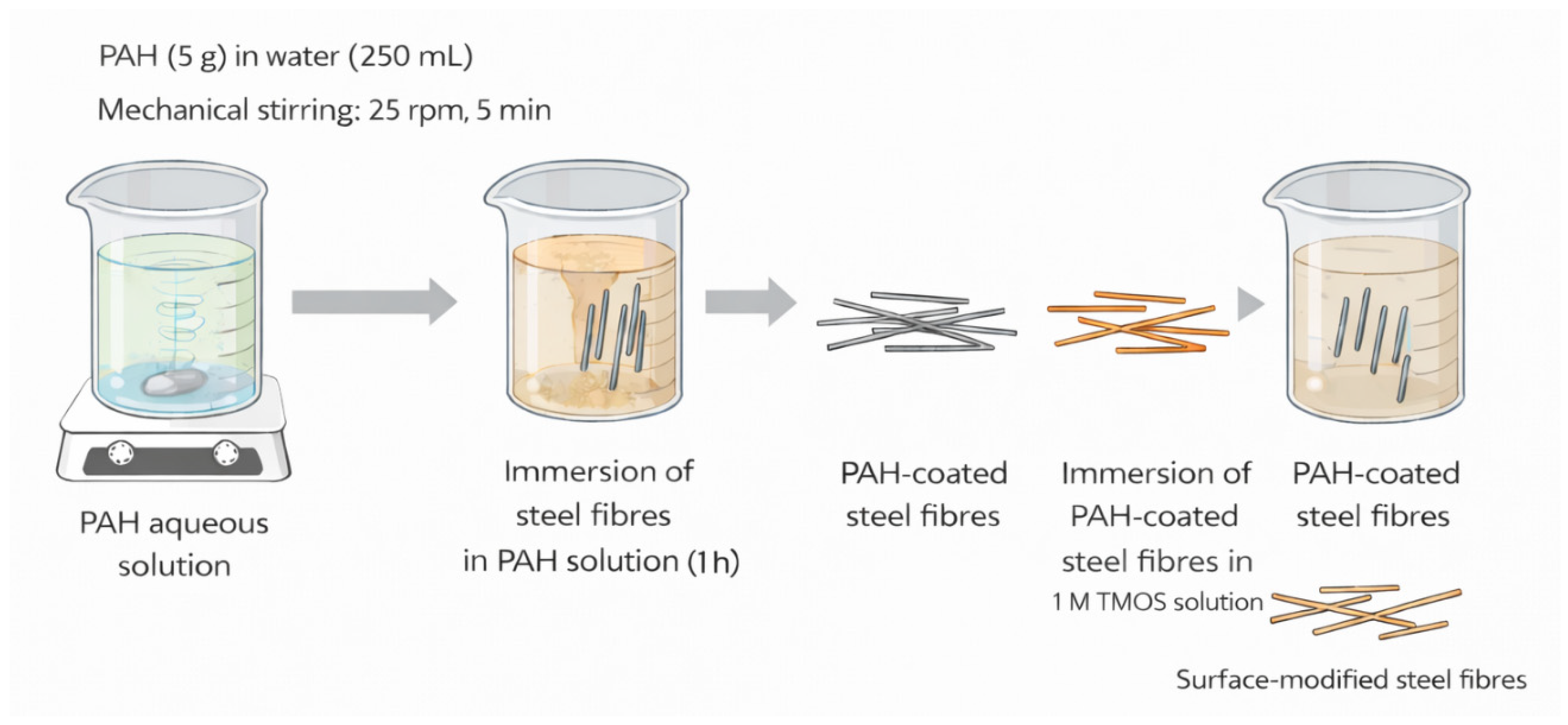
In a typical coating procedure (illustrated in Figure 1), 5 g of polyallylamine hydrochloride (PAH) was dissolved in 250 mL of water and mechanically stirred at 25 rpm for 5 min. The fibres (approximately 230 g) were then submerged in the PAH solution for one hour, after which the excess solution was removed. The PAH-coated fibres were subsequently immersed in a pre-prepared 1M tetramethyl orthosilicate (TMOS) solution. If necessary, hydrochloric acid (HCl) was added to regulate the pH level between 7 and 7.5. After the coating process, the fibres were removed from the solution and left to dry at room temperature for 24 h before being incorporated into the UHPC mixture.
The bioinspired coating method adopted in this study follows the procedure reported in [28]. This method enhances the interfacial bond between steel fibres and the cementitious matrix by facilitating silica deposition on the fibre surface. The presence and uniformity of the silica coating were validated in the earlier study through scanning electron microscopy (SEM) and energy-dispersive spectroscopy (EDS) at an operating voltage of 15 kV.

2.3. Mix Proportion and Specimen Preparation

In this study, self-compacting steel-fibre reinforced eco-efficient ultra-high-performance concrete was designed. The mix proportions were formulated following the mix design methodology outlined in [48]. However, while the previous study incorporated ultra-high fine fly ash, this study utilises conventional fly ash. The detailed mix proportions are provided in Table 2.
The mixing procedure was crucial in achieving homogeneous dispersion of steel fibres throughout the matrix. The mixes (Table 2) were prepared using a forced-action pan mixer, following a systematic gradation-based sequence. Initially, the coarsest material (sand) and the finest component (micro silica) were blended, followed by the incorporation of fly ash and then cement, maintaining a coarse-to-fine order. Each component was mixed for approximately two minutes before the addition of the next ingredient to ensure uniform distribution.
To improve the workability of the dry mix, two-thirds of the superplasticiser (SP) was manually pre-mixed with water before being gradually introduced into the dry materials while mixing continuously for four minutes. The remaining one-third of the SP was then added and blended for an additional two minutes to optimise fluidity before the gradual incorporation of steel fibres. The final mixing phase lasted approximately four minutes, ensuring uniform fibre dispersion within the matrix.
The mixes described in Table 2 were cast twice, once with uncoated steel fibres and once with coated steel fibres. For each fibre type, 12 prismatic beams (160 mm × 40 mm × 40 mm) and 15 cubes (50 mm × 50 mm × 50 mm) were cast. Since the concrete exhibited sufficient fluidity, it was poured directly from the mixing bowl into the moulds without the need for additional tools, such as a scoop. Although classified as SCC, a consistent casting approach was maintained by vibrating the moulds in three layers, with each layer subjected to 20 s of vibration on a vibration table to ensure uniform compaction.
Immediately after casting, all specimens were covered with a glass sheet to minimise moisture loss and maintain a controlled curing environment. A damp burlap layer was then placed over the specimens to ensure continuous hydration. This initial curing method was maintained for the first 24 h, allowing the concrete to develop its early-age strength under sealed conditions. After 24 h, the specimens were demoulded and fully immersed in a water-curing tank maintained at 20 (±1) °C, where they remained until the designated testing age.

2.4. Test Set-Up and Procedure

2.4.1. Compressive Strength Test

All compressive strength tests conducted in this study followed the standard test method for 50 mm cubic specimens [49]. The compressive strength of the mixes was evaluated at 7, 14, 28, 56, and 90 days. A loading rate of 2.5 kN/s, equivalent to 1 MPa/s, was applied during testing [48]. For each testing age, three specimens were tested from the coated steel fibre mix and three from the uncoated steel fibre mix, resulting in a total of six specimens per age to ensure a reliable comparison of their performance.

2.4.2. Bending Tests

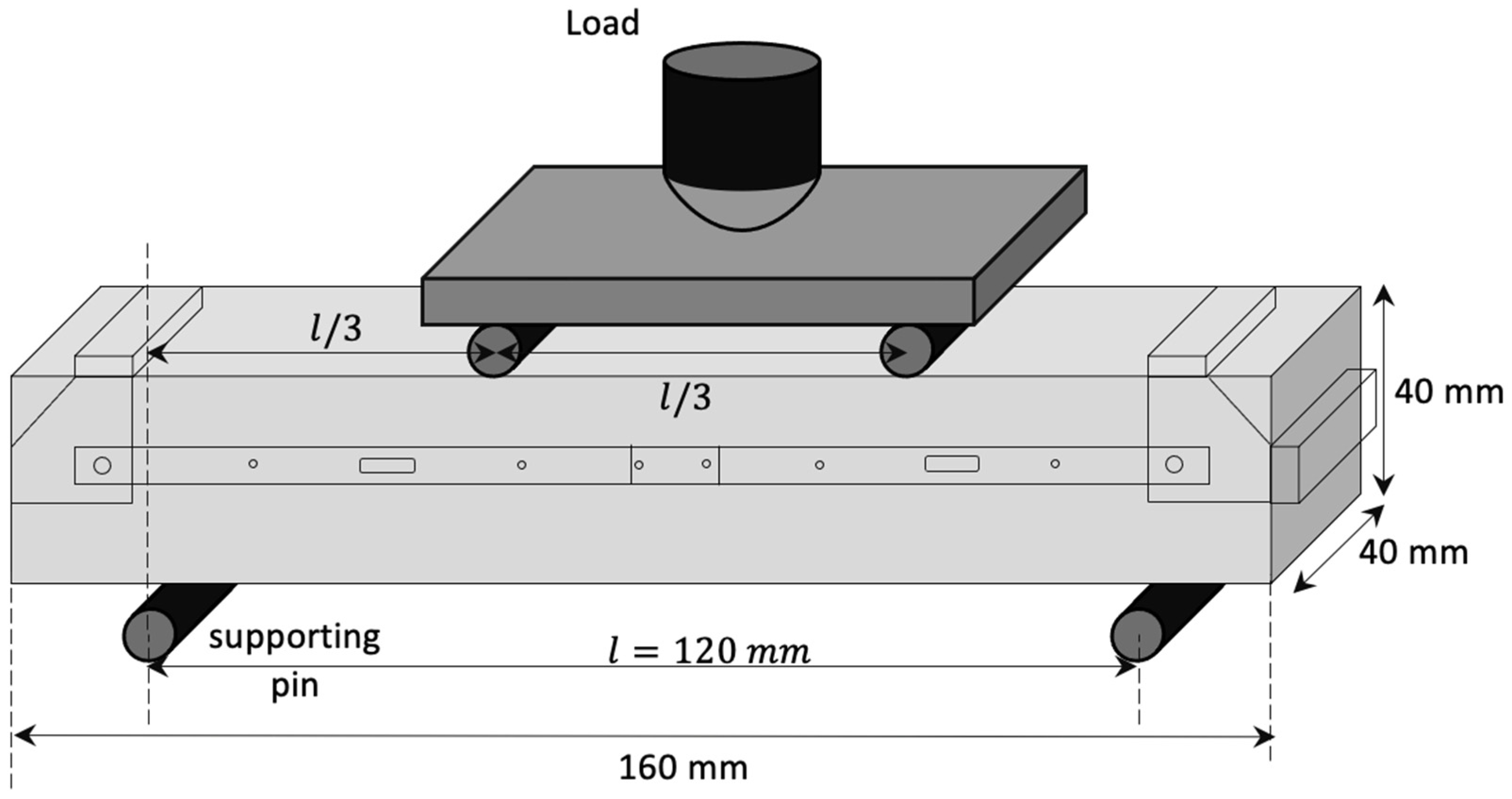
The four-point bending test was conducted on twelve prisms, following the procedure outlined in [50]. The test was performed on six specimens from the mix containing uncoated fibres and six from the mix with coated fibres, with testing carried out at 7 and 28 days. The flexural tests were performed using a four-point bending configuration, as illustrated in Figure 2. The specimens were supported on two steel rollers providing simply supported boundary conditions, while the load was applied through two loading rollers positioned at one-third of the span length. A transverse steel strip was fixed at the mid-span of the specimen to provide a stable mounting point for the linear variable differential transformer (LVDT) used to measure mid-span deflection during the test. The end fixtures ensured proper alignment of the specimen and stable support throughout the loading process.
In addition, a three-point bending test on notched prisms was conducted following the procedure outlined by RILEM [51]. The specimens were tested at 7 and 28 days, with three samples from the mix containing coated fibres and three from the mix with uncoated fibres at each age.
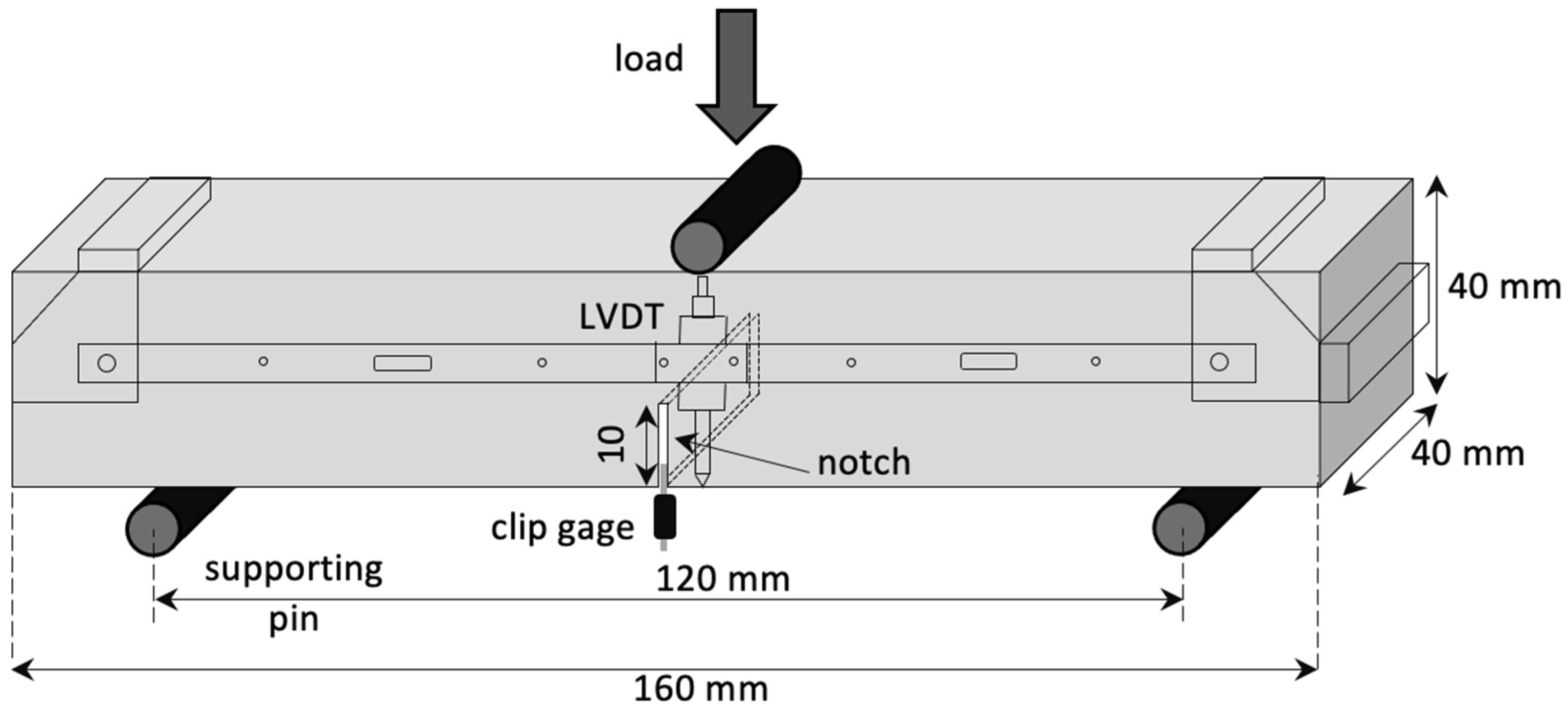
The mould dimensions used in this study were selected based on ASTM C1609 [52]. The width and depth of the specimens were 40 mm, which is more than three times the fibre length of 13 mm. Furthermore, the span length was three times the specimen depth, ensuring compliance with standard testing guidelines. To enhance dimensional stability, the exposed surfaces of the specimens were rectified before testing. The notch length was 10 mm, in accordance with the methodology presented in [48].
The vertical displacement rate of the testing machine was set to 3 μm/s to ensure controlled loading conditions. During testing, the mid-span deflection (δ) and the crack mouth opening displacement (CMOD) were measured using a Linear Variable Differential Transformer (LVDT) and a clip gauge, both of which were attached to the knife edges of the specimens. These instruments continuously recorded the load–deflection and load–CMOD curves for all specimens. Figure 3 illustrates the experimental setup and schematic diagram of the three-point bending test on the notched prisms.

3. Results and Discussion

3.1. Compressive Strength

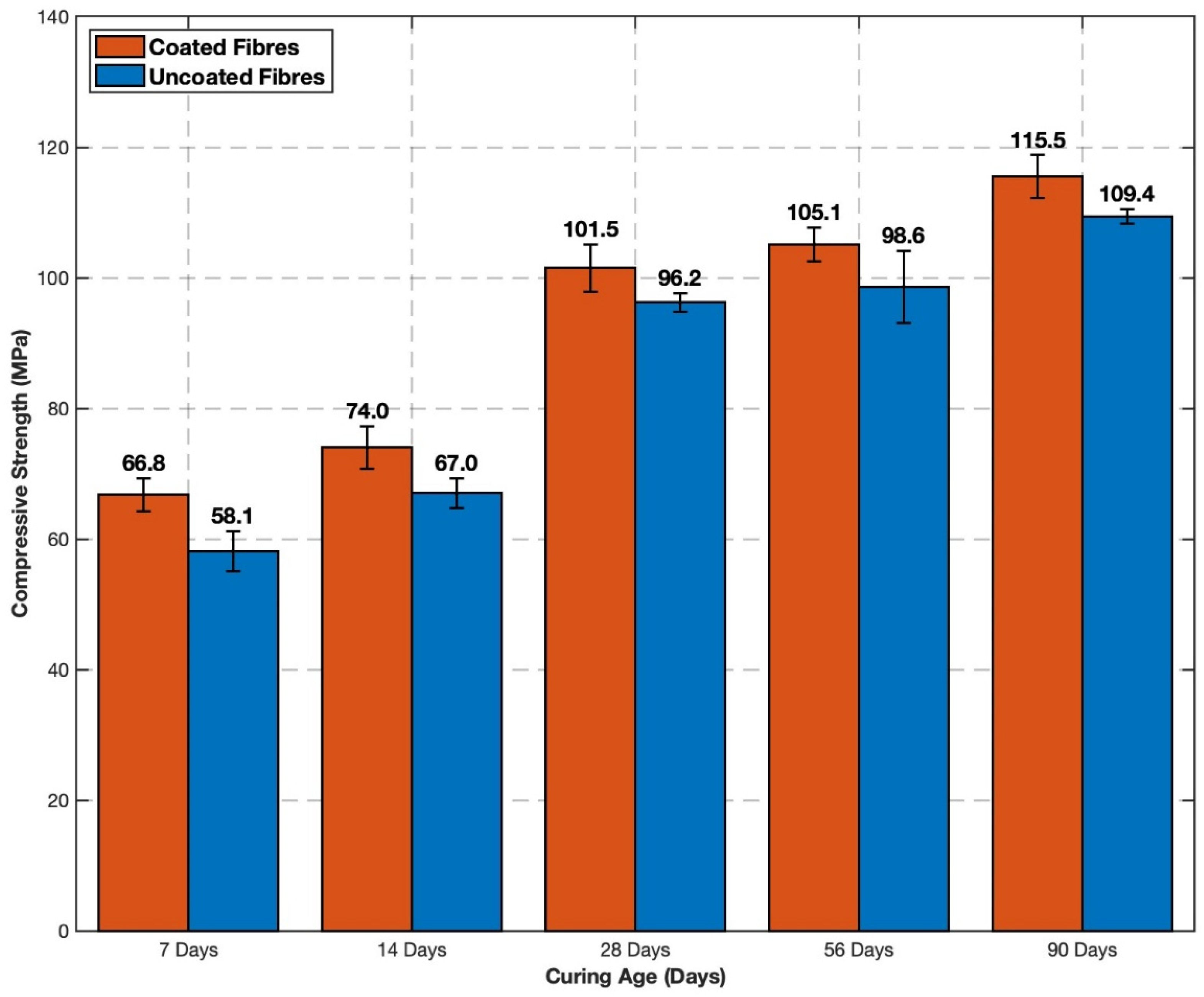
Compressive strength results are presented in Figure 4. Across all curing ages, mixes containing coated fibres consistently outperformed those with uncoated fibres. The narrow error bars indicate good repeatability, reinforcing the reliability of the results and the effectiveness of the coating in fibre-reinforced cementitious systems.
The largest relative improvement was observed at 7 days, where the coated mix achieved 66.8 MPa compared to 58.1 MPa for the uncoated mix, representing an increase of 8.7 MPa (≈15%). This suggests that the silica-based coating enhanced early-age fibre–matrix bonding and improved load transfer. At 14 days, strengths of 74.0 MPa and 67.0 MPa were recorded for coated and uncoated mixes, respectively, a difference of 7.0 MPa (≈10.4%). This indicates that the coating continued to facilitate fibre–matrix interaction, possibly by promoting hydration and reducing microcracking at the interface. At the end of 28 days, the coated mix reached 101.5 MPa compared to 96.2 MPa for the uncoated mix, a difference of 5.3 MPa (≈5.5%). These early-age findings are consistent with Wang et al. [38], who reported that biomimetic silica coatings enhanced compressive strength at 7 and 28 days in fibre-reinforced cementitious composites by densifying the fibre–matrix interface.
At later ages, the improvements stabilised but remained consistent: at 56 days, the coated mix attained 105.1 MPa against 98.6 MPa for the uncoated mix, an increase of 6.5 MPa (≈6.6%), while at 90 days the coated mix recorded 115.5 MPa versus 109.4 MPa, a difference of 6.1 MPa (≈5.6%). These results demonstrate that, although the relative gains diminish with age, the coating provides a sustained long-term enhancement in compressive performance.
The pronounced early-age improvement is commonly attributed to accelerated hydration at the fibre–matrix interface: deposited nanosilica promotes secondary hydration with Ca(OH)2, increasing the formation of C–S–H and reducing porosity at the fibre–matrix interface, thereby enhancing early strength [37,53,54]. This is consistent with Zhang et al. [55], who reported that grafting SiO2 onto PVA fibres improved interfacial bonding strength by enhancing chemical interaction and densifying the fibre–matrix transition zone. Similar improvements in fibre–matrix adhesion were also demonstrated in our earlier work on bioinspired silica-coated steel fibres [28], which confirmed the role of nanosilica in strengthening the ITZ. Together, these studies reinforce the interpretation that nanosilica-based coatings densify the interface, explaining both the pronounced early-age strength gains and the sustained interfacial improvements observed in this study.
It should be noted that the bioinspired coating process is carried out under mild aqueous conditions without high-temperature treatment and uses relatively inexpensive reagents. These characteristics suggest potential economic and environmental advantages compared with conventional thermal or sol–gel coating techniques. From a sustainability perspective, the proposed method avoids energy-intensive processing and hazardous chemicals, which may reduce energy consumption and environmental impact. However, a detailed economic and life-cycle assessment is beyond the scope of the present study.

3.2. Four-Point Bending Test

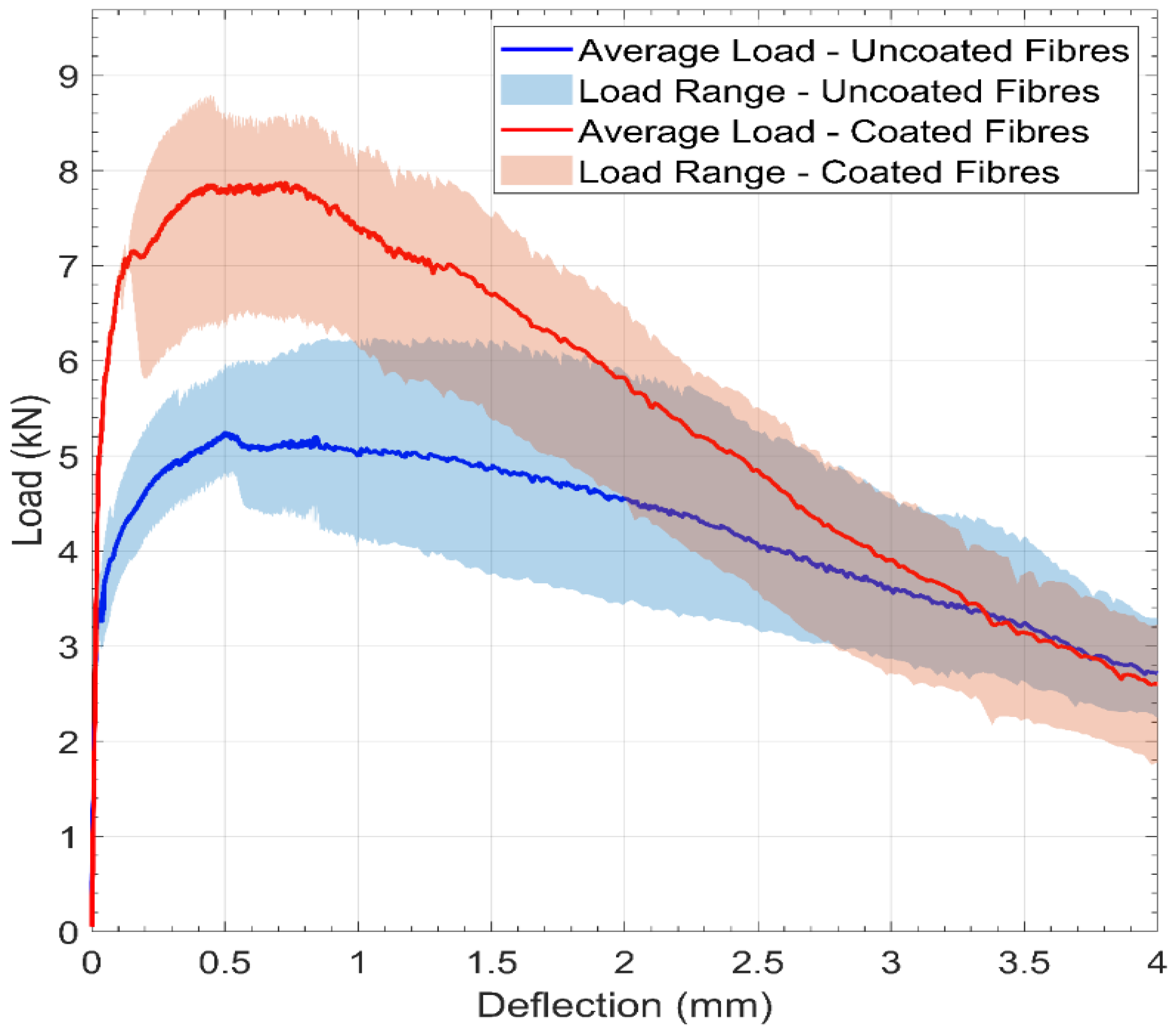
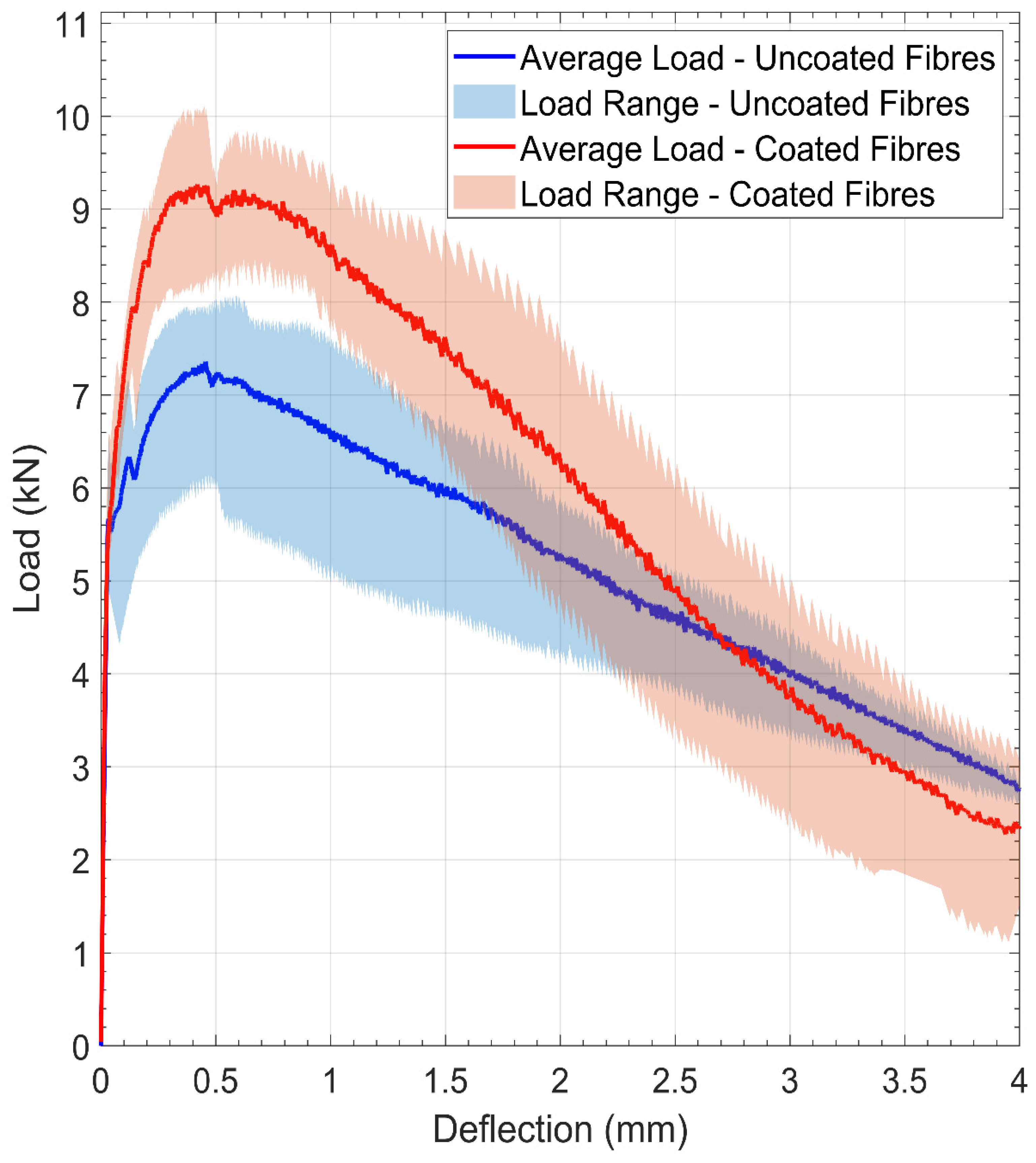
The four-point bending test results (Table 3) demonstrate clear improvements in flexural capacity for UHPC reinforced with silica-coated fibres. At 7 days, coated specimens reached a maximum load of 8.14 kN, compared with 5.37 kN for the uncoated mix, representing a 51.5% increase. At 28 days, the coated specimens again outperformed the uncoated ones (9.74 kN vs. 7.40 kN), corresponding to a 31.6% enhancement. Although the relative improvement was lower at 28 days, the results confirm that the coating provides consistent strength benefits across curing ages. The variability observed in some flexural test results may be attributed to the random distribution and orientation of fibres within the matrix, as well as localised crack propagation during bending. Such variability is commonly reported in fibre-reinforced concrete due to the heterogeneous nature of the composite.
The load–deflection curves (Figure 5 and Figure 6) reinforce these findings. The solid curves represent the average load–deflection response obtained from three specimens tested under identical conditions. The shaded regions represent the load range, defined by the minimum and maximum load values measured among the three specimens. The coated specimens consistently exhibited higher peak loads, while the post-peak softening behaviour remained similar to that of the uncoated specimens. This indicates that the coating primarily improves peak load capacity through stronger fibre–matrix adhesion, rather than altering post-crack ductility or energy dissipation.
These structural-scale outcomes align with earlier single-fibre pull-out tests [28], where silica-coated fibres showed a 22.6% increase in bond strength, a 21.4% rise in interfacial shear strength, and a 33.4% improvement in pull-out energy. As described by Abdallah and Rees [56], the pull-out behaviour consists of a debonding stage followed by frictional pull-out. In the present study, this response is interpreted as an enhancement of the initial adhesion-controlled stage (associated with the peak load), while the post-peak frictional stage remains largely unchanged. Comparable mechanisms have also been reported by Hong et al. [57] in coated carbon-fibre textiles and by Zhang et al. [26] in nano-silica-modified concretes, both of which attributed higher early stiffness and load capacity to refined interfacial transition zones.
At both 7 and 28 days, coated specimens attained higher peak loads, while the post-peak response remained similar to that of uncoated specimens. This indicates that the silica coating primarily enhances fibre–matrix adhesion and peak load capacity, but does not significantly influence post-crack ductility or energy absorption. Unlike hooked or crimped fibres, which improve load retention after cracking, the bioinspired coating strengthens the chemical bond at the interface, resulting in higher initial resistance to pull-out. The reduced relative gain at 28 days further suggests that as the UHPC matrix develops intrinsic strength, the contribution of interfacial enhancement becomes less dominant.
Overall, these results demonstrate that bioinspired silica coatings provide substantial gains in flexural strength at both 7 and 28 days, validating their effectiveness in UHPC under structural-scale loading while clarifying their role as a complementary, rather than alternative, strategy to mechanical fibre modifications.

3.3. Three-Point Bending Test on Notched Prisms

The three-point bending test (3PBT) results on notched prisms (Table 4) provide further validation of the beneficial effect of the bioinspired silica coating on fibre–matrix interaction, complementing the four-point bending test (4PBT) findings. The three-point bending test (3PBT) results align with the four-point bending test (4PBT), confirming the positive impact of the bioinspired silica-based coating on fibre-matrix bonding.
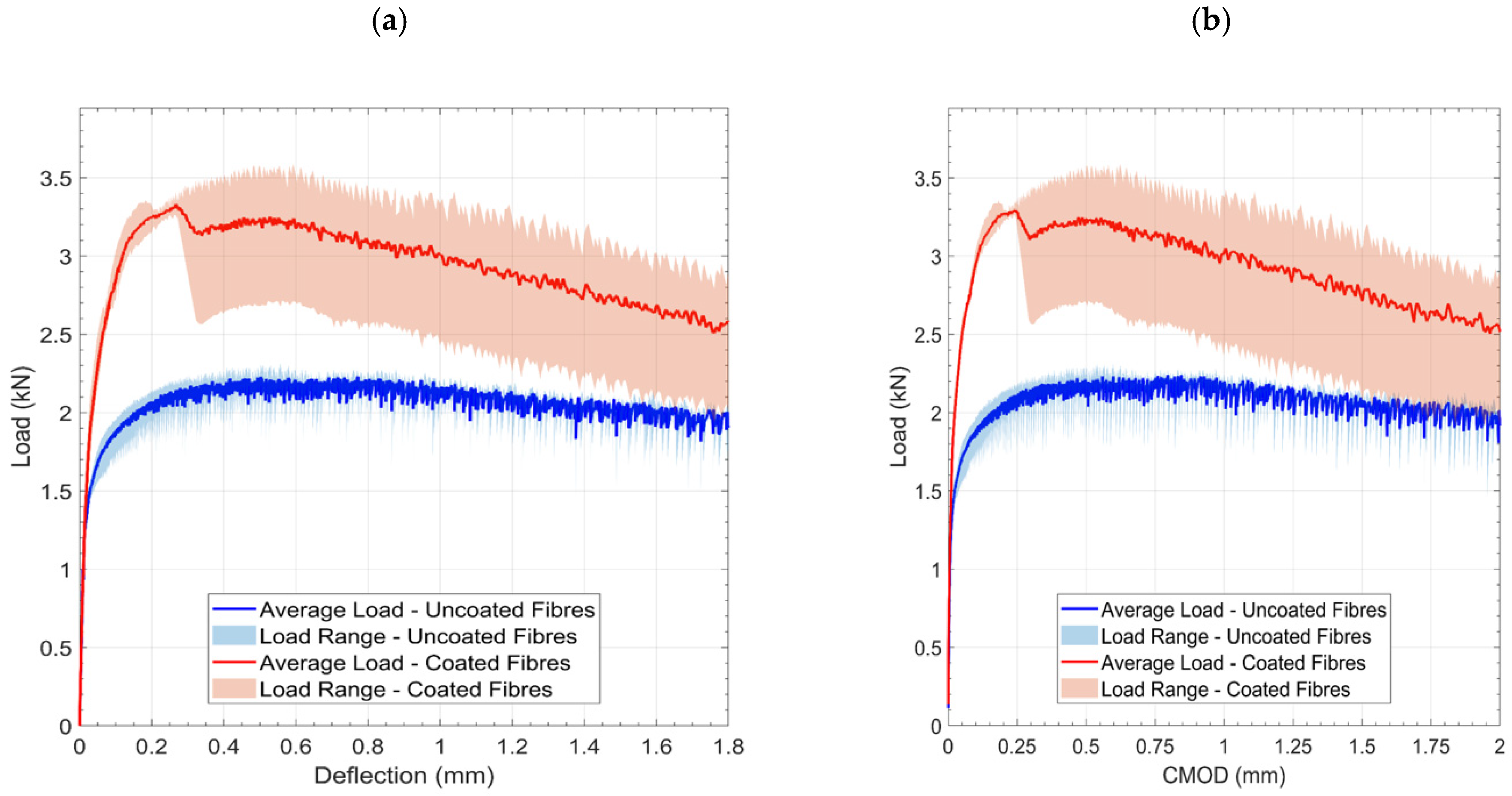
At 7 days, the coated specimens achieved a maximum load of 3.455 kN (±0.169), compared to 2.276 kN (±0.034) for uncoated fibres, representing a 51.7% increase. This enhancement is consistent with the 51.5% improvement observed in 4PBT (from 5.37 to 8.14 kN). The similarity between the two bending configurations demonstrates that the coating effect is robust and not test-geometry-dependent. The reductions in deflection (0.657 mm → 0.406 mm) and CMOD (0.733 mm → 0.415 mm) (Figure 7a,b) further indicate that the silica coating improved load transfer efficiency and delayed crack initiation, thereby increasing crack resistance at the onset of loading.
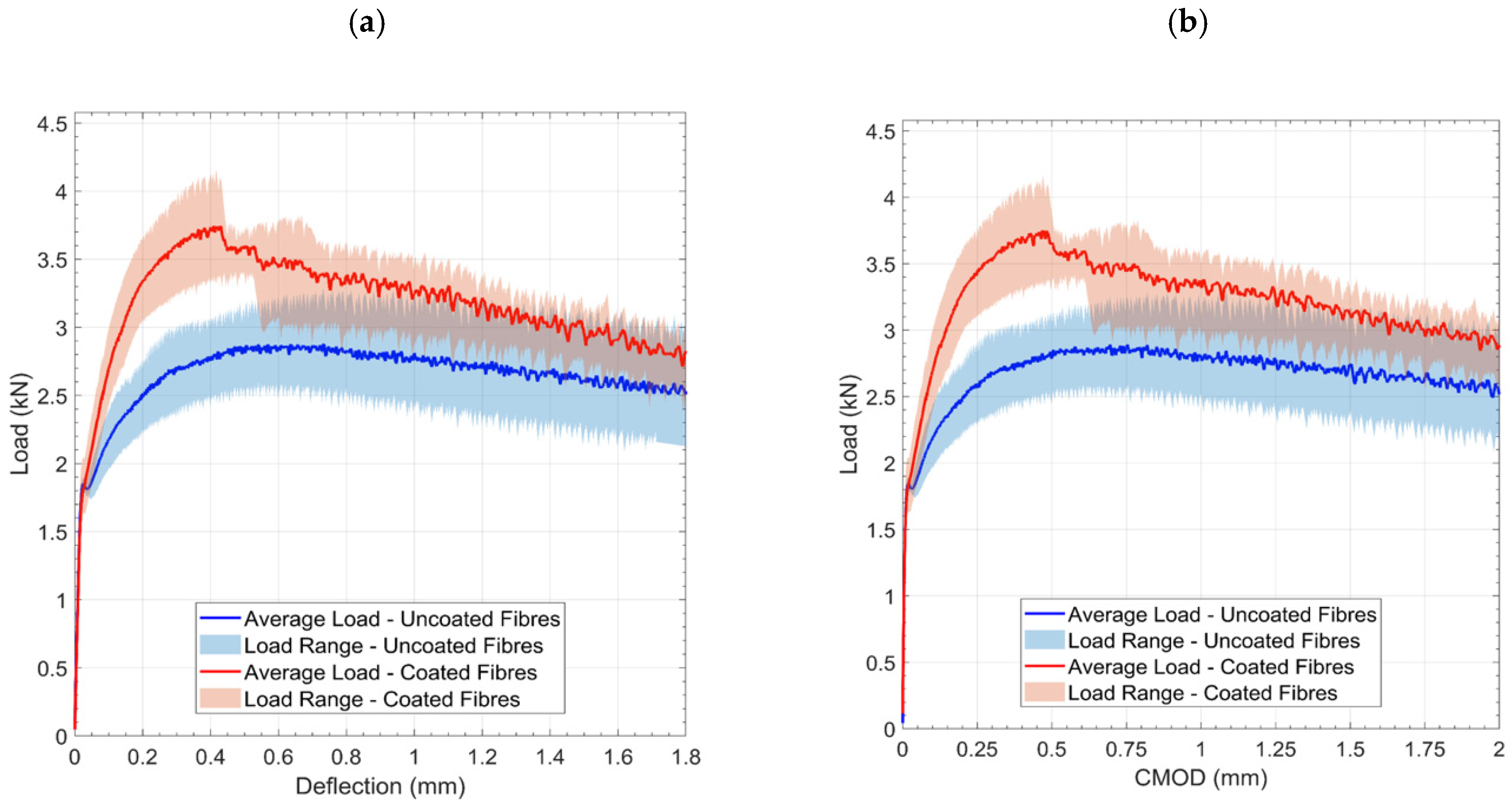
At 28 days, the coating effect remained significant though less pronounced. The maximum load rose from 2.935 kN (±0.353) to 3.787 kN (±0.374), a 29.0% improvement, aligning with the 31.6% increase observed in 4PBT (from 7.40 to 9.74 kN). The smaller relative improvement compared to 7 days suggests that, as the cementitious matrix gains intrinsic strength through continued hydration, the relative contribution of fibre–matrix bonding to overall flexural resistance becomes less dominant. Nonetheless, the reductions in deflection (0.652 mm → 0.449 mm) and CMOD (0.734 mm → 0.510 mm) (Figure 8a,b). It can be seen that coated fibres continued to provide better crack control during propagation, not only at crack initiation. The ascending portion of the load–deflection response up to the peak load is mainly governed by fibre–matrix interfacial bonding and stress transfer between the fibre and the surrounding matrix. After debonding, the post-peak behaviour is primarily controlled by frictional pull-out and mechanical interaction between the fibre and the matrix, which governs crack bridging and energy dissipation in fibre-reinforced composites [58,59].
The notched 3PBT configuration is particularly sensitive to fracture processes, as the notch forces localisation of tensile stresses at the mid-span. Therefore, the observed improvement in coated specimens can be directly attributed to enhanced interfacial bonding that delays fibre pull-out and promotes more effective crack-bridging. This contrasts with 4PBT, where stresses are distributed over a longer region and peak loads are more representative of global flexural capacity. The agreement between both test types confirms that the silica coating provides a fundamental improvement in fibre–matrix adhesion, observable at both the microcrack initiation scale and the structural flexural response.
The larger improvements at an early age (≈51%) compared to later age (≈27–31%) are consistent with the role of nanosilica at the fibre surface in promoting accelerated hydration and densification of the interfacial transition zone (ITZ). At early stages, when the bulk matrix is relatively weak, this interfacial strengthening dominates the flexural response. At later stages, as the bulk matrix becomes denser and stronger, the relative impact of interfacial enhancement decreases, but the coating still contributes to improved crack control and reduced CMOD.
The improved mechanical performance observed in the specimens containing coated fibres can be attributed to the enhanced fibre–matrix interfacial interaction. The silica layer deposited on the fibre surface promotes stronger bonding with the cementitious matrix, which improves stress transfer and delays fibre debonding during loading. As a result, the coated fibres provide more effective crack bridging and resistance to pull-out, leading to enhanced flexural performance and fracture resistance.

4. Conclusions

This study experimentally validated the effectiveness of bioinspired silica-based surface modification of steel fibres in ultra-high-performance concrete (UHPC). Based on the experimental results, the following conclusions can be drawn:
  • Bioinspired silica coating of steel fibres resulted in consistent improvements in both compressive and flexural performance of UHPC, with the most pronounced benefits observed at early ages.
  • At 7 days, coated UHPC exhibited an increase in compressive strength of approximately 15%, while flexural capacity increased by about 51% in both three-point bending tests (notched prisms) and four-point bending tests (unnotched prisms).
  • At later ages, compressive strength gains stabilised at approximately 5–7% between 28 and 90 days, while flexural performance at 28 days remained significantly higher for coated specimens, with improvements in the range of 29–32%.
  • The improved mechanical performance is attributed to enhanced fibre–matrix interaction, which improves stress transfer and delays crack initiation.
  • The close agreement between the results of three-point bending and four-point bending tests confirms that the beneficial effect of the fibre coating is robust across different structural loading configurations.
  • Importantly, these structural-scale results extend previous single-fibre pull-out observations, providing direct evidence that nanosilica-based surface modification of steel fibres translates into measurable performance gains at the composite level.
Overall, the findings demonstrate that bioinspired silica coatings provide an effective and practical strategy for enhancing fibre–matrix interaction in UHPC, enabling improved mechanical performance without altering fibre dosage or mix composition. This approach offers a promising pathway for advancing the mechanical efficiency of UHPC in structural applications.

Author Contributions

Conceptualization, A.A. (Abdullah Alshahrani); Methodology, A.A. (Abdullah Alshahrani), A.I. and A.A. (Ayman Almutlaqah); Software, A.A. (Abdullah Alshahrani); Investigation, A.A. (Abdullah Alshahrani); Writing—original draft, A.A. (Abdullah Alshahrani), A.I., A.A. (Ayman Almutlaqah) and S.K.; Writing—review & editing, A.A. (Abdullah Alshahrani), A.I., A.A. (Ayman Almutlaqah) and S.K.; Supervision, S.K. All authors have read and agreed to the published version of the manuscript.

Funding

The authors are thankful to the Deanship of Graduate Studies and Scientific Research at Najran University for funding this work under the Consortium Funding Program grant code (NU/CPI/SERC/14/3767-1).

Data Availability Statement

The original contributions presented in the study are included in the article, further inquiries can be directed to the corresponding author.

Conflicts of Interest

The authors declare no conflicts of interest.

References

  1. Smith, A.; Alshahrani, A.; Xu, G. Properties, damage law and stress-strain models for ultra-high performance fibre-reinforced concrete containing coarse aggregate. Constr. Build. Mater. 2025, 491, 142619. [Google Scholar] [CrossRef]
  2. Deeb, R.; Karihaloo, B.L.; Kulasegaram, S. Reorientation of short steel fibres during the flow of self-compacting concrete mix and determination of the fibre orientation factor. Cem. Concr. Res. 2014, 56, 112–120. [Google Scholar] [CrossRef]
  3. Huang, Y.; Kong, D.; Li, Y.; Zhou, S.; Shu, J.; Wu, B. Effect of different shapes of steel fibers and palygorskite-nanofibers on performance of ultra-high-performance concrete. Sci. Rep. 2024, 14, 8224. [Google Scholar] [CrossRef] [PubMed]
  4. Gong, Y.; Hua, Q.; Wu, Z.; Yu, Y.; Kang, A.; Chen, X.; Dong, H. Effect of Basalt/Steel Individual and Hybrid Fiber on Mechanical Properties and Microstructure of UHPC. Materials 2024, 17, 3299. [Google Scholar] [CrossRef]
  5. Du, W.; Yu, F.; Qiu, L.; Guo, Y.; Wang, J.; Han, B. Effect of Steel Fibers on Tensile Properties of Ultra-High-Performance Concrete: A Review. Materials 2024, 17, 1108. [Google Scholar] [CrossRef]
  6. Alshahrani, A.; Kulasegaram, S.; Kundu, A. Utilisation of simulation-driven fibre orientation for effective modelling of flexural strength and toughness in self-compacting concrete. Constr. Build. Mater. 2025, 459, 139767. [Google Scholar] [CrossRef]
  7. Alshahrani, A.; Kulasegaram, S. Effect of fibre diameter and tensile strength on the mechanical, fracture, and fibre distribution properties of eco-friendly high-strength self-compacting concrete. Constr. Build. Mater. 2023, 403, 133161. [Google Scholar] [CrossRef]
  8. ACI Committee 318; American Concrete Institute; International Organization for Standardization. Building Code Requirements for Structural Concrete (ACI 318-08) and Commentary; American Concrete Institute: Farmington Hills, MI, USA, 2007. [Google Scholar]
  9. CNR-DT 204; Guide for the Design and Construction of Fiber-Reinforced Concrete Structures. National Research Council: Singapore, 2006.
  10. JSCE Concrete Committee. Standard Specifications for Concrete Structures; JSCE Concrete Committee: Tokyo, Japan, 2007. [Google Scholar] [CrossRef]
  11. 5100.5:2017; Bridge Design Part 5: Concrete. Australian Standards: Sydney, NSW, Australia, 2017.
  12. Vandewalle, L.; Nemegeer, D.; Balazs, L.; Di Prisco, M. RILEM TC 162-TDF: Test and design methods for steel fibre reinforced concrete-Bending test (Final Recommendation). Mater. Struct./Mater. Constr. 2002, 35, 579–582. [Google Scholar] [CrossRef]
  13. Redžić, N.; Grgić, N.; Baloević, G. A Review on the Behavior of Ultra-High-Performance Concrete (UHPC) Under Long-Term Loads. Buildings 2025, 15, 571. [Google Scholar] [CrossRef]
  14. Wu, K.; Shen, R.; Luo, K.; Mo, F.; Jiang, H.; Fang, H.; Xian, B. Experimental Study of the Interfacial Shear Behavior Between NRC and UHPC in UHPC-Jacketing Rehabilitation of Concrete Bridges. Buildings 2025, 15, 2928. [Google Scholar] [CrossRef]
  15. Tang, J.P.; Feng, R.; Quach, W.M.; Zeng, J.J. Evaluation of flexural performance on corrosion-damaged RC beams retrofitted with UHPFRCC under marine exposure. Eng. Struct. 2025, 333, 120193. [Google Scholar] [CrossRef]
  16. Liu, P.; Tang, J.P.; Feng, R.; Fan, Y.; Zhu, J.H. Interfacial behaviour and shear performance of polarized CFRCM-strengthened corroded RC continuous beams. Constr. Build. Mater. 2025, 472, 140786. [Google Scholar] [CrossRef]
  17. Qi, J.; Wu, Z.; Ma, Z.J.; Wang, J. Pullout behavior of straight and hooked-end steel fibers in UHPC matrix with various embedded angles. Constr. Build. Mater. 2018, 191, 764–774. [Google Scholar] [CrossRef]
  18. Wiemer, N.; Wetzel, A.; Schleiting, M.; Krooß, P.; Vollmer, M.; Niendorf, T.; Böhm, S.; Middendorf, B. Effect of fibre material fibre roughness on the pullout behaviour of metallic micro fibres embedded in UHPC. Materials 2020, 13, 3128. [Google Scholar] [CrossRef] [PubMed]
  19. Zile, E.; Zile, O. Effect of the fiber geometry on the pullout response of mechanically deformed steel fibers. Cem. Concr. Res. 2013, 44, 18–24. [Google Scholar] [CrossRef]
  20. Robins, P.; Austin, S.; Jones, P. Pull-out behaviour of hooked steel fibres. Mater. Struct./Mater. Constr. 2002, 35, 434–442. [Google Scholar] [CrossRef]
  21. Abdallah, S.; Fan, M.; Rees, D.W.A. Effect of elevated temperature on pull-out behaviour of 4DH/5DH hooked end steel fibres. Compos. Struct. 2017, 165, 180–191. [Google Scholar] [CrossRef]
  22. Wu, Z.; Khayat, K.H.; Shi, C. How do fiber shape and matrix composition affect fiber pullout behavior and flexural properties of UHPC? Cem. Concr. Compos. 2018, 90, 193–201. [Google Scholar] [CrossRef]
  23. Kim, J.J.; Yoo, D.Y. Effects of fiber shape and distance on the pullout behavior of steel fibers embedded in ultra-high-performance concrete. Cem. Concr. Compos. 2019, 103, 213–223. [Google Scholar] [CrossRef]
  24. Wu, Z.; Shi, C.; Khayat, K.H. Influence of silica fume content on microstructure development and bond to steel fiber in ultra-high strength cement-based materials (UHSC). Cem. Concr. Compos. 2016, 71, 97–109. [Google Scholar] [CrossRef]
  25. Simões, T.; Octávio, C.; Valença, J.; Costa, H.; Dias-da-Costa, D.; Júlio, E. Influence of concrete strength and steel fibre geometry on the fibre/matrix interface. Compos. B Eng. 2017, 122, 156–164. [Google Scholar] [CrossRef]
  26. Zhang, P.; Zhao, Y.N.; Li, Q.F.; Wang, P.; Zhang, T.H. Flexural toughness of steel fiber reinforced high performance concrete containing nano-SiO2, fly ash. Sci. World J. 2014, 2014, 403743. [Google Scholar] [CrossRef]
  27. Gao, Y.; Cheng, Z.; Yu, J.; Guo, X.; Liu, Y.; Chen, W. Mechanical performance enhancement of UHPC via ITZ improvement using graphene oxide-coated steel fibers. Cem. Concr. Compos. 2025, 157, 105931. [Google Scholar] [CrossRef]
  28. Ismail, A.; Alshahrani, A.; Alawode, A.; Kulasegaram, S. Bioinspired eco-friendly coating technology for enhanced steel fibre bonding and sustainability in cementitious materials. Constr. Build. Mater. 2025, 467, 140408. [Google Scholar] [CrossRef]
  29. Deng, Y.; Zhang, Z.; Shi, C.; Wu, Z.; Zhang, C. Steel Fiber–Matrix Interfacial Bond in Ultra-High Performance Concrete: A Review. Engineering 2023, 22, 215–232. [Google Scholar] [CrossRef]
  30. Sharma, H.; Kumar, A.; Rana, S.; Sahoo, N.G.; Jamil, M.; Kumar, R.; Sharma, S.; Li, C.; Kumar, A.; Eldin, S.M.; et al. Critical review on advancements on the fiber-reinforced composites: Role of fiber/matrix modification on the performance of the fibrous composites. J. Mater. Res. Technol. 2023, 26, 2975–3002. [Google Scholar] [CrossRef]
  31. Alqawzai, S.; Yang, B.; Alsubari, B.; Abdulaali, H.S.; Elchalakani, M.; Al-Nini, A. Experimental Database on pullout bond performance of steel fiber embedded in ultra-high-strength concrete. Tikrit J. Eng. Sci. 2022, 29, 60–82. [Google Scholar] [CrossRef]
  32. Tan, X.; Li, M.; Zhao, L.; Pan, Y.; Zhang, P.; Qi, M.L. Benefits of Surface-Modified Steel Fibers on Enhancing the Mechanical Properties in Cement Matrix. Coatings 2025, 15, 682. [Google Scholar] [CrossRef]
  33. Lee, S.K.; Oh, T.; Chun, B.; Chu, S.H.; Sukontasukkul, P.; Yoo, D.Y. Surface refinement of steel fiber using nanosilica silver its effect on static dynamic pullout resistance of reactive powder concrete. J. Build. Eng. 2022, 51, 104269. [Google Scholar] [CrossRef]
  34. Soulioti, D.V.; Barkoula, N.M.; Koutsianopoulos, F.; Charalambakis, N.; Matikas, T.E. The effect of fibre chemical treatment on the steel fibre/cementitious matrix interface. Constr. Build. Mater. 2013, 40, 77–83. [Google Scholar] [CrossRef]
  35. Chun, B.; Kim, S.; Yoo, D.Y. Benefits of chemically treated steel fibers on enhancing the interfacial bond strength from ultra-high-performance concrete. Constr. Build. Mater. 2021, 294, 123519. [Google Scholar] [CrossRef]
  36. Qu, S.; Zhang, Y.; Zhu, Y.; Huang, L.; Qiu, M.; Shao, X. Prediction of tensile response of UHPC with aligned and ZnPh treated steel fibers based on a spatial stochastic process. Cem. Concr. Res. 2020, 136, 106165. [Google Scholar] [CrossRef]
  37. Oh, T.; You, I.; Banthia, N.; Yoo, D.Y. Deposition of nanosilica particles on fiber surface for improving interfacial bond and tensile performances of ultra-high-performance fiber-reinforced concrete. Compos. B Eng. 2021, 221, 109030. [Google Scholar] [CrossRef]
  38. Wang, L.; Xu, J.; Wang, J.; Li, Q.; Wang, H.; Li, D.; Fang, Y. Biomimetic silica coating for steel fibers: A low-cost strategy to enhance interfacial bonding in cementitious composites. Constr. Build. Mater. 2025, 492, 142924. [Google Scholar] [CrossRef]
  39. Kim, G.W.; Oh, T.; Chun, B.; Lee, S.W.; Hung, C.C.; Yoo, D.Y. Enhanced tensile performance of ultra-high-performance alkali-activated concrete using surface roughened steel fibers. Constr. Build. Mater. 2023, 409, 133867. [Google Scholar] [CrossRef]
  40. Yoo, D.Y.; Jang, Y.S.; Chun, B.; Kim, S. Chelate effect on fiber surface morphology and its benefits on pullout and tensile behaviors of ultra-high-performance concrete. Cem. Concr. Compos. 2021, 115, 103864. [Google Scholar] [CrossRef]
  41. Schleiting, M.; Klier, K.; Wiemer, N.; Wetzel, A.; Zarges, J.C.; Heim, H.P.; Middendorf, B. Fibre pullout behaviour of fibre-reinforced UHPC with TPE-coated fibres. Constr. Build. Mater. 2023, 376, 131043. [Google Scholar] [CrossRef]
  42. Riahi, S.; Nemati, A.; Khodabandeh, A.R.; Baghshahi, S. Investigation of interfacial and mechanical properties of alumina-coated steel fiber reinforced geopolymer composites. Constr. Build. Mater. 2021, 288, 123118. [Google Scholar] [CrossRef]
  43. Yao, X.; Xu, Y.; Dong, X.; Tian, Z. Assessing the desiccation crack propagation performance of cemented soil reinforced by modified polyvinyl alcohol fiber. Measurement 2024, 235, 114920. [Google Scholar] [CrossRef]
  44. Kim, S.; Choi, S.; Yoo, D.Y. Surface modification of steel fibers using chemical solutions their pullout behaviors from ultra-high-performance concrete. J. Build. Eng. 2020, 32, 101709. [Google Scholar] [CrossRef]
  45. Yoo, D.Y.; Banthia, N.; Yoon, Y.S. Recent development of innovative steel fibers for ultra-high-performance concrete (UHPC): A critical review. Cem. Concr. Compos. 2024, 145, 105359. [Google Scholar] [CrossRef]
  46. Pi, Z.; Xiao, H.; Liu, R.; Li, H. Combination usage of nano-SiO2-coated steel fiber silica fume its improvement effect on SFRCC. Compos. B Eng. 2021, 221, 109022. [Google Scholar] [CrossRef]
  47. He, Q.; Liu, C.; Yu, X. Improving steel fiber reinforced concrete pull-out strength with nanoscale iron oxide coating. Constr. Build. Mater. 2015, 79, 311–317. [Google Scholar] [CrossRef]
  48. Ferdosian, I.; Camões, A. Mechanical performance and post-cracking behavior of self-compacting steel-fiber reinforced eco-efficient ultra-high performance concrete. Cem. Concr. Compos. 2021, 121, 104050. [Google Scholar] [CrossRef]
  49. ASTM C109/C109M; Test Method for Compressive Strength of Hydraulic Cement Mortars (Using 2-in. or [50-mm] Cube Specimens). ASTM International: West Conshohocken, PA, USA, 2012. [CrossRef]
  50. BS EN 12390-5; Testing Hardened Concrete Part 5: Flexural Strength of Test Specimens. British Standard: London, UK, 2009; Volume 38, pp. 195–217.
  51. RILEM TCS. Determination of the fracture energy of mortar and concrete by means of three-point bend tests on notched beams. Mater. Struct. 1985, 18, 285–290. [Google Scholar]
  52. ASTM C1609; Standard Test Method for Flexural Performance of Fiber Reinforced Concrete (Using Beam with Third-Point Loading). ASTM International: West Conshohocken, PA, USA, 2007; pp. 1–8.
  53. Pi, Z.; Xiao, H.; Du, J.; Liu, M.; Li, H. Interfacial microstructure and bond strength of nano-SiO2-coated steel fibers in cement matrix. Cem. Concr. Compos. 2019, 103, 1–10. [Google Scholar] [CrossRef]
  54. Pi, Z.; Xiao, H.; Liu, R.; Liu, M.; Li, H. Effects of brass coating and nano-SiO2 coating on steel fiber–matrix interfacial properties of cement-based composite. Compos. B Eng. 2020, 189, 107904. [Google Scholar] [CrossRef]
  55. Zhang, W.; Zou, X.; Wei, F.; Wang, H.; Zhang, G.; Huang, Y.; Zhang, Y. Grafting SiO2 nanoparticles on polyvinyl alcohol fibers to enhance the interfacial bonding strength with cement. Compos. B Eng. 2019, 162, 500–507. [Google Scholar] [CrossRef]
  56. Abdallah, S.; Rees, D.W.A. Analysis of Pull-Out Behaviour of Straight and Hooked End Steel Fibres. Engineering 2019, 11, 332–341. [Google Scholar] [CrossRef]
  57. Hong, G.; Park, J.; Lee, S.C.; Cha, S.W.; Ryu, J.; Choi, S. Experimental and Theoretical Analysis of Flexural Properties of Mortar Beam Reinforced with Coated Carbon-Fiber Textile. Buildings 2023, 13, 2157. [Google Scholar] [CrossRef]
  58. Laranjeira, F.; Molins, C.; Aguado, A. Predicting the pullout response of inclined hooked steel fibers. Cem. Concr. Res. 2010, 40, 1471–1487. [Google Scholar] [CrossRef]
  59. Laranjeira, F.; Aguado, A.; Molins, C. Predicting the pullout response of inclined straight steel fibers. Mater. Struct./Mater. Constr. 2010, 43, 875–895. [Google Scholar] [CrossRef]
Figure 1. Diagrammatic representation of the bioinspired coating process for steel. Adapted from [28].
Buildings 16 01278 g001
Figure 2. Schematic diagram of the four-point bending test.
Buildings 16 01278 g002
Figure 3. Schematic diagram of the three-point bending test on a notched specimen.
Buildings 16 01278 g003
Figure 4. Compressive strength of coated and uncoated fibre-reinforced cementitious matrices at different curing ages.
Buildings 16 01278 g004
Figure 5. Load–deflection curves from the four-point bending test at 7 days for coated and uncoated fibre specimens.
Buildings 16 01278 g005
Figure 6. Load–deflection curves from the four-point bending test at 28 days for coated and uncoated fibre specimens.
Buildings 16 01278 g006
Figure 7. (a) 3PBT–7 days–deflection, (b) 3PBT–7 days–CMOD.
Buildings 16 01278 g007
Figure 8. (a) 3PBT–28 days–deflection, (b) 3PBT–28 days–CMOD.
Buildings 16 01278 g008
Table 1. Chemical composition and physical characteristics of Ordinary Portland Cement (OPC), Silica Fume (SF), and Fly Ash (FA).
PropertyOPCSFFA
SiO2 (%)19.698553.10
Al2O3 (%)4.3220.64
Fe2O3 (%)2.858.93
CaO (%)63.0416.12
K2O (%)0.742.17
Na2O (%)0.1641.68
MgO (%)2.171.79
SO3 (%)3.1221.93
TiO2 (%)0.330.90
Specific Gravity3.152.202.40
Loss on Ignition (LOI) (%)3.0342.93
Table 2. Mix proportions of SCC mixes (kg/m3).
Mix DesignationWaterCementSFFASPSandFibre Vf 1%
mix167.164056.3361.16.31131.278
Table 3. Four-point bending test results for uncoated and coated fibre specimens.
Fibre ConditionCuring Age (Days)Maximum Load (kN) (SD)Corresponding Deflection (mm) (SD)Load Enhancement (%)
Uncoated fibre75.37 (0.76)0.86 (0.38)-
Coated fibre78.14 (0.98)0.43 (0.28)51.5
Uncoated fibre287.40 (1.08)0.50 (0.08)-
Coated fibre289.74 (0.83)0.48 (0.17)31.6
Table 4. Three-point bending test results for uncoated and coated fibre specimens.
Fibre ConditionCuring Age (Days)Maximum Load (kN) (SD)Corresponding Deflection (mm) (SD)Corresponding CMOD (mm) (SD)Load Enhancement (%)
Uncoated Fibre72.276 (0.034)0.657 (0.089)0.733 (0.118)-
Coated Fibre73.455 (0.169)0.406 (0.169)0.415 (0.159)51.7
Uncoated Fibre282.935 (0.353)0.652 (0.271)0.734 (0.307)-
Coated Fibre283.787 (0.374)0.449 (0.044)0.510 (0.058)29
Disclaimer/Publisher’s Note: The statements, opinions and data contained in all publications are solely those of the individual author(s) and contributor(s) and not of MDPI and/or the editor(s). MDPI and/or the editor(s) disclaim responsibility for any injury to people or property resulting from any ideas, methods, instructions or products referred to in the content.