Review

Fatigue Damage in Cement-Based Materials: A Critical Multiscale Review

1
Department of Environmental and Resource Engineering, Technical University of Denmark, 2400 Kgs. Lyngby, Denmark
2
Department of Civil and Mechanical Engineering, Technical University of Denmark, 2400 Kgs. Lyngby, Denmark
*
Author to whom correspondence should be addressed.
Buildings 2026, 16(6), 1270; https://doi.org/10.3390/buildings16061270
Submission received: 29 January 2026 / Revised: 12 March 2026 / Accepted: 16 March 2026 / Published: 23 March 2026

Abstract

This review examines fatigue damage in cement-based materials across the micro-, meso-, and macroscales, with emphasis on how damage initiates, transfers, and becomes structurally observable under cyclic loading. At the microscale, capillary pores, unhydrated cement particles, and the calcium–silicate–hydrate (C-S-H) phase govern local stress concentration, bond rupture, limited healing, and microcrack development. At the mesoscale, the interfacial transition zone (ITZ), cement paste, aggregates, and fiber reinforcement effects control crack initiation, deflection, bridging, and coalescence. At the macroscale, specimen size, boundary conditions, loading regime, and environmental exposure shape stiffness degradation, residual strain accumulation, crack growth, and fatigue life. Beyond summarizing existing studies, this review synthesizes a causal damage transfer interpretation that links microscale deterioration, mesoscale crack interaction, and macroscale response. Current gaps include the limited quantitative link between microstructure-informed models and three-dimensional experimental observations, the still-incomplete validation of multiscale predictive frameworks, and the insufficient treatment of coupled fatigue–environment effects. Addressing these gaps is essential for more reliable fatigue life prediction and for developing durable, resource-efficient concrete infrastructure.

1. Introduction

Failure under repeated loading indicates progressive deterioration and eventual fracture of a material, even when the load amplitude remains well below that required for monotonic failure. Cement-based materials are heterogeneous composites composed of cement paste, water, aggregates, pores, and hydration products. Although they are often treated as homogeneous in design [1], their internal heterogeneity and the interactions among cement paste, aggregates, and the interfacial transition zone (ITZ) govern fatigue response and make the underlying damage process difficult to interpret. This issue is also relevant from a durability and sustainability perspective, because fatigue-induced deterioration increases maintenance demand, accelerates repair or replacement, and can shorten the service life of concrete infrastructure [2]. Improving fatigue resistance and extending service life can therefore contribute to reducing resource consumption and environmental impacts associated with construction and maintenance.
Two main hypotheses are commonly invoked to explain fatigue damage in cement-based materials. The first centers on progressive bond deterioration between aggregates and the cement matrix at the ITZ. Owing to its higher porosity and weaker bonding compared with the bulk paste [3,4], the ITZ is vulnerable to stress concentrations under cyclic loading [5,6,7]. Local stresses initiate cracks that propagate along the interfacial region [3,8], eventually contributing to fatigue failure. The second hypothesis focuses on the role of pre-existing microcracks within the cement matrix, which act as stress concentrators and accelerate crack growth under cyclic loading [3,4,6,8,9,10,11]. These mechanisms are not mutually exclusive; they often operate simultaneously and interact with each other [6,8]. In addition, weak points within aggregates can also contribute to fatigue damage [7,12].
Aggregates are typically stiffer than the surrounding matrix, and this stiffness mismatch generates uneven stress fields in the paste, further promoting crack initiation and propagation [6,7]. These mechanisms are fundamentally related to those active under monotonic loading, but fatigue amplifies their consequences through cumulative damage and repeated crack opening, sliding, and coalescence. Fatigue sensitivity also differs under tension and compression: tensile loading promotes rapid crack opening, whereas compressive loading tends to close cracks while inducing splitting, frictional slip, and shear-related damage. The present review focuses primarily on cyclic compressive fatigue in cement-based materials.
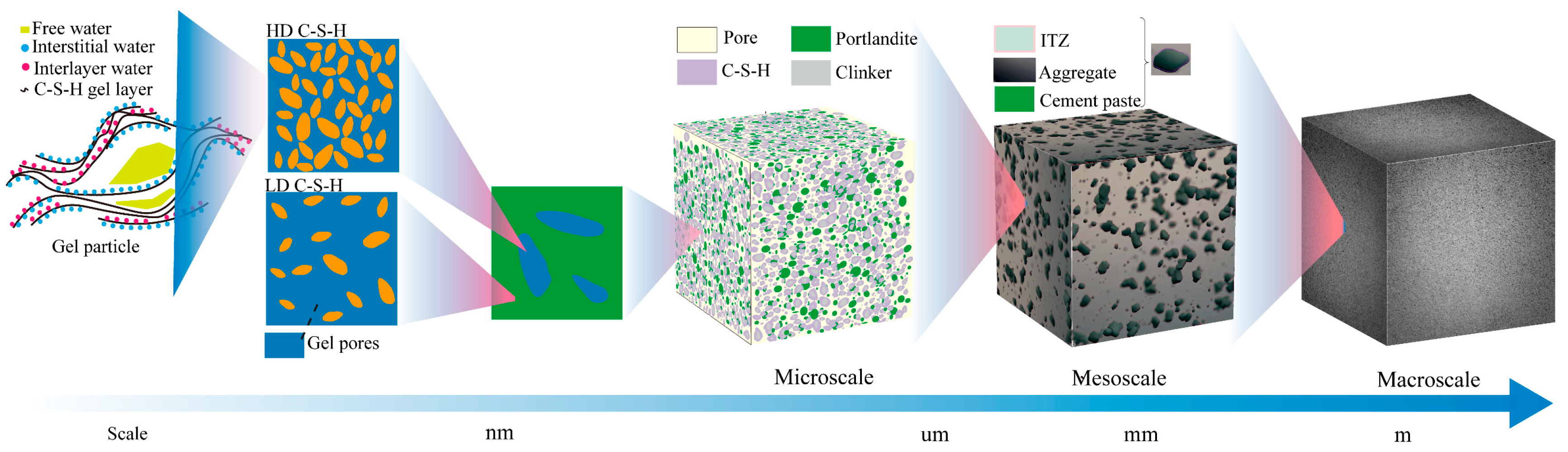
To capture the multiscale nature of these processes, Wittmann [12] introduced a three-level framework consisting of the microscale, mesoscale, and macroscale, which has since been widely adopted [5,13,14], as illustrated in Figure 1. This spatial classification provides a useful organizational basis, but it does not by itself explain how local deterioration evolves into structurally observable fatigue damage. A more informative interpretation requires tracing how mechanisms identified at one scale influence crack interaction and damage accumulation at the next.
At the microscale, the cement paste comprises gel pores, capillary pores, C-S-H, unhydrated cement particles, Portlandite, and other hydration products [15]. Fatigue studies at this level explore how local features respond to repeated loading, often at the scale of C-S-H interactions [5,13,14]. The cement matrix may also contain initial microcracks caused by hydration shrinkage and entrapped air bubbles [16,17]. Although direct observation remains challenging, many reported microscale cracks in fatigued paste are associated with fractured C-S-H phases and local defect accumulation [8]. At the mesoscale, cement-based composites comprise aggregates, cement paste, and the ITZ [3,4], and fatigue studies focus on crack initiation and propagation through these constituents. At the macroscale, the material is treated as a continuum, enabling investigations of stiffness degradation [12,18,19], fatigue life [12,18,19], cracking characteristics [10,12,20,21], and energy dissipation laws [3,11].
The aim of this review is threefold: first, to summarize experimentally and numerically observed fatigue damage mechanisms across the micro-, meso-, and macroscales; second, to critically synthesize where findings across the literature converge, conflict, or remain incomplete; and third, to discuss a causal damage transfer interpretation linking microscale deterioration, mesoscale crack interaction, and macroscale fatigue indicators. Section 2, Section 3 and Section 4 review fatigue damage at the three principal scales, Section 5 discusses their integration at multiple length scales, Section 6 presents a broader discussion of current limitations, and Section 7 concludes the main findings.

2. Microscale Studies on Fatigue Damage of Cement-Based Materials

At the microscale, the material comprises various components, including unhydrated cement grains, capillary pores, gel pores, C S H particles (the primary hydration products), and other hydration products in the cement paste, constituting the primary binding phase in concrete [15,22,23]. These microscale components interact with one another to influence the overall behavior and properties of the material, such as its strength [24,25,26,27], durability [28,29,30], and permeability [31,32,33]. For example, scanning electron microscope (SEM) images of fracture surfaces under monotonic and cyclic loading reveal distinct features such as porosity, the distribution of hydration products, mechanical interlocking, and electrostatic interactions [34]. SEM observations of static fracture surfaces reveal features consistent with the hypothesis that fatigue crack growth behavior at the nanoscale level is linked to the rupture of C-S-H gel particle connections [8]; the microcracks on the fatigue fracture surfaces are generally distributed around stiff particles such as unhydrated cement particles and calcium hydroxide (CH) or near pores [8].
Microscale studies of fatigue damage are crucial for further understanding how microcracks initiate, develop, and propagate in cement-based materials under cyclic loading, causing macroscopic behavioral changes through progressive degradation and ultimately leading to fatigue failure [3,35,36]. Understanding fatigue behavior requires linking microscale changes in cement-based materials with the degradation of macroscopic properties. Only a limited number of papers investigating fatigue damage at this scale have been identified (see Table 1). For a comparative summary of microscale characterization techniques and their capabilities under cyclic loading, see Table A1 in the Appendix A.

2.1. Role of Microstructure in Fatigue Damage

2.1.1. Capillary Pores

Capillary pores within the cement matrix act as stress concentrators due to their lower stiffness relative to the surrounding material, thereby facilitating microcrack initiation and subsequent propagation under cyclic loading [44,45,46]. Additionally, capillary pores allow water and aggressive substances to penetrate cement-based materials [47], which can promote corrosion, swelling, or chemical reactions, creating initiation points for fatigue cracks under cyclic loading, ultimately leading to failure [48,49].

2.1.2. Unhydrated Cement

Unhydrated cement particles, owing to their higher stiffness relative to surrounding hydration products, act as stress concentrators that promote crack initiation and facilitate crack growth under cyclic loading [35]. These particles, often embedded within the hydrate gel matrix, become exposed during cyclic loading as advancing microcrack fronts propagate through the matrix, promoting the development of additional nanoscale cracks. This results in a higher crack density and more complex crack networks in fatigued samples than in those subjected to monotonic loading. Their crystalline structure and comparatively weak bonding make these phases vulnerable to stress concentrations; under cyclic loading, this vulnerability facilitates microcrack initiation and growth, especially in the vicinity of unhydrated particles and weaker C–S–H phases [50,51,52]. The larger size or non-uniform distribution of these particles intensifies stress concentrations, thereby accelerating crack propagation and their coalescence into macrocracks [53,54]. However, under certain conditions, unhydrated cement particles may undergo further hydration, which can locally improve strength; the mechanisms of such healing effects are discussed in Section 2.1.3.
In conclusion, unhydrated cement particles significantly influence the fatigue damage process in cement-based materials, acting as both sites of stress concentration and potential sites for further hydration-induced strength enhancement.

2.1.3. Hydration Products (Mainly C-S-H)

The microstructure, particularly the calcium–silicate–hydrate (C-S-H) phase, plays a critical role in governing the properties of cement-based materials. Its influence on fatigue behavior can be grouped into three main mechanisms: (i) healing and repair, where rehydration fills defects and pores with hydration products, including C-S-H gel, thereby improving compactness [52]; (ii) crack initiation and propagation, where fatigue damage accumulates through microcrack formation growth, with fractures exposing un-hydrated surfaces [8,34,35,40]; (iii) crack bridging and closure, where hydrates physically bridge microcracks and facilitate microstructural repair [24].
These mechanisms strongly affect fatigue resistance and overall durability, as C-S-H gel provides cohesion and strength to the cement paste [42,55]. The incorporation of nanofillers can further enhance the role by promoting a denser C–S–H network and refining the pore structure of the hardened paste [29]. Despite these improvements, the underlying mechanisms remain complex, with nanoscale crack growth often attributed to the rupture of C-S-H connections [40,52]. Molecular simulations are increasingly used to explore the nanoscale mechanical behaviors of C-S-H and polymer fibers [37,43].
Healing and Repair
During cyclic loading at an early age, calcium–silicate–hydrate (C-S-H) gel, the primary hydration product, can undergo chemical reactions and rehydration, leading to the closure of microcracks and improved material integrity. This phenomenon is explained by the self-healing of cement paste under cyclic loading, which is attributed to its nanogranular C-S-H gel architecture. This structure comprises interlayer spaces accommodating water molecules and calcium ions. Under compression, these interstitial spaces diminish, leading to the expulsion of water molecules. During load release, the spaces reopen, facilitating the ingress of new water molecules and calcium ions. This process fosters the formation of new bonds and the healing of cracks [56,57].
Furthermore, unhydrated cement grains amplify this mechanism by serving as a source of calcium ions for rehydration [58]. The rehydration produces calcium–silicate–hydrate (C–S–H) gel and calcium hydroxide (CH) crystals that fill the cracks [59]. This mechanism is supported by the observation that the compressive strength of cement paste increases after cyclic loading, particularly at low water-to-cement ratios and high solid inclusion contents [58]. Thus, the healing process contributes to damage repair and enhances the fatigue resistance of the cement-based material.
Crack Behavior
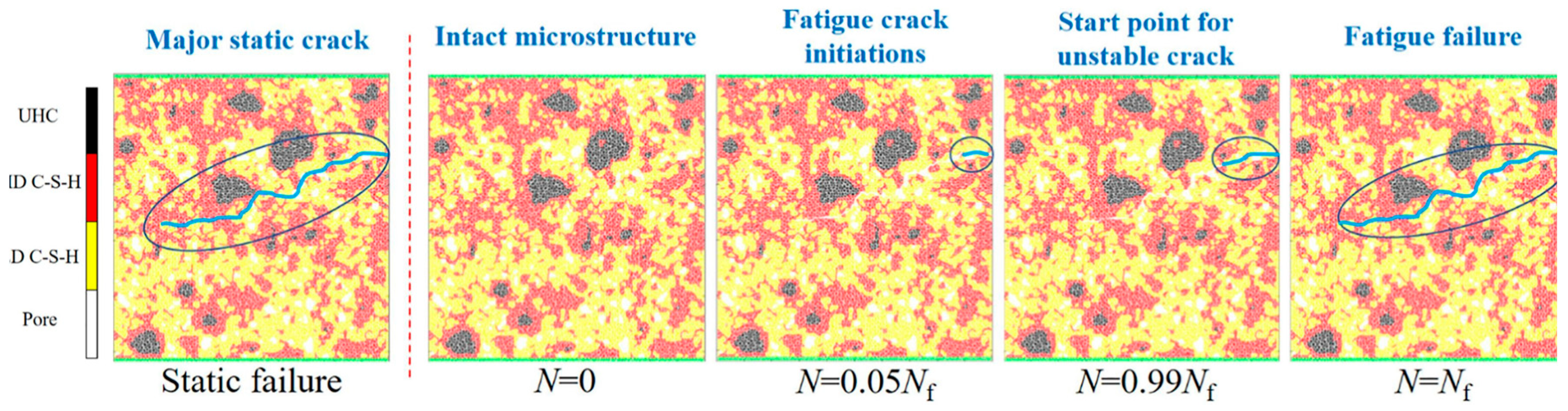
Fatigue damage in hardened cement paste at the microscale was numerically investigated under uniaxial tensile loading using a 2D lattice model based on realistic XCT images and a cyclic constitutive law that accounts for fatigue damage evolution and crack growth [35]. In Figure 2, the visualization depicts the sequence of crack initiation and propagation, where cracks propagate along the weakest link via low-density C-S-H and pores [35]. This susceptibility of C-S-H to crack initiation arises from its relatively low tensile strength compared to other components of cement-based materials [58]. Under fatigue loading, many nanocracks, as shown in Figure 2, merge to form primary cracks, leading to ultimate failure [18]. These nanocracks act as stress concentrators and pathways for harmful substances, compromising the material’s durability and fatigue performance [8,34,35,40].
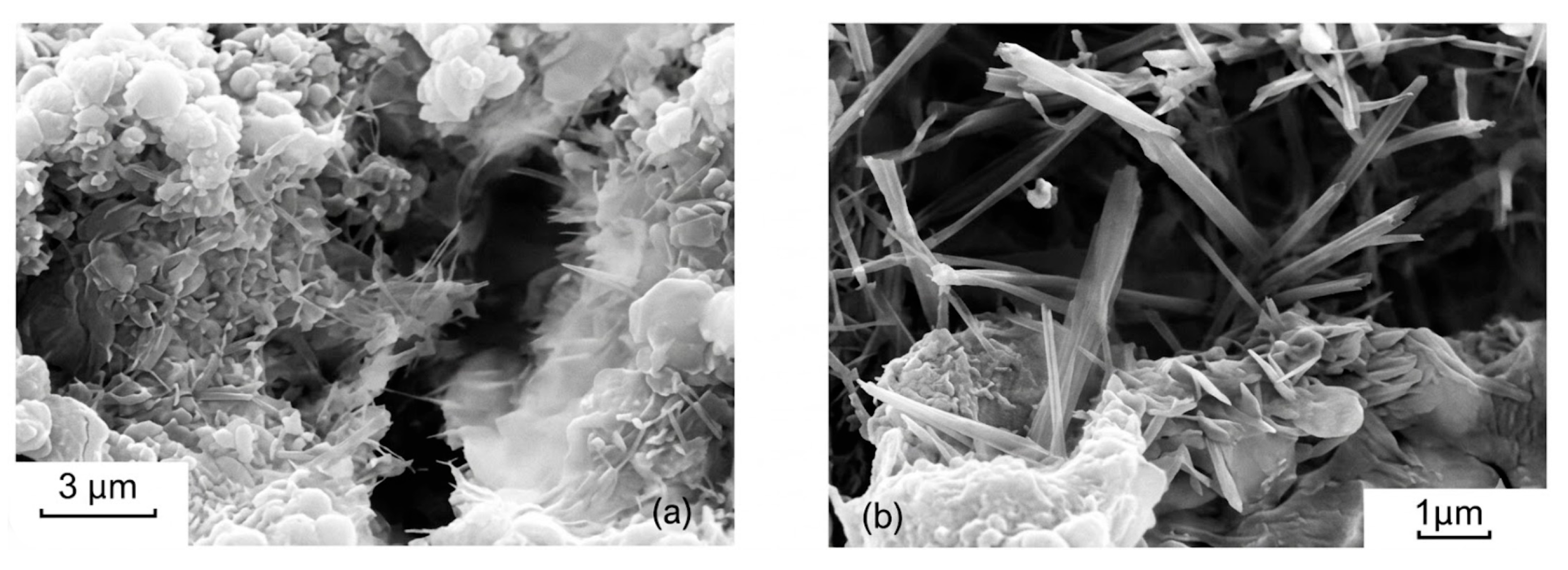
C-S-H can also act as a crack-bridging material, spanning the cracks that form during cyclic loading, as shown in Figure 3 [24]. This bridging effect helps redistribute stresses, dissipate energy, and partially close cracks, promoting microstructural repair. This process decreases porosity and enhances strength by hydrating previously unreacted cement, thereby reducing the volume of water-filled or partially filled pores [60]. Other hydration products, including calcium hydroxide (CH) crystals [61] and ettringite, can impact fatigue behavior alongside C-S-H particles. CH crystals may initiate cracks and reduce fatigue strength [61], while ettringite undergoes volume changes during hydration or moisture, generating internal stresses contributing to fatigue damage [62].
Fatigue Hardening
Garrett [24] investigated fatigue hardening during cyclic loading through a novel rehydration technique. The study measured strength from pre- and post-fatigue wet and dried samples. SEM analysis revealed that fatigue exposes unhydrated cement particles, leading to further hydration and the formation of new hydration products, such as C-S-H. These products can either strengthen the material by filling microcracks or weaken it by increasing CH and causing microcracking due to ettringite recrystallization. This work illustrates how microscale studies provide critical insights into fatigue damage mechanisms by linking hydration chemistry with crack development and material performance.
Microscale studies have significantly improved understanding of fatigue damage in cement-based materials by clarifying the roles of capillary pores, unhydrated cement particles, and hydration products, particularly C-S-H. Capillary pores act as stress concentrators and transport pathways for moisture and aggressive agents; unhydrated cement particles may both initiate local stress concentrations and provide limited potential for secondary hydration; and the C-S-H phase is central to crack initiation, bond rupture, local crack bridging, and partial microstructural recovery. These findings collectively show that microscale fatigue resistance depends not on a single constituent, but on the interaction among porosity, hydration state, and local defect evolution.
At the same time, the microscale literature still provides stronger mechanistic insight than quantitative transfer rules. No single mechanism can be identified as universally dominant under all loading and environmental conditions: progressive bond rupture is generally more closely associated with fatigue degradation, whereas limited moisture-assisted rehydration may locally delay crack growth or contribute to apparent recovery at early ages. In addition, loading frequencies and strain rates used in molecular dynamics or related microscale simulations are not directly representative of structural fatigue conditions, so these studies are best viewed as tools for mechanism identification and relative trend interpretation rather than direct life prediction. These findings indicate that microscale fatigue behavior is governed by the interactions among porosity, hydration state, and local defect evolution, providing the mechanistic basis for the mesoscale crack interaction processes observed.

3. Mesoscale Studies of Fatigue Damage in Cement-Based Materials

3.1. Importance of Mesoscale Studies in Understanding Fatigue Damage

At the mesoscale, cement-based materials have three phases: aggregates, cement paste matrix, and the ITZ. Mesoscale studies, positioned between microscale characterization and macroscale structural analysis, have demonstrated that the properties and interactions of these phases play a decisive role in fatigue damage evolution and overall material performance [56,57,61,62].
Mesoscale studies are vital for understanding fatigue damage in cement-based materials, providing valuable insights into the initiation and propagation of cracks, assessing stress transfer mechanisms, and analyzing microstructural heterogeneity, thereby significantly influencing overall performance [3]. Researchers can improve the fatigue resistance of cement-based materials by identifying critical sites for crack initiation, optimizing stress transfer mechanisms, and developing targeted design strategies [63]. Extensive research has been conducted on various cement-based materials, such as asphalt concrete [64], cement-treated base materials [65,66,67], and fiber-reinforced concrete [59,68]; Refs. [3,59,64,65,66,68,69,70,71,72,73,74,75,76,77,78,79,80,81,82,83,84,85] cover various materials, with a subset [68,70,73,74,77,79,80] focusing on fatigue damage in cement-based materials as presented in Table 2. Cylindrical samples (with a diameter-to-height ratio of 1:2) are used in compressive fatigue tests, while beam-shaped samples are employed in flexural fatigue tests with the three-point bending method. Representative mesoscale investigations and the detection methods they employ are compiled in Table A2 (Appendix A).

3.2. Role of Mesostructure in Fatigue Damage

Heterogeneity at the mesoscale is crucial in governing fatigue damage in cement-based materials. The presence of different components, such as aggregates, cement paste, and ITZs, introduces variations in mechanical and physical properties that significantly affect stress distribution, crack initiation, and propagation. When short fibers are incorporated, they act as an additional bridging phase, further modifying the fatigue response.
The ITZ, being more porous and weaker than the bulk paste, is especially prone to stress concentrations and often serves as a preferred site for crack initiation under cyclic loading [89,90]. The cement paste, already analyzed in detail at the microscale (Section 2), serves as the continuous phase that transfers stresses between aggregates and accommodates microcrack development under fatigue [91,92]. Aggregates play an active role in enhancing the fatigue resistance of cement-based materials. Acting as crack arresters and bridging elements, they disrupt crack propagation, forcing cracks to deviate from straight paths and thereby increasing crack tortuosity. This deflection mechanism promotes multiple cracking, distributing damage over a larger volume and increasing the energy dissipation associated with fatigue crack formation and growth. As a result, aggregates delay crack coalescence and extend the fatigue life of the material. Their effectiveness depends strongly on size, morphology, distribution, and the quality of bonding with the surrounding paste. As further elaborated in Section 3.2.3, aggregates contribute most effectively to fatigue resistance through crack arrest, bridging, and tortuosity mechanisms that enhance energy dissipation [74,81,93,94].
In summary, mesoscale heterogeneity governs both the damage accumulation and energy dissipation during the cyclic loading. A comprehensive understanding of the interactions among ITZ, paste, and aggregates is therefore essential for predicting fatigue performance and for designing cement-based materials with improved resistance to cyclic loading.

3.2.1. Interfacial Transition Zone (ITZ)

As mentioned above, the ITZ represents the weakest region in cement-based materials due to its higher porosity and poorer bonding compared with the bulk paste. Building on this, Sanchez et al. [85] demonstrated, using the Damage Rating Index (DRI), that cracking patterns associated with internal swelling reactions often involve debonding and crack development in the ITZ, confirming its role as a preferential pathway for deterioration. Under cyclic loading, stress concentrations localize in this region, enabling crack initiation and subsequent propagation into the surrounding paste [89,90]. Furthermore, the porous structure of the ITZ makes it more vulnerable to environmental factors, such as moisture infiltration, chemical attack, and freeze–thaw cycles, which further degrade its mechanical performance and intensify fatigue damage [86].
Improving the quality of the ITZ—through supplementary cementitious materials and nano-modified, optimized curing—remains an effective strategy to enhance fatigue resistance and extend service life in concrete structures [95,96,97].

3.2.2. Cement Paste

Cement paste is crucial in studying fatigue damage in concrete structures through multiple mechanisms. As a binding agent, it enhances the structural integrity, stiffness, and strength of the composites. However, it is essential to acknowledge that cement paste is also susceptible to fatigue damage [94]. Shrinkage-induced cracks may form during the early drying and curing stages as the paste undergoes volume reduction [76,92]. These pre-existing flaws can serve as preferential sites for fatigue damage once cyclic loading is applied. Under repeated loading and unloading, additional microcracks develop and progressively propagate through the paste, driven by localized stress concentration [98]. In this way, shrinkage cracks act as precursors, while fatigue-induced microcracking governs the progressive degradation of cement paste.
During cyclic loading, the stiffness of the cement paste plays a critical role in controlling stress distribution and crack formation [99]. Repeated loading and unloading impose alternating stress states of compression and tension that induce strain in the paste, and because its stiffness differs from that of aggregates and the ITZ, this mismatch produces non-uniform stress and strain distributions across the composite material [100]. The presence of water-filled capillaries and the inherent brittleness of the paste further increase its susceptibility to cracking under cyclic loading [101].
The material weakens as microcracks initiated from the cement paste propagate and connect with neighboring cracks, as shown in Figure 4, eventually reducing load-carrying capacity. Due to its brittleness, cement paste offers limited resistance to crack propagation. This limited resistance exacerbates the development and progression of fatigue damage in the concrete structure.

3.2.3. Aggregates

Aggregates play a vital role in the fatigue mechanism of cement-based materials through their interactions with the cement paste and their influence on crack development. At the early stages of cyclic loading, the bond between aggregates and the cement matrix enhances matrix cohesion and improves resistance to crack initiation [3,81]. This bond reduces premature debonding at the ITZ and helps distribute stresses more effectively, thereby lowering the risk of localized stress concentrations that accelerate fatigue damage [91].
However, it is crucial to acknowledge that the intrinsic properties of aggregates—such as their size, shape, porosity, and interfacial bonding quality—play a pivotal role in determining the fatigue behavior of concrete [3]. Aggregates with inherent weaknesses in these properties, such as excessive porosity, irregular particle geometry, or poor adhesion to the cement matrix, can act as localized stress concentrators, accelerating the initiation and propagation of fatigue cracks [74,93]. For instance, porous aggregates may compromise the material’s integrity by creating nucleation sites for microcracks, while angular or elongated particles can induce internal stress imbalances. Similarly, weak ITZs between aggregates and the cement paste further exacerbate fatigue damage susceptibility by facilitating crack growth [81,94].

3.2.4. Fiber Reinforcement

Short fibers enhance fatigue resistance by bridging cracks, arresting crack growth, and promoting multiple cracking, thereby increasing energy dissipation and transforming the brittle cementitious matrix into a more ductile one.
Polypropylene fibers (PFs) form a network within the cement matrix that bridges cracks and alters the microstructure. SEM analysis has shown that PF reduces calcium hydroxide crystallization, decreases micro-voids, and densifies the ITZ, thereby improving fatigue life [83]. Polyvinyl alcohol (PVA) fibers exhibit distinct fatigue-induced failure modes, including crushed and ruptured ends, as confirmed by SEM and EDS, which indicate that interfacial deterioration governs fatigue performance [75]. Steel fibers provide higher stiffness and strength, enabling effective macrocrack bridging and delaying unstable crack growth. Classic studies demonstrated that steel fiber-reinforced concrete (SFRC) exhibits improved flexural fatigue life, with predictive models linking fatigue performance to fiber pull-out and bridging forces [102,103]. The findings of Vicente et al. [59], who used CT-scan technology, complement this, demonstrating that variations in fiber orientation and content strongly influence both the scatter and the magnitude of fatigue life, with fibers oriented perpendicular to the loading direction providing the most effective crack bridging and the longest fatigue performance.
Overall, the effectiveness of fiber reinforcement depends on fiber type, fiber orientation, volume fraction, aspect ratio, and bond properties, which together control the balance between crack bridging, pull-out, and interfacial degradation under cyclic loading.

3.3. Contribution of Mesoscale Studies in Understanding Fatigue Damage Mechanisms

The ITZ in cement-based materials is highly susceptible to crack initiation under cyclic loading due to stress concentrations arising from the mismatch in mechanical properties between the aggregate and the cement paste, leading to uneven stress distribution [104]. Its high porosity and incomplete bonding further weaken load transfer across the matrix and provide preferential pathways for crack propagation, thereby reducing fatigue resistance [105]. Cement paste contributes to structural cohesion but is prone to shrinkage-induced microcracks and progressive damage under repeated loading. The water-filled capillary network acts as a pathway for stress concentration and moisture transport, while the brittle nature of the surrounding matrix accelerates crack initiation and propagation, rendering the paste a critical component in fatigue deterioration. Aggregates, when well bonded to the surrounding paste, improve fatigue resistance by acting as crack arresters, deflecting cracks, and promoting tortuous paths and multiple cracking. These mechanisms increase energy dissipation and delay crack coalescence, thereby extending fatigue life [102]. Conversely, poor aggregate properties, such as high porosity or weak bonding, can create stress concentrations that accelerate fatigue damage [103].
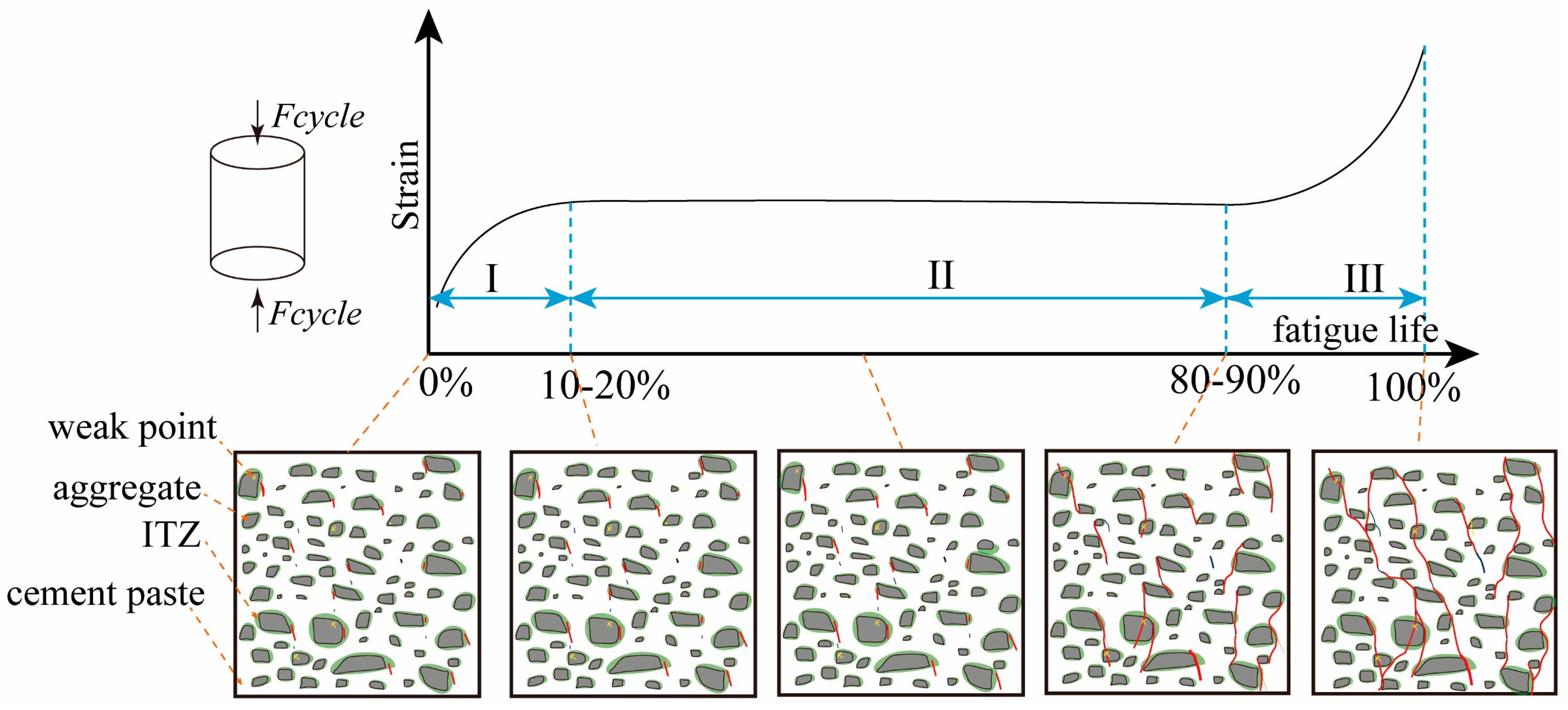
Figure 4 illustrates the strain evolution of concrete under cyclic fatigue loading, divided into three characteristic phases, and links these macroscopic trends to mesoscale crack development [106]. The curve shows strain on the vertical axis and fatigue life on the horizontal axis, highlighting how deformation evolves from initial microcrack nucleation to final failure. The lower schematics provide a mesoscale perspective, showing aggregates, cement paste, and the ITZ, each of which can act as a potential weak point where cracks can form and evolve. In Phase I (0–10% or up to 20% of fatigue life), strain increases rapidly as microcracks nucleate in regions of inherent weakness, most often within the ITZ, but also in pre-existing flaws in aggregates or cement paste. During Phase II (10–20% to 80–90%), strain stabilizes, and damage evolves more gradually; microcracks propagate in a distributed manner across aggregates, ITZ, and cement paste, causing progressive stiffness degradation while the specimen retains load-bearing capacity. In Phase III (80–90% to failure), strain accelerates sharply as cracks coalesce into a connected fracture network spanning the mesoscale constituents, leading to a catastrophic loss of structural integrity and ultimate failure.
Taken together, the mesoscale literature consistently shows that fatigue damage is strongly controlled by ITZ quality, aggregate morphology, and constituent interactions. However, reported effects of aggregate size and shape on crack paths are not always consistent, as the governing mechanism depends on stress level, stiffness mismatch, specimen geometry, and whether a study emphasizes crack initiation or propagation. For fiber-reinforced systems, fatigue resistance should not be attributed solely to crack bridging: fiber–ITZ interactions are a distinct, coupled mesoscale mechanism that involves debonding, pull-out resistance, interface degradation, and load transfer under cyclic loading. These mesoscale mechanisms provide the key bridge between microscale defect generation and macroscale fatigue response, highlighting the importance of constituent interaction and crack network evolution.

4. Macroscale Studies of Fatigue Damage in Cement-Based Materials

4.1. Importance of Macroscale Studies in Understanding Fatigue Damage

As shown in Table 3, macroscale studies assess the global response of cement-based materials to cyclic loading by monitoring stiffness degradation, residual strain, and the evolution of crack density and width, and by quantifying fatigue life indicators such as S–N curves [7,9,107,108]. At this level, the cumulative effects of micro- and mesoscale damage are expressed through measurable structural properties. These are essential for linking multiscale mechanisms to service life prediction, load-bearing capacity under repeated loads, and for establishing design guidelines for fatigue-resistant concrete structures.
In the context of fatigue damage, understanding and predicting the performance of heterogeneous materials, such as cement-based materials, requires establishing clear links between their microstructure and macroscopic behavior. However, ensuring the safety, functionality, and durability of structures also requires macroscale investigations that account for geometric details and realistic boundary conditions.
Macroscale specimens or structural components, such as beams or slabs, are subjected to controlled cyclic loading patterns that closely simulate real-world conditions. Techniques employed in macroscale fatigue studies include theoretical and analytical approaches, as shown in Table A3 in Appendix A, such as curve fitting of mechanical properties [9,49,109,110,111,112] and analytical modeling [105,113,114,115,116]. Experimental methods include acoustic emission (AE) monitoring [19,117,118,119,120], ultrasonic testing [18,121,122,123,124], digital image correlation (DIC) [125,126], and fiber optics [127,128,129]. In addition, combined experimental–theoretical approaches, particularly finite element (FE) simulations [130,131,132,133,134,135], are widely used to link observed behavior with predictive models. Conducting analyses of cement-based materials at a larger scale is vital to ensure the safety and sustainability of infrastructure [10,136]. For instance, recent macroscopic beam tests incorporating carbon nanotubes and carbon fibers have demonstrated the effectiveness of self-monitoring methods, where changes in electrical resistivity successfully captured the progression of flexural fatigue damage, offering a reliable approach for simulating structural fatigue responses in real-time applications [137].
By leveraging the findings derived from macroscale analysis, engineers are empowered to make well-informed decisions that contribute to the long-term performance and sustainability of cement-based structures.
Table 3. Macroscale studies investigating fatigue damage in various types of cement-based materials.
First AuthorYearRef.Sample Typew/cSample Size (mm)Cyclic LoadMethod
Antrt1967[49]Cement paste; plain concrete0.70; 0.45Cylinder (50.8 × 101.6)Uniaxial compressionCurve analysis
Pindado1999[109]Porous concrete0.23~0.31Cylinder (150 × 300)Uniaxial compressionCurve analysis
Cachim2002[110]SRFC0.38Cylinder (150 × 300)Uniaxial compressionCurve analysis
Zhang2015[119]Rubber concrete0.36Cuboid (280 × 70 ×70)FPBAE
Oneschkow2016[111]HSC0.35Cylinder (60 × 180)Uniaxial compressionCurve analysis
Qiu2018[112]ECCs1.10Cuboid (60 × 40 ×50)FPB.Curve analysis
Alshareedah2019[105]Pervious concrete0.34Cuboid (100 × 100 × 355)TPBAnalytical modeling
Viswanath2021[9]Plain concrete0.54Cylinder (101.6 × 203.2)Uniaxial compressionCurve analysis
Fitzka2021[124]Self-compacting concrete0.39Cylinder (21 × 35)Uniaxial compressionUltrasonic testing
Oneschkow2022[7]HSC and mortar0.35Cylinder (60 × 180)Uniaxial compressionFE; Curve analysis
Abbreviations: (Φ) the diameter size of a cylinder; (h) height; (FPB) four-point bending; (TPB) three-point bending; (HSC) high-strength concrete; (ECCs) engineered cement-based composites; (SRFC) steel fiber-reinforced concrete; (AE) acoustic emission. “Cylinder (Φ × h)” is a cylinder with a diameter of Φ and a height of h. “Cuboid (L × W × H)” refers to a cuboid with a length of L, a width of W, and a height of H. All the digital number values in the “sample size” are in millimeters (mm).

4.2. Fatigue Damage at the Macroscale Level

Structural design against static and fatigue failures in concrete is still predominantly based on oversimplified empirical characterization, where the uniaxial compressive strength measured on standard cubes or cylinders—specimens with little geometric or mechanical resemblance to real structural components—serves as the sole experimentally verified design parameter. As highlighted by [138], this simplified approach fails to capture the fracture, fatigue, and size-dependent mechanisms governing real structural performance, underscoring the need to move beyond strength-based design toward physics-informed, fracture- and fatigue-based approaches.

4.2.1. Geometric Factors

Geometric factors significantly influence the macroscopic fatigue behavior of concrete because of its heterogeneous internal structure and inherent flaw distribution. Among them, specimen size plays a crucial role: larger specimens generally exhibit shorter fatigue lives under the same stress level, a phenomenon widely known as the size effect. This effect is rooted in the statistical probability of flaw occurrence and the principles of fracture mechanics. With increasing specimen volume, the likelihood of critical defects rises, and stress intensity at crack tips becomes more pronounced, thereby promoting crack initiation and accelerating fatigue crack growth. As summarized in recent state-of-the-art reviews, fracture mechanics-based fatigue models (e.g., modified Paris-type laws and size-adjusted fracture toughness formulations) consistently show that larger specimens exhibit lower effective fracture toughness and faster crack propagation rates under cyclic loading, explaining their reduced fatigue resistance [116]. Due to concrete’s heterogeneity, fatigue test results exhibit strong scatter; therefore, statistical analysis is essential for evaluating its fatigue performance and interpreting size-dependent variability [116].
Specimen size affects toughness and crack propagation under fatigue loading. Traditional stress/strength-based criteria, which predict failure when a critical stress or strain is reached as defined by constitutive laws (e.g., elasticity, plasticity, viscoelasticity) [116,139], often fail to account for the fact that larger specimens exhibit lower fatigue resistance.
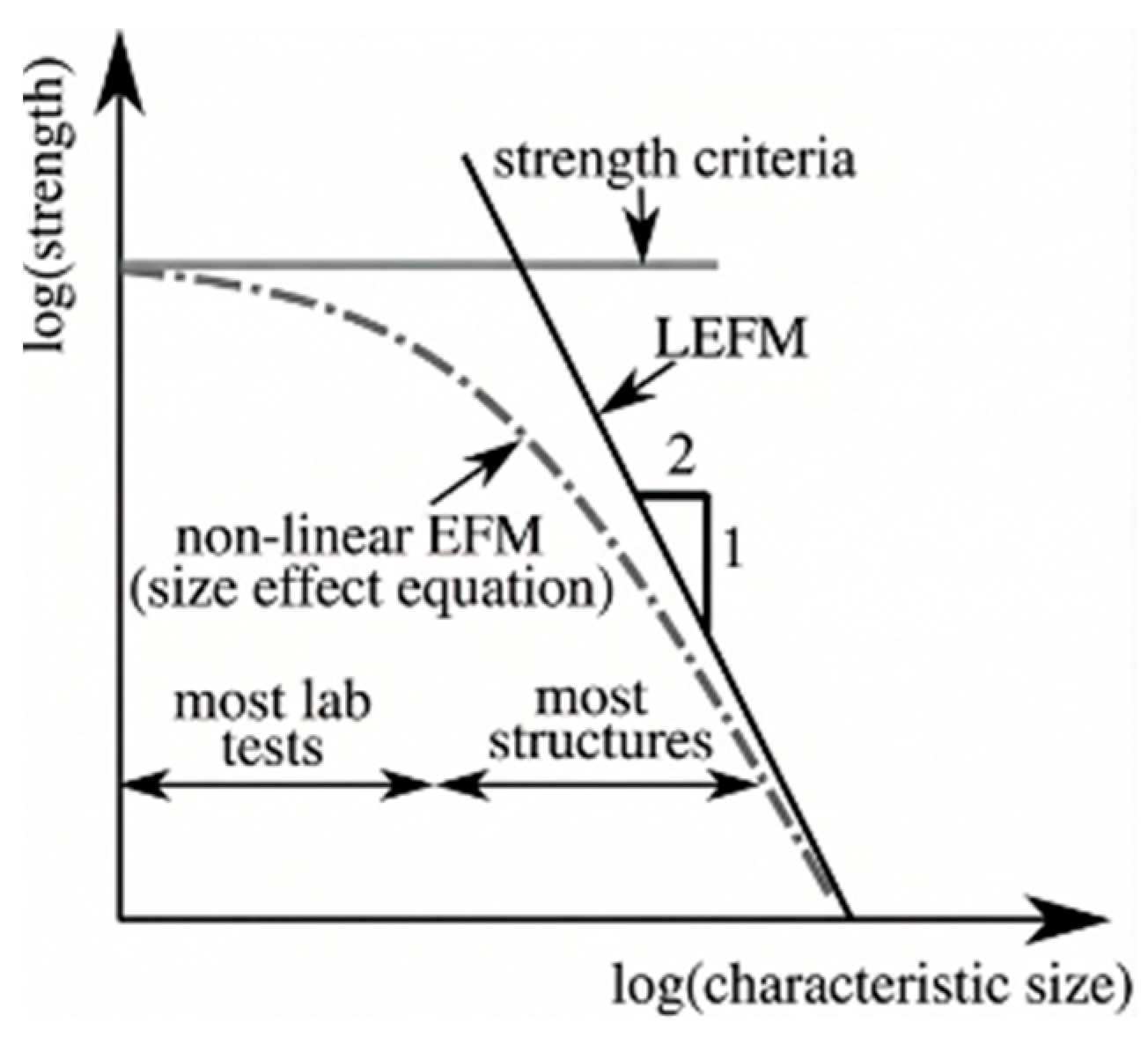
To overcome this limitation, recent studies have introduced size-dependent strength parameters that link stress-based criteria with an energy-based failure perspective. Although compressive fatigue is not governed by classical mode I crack propagation, fracture-mechanics principles provide a rational explanation: fatigue failure occurs when the available energy within the material exceeds the energy required to activate and grow internal micro-defects, and this energy threshold decreases with increasing specimen size [116,138]. As shown in Figure 5, smaller specimens exhibit strength-controlled behavior, whereas larger specimens exhibit energy-controlled failure with pronounced size effects [140]. Using both small and large specimens helps connect laboratory fatigue results with the behavior of full-scale concrete structures. Size effects can be interpreted within the framework of fracture mechanics. Linear Elastic Fracture Mechanics (LEFM) applies when concrete behaves in a brittle manner—as in large specimens—where failure is governed by energy release and stress intensity. In contrast, nonlinear (cohesive) fracture mechanics accounts for microcracking and nonlinear stress redistribution, making it more appropriate for smaller or quasi-brittle specimens. Together, these perspectives enable consistent interpretation of fatigue behavior across different specimen sizes.

4.2.2. Boundary Conditions

Boundary conditions in fatigue testing encompass the constraints, loading patterns, load history, and environmental factors applied to a test specimen. These environments are designed to mimic real-world conditions to help understand how materials behave under the stress of repeated loading cycles. Accurately replicating these conditions is vital for obtaining meaningful insights into material fatigue behavior and developing reliable design strategies for structures subjected to repeated stress cycles.
Constraints can cause stress concentrations, accelerate crack growth, and reduce fatigue life. The shape and size of the test specimen introduce geometric constraints that can influence stress distribution. For instance, notches or holes in a specimen act as stress raisers, leading to localized stress concentrations and accelerated fatigue crack initiation [19,139]. The specific type of loading, such as tension, compression, or bending, imposes distinct constraints on the material. In [141], bending tests were performed on prism specimens under both concentric and eccentric loading, showing that eccentric loading produced a more heterogeneous damage pattern. The type and placement of supports used to hold the specimen during fatigue testing introduce constraints that affect load transfer through the material. Fixed supports rigorously constrain the specimen, preventing movement or rotation at the support points. This restraint leads to a more complex stress distribution, often with higher stress concentrations near the fixed supports [124]. In contrast, simply supported conditions allow for some rotation or movement at the supports. This reduced restraint typically results in a more uniform stress distribution across the specimen, minimizing stress concentrations near the supports [12].
Loading patterns significantly influence fatigue damage in cement-based materials, and recognizing their influence is essential for reliable service life prediction. Under uniform compressive loading, microcracks tend to nucleate in the cement matrix near particle boundaries and gradually propagate, leading to progressive reductions in stiffness and strength [141]. When loading is non-uniform, as in gradient-compressive or tensile cases, stress redistribution induces asymmetric crack development; here, residual strain and curvature are essential indicators for evaluating fatigue behavior [141]. These structural-scale responses connect directly with fatigue regimes: high cycle fatigue at low stress amplitudes produces slow but cumulative microcrack growth that eventually coalesces into larger cracks, typical of traffic- or vibration-loaded structures [108,118,124,139], whereas low cycle fatigue at high stress amplitudes over fewer cycles triggers rapid macrocrack formation and severe damage, as often observed during earthquakes or impact events [108].
Environmental factors such as moisture, temperature fluctuations, and chemical exposure can exacerbate fatigue-related damage. As moisture penetrates cement-based materials and fills their internal pores and voids, it causes internal stresses under cyclic loading due to pressure fluctuations [104,142]. This internal pressure buildup can weaken the microstructure, making it more susceptible to fatigue damage [142]. Furthermore, moisture can initiate or accelerate chemical reactions within the material, leading to degradation and weakening the structure [143]. For instance, in concrete, moisture promotes carbonation, in which carbon dioxide reacts with calcium hydroxide to form calcium carbonate, lowering the pH of the pore water [141]. This reduced alkalinity compromises the passivation layer protecting the reinforcing steel, making it vulnerable to corrosion and contributing to structural deterioration, making fatigue damage easier [141]. In cold environments, trapped moisture can freeze and expand, generating internal stresses that induce cracking, strength loss, and a higher fatigue failure risk [144]. Temperature fluctuations can induce thermal stresses within concrete, contributing to fatigue damage. Higher temperatures generally lead to reduced fatigue life in concrete [119]. This is supported by testing dry concrete at 70 °C, significantly reducing fatigue life compared to 25 °C, with ordinary concrete dropping by 66% and crumb rubber concrete by 80% [119]. Chemical exposure can significantly impact the fatigue damage of cement-based materials. For instance, carbonation, a reaction between CO2 and concrete, accelerates fatigue damage by increasing CO2 diffusion through microcracks and raising the carbonation rate [141]. Additionally, exposure to chemicals like calcium chloride can reduce damage when supplementary cementitious materials are used [145].
By carefully controlling boundary conditions, researchers can accurately simulate real-world conditions, gain deeper insight into material fatigue behavior, and develop robust design strategies for structures subjected to cyclic loading.

4.3. Key Findings

Macroscale studies reveal that geometric factors, such as specimen size and shape, significantly influence fatigue performance due to the quasi-brittle behavior and heterogeneity of cement-based materials. Larger specimens generally exhibit shorter fatigue lifetimes and lower fracture toughness, while smaller specimens more closely follow strength criteria. Boundary conditions, including support configurations and loading patterns, are critical for stress distribution and crack propagation. Fixed supports induce stress concentrations, whereas simply supported conditions result in more uniform stress. Loading conditions, including loading patterns and load histories, produce distinct crack formation behaviors. For instance, high-cycle fatigue at low stress amplitudes leads to gradual microcrack accumulation, whereas low-cycle fatigue at high stress amplitudes results in rapid macrocrack formation and severe damage.
Environmental factors, including moisture, freeze–thaw cycles, temperature variations, and chemical exposure, exacerbate fatigue by weakening the microstructure and accelerating degradation processes, such as carbonation and corrosion. Finally, techniques including loading curve analysis, acoustic emission, ultrasonic testing, optical methods such as DIC and fiber optics, and finite element modeling provide complementary insights into fatigue behavior, helping to link laboratory results with real-world structural performance and guiding the design of safer, more durable, and sustainable cement-based structures.
These observations also indicate the limits of treating fatigue solely through S-N curves. S-N relationships remain useful as compact empirical descriptors. However, they are not mechanistic models: they cannot uniquely represent stiffness degradation, residual strain evolution, energy dissipation, crack network topology, or coupled environmental effects, and specimens with similar fatigue lives may still follow different damage paths. Likewise, LEFM-type interpretations are most informative when a dominant crack or an equivalent fracture process zone can be idealized, whereas cohesive or energy-based approaches are more appropriate for distributed cracking in quasi-brittle materials. The present discussion of size effect and boundary conditions is intended to complement, not contradict, standardized fatigue test procedures such as ASTM- and RILEM-type methods. Macroscale fatigue indicators, therefore, represent the cumulative outcome of damage processes evolving across multiple structural scales.

5. Studies on Fatigue Damage of Cement-Based Materials at Multiple Length Scales

This section synthesizes the preceding microscale, mesoscale, and macroscale evidence. The purpose is to examine how findings across scales can be connected, where current experimental-model links remain incomplete, and which issues most strongly limit reliable fatigue life prediction.
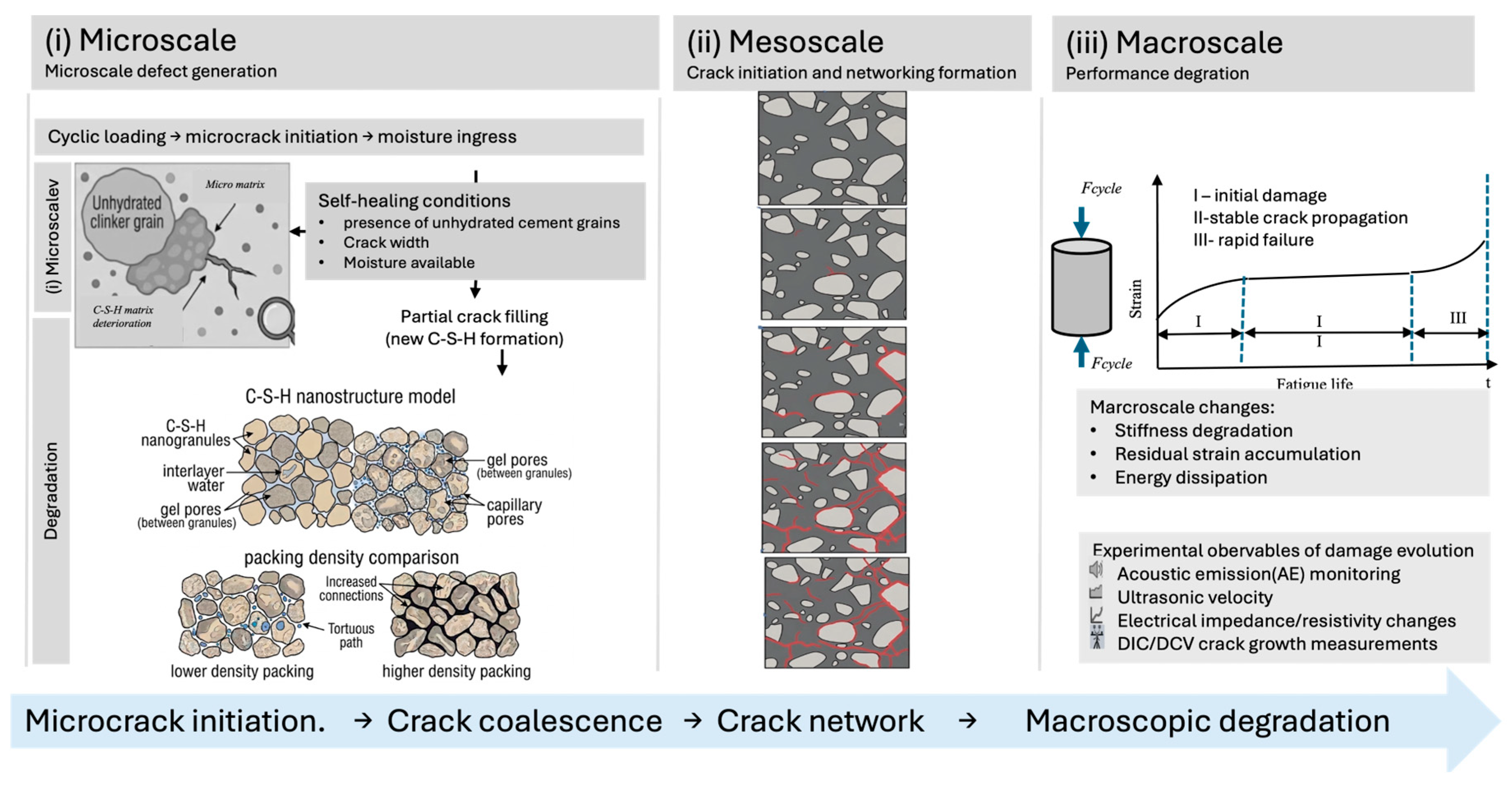
To synthesize the mechanisms discussed in the previous sections, fatigue damage in cement-based materials can be interpreted as a multiscale damage transfer process linking microscale defect generation, mesoscale crack interaction, and macroscale performance degradation.
Figure 6 summarizes this conceptual framework and illustrates how microscale bond rupture and pore evolution lead to mesoscale crack initiation and interaction within the heterogeneous microstructure, ultimately manifesting as stiffness degradation, residual strain accumulation, and fatigue failure at the macroscale. The figure also highlights representative experimental observables across scales, including acoustic emission monitoring, ultrasonic velocity measurements, changes in electrical impedance or resistivity, and DIC/DVC-based crack-growth tracking. The schematic synthesizes the multiscale fatigue mechanisms discussed throughout the review. At the microscale, cyclic loading leads to bond rupture, pore evolution, and microcrack initiation within the hydrated cement matrix. These defects interact at the mesoscale through ITZ debonding, crack deflection around aggregates, and crack coalescence, eventually forming crack networks. At the macroscale, the development of these crack networks manifests as stiffness degradation, residual strain accumulation, and energy dissipation under cyclic loading. Representative experimental observables across scales include acoustic emission monitoring, ultrasonic velocity measurements, electrical impedance monitoring, and DIC/DVC-based crack-growth characterization.

5.1. Importance of Integrating Findings at Multiple Length Scales

To gain a comprehensive understanding of concrete behavior and failure mechanisms, it is imperative to integrate research findings from studies spanning the micro-, meso-, and macroscales [62]. In the present review, this multiscale perspective serves not merely as a classification scheme but also as the basis for a causal damage transfer interpretation: microscale bond rupture and local defect accumulation progressively influence mesoscale interfacial debonding and crack interaction, which, in turn, manifest as macroscale stiffness loss, residual strain accumulation, and structural fatigue failure. Existing studies have already demonstrated the value of multiscale approaches for linking fatigue behavior across scales. For example, Zhang et al. proposed a multiscale modeling method based on an uncoupled upscaling technique to investigate the fatigue performance of concrete structures [146]. Sun et al. used a multiscale approach combining mesoscale and macroscale models to investigate crack development during high-cycle fatigue, showing that fatigue cracks often originate near the ITZ and gradually propagate into the cement mortar matrix [61]. Ding et al. developed a physically motivated model linking microscale fatigue energy dissipation, self-similar crack development, and stochastic fracture behavior at the macroscale [135]. Together, these studies show that the key challenge is not only to describe fatigue phenomena at different scales, but also to clarify the mechanistic pathways by which damage is transferred, accumulated, and amplified across them. Integrating findings across multiple length scales is therefore essential for understanding fatigue, as it connects local deterioration, mesoscale crack propagation, and global structural response within a single interpretive framework [62].

5.2. Advancements in Understanding Fatigue Damage in Cement-Based Materials

Significant progress has been made in understanding fatigue damage in cement-based materials, yielding deeper insight into the underlying mechanisms and more reliable interpretation of fatigue life behavior. One notable advance is the improved characterization of fatigue damage across different length scales. Through microscopy and imaging techniques such as TEM, SEM, and X-ray imaging, researchers have clarified the formation and propagation of microcracks, the behavior of the ITZ, and the degradation of the cement matrix during cyclic loading [147].
Multiscale modeling approaches have also emerged as a significant development in this field. By integrating models spanning the microscale to the macroscale, researchers have captured the intricate interactions and feedback mechanisms within the material’s structure [135,148]. These sophisticated multiscale models account for factors such as the aggregate distribution, ITZ properties, and load transfer mechanisms [62]. As a result, they provide a more comprehensive and realistic representation of fatigue behavior in cement-based materials [149].
At the same time, most current multiscale models should still be regarded as partially validated rather than fully validated predictive tools. Experimental techniques such as XCT, SEM, DVC, acoustic emission, and ultrasonic monitoring provide increasingly useful checkpoints for crack initiation, crack connectivity, stiffness degradation, and strain localization, but one-to-one validation across all scales remains limited. For this reason, it is important to distinguish between promising experimental model consistency and full predictive validation.
Nevertheless, this integrated experimental–computational approach enables accurate detection of microcrack initiation and growth during cyclic loading, providing a powerful validation tool for multiscale models and offering new insights into the fatigue degradation process [150,151,152]. Together, these studies illustrate how advanced imaging and computational modeling can be merged within a multiscale framework to improve the predictive accuracy of fatigue damage analysis in cement-based materials.
These advancements collectively provide a stronger foundation for reliable fatigue life prediction and performance-based design. By linking experimental observations with multiscale modeling and computational simulations, researchers are now better equipped to develop concrete structures that are not only more durable under cyclic loading but also more sustainable in long-term applications.

6. Discussion and Critical Synthesis

Previous sections have reviewed fatigue damage mechanisms in cement-based materials across microscale, mesoscale, and macroscale length scales. This discussion critically evaluates the current state of knowledge, identifies fundamental controversies, assesses methodological limitations, and examines challenges in integrating understanding across scales. Despite decades of research, critical gaps persist in mechanistic understanding, experimental–computational validation, and practical predictive capability.

6.1. Mechanistic Controversies and Unresolved Questions

6.1.1. C-S-H Degradation: Competing Mechanisms

A fundamental controversy exists regarding C-S-H degradation under cyclic loading. Molecular dynamics simulations [153,154] demonstrate irreversible bond rupture between C-S-H gel particles, with progressive damage accumulation. Conversely, experimental observations [145,155] show partial strength recovery (30–50%) after rest periods under saturated conditions, attributed to rehydration and the formation of fresh C-S-H. This apparent contradiction reflects multiple concurrent mechanisms whose relative contributions depend on moisture availability (rehydration requires RH > 80%), loading frequency (>10 Hz suppresses rehydration), stress amplitude (>80% of compressive strength causes irreversible damage), and temperature. Current experimental techniques (SEM, XCT) fail to distinguish permanent bond rupture from temporary separation at nanoscale resolution. Advanced in situ nanomechanical testing coupled with chemical analysis is required to resolve this controversy.

6.1.2. ITZ Property–Performance Relationships

Despite widespread recognition of the ITZ’s critical role in fatigue [156,157], quantitative relationships between ITZ properties and fatigue life remain poorly established. ITZ thickness varies widely (20–100 μm) depending on measurement technique and definition criteria, yet systematic studies correlating thickness with fatigue life are absent. ITZ porosity exceeds bulk paste by 5–15% [156,158], but the functional relationship with fatigue performance has not been quantified. Direct measurement of aggregate–paste bond strength under cyclic loading is experimentally challenging, with limited data showing 5–15% degradation per decade of cycles but substantial scatter. The relative contributions of ITZ debonding versus bulk paste cracking vary significantly across studies, likely reflecting differences in aggregate characteristics, w/c ratios, and curing conditions. Establishing rigorous property–performance relationships requires standardized characterization protocols (e.g., nanoindentation mapping at ≤5 μm spacing [159] and XCT at ≤1 μm voxel size) and systematic parametric studies varying individual ITZ properties while controlling other variables.

6.1.3. Aggregate Effects and Size-Dependent Mechanisms

There are contradictory findings regarding the influence of aggregates on fatigue. Some studies report that larger aggregates enhance resistance (1.5–2×) through crack deflection [160], while others report reduced service life (30–50%) due to stress concentrations [140,161]. These contradictions arise from stress level dependency (crack deflection dominates at low stress, while concentration dominates at high stress), dimensional effects (aggregate size relative to crack length), ITZ quality variations (weak ITZ promotes interfacial cracking, while strong ITZ enables deflection), and three-dimensional crack complexity undetectable in two-dimensional studies. Similarly, both Linear Elastic Fracture Mechanics (LEFM) and energy-based approaches are used to address size effects [140,148], yet their applicability domains remain poorly defined. The transition zone (between the applicability of LEFM and energy-based approaches) requires combined approaches and experimental validation. For fatigue, additional complications arise from dynamic FPZ evolution during testing, as FPZ size increases 2–3 times from initial cycles to near failure.

6.2. Methodological Limitations and Validation Gaps

6.2.1. Loading Condition Representativeness

Most fatigue studies employ high frequencies (5–20 Hz) and elevated stress levels (70–90% of compressive strength) for short test durations, yet infrastructure loading occurs most frequently at 0.1–1 Hz and 30–60% of the compressive strength. This 1–2-order-of-magnitude frequency discrepancy affects time-dependent processes, such as creep (5 s load duration at 0.1 Hz allows for creep, while entirely suppressed at 10 Hz), moisture redistribution (equilibration possible at low frequency, while persistent gradients remain at high frequency), and chemical kinetics (dissolution–precipitation proceeds over minutes to hours, while entirely suppressed at high frequency) [162,163]. Limited studies comparing frequencies report reductions of 20–40% in service life when increasing from 0.5 Hz to 10 Hz. High-frequency loading also generates heat, with temperature rises of 5–15 °C affecting material properties and time-dependent mechanisms. Stress-level extrapolation using S-N relationships introduces substantial uncertainty, as different mechanisms may dominate at service stress levels (localized ITZ microcracking at 50–70% of compressive strength) versus laboratory stress levels (widespread inelastic deformation at >75% of compressive strength).

6.2.2. Molecular Dynamics Validation Gap

MD simulations predict bond rupture at the C-S-H particle scale (1–50 nm) [153,154], while experimental techniques (SEM ≥ 1 μm, XCT 0.5–5 μm [152]) operate at a coarser scale by four orders of magnitude. This resolution gap prevents direct validation of MD-predicted mechanisms. Time-scale gaps (MD resolves nanoseconds to microseconds, while experiments span hours to years) further complicate validation. Bridging strategies include nanoindentation under cyclic loading combined with Raman spectroscopy, statistical upscaling to mesoscale properties amenable to experimental validation [146], indirect validation through macroscale measurements, and machine learning-accelerated simulations that enable larger systems [164]. Until such validation is established, MD predictions should be viewed as hypothesis-generating tools rather than quantitatively predictive models.

6.2.3. S-N Curve Limitations and Alternative Approaches

S-N curves remain dominant despite several fundamental limitations: (1) mechanism agnosticism, i.e., identical S-N curves may reflect different failure mechanisms; (2) variable amplitude inadequacy, i.e., Miner’s rule violations resulting in gross errors exceeding 300% [138]; (3) excessive scatter with coefficient of variation of 0.3–0.8, compared to 0.05–0.15 for static strength; (4) neglecting environmental coupling, resulting in laboratory curves that underestimate field damage by 2–5 times [141,165]; and (5) size dependence, i.e., smaller specimens show 2–3 times longer life than large specimens [140,148]. Alternative energy-based methods [148] characterize fatigue through cumulative energy dissipation, providing intrinsic material properties that are less size-dependent than those of stress-based criteria and naturally handle variable-amplitude loading. Damage mechanics models [135,147] introduce damage variables that evolve according to physically motivated laws, enabling the prediction of variable amplitude and multiaxial loading. However, these approaches require more complex testing and broader validation before design code adoption.

6.2.4. Coupled Fatigue–Environment Degradation

Most fatigue studies are conducted under controlled laboratory conditions (20–25 °C, 50–60% RH), yet infrastructure experiences simultaneous mechanical and environmental degradation. Freeze–thaw cycling combined with fatigue produces 2–3 times faster degradation than additive effects [144], as freeze-induced microcracking creates stress concentrations that accelerate fatigue, while fatigue cracks provide water pathways that accelerate freeze damage. Chloride ingress under fatigue increases penetration rates [166], with fatigue cracks bypassing slow diffusion through intact concrete and enabling corrosion that generates additional tensile stresses. Carbonation combined with fatigue accelerates CO2 ingress [141], with embrittlement increasing crack propagation. These synergistic effects create feedback loops, reducing service life more than 90% compared to uncoupled predictions [166]. Coupled mechanisms remain under-studied due to experimental complexity (environmental chambers, extended durations), mechanism complexity (multiple interacting processes), time-scale mismatches (environmental degradation operates on months-to-years scales, while mechanical fatigue operates on hours-to-weeks), and model complexity (multi-physics coupling).

6.3. Cross-Scale Integration and Damage Transfer Framework

6.3.1. Multiscale Integration Challenges

Current multiscale approaches typically employ separate models at each scale without explicit coupling or use phenomenological bridging laws that lack a mechanistic foundation. Validation focuses on macroscale predictions (S-N curves, stiffness degradation) without verifying mesoscale mechanisms, leaving cross-scale linkages as unvalidated assumptions. The equifinality problem compounds this: multiple microstructural configurations can yield identical fatigue lives via distinct damage pathways. For example, specimens with weak ITZ/strong aggregates (failure via interfacial networks) and strong ITZ/weak aggregates (failure via through-aggregate cracking) may exhibit identical numbers of cycles to failure, yet respond differently to mixture modifications, environmental exposure, and loading variations. Distinguishing pathways requires multi-model characterization, e.g., stiffness degradation rates, energy dissipation patterns, acoustic emission signatures, and in situ XCT monitoring.

6.3.2. Proposed Damage Transfer Framework

This study proposes a mechanistic framework explicitly linking damage evolution across scales. Microscale-to-mesoscale transfer occurs through nanocrack coalescence, i.e., individual C-S-H bond ruptures (e.g., at N < 0.1Nf) accumulate as nanostrain, creating stress concentrations that trigger microcrack coalescence when nanocracks approach critical spacing (e.g., dc ≈ 2–5 nm). Subsequently, microcracks propagate to ITZ boundaries when the local stress intensity exceeds the ITZ fracture toughness, defining the critical microcrack length. Mesoscale-to-macroscale transfer occurs through ITZ debonding: interfacial cracks propagating along aggregate perimeters redistribute stresses to the bulk paste, with effective stress increasing as ITZ crack density grows. The transition to macroscale occurs when the volume-averaged stiffness drops below a critical value, indicating sufficient damage for macrocrack localization. This framework provides a mechanistic basis for hierarchical computational models that predict macroscale fatigue life from microstructural characteristics.
Quantifying damage transfer rates requires combined experimental–computational studies employing in situ XCT imaging at multiple resolutions (μm mesoscale, mm macroscale) during fatigue loading, multiscale modeling (molecular dynamics, discrete element methods, and finite element analysis) with explicit validation at each scale transition, and statistical frameworks propagating microstructural variability through scales to quantify uncertainty in macroscale predictions. Such integrated approaches would transform fatigue prediction from purely empirical S-N curves to mechanistically informed frameworks that enable the optimization of microstructure for fatigue resistance and reliable prediction for novel materials (recycled aggregates, alternative binders, fiber reinforcement) lacking extensive empirical databases.

6.4. Summary

This discussion identifies fundamental mechanistic controversies (C-S-H degradation mechanisms, ITZ property quantification, aggregate effects, size effect applicability domains) requiring targeted experimental resolution; methodological limitations (loading condition representativeness, MD experimental validation gaps, S-N curve inadequacies, coupled degradation gaps) constraining progress and reliability; and cross-scale integration challenges (equifinality problem, lack of validated damage transfer frameworks) limiting predictive capability. Addressing these gaps requires sustained research investment in multiscale experimental validation, mechanistically informed modeling frameworks, and coupled degradation characterization—priorities that align with the urgent need for durable, sustainable infrastructure in the climate change era. The proposed damage transfer framework provides a path toward predictive models bridging nanoscale mechanisms to structural performance, essential for optimizing emerging sustainable concrete formulations and ensuring infrastructure resilience under intensifying environmental extremes.

7. Conclusions

This comprehensive multiscale review of fatigue damage in cement-based materials synthesizes current understanding across micro-, meso-, and macroscale length scales, critically evaluates methodological limitations, and proposes an integrated damage transfer framework. The analysis reveals substantial progress but also exposes critical gaps that constrain predictive capability, particularly urgent given the dual imperatives of extending infrastructure service life and reducing embodied carbon in the climate change era.
Key findings include the following:
  • At the microscale, fatigue arises from C-S-H degradation via competing mechanisms: irreversible bond rupture (dominant in dry conditions and at high frequencies) versus reversible rehydration (occurring in saturated conditions at infrastructure loading rates). Identifying the governing mechanisms requires bridging the four orders-of-magnitude gap between molecular dynamics predictions (1–50 nm) and experimental observations (>1 µm).
  • At the mesoscale, the interfacial transition zone (ITZ) plays a critical but incompletely quantified role. ITZ properties exhibit substantial variability (thickness: 20–100 μm, porosity exceeding that of the bulk paste, and bond strength), yet quantitative correlations with fatigue life remain absent. Contradictory findings regarding aggregate effects are reconciled through stress-level dependence, dimensional scaling, and variations in ITZ quality.
  • At the macroscale, stress-life (S-N) curves dominate despite several fundamental limitations, including mechanism agnosticism, inadequacy for variable-amplitude loading, excessive scatter, neglect of environmental coupling, and size dependence. Alternative energy-based and damage mechanics approaches show promise but require broader validation.
In addition, the following critical gaps have been identified: mechanistic controversies persist regarding C-S-H degradation mechanisms, ITZ property–performance relationships, aggregate influence, and size effect applicability domains. Methodological limitations include mismatches in loading conditions, gaps in validation between computational predictions and experiments, and severely understudied coupled degradation. Cross-scale integration challenges arise from separate models without explicit coupling, from phenomenological bridging laws lacking a physical foundation, and from the equifinality problem (identical fatigue lives arising from different damage pathways).
In response, this review proposes a mechanistic damage transfer framework explicitly linking scales: (1) microscale-to-mesoscale through nanocrack coalescence, creating stress concentrations and triggering microcrack formation; (2) mesoscale-to-macroscale through ITZ debonding, redistributing stresses to the bulk paste with transition to macroscale when the volume-averaged stiffness drops below a critical value. Moreover, multi-modal characterization (stiffness degradation rates, energy dissipation patterns, acoustic emission, 4D X-ray tomography) addresses equifinality by distinguishing damage pathways.
Future priorities include multiscale experimental validation employing in situ X-ray tomography and advanced characterization bridging molecular dynamics-experiment gaps; mechanistically informed modeling frameworks integrating physics-based and data-driven approaches; coupled degradation characterization through accelerated testing validated against field specimens; and translation to practice through simplified procedures, reliability-based provisions, and code integration. Another emerging direction is the use of machine learning and other data-driven approaches for fatigue analysis of cement-based materials. Rather than replacing mechanistic models, these approaches can be used to develop surrogate models that approximate complex multiscale simulations or experimental relationships with significantly reduced computational cost.
Fatigue damage spans six orders of magnitude in length scale (nanoscale bond rupture to meter-scale cracking) and nine orders in time scale (individual cycles to decades of service). This multiscale complexity has hindered reliable prediction despite decades of research. The critical synthesis presented—identifying controversies, quantifying limitations, and proposing damage transfer frameworks—provides a foundation for transforming fatigue prediction from empirical correlations to mechanistically informed approaches. Achieving substantial service life extensions while transitioning to low-carbon materials requires understanding fatigue mechanisms well enough to optimize microstructure, predict coupled degradation, and design confidently for novel systems. The research priorities identified provide a roadmap toward concrete infrastructure that is simultaneously more durable and more sustainable, contributing to both infrastructure resilience and climate change mitigation objectives that define the 21st-century built environment.

Author Contributions

Conceptualization, C.K., T.L., H.S. and A.M.; methodology, C.K., T.L., H.S. and A.M.; writing—original draft preparation, C.K.; writing—review and editing, C.K., T.L., H.S. and A.M.; supervision, H.S. and A.M.; project administration, A.M.; funding acquisition, A.M. All authors have read and agreed to the published version of the manuscript.

Funding

The presented work is part of the FRONTIER project, funded by the VILLUM FONDEN (Grant ID: 37492).

Data Availability Statement

Data will be made available on request.

Acknowledgments

The presented work is part of the FRONTIER project, funded by VILLUM FONDEN. This research is an ongoing effort to reveal the fatigue damage process in engineering materials, using Digital Volume Correlation as the primary tool.

Conflicts of Interest

The authors declare no conflicts of interest. The funders had no role in the design of the study; in the collection, analyses, or interpretation of data; in the writing of the manuscript; or in the decision to publish the results.

Abbreviations

The following abbreviations are used in this manuscript:
ITZInterfacial Transition Zone
C-S-H (CSH)Calcium–Silicate–Hydrate
CHCalcium Hydroxide (Portlandite)
SEMScanning Electron Microscopy
CT/X-CTX-ray Computed Tomography
MIPMercury Intrusion Porosimetry
FEMFinite Element Method
DEMDiscrete Element Method
MDMolecular Dynamics
ECCEngineered Cementitious Composites
FRPFiber-Reinforced Polymer
CFRPCarbon Fiber-Reinforced Polymer
GFRPGlass Fiber-Reinforced Polymer
FRCFiber-Reinforced Concrete
RPCReactive Powder Concrete
HPCHigh-Performance Concrete
HSCHigh-Strength Concrete
RCReinforced Concrete
SCCSelf-Compacting Concrete
AEAcoustic Emission
DVCDigital Volume Correlation
EDSEnergy Dispersive Spectroscopy
NDTNon-Destructive Testing
LEFMLinear Elastic Fracture Mechanics
RVERepresentative Volume Element
S–N curveStress–Number of Cycles Curve
FPBFour-Point Bending
PVAPolyvinyl Alcohol (fiber)
OCCOrdinary Cement Concrete

Appendix A

Appendix A.1. Techniques for Investigating Microscale Fatigue Damage

The microstructure of cement-based materials is small-scale and requires high-resolution equipment for characterization. Among the available techniques for investigating microscale fatigue damage, SEM is a valuable tool; however, it has specific limitations, such as 2D imaging, surface sensitivity, and the need for sample removal [167]. These constraints may limit its ability to fully encapsulate the three-dimensional nature of fatigue damage, and potential artifacts may impede its efficacy in detecting subsurface fatigue damage.
Molecular dynamics (MD) simulation enables researchers to observe atomic-scale interactions and movements that are often difficult or impossible to measure experimentally, thereby deepening understanding of the mechanisms underlying fatigue-related processes and their effects on material behavior. MD simulations were employed to investigate the influence of fatigue loading on transport properties [37] and the fatigue behavior of the interface between fibers and the hydraulic cement matrix [43]. However, MD simulations have limitations, including computational demands, limitations in force-field accuracy, and potential deviations from real-world fatigue damage.
Besides SEM and MD simulation, other methods like X-ray computed tomography (XCT) [8,34,35,40], finite element simulation [35,40], and mercury intrusion porosimetry (MIP) [45,55] are also used at the microscale to characterize fatigue damage in cement-based materials. Table A1 summarizes the advantages and disadvantages of these techniques, providing insights into crack initiation and propagation, ITZ degradation, pore structure evolution, and the limitations of current methods for monitoring microstructural fatigue mechanisms in cement-based materials. By employing these techniques, researchers can deepen their understanding of fatigue damage at the microscale, thereby advancing knowledge in this field.
Table A1. Techniques for characterizing microscale fatigue damage in cement-based materials.
TechniquesAdvantagesDisadvantagesInformation Gained
SEM [167]High-resolution imaging reveals microstructural fatigue damage featuresLimited to 2D imaging, surface sensitivity, and requires sample extractionMicrocracks, voids, debonding, and other fatigue damage features
MD [37,43]Observation of atomic-scale interactions and motions driving fatigue damageComputational demands, precision of force fields, and potential deviations from real-world fatigue damageAtomic-scale fatigue damage mechanisms
XCT [8,34,35,40]Provision of 3D imaging, insights into the internal structure, and fatigue damage distributionCost-intensive, necessitates specialized equipmentInternal structure, fatigue damage distribution, pore structure
FE [35,40]Simulation of material behavior under varying loading conditions, including fatigueComputationally intensiveMaterial behavior under fatigue loading
MIP [45,55]Insights into material pore structure, subject to alteration by fatigue damageTime-consuming, necessitates specialized equipmentPore structure
Abbreviation: (SEM) scanning electron microscope; (MD) molecular dynamics simulation; (XCT) X-ray computed tomography; (FE) finite element simulation; (MIP) mercury intrusion porosimetry.

Appendix A.2. Techniques for Investigating Mesoscale Fatigue Damage

Table A2 presents a comprehensive list of mesoscale studies investigating fatigue damage using various detection methods [3,64,68,70,72,74,77,80,81,83,168]. These studies have employed techniques such as X-ray computed tomography (XCT) [59,68,80], SEM [74,77,78,79,83], modeling methods [3,64,65,66,69,70,72,73,79,81,82,84], digital volumetric correlation (DVC) [168], and others.
SEM has also been used to investigate mesoscale fatigue damage in cement-based materials [74,77,83]. SEM enables high-resolution imaging of the material’s surface, revealing microstructural changes, such as crack formation and propagation. For instance, SEM studies have shown that polypropylene fibers enhance fatigue life by forming networks that restrict CH growth, bridge cracks, and redistribute stresses [83].
XCT is another powerful technique for analyzing pore morphology, tracking fracture evolution, and monitoring crack propagation [48,93]. XCT provides three-dimensional images of the internal structure of materials, which is essential for understanding how cracks form and propagate through different phases. Studies using XCT have revealed that cracks primarily form at ITZs and at sharp aggregate corners, propagating through weak planes until failure [80]. This information is vital for assessing the influence of recycled aggregates and studying the flexural properties and fatigue life of ITZs.
DVC has been employed to observe crack opening and closing, crack tip extension and diversion, crack tip blunting, and elastic recovery [168]. DVC provides detailed information on deformation and strain distributions within materials, helping to understand fatigue performance under different loading conditions.
Modeling methods have emerged as widely utilized techniques for investigating failure mechanisms in cement-based materials [3,64,65,66,69,70,71,72,73,79,81,82,84]. One study investigated the damage behavior of adhesive zones in bituminous materials, identifying two failure mechanisms: adhesive failure at the bitumen-stone interface and cohesive failure within the thin bitumen [64]. Another study developed a micromechanics-based model to evaluate how aggregate properties, interfacial tensile strength, and the elastic stiffness of the constituent materials affect fatigue life [3,72]. A 2D mesoscale implicit finite-element model was used to analyze the effects of residual stresses on the tensile fatigue behavior of concrete, revealing that eigenstresses around cracks during fatigue loading result in a surface mismatch that impedes crack re-closure [70]. Additionally, it was found that the bridging stress decreases as the crack length increases, particularly during the early stage of crack growth [81].
Table A2. Mesoscale studies investigating fatigue damage with various detection methods.
First AuthorYearRef.MethodKey Findings
Sun2009[83]SEMPolypropylene fiber enhances fatigue life by forming a network that restricts CH growth, bridges cracks, and reallocates stresses.
Hemalatha2013[74]Fly ash and silica fume slightly increase the fatigue life of SCC, and the damage takes place mainly through aggregates.
Qinghua2016[77]UHTCC has a higher fatigue life and a new failure mode of PVA. Fiber was discovered; fatigue failure surface could be divided into fatigue source region, transition region, and crack extension region.
Jose2020[80]XCTCracks form primarily at the paste-aggregate interface and sharp aggregate corners, propagating through weak planes until failure.
González2023[68]Larger specimens exhibit greater susceptibility to compressive fatigue loading, resulting in shorter fatigue life.
Sharma2016[168]DVCCrack opening and closing, crack tip extension and diversion, crack tip blunting, and elastic recovery were observed.
Mo2011[64]ModelingTwo failure mechanisms were observed at the adhesive zone: adhesive failure at the bitumen–stone interface and cohesive failure within the thin bitumen layer.
Corrado2016[70]Eigenstresses around cracks during the fatigue loading lead to a surface mismatch that hinders crack re-closure.
Simon2016[81]The bridging stress decreases as the crack length increases, especially during the early stage of crack growth.
Dutta2019,2020[3,72]Pre-existing microcracks in the matrix cause damage. More coarse aggregates decrease fatigue life, but increasing mortar stiffness improves fatigue performance. The fatigue life is observed to increase with a finer gradation, a lower aggregate volume fraction, higher interface tensile strength, and higher elastic properties of the phases.
Abbreviation: (SEM) scanning electron microscope; (XCT) X-ray computed tomography; (ITZ) interfacial transition zone; (DVC) digital volume correlation; (FE) finite element; (SCC) self-compact concrete.

Appendix A.3. Techniques for Investigating Macroscale Fatigue Damage

Appendix A.3.1. Ultrasonic Testing

Ultrasonic testing (UT) is a non-destructive technique that utilizes high-frequency sound waves to evaluate the internal condition of cement-based structures and detect defects. Through the analysis of ultrasonic wave propagation, this method demonstrated effectiveness in identifying fatigue-related issues, such as cracks and voids [18,122], moisture levels [142], and stiffness degradation [121]. Disadvantages include sensitivity to surface conditions, material variability, and the need for expert interpretation and specialized equipment.

Appendix A.3.2. Acoustic Emission

Acoustic emission (AE) monitoring involves detecting and analyzing acoustic signals from cement-based materials. These signals provide valuable insights into the initiation and progression of microcracks, facilitating the assessment of the timing and severity of fatigue damage in the material [108,169]. Advantages of AE monitoring include its ability to track real-time crack development under cyclic loading, providing detailed information about the crack initiation, progression, and behavior throughout the loading phases. This non-destructive method can be correlated with AE indicators—such as hit count and signal energy—allowing for the prediction of fatigue life and the assessment of damage severity [19,107,117,119,120,169,170,171].
However, disadvantages include the complexity of interpreting AE data, as multiple factors, such as noise, sensor placement, and signal attenuation, can influence the accuracy of signal analysis [172]. Additionally, advanced signal processing techniques and expertise are required to distinguish relevant crack-related signals from background noise, making this less straightforward in practical applications [172,173]. Despite these challenges, AE monitoring remains a valuable tool for understanding the microcrack behavior in cement-based materials.

Appendix A.3.3. Digital Image Correlation (DIC)

Digital Image Correlation (DIC) provides full-field, non-contact measurement of displacement and strain, enabling direct visualization of fatigue damage evolution in concrete. By extracting displacement and crack-opening fields, DIC can accurately locate the crack tip and quantify the extent of the fracture process zone (FPZ). Li et al. [125] integrated DIC with Bažant’s crack band model to determine the crack tip based on the critical crack-opening displacement and demonstrated how the FPZ decreases and stabilizes during fatigue loading, allowing for quantitative tracking of fatigue crack evolution. Beyond crack detection, DIC enables mechanistic analysis, such as identifying the onset of localization, evaluating strain redistribution, and constructing crack-propagation curves (a–N curves), providing insight into how microcracks accumulate and transition into macrocracks [126]. In flexural fatigue tests, DIC has been used to measure crack propagation rates and validate fatigue models by comparing observed crack growth with predicted behavior. Thus, DIC is not only a measurement tool but also a diagnostic method that links observable deformation to fatigue life prediction and crack-growth mechanisms.
Despite these advantages, DIC has practical limitations: strain fields are sensitive to image noise, crack-tip identification may involve subjective judgment, and large deformations or pixel loss near specimen edges can reduce measurement reliability.

Appendix A.3.4. Optical Fiber

Optical fiber sensing provides an embedded and non-intrusive method for monitoring internal strain and fatigue damage evolution in cement-based materials. Fiber Bragg Grating (FBG) sensors can be embedded inside concrete to measure strain changes during loading due to their high sensitivity, durability, and immunity to electromagnetic interference. Yassin et al. demonstrated that embedded FBG sensors can reliably capture strain variations in concrete under loading, confirming their measurement stability and feasibility for structural health monitoring [129]. Distributed optical fiber sensing (DOFS), based on Rayleigh or Brillouin backscattering, extends sensing from discrete points to full-length strain measurement along the fiber. Barrias et al. applied distributed optical fibers in reinforced concrete beams subjected to fatigue loading and successfully monitored strain accumulation and fatigue-induced damage progression along the beam, identifying localized strain peaks associated with crack development [127]. In fatigue studies, DOFS provides internal strain evolution while DIC captures surface crack evolution, making the two methods complementary.
Despite these advantages, fiber installations require careful protection to prevent debonding, and fiber rupture or signal attenuation may occur when cracks intersect the sensor path, complicating interpretation [127].

Appendix A.3.5. Curve Analysis

Curve analysis involves examining and interpreting load–displacement or load-strain curves from fatigue tests.
(a) S-N Curve: The S-N curve, also known as the fatigue curve, is constructed by plotting the applied stress amplitude (S) against the number of cycles to failure (N). This curve provides valuable information on the fatigue behavior of cement-based materials, facilitating the determination of the fatigue limit, endurance limit, and the relationship between stress amplitude and fatigue life [9,20,49,104,111,143,160,162,170,174,175,176]. However, disadvantages include its limited ability to capture real-world, complex loading scenarios involving multi-axial or variable loading. Additionally, significant variability in material properties can result in scatter in the S-N data, making predictions less reliable in some cases [11].
(b) Stress–Strain Curve: The stress–strain curve illustrates the relationship between stress and strain in cement-based materials subjected to cyclic loading [177]. By analyzing this curve, researchers can understand the material’s response to fatigue loading, including stiffness degradation and deformation characteristics under various stress levels [110,113,114,144,163]. However, the disadvantage is that the stress–strain curve can be highly sensitive to initial material imperfections and local defects, making it difficult to generalize findings across different samples. Additionally, specialized equipment may be required to capture accurate measurements under cyclic loading conditions.
Overall, while the S-N and stress–strain curves are indispensable tools for understanding the fatigue performance of cement-based materials, each has its challenges. These challenges must be carefully considered to ensure accurate and reliable data that inform effective structural design and maintenance strategies.

Appendix A.3.6. Modeling Approaches

Analytical modeling involves developing mathematical models and equations to accurately describe the fatigue behavior of cement-based materials. Experimental findings have provided a foundation for predicting fatigue life in concrete structures. However, traditional regression-based models, which rely on empirical relationships between stress level and fatigue life, fall short of contemporary engineering demands [116]. While effective for simulating single-crack growth under fatigue loading, fracture mechanics models struggle to capture the complex interactions among multiple, randomly distributed microcracks under varying stress conditions [116]. Damage-based models, on the other hand, offer a more holistic approach by considering the entire fatigue process and accounting for the inherent randomness of fatigue in concrete structures, but fail to establish a unified connection between the evolution of quasi-static damage and fatigue damage [116]. Machine learning techniques offer promising avenues for developing advanced fatigue prediction models that better address the challenges posed by complex stress states and the stochastic nature of fatigue phenomena [116].
The Finite Element Method (FEM) is one of several numerical modeling techniques used to simulate the behavior of cement-based materials under cyclic loading conditions. Numerical approaches, including FEM, discrete element methods (DEM), and lattice element methods (LEM), offer various methods for predicting material responses. FEM facilitates the prediction of stress distribution, strain accumulation, and potential failure locations. For instance, FEM has been employed to investigate the bonding performance between FRP and concrete [131]. This method provides comprehensive insights into the structural response and evolution of fatigue damage in cement-based materials [132,135], aiding in the optimization of design and maintenance strategies to enhance performance and longevity. FEM is versatile and can solve a wide range of problems, offering high accuracy with well-defined models. It is also efficient at handling large, complex problems. However, FEM requires significant computational resources and involves a complex setup and validation process. On the other hand, DEM and LEM can offer more detailed modeling of individual particles or lattice structures, which can be beneficial for specific types of analyses. These methods are particularly suitable for analyzing granular materials and fracture processes. Despite their advantages, DEM and LEM incur higher computational costs for large-scale problems and are less applicable to certain types of materials that exhibit continuous behavior, such as fluids or highly ductile materials.

Appendix A.3.7. Summary

Various techniques can be employed to investigate macroscale fatigue damage in cement-based materials. These techniques include ultrasonic testing, acoustic emission monitoring, curve analysis, and modeling methods. By combining these approaches, researchers can gain comprehensive insights into internal defects, crack initiation and propagation, fatigue behavior, and structural integrity. Ultrasonic testing and acoustic emission monitoring effectively detect internal defects and monitor crack growth in real time. However, these methods can be limited by their sensitivity to noise and the need for sophisticated equipment. Curve analysis and modeling methods provide valuable insights into fatigue behavior and structural integrity, but often require extensive data and complex interpretation. The integration of these techniques provides valuable information that helps develop design and maintenance strategies, ultimately improving the performance and longevity of cement-based structures. Despite their advantages, these techniques can be resource-intensive and may require specialized knowledge for accurate implementation and interpretation.
Table A3. Macroscale studies investigating fatigue damage using different detection methods.
First AuthorYearRef.MethodResearch Focus
Antrt1967[49]Curve analysisFatigue mechanism of cement pastes and plain concrete in axial compression
Pindado1999[109]How the polymer affects fatigue in porous concrete, and which Wöhler fatigue curves to use in pavement design
Cachim2002[110]Comparison of fatigue behavior between plain concrete and FRC.
Oneschkow2016[111]The influence of the cycle number on failure on the change of strain and stiffness
Qiu2018[112]Self-healing effects on the flexural fatigue performance of ECCs
Viswanath2021[9]Concrete compressive strain behavior and magnitudes under uniaxial fatigue loading
Yuyama2001[117]AERelationship between A.E. activity and cracking process/loading phase
Thummen2006[19]The lifetime behavior of a cement concrete refractory
Shah2014[118]Monitoring fatigue crack growth in concrete beams under three-point loading.
Zhang2015[119]The influence of rubber particles’ incorporation on the fatigue damage process
Prashanth2019[120]Role of steel reinforcement in flexural fatigue of under-reinforced concrete beams
Von2016[121]UTStiffness development in fatigue-loaded concrete
Pan2020[122]UT, Analytical modelingAssessment of impact fatigue behavior in the reinforced ECC slab and prediction of the remaining fatigue life
Tigdemir2004[18]UT, Analytical modelingEstimation of fatigue life in asphalt concrete
Thiele2022[123]AE, UTInvestigation of the fatigue process and the related damage evolution in concrete
Li2021[125]DICFull-field crack-tip localization and FPZ evolution during fatigue using DIC + crack-band model
Luo2024[126]Tracking fatigue crack propagation length (a–N curve) using displacement jumps
Yassin2024[129]Optical fiberInternal strain monitoring of embedded optical fiber sensors under cyclic loading
Barries2019[127]Fatigue-induced strain localization detection along reinforced concrete beams
Isojeh2017[113]Analytical modelingThe behavior of plain and steel fiber-reinforced concrete under tension fatigue loading
Jiang2017[114]Deformation evolution of concrete under high-cycle fatigue loads
AlShareedah2019[105]Performance evaluation and fatigue life of pervious concrete under flexural fatigue loading
Huang2019[115]Three-stage fatigue deformation behavior of plain and fiber-reinforced concrete
Wei2023[116]Development of fatigue analytical models of concrete in recent years
Tong2017[130]FEFatigue behavior of steel-reinforced concrete beams
Arsenie2017[132]Prediction of the fatigue damage of a geogrid-reinforced asphalt concrete
Al-Saoudi2019[131]Investigation of the fatigue life of FRP. Laminates bonded to concrete.
Huang2020[133]Internal stress in pavement concrete under rolling fatigue load
Zhang2021[134]Bond-slip effect under fatigue loading
Abbreviation: (FRC) fiber-reinforcement concrete; (ECCs) engineered cement-based composites; (AE) acoustic emission; (UT) ultrasonic testing; (FRP) fiber-reinforced polymer; (FE) finite element.

References

  1. Pichler, B.; Hellmich, C. Upscaling quasi-brittle strength of cement paste and mortar: A multi-scale engineering mechanics model. Cem. Concr. Res. 2011, 41, 467–476. [Google Scholar] [CrossRef]
  2. Pierrehumbert, R. There is no Plan B for dealing with the climate crisis. Bull. At. Sci. 2019, 75, 215–221. [Google Scholar] [CrossRef]
  3. Dutta, S.; Kishen, J.M.C. Mesoscale Analysis of Fatigue Damage through Aggregate–Mortar Bond Cracks in Cementitious Composites. J. Eng. Mech. 2020, 146, 04019126. [Google Scholar] [CrossRef]
  4. Zeng, H.; Li, W.; Jin, M.; Zhang, J.; Ma, Y.; Lu, C.; Liu, J. Deterioration of performances and structures of cement pastes under the action of thermal cycling fatigue. Int. J. Fatigue 2022, 165, 107181. [Google Scholar] [CrossRef]
  5. Nguyen, V.P.; Stroeven, M.; Sluys, L.J. Multiscale failure modeling of concrete: Micromechanical modeling, discontinuous homogenization and parallel computations. Comput. Methods Appl. Mech. Eng. 2012, 201–204, 139–156. [Google Scholar] [CrossRef]
  6. Keerthana, K.; Kishen, J.C.M. An experimental and analytical study on fatigue damage in concrete under variable amplitude loading. Int. J. Fatigue 2018, 111, 278–288. [Google Scholar] [CrossRef]
  7. Oneschkow, N.; Timmermann, T.; Löhnert, S. Compressive Fatigue Behaviour of High-Strength Concrete and Mortar: Experimental Investigations and Computational Modelling. Materials 2022, 15, 319. [Google Scholar] [CrossRef]
  8. Gan, Y.; Zhang, H.; Zhang, Y.; Xu, Y.; Schlangen, E.; van Breugel, K.; Šavija, B. Experimental study of flexural fatigue behaviour of cement paste at the microscale. Int. J. Fatigue 2021, 151, 106378. [Google Scholar] [CrossRef]
  9. Viswanath, S.; LaFave, J.M.; Kuchma, D.A. Concrete compressive strain behavior and magnitudes under uniaxial fatigue loading. Constr. Build. Mater. 2021, 296, 123718. [Google Scholar] [CrossRef]
  10. Wu, B.; Li, Z.; Tang, K.; Wang, K. Microscopic Multiple Fatigue Crack Simulation and Macroscopic Damage Evolution of Concrete Beam. Appl. Sci. 2019, 9, 4664. [Google Scholar] [CrossRef]
  11. Karna, S.; Deb, P.; Mondal, S. Consequences of fatigue in concrete structures: A state-of-the-art review and possible remedial measures. Innov. Infrastruct. Solut. 2024, 9, 320. [Google Scholar] [CrossRef]
  12. Sun, R.; Han, L.; Zhang, H.; Ge, Z.; Guan, Y.; Ling, Y.; Schlangen, E.; Šavija, B. Fatigue life and cracking characterization of engineered cementitious composites (ECC) under flexural cyclic load. Constr. Build. Mater. 2022, 335, 127465. [Google Scholar] [CrossRef]
  13. Qian, Z.; Schlangen, E.; Ye, G.; van Breugel, K. Modeling Framework for Fracture in Multiscale Cement-Based Material Structures. Materials 2017, 10, 587. [Google Scholar] [CrossRef]
  14. Yin, B.; Hua, X.; Qi, D.; Han, K.; Wang, P.; Hou, D.; Liu, C. Multi-scale synergistic modification and mechanical properties of cement-based composites based on in-situ polymerization. Cem. Concr. Compos. 2023, 137, 104945. [Google Scholar] [CrossRef]
  15. Patel, R.A.; Perko, J.; Jacques, D.; De Schutter, G.; Ye, G.; Van Bruegel, K. Effective diffusivity of cement pastes from virtual microstructures: Role of gel porosity and capillary pore percolation. Constr. Build. Mater. 2018, 165, 833–845. [Google Scholar] [CrossRef]
  16. Angst, U.; Vennesland, Ø. Critical chloride content in reinforced concrete–State of the art. In Concrete Repair, Rehabilitation and Retrofitting II; CRC Press: Boca Raton, FL, USA, 2008; pp. 167–168. [Google Scholar]
  17. Angst, U.M.; Geiker, M.R.; Alonso, M.C.; Polder, R.; Isgor, O.B.; Elsener, B.; Wong, H.; Michel, A.; Hornbostel, K.; Gehlen, C.; et al. The effect of the steel–concrete interface on chloride-induced corrosion initiation in concrete: A critical review by RILEM TC 262-SCI. Mater. Struct. 2019, 52, 88. [Google Scholar] [CrossRef]
  18. Tigdemir, M.; Kalyoncuoglu, S.F.; Kalyoncuoglu, U.Y. Application of ultrasonic method in asphalt concrete testing for fatigue life estimation. NDT E Int. 2004, 37, 597–602. [Google Scholar] [CrossRef]
  19. Thummen, F.; Olagnon, C.; Godin, N. Cyclic fatigue and lifetime of a concrete refractory. J. Eur. Ceram. Soc. 2006, 26, 3357–3363. [Google Scholar] [CrossRef]
  20. Lee, M.K.; Barr, B.I.G. An overview of the fatigue behaviour of plain and fibre reinforced concrete. Cem. Concr. Compos. 2004, 26, 299–305. [Google Scholar] [CrossRef]
  21. Murdock, J.W. A Critical Review of Research on Fatigue of Plain Concrete; University of Illinois bulletin; University of Illinois at Urbana Champaign, College of Engineering: Urbana, IL, USA, 1965; Volume 62. [Google Scholar]
  22. Aldakheel, F. A microscale model for concrete failure in poro-elasto-plastic media. Theor. Appl. Fract. Mech. 2020, 107, 102517. [Google Scholar] [CrossRef]
  23. Xu, J.; Yao, Z.; Yang, G.; Han, Q. Research on crumb rubber concrete: From a multi-scale review. Constr. Build. Mater. 2020, 232, 117282. [Google Scholar] [CrossRef]
  24. Garrett, G.; Jennings, H.; Tait, R. The fatigue hardening behaviour of cement-based materials. J. Mater. Sci. 1979, 14, 296–306. [Google Scholar] [CrossRef]
  25. Murray, S.J.; Subramani, V.J.; Selvam, R.P.; Hall, K.D. Molecular Dynamics to Understand the Mechanical Behavior of Cement Paste. Transp. Res. Rec. J. Transp. Res. Board 2010, 2142, 75–82. [Google Scholar] [CrossRef]
  26. Li, X.; Bizzozero, J.; Hesse, C. Impact of C-S-H seeding on hydration and strength of slag blended cement. Cem. Concr. Res. 2022, 161, 106935. [Google Scholar] [CrossRef]
  27. Hlobil, M.; Šmilauer, V.; Chanvillard, G. Micromechanical multiscale fracture model for compressive strength of blended cement pastes. Cem. Concr. Res. 2016, 83, 188–202. [Google Scholar] [CrossRef]
  28. Liu, C.; Zhang, M. Microstructure-based modelling of chloride diffusivity in non-saturated cement paste accounting for capillary and gel pores. Cem. Concr. Res. 2023, 168, 107153. [Google Scholar] [CrossRef]
  29. Zhou, F.; Pan, G.; Mi, R.; Zhan, M. Improving the properties of concrete using in situ-grown C-S-H. Constr. Build. Mater. 2021, 276, 122214. [Google Scholar] [CrossRef]
  30. Reddy, K.C.; Melaku, N.S.; Park, S. Thermodynamic Modeling Study of Carbonation of Portland Cement. Materials 2022, 15, 5060. [Google Scholar] [CrossRef]
  31. Zhou, C.; Ren, F.; Wang, Z.; Chen, W.; Wang, W. Why permeability to water is anomalously lower than that to many other fluids for cement-based material? Cem. Concr. Res. 2017, 100, 373–384. [Google Scholar] [CrossRef]
  32. Ren, F.; Zhou, C.; Zeng, Q.; Ding, Z.; Xing, F.; Wang, W. The dependence of capillary sorptivity and gas permeability on initial water content for unsaturated cement mortars. Cem. Concr. Compos. 2019, 104, 103356. [Google Scholar] [CrossRef]
  33. Bogdan, M.; Benboudjema, F.; Colliat, J.; Stefan, L. Microscopic model for concrete diffusivity prediction. In Euro-C Conference; CRC Press: Boca Raton, FL, USA, 2014; pp. 667–677. [Google Scholar]
  34. Gan, Y.; Zhang, H.; Liang, M.; Zhang, Y.; Schlangen, E.; van Breugel, K.; Šavija, B. Flexural strength and fatigue properties of interfacial transition zone at the microscale. Cem. Concr. Compos. 2022, 133, 104717. [Google Scholar] [CrossRef]
  35. Gan, Y.; Zhang, H.; Liang, M.; Schlangen, E.; van Breugel, K.; Šavija, B. A numerical study of fatigue of hardened cement paste at the microscale. Int. J. Fatigue 2021, 151, 106401. [Google Scholar] [CrossRef]
  36. Wang, Y.; Li, J. A two-scale stochastic damage model for concrete under fatigue loading. Int. J. Fatigue 2021, 153, 106508. [Google Scholar] [CrossRef]
  37. Cao, Q.; Xu, Y.; Fang, J.; Song, Y.; Wang, Y.; You, W. Influence of Pore Size and Fatigue Loading on NaCl Transport Properties in C-S-H Nanopores: A Molecular Dynamics Simulation. Materials 2020, 13, 700. [Google Scholar] [CrossRef]
  38. Ghassemi, P.; Rajabi, H.; Toufigh, V. Fatigue performance of polymer and ordinary cement concrete under corrosive conditions: A comparative study. Eng. Fail. Anal. 2020, 111, 104493. [Google Scholar] [CrossRef]
  39. Cho, B.H.; Nam, B.H.; Khawaji, M. Flexural fatigue behaviors and damage evolution analysis of edge-oxidized graphene oxide (EOGO) reinforced concrete composites. Cem. Concr. Compos. 2021, 122, 104082. [Google Scholar] [CrossRef]
  40. Gan, Y. Experimental and Numerical Study of Fatigue Behaviour at the Microscale of Cementitious Materials. PhD Thesis, Delft University of Technology, Delft, The Netherlands, 2022. [Google Scholar]
  41. Li, L.; Zheng, Q.; Wang, X.; Han, B.; Ou, J. Modifying fatigue performance of reactive powder concrete through adding pozzolanic nanofillers. Int. J. Fatigue 2022, 156, 106681. [Google Scholar] [CrossRef]
  42. Cong, S.; Cheng, Z.; Tang, L.; Ling, X. Fatigue properties and microstructure of graphene oxide/microcapsule self-healing concrete. J. Build. Eng. 2023, 70, 106264. [Google Scholar] [CrossRef]
  43. Li, G.; Yin, B.; Zhang, L.; Liew, K. The hydraulic interface towards the anti-fatigue performance of fiber-calcium silicate hydrate composites under cyclic loading. Compos. Part A Appl. Sci. Manuf. 2023, 171, 107579. [Google Scholar] [CrossRef]
  44. Bu, Y.; Yang, H.; Zhao, L.; Guo, S.; Liu, H.; Ma, X. Stress concentration of perforated cement sheath and the effect of cement sheath elastic parameters on its integrity failure during shale gas fracturing. Front. Mater. 2022, 9, 980920. [Google Scholar] [CrossRef]
  45. Dong, H.; Gao, P.; Ye, G. Characterization and comparison of capillary pore structures of digital cement pastes. Mater. Struct. 2017, 50, 154. [Google Scholar] [CrossRef]
  46. Hsu, T.T.C. Fatigue and microcracking of concrete. Matériaux Constr. 1984, 17, 51–54. [Google Scholar] [CrossRef]
  47. Zhang, Y.; Zhang, M.; Ye, G. Influence of moisture condition on chloride diffusion in partially saturated ordinary Portland cement mortar. Mater. Struct. 2018, 51, 36. [Google Scholar] [CrossRef]
  48. Vicente, M.A.; González, D.C.; Mínguez, J.; Tarifa, M.A.; Ruiz, G.; Hindi, R. Influence of the pore morphology of high strength concrete on its fatigue life. Int. J. Fatigue 2018, 112, 106–116. [Google Scholar] [CrossRef]
  49. Antrt, J.D. The Mechanism of Fatigue in Cement Paste and Plain Concrete. 1967. Available online: https://onlinepubs.trb.org/Onlinepubs/hrr/1967/210/210-004.pdf (accessed on 11 November 2025).
  50. Alainachi, I.; Fall, M.; Majeed, M. Behaviour of Backfill Undergoing Cementation Under Cyclic Loading. Geotech. Geol. Eng. 2022, 40, 4735–4759. [Google Scholar] [CrossRef]
  51. Kulisch, D.; Katz, A.; Zhutovsky, S. Quantification of Residual Unhydrated Cement Content in Cement Pastes as a Potential for Recovery. Sustainability 2022, 15, 263. [Google Scholar] [CrossRef]
  52. Wang, Y.; An, M.; Lu, J.; Huang, H. Effect of Rehydration on the Performance of Mechanically Loaded UHPC. Front. Mater. 2022, 9, 836201. [Google Scholar] [CrossRef]
  53. Gu, X.; Jin, X.; Zhou, Y. Mechanical Properties of Concrete and Steel Reinforcement. In Basic Principles of Concrete Structures; Gu, X., Jin, X., Zhou, Y., Eds.; Springer: Berlin/Heidelberg, Germany, 2016; pp. 21–58. [Google Scholar]
  54. Kulisch, D.; Zhutovsky, S. Recovering hydrated cement paste in new mortar as supplementary cementitious material. Mater. Struct. 2023, 56, 86. [Google Scholar] [CrossRef]
  55. Song, Y.; Zhou, J.-W.; Bian, Z.-N.; Dai, G.-Z. Pore Structure Characterization of Hardened Cement Paste by Multiple Methods. Adv. Mater. Sci. Eng. 2019, 2019, 3726953. [Google Scholar] [CrossRef]
  56. Chen, B.; Guo, L.; Sun, W. Fatigue Performance and Multiscale Mechanisms of Concrete Toughened by Polymers and Waste Rubber. Adv. Mater. Sci. Eng. 2014, 2014, 684207. [Google Scholar] [CrossRef]
  57. Jia, Z.; Jia, D.; Sun, Q.; Wang, Y.; Ding, H. Preparation and Mechanical-Fatigue Properties of Elastic Polyurethane Concrete Composites. Materials 2021, 14, 3839. [Google Scholar] [CrossRef]
  58. Hlobil, M.; Sotiriadis, K.; Hlobilová, A. Scaling of strength in hardened cement pastes—Unveiling the role of microstructural defects and the susceptibility of C-S-H gel to physical/chemical degradation by multiscale modeling. Cem. Concr. Res. 2022, 154, 106714. [Google Scholar] [CrossRef]
  59. Vicente, M.A.; Ruiz, G.; González, D.C.; Mínguez, J.; Tarifa, M.; Zhang, X. Effects of fiber orientation and content on the static and fatigue behavior of SFRC by using CT-Scan technology. Int. J. Fatigue 2019, 128, 105178. [Google Scholar] [CrossRef]
  60. Gallucci, E.; Mathur, P.; Scrivener, K. Microstructural development of early age hydration shells around cement grains. Cem. Concr. Res. 2010, 40, 4–13. [Google Scholar] [CrossRef]
  61. Sun, X.; Guo, X.; Guo, L.; Wu, B.; Wang, Y. Multiscale Analysis of Concrete Damage and Crack Propagation Under High Cycle Loading. Int. J. Comput. Methods 2019, 17, 1844007. [Google Scholar] [CrossRef]
  62. Sun, W.; Wei, Y.; Wang, D.; Wang, L. Review of Multiscale Characterization Techniques and Multiscale Modeling Methods for Cement Concrete: From Atomistic to Continuum, Multi-Scale Modeling and Characterization of Infrastructure. In Multi-Scale Modeling and Characterization of Infrastructure Materials: Proceedings of the International RILEM Symposium Stockholm, June 2013; Springer: Dordrecht, The Netherlands, 2013; pp. 325–341. [Google Scholar]
  63. Huang, B.-T.; Li, Q.-H.; Xu, S.-L.; Zhou, B.-M. Tensile fatigue behavior of fiber-reinforced cementitious material with high ductility: Experimental study and novel P-S-N model. Constr. Build. Mater. 2018, 178, 349–359. [Google Scholar] [CrossRef]
  64. Mo, L.; Huurman, M.; Wu, S.; Molenaar, A. Bitumen–stone adhesive zone damage model for the meso-mechanical mixture design of ravelling resistant porous asphalt concrete. Int. J. Fatigue 2011, 33, 1490–1503. [Google Scholar] [CrossRef]
  65. Chen, X.; Yuan, J.; Dong, Q.; Zhao, X. Meso-scale cracking behavior of Cement Treated Base material. Constr. Build. Mater. 2020, 239, 117823. [Google Scholar] [CrossRef]
  66. Zhao, X.; Dong, Q.; Chen, X.; Han, H.; Zhang, T. Evaluation of fatigue performance of cement-treated composites based on residual strength through discrete element method. Constr. Build. Mater. 2021, 306, 124904. [Google Scholar] [CrossRef]
  67. Zhao, X.; Dong, Q.; Chen, X.; Xiao, Y.; Zheng, D. Fatigue damage numerical simulation of cement-treated base materials by discrete element method. Constr. Build. Mater. 2021, 276, 122142. [Google Scholar] [CrossRef]
  68. González, D.C.; Mena, Á.; Ruiz, G.; Ortega, J.J.; Poveda, E.; Mínguez, J.; Yu, R.; De La Rosa, Á.; Vicente, M.Á. Size effect of steel fiber–reinforced concrete cylinders under compressive fatigue loading: Influence of the mesostructure. Int. J. Fatigue 2023, 167, 107353. [Google Scholar] [CrossRef]
  69. Caggiano, A.; Schicchi, D.S.; Yang, S.; Harenberg, S.; Malarics-Pfaff, V.; Pahn, M.; Dehn, F.; Koenders, E. A Microscale Approach for Modelling Concrete Fatigue Damage-Mechanisms. Key Eng. Mater. 2019, 827, 73–78. [Google Scholar] [CrossRef]
  70. Corrado, M.; Molinari, J.-F. Effects of residual stresses on the tensile fatigue behavior of concrete. Cem. Concr. Res. 2016, 89, 206–219. [Google Scholar] [CrossRef]
  71. Dong, Q.; Yan, S.; Chen, X.; Dong, S.; Zhao, X.; Polaczyk, P. Review on the mesoscale characterization of cement-stabilized macadam materials. J. Road Eng. 2023, 3, 71–86. [Google Scholar] [CrossRef]
  72. Dutta, S.; Kishen, J.C. Micromechanical analysis of fatigue damage in concrete caused by matrix microcracks. In Proceedings of the 10th International Conference on Fracture Mechanics of Concrete and Concrete Structures, Bayonne, France, 23–26 June 2019. [Google Scholar]
  73. Guo, L.-P.; Carpinteri, A.; Roncella, R.; Spagnoli, A.; Sun, W.; Vantadori, S. Fatigue damage of high performance concrete through a 2D mesoscopic lattice model. Comput. Mater. Sci. 2009, 44, 1098–1106. [Google Scholar] [CrossRef]
  74. Hemalatha, T.; Kishen, J.M.C.; Ramaswamy, A. Influence of mineral admixtures on fatigue behaviour of self compacting concrete—Scanning electron microscopy and microindentation study. In 8th International Conference on Fracture Mechanics of Concrete and Concrete Structures, FraMCoS; CIMNE: Barcelona, Spain, 2013; pp. 840–849. [Google Scholar]
  75. Huang, B.-T.; Li, Q.-H.; Xu, S.-L.; Liu, W.; Wang, H.-T. Fatigue deformation behavior and fiber failure mechanism of ultra-high toughness cementitious composites in compression. Mater. Des. 2018, 157, 457–468. [Google Scholar] [CrossRef]
  76. Huang, H.; An, M.; Wang, Y.; Yu, Z.; Ji, W. Effect of environmental thermal fatigue on concrete performance based on mesostructural and microstructural analyses. Constr. Build. Mater. 2019, 207, 450–462. [Google Scholar] [CrossRef]
  77. Li, Q.; Huang, B.; Xu, S.; Zhou, B.; Yu, R.C. Compressive fatigue damage and failure mechanism of fiber reinforced cementitious material with high ductility. Cem. Concr. Res. 2016, 90, 174–183. [Google Scholar] [CrossRef]
  78. Li, Z.; Shen, A.; Long, H.; Guo, Y.; He, T. Dynamic deterioration of strength, durability, and microstructure of pavement concrete under fatigue load. Constr. Build. Mater. 2021, 306, 124912. [Google Scholar] [CrossRef]
  79. Rybczynski, S.; Schaan, G.; Dosta, M.; Ritter, M.; Schmidt-Döhl, F. Discrete Element Modeling and Electron Microscopy Investigation of Fatigue-Induced Microstructural Changes in Ultra-High-Performance Concrete. Materials 2021, 14, 6337. [Google Scholar] [CrossRef]
  80. Sainz-Aja, J.; Carrascal, I.; Polanco, J.A.; Thomas, C. Fatigue failure micromechanisms in recycled aggregate mortar by μCT analysis. J. Build. Eng. 2020, 28, 101027. [Google Scholar] [CrossRef]
  81. Simon, K.M.; Kishen, J.C. Influence of aggregate bridging on the fatigue behavior of concrete. Int. J. Fatigue 2016, 90, 200–209. [Google Scholar] [CrossRef]
  82. Sun, B.; Xu, Z. An efficient numerical method for meso-scopic fatigue damage analysis of heterogeneous concrete. Constr. Build. Mater. 2021, 278, 122395. [Google Scholar] [CrossRef]
  83. Sun, Z.; Xu, Q. Microscopic, physical and mechanical analysis of polypropylene fiber reinforced concrete. Mater. Sci. Eng. A 2009, 527, 198–204. [Google Scholar] [CrossRef]
  84. Wu, J.; Yang, J.; Zhang, R.; Jin, L.; Du, X. Fatigue life estimating for chloride attacked RC beams using the S-N curve combined with mesoscale simulation of chloride ingress. Int. J. Fatigue 2022, 158, 106751. [Google Scholar] [CrossRef]
  85. Zhang, Z.; Zhang, H.; Lv, W.; Zhang, J.; Wang, N. Micro-structure characteristics of unsaturated polyester resin modified concrete under fatigue loads and hygrothermal environment. Constr. Build. Mater. 2021, 296, 123766. [Google Scholar] [CrossRef]
  86. Yang, X.; Shen, A.; Guo, Y.; Zhou, S.; He, T. Deterioration mechanism of interface transition zone of concrete pavement under fatigue load and freeze-thaw coupling in cold climatic areas. Constr. Build. Mater. 2018, 160, 588–597. [Google Scholar] [CrossRef]
  87. Locati, L. Programmed fatigue test, variable amplitude rotat. Metall. Ital. 1952, 44, 135–144. [Google Scholar]
  88. Locati, L. La Fatica dei Materiali Metallici; U. Hoepli: Milan, Italy, 1950. [Google Scholar]
  89. Ollivier, J.; Maso, J.; Bourdette, B. Interfacial transition zone in concrete. Adv. Cem. Based Mater. 1995, 2, 30–38. [Google Scholar] [CrossRef]
  90. Sanchez, L.; Drimalas, T.; Fournier, B. Assessing condition of concrete affected by internal swelling reactions (ISR) through the Damage Rating Index (DRI). Cement 2020, 1, 100001. [Google Scholar] [CrossRef]
  91. Xie, J.; Tang, L.; Lv, S.; Zhang, N.; Huang, T.; Liu, H. Standardization of Fatigue Characteristics of Cement-Treated Aggregate Base Materials under Different Stress States. Appl. Sci. 2018, 8, 1500. [Google Scholar] [CrossRef]
  92. Zhang, G.; Luo, X.; Liu, Y.; Zhu, Z. Influence of Aggregates on Shrinkage-Induced Damage in Concrete. J. Mater. Civ. Eng. 2018, 30, 04018281. [Google Scholar] [CrossRef]
  93. Skarżyński, Ł.; Marzec, I.; Tejchman, J. Fracture evolution in concrete compressive fatigue experiments based on X-ray micro-CT images. Int. J. Fatigue 2019, 122, 256–272. [Google Scholar] [CrossRef]
  94. Hurley, R.; Pagan, D. An in-situ study of stress evolution and fracture growth during compression of concrete. Int. J. Solids Struct. 2019, 168, 26–40. [Google Scholar] [CrossRef]
  95. Xu, Z.; Bai, Z.; Wu, J.; Long, H.; Deng, H.; Chen, Z.; Yuan, Y.; Fan, X. Microstructural characteristics and nano-modification of interfacial transition zone in concrete: A review. Nanotechnol. Rev. 2022, 11, 2078–2100. [Google Scholar] [CrossRef]
  96. Choi, S.-J.; Mun, J.-S.; Yang, K.-H.; Kim, S.-J. Compressive fatigue performance of fiber-reinforced lightweight concrete with high-volume supplementary cementitious materials. Cem. Concr. Compos. 2016, 73, 89–97. [Google Scholar] [CrossRef]
  97. Afaghi, M.; Klausen, A.B.E.; Øverli, J.A. A Review on Fatigue Performance of Concrete Structures Part II, Material Parameters and Environmental Factors. Nord. Concr. Res. 2023, 68, 127–144. [Google Scholar] [CrossRef]
  98. Daneshvar, D.; Behnood, A.; Robisson, A. Interfacial bond in concrete-to-concrete composites: A review. Constr. Build. Mater. 2022, 359, 129195. [Google Scholar] [CrossRef]
  99. Zhang, Z.; Rao, F.; Ye, G.; Liu, J. Mechanical Performance and Void Structure Change of Foamed Cement Paste Subjected to Static and Cyclic Loading under Plane Strain Conditions. Materials 2022, 15, 1711. [Google Scholar] [CrossRef]
  100. Richard, B.; Ragueneau, F.; Cremona, C.; Adelaide, L. Isotropic continuum damage mechanics for concrete under cyclic loading: Stiffness recovery, inelastic strains and frictional sliding. Eng. Fract. Mech. 2010, 77, 1203–1223. [Google Scholar] [CrossRef]
  101. McLean, J.; Cui, L. Multiscale Geomechanical Behavior of Fiber-Reinforced Cementitious Composites Under Cyclic Loading Conditions—A Review. Front. Mater. 2021, 8, 759126. [Google Scholar] [CrossRef]
  102. Jun, Z.; Stang, H. Fatigue performance in flexure of fiber reinforced concrete. Mater. J. 1998, 95, 58–67. [Google Scholar]
  103. Zhang, J.; Stang, H.; Li, V.C. Fatigue life prediction of fiber reinforced concrete under flexural load. Int. J. Fatigue 1999, 21, 1033–1049. [Google Scholar] [CrossRef]
  104. Raithby, K.D. Flexural fatigue behavior of plain concrete. Fatigue Fract. Eng. Mater. Struct. 1979, 2, 269–278. [Google Scholar] [CrossRef]
  105. AlShareedah, O.; Nassiri, S.; Dolan, J.D. Pervious concrete under flexural fatigue loading: Performance evaluation and model development. Constr. Build. Mater. 2019, 207, 17–27. [Google Scholar] [CrossRef]
  106. Petryna, Y. Experimental investigation of damage evolution in concrete under high-cycle fatigue. In Proceedings of the 9th International Conference on Fracture Mechanics of Concrete and Concrete Structures, Berkeley, CA, USA, 29 May–1 June 2016. [Google Scholar]
  107. Aggelis, D.G.; Shiotani, T.; Terazawa, M. Assessment of Construction Joint Effect in Full-Scale Concrete Beams by Acoustic Emission Activity. J. Eng. Mech. 2010, 136, 906–912. [Google Scholar] [CrossRef]
  108. Noorsuhada, M.N. An overview on fatigue damage assessment of reinforced concrete structures with the aid of acoustic emission technique. Constr. Build. Mater. 2016, 112, 424–439. [Google Scholar] [CrossRef]
  109. Pindado, M.Á.; Aguado, A.; Josa, A. Fatigue behavior of polymer-modified porous concretes. Cem. Concr. Res. 1999, 29, 1077–1083. [Google Scholar] [CrossRef]
  110. Cachim, P.B.; A Figueiras, J.; Pereira, P.A. Fatigue behavior of fiber-reinforced concrete in compression. Cem. Concr. Compos. 2002, 24, 211–217. [Google Scholar] [CrossRef]
  111. Oneschkow, N. Fatigue behaviour of high-strength concrete with respect to strain and stiffness. Int. J. Fatigue 2016, 87, 38–49. [Google Scholar] [CrossRef]
  112. Qiu, J.; Aw-Yong, W.L.; Yang, E.-H. Effect of self-healing on fatigue of engineered cementitious composites (ECCs). Cem. Concr. Compos. 2018, 94, 145–152. [Google Scholar] [CrossRef]
  113. Isojeh, B.; El-Zeghayar, M.; Vecchio, F.J. Fatigue Behavior of Steel Fiber Concrete in Direct Tension. J. Mater. Civ. Eng. 2017, 29, 04017130. [Google Scholar] [CrossRef]
  114. Jiang, C.; Gu, X.; Huang, Q.; Zhang, W. Deformation of concrete under high-cycle fatigue loads in uniaxial and eccentric compression. Constr. Build. Mater. 2017, 141, 379–392. [Google Scholar] [CrossRef]
  115. Huang, B.-T.; Li, Q.-H.; Xu, S.-L. Fatigue Deformation Model of Plain and Fiber-Reinforced Concrete Based on Weibull Function. J. Struct. Eng. 2019, 145, 04018234. [Google Scholar] [CrossRef]
  116. Wei, X.; Makhloof, D.A.; Ren, X. Analytical Models of Concrete Fatigue: A State-of-the-Art Review. Comput. Model. Eng. Sci. 2023, 134, 9–34. [Google Scholar] [CrossRef]
  117. Yuyama, S.; Li, Z.-W.; Yoshizawa, M.; Tomokiyo, T.; Uomoto, T. Evaluation of fatigue damage in reinforced concrete slab by acoustic emission. NDT E Int. 2001, 34, 381–387. [Google Scholar] [CrossRef]
  118. Shah, S.G.; Kishen, J.C. Use of acoustic emissions in flexural fatigue crack growth studies on concrete. Eng. Fract. Mech. 2012, 87, 36–47. [Google Scholar] [CrossRef]
  119. Zhang, Y.M.; Zhao, Z. Internal Stress Development and Fatigue Performance of Normal and Crumb Rubber Concrete. J. Mater. Civ. Eng. 2015, 27, A4014006. [Google Scholar] [CrossRef]
  120. Prashanth, M.; Singh, P.; Kishen, J.C. Role of longitudinal reinforcement on the behavior of under reinforced concrete beams subjected to fatigue loading. Int. J. Fatigue 2019, 125, 271–290. [Google Scholar] [CrossRef]
  121. von der Haar, C.; Marx, S. Development of stiffness and ultrasonic pulse velocity of fatigue loaded concrete. Struct. Concr. 2016, 17, 630–636. [Google Scholar] [CrossRef]
  122. Pan, Y.; Wu, C.; Cheng, X.; Li, V.C.; He, L. Impact fatigue behaviour of GFRP mesh reinforced engineered cementitious composites for runway pavement. Constr. Build. Mater. 2020, 230, 116898. [Google Scholar] [CrossRef]
  123. Thiele, M.; Pirskawetz, S. Analysis of Damage Evolution in Concrete under Fatigue Loading by Acoustic Emission and Ultrasonic Testing. Materials 2022, 15, 341. [Google Scholar] [CrossRef]
  124. Fitzka, M.; Karr, U.; Granzner, M.; Melichar, T.; Rödhammer, M.; Strauss, A.; Mayer, H. Ultrasonic fatigue testing of concrete. Ultrasonics 2021, 116, 106521. [Google Scholar] [CrossRef] [PubMed]
  125. Li, D.; Huang, P.; Chen, Z.; Yao, G.; Guo, X.; Zheng, X.; Yang, Y. Experimental study on fracture and fatigue crack propagation processes in concrete based on DIC technology. Eng. Fract. Mech. 2020, 235, 107166. [Google Scholar] [CrossRef]
  126. Luo, S.; Su, Y.; Zhang, Q.; Zhang, K. Effects of steel fibers on the flexural fatigue performance of recycled aggregate concrete. Constr. Build. Mater. 2024, 412, 134709. [Google Scholar] [CrossRef]
  127. Barrias, A.; Casas, J.R.; Villalba, S. Fatigue performance of distributed optical fiber sensors in reinforced concrete elements. Constr. Build. Mater. 2019, 218, 214–223. [Google Scholar] [CrossRef]
  128. Becks, H.; Hegger, J.; Classen, M. Measuring Strain and Crack Evolution in Reinforced Concrete under Monotonic and Fatigue Tension using Fiber Optic Sensors. Procedia Struct. Integr. 2024, 64, 1279–1286. [Google Scholar] [CrossRef]
  129. Yassin, M.H.; Farhat, M.H.; Nahas, M.; Saad, A.S. Investigation of fiber Bragg grating sensor measurability in concrete beams under static load conditions. Heliyon 2024, 10, e40105. [Google Scholar] [CrossRef]
  130. Tong, L.; Liu, B.; Zhao, X.-L. Numerical study of fatigue behaviour of steel reinforced concrete (SRC) beams. Eng. Fract. Mech. 2017, 178, 477–496. [Google Scholar] [CrossRef]
  131. Al-Saoudi, A.; Al-Mahaidi, R.; Kalfat, R.; Cervenka, J. Finite element investigation of the fatigue performance of FRP laminates bonded to concrete. Compos. Struct. 2019, 208, 322–337. [Google Scholar] [CrossRef]
  132. Arsenie, I.M.; Chazallon, C.; Duchez, J.-L.; Mouhoubi, S. Modelling of the fatigue damage of a geogrid-reinforced asphalt concrete. Road Mater. Pavement Des. 2016, 18, 250–262. [Google Scholar] [CrossRef]
  133. Huang, W.; Guo, Y.; Shen, A.; Li, Y.; Song, P. Numerical simulation of internal stress in pavement concrete under rolling fatigue load. Int. J. Pavement Eng. 2020, 23, 1306–1315. [Google Scholar] [CrossRef]
  134. Zhang, W.; Tang, Z. Numerical Modeling of Response of CFRP–Concrete Interfaces Subjected to Fatigue Loading. J. Compos. Constr. 2021, 25, 04021043. [Google Scholar] [CrossRef]
  135. Zhaodong, D.; Jie, L. A physically motivated model for fatigue damage of concrete. Int. J. Damage Mech. 2018, 27, 1192–1212. [Google Scholar] [CrossRef]
  136. Yan, B.; Jia, H.; Yilmaz, E.; Lai, X.; Shan, P.; Hou, C. Numerical study on microscale and macroscale strength behaviors of hardening cemented paste backfill. Constr. Build. Mater. 2022, 321, 126327. [Google Scholar] [CrossRef]
  137. Çelik, D.N.; Yıldırım, G.; Al-Dahawi, A.; Ulugöl, H.; Han, B.; Şahmaran, M. Self-monitoring of flexural fatigue damage in large-scale steel-reinforced cementitious composite beams. Cem. Concr. Compos. 2021, 123, 104183. [Google Scholar] [CrossRef]
  138. Riyar, R.L.; Mansi, S.; Bhowmik, S. Fatigue behaviour of plain and reinforced concrete: A systematic review. Theor. Appl. Fract. Mech. 2023, 125, 103867. [Google Scholar] [CrossRef]
  139. Miura, T.; Sato, K.; Nakamura, H. Influence of primary cracks on static and fatigue compressive behavior of concrete under water. Constr. Build. Mater. 2021, 305, 124755. [Google Scholar] [CrossRef]
  140. Augusthus-Nelson, L.; Lees, J.M.; Weekes, L. Size effects in unreinforced and lightly reinforced concrete beams failing in flexure. Eng. Fract. Mech. 2022, 259, 107987. [Google Scholar] [CrossRef]
  141. Jiang, C.; Huang, Q.; Gu, X.; Zhang, W. Experimental investigation on carbonation in fatigue-damaged concrete. Cem. Concr. Res. 2017, 99, 38–52. [Google Scholar] [CrossRef]
  142. Markert, M.; Brodscholl, R.; Katzmann, J. Development of an ultrasonic testing method for continuous measurements on concrete with different moisture levels under compressive fatigue loading. Otto Graf J. 2020, 19, 2020. [Google Scholar]
  143. Lewis, G. Fatigue testing and performance of acrylic bone-cement materials: State-of-the-art review. J. Biomed. Mater. Res. Part B Appl. Biomater. 2003, 66, 457–486. [Google Scholar] [CrossRef] [PubMed]
  144. Bai, J.; Xu, R.; Zhao, Y.; Shi, J. Flexural fatigue behavior and damage evolution analysis of aeolian sand concrete under freeze–thaw cycle. Int. J. Fatigue 2023, 171, 107583. [Google Scholar] [CrossRef]
  145. Li, D.; Zheng, H.; Gu, K.; Lang, L.; Shi, S.; Chen, B. Autogenous healing mechanism of cement-based materials. Front. Struct. Civ. Eng. 2023, 17, 948–963. [Google Scholar] [CrossRef]
  146. Zhang, H.; Šavija, B.; Figueiredo, S.C.; Schlangen, E. Experimentally validated multi-scale modelling scheme of deformation and fracture of cement paste. Cem. Concr. Res. 2017, 102, 175–186. [Google Scholar] [CrossRef]
  147. Ren, X.; Wei, X.; Ballarini, R. A Temporal Multiscale Model for Fatigue Damage of Concrete. J. Eng. Mech. 2022, 148, 04021163. [Google Scholar] [CrossRef]
  148. Kumar, B.; Ray, S. A multi-scale based fracture characterization in concrete under fatigue loading using critical energy dissipation. Int. J. Fatigue 2022, 165, 107165. [Google Scholar] [CrossRef]
  149. Dobromil, P.; Jan, C.; Radomir, P. Material model for finite element modelling of fatigue crack growth in concrete. Procedia Eng. 2010, 2, 203–212. [Google Scholar] [CrossRef]
  150. Nguyen, N.H.; Bui, H.H.; Kodikara, J.; Arooran, S.; Darve, F. A discrete element modelling approach for fatigue damage growth in cemented materials. Int. J. Plast. 2019, 112, 68–88. [Google Scholar] [CrossRef]
  151. M, N.B.J.; Kuang, C.; Michel, A. Microstructure-informed modelling of cement mortar using XCT imaging and phase segmentation. Constr. Build. Mater. 2025, 477, 141342. [Google Scholar] [CrossRef]
  152. Kuang, C.; Ghosh, S.; Michel, A. Enhanced detection of fine damage in composite materials using integrated X-ray computed tomography, digital volume correlation, and U-Net. J. Build. Eng. 2024, 98, 111440. [Google Scholar] [CrossRef]
  153. Liang, Y. Mechanical and fracture properties of calcium silicate hydrate and calcium hydroxide composite from reactive molecular dynamics simulations. Chem. Phys. Lett. 2020, 761, 138117. [Google Scholar] [CrossRef]
  154. Cao, X.; Pan, Y.; Zhang, C.; Bi, Y.; Zhao, H.; Yu, C.; Yin, F. Molecular dynamics study on microporous direction effect on C-S-H fracture performance. Mater. Today Commun. 2024, 39, 109168. [Google Scholar] [CrossRef]
  155. Vicente, M.A.; Ruiz, G.; González, D.C.; Mínguez, J.; Tarifa, M.; Zhang, X. CT-Scan study of crack patterns of fiber-reinforced concrete loaded monotonically and under low-cycle fatigue. Int. J. Fatigue 2018, 114, 138–147. [Google Scholar] [CrossRef]
  156. Scrivener, K.L.; Crumbie, A.K.; Laugesen, P. The Interfacial Transition Zone (ITZ) Between Cement Paste and Aggregate in Concrete. Interface Sci. 2004, 12, 411–421. [Google Scholar] [CrossRef]
  157. Erdem, S.; Dawson, A.R.; Thom, N.H. Microstructure-linked strength properties and impact response of conventional and recycled concrete reinforced with steel and synthetic macro fibres. Constr. Build. Mater. 2011, 25, 4025–4036. [Google Scholar] [CrossRef]
  158. Häfner, S.; Eckardt, S.; Luther, T.; Könke, C. Mesoscale modeling of concrete: Geometry and numerics. Comput. Struct. 2006, 84, 450–461. [Google Scholar] [CrossRef]
  159. Huang, H.; Peng, C.; Luo, J.; Sun, T.; Deng, T.; Hu, J.; He, Z.; Wei, J.; Yu, Q.; Anvarovna, K.G.; et al. Micromechanical properties of interfacial transition zone between carbon fibers and UHPC matrix based on nano-scratching tests. Cem. Concr. Compos. 2023, 139, 105014. [Google Scholar] [CrossRef]
  160. Riccardi, C.; Falchetto, A.C.; Wistuba, M.; Losa, M. Fatigue comparisons of mortars at different volume concentration of aggregate particles. Int. J. Fatigue 2017, 104, 416–421. [Google Scholar] [CrossRef]
  161. Banjara, N.K.; Ramanjaneyulu, K. Experimental Investigations and Numerical Simulations on the Flexural Fatigue Behavior of Plain and Fiber-Reinforced Concrete. J. Mater. Civ. Eng. 2018, 30, 04018151. [Google Scholar] [CrossRef]
  162. Kim, J.-K.; Kim, Y.-Y. Experimental study of the fatigue behavior of high strength concrete. Cem. Concr. Res. 1996, 26, 1513–1523. [Google Scholar] [CrossRef]
  163. Müller, S.; Mechtcherine, V. Fatigue behaviour of strain-hardening cement-based composites (SHCC). Cem. Concr. Res. 2017, 92, 75–83. [Google Scholar] [CrossRef]
  164. Ani, A.; Nakka, R.; Subhash, G.; Molinari, J.-F.; Ponnusami, S.A. Machine learning for computational fracture and damage mechanics— Status and perspectives. Eng. Fract. Mech. 2026, 332, 111778. [Google Scholar] [CrossRef]
  165. Ali, M.A.; Tomann, C.; Aldakheel, F.; Mahlbacher, M.; Noii, N.; Oneschkow, N.; Drake, K.-H.; Lohaus, L.; Wriggers, P.; Haist, M. Influence of Moisture Content and Wet Environment on the Fatigue Behaviour of High-Strength Concrete. Materials 2022, 15, 1025. [Google Scholar] [CrossRef] [PubMed]
  166. Wu, J.; Xu, J.; Diao, B.; Panesar, D.K. Impacts of reinforcement ratio and fatigue load level on the chloride ingress and service life estimating of fatigue loaded reinforced concrete (RC) beams. Constr. Build. Mater. 2021, 266, 120999. [Google Scholar] [CrossRef]
  167. Stutzman, P.E.; Clifton, J.R. Specimen preparation for scanning electron microscopy. In International Conference on Cement Microscopy, International Cement Microscopy Association; ICMA: Washington, DC, USA, 1999; pp. 10–22. [Google Scholar]
  168. Sharma, R.; Ren, W.; McDonald, S.; Yang, Z. Micro-mechanisms of concrete failure under cyclic compression: X-ray tomographic in-situ observations. In Proceedings of the 9th International Conference on Fracture Mechanics of Concrete and Concrete Structures, Berkeley, CA, USA, 29 May–1 June 2016. [Google Scholar]
  169. Shah, S.G.; Ray, S.; Kishen, J.C. Fatigue crack propagation at concrete–concrete bi-material interfaces. Int. J. Fatigue 2014, 63, 118–126. [Google Scholar] [CrossRef]
  170. Benaboud, S.; Takarli, M.; Pouteau, B.; Allou, F.; Dubois, F.; Hornych, P.; Nguyen, M.L. Fatigue process analysis of aged asphalt concrete from two-point bending test using acoustic emission and curve fitting techniques. Constr. Build. Mater. 2021, 301, 124109. [Google Scholar] [CrossRef]
  171. Chen, C.; Chen, X.; Guo, S. Experimental study on acoustic emission characteristic of fatigue crack growth of self-compacting concrete. Struct. Control. Health Monit. 2019, 26, e2332. [Google Scholar] [CrossRef]
  172. Aggelis, D.G.; Grosse, C.U.; Shiotani, T. Acoustic emission characterization of fresh cement-based materials. In Advanced Techniques for Testing of Cement-Based Materials; Springer: Berlin/Heidelberg, Germany, 2020; pp. 1–22. [Google Scholar]
  173. Aggelis, D.G.; Sause, M.G.R.; Paćko, P.; Pullin, R.; Grigg, S.; Kek, T.; Lai, Y.-K. Acoustic Emission, Chapter 7/10. In Structural Health Monitoring Damage Detection Systems for Aerospace; Springer: Berlin/Heidelberg, Germany, 2021. [Google Scholar]
  174. Raju, N. Prediction of the fatigue life of plain concrete in compression. Build. Sci. 1969, 4, 99–102. [Google Scholar] [CrossRef]
  175. Liu, F.; Zheng, W.; Li, L.; Feng, W.; Ning, G. Mechanical and fatigue performance of rubber concrete. Constr. Build. Mater. 2013, 47, 711–719. [Google Scholar] [CrossRef]
  176. Sohel, K.; Al-Jabri, K.; Zhang, M.; Liew, J.R. Flexural fatigue behavior of ultra-lightweight cement composite and high strength lightweight aggregate concrete. Constr. Build. Mater. 2018, 173, 90–100. [Google Scholar] [CrossRef]
  177. Gene, M.N. Fatigue of Concrete—A Review of Research*. ACI J. Proc. 1958, 55, 191–219. [Google Scholar]
Figure 1. A schematic illustration of the multiscale representation of cement-based composites, synthesized based on refs. [7,14,15]. Multiscale representation of cement-based composites. Adapted from Ref. [7] under the CC BY license and reproduced with permission from refs. [14,15]. Copyright Elsevier.
Buildings 16 01270 g001
Figure 2. A representative example of the dominant fatigue fracture crack in cement paste (w/c = 0.4) under uniaxial tensile fatigue, showing UHC, HD C-S-H, and LD C-S-H phases [35]. Reproduced from Ref. [35] under CC BY license. Abbreviation: (UHC) unhydrated cement; (HD C-S-H) C-S-H with high density; (LD C-S-H) C-S-H with low density.
Buildings 16 01270 g002
Figure 3. Hydrate bridging of microcracks as the basis of the microstructural repair process illustrated by fatigue fracture surfaces rehydrated for 7 h (a) and 24 h (b) [24]. Reproduced with permission from ref. [24]. Copyright Springer Nature.
Buildings 16 01270 g003
Figure 4. Mesoscale crack development in cement-based materials during fatigue damage.
Buildings 16 01270 g004
Figure 5. Strength and characteristic size relationships of size effect law [140]. Reproduced with permission from ref. [140]. Copyright Elsevier.
Buildings 16 01270 g005
Figure 6. Multiscale fatigue damage evolution and experimental observables in cement-based materials.
Buildings 16 01270 g006
Table 1. Microscale studies investigating fatigue damage in various types of cement-based materials.
First AuthorYearRef.Samplew/cSample Size (mm)Cyclic LoadLoad LevelFrequencyMethod
Garrett1979[24]Mortar0.39, 0.5Cuboid (60 × 60 × 180)Compression0.5~0.6 fc10 HzSEM
Cao2020[37]C-S-H nanoporesUATCFL0.05 GPa *400 fs *MD
Ghassemi2020[38]PC, OCC0.42, 0Cylinder (76.2 × 152.4)Compression6 Hz/1 HzSEM
Cho2021[39]SRFC with EOGO0.52Cuboid (100 × 100 × 350)FPB0.6~0.9 fc10 HzSEM
Gan2021,2022[8,34,35,40]Cement paste0.40, 0.50Cuboid (300 × 300 × 1650)Bending test0.4~0.6 fc10 HzXCT/SEM/FE
Linwei2022[41]RPC0.38Cuboid (30 × 30 × 60)Compression0.7~0.9 fc10 HzSEM
Cong2023[42]GOMC-SHC0.40, 0.45, 0.50Cylinder (50 × 100)Compression0.6~0.7 fc5 Hz
G. Li2023[43]FRCCCompression2 GPa *100 ps *MD
Abbreviations: (—) not given or not applicable in the corresponding paper; (PC) polymer concrete with epoxy resin; (OCC) ordinary cement concrete; (EOGO) edge-oxidized graphene oxide; (RPC) reactive powder concrete; (GOMC-SHC) graphene oxide/microcapsule self-healing concrete; (FRCCs) fiber-reinforced cement-based composites; (TPB) three-point bending; (UATCFL) uniaxial alternate tension–compression fatigue loading; (FPB) four-point bending; (SEM) scanning electron microscope; (MD) molecular dynamics simulation; (MIP) mercury intrusion porosimeter; (XCT) X-ray computed tomography; (RP) rectangular plane. “Cylinder (Φ × h)” is a cylinder with a diameter of Φ and a height of h. “Cuboid (L × W × H)” refers to a cuboid with a length of L, width W, and height H. All the digital number values below the “Sample size” are in millimeters (mm). * in contrast to the large-scale model of cement-based materials, the scale of the C-S-H molecular model is considerably smaller, so the values in fatigue loading to the pore structure of the C-S-H using the molecular dynamics simulation (MD) could be quite different. In this case, the frequency is replaced by the cycle time when MD is mentioned.
Table 2. Mesoscale studies investigating fatigue damage in various types of cement-based materials.
First AuthorYearRef.Sample Typew/cSample Size (mm)Cyclic LoadLoad LevelFrequency (Hz)Method
Guo2009[73]HPC0.35Cuboid (100 × 100 × 400)FPB0.5 fc, 0.7 fcModeling
Sun2009[83] (Sun and Xu 2009)PFRC0.42Cuboid (100 × 100 × 400)TPB0.65~0.85 fc10SEM
Mo2011[64]Asphalt concreteCylinder (6.8 × 10, 2.7 × 10)Compression1 MPa10Modeling
Hemalatha2013[74]S.C.C.Cuboid (76 × 76 × 241, 152 × 152 × 431, 304 × 304 × 810)TPBIncrements1SEM
Corrado2016[70]Plain concreteR.P. (60 × 50)CompressionStrain 0 to −0.5Modeling
Qinhua2016[77] (Li, Huang et al. 2016)UHTCCCylinder (70 × 140)Compression0.65~0.90 fc4SEM, E.D.S.
Yang2018[86]Concrete pavement0.34Cuboid (100 × 100 × 400)TPB0.5010SEM
Jose2020[80]Mortar0.16~0.20Cylinder (20 × 40)CompressionL.S.A.10XCT.
Rybczynski2021[79]UHPC0.24Cylinder (180 × 60)Compression0.80 fc1SEM/TEM
González2023[68]SFRC0.71Cylinder (150 × 300, 100 × 300, 75 × 150)Compression0.80 fc0.25XCT
Abbreviations: (—) not given in the corresponding papers; (HPC) high-performance concrete; (PFRC) polypropylene fiber-reinforced concrete; (SCC) self-compacting concrete; (UHTCCs) ultra-high-toughness cement-based composites; (UHPC) ultra-high-performance concrete; (FRPs) fiber-reinforced polymers; (SFRC) steel fiber-reinforced concrete; (TPB) three-point bending test; (FPB) four-point bending test; (ITZ) interfacial transition zone; (EDS) energy-dispersive X-ray spectroscopy; “Cylinder (Φ × h)” is a cylinder with a diameter of Φ and a height of h; (L.S.A.) Locati accelerated stress in fatigue tests [87,88]; “Circle (150)” refers to a circle with a diameter of 150 mm. R.P. (W × H) is a rectangular plane with a width of W and a height of H. All the digital number values in the “sample size” are in millimeters (mm). Increments: the load was applied in increments of 0.5 kN after every 500 cycles.
Disclaimer/Publisher’s Note: The statements, opinions and data contained in all publications are solely those of the individual author(s) and contributor(s) and not of MDPI and/or the editor(s). MDPI and/or the editor(s) disclaim responsibility for any injury to people or property resulting from any ideas, methods, instructions or products referred to in the content.