Article

Parameter Estimation and Interval Assessment of the Collapse Capacity of Viscous-Damped Structures Under Degradation and Partial Failure Scenarios

1
Faculty of Civil Engineering and Mechanics, Kunming University of Science and Technology, Kunming 650500, China
2
College of Water Conservancy, Yunnan Agricultural University, Kunming 650201, China
3
Yunnan Earthquake Engineering Technology Research Center, Kunming 650500, China
*
Author to whom correspondence should be addressed.
Buildings 2026, 16(6), 1271; https://doi.org/10.3390/buildings16061271
Submission received: 9 February 2026 / Revised: 14 March 2026 / Accepted: 20 March 2026 / Published: 23 March 2026
(This article belongs to the Special Issue Reliability and Risk Assessment of Building Structures)

Abstract

In-service deviations of viscous dampers can reduce the collapse safety margin of viscous-damped structures under strong earthquakes. This study examines two representative mechanisms: global degradation of the damper group and local failure of a subset of dampers. Incremental dynamic analyses are conducted for five damper-state scenarios using the 22 far-field ground-motion records recommended by ATC-63. To support reliability-oriented, uncertainty-aware collapse-capacity comparison with limited records, three complementary probabilistic inference frameworks are developed: an event-based fragility model using binary collapse indicators, a drift-margin model leveraging continuous deformation information from non-collapse responses, and a fusion model that combines both sources via a weighted composite likelihood with fusion strength governed by the weight w. For each scenario, the capacity scale parameter μm is reported as IM50,m, and record-level bootstrap resampling is used to construct interval estimates. Multi-scenario effects are further summarized by the ensemble mean reduction b and inter-path dispersion σdamper, offering compact measures of systematic shift and pathway-to-pathway variability. Results indicate a dominant systematic downward shift in median collapse capacity, with IM50,m reduced by approximately 2.4–2.9% overall, whereas differences among degradation pathways are secondary and bounded by the intervals. Scenario rankings remain consistent across the three frameworks; fusion outputs show weak sensitivity to w and yield tighter interval constraints on σdamper than the event-only baseline. The resulting interval-based parameters enable risk- and reliability-informed interpretation of degradation effects and provide a consistent basis for uncertainty quantification in probabilistic performance comparisons across scenarios.

1. Introduction

Viscous dampers have been widely adopted in both new construction and retrofit projects owing to their energy-dissipation efficiency [1,2]. Classical studies established the constitutive and system-level foundations of viscous damping devices, including the fractional-derivative Maxwell model and spring–viscous damper systems for combined seismic and vibration isolation [3,4]. Subsequent studies further clarified their engineering application and design significance under earthquake loading [5,6,7]. Within the broader field of supplemental damping, related developments in alternative energy-dissipation mechanisms also indicate that the engineering context of damping research has continued to expand beyond conventional viscous devices [8,9]. In engineering practice, the objective of employing viscous damping extends beyond displacement and damage control under design-level earthquakes; more importantly, it aims to preserve collapse-prevention safety margins and enhance collapse reliability under strong ground motions. In service, however, once the damper energy-dissipation capacity deviates from the design specification, the seismic interstory deformation demand and the distribution of energy dissipation within the structural system change accordingly, thereby affecting collapse capacity. To address the challenge of in-service performance deviations of viscous dampers [10,11], it is first necessary to quantify plausible deviation scenarios. For viscous dampers, two dominant deviation modes are typically observed. The first is global drift of damper parameters, in which the damping coefficient and damping exponent deviate from their design values over a broad intensity range, leading to an overall reduction in added damping and energy-dissipation capacity. Such drift may arise from manufacturing variability and is also closely related to thermo-mechanical coupling processes, including temperature-field variations and viscosity changes induced by self-heating effects [12,13,14]. The second mode is local damper failure, where a small number of dampers enter an equivalent failure state due to stroke limitations, connection/installation anomalies, or reaching velocity and load limits, resulting in interruption of local energy-dissipation paths. The impact of such local failures has been examined repeatedly in structural reliability analyses [10,15].
However, parameter drift and failure phenomena observed at the viscous-damper level cannot be directly translated into actionable conclusions at the collapse-performance level. The central challenge is to transform these damper-level changes into quantitative parameters required by collapse fragility analysis. Existing studies [13,15] have provided extensive experimental and numerical evidence on temperature and self-heating effects, degradation of energy dissipation capacity, and failure issues associated with connections and stroke limits of viscous dampers. Yet, these contributions largely focus on damper mechanical properties, variations in equivalent damping, or response metrics such as interstory drift, floor acceleration, and energy dissipation shares, primarily under design-level earthquake conditions. When the research question shifts to collapse resistance, the available results rarely provide, in a direct and consistent manner, the capacity scale parameter, the dispersion parameter, and their interval estimates needed for collapse-level comparison. Accordingly, interval-based uncertainty quantification is needed to distinguish whether observed scenario differences reflect degradation/failure effects or merely estimation variability induced by limited ground motions and modeling assumptions. Recent studies have shown that the fragility-fitting and parameter-estimation procedures themselves, as well as record-selection bias, can substantially influence PBEE quantification results [16,17,18]. Therefore, reporting only point estimates without corresponding interval estimates undermines the identifiability of parameter differences and the reproducibility of the conclusions, and is insufficient to support reliable comparisons of collapse performance.
In collapse-level quantification, a widely adopted route in collapse assessment and PBEE uses incremental dynamic analysis (IDA) and treats collapse/non-collapse as a binary outcome to fit collapse fragility, because this approach provides an explicit collapse criterion and facilitates comparison with prior studies [19]. However, binary-event data constrain the capacity scale parameter unevenly along the intensity axis. When the collapse probability remains close to 0 at low intensities or close to 1 at high intensities, observations enter an endpoint-saturation regime, and the information available for identifying the capacity scale parameter becomes markedly weaker [20,21,22]. As a result, most identifiable evidence is concentrated within a narrow transition range, making event-based fragility more effective for identifying first-order differences such as median shifts than for resolving subtle scenario-to-scenario differences or constraining dispersion-related quantities. By contrast, continuous response information from non-collapse records may still retain discriminatory power at both ends of the intensity axis, because response measures such as interstory drift can continue to reflect proximity to the collapse threshold even when binary outcomes become saturated [23,24,25]. This observation motivates the introduction of continuous near-collapse information as a complement to collapse-event data under limited record sets.
Building on the information structure discussed above, this study focuses on the capacity scale parameter as the main quantity for cross-scenario comparison and conducts parameter identification and bootstrap-based interval estimation of collapse capacity across five representative damper-state scenarios. The scenario design uses two variables to cover the two deviation modes: global degradation is represented by stepwise reductions in the damping coefficient C, whereas partial loss of functionality is represented by removing a prescribed proportion of dampers. At the analysis level, a consistent IDA protocol and the same set of ground motions (22 far-field records recommended by ATC-63 [26]) are used for all scenarios. At the inference level, three complementary channels are established: the collapse event channel model fits the fragility using binary collapse outcomes, the drift-margin channel model introduces continuous deformation information near the collapse limit, and the dual-channel fusion model combines both information sources through a weighted composite likelihood. Bootstrap resampling is then used to construct interval estimates for the capacity scale parameter and the associated summary statistics. After identifying the capacity scale parameter, this study defines δm relative to a baseline scenario and summarizes scenario effects using two metrics, b and σdamper. On this basis, the study delivers a parameterized and uncertainty-aware set of outputs for comparing collapse capacity across damper-performance scenarios and for supporting subsequent collapse-risk and reliability assessment.

2. Method

2.1. Scenario Definition and Analysis Setup

This study uses a four-story reinforced-concrete viscous-damped frame, designed in accordance with current Chinese seismic design codes, as an illustrative case to demonstrate the implementation of the proposed parameter-identification and interval-estimation procedure on a code-compliant prototype. The structure employs velocity-dependent viscous dampers, with nominal device properties defined by a damping coefficient C = 60 kN/(mm/s) α and a velocity exponent α = 0.25. The dampers are distributed uniformly and symmetrically along the height and in both principal directions, with five dampers per direction on Stories 1–2 and four dampers per direction on Story 3. This nominal code-compliant configuration is defined as the baseline scenario S0_NOM, where “NOM” denotes the nominal damper layout and device properties. Four performance-deviation scenarios are then introduced based on two mechanisms, namely global degradation and partial loss of functionality. For global degradation, the damper layout is kept unchanged while the damping coefficient is reduced, leading to S1_0.8C and S4_0.7C, which represent two adverse levels with C reduced to 80% and 70% of the nominal value, respectively. For partial loss of functionality, the remaining dampers retain their nominal properties while a prescribed proportion of dampers is taken out of service, leading to S2_FAIL7% and S3_FAIL14%, which represent two adverse levels with approximately 7% and 14% of the dampers deactivated, respectively. For the present prototype, these percentages correspond approximately to 2 and 4 dampers out of the 28 installed dampers. Under this naming convention, the prefix S0–S4 functions as a compact scenario index, whereas the suffix specifies the underlying deviation mechanism together with its severity level. Incremental dynamic analyses (IDA) are conducted for all five scenarios using an identical analysis procedure to obtain directly comparable collapse-capacity outputs.
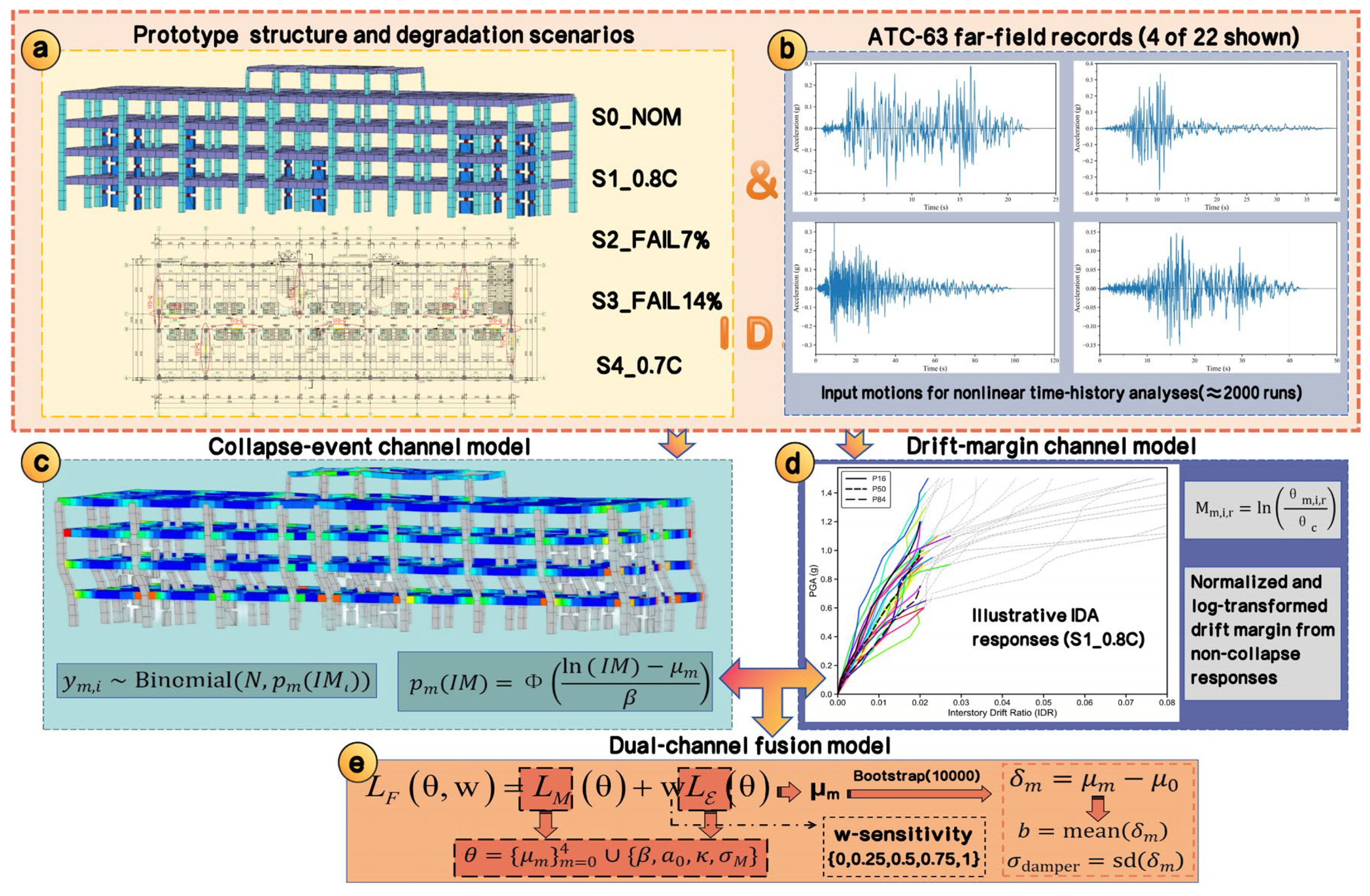
To reduce statistical variability induced by ground-motion sampling, IDA is conducted using the 22 far-field records recommended by ATC-63 [26]. Given that the case-study structure is a low-rise reinforced concrete frame with a short fundamental period (approximately T1 ≈ 0.5 s), and that previous studies have shown that acceleration-related intensity measures remain suitable for short-period structures, with PGA exhibiting strong correlation with short-period structural responses [27,28], PGA is selected as the unified intensity measure (IM) to maintain correspondence with the design hazard level and ensure consistent cross-scenario comparisons. A variable-step scaling grid is adopted to enhance resolution in the collapse-sensitive range, and the intensity is increased progressively until each scenario enters the collapse range. The collapse threshold follows the recommendation of CECS 392 [29], where collapse is defined when the maximum interstory drift ratio exceeds 1/50. This threshold is adopted as a unified collapse definition for all five scenarios, thereby ensuring consistency in the comparative analyses. Figure 1 provides an overview of the study workflow from scenario definition and nonlinear time-history analysis to channel-specific inference and dual-channel fusion. Figure 1a shows the prototype structure and the five damper-state scenarios considered in this study. Figure 1b shows representative ATC-63 far-field records (4 of 22 shown) used as common input motions for the nonlinear time-history analyses. Figure 1c,d summarize the collapse-event and drift-margin channel models, respectively. Figure 1e shows the dual-channel fusion step, bootstrap interval estimation, and the derivation of the summary metrics. The detailed model formulations and computational procedures are presented in the subsequent sections.
The main components are as follows:
(a)
Prototype structure and the five damper-state scenarios considered in this study.
(b)
Representative ATC-63 far-field records (4 of 22 shown) used as common input motions for nonlinear time-history analyses.
(c)
Collapse event channel model based on binary collapse outcomes from IDA.
(d)
Drift-margin channel model based on illustrative IDA responses and the normalized, log-transformed drift margin derived from non-collapse responses.
(e)
Dual-channel fusion model based on weighted composite likelihood, followed by bootstrap interval estimation and derivation of the summary metrics.

2.2. The Collapse Event Channel Model, the Drift-Margin Channel Model, and the Dual-Channel Fusion Model

The three models introduced in this section are designed to characterize scenario-dependent collapse capacity from complementary types of IDA output. The collapse event channel uses binary collapse observations, the drift-margin channel uses continuous non-collapse response information, and the dual-channel fusion model combines these two sources of evidence within a composite-likelihood-based estimation framework.

2.2.1. The Collapse Event Channel Model

A collapse event channel model is established based on the IDA collapse and non-collapse counts. For scenario m at intensity level IMi, the number of collapses ym,i under n = 22 records follow a binomial distribution, and the collapse probability is modeled using a Probit form in the logarithmic intensity domain. This channel serves as the baseline model because it is consistent with the conventional fragility-analysis framework commonly used in IDA-based collapse assessment. Its role is to extract scenario-dependent capacity information directly from the collapse/non-collapse outcomes observed over the full intensity range.
p m I M = Φ ln ( I M ) μ m β
This formulation preserves direct comparability with standard collapse fragility analysis and provides the reference statistical description for the subsequent introduction of continuous-response information.

2.2.2. The Drift-Margin Channel Model

Binary collapse observations tend to saturate at both ends of the intensity axis, resulting in insufficient information contribution from the low- and high-intensity ranges for μm. To incorporate continuous response information, this study introduces a drift-margin channel model. This channel is intended to recover useful information that is not fully utilized when only binary collapse indicators are considered. In particular, non-collapse responses close to the collapse threshold still reflect proximity to failure even when the binary outcomes remain unchanged over a range of intensity levels. The maximum interstory drift ratio is normalized by the collapse threshold and transformed into a dimensionless drift margin M through a logarithmic mapping, defined as follows:
M m , i , r = ln θ m , i , r θ c
M = 0 corresponds to reaching the threshold, while M < 0 indicates that the threshold is not exceeded and its magnitude reflects the remaining margin. The logarithmic mapping makes the margin dimensionless and places the collapse threshold at the interpretable reference value M = 0, so that increasingly negative values indicate a larger remaining distance from collapse. M is assumed to vary approximately linearly with ln(IM) with normally distributed residuals, given by
M m , i , r N a 0 + κ ln IM i μ m , σ M 2
Here, a0 is the intercept, κ controls the rate at which the margin evolves with increasing intensity, and σM represents the effective dispersion that captures record-to-record variability and numerical scatter. This channel uses continuous deformation information from non-collapse responses to supplement the binary collapse observations and provide an additional basis for characterizing scenario-dependent capacity differences.

2.2.3. The Dual-Channel Fusion Model and Weight Setting

Both observation types are derived from the same set of IDA responses. If the likelihoods of the two channels are multiplied directly, the common-source information may be double counted, leading to overly narrow intervals. To address this issue, a composite-likelihood approach is adopted, in which the contributions of the two channels are combined through weighting to form the dual-channel fusion model. The purpose of fusion is not to introduce additional physical variables, but to integrate two complementary forms of statistical evidence extracted from the same IDA dataset. The collapse event channel contributes direct failure information, whereas the drift-margin channel contributes continuous pre-collapse information extracted from non-collapse responses. The weighted composite log-likelihood is written as
L F θ , w = L M θ + w L E θ
Here, Lε and LM denote the log-likelihoods of the collapse event channel and the drift-margin channel, respectively. The corresponding parameter vector in the fusion model is written as
θ = { μ m } m = 0 4 β , a 0 , κ , σ M
where w ≥ 0 controls the contribution of the collapse event channel. In this study, w = 1 is adopted as the default setting, while a sensitivity analysis over w ∈ {0, 0.25, 0.5, 0.75, 1} is performed to evaluate the influence of the weighting choice on the key outputs. Here, w = 0 corresponds to using only the drift-margin channel, whereas w > 0 indicates that both channels contribute. The results indicate that the main estimates remain stable over the examined range, suggesting that the fusion results are not strongly sensitive to the specific value of w. The default choice w = 1 provides a balanced nominal contribution of the two channels, while the sensitivity analysis is used to verify that the main conclusions do not depend strongly on this specific weighting choice.

2.2.4. Metric Calculation and Bootstrap Intervals

To facilitate cross-scenario interpretation, the estimated capacity parameters are converted into relative shifts with respect to the baseline scenario. This representation makes the scenario effect directly interpretable as a reduction or increase in median collapse capacity relative to the nominal design state. Based on the estimated μm for each scenario, the median shift is defined with respect to the baseline scenario m = 0 as
δ m = μ m μ 0 ,   m = 1 , , 4
To summarize the scenario effects more compactly, the following summary metrics are introduced. Here, b summarizes the average degradation level across scenarios, whereas σdamper characterizes the inter-scenario dispersion associated with different degradation and failure paths. Accordingly, the summary metrics are defined as
b = mean δ m ,   σ damper = sd δ m
Given the limited number of records and the tail-event nature of collapse response, record-level bootstrap resampling is adopted to construct interval estimates. Bootstrap resampling is introduced to quantify estimation uncertainty under limited records while preserving the record-wise correspondence across intensity levels and across the two observation channels. In each resample, 22 records are drawn with replacement, while preserving the correspondence of the same record across intensity levels and across the two observation types. Model parameters are re-estimated for each resample to obtain the bootstrap distributions. With B = 10,000 repetitions, 95% intervals are reported using the percentile method, and the median of the bootstrap distribution is reported as the central statistic.

3. Results

3.1. Collapse Fragility Fitting and Back-Calculation of the Median Collapse Intensity

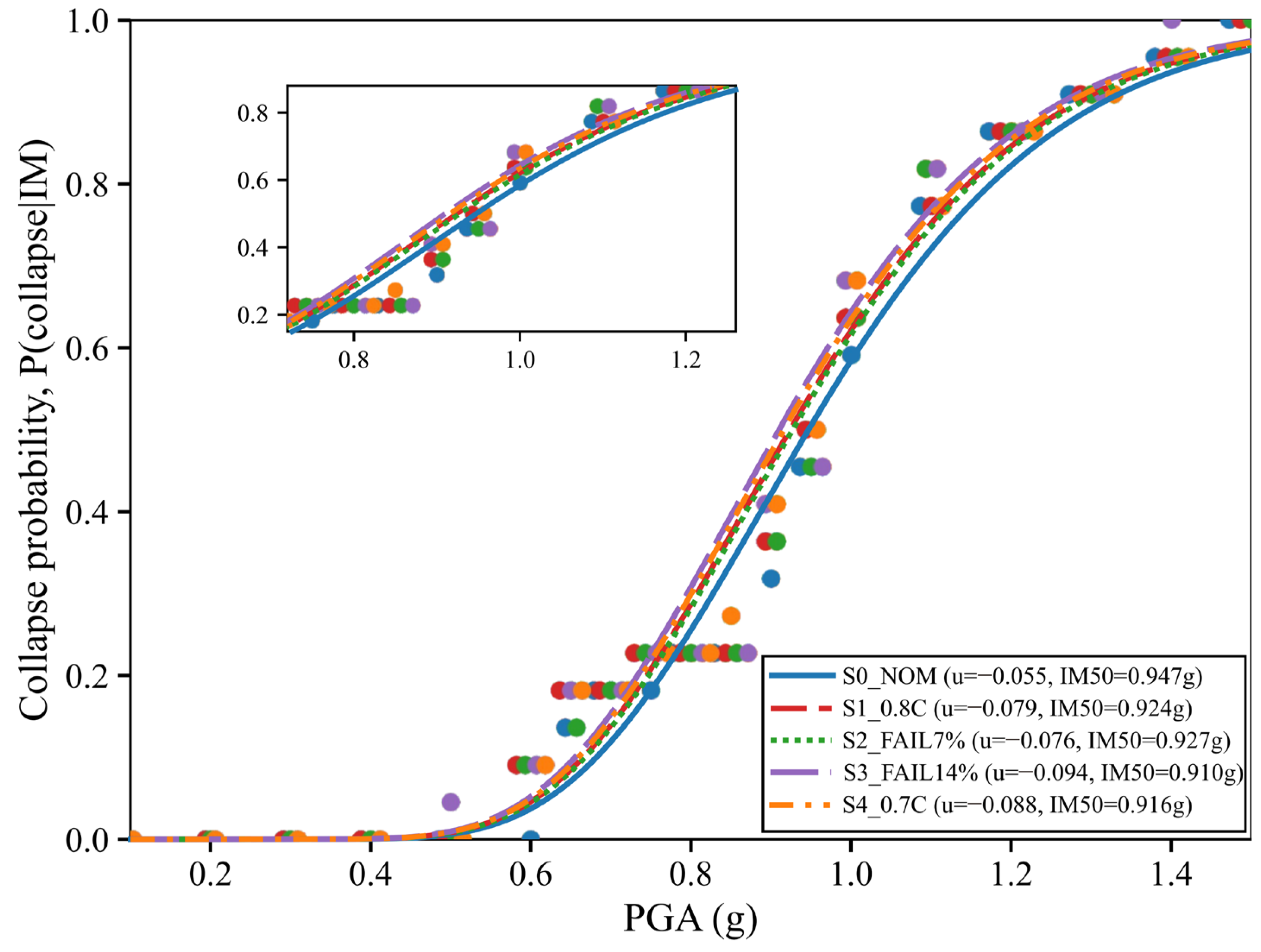
To investigate how changes in damper states affect collapse capacity and to examine whether different degradation/failure mechanisms lead to identifiable scenario-to-scenario differences at the collapse level, Figure 2 presents the collapse fragility curves for the five scenarios. The colored dots represent the empirical collapse probabilities at each analyzed intensity level, obtained from the observed collapse counts in the 22-record IDA set; the discrete vertical levels of the dots reflect the finite-record nature of the collapse fractions. The colored lines are the corresponding Probit fragility fits. The collapse probabilities are fitted using a Probit model in the logarithmic intensity domain (Equation (1)), with a common dispersion parameter β shared across scenarios. This shared-β formulation reduces the degrees of freedom under a limited record set and ensures that scenario differences are primarily reflected by the capacity scale parameter, i.e., the horizontal position of the fragility curve. As shown in Figure 2, the five fitted curves remain close in shape but exhibit systematic horizontal shifts. The baseline scenario S0_NOM stays furthest to the right, indicating the largest median collapse capacity, whereas the weakened scenarios shift leftward to lower intensity levels. The inset highlights this transition range and makes the scenario-to-scenario differences easier to compare.
The quantitative results indicate that the baseline scenario S0_NOM has a median collapse intensity IM50,m of approximately 0.947 g. For the four weakened scenarios, IM50,m shifts toward lower intensities, reaching 0.924 g (S1_0.8C), 0.927 g (S2_FAIL7%), 0.910 g (S3_FAIL14%), and 0.916 g (S4_0.7C), corresponding to an approximate 2–4% reduction relative to the baseline. The shared parameter β = 0.2562 suggests that the transition-zone widths are similar across scenarios; thus, the dominant information for cross-scenario comparison arises from changes in the intensity level required to reach the same collapse probability, rather than from differences in curve shape. Based on these findings, μm is adopted as the capacity scale parameter, and δm is further defined. To summarize scenario-level effects, b and σdamper are introduced to represent, respectively, (i) the systematic downward shift of the median capacity and (ii) the between-scenario differences in median capacity at the collapse level. The corresponding summary statistics are reported later in Table 1.
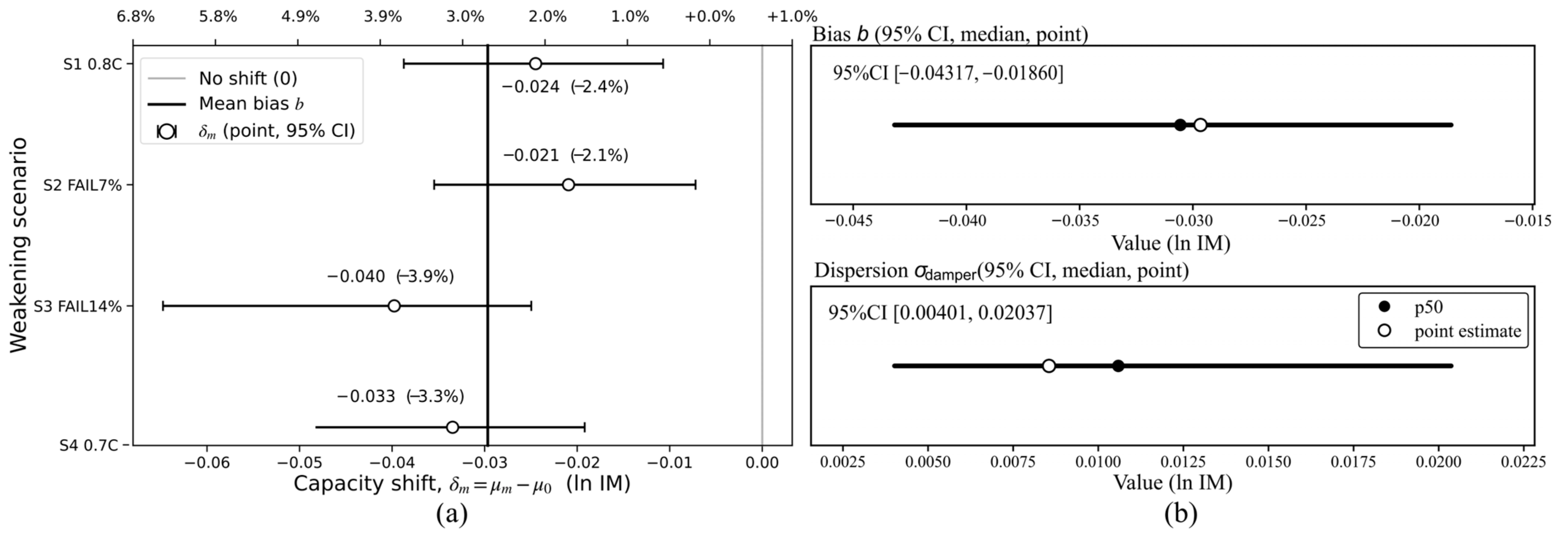
Collapse fragility is jointly governed by the capacity scale and dispersion (scatter) parameters; however, under a limited number of ground motions, parameter uncertainty may obscure the interpretation of degradation effects [30]. Therefore, this study uses the baseline scenario as a reference to extract the capacity shift δm = μm − μ0, and then summarizes the weakened-scenario set using the mean shift b and σdamper. Bootstrap intervals are further reported for these quantities (Figure 3).
Figure 3a shows that δm is negative for all four weakened scenarios: δS1 = −0.02449, δS2 = −0.02093, δS3 = −0.03977, and δS4 = −0.03346 (baseline μ0 = 0.05462, corresponding to IM50,0 = 0.94684 g). Mapping δm back to the intensity scale, exp(δm) represents the ratio of the median collapse intensity, and the corresponding reduction 1 − exp(δm) is approximately 2.4%, 2.1%, 3.9%, and 3.3%, respectively, indicating that the weakening effects are primarily manifested as a downward shift in the median capacity. At the ensemble level, Figure 3b reports b = −0.02966 (bootstrap median −0.03055, 95% interval [−0.04317, −0.01860]), and the interval is entirely negative, indicating a stable direction of systematic degradation. In contrast, σdamper = 0.00855 (median 0.01059, 95% interval [0.00401, 0.02037]) exhibits a relatively wide interval, implying that when relying only on binary (0/1) collapse-event information, the constraint on the “between-scenario dispersion of median differences across weakening modes” remains weak. For this case study, the identifiability of the global shift b is stronger than that of σdamper.
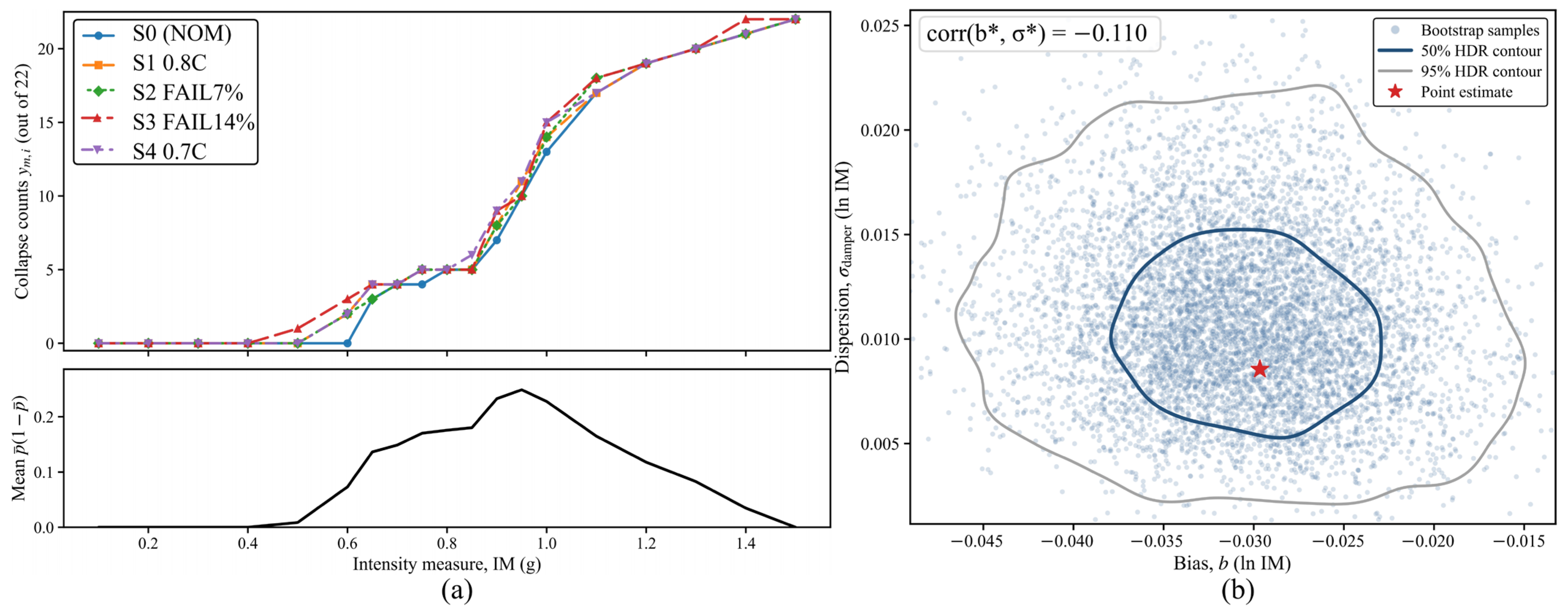
Figure 4 explains why b converges more readily, whereas the interval of σdamper is more difficult to tighten in Figure 3, by examining how the number of collapse cases evolves with intensity level. For a binomial–Probit collapse fragility model, the dominant information for the location (capacity scale) parameter μm is concentrated in the intensity range where the collapse probability is moderate. When the collapse probability approaches 0 or 1, the collapse counts rapidly enter an endpoint-saturation regime (almost no collapses or almost all collapses), and the marginal constraint contributed by additional intensity levels decays quickly. Consequently, the event channel provides substantial identifiability mainly within an effective intensity window near the median collapse intensity.
Consistent with this interpretation, Figure 4a shows that the collapse counts approach 0 at the low-intensity end and 22 at the high-intensity end, and the differences among the five scenarios are concentrated primarily within the collapse-sensitive intensity range. The sensitivity index p i ¯ ( 1 p i ¯ ) in the lower panel peaks within this range and decays toward both ends, indicating that the identification of μm is driven mainly by a small number of key intensity levels. This information structure provides a more stable constraint for the first-order ensemble mean shift b, whereas the second-order metric σdamper, which is associated with between-mode differences, is more difficult to estimate with a narrow interval when only 0/1 event data are used.
In Figure 4b, the bootstrap point cloud of (b*, σdamper*) exhibits a weak correlation (approximately −0.11), indicating that the relatively wide interval of σdamper is not primarily caused by mean–dispersion coupling. Instead, it mainly results from endpoint saturation at both ends of the intensity axis and the concentration of informative observations within a narrow transition window in the event data. Mechanistically, this finding motivates the subsequent incorporation of continuous-response evidence and the adoption of dual-channel fusion to strengthen the constraint on between-mode differences.

3.2. Drift-Margin Modeling and Near-Collapse Identifiability

As already suggested by the collapse-event observations in Figure 2, collapse/non-collapse data at both ends of the intensity axis tend to enter an endpoint-saturation regime, so that the information available for distinguishing scenarios is concentrated within a limited collapse-sensitive intensity window. To supplement this limited event-based information near the threshold without changing the collapse criterion, this section employs a drift-margin channel model, where the drift margin M quantifies how close a record is to the collapse threshold. Scenario-dependent capacity differences in the near-collapse stage are then identified through the statistical evolution of M with the intensity measure IM.
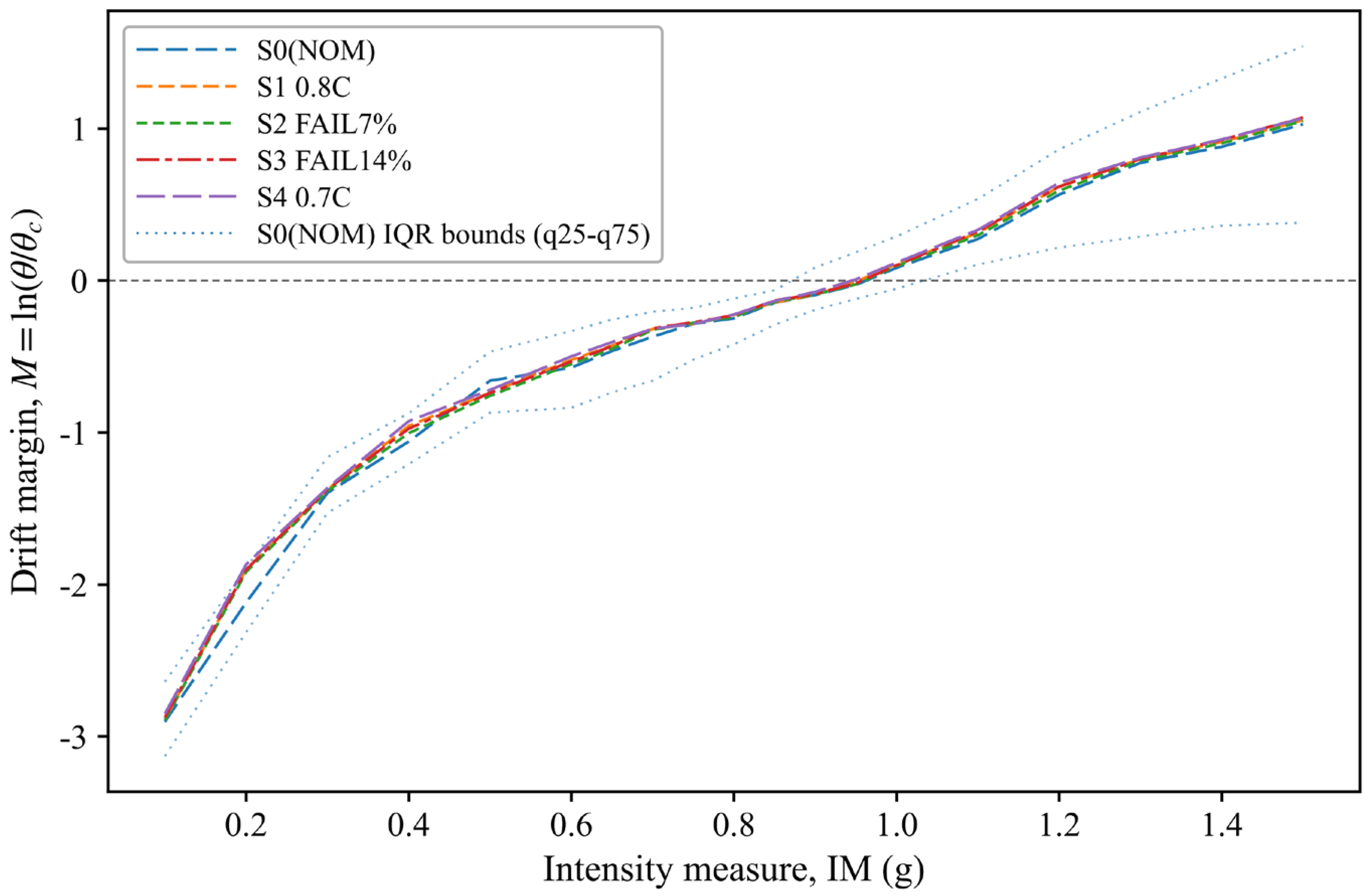
From the response perspective, Figure 5 presents the MIM statistical trajectories (median and interquartile band) for the five scenarios within intensity ranges where event information tends to saturate. As IM increases, the median M rises progressively and crosses from negative to positive around M = 0. This crossing interval corresponds to the intensity range in which, for the median record, the maximum interstory drift ratio evolves from below the threshold to reaching the threshold; it therefore locates the near-critical drift state along the intensity axis. Unlike binary collapse counts, the interquartile band within this crossing interval remains non-degenerate, indicating that the 22 records still span continuous response differences—from near-threshold to clearly sub-threshold behavior—thereby providing an additional source of information for scenario comparisons.
Moreover, the median trajectories of the weakened scenarios exhibit a stable ordering within the near-critical range, and the interquartile bands show overall similar shapes. This indicates that the weakening effects are primarily manifested as a systematic downward shift in the margin level (i.e., earlier attainment of the collapse threshold), rather than as a pronounced change in the record-to-record dispersion structure on this scale. Overall, the drift-margin channel provides complementary constraints on the capacity scale parameter in the near-critical range, and it offers response-level support for the subsequent cross-channel comparison and dual-channel fusion analyses.
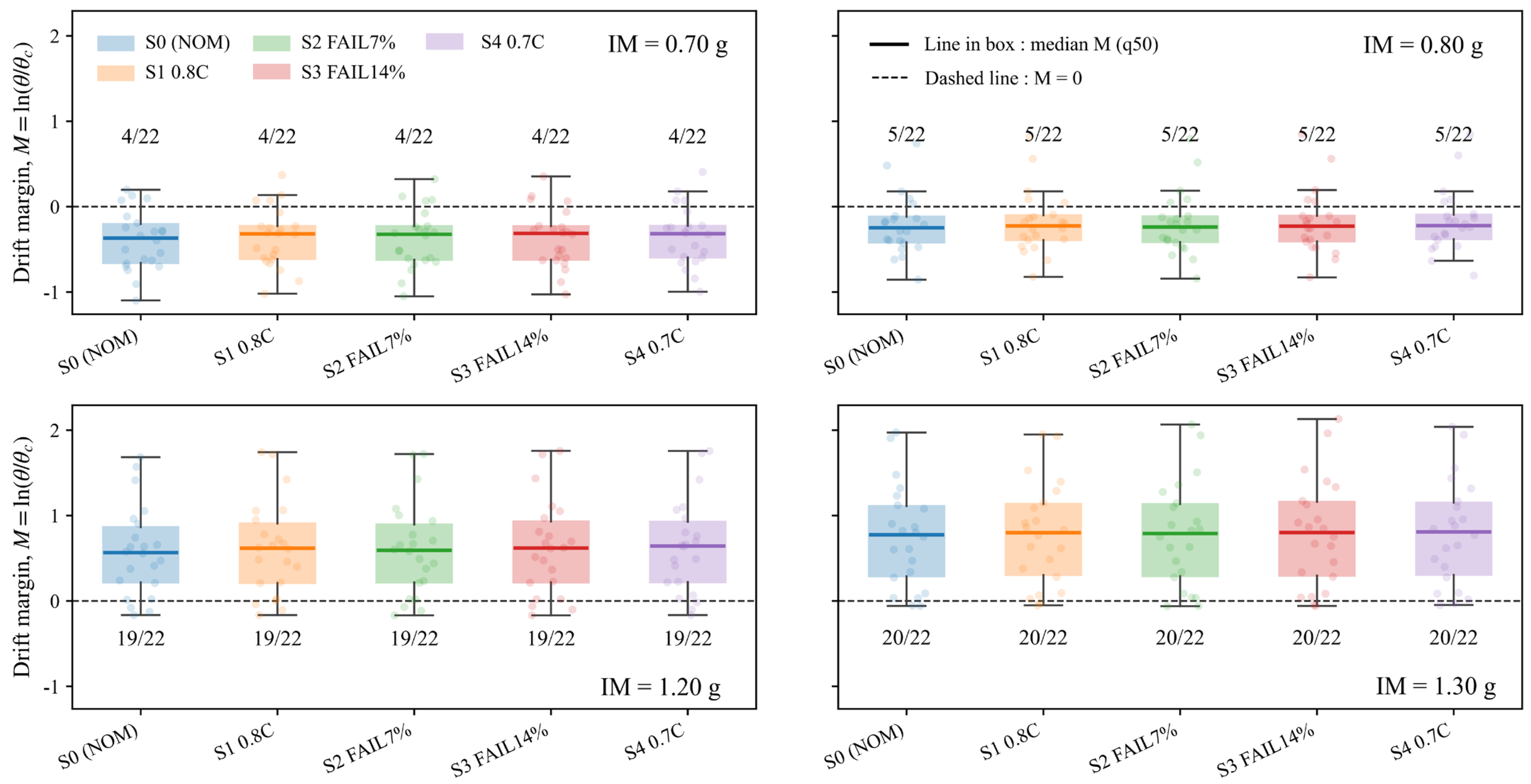
To examine whether the drift margin M can provide stable supplementary discrimination when collapse counts at the same intensity level are insufficient to resolve scenario differences, Figure 6 presents the record-to-record distributions of M at four representative intensity levels and compares them with the corresponding collapse-probability levels. This comparison is used to assess whether scenarios still exhibit testable differences in near-threshold proximity when their collapse probabilities are similar. The selected intensity levels span both the near-critical transition range and the high-intensity saturation range.
At IM = 0.70 g and 0.80 g, the collapse counts across scenarios are 4/22 and 5/22, respectively, indicating that collapse statistics at these intensity levels have limited resolution for distinguishing scenario differences. Nevertheless, the median of M, the interquartile range, and the offset relative to the threshold line M = 0 exhibit a consistent separation across scenarios. This result suggests that, when the numbers of collapsing records are identical or similar, different weakened scenarios can still show testable distributional shifts in near-threshold proximity, and that continuous margin evidence provides a valuable complement to the limited discriminative power of collapse-event information. When the intensity increases to IM = 1.20 g and 1.30 g, the numbers of collapsing records rise to 19/22 and 20/22, respectively, entering the high-intensity saturation regime where the incremental resolution of collapse counts for scenario differentiation remains limited. In contrast, the distribution of the drift margin M still shows an overall scenario-dependent shift accompanied by upper-tail thickening. This behavior indicates that, under a mixed state in which most records have exceeded the collapse threshold while a few remain below it, scenario differences can still be captured through the distributional shape of the continuous margin measure. Taken together, these results suggest that scenario-level capacity differences at the high-intensity end are more appropriately characterized and compared using the distributional features of M.
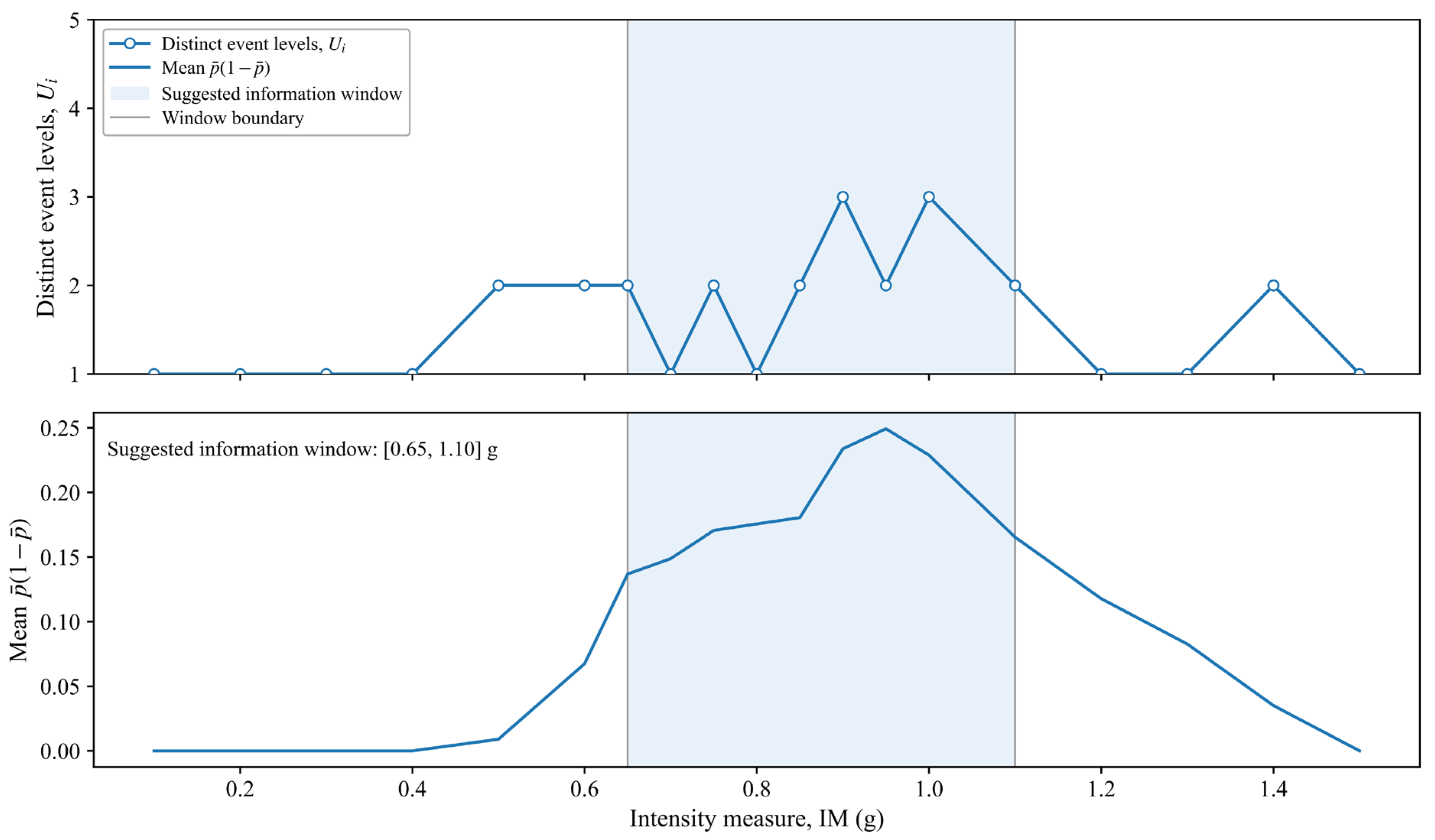
Before introducing the dual-channel fusion model, Figure 6 uses two metrics to interpret the information distribution of the collapse event channel along the intensity axis and its endpoint-saturation mechanism. The first metric is the cross-scenario stratification count Ui = # {ym,i}, which quantifies, at a given intensity level IMi, how many distinguishable tiers of collapse counts can be formed by the five scenarios. The second metric is a sensitivity index w i = p i ¯ ( 1 p i ¯ ) , constructed from the scenario-averaged collapse probability, which reflects the responsiveness of the binary collapse indicator to incremental changes in intensity. Together, these metrics delineate the effective identification range of the collapse event channel model.
Figure 7 shows that, at the low-intensity end where p i ¯ 0 , Ui remains at 1 for an extended range and wi ≈ 0. In this regime, collapse observations are dominated by the zero-collapse boundary and provide little effective constraint on scenario-dependent capacity differences. As intensity enters the collapse-sensitive range, Ui increases to 2–3 and stratifications persist, while wi rises markedly and reaches its peak near the median. This indicates that the same intensity window both generates distinguishable tiers of collapse counts and exhibits the strongest response to intensity increments, thereby providing the primary information for the collapse event channel to identify the capacity scale parameter. As intensity increases further, the collapse counts approach the upper boundary, Ui drops back to 1, and wi decays toward zero, showing that the collapse-event information rapidly weakens once constrained by the upper-bound saturation.
Therefore, Figure 7 indicates that the effective information for the collapse event channel model in identifying the capacity scale parameter is concentrated within the collapse-sensitive intensity window. At the low- and high-intensity ends, collapse observations are dominated by the zero-collapse boundary and the near-all-collapse upper boundary, respectively, and scenario differences can no longer be further resolved through collapse counts. Given this information distribution, the drift-margin channel retains a continuous gradient relative to the threshold even in the endpoint-saturation ranges. It can therefore be anchored to the same capacity scale parameter to provide complementary constraints on scenario differences, and, together with the collapse event channel, supports the joint estimation in the dual-channel fusion model.

3.3. Scale Calibration and Composite-Likelihood Fusion

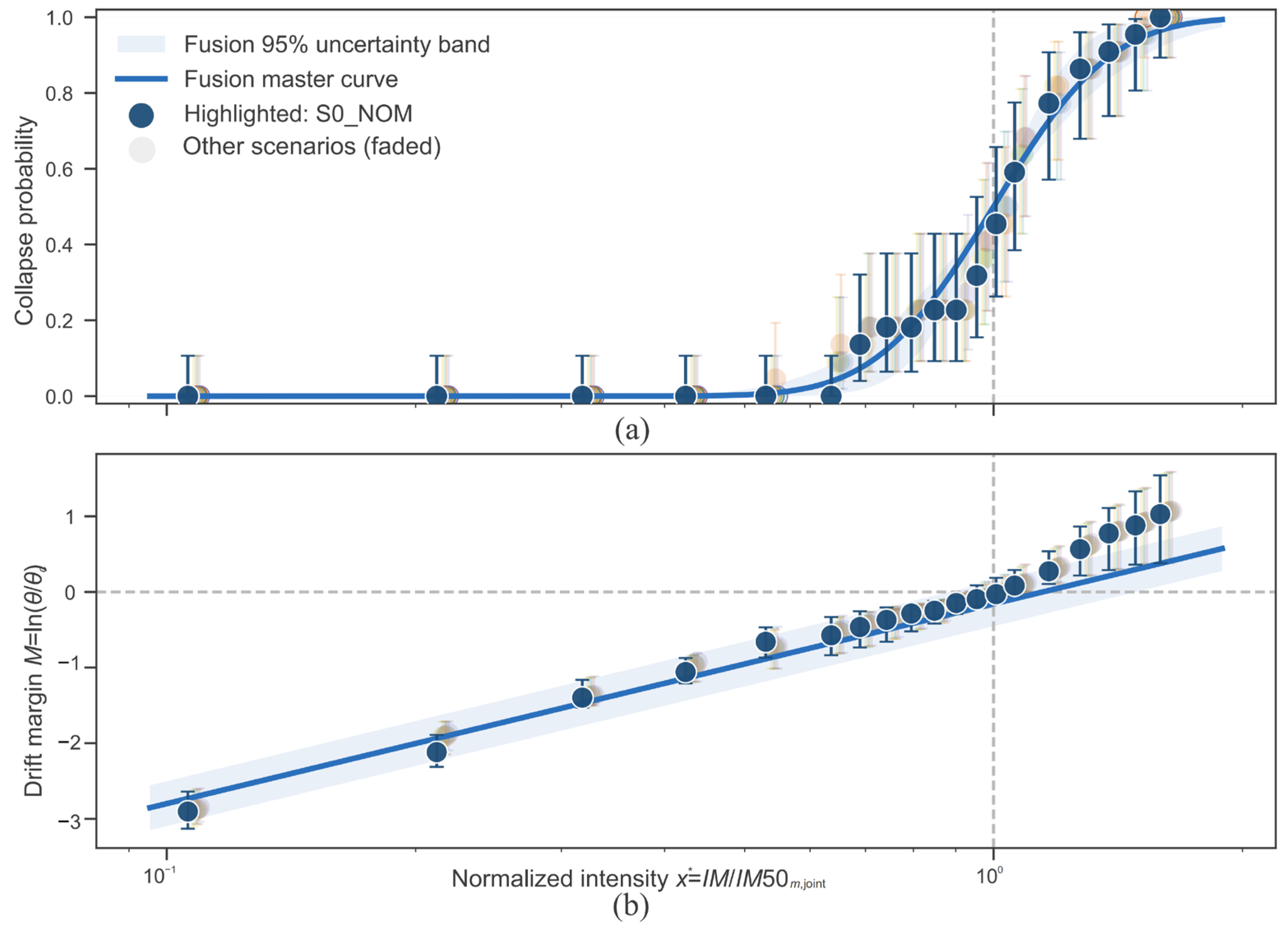
Since both the collapse event channel and the drift-margin channel are derived from the same set of IDA responses, they represent two characterizations of the same source data. The key to dual-channel fusion is to test whether a unified set of scenario capacity scale parameters μm can simultaneously explain the transition point of collapse probability in the event channel and the threshold crossing point in the margin channel. To this end, Figure 8 presents the results of the two channels in the same coordinate system, with intensity normalized as follows:
x * = I M I M 50 , m , F u s i o n
Here, IM50,m,Fusion = exp(μm) represents the median collapse intensity scale for scenario m from the fusion model. This allows testing whether the shared μm can anchor the critical points of both channels to the same dimensionless intensity axis.
Figure 8a shows that, for all scenarios, the collapse probability increases monotonically with x* and enters a steep-rising range around x* ≈ 1. This indicates that, after normalization by IM50,m,Fusion, the median transition of the event channel is concentrated at a similar dimensionless intensity level. In Figure 8b, the drift margin M is approximately linear with ln(x*) and crosses M = 0 near x* ≈ 1, further indicating that when the intensity approaches IM50,m,Fusion, the median level of the maximum interstory drift ratio approaches the drift threshold.
Except for the baseline scenario, the weakened scenarios do not show clustered separation in curve shape in the normalized coordinates. The scenario differences are mainly reflected by the horizontal shift associated with μm, rather than being dominated by systematic changes in slope-related parameters. On this basis, Figure 7 supports the fusion model formulation with a shared μm and provides a unified normalized intensity reference for subsequently summarizing scenario effects using δm, b, and σdamper.
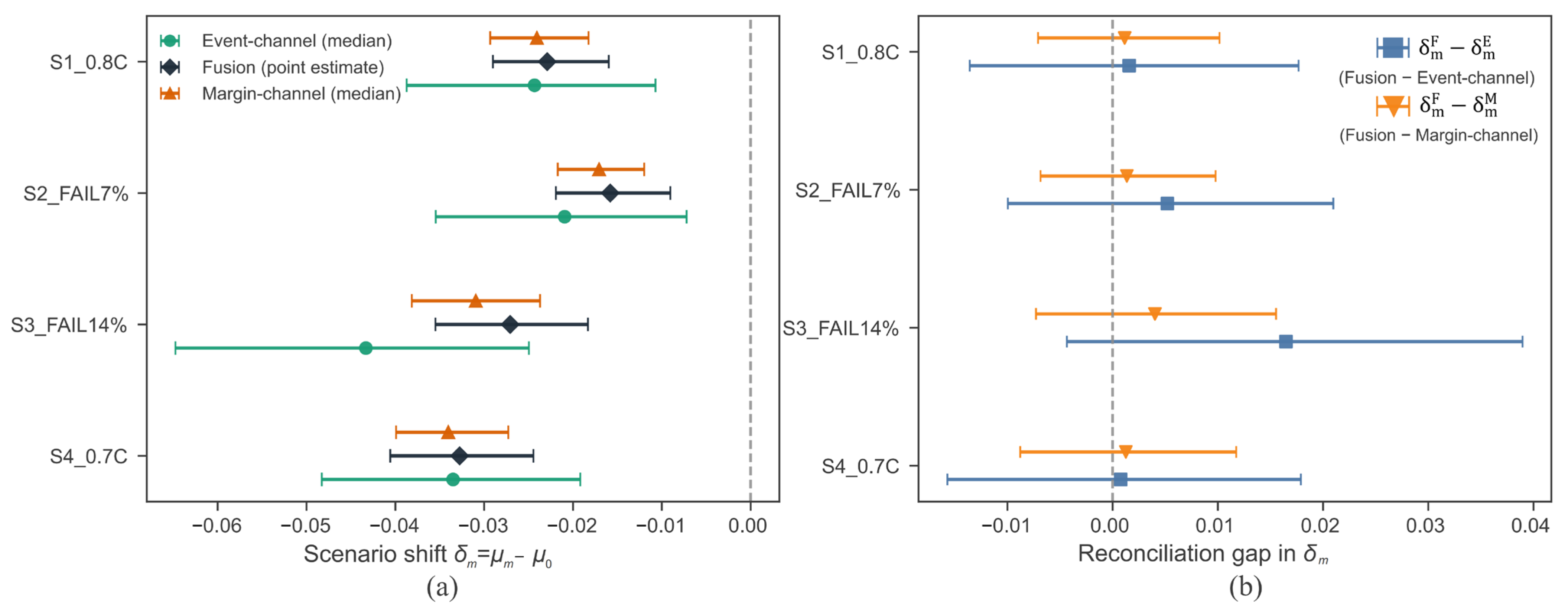
After establishing a unified intensity scale, Figure 9 reports the scenario-specific deviations relative to the main trend and compares, side by side, the magnitude of capacity shift and the associated intervals obtained from the collapse event channel model, the drift-margin channel model, and the dual-channel fusion model. In this study, δm denotes the capacity location shift of scenario m relative to the baseline scenario S0_NOM.
In Figure 9a, δm < 0 for all four weakened scenarios under the collapse event channel model, the drift-margin channel model, and the dual-channel fusion model, indicating that the capacity location shifts induced by weakening consistently move toward lower intensity levels across the three models. The estimated shift magnitudes and interval widths, however, differ among the models. Taking S3_FAIL14% as an example, the event channel yields a more negative δm with a wider interval, the margin channel gives a center closer to zero, and the fusion result lies between the two, reflecting the different contributions of the two information sources to the same capacity scale parameter.
To quantify the differences among the three models, Figure 9b introduces two fusion-to-single-channel differences:
Δ F E , m = δ m ( F ) δ m ( E )
Δ F M , m = δ m ( F ) δ m ( M )
where the superscripts F, E, and M correspond to the fusion model, the event channel model, and the margin channel model, respectively. When Δ is close to zero, the fusion result is close to the corresponding single-channel result for that scenario. For example, the positive ΔFE,m for S3_FAIL14% indicates that, within the limited informative intensity window, the event channel is more sensitive to the collapse outcomes of a small number of key records and may yield a larger downward shift. After including the margin channel, near-threshold information from non-collapse samples contributes to the estimation, pulling the fusion result toward zero and narrowing the interval. If ΔFE,m ≈ 0 for some scenarios, the fusion and event-channel shift magnitudes are similar for those scenarios, and the continuous margin information has a limited effect on the central value. Overall, Figure 8 reports the model-dependent differences in the magnitude of δm and the associated interval changes across the three channels. In most scenarios, the fusion result lies between the two single-channel results and provides a tighter interval range.
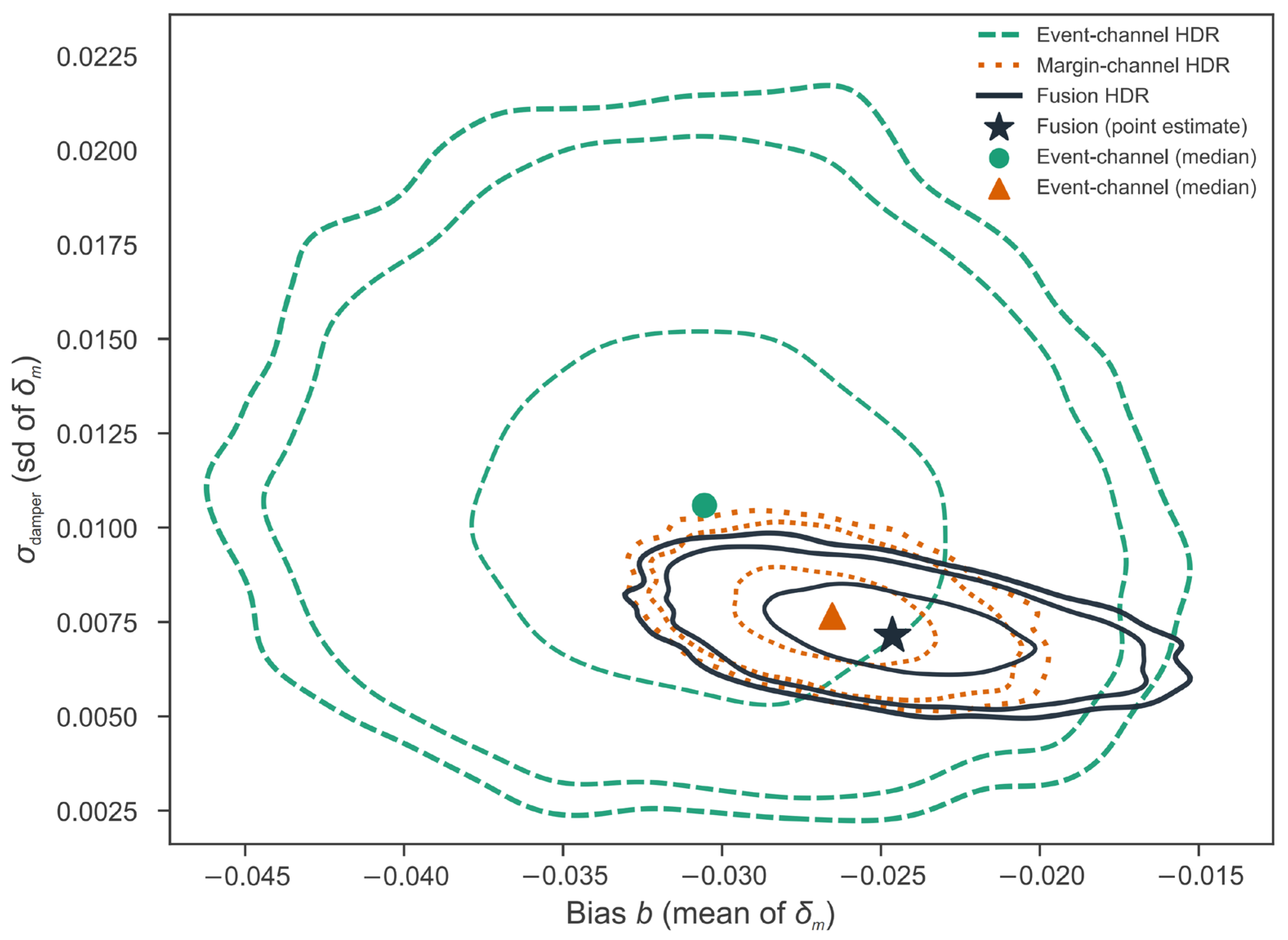
The collapse event channel model uses only binary collapse outcomes. Because its dominant information is concentrated within the collapse-sensitive intensity window, it provides limited constraint on the ensemble metric σdamper that reflects differences among degradation modes, resulting in a relatively wide range for (b, σdamper). After introducing the drift-margin channel, even when collapse counts at the same intensity level are similar, the drift-margin distributions of the non-collapse samples retain continuous differences in near-threshold proximity, which tightens the feasible range of (b, σdamper). Under a shared capacity scale, the dual-channel fusion model combines the two information sources, yielding more concentrated ranges for the ensemble-level b and σdamper.
Figure 10 compares the two-dimensional uncertainty regions for the three models. Two-dimensional density contours constructed from bootstrap samples capture the joint range of the ensemble mean shift and the between-mode differences. The results show that the event channel produces the largest contour region, with slower contraction along the σdamper direction. The drift-margin channel yields a noticeably tighter region. The fusion model further reduces the contour region and places it between the central regions of the two single-channel models. This indicates that fusion not only adjusts the central tendency but also substantially compresses the joint range of (b, σdamper), thereby strengthening the constraint on σdamper.

3.4. Bootstrap Intervals and Ranking Robustness

Under a limited ground-motion set, both b and σdamper are affected by sampling variability; therefore, reporting both point estimates and interval estimates is necessary to reduce the risk of misinterpretation. In the collapse event channel model, a common dispersion parameter β is adopted across scenarios to stabilize fragility fitting under limited data. To assess the influence of this assumption, an additional sensitivity analysis was performed by allowing scenario-specific βm values. Table 1 summarizes the point estimates and bootstrap 95% intervals (B = 10,000) of b and σdamper from the collapse event channel model, the drift-margin channel model, and the dual-channel fusion model under both shared-β and scenario-specific-βm settings. It can be seen from Table 1 that the resulting changes are negligible and that the bootstrap intervals remain highly overlapping, indicating that the principal conclusions are robust to the shared-β formulation.
Under the shared-β formulation adopted in the main analysis, all three models yield negative values of b, and their bootstrap 95% intervals lie entirely in the negative range. The event channel, margin channel, and fusion model give b = −0.02966, −0.02658, and −0.02464, respectively. The corresponding exp(b) values are 0.971, 0.974, and 0.976, which translate to an overall reduction of approximately 2.4–2.9% in the median collapse-intensity scale. The fusion-model estimate of b is closer to zero, yet it remains within the overlap of the two single-channel intervals, indicating that the median reduction level is only weakly dependent on the information source. In contrast, σdamper, which governs the between-mode differences, is more sensitive to the information source. Using collapse events alone, its 95% interval is [0.00401, 0.02037]; after incorporating drift-margin information, it tightens to [0.00570, 0.00987]; and the fusion model further narrows it to [0.00542, 0.00920]. The interval width is reduced by approximately 77% relative to the event channel, while the central value (0.00714) remains of the same order as those from the two single-channel models.
Overall, all three models yield negative b values with a reduction magnitude of approximately 2.4–2.9%, indicating that the primary effect of the degradation set on collapse capacity is a downward shift in the median capacity. Meanwhile, σdamper remains at a low level, and its upper bound is tightened to about 0.0092 after information fusion, suggesting that between-mode differences are mainly reflected as second-order perturbations. Accordingly, for the viscous-damper weakening set considered here, the reduction in collapse capacity is dominated by an overall downward shift in the median, whereas the between-mode dispersion remains of secondary magnitude. For the present representative case study, this reduction should be interpreted as a modest but systematic downward shift in collapse capacity, with its engineering significance lying in the stability of the shift direction across models and its boundedness relative to sampling variability. Accordingly, these parameterized results are most appropriately used as uncertainty-aware inputs for collapse-fragility updating and subsequent risk- or reliability-oriented assessment.
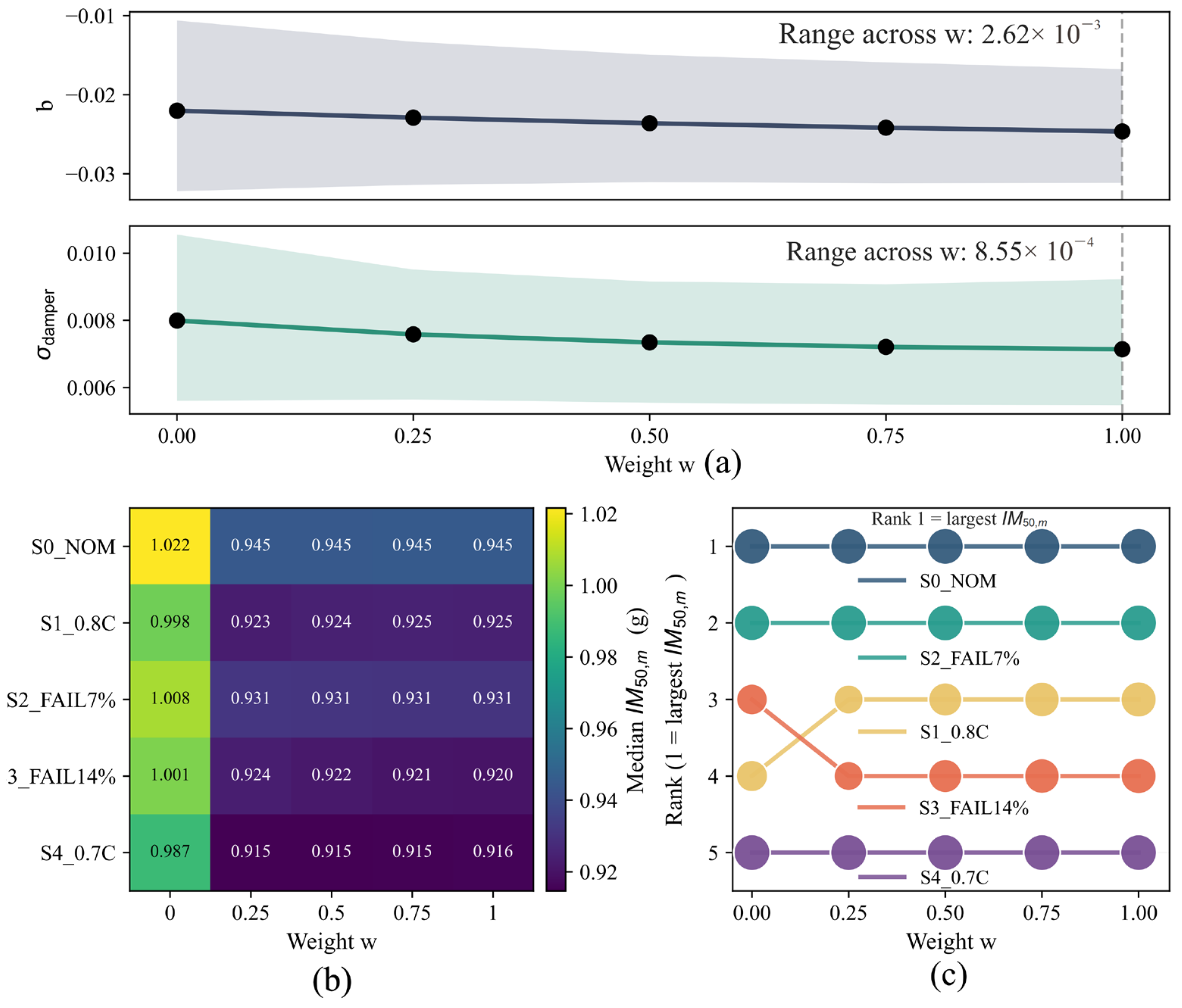
To demonstrate that the main findings of the dual-channel fusion model are not contingent on an arbitrary choice of the weight, this study performs a comparative analysis by varying w over {0, 0.25, 0.5, 0.75, 1} in addition to the primary setting w = 1. The responses to weight variation are reported at three levels—global metrics, scenario capacities, and ranking—thereby providing a solid basis for adopting the fusion results under w = 1 in the subsequent discussions.
Figure 11a reports the point estimates of b and σdamper from the dual-channel fusion model under different weights w, together with their 95% bootstrap intervals, and the adopted setting w = 1 is marked by a dashed line. The results show that b decreases slightly as w increases, with an overall variation of approximately 2.62 × 10⁻³, which is clearly smaller than the corresponding interval width. Meanwhile, the intervals under different w values overlap substantially. The point estimate of σdamper gradually converges from 0.00799 to 0.00714, with a maximum change of about 8.55 × 10⁻⁴, and the variations of the interval bounds with w are also limited. These results indicate that the two global metrics remain at comparable levels across the examined weights, and adopting w = 1 as the default setting does not introduce a meaningful bias.
Figure 11b summarizes how the median capacity IM50,m for the five degradation scenarios varies with w. The results indicate that as w increases from 0 to 0.25, all scenarios exhibit a common downward shift in IM50,m. The changes then become more gradual over w = 0.25, and the values remain essentially stable. The capacity ranking across scenarios does not change over the entire range: S0_NOM consistently yields the largest IM50,m, S4_0.7C consistently yields the smallest IM50,m, and the remaining scenarios remain stably distributed between them. These results further indicate that varying w mainly induces a small, synchronous adjustment in scenario capacity levels, without altering the relative differences or the ranking order among scenarios
Figure 11c presents how the capacity ranks vary with w, with bubble size indicating the modal rank probability. The results show that S0_NOM, S2_FAIL7%, and S4_0.7C remain stable at Rank 1, Rank 2, and Rank 5 over the entire range, with rank probabilities close to 1. Rank variation is mainly concentrated between S1_0.8C and S3_FAIL14%: at w = 0, they appear at Rank 4 and Rank 3, respectively, whereas for w ≥ 0.25 they switch to Rank 3 and Rank 4, and their modal probabilities increase markedly as w increases. This indicates that rank differences are primarily confined to a local swap between scenarios with similar capacities, while the ranks of the other scenarios remain stable; consequently, the overall ordering does not depend on any single weight value.

4. Discussion

4.1. Scope of the Study and Key Findings

This study focuses on the influence of in-service performance deviations of viscous dampers on structural collapse capacity. Under a unified IDA protocol, two scenario types are compared, namely global degradation and partial loss of functionality, and parameter estimation is conducted in parallel using the collapse event channel model, the drift-margin channel model, and the dual-channel fusion model. All three models predict the same direction of change in the capacity scale parameter μm, with degradation effects first manifested as an overall downward shift in IM50,m. Compared with using collapse-indicator data alone, incorporating drift-margin information enables a tighter constraint on the dispersion magnitude associated with differences among degradation pathways, and the fusion model further narrows the intervals while preserving the overall trend. The weight-study results show that the median capacities and ranking structure are only weakly dependent on w, and rank crossings are mainly confined to adjacent scenarios with similar capacities.

4.2. Constraint Differences Between Collapse Decisions and Continuous Deformation Information and Parameter Identifiability

The capacity scale parameter can be identified more stably because the collapse-sensitive intensity range contributes more concentrated information to the location parameter. In the collapse event channel, the observation for each ground-motion record at each intensity level is a binary collapse outcome taking values 0 or 1. Such data tend to exhibit endpoint saturation at both low and high intensities, which weakens the separation of subtle differences among scenarios. The drift-margin channel incorporates continuous deformation information from non-collapse records, so that both ends of the intensity axis retain gradients related to proximity to the threshold; as a result, it is more effective in tightening the dispersion magnitude. The dual-channel fusion model combines the two information sources under a shared μm and uses w to control their relative contributions. Interval contraction is therefore mainly driven by the complementarity of the two information types rather than by double counting, and the improvement is reflected primarily in more concentrated intervals and clearer ranking among adjacent scenarios.

4.3. Linkage to Prior Studies and Methodological Advancements

Existing studies have provided extensive discussions of viscous-damped systems from both engineering-application and device-mechanism perspectives; however, at the collapse-performance level, capacity scale parameters and interval results that can directly support cross-scenario comparisons remain relatively limited [31,32,33]. Recent experimental and numerical investigations on constitutive evolution under coupled temperature–pressure effects, parameter drift induced by temperature rise and self-heating, and limit states or equivalent functional degradation associated with connection conditions and stroke constraints provide clear engineering backgrounds and mechanistic bases for the two scenario abstractions adopted in this study, namely global degradation and local failure [34,35,36]. In collapse assessment, binary collapse-outcome data tend to exhibit endpoint saturation at both ends of the intensity axis, and differences in record sampling and selection can amplify interval variability and reduce the ability to separate closely spaced scenarios [37,38,39]. Consequently, relying on collapse decisions alone often makes it difficult to obtain tighter interval constraints on dispersion-related quantities. In response to the issues noted above, the methodological advances of this study focus on two aspects. First, without changing the prescribed collapse threshold, continuous deformation information from non-collapse records is incorporated to strengthen the contribution of the low- and high-intensity ranges to the estimation of the capacity scale parameter, thereby alleviating overly wide intervals caused by limited information at the endpoints. Second, because the two observation types are derived from the same IDA responses and are correlated, a composite-likelihood formulation is adopted and combined in a controlled manner through weight comparisons, while bootstrap resampling is used to provide both point estimates and interval results. This enables the capacity scale and dispersion magnitude to be reported in a unified parameterized form, facilitating cross-scenario comparisons and uncertainty representation.

4.4. Practical Implications and Extensions of the Parameterized Results

The scenario-level outputs IM50,m and their intervals can be used to update the location of collapse fragility along the intensity axis while explicitly incorporating the uncertainty induced by a limited number of records. The ensemble metrics b and σdamper provide a compact summary of multi-scenario results and support order-of-magnitude interpretation. Specifically, b represents the overall downward shift of the median capacity induced by the degradation set, whereas σdamper represents the magnitude of differences among degradation pathways. These metrics support two applications. First, for collapse-level comparisons, they facilitate summarizing and interpreting the relative magnitude of differences among degradation pathways. Second, for collapse-related risk and reliability quantification, they provide unified parameter inputs for both the median-capacity change and the pathway-to-pathway differences, allowing uncertainty propagation and result comparisons to be carried out on a consistent scale.
This study is based on a representative case study and a standardized record set, and the partial loss-of-function scenarios are defined in proportional terms to ensure clear comparisons. Although the 22 far-field ground motions used in this study correspond to the complete standardized set recommended by ATC-63 and provide a consistent basis for cross-scenario comparison, the sample size remains statistically limited for collapse-fragility fitting, particularly for dispersion-related quantities and interval estimates. Accordingly, the reported intervals should be interpreted with finite-sample caution. The conclusions of the present study are therefore intended primarily for comparative assessment under a unified standardized record set, rather than as fully converged universal estimates of collapse-fragility parameters. Future work can broaden the range of structural prototypes and design parameters, incorporate spatial patterns of local failures that are more representative of engineering practice, and, when scenario-driven changes in dispersion need to be captured, relax the shared-dispersion assumption and perform parallel comparisons.
In addition, the present study focuses on establishing a parameterized characterization of collapse-capacity shift and between-path variability under a unified IDA framework for the representative viscous-damper weakening set considered herein. The four-story RC frame analyzed in this study is taken as a representative short-period structural prototype. Future work may further examine the applicability of the proposed framework by extending it to additional structural prototypes and broader benchmark datasets.

5. Conclusions

This study addresses the quantification of collapse capacity for viscous-damped structures under damper performance deviations. Two scenario types, namely global degradation and local failure, are defined based on a unified incremental dynamic analysis framework and a standardized ground-motion set, and cross-scenario comparisons are conducted under a consistent collapse threshold. Three parallel frameworks, the collapse event channel, the drift-margin channel, and the dual-channel fusion approach, are employed to obtain the capacity scale parameters together with interval estimates, and the multi-scenario effects are summarized using b and σdamper. The results indicate that the dominant impact is a downward shift in the median collapse capacity, while differences among degradation pathways are of secondary magnitude, and the scenario ranking remains stable across the three frameworks. These findings provide parameterized results and interval-based uncertainty expressions for collapse-capacity comparisons under degradation conditions.
(1)
This study establishes five representative damper-state scenarios, including a baseline case, global degradation cases, and local failure cases, and conducts cross-scenario collapse-capacity assessments under a unified IDA protocol. This setup enables direct comparison of collapse capacity across scenarios on a consistent intensity scale and ensures the comparability of the results.
(2)
This study develops three complementary frameworks—the collapse event channel model, the drift-margin channel model, and the dual-channel fusion model—which are based on binary collapse outcomes, continuous deformation information from non-collapse records, and their joint constraints, respectively. These frameworks are used to estimate the scenario-specific capacity scale parameter μm and to report interval results, thereby explicitly accounting for the uncertainty induced by the limited sample size.
(3)
Under all three frameworks, the relative ranking and overall ordering of IM50,m for each scenario remain consistent. Rank uncertainty is mainly concentrated in adjacent scenarios with similar capacities, manifesting as natural overlap in resampling, with no overall shift in ranking observed.
(4)
The median shift δm is defined as μmμ0 with respect to the baseline scenario, and the multi-scenario effects are summarized using b = mean(δm) and σdamper = sd(δm), with interval estimates provided. The results show that the main impact of performance deviations on collapse capacity is a systematic downward shift in the median capacity, with the median collapse intensity reduced by approximately 2.4% to 2.9%. The differences between degradation pathways are of secondary magnitude and can be bounded by the interval estimates. The dual-channel fusion model maintains stability in key outputs under varying weight w. Therefore, this study provides parameterized collapse capacity results that can be directly recalculated, which can be used for updating collapse fragility under degradation conditions, as well as for unified parameter input and uncertainty expression in collapse-related risk and reliability quantification.

Author Contributions

Conceptualization, X.Z. and W.P.; methodology, X.Z.; software, X.Z.; validation, X.Z. and W.P.; formal analysis, X.Z.; investigation, X.Z.; resources, W.P.; data curation, X.Z.; writing—original draft preparation, X.Z.; writing—review and editing, W.P.; visualization, X.Z.; supervision, W.P.; project administration, W.P. All authors have read and agreed to the published version of the manuscript.

Funding

This research was funded by the National Natural Science Foundation of China, grant number 32060368; and the National Natural Science Foundation of China, grant number 42367025.

Data Availability Statement

The original contributions presented in this study are included in the article. Further inquiries can be directed to the corresponding author.

Conflicts of Interest

The authors declare no conflicts of interest.

Abbreviations

The following abbreviations are used in this manuscript:
IDAIncremental Dynamic Analysis

References

  1. Zhou, Y.; Sebaq, M.S.; Xiao, Y. Energy dissipation demand and distribution for multi-story buildings with fluid viscous dampers. Eng. Struct. 2022, 253, 113813. [Google Scholar] [CrossRef]
  2. Pollini, N. Fail-safe optimization of viscous dampers for seismic retrofitting. Earthq. Eng. Struct. Dyn. 2020, 49, 1599–1618. [Google Scholar] [CrossRef]
  3. Makris, N.; Constantinou, M.C. Fractional-derivative Maxwell model for viscous dampers. J. Struct. Eng. 1991, 117, 2708–2724. [Google Scholar] [CrossRef]
  4. Makris, N.; Constantinou, M. Spring-viscous damper systems for combined seismic and vibration isolation. Earthq. Eng. Struct. Dyn. 1992, 21, 649–664. [Google Scholar] [CrossRef]
  5. Lee, D.; Taylor, D.P. Viscous damper development and future trends. Struct. Des. Tall Build. 2001, 10, 311–320. [Google Scholar] [CrossRef]
  6. Makris, N.; Zhang, J. Seismic response analysis of a highway overcrossing equipped with elastomeric bearings and fluid dampers. J. Struct. Eng. 2004, 130, 830–845. [Google Scholar] [CrossRef]
  7. Priestley, M.; Grant, D. Viscous damping in seismic design and analysis. J. Earthq. Eng. 2005, 9, 229–255. [Google Scholar] [CrossRef]
  8. Kalfas, K.N.; Makris, N.; El Shamy, U. Assessment of the effect of design parameters of pressurized sand dampers from component testing. J. Eng. Mech. 2023, 149, 04023072. [Google Scholar] [CrossRef]
  9. Kalfas, K.N.; Vaiana, N.; Makris, N. A Rate-Independent phenomenological model for the characterization of pressurized sand dampers. J. Eng. Mech. 2025, 151, 04025007. [Google Scholar] [CrossRef]
  10. Scozzese, F.; Gioiella, L.; Dall’Asta, A.; Ragni, L.; Tubaldi, E. Influence of viscous dampers ultimate capacity on the seismic reliability of building structures. Struct. Saf. 2021, 91, 102096. [Google Scholar] [CrossRef]
  11. Kazemi, F.; Mohebi, B.; Jankowski, R. Predicting the seismic collapse capacity of adjacent SMRFs retrofitted with fluid viscous dampers in pounding condition. Mech. Syst. Signal Process. 2021, 161, 107939. [Google Scholar] [CrossRef]
  12. Cucuzza, R.; Domaneschi, M.; Greco, R.; Marano, G.C. Numerical models comparison for fluid-viscous dampers: Performance investigations through genetic algorithm. Comput. Struct. 2023, 288, 107122. [Google Scholar] [CrossRef]
  13. Hu, S.; Hao, H.; Meng, D.; Yang, M. Theoretical and numerical study of the thermo-mechanical coupling effect on the fluid viscous damper. J. Sound Vib. 2025, 597, 118846. [Google Scholar] [CrossRef]
  14. Lak, H.; Zahrai, S.M.; Mirhosseini, S.M.; Zeighami, E. Application of computational fluid dynamics in design of viscous dampers-CFD modeling and full-scale dynamic testing. Earthq. Eng. Eng. Vib. 2023, 22, 1065–1080. [Google Scholar] [CrossRef]
  15. Hu, S.; Yang, M.; Meng, D.; Hu, R. Damping performance of the degraded fluid viscous damper due to oil leakage. Structures 2023, 48, 1609–1619. [Google Scholar] [CrossRef]
  16. Iervolino, I. Estimation uncertainty for some common seismic fragility curve fitting methods. Soil Dyn. Earthq. Eng. 2022, 152, 107068. [Google Scholar] [CrossRef]
  17. Hariri-Ardebili, M.A.; Sattar, S. Uncertainty and bias in generic ground motion sets used for PBEE. Structures 2023, 57, 105088. [Google Scholar] [CrossRef]
  18. Bodenmann, L.; Baker, J.W.; Stojadinović, B. Accounting for ground-motion uncertainty in empirical seismic fragility modeling. Earthq. Spectra 2024, 40, 2456–2474. [Google Scholar] [CrossRef]
  19. Vamvatsikos, D.; Cornell, C.A. Incremental dynamic analysis. Earthq. Eng. Struct. Dyn. 2002, 31, 491–514. [Google Scholar] [CrossRef]
  20. Shinozuka, M.; Feng, M.Q.; Lee, J.; Naganuma, T. Statistical analysis of fragility curves. J. Eng. Mech. 2000, 126, 1224–1231. [Google Scholar] [CrossRef]
  21. Grigoriu, M.; Radu, A. Are seismic fragility curves fragile? Probabilistic Eng. Mech. 2021, 63, 103115. [Google Scholar] [CrossRef]
  22. Šipčić, N.; de Quevedo Iñarritu, P.G.; Kohrangi, M.; Vamvatsikos, D.; Bazzurro, P. Practical approach to Hazard-Consistent fragility curve estimates using Bayesian updating. Nucl. Eng. Des. 2025, 437, 114029. [Google Scholar] [CrossRef]
  23. Crowley, H.; Polidoro, B.; Pinho, R.; Van Elk, J. Framework for developing fragility and consequence models for local personal risk. Earthq. Spectra 2017, 33, 1325–1345. [Google Scholar] [CrossRef]
  24. Silva, V.; Akkar, S.; Baker, J.; Bazzurro, P.; Castro, J.M.; Crowley, H.; Dolsek, M.; Galasso, C.; Lagomarsino, S.; Monteiro, R. Current challenges and future trends in analytical fragility and vulnerability modeling. Earthq. Spectra 2019, 35, 1927–1952. [Google Scholar] [CrossRef]
  25. Martins, L.; Silva, V. Development of a fragility and vulnerability model for global seismic risk analyses. Bull. Earthq. Eng. 2021, 19, 6719–6745. [Google Scholar] [CrossRef]
  26. Applied Technology Council. Quantification of Building Seismic Performance Factors (ATC-63 Project Report); Applied Technology Council: Redwood City, CA, USA, 2009. [Google Scholar]
  27. Aquib, T.A.; Sivasubramonian, J.; Mai, P.M. Analysis of ground motion intensity measures and selection techniques for estimating building response. Appl. Sci. 2022, 12, 12089. [Google Scholar] [CrossRef]
  28. Liu, H.; Yuan, F.; Zhang, Z.; Zhou, M. Systematic Selection of Ground Motion Intensity Measures Satisfying the Probabilistic Seismic Demand Analysis. Buildings 2025, 15, 4273. [Google Scholar] [CrossRef]
  29. CECS 392-2014; Code for Anti-Collapse Design of Building Structures. China Planning Press: Beijing, China, 2014.
  30. Baraschino, R.; Baltzopoulos, G.; Iervolino, I. R2R-EU: Software for fragility fitting and evaluation of estimation uncertainty in seismic risk analysis. Soil Dyn. Earthq. Eng. 2020, 132, 106093. [Google Scholar] [CrossRef]
  31. Qiu, W.; Wen, H.; Gong, C.; Zhang, Z.; Li, W.; Li, S. Seismic Fragility and Loss Assessment of a Multi-Story Steel Frame with Viscous Damper in a Corrosion Environment. Buildings 2025, 15, 2515. [Google Scholar] [CrossRef]
  32. Dong, S.; Pan, W.; Ye, L.; Wang, J. Design of displacement-based viscous damper damping structures. Sci. Rep. 2025, 15, 11742. [Google Scholar] [CrossRef] [PubMed]
  33. De Domenico, D.; Hajirasouliha, I. Multi-level performance-based design optimisation of steel frames with nonlinear viscous dampers. Bull. Earthq. Eng. 2021, 19, 5015–5049. [Google Scholar] [CrossRef]
  34. Zhang, Y.; Xu, W.; Wang, S.; Du, D.; Geng, Y. Mechanical modeling of viscous fluid damper with temperature and pressure coupling effects. Machines 2024, 12, 366. [Google Scholar] [CrossRef]
  35. Zhang, X.; Zhao, S.; Jierula, A.; Liu, Q. Numerical Simulation-Based Study on Influence of Different Connection Configurations of Viscous Dampers on Seismic Performance. Buildings 2025, 15, 1827. [Google Scholar] [CrossRef]
  36. Zhang, Y.; Ding, Y.; Xu, G. Limit states of impact-buffered viscous dampers: A new model and the implications for the seismic fragility of bridges subjected to near-fault pulse-like ground motions. Soil Dyn. Earthq. Eng. 2025, 195, 109416. [Google Scholar] [CrossRef]
  37. Zucconi, M.; Romano, F.; Ferracuti, B. Typological fragility curves for RC buildings: Influence of damage index and building sample selection. Eng. Struct. 2022, 266, 114627. [Google Scholar] [CrossRef]
  38. Ruggieri, S.; Calò, M.; Cardellicchio, A.; Uva, G. Analytical-mechanical based framework for seismic overall fragility analysis of existing RC buildings in town compartments. Bull. Earthq. Eng. 2022, 20, 8179–8216. [Google Scholar] [CrossRef]
  39. Nguyen, H.D.; Lee, Y.-J.; LaFave, J.M.; Shin, M. Seismic fragility analysis of steel moment frames using machine learning models. Eng. Appl. Artif. Intell. 2023, 126, 106976. [Google Scholar] [CrossRef]
Figure 1. Overall workflow of the present study, from scenario definition and nonlinear time-history analysis to channel-specific inference and dual-channel fusion.
Buildings 16 01271 g001
Figure 2. Collapse fragility curves under different viscous-damper scenarios. Colored dots denote the empirical collapse probabilities at each analyzed intensity level, and the colored lines denote the corresponding Probit fragility fits. The inset shows a zoomed-in view of the transition range.
Buildings 16 01271 g002
Figure 3. Decomposition of capacity shift and dispersion on the ln(IM) scale: (a) capacity shift δm and the mean shift b; (b) bootstrap interval summary for σdamper.
Buildings 16 01271 g003
Figure 4. Bootstrap diagnostics: (a) collapse count–IM relationship; (b) joint samples of (b*, σdamper*) * and HDR contours. In panel (b), dots denote bootstrap samples, and the superscript asterisk in b* and σdamper* indicates bootstrap-derived quantities.
Buildings 16 01271 g004
Figure 5. Statistical trajectories of the drift margin M = ln(θ/θc) versus IM for the weakened scenarios.
Buildings 16 01271 g005
Figure 6. Comparison of drift-margin M distributions at representative intensity levels.
Buildings 16 01271 g006
Figure 7. Identification of the information window for the collapse event channel model, and the variation of Ui and the sensitivity index with IM.
Buildings 16 01271 g007
Figure 8. Fusion main curve and normalized calibration. (a) Collapse channel; (b) margin channel.
Buildings 16 01271 g008
Figure 9. Scenario shifts and reconciled differences: (a) comparison of δm; (b) comparison of fusion–event and fusion–margin.
Buildings 16 01271 g009
Figure 10. Parameter-uncertainty contraction of (b, σdamper) from the fusion model relative to the single-channel models.
Buildings 16 01271 g010
Figure 11. Weight sensitivity and ranking-stability assessment for the dual-channel fusion model: (a) sensitivity of the global degradation-set metrics b and σdamper to the weight w; (b) variation of the scenario median capacities IM50,m with w; (c) stability of scenario capacity rankings with w (rank-transition plot; Rank 1 denotes the largest IM50,m).
Buildings 16 01271 g011
Table 1. Point estimates and bootstrap 95% confidence intervals of b and σdamper under shared and scenario-specific β.
Modelβ SettingB (Point)b
(Bootstrap 95% CI)
σdamper
(Point)
σdamper
(Bootstrap 95% CI)
EventShared−0.02966[−0.04317, −0.01860]0.00855[0.00401, 0.02037]
EventFree−0.02779[−0.04026, −0.01437]0.00837[0.00382, 0.01586]
MarginShared−0.02658[−0.03152, −0.02100]0.00757[0.00570, 0.00987]
MarginFree−0.02598[−0.03176, −0.02065]0.00749[0.00567, 0.00980]
FusionShared−0.02464[−0.03118, −0.01722]0.00714[0.00542, 0.00920]
FusionFree−0.02408[−0.03104, −0.01679]0.00707[0.00528, 0.00917]
Disclaimer/Publisher’s Note: The statements, opinions and data contained in all publications are solely those of the individual author(s) and contributor(s) and not of MDPI and/or the editor(s). MDPI and/or the editor(s) disclaim responsibility for any injury to people or property resulting from any ideas, methods, instructions or products referred to in the content.