Article

Local Knowledge Mining of Architectural Heritage Semantic Fragments Based on Knowledge Graph Alignment

Architecture College, Xi’an University of Architecture and Technology, Xi’an 710055, China
*
Author to whom correspondence should be addressed.
Buildings 2026, 16(6), 1233; https://doi.org/10.3390/buildings16061233
Submission received: 13 November 2025 / Revised: 12 March 2026 / Accepted: 15 March 2026 / Published: 20 March 2026
(This article belongs to the Section Architectural Design, Urban Science, and Real Estate)

Abstract

In the field of digital architectural heritage, the mining of tacit local knowledge embedded in architectural heritage is considered essential for the preservation, inheritance, and application of regional architectural characteristics. Local knowledge can be formally represented through semantic models, by which the automated mining of tacit information can be facilitated. However, due to the incomplete preservation of physical buildings and the fragmented nature of historical records, local knowledge is often represented as semantic fragments. Consequently, existing semantic models are still challenged in terms of knowledge integration and reasoning. In this study, a knowledge graph was developed for representing local knowledge, in which fragmented local semantics were aligned at both the ontological and entity levels. Subsequently, implicit local knowledge mining is achieved through meta-path centrality propagation combined with expert evaluation on a graph visualization platform. The method was applied to eight historical buildings in a case study. The knowledge graph quality assessment results indicate excellent ontology utilization and property utilization. The knowledge mining results demonstrate that graph-based expert evaluation successfully enables knowledge Feature Ranking and knowledge Extinction Warning.

1. Introduction

1.1. Local Knowledge in Digital Architectural Heritage

Architectural heritage, which is an important carrier of local cultural identity, does not only include the material assets conferred by history but also the cultural resources needed for future development [1], with diverse emotional, cultural, and practical values [2].
In digital architectural heritage, Historic Building Information Modeling (HBIM) [3,4] and Digital Twin (DT) technology provide a systematic framework for heritage conservation [5]. Measurement techniques create geometric twins that link digital models to physical entities [6], enabling HBIM models to integrate multidimensional data including material, color, and texture [7,8]. This approach achieves digital archiving and permanent preservation of architectural heritage [9].
Compared to tangible building structures, the preservation of intangible esthetic characteristics [10] and humanistic values embedded in architectural heritage presents greater challenges [11,12]. For architecture, heritage value resides not only in the physical form but also in embedded tacit local knowledge [13]. Extracting this knowledge from digital archives provides valuable design references, activating vast “dormant” [8] digital heritage data and converting it into practical value for conservation [14].
The mining of local knowledge involves complex cognitive processes, including perception, communication, and reasoning [6]. Such knowledge is often embedded in the architect’s mind and difficult to express parametrically. Traditionally, architects developed an understanding of knowledge through direct empirical observation, measurement, and graphic documentation of existing structures [15,16,17]. However, the explicit representation of this tacit knowledge remains limited, which hinders scientific knowledge reuse and leaves the potential of digital archives of architectural heritage largely untapped.
Semantic webs, ontologies, and knowledge graphs for architectural heritage provide a technical pathway for mining tacit local knowledge [18]. Semantic models enable deep semantic description and organization of architectural heritage and related local knowledge, while supporting semantic services such as integration, retrieval, and reasoning [19]. Represented graphically, these models serve as explicit carriers of tacit knowledge, offering advantages in computational processing and human–computer interaction. Several studies have demonstrated their great potential in knowledge mining [20,21].

1.2. Semantic Fragmentation in Knowledge Mining

Currently, in the semantic modeling of digital heritage, multiple types of semantic models have been developed based on ontologies and property graphs [22]. Although these models provide an important semantic foundation for the excavation of local knowledge, significant difficulties are still encountered when knowledge reasoning and service applications are directly performed on existing models to achieve implicit local knowledge excavation. An important reason is that a large number of semantic fragments [23,24,25,26] are generated during the semantic modeling process. Specifically, these fragments are mainly caused by the unique data features of architectural heritage:
  • Incomplete heritage and documentation: Architectural heritage often suffers from physical deterioration, natural disasters, or human damage [27,28], while associated graphic and textual records are frequently lost or incomplete [8]. The resulting sparse and disconnected data disrupt coherent reasoning. Reconstruction of missing links largely depends on experts who integrate scattered sources through domain knowledge. This process is inconsistent and difficult to scale.
  • Unaligned semantic objectives: Metadata from heritage conservation, urban planning, museology and related fields serve distinct purposes and contexts [4]. As a result, incompatible semantic structures limit unified reasoning across domains. Alignment is still achieved mainly through manual interdisciplinary discussion and custom mapping, which remains time consuming and subjective.
  • Inconsistent nomenclature and reference: Identical physical or intangible entities are often described using different names, such as “Main Hall” and “Principal Room.” This practice leads to redundancy and isolated entities, hindering reliable identification during reasoning. Resolution typically relies on expert judgment to identify synonyms, merge duplicates, and standardize terminology, requiring extensive effort and verification.
This study aims to develop a Local Knowledge Graph (LKG) framework for the mining of tacit local knowledge embedded in architectural heritage. The first objective is to construct a knowledge graph for representing local knowledge, in which fragmented local semantics are aligned at both ontological and entity levels, transforming scattered and heterogeneous semantic fragments into a unified, interconnected network structure. The second objective is to enable implicit local knowledge mining through expert-informed meta-path computation, including centrality propagation and retrieval in graphs, uncovering conservation-relevant knowledge patterns while reducing reliance on non-standard and inefficient manual analysis in early-stage design and heritage restoration.

2. Review of Related Studies

2.1. Knowledge Representation in Architectural Heritage

The recording, preservation, and knowledge mining of architectural heritage constitute a complex interdisciplinary task due to the multidimensional nature of heritage information. From a data perspective, it involves surveying data, modeling data, social and historical data, and related documents, all of which originate from diverse and interconnected sources. In addition, to manage these multi-source datasets, structural metadata is required to represent them in a structured knowledge form [29], enabling the creation of databases and their archival management.
The Industry Foundation Classes (IFC) standard, developed by ISO (ISO/TC 184/SC4 2013), is an open semantic standard [30] based on the EXPRESS language [31], enhancing the accuracy of non-geometric information in 3D modeling [32,33]. However, since EXPRESS lacks semantic depth, logic-based languages such as RDF and OWL are considered more advantageous for knowledge representation, semantic data sharing, ontology reuse, and software interoperability [34]. In 2005, Beetz et al. [21] proposed the prototype of the IfcOWL ontology, marking the first step in extending structured building information into the semantic ontology domain. Since then, the IFC standard has played an important role in architectural heritage information management, particularly in heritage cataloging and monument restoration [35]. Furthermore, IFC can be integrated with various applications, such as GIS for multiscale cultural heritage analysis [36,37], Building Performance Simulation (BPS) for improving the energy efficiency of modern historical buildings [38], and game engines for constructing information-rich 3D heritage models [39].
The limitations of using the IFC standard lie in its inadequacy for accommodating the specificity, uniqueness, and context dependency of cultural heritage. Certain key information cannot be formally represented through IFC, resulting in a “semantic bottleneck” [40] during the modeling process, which compromises the integrity and consistency of architectural heritage information.
An ontology is a standardized abstraction and description of domain knowledge, serving as a method for expressing, sharing, and reusing knowledge [41]. It describes domain knowledge by defining concepts, attributes, relationships, and rules. Gruber [42] defined formal ontology as “an explicit specification of a conceptualization,” treating knowledge as domain concepts and relations—representational primitives for modeling knowledge areas. This supports ontology-based knowledge management, sharing, and reuse.
Heritage-related ontologies include: The Conceptual Reference Model (CIDOC-CRM) [43], an ISO-standard semantic model that has been in use since 2006, with formal structure for spatiotemporal cultural data, supporting inference. The Architecture Metadata Object Schema (ARMOS) [44], based on CIDOC-CRM, which precisely describes architectural forms. The Monument Damage Description (MONDIS) [45] which models damage, diagnosis, and interventions with automated semantic inference. The DURAARK [46] project which develops point-cloud-based BIM models and RDF datasets encompassing building data and contextual relations, providing tools for long-term preservation of architectural heritage knowledge; it highlights semantic web and BIM potential in conservation while enabling traceable datasets for robust support.
Overall, existing ontologies primarily focus on information management and storage, with limited semantic inference and mining, and scant design-support models.

2.2. Heritage Knowledge Alignment

Digital architectural heritage encompasses diverse applications. While most conservation projects address specific problems through a problem-oriented approach, such issues typically cannot be resolved through a single knowledge system [46]. Instead, they require establishing connections among multiple knowledge ontologies. Consequently, application-oriented ontologies in digital heritage frequently involve the integration of multiple ontological frameworks.
For entity, applications such as damage detection [47], material degradation assessment [48], and preventive conservation [49] require integrating multiple knowledge types, including building components and construction techniques, to form domain knowledge bases. Research has established ontology models for historic buildings, construction techniques, and structural damage using OWL and SWRL, extracting implicit knowledge from damage cases to support conservation [50]. Based on the Yingzao Fashi [51], ontologies have been developed for Song Dynasty timber construction, enabling both knowledge retrieval and automatic component generation through BIM [52]. Some tasks require broader knowledge modeling that integrates humanities elements such as events and figures into unified ontologies [53], enabling comprehensive retrieval of buildings, events, and associated individuals [54].
Integrating multi-domain knowledge inevitably causes concept overlap and semantic conflicts. Historic buildings exhibit significant variations due to layered structures, modifications, material aging, and component loss, displaying notable diversity in geometric form and semantic features [50]. Identifying repetitive elements among diverse forms [55] and terminology [48,56,57,58] is essential for semantic representation, typically referencing classical texts [59,60] or controlled vocabulary systems [23,61]. For HBIM, classification results form parametric component families [62,63].
Metadata standardization faces challenges from multilingual characteristics, translation needs, and abundant local terminology. The INCEPTION project addresses this by developing common parameters and establishing terminologies for semantic enrichment in BIM environments, using an open HBIM ontology based on semantic web and Linked Open Data principles [64].
Intangible architectural information exhibits more complex knowledge structures than geometric data. Classification methods are commonly applied to intangible resources [4,65]. Digital management requires knowledge modeling through semantic relationships and conceptual hierarchies. Studies have proposed semantic description models for digital images, multimodal fusion approaches for classification, and cross-modal knowledge graphs integrating extraction with graph technology [66,67,68].

2.3. Graph-Based Heritage Semantic Reasoning

Digital heritage semantics and knowledge graphs are essentially graph-based data formats. Graphs, composed of nodes and edges, provide the foundational framework for knowledge representation, making graph computation fundamental to architectural heritage semantic analysis.
Ontologies rely on the Web Ontology Language (OWL), a knowledge representation language based on Description Logic (DL). In OWL, classes correspond to DL concepts and properties correspond to DL roles [69]. OWL enables logical inference from initial knowledge to derive new entities. Semantic reasoners provide rich knowledge inference for ontology models, with some employing first-order predicate logic and probabilistic reasoners using non-axiomatic reasoning systems [70]. Ontology reasoning enables semantic technologies to uncover knowledge beyond the original scope [71]. Studies have established ontology models for historic buildings, construction techniques, and structural damage using OWL and SWRL, extracting implicit knowledge from damage cases [72].
Property graphs offer another common format for knowledge graphs, organizing information as nodes, relationships, and properties. Compared to OWL, property graphs enable faster querying and traversal. Their concise representation of spatial topology makes them suitable for spatial analysis. Property graphs can integrate semantic layers, ontology layers, or schema constraints, maintaining efficiency while preserving semantic expression and interoperability. Research has constructed knowledge graphs for urban historic architecture using Neo4j property graphs, calculating entity influence weights through node centrality, eigenvector centrality, and PageRank algorithms combined with social media and sentiment analysis [73]. Other studies have transformed architectural floor plans into hierarchical hypergraphs using first-order logic formulas [74].
Currently, semantic models primarily function as metadata for data management rather than knowledge mining tools. The knowledge information formed by semantics and their relationships remains underutilized yet holds potential value for supporting design decisions and innovatively integrating traditional knowledge into new architecture.

3. Methods

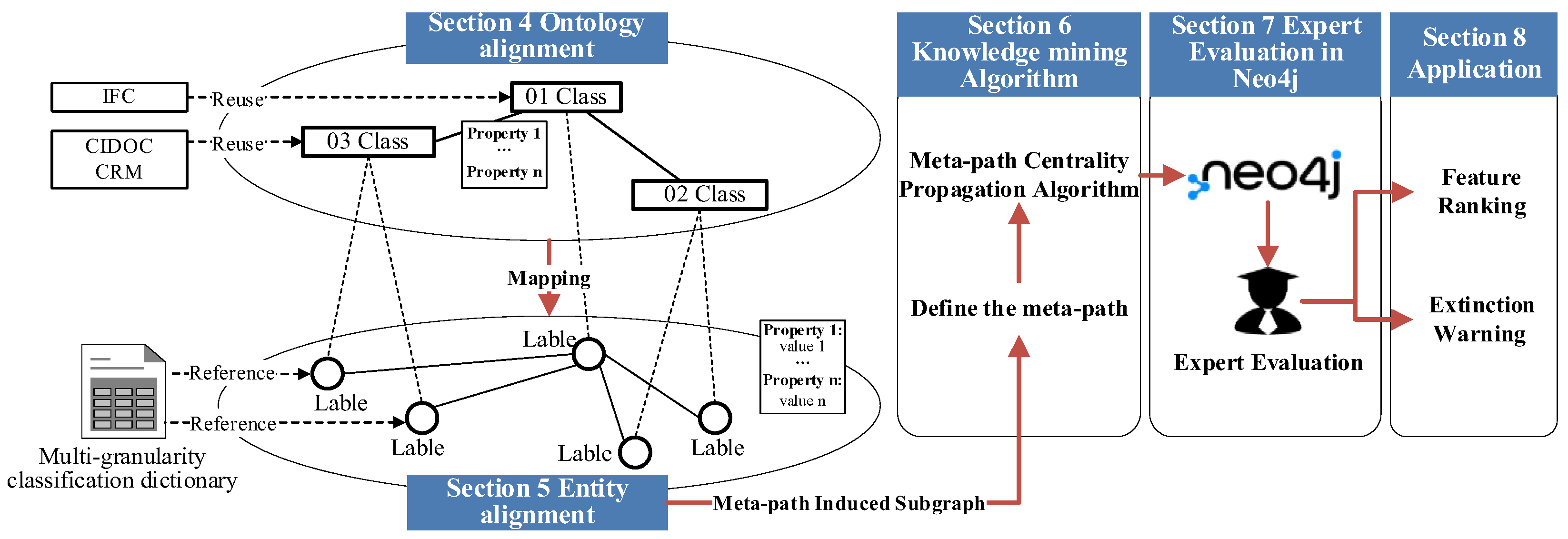
This study develops a framework for local knowledge mining from architectural heritage (Figure 1). The framework comprises three stages: knowledge graph construction, knowledge mining based on node centrality, and expert evaluation with result validation.
Knowledge graph construction establishes the Local Knowledge Graph through ontology alignment and entity alignment. Ontology alignment integrates domain ontologies from architecture, heritage, and geography into a unified conceptual schema. Entity alignment assigns consistent labels using multi-granularity classification dictionaries, ensuring mined knowledge represents integrated local patterns across cases.
Knowledge mining is based on graph node centrality computation. Five heritage value criteria are defined and mapped to 18 meta-paths that propagate spatial importance to target knowledge nodes. The centrality propagation algorithm computes node weights within meta-path-induced subgraphs, capturing how spatial context influences knowledge significance.
Expert evaluation is conducted on the Neo4j graph database platform after centrality computation. Experts assess the computed results and determine threshold parameters through interactive graph inspection. This graph-level evaluation approach replaces traditional instance-level scoring, improving efficiency while preserving professional judgment. Two knowledge services validate the framework: Feature Ranking orders knowledge nodes by centrality, and Extinction Warning identifies endangered elements through low centrality combined with graph-based criteria. Validation through meta-path queries confirms the scientific feasibility of expert-set thresholds.

4. Ontology Alignment of Local Knowledge Graph

In order to establish the local knowledge ontology model, the ontology integration method proposed by Enrico and Antonio [63] is adopted. It includes:
  • Reference model retrieval;
  • Reference model reconciliation and normalization;
  • Reference model matching;
  • Reference model merging/integration.
Following the above four steps, this study retrieved ontology models widely used in the fields of HBIM, architectural heritage and geographic information (Table 1). Local knowledge is constructed from three aspects: building components, construction knowledge and humanistic knowledge. Extract the classes and attributes of the selected ontology, and these subsets will be used as elements of local knowledge ontology to integrate with other ontologies.

4.1. Architectural Heritage Elements Ontology

The Architectural Heritage Elements Ontology (AHEO) provides a simplified representation of architectural heritage components by focusing on externally visible structural and decorative elements, as many internal structures lack observable features. Local knowledge from traditional and contemporary vernacular buildings shows significant variation but also implicit inheritance, which AHEO is designed to accommodate across diverse building types.
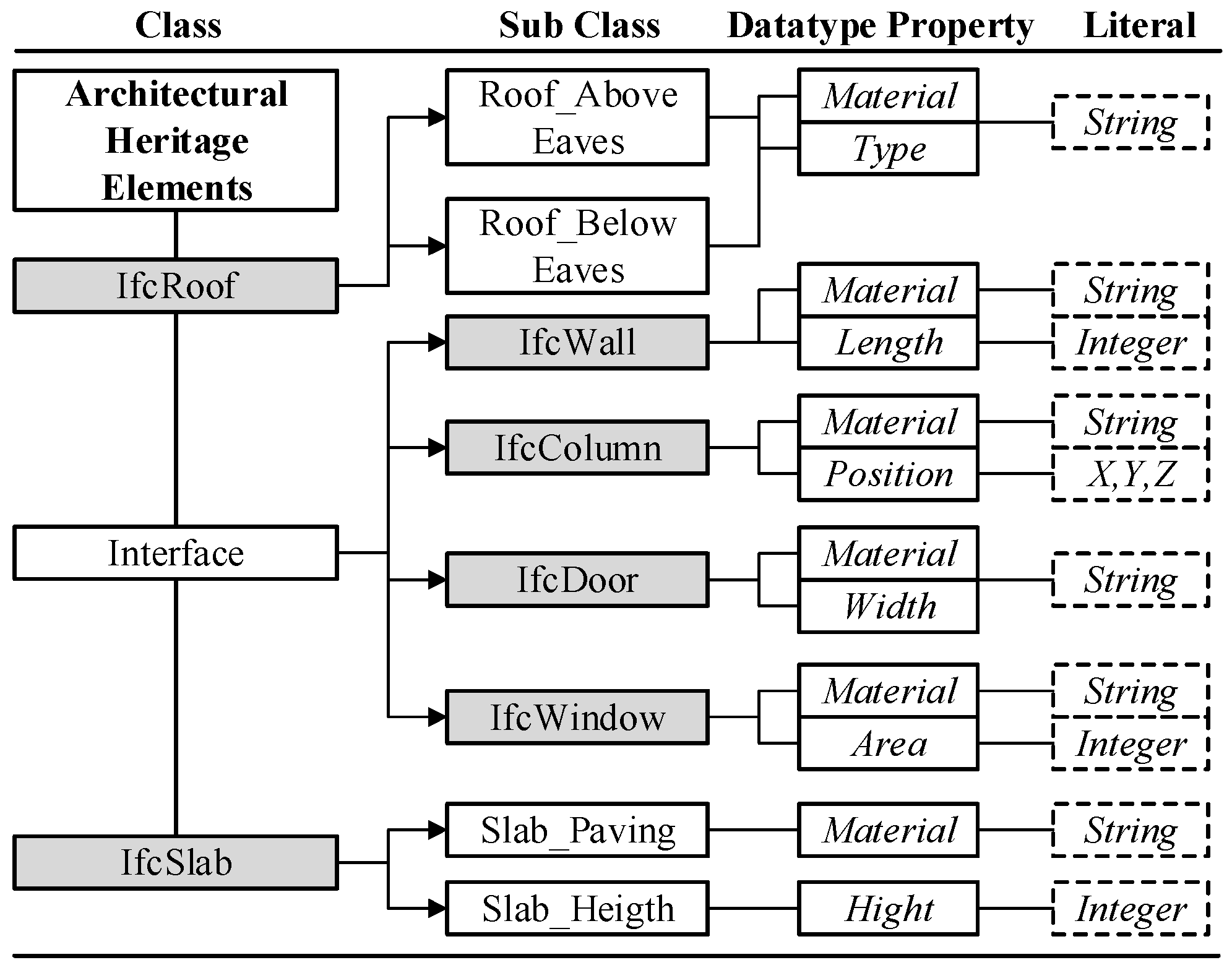
The IFC standard from BuildingSMART describes building objects through entities and property sets, including IfcElement subclasses defined in EXPRESS language. Wang et al. [88] extended IFC with semantic classes for ancient Chinese architectural components, enabling cross-period representation. AHEO adopts this approach by reusing six IFC subclasses (Figure 2). Reflecting the tripartite elevation of Chinese ancient architecture—roof, interface, and platform—the IFC structure is reorganized by introducing an interface class and adding subclasses under IfcRoof and IfcSlab.

4.2. Architectural Heritage Construction Ontology

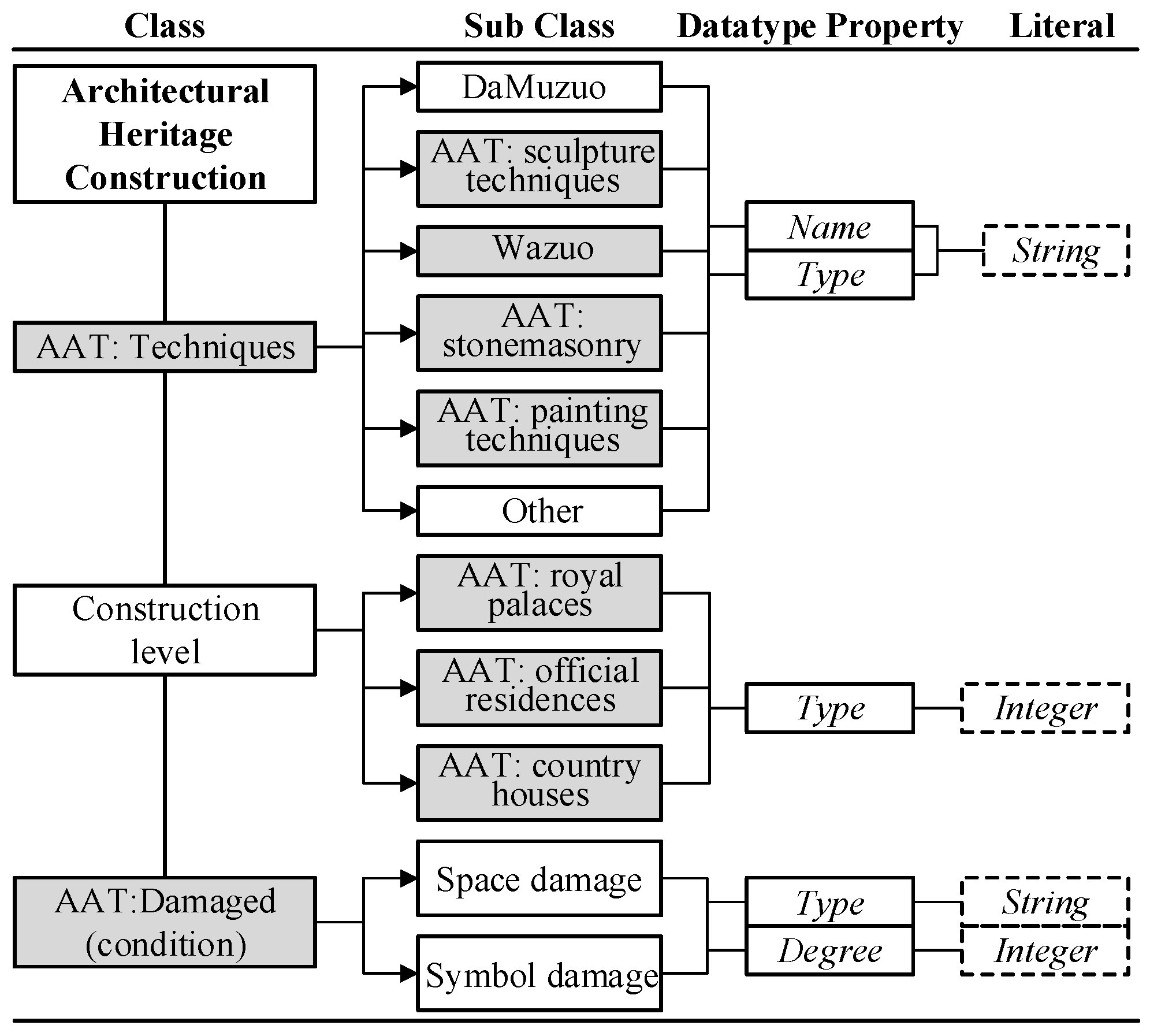
The Architectural Heritage Construction Ontology (AHCO) primarily describes the construction features embedded in physical architectural heritage, encompassing three classes: construction level, construction technique, and construction damage. These correspond to the design, construction, and restoration dimensions of heritage, respectively, covering the full life cycle of traditional architectural construction. The AHCO reuses classes and subclasses from the Art & Architecture Thesaurus (AAT) [76], maintained by the Getty Research Institute, to standardize terms in art, architecture, and cultural heritage (Figure 3). Specifically:
Techniques (AAT: Techniques) defines standards for spatial layout and component fabrication. Ancient Chinese architecture was governed by feudal “ritual systems” and metaphysical thought, enforcing strict hierarchical building codes that embodied dynastic institutions.
Construction level encompasses construction knowledge of ancient buildings, based on the “material” and “skill” in Yingzao Fashi [51], emphasizing classified construction methods and reflecting traditional design principles.
Damaged Condition (AAT: Damaged Condition) captures structural, material, and decorative degradation over time, informing restoration decisions and conservation interventions.

4.3. Architectural Heritage Humanistic Ontology

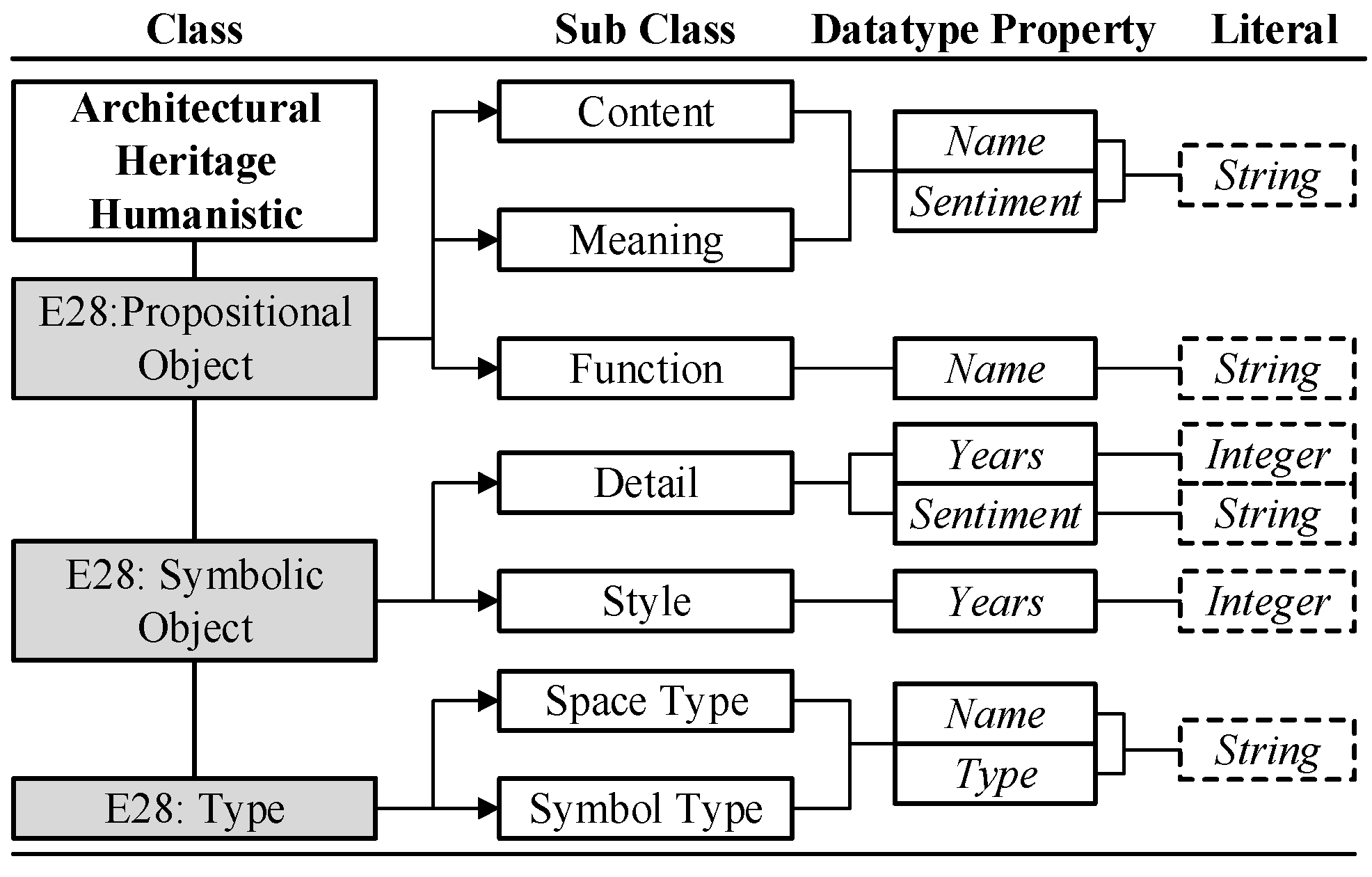
The Architectural Heritage Humanistic Ontology (AHHO) primarily describes the humanistic knowledge embedded in physical heritage, encompassing object, symbolic, and types. CIDOC CRM, the most widely applied ontology in cultural heritage, is reused in AHHO under the “E28 Conceptual Object class” [75] with added subclasses (Figure 4).
It should be noted that humanistic knowledge constitutes intangible heritage, accumulated, recorded, and transmitted over time by individuals. It persists in at least one carrier or human memory and ceases only when the final carrier and memory vanish. Thus, AHHO knowledge must reside in specific carriers and may exist across multiple carriers.

4.4. Cross-Ontology Linkage Based on Space and Symbols

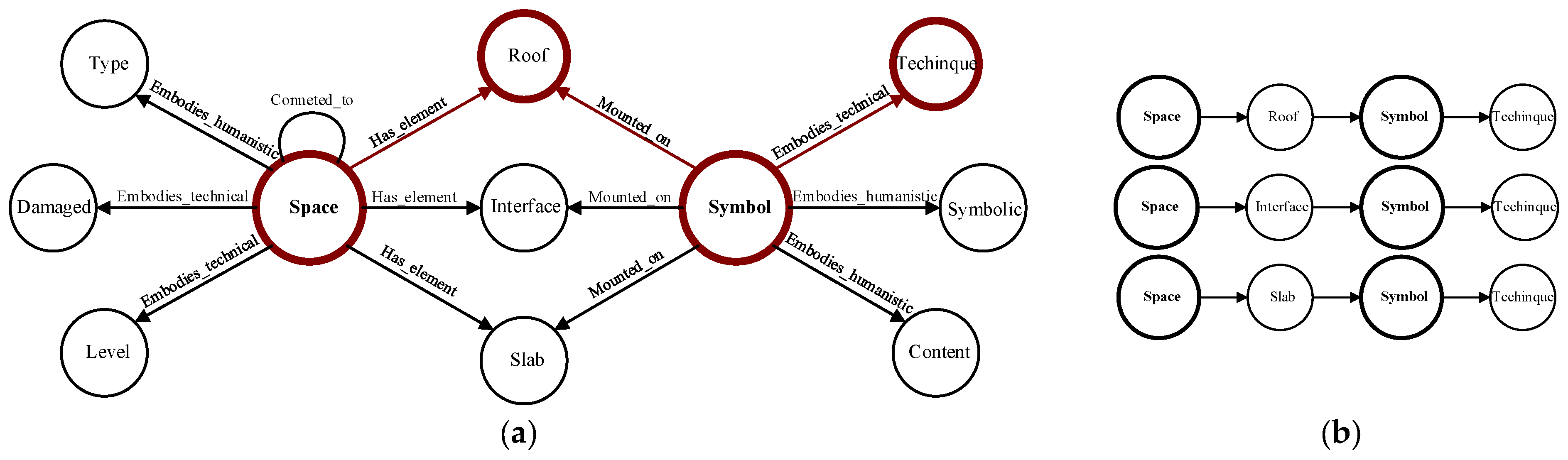
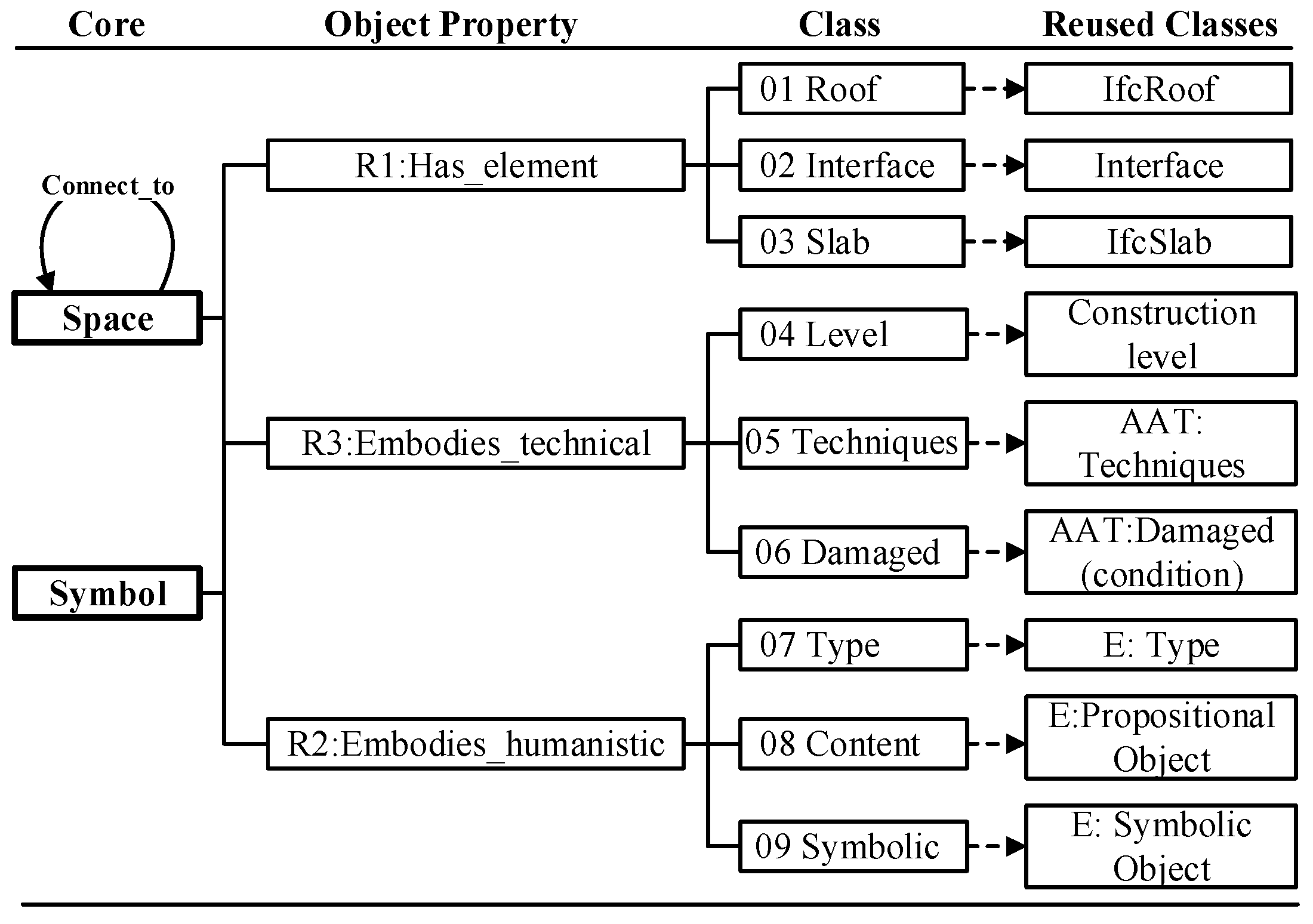
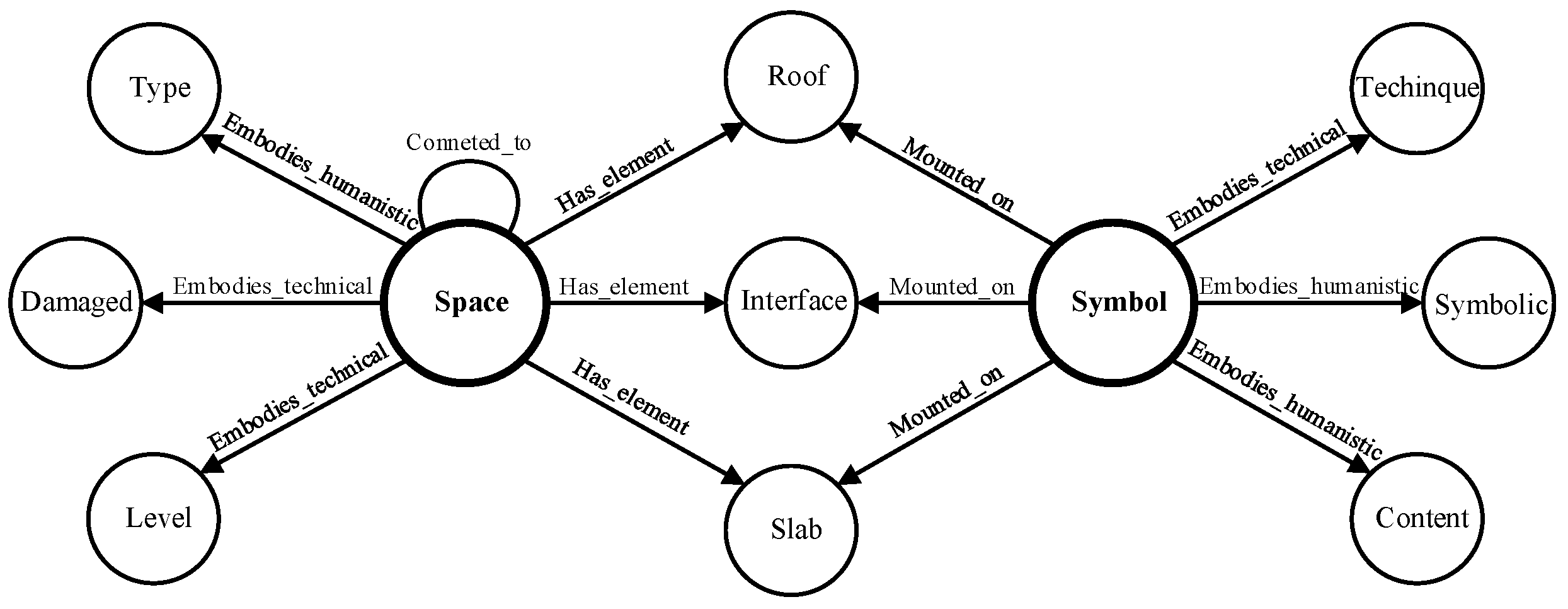
Space and symbol are the two core carriers of tacit knowledge of local architecture (Figure 5), which are linked with other ontologies as core knowledge. Space is the basic unit of a building, and the spatial connection and location relationship between units determine the local spatial organization mode. Symbol is the direct carrier of implicit features. Compared with space, symbol is easy to be captured and perceived by human vision and computer images. Here, we regard space and symbols as building entities. Although space is a part of peacekeeping, it can still be recognized as an entity in the computing environment [89].
The two-node structure links tacit knowledge through spatial and symbolic bridges, enhancing semantic relevance and revealing internal relationships. It supports cross-domain integration and enables flexible graph expansion via spatial and symbolic associations, ensuring openness and adaptability.

5. Entity Alignment of Local Knowledge Graph

5.1. Ontology–Entity Mapping

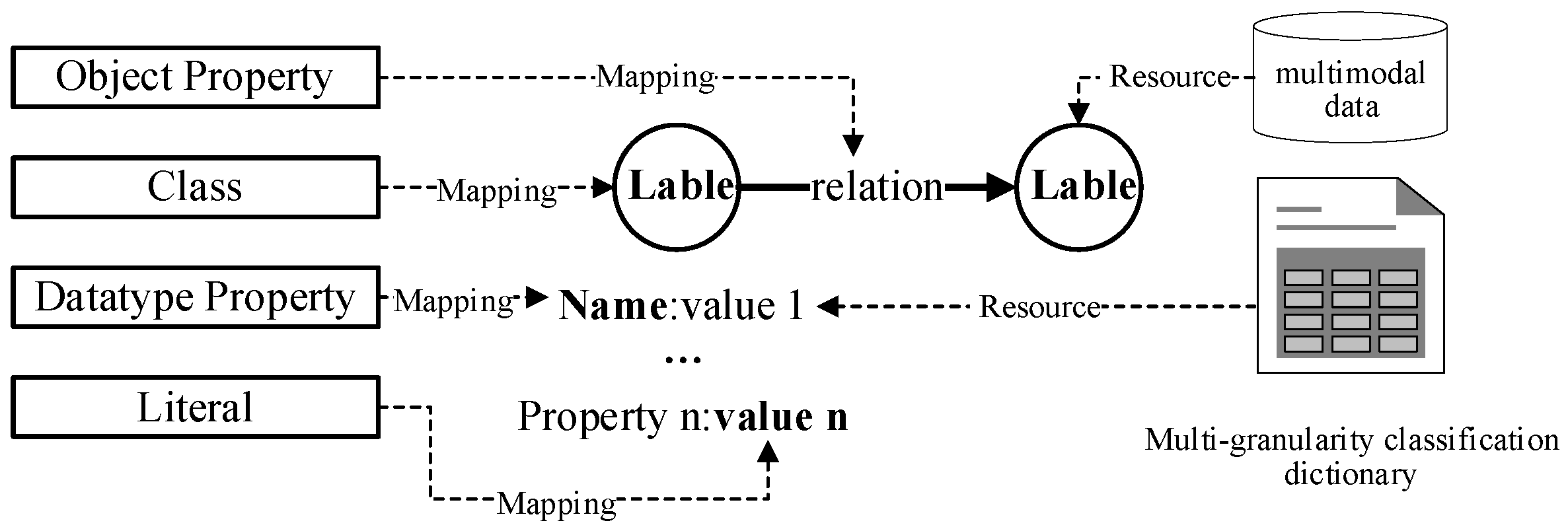
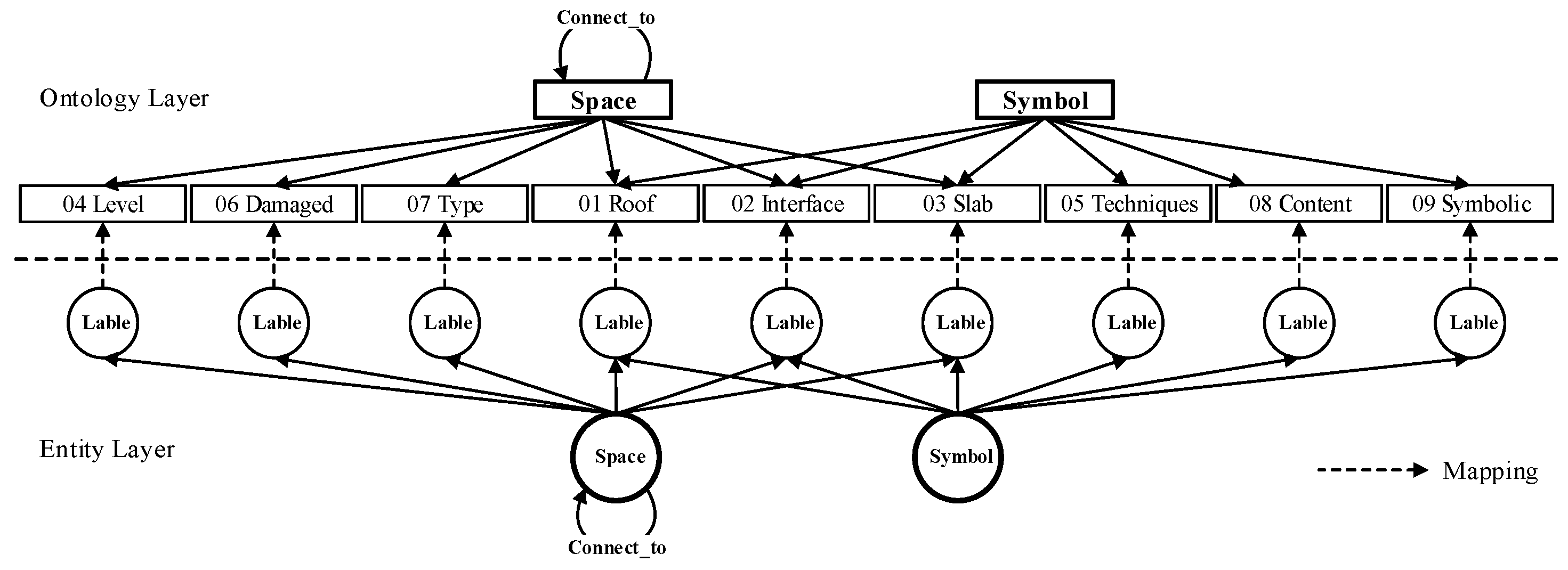
Ontology–entity mapping aligns the established ontology models with semantic instances. While ontologies excel in logical constraints, the LKG ontology incorporates a “Space → Connect_to → Space” topological structure, using nodes for spaces and edges for adjacency. This enables full-graph representation of spatial clustering and connectivity. In contrast, the property graph (PG) model better captures natural graph structures with superior efficiency in algorithms, queries, and visualization. This study therefore adopts the PG standard and implements LKG using Neo4j Desktop 1.6.3. As shown in Figure 6, a complete mapping mechanism is established from the ontology layer to the property graph and multimodal data, defining mapping rules from ontology to semantic entities and corresponding data resources. Figure 7 presents the schema subgraph for ontology–entity mapping. This separated structure ensures semantic constraints for local knowledge while flexibly representing complex spatial and knowledge networks.

5.2. Multi-Granularity Entity Name Dictionary

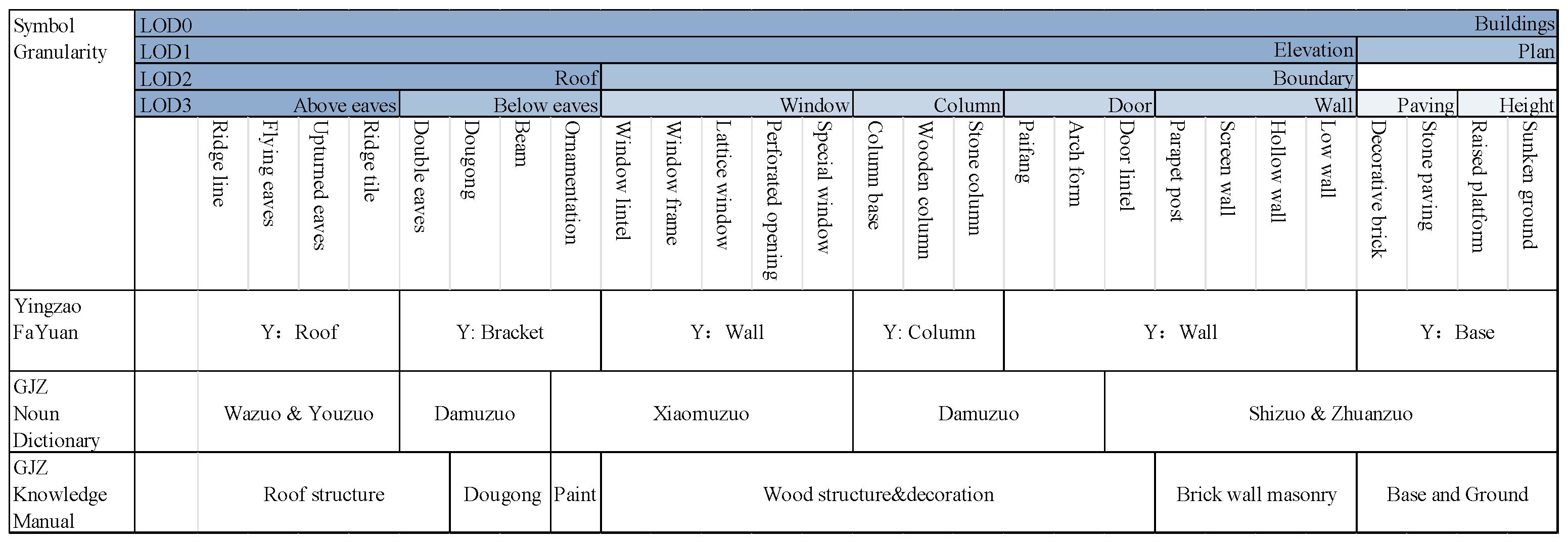
Entity alignment is the task of semantic standardization at the entity level. It assigns standardized semantic names to each spatial symbol entity to ensure that (1) graphic entities from point clouds, models, images and other graphics are mapped to text entities from classics and documents and (2) entities from different construction cases but of the same type are mapped (Figure 8). Entity alignment can ensure the readability of local knowledge and eliminate ambiguity, making knowledge more conducive to the structured storage and inheritance of local knowledge [4].
The multi-granularity classification dictionary is a hierarchical classification system which provides coarse-grained to fine-grained classification labels for entity names (Figure 9 and Figure 10). The specific method is:
  • Develop an external space symbol name classification dictionary in XML or spreadsheet format. This dictionary contains all predefined classification information for space symbols, established in advance by architecture domain experts;
  • Use the classification dictionary as an index to link with external knowledge bases. The dictionary supplies classification labels, while the external knowledge bases provide standard name strings, thereby constructing the external space and symbol name database;
  • Map the external space and symbol name database to spaces and symbols in a given building case. In this way, space symbol names defined by experts are annotated onto building entity geometries. This completes the semantic annotation of drawings and produces information pairs that computers can recognize;
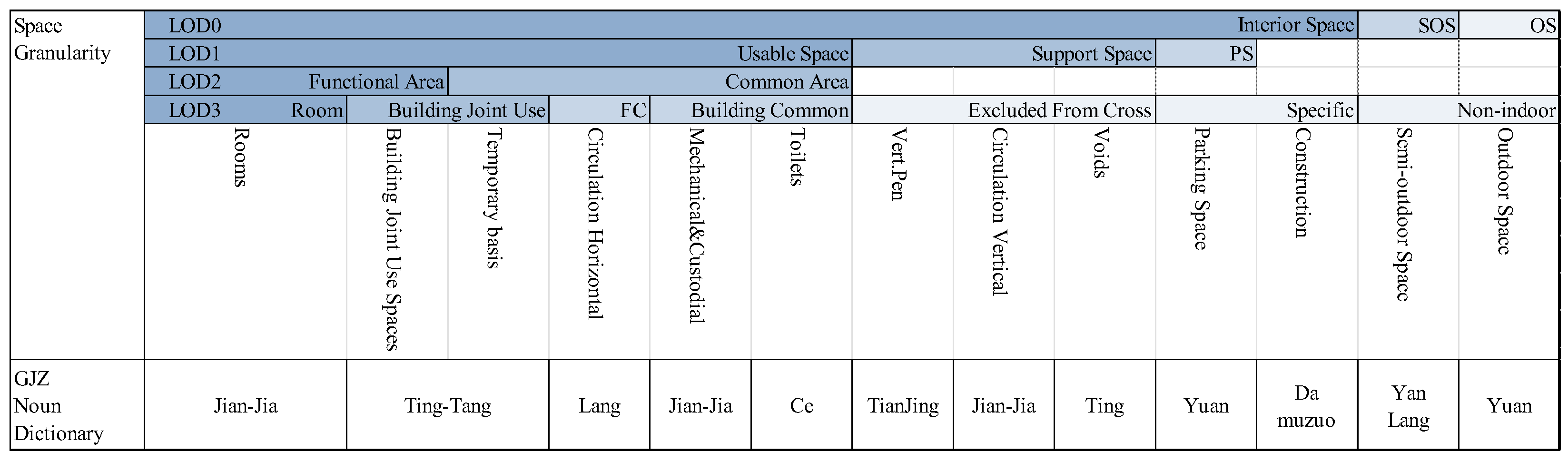
  • The external space and symbol name database supports linkage to various external knowledge bases, such as AAT [76], ANSI/Boma [90] and other building-related semantic description dictionaries. This method enables alignment of local regional knowledge dictionaries and achieves entity consistency.
Figure 9. Space granularity entity name dictionary.
Buildings 16 01233 g009
Figure 10. Symbol granularity entity name dictionary.
Buildings 16 01233 g010

6. Knowledge Mining Based on Graph Node Centrality

6.1. Value Definition of Node Centrality

Local knowledge mining in this study is based on node centrality computation within the knowledge graph. This approach offers significant advantages over traditional instance-level assessment: rather than requiring experts to score hundreds of individual entities, experts evaluate centrality-based results computed from the graph, dramatically improving efficiency while preserving professional judgment in conservation decisions.
The mining targets five heritage value dimensions: Spatial Typology (C1), Construction Hierarchy (C2), Symbolic Significance (C3), Craft Techniques (C4), and Vulnerability (C5). Node centrality captures these dimensions through graph topology, validated through two knowledge services: Feature Ranking orders all knowledge nodes by centrality, where knowledge associated with high-centrality spaces ranks higher; Extinction Warning identifies endangered elements, where nodes below the centrality threshold combined with no successor instances are flagged as endangered. Table 2 presents the complete mapping between criteria and services.

6.2. Meta-Path Propagation of Node Centrality

In the knowledge graph, space nodes are not directly connected to target knowledge nodes such as symbols, techniques, and contents, but are instead associated through intermediate building components. As a result, standard centrality measures fail to effectively capture this indirect spatial influence.
For example, a roof ridge ornament may appear only once in a complex, yet its placement at the visual and ritual center of the main hall grants it far greater perceptual weight than repetitive but peripheral elements. To address this, we introduce meta-path-based centrality propagation, which enables spatial importance to flow through the graph structure to target knowledge nodes.
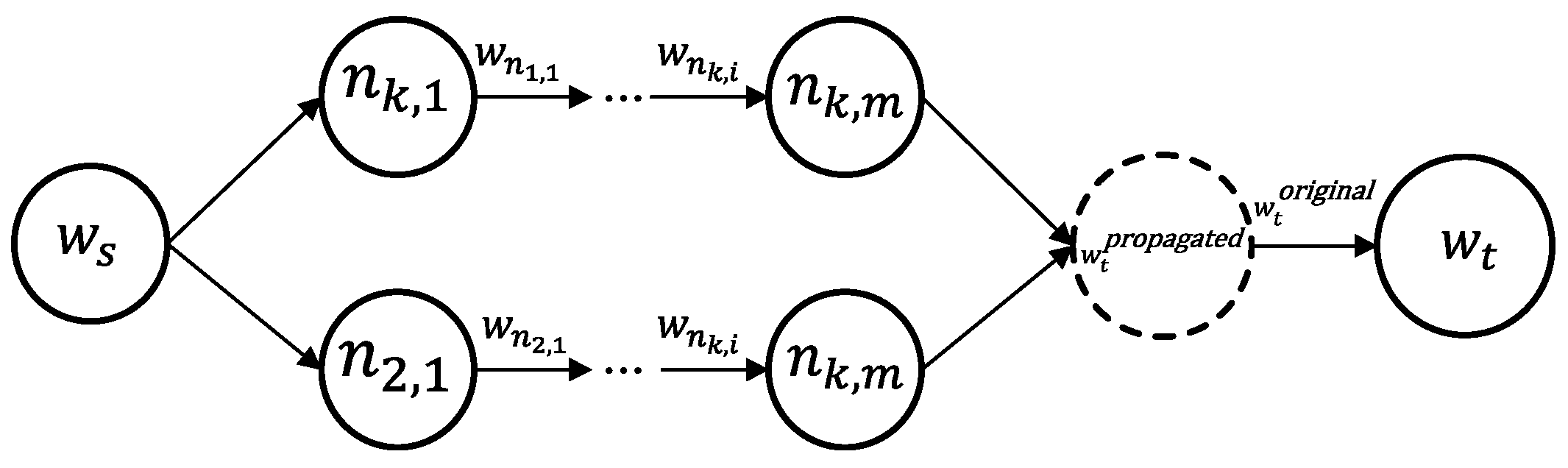
A meta-path connects source nodes to target nodes through specific relationship sequences (Figure 11). All 18 meta-paths originate from space and terminate at knowledge targets (Table 2). Spatial knowledge paths (P1–P3) directly connect space to attributes. Component-mediated paths (P4–P6) access symbol through roof, interface, and slab. Deep semantic paths (P7–P18) extend to content, symbolic meaning, technique, and damage states. The propagation algorithm (Section 6.3) computes centrality within meta-path-induced subgraphs and aggregates values across paths.

6.3. Meta-Path Centrality Propagation Algorithm

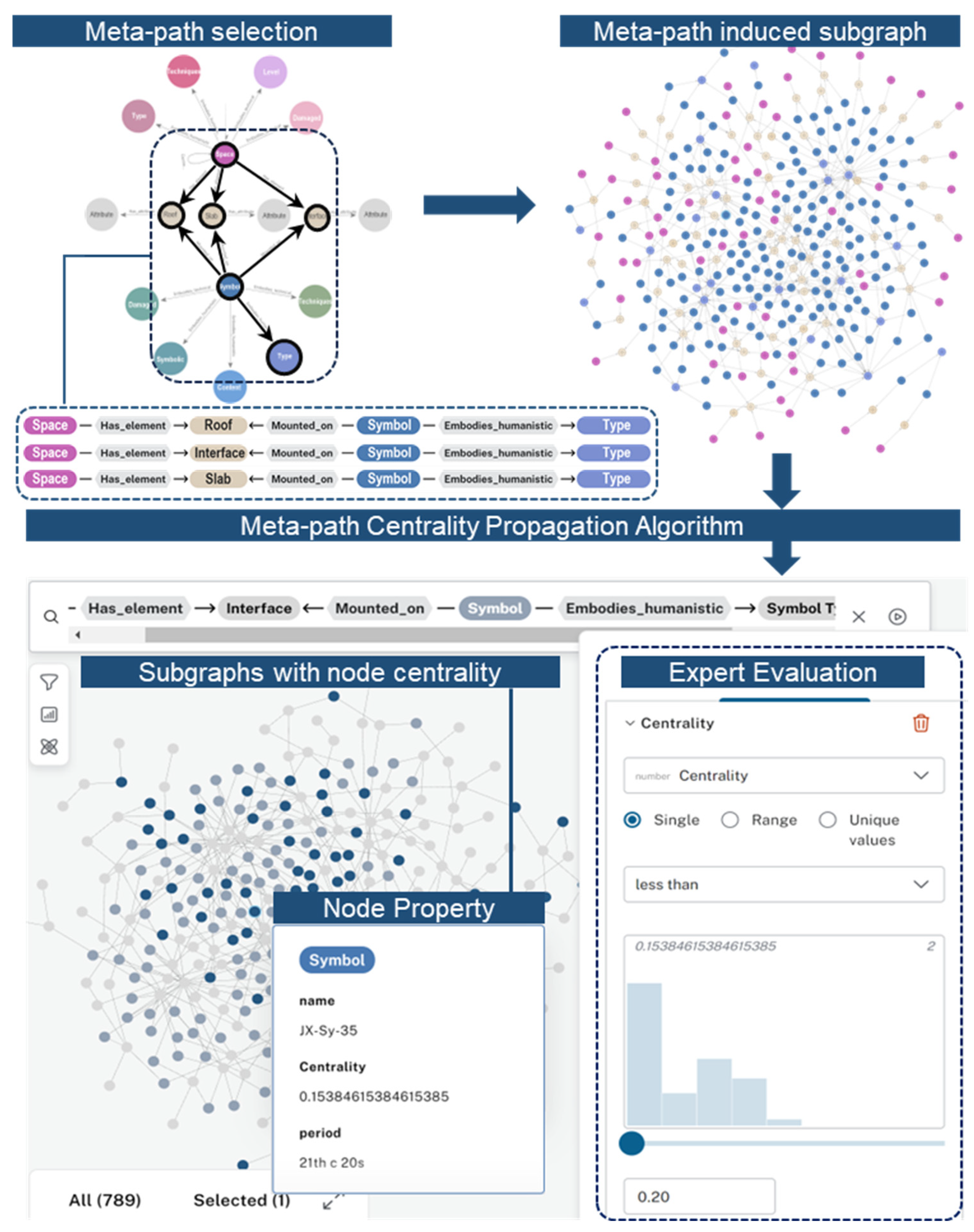
The centrality propagation comprises four steps: extracting meta-path-induced subgraphs, calculating source node weights, propagating weights along meta-paths, and aggregating values while fusing with original weights (Figure 12). The induced subgraph preserves only path-relevant nodes and edges, ensuring weight calculations reflect topological importance under specific semantic relationships without interference from unrelated elements.
Theorem 1.
Meta-path-induced Subgraph: Given a Local Knowledge Graph G = ( V , E ) , V is the set of nodes and E is the set of edges, a meta-path P k and its induced subgraph H k are defined as follows:
P k : s n k , 1 n k , m t ( k = 1 , , K )
H k = ( V k , E k )
where s is the source node and t is the target node. V k contains all nodes appearing in instance paths of P k , and E k contains all edges in those paths. The induced subgraph is extracted by filtering nodes and edges from the complete knowledge graph that conform to the meta-path pattern, forming a local subnetwork within which all subsequent weight calculations are performed.
Theorem 2.
Source Node Weight: In the induced subgraph H k = ( V k , E k ) , let S V k be the set of nodes corresponding to source node type s . For a node v S , its degree centrality is defined as:
C D ( v ) = d e g H k ( v )
Optionally, closeness centrality and betweenness centrality can also be calculated:
C C ( v ) = S 1 u S , u v d H k ( v , u ) , C B ( v ) = x , y S x v , y v , x y σ x y ( v ) σ x y
where d e g H k ( v ) is the degree of node v within H k , d H k ( v , u ) is the shortest path length between v and u in H k , σ x y is the total number of shortest paths between node pair x and y in H k , and σ x y ( v ) is the number of those paths passing through v . Weight calculations must be completed within the induced subgraph H k rather than the global graph G . The induced subgraph contains only nodes and edges relevant to the meta-path, reflecting the local topological structure under that semantic path. Calculating in the global graph would introduce interference from unrelated nodes and distort weights. Subgraph-based calculation ensures weights reflect node importance only under that specific semantic relationship. To avoid scale differences across subgraphs, centrality values require normalization:
w s = C D ( v ) C D m i n C D m a x C D m i n
Isolated nodes or minimum values are set to ϵ = 0.01 to avoid zero weights in subsequent multiplicative propagation. Intermediate node weights w n k , i directly use normalized attribute weights if available; otherwise, edge weights or a default value of 1 are used. For architectural spatial topology, degree centrality effectively reflects node connectivity importance. This study primarily employs degree centrality, while other centrality measures can be selected based on specific requirements.
Theorem 3.
Meta-path Weight Propagation: For each meta-path P k , the propagation value w p k is calculated through hop-by-hop multiplicative attenuation:
w p k = w s i = 1 m w n k , i
where w s is the source node’s initial weight, w n k , i is the weight of the i -th intermediate node, and m is the number of intermediate nodes. The multiplicative propagation model simulates a hop-by-hop attenuation effect: longer paths and lower intermediate node weights result in smaller final propagation values. This aligns with the physical intuition of spatial influence in architecture, where distant spaces exert exponentially decaying influence on components.
Theorem 4.
Multi-path Aggregated Weight: Given K meta-paths, the aggregated propagation value for the target node is:
w t propagated = k = 1 K α k w p k , α k = 1 K
where α k is the weight coefficient for the k -th path. This study adopts uniform weighting α k = 1 / K as a baseline strategy to avoid subjective bias.
Theorem 5.
Target Node Weight Update: The final centrality of a target node is obtained by combining its own weight with the weights propagated from other nodes through a weighted fusion process:
w t = β w t original + ( 1 β ) w t propagated
where β [ 0,1 ] is a fusion coefficient controlling the relative importance between the node’s intrinsic attributes and spatial propagation influence. When β = 0 , the weight relies entirely on spatial propagation; when β = 1 , only the node’s own attributes are considered. β enables architects to make value judgments regarding the relative importance of spatial configuration and symbolic meaning. In this study β = 0.5 .

7. Case Study

7.1. Local Knowledge Graph Construction

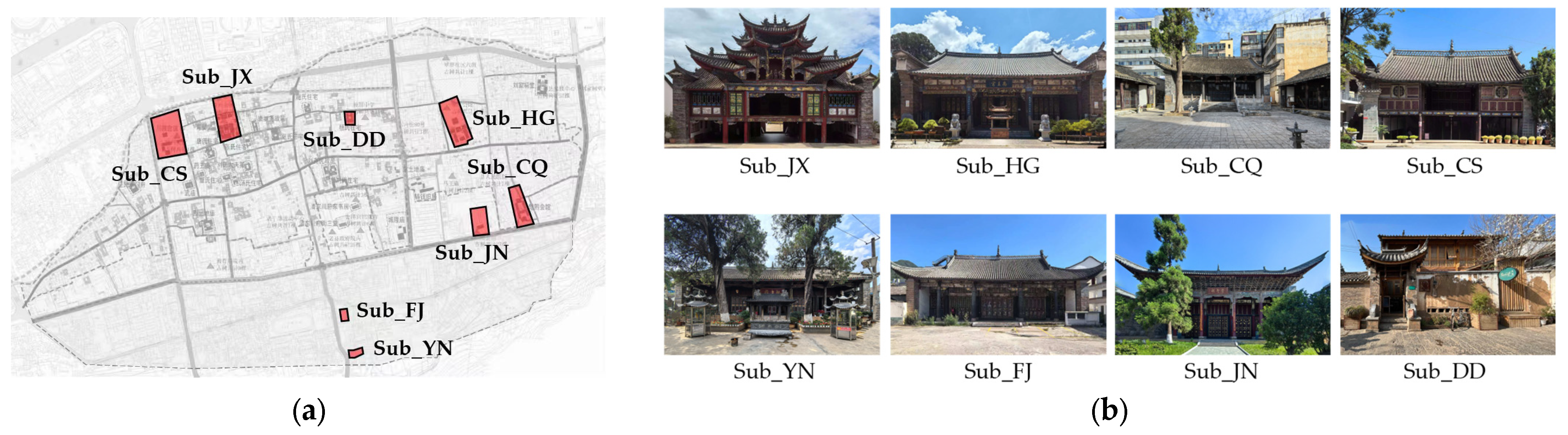
This study examines eight courtyards in Huize County’s ancient district, Yunnan Province, China (Figure 13). Eight are 18th-century Qing Dynasty buildings designated as national heritage units, showing various degrees of damage, in situ reconstruction, or extensions, with one nearly rebuilt.
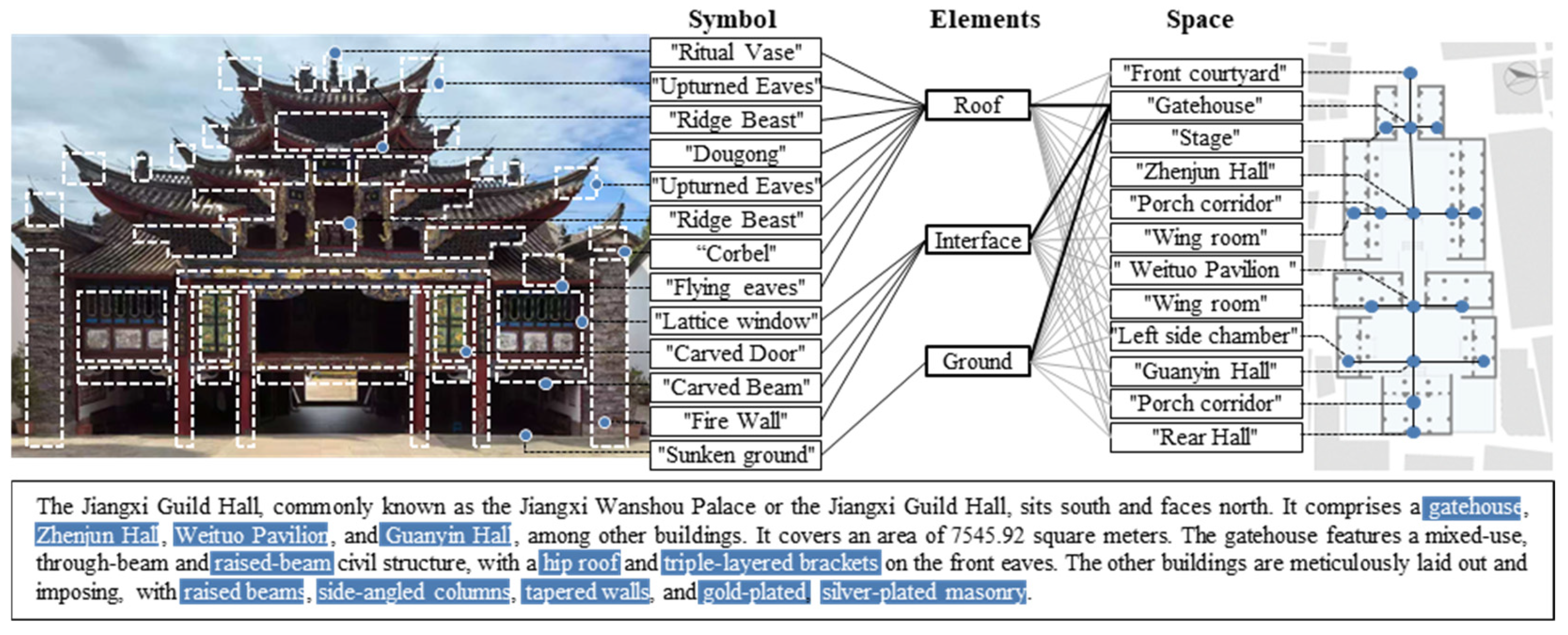
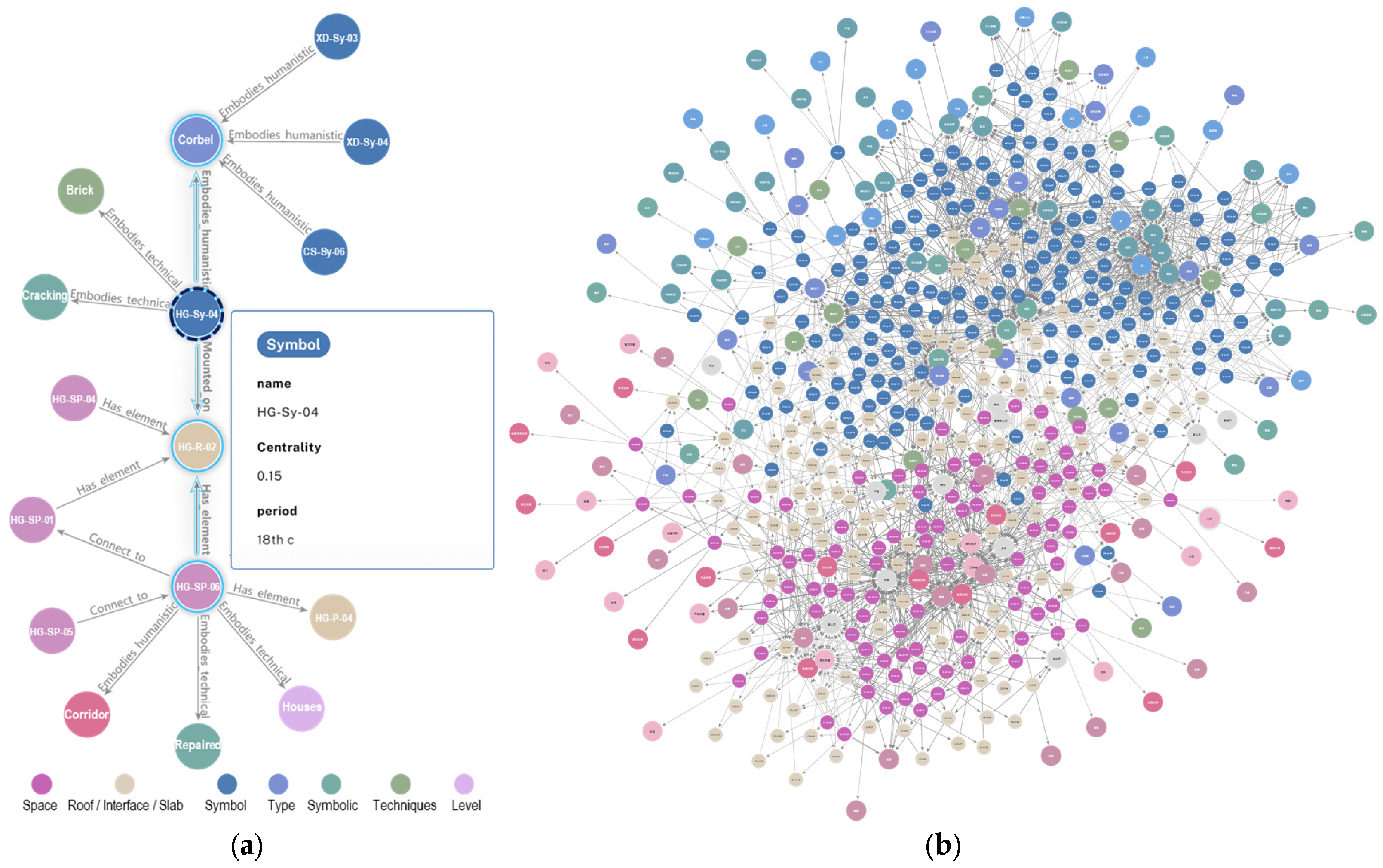
The knowledge extraction process is illustrated in Figure 14. Space nodes including courtyard, colonnade, side rooms, and main hall are mapped to their positions within the building plan. Symbol nodes including ridge ornaments, carved windows, ceiling paintings, and stone bases are attached to their corresponding spaces. This spatial mapping transforms architectural survey data into graph-structured knowledge (Figure 15a).
The Local Knowledge Graph was constructed in the Neo4j graph database following the ontology alignment and entity alignment methods described in Section 4 and Section 5 (Figure 15b). The graph comprises 18 node types with 581 nodes and 6 relationship types with 2109 relationships (Table 3).

7.2. Graph Computation and Expert Evaluation

The constructed knowledge graph was deployed on the Neo4j graph database platform for centrality computation and expert evaluation. Meta-path queries extract induced subgraphs following the patterns defined in Table 2, and the propagation algorithm computes node centrality within each subgraph.
Figure 16 demonstrates the centrality computation result using paths P4–P6 which connect space to symbol to type. The visualization displays the induced subgraph with node color intensity indicating centrality weight. Darker nodes represent higher centrality values propagated from important spatial contexts. Centrality and timestamps are embedded as node properties, enabling interactive querying within the graph database.
Five experts were invited to evaluate the centrality computation results through the Neo4j visualization interface: three heritage conservation specialists with over 15 years of experience in Yunnan regional architecture, and two practicing architects. Each expert independently performed threshold calibration for Extinction Warning through interactive graph inspection (Figure 16). The experts focused on symbol nodes and their connection patterns within the subgraph. The evaluation protocol proceeded as follows:
  • Initialize centrality threshold at 1.0, displaying all nodes in the visualization;
  • Progressively decrease threshold in 0.05 decrements (Figure 17);
  • At each level, evaluate remaining nodes using the graph criteria in Table 4;
  • Determine the threshold where nodes consistently show endangered features;
  • Record the final threshold value. The results are presented in Section 8.2.2.

8. Validation and Results

8.1. Evaluate Knowledge Graph Quality

The ontology was evaluated using two structural quality metrics: the Instantiated Class Ratio (ICR) and the Instantiated Property Ratio (IPR) [91]. ICR measures the proportion of defined classes that have at least one instance, reflecting ontology utilization. IPR measures the proportion of defined properties actually used in the graph. Well-designed ontologies typically achieve ICR above 80% and IPR above 90% [91].
In the full graph, both AHEO and AHCO achieved 100% ICR while AHHO reached 86%, indicating comprehensive coverage of the designed ontology (Table 5). The AHCO usage rate correlates with entity volume: buildings with more than 150 nodes achieve 91-100% AHCO-ICR, while those below 100 nodes show 46–73%. This reflects that larger cases encompass a wider variety of construction knowledge. AHHO is minimally affected by data volume because humanistic knowledge within the same region is highly correlated. The IPR reached 92%, stable across cases because attributes are collected at spatial and symbolic levels rather than the building level.

8.2. Knowledge Mining Results

8.2.1. Local Knowledge Feature Ranking

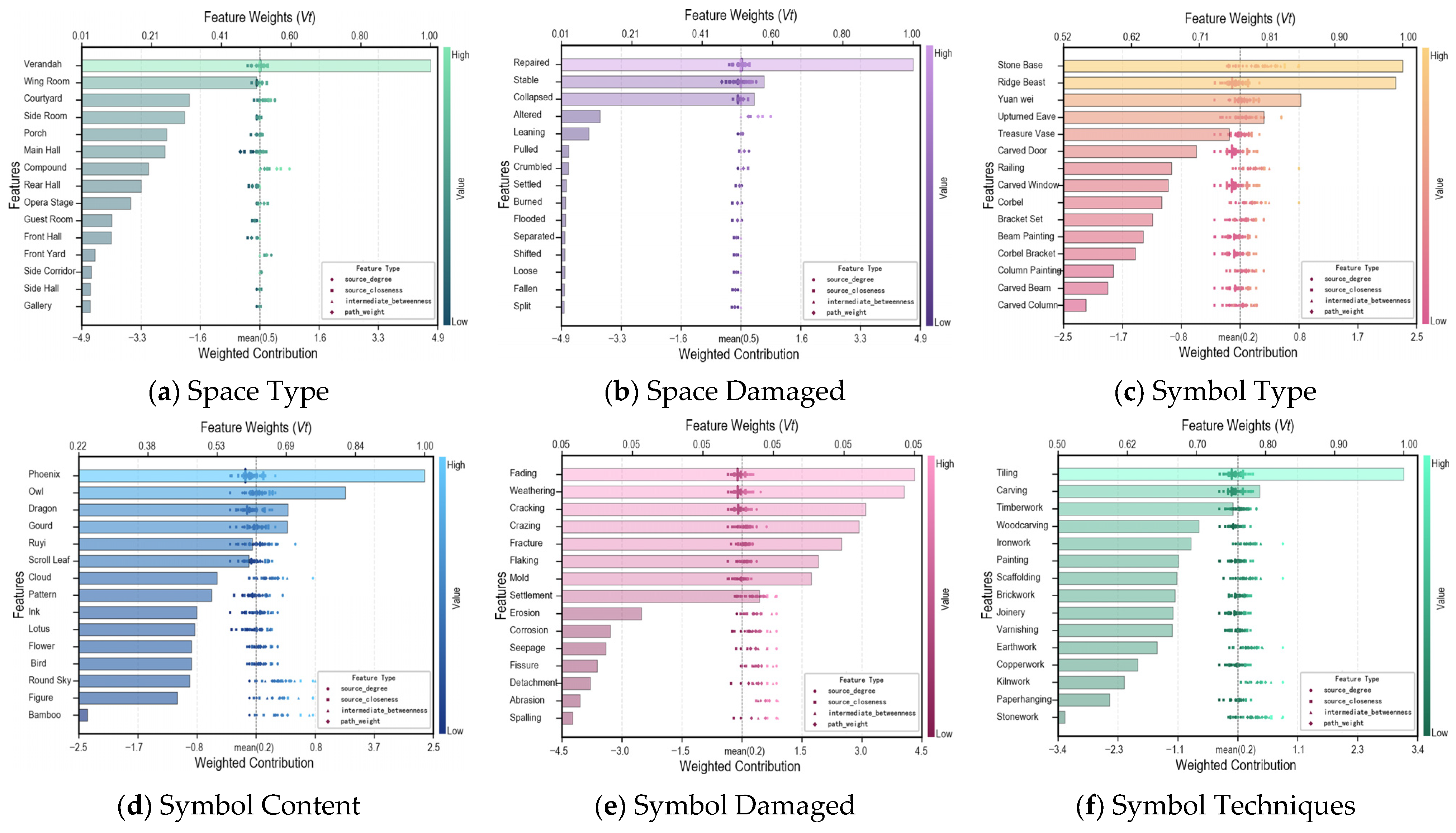
Based on node centrality computation, knowledge elements are ranked by their heritage significance. Figure 18 presents the ranking results across six knowledge dimensions.
Space features. Colonnades, side rooms, and courtyards show highest centrality as they form primary circulation paths. The main hall, despite its size, ranks lower due to peripheral location in circulation networks. The top seven spaces define a characteristic prototype: centralized layout centered around a courtyard linked by colonnades.
Symbol features. Ridge beasts and stone bases rank highest. Ridge beasts show a high degree of centrality from consistent paired placement on roofs. Stone bases have a high betweenness centrality due to connecting multiple spaces. Their corresponding roof and platform components remain well-preserved, whereas structural elements show greater damage.
Technique and damage features. Primary crafts are tiling, carving, and timberwork. Predominant damages include fading, weathering, and cracking, indicating urgent conservation needs.
Symbolic content. Phoenixes, birds, and dragons representing protection and fortune rank highest. The ranking reflects physical prevalence: phoenixes achieve high weight through numerous ridge beast embodiments, demonstrating effective centrality propagation from symbols to their semantic content.

8.2.2. Local Knowledge Extinction Warning

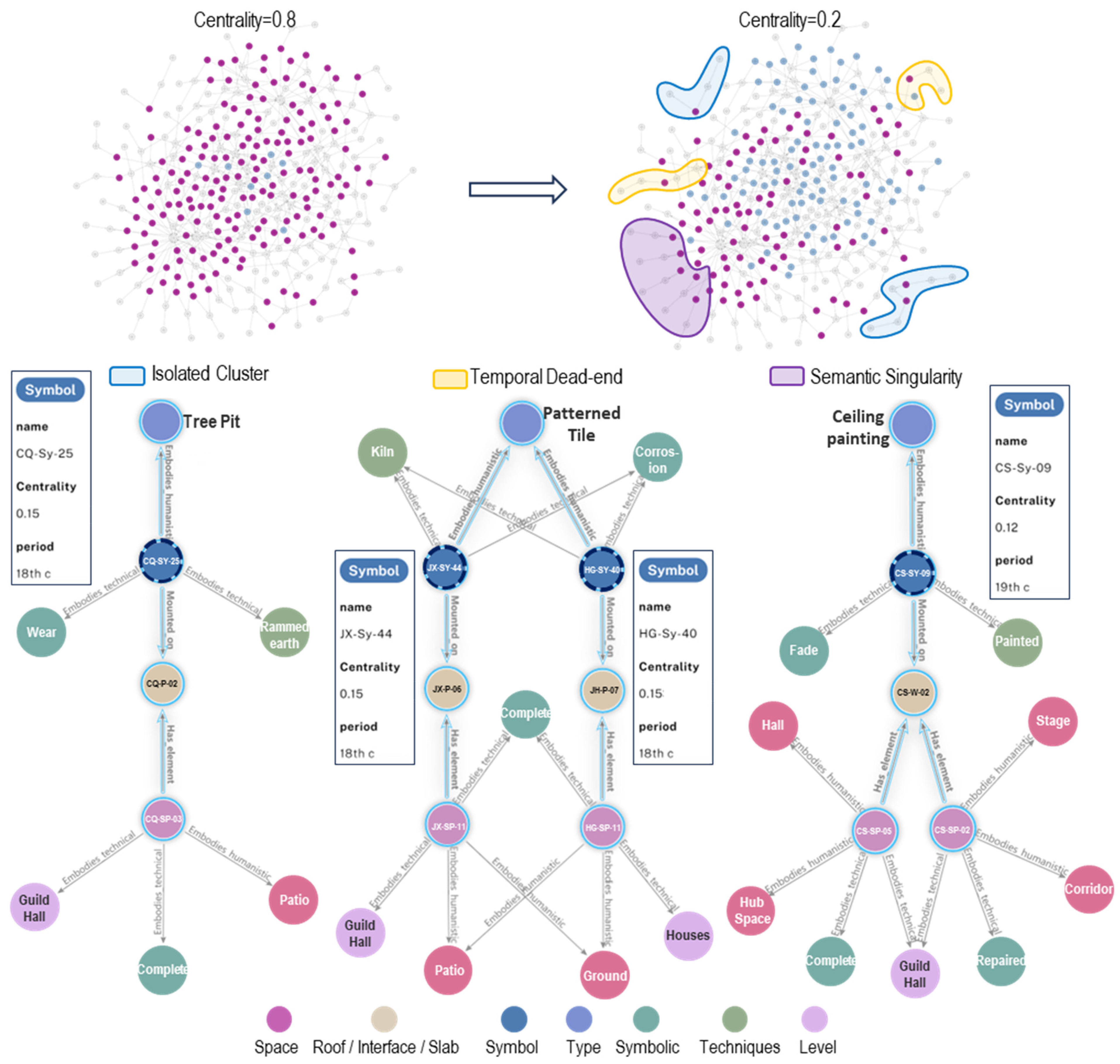
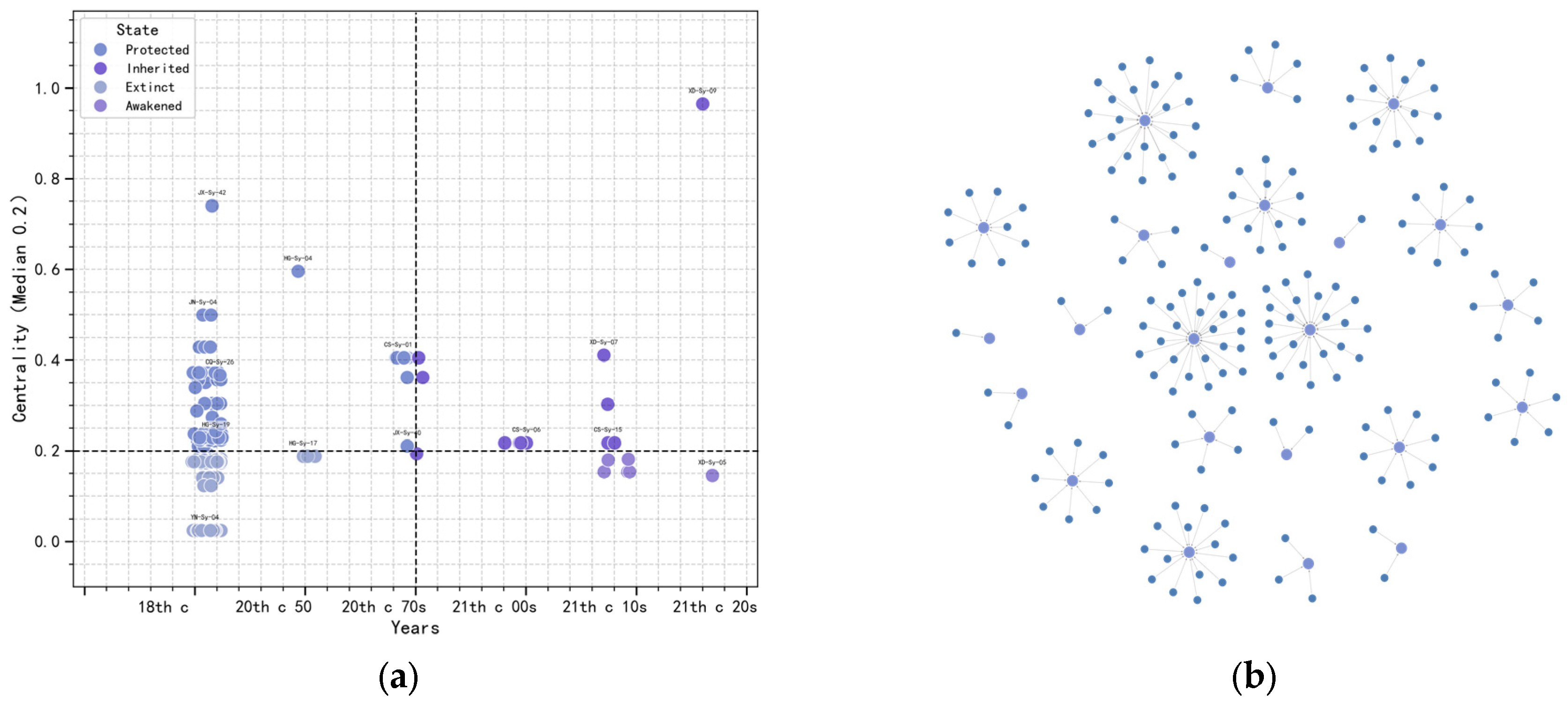
The five experts independently determined threshold values of 0.15, 0.20, 0.20, 0.20, and 0.25 respectively. The final threshold was calculated as the mean value of 0.20. The Intraclass Correlation Coefficient ICC (2, 5) reached 0.82, indicating good inter-rater reliability. Extinction Warning identifies endangered knowledge by combining low centrality with graph-based endangered features. Elements with centrality below the expert-determined threshold of 0.20 are flagged as potentially endangered (Figure 19).
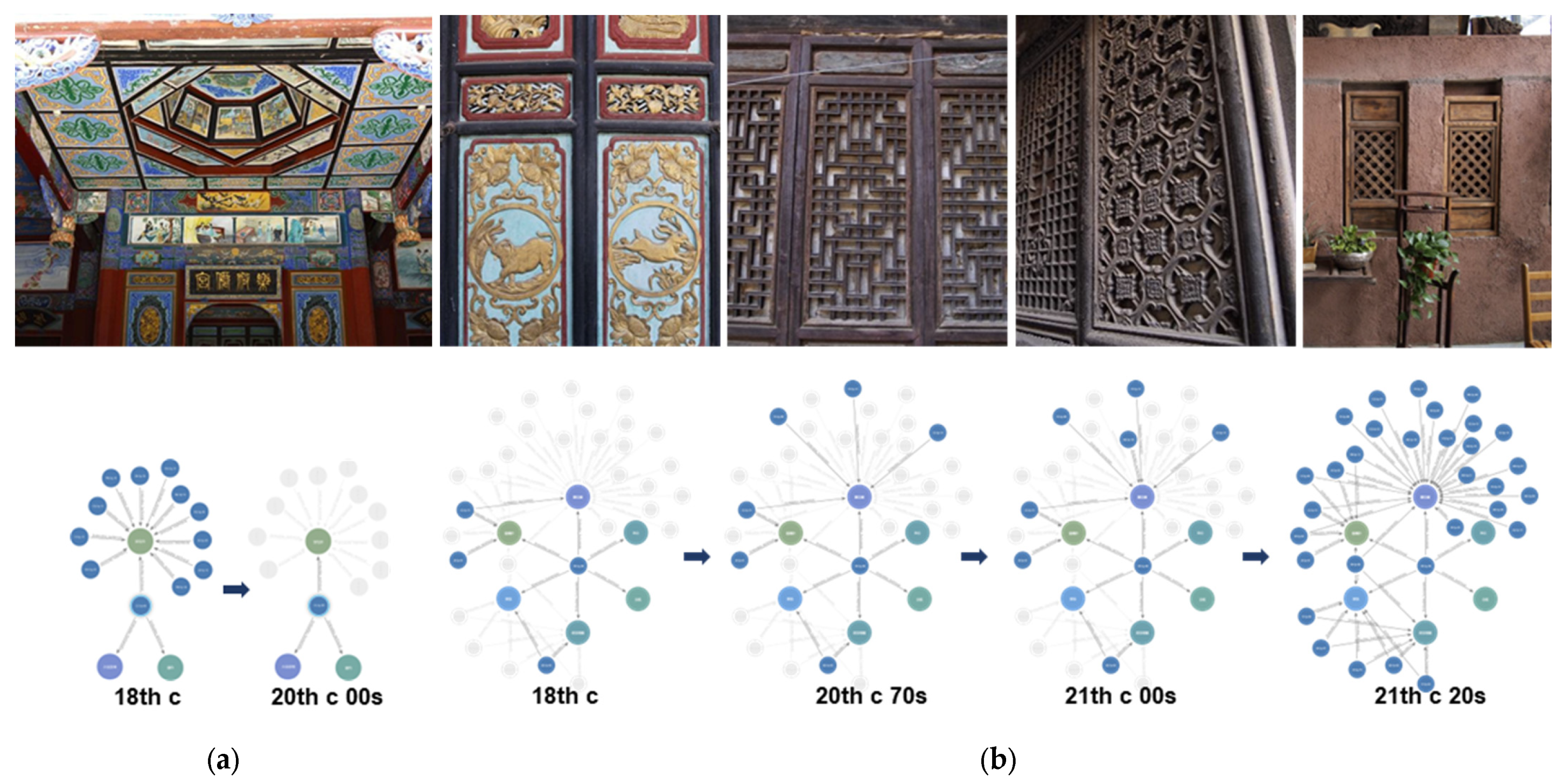
To verify that the centrality-based Extinction Warning accurately identifies endangered knowledge, meta-path queries trace knowledge inheritance through temporal relationships. Two representative cases demonstrate the effectiveness of this approach.
The ceiling painting CS-SY-09 was flagged as endangered with a centrality of 0.12, below the 0.20 threshold. Figure 20a shows the meta-path query result: this element appears as an isolated cluster in the subgraph, and none of its neighboring nodes display later time periods attributes. This unique artifact has no recorded successors since the 19th century and shows extensive fading. Its destruction would erase both its painting techniques and cultural meanings. The low centrality and isolated graph position accurately reflect its endangered status.
In contrast, the carved window XD-SY-09 has a centrality of 0.75, well above the threshold. Figure 20b shows its meta-path query result: the node connects to multiple successor instances across different time periods, forming a well-connected subgraph. Since the 18th century, this carved window has been continuously inherited as a significant local cultural symbol. Its carving motifs and crafting techniques have remained consistent across multiple buildings and periods, demonstrating both preservation and enduring vitality. The higher centrality and rich graph connectivity correctly reflect its robust transmission status.
These verification results demonstrate that the combination of graph-based centrality computation and expert threshold evaluation successfully distinguishes endangered knowledge nodes, validating the scientific feasibility of the proposed method.

9. Conclusions

Architectural heritage contains rich implicit local knowledge. Existing semantic models produce semantic fragments when confronted with physical damage and incomplete data, thereby hindering the reasoning and mining of local knowledge. This study develops a Local Knowledge Graph (LKG) framework for local knowledge representation and mining. A case study of eight historical buildings in Huize County validated the framework’s effectiveness. The contributions are concluded in two aspects.
  • Regarding the first objective of knowledge graph construction, the LKG aligns fragmented local semantics through two complementary mechanisms. At the ontological level, three domain ontologies are integrated through spatial and symbolic linkage nodes, with AHEO and AHCO achieving 100% instantiated class ratio and AHHO reaching 86%. At the entity level, a multi-granularity classification dictionary enables consistent labeling of multimodal data across building cases, achieving 92% Instantiated Property Ratio. The resulting property graph comprising 581 nodes and 2109 relationships demonstrates effective fusion and representation of localized architectural knowledge across heterogeneous sources.
  • Regarding the second objective of implicit local knowledge mining, the framework achieves fragmented knowledge mining through a meta-path centrality propagation algorithm combined with expert evaluation on the Neo4j platform, validated by two knowledge services. Feature Ranking identified characteristic spatial and symbolic prototypes of Huize regional architecture, revealing colonnades, courtyards, ridge beasts, and stone bases as high-centrality elements. Extinction Warning achieved reliable endangered knowledge identification with an expert consensus threshold of 0.20; Intraclass Correlation Coefficient reached 0.82. Case verification demonstrated that the combination of graph-based centrality computation and expert threshold evaluation successfully distinguishes endangered knowledge nodes.
Additionally, the constructed LKG offers the following potential values. Presented in an intuitive graphical format, it facilitates architects’ comprehension and uncovers tacit knowledge inaccessible to traditional qualitative methods. As a machine-readable structured data model, the LKG enables flexible expansion and alignment with existing knowledge, forming a dynamic, extensible graph capable of integrating behavioral data and affective semantics. Furthermore, the semantic graph can integrate with AI technologies, offering semantic support for intelligent applications such as historical building reconstruction and automated generation.
A limitation is the exclusion of multimodal data preprocessing. Additionally, linking computational outputs to specific conservation actions such as significance assessment, preventive conservation requires a systematic framework beyond the current scope. Integrating this framework with comprehensive heritage value assessment systems represents an important direction for future work.

Author Contributions

Conceptualization, Q.Y. and J.C.; methodology, Q.Y.; software, Q.Y.; validation, Q.Y. and J.C.; formal analysis, Q.Y.; investigation, Q.Y. and Y.Q.; resources, Q.Y.; data curation, Q.Y.; writing—original draft preparation, Q.Y.; writing—review and editing, Q.Y. and Y.Q.; visualization, Q.Y. and Y.Q.; supervision, J.C.; project administration, J.C.; funding acquisition, J.C. All authors have read and agreed to the published version of the manuscript.

Funding

This research was funded by the Project of the Collaborative Unit of the National Key Research and Development Program of China (2023YFC3805502).

Data Availability Statement

All the data that support the findings of this study are owned by the authors’ institution and are available from the corresponding author upon reasonable request.

Acknowledgments

The authors gratefully acknowledge the funding support received.

Conflicts of Interest

The authors declare no conflicts of interest.

References

  1. Chang, Q.; Jiang, T.Y.; Chen, C.; Li, Y.C. Reflection on the Fundamental Category of Heritage Architecture. Herit. Archit. 2016, 1, 44–61. [Google Scholar]
  2. Soni, S.; Patidar, S.; Pimple, J. Conservation Practices Depleting Values and Lifespan of Heritage. IJAH 2022, 5, 20–25. [Google Scholar] [CrossRef]
  3. Schweiker, M.; Ampatzi, E.; Andargie, M.S.; Andersen, R.K.; Azar, E.; Barthelmes, V.M.; Berger, C.; Bourikas, L.; Carlucci, S.; Chinazzo, G.; et al. Review of Multi-Domain Approaches to Indoor Environmental Perception and Behaviour. Build. Environ. 2020, 176, 106804. [Google Scholar] [CrossRef]
  4. Parente, M.; Bruno, N.; Ottoni, F. HBIM and Information Management for Knowledge and Conservation of Architectural Heritage: A Review. Heritage 2025, 8, 306. [Google Scholar] [CrossRef]
  5. Tao, F.; Zhang, C.; Liu, W.; Zhang, H.; Ma, X.; Gao, P.; Zhang, J. Digital Engineering and Its Ten Application Outlooks. J. Mech. Eng. 2023, 59, 193–215. [Google Scholar] [CrossRef]
  6. Lombardi, M.; Rizzi, D. Semantic Modelling and HBIM: A New Multidisciplinary Workflow for Archaeological Heritage. Digit. Appl. Archaeol. Cult. Herit. 2024, 32, e00322. [Google Scholar] [CrossRef]
  7. Oliveira, A.; Oliveira, J.F.; Pereira, J.M.; De Araújo, B.R.; Boavida, J. 3D Modelling of Laser Scanned and Photogrammetric Data for Digital Documentation: The Mosteiro Da Batalha Case Study. J. Real-Time Image Process. 2014, 9, 673–688. [Google Scholar] [CrossRef]
  8. Huang, H.; Tan, J.; Guo, X. The Path to Explicit Representation of Tacit Knowledge in Architectural Heritage under the Digital Twin Paradigm. New Archit. 2025, 105–109. [Google Scholar] [CrossRef]
  9. Alshawabkeh, Y.; El-Khalili, M.; Almasri, E.; Bala’awi, F.; Al-Massarweh, A. Heritage Documentation Using Laser Scanner and Photogrammetry. The Case Study of Qasr Al-Abidit, Jordan. Digit. Appl. Archaeol. Cult. Herit. 2020, 16, e00133. [Google Scholar] [CrossRef]
  10. Milne, L. The Significance of Aesthetic and Heritage Values in a Public Policy Environment: Victoria Theatre Case Study. Master’s Thesis, Auckland University of Technology, Auckland, New Zealand, 2011. [Google Scholar]
  11. Hussein, K.A.; Abrahim, A.R.; Mohammed, A.S.; Ali, K.A. Digital Preservation of Heritage Urban Facades: An Integrated Approach Using Historic Building Information Modeling and Shape Grammar Analysis. Digit. Appl. Archaeol. Cult. Herit. 2024, 35, e00383. [Google Scholar] [CrossRef]
  12. Nofal, E.; Reffat, R.M.; Boschloos, V.; Hameeuw, H.; Vande Moere, A. The Role of Tangible Interaction to Communicate Tacit Knowledge of Built Heritage. Heritage 2018, 1, 28. [Google Scholar] [CrossRef]
  13. Pescaru, A.H.; Zsak, I.-G.; Onescu, I. Architecture and Armour in Heritage Discourse: Form, Function, and Symbolism. Heritage 2025, 8, 382. [Google Scholar] [CrossRef]
  14. Dipasquale, L.; Ammendola, J.; Montoni, L.; Ferrari, E.P.; Zambelli, M. Harnessing Vernacular Knowledge for Contemporary Sustainable Design through a Collaborative Digital Platform. Heritage 2024, 7, 5251. [Google Scholar] [CrossRef]
  15. Baldissini, S.; Garagnani, S. Digital Documentation and Analysis of Palladian Microarchitectures: From 3D Models to Knowledge-Based Information Systems. Heritage 2025, 8, 388. [Google Scholar] [CrossRef]
  16. Akboy-İlk, S. The Nature of Drawing in the Changing Culture of Architectural Documentation. J. Archit. Plan. Res. 2016, 33, 29–44. [Google Scholar]
  17. Warden, R.; Woodcock, D. Historic Documentation: A Model of Project Based Learning for Architectural Education. Landsc. Urban Plan. 2005, 73, 110–119. [Google Scholar] [CrossRef]
  18. Anumba, C.J.; Egbu, C.O.; Carrillo, P.M. (Eds.) Knowledge Management in Construction; Blackwell Pub: Oxford, UK; Malden, MA, USA, 2005; ISBN 978-1-4051-2972-5. [Google Scholar]
  19. Chen, J.; Ou, S. Research on the Construction of the Semantic Model for Chinese Ancient Architectures Based on Architectural Narratives. Electron. Libr. 2020, 38, 769–784. [Google Scholar] [CrossRef]
  20. Simeone, D.; Cursi, S.; Acierno, M. BIM Semantic-Enrichment for Built Heritage Representation. Autom. Constr. 2019, 97, 122–137. [Google Scholar] [CrossRef]
  21. Beetz, J.; van Leeuwen, J.P.; de Vries, B. An Ontology Web Language Notation of the Industry Foundation Classes. In Proceedings of the 22nd CIB W78 Conference on Information Technology in Construction; Technische Universität Dresden: Dresden, Germany, 2005. [Google Scholar]
  22. Strug, B.; Ślusarczyk, G.; Paszynska, A.; Palacz, W. A Survey of Different Graph Structures Used in Modeling Design, Engineering and Computer Science Problems. In Graph-Based Modelling in Science, Technology and Art; Springer: Cham, Switzerland, 2022; pp. 243–275. [Google Scholar]
  23. Pauwels, P.; Zhang, S.; Lee, Y.-C. Semantic Web Technologies in AEC Industry: A Literature Overview. Autom. Constr. 2017, 73, 145–165. [Google Scholar] [CrossRef]
  24. Bartalesi, V.; Meghini, C.; Metilli, D. Steps towards a Formal Ontology of Narratives Based on Narratology. In Proceedings of the 7th Workshop on Computational Models of Narrative (CMN 2016), Kraków, Poland, 11–12 July 2016; pp. 4:1–4:10. [Google Scholar]
  25. Pauwels, P.; Van Deursen, D. IFC-to-RDF: Adaptation, Aggregation and Enrichment. In First International Workshop on Linked Data in Architecture and Construction; Ghent University: Ghent, Belgium, 2012; pp. 1–3. [Google Scholar]
  26. Argasiński, K.; Tomczak, A. Enhancing Semantic Interoperability of Heritage BIM-Based Asset Preservation. Heritage 2025, 8, 410. [Google Scholar] [CrossRef]
  27. Zhang, X.; Zhi, Y.; Xu, J.; Han, L. Digital Protection and Utilization of Architectural Heritage Using Knowledge Visualization. Buildings 2022, 12, 1604. [Google Scholar] [CrossRef]
  28. Puerto, A.; Castañeda, K.; Sánchez, O.; Peña, C.A.; Gutiérrez, L.; Sáenz, P. Building Information Modeling and Complementary Technologies in Heritage Buildings: A Bibliometric Analysis. Results Eng. 2024, 22, 102192. [Google Scholar] [CrossRef]
  29. Ronzino, P.; Niccolucci, F.; D’Andrea, A. Built Heritage Metadata Schemas and the Integration of Architectural Datasets Using CIDOC-CRM. In Proceedings of the International Conference Built Heritage; Politecnico di Milano: Milan, Italy, 2013. [Google Scholar]
  30. Corry, E.J.; Coakley, D.; O’Donnell, J.; Pauwels, P.; Keane, M.M. The Role of Linked Data and Semantic Web in Building Operation. In Proceedings of the NUIG-UL Alliance—Engineering, Informatics & Science Research Day; NUI Galway: Galway, Ireland, 2013. [Google Scholar]
  31. Elshani, D.; Wortmann, T.; Staab, S. Towards Better Co-Design with Disciplinary Ontologies: Review and Evaluation of Data Interoperability in the AEC Industry. In Proceedings of the LDAC@ ESWC, Hersonissos, Greece, 29 May 2022; pp. 43–52. [Google Scholar]
  32. Kalay, Y.E. Enhancing Multi-Disciplinary Collaboration through Semantically Rich Representation. Autom. Constr. 2001, 10, 741–755. [Google Scholar] [CrossRef]
  33. Eastman, C. Knowledge-Based Building Information Modeling. In Building Information Modeling: BIM in Current and Future Practice; John Wiley & Sons, Inc.: Hoboken, NJ, USA, 2014; Volume 43. [Google Scholar]
  34. Hu, Z.-Z.; Leng, S.; Lin, J.-R.; Li, S.-W.; Xiao, Y.-Q. Knowledge Extraction and Discovery Based on BIM: A Critical Review and Future Directions. Arch. Comput. Methods Eng. 2022, 29, 335–356. [Google Scholar] [CrossRef]
  35. Quattrini, R.; Pierdicca, R.; Morbidoni, C. Knowledge-Based Data Enrichment for HBIM: Exploring High-Quality Models Using the Semantic-Web. J. Cult. Herit. 2017, 28, 129–139. [Google Scholar] [CrossRef]
  36. Colucci, E.; De Ruvo, V.; Lingua, A.; Matrone, F.; Rizzo, G. HBIM-GIS Integration: From IFC to cityGML Standard for Damaged Cultural Heritage in a Multiscale 3D GIS. Appl. Sci. 2020, 10, 1356. [Google Scholar] [CrossRef]
  37. Chorro-Domínguez, F.J.; Redweik, P.; Sanjosé-Blasco, J.J. Integrating HBIM and GIS Through Object-Relational Databases for the Conservation of Rammed Earth Heritage: A Multiscale Approach. Heritage 2025, 8, 336. [Google Scholar] [CrossRef]
  38. Massafra, A.; Predari, G.; Gulli, R. Towards Digital Twin Driven Cultural Heritage Management: A Hbim-Based Workflow for Energy Improvement of Modern Buildings. Int. Arch. Photogramm. Remote Sens. Spat. Inf. Sci. 2022, 46, 149–157. [Google Scholar] [CrossRef]
  39. Pauwels, P.; Verstraeten, R.; De Meyer, R.; Van Campenhout, J. Architectural Information Modelling for Virtual Heritage Application. In Proceedings of the Digital Heritage–Proceedings of the 14th International Conference on Virtual Systems and Multimedia, Limassol, Cyprus, 20–25 October 2008; pp. 18–23. [Google Scholar]
  40. Fai, S.; Sydor, M. Building Information Modelling and the Documentation of Architectural Heritage: Between the ‘Typical’ and the ‘Specific’. In Proceedings of the 2013 Digital Heritage International Congress (DigitalHeritage); IEEE: Marseille, France, 2013; Volume 1, pp. 731–734. [Google Scholar]
  41. Wang, H.; Qi, G.; Chen, H. Knowledge Graph: Methods, Practice and Application; Beijing Book Co. Inc.: Beijing, China, 2019; ISBN 7-121-36671-1. [Google Scholar]
  42. Gruber, T. A Translational Approach to Portable Ontologies. Knowl. Acquis. 1993, 5, 199–220. [Google Scholar] [CrossRef]
  43. IDOC CRM. Conceptual Reference Model. 2003. Available online: https://cidoc-crm.org (accessed on 10 March 2026).
  44. Agathos, M.; Kapidakis, S. A Meta-Model Agreement for Architectural Heritage. In Proceedings of the Research Conference on Metadata and Semantic Research; Springer: Cham, Switzerland, 2013; pp. 384–395. [Google Scholar]
  45. Cacciotti, R.; Blaško, M.; Valach, J. A Diagnostic Ontological Model for Damages to Historical Constructions. J. Cult. Herit. 2015, 16, 40–48. [Google Scholar] [CrossRef]
  46. Chen, Y.; Zhao, S. Construction of a Heritage Building Knowledge Ontology Integrating HBIM and Humanistic Knowledge. Libr. Trib. 2024, 44, 90–102. [Google Scholar]
  47. Cacciotti, R.; Valach, J.; Kuneš, P.; Čerňanský, M.; Blaško, M.; Křemen, P. Monument Damage Information System (MONDIS): An Ontological Approach to Cultural Heritage Documentation. ISPRS Ann. Photogramm. Remote Sens. Spat. Inf. Sci. 2013, 2, 55–60. [Google Scholar] [CrossRef]
  48. Messaoudi, T.; Véron, P.; Halin, G.; De Luca, L. An Ontological Model for the Reality-Based 3D Annotation of Heritage Building Conservation State. J. Cult. Herit. 2018, 29, 100–112. [Google Scholar] [CrossRef]
  49. Zalamea, O.; Van Orshoven, J.; Steenberghen, T. From a CityGML to an Ontology-Based Approach to Support Preventive Conservation of Built Cultural Heritage. In Proceedings of the 19th AGILE International Conference on Geographic Information Science; Springer: Berlin/Heidelberg, Germany, 2016; Volume 42342, pp. 34–39. [Google Scholar]
  50. Yang, X.; Lu, Y.C.; Murtiyoso, A.; Koehl, M.; Grussenmeyer, P. HBIM Modeling from the Surface Mesh and Its Extended Capability of Knowledge Representation. Int. J. Geo-Inf. 2019, 8, 301. [Google Scholar] [CrossRef]
  51. Li, J. Ying Zao Fa Shi Zhu Shi. Juan Shang; China Building Industry Press: Beijing, China, 1983. [Google Scholar]
  52. Cheng, X.; Tian, Y.; Shu, K.; Wang, Z. Knowledge Organization of Traditional Architectural Ancient Books for Craftsmanship Inheritance: A Case Study of the Carpentry System in “Ying Zao Fa Shi”. Libr. Trib. 2024, 44, 111–122. [Google Scholar] [CrossRef]
  53. Liu, Q.; Chang, B. Research on the Design Method of Ontology Knowledge Base for Ancient Architectural Preservation Technology Based on ODM Model. Comput. Appl. Softw. 2010, 27, 3. [Google Scholar]
  54. Xu, Y. Research on the Construction and Application of Domain Ontology for Ancient Architecture; Guangxi Normal University: Guilin, China, 2017. [Google Scholar]
  55. Noardo, F. Architectural Heritage Semantic 3D Documentation in Multi-Scale Standard Maps. J. Cult. Herit. 2018, 32, 156–165. [Google Scholar] [CrossRef]
  56. Bruno, N.; Roncella, R. HBIM for Conservation: A New Proposal for Information Modeling. Remote Sens. 2019, 11, 1751. [Google Scholar] [CrossRef]
  57. Previtali, M.; Brumana, R.; Stanga, C.; Banfi, F. An Ontology-Based Representation of Vaulted System for HBIM. Appl. Sci. 2020, 10, 1377. [Google Scholar] [CrossRef]
  58. Bacci, G.; Bertolini, F.; Bevilacqua, M.G.; Caroti, G.; Piemonte, A. Hbim Methodologies for the Architectural Restoration. The Case of the Ex-Church of san Quirico All’olivo in Lucca, Tuscany. ISPRS—Int. Arch. Photogramm. Remote. Sens. Spat. Inf. Sci. 2019, XLII-2/W11, 121–126. [Google Scholar] [CrossRef]
  59. Doerr, M. Ontologies for Cultural Heritage. In Handbook on Ontologies; Staab, S., Studer, R., Eds.; Springer: Berlin/Heidelberg, Germany, 2009; pp. 463–486. [Google Scholar]
  60. Baik, A. From Point Cloud to Jeddah Heritage BIM Nasif Historical House—Case Study. Digit. Appl. Archaeol. Cult. Herit. 2017, 4, 1–18. [Google Scholar] [CrossRef]
  61. Simeone, D.; Cursi, S. A Platform for Enriching BIM Representation through Semantic Web Technologies. In Proceedings of the Joint Conference on Computing in Construction (JC3); Heriot-Watt University: Edinburgh, UK, 2017; Volume 1, pp. 423–430. [Google Scholar]
  62. Yang, X.; Koehl, M.; Grussenmeyer, P. Parametric Modelling of As-Built Beam Framed Structure in BIM Environment. Int. Arch. Photogramm. Remote Sens. Spat. Inf. Sci. 2017, 42, 651–657. [Google Scholar] [CrossRef]
  63. Caldarola, E.G.; Rinaldi, A.M. A Multi-strategy Approach for Ontology Reuse Through Matching and Integration Techniques. In Quality Software Through Reuse and Integration. FMI IRI 2016 2016 2016. Advances in Intelligent Systems and Computing; Springer: Cham, Switzerland, 2017; pp. 63–90. [Google Scholar] [CrossRef]
  64. Maietti, F.; Medici, M.; Ferrari, F.; Ziri, A.E.; Bonsma, P. Digital Cultural Heritage: Semantic Enrichment and Modelling in BIM Environment. In Proceedings of the Digital Cultural Heritage: Final Conference of the Marie Skłodowska-Curie Initial Training Network for Digital Cultural Heritage, ITN-DCH 2017, Olimje, Slovenia, 23–25 May 2017, Revised Selected Papers; Springer: Berlin/Heidelberg, Germany, 2018; pp. 104–118. [Google Scholar]
  65. Trovato, M.R.; Sanzaro, D. A Knowledge and Evaluation Model to Support the Conservation of Abandoned Historical Centres in Inner Areas. Heritage 2024, 7, 1618–1664. [Google Scholar] [CrossRef]
  66. Sevilla, J.; Samper, J.J.; Fernández, M.; León, A. Ontology and Software Tools for the Formalization of the Visualisation of Cultural Heritage Knowledge Graphs. Heritage 2023, 6, 4722–4736. [Google Scholar] [CrossRef]
  67. Daoudi, H.; Chaker, I.; Zahi, A. Building an Ontology for the Tangible Cultural Heritage of the Medina of Fez. Heritage 2025, 8, 391. [Google Scholar] [CrossRef]
  68. Crisan, A.; Pepe, M.; Costantino, D.; Herban, S. From 3D Point Cloud to an Intelligent Model Set for Cultural Heritage Conservation. Heritage 2024, 7, 1419–1437. [Google Scholar] [CrossRef]
  69. Caneparo, L. Semantic Knowledge in Generation of 3D Layouts for Decision-Making. Autom. Constr. 2022, 134, 104012. [Google Scholar] [CrossRef]
  70. Cota, G.; Zese, R.; Bellodi, E.; Lamma, E.; Riguzzi, F. A Framework for Reasoning on Probabilistic Description Logics. In Applications and Practices in Ontology Design, Extraction, and Reasoning; IOS Press: Amsterdam, The Netherlands, 2020; pp. 127–144. [Google Scholar]
  71. Lima, C.; El-Diraby, T.; Stephens, J. Ontology-Based Optimisation of Knowledge Management in e-Construction. J. Inf. Technol. Constr. (ITcon) 2005, 10, 305–327. [Google Scholar]
  72. Chen, W. Ontology-Based Knowledge Representation and Case Reasoning for Ancient Architecture. Master’s Thesis, Xi’an University of Architecture and Technology, Xi’an, China, 2020. [Google Scholar]
  73. Cao, X. Construction and Expression of an Urban Historical and Cultural Landscape Assessment Model Based on Knowledge Graph: A Case Study of Beijing. Master’s Thesis, Beijing University of Civil Engineering and Architecture, Beijing, China, 2023. [Google Scholar]
  74. Grabska, E.; Ślusarczyk, G. Knowledge and Reasoning in Design Systems. Autom. Constr. 2011, 20, 927–934. [Google Scholar] [CrossRef]
  75. ISO 21127:2023; Information and Documentation: A Reference Ontology for the Interchange of Cultural Heritage Information. International Organization for Standardization: Geneva, Switzerland, 2023.
  76. Soergel, D. The Art and Architecture Thesaurus (AAT): A Critical Appraisal. Vis. Resour. 1995, 10, 369–400. [Google Scholar] [CrossRef]
  77. Daquino, M.; Tomasi, F. Historical Context Ontology (HiCO): A Conceptual Model for Describing Context Information of Cultural Heritage Objects. In Proceedings of the Research Conference on Metadata and Semantics Research; Springer: Berlin/Heidelberg, Germany, 2015; pp. 424–436. [Google Scholar]
  78. Dimić Surla, B.; Segedinac, M.; Ivanović, D. A BIBO Ontology Extension for Evaluation of Scientific Research Results. In Proceedings of the Fifth Balkan Conference in Informatics; ACM: New York, NY, USA, 2012; pp. 275–278. [Google Scholar]
  79. Peroni, S.; Shotton, D. FaBiO and CiTO: Ontologies for Describing Bibliographic Resources and Citations. J. Web Semant. 2012, 17, 33–43. [Google Scholar] [CrossRef]
  80. Kutzner, T.; Chaturvedi, K.; Kolbe, T.H. CityGML 3.0: New Functions Open up New Applications. PFG–J. Photogramm. Remote Sens. Geoinf. Sci. 2020, 88, 43–61. [Google Scholar] [CrossRef]
  81. Aydın, M. Analyzing the Impact of ISO 16739-1: 2024 (Industry Foundation Classes, IFC) on Data Sharing and Building Information Modeling (BIM) Collaboration in the Construction Industry. J. Archit. Sci. Appl. 2025, 10, 157–174. [Google Scholar] [CrossRef]
  82. Pauwels, P.; Terkaj, W. EXPRESS to OWL for Construction Industry: Towards a Recommendable and Usable ifcOWL Ontology. Autom. Constr. 2016, 63, 100–133. [Google Scholar] [CrossRef]
  83. Tibaut, A.; Jakoša, D. Development of Knowledge Model for Construction Projects. In Proceedings of the International Conference on Knowledge Management in Organizations; Springer: Berlin/Heidelberg, Germany, 2015; pp. 248–259. [Google Scholar]
  84. Carriero, V.A.; Gangemi, A.; Mancinelli, M.L.; Marinucci, L.; Nuzzolese, A.G.; Presutti, V.; Veninata, C. ArCo: The Italian Cultural Heritage Knowledge Graph. In Proceedings of the International Semantic Web Conference; Springer: Berlin/Heidelberg, Germany, 2019; pp. 36–52. [Google Scholar]
  85. Kim, S.; Ahn, J.; Suh, J.; Kim, H.; Kim, J. Towards a Semantic Data Infrastructure for Heterogeneous Cultural Heritage Data-Challenges of Korean Cultural Heritage Data Model (KCHDM). In Proceedings of the 2015 Digital Heritage; IEEE: New York, NY, USA, 2015; Volume 2, pp. 275–282. [Google Scholar]
  86. Elrawi, O.M. The Use of Mixed-Realities Techniques for the Representation of Islamic Cultural Heritage. In Proceedings of the 2017 International Conference on Machine Vision and Information Technology (CMVIT); IEEE: Piscataway, NJ, USA, 2017; pp. 58–63. [Google Scholar]
  87. Hernández, F.; Rodrigo, L.; Contreras, J.; Carbone, F.; Fundación, F.C.; Botín, M. Building a Cultural Heritage Ontology for Cantabria. In Proceedings of the Annual Conference of CIDOC; ICOM: Athens, Greece, 2008; pp. 1–14. [Google Scholar]
  88. Wang, R.; Zhang, X.; Hu, Y.; Lyu, M.; Wang, Y. Research on Standardization of Basic Data for Ming and Qing Dynasty Timber Structure Heritage Buildings. J. Hunan Univ. (Nat. Sci.) 2024, 51, 206–216. [Google Scholar]
  89. Rasmussen, M.H.; Lefrançois, M.; Schneider, G.F.; Pauwels, P. BOT: The Building Topology Ontology of the W3C Linked Building Data Group. Semant. Web 2020, 12, 143–161. [Google Scholar] [CrossRef]
  90. ANSI/BOMA Z65.1-1996; Standard Method for Measuring Floor Area in Office Buildings. Building Owners and Managers Association International: Washington, DC, USA, 1996.
  91. Seo, S.; Cheon, H.; Kim, H.; Hyun, D. Structural Quality Metrics to Evaluate Knowledge Graph Quality. arXiv 2022, arXiv:2211.10011. [Google Scholar]
Figure 1. The overall framework for local knowledge alignment.
Buildings 16 01233 g001
Figure 2. Architectural Heritage Elements Ontology structure.
Buildings 16 01233 g002
Figure 3. Architectural Heritage Construction Ontology structure.
Buildings 16 01233 g003
Figure 4. Architectural Heritage Humanistic Ontology structure.
Buildings 16 01233 g004
Figure 5. Architectural heritage cross-ontology linkage.
Buildings 16 01233 g005
Figure 6. Ontology to attribute graph.
Buildings 16 01233 g006
Figure 7. Hierarchical structure of Local Knowledge Graph.
Buildings 16 01233 g007
Figure 8. Local knowledge on property graph.
Buildings 16 01233 g008
Figure 11. (a) The red path represents a meta-path identified in the local knowledge graph; (b) meta-paths originate from spatial units and terminate at target knowledge nodes.
Buildings 16 01233 g011
Figure 12. Meta-path centrality propagation diagram.
Buildings 16 01233 g012
Figure 13. (a) The distribution plan of the eight buildings in Cases; (b) main facades of eight buildings.
Buildings 16 01233 g013
Figure 14. Spatial mapping of spatial and symbolic knowledge nodes.
Buildings 16 01233 g014
Figure 15. (a) Spatial mapping of spatial and symbolic knowledge nodes into a knowledge graph; (b) Huize Local Knowledge Graph.
Buildings 16 01233 g015
Figure 16. Neo4j bloom visualization interface and expert evaluation.
Buildings 16 01233 g016
Figure 17. Expert evaluation process and criterion illustration: thumbnail with red nodes as extinction warning nodes below the threshold.
Buildings 16 01233 g017
Figure 18. Local Knowledge Feature Ranking for the Case.
Buildings 16 01233 g018
Figure 19. (a) Coordinates of knowledge extinction; (b) The purple center node in the diagram represents isolated instances of symbol knowledge.
Buildings 16 01233 g019
Figure 20. (a) Local knowledge evolution of entity CS-SY-09; (b) local knowledge evolution of entity XD-SY-09.
Buildings 16 01233 g020
Table 1. Ontology related to local knowledge.
AbbreviationBuildingConstructionHumanisticApplicationFormatUpdate
CIDOC-CRM [75]Cultural Heritage, Museum DocumentationRDFS/OWL2020
AAT [76] Art, ArchitectureRDF/XML, NT32017
HiCO [77] Cultural Heritage Object ContextOWL 2 DL2020
BIBO [78] Bibliographic References, CitationsRDF, RDFS, OWL2016
CiTO [79] Scientific Article CitationsOWL 2 DL2018
CityGML [80] Building Procedural Modeling, 3D City ModelingXML/GML2020
IFC [81] Building Products and Components ModelingSTEP/XML/RDF2024
ifcOWL [82] Semantic Web Representation of IFCOWL2016
AECO [83] Architecture, Engineering, Construction, OperationOWL2009
ArCo [84]Italian Cultural HeritageOWL/RDF2019
KCHDM [85]Korean Cultural Heritage2015
Knowledge Cube [86]Islamic Cultural Heritage2017
CCHO [87]Cultural Heritage Ontology for CantabriaOWL/RDF2008
✓ indicates the inclusion of this type of knowledge.
Table 2. Value framework: evaluation criteria, meta-path design, and knowledge services.
CriteriaServicePathMeta-Path PatternEvaluation Rule
C1: Spatial TypologyFeature RankingP1Space → TypeKnowledge in high-centrality spaces ranks higher
C2: Construction
Hierarchy
Feature RankingP2Space → Level
C3: Symbolic
Significance
Feature RankingP10–P12
P7–P9
Space → [Roof/Interface/Slab] → Symbol → Content
Space → [Roof/Interface/Slab] → Symbol → Symbolic
C4: Craft
Techniques
Feature RankingP13–P15Space → [Roof/Interface/Slab] → Symbol → Technique
C5: VulnerabilityExtinction WarningP4–P6
P3
P16–P18
Space → [Roof/Interface/Slab] → Symbol → Type
Space → Damaged
Space → [Roof/Interface/Slab] → Symbol → Damaged
Below threshold + no successor = endangered
Table 3. Huize Local Knowledge Graph data statistics.
CaseFull NameLevelPreservation StateMapped Entities (N/R) *Space/Symbol
Sub_JXJiangXiNationalRepaired191/47919/44
Sub_HGHuGuangNationalSound173/44019/40
Sub_CQChuQianNationalPartial damage136/32716/26
Sub_CSChuanShanNationalRepaired125/27818/16
Sub_YNYunNanNationalSound104/1775/19
Sub_FJFuJianNationalPartial collapse80/1265/11
Sub_JNJiangNanNationalDamaged88/1704/17
Sub_DDDangDaiN/AReconstructed75/1056/9
Total8 Buildings 581 Nodes, 2109 Relationships92 Space, 182 Symbol
* N/R: Number of nodes/number of relationships.
Table 4. Graph-based criteria for Extinction Warning threshold calibration.
CriterionGraph FeatureEndangered Indicator
Isolated ClusterSmall group connected only to each otherDetached component not linked to main graph
Temporal Dead-endSymbol node with no temporal inheritance among neighborsNo neighboring nodes with later time period properties
Semantic SingularityIsolated symbol nodeNo shared neighbors with other symbol nodes
Table 5. Evaluate knowledge graph quality using ICR and IPR [91].
CaseOntology-ICR *Ontology-IPR *
AHEOAHCOAHHOProperty
Sub_JX100%100%71%84%
Sub_HG100%100%71%88%
Sub_CQ100%91%71%88%
Sub_CS100%91%71%88%
Sub_YN100%73%71%92%
Sub_FJ100%46%86%92%
Sub_JN100%46%71%88%
Sub_DD88%55%86%92%
Full Graph100%100%86%92%
* ICR-Instantiated & IPR-Instantiated Property Ratio [91].
Disclaimer/Publisher’s Note: The statements, opinions and data contained in all publications are solely those of the individual author(s) and contributor(s) and not of MDPI and/or the editor(s). MDPI and/or the editor(s) disclaim responsibility for any injury to people or property resulting from any ideas, methods, instructions or products referred to in the content.