Preliminary Study on Measures to Improve Fire Safety in Existing High-Rise Residential Buildings with Combustible Façades



Abstract
1. Introduction
2. Materials and Methods
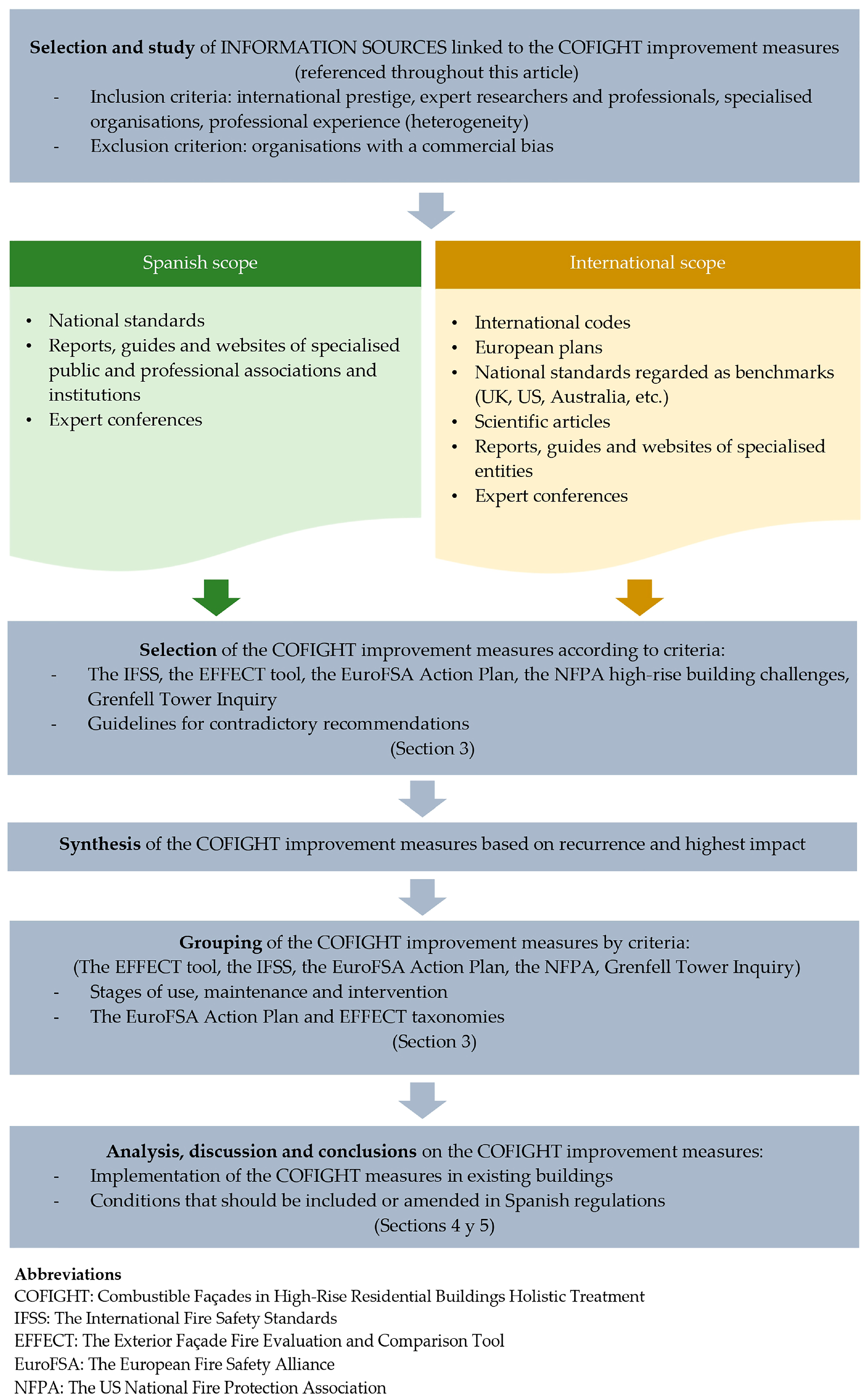
2.1. Study of Information Sources Related to the COFIGHT Measures
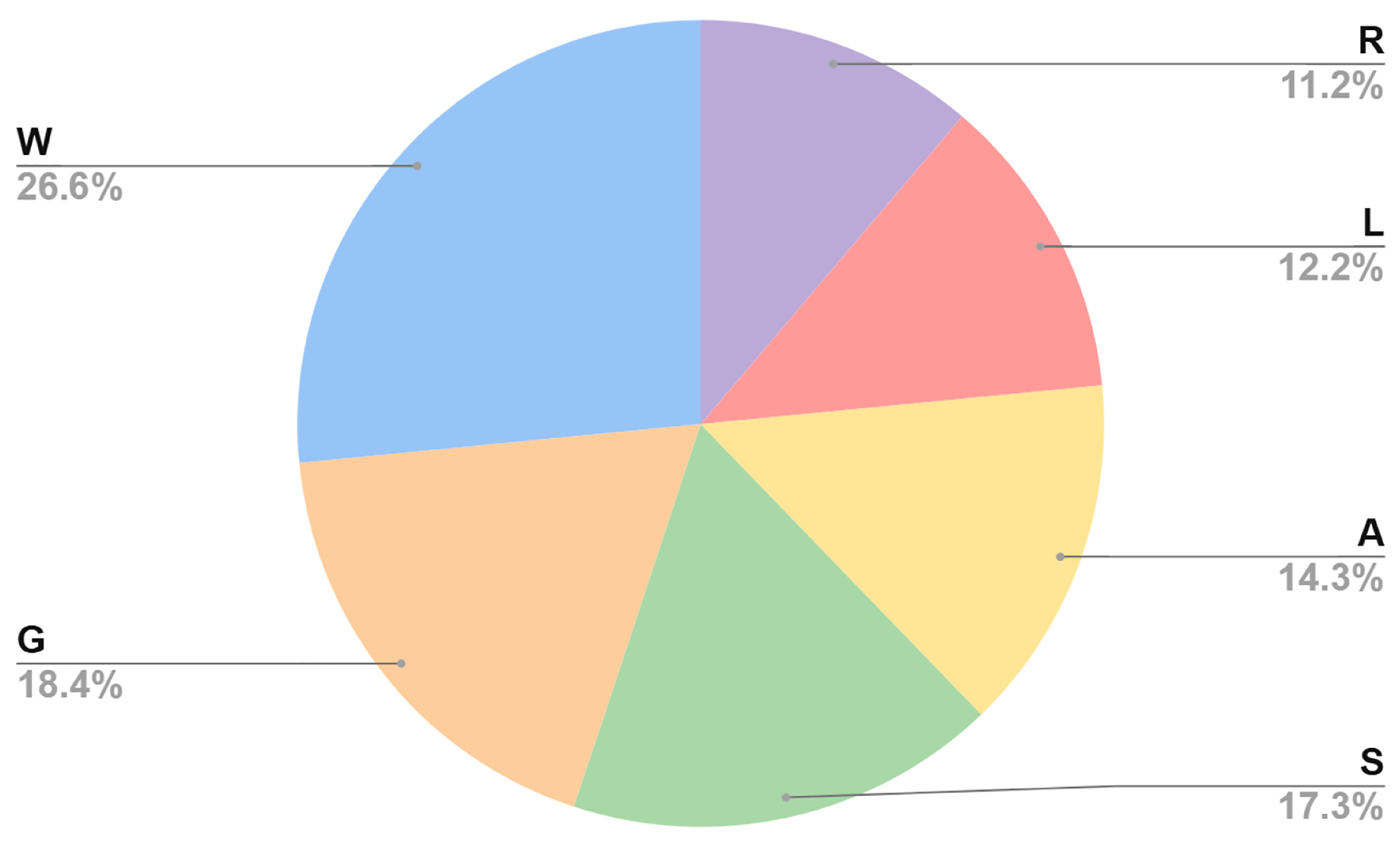
- source type: standard (S), article (A), report (R), guide (G), lecture (L), and website (W) (Figure 2);
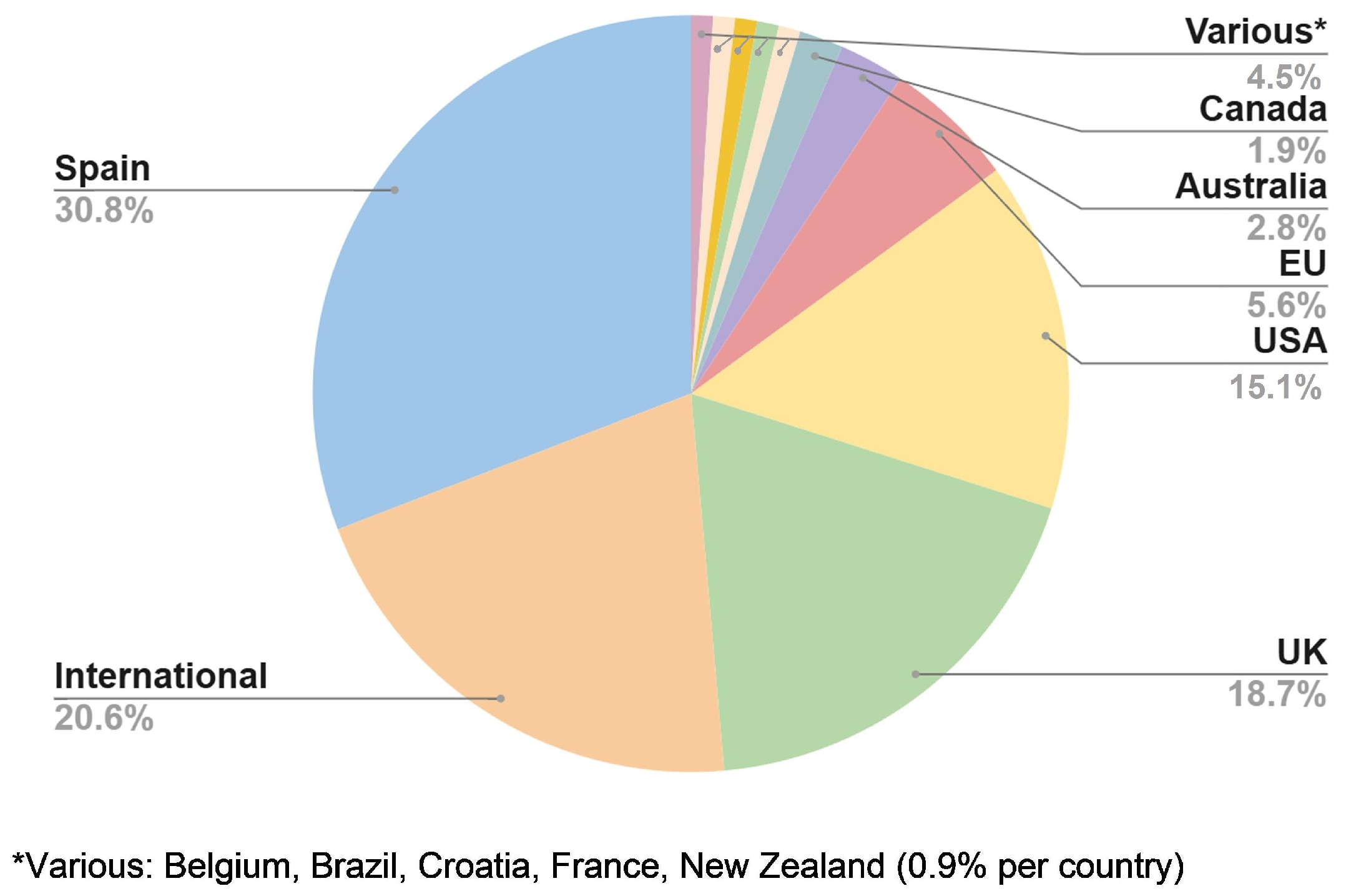
- place of origin (Figure 3). The global representativeness of this review is ensured by sources from the International Building Council and the NFPA, as these organisations lead the resolution of fire safety challenges in high-rise buildings on an international level.
2.2. Selection and Grouping Criteria for the COFIGHT Measures
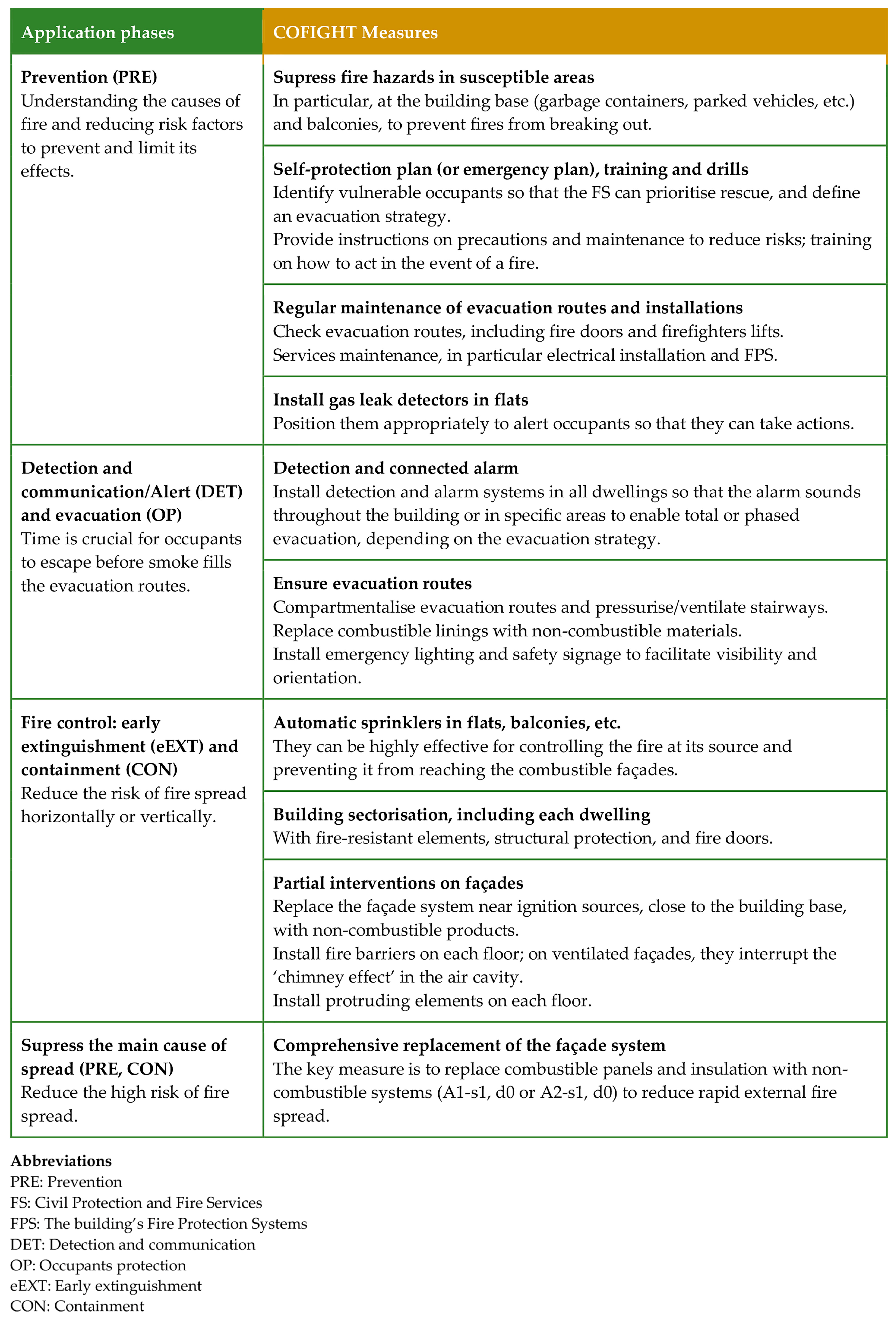
- Consider the five common principles of the IFSS [1]:
- prevention (PRE): understand cause and risk factors for protection against the outbreak of fire and limit its effects;
- detection and communication (DET): detect the fire as soon as possible and quickly inform occupants and the Fire Service;
- occupant Protection (OP): making it easier for occupants to avoid fire and escape its effects;
- containment (CON): limiting fire and all its consequences to the smallest possible area (including structural integrity);
- extinguishment (EXT): suppress fire and protect the surrounding environment; within this principle, early extinguishment (eEXT) measures are differentiated [23], whose objective is to intervene in the initial phase of the fire in order to prevent spread and minimise damage.
- The fire safety measures repository from the Exterior Façade Fire Evaluation and Comparison Tool (EFFECT) by the US National Fire Protection Association (NFPA) was used as a reference.This tool proposes mitigation measures at the building use and intervention phases based on fire risk factors, according to the following aspects:
- management, repair and periodic maintenance of existing fire safety measures;
- types of fire safety measures: active or passive; active protection measures cover systems that detect and extinguish fire (sprinklers, alarms, etc.), while passive protection measures comprise those affecting elements that contain and slow the spread of fire and smoke (walls, doors, modification of façade systems, etc.) [24].
- Be aligned with the following areas of interest, included in the European Fire Safety Action Plan (EuroFSA) [25]:
- intensify fire safety for the growing vulnerable community (elderly or disabled people);
- reduce evacuation time of persons in a fire;
- increase awareness of persons’ responsibilities regarding fire safety.
- Contemplate some of the challenges of high-rise buildings identified by the NFPA [26]:
- longer exit times and distances;
- evacuation strategies;
- smoke movement;
- fire control.
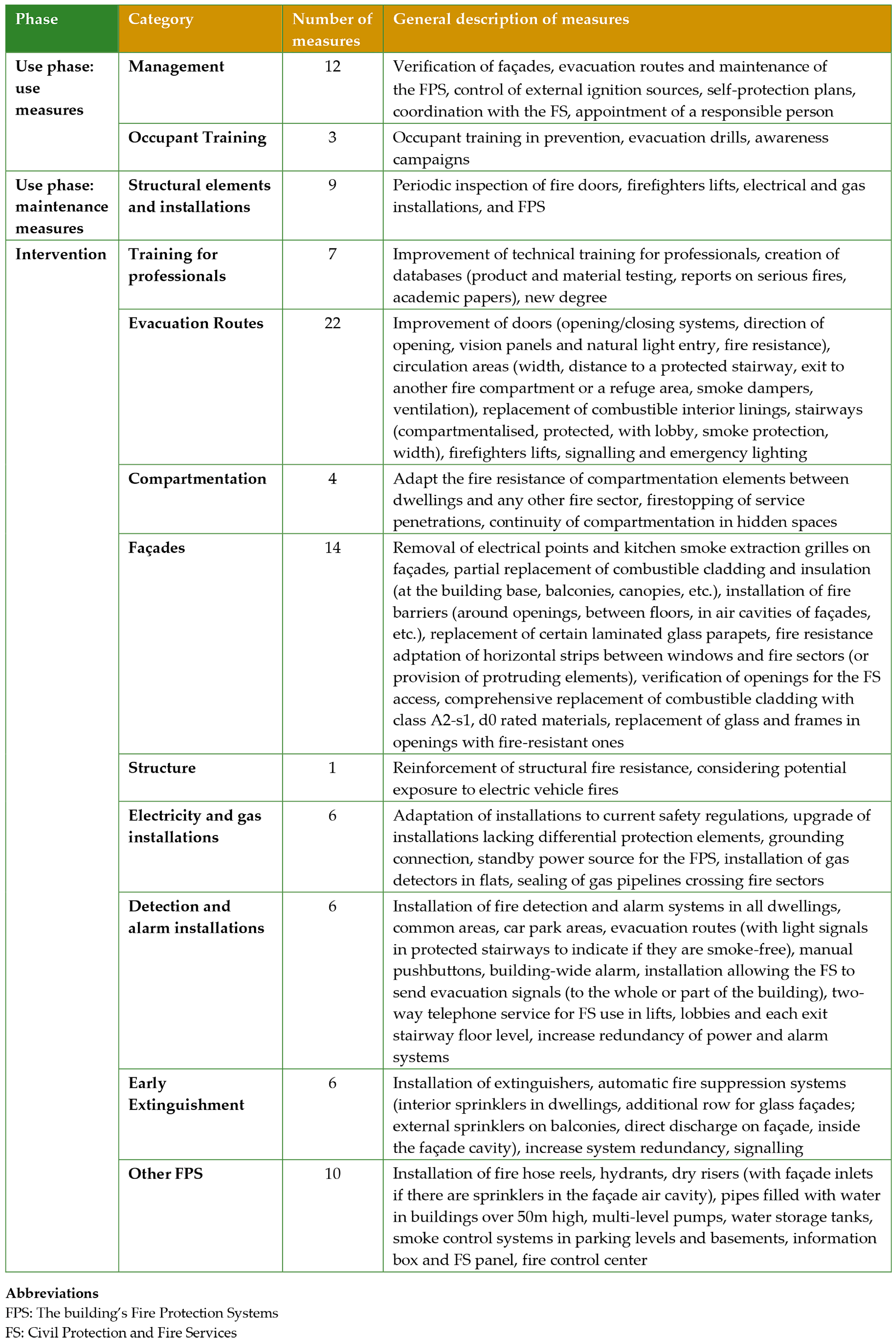
- The ‘occupancy’ and ‘intervention’ stages of the life cycle of existing high-rise residential buildings with combustible façades; furthermore, within the occupancy stage, a distinction is made between measures specific to use and those related to maintenance;
- The EuroFSA plan taxonomy and the categories of the EFFECT.
2.3. Agents Responsible for the COFIGHT Measures
2.4. Comparison of COFIGHT Measures with CTE DB SI Regulations
3. Results
3.1. Building Use Phase: Use Measures
3.1.1. Management Procedures
- Commission a competent construction building professional to verify the type of façade. Check whether the ‘substantial’ materials (those that are an important part of a heterogeneous product of the façade according to the UNE-EN 13501-1 standard [27]) are combustible or not, and, where applicable, whether they are protected or not by a layer with an EI 30 fire-resistance rating [20,28]; or a K2 30 fire protection capability [28]. In the event of complex façade systems or those with continuous exterior cladding, the involvement of fire safety experts is required to identify façade system safety (PRE) [29].
- 2.
- Develop management procedures to prevent occupation of balconies near combustible façades, or at least prohibit barbecues, shisha pipes, and other ignition hazards, as well as to suppress fire load near the building base next to the façade (cars, garbage containers, etc.). This should be monitored on a daily basis or even more frequently (PRE) [22].
- 3.
- 4.
- 5.
- Check that the opening and closing systems of fire doors have not been altered with bolts or padlocks, as these prevent evacuation or access by the FS in case of fire (OP, EXT) [31].
- 6.
- Check that up-to-date maintenance certificates are available for the building’s Fire Protection Systems (henceforth, FPS) (PRE, EXT) [30].
- 7.
- Commission a professional expert in building fire safety to develop a self-protection plan for high-rise residential buildings that may include combustible materials on façades. When developing the evacuation strategy, these specific features, the building’s use, the presence of vulnerable persons, etc., must be considered (PRE, OP, CON) [33,34].The self-protection plan shall consider:
- the provision of fire safety instructions (including evacuation instructions) in a manner that ensures they are understood by the building occupants, taking into account the nature of the building and occupants’ knowledge of it (OP) [16].
- 8.
- Provide the building’s occupants with the self-protection plan and personal evacuation plans for disabled persons, including any updates that may be required. For the plans to be effective, there should be cooperation and exchange of information among the professionals who draft plans, building owners and occupants, and the FS (PRE, OP) [36,37].
- 9.
- Submit a copy of the self-protection plan to the FS, in electronic and paper format (OP) [16].
- 10.
- Provide the FS with the following building information (in electronic and paper format):
- 11.
- In the event of façade systems made of combustible products, the FS, together with the PA, should review protocols for action (OP) [16].
- 12.
- In buildings with dwellings located more than 18 m high, designate a person or organisation responsible for fire matters in a manner regulated by the PA (this role is required in the UK). Their main functions should be registering the building as a ‘Higher-Risk Building’, ensuring management of safety risks, channelling occupants’ concerns, and exchanging building safety information with the FS (PRE) [32].
3.1.2. Occupant Training
- 1.
- Provide training to occupants on:
- how to avoid renovation work that compromises fire safety features of compartmentation [1] (e.g., removal of fire-resistant wall coverings, replacement of fire doors with non-fire doors, modification of installation layouts without maintaining the required fire resistance at the points in which they cross compartmentation [20], etc.), and the need to perform proper maintenance related to fire containment (CON);
- the use of manual FPS, such as fire extinguishers and fire hose reel (eEXT) [43].
- 2.
- 3.
- Run awareness campaigns on maintenance and promote mandatory inspection campaigns, including penalties, in a way regulated by the PA (EXT) [17].
3.2. Building Use Phase: Maintenance Measures
3.2.1. Maintenance of Evacuation Routes and Firefighters Lifts
- 2.
3.2.2. Maintenance of the Electrical Installation
- In light of the increasing electrification of residential buildings due to the energy transition [53], the PA should regulate the frequency to carry out the supervision of the electrical installation in dwellings or in the building by accredited electricians. The sources consulted recommend the following frequencies:
- 3.
- Maintenance of emergency lighting installation in accordance with current legislation carried out by qualified staff. During the inspection of emergency lighting devices (monthly/annual), both correct operation and autonomy time shall be checked. Promote the use of emergency lighting luminaires equipped with an automatic verification system, as they facilitate maintenance (OP) [56,57].
3.2.3. Maintenance of Gas Installation
- Periodic inspection of the gas installation by accredited staff [58], for example, yearly (PRE).
- Control or manage ignition sources: gas pipes for barbecues (PRE) [59].
- Check accessibility of gas pipeline isolation valves at least once every three years, so that the gas supply can be cut off quickly in case of emergency (PRE) [17].
3.2.4. Maintenance of the FPS
- Maintenance of the FPS: fire extinguishers, equipped fire hydrants (EFHs), fire detection and alarm systems, automatic fire suppression systems, etc., according to current legislation, including the specified frequency and qualification of the companies contracted (DET, eEXT, EXT) [20,32,60,61]. The following are some relevant maintenance operations:
3.3. Building Intervention Phase
3.3.1. Training for Professionals
- The national building regulator should sponsor the development of a library containing data on product and material testing, reports on serious fires, and academic papers, to provide with an ongoing resource for drafters of renovation projects for particularly complex and high-risk buildings [17,19]. Some references are The University of Queensland’s Cladding Materials Library [17,64] and the KRESNIK Database of commercial façade tests in Poland (PRE) [19].
- Provide with more university training in performance-based building design and basic fire safety knowledge, as opposed to prescriptive application of regulations; pay special attention to design-based training in addition to technology-based training; offer more training on risk assessment, as well as feeding back the knowledge acquired in engineering into the educational programme (PRE) [3,29].
- 5.
- 6.
- In order to accelerate the creation of a professional fire protection engineering corps, it is recommended that the Government takes urgent measures to increase the number of places on high-quality master’s degree courses accredited by a professional regulator (PRE) [17].
- 7.
- The Government should appoint an independent group to examine whether those with commercial interest in the building process can perform construction monitoring functions. The same group should examine whether all construction monitoring functions should be performed by a national authority (PRE) [17].
3.3.2. Modification of Evacuation Routes
- * On doors located on evacuation routes, and in particular on those intended as building exits that require a key to open, incorporate an easy-to-operate opening device that can be activated without a key and without having to operate more than one mechanism from the side approached by occupants escaping (handle, push button, horizontal push or slide bar) (OP) [3,20,32].
- On evacuation routes, if the expected occupancy in the building is high, for example, more than 60 occupants, arrange for doors to be opened in the direction of evacuation (OP) [32].
- Incorporate vision panels and natural light inlets in doors that divide corridors into evacuation routes, in doors leading to stairways, and in those that open in both directions. Vision panels allow fire risks to be assessed and enable users to check whether there are persons on the other side to avoid collisions. They also help to prevent occupants from keeping doors open to allow natural light into windowless spaces (OP, CON) [32,65].
- Replace doors of dwellings with fire-resistant doors, with a self-closing device (a device that closes a door when it is open at any angle, against the door frame) (OP, CON) [32].
- 8.
- 9.
- 10.
- 11.
- * Ventilate escape routes to keep them free of smoke: install smoke dampers and smoke ventilation systems (OP, CON) [35].
- 12.
- Reduce the fire load by replacing combustible lining materials (on walls, ceilings and floors) on evacuation routes with others which do not contribute to fire spread (A1) or have very limited combustibility (A2), and also very low smoke emission (s1) and no falling drops or flaming particles (d0) (PRE, CON) [12,72,73,74].
- 13.
- 14.
- 15.
- In protected stairways or those protected by a lobby, have the existing ventilation system checked by fire safety experts to ensure that, in the event of a fire, smoke is prevented from entering the protected area for the necessary duration. If a pressurisation system is installed, it must have extra air flow capacity to prevent smoke from invading the stairway and reaching upper floors, taking into account realistic evacuation scenarios that include opening of doors, expected evacuation time, height of the building and potential smoke leaks inside the stairway (CON) [75,76,77]. Some research is critical concerning design and implementation of the pressurisation system for evacuation routes as generally proposed, and suggests studying the ventilation system based on the needs and risks of each building, through the PBD using CFD (Computational Fluid Dynamics) simulation [78,79], which involves the participation of fire safety engineers and other skilled professionals [29]. One solution adopted in the UK under the PBD has been, in many cases, to move away from pressurisation and opting for alternative solutions based on air exchange rates or ‘smoke clearance’; for instance, the system installed in the Beetham Tower in Manchester [78].
- 16.
- Adapt the width of the evacuation stairway to accommodate not only the occupants but also rescue personnel (OP, EXT) [3].
- 17.
- 18.
- 19.
- 20.
- In the event of fire doors that should be fire doors but are not clearly marked or identified as such, confirm whether or not they are fire doors and provide with required signage (OP) [81].
- 21.
- 22.
3.3.3. Modification of Other Interior Compartmentation Elements
- Adapt the fire resistance of compartmentation elements and between dwellings and any other area of the building (CON) [32].
3.3.4. Modification of Façade System
- Remove or de-energise photovoltaic panels and lighting systems on the façade or in the cavity (including associated low-voltage transformers), as well as power sockets, electrical wiring, lightning conductor wiring, electric motors for automated awnings, etc., in order to minimise the risk of ignition (PRE, CON) [22,59].
- Interrupt combustible cladding and insulation of the façade system arranged continuously and vertically (connecting floors), by replacing it with strips of non-combustible materials [22]. The height of these strips is crucial to preventing fire from spreading further, as the flame can ‘jump’ over strips of non-combustible materials [87]. Thus, in large-scale tests conducted according to the BS 8414-1:2002 standard [88], such as those developed by the Faculty of Civil Engineering of the University of Zagreb, the failure of samples incorporating fire barriers has been observed [89]. The height of the non-combustible strips can be determined through performance-based design by evaluating the rate of combustible gas production of combustible material that heats up when reached by the ‘jumping’ flame (CON) [87].
- * In the event of façades with ventilated cavities, in addition to the previous measure, horizontally interrupt the air cavities in continuity with the floor slabs on each floor [59], or every two floors [28] and, at least, in continuity with the floor slabs that separate fire sectors (CON) [20,59].
- Replace combustible cladding and insulation on façade projections (balconies, canopies, etc.) with fire-resistant and non-combustible alternatives (PRE, CON) [22].
- On balconies and terraces, replace the laminated glass parapet containing an intermediate layer of plastic film (e.g., polyvinyl butyral) with another non-combustible solution (e.g., laminated glass with an intumescent film). However, this measure is questioned due to its implications for balcony design (CON) [90,91].
- * Adapt the fire resistance to a minimum of 60 min for the horizontal strip of the façade situated between the top of the windows on one floor and the sill of the windows on the floor above. Adapt, at least, fire resistance of the strip between windows in different fire sectors (CON) [20].
- * Instead of the strip on the façade indicated in the previous measure, or in addition to it, horizontal protruding elements such as eaves, balconies or recesses, which are fire-resistant and non-combustible, may be installed above the windows so as to reduce the risk of fire spreading through the window openings between floors or, at least, between different fire compartments (CON) [20,92,93].Below is a detailed description of how elements of the two previous measures are standardised by certain regulations in various countries:
- the minimum height established for the horizontal strip of the façade varies, for example, from 0.90 m (Australia, USA, UAE), to 1 m between fire sectors (Spain), and 1.20 m (Belgium), to 1.50 m (Singapore, for residential buildings over 24 m high); in Spain, if horizontal projections are provided, the minimum height of 1 m may be reduced by a dimension equal to that of the projection;
- * If the façade is modified, verify that openings allow access from the outside to the FS (EXT) [20].
- Replace all combustible cladding and insulation, including decorative elements made of combustible materials [22] with cladding and insulation with fire reaction class A2-s1, d0–A2-s2, d0, even on façades that are difficult to access (light wells, inner courtyards, narrow streets in old town centres, façades supporting external escape routes) [16,22,32,33,72,92]. In any case, pay attention to execution at critical points such as joints or seams (CON) [33].
- * In façades with a ventilated cavity, in addition to the previous measure, install cavity barriers. The width of the air cavity, ventilation and the scale of the fire are crucial parameters that may influence fire behaviour inside the cavity. Wind speed may also influence air flow in ventilated cavities. Further studies are required to identify how air flow within air cavities governs fire behaviour (CON) [20,95].
3.3.5. Fire Resistance of Structures
- Intervene in the structure, bearing in mind that the objective of fire safety in existing high-rise buildings is to prevent fire spread and keep structural integrity until the available fuel load has been consumed, rather than merely preserving integrity for a specified period of time to allow occupants to evacuate (survival of the full burnout) (CON) [3]. This approach is consistent with the advanced design methods of Eurocode 1 (EN 1991-1-2), which allows for the use of parametric fire curves based on the specific fuel load and building ventilation [97]. In the case of floors used for parking, the potential exposure to electric vehicle (EV) fires should be considered (CON) [98].
3.3.6. Electricity and Gas Installations
- * Adaptation of existing installations to current safety regulations (PRE).
- 2.
- 3.
- 4.
- * Provide with a sufficient backup source of electrical power to supply the fire protection equipment (EXT) [34].
- 5.
- Install detectors that warn of potential gas leaks in flats (DET) [40].
- 6.
3.3.7. Detection and Alarm Installations
- Install fire detection and alarm systems in all dwellings. The fire alarm must sound simultaneously throughout the entire building, not just in the dwelling where the fire originates. (DET) [14,22,32,44,72,81]. In addition, install manual pushbuttons that allow the transmission of local alarms, general alarms, and verbal instructions (DET) [34,44,72].
- Install fire detection and alarm systems on evacuation routes, with light signals indicating whether the protected stairways are smoke-free or not (DET) [75].
- Equip all buildings with installations so that the FS can send an evacuation signal to the whole or part of the building by means of sirens or similar devices (DET) [16].
- Increase redundancy of power and alarm systems to keep a high level of safety even in the event of partial failure of any of these systems [3], for example, by providing backup power systems (DET).
- Install a two-way telephone service for FS use in all lifts cabins and lobbies, and also on each exit stairway floor level (OP, EXT) [34].
3.3.8. Early Fire Extinguishing Systems
- 2.
- * Install an automatic interior sprinkler system to control an interior fire and reduce the likelihood of ignition of a combustible façade system due to such a fire (eEXT) [3,20,21,22,34,44,104]. Sprinklers must be installed in individual dwellings and in common areas (except in fire-sterile common areas) [32].
- 3.
- Incorporate an additional row of interior sprinklers in a glass façade to preserve the integrity of the glazing and insulation and reduce thermal radiation (eEXT) [104].
- 4.
- 5.
- Increase redundancy of power and fire suppression systems to keep a high level of safety even in the case of a partial failure of one of these systems (eEXT) [3].
- 6.
3.3.9. Other FPS (FS Intervention)
- * Install hose reels (EXT) [20]. The 25 mm hose reels could be used by building occupants trained in their use, requiring at least two people for operation. The 45 mm hose reels are for exclusive use by firefighters or qualified staff (eEXT) [110]. In the event of untrained occupants, it is preferable they evacuate the building rather than try to extinguish the fire by using hoses [111].
- * Install a dry riser for water supply for firefighting in the building’s floors, supplied by connections to no fewer than two main water pipes located on different streets (EXT) [3,20,21,32,34]. Homogenise the arrangement of dry risers in buildings, so that the FS can easily find them (EXT) [65]. Further details of this measure are:
- In the event that sprinklers are installed within the cavities of façades with combustible cladding, provide with an independent dry riser for exclusive use of the FS, as an additional measure for supplying the sprinkler system, with inlets on the façade and a network of horizontal piping (EXT) [112].
- In the case of buildings over 50 m high, include pipes filled with water supplied by pumps from tanks located in the building, so that the FS can connect hoses (EXT) [32].
- 7.
- 8.
- 9.
- 10.
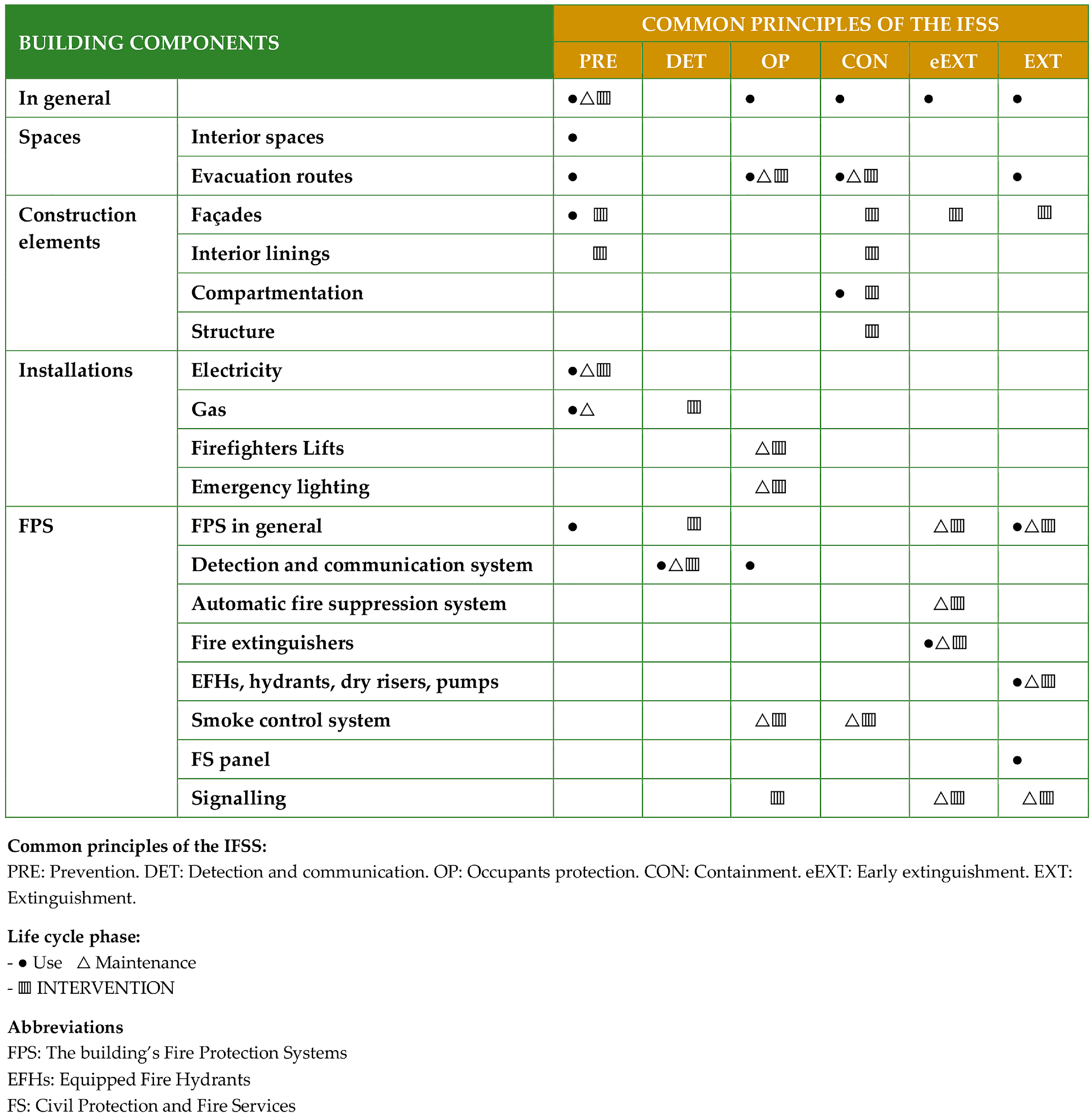
3.4. Summary of the Common Principles of the IFSS Based on the Measures Compiled
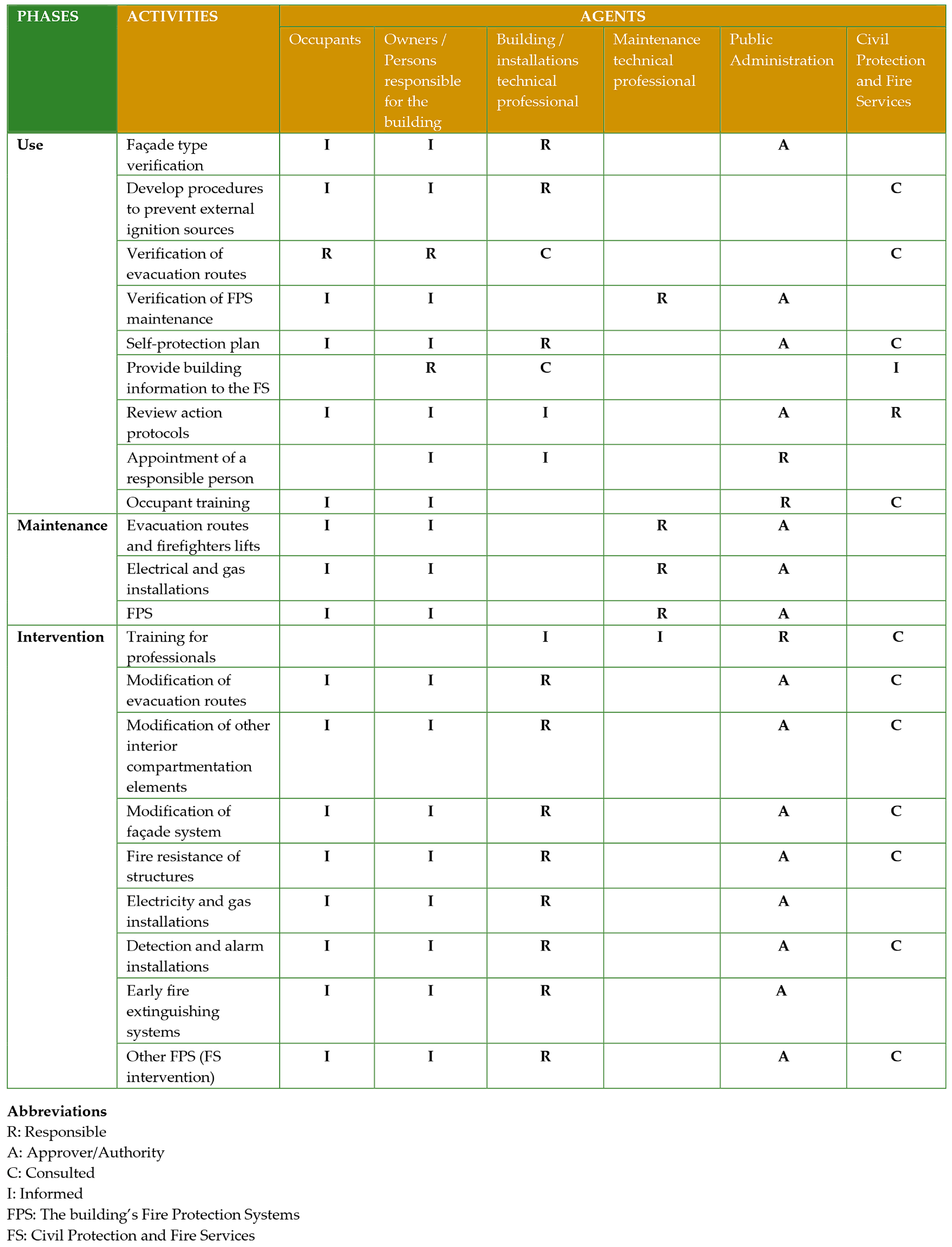
3.5. Responsibility of the Agents Involved in Implementing the COFIGHT Measures
4. Discussion
4.1. Implementation of the COFIGHT Measures in Existing Buildings
4.1.1. How to Begin the Process of Improving Safety of Buildings at Risk of Having Combustible Façades?
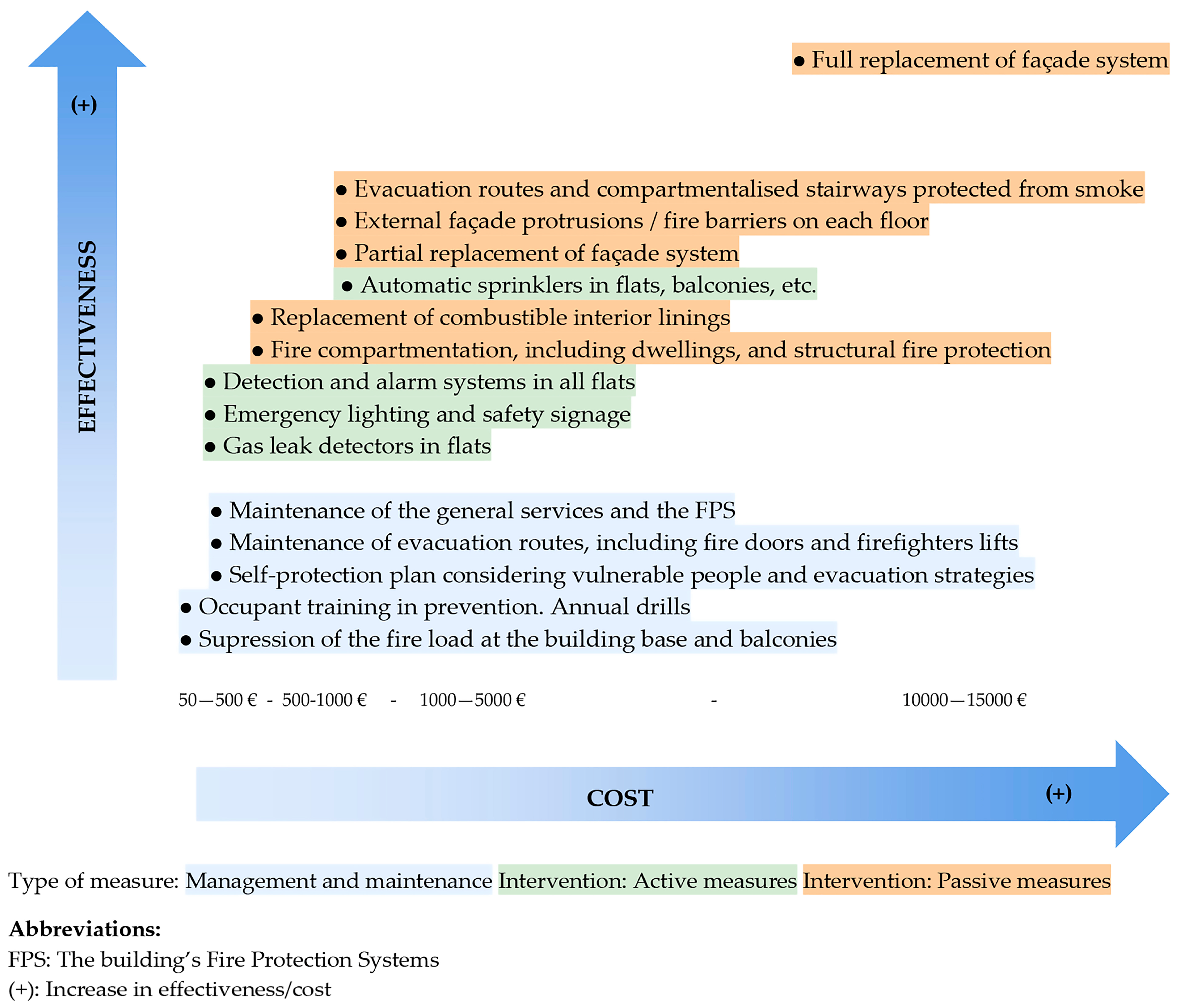
4.1.2. What Should Be the Strategy for Implementing the COFIGHT Measures?
- In the case of lightweight façade typologies and curtain walling with large glazed areas and other elements with weak thermo-mechanical behaviour (with assemblies located beyond the edge of the fire-rated floor slab), in addition to the presence of combustible materials and a fully developed fire scenario indoors, the installation of internal sprinklers-discharging the required water density based on the fire load [107] can control the fire source. This can guarantee the stability of these façades for a specific duration, preventing glazing failure and external fire breakout, thereby hindering fire spread to the floor above [21,73,93]. In addition to internal sprinklers, the installation of window sprinklers or external water curtains on these types of façades can maintain their integrity for a determined period [73].
- Regarding double-skin façades with a continuous air cavity and the presence of combustible elements—a configuration posing a high risk of fire spread-the installation of water—curtain sprinklers between the two skins, providing the required water flow for the combustible material’s fire load, can inhibit smoke spread and prevent temperature increases within the façade cavity [108]. In these façades, besides installing sprinklers within the cavity, internal sprinklers can extinguish an indoor fire or, should the fire reach the façade, activate the water-curtain sprinklers arranged within the air cavity [73].
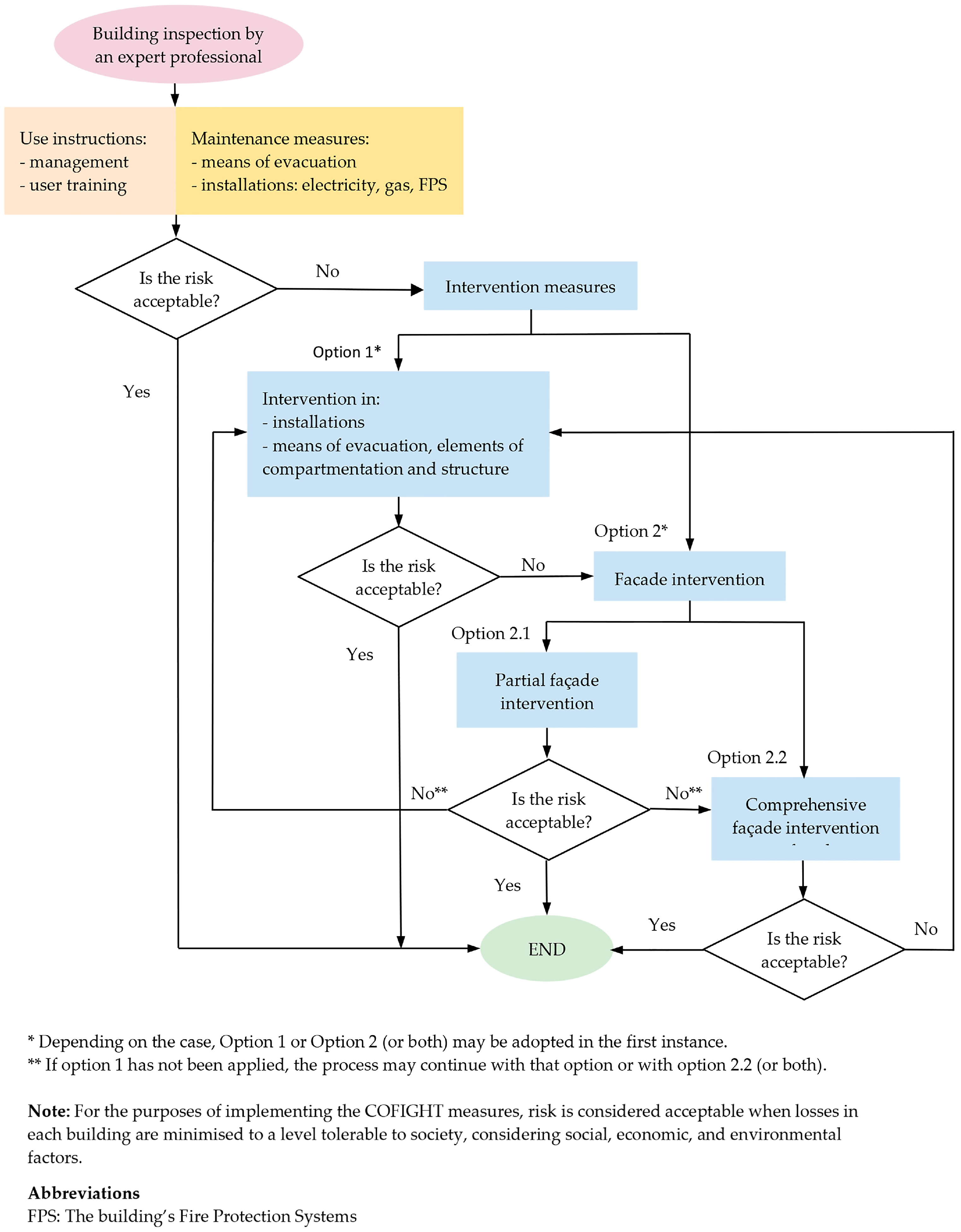
- management and maintenance;
- partial intervention inside the building or on façades (active and passive measures);
- comprehensive intervention on façades (passive measure).

4.2. Requirements That Should Be Incorporated or Amended in Spanish Regulations
4.2.1. External Propagation Through Façade
4.2.2. Internal Propagation
4.2.3. Occupant Evacuation
4.2.4. Fire Protection Systems
4.2.5. Fire Service Intervention
4.2.6. Energy Retrofit of Buildings
5. Conclusions
5.1. Main Findings
- Immediate actions for prevention, detection, and alarm:
- -
- Management and maintenance.
- -
- Installing detection and alarm systems throughout the building.
- Early suppression and protection actions:
- -
- Installing sprinklers for early suppression.
- -
- Ensuring that staircases and evacuation routes are smoke-protected and correctly compartmented.
- Definitive measure: The most effective solution is the replacement of the combustible façade.
5.2. Limitations
5.3. Future Lines of Research
- Improving the behaviour of building occupants regarding fire safety is an open field.
- Creation and implementation of internationally agreed-upon supervision and risk assessment protocols for these types of buildings.
- Influence of new energy retrofit solutions on fire dynamics, aimed at preventing the creation of new risks not accounted for in current statistics.
- Robust regulations for the refurbishment of existing buildings based on common international principles, thereby establishing the main objectives that must be met in terms of fire safety.
- At least one internationally agreed-upon testing method is required for the systems and products mentioned. Small-scale test methods are available for assessing the reaction to fire of façade materials. However, these methods are not suitable for construction solutions involving heterogeneous products. To this end, there are various standardised medium- and large-scale fire reaction test methods available. However, these cannot be used in their standardised form either, as they are not representative of reality, and are not sufficiently defined to determine fire spread. Furthermore, the differences in the methodology of each trial prevent results from being compared.
- Development of data repositories on product and material testing, representative fire reports, and academic knowledge as a resource for designers, such as the ‘Cladding Materials Library’ at the University of Queensland.
Author Contributions
Funding
Data Availability Statement
Conflicts of Interest
Abbreviations
| IFSS | The International Fire Safety Standards |
| CTE DB SI | The Basic Fire Safety Document of the Technical Building Code |
| IBC | The International Building Code |
| COFIGHT | Combustible Façades in High-Rise Residential Buildings: Holistic Treatment |
| EFFECT | The Exterior Façade Fire Evaluation and Comparison Tool |
| NFPA | The US National Fire Protection Association |
| PRE | Prevention |
| DET | Detection and communication |
| OP | Occupant Protection |
| CON | Containment |
| EXT | Extinguishment |
| eEXT | Early extinguishment |
| EuroFSA | The European Fire Safety Alliance |
| PA | Public Administration |
| FS | Civil Protection and Fire Services |
| FPS | The building’s Fire Protection Systems |
| EFHs | Fire hydrants |
| GRP | Glass-reinforced polymers |
| HPL | High-pressure laminates |
| MCM | Metal composite materials |
References
- The International Fire Safety Standards Coalition. International Fire Safety Standards: Common Principles. Safe Buildings Save Lives. 2020. Available online: https://ifsscoalition.wordpress.com/wp-content/uploads/2021/12/d4d39-ifss-cp-1st-edition.pdf (accessed on 1 September 2025).
- The International Association of Fire and Rescue Services. World Fire Statistics; Report N. 30; Center for Fire Statistics: Ljubljana, Slovenia, 2025; Available online: https://www.ctif.org/sites/default/files/2025-08/CTIF_Report30.pdf (accessed on 1 September 2025).
- Li, G.Q.; Zhang, C.; Jiang, J.A. A Review on Fire Safety Engineering: Key Issues for High-Rise Buildings. Int. J. High-Rise Build. 2018, 7, 265285. [Google Scholar] [CrossRef]
- Messerschmidt, B.; NFPA. NFPA Journal. 1 May 2020. Available online: https://www.nfpa.org/es/news-blogs-and-articles/nfpa-journal/2020/05/01/vac%C3%ADo-de-datos (accessed on 1 September 2025).
- Bonner, M.; Rein, G. Flammability and Multi-objective Performance of Building Façades: Towards Optimum Design. Int. J. High-Rise Build. 2018, 7, 363–374. [Google Scholar] [CrossRef]
- Sharma, A.; Zhang, T.; Dwivedi, G. Façade Fires in High-Rise Buildings: Challenges and Artificial Intelligence Solutions. In Sustainable Structures and Buildings; Springer International Publishing: Cham, Switzerland, 2024; pp. 77–94. [Google Scholar] [CrossRef]
- Meacham, B.; McNamee, M. Fire Safety Challenges of ‘Green’ Buildings and Attributes; Final Report; Fire Protection Research Foundation: Quincy, MA, USA, 2020; Available online: https://www.nfpa.org/education-and-research/research/fire-protection-research-foundation/projects-and-reports/fire-safety-challenges-of-green-buildings (accessed on 1 September 2025).
- Kurniawan, T.A.; Tambunan, L.; Imaniar, L.N. Fire Safety Parameters of High-Rise Residential Building: A Literature Review of Performance-Based Analysis Method. IOP Conf. Ser. Earth Environ. Sci. 2018, 152, 012030. [Google Scholar] [CrossRef]
- McLaggan, M.S.; Hidalgo, J.P.; Osorio, A.F.; Heitzmann, M.T.; Carrascal, J.; Lange, D.; Maluk, C.; Torero, J.L. Towards a better understanding of fire performance assessment of façade systems: Current situation and a proposed new assessment framework. Constr. Build. Mater. 2021, 300, 124301. [Google Scholar] [CrossRef]
- Chen, T.B.Y.; Yuen, A.C.Y.; Yeoh, G.H.; Yang, W.; Chan, Q.N. Evaluación del riesgo de incendio en revestimientos exteriores combustibles mediante una base de datos numérica colectiva. Fire 2019, 2, 11. [Google Scholar] [CrossRef]
- Meacham, B.J. Fire safety of existing residential buildings: Building regulatory system gaps and needs. Fire Saf. J. 2023, 140, 103902. [Google Scholar] [CrossRef]
- Dabous, S.A.; Shikhli, A.; Shareef, S.; Mushtaha, E.; Obaideen, K.; Alsyouf, I. Fire prevention and mitigation technologies in high-rise buildings: A bibliometric analysis from 2010 to 2023. Ain Shams Eng. J. 2024, 15, 103010. [Google Scholar] [CrossRef]
- Marshall, S.W.; Runyan, C.W.; Bangdiwala, S.I.; Linzer, M.A.; Sacks, J.J.; Butts, J.D. Fatal Residential Fires. Who Dies and Who Survives? JAMA 1998, 279, 1633–1637. [Google Scholar] [CrossRef]
- Fundación MAPFRE; Asociación Profesional de Técnicos de Bomberos [Professional Association of Fire Technicians]. Víctimas de Incendios en España en 2024 [Fire Victims in Spain in 2024]. 2025. Available online: https://documentacion.fundacionmapfre.org/documentacion/publico/es/media/group/1129490.do (accessed on 3 September 2025).
- Mazzucchelli, E.S.; Lucchini, A.; Stefanazzi, A. Fire safety issues in high-rise building façades. Technol. Eng. Mater. Archit. 2019, 5, 130–140. [Google Scholar] [CrossRef]
- The UK Government Web Archive. Grenfell Tower Inquiry: Phase 1 Report. 2019. Available online: https://webarchive.nationalarchives.gov.uk/ukgwa/20250325101139/https://www.grenfelltowerinquiry.org.uk/phase-1-report (accessed on 1 September 2025).
- The UK Government Web Archive. Grenfell Tower Inquiry: Phase 2 Report. 2024. Available online: https://webarchive.nationalarchives.gov.uk/ukgwa/20250325142912/https://www.grenfelltowerinquiry.org.uk/phase-2-report (accessed on 1 September 2025).
- Fernández Solla, I. Fachadas y Fuego Después de la Torre Grenfell [Façades and Fire After the Grenfell Tower]. Tectónica. 3 June 2019. Available online: https://tectonica.archi/articles/fachadas-y-fuego-despues-de-la-torre-grenfell/ (accessed on 2 September 2025).
- Bonner, M.; Wegrzynski, W.; Papis, B.K.; Rein, G. KRESNIK: A top-down, statistical approach to understand the fire performance of building façades using standard test data. Build. Environ. 2020, 169, 106540. [Google Scholar] [CrossRef]
- Ministerio de Vivienda y Agenda Urbana [Ministry for Housing and Urban Agenda]. Código Técnico de la Edificación: Documento Básico SI Seguridad en caso de Incendio [Technical Building Code: Basic Document SI Safety in Case of Fire]. 4 March 2025. Available online: https://www.codigotecnico.org/pdf/Documentos/SI/DccSI.pdf (accessed on 1 September 2025).
- The International Code Council, USA. International Building Code. 2024. Available online: https://codes.iccsafe.org/content/IBC2024V2.0 (accessed on 4 September 2025).
- NFPA’s EFFECT. Arup.EFFECT: External Façade Fire Evaluation and Comparison Tool. NFPA’s Online Tool Based on Methodology Developed by Arup. User’s Guide. 2018. Available online: https://www.nfpaeffect.com/signup (accessed on 1 September 2025).
- Modern Building Alliance. EU Fire Safety Guide. The 7 Layers of Fire Safety in Buildings; Modern Building Alliance: Brussels, Belgium, 2019; Available online: https://www.modernbuildingalliance.eu/assets/uploads/2019/07/EU-Fire-Safety-Guide-printable-version.pdf (accessed on 3 September 2025).
- Lamont, S.; Ingolfsson, S. High Rise Buildings with Combustible Exterior Façade Systems: Fire Risk Assessment Tool; National Fire Protection Association: Quincy, MA, USA, 2018. [Google Scholar]
- The European Fire Safety Alliance. European Fire Safety Alliance Action Plan. 10 Actions That Will Improve Fire Safety in Europe. 2020. Available online: https://www.europeanfiresafetyalliance.org/wp-content/uploads/2020/04/European-Fire-Safety-Action-Plan.pdf (accessed on 2 September 2025).
- NFPA. High-Rise Building Safety. Available online: https://www.nfpa.org/education-and-research/building-and-life-safety/high-rise-buildings (accessed on 29 December 2025).
- UNE-EN 13501-1; Fire Classification of Construction Products and Building Elements. Part 1: Classification Using Data from Reaction to Fire Tests. UNE: Madrid, Spain, 2019. Available online: https://www.une.org/encuentra-tu-norma/busca-tu-norma/norma/?c=N0062154 (accessed on 12 March 2026).
- Martin, Y.; Eeckhout, S.; Lassoie, L.; Winnepenninckx, E.; Deschoolmeester, B. Fire Safety of Multi-Storey Building Façades; Belgian Building Research Institute: Brussels, Belgium, 2022; Available online: https://www.buildwise.be/umbraco/surface/publicationitem/DownloadFile?file=31400%2Fen%2Funprotected%2FIP_37_EN.pdf (accessed on 10 September 2025).
- Torero, J. Seguridad Contra Incendios: Introducción [Fire Safety: Introduction]. In Proceedings of the 4th Building Fire Safety Workshop, São Paulo, Brazil, 20 October 2016; Available online: https://www.youtube.com/watch?v=Yo9DDMSfr6g (accessed on 10 September 2025).
- Clúster de Seguretat Contra Incendis [Fire Safety Cluster]. Guía de Manteniment Protecció Passiva. Guía de Manteniment dels Sistemes de Protecció Passiva Contra Incendis [Passive Protection Maintenance Guide. Maintenance Guide for Passive Fire Protection Systems]. Clúster de Seguretat Contra Incendis. October 2021. Available online: https://interior.gencat.cat/web/.content/home/030_arees_dactuacio/bombers/prevencio_d_incendis/instruccions_guies_i_recomanacions/guies_tecniques/Documents/Guia_proteccio_passiva_2021.pdf (accessed on 5 September 2025).
- Fundación MAPFRE; Asociación Profesional de Técnicos de Bomberos [Professional Association of Firefighters]. Guía de Prevención de Incendios y Otros Riesgos. Comunidades de Vecinos [Guide to Fire Prevention and Other Risks. Residents’ Associations]. 2016. Available online: https://www.fundacionmapfre.org/media/educacion-divulgacion/prevencion/incendios/guia-comunidades-vecinos.pdf (accessed on 7 September 2025).
- Ministry of Housing, Communities and Local Government; The UK Government. The Building Regulations 2010. Fire Safety. Approved Document B. Volume 1: Dwellings. 7 December 2010, Last Updated 11 March 2025. Available online: https://www.gov.uk/government/publications/fire-safety-approved-document-b (accessed on 5 September 2025).
- Álvarez, P. Normativa Vigente [Current Regulations]. [Conference Session]. Jornada Técnica Sobre la Gestión de Riesgo de Incendio en la Edificación [Technical Conference on Fire Risk Management in Buildings, 8:50]. Grupo Aparejadores Madrid [Building Engineers Group], Spain. 29 May 2024. Available online: https://youtu.be/sTxG1YxjUGY?t=530 (accessed on 7 September 2025).
- The National Fire Protection Association, USA. The Life Safety Code. (NFPA 101). 2024. Available online: https://www.nfpa.org/codes-and-standards/nfpa-101-standard-development/101 (accessed on 10 September 2025).
- De Hults, Q.; El Houssami, M. A European Framework to Ensure Fire Safety in Workshop Buildings. In Proceedings of the 3rd International Symposium on Fire Safety of Façades, Paris, France, 26–27 September 2019; Available online: https://www.researchgate.net/profile/Mohamad-El-Houssami/publication/336141132_A_European_framework_to_ensure_fire_safety_in_taller_buildings/links/5d920db8a6fdcc2554a7110d/A-European-framework-to-ensure-fire-safety-in-taller-buildings.pdf (accessed on 15 September 2025).
- Amorós Gonzálvez, J. Foro de Debate [Discussion Forum]. [Conference Session]. Seminario: Estrategias de Diseño para la Seguridad en caso de Incendios en Fachadas y Otros Espacios [Seminar: Design Strategies for Fire Safety in Facades and Other Spaces 1:25:06]. Colegio Territorial de Arquitectos de Alicante [Alicante Professional Association of Architects], Spain. 5 April 2024. Available online: https://youtu.be/tr3sc8GKyw4?t=5156 (accessed on 15 September 2025).
- The Government of the UK. Consultation Outcome: Personal Emergency Evacuation Plans in High-Rise Residential Buildings. 2021, Updated 2 December 2024. Available online: https://www.gov.uk/government/consultations/personal-emergency-evacuation-plans/personal-emergency-evacuation-plans-in-high-rise-residential-buildings-accessible-version#:~:text=Proposal%201:%20We%20propose%20to,consistency%20at%20a%20national%20level (accessed on 15 September 2025).
- Williams, N. Fire Safety Law. A 2022 Update. Government Events. 2022. Available online: https://www.governmentevents.co.uk/fire-safety-law-a-2022-update/#:~:text=The%20new%20Building%20etc%20 (accessed on 15 September 2025).
- The Government of the UK. Building Safety Act. (2022, Last Updated 2025). Available online: https://www.legislation.gov.uk/ukpga/2022/30/contents (accessed on 20 September 2025).
- Fundación MAPFRE; Asociación Profesional de Técnicos de Bomberos [Professional Association of Firefighters]. Guía de Prevención de Incendios en el Hogar [Fire Prevention Guide for the Home]. 2016. Available online: https://www.fundacionmapfre.org/media/educacion-divulgacion/prevencion/incendios/guia-hogar.pdf (accessed on 20 September 2025).
- The National Fire Protection Association. Lithium-Ion Battery Safety. NFPA. Available online: https://www.nfpa.org/education-and-research/home-fire-safety/lithium-ion-batteries#smaller-devices-&-electronics (accessed on 30 December 2025).
- Proulx, G. Why Building Occupants Ignore Fire Alarms. Construction Technology Update No. 42. National Research Council of Canada, December 2000. Available online: https://publications.gc.ca/collections/collection_2008/nrc-cnrc/NR25-2-42E.pdf (accessed on 2 October 2025).
- Asociación Española de Sociedades de Protección Contra Incendios [Spanish Association of Fire Protection Companies]; Tecnifuego. Interés y alta Participación en la Mesa Redonda de Detección de Incendios: ‘Hogares Seguros Frente a los Incendios. Víctimas Cero’ [Interest and High Participation in the Fire Detection Round Table: ‘Safe Homes Against Fire. Zero Victims’]. 1 June 2024. Available online: https://www.tecnifuego.org/comunicacion/interes-y-alta-participacion-en-la-mesa-redonda-de-deteccion-de-incendios-hogares (accessed on 10 October 2025).
- The Anchor Fire Protection Company. High Rise Fire Safety: A Comprehensive Guide. January 2024. Available online: https://anchorfire.net/blog/high-rise-fire-safety/ (accessed on 7 March 2026).
- The National Fire Protection Association. What to Know About Apartment and High-Rise Escape Planning. 30 January 2023. Available online: https://www.nfpa.org/news-blogs-and-articles/blogs/2023/01/30/what-to-know-about-apartment-and-high-rise-escape-planning (accessed on 20 September 2025).
- Burge, S. 23 Common Causes of Fire. International Fire and Safety Journal. 17 July 2023. Available online: https://internationalfireandsafetyjournal.com/causes-of-fire/ (accessed on 15 October 2025).
- UNE 23740-1:2016; Seguridad Contra Incendios. Elementos de Cerramiento de Huecos. Requisitos Específicos de Instalación, Uso, Mantenimiento. Parte 1: Puertas Cortafuego. [Fire Safety. Shutter Assemblies Elements. Specific Requirements for Installation, Use and Maintenance. Part 1: Fire Doors]. UNE: Madrid, Spain, 2016. Available online: https://www.une.org/encuentra-tu-norma/busca-tu-norma/norma?c=N0056501 (accessed on 15 October 2025).
- Pérez Real, J.L.; Seguritecnia. Mantenimiento Obligatorio de las Puertas Cortafuego [Mandatory Maintenance of Fire Doors]. January 2021. Available online: https://www.seguritecnia.es/tecnologias-y-servicios/proteccion-contra-incendios/mantenimiento-obligatorio-de-las-puertas-cortafuego_20210201.html (accessed on 15 October 2025).
- The Government of the UK. Fact Sheet: Lifts and Essential Fire-Fighting Equipment (Regulation 7).gov.uk. 23 July 2023. Available online: https://www.gov.uk/government/publications/fire-safety-england-regulations-2022/fact-sheet-lifts-and-essential-fire-fighting-equipment-regulation-7#fn:2 (accessed on 9 October 2025).
- Electricidad Expertos [Electricity Experts]; Electricidadexpertos. Cómo Prevenir Incendios Eléctricos en Viviendas [How to Prevent Electrical Fires at Home]. Available online: https://www.electricidadexpertos.com/prevenir-incendios-electricos-viviendas/ (accessed on 30 December 2025).
- Fundación MAPFRE; Asociación Profesional de Técnicos de Bomberos [Professional Association of Firefighters]. Libro Blanco de la Prevención de Incendios y Sus Consecuencias. 112 Recomendaciones [White Paper on Fire Prevention and its Consequences. 112 Recommendations]; Fundación MAPFRE: Madrid, Spain, 2025; Available online: https://documentacion.fundacionmapfre.org/documentacion/publico/es/media/group/1127016.do (accessed on 10 October 2025).
- London Fire Brigade. White Goods and Fire Safety. Tumble Dryers, Washing Machines, Refrigerators and Freezers Can All Cause Electrical Fires. Here’s What You Need to Know to Stay Safe. London-Fire. Available online: https://www.london-fire.gov.uk/safety/the-home/electrical-items/whitegoods/ (accessed on 30 December 2025).
- The International Energy Agency. Electrification. Available online: https://www.iea.org/energy-system/electricity/electrification#tracking (accessed on 30 December 2025).
- The Forum for European Electrical Domestic Safety. Energy Performance of Buildings Directive Implementation Guidelines. Recommendations on Electrical Safety. May 2024. Available online: https://feedsnet.org/wp-content/uploads/2024/05/FEEDS_EPBD-implementation.pdf (accessed on 20 October 2025).
- The European Fire Safety Alliance. Energy Transition and Fire Safety. [Event Report]. European Fire Safety Week, Virtually. 29 November–1 December 2021. Available online: https://www.europeanfiresafetyalliance.org/wp-content/uploads/2022/04/European_Fire-Safety_Week_2021_Event_report.pdf (accessed on 20 October 2025).
- UNE-EN 50172:2025; Sistemas de Alumbrado de Seguridad. [Emergency Escape Lighting Systems]. UNE: Madrid, Spain, 2025. Available online: https://www.une.org/encuentra-tu-norma/busca-tu-norma/norma?c=N0074119 (accessed on 5 November 2025).
- Asociación Española de Normalización y Certificación [Spanish Association for Standardization and Certification]; Asociación Española de Fabricantes de Iluminación [Spanish Association of Lighting Manufacturers]. Sistemas de Alumbrado de Seguridad. Mantén las Luminarias de Emergencia al Día, Son la luz de tu Tranquilidad [Safety Lighting Systems. Keep Your Emergency Lights up to Date; They Are the Light of Your Peace of Mind]. Available online: https://media.timtul.com/media/web_anfalum/La-luz-de-tu-tranquilidad_20240319175723.pdf#:~:text=El%20UNICOresponsable%20del%20funcionamiento%20de%20la%20instalación,revisión%20de%20la%20instalación%20cada%203%20años (accessed on 5 November 2025).
- Charles, S.; FIRE. What Is A Gas Safety Inspection? Fire-Magazine. 3 September 2023. Available online: https://fire-magazine.co.uk/what-is-a-gas-safety-inspection (accessed on 10 November 2025).
- SFS Façade Fire Safety Design Committee. Society of Fire Safety Practice Guide: Façade/External Wall Fire Safety Design. Engineers Australia, Society of Fire Safety. 7 March 2019. Available online: https://www.engineersaustralia.org.au/sites/default/files/Learned%20Society/SFS_Facade%20Fire%20Safety%20Design_002_0.pdf (accessed on 5 November 2025).
- Ministerio de Economía [Ministry for Economy]; Industria y Competitividad [Industry and Competitiveness]. Real Decreto 513/2017, de 22 de Mayo, Por el Que se Aprueba el Reglamento de Instalaciones de Protección Contra Incendios [Royal Decree 513/2017, of May 22, Approving the Regulation on Fire Protection Installations]. 2022. Available online: https://www.boe.es/buscar/act.php?id=BOE-A-2017-6606 (accessed on 3 November 2025).
- Tortosa Martinez, A.; Tecnifuego. La Correcta Contratación del Mantenimiento de los Sistemas de Protección Contra Incendios [The Correct Contracting of Maintenance for Fire Protection Systems]. 22 February 2016. Available online: https://www.tecnifuego.org/la-correcta-contratacion-del-mantenimiento-de-los-sistemas-de-proteccion-contra-incendios (accessed on 10 November 2025).
- González, D. Servicio de Prevención, Extinción de Incendios y Salvamento del Excelentísimo Ayuntamiento de Alicante [Fire Prevention, Extinction and Rescue Service of the Alicante City Council]. [Conference Session, 1:28:43]. Seminario: Estrategias de Diseño para la Seguridad en Caso de Incendios en Fachadas y Otros Espacios. Colegio Territorial de Arquitectos de Alicante [Alicante Professional Association of Architects], Spain. 10 April 2024. Available online: https://www.youtube.com/watch?v=tr3sc8GKyw4&t=3602s (accessed on 3 November 2025).
- Fire Industry Association. Maintaining Your Fire Alarm System. 2024. Available online: https://www.fia.uk.com/cut-false-alarm-costs/reducing-false-alarms/maintaining-your-fire-alarm-system.html (accessed on 4 November 2025).
- The University of Queensland, Australia; Queensland Government. Cladding Materials Library. Available online: https://claddingmaterialslibrary.com/search-access (accessed on 30 December 2025).
- Llopis Navarro, F.L. Procedimientos de Trabajo: Apoyos y Edificios de Gran Altura [Work Procedures: Supports and High-Rise Buildings, 1:36:21]. [Conference Session]. Seminario: Estrategias de Diseño para la Seguridad en Caso de Incendios en Fachadas y Otros Espacios. Colegio Territorial de Arquitectos de Alicante [Alicante Professional Association of Architects], Spain. 10 April 2024. Available online: https://youtu.be/tr3sc8GKyw4?t=5781 (accessed on 4 November 2025).
- International Association of Fire Chiefs. What Is a Fire Protection Engineer (FP Engineer)? 2025. Available online: https://careers.iafc.org/career/fire-protection-engineer-fp-engineer/job-descriptions#:~:text=Design%2C%20develop%2C%20and%20implement%20fire,reports%2C%20plans%2C%20and%20specifications (accessed on 4 November 2025).
- Unidad de Calidad en la Construcción del Instituto de Ciencias de la Construcción Eduardo Torroja—CSIC [Construction Quality Unit of the Eduardo Torroja Institute for Construction Sciences—CSIC]; Consejo General de la Arquitectura Técnica de España [General Council of Technical Architecture. Spain.]; Consejo Superior de Colegios de Arquitectos de España [Higher Council of Colleges of Architects. Spain]; Ministerio de Transportes, Movilidad y Agenda Urbana; Instituto de Ciencias de la Construcción Eduardo Torroja. Guía para la Elaboración del Libro del Edificio Existente para la Rehabilitación. Instrucciones, Recomendaciones, Consejos y Ejemplos para la Justificación del Anexo I del Real Decreto 853/2021 [Guide for the Preparation of the Existing Building Logbook for Refurbishment. Instructions, Recommendations, Advice and Examples for the Justification of Annex I of Royal Decree 853/2021]. November 2021. Available online: https://www.ietcc.csic.es/wp-content/uploads/2021/12/Guia_LEE_00.pdf (accessed on 5 November 2025).
- Bermejo Martín, F. El Hospital Puerta del Mar (Cádiz) No Ha Escarmentado [The Puerta del Mar Hospital (Cádiz) Has Not Learned Its Lesson]; Observatorio de Prevención de Riesgos y Accidentes [Observatory for Risk and Accident Prevention]; OPRA: Inbisa, Spain, 2024; Available online: https://opra.info/el-hospital-puerta-del-mar-cadiz-no-ha-escarmentado/ (accessed on 5 November 2025).
- Tecnifuego. Comunicación. Notas Informativas: La Importancia de las Puertas Automáticas en la Seguridad Contra Incendios [Communication. Information Notes: The Importance of Automatic Doors in Fire Safety]. 2 June 2023. Available online: https://www.tecnifuego.org/comunicacion/la-importancia-de-las-puertas-automaticas-en-la-seguridad-contra-incendios (accessed on 7 November 2025).
- Gilabert, E. Soluciones de Protección Pasiva: Puertas Resistentes al Fuego [Passive Protection Solutions: Fire-Resistant Doors, 1:03:46]. [Conference Session]. Seminario: Estrategias de Diseño para la Seguridad en Caso de Incendios en Fachadas y Otros Espacios. Colegio Territorial de Arquitectos de Alicante [Alicante Professional Association of Architects], Spain. 10 April 2024. Available online: https://youtu.be/tr3sc8GKyw4?t=3831 (accessed on 10 November 2025).
- Ziavras, V.; NFPA. Unraveling the Area of Refuge Requirements. 13 March 2023. Available online: https://www.nfpa.org/news-blogs-and-articles/blogs/2017/07/12/101wednesdays-areas-of-refuge-why-what-and-when (accessed on 11 November 2025).
- Grau, A. Propuesta de Mejora Reglamentaria en Función de la Tipología de Edificios [Proposal for Regulatory Improvement Based on Building Typology, 25:45]. [Conference Session]. Jornada Técnica Sobre la Gestión de Riesgo de Incendio en la Edificación. Colegio Oficial de Aparejadores y Arquitectos Técnicos de Madrid [Official Association of Quantity Surveyors and Technical Architects of Madrid], Aparejadores Madrid, Spain. 29 May 2024. Available online: https://youtu.be/sTxG1YxjUGY?t=1542 (accessed on 10 September 2025).
- Giraldo Forero, M.D.P. Evaluación del Comportamiento del Fuego y Protección Contra Incendios en Diversas Tipologías de Fachadas [Evaluation of Fire Performance and Fire Protection in Various Types of Façades]. Doctoral Thesis, Universitat Politècnica de Catalunya (UPC), Barcelona, Spain, 2012. [Google Scholar] [CrossRef]
- European Fire Safety Community; Fire Safe Europe. Comparative Study of National Fire Safety Requirements. Identifying Key Trends Across the EU for High-Rise Residential Buildings and Hospitals. [Online Meeting] Fire Information Exchange Platform. 15 April 2021. Available online: https://www.tecnifuego.org/recursos/arxius/20210513_05122021-04-15+FSEU+FIEP+Presentation+-+National+Fire+Safety+Requirements+-+FINAL.pdf (accessed on 11 November 2025).
- Bendicho, S.; Tecnifuego. Cómo Protegemos Frente al Humo las Escaleras Protegidas en Edificios de Alto Riesgo? [How Do We Protect Protected Stairways in High-Risk Buildings from Smoke]. 11 November 2024. Available online: https://www.tecnifuego.org/blog-tecnifuego/como-protegemos-frente-al-humo-las-escaleras-protegidas-en-edificios-de-alto-riesgo (accessed on 13 November 2025).
- Black, W.Z. Stairway pressurization and the movement of smoke during a high-rise fire. ASHRAE Trans. 2015, 121, 216–230. [Google Scholar]
- Lee, A.; Lau, G.E. Smoke Control in High-Rise Residential Buildings with Stair Pressurization Systems. Fire 2023, 6, 132. [Google Scholar] [CrossRef]
- Lay, S. Pressurization systems do not work & present a risk to life safety. Case Stud. Fire Saf. 2014, 1, 13–17. [Google Scholar] [CrossRef]
- O’Connor, B.; NFPA. Smoke Control Systems. 5 February 2021. Available online: https://www.nfpa.org/es/news-blogs-and-articles/blogs/2021/02/05/sistemas-de-control-de-humo (accessed on 14 November 2025).
- LegalDocuments.co.uk. Improving Fire Safety in Existing Buildings: A Legal Approach. 2023. Available online: https://www.legaldocuments.co.uk/construction-law-advice/improving-fire-safety-in-existing-buildings-a-legal-approach/ (accessed on 14 November 2025).
- Building Safety Regulator; HSE. Safety Case Toolkit. Reasonable Steps and Practical Examples. February 2024. Available online: https://buildingsafety.campaign.gov.uk/wp-content/uploads/sites/157/2024/02/23_032-Safety-Case-Toolkit-Reasonable-Steps-and-Practical-Examples-Feb-2024.pdf (accessed on 14 November 2025).
- UNE-EN ISO 7010:2020/A6:2023; Graphical Symbols. Safety Colours and Safety Signs. Registered Safety Signs. Amendment 6 (ISO 7010:2019/Amd 6:2022). UNE: Madrid, Spain, 2023. Available online: https://tienda.aenor.com/p/norma-une-en-iso-7010-2020-a6-2023-n0071203 (accessed on 12 March 2026).
- UNE-EN 81-73:2021; Reglas de Seguridad para la Construcción e Instalación de Ascensores. Aplicaciones Particulares para Ascensores para Personas y Personas y Cargas. Parte 73: Comportamiento de los Ascensores en Caso de Incendio [Safety Rules for the Construction and Installation of Lifts—Particular Applications for Passenger and Goods Passenger Lifts—Part 73: Behaviour of Lifts in the Event of Fire]. UNE: Madrid, Spain, 2021. Available online: https://www.une.org/encuentra-tu-norma/busca-tu-norma/norma?c=N0065916 (accessed on 12 March 2026).
- Ministerio de Vivienda y Agenda Urbana [Ministry for Housing and Urban Agenda]. Código Técnico de la Edificación: Documento Básico SUA Seguridad de Utilización y Accesibilidad. Comentarios: 15 Julio 2024 [Technical Building Code: Basic Document SUA Safety of Use and Accessibility. Comments: 15 July 2024]. 2022. Available online: https://www.codigotecnico.org/pdf/Documentos/SUA/DccSUA.pdf (accessed on 17 November 2025).
- New Zealand Government; Ministry of Business, Innovation & Employment. Building Code. Protection from Fire. Building Performance. 2025. Available online: https://www.building.govt.nz/building-code-compliance (accessed on 17 November 2025).
- Queensland Government. Guideline for Assessing Buildings with Fuel Cladding. November 2019. Available online: https://www.hpw.qld.gov.au/__data/assets/pdf_file/0010/4105/GuidelineAccessCombustibleBuildings.pdf (accessed on 17 November 2025).
- Torero, J. Phase 2 Grenfell Tower Inquiry: Adequacy of the Current Testing Regime. TAEC. 4 January 2022. JTOR00000006/1. GFT-1907-OC-003-PR-01. Available online: https://webarchive.nationalarchives.gov.uk/ukgwa/20250319155650/https://assets.grenfelltowerinquiry.org.uk/JTOR00000006_Professor%20Jose%20Torero%20-%20Phase%202%20Report_%20Adequacy%20of%20the%20Current%20Testing%20Regime%20dated%204%20January%202022.pdf (accessed on 17 November 2025).
- BS 8414-1:2020; Fire Performance of External Cladding Systems. Test Method for Non-Loadbearing External Cladding Systems Fixed to, and Supported by, a Masonry Substrate. BSI: London, UK, 2020. Available online: https://knowledge.bsigroup.com/products/fire-performance-of-external-cladding-systems-test-method-for-non-loadbearing-external-cladding-systems-fixed-to-and-supported-by-a-masonry-substrate (accessed on 12 March 2026).
- Rukavina, M.J.; Careciv, M.; Pečur, B. FIRE PROTECTION OF FAÇADES-The Guideline for Designers, Architects, Engineers and Fire Experts; The University of Zagreb, Faculty of Civil Engineering: Zagreb, Croatia, 2017; Available online: https://fireonline.it/wp-content/uploads/2018/07/GF_FireManual_165x235mm_8.9.2017.pdf (accessed on 18 November 2025).
- Hall, S.; McGree, T.; NFPA. Home Structure Fires. NFPA Research: Building and Life Safety. 1 August 2025. Available online: https://www.nfpa.org/education-and-research/research/nfpa-research/fire-statistical-reports/home-structure-fires (accessed on 18 November 2025).
- Hall, T.; RICS. How Part B Changes Complicated Balcony Design. 19 October 2023. Available online: https://ww3.rics.org/uk/en/journals/built-environment-journal/part-b-changes-balcony-design.html (accessed on 18 November 2025).
- Enginyers Industrials de Catalunya [Industrial Engineers of Catalonia]. Estudio Sobre la Problemática Generada por la Propagación de Incendios en Fachadas de Edificios [Study on the Issues Generated by the Spread of Fires on Building Façades]. Col·legi/Associació d’Enginyers Industrials de Catalunya. 2019. Available online: https://www.eic.cat/gfe/docs/21223.PDF (accessed on 20 November 2025).
- O’Connor, D.J.; CTBUH. Building Façade or Fire Safety Façade? 2008. Available online: https://global.ctbuh.org/resources/papers/download/405-building-facade-or-fire-safety-facade.pdf (accessed on 20 November 2025).
- Korch, E. Spandrel Area and Spandrel Panels in Façades [Online CPD Seminar]. Institute for Architectural Science and Technology. Façade Intelligence. 30 October 2025. Available online: https://www.youtube.com/watch?v=mKbfmsAD-vw (accessed on 2 December 2025).
- Godakandage, R.; Weerasinghe, P.; Gamage, K.; Adnan, H.; Nguyen, K. A Systematic Review on Cavity Fires in Buildings: Flame Spread Characteristics, Fire Risks, and Safety Measures. Fire 2024, 7, 12. [Google Scholar] [CrossRef]
- Zhou, B.X. Application and Design Requirements of Fire Windows in Buildings. Procedia Eng. 2014, 71, 286–290. [Google Scholar] [CrossRef]
- EN 1991-1-2:2024; Eurocode 1—Actions on Structures—Part 1–2: Actions on Structures Exposed to Fire. CEN: Brussels, Belgium, 2024. Available online: https://tienda.aenor.com/norma-cen-en-1991-1-2-2024-72781 (accessed on 10 March 2026).
- Bolina, F.L.; Fachinelli, E.G.; Rodrigues, J.P. Analysis of building structures subjected to electric vehicle fires. J. Build. Eng. 2025, 107, 112769. [Google Scholar] [CrossRef]
- NFPA. Electrical Safety in the Home. Available online: https://www.nfpa.org/education-and-research/home-fire-safety/electrical-safety-in-the-home (accessed on 29 December 2025).
- NFPA. Understanding Our Electrical World: 8 Items That Form the Grounding Electrode System. 2021. Available online: https://www.nfpa.org/news-blogs-and-articles/blogs/2021/05/21/understanding-our-electrical-world-8-items-that-form-the-grounding-electrode-system (accessed on 2 December 2025).
- Murphy, N. The Importance of Grounding and Circuit Protection. CPD Online College. 1 October 2024. Available online: https://cpdonline.co.uk/knowledge-base/health-and-safety/importance-grounding-circuit-protection/ (accessed on 2 December 2025).
- NFPA. NFPA 54 National Fuel Gas Code. (NFPA 54, ANSI Z223.1). 2024. Available online: https://www.nfpa.org/es/codes-and-standards/nfpa-54-standard-development/54 (accessed on 3 December 2025).
- O’Connor, B.; NFPA. Fire Extinguisher Placement Guide. 30 April 2021. Available online: https://www.nfpa.org/news-blogs-and-articles/blogs/2021/04/30/extinguisher-placement-guide (accessed on 3 December 2025).
- Węgrzyński, W.; Antosiewicz, P.; Burdzy, T.; Tofiło, P.; Papis, B.K. Experimental investigation into fire behaviour of glazed façades with pendant type sprinklers. Fire Saf. J. 2020, 115, 103159. [Google Scholar] [CrossRef]
- Pedersen, K.; Nguyen, K.; Hunt, A. A Risk-Based Approach to Assess the Effectiveness of Sprinklers in Buildings with Combustible Cladding. Fire 2025, 8, 119. [Google Scholar] [CrossRef]
- Meraner, C.; Skilbred, E.S.; Arsava, K.S. Experimental Investigation of Water-Based Fire Suppression Systems on External Façade Fires. Fire Technol. 2024, 60, 3629–3648. [Google Scholar] [CrossRef]
- NFPA. NFPA 13 Standard for the Installation of Sprinkler Systems. 2025. Available online: https://www.nfpa.org/es/codes-and-standards/nfpa-13-standard-development/13 (accessed on 10 March 2026).
- Sungkono, W.D.; Thabari, J.A.; Brajamagenta, K.; Nugroho, Y.S. Modeling of fire spread control in double skin façade by using water spray systems. AIP Conf. Proc. 2021, 2376, 090006. [Google Scholar]
- Health and Safety Executive. Safety Signs and Signals; HSE Books; HSE: Bootle, UK, 2015. Available online: https://www.hse.gov.uk/pubns/priced/l64.pdf (accessed on 3 December 2025).
- Mutua Cat Prevenció/Training. Available online: https://somprevencio.cat/es/inicio/ (accessed on 29 December 2025).
- Bigda, K.; NFPA. NFPA 1: Where Are Standpipes Required? 10 May 2019. Available online: https://www.nfpa.org/news-blogs-and-articles/blogs/2019/05/10/nfpa-1-where-are-standpipes-required-firecodefridays (accessed on 3 December 2025).
- Roda, A. Mesa Redonda. Reflexiones Tras el Incendio de Valencia para Mejorar la Seguridad de Nuestros Edificios [Round-table Meeting. Reflections After the Valencia Fire to Improve Safety of Our Buildings]. [Conference Session]. Hispalyt, Málaga, Spain. 17 May 2024. Available online: https://www.youtube.com/watch?v=hQ4gatdMb-c (accessed on 3 December 2025).
- Rein, G. Incendios en Fachadas y la Tragedia de la Torre Grenfell: Lecciones para la Ingeniería y la Sociedad [Fires in Façades and the Grenfell Tower Tragedy: Lessons for Engineering and Society, 34:55]. [Conference Session]. Jornada Protección Contra Incendios en Edificios: La Seguridad Como Prioridad. Hispalyt, Madrid, Spain. 27 November 2025. Available online: https://youtu.be/09jAHDEwrv8?t=2095 (accessed on 7 January 2026).
- Rempillo, E. A Guide to Fire Prevention Week in 2025. Safety Culture. 1 October 2024. Available online: https://safetyculture.com/topics/fire-safety/fire-prevention-week/ (accessed on 7 January 2026).
- CanOps. Fire Prevention Week (FPW): Charge into Fire Safety: Lithium-Ion Batteries in Your Home. 5–11 October 2025. Available online: https://www.canops.org/campaigns/2025-fire-prevention-week/ (accessed on 9 January 2026).
- ISO 23932-1:2018; Fire Safety Engineering. General Principles. Part 1: General. ISO: Geneva, Switzerland, 2018. Available online: https://www.iso.org/es/contents/data/standard/06/39/63933.html?browse=tc (accessed on 9 January 2026).
- Meachan, B.J. Decision-Making for Fire Risk Problems: A Review of Challenges and Tools. J. Fire Prot. Eng. 2016, 14, 149–168. [Google Scholar] [CrossRef]
- European Fire Safety Alliance. Our Focus: Dangerous Reduction in Escape Times. Available online: https://www.europeanfiresafetyalliance.org/our-focus/escape-time/ (accessed on 29 December 2025).
- Pedreira, A. Misión y Estrategia para Mejorar la Seguridad Frente a Incendios en la Edificación, Construcción y Rehabilitación [Mission and Strategy to Improve Fire Safety in Construction and Building Refurbishment, 10:58]. [Conference Session]. Jornada Protección Contra Incendios en Edificios: La Seguridad Como Prioridad. Hispalyt, Madrid, Spain. 27 November 2025. Available online: https://youtu.be/09jAHDEwrv8?t=658 (accessed on 12 January 2026).
- Fire Industry Association. How Your Fire Alarm Detectors Can Reduce Unwanted Alarms. 2024. Available online: https://www.fia.uk.com/static/uploaded/d53db0d8-4140-4b78-a7c4737472d2a3b6.pdf (accessed on 12 January 2026).
- République Française; Légifrance. Arrêté du 30 Décembre 2011 Portant Règlement de Sécurité Pour la Construction des Immeubles de Grande Hauteur et Leur Protection Contre les Risques D’incendie et de Panique [Order of 30 December 2011 Establishing Safety Standards for the Construction of High-Rise Buildings and Their Protection Against Fire and Panic Risks]. Available online: https://www.legifrance.gouv.fr/loda/id/JORFTEXT000025167121/ (accessed on 13 January 2026).
- Ziavras, V.; NFPA. Determining Sprinkler Requirements for High Rise Buildings. 21 August 2020. Available online: https://www.nfpa.org/news-blogs-and-articles/blogs/2020/08/21/determining-sprinkler-requirements-for-high-rise-buildings (accessed on 14 January 2026).
- McNamee, M.; Meacham, B.J. Conceptual Basis for a Sustainable and Fire Resilient Built Environment. Fire Technol. 2025, 61, 29–62. [Google Scholar] [CrossRef]




Disclaimer/Publisher’s Note: The statements, opinions and data contained in all publications are solely those of the individual author(s) and contributor(s) and not of MDPI and/or the editor(s). MDPI and/or the editor(s) disclaim responsibility for any injury to people or property resulting from any ideas, methods, instructions or products referred to in the content. |
© 2026 by the authors. Licensee MDPI, Basel, Switzerland. This article is an open access article distributed under the terms and conditions of the Creative Commons Attribution (CC BY) license.
Share and Cite
Escrig, T.; Soto, T.; Serrano-Lanzarote, B.; Ruiz, A.G.-P. Preliminary Study on Measures to Improve Fire Safety in Existing High-Rise Residential Buildings with Combustible Façades. Buildings 2026, 16, 1196. https://doi.org/10.3390/buildings16061196
Escrig T, Soto T, Serrano-Lanzarote B, Ruiz AG-P. Preliminary Study on Measures to Improve Fire Safety in Existing High-Rise Residential Buildings with Combustible Façades. Buildings. 2026; 16(6):1196. https://doi.org/10.3390/buildings16061196
Chicago/Turabian StyleEscrig, Teresa, Teresa Soto, Begoña Serrano-Lanzarote, and Alejandra García-Prieto Ruiz. 2026. "Preliminary Study on Measures to Improve Fire Safety in Existing High-Rise Residential Buildings with Combustible Façades" Buildings 16, no. 6: 1196. https://doi.org/10.3390/buildings16061196
APA StyleEscrig, T., Soto, T., Serrano-Lanzarote, B., & Ruiz, A. G.-P. (2026). Preliminary Study on Measures to Improve Fire Safety in Existing High-Rise Residential Buildings with Combustible Façades. Buildings, 16(6), 1196. https://doi.org/10.3390/buildings16061196