1. Introduction
For centuries, the cities of Beirut, Damascus, and Baghdad existed as provincial capitals located quite far from the center (capital) of the Ottoman Empire. Ottoman architecture was not only the result of a network of centrally planned buildings and spaces spread throughout the country but also the product of numerous local initiatives that regulated the complex institutional relations between the capital and the provinces [
1,
2,
3,
4]. This process can be read as the “spread of Ottoman Istanbul into the provinces”, as described by Irene Bierman [
1]. In this context, the newly established administrative centers facilitated the emergence of new civic focal points by transforming the public fabric of cities through spatial elements representing the state. From the second half of the nineteenth century onwards, a series of administrative and social reforms were implemented, particularly in provincial cities far from the imperial capital, with the aim of preserving the territorial integrity of the state (In the post-Tanzimat period (1839), particularly from the second half of the nineteenth century onward, the Ottoman state implemented comprehensive administrative and social reforms aimed at strengthening central control in provincial cities. The reorganization of the vilayet system, the restructuring of public institutions, and the proliferation of new public building types constituted the principal spatial manifestations of these reforms in the provinces. Within this framework, centralization policies sought not only to reorganize the administrative structure of the imperial capital, Istanbul but also to reinforce the institutional and spatial ties between the capital and provincial cities. For detailed information on this topic, see [
5,
6,
7,
8,
9]). Public buildings constructed within the framework of these initiatives, generally defined as ‘centralization policies’, gained importance not only as structures responding to new public services but also as elements that made the presence of the state visible and expressed concepts of unity through space [
10,
11,
12].
The newly established administrative units, military buildings, educational and health institutions, as well as initiatives supporting transportation and communication infrastructure, constitute the principal examples of construction activity during this period [
2,
4,
13]. This architectural production reveals new spatial patterns at the urban scale that can be read through the locations of public buildings within the city and the relationships they establish with one another [
2,
5,
14]. Beyond their administrative functions, these public buildings constitute a critical layer of architectural heritage whose spatial configuration provides an analytical basis for assessing historical significance and long-term conservation priorities.
Within this framework, the article addresses the following two-part comparative question: to what extent did Ottoman centralization policies generate similar spatial patterns in the placement of public buildings and the formation of new civic centers in provincial capitals, and where did these seemingly shared spatial logics diverge in response to local conditions?
To address these questions, the study examines the cities of Beirut, Damascus, and Baghdad—each of which experienced comparable administrative transformations in the second half of the nineteenth century—within a comparative framework. While studies focusing on these cities individually or on specific building types are relatively abundant, analyses that examine multiple provincial capitals together within a shared historical and administrative context remain limited [
15,
16,
17,
18,
19,
20,
21].
While the existing scholarship has examined late Ottoman public architecture primarily through stylistic, institutional, or ideological lenses, the spatial organization of public buildings has largely been interpreted descriptively. The present study extends these interpretations by operationalizing urban centrality through density-based spatial clustering and calibrated GIS analysis. Rather than reiterating that public buildings contributed to urban transformation, the research identifies measurable spatial mechanisms—such as corridor—aligned institutional aggregation, cluster polygon (convex hull), axial concentration, and differentiated peripheral dispersion—through which centralization policies materialized in provincial contexts. In the case of Baghdad, this approach refines prevailing narratives by demonstrating that hybridity and negotiation were not confined to architectural language but were also embedded in the spatial configuration and clustering logic of public institutions. The quantitative framework thus transforms narrative claims about Ottoman urban centralization into spatially testable configurations.
In this study, ‘urban centrality’ is approached not merely as a symbolic expression of state authority but as a spatial condition produced through the structured concentration of public institutions and their relational positioning along major urban axes.
Within the framework of Ottoman centralisation policies, public buildings and infrastructural axes are interpreted as material instruments through which administrative authority was spatially articulated. Accordingly, urban centrality is conceptualised here as the degree to which public institutions form measurable spatial clusters and axial alignments, generating nodal or linear focal configurations within the urban fabric.
In many historic cities, traditional civic centers formed around administrative and public institutions are currently undergoing significant transformation. Processes such as decentralization of public functions and urban expansion have altered the role of historic city centers. Understanding how these civic focal areas originally emerged therefore provides an important perspective for interpreting the ongoing transformation of historic urban cores.
Accordingly, the study analyzes the role of public buildings in the redefinition of provincial urban space through processes of urban centralization and spatial patterning. Within this framework, Beirut and Damascus are treated as cases that establish the comparative urban analysis, while Baghdad is examined as a more detailed focus case study. This multi-scalar comparative approach allows the spatial effects of Ottoman centralisation reforms to be assessed simultaneously across different analytical scales.
The remainder of the article is structured as follows:
Section 2 constitutes the Materials and Methods section and defines the archival sources, maps, visual materials, architectural drawings, and GIS- and machine-learning-based analytical methods employed in the study.
Section 3 introduces the comparative urban framework and presents inter-city mapping and spatial analysis results for Beirut, Damascus, and Baghdad through tables.
Section 4 develops Baghdad as a focused case study through the comparative analysis of building-based archival documents, historical visuals, and plan readings, with particular attention to materiality, building components, and architectural configuration in relation to locality.
Section 5 synthesizes urban-scale and building-scale findings and discusses the relationship between centralization and locality through analytical tables. The conclusion summarizes the study’s contributions to discussions on Ottoman provincial public architecture, the spatial formation of urban centers, and locality in the specific context of Baghdad.
2. Materials and Methods
The concept of ‘urban centrality’, defined in the introduction, will be made functional in this study in the following ways:
- (1)
The spatial clustering intensity of public buildings (DBSCAN-based cluster ratio and average cluster size);
- (2)
Their proximity and alignment with major urban axes;
- (3)
Their configuration as nodal or linear concentrations within the city structure.
This operational definition allows urban centrality to be evaluated comparatively across Beirut, Damascus, and Baghdad.
This study adopts a comparative and multi-scalar methodological approach to examine the urban locations of public buildings constructed in Beirut, Damascus, and Baghdad, as well as the spatial relationships they establish both with one another and with major urban axes. The research is based on a comprehensive analytical framework that integrates urban-scale spatial analyses—focusing on the distribution of public buildings, areas of concentration, and their relationships with circulation axes—with architectural analyses conducted at the building scale. The multi-scalar and spatial–analytical approach employed in this study demonstrates methodological continuity with the existing scholarship in architectural and urban history that utilizes GIS-based methods to investigate the relationship between public buildings and urban centrality [
22,
23].
The historical scope of the study is limited to the late nineteenth and early twentieth centuries, taking into account the availability of city maps as well as documentary and visual sources related to public buildings. This period corresponds to a phase in which public building programs intensified in provincial cities and public buildings formed new administrative focal points along major urban axes. The primary dataset consists of historical city maps, architectural drawings and plans, photographs, postcards, and archival documents. Prior to spatial analysis, historical city maps were georeferenced in QGIS using identifiable urban landmarks and persistent morphological features to ensure spatial consistency. Major urban axes were identified on the basis of late nineteenth- and early twentieth-century historical maps and documented circulation routes, rather than modern street networks. Historical city maps were used to examine the intra-urban distribution of public buildings, their areas of concentration, and their relationships with principal urban axes. While traditional urban morphological studies rely primarily on descriptive interpretations of spatial form, the present study employs georeferenced spatial analysis to transform historical maps into spatially measurable and comparable datasets. Density-based clustering is therefore used to identify concentration patterns without imposing predefined boundaries, introducing a quantitative and reproducible dimension to the analysis.
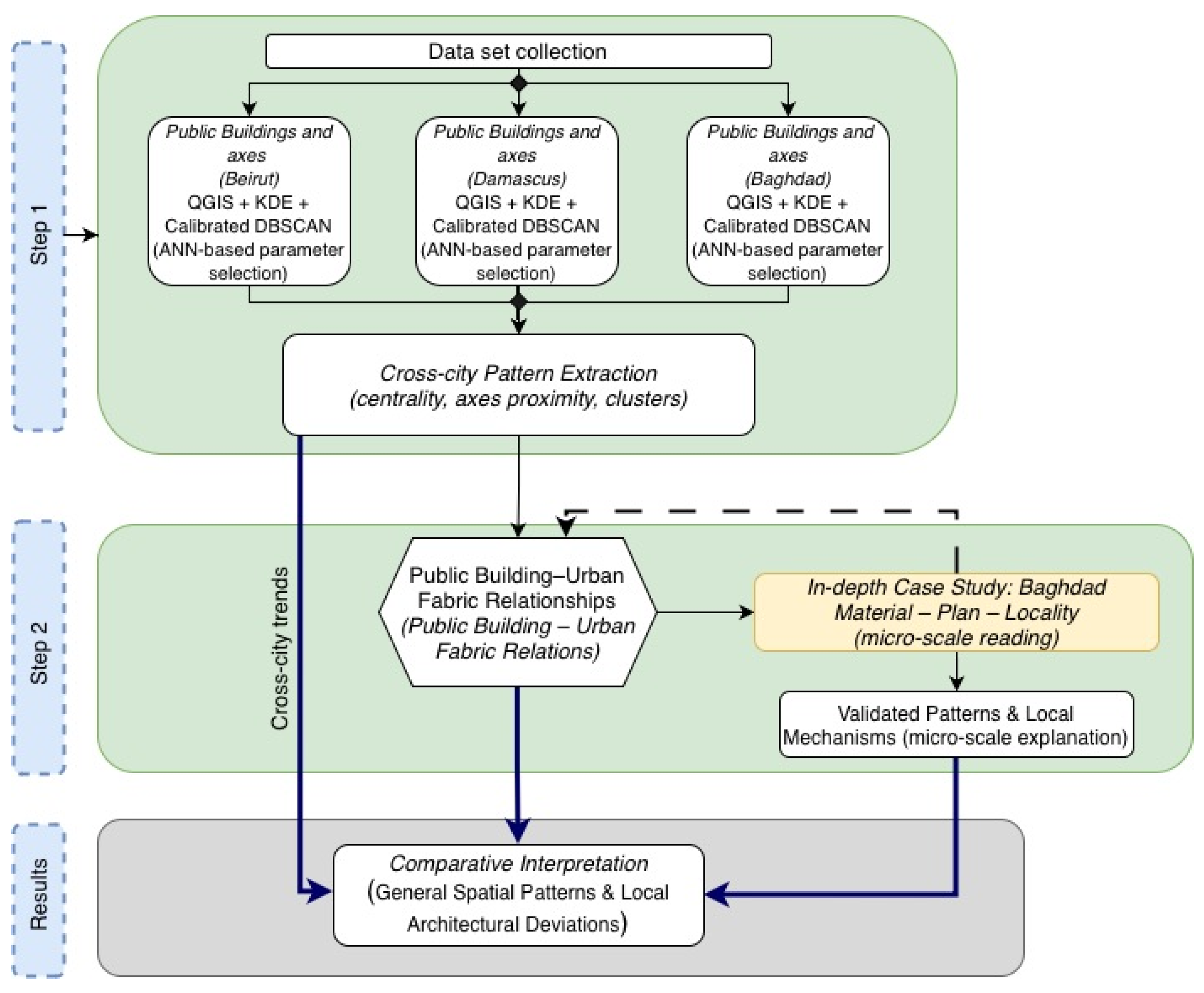
In the first stage of the analysis, public buildings in Beirut, Damascus, and Baghdad were identified and subjected to spatial analysis using QGIS version 3.44. Kernel Density Estimation (KDE) and the DBSCAN clustering algorithm were applied to examine spatial concentrations of public buildings, their locational relationships with one another, and their proximity to major urban axes. Spatial clustering analyses were conducted using the DBSCAN algorithm within a Python (v3.10)-based environment, with computational workflows implemented via Google Colab to ensure reproducibility and consistency across the three cities. These quantitative analyses provide an analytical basis for identifying comparable spatial patterns and variations among the case studies (
Figure 1).
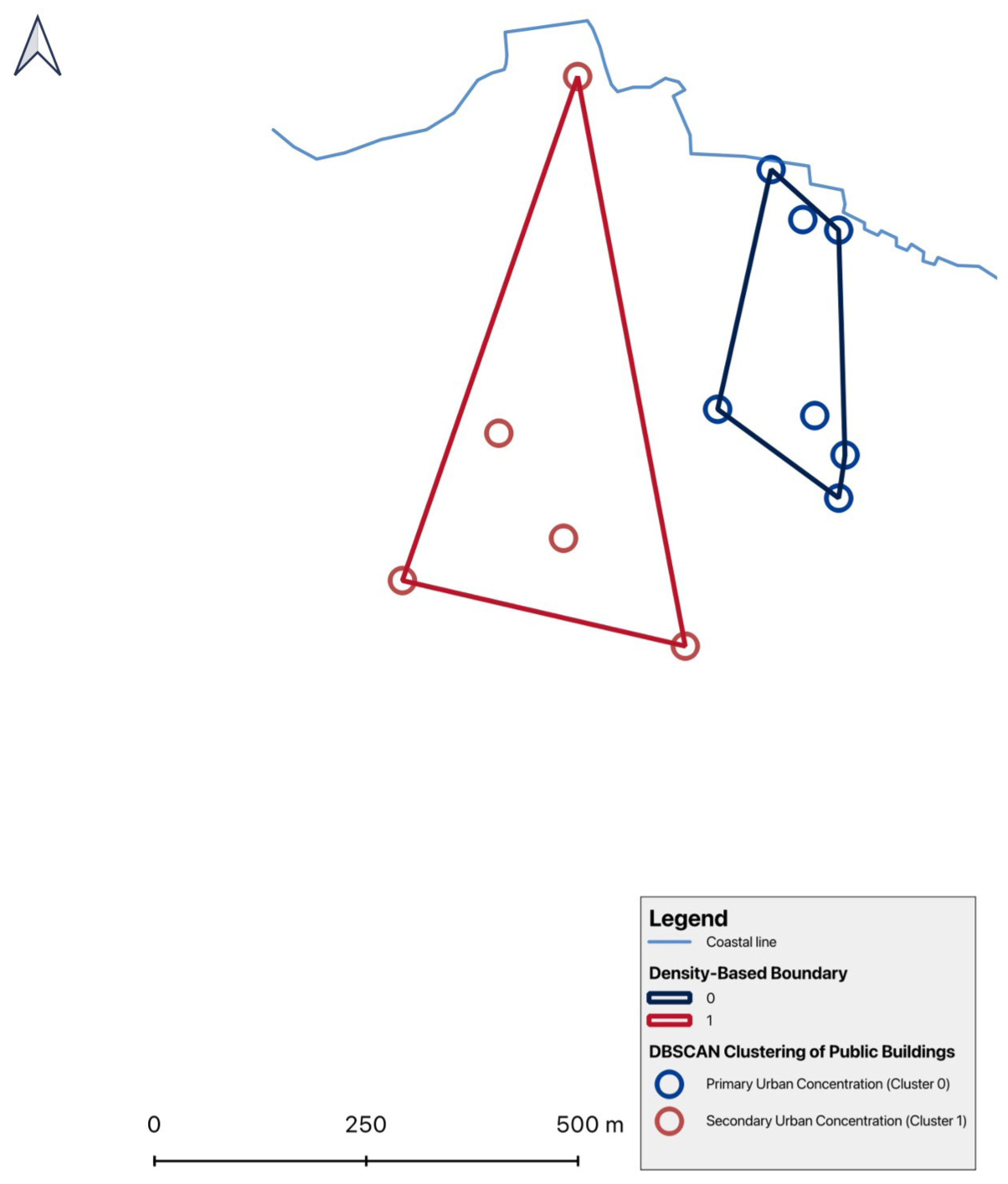
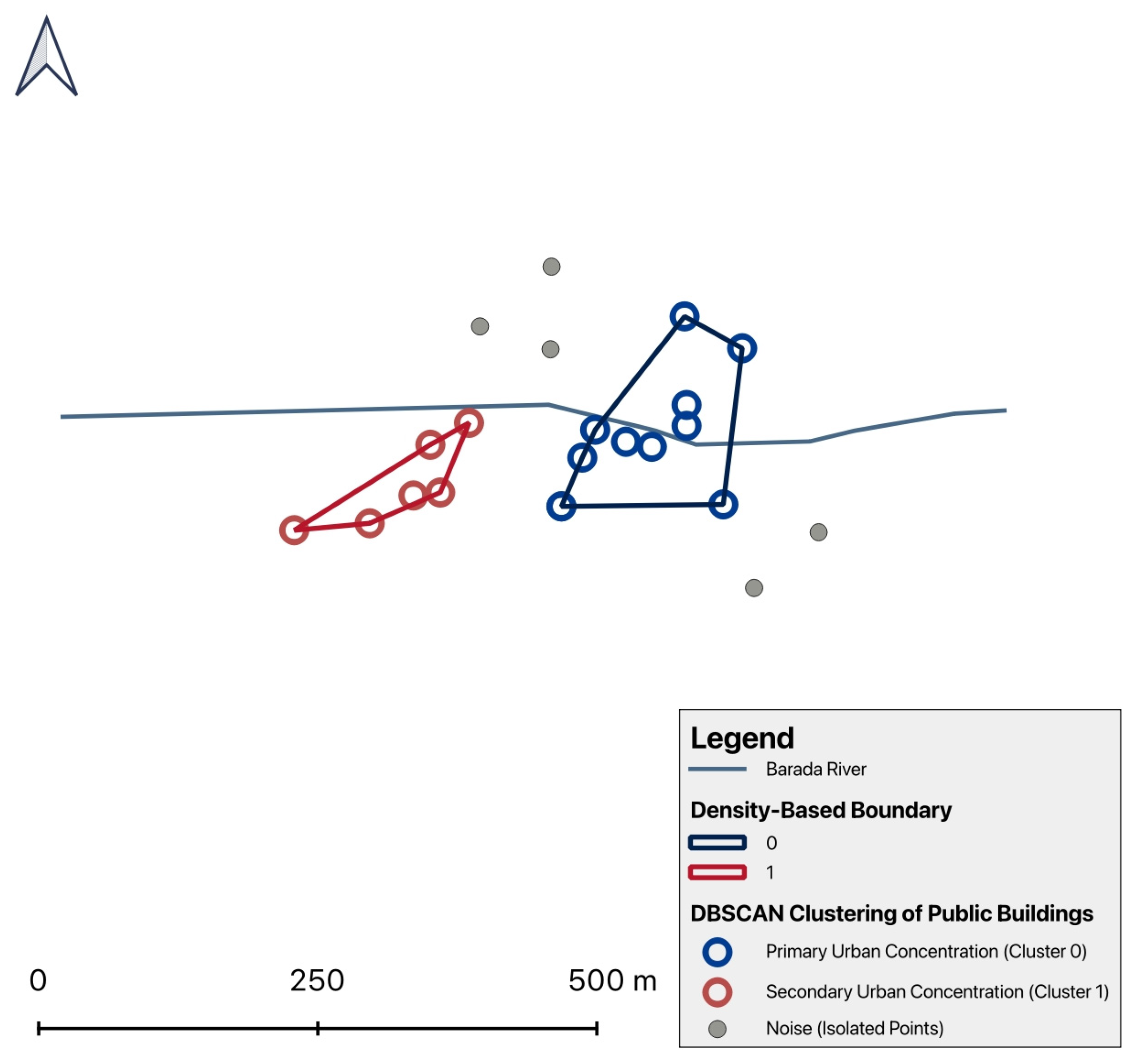
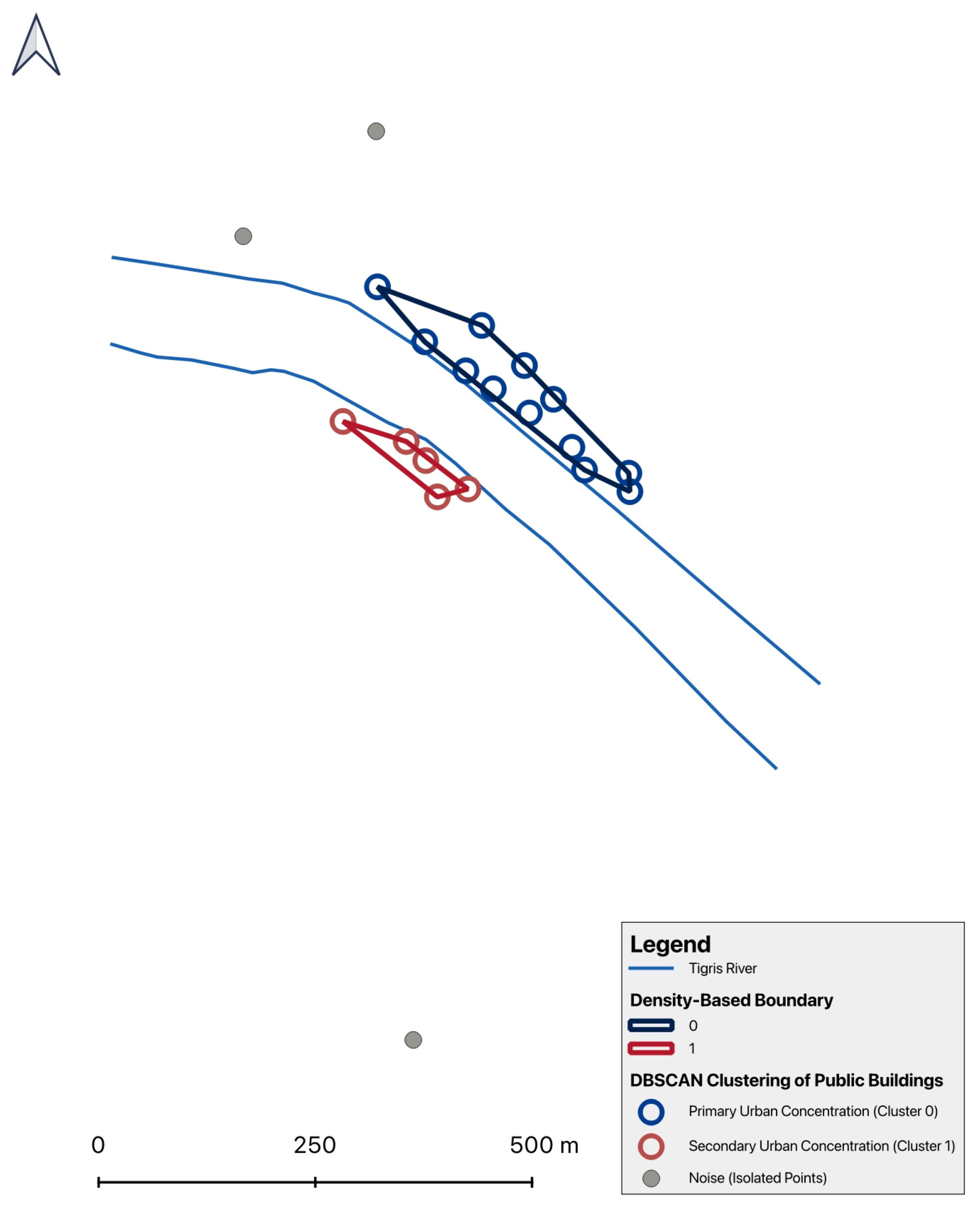
In order to avoid arbitrary parameter selection, the DBSCAN eps value was calibrated through average nearest neighbour (ANN) analysis and sensitivity testing. For each city, the mean nearest neighbour distance between public buildings was calculated (Beirut: 211.2 m; Damascus: 160.1 m; Baghdad: 237.0 m). Based on these values, multiple eps thresholds (280–240 m) were systematically tested. Lower thresholds produced predominantly noise classifications, while substantially higher thresholds resulted in over-merging of spatial clusters. Accordingly, city-specific eps values were adopted to ensure stable and structurally meaningful cluster formation while preserving inter-city comparability (Beirut: 270 m; Damascus: 280 m; Baghdad: 240 m). For each identified cluster, convex hull polygons were generated in QGIS to delineate the spatial extent of density-based concentrations and to visualise cluster boundaries consistently across the three cities. All these calculations are compiled and presented in a table.
The resulting spatial outputs were evaluated through maps and tables in order to identify shared and divergent patterns of spatial relationships between public buildings, the urban fabric, circulation networks, and open spaces. At this stage, the relationships of public buildings to urban centers, their proximity to major axes, and their clustering tendencies were analyzed comparatively across Beirut, Damascus, and Baghdad.
In the second stage of the analysis, the study focuses on Baghdad as a case study and turns to detailed architectural investigations at the building scale. Baghdad was selected due to the continuity and accessibility of architectural documentation, as well as the pronounced interaction between public buildings and local construction practices, which allows micro-scale adaptations to be examined in relation to broader spatial patterns. Selected public buildings were analyzed in terms of plan organization, façade articulation, construction techniques, material use, and their relationship to environmental conditions. Photographs and postcards provided complementary visual evidence regarding façade composition, material expression, and the urban context of the buildings, while official correspondence and construction records were used to clarify building functions, construction processes, and institutional contexts. Building-scale analyses were structured around a set of parameters aimed at examining how standardized public building programs were locally adapted. These analyses were systematically presented through a comparative table including parameters such as building type, function, urban location, construction technique, local adaptation, and material use.
Findings obtained at the building scale were read together with spatial patterns identified at the urban scale across Beirut, Damascus, and Baghdad in order to examine how recurring spatial relationships varied under different local conditions. The findings derived from the Baghdad case study were not treated as isolated observations but were instead used to refine and reinterpret the spatial patterns identified across all three cities, allowing local architectural mechanisms to be related to broader inter-city trends.
To ensure the comparability of building-scale architectural analyses, a criteria-based evaluation table was developed for the selected public buildings in the Baghdad case study. This table systematically compares plan organization, façade articulation, material use, and environmental relationships under three main categories: imperial influence, local factors, and architectural adaptation. The evaluation expresses the relative intensity of each characteristic using a qualitative scale (low, moderate, and high), thereby enabling building-based observations to be related to spatial patterns identified at the urban scale. This approach facilitates the interpretation of micro-scale architectural adaptations within the context of broader urban and regional tendencies.
In the final stage, the results of the inter-city spatial analyses and the building-scale findings from the Baghdad case study were brought together to provide a comprehensive assessment of the role of public buildings in the formation of urban centers in Ottoman provincial cities during the second half of the nineteenth century. This methodological approach aims to address the relationship between urban-scale spatial patterns and building-scale local architectural practices within the production of public architecture.
The analysis focuses on planimetric spatial relationships and clustering patterns, while acknowledging that volumetric and vertical dimensions represent an important but currently under-documented aspect of late Ottoman urban morphology.
3. Provincial Urban Centers Late Ottoman Period: Beirut, Damascus and Baghdad
This section introduces Beirut, Damascus, and Baghdad as provincial urban centers and situates them within the administrative and spatial transformations of their period. At this stage, the study adopts a comparative urban analysis approach in order to place the discussion within a broader spatial framework and to examine how different provincial contexts shaped the implementation of public building policies.
Despite their geographical distance from the imperial capital of Istanbul, all three cities occupied strategically, economically, and symbolically significant positions [
3,
24,
25]. This circumstance rendered them critical focal points for the implementation of nineteenth-century centralization reforms. Beirut functioned as a rapidly developing port city in the Eastern Mediterranean, integrated into global trade networks; Damascus served as the administrative capital of Syria, combining administrative and religious functions through its strategic location along pilgrimage routes; and Baghdad emerged as a provincial capital of Mesopotamia, defined by its role as an important administrative and religious center anchored in a river-based urban setting [
26]. Despite these differing functional and spatial characteristics, all three cities offer comparable cases for examining how Ottoman centralisation reforms in the late Ottoman period were translated into urban space through public buildings [
15,
16,
18,
19,
27,
28,
29,
30,
31]
These cities accommodated new public buildings that reflected the broader reform agenda while being shaped by local conditions, established building traditions, material availability, and existing urban fabrics [
2,
32,
33,
34,
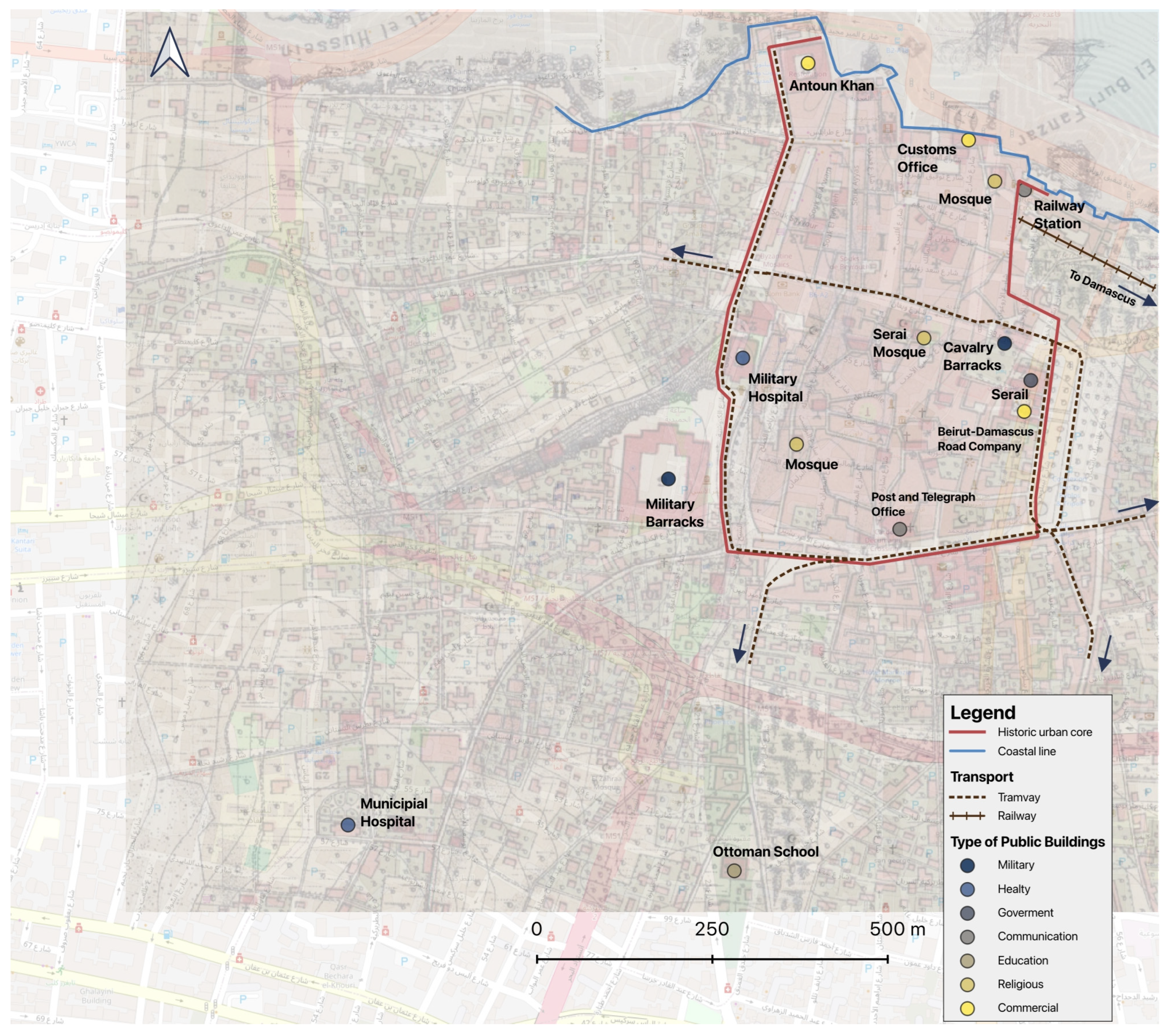
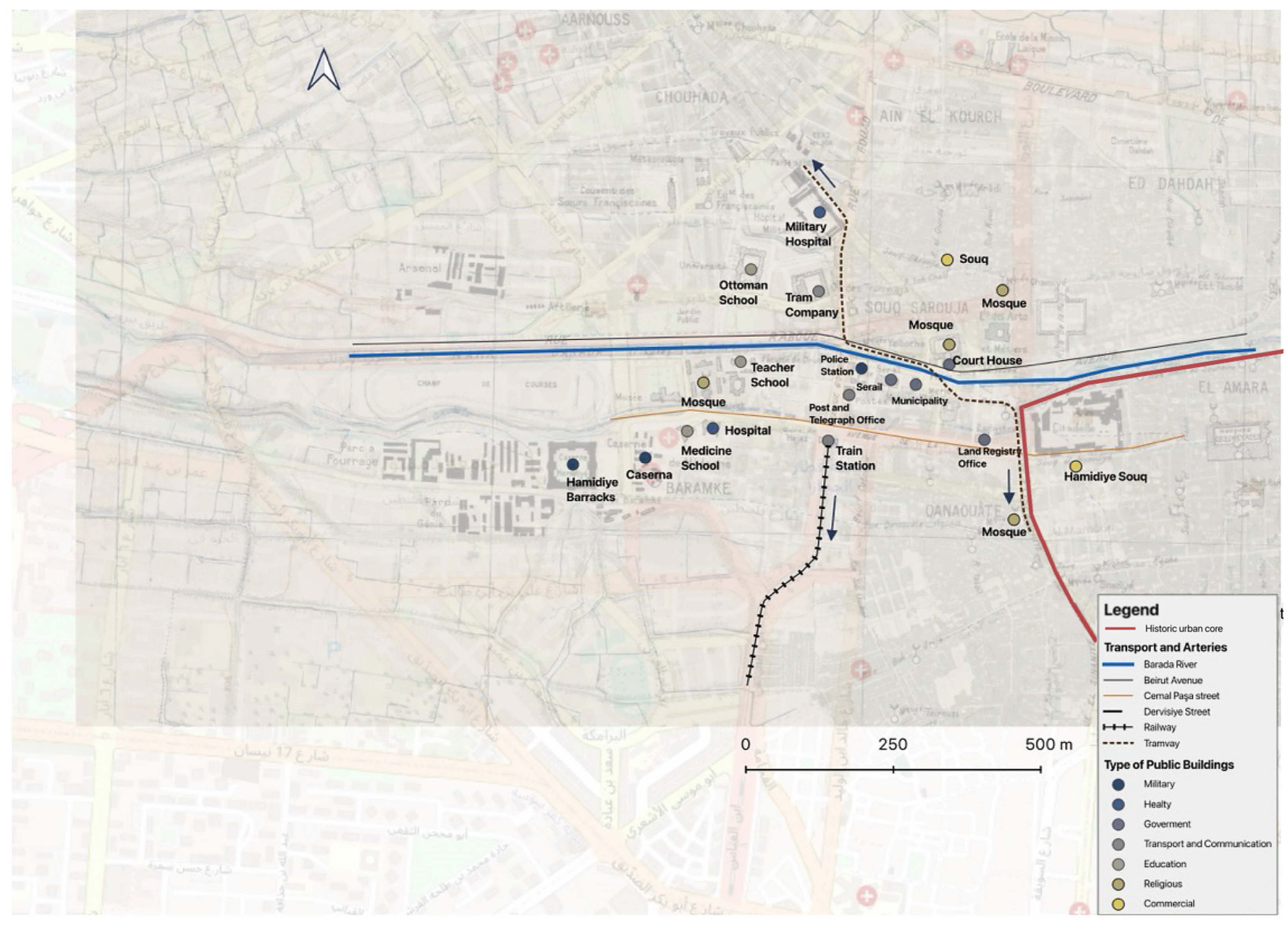
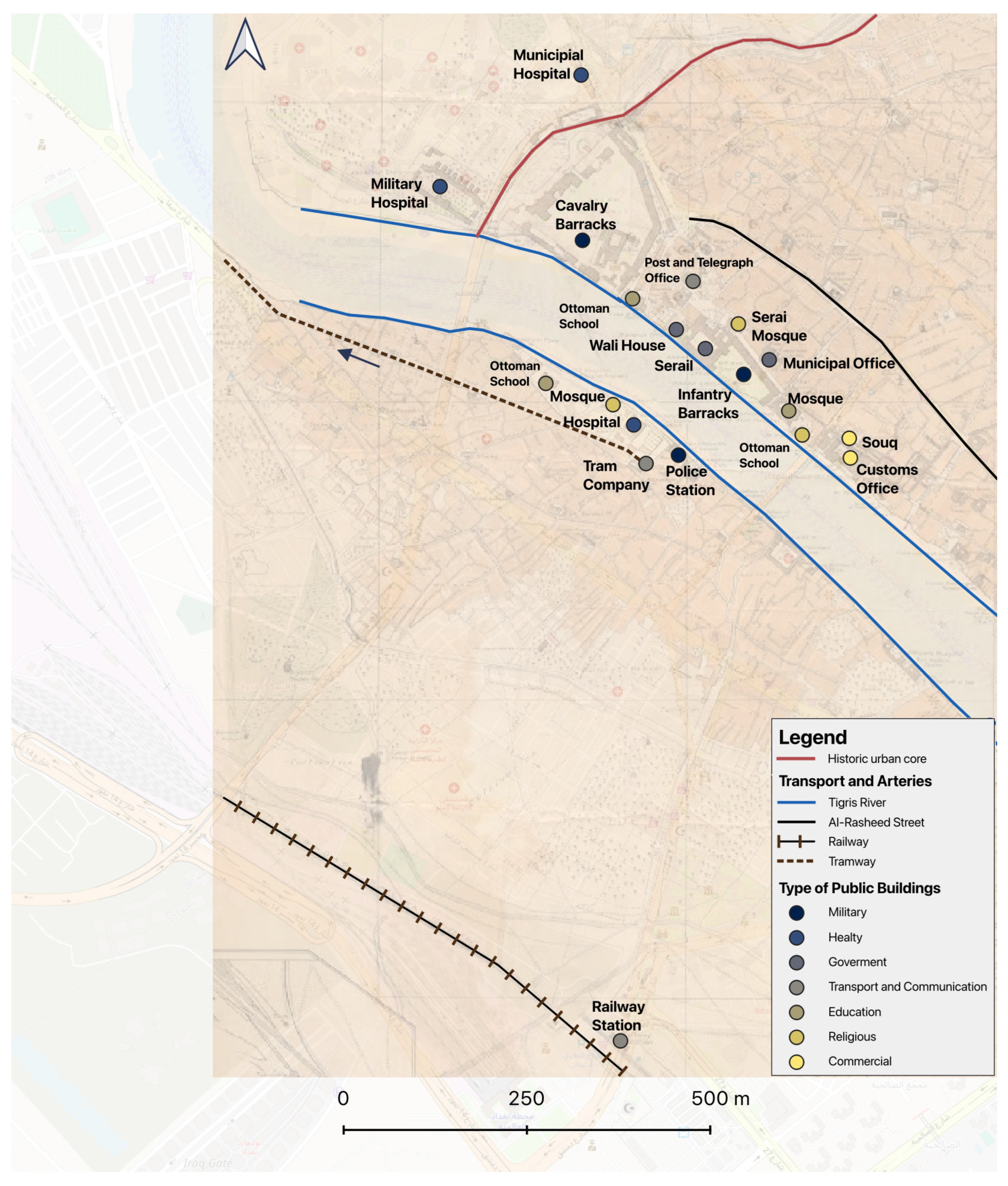
35]. Consequently, their built environments embody both the general principles of reform characteristic of the period and the local architectural and construction practices developed within each provincial context. Despite differences in scale, economic profile, and trajectories of political development, all three cities witnessed the emergence of urban centers in which public-serving buildings—such as government offices, military barracks, schools, hospitals, post offices, and transportation infrastructure—were frequently located in close spatial relation to one another. This condition necessitates an understanding of public buildings not merely as individual architectural objects but as key spatial components in the formation of new urban centers [
Figure 2,
Figure 3 and
Figure 4] [
2,
32,
35].
The methodological framework of the study enables conducting an inquiry into how ostensibly shared administrative and spatial logics were interpreted across different local contexts [
2,
18,
19,
36]. To deepen this inquiry, the study focuses on Baghdad as a case study, examining how public buildings constructed within largely standardized programs were reinterpreted through local conditions. With its brick-based construction tradition, river-oriented urban structure, and irregular parcel layout, Baghdad provides a context in which the diversification of shared spatial tendencies under local conditions can be closely observed.
3.1. Comparative Urban Analysis in Three Cities: Qualitative Mapping of Public Building Distribution
This section examines the location of public buildings within the urban fabric of Beirut, Damascus, and Baghdad through annotated maps [
Figure 1,
Figure 2 and
Figure 3]. The intra-urban distribution of government buildings, military barracks, educational and health facilities, and communication infrastructure; their proximity and distance relationships with one another; and their connections to major urban axes are analyzed through inter-city comparison. This reading opens a discussion on how public buildings were positioned not as isolated functional structures but as interrelated spatial components concentrated within specific parts of urban organization.
The analyses indicate that public building programs display a high degree of similarity across the three cities. Government buildings, military barracks, educational and health facilities, and communication-related structures were located in spatially related configurations in all cases, establishing specific proximity–distance relationships among them. This condition suggests that public buildings functioned not merely as individual facilities but as spatial expressions of an administratively driven logic articulated from the center and materialized within provincial urban contexts. These inter-city similarities may be evaluated, within the framework of Ottoman center–province relations, as manifestations of a spatial tendency toward administrative concentration articulated through public buildings.
Nevertheless, it is both expected and natural that this shared administrative logic did not produce identical spatial outcomes across different cities. The urban placement of public buildings was significantly shaped by local conditions such as geographical thresholds including seas and rivers, the dominance of commercial or religious functions, existing historical fabrics, and transportation infrastructures. As a result, public buildings with similar programs emerged within distinct spatial configurations in each city.
Within this framework, the spatial organization of public buildings in Beirut is primarily interpreted through their relationship with the sea and the port. Commercial structures along the coastline, together with the customs house and the railway station, stand out as the principal public buildings through which the city connected outward. Parallel to this coastal strip, yet extending inland, a linear public focus developed. As in the other two cities, military barracks constituted the most dominant public building type in Beirut, functioning as a primary administrative focal point within the inner urban fabric. Within the zone enclosed by the tramway line—which largely overlaps with the former city walls—the government building, military hospital, post and telegraph office, and religious structures were located in close proximity. A distinguishing feature of Beirut, however, is the relatively dispersed location of educational and health facilities, situated at a greater distance from this administrative concentration zone [
Figure 2].
Figure 2.
Public Buildings and Urban Axes in Beirut. Selected public buildings in Damascus and their spatial relationship with major urban axes [Base map: Beirut late nineteenth century; author’s overlay, 2025 [
37]]. The map was produced in QGIS based on manually digitized public buildings and urban axes].
Figure 2.
Public Buildings and Urban Axes in Beirut. Selected public buildings in Damascus and their spatial relationship with major urban axes [Base map: Beirut late nineteenth century; author’s overlay, 2025 [
37]]. The map was produced in QGIS based on manually digitized public buildings and urban axes].
In Damascus, the placement of public buildings took shape around a nodal concentration developed in relation to the Barada River. Government and administrative buildings clustered within this node, forming the city’s modern administrative core. Although educational and health facilities were not distributed as evenly on both sides of the river as in Baghdad, they were nevertheless positioned in relation to this water element. Commercial and religious buildings largely remained within the boundaries of the historic city, while new public buildings contributed to the formation of an administrative area partially distinct from the older urban fabric (A contemporary French traveler described the area along the Barada River as a zone where the regenerative effects of riverside promenades were most strongly felt, emphasizing the role of these spaces in Damascus’s emerging modern urban landscape [
2,
27]) (
Figure 3).
Figure 3.
Public Buildings and Urban Axes in Damascus. Selected public buildings in Damascus and their spatial relationship with major urban axes [Base map: Damascus, late nineteenth century [
38]; author’s overlay, 2025]. The map was produced in QGIS based on manually digitized public buildings and urban axes].
Figure 3.
Public Buildings and Urban Axes in Damascus. Selected public buildings in Damascus and their spatial relationship with major urban axes [Base map: Damascus, late nineteenth century [
38]; author’s overlay, 2025]. The map was produced in QGIS based on manually digitized public buildings and urban axes].
In Baghdad, the spatial organization of public buildings was strongly structured by the Tigris River, which divides the city into two parts. Public buildings positioned on opposing banks of the river contributed to the development of a linear and directional urban center. As in Beirut, military barracks emerged as the most dominant public structures in Baghdad, accompanied by the government building, schools at different levels, post and telegraph offices, and hospitals. Religious buildings were present on both sides of the river, although their relationships with public buildings varied according to the surrounding urban context. The availability of open land along the riverbanks allowed public buildings to be arranged in a looser yet continuous sequence [
Figure 4].
Figure 4.
Public Buildings and Urban Axes in Baghdad. Selected public buildings in Damascus and their spatial relationship with major urban axes. [Base map: Baghdad, early twentieth century [
39]; author’s overlay, 2025]. The map was produced in QGIS based on manually digitized public buildings and urban axes].
Figure 4.
Public Buildings and Urban Axes in Baghdad. Selected public buildings in Damascus and their spatial relationship with major urban axes. [Base map: Baghdad, early twentieth century [
39]; author’s overlay, 2025]. The map was produced in QGIS based on manually digitized public buildings and urban axes].
When considered together, the programs of public buildings and the spatial relationships established among them in Beirut, Damascus, and Baghdad demonstrate that Ottoman centralisation reforms were implemented in provincial cities according to broadly similar principles. However, the spatial translation of these principles differed in each city under the influence of local conditions such as the sea, rivers, trade, religion, and existing urban structures. The inter-city comparison presented in this section makes visible this interaction between administrative centrality and local spatial dynamics and identifies observable spatial patterns that are quantitatively examined in
Section 3.2 [
Table 1].
3.2. Quantitative Spatial Clustering Analysis (Calibrated DBSCAN)
While
Section 3.1 identified spatial tendencies through qualitative mapping and urban axis interpretation, the following analysis moves beyond descriptive observation by applying DBSCAN clustering to test the structural coherence of these patterns. Rather than merely illustrating density, the calibrated DBSCAN model evaluates whether public buildings form statistically meaningful spatial clusters and to what degree such clustering varies across cities. Through parameter calibration based on average nearest neighbor distances and sensitivity testing, the analysis aims to provide a comparable quantitative assessment of urban centrality in Beirut, Damascus, and Baghdad.
In order to assess patterns of spatial concentration of public buildings at the urban scale in a more objective manner, datasets of public buildings compiled for Beirut, Damascus, and Baghdad were analyzed using a Python-based DBSCAN clustering algorithm. The results indicate that public buildings in all three cities were not randomly distributed but instead formed clusters concentrated around specific urban references and circulation routes.
In Beirut, the DBSCAN results reveal two main clusters of public buildings, whose spatial extent is defined through convex hull analysis. The primary cluster forms an elongated hull parallel to the coastline, indicating a corridor-based spatial organization structured along the maritime axis. The secondary cluster generates a more compact hull further inland, suggesting a localized concentration distinct from the coastal strip. Buildings classified as noise remain outside these hull boundaries, reflecting dispersion beyond the dominant concentration areas. Together, the contrasting hull geometries point to a dual spatial structure characterized by a linear coastal concentration and a secondary inland node (
Figure 5).
In Damascus, the DBSCAN results reveal a more compact pattern of spatial concentration around the Barada River. Convex hull delineation shows that both clusters generate relatively condensed geometries with limited longitudinal extension. Unlike Beirut’s Corridor-aligned clustering, the hulls in Damascus indicate a nodal concentration structured around a localized river-oriented core. Buildings classified as noise remain in close proximity to these concentration areas, suggesting limited spatial dispersion beyond the primary cluster zone. Overall, the compact hull geometries point to a more centralized and spatially condensed pattern of public building distribution (
Figure 6).
In Baghdad, the DBSCAN results identify two clusters of public buildings distributed along both banks of the Tigris River. Convex hull delineation reveals elongated geometries that follow the river’s course, producing a directional and longitudinal spatial configuration. Unlike the compact nodal structure observed in Damascus, the hulls in Baghdad extend linearly along the waterfront, indicating a river-oriented axis of concentration rather than a condensed central core. The spatial alignment of clusters on opposite banks suggests a cross-river continuity, while the relatively broader hull extension reflects a more dispersed distribution compared to the other case studies. Buildings classified as noise remain outside these elongated hull boundaries, reinforcing the interpretation of a structured yet spatially stretched pattern of public building concentration along the Tigris (
Figure 7).
To further clarify the quantitative structure of clustering across cities, the calibrated DBSCAN results are summarised in
Table 1.
Table 1.
DBSCAN parameter calibration and clustering results for Beirut, Damascus, and Baghdad.
Table 1.
DBSCAN parameter calibration and clustering results for Beirut, Damascus, and Baghdad.
| City | Total B. | Avg NN (m) | eps (m) | Clusters | Cluster Ratio (%) | Noise (%) | Avg Cluster Size |
|---|
| Beirut | 14 | 211.2 | 270 | 2 | 85.7 | 14.3 | 6 |
| Damascus | 21 | 160.1 | 280 | 2 | 76.2 | 23.8 | 8 |
| Baghdad | 20 | 237.0 | 240 | 2 | 85.0 | 15.0 | 8.5 |
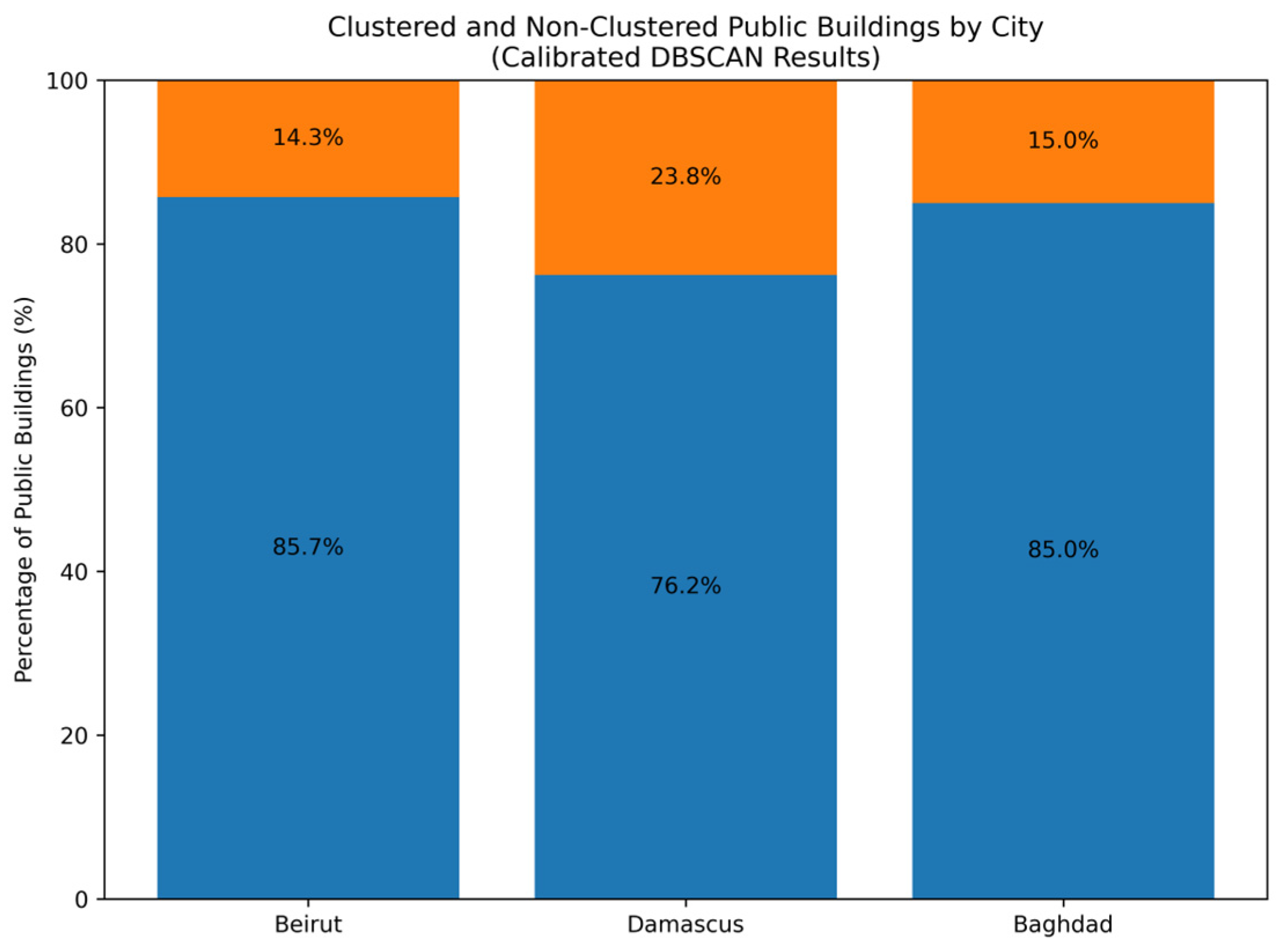
Table 1 presents the calibrated DBSCAN results for the three cities following average nearest neighbour analysis and sensitivity testing. Rather than applying a uniform distance threshold, city-specific eps values were adopted to ensure stable and structurally meaningful cluster formation (Beirut: 270 m; Damascus: 280 m; Baghdad: 240 m). Lower thresholds produced predominantly noise classifications, while substantially higher thresholds resulted in over-merging of clusters without improving structural interpretability.
The results indicate that all three cities exhibit two structural clusters; however, the degree of clustering varies across cases. The cluster ratio is highest in Beirut (85.7%) and Baghdad (85.0%), while Damascus shows a comparatively lower level of concentration (76.2%). This variation reflects differences in spatial density and morphological configuration rather than divergence in administrative logic. In parallel, the average cluster size ranges from 6.0 buildings in Beirut to 8.5 in Baghdad, with Damascus occupying an intermediate position (8.0), suggesting differing degrees of spatial compactness in the formation of public institutional cores (
Figure 8).
DBSCAN parameters were calibrated individually for each city to ensure stable cluster formation without over-fragmentation or over-merging. Accordingly, the reported cluster and noise ratios reflect optimized city-specific configurations rather than a uniform distance threshold.
While the spatial concentration of public buildings indicates the formation of urban focal areas, the results do not suggest the emergence of a single dominant core in all cases. Instead, differentiated—and in some instances multi-nodal—configurations become visible. In this respect, the clustering patterns resonate with discussions of polycentric urban development, where multiple spatial focal points coexist within a single urban structure. These clusters reflect administratively structured concentrations produced through centralization policies and mediated by local spatial conditions. In the case of Damascus, the relatively higher eps threshold reflects a more dispersed spatial distribution pattern, requiring a broader interaction radius to achieve structurally coherent clustering.
The inter-city comparison demonstrates that public buildings in all three cities followed comparable spatial logics aimed at generating urban centrality, while the density, form, and continuity of clusters varied according to local urban morphology. The DBSCAN results quantitatively substantiate the urban location patterns discussed qualitatively in
Section 3.1 and make visible, in comparative terms, the differentiated forms of spatial centrality produced in provincial contexts [
Table 1]. These findings provide the analytical basis for the synthesis presented in the following section.
3.3. Comparative Evaluation of Urban Centrality in Three Cities
Building on the qualitative and quantitative analyses presented above, this section synthesises the spatial characteristics observed across the three cities in order to clarify distinct modes of urban centrality.
Section 3.1 and
Section 3.2 have identified spatial tendencies through qualitative mapping and tested these tendencies through calibrated clustering analysis. This section synthesizes the qualitative and quantitative findings through tables to comparatively interpret the forms of urban centrality observed in Beirut, Damascus, and Baghdad [
Table 2]. Rather than repeating individual results, the synthesis aims to clarify how clustering intensity, axial alignment, and spatial configuration together shape distinct forms of administrative concentration in each city.
These comparative spatial findings establish the broader framework within which Baghdad is examined in greater architectural detail in the following section.
Specifically, the comparative clustering results help to situate Baghdad within the broader range of spatial configurations observed in the three cities, while the identification of river-aligned clustering patterns and administrative focal areas in Baghdad provides the spatial context for interpreting the selected building case studies. The architectural analyses in the following section therefore examine these structures as elements embedded within the density-based urban configuration rather than as isolated institutional examples.
4. Public Building Architecture in Baghdad: Materials, Facades, and Construction Practices
Building on the comparative spatial findings in
Section 3, the following section deepens the analysis through a focused architectural examination of Baghdad, where urban centrality takes a pronounced linear form along the Tigris.
The architectural case selection in this section is directly informed by the DBSCAN clustering results presented in
Section 3.2. The spatial analysis demonstrated that public buildings in Baghdad formed two structurally coherent and predominantly linear clusters along the Tigris River, with a pronounced concentration in the Rusafa district. The buildings examined below are situated within these identified cluster zones and represent key institutional nodes that contributed to the formation of the river-oriented public axis. In addition to structures located within the two identified cluster areas, one selected case also represents a non-clustered (noise) spatial condition, allowing the analysis to address both concentrated and peripheral configurations. By focusing on structures embedded in the primary cluster area, while also considering buildings associated with the secondary cluster and the non-clustered condition, the analysis seeks to examine how macro-scale spatial concentration translated into architectural form, programmatic organization, and material expression at the building scale. In this respect, the GIS-based clustering analysis operates not merely as a mapping tool but as a methodological framework guiding the micro-scale architectural investigation.
Baghdad, one of the major provincial capitals of the Ottoman Empire, emerged as a principal urban center in which public building programs intensified during the late nineteenth and early twentieth centuries [
3,
40]. During this period, Baghdad functioned not only as a site where administrative reforms were implemented but also as a concrete field of application in which public building models developed at the imperial center were reinterpreted within local architectural and urban conditions.
A significant portion of public buildings constructed in Baghdad during this period were concentrated in the Rusafa district, located between the Tigris River and al-Rashid Street. Through the co-location of administrative, military, educational, and health-related functions, this area became one of the primary focal points in the formation of the city’s public and administrative core. The public buildings examined in this study, which date to different phases of construction, are situated within this zone, where state authority was most clearly articulated in spatial terms [
21,
31].
The identification and spatial assessment of these buildings are based on the 1917 Baghdad map, which constitutes the only accessible and analytically reliable detailed cartographic source for the period [
Figure 4]. The map clearly depicts major institutional structures such as the infantry barracks, the military hospital, the government palace, and the palace mosque. Surrounding this institutional core, additional public buildings serving educational, health, and communication functions can be identified. Among these are the military high school and military middle school, the industrial school, the post and telegraph office, the customs house, Gureba hospitals, and a military hospital. While expanding the existing administrative core, these buildings also increased the spatial diversity of public services. Although some structures underwent repair, damage, or functional transformation in later periods, the locations of the principal institutional focal points reflect the spatial continuity of the public core established during this phase [
2,
20].
In the remainder of this section, selected public buildings within the study area—namely the Baghdad Government Building, the Military High School, the Gureba Hospital, the Municipal Hospital, and the Customs House—are examined at the building scale in terms of material use, façade articulation, and construction techniques. These architectural readings aim to demonstrate how centrally developed public building programs were reinterpreted in response to Baghdad’s environmental conditions, local construction traditions, and urban morphology.
In major provincial cities of the period, government buildings constituted the primary architectural instruments through which centralized administrative presence was rendered visible at the urban scale. Within this context, the Baghdad Government Building occupies a prominent symbolic and spatial position within the city’s public and administrative core, located along the banks of the Tigris River [Tables 3 and 4]. The earliest archival document referring to the Baghdad Government Building in the Ottoman Archives dates to 1856 [
41], with subsequent documentation appearing in various records between 1857 and 1914.
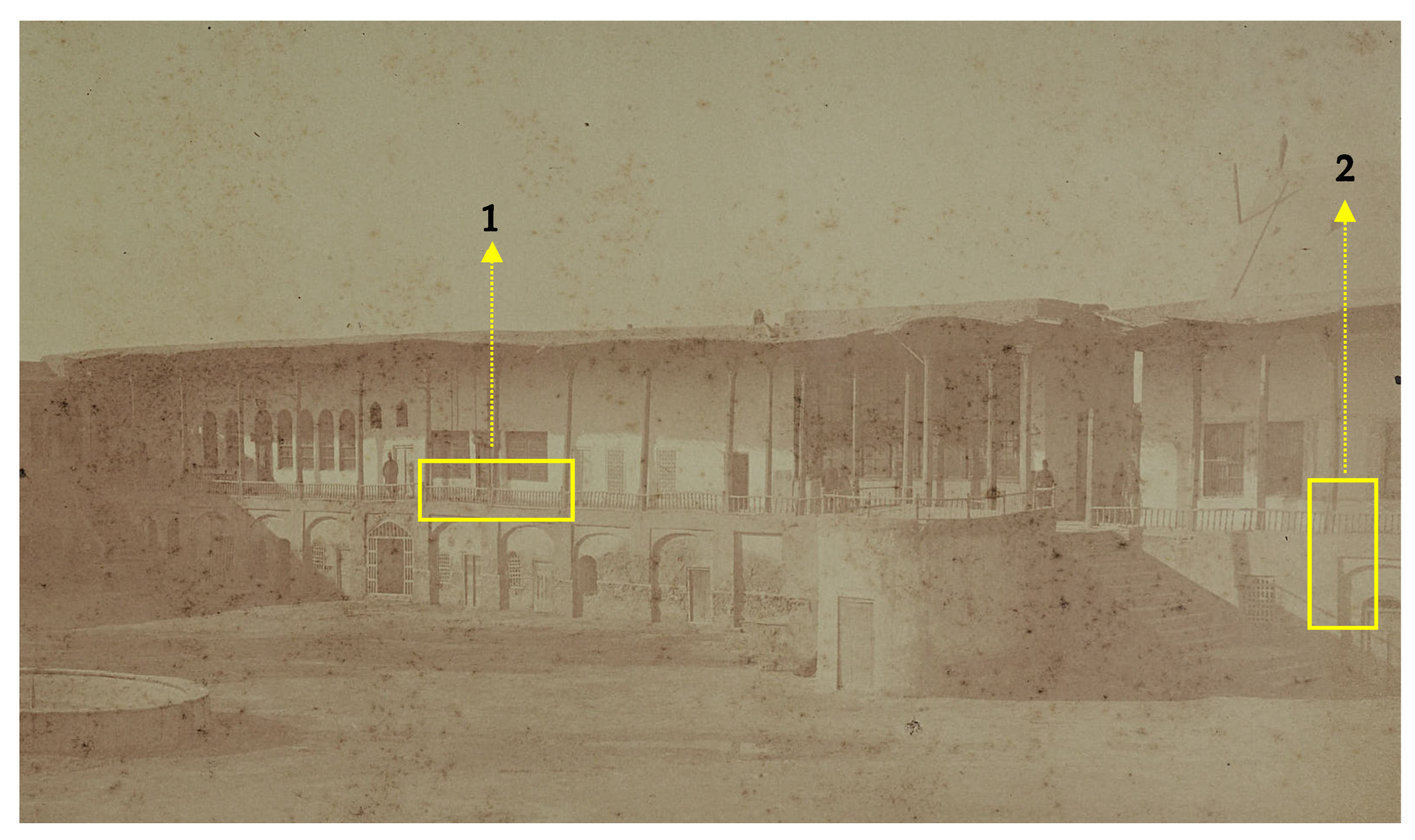
The building consists of a two-story rectangular mass with a strong horizontal emphasis, extending parallel to the river. Its façade is defined by rows of round-arched windows, while the limited use of ornamental elements lends the building an overall expression of restraint and simplicity. This controlled and sober façade facing the river contributes to the building’s institutional presence within the city skyline (
Figure 9).
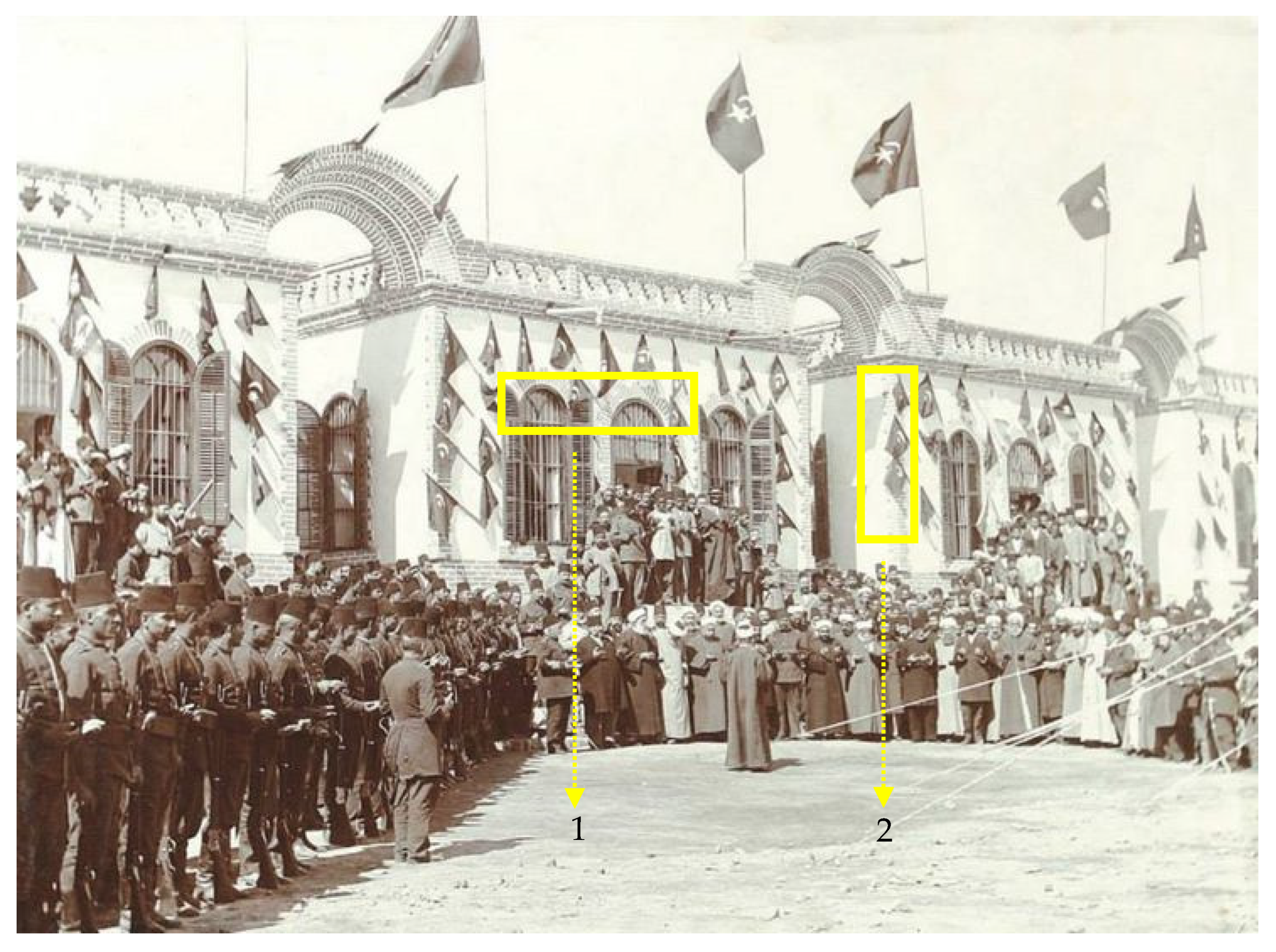
At the center of the interior organization lies a rectangular courtyard, which constitutes the most defining spatial element of the building. Articulated by wooden columns and a circular projecting balcony, the courtyard functions as an intermediate space that enhances both circulation and the relationship between interior and exterior spaces. The structural simplicity observed in both the façades and the interior indicates the adoption of an architectural language compatible with local construction practices. As noted by Çelik, the building displays a character that integrates structural plainness with local architectural traditions [
2] (
Figure 10).
Figure 10.
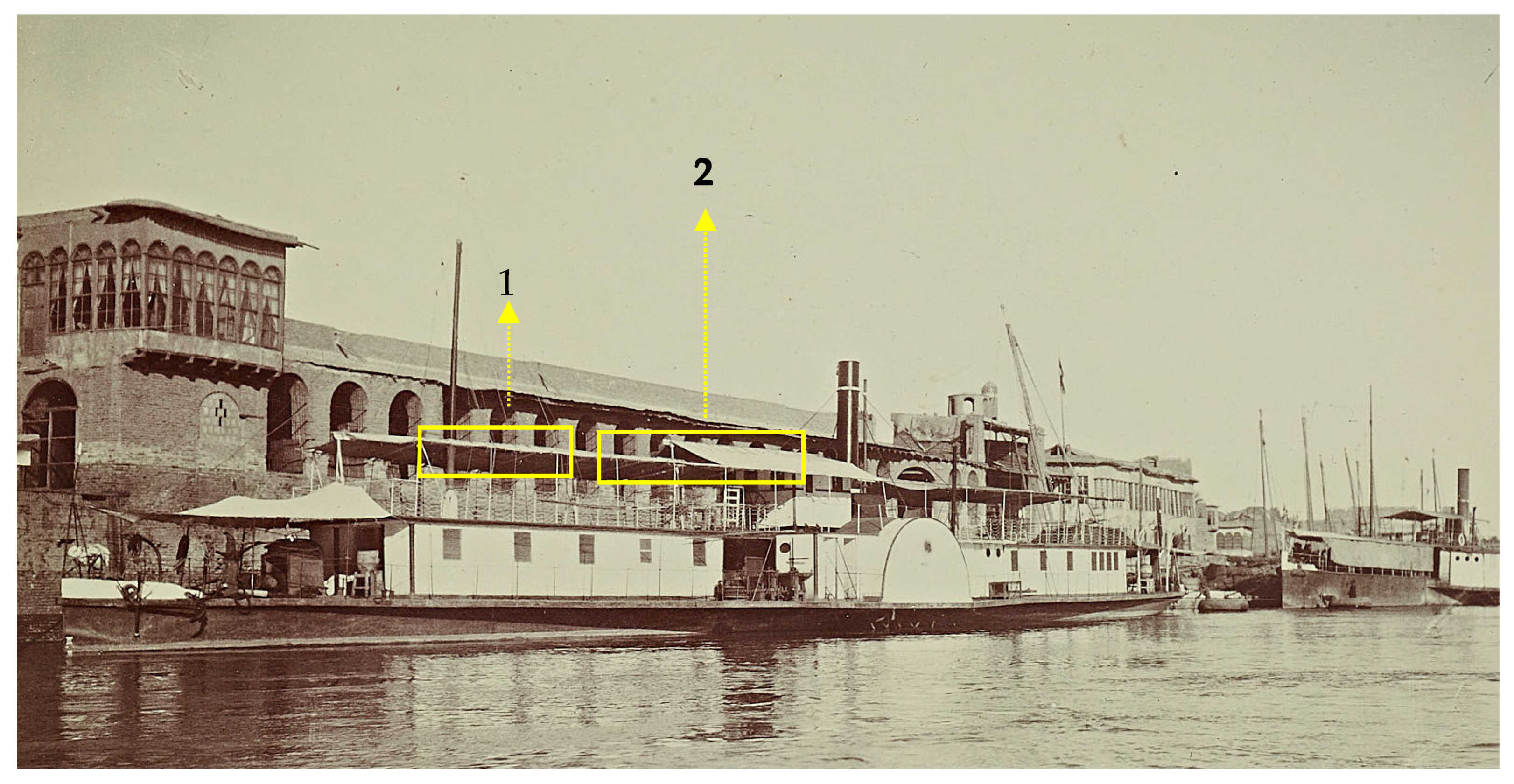
Courtyard view of the Serail in Baghdad, highlighting the arcaded structural system organizing the ground floor (1) and the depth of window openings indicating thick load-bearing masonry walls (2). These features demonstrate how centrally conceived public architecture was materially and structurally adapted to local construction practices and environmental conditions in Baghdad [
43].
Figure 10.
Courtyard view of the Serail in Baghdad, highlighting the arcaded structural system organizing the ground floor (1) and the depth of window openings indicating thick load-bearing masonry walls (2). These features demonstrate how centrally conceived public architecture was materially and structurally adapted to local construction practices and environmental conditions in Baghdad [
43].
In this respect, the Baghdad Government Building represents an adaptation of centrally developed administrative building typologies to the local context of Baghdad through material choices and spatial organization (Table 3).
As a response to one of the prevailing policies of the period—namely the emphasis on “educational discipline”—numerous archival documents exist concerning school buildings in Baghdad that were constructed, planned, or repaired. These include the Baghdad Military Middle School, Military High School, Civil Middle School, Girls’ Middle School, Civil High School, Industrial School, Teachers’ Training School, Police School, and Law School. In addition, many documents record the frequent relocation of schools, the reuse of a single building by different institutions, the transfer of buildings between schools, as well as the construction and repair of new school buildings [
3,
25]. Military educational buildings of this period stand out not only for their instructional functions but also as structures that spatially articulated notions of discipline, order, and institutional continuity. Within this framework, the Baghdad Military High School was constructed near the banks of the Tigris River, in close proximity to the area where public and military buildings were concentrated [
Figure 4] (Table 3).
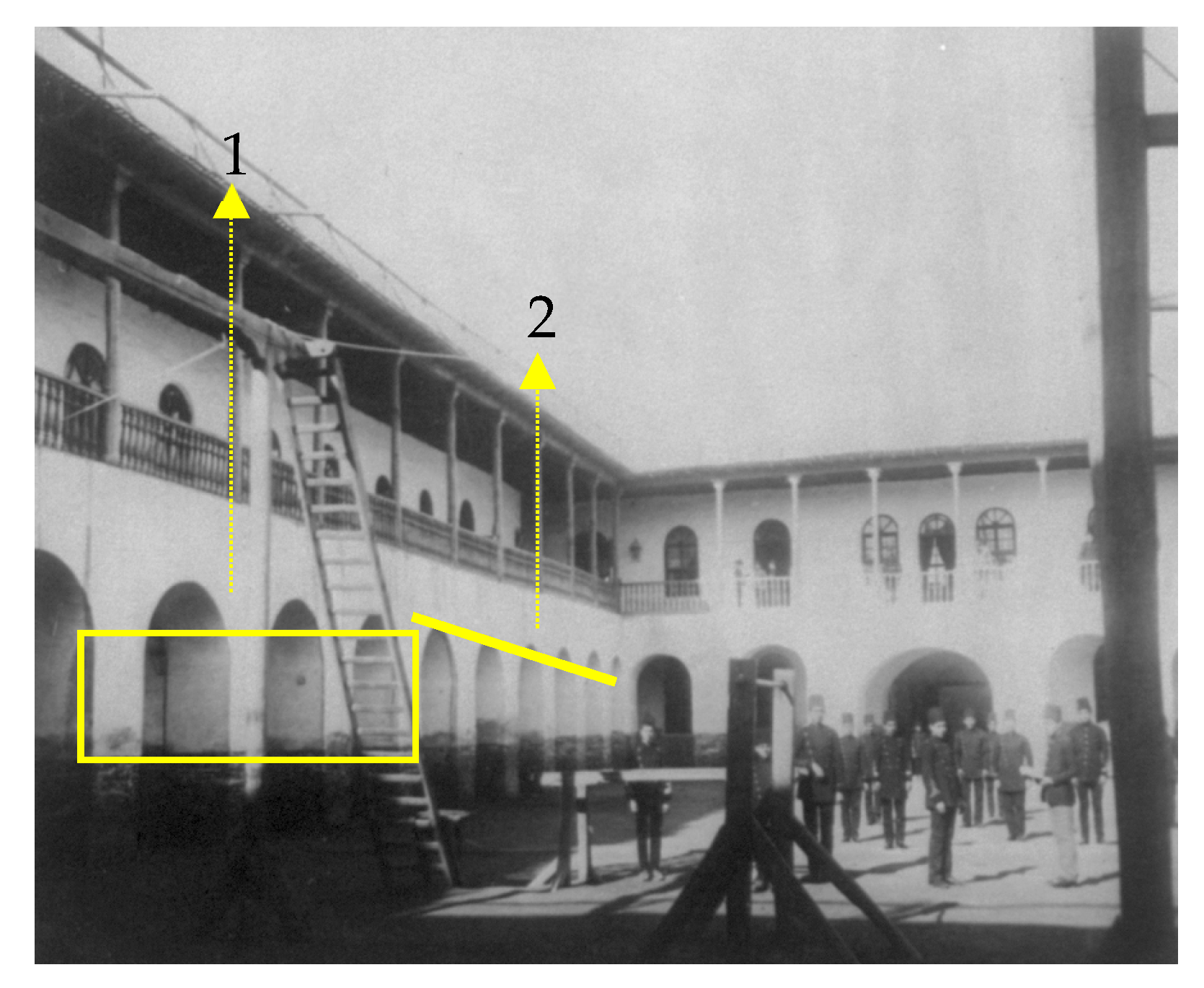
On the ground floor, arcaded porticoes line the façades facing the courtyard, while on the first floor the recession of the walls creates a continuous balcony running along the courtyard-facing elevations. This configuration facilitates circulation while also establishing visual and spatial continuity between the courtyard and the upper floors. The courtyard constitutes the most significant component of the building, as it provides a large open space suitable for the practical aspects of military training (
Figure 11).
The Military High School building follows a rectangular plan organized around a spacious central courtyard. This layout allows classrooms, teachers’ rooms, a small mosque, and ancillary spaces to be arranged around the courtyard. The two-story structure exhibits a clear, hierarchical, and orderly spatial organization in functional terms (
Figure 12).
Due to its geographical location, its status as a religious center, and its exposure to pilgrimage traffic—and consequently to epidemic diseases—Baghdad has historically been a city in need of carefully organized health services [
46]. In addition, the frequent flooding of the Tigris River, the presence of extensive marshlands, and a significant nomadic population further intensified the demand for medical infrastructure. As in other Ottoman territories, the first modern health institution established in Baghdad was a military hospital, reflecting a widely adopted policy of the period [
47] [
Figure 4].
Following the military hospital, the first civilian hospital founded in Baghdad in the nineteenth century was the Gureba Hospital [Hospital for the Poor], which opened in 1872 during the reign of Sultan Abdülaziz and the governorship of Midhat Pasha. The building features an arcaded ground floor and a row of windows on the upper level (
Figure 13). Triangular towers positioned at the corners of the façade facing the Tigris River lend the building a monumental character. The first floor is recessed from the ground-floor alignment, creating a balcony supported by balustrades. Its two-story rectangular plan organized around a central courtyard corresponds to the general plan typology commonly adopted for public institutions of the period (
Figure 14 and Tables 3 and 4).
In 1888, Namık Pasha initiated the construction of a new hospital building and planned to transfer the internal facilities of the Gureba Hospital—such as surgical equipment, beds, and the pharmacy—to this new structure. During this period, the hospital was constructed on the opposite bank of the river, in the Rusafa district near the Azamiye Gate. Its official inauguration took place in 1900, and it became operational in 1901. Designed to provide modern medical services in various branches, including internal medicine, surgery, ophthalmology, and obstetrics and gynecology, the hospital building also contained dedicated operating rooms, a specialized ward for psychiatric and neurological patients, a pharmacy, a prayer room, and a kitchen [
50]. European medicines, disinfectants, and surgical instruments were introduced to the hospital, accompanied by further improvements.
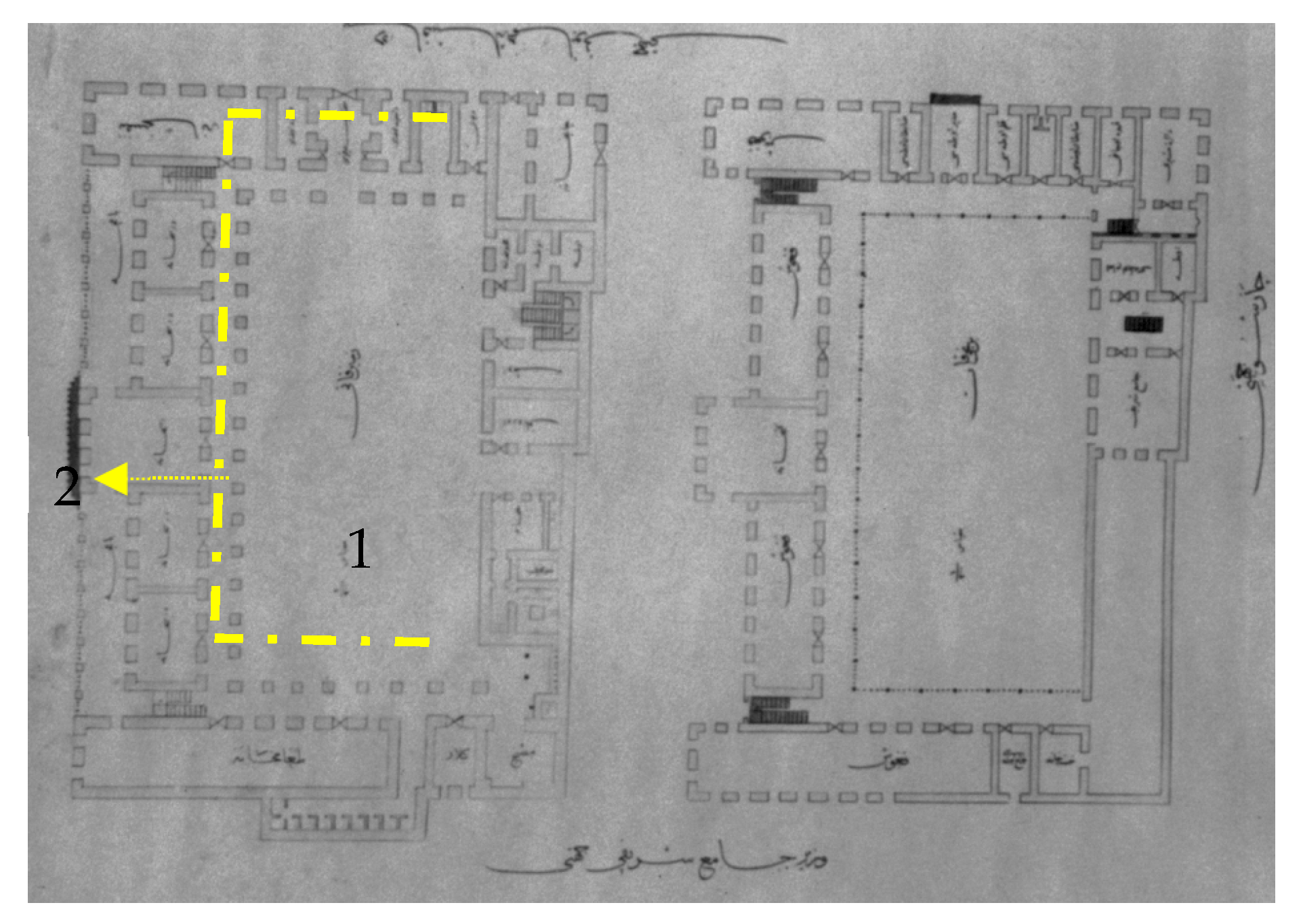
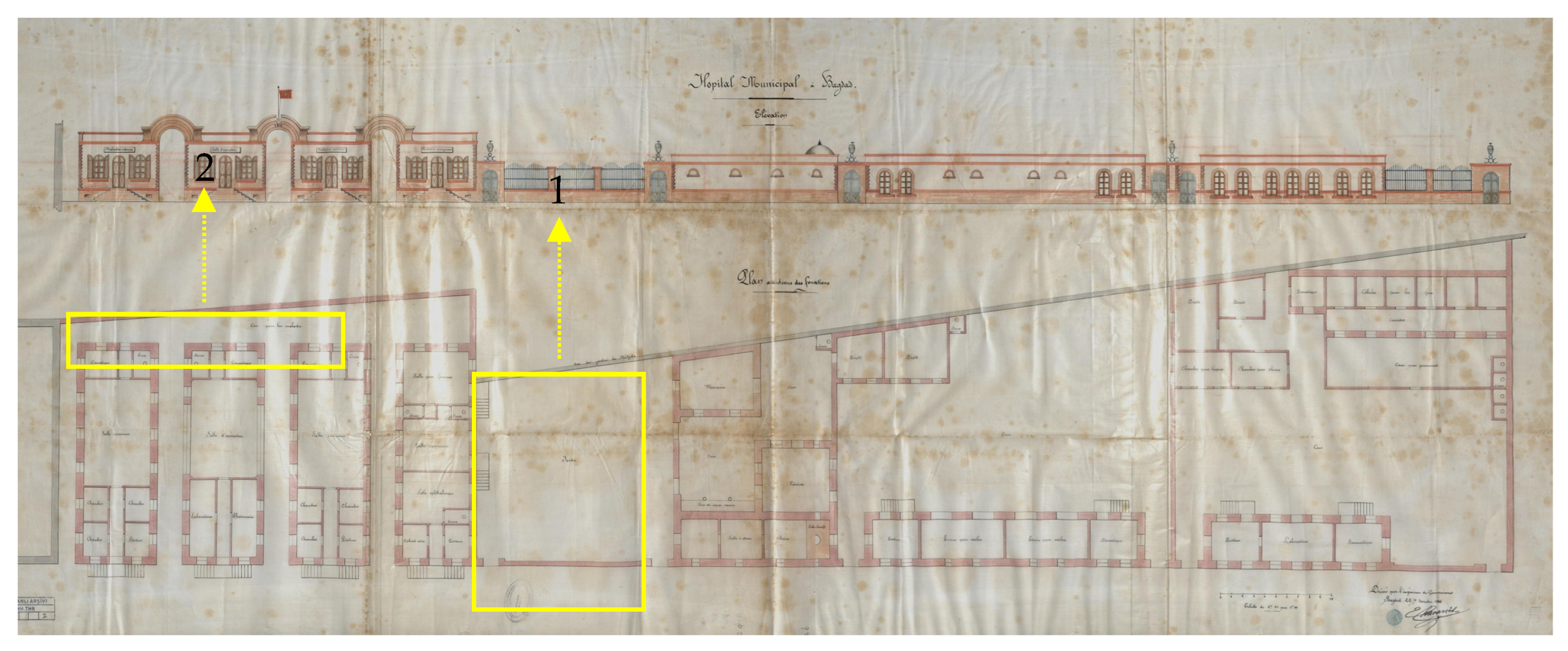
The building appears to be organized into two main units separated by a central garden. The larger unit, located to the right of the garden entrance, was designed with a flat roof and a raised basement and seems to have accommodated rooms for psychiatric patients in the section farthest from the entrance. Directly in front of these patient rooms is a shared corridor, followed by an enclosed courtyard that is surrounded and disconnected from the other units (
Figure 15). The area to the right of the garden separating the two main units contains service spaces such as the women’s ward and ophthalmology rooms, which are separated from other medical departments. This unit also includes an operating room, a laboratory, and numerous spaces identified as “rooms,” likely intended for inpatient care. The plan drawing further indicates that the hospital building incorporated service areas such as doctors’ offices, a pharmacy, attendants’ rooms, storage spaces, a place of worship, a kitchen, a common hall, bathrooms, and other related facilities (
Figure 16).
Situated on both banks of the Tigris River, Baghdad long held an important position in terms of Ottoman riverborne trade and customs revenues. According to detailed data in the Customs Yearbook, between 1913 and 1914, approximately one third of the Ottoman Empire’s total customs revenues were generated by the customs administrations of Baghdad, Beirut, Jeddah, and Yemen, with Baghdad ranking second after Beirut in terms of revenue volume among these provinces [
53].
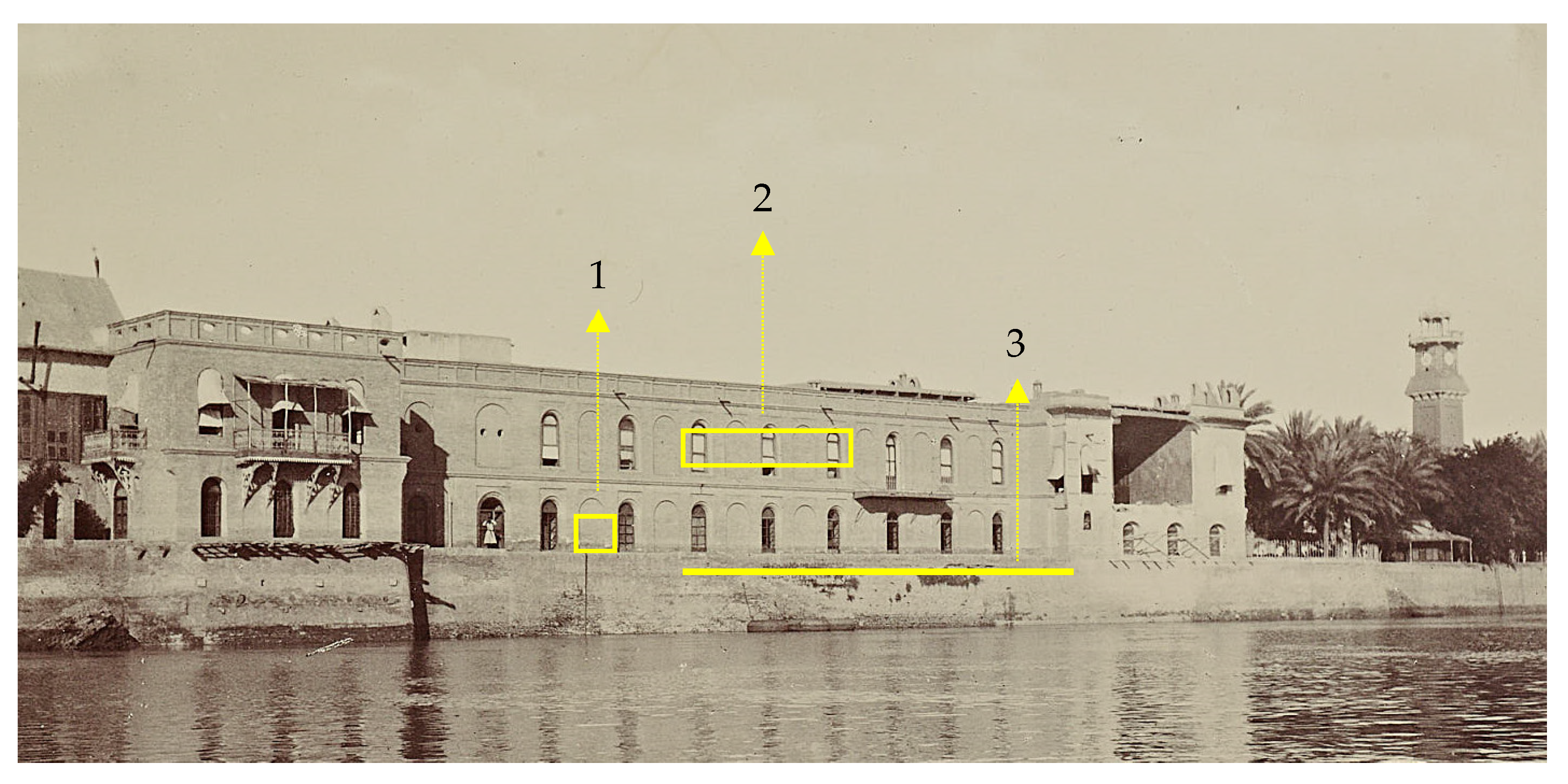
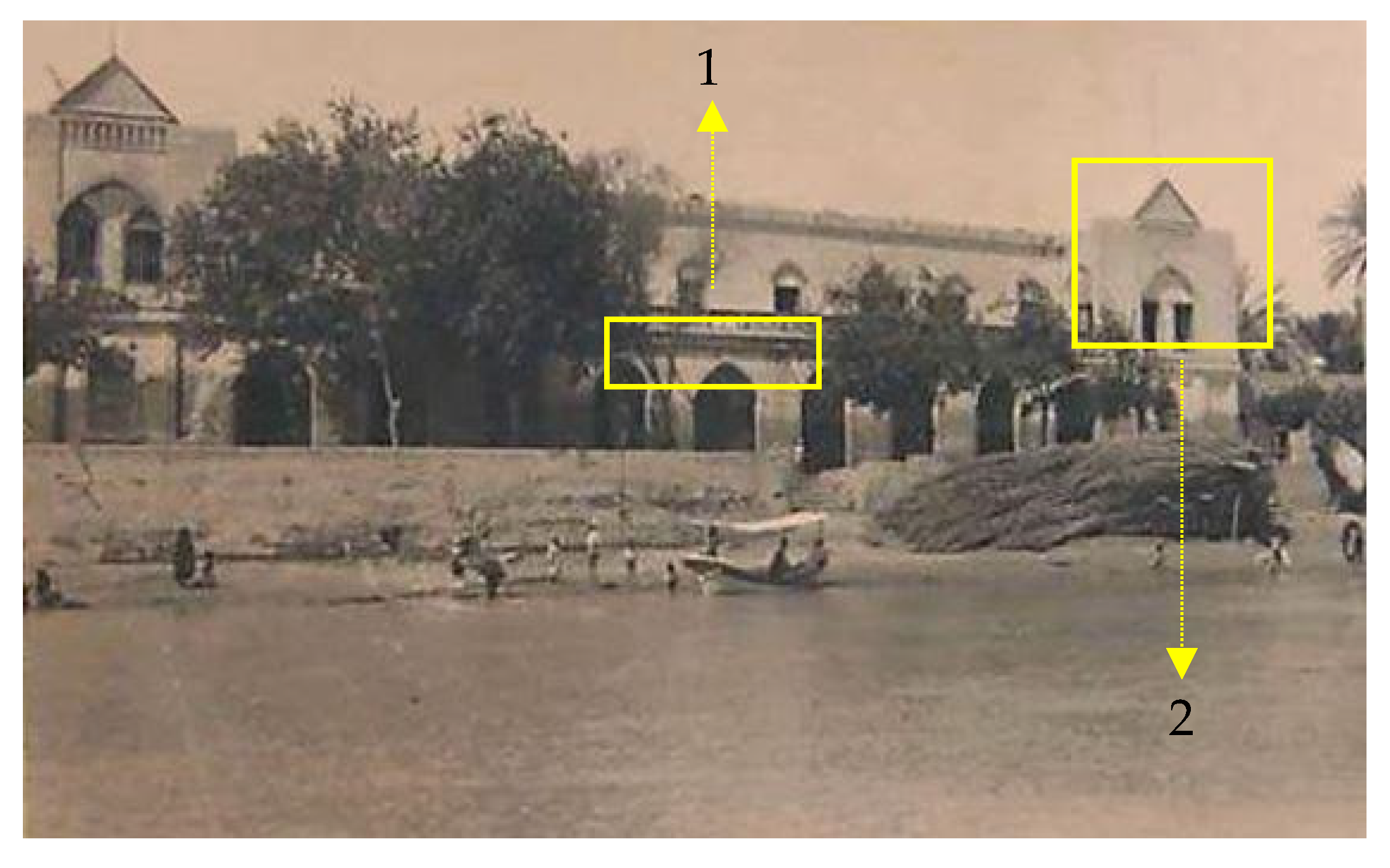
Symbolizing the city’s commercial connections with its hinterland while also functioning as an internal customs administration, the Baghdad Customs House was constructed along the Tigris River in the Rusafa district on a route where several major public buildings, including the Infantry Barracks, the Government Building, and the Military High School, were located in close proximity. As in other public building projects of the nineteenth century, this location was deliberately selected for the Customs House and subsequently became a preferred site for newly constructed building types in the city. The Baghdad Customs Building, which appears to have a rectangular plan and a strongly horizontal massing, is characterized by large arches on its façade facing the Tigris River. Its roof, apparently constructed of stone, is designed as a hipped roof (
Figure 17) [
54]. In an archival document dated 1864 and titled “Construction of the Customs Building in Baghdad’,
‘it is envisaged that a Customs Ministry would be established in Baghdad and that customs, tobacco, and salt revenues would be collected under a single administration. The dock in front of the building and the bricks that were the building’s basic material could be purchased for 210 kuruş thanks to cash payment and convenience.’
Furthermore, the statement,
“The cost of roof tiles [tiles, etc.] was reduced from 200 kuruş to 135 kuruş, resulting in savings of more than 70,000 kuruş”
proves with an official archive document that materials such as bricks and tiles were used as the building’s construction materials [
55].
Figure 17.
Riverfront view of the Baghdad Customs Office, highlighting the thick load-bearing masonry walls and exposed brick construction visible at the lower level (1) and the extended roof eaves providing shade and climatic protection along the facade (2). These features highlight how a centrally conceived administrative building was materially and environmentally adapted through local construction techniques and climate-responsive architectural elements in Baghdad [
56].
Figure 17.
Riverfront view of the Baghdad Customs Office, highlighting the thick load-bearing masonry walls and exposed brick construction visible at the lower level (1) and the extended roof eaves providing shade and climatic protection along the facade (2). These features highlight how a centrally conceived administrative building was materially and environmentally adapted through local construction techniques and climate-responsive architectural elements in Baghdad [
56].
5. Discussion: Urban Centrality, Centralization, and Local Adaptation in Baghdad
The findings of this study engage directly with ongoing debates on the diffusion of Ottoman architectural and administrative practices into provincial contexts. Irene Bierman’s notion of the “spread of Ottoman Istanbul into the provinces” frames provincial urban transformation as a spatial extension of imperial centrality beyond the capital [
1]. Similarly, Çelik’s research has emphasized the role of modernization processes in restructuring provincial cities through centrally informed architectural interventions. The comparative GIS analysis presented here both resonates with and complicates these interpretations. While the clustering patterns demonstrate that public building programs in Beirut, Damascus, and Baghdad followed comparable spatial strategies aligned with administrative centralization, the architectural evidence from Baghdad indicates that these interventions were not simple replications of Istanbul-centered precedents. Rather, they were shaped through negotiation with local morphology, material traditions, climatic conditions, and river-oriented spatial organization.
This discussion first situates Baghdad’s architectural evidence within the comparative patterns of urban centrality identified across the three cities, and then evaluates how centralisation policies were negotiated through local architectural practices in Baghdad (
Table 3 and
Table 4).
The Iraqi region has unique characteristics in terms of the building styles and materials used. Clay An analysis of Baghdad’s 19th-century public architecture reveals how Ottoman centralization policies intersected with long-established local building traditions, producing a layered urban and architectural fabric where imperial intentions and provincial realities coexisted. The Ottoman state, particularly after the Tanzimat reforms, aimed to consolidate administrative authority through a renewed spatial order: government buildings, barracks, schools, hospitals, customs offices, and postal and telegraph buildings were deliberately positioned along the Tigris River and on key axes to create a new urban backbone reflecting the state presence in the provincial capital. This spatial restructuring was consistent with broader imperial efforts to standardize administrative infrastructure across the empire. Archival evidence, including material records from Baghdad submitted to the central government in 1913, confirms that construction activities were carried out under strict administrative supervision, building materials were systematically recorded, and cost control and evaluation were implemented.
These documents demonstrate the empire’s attempts to regulate provincial construction, ensure consistency in material quality, and tighten bureaucratic control over local construction processes. However, the physical realization of these public buildings reflects a strong continuity of regional construction culture. As Abdullah and Al-Qaisi [
57] note, the Iraqi region possessed a deeply rooted architectural tradition shaped by climate, geography, and available materials: clay and gypsum in the south, limestone in the north, and brick, tile, plaster, stucco, marble, and stone were commonly used throughout the region. Thick load-bearing walls, vaulted brick interiors, cellars and basements for cooling, and tar applications for moisture protection were characteristic features that persisted into the Ottoman period. Early modern texts also provide information about the urban structure of Baghdad before the 19th century. For example, Pedro Teixeira, who visited the region in the early 17th century, described the city as follows:
“Approaching the city, after crossing a river with 28 channels, you enter through the great gate. There are also five more gates opening onto the river. … The whole area is very flat and fertile, and there are no mountains or hills to obstruct the view… The walls are one and a half leagues high and extend to the river, taking a crescent shape on the other side. There are two more gates extending towards the land. One is in the middle, the other at the other end. There is a wide moat nearby, and the walls are made of brick.” [
58]
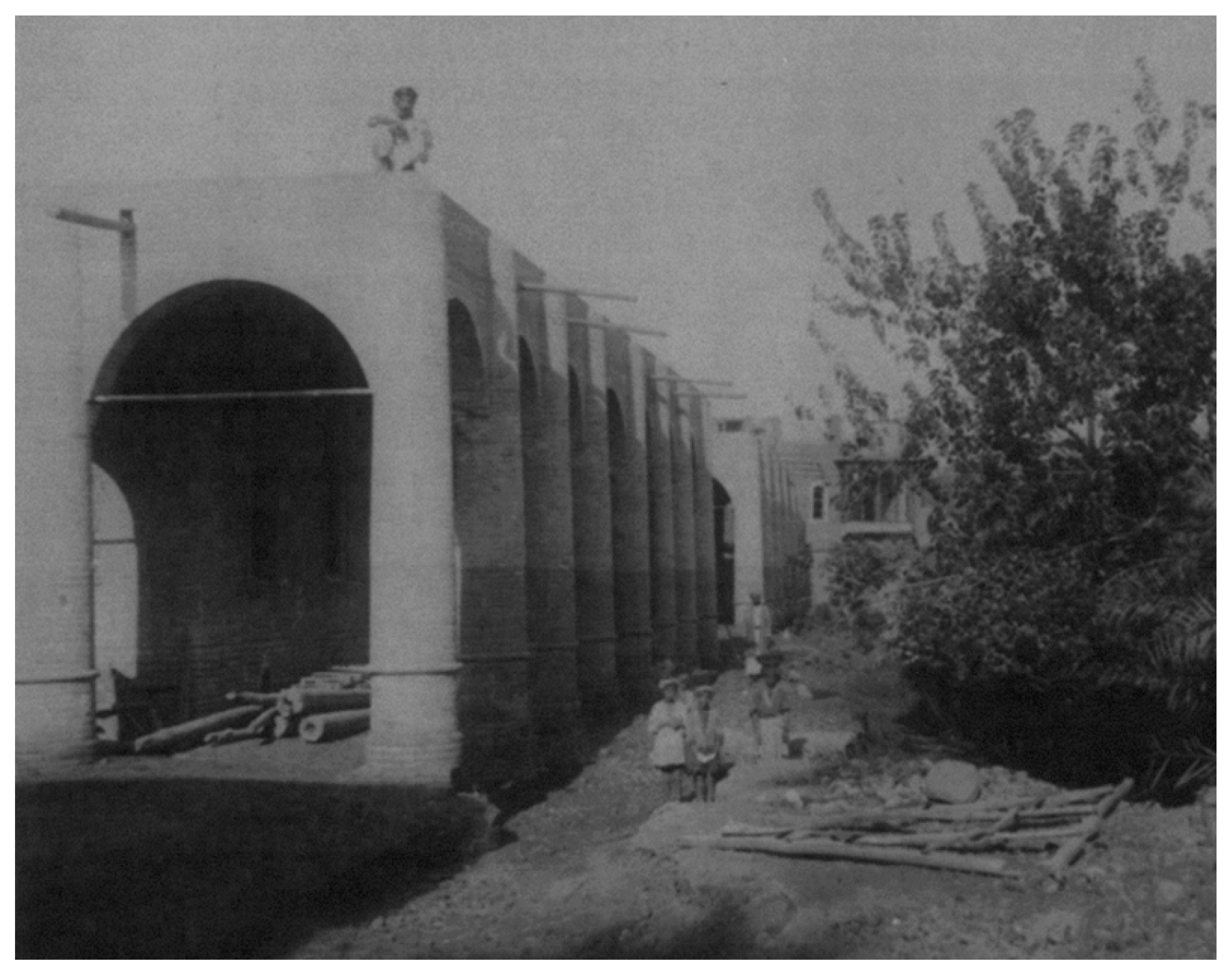
The statement found in an archival repair document concerning the Baghdad Infantry Barracks—indicating that “the barracks and external passageways are covered with vaulted arches constructed of brick”—is particularly informative with regard to material use and construction techniques [
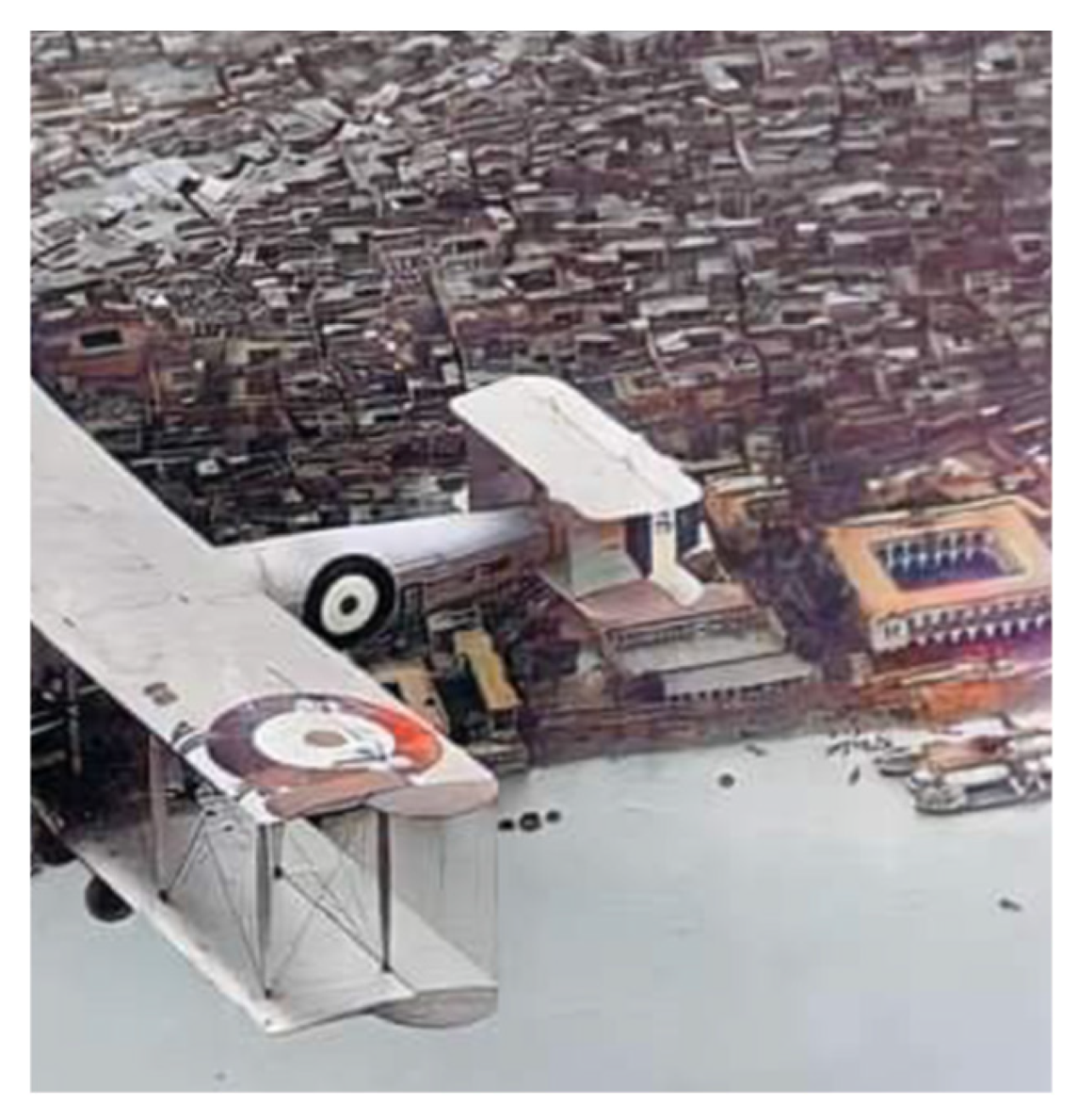
59]. Although the visual evidence presented in
Figure 18 derives from a different building, it effectively illustrates this constructional condition. These local building methods not only responded to Baghdad’s challenging climatic conditions but also shaped the structural and spatial configurations of newly constructed public facilities.
As demonstrated in
Table 3 and
Table 4, which summarize the analyses, the layout, façade composition, typological preferences, and institutional functions of Baghdad’s public buildings clearly express imperial architectural norms—such as symmetry, disciplined window rhythms, axial organization, courtyard schemes, and representative massing—while the material choices and technical practices remained distinctly local. The vision of establishing administratively centralized provincial centers thus intersected with the practical realities of Mesopotamian building culture, giving rise to hybrid architectural forms. This outcome may be summarized as “imperial in intent and urban positioning, yet regional in construction, material logic, and environmental adaptability.” Consequently, public architecture in late Ottoman Baghdad cannot be understood solely as an extension of Ottoman centralisation policies or as a direct continuation of local traditional practices; rather, it embodies a negotiated architectural identity shaped simultaneously by centralization and locality, institutional standardization and provincial age.
Table 3.
Architectural Characteristics and Local Adaptation of Some Public Buildings in Baghdad [B.N: Building Name].
Table 3.
Architectural Characteristics and Local Adaptation of Some Public Buildings in Baghdad [B.N: Building Name].
| B.N. | Evaluation Criteria | Evaluation |
|---|
| Government House [Serai] | Function/Type | Administrative |
| Location in the City | On the east bank of the Tigris River, along the Tigris-aligned urban axis. |
| Construction Material | Fired brick with lime plaster and wooden elements. |
| Structural Technique | brickwork on the exterior, wooden supported porches around the inner courtyard. |
| Surface Texture/Ornamentation | Plain brick masonry with round arches, arch traces, and arched windows. Simple arched facades and wooden railings in the courtyard. |
| Remarks on Local Adaptation | It combines imperial administrative typology with local building traditions; the use of brick, wood materials and the climatic courtyard layout, the presence of the ‘serdab’ floor. |
| Military High School | Function/Type | Education |
| Location in the City | The banks of the Tigris River are part of the public settlement that emerged in the late Ottoman period. |
| Construction Material | Predominantly local brick masonry; limited stone at load-bearing points. |
| Structural Technique | The structure features load-bearing brick masonry and a rectangular, cantilevered structural frame with regularly spaced arched window openings. |
| Surface Texture/Ornamentation | Smooth plastered façade; minimal ornamentation; rhythmic rows of tall arched windows. A decorative roofline crown element. |
| Remarks on Local Adaptation | Courtyard plan promotes ventilation; local brick reduces heat; coastal setting provides cooling. Imperial education model and local climate/material adaptation. |
| Municipality Hospital | Function/Type | Public health service |
| Location in the City | North of the old city, outside the walls, near the al-Muazzam gate; continuing along the line that follows the al-Rasheed Street route. |
| Construction Material | The facade was constructed using locally sourced materials, employing a brick-and-wall technique combined with plastered surfaces. |
| Structural Technique | Load-bearing brick masonry walls; flat timber roofing; repetitive ward modules around courtyards. |
| Surface Texture/Ornamentation | Simple plastered facades, rhythmically rounded arched window openings and wooden shutters, arched brick roof cornices, brick-patterned plinth traces. |
| Remarks on Local Adaptation | Use of brick due to climate & availability; elongated plan adapted to irregular plot; multiple courtyards for ventilation; segregated patient blocks reflecting local medical-spatial culture. |
| Guraba Hospital | Function/Type | Public health service |
| Location in the City | Al-Karkh district, along the Tigris River, opposite the main administrative concentration area. |
| Construction Material | Brick arches and vaults on the ground floor; smooth plastered brick surfaces. |
| Structural Technique | The building employs load-bearing brick masonry combined with a repetitive arcade system of wide pointed arches that support the upper floor. |
| Surface Texture/Ornamentation | Rhythmic arch openings; rectangular windows set in arched niches on the upper floor, with towers on either side. |
| Remarks on Local Adaptation | Strong adaptation to the local climate: courtyard plan for ventilation, shaded porches and vaults on the ground floor; thick walls for cooling and riverside location for water access; combines Ottoman public building typology with Baghdad local techniques. |
| Custom Office | Function/Type | Customs administration and river trade |
| Location in the City | Situated directly on the Tigris riverbank in Rusafa, aligned with other major 19th-century public buildings and positioned on the main commercial circulation route. |
| Construction Material | Primarily brick masonry, with stone elements around openings; archival records confirm the use of brick and tile. |
| Structural Technique | Load-bearing brick walls combined with a rectangular horizontally oriented plan; large arched openings create a rhythm along the riverside façade. |
| Surface Texture/Ornamentation | Minimal decoration; articulation achieved through deep arches, recessed bays and modest stone detailing, reflecting a functional public-commercial identity. |
| Remarks on Local Adaptation | The riverside orientation, large openings for ventilation, and use of abundant local brick demonstrate adaptation to the Baghdad climate and the river-based logistics essential for customs operations. |
Table 4.
Comparative Evaluation of Imperial Influence, Local Factors, and Architectural Adaptation in Selected Public Buildings of Ottoman Baghdad.
Table 4.
Comparative Evaluation of Imperial Influence, Local Factors, and Architectural Adaptation in Selected Public Buildings of Ottoman Baghdad.
| Category | Sub-Criteria | Government House | Military High School | Municipality Hospital | Gureba Hospital | Customs Office |
|---|
| Imperial Framework | Administrative symbolism | ●●● | ●● | ● | ●● | ●● |
| Standardized program | ●● | ●● | ●● | ●● | ●● |
| Formal vocabulary | ●● | ●● | ●● | ●● | ●● |
| Local Factor Influence | Climate adaptation | ●●● | ●● | ●● | ●●● | ●● |
| Material constraints | ●●● | ●● | ●●● | ●●● | ●●● |
| Architectural Adaptation | Water orientation | ●●● | ●● | ●● | ●●● | ●●● |
| Plan adaptation | ●● | ●●● | ●●● | ●● | ●● |
| Facade adaptation | ●● | ●● | ●● | ●●● | ●●● |
6. Evaluation and Conclusions
This study aims to elucidate how public buildings in Baghdad were produced within a provincial context and how they related to local conditions by examining their urban locations and architectural characteristics in the second half of the nineteenth century. The comparative framework established between Beirut, Damascus, and Baghdad demonstrates that public buildings in different provincial capitals were positioned according to similar spatial logics, while these logics materialized in distinct ways under varying physical and environmental conditions in each city.
The urban analyses reveal that in all three cities public buildings were located in relation to strong geographical references such as rivers or ports, contributing to the formation of new civic focal points. Government buildings, military structures, educational and health institutions, and service facilities were not distributed randomly within the urban fabric; rather, they were arranged in spatial configurations defined by patterned clustering rather than random distribution. This indicates that public buildings functioned not merely as individual structures but as components that actively shaped urban organization.
Building-scale architectural analyses focused on Baghdad further substantiate these broader urban observations. The widespread use of local materials—most notably brick—along with regionally established construction techniques such as thick load-bearing walls, vaulted spaces, shaded transitional areas, and courtyard-centered plan schemes, is clearly observable in the examined public buildings. These features demonstrate a design approach responsive to environmental and climatic conditions. By contrast, the functional programs, spatial hierarchies, and institutional arrangements of these buildings display a configuration consistent with contemporary conceptions of public architecture.
The evaluation table addressing the five selected public buildings reveals that their architectural characteristics did not develop along a single trajectory but instead incorporated varying degrees of local adaptation [
Table 3]. While the Government Building and the Customs House exhibit stronger institutional continuity through their locations and functional layouts, the Gureba Hospital stands out as a structure that responds more directly to local conditions through its material use, plan organization, and relationship with the river [
Table 3 and
Table 4]. The Military High School and the Municipal Hospital occupy an intermediate position, balancing functional requirements with local architectural solutions. Across all cases, the sustained relationship with the Tigris River underscores its determining role in shaping public and administrative spaces in Baghdad.
Taken together, these findings indicate that public architecture in Baghdad cannot be interpreted either as the direct application of a fully standardized model or solely as the continuation of local building traditions. Rather, public buildings were shaped through a multi-layered process of adaptation negotiated between general programmatic frameworks and local materials, climate, and urban context. The resulting built environment exhibits a hybrid architectural character at both the urban and building scales.
The calibrated clustering analyses further demonstrate that urban centrality in Beirut, Damascus, and Baghdad was not an abstract or symbolic construct but a measurable spatial condition produced through varying degrees of clustering intensity and axial alignment. The comparative results reveal that all three cities displayed measurable patterns of administrative clustering, although the density, continuity, and configuration of these clusters differed according to local geographical and urban structures. The calibrated clustering analyses demonstrate that urban centrality can be operationalized through measurable patterns of clustering intensity and axial alignment. Importantly, these findings do not merely reaffirm that public buildings contributed to urban transformation—a premise widely acknowledged in urban historiography. Rather, the calibrated spatial analysis makes it possible to distinguish between different intensities and configurations of centralization across provincial capitals. The results reveal that centralization did not produce a uniform spatial outcome; instead, it materialized through distinct mechanisms such as corridor-aligned clustering in Beirut, compact nodal concentration in Damascus, and river-aligned elongated clustering in Baghdad. This study goes beyond descriptive mapping by conceptualizing urban centrality as a spatially analyzable pattern within a quantitative framework, basing interpretations of modernization and centralization on empirically observable clustering configurations.
Integrating these analyses with architectural inquiry, the research identifies how institutional concentration, axial alignment, and environmental dispersion function as spatial expressions of centralization. The Baghdad case demonstrates that processes of adaptation and reciprocal shaping between centralized public building programs and local materials, construction techniques, and environmental conditions were reflected not only in architectural form but also in the spatial organization of public institutions within the urban fabric.
This multi-scalar approach positions public architecture not merely as a reflection of administrative reform but as a structuring component in the formation of differentiated urban centralities. The study also contributes to ongoing discussions on the historical assessment of architectural heritage by providing a concrete spatial framework. Identifying administrative clusters and their relationships to major urban axes enables the delineation of historically concentrated areas, supports the definition of coherent conservation zones, and offers a spatial basis for developing adaptive reuse strategies for public buildings. In rapidly transforming cities such as Baghdad, these findings contribute to the integration of historical civic cores into sustainable urban planning and heritage management processes.
Beyond its historical and analytical contributions, the study provides spatially grounded insights that may inform conservation and planning practices. The identification of historically concentrated administrative clusters enables the delineation of potential heritage zones that extend beyond individual monuments to encompass broader urban contexts. Recognizing the relationship between public buildings and major urban axes also supports the preservation of morphological continuity within historic centers. In rapidly transforming cities such as Baghdad, integrating such spatial knowledge into planning processes may contribute to more sustainable urban management strategies that balance development pressures with the protection of historic civic cores.
The framework developed through the comparison of Beirut, Damascus, and Baghdad renders visible the diverse forms of urban organization generated by public architecture in provincial cities, while building-scale architectural readings elucidate the material and spatial dimensions of this process. In this respect, the study offers a comprehensive interpretation that places the urban-scale role of public architecture at the center of Ottoman architectural history in a provincial context.
Moreover, the study demonstrates that a multi-scalar research framework combining historical maps, archival visual materials, architectural analysis, and digital spatial tools can be applied to the study of public architecture in comparable periods and geographies. In particular, the use of calibrated DBSCAN clustering and comparative spatial metrics demonstrates how digital spatial methods can move beyond illustrative mapping toward analytically grounded interpretations of urban structure. The present study focuses on planimetric spatial relationships and clustering patterns. Future research integrating volumetric data, building heights, and three-dimensional modelling would further refine the analysis of urban prominence and public architectural visibility within late Ottoman provincial cities.
The proposed methodology provides a flexible analytical framework for future research on other provincial cities or different imperial contexts, enabling the role of public buildings in the production of urban space to be examined through temporal and spatial continuities. While the comparative structure allows for systematic evaluation across three provincial capitals, the findings should not be interpreted as statistically generalizable to the entire Ottoman urban system. Rather, the study offers an analytically comparable framework for examining spatial centrality in selected provincial contexts where consistent cartographic and archival data are available.