Systematic Review

Advancing Digital Twins for Building Lifecycle Management in Construction: A Systematic Literature Review


by
Tran Duong Nguyen
1 and
Sanjeev Adhikari
2,*
1
School of Building Construction, College of Design, Georgia Institute of Technology, Atlanta, GA 30332, USA
2
Department of Construction Management, Kennesaw State University, Marietta, GA 30060, USA
*
Author to whom correspondence should be addressed.
Buildings 2026, 16(6), 1151; https://doi.org/10.3390/buildings16061151
Submission received: 17 December 2025 / Revised: 18 February 2026 / Accepted: 5 March 2026 / Published: 14 March 2026

Abstract

The Fourth Industrial Revolution has accelerated the adoption of advanced digital technologies in construction, with Digital Twin (DT) emerging as a data-driven framework for enhancing project performance, efficiency, and sustainability. Despite these advantages, DT adoption in construction remains limited due to high implementation costs, data integration challenges, and a lack of standardized practices, especially in real-time data utilization and lifecycle management. This study presents a PRISMA-guided systematic literature review of DT applications across the construction lifecycle. The study addresses three main objectives: (1) to analyze DT’s adoption across construction lifecycle phases, (2) to identify barriers and benefits to DT adoption, and (3) to explore research gaps and potential advancements. Peer-reviewed journal articles published between 2003 and 2024 were retrieved from the Scopus and Web of Science databases using structured keyword combinations related to Digital Twin and the built environment. From an initial pool of 3109 records, 53 studies met predefined inclusion criteria. They were analyzed using a lifecycle-oriented thematic coding framework examining application domains, enabling technologies, reported benefits, and implementation constraints. Unlike prior reviews that focus on specific technologies or lifecycle segments, this study provides a lifecycle-wide synthesis of DT maturity across design, construction, operation, and demolition phases. The findings indicate that DT applications are most developed in the design and operation phases, particularly through integration with Building Information Modeling (BIM) and Internet of Things (IoT) systems for simulation, monitoring, and predictive maintenance. In contrast, construction-phase adoption is constrained by challenges in real-time data integration, while demolition and end-of-life applications remain largely conceptual. Overall, current DT implementations are predominantly phase-specific rather than lifecycle-integrated, therefore emphasizing the need for standardized data frameworks, scalable architectures, and cross-phase governance strategies to enable end-to-end lifecycle digitalization in construction.

1. Introduction

The construction industry, which encompasses Real estate, Infrastructure, and Industrial structures, is the largest globally, contributing 13 percent of global GDP. Nevertheless, it continues to face persistent challenges in efficiency, digital integration, and sustainability [1]. The analysis also found that annual productivity growth was only one-third of the economy’s average over the past 20 years [1] and does not appear to keep pace with societal demands [2]. The industry is perceived as among the least digitally advanced and slow to adopt digital technologies [3]. Given this background, the construction sector must transform and modernize itself to address these issues [4]. Fortunately, the productivity gap can be reduced through performance improvement in the construction sector [5].
One promising solution to these challenges is Digital Twin (DT) technology. What makes DT technology original is its management of physical assets in industries through virtual replicas that mirror real-world processes. It has become essential for reshaping simulation-based planning and optimization processes in the manufacturing and automotive sectors to enhance efficiency [6]. In the construction industry, DT leverages real-time data from sensors to monitor the physical structure of an actual building or project, helping to predict issues, improve maintenance, and make better decisions throughout the entire process [7]. Studies by [8,9] summarize the substantial value of DT in manufacturing. DT enables predictive maintenance, optimized production processes, and a highly controlled quality process. These applications further facilitate faster, more informed decisions, hence showing the strong applicability of DT in manufacturing, where strict standards and efficiency mandates drive its value. However, unlike manufacturing, where DT has succeeded in process optimization and quality control, the construction sector faces unique technical and economic barriers to adopting DT. These challenges include high implementation costs, complex data integration requirements, and a lack of standardized frameworks, particularly regarding interoperability and real-time data exchange [5,10].
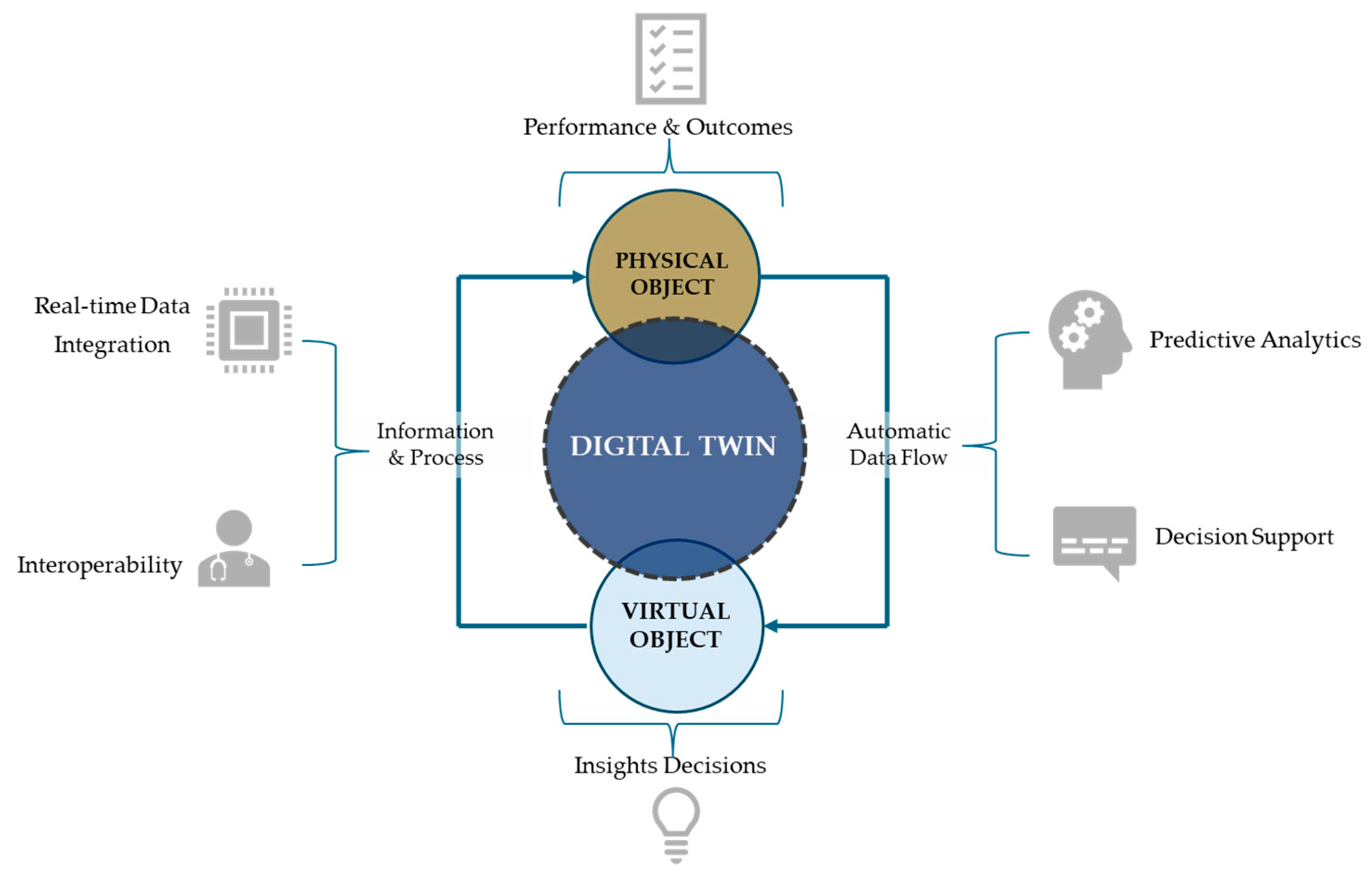
Given these challenges and opportunities, this paper aims to provide actionable insights into how DT can be better integrated into the construction lifecycle. By building on prior research and addressing current knowledge gaps, this study seeks to contribute to a clearer understanding of DT’s transformative role in construction. With a focus on the entire lifecycle, from design and construction through operation and demolition, this paper examines how DT can enhance efficiency, project management, and sustainability in construction projects. Figure 1 illustrates a Digital Twin Concept [10,11].
The concept of DT has evolved significantly since its informal introduction in the early 2000s, in a paper by Dr. Michael Grieves at the Product Lifecycle Management Special Meeting. It was discussed as the “Mirrored Spaces Model” [12], and the concept was later described as the “Information Mirroring Model” [13]. Until now, these phrases have converged into a single term, widely adopted as “Digital Twin” [14]. This evolution reflects a shift from static representation toward dynamic cyber-physical integration. Accordingly, DT applications have expanded to include real-time data exchange and multi-scale simulations, setting DT as a bridge between physical and digital domains [15]. In manufacturing, this DT potential has been well documented, as it aids predictive maintenance, decision-making, and lifecycle management through intelligent data integration [8,9]. However, while manufacturing has embraced DT, the construction industry has yet to benefit from it due to barriers that impede seamless integration.
To clarify this conceptual ambiguity and address this implementation challenge, the literature increasingly distinguishes between static digital models, digital shadows, and fully developed DT. Digital models are offline or manually updated representations with no requirement for automated data exchange [15,16]. Digital shadows introduce automated, one-way data flow from the physical asset to its virtual counterpart, enabling real-time monitoring but not control [17]. By contrast, a DT is defined as a dynamically synchronized, data-driven virtual representation of a physical system, characterized by continuous (often bidirectional) cyber–physical data exchange that supports monitoring, simulation, prediction, optimization, and control across the asset lifecycle [15,16,18]. In the built environment, BIM provides rich, structured information models and is viewed as a key enabler and data backbone for DT, yet BIM alone remains essentially static and does not constitute a DT unless coupled with real-time sensing, analytics, and feedback/control mechanisms [19,20,21]. Given this critical distinction, conceptual precision becomes essential when synthesizing the literature. Accordingly, in this review, studies were classified as DT research only when they implemented dynamic data linkage between physical and digital systems (at a minimum, continuously updated data streams) and delivered lifecycle monitoring, predictive, or decision-support capabilities beyond static BIM or modeling [16,17,22].
Building on this operational clarification, it is equally important to situate the present review within the broader body of existing scholarship. Several recent reviews have examined DT in construction, focusing on bibliometric trends [23,24], BIM integration and interoperability [21,22], facility management applications [24], and safety and technology-oriented implementations [25,26]. These studies have significantly advanced the understanding of DT and its domain-specific applications across the built environment. However, most concentrate on specific enabling technologies, organizational drivers, or isolated lifecycle phases, rather than systematically evaluating DT maturity across the full building lifecycle [27]. Consequently, lifecycle continuity, cross-phase integration depth, and comparative maturity levels remain insufficiently examined [28]. Unlike prior reviews that primarily adopt bibliometric, technology-centered, or phase-specific perspectives, the present study employs a lifecycle-oriented analytical framework to assess DT adoption across the design, construction, operation, and demolition phases. By evaluating integration depth and cross-phase continuity rather than isolated applications, this review clarifies maturity differences and identifies research priorities necessary to support end-to-end lifecycle digitalization in construction [22,29].
To address the identified lifecycle-wide synthesis gap, this paper systematically reviews the literature to assess the current state of DT in construction. The following four key research questions (RQs) inform the findings of the research:
  • RQ1: What is the current state of Digital Twin adoption across various stages of the construction lifecycle, including design, construction, operation, and demolition?
  • RQ2: What are the primary benefits and common barriers to Digital Twin adoption in the construction industry?
  • RQ3: How are Digital Twin applications in construction evolving to integrate with emerging technologies, including AI, IoT, and BIM?
  • RQ4: What are the critical research gaps in Digital Twin integration within construction, and how can addressing these gaps inform future advancements?
The paper is organized as follows: after the Introduction, Section 2 of the Literature Review presents the current state of the art of DT in construction, covering its applications, benefits, challenges, and relevant integrations. Section 3 describes the methodology, representing the structured literature analysis process. Section 4 discusses the results found for each research question, while Section 5 discusses the findings and the future potential of DT in construction. Finally, Section 6 concludes with a summary of key insights and a comprehensive reference list.

2. Background

DT technology has rapidly emerged as a transformative force across multiple industries, potentially reshaping traditional construction practices by bridging the gap between physical and digital assets. This section provides a conceptual and contextual overview of Digital Twin (DT) development in the construction domain, outlining key themes discussed in the literature. Given the complexity and unique nature of construction projects, and the industry’s historically slow adoption of digital technologies, DT offers an innovative solution to longstanding challenges in project optimization and management. The purpose of the Background section is to establish the theoretical context and thematic scope of DT research before the structured, systematic analysis presented in subsequent sections.

2.1. Growth and Research Trends in DT Technology

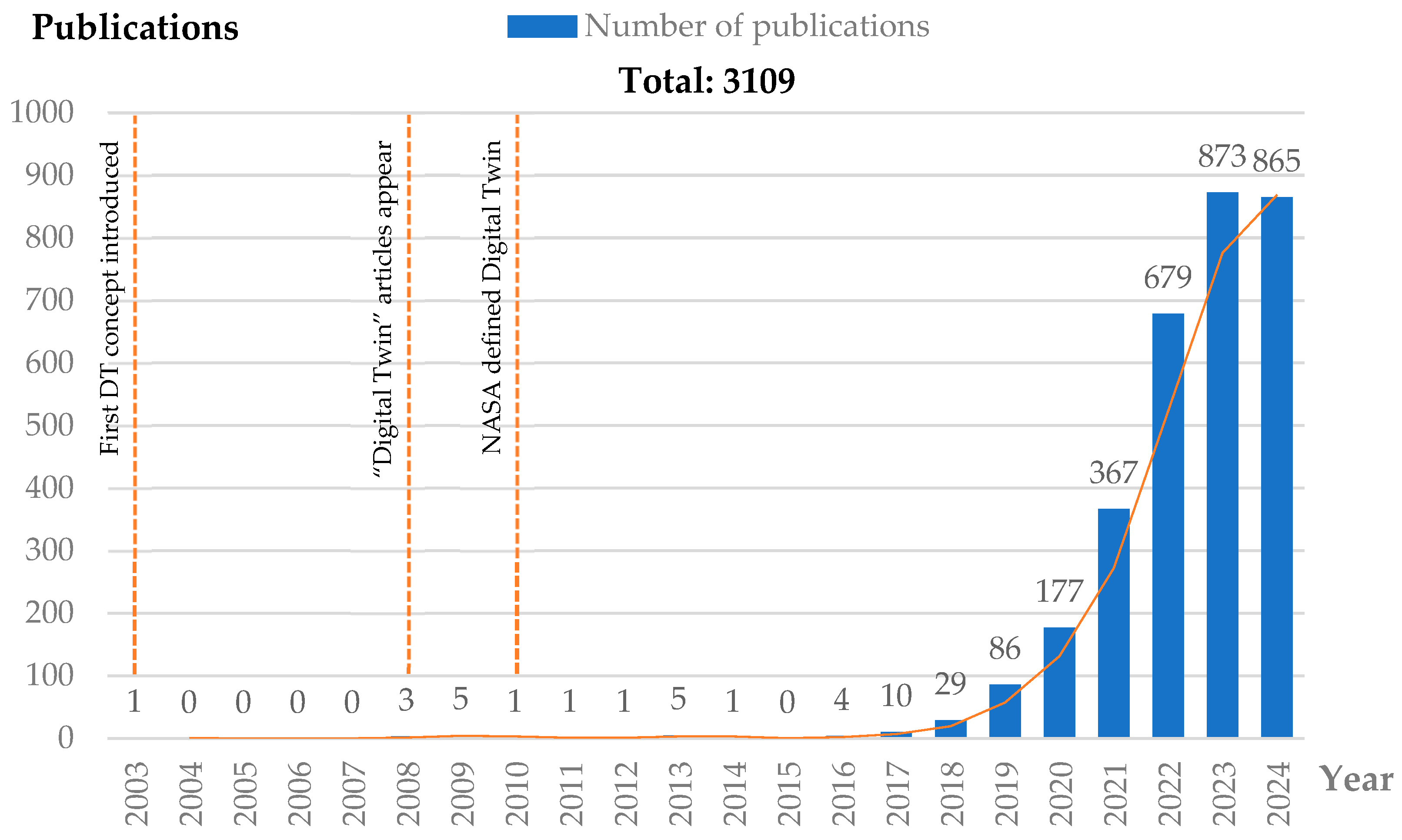
To illustrate the growing importance of DT, publications from 2003 to 2024 were examined to identify general research trends and temporal patterns. Since its initial conceptualization by Dr. Grieves in 2003, DT has attracted significant attention in academic research, particularly in construction. Bibliographic data retrieved from the Scopus database were used to visualize publication trends over time, as illustrated in Figure 2. Significant milestones in DT research include the National Aeronautics and Space Administration (NASA) adopting DT in 2010 and a notable increase in DT-related publications beginning in 2018. Publication counts show substantial growth from 2018 to 2024, reflecting expanding scholarly engagement with DT concepts. These publication trends indicate increasing academic and industry attention to DT-related topics.
As demonstrated in Figure 2, DT is attracting significant interest across academia and industry in the construction sector due to its potential to enhance project management, safety, and sustainability. The diversity of DT-related applications and interpretations in the literature reflects the interdisciplinary and evolving nature of the field [18]. Such conceptual diversity underscores the importance of systematically synthesizing existing scholarship to clarify definitions, application domains, and research directions [30].
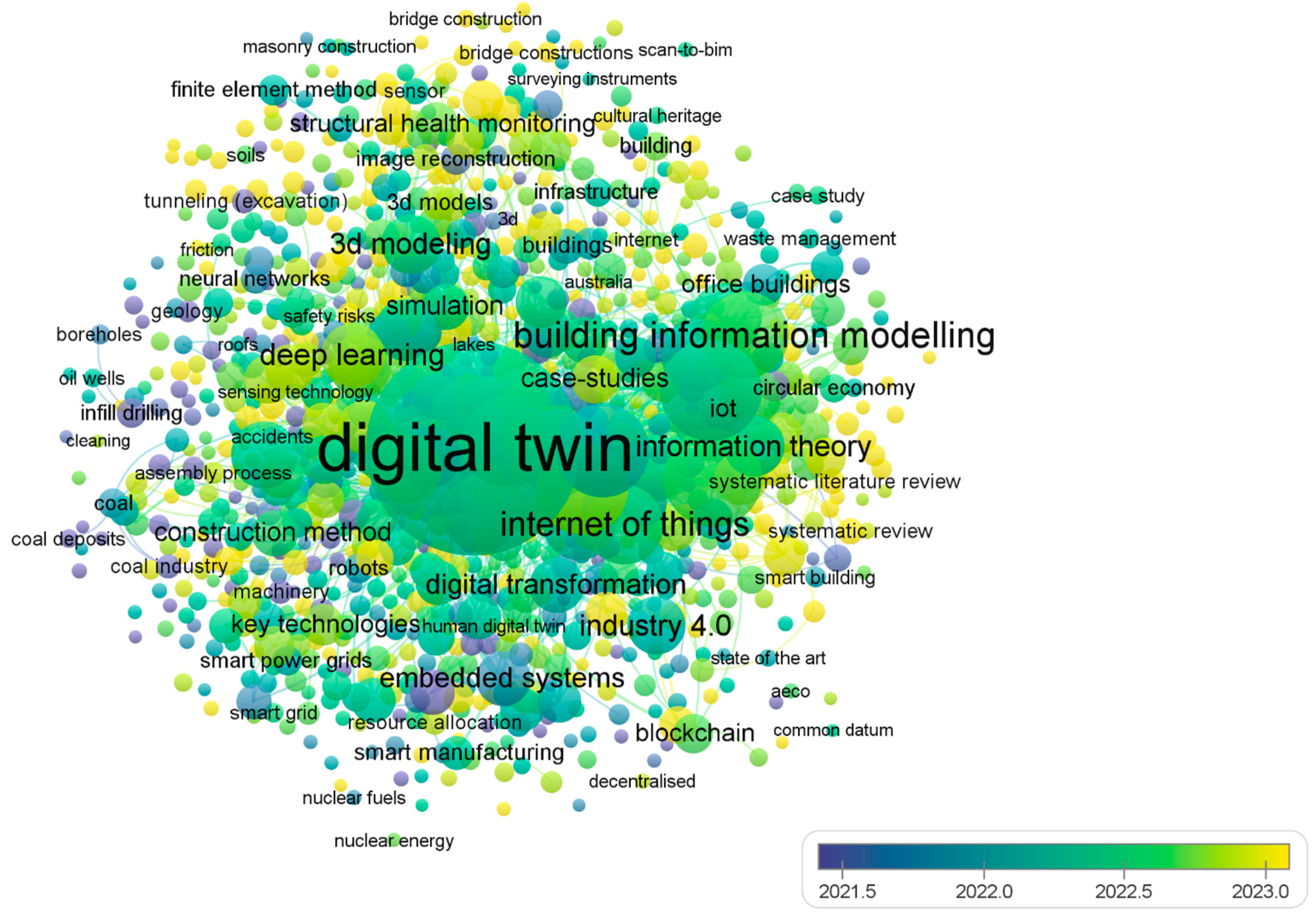
Further illustrating DT’s impact, Figure 3 displays a word cloud derived from Scopus data, showing keyword co-occurrence in DT literature based on Scopus search results, covering articles from 2003 to 2024. Of the 3109 articles analyzed, 1285 of 18,004 keywords were used in this study. Figure 3 presents prominent DT-related topics, including Industry 4.0, Building Information Modeling (BIM), Internet of Things (IoT), deep learning, and digital transformation. The visualization highlights strong associations between Digital Twin and complementary technologies such as BIM, IoT, and Industry 4.0. Closely linked to predictive technologies such as deep learning and neural networks, as well as to emerging topics such as blockchain and data-driven systems, DT is often discussed in the context of real-time monitoring and analytics. These co-occurrence patterns illustrate the multidimensional technological context within which DT research is located. The color of each node represents the average publication year of the keyword, where blue indicates earlier studies and yellow represents more recent research trends.

2.2. Building Lifecycle Management and Optimization

DT has been discussed in the literature as a framework for enhancing building lifecycle management by mirroring physical assets across construction phases, including design, construction, operation, maintenance, and demolition. By tracking asset performance over time and simulating operational scenarios, DT is described as supporting proactive maintenance planning, which may reduce operational costs and extend asset lifespans [18,19]. In the design phase, for instance, DT integration with BIM has enabled more accurate simulations, reducing design errors and improving planning efficiency [5,20]. During construction, DT integrated with IoT has been explored for real-time monitoring applications, including resource tracking, safety observation, and workflow coordination. In the operation and maintenance phase, DT has been associated with predictive maintenance strategies and resource optimization practices [31].
The extent and depth of DT application vary across lifecycle phases, reflecting differences in data availability, system integration requirements, and operational priorities [32]. These variations have prompted continued discussion regarding how DT frameworks may be structured to support lifecycle-wide continuity and coordination. DT applications are discussed across both construction and manufacturing domains, although sectoral priorities differ. In the design phase, DT supports collaborative engineering and scenario-based simulation for complex infrastructure projects. For example, research by ref. [33], demonstrated DT’s effectiveness in improving technical communication and optimizing architectural designs through real-time simulation. Similarly, ref. [34] illustrated DT’s design potential by optimizing ventilation systems in sanitation projects.
In construction and manufacturing contexts, DT has also been applied to real-time monitoring and risk mitigation. For instance, ref. [35] integrated DT with Machine Learning (ML) techniques to analyze safety risks on construction sites. In manufacturing, DT has been associated with flexible scheduling, process optimization, and predictive maintenance, as shown by [36], who applied DT to anticipate machinery failures. During operation and maintenance, DT’s real-time data integration has been explored for energy management and asset optimization, as reported by ref. [37]. These studies illustrate the breadth of DT-related applications discussed in the literature across lifecycle stages and industrial contexts.

2.3. Integration of DT with BIM and IoT

DT research frequently emphasizes integration with BIM and IoT systems. BIM provides structured digital representations of physical assets that support planning, design, and information coordination, while IoT technologies supply real-time data on system performance and site conditions [33]. By linking BIM-based models with IoT sensor streams, DT frameworks support near-real-time monitoring and analysis across construction processes. The integration of DT, BIM, and IoT involves coordination across heterogeneous data formats, semantic models, and exchange protocols, which introduces technical and organizational complexity [5,25].
Within these integrated environments, recent studies incorporate ML techniques to augment DT capabilities. ML is commonly applied for pattern recognition, anomaly detection, and predictive analytics based on sensor and time-series data, particularly in contexts where deterministic modeling alone may be insufficient. Rather than replacing physics-based or simulation models, ML is typically described as a complementary component within hybrid DT architectures that combine data-driven inference with structured BIM information. The quality, interoperability, and governance of underlying data infrastructures influence the performance of these hybrid architectures [38].

2.4. Enhancing Safety and Risk Management

Safety management is widely recognized as a significant application area for DT in construction, given the high-risk nature of many project environments. When integrated with IoT-enabled sensing technologies, DT frameworks have been explored for real-time monitoring of site conditions, including environmental and structural states, enabling earlier identification of potential safety risks and supporting predictive safety planning [39]. In DT-enabled safety environments, ML is often used to process heterogeneous sensor and measurement data, enabling pattern recognition, anomaly detection, and predictive risk assessment. For example, hybrid and ensemble ML models have been shown to outperform traditional empirical approaches in predictive tasks under dynamic, uncertain conditions [40,41]. These approaches illustrate how ML functions as an analytical layer within DT architectures, transforming sensor data into structured safety insights. In this context, ML is typically described as a complementary component within DT systems rather than a replacement for cyber–physical synchronization mechanisms. The application of DT-based safety systems involves considerations related to IoT deployment costs, data connectivity reliability, and integration scalability, particularly in complex or remote construction environments [42]. These conditions are frequently discussed in the context of the feasibility and scalability of DT–ML safety frameworks.

2.5. Sustainability and Resource Efficiency

With growing emphasis on environmental sustainability in construction, DT has been discussed in relation to resource optimization and lifecycle performance improvement. In the operation phase, DT frameworks are associated with energy management applications through predictive analytics, supporting optimization of systems such as HVAC and other building services. DT applications have been explored to optimize energy consumption, reduce material waste, and support end-of-life planning strategies. For instance, DT has been applied to predictive maintenance in facility management contexts, contributing to asset longevity and energy performance management [5]. In the demolition and recovery phase, DT has been examined as a tool for material recovery planning and resource tracking. Reference [32] describes DT’s potential role in supporting circular economy principles, including material classification for recycling and structured demolition planning. The literature discusses DT’s environmental implications in terms of energy optimization, waste reduction, and lifecycle resource efficiency. Quantitative performance evaluation methods and standardized environmental metrics are often considered within broader discussions of sustainability assessment in construction contexts [43].

2.6. Data Security and Ownership

Data security and ownership are increasingly discussed in construction on DT. Given the collaborative nature of construction projects, DT platforms often require extensive data sharing among multiple stakeholders, raising concerns regarding intellectual property rights, data ownership, and information security [43]. Project data exchanged across firms may introduce security vulnerabilities, particularly when stored or transmitted through cloud-based DT platforms [28,30]. Furthermore, the lack of clearly defined governance structures for data sharing and ownership is frequently noted in discussions of stakeholder coordination. Companies may exercise caution when disclosing proprietary information in shared digital environments. Accordingly, the literature references legal, contractual, and governance considerations as relevant components of DT-enabled collaboration frameworks [5,25].

2.7. Technical and Organizational Barriers to Adoption

In addition to technical considerations, organizational and financial factors are frequently discussed in relation to DT implementation in construction. The cost of implementing DT technologies, including IoT sensors, cloud infrastructure, and data processing systems, is commonly cited as a significant consideration, particularly for small and medium-sized enterprises [28,31]. The evaluation of return on investment (ROI) is often contextualized within the construction industry’s traditionally low-margin structure, which may influence technology adoption decisions. Organizational inertia and resistance to workflow change are also described in the literature, especially among stakeholders unfamiliar with DT systems [42]. Another commonly referenced factor is the availability of skilled personnel capable of interpreting DT data and managing digital platforms. The development of digital competencies, training frameworks, and cost–benefit evaluation methods is frequently discussed in relation to long-term DT integration strategies [29,34].
Collectively, the literature presents DT as a multi-dimensional concept encompassing lifecycle management, technological integration, safety applications, sustainability considerations, data governance, and organizational factors. These thematic domains provide the conceptual foundation for understanding the scope and diversity of DT research within the construction industry. The structured assessment of lifecycle maturity, integration depth, and research gaps identified across these domains is presented in the subsequent systematic review analysis to ensure methodological clarity and analytical coherence.

3. Methodology

3.1. Research Design and Review Protocol

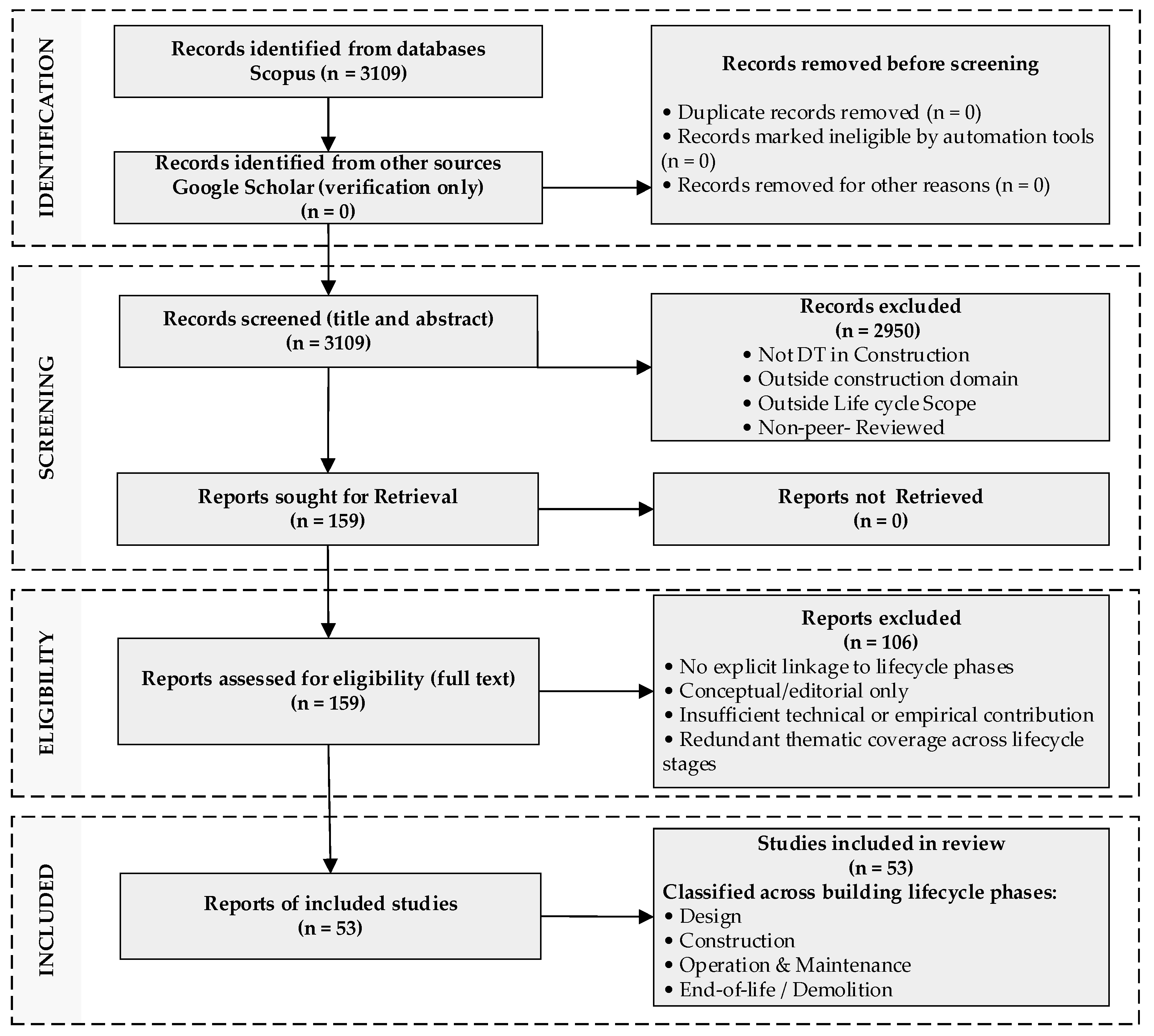
The study adopted a systematic literature review approach to examine DT applications across the construction lifecycle. The review protocol followed the PRISMA 2020 framework for reporting systematic reviews (Page et al., 2021) [44], comprising four sequential phases: identification, screening, eligibility assessment, and inclusion (Figure 4). The detailed search strategy and screening process are provided in Appendix A. The review protocol was developed internally before data extraction to define eligibility criteria, search strategy, and lifecycle classification approach, and the detailed protocol is provided in the Supplementary Materials. The review was not registered in a public registry.
Literature retrieval was conducted using the Scopus database, which provides extensive coverage of peer-reviewed journals in construction management, engineering, and digital technologies. Google Scholar was used solely for verification purposes and did not contribute additional records. The Boolean search query was applied to the TITLE-ABS-KEY fields and structured as follows: (“digital twin” OR “digital twins”) AND (“construction” OR “built environment” OR “building lifecycle” OR “BIM”).
Searches were limited to peer-reviewed journal articles published in English between 2003 and 2024. Conference proceedings, book chapters, editorials, and non-English publications were excluded to ensure academic rigor and comparability. The selected time range captures both the early conceptual development of DT and recent lifecycle-oriented implementation studies in construction. The initial search yielded 3109 records, as illustrated in the PRISMA flow diagram (Figure 4).

3.2. Study Selection and Eligibility Criteria

The 3109 retrieved records were screened based on titles and abstracts to determine relevance to DT applications within the construction or built environment domain. Records were excluded if they: (a) did not address Digital Twin concepts, (b) focused on non-construction domains, (c) fell outside building lifecycle contexts, and (d) were not peer-reviewed journal articles. A total of 2950 records were excluded during title and abstract screening. The remaining 159 articles were assessed for full-text eligibility.
Full-text eligibility was assessed through a structured, cross-verified review using predefined inclusion criteria. Studies were included if they: (1) explicitly addressed DT concepts or implementations, (2) focused on construction or building-related contexts, (3) demonstrated dynamic linkage between physical and digital systems (at a minimum, continuously updated data exchange), and (4) provided substantive analysis of lifecycle applications, benefits, challenges, or technological integration.
Reports were excluded at the eligibility stage if they: (i) lacked explicit lifecycle linkage, (ii) were conceptual/editorial without technical or empirical contribution, and (iii) provided redundant thematic coverage without distinct analytical value. As a result, this process resulted in a final sample of 53 peer-reviewed journal articles.
Screening and eligibility assessment were conducted by the corresponding author using predefined criteria aligned with the operational definition of DT established in Section 1. In addition, two reviewers independently conducted title–abstract and full-text screening. Discrepancies were resolved through discussion and consensus. No automation tools were used for screening decisions.

3.3. Analytical Validation and Synthesis Process

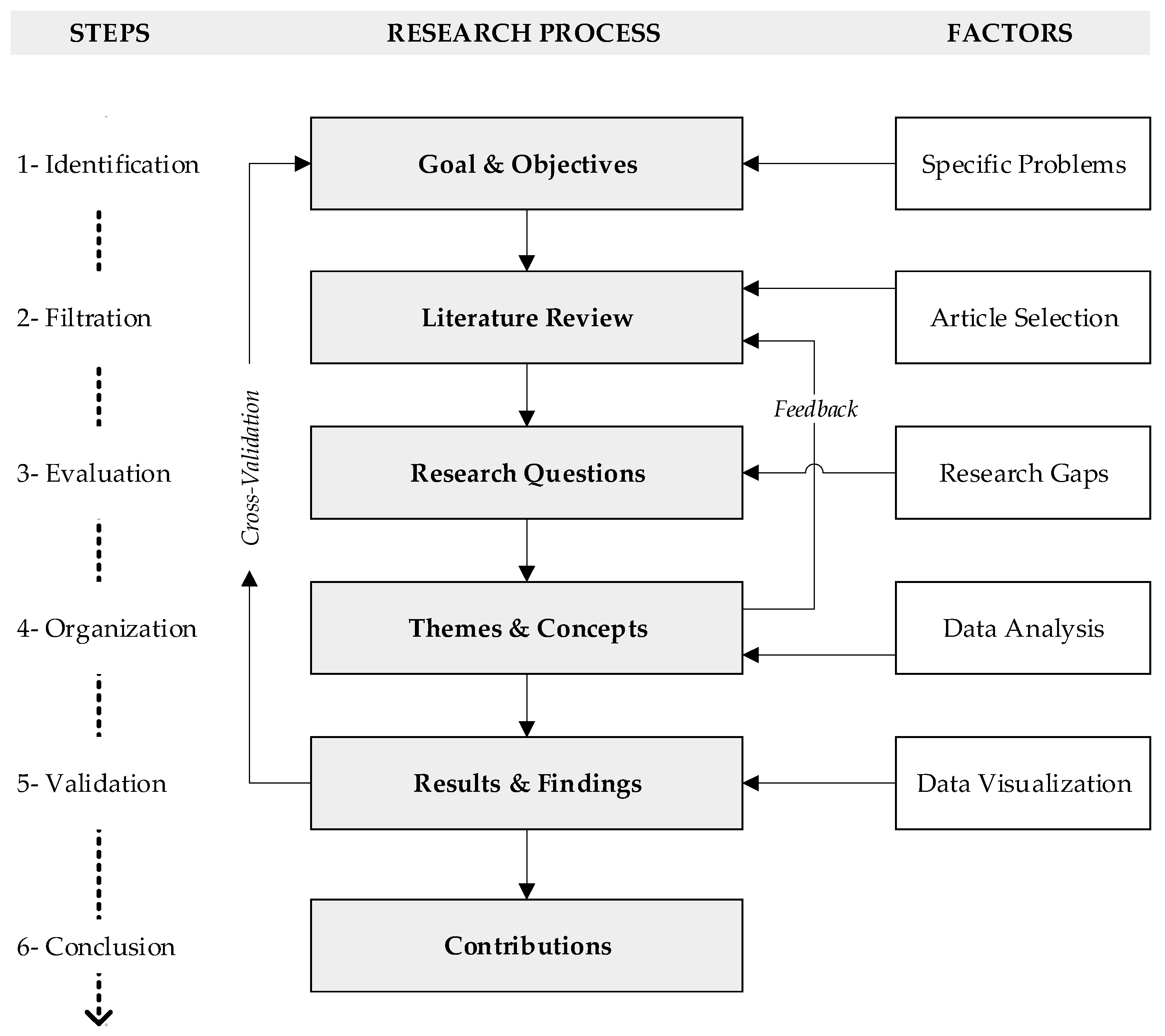
Figure 5 presents the methodological flowchart guiding the analytical process. Following article selection, extracted variables were cross-checked against foundational DT literature to ensure conceptual consistency and coverage of key thematic dimensions. Findings were organized iteratively into structured themes corresponding to lifecycle phases and technological integration categories.
Data extraction was performed using a structured coding framework aligned with the research questions. Extracted variables included lifecycle phase, DT application domain, integrated technologies (e.g., BIM, IoT), reported benefits, identified barriers, and sustainability implications. The extracted information was organized into tables to support thematic comparisons across studies. Data visualization enhances interpretability and traceability between coded literature and synthesized findings, ensuring alignment among research objectives, themes, and results. A formal risk-of-bias tool was not applied due to heterogeneous study designs; instead, rigor was assessed based on peer-reviewed sources, clarity of DT scope, and linkage to construction lifecycle phases. Due to the conceptual and methodological diversity of the included studies, a statistical meta-analysis was not appropriate; therefore, results were synthesized using qualitative thematic analysis.

4. Results

This section synthesizes findings from the selected studies to address the four research questions. Rather than reiterating individual study outcomes or table entries, the analysis emphasizes cross-document patterns, lifecycle stage contrasts, and recurring themes in DT adoption across the construction industry. While DT applications are reported across all lifecycle phases, their maturity, integration depth, and decision-support capability vary substantially by stage. The literature indicates an intense concentration of DT research in the design and operation phases, moderate development during construction, and limited empirical application in demolition and end-of-life contexts. These patterns highlight structural challenges related to interoperability, data continuity, and lifecycle integration.

4.1. What Is the Current State of DT Adoption Across Different Stages of the Construction Lifecycle?

DT creates detailed virtual representations of physical systems and has gained increasing attention in the construction industry for its ability to enhance planning, monitoring, and maintenance across the lifecycle of construction projects [11]. Spanning all stages of construction, from design and construction to operation, maintenance, and demolition, DT applications hold the potential for optimizing processes, improving safety, and enhancing sustainability [32,33]. This section explores the current state of DT adoption across the major stages of the construction lifecycle. It examines the specific roles DT plays at each phase and the extent of its integration while highlighting the limitations and opportunities identified in existing research.
Table 1 summarizes the current state, challenges, and primary references for DT adoption across each stage of the construction lifecycle. It underscores DT’s transformative potential while acknowledging the barriers to its full integration and application in construction.

4.1.1. DT in the Design Phase

The design phase is among the earliest and most widely adopted stages of DT in construction. At this stage, DT enhances digital modeling and planning processes by integrating with BIM, creating a dynamic digital representation that can evolve with real-time updates and adjustments [20,30]. With DT adoption in design, the focus is on improving project accuracy, identifying potential issues before physical construction begins, and facilitating better coordination among stakeholders [20]. For example, studies show that by using DT, architects and engineers can simulate complex design scenarios, optimize space utilization, and refine structural components based on predictive data, allowing for a more efficient and accurate design phase [5]. Despite its benefits, the integration of DT with BIM and other design technologies faces interoperability challenges [11]. According to recent research, inconsistent data formats and a lack of standardized communication protocols between BIM and DT platforms complicate data exchange and limit DT’s functionality [8,46]. Although efforts are underway to standardize data formats, the lack of universal standards remains a significant barrier to achieving seamless DT integration during the design phase [56].

4.1.2. DT in the Construction Phase

During the construction phase, DT plays a significant role in monitoring real-time project data, managing resources, and ensuring quality control [30,32]. DT systems can be integrated with IoT-enabled devices on-site, such as sensors and cameras, which gather real-time data on environmental conditions, equipment performance, and worker safety [33,37]. This integration allows project managers to make informed, data-driven decisions that enhance construction quality and operational efficiency [27]. For instance, DT applications in construction management can identify potential delays, resource misallocations, or quality issues, enabling immediate adjustments to project plans [49,50]. One of the primary applications of DT in construction is its capacity for real-time monitoring of safety conditions [24]. By linking IoT sensors with DT platforms, construction sites can monitor hazardous conditions, send alerts, and track workforce safety compliance [36,41]. This capability has been shown to reduce on-site accidents and ensure regulatory adherence [25]. However, the implementation of DT in construction still needs to be improved due to technical and financial constraints, particularly in the cost of IoT sensors, data storage, and connectivity infrastructure [39]. Also, connectivity issues, especially in remote or complex environments, restrict DT’s effectiveness in delivering real-time insights [57].

4.1.3. DT in the Operation and Maintenance Phase

The operation and maintenance phase benefits significantly from DT adoption, representing the longest period in a building’s lifecycle [22,53]. DT enables predictive maintenance, energy efficiency optimization, and asset management by continuously monitoring building conditions and providing facility managers with actionable insights [51]. For example, DTs can forecast potential system failures, allowing maintenance teams to address issues proactively rather than reactively, which minimizes operational interruptions and extends asset lifespan [54]. Moreover, DT’s capacity to monitor energy consumption and optimize heating, ventilation, and air conditioning (HVAC) systems aligns with the growing industry’s emphasis on sustainability [9]. By analyzing real-time and historical data, DT can suggest energy-saving measures that reduce operational costs and environmental impacts [42]. Nevertheless, studies reveal that DT adoption in maintenance is often challenged by a lack of trained personnel capable of interpreting complex data streams and integrating DT with existing building management systems [49]. Moreover, cybersecurity and data privacy concerns are heightened in this phase due to the volume of complex operational data generated and shared across stakeholders [58].

4.1.4. DT in the Demolition Phase

The demolition phase is one of the least explored areas for the application of DT in construction. This phase involves the deconstruction of structures, often focusing on waste management and material recovery [40,55]. Research on DT applications in this phase is limited, but emerging studies suggest that DT could play a valuable role in planning demolition processes, managing waste, and facilitating resource recovery [21,53]. By simulating demolition procedures, DT can help construction teams assess the environmental impact of material disposal, optimize material recycling, and identify reusable components before deconstruction begins [19,52]. The limited adoption of DT in this phase is partly due to the nascent state of research on sustainable construction and demolition practices within the DT framework [42,59]. DT applications for end-of-life construction are often vulnerable to the high costs of implementing sophisticated data management systems. The need for regulatory incentives for sustainable demolition practices [27,56] emphasizes that increased research and industry focus on circular-economy principles could catalyze the adoption of DT in demolition and recovery, aligning DT technology with broader environmental and sustainability goals.
Accordingly, the reviewed literature indicates that DT adoption across the construction lifecycle remains uneven, with apparent differences in maturity and application focus across phases [17,22]. In the design and construction phases, DT is primarily used to support simulation, visualization, real-time monitoring, and safety management, typically within BIM-centered data environments. However, interoperability constraints, fragmented data flows, and high implementation costs continue to limit seamless integration. DT applications are most mature in the operation and maintenance phase, where sensor-enabled systems support predictive maintenance and energy optimization, although cybersecurity and data privacy concerns persist [60]. In contrast, DT use in demolition and recovery remains conceptual mainly, with limited empirical evidence, reflecting challenges related to lifecycle data continuity, information loss during handover, and the absence of standardized end-of-life data frameworks. These patterns suggest that current DT implementations are phase-specific rather than lifecycle-integrated, underscoring the need for more cohesive, end-to-end DT architectures.

4.2. What Are the Key Benefits and Common Barriers Associated with Adopting Digital Twin in Construction?

4.2.1. Benefits of Applying DT

A DT can be leveraged for visualization, documentation, code adherence, modeling, analysis, progress tracking, and planning. Professionals such as facility managers, architects, engineers, developers, builders, and owners are the primary users and beneficiaries of the DT concept [61]. They are also learning from the challenges encountered in developing industries such as aerospace and manufacturing, where DT adoption is more widespread and benefits its implementation. As noted in Table 2, DT offers several benefits in construction beyond improved visualization and optimized asset performance.
Table 2 categorizes DT’s benefits across key themes, allowing for a clearer understanding of how DT contributes to construction and manufacturing by enhancing sustainability, reducing costs, improving safety, and supporting lifecycle management.
One of the primary benefits of DT in construction is its ability to provide comprehensive real-time monitoring and control across construction projects. Through the integration of data from IoT sensors, DT enables construction managers to monitor various site conditions, including resource allocation and equipment performance, ensuring that projects stay on schedule and remain within budget constraints [29,43].
Additionally, DT technology equips project teams to optimize workflows by simulating “what-if” scenarios, thus identifying potential bottlenecks and proactively enhancing workflow efficiency [5,67]. In the operations and maintenance phase, DT supports predictive maintenance by collecting and analyzing performance data over time, identifying anomalies early, and preventing system failures [9,39]. This proactive approach can significantly reduce downtime and maintenance costs, enabling maintenance to be scheduled based on actual asset conditions rather than predetermined intervals.
Moreover, DT applications enhance safety and quality management by promoting real-time site data monitoring, which facilitates the detection of hazardous conditions and safety compliance through wearable devices and IoT integration [37,40]. By sending alerts and tracking compliance with safety protocols, DT has proven effective in reducing on-site accidents and ensuring regulatory compliance. However, the broad implementation of DT in construction still faces technical and financial hurdles, including the high cost of IoT sensors, the need for robust data storage, and the challenge of establishing reliable connectivity infrastructure [27,33]. These connectivity issues, particularly in remote or complex settings, limit DT’s ability to provide timely insights throughout all project phases.

4.2.2. Barriers to DT Adoption

While DT is expected to benefit the construction industry in the coming years, there are still barriers to its successful adoption. To implement DT effectively, a range of technologies and software is required, along with substantial time and cost investments in creating and managing these digital models. Even with the initial setup of digital assets, gathering and maintaining accurate information remains challenging, hindering the efficient application of the DT across projects. Only when DT achieves widespread adoption will many owners and contractors fully understand and appreciate its potential to improve the operation and maintenance of digital assets and the broader future of DT technology. Table 3 summarizes the significant challenges of DT adoption in the construction sector.
A significant barrier to DT adoption in construction is the need for standardized data frameworks and interoperability across systems. The construction industry often relies on diverse data sources with incompatible formats, which complicates efforts to integrate this data into a unified DT model [56]. In particular, the absence of consistent data standards creates additional obstacles to communication between DT and other critical technologies, such as BIM, thereby limiting DT’s ability to deliver accurate and comprehensive insights across construction projects [68].
High Initial Investment and Limited ROI pose substantial financial challenges for implementing DT technology, which requires significant expenditures on hardware, software, and specialized training [5,43]. This financial barrier is incredibly prohibitive for small and medium enterprises (SMEs), which may lack the resources for such an investment [39,52]. Despite DT’s long-term potential, the high upfront costs and uncertainty surrounding ROI deter many organizations from adopting the technology. Research suggests that many companies hesitate to allocate resources to DT technology without explicit financial incentives or cost-sharing initiatives [54].
Data Security and Privacy Concerns also represent a critical barrier to DT adoption. As DT systems rely on continuous data exchange between physical assets and digital models, this reliance raises concerns about data security and intellectual property protection [25,40]. Sharing sensitive data across multiple stakeholders heightens the risk of data breaches and unauthorized access. Additionally, issues related to intellectual property rights and data ownership complicate DT adoption further, as stakeholders often hesitate to share crucial information due to privacy concerns [63,73]. Stakeholder resistance and limited knowledge also impede DT adoption, primarily due to a lack of understanding about DT technology among construction professionals and stakeholders [71]. This knowledge gap contributes to a reluctance to embrace DT, as many industry practitioners conflate DT with other technologies, such as BIM, without fully understanding DT’s distinct advantages and applications in construction. Furthermore, concerns around job displacement add to this resistance, with some workers fearing that increased automation and digitalization may threaten their roles [17].
As shown in previous studies, the benefits and barriers associated with DT adoption are closely interrelated. Reported benefits include improved decision-making, operational efficiency, and enhanced safety performance; however, their realization depends on reliable data integration and organizational readiness. Common barriers, such as high implementation costs, limited data standardization, interoperability challenges, and unclear data ownership, consistently constrain adoption. Technical barriers are more prominent in early lifecycle phases, whereas organizational, governance, and security-related challenges become more significant during operation and handover. These outlines show that DT adoption challenges evolve across the building lifecycle and require coordinated technical, organizational, and institutional responses rather than solely technology-focused solutions.

4.3. How Are Digital Twin Applications in Construction Evolving to Align with Emerging Technologies?

DT has promising applications that are increasingly being integrated across various sectors of the construction industry [35]. Before actual construction begins, buildings and infrastructure can be digitally created, allowing stakeholders to make more informed design decisions [21]. Following project completion, DT applications play a critical role in the built environment, supporting areas such as property management, infrastructure maintenance, city planning, and facility management. Table 4 provides a structured overview of the current state of DT adoption, its specific applications across the construction lifecycle, and relevant citations supporting each application.
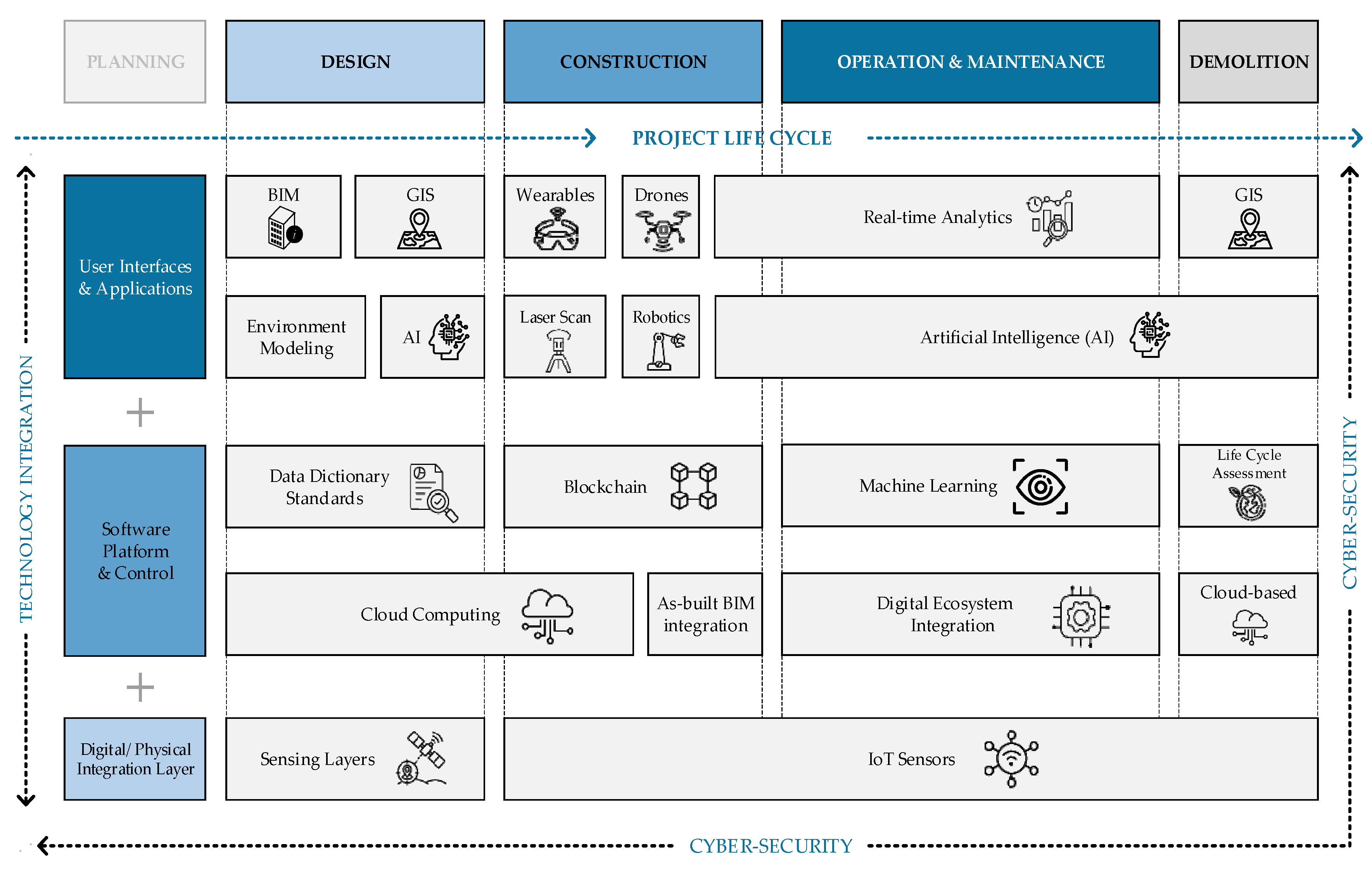
Figure 6 illustrates the primary application areas of DT and related digital technologies throughout the AEC supply chain. This diagram categorizes DT applications across the building lifecycle into three core layers: user interfaces, software platforms, and digital/physical integration. This graph categorizes DT apps in construction into three primary areas. The User Interfaces and Applications layer comprises technologies that directly interact with end users and facilitate design, monitoring, and management tasks. The Software Platform and Control layer encompasses technologies that provide a software backbone, control systems, and management platforms for processing, analyzing, and visualizing data. Finally, the Digital/Physical Integration Layer bridges the physical environment and digital systems, capturing real-world data to support virtual platforms. These layers illustrate a comprehensive approach to integrating digital twin technologies in construction. The study acknowledges that not all relevant technologies are within its scope, and practical applications will hinge on addressing key issues related to people, practices, and the environment. Future research will aim to provide a more comprehensive review of these aspects, encompassing a broader spectrum of technologies in DT apps.
DT integrates with various emerging technologies across the building lifecycle to enhance collaboration, safety, and efficiency. In the Design Phase, DT is integrated with tools such as BIM, Geographic Information Systems (GIS), and Environmental Modeling, thereby improving collaboration and optimizing planning. During the Construction Phase, wearables, drones, and IoT sensors provide real-time monitoring and boost site safety. In the Operation & Maintenance phase, artificial intelligence and real-time analytics drive predictive maintenance and energy management, extending asset lifespans and reducing costs. Finally, during the Demolition & Deconstruction phase, GIS supports sustainable practices by facilitating resource recovery and recycling.
Accordingly, DT enhances decision-making [64], safety, cost-efficiency [5], and sustainability across all construction phases. In addition, emerging technologies such as AI, Blockchain [27], and IoT streamlines DT processes [23], enabling further innovation and fostering greater efficiency in construction. The reviewed studies indicate a gradual shift from static, model-based DT implementations toward data-driven, intelligence-enabled systems. Integration with IoT is now foundational rather than optional, while emerging applications increasingly incorporate AI and ML for predictive analytics, anomaly detection, and automated decision support. Nevertheless, most implementations remain siloed and project-specific, limiting scalability. Across documents, the lack of interoperable data schemas and consistent governance frameworks continues to constrain broader adoption of ML-enabled DT systems.

4.4. What Research Gaps in Digital Twin Integration Could Inform Future Development?

The literature reveals several persistent research gaps in DT integration across the building lifecycle, particularly at the interfaces between design, construction, operation, and demolition. While DT concepts are well established for monitoring and performance optimization, their application remains uneven and fragmented across lifecycle stages. Addressing these gaps is essential for advancing DT from isolated, phase-specific implementations toward more integrated lifecycle-oriented frameworks.
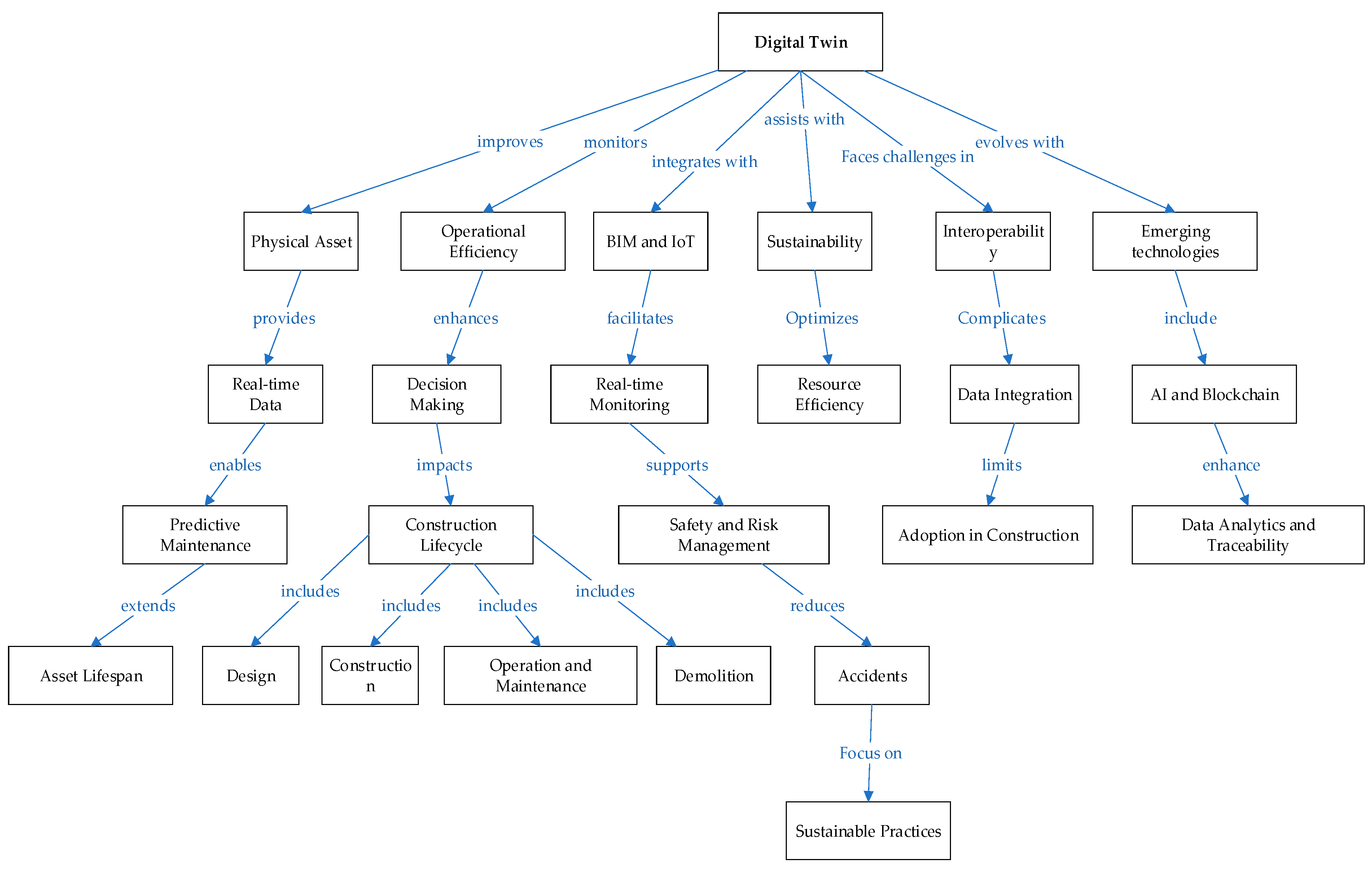
Figure 7 synthesizes the core concepts, enabling technologies, and constraints associated with DT adoption in construction, with particular emphasis on underexplored and poorly connected areas identified in the literature. Rather than representing a process flow or a quantitative assessment, the diagram illustrates conceptual relationships reported across studies and highlights where integration remains limited or underdeveloped. As illustrated, recurring research gaps identified in the reviewed literature include interoperability limitations, fragmented data integration across DT, BIM, and IoT platforms [76], and constrained adoption due to high implementation costs and the absence of standardized data and governance frameworks [68]. These challenges are most evident at lifecycle transition points, particularly between construction and operation, and during end-of-life phases where data continuity is weakest. Although emerging technologies such as artificial intelligence and blockchain are frequently proposed as enablers of predictive maintenance and data traceability [59]. Empirical evidence of their integrated and scalable deployment within DT frameworks remains limited. Collectively, these findings indicate that addressing data standardization, interoperability, and lifecycle-wide integration remains critical for advancing DT adoption in construction [35].

4.4.1. Research Gaps in DT Integration Across the Building Lifecycle

Design Stage: Data Standardization and Interoperability
A significant challenge in DT adoption during the design phase is the lack of standardized data frameworks and interoperable systems. Although integrating BIM with DT has proven effective in enhancing project planning and design efficiency [33], interoperability issues continue due to inconsistent data formats and limited communication protocols among BIM, GIS, and DT platforms [10]. As Dr. Sawhney’s research emphasizes, accurate data classification and dictionary definitions are essential for producing high-quality digital assets [74]. However, current systems lack consistent frameworks for managing and sharing this critical data, which can create inefficiencies in later project stages [52]. To address this gap, research should explore the creation of universal data standards and protocols to facilitate seamless information exchange between DT and other digital design technologies [59]. Developing a comprehensive framework for interoperable data sharing would enhance DT integration and establish a unified foundation applicable to other lifecycle phases.
Construction Stage: Real-Time Data and Process Integration
In the construction phase, DT applications play a key role in tracking resources, improving safety, and enabling real-time monitoring [43]. However, a significant barrier exists in integrating real-time data from on-site IoT sensors, drones, and other technologies into a cohesive DT model [52]. Current DT platforms often face challenges in assimilating as-built, as-planned, and real-time construction data due to technological limitations, data processing costs, and connectivity issues, especially in remote locations [74]. Additionally, as noted by [10]. The lack of a standardized digital infrastructure across construction projects impedes DT’s ability to deliver reliable, real-time insights. Therefore, future research should investigate methods to achieve higher levels of real-time integration, including enhanced IoT sensor capabilities and robust network connectivity solutions capable of withstanding construction’s unpredictable environments [50]. Developing DT platforms that efficiently integrate diverse, real-time data will improve construction quality, efficiency, and safety.
Operation & Maintenance Phase: Predictive Analytics and Long-Term Data Management
The operation and maintenance (O&M) phase benefits significantly from DT applications, particularly through predictive maintenance and energy management [24]. However, the integration of predictive analytics within DT systems remains limited [51]. Many DT applications in O&M lack advanced data analytics capabilities, thereby limiting their ability to forecast system failures and manage complex asset portfolios effectively and accurately. Furthermore, Dr. Sawhney points out that the shortage of trained personnel to interpret and use DT data insights poses an additional barrier, as few programs focus on developing these specialized skills [68]. To address this gap, research should prioritize the development of AI-driven predictive algorithms within DT platforms and the construction of a knowledge base that integrates historical data with real-time data streams [20]. Furthermore, addressing the skill gap through targeted training programs can empower facility managers to leverage predictive insights more effectively, ultimately optimizing asset lifespans and enhancing operational efficiency [64].
Demolition & Recovery Phase: Sustainable Waste Management and Circular Economy
The demolition and recovery phase is underexplored in DT research, and existing DT applications have yet to support sustainable demolition and resource recovery practices fully [55]. Although preliminary studies suggest that DT can assist in waste volume assessment and resource tracking, few systems currently simulate end-of-life asset management with enough accuracy to inform sustainable practices [75]. This gap results from limited research on applying DT to circular economy principles, which aim to minimize environmental impacts by recycling and reusing materials [52]. Expanding DT’s role in this phase will require research into developing DT frameworks that support material classification, waste tracking, and circular economy strategies [24]. Integrating AI and GIS with DT in demolition can significantly enhance resource recovery efforts, fostering environmentally responsible practices in construction’s end-of-life stage [50].
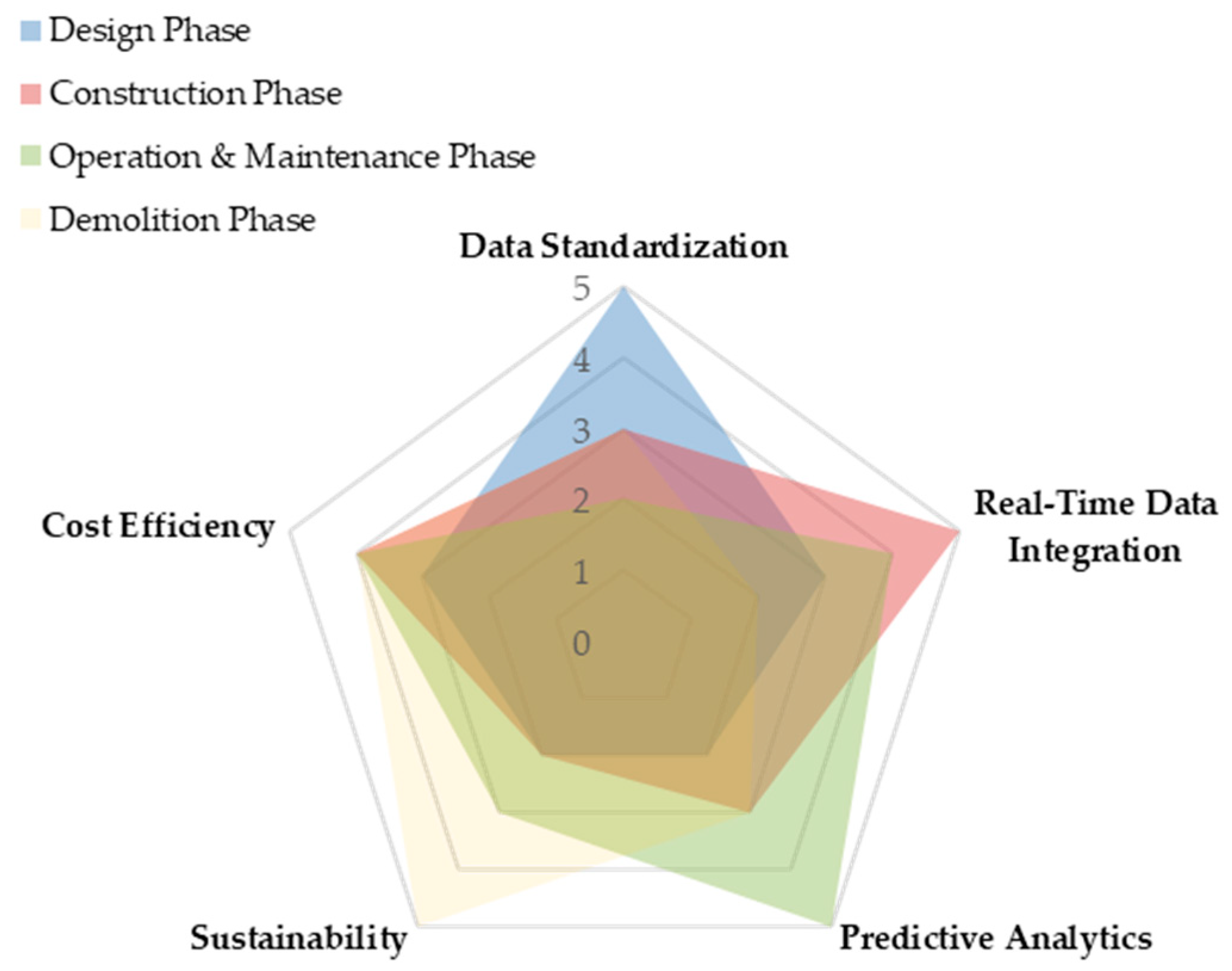
The radar chart (Figure 8) identifies key research gaps in DT integration across the construction lifecycle, with a focus on data standardization, real-time integration, predictive analytics, sustainability, and cost efficiency. For example, data standardization is the primary gap in the design phase due to the lack of unified frameworks, while real-time data integration and cost efficiency present secondary challenges. The construction phase faces significant challenges in real-time data integration, especially with IoT connectivity and cost efficiency in real-time monitoring. Similarly, in the operation and maintenance phase, predictive analytics remains the central gap, as advanced AI-driven models remain underdeveloped, with real-time data integration and cost efficiency as lesser priorities. Finally, sustainability is the most critical gap in the demolition phase, underscoring DT’s potential to support sustainable demolition and resource recovery, although high costs remain a barrier. This visualization highlights phase-specific priorities and clarifies where future DT research efforts should be concentrated. The 1–5 scores represent a qualitative synthesis of literature, reflecting the frequency of reported challenges, solution maturity, and scholarly consensus, with higher scores indicating more persistent and critical gaps.
As seen, DT offers substantial potential to transform the construction industry, but realizing this potential requires addressing key research gaps. The challenges surrounding data standardization, real-time integration, predictive analytics, and sustainability indicate that DT integration is still in its early stages [60,66]. Targeted research addressing these gaps will allow DT to support a more integrated, efficient, and sustainable construction lifecycle [34]. Future studies should focus on establishing universal standards, developing robust real-time data management solutions, enhancing predictive capabilities, and advancing sustainable practices [80]. By overcoming these barriers, DT can evolve into a comprehensive tool that meets the construction industry’s changing needs and aligns with global sustainability goals.

4.4.2. The Future Research Directions of Digital Twin in Construction

The shift towards digitalization in construction has accelerated in response to the global pandemic, highlighting the critical need for digitizing operations to maintain resilience and adaptability [57]. As a result, many organizations within the construction sector are adopting a technology-driven mindset, which has sparked increased interest in DT and other digital innovations [50]. Changing market dynamics and evolving industry perspectives create new opportunities for technology solution providers, with DT expected to advance the industry [81].
DT in construction remains in its early-adopter stage [35], yet the transition toward digital solutions is both essential and foreseeable [75]. Recent developments indicate a growing emphasis on collaborative systems and digital workflows, showing DT’s potential to transform traditional construction practices [23]. Incorporating emerging technologies and innovative processes presents a value-driven opportunity for improvement, allowing the industry to embrace efficiency, safety, and sustainability [39].
Based on the selected papers, Table 5 organizes future research directions by major themes relevant to DT in construction. These themes include AI integration, predictive maintenance, data management, and ethical considerations, each of which has the potential to further DT’s impact in construction. Focusing on these areas will guide research and drive the construction industry towards more efficient, data-driven, and sustainable practices.
In addition to the key themes, the study identifies DT applications that benefit the built environment, building construction, estates, infrastructure, city planning, and facility management. For instance, ref. [36] stated that by using DT in the built environment, these applications could analyze critical factors such as climate, carbon emissions, circular-economy outcomes, energy use, air pollution, and water quality. In the property and estate sector, a DT has been implemented to optimize estate plans, maximize space utilization, support office space design and usage, and monitor datasets, including occupancy, temperature, carbon dioxide levels, and meeting room status. Regarding building construction, the most significant application of DT is in energy performance assessment and management [36]. For example, in the infrastructure sector, the system can be visualized from the design phase through to the operation phase, using DT to integrate energy analysis and real-time energy management [30]. Moreover, in facility management, DT can monitor facility operations and promptly detect issues [50]. When applied to city planning, DT technology enables predictions for bus arrival times, enhances cloud-based driving direction systems, and supports active accident-avoidance applications [5].
Furthermore, the concept of DT offers numerous new perspectives and future research directions for scholars. For example, future work on DT in the construction industry could focus on developing applications to monitor construction progress and assess construction workers’ performance [45,54]. As urban development evolves, smart buildings and smart cities are expected to become prominent topics in the near future [19]. As buildings become more technologically advanced, the digitalization of facility management functions will also increase. Moreover, future research could integrate BIM with DT to enhance design and construction processes [21]. This integration could answer questions about how innovative technologies, particularly BIM and DT, can promote sustainability. The resulting insights could provide real-time feedback to improve the performance and energy efficiency of buildings and urban development [54]. This line of research would be valuable for organizations aiming to maximize efficiency and reduce costs, and for policymakers and planning organizations in their efforts to raise public awareness and achieve sustainability goals.
Synthesizing the identified research gaps reveals three persistent deficiencies across the DT literature: (1) limited lifecycle continuity due to poor data handover between phases, (2) insufficient empirical validation of DT benefits beyond pilot studies, and (3) weak integration of governance, policy, and contractual considerations into technical DT frameworks. These gaps suggest that future DT research must move beyond proof-of-concept implementations and address systemic adoption conditions at organizational and industry levels.

5. Discussions & Future Research

5.1. Discussions

The study puts DT adoption in the construction sector within the broader context of DT maturity observed in industries such as manufacturing, aerospace, and infrastructure. To establish this comparative baseline, prior research has demonstrated that DTs are highly effective in closed-loop and standardized environments, where predictive maintenance, quality control, and process optimization are supported by stable data infrastructures and long-term operational continuity [8,9,36]. By contrast, this review shows that construction operates under fundamentally different conditions, which limit the direct transferability of DT models developed in those sectors.
One major challenge identified in the construction context is the fragmented nature of project delivery. Compared with manufacturing, DT implementation in construction is shaped by heterogeneous data sources, temporary organizational structures, and discontinuous lifecycle ownership, all of which hinder the development of persistent digital representations [10,40,54]. These conditions explain why, although DT applications in construction demonstrate strong performance during the design and construction phases, particularly through BIM-enabled simulation, real-time monitoring, and safety management [33,41,46]. Their effectiveness diminishes in later lifecycle stages. This contrasts with manufacturing DTs, in which the same digital system typically persists throughout the full product lifecycle within standardized data environments and unified governance structures [8,36].
Regarding lifecycle distribution, the findings further indicate that the benefits of DT in construction are unevenly distributed across the lifecycle. Design- and construction-phase applications dominate the literature because these phases offer clearer short-term returns, including improved coordination, reduced rework, and enhanced site safety [5,25,67]. However, this emphasis creates a structural imbalance, as the operation, demolition, and recovery phases remain comparatively underexplored despite their greater potential to affect long-term sustainability. This imbalance reinforces earlier observations that DT research in construction remains largely project-centric rather than lifecycle-centric, thereby limiting its contribution to circular economy objectives and resource recovery strategies [32,50,65].
To better understand this gap, it is necessary to distinguish between technical feasibility and practical scalability. While several studies demonstrate successful pilot implementations integrating DT with IoT, AI, or Blockchain technologies [35,59], these applications are rarely scaled beyond individual projects. One key reason is that scalability is constrained not by sensing capability, but by governance and cost structures, including high upfront investment requirements, limited interoperability, and the absence of standardized data frameworks [28,68]. In comparison, infrastructure and smart-city-scale DT initiatives often benefit from public-sector investment and regulatory mandates, conditions that are largely absent in building-scale construction projects [51,76].
With respect to data integration, cross-sector comparisons further reveal that standardization, rather than analytics or sensing, is the dominant bottleneck to advancing DT in construction. Manufacturing DTs benefit from mature data schemas, controlled processes, and repeatable workflows. In contrast, construction DTs must reconcile as-designed, as-built, and as-operated data generated by multiple stakeholders using incompatible platforms [54,63]. As a result, predictive analytics and AI-enabled decision support remain less mature in construction DTs, even though similar technologies are readily available [39,49].
With respect to sustainability, this study extends the DT literature by highlighting the underexplored role of DTs in the demolition and recovery phases. While sustainability-oriented DT applications are frequently discussed in the context of operational energy management [9,34], fewer studies address material tracking, waste classification, and end-of-life decision support [32,64]. This omission represents a critical research gap, as the demolition phase offers significant opportunities to support circular economy practices through data-driven deconstruction planning and material reuse.
Taken together, these findings suggest that DT performance in construction should not be evaluated solely based on technological capability. Rather, DT effectiveness depends on its alignment with industry structure, data governance mechanisms, and lifecycle responsibility allocation. Addressing interoperability, cost distribution, and data ownership across project phases is therefore more consequential than incremental improvements in sensing or analytics alone. By framing DT adoption as a socio-technical challenge rather than a purely technical one, this discussion helps explain the persistent gap between DT’s conceptual promise and its realized value in the construction industry.

5.2. Future Research

Advancing DT in construction requires addressing critical challenges across the project lifecycle to realize its full potential. This research plan emphasizes establishing data standards, enhancing real-time data integration, and promoting wider industry adoption to maximize DT’s impact in construction.
A central challenge to DT adoption is the lack of standardized data frameworks, which complicates integration between DT, BIM, and IoT systems. To address this barrier, future research will prioritize developing universal standards and protocols for interoperability. By collaborating with industry stakeholders, the goal is to develop consistent data classifications that support DT functions across all project stages, from design to demolition, forming an integrated DT ecosystem. Real-time data integration is another critical aspect for effective DT use, especially for predictive maintenance and project monitoring. With improved real-time data, DT can provide timely, actionable insights that enhance project efficiency and safety. Future research will explore advanced sensor technology, such as 5G-enabled IoT devices, to ensure reliable data flow in diverse environments. Strengthening connectivity at remote sites is also essential, as it enables continuous, real-time insights for proactive decision-making.
Furthermore, integrating AI into DT systems enhances predictive asset management and risk-reduction capabilities. DT can analyze historical and real-time data by developing AI-driven algorithms to anticipate equipment issues and optimize resource use. Future research will involve testing AI models across various project scenarios to ensure adaptability, ultimately supporting more resilient and efficient construction processes. DT also has significant potential for sustainability efforts, particularly in resource recovery and waste reduction during demolition. The research will focus on how DT can support circular economy principles by tracking materials and promoting recycling. Integrating GIS with DT could provide spatial insights to optimize resource recovery, reducing the construction industry’s ecological footprint.
Finally, bridging the knowledge gap in DT technology is essential for broader adoption. Many construction professionals remain unfamiliar with DT’s applications, limiting their integration. To address this, targeted training programs will be developed to equip industry professionals with essential DT skills, fostering widespread adoption and enabling teams to leverage DT’s lifecycle management benefits effectively.
The most significant finding in this research plan is DT’s capacity to advance sustainability through resource recovery and waste reduction, particularly during demolition. Aligning DT with circular economy principles offers a promising path to reduce construction’s environmental impact. This research approach, focused on data standards, real-time capabilities, AI, and industry-wide adoption, aims to shape a more sustainable and efficient future for construction through DT technology.

6. Conclusions

Digital Twin (DT) research in construction has expanded rapidly; however, its lifecycle integration remains uneven and structurally fragmented. This systematic review examined 53 peer-reviewed studies to evaluate the maturity and distribution of DT applications across the construction lifecycle. To provide structured insight into this distribution, the study applied a lifecycle-oriented analytical framework that covers the design, construction, operation, maintenance, and demolition phases. The findings reveal uneven lifecycle maturity, with stronger implementation in design and operation contexts and comparatively limited cross-phase continuity. This imbalance suggests that DT adoption remains phase-concentrated rather than lifecycle-integrated.
This study significantly contributes to the body of knowledge in three primary dimensions. First, it establishes an operational definition of DT that distinguishes dynamic cyber–physical systems from static BIM-based models, thereby addressing conceptual ambiguity in the literature. Second, it provides a structured lifecycle comparison that enables systematic assessment of integration depth across phases. Third, it synthesizes recurring implementation constraints, including interoperability complexity, data governance challenges, cost considerations, and organizational readiness factors. Taken together, these contributions clarify both the conceptual boundaries and the practical limitations of DT implementation in construction.
Across the reviewed literature, DT is most frequently operationalized through integration with BIM and IoT systems, with emerging incorporation of machine learning as an analytical layer. However, despite these technological advances, consistent data governance structures and lifecycle-wide interoperability remain structurally underdeveloped. This structural limitation highlights a central challenge: DT systems are often technically capable yet organizationally fragmented. To address this challenge, alignment between technological integration, standardized data protocols, and organizational capability development becomes essential.
From a practical standpoint, effective DT implementation requires not only technical interoperability but also governance mechanisms that address data ownership, standardization, and cost–benefit evaluation. In this regard, lifecycle integration should be viewed not merely as a technical objective but as an institutional coordination effort.
This study is subject to several limitations. It was restricted to English-language, peer-reviewed journal articles from a single database, potentially excluding conference papers and industry reports. Due to methodological heterogeneity, no quantitative meta-analysis or formal assessment of reporting bias and evidence certainty was conducted. Findings are based on qualitative thematic analysis and should be interpreted in light of potential publication bias toward successful DT implementations. Given these limitations, future research should prioritize empirical validation of lifecycle-integrated DT frameworks, development of standardized interoperability protocols, and quantitative assessment of DT’s environmental and operational performance impacts. Advancing these research directions will be critical for advancing DT from fragmented adoption toward comprehensive lifecycle digitalization in construction.

Supplementary Materials

The following supporting information can be downloaded at https://www.mdpi.com/article/10.3390/buildings16061151/s1, which provides additional details on the review protocol, search strategy, and eligibility criteria applied in the systematic literature review.

Author Contributions

Conceptualization, All; formal analysis, T.D.N.; investigation, All; evaluation methodology, S.A.; supervision, S.A.; writing—original draft, T.D.N.; writing—review and editing, All. All authors have read and agreed to the published version of the manuscript.

Funding

This research received no external funding.

Data Availability Statement

This study did not generate new datasets. All data supporting the findings are derived from publicly available sources, primarily peer-reviewed publications indexed in databases such as Scopus and Google Scholar, which are cited throughout the manuscript.

Conflicts of Interest

The authors declare no conflicts of interest. The funders had no role in the study’s design, data collection, analysis, interpretation, manuscript writing, or decision to publish the results.

Appendix A

The appendix provides additional information to enhance the organization and readability of research papers and presents the key findings and methodological aspects of the reviewed articles.
Table A1. Summary of Key Digital Twin Studies in Construction.
No.TitleAuthor & YearCit. #MethodologyMajor
Contributions
1Technologies for digital twin applications in constructionAbanda et al. (2024)[10]Systematic literature review on DT in construction and manufacturing sectors.Highlights differences in DT adoption between construction and manufacturing, and discusses implementation challenges.
2Digital Twins and Blockchain technologies for building lifecycle managementAdu-Amankwa et al. (2023)[27]A systematic review on integrating DT and blockchain for lifecycle management.Emphasizes the potential of DT/blockchain for enhanced lifecycle sustainability in construction.
3Delving into the Digital Twin Developments and ApplicationsAfzal et al. (2023)[35]The PRISMA approach focuses on DT applications and fragmentation in construction knowledge.Identifies gaps in DT knowledge and proposes a structured approach to improve understanding of construction.
4Digital twins in the built environment: Definition, applications, and challengesAlBalkhy et al. (2024)[39]Qualitative review detailing DT applications and barriers for Industry 5.0 in the built environment.Discusses the evolution of DT for Industry 5.0, focusing on challenges such as interoperability and security.
5Digital twin in the AEC industry: A bibliometric reviewAlmatared et al. (2022)[45]Bibliometric analysis of DT literature focusing on architecture, engineering, and construction (AEC)Explores trends in the use of DT in AEC and identifies future research opportunities.
6IoT, BIM, and DT in the Construction Industry: A ReviewBaghalzadeh Shishehgarkhaneh et al. (2022)[23]Bibliometric and systematic literature review on integrating BIM, IoT, and DT in construction.Identifies critical research themes (e.g., HBIM, smart contracts) and suggests future research areas, including BIM with AI and the Metaverse.
7How will the Digital Twin shape the future of Industry 5.0?Barata & Kayser (2024)[66]Bibliometric analysis and discussion using strong structuration theory to explore DT’s role in Industry 5.0.Proposes a future-oriented SA–DT framework and discusses DT as an enabler for Industry 5.0.
8A Survey on Digital Twin: Definitions, Characteristics, Applications, and Design ImplicationsBarricelli et al. (2019)[63]Survey of literature on DT definitions, characteristics, applications, and design implications.Consolidates DT definitions and applications, focusing on data integration and real-time synchronization challenges.
9Towards a Semantic Construction Digital Twin: Directions for Future ResearchBoje et al. (2020)[20]The conceptual framework focused on developing a semantic construction DT with standardized data models.Identifies interoperability and integration as critical challenges and proposes research directions to improve the effectiveness of construction DT.
10Comprehensive Survey of the Landscape of Digital Twin Technologies and Their Diverse ApplicationsChen et al. (2023)[19]Literature review and statistical analysis of DT research from 2018 to 2022 using the Web of Science (WOS) and VOS viewer.Surveys the evolution of DT technology, its architectures, applications across industries, and essential enabling technologies.
11Demystifying the Definition of Digital Twin for the Built EnvironmentDavari et al. (2022)[47]An analytical study examining various definitions of DTs specifically within the context of the built environment.Proposes a unified definition of DT for the built environment to address ambiguities in the current literature.
12Construction and Maintenance of Building Geometric Digital Twins: State-of-the-Art ReviewDrobnyi et al. (2023)[72]State-of-the-art review on DTs for geometric representation in building construction and maintenance.Highlights current methods for creating and updating geometric DTs for buildings, with a focus on accuracy and efficiency in maintenance applications.
13Digital Twin Requirements in the Context of Industry 4.0Durão et al. (2018)[56]Conference paper on DT requirements for Industry 4.0, using case studies from product lifecycle management.Defines the core requirements for DT in Industry 4.0, with a focus on data integration and lifecycle interoperability.
14Digital Twin in Construction: An Empirical AnalysisEl Jazzar et al. (2020)[53]Empirical analyses of DT construction applications include surveys and real-world case studies.Shows DT’s potential for site monitoring and lifecycle management benefits in construction.
15Digital twin publications in construction (2017–2023): A bibliometrics-based visualization analysisFoudah et al. (2024)[37]Bibliometric analysis of DT publications in construction from 2017 to 2023, using visualization software.Identifies dominant research themes and collaboration patterns, showing gaps in DT research in construction.
16Smart City Digital Twin–Enabled Energy ManagementFrancisco et al. (2020)[9]Case study on DT-enabled energy management for urban buildings in smart cities, using real-time data.Demonstrates energy optimization in urban buildings through DT for energy prediction and load reduction.
17Digital Twin: Enabling Technologies, Challenges, and Open ResearchFuller et al. (2020)[42]The survey covered technologies enabling DT, associated challenges, and open research areas, with a focus on IoT integration.Discusses data privacy, interoperability, and integration challenges, proposing a framework for DT research.
18Origins of the Digital Twin ConceptGrieves (2016)[14]Conceptual exploration tracing the origins of DT, from initial PLM concepts to broader applications.Introduces foundational principles of DT in PLM, illustrating the evolution toward advanced applications.
19Virtually Intelligent Product Systems: Digital and Physical TwinsGrieves (2019)[11]A framework for integrating digital and physical twins, with case studies in manufacturing.Emphasizes DT as a connection between digital and physical spaces, enhancing monitoring and operational insights.
20Digital twin-enabled innovative facility management: A bibliometric reviewHakimi et al. (2024)[24]A comprehensive review of DT applications in facility management using AI and predictive maintenance.Highlights DT’s role in predictive maintenance, asset management, and operational cost reduction.
21Special Issue on Digital Twin-Driven Design and ManufacturingHe et al. (2021)[49]Collection of articles on DT applications in sustainable design and manufacturing sectors.Discusses advancements in DT-driven design optimization, lifecycle management, and sustainability in manufacturing.
22A Review of the Digital Twin Technology in the AEC-FM IndustryHosamo et al. (2022)[60]Literature review on DT technology in architecture, engineering, and construction-facility management.Identifies DT’s potential for real-time monitoring and fault detection, along with the challenges of data standardization.
23Digital Twin and Industry 4.0 Enablers in Building and Construction: A SurveyHu et al. (2022)[28]A survey exploring DT enablers for Industry 4.0 in construction, with a focus on IoT, AI, and cloud computing.Emphasizes DT-IoT integration for construction 4.0, supporting data collaboration and automation benefits.
24Digital Twin Applications Toward Industry 4.0: A ReviewJavaid et al. (2023)[50]A comprehensive review of DT’s role in Industry 4.0, detailing applications across various industrial sectors.Highlights DT’s transformative impact on operational efficiency and predictive capabilities within Industry 4.0.
25Characterizing the Digital Twin: A Systematic Literature ReviewJones et al. (2020)[30]The systematic literature review focused on definitions and applications of DT across various industries.Categorizes DT applications and identifies research gaps, underlining DT’s evolving role in Industry 4.0.
26Digital Twin-Aided Sustainability-Based Lifecycle Management for Railway SystemsKaewunruen & Xu (2018)[33]Case study on DT applications in railway lifecycle management with a sustainability focus.Demonstrates DT’s potential to reduce environmental impact throughout the lifecycle of railway systems.
27Digital Twin: Vision, Benefits, Boundaries, and Creation for BuildingsKhajavi et al. (2019)[31]Review of DT in building lifecycle, discussing benefits, challenges, and areas for future research.Provides a framework for DT implementation in building management, with an emphasis on operational improvements.
28Review of Digital Twins for Constructed FacilitiesKhallaf et al. (2022)[58]A comprehensive review of DT applications in facility management, focusing on real-time monitoring and asset management.Highlights DT’s potential to streamline facility management processes and enhance maintenance operations.
29Digital Twin Approach in Buildings: Future Challenges via a Critical Literature ReviewLauria et al. (2024)[64]Critical literature review of DT applications in building construction, focusing on future research directions.Identifies DT’s construction challenges, including data integration and long-term model maintenance.
30Developing an Integrative Framework for Digital Twin Applications in the Building Construction IndustryLong et al. (2024)[29]Proposal of a framework to integrate DT applications across various phases of building construction.Emphasizes the need for standardized frameworks to support DT implementation across the building lifecycle.
31Applications of Digital Twin Technology in Construction Safety Risk Management: A Literature ReviewLuo et al. (2024)[48]Literature review on DT applications in construction safety, highlighting case studies and safety protocols.Demonstrates DT’s use in proactive risk management, enabling real-time hazard detection and mitigation.
32A Review of Digital Twin Applications in ConstructionMadubuike et al. (2022)[71]A comprehensive review of DT applications within the construction industry, focusing on emerging technologies.Discusses integrating DT with other technologies, such as IoT and AI, to optimize construction workflows.
33The Role of BIM in Integrating Digital Twin in Building Construction: A Literature ReviewNguyen & Adhikari (2023)[21]Literature review on the role of BIM in supporting DT integration across construction projects.Highlights BIM’s role as a foundation for DT development, emphasizing interoperability and data consistency.
34Digital Twins in the Construction Industry: A Comprehensive Review of Current ImplementationsOmrany et al. (2023)[75]A comprehensive review of DT implementations in construction, analyzing various real-world cases.Identifies best practices and challenges in current DT applications, with an emphasis on project management.
35Digital Twin Technology and Social Sustainability: Implications for the Construction IndustryOmrany et al. (2024)[25]Analysis of DT’s impact on social sustainability within the construction sector.Discusses how DT can contribute to sustainable practices by improving project efficiency and resource use.
36Digital Twin Application in the Construction Industry: A Literature ReviewOpoku et al. (2021)[5]Literature review of DT applications in construction, analyzing industry trends and case studies.Examines the benefits of DT for construction management, highlighting its role in process optimization.
37Drivers for Digital Twin Adoption in the Construction Industry: A Systematic Literature ReviewOpoku et al. (2022)[70]Systematic literature review on the motivations for DT adoption in construction.Identifies the critical drivers of DT adoption, including cost savings, risk mitigation, and operational efficiency.
38Barriers to the Adoption of Digital Twin in the Construction Industry: A Literature ReviewOpoku et al. (2023)[65]Literature review identifying obstacles to DT implementation in construction.Key challenges include data interoperability, high initial costs, and a lack of standardization.
39Geometric Parameter Updating in Digital Twin of Built Assets: A Systematic Literature ReviewOsadcha et al. (2023)[76]The systematic review focused on methods for updating geometric parameters in DTs for built assets.Discusses techniques for real-time geometry updates, with an emphasis on accuracy in asset management.
40Enabling Technologies and Tools for Digital TwinQi et al. (2019)[80]Review exploring the technologies and tools supporting DT development across industries.Highlights critical technologies for DT development, including IoT, AI, and cloud computing, and their applications.
41Digital Twin Values, Challenges, and Enablers: From a Modeling PerspectiveRasheed et al. (2020)[18]A review of DTs’ values, challenges, and enablers, with a focus on modeling.Emphasizes DT’s modeling potential for predictive analysis while discussing data management challenges.
42Architecture for Digital Twin Implementation Focusing on Industry 4.0Rolle et al. (2020)[82]Proposed architecture for DT implementation tailored to Industry 4.0 standards and requirements.Introduces an architectural framework for DT integration, with a focus on interoperability and data exchange.
43Analysis of Digital Twins in the Construction Industry: Practical Applications, Purpose, and Parallel with Other IndustriesSaback et al. (2024)[52]Comparative analysis of DT applications across construction and other industries.Discusses DT’s practical applications in construction and lessons learned from other industries.
44Construction with Digital Twin Information SystemsSacks et al. (2020)[43]Case study on implementing DT information systems in construction projects.Demonstrates DT’s role in improving project coordination and decision-making through real-time data sharing.
45A Proposed Framework for Construction 4.0 Based on a Review of LiteratureSawhney et al. (2020)[68]Literature review proposing a framework for integrating DT into Construction 4.0.Outlines a pathway for adopting DT within Construction 4.0, emphasizing digitalization and automation.
46Differentiating Digital Twin from Digital ShadowSepasgozar et al. (2021)[17]Comparative analysis distinguishing DT from digital shadow technologies.Clarifies key differences in purpose, data management, and applications between DT and digital shadow.
47Digital Twins in Built Environments: An Investigation of Characteristics, Applications, and ChallengesShahzad et al. (2022)[51]Review DT applications in built environments, covering various use cases and associated challenges.Identifies DT characteristics unique to built environments and associated challenges, such as scalability and complexity.
48Digital Twin and Its Potential Applications in the Construction Industry: State-of-the-Art ReviewSu et al. (2023)[55]State-of-the-art review on DT applications in construction, identifying use cases and technological advancements.Highlights how DT can improve project efficiency, monitoring, and predictive capabilities in construction.
49Technologies for Digital Twin Applications in ConstructionTuhaise et al. (2023)[26]A comprehensive review of technologies enabling DT in construction, including IoT, AI, and data analytics.Examines challenges in technology integration and proposes solutions to improve DT implementation.
50Opportunities and Threats of Adopting Digital Twin in Construction Projects: A ReviewWang et al. (2024)[57]Review analyzing the benefits and risks of DT adoption in construction projects.Highlights DT’s project management benefits while discussing potential threats, such as cybersecurity risks.
51Knowledge Map and Forecast of Digital Twin in the Construction Industry: State-of-the-Art ReviewXie et al. (2023)[62]State-of-the-art review that maps DT knowledge and trends in construction.Identifies emerging research areas and predicts future trends in the application of DT in construction.
52A Review of Digital Twin Technologies for Enhanced Sustainability in the Construction IndustryZhang et al. (2024)[34]The review focused on DT technologies for sustainability in construction, exploring energy and resource efficiencies.Highlights DT’s potential to enhance sustainability through improved resource management and reduced waste.
53Building on Digital Twin: Overcoming Barriers and Unlocking Success in the Construction IndustryZhu et al. (2024)[54]Analyze the barriers to the adoption of DT in construction and propose mitigation strategies.Identifies key adoption barriers, such as cost and complexity, and suggests pathways for effective DT integration.

References

  1. McKinsey How Disruption Is Reshaping Construction|McKinsey. Available online: https://www.mckinsey.com/business-functions/operations/our-insights/the-next-normal-in-construction-how-disruption-is-reshaping-the-worlds-largest-ecosystem (accessed on 24 February 2022).
  2. Sawhney, A.; Agnihotri, R.; Kumar Paul, V. Grand Challenges for the Indian Construction Industry. Built Environ. Proj. Asset Manag. 2014, 4, 317–334. [Google Scholar] [CrossRef] [Scilit]
  3. Agarwal, R.; Chandrasekaran, S.; Sridhar, M. Imagining Construction’s Digital Future; McKinsey & Company: New York, NY, USA, 2016; Volume 28. [Google Scholar]
  4. Farmer Construction Labour Market in the UK: Farmer Review. Available online: https://www.gov.uk/government/publications/construction-labour-market-in-the-uk-farmer-review (accessed on 24 February 2022).
  5. Opoku, D.-G.J.; Perera, S.; Osei-Kyei, R.; Rashidi, M. Digital Twin Application in the Construction Industry: A Literature Review. J. Build. Eng. 2021, 40, 102726. [Google Scholar] [CrossRef] [Scilit]
  6. Oesterreich, T.D.; Teuteberg, F. Understanding the Implications of Digitisation and Automation in the Context of Industry 4.0: A Triangulation Approach and Elements of a Research Agenda for the Construction Industry. Comput. Ind. 2016, 83, 121–139. [Google Scholar] [CrossRef] [Scilit]
  7. Adhikari, S.; Nguyen, T.D. Investigation of Digital Twins from the Perspective of the Construction Industry: Based on a Literature Review. In ASCE International Conference on Computing in Civil Engineering 2023; American Society of Civil Engineers: Reston, VA, USA, 2024; pp. 407–415. [Google Scholar] [CrossRef] [Scilit]
  8. Lu, Q.; Xie, X.; Heaton, J.; Parlikad, A.K.; Schooling, J. From BIM Towards Digital Twin: Strategy and Future Development for Smart Asset Management. In Proceedings of the Service Oriented, Holonic and Multi-Agent Manufacturing Systems for Industry of the Future; Borangiu, T., Trentesaux, D., Leitão, P., Giret Boggino, A., Botti, V., Eds.; Springer International Publishing: Cham, Switzerland, 2020; pp. 392–404. [Google Scholar]
  9. Francisco, A.; Mohammadi, N.; Taylor, J.E. Smart City Digital Twin–Enabled Energy Management: Toward Real-Time Urban Building Energy Benchmarking. J. Manag. Eng. 2020, 36, 04019045. [Google Scholar] [CrossRef] [Scilit]
  10. Abanda, F.H.; Jian, N.; Adukpo, S.; Tuhaise, V.V.; Manjia, M.B. Digital Twin for Product versus Project Lifecycles’ Development in Manufacturing and Construction Industries. J. Intell. Manuf. 2024, 36, 801–831. [Google Scholar] [CrossRef] [Scilit]
  11. Grieves, M. Virtually Intelligent Product Systems: Digital and Physical Twins. In Complex Systems Engineering: Theory and Practice; Flumerfelt, S., Schwartz, K.G., Mavris, D., Briceno, S., Eds.; American Institute of Aeronautics and Astronautics, Inc.: Reston, VA, USA, 2019; pp. 175–200. ISBN 978-1-62410-564-7. [Google Scholar]
  12. Grieves, M.W. Product Lifecycle Management: The New Paradigm for Enterprises. Int. J. Prod. Dev. 2005, 2, 71. [Google Scholar] [CrossRef] [Scilit]
  13. Grieves, M. Product Lifecycle Management: Driving the Next Generation of Lean Thinking; McGraw-Hill: New York, NY, USA, 2006; ISBN 978-0-07-145230-4. [Google Scholar]
  14. Grieves, M. Virtually Perfect: Driving Innovative and Lean Products Through Product Lifecycle Management; Space Coast Press: Merritt Island, FL, USA, 2011; ISBN 978-0-9821380-0-7. [Google Scholar]
  15. Tao, F.; Zhang, H.; Liu, A.; Nee, A. Digital Twin in Industry: State-of-the-Art. IEEE Trans. Ind. Inform. 2019, 15, 2405–2415. [Google Scholar] [CrossRef] [Scilit]
  16. Singh, M.; Fuenmayor, E.; Hinchy, E.P.; Qiao, Y.; Murray, N.; Devine, D. Digital Twin: Origin to Future. Appl. Syst. Innov. 2021, 4, 36. [Google Scholar] [CrossRef] [Scilit]
  17. Sepasgozar, S.M.E. Differentiating Digital Twin from Digital Shadow: Elucidating a Paradigm Shift to Expedite a Smart, Sustainable Built Environment. Buildings 2021, 11, 151. [Google Scholar] [CrossRef] [Scilit]
  18. Rasheed, A.; San, O.; Kvamsdal, T. Digital Twin: Values, Challenges and Enablers from a Modeling Perspective. IEEE Access 2020, 8, 21980–22012. [Google Scholar] [CrossRef] [Scilit]
  19. Chen, H.; Shao, H.; Deng, X.; Wang, L.; Wang, X. Comprehensive Survey of the Landscape of Digital Twin Technologies and Their Diverse Applications. Comput. Model. Eng. Sci. 2023, 138, 125–165. [Google Scholar] [CrossRef] [Scilit]
  20. Boje, C.; Guerriero, A.; Kubicki, S.; Rezgui, Y. Towards a Semantic Construction Digital Twin: Directions for Future Research. Autom. Constr. 2020, 114, 103179. [Google Scholar] [CrossRef] [Scilit]
  21. Nguyen, T.; Adhikari, S. The Role of BIM in Integrating Digital Twin in Building Construction: A Literature Review. Sustainability 2023, 15, 10462. [Google Scholar] [CrossRef] [Scilit]
  22. Deng, M.; Menassa, C.C.; Kamat, V.R. From BIM to Digital Twins: A Systematic Review of the Evolution of Intelligent Building Representations in the AEC-FM Industry. J. Inf. Technol. Constr. 2021, 26, 58–83. [Google Scholar] [CrossRef] [Scilit]
  23. Baghalzadeh Shishehgarkhaneh, M.; Keivani, A.; Moehler, R.C.; Jelodari, N.; Roshdi Laleh, S. Internet of Things (IoT), Building Information Modeling (BIM), and Digital Twin (DT) in Construction Industry: A Review, Bibliometric, and Network Analysis. Buildings 2022, 12, 1503. [Google Scholar] [CrossRef] [Scilit]
  24. Hakimi, O.; Liu, H.; Abudayyeh, O. Digital Twin-Enabled Smart Facility Management: A Bibliometric Review. Front. Eng. Manag. 2024, 11, 32–49. [Google Scholar] [CrossRef] [Scilit]
  25. Omrany, H.; Mehdipour, A.; Oteng, D. Digital Twin Technology and Social Sustainability: Implications for the Construction Industry. Sustainability 2024, 16, 8663. [Google Scholar] [CrossRef] [Scilit]
  26. Tuhaise, V.V.; Tah, J.H.M.; Abanda, F.H. Technologies for Digital Twin Applications in Construction. Autom. Constr. 2023, 152, 104931. [Google Scholar] [CrossRef] [Scilit]
  27. Adu-Amankwa, N.A.N.; Pour Rahimian, F.; Dawood, N.; Park, C. Digital Twins and Blockchain Technologies for Building Lifecycle Management. Autom. Constr. 2023, 155, 105064. [Google Scholar] [CrossRef] [Scilit]
  28. Hu, W.; Lim, K.Y.H.; Cai, Y. Digital Twin and Industry 4.0 Enablers in Building and Construction: A Survey. Buildings 2022, 12, 2004. [Google Scholar] [CrossRef] [Scilit]
  29. Long, W.; Bao, Z.; Chen, K.; Thomas Ng, S.; Yahaya Wuni, I. Developing an Integrative Framework for Digital Twin Applications in the Building Construction Industry: A Systematic Literature Review. Adv. Eng. Inform. 2024, 59, 102346. [Google Scholar] [CrossRef] [Scilit]
  30. Jones, D.; Snider, C.; Nassehi, A.; Yon, J.; Hicks, B. Characterising the Digital Twin: A Systematic Literature Review. CIRP J. Manuf. Sci. Technol. 2020, 29, 36–52. [Google Scholar] [CrossRef] [Scilit]
  31. Khajavi, S.H.; Motlagh, N.H.; Jaribion, A.; Werner, L.C.; Holmström, J. Digital Twin: Vision, Benefits, Boundaries, and Creation for Buildings. IEEE Access 2019, 7, 147406–147419. [Google Scholar] [CrossRef] [Scilit]
  32. Kang, T.W.; Mo, Y. A Comprehensive Digital Twin Framework for Building Environment Monitoring with Emphasis on Real-Time Data Connectivity and Predictability. Dev. Built Environ. 2023, 17, 100309. [Google Scholar] [CrossRef] [Scilit]
  33. Kaewunruen, S.; Xu, N. Digital Twin for Sustainability Evaluation of Railway Station Buildings. Front. Built Environ. 2018, 4, 77. [Google Scholar] [CrossRef] [Scilit]
  34. Zhang, Z.; Wei, Z.; Court, S.; Yang, L.; Wang, S.; Thirunavukarasu, A.; Zhao, Y. A Review of Digital Twin Technologies for Enhanced Sustainability in the Construction Industry. Buildings 2024, 14, 1113. [Google Scholar] [CrossRef] [Scilit]
  35. Afzal, M.; Li, R.Y.M.; Shoaib, M.; Ayyub, M.F.; Tagliabue, L.C.; Bilal, M.; Ghafoor, H.; Manta, O. Delving into the Digital Twin Developments and Applications in the Construction Industry: A PRISMA Approach. Sustainability 2023, 15, 16436. [Google Scholar] [CrossRef] [Scilit]
  36. Zhang, J.; Cheng, J.C.P.; Chen, W.; Chen, K. Digital Twins for Construction Sites: Concepts, LoD Definition, and Applications. J. Manag. Eng. 2022, 38, 04021094. [Google Scholar] [CrossRef] [Scilit]
  37. Foudah, A.; Tarek, M.; Essam, S.; El Hawary, M.; Adel, K.; Marzouk, M. Digital Twin Publications in Construction (2017–2023): A Bibliometrics-Based Visualization Analysis. Constr. Innov. 2024, 26, 147–172. [Google Scholar] [CrossRef] [Scilit]
  38. Mazzetto, S. A Review of Urban Digital Twins Integration, Challenges, and Future Directions in Smart City Development. Sustainability 2024, 16, 8337. [Google Scholar] [CrossRef] [Scilit]
  39. AlBalkhy, W.; Karmaoui, D.; Ducoulombier, L.; Lafhaj, Z.; Linner, T. Digital Twins in the Built Environment: Definition, Applications, and Challenges. Autom. Constr. 2024, 162, 105368. [Google Scholar] [CrossRef] [Scilit]
  40. Ma, T.; Chen, H.; Zhang, K.; Shen, L.; Sun, H. The Rheological Intelligent Constitutive Model of Debris Flow: A New Paradigm for Integrating Mechanics Mechanisms with Data-Driven Approaches by Combining Data Mapping and Deep Learning. Expert Syst. Appl. 2025, 269, 126405. [Google Scholar] [CrossRef] [Scilit]
  41. Ma, T.; Hu, X.; Liu, H.; Peng, K.; Lin, Y.; Chen, Y.; Luo, K.; Xie, S.; Han, C.; Chen, M. Elastic Modulus Prediction for High-Temperature Treated Rock Using Multi-Step Hybrid Ensemble Model Combined with Coronavirus Herd Immunity Optimizer. Measurement 2025, 240, 115596. [Google Scholar] [CrossRef] [Scilit]
  42. Fuller, A.; Fan, Z.; Day, C.; Barlow, C. Digital Twin: Enabling Technologies, Challenges and Open Research. IEEE Access 2020, 8, 108952–108971. [Google Scholar] [CrossRef] [Scilit]
  43. Sacks, R.; Brilakis, I.; Pikas, E.; Xie, H.S.; Girolami, M. Construction with Digital Twin Information Systems. Data-Centric Eng. 2020, 1, e14. [Google Scholar] [CrossRef] [Scilit]
  44. Page, M.J.; McKenzie, J.E.; Bossuyt, P.M.; Boutron, I.; Hoffmann, T.C.; Mulrow, C.D.; Shamseer, L.; Tetzlaff, J.M.; Akl, E.A.; Brennan, S.E.; et al. The PRISMA 2020 statement: An updated guideline for reporting systematic reviews. BMJ 2021, 372, n71. [Google Scholar] [CrossRef] [Scilit] [PubMed]
  45. Almatared, M.; Liu, H.; Tang, S.; Sulaiman, M.; Lei, Z.; Li, H.X. Digital Twin in the Architecture, Engineering, and Construction Industry: A Bibliometric Review. In Construction Research Congress 2022; American Society of Civil Engineers: Reston, VA, USA, 2022; pp. 670–678. [Google Scholar] [CrossRef] [Scilit]
  46. Nguyen, T.D.; Adhikari, S. Perception of Students’ Understanding of BIM with Sustainable Design. In 2022 ASEE Annual Conference & Exposition; American Society for Engineering Education: Washington, DC, USA, 2022. [Google Scholar]
  47. Davari, S.; Shahinmoghadam, M.; Motamedi, A.; Poirier, E. Demystifying the Definition of Digital Twin for Built Environment. In Proceedings of the 9th International Conference on Construction Engineering and Project Management (ICCEPM 2022), Las Vegas, NV, USA, 20–23 June 2022; pp. 1122–1129. [Google Scholar]
  48. Luo, Q.; Sun, C.; Li, Y.; Qi, Z.; Zhang, G. Applications of Digital Twin Technology in Construction Safety Risk Management: A Literature Review. Eng. Constr. Archit. Manag. 2024, 32, 3587–3607. [Google Scholar] [CrossRef] [Scilit]
  49. Special Issue: Digital Twin-Driven Design and Manufacturing. J. Comput. Inf. Sci. Eng. 2021, 21, 030301. [CrossRef] [Scilit]
  50. Javaid, M.; Haleem, A.; Suman, R. Digital Twin Applications toward Industry 4.0: A Review. Cogn. Robot. 2023, 3, 71–92. [Google Scholar] [CrossRef] [Scilit]
  51. Shahzad, M.; Shafiq, M.T.; Douglas, D.; Kassem, M. Digital Twins in Built Environments: An Investigation of the Characteristics, Applications, and Challenges. Buildings 2022, 12, 120. [Google Scholar] [CrossRef] [Scilit]
  52. Saback, V.; Popescu, C.; Blanksvärd, T.; Täljsten, B. Analysis of Digital Twins in the Construction Industry: Practical Applications, Purpose, and Parallel with Other Industries. Buildings 2024, 14, 1361. [Google Scholar] [CrossRef] [Scilit]
  53. El Jazzar, M.; Piskernik, M.; Nassereddine, H. Digital Twin in Construction: An Empirical Analysis. In EG-ICE 2020 Workshop on Intelligent Computng in Engineering; Universitätsverlag der TU Berlin: Berlin, Germany, 2020. [Google Scholar]
  54. Zhu, H.; Hwang, B.-G.; Tan, Y.Z.; Wei, F. Building on Digital Twin: Overcoming Barriers and Unlocking Success in the Construction Industry. J. Constr. Eng. Manag. 2024, 150, 04024142. [Google Scholar] [CrossRef] [Scilit]
  55. Su, S.; Zhong, R.Y.; Jiang, Y.; Song, J.; Fu, Y.; Cao, H. Digital Twin and Its Potential Applications in Construction Industry: State-of-Art Review and a Conceptual Framework. Adv. Eng. Inform. 2023, 57, 102030. [Google Scholar] [CrossRef] [Scilit]
  56. Durão, L.F.C.S.; Haag, S.; Anderl, R.; Schützer, K.; Zancul, E. Digital Twin Requirements in the Context of Industry 4.0. In Proceedings of the Product Lifecycle Management to Support Industry 4.0; Chiabert, P., Bouras, A., Noël, F., Ríos, J., Eds.; Springer International Publishing: Cham, Switzerland, 2018; pp. 204–214. [Google Scholar]
  57. Wang, M.; Ashour, M.; Mahdiyar, A.; Sabri, S. Opportunities and Threats of Adopting Digital Twin in Construction Projects: A Review. Buildings 2024, 14, 2349. [Google Scholar] [CrossRef] [Scilit]
  58. Khallaf, R.; Khallaf, L.; Anumba, C.J.; Madubuike, O.C. Review of Digital Twins for Constructed Facilities. Buildings 2022, 12, 2029. [Google Scholar] [CrossRef] [Scilit]
  59. Qi, Q.; Tao, F. Digital Twin and Big Data Towards Smart Manufacturing and Industry 4.0: 360 Degree Comparison. IEEE Access 2018, 6, 3585–3593. [Google Scholar] [CrossRef] [Scilit]
  60. Hosamo, H.H.; Imran, A.; Cardenas-Cartagena, J.; Svennevig, P.R.; Svidt, K.; Nielsen, H.K. A Review of the Digital Twin Technology in the AEC-FM Industry. Adv. Civ. Eng. 2022, 2022, e2185170. [Google Scholar] [CrossRef] [Scilit]
  61. United BIM Digital Twin in Design-Build Construction—United-BIM. Available online: https://www.united-bim.com/digital-twin-in-design-build-construction/ (accessed on 20 February 2022).
  62. Xie, H.; Xin, M.; Lu, C.; Xu, J. Knowledge Map and Forecast of Digital Twin in the Construction Industry: State-of-the-Art Review Using Scientometric Analysis. J. Clean. Prod. 2023, 383, 135231. [Google Scholar] [CrossRef] [Scilit]
  63. Barricelli, B.R.; Casiraghi, E.; Fogli, D. A Survey on Digital Twin: Definitions, Characteristics, Applications, and Design Implications. IEEE Access 2019, 7, 167653–167671. [Google Scholar] [CrossRef] [Scilit]
  64. Lauria, M.; Azzalin, M. Digital Twin Approach in Buildings: Future Challenges via a Critical Literature Review. Buildings 2024, 14, 376. [Google Scholar] [CrossRef] [Scilit]
  65. Opoku, D.-G.J.; Perera, S.; Osei-Kyei, R.; Rashidi, M.; Bamdad, K.; Famakinwa, T. Barriers to the Adoption of Digital Twin in the Construction Industry: A Literature Review. Informatics 2023, 10, 14. [Google Scholar] [CrossRef] [Scilit]
  66. Barata, J.; Kayser, I. How Will the Digital Twin Shape the Future of Industry 5.0? Technovation 2024, 134, 103025. [Google Scholar] [CrossRef] [Scilit]
  67. Agrawal, A.; Fischer, M.; Singh, V. Digital Twin: From Concept to Practice. J. Manag. Eng. 2022, 38, 06022001. [Google Scholar] [CrossRef] [Scilit]
  68. Sawhney, A.; Riley, M.; Irizarry, J.; Pérez, C.T. A Proposed Framework for Construction 4.0 Based on a Review of Literature. In Proceedings of the EPiC Series in Built Environment; EasyChair: Stockport, UK, 2020; Volume 1, pp. 301–309. [Google Scholar]
  69. Tao, F.; Cheng, J.; Qi, Q.; Zhang, M.; Zhang, H.; Sui, F. Digital Twin-Driven Product Design, Manufacturing and Service with Big Data. Int. J. Adv. Manuf. Technol. 2018, 94, 3563–3576. [Google Scholar] [CrossRef] [Scilit]
  70. Opoku, D.-G.J.; Perera, S.; Osei-Kyei, R.; Rashidi, M.; Famakinwa, T.; Bamdad, K. Drivers for Digital Twin Adoption in the Construction Industry: A Systematic Literature Review. Buildings 2022, 12, 113. [Google Scholar] [CrossRef] [Scilit]
  71. Madubuike, O.C.; Anumba, C.J.; Khallaf, R. A Review of Digital Twin Applications in Construction. J. Inf. Technol. Constr. 2022, 27, 145–172. [Google Scholar] [CrossRef] [Scilit]
  72. Drobnyi, V.; Hu, Z.; Fathy, Y.; Brilakis, I. Construction and Maintenance of Building Geometric Digital Twins: State of the Art Review. Sensors 2023, 23, 4382. [Google Scholar] [CrossRef] [Scilit] [PubMed]
  73. Tao, F.; Sui, F.; Liu, A.; Qi, Q.; Zhang, M.; Song, B.; Guo, Z.; Lu, S.; Nee, A. Digital Twin-Driven Product Design Framework. Int. J. Prod. Res. 2019, 57, 3935–3953. [Google Scholar] [CrossRef] [Scilit]
  74. Seaton, H.; Savian, C.; Sepasgozar, S.; Sawhney, A. Digital Twins from Design to Handover of Constructed Assets; Technical Report; Royal Institution of Chartered Surveyors: London, UK, 2022. [Google Scholar]
  75. Omrany, H.; Al-Obaidi, K.M.; Husain, A.; Ghaffarianhoseini, A. Digital Twins in the Construction Industry: A Comprehensive Review of Current Implementations, Enabling Technologies, and Future Directions. Sustainability 2023, 15, 10908. [Google Scholar] [CrossRef] [Scilit]
  76. Osadcha, I.; Jurelionis, A.; Fokaides, P. Geometric Parameter Updating in Digital Twin of Built Assets: A Systematic Literature Review. J. Build. Eng. 2023, 73, 106704. [Google Scholar] [CrossRef] [Scilit]
  77. Tang, S.; Shelden, D.R.; Eastman, C.M.; Pishdad-Bozorgi, P.; Gao, X. A Review of Building Information Modeling (BIM) and the Internet of Things (IoT) Devices Integration: Present Status and Future Trends. Autom. Constr. 2019, 101, 127–139. [Google Scholar] [CrossRef] [Scilit]
  78. Feng, H.; Chen, Q.; García de Soto, B. Application of Digital Twin Technologies in Construction: An Overview of Opportunities and Challenges. In Proceedings of the 38th International Symposium on Automation and Robotics in Construction (ISARC 2021), Dubai, United Arab Emirates, 2–4 November 2021. [Google Scholar]
  79. World Economic Forum: What’s the Future of the Construction Industry? Available online: https://www.weforum.org/stories/2016/04/building-in-the-fourth-industrial-revolution/ (accessed on 9 November 2024).
  80. Qi, Q.; Tao, F.; Hu, T.; Anwer, N.; Liu, A.; Wei, Y.; Wang, L.; Nee, A.Y.C. Enabling Technologies and Tools for Digital Twin. J. Manuf. Syst. 2021, 58, 3–21. [Google Scholar] [CrossRef] [Scilit]
  81. Sourceable: How Digital Twins Are Adding Value to Construction Projects—Architecture. Construction. Engineering. Property. Available online: https://sourceable.net/how-digital-twins-are-adding-value-to-construction-projects/ (accessed on 20 February 2022).
  82. Rolle, R.; Martucci, V.; Godoy, E. Architecture for Digital Twin Implementation Focusing on Industry 4.0. IEEE Lat. Am. Trans. 2020, 18, 889–898. [Google Scholar] [CrossRef] [Scilit]
Figure 1. Illustration of a Digital Twin Concept, adapted from [10,11].
Buildings 16 01151 g001
Figure 2. Overall Trends in Digital Twin Technology Development with essential milestones in the construction sector, retrieved data from SCOPUS database, 2003 to November 2024.
Buildings 16 01151 g002
Figure 3. Word cloud links the concept of Digital Twin to other concepts in the construction domain, and the data were retrieved using VOSviewer software (version 1.6.20).
Buildings 16 01151 g003
Figure 4. PRISMA 2020 flow diagram.
Buildings 16 01151 g004
Figure 5. Research Methodology Flowchart.
Buildings 16 01151 g005
Figure 6. DT Applications throughout the Building Life Cycle, adapted from [79].
Buildings 16 01151 g006
Figure 7. Core Concepts and Research Gaps of Digital Twin in Construction.
Buildings 16 01151 g007
Figure 8. Key Research Gaps in Digital Twin Integration Across Lifecycle Phases.
Buildings 16 01151 g008
Table 1. DT Adoption Across Building Lifecycle Stages.
Lifecycle PhaseCurrent State of
DT Adoption
Challenges
and Limitations
References
Design Phase-Widely adopted for digital modeling and planning
-DT enhances project accuracy by integrating BIM to simulate scenarios and improve design processes.
-Interoperability challenges with BIM due to inconsistent data formats
-Lack of standardized communication protocols, leading to limited functionality.
[5,30,33,35,37,45,46,47]
Construction Phase-DT adoption supports real-time project data monitoring
-Quality control and resource management through IoT-enabled devices that collect data on site conditions and worker safety.
-High costs of IoT sensors, data storage, and infrastructure
-Connectivity issues in remote environments are limiting real-time effectiveness.
[23,25,43,48,49,50]
Operation & Maintenance Phase-DT enables predictive maintenance and energy optimization
-Supporting sustainable asset management through continuous monitoring and actionable insights on building conditions.
-Challenges include limited skilled personnel for DT data interpretation
-Cyber security concerns
-High data processing and privacy risks.
[8,24,28,34,50,51,52,53]
Demolition & Recovery Phase-Emerging applications for DT in planning and managing sustainable demolition
-Waste management
-Material recovery
-Aligning with circular economy principles.
-Limited real-world applications due to high implementation costs
-Lack of regulatory incentives for sustainable demolition practices.
[25,54,55]
Table 2. Benefits of Digital Twin in the Literature Review.
No.ThemesBenefitsReferences
1Sustainability and Energy Efficiency-Monitoring and comparing energy consumption based on environmental and human impact
-Fueling the energy grid with renewable energy integration
-Real-time fault estimation for PV energy units
-Energy-efficient manufacturing
-Minimize energy wastage and optimize resource usage in real-time
[34,37,42]
2Cost Reduction and
Resource
Optimization
-Reducing costs, risk, and design time
-Reducing complexity and reconfiguration time
-Lowering operational and maintenance costs
-Long-term cost reduction through automated site monitoring
-Enhanced resource allocation between human tasks and automated systems (robots, drones, sensors)
[20,30,31,62]
3Predictive Maintenance and Asset Management-Enable predictive maintenance to optimize production speed
-Real-time monitoring of physical assets for operational efficiency
-Condition-based maintenance for preventive actions and asset health insights
-Streamlined asset tracking and maintenance scheduling across the lifecycle
[5,53,54,63]
4Project
Monitoring and Control
-Proactive management for construction teams
-Shortened construction schedules
-Improved construction quality with reduced overhead and direct costs
-Real-time tracking of project progress, ensuring timeline adherence and transparency
[29,43,47]
5Design and Quality
Optimization
-Enhanced design and construction processes
-“What-if” analyses for design improvement
-Testing design options against contextual data
-Data-driven quality control, continuous optimization, and reduced design changes or rework
[25,51,64]
6Safety and Risk
Management
-Health and safety improvements on construction sites
-Real-time data from wearables and sensors for hazard monitoring
-Optimized site layout for productivity and safety
-Remote equipment monitoring for enhanced risk management on congested sites
[17,50,65]
7Enhanced Flexibility and Innovation-Increased flexibility in workflows
-Innovation-driven processes and tools
-Productivity improvements through high levels of customization
-Industry 4.0 integration for automated adjustments and process improvements
[30,39,66]
8Lifecycle Data Management and Accessibility-Accessible lifecycle information throughout projects
-Data-driven decision support via real-time data collection
-Enhanced lifecycle management and data integration across platforms
[20,21,53]
Table 3. Significant challenges of Digital Twin adoption in the literature review.
No.ThemesChallengesReferences
1Standardization and
Interoperability
-Lack of standardized data frameworks
-Inconsistent data standards are complicating integration with technologies like BIM
-Difficulty in achieving cohesive DT models across diverse data sources
[51,68]
2High Initial Investment and Limited ROI-Significant initial cost for DT hardware, software, and training
-Financial barriers are particularly challenging for SMEs
-Hesitation due to uncertain ROI
[5,30,54]
3Data Security and Privacy Concerns-Risks associated with sharing sensitive data across stakeholders
-Intellectual property concerns and unauthorized access risks
-Ownership disputes over data and privacy hesitancies
[42,63,69]
4Stakeholder Resistance and Limited Knowledge-Lack of understanding among stakeholders regarding DT benefits
-Confusion with other technologies, e.g., BIM
-Concerns over job displacement with increased automation
[64,70]
5Data Transfer and Real-Time Control-Challenges in transferring large volumes of data for real-time control
-Need for robust 5G or similar connectivity to prevent network issues
-Difficulties in ensuring real-time data flow in field environments
[17,24,43]
6Comprehensive and
Accurate Data Collection
-High demand for data accuracy to meet project constraints
-Challenges in maintaining updated models reflecting the physical state
-Requirement for data validation and structuring methods
[20,31,71,72]
7Ethical and Human
Interaction Concerns
-Ethical issues surrounding data use and privacy
-Balancing human interaction design with automation
-Potential for unequal distribution of benefits across sectors
[30,63]
Note: Table 3 categorizes DT adoption challenges by themes, capturing the central barriers to DT adoption discussed in the literature, which typically include standardization, investment, data security, and stakeholder engagement.
Table 4. Current State of DT Adoption, Applications, and Emerging Technologies Across the Construction Lifecycle.
Current State of DT Adoption
Within the Project Life Cycle Stages
DT ApplicationsEmerging Tech./TrendsReferences
1-Design Phase
DTs enhance project planning, improve design accuracy, and facilitate collaboration by integrating real-time data.
DT enables architects and engineers to create and simulate complex design options, ensuring optimized space usage and structural integrity.
Creating digital assets such as BIM, drawings, and images enhances this process.
Simulating design options
Enhancing collaboration
Optimizing space and structural design
Data dictionary definition and data validation to ensure quality data
Planning sensing layers (IoT, sensors) early for integration with physical assets
BIM
GIS
AI for design simulations
Data dictionary standards
Sensing layers
[3,5,33,74]
Integrating BIM and GIS in the design phase allows for improved decision-making and efficient stakeholder communication.
This integration is especially beneficial for complex infrastructure, like railway stations.
Integration with BIM/GIS for improved decision-making
Collaboration on complex projects
Environmental impact simulations for asset alignment with existing infrastructure and surroundings
BIM
GIS
Cloud Computing
Environmental modeling
[33,48,62,74,75]
2-Construction Phase
DT supports real-time monitoring of construction sites
Enabling project managers to track equipment, resources, and worker safety.
IoT-enabled sensors provide real-time data, facilitating immediate intervention and improved safety.
Real-time monitoring of the site
Tracking resources
Enhancing safety with IoT
As-built data integration (capturing changes, images, videos)
Assembly and installation of IoT devices as part of the asset-sensing layer
IoT
Wearables
Drones
Sensors for site data capture
Laser Scanning
[23,39,43,48,55,64,72,74,76]
DT platforms integrated with blockchain improve information sharing and traceability, improving quality management and risk control.
DT applications can also reduce errors by allowing for the timely detection of any deviations from design specifications during construction.
Blockchain integration for traceability,
Quality management and risk control
Error reduction through real-time
Design compliance checks
Improved handover with enhanced as-built modeling data continuity
Blockchain
Cloud
Real-time Analytics
As-built BIM integration
[26,27,35,66,68,74]
3-Use Phase (Operation & Maintenance)
DT is widely applied in predictive maintenance and energy management, enabling facility managers to monitor building conditions and predict failures.
This proactive maintenance approach reduces operational costs and prolongs asset lifespans.
Predictive maintenance
Continuous monitoring for proactive interventions
Extending asset lifespans
Integrating historical data to improve operational efficiency
IoT
AI for predictive analytics
Machine Learning
Digital ecosystem integration
[20,28,30,39,42,50,51,74,77]
Regarding sustainability, DT can monitor energy usage and optimize HVAC systems, supporting efficient resource management. For example, hospital facilities benefit from DT’s ability to monitor utilities, while heritage buildings can use DT for continuous structural assessment.
Energy and utility monitoring
HVAC optimization
Structural assessment in historic buildings
AI for energy optimization
IoT for monitoring
[9,24,34,48,52]
4-Deconstruction & Demolition
DT is relatively underdeveloped in this phase but has potential in waste management and sustainable demolition.
DT can help assess waste volumes and simulate demolition processes, promoting material recovery and recycling efforts aligned with circular economy principles.
Waste volume assessment
Demolition simulation for sustainable practices
Material recovery
Recycling planning
Circular economy modeling
AI for material classification
GIS for mapping
[32,72,74]
DT applications in this phase could be further advanced by standardizing demolition practices to ensure environmental impact assessment and recycling protocols are met efficiently.
Standardizing demolition for improved recycling
Environmental impact assessment (LCA)
Integrating regulatory compliance checks
Cloud Computing
IoT for resource tracking
[36,78]
Table 5. Future Directions of Digital Twin in Literature Review.
No.ThemesFuture DirectionsReferences
1AI Integration with Digital Twin-Exploring the integration of AI with DT for improved data processing and predictive analytics
-Investigating how AI can enhance real-time decision-making and automation in DT applications
[42,64]
2Quantifiable Improvements and Optimization-Identifying the limits and potential improvements achievable through DT applications
-Developing benchmarks for DT performance and optimization within construction processes
[20,30]
3Cost Savings and Predictive Maintenance-Cost-effective approaches for capital-intensive assets like heavy equipment and engines
-Enhanced predictive maintenance for reducing downtime and extending asset lifecycles
[31,54,57]
4Automated and Smart Construction Sites-Developing tools and methods for smart automation in construction environments
-Building autonomous systems that can self-optimize and streamline project management
[20,70]
5Ethical Issues and Data Security-Addressing ethical concerns related to DT data sharing and privacy
-Strengthening data security against risks like hacking, malware, and unauthorized access
[51,63]
6Data Storage and Multi-Domain Interactions-Developing storage solutions to handle large, complex datasets in DT environments
-Investigating interactions between DT models in project, resource, and surrounding environmental contexts
[43,53]
7Benchmarking and Standards Development-Establishing industry benchmarks for DT implementation and usage in construction
-Designing practical standards and models to serve as guidelines for practitioners
[74,75]
8Corrective Maintenance and Real-Time Issue Resolution-Reducing lead times in corrective maintenance through predictive insights
-Developing DT-driven systems for immediate detection and resolution of operational issues
[53,71]
9Implementation and Requirements for New Use Cases-Exploring additional parameters and requirements for DT in practical scenarios
-Real-world case simulations and pilot testing to refine DT models
[35,56]
10Expanding Applications in the Built Environment-Expanding DT applications in sustainable design and lifecycle management in the built environment
-Developing DT for enhancing environmental and operational performance in construction
[21,51]
Disclaimer/Publisher’s Note: The statements, opinions and data contained in all publications are solely those of the individual author(s) and contributor(s) and not of MDPI and/or the editor(s). MDPI and/or the editor(s) disclaim responsibility for any injury to people or property resulting from any ideas, methods, instructions or products referred to in the content.