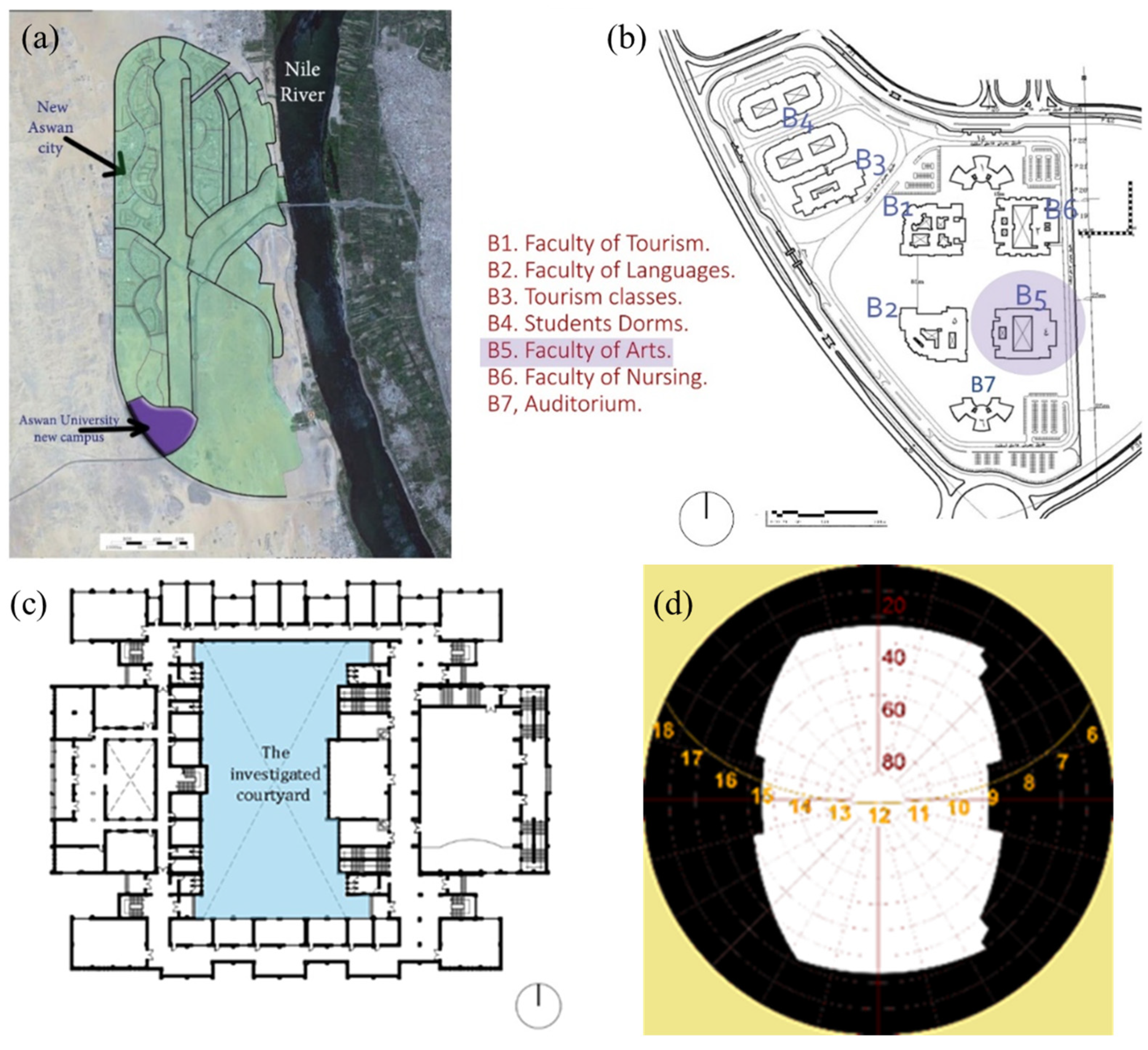
1. Introduction
Rapid urbanization, coupled with accelerating climate change, has significantly intensified outdoor thermal stress in urban environments, particularly in hot–arid regions where extreme solar radiation and elevated mean radiant temperatures dominate the urban energy balance. In such climates, outdoor thermal discomfort not only constrains the usability of open and semi-open spaces but also indirectly increases building cooling demand, amplifying energy consumption and peak electricity loads during prolonged summer periods. Consequently, mitigating outdoor thermal stress has emerged as a critical challenge for climate-responsive urban design in arid and semi-arid cities.
Urban vegetation has been widely promoted as an effective nature-based solution for moderating urban microclimates through shading, evapotranspiration, and modification of surface radiative exchanges. Numerous empirical and simulation-based studies have demonstrated that trees and green elements can substantially reduce air temperature, mean radiant temperature, and human thermal stress in outdoor environments [
1,
2,
3]. Among the available thermal comfort indicators, the PET has become one of the most widely adopted metrics due to its strong physiological basis and its ability to integrate meteorological variables with human thermoregulation into a single, interpretable index [
4,
5]. PET-based assessments have consistently shown that vegetation can reduce outdoor thermal stress across different climatic contexts, confirming its relevance for human-centered environmental evaluation [
6,
7,
8,
9]. However, despite the extensive application of PET in vegetation-related thermal comfort studies, much of the existing literature remains descriptive rather than comparative. Many studies report absolute PET values under vegetated scenarios without explicitly quantifying how much cooling is achieved relative to a clearly defined non-vegetated reference condition [
6,
10]. As a result, the net cooling contribution of vegetation is often conflated with background climatic variability or site-specific boundary conditions, limiting the transferability and comparability of reported findings across different studies and design contexts.
Courtyards represent a particularly important yet complex microclimatic setting in hot–arid architecture. As semi-enclosed transitional spaces, courtyards strongly mediate the interaction between outdoor climatic forcing and indoor thermal performance. Previous research has shown that courtyard geometry, enclosure ratio, and orientation exert substantial influence on solar access, longwave radiation trapping, and airflow patterns, thereby shaping outdoor thermal comfort conditions [
11,
12,
13,
14,
15,
16]. Vegetation within courtyards has been shown to further enhance microclimatic moderation by reducing mean radiant temperature and shading exposed surfaces [
2,
3,
17]. Nevertheless, most courtyard-focused vegetation studies evaluate performance using single scenarios or limited vegetation configurations, often emphasizing either geometric form or general greening strategies [
18,
19,
20]. While such studies provide valuable insights into courtyard behavior, they rarely establish systematic relationships between the vegetation coverage ratio and thermal mitigation intensity, particularly when vegetation characteristics such as tree species and canopy structure are considered. Consequently, designers lack quantitative guidance on how incremental increases in vegetation coverage translate into proportional reductions in thermal stress.
Recent advances in microclimate simulation tools, such as ENVI-met and coupled energy modeling platforms, have enabled more detailed exploration of vegetation–microclimate interactions [
21,
22,
23]. Several studies have reported substantial PET reductions exceeding 20–25 °C in highly vegetated courtyards under hot–arid conditions, alongside noticeable reductions in cooling energy demand for surrounding buildings [
3,
24,
25]. These findings highlight the dual benefits of courtyard vegetation for outdoor comfort and indoor energy performance. However, despite their contribution, most of these studies rely on aggregated or mean PET values, typically derived from limited daytime periods or representative hours. Such approaches overlook the pronounced diurnal variability in thermal stress in hot–arid climates, where peak discomfort occurs during specific hours driven primarily by solar altitude and radiative load. As a result, the temporal stability and reliability of vegetation-induced cooling remain insufficiently characterized.
Moreover, while the linkage between improved outdoor comfort and reduced cooling energy demand is frequently suggested, the quantitative sensitivity of energy performance to changes in outdoor PET remains weakly defined. Existing studies tend to report parallel improvements in comfort and energy use without explicitly analyzing how reductions in outdoor thermal stress propagate into measurable energy savings. Recent investigations have begun to address these gaps through coupled simulation approaches and field-validated frameworks, yet standardized, species-sensitive assessment methodologies remain scarce [
24,
25,
26,
27,
28,
29,
30]. This limits the ability to evaluate the energy relevance of outdoor greening strategies beyond qualitative associations. Contemporary research emphasizes the need for climate-adaptive vegetation strategies, particularly in water-limited arid environments where species selection and coverage optimization must balance cooling benefits with resource constraints [
31,
32]. Taken together, these limitations indicate that previous studies lack a species-sensitive, reference-based, and temporally resolved framework capable of simultaneously evaluating vegetation-induced thermal mitigation and its energy implications in courtyard environments. Specifically, there is a need for analytical tools that (i) normalize thermal comfort improvements relative to a non-vegetated baseline, (ii) capture diurnal variations rather than static snapshots, and (iii) explicitly link outdoor thermal mitigation to indoor cooling energy demand.
To address these challenges, this study introduces two complementary empirical indicators: the Vegetation Cooling Efficiency Index (VCEI) and the PET–Energy Sensitivity Index (PESI). The VCEI quantifies vegetation-induced reductions in PET relative to a reference scenario without vegetation, normalized by vegetation coverage ratio, thereby enabling objective comparison across species and design alternatives. The PESI, in turn, characterizes the sensitivity of cooling energy demand to changes in outdoor thermal comfort, providing a quantitative measure of how effectively outdoor mitigation translates into indoor energy benefits. The proposed framework is applied to a university courtyard in Aswan City, Egypt, representative of extreme hot–arid climatic conditions. By integrating hourly microclimatic simulations, field measurements, and dynamic building energy modeling, this study derives species-specific relationships between vegetation coverage and thermal mitigation for three commonly used tree species (Cassia leptophylla, Cassia nodosa, and Ficus nitida). Through this integrated approach, the study advances current knowledge by moving beyond descriptive assessments toward a performance-oriented evaluation of courtyard vegetation, offering practical metrics to support climate-responsive design and energy-efficient urban development in hot–arid regions.
3. Materials and Methods
This study adopts an integrated empirical–simulation framework designed to quantify how courtyard vegetation modifies outdoor thermal conditions and how these microclimatic changes propagate into building cooling energy demand under hot–arid climatic conditions. The methodological approach builds upon established microclimate-energy coupling techniques [
35,
36,
37] while introducing novel species-sensitive performance indicators suitable for climate-responsive design decision-making. The courtyard is explicitly conceptualized as a thermally active interface, mediating radiative and convective energy exchange between outdoor spaces and surrounding indoor environments, rather than as a passive architectural void. The methodological design is explicitly reference-based, whereby all vegetation-induced effects are evaluated relative to a consistent non-vegetated baseline scenario (S0). This normalization strategy minimizes confounding influences related to geometry, building operation, and climatic forcing, ensuring that observed variations in thermal comfort and energy demand can be attributed exclusively to vegetation characteristics.
The framework integrates three interdependent components: (i) hourly characterization of courtyard microclimatic conditions, (ii) assessment of outdoor thermal comfort using the PET, and (iii) evaluation of indoor cooling energy demand through dynamic building energy simulations. The interdependency of these components is central to the proposed methodology, as changes in courtyard radiative and convective conditions directly influence both human thermal perception and building cooling loads. Based on this integrated structure, two empirical performance indicators are formulated: the VCEI and the PESI. The VCEI quantifies the efficiency with which vegetation mitigates thermal stress and reduces cooling demand per unit of vegetation input, while the PESI captures the sensitivity of building cooling energy demand to incremental changes in outdoor thermal comfort. Together, these indices move beyond descriptive assessment and enable performance-based comparison of vegetation strategies, which is particularly valuable for early-stage design decision-making.
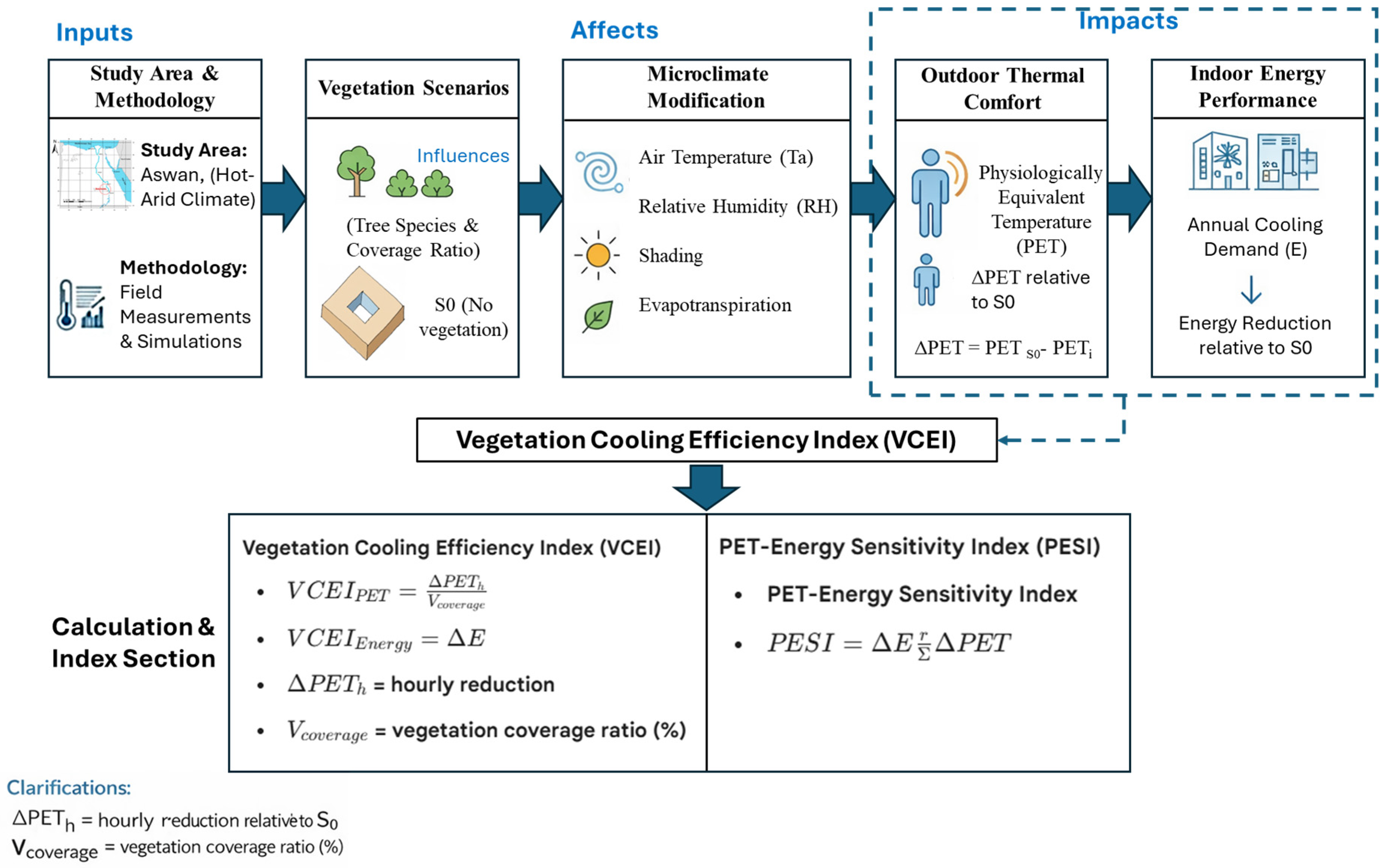
Vegetation scenarios are systematically defined by varying tree species and vegetation coverage ratios while maintaining identical courtyard geometry, building configuration, envelope properties, operational schedules, and climatic boundary conditions across all simulations. This controlled experimental design emulates a quasi-experimental setup, allowing vegetation characteristics to be treated as the sole independent variables. An overview of the methodological logic linking vegetation parameters, courtyard microclimate modification, outdoor thermal comfort, and indoor energy demand is presented in
Figure 2. This structured coupling establishes a clear causal pathway from vegetation characteristics to microclimate modification, outdoor thermal perception, and indoor energy response, forming the backbone of the proposed analytical framework.
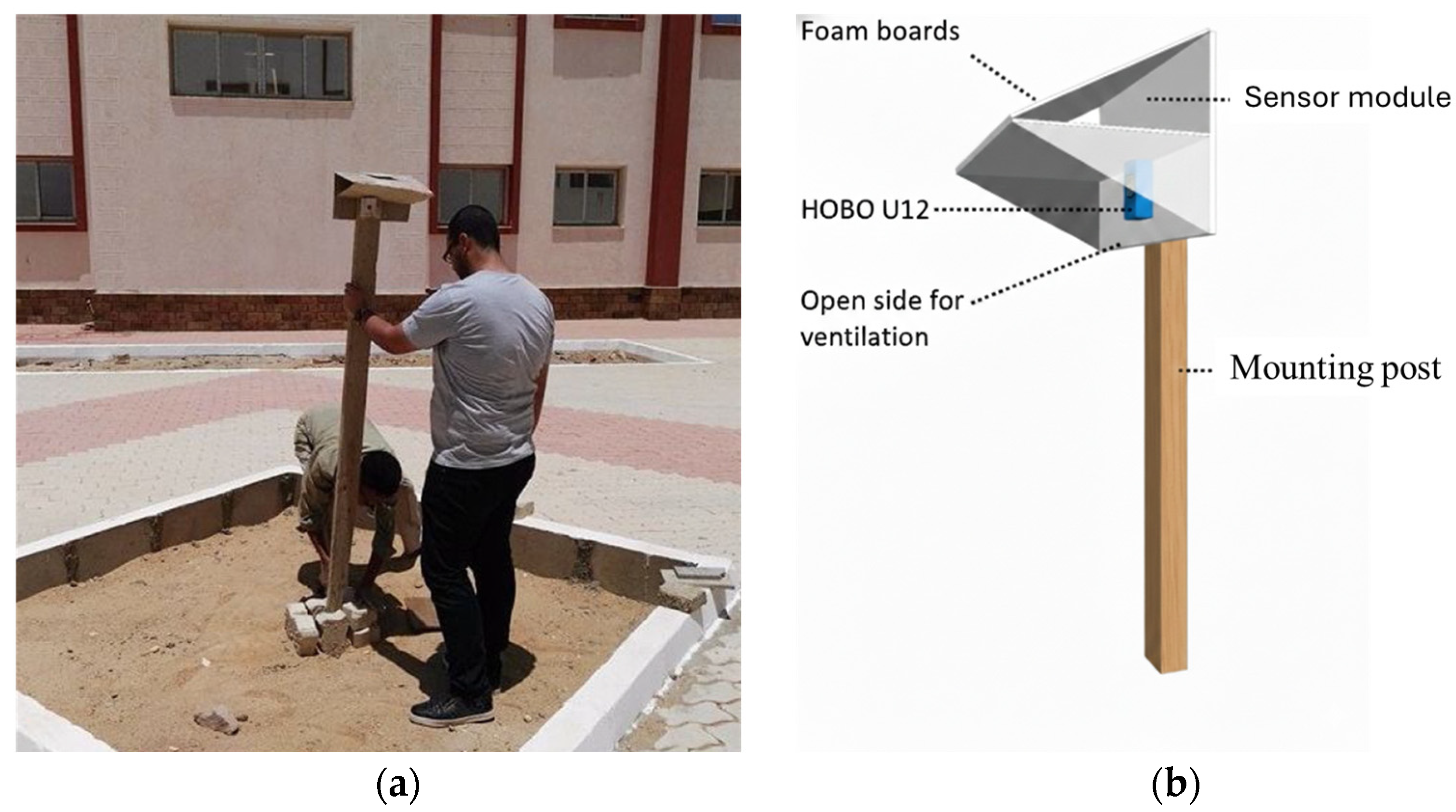
To establish an empirical baseline and enhance the reliability of numerical simulations, on-site field measurements of air temperature and relative humidity were conducted within the courtyard during representative peak summer periods. Measurements were performed at the pedestrian level to capture human-relevant thermal exposure. The measured data were used not only for model calibration but also to constrain simulation uncertainty, thereby increasing confidence in the subsequent scenario-based analyses. Details of the measurement setup and sensor configuration are illustrated in
Figure 3.
3.1. Microclimate Simulation and Outdoor Thermal Comfort Assessment
Outdoor thermal comfort and building energy performance were evaluated within an integrated simulation framework designed to capture the coupled effects of courtyard vegetation on human thermal stress and cooling energy demand. Outdoor thermal comfort was assessed using the PET, a biometeorological index that integrates air temperature, relative humidity, wind speed, mean radiant temperature, and human thermophysiological response into a single human-centered metric. PET is particularly robust for hot–arid environments due to its comprehensive integration of radiative and metabolic factors, as validated in numerous regional and climate-specific calibration studies [
38,
39]. So, PET was selected due to its proven applicability in hot–arid environments and its widespread use in outdoor comfort studies. Mean radiant temperature (T
mrt), a dominant driver of thermal stress in courtyard environments, was obtained through microclimatic simulations using ENVI-met v5.5 accounting for radiative exchanges between the human body, surrounding built surfaces, and vegetation elements. The ENVI-met platform enables high-resolution modeling of shortwave and longwave radiation fluxes, vegetation transpiration, and three-dimensional plant geometry with validated accuracy for courtyard microclimates [
40,
41].
Hourly PET values were subsequently calculated using standardized human parameters to ensure consistency and comparability across all vegetation scenarios and tree species. The standard metabolic rate (80 W) corresponding to a walking activity at 0.5 m/s and clothing insulation (0.5 clo) representative of light summer clothing were applied uniformly across scenarios [
42]. Full diurnal datasets were retained in the analysis, enabling explicit assessment of the temporal variability in vegetation-induced thermal mitigation rather than relying on aggregated or static indicators.
3.2. Building Energy Simulation and Annual Cooling Demand Estimation
Indoor thermal performance was assessed using dynamic building energy simulations, with annual cooling energy demand adopted as the primary performance indicator. Building envelope properties, internal gains, occupancy schedules, and HVAC operation were maintained identically across all scenarios to isolate the influence of courtyard microclimate modification. Due to the computational constraints associated with year-long microclimate simulations, an indirect scaling approach was employed to estimate annual cooling demand. Cooling energy outputs obtained from representative simulation days were extrapolated using cooling degree hours (CDHs), allowing short-term simulation results to be translated into estimated monthly and annual cooling energy demand while preserving the relative influence of vegetation-induced microclimatic modification. This approach preserves the relative influence of vegetation-induced microclimatic modification while enabling whole-year energy assessment within a feasible computational framework.
3.3. Courtyard Vegetation Scenarios and Species Characterization
Vegetation scenarios were defined based on the horizontal projection of tree canopy area relative to the total courtyard area, hereafter referred to as the vegetation coverage ratio. This metric was selected because it directly governs the dominant microclimatic mechanisms operating in hot–arid courtyard environments, including solar shading intensity, sky-view factor reduction, and radiative heat exchange moderation.
A non-vegetated courtyard scenario (S0) was established as the reference baseline. Subsequent scenarios introduced vegetation at progressively increasing coverage ratios representing low, moderate, and high greening intensities consistent with realistic courtyard landscaping practices in educational campuses.
Table 1 presents the simulation matrix for assessing the impact of vegetation species and coverage levels on courtyard microclimate and building energy performance. The selected coverage range enables identification of both marginal cooling gains and potential diminishing returns associated with intensive vegetation deployment, which is critical for performance-based design optimization.
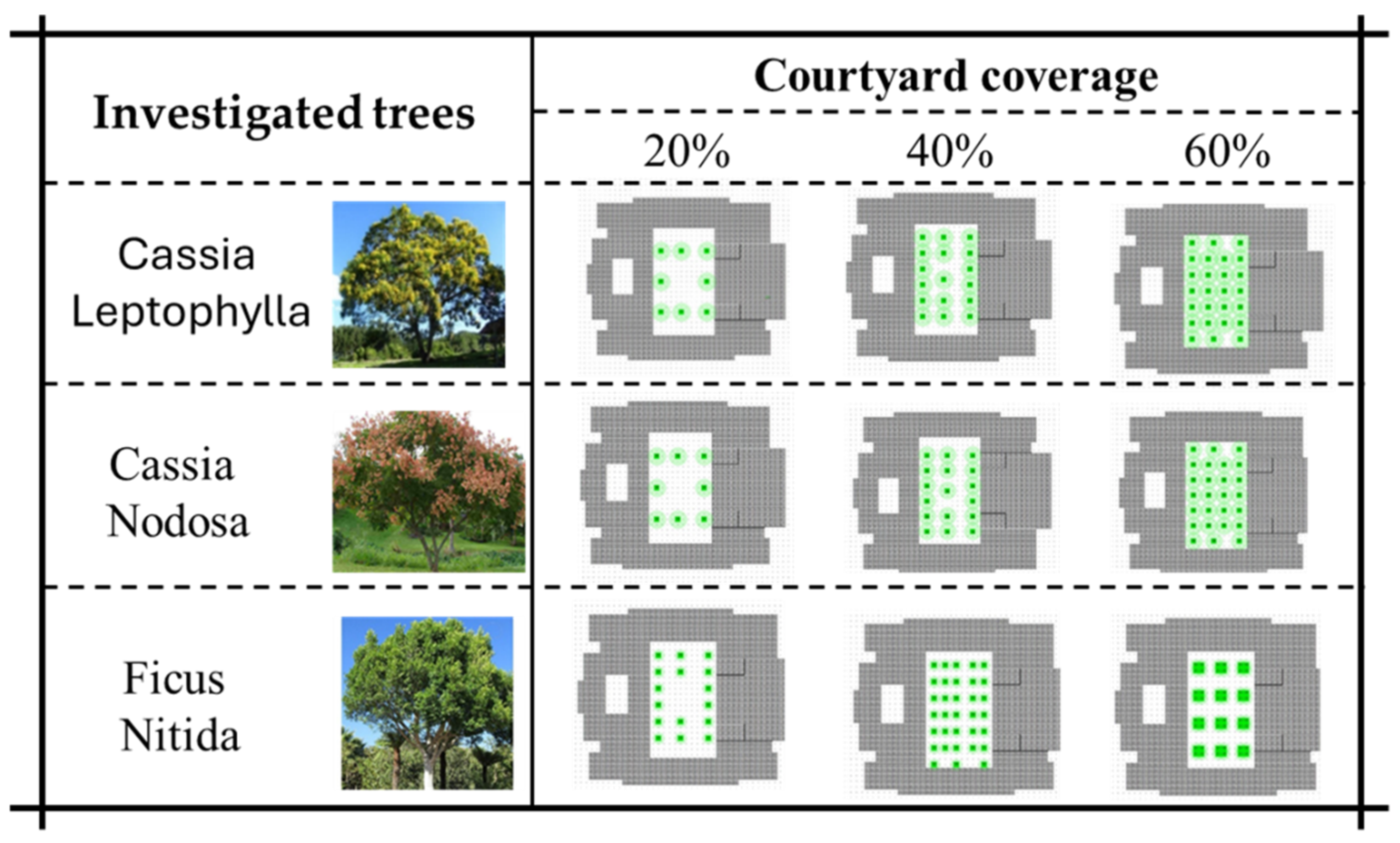
To maintain strict comparability, all vegetation scenarios were implemented using identical courtyard geometry, building configuration, simulation settings, and climatic forcing. Tree placement followed a uniform spatial distribution strategy, ensuring homogeneous canopy coverage while avoiding excessive clustering that could artificially constrain airflow or distort radiative exchange. This approach minimizes layout-induced bias and enhances the interpretability of coverage-related effects. The spatial configuration of the investigated vegetation scenarios is illustrated in
Figure 4.
Tree species were selected based on three explicit criteria: climatic suitability for hot–arid environments, prevalence in regional landscaping practice, and diversity of canopy morphology and radiative behavior. The selected species, Cassia leptophylla, Cassia nodosa, and Ficus nitida, represent a spectrum of canopy densities and geometries, enabling species-specific differentiation of cooling performance under identical boundary conditions.
Key biophysical parameters incorporated into the simulations include tree height, canopy diameter, and leaf area density (LAD). These parameters collectively govern shortwave radiation interception, longwave radiative exchange, and evapotranspiration potential, which are the primary physical mechanisms through which vegetation modifies courtyard microclimate. Parameter values were derived from peer-reviewed literature and standardized modeling assumptions to ensure physical realism and reproducibility.
All trees were modeled at a mature growth stage to reflect long-term campus landscaping conditions rather than transient or early-growth effects. To isolate species-specific performance, planting density was adjusted to maintain identical vegetation coverage ratios across all species scenarios, ensuring that observed differences in thermal performance arise from intrinsic biophysical characteristics rather than total canopy extent. The geometric and biophysical properties of the investigated species are summarized in
Table 2.
Vegetation elements were explicitly incorporated into the microclimate simulation framework to capture their influence on radiative exchange, shading patterns, and surface–air thermal interactions within the courtyard. Tree canopies modify both shortwave and longwave radiation balances, leading to localized reductions in Tmrt, which is a dominant driver of outdoor thermal stress in hot–arid climates.
These vegetation-induced microclimatic modifications were directly reflected in the calculation of PET, enabling consistent, scenario-wide comparison of outdoor thermal comfort performance. The resulting PET values constitute the primary input for the empirical derivation of the VCEI.
In parallel, the modified courtyard microclimate conditions were coupled with dynamic building energy simulations to quantify their indirect impact on annual cooling energy demand. By preserving identical building envelope properties, internal gains, occupancy schedules, and HVAC operation across all simulations, the analysis isolates the energy implications of courtyard vegetation as a microclimate-driven phenomenon. This integrated modeling strategy provides the empirical foundation for linking the VCEI with building energy sensitivity (PESI) in subsequent analyses.
3.4. Reference-Based Performance Indicators
3.4.1. Vegetation Cooling Efficiency Index (VCEI)
To move beyond absolute reporting of thermal comfort improvement, this study introduces the VCEI as a normalized metric that quantifies the effectiveness of courtyard vegetation in mitigating outdoor thermal stress and reducing indoor cooling energy demand. The index is designed to capture the cooling benefit generated per unit of vegetation input, thereby enabling meaningful comparison across vegetation coverage levels and tree species.
The conceptual basis of the VCEI rests on the premise that vegetation-induced microclimatic modification is primarily governed by radiative attenuation and evapotranspiration processes, which scale with canopy extent. Normalizing thermal and energy benefits by vegetation coverage allows for the isolation of efficiency from magnitude, an aspect that is critical for performance-based design decision-making. This formulation intentionally avoids reliance on absolute PET or energy values, which are highly climate-specific, and instead emphasizes relative performance improvements that are more transferable across hot–arid contexts. The normalization strategy adopted in this study ensures that the VCEI remains directly applicable during early design stages, where vegetation coverage is a controllable planning variable.
Two complementary formulations of the VCEI were empirically derived to capture both outdoor thermal comfort improvement and indoor energy performance enhancement.
The comfort-based Vegetation Cooling Efficiency Index (
is expressed as:
where
represents the Physiologically Equivalent Temperature of the non-vegetated courtyard,
denotes the PET corresponding to a given vegetation scenario, and
is the vegetation coverage ratio (%).
Equation (1) quantifies the reduction in thermal stress per unit vegetation coverage, allowing for direct comparison of cooling efficiency across vegetation scenarios under identical climatic conditions.
To capture the energy implications of vegetation-induced microclimate modification, an energy-based formulation was also developed:
where
and
represent the annual cooling energy demand of the baseline and vegetated scenarios, respectively.
This formulation expresses the cooling energy savings achieved per unit vegetation coverage, providing a direct link between courtyard greening strategies and building operational performance.
VCEI values were calculated for all vegetation scenarios using consistent climatic inputs, simulation settings, and human comfort parameters. By maintaining uniform boundary conditions across scenarios, the derived VCEI values reflect intrinsic vegetation efficiency rather than contextual variability. The resulting indices form the empirical basis for comparative evaluation of vegetation strategies and species-specific performance. While the VCEI evaluates vegetation efficiency in mitigating thermal stress, it does not capture the downstream energy implications, thereby necessitating a complementary sensitivity metric.
3.4.2. PET–Energy Sensitivity Index (PESI)
While the VCEI quantifies the efficiency of vegetation in reducing thermal stress, it does not explicitly capture how outdoor comfort improvements translate into indoor energy performance. To address this gap, the PESI is introduced to empirically link changes in outdoor thermal comfort to variations in indoor cooling energy demand.
The PESI conceptualizes the courtyard–building system as a coupled thermo-responsive entity, in which outdoor radiative mitigation modifies the thermal boundary conditions governing indoor cooling loads. The index is defined as the ratio between the reduction in annual cooling energy demand and the associated reduction in PET relative to the non-vegetated reference scenario.
By expressing energy sensitivity in units of kWh·°C−1, the PESI enables direct interpretation of how effectively outdoor comfort improvements translate into operational energy benefits. This formulation avoids reliance on absolute energy savings alone and highlights non-linear response regimes under intensified vegetation coverage. Unlike conventional energy performance metrics that implicitly assume linear indoor–outdoor coupling, the PESI explicitly captures non-linear response regimes, allowing for identification of threshold behaviors and diminishing returns under intensified vegetation coverage.
The PET–Energy Sensitivity Index is defined as:
The change in cooling energy demand is quantified as the difference between the annual cooling energy consumption of the non-vegetated reference scenario and that of each vegetated scenario. Similarly, the corresponding change in outdoor thermal comfort is defined as the reduction in PET achieved through the introduction of courtyard vegetation relative to the reference condition. These two quantities together describe how vegetation-induced thermal mitigation in the courtyard translates into variations in building cooling energy demand.
The PESI is expressed in units of kWh·°C−1, indicating the magnitude of cooling energy variation associated with a one-degree change in PET. This formulation enables the translation of human thermal comfort improvement into energy-relevant terms.
PESI values were derived by statistically coupling PET reductions and cooling energy savings across all vegetation scenarios. Regression-based analysis was employed to characterize the relationship between outdoor thermal stress mitigation and indoor energy response, allowing for the identification of sensitivity gradients and potential non-linear behavior. This approach enables the assessment of whether incremental improvements in thermal comfort yield proportional or diminishing energy benefits.
The PESI framework complements the VCEI by connecting vegetation efficiency to building energy sensitivity, thereby forming an integrated evaluation approach that links courtyard design decisions to both human comfort and operational energy outcomes.
3.5. Statistical Robustness, Species Sensitivity, and Diurnal Performance Assessment
To ensure the robustness and reliability of the proposed indices, a comprehensive statistical validation procedure was conducted using metrics widely adopted in environmental modeling and building energy research. Regression models developed for the empirical derivation of the VCEI and PESI were evaluated using the coefficient of determination (R2), which quantifies explanatory power, and the root mean square error (RMSE), which reflects predictive accuracy and dispersion.
These performance metrics were calculated separately for each analytical relationship investigated, namely: (i) vegetation coverage versus PET reduction (VCEI_PET), (ii) vegetation coverage versus cooling energy savings (VCEIE), and (iii) outdoor thermal comfort mitigation versus cooling energy response (PESI). This disaggregated validation strategy avoids aggregation bias and allows each component of the methodological framework to be independently assessed.
In addition to regression-based validation, a structured sensitivity analysis was performed to evaluate the influence of key vegetation parameters on index behavior. Partial variation techniques were applied, whereby vegetation coverage ratio and tree species were varied independently while all other variables were held constant. This approach enables identification of dominant drivers governing vegetation cooling efficiency and building energy sensitivity, as well as assessment of index stability across different vegetation configurations.
To capture the temporal dynamics of vegetation performance, full diurnal datasets were retained for analysis. This temporal resolution allows for the detection of species-dependent and coverage-dependent variations in cooling effectiveness across daytime and nighttime periods, which would otherwise be obscured by daily or seasonal averaging. The diurnal assessment provides additional insight into the operational relevance of vegetation strategies under peak thermal stress conditions.
Although the numerical values of the VCEI and PESI are empirically calibrated for hot–arid climates and courtyard-based educational buildings, the underlying normalization logic, coupling strategy, and validation procedure are intentionally climate- and typology-agnostic. This enables the proposed framework to be recalibrated using locally measured or simulated datasets for other climatic zones, urban morphologies, and building functions, thereby enhancing methodological transferability.
4. Results and Discussion
This section presents the integrated analysis of courtyard vegetation performance from both outdoor thermal comfort and indoor energy perspectives. The discussion proceeds in three sequential steps. First, the magnitude of PET reduction across vegetation species and coverage levels is examined to characterize outdoor thermal mitigation. Second, the corresponding cooling energy savings are analyzed to evaluate indoor energy responsiveness. Third, the relationship between outdoor comfort improvement and energy sensitivity is interpreted using the proposed VCEI and PESI, with particular attention to non-linear behavior, species-dependent performance, and annualized implications. This structured progression enables a coherent interpretation of how microclimatic modification translates into building-scale energy outcomes.
4.1. Vegetation-Induced Outdoor Thermal Mitigation Relative to the Non-Vegetated Reference
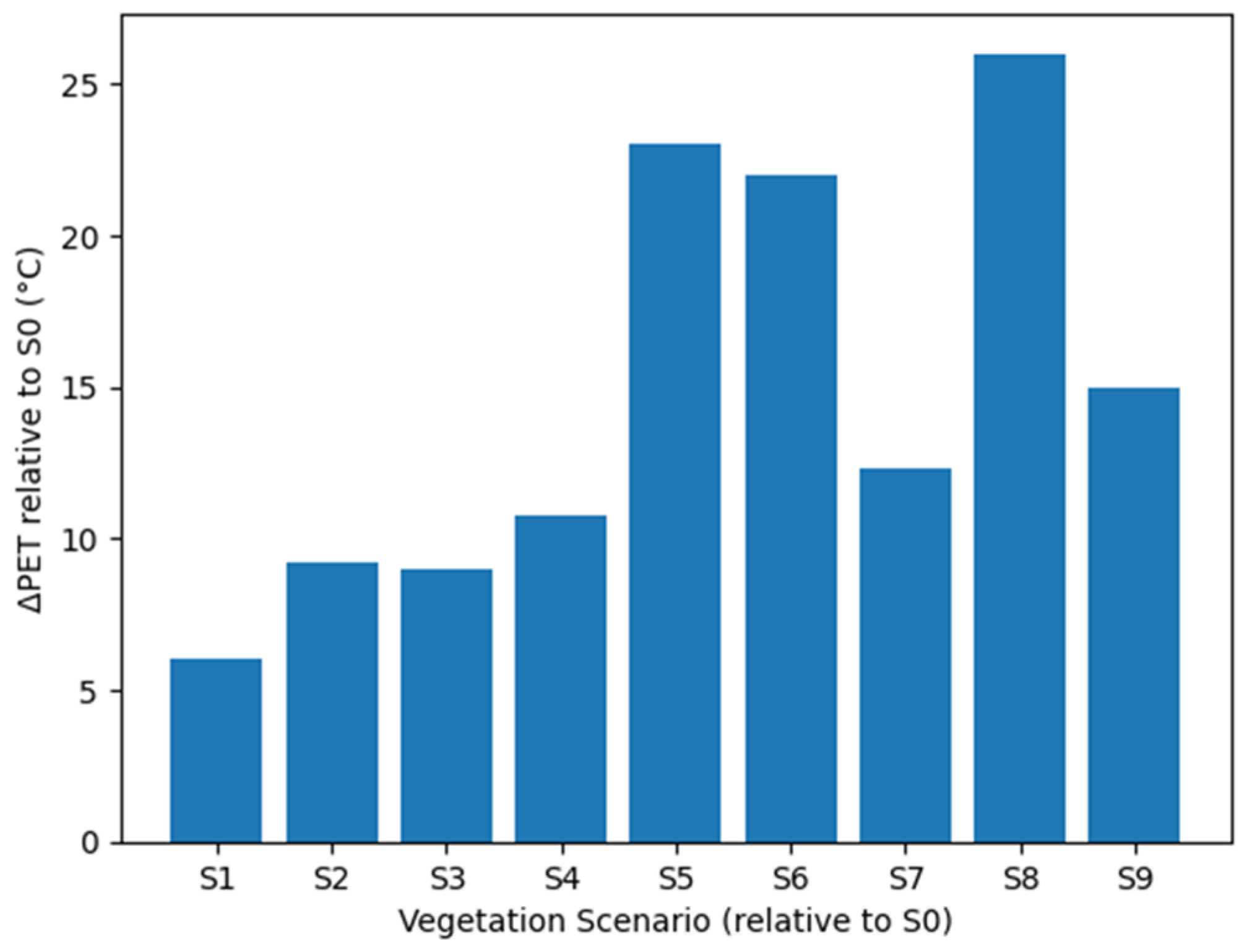
Figure 5 illustrates the reduction in Physiologically Equivalent Temperature (ΔPET) achieved by the investigated courtyard vegetation scenarios relative to the reference condition (S0), which represents a courtyard without vegetation. Across all scenarios, the introduction of vegetation results in a marked reduction in outdoor thermal stress, confirming the effectiveness of courtyard greening as a climate adaptation strategy in hot–arid urban environments.
The magnitude of PET reduction varies considerably between scenarios, with scenario-averaged ΔPET values ranging from approximately 6 °C under low vegetation coverage to about 26 °C under dense canopy configurations, while hourly peak reductions during critical midday periods reach substantially higher values. Scenarios with moderate vegetation coverage achieve PET reductions between 10 °C and 23 °C, indicating that substantial thermal benefits can be obtained without maximizing vegetation extent. This finding is particularly relevant for dense urban campuses, where spatial, water, and maintenance constraints often limit large-scale greening interventions.
While these results confirm the capacity of courtyard vegetation to substantially reduce outdoor thermal stress, they do not yet indicate how efficiently this mitigation is achieved per unit vegetation input nor how it translates into building energy performance.
By integrating species-sensitive outdoor thermal assessment with energy-response analysis, the present findings confirm and extend existing evidence on the cooling role of vegetation in hot–arid courtyard environments. Consistent with previous studies, the introduction of vegetation within the courtyard significantly reduced air temperature and PET, primarily through combined shading and evapotranspiration mechanisms. Earlier studies in hot–arid educational courtyards have reported that high vegetation coverage can reduce mean radiant temperature and PET by more than 25 °C relative to non-vegetated conditions, producing substantial gains in thermal comfort [
3].
These results align with broader outdoor comfort research emphasizing the importance of canopy density and spatial distribution in regulating radiant heat exchange within enclosed courtyards [
43,
44]. However, while previous investigations predominantly reported absolute PET reductions, the present results suggest that the magnitude of mitigation alone does not fully characterize performance efficiency, thereby motivating further analysis of vegetation effectiveness per unit coverage.
4.2. Cooling Energy Savings
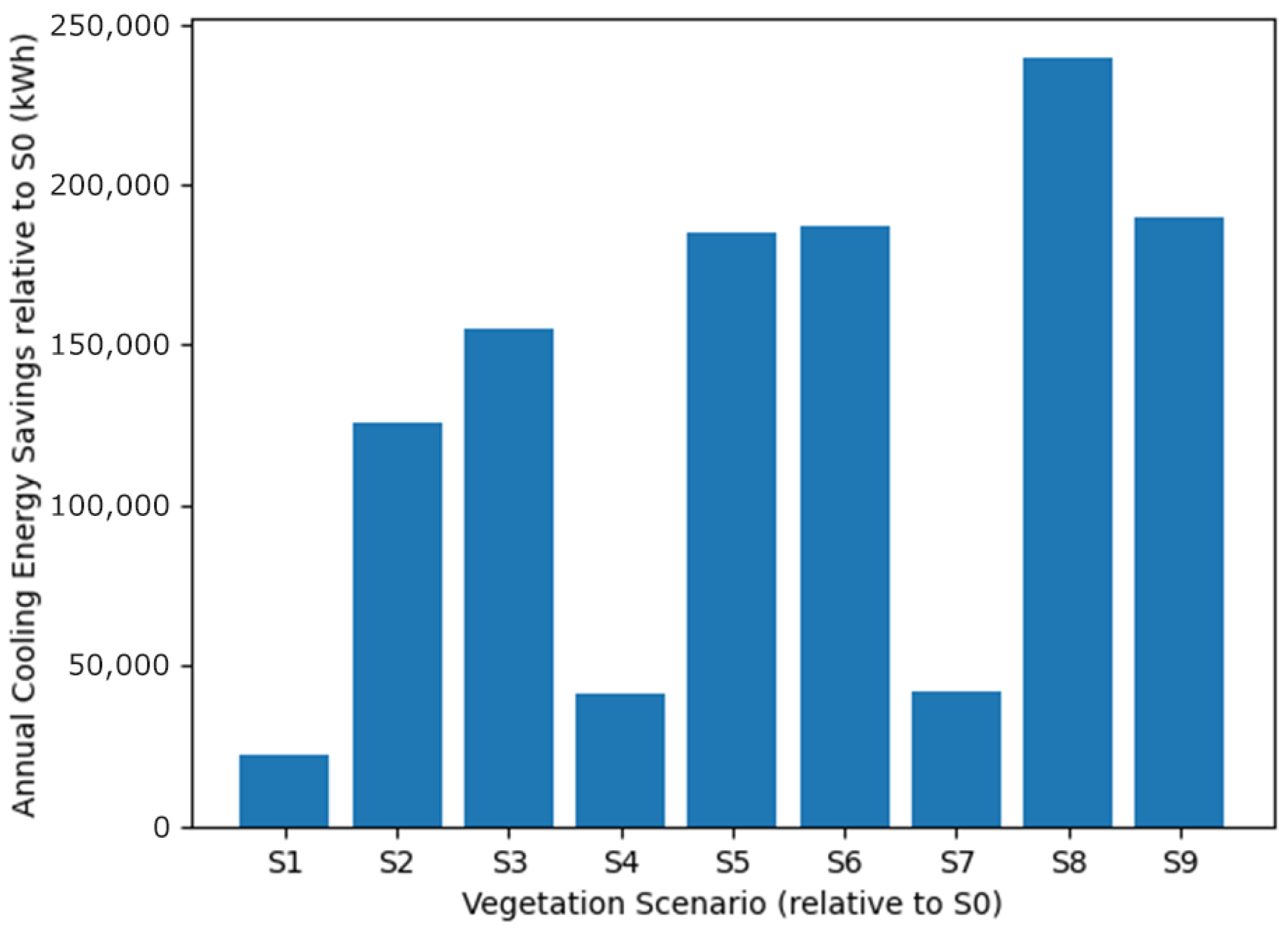
As shown in
Figure 6, courtyard vegetation has a pronounced influence on the cooling energy demand of the surrounding building when compared to the non-vegetated reference scenario. Annual cooling energy savings range from approximately 22 MWh to nearly 240 MWh, demonstrating the potential of outdoor microclimate mitigation strategies to contribute meaningfully to building energy efficiency goals. In the non-vegetated reference scenario (S0), cooling demand remains consistently highest across the simulated period, reflecting full solar exposure of courtyard surfaces and the absence of evaporative or shading moderation. The bare ground and exposed façades increase surface temperatures and intensify convective heat exchange with the building envelope, producing sustained cooling loads during peak hours. The sharper and more prolonged cooling peaks observed in S0 indicate limited thermal buffering capacity, establishing it as a critical baseline for evaluating vegetation-induced performance improvements.
However, the results also reveal that similar levels of outdoor thermal mitigation do not necessarily translate into proportional energy savings. Several scenarios with moderate PET reductions yield relatively limited energy benefits, while others achieve substantially higher energy savings under comparable thermal conditions. This highlights the importance of considering the interaction between outdoor spaces and adjacent buildings when evaluating the energy implications of urban vegetation strategies.
The observed divergence between PET reduction and cooling energy sensitivity highlights the non-linear nature of courtyard–building thermal coupling. While PET is predominantly governed by radiative exposure at pedestrian level, cooling energy demand additionally reflects envelope heat storage, convective exchange, and temporal lag effects. Consequently, vegetation configurations that achieve comparable PET reductions may induce markedly different energy responses, depending on canopy morphology, shading persistence, and diurnal heat flux modulation. An apparent transition in the PET–energy relationship is observed around ΔPET ≈ 10 °C, beyond which the PESI increases more rapidly. This inflection can be interpreted considering the thermal response characteristics of the studied university building typology under hot–arid conditions. At lower levels of PET reduction, vegetation primarily moderates shortwave radiation at pedestrian level, while the building envelope continues to experience substantial conductive and convective heat gains. Once vegetation density and canopy continuity are sufficient to produce PET reductions approaching 10 °C, sustained shading of courtyard-facing façades and adjacent ground surfaces becomes more persistent, reducing surface temperatures and limiting heat storage within the envelope. This leads to a threshold-like response in cooling demand, as envelope heat flux and indoor cooling loads become more directly affected by the stabilized microclimate. Although the precise numerical value of this transition may vary under different representative days or boundary-condition assumptions, the existence of a non-linear threshold is expected to remain robust for similar heavy-mass educational buildings in hot–arid climates, where cooling loads are dominated by radiative gains and delayed thermal storage effects. Future work incorporating seasonal simulations and probabilistic boundary-condition variation would allow for formal testing of the stability of this inflection behavior.
While these outcomes confirm that courtyard vegetation can contribute meaningfully to reducing building cooling demand, the results expose important limitations in how earlier studies have interpreted the relationship between outdoor thermal mitigation and indoor energy performance. Unlike prior work that reported absolute cooling energy savings as independent outcomes, the present findings demonstrate that outdoor thermal mitigation and energy response do not scale proportionally.
Importantly, scenarios achieving the largest reductions in PET are not necessarily those yielding the highest cooling energy savings. This finding challenges the implicit assumption of linear indoor–outdoor thermal coupling that underpins much of the existing literature. While prior studies have acknowledged that outdoor thermal mitigation may correlate with reduced energy consumption, explicit quantification of sensitivity per degree of PET change remains limited [
45]. The divergence observed here underscores the need to explicitly evaluate building–microclimate interaction mechanisms rather than assuming direct proportionality.
4.3. Vegetation Cooling Efficiency in Terms of Outdoor Thermal Comfort (VCEI_PET)
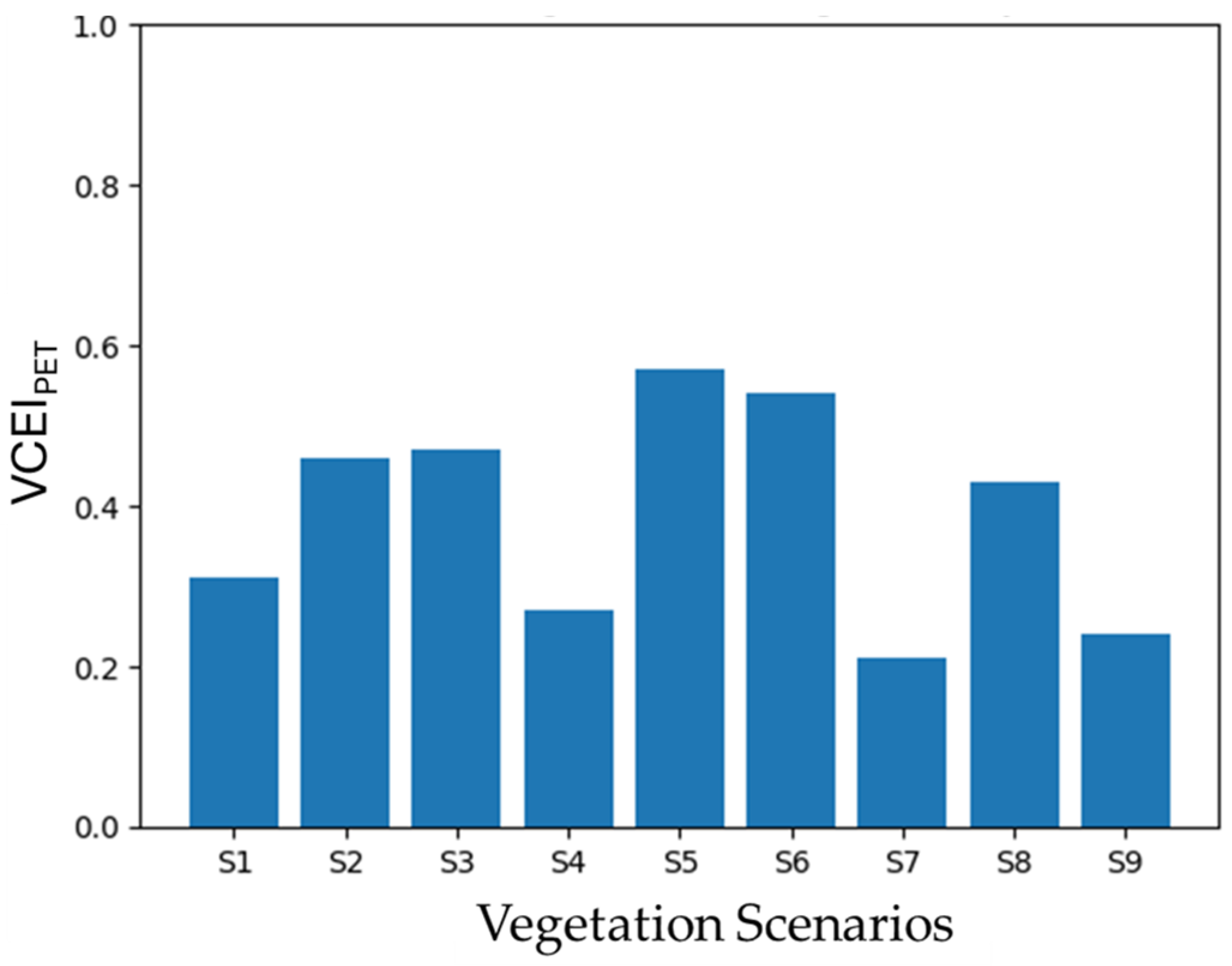
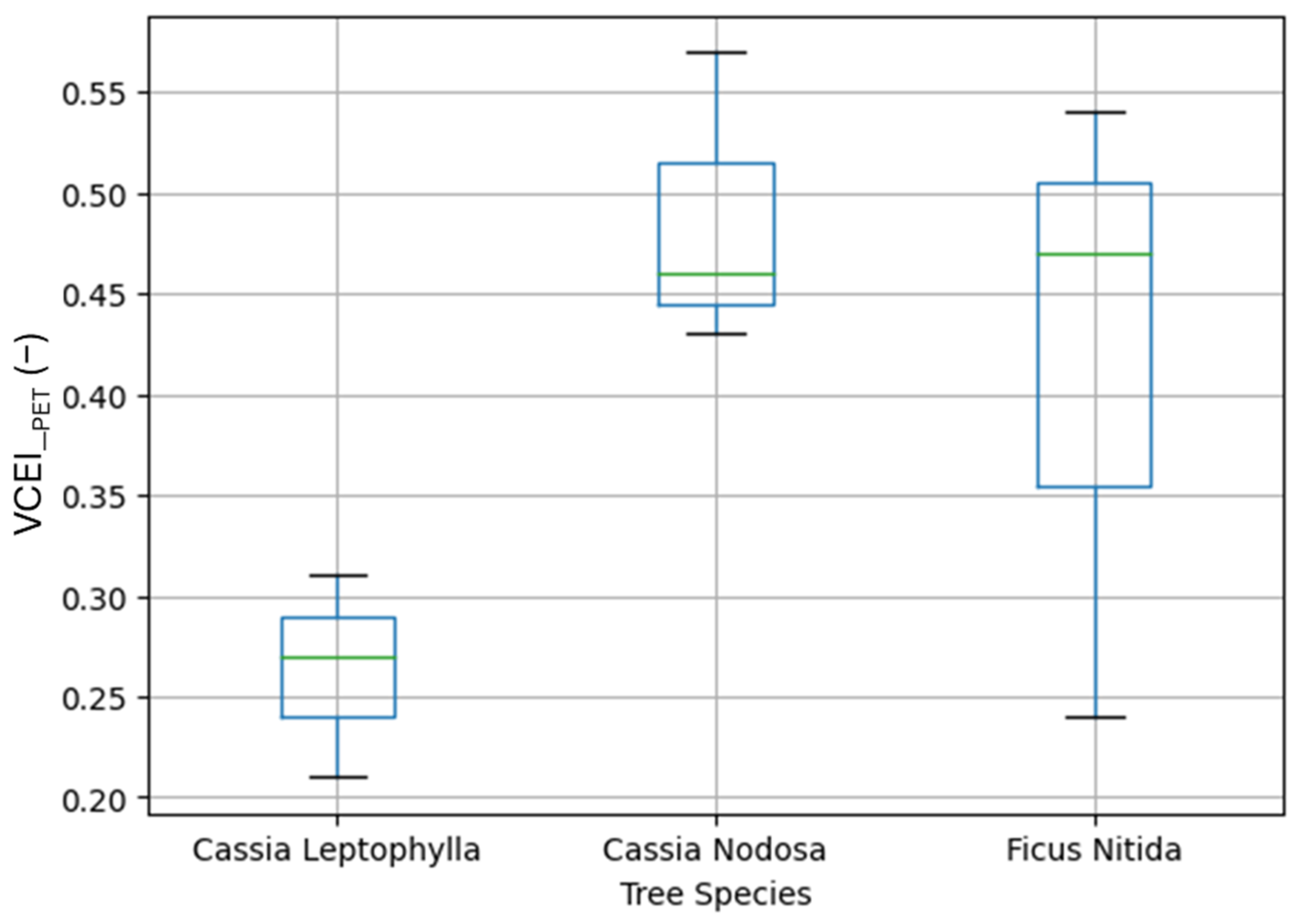
Figure 7 presents the VCEI_
PET for all vegetated scenarios relative to the reference case. The bounded range of VCEI_
PET values (0.21–0.57) indicates moderate to high efficiency in translating vegetation deployment into courtyard-scale thermal comfort improvement. Interpreting these values relative to the S0 baseline clarifies the efficiency dynamics: because S0 exhibits the highest PET levels due to unmitigated radiative loading, even moderate vegetation coverage initially produces substantial relative PET reductions. However, as coverage increases, incremental shading overlaps temporally and spatially, leading to diminishing marginal improvements in PET per unit vegetation area. This explains why scenarios with similar absolute PET reductions may display different VCEI_
PET values depending on canopy continuity and solar interception effectiveness.
Scenarios combining appropriate vegetation coverage with tree species characterized by dense and continuous canopies exhibit the highest efficiency. In contrast, scenarios with limited coverage or fragmented shading patterns demonstrate lower efficiency, despite achieving measurable reductions in PET. The relatively high dispersion of VCEI_PET observed for FN warrants further clarification. While all species were modeled under consistent boundary conditions, the variability associated with FN appears to be primarily driven by its canopy architecture at maturity and its interaction with time-dependent solar geometry rather than by the selected LAD value alone. FN exhibits a comparatively compact and vertically stratified canopy form, which produces heterogeneous and temporally shifting shading footprints within the courtyard. Under high solar altitudes typical of hot–arid climates, this morphology can lead to intermittent façade shading and variable ground-level radiative attenuation, thereby amplifying sensitivity to hourly solar position. In contrast, CN demonstrates a broader and more laterally continuous canopy geometry, promoting more stable radiative interception throughout peak cooling periods. Although LAD influences overall attenuation potential, the results suggest that geometric canopy continuity and its diurnal alignment with solar trajectories play a more decisive role in explaining the observed efficiency dispersion. Future studies incorporating dynamic growth stages and seasonally adjusted LAD profiles would further refine this interpretation. From a sustainable urban design perspective, this suggests that strategic vegetation design can achieve meaningful thermal benefits without excessive resource use.
These aggregate efficiency trends motivate a closer examination of how vegetation type and canopy morphology govern both the magnitude and temporal stability of thermal mitigation. The introduction of the Vegetation Cooling Efficiency Index (VCEI) provides a novel quantitative framework for interpreting species-dependent cooling outcomes. While previous studies have documented substantial absolute reductions in PET and air temperature through vegetation and hybrid shading strategies (e.g., PET reductions of approximately 18.5 °C in school courtyards) [
46], few investigations have normalized these effects per unit vegetation coverage.
By expressing performance as efficiency per unit canopy coverage, the VCEI demonstrates that vegetation effectiveness cannot be inferred solely from absolute thermal indicators. This efficiency-based perspective adds methodological rigor to conventional parametric assessments and clarifies why scenarios with similar PET reductions may differ significantly in their resource-performance balance.
4.4. Species-Specific Thermal Performance and Temporal Stability of Courtyard Vegetation
4.4.1. Diurnal PET Response Under Different Tree Species
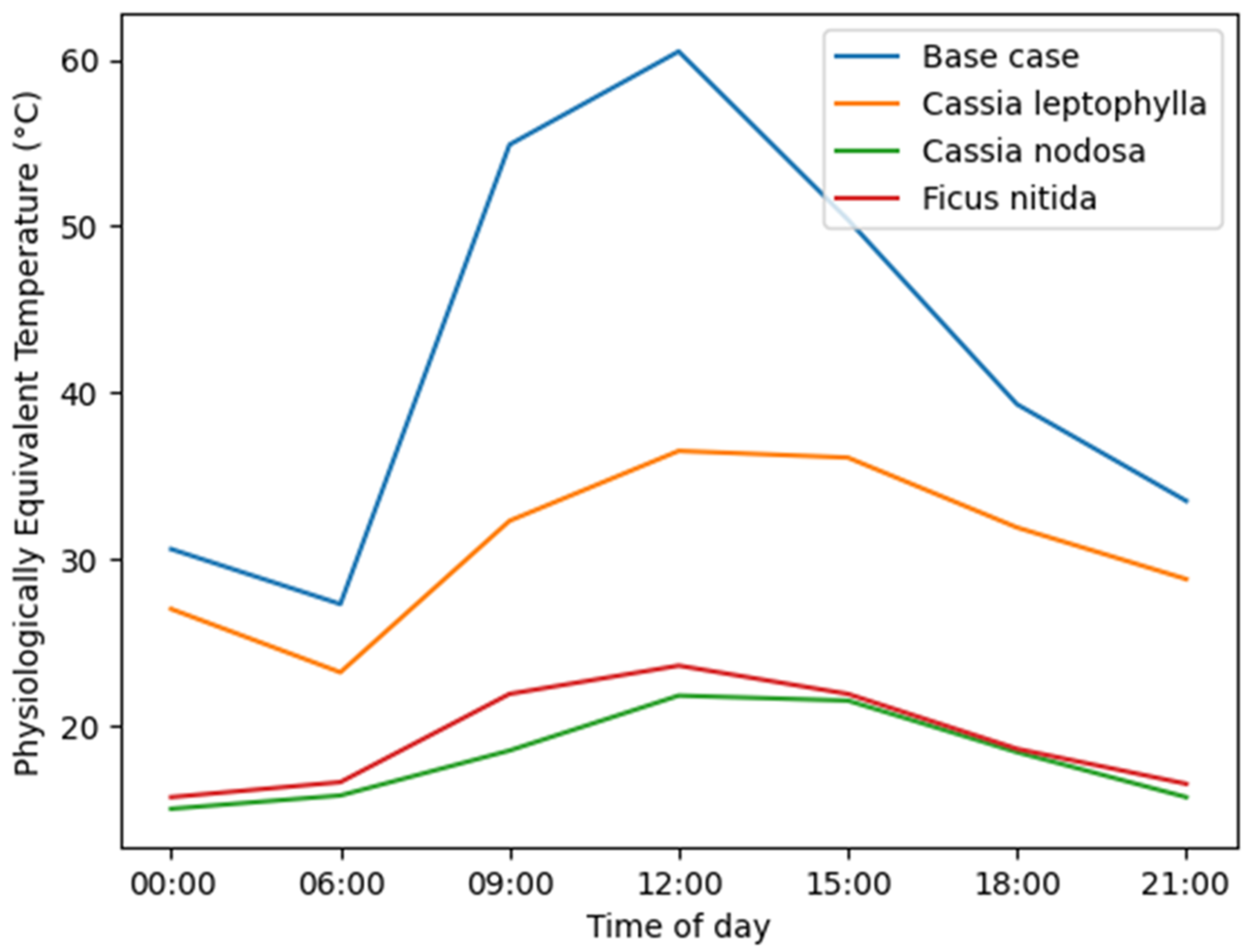
Figure 8 presents the diurnal variation in PET within the courtyard under different vegetation species at a representative vegetation coverage ratio of 40%, compared against the non-vegetated reference scenario (S0). The results clearly demonstrate that vegetation-induced cooling persists throughout the day, with the most pronounced effects occurring during peak thermal stress hours.
In the reference scenario, PET values increase sharply after sunrise, reaching a maximum of approximately 60.5 °C at midday, before gradually declining during the evening hours. In contrast, all vegetated scenarios significantly attenuate daytime PET peaks. At 12:00 p.m., PET is reduced to approximately 36.5 °C under CL, 21.8 °C under CN, and 23.6 °C under FN, corresponding to peak-hour PET reductions of 24.0 °C, 38.7 °C, and 36.9 °C, respectively.
The magnitude and temporal consistency of cooling vary markedly by species. CN exhibits the strongest and most stable cooling performance across the day, maintaining PET values below approximately 22 °C during peak daytime hours, including late morning and early afternoon periods. FN provides comparable midday cooling but shows increased PET values during the late morning period, indicating greater sensitivity to solar altitude and canopy configuration. CL demonstrates moderate cooling effectiveness, particularly during peak hours, but exhibits higher PET values relative to the other species during early morning and evening periods.
These diurnal patterns confirm that vegetation coverage alone does not fully characterize thermal performance. Instead, species-specific canopy structure and shading continuity govern both the magnitude and timing of thermal mitigation. The observed temporal behavior provides mechanistic support for the species-specific regression results and explains the improved explanatory power achieved when vegetation type is explicitly considered.
4.4.2. Species-Specific Relationship Between Vegetation Coverage and ΔPET
To rigorously examine how vegetation characteristics govern courtyard thermal performance, species-specific relationships between vegetation coverage ratio and thermal mitigation were evaluated using hourly reductions in physiologically equivalent temperature (ΔPET) relative to the non-vegetated reference scenario (S0). For each vegetated configuration, ΔPET was computed at an hourly resolution by differencing simulated PET values against the corresponding base-case values at the same time step. This approach ensures that all reported cooling effects represent net vegetation-induced mitigation while explicitly accounting for diurnal variability in radiative and microclimatic conditions.
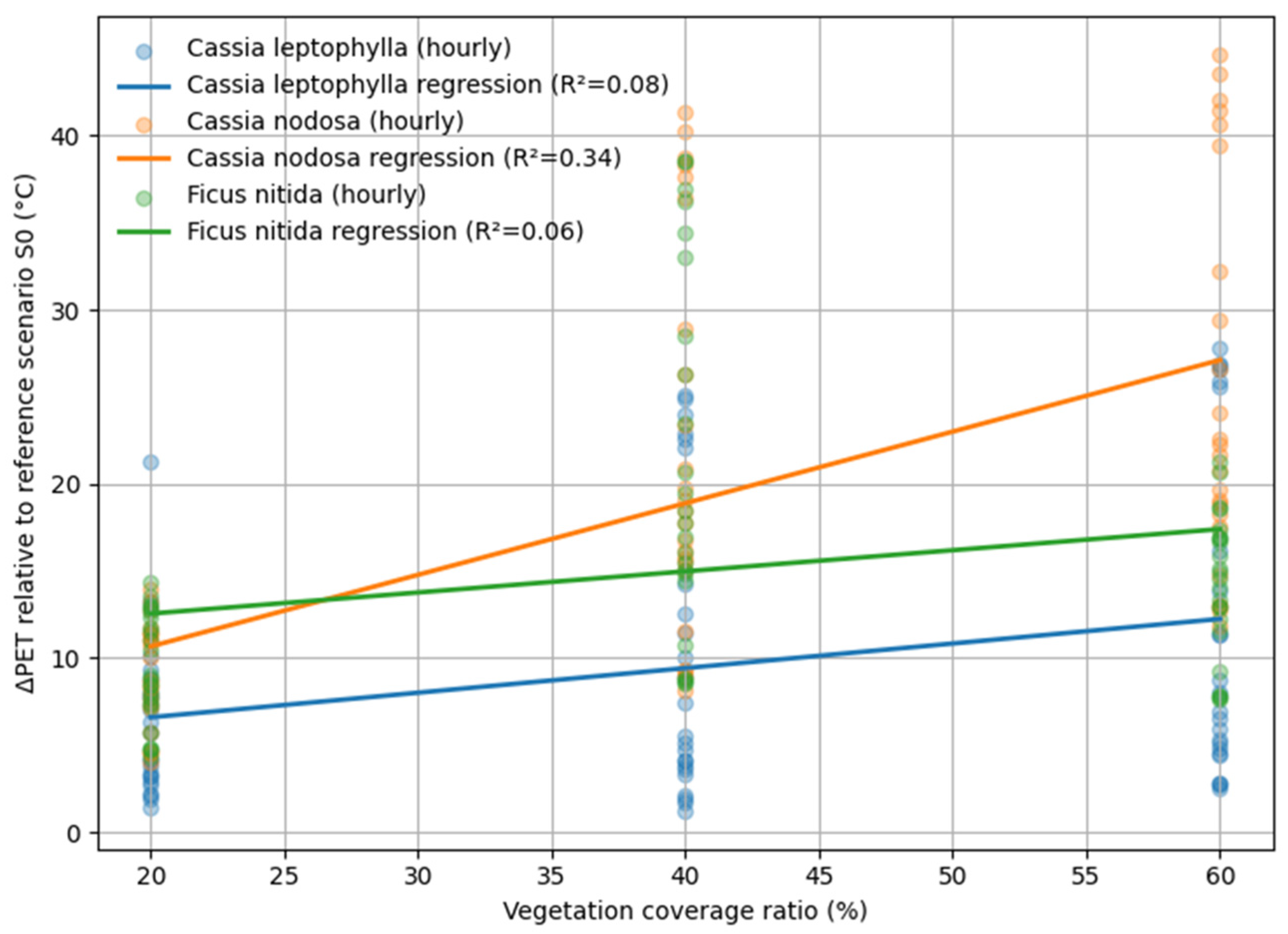
Figure 9 presents the relationship between vegetation coverage ratio (20%, 40%, and 60%) and ΔPET for the three investigated tree species, using all hourly observations across the diurnal cycle. Rather than relying on aggregated or mean values, the figure illustrates the full dispersion of thermal responses, thereby capturing the combined influence of canopy coverage, species-specific shading characteristics, and time-dependent solar exposure. Across all species, ΔPET values exhibit a clear upward shift with increasing vegetation coverage, confirming the dominant role of canopy extent in reducing outdoor thermal stress within courtyard environments.
At a coverage ratio of 20%, ΔPET values remain relatively modest and temporally dispersed. CL produces limited cooling during nocturnal and early morning hours, with ΔPET typically below 5 °C, while mid-morning and early afternoon periods yield higher reductions approaching 8–10 °C. In contrast, CN and FN exhibit stronger cooling responses at the same coverage level, frequently exceeding 10 °C during periods of high solar exposure. This behavior reflects the denser foliage and more effective radiative shielding provided by these species under direct solar loading.
Increasing vegetation coverage to 40% leads to a substantial amplification of thermal mitigation across all species. Hourly ΔPET values for CL extend into the range of approximately 20–25 °C during peak hours, while CN and FN achieve markedly higher reductions, with numerous observations exceeding 35 °C relative to the reference scenario. The broader vertical spread observed in
Figure 9 at this coverage level indicates heightened sensitivity of thermal performance to solar altitude and canopy–surface interactions, particularly during midday conditions when mean radiant temperature dominates human thermal stress.
At the highest coverage ratio of 60%, species-dependent differences become most pronounced. CN consistently delivers the strongest and most scalable cooling performance, with peak ΔPET values exceeding 40 °C and a relatively coherent clustering of hourly data points across the diurnal cycle. CL demonstrates moderate but stable mitigation, characterized by a gradual increase in ΔPET with coverage and comparatively lower dispersion. FN exhibits high peak-hour cooling but greater diurnal variability, suggesting that its thermal effectiveness is more sensitive to temporal changes in solar geometry despite its dense canopy structure.
Species-specific linear regressions fitted using the full set of hourly observations reveal distinct coverage–mitigation relationships. CN exhibits the steepest regression slope and the highest explanatory power, indicating a strong and reliable scaling of ΔPET with increasing vegetation coverage. CL shows a weaker but still systematic relationship, while FN displays lower linear coherence due to pronounced temporal variability in shading effectiveness. The relatively moderate coefficients of determination obtained from these regressions highlight that vegetation coverage alone cannot fully explain thermal mitigation, and that time-dependent radiative processes and species morphology play a critical role.
Overall, the results demonstrate that courtyard thermal mitigation is governed not only by the extent of vegetation coverage but also by species-specific canopy structure and its interaction with diurnal climatic forcing. The use of hourly ΔPET values reveals important variability that would be obscured by mean-based analyses, reinforcing the need for high-resolution evaluation when developing vegetation-based cooling strategies. These findings provide empirical support for treating vegetation type as an explicit design variable and substantiate the formulation of the VCEI as a species-sensitive indicator rather than a purely geometric metric.
4.4.3. Species-Specific Sensitivity of Vegetation Cooling Efficiency (VCEI_PET)
To examine the influence of tree species on vegetation cooling efficiency, the sensitivity of the VCEI_
PET was analyzed across the investigated vegetation scenarios relative to the non-vegetated reference case (S0).
Figure 10 presents the distribution of VCEI_
PET values for the three tree species considered, highlighting both central tendency and variability under identical climatic and geometric conditions. The results reveal a pronounced species-dependent differentiation in cooling efficiency. CL consistently exhibits the lowest VCEI_
PET values, with a narrow interquartile range centered around approximately 0.26–0.28. This limited spread indicates relatively stable but modest cooling efficiency per unit vegetation coverage, suggesting constrained radiative attenuation and evapotranspiration performance under the examined conditions.
In contrast, CN demonstrates substantially higher VCEI_PET values, with median values approaching 0.46 and upper extremes exceeding 0.55. The comparatively compact distribution indicates both high efficiency and consistent performance across vegetation coverage ratios. This behavior reflects a strong ability to generate outdoor thermal comfort improvement per unit canopy coverage, emphasizing the role of canopy density and shading effectiveness exhibits VCEI_PET values comparable in magnitude to CN but with markedly higher dispersion. The wider interquartile range and extended lower whisker indicate greater sensitivity to vegetation coverage ratio, suggesting that its cooling efficiency is more dependent on canopy extent and spatial configuration. While high-efficiency outcomes are achievable, performance variability is more pronounced relative to the other species.
Overall, the results presented in
Figure 10 demonstrate that VCEI_
PET is not only a function of vegetation coverage but is strongly modulated by tree species characteristics. The observed inter-species contrasts confirm the necessity of species-specific evaluation when assessing courtyard vegetation strategies, as similar coverage ratios may yield substantially different thermal comfort efficiencies depending on canopy structure and physiological properties. Together, these species-dependent efficiency patterns raise a critical question regarding the extent to which outdoor thermal mitigation translates into measurable reductions in cooling energy demand.
The observed species-specific differences corroborate prior evidence that tree morphology plays a decisive role in microclimatic modification. Previous studies have shown that extensive tree canopies with dense foliage provide sustained shading and larger reductions in both air temperature and radiant temperature compared to sparser or vertically oriented vegetation arrangements [
24].
In the present results, CN consistently produced the greatest PET reduction and the strongest improvement in outdoor thermal comfort, aligning with findings emphasizing the dominant influence of canopy shading in campus courtyards and street canyons. In contrast, FN exhibited greater temporal variability, highlighting that effective vegetation strategies must consider canopy architecture and its interaction with diurnal solar geometry. These findings reinforce conclusions from research demonstrating that courtyard height-to-width ratios and vegetation arrangements jointly regulate PET and outdoor thermal comfort [
44].
4.5. Sensitivity of Cooling Energy Demand to Outdoor Thermal Mitigation: PESI Analysis
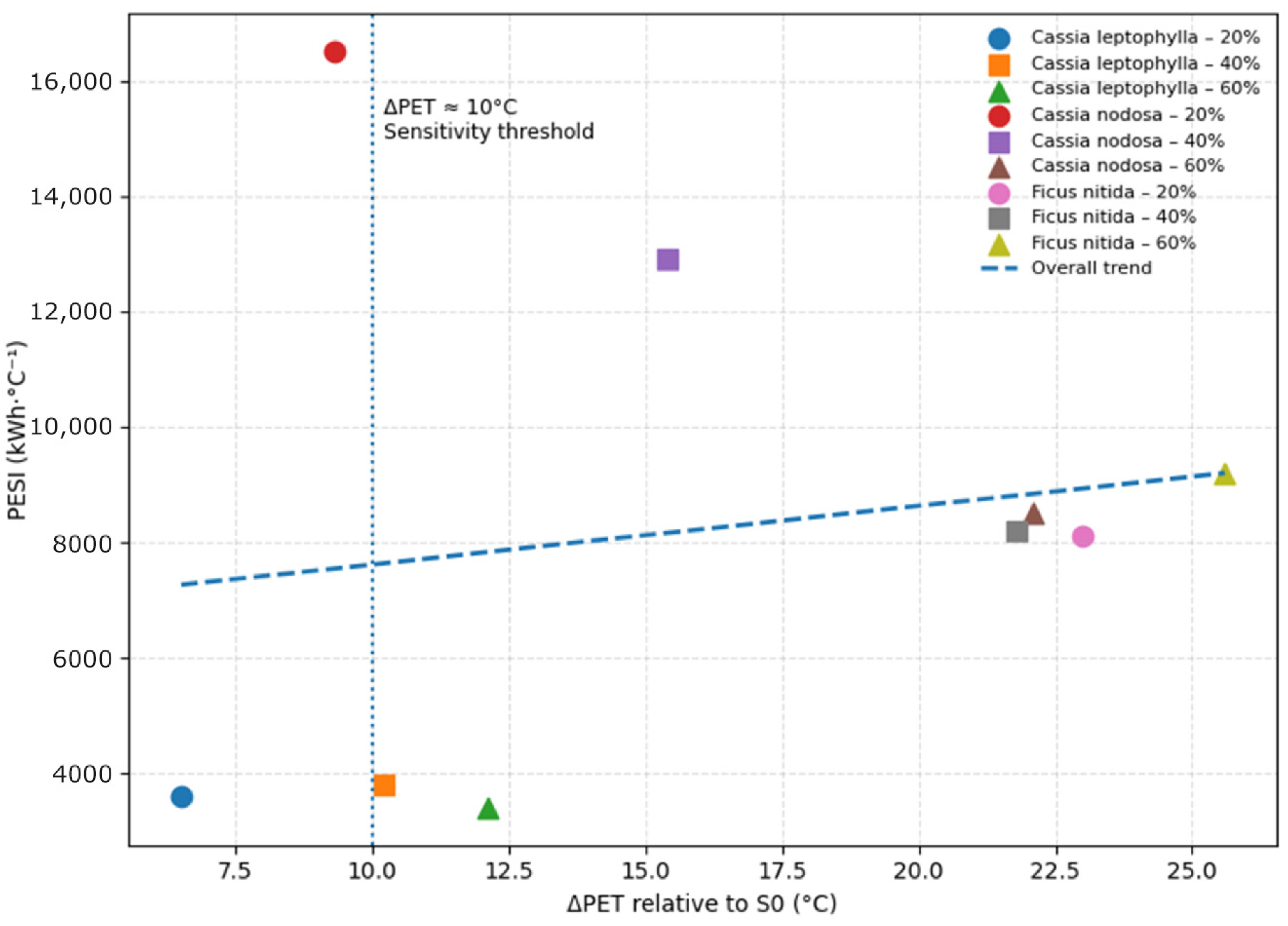
Figure 11 presents the relationship between vegetation-induced reductions in physiologically equivalent temperature (ΔPET) and the corresponding PESI, which quantifies the magnitude of cooling energy savings achieved per unit reduction in outdoor thermal stress relative to the non-vegetated reference scenario (S0). Across all vegetation scenarios, PESI values range from approximately 3400 to 16,500 kWh·°C
−1, revealing substantial variability in the degree to which outdoor thermal mitigation propagates into indoor energy performance. At lower vegetation coverage ratios (20%), PESI values remain comparatively modest, typically ranging between 3400 and 6000 kWh·°C
−1 depending on tree species and time of day. In these scenarios, ΔPET reductions are generally limited to early morning and late afternoon periods, resulting in relatively weak coupling between courtyard microclimate improvement and building cooling demand. The building cooling load during peak hours remains largely governed by direct solar gains and internal heat loads, thereby constraining the energy impact of modest outdoor thermal mitigation.
As vegetation coverage increases to 40%, a pronounced escalation in PESI values is observed. For this intermediate coverage level, PESI values commonly fall within the range of 7000–12,000 kWh·°C−1, indicating a substantially stronger sensitivity of cooling energy demand to outdoor PET reductions. This transition corresponds to ΔPET values exceeding 20–30 °C during peak midday hours, which significantly suppress radiative heat exchange and reduce the thermal gradient driving heat transfer into adjacent indoor spaces. Quantitatively, scenarios at this coverage level exhibit up to 2.0–2.5 times higher PESI values than their 20% counterparts, underscoring the non-linear nature of comfort–energy coupling. At the highest vegetation coverage ratio (60%), the PESI reaches its maximum values, with peak sensitivities exceeding 15,000 kWh·°C−1 in scenarios dominated by dense-canopy species. These high PESI values indicate that each additional degree of PET reduction corresponds to disproportionately large reductions in cooling energy demand. This behavior reflects a regime in which courtyard microclimate conditions exert dominant control over building thermal loads, particularly during critical peak cooling periods. However, the spread of PESI values at this coverage level also widens, suggesting increased sensitivity to species-specific canopy structure and shading dynamics.
Species-dependent differences are evident across all coverage ratios. Scenarios employing CN consistently exhibit higher PESI values compared to CL and FN, with mean PESI values approximately 20–35% higher under comparable ΔPET conditions. This indicates that the thermal mitigation produced by CN is more effectively translated into cooling energy savings, likely due to its canopy geometry and shading persistence during peak solar exposure. In contrast, FN demonstrates greater variability in the PESI, with comparable ΔPET values yielding a wider spread of energy responses, suggesting that temporal shading effectiveness and diurnal solar angle play a stronger role in modulating energy sensitivity. Importantly,
Figure 11 demonstrates that the PESI does not scale linearly with ΔPET across all scenarios. For ΔPET values below approximately 10 °C, the PESI remains relatively low and weakly responsive, indicating limited energy benefit from marginal thermal mitigation. Beyond this threshold, the PESI increases sharply over an intermediate ΔPET range, indicating a transition toward a highly sensitive energy-response regime. This threshold behavior provides quantitative evidence that meaningful reductions in cooling energy demand are achieved only when outdoor thermal mitigation exceeds a critical intensity.
Overall, the quantitative analysis of the PESI confirms that cooling energy demand exhibits heterogeneous and non-linear sensitivity to outdoor thermal comfort improvement in hot–arid courtyard environments. While vegetation-induced PET reductions are necessary for enhancing outdoor comfort, their effectiveness in reducing energy demand depends strongly on coverage ratio, tree species, and the magnitude of thermal mitigation achieved. These findings reinforce the necessity of jointly evaluating the VCEI and PESI when assessing courtyard greening strategies, as scenarios that maximize outdoor comfort do not necessarily yield proportionally optimal energy performance.
Figure 11 further reveals a threshold-like behavior around ΔPET ≈ 10 °C, beyond which the PESI increases rapidly before exhibiting signs of saturation at higher levels of outdoor thermal mitigation, indicating diminishing marginal energy benefits under intensified greening. This suggests that early-stage vegetation interventions may yield disproportionately high energy benefits compared to more intensive greening strategies.
The introduction of the PESI formalizes the non-linear coupling between outdoor thermal mitigation and cooling energy demand. The threshold behavior observed around ΔPET ≈ 10 °C, where cooling energy savings become markedly more sensitive to further PET reductions, extends recent discussions on comfort–energy coupling [
45].
The pronounced variation in PESI values, spanning nearly an order of magnitude, can be attributed to the non-linear nature of courtyard–building thermal interaction. While PET reduction is predominantly governed by instantaneous radiative exposure, cooling energy demand reflects envelope heat storage, convective exchange, and time-lagged heat fluxes.
Moreover, the identification of diminishing marginal energy benefits at intensified vegetation coverage (60%) carries significant implications for climate-responsive design in hot–arid regions. In water-scarce climates, over-greening strategies may introduce unnecessary irrigation and maintenance burdens without proportionate energy returns. This supports a performance-based design approach prioritizing canopy morphology, spatial placement, and species selection over generalized coverage targets.
The CDH-based extrapolation method used for annualization provides computational efficiency and preserves comparative scenario trends; however, its limitations should be acknowledged. Unlike full-year dynamic co-simulation, CDH-based extrapolation does not fully resolve transient shading–envelope interactions or extreme heat events. Future work incorporating full year coupled simulations would allow for validation of whether the observed high PESI magnitudes and non-linear threshold behavior remain stable under dynamic annual boundary conditions.
5. Conclusions
This study demonstrates that courtyard vegetation in hot–arid university buildings functions as a measurable and design-sensitive regulator of both outdoor thermal comfort and indoor cooling energy demand. The results confirm that vegetation-induced microclimatic modification propagates into building energy performance in a distinctly non-linear manner. While substantial reductions in PET were achieved across multiple scenarios, the corresponding cooling energy savings did not scale proportionally, revealing a partial decoupling between pedestrian-level thermal mitigation and indoor operational energy response. Species-specific canopy morphology and vegetation coverage were shown to govern this coupling more critically than vegetation quantity alone.
The principal contribution of this research lies in advancing vegetation assessment from absolute performance reporting toward an integrated efficiency–sensitivity framework. Through the introduction of the VCEI and the PESI, the study establishes a mechanistic linkage between outdoor comfort improvement and cooling energy responsiveness. By explicitly quantifying this relationship, the proposed framework addresses a persistent limitation in courtyard and urban greening research, where thermal comfort benefits have frequently been evaluated independently of building energy consequences.
Beyond its methodological contribution, the findings expose important research gaps that warrant further investigation. First, uncertainty quantification of index-based metrics remains to be formally established through probabilistic or sensitivity-based validation. Second, seasonal and phenological variability in vegetation performance requires longitudinal assessment to determine year-round comfort–energy coupling behavior. Third, the interaction between courtyard vegetation and passive ventilation strategies demands systematic exploration to clarify airflow–shading synergies. Fourth, multi-scale validation of the VCEI–PESI framework is necessary to evaluate its scalability to campus- and neighborhood-level interventions, where mesoscale microclimatic interactions may introduce additional non-linear effects. Finally, future research should integrate life-cycle cost analysis, irrigation demand, and projected climate warming scenarios to assess long-term environmental and economic resilience.
Collectively, this study establishes a transferable analytical foundation for optimizing courtyard vegetation as a performance-driven component of climate-responsive building systems. By bridging outdoor adaptation strategies with indoor energy efficiency metrics, the proposed framework provides a structured pathway for advancing evidence-based greening policies in hot–arid educational environments and beyond.




 ,
,