Next Article in Journal
A Design-Oriented Exponential Model for Partial Stirrup Replacement with Steel Fibers in Reinforced Concrete Beam–Column Joints
Previous Article in Journal
Integrating Computer Vision and GIS for Large-Scale Morphological Mapping and Driving Force Analysis of Vernacular Courtyard Dwellings
 
 
Due to scheduled maintenance work on our servers, there may be short service disruptions on this website between 11:00 and 12:00 CEST on March 28th.
Article

Path Tracking of Highway Tunnel Inspection Robots: A Robust Enhanced Extended Sliding Mode Predictive Control Approach

1
School of Mechanical Engineering, Shandong University, Jinan 250061, China
2
Laboratory of High Efficiency and Clean Mechanical Manufacture, Shandong University, Ministry of Education, Jinan 250061, China
*
Author to whom correspondence should be addressed.
Buildings 2026, 16(6), 1119; https://doi.org/10.3390/buildings16061119
Submission received: 22 January 2026 / Revised: 26 February 2026 / Accepted: 9 March 2026 / Published: 11 March 2026
(This article belongs to the Section Building Structures)

Abstract

The irregular geometry of highway tunnel linings, combined with uneven terrain and external disturbances, often causes inspection robots to deviate from their predefined paths. Due to the strong coupling inherent in robotic systems, these deviations propagate to the end-effector, significantly compromising automated inspection accuracy and effectiveness. To tackle these issues, this study introduces an Enhanced Extended Sliding Mode Predictive Control (EESMPC) method, which integrates an adaptive Extended State Observer (ESO). The algorithm is derived from the robot chassis model and a desired trajectory error model, enabling precise contour profile tracking. Crucially, the integrated ESO actively estimates and compensates for unmodeled disturbances and system uncertainties within the state feedback, thereby enhancing both path tracking stability and precision. Comparative MATLAB simulations and experimental path tracking tests evaluated the performance against three other controllers. The results demonstrate that the EESMPC algorithm achieves superior tunnel lining tracking performance, exhibiting marked improvements in both tracking accuracy and system robustness. Consequently, this approach significantly enhances the automated inspection accuracy and operational efficiency of highway tunnel inspection robots.

1. Introduction

Highway tunnels, serving as critical infrastructure within urban transportation networks, are susceptible to structural deterioration—including lining cracks, water leakage, and spalling—during long-term service. This deterioration arises from factors such as construction defects and geological hazards [1,2,3], including seismic disasters [4], landslides, debris flows, etc. The progression of these defects significantly compromises tunnel serviceability and poses serious threats to transportation safety. Therefore, standardized tunnel defect inspection, essential for accurate damage diagnosis and evidence-based remediation strategies, has emerged as a critical challenge requiring urgent industry attention in tunnel operations and maintenance.
To address the demand for standardized highway tunnel inspection, tunnel inspection robot technology has advanced rapidly in recent years. Compared to traditional manual methods—characterized by high operational risks and low efficiency—robots equipped with autonomous navigation capabilities effectively replace human labor in lining inspection, significantly mitigating personnel safety hazards [5]. Modern inspection robots typically integrate high-precision sensors with advanced image processing techniques [6], substantially improving defect identification accuracy through multi-source data fusion. Current mainstream systems incorporate core technological features including: (1) robotic arms, (2) high-performance computer vision systems, (3) high-resolution 3D laser scanners, and (4) ultrasonic sensor arrays [7]. Victores et al. [8] developed an automated system using a mobile platform equipped with a robot for accurate geometric measurement of crack parameters. Mashimo’s robot [9] employed integrated CCD cameras and laser sensors, enabling automated acquisition of magnified crack imagery along with identification of concrete lining spalling and loosening defects. Nakamura [10] proposed a comprehensive full-cross-section inspection system achieving precise defect localization and dimensional quantification on tunnel surfaces.
However, substantial technical limitations remain in current highway tunnel inspection robots, primarily related to path-tracking accuracy and inspection stability. Irregular terrain conditions stemming from tunnel-construction-induced ground settlement and complex operational environments [11,12] frequently prevent robots from precisely adhering to predefined inspection paths [13]. More critically, due to kinematic chain effects, pose deviations of the mobile chassis are significantly amplified throughout the long-reach robotic arm, resulting in a pronounced amplification at the end-effector [14]. This severely degrades the positioning accuracy of mounted inspection equipment, directly compromising defect inspection reliability. Consequently, the measurement accuracy and operational efficiency of inspection robots are fundamentally constrained by the path-tracking control performance of their mobile chassis [15]. Optimizing path-tracking control strategies enables real-time compensation for pose deviations, effective suppression of environmental disturbances [16], and significant enhancement of inspection data spatial consistency and timeliness [17,18]. Therefore, developing high-precision chassis path-tracking control algorithms constitutes a fundamental requirement for improving the overall operational performance of tunnel inspection robots.
Tunnel inspection equipment is typically mounted on a mobile chassis platform. Consequently, the path-tracking control performance of this chassis directly dictates inspection accuracy and operational efficiency. As the inspection system’s core control element, high-precision path tracking ensures strict adherence to the predefined inspection trajectory, which is crucial for acquiring spatially consistent inspection data. Prevalent path tracking control algorithms primarily comprise five categories: PID Control [19,20], Pure Pursuit Control [21,22], Fuzzy Control [23,24], Model Predictive Control (MPC) [25,26], and Sliding Mode Control (SMC) [27,28,29]. However, significant limitations exist in these controllers. PID controllers lack environmental adaptability, exhibiting degraded control performance under complex tunnel disturbances. Pure Pursuit Control, being geometry-based, demonstrates increased tracking deviation in dynamic tunnel environments characterized by abrupt structural changes and non-uniform terrain. Fuzzy Control requires real-time processing of multi-source sensor information; its expanding rule base compromises real-time responsiveness due to computational load. MPC performance heavily relies on system model accuracy. Modeling errors—arising from the robot’s coupled multi-body dynamics and complex environment—lead to degraded control performance. SMC offers strong robustness and reduced model dependence, yet its inherent high-frequency chattering introduces tracking errors. Comparatively, SMC demonstrates distinct advantages for highly nonlinear tunnel inspection robots. However, effective chattering suppression remains a critical challenge. Chattering not only reduces trajectory tracking accuracy but also causes harmful vibrations in the end-mounted inspection equipment, severely compromising reliability. Therefore, designing enhanced SMC algorithms incorporating chattering suppression presents a promising approach for improving tunnel inspection robot path tracking performance.
Significant innovative research advances path tracking control methodologies. Brown et al. [30] proposed an integrated control framework leveraging Model Predictive Control (MPC) to achieve synergistic optimization of local path planning and tracking. Robust sliding mode controllers [31,32,33,34,35,36,37] were proposed for path tracking of wheeled mobile robots (WMRs) in uncertainty. The control algorithms presented above improve the performance of WMRs for path tracking, ensuring stability and precision during operation. However, these methods neglect the estimation of unknown disturbances.
To address problems of reduced precision caused by unknown disturbances encountered during path tracking, observer-based controllers to estimated disturbances were introduced for trajectory tracking control of robots. To address path tracking for rice seeding robots in paddy fields, Li [38] developed a fast terminal sliding mode controller integrated with a nonlinear observer. Meanwhile, Miranda [39] introduced a novel finite-time tracking controller for wheeled mobile robots (WMRs) under kinematic disturbances, utilizing an observer to estimate and compensate for these effects. To address trajectory tracking under disturbances, Rodríguez [40] proposed a robust control scheme that combines a disturbance observer with a proportional-retarded controller for WMRs. Ramírez [41] introduced a Linear Active Disturbance Rejection control scheme, incorporating a saturation-input strategy in the ESO design to suppress potential peaking phenomena. Meanwhile, Zhao [42] formulated a method utilizing integral sliding mode control alongside ESO to estimate and compensate for both external perturbations and unmodeled dynamics in WMR path-following tasks. Numerical simulations and experimental results confirm the efficacy and superior performance of these observer-based controllers. However, these methods have not been applied in the field of tunnel inspection. The tunnel environment poses significant challenges for sensors, and the uncertainty in measurements directly impacts controller performance. Irregularities in the tunnel linings, along with conditions such as water stains, dust, and uneven lighting, can hinder feature extraction or cause visual matching failures, leading to jumps or drift in absolute position and orientation estimates. Multi-sensor fusion serves as an essential strategy to enhance system robustness and address single-sensor failures. To efficiently estimate system performance, Yin [43] proposed a measurement precision model based on error analysis theory, to guide both hardware selection and spatial arrangement. To effectively monitor bridge cable health and bridge tower tops, Shi [44,45] used monitoring data based on an improved multi-rate data fusion method to analyze the bridge’s thermal field distribution and the time-dependent variation of tower displacements, achieving high fused displacement measurements precision. To achieve more reliable health evaluation and fault diagnosis for tunnel linings, research on health monitoring with intelligent applications of artificial intelligence utilized by inspection robots has been significantly advanced. Guo [46] introduced a dynamically constrained digital twin framework for fault diagnosis, leveraging insights from the digital twin paradigm and the Runge–Kutta method for dynamical simulation, supporting fault diagnosis under conditions of limited or missing fault data. Zhao [47] proposed a multi-feature health indicator based on joint feature distribution modeling, along with a prediction architecture named the Temporal–Self-Attention-based Dual-branch Transfer Adversarial Network. The framework is designed to enhance the generalizability of cross-working conditions.
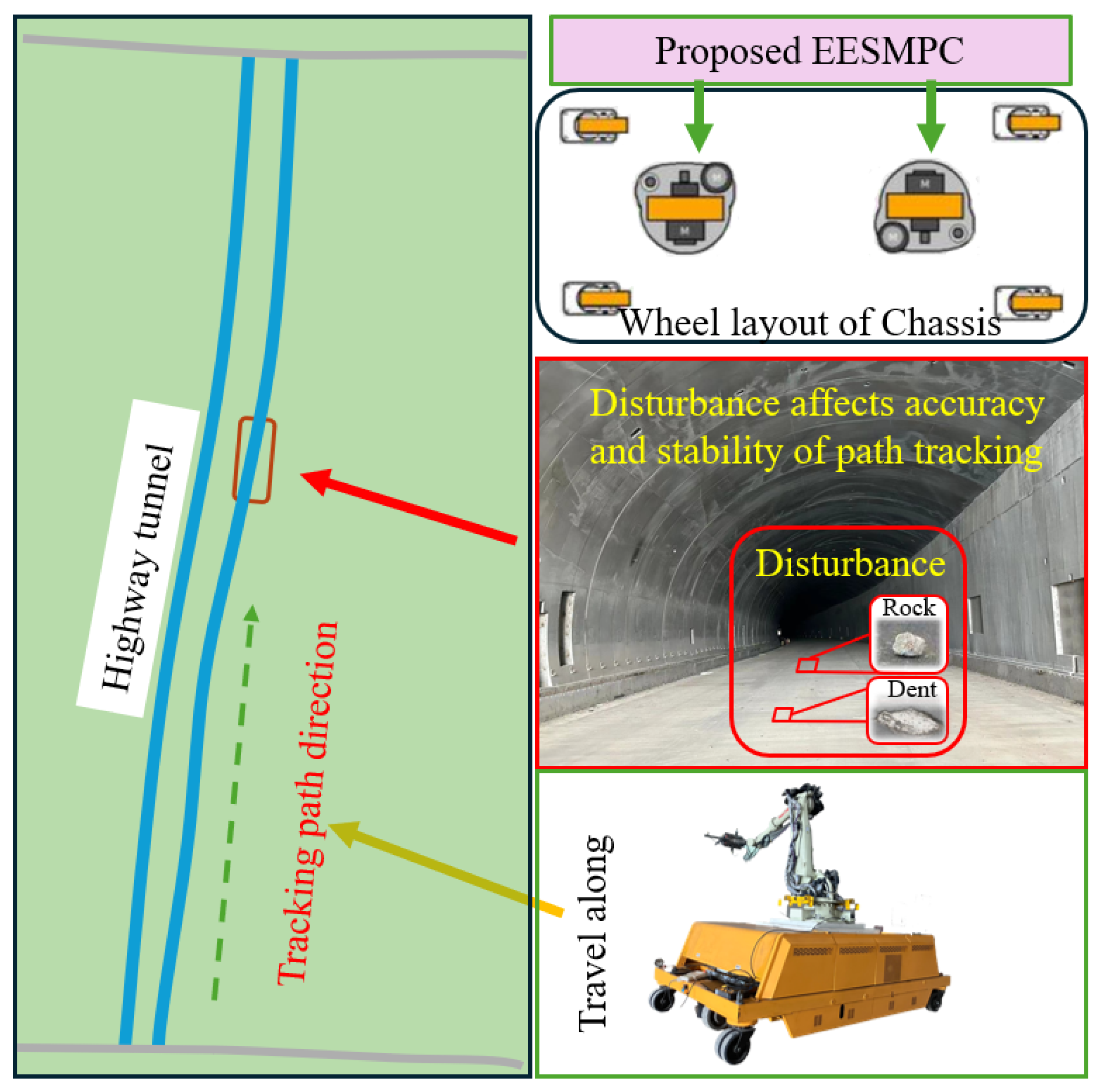
Addressing the insufficient path tracking accuracy of highway tunnel inspection robots operating in complex environments, this study introduces an EESMPC framework designed for chassis path tracking in tunnel environments. The method combines a SMPC with an adaptive ESO to achieve high-precision trajectory tracking under the irregular terrain conditions characteristic of tunnels. The proposed method innovatively integrates SMPC with adaptive ESO. The SMPC incorporates a sliding mode function within a receding-horizon optimization framework, thereby preserving the predictive optimization and constraint-handling capabilities of MPC while introducing the robustness of sliding mode control. The ESO unifies model uncertainties and external disturbances into a lumped disturbance, which is estimated and compensated for in a feedforward manner. This two-layer architecture fundamentally enhances the system’s accuracy and robustness under complex disturbances, such as those arising from irregular tunnel road surfaces, significantly enhancing trajectory tracking accuracy and anti-disturbance capabilities. This methodology provides a robust technical foundation for advancing intelligent inspection systems in highway tunnels, as validated in Figure 1.
The main contributions of this paper are as follows: A Robust EESMPC scheme for accurate path tracking during tunnel inspection tasks is proposed in specific application scenarios with multiple sources of uncertainty, such as road unevenness, model parameter perturbations, and sensor measurement noise, which mitigates the problem of tracking errors in robot inspection systems when faced with various disturbance scenarios. Aimed at enhancing the accuracy of path tracking in varying disturbance highway tunnel environments, an improved ESO with adaptive gain adjustment based on observation error is proposed to enhance the adaptability of the EESMPC strategy. The performance of the system is evaluated both in MATLAB(v2020a) simulation and in a real tunnel environment. The results indicate that EESMPC can withstand various highway tunnel scenarios, demonstrating higher robustness and accuracy than the other methods.
The article is arranged as follows: Section 2 introduces the disturbance model and system uncertainty assumption including analysis of tunnel lining profile disturbances and analysis of tunnel pavement disturbances. Section 3 introduces the kinematic model, dynamic model and path tracking pose error model of tunnel lining inspection robots. Section 4 provides the design of the enhanced extended sliding mode predictive controller with detailed derivation. Section 5 provides experiments and Section 6 provides the discussion, where the performance of the proposed controller is compared with three other controllers. Finally, Section 7 concludes this article.

2. Disturbance Model and System Uncertainty Assumption

During tunnel lining inspection in complex working conditions, unpredictable exogenous disturbances may affect the tunnel lining inspection robot. These pronounced vibrations compromise the inspection accuracy of the robot. Exogenous disturbances primarily include tunnel lining profile variations and tunnel pavement irregularities.

2.1. Disturbance Model of Tunnel Lining Profile

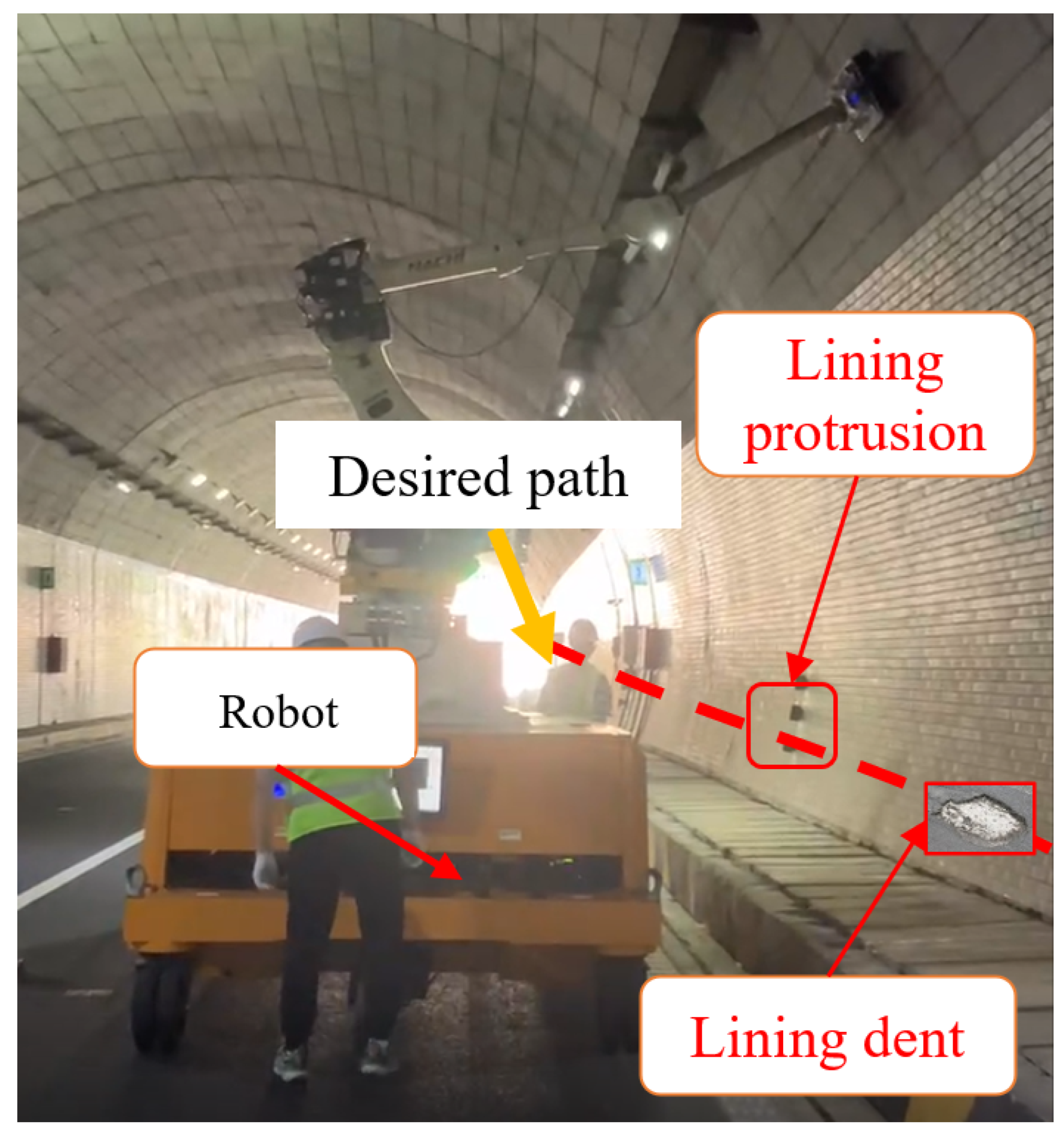
The tunnel lining is typically constructed in a curved shape along the direction of traffic, and structural discontinuities along the tunnel inspection line including abrupt concavities, convexities, or installed objects may introduce disturbances. As illustrated in Figure 2, these unanticipated profile variations constitute disturbance sources during inspection. Tunnel lining disturbances primarily manifest as constant or step-like disturbances.
d step ( t ) = A · H ( t t 0 )
where A is the disturbance amplitude (e.g., the dimension or height difference of an abrupt lining change). H ( t t 0 ) is the unit step function, indicating that the disturbance initiates and persists continuously starting at time t 0 .

2.2. Disturbance Model of Tunnel Pavement

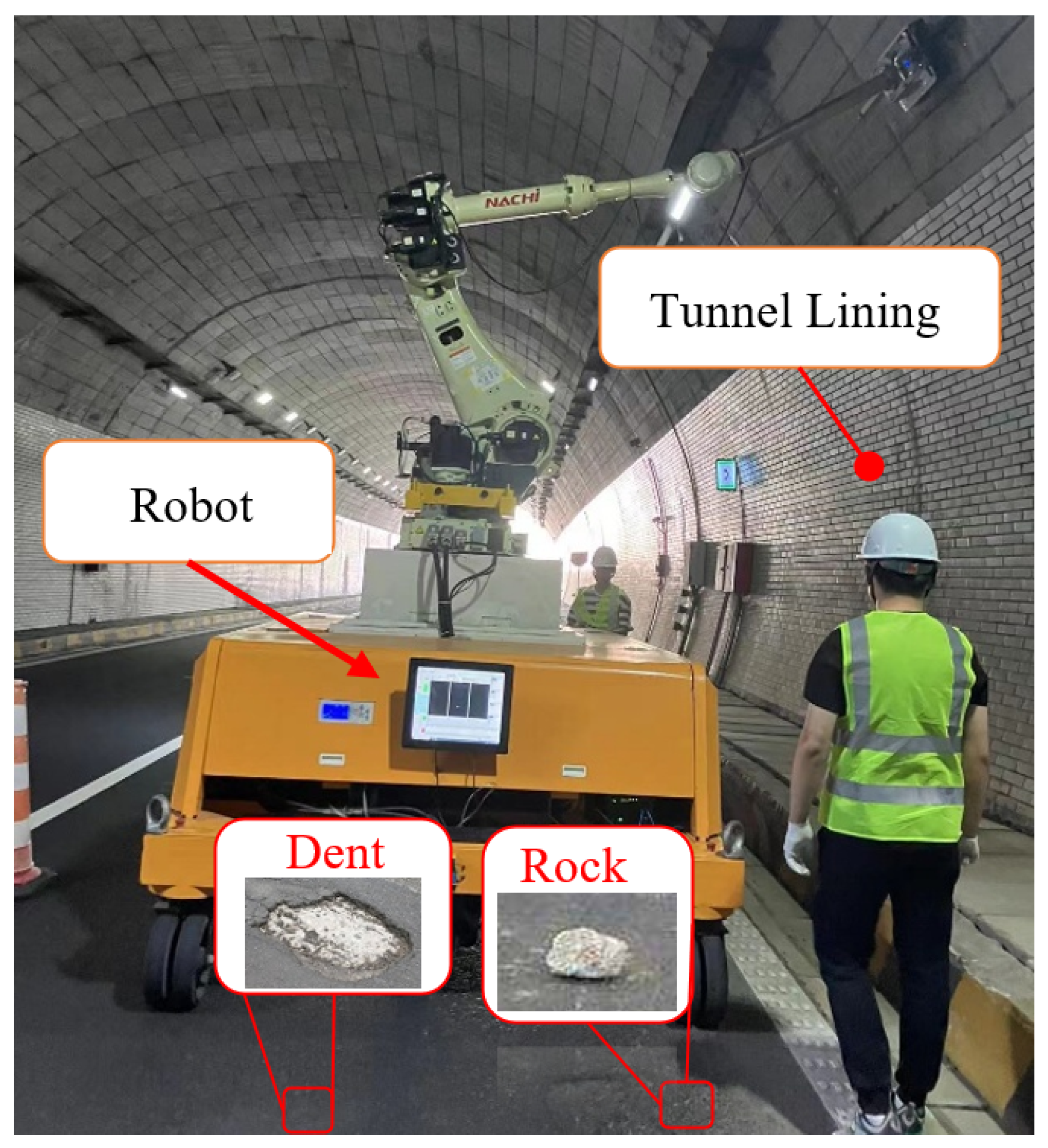
In highway tunnels with prolonged service and heavy traffic loads, road surface settlement is inevitable. This deformation can exhibit considerable variation, with unknown rocks or depressions potentially protruding from the pavement, as illustrated in Figure 3. As the robot inspects the lining, vibration excitation from the pavement surface transmitted to the mobile platform. Therefore, mitigating the vibration impact of the tunnel pavement on the robot is essential. Unknown rocks or dent disturbances on the tunnel pavement primarily manifest as constant or step-like disturbances.
d pm ( t ) = B · H ( t t 1 )
where B is the disturbance amplitude, H ( t t 1 ) is the unit step function, indicating that the disturbance initiates and persists continuously starting at time t 1 .

3. Mathematics and Model

3.1. Kinematic Model

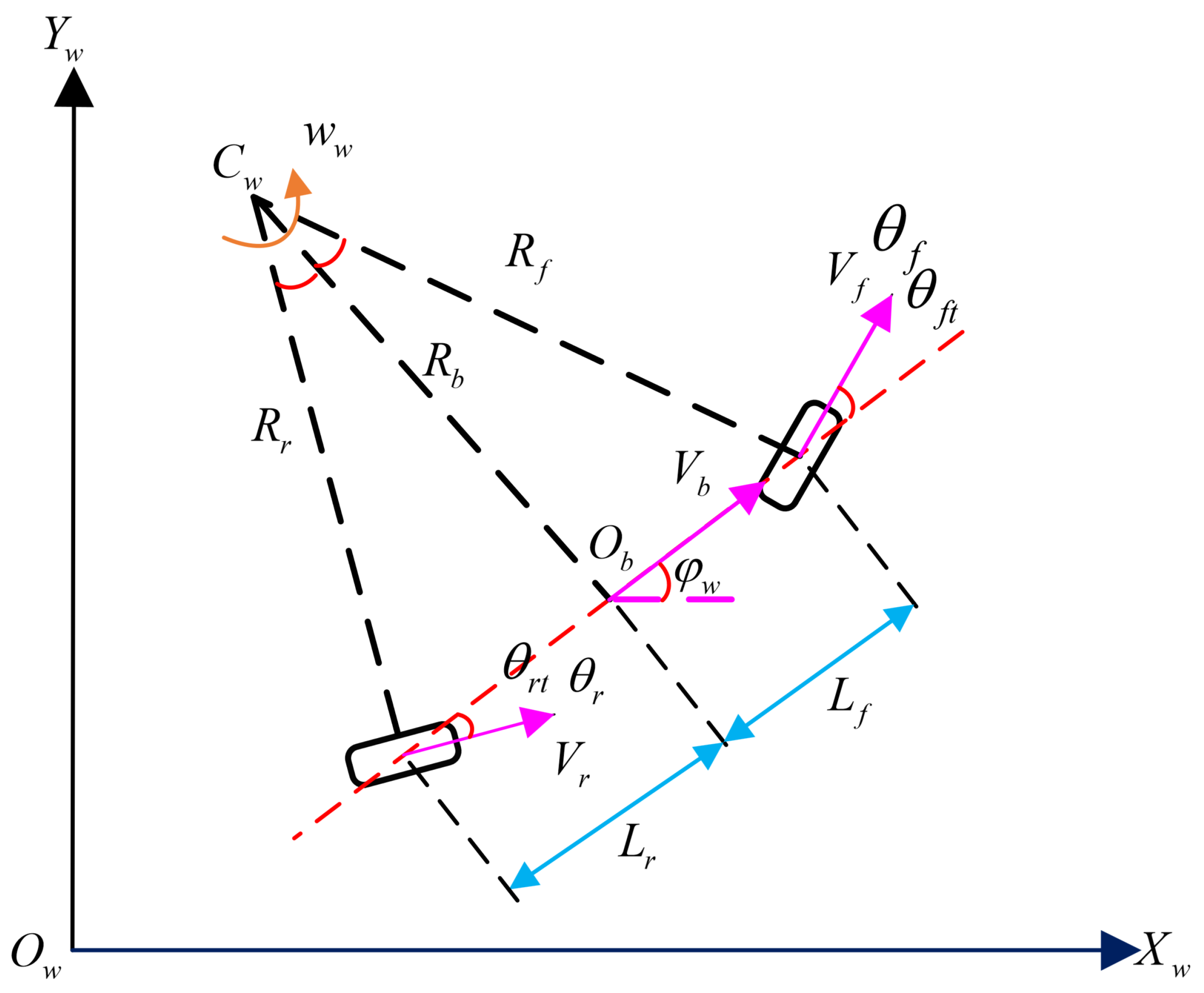
The robot chassis utilizes a dual-steerable-wheel configuration, closely aligning with bicycle model assumptions. Given the constant velocity maintained during inspection, developing the kinematic model based on the bicycle model is well-justified for this structure. The chassis motion is described as rotation about an instantaneous center of rotation C w . As shown in Figure 4, the origin of the robot chassis coordinate frame is located at the center of mass C w , and the velocity at C w is denoted V b . The parameters are presented in Table 1.
The Ackermann steering principle dictates that the steering axes of the front and rear wheels converge at the instantaneous center of rotation C w . This geometric constraint, illustrated in Figure 4, governs the steering angles of all wheels.
Assuming the robot chassis undergoes planar motion, its pose in the world coordinate frame is defined by the vector P = [ x , y , φ w ] T , where ( x , y ) specifies the central position and φ w denotes the heading angle. Owing to the robot’s low inspection speed and smooth turning maneuvers, the time derivative of the heading angle φ w is approximated by the angular velocity ω , which is approximated by the angular velocity C w . Under this assumption, the kinematic model for the chassis center point is expressed as:
P ˙ = x ˙ y ˙ φ w ˙ = cos φ w sin φ w 0 sin φ w cos φ w 0 0 0 1 v x v y ω
Since the robot chassis is subject to nonholonomic constraints and its motion range is confined to the pavement of the tunnel, it satisfies the following nonholonomic constraint equation:
y ˙ · cos φ w x ˙ · sin φ w = 0
To establish the generalized kinematic equation of the mobile robot, generalized coordinates are adopted to represent its pose coordinates q = x y φ w θ f θ r θ f t θ r t T . Assuming that the wheels satisfy the pure rolling without slipping condition, the nonholonomic constraints of the mobile platform can be formulated as:
y ˙ cos φ w x ˙ sin φ w = 0 x ˙ cos φ w + y ˙ sin φ w = r · θ ˙ f · cos θ f t x ˙ cos φ w + y ˙ sin φ w = r · θ ˙ r · cos θ r t
From the geometric relationships in Figure 4, it can be derived that
cos θ f t = R b R f sin θ f t = L f R f cos θ r t = R b R r sin θ r t = L r R f
x ˙ = r · θ ˙ f cos θ f t cos φ w y ˙ = r · θ ˙ f cos θ f t sin φ w
The above kinematic constraints can be expressed as a pose transition equation in matrix form, which can be written as:
A ( q ) q ˙ = 0
A = sin φ w cos φ w 0 0 0 0 0 cos φ w sin φ w 0 r R b R f 0 0 0 cos φ w sin φ w 0 0 r R b R r 0 0
Thus, through the coordinate transformation matrix, the generalized coordinates in the base coordinate system of the mobile chassis can be mapped to the actuation dynamics of the driving motor within the inertial coordinate system, and its matrix form is as follows:
q ˙ = S ( q ) β ˙
where S ( q ) = r R b R f cos φ w 0 0 0 r R b R f sin φ w 0 0 0 0 0 1 0 1 0 0 0 0 1 0 0 0 0 1 0 0 0 0 1 , β ˙ = θ ˙ f θ ˙ r θ ˙ f t θ ˙ r t .

3.2. Dynamic Model

Using the Lagrange dynamic approach, the inspection robot is described as:
M ( q ) q ¨ + V ( q , q ˙ ) = B τ b + A T ( q ) λ b
where M denotes the mass, V ( q , q ˙ ) encompasses the centripetal and Coriolis force, B maps the input transformation matrix, τ b is the input vector comprising the wheel torques, and λ b is the Lagrange multiplier.
By rearranging Lagrange’s equations, it can be derived that:
M ( q ) = m 0 2 m w sin φ w 0 0 0 0 0 m 2 m w cos φ w 0 0 0 0 2 m w sin φ w 2 m w cos φ w I 0 0 0 0 0 0 0 I w 1 0 0 0 0 0 0 0 I w 1 0 0 0 0 0 0 0 I w 2 0 0 0 0 0 0 0 I w 2
V ( q , q ˙ ) = 2 m w φ w ˙ 2 cos φ w 2 m w φ w ˙ 2 sin φ w 2 m w x ˙ cos φ w + y ˙ sin φ w φ w ˙ 0 0 0 0 ,
B = 0 0 0 0 0 0 0 0 0 0 0 0 1 0 0 0 0 1 0 0 0 0 1 0 0 0 0 1 , τ b = τ f τ r τ f t τ r t where m = m b + 2 m w , I = I b + 2 m w ( L f 2 + L r 2 ) + 2 I m . m and I are the total mass and moment of inertia of the chassis, respectively, excluding the steering wheels. The steering wheel mass is m w and I b is the platform’s moment of inertia excluding the steering wheels. The moments of inertia related to the steering wheels are defined as follows: I m (about the chassis center), I w 1 (drive wheels about their axes), and I w 2 (steering wheels themselves).
Through the previous kinematic model, it can be derived that:
S T ( q ) A ( q ) = 0
Differentiating both sides of the kinematic equation q ˙ = S ( q ) β ˙ with respect to time yields:
q ¨ = S ( q ) β ¨ + S ˙ ( q ) β ˙
Substituting the above equation into the dynamic equation of the mobile platform, and premultiplying both sides by S T ( q ) , it can be derived that:
S T ( q ) M ( q ) S ( q ) β ¨ + S ˙ ( q ) β ˙ = S T ( q ) B τ b
Equivalently,
S T M S β ¨ + M S ˙ β ˙ + V = S T B τ b
The generalized dynamic equation of the mobile platform has been derived.

3.3. Path Tracking Pose Error Model and Analysis

Achieving precise path tracking for the highway tunnel inspection robot necessitates a robust kinematic modelling framework. During inspection, the control system first generates a continuously differentiable reference path based on the fitted geometric features of the tunnel lining. To evaluate tracking performance, a robot pose error model is formulated. This model is solved in real-time to compute optimal velocity and steering commands, ensuring the inspection equipment maintains precise path tracking along the predefined trajectory.
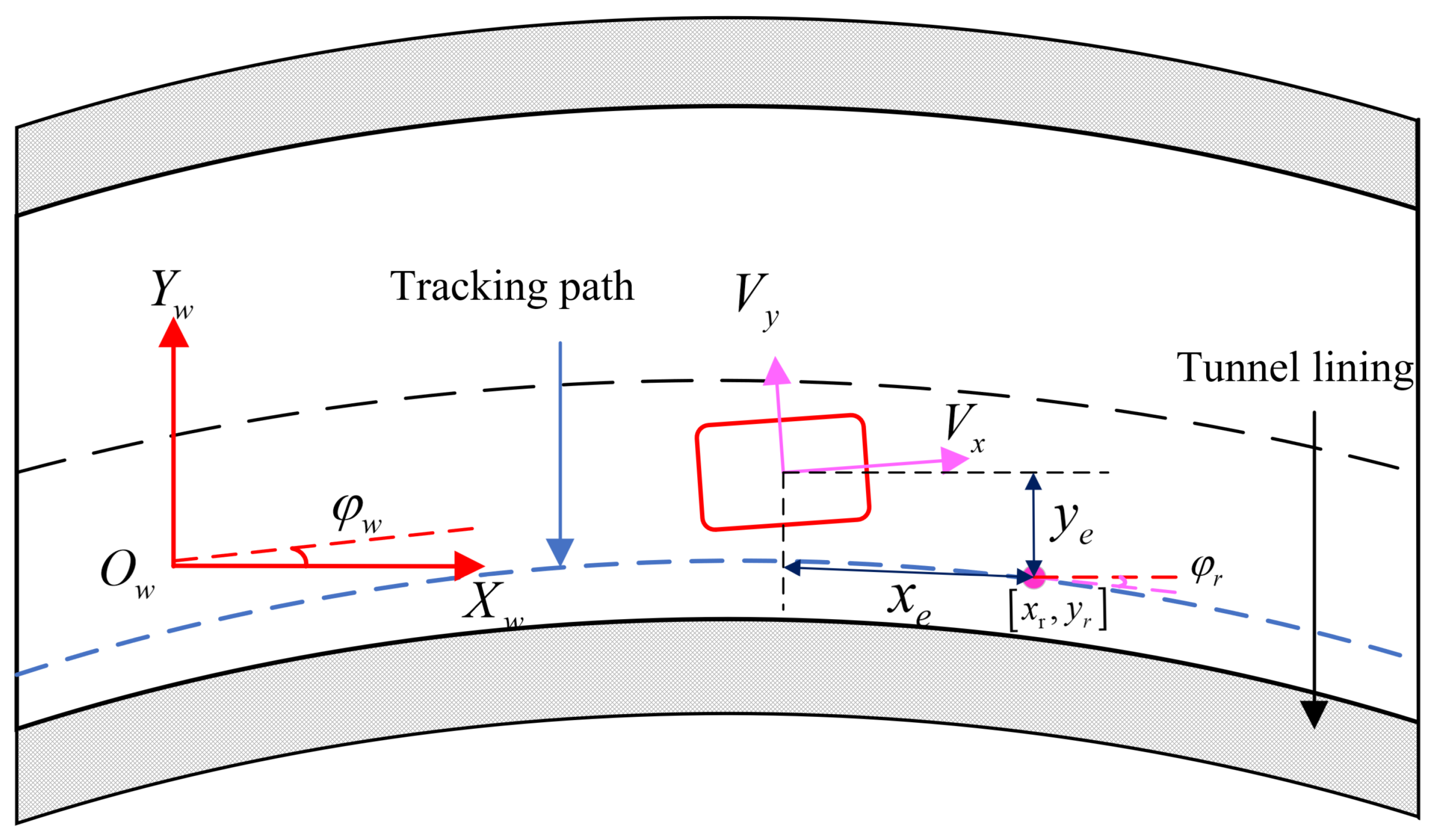
Accounting for variations in tunnel diameters and operational standoff distances, the world coordinate frame for pose error calculation is established at the initial chassis center position (origin O), with the robot’s heading direction defining the positive x-axis. The reference pose is P r = x r , y r , φ r T . Figure 5 defines the resulting pose error configuration.
Given the slowly varying tunnel geometry, the preview control objective is set as a point previewed at a certain distance ahead along the reference path. The tracking error relative to this preview point, expressed in the robot’s body frame, is:
P e = x e y e φ e = cos φ w sin φ w 0 sin φ w cos φ w 0 0 0 1 x r x y r y φ r φ
where ( x r , y r , φ r ) are the coordinates of the preview point.
Expanding Equation (16) and differentiating each error component yields the differential expression of the pose error:
x ˙ e = v r x cos φ e v r y sin φ e v x + ω y e y ˙ e = v r x cos φ e + v r y sin φ e v y + ω x e φ ˙ e = ω r ω
Given the small curvature of highway tunnel geometries, heading angle errors remain minimal during operation. This justifies linearizing Equation (17) for controller implementation:
P ˙ e = A · P e + u r u
where P e represents the system state vector; A = 0 ω v r y ω 0 v r x 0 0 0 represents system gain; u r represents the target control input vector; u represents the actual control input vector.
The target control input u r is derived from the preview point coordinates:
u r = v r · cos φ d v r · sin φ d k ω · ( φ d φ ) / T
where v r = min ( max ( v b a s e , d r T ) , v max ) , v b a s e is the allowable speed during inspection; d r is distance between the chassis center and preview point. When v b a s e > d r T , v r = v b a s e , otherwise, v r = d r T . v m a x is the allowable maximum speed during inspection. T is the controller sampling period; k ω is the angular velocity smoothing factor regulating rate of change.
With the pose error model established, the state vector P e governs the control system. The motion control input u regulates the steerable wheels’ dynamics to actively suppress, ensuring the robot chassis converges to and tracks the reference path during tunnel inspection.

4. Enhanced Extended Sliding Mode Predictive Controller Design

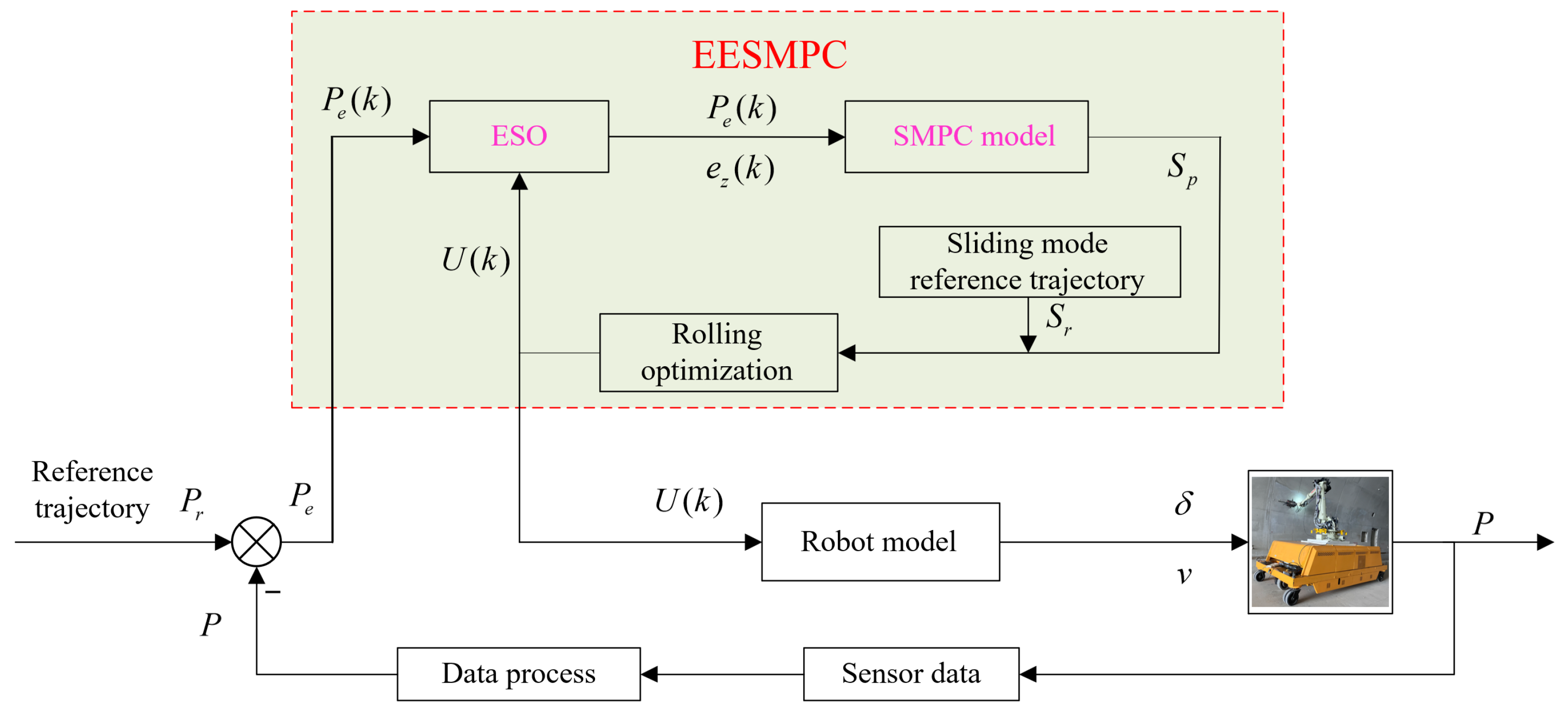
During highway tunnel inspection, the Enhanced Extended Sliding Mode Predictive Control (EESMPC) framework utilizes the generated reference path to achieve high-precision tracking. As shown in Figure 6, the controller processes position/orientation error inputs through three integrated stages: (1) State Expansion: The Extended State Observer (ESO) augments the error state vector by estimating and compensating unmodeled disturbances. (2) Sliding Mode Optimization: The SMPC core solves the constrained optimization problem. (3) Rolling Horizon Execution: The optimal control input is applied while shifting the prediction window forward each cycle. This architecture enables real-time disturbance suppression while maintaining the robot chassis within prescribed tracking bounds throughout tunnel inspections.

4.1. Design of SMPC

1.
Discretization for SMPC
To transform the continuous-time model into a form suitable for digital controllers and considering the subsequent need for the online solution of quadratic programming (QP) problems, the forward Euler method is used to discretize the continuous-time model. For sampling time T, the discrete state-space representation becomes:
P ˙ e = P e ( k + 1 ) P e ( k ) T = A · P e + U
where U = u r u .
Here is the precise mathematical formulation of the robot pose error model state equation, incorporating academic rigor and consistent notation:
P e ( k + 1 ) = A m P e ( k ) + B U ( k ) y ( k ) = C · P e ( k )
where A m = 1 ω T V r y T ω T 1 V r x T 0 0 1 , B = T 0 0 0 T 0 0 0 T , C = 1 0 0 0 1 0 0 0 1 .
2.
Sliding Surface Design
Based on the discretized pose error model, the following sliding surface is selected to enforce tracking convergence:
s ( k ) = K · P e ( k ) = 0
where the matrix gains K = [ k 1 , k 2 , k 3 ] is selected to satisfy both the stability/dynamic performance requirements of the quasi-sliding mode and the Hurwitz condition, consequently ensuring stability on the sliding surface.
The global sliding mode surface of the prediction model can be formulated as:
s p ( k ) = K · P e ( k ) p ( k )
where p ( k ) is a designed function satisfying three conditions: p ( 0 ) = K · P e ( 0 ) ; when t , p ( t ) p ( t ) is first-order differentiable.
Employing the global sliding mode function method, p ( k ) is designed as:
p ( k ) = s ( 0 ) α k
where α is the global sliding mode control parameter, satisfying 0 < α < 1 .
The switching function based on global sliding mode prediction control is then:
s p ( k ) = K · P e ( k ) s ( 0 ) α k
3.
Sliding mode prediction model
The sliding function value for the future time step k + p is predicted by recursively applying the discretized state-space model and sliding surface definition:
s p ( k ) = K A m P e ( k 1 ) + B U ( k 1 ) s ( 0 ) α k
The predicted sliding function state over the prediction horizon is:
s p ( k + p ) = K A m p P e ( k ) + i = 1 p K A m i 1 B U ( k + p i ) s ( 0 ) α k + p
To mitigate the effects of uncertainties in prediction, feedback correction is applied to the predicted sliding function. Future predictions are corrected by utilizing the deviation between the present function value s ( k ) and the prior prediction at k p :
s ^ p ( k + p ) = s ( k + p ) h p s ( k ) s p ( k k p ) = K A m p P e ( k ) + i = 1 p K A m i 1 B U ( k + p i ) s ( 0 ) α k + h p s ( k ) s p ( k k p )
where h p is the correction coefficient, typically set as h p = 1 , s p ( k k p ) = C A m p P e ( k p ) + i = 1 p C A i 1 B U ( k i ) α k .
4.
Determining the reaching law
For the SMPC design, the reference trajectory is defined by the widely used exponential reaching law:
s ˙ = ε sgn ( s ) q s
where ϵ , q are reaching law parameters. Discretizing the above equation, we can get:
s ( k + 1 ) s ( k ) = ε T sgn ( s ( k ) ) q T s ( k )
Thus, the reference trajectory at time k + p is:
s r ( k + p ) = μ s r ( k + p 1 ) η sgn s r ( k + p 1 )
where 0 < μ = 1 q T < 1 , η = ε T > 0 .
5.
Determining the control law
Within the SMPC framework, the control input depends not only on the current sliding surface but also on the predicted values of the sliding surface over a finite future horizon. This enhances performance while mitigating output chattering. The optimal control law is defined as the solution to a QP problem with the dual objective of minimizing trajectory tracking error and penalizing excessive control effort [48]. The cost function is designed as:
J = arg min ( i = 1 N s ^ p ( k + i ) s r ( k + i ) 2 + j = 0 M 1 r j U ( k + j ) 2 )
where the prediction and control horizons are denoted by N and M, respectively. The weighting matrix r j regulates the trade-off between tracking accuracy and control energy. The corresponding cost function is expressed in matrix-vector form as:
J = S ^ p ( k + 1 ) S r ( k + 1 ) T S ^ p ( k + 1 ) S r ( k + 1 ) + U ¯ T ( k ) R U ¯ ( k )
where S ^ p ( k + 1 ) = s ^ p ( k + 1 ) , s ^ p ( k + 2 ) , , s ^ p ( k + N ) T .
Substituting Equation (28) into Equation (33) and rearranging yields:
J = Φ P e ( k ) + G U ( k ) + H E ( k ) S r ( k + 1 ) E α k S ( 0 ) T [ Φ P e ( k ) + G U ( k ) + H E ( k ) S r ( k + 1 ) E α k S ( 0 ) ] + U ¯ T ( k ) R U ¯ ( k )
where R = diag ( r 0 , r 1 , , r M 1 ) ,
E is an N × 3 identity matrix,
H = 2 ( Φ T Φ + R ) is an N × N symmetric positive definite matrix,
S r ( k + 1 ) = s r ( k + 1 ) , s r ( k + 2 ) , , s r ( k + N ) T ,
E ( k ) = s ( k ) s p ( k k 1 ) , s ( k ) s p ( k k 2 ) , , s ( k ) s p ( k k N ) T ,
U ¯ = U ( k ) , U ( k + 1 ) , , U ( k + M 1 ) T ,
Φ = K A m K A m 2 K A m N , G = K B 0 0 K A m B K B 0 K A m N 1 B K A m N 2 B B .
Taking the partial derivative of Equation (34) and setting J U ¯ ( k ) = 0 , the SMPC control law is obtained:
U ¯ ( k ) = ( G T G + R ) 1 G T S r ( k + 1 ) Φ P e ( k ) H E ( k ) α k E s ( 0 )
Substituting the reference trajectory expression (Equation (31)) allows calculation of the control increments from time k to k + M 1 .
The actual control input applied at time k is therefore:
u = u r + U
After obtaining the actual control input, to further enhance control performance and reduce chattering caused by rapid switching, the following control input constraints are added:
| u i | = | u r i + U i | < u i m | Δ u i | = | Δ ( u r i + U i ) | < u i d m
where u i represent control inputs, u r i represent target control inputs, U i represent target control inputs from SMPC. u i m are maximum allowable control inputs; u i d m is the maximum allowable absolute control increment per step. These constraints are represented by matrices U m = u 1 m , u 2 m , u 3 m , u 1 dm , u 2 dm , u 3 dm according to system requirements.
Under imposed control input constraints, solely the initial control increment U ( k ) of the optimized sequence is deployed. By continually repeating this optimization based on the receding horizon principle, the optimal actual control input for the system is attained.
6.
System stability verification
For stability verification, the SMPC design employs the addition of a terminal constraint. Based on the cost function expression (Equation (32)), assuming:
V ( k ) = i = 1 N s ^ p ( k + i ) s r ( k + i ) 2 + j = 0 M 1 r j U ( k + j ) 2
Assuming that at time k + N , the predicted state reaches the reference trajectory, achieving ideal sliding mode dynamics.
The attained optimum of the cost function, which is V 0 ( k ) at each cycle, is chosen as the Lyapunov function candidate for proof of stability.
The cost function has a sum-of-squares form, ensuring V 0 ( k ) is positive definite. To simplify, the control and prediction horizons are both set to N:
V 0 ( k + 1 ) = min ( i = 1 N s ^ p ( k + i + 1 ) s r ( k + i ) 2 + j = 0 M 1 r j U ( k + 1 + j ) 2 )
Considering the optimization process and the terminal constraint, it can be shown:
V 0 ( k + 1 ) = min { V ( k ) s ^ p ( k + 1 ) s r ( k + 1 ) 2 r 0 U 2 ( k ) + [ s ^ p ( k + 1 + N ) s r ( k + 1 + N ) ] 2 + r 0 U 2 ( k + N ) }
V 0 ( k + 1 ) = V 0 ( k ) s ^ p ( k + 1 ) s r ( k + 1 ) 2 + r 0 U 2 ( k )
Since V 0 ( k + 1 ) V 0 ( k ) , the derivative of V 0 ( k ) is negative definite. Therefore, the system is stable under the proposed SMPC law with terminal constraint.

4.2. Adaptive Extended State Observer

Highway tunnel environments introduce complex disturbances—including aerodynamic effects, uneven terrain, and sensor noise—that degrade robot path-tracking performance. As these disturbances are often unmeasurable, this paper incorporates an ESO. In the ESO approach, the collective unknown disturbance is modeled as an augmented state, which leads to the construction of an expanded state-space model:
Z ( k + 1 ) = A m Z ( k ) + B U ( k ) L C Z ( k ) y ( k )
where Z ( k + 1 ) is the new extended state vector, L ( k ) = l 1 l 2 l 3 T is the gain vector of the observer.
Define the estimation error between the original state and its estimate as E z ( k ) = Z ( k ) P e ( k ) . From Equations (21) and (42), the error dynamics are:
E z ( k + 1 ) = ( A m L C ) E z ( k )
To ensure E z converges to 0, the observer gain L must be designed such that all eigenvalues of [ A m L C ] have negative real parts.
The ESO for the original system is thus:
E z ( k ) = Z ( k ) y ( k ) Z ( k + 1 ) = A m Z ( k ) L E z ( k ) + B U ( k )
Since different highway tunnels present varying disturbance environments, an improved ESO with adaptive gain adjustment based on observation error is proposed to enhance the adaptability of the SMPC strategy and balance the convergence speed and noise robustness.The adaptive gain is designed with the principle that a larger error magnitude leads to a higher gain for faster convergence, while a smaller error results in a reduced gain to mitigate noise.
In this paper, an adaptive observer gain is designed as L ( k + 1 ) = L ( k ) + α · E z ( k ) , where α = 0.1 is the constant adjustment coefficient.
After introducing the improved adaptive ESO, the state variables input to the system are modified as follows:
Z e ( k ) = P e ( k ) + E z ( k )
The improved ESO can adaptively adjust observer parameters based on the system’s actual performance, improving estimation accuracy and system responsiveness. It is suitable for systems in highway tunnel environments where parameters vary over time or exhibit uncertainties.
After incorporating the improved ESO, the input to the proposed controller becomes:
U ( k ) = ( G T G + R ) 1 G T S r ( k + 1 ) Φ Z e ( k ) H E ( k ) α k E s ( 0 )                                                   = ( G T G + R ) 1 G T S r ( k + 1 ) Φ ( P e ( k ) + e ( k ) ) H E ( k ) α k E s ( 0 )
Solving the SMPC optimization problem yields the optimal control sequence U k , and at each step, only the first element of the optimized sequence is implemented as the control action.
u ( k ) = u ( k | k )
Through the construction of the improved ESO, unknown disturbances within the state variables can be effectively estimated and compensated, thereby improving the stability and tracking accuracy of the path-following system.

4.3. Numerical Simulation

MATLAB simulations were performed to assess the control performance of the robust EESMPC. The path tracking performance of EESMPC was compared with that of the SMC, MPC, and PID controllers. Simulation settings included an initial pose of P o = 0 , 0 , 0 T , and a velocity parameter v 0 = 0.5 m/s. EESMPC parameters are listed in Table 2, while the PID controller used k p = 100 , k i = 0 , k d = 30 . The k p , k i , k d gains of the PID controller were preliminarily determined using the Ziegler–Nichols tuning method. Based on this initial tuning, manual fine-tuning was performed according to step-response performance to achieve a balance between response and stability. SMC parameters are listed in Table 3, and The design and derivation of SMC are presented in Appendix A. The switching surface coefficients of the SMC were selected based on the desired closed-loop pole placement principle to ensure the dynamic characteristics of the sliding mode. The switching gain was determined according to the reaching condition for the existence of the sliding mode. The thickness of the boundary layer was chosen by trading off tracking accuracy against control smoothness. The simulation parameters of the MPC controller are detailed in Table 4. The weighting matrices of the MPC controller were determined through systematic trial-and-error combined with engineering experience. The target was to balance the squared tracking error and the squared control input over the prediction horizon. N p and N c were selected considering both the system dynamics and the available realtime computational capability. For a fair comparison, a uniform sampling period of T = 10 ms is used.
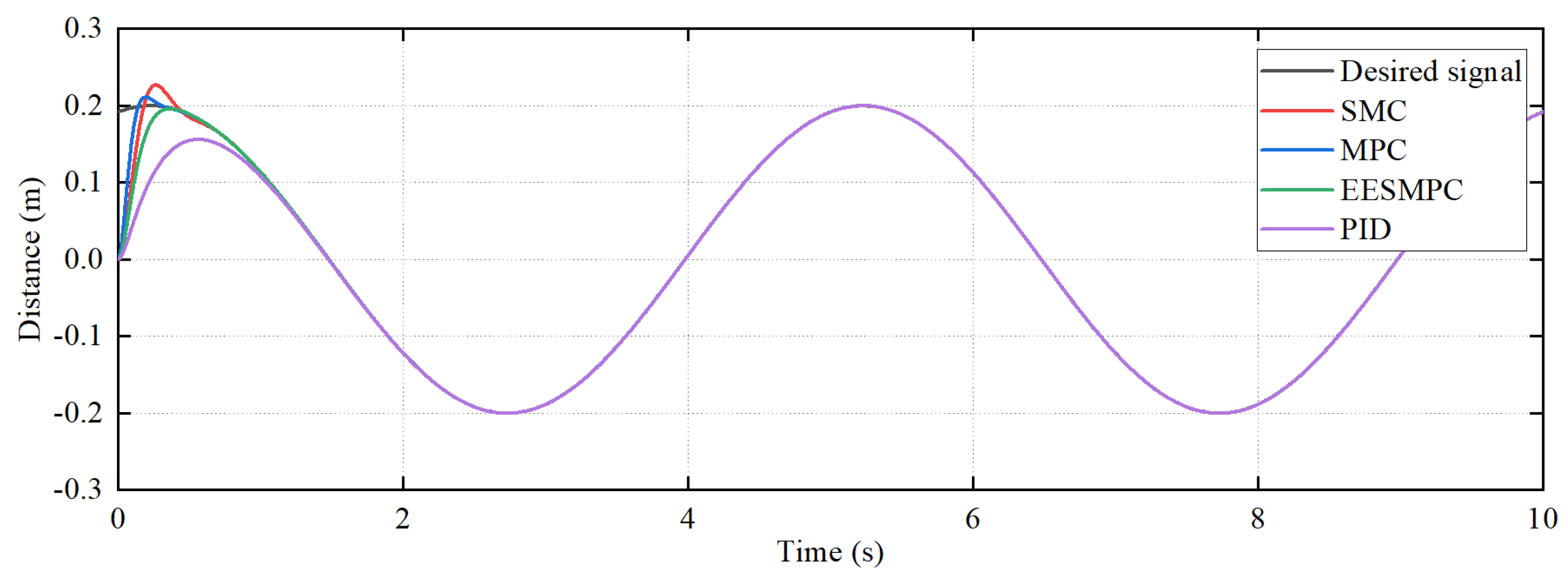
The desired trajectory of the system is given as P d 1 = [ 0.2 , 0 , 0 ] T . The corresponding tracking performance, obtained from simulations, is presented in Figure 7. The results indicate that the proposed method achieves convergence in 0.3 s, and the MPC method’s convergence time is 0.4 s, and the SMC method’s convergence time is 0.7 s and the convergence time of PID is 1.5 s. By comparing, it can be observed that the proposed EESMPC can make the tracking errors converge to a smaller error than the other controllers.
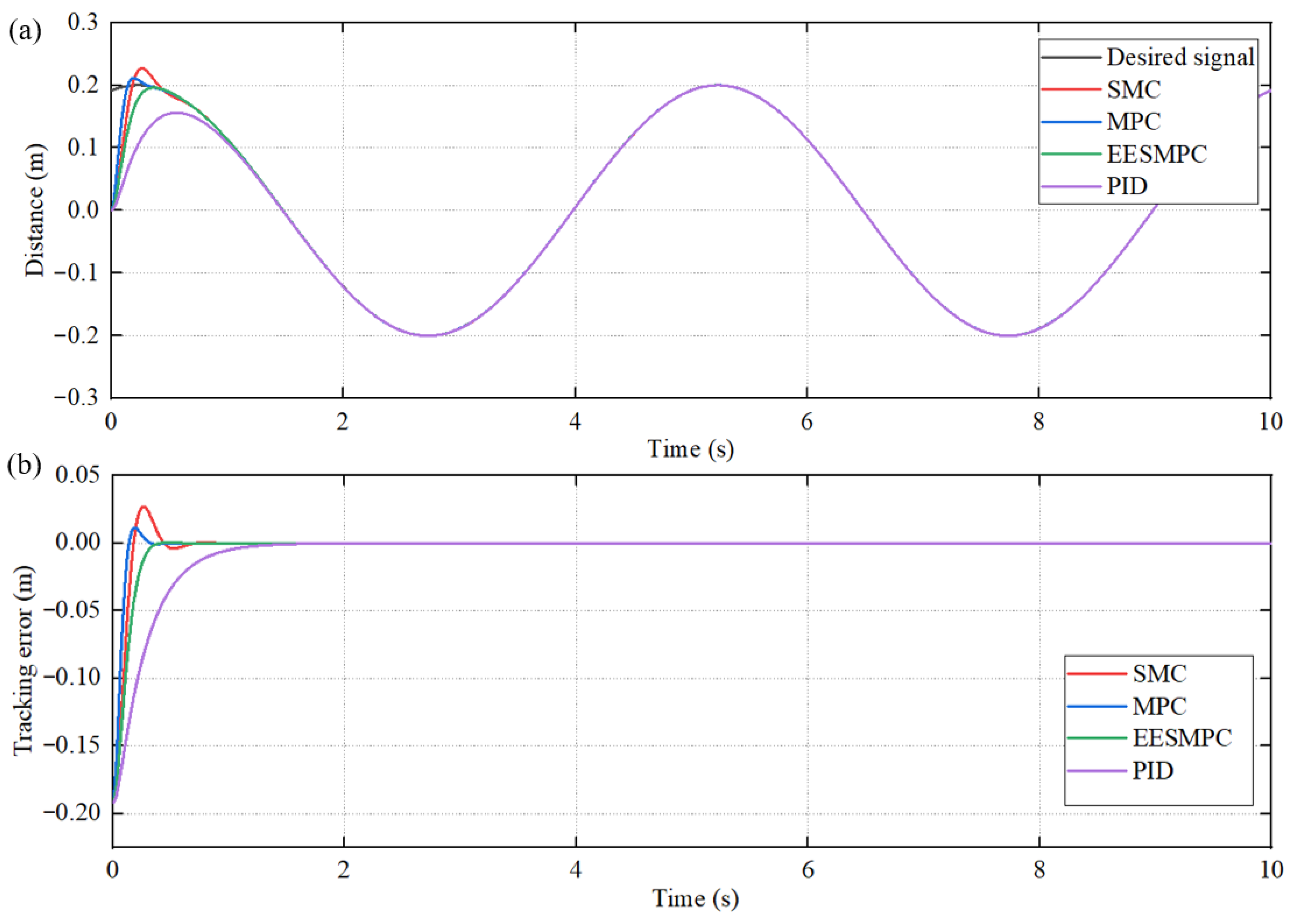
The sine trajectory of the system is given as P d 2 = 0.2 sin 2 π 5 t 5 . The data of position tracking are shown in Figure 8. The results indicate that the proposed method’s convergence time is 0.3 s, and the MPC method’s convergence time is 0.4 s, and the SMC method’s convergence time is 0.7 s and the convergence time of PID is 1.5 s. From the comparison, it can be observed that the proposed EESMPC enables the tracking errors to converge to a smaller value than the other controllers.
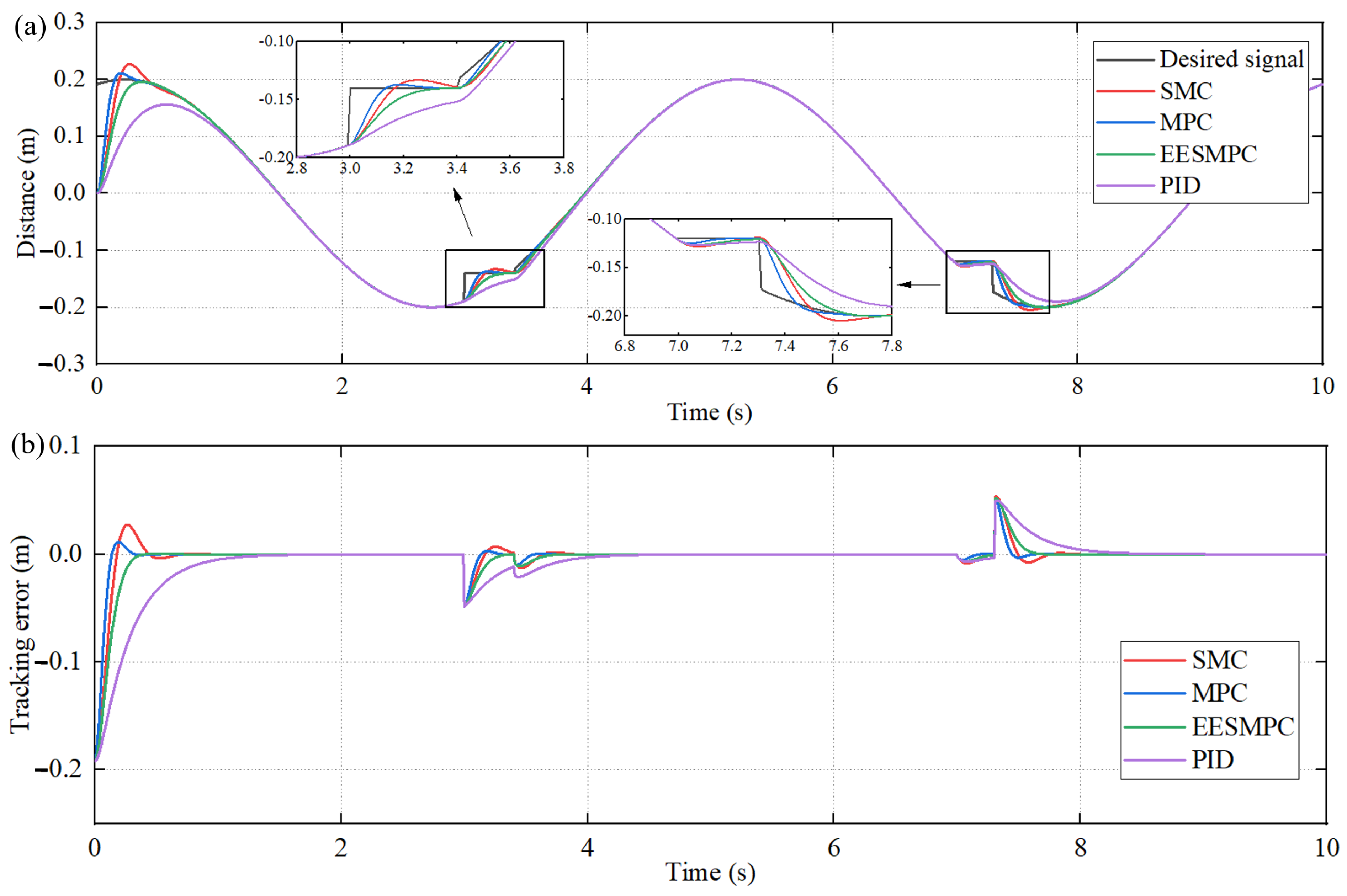
From the analysis of disturbances in Section 2, step position disturbances will be encountered in the desired trajectory. To verify the disturbance effect of step disturbances in the tunnel lining on the tracking trajectory, based on the simulation results of the sine curve, external step disturbances are introduced. The tracking trajectories are set to −0.14 m between 3 s and 3.4 s and −0.12 m between 7 s and 7.3 s. The simulation results of the tracking of reference trajectories with step disturbances are shown in Figure 9. It can be observed that after step disturbances are applied all the algorithms are quickly adjusted to adapt to the step disturbances. In contrast, the convergence speed to the sinusoidal trajectory is faster.
The performance and precision of the proposed algorithm were evaluated by employing a set of quantitative indicators to benchmark it against the four candidate controllers, as shown in Table 5. The max error refers to the maximum deviation of the controller when encountering disturbances after convergence. In the table, DRT refers to the disturbance rejection time, and MAE and RMSE are the abbreviations for mean absolute error and root mean square error, respectively.
From the results of evaluation indicators, compared with the other controllers, the proposed method achieves a markedly shorter convergence time, a smaller max error, a smaller overshoot and a shorter disturbance rejection time. In contrast with the other controllers, the MAE and RMSE of the proposed method are smaller.
From the simulation results, for time-varying position tracking with disturbances, the proposed EESMPC maintains close alignment with the ideal curve’s trajectory, and achieves rapid regulation with minimal overshoot.
The numerical simulation results confirm that the proposed method exhibits superior dynamic response and steady-state accuracy. It delivers quantitatively controllable transient responses, precisely adjustable convergence time, and high steady-state precision in tunnel inspection trajectory tracking.

5. Experiments

In order to further assess the applicability and reliability of the proposed approach within actual highway tunnel settings, field experiments were conducted in a highway tunnel under construction.
Path tracking error during field trials was derived from multi-source sensors. To intuitively visualize tracking deviation relative to the tunnel lining contour, experimental error data was quantified as the relative deviation between the robot chassis position and the fitted reference curve. The robot features a controller built around an NVIDIA Xavier NX processor, which delivers 21 TOPs of computing power, thereby guaranteeing both high computational efficiency for the algorithm and real-time performance of the controller.

5.1. Target Path Point Acquisition

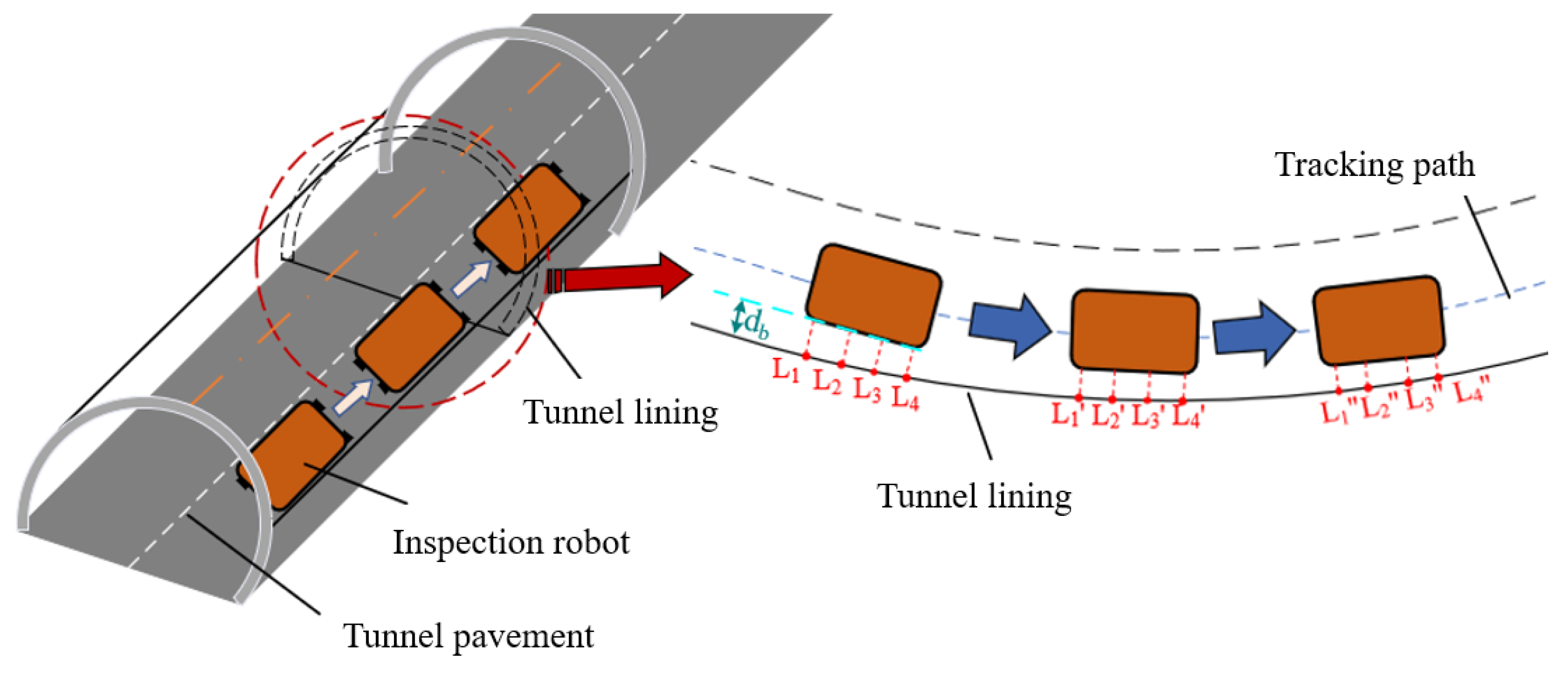
The target path for the tunnel inspection robot’s path tracking in this study is not pre-defined but acquired in real-time by four laser sensors mounted laterally on the robot. The method for obtaining target path points is illustrated in Figure 10.
Let the current values of the four sensors be L 1 , L 2 , L 3 , L 4 . These path point data are added to the fitting dataset. At the next time step, new sensor values L 1 , L 2 , L 3 , L 4 are similarly added to the dataset. This process repeats. Subsequent fitting of the path point data within the dataset yields the target path function for tracking.
Due to sensor limitations and external disturbance, anomalous sensor data can affect curve fitting and ultimately robot tracking performance. Therefore, the acquired sensor data requires filtering. Considering highway tunnel applications, a limiting moving average filter was employed. This method averages only a finite queue of recent data, improving real-time performance while eliminating fluctuations and rejecting abrupt outliers.

5.2. Path Fitting Method Based on Least Squares

Based on the acquired target path points, data processing is required to derive the target path function that the robot chassis will track. Owing to external disturbances, sensor data is inherently contaminated with noise and errors. Moreover, the target path function needs to predict data trends to facilitate timely comparison with the current pose for motion control purposes.
The Least Squares Method (LSM) [48] identifies the optimal function fit for given data by minimizing the sum of squared errors. In this study, the LSM was employed to fit a polynomial to the sensor data, thereby obtaining the target function for the curve fitting stage. Considering the surface characteristics of tunnel walls, a polynomial model was selected. To ensure smoothness and continuity, a cubic polynomial was utilized, expressed as follows:
y = a x 3 + b x 2 + c x + d
Given a set of sample data points P ( x , y ) , the sum of squared errors s is:
s = i = 1 m a x i 3 + b x i 2 + c x i + d y i 2
Expressing s in matrix form:
X v = 1 x 1 x 1 2 x 1 3 1 x 2 x 2 2 x 2 3 1 x m x m 2 x m 3 , θ = d c b a , y r = y 1 y 2 y 3 y m
where X v is a Vandermonde matrix, θ is the coefficient vector, and y r is the output vector.
Applying the LSM, the optimal coefficient vector is:
θ = ( X v T X v ) 1 X v T y r
The solved cubic polynomial coefficients are substituted into Equation (49), yielding the optimal curve function that minimizes the sum of squared errors.

5.3. The Actual Tunnel Environment

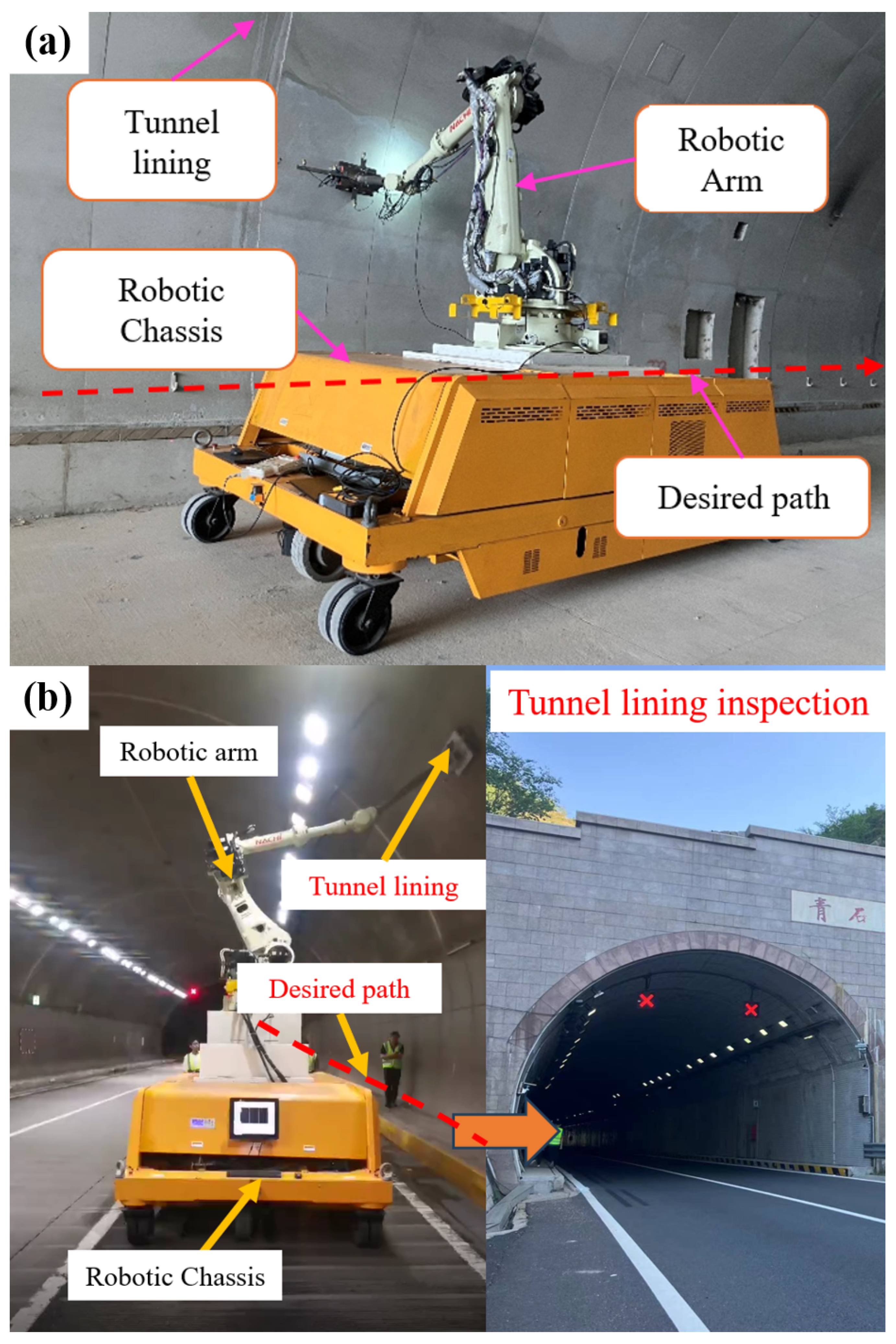
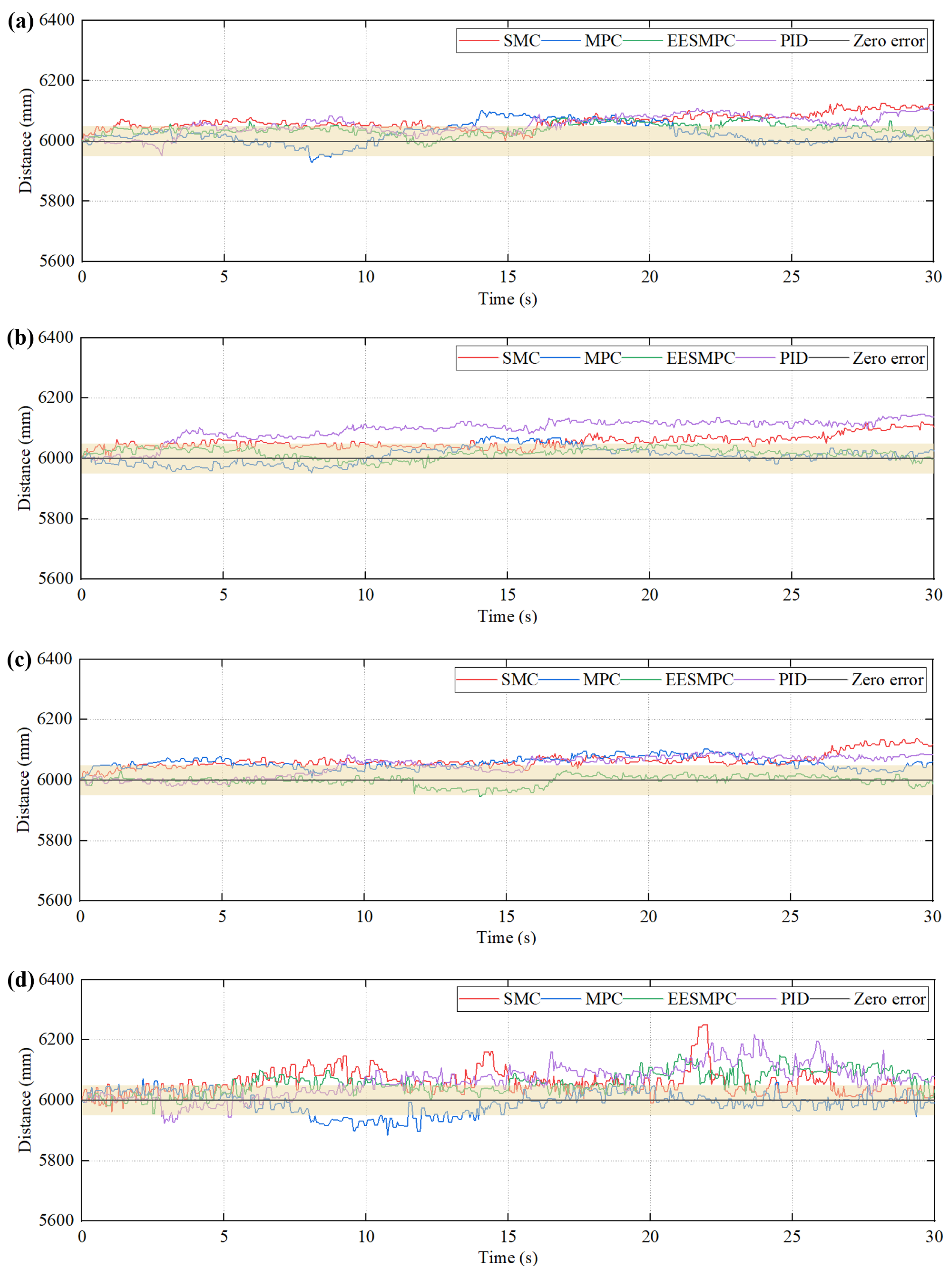
Experimental trials were primarily executed within the left vehicular lane. The tunnel features a concrete pavement surface with intentionally preserved unevenness, closely replicating real-world operational scenarios. The test configured within the tunnel environment is illustrated in Figure 11. For a comprehensive evaluation, two different tunnel lining scenarios are adopted to test the performance of EESMPC.
Multiple automated inspection experiments were conducted in a tunnel environment to assess the precision, stability, and overall performance of the designed path tracking control algorithm. The pavement within the tunnel is uneven, and there exist unknown protrusions and dents in the tunnel, leading to numerous unknown disturbance factors. Disturbances encountered in the path tracking are unknown dents and uncertain protusions. The maximum disturbance amplitude is 0.2 m. All four controllers were sequentially implemented in the robot’s main control unit, with autonomous inspection tasks executed separately for each algorithm. To ensure a fair comparison, five experiments were conducted for each controller. Through extensive on-site debugging, key parameters were determined, including inspection distance baseline d b = 6000 mm.
Two distinct tunnel lining scenarios were tested. In scenario 1, the robot operated at 1.0 m/s for 30 s. In scenario 2 (a different tunnel), the speed was increased to 1.5 m/s with the same 30 s duration. Both tests started from predefined initial chassis poses. The experimental setup mirrors that used in the preceding numerical simulations.

6. Results and Discussion

The integrated laser sensor array was employed to acquire distance measurements, which provided real-time pose data for the system. The measurements from four displacement lasers subsequently served as the central focus of the experimental analysis.
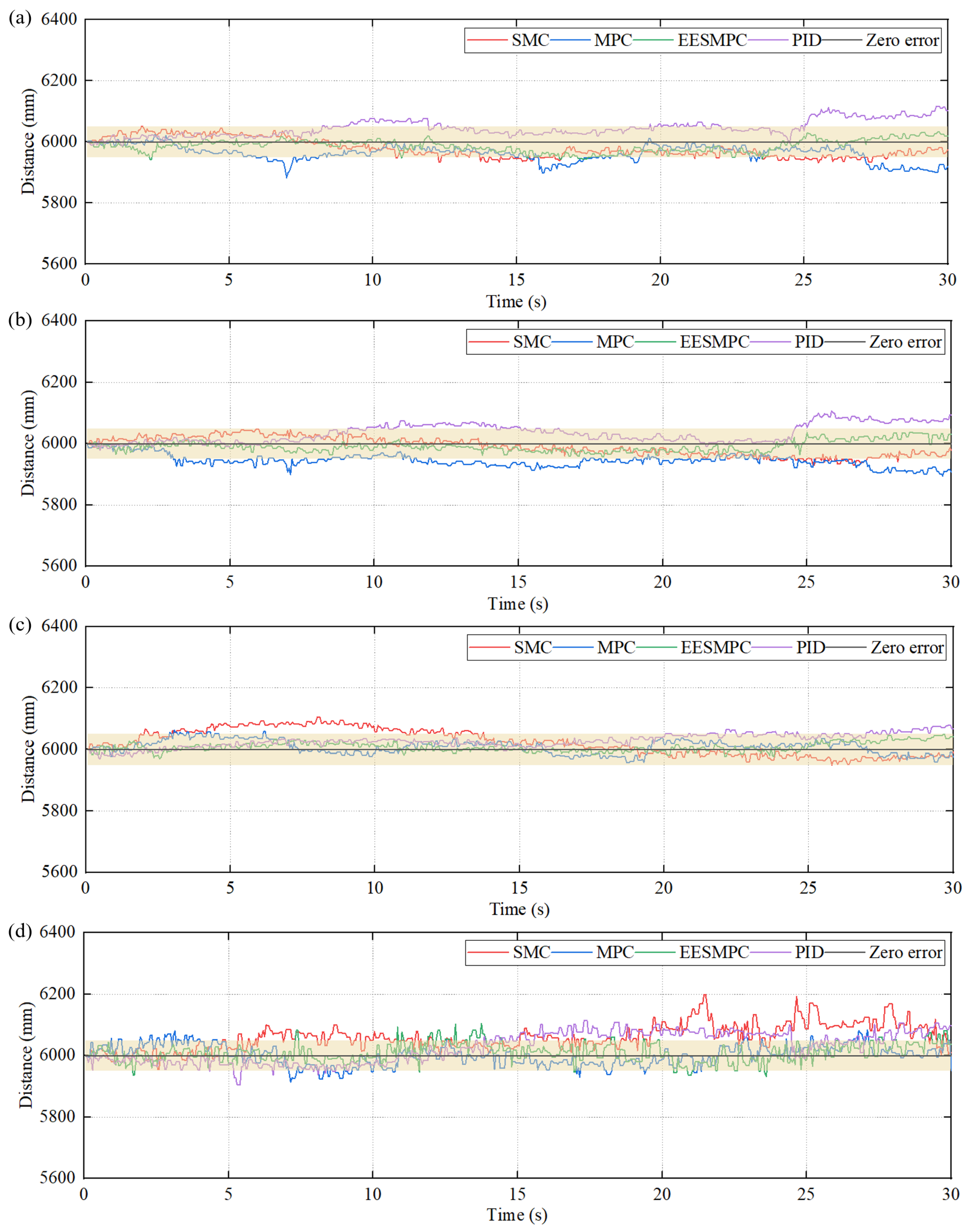
Figure 12 presents the experimental results acquired from the tunnel scenario 1. In Figure 12, the light-yellow areas indicate error bars. The values of error bars are computed as follows:
V e b = 6000 ± ( 1.96 S D n )
where V e b is the value of error bars. S D = i = 1 n ( x i x ¯ ) 2 n 1 , 6000 mm is the zero error line, and 1.96 is the commonly used z-value for a 95% confidence interval.
It can be seen from the figure that the laser data obtained by the controller proposed falls within the error bars, while the data from the other three controllers partially lie outside the error bars. As evidenced by the experimental data, the proposed controller exhibits a reduced error in laser measurements relative to the other three controllers. In contrast, the EESMPC algorithm maintains deviations consistently near the zero-baseline, characterized by shorter settling time, reduced maximum deviation, lower absolute error, and enhanced stability. The MAE and RMSE values of the laser during path tracking are present in Table 6 and Table 7.
As summarized in Table 6 and Table 7, the MAE values for the proposed controllers are 17.5857 mm, 17.1493 mm, 17.5640 mm and 29.3960 mm, and the RMSE values for the proposed controllers are 20.7921 mm, 17.6897 mm, 16.6565 mm and 34.8105 mm. The proposed method outperforms the other controllers across key metrics, achieving high-precision control alongside improved energy efficiency.
Figure 13 presents the experimental results acquired from the tunnel scenario 2. In Figure 13, the values of the error bars are the same as Figure 12.
As evidenced by the experimental data, the proposed controller exhibits a reduced error in laser measurements relative to the other three controllers, characterized by shorter settling time, reduced maximum deviation, and lower absolute error. The RMSE values of the laser during path tracking are present in Table 8.
As summarized in Table 8, the RMSE values for the proposed controllers are 22.6997 mm, 19.6680 mm, 22.4903 mm and 37.5399 mm. The proposed method outperforms the other controllers across key metrics, achieving high-precision control alongside improved energy efficiency. This leads to the higher tracking accuracy of the EESMPC controller, validating its comprehensive performance advantage for tunnel lining inspection. In scenario 2, the larger RMSE values are primarily attributed to the combined effects of higher testing speeds and more complex scenario dynamics.
In conclusion, for the path tracking control of highway tunnel inspection robots, all evaluation metrics of the proposed EESMPC algorithm outperform those of the other three controllers. This verifies the accuracy and stability of the designed path tracking controller, thereby confirming its effectiveness in path tracking control for the robot chassis during autonomous inspection tasks.


7. Conclusions

External disturbances and irregular terrain within highway tunnels often cause inspection robots to deviate from their predefined paths. Critically, pose deviations of the robot chassis result in significant positioning errors, which severely compromises inspection accuracy and further degrades inspection effectiveness. To address this challenge, a robust EESMPC algorithm is proposed in this study. The proposed EESMPC incorporates an adaptive ESO to estimate and compensate for unmeasured system state parameters and disturbances, thereby enhancing the control precision and stability of the path tracking system. The validation through comparative MATLAB simulations and experiments confirms that the proposed EESMPC algorithm achieves superior tracking performance and robustness in following target curves within demanding tunnel environments. Overall, the proposed EESMPC effectively enhances the automated inspection accuracy and operational efficiency of highway tunnel inspection robots. In this study the disturbance models were simplified. To facilitate theoretical derivation and controller design, external disturbances and model uncertainties were simplified as bounded step signals. However, actual disturbances in tunnel environments may exhibit more complex time-varying or correlated characteristics. Tunnel-lining unevenness and pavement irregularities are often coupled. This simplified model may not fully capture all dynamic features of real-world disturbances, which could affect control performance optimality under extreme or unmodeled dynamic scenarios. Controller performance may also vary with the accuracy of the sensors used as well as the response speed of the chassis wheels. Future research may consider more refined disturbance models, such as those based on stochastic processes or data-driven approaches.

Author Contributions

Conceptualization, X.G.; methodology, X.G. and Z.D.; software, X.G. and Z.D.; validation, X.G. and Z.D.; formal analysis, X.G.; investigation, X.G.; resources, X.G.; data curation, X.G. and Z.D.; writing—original draft preparation, X.G.; writing—review and editing, X.G. and Z.D.; visualization, X.G. and Z.D.; supervision, J.Z. All authors have read and agreed to the published version of the manuscript.

Funding

This work was supported by the Key R&D Program of Shandong Province [Grant No. 2024CXGC010213].

Data Availability Statement

Data is contained within the article.

Conflicts of Interest

The authors declare no conflicts of interest.

Appendix A. Design of Sliding Mode Controller

The controller input is the pose error vector P e = [ x e , y e , φ e ] T , representing the deviation between the robot’s current chassis pose P = [ x , y , φ ] T and the target path point P r = [ x r , y r , φ r ] T during tunnel inspection. The sliding mode controller (SMC) processes this error to compute the velocity command u = [ v x , v y , ω ] T for the next control cycle. This command executes the motion while new pose error is fed back, establishing a closed-loop path tracking system as shown in Figure A1.
Figure A1. Control scheme of SMC.
Buildings 16 01119 g0a1
To design a controller that meets the specified requirements, an integral sliding surface is selected, with the switching function designed as follows:
s 1 = x e + c 1 0 t x e ( τ ) d τ s 2 = y e + c 2 0 t y e ( τ ) d τ s 3 = φ e + c 3 0 t φ e ( τ ) d τ
where c 1 , c 2 , c 3 are coefficients to be determined. When c 1 , c 2 , c 3 approach 0, this ensures that the controller stabilizes on the sliding surface.
The exponential reaching law is adopted as follows:
s ˙ = ε sgn ( s ) ρ s ε > 0 , ρ > 0
By differentiating Equation (A1) and combining it with Equation (A2), the SMC input is derived as follows:
u = u r + ( A + C ) P e + ε sgn ( s ) + ρ s
where C = diag ( c 1 , c 2 , c 3 ) .
A Lyapunov function is defined as follows:
V = 1 2 s 2
By taking the derivative of both sides of Equation (A4), it can be obtained that V ˙ = ε | s | ρ s 2 . Since ϵ > 0 and ρ > 0 , then ε | s | ρ s 2 0 .
In summary, while s = 0 s s ˙ = 0 , and then V ˙ = s s ˙ 0 is satisfied. Based on Lyapunov stability theory, it can be concluded that the system is stable.
Owing to the presence of the switching surface in the SMC, the system will continuously cross this surface, resulting in system chattering that impairs system stability. A saturation function is therefore employed to replace the sign function, mitigating system chattering. This function takes the following form:
sat ( s , Δ ) = sign ( s ) if | s | > Δ s Δ if | s | Δ , Δ > 0

References

  1. Li, L.; Shang, C.; Chu, K.; Zhou, Z.; Song, S.; Liu, Z.; Chen, Y. Large-scale geo-mechanical model tests for stability assessment of super-large cross-section tunnel. Tunn. Undergr. Space Technol. 2021, 109, 103756. [Google Scholar] [CrossRef]
  2. Miao, X.; Wang, J.; Wang, Z.; Sui, Q.; Gao, Y.; Jiang, P. Automatic recognition of highway tunnel defects based on an improved U-Net model. IEEE Sens. J. 2019, 19, 11413–11423. [Google Scholar] [CrossRef]
  3. Ye, F.; Qin, N.; Liang, X.; Ouyang, A.; Qin, Z.; Su, E. Analyses of the defects in highway tunnels in China. Tunn. Undergr. Space Technol. 2021, 107, 103658. [Google Scholar] [CrossRef]
  4. Zucca, M.; Valente, M. On the limitations of decoupled approach for the seismic behaviour evaluation of shallow multi-propped underground structures embedded in granular soils. Eng. Struct. 2020, 211, 110497. [Google Scholar] [CrossRef]
  5. Li, D.; Xie, Q.; Gong, X.; Yu, Z.; Xu, J.; Sun, Y.; Wang, J. Automatic defect detection of metro tunnel surfaces using a vision-based inspection system. Adv. Eng. Inform. 2021, 47, 101206. [Google Scholar] [CrossRef]
  6. Protopapadakis, E.; Doulamis, N. Image based approaches for tunnels’ defects recognition via robotic inspectors. In International Symposium on Visual Computing; Springer International Publishing: Cham, Switzerland, 2015; pp. 706–716. [Google Scholar]
  7. Loupos, K.; Doulamis, A.D.; Stentoumis, C.; Protopapadakis, E.; Makantasis, K.; Doulamis, N.D.; Amditis, A.; Chrobocinski, P.; Victores, J.; Montero, R. Autonomous robotic system for tunnel structural inspection and assessment. Int. J. Intell. Robot. Appl. 2018, 2, 43–66. [Google Scholar] [CrossRef]
  8. Victores, J.G.; Menendez, E.; Balaguer, C. Tunnel Structural Inspection and Assessment Using an Autonomous Robotic System. In Infrastructure Robotics: Methodologies, Robotic Systems and Applications; John Wiley & Sons, Inc.: Hoboken, NJ, USA, 2024; pp. 185–203. [Google Scholar]
  9. Mashimo, H.; Ishimura, T. State of the art and future prospect of maintenance and operation of road tunnel. In 2006 Proceedings of the 23rd ISARC, Tokyo, Japan, 3–5 October 2006; IAARC: Oulu, Finland, 2006; pp. 299–302. [Google Scholar]
  10. Nakamura, S.; Yamashita, A.; Inoue, F.; Inoue, D.; Takahashi, Y.; Kamimura, N.; Ueno, T. Inspection test of a tunnel with an inspection vehicle for tunnel lining concrete. J. Robot. Mechatronics 2019, 31, 762–771. [Google Scholar] [CrossRef]
  11. Xie, X.; Yang, Y.; Ji, M. Analysis of ground surface settlement induced by the construction of a large-diameter shield-driven tunnel in Shanghai, China. Tunn. Undergr. Space Technol. 2016, 51, 120–132. [Google Scholar] [CrossRef]
  12. Gierlak, P.; Kurc, K.; Szybicki, D. Mobile crawler robot vibration analysis in the contexts of motion speed selection. J. Vibroeng. 2017, 19, 2403–2412. [Google Scholar] [CrossRef]
  13. García, J.; Martínez, J.L.; Mandow, A.; García-Cerezo, A. Steerability analysis on slopes of a mobile robot with a ground contact arm. In Proceedings of the 2015 23rd Mediterranean Conference on Control and Automation (MED), Torremolinos, Spain, 16–19 June 2015; pp. 267–272. [Google Scholar]
  14. Chen, Z.; He, C.; Yang, W.; Guo, W.; Li, Z.; Xu, G. Impacts of geological conditions on instability causes and mechanical behavior of large-scale tunnels: A case study from the Sichuan–Tibet highway, China. Bull. Eng. Geol. Environ. 2020, 79, 3667–3688. [Google Scholar] [CrossRef]
  15. Yao, Q.; Tian, Y.; Wang, Q.; Wang, S. Control strategies on path tracking for autonomous vehicle: State of the art and future challenges. IEEE Access 2020, 8, 161211–161222. [Google Scholar] [CrossRef]
  16. Cao, S.; Jin, Y.; Trautmann, T.; Liu, K. Design and experiments of autonomous path tracking based on dead reckoning. Appl. Sci. 2022, 13, 317. [Google Scholar] [CrossRef]
  17. Liu, Z.; Cheng, S.; Ji, X.; Li, L.; Wei, L. A hierarchical anti-disturbance path tracking control scheme for autonomous vehicles under complex driving conditions. IEEE Trans. Veh. Technol. 2021, 70, 11244–11254. [Google Scholar] [CrossRef]
  18. Zou, M.; Bai, H.; Wang, Y.; Yu, S. Mechanical design of a self-adaptive transformable tracked robot for cable tunnel inspection. In Proceedings of the 2016 IEEE International Conference on Mechatronics and Automation, Harbin, China, 7–10 August 2016; pp. 1096–1100. [Google Scholar]
  19. Bingul, Z.; Karahan, O. Real-time trajectory tracking control of Stewart platform using fractional order fuzzy PID controller optimized by particle swarm algorithm. Ind. Robot. Int. J. Robot. Res. Appl. 2021, 49, 708–725. [Google Scholar] [CrossRef]
  20. Nie, Y. The Research on Mobile Robot Path Routing Based on PID Algorithm. In Proceedings of the 2nd International Conference on Artificial Intelligence and Advanced Manufacture, Manchester, UK, 15–17 October 2020; Association for Computing Machinery: New York, NY, USA, 2020; pp. 466–469. [Google Scholar]
  21. Wang, L.; Chen, Z.; Zhu, W. An improved pure pursuit path tracking control method based on heading error rate. Ind. Robot. Int. J. Robot. Res. Appl. 2022, 49, 973–980. [Google Scholar] [CrossRef]
  22. Sun, Q.; Wang, Z.; Li, M.; Liu, B.; Cheng, J.; Tai, J. Path tracking control of wheeled mobile robot based on improved pure pursuit algorithm. In Proceedings of the 2019 Chinese Automation Congress (CAC), Hangzhou, China, 22–24 November 2019; pp. 4239–4244. [Google Scholar]
  23. Omrane, H.; Masmoudi, M.S.; Masmoudi, M. Fuzzy logic based control for autonomous mobile robot navigation. Comput. Intell. Neurosci. 2016, 2016, 9548482. [Google Scholar] [CrossRef]
  24. Abdalla, T.Y. Adaptive Fuzzy FOPID Control Scheme for Path tracking of Mobile Robot. Int. J. Comput. Appl. 2018, 181, 1–5. [Google Scholar] [CrossRef]
  25. Faulwasser, T.; Weber, T.; Zometa, P.; Findeisen, R. Implementation of nonlinear model predictive path-following control for an industrial robot. Int. J. Comput. Appl. 2016, 25, 1505–1511. [Google Scholar] [CrossRef]
  26. Bai, G.; Meng, Y.; Liu, L.; Luo, W.; Gu, Q.; Liu, L. Review and comparison of path tracking based on model predictive control. Electronics 2019, 8, 1077. [Google Scholar] [CrossRef]
  27. Zhai, J.; Song, Z. Adaptive sliding mode trajectory tracking control for wheeled mobile robots. Int. J. Control 2019, 91, 2255–2262. [Google Scholar] [CrossRef]
  28. Xie, H.; Zheng, J.; Chai, R.; Nguyen, H.T. Robust tracking control of a differential drive wheeled mobile robot using fast nonsingular terminal sliding mode. Comput. Electr. Eng. 2021, 96, 107488. [Google Scholar] [CrossRef]
  29. Medina, L.; Guerra, G.; Herrera, M.; Guevara, L.; Camacho, O. Trajectory tracking for non-holonomic mobile robots: A comparison of sliding mode control approaches. Results Eng. 2024, 22, 102105. [Google Scholar] [CrossRef]
  30. Brown, M.; Funke, J.; Erlien, S.; Gerdes, J.C. Safe driving envelopes for path tracking in autonomous vehicles. Control Eng. Pract. 2017, 61, 307–316. [Google Scholar] [CrossRef]
  31. Yu, H.; Sheng, N.; Ai, Z. Sliding mode control for trajectory tracking of mobile robots. In Proceedings of the 2021 40th Chinese Control Conference (CCC), Shanghai, China, 26–28 July 2021; pp. 13–17. [Google Scholar]
  32. Mu, J.; Yan, X.; Spurgeon, S.K.; Mao, Z. Nonlinear sliding mode control of a two-wheeled mobile robot system. Int. J. Model. Identif. Control 2017, 27, 75–83. [Google Scholar] [CrossRef]
  33. Goswami, N.K.; Padhy, P.K. Sliding mode controller design for trajectory tracking of a non-holonomic mobile robot with disturbance. Comput. Electr. Eng. 2018, 72, 307–323. [Google Scholar] [CrossRef]
  34. Nghiem, G.; Le, T.; Phung, T.C.; Dinh, Q.H. A study on the optimal control strategy using sliding mode controller for Mecanum-Wheeled omnidirectional mobile robot. Measurement 2025, 255, 118113. [Google Scholar] [CrossRef]
  35. Sánchez, J.A.S.; López-González, E.; Magid, E.; Martínez-García, E.A. Double spiraliform path planning and tracking for agricultural mobile robotics: A modeling and simulation study. Comput. Electron. Agric. 2025, 237, 110715. [Google Scholar] [CrossRef]
  36. Yan, X.; Wang, D.; Ma, A.; Zhao, S. Adaptive robust control for heavy-duty tracked transportation robots in underground mines. Control Eng. Pract. 2025, 164, 106494. [Google Scholar] [CrossRef]
  37. Das, M.S.; Gogoi, U.R.; Mandal, S. Hybrid Adaptive Sliding Mode Controller for Path Tracking of Wheeled Mobile Robot in Uncertainty. Ain Shams Eng. J. 2025, 16, 103640. [Google Scholar] [CrossRef]
  38. Li, Y.; Wu, T.; Xiao, Y.; Gong, L.; Liu, C. Path planning in continuous adjacent farmlands and robust path-tracking control of a rice-seeding robot in paddy field. Comput. Electron. Agric. 2023, 210, 107900. [Google Scholar] [CrossRef]
  39. Miranda-Colorado, R. Observer-based finite-time control for trajectory tracking of wheeled mobile robots with kinematic disturbances. ISA Trans. 2024, 148, 64–77. [Google Scholar] [CrossRef]
  40. Rodriguez-Arellano, J.A.; Miranda-Colorado, R.; Villafuerte-Segura, R.; Aguilar, L.T. Experimental observer-based delayed control of wheeled mobile robots. Appl. Math. Model. 2025, 143, 116038. [Google Scholar] [CrossRef]
  41. Ramírez-Neria, M.; Madonski, R.; Hernández-Martínez, E.G.; Lozada-Castillo, N.; Fernández-Anaya, G.; Luviano-Juárez, A. Robust trajectory tracking for omnidirectional robots by means of anti-peaking linear active disturbance rejection. Robot. Auton. Syst. 2025, 183, 104842. [Google Scholar] [CrossRef]
  42. Zhao, L.; Li, J.; Li, H.; Liu, B. Double-loop tracking control for a wheeled mobile robot with unmodeled dynamics along right angle roads. ISA Trans. 2025, 136, 525–534. [Google Scholar] [CrossRef] [PubMed]
  43. Yin, Z.; Chen, Y.; She, P.; Liu, C.; He, X.; Lv, S. Modeling the measurement precision of a multi-camera system. Opt. Lett. 2025, 50, 6489–6492. [Google Scholar] [CrossRef]
  44. Shi, Y.; Wang, Y.; Wang, L.N.; Wang, W.N.; Yang, T.Y. Bridge cable performance warning method based on temperature and displacement monitoring data. Buildings 2025, 15, 2342. [Google Scholar] [CrossRef]
  45. Shi, Y.; Wang, Y.; Wang, L.N.; Wang, W.N.; Yang, T.Y. Bridge Tower Warning Method Based on Improved Multi-Rate Fusion Under Strong Wind Action. Buildings 2025, 15, 2733. [Google Scholar] [CrossRef]
  46. Guo, Z.; Li, J.; Wang, T.; Xie, J.; Yang, J.; Niu, B. Dynamically Constrained Digital Twin-Based Mechanical Diagnosis Framework Under Undetermined States Without Fault Data. IEEE Trans. Instrum. Meas. 2025, 74, 3547715. [Google Scholar]
  47. Zhao, Y.; Ta, Y.; Bi, R.; Tang, B.; Lu, Z.; Yan, Y.; Xie, J.; Guo, Z. A cross-working-condition prediction method for bearing remaining useful life based on SPW-SVDD health indicators and temporal-self -attention mechanism. Adv. Eng. Inform. 2026, 71, 104313. [Google Scholar]
  48. Gopalakrishnan, S.; Bourbakis, N. Curve fitting methods: A survey. Int. J. Monit. Surveill. Technol. Res. (IJMSTR) 2016, 4, 33–53. [Google Scholar] [CrossRef]
Figure 1. Schematic diagram of the proposed path tracking for a tunnel inspection robot, which addresses disturbances encountered during operation and thereby improves tracking accuracy.
Buildings 16 01119 g001
Figure 2. Disturbances in the tunnel lining profile. The schematic illustrates various geometric anomalies along the inspection path, including sudden concavities, convexities, or mounted fixtures, that may induce tracking perturbations.
Buildings 16 01119 g002
Figure 3. Disturbances on the tunnel pavement. This figure shows potential hazards like rocks or dents that may project above the surface.
Buildings 16 01119 g003
Figure 4. Geometric model of robot chassis.
Buildings 16 01119 g004
Figure 5. Path tracking pose error model.
Buildings 16 01119 g005
Figure 6. Block diagram of EESMPC.
Buildings 16 01119 g006
Figure 7. Simulations of step signal tracking.
Buildings 16 01119 g007
Figure 8. Simulations of sine signal tracking. (a) Sine signal tracking; (b) sine signal tracking error.
Buildings 16 01119 g008
Figure 9. Tracking sine signal with step disturbances. (a) Signal tracking with step disturbances; (b) tracking error with step disturbances.
Buildings 16 01119 g009
Figure 10. Schematic diagram of target path generation.
Buildings 16 01119 g010
Figure 11. Experiments in actual highway tunnel scenarios. (a) Experiments in actual highway tunnel scenario 1; (b) experiments in actual highway tunnel scenario 2.
Buildings 16 01119 g011
Figure 12. Path tracking results of tunnel lining robot in scenario 1. The light-yellow shaded areas in the figure indicate the error bars. (a) Displacement data of laser 1; (b) displacement data of laser 2; (c) displacement data of laser 3; (d) displacement data of laser 4.
Buildings 16 01119 g012
Figure 13. Path tracking results of tunnel lining robot in scenario 2. The light-yellow shaded areas in the figure indicate the error bars. (a) Displacement data of laser 1; (b) displacement data of laser 2; (c) displacement data of laser 3; (d) displacement data of laser 4.
Buildings 16 01119 g013
Table 1. Parameter symbols.
SymbolParameter
O b Center of rotation
V b Chassis center speed
R f Front steering wheel rotation radius
L f Distance from front wheel to center point
v f Front wheel speed
θ f Front steering wheel travel angle
θ f t Front steering wheel steering angle
C w Robot chassis center point
φ w Heading angle
R b Rotation radius
R r Rear steering wheel rotation radius
L r Distance from the rear wheel to the center point
v r Rear wheel speed
θ r Rear steering wheel travel angle
θ r t Rear steering wheel steering angle
rSteering wheel radius
Table 2. Parameter symbols of EESMPC.
ParameterValue
K 0.85 , 0.85 , 0.25 T
r i 0.2
N5
M1
μ 0.6
η 0.01
α 0.6
U m 0.55 , 0.55 , 0.345 , 0.15 , 0.15 , 0.174
k 0.2
Table 3. Parameter symbols of SMC.
ParameterValue
C d i a g ( 0.18 , 0.015 , 0.023 )
ϵ 0.008
ρ 0.13
Δ 0.05
Table 4. Parameter symbols of MPC.
ParameterValue
N p 10
N c 5
Q d i a g ( 30 , 30 , 15 )
R d i a g ( 1 , 1 , 2 )
R f d i a g ( 0.5 , 0.5 , 1 )
Table 5. Evaluation indicators of distance tracking errors.
ControllerConverge Time/sMax Error/mOvershoot/%DRT/mMAE/mRMSE/m
SMC 0.68 0.010 13.5 1.08 0.0040 0.0181
MPC 0.45 0.005 5.5 0.94 0.0041 0.0193
EESMPC 0.34 0.002 2.0 0.84 0.0023 0.0148
PID 1.28 0.030 2.5 1.41 0.0095 0.0271
Table 6. MAE values of laser data in scenario 1.
ControllerLaser 1/mmLaser 2/mmLaser 3/mmLaser 4/mm
SMC 34.2133 26.6147 34.7240 50.6507
MPC 34.5040 53.4320 21.7080 34.4400
EESMPC 17.5857 17.1493 17.5640 29.3960
PID 52.2907 49.2653 44.0773 63.2053
Table 7. RMSE values of laser data in scenario 1.
ControllerLaser 1/mmLaser 2/mmLaser 3/mmLaser 4/mm
SMC 28.9407 28.2914 28.2322 43.2642
MPC 32.5603 25.7905 18.5917 41.1369
EESMPC 20.7921 17.6897 16.6565 34.8105
PID 35.4748 38.3295 36.5904 61.4735
Table 8. RMSE values of laser data in scenario 2.
ControllerLaser 1/mmLaser 2/mmLaser 3/mmLaser 4/mm
SMC 37.5335 30.8116 43.7759 65.6551
MPC 43.2911 57.3810 25.2770 45.3589
EESMPC 22.6997 19.6680 22.4903 37.5399
PID 59.8191 61.9208 54.8949 75.8679
Disclaimer/Publisher’s Note: The statements, opinions and data contained in all publications are solely those of the individual author(s) and contributor(s) and not of MDPI and/or the editor(s). MDPI and/or the editor(s) disclaim responsibility for any injury to people or property resulting from any ideas, methods, instructions or products referred to in the content.