Article

A Design-Oriented Exponential Model for Partial Stirrup Replacement with Steel Fibers in Reinforced Concrete Beam–Column Joints


by
Mehmet Alper Çankaya
Department of Civil Engineering, İzmir Katip Çelebi University, İzmir 35620, Turkey
Buildings 2026, 16(6), 1117; https://doi.org/10.3390/buildings16061117
Submission received: 17 February 2026 / Revised: 7 March 2026 / Accepted: 9 March 2026 / Published: 11 March 2026
(This article belongs to the Section Building Structures)

Abstract

Reinforcement congestion in reinforced concrete (RC) beam–column joints creates constructability difficulties and may compromise seismic performance due to inadequate consolidation and confinement. Although fiber-reinforced concrete (FRC) has been widely investigated as an alternative to dense transverse reinforcement, current seismic codes (e.g., ACI 318-19, TBEC-2018) do not provide explicit provisions to quantify the interaction between steel fiber dosage and joint shear demand. This study examines the feasibility of partial stirrup replacement through a hybrid confinement strategy that preserves minimum transverse reinforcement for bar stability while using steel fibers to compensate for joint shear demand. Two large-scale exterior beam–column assemblies were tested under quasi-static reversed cyclic loading: a code-compliant reference specimen and a hybrid specimen incorporating minimum stirrups with 0.5% hooked-end steel fibers. The hybrid specimen exhibited improved stiffness retention and energy dissipation without brittle joint shear failure. A validated nonlinear finite element model (VecTor2) was used to conduct a parametric investigation covering beam reinforcement ratios of 1.3–1.5% and fiber volume fractions of 0.5–1.2%. Results demonstrate a consistent non-linear interaction between beam-induced joint shear demand and fiber contribution. This interaction is formulated through a demand-based exponential relationship that links required steel fiber dosage to joint shear demand while preserving minimum transverse reinforcement for longitudinal bar stability. The proposed model provides a design-compatible framework for hybrid fiber-stirrup confinement in seismic design practice.

1. Introduction

Beam–column joints are critical regions in reinforced-concrete (RC) moment-resisting frames because they must transfer significant, reversing shear and moment demands between beams and columns while sustaining significant inelastic deformations. When confinement and anchorage detailing are inadequate, damage can localize in the joint core and trigger brittle mechanisms—diagonal cracking, concrete crushing/spalling, and bond deterioration—leading to rapid loss of stiffness and strength [1,2]. In existing buildings with substandard detailing and material properties, joint response may be governed by interacting nonlinear mechanisms and alternative failure paths, which complicates the prediction of capacity and seismic assessment [3].
Exterior joints are especially sensitive because one-sided framing reduces transverse restraint and can intensify bond-slip and anchorage demands on beam longitudinal reinforcement. Modern seismic codes such as the Turkish Building Earthquake Code (TBEC-2018) [4] and ACI 318-19 (ACI Committee 318, 2019) [5], therefore, require closely spaced transverse reinforcement within the joint and adjacent confinement regions to provide shear resistance, confinement, and bar stability. In practice, however, these requirements often result in severe reinforcement congestion, complicating concrete placement and vibration and increasing the risk of construction defects. Consequently, hybrid confinement strategies that can alleviate congestion—without compromising joint safety—remain of strong practical interest.
Fiber-reinforced cementitious systems have been widely investigated as a complementary approach to improve joint performance through distributed crack bridging and residual tensile capacity. Applications of engineered cementitious composites and high-performance fiber-reinforced cementitious composites (HPFRCC) in joint/critical regions have been reported to enhance damage tolerance and, in specific configurations, to enable reductions in conventional transverse reinforcement [6,7,8]. Subsequent work has further examined joint concepts that explicitly target reducing transverse reinforcement, as well as hybrid-fiber solutions for different joint types, including exterior and knee (corner) joints [9,10]. Experimental evidence has also shown that incorporating steel fibers can allow reductions not only in shear reinforcement but also in longitudinal reinforcement while maintaining comparable ductility, energy dissipation, and stiffness performance in beam–column joints [11]. Extending these observations to exterior beam–column joints subjected to cyclic loading, recent studies have reported improvements in joint shear resistance and anchorage-related behavior with the incorporation of steel fibers. In addition, parametric investigations have shown that seismic performance indicators—such as hysteretic response, ductility, stiffness degradation, and energy dissipation—are influenced by the interaction between fiber volume fraction and stirrup ratio in the joint core region [12,13]. Review studies emphasize that the reported benefits of fiber-based joint solutions depend strongly on joint configuration, demand level, boundary conditions, and modelling assumptions, and they highlight the need for design-oriented quantification of fiber contributions at the structural level [14].
Alongside material substitution, detailing innovations and numerical studies have expanded the evidence base for hybrid joint concepts. For example, headed bars have been combined with SFRC to mitigate anchorage congestion and improve cyclic response in exterior joints [15]. Complementary nonlinear numerical studies demonstrate that cyclic response predictions for SFRC joints are sensitive to constitutive choices and assumed failure mechanisms; nevertheless, parametric comparisons include configurations with reduced or absent joint stirrups, indicating that fiber contribution can be significant under certain demand levels [3,16]. Recent nonlinear finite element investigations further confirm that increasing steel fiber content in the joint core can enhance post-cracking behavior, stiffness retention, and ductile shear response under cyclic loading, while also highlighting the potential to alleviate reinforcement congestion traditionally required for seismic resistance [17]. In prefabricated construction, fiber-reinforced concretes have been introduced in critical cast-in-place regions and wet-joint cores to improve seismic performance of beam–column connections, including interior joint systems and grouted sleeve connections [18,19,20]. Recent experimental work on exterior joints also continues to explore solely fiber-based solutions and retrofit measures under cyclic loading [21].
While material-level innovations in fiber-based joint solutions have advanced the understanding of localized confinement and shear response [6,7,8,9,10,14,15,16,18,19], the overall development of the field remains uneven when assessed from a structural design perspective. A considerable number of experimental and numerical studies have demonstrated strength and ductility enhancements under specific detailing configurations; however, these investigations predominantly focus on performance evaluation rather than on developing simplified, design-compatible formulations suitable for routine seismic design. As a result, despite the growing body of research at the material and component levels, the systematic translation of fiber-induced improvements into rational calculation procedures remains comparatively limited. Similar challenges have been observed in other structural innovation domains, where performance enhancement alone is insufficient unless supported by explicit, design-oriented calculation procedures [22,23].
Establishing a coherent design perspective for hybrid fiber–stirrup joint systems requires clarification of two interrelated technical issues that remain insufficiently resolved in the literature. First, most studies either focus on maximizing shear capacity through high fiber dosages (>1.0%) or on complete fiber substitution in highly specific configurations [6,7,9,16,19,20,21]. However, the total elimination of stirrups may fail to prevent the outward buckling of longitudinal reinforcement [24] and can compromise the anchorage integrity of beam bars under extreme reversals. Partial replacement strategies—retaining a minimum transverse reinforcement level (e.g., as per TS500) for bar stability while using fibers to offset the remaining confinement and shear demand—have not yet been systematically quantified within a unified and generalizable design framework. Second, current codes such as the TBEC-2018 and ACI 318-19 do not include an explicit joint-shear contribution term for fibers derived from a verified framework. Accordingly, the absence of such a provision limits the practical implementation of fiber-based joint solutions in routine structural design.
In response to these design-level requirements, the present study aims to develop a design-oriented exponential formulation that explicitly relates beam-induced joint shear demand to the required steel fiber dosage while preserving the minimum transverse reinforcement necessary for bar stability. Rather than treating fiber content as an isolated material parameter, the study explicitly links fiber dosage to the beam longitudinal reinforcement ratio, which governs the resultant shear force in the joint panel. A hybrid experimental–numerical methodology is adopted to achieve this objective. Two large-scale exterior RC beam–column assemblies were tested under quasi-static reversed cyclic loading: a reference specimen detailed in accordance with TBEC-2018 ductile requirements, and a hybrid specimen incorporating minimum transverse reinforcement compliant with TS500 [25] combined with a 0.5% volumetric fraction of hooked-end steel fibers. The experimental results were primarily used to calibrate and validate a nonlinear finite element (NLFE) model developed in VecTor2. The validated model was subsequently employed to conduct an extensive parametric investigation covering practical ranges of beam longitudinal reinforcement ratios (1.3–1.5%) and steel fiber volume fractions (0.5–1.2%), while maintaining joint shear stresses within code-prescribed limits. By synthesizing experimental observations with parametric numerical results, the study proposes an exponential regression model that quantifies the steel fiber dosage required for partial stirrup replacement as a function of beam-induced joint shear demand. The proposed exponential formulation provides a design-oriented tool that can be integrated with existing code-based joint shear checks, offering engineers a rational basis for optimizing joint confinement and alleviating reinforcement congestion in seismic RC structures.

2. Materials and Methods

2.1. Test Specimens and Setup

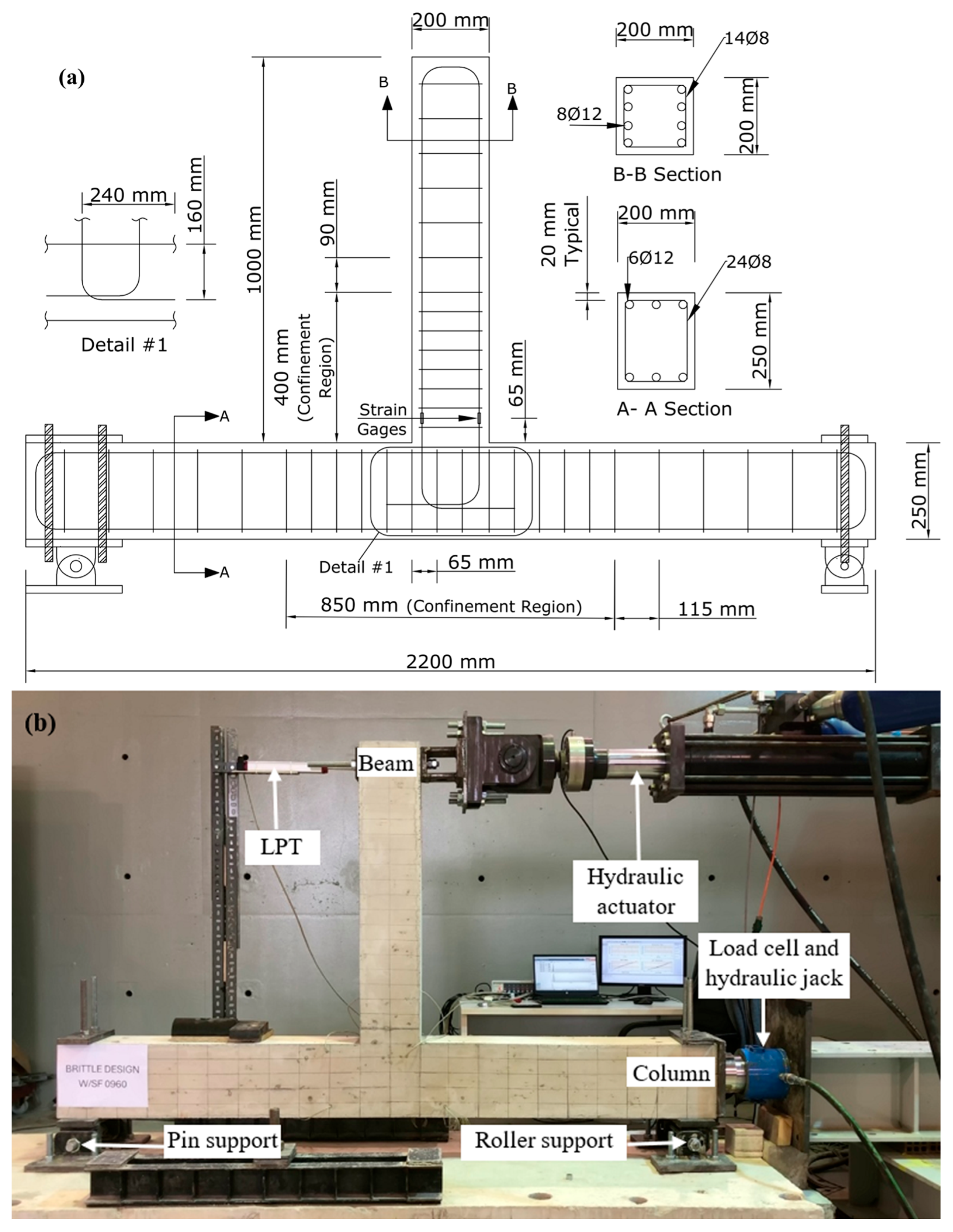
Two large-scale reinforced-concrete exterior beam–column assemblies were constructed. The first specimen, namely “reference”, was designed with ductile reinforcement detailing, with appropriate anchorage length and hoop confinement in the joint zones, in accordance with the TBEC-2018 code. The beam had a tensile reinforcement ratio of 1.3%, while the column had a reinforcement ratio of 1.5%. The beam had a square cross-section with a side length of 200 mm, and the column had a rectangular cross-section measuring 200 mm by 250 mm, Figure 1a.
The second specimen, designated as “fibrous”, had identical member dimensions and longitudinal reinforcement ratios for its members as the reference specimen. However, it did not meet the TBEC 2018 requirements for hoop spacing in confinement regions. Instead, it incorporated the minimum amount of shear reinforcement at a spacing equal to half of the member’s effective depth (d) and included 0.5% hooked-end steel fibers having an aspect ratio (L/D) of 66.7, where L and D denote the fiber length and diameter, respectively. Regarding the specimen size, although scale effects are known to influence the nominal strength and deformation characteristics of cementitious composites, particularly in shear-dominated responses, the selected dimensions are consistent with established experimental protocols and the methodological definition of large-scale testing for evaluating the relative hysteretic performance and failure mechanisms of the tested specimens [26,27]. In this framework, the experimental program was intended to establish a validated behavioral benchmark for the subsequent numerical modelling study, which provided the basis for an extended parametric investigation covering various reinforcement and fiber configurations.
The specimens were cut at the mid-height of the supporting column and mid-span of the beams, which were assumed to be the points of inflection under seismic loading. A test setup was designed to orient the specimens with the columns positioned horizontally and the beams vertically, so that the vertical member represented the beam (Figure 1b). The specimen was connected to the strong floor using a pin constraint at the base (bottom) of the column, while the top was roller-supported to simulate inflection points. A relatively low axial load of 25 kN was intentionally selected and applied using a vertical hydraulic jack positioned at the top of the column. This magnitude established a conservative lower bound on the joint shear strength, as extensive research confirms that higher axial compressive stresses significantly enhance shear resistance through improved confinement and the aggregate interlock mechanism [28,29]. By minimizing the contribution of the axial strut to the joint shear strength, this loading protocol isolates and rigorously tests the efficiency of the hybrid fiber-stirrup reinforcement under the most critical shear demand conditions. A load cell was installed between the hydraulic jack and the top surface of the column to monitor the applied load. Additionally, a linear position transducer (LPT) was used at the beam tip to measure actual horizontal displacement. Two strain gauges were attached to the longitudinal reinforcements in the beam’s plastic hinge region, Figure 1a. All sensors were connected to an 8-channel data acquisition device to gather the data.
The loading protocol was reversed-cyclic and applied through a displacement-controlled horizontal double-acting hydraulic actuator from the tip of the beam. The actuator had a capacity of 600 kN and was mounted on a rigid wall. The loading protocol followed ACI 374.1-05 [30] regulations. According to this standard, each story drift ratio was cyclically applied three times in both directions. The initial story drift ratio was selected to be small enough (e.g., 0.1%) to ensure that the specimens remained within the linear elastic range. Subsequent drift ratios were selected to be at least 1.25 times, but no more than 1.5 times, the previous cycle. The specimens were subjected to push and pull forces until (1) safety concerns arose based on the observed damage patterns, and (2) the limit ratio of 3.5% as defined by ACI 374.1-05 regulation was attained. Drift ratios gradually increased from 0.10% to maximum values of 3.55% and 4.42% for reference and fibrous specimens, respectively.

2.2. Material Properties

Concrete was ordered from a ready-mix concrete supplier, with a water-to-cement ratio of 0.56 and a cement-to-aggregate ratio of 0.15. The mix included Portland cement (CEM-I 42.5R) and crushed limestone aggregates, with a maximum aggregate size of 16 mm and a density ranging from 2.67 to 2.69 g/cm3. The concrete and steel fibers were mixed in pre-built reservoirs using a hand mixer and then poured into the formworks, as illustrated in Figure S1. Three standard cubes (15 × 15 × 15 cm) and cylinders (10 × 20 cm) were prepared for compressive and split tensile strength tests. The samples were subjected to the same environmental conditions as the beam–column specimens. Material tests were performed using a hydraulic press on the day of the experiments, at least 28 days after casting. The average compressive strengths were 48.50 and 51.50 MPa for plain and fibrous concrete, respectively, while the split tensile strengths were 3.70 and 3.50 MPa. This slight reduction in splitting tensile strength for the fibrous mix is plausible because peak splitting is mainly governed by the matrix response up to first cracking, whereas steel fibers mainly improve post-cracking stress transfer; additionally, fiber-induced interfacial voids and variability in fiber dispersion/orientation can offset pre-peak gains [31,32,33]. The equivalent cylindrical compressive strength was calculated by applying a conversion factor of 0.85 to account for size and shape effects. Additionally, direct tensile strength was estimated from the split tensile strength using the factor recommended by [34]. The resulting compressive and tensile strengths were 41 MPa and 44 MPa for plain and fibrous concretes, respectively, while the direct tensile strengths were 2.55 MPa and 2.41 MPa.
B420C-grade deformed bars were used as steel reinforcement. Three 30 cm long samples were prepared for tension tests, and the yield and ultimate strengths were determined to be 500 and 670 MPa, respectively. The physical and mechanical properties of the hooked-end steel fibers used in this study, as provided by the manufacturer, were a length of 60 mm, a diameter of 0.9 mm, and a tensile strength of 1100 MPa.

2.3. Sectional Analysis of the Reference Joint

The beam and column sections of the reference specimen were analyzed using the detected material properties to determine the yield moment ( M y ), ultimate moment ( M u ) and plastic moment ( M p ) capacities in addition to shear strength. The analysis accounted for the effects of tension stiffening and strain hardening in rebars. The crushing strain of plain concrete was assumed to be 3.5 × 10 3 as recommended by ACI 318-19. The sum of the ultimate moment capacities of the lower and upper columns was found to be greater than 20% that of the beam, indicating a strong column–weak beam behavior, as required by both ACI 318-19 and TBEC 2018 codes.
The diagonal tensile (shear) strength of the beam and columns was also calculated using the formula provided in ACI 318-19 since the contribution of longitudinal reinforcement ratio to the shear strength is considered, as shown in Equation (1). In this equation, V c represents the shear strength of concrete, λ is the modification factor of concrete, ρ is the longitudinal reinforcement ratio, f c denotes the compressive strength of concrete, N u is the exerted axial load to the member, A g is the gross cross-sectional area, b w is the width of the cross-section and finally d is the effective depth. Next, the joint shear force V j and the shear resistance of the connection were calculated. Equation (2) was employed to compute V j , where T represents the tensile force in the beam reinforcement and V c o l is the shear force in the column. The tensile force in the beam reinforcement was calculated following the ACI 318-19, which is identical to the TBEC 2018 code, using Equation (3), and was found to be 282 kN. When the highest lateral load corresponding to the beam’s plastic moment capacity was calculated, the maximum shear force that could develop in the column was determined to be 27 kN using principles of statics. Consequently, the joint shear force for the specimen was calculated to be 255 kN. This indicates that to ensure a ductile failure mode, the shear strength of the joint must exceed the calculated force. The shear strength of the exterior beam–column joint is defined as a function of the compressive strength of concrete in both the ACI 318-19 and TBEC-2018 codes, with distinctions made between confined and unconfined joints based on whether transverse beams confine all four faces. However, these predictions might not always be accurate due to the various mechanisms involved in actual behavior. The design ( V e ) and nominal ( V n ) joint shear strengths were calculated to be 320 kN and 416 kN according to the TBEC-2018 and ACI 318-19 codes, respectively, using Equations (4) and (5). In the case of applying the strength reduction factor specified in ACI 318-19, the design shear strength is reduced to 312 kN, which closely matches the value from TBEC-2018.
The analysis results are presented in Table 1. Based on the results, a ductile bending failure of the reinforced concrete beam is anticipated, depending on the following factors: (1) the strong-column weak-beam behavior, (2) the shear strength provided by the beam and column members (at least 133 kN) exceeding the flexural strength (55 kN) provided by the plastic moment capacity of the RC beam, and (3) expectation of a higher nominal joint shear capacity compared to the joint shear force generated by the tensile forces in the beam reinforcement.
V c = 0.66 λ ρ 1 / 3 f c + N u 6 A g b w d
V j = T V c o l
T = 1.25 f y A s
V e = 1.0 b j h f c k
V n = 1.3 λ f c A c

2.4. Numerical Modeling

Cyclic loading tests of RC beam–column assemblies were modeled using the preprocessor FormWorks, and the analyses were conducted utilizing the two-dimensional nonlinear finite element code VecTor2 (VT2) [35]. VT2 is specifically designed for the analysis of RC membrane elements under in-plane stress conditions and is developed by formulations based on the Modified Compression Field Theory (MCFT) [36]. MCFT serves as an analytical framework that postulates that cracks in concrete are uniformly distributed throughout the volume, employing a smeared crack approach. Detailed theoretical background and finite element implementation are available in [35,36].
Full-scale models of the specimens were established, as shown in Figure S2. Eight distinct regions were generated to represent the steel support, loading plates, and the RC beam–column joint itself. These regions were discretized in space using four-point plane stress rectangular elements. Each node was able to translate in both the x and y directions, providing a total of eight degrees of freedom per element. Rebars were discretely modeled in the concrete section as two-point truss elements with a uniform cross-sectional area. These elements possess four degrees of freedom and resist only axial elongation. A perfect bond was assumed between the concrete and reinforcement, and the interaction between the concrete and steel regions was established through shared nodes. The boundary conditions of the supports were defined to replicate the experimental setup. The roller supports were simulated by restraining the vertical translation of the corresponding nodes at the modeled support plates while allowing horizontal movement. In contrast, the pin support was idealized by restraining translations in both directions at the corresponding node. The constant axial load on the column was modeled as a vertical nodal force applied at the column tip through the loading plate region. Lateral actions were transferred through the loading plate at the beam tip, consistent with the actuator-driven experimental setup. Out-of-plane effects were inherently restrained by the two-dimensional plane-stress idealization adopted in VecTor2.
Based on the mesh sensitivity analysis, the maximum edge length of rectangular elements was set to 20 mm, with an aspect ratio of 1.5, for RC beam–column joints. The selection was made based on computational time and result precision. The specimens were subjected to lateral loading through displacement increments ranging from 0.25 to 1.25 mm. All analyses considered geometric non-linearity regarding the P-Delta effects or other large displacements. Moreover, selecting an appropriate model for crack spacing/allocation is also crucial for accurately simulating the cracking characteristics. An existing model (Eurocode 2 [37]) was utilized for the reference specimen. However, the existing models were derived for RC members without fiber reinforcement in the software. Therefore, considering the calibration work of [38] crack spacing for fibrous concrete was taken to be 30 mm.
VT2 incorporates various constitutive models for both concrete and steel reinforcement. The compressive behavior of fibrous concrete was represented by a constitutive model that accounts for the contribution of steel fibers [39]. This model differentiates between pre- and post-peak behavior: significant lateral crack opening does not occur in the pre-peak compression region, whereas in the post-peak region, this effect is mitigated by the confinement provided by the steel fibers. On the other hand, the plain concrete used in the reference specimen was modeled using the Popovics Normal Strength (NS) model, which is more suitable for capturing the material’s pre-peak behavior than the default Hognestad model used in the program. Additionally, a relatively recent model, Montoya 2003, was selected instead of the default Modified Park and Kent model for the post-peak response of concrete under compression. The Simplified Diverse Embedment Method (SDEM) [40] was employed for the tensile behavior of fiber-reinforced concrete, which relates residual tensile strength in the cracked region to the crack width. Consequently, the tensile stresses transferred between the crack surfaces were considered in the analyses. A tension stiffening model was also incorporated to represent the average stresses and strains (e.g., tensile stress in cracked concrete) used in the compatibility and equilibrium conditions of the Modified Compression Field Theory (MCFT). The utilized models are summarized in Table 2. The materials’ necessary mechanical and physical properties, such as the compressive strength of fibrous and plain concrete, aggregate diameter, yield and ultimate strength of steel rebars, and the length, diameter, and tensile strength of fibers, were derived from material test results. The remaining parameters were set to be the software defaults as specified in [35].

3. Results and Discussion

3.1. Experimental Section

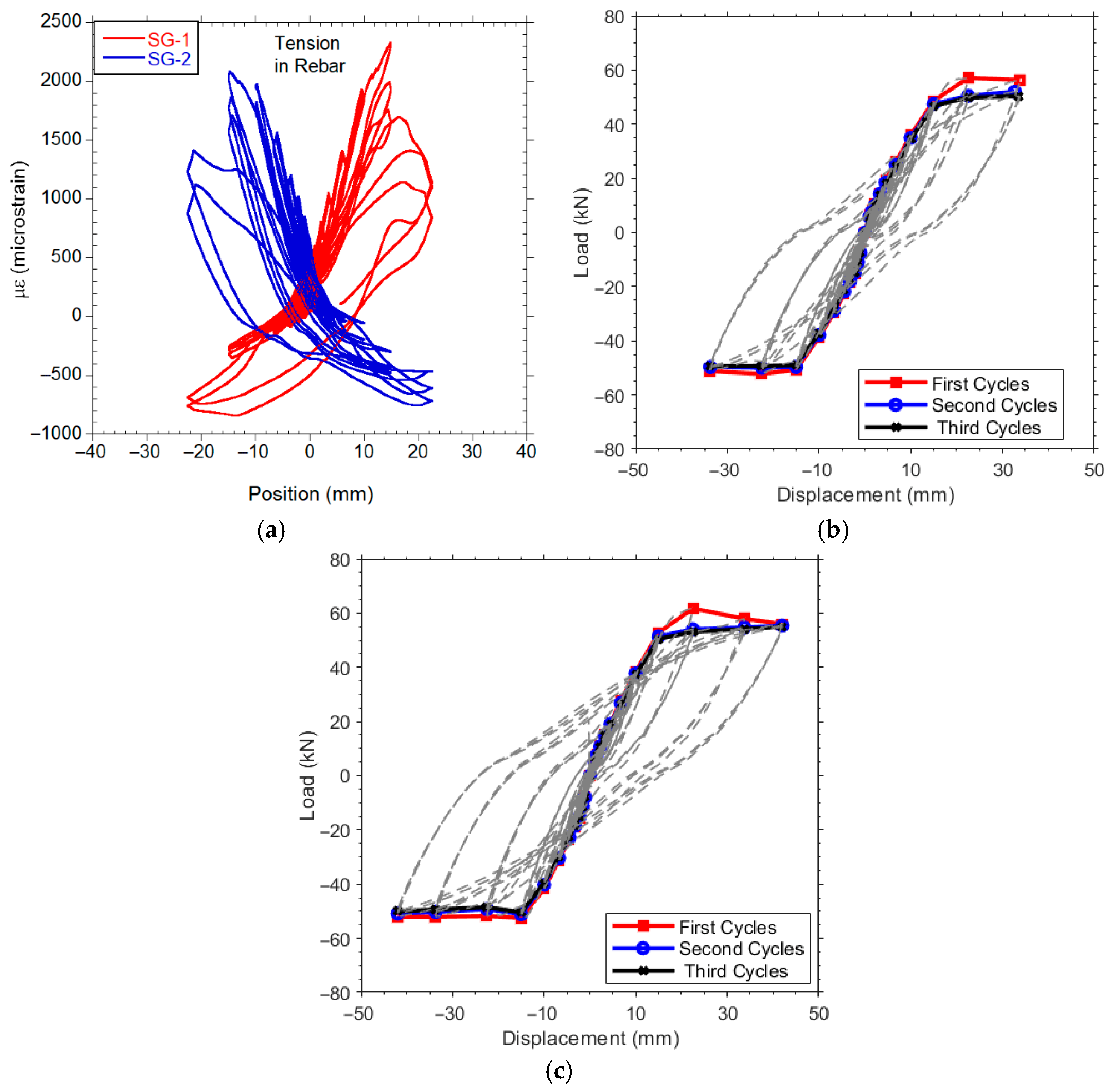
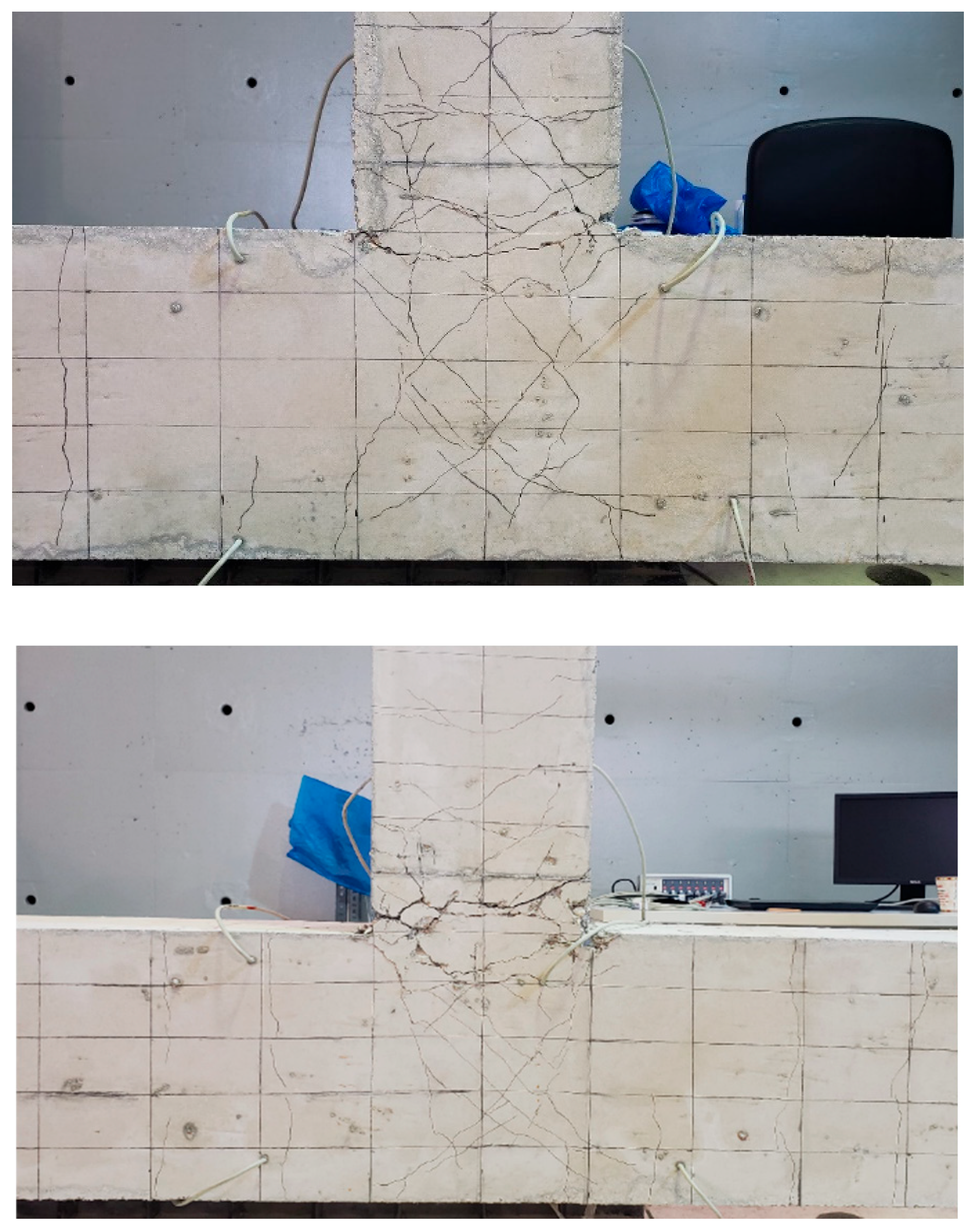
Reversed-cyclic loading was applied to observe the behavior of RC beam–column assemblies within the linear and nonlinear range. The load–displacement relationship was linear during the initial loading stage, indicating that the specimens were within the elastic range. Pinching in the loops became visible for both specimens at the ±4.5 mm (0.47%) loading group. In the non-fibrous (reference) specimen, this effect was more pronounced. This indicated potential bond deterioration of rebars and the development of new cracks, specifically the formation of flexural cracks in the tension zone of the RC beam [41]. The rebar strains in the reference specimen beam reached 2000 με as an indication of yield initiation at a ±10 mm tip displacement. At this loading stage, the experimentally detected lateral load ranged from 35 to 38 kN, which closely matched the theoretically calculated yielding load (35 kN) derived from M y . Subsequently, the strain increased towards 2500 με at a ±15 mm (1.57%) loading group, resulting in full yielding of the rebars, as shown in Figure 2a. Up to this point, the peak loads observed in the first, second, and third cycles of each loading group were almost identical within each group. This could be observed from the envelop curves which were created by connecting the peaks of the measured hysteresis relationships, Figure 2b,c. The loading protocol continued with a tip displacement of ±22.5 mm (2.36%), which exceeded the yield limit. At this stage, a clear separation between the peak loads of consecutive cycles was observed in both loading directions. However, this phenomenon was notably more pronounced in the positive direction, with a maximum difference of 13% in the fibrous specimen. While a similar trend was evident in the negative direction, the separation was less pronounced. This directional asymmetry is attributed to experimental artifacts associated with the test setup. Specifically, the axial load was applied to the column after the beam had already been connected to the actuator, leading to axial shortening of the column and potential support settlement. These effects introduced an unintended preloading of the beam, resulting in a slight bias between the positive and negative loading directions. This behavior was consistently observed in both the reference and fibrous specimens. In terms of peak strength, the reference and fibrous specimens reached 57 kN and 60 kN, respectively. These results indicated that the existence of 0.5% SF had a marginal effect on improving load capacity. Additionally, the experimentally obtained strengths are also in close agreement with the theoretically calculated plastic capacity of 55 kN for the reference specimen. Upon reaching a ±33.75 mm (3.55%) tip displacement, the plastic hinge region of the beams experienced severe flexural damage, as shown in Figure 3. However, in both specimens, only cross-type hairline-thin diagonal cracks were observed in the joint regions, indicating that the diagonal tensile strength of concrete ( V c ) was exceeded. This should not be regarded as a joint failure since the required shear force for a failure would be greater than V c due to the short shear span of the region, akin to that in short beams where the shear span-to-depth ratio is less than 3.0 [34,42]. Additionally, concrete crushing began in the compression regions of the RC beam and those led to a slight reduction in strength (maximum of 10% in the specimen having SF) particularly in the first cycle groups compared to those of the previous loading stage. Despite this slight reduction, the load could still be sustained in the second and third cycles. The experiment for the reference specimen was terminated upon reaching a 3.55% drift ratio, whereas for the fibrous specimen, it continued until a 4.42% drift ratio, with the progression of damage being carefully monitored throughout this final loading phase.
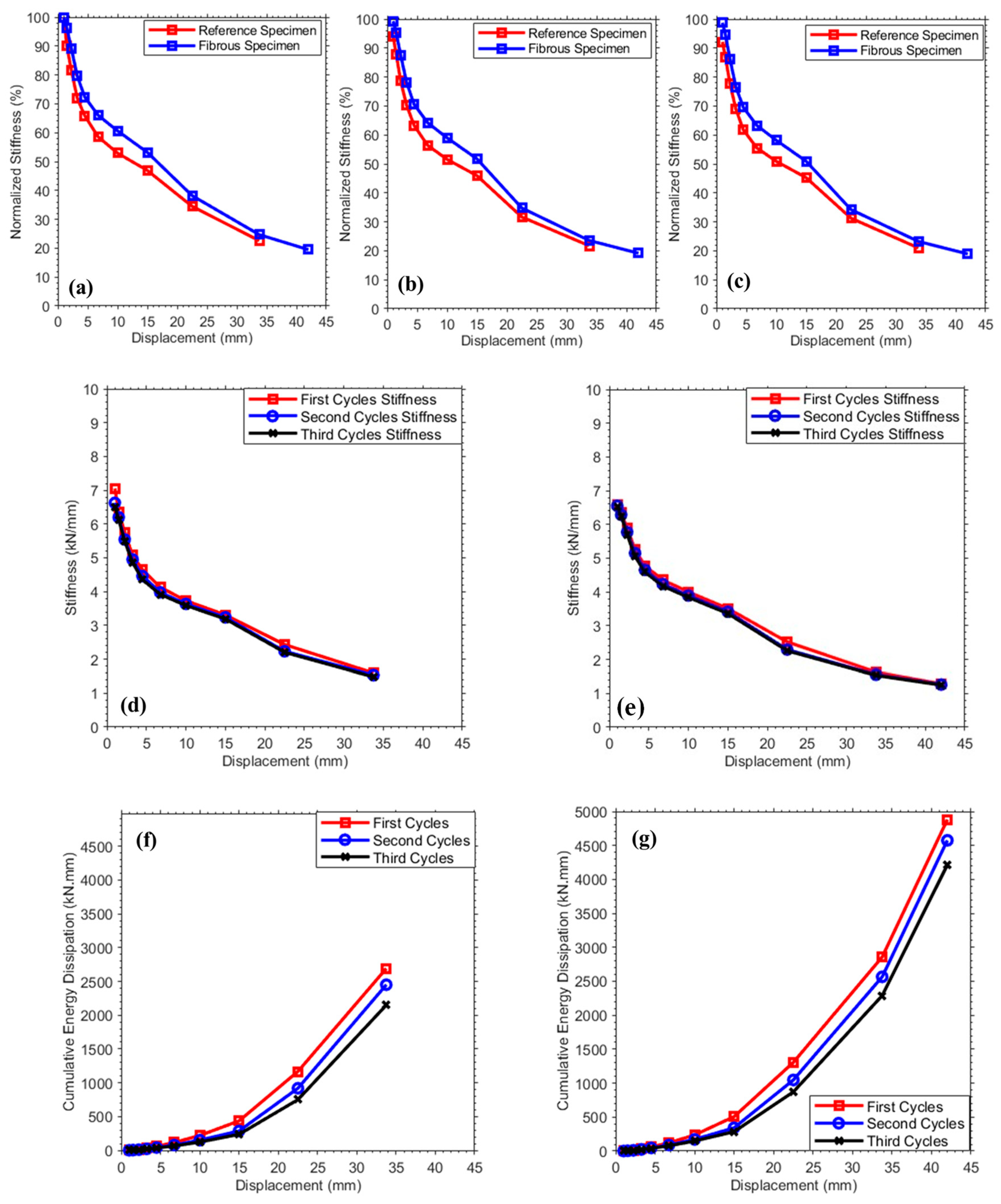
Degradation of structural stiffness under repeated cycles is a significant characteristic of RC in terms of seismic performance. This reduction in stiffness is attributed to extensive cracking and spalling of concrete as noted by [43]. In the current study, stiffness degradation was computed by the secant stiffness variations in each cycle through connecting the tips of the force-displacement curves at each extreme with a line and calculating its slope. The stiffnesses of each frame were normalized by the initial stiffness, and the degradation is presented comparatively for three cycle groups, Figure 4a–c. Both specimens started with equal absolute stiffness values, Figure 4d,e. In other words, the existence of steel fibers did not contribute to initial stiffness.
Formation of new flexural cracks over the tension face of RC beams, which diminished the size of the effective cross-sectional area, resulted in a steep decrease in stiffness for both specimens and for all cycles of loading groups until the onset of yielding (±10 mm tip displacement) compared to the rest of the loading sequence. Afterwards, the displacement increased rapidly while the load increased more slowly, which in turn resulted in a gradual decrease in the slope of the stiffness degradation curve. This finding is parallel to that of [44]. The decrease in stiffness, on the other hand, was detected to be more pronounced (varying between 5–10%) in all cycles of loading groups of reference specimen when compared to those of fibrous specimen. The reason for this segregation in reduction in stiffness can be explained by the steel fibers bridging mechanism and thus inhibiting the crack propagation.
Similar to stiffness degradation, the energy dissipation capacity of RC is another significant parameter to assess the seismic performance of structural members. Energy dissipation was computed from the enclosed area of hysteresis curves, and cumulative energy dissipation was determined by consecutively summing the areas of all hysteretic loops. Each cycle of any specimen dissipated almost identical cumulative energy compared to the corresponding cycle of the other specimen, from the initial stage until the onset of yielding, as shown in Figure 4f,g. However, a divergence in energy dissipation capacities emerged by the full yielding of longitudinal reinforcements (±15 mm). The fibrous specimen consistently dissipated more energy than the reference during the first, second, and third cycles of the loading groups, respectively from highest to lowest. Conversely, the energy dissipation rate exhibited a reversed order across the cycles. For instance, in the third cycle of the ±15 mm loading group, the fibrous specimen cumulatively dissipated 21% more energy than the reference specimen, representing the largest difference among all loading and cycle groups while the second and first cycles dissipated 19% and 16% more energy, respectively. Finally, the fibrous specimen dissipated approximately 6% more energy in all cycles of the final loading group (±33.75 mm).

3.2. Numerical

3.2.1. Validation of Numerical Analysis

The nonlinear finite element models developed in VecTor2 were validated against the quasi-static reversed-cyclic tests of the Reference (ductile) and Fibrous (hybrid) exterior beam–column joint assemblies. The primary aim of this validation was twofold: (i) to demonstrate that the adopted two-dimensional (2D) plane-stress idealization can reproduce the key global response measures required for the subsequent parametric study, and (ii) to transparently delineate which cyclic features are expected to be underrepresented due to unavoidable modeling idealizations and the intrinsic limitations of 2D joint simulations. In this context, the validation was conducted using three complementary benchmarks: (1) global hysteretic response and envelope curves, (2) yield and peak strengths, and (3) crack pattern with governing failure mechanism.
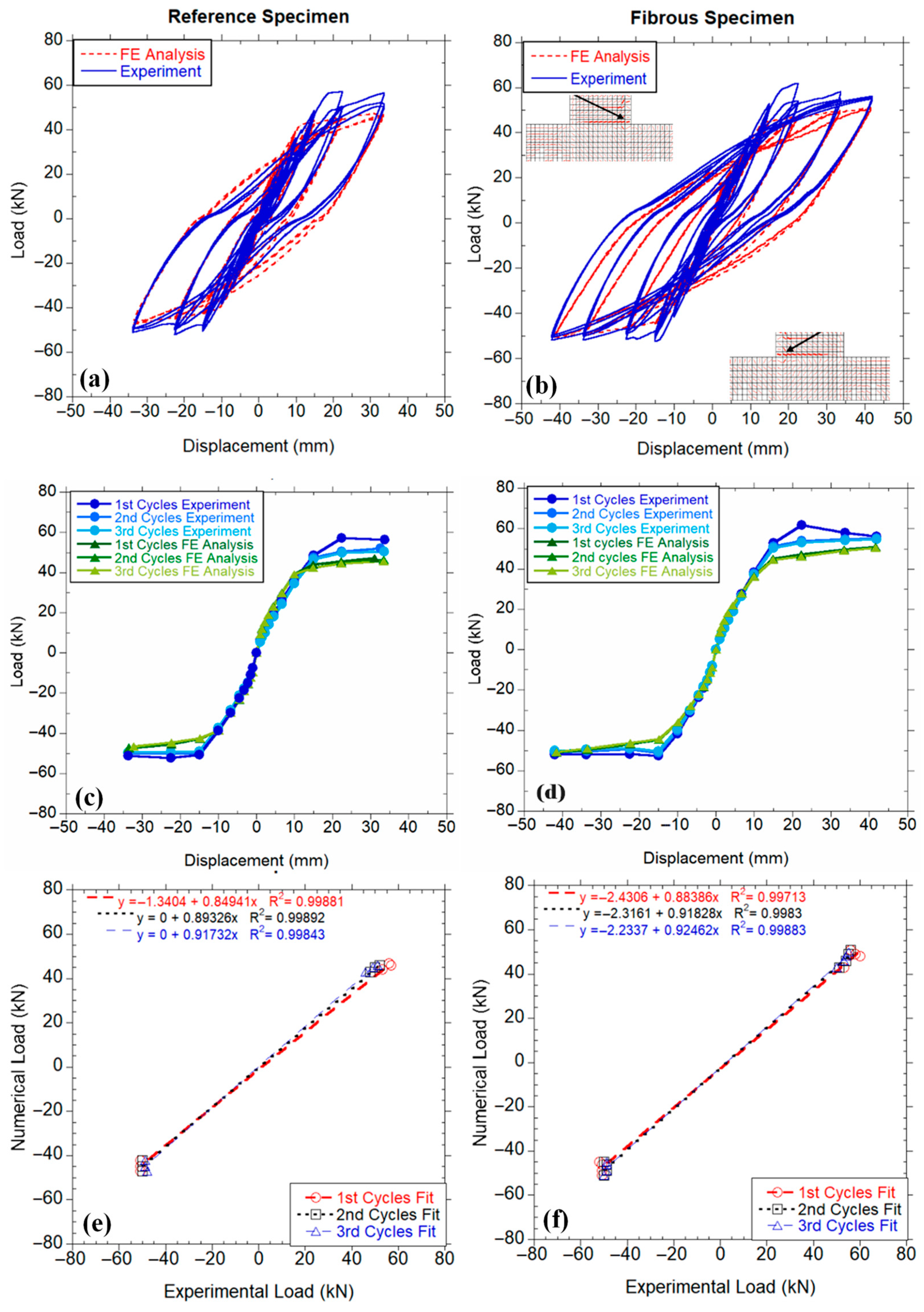
The hysteretic behavior of both specimens is illustrated in Figure 5a,b. The analysis results for the VT2 model exhibited highly stable hysteretic loops that closely matched the experimental data. Following the onset of yield in the longitudinal beam reinforcement, the analytical model captures the progressive expansion of the loop areas across the subsequent loading groups (ranging from ±10 mm to ±33.75 mm), consistent with experimental observations. However, the simulation tends to under-represent the “pinching” effect observed in the experiments, particularly at larger drift levels. This is a direct consequence of the perfect-bond assumption adopted during the model development phase, as previously detailed. While this assumption facilitates numerical convergence and stability, it inherently introduces a modeling idealization by neglecting the cumulative damage associated with load-reversal-dependent bond-slip and cyclic crack-slip degradation. Consequently, the 2D smeared-crack framework results in a more stable hysteretic response, reflecting a common trade-off between computational robustness and the detailed capture of localized interface deterioration [45].
The envelope curves in Figure 5c,d demonstrate that the NLFE model reproduces the global response of both specimens with high fidelity, particularly in the linear-elastic range. However, a directional discrepancy is observed in the post-yield error margins: while the FE model aligns closely with experimental strengths in the negative direction (within ~5–10% deviation), it shows a larger underestimation (~10–20%) in the positive direction. This variance in model accuracy between loading directions is not a deficiency of the numerical formulation but a result of the inherent asymmetry in the experimental data due to the previously explained test-induced imperfections (e.g., boundary-condition or measurement-related effects) during axial loading. While the FE model represents an idealized and thus more symmetric structural response based on the theoretically calculated plastic capacity (~55 kN), the experimental peaks reflect these test-specific conditions. Despite this artifact, the model’s global reliability is statistically confirmed by a linear regression for displacement amplitudes of |Δ| ≥ 15 mm, yielding an R2 of 0.99 (Figure 5e,f). This high correlation indicates that the NLFE model effectively captures the governing non-linear mechanisms once the experimental factors are accounted for.
On the other hand, a crack pattern quite identical to the experimental one was captured. No brittle joint failure was observed in any of the analyses except for the hairline-thin diagonal cracks. Instead, significant flexural cracks, leading to bending failure (up to 5 mm wide), were detected in the beam’s plastic hinge region, as shown in Figure 5b. The reference and fibrous specimens failed once the ±33.75 mm and ±42 mm loading groups were completed, respectively.
Overall, the numerical model shows strong consistency with the experimental results in terms of global load–deformation behavior, envelope response, and peak strength levels, as supported by the high correlation observed between numerical and experimental loads. Minor discrepancies in localized hysteretic features can be attributed to the simplified modeling assumptions adopted in the numerical analysis, including the 2D plane-stress formulation and the perfect bond assumption between reinforcement and concrete.
Finally, the numerical model can therefore be considered reliable for comparing global response trends, backbone strength levels, stiffness-degradation tendencies, and failure-mode shifts across parametric configurations, as also adopted in prior cyclic joint studies that focus on comparative performance rather than exact reproduction of every hysteretic nuance [3]. Nevertheless, because VecTor2 is employed here in a 2D plane-stress framework, out-of-plane effects (including torsion) and fully three-dimensional anchorage/confinement mechanisms—although implicitly accounted for through constitutive material models—are beyond the model’s direct representational capacity. Consequently, local hysteretic features strongly governed by 3D bond-slip behavior—most notably pronounced pinching and abrupt unloading/reloading stiffness drops—should be interpreted as model limitations rather than deficiencies of the experimental dataset.

3.2.2. Parametric Investigation

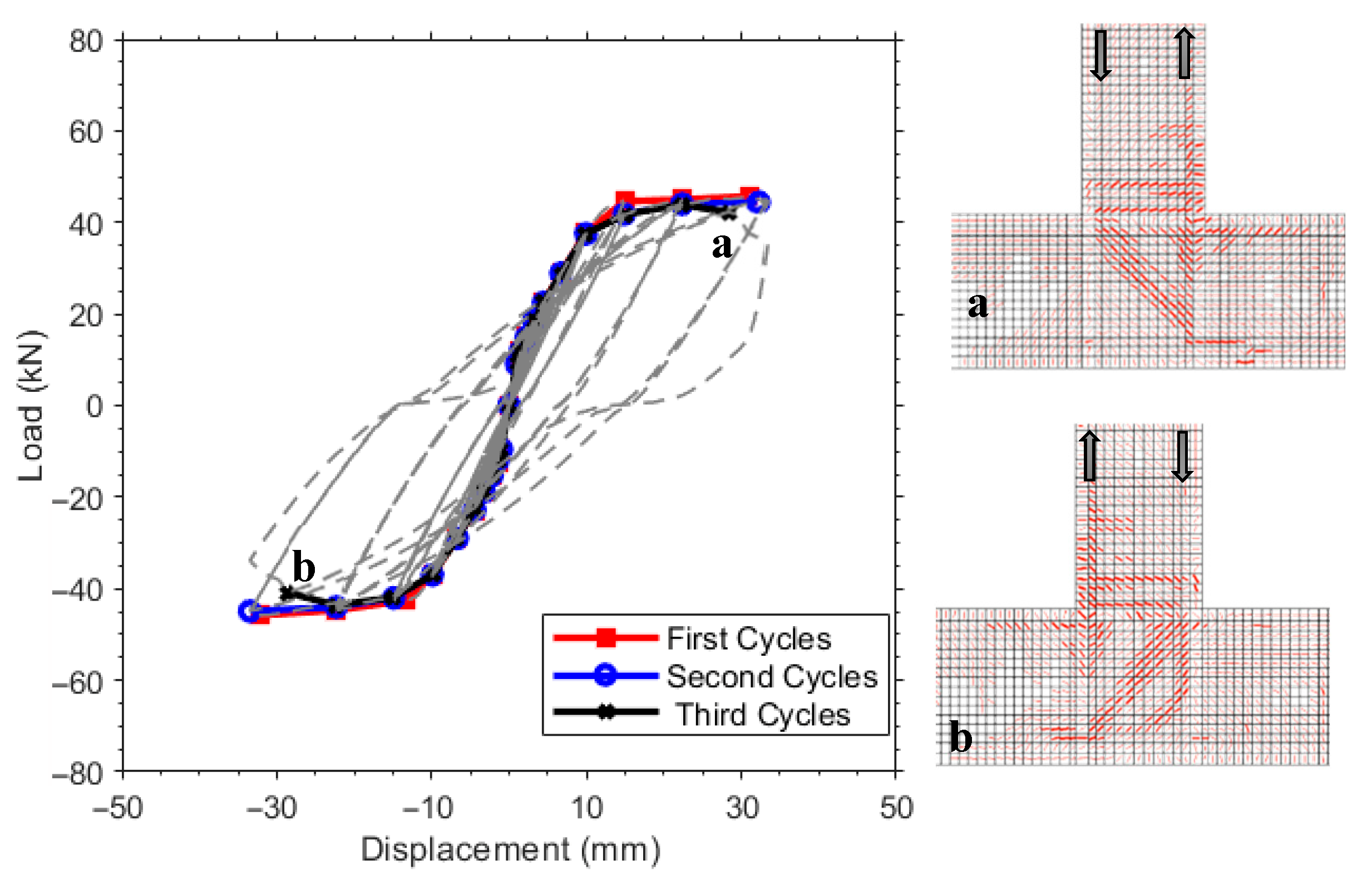
The numerical investigation was initiated by extending the scope of the experimental program to examine the expected failure mechanism when the joint region is provided with only the minimum transverse reinforcement (i.e., without stirrup densification) and without steel fibers. This configuration, referred to herein as the fiber-off baseline, corresponds to Scenario 1 in Table 3 and is introduced to clarify the role of confinement on joint response and failure mode under the same loading protocol.
Based on the analysis results, the envelope curves indicate a pronounced deterioration of lateral load capacity, particularly during the third cycle of the maximum lateral-loading group, suggesting that the specimen was approaching its failure limit (Figure 6). The model ultimately lost its load-carrying capacity by the end of the cycle due to the development of extensive diagonal shear cracking across the joint panel (corner-to-corner), with crack widths reaching approximately 5 mm, accompanied by significant flexural cracking within the beam plastic-hinge region (Figure 6). The maximum lateral load attained in this fiber-off baseline was 45.7 kN, which is about 3% lower than that of the corresponding numerical model of specimen with ductile detailing. This modest reduction implies that, although the beam longitudinal reinforcement yielded, the beam plastic moment capacity was not fully utilized. Consistent with the observed joint-panel diagonal cracking and the rapid post-peak strength degradation, the response is characterized as a joint-shear-dominated brittle mechanism, with limited ductility and unstable cyclic strength retention.
Next, the resultant shear forces in the joint zone were derived from the numerical models of the reference specimen, the fibrous specimen, and the fiber-off baseline configuration (Scenario #1). Shear stress distributions were measured along the joint panel height at the maximum beam lateral deflection before the failure. These distributions were then integrated, and the resulting area under the curves was multiplied by the joint depth (200 mm) to compute the forces. The resultant shear forces for the reference specimen and Scenario #1 were −240/244 kN and −235/237 kN in the negative and positive loading directions, respectively. This finding indicated that confinement within the joint region had quite a limited contribution to the resultant shear force in the joint zone. Instead, it was effective in controlling the failure mode by restricting and controlling crack width, even in joints that did not fully utilize the code-based nominal shear strength. This observation is consistent with the explanation by [46] that the primary reason for confining the core concrete within the joint region with stirrups is to control the cracks. The resultant shear force in the fibrous specimen slightly increased to −250/260 kN. This rise can be attributed to the enhanced sectional moment capacity and, hence, the improved flexural strength of the fibrous RC beam owing to the superior behavior of fibrous concrete under tension.
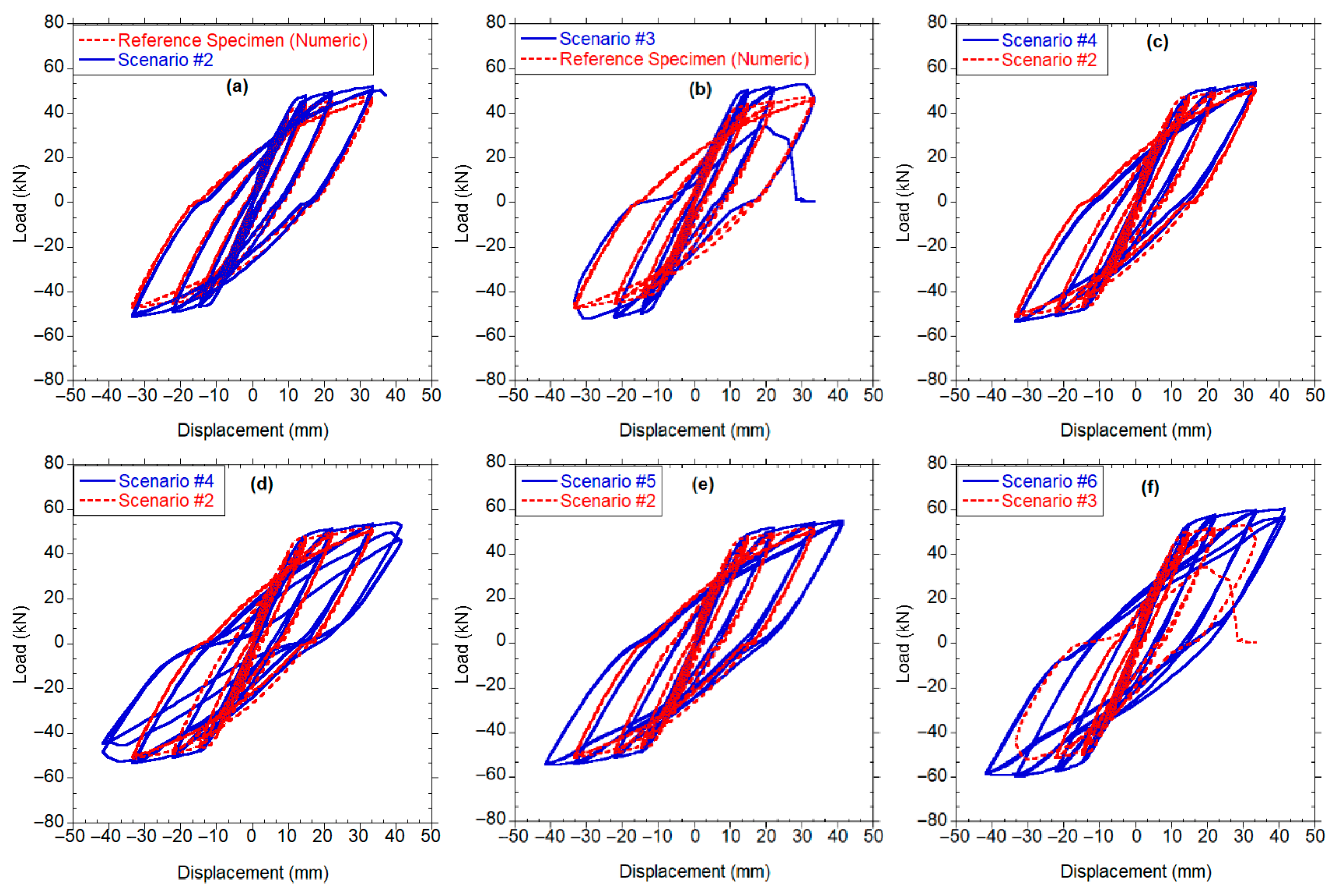
A parametric study was undertaken using two previously validated models to (1) predict the actual shear strength of the joint panel and (2) investigate the interaction arising between the resultant shear force in the joint panel and hooked-end steel fibers. The investigation of the actual shear strength of the joint panel began by varying only the beam tensile reinforcement ratio in the validated reference model while keeping other parameters —such as joint aspect ratio, member geometry, and beam–column detailing—constant. This approach progressively increased the shear demand in the joint region. The tensile reinforcement was initially increased to 1.4% or 500 mm2 (Scenario #2) and subsequently to 1.5% or 530 mm2 (Scenario #3). These ratios were intentionally selected. For example, a rebar ratio of 1.5% generated the maximum shear demand within the shear strength capacity of the ductile joint zone, while also remaining within the range of an economically viable design. Figure 7 presents the hysteresis curves, obtained from numerical analyses, comparatively. The specimen with a 1.4% reinforcement ratio exhibited a consistent behavior with that of the reference specimen (1.3%) in addition to the slight improvement in load-carrying capacity, as shown in Figure 7a. The joint shear force at the final loading stage was measured at −263/264 kN, and a flexural failure was observed at the plastic hinge region of the RC beam. However, when the reinforcement was increased to 1.5%, the specimen failed in the second loading cycle due to severe “x”-shaped shear cracks in the joint panel, preventing completion of the final loading cycle, Figure 7b. At this stage, the shear force was recorded at −270/271 kN. Despite confinement in both the joint region and member ends, the specimen experienced joint panel shear failure, indicating that the nominal joint shear strength is 270 kN. This value represents approximately 85% of the code-based (TBEC-2018) calculated strength. Such an underestimation is consistent with the unconservative prediction found by [47] for the ACI 318-11 code expression that computes the shear strength of exterior joints, which closely resembles that of TBEC-2018.
In the second stage of the parametric study, the interaction between the volumetric steel fiber ratio and the resulting shear force in the joint panel was analyzed with the increasing tensile rebar ratio in the beam. The volumetric fiber ratio varied from 0.5% to 1.2%, remaining below the 1.5% threshold reported in the literature as a critical limit, beyond which workability issues may occur [48]. The previous analysis of brittle design with a 1.3% rebar ratio demonstrated that the removal of hoop confinement or steel fibers from the beam–column assembly resulted in joint failure. Therefore, increasing the longitudinal reinforcement ratio in the beam, and thus the shear demand in the joint, could lead to failure even at lower drift ratios if the critical sections are not confined or steel fibers are not utilized. As a result, analyses for brittle designs with rebar ratios of 1.4% and 1.5% were not conducted. The incorporation of 0.5% hooked-end steel fibers into the specimen with 1.4% longitudinal reinforcement (Scenario #4) resulted in a shear force of −263/276 kN and produced a hysteretic response nearly identical to that of its ductile (confined) counterpart, up to a tip displacement of ±33.5 mm, Figure 7c. However, during the second and third loading cycles at the subsequent stage (±42 mm), the 0.5% steel fiber ratio was insufficient to prevent shear failure in the joint panel, resulting in steep strength degradation, as shown in Figure 7d. This indicated that the shear demand from the unconfined joint, even with the inclusion of fibers, exceeded the available strength. On the other hand, a slight increase in the volumetric steel fiber ratio to 0.6% (Scenario #5) could sustain the load-carrying capacity at a tip deflection of ±42 mm without failure, as shown in Figure 7e. The shear force couple developed in the joint panel was −270/285 kN. In other words, the joint shear capacity enhanced by at least the resisted shear force. Major flexural cracks reaching approximately 4 mm wide formed in the plastic hinge region of the beam, as well as hairline-thick shear cracks in the joint region. Increasing the longitudinal rebar ratio to 1.5% required doubling the volumetric fiber ratio to 1.2% (Scenario #6) for maintaining the load-carrying capacity up to a ±42 mm tip displacement without failure, Figure 7f. The resultant joint shear force increased to −285/320 kN. Additionally, severe flexural cracks (~5 mm wide) were observed at the plastic hinge region of the beam, along with diagonal shear cracks reaching up to 2 mm wide.

3.3. Proposed Exponential Design Model

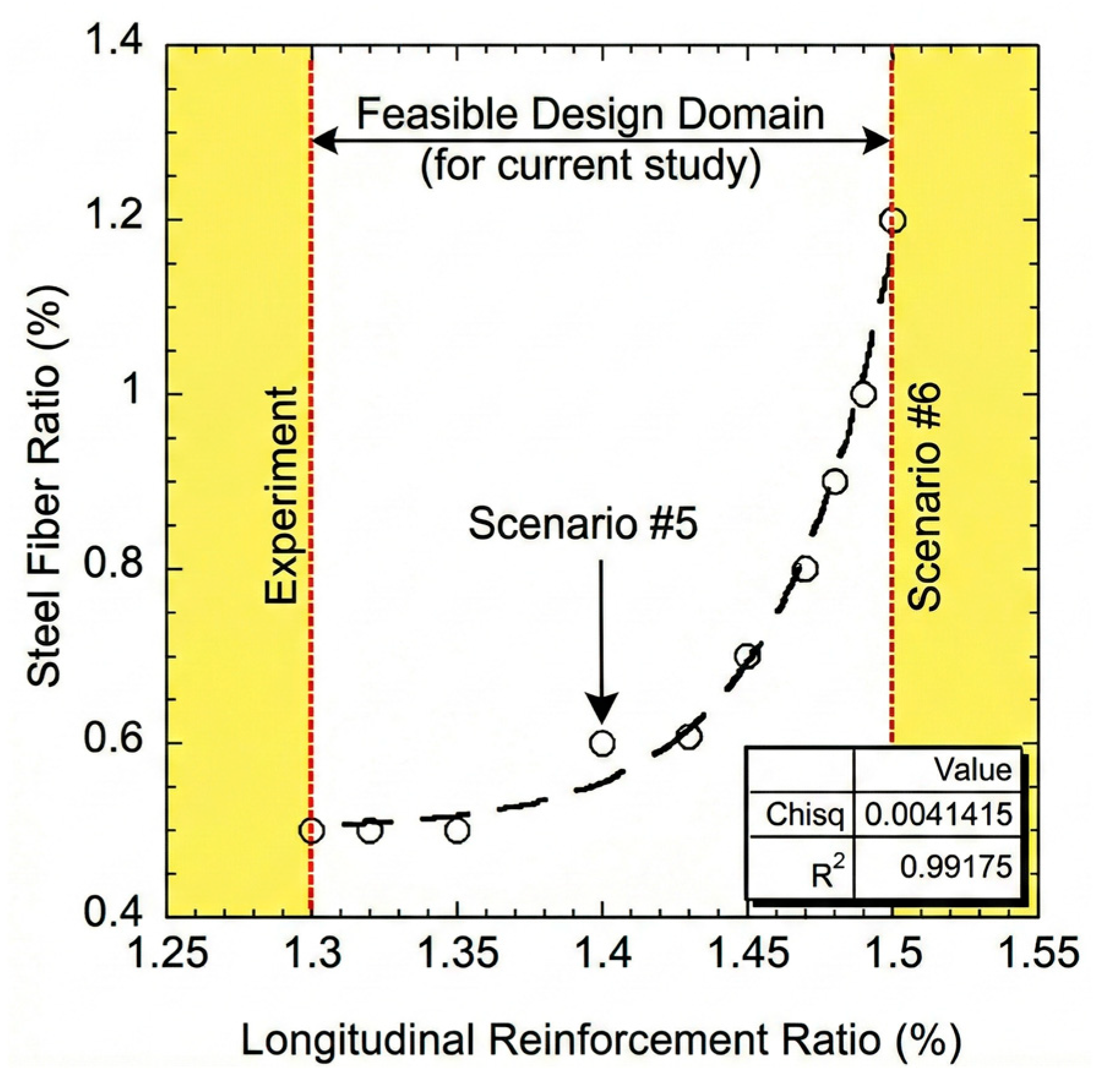
A regression analysis was performed to quantify the trade-off between the beam longitudinal reinforcement ratio, ρ (%), and the required steel fiber volume fraction, V f (%), for partial stirrup replacement, Figure 8. While the experimental and initial numerical results provided a fundamental understanding of the hybrid confinement mechanism, the dataset was expanded to improve the statistical basis of the proposed relationship. In total, ten data points were used in the regression calibration. These consisted of experimental fibrous configuration, two calibrated numerical baseline cases (Scenarios #5 and #6), and seven additional NLFE analyses conducted within the investigated range of ρ = 1.3–1.5%.
The parametric results revealed that the relationship between the shear demand-driven by the beam reinforcement ratio- and the necessary fiber dosage is characterized by a significant non-linear trend. As ρ increases, the joint shear demand rises, promoting wider diagonal cracking and requiring an exponentially higher fiber content to maintain joint integrity and prevent brittle failure up to 4% story drift. In this context, the observed exponential trend is consistent with the mechanics of crack-bridging in fiber-reinforced concrete. The contribution of steel fibers is governed by their ability to transfer stresses across cracks, and within the adopted constitutive material modelling approach (SDEM), this contribution progressively reduces with increasing crack width through a nonlinear softening-type behavior associated with fiber pull-out and slip mechanisms. Therefore, a linear relationship between shear demand and fiber content would not be expected from a mechanical standpoint. To capture this behavior, a shifted exponential model with an offset was adopted, as expressed in Equation (6).
V f = 0.5 + A e x p [ k ( ρ 1.30 ) ]
Here, the offset of 0.5% represents the baseline fiber dosage validated experimentally for the specimen with ρ = 1.3 % , and the term ( ρ 1.30 ) denotes the increment beyond this baseline. Regression analysis yielded A = 0.0045 and k = 25. As shown in Figure 8, the model provides a good fit to the data (R2 = 0.99) within the investigated domain. Given the limited dataset size, the regression coefficients should be interpreted with caution, as they inherently reflect modelling assumptions within the investigated parameter range. Nevertheless, the two-dimensional plane-stress idealization and the perfect bond assumption adopted in the numerical analyses are considered to have limited influence on the predicted global shear response, and therefore their effect on the derived regression relationship is also limited within the investigated parameter range. The proposed relationship should therefore be viewed as a mechanically informed numerical trend within a bounded parameter space, rather than as a universally validated design equation.

3.4. Design Implications and Applicability of the Proposed Model

Current design codes (e.g., TBEC-2018 and ACI 318-19) do not explicitly account for the contribution of steel fibers to joint shear resistance. In this context, Equation (6) provides a validated and design-oriented tool that is intended to complement existing code provisions rather than replace them. The proposed model is particularly applicable to exterior RC beam–column joints detailed in accordance with the strong-column/weak-beam principle and having a joint aspect ratio close to unity. Within this framework, conventional code-based design requirements, such as flexural hierarchy and minimum transverse reinforcement for bar stability, remain fully satisfied. The beam longitudinal reinforcement ratio is first selected based on flexural design considerations, which governs the corresponding joint shear demand. The proposed formulation can then be used to estimate the steel fiber dosage required to replace the stirrup densification, while maintaining the minimum transverse reinforcement mandated by the design code. In this manner, the model offers structural engineers a practical means of mitigating reinforcement congestion by substituting densified joint stirrups with workable dosages of hooked-end steel fibers (0.5–1.2%), without compromising code-compliant confinement integrity. Unlike most previous studies [12,13,17,49,50] that mainly evaluate the seismic performance of fiber-reinforced joints, the present approach provides a demand-based formulation linking joint shear demand directly to the required steel fiber dosage for partial stirrup replacement.
The applicability of the model is intentionally limited to joint shear demands within the bounds prescribed by current design codes, thereby ensuring conservative and code-compatible implementation. Within this design-oriented framework, the model is considered valid primarily for low-to-moderate axial load ratios (typically ν ≤ 0.20), where joint shear demand governs the failure mode under the conditions considered in the present study. Direct extrapolation to higher axial load levels, where confinement-driven mechanisms become dominant, may not be appropriate without further validation.

4. Conclusions

This study presented a hybrid experimental and numerical investigation to quantify the efficiency of partially replacing conventional stirrup confinement with hooked-end steel fibers in exterior RC beam–column joints. By integrating large-scale cyclic testing with nonlinear finite element analysis, the interaction between stirrup detailing, joint shear demand, and seismic performance was systematically evaluated. The main conclusions are summarized as follows:
  • Numerical Validation and Failure Mechanisms: The VecTor2 simulations accurately reproduced the global load–deformation envelope response of the tested assemblies (R2 = 0.99). Although the smeared-crack formulation and the perfect bond assumption between reinforcement and concrete led to an underestimation of the pinching effect observed in the experiments, the model successfully captured the transition from ductile beam flexural yielding to brittle joint shear failure. This indicates that the dominant shear-transfer mechanisms governing joint behavior were adequately represented, supporting the use of the model for parametric structural assessment.
  • Nonlinear Shear Compensation: A pronounced nonlinear relationship was identified between the beam reinforcement ratio (ρ) and the required fiber dosage (Vf). Increasing ρ from 1.3% to 1.5% raised the joint shear demand by approximately 12%, while the required fiber content increased disproportionately from 0.5% to 1.2%. This exponential trend results from the crack-bridging mechanism of fibers, whose efficiency decreases with increasing crack width under elevated shear stresses.
  • Seismic Performance and Hybrid Feasibility: The incorporation of steel fibers enhanced post-yield cyclic behavior, with fibrous specimens exhibiting up to 21% higher energy dissipation than the code-compliant reference specimen, stabilizing to approximately 6% at extreme drift levels. A hybrid configuration combining minimum transverse reinforcement (TS500-compliant) with 0.5% hooked-end steel fibers effectively prevented brittle joint shear failure while maintaining ductile performance comparable to fully confined seismic detailing under low axial loads.
  • Code Assessment and Design-Oriented Model: The analyses indicate that TBEC 2018 and similar code formulations may overestimate the shear capacity of conventionally confined joint panels by approximately 15%, as transverse confinement primarily controls crack propagation rather than proportionally increasing shear resistance. In this study, an exponential design model is proposed to estimate the required fiber dosage for partial stirrup replacement within the defined applicability limits (1.3% ≤ ρ ≤ 1.5%, 0.5% ≤ Vf ≤ 1.2%, ν ≤ 0.20, aspect ratio ≈ 1).
  • Future Research Directions: Further studies should evaluate the proposed hybrid strategy under higher axial load ratios and different joint configurations (interior, knee, and varying aspect ratios) and investigate alternative or hybrid fiber types to generalize the proposed design methodology.

Supplementary Materials

The following supporting information can be downloaded at https://www.mdpi.com/article/10.3390/buildings16061117/s1: Figure S1: Concrete pouring steps; Figure S2: Numerical model of fibrous specimen.

Funding

This research received no external funding.

Data Availability Statement

The original contributions presented in this study are included in the article and Supplementary Material. Further inquiries can be directed to the corresponding author.

Acknowledgments

The author expresses gratitude to the staff of the Structural Mechanics Laboratory in the Civil Engineering Department at Izmir Kâtip Çelebi University for their support throughout the experimental phase. The author also acknowledges the crucial infra-structure assistance provided by the Civil Engineering Department of Izmir Institute of Technology during the material testing, as well as the collaborative efforts of Batı Beton Company during the concrete pouring process. Finally, the author extends thanks to Artı Yapısal Çelik Company for their partial contribution to the fabrication of the experimental setup.

Conflicts of Interest

The author declares no conflicts of interest.

Abbreviations

The following abbreviations are used in this paper:
RCReinforced Concrete
FRCFiber Reinforced Concrete
SFRC Steel Fiber Reinforced Concrete
HPFRCCHigh Performance Fiber Reinforced Cementitious Composite
ACIAmerican Concrete Institute
TBECTurkish Building Earthquake Code
TS500Turkish Standard for Reinforced Concrete
NLFENonlinear Finite Element
FEMFinite Element Method
VT2VecTor2
MCFTModified Compression Field Theory
NSCNormal Strength Concrete
NSNormal Strength
SDEMSimplified Diverse Embedment Method
LPTLinear Position Transducer
SFSteel Fiber
2DTwo-Dimensional

References

  1. Park, R.; Paulay, T. Reinforced Concrete Structures; John Wiley&Sons: Christchurch, New Zealand, 1975. [Google Scholar]
  2. Paulay, T.; Park, R.; Priestley, M.J.N. Reinforced Concrete Beam-Column Joints Under Seismic Actions. ACI J. Proc. 1978, 75, 585–593. [Google Scholar] [CrossRef]
  3. Yurdakul, Ö.; Del Vecchio, C.; Di Ludovico, M.; Avşar, Ö. Numerical Simulation of Substandard Beam-Column Joints with Different Failure Mechanisms. Struct. Concr. 2020, 21, 2515–2532. [Google Scholar] [CrossRef]
  4. Turkish Building Earthquake Code; Ministry of Interior, Disaster and Emergency Management Presidency (AFAD): Ankara, Turkey, 2018.
  5. ACI Committee 318; Building Code Requirements for Structural Concrete and Commentary. American Concrete Institute: Farmington Hills, MI, USA, 2019.
  6. Zhang, R.; Matsumoto, K.; Hirata, T.; Ishizeki, Y.; Niwa, J. Application of PP-ECC in Beam-Column Joint Connections of Rigid-Framed Railway Bridges to Reduce Transverse Reinforcements. Eng. Struct. 2015, 86, 146–156. [Google Scholar] [CrossRef]
  7. hossein Saghafi, M.; Shariatmadar, H. Enhancement of Seismic Performance of Beam-Column Joint Connections Using High Performance Fiber Reinforced Cementitious Composites. Constr. Build. Mater. 2018, 180, 665–680. [Google Scholar] [CrossRef]
  8. Saghafi, M.H.; Shariatmadar, H.; Kheyroddin, A. Seismic Behavior of High-Performance Fiber-Reinforced Cement Composites Beam-Column Connection with High Damage Tolerance. Int. J. Concr. Struct. Mater. 2019, 13, 14. [Google Scholar] [CrossRef]
  9. Saghafi, M.H.; Golafshar, A.; Zareian, M.S.; Mehri, A.H. Application of HPFRCC in Beam–Column Joints to Reduce Transverse Reinforcements. Structures 2021, 31, 805–814. [Google Scholar] [CrossRef]
  10. Zainal, S.M.I.S.; Hejazi, F.; Rashid, R.S.M. Enhancing the Performance of Knee Beam–Column Joint Using Hybrid Fibers Reinforced Concrete. Int. J. Concr. Struct. Mater. 2021, 15, 20. [Google Scholar] [CrossRef]
  11. Niwa, J.; Shakya, K.; Matsumoto, K.; Watanabe, K. Experimental Study on the Possibility of Using Steel Fiber–Reinforced Concrete to Reduce Conventional Rebars in Beam-Column Joints. J. Mater. Civ. Eng. 2012, 24, 1461–1473. [Google Scholar] [CrossRef]
  12. Son, D.H.; Baek-Il, B.; Lee, J.; Choi, C.S. Shear Strength of Steel Fiber Reinforced Concrete Exterior Beam-Column Joints with Various Anchorage Details under Cyclic Loading. Structures 2024, 61, 105940. [Google Scholar] [CrossRef]
  13. Wu, B.; Liu, X.; Jia, J.; Fang, D.; Shao, J.; Kong, W. Experimental and Numerical Investigations on the Seismic Performance of High-Strength Exterior Beam-Column Joints with Steel Fibers. Materials 2024, 17, 4066. [Google Scholar] [CrossRef]
  14. Hou, L.; Xu, R.; Chen, D.; Xu, S.; Aslani, F. Seismic Behavior of Reinforced Engineered Cementitious Composite Members and Reinforced Concrete/Engineered Cementitious Composite Members: A Review. Struct. Concr. 2020, 21, 199–219. [Google Scholar] [CrossRef]
  15. Sachdeva, P.; Danie Roy, A.B.; Kwatra, N. Behaviour of Steel Fibers Reinforced Exterior Beam-Column Joint Using Headed Bars under Reverse Cyclic Loading. Structures 2021, 33, 3929–3943. [Google Scholar] [CrossRef]
  16. Yimer, M.A.; Aure, T.W. Numerical Investigation of Reinforced Concrete and Steel Fiber-Reinforced Concrete Exterior Beam-Column Joints under Cyclic Loading. Iran. J. Sci. Technol.—Trans. Civ. Eng. 2022, 46, 2249–2273. [Google Scholar] [CrossRef]
  17. Noor, U.A.; Jadoon, M.A.; Onyelowe, K.; Shehzad, A.; Ghaedi, K.; Alabduljabbar, H.; Javed, M.F. Non-Linear Finite Element Analysis of SFRC Beam-Column Joints under Cyclic Loading: Enhancing Ductility and Structural Integrity. Sci. Rep. 2024, 14, 18152. [Google Scholar] [CrossRef]
  18. Deng, M.; Ma, F.; Song, S.; Lü, H.; Sun, H. Seismic Performance of Interior Precast Concrete Beam-Column Connections with Highly Ductile Fiber-Reinforced Concrete in the Critical Cast-in-Place Regions. Eng. Struct. 2020, 210, 110360. [Google Scholar] [CrossRef]
  19. Sun, C.; Zhuang, M.L.; Wang, Z.; Chen, B.; Gao, L.; Qiao, Y.; Zhu, H.; Zhang, W.; Yang, J.; Yu, C. Experimental Investigation on the Seismic Performance of Prefabricated Fiber-Reinforced Concrete Beam-Column Joints Using Grouted Sleeve Connections. Struct. Concr. 2023, 24, 4702–4718. [Google Scholar] [CrossRef]
  20. Zhuang, M.L.; Cheng, J.; Fei, D.; Sun, C.; Wang, Z.; Chen, B.; Qiao, Y. Numerical Simulation Study on the Seismic Performance of Prefabricated Fiber-Reinforced Concrete Beam–Column Joints With Grouted Sleeve Connections. Int. J. Concr. Struct. Mater. 2024, 18, 26. [Google Scholar] [CrossRef]
  21. Shapoori, M.; Sayyahi, O.; Jalaeefar, A. Seismic Performance of the Exterior Beam-Column Joint without Transverse Rebar Using Fiber-Reinforced Concrete and Retrofit Methods. Structures 2025, 79, 109451. [Google Scholar] [CrossRef]
  22. Mo, Z.; Lai, B.L.; Shu, G.; Yang, T.Y.; Ventura, C.E.; Liew, J.Y.R. Enhancing Seismic Resilience in Modular Steel Building through Three-Dimensional Isolation. Eng. Struct. 2025, 323, 119269. [Google Scholar] [CrossRef]
  23. Mo, Z.; Lai, B.; Shu, G.; Chen, P.; Yang, T.Y. Performance-Based Seismic Design Method of Stacked Modular Steel Building Based on Three-Dimensional Seismic Isolation. Eng. Struct. 2025, 336, 120438. [Google Scholar] [CrossRef]
  24. Nadir, W.; Ali, A.Y.; Kadhim, M.M.A. Structural Behavior of Hybrid Reinforced Concrete Beam-Column Joints under Cyclic Load: State of the Art Review. Case Stud. Constr. Mater. 2021, 15, e00707. [Google Scholar] [CrossRef]
  25. Requirements for Design and Construction of Reinforced Concrete Structures; Turkish Standards Institute: Ankara, Turkey, 2000.
  26. Bermudez, M.; Hung, C.-C. Shear Strength Equation and Database for High-Strength High-Performance Fiber-Reinforced Concrete and Ultra- High-Performance Concrete Beams without Stirrups (Open Source). ACI Struct. J. 2024, 121, 185–195. [Google Scholar] [CrossRef]
  27. Noor, U.A.; Javed, M.F.; Shahzada, K. Experimental and Numerical Approaches for Evaluating Steel Fiber Reinforced Concrete Beam Column Joints: A State-of-the-Art Review. Adv. Struct. Eng. 2025, 28, 2961–2998. [Google Scholar] [CrossRef]
  28. Zhang, H.; Sharhan, A.; Wang, J.; Chen, Z. Seismic Performance and Shear Capacity Prediction of SFRC Shear Walls with Different Door Openings. Structures 2025, 72, 108198. [Google Scholar] [CrossRef]
  29. Iranata, D.; Suswanto, B.; Amalia, A.R.; Tajunnisa, Y.; Septiarsilia, Y. Effect of Axial Load on the Seismic Performance of Steel Reinforced Concrete Beam-Column Joint. Civ. Eng. J. 2025, 11, 2440–2459. [Google Scholar] [CrossRef]
  30. ACI Committee 374; Acceptance Criteria for Moment Frames Based on Structural Testing and Commentary. American Concrete Institute: Farmington Hills, MI, USA, 2005.
  31. Faustmann, S.; Kronau, M.; Fischer, O. Direct Tensile Tests on Steel Fiber Reinforced Concrete with Focus on Wall Effect and Fiber Orientation. Mater. Struct./Mater. Constr. 2024, 57, 185. [Google Scholar] [CrossRef]
  32. Hwang, J.P.; Kim, M.; Ann, K.Y. Porosity Generation Arising from Steel Fibre in Concrete. Constr. Build. Mater. 2015, 94, 433–436. [Google Scholar] [CrossRef]
  33. Zani, G.; Martinelli, P.; di Prisco, M. Role of the Tensile Constitutive Modeling on the Structural Response of Fiber Reinforced Concrete Flat Slabs: A Numerical Study. Struct. Concr. 2023, 24, 1313–1327. [Google Scholar] [CrossRef]
  34. Ersoy, U.; Özcebe, G.; Tankut, T. Reinforced Concrete; METU Press: Ankara, Turkey, 2016. [Google Scholar]
  35. Wong, P.S.; Vecchio, F.J.; Trommels, H. VecTor2 & FormWorks User’s Manual; University of Toronto: Toronto, ON, Canada, 2002. [Google Scholar]
  36. Vecchio, F.J.; Collins, M.P. Modified Compression-Field Theory for Reinforced Concrete Elements Subjected to Shear. J. Am. Concr. Inst. 1986, 83, 219–231. [Google Scholar] [CrossRef]
  37. EN 1992-1-1; Eurocode 2: Design of Concrete Structures—Part I: General Rules and Rules for Buildings. European Committee for Standardization (CEN): Brussels, Belgium, 2004.
  38. Çankaya, M.A.; Al Saman, M. The Investigation and Estimation of Flexural Strength in Shear-Critically Designed RC Beams Considering the Steel Fiber Content. Structures 2024, 62, 106259. [Google Scholar] [CrossRef]
  39. Lee, S.C.; Oh, J.H.; Cho, J.Y. Compressive Behavior of Fiber-Reinforced Concrete with End-Hooked Steel Fibers. Materials 2015, 8, 1442–1458. [Google Scholar] [CrossRef]
  40. Lee, S.C.; Cho, J.Y.; Vecchio, F.J. Simplified Diverse Embedment Model for Steel Fiber-Reinforced Concrete Elements in Tension. ACI Mater. J. 2013, 110, 403–412. [Google Scholar] [CrossRef]
  41. Çankaya, M.A. Dynamic Behavior of Reinforced Concrete Frames with Infill Walls. Master’s Thesis, İzmir Institute of Technology, İzmir, Turkey, 2011. [Google Scholar]
  42. Hegger, J.; Sherif, A.; Roeser, W. Nonseismic Design of Beam-Column Joints. ACI Struct. J. 2003, 100, 654–664. [Google Scholar] [CrossRef]
  43. Mogili, S.; Kuang, J.S.; Huang, R.Y.C. Effects of Beam–Column Geometry and Eccentricity on Seismic Behaviour of RC Beam–Column Knee Joints. Bull. Earthq. Eng. 2019, 17, 2671–2686. [Google Scholar] [CrossRef]
  44. Zhang, J.; Zhao, X.; Rong, X.; Li, Y. Experimental Study of High-Strength Steel Fiber Concrete Exterior Beam-Column Joints with High-Strength Steel Reinforcements. Bull. Earthq. Eng. 2023, 21, 2785–2815. [Google Scholar] [CrossRef]
  45. Ferche, A.C.; Vecchio, F.J. Modelling of Reinforced Concrete Structures Subjected to Cyclic Loading. In Advances in Engineering Materials, Structures and Systems: Innovations, Mechanics and Applications; CRC Press: London, UK, 2019; pp. 1333–1338. [Google Scholar]
  46. Kassem, W. Strut-and-Tie Modelling for the Analysis and Design of RC Beam-Column Joints. Mater. Struct. 2016, 49, 3459–3476. [Google Scholar] [CrossRef]
  47. Pauletta, M.; Di Luca, D.; Russo, G. Exterior Beam Column Joints—Shear Strength Model and Design Formula. Eng. Struct. 2015, 94, 70–81. [Google Scholar] [CrossRef]
  48. Yazici, Ş.; Inan, G.; Tabak, V. Effect of Aspect Ratio and Volume Fraction of Steel Fiber on the Mechanical Properties of SFRC. Constr. Build. Mater. 2007, 21, 1250–1253. [Google Scholar] [CrossRef]
  49. Fares, A.M.H.; Bakir, B.B. Shear Strength Prediction of Fiber Reinforced Concrete Beam-Column Joints. J. Earthq. Eng. 2025, 29, 2215–2235. [Google Scholar] [CrossRef]
  50. Choi, C.S.; Bae, B.I. Effectiveness of Steel Fibers as Hoops in Exterior Beam-to-Column Joints under Cyclic Loading. ACI Struct. J. 2019, 116, 205–219. [Google Scholar] [CrossRef]
Figure 1. Experimental details: (a) reinforcement detailing and strain gauge locations of the reference specimen; (b) overview of the test setup and instrumentation.
Buildings 16 01117 g001
Figure 2. Strain history of longitudinal beam rebars for the reference specimen (a); hysteresis and corresponding envelope curves for the reference (b) and fibrous (c) specimens.
Buildings 16 01117 g002
Figure 3. Crack patterns of the reference (top) and fibrous (bottom) specimens at the final state.
Buildings 16 01117 g003
Figure 4. Normalized stiffness degradation during the 1st (a), 2nd (b), and 3rd (c) cycle groups; evolution of absolute stiffness and energy dissipation for reference (d,f) and fibrous (e,g) specimens.
Buildings 16 01117 g004
Figure 5. Comparison of experimental and NLFE analysis results for reference (left) and fibrous (right) specimens: (a,b) hysteresis loops, (c,d) envelope curves, and (e,f) correlation between experimental and numerical loads.
Buildings 16 01117 g005
Figure 6. Hysteretic response and envelope curves for Scenario 1, and the crack pattern at ±33.75 mm beam tip displacement.
Buildings 16 01117 g006
Figure 7. Numerical hysteretic response of beam–column assemblies: (a,b) models with 1.4% and 1.5% beam rebar ratios versus the reference specimen; (c,d) models with a 1.4% beam rebar ratio with and without 0.5% SF; (e) models with a 1.4% beam rebar ratio with and without 0.6% SF; (f) models with a 1.5% beam rebar ratio with and without 1.2% SF.
Buildings 16 01117 g007
Figure 8. The relationship between the required steel fiber ratio and the longitudinal reinforcement ratio, fitted using a shifted exponential model with a constant offset.
Buildings 16 01117 g008
Table 1. Sectional analysis of the reference specimen.
Flexural Strength (kN·m)Shear Strength (kN)Corresponding Load Capacities (kN)
M y M u M P V c V w
(Confinement Zone/Outside)
P y P u P p P s
(Confinement Zone/Outside)
Beam33.63751.835175/98353955210/133
Column36.141.558.137.5175/98---212/135
Vw represents the shear strength contribution of stirrups. Ps denotes the shear force capacity while Py, Pu and Pp refer to the flexural load capacities.
Table 2. Material models adopted for numerical modeling.
Material and PropertyModel (Reference/Fibrous)
Concrete—Compression pre-peakPopovics (NSC)/[39] (FRC)
Concrete—Compression post-peakMontoya 2003/[39] (FRC)
Concrete—Tension stiffeningModified Bentz 2003
Concrete—Tension softeningLinear/Exponential
Concrete—Crack spacingEurocode 1991 (Deformed Bars)/User Input Value (30 mm)
FRC tensionSDEM Monotonic [40]
Steel reinforcement—Dowel actionTassios (Crack slip)
Steel reinforcement—bucklingAsatsu
Steel reinforcement—Hysteretic responseBauschinger Effect (Seckin)
Table 3. The scenarios used in numerical analyses.
ScenarioDetailing/PurposeBeam Rebar Ratio (%)Steel Fiber Ratio (%)
#1Fiber-off baseline (same detailing as fibrous specimen, fibers set to 0%)1.3None
#2Ductile (same detailing as reference specimen)1.4None
#3 Ductile (same detailing as reference specimen)1.5None
#4Hybrid (same detailing as fibrous specimen)1.40.5
#5Hybrid (same detailing as fibrous specimen)1.40.6
#6Hybrid (same detailing as fibrous specimen)1.51.2
Disclaimer/Publisher’s Note: The statements, opinions and data contained in all publications are solely those of the individual author(s) and contributor(s) and not of MDPI and/or the editor(s). MDPI and/or the editor(s) disclaim responsibility for any injury to people or property resulting from any ideas, methods, instructions or products referred to in the content.