Article

Seasonal Interaction Effects of Microclimate and Built Environment on Elderly Outdoor Activities: A Case Study in Xi’an, China

1
School of Civil Engineering and Architecture, University of Jinan, Jinan 250022, China
2
School of Architecture, Xi’an University of Architecture and Technology, Xi’an 710064, China
3
School of Architecture and Urban Planning, Beijing University of Civil Engineering and Architecture, Beijing 100044, China
4
Department of Architecture and Built Environment, University of Nottingham, Nottingham NG7 2RD, UK
5
School of Architecture, Southeast University, Nanjing 210096, China
*
Author to whom correspondence should be addressed.
Buildings 2026, 16(5), 936; https://doi.org/10.3390/buildings16050936
Submission received: 31 January 2026 / Revised: 22 February 2026 / Accepted: 25 February 2026 / Published: 27 February 2026
(This article belongs to the Special Issue Advances in Green Building and Environmental Comfort)

Abstract

Microclimate and built environment jointly influence outdoor activities among the elderly. However, existing studies largely focus on a single season or environmental factor, lacking a comprehensive analysis of seasonal variation and multi-factor coupling effects. This paper investigates the seasonal interaction effects of microclimate and built environment on elderly outdoor activities, with implications for elderly-friendly urban design. Using a typical residential neighbourhood in Xi’an as a case, we constructed a multi-source spatio-temporal dataset through high-density microclimate monitoring in winter and summer, fine-grained POI mapping, and computer-vision-based behavioural annotation. Generalised Additive Models (GAM) and SHAP analysis were employed for modelling and mechanism exploration. The results show that: (1) Elderly activity patterns exhibit a fundamental seasonal reversal—characterised as “sun-seeking and wind-avoiding” in winter and “shade-seeking and wind-pursuing” in summer; (2) Environmental factors exhibit marked nonlinear and threshold-dependent influences that vary by season; (3) Microclimate and built environment elements demonstrate synergistic interaction effects, especially pronounced in summer. Quantitatively, GAM and SHAP analyses indicate that the “effective service radius” of Elderly-Friendly POIs (defined as the threshold where positive influence approaches zero) contracted from approximately 45–50 m in winter to 35–40 m in summer, while their peak promotional effect occurred at 20–25 m. Positive POIs exhibited a significantly shorter influence range, and Negative POIs demonstrated negligible distance-dependent effects. This study confirms a “seasonal dynamic interaction” mechanism and proposes the adaptive design strategy of “sunlight and wind-shelter pockets—shade and ventilation corridors,” offering empirical and methodological support for climate-responsive elderly-friendly community planning.

1. Introduction

With the intensification of global climate change and population aging, elderly individuals face an increasing number of environmental challenges, particularly in outdoor activities [1,2,3,4,5,6,7,8,9,10,11,12,13,14,15,16,17,18,19,20,21,22,23]. Climate change not only increases the health risks faced by the elderly but also significantly affects their activity patterns [4]. Elderly individuals often have a higher dependence on outdoor activities due to physiological, psychological, and social reasons, and microclimate factors such as temperature, humidity, and wind speed directly affect the comfort and safety of their activities [5,6,7]. The impact of the built environment (such as green spaces, road networks, and public facilities) on elderly activities is becoming increasingly important. How to construct an elderly-friendly built environment amid seasonal climate fluctuations has become a critical issue in the intersection of urban planning, public health, and environmental design [8,9,10,11].
This study aims to reveal how the seasonal interaction of microclimate and built environment elements influences elderly outdoor activities, particularly under different climatic conditions in winter and summer, and to explore the underlying environment-behavior mechanisms. Through this study, we aim to better understand the seasonal impacts of climate and environmental conditions on elderly activities and provide theoretical support for the design of climate-adaptive elderly-friendly communities [12,13].
Previous studies have confirmed that microclimate factors such as thermal environment (e.g., UTCI), solar radiation, and wind environment directly affect the thermal comfort and activity willingness of the elderly [14]. At the same time, built environment elements such as green spaces, streets, and public facilities also have a significant impact on activity frequency and spatial distribution [15]. However, there are several limitations in existing studies: firstly, most studies focus on a single season (especially summer), lacking comparative analysis between winter and summer, which makes it difficult to reveal the seasonal reversal mechanism of elderly outdoor behavior with climate change [16]. Secondly, microclimate and built environment elements are often studied separately, and there is a lack of systematic modeling and quantitative evidence on how they interact or counteract in influencing activity behavior [17,18]. Thirdly, elderly-friendly facilities (such as EF-POI) are often treated as static service nodes, and their climate regulation functions and spatial performance in actual use have not been fully evaluated and quantified. These shortcomings limit a deeper understanding of the dynamic and complex relationship between the elderly and the environment [19,20].
To address the aforementioned research gaps, this study uses a typical residential area in Xi’an as a case study. It aims to systematically reveal how the seasonal interaction of microclimate and built environment elements influences elderly outdoor activities and propose targeted design strategies. Specifically, first, through high-density microclimate monitoring and refined POI mapping, combined with computer vision-based behavioral annotation methods, the environmental data for winter and summer will be collected, and the spatiotemporal intensity of elderly outdoor activities will be quantified. Next, a Generalized Additive Model (GAM) will be constructed to analyze the nonlinear impact of environmental variables on activity intensity and seasonal differences. SHAP interpretability analysis will be used to reveal the contribution and interaction mechanisms of key variables. Finally, based on empirical results, the study proposes “seasonal adaptation” design strategies for climate-adaptive elderly-friendly communities to guide built environment optimization and practical applications.
This paper is divided into six parts. Section 1 is the introduction, which explains the research background, significance, objectives, and content. Section 2 systematically reviews relevant theories and research progress, identifying research gaps. Section 3 details the research methodology, including data collection, processing, and analysis models. Section 4 presents the results and conducts multidimensional analysis. Section 5 discusses the findings in conjunction with the literature and offers planning and design insights. Section 6 concludes the paper, outlining the research limitations and future directions.

2. Literature Review

2.1. The Impact of Microclimate Elements on Elderly Outdoor Activities

Elderly individuals have lower physiological tolerance to extreme temperatures, and their outdoor activity behavior is highly dependent on thermal comfort [21,22]. Microclimate factors, especially thermal environment (UTCI), solar radiation, and pedestrian-level wind speed, are the key physical factors influencing their activity decisions [23]. Studies have shown that UTCI is significantly correlated with elderly outdoor activity attendance rates and duration of stay, with high thermal stress leading to reduced activity [24,25,26]. The effect of solar radiation shows a seasonal dual characteristic: in winter, it serves as a key “thermal resource,” promoting elderly individuals’ “phototropism” behavior [27]; in summer, it becomes the primary source of thermal stress. The impact of wind environment is similarly complex; cold winds in winter exacerbate the cold sensation, while moderate ventilation in summer significantly enhances comfort [28]. However, existing studies mostly focus on the linear effects of a single season or climate factor, lacking systematic comparison between winter and summer, and in-depth analysis of the synergistic or antagonistic effects between multiple factors, which limits the overall understanding of elderly individuals’ year-round environmental adaptation behavior [29,30].

2.2. The Impact of Built Environment Elements on Elderly Outdoor Activities

The built environment provides the physical space for outdoor activities [31]. At a macro level, accessibility to green spaces, street connectivity, and public space density are positively correlated with elderly activity levels [32,33]. Research is becoming more refined, with Point of Interest (POI) data often used to map facility distribution. Elderly-friendly facilities (EF-POI) have been shown to be key spatial magnets attracting elderly individuals [34,35]. In recent years, some studies have begun to explore the coupled effects of POIs and thermal environments on human behavior, but they have yet to delve into seasonal differences and lack analysis of the nonlinear relationships and interaction effects between elements [36,37]. At the same time, most current studies still treat EF-POIs as static, functionally homogeneous service points, seriously overlooking their potential role as microclimate regulators (such as providing shade and promoting ventilation). Their “climate performance” has not been fully quantified [38]. The built environment (such as building layout and vegetation) also continues to shape local microclimate patterns [39,40]. This indicates that the effects of microclimate and built environment are not independent but are deeply interactive [41,42]. However, existing literature often analyzes them separately, and there is a lack of systematic modeling and explanation of how facility layout interacts with microclimate conditions to influence behavioral choices.

2.3. The Development and Application of Relevant Research Methods

To reveal the complex relationship between environment and behavior, research methods are developing towards multi-source integration and mechanistic explanation [43]. Traditional questionnaires and observations have limitations in sample size and objectivity, whereas behavior annotation techniques based on computer vision and deep learning (such as the YOLO model) have enabled the automated quantification of large-scale, long-term activity intensity [44,45,46]. In terms of environmental measurement, high-density portable meteorological networks support the fine spatial collection of microclimate parameters [47,48]. However, existing studies still fall short in integrating the aforementioned data and analyzing their underlying mechanisms. Although Generalized Additive Models (GAM) effectively capture the nonlinear relationship between environmental variables and activity intensity, their interpretability in revealing seasonal interaction effects between multiple variables is limited [49,50]. In recent years, interpretable machine learning methods (such as SHAP) have been introduced to quantify variable contributions and explain interaction mechanisms. However, these methods have not been fully applied in this research area, particularly in analyzing the seasonal differences in elderly activities [51,52]. Therefore, the systematic integration of high-density microclimate monitoring, computer vision-based behavior recognition, GAM modeling, and SHAP interpretability analysis to construct an analytical framework capable of simultaneously addressing nonlinear, seasonal, and interaction effects is the key approach to tackle the complexity of current research. This is also the core breakthrough in the methodology of this study.

2.4. Summary of Research Gaps and Positioning of This Study

Existing literature mostly focuses on a single environmental dimension or season, lacking research that integrates multidimensional climate and built environment elements at a fine scale and systematically reveals their seasonal interaction mechanisms. In particular, there is a significant lack of quantitative modeling of the interaction between microclimate and elderly-friendly facilities (EF-POI), and insufficient integration of high-density field measurements, behavior recognition, and interpretable machine learning methods. To address this, this study uses a typical residential area in Xi’an as a case study, constructing a multi-source spatiotemporal dataset through high-density microclimate monitoring in winter and summer, refined POI mapping, and deep learning-based behavior annotation. A Generalized Additive Model (GAM) is used to analyze the nonlinear impacts and seasonal differences in various factors, and the SHAP method is introduced for the first time to reveal the contributions and interaction mechanisms of variables. Ultimately, the study aims to systematically elucidate the seasonal dynamic interaction mechanisms between “microclimate–built environment–activity behavior” and provide empirical evidence and refined strategies for the design of climate-adaptive elderly-friendly communities.

3. Methodology

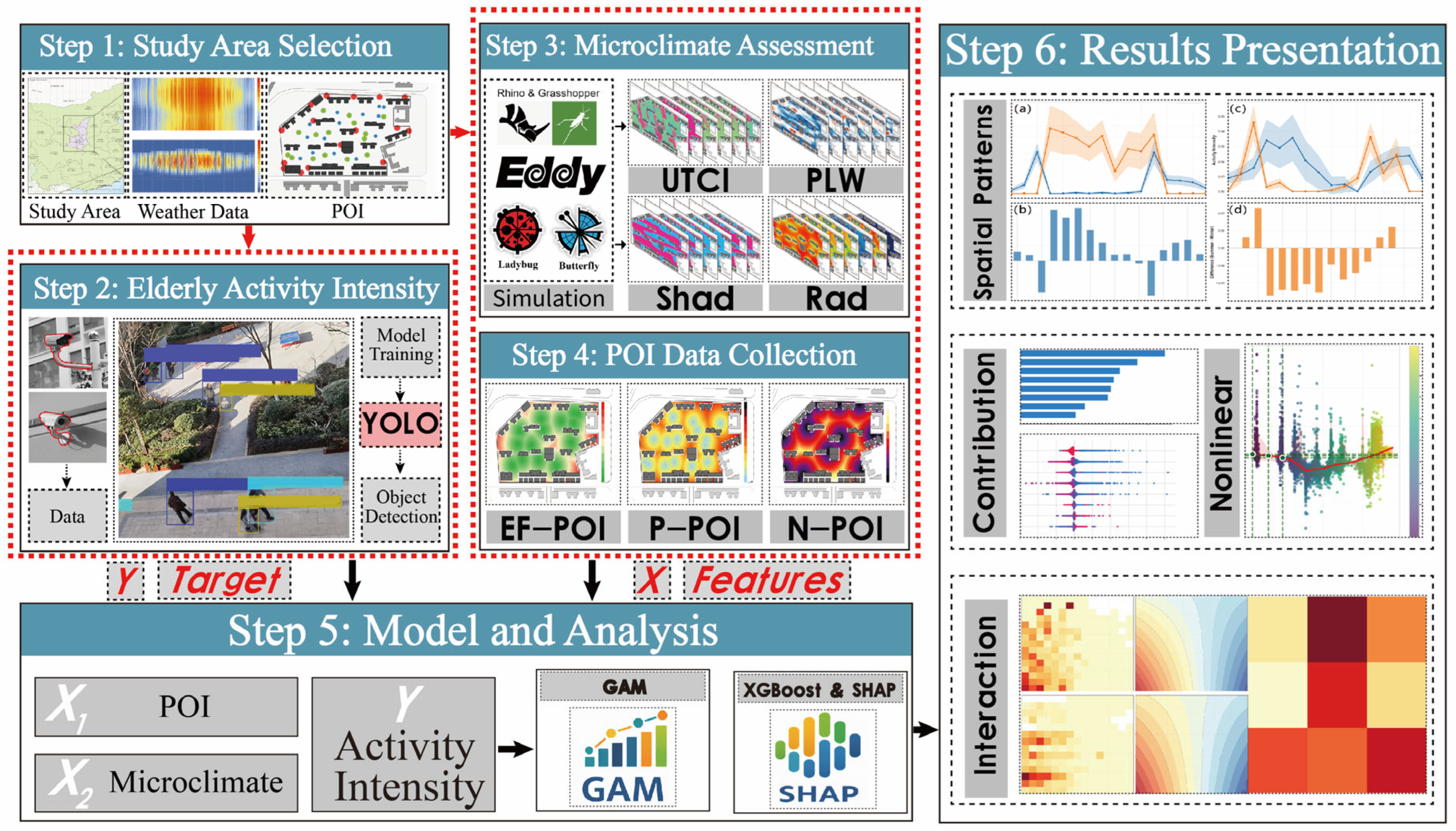
This study adopts an integrated research framework that combines multi-source data collection, quantitative analysis, and mechanistic explanation (Figure 1). The framework follows the logical sequence of “environment-driven behavior response-model analysis,” including five core steps: preparation of the study area and basic data, quantification of elderly outdoor activity intensity, microclimate environmental performance evaluation, collection of built environment elements, and finally, model construction and interaction mechanism analysis. By integrating microclimate monitoring, Geographic Information Systems (GIS), and computer vision technology, detailed data for both winter and summer are collected. The study employs Generalized Additive Models (GAM) and SHAP interpretable machine learning methods to systematically analyze the nonlinear effects, seasonal differences, and complex interaction mechanisms of microclimate and built environment elements on elderly outdoor activities.

3.1. Study Area

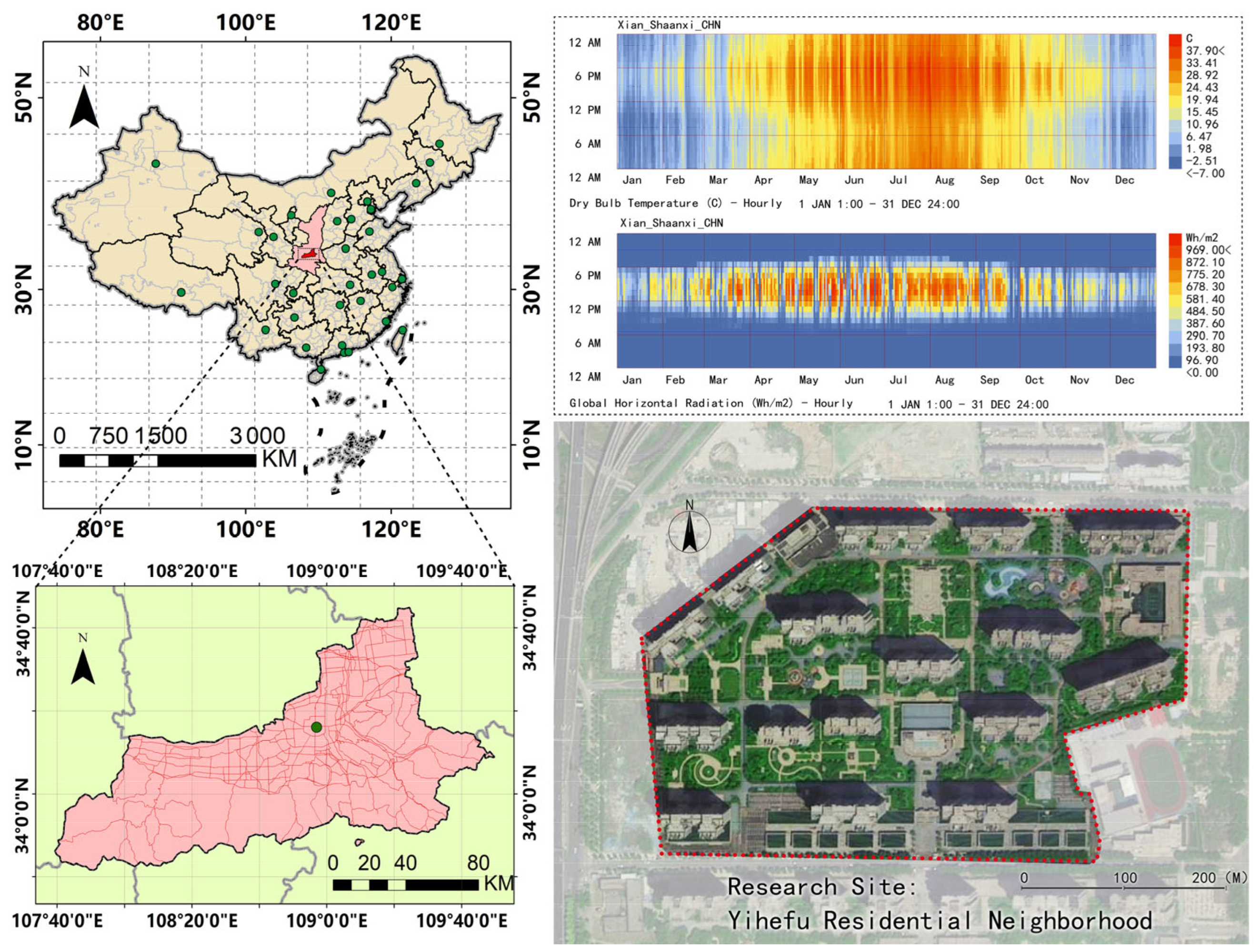
The case study is located in a typical residential community in Xi’an, China (Figure 2). Xi’an has a temperate semi-humid continental monsoon climate, characterized by cold winters, hot summers, and distinct four seasons, providing an ideal setting for studying seasonal adaptation in outdoor activities. The selected residential area is representative of the city, with typical construction dates, spatial layout (including the distribution of residential buildings, public green spaces, road networks, and activity areas), and a proportion of elderly population. The community contains a rich variety of potential activity spaces and diverse microclimate environments, ensuring internal validity of the research findings and some external generalizability. Specifically, based on demographic statistics obtained from the local property management department, the selected neighborhood has an aging population rate (aged 60 and above) of approximately 16.5%, which aligns closely with the overall demographic profile of Xi’an city (where the elderly account for 16.02% of the resident population according to the Seventh National Population Census). Furthermore, its spatial configuration—characterized by typical mid-rise and high-rise residential buildings, interspersed public green spaces, and a standard mix of elderly-friendly and general public facilities—represents the predominant residential development pattern in northern Chinese cities. These specific demographic and spatial characteristics justify the external generalizability of our findings within similar temperate urban contexts.

3.2. Data Collection

The data collection in this study covers three aspects: microclimate environment, built environment facilities, and elderly outdoor activity behavior, with variable data shown in Table 1.

3.2.1. Microclimate Data Simulation

To ensure multi-source data integration at a high spatial resolution, the entire study area was unified into a 10 m × 10 m spatial grid system. Consequently, all continuous microclimate data utilized in the final models were derived from numerical simulations, while field monitoring was specifically conducted to provide boundary conditions and to validate/calibrate these simulated results.
During the winter (10–19 January 2023) and summer (10–19 July 2023), basic meteorological data were collected synchronously using portable meteorological stations at sampled locations. The measurement uncertainty ranges of the instruments were strictly controlled: dry bulb temperature (±0.2 °C), relative humidity (±2%), black globe temperature (±0.3 °C), and wind speed (±0.1 m/s).
Based on the validated boundary conditions, high-resolution spatial simulations were performed. Solar radiation (Rad) and shade distribution (Shad) were simulated using the Ladybug plugin (version 1.6.0, https://www.ladybug.tools/), while pedestrian-level wind speed (PLW) was obtained through computational fluid dynamics (CFD) simulations. To establish the reliability of the simulated data, we compared the simulation outputs against the field measurements at the sample points. The validation metrics demonstrated high predictive accuracy for both the CFD wind simulations (R2 = 0.89, RMSE = 0.18 m/s) and the Ladybug radiation simulations (R2 = 0.91, RMSE = 28.5 W/m2). Finally, the Universal Thermal Climate Index (UTCI) for each 10 m × 10 m grid was calculated based on the calibrated, gridded simulation parameters (temperature, humidity, radiation, and wind speed), rather than being directly measured. All microclimate variables were processed as hourly data from 06:00 to 21:00 to ensure full alignment with the elderly activity observation data.

3.2.2. Built Environment POI Data

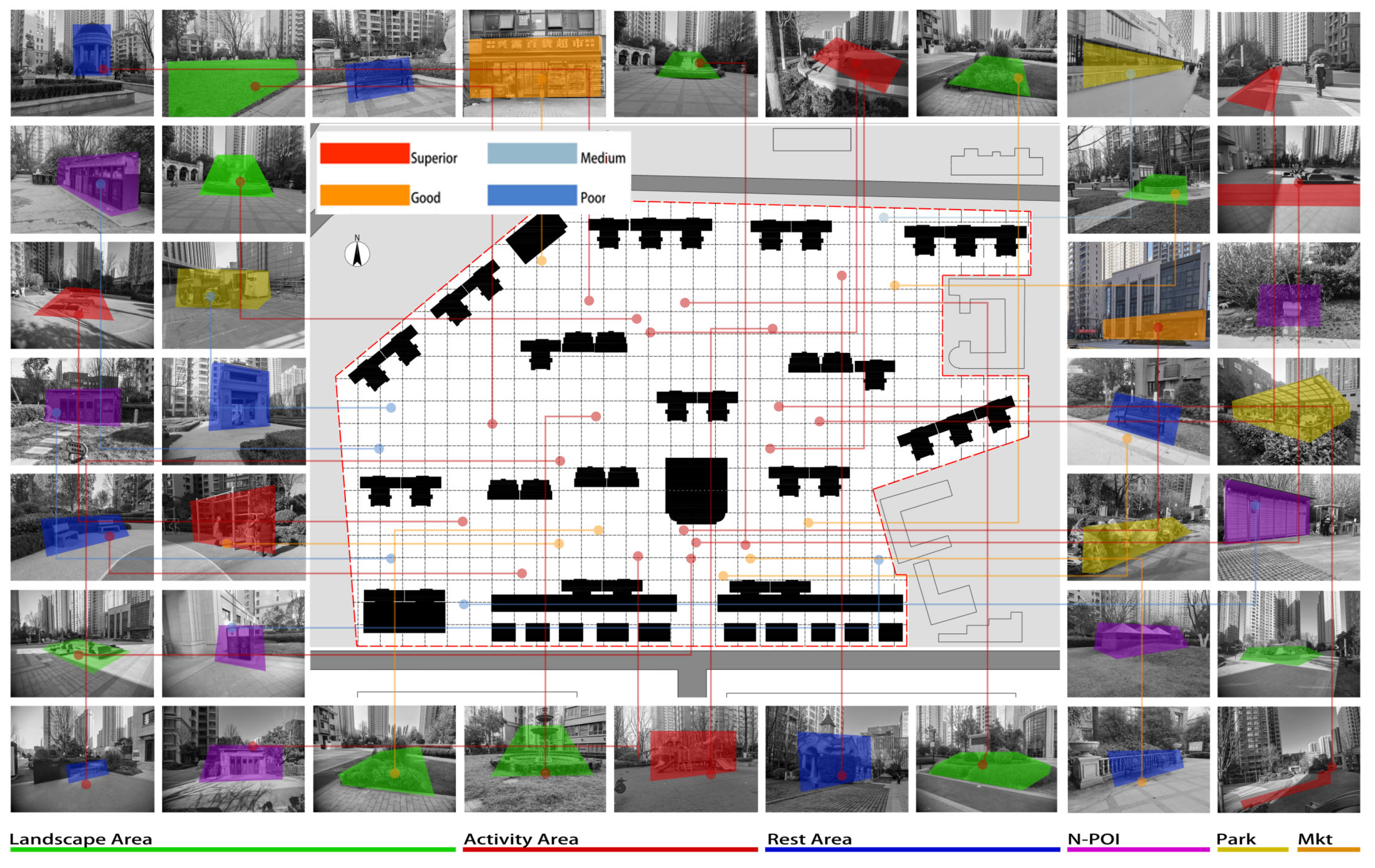
Based on field surveys and GIS mapping, the built environment facilities in the study area were classified as Points of Interest (POI). Based on their pre-designated function and attractiveness for elderly activities, these were operationally defined into three categories (Figure 3): (1) Elderly-Friendly Points of Interest (EF-POI): Facilities specifically designed for elderly people or highly attractive to them, such as fitness squares, chess pavilions, and resting corridors; (2) Positive Points of Interest (P-POI): Facilities generally attractive to the public with good environmental quality, such as central green spaces, children’s playgrounds, and convenience stores; (3) Negative Points of Interest (N-POI): Spaces with potential safety hazards, poor environmental quality, or negative functions, such as garbage stations, idle corners, and traffic-heavy roads. To ensure the objectivity of this classification and avoid subjective bias, the categorization process was independently conducted by three trained researchers. A Fleiss’ Kappa test was subsequently performed to evaluate inter-rater reliability, yielding a high agreement score (Kappa = 0.86). Any initial classification discrepancies were resolved through consensus discussions. Furthermore, regarding the Negative POIs (N-POIs), although garbage stations, idle corners, and traffic-heavy roads possess different physical properties, they were treated as a unified category in this study because they functionally share the same “spatial repelling effect” on the elderly. Whether stemming from poor environmental sanitation or potential traffic safety hazards, these spaces consistently act as environmental deterrents, significantly reducing the willingness of older adults to stay or engage in outdoor activities in their vicinity. In GIS, the shortest path distance from each activity observation point to the three categories of POIs was calculated as a key explanatory variable.

3.2.3. Elderly Activity Data

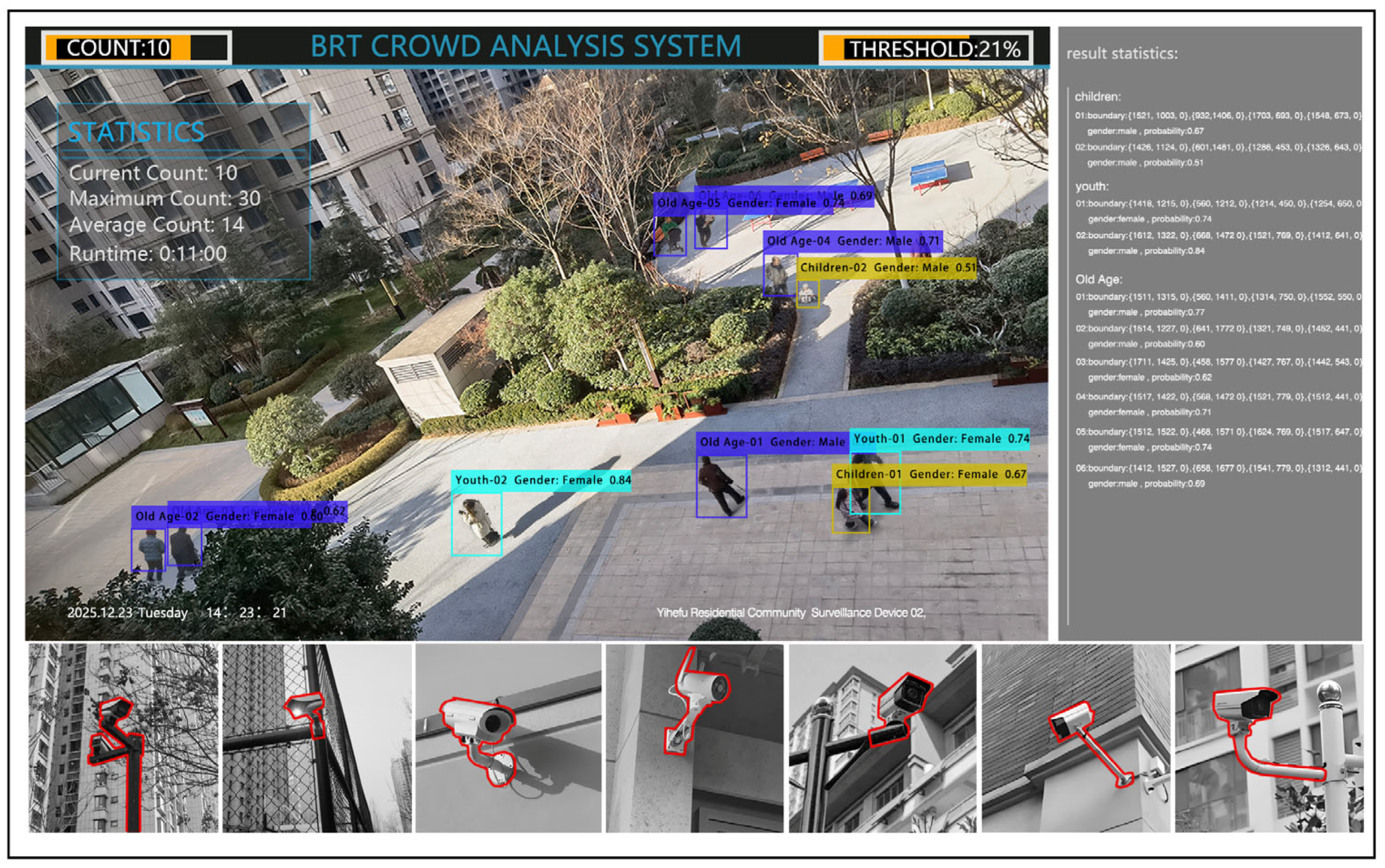
Elderly outdoor activity data were collected using a computer vision-based system behavior annotation method (Figure 4). The data collection period was fully synchronized with the microclimate simulation period. Specifically, for the 10 typical days in both winter and summer, continuous video recording was conducted daily from 06:00 to 21:00 using eight fixed high-definition network cameras set up at key nodes in the community’s public spaces. Prior to data collection, this study obtained ethical approval from the institutional review board. To strictly ensure privacy protection, all video data were processed locally, and facial features were automatically blurred. Only anonymous spatiotemporal trajectory data were retained for analysis. The placement of the cameras was determined through preliminary surveys to ensure coverage of all major potential activity areas while minimizing overlap. This maximized spatial coverage and minimized repeated counting of the same individual. Furthermore, to completely eliminate double-counting when individuals moved between different camera views, a Re-Identification (ReID) algorithm was integrated into the post-processing pipeline. This algorithm effectively maintained unique individual tracking across the entire site by matching appearance feature vectors (e.g., clothing color) and spatiotemporal constraints (aligning exit and entry times at the boundaries of adjacent cameras). Video analysis was performed using a deep learning object detection model based on the YOLOv8 architecture. The model was trained and validated on a custom dataset containing images of elderly individuals in multiple scenes, achieving a precision rate greater than 92% for elderly target recognition. Specifically, the model was trained to distinguish the elderly from other adults based on a combination of comprehensive visual cues. These include postural features (e.g., hunched back), gait characteristics (e.g., shorter strides, slower pace), and the frequent presence of specific assistive devices (e.g., walking canes, wheelchairs, or strollers typically used by grandparents). The model automatically processes the video stream, frame by frame, recognizing and outputting the bounding box, timestamp, and continuous trajectory of each elderly individual in the frame.
To convert the recognition results into spatial activity intensity indicators, the study area was first divided into regular 10 m × 10 m grids. Next, the continuous trajectories of each elderly individual were subjected to spatiotemporal clustering. If the same individual moved between adjacent grids for more than 5 min or stayed in the same grid for more than 10 min intermittently, this was recorded as a new independent activity, effectively eliminating duplicate records caused by brief occlusion or wandering. These duration thresholds were not arbitrary but grounded in previous environmental gerontology observations. A 5 min movement threshold effectively filters out transient passing, reflecting deliberate spatial transitions at a typical elderly walking speed within a 10 m grid. Meanwhile, the 10 min stationary threshold reliably differentiates purposeful staying activities (e.g., resting, chatting, or observing) from brief, insignificant stops [36].
Ultimately, the activity intensity (AIi,t) of each grid (i) during each hour (t) was quantified as the total stay duration of all elderly individuals in that grid during the time period (unit: person·minutes), with the calculation formula defined as follows:
  A I i , t = k = 1 n i , t   d k
Here, ni,t represents the number of independent elderly activity occurrences in grid i during hour t, and dk represents the duration (in minutes) of the k-th activity. This method enables the objective and automated collection of large-scale, long-duration behavioral data, forming a dependent variable dataset fully aligned with the microclimate and POI data in both the spatial and temporal dimensions.

3.3. Data Analysis Methods

3.3.1. Descriptive Statistics and Spatiotemporal Pattern Visualization

To preliminarily reveal the spatiotemporal characteristics and seasonal differences in the microclimate environment, POI distribution, and elderly outdoor activities, this study first conducted a systematic descriptive analysis and visualization. Using QGIS (version 3.34, https://qgis.org) and the Python (version 3.9, https://python.org) libraries Matplotlib (version 3.8, https://matplotlib.org) and Seaborn (version 0.13, https://seaborn.pydata.org), hourly heatmaps of microclimate variables, spatial distribution and influence range maps of POIs, and spatiotemporal heatmaps of elderly activity intensity were generated. These visualizations intuitively present the basic distribution patterns, daily variations, and spatial heterogeneity of key variables during winter and summer, providing foundational understanding and visual evidence for subsequent model construction and mechanism analysis.

3.3.2. Generalized Additive Model (GAM)

To quantify the nonlinear effects of microclimate and built environment on elderly activity intensity and the interaction effects between variables, this study constructed a seasonal Generalized Additive Model (GAM). GAM is capable of flexibly capturing the complex nonlinear relationship between predictor variables and response variables through nonparametric smooth functions. Models were established separately for winter and summer data. Prior to modeling, a Variance Inflation Factor (VIF) test was conducted for all explanatory variables, yielding VIF values strictly below 3.0, which indicates no significant multicollinearity. To address the right-skewed distribution and potential zero values in activity intensity, a log(AIi,t + 1) transformation was applied to the dependent variable. Preliminary tests using zero-inflated Poisson and Tweedie distributions yielded highly consistent nonlinear trends; therefore, the log transformation was retained for its computational efficiency and interpretability. The basic form is as follows:
  log E A I i , t = β 0 + j = 1 p   f j x i j , t + k = 1 q   g k x i k , t , x i l , t + ϵ i , t
Here, AIi,t represents the activity intensity of grid i at time t; β0 is the intercept; fj(⋅) is the thin plate spline smooth function applied to individual continuous variables (such as UTCI, Rad, distance, etc.); gk(⋅) is the tensor product smooth function used to test key interaction effects (e.g., interaction between UTCI and distance to EF-POI); ϵi,t represents the random error term. The model was fitted using the mgcv package (version 1.8-42, https://cran.r-project.org/package=mgcv, accessed on 30 January 2026) in R (version 4.3.2, https://www.r-project.org/). The inclusion of the interaction terms gk(·) was initially theory-driven—based on the known physical coupling between built facilities and microclimatic factors (e.g., EF-POI and shading)—and subsequently refined using a data-driven stepwise selection process based on the Akaike Information Criterion (AIC). Furthermore, to ensure robustness and avoid the under-smoothing occasionally caused by the GCV criterion, the Restricted Maximum Likelihood (REML) method was employed as the primary criterion for smoothing parameter selection. The best degrees of freedom for the smoothing terms were selected using the Generalized Cross-Validation (GCV) criterion to avoid overfitting.

3.3.3. SHAP (SHapley Additive exPlanations) Analysis

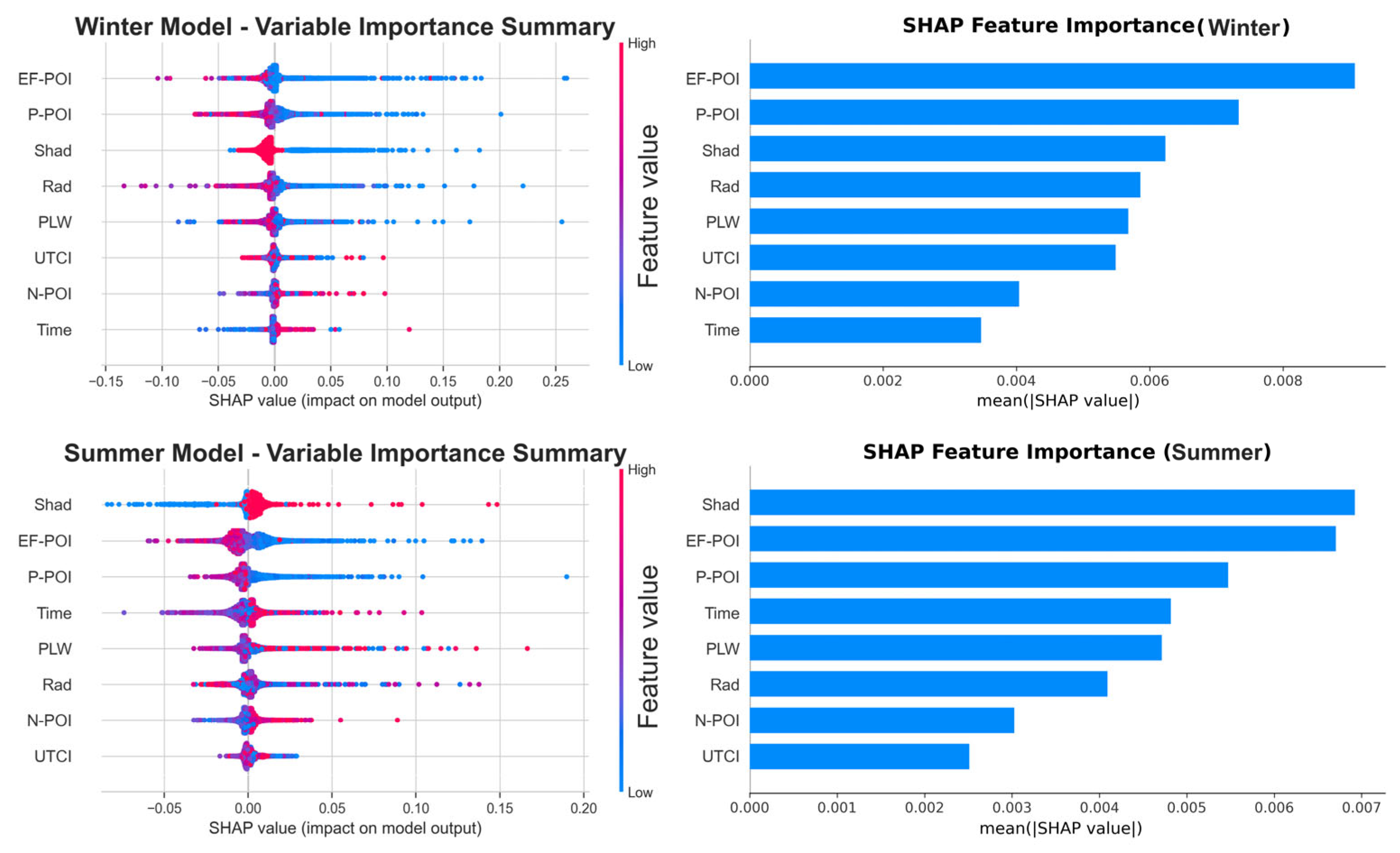
To provide a deeper explanation of the GAM model’s predictions and quantitatively assess the contribution of each environmental variable to activity intensity and its seasonal differences, this study employed Shapley Additive exPlanations (SHAP) analysis based on game theory. Because SHAP’s highly efficient TreeExplainer is specifically designed for tree-based machine learning algorithms rather than GAMs, we trained parallel eXtreme Gradient Boosting (XGBoost) models using the exact same feature sets and targets for winter and summer (as illustrated in Figure 1). To prevent overfitting and rigorously evaluate the models’ generalization ability, a 5-fold cross-validation was conducted during the model training process. These XGBoost surrogate models achieved high consistency with the GAMs in terms of predictive performance (with comparable R2 values across the validation folds), ensuring that the extracted SHAP values faithfully and globally reflect the variable contributions and interaction thresholds inherent in the dataset. SHAP values unify local accuracy and global consistency by assigning a contribution value to each feature of every sample. Specifically, we calculated the average absolute SHAP values for each variable in the winter and summer models, using these values as the basis for global feature importance ranking. Additionally, by plotting SHAP dependency plots, we visualized how the values of key variables (such as UTCI, Shad, and distance to EF-POI) influence their SHAP values (i.e., their marginal contribution to predictions), revealing their nonlinear effects and potential thresholds. All SHAP analyses were performed using the SHAP library (version 0.44.0, https://shap.readthedocs.io/) in Python (version 3.9, https://python.org).

4. Results and Analysis

4.1. Microclimate and Activity Spatial Patterns

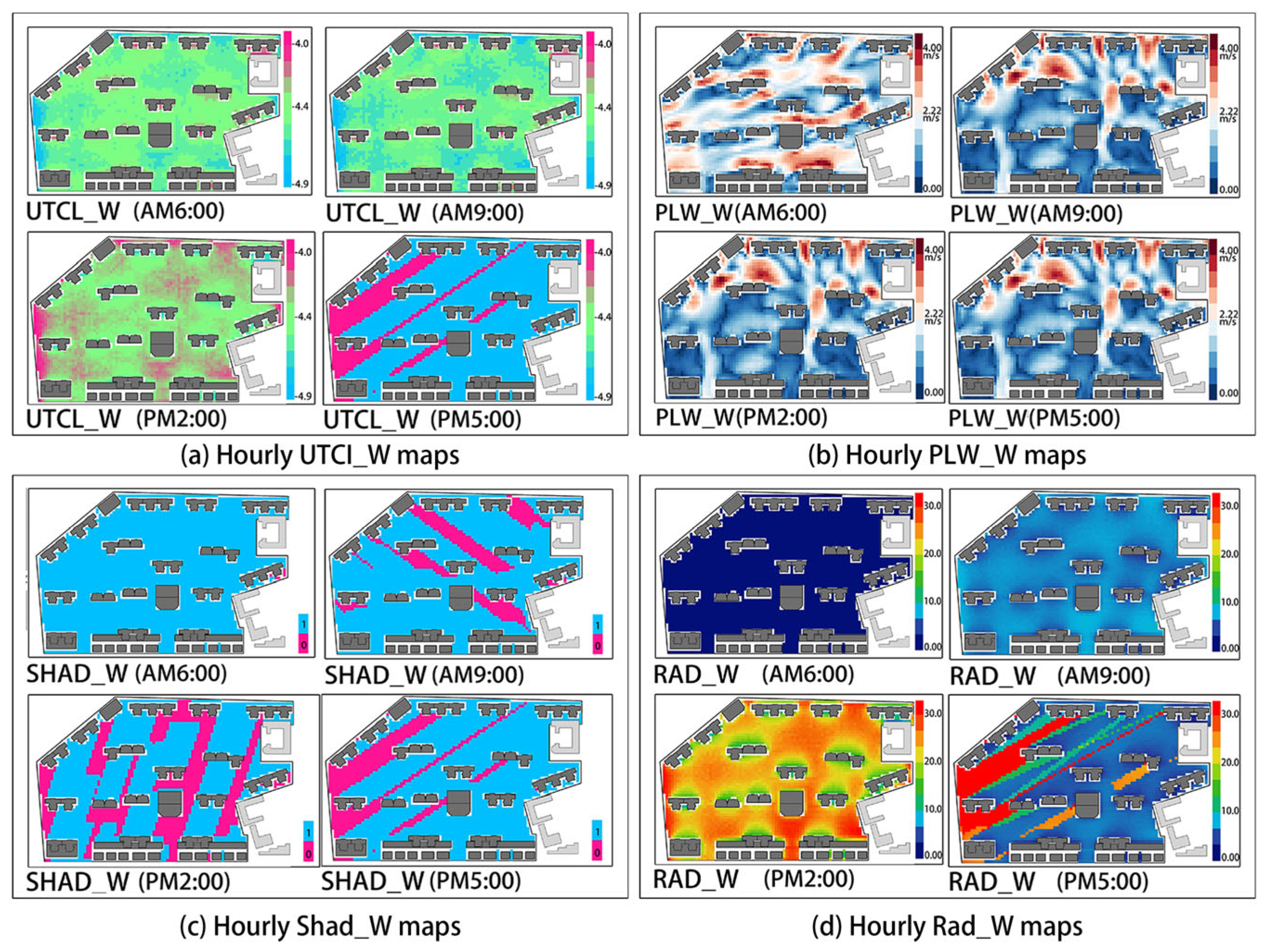
To contextualize the environmental conditions during the study periods, Table 2 summarizes the descriptive statistics of key microclimate variables across the winter and summer observation days. The winter microclimate elements exhibit a significant spatiotemporal differentiation, and their hourly evolution patterns are clearly presented through heatmaps (Figure 5). UTCI, pedestrian-level wind speed, shading conditions, and solar radiation show strong dynamic changes and spatial heterogeneity during the day. UTCI reaches relatively higher levels between 9:00 AM and 3:00 PM (Figure 5a), indicating that thermal comfort conditions improve during this time. The PLW graph shows the variation in pedestrian-level wind speed, with wind speed peaking around noon, especially in open areas, where wind speed significantly influences activity intensity (Figure 5b). The heatmap of shading conditions reveals the movement trajectory of shadows cast by buildings and vegetation, with these shadowed areas forming a sharp contrast in microclimate with the unshaded regions (Figure 5c). Solar radiation, as a key heat source driving factor, peaks around noon and regularly shifts in space with the change in solar azimuth (Figure 5d). These detailed spatiotemporal patterns collectively indicate a dynamic interplay between “heat sources” and “shadows” in the winter residential area, providing key environmental context for understanding the elderly’s “phototropic behavior” in response to cold.
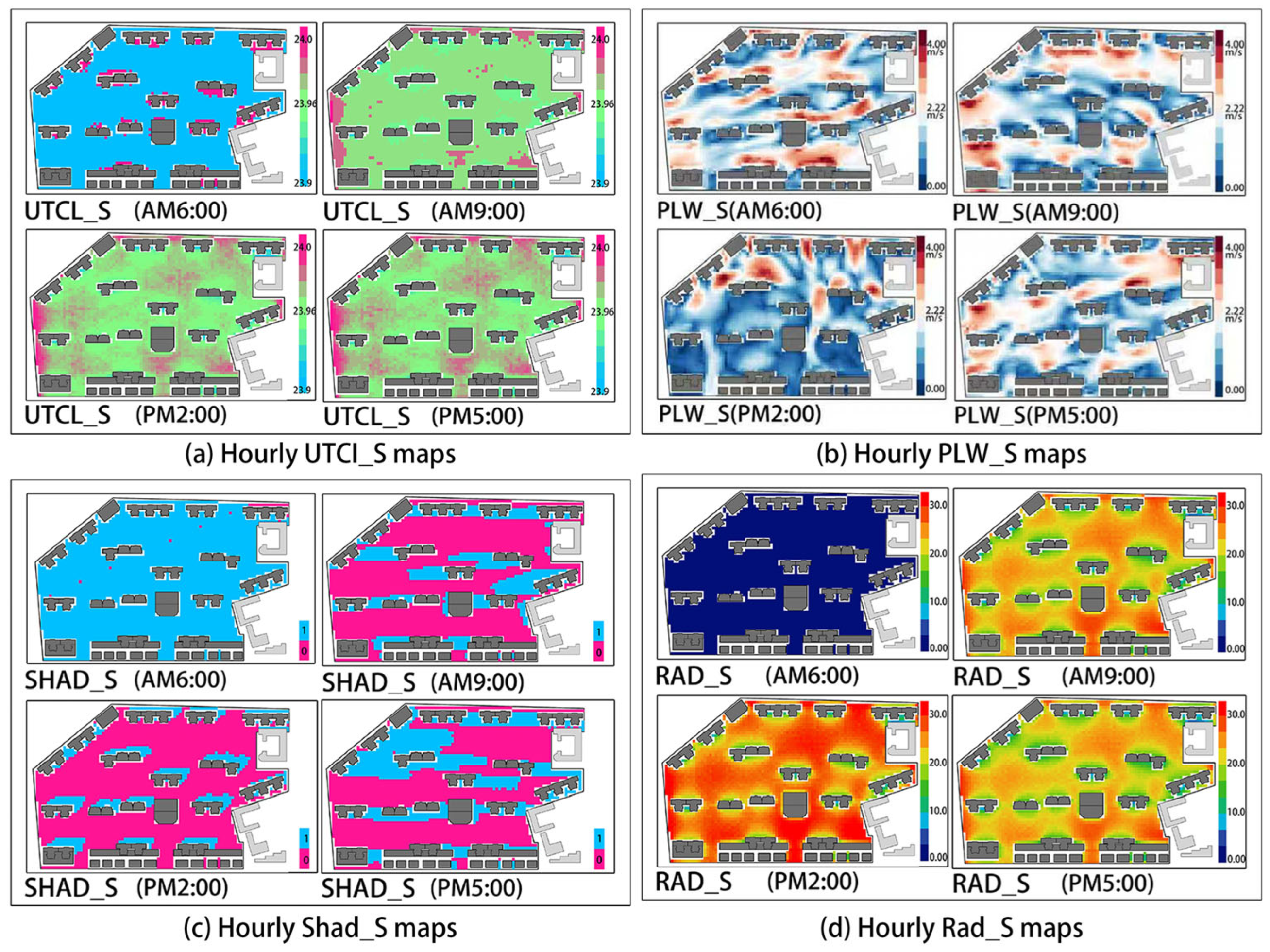
Compared to winter, the spatiotemporal pattern of microclimate elements in summer exhibits distinctly different characteristics, with the dynamic changes in thermal comfort pressure and regulating factors shown in Figure 6. Overall, UTCI remains at a high level for an extended period during the day, especially forming a large area of strong heat stress around noon (Figure 6a). As a key regulating factor, pedestrian-level wind speed shows high ventilation potential in local areas (such as building gaps and open corridors). The spatial alignment of these potential ventilation corridors with high-temperature areas is crucial for mitigating localized heat island effects (Figure 6b). The heatmap of shading conditions clearly depicts the all-day distribution and movement of shadows, with these shaded areas forming “cool islands” that shield against direct solar radiation (Figure 6c). Correspondingly, the solar radiation intensity peaks at noon, and the high-value areas of radiation are spatially coupled with the high-temperature UTCI areas and low-value shading areas (Figure 6d). These patterns indicate that the summer thermal environment in the residential area is driven by intense solar radiation, while shading and ventilation become key spatial regulating measures. This provides a direct physical environmental explanation for understanding elderly individuals’ adaptive behavior of “seeking shade to escape the heat.”
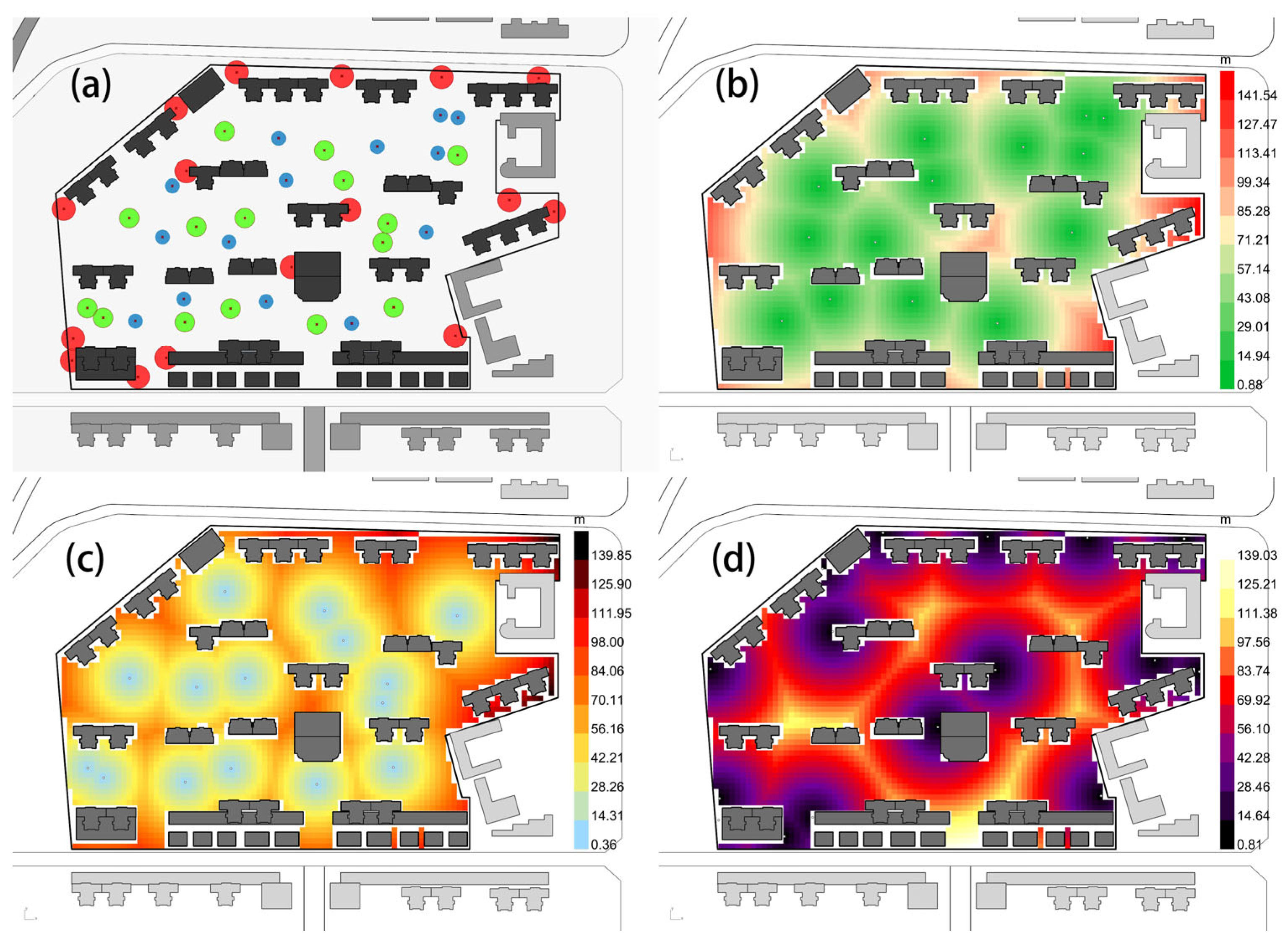
The spatial distribution and potential influence areas of different types of Points of Interest (POIs) in the study area show significant differences, with their geographical patterns shown in Figure 7. Overall, elderly-friendly (EF-POI), positive (P-POI), and negative (N-POI) POIs exhibit a combination of clustering and dispersion in the residential area (Figure 7a). Specifically, the heatmap of the influence area of EF-POIs shows that their service capacity forms a high-intensity core around the facilities, which decreases with increasing distance. This indicates that their “climate buffering” or “activity anchoring” effect is most concentrated in local areas (Figure 7b). The influence range of positive POIs (P-POIs) is broader and more continuous, suggesting their general contribution to promoting public vitality at the neighborhood scale (Figure 7c). In contrast, the influence range of negative POIs (N-POIs) generally shows lower heat values and is scattered, indicating the suppressive effect these areas may have on activities due to environmental or functional deficiencies (Figure 7d). The spatial heterogeneity of the influence intensity of the three POI types (heat values ranging from 0.36 to 11.84) clearly reveals the different roles built environment facilities play in supporting or restricting elderly outdoor activities, providing a key spatial structural basis for subsequent analysis of environment-behavior interactions.
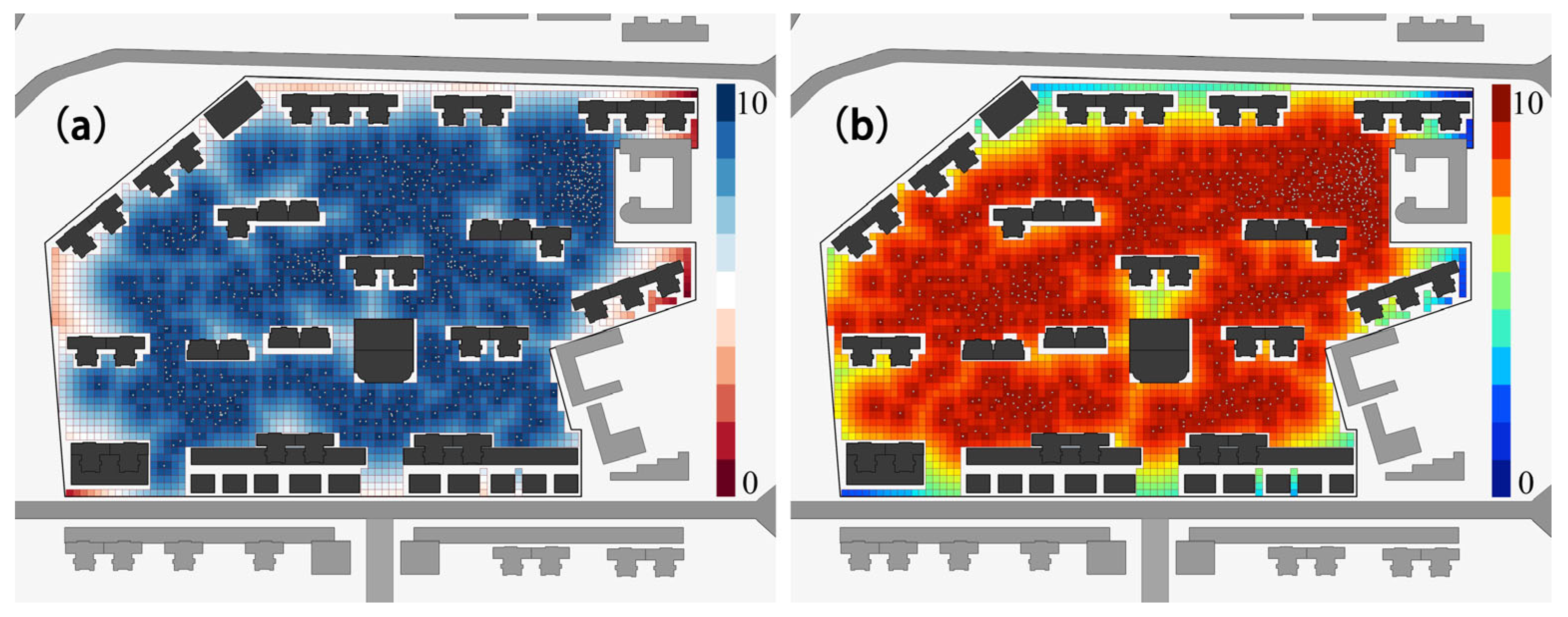
The spatial distribution of elderly outdoor activities exhibits a distinct seasonal reversal pattern between winter and summer (Figure 8). In winter, high-intensity activity areas (shown in cool colors in the figure) are mainly concentrated in spaces with ample sunlight and low wind speed, such as open areas facing south and some wind-sheltered corners of buildings (Figure 8a). In contrast, the high-intensity activity areas in summer (shown in warm colors in the figure) clearly shift to shaded, well-ventilated areas, such as under corridors, beneath tree shade, and near wind corridors formed between buildings (Figure 8b). This shift in the activity heatmap from “cool color clustering” to “warm color migration” visually demonstrates the strong adaptability of the elderly population in utilizing space to cope with different climatic conditions. The seasonal differences in this spatial pattern provide key behavioral evidence for further investigation into how microclimate factors and built environment elements specifically drive activity distribution.

4.2. Temporal Patterns of Elderly Outdoor Activities

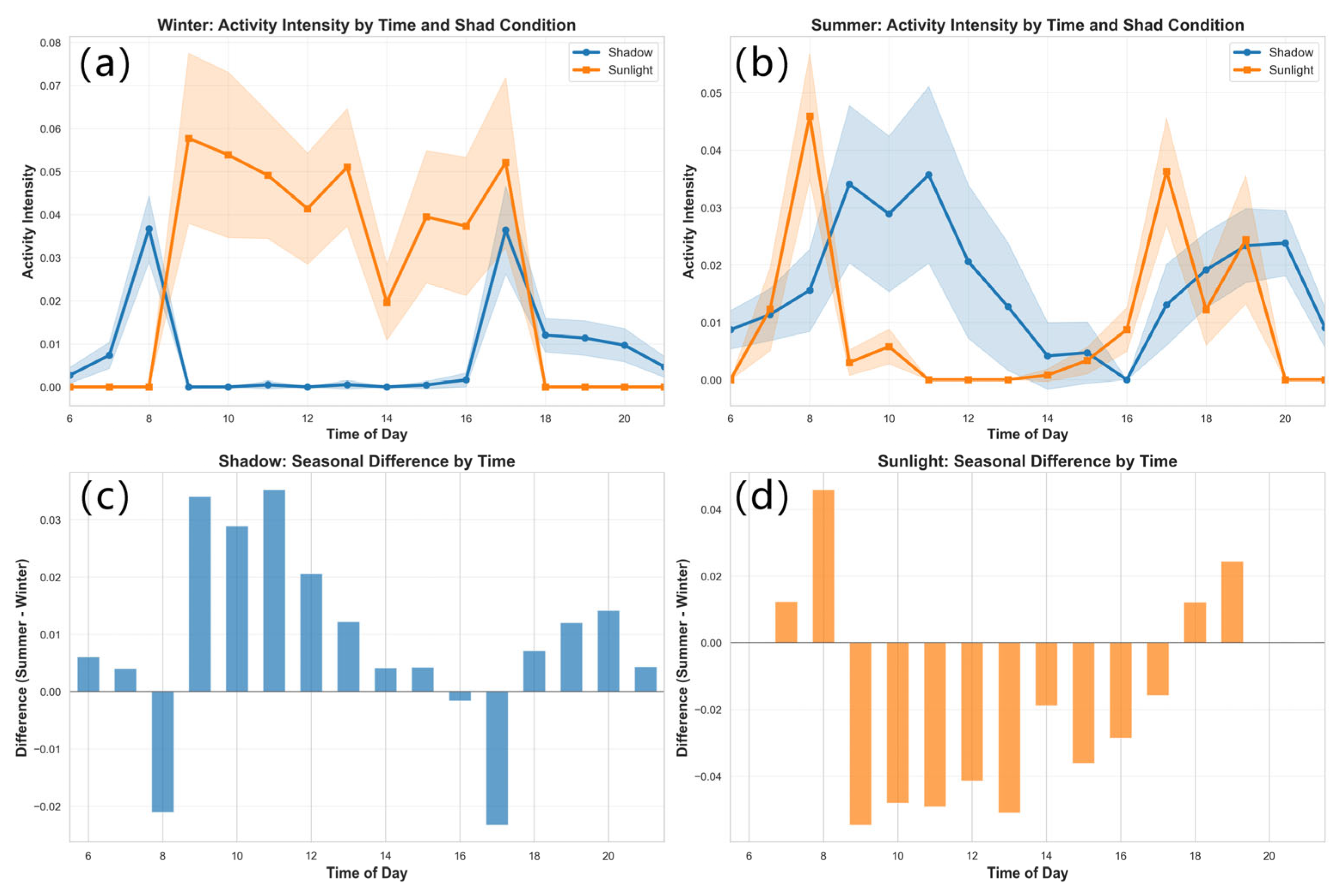
The intensity of elderly outdoor activities shows significant seasonal responses to sunlight and shading conditions, along with a regular daily variation pattern (Figure 9). In winter, the activity intensity in sunlight is significantly higher than in shaded areas throughout the day, peaking around noon (12:00–13:00), clearly reflecting a “phototropic” behavior pattern for achieving thermal comfort (Figure 9a). The pattern in summer undergoes a fundamental reversal: for most of the day (10:00–18:00), activity intensity in shaded areas exceeds that in sunlight areas. The daily activity shows a bimodal pattern, with peaks in the morning and evening, while activity in sunlight areas drops to its lowest during noon, reflecting a “seeking shade” strategy to avoid high temperatures (Figure 9b). Notably, the evening activity peak (17:00–18:00) is prominent in both winter and summer, suggesting that social rhythms (such as picking up children) and microclimate conditions jointly shape the timing of activities. The seasonal difference graph further quantifies this behavioral shift: in summer, activity intensity in shaded areas is generally higher in the afternoon compared to winter, while the intensity in sunlight areas is lower during most of the day compared to winter (Figure 9c,d). This positive-negative contrast confirms the fundamental seasonal reversal of the dominant environmental factors driving elderly outdoor activities.

4.3. Nonlinear Impacts and Thresholds of Microclimate and Built Environment

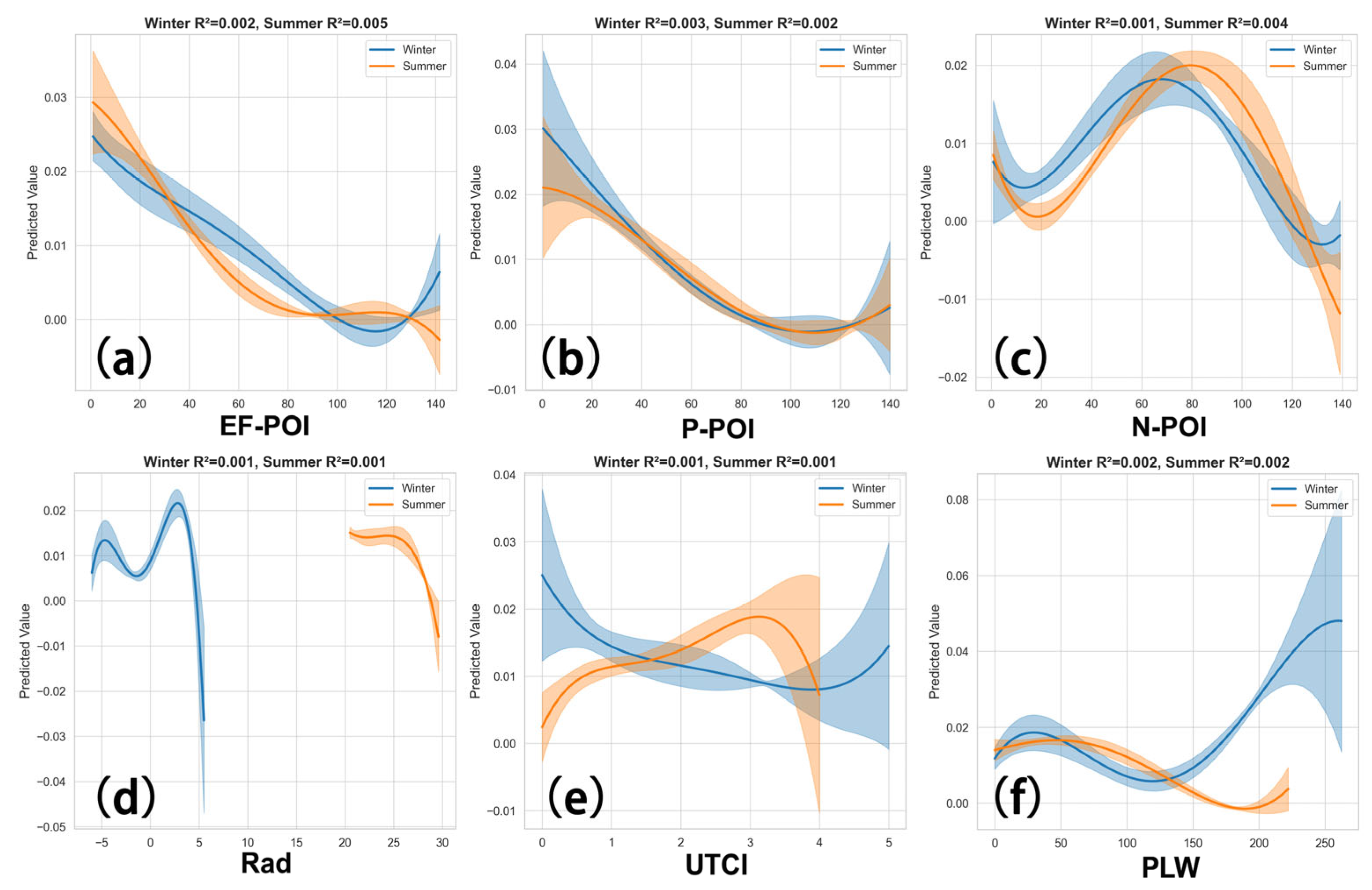
The Generalized Additive Model (GAM) reveals that three types of Points of Interest (POIs) and three microclimate variables have complex nonlinear effects on elderly outdoor activity intensity, with distinct seasonal differences in their impact patterns (Figure 10). Specifically, the distance to Elderly-Friendly POIs (EF-POIs) is negatively correlated with activity intensity, but there is a threshold for the negative impact: in winter, when the distance exceeds about 50 units, the predicted value shifts from positive to negative; in summer, this threshold occurs earlier (around 30 units), and the negative effect at the same distance is stronger (Figure 10a). The distance to Positive POIs (P-POIs) also shows a positive-to-negative influence, with the effective range for promoting activity being slightly larger in winter than in summer (Figure 10b). The distance to Negative POIs (N-POIs) shows a weak positive effect, suggesting that staying farther from these areas may slightly benefit activity (Figure 10c). In terms of microclimate, UTCI shows an inverted “U” relationship with activity intensity, with a clear comfort range, and the upper comfort limit in summer is significantly lower than in winter (Figure 10d). Pedestrian-level wind speed (PLW) shows a monotonically positive effect in winter, while in summer, it follows a unimodal curve, with moderate wind speeds being most favorable for activity (Figure 10e). The effect of solar radiation (Rad) also shows seasonal reversal, being significantly positive in winter and transitioning from positive to negative in summer (Figure 10f). These nonlinear curves not only quantify the complex relationship between environmental factors and activity intensity but also clearly indicate the key thresholds at which the direction of their impact changes.

4.4. Interaction Effects of Microclimate and Built Environment

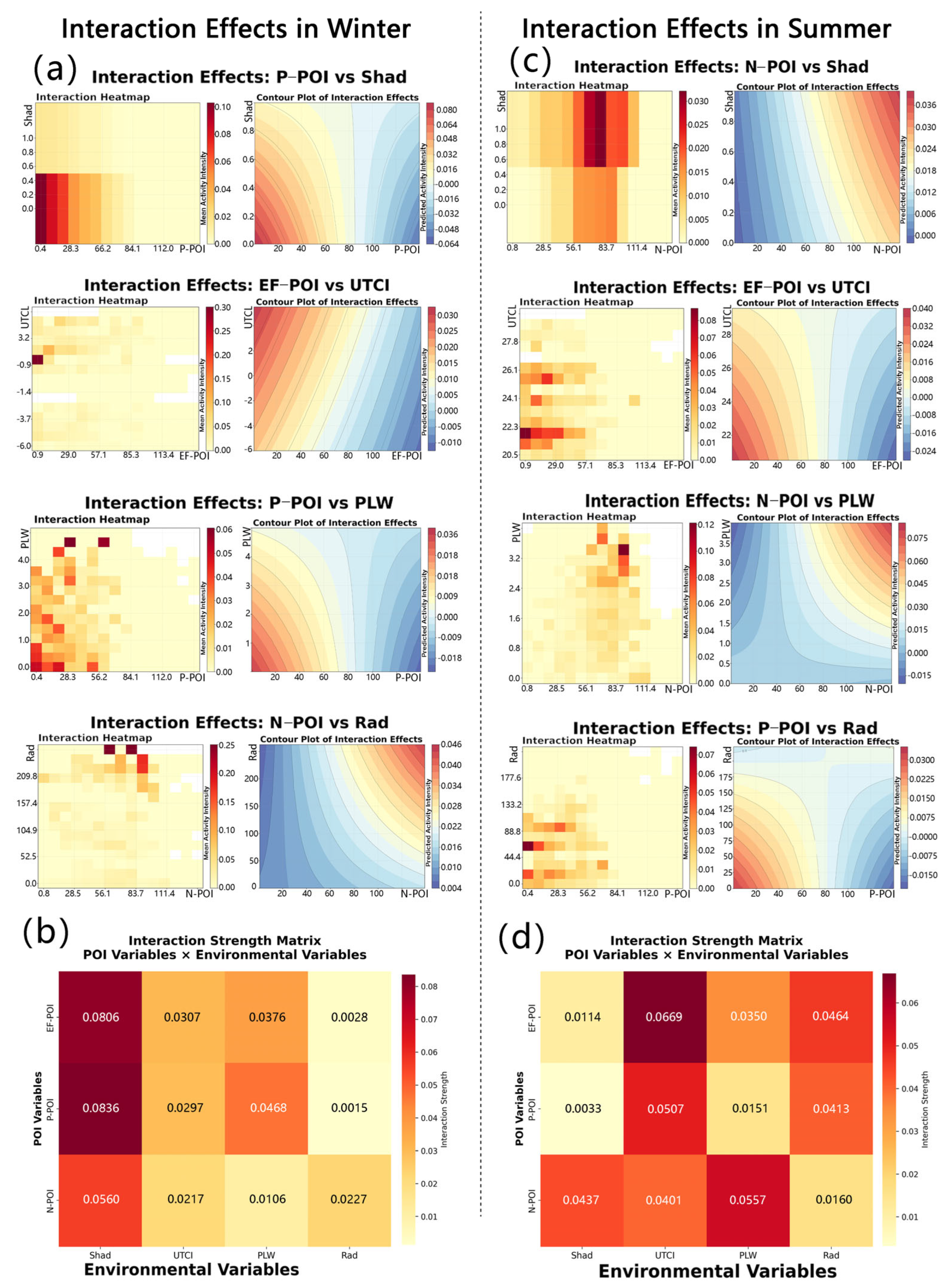
The impacts of microclimate variables and built environment elements on elderly outdoor activities are not independent, but rather exhibit significant synergistic or antagonistic interactions, with varying intensities across seasons (Figure 11). In winter, the visualization of interaction effects shows that the combined influence of Positive Points of Interest (P-POI) and shading (Shad) conditions on activity intensity is most pronounced, with the peak effect occurring in a specific spatial configuration (Figure 11a); The interaction intensity matrix further quantifies that the overall interaction in winter is relatively weak, with the interaction between EF-POI and shading conditions being stronger (intensity value approximately 0.08) (Figure 11b). As summer arrives, the interaction pattern changes significantly, with the interaction between Negative Points of Interest (N-POI) and solar radiation (Rad) being the most intense in the visualization (Figure 11c); The intensity matrix confirms that the overall interaction intensity in summer is higher than in winter, particularly the interactions between thermal stress (UTCI) and various POIs, which are generally stronger (for example, the interaction strength between N-POI and PLW reaches 0.15), This reveals that under high-temperature stress, the role of built environment facilities in regulating microclimate perception is amplified (Figure 11d). These results indicate that both climate conditions and facility layout jointly shape the probability of activity occurrence, with summer being a key season for implementing “climate-adaptive” built environment interventions. Based on these analyses, urban planning and design should develop refined strategies to address the impact of seasonal changes on elderly activities, with particular attention to the layout of shaded areas in summer to provide comfortable spaces for activity.

4.5. Variable Importance Ranking and Model Interpretability

SHAP analysis reveals significant seasonal differences in the key environmental variables driving elderly outdoor activities and their contribution (Figure 12). In the winter model, Elderly-Friendly Points of Interest (EF-POIs) are the most important variables explaining activity intensity, indicating their most significant driving effect on elderly winter activities; Positive Points of Interest (P-POIs) and shading conditions (Shad) are of secondary importance, with the latter providing key wind and cold shelter for elderly individuals in the cold season. In contrast, the effects of solar radiation (Rad), pedestrian-level wind speed (PLW), and time (Time) are relatively mild, while the impact of thermal stress (UTCI) and Negative Points of Interest (N-POIs) is the least significant. The feature importance ranking in the summer model undergoes a fundamental shift: shading conditions (Shad) replace other variables as the most influential factor, confirming that shading is the primary behavioral decision factor in hot environments; at the same time, the importance of thermal stress (UTCI) and pedestrian-level wind speed (PLW) increases significantly, highlighting the enhanced role of temperature comfort and ventilation conditions under heat stress; the influence of Negative Points of Interest (N-POIs) also increases, indicating a stronger avoidance of unfavorable spaces in summer. This shift in importance ranking from “elderly-friendly facilities and shading dominance” to “shading and thermal stress dominance” quantitatively confirms, from the perspective of machine learning interpretability, the fundamental seasonal reversal in the driving mechanisms of elderly outdoor activities, providing clear priority guidelines for designing elderly-friendly environments in different seasons.
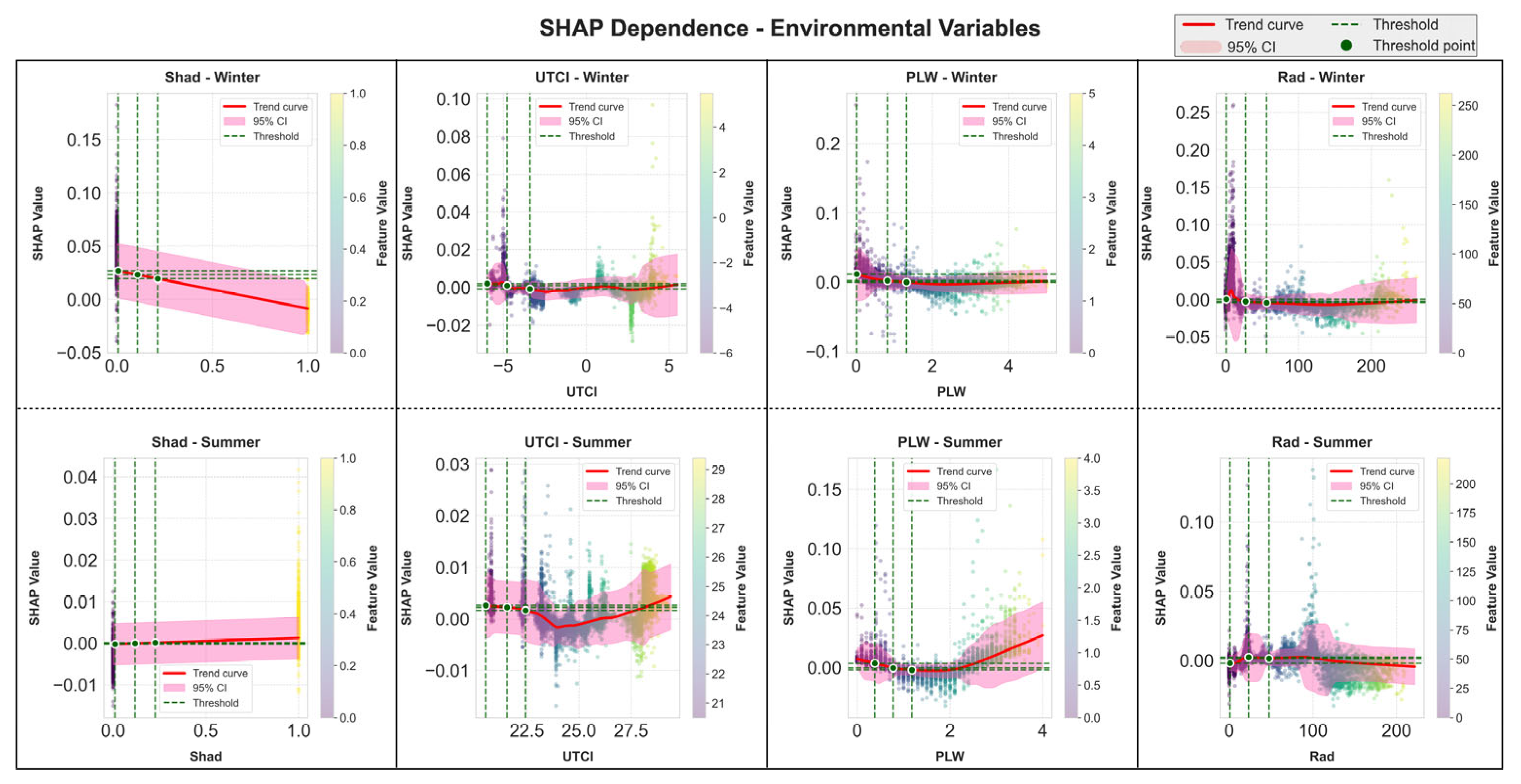
SHAP dependency plots further reveal the complex nonlinear patterns and seasonal differences in the impact of key microclimate variables on elderly outdoor activity intensity (Figure 13). In winter, solar radiation (Rad) shows the strongest positive impact potential (with the highest SHAP value reaching 0.25), but its effect is distributed over a wide range, suggesting the existence of an optimal radiation threshold range; the effects of shading (Shad) and the Universal Thermal Climate Index (UTCI) are relatively limited and concentrated. In summer, the influence intensity and dispersion of all microclimate variables significantly increase: shading (Shad) becomes the most prominent positive influencing factor, confirming its role as a key heat-relief element in hot environments; the effects of UTCI and pedestrian-level wind speed (PLW) also increase significantly, with PLW showing a peak characteristic at moderate wind speeds, reflecting specific needs for ventilation conditions; notably, solar radiation (Rad) shows higher SHAP values in summer (up to 0.40), suggesting its role shifts from being a “heat resource” in winter to a “thermal stress source” in summer. These dependencies, from a local contribution perspective, quantify the specific form of influence intensity for each microclimate factor and its seasonal evolution.
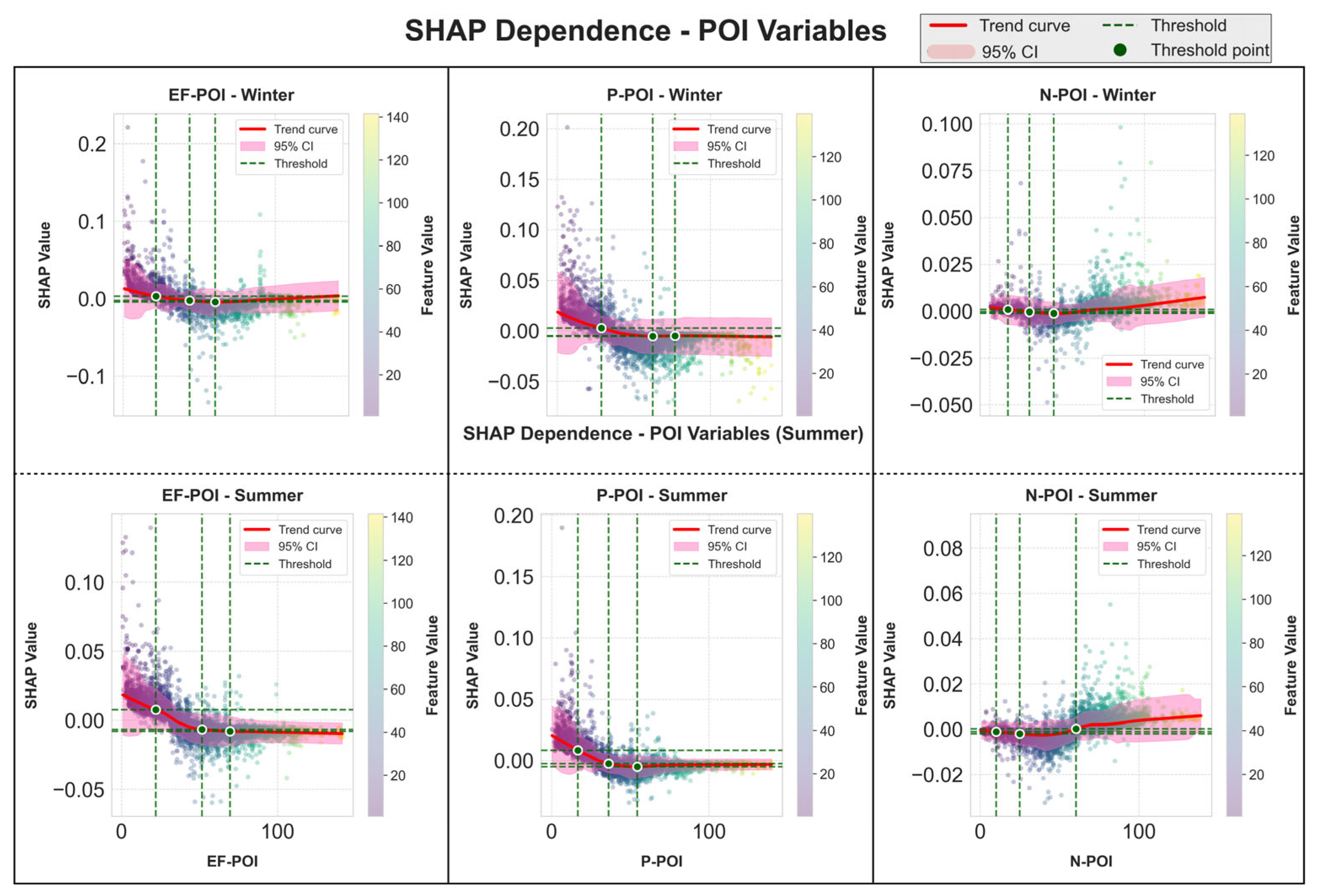
The influence of different categories of Points of Interest (POIs) on activity intensity also exhibits nonlinear dependencies and seasonal variations (Figure 14). Quantitative analysis based on SHAP dependence plots further reveals the specific parameters and seasonal differences in the influence patterns of the three POI types. In winter, Elderly-Friendly POIs (EF-POIs) exert the most significant influence, with the highest potential positive SHAP contribution (the peak of the trend curve) occurring at a distance of approximately 20–25 m. Furthermore, defining the “effective service radius” as the threshold distance where the positive SHAP value approaches zero and the promotional effect becomes negligible, this radius extends to approximately 45–50 m in winter. Positive POIs (P-POIs) also show a similar pattern of initial promotion followed by attenuation, but their maximum influence distance and strength are both smaller than those of EF-POIs. In summer, the absolute influence strength of all POI types generally weakens. Notably, the effective service radius (the zero-crossing threshold) for EF-POIs in summer narrows to approximately 35–40 m, while the peak promotional distance slightly contracts to around 15–20 m. This indicates that their effective service radius becomes more focused under thermal stress conditions. Negative POIs (N-POIs) exhibit a weak positive influence in both seasons (SHAP values generally below 0.01), suggesting that being farther away from such spaces slightly benefits activities. However, their overall contribution level is low, and no clear distance threshold is observed. These quantitative results indicate that the promoting or inhibiting effects of POIs on activities do not vary linearly with distance but operate within an “effective window” in their service range. The width of this window (e.g., the effective radius of EF-POIs contracting from 45 to 50 m in winter to 35–40 m in summer) and its effect strength are significantly modulated by seasonal climatic conditions. This finding, from the perspective of built environment elements, further refines the intrinsic mechanism of seasonal interaction effects and provides a quantitative basis for the layout of elderly-friendly facilities based on precise service radii.

5. Discussion

5.1. Synthesis of the Environment-Behavior Mechanism

Our findings can be deeply understood through the lens of Lawton’s Ecological Model of Aging and the Person-Environment (P-E) fit theory. According to these frameworks, as individuals age, their “environmental docility” increases, making their behavior highly sensitive to external physical pressures. In this context, the statistical interaction effects identified in our GAM and SHAP analyses are not merely mathematical artifacts; rather, they represent actual “behavioral adaptation mechanisms.” When older adults preferentially select specific facility nodes (e.g., EF-POIs) coupled with certain microclimates (e.g., dense shade in summer), they are actively seeking an optimal P-E fit, utilizing the built environment as a physical buffer to compensate for their reduced physiological thermal tolerance. By integrating high-precision microclimate monitoring, fine-scale built environment mapping, and machine learning-based behavioral analysis, this study empirically demonstrates that elderly outdoor activities constitute a spatiotemporal manifestation of the seasonal, dynamic interplay among the microclimatic physical environment, built facility layout, and social life rhythms. The core findings point to a clear adaptive behavior framework of “needs-resources matching”.
In winter, thermal resources (solar radiation) are scarce “comfort resources.” The activity patterns of older adults exhibit an active optimization strategy of “sun-seeking and cold-avoiding” [53]. Spatially, their activities cluster in areas with sufficient sunlight and lower wind speeds. Temporally, they closely follow the solar trajectory, with activity intensity peaking around noon during the peak radiation period. During this phase, Elderly-Friendly POIs (EF-POIs) serve as key activity anchors by providing microenvironments that shelter from wind and concentrate sunlight.
In summer, intense solar radiation transforms into a “heat stress source.” The behavioral logic systematically reverses to a “shade-seeking and wind-pursuing” mode aimed at dissipating this thermal stress [54,55]. Activity hotspots shift from open, sunny areas to spaces with continuous shade and high ventilation potential. Activity timing also avoids the midday heat, resulting in a bimodal pattern peaking in the early morning and evening [56]. However, it is crucial to acknowledge that these spatiotemporal patterns are not exclusively driven by microclimatic comfort. Alternative behavioral explanations, particularly social scheduling and infrastructural accessibility, play a concurrent role. For instance, the consistent evening activity peak (17:00–18:00) observed in both seasons strongly aligns with the social routine of Chinese older adults picking up grandchildren from school and socializing in accessible community spaces. Thus, the microclimate acts as a critical spatial constraint and modulator, while social rhythms largely dictate the temporal occurrence of activities.
GAM and SHAP analyses further refine the intrinsic mechanism of this adaptation. First, the effects of environmental factors are generally nonlinear and exhibit key thresholds, indicating that older adults’ environmental choices operate within defined comfort zones and tolerance limits. Second, there are significant synergistic effects between microclimate and the built environment, with interaction intensities generally higher in summer than in winter. Importantly, EF-POIs in summer show positive interactions with microclimate-regulating factors like shade and ventilation. This confirms their functional value as “active climate buffers,” rather than merely passive facility carriers.
This study finds that older adults flexibly utilize the heterogeneity of the built environment through dynamic spatial choices and temporal scheduling to respond to seasonal climatic pressures. This mechanism suggests that the key to supporting elderly outdoor activity lies in providing “optional comfort.” That is, a neighborhood should offer multiple spatial options with differentiated microclimatic characteristics under varying weather conditions to meet adaptive behavioral needs across all seasons.

5.2. Comparison with and Extension of Previous Studies

The results of this study are consistent with existing literature, while also providing important deepening and extension. This study confirms that thermal environment (UTCI) and solar radiation are key factors influencing elderly outdoor activities, which is consistent with the conclusions of most thermal comfort studies [57]. However, existing studies mostly focus on the linear effects of a single season or environmental factor, whereas this study finds a fundamental seasonal reversal in driving factors, with relationships being mostly nonlinear and exhibiting thresholds. This finding elevates “seasonality” from a background variable to a core explanatory mechanism, addressing the current research gap due to insufficient attention to the dynamics of environment-behavior relationships.
Regarding the impact of the built environment, previous studies have mostly focused on the static effects of macro factors, such as green spaces and street networks [58]. For example, studies by Shi et al. [15] and Li et al. [59] generally reported linear distance-decay effects or linear positive correlations between facility accessibility and elderly activity levels. In contrast, our study explicitly reveals nonlinear dependencies and quantifies exact operational thresholds. We found that the promotional effect of EF-POIs does not simply decrease linearly, but drops sharply after a specific “effective window”—a threshold of 45–50 m in winter and 35–40 m in summer. By quantifying these precise thresholds rather than assuming linear decay, this study introduces a refined classification of Points of Interest (POIs) (EF-POI, P-POI, N-POI) and quantifies their influence range, revealing the differentiated and nonlinear effect patterns of different types of facilities. More importantly, through interaction term analysis and SHAP analysis, this study quantitatively reveals for the first time a significant synergistic effect between EF-POIs and microclimate factors (especially summer shading). This provides empirical support for the theoretical hypothesis of “climate regulation function of facilities,” addressing the criticism in the literature regarding the insufficient evaluation of elderly-friendly facility functions.
Methodologically, this study combines high-density field measurements, GAM modeling, and SHAP interpretable machine learning to model and provide a mechanistic insight into the complex relationship between “multidimensional environment-seasonal behavior.” Compared to traditional linear regression or single-season analysis, this approach captures the complexity of the real world more accurately, providing a methodological reference for environment-behavior research.

5.3. Practical Implications and Design Recommendations

(1)
Implement seasonally precise spatial adaptation strategies
Planning should move beyond static, homogeneous spatial layouts and shift towards dynamic, differentiated “seasonal response” designs. The winter strategy should focus on creating “sunlight and wind-sheltered pockets”: by optimizing building layout and landscape design, wind-sheltered, sun-exposed microenvironments should be formed in south-facing open areas, with concentrated placement of seating and social facilities in these areas. The summer strategy should focus on systematically constructing “shade and ventilation corridors”: continuous shading networks should be created using corridors and rows of trees, and building gaps and green spaces should be organized to strengthen natural ventilation, guiding airflow through main activity paths.
(2)
Promote the precision and functional coupling layout of EF-POIs
The layout of EF-POIs should not only be based on service radius but should also prioritize climate-performance-oriented site selection. It is recommended to use microclimate simulations to generate summer heat risk maps and prioritize EF-POI placement in areas with high heat risk that can significantly improve comfort through shading and ventilation modifications, making them key nodes for alleviating heat stress. At the same time, the physical coupling of EF-POIs with shading facilities (e.g., pavilions, large trees) and water points should be promoted to directly enhance their climate buffering capacity.
(3)
Guide the age-friendly transformation of Negative Spaces (N-POIs)
For identified Negative Spaces (N-POIs), targeted renovations can be carried out to mitigate their negative impacts. For example, green buffer zones and landscape walls can be added around waste stations; underutilized corners can be revitalized by adding simple fitness facilities or community gardens; on busy traffic corridors, the width of sidewalks can be increased, safety barriers installed, and rest nodes created to enhance their safety and usability. Through “micro-updating,” these spaces can be transformed from activity suppression points into potential vitality hubs.

5.4. Research Limitations and Future Directions

This study has some limitations. The case study was conducted in a single residential area in Xi’an, so the generalizability of the conclusions needs further validation across different climatic regions and types of residential areas. Regarding generalizability constraints, the findings of this study are primarily applicable to temperate cities with distinct seasonal variations. If translated to other contexts, the environment-behavior mechanisms would likely differ: (1) In tropical climates, the ‘shade-seeking’ behavior observed in our summer model would dominate year-round, making continuous shading networks the absolute priority, while ‘sun-seeking’ needs might be entirely absent. (2) In severe cold climates, the necessity for wind-sheltered and sun-exposed pockets would be significantly amplified and extended across more months, potentially altering the service radius thresholds of EF-POIs. (3) Furthermore, in dense urban areas, the scarcity of large green spaces and severe urban canyon effects might alter the interaction intensities between POIs and microclimates, placing much higher demands on the micro-renewal of negative spaces (N-POIs) compared to standard residential blocks. Although the behavioral observation data is objective, it does not include potential moderating variables such as individual socioeconomic attributes, health status, and subjective perceptions. Moreover, although ‘Time’ was included as a variable to capture diurnal rhythms, the hourly continuous observations at multiple grids may still contain residual temporal autocorrelation. Future studies should incorporate explicit temporal correlation structures (e.g., AR1 models) to address this. Additionally, the study focuses only on winter and summer, without considering the spring and autumn transitional seasons. Future research could deepen in the following areas: conducting cross-regional comparisons to reveal the moderating effects of climate and cultural background; integrating wearable devices to obtain physiological indicators and linking environmental exposure, physiological response, and behavior choice analysis; conducting long-term longitudinal tracking to examine the stability of adaptive behavior; combining this analytical framework with urban climate models or digital twin platforms, and developing it into a design support tool.

6. Conclusions

This study investigated the seasonal interactive effects of microclimate and built environment factors on elderly outdoor activities, revealing the complexity of this interplay through field data and advanced analytical methods. The findings demonstrate that outdoor activities among the elderly are not only influenced by climatic variations but are also closely tied to the spatial configuration of the environment, with significant seasonal differences in activity patterns.
First, the study identified a fundamental seasonal reversal in the key environmental drivers of elderly outdoor activities. In winter, activities exhibited a distinct “sun-seeking and wind-avoiding” pattern, primarily driven by solar radiation and concentrated around service facilities like EF-POIs to obtain thermal comfort. In summer, the behavioral pattern systematically reversed to “shade-seeking and wind-pursuing,” with activity intensity being highly sensitive to thermal stress (UTCI) and shade conditions. EF-POIs functioned as crucial “climate buffers” by modulating the local microclimate. SHAP analysis further confirmed this shift in the driving mechanism from the perspective of variable contributions.
Second, the influence of environmental factors on activity intensity generally manifests as complex nonlinear relationships with clear utility or comfort thresholds. This indicates that the elderly’s response to environmental conditions is not simply linear but is sensitive within specific ranges. Quantitatively, the effective service radius of key facilities varied seasonally: for instance, Elderly-Friendly POIs (EF-POIs) exhibited a maximum influence distance of approximately 25 m in winter, which contracted to about 20 m in summer. The influence distance of Positive POIs (P-POIs) was generally shorter than that of EF-POIs, while Negative POIs (N-POIs) showed minimal distance-dependent effects.
Third, there were significant synergistic interaction effects between microclimate and built environment elements, and the interaction strength increased markedly in summer. This suggests that under high-temperature stress, rational facility layouts can amplify the positive benefits of microclimate regulation strategies like shading and ventilation, highlighting the importance of a “space-climate” coupling mindset in climate-adaptive design.
Theoretically, by revealing the dual mechanisms of “seasonal dynamic interaction” and “nonlinear threshold response,” this research deepens the understanding of the environmental-behavioral adaptation of the elderly, promoting a paradigm shift in environmental gerontology from static correlation analysis to dynamic mechanistic interpretation. Practically, the study advocates for the implementation of “seasonally precise adjustment” planning and design strategies: prioritizing the creation of “sunlight and wind-shelter pockets” in winter and systematically constructing “shade and ventilation corridors” in summer. Furthermore, the layout of EF-POIs should be optimized based on microclimate simulation, and the transformation of N-POIs for elderly-friendliness should be guided by quantitative evidence such as their effective service radii.
Despite limitations in the single-case scope and observational period, the proposed multi-source data integration framework and the core perspective of “seasonal interaction” provide robust methodological support. Specifically, analyzing “seasonal interaction” moves beyond traditional single-variable or single-season assessments by systematically coupling spatial mapping with continuous climatic variations. This dual-perspective approach provides a reproducible analytical framework for identifying the precise climatic vulnerability of specific public facilities, thereby offering a clear scientific basis for conducting refined and human-centered elderly-friendly environmental design across different climatic zones and urban contexts.

Author Contributions

Conceptualization, S.W. and C.W.; methodology, S.W. and C.W.; software, Q.L. and S.Z.; validation, Y.X. (Yuhao Xu) and Y.X. (Yunqin Xia); formal analysis, S.W. and Q.L.; investigation, S.W., Y.X. (Yuhao Xu) and Y.X. (Yunqin Xia); resources, C.W.; data curation, S.Z. and Y.X. (Yuhao Xu); writing—original draft preparation, S.W. and Q.L.; writing—review and editing, C.W. and S.Z.; visualization, Q.L. and Y.X. (Yuhao Xu); supervision, C.W.; project administration, C.W.; funding acquisition, C.W. All authors have read and agreed to the published version of the manuscript.

Funding

This research received no external funding.

Data Availability Statement

The raw data supporting the conclusions of this article will be made available by the authors upon request.

Conflicts of Interest

The authors declare no conflicts of interest.

Abbreviations

The following abbreviations are used in this manuscript:
EF-POIElderly-Friendly Point of Interest
N-POINegative Point of Interest
P-POIPositive Point of Interest
PLWPedestrian-Level Wind Speed
RadSolar Radiation
UTCIUniversal Thermal Climate Index
ShadShade presence

References

  1. Woolrych, R.; Haq, G.; Latter, B. Healthy Ageing in a Changing Climate: Creating Inclusive, Age-Friendly, and Climate Resilient Cities and Communities in the UK. 2023. Available online: https://www.sei.org/publications/healthy-ageing-changing-climate/ (accessed on 1 January 2026).
  2. Pillemer, K. Aging and Climate Change: From Vulnerability to Action. Innov. Aging 2024, 8, 264. [Google Scholar] [CrossRef]
  3. Hua, K.; Pan, Y.; Fang, J.; Wu, H.; Hua, Y. Integrating social, climate and environmental changes to confront accelerating global aging. BMC Public Health 2024, 24, 2838. [Google Scholar] [CrossRef]
  4. Dionne, I.J. Seasonality and climate change: Challenges for physical activity in older adults. Open Access Gov. 2024, 44, 96–97. [Google Scholar] [CrossRef]
  5. Vecellio, D.J.; Bardenhagen, E.K.; Lerman, B.; Brown, R.D. The role of outdoor microclimatic features at long-term care facilities in advancing the health of its residents: An integrative review and future strategies. Environ. Res. 2021, 201, 111583. [Google Scholar] [CrossRef] [PubMed]
  6. Lin, C.; Feng, Q.; Huang, J.; Zhong, R. Investigation on the Perception of Microclimatic Factors by the Elderly in Humid and Hot Areas: The Case of Guangzhou, China. Atmosphere 2023, 14, 1570. [Google Scholar] [CrossRef]
  7. Zheng, W.; Feng, R.; Wang, Y.; Shao, T.; Chow, D.; Zhang, L. Fundamental Research on Sustainable Building Design for the Rural Elderly: A Field Study of Various Subjective Responses to Thermal Environments and Comfort Demands during Summer in Xi’an, China. Sustainability 2024, 16, 7778. [Google Scholar] [CrossRef]
  8. Chen, Y.; Li, L. Research Progress and Insights on the Impact Mechanism of Community Outdoor Built Environment on Elderly Physical Activity: From a Socio-Ecological Perspective. Contemp. Archit. 2021, 3, 129–133. [Google Scholar]
  9. Pu, Q. Study on the Impact of Built Environment on Elderly Walking Activities and Quality of Life. Master’s Thesis, Chongqing Jiaotong University, Chongqing, China, 2024. [Google Scholar] [CrossRef]
  10. Li, Y.; Zhao, R.; Zhang, X. Aging-friendly design strategies for community public service facilities based on context analysis. Front. Public Health 2025, 13, 1649904. [Google Scholar] [CrossRef]
  11. Fathi, M.S.; Ahmad, W.M.K.W.; Huda, N.A. A Review of Malaysia’s Ageing Population and Its Policies for Livable Cities. In Proceedings of the 1st International Conference on Sustainable Urban Design for Liveable Cities (SUDLiC 2014), Kuala Lumpur, Malaysia, 11–12 November 2014; pp. 195–208. [Google Scholar]
  12. Bayar, R.; Aygün Oğur, A. Integrating climate change responses into age-friendly city domains: A theoretical review. Urbani Izziv 2023, 34, 67–78. [Google Scholar] [CrossRef]
  13. Dabelko-Schoeny, H.; Dabelko, G.D.; Rao, S.; Damico, M.; Doherty, F.C.; Traver, A.C.; Sheldon, M. Age-friendly and climate resilient communities: A grey–green alliance. Gerontologist 2024, 64, gnad137. [Google Scholar] [CrossRef]
  14. Hu, Y.; Zhou, J. Using Physiological Data to Improve the Accuracy of Outdoor Thermal Comfort Evaluation for the Elderly in a Hot Summer and Cold Winter Area of China. J. Green Build. 2024, 19, 55–84. [Google Scholar] [CrossRef]
  15. Shi, Y.; Zhu, X.; Sun, J. Study on the Impact of Green Open Spaces on Different Social Interaction Activities of the Elderly: A Case Study of Nanjing. J. West. Hum. Settl. Environ. 2022, 37, 62–68. [Google Scholar] [CrossRef]
  16. Ji, Y.; Feng, X.; Zhao, H.; Xu, X. Study on the elderly’s perception of microclimate and activity time in residential communities. Build. Environ. 2024, 266, 112125. [Google Scholar] [CrossRef]
  17. Olawade, D.B.; McLaughlin, M.; Adeniji, Y.J.; Egbon, G.O.; Rahimi, A.; Boussios, S. Urban Microclimates and Their Relationship with Social Isolation: A Review. Int. J. Environ. Res. Public Health 2025, 22, 909. [Google Scholar] [CrossRef] [PubMed]
  18. Xia, B.; Chen, Q.; Buys, L.; Susilawati, C.; Drogemuller, R. Impact of the built environment on ageing in place: A systematic overview of reviews. Buildings 2024, 14, 2355. [Google Scholar] [CrossRef]
  19. Yan, X.; Wang, Y.; Zhou, D. Approach of achieving urban environmental equity for the elderly by evaluating cooling effects from urban parks. Urban Clim. 2025, 61, 102471. [Google Scholar] [CrossRef]
  20. Ma, X.; Tian, Y.; Du, M.; Hong, B.; Lin, B. How to design comfortable open spaces for the elderly? Implications of their thermal perceptions in an urban park. Sci. Total Environ. 2021, 768, 144985. [Google Scholar] [CrossRef]
  21. Kenney, W.L.; Cottle, R.M.; Vecellio, D.J.; Fisher, K.G.; Leach, O.K.; Kong, Q.; Wolf, S.T. Age and livability in a hotter climate. EBioMedicine 2025, 122, 106020. [Google Scholar] [CrossRef]
  22. Liu, Q.; Feng, G.; Sun, Y.; Zhou, H.; Wang, X. Physiological Adaptation And Thermal Comfort Of The Elderly Under Large Temperature Step Changes During Winter In Severe Cold Area. J. Build. Eng. 2025, 116, 114637. [Google Scholar] [CrossRef]
  23. Li, L.; Wang, Z.; Zhen, M.; Nan, K. Study on outdoor thermal comfort of older people in age-friendly communities in cold regions. Energy Build. 2025, 329, 115265. [Google Scholar] [CrossRef]
  24. Crosby, K.M.; Adams, B.; Zambrano Garza, E.; Bourbonnais, M.L.; Fenton, M.; Hoppmann, C.; Jakobi, J.M. The effects of weather on physical activity and sedentary behaviour in older adults. Front. Sports Act. Living 2025, 6, 1468911. [Google Scholar] [CrossRef]
  25. Wang, T. Study on the Preferred Microclimate Conditions for the Elderly in Public Housing Estates in Hong Kong Based on Passive Observation Method. Master’s Thesis, The Hong Kong Polytechnic University, Hong Kong, China, 2022. [Google Scholar]
  26. McKenna, Z.J.; Foster, J.; Atkins, W.C.; Belval, L.N.; Watso, J.C.; Jarrard, C.P.; Orth, B.D.; Crandall, C.G. Age alters the thermoregulatory responses to extreme heat exposure with accompanying activities of daily living. J. Appl. Physiol. 2023, 135, 445–455. [Google Scholar] [CrossRef] [PubMed]
  27. Martins, C.F.; Carneiro, L.; Figueiredo, C.; Mota, M.P. Unlocking the Effects of Seasonal Changes on Mobility, Activity, and Lifestyle in Rural Older Adults Living Alone: Insights From a Clustering Analysis. J. Phys. Act. Health 2025, 22, 1527–1538. [Google Scholar] [CrossRef] [PubMed]
  28. Li, C.; Yu, M.; Li, C. Research on Elderly-Friendly Landscape Renewal in Old Residential Communities in Shenyang Based on Comfort Optimization: A Case Study of Xiushan Community. China Landsc. Archit. 2019, 35, 23–28. [Google Scholar]
  29. Huang, H.; Wei, L. Environmental Factors Affecting Thermal Comfort of Elderly People in Parks in Humid and Hot Areas. China Urban For. 2023, 21, 13–19. [Google Scholar]
  30. Zong, H.; Liu, Y.; Wang, Q.; Liu, M.L.; Chen, H. Usage patterns and comfort of gardens: A seasonal survey of internal garden microclimate in the aged care homes of Chengdu City. Int. J. Biometeorol. 2019, 63, 1181–1192. [Google Scholar] [CrossRef]
  31. Xu, Z.; Lin, Z.; Wang, L.; Shang, Z.; Sun, C. Spatial planning interventions for winter sunbathing: Optimizing neighborhood open spaces for the elderly in Jiande, China. Front. Archit. Res. 2025, 15, 144–161. [Google Scholar] [CrossRef]
  32. Wang, X.; Yang, D. Identification and Optimization of Green Space Environmental Factors Affecting Elderly Health Activities: A Case Study of Dalian. J. West. Hum. Settl. Environ. 2024, 4, 87–92. [Google Scholar]
  33. Lai, H.Z.; Lau, S.S.Y.; Sun, C.Y. Associations Between Physical Features and Behavioral Patterns in Macau Outdoor Community Public Spaces and Older Adults’ Performance of Instrumental Activities of Daily Living. Land 2025, 14, 955. [Google Scholar] [CrossRef]
  34. Zhao, P.; Luo, J.; Hu, H. Analysis of the Living Circle and Facility Distribution Characteristics of the Elderly Based on Big Data: A Case Study of Beijing. Geogr. Sci. 2022, 42, 1176–1186. [Google Scholar]
  35. Liu, L.; Lyu, H.; Dai, J.; Tu, Y.; Gao, T. Data-Driven Spatial Optimization of Elderly Care Facilities: A Study on Nonlinear Threshold Effects Based on XGBoost and SHAP—A Case Study of Xi’an, China. ISPRS Int. J. Geo-Inf. 2025, 14, 371. [Google Scholar] [CrossRef]
  36. Wang, S.; Zhang, Q.; Gao, P.; Wang, C.; An, J.; Wang, L. Coupled Impact of Points of Interest and Thermal Environment on Outdoor Human Behavior Using Visual Intelligence. Buildings 2024, 14, 2978. [Google Scholar] [CrossRef]
  37. Huang, Z.; Gou, Z.; Cheng, B. An investigation of outdoor thermal environments with different built morphologies and their impacts on pedestrian behaviors. Build. Environ. 2020, 175, 106800. [Google Scholar]
  38. Wen, F.; Zhang, L.; Jiang, L.; Tang, R.; Zhang, B. Synergistic Mechanisms Between Elderly Oriented Community Activity Space Morphology and Microclimate Performance: An Integrated Learning and Multi-Objective Optimization Approach. ISPRS Int. J. Geo-Inf. 2025, 14, 211. [Google Scholar] [CrossRef]
  39. Giannaros, C.; Papagiannaki, K.; Kyriakou, P.; Agathangelidis, I.; Vafeiadis, V.; Bezes, A.; Kotroni, V.; Lagouvardos, K. Built environment dynamics, atmospheric circulations, and geographical context shaping urban microclimates: Mobile observational insights from Athens’s complex basin, Greece. Urban Clim. 2025, 64, 102627. [Google Scholar] [CrossRef]
  40. Allen-Dumas, M.R.; Rose, A.N.; New, J.R.; Omitaomu, O.A.; Yuan, J.; Branstetter, M.L.; Sylvester, L.M.; Seals, M.B.; Carvalhaes, T.M.; Adams, M.B.; et al. Impacts of the morphology of new neighborhoods on microclimate and building energy. Renew. Sustain. Energy Rev. 2020, 133, 110030. [Google Scholar] [CrossRef]
  41. Zhao, Z.; Li, H.; Wang, S. The mutual impacts of individual building design and local microclimate in high-density cities and the major influential parameters. Build. Simul. 2025, 18, 99–121. [Google Scholar] [CrossRef]
  42. Wu, J. Revealing the Multi-dimensional Impacts of Urban form and Land Use on Microclimate: A Case Study based on Nanjing. In Proceedings of the 2024 International Conference on Urban Planning and Design (UPD 2024), Suzhou, China, 26–28 April 2024; Atlantis Press: Dordrecht, The Netherlands, 2024; pp. 303–312. [Google Scholar]
  43. Wang, S.; Liu, G.; Ma, J.; Li, H.; Li, W.; Bu, H.; Chen, P.; Song, P.; Chen, Q. A bibliometric analysis of environmental behavior (1974–2024): Evolution of research hotspots and trends. Front. Psychol. 2025, 16, 1662745. [Google Scholar] [CrossRef]
  44. Önal, O.; Dandıl, E. Unsafe-Net: YOLO v4 and ConvLSTM based computer vision system for real-time detection of unsafe behaviours in workplace. Multimed. Tools Appl. 2025, 84, 34967–34993. [Google Scholar] [CrossRef]
  45. Han, K.; Li, J.; Tao, R. Recognition of unsafe behaviors of key position personnel in coal mines based on improved YOLOv7 and ByteTrack. J. Mine Autom. 2024, 50, 82–91. [Google Scholar]
  46. Elnady, M.; Abdelmunim, H.E. A novel YOLO LSTM approach for enhanced human action recognition in video sequences. Sci. Rep. 2025, 15, 17036. [Google Scholar] [CrossRef]
  47. Pieters, O.; Deprost, E.; Van Der Donckt, J.; Brosens, L.; Sanczuk, P.; Vangansbeke, P.; De Swaef, T.; De Frenne, P.; Wyffels, F. MIRRA: A modular and cost-effective microclimate monitoring system for real-time remote applications. Sensors 2021, 21, 4615. [Google Scholar] [CrossRef]
  48. Lehman, K.; Canty, T.; Nikolaitchik, M.; Jones, A.L. Mesoterps: Advancements in University Micronet for Enhanced Environmental Monitoring and Safety. In Proceedings of the 105th Annual AMS Meeting 2025, New Orleans, LA, USA, 12–16 January 2025; Volume 105, p. 452972. [Google Scholar]
  49. Pan, X.; Chen, X.; Gao, Y.; Jiang, L.; Hu, H.; Suzuki, K.; Zhang, Y. Nationwide evidence from China on the dose–response between environmental fitness support and physical activity. Sci. Rep. 2025, 15, 40498. [Google Scholar] [CrossRef]
  50. Zhang, W.; Tao, R.; Zhou, F.; Zhou, C.; Gong, B. Non-linear trends using the generalized additive models in physical and technical performances of the Chinese Super League players. PLoS ONE 2024, 19, e0307843. [Google Scholar] [CrossRef] [PubMed]
  51. Salih, A.M.; Raisi-Estabragh, Z.; Galazzo, I.B.; Radeva, P.; Petersen, S.E.; Lekadir, K.; Menegaz, G. A perspective on explainable artificial intelligence methods: SHAP and LIME. Adv. Intell. Syst. 2025, 7, 2400304. [Google Scholar] [CrossRef]
  52. Ittner, J.; Bolikowski, L.; Hemker, K.; Kennedy, R. Feature synergy, redundancy, and independence in global model explanations using shap vector decomposition. arXiv 2021, arXiv:2107.12436. [Google Scholar] [CrossRef]
  53. Chen, R.; Yang, Q. Microclimate Adaptation for Outdoor Recreation in Winter Cold and Wet Climate Cities: A Case Study of the Elderly in Chengdu. Landsc. Archit. 2018, 25, 16–20. [Google Scholar] [CrossRef]
  54. Lönn, J.; Lujic, S.; Lindberg, F.; Hansson, I.; Bjälkebring, P.; Gustafsson, S.; Kivi, M.; Thorsson, S. Older adults’ preferences and behaviour during warm weather and heatwaves in the urban environment: A case study in southwestern Sweden. Sustain. Cities Soc. 2025, 119, 106065. [Google Scholar] [CrossRef]
  55. Vasconcelos, L.; Langemeyer, J.; Cole, H.V.; Baró, F. Nature-based climate shelters? Exploring urban green spaces as cooling solutions for older adults in a warming city. Urban For. Urban Green. 2024, 98, 128408. [Google Scholar] [CrossRef]
  56. Lin, W.; Yu, Z.; Yang, X. Study on Elderly Outdoor Activities and Their Spatial Characteristics in Residential Areas: An Empirical Investigation of Summer Outdoor Activities. Archit. Archit. J. 2011, 2, 73–77. [Google Scholar]
  57. Li, Q.; Wang, J.; Mi, J. Study on Outdoor Thermal Environment Evaluation and Optimization Design Strategy of Nursing Homes in Hot and Humid Areas. In Proceedings of the 12th International Conference on Urban Climate, Rotterdam, The Netherlands, 7–11 July 2025. [Google Scholar]
  58. Song, Y.; Zhou, M.; Tan, J.; Cheng, J.; Wang, Y.; Feng, X.; Yu, H. Association between street greenery and physical activity among Chinese older adults in Beijing, China. Sci. Rep. 2025, 15, 19509. [Google Scholar] [CrossRef]
  59. Li, J.W.; Fan, C.J.; Tian, L.; Ouyang, W.; Miao, W.S. The Impact of Built Environment on Elderly Social Interaction Activities in Communities. Hum. Geogr. 2021, 36, 56–65. [Google Scholar]
Figure 1. Research framework and workflow.
Buildings 16 00936 g001
Figure 2. The study area in Xi’an, China.
Buildings 16 00936 g002
Figure 3. Spatial distribution and classification of Points of Interest (POIs) in the study area.
Buildings 16 00936 g003
Figure 4. YOLO-based object detection for elderly activity logging.
Buildings 16 00936 g004
Figure 5. Hourly heatmaps of UTCI, PLW, Shad, and Rad in winter (06:00–21:00). (a) Universal Thermal Climate Index (UTCI); (b) Pedestrian-Level Wind Speed (PLW); (c) Shade presence (Shad); (d) Solar Radiation (Rad).
Buildings 16 00936 g005
Figure 6. Hourly heatmaps of UTCI, PLW, Shad, and Rad in summer (06:00–21:00). (a) Universal Thermal Climate Index (UTCI); (b) Pedestrian-Level Wind Speed (PLW); (c) Shade presence (Shad); (d) Solar Radiation (Rad).
Buildings 16 00936 g006
Figure 7. Spatial distribution of Points of Interest (POIs) and their corresponding influence heatmaps. (a) Geographic distribution of three POI categories: Elderly-Friendly (EF-POI, green circles), Positive (P-POI, blue circles), and Negative (N-POI, red circles); (b) Heatmap of the potential influence area of Elderly-Friendly POIs (EF-POI); (c) Heatmap of the potential influence area of Positive POIs (P-POI); (d) Heatmap of the potential influence area of Negative POIs (N-POI).
Buildings 16 00936 g007
Figure 8. Heatmaps of Elderly Outdoor Activities (Winter vs. Summer). (a) Distribution pattern of activities during winter; (b) Distribution pattern of activities during summer.
Buildings 16 00936 g008
Figure 9. Diurnal patterns and seasonal shifts of elderly outdoor activity intensity in response to sunlight and shade. (a) Time-series of activity intensity in winter; (b) Time-series of activity intensity in summer; (c) Seasonal difference (Summer–Winter) of activity intensity in shaded areas; (d) Seasonal difference (Summer–Winter) of activity intensity in sunlight areas.
Buildings 16 00936 g009
Figure 10. Smooth function curves of key variables from the Generalized Additive Model (GAM) for winter and summer. Shaded areas represent 95% confidence intervals. (a) EF-POI; (b) P-POI; (c) N-POI; (d) UTCI; (e) PLW; (f) Rad. (Shaded areas represent 95% confidence intervals).
Buildings 16 00936 g010
Figure 11. Visualization and strength matrices of key interaction effects between microclimate and built environment variables across seasons. (a) Visualization of interaction effects among key variables in winter; (b) Interaction strength matrix for winter; (c) Visualization of interaction effects among key variables in summer; (d) Interaction strength matrix for summer.
Buildings 16 00936 g011
Figure 12. SHAP feature importance for winter and summer models.
Buildings 16 00936 g012
Figure 13. SHAP dependence plots for key microclimatic variables in winter and summer. Shaded areas represent 95% confidence intervals.
Buildings 16 00936 g013
Figure 14. SHAP dependence plots for different POI categories (Elderly-Friendly, Positive, Negative) across seasons. Shaded areas represent 95% confidence intervals.
Buildings 16 00936 g014
Table 1. Variable definitions.
AbbreviationDescriptionUnit
RadSimulated Solar Radiation (mean in winter Rad_W and summer Rad_S)W/m2
UTCIUniversal Thermal Climate Index, calculated from calibrated grid-level simulated parameters (mean in winter UTCI_W and summer UTCI_S)°C
PLWSimulated Pedestrian-Level Wind Speed at 1.5 m (mean in winter PLW_W and summer PLW_S)m/s
ShadShade presence (binary: Shad_W, Shad_S, where 1 = Yes, 0 = No)-
EF-POIElderly-Friendly Point of Interest-
P-POIPositive Point of Interest-
N-POINegative Point of Interest-
TimeObservation time period (6:00–21:00, standardized to decimal hour)h
Table 2. Descriptive statistics of key microclimate variables during the winter and summer observation periods.
VariableWinter
Mean
Winter
SD
Winter
Min
Winter
Max
Summer
Mean
Summer
SD
Summer
Min
Summer
Max
UTCI−1.643.26−65.524.512.1420.529.6
Rad44.4961.620262.363.8854.740222
PLW1.621051.480.7904
Disclaimer/Publisher’s Note: The statements, opinions and data contained in all publications are solely those of the individual author(s) and contributor(s) and not of MDPI and/or the editor(s). MDPI and/or the editor(s) disclaim responsibility for any injury to people or property resulting from any ideas, methods, instructions or products referred to in the content.