Systematic Review

Artificial Intelligence in Construction Project Management: A Systematic Literature Review of Cost, Time, and Safety Management

1
Department of Civil Engineering and Management, School of Engineering, University of Manchester, Manchester M13 9PL, UK
2
Department of Civil Engineering, School of Engineering and Innovation, Aston University, Birmingham B4 7ET, UK
3
College of Civil Engineering and Architecture, Zhejiang University, Hangzhou 310058, China
4
School of Civil Engineering, Wuhan University, Wuhan 430072, China
5
Department of Building and Real Estate, The Hong Kong Polytechnic University, Hung Hom, Kowloon, Hong Kong SAR, China
*
Author to whom correspondence should be addressed.
Buildings 2026, 16(5), 1061; https://doi.org/10.3390/buildings16051061
Submission received: 25 December 2025 / Revised: 1 March 2026 / Accepted: 4 March 2026 / Published: 7 March 2026

Abstract

Artificial intelligence (AI) has become the leading technology for digital transformation in various industries. However, the digitalization of construction project management (e.g., cost, time, and safety) in the context of AI technology implementation is still limited. Therefore, this paper aims to conduct a systematic literature review of AI technologies in construction project cost, time, and safety management, and identify mainstream application areas, cross-domain synthesis, challenges, research gaps, and future research directions. By adopting the PRISMA approach, a systematic literature review was conducted to retrieve 392 articles from the Scopus database. The results presented mainstream application areas of construction project cost (i.e., cost estimation, cost prediction, cost index forecasting, cost control, cost optimization), time (i.e., planning and scheduling, delay risk prediction, time optimization, cycle time prediction), and safety (i.e., workers’ safety monitoring, on-site safety monitoring, personal protective equipment (PPE) detection, safety report text analysis, fall risk monitoring, safety accident prediction, and safety hazard identification and risk assessment). Moreover, the cross-domain synthesis, challenges, and research gaps of AI technologies in construction project management were discussed. Based on these findings, this paper suggests future directions to extend research in this domain. This paper would contribute to the construction project management research domain by providing key application areas and useful research directions, thus promoting digital transformation in the sector.

1. Introduction

The construction industry is a crucial sector for developing the global economy. It provides infrastructure, employment, and contributes to the gross domestic product (GDP) in developed and developing countries around the world [1]. According to the McKinsey Global Institute, the construction industry accounts for about 13% of the world’s GDP [2]. It also provides infrastructure (e.g., buildings, roads, bridges) for other sectors, thus helping them with their daily activities and development. It is reported that the construction industry creates several jobs, employing 7% of the global workforce [2]. Hence, the contribution of the construction industry cannot be ignored in global economic development. To improve the development of the construction industry, four basic indicators, such as project management and business strategy, resource availability, stakeholder needs, and industry development policies, are paramount [1].
Since the construction industry is a project-based sector, project management is considered the main approach to resource utilization and performance measurement. The Project Management Institute (PMI) categorized project management into 14 different areas, including time, cost, quality, risk, project integration, scope, human resources, stakeholders, communication, procurement, environment, safety, finance, and claims management [3]. The success of every project depends on its completion within the specified time and budget. However, the cost and time performance indicators of construction projects have always been a challenging issue [4]. Sepasgozar et al. [5] reported that the average cost overrun in the global construction industry is 28%; while the UK faces an average cost overrun of 47%, and only 35% of construction projects in South Africa are completed within the estimated cost. Effective and accurate cost management is a major challenge, especially when dealing with large-scale, highly complex, uncertain, and unique projects. Since many existing cost estimation methods are incapable of addressing the complex and uncertain nature of modern large-scale projects, the cost management of highly complex projects urgently needs to be optimized [6]. Ansar et al. [7] examined 65 projects in ten areas and concluded that the average delay rate for construction projects was 42.7%. Effective project time management involves coordination and communication, planning and scheduling, resource allocation, progress monitoring and tracking, and other tasks [8]. Therefore, the greatest challenge in project time management is to find the optimal solution through multi-party coordination to ensure that the project proceeds on schedule. In addition, the construction industry is widely known as a dynamic, multidisciplinary, labour-intensive, and high-risk industry with high frequency and diverse sources of injuries, accidents, and fatalities [9]. Nearly three-quarters of all workplace accidents in the EU result in wounds, superficial injuries, dislocations, sprains, concussions, or internal injuries [10]. In the United States, fatalities from falls, slips, and trips in the construction sector increased by 5.9%, accounting for nearly 20% of all workplace deaths, of which more than one-third were due to falls to a lower level, with construction contributing 46.2% of these fatal incidents [11]. Occupational accidents and injuries on construction sites can have economic, policy, and social implications for organisations and even countries. As stated by Othman et al. [12], managing health and safety in construction projects is a core issue that every organization must consider to mitigate occupational accidents and optimize the efficiency of the human resource. These alarming reports underscore the critical importance of cost, time, and safety management in construction project management.
Traditional construction project management practices (e.g., site reports, safety training) have obvious limitations in dealing with construction cost, time, and safety issues [13]. Therefore, many researchers have applied digital technologies to improve construction resource monitoring or health and safety (H&S) issues in the last decade [14]. To respond to the increasing demand for cost, time, and safety management, digital technologies such as building information modelling (BIM), digital twin, wearable sensors, internet of things (IoT), cloud computing, blockchain, virtual/augmented reality (VR/AR), and artificial intelligence (AI) have been applied in the construction project management [15]. Therefore, implementing digital technologies in construction project cost, time, and safety management could enhance proactive intervention and improve project performance.
In this context, several review studies have examined the application of AI in the construction industry from a broad perspective. Datta et al. [16] reviewed the use of AI and machine learning (ML) across different stages of the construction project lifecycle and discussed their roles in supporting decision-making and process automation. Pan and Zhang [2] examined the integration of BIM and AI in construction project management and reported that such integration has the potential to improve project planning, monitoring, and control. Darko et al. [17] conducted a scientometric review of AI technologies in the architecture, engineering, and construction industry, identifying machine learning, neural networks, genetic algorithms, and fuzzy systems as dominant approaches. Abioye et al. [18] systematically analyzed AI trends, opportunities, and challenges in construction and highlighted the accelerating digital transformation driven by AI adoption. Chen and Ying [19] examined the evolution of AI research using main path analysis and confirmed the rapid expansion of AI applications in the sector. Akinosho et al. [20] focused on deep learning (DL) applications in areas such as structural health monitoring and safety management, while Xu et al. [21] evaluated the strengths and limitations of machine learning techniques in construction contexts. Although these studies provide useful overviews of AI adoption in construction, their analyses mainly remain at the level of technologies and system integration, rather than focusing on how AI is applied to core project performance indicators.
Despite the usefulness of previous empirical and review studies of AI in construction project management [22], extant literature not only lacks a specific focus on construction project cost, time, and safety management but also a cross-domain synthesis of the studied topic. While other construction project management domains, such as risk, stakeholder, quality, or procurement management, are equally important, the key to the success of every project depends on its cost, time, and safety management, which are widely recognized as the key performance indicators in project delivery. The predictability of design and construction cost, time, and safety can be considered as process-oriented thinking, while other indicators, such as stakeholder satisfaction, communication, procurement, and finance support results-oriented thinking [23]. Furthermore, safety management needs to be improved from a humanitarian standpoint to guarantee the security of workers engaged in construction projects [24]. These indicators are not only critical to project success but are also the most data-intensive, making them highly compatible with AI-driven methods. Moreover, numerous studies have focused on a single dimension, whereas only limited studies have attempted to address all three aspects simultaneously, particularly in the context of integrating multiple AI technologies. Since cost overruns, time delays, and safety incidents are common and recurrent challenges in construction, it is crucial and timely to investigate how AI technologies can be used to tackle these challenges in an era of digital transformation. However, a state-of-the-art review that comprehensively explores the applications, cross-domain synthesis, challenges, research gaps, and future research directions of AI technologies in construction project cost, time, and safety management has not yet been conducted.
To fill this research gap, this paper aims to conduct a systematic literature review of extant studies on AI technologies in construction project cost, time, and safety management. The specific research objectives include: (1) discussing the mainstream applications of AI technologies in construction project cost, time, and safety management; and (2) highlighting cross-domain synthesis, challenges, research gaps, and future research directions of AI technologies in construction project cost, time, and safety management. Our research approach adopted qualitative analysis based on a systematic literature review. This approach would help to identify relevant articles and assess their eligibility, reproducibility, and quality of the included articles, as well as guide the discussion of mainstream applications, challenges, and future research directions. The findings would help construction practitioners and researchers recognize the advantages of AI technologies in improving project efficiency and productivity. They would also contribute to making more informed decisions about technology investments and digital transformation. In addition, the challenges and research gaps of AI technologies in construction project cost, time, and safety management would provide useful research directions for other researchers.

2. Research Methods

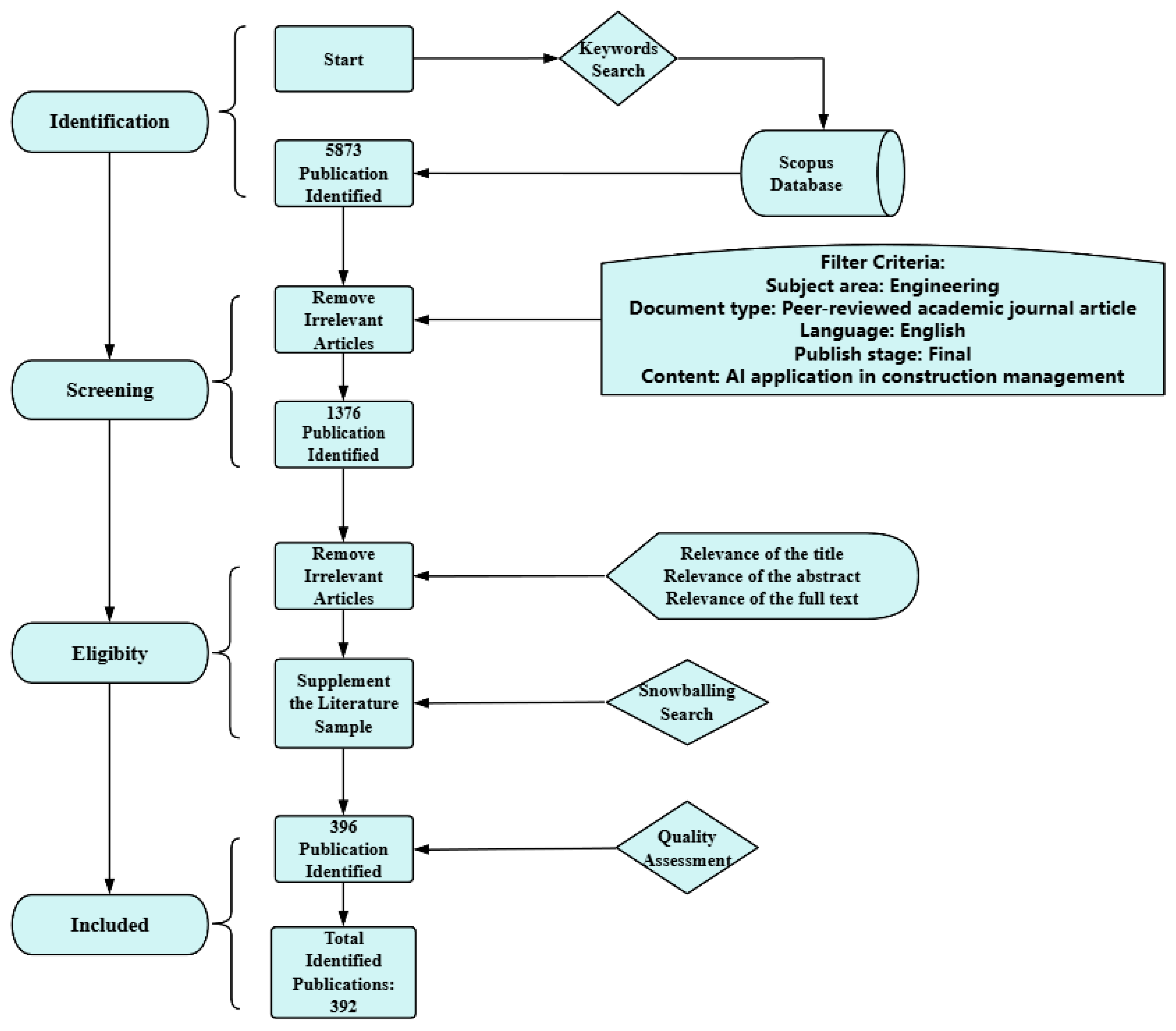
This paper adopted a systematic literature review approach to achieve the aforementioned research objectives by following the Preferred Reporting Items for Systematic Reviews and Meta-Analyses (PRISMA) approach [25]. The PRISMA approach was chosen because it can reduce bias and improve transparency during literature selection [26]. It consists of four main steps: (1) literature search and identification, (2) literature screening, (3) eligibility, (4) quality assessment, and included articles. Figure 1 shows an overview of the research process.

2.1. Literature Search and Identification

The first step is to search and identify published articles related to the studied research domain—the application of AI in construction project cost, time, and safety management. The primary search engine employed in this paper was the Scopus database. Compared to other digital databases such as Web of Science, Scopus provides broader journal coverage and more up-to-date indexing [27]. It includes over 21,500 peer-reviewed journals, 7.2 million conference papers, and more than 60 million documents [28] and is known for its faster indexing speed relative to many competitors [29]. Scopus also offers advanced keyword search and citation analysis features, making it especially valuable for interdisciplinary studies [30]. Its extensive indexing of engineering, management, and built environment journals enhances its representativeness for construction management research [14]. Accordingly, Scopus was deemed the most suitable data source for the present research. On the other hand, this paper selected specific keywords or search strings by analyzing keywords used in other published articles for the reliable identification of pertinent articles. As such, Google Scholar was employed to find relevant articles to determine some keywords. It is known that Google Scholar is the search engine with the highest coverage of literature [30]. It is an effective tool for identifying similar keywords from previously published articles.
Table 1 shows the keywords of construction project management domains used in the Scopus database. As shown in Table 1, this paper identified the main and secondary keywords from the existing literature in construction cost, time, and safety management. In the cost management domain, the main search keywords include “cost overrun”, “cost control”, and “cost management”. Similarly, the main keywords in the time management domain include “time overrun”, “delay”, and “time management”. Lastly, “safety management”, “safety risk assessment,” and “safety climate” were the main search keywords in the safety management domain. These keywords were selected because they are not only the essential components of project cost, time, and safety management, but also because they connect with one another. For example, time overrun is a key aspect of construction time management, and it can lead to increased time-related costs, third-party claims, disputes, and a decline in productivity [31]. In addition, safety risk assessment is an essential component of safety management in construction projects, and it is also closely associated with project costs [32]. Moreover, the main keywords were combined with secondary keywords such as “construction” and “AI” and linked with the Boolean operator “AND”. Then, these search strings were used to search for relevant articles in the Scopus database. Notably, the search was conducted in January 2026; thus, the literature search only included articles published from 2013 to January 2026. Consequently, 5873 literature documents were identified in the Scopus database.

2.2. Literature Screening

After identifying 3611 literature documents from Scopus, the results were screened according to the criteria shown in Table 2. Firstly, the subject area was limited to “engineering” because the construction industry is crucial to the economic development of every country. For example, the rate of economic growth of a country can be measured by the level of development of its physical infrastructure. Moreover, construction project management involves numerous stakeholders, multiple processes, and different project life cycle stages to achieve project completion on time, cost, and safety [23]. Therefore, it is meaningful to study how AI affects the management of highly complex construction projects. Secondly, only peer-reviewed journal articles were selected to ensure an accurate and reliable literature dataset. It is stated that peer-reviewed journals remain the most trusted scientific articles to determine the professionalism and reliability of academic sources, citations, and publications in the digital age [33]. Therefore, selecting only peer-reviewed journal articles can maximize the reliability and scientific nature of the research dataset, thereby enhancing the professionalism, accuracy, and value of the research. Thirdly, the language of the articles was limited to “English”, and the publication period of the literature documents was selected from 2013 to 2026 (Until January). Since the concept of Industry 4.0 was first proposed by Germany in 2012, the fourth industrial revolution has been promoted by various countries globally [34]. As such, this paper focuses on published articles in the past twelve years after the concept of Industry 4.0. It would be meaningful to explore the application areas and challenges of AI technologies in construction cost, time, and safety management in the past 12 years, since the beginning of the Industry 4.0 era. Lastly, this paper only focuses on published articles available online (i.e., articles in the final stage). After screening, 1376 articles were obtained.

2.3. Eligibility

At this stage, two independent reviewers (YG and MAA) read the title, abstract, and full text of 1376 published articles to exclude irrelevant articles that are outside the scope of the studied topic. To resolve any discrepancies, the two reviewers scheduled an online meeting to discuss our differences and to reach a consensus. The first stage of the eligibility criteria is to read titles and abstracts of 1376 articles. The second stage was full-text reading, where the contents of the abstract do not provide adequate information to either include or exclude an article. In both stages, the two independent reviewers carefully followed these eligibility criteria: (1) the article must be related to a branch of AI technologies; (2) the research theme of the article must be applied in the construction industry; and (3) the subject area of the article must be involved in either cost management or time management, or safety management. Articles were excluded if they did not meet all the eligibility criteria. For instance, a study by Pfitzner et al. [35] focused on cost management and time management in the construction sector, but was excluded because the technology applied was a digital twin. In addition, the search results were supplemented by a snowballing approach. As a result, 396 articles were obtained in the dataset.

2.4. Quality Assessment and Included Articles

A detailed quality assessment process was required to ensure the quality of the selected articles. A checklist covering the assessment factors was used as a quality tool for conducting a quality assessment [36] and has been reported in previous studies [37]. The quality assessment of the included articles can further examine the data to ensure the accuracy and reliability of the research process and results. Moreover, the assessment results may contribute to interpreting differences in research results [36]. Therefore, the quality assessment checklist shown in Table 3 was used as the quality assessment tool in this paper. To conduct quality assessment, two independent reviewers (i.e., YG and MFAA) assessed 396 articles, and any disagreements were resolved through consensus during a meeting. In cases of disagreement or uncertainty, a third reviewer (YH) was consulted to serve as a moderator, and consensus was reached through discussion during a meeting. This process was adopted to minimize potential bias and ensure the consistency and reliability of the quality assessment. The assessment weights include 0, 0.5, and 1, representing the article failed to answer a question, partially addressed a question, and fully met a question, respectively. Articles that achieved more than 70% of the quality assessment were accepted. In this study, 4 articles were excluded. This threshold has been widely adopted in previously published high-quality systematic literature reviews to ensure an appropriate balance between methodological rigor and inclusiveness of the evidence base [14,26]. Finally, a total of 392 identified articles were included in the research dataset. Then, the research contributions as well as the research gaps and future research directions of AI technologies in construction project cost, time, and safety management were explored.

3. Results

3.1. Annual Publication Trends

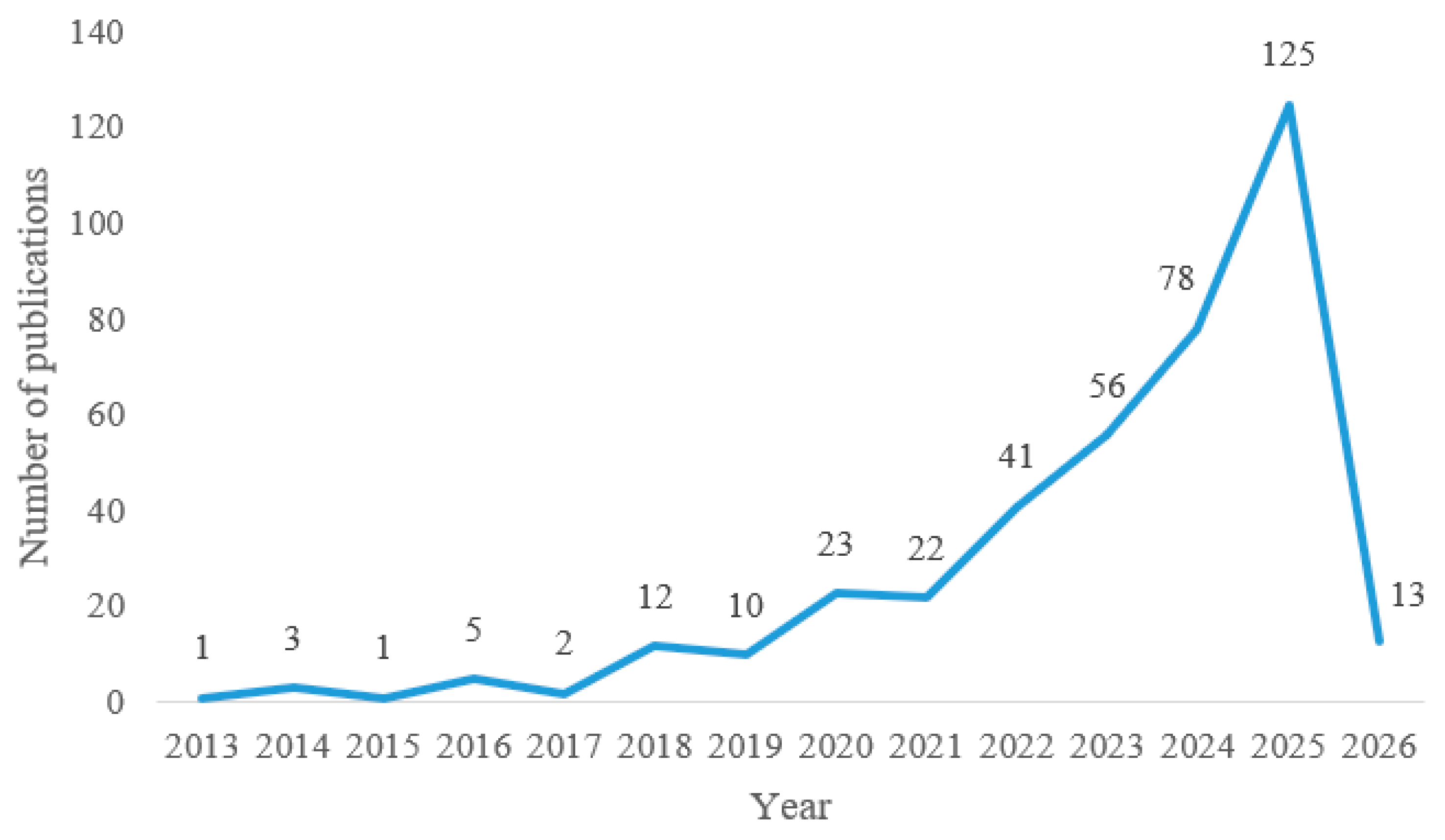
An overview of the articles included was first conducted from the perspective of publication year, as illustrated in Figure 2. The annual publication trend of journal articles from 2013 to 2026 was analyzed. Overall, the number of publications related to AI technologies in construction project cost, time, and safety management exhibits a clear and sustained upward trend over the past decade, indicating rapidly growing academic interest in this research area.
In the early stage from 2013 to 2017, the annual number of publications remained very limited, consistently below 10 articles per year. This period corresponds to the initial exploratory phase following the introduction of the Industry 4.0 concept in 2012, during which AI applications in the construction industry were still emerging and lacked widespread adoption. A noticeable growth phase began after 2018, with the number of publications increasing from 12 in 2018 to 23 in 2020 and 22 in 2021. The growth accelerated significantly from 2022 onward. In 2022, 41 journal articles were published, representing an increase of approximately 86% compared to 2021. This rapid expansion continued in subsequent years, with 56 articles published in 2023 and 78 in 2024. The publication output reached its peak in 2025, with a total of 125 journal articles, nearly doubling the number reported in 2024. This sharp increase reflects the maturation of AI methodologies, improved data availability, and their expanding integration into construction project management practices. It should be noted that the number of publications in 2026 (13 articles) is relatively low, as the data only cover the early part of the year. Therefore, this figure does not indicate a decline in research interest but rather reflects the incomplete publication cycle. Overall, the observed trend demonstrates that AI-driven research in construction cost, time, and safety management has entered a phase of rapid development and is expected to maintain strong growth momentum in the coming years.

3.2. Mainstream AI Technologies in Construction Project Cost, Time, and Safety Management

Based on the retrieved articles, this paper identifies the mainstream AI technologies in construction project cost, time, and safety management through a qualitative discussion of the included articles. Table 4 summarizes the application areas, AI technologies, results, and findings of selected articles in construction project cost, time, and safety management. The following sections discuss the mainstream application areas within each domain and the associated AI technologies.

3.2.1. Construction Project Cost Management

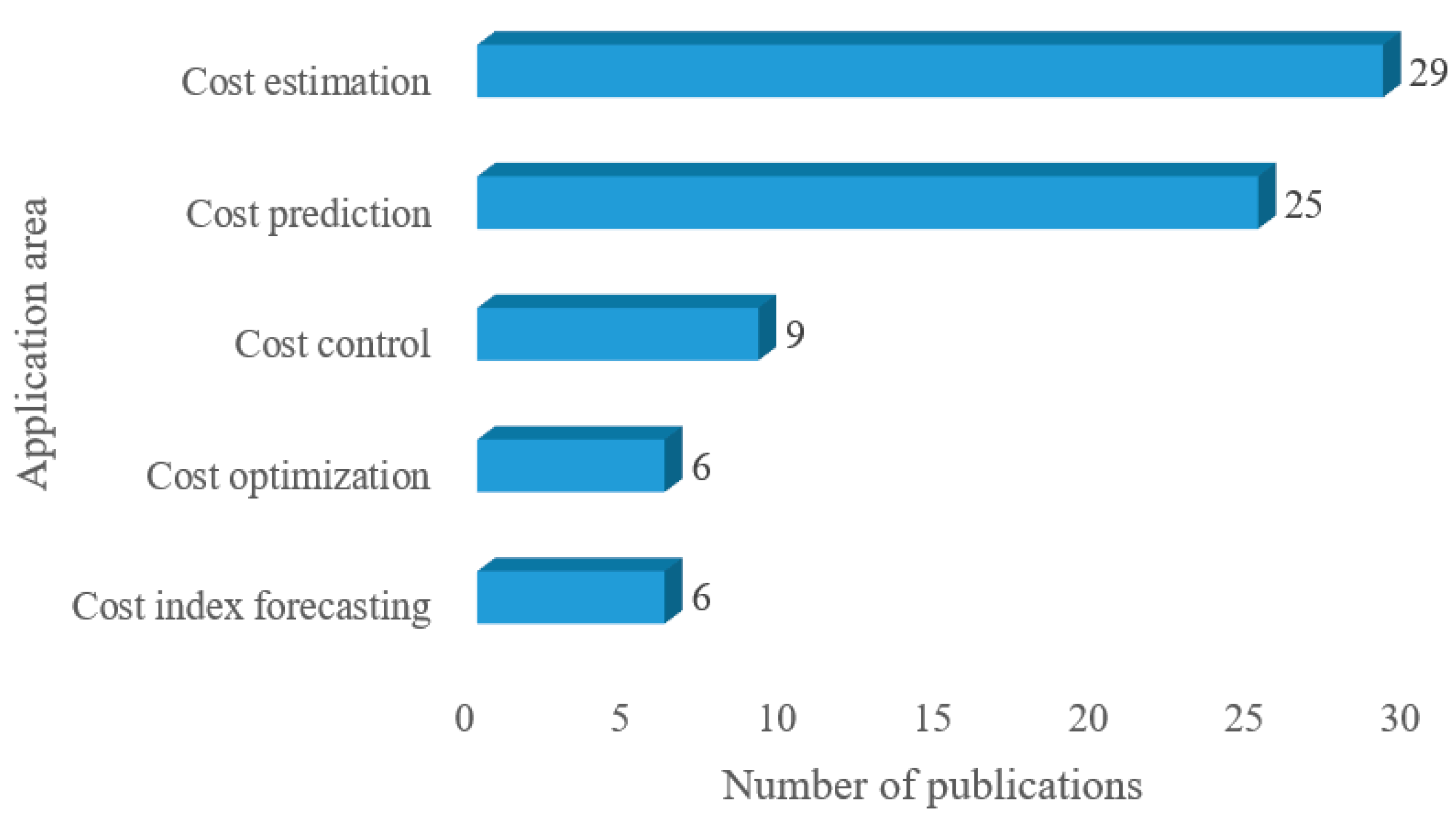
Figure 3 illustrates the application areas of AI technologies in construction project cost management. The results shown in Figure 3 were obtained by classifying and counting the cost management application areas in the research database. In the included articles, AI technologies were applied in five application areas of construction cost management, such as cost estimation, cost prediction, cost index forecasting, cost control, and cost optimization.
Cost Estimation
According to the retrieved articles, cost estimation had the highest number of articles on AI technologies in project cost management. Cost estimation is one of the factors influencing successful project delivery, and applying various AI technologies can improve estimation capability and performance. In construction, the difference between estimated and actual costs is one of the challenging issues in cost management [71]. Rafiei and Adeli [38] proposed a construction cost estimation model that integrates advanced ML algorithms, including deep Boltzmann machine (DBM) and back-propagation neural network (BPNN). By incorporating economic variables and indices (EV&Is), the model aimed to enhance prediction accuracy. Their study utilized data from 372 low- to mid-rise buildings (3–9 stories) in Tehran, Iran. Results indicated that the proposed DBM-BPNN model outperformed traditional BPNN-only and support vector machine (SVM)-only models, significantly reducing estimation errors. Specifically, the DBM-BPNN model achieved mean square error (MSE) values ranging from 0.021 to 0.125, depending on the ratios of training to verification data and the network architecture. Furthermore, SVM and random forest (RF) algorithms have been applied in construction cost estimation [72]. SVM is often used as a core algorithm to develop construction cost estimation models, including bridge construction cost estimation [73] and periodic cost estimation [39]. Moreover, Abed et al. [40] developed a conceptual cost estimation model for early-stage road construction projects using several ML algorithms, including RF, K-Nearest Neighbours (KNN), ridge regression, and LASSO regression. Their study introduced a new dataset tailored for road construction cost prediction. Among the tested models, ridge regression demonstrated the highest performance, achieving an R2 score of 1.0, a mean absolute percentage error (MAPE) of 0.00, and a root mean square error (RMSE) of 0.00. Cost estimation is critical throughout the project life cycle and can impact project feasibility decisions. Thus, Sanni-Anibire et al. [71] employed an integrated technique of multiple ML algorithms, including multi-linear regression analysis (MLRA), KNN, SVM, and artificial neural network (ANN), to develop a cost estimation model for high-rise building projects. Moreover, the case-based reasoning (CBR) approach has received attention recently as an emerging application in conceptual cost estimation [74]. In addition to ML algorithms, natural language processing (NLP) [75] and DNN [76] techniques have been used to automate construction cost estimation.
Across the reviewed studies, cost estimation applications of AI are mainly based on supervised learning models, with ANNs and kernel methods such as SVM and RF being most frequently adopted. This trend reflects the complex and nonlinear relationships between project characteristics and construction costs. Although many studies reported high prediction accuracy, most models are developed using project-specific or region-specific datasets, often with relatively small sample sizes. Consequently, model performance is usually demonstrated under limited conditions, and evidence regarding applicability across different project types or contexts remains insufficient. Overall, existing studies tend to place greater emphasis on improving prediction accuracy than on examining model robustness and broader applicability.
Cost Prediction
It was revealed that about 18 articles have demonstrated how AI technologies can be applied to cost prediction. In cost management, cost prediction from past cases or historical data is essential when the actual cost values are unknown. Therefore, improving cost prediction using AI technologies is a theme of the digital age. ML algorithms have been used to design construction cost prediction models [77]. This is because ML algorithms can maximize the predictive performance of models. Construction cost overrun prediction is one of the research areas that has attracted experts’ and researchers’ attention. Arabiat et al. [41] and Al Mnaseer et al. [42] developed ANN-based models to estimate construction cost overruns, thereby enhancing project managers’ decision-making. Arabiat et al. [41] employed both ANN and KNN algorithms, finding that the ANN model achieved superior performance (R2 = 0.9913; RMSE = 0.021) compared to the KNN model (R2 = 0.9233; RMSE = 0.1304). Al Mnaseer et al. [42] integrated Tabu Search optimization with ANN to further enhance prediction accuracy. Their optimized model achieved R2 values of 0.9385 for both cost and time overrun predictions, with corresponding mean absolute error (MAE) values of 0.0033 and 0.8590, respectively. These results underscore the potential of advanced ML algorithms to improve the accuracy of overrun forecasts and reduce uncertainty in construction project management. In addition, decision tree (DT) [78] and CBR [79] have provided further developments in the performance of construction cost prediction. In summary, cost prediction applications based on AI technologies can help managers and stakeholders improve the accuracy of their decisions in practice [77].
AI-driven cost prediction models, especially those targeting cost overruns, provided effective tools for identifying deviation risks during project execution by leveraging historical patterns and intermediate project data. Their main limitation lies in the strong dependence on the quality and completeness of past records, as well as sensitivity to changing project conditions and external factors that are difficult to model explicitly. These approaches may be best suited for mid- to late-stage monitoring and risk warning applications, where historical trends can inform managerial decisions rather than serve as definitive cost controls.
Cost Index Forecasting
The predictive performance of ML algorithms is also utilized in cost index forecasting. Wang and Ashuri [44] mainly used two ML algorithms (i.e., KNN and PERT) for medium and long-term forecasting of construction cost indices, finding cost estimator methods with better budgetary performance. Cao and Ashuri [80] proposed new approaches for applying AI algorithms in cost index forecasting. They proposed long short-term memory (LSTM) models that provide more accurate cost index predictions for road construction. They successfully solved the prediction challenge when faced with highly volatile cost data. Accurate forecasting of cost indices is critical for improving construction cost estimation [44]. In their study, Wang and Ashuri [44] applied KNN and program evaluation and review technique (PERT) algorithms to enhance predictions of the Engineering News-Record (ENR) and Construction Cost Index (CCI). Both approaches significantly outperformed traditional time series models across short-, mid-, and long-term forecasts. For short-term predictions, the KNN algorithm achieved an MAPE of 0.19%, MSE of 443, and MAE of 18. In mid-term forecasts, the PERT algorithm performed best, with a MAPE of 0.28%, MSE of 1291, and MAE of 32. For long-term predictions, the KNN algorithm yielded a MAPE of 0.78%, MSE of 9138, and MAE of 70. These findings demonstrate the effectiveness of ML algorithms to enhance cost index forecasting, thereby improving overall cost estimation accuracy in construction. The progression from simple quantitative methods to AI technologies for cost index forecasting has significantly improved predictions’ accuracy, flexibility, and adaptability.
Machine/deep learning models such as KNN and LSTM outperform traditional time series approaches in cost index forecasting, particularly in capturing nonlinear patterns and market volatility. KNN performs well in short- and long-term forecasting with relatively simple structures, while LSTM better captures temporal dependencies in dynamic data. However, both approaches rely heavily on stable historical records, which limits robustness under sudden market shifts. Therefore, ML or DL-based cost index forecasting is most suitable in contexts with reliable historical data and where medium- to long-term budgeting decisions require improved predictive accuracy rather than real-time control.
Cost Control
Due to the likelihood of programme changes in construction projects, cost control is a critical step in ensuring the successful delivery of the project within budget. In recent years, applying AI technologies to cost assessment and control has become a new research direction. Mohammed et al. [45] applied ANN, multi-linear regression (MLR), and SVM to improve earned value management (EVM) in construction projects. EVM is a project control method that tracks cost, schedule, and scope using key performance indicators such as schedule performance index (SPI), cost performance index (CPI), and to-complete performance index (TCPI). Their results showed that ANN and SVM provided more accurate predictions than MLR. ANN achieved average accuracy rates of 83.09% for SPI, 90.83% for CPI, and 82.88% for TCPI. SVM obtained 94.12% for SPI, 71.76% for CPI, and 84.82% for TCPI. Although MLR showed higher average accuracy—95.89% for SPI, 96.89% for CPI, and 95.91% for TCPI, ANN and SVM had lower MAPE, indicating better predictive performance. Cost control can help project managers to effectively manage costs, measure cost performance, and make cost control decisions. Yi and Luo [46] developed an AI-driven construction cost estimation and control analysis model using deep neural network (DNN) to analyze real-world data and identify key cost components. Their findings significantly improved both the efficiency and accuracy of cost estimation. The model achieved an accuracy ratio of 98.7%, a prediction ratio of 97.9%, and reduced the error rate to 9.8%, outperforming existing models in construction cost control.
Compared with cost estimation and prediction, AI applications in cost control focus more on supporting managerial decisions during project execution. Most studies have integrated predictive models with EV indicators such as SPI, CPI, and TCPI, reflecting a shift toward performance monitoring rather than standalone prediction. However, evaluations often rely on overlapping accuracy metrics and retrospective datasets, with limited discussion of real-time implementation and adaptability. As a result, AI in cost control remains primarily analytical rather than fully operational.
Cost Optimization
The main objective of cost optimization in construction project management is to ensure the project’s successful implementation while reducing the project cost, thereby increasing its overall profitability. However, cost optimization techniques in the past have been limited by subjectivity or bias towards error since they mainly rely on subjective judgment from experts and historical data [48]. Varouqa [47] applied ANN to address qualitative and quantitative challenges in cost optimization for prefabricated construction projects. Compared with ant colony optimization (ACO), the ANN model showed lower error values, indicating improved cost optimization accuracy and shorter project duration. Almahameed and Bisharah [48] explored AI algorithms such as linear regression, DT, SVM, gradient boosting, RF, KNN, convolutional neural network (CNN), and particle swarm optimization (PSO). Their integrated model achieved an RMSE of 0.3179, an MAE of 0.6234, and an R2 of 0.9989. These results demonstrate strong potential for enhancing decision-making, improving project performance, and increasing profitability in construction.
AI-based cost optimization improves decision accuracy by reducing subjectivity inherent in traditional expert-driven methods. ANN and hybrid models can effectively handle both qualitative and quantitative variables. Nevertheless, many models are validated on specific project types and limited datasets, restricting broader applicability. In practice, these approaches are most suitable for projects with clearly defined cost parameters and sufficient historical data to support structured optimization and cost–performance trade-offs.

3.2.2. Construction Project Time Management

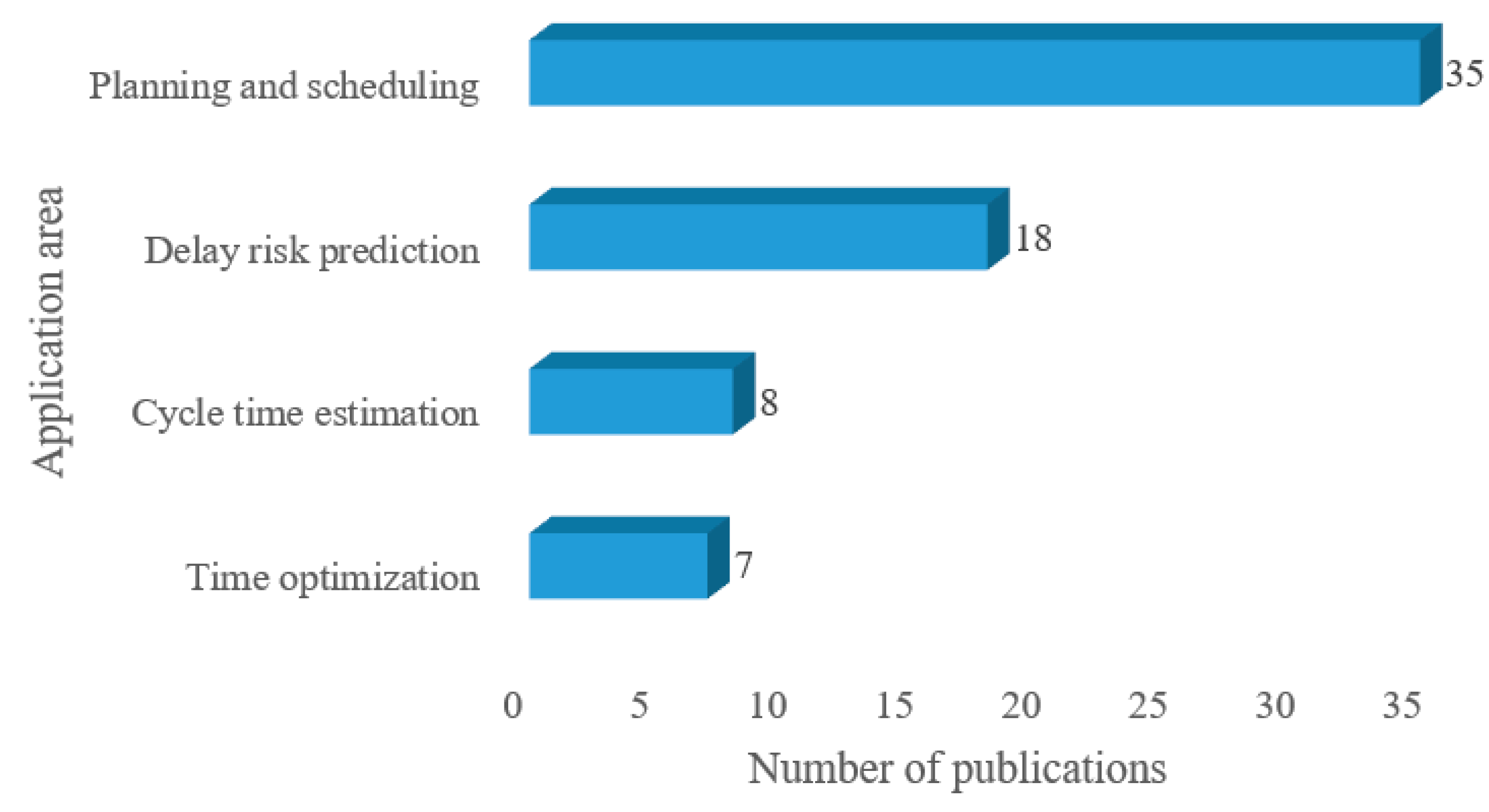
Figure 4 presents application areas in construction project time management based on AI technologies. As shown in Figure 4, AI technologies were applied in many construction project time application areas during the studied period. They include planning and scheduling, delay risk prediction, time optimization, and cycle time prediction.
Planning and Scheduling
According to the application areas in construction time management (see Figure 4), developing relevant AI technologies within planning and scheduling has become a mainstream research direction. Project schedule management contributes significantly to ensuring that projects are completed on time. Particularly in construction projects with a multi-party collaborative nature, construction scheduling is a complex and challenging task. Most construction projects suffer from schedule delays, which is a chronic problem present in the global construction industry. It has been reported that ineffective scheduling is one of the top ten reasons for project delays [81]. Achieving automated construction schedule planning and management has also been explored for a long time [82]. Therefore, applying various types of AI technologies to construction project schedule management to enhance the project’s overall efficiency has become a topic of great concern. Previous studies have used AI technologies such as genetic algorithm (GA) [83], RF [84], ANN [52], and reinforcement learning (RL) [50] to improve schedule management and monitoring. Faghihi et al. [82] conducted a review study in construction schedule automation from 1985 to 2014, finding that GA was the primary AI technology used to mitigate scheduling challenges as compared to other AI technologies. Other studies have combined ML algorithms with NLP to design solutions to project scheduling management problems [52]. Yan et al. [49] developed a model combining computer vision (CV) and earned duration management to monitor and evaluate construction schedules in prefabricated buildings. Their model achieved an MAPE of 9.3%, an average absolute error of 0.066, and a predicted project duration of 509.52 h, demonstrating high accuracy. Kedir et al. [50] applied a hybrid method integrating RL and agent-based modeling (RL-ABM) to optimize project durations and support planning decisions. The RL-ABM approach improved project duration by 15% in two case studies and matched the performance of GA and PSO in a third case, achieving a project duration of 64 days. Prieto et al. [51] employed NLP from a generative pre-trained transformer (GPT) model to generate and optimize construction schedules based on user inputs. Their results showed that ChatGPT 5.2 produced coherent task breakdowns, offered a positive user experience, and kept task duration deviations within 1 day and worker count deviations within 2, indicating strong potential for schedule automation.
Across the reviewed studies, applications of AI in planning and scheduling increasingly focus on improving automation and adaptability in project scheduling tasks. Earlier studies mainly relied on optimization-oriented approaches to generate schedules or reduce project duration, while more recent work integrates learning based methods to support dynamic planning and progress monitoring. This reflects a gradual shift from static schedule optimization toward data-driven and adaptive scheduling support. However, most proposed approaches are developed and validated under controlled or simplified project settings, with limited consideration of uncertainty, coordination complexity, or changing site conditions. As a result, while methodological diversity has increased, evidence of robustness and scalability in real project environments remains limited.
Delay Risk Prediction
Several studies have focused on developing AI technologies for predicting construction project delay risk [55]. Project delays are a common phenomenon in the construction industry, and the negative impacts caused by project delays are multifaceted. Therefore, it is essential to upgrade delay risk analysis methods with more advanced techniques to reduce the occurrence of delays. Gondia et al. [54] developed delay risk prediction models using DT and Naive Bayes (NB) algorithms. The DT model achieved a training accuracy of 74.5% and a testing accuracy of 47.2%, with misclassification errors of 25.5% and 52.8%, respectively. The NB model achieved 78.4% training accuracy and 51.2% testing accuracy, with misclassification errors of 21.6% and 48.8%. These models were effective for small datasets with conditionally independent variables. Shirazi and Toosi [55] developed a delay risk prediction model based on a deep multilayer perceptron neural network (Deep-MLP-NN). Their model achieved 94.36% accuracy, 93.81% F1-score, 95.85% precision, 94.07% recall, and a kappa coefficient of 91.36%. It significantly improved prediction performance by capturing complex non-linear patterns, demonstrating the strong potential of DL for delay prediction in Iranian dam construction projects. These studies provided new approaches to delayed risk prediction for project time management to better assist project managers in making project decisions. Moreover, Arabiat et al. [41] and Al Mnaseer et al. [42] used KNN and ANN algorithms to design a time estimation model to predict project completion time and support project decision-making.
Studies on delay risk prediction show a consistent emphasis on using supervised learning models to identify delay likelihood based on historical project attributes and risk factors. Common patterns include the use of classification-oriented models to distinguish delayed and non-delayed projects, as well as the reliance on structured project data. Although several studies reported strong prediction performance, results are often derived from relatively small or context-specific datasets, which constrain broader applicability. In addition, many models prioritize prediction accuracy, with less attention given to interpretability or practical use in early decision making. This indicates that existing research has mainly addressed the detection of delay risks, while the translation of prediction results into proactive time management actions remains underexplored.
Time Optimization
For a time optimization application, GA has been applied as an optimization tool in conjunction with the fast-track method [56]. They reported an average project duration reduction of 40.48% in Case I and 18.59% in Case II compared to traditional methods. When integrated with BIM [57], GA shortened project duration by approximately 20%, completing it in 344 days for $1,253,360, compared to the standard 439 days and $1,271,306. Additionally, Kulejewski and Rosłon [58] combined metaheuristic algorithms with ANN to optimize construction schedules from a sustainability perspective. Their solution was first refined through a metaheuristic algorithm and then further by nearly 11% using the approach for the multi-mode resource-constrained project scheduling problem with an ANN (AMTANN) procedure. This improved the net present value (NPV) from 27,822 to 27,915 and the sustainability value index (SVI) from 0.9761 to 0.9910. The proposed model demonstrated strong adaptability to the complex requirements of time management in construction projects.
Time optimization methods based on AI and metaheuristic algorithms demonstrate strong capability in reducing project duration and improving resource allocation under defined constraints. Nevertheless, their performance is highly sensitive to model assumptions, parameter settings, and project-specific objectives, which restricts generalization across different construction contexts. These approaches are therefore most applicable to scenario-based optimization and planning-stage analysis, where alternative scheduling strategies can be evaluated before implementation rather than adjusted continuously during construction.
Cycle Time Estimation
Construction projects usually involve large equipment. Hence, the productivity of workers and equipment needs to be estimated for project management. However, the equipment’s cycle time and total consumption time would be less accurately estimated when relying on human experience or manual equipment description [85]. Therefore, Sabillon et al. [59] developed a cycle time estimation system using SVM and Bayesian algorithms to forecast long-term operation times. Their system leverages audio signal processing and Markov chain-based filters to provide accurate multi-day cycle time predictions. It achieved an average accuracy of 85.14% for activity classification using SVM. While it demonstrates the potential of AI in cycle time estimation, further research is needed to support broader and more integrated applications.
AI-based cycle time estimation improves productivity assessment by enabling automated activity recognition through SVM, Bayesian models, and signal processing techniques. The integration of audio data and probabilistic filtering enhances the detection of repetitive operational patterns and multi-day performance trends. However, performance depends on controlled sensing conditions and clear activity signals, limiting robustness in noisy or highly variable site environments. Therefore, AI-driven cycle time estimation is most suitable for equipment-intensive operations with repetitive cycles and reliable sensor data, where automated monitoring can support data-informed time management decisions.

3.2.3. Construction Project Safety Management

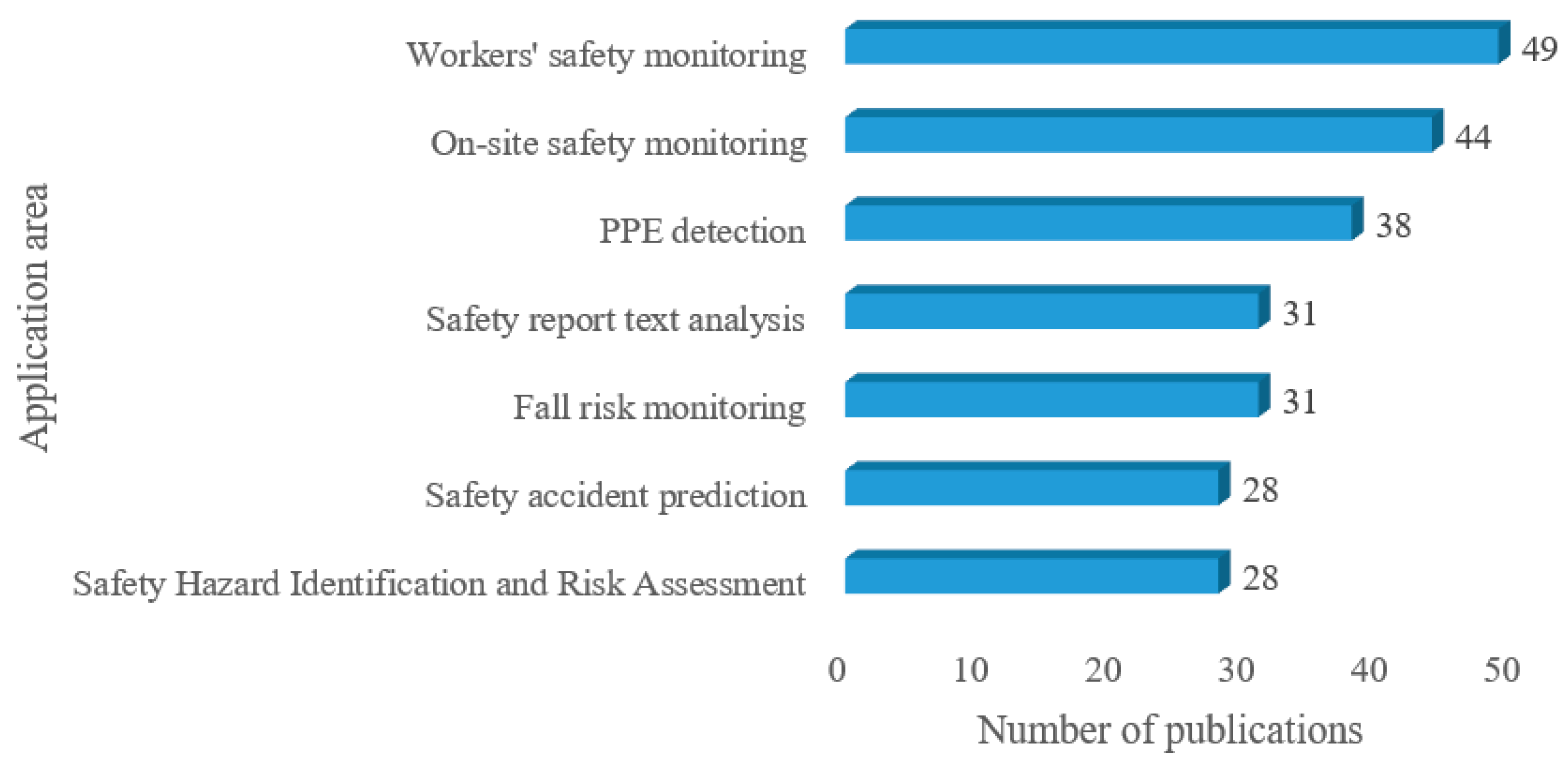
Figure 5 shows the application areas of AI technologies in construction safety management. According to Figure 5, the application areas of AI technologies in construction safety management can be categorized into seven main directions. They include worker safety monitoring, on-site safety monitoring, personal protective equipment (PPE) detection, safety report text analysis, fall risk monitoring, safety incident prediction, and safety hazard identification and risk assessment.
Worker Safety Monitoring
As indicated in Figure 5, worker safety monitoring is one of the critical areas of applying AI technologies in construction project management. Ensuring worker safety is challenging due to the dynamic and task-complexity of construction activities and on-site environment [60]. It has been demonstrated that the most crucial aspect of safety detection for workers is monitoring unsafe worker behaviour. The source of most safety accidents is either directly or indirectly related to unsafe behaviour of construction workers [86]. Therefore, automated monitoring of construction workers’ unsafe behaviour is an essential task. However, relying on manual efforts to observe and identify unsafe behaviours has several limitations, such as data collection time, data reliability, and the need for active worker cooperation [87]. As a result, there is a trend to create automated unsafe behaviour recognition models using AI technologies. Ding et al. [60] developed a hybrid DL model combining CNNs and LSTM to automatically detect hazardous worker behaviours. Their model achieved 97% accuracy in distinguishing safe and unsafe actions, and 92% accuracy in identifying four specific action types. Fang et al. [61] introduced a CV and DL approach that not only detects unsafe behaviours but also links them to corresponding safety rule violations. Their model achieved a precision of 97% and a recall of 90% for a specific category of unsafe behaviour. These studies demonstrate the effectiveness of CV-based AI in monitoring dangerous behaviour and enhancing safety management on construction sites. As Khan et al. [86] stated, CV is one of the leading technologies for monitoring construction workers’ behaviour. However, they suggested that using CV technology for workers’ monitoring and detection has limitations, such as real-time occlusion. As such, they proposed a vision and sensor-based monitoring solution. Additionally, monitoring workers’ fatigue levels using wearable sensors is a measure to ensure their H&S [88]. By using CV, wearable sensors, supervised ML, and DL algorithms, previous studies have monitored and predicted workers’ physical fatigue [88], mental fatigue [89], and work-related risk factors and activity recognition [90]. For example, Yu et al. [62] developed a novel non-intrusive method to monitor the whole-body physical fatigue of construction workers using a CV-based 3D motion capture algorithm and biomechanical analysis. Their method can provide joint-level physical fatigue assessments automatically. The mean error of the 3D location of each joint is 3.90 cm, with a standard deviation of 1.59 cm. Their method can provide real-time joint capacity and fatigue index during tasks, which helps to understand the fatigue development process and improve occupational H&S in the construction industry.
Across the reviewed studies, worker safety monitoring is primarily driven by vision-based methods and DL models aimed at recognizing unsafe behaviors, fatigue, and work-related risk factors. A clear pattern is the emphasis on behavior level detection, reflecting the widely acknowledged role of unsafe actions in construction accidents. Many studies reported high recognition accuracy under controlled conditions, indicating the technical feasibility of automated monitoring. However, performance is often affected by practical constraints such as occlusion, lighting variation, and dynamic site environments. In addition, most systems are evaluated in limited scenarios or short time windows, while issues related to long-term deployment, worker acceptance, and integration with site management practices remain insufficiently addressed.
On-Site Safety Monitoring
Although safety management in the construction industry has been progressing, construction sites are still one of the work environments with high risk [91]. Due to the dynamic and complex activities undertaken on construction sites, workers’ safety is highly vulnerable in on-site environments. Therefore, it is still challenging to prevent accidents and injuries on construction sites. Many researchers have studied workers’ safety by enhancing real-time safety monitoring at construction sites [91]. In particular, applying CV techniques to on-site safety monitoring would enhance the feasibility of safety management systems to accurately detect the locations of workers and equipment [91], equipment posture [92], and workers’ behavioural characteristics [63]. For example, Yang et al. [63] proposed a transformer-based DL model, STR-Transformer, which achieved average precision scores of 88.7% with 8-frame inputs and 86.6% with 16-frame inputs for identifying unsafe worker actions in videos. By incorporating a relative position feature fusion model, the model improved average precision by 2.5% over the baseline. It operates at 202.3 floating-point operations with an inference time of 0.061 s per clip. Furthermore, the use of multimodal data (RGB + RGB difference frames) enhanced recognition accuracy by 2.8% compared to red, green, and blue (RGB)-only inputs. In addition, DL and fuzzy inference techniques have been used to assess on-site safety level, providing real-time safety warnings to workers when a low safety level is monitored [91]. Safety monitoring systems using CV and DL algorithms can perform automatic analysis and processing of images and videos. The efficiency and real-time safety management of construction projects can be improved by widely installing on-site surveillance cameras [92]. However, CV-based safety monitoring can be affected by some external factors such as sunlight and weather conditions. Kang et al. [64] pioneered the integration of weather variation parameters into outdoor construction safety monitoring systems to enhance model performance under five weather conditions, including light, dark, rain, snow, and fog. They employed a one-stage instance segmentation model, YOLACT, combined with weather augmentation. This approach improved the mean average precision (mAP50:95) to 0.755 ± 0.009 while maintaining a high frame rate of 19.2 ± 0.04 FPS, significantly enhancing the practicality of on-site camera-based safety monitoring in construction project management.
On-site safety monitoring research emphasizes real-time analysis of workers, equipment, and spatial interactions within dynamic construction environments. Vision-based and multimodal approaches enable continuous detection of unsafe situations, proximity risks, and abnormal site states, demonstrating clear advantages for real-time situational awareness. Nevertheless, most existing systems are developed for predefined scenarios and relatively stable site layouts, with limited adaptability to rapidly changing construction conditions. As a result, current on-site safety monitoring applications are more suitable for risk alerting and supervision support than for fully autonomous safety management.
Personal Protective Equipment (PPE) Detection
PPE is the most frequently used safety control measure for safety management in construction projects [93]. However, the effectiveness of PPE as a safety measure is less predicted due to workers’ subjective awareness of equipment hazards. Therefore, several studies have applied AI technologies like ML and DL for PPE detection. Fang et al. [94] proposed an auto-detection method for safety measures based on DL and CV techniques to provide safety for workers performing work at height. Furthermore, Li et al. [93] designed a model based on DL that could identify the improper use of PPE without affecting the expected behaviour of individuals. Moreover, their study considered the effects of various visual conditions on PPE monitoring, including visual range, weather, lighting, personal posture, and occlusion. A safety helmet is an essential piece of equipment in the field of PPE because it protects workers’ heads. Therefore, monitoring safety helmets has been the focus of safety management research in construction projects. Fang et al. [94] and Wu et al. [95] have successively proposed automatic helmet wear detection methods based on CNN. With the popularity of vision-based helmet detection methods, Mneymneh et al. [96] created a regulatory framework based on CV technology to automatically and efficiently detect non-compliance with safety rules and regulations, especially the failure to wear a helmet. Hayat and Morgado-Dias [65] developed a real-time helmet-wearing monitoring system for construction sites to reduce safety risks. Using the YOLOv5x detection model, their system achieved a mAP of 92.44%, accuracy of 92.00%, precision of 92.44%, recall of 89.24%, and F1 score of 90.81%. It performed effectively even under low-light conditions and with small objects, demonstrating strong potential for real-time safety monitoring in construction environments.
AI-based PPE detection enhances compliance monitoring through CV and DL, enabling real-time identification of helmet use and working at height. These systems reduce manual supervision and support continuous monitoring under stable visual conditions. However, performance remains sensitive to occlusion, lighting variation, and camera positioning, and current research focuses predominantly on helmet detection rather than broader PPE detection. Accordingly, AI-driven PPE detection is most suitable for fixed-camera environments with consistent visual coverage, where automated compliance monitoring complements broader safety management strategies.
Safety Report Text Analysis
Another area where AI technologies were widely applied was analyzing safety report texts, including report analysis, classification of accident narratives, and causes of construction accidents. In the field of safety management in construction projects, it is crucial to analyze past accidents to reduce safety hazards in current projects and prevent similar events in the past from recurring. In the early stages of research, ML algorithms such as RF and SVM were applied to analyze safety reports and classify the causes of construction accidents, enabling the prediction of injury types. Tixier et al. [97] employed RF to classify construction incident narratives, achieving an F1 score of 0.95. Similarly, Goh and Ubeynarayana [66] used SVM for classifying accident narratives, reporting precision between 0.5 and 1.0, recall from 0.36 to 0.9, and F1 scores ranging from 0.45 to 0.92. In recent years, NLP and DL have been the dominant techniques applied to this field [98]. Moreover, NLP is frequently used in conjunction with text mining to extract and categorize causes from accident reports [99].
Fall Risk Monitoring
Fall risk monitoring is a mainstream application area of AI technologies, especially for falls from height accidents. Falls from height are recognized as the leading cause of injury and death [100]. Despite a series of policies, laws, and protective measures for the phenomenon of falls from height, it is still a prevalent problem in construction projects [100]. Therefore, one of the solutions is to use AI technologies to enhance safety monitoring behaviour of workers working at heights, thus effectively preventing fall-at-height hazards. Fang et al. [100] developed an automated CV-based method to monitor whether workers wear safety belts while working at heights. Furthermore, CV techniques and DL algorithms have been demonstrated to monitor work-at-height safety, especially mobile scaffolding safety detection [86]. In addition, Kolar et al. [67] developed a CNN-based safety guardrail detection model using transfer learning and data augmentation, achieving high accuracy in identifying guardrails on construction sites. The model attained an accuracy and F1 score of 96.5%, with a precision of 95.0% and a recall of 97.4%. These results underscore the effectiveness of CV and DL techniques in fall-at-height monitoring, enhancing on-site risk identification, and reducing the likelihood of fall-related incidents.
Safety Accident Prediction
Safety accidents are a significant challenge in construction safety management. It can cause large-scale casualties and property damage [68]. Previous studies have focused on discussing and discovering the predictability of accidents to prevent them from occurring [97]. Predictions of safety accidents have become possible with the rapid advancement of AI technologies. Tixier et al. [97] combined various ML algorithms to build models that can provide reliable probabilistic predictions of the possible outcomes in the event of an accident. However, their model had limitations in the prediction of injury severity. Baker et al. [101] improved the model of Tixier et al. [97] based on NLP and ML algorithms. Their new model efficiently predicted the likelihood and outcome of safety accidents, including the type of event, type of injury, body part, and injury severity. Zhu et al. [68] applied ML algorithms to predict the severity of accidents in construction projects. Their analysis identified accident type, reporting and handling procedures, and safety culture as the most influential factors affecting accident outcomes. Emergency management and safety training were also highlighted as critical subsystems for mitigating consequences and reducing accident frequency. Among the eight evaluated algorithms, AutoML achieved the highest F1 score of 84.4%, followed by logistic regression and NB, each scoring around 80%. These findings demonstrate the effectiveness of ML algorithms in classifying accident severity and underscore their potential to support proactive safety strategies in construction management. Furthermore, Choi et al. [102] used ML to create a prediction model for fatal accidents on construction sites based on accident victim data from 2011 to 2016. They identified month, employment size, age, number of days, and length of service as essential factors in predicting the likelihood of fatal accidents. Moreover, Koc et al. [103] combined discrete wavelet transform (DWT) and ML algorithms (e.g., ANN, multivariate adaptive regression splines, and support vector regression) to predict the number of safety accidents based on time series data. They developed a new research direction for construction safety management systems by combining it with a time series prediction model.
Research on safety accident prediction consistently applies supervised learning models to estimate accident likelihood or severity based on historical records and project attributes. Common trends include the use of classification models to distinguish accident outcomes and the increasing incorporation of text-based information from safety reports. While prediction results demonstrate promising accuracy, most models rely on retrospective data and are validated offline, which limits their direct applicability to real-time safety management. Moreover, prediction outputs are often treated as isolated results, with limited discussion on how they can inform preventive actions or intervention strategies. This suggests that existing studies have mainly focused on improving predictive capability, while the operational use of accident prediction for proactive safety control remains underdeveloped.
Safety Hazard Identification and Risk Assessment
Hazard identification is the foundation of safety management in construction projects [104]. Project managers can take timely and accurate precautions to prevent hazards from occurring with the ability to comprehensively identify safety hazards and accurately assess risks in construction projects. AI technologies have contributed to identifying safety hazards and risk assessment methods. By adopting ML, DL, and CV technologies, construction sites can implement dynamic management frameworks capable of automatically identifying safety hazards and conducting real-time ergonomic risk assessments [105]. Specifically, by integrating CV with a dynamic Bayesian network, Piao et al. [70] classified fall risks into low, medium, or high, on a second-by-second basis using inputs such as worker posture, PPE usage, and proximity to equipment. In a 93 s case study, the model issued medium-risk alerts when probabilities exceeded 52.3%, demonstrating its temporal accuracy and potential for proactive safety management. Furthermore, Ajayi et al. [106] applied DNN to enhance H&S management in the power infrastructure sector, providing models that help identify and predict H&S risks to support project managers in implementing safety strategy decisions.

4. Discussion

4.1. A Conceptual Framework Linking AI Applications Across Cost, Time, and Safety

AI technologies used in construction cost, time, and safety management share substantial methodological commonality, reflecting that these domains, although traditionally treated separately, rely on overlapping analytical techniques and data processing capabilities. As summarized in the earlier sections of this review, ML and DL models have been widely applied to cost estimation, prediction, and optimization [38]. Similar predictive and optimization techniques are also adopted for time management tasks, including delay prediction, schedule monitoring, and time optimization [54]. In the safety domain, DL and CV methods dominate applications such as unsafe behavior detection, PPE monitoring, and real-time site analysis [60]. These examples demonstrate a shared reliance on classification, prediction, optimization, and pattern recognition models across all three domains. However, the depth and maturity of AI applications are not evenly distributed across these domains [107]. Compared with cost and time management, safety-related studies are more numerous and often closer to real-world implementation, particularly in vision-based monitoring and on-site detection tasks [108]. This imbalance can be partly attributed to the availability of continuous visual and sensor data, the immediacy of safety risks, and the feasibility of deploying and validating safety-oriented systems in live site environments. In contrast, applications in cost and time management more frequently rely on retrospective or project-specific data, which constrains validation and slows the transition from experimental models to deployable solutions [109].
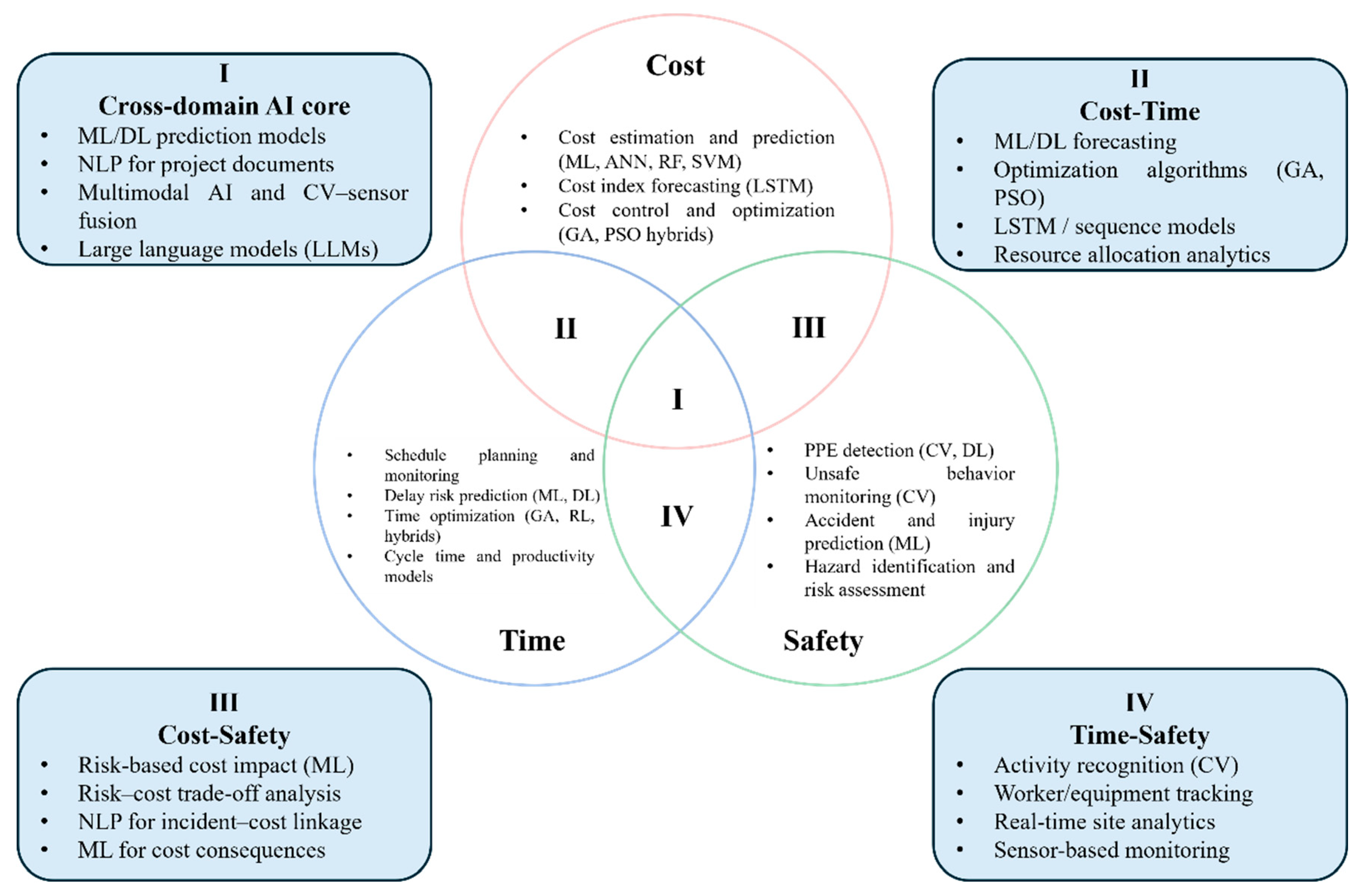
Figure 6 illustrates this methodological overlap through an integrated conceptual framework. Each circle represents one domain, cost, time, or safety, and highlights the AI techniques most frequently applied within that domain. The areas of intersection indicate where AI methods are simultaneously used across multiple domains. For instance, ML/DL-based predictive models commonly appear in cost forecasting [38], delay risk prediction [55], and safety accident prediction [97]. NLP techniques also show cross-domain relevance: they assist with extracting cost-related information from specifications [75], analysing schedule-related textual data [52], and classifying safety incident narratives [66]. Likewise, CV and sensor-based models are central to safety monitoring [60] and also contribute to time-related activity recognition and progress tracking [49]. The overlapping region in Figure 6 also reflects optimization algorithms, such as GA, PSO, and hybrid optimization frameworks, which appear across cost optimization [47], time optimization [57], and risk-based decision support. Beyond methodological commonality, these AI techniques provide a direct mechanism for addressing cost–time–safety trade-offs by formulating construction decision-making as a multi-objective optimization problem. Prior studies have shown that evolutionary and metaheuristic algorithms can explicitly balance competing objectives, such as minimizing project cost and duration while constraining safety risk levels or accident probabilities [110]. Similarly, recent building-scale and project-level studies demonstrate that integrating safety-related risk indicators into optimization and decision-support frameworks enables simultaneous evaluation of economic efficiency, schedule performance, and safety outcomes, rather than treating them as independent targets [111]. Overall, the methodological overlaps illustrated in Figure 6 highlight the potential for integrated AI systems that not only share analytical techniques but also support explicit cost–safety–time trade-off optimization, enabling more holistic and proactive decision support in complex construction environments.
Although the methodological overlaps illustrated in Figure 6 indicate potential for integrated AI systems, the level of practical maturity differs across domains. Cost-related applications are typically validated using retrospective data from completed projects, which supports offline analysis but limits real-time use [112]. Time-related studies are often examined through engineering-level case studies within individual projects, demonstrating feasibility under project-specific conditions [83]. In contrast, safety applications show clearer progress toward deployment. For example, an on-site case study at the Jinji Lake Tunnel implemented an AI-based safety early warning system using field monitoring data to support continuous risk assessment and timely intervention during construction [113]. Overall, these cases indicate that safety-related applications are generally closer to deployment, whereas many cost and time applications remain at a validation or pilot stage, highlighting that methodological overlap alone does not guarantee deployable integration.

4.2. Cross-Domain Synthesis and Challenges of AI Technologies in Cost, Time, and Safety Management

The integration of AI technologies with other digital technologies could enhance real-world applications for managing cost, time, and safety performance in construction projects. This cross-domain synthesis could allow project teams to simultaneously monitor and optimize different indicators of project performance. For instance, AI-driven models can forecast cost overruns by analyzing historical expenditure patterns and real-time financial data [110]. In the time domain, ML algorithms could enhance schedule reliability by predicting delays and dynamically adjusting task sequences based on project progress [111]. Regarding the safety dimension, AI technologies could leverage real-time sensor data and image recognition to detect unsafe conditions and enforce preventive measures. By synthesizing insights across these traditionally siloed construction project management indicators, AI technologies could contribute to efficient decision-making, reduced disruptions, and improved overall project outcomes.
Despite the growing application of AI technologies in construction cost, time, and safety management, several key challenges hinder their widespread adoption. First, the effectiveness of AI technologies heavily depends on the quality and availability of data. Limited historical records, small sample sizes, and difficulties in data collection or validation may compromise model accuracy and reliability [78]. Moreover, a considerable proportion of existing studies remain at a proof-of-concept stage, with models validated under controlled or retrospective conditions rather than tested in live project environments, raising questions about their maturity and real-world readiness [114]. Second, many AI-based algorithms lack practical adaptability and generalizability. Algorithms often depend on context-specific training data, making them difficult to apply across diverse project environments [101]. Bridging the gap between theoretical development and practical deployment requires addressing complex technical demands and fostering interdisciplinary collaboration. Third, ethical concerns and privacy issues remain critical barriers. The use of surveillance cameras, location tracking, and wearable devices [88] raises questions about data security and worker consent, which may hinder user acceptance among stakeholders. Lastly, the high cost of implementing AI technologies, including expenses for hardware, software, and technical expertise, poses a significant constraint [115]. Without addressing these cost and resource barriers, the practical feasibility and scalability of AI technologies in construction project management remain limited.

4.3. Research Gaps and Future Directions of AI Technologies in Construction Project Management

4.3.1. Construction Project Cost Management

Relevant studies have applied AI technologies in cost management processes such as conceptual cost estimation in the early planning stage [74], periodic cost estimation and prediction during the project process [39], project overrun prediction at project completion [42], cost index prediction [44], and cost control and optimization covering the entire project lifecycle [48]. Nevertheless, complete automation of construction cost management is a significant challenge in related research. Also, they require manual efforts, which may lead to subjectivity, errors, and bias in the performance of AI technologies. Moreover, few studies have proposed comprehensive AI technologies that can be used for cost management throughout the project lifecycle. Furthermore, the predictive performance of models with AI technologies is limited by the availability of physical datasets. In addition, individualized parameters and variables are included in AI technologies to optimize the accuracy and decision-making in cost management. Emerging AI developments offer new opportunities for advancing this domain. In particular, LLMs, multimodal AI, and foundation models could support automated extraction, interpretation, and integration of heterogeneous cost-related information from text, drawings, sensor data, and BIM models. These models may also enable more adaptive and context-aware cost prediction across diverse project types and environments.
The identified future directions of construction cost management include:
  • Exploring fully automated management of cost estimation and forecasting systems throughout the entire construction project lifecycle.
  • Developing virtual sample generation and augmentation strategies, such as simulation-driven and digital twin–based approaches, to alleviate data scarcity in construction cost management. Future studies should investigate how synthetic cost data, when combined with limited real project records, can improve model robustness, transferability, and uncertainty quantification across different project types and market conditions.
  • Creating a hybrid data-driven AI cost management model that includes several parameters and variables, such as the environment, resources, market dynamics, economic situation, political trends, building type, and stakeholder factors.
  • LLM-enabled and multimodal AI frameworks for construction cost management, with a focus on integrating textual documents, drawings, BIM models, and real-time site information to support automated early-stage cost reasoning and dynamic cost analytics. Research should examine how these models can move beyond prediction to assist decision-making under uncertainty by providing interpretable, context-aware cost insights.

4.3.2. Construction Project Time Management

Numerous previous studies have demonstrated AI technologies in project schedule management [50] and delay risk sources [42]. Other studies have combined AI optimization techniques with other digital technologies to optimize time management [116]. First, there is still an existing gap in exploring NLP-based tools in construction project time management. Second, the diversity of delay risk sources creates challenges for delay risk prediction in construction projects. Third, the proposed methods in previous studies lack data dependency and scenario virtualization. Emerging AI trends such as generative AI, LLM-based reasoning, and autonomous AI agents offer new possibilities for automated schedule generation, dynamic task sequencing, and proactive risk identification. These technologies could bridge existing gaps by enabling real-time dialogue-based scheduling, automated extraction of schedule constraints, and multimodal analysis of construction progress.
The identified future directions of construction time management include:
  • Advancing NLP- and LLM-based approaches for construction time management, with particular emphasis on automated extraction and reasoning over schedule constraints from contracts, specifications, and planning documents. Future studies should explore how dialogue-based models can support interactive schedule adjustment, explain delay risks, and assist planners in early-stage and ongoing decision-making.
  • Multifaceted considerations of delay risk sources and other external project variables, including project location, duration, contract type, technical complexity, and climate patterns in delay risk prediction modelling in construction projects.
  • Development potential of hybrid optimization models in time management of construction projects.
  • Investigating autonomous AI agents and generative scheduling systems to enable adaptive, real-time time management under changing site conditions. Such systems could integrate progress data, risk signals, and resource availability to continuously update task sequencing, identify emerging delays, and support proactive schedule optimization beyond static planning models.

4.3.3. Construction Project Safety Management

Several studies have used AI technologies in real-time monitoring of workers’ unsafe behaviours [60], construction site safety [91], working at height [86], and PPE detection [65]. However, automated vision-based safety management of construction projects has limitations such as occlusion due to direct sunlight. Besides, current research on PPE mainly focuses on helmet detection. Moreover, the diversity of datasets can impact the performance of AI technologies in text analysis of safety reports. Emerging AI techniques, such as multimodal perception models and foundation models for vision-language integration, can support more robust safety monitoring that remains reliable under variable site conditions. These approaches can also improve the automation of hazard recognition, safety rule extraction, and near-miss interpretation using combined video, sensor, and textual data.
The identified future directions of construction safety management include:
  • Developing robust vision-based safety monitoring methods that remain reliable under challenging site conditions such as strong sunlight, occlusion, and complex worker interactions. Future research should focus on improving the generalization and stability of unsafe behavior detection and activity recognition in real-time, long-term on-site deployments.
  • Explore the application of AI technologies in other PPE detection techniques, e.g., protective clothing, gloves, and goggles, while combining them with object-tracking monitoring.
  • Examining the international implications of national differences for safety accident analysis and prediction.
  • Advancing multimodal AI and vision–language models for construction safety management, integrating video, sensor data, and textual safety rules to support automated hazard identification, near-miss interpretation, and safety reasoning. Such approaches have the potential to move safety systems beyond detection toward proactive, context-aware safety decision support.

5. Conclusions

This paper conducted a systematic literature review of AI technologies in construction project cost, time, and safety management. The paper adopted the PRISMA approach to retrieve 392 relevant publications from the Scopus database over the last twelve years (2013 to January 2026). The results identified mainstream application areas, cross-domain synthesis, challenges, research gaps, and future research directions of AI technologies in construction project cost, time, and safety management. The mainstream application areas of AI technologies in construction cost management include (1) cost estimation, (2) cost prediction, (3) cost index forecasting, (4) cost control, and (5) cost optimization. Moreover, the mainstream application areas of AI technologies in construction time management were (1) planning and scheduling, (2) delay risk prediction, (3) time optimization, and (4) cycle time prediction. From the perspective of construction safety management, the mainstream application areas of AI technologies include (1) workers’ safety monitoring, (2) on-site safety monitoring, (3) PPE detection, (4) safety report text analysis, (5) fall risk monitoring, (6) safety accident prediction, and (7) safety hazard identification and risk assessment. Additionally, the cross-domain synthesis, challenges, research gaps, and potential future directions were discussed.
This paper has several implications and contributions. From a theoretical perspective, the research gaps and future research directions could serve as useful references for other researchers and practitioners interested in the studied domain. They could help other researchers to extend the application of AI technologies in construction project cost, time, safety, and other project performance indicators, while practitioners could develop new models to improve operational scalability and maintain long-term competitiveness. From a practical perspective, it highlights how AI applications in project cost, time, and safety management can enhance construction efficiency by supporting on-time, cost-effective, and safe project delivery. The identified challenges could foster awareness among practitioners, enabling proactive risk mitigation, productivity gains, and data-driven decision-making. From a policy and economic perspective, the findings could provide an evidence-based foundation for regulatory bodies and government agencies to develop standards and frameworks that would encourage responsible and trustworthy use of AI technologies in construction. Additionally, organizations and agencies should leverage these findings to develop incentive schemes that could encourage construction firms to invest in AI-driven construction applications, thereby facilitating sector and national economic development.

Limitations and Future Studies

This paper has several limitations. First, the data sources only included the Scopus database. Although a snowballing approach was used to expand the data sample, the dataset may be insufficient, likely leading to biased findings. In addition, the formulation of search strings, despite being carefully designed, may have influenced the scope of retrieved studies and unintentionally excluded relevant publications using alternative terminology. Moreover, relying on a single database may have excluded relevant studies indexed only in other repositories such as Web of Science, IEEE Xplore, or domain-specific collections, which should be considered when interpreting the comprehensiveness and generalizability of the results. Second, the research only selected peer-reviewed journal articles written in English during the literature screening stage. Therefore, conference papers, publications in other languages, and non-peer-reviewed articles were excluded from the dataset. Thirdly, this paper lacks detailed empirical analyses of specific AI technology applications for cost, time, and safety management in construction projects and only suggests future directions in this domain. Consequently, future research should address these limitations by expanding the sample dataset, such as considering multiple databases and publications in other languages. Moreover, future research could elaborate on specific AI technology by using practical examples or case studies to increase the likelihood and prevalence of applying AI technologies in construction project management.

Author Contributions

Conceptualization, Y.G. and M.F.A.-A.; methodology, Y.G., M.F.A.-A. and Y.H.; validation, Y.H., Z.-S.C. and B.M.; formal analysis, Y.G.; data curation, Y.G.; writing—original draft preparation, Y.G.; writing—review and editing, M.F.A.-A., Y.H., Z.-S.C. and B.M.; visualization, Y.H., Z.-S.C. and B.M.; supervision, M.F.A.-A.; project administration, M.F.A.-A. All authors have read and agreed to the published version of the manuscript.

Funding

This research received no external funding.

Data Availability Statement

All data analyzed during the study are available from the corresponding author upon request.

Acknowledgments

The authors are grateful to the Department of Civil Engineering and Management, University of Manchester, UK, for supporting this research. The authors are also grateful to the editor and reviewers for their comments in improving the quality of this paper. This paper forms part of the first author’s research project, where similar research backgrounds but different scopes and/or analyses may have been published.

Conflicts of Interest

The authors declare no conflict of interest.

References

  1. Osman, A.M.; Liu, Y.S. Critical Determinants of the Competitiveness of the Ghanaian Construction Industry. J. Constr. Dev. Ctries. 2023, 28, 267–291. [Google Scholar] [CrossRef]
  2. Pan, Y.; Zhang, L. Roles of Artificial Intelligence in Construction Engineering and Management: A Critical Review and Future Trends. Autom. Constr. 2021, 122, 103517. [Google Scholar] [CrossRef]
  3. Demirkesen, S.; Ozorhon, B. Impact of Integration Management on Construction Project Management Performance. Int. J. Proj. Manag. 2017, 35, 1639–1654. [Google Scholar] [CrossRef]
  4. Minchin, R.E.; Li, X.; Issa, R.R.; Vargas, G.G. Comparison of Cost and Time Performance of Design-Build and Design-Bid-Build Delivery Systems in Florida. J. Constr. Eng. Manag. 2013, 139, 04013007. [Google Scholar] [CrossRef]
  5. Sepasgozar, S.M.E.; Costin, A.M.; Karimi, R.; Shirowzhan, S.; Abbasian, E.; Li, J. BIM and Digital Tools for State-of-the-Art Construction Cost Management. Buildings 2022, 12, 396. [Google Scholar] [CrossRef]
  6. Kujala, J.; Brady, T.; Putila, J. Challenges of Cost Management in Complex Projects. Int. J. Bus. Manag. 2014, 9, 48–58. [Google Scholar] [CrossRef]
  7. Ansar, A.; Flyvbjerg, B.; Budzier, A.; Lunn, D. Does Infrastructure Investment Lead to Economic Growth or Economic Fragility? Evidence from China. Oxf. Rev. Econ. Policy 2016, 32, 360–390. [Google Scholar] [CrossRef]
  8. Chin, L.S.; Hamid, A.R.A. The Practice of Time Management on Construction Project. Procedia Eng. 2015, 125, 32–39. [Google Scholar] [CrossRef]
  9. Zhou, Z.; Goh, Y.M.; Li, Q. Overview and Analysis of Safety Management Studies in the Construction Industry. Saf. Sci. 2015, 72, 337–350. [Google Scholar] [CrossRef]
  10. [Hsw_n2_02] Fatal Accidents at Work by NACE Rev. 2 Activity. Available online: https://ec.europa.eu/eurostat/databrowser/view/hsw_n2_02/default/table?lang=en (accessed on 16 December 2025).
  11. U.S. Bureau of Labor Statistics. Available online: https://www.usa.gov/agencies/bureau-of-labor-statistics (accessed on 1 November 2024).
  12. Othman, I.; Shafiq, N.; Nuruddin, M.F. Effective Safety Management in Construction Project. IOP Conf. Ser. Mater. Sci. Eng. 2017, 291, 012018. [Google Scholar] [CrossRef]
  13. Pinto, A.; Nunes, I.L.; Ribeiro, R.A. Occupational Risk Assessment in Construction Industry—Overview and Reflection. Saf. Sci. 2011, 49, 616–624. [Google Scholar] [CrossRef]
  14. Liu, X.; Antwi-Afari, M.F.; Li, J.; Zhang, Y.; Manu, P. BIM, IoT, and GIS Integration in Construction Resource Monitoring. Autom. Constr. 2025, 174, 106149. [Google Scholar] [CrossRef]
  15. Ye, Z.; Antwi-Afari, M.F.; Tezel, A.; Manu, P. Building Information Modeling (BIM) in Project Management: A Bibliometric and Science Mapping Review. Eng. Constr. Archit. Manag. 2024, 32, 3078–3103. [Google Scholar] [CrossRef]
  16. Datta, S.D.; Islam, M.; Sobuz, M.H.R.; Ahmed, S.; Kar, M. Artificial Intelligence and Machine Learning Applications in the Project Lifecycle of the Construction Industry: A Comprehensive Review. Heliyon 2024, 10, e26888. [Google Scholar] [CrossRef]
  17. Darko, A.; Chan, A.P.C.; Adabre, M.A.; Edwards, D.J.; Hosseini, M.R.; Ameyaw, E.E. Artificial Intelligence in the AEC Industry: Scientometric Analysis and Visualization of Research Activities. Autom. Constr. 2020, 112, 103081. [Google Scholar] [CrossRef]
  18. Abioye, S.O.; Oyedele, L.O.; Akanbi, L.; Ajayi, A.; Davila Delgado, J.M.; Bilal, M.; Akinade, O.O.; Ahmed, A. Artificial Intelligence in the Construction Industry: A Review of Present Status, Opportunities and Future Challenges. J. Build. Eng. 2021, 44, 103299. [Google Scholar] [CrossRef]
  19. Chen, H.-P.; Ying, K.-C. Artificial Intelligence in the Construction Industry: Main Development Trajectories and Future Outlook. Appl. Sci. 2022, 12, 5832. [Google Scholar] [CrossRef]
  20. Akinosho, T.D.; Oyedele, L.O.; Bilal, M.; Ajayi, A.O.; Delgado, M.D.; Akinade, O.O.; Ahmed, A.A. Deep Learning in the Construction Industry: A Review of Present Status and Future Innovations. J. Build. Eng. 2020, 32, 101827. [Google Scholar] [CrossRef]
  21. Xu, Y.; Zhou, Y.; Sekula, P.; Ding, L. Machine Learning in Construction: From Shallow to Deep Learning. Dev. Built Environ. 2021, 6, 100045. [Google Scholar] [CrossRef]
  22. Zhang, J.; Jiang, S. Review of Artificial Intelligence Applications in Construction Management over the Last Five Years. Eng. Constr. Archit. Manag. 2026, 33, 361–379. [Google Scholar] [CrossRef]
  23. Takim, R.; Akintoye, A. Performance Indicators for Successful Construction Project Performance. In Proceedings of the 18th Annual ARCOM Conference, Northumbria, UK, 2–4 September 2002. [Google Scholar]
  24. Winge, S.; Albrechtsen, E.; Arnesen, J. A Comparative Analysis of Safety Management and Safety Performance in Twelve Construction Projects. J. Saf. Res. 2019, 71, 139–152. [Google Scholar] [CrossRef] [PubMed]
  25. Moher, D.; Liberati, A.; Tetzlaff, J.; Altman, D.G. The PRISMA Group Preferred Reporting Items for Systematic Reviews and Meta-Analyses: The PRISMA Statement. PLoS Med. 2009, 6, e1000097. [Google Scholar] [CrossRef] [PubMed]
  26. Huang, Y.; Antwi-Afari, M.F.; Sun, B.; Liu, J. Critical Success Factors for Implementing Self-Powered Wearable Internet of Things Sensors in Construction: A Systematic Literature Review and Conceptual Framework. Appl. Energy 2025, 401, 126836. [Google Scholar] [CrossRef]
  27. Chadegani, A.A.; Salehi, H.; Yunus, M.M.; Farhadi, H.; Fooladi, M.; Farhadi, M.; Ebrahim, N.A. A Comparison between Two Main Academic Literature Collections: Web of Science and Scopus Databases. Asian Soc. Sci. 2013, 9, 18–26. [Google Scholar] [CrossRef]
  28. He, Q.; Wang, G.; Luo, L.; Shi, Q.; Xie, J.; Meng, X. Mapping the Managerial Areas of Building Information Modeling (BIM) Using Scientometric Analysis. Int. J. Proj. Manag. 2017, 35, 670–685. [Google Scholar] [CrossRef]
  29. Meho, L.I.; Rogers, Y. Citation Counting, Citation Ranking, and h-Index of Human-Computer Interaction Researchers: A Comparison of Scopus and Web of Science. J. Am. Soc. Inf. Sci. Technol. 2008, 59, 1711–1726. [Google Scholar] [CrossRef]
  30. Falagas, M.E.; Pitsouni, E.I.; Malietzis, G.A.; Pappas, G. Comparison of PubMed, Scopus, Web of Science, and Google Scholar: Strengths and Weaknesses. FASEB J. 2008, 22, 338–342. [Google Scholar] [CrossRef]
  31. Raykar, G.A.N.P.; India, I. Analyzing the Critical Factors Influencing the Time Overrun and Cost Overrun in Construction Project. Int. J. Eng. Res. 2016, 5, 21–25. [Google Scholar]
  32. Muflihah Darwis, A.; Furqaan Nai’em, M.; Thamrin, Y.; Noviponiharwani; Rahmadani, S.; Amin, F. Safety Risk Assessment in Construction Projects at Hasanuddin University. Gac. Sanit. 2021, 35, S385–S387. [Google Scholar] [CrossRef] [PubMed]
  33. Nicholas, D.; Watkinson, A.; Jamali, H.R.; Herman, E.; Tenopir, C.; Volentine, R.; Allard, S.; Levine, K. Peer Review: Still King in the Digital Age. Learn. Publ. 2015, 28, 15–21. [Google Scholar] [CrossRef]
  34. Liao, Y.; Deschamps, F.; Loures, E.d.F.R.; Ramos, L.F.P. Past, Present and Future of Industry 4.0—A Systematic Literature Review and Research Agenda Proposal. Int. J. Prod. Res. 2017, 55, 3609–3629. [Google Scholar] [CrossRef]
  35. Pfitzner, F.; Braun, A.; Borrmann, A. From Data to Knowledge: Construction Process Analysis through Continuous Image Capturing, Object Detection, and Knowledge Graph Creation. Autom. Constr. 2024, 164, 105451. [Google Scholar] [CrossRef]
  36. Kitchenham, B.; Brereton, P. A Systematic Review of Systematic Review Process Research in Software Engineering. Inf. Softw. Technol. 2013, 55, 2049–2075. [Google Scholar] [CrossRef]
  37. Jiang, Q.; Antwi-Afari, M.F.; Fadaie, S.; Mi, H.-Y.; Anwer, S.; Liu, J. Self-Powered Wearable Internet of Things Sensors for Human-Machine Interfaces: A Systematic Literature Review and Science Mapping Analysis. Nano Energy 2024, 131, 110252. [Google Scholar] [CrossRef]
  38. Rafiei, M.H.; Adeli, H. Novel Machine-Learning Model for Estimating Construction Costs Considering Economic Variables and Indexes. J. Constr. Eng. Manag. 2018, 144, 04018106. [Google Scholar] [CrossRef]
  39. Cheng, M.-Y.; Hoang, N.-D. Interval Estimation of Construction Cost at Completion Using Least Squares Support Vector Machine. J. Civ. Eng. Manag. 2014, 20, 223–236. [Google Scholar] [CrossRef]
  40. Abed, Y.G.; Hasan, T.M.; Zehawi, R.N. Cost Prediction for Roads Construction Using Machine Learning Models. Int. J. Electr. Comput. Eng. Syst. 2022, 13, 927–936. [Google Scholar] [CrossRef]
  41. Arabiat, A.; Al-Bdour, H.; Bisharah, M. Predicting the Construction Projects Time and Cost Overruns Using K-Nearest Neighbor and Artificial Neural Network: A Case Study from Jordan. Asian J. Civ. Eng. 2023, 24, 2405–2414. [Google Scholar] [CrossRef]
  42. Al Mnaseer, R.; Al-Smadi, S.; Al-Bdour, H. Machine Learning-Aided Time and Cost Overrun Prediction in Construction Projects: Application of Artificial Neural Network. Asian J. Civ. Eng. 2023, 24, 2583–2593. [Google Scholar] [CrossRef]
  43. Lin, Q.; Yang, X. KSG-YOLO: Application of YOLO-Based Detection With Knowledge Distillation and Structured Pruning in Green Assembly Building Scenarios. IEEE Access 2025, 13, 193462–193473. [Google Scholar] [CrossRef]
  44. Wang, J.; Ashuri, B. Predicting ENR Construction Cost Index Using Machine-Learning Algorithms. Int. J. Constr. Educ. Res. 2017, 13, 47–63. [Google Scholar] [CrossRef]
  45. Mohammed, S.J.; Abdel-khalek, H.A.; Hafez, S.M. Predicting Performance Measurement of Residential Buildings Using Machine Intelligence Techniques (MLR, ANN and SVM). Iran. J. Sci. Technol. Trans. Civ. Eng. 2022, 46, 3429–3451. [Google Scholar] [CrossRef]
  46. Yi, Z.; Luo, X. Construction Cost Estimation Model and Dynamic Management Control Analysis Based on Artificial Intelligence. Iran. J. Sci. Technol. Trans. Civ. Eng. 2024, 48, 577–588. [Google Scholar] [CrossRef]
  47. Varouqa, I.F. Using Artificial Intelligence and Computation Enhanced Apply in Neural Network. J. Appl. Sci. Eng. 2021, 24, 763–770. [Google Scholar] [CrossRef]
  48. Almahameed, B.A.; Bisharah, M. Applying Machine Learning and Particle Swarm Optimization for Predictive Modeling and Cost Optimization in Construction Project Management. Asian J. Civ. Eng. 2024, 25, 1281–1294. [Google Scholar] [CrossRef]
  49. Yan, X.; Zhang, H.; Zhang, W. Intelligent Monitoring and Evaluation for the Prefabricated Construction Schedule. Comput.-Aided Civ. Infrastruct. Eng. 2023, 38, 391–407. [Google Scholar] [CrossRef]
  50. Kedir, N.S.; Somi, S.; Fayek, A.R.; Nguyen, P.H.D. Hybridization of Reinforcement Learning and Agent-Based Modeling to Optimize Construction Planning and Scheduling. Autom. Constr. 2022, 142, 104498. [Google Scholar] [CrossRef]
  51. Prieto, S.A.; Mengiste, E.T.; García de Soto, B. Investigating the Use of ChatGPT for the Scheduling of Construction Projects. Buildings 2023, 13, 857. [Google Scholar] [CrossRef]
  52. Amer, F.; Hockenmaier, J.; Golparvar-Fard, M. Learning and Critiquing Pairwise Activity Relationships for Schedule Quality Control via Deep Learning-Based Natural Language Processing. Autom. Constr. 2022, 134, 104036. [Google Scholar] [CrossRef]
  53. Toğan, V.; Mostofi, F.; Tokdemir, O.B.; Kadioğlu, F. Efficient Management of Safety Documents Using Text-Based Analytics to Extract Safety Attributes From Construction Accident Reports. IEEE Access 2025, 13, 99758–99777. [Google Scholar] [CrossRef]
  54. Gondia, A.; Siam, A.; El-Dakhakhni, W.; Nassar, A.H. Machine Learning Algorithms for Construction Projects Delay Risk Prediction. J. Constr. Eng. Manag. 2020, 146, 04019085. [Google Scholar] [CrossRef]
  55. Shirazi, D.H.; Hossein, T. Deep Multilayer Perceptron Neural Network for the Prediction of Iranian Dam Project Delay Risks. J. Constr. Eng. Manag. 2023, 149, 04023011. [Google Scholar] [CrossRef]
  56. Cho, K.; Hastak, M. Time and Cost–Optimized Decision Support Model for Fast-Track Projects. J. Constr. Eng. Manag. 2013, 139, 90–101. [Google Scholar] [CrossRef]
  57. Alzara, M.; Attia, Y.A.; Mahfouz, S.Y.; Yosri, A.M.; Ehab, A. Building a Genetic Algorithm-Based and BIM-Based 5D Time and Cost Optimization Model. IEEE Access 2023, 11, 122502–122515. [Google Scholar] [CrossRef]
  58. Kulejewski, J.; Rosłon, J. Optimization of Ecological and Economic Aspects of the Construction Schedule with the Use of Metaheuristic Algorithms and Artificial Intelligence. Sustainability 2023, 15, 890. [Google Scholar] [CrossRef]
  59. Sabillon, C.; Rashidi, A.; Samanta, B.; Davenport, M.A.; Anderson, D.V. Audio-Based Bayesian Model for Productivity Estimation of Cyclic Construction Activities. J. Comput. Civ. Eng. 2020, 34, 04019048. [Google Scholar] [CrossRef]
  60. Ding, L.; Fang, W.; Luo, H.; Love, P.E.D.; Zhong, B.; Ouyang, X. A Deep Hybrid Learning Model to Detect Unsafe Behavior: Integrating Convolution Neural Networks and Long Short-Term Memory. Autom. Constr. 2018, 86, 118–124. [Google Scholar] [CrossRef]
  61. Fang, W.; Love, P.E.D.; Ding, L.; Xu, S.; Kong, T.; Li, H. Computer Vision and Deep Learning to Manage Safety in Construction: Matching Images of Unsafe Behavior and Semantic Rules. IEEE Trans. Eng. Manag. 2023, 70, 4120–4132. [Google Scholar] [CrossRef]
  62. Yu, Y.; Li, H.; Yang, X.; Kong, L.; Luo, X.; Wong, A.Y.L. An Automatic and Non-Invasive Physical Fatigue Assessment Method for Construction Workers. Autom. Constr. 2019, 103, 1–12. [Google Scholar] [CrossRef]
  63. Yang, M.; Wu, C.; Guo, Y.; Jiang, R.; Zhou, F.; Zhang, J.; Yang, Z. Transformer-Based Deep Learning Model and Video Dataset for Unsafe Action Identification in Construction Projects. Autom. Constr. 2023, 146, 104703. [Google Scholar] [CrossRef]
  64. Kang, K.-S.; Cho, Y.-W.; Jin, K.-H.; Kim, Y.-B.; Ryu, H.-G. Application of One-Stage Instance Segmentation with Weather Conditions in Surveillance Cameras at Construction Sites. Autom. Constr. 2022, 133, 104034. [Google Scholar] [CrossRef]
  65. Hayat, A.; Morgado-Dias, F. Deep Learning-Based Automatic Safety Helmet Detection System for Construction Safety. Appl. Sci. 2022, 12, 8268. [Google Scholar] [CrossRef]
  66. Goh, Y.M.; Ubeynarayana, C.U. Construction Accident Narrative Classification: An Evaluation of Text Mining Techniques. Accid. Anal. Prev. 2017, 108, 122–130. [Google Scholar] [CrossRef]
  67. Kolar, Z.; Chen, H.; Luo, X. Transfer Learning and Deep Convolutional Neural Networks for Safety Guardrail Detection in 2D Images. Autom. Constr. 2018, 89, 58–70. [Google Scholar] [CrossRef]
  68. Zhu, R.; Hu, X.; Hou, J.; Li, X. Application of Machine Learning Techniques for Predicting the Consequences of Construction Accidents in China. Process Saf. Environ. Prot. 2021, 145, 293–302. [Google Scholar] [CrossRef]
  69. Cheng, S.; Qi, Y.; Wu, R.; Guan, Y. A Multimodal Agent Framework for Construction Scenarios: Accurate Perception, Dynamic Retrieval, and Explainable Hazard Reasoning. Buildings 2025, 15, 4439. [Google Scholar] [CrossRef]
  70. Piao, Y.; Xu, W.; Wang, T.-K.; Chen, J.-H. Dynamic Fall Risk Assessment Framework for Construction Workers Based on Dynamic Bayesian Network and Computer Vision. J. Constr. Eng. Manag. 2021, 147, 04021171. [Google Scholar] [CrossRef]
  71. Sanni-Anibire, M.O.; Mohamad Zin, R.; Olatunji, S.O. Developing a Preliminary Cost Estimation Model for Tall Buildings Based on Machine Learning. Int. J. Manag. Sci. Eng. Manag. 2021, 16, 134–142. [Google Scholar] [CrossRef]
  72. Wang, R.; Asghari, V.; Cheung, C.M.; Hsu, S.-C.; Lee, C.-J. Assessing Effects of Economic Factors on Construction Cost Estimation Using Deep Neural Networks. Autom. Constr. 2022, 134, 104080. [Google Scholar] [CrossRef]
  73. Juszczyk, M. On the Search of Models for Early Cost Estimates of Bridges: An SVM-Based Approach. Buildings 2020, 10, 2. [Google Scholar] [CrossRef]
  74. Uysal, F.; Sonmez, R. Bootstrap Aggregated Case-Based Reasoning Method for Conceptual Cost Estimation. Buildings 2023, 13, 651. [Google Scholar] [CrossRef]
  75. Akanbi, T.; Zhang, J. Design Information Extraction from Construction Specifications to Support Cost Estimation. Autom. Constr. 2021, 131, 103835. [Google Scholar] [CrossRef]
  76. Saeidlou, S.; Ghadiminia, N. A Construction Cost Estimation Framework Using DNN and Validation Unit. Build. Res. Inf. 2024, 52, 38–48. [Google Scholar] [CrossRef]
  77. Shoar, S.; Chileshe, N.; Edwards, J.D. Machine Learning-Aided Engineering Services’ Cost Overruns Prediction in High-Rise Residential Building Projects: Application of Random Forest Regression. J. Build. Eng. 2022, 50, 104102. [Google Scholar] [CrossRef]
  78. Mahdavian, A.; Shojaei, A.; Salem, M.; Yuan, J.S.; Oloufa, A.A. Data-Driven Predictive Modeling of Highway Construction Cost Items. J. Constr. Eng. Manag. 2021, 147, 04020180. [Google Scholar] [CrossRef]
  79. Sohrabi, H.; Noorzai, E. Risk-Supported Case-Based Reasoning Approach for Cost Overrun Estimation of Water-Related Projects Using Machine Learning. Eng. Constr. Archit. Manag. 2022, 31, 544–570. [Google Scholar] [CrossRef]
  80. Cao, Y.; Ashuri, B. Predicting the Volatility of Highway Construction Cost Index Using Long Short-Term Memory. J. Manag. Eng. 2020, 36, 04020020. [Google Scholar] [CrossRef]
  81. Bajjou, M.S. Empirical Study of Schedule Delay in Moroccan Construction Projects. Int. J. Constr. Manag. 2018, 20, 783–800. [Google Scholar] [CrossRef]
  82. Faghihi, V.; Nejat, A.; Reinschmidt, K.F.; Kang, J.H. Automation in Construction Scheduling: A Review of the Literature. Int. J. Adv. Manuf. Technol. 2015, 81, 1845–1856. [Google Scholar] [CrossRef]
  83. Aziz, R.F.; Hafez, S.M.; Abuel-Magd, Y.R. Smart Optimization for Mega Construction Projects Using Artificial Intelligence. Alex. Eng. J. 2014, 53, 591–606. [Google Scholar] [CrossRef]
  84. Awada, M.; Srour, F.; Srour, I. Data-Driven Machine Learning Approach to Integrate Field Submittals in Project Scheduling. J. Manag. Eng. 2021, 37, 04020104. [Google Scholar] [CrossRef]
  85. Rashidi, A.; Nejad, H.R.; Maghiar, M. Productivity Estimation of Bulldozers Using Generalized Linear Mixed Models. KSCE J. Civ. Eng. 2014, 18, 1580–1589. [Google Scholar] [CrossRef]
  86. Khan, N.; Saleem, M.R.; Lee, D.; Park, M.-W.; Park, C. Utilizing Safety Rule Correlation for Mobile Scaffolds Monitoring Leveraging Deep Convolution Neural Networks. Comput. Ind. 2021, 129, 103448. [Google Scholar] [CrossRef]
  87. Liu, W.; Meng, Q.; Li, Z.; Hu, X. Applications of Computer Vision in Monitoring the Unsafe Behavior of Construction Workers: Current Status and Challenges. Buildings 2021, 11, 409. [Google Scholar] [CrossRef]
  88. Anwer, S.; Li, H.; Umer, W.; Antwi-Afari, M.F.; Mehmood, I.; Yu, Y.; Haas, C.; Wong, A.Y.L. Identification and Classification of Physical Fatigue in Construction Workers Using Linear and Nonlinear Heart Rate Variability Measurements. J. Constr. Eng. Manag. 2023, 149, 04023057. [Google Scholar] [CrossRef]
  89. Mehmood, I.; Li, H.; Qarout, Y.; Umer, W.; Anwer, S.; Wu, H.; Hussain, M.; Fordjour Antwi-Afari, M. Deep Learning-Based Construction Equipment Operators’ Mental Fatigue Classification Using Wearable EEG Sensor Data. Adv. Eng. Inform. 2023, 56, 101978. [Google Scholar] [CrossRef]
  90. Antwi-Afari, M.F.; Qarout, Y.; Herzallah, R.; Anwer, S.; Umer, W.; Zhang, Y.; Manu, P. Deep Learning-Based Networks for Automated Recognition and Classification of Awkward Working Postures in Construction Using Wearable Insole Sensor Data. Autom. Constr. 2022, 136, 104181. [Google Scholar] [CrossRef]
  91. Kim, H.; Kim, K.; Kim, H. Vision-Based Object-Centric Safety Assessment Using Fuzzy Inference: Monitoring Struck-By Accidents with Moving Objects. J. Comput. Civ. Eng. 2016, 30, 04015075. [Google Scholar] [CrossRef]
  92. Luo, H.; Wang, M.; Wong, P.K.-Y.; Cheng, J.C.P. Full Body Pose Estimation of Construction Equipment Using Computer Vision and Deep Learning Techniques. Autom. Constr. 2020, 110, 103016. [Google Scholar] [CrossRef]
  93. Li, J.; Zhao, X.; Zhou, G.; Zhang, M. Standardized Use Inspection of Workers’ Personal Protective Equipment Based on Deep Learning. Saf. Sci. 2022, 150, 105689. [Google Scholar] [CrossRef]
  94. Fang, Q.; Li, H.; Luo, X.; Ding, L.; Luo, H.; Li, C. Computer Vision Aided Inspection on Falling Prevention Measures for Steeplejacks in an Aerial Environment. Autom. Constr. 2018, 93, 148–164. [Google Scholar] [CrossRef]
  95. Wu, J.; Cai, N.; Chen, W.; Wang, H.; Wang, G. Automatic Detection of Hardhats Worn by Construction Personnel: A Deep Learning Approach and Benchmark Dataset. Autom. Constr. 2019, 106, 102894. [Google Scholar] [CrossRef]
  96. Mneymneh, B.E.; Abbas, M.; Khoury, H. Vision-Based Framework for Intelligent Monitoring of Hardhat Wearing on Construction Sites. J. Comput. Civ. Eng. 2019, 33, 04018066. [Google Scholar] [CrossRef]
  97. Tixier, A.J.-P.; Hallowell, M.R.; Rajagopalan, B.; Bowman, D. Automated Content Analysis for Construction Safety: A Natural Language Processing System to Extract Precursors and Outcomes from Unstructured Injury Reports. Autom. Constr. 2016, 62, 45–56. [Google Scholar] [CrossRef]
  98. Luo, X.; Li, X.; Song, X.; Liu, Q. Convolutional Neural Network Algorithm–Based Novel Automatic Text Classification Framework for Construction Accident Reports. J. Constr. Eng. Manag. 2023, 149, 04023128. [Google Scholar] [CrossRef]
  99. Zhang, F.; Fleyeh, H.; Wang, X.; Lu, M. Construction Site Accident Analysis Using Text Mining and Natural Language Processing Techniques. Autom. Constr. 2019, 99, 238–248. [Google Scholar] [CrossRef]
  100. Fang, W.; Ding, L.; Luo, H.; Love, P.E.D. Falls from Heights: A Computer Vision-Based Approach for Safety Harness Detection. Autom. Constr. 2018, 91, 53–61. [Google Scholar] [CrossRef]
  101. Baker, H.; Hallowell, M.R.; Tixier, A.J.-P. AI-Based Prediction of Independent Construction Safety Outcomes from Universal Attributes. Autom. Constr. 2020, 118, 103146. [Google Scholar] [CrossRef]
  102. Choi, J.; Gu, B.; Chin, S.; Lee, J.-S. Machine Learning Predictive Model Based on National Data for Fatal Accidents of Construction Workers. Autom. Constr. 2020, 110, 102974. [Google Scholar] [CrossRef]
  103. Koc, K.; Ekmekcioğlu, Ö.; Gurgun, A.P. Accident Prediction in Construction Using Hybrid Wavelet-Machine Learning. Autom. Constr. 2022, 133, 103987. [Google Scholar] [CrossRef]
  104. Carter, G.; Smith, S.D. Safety Hazard Identification on Construction Projects. J. Constr. Eng. Manag. 2006, 132, 197–205. [Google Scholar] [CrossRef]
  105. Antwi-Afari, M.F.; Li, H.; Umer, W.; Yu, Y.; Xing, X. Construction Activity Recognition and Ergonomic Risk Assessment Using a Wearable Insole Pressure System. J. Constr. Eng. Manag. 2020, 146, 04020077. [Google Scholar] [CrossRef]
  106. Ajayi, A.; Oyedele, L.; Owolabi, H.; Akinade, O.; Bilal, M.; Davila Delgado, J.M.; Akanbi, L. Deep Learning Models for Health and Safety Risk Prediction in Power Infrastructure Projects. Risk Anal. 2020, 40, 2019–2039. [Google Scholar] [CrossRef]
  107. Lai, J.; Chong, H.-Y.; Qin, B.; Liao, L.X.; Chao, H.-C. Applying Artificial Intelligence in Construction Management: A Scoping Review. J. Internet Technol. 2025, 26, 1–12. [Google Scholar] [CrossRef]
  108. Badhan, S.J.; Samsami, R. Artificial Intelligence (AI) in Construction Safety: A Systematic Literature Review. Buildings 2025, 15, 4084. [Google Scholar] [CrossRef]
  109. Adebayo, Y.; Udoh, P.; Kamudyariwa, X.B.; Osobajo, O.A. Artificial Intelligence in Construction Project Management: A Structured Literature Review of Its Evolution in Application and Future Trends. Digital 2025, 5, 26. [Google Scholar] [CrossRef]
  110. Anumba, C.; Khallaf, R. Use of Artificial Intelligence to Improve Knowledge Management in Construction. IOP Conf. Ser. Earth Environ. Sci. 2022, 1101, 032004. [Google Scholar] [CrossRef]
  111. Zhang, C.; Kumar, D.; Li, H.; Zhou, R.; Lv, L.; Tian, J. Development of a BIM-Enabled Automated Cost Segregation System. Buildings 2023, 13, 1805. [Google Scholar] [CrossRef]
  112. Ahn, J.; Ji, S.-H.; Park, M.; Lee, H.-S.; Kim, S.; Suh, S.-W. The Attribute Impact Concept: Applications in Case-Based Reasoning and Parametric Cost Estimation. Autom. Constr. 2014, 43, 195–203. [Google Scholar] [CrossRef]
  113. Li, F.; Zheng, M.; Yu, J.; Ding, X.; Xiahou, X.; Li, Q. Deep Learning-Based Safety Early-Warning Model for Deep Foundation Pit Construction with Extra-Long Weir Construction Method—A Case Study of the Jinji Lake Tunnel. Buildings 2025, 15, 4270. [Google Scholar] [CrossRef]
  114. Najafzadeh, M.; Yeganeh, A. AI-Driven Digital Twins in Industrialized Offsite Construction: A Systematic Review. Buildings 2025, 15, 2997. [Google Scholar] [CrossRef]
  115. Mukhamediev, R.I.; Popova, Y.; Kuchin, Y.; Zaitseva, E.; Kalimoldayev, A.; Symagulov, A.; Levashenko, V.; Abdoldina, F.; Gopejenko, V.; Yakunin, K.; et al. Review of Artificial Intelligence and Machine Learning Technologies: Classification, Restrictions, Opportunities and Challenges. Mathematics 2022, 10, 2552. [Google Scholar] [CrossRef]
  116. Deria, A.; Ghannad, P.; Lee, Y.-C. Dynamic Real-Time Optimization of Modular Unit Allocation to Off-Site Facilities in Postdisaster Reconstruction Using Deep Reinforcement Learning. J. Manag. Eng. 2024, 40, 04024021. [Google Scholar] [CrossRef]
Figure 1. Overview of research process.
Buildings 16 01061 g001
Figure 2. Annual trend of journal articles from 2013 to 2026. Note: articles published in 2026 were up to January; the number of published articles in 2026 is incomplete.
Buildings 16 01061 g002
Figure 3. Application areas of AI technologies in construction project cost management.
Buildings 16 01061 g003
Figure 4. Application areas of AI technologies in construction project time management.
Buildings 16 01061 g004
Figure 5. Application areas of AI technologies in construction project safety management.
Buildings 16 01061 g005
Figure 6. Conceptual synthesis of AI technologies across cost, time, and safety management.
Buildings 16 01061 g006
Table 1. Keywords of construction cost, time, and safety management domains.
Construction Project Management Keywords
Cost management“cost overrun” OR “cost control” OR “budget” OR “cost planning” OR “cost estimation” OR “cost management” AND “artificial intelligence” OR “machine learning” OR “deep learning” OR “computer vision” OR “natural language processing” OR “robotics” OR “automated planning and scheduling” AND “construction”
Time management“time management” OR “time overrun” OR “delays” OR “time control” OR “scheduling” OR “time performance” AND “artificial intelligence” OR “machine learning” OR “deep learning” OR “computer vision” OR “natural language processing” OR “robotics” OR “automated planning and scheduling” AND “construction”
Safety management“safety management” OR “safety control” OR “human error” OR “safety risk assessment” OR “safety climate” OR “accident” OR “injuries” AND “artificial intelligence” OR “machine learning” OR “deep learning” OR “computer vision” OR “natural language processing” OR “robotics” OR “automated planning and scheduling” AND “construction”
Table 2. Screening criteria.
Screening DimensionFilter CriteriaNumber of Articles Obtained
Subject areaEngineering3911
Document typePeer-reviewed journal article1753
LanguageEnglish1671
Publication year2013–2026 (until January)1524
Publication stageFinal1376
Table 3. Quality assessment checklist.
No.Checklist
1.Are the aim and objectives clearly stated?
2.Is the reporting logical and coherent?
3.If the study involves assessment of a technology/application, is the technology/application clearly defined?
4.Is the research methodology used appropriate for the objective?
5.Are the data collection methods adequately described?
6.Do the explanations and conclusions depend on the data?
7.Does it make an incremental contribution to knowledge?
8.Have the goals and objectives been achieved?
9.Is the research process transparent and well-documented?
10.What implications does the publication have for practice?
Table 4. Selected articles on application areas and AI technologies in construction project cost, time, and safety management.
ArticleApplication AreasAl TechnologiesKey FindingsResults
Cost Management
[38]Cost estimation DBM-SoftMax, DBM-BPNN, DBM-SVMProposed model significantly reduced cost estimation errors compared to BPNN-only and SVM-only models.DBM-BPNN MSE: 0.021–0.125, DBM-SVM MSE: as low as 0.021, training accuracy: 87.6–100.0%
[39]Cost estimation LS-SVM, MLIE, DE, FCMCThe new EAC-LSPIM model can run automatically without human intervention and provides accurate and reliable predictions. By combining LS-SVM, MLIE, and DE, the model achieves uncertainty-aware construction cost range predictions.RMSE: 0.044, MAPE: 3741, MAE: 0.034, PICP: 97.73%, MPI: 19.22.
[40]Cost estimation RF, KNN, Ridge Regression, LASSO RegressionThe study presents a new dataset for road construction cost estimation. Ridge Regression achieved the highest accuracy.RF: R2 = 0.99, MAPE = 0.005, RMSE = 3181.8, KNN: R2 = 0.99, MAPE = 0.006, RMSE = 1485.6, LASSO: R2 = 0.99, MAPE = 0.0002, RMSE = 0.09, Ridge: R2 = 1.0, MAPE = 0.00, RMSE = 0.00.
[41]Cost prediction ANN, KNNANN and KNN models were used to predict cost and time overruns and the ANN model achieved the highest accuracy.ANN: R2 = 0.99, RMSE = 0.021, KNN: R2 = 0.92, RMSE = 0.13.
[42]Cost prediction ANN, Tabu SearchANN with Tabu Search optimization was used to predict cost and time overruns.ANN with Tabu Search: R2 = 0.9384 (cost overruns), R2 = 0.9385 (time overruns), MAE = 0.0032950 (cost overruns), MAE = 0.85903 (time overruns).
[43]Cost predictionKnowledge-distilled deep learning model; teacher–student learning; structured channel pruning for edge deploymentA compressed vision-based AI framework that transfers detection knowledge from a high-capacity model to a lightweight model and applies structured pruning to maintain small-object detection accuracy under strict computational budgets.Demonstrates prototype-level effectiveness for on-site safety supervision and material tracking by significantly reducing computational cost while preserving detection reliability. The approach supports resource-efficient deployment in green assembly construction, but is validated on benchmark datasets rather than full-scale field implementation.
[44]Cost index forecastingKNN, PERTKNN and PERT algorithms significantly enhance CCI forecasting accuracy. Both methods outperform traditional time series models in short-, mid-, and long-term predictions.KNN: MAPE = 0.19%, MSE = 443, MAE = 18 (short-term) PERT: MAPE = 0.28%, MSE = 1291, MAE = 32 (mid-term) k-NN: MAPE = 0.78%, MSE = 9138, MAE = 70 (long-term).
[45]Cost controlANN, MLR, SVMThe study combined ANN, MLR, and SVM to predict SPI, CPI, and TCPI. ANN and SVM provided better results than MLR in terms of prediction accuracy.MLR: AA% = 95.89% (SPI), 96.89% (CPI), 95.91% (TCPI); MAPE = 4.11% (SPI), 3.11% (CPI), 4.09% (TCPI)
ANN: AA% = 83.09% (SPI), 90.83% (CPI), 82.88% (TCPI); MAPE = 16.91% (SPI), 9.17% (CPI), 17.12% (TCPI)
SVM: AA% = 94.12% (SPI), 71.76% (CPI), 84.82% (TCPI); MAPE = 5.88% (SPI), 28.24% (CPI), 15.18% (TCPI).
[46]Cost controlAI-CCECA Model (DNN)The AI-CCECA model, based on Deep Neural Networks (DNN), provides accurate cost predictions and enhances cost estimation efficiency by identifying key cost components using real-world data.RMSE: 0.044 MAPE: 3741 MAE: 0.034.
[47]Cost optimisationANNANN algorithm used in prefabricated construction projects to solve qualitative and quantitative problems during cost optimization.Error graph comparison with ACO shows the minimum error value.
[48]Cost optimisationML and PSOVarious ML algorithms (Linear Regression, DT, SVM, Gradient Boosting, RF, KNN, CNN) and PSO are used for predictive modeling and cost optimization.RMSE: 0.3179, MAE: 0.6234, R2: 0.9989.
Time management
[49]Planning and schedulingComputer Vision and EDMIntelligent monitoring and evaluation of prefabricated building construction schedules using computer vision and EDM.MAPE: 9.3%, Average Absolute Error: 0.066, Project Duration Prediction: 509.52 h.
[50]Planning and schedulingRL-ABMHybrid reinforcement learning and agent-based modeling to optimize construction planning and scheduling.Improved project duration by 15% in two case studies, comparable to GA and PSO, with 64 days in the third case study.
[51]Planning and schedulingNLPApplication of NLP to generate and optimize construction schedules based on user-provided project details.Positive interaction experience, logical and coherent task breakdown, Maximum task duration deviation: 1 day, Maximum worker count deviation: 2 workers.
[52]Planning and schedulingDeep Learning-based NLPA novel machine learning solution that learns construction scheduling domain knowledge from existing records completely automatically and applies it to validate the logic in input schedules.Precision: 85.14%, Recall: 95.12%, F1-score: 88.3%
[53]Planning and schedulingLarge language models (LLMs), DistilBERTAn efficient LLM-based approach using DistilBERT to automatically extract core safety attributes from unstructured construction accident reports, reducing reliance on manual text processing.Delivers accuracy comparable to full-scale LLMs with about 50% lower computational cost, supporting fast safety decision-making under limited resources. Validated on large historical datasets and demonstrated at the prototype level for system integration.
[54]Delay risk predictionDT, NBEffective for small-sized data sets with conditionally independent variables. Used to predict project delay extents based on risk source levels.DT: Training accuracy: 74.5%, Testing accuracy: 47.2%, Misclassification error: 25.5% (training), 52.8% (testing)
NB: Training accuracy: 78.4%, Testing accuracy: 51.2%, Misclassification error: 21.6% (training), 48.8% (testing).
[55]Delay risk predictionDeep-MLP-NNAdvanced deep learning model for predicting delays in Iranian dam construction projects. Combines delay risk factors and project characteristics.Accuracy: 94.36%, F1-score: 93.81%, Precision: 95.85%, Recall: 94.07%, Kappa coefficient: 91.36%.
[56]Time optimisationFast-track method with GAProposed model has improved project duration and cost efficiency.Expected average reduction in project duration was 40.48% (Case I) and 18.59% (Case II) compared with traditional methods. Project costs were reduced by 0.39% (Case I) and 4.48% (Case II).
[57]Time optimisationBIM-5D with GAThe suggested plugin reduces project time and saves various amounts of money.Reduced project time by 20%, cost savings not specified.
[58]Time optimisationMeta-heuristic algorithms with ANNThe initial solution was improved twice: first by a metaheuristic algorithm, and then further by the AMTANN procedure.NPV improved from 27,822 to 27,915, and SVI from 0.9761 to 0.9910.
[59]Cycle time estimationAudio-Based Bayesian ModelProposed an audio-based Bayesian system for estimating cycle times of cyclic construction activities. The system accurately forecasts cycle times for multiple days of operation using robust audio signal processing techniques and Markov chain-based filters.Achieved an average accuracy of 85.14% for activity classification using SVM.
Safety management
[60]Workers’ safety monitoringHybrid DL model (CNN + LSTM)The model accurately detects safe/unsafe actions conducted by workers on-site. It exceeds current state-of-the-art descriptor-based methods for detecting points of interest in images.Accuracy: 97% for detecting safe/unsafe actions, 92% for recognizing four types of actions.
[61]Workers’ safety monitoringCV and DL-based approachThe method robustly and accurately recognizes people’s unsafe behavior and matches it with contravened safety rules.Precision: 97% for category, Recall: 90% for category.
[62]Workers’ safety monitoringCV-based 3D motion capture algorithmThe method provides joint-level physical fatigue assessments automatically and non-intrusively for construction workers.The mean error of the 3D location of each joint is 3.90 cm, with a standard deviation of 1.59 cm. The method can provide real-time joint capacity and fatigue index during tasks.
[63]On-site safety monitoringTransformer-based deep learning model (STR-Transformer) with RPFFM and multimodal dataEffectively identifies unsafe actions of construction workers by extracting spatial and temporal features from videos. Using multimodal data (RGB + RGB difference frames) and RPFFM enhances recognition performance.Average precision: 88.7% with 8-frame inputs, FLOPs: 202.3 GFLOPs, Inference time: 0.061 s per clip.
[64]On-site safety monitoringWeather Augmentation with YOLACTThe model with weather augmentation improves recognition performance under bad weather conditions.mAP50:95: 0.755 ± 0.009, FPS: 19.2 ± 0.04.
[65]Personal protective equipment (PPE) detectionYOLOv5x-based detection systemAchieved high accuracy in detecting safety helmets in low-light conditions and for small objects.mAP: 92.44%, Accuracy: 92.00%, Precision: 92.44%, Recall: 89.24%, F1 score: 90.81%.
[66]Safety report text analysisSVM, LR, RF, KNN, DT, NBSVM is the best performing algorithm for classifying construction accident narratives.Precision: 0.5–1.00, Recall: 0.36–0.90, F1 score: 0.45–0.92.
[67]Fall risk monitoringCNN, SVMDeveloped a safety guardrail detection model using transfer learning and data augmentation, achieving high accuracy in detecting guardrails in construction sites.Accuracy: 96.5%, F1 score: 96.5%, Precision: 95.0%, Recall: 97.4%.
[68]Safety accident predictionLR, DT, SVM, KNN, AutoMLIdentified key factors influencing accident severity, including accident type, accident reporting and handling, and safety culture; emphasized the importance of emergency management and safety training in reducing severity and occurrence.AutoML: 84.4%, LR: 80.0%, NB: 78.5%.
[69]Safety hazard identification and risk assessmentMultimodal LLM-based agents; vision–language models; Retrieval-Augmented Generation; knowledge graph; parameter-efficient fine-tuning; structured promptingAn LLM-centered multimodal agent that fuses visual perception and retrieved safety regulations to perform structured and explainable construction hazard reasoning.Validated as a prototype system for activity recognition, PPE compliance, and hazard identification under experimental settings, demonstrating feasibility for intelligent safety management rather than full on-site deployment.
[70]Safety hazard identification and risk assessmentDBN, CVEnabled real-time fall risk assessment using dynamically detected risk factors (e.g., unsafe action, PPE use, equipment proximity); improved safety warning precision through second-by-second risk probability classification (low/medium/high).Achieved accurate per-second risk classification using expert-validated DBN; medium-risk warning issued when probability ≥52.3%; 93 s video test validated temporal inference effectiveness.
Note: DBM = Deep Boltzmann Machine; BPNN = Back-Propagation Neural Network; SVM = Support Vector Machine; LS-SVM = Least Squares Support Vector Machine; RF = Random Forest; KNN = K-Nearest Neighbours; ANN = Artificial Neural Network; DT = Decision Tree; NB = Naïve Bayes; MLR = Multiple Linear Regression; DNN = Deep Neural Network; PSO = Particle Swarm Optimization; GA = Genetic Algorithm; RL = Reinforcement Learning; ABM = Agent-Based Modeling; NLP = Natural Language Processing; LLM = Large Language Model; CV = Computer Vision; DBN = Dynamic Bayesian Network; YOLOv5x = You Only Look Once version 5x; AutoML = Automated Machine Learning; EDM = Earned Duration Management; RPFFM = Relative Position Feature Fusion Module.
Disclaimer/Publisher’s Note: The statements, opinions and data contained in all publications are solely those of the individual author(s) and contributor(s) and not of MDPI and/or the editor(s). MDPI and/or the editor(s) disclaim responsibility for any injury to people or property resulting from any ideas, methods, instructions or products referred to in the content.