


Abstract
Concrete compressive strength is traditionally modeled as a function of mixture composition, with cement dosage often assumed to produce proportional strength gains. However, such interpretations are typically correlational and do not quantify the causal effectiveness of cement additions under varying mixture conditions. This study introduces an interpretable causal machine learning (ICML) framework to estimate the marginal causal effect of cement dosage on compressive strength using an R-learner-based approach. Cement content is treated as a continuous intervention variable, and heterogeneous treatment effects are estimated conditionally on mixture composition and curing age. The estimated average marginal effect of cement dosage is 0.136 MPa per kg/m3 (95% bootstrap confidence interval: [0.1055, 0.1433]). However, substantial heterogeneity is observed, with individual marginal effects ranging from −0.027 to 0.370 MPa (5th–95th percentile). Near-zero and, in limited regimes, negative marginal effects emerge under high water content and unfavorable mixture conditions, indicating inefficient cement utilization. Robustness checks across alternative cross-fitting schemes and trimming procedures confirm the stability of the estimated causal effects. Unlike conventional machine learning models that explain predicted strength values, the proposed framework applies explainability directly to the estimated causal effect function. Local SHAP-based explanations reveal the mixture configurations under which cement additions are effective or inefficient. By explicitly identifying mixture conditions under which cement additions are effective or inefficient, the proposed framework supports more rational cement use, reducing unnecessary material consumption, lowering construction costs, and easing the decision-making burden on designers in practical concrete mix design.
1. Introduction
Concrete compressive strength is one of the most critical performance indicators governing the structural reliability, durability, and sustainability of cement-based materials. In classical concrete technology, strength development has traditionally been associated with cement content, water–cement ratio, curing regime, and the presence of supplementary cementitious materials (SCMs), forming the basis of conventional mix design methodologies [1,2,3]. Within this framework, increasing cement dosage is often implicitly assumed to result in proportional strength gains, an assumption that continues to influence empirical design practices as well as contemporary data-driven models.
Over the past two decades, extensive experimental research has demonstrated that compressive strength development cannot be explained by single-parameter trends alone. Numerous studies have highlighted the complex, nonlinear, and interaction-driven relationships among cement, water, aggregates, SCMs, and curing conditions, particularly under high cement contents where diminishing or inconsistent strength gains are frequently observed [4,5,6,7,8]. These findings indicate that cement efficiency is highly context-dependent and may be substantially reduced under unfavorable mixture compositions or curing regimes. Nevertheless, most experimental analyses remain based on isolated parameter studies or average trends, which limits their ability to capture conditional and heterogeneous responses across diverse mix designs. Recent experimental–computational investigations further confirm that mixture interactions and curing-related moderators can dominate strength development, complicating single-factor interpretations [9].
In parallel, machine learning (ML) techniques have been increasingly adopted to predict concrete compressive strength due to their ability to model nonlinear relationships and high-dimensional interactions. Numerous studies have reported that artificial neural networks, support vector machines, random forests, gradient boosting, and deep learning architectures outperform traditional regression-based approaches in predictive accuracy [10,11,12,13,14,15,16]. More recent works have extended these approaches to heavy and lightweight concretes, demonstrating robust strength prediction across different material systems using ensemble and deep learning models [17,18,19,20,21,22]. In addition, hybrid and optimization-assisted ML frameworks have been proposed to support mix design under multiple objectives, including strength, cost, and environmental impact [23,24].
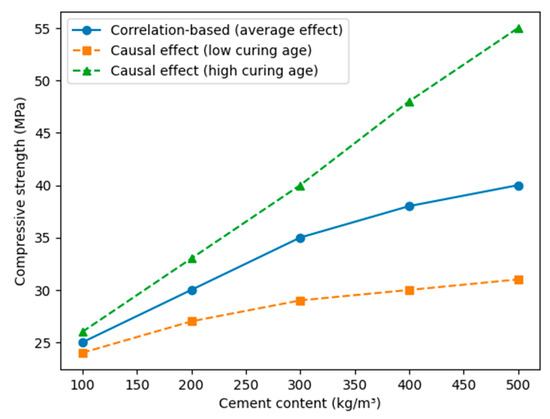
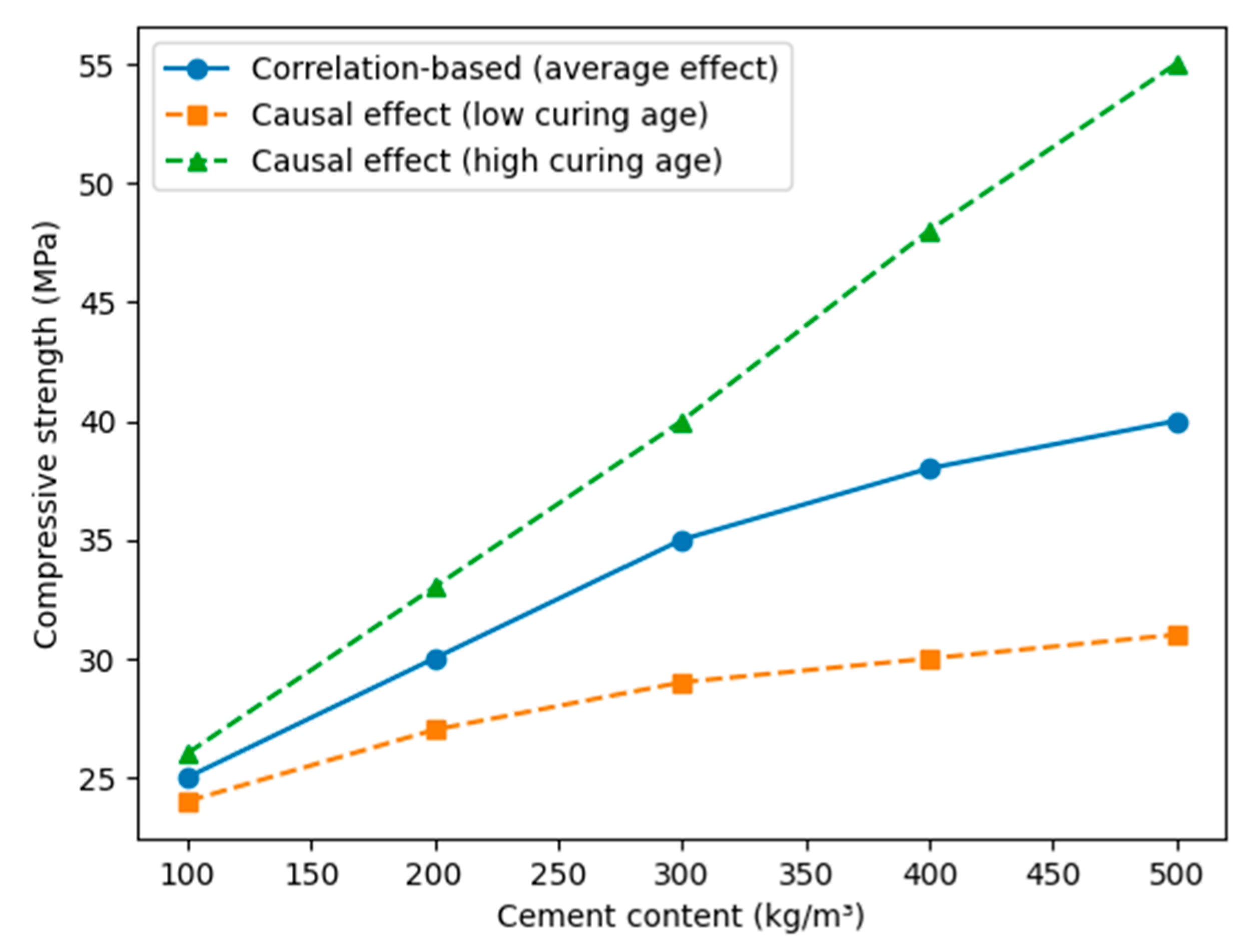
Despite their predictive success, most ML-based studies treat cement content as a standard input variable and focus primarily on minimizing prediction error. As a result, the learned relationships remain fundamentally correlational and provide limited insight into the causal effectiveness of cement dosage as a design intervention. Feature importance measures, partial dependence plots, and sensitivity analyses are commonly used to interpret the role of cement; however, these tools do not offer intervention-based guarantees and may confound true causal effects with spurious correlations induced by water content, SCM replacement, or curing age [25,26]. This limitation becomes particularly evident in practice, where similar increases in cement dosage can lead to markedly different strength outcomes across mixes-a phenomenon frequently reported but rarely explained in the literature. To conceptually illustrate this limitation, Figure 1 contrasts correlation-based interpretations of cement dosage with a causal, context-dependent perspective.
Figure 1.
Correlation-based versus causal interpretation of cement dosage effect on compressive strength under different curing conditions.
To enhance transparency in ML-based concrete research, explainable artificial intelligence (XAI) techniques have gained increasing attention. Methods such as SHAP, permutation importance, and local surrogate models have been applied to interpret strength prediction models and identify influential mixture parameters [27,28,29,30,31,32]. Recent studies demonstrate that XAI can improve the trustworthiness and usability of ML models in concrete technology, including applications to compressive strength, elastic modulus, and durability-related indicators [33,34]. However, these approaches predominantly explain predicted outcomes rather than the underlying causal mechanisms governing material behavior, thereby limiting their ability to support decision-making under hypothetical design interventions.
Figure 1 illustrates the fundamental difference between correlation-based and causal interpretations of the effect of cement dosage on concrete compressive strength. While correlation-based analyses suggest an average and monotonic increase in strength with increasing cement content, the causal framework reveals pronounced heterogeneity across curing conditions. Specifically, identical increases in cement dosage may lead to substantially different strength outcomes under low and high curing ages, demonstrating that cement efficiency is inherently context-dependent rather than uniform. This distinction highlights why predictive or correlation-based models alone are insufficient for intervention-oriented mix design decisions and motivates the adoption of causal machine learning approaches capable of isolating conditional and heterogeneous treatment effects. To clarify this conceptual distinction, a schematic comparison between correlation-based and causal interpretations of cement dosage is provided in Figure S1 (Supplementary Material).
Beyond strength prediction, ML applications in concrete research have expanded toward durability assessment and microstructural characterization. Ensemble and multitask learning models have been developed to evaluate carbonation, chloride ingress, and sulfate attack, while highlighting persistent challenges related to data scarcity and field validation [35]. Concurrently, deep learning–based image analysis techniques have enabled automated segmentation and feature extraction from SEM images, linking microstructural descriptors to mechanical performance [36,37]. These advances further emphasize that concrete performance is governed by multiscale and interaction-driven processes, reinforcing the need for analytical frameworks that move beyond purely correlational modeling.
Recently, causal machine learning (CML) has emerged as a promising paradigm to bridge the gap between prediction and intervention. By explicitly modeling treatment variables and controlling for confounding factors, CML methods enable the estimation of causal effects from observational data [38,39]. While causality-based approaches have gained substantial traction in economics and social sciences, their application in concrete technology and construction materials research remains limited. Only a small number of recent studies explicitly discuss causal reasoning and intervention-based analysis in engineering ML applications [40,41,42], and mixture design variables such as cement dosage are rarely treated as formal causal interventions.
In the context of cement-based materials, the need for causal and interpretable frameworks is particularly pronounced under sustainability-driven constraints. Cement production is a major contributor to global CO2 emissions, and inefficient cement usage directly exacerbates environmental impacts. Recent ML-based studies on low-carbon concretes and cementitious paste backfill systems indicate that high predictive accuracy does not necessarily translate into optimal or sustainable material utilization [43,44]. These findings highlight the importance of moving beyond prediction to understand when and under which conditions additional cement is genuinely effective.
From a scientific perspective, despite extensive experimental and data-driven research on concrete strength, there remains a lack of frameworks capable of quantifying the conditional and heterogeneous causal effect of cement dosage while explicitly controlling for mixture-dependent confounding factors. Existing studies predominantly report average trends or predictive associations, leaving the intervention-level behavior of cement additions insufficiently understood.
From an applied engineering and technological perspective, this limitation restricts the ability of designers to anticipate how incremental changes in cement dosage will perform under specific mixture compositions and curing conditions. As a result, concrete mix design decisions often rely on trial-and-error procedures or conservative safety margins, rather than on condition-specific, evidence-based intervention analysis.
From an economic and sustainability perspective, inefficient cement utilization directly increases material costs and contributes to unnecessary CO2 emissions. Given the environmental footprint of cement production, understanding when additional cement yields meaningful strength gains—and when it does not—is critical for cost-efficient and sustainable construction practice.
Within this context, the purpose of this study is to develop a decision-relevant and interpretable causal machine learning framework for concrete mix design that explicitly separates prediction from intervention. The specific objectives of the study are to:
- (i).
- Treat cement dosage as a continuous causal intervention and estimate its marginal causal effect on compressive strength;
- (ii).
- Quantify the heterogeneity of this effect across mixture compositions and curing ages;
- (iii).
- Apply explainable artificial intelligence directly to the estimated causal effect function to identify conditions of efficient and inefficient cement usage; and
- (iv).
- Demonstrate how the proposed framework can support rational, cost-aware, and sustainability-oriented construction decision-making.
2. Materials and Methods
2.1. Conceptual Framework: Cement as a Causal Intervention
To achieve the objective of this study, a structured methodological workflow was implemented, consisting of data preparation, model development, performance evaluation, and explainability analysis. This workflow was designed to ensure methodological transparency and interpretability, allowing systematic examination of the influence of mixture parameters on compressive strength.
The workflow follows a sequential structure comprising four main stages: (i) experimental data preparation and preprocessing, (ii) development of machine learning models for compressive strength prediction, (iii) model performance evaluation using statistical metrics, and (iv) explainability analysis to interpret marginal and causal effects of key mixture parameters.
From a concrete engineering perspective, this framing reflects real-world mix design decisions, where cement dosage can be incrementally adjusted and its marginal contribution to strength is of practical interest. Accordingly, the causal question addressed in this study is formulated as: How does concrete compressive strength change when cement content is increased by a small amount while all other mix components and curing conditions remain unchanged?
To address this question, a causal inference framework was adopted, in which compressive strength is defined as the outcome variable, cement content as the treatment variable, and the remaining mixture components together with curing age as confounding variables.
2.2. Dataset Description
The dataset used in this study consists of experimental results from different concrete mixes and enables examination of relationships between compressive strength and mixture components under varying curing conditions. The experimental dataset originates from the concrete compressive strength database developed by Prof. I-Cheng Yeh and was accessed through the Kaggle repository [10]. The original data and its formulation are described in Yeh [10], which is duly acknowledged in this study.
The analysis is based on 1030 experimental observations covering a wide range of mixture compositions and curing ages. The input variables include seven mixture components—cement, blast furnace slag, fly ash, water, superplasticizer, fine aggregate, and coarse aggregate (kg/m3)—together with curing age (days).
All variables used in the analysis are continuous numerical variables measured on a continuous scale, and no categorical or discrete class variables are included. This characteristic enables estimation of marginal causal effects, which are more consistent with engineering decision-making than binary comparisons (e.g., low versus high cement content). Table 1 summarizes the statistical properties of the dataset and demonstrates a wide and balanced coverage of mixture compositions and curing ages, which is essential for estimating heterogeneous marginal causal effects.
Table 1.
Summary statistics of the input and output variables computed in this study based on the concrete compressive strength dataset from Yeh [10].
In particular, superplasticizer dosage ranges from 0 to 32 kg/m3. To ensure data plausibility and to assess whether extreme admixture dosages could disproportionately influence the Random Forest nuisance models or the estimated marginal cement effects, percentile-based screening was performed. The median superplasticizer dosage is 6.4 kg/m3, with the 99th percentile at 23.4 kg/m3 and a maximum observed value of 32.2 kg/m3, indicating that very high dosages occur only in a small fraction of mixtures. Sensitivity analyses removing the top 1% and top 0.5% of superplasticizer values, as well as winsorization at the 99th percentile, yielded nearly identical average marginal cement effects (maximum deviation Δ ≤ 0.0025 MPa/kg), confirming that the reported causal estimates are not driven by extreme superplasticizer values.
For descriptive transparency, a Pearson cross-correlation matrix among mixture variables, curing age, and compressive strength is provided in Supplementary Table S1. These correlations are reported for background context and should not be interpreted as causal effects.
2.3. Definition of Variables
The outcome variable considered in this study is the uniaxial compressive strength of concrete (MPa). Cement content (kg/m3) is defined as the treatment variable and is analyzed to estimate its marginal causal effect on compressive strength. Cement dosage is modeled as a continuous treatment variable to facilitate marginal effect estimation within the causal learning framework.
The remaining mixture components—water content, fly ash content, blast furnace slag content, superplasticizer dosage, fine aggregate content, coarse aggregate content, and curing age—are included as confounding variables to control for their concurrent variation with cement content and compressive strength within the dataset.
2.4. Causal Effect Estimation Using the R-Learner Framework
In this study, the marginal causal effect of cement content on concrete compressive strength was estimated using the R-learner framework proposed by Nie and Wager [45]. The R-learner is designed to estimate heterogeneous treatment effects by decomposing the causal estimation problem into separate nuisance components for the outcome and the treatment, followed by a residual-based estimation of the treatment effect function.
Specifically, two regression models were trained: (i) an outcome model estimating the conditional expectation of compressive strength given the set of confounding variables, and (ii) a treatment model estimating the conditional expectation of cement content given the same confounders. Random Forest regression was employed for both nuisance models due to its flexibility in capturing nonlinear relationships and interaction effects without imposing explicit parametric assumptions.
Let Y denote compressive strength, T cement content, and X the vector of confounding variables. The R-learner formulation can be expressed as Equation (1),
where and are the estimated conditional expectations obtained from the nuisance models. Residualized outcomes and treatments were computed using these estimates, and the treatment effect function was subsequently learned by regressing the residualized outcome on the residualized treatment.
Within this framework, the estimated treatment effect function is denoted by t(x), representing the conditional marginal causal effect of cement content on compressive strength given covariates x. Formally, t(x) corresponds to the marginal response of compressive strength to a unit increase in cement content under a given mixture composition and curing condition. The estimated causal quantity therefore captures how the effectiveness of cement dosage varies across the covariate space.
To construct the dose–response surface, the estimated marginal causal effect function obtained from the R-learner framework was evaluated using a model-based counterfactual prediction approach. Cement content was varied over a predefined grid spanning its observed range, while curing age was allowed to vary jointly, and the remaining covariates were held at their empirical distributions. For each grid point, counterfactual outcomes were computed based on the estimated treatment effect function, yielding a nonparametric estimate of the continuous dose–response relationship.
The resulting dose–response surface represents the joint variation in the estimated marginal causal effect of cement dosage as a function of cement content and curing age. This procedure follows standard dose–response analysis in the causal inference literature and is consistent with generalized random forest–based approaches for heterogeneous treatment effect estimation [38,45,46].
2.5. Model Reliability and Validation
Model reliability was assessed during the nuisance estimation stage using K-fold cross-validation to ensure stable learning of the conditional expectations. The predictive performance of the outcome and treatment models was evaluated solely to verify adequate model fit and convergence, and not as an indicator of causal validity.
A placebo test was employed as a robustness check to assess whether the estimated marginal causal effects reflect an intervention-driven structure rather than associations induced by correlations among variables. In the placebo setting, the cement content variable was randomly permuted across observations, thereby removing any true causal relationship between cement dosage and compressive strength while preserving the distributions of the remaining variables.
To visualize the distribution of the estimated marginal causal effects, a histogram of the estimated t(x) values was constructed. In addition, a kernel density estimation (KDE) was applied to obtain a smooth approximation of the underlying distribution. The density curve was estimated using a Gaussian kernel with a bandwidth selected according to standard rules implemented in the analysis software (Python 3.14.3).
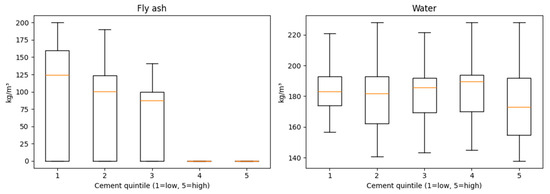
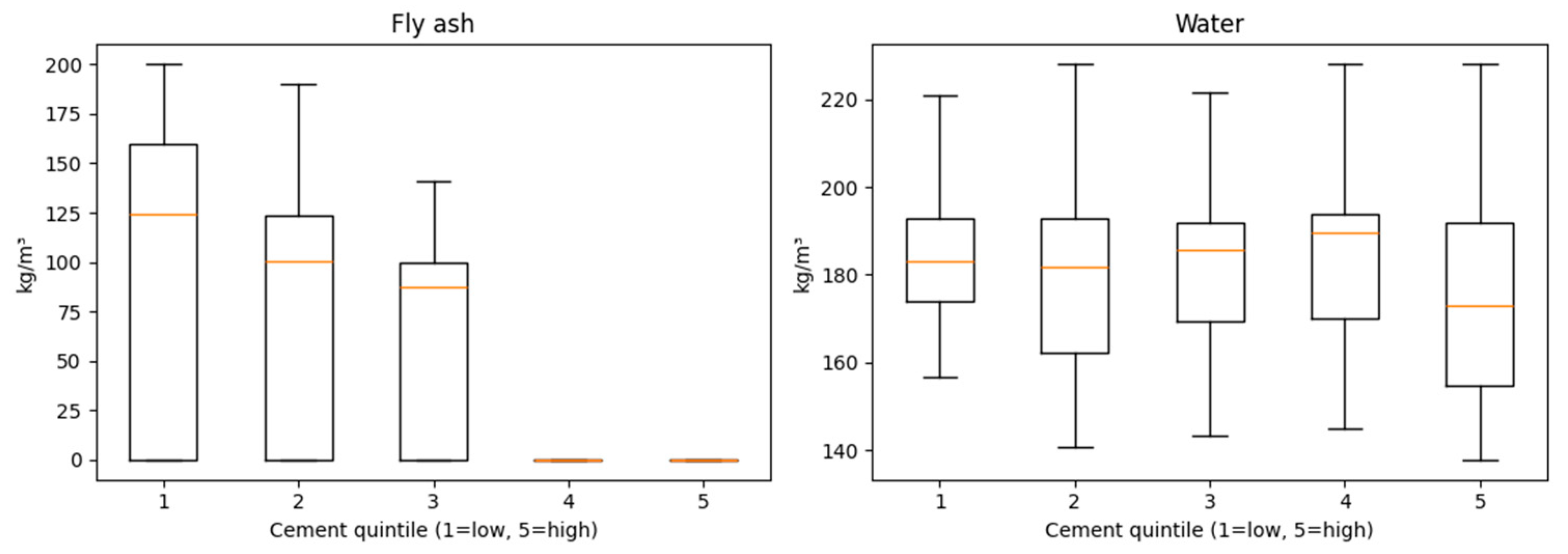
To ensure credible causal interpretation, common support between cement dosage and key moderators was explicitly evaluated. Cement content was divided into quintile-based bins, each containing approximately 200 observations, indicating balanced coverage across the treatment range, as shown in Figure 2 and summarized in Table 2. The distributions of major moderators, including fly ash content, water content, superplasticizer dosage, and curing age, exhibited substantial overlap across cement quintiles, suggesting the presence of comparable mixture configurations throughout most of the cement domain and reducing the risk of extrapolating effects in sparse regions.
Figure 2.
Covariate overlap across cement dosage quintiles used for common support assessment.
Table 2.
Summary statistics of key covariates across cement dosage quintiles for overlap diagnostics.
To assess sensitivity to boundary observations, a 5% tail trimming analysis was conducted. The estimated average marginal causal effect increased slightly from 0.1322 MPa per kg/m3 in the full sample to 0.1489 MPa per kg/m3 in the trimmed sample, while preserving both the direction and heterogeneous structure of the estimated effects. This indicates that the reported causal estimates are not driven by extreme values or limited overlap at the boundaries of the treatment range.
For nuisance model estimation, cross-fitting was implemented using curing-age–quantile stratified splits to address the imbalance in the age distribution (mean curing age ≈ 45 days). The primary specification employed 5-fold stratified cross-fitting, with robustness further evaluated under alternative configurations, including 10-fold stratified cross-fitting and repeated split designs. Across these specifications, effect estimates varied within a narrow range, demonstrating stability with respect to the cross-validation strategy and confirming that the results are not sensitive to a particular data partitioning scheme.
As shown in Figure 2 and summarized in Table 2, the distributions of key moderators exhibit substantial overlap across cement dosage quintiles. Despite differences in average cement content, the ranges of curing age, fly ash content, and water content remain largely comparable across bins, indicating the presence of similar mixture configurations throughout the treatment domain. This overlap satisfies the common support assumption required for credible causal inference and reduces the risk that the estimated marginal effects are driven by extrapolation in sparsely populated regions of the data space.
The balanced sample sizes across cement quintiles, each containing approximately 200 observations, further support the robustness of the causal estimation framework. Taken together, the visual and numerical diagnostics confirm that the heterogeneous marginal causal effects of cement dosage are identified within regions of sufficient covariate overlap rather than being inferred from isolated or extreme mixture combinations.
2.6. Integration of Explainable Artificial Intelligence
Explainable artificial intelligence (XAI) techniques were applied to the estimated causal effect function rather than to predicted compressive strength values. SHAP-based methods were used to decompose the marginal causal effect of cement content into contributions associated with individual mixture components and curing conditions.
For global interpretation, SHAP beeswarm plots were generated to visualize the overall heterogeneity of the estimated causal effects across the dataset. SHAP dependence plots were used to examine how the marginal effect of cement varies conditionally with respect to individual variables. In addition, SHAP waterfall plots were employed to provide local explanations for selected mixture scenarios. Dose–response surfaces were constructed to illustrate how the marginal causal effect of cement content evolves with continuous variables such as curing age.
These analyses were conducted to support the interpretation of the estimated causal mechanisms within the proposed modeling framework.
3. Results
3.1. Average Marginal Causal Effect of Cement Dosage
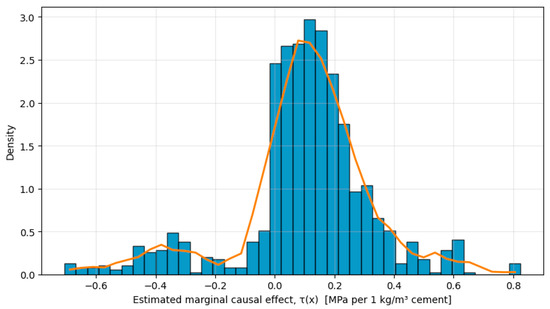
The overall distribution of the estimated marginal causal effect of cement dosage on concrete compressive strength is presented in Figure 3. It shows the histogram of the estimated marginal causal effects together with the corresponding kernel density estimation.
Figure 3.
Distribution of the estimated marginal causal effects of cement content on compressive strength. Blue bars: Histogram of estimated marginal causal effects. Orange line: Kernel density estimation of treatment.
As illustrated in Figure 3, the estimated marginal causal effect is not concentrated around a single value but spans a wide range across the dataset, indicating substantial variability in the marginal response of compressive strength to incremental increases in cement content under different mixture compositions and curing conditions. Based on the distribution shown in Figure 3, the estimated marginal effects range approximately from −0.6 MPa to 0.8 MPa per 1 kg/m3 increase in cement content.
The distribution is centered around the average treatment effect estimated in the overall analysis (0.136 MPa per 1 kg/m3), with the highest density observed in the interval between approximately 0.05 and 0.25 MPa, indicating that most observations fall within this range. The modal value of the distribution is close to 0.12–0.15 MPa, consistent with the estimated mean effect. Nonparametric bootstrap analysis (80 resamples with full cross-fitting) yielded a 95% confidence interval of [0.1055, 0.1433], confirming the statistical robustness of the average estimate. In addition, the estimated average marginal effect remained stable across alternative cross-fitting fold configurations, indicating that the reported effect is not sensitive to the specific validation design.
At the lower end of the distribution, a non-negligible fraction of observations exhibits marginal effects close to zero or slightly negative (below approximately 0.05 MPa). Importantly, the presence of near-zero and occasionally negative marginal effects does not imply that cement inherently reduces compressive strength. Rather, these values reflect localized inefficiencies under specific mixture configurations. For example, excessive water content or imbalanced admixture regimes may suppress the effective utilization of additional cement, leading to negligible or negative marginal strength gains despite increased cement dosage.
Conversely, a smaller subset of observations shows relatively high marginal effects exceeding approximately 0.4 MPa, indicating substantially more efficient cement utilization under favorable mixture conditions. The pronounced spread of the distribution, together with the presence of both low- and high-effect tails, quantitatively confirms the heterogeneous nature of the estimated marginal causal effects across the dataset.
The stability of this distribution across alternative cross-fitting designs and the collapse of heterogeneity under placebo testing further indicate that these patterns are not artifacts of statistical noise or residual confounding but represent conditional behavior within the observed mixture space. Figure 3 therefore provides a numerical summary of cement efficiency variability and establishes a quantitative basis for the subsequent heterogeneity and conditioning analyses.
3.2. Validation of Causal Estimates Using Placebo Testing
The placebo test was used to assess whether the estimated marginal causal effects reflect an intervention-driven structure rather than associations induced by correlations among variables. In the placebo setting, cement content was randomly permuted across observations while preserving the distributions of the remaining variables.
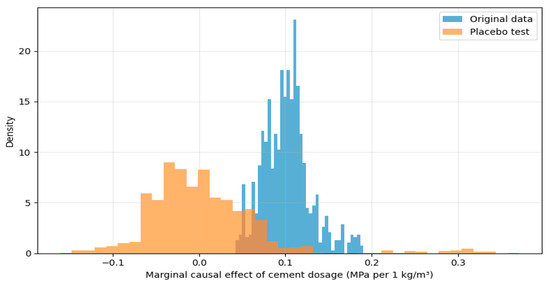
Figure 4 compares the distributions of marginal causal effect estimates obtained from the original data and from the placebo test. As shown in Figure 4, the distribution estimated from the original data is clearly shifted toward positive values, whereas the distribution obtained under the placebo condition is concentrated around zero.
Figure 4.
Comparison of marginal causal effect estimates obtained from the original data and the placebo test.
Quantitatively, the marginal causal effects estimated from the original data are primarily distributed within the range of approximately 0.05 to 0.20 MPa per 1 kg/m3 increase in cement content, with a pronounced peak around 0.10–0.12 MPa, consistent with the average treatment effect reported earlier. In contrast, the placebo distribution is narrowly centered near 0 MPa, with most values lying within approximately −0.10 to 0.10 MPa, indicating the absence of a systematic marginal response when the intervention structure is removed.
The dispersion of the placebo distribution is substantially smaller than that of the original estimates, and the overlap between the two distributions is limited to a narrow region near zero. This separation indicates that the marginal causal effects observed in the original analysis are not driven by random correlations or model flexibility but reflect a distinct empirical pattern that disappears under random permutation of the treatment variable.
Overall, the comparison shown in Figure 4 provides a quantitative robustness check for the causal estimation procedure. The clear contrast in both the central tendency and spread of the original and placebo distributions supports the validity of the estimated marginal causal effects derived from the original data.
3.3. Heterogeneity of Cement Efficiency Across Mix Conditions
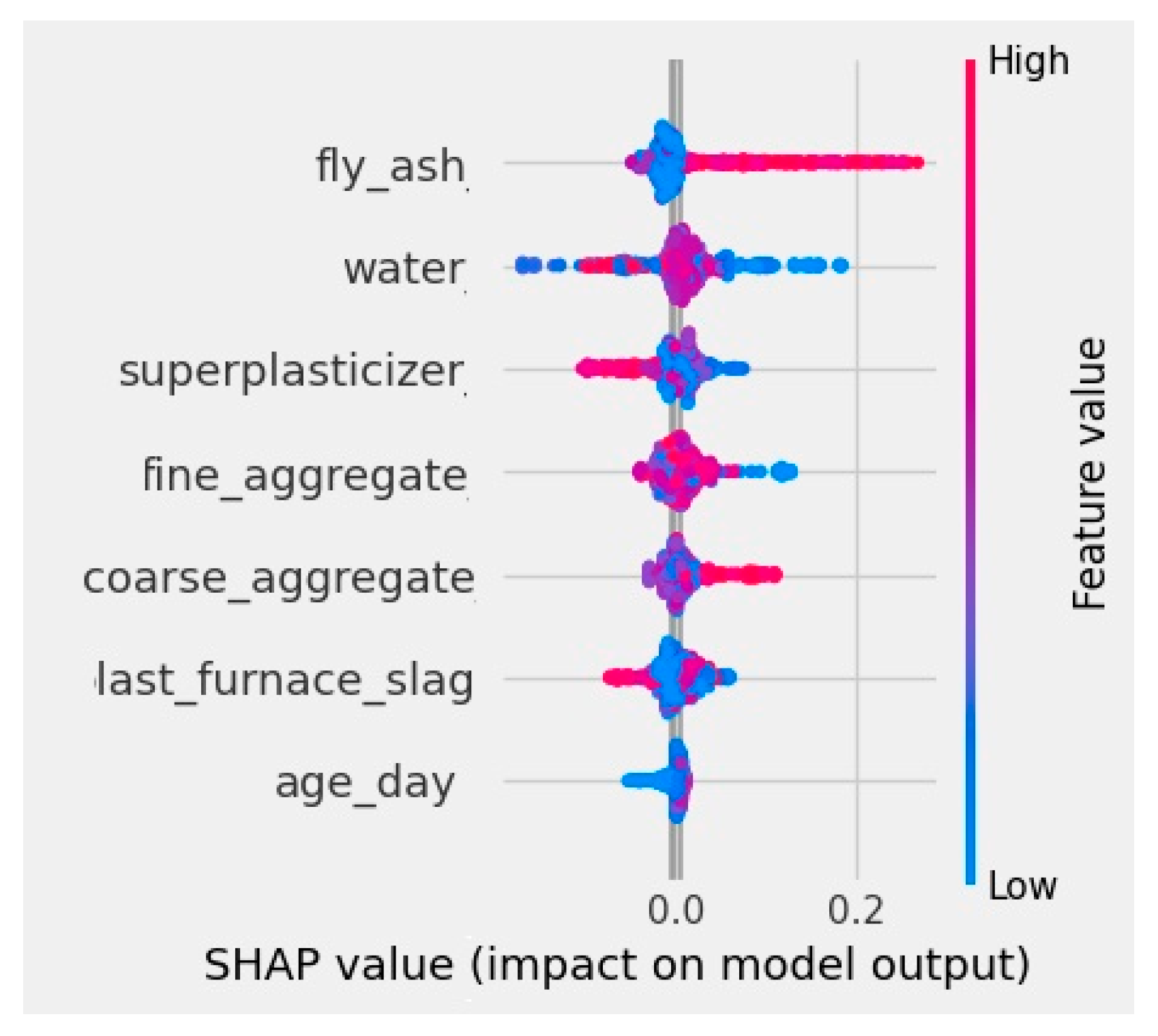
The heterogeneity of cement efficiency across different mixture compositions and curing conditions is illustrated using the SHAP summary (beeswarm) plot shown in Figure 5. The analysis is based on SHAP values computed for the estimated marginal causal effect of cement dosage.
Figure 5.
SHAP summary (beeswarm) plot explaining the marginal causal effect of cement dosage.
Figure 5 presents the global distribution of SHAP values across all observations, indicating the relative contribution of each variable to variations in the estimated marginal causal effect. The variables are ordered according to their mean absolute SHAP values, providing a quantitative ranking of their importance in shaping cement efficiency.
Among all variables, fly ash content exhibits the largest spread and magnitude of SHAP values, with contributions ranging approximately from −0.10 to +0.25 MPa, indicating that fly ash plays a dominant role in conditioning the marginal effect of cement dosage. High fly ash values are predominantly associated with positive SHAP values, whereas low fly ash values tend to correspond to negative or near-zero contributions.
Water content and superplasticizer dosage also show substantial dispersion in SHAP values, with typical ranges on the order of −0.08 to +0.10 MPa, reflecting their strong conditional influence on cement efficiency. In both cases, the wide spread of SHAP values indicates that these variables act as key moderators whose effects depend on the surrounding mixture context.
In contrast, curing age exhibits a comparatively narrow range of SHAP values, mostly concentrated within approximately −0.03 to +0.04 MPa, suggesting a more stabilizing role in the global heterogeneity of cement efficiency. While curing age remains relevant, its smaller SHAP magnitude indicates that it contributes less to cross-sectional variability than mixture composition variables.
Overall, the SHAP summary plot quantitatively confirms that heterogeneity in the estimated marginal causal effects of cement dosage is primarily governed by mixture composition variables-particularly fly ash content, water content, and superplasticizer dosage-rather than by curing age alone. Figure 5 therefore provides a numerical global overview of the variables associated with variability in cement efficiency and motivates the subsequent analysis of conditional and local patterns.
3.4. Conditioning Effects of Mixture Components and Curing Age
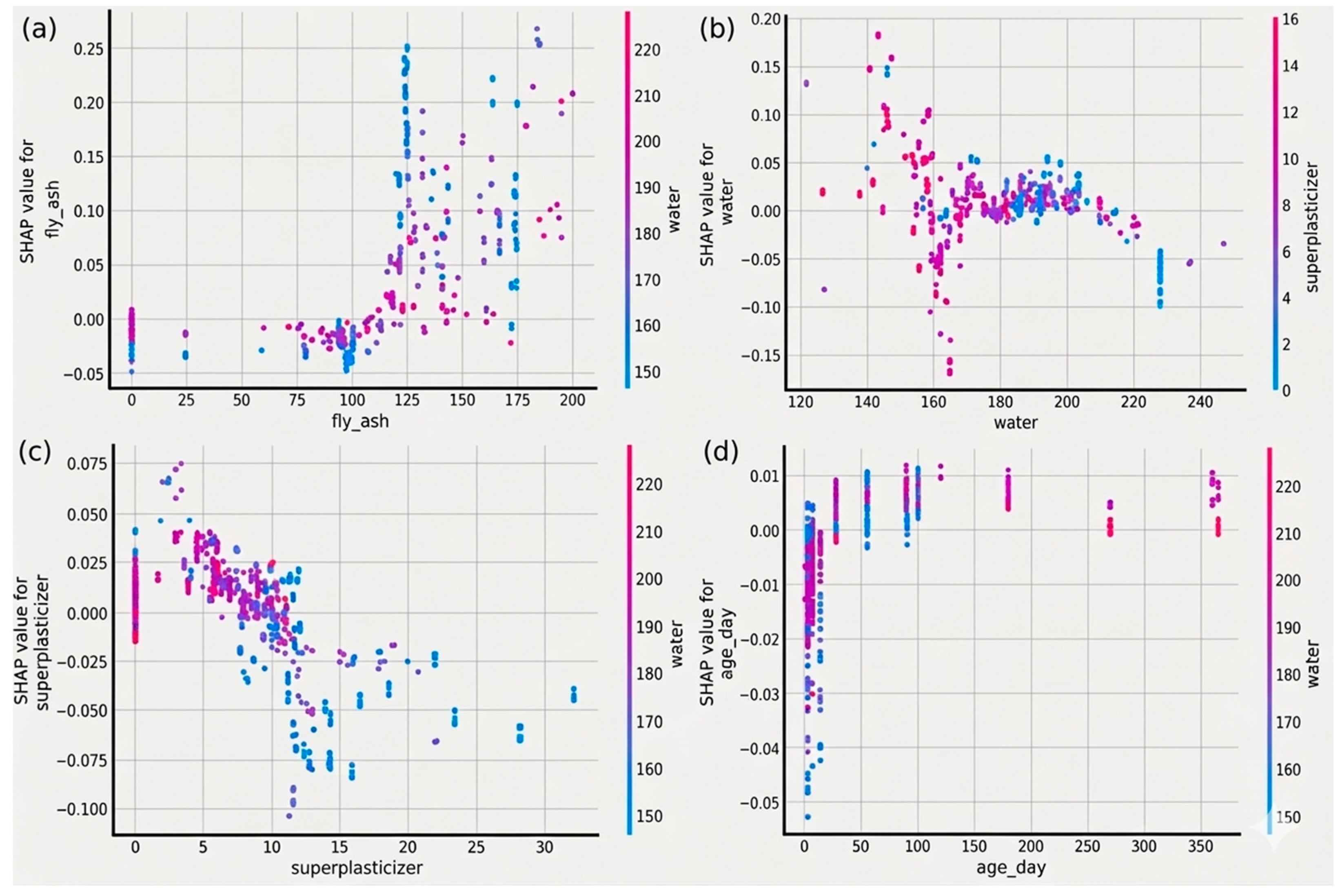
The conditioning of the marginal causal effect of cement dosage by mixture components and curing age was examined using SHAP dependence plots, as shown in Figure 6.
Figure 6.
SHAP dependence plots illustrating how key mixture components and curing age condition the marginal causal effect of cement dosage: (a) dependence of SHAP values on fly ash content; (b) conditioning effect of water content on the marginal causal effect of cement dosage; (c) relationship between superplasticizer dosage and the estimated marginal causal effects; (d) variation in SHAP values with curing age.
Figure 6 presents SHAP dependence plots illustrating how the estimated marginal causal effect varies conditionally with respect to selected mixture components and curing age. While the SHAP summary plot in Figure 5 provides a global ranking of variable importance, the dependence plots reveal how the direction, magnitude, and dispersion of the marginal causal effect change across the range of each conditioning variable.
Figure 6a shows the dependence of SHAP values on fly ash content. At low fly ash levels (below approximately 80–100 kg/m3), SHAP values are clustered near zero or slightly negative, indicating limited marginal contribution of cement dosage. As fly ash content increases beyond approximately 100 kg/m3, SHAP values shift upward and spread over a wider positive range, reaching values of approximately 0.20–0.25 MPa, indicating a substantially enhanced marginal effect of cement dosage at moderate to high fly ash contents.
Figure 6b illustrates the conditioning effect of water content. At moderate water contents (approximately 150–190 kg/m3), SHAP values are concentrated around slightly positive values, suggesting relatively stable marginal cement efficiency. In contrast, at higher water contents (above approximately 200 kg/m3), SHAP values shift downward and become predominantly negative, with magnitudes reaching approximately −0.10 MPa, indicating suppression of the marginal causal effect of cement dosage under high water conditions.
Figure 6c depicts the relationship between superplasticizer dosage and the estimated marginal causal effects. At low-to-moderate superplasticizer dosages (below approximately 10–12 kg/m3), SHAP values are generally close to zero or slightly positive. As dosage increases beyond this range, SHAP values decrease and exhibit greater dispersion, with negative contributions reaching approximately −0.08 to −0.10 MPa, indicating reduced marginal cement efficiency at higher superplasticizer levels.
Figure 6d shows the variation in SHAP values with curing age. At early curing ages (below approximately 28 days), SHAP values exhibit wider dispersion and include more negative values, reaching approximately −0.05 MPa. As curing age increases beyond 90 days, SHAP values become more narrowly distributed and concentrate near zero or slightly positive values (within approximately −0.01 to +0.01 MPa), indicating reduced variability in the marginal causal effect at later ages.
Across Figure 6a–d, the SHAP dependence plots quantitatively demonstrate that the marginal causal effect of cement dosage exhibits nonlinear and variable behavior across mixture compositions and curing conditions. Fly ash content, water content, and superplasticizer dosage primarily influence the magnitude and dispersion of the marginal effects, whereas curing age mainly affects the variability of the response. These numerical patterns provide a quantitative basis for understanding the conditional heterogeneity of cement efficiency and motivate the subsequent local and dose–response analyses.
3.5. Local Causal Explanations: Efficient Versus Inefficient Cement Use
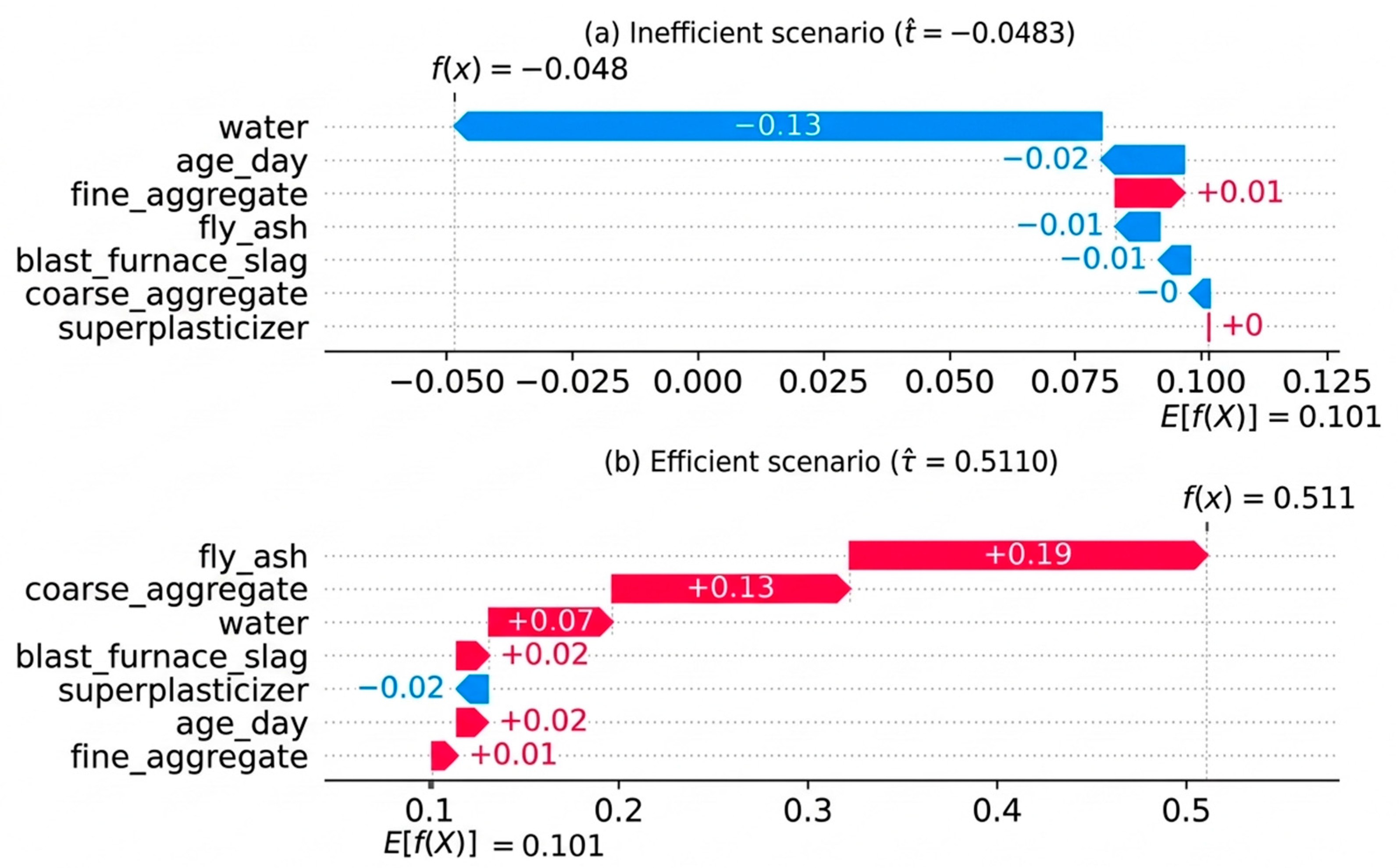
Local explanations of the estimated marginal causal effects were examined using SHAP waterfall plots to illustrate condition-specific behavior of cement dosage under selected mixture configurations. To illustrate how the proposed framework supports local decision-making, SHAP waterfall analyses were performed for two representative mix scenarios exhibiting contrasting marginal causal effects.
The efficient and inefficient cases were selected from the upper and lower 5th percentiles of the estimated marginal cement effect distribution (p5 = −0.0267, p95 = 0.3701) to ensure objective, distribution-based case selection. Within each tail, the observation closest to the median estimated marginal effect value was chosen to avoid selecting extreme outliers and to ensure reproducibility.
Figure 7 presents local SHAP waterfall explanations for (a) a scenario associated with a relatively low marginal causal effect of cement dosage and (b) a scenario associated with a relatively high marginal causal effect. In each case, the waterfall plot decomposes the estimated marginal effect into additive contributions from individual mixture components relative to the baseline expectation.
Figure 7.
Local SHAP waterfall explanations for (a) inefficient and (b) efficient cement dosage scenarios.
In the low-effect scenario (Figure 7a), the estimated marginal causal effect is = −0.0483. The baseline expected marginal effect is approximately 0.101 MPa, which is reduced by strong negative contributions from specific mixture variables. In particular, water content contributes −0.13 MPa, representing the dominant suppressing factor. Curing age further contributes approximately −0.02 MPa, while fly ash and blast furnace slag each contribute around −0.01 MPa. These negative contributions outweigh small positive offsets from fine aggregate (approximately +0.01 MPa) and superplasticizer (near zero), resulting in an overall negative marginal effect of cement dosage.
In contrast, the high-effect scenario (Figure 7b) exhibits an estimated marginal causal effect of = 0.5110, representing an order-of-magnitude increase relative to the inefficient case. Starting from the same baseline expectation (≈0.101 MPa), the marginal effect is amplified primarily by fly ash content, which contributes approximately +0.19 MPa, and coarse aggregate content, contributing about +0.13 MPa. Additional positive contributions arise from water content (+0.07 MPa), blast furnace slag (+0.02 MPa), curing age (+0.02 MPa), and fine aggregate (+0.01 MPa). A small negative contribution from superplasticizer (approximately −0.02 MPa) is insufficient to offset the cumulative positive effects, yielding a substantially higher marginal cement efficiency.
The comparison of Figure 7a,b quantitatively illustrates how local mixture conditions are associated with pronounced differences in the estimated marginal causal effect of cement dosage. Specifically, the difference between the two scenarios corresponds to a change of more than 0.55 MPa per 1 kg/m3 of cement, despite identical units of cement increase. These local explanations provide a numerical and transparent representation of how individual mixture components shape cement efficiency under specific configurations and complement the global and conditional analyses presented earlier.
3.6. Dose–Response Behavior of Cement Dosage Under Varying Curing Ages
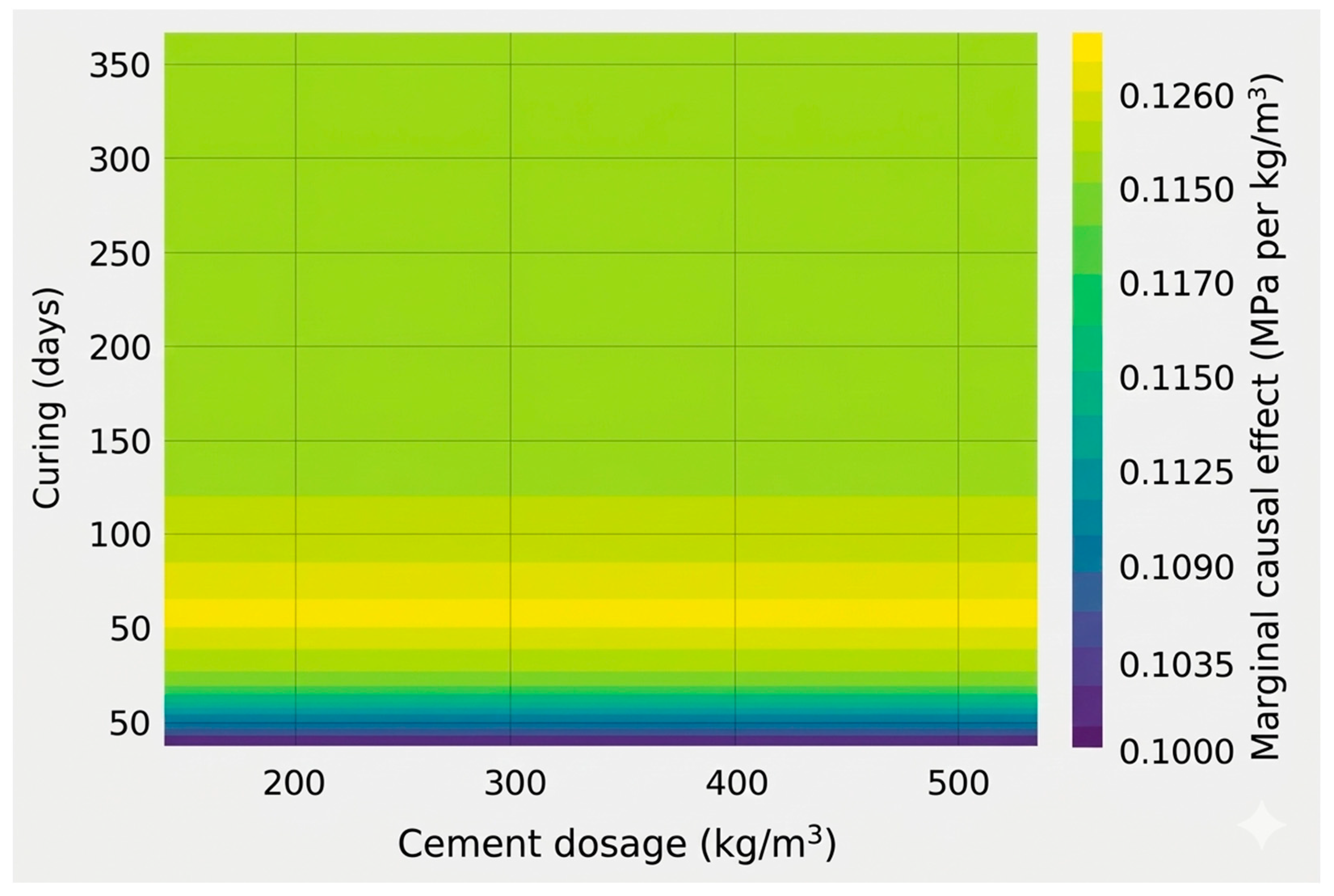
The joint variation in the marginal causal effect of cement dosage with cement content and curing age was examined using a dose–response surface, as shown in Figure 8. The surface provides a visual representation of how the estimated marginal causal effect varies across curing ages and cement dosage levels.
Figure 8.
Dose–response surface showing the marginal causal effect of cement dosage under varying curing ages.
Figure 8 shows that the estimated marginal causal effect of cement dosage exhibits clear age-dependent patterns. At early curing ages (below approximately 28 days), the marginal causal effect is relatively low and exhibits noticeable variability, with values ranging approximately from 0.100 to 0.112 MPa per 1 kg/m3 increase in cement content. This region is characterized by stronger color gradients, indicating higher dispersion in marginal effects during early-stage hydration.
As curing age increases beyond approximately 56–90 days, the estimated marginal causal effect shifts toward higher values and becomes more uniform across cement dosage levels. In this regime, the marginal effects concentrate within a narrower range of approximately 0.115 to 0.126 MPa, indicating reduced dispersion and increased stability of the marginal response. The relatively flat color bands at later ages suggest that curing age moderates the variability of cement efficiency rather than amplifying it.
To quantitatively assess this stabilizing behavior, the dispersion of the estimated marginal causal effects was evaluated across discrete curing age bins. The analysis shows that the standard deviation of the estimated marginal effects decreases systematically with curing age, confirming that variability is higher at early ages and progressively diminishes as curing progresses. This quantitative pattern supports the visual evidence from the dose–response surface and indicates that curing age acts as a stabilizing factor for marginal cement effects.
Overall, the dose–response surface illustrates systematic changes in both the magnitude and dispersion of the estimated marginal causal effects of cement dosage across curing ages. The results indicate that marginal cement efficiency becomes more stable and predictable at later curing stages, providing a quantitative basis for the temporal interpretation of cement dosage effects discussed in the following section.
4. Discussion
This study departs from conventional approaches in the literature by examining the effect of cement dosage on concrete compressive strength not through correlation-based or purely predictive models, but as a causal and condition-dependent intervention effect. The central hypothesis—that cement efficiency is not constant but varies with mixture composition and curing conditions—is supported by the observed heterogeneity in the estimated marginal causal effects. Rather than being representable by a single global coefficient, the contribution of additional cement is shown to depend systematically on the surrounding mixture context.
The positive average marginal effect of cement dosage identified in this study (0.136 MPa per kg/m3; 95% CI: [0.1055, 0.1433]) is consistent with the classical understanding that compressive strength increases with cement content [1,2]. However, while classical concrete technology literature typically reports aggregate monotonic trends under controlled experimental conditions, the present results reveal substantial heterogeneity in marginal effects, with a 5th–95th percentile range from −0.027 to 0.370 MPa. This indicates that the strength gain associated with additional cement is not uniform but strongly conditional on mixture composition and curing context.
The SHAP-based global and conditional analyses indicate that fly ash content is consistently associated with substantial variation in the marginal causal effect of cement dosage. This observation aligns with earlier experimental studies reporting that supplementary cementitious materials modify hydration pathways and strength development in cement-based systems [5,6,15]. The present study extends these findings by offering a causal interpretation of this interaction, moving beyond empirical comparisons toward quantifying how fly ash conditions the effectiveness of cement additions across different mix designs.
In addition to fly ash, water content and superplasticizer dosage emerge as important moderators of cement efficiency. Classical experimental studies have long recognized that excessive water or chemical admixtures can suppress strength development [1,5,15]. The interaction-driven variability observed in the present analysis is consistent with the qualitative insights of Aïtcin and Flatt (2015) [4], who emphasize the regulatory role of superplasticizers and water demand in hydration efficiency. Our results extend this perspective quantitatively by identifying regimes in which high water content or unfavorable mixture conditions yield near-zero or even negative marginal effects of cement dosage. While classical experimental studies rarely report negative marginal responses explicitly, such conditional inefficiencies are consistent with diminishing-return phenomena described in eco-efficient cement strategies [5].
The role of curing age further highlights the conditional nature of cement efficiency. The dose–response analysis suggests that marginal causal effects are more variable at early ages and become increasingly stable at later curing stages. This trend is quantitatively supported by a variance-based analysis of the estimated marginal causal effects across curing age bins, which shows a systematic reduction in effect variability with increasing curing age. This pattern is consistent with the established understanding of hydration progression and microstructural development in concrete, while providing an explicit causal link between curing time and the effectiveness of cement dosage. Cement therefore appears not as a static contributor to strength, but as a time- and condition-dependent causal factor.
The local SHAP-based explanations further complement these findings by illustrating how cement efficiency varies across specific mixture configurations. The contrasting scenarios analyzed in the Section 3 demonstrate that similar increments in cement dosage can be associated with markedly different marginal causal effects depending on the surrounding mixture conditions. Variations in water content, fly ash dosage, superplasticizer usage, and curing age jointly condition the effectiveness of cement additions at the mix-specific level. These local, condition-specific explanations reinforce the view that cement efficiency is an emergent outcome shaped by interacting mixture parameters rather than an intrinsic material constant.
Compared to prediction-oriented machine learning studies [10,11,14], the present framework differs fundamentally in objectives. While these works demonstrate high predictive accuracy for compressive strength, cement dosage is treated as a standard input variable and interpreted primarily through correlational feature importance measures. In contrast, the present study treats cement content as a continuous intervention and estimates its marginal causal effect, thereby providing intervention-level interpretation rather than predictive association.
Similarly, although explainable artificial intelligence techniques such as SHAP [18] have been widely applied to interpret strength prediction models [29], these approaches typically explain predicted outcomes rather than causal response functions. The proposed interpretable causal machine learning (ICML) framework applies explainability directly to the estimated heterogeneous treatment effect, thereby distinguishing between explaining prediction and explaining intervention impact.
Methodologically, the proposed approach builds upon heterogeneous causal effect estimation frameworks [38,39] and extends their application to cementitious materials. While prior engineering studies rarely treat mixture variables as formal interventions, the present results demonstrate that cement efficiency can be rigorously quantified as a conditional causal parameter, providing a bridge between classical experimental observations and intervention-oriented data-driven mix design.
Despite the insights provided, several limitations of the present study should be acknowledged. First, the analysis relies on observational mixture data, and although the R-learner framework controls for observed confounders, unmeasured confounding variables may still influence the estimated causal effects. Second, the causal effect estimates are model-dependent and rely on the flexibility and stability of the random forest nuisance and effect learners. While cross-fitting and robustness checks mitigate overfitting risks, alternative learners may yield slightly different effect surfaces. Third, the dataset represents laboratory-scale mixtures within specific composition ranges (cement: 102–540 kg/m3; curing age: 1–365 days), which may limit external generalizability to field-scale or ultra-high-performance concrete systems. Finally, while the proposed ICML framework quantifies intervention-level effects statistically, it does not directly incorporate physicochemical hydration modeling, which may further refine mechanistic interpretation.
Future research could further enhance the proposed framework by integrating computer vision–based microstructural analysis. Recent advances in deep learning enable quantitative characterization of porosity, crack density, and hydration-related features directly from curing images or microstructural scans. Semantic segmentation architectures such as DeepLab have demonstrated strong performance in delineating pores and cracks in cementitious materials, enabling pixel-level quantification of void structures and microcracks [47]. In parallel, EfficientNet-based models provide computationally efficient and scalable feature extraction, allowing robust learning of texture and morphology descriptors from large image datasets [48]. Incorporating such vision-derived microstructural indicators as additional covariates within the proposed causal learning framework could improve mechanistic interpretability and help distinguish whether observed inefficiencies in cement utilization arise from mixture-level interactions or from microstructural constraints during hydration. This perspective also opens pathways to extend the framework to alternative binders, blended cement systems, durability-related performance indicators, and physics-informed causal models that more explicitly integrate material chemistry and hydration kinetics.
5. Conclusions
This study developed an interpretable causal machine learning (ICML) framework to quantify the marginal causal effect of cement dosage on concrete compressive strength. By treating cement content as a continuous intervention variable and estimating heterogeneous treatment effects using an R-learner approach, the analysis moves beyond correlational prediction toward intervention-level interpretation.
The main findings can be summarized as follows:
- The average marginal causal effect of cement dosage is 0.136 MPa per kg/m3 (95% CI: [0.1055, 0.1433]), confirming the classical monotonic relationship between cement content and compressive strength reported in the concrete technology literature.
- However, the marginal effect is highly heterogeneous, ranging from −0.027 to 0.370 MPa, demonstrating that cement efficiency is strongly conditional on mixture composition and curing age.
- Under specific mixture regimes characterized by high water content or unfavorable interaction structures, additional cement yields negligible or, in limited regimes, slightly negative marginal effects, highlighting inefficient cement utilization.
- Cross-fitting-based stability checks and robustness analyses indicate that the estimated causal effects are not driven by extreme observations or specific model configurations.
- Applying explainability directly to the estimated causal effect function provides actionable, intervention-oriented insights that are not attainable through conventional prediction-based machine learning or post hoc XAI analyses.
While the results align with classical experimental observations that compressive strength increases with cement content, they extend the prior literature by formally quantifying conditional and heterogeneous causal responses. The proposed framework thus bridges traditional experimental knowledge, modern machine learning flexibility, and sustainability-oriented cement optimization.
Nevertheless, the analysis is based on observational mixture data and relies on measured covariates; unobserved confounding and dataset-specific composition ranges may limit external generalizability. Future research may integrate physics-informed modeling, microstructural characterization, and complementary data sources (e.g., imaging-based porosity descriptors) to further enhance mechanistic interpretability and field applicability.
Supplementary Materials
The following supporting information can be downloaded at: https://www.mdpi.com/article/10.3390/buildings16051059/s1, Figure S1: Conceptual illustration contrasting correlation-based and causal interpretations of cement dosage effects in concrete mix design; Table S1: Pearson cross-correlation matrix among mixture components, curing age, and compressive strength.
Author Contributions
Conceptualization, A.N.A.T. and S.T.; methodology, A.N.A.T.; software, A.N.A.T.; validation, A.N.A.T.; formal analysis, A.N.A.T.; investigation, D.A. and I.D.; resources, D.A. and I.D.; data curation, D.A. and I.D.; writing—original draft preparation, A.N.A.T. and S.T.; writing—review and editing, D.A. and I.D.; visualization, A.N.A.T., S.T., D.A. and I.D.; supervision, A.N.A.T. and S.T.; project administration, S.T. All authors have read and agreed to the published version of the manuscript.
Funding
This research received no external funding.
Data Availability Statement
Data available in a publicly accessible repository. The dataset used in this study was obtained from the publicly available concrete compressive strength dataset originally compiled by Prof. I-Cheng Yeh. The dataset was accessed via the Kaggle platform, with proper attribution to the original source and associated publication (Concrete Compressive Strength Dataset/https://www.kaggle.com/datasets/elikplim/concrete-compressive-strength-data-set) accessed on 16 November 2025.
Conflicts of Interest
The author declares no conflicts of interest.
Abbreviations
The following abbreviations are used in this manuscript:
| AI | Artificial Intelligence |
| XAI | Explainable Artificial Intelligence |
| ML | Machine Learning |
| CML | Causal Machine Learning |
| ICML | Interpretable Causal Machine Learning |
| SHAPs | SHapley Additive exPlanations |
| ATE | Average Treatment Effect |
| CATE | Conditional Average Treatment Effect |
| SCMs | Supplementary cementitious materials |
References
- Neville, A.M. Properties of Concrete, 4th ed.; Pearson Education: London, UK, 2009; Available online: https://search.worldcat.org/zh-cn/title/316967414 (accessed on 4 March 2026).
- Mindess, S. Resistance of concrete to destructive agencies. In Lea’s Chemistry of Cement and Concrete, 5th ed.; Elsevier: Amsterdam, The Netherlands, 2019; pp. 251–283. [Google Scholar]
- Adiguzel, D.; Tuylu, S.; Eker, H. Utilization of tailings in concrete products: A review. Constr. Build. Mater. 2022, 360, 129574. [Google Scholar] [CrossRef] [Scilit]
- Aïtcin, P.-C.; Flatt, R.J. Science and Technology of Concrete Admixtures; Woodhead Publishing: Cambridge, UK, 2015. [Google Scholar]
- Scrivener, K.L.; John, V.M.; Gartner, E.M. Eco-efficient cements: Potential economically viable solutions for a low-CO2 cement-based materials industry. Cem. Concr. Res. 2018, 114, 2–26. [Google Scholar] [CrossRef] [Scilit]
- Tuylu, S. Investigation of the effect of using different fly ash on the mechanical properties in cemented paste backfill. J. Wuhan Univ. Technol.-Mater. Sci. Ed. 2022, 37, 620–627. [Google Scholar] [CrossRef] [Scilit]
- Tuylu, S. Effect of different particle size distribution of zeolite on the strength of cemented paste backfill. Int. J. Environ. Sci. Technol. 2022, 19, 131–140. [Google Scholar] [CrossRef] [Scilit]
- Adiguzel, D.; Bascetin, A.; Tuylu, S. Aggregate blending optimisation in quarries to improve of the mechanical and environmental properties of concrete. Int. J. Min. Reclam. Environ. 2025, 39, 384–399. [Google Scholar] [CrossRef] [Scilit]
- Wan, X.; Abumalek, A. New insights into compressive strength of cement-based materials. Appl. Mater. Today 2026, 48, 103083. [Google Scholar] [CrossRef] [Scilit]
- Yeh, I.-C. Modeling of strength of high-performance concrete using artificial neural networks. Cem. Concr. Res. 1998, 28, 1797–1808. [Google Scholar] [CrossRef] [Scilit]
- Chou, J.-S.; Pham, A.-D. Enhanced artificial intelligence for ensemble approach to predicting high performance concrete compressive strength. Constr. Build. Mater. 2013, 49, 554–563. [Google Scholar] [CrossRef] [Scilit]
- Zhang, J.; Huang, Y.; Ma, G.; Sun, Y.; Nener, B. A metaheuristic-optimized multi-output model for predicting multiple properties of previous concrete. Constr. Build. Mater. 2020, 249, 118760. [Google Scholar] [CrossRef] [Scilit]
- Wang, J.; Fu, J.; Song, W.; Zhang, Y. Viscosity and strength properties of cemented tailings backfill with fly ash and its strength predicted. Minerals 2021, 11, 78. [Google Scholar] [CrossRef] [Scilit]
- Li, D.; Tang, Z.; Kang, Q.; Zhang, X.; Li, Y. Machine learning-based method for predicting compressive strength of concrete. Processes 2023, 11, 390. [Google Scholar] [CrossRef] [Scilit]
- Qi, C.; Huang, B.; Wu, M.; Wang, K.; Yang, S.; Li, G. Concrete strength prediction using different machine learning processes: Effect of slag, fly ash and superplasticizer. Materials 2022, 15, 5369. [Google Scholar] [CrossRef] [Scilit]
- Cao, H.; Wang, A.; Yilmaz, E.; Cao, S. Machine Learning Algorithm-Based Prediction Model and Software Implementation for Strength Efficiency of Cemented Tailings Fills. Minerals 2025, 15, 405. [Google Scholar] [CrossRef] [Scilit]
- Salami, B.A.; Olayiwola, T.; Oyehan, T.A.; Raji, I.A. Data-driven model for ternary-blend concrete compressive strength prediction using machine learning approach. Constr. Build. Mater. 2021, 301, 124152. [Google Scholar] [CrossRef] [Scilit]
- Madani, H.; Kooshafar, M.; Emadi, M. Compressive strength prediction of nanosilica-incorporated cement mixtures using adaptive neuro-fuzzy inference system and artificial neural network models. Pract. Period. Struct. Des. Constr. 2020, 25, 04020021. [Google Scholar] [CrossRef] [Scilit]
- Cook, R.; Lapeyre, J.; Ma, H.; Kumar, A. Prediction of compressive strength of concrete: Critical comparison of performance of a hybrid machine learning model with standalone models. J. Mater. Civ. Eng. 2019, 31, 04019255. [Google Scholar] [CrossRef] [Scilit]
- Zhao, Y.; Goulias, D.; Saremi, S. Enhancing prediction accuracy of concrete compressive strength using stacking ensemble machine learning. Comput. Concr. 2023, 32, 233–246. [Google Scholar]
- Taiwo, R.; Yussif, A.M.; Adegoke, A.H.; Zayed, T. Prediction and deployment of compressive strength of high-performance concrete using ensemble learning techniques. Constr. Build. Mater. 2024, 451, 138808. [Google Scholar] [CrossRef] [Scilit]
- Sah, A.K.; Hong, Y.M. Performance comparison of machine learning models for concrete compressive strength prediction. Materials 2024, 17, 2075. [Google Scholar] [CrossRef] [Scilit]
- Le Nguyen, K.; Shakouri, M.; Ho, L.S. Investigating the effectiveness of hybrid gradient boosting models and optimization algorithms for concrete strength prediction. Eng. Appl. Artif. Intell. 2025, 149, 110568. [Google Scholar] [CrossRef] [Scilit]
- Mahjoubi, S.; Barhemat, R.; Meng, W.; Bao, Y. Review of AI-assisted design of low-carbon cost-effective concrete toward carbon neutrality. Artif. Intell. Rev. 2025, 58, 225. [Google Scholar] [CrossRef] [Scilit]
- Molnar, C. Interpretable Machine Learning, 2nd ed.; Leanpub: Victoria, BC, Canada, 2020; Available online: https://originalstatic.aminer.cn/misc/pdf/Molnar-interpretable-machine-learning_compressed.pdf (accessed on 4 March 2026).
- Kim, J.; Lee, D.; Ubysz, A. Comparative analysis of cement grade and cement strength as input features for machine learning-based concrete strength prediction. Case Stud. Constr. Mater. 2024, 21, e03557. [Google Scholar] [CrossRef] [Scilit]
- Lundberg, S.M.; Lee, S.-I. A unified approach to interpreting model predictions. In Advances in Neural Information Processing Systems; Curran Associates: Red Hook, NY, USA, 2017; Volume 30. [Google Scholar]
- Antoniadi, A.M.; Du, Y.; Guendouz, Y.; Wei, L.; Mazo, C.; Becker, B.A.; Mooney, C. Current challenges and future opportunities for XAI in machine learning-based decision support systems. Appl. Sci. 2021, 11, 5088. [Google Scholar] [CrossRef] [Scilit]
- Almutairi, A. Explainable machine learning-based prediction of compressive strength in sustainable recycled aggregate self-compacting concrete using SHAP analysis. Sustainability 2025, 17, 11334. [Google Scholar] [CrossRef] [Scilit]
- Saarela, M.; Podgorelec, V. Recent applications of explainable artificial intelligence (XAI): A systematic literature review. Appl. Sci. 2024, 14, 8884. [Google Scholar] [CrossRef] [Scilit]
- Fan, T.; Zhang, S.; Ni, W. Predicting the Strength of Fly Ash–Slag–Gypsum-Based Backfill Materials Using Interpretable Machine Learning Modeling. Appl. Sci. 2025, 15, 12035. [Google Scholar] [CrossRef] [Scilit]
- Fu, H.; Zhou, X.; Xu, P.; Sun, D. Prediction of compressive strength of concrete using explainable machine learning models. Materials 2025, 18, 5009. [Google Scholar] [CrossRef] [Scilit]
- Ibrahim, S.M.; Ansari, S.S.; Hasan, S.D. Towards white box modeling of compressive strength of sustainable ternary cement concrete using explainable artificial intelligence (XAI). Appl. Soft Comput. 2023, 149, 110997. [Google Scholar] [CrossRef] [Scilit]
- Tijani, I.A.; Wakjira, T.G.; Kanaan, D.; Alam, M.S.; Haroglu, H. Explainable Machine Learning in Concrete Technology: A State-of-the-Art Review with Future Innovations. Arch. Comput. Methods Eng. 2026, 1–29. [Google Scholar] [CrossRef] [Scilit]
- Taffese, W.Z.; Hilloulin, B.; Zaccardi, Y.V.; Marani, A.; Nehdi, M.L.; Hanif, M.U.; Kamath, M.; Nunes, S.; von Greve-Dierfeld, S.; Kanellopoulos, A. Machine learning in concrete durability: Challenges and pathways identified by RILEM TC 315-DCS towards enhanced predictive models. Mater. Struct. 2025, 58, 145. [Google Scholar] [CrossRef] [Scilit]
- Bangaru, S.S.; Wang, C.; Zhou, X.; Hassan, M. Scanning electron microscopy (SEM) image segmentation for microstructure analysis of concrete using U-net convolutional neural network. Autom. Constr. 2022, 144, 104602. [Google Scholar] [CrossRef] [Scilit]
- Akber, M.Z.; Anwar, G.A.; Chan, W.K.; Lee, H.H. TPE-xgboost for explainable predictions of concrete compressive strength considering compositions, and mechanical and microstructure properties of testing samples. Constr. Build. Mater. 2024, 457, 139398. [Google Scholar] [CrossRef] [Scilit]
- Athey, S.; Imbens, G. Recursive partitioning for heterogeneous causal effects. Proc. Natl. Acad. Sci. USA 2016, 113, 7353–7360. [Google Scholar] [CrossRef] [Scilit] [PubMed]
- Chernozhukov, V.; Chetverikov, D.; Demirer, M.; Duflo, E.; Hansen, C.; Newey, W.; Robins, J. Double/debiased machine learning for treatment and structural parameters. Econom. J. 2018, 21, C1–C68. [Google Scholar] [CrossRef] [Scilit]
- Naser, M.Z. Causality and causal inference for engineers: Beyond correlation, regression, prediction, and artificial intelligence. WIREs Data Min. Knowl. Discov. 2024, 14, e1533. [Google Scholar] [CrossRef] [Scilit]
- Naser, M.Z. Causality, explanations, machine learning, and engineering. Found. Sci. 2025, 30, 945–970. [Google Scholar] [CrossRef] [Scilit]
- Carloni, G.; Berti, A.; Colantonio, S. The role of causality in explainable artificial intelligence. WIREs Data Min. Knowl. Discov. 2025, 15, e70015. [Google Scholar] [CrossRef] [Scilit]
- Adiguzel Tuylu, A.N.; Tuylu, S.; Adiguzel, D.; Namli, E.; Gungoren, C.; Demir, I. Optimizing Strength Prediction for Cemented Paste Backfills with Various Fly Ash Substitution: A Computational Approach Using Machine Learning Algorithms. Minerals 2025, 15, 234. [Google Scholar] [CrossRef] [Scilit]
- Vijarania, M.; Swati Jatain, A.; Tipu, R.K. Eco-strengthNet: A multi-objective, explainable ensemble and GUI for sustainable concrete optimisation. Asian J. Civ. Eng. 2025, 26, 5115–5137. [Google Scholar] [CrossRef] [Scilit]
- Nie, X.; Wager, S. Quasi-oracle estimation of heterogeneous treatment effects. Biometrika 2021, 108, 299–319. [Google Scholar] [CrossRef] [Scilit]
- Adıgüzel Tüylü, A.N. Physicochemical evaluation of fly ash utilization in cemented paste backfill (CPB) systems using interpretable causal machine learning. Physicochem. Probl. Miner. Process. 2026, 62, 218147. [Google Scholar] [CrossRef] [Scilit]
- Luo, D.; Qiao, X.; Niu, D. A predictive model for the freeze-thaw concrete durability index utilizing the deeplabv3+ model with machine learning. Constr. Build. Mater. 2025, 459, 139788. [Google Scholar] [CrossRef] [Scilit]
- Kabir, H.; Wu, J.; Dahal, S.; Joo, T.; Garg, N. Automated estimation of cementitious sorptivity via computer vision. Nat. Commun. 2024, 15, 9935. [Google Scholar] [CrossRef] [Scilit] [PubMed]

Disclaimer/Publisher’s Note: The statements, opinions and data contained in all publications are solely those of the individual author(s) and contributor(s) and not of MDPI and/or the editor(s). MDPI and/or the editor(s) disclaim responsibility for any injury to people or property resulting from any ideas, methods, instructions or products referred to in the content. |
© 2026 by the authors. Licensee MDPI, Basel, Switzerland. This article is an open access article distributed under the terms and conditions of the Creative Commons Attribution (CC BY) license.