2. Materials and Methods
2.1. Data Collection
The purpose of the data collection was to contribute to the fulfilment of the research objectives. The methodological approach was two-fold, involving the analysis, synthesis, and evaluation of (i) data and evidence from original archival case materials (or archival research), and (ii) published literature (or literature review), including a comparative analysis of the findings from the literature review and those from the archival research. The archival research was based on a sample of twenty-one case studies, which included formally disputed delay assessments.
2.2. Case Study Materials
Construction delay claims and disputes require the preparation of delay analysis (or delay expert) reports to substantiate the claimed EOT entitlements and/or Liquidated Damages (LD). Similar reports are produced for the defending (or responding) parties to rebut the claimants’ case and/or offer alternative delay assessments. This process may involve the production of formal replies to the defendants’ responses by the claimants’ delay analysts and responses to such replies by the defendants’ delay analysts. Additionally, schedules that provide summaries of the opposing delay analysts’ opinions and areas of disagreement are typically prepared. Some disputes can also involve independent delay experts, who are appointed by the decision-makers (e.g., arbitrators), to assist them with the evaluation of the delay analyses that support the opposing parties’ claims and, generally, terminate with a decision. These documents are rich sources of data and were used to identify, categorize, and evaluate the factors at play. The term ‘case study’ refers to circumstances where a delay analyst prepared a delay assessment for their client.
Twenty-one case studies were selected from an initial sample of forty-four. The selection of case studies was based on five criteria. The first criterion was that each case study involved a delay (or delays) to the completion of the construction works, upon which the parties were unable to reach an agreement on the EOT assessment during the contract claims/EOT procedure, and the disagreements escalated from contract claims into disputes. The second criterion was recency. The case studies were selected from the period between January 2016 and January 2024. The case studies that started before this timeframe or were incomplete by the end of it were eliminated from the sample. The third criterion was response. Only case studies involving delay analysis reports that were commissioned by both parties in a dispute were selected. In other words, where a response to a delay analysis report was unavailable, the case study was excluded. The fourth criterion was representativeness. The case studies were, as far as possible, reasonably representative of the range of projects dealt with by delay analysts. The fifth criterion was that the delay analysis process was undertaken ‘in-house’ and involved a single delay consultant. This criterion was necessary to secure access to the data collected. Based on the above criteria, twenty-one case studies were identified for further analysis.
Table 1 provides a brief description of the case studies, including project type, service, type of contract, location, client, and dispute resolution forum. The abbreviations used in
Table 1 include Negotiation (Neg); Claims Avoidance Procedure (CAP); Adjudication (Adj); Dispute Adjudication Board (DAB), and Arbitration (Arb).
Table 1 also illustrates that the project types are various, including buildings, mixed-use developments, infrastructure, and civil engineering projects. Some cases involved the production of in-house delay assessments (referred to as delay analysis reports, or DAR) by the participating parties, whilst others relied upon independent delay expert reports (IDER). One case study involved a project based in Africa, three were based in EU countries, two were in Asia, and fifteen projects were UK-based. The reports were produced on behalf of contractors (Contr), subcontractors (Subcon), designers (Design), engineers (Eng), and employers (Client). The agreements in sixteen cases were standard forms of construction contracts, namely JCT, NEC, IChemE, and FIDIC. Five agreements were identified as bespoke. There were also five dispute resolution forums involved in the settlement of those disputes, ranging from Negotiation to Arbitration (as illustrated in
Table 1).
All contracts in the case study sample included claims/EOT procedures, enabling early settlements of disagreements over delay assessments. The identified disagreements were over diverging assessments of the impacts of project delays. From comparisons of the identified delay assessments, the areas of disagreement by delay experts, the reasons for their opinions, assumptions, and delay assessment results were ascertained. In other words, all cases involved disagreements over delay assessments; those disagreements escalated from contract claims into disputes and required the intervention of an independent delay analyst and/or a third-party decision-maker to identify the impact of delays because the parties and their delay analysts were unable to reach early settlements.
This is the largest case study sample used for this research purpose that is offered in the identified published work. Moreover, most construction disputes, like the ones in the case study sample, are settled by dispute resolution methods that guarantee the confidentiality of parties, and therefore, such data is typically unavailable. The identification of factors relied upon the language used by delay analysts and decision-makers to describe those factors in real projects and dispute resolution forums typically used in the sector. Consequently, it is argued in this article that the data collection approach offers a rigorous foundation for the identification and evaluation of the factors, contextual variables, and root causes.
Although the aforementioned records are available to several organizations involved in the disputes, under the normal principles governing arbitrations and other alternative dispute resolution methods, these records are not publicly available and are confidential. The project archives were provided by a single private entity. The sample includes construction projects that were managed by various organizations. For ethical reasons, the cases have been anonymized, some of their parameters withheld, and described by their function (e.g., Packaging Plant; Teaching Facility; Infrastructure) and approximate location (e.g., Africa, Asia, EU, and UK).
2.3. Published Literature
This data collection method involved the analysis, synthesis, and evaluation of published academic and grey literature and case law. The literature search was precipitated by a search for relevant databases. The main criteria for the database search were access, materials included, and database type. Eight databases were identified and examined, namely (i) the Association of Researchers in Construction Management research database; (ii) the ICONDA library, or the online repository containing publications relating to the Council for Research and Innovation in Building and Construction; (iii) Google and Google Scholar; (iv) the British Library Ethos; (v) the Scopus database; (vi) the Web of Science database; (vii) LexisNexis and (viii) Westlaw.
Consequently, the literature review was designed to identify as many publications as possible that can inform the research aim, including relevant journal articles, conference papers, doctoral theses, books, and case law. The search for published works was conducted in a manner that targeted the reduction of retrieval and publication bias. For example, keywords (e.g., delay analysis) and synonyms of the keywords (e.g., scheduling analysis) were used in addition to the database-specific subject headings to reduce retrieval bias, such as assigning publication types incorrectly or using generic terms, because, inter alia, this is a relatively new subject area. Besides academic publications, the literature search included grey literature and case law to reduce publication bias. The three types of literature were comparatively analyzed, but the ideas presented in case law and academic literature were typically given more weight than the ideas presented in professional (or grey) literature (e.g., the SCL Protocol), if there were clashes of ideas or principles. For example, academic and grey literature give an undue weight to the economic efficiency of DAM, whilst legal systems are mainly concerned with their effectiveness.
2.4. Research Approach
The research method was qualitative, including a continuous and systematic process involving analysis, synthesis and evaluation of case studies, and a comparative analysis of those findings with the results from the evaluation of the identified academic and grey literature and case law, in every stage of the qualitative analysis. The key stages of the qualitative analysis were: (i) ‘comprehending’ the justifications for disagreements (or the factors) stated by delay experts in delay analysis reports and using the language from those reports to avoid misinterpretation of the factors, after becoming familiar with all aspects of the disagreements, which were discussed in the archival case materials and the published literature. This knowledge was used to identify and verify the reasons for disagreements (or the contextual variables); (ii) ‘synthesizing’ or categorizing the identified contextual variables after studying the relationships between the factors and contextual variables, and applying them to themes, including baseline programme, programme updates, data asymmetry, selection and application of DAM, which are discussed in
Section 3 of this article; (iii) ‘theorizing’ to identify explanations of the main root causes of the disagreements, and the escalation of those disagreements from contract claims into disputes, and (iv) ‘recontextualizing’ the identified knowledge back into the broader context, including the case studies, to verify the proposed analytical framework and test the validity and relative importance of the identified primary root causes. Moreover, this qualitative research method involved the verification of the identified root causes against case study materials and literature. For example, in the absence of best or good practice guidance on delay analysis methods and contractual delay analysis terms, the delay experts disagreed and escalated the disagreements from contract claims into disputes. This is explained in
Section 3.3. In summary, the aim was to fulfil the objectives of the data collection approach, including: (i) to identify the factors, contextual variables and primary root causes of the escalations of disagreements over delay assessments from contract claims into disputes; (ii) to evaluate the interplay between objective and subjective factors and contextual variables, and (iii) to identify and verify the main root causes. The results from the qualitative research are discussed next.
3. Results
The results were divided into two categories, namely (i) factors and (ii) contextual variables and root causes. As discussed in
Section 2, the former was based on the analysis of the case study materials. The latter was founded on the evaluation of the identified published literature and verified against the case study data. Those are described and interpreted next, and conclusions are drawn.
3.1. Identified Factors
Thirty-three factors were identified and summarized in
Table 2.
The identified thirty-three factors include three that are outside the scope of this study; specifically, disagreements over points of law (Factors 32 and 33) and questions of fact that do not require the assistance of delay experts, e.g., practical project/section completion dates (Factor 31). The remaining thirty justifications for differences in delay experts’ opinions can be categorized into at least four ways. The first two categories are factual and technical evidence, which are at the core of delay assessments. The former category includes materials and documents, or objective factors, whilst the latter refers to matters that are interpreted by delay analysts, namely matters of interpretation, or subjective factors. These two categories of factors are discussed next.
3.1.1. Objective Factors
As illustrated in
Table 2, the first category is objective factors, or materials and documents, including factual evidence, consisting of (i) programmes which identify the planned and actual type, sequence, start/completion dates, and durations of activities and (ii) as-built records (or data) that offer the contemporaneous progress of construction works and issues that caused project delays, which are discussed next.
Disputed ‘reliability’/‘robustness’/‘integrity’ of the baseline programme (BP) was a reason for disagreements, as it influenced the CPM analysis and EOT assessments. The specific reasons are stated in
Table 2, Factors 1–8. For example, high-level and/or incomplete BP (Factor 1), or erroneous logic of the BP (Factor 2). When such issues were argued by delay experts, they offered delay assessments that were based on assumptions (e.g., assumed BP logic). This includes cases where a clear BP logic existed, but the relevant delay experts contended that it was erroneous. Such assumptions were rejected and disputed by the opposing delay experts as,
inter alia, ‘theoretical’ and/or ‘inadequate’. Those terms carried negative connotations, including subjectivity and bias. The decision-makers’ rulings from the case study sample indicate that reliability-related arguments were relatively weak because,
inter alia, the BP in all cases was a contractual document and, as such, formed an integral part of the agreement. Alteration of the BP was not accepted as a justification by the relevant decision-maker when the BP had clear logic and was a contractual document. Assumptions as to the baseline logic were only accepted if the baseline did not provide logic or lacked essential details. The most objective assumptions were typically preferred, such as assumptions based on technical expertise and/or material facts. At least one delay analyst was criticized for not making objective assumptions in each case. For example, in Case Studies 1, 15 and 16, the BP lacked essential details, so assumptions were required to identify, among other things, reasonable activity durations and logic, respectively, for the whole or one section of the BP. This created disagreements over the accuracy of the claimed EOT entitlements. The data shows that at least one party in those cases made subjective assumptions for which they were criticized by their opponents and/or the decision-makers. In summary, the analysis of the case study sample suggests that (i) issues relating to the quality of BP caused disputes; (ii) disagreements relating to the as-built programme, withholding of relevant records and programmes, and the selection of DAM (Factors 9–30) were relatively more significant factors, and hence (iii) although of varied importance all factors are significant causes of disagreements, and should be addressed to avoid the escalation of such disagreements from contract claims into disputes.
Besides BP-related disagreements, the unavailability of robust and credible programme updates (PU) was a common reason for disagreements over delay assessments. The specific reasons are stated in
Table 2, Factors 9–16. This includes criticism by the decision-makers for withholding the electronic version of the programmes by the holder/owner. Although the unavailability of accurate contemporaneous records was rarely a fundamental cause for disagreements in the case study sample, validation of the PU was required in all cases to establish the status of the works, which indicates issues with the programmes, including inaccurate activity start/completion dates and durations. This was often the basis for disagreements because,
inter alia, more than one data source was used to validate progress, and/or the sources included conflicting start or completion dates for different activities. In other words, although as-built records were always available to at least one of the parties in the case studies, they were,
inter alia, incomplete and/or inaccurate and/or contradictory (Factors 17–20). It was argued by delay analysts and decision-makers that such issues impacted on the results from the CPM analysis, and therefore, the alleged EOT entitlements and liabilities for LD. In this context, delay analysts were criticized for, among other things, subjectively selecting the most beneficial material records, rather than the most reliable ones, which influenced the CPM results and, ultimately, the claimed EOT entitlements and liabilities. Therefore, the disagreements over those objective factors (Factors 9–20) were motivated by ulterior motives, including prioritization of delay analysts’ interests (e.g., to increase billable hours by escalating contract claims into disputes) and/or their clients’ goals (e.g., to employ positional bargaining negotiation tactics by increasing the claimed EOT entitlements/liabilities for LD). As indicated above, those interests can align and are prioritized over the delay analysts’ duty to create objective assessments. Ultimately, the case study sample indicates that such strategies/tactics are unlikely to serve their clients’ interests, as the available decisions criticized such actions.
Another example of prioritization of interests is that some of the data holders refused to make data available (Factors 15 and 17) and/or preferred one source over another in the case study sample, even if contractual obligations to act in a mutual spirit of trust and cooperation exist. The archival case materials suggest that such practices are inefficient and ineffective for dealing with disputes over EOT assessments. For example, if contemporaneous records were withheld, the delay analysis was theoretical because it relied on assumptions rather than facts and was criticized or rejected by the decision-maker.
The analysis of the identified objective factors validates the working hypothesis in that the justifications given by the delay analysts for their opinions—specifically, the objective factors stated by those professionals as the reasons for disagreements—are unlikely to offer a full explanation for those reasons for disagreements or indeed are not always the real reasons for those disagreements. The objective factors were often used as opportunities for prioritization of interests. There was another set of covertly subjective reasons that caused the disagreements. As described above, subjective factors, such as ‘theoretical’ or ‘biased’ assumptions, were typically the drivers of disagreements over delay assessments in the case study sample. The need to make assumptions was either created by delay analysts (e.g., by claiming that the programme logic was erroneous) or there were opportunities to make such assumptions (e.g., the programmes lacked essential details, and/or the requisite as-built data was unavailable). In all case studies, at least one of the delay analysts was criticized for making such assumptions when opportunities were created or emerged. Since such criticisms were present in all case studies, it is concluded that opportunities exist for opportunistic/tactical/strategic behavior in the legal systems discussed in the case study sample. These research results, inter alia, prompted the need for the identification and evaluation of contextual variables and root causes.
3.1.2. Subjective Factors
The second category of factors includes matters of interpretation, also described as subjective factors that reveal how delay analysts interpreted the available data, selected or modified the DAM, chose and/or manipulated the delay quantification technique, and the assumptions they sought to rely on in the EOT assessments. All factors in this category influenced the determinations of EOT entitlements and liabilities for LD and include the manipulation of (i) activity completion dates (Factor 24) and (ii) the delay analysis, including multiple other ways to manipulate the DAM (Factors 21 and 25), CPM (Factors 22 and 23). Those factors are used as examples to illustrate the overtly subjective reasons for disagreements between delay analysts, next.
The analysis of the archival data reveals that delay analysts often manipulated the completion dates of activities, using ‘substantive’ completion dates. The consequence of this action was to (i) alter the critical path of the project; (ii) influence the outcome of the causation analysis and ultimately (iii) alter their clients’ liability for LD or EOT entitlements. This was a key point of disagreement among parties and/or their delay experts. This is further evidence that subjective criteria are used to attempt to strengthen one party’s case in terms of their EOT entitlement or reduce their liability for damages. The definition of ‘practical’ completion is discussed in case law [
48]. However, in the case study sample, delay analysts did not refer to the term ‘practical’ completion. The term ‘substantive’ completion connotes a different concept describing when, in a delay expert’s opinion, an activity was sufficiently completed to commence the next logically dependent activity. One of the main issues with such manipulations is that this was not the intended or agreed method of work. For example, the plan (or BP) required the activity to be completed, not ‘substantially’ completed, to commence the next logically dependent activity. In this example, the decisions as to when activities become substantially completed are open to subjective interpretations and, consequently, cause disagreements.
Contradictory rationale for the selection of the most appropriate DAM and the relative robustness of the chosen DAM/CPM were other reasons for disagreements. In all case studies, it was alleged (by at least one of the delay experts) or ruled (by the decision-maker) that at least one of the parties, or their delay expert, employed a ‘novel’, ‘modified’, ‘unrecognized’ or a ‘bespoke’ DAM (Factor 21), modified/incomplete CPM (Factor 22), and weak selection rational for the DAM (Factor 25) to arrive at their conclusions regarding the measurement and causation of delay. Those terms and phrases carried negative connotations, implying that the DAM/CPM was inadequate and produced subjective and self-serving results. The case study sample indicates that this was a key disagreement, and the decision-makers were often asked to prefer one side’s DAM over the other disputant’s DAM.
In other cases, the decision-makers implemented a different DAM from the ones adopted by the parties’ delay experts on the grounds of accuracy and contextual considerations. This indicates that the motives behind the use of the current approach to delay analysis can be controversial at best. For example, in Case Study 2, the decision-maker instructed the parties to use an unrecognized DAM. When this instruction was resisted, the decision-maker employed a relatively more theoretical DAM (than the two DAM used by the parties’ delay analysts) to quantify the delay. This indicates either (i) a lack of understanding of DAM and available guidance by parties to disputes, including decision-makers, or (ii) subjective, even self-serving, motives behind the selection and/or manipulation of DAM.
Although all cases involved disagreements relating to causation, in all instances, at least one delay expert was criticized for partiality; for example, their analysis suggested that they altered the critical path without strong justifications, which misrepresented the criticality of events. Such criticisms suggest that the causation analysis results depend on the selection of an ‘unrecognized’ DAM, or ‘modification’ of programmes when conducting the CPM assessment. Thus, the results indicate that the causation analysis issue was linked to the selection of the DAM and the robustness of the CPM assessment. In other words, although the key issues raised include irregular programme updates, lack of access to as-built records and the electronic versions of the programmes, and disputed as-built status of the works, the use of unrecognized or modified DAM and/or CPMs (i.e., unrecognized delay assessments) was the most common reason for disagreement.
To contrast the identified objective and subjective factors, Factors 21, 22, and 25 were the only three reasons for disagreements identified in all case studies. As-built data was available to at least one of the parties in a dispute in all case studies. BP (Factor 7) and PU (Factor 16) were unavailable only in one case study (see
Appendix A). Therefore, the main factors are Factors 21, 22, and 25. In summary, the subjective and self-serving interpretation of the facts with DAM was the main reason for the disagreements identified from the case study sample. However, it is argued in this article that the root causes of this problem are systemic issues. In other words, legal systems allow subjective interpretation of factual data. These systemic issues are the root causes of this problem and are discussed in the next section, and an analysis of their interplay is offered in
Section 3.3.
In terms of contribution to theory and practice, besides identifying and explaining the justifications for differences in expert opinions (or the factors) and the reasons for disagreements over delay assessments (or the contextual variables), which impacted the escalation of contract claims into disputes, Factors 1–30 can be used as guidance on the pitfalls construction specialists should avoid when preparing and administering the relevant materials and documents to ensure early settlements of disagreements via contract claims procedures through contractual certainty and effective risk allocation.
3.2. Contextual Variables and Root Causes
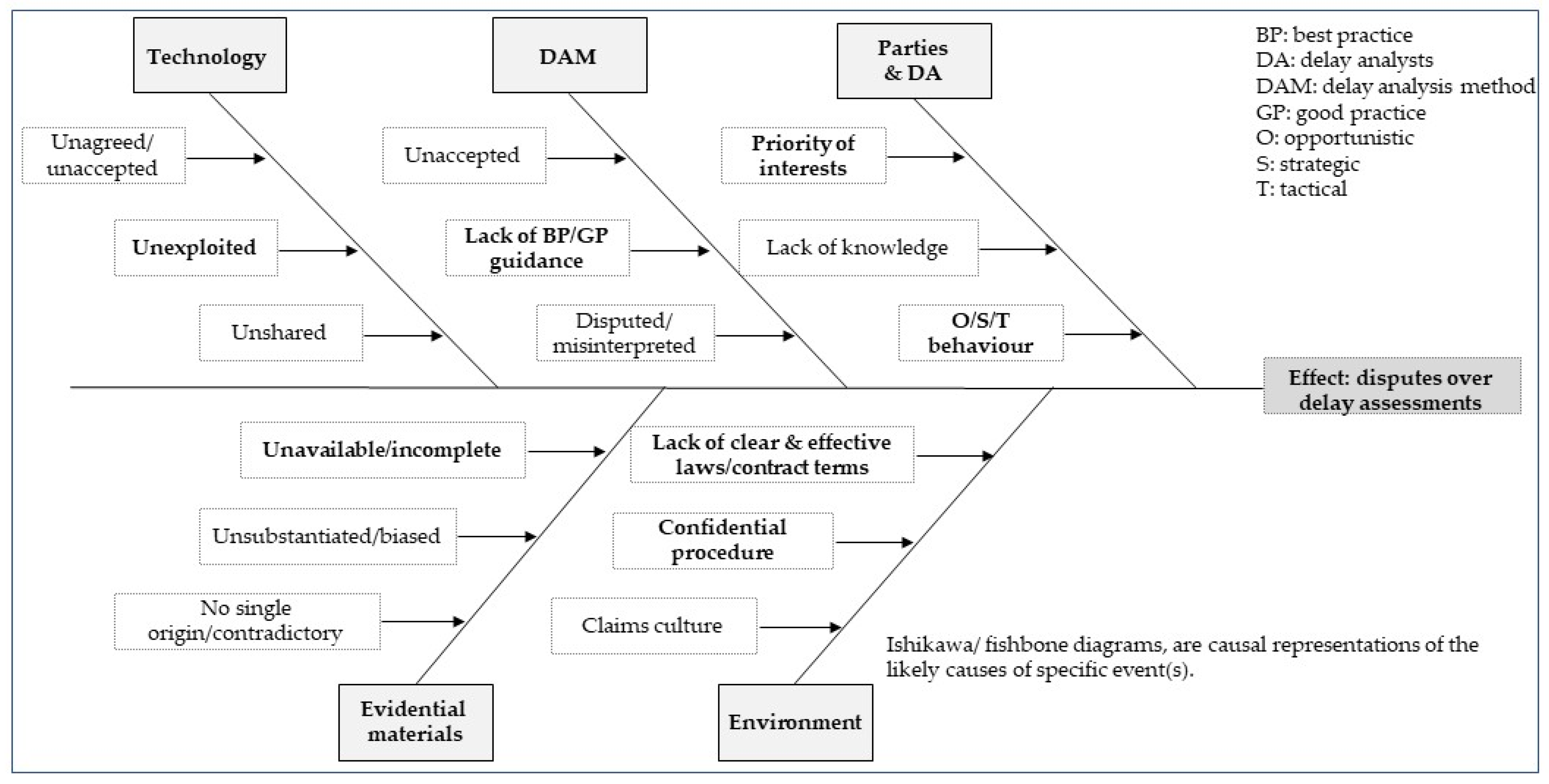
From the evaluation of the identified published literature and case study materials, the contextual variables were categorized as follows: (i) technological, (ii) evidential, (iii) environmental, (iv) contextual variables impacting delay assessments, including the selection and application of DAM, and (v) parties and delay analysts. Those contextual variables, illustrated in
Figure 1, relate to the legal, contractual, technical, factual, and procedural issues that collectively create opportunities for opportunistic/tactical/strategic behavior in the legal systems discussed in the case study sample. Such behavior resulted in disagreements over delay assessments, which escalated from contract claims into disputes, in all case studies. Some of the identified contextual variables have been highlighted in bold font, which signifies their relatively higher impact. The categories of contextual variables are colored in light grey, and the cumulative effect of all contextual variables is highlighted in darker grey.
The results reveal relationships between the contextual variables and factors, including the interplay between contextual variables. The discussion of the former commenced in the previous section. Concerning the latter, the collection and distribution of requisite data was influenced by the lack of agreement among the parties to construction contracts (i.e., contract deficiencies) and could have been improved using technologies. Furthermore, the objectivity of the delay assessments was impacted by the lack of best or good practice guidance, the confidential nature of the procedure, which resulted in biased EOT assessments. Case studies 7, 8, and 12, inter alia, offer evidence to support these propositions. In Case Study 7, for example, the arbitral tribunal appointed its own independent delay expert, which assisted the tribunal with evaluating the two independent delay expert reports commissioned by the parties. The tribunal-appointed expert criticized both delay assessments as theoretical and relying on unreasonable assumptions but clarified that while one of the reports was theoretical and unreliable, aspects of the other were objective. On the one hand, the two delay experts argued that they relied upon ‘recognized’ or ‘endorsed’ (e.g., by the SCL) DAM. On the other hand, the delay experts criticized each other for modifying the DAM/CPM. Such behavior revealed that (i) their original claims about using endorsed DAM were untruthful, as the DAM were modified; (ii) the current guidance provided in the SCL Protocol and AACE Practice Direction does not represent best or good practice guidance, and/or it offers opportunities for such behavior, and/or (iii) at least one of the delay analysts was not fulfilling their duty to produce objective delay assessments. Moreover, such circumstances put into question the independent status of delay experts if (i) the arbitral tribunals need to make such appointments (e.g., Case Study 7); (ii) the tribunal-appointed experts criticize at least one of the parties-appointed delay experts for, among other things, their lack of objectivity (e.g., Case Study 7), and (iii) at least one of the delay experts criticizes the opposing expert for manipulating their delay assessment, which occurred in every case study. Moreover, it is clear from the case study sample that such appointments increased the cost of the disputes significantly and that theoretical assumptions were typically exposed.
In Case Studies 8 and 13, the parties established mechanisms for the assessment of delays in the contracts, but one of the delay analysts disregarded those provisions despite the guidance from the arbitral tribunals and the case law, claiming that such issues are technical and therefore within their expertise. The tribunals indicated that the best way to serve the clients’ interests in those instances was to follow the pre-agreed DAM. However, one of the delay analysts in both cases disregarded the guidance, and they were criticized for it by the tribunals. This indicates the gravity of the issue, as delay analysts went as far as disregarding the guidance of the law [
27,
28], contract terms, and the relevant decision-makers to perpetuate the disputes. One of the delay analysts used novel concepts, including ‘complexity’ of programmes and ‘magnitude’ of delay (Factor 29), as opposed to more established and accurate methods such as the CPM, to quantify the delay, for which they were criticized by the decision-makers. This indicates the need for best practice guidance that establishes clear principles for the selection of DAM and discourages behavior that prioritizes delay analysts’ and/or their clients’ interests, which is manifested through zero-sum games and positional bargaining tactics, over the legal duty to produce objective assessments. Moreover, in all case studies, all dispute resolution methods guaranteed the confidentiality of the delay experts and their reports and thus protected their reputation.
In conclusion, the results suggest that the root cause of the escalation of disagreements over delay assessments from claims into disputes is the exploitation of systemic flaws, including (i) the lack of best practice guidance on assessing the impact of delays; (ii) contract deficiencies; (iii) prioritization of interests over duties; (iv) the confidential nature of the dispute resolution forums and (v) failure to exploit existing and emerging technologies to ensure the production and distribution of requisite evidential materials. It is therefore argued in this article that the issue is a systemic one. Without best or good practice guidance, opportunistic/tactical/strategic behavior is likely to continue. This needs to be addressed in construction contracts and/or best practice protocols/directions.
3.3. Analysis of the Interplay Between Factors and Contextual Variables
The analysis of the identified thirty factors in
Section 3.1 concluded that, although twenty of those factors were classified as objective, the main factors that caused disagreements between delay experts were either (i) factors presented by one of the delay experts in the case studies as objective (e.g., incomplete programmes or erroneous programme logic), but using subjective assumptions (e.g., by adding self-serving programme logic) when allegedly ‘remedying’ the objective issues, or (ii) self-serving interpretations of the facts. In other words, the former factors were ‘covertly’ subjective reasons for disagreements, while the latter were ‘overtly’ subjective reasons for disagreements. This raised the question as to why the legal systems in the case study sample allow the use of subjective assumptions when delay experts have a legal duty to produce objective delay assessments. Therefore, a working hypothesis was introduced that the factors identified from the case study sample are driven by contextual variables (or systemic issues), some of which are the main drivers (or root causes). Those contextual variables were identified in
Section 3.2. This section offers the substantiation of the working hypothesis by exploring the interplay between the factors and contextual variables. Consequently, one of the main theoretical arguments presented in this article is that it is important to understand the interplay between the relevant legal principles, the rules that govern the alternative dispute resolution (ADR) methods, the construction contract terms that regulate the determination of the impact of delays, the bargaining approaches used in such forums, the behavior of the parties and/or delay analysts and the delay analysis reports that are produced by the latter to justify the claimed EOT entitlements.
In terms of the aforementioned interplay, there is no best or good practice guidance on the selection of DAM. Legal systems leave it to the parties to construction agreements to decide how to use DAM, e.g., by including delay analysis terms in the contracts. However, construction contracts are often deficient in terms that govern the determination of the impact of delays, which is a significant issue in the aforesaid context. In the absence of such terms, delay analysts have the discretion to select and apply DAM. Such contexts create uncertainty and present opportunities for strategic/tactical/opportunistic behavior and prioritization of the interests of delay experts and/or their clients. For example, delay analysis consultants typically use billable hours to generate their income. The billable hours are likely to be higher if disagreements escalate from contract claims into disputes. As noted in
Section 3.1, the analysis of the archival case materials supports this argument, e.g., all delay analysts in the case study sample exercised their discretion to select and apply DAM, which led to using different and/or modified DAM that, in turn, resulted in the production of divergent EOT entitlements or LD liabilities and disagreements over those assessments. However, in all case studies, the delay analysts referred to the endorsement (by the SCL) of the DAM they had selected for the delay assessments, as if the SCL Protocol represented best or good practice guidance, and/or as if the DAM was compliant with the protocol. This was the case even if they modified the DAM, i.e., the DAM was not compliant with the SCL Protocol. For instance, in Case Studies 8 and 13, the opposing delay experts used the same DAM, but one of them conducted the CPM assessment retrospectively, rather than contemporaneously, which was required under the SCL Protocol. Such issues resulted in criticisms by their opponents and/or the decision-makers in all case studies, which included descriptions of at least one of the EOT assessments as, e.g., ‘subjective’, ‘theoretical’, or ‘biased’. To summarize, the analysis of the interplay between the factors and contextual variables concluded that in the absence of best or good practice guidance and clear delay analysis contract terms, delay experts prioritized their own or their clients’ interests when exercising their discretion. Although those were the main root causes of the escalation of disagreements over delay assessments, there are others, namely the confidential nature of ADR methods and inadequate evidential materials and/or rules.
The ADR forums used by the construction sector, including all ADR forums employed to settle the disputes in the case study sample, are characterized by, inter alia, relatively more relaxed evidential rules (when those ADR methods are compared to Litigation) and the confidentiality of the proceedings and evidential materials. The rules governing ADR forums ensure that the proceedings, including the delay expert reports and the decisions (which contain the criticisms of the delay expert reports), are typically kept private and confidential. This context incentivized the use of self-serving and subjective assumptions by delay experts, as the criticism of their delay analysis reports by decision-makers is unlikely to be published.
The aforementioned contextual variables allow the use of self-serving and subjective delay analysis reports that were typically used to enable Hard Positional Bargaining by providing misleading statements which were designed to create entrenched and extreme positions used to apply pressure, demand concessions and obtain one-sided gains. The archival case materials indicate such opportunistic/tactical/strategic behavior; specifically, parties were withholding information, which impaired the ability of their opponents to assess their EOT entitlement or LD liability. Moreover, the case studies show, among other things, (i) in all cases, the parties’ positions were significantly away from each other until the decision was made; (ii) very few concessions were offered during the dispute resolution process; (iii) the few concessions rarely resulted in significant reductions in EOT entitlements to the parties making such offers; (iv) the parties were often criticized by the decision-makers for not making significant concessions; (v) one party’s ability to assess its position was often limited by the unavailability of source materials and (vi) the parties were often criticized by decision-makers for formulating subjective assumptions that influenced the accuracy of the claimed EOT entitlements.
Further evidence of the deliberateness of the current state of play is that construction projects in the case study sample often lacked the requisite source materials, even though technologies, such as video recorders that can provide adequate evidence in the form of progress data, have existed for decades. In other words, this area of disagreement could have been remedied by using existing technologies and a single project database for the whole project.
In summary, the analysis of the interplay between factors and contextual variables concluded that the main root causes of the escalation of disagreements over delay assessments were the lack of best or good practice guidance for the selection and application of DAM and deficiencies in contract provisions. If those were offered, and existing technologies were used in the aforementioned manner, delay experts and/or parties to construction agreements would not be able to prioritize their interests over the interests of the public (or the taxpayers), who (in public projects) are the third parties that typically fund the costs of the escalations of disagreements over delay assessments from contract claims into disputes. In other words, the current system incentivizes such opportunistic/tactical/strategic behavior, as the inefficiencies are funded by the public.
4. Discussion
This discussion focuses on the identified categories and subcategories of (i) factors and their interplay, namely materials and records, including BP, PU, and as-built data, and matters of interpretation, which relate to aspects of the assessments of delays, and (ii) the relationship between the factors, contextual variables, and root causes.
The identified literature not only acknowledges some of the identified individual factors, but it also offers partial solutions. For example, if a BP lacks important detail or logic, it can be rectified by external verification of the BP before a contract is signed [
21]. In terms of contribution to practice, it is recommended that construction professionals use Factors 1–8 as guidance on the issues they should avoid when undertaking such exercises.
Although it can be argued that the results verify arguments presented in previous academic works that uncertainty of outcome can be driven by the insufficiency and/or poor quality of data, the analysis of the case studies indicates that BP, PU, and as-built records, though occasionally incomplete, were typically reliable and available to at least one of the parties in the case study sample. In other words, the uncertainty of outcome can be driven, and it was driven in all instances in the case study sample, by ‘covertly’ or ‘overtly’ subjective factors [
29,
30,
31,
32]. However, the published literature does not reveal many of the covertly subjective elements associated with the objective factors identified in this article, namely, the ‘self-serving’ or ‘theoretical’ assumptions used by at least one of the delay analysts in each case study. Moreover, the need to make assumptions was either created or exploited. In other words, opportunistic/tactical/strategic behavior was at the core of the generation of disagreements over delay assessments and the escalation of those disagreements from contract claims into disputes. This is one of the main contributions of this study, along with the identification and categorization of lists of factors, contextual variables, and root causes that are more detailed and complete, which collectively offer an analytical framework and the foundation for an integrated (or holistic) solution.
The research results also validate arguments that current contract mechanisms are ineffective in preventing disagreements over delay assessments, and offer examples of such inadequacies [
49]. For instance, the contracts in the case study sample did not include provisions for the collection and distribution (to all parties in construction projects) of relevant as-built data. Furthermore, while in theory, the project programmes should be regularly updated and used as instruments during the construction claims/EOT procedures, this is not always the case in practice, as some construction contracts do not stipulate such requirements. In the case study sample, the JCT, IchemE, and some of the bespoke contracts did not include such requirements. Therefore, there were no contractual needs to (i) issue regular and accurate PU and (ii) record and distribute as-built data. This was problematic, as it increased the opportunities for disagreements. Without such contract provisions, the parties cannot have contractual certainty, as they are likely to be exposed to opportunistic/tactical/strategic behavior, because, as aforementioned, (i) the analysis of delays in such contexts requires assumptions that are likely to be ‘theoretical’ and thus disputed, and (ii) legal systems require effective contract provisions to manage such risks. Offering adequate contract mechanisms is particularly important in a context where the law leaves it to the parties and their technical and legal advisors to manage and resolve disagreements over delay assessments [
27,
28].
The results also verify concerns about ‘modifying’ DAM raised in case law [
50]. The use of unrecognized or modified DAM should be eliminated. The SCL Protocol suggests that the parties identify and rely upon the most suitable DAM at the outset of a project [
35]. It has been suggested that recommending a ‘best of the rest’ method for delay analysis should be the best practice [
21,
35]. Therefore, this article argues that to avoid delay disputes, the plan and the delay assessment techniques should be agreed upon at the outset of a project, and the progress should be contemporaneously verified. In other words, SCL’s suggestion that the DAM fits the context should be incorporated in the construction agreements. This is the guidance provided by some legal systems [
27,
28]. This is another instance where contractual certainty can also be improved by agreeing to use a contractual protocol for delay analysis and/or changing the ownership of programmes, records, and the analysis. Case Studies 8 and 13 indicate that the former is a viable aspect of a potential solution, as the incorporation of delay analysis clauses was initiated in the UAE. For example, the use of contractually stipulated DAM appears to narrow the scope of the disputes significantly if such a method is harmonized with the contract.
In summary, it is the interplay between (i) availability, validity, disclosure, and analysis of data and (ii) systemic issues such as contractual uncertainty, the unwillingness of the legal systems to offer best or good practice guidance, that were exploited in all case studies by at least one of the parties’ and/or their delay analysts to create and escalate disagreements. Those findings offer a useful analytical framework that enhances the construction and legal professionals’ understanding of dispute causation, involving, inter alia, a distinction between factual data and technical causes and a sound foundation for a holistic solution.
5. Conclusions
EOT disputes are (i) widespread, persistent, time-consuming, and costly; (ii) one of the leading causes of construction disputes in the world; (iii) often funded by taxpayers, particularly disputes involving public projects; (iv) negatively impact productivity in the construction sector, and (v) should be resolved at an early stage to avoid and manage disputes more effectively. However, although legal systems have identified this issue, the published literature offers no in-depth studies that adequately diagnose the problem. The identified academic literature argues that the main causes of the escalation of disagreements over delay assessments from contract claims into disputes are objective factors, particularly unavailability and/or inadequacy of relevant project data, and/or contract deficiencies, and/or individual subjective factors. Furthermore, those findings are not based on comprehensive investigations of all factors involved, employing research methodologies that rely upon real-life project data. This is unsurprising as such data is not widely available and the research required to establish all factors is interdisciplinary and international, involving knowledge from the following professions: Project Planning, Construction Management and Engineering, Quantity Surveying, Dispute Resolution and Law. Therefore, the international significance of this study is anchored in the fact that it is the first study that establishes the factors, contextual variables, and root causes; specifically, systemic flaws create cultures, attitudes, and behavior that allow for the subjective factors to be the leading causes of the escalation of disagreements over delay assessments from contract claims into disputes. Since the technical aspect of delay disputes, namely delay assessments, is an international issue concerning all states, and there are similarities in the ways many legal systems tackle this issue, the impact of this study is expected to be universal.
This article employed three terms to explain the reasons for disagreements over delay assessments, namely factors, contextual variables, and root causes. Initially, this study focused on establishing and evaluating the justifications for differences in delay expert opinions (or the factors). However, it was established that these factors are not always the real reasons for disagreements over delay assessments (or the contextual variables). Delay analysis reports are produced for a purpose that is different from this study’s aim, and are often described as, inter alia, subjective, theoretical, and biased. Thus, this research sought to investigate the contextual variables (or the real reasons for disagreements) and root causes. The term ‘root causes’ describes the main contextual variables (or drivers), which are typically systemic issues. Once a comprehensive list of factors was established, the factors were evaluated and categorized. Then, the contextual variables and root causes were identified, evaluated, and categorized. Consequently, the working hypothesis was that, although the factors identified from the case study sample are at the core of the escalation of disagreements over delay assessments from contract claims into disputes, they are driven by contextual variables, some of which are the main drivers (or root causes).
Based on twenty-one case studies, the factors were identified, evaluated, and categorized. Essentially,
Table 2 offers a framework of factors that can help practitioners in all legal systems across the world to proactively mitigate the risk of disagreements over delay assessments. Two main categories of factors were identified, namely Objective and Subjective Factors, including thirty factors, divided into four subcategories, namely (i) baseline programme; (ii) programme updates; (iii) contemporaneous as-built data; (iv) delay analysis, involving the execution of DAM, the CPM, and causation analysis. Although the analysis of those factors can be synthesized into four issues concerning the availability, validity, disclosure, and analysis of data, the results of the evaluation of contextual variables reveal that claims culture, and the attitudes and behavior it produces, is at the core of the escalation of disagreements over delay assessments, as, among other things, delay analysts and/or their clients were often criticized for withholding available data, neglecting to revise expert opinions when new data were presented during dispute resolution proceedings, inconsistent reasoning for the selection and application of DAM, modification of recognized DAM to suit their and/or their clients’ interests, selective use of programmes and changing the start/completion dates of activities, by,
inter alia, using substantive start/completion dates, to suit the CPM analysis. In other words, this study revealed that, although the evaluation of the case study materials and the literature indicates that the primary reasons for disagreements over delay assessments concern the availability, validity, disclosure, and analysis of data, the main drivers are systemic issues such as inadequate contract provisions and the unwillingness of legal systems to offer best or good practice guidance on the production of delay assessments.
In addition to the aforementioned contributions to academic and practical knowledge, this study reveals how data gaps, issues with delay analysis instruments, and technical expertise involving methodological uncertainties can be exploited in legal systems that involve the production of expert opinions by opposing delay experts. These study results are likely to be beneficial for any innovative delay analysis tools. When creating new delay analysis instruments, academics and practitioners should be mindful of how the aforementioned issues can be exploited by the parties and delay analysts, which is likely to lead to escalations and disagreements over delay assessments from contract claims into disputes.
In terms of research limitations, although the case study sample is arguably small, it is the largest case study sample used to identify those factors and variables to date, and it includes some of the most important infrastructure projects and some of the largest construction disputes in the world. This is significant, as such data is typically inaccessible to the public due to the nature of alternative dispute resolution methods in the construction sector, which ensure the confidentiality of the parties and proceedings.
The case study sample included only cases where the disagreements over delay assessments escalated from contract claims into disputes. This was because the organization that offered the archival case materials specialized in this type of dispute, and it would only be instructed in instances where the parties to construction agreements are unable to settle those disagreements without the assistance of external consultants.
In terms of the generalizability of the research findings, it is noted that fifteen of the twenty-one case studies were UK-based. Therefore, although this study offers strong evidence that the implementability of the offered analytical framework is multinational, further research is recommended in different legal jurisdictions.
Even though (i) the research data presented in this article are reliable, and standard industry terminology was used to summarize the primary issues, and (ii) the evaluation of the issues and potential solutions presented in this article indicates that certainty of outcome in delay claims and disputes can be improved by the exploitation of existing and emerging technologies and contractual delay protocols, and/or changing the ownership of relevant data, it is recommended that further research is carried out, including the creation and testing of effective and efficient solutions for a reduction in escalations of disagreements over delay assessments, from contract claims into disputes. The knowledge of the factors, contextual variables, and root causes identified in this article is likely to be critical in creating such solutions.