2. Materials and Methods
The research objectives informed the data collection objectives, which were:
Objective 1: To identify the essential components of a conceptual pilot solution for early settlements of delay and disruption disagreements;
Objective 2: To create scenarios that identify the main challenges for the construction sector in the future;
Objective 3: To verify the implementability of the pilot solution, including in the four scenarios.
A dual approach, including two research methods, was used in this study to fulfil these objectives. The first one involved the analysis, synthesis, and evaluation of the published literature to identify a research gap and create an innovative and holistic conceptual solution to a problem, that is, the escalation of disagreements over delay and disruption assessments. This method contributed to the fulfilment of data collection Objective 1 and research Objective 1. The second research method, scenario planning, was used to forecast four scenarios for the future of the construction sector in/after 2030, identify the likelihood of the implementation of the proposed pilot solution, and seek its validation, refinement, and improvement, including in those four scenarios. The scenario planning, therefore, contributed to the fulfilment of all three data collection objectives.
Section 2 is divided into four sections. Firstly, after discussing the approach to the literature review in
Section 2.1, the main aspects of the Trilateral Model are discussed in the context of the literature in
Section 2.2. Then, after discussing the approach to the scenario-planning workshop in
Section 2.3, a synthesis of the key findings from the scenario-planning workshop is presented, including the PESTEL factors in
Section 2.4.
2.1. Literature Review
The literature search was precipitated by a search for relevant databases. Eight databases were identified and examined, namely (i) the Web of Science database; (ii) the Scopus database; (iii) the British Library ‘Ethos’; (iv) Google and Google Scholar; (v) the ICONDA library, or the online repository containing publications relating to the Council for Research and Innovation in Building and Construction (CIB); (vi) the Association of Researchers in Construction Management (ARCOM) research database; (vii) Westlaw, and (viii) LexisNexis.
The main criteria for the database search were the multidisciplinary needs of this research project, access, database type and relevance, and materials included. For example, this is a multidisciplinary research, involving knowledge from the following disciplines: project planning, construction management and engineering, quantity surveying, dispute resolution, technology, and law. For such studies, relevant databases (e.g., Web of Science and Scopus) were selected to ensure that pertinent literature was captured. Moreover, to reduce publication, geographic and data bias, (i) all databases with relevant literature and access were searched; (ii) databases that include professional (or grey) literature (e.g., Google) and case law (e.g., LexisNexis) were also used, and (iii) multiple types of content were included in the search, namely conference papers, journal articles, case law, professional literature and PhD theses. However, when a conference paper and a journal article relating to the same topic by the same authors were identified, the conference paper was excluded from the findings. Consequently, in addition to academic publications, the literature review included professional literature and case law (or collectively published literature) to reduce publication bias. The three types of literature were comparatively analyzed, but the ideas presented in case law and the academic literature were typically given more weight than the ideas presented in grey literature (e.g., the SCL Protocol), if there were clashes of ideas or principles. However, no such clashes were identified from the literature review.
The literature review sought to establish a research gap by using a methodical approach involving the analysis, synthesis, and evaluation of the identified published literature. The search for published literature was conducted in a manner that targeted reducing retrieval bias. Key search terms were adopted to seek all articles related to a reduction in construction (delay and disruption) disputes, as inter alia, this is a relatively new research field. For instance, in addition to the database-specific subject headings, keywords (e.g., disruption and delay dispute/analysis and scenario planning) and their synonyms (e.g., quantum and scheduling dispute/analysis and scenario analysis) were used to reduce retrieval bias, such as using generic terms or assigning publication types incorrectly, because, among other things, the subject area is relatively new. Moreover, the literature review sought to identify articles that investigate (i) the potential that existing and emerging technologies offer to avoid construction disputes (e.g., video cameras, scanners, unmanned aerial vehicles, blockchain, and artificial intelligence), and (ii) the potential of contractual solutions to achieve early settlements of delay and disruption disagreements. Only articles that identify challenges and offer solutions were selected for analysis. To create an integrated conceptual solution, those findings were synthesized (or categorized) into three themes, namely (i) causes of disagreements over delay and disruption assessments; (ii) solutions that recommend improvements for the lacking or inadequate material evidence, and (iii) studies that recommend improvements to contract provisions and procedures.
The case law was mainly identified through the search criteria in Westlaw and LexisNexis. All decisions of the relevant court (e.g., the Technology and Construction Court) were detected. The guidance offered on the selection and application of delay and disruption analysis methods was the main search criterion. The judicial decisions were qualitatively analyzed. The case law was grouped into themes based on the identified legal principles. Court judgments that did not refer to such principles were excluded. For example, principles discussing the legal aspects of concurrent delay were excluded from the sample, as those are not the focus of this study. Although the UK’s legal systems are at the core of the findings, case law from other jurisdictions was used to (i) corroborate the similarities between different legal systems, and (ii) supplement the research results because, e.g., some of those legal systems offer legal precedents that have not been created in UK legal jurisdictions. For example, the Australian law courts are clear that the selection of the DAM is a contractual matter. The results from the case law analysis are presented next. In summary, the literature search method consisted of an examination of the published literature germane to the data collection objectives, namely (i) to identify the requirements of the interdisciplinary component of the issue, including those of the legal systems, construction contracts, available guidance, and delay and disruption assessments, and (ii) to determine the interplay between those requirements.
The qualitative research method included a continuous and systematic process involving analysis, synthesis and evaluation of the published literature, and a comparative analysis of the findings from the academic and grey literature with the results from the evaluation of the identified case law, at every stage of the qualitative analysis. This process was essential in detecting the relevance of published literature to the data collection objectives. The main phases of the qualitative analysis were (i) ‘comprehending’ all areas of disagreements from the identified published literature, to establish the reasons for disagreements between delay and disruption experts. Publications that did not offer issues or aspects of the solution were excluded from the literature review results. This knowledge was required to discover and validate the main components for an effective and efficient conceptual solution; (ii) ‘categorizing’ (or synthesizing) those reasons and components, after studying the relationships between the main causes and the key aspects of the solution, and applying them to themes, namely, evidential materials and contractual requirements; (iii) ‘theorizing’ or using theoretical knowledge to discover explanations of the reasons for those types of disagreements, including the reasons for their escalation from contract claims into disputes, and the key aspects of the conceptual solution, and (iv) ‘recontextualizing’ the identified reasons and solutions back into the wider setting to establish the feasibility of the advocated solution (or Trilateral Model).
The literature review synthesized thirty-nine relevant academic publications from the period from 2010 to 2025, and twenty-six cases were distilled from the review of case law. The key findings were that (i) there are three integral components of the pilot conceptual solution, namely evidential requirements, data repository and a contractual mechanism, and (ii) although the published works discussed those individual aspects of the problem identified in this article and have offered some solutions to separate aspects of it, they have not fully associated them and have not proposed an effective solution to it that is empirically verified and implementable by the construction sector.
2.2. Trilateral Conceptual Solution for a Reduction in Construction Disputes
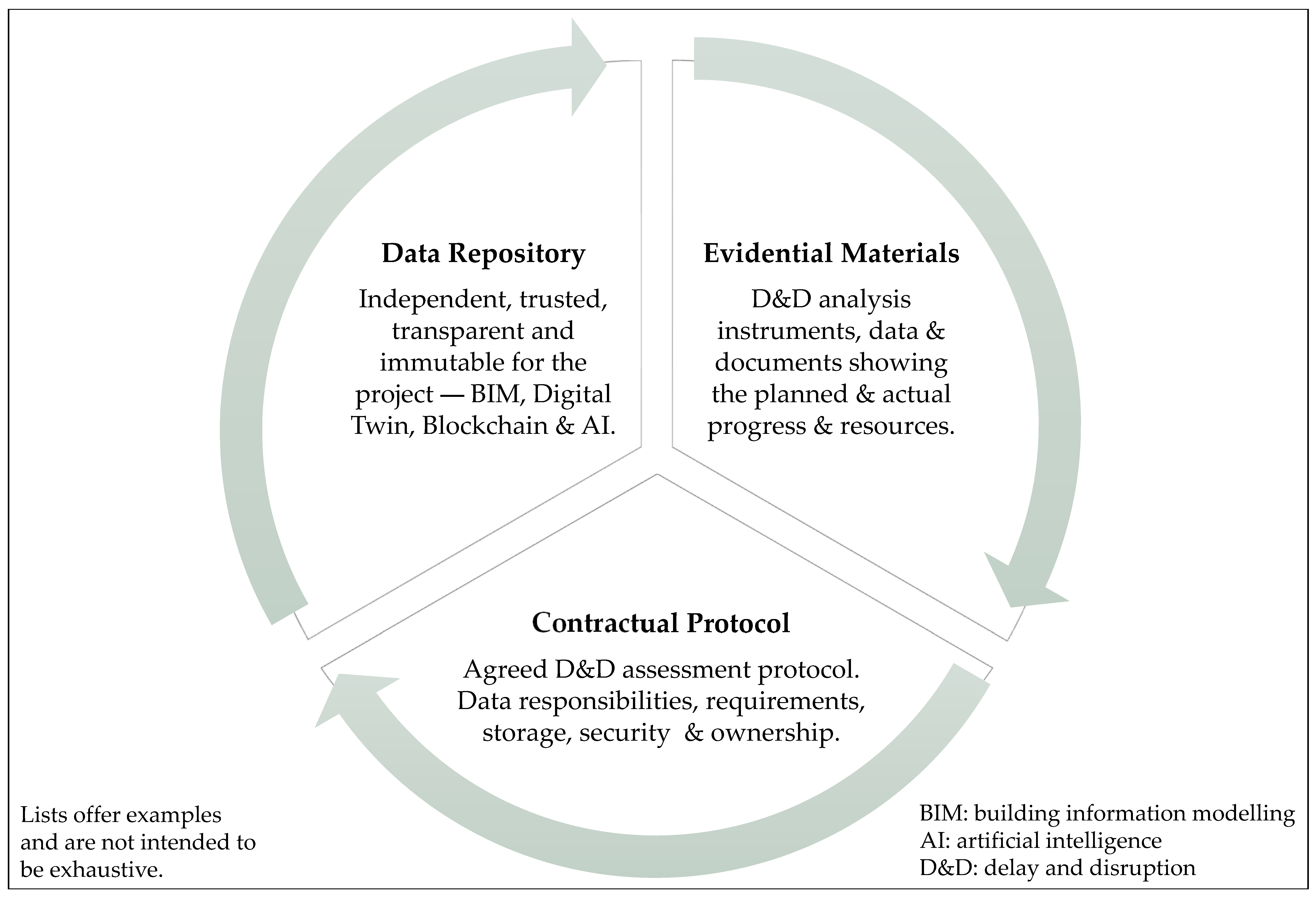
The first research finding, illustrated in
Figure 1, was a pilot trilateral conceptual solution for a reduction in such disputes through unequivocal, impartial, acceptable, and effective risk allocation and contractual certainty consisting of (i) a contract solution (or contractual protocol); (ii) evidential materials, and (iii) a data repository created with existing and emerging technologies. From the analysis, synthesis and evaluation of the literature, it was concluded that the primary arguments presented in the identified published works are that the main causes for disputes are (i) deficient contract provisions (e.g., inadequate and/or disputed delay/disruption measurement mechanisms) [
24]; (ii) inadequate source (or evidential) materials illustrating the planned and actual progress of building works, and (iii) unexploited technological advancements [
14,
15]. The identified published works have detected these individual issues, yet failed to fully associate them, explore the interplay between them, and offer a holistic conceptual solution. It is predominantly focused on the factors that cause disputes, and not on explaining how or why disagreements occur over delay and disruption assessments and escalate from claims into disputes. Consequently, in instances where solutions were offered, such recommendations were partial as the investigations into construction delay and disruption disputes did not adopt an integrated approach for resolving the problem. The three tenets of the proposed solution, illustrated in
Figure 1, are discussed next.
2.2.1. Evidential Materials
The identified literature suggests that inadequate source (or evidential) materials are one of the key causes of the escalation of disagreements over delay and disruption assessments from contract claims into disputes. Source materials can be defined as analytical tools, such as delay/disruption analysis instruments, which represent the evidential materials required to substantiate delay and disruption claims in law courts. For example, unavailable construction resource plans, flawed baseline and updated programmes (or schedules), and progress records/data [
22]. Moreover, baseline programmes should be independently verified to ensure their reliability in construction disputes. Since the lack of such requisite instruments/materials is unjustified and obtaining them is, at least in theory, achievable, this is the first tenet of the solution.
2.2.2. Data Repository
Since the literature suggests that the unavailability of requisite evidential materials to all parties involved in construction projects is at the core of the escalation of construction (delay and disruption) claims into disputes, using independent, trusted, transparent, and immutable technologies to (frequently and regularly) record the as-built status of the works and distribute this data among all parties involved in construction projects, to eliminate information asymmetry and facilitate the rationality of the parties when assessing their contractual entitlements and liabilities under the law by offering the same requisite evidential materials to all parties involved, is the second tenet of the proposed Trilateral Model. This can be achieved, at least in theory, by integrating existing and emerging technologies, including scanners [
25], blockchain [
26], sensors [
27], unmanned aerial vehicles [
15], and data management systems [
14]. It is argued in this article that the integration of existing and emerging technologies is likely to facilitate, at least in theory, accurate, reliable, transparent, and contemporaneous collection, storage, and distribution of requisite evidential materials (or delay and disruption analysis instruments) among all parties to construction agreements, which in turn is likely to lead to early settlements of disputes over the fact-related aspects of delay and disruption disagreements.
2.2.3. Contractual Protocol
The appropriateness of using any method for the assessment of delay and disruption entitlements, in the absence of any contractual requirements, remains at the discretion of the delay/disruption experts [
28]. Such discretion is often exploited by the parties/experts, which results in the escalation of contract (delay and disruption) claims into disputes [
5]. Furthermore, it is recommended that the parties to construction contracts accept the assessment methods to avoid the escalation of disagreements [
12,
13]. Consequently, it is argued in this article that neither the law nor technical aspects of delay and disruption claims prevent the parties from accepting the methods for delay and disruption assessments on an
ex ante basis. Moreover, the third tenet of the proposed solution requires improving the acceptability of delay and disruption analysis methods by the parties, the experts, and the decision-makers. In summary, all three tenets are required to ensure early settlements of delay and disruption disagreements in legal systems that rely on unequivocal substantiation of claims. Such a system of work is likely to facilitate productivity and commercial certainty via clear risk allocation that is legally enforceable.
2.3. Scenario Planning
The second research method used in this study was scenario planning, as it can assist decision-makers in the construction, technology, and dispute resolution sectors with understanding the challenges the construction sector is likely to experience in/after 2030, and can test, refine, and improve the pilot conceptual solution. The empirical research followed the scenario-planning method [
29].
The target participants invited to join the scenario-planning workshop were highly placed professionals and visionaries with construction law and management experience, such as senior academics, construction lawyers, decision-makers, commercial managers, delay analysts, and quantity surveyors with relevant experience. One hundred and ten relevant professionals were invited to participate in the workshop. Thirty-three professionals expressed interest in attending the workshop. Nine professionals attended the event. The literature indicates that between six and eight is a sufficient and manageable number of participants for scenario-planning and analysis workshops. A group of more than twelve participants may disintegrate into two or three small groups, each having its own independent discussion [
30]. Therefore, the group was not divided. Their experience is described in
Table 1.
Survey data were collected from the scenario-planning workshop participants.
Table 2 illustrates the ten stages of the scenario-planning method conducted in this study.
Stage 1 focused on defining the timeframe, scope, and decision variables. The timeframe was from 2022 to 2030. It was designed to identify the political, economic, social, technological, environmental, and legal (PESTEL) environment and facilitate medium-term and long-term planning (i.e., over five years). The scope focused on international dispute avoidance in the construction sector through the pilot solution offered in this article. The topics covered were the use of contract solutions, evidential materials, and available technologies in the context of risk allocation, dispute avoidance, and certainty of relevant construction contract terms.
Stage 2 identified the major actors and visionaries in the relevant sectors who are likely to be affected by changes in the PESTEL environment, namely specialists in dispute resolution, construction management, and relevant technologies, such as decision-makers (e.g., adjudicators and arbitrators), owners of law firms, construction dispute resolution consultancies, construction and technology companies, and visionaries.
Stages 3 to 5 identified the main forces that are likely to shape the PESTEL environment. Force is defined as ‘any trend, or any force that could affect whether the pilot solution is successful in the future, or not, in any way and/or magnitude.’ The PESTEL model was used to divide the trends into six groups to facilitate the participants’ thinking and identify as many factors as possible.
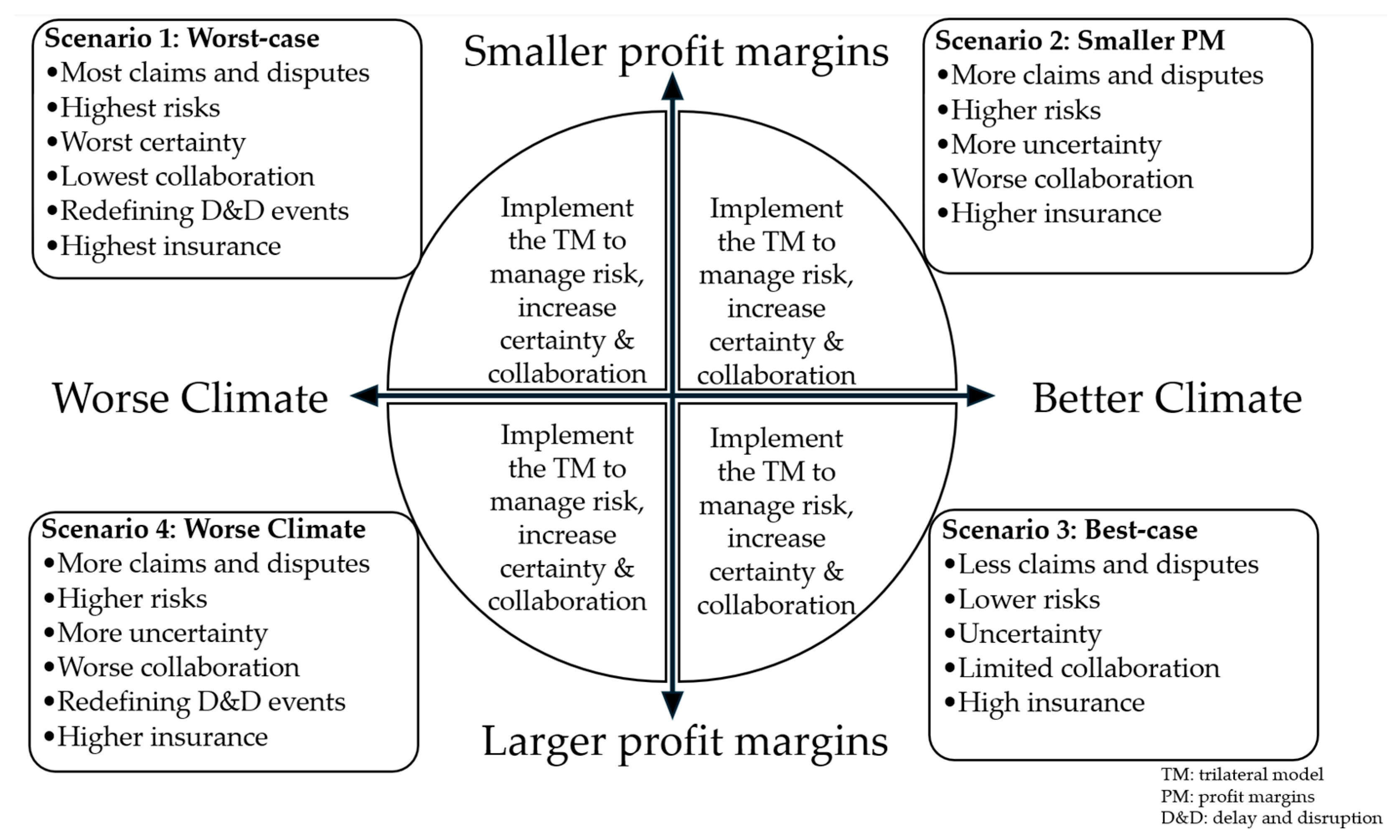
Stages 6 to 8 identified the two most important forces in 2022 and 2030 by plotting the identified forces into the four categories of a Probability and Impact Matrix, namely Category 1: low impact and low probability; Category 2: high impact and low probability; Category 3: high impact and high probability; and Category 4: low impact and high probability. The Category 3 forces were prioritized over the other categories. The two Category 3 forces with the highest impact and probability were used as the basis for creating four scenarios for the future. All participants were instructed to complete these tasks before the start of the focus group. Consequently, all participants were instructed to identify all forces, evaluate them in terms of their likely impact and the probability of their occurrence, and state the two most critical forces from their chosen factors. As per the guidance provided in the scenario planning and analysis literature, the stakeholder behaviour was evaluated, the four scenarios were validated, their consistency against key trends was verified, and the current construction and dispute resolution activities were connected with the likely future scenarios [
29,
31,
32].
Stages 9 and 10 sought the validation, refinement, and improvement of the proposed solution in the four identified scenarios. Since no challenges with the proposed conceptual solution were established, no actions were required to reduce the impact of the challenges on the solution. The recommended refinements and improvements are reported in the next section of this article.
The next sections offer the identified PESTEL factors (or forces) and the four constructed scenarios.
2.4. Identified Critical PESTEL Factors
The main forces identified by the nine participants of the scenario-planning workshop are summarized in
Table 3.
Eighteen factors were provided. However, the analysis of those eighteen factors concluded that consolidation was required because some participants used different terms to describe identical factors. The consolidation resulted in a reduction in the number of critical factors from eighteen to nine. In terms of categories, Politics, Economics, Society, Technology, and Environment were the five categories that the nine factors were associated with. One of the key findings was that none of the participants considered legal factors to be among the most critical. These factors were then plotted by each participant on a Probability and Impact Matrix to identify the two most critical factors in 2030, namely climate change and profit margins. Initially, the participants stated their most critical factors by voting. Each one of the nine participants had two votes, or a total of eighteen votes. Fourteen of the eighteen votes stated those two factors. Among the fourteen votes were the votes of the participants with the longest and most relevant experience and qualifications, including Participants 3, 7 and 9. After further discussion, a consensus was reached that climate change and profit margins were the most critical factors.
4. Discussion
Although studies concur with some individual aspects of the research results presented in this article, including the results of the scenario-planning workshop and the proposed Trilateral Model, the literature has not associated those issues and has not offered a holistic solution to this problem, which was one of the main contributions of this article.
In terms of the research results from the scenario-planning workshop, the finding that climate change is a very significant issue that is likely to impact the construction sector between 2022 and 2050 is corroborated by the literature [
9,
10,
33,
34]. For example, scenario-planning research indicates that climate change,
inter alia, threatens future generations and will require urgent global action and collaboration over the next three decades [
10]. Moreover, research identifies climate change as one of the two most significant issues that are likely to impact the built environment by 2040. Many countries are expected to be impacted by sea level rise, floods, drought, famine, and conflicts over resources, leading to mass migrations of people. This is likely to result in a significant and rapid transformation of the built-environment sector, where automation, data, digitalization, robotization, and similar technological advancements are likely to be a part of this transformation [
9]. In other words, there are climate change-driven events that typically affect construction contracts and result in disputes, e.g., floods and other extremely adverse weather conditions that are likely to cause construction delays and disruptions.
The second most significant issue identified from the scenario-planning workshop was the likely impact of inadequate profit margins (associated with numerous types of construction projects and various sizes of construction firms) on the construction sector. Although there is a lack of scenario-planning research to evidence the likelihood of profit margins becoming a significant issue at the beginning of the next decade, many studies comment on this matter and the relationship of small profit margins with the claims culture that exists in many countries. For example, the lack of financial flexibility and space for errors, combined with unforeseen project issues (e.g., the use of emerging technologies), makes construction companies vulnerable. Such vulnerability is often addressed by exploiting ambiguous legal rules and/or creating contractual uncertainty, which ultimately results in construction disputes aimed at generating additional revenues [
35,
36,
37,
38,
39,
40,
41,
42]. Consequently, there is wide support for the proposition that inadequate profit margins are a significant issue.
In terms of the key tenets of the proposed Trilateral Model, although such a solution has not been offered to date, the literature offers support for the individual tenets of the solution. This is discussed in
Section 3, as the model was based on such ideas. For example, the identified academic and grey literature suggests that inadequate evidential materials are one of the key causes of the escalation of disagreements over delay and disruption assessments into disputes. This could be remedied by the use of information repositories that exploit existing and emerging technologies [
14], and unmanned aerial vehicles [
15].
Moreover, construction contracts rarely offer efficient and effective mechanisms for the management and measurement of such delays and/or disruptions, and cause unnecessary and often avoidable disputes over the extent of the liability of parties to construction contracts for such events. It is therefore recommended that the parties to construction contracts agree on the delay and disruption assessment methods to avoid the escalation of disagreements over methodology [
12,
13].
This study reveals that, among other things, the number of climate change-driven events and the number of disputes relating to the measurement of the impact of those events are expected to increase. Consequently, the need for implementing the proposed solution is even greater because it aims to reduce such disputes by offering an accurate and acceptable risk allocation mechanism that is to be agreed upon on an ex ante basis. In other words, the Trilateral Model is likely to facilitate contractual certainty. Also, the research findings revealed that the model is likely to provide a viable solution to the negative impact of climate change on the insurance market, as, inter alia, it is likely to tackle the claims culture associated with some of the main sources of disputes in the construction sector. The clear allocation of risk that the model offers is likely to lead to a reduction in opportunistic/strategic/tactical claims and disputes. This is likely to have an impact on tender practices where the parties reflect those changes in their tenders (or offers), which, in turn, is likely to reduce the number of claims and disputes, which, in turn, can reduce insurance premiums and lead to more sustainable insurance markets.
5. Conclusions
Construction delay and disruption disputes involve disagreements over questions of law, facts, and technical matters. Disputes over technical issues concern disagreements that relate to specific fields outside the law, e.g., delay and disruption assessments, which are referred to in this article as technical matters. In other words, issues that require the assistance of specialists, namely, delay or disruption experts who assist decision-makers with interpreting the relevant facts to establish project delays or disruptions. Such disagreements often escalate from contract claims into disputes. The escalations are persistent, expensive, time-consuming, negatively impact the productivity of the construction sector, and are typically funded by third parties, namely the taxpayers. This is iniquitous not only because the funders are third parties, but also because such disputes are avoidable through the use of well-established legal principles and existing and emerging technologies. This article offered a solution to the aforementioned problem based on the analysis, synthesis, and evaluation of published literature, which was validated in a scenario-planning workshop. The recommended solution is significant because, among other things, governments, including the UK government, seek solutions that facilitate early settlements of construction disputes, which is the verified purpose of the Trilateral Model.
The literature review revealed that some of the aspects of the problem have been identified and explored, but the known aspects have not been fully associated, and as a result, holistic solutions have not been offered. This negatively impacted the effectiveness of the solutions that the published work tendered. The lack of integrated solutions is predictable and attributable to (i) the fragmented nature of the construction sector, which involves professional silos that also exist in the academic sector, and (ii) the slow uptake of technologies that the construction sector is associated with, which are an essential aspect of the holistic solution. The expertise required to offer such a solution includes knowledge from project management, planning, construction engineering, quantity surveying, commercial management, law, dispute resolution and technology. Moreover, the solution is implementable in multiple legal jurisdictions, including the ones discussed in this article. Consequently, this research is multinational, multidisciplinary, and interdisciplinary. The study contributed to the fulfilment of the identified research gap by offering a commercially and legally viable and verified conceptual solution, including the requisites for early settlement of delay and disruption disagreements, namely (i) the use of well-established legal instruments, specifically, contract terms, to improve the acceptability of delay and disruption assessments by the parties to construction contracts, experts and decision-makers, and (ii) the creation of undisputable evidential materials which offer an accurate representation of the facts that are distributed among all relevant parties. This would be facilitated by the use of emerging and existing technologies.
The key research findings of the scenario-planning workshop were that (i) climate change and small profit margins are likely to be the main issues in the construction sector in the next decade; (ii) the number and cost of delay and disruption disputes are likely to increase in the future, and (iii) the implementation of the Trilateral Model is likely to offer an effective solution in the four scenarios. The former finding is supported in principle by the academic literature; specifically, (i) many studies forecast that climate change is one of the main issues or the main issue that the construction sector will have to tackle over the next decades, and (ii) small profit margins have been a significant matter in many countries, which has negatively impacted construction firms, for decades. Currently, dispute resolution systems are associated with a claims culture that operates in an environment characterized by, inter alia, deficient evidence and contract provisions, and disputes over delay and disruption methods. The offered solution is likely to remedy those deficiencies and, thus, is likely to act as a deterrent by creating contractual certainty and removing opportunities for disagreements that often escalate from contract claims into disputes, which, in turn, is likely to lead to a reduction in such disputes through early settlements of disagreements over delay and disruption assessments. The recommended method of work should also facilitate productivity as the sector can focus its resources on relevant activities whilst facing the challenges climate change is likely to present.
This article contributed to knowledge in two ways: (i) it offered academic knowledge, including a conceptual solution and four likely scenarios based on the most critical forces that are likely to impact the construction sector in the future, and (ii) it created and validated a solution to a practical problem. The former enabled a comprehensive understanding of the core contractual and legal issues that enable disagreements over disruption and delay assessments, and the overarching reasons for their escalation from construction claims into disputes. The latter involved the design and validation of a conceptual solution to a practical issue, designed to achieve early settlement of disagreements over disruption and delay assessments and the resolution of such disagreements through contract claims procedures. Consequently, the Trilateral Model highlighted the key aspects of an integrated solution for the early settlement of construction disputes of these types.
It is noted that the aspect of the proposed solution related to offering material evidence using emerging and existing technologies is common across many legal jurisdictions. In fact, this aspect of the conceptual solution is similar across all legal jurisdictions that require substantiation by such evidence. However, the contractual aspect of the offered solution is based on legal principles offered in the UK and Australia. Consequently, even though this research submits a solid case that the applicability of the Trilateral Model is multijurisdictional and international, as, among other things, (i) the model was verified in a scenario-planning workshop attended by several highly qualified professionals, some of whom practice law across multiple legal jurisdictions, and (ii) one of the key findings from the scenario-planning workshop was that legal factors were not among the most critical forces that were likely to affect the implementation of the model by the construction sector, further research is recommended before the proposed model of work is implemented in different construction agreements and legal jurisdictions.
Although the testing of the solution revealed that the Trilateral Model is likely to be implemented in all four scenarios, further testing in real-life projects and disputes is recommended. The conceptual solution can be applied to other types of construction and commercial disputes, including technical disagreements based on methodology similar to the one used for the assessments of construction delays and disruptions.
As has been mentioned, the offered model is conceptual. Therefore, identification of the specific requirements relating to the three tenets of the Trilateral Model and their empirical testing, before the model is tested in live construction projects, is recommended.
The operationalization of the proposed model could be facilitated by an integration of machine learning-based text analytics, which is an avenue for further research. For example, with graph neural network-driven text classification and transformer-based text analysis for defect inspection and monitoring [
43], relevant documents and records could be converted into organized outputs such as dispute-risk indicators, evidence-comprehensiveness results, and event narratives and chronologies [
44].