Next Article in Journal
DHW Storage and Recirculation Systems in High-Rise Hotel Buildings: A Comparison of Energy Efficiency and Environmental Impacts
Previous Article in Journal
Leveraging Machine Learning to Explore the Spatial Function Service Value Through Human Perceptual Experience
 
 
Due to scheduled maintenance work on our servers, there may be short service disruptions on this website between 11:00 and 12:00 CEST on March 28th.
Article

Numerical Simulation of Natural Ventilation in Main Transformer Room of Indoor Substation

1
State Grid Hebei Electric Power Co., Ltd., Economic and Technological Research Institute, Shijiazhuang 050000, China
2
School of Civil Engineering, Hebei University of Science and Technology, Shijiazhuang 050018, China
3
Hebei Province Housing Construction Projects Regeneration Technology Innovation Center, Shijiazhuang 050000, China
*
Authors to whom correspondence should be addressed.
Buildings 2026, 16(4), 864; https://doi.org/10.3390/buildings16040864
Submission received: 3 December 2025 / Revised: 21 January 2026 / Accepted: 12 February 2026 / Published: 21 February 2026
(This article belongs to the Section Building Energy, Physics, Environment, and Systems)

Abstract

In the split main transformer room of the indoor substation studied in this paper, the heat dissipation area of the transformer main body and part of the convection pipeline accounts for approximately 5.4% of the total heat dissipation area, with the outdoor radiator responsible for releasing most of the heat. Compared with the integrated main transformer room of indoor substations, the split-type design features a smaller building size and lower ventilation energy consumption, thus it is widely applied in urban areas. This study employs computational fluid dynamics (CFD) simulation to investigate the natural ventilation and heat dissipation performance of the main transformer room in a 110 kV indoor substation located in the Shijiazhuang area. A thermal imager is used to capture the surface temperature distribution of the main transformer, and the data is fitted into a polynomial function. During the numerical simulation, the surface temperature of the main transformer is set using a user-defined function (UDF), and the total heat dissipation of each heat-dissipating surface of the transformer is extracted via FLUENT(Ansys 2024 R2) software as the basis for evaluating the ventilation and heat dissipation effectiveness. The effects of different ventilation window sizes on the natural ventilation heat dissipation and air change rate of the indoor substation’s main transformer room under thermal pressure are compared. The feasibility of this numerical simulation method is verified through experimental measurements and theoretical analysis.

1. Introduction

With the advancement of urbanization and the surge in power demand, indoor substations have emerged as core components of modern urban power grids, thanks to their advantages such as small footprint, short construction period, low operation and maintenance costs, and compatibility with the surrounding environment [1,2]. However, continuous heat generation from equipment within the enclosed space easily leads to a rise in indoor temperatures. High temperatures can reduce equipment operating efficiency, shorten service life, deteriorate the working environment, and increase safety risks, directly threatening the stability and reliability of the power supply network [3,4]. Therefore, optimizing the natural ventilation and heat dissipation effect of the main transformer room is crucial for ensuring the safe and efficient operation of the power grid.
Existing research on the ventilation and heat dissipation of indoor substations has laid a certain foundation: Ding Bin et al. [5] found that ventilation energy consumption accounts for 10.7% of the total building energy consumption of indoor substations; Wang Hong et al. [6] and Mo Wenxiong et al. [7] discussed related issues from a theoretical perspective. Gao Xueping [8] and Xu Tianguang [9] analyzed the impact of air inlets on the mechanical ventilation of transformer rooms through numerical simulation. Dakun Xu et al. [10] established an experimental platform and conducted research by combining experiments with numerical simulation. In addition, Wu Jie et al. [11] proposed evaluating the heat dissipation effect by integrating room temperature distribution and air age. Chen Wei et al. [12] also performed numerical simulation optimization for the natural ventilation of split main transformer rooms.
Nevertheless, there are still obvious gaps in existing research, which are difficult to meet the needs of practical engineering. Firstly, most studies [13,14,15,16,17,18,19,20,21,22,23,24] focus on integrated transformers, lacking targeted research on split transformers. Secondly, the uniform heat flux boundary condition is widely used in numerical simulations. This setting introduces significant errors under natural ventilation conditions, resulting in large deviations between simulation results and measured data [25,26]. Even the study by Chen et al. [27] faces similar problems due to the same boundary condition setting. Thirdly, the evaluation method is relatively simplistic, as the effect is only judged based on room temperature distribution, lacking accurate quantitative indicators.
In response to the above research gaps, this paper takes the split main transformer room of a 110 kV indoor substation in Shijiazhuang as the research object and conducts investigations on natural ventilation and heat dissipation. The core innovations and corresponding research methods are as follows: (i) In the setting of numerical simulation boundary conditions, a thermal imager was used to extract the actual temperature distribution on the transformer surface, which was then fitted into a polynomial function. Accurate temperature boundary loading was achieved in Fluent via UDF, replacing the traditional uniform heat flux setting and solving the problem of insufficient simulation accuracy under natural ventilation conditions. (ii) In the evaluation of heat dissipation effectiveness, a quantitative index system centered on the total heat dissipation of each heat-dissipating surface of the transformer was established, replacing the single room temperature distribution evaluation method and improving the accuracy of effect judgment. (iii) In the research design, natural ventilation optimization analysis was completed by systematically comparing the effects of different ventilation window sizes on heat dissipation performance and air change rate, and the reliability of the proposed numerical simulation method was verified through a combination of actual measurements and theoretical analysis.

2. Field Test

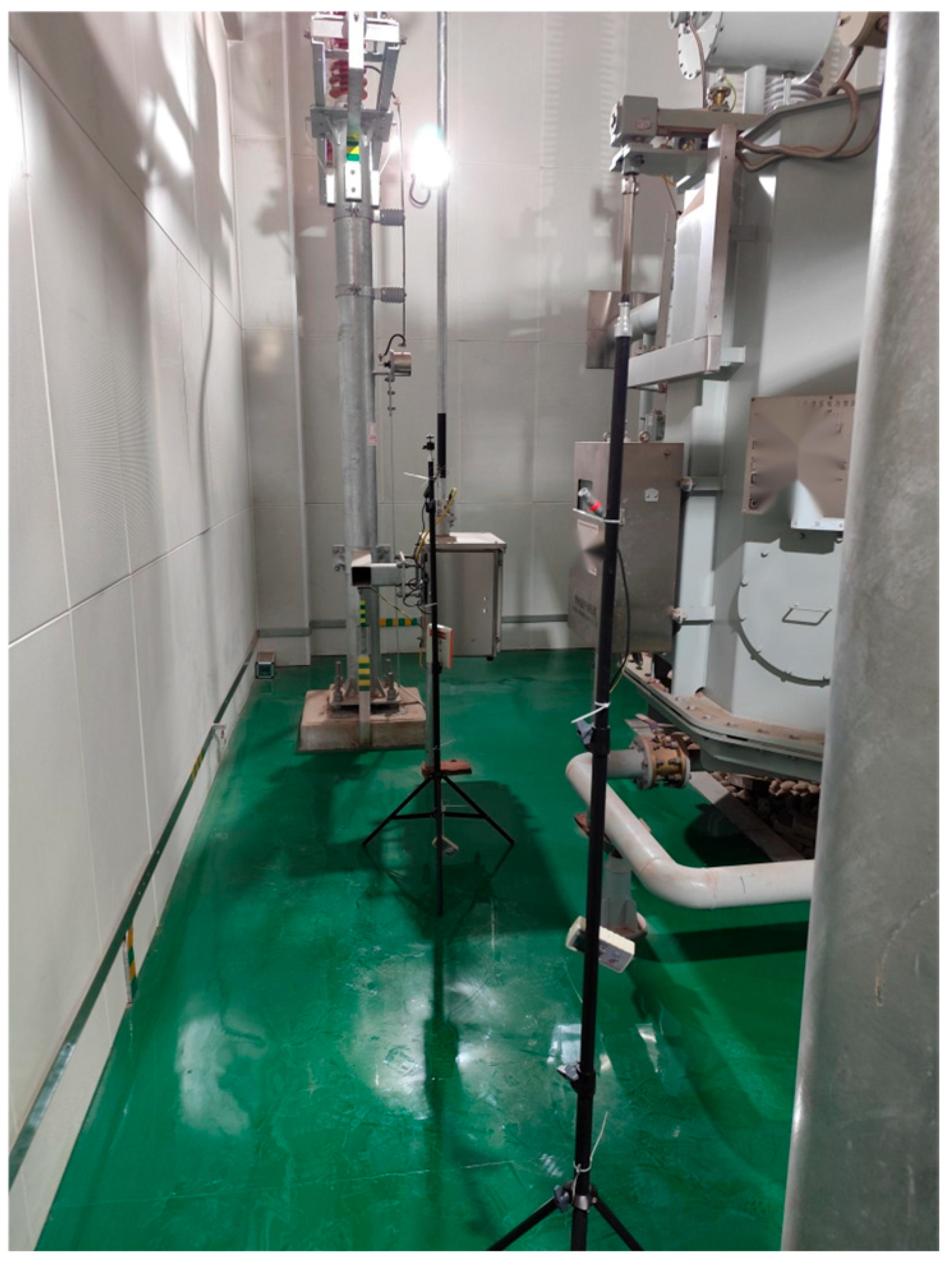
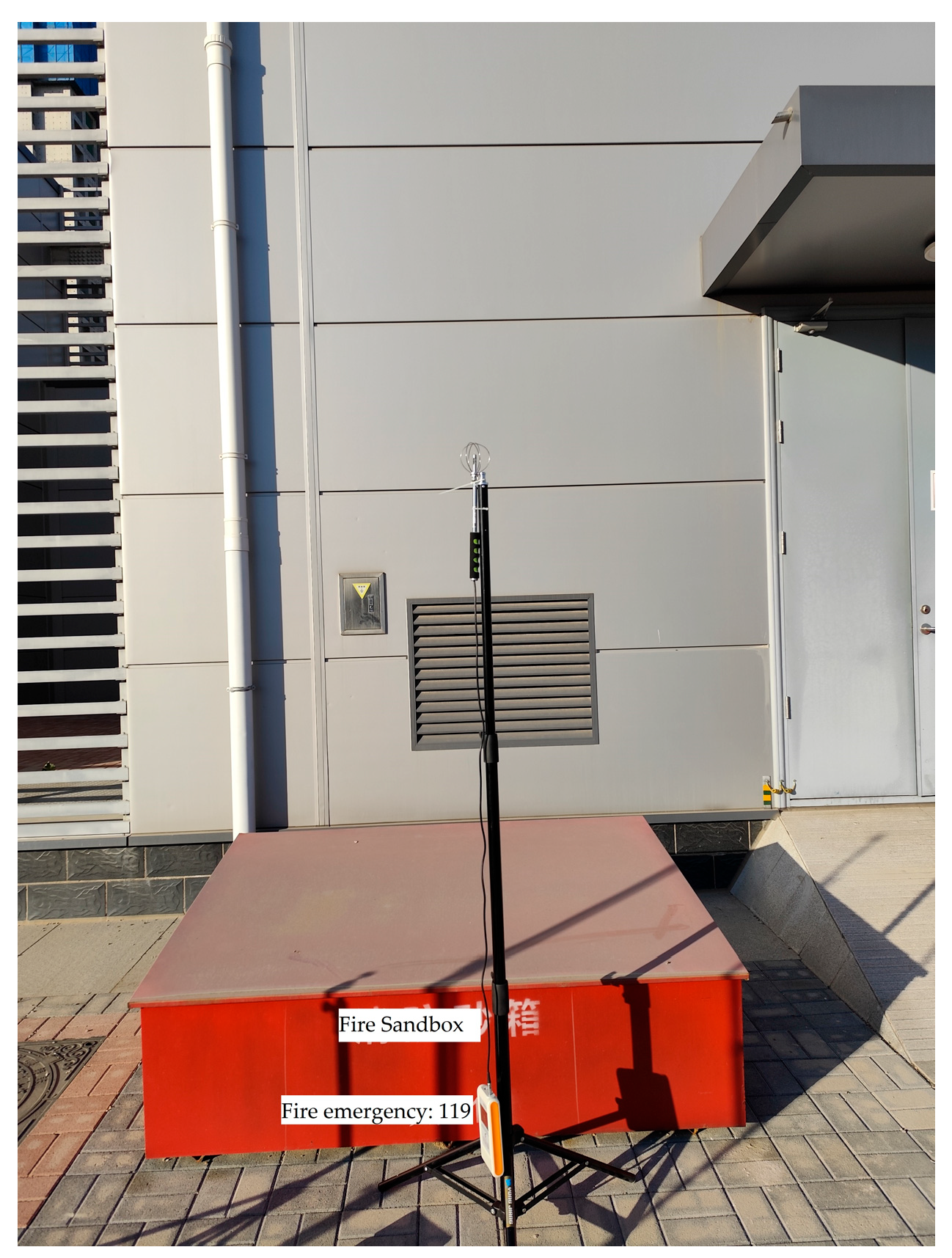
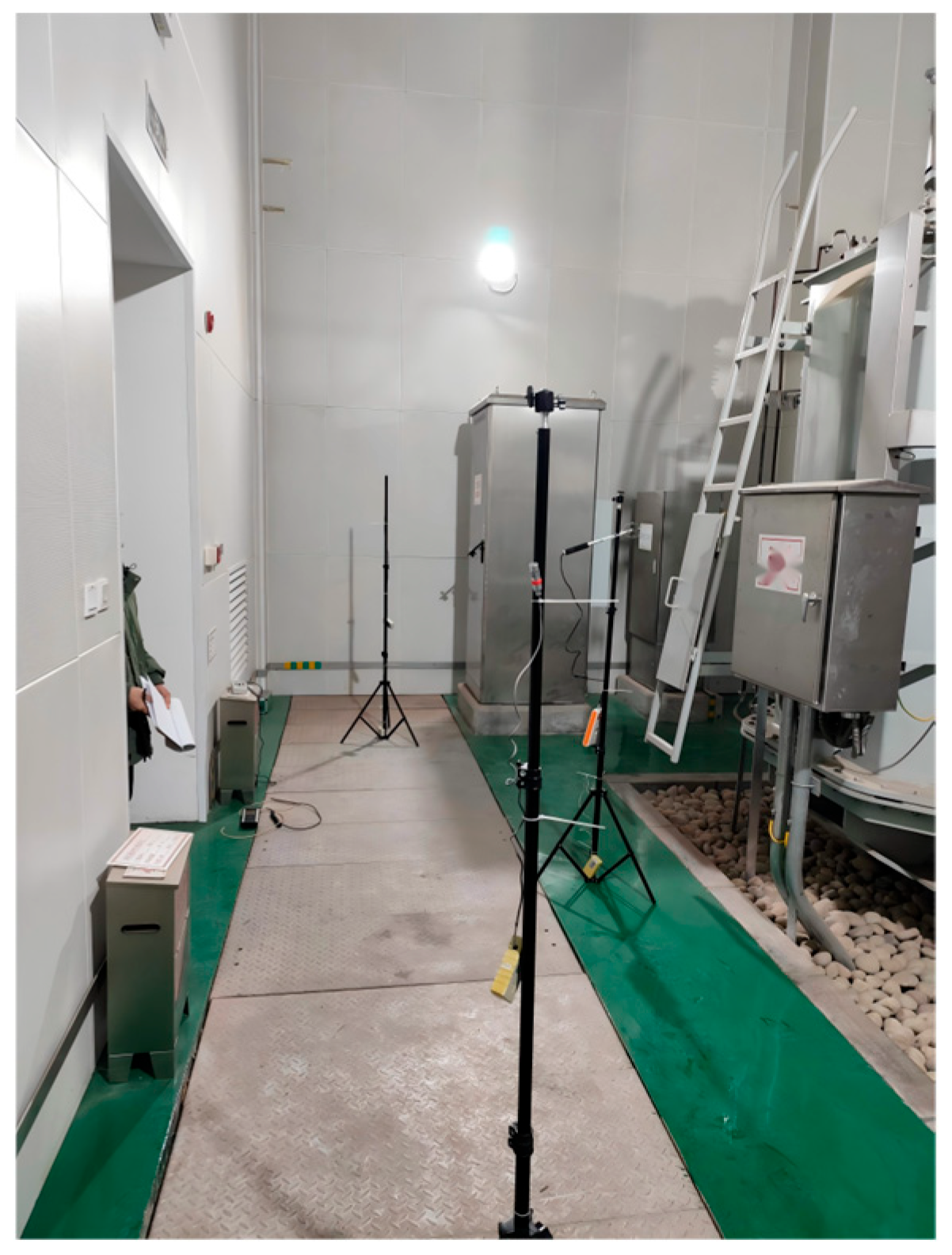
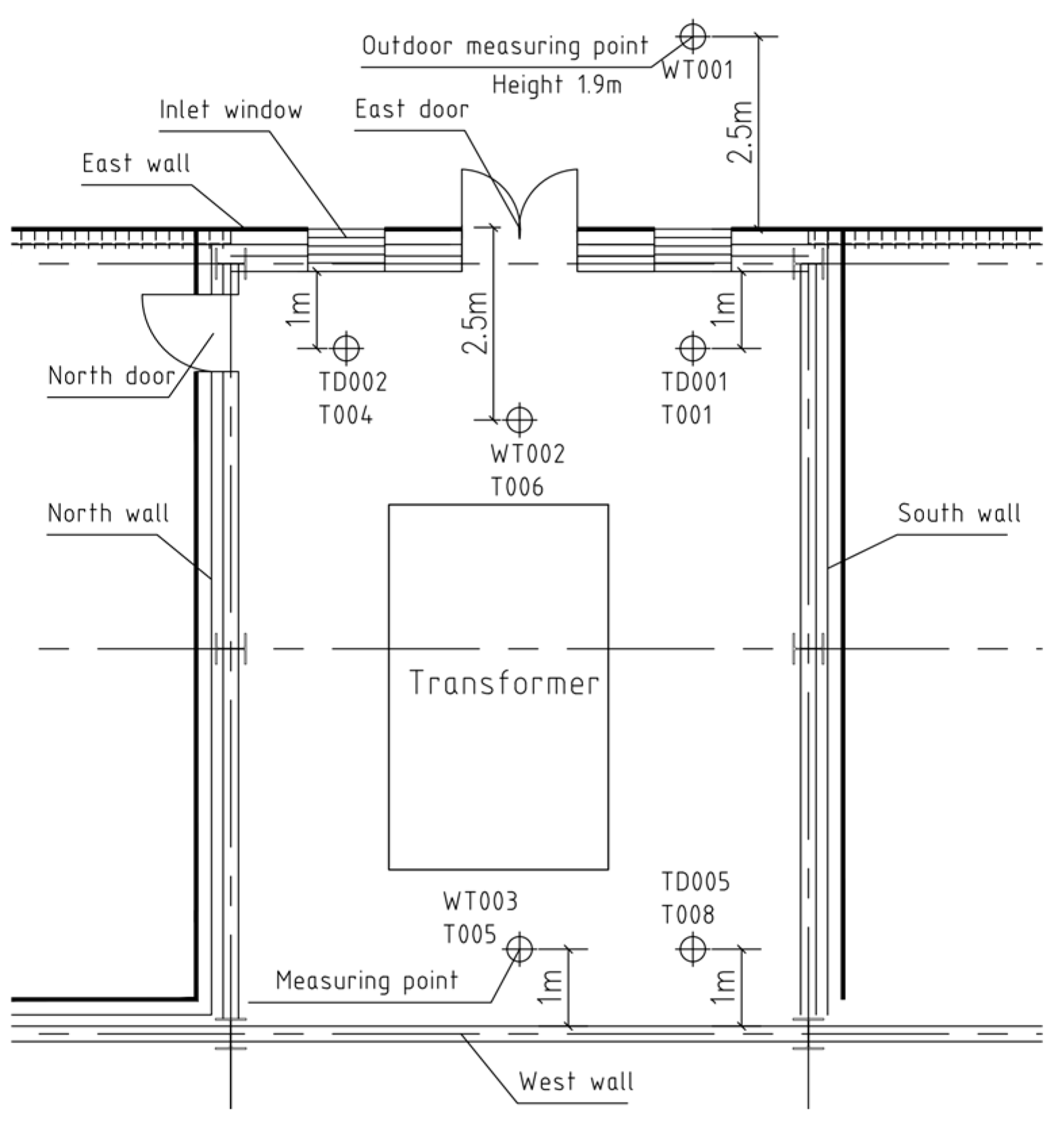
The test site is located in Shijiazhuang City, Hebei Province, and the test object is the main transformer room of an indoor substation equipped with a split transformer. To fully evaluate the heat dissipation performance of the existing ventilation system, instruments with continuous data storage functions were used to record indoor and outdoor environmental parameters, including temperature, air flow rate, and other relevant data (as shown in Figure 1, Figure 2, Figure 3 and Figure 4). Measurement points were arranged both inside and outside the #2 main transformer room. The overall temperature distribution of the main transformer surface and radiator was measured and analyzed using a testo865 infrared thermal imager (Testo SE & Co. KGaA, Lenzkirch, Baden-Württemberg, Germany). Parameters such as temperature, wind speed, air pressure, and humidity at each ventilation opening are measured using a TSI 9565-P anemometer with a 966 probe (TSI Incorporated, Shoreview, MN, USA) and a Swema 3000 hot-wire anemometer (Swema AB, Danderyd, Stockholm, Sweden). Brackets were installed at each indoor measurement point, with sensors placed at heights of 0.5 m and 1.5 m to continuously monitor and record temperature, humidity, and wind speed without interference. As shown in Figure 4, the test instrument numbers are labeled next to the corresponding measurement points. Specifically, T001, T004, T005, T006, and T008 are WZY-1 temperature recorders (Beijing Tianjian Huayi Technology Development Co., Ltd., Beijing, China) installed at 0.5 m. Among them, TD001, TD002, and TD005 are WSZY-1 temperature and humidity recorders, while WT002 and WT003 are WWFWZY-1 universal wind speed and temperature recorders (Beijing Tianjian Huayi Technology Development Co., Ltd., Beijing, China) installed at 1.5 m. The outdoor measurement point WT001 is a WWFWZY-1 universal wind speed and temperature recorder (Beijing Tianjian Huayi Technology Development Co., Ltd., Beijing, China), installed at 1.9 m. The west wall of this room is an inner wall, the other three walls are outer walls, and the roof is exposed to the outdoors.
The tests were conducted in the #2 main transformer room on 3 January 2025 (from 10:00 to 11:32) and 9 June 2025 (from 10:00 to 11:30), respectively. The weather during both test periods was sunny with high atmospheric transparency.
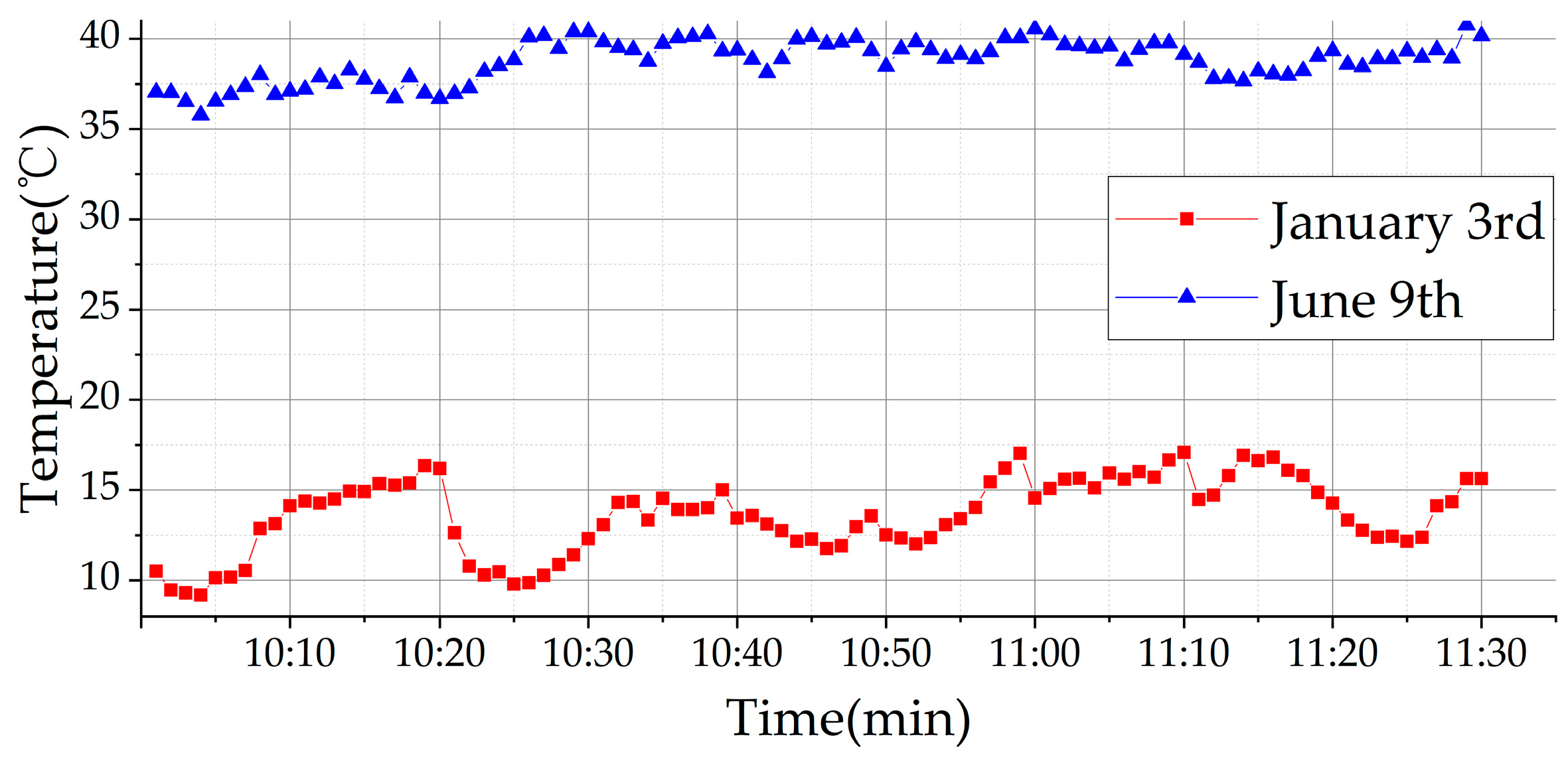
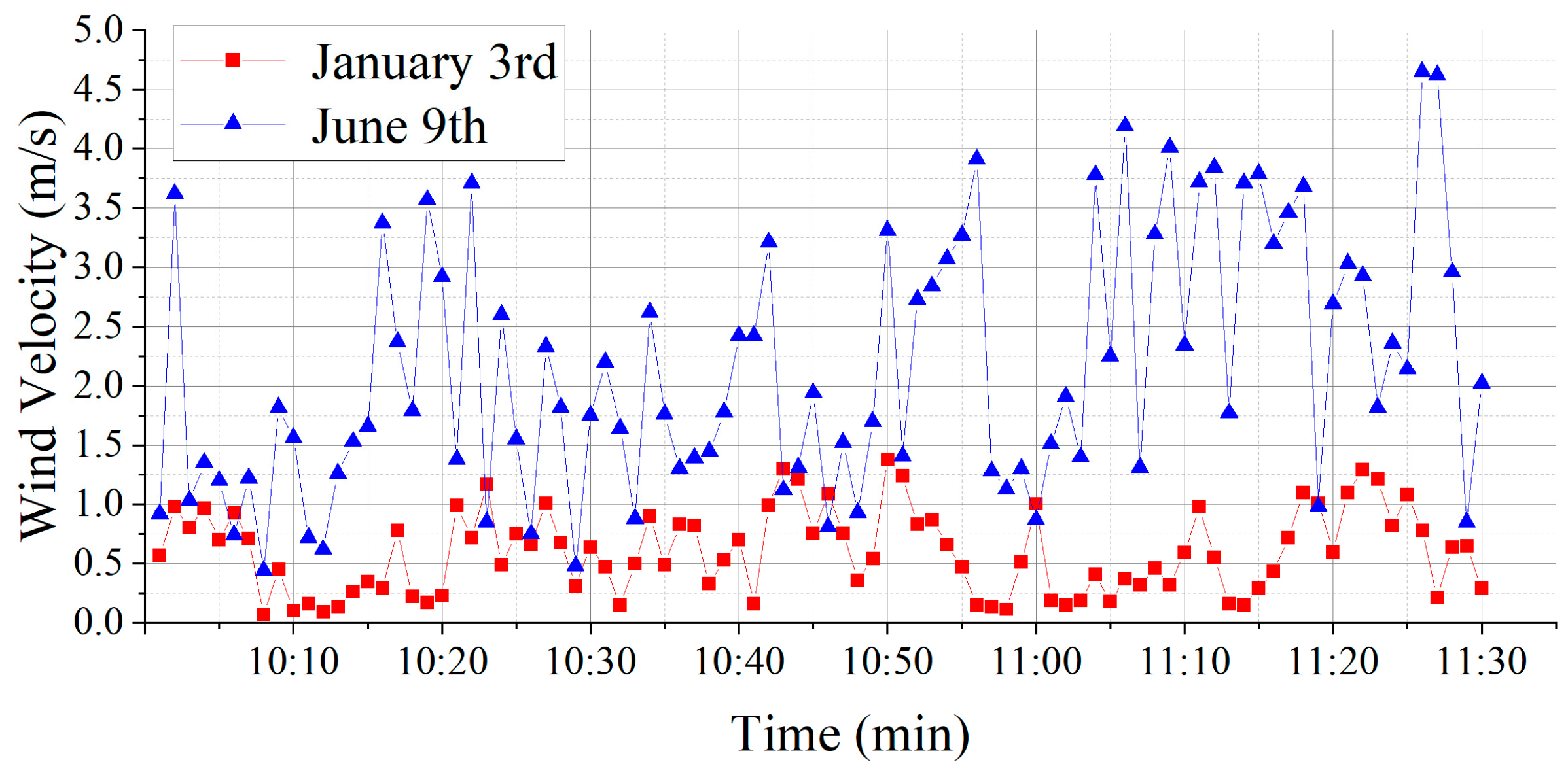
On 3 January 2025, the outdoor atmospheric pressure was 102.570 kPa. During the test, the minimum outdoor temperature was 9.19 °C, the maximum was 17.09 °C; the minimum outdoor wind speed was 0.07 m/s, and the maximum was 1.31 m/s. On 9 June 2025, the outdoor atmospheric pressure was 99.710 kPa. During the test, the minimum outdoor temperature was 35.77 °C, the maximum was 40.76 °C; the minimum outdoor wind speed was 0.44 m/s, and the maximum was 4.65 m/s.
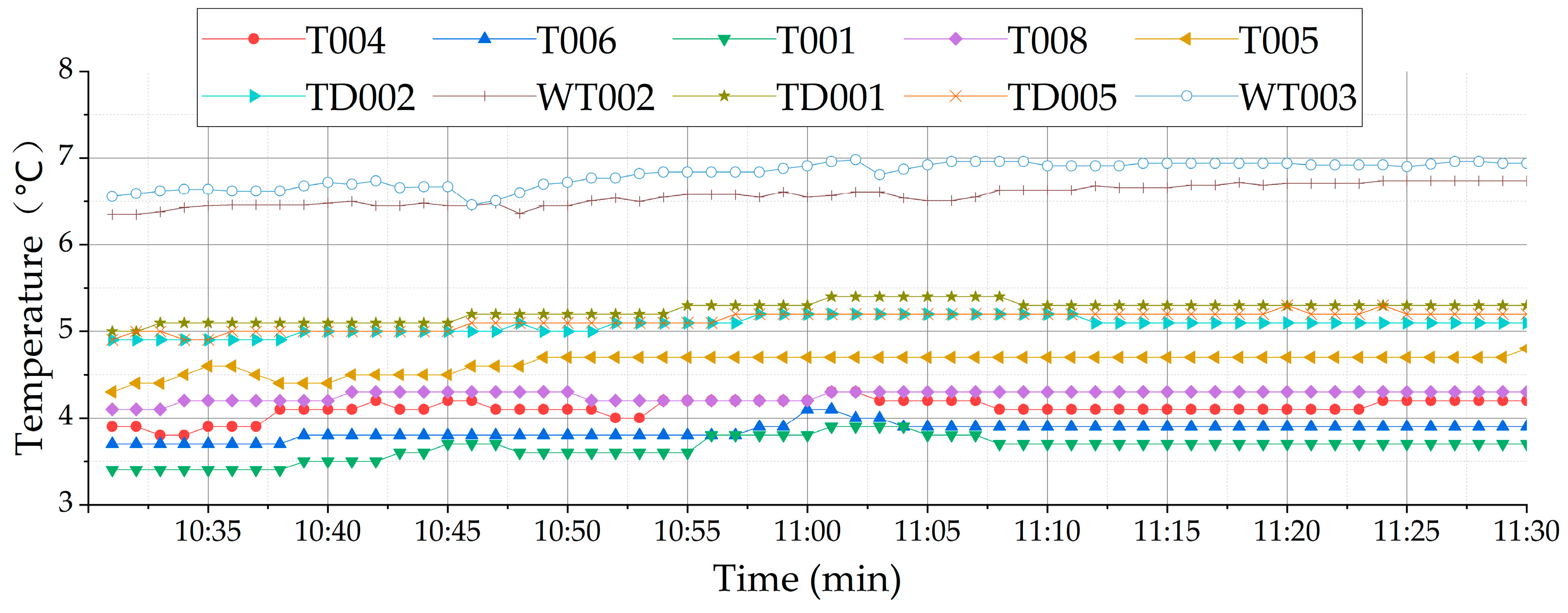
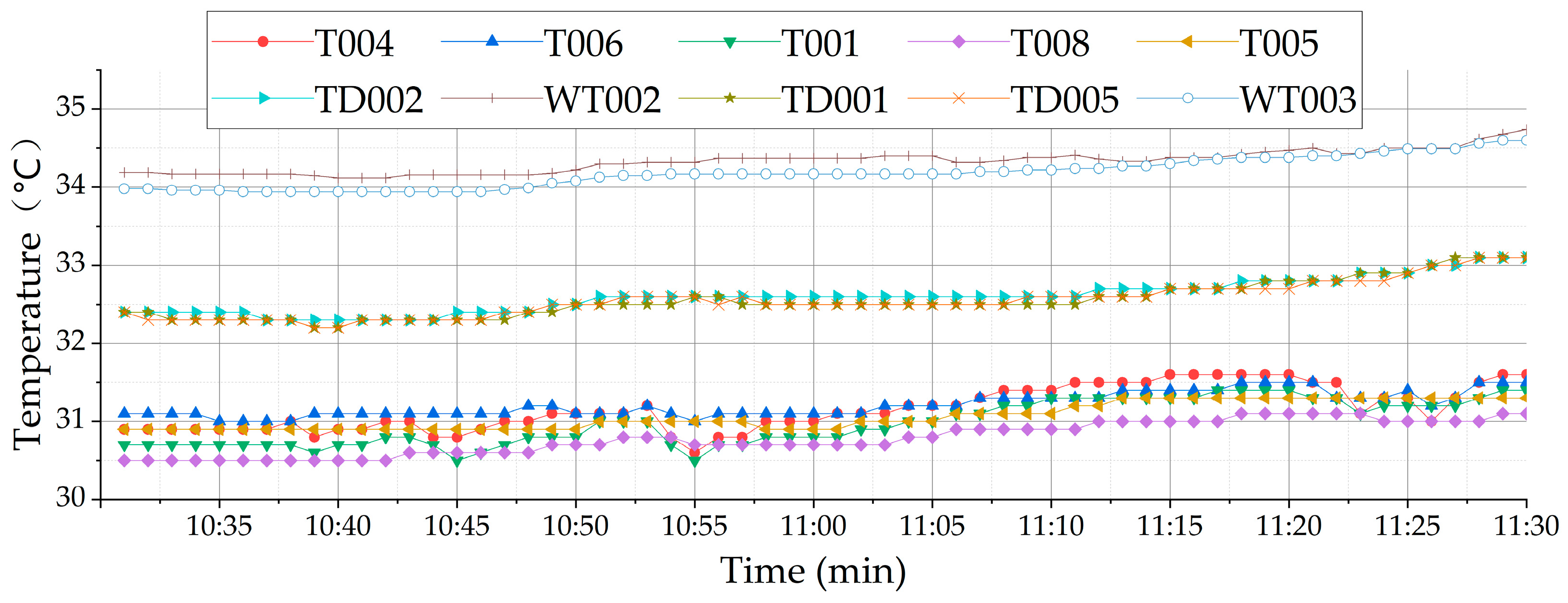
The outdoor wind speed at the measurement point of the #2 main transformer on January 3 and June 9 is shown in Figure 5, and the indoor and outdoor temperature distributions are shown in Figure 6, Figure 7 and Figure 8. During the 1 h measurement period without interference, the indoor temperature remained relatively stable with a variation in less than 0.3 °C, indicating that the indoor temperature was minimally affected by changes in outdoor temperature. Notably, the outdoor air temperature was consistently higher than the indoor temperature, suggesting that the main transformer was operating under a low load. The temperature deviation between measurement points at the same height was small. The surface temperatures at WT002 and WT003—which are located near the east and west sides of the main transformer—were higher than those at other measurement points at the same height, likely due to their proximity to the heat source. During the unmanned test period, the wind speed recorded by the universal anemometers at WT002 and WT003 was 0 m/s, indicating that the actual wind speed at these points was below the minimum detection threshold of the instruments, suggesting that outdoor wind speed had little impact on indoor wind speed.
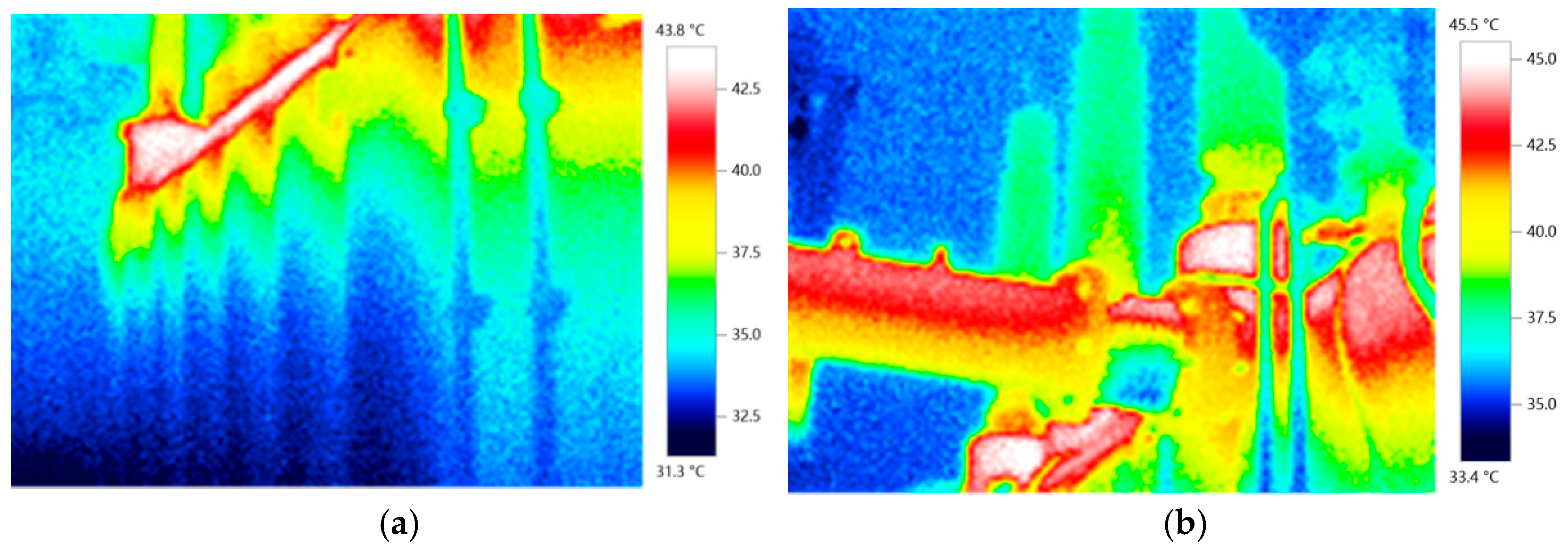
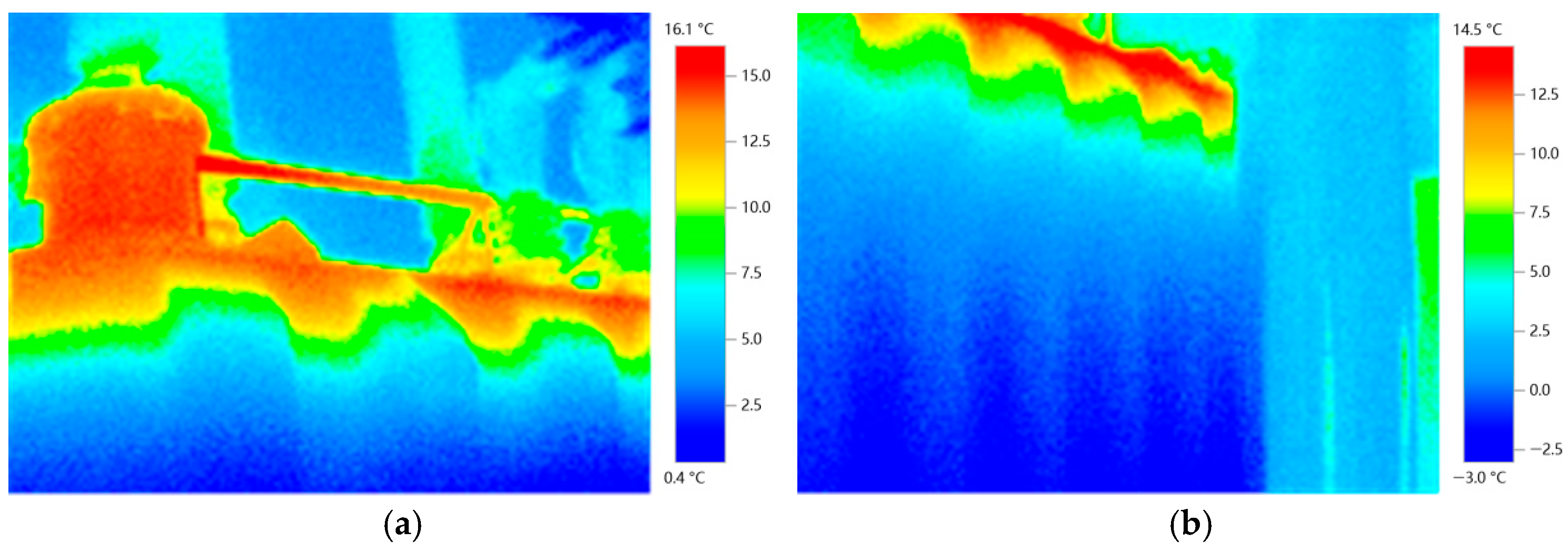
The surface temperatures of the building structure and the transformer were measured using a testo865 infrared thermal imager, and temperature data was extracted from the thermal images using the supporting IRSoft analysis software (Version 5.1) (see Figure 9 and Figure 10). The surface emissivity of the painted equipment was 0.94, and that of the wall was 0.98. The IRSoft analysis software can correct the emissivity of thermal images.
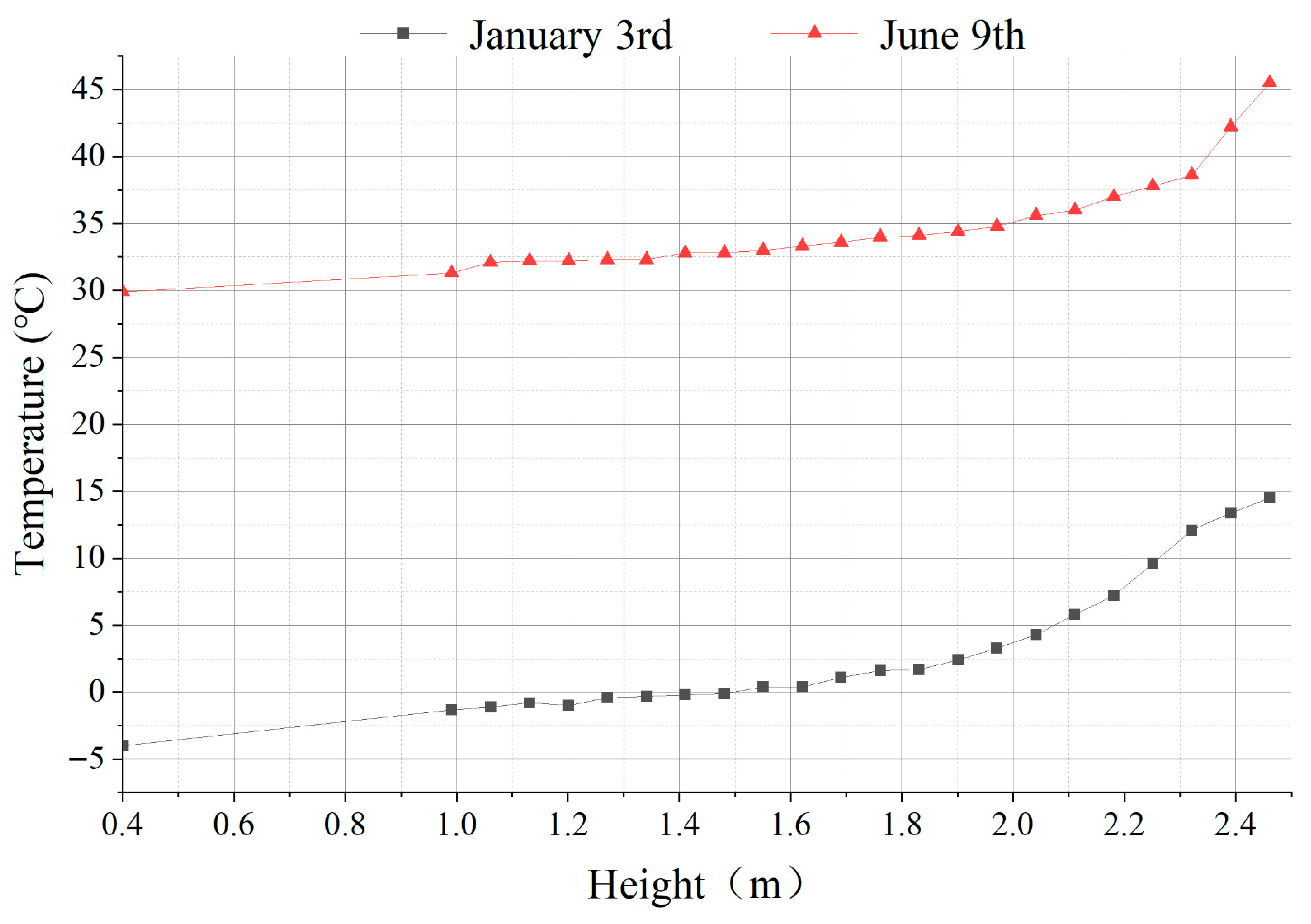
The surface temperature of the #2 main transformer was non-uniform, which is consistent with the thermal stratification phenomenon observed in the natural convection heat dissipation of transformer oil. The surface temperature distribution on the south side of the main transformer, extracted from the thermal images, is shown in Figure 11. The thermal images reveal a large temperature gradient along the height direction on the north and south sides of the main transformer, while the temperature gradient along the height direction on the east and west end sides is relatively small. Additionally, the temperature at the top terminal is uniform, consistent with the top temperature of the main transformer.

3. Numerical Simulation Comparison

3.1. Model Establishment and Simplification

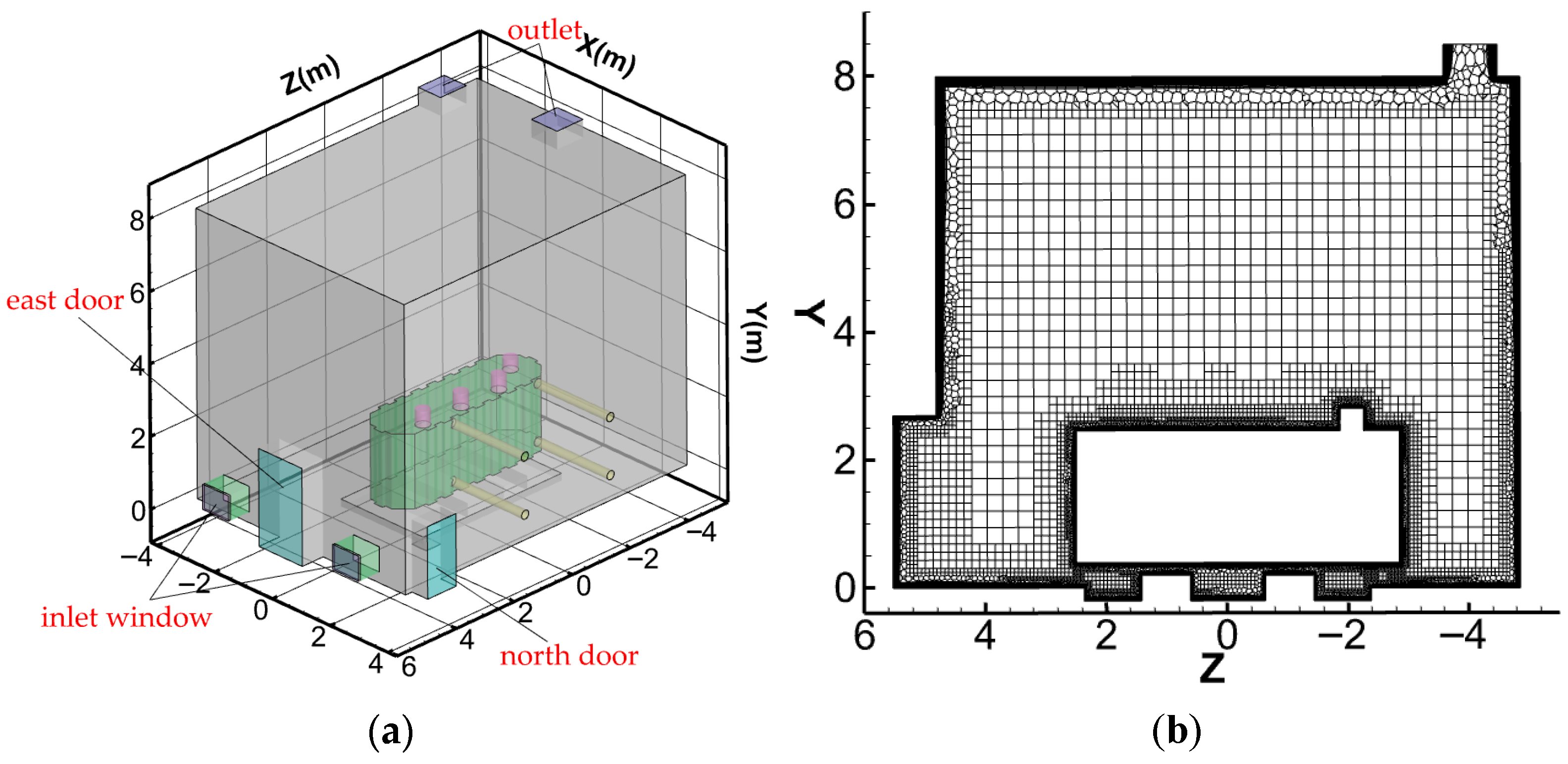
Based on the actual dimensions of the #2 main transformer room of a 110 kV indoor substation in Shijiazhuang, Space Claim software(Ansys 2024 R2) was used to construct a geometric model [27]. To balance computational efficiency and simulation accuracy, the following simplified assumptions are made: (1) Secondary structures such as insulators, terminal boxes, and lightning rods, which have minimal impact on ventilation and heat dissipation, are ignored; (2) Under natural ventilation conditions, the exhaust fan is not activated, so the circular nozzle of the roof exhaust fan is simplified to a square duct with the original opening size, and the exhaust fan body is omitted; (3) The pebbles in the oil discharge pool are paved flat and flush with the ground, simplified to a 0.2 m deep plane.
The core parameters of the model are as follows: The measured dimensions of the main transformer room are 7.21 m (X-axis) × 9.65 m (Z-axis) × 8.00 m (Y-axis). The main transformer and radiator are arranged separately (with the radiator placed outdoors). The main transformer is 0.4 m above the ground, and the foundation height is 0.4 m (0.2 m higher than the ground), simplified as an approximate cuboid with dimensions of 5.13 m (Z-axis) × 1.64 m (X-axis) × 2.06 m (Y-axis) and with rectangular concave-convex ribs on the sides. Ventilation opening sizes: window opening: 0.7 m (height) × 0.9 m (width) × 0.71 m (depth); east door opening: 2.7 m (height) × 1.5 m (width) × 0.71 m (depth); north door opening: 2 m (height) × 0.98 m (width) × 0.54 m (depth); exhaust port: 0.89 m (length) × 0.89 m (width) × 0.5 m (height). The main transformer room model is shown in Figure 12.

3.2. Grid Division

Fluent Meshing software (Ansys 2024 R2) is used to generate a mixed grid to balance simulation accuracy and computational performance. The grid setting parameters are as follows: The boundary layer adopts the last-ratio migration method, with a first-layer thickness of 0.001 m, 25 layers, and a transition ratio of 0.12. The mesh filling uses the poly-hexcore method, with the size adjustment method set to Global, a buffer layer of 2, a stripping layer of 1, a minimum cell size of 0.002 m, and a maximum cell size of 0.256 m. The final total number of grids is approximately 4.4 million, and the grid distribution is shown in Figure 12.

3.3. Determination of Boundary Conditions

A core advantage of this research is the loading of the transformer’s non-uniform surface temperature through a user-defined function (UDF). The specific setting process and boundary conditions are as follows:
(1)
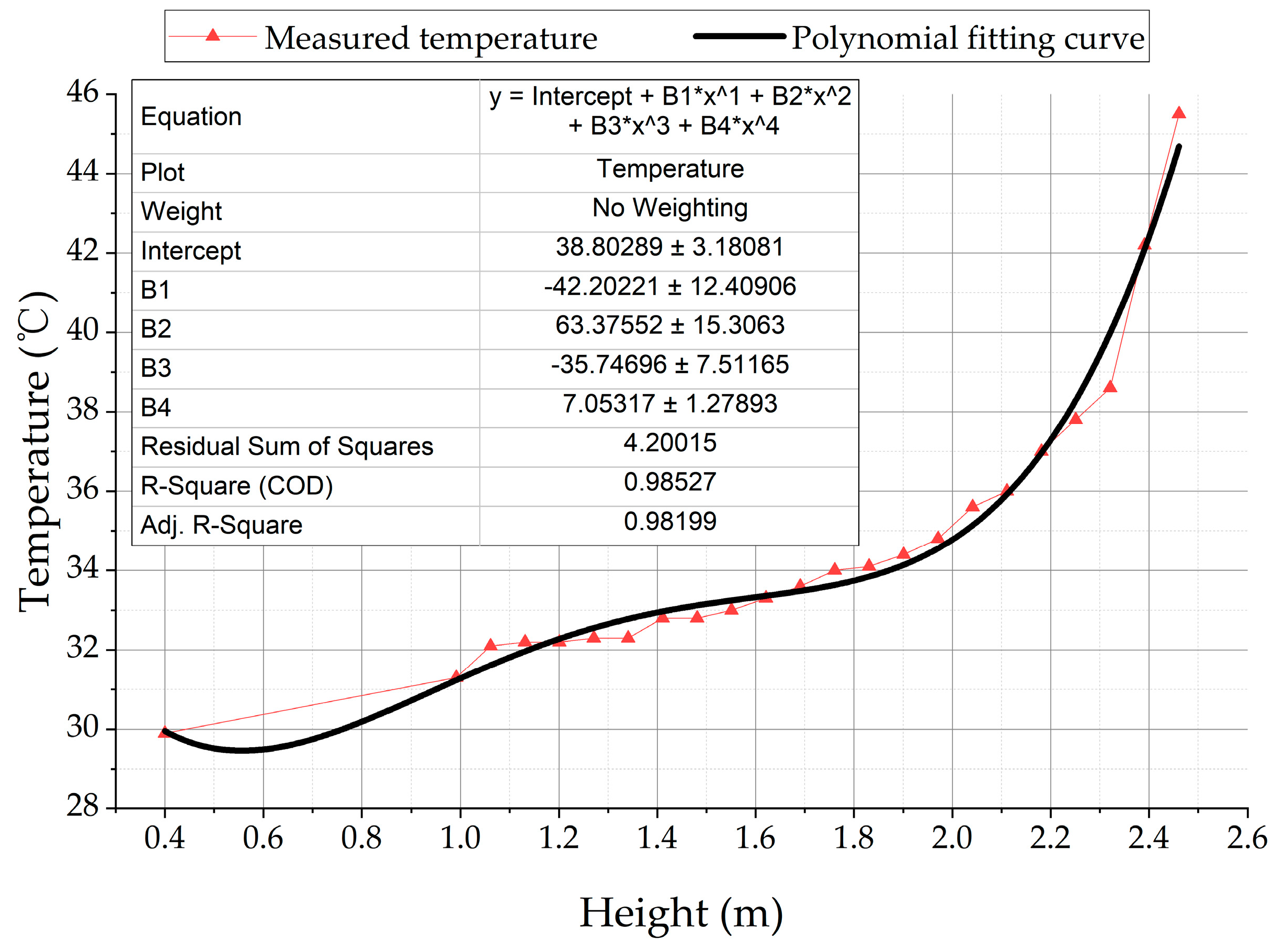
Transformer and terminal column temperature boundary: Without considering the oil flow distribution characteristics in the transformer, tubing, and terminal column, each wall is set as a non-slip solid wall with a fixed temperature boundary. The temperature values are fitted into a polynomial based on field thermal imaging test data and loaded into the model via UDF programming. Taking the working condition on 9 June as an example, the fitting formula is: T = 7.0532 × y4 − 35.747 × y3 + 63.376 × y2 − 42.202 × y + 38.803, °C; y is the height coordinate value, m, 0.4 ≤ y ≤ 2.461, as shown in Figure 13. The temperature of the terminal column is the fitted temperature of the main transformer’s top surface (y = 2.461 m) and does not change with height.
(2)
Inlet air and porous media boundary: The inlet air temperature is 37.89 °C, measured by a hot-wire anemometer outside the inlet window. The inlet window contains shutters and filters, simplified to a 10 mm thick, porous medium with a viscous resistance coefficient of 2,111,000 m−2 and a porosity of 0.9. This parameter ensures that the simulated air temperature inside the window matches the measured value of 33.7 °C. Since the inlet velocity is below the instrument’s measurement error, the measured wind speed has no reference value and is not included in the boundary conditions.
(3)
Building surface temperature boundary: The building’s surface temperature is determined by measuring the average temperature of nine measurement points (see Table 1), and the vertical wall temperature is set using a fitting curve: t = −0.0693 × y2 + 1.1786 × y + 30.405, °C, y is the vertical height, m.
(4)
Other solution settings: The remaining parameter settings refer to Reference [12].

3.4. Validation of CFD Simulation Results

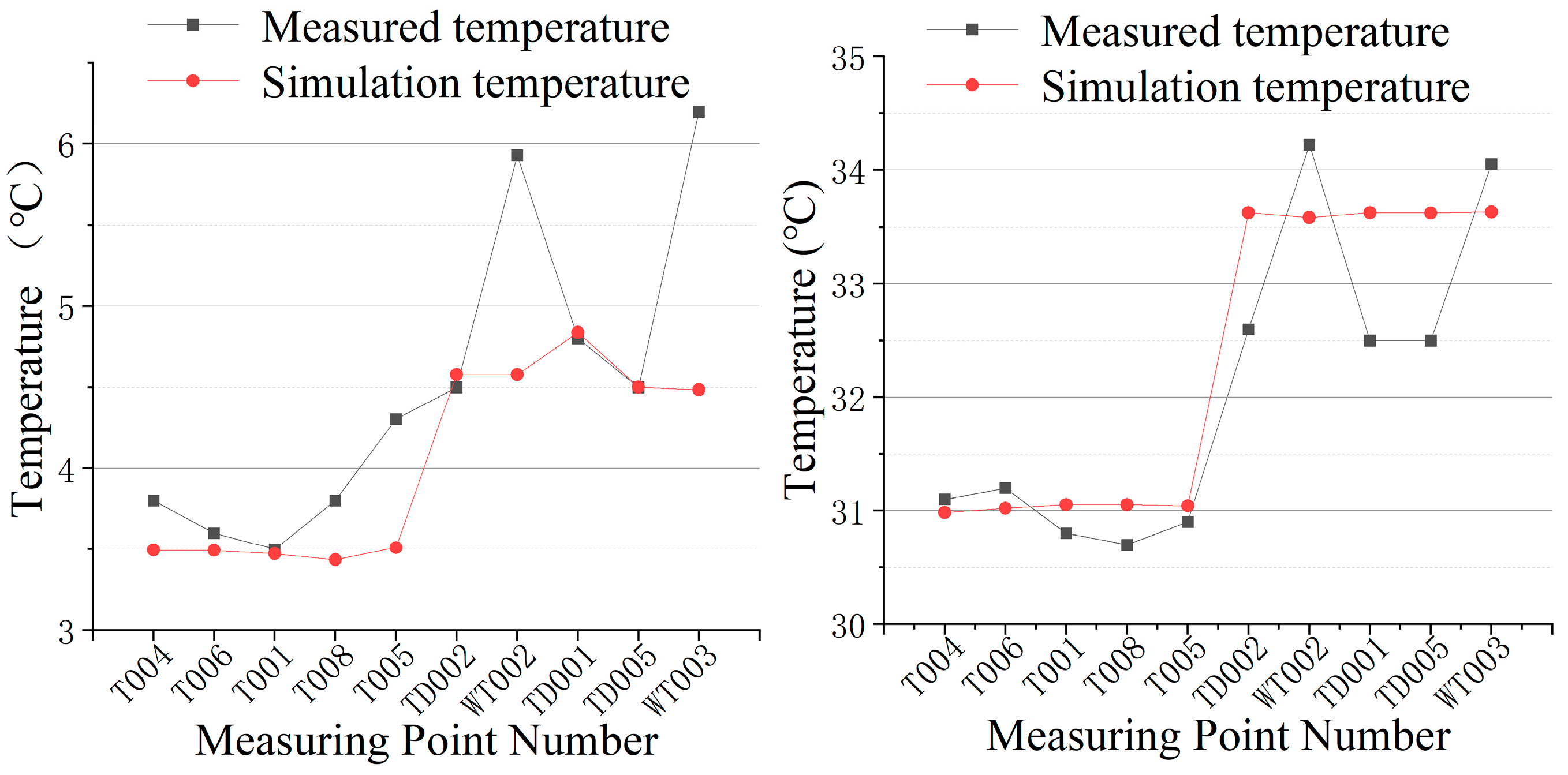
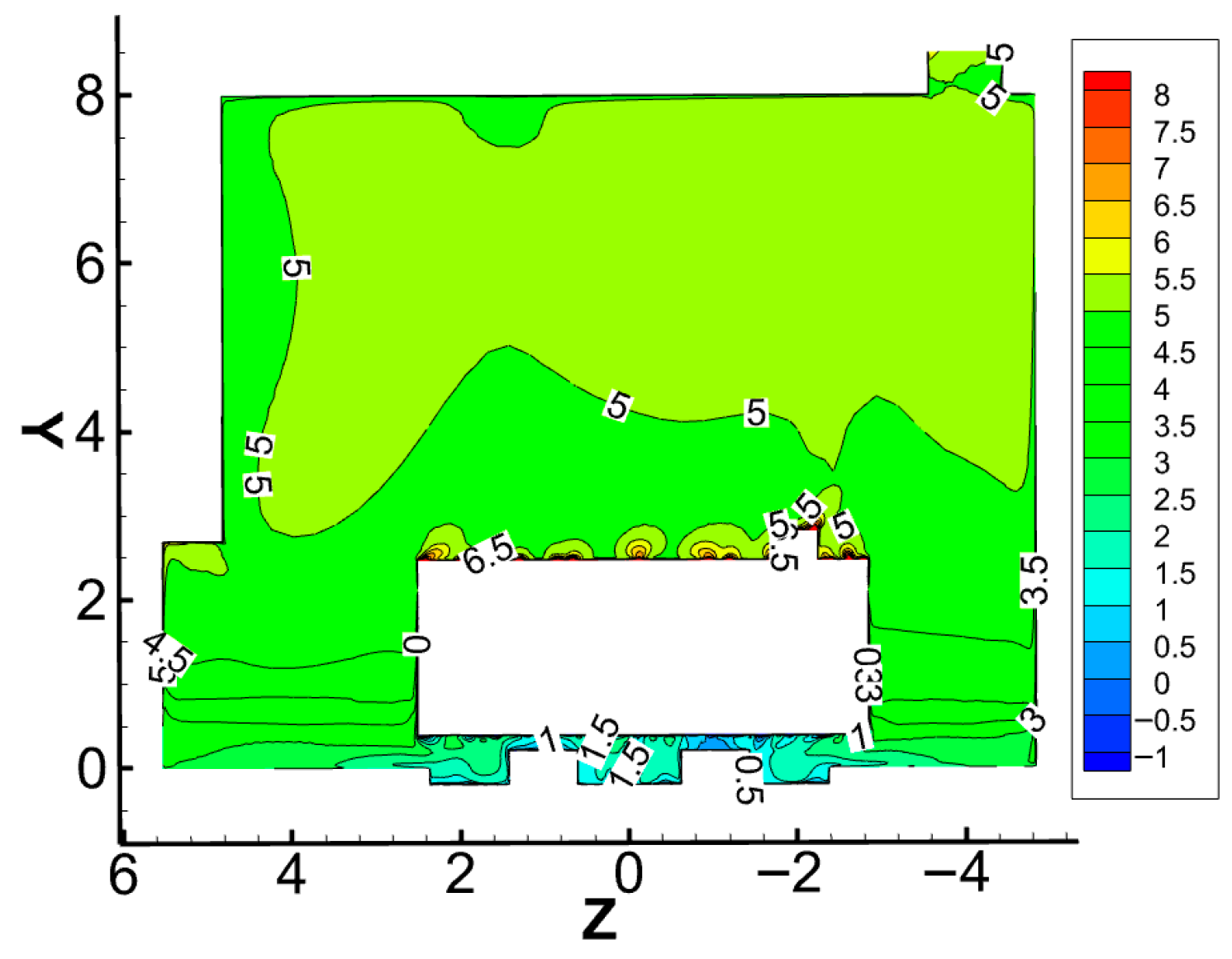
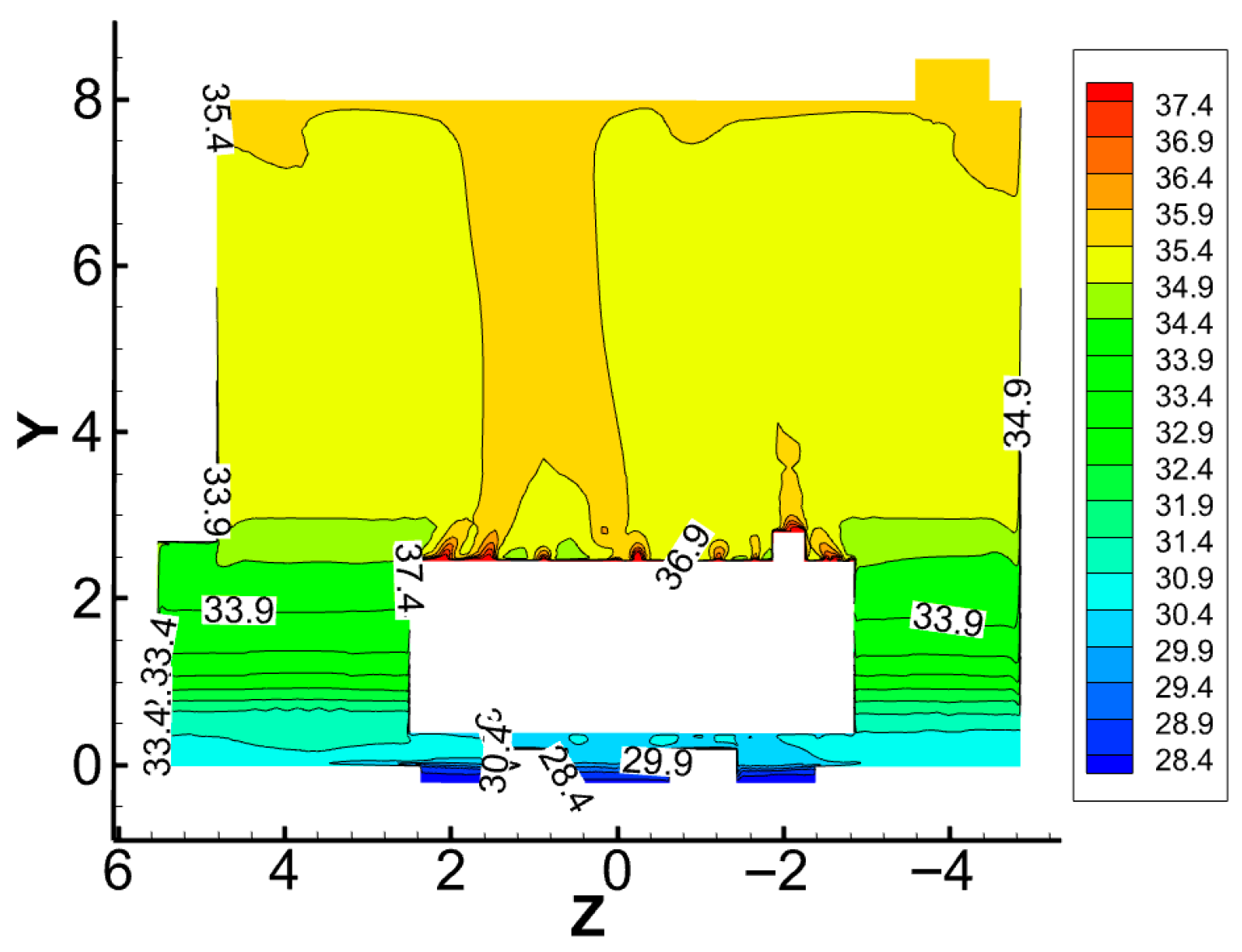
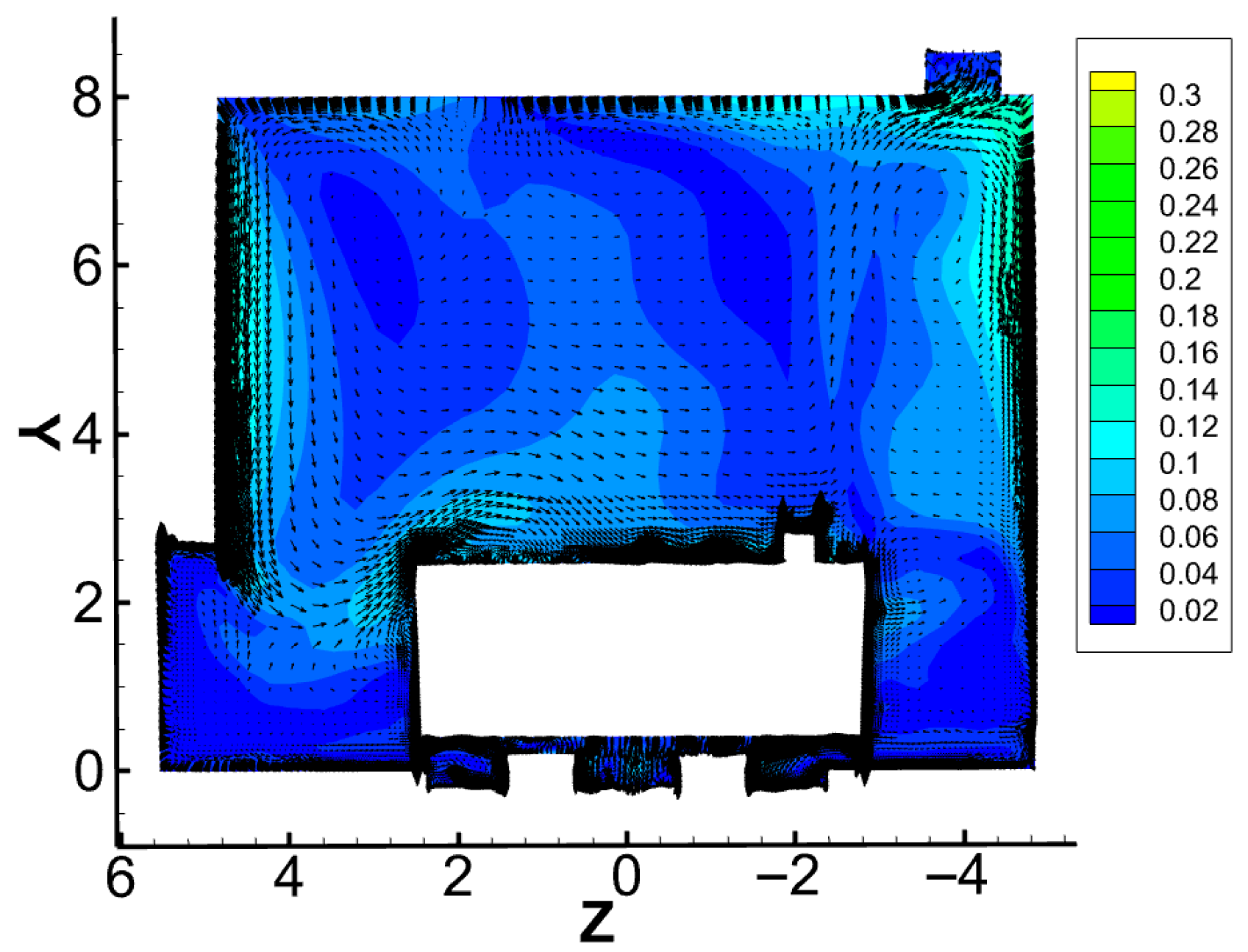
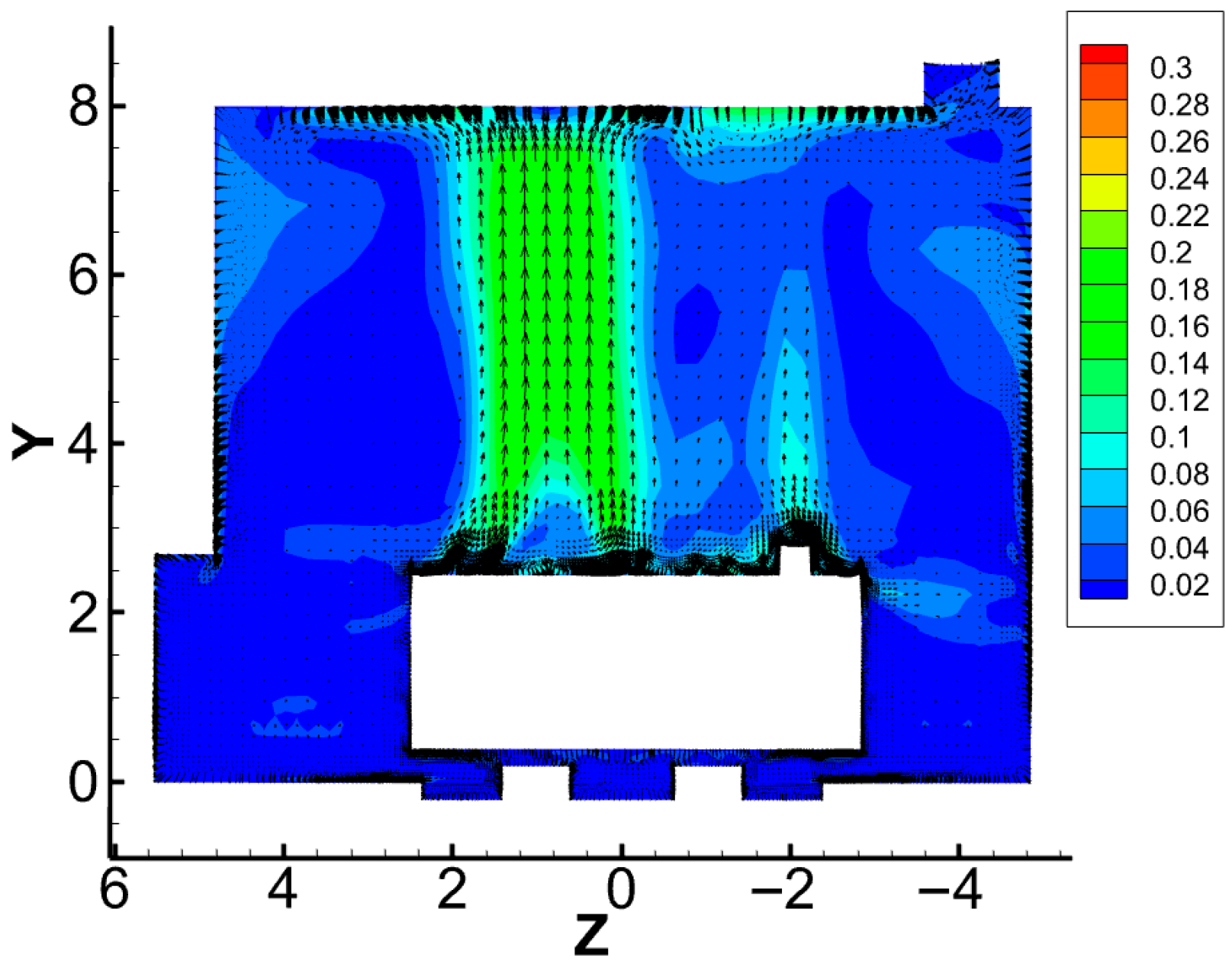
As shown in Figure 14, the measured values at each point are in good agreement with the simulated values, as the simulation accurately models natural ventilation conditions. The simulation simplifies certain boundary conditions, such as setting the uneven ground temperature as a uniform constant and approximating the temperature distribution on each side of the main transformer using a fitting formula derived from the south-side surface temperature distribution. Measurement points with significant deviations between measured and simulated values are associated with areas of high local surface temperature, which were simplified in the simulation. On 3 January, the maximum error between the measured and simulated temperatures at the measurement points is 1.71 °C, with an average error of 0.45 °C. On 9 June, the maximum error is 1.13 °C, and the average error is 0.27 °C. The temperature distribution contours are shown in Figure 15 and Figure 16. As shown in Figure 17 and Figure 18, the numerical simulation results for wind speed at WT002 and WT003 on 3 January are 0.070 m/s and 0.025 m/s, respectively. On 9 June, the corresponding simulation results are 0.026 m/s and 0.018 m/s. Compared to the measured results of 0 m/s, the deviations are smaller than the test instrument’s measurement accuracy. Therefore, the model effectively reflects the indoor temperature and flow field distribution.

3.5. Grid Independence Verification

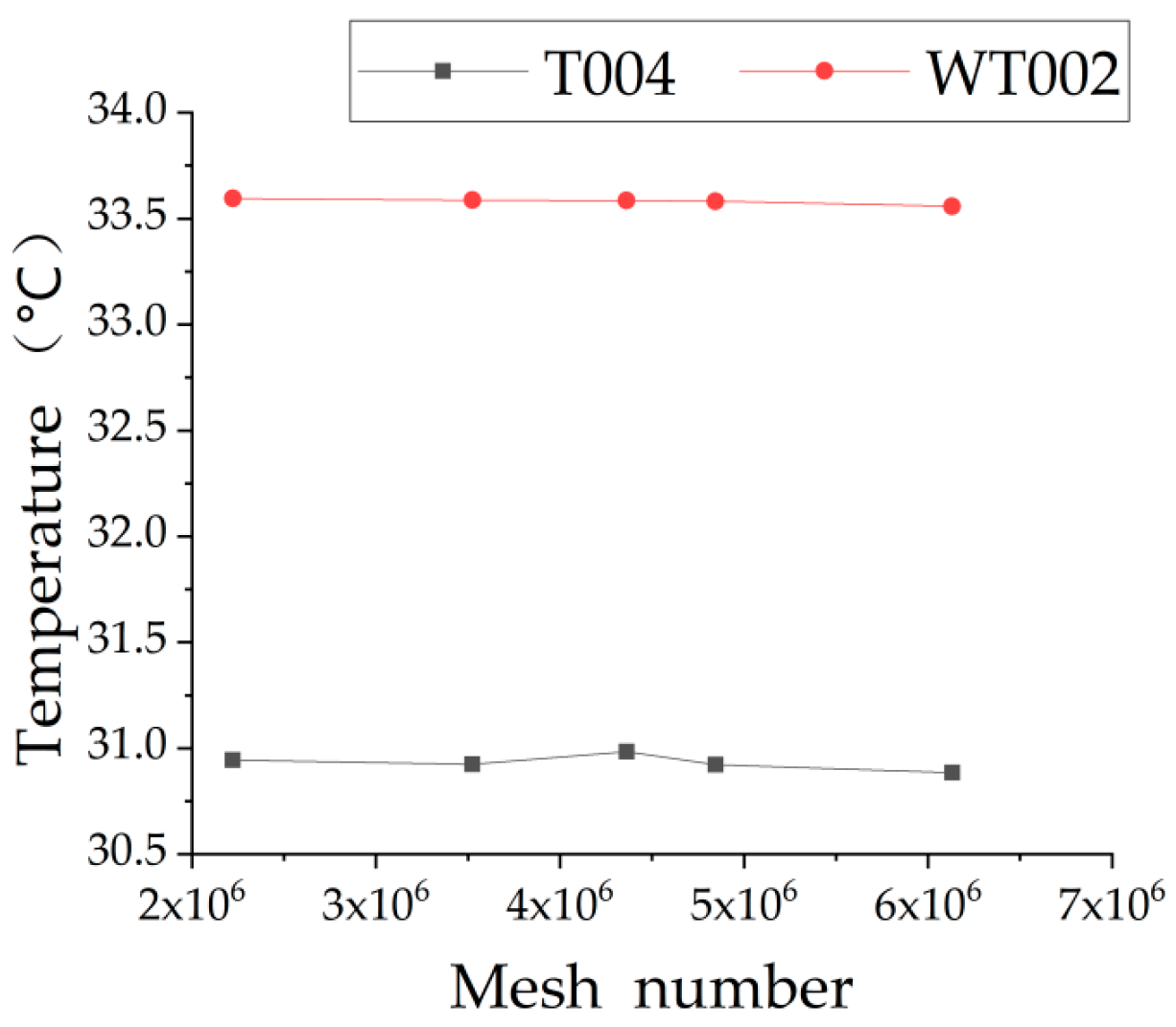
Numerical simulations are performed with five different grid numbers, with the number of boundary layers set to 5, 15, 25, 25, and 25 respectively, while other settings remain consistent. The temperatures of two monitoring points are compared to verify grid independence (see Figure 19). During the numerical simulation, the residual setting condition is satisfied when the number of iteration steps ranges from 500 to 800. When the number of iteration steps reaches 1000 to 1300, the temperature of the monitoring points stabilizes. The final iteration step is set to 1500. In natural ventilation numerical simulations, the velocity, velocity gradient, and temperature gradient in the middle of the space are very small. As long as the boundary layer mesh size (where velocity and temperature gradients are large) is sufficiently small, the grid-independent solution is less sensitive to the mesh size in the middle of the space.

3.6. Heat Flux of Each Transformer Surface

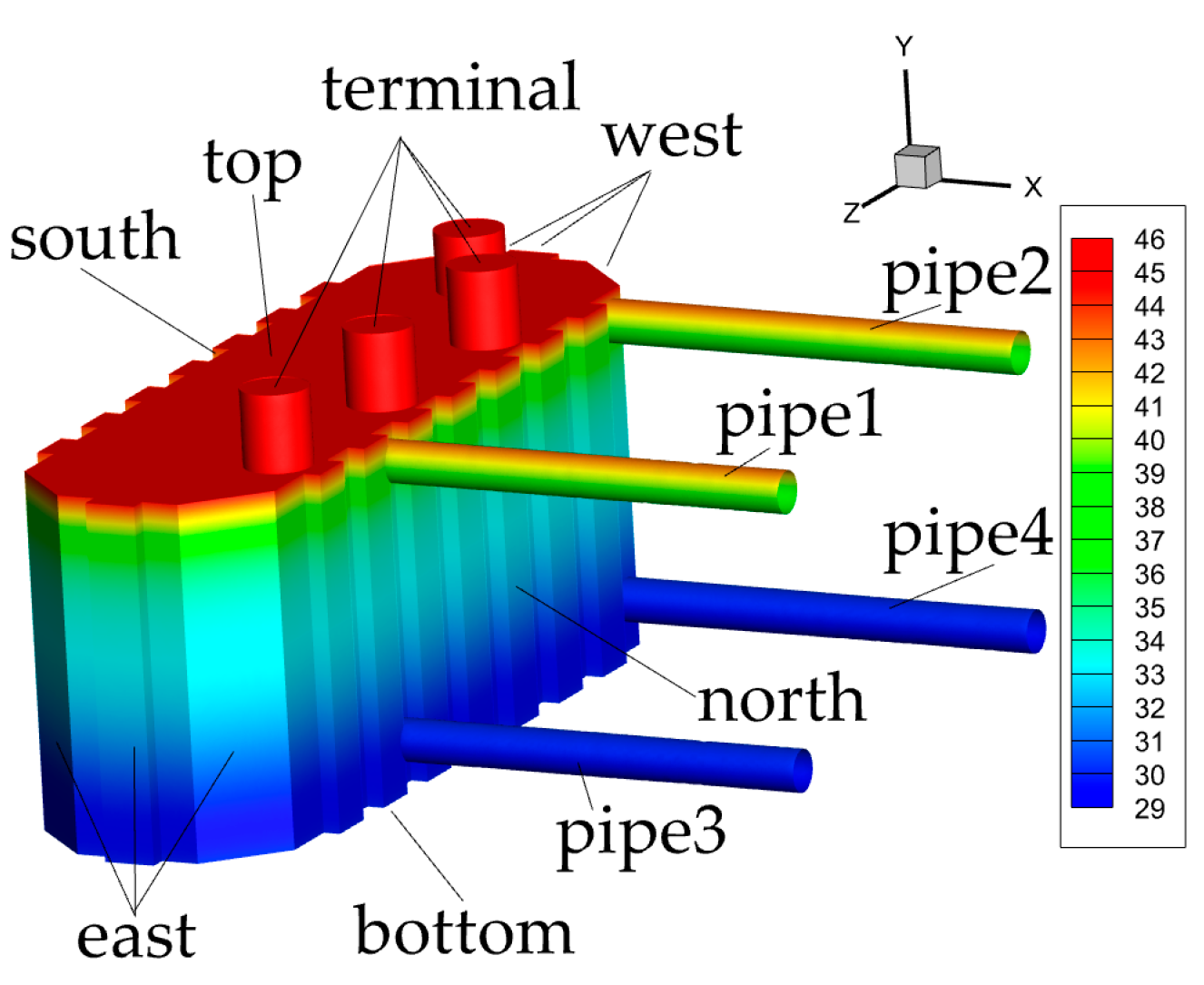
The heat flux of each transformer surface obtained from the numerical simulation results is presented in Table 2. The names of each transformer surface are shown in Figure 20. The terminal surface exhibits the highest heat flux density (92.03 W/m2), while the pipe4 surface has the lowest (0.54 W/m2), with a difference of 91.48 W/m2 between the two. The total heat dissipation of all transformer surfaces is 1600.95 W.
Based on the indoor measured surface temperatures, the heat dissipation of each transformer surface is calculated theoretically [27]. For the natural ventilation process, the convective heat transfer is calculated using the following formulas:
The convective heat transfer φ :
φ = h A Δ t
h = λ N u l
N u = C ( G r Pr ) n
In the formula, h is the surface heat transfer coefficient, W/(m2·K), A is the equipment surface area, m2, Δ t is the temperature difference between the surface of the equipment and the surrounding air, K, N u is Nusselt number, the fluid thermal conductivity λ = 0.0267, W/(m·K), l is equipment characteristic length, m, the Grashof number G r = g α v Δ t l 3 / v 2 , g is acceleration of gravity, m/s2, the volume expansion coefficient at qualitative temperature α v = 1/T, 1/K, T = 305.21 K is the average temperature of 10 measuring points indoors, the air kinematic viscosity v = 16.67 × 10⁻⁶, m2/s, and the Prandtl number Pr = 0.697. The coefficient C and the exponent n are determined by the shape and position of the heated surface [28].
The radiation heat transfer Φ :
Φ = ε A σ ( T w 4 T 4 )
In the formula, the surface emissivity of the equipment brushed with paint ε = 0.94, the Stefan-Boltzmann constant σ = 5.67 × 10⁻⁸ W/(m2·K4), T w is the temperature of equipment surface, K, T is the temperature of wall surface, K. T w is the average temperature of 9 measuring points evenly distributed on the surface of the equipment. T for the bottom is the temperature of oil discharge tank. T for the other surface is the average temperature of the wall surfaces.
According to the measured data, the theoretical calculation results of the transformer’s surface heat dissipation are shown in Table 3 and Table 4. The top surface has the highest heat flux density (96.86 W/m2), while pipe4 has the lowest (−3.19 W/m2), with a difference of 100.05 W/m2 between the two. The total heat dissipation of all transformer surfaces is 1574.84 W.
The error rate of the total transformer surface heat dissipation between the numerical simulation and theoretical calculation is 1.6%. However, significant deviations in heat flux density are observed across different transformer surfaces.

4. Influence of Inlet Window Size on Natural Ventilation Heat Dissipation Effect

Factors such as transformer load conditions, outdoor temperature, wind speed, and thermal radiation environment can affect the distribution of the indoor transformer surface temperature, leading to variations. By comparing the thermal images of the main transformer measured on 3 January and 9 June, it was found that under different working conditions, the curve of the transformer surface temperature with height is similar, in accordance with the natural convection heat dissipation law of transformer oil [22,23,24]. Therefore, in this simulation, it was assumed that the surface temperature variation curve with height remained consistent under all load conditions of the main transformer, ensuring that the transformer surface temperature distribution conformed to its inherent law. The research method adopted in this paper is to obtain the natural ventilation heat dissipation of indoor transformers with different building structures through numerical simulation under the conditions of constant transformer surface temperature distribution and thermal environment, using this as the basis for optimizing the natural ventilation of the building structure. Of course, the impact of this assumption on the simulation results requires further verification. According to the requirements in the “35 kV~110 kV Substation Design Specification” (main transformer room exhaust temperature not exceeding 45 °C) and the “Power Plant Heating, Ventilation, and Air Conditioning Design Specification” (room overall temperature not exceeding 40 °C), the mechanical exhaust will be automatically activated under high-temperature and full-load conditions in summer. Therefore, four natural ventilation conditions corresponding to different main transformer loads are set, as shown in Table 5.
To make the results more intuitive and to simplify the window filters and shutters, the enclosure structure walls were modeled with convective or adiabatic boundary conditions (as shown in Table 6) for comparison with CFD simulations.
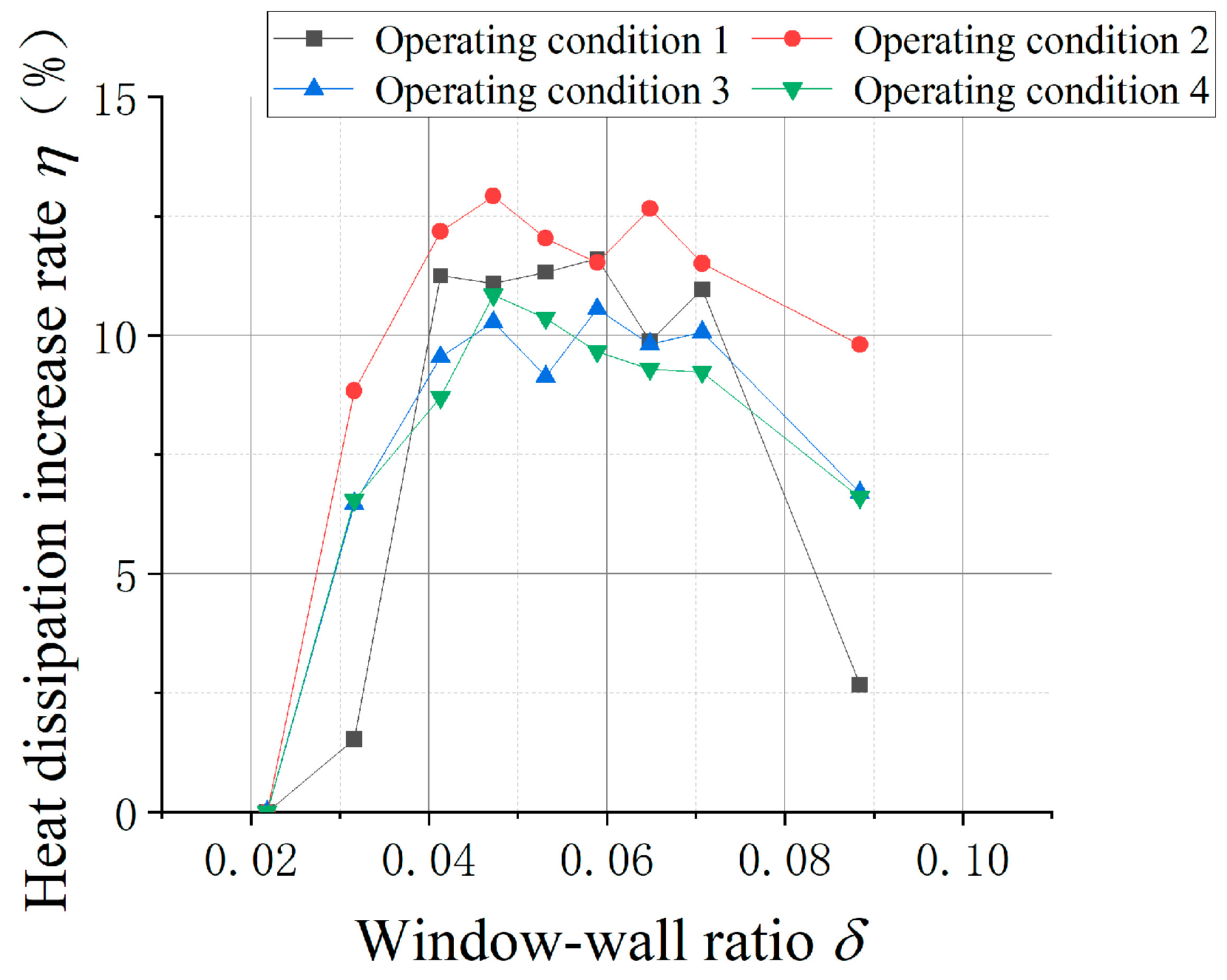
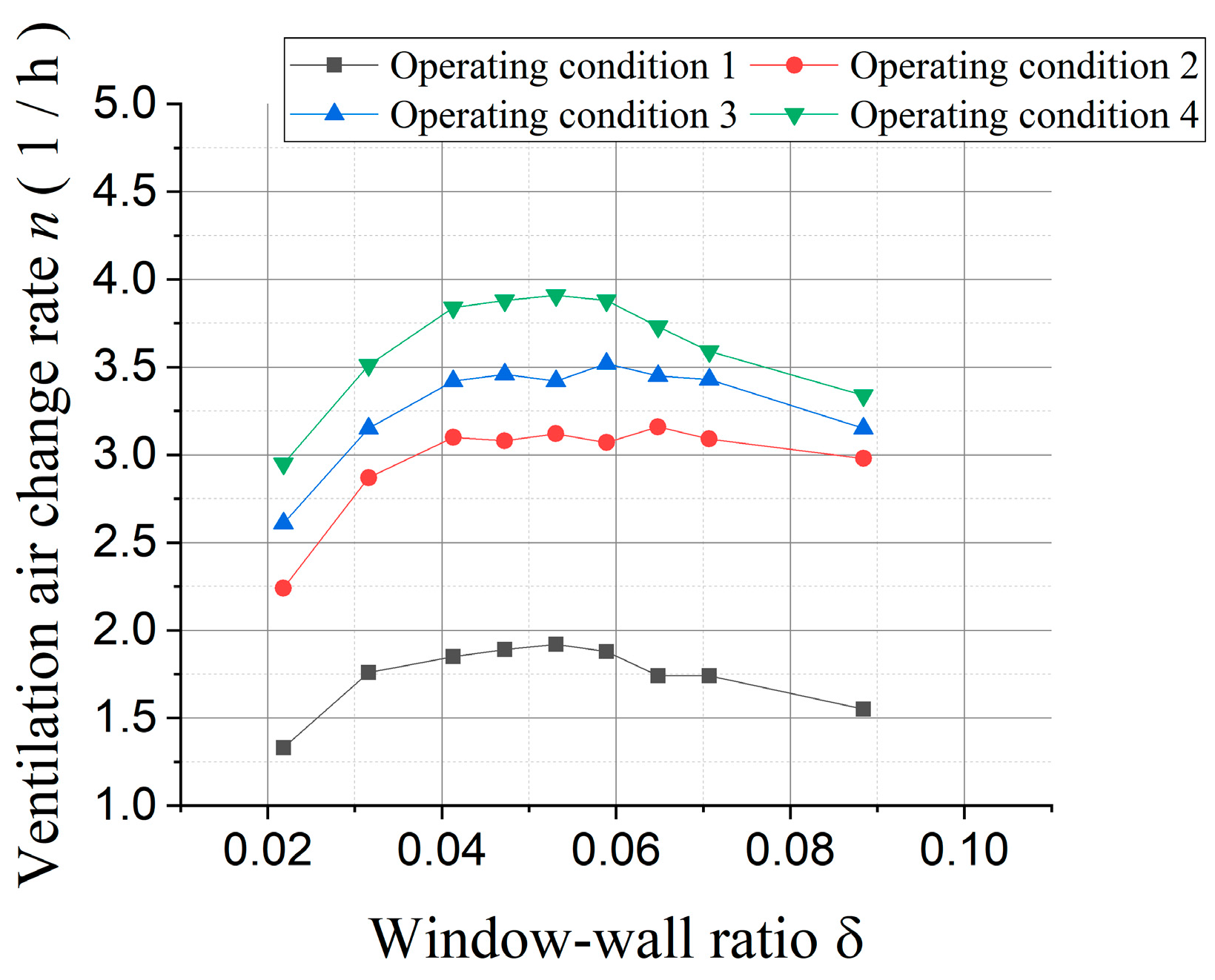
To intuitively compare the natural ventilation heat dissipation effects under different building structures and evaluate the generality of the research results, the measured dimensions of the #2 main transformer room are used as the reference for the basic building structure. The following parameters are defined as follows: (1) Transformer surface heat dissipation increase rate ( η ), which reflects the impact of changing a single building structure factor on the ventilation and heat dissipation effect. (2) Room air change rate (n), which reflects the impact of changing a single building structure factor on the natural ventilation volume.
η = q n q 0 q 0 × 100 %
In the formula, η is transformer surface heat dissipation increase rate, q0 is total heat dissipation power of each transformer surface under the original building structure, W, and qn is total heat dissipation power of each transformer surface after changing the building structure, W.
Both qn and q0 can be directly obtained from FLUENT software. The room air change rate (n) is calculated by dividing the air intake volume (obtained from FLUENT software) by the room volume.
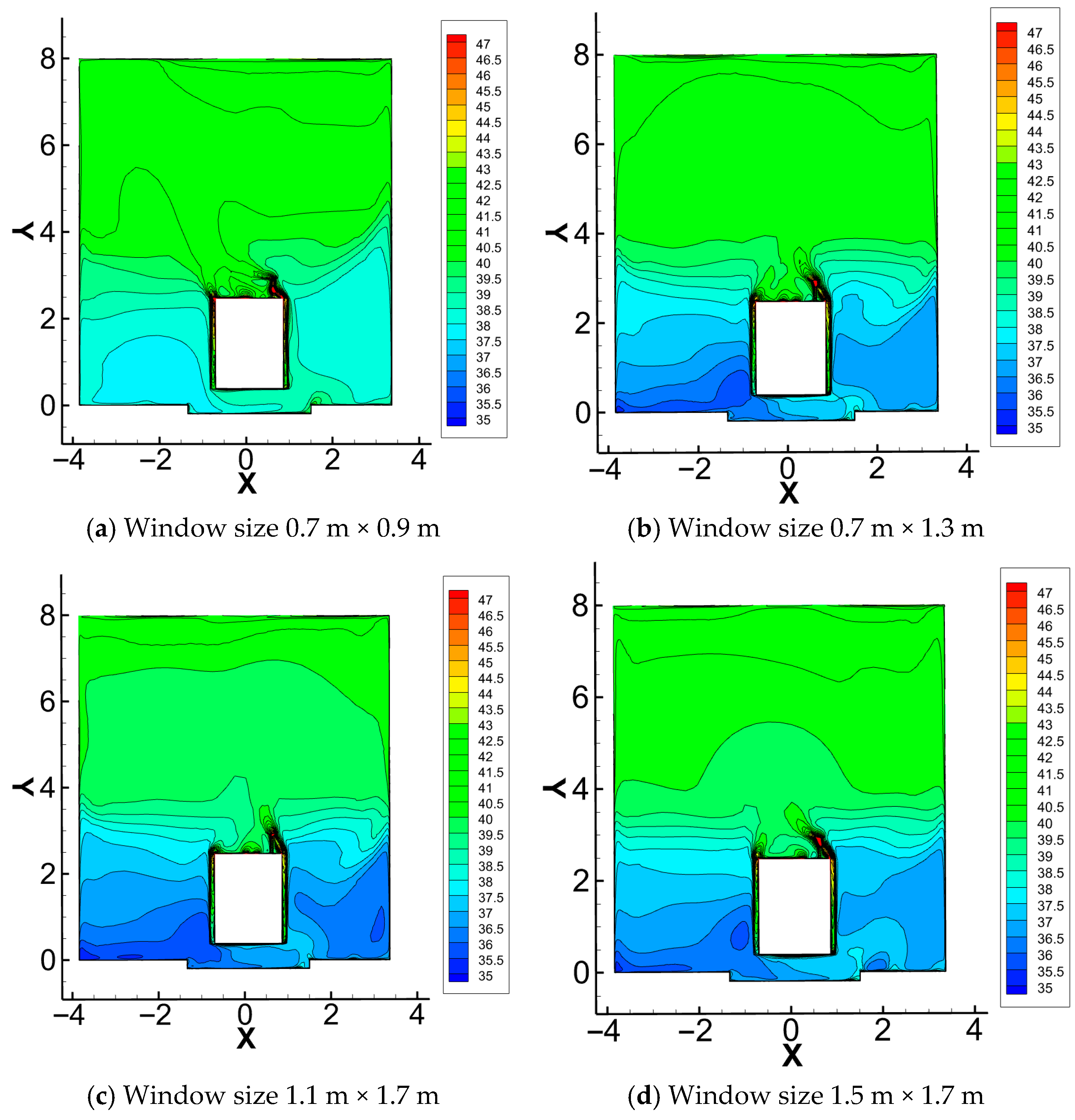
Taking the measured dimensions of the #2 main transformer room model as the basic building structure reference, the dimensions of other structures remain unchanged (including the window bottom edge height and original window size of 0.7 m × 0.9 m). On this basis, the window area is increased, and the inlet window sizes are shown in Table 7. The influence of the inlet window size on the natural ventilation heat dissipation effect was then compared (as shown in Figure 21, Figure 22 and Figure 23). Under different main transformer load conditions, when the window height is constant, increasing the window width significantly improves both the transformer surface heat dissipation and the transformer room’s natural ventilation. However, when the window width is constant, increasing the window height does not improve, and in some cases reduces, both heat dissipation and natural ventilation when the window height exceeds 1.2 m.
If building internal resistance is not significant, the flow caused by stack effect can be expressed by [29]:
Q = C D A 2 g Δ H N P L ( T i T o ) / T i
In the formula, Q is airflow rate, m3/s, CD is discharge coefficient for opening, A is free area of inlet openings, m2, g is gravitational acceleration, m/s2, Δ H N P L is height from midpoint of lower opening to neutral pressure level, m, To and Ti are the outdoor and indoor temperature, °C.
Increasing the inlet window area reduces ventilation resistance. Additionally, raising the window centerline reduces the indoor–outdoor thermal pressure difference between the air inlet and outlet. The simulation results are basically consistent with the theoretical analysis. However, simply increasing the window area does not necessarily enhance air intake or improve transformer surface heat dissipation.

5. Conclusions and Foresight

This paper conducts field measurements and numerical simulations of the natural ventilation in the split main transformer room of a substation in Shijiazhuang. During the numerical simulation, the transformer surface temperature was set using a user-defined function (UDF), which was more in line with the actual working conditions compared to the traditional uniform heat flux density setting. On 3 January, the maximum error between the measured and simulated temperatures at the measurement points was 1.71 °C, with an average error of 0.45 °C. On 9 June, the maximum error was 1.13 °C, and the average error was 0.27 °C. Measurement points with large deviations between measured and simulated temperatures were all associated with nearby local high-temperature surfaces, which were simplified in the simulation. Based on the measured data, the heat flux density and total heat dissipation of each surface were calculated theoretically and compared with the numerical simulation results. The error rate of the total transformer surface heat dissipation between the numerical simulation and theoretical calculation is 1.6%, while significant differences in heat flux density were observed across different transformer surfaces. Under the conditions of constant main transformer surface temperature and considering only the thermal pressure effect, numerical simulations were used to compare the influence of changing only the inlet window size on the natural ventilation effect. Without changing the height of the inlet window’s centerline, increasing the window area reduces ventilation resistance and significantly improves natural ventilation heat dissipation and air change rate. However, simply increasing the vertical height of the inlet window reduces both ventilation resistance and the vertical height difference between the air inlet and outlet, thereby decreasing the thermal pressure difference and not necessarily enhancing natural ventilation heat dissipation and air change rate.
Since the research team did not conduct actual tests on the transformer’s high-load operating conditions in summer, the conclusions obtained based on the assumed transformer surface temperature distribution under high-load conditions need further measurement and verification. The numerical simulation only compares working conditions with near-zero air flow velocity in the test area and does not verify high-velocity field conditions under summer high loads. During the numerical simulation, only the effect of thermal pressure is considered, and the influence of wind pressure is not analyzed. The heat transfer coefficient values of the building envelope in this paper are derived from design data, without actual measurements or sensitivity analysis of the heat transfer coefficient.
On the basis of this research, the team carried out numerical simulation studies on the influence of single factors (window size, window installation height, building plane size, building height) on the natural ventilation and mechanical ventilation of split substation main transformer rooms, and applied for an invention patent titled “Substation Natural Ventilation Heat Dissipation Structure” (patent application number: CN 119726427 A).

Author Contributions

Conceptualization, J.S.; methodology, Y.W.; formal analysis, Y.K.; investigation, J.Z. (Jun Zhang); writing—original draft preparation, J.Z. (Jiyu Zhang); project administration, J.S. All authors have read and agreed to the published version of the manuscript.

Funding

This study was financially supported by the program of State Grid Hebei Electric Power Co., 725 Ltd. Economic and Technological Research Institute under Grant number B604JY240081.

Data Availability Statement

Data is contained within the article.

Conflicts of Interest

Authors Jizhi Su, Jun Zhang and Yong Kang were employed by the company State Grid Hebei Electric Power Co., Ltd. The remaining authors declare that the research was con-ducted in the absence of any commercial or financial relationships that could be construed as a potential conflict of interest. The authors declare no conflict of interest. The funders had no role in the design of the study; in the collection, analyses or interpretation of data; in the writing of the manuscript; or in the decision to publish the results.

References

  1. Wang, L.; Geng, M.; Bai, X.; Ma, J.; Zhao, Y.; Shen, C.; Yang, B. Urban 110 kV indoor substation noise analysis and control schemes: A real case study. Appl. Acoust. 2021, 183, 108290. [Google Scholar] [CrossRef]
  2. Xia, Q.; Yang, R.J. Design, Construction and Development Trends of Urban Indoor Substations. Electr. Power Surv. Des. 2018, S2, 24–28. (In Chinese) [Google Scholar] [CrossRef]
  3. Xu, H.D. Thoughts on Heat Dissipation and Ventilation Issues in Main Transformer Rooms of Indoor Substations. Sci.-Tech Wind 2011, 12, 197. (In Chinese) [Google Scholar] [CrossRef]
  4. Guan, Y. Analysis of Heating of Substation Equipment and Corresponding Measures. Electr. Power Saf. Technol. 2021, 23, 17–19. Available online: https://kns.cnki.net/kcms2/article/abstract?v=MXvIvFkaDQw7mcFwWGRpdBMYIgGptGKdVPTBnotfLLe4dq7f-nNZkGN85l_SUFdUBJfd0Zc5OQL3IWWGZVSdoBa0Pe30dFRF4uRwCl_4wBVHRg6bGmidhTZHeOqx3YZUmVyP576tIsgkoea6HGd33AylDw7Jo1FCozdLewc7jW_3qtLdo3tSJw==&uniplatform=NZKPT&language=CHS (accessed on 4 February 2026). (In Chinese)
  5. Ding, B.; Liu, J.W.; Hua, Y.J.; Chen, Q. Investigation and Simulation Study on Building Energy Consumption of Indoor Substations. Build. Energy Eff. (Chin. Engl.) 2021, 49, 85–90. Available online: https://kns.cnki.net/kcms2/article/abstract?v=MXvIvFkaDQyQz442ErUnzhCGPk8RFW1nvYIjfl-CiU1-ZLsAoXFiRuMa_Xys5Sje27-TbJZYXArfurmpkzEbOpCbxWfktPp224-OhbYmiZXjFDZi79awdgU0zSFh2xMXTFyBOMu4iMy_UcpEzqKiMpkJcyj1bIJFRMegsok_43vAZmXlSb-OZQ==&uniplatform=NZKPT&language=CHS (accessed on 4 February 2026). (In Chinese)
  6. Wang, H.; Jia, L.M. Improvement of Ventilation Design for 110 kV Fully Indoor Urban Substations. Power Supply Util. 2009, 26, 46–48+59. Available online: https://kns.cnki.net/kcms2/article/abstract?v=MXvIvFkaDQyC9NZmcnXQWSHtx2fyHbjR3MUW7qTOhmK7kFfen7NaSMJqk9ClIiqW-OOhpL7BjWyoPh4nDkS5LKf-vtwhjhLDXvJCgsQOH101iuO6mDzQh7gjFoOM94mxKXZ2C5HNe8QGCvge_b18-b9kBS-0qpinp5K5d1NGv-HIw-_9wS312A==&uniplatform=NZKPT&language=CHS (accessed on 4 February 2026). (In Chinese)
  7. Mo, W.X.; Zeng, W.F. Analysis and Countermeasures of Ventilation and Heat Dissipation Problems of Main Transformers in Indoor Substations. Guangdong Power Transm. Distrib. Technol. 2004, 5, 27–31. Available online: https://kns.cnki.net/kcms2/article/abstract?v=MXvIvFkaDQzdrjIt4lXCPoRdEhehROBtQGNrW3zWFQEIz7F_1sC_8bZRRCImfxnXudf4qUoK1Y1BciHfNtmgrQ-qBtEt51Hdjqp3RjOYBDAVgQ_wkYk92sbOPvP5MBo1PAY3DQLTBomcxJXVXB6yL26ACdpAgpbnyJrVN23JBHOoVaQFwKfsLA==&uniplatform=NZKPT&language=CHS (accessed on 4 February 2026). (In Chinese)
  8. Gao, X.P.; Li, W.; Song, H.F.; Zhang, S. Influence of Air Inlets on Ventilation Effect of Transformer Rooms. J. Civ. Archit. Environ. Eng. 2012, 34, 117–122. Available online: https://kns.cnki.net/kcms2/article/abstract?v=MXvIvFkaDQypFXaMIuOaXnG3nBbjEns3-RUsRXjcQTEMBLLW-iLc8UEGeWjpqP0r2jx0Ht1Jj2gMm1IcwwpXkpuBenOHz7x8bI_6ZDVyyyn7atwnK_HNu4y-y-jx8ZKz2pvyuPcIv4U1JQCaZpNid_ulF0sm9_a0dbYJgmGzMFs_LL4BFmz9Gg==&uniplatform=NZKPT&language=CHS (accessed on 4 February 2026). (In Chinese)
  9. Xu, T.G.; Wang, Y.Q.; Zhang, Y.; Zhu, C.; Ma, Y.; Fu, J. Numerical Simulation and Optimization Study on Air Inlets of Transformer Rooms in a Substation. Electr. Power Sci. Eng. 2019, 35, 37–43. Available online: https://kns.cnki.net/kcms2/article/abstract?v=MXvIvFkaDQwN3mJct6kujyZasCSOv_IkBZFv8zEMLgfoYEGwNcX9Vi1Yr-teyjlQgGuYBtvdjhRhmWD0gzTGpgxGmpV8b1FMLZ2IPKpoXnuxixB-yIKy23GahxoBgAuwZAR0sO4qKJ5uPLCv24zS_B5XQMpNld9zjFJRYDvxp7eo5_LyEE2vaQ==&uniplatform=NZKPT&language=CHS (accessed on 4 February 2026). (In Chinese)
  10. Xu, D.; Zhang, L.; Wang, H.; Wang, K.; Zhang, W. An Investigation of the Ventilation Systems of Whole-Indoor Urban Substations. Buildings 2024, 14, 3749. [Google Scholar] [CrossRef]
  11. Wu, J. Research on the Influence of Building Openings on Indoor Natural Ventilation of Office Buildings. Master’s Thesis, Nanjing Normal University, Nanjing, China, 2014. Available online: https://kns.cnki.net/kcms2/article/abstract?v=MXvIvFkaDQxdgxNELxMgmnn7Ttb62pk-1U-qWqi-J88-yIG46-awoRU9DALcPJcGvXPFuBbIYLglIpQ94PKY7JinI0zttW31EGVDA2HhWSIxQ6Ok69NrywgnrtdRYNMwK3wpE39Trat70UxnT0yKg0p0pDh1v62xC6F8BLpgpEazdFYuo0HCM4GneVsFPrBS&uniplatform=NZKPT&language=CHS (accessed on 4 February 2026). (In Chinese)
  12. Chen, W.; Cao, H.; Hu, S.; Tang, Q.; Zhang, W. Optimal Design Research on Ventilation and Heat Dissipation of Indoor Main Transformer Rooms. Energy Res. Inf. 2022, 38, 236–246. (In Chinese) [Google Scholar] [CrossRef]
  13. Qin, W.H. Numerical Simulation and Optimization Study on Ventilation and Heat Dissipation of 110 kV Indoor Substations. Master’s Thesis, Southeast University, Nanjing, China, 2019. (In Chinese) [Google Scholar] [CrossRef]
  14. Shao, Z.W. Numerical Simulation and Optimization Study on Ventilation Systems of Fully Indoor Substations. Master’s Thesis, Southeast University, Nanjing, China, 2015. Available online: https://kns.cnki.net/kcms2/article/abstract?v=MXvIvFkaDQw7QcLuAOD-fkM6N9LqXTKjwyVO5SJSCjr-dN869CdhfCOkaopZTeOTqrvF3d0mxdw3iKEyMwvhnL9BiC1UcJXXmrR4Oa1CGnejAPTZ9h0r5rWeYSzZl26FuZnzOi940McltEKqTA6yxmAI5hnJuc28KjKwWjdn3danMrrqJ2EpPJqsDMrbRL6n&uniplatform=NZKPT&language=CHS (accessed on 4 February 2026). (In Chinese)
  15. Mohamad, K.; Khaled, C. CFD study of ventilation for indoor multi-zone transformer substation. Int. J. Heat Technol. 2018, 36, 88–94. [Google Scholar] [CrossRef]
  16. Jin, J.; Liu, W.; Hu, P.; Guo, Z.; Wen, B.; Jiang, N. Simulation and Optimization of Ventilation and Noise Reduction in Indoor Substations. J. Wuhan Univ. (Eng. Ed.) 2015, 48, 495–501. (In Chinese) [Google Scholar] [CrossRef]
  17. Zhang, F.; Huang, X.; Ding, J. Numerical Simulation and Optimization Analysis of Ventilation and Heat Transfer in Indoor Substations. Fluid Mach. 2016, 44, 76–80. Available online: https://kns.cnki.net/kcms2/article/abstract?v=MXvIvFkaDQw2G167hpFN8tqET-Qb5v9cD92S3ga0czodD_yiqFh3Sbsfj2c2q10wPik2xvbkiqZHZL13_0oevpptCKUP7uvM2-HIKN8csq5b4f_TUitXuPsUY-e0DnLzqWVev9RXHX1Gc3hK9Bcp7x7YogIqLroMuK1GY9VSpExyLGgxGjmlSQ==&uniplatform=NZKPT&language=CHS (accessed on 4 February 2026). (In Chinese)
  18. Wang, J.; Zhang, F.; Xing, H.B.; Ding, J. Numerical Simulation and Optimization Design of Ventilation and Heat Transfer in Indoor Substations Based on CFD. Mach. Des. Manuf. 2016, 3, 45–47+50. (In Chinese) [Google Scholar] [CrossRef]
  19. Liu, Y.; Ye, W.; Li, Y.; Chen, T.; Hu, K. Ventilation Optimization for Reduction of Indoor Air Temperature of Main Transformer Room in Urban Indoor Substation by the Variational Method. J. Therm. Sci. 2019, 28, 1089–1101. [Google Scholar] [CrossRef]
  20. Zhang, H.; Wang, L.; Yang, P.; Liu, Y.; Zhu, C.; Wang, L.; Zhong, H. Optimizing air inlet designs for enhanced natural ventilation in indoor substations: A numerical modelling and CFD simulation study. Case Stud. Therm. Eng. 2024, 59, 104408. [Google Scholar] [CrossRef]
  21. Chen, Y.; Shao, Y.; Li, Y.; Deng, L.; Che, D. Numerical simulation and optimization of ventilation and heat dissipation in main transformer room of semi-indoor substations. Appl. Therm. Eng. 2025, 269, 126105. [Google Scholar] [CrossRef]
  22. Beiza, M.; Ramos, J.C.; Rivas, A.; Antón, R.; Larraona, G.S.; Gastelurrutia, J.; de Miguel, I. Zonal thermal model of the ventilation of underground transformer substations: Development and parametric study. Appl. Therm. Eng. 2014, 62, 215–228. [Google Scholar] [CrossRef]
  23. Li, J.B.; Chen, Y.; Tang, L.H.; Peng, J. Numerical Simulation and Optimization Study on Ventilation and Heat Dissipation of Semi-Indoor Substations. Energy Res. Util. 2024, 2, 15–20+24. (In Chinese) [Google Scholar] [CrossRef]
  24. Liu, H. Numerical Analysis and Research on Finned Radiators for Transformers. Master’s Thesis, Dalian University of Technology, Dalian, China, 2023. (In Chinese) [Google Scholar] [CrossRef]
  25. Li, J.M. Multi-Field Coupled Thermal Analysis and Winding Equivalent Modeling Research of Oil-Immersed Power Transformers. Master’s Thesis, Shenyang University of Technology, Shenyang, China, 2025. (In Chinese) [Google Scholar] [CrossRef]
  26. Gastelurrutia, J.; Ramos, J.C.; Rivas, A.; Larraona, G.S.; Izagirre, J.; del Río, L. Zonal thermal model of distribution transformer cooling. Appl. Therm. Eng. 2011, 31, 4024–4035. [Google Scholar] [CrossRef]
  27. Tao, W.Q. Numerical Heat Transfer, 2nd ed.; Xi’an Jiaotong University Press: Xi’an, China, 2001. (In Chinese) [Google Scholar]
  28. Zhang, H. Study on Numerical Simulation and Optimization of Ventilation for Turbine Building of Thermal Power Plant. Master’s Thesis, Southeast University, Nanjing, China, 2016. Available online: https://kns.cnki.net/kcms2/article/abstract?v=MXvIvFkaDQyiLxvzqMfMBjd_L1AOpkYGK2A7a5DakpuxgPo3_IjeAntghirlTUSMldgeHWAr01gEvg1pKfAObA1XgjAH0osyctNogVDcQ1Q6zriD8-MZv8rQs1B9W6Ya18mBoeU0pYwo_3PrRfiq742jLJd5sstDHPxdRIfwdcsoPdH8RxGm_F1AbMf1651L&uniplatform=NZKPT&language=CHS (accessed on 4 February 2026). (In Chinese)
  29. Ashrae. ASHRAE Handbook—Fundamentals (SI); Amer Society of Heating: Peachtree Corners, GA, USA, 2021; p. 16.14. [Google Scholar]
Figure 1. Outdoor measurement point layout of #2 main transformer room.
Buildings 16 00864 g001
Figure 2. Indoor east-side measurement point layout of #2 main transformer room.
Buildings 16 00864 g002
Figure 3. Indoor west-side measurement point layout of #2 main transformer room.
Buildings 16 00864 g003
Figure 4. #2 Indoor and outdoor measurement point layout diagram of #2 main transformer room.
Buildings 16 00864 g004
Figure 5. Outdoor wind velocity at WT001 measurement point on 3 January and 9 June.
Buildings 16 00864 g005
Figure 6. Outdoor air temperature at WT001 measurement point (measured from 10:30 to 11:30 on 3 January and 9 June).
Buildings 16 00864 g006
Figure 7. Indoor air temperatures at each measurement point (recorded from 10:30 to 11:30 on 3 January).
Buildings 16 00864 g007
Figure 8. Indoor air temperatures at each measurement point (recorded from 10:30 to 11:30 on 9 June).
Buildings 16 00864 g008
Figure 9. Surface temperature test results of the main transformer on 3 January. (a) Temperature of the upper surface and terminal column on the south side of the main transformer. (b) Temperature of the upper half surface on the south side of the main transformer.
Buildings 16 00864 g009
Figure 10. Surface temperature test results of the main transformer on 9 June. (a) Temperature of the upper half surface on the south side of the main transformer. (b) Temperature of the upper surface on the north side of the main transformer and the upper oil pipe surface.
Buildings 16 00864 g010
Figure 11. Surface temperature distribution on the south side of the #2 main transformer body on 3 January and 9 June.
Buildings 16 00864 g011
Figure 12. Main transformer room model and grid division (m) ((a): Model; ((b): grid division).
Buildings 16 00864 g012
Figure 13. Comparison between measured temperature distribution and fitting curve of the main transformer on 9 June.
Buildings 16 00864 g013
Figure 14. Comparison between measured and simulated temperatures at indoor measurement points of the main transformer ((Left): 3 January; ((Right): 9 June).
Buildings 16 00864 g014
Figure 15. Numerical simulation temperature cloud diagram (Working condition X = 0 on 3 January, °C).
Buildings 16 00864 g015
Figure 16. Numerical simulation temperature cloud diagram (Working condition X = 0 on 9 June, °C).
Buildings 16 00864 g016
Figure 17. Numerical simulation velocity contour and vector diagram (Working condition X = 0 on 3 January, m/s).
Buildings 16 00864 g017
Figure 18. Numerical simulation velocity contour and vector diagram (Working condition X = 0 on 9 June, m/s).
Buildings 16 00864 g018
Figure 19. Grid independence verification.
Buildings 16 00864 g019
Figure 20. Name and temperature distribution of transformer surfaces (Working condition on 9 June, °C).
Buildings 16 00864 g020
Figure 21. Influence of ventilation window size on transformer heat dissipation.
Buildings 16 00864 g021
Figure 22. Influence of ventilation window size on natural ventilation air change rate.
Buildings 16 00864 g022
Figure 23. Temperature cloud diagrams under operating condition 4 with different inlet window sizes (Z = 0, 9 June, °C).
Buildings 16 00864 g023
Table 1. Building surface temperatures.
Surface NameAverage Temperature (°C)Surface NameAverage Temperature (°C)
East door34.8Roof35.7
North door31.7Floor30.7
Table 2. Numerical simulation results of heat flux on each transformer surface.
NameArea (m2)Area-Weighted Average Static Temperature (°C)Area-Weighted Average Radiation Heat Flux (W/m2)Area-Weighted Average Total Surface Heat Flux (W/m2)Integral Total Surface Heat Flux (W)
top7.5744.69 59.3181.91619.72
bottom8.0629.96 9.769.0372.79
east4.2733.39 22.4023.97102.35
north11.5833.37 4.526.0670.17
south11.8133.39 6.648.1696.32
west4.2733.39 23.6425.32108.11
pipe11.9139.49 58.2973.93141.20
pipe21.9439.49 60.0375.29146.16
pipe31.9129.78 5.281.342.56
pipe41.9429.78 4.550.541.06
terminal2.6144.69 66.6892.03240.51
Table 3. Theoretical calculation results of heat flux on each transformer surface (1).
NameArea (m2) T w
(K)
l
(m)
Cn T
(K)
top7.57317.651.640.02920.39308.05
bottom8.06303.351.640.590.25301.15
east4.27310.152.060.02920.39308.05
north11.58307.952.060.590.25308.05
south11.81307.452.060.590.25308.05
west4.27309.852.060.02920.39308.05
pipe11.91315.250.20.480.25308.05
pipe21.94315.450.20.480.25308.05
pipe31.91307.050.20.480.25308.05
pipe41.94306.950.20.480.25308.05
terminal2.61316.450.50.590.25308.05
Table 4. Theoretical calculation results of heat flux on each transformer surface (2).
NameArea (m2) φ
(W)
Φ
(W)
Total Surface Heat Flux Density (W/m2)Total Surface Heat Flow (W)
top7.57258.57 474.26 96.86 732.83
bottom8.06−23.09 104.39 10.09 81.29
east4.2742.01 56.45 23.06 98.46
north11.5850.86 −7.21 3.77 43.64
south11.8140.32 −44.03 −0.31 −3.71
west4.2738.51 48.31 20.34 86.82
pipe11.9161.98 88.75 78.92 150.73
pipe21.9464.58 92.81 81.07 157.39
pipe31.917.43 −11.83 −2.31 −4.41
pipe41.947.05 −13.24 −3.19 −6.19
terminal2.6195.48 142.51 91.06 237.98
Table 5. Four natural ventilation conditions for main transformer loads.
NumberingOutdoor Ventilation Calculation Temperature (℃)Transformer Surface Temperature Distribution Along Height Y-Axis (°C) 0.4 m ≤ y ≤ 2.461 mMaximum Transformer Surface Temperature (℃)
Operating condition 129.48T = 7.0532 × y4 − 35.747 × y3 + 63.376× y2 − 42.202 × y + 38.80344.69
Operating condition 229.48T = 7.0532 × y4 − 35.747 × y3 + 63.376 × y2 − 42.202× y + 50.80356.69
Operating condition 328.48T = 7.0532 × y4 − 35.747 × y3 + 63.376 × y2 − 42.202 × y + 54.80360.69
Operating condition 426.48T = 7.0532 × y4 − 35.747 × y3 + 63.376 × y2 − 42.202 × y + 58.80364.69
Table 6. Setting of building wall boundary conditions.
TitleBoundary TypesHeat Transfer Coefficient (W/(m2·K))
WallConvection0.35
RoofConvection0.35
East GateConvection1.5
North GateConvection1.5
GroundAdiabatic
Oil Discharge PoolAdiabatic
Side Wall of Window HoleAdiabatic
Table 7. Total window area and window–wall ratio for different inlet window sizes.
Serial NumberWindow Size
(Height m × Width m)
Total Area of 2 Windows m2Window–Wall Ratio
10.7 × 0.91.260.0218
20.7 × 1.31.820.0316
30.7 × 1.72.380.0413
40.8 × 1.72.720.0472
50.9 × 1.73.060.0531
61 × 1.73.40.0589
71.1 × 1.73.740.0648
81.2 × 1.74.080.0707
91.5 × 1.75.10.0884
Disclaimer/Publisher’s Note: The statements, opinions and data contained in all publications are solely those of the individual author(s) and contributor(s) and not of MDPI and/or the editor(s). MDPI and/or the editor(s) disclaim responsibility for any injury to people or property resulting from any ideas, methods, instructions or products referred to in the content.