Article

A Method for Forming New-Type Construction Project Management Teams Using CSCD-NSGA-II

School of Civil Engineering, Central South University, Changsha 410083, China
*
Author to whom correspondence should be addressed.
Buildings 2026, 16(4), 816; https://doi.org/10.3390/buildings16040816
Submission received: 12 December 2025 / Revised: 11 February 2026 / Accepted: 13 February 2026 / Published: 16 February 2026

Abstract

As intelligent construction technology advances, new projects have become more technology-intensive, collaborative, and multi-objective. Traditional team formation methods based on people’s experience can no longer meet their complex management needs. This study reframes team formation as a multi-objective optimization problem to maximize person–job fit and team collaboration. By introducing a hierarchical penalty mechanism for structured resumes and performing semantic feature extraction on unstructured text via the BERT-base-Chinese model, we develop a job competency model, quantify person–job fit with cosine similarity, and assess team collaboration through MBTI theory and a project-specific scoring framework. An improved algorithm, CSCD-NSGA-II, is proposed, which combines K-means clustering and a modified crowding distance, to maintain solution diversity under constraints. It improves HV by 1.55% and reduces SP by 10.81% compared to the standard NSGA-II. Validation using real projects, simulated data, and algorithm comparisons demonstrates that CSCD-NSGA-II generates teams more efficiently than manual methods. Survey results indicate improved role diversity and the feasibility of collaboration, along with similar task adaptability. The algorithm also outperforms NSGA-II, MOPSO, and SPEA2, supporting intelligent team formation in modern construction.

1. Introduction

Currently, the field of construction engineering is undergoing significant changes, and intelligent building technology is driving industry innovation, leading the industry towards advanced development [1]. Intelligent construction technology drives projects toward informatization, standardization, and modernization [2,3]. The concept of “new construction projects” has emerged, and its core connotation can be interpreted from two dimensions: technical application and construction objectives.
On the one hand, technology-driven new construction projects revolutionize the entire construction process by integrating innovative technologies, methods, and materials, making them fundamentally different from traditional projects. Traditional construction relies on experience-based operational models, with limited technological applications and a predominance of manual work, thereby constraining efficiency, quality, and safety. In contrast, new construction projects achieve intelligent upgrading through in-depth integration of key technologies, including 3D printing, BIM, artificial intelligence, big data, the Internet of Things (IoT), industrialized materials, and virtual and augmented reality [4,5,6]. For example, deep learning models, such as generative adversarial networks and variational autoencoders [7], have transformed the design process from manual drafting to intelligent automated design. The widespread application of IoT technology enables real-time collection and transmission of construction site data-covering equipment operation status and environmental parameters [8]-breaking the information lag bottleneck of traditional construction. Moreover, the fusion of computer vision and object detection algorithms enables automatic identification of safety risks, such as unsafe worker behaviors, abnormal site conditions, and unauthorized intrusions into hazardous areas [9]. This marks a shift from the “reactive response” mode of traditional manual inspection-based safety management to a “proactive warning” mechanism. Some scholars, therefore, believe that new construction projects are modern projects characterized by intelligent construction technologies and innovative management methods on construction sites, with technology-enabled features [10].
On the other hand, according to Maslow’s Hierarchy of Needs, human demands evolve from basic physiological needs to the need for self-actualization, a progression closely tied to the level of social development [11]. As a vital carrier for human production and living, the development of construction projects must align with social contexts and public demands, which directly drives the hierarchical differences in construction objectives between new and traditional projects. Traditional construction projects prioritize the three core goals of schedule, cost, and quality, focusing on functional delivery while paying insufficient attention to higher-order demands, such as ecological impacts, cultural value, and social benefits [12,13]. In contrast, new construction projects, in pursuit of these basic goals, further emphasize sustainable development, green building practices, and the comprehensive realization of economic, social, and environmental benefits. This upgrade not only responds to people’s higher-order needs for architectural aesthetic experience, cultural connotation, and healthy, livable spaces, but also represents an inevitable direction for the industry to meet the dual-carbon goals and achieve the transition toward sustainable development. Its objectives are far more comprehensive, advanced, and integrated than those of traditional projects.
Although extensive research has been conducted on new construction projects, a unified, widely recognized definition has not yet emerged. Existing research mainly emphasizes the application of new technologies in isolation, lacking a systematic discussion of the connotation from an industry-wide perspective, and neglects the guiding role of management objectives, failing to deeply explore how to adjust and optimize the structure and mode of the management team to adapt to the technical characteristics and goal requirements of new construction projects. Based on this, this study believes that new construction projects are modern projects supported by new technologies, methods, and materials as core innovative elements, breaking through the technical limitations and goal boundaries of traditional projects. Under the premise of ensuring basic functions and quality, they ultimately achieve higher-level comprehensive construction goals, such as sustainable development, green and low-carbon development, economic efficiency, social adaptability, and environmental friendliness.
The technological innovation and goal upgrading of new construction projects inevitably drive the transformation of construction project management. The core of construction project management lies in the efficient organization and coordination of various resources. As the core carrier of technology implementation and process promotion, the adaptability and collaboration efficiency of human resources directly determine a project’s comprehensive benefits [14,15]. Therefore, building a new type of construction project management team—one that possesses advanced technology application capabilities, aligns with modern management concepts, and achieves high-efficiency collaboration—has become imperative to support the implementation of intelligent construction and promote the high-quality development of the industry.
At present, the formation of construction project management teams still faces prominent practical challenges. Most enterprises rely on project managers’ subjective experience for staffing [16]. Project managers, however, focus their core efforts on on-site activities, such as production schedules, quality control, and safety management, and lack systematic support from human resource management theories. Consequently, their judgments of personnel capabilities and suitability are susceptible to empirical biases. Meanwhile, human resource departments are primarily engaged in daily routine work, including recruitment, training, and compensation [17]. With limited daily interaction with on-site project personnel, they struggle to accurately assess employees’ actual job performance and collaboration needs. This results in a mismatch between staffing arrangements and actual project requirements, failing to accommodate the technical complexity and multidimensional objectives of new construction projects. In the meantime, theoretical research also presents notable gaps that are unable to support the formation of new construction project management teams adequately. The limitations are reflected in three aspects: (1) Insufficient scenario adaptability. Existing optimization frameworks mostly draw on general models from systems engineering fields, lacking targeted designs for the distinctive scenarios of new construction projects—such as technical compatibility requirements, frequent team collaboration, and sustainable development goals. (2) Single-dimensional optimization objectives. Most studies focus on optimizing either person–job fit or team collaboration in isolation, ignoring the inherent logic of new construction projects: person–job fit serves as the foundation, and team collaboration serves as the guarantee. The lack of integrated modeling that links these two dimensions makes it challenging to balance technical adaptability and team collaboration efficiency. (3) The performance of the algorithm needs to be optimized. Although traditional multi-objective optimization algorithms, such as NSGA-II, are widely used and have multi-objective optimization capabilities, they are limited by their design, which relies on local domain information of individuals to calculate crowding distance. When dealing with complex problems, such as forming teams for new construction projects with multiple constraints, solutions are prone to insufficient distribution and the attenuation of diversity in the decision space. This phenomenon may lead to the limited coverage of the decision space by the Pareto–optimal solution set output by the algorithm, making it difficult to fully meet the diverse solution selection needs of complex projects under different priorities (such as efficiency priority, team collaboration priority), and also making it difficult to adapt to the dynamic adjustment demands that may arise during the progress of new construction projects.
In response to the practical pain points and research gaps mentioned above, this paper constructs a multi-objective optimization model for forming new construction project management teams, with the core objective of maximizing person–job fit and overall team coordination. Quantification methods include a text-similarity algorithm based on the BERT model to assess person–job fit and the MBTI personality theory to quantify the team’s collaborative potential. For the multi-objective optimization problem, a novel algorithm, CSCD-NSGA-II, which integrates K-means clustering with a special crowded distance (CSCD), is proposed to provide a scientific quantitative basis and decision support for the formation of new construction project management teams.
The specific contributions of this research are as follows: (1) This paper innovatively combines K-means clustering with a special crowded distance to construct the CSCD mechanism, alleviating the problem of Pareto solution diversity attenuation under special constraints. This mechanism divides the decision space via clustering, ensuring that the crowdedness calculation is performed only within the same solution type. Compared with the traditional NSGA-II, the HV value increases by 1.55%, and the SP value decreases by 10.81%. Compared with algorithms such as MOPSO and SPEA2, the comprehensive performance advantage ranges from 3.15% to 6.22%, effectively avoiding the loss of Pareto solutions and better adapting to the complex requirements of new construction project management team formation. (2) A dual-dimensional evaluation system is constructed. Given the characteristics of the construction industry, the person–job matching bilateral theory is combined with NLP, and the BERT-base-Chinese model is selected to extract semantic features from resumes. At the same time, the MBTI evaluation system is verified through engineering scenarios, and the collaborative scoring standards are determined based on empirical research, taking into account both scientific validity and practical applicability. (3) Practical value is realized, achieving a “triple breakthrough” in efficiency, quality, and operability. Using 138 real resumes and a 300-person simulated dataset, Pareto-optimal team-formation plans covering three scenarios, such as “high fit—medium coordination,” are generated. The formation efficiency is improved, and the total time consumption is significantly lower than that of manual-based formation plans. At the same time, the plans are verified through 56 industry questionnaires, and the dimensions of role diversity and collaboration feasibility are 0.16 and 0.14 points higher than those of the manual plans, respectively, while task adaptability is essentially the same, providing directly applicable team-formation plans for enterprises.
The structure of this article is as follows. Section 2 systematically reviews the relevant literature on person–job fit, personality theory, and multi-objective optimization algorithms; Section 3 clarifies the operational definition and constraints of the new type of construction project management team, and constructs a multi-objective optimization model; Section 4 elaborates on the BERT model and cosine similarity for quantifying person–job fit, the MBTI method for quantifying team collaboration, and the complete design process of CSCD-NSGA-II; Section 5 conducts algorithm comparisons and external validations through project cases and simulated datasets; and Section 6 summarizes the research findings, discusses ethical risks and methodological limitations, and proposes future research directions.

2. Literature Review

This section aims to systematically review and synthesize existing research on person–job fit, personality theories, team formation, multi-objective optimization algorithms, and their applications in team collaboration. It clarifies the progress and limitations of current studies, lays a theoretical foundation, and identifies innovative entry points for this research.

2.1. Person–Job Fit

The theory of person–job fit can be traced back to Frank Parsons’ trait-factor theory, which encompasses two core dimensions: demand-ability fit and demand-supply fit [18,19]. Demand-ability fit emphasizes the alignment between employees’ skills and job requirements, while demand-supply fit focuses on the consistency between job conditions and employees’ expectations. Together, these two dimensions facilitate the exertion of individual potential and the improvement in enterprise operational efficiency. With the rapid development of artificial intelligence technologies—especially the integration of machine learning, deep learning, and large language models—technical support has been provided for quantifying person–job fit and continuously optimizing evaluation models toward greater accuracy and efficiency [20].
In research on demand-ability fit, Hu et al. classified tasks using hierarchical clustering, used TF-IDF (Term Frequency-Inverse Document Frequency) for information representation, and combined distance metric learning to calculate matching degrees [21]. Faliagka et al. applied models such as LR (Logistic Regression), RT (Random Tree), and SVM to predict job-matching scores based on LinkedIn users’ personality traits [22]. From the perspective of demand-supply fit, Martinez-Gil et al. leveraged RF (Random Forest) and SVM algorithms to predict individuals’ interest in specific positions [23]. Rebaza et al. targeted job seekers in the internet industry, adopted the Word2Vec word embedding model to convert text features, and calculated fit degrees using cosine similarity and WMD (Word Mover’s Distance) to realize Top-K job recommendations [24].
With the rise in large language models, pre-trained models have gradually become mainstream. Guo et al. proposed a BERT-based text ranking framework for LinkedIn’s job recommendation services [25]. He et al. extracted textual and structured features using the ALBERT model and calculated matching degrees using fusion and bilinear modules [26]. Existing studies have improved evaluation accuracy using various technologies such as bag-of-words, word embedding models, and pre-trained models. However, most focus on general recruitment and recommendation scenarios, failing to adapt to the specific needs of new construction project management positions and to provide an in-depth exploration of multi-granularity matching relationships, thereby failing to meet the demands of the construction engineering field.

2.2. Application of Personality Theories in Team Collaboration Evaluation

Personality traits are key factors influencing team collaboration, and current research has proposed various models and personality theories to explore individual personalities from diverse perspectives. The mainstream evaluation models include MBTI and the Big Five personality model, which differ in their theoretical bases and application scenarios.
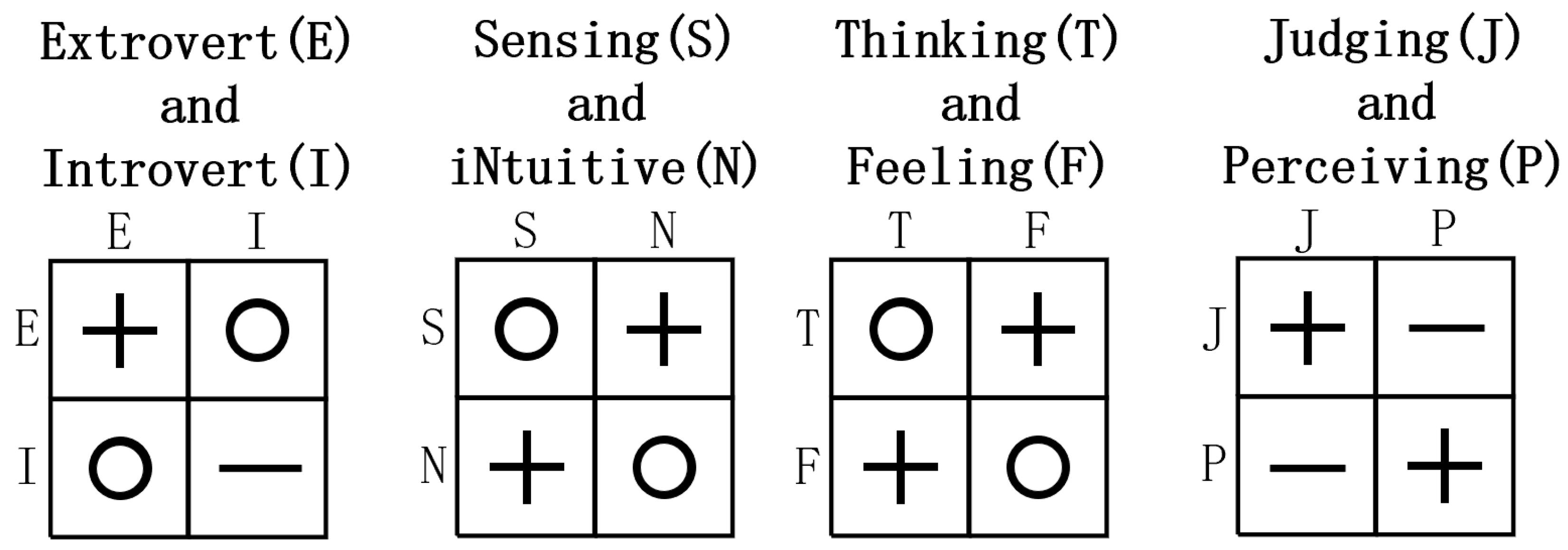
The MBTI is based on Jung’s psychological type theory, and through empirical optimization, it establishes four independent personality dimensions: Extraversion (E)–Introversion (I), Sensing (S)–Intuition (N), Thinking (T)–Feeling (F), and Judging (J)–Perceiving (P). Although all eight personality traits may exist in an individual to some extent, one tends to dominate each dimension. Thus, the MBTI classifies personalities into 16 distinct types. Its core advantages lie in its intuitiveness, ease of operation, and extensive application in corporate team building and recruitment assessments [27]—it is not only used for career evaluation but also widely applied to explain personality test results to individuals [28,29]. However, it has certain limitations: first, its binary classification logic is overly absolute, ignoring the continuity of personality and failing to capture intermediate states [30]; second, studies on the test-retest reliability of MBTI subscales show heterogeneity-correlation coefficients for E-I, S-N, and J-P are acceptable, while those for T-F are relatively weak [31].
The Big Five personality model (Extraversion, Agreeableness, Conscientiousness, Neuroticism, Openness to Experience) is also a mainstream framework in personality psychology. Its key strengths include solid psychometric properties, with reliability and predictive validity validated by numerous empirical studies, enabling effective prediction of job performance and collaborative behaviors. Its continuous dimensional scoring aligns with the complexity of personality, and its theoretical foundation is widely recognized in academia [32,33]. Nevertheless, it also has limitations for quantifying team collaboration: first, the model is costly to interpret; second, its continuous dimensions are better suited to individual personality assessment, making it more challenging to quantify team collaboration.
Despite the aforementioned limitations, the MBTI is relatively applicable in specific fields, especially for measuring interpersonal relationship characteristics to evaluate indicators such as team collaboration and performance [34]. For instance, Tricia used the MBTI to study team effectiveness [35], and Rodríguez applied it to assess the success of engineering teams in project-based learning [36]. In summary, this study adopts the MBTI to quantify the collaboration degree of new construction project management teams for three reasons: first, for the strong scenario adaptability—engineering management teams primarily engage in “task-oriented interaction,” and MBTI dimensions such as T-F (decision-making style) and J-P (work rhythm) directly correspond to core needs like schedule coordination and safety communication, offering greater relevance than the Big Five’s general dimensions; second, high practical feasibility—the MBTI questionnaire contains approximately 30 items (answered as “yes/no”), compared to approximately 60 items for the Big Five (rated on a 5-point scale), saving about 10 min per completion. Additionally, it is widely used in employee onboarding personality assessments and training in Chinese construction enterprises, ensuring high recognition among managers and employees and an abundant data foundation.

2.3. Team Formation and the Application of Multi-Objective Optimization Algorithms

Team formation is a systematic project that improves performance by optimizing personnel structure [37]. Scholars have pointed out that the person–job fit is an essential source of work significance and can significantly enhance team task performance [38]. Drawing on Bandura’s self-efficacy theory, Li found that the person–job fit positively affects team performance [39,40]. Wu divided team diversity into knowledge diversity and value diversity and found a positive correlation between team diversity and construction project performance [41]. Juárez et al. classified general team formation problems into two types of models: task-oriented and community-oriented [42]. This study focuses on the task-oriented team formation framework, which balances the person–job fit and member collaboration indicators to meet the task-oriented characteristics of new construction project management teams.
For such models, scholars mainly conduct quantitative modeling research using mathematical programming methods and multi-objective optimization algorithms. Among them, multi-objective optimization algorithms are widely applied in team formation due to their ability to explore complex solution spaces, as shown in Table 1. However, most existing applications focus on software crowdsourcing projects or general-scenario frameworks. Few targeted improvements have been made to existing algorithms to address the special needs of new construction project management teams—such as high technical adaptability requirements, frequent team collaboration, and the project’s need for achieving sustainable development.

2.4. Review of Existing Research

Although existing research and practical applications have achieved certain progress, there are still deficiencies in dealing with the characteristics of new construction project management teams, namely “high technical compatibility requirements, frequent team collaboration, and demand for sustainable development”.
  • Insufficient scenario adaptability and lack of industry-specific targeting: Most person–job fit models focus on general recruitment and recommendation, failing to consider the segmented competency needs of engineering management positions (e.g., BIM technology, multi-disciplinary collaboration); team formation and algorithm applications mostly draw on general frameworks without integrating the special constraints of the construction industry, resulting in a disconnect between model implementation and practical needs.
  • Lack of integrated modeling and single-dimensional objectives: Existing studies mostly optimize person–job fit or team collaboration in isolation, lacking integrated “person–job fit-team collaboration” modeling. Additionally, person–job fit does not incorporate higher-order objectives of new projects (e.g., green and low-carbon development), which is inconsistent with the industry’s demand for high-quality transformation.
  • Room for improvement in algorithm performance and design: Traditional NSGA-II algorithms have limitations, operator design relies on simple variants, most genetic algorithms applied to team formation are confined to basic crossover operators and their simple modifications [49,50], with limited research on exploring and enhancing crossover operators tailored to the specific characteristics of new construction project management team formation. Moreover, the local calculation of crowding distance results in diminished diversity of Pareto solutions.
  • Lack of critical justification for the selection of personality assessment models: Existing studies either avoid academic controversies surrounding the MBTI or overlook the practical feasibility of the Big Five personality model. They lack a systematic comparative analysis and fail to justify the rationality of model selection in construction industry contexts.

3. Model Construction

3.1. Problem Description

Based on the aforementioned analysis, this study defines the multi-objective optimization problem of construction project management team formation as follows: driven by business needs and industry development trends, construction enterprises need to rapidly establish a core management team aligned with the management model for new-type construction projects. Team formation must meet dual core requirements: first, under the predefined position system, select personnel whose skills and qualifications are highly aligned with job requirements to ensure professional coverage of core management functions; second, consider the collaborative compatibility among team members and improve team efficiency and cohesion through optimized personnel allocation. Therefore, this study establishes a multi-objective optimization model with the core goals of maximizing person–job fit and overall team coordination. Section 3.2 will construct the mathematical model of this problem, and Section 4 will introduce the quantification methods for the corresponding objective functions.

3.2. Multi-Objective Optimization Model

Based on the problem description in Section 3.1, this section constructs a multi-objective optimization model for the formation of new-type construction project management teams, as follows:
f 1 = max i = 1 n j = 1 m M D i j x i j m
f 2 = max   C o o r d i n a t i o n
x i j = 0   o r   1 ,   i = 1 , 2 , , n ,   j = 1 , 2 , , m
s . t . j = 1 m x i j 1 ,   i = 1 , 2 , , m
s . t . i = 1 n x i j = 1 ,   j = 1 , 2 , , m
T e a m R i g i d c o n s = t r c o n s 1 , t r c o n s 2 , , t r c o n s h
Equation (1) defines the objective function f1, which maximizes the team’s overall person–job fit. Here, MD’ij represents the fit between person i and job j, m represents the total number of positions, and n represents the total number of candidates. The purpose of this approach is to map the overall person–job fit of the final team to the range of [0, 10], with the specific calculation method detailed in Section 4.1. The variable xij is a binary variable indicating whether person i is assigned to job j. Equation (2) defines the objective function f2, with the specific calculation method detailed in Section 4.2. Equations (3) and (4) serve as constraints, ensuring that each individual is assigned to at most one job and that each job is filled by exactly one person. Equation (6) specifies the rigid constraints for team formation, requiring members of the construction management team to meet certain conditions. The specific content will be elaborated in Section 4.1.

4. Solution Method

To address the aforementioned team formation problem and solve the proposed multi-objective optimization model, this section proposes a person–job fit calculation method for new construction project management teams based on text similarity, along with an approach to evaluate overall team coordination based on MBTI. Then, the CSCD-NSGA-II algorithm is developed to solve the multi-objective optimization model.

4.1. Person–Job Fit Degree Measurement Method

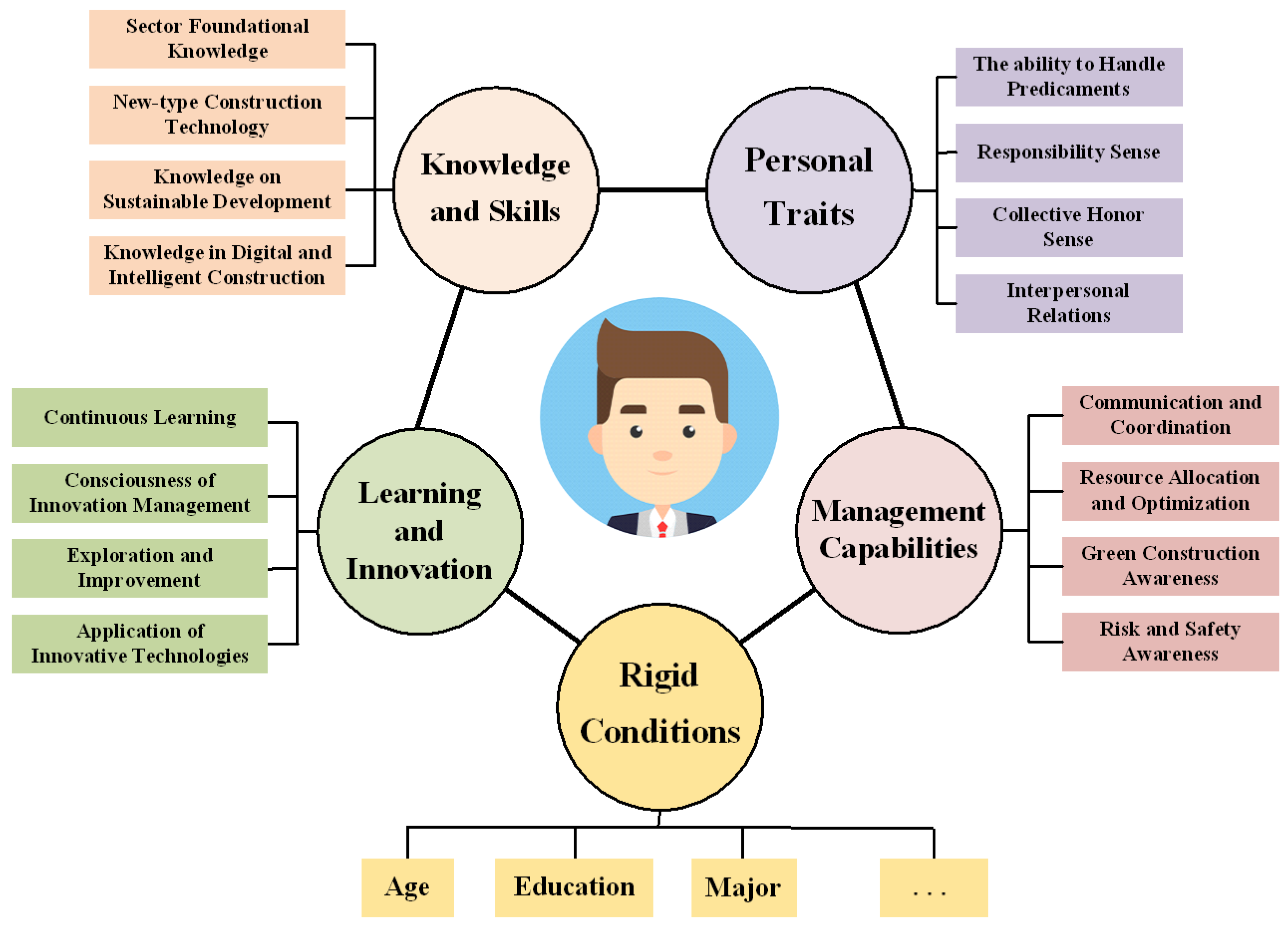
Before calculating person–job fit, it is necessary to verify whether candidates meet the position’s basic requirements—it is explicitly defined constraints. These are defined as the “rigid conditions” for post-qualifications in this study. Additionally, in new construction project management, specific post-qualification criteria—closely linked to the competencies and qualities required for the position—do not emphasize merit-based selection and are thus defined as “flexible conditions”. Sina identified ten core competencies of project managers (e.g., team capabilities, stress tolerance, relationship building, order maintenance) as critical to their outstanding performance [51]. Ashok identified four key success factors for project managers via quantitative analysis: relationship management, leading by example, self-management, interpersonal sensitivity, and 13 contributing leadership practices [52]. Ahmed’s analysis of data from 197 project managers revealed a positive correlation between relationship/innovation-oriented capabilities and project success [53]. Based on the previous definition of new construction projects and Chinese policy documents promoting the development and transformation of the construction industry, this study selects four dimensions—knowledge and skills, personal traits, learning and innovation, and management capabilities—as the “flexible conditions” for new construction project management personnel [54,55]. Each dimension encompasses distinct competency requirements, with the rationale for their selection outlined below. Table 2 presents the dimensions, requirements, and specific connotations of the competency requirements.
  • Knowledge and Skills: Knowledge and skills refer to the professional expertise and technical capabilities required for construction managers to perform their duties, which play a stable role in management practices [56]. These include not only traditional construction management expertise but also intelligent construction technologies [57], sustainable development indicators, and other relevant competencies [58].
  • Personal Traits: Personal traits denote the inherent qualities and personality characteristics demonstrated by construction managers in the course of fulfilling their responsibilities. Though intangible, these traits significantly impact project success and management efficiency [59], including the ability to handle interpersonal dynamics, a strong sense of responsibility, and the capacity to resolve dilemmas [60].
  • Learning and Innovation: In the era of intelligent construction, learning and innovation capabilities are critical for construction managers. These capabilities are reflected in the attitudes and behaviors that drive knowledge renewal, technological advancement, and business process optimization [61].
  • Management Capabilities: In addition to professional knowledge and skills, construction managers must possess a set of comprehensive management capabilities. Specifically, these include interpersonal communication [62], resource allocation, environmental adaptability, and risk management [63], all of which are essential for the effective discharge of their duties [64].

Table 2. The connotations of the ability requirements.
Competency DimensionCompetency RequirementsConnotations
Knowledge and SkillsSector Foundational KnowledgeBe well-versed in the laws and regulations of the construction industry, construction standards and specifications, as well as construction organization design.
New-type Construction TechnologyBe familiar with advanced construction technologies that are currently prevalent or expected to gain widespread adoption, aligned with the requirements of intelligent construction.
Knowledge on Sustainable DevelopmentAcquire proficiency in the knowledge related to advancing environmentally sustainable development and fulfilling social responsibility via construction activities.
Knowledge in Digital and Intelligent ConstructionAcquire proficiency in the application of information technology to enhance construction processes, specifically focusing on the utilization of big data analytics, IoT, cloud computing platforms, and AI-driven decision support systems within the context of construction management.
Personal TraitsThe ability to Handle PredicamentsPossess the ability to maintain composure and identify practical solutions when confronted with a variety of difficulties and challenges in the project.
Responsibility SenseA serious and responsible attitude towards work, coupled with a proactive willingness to undertake all tasks within one’s defined scope of responsibility.
Collective Honor SenseAn attitude that prioritizes team interests over personal gains and takes genuine pride in the team’s achievements.
Interpersonal RelationsThe ability to build and maintain positive working relationships with superiors, subordinates, and external stakeholders.
Learning and InnovationContinuous LearningThe capacity to proactively pursue new knowledge and skills and effectively translate acquired learning into practical applications within the workplace.
Consciousness of Innovation ManagementAwareness and a proactive willingness to promote innovation in project management and work processes.
Exploration and ImprovementContinuously engage in in-depth analysis of the current situation and existing issues, and proactively develop and propose practical, feasible, and effective improvement plans to enhance and optimize the current status.
Application of
Innovative Technologies
Emphasis should be placed on applying new technologies and materials in projects to improve engineering quality and efficiency.
Management CapabilitiesCommunication and CoordinationThe capacity to engage in effective communication with all stakeholders and facilitate consensus-building throughout the project implementation process.
Resource Allocation
and Optimization
Optimize the allocation of human, material, and financial resources in accordance with project requirements and refine resource management strategies to maximize overall efficiency and benefits.
Green Construction AwarenessUnderstanding of environmental protection, sustainable development, and the green construction management system, and their practical application in the construction process.
Risk and Safety AwarenessIdentify potential risks, evaluate risk levels, and take preventive measures to ensure the construction safety and project quality.
Based on the “rigid conditions” and “flexible conditions” for post qualification, a competency model for new construction project management personnel is established, as illustrated in Figure 1. Figure 1 shows the four flexible conditions included in the competency model and the content covered by the rigid conditions. On this basis, candidates’ resume data are categorized into structured and unstructured text, with structured text corresponding to the “rigid conditions” and unstructured text corresponding to the “flexible conditions”. The methods for calculating the fitness degree between different types of text and the competency model are as follows.
(1)
Calculation of Fit Degree for Structured Text
In accordance with the previously defined “rigid conditions” for positions and the basic requirements for construction project management personnel, the degree of fit is primarily evaluated based on age, educational background, academic major, and professional qualifications. If a candidate meets the relevant conditions, the fit degree is assigned a value of 0; otherwise, it is assigned a value of 1. The specific calculation is given in Equation (7).
S i m = i = 1 n Sim ( R i , J i ) , S i m ( R i , J i ) = 0 ,   S a t i s f y   t h e   c o n d i t i o n 1 ,   N o t   s a t i s f y   t h e   c o n d i t i o n
Here, Sim denotes the fit degree of structured text, Sim(Ri,Rj) indicates the fit degree for one rigid condition, and Ri,Rj respectively refers to the i-th structured text data of person R and the i-th “rigid condition” of position J.
(2)
Calculation of Fitness for Unstructured Text
Unstructured text mainly comprises long-text data, such as project experience and work history in resumes, as well as detailed descriptions of competency requirements, specific project profiles, and project objective achievement needs specified in the post’s “flexible conditions”. Despite containing a certain number of domain-specific terminologies, large language models (LLMs) have now become out-of-the-box tools capable of identifying valid information from unstructured text inputs. Therefore, this study adopts the publicly available BERT-base-Chinese model released by Google as the foundation for text semantic representation and employs cosine similarity to measure the semantic similarity between single-segment text embeddings from the two datasets, thereby deriving the degree of fit for unstructured text. The rationales are as follows: (1) Sample size limitation. Due to limited access to resume data, the number of valid resumes collected from the construction industry for this study is relatively small, and all are in Chinese. In such small-sample scenarios, domain-specific fine-tuning tends to cause severe overfitting, leading to a sharp decline in model generalization ability. (2) Research focus. This study primarily focuses on the multi-objective optimization problem of forming a new construction project management team. Thus, it does not additionally construct a large-scale construction industry corpus (e.g., specification documents, construction logs). However, the pre-trained corpus of the general BERT model already covers most core terminologies related to construction engineering (e.g., “BIM technology”, ”Constructor Certification”, “major projects”, “prefabricated buildings”), whose basic semantic representation capability is sufficient to meet the fundamental requirements of person–job fit quantification in this study. (3) Theoretical rationality. The high-dimensional, dense embedding vectors generated by BERT encode core semantic information in vector direction rather than vector magnitude [65]. Cosine similarity can effectively eliminate interference from magnitude differences and accurately measure semantic consistency between resumes and job descriptions [66]. (4) Scenario applicability. The person–job fit measurement in this study is to determine whether the characteristics of team members are semantically consistent with the requirements of new construction project management positions, rather than measuring the absolute degree of matching. The “relative fit degree” characteristic of cosine similarity is precisely suitable for this demand and can distinguish fine-grained differences to a certain extent [67].
The core parameters of the BERT-base-Chinese model selected in this study are as follows: the network structure consists of 12-layer Transformer encoder layers, with a hidden layer dimension of 768, 12 self-attention heads, and a vocabulary size of 21,128. All parameters remain in their original pre-trained state. The output vector of the [CLS] token in the last layer of the model is selected as the semantic representation of single-segment text (with a fixed dimension of 768) to ensure semantic consistency. The specific operation process is as follows:
  • Standardized text preprocessing: The NLTK toolkit, it is used to perform standardized text preprocessing, including removing redundant spaces and removing meaningless punctuation marks, while retaining hyphenated professional terms to maintain semantic integrity.
  • Text length adaptation: A hybrid truncation strategy from the Tokenizers library is adopted to ensure that the text length complies with the 512-token input limit of the Bert model. For multiple resume fields and job dimension fields, field-wise independent encoding is employed for semantic embedding extraction: the preprocessed resume fields and job dimension fields are fed into the model, and the 768-dimensional vector corresponding to the <CLS> token in the last layer is extracted as the field-level semantic representation.
  • Feature vector aggregation: Instead of assigning subjective weights during field aggregation, the embedding vectors for each field are concatenated in sequence to form the resume’s global feature vector, fully retaining semantic information across all dimensions while avoiding bias.
  • Vector normalization: Before similarity calculation, the aggregated vectors are standardized (Equation (8)) to ensure that the norm of each vector is 1.
  • Similarity calculation and normalization: Cosine similarity is used to measure the semantic consistency between the global feature vectors of resumes and job descriptions, with an output range of [0, 1]. To improve the discriminability of matching results, linear normalization is further applied to map the similarity values to the [0, 10] interval, obtaining the final person–job fit degree (Equation (9)):
N o r m a l i z e d v = v v
M D = 10 × Cos S i m = 10 × V r e s u m e V j o b V r e s u m e V j o b
where Vresume and Vjob denote the standardized vectors of the resume text and job description text respectively, MD represents the person–job fit degree, and CosSim refers to the cosine similarity.
Based on the aforementioned methods for calculating the fit degree of structured and unstructured text, combined with the scenario requirements for new construction project management positions specified by the “rigid conditions” and “flexible conditions”, the final calculation of the person–job fit degree uses a penalty function to soften constraints. This study adopts a hierarchical constraint definition, as detailed below. Absolute rigid criteria: Professional qualifications and core major categories are directly linked to engineering project compliance and safety. Candidates who do not meet these requirements are directly deemed mismatched, and no subsequent fit degree calculation is performed. Adaptable rigid criteria: Items, including educational background and age, allow minor violations but will be subject to corresponding penalties. The revised calculation formula for the person–job fit degree is as follows:
M D = M D i = 1 n γ s i
where Si is the fit degree assignment of adaptable rigid items, and Si = 0 indicates full compliance with constraints, while Si = 1 indicates incomplete compliance. The penalty coefficient γ is set to 0.5, which is compatible with the [0, 10] score range for the degree of person–job fit. This value avoids insufficient feasible solutions caused by excessive penalties and prevents constraint failure due to overly lenient penalties.

4.2. Team Coordination Measurement Method

Based on the discussions above, this study adopts the MBTI tool to measure the overall coordination degree of teams through a three-step process: dimension-matching quantification, individual pairwise scoring, and team aggregation.

4.2.1. Dimension Matching Quantification

The core of using MBTI to quantify team coordination lies in quantifying the matching relationships over the four dimensions: E-I, S-N, T-F, and J-P. Chen pointed out that optimal collaborative relationships can be formed when individuals show complementarity in one or two personality dimensions while maintaining similarity in the remaining dimensions. This combination enhances mutual understanding and communication or achieves functional complementarity in decision-making and problem-solving. Chen further classified matching relationships into three categories: positive (+), neutral (○), and negative (−) (as shown in Figure 2), and assigned corresponding scores of +9, +3, and −3, respectively [68,69]. Many scholars have adopted this theory to quantify team coordination in various scenarios. For instance, Zhang used it to form a new product development team [45], Xu to establish an academic research team [70], and Abdelsalam to optimize the composition of an integrated product development project team [71].

4.2.2. Calculation of Individual Pairwise Matching Scores

For each pair of team members, matching values are assigned to the four dimensions separately in accordance with the rules specified in Section 4.2.1. The total matching score for a single member pair is obtained by summation, calculated as follows:
S c o r e i , j = k = 1 4 W k
where Wk denotes the matching value of the k.th dimension (valued at +9, +3, or −3), and i,j represent two distinct team members. For example, if one member’s MBTI type is ESFJ and another’s is INTJ, their pairwise matching score is calculated as follows: E-I (+3) + S-N(+9) + F-T(+9) + J-J(+3) = 24 points.

4.2.3. Aggregation of Overall Team Coordination Degree

First, the raw scores of all individual pairs are standardized to the interval [0, 1]. The maximum and minimum matching scores across all personality type combinations are 36 and 0, respectively. Thus, any personality matching score can be standardized within this range. For instance, the personality matching score between ESFJ and INTJ can be standardized as 24/36 = 0.67. Based on this, the study presents the standardized pairwise scores for the 16 MBTI personality types in Table 3.
Subsequently, the arithmetic mean is taken as the overall team coordination degree and mapped to the interval [0, 10] (Equation (12)):
C o o r d i n a t i o n = 10 × 1 C n 2 i j N o r m a l i z e S c o r e i , j
where Coordination denotes the overall team coordination degree with a value range of [0, 10], and NormalizedScorei,j represents the standardized pairwise matching score, which can be directly retrieved from Table 3.

4.3. Design of the CSCD-NSGA-II

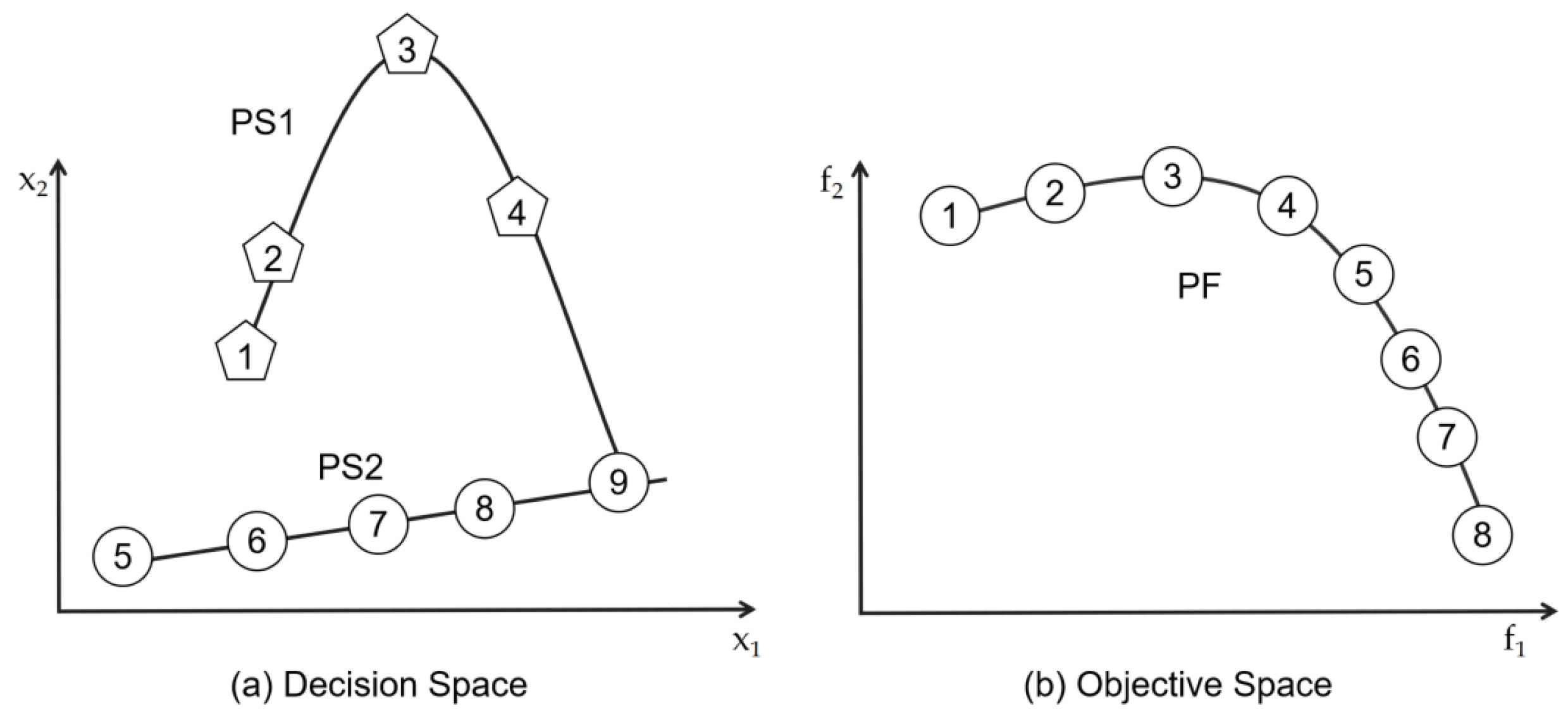
This section designs the CSCD-NSGA-II algorithm to solve the multi-objective optimization model established in Section 3.2. The traditional NSGA-II algorithm, first proposed by Deb et al. in 2002 [72], is renowned for its strong convergence capability, which can effectively approximate the Pareto Set (PS), the set of optimal trade-off solutions in the decision space [73]. Its mapping in the objective space is called the Pareto Front (PF). However, in the multi-objective optimization model proposed in this study, some individuals may have the same person–job fit degree and the identical team collaboration levels with other team members. In such cases, different team formation plans may produce identical objective function values, and a specific objective value on the PF may correspond to multiple PSs [74]. This can cause the NSGA-II algorithm to identify only one PS or a subset of PSs associated with the PF during the search, thereby resulting in insufficient diversity and completeness in the obtained solutions [75].
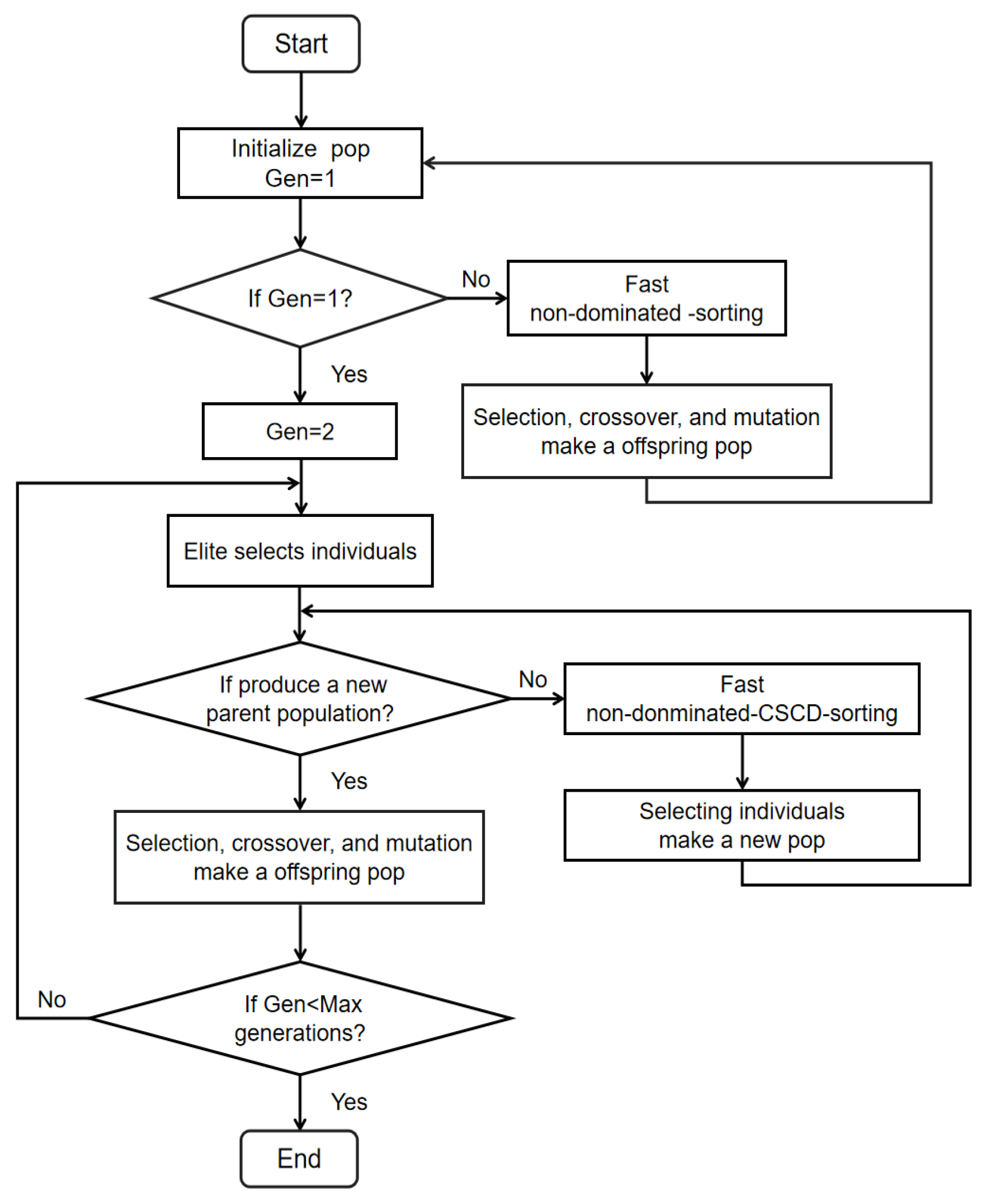
To address this issue, this study proposes the CSCD-NSGA-II algorithm. The innovation of this method lies in calculating the Special Crowding Distance (SCD) based on K-means clustering (CSCD). This improvement is designed to enhance the diversity and completeness of solutions, thereby improving the algorithm’s search efficiency. Figure 3 illustrates the complete workflow of the CSCD-NSGA-II algorithm.

4.3.1. Chromosome Encoding Method

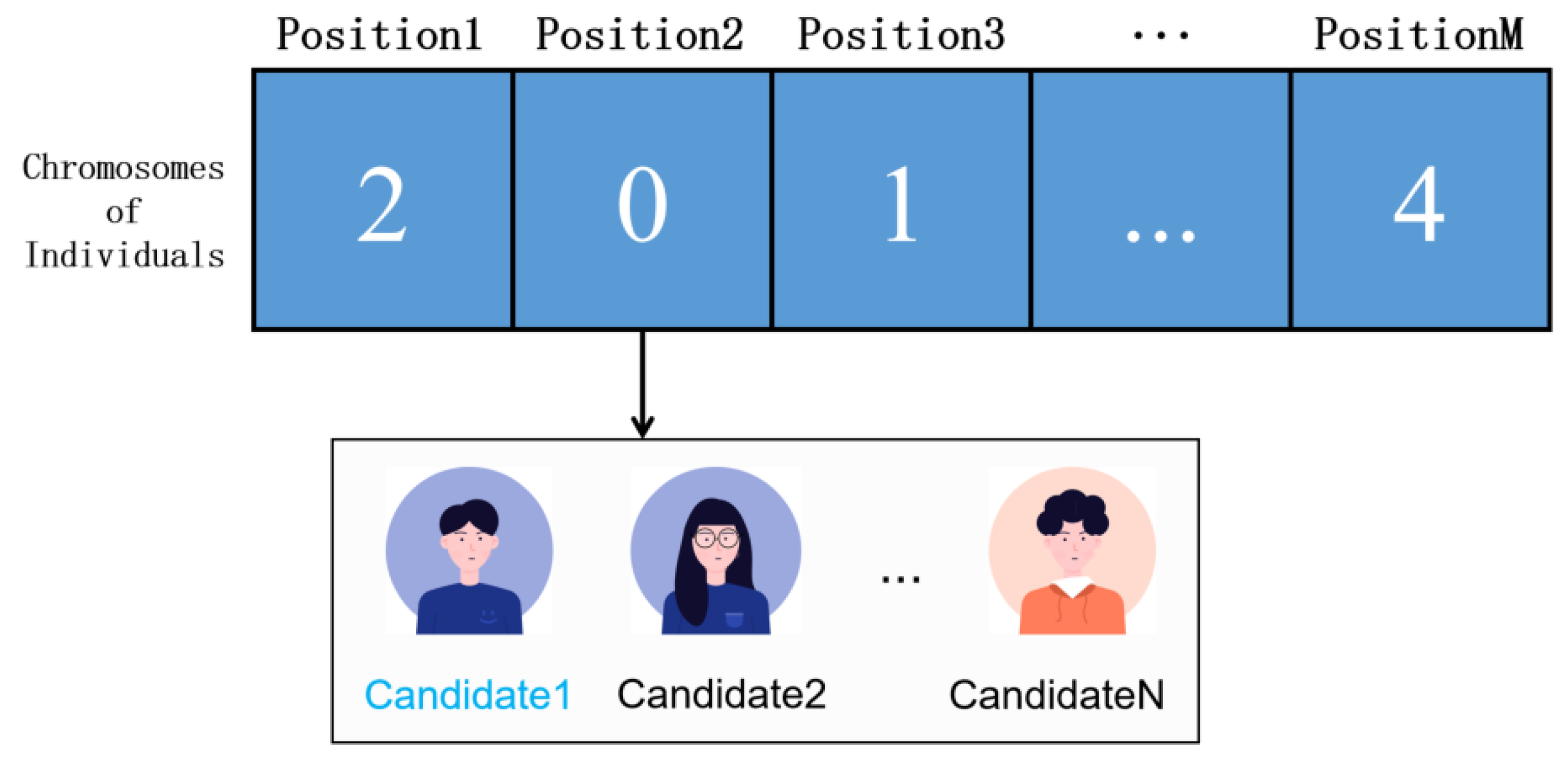
This method adopts integer encoding to represent a single chromosome. The chromosome length M corresponds to the total number of positions in the team, where each j-th position has N j candidates available. The encoded value s j at the j-th position of the chromosome is an integer within the range 0 , N j 1 , indicating that the s j + 1 -th candidate in the candidate sequence is assigned to this position. As shown in Figure 4, the encoded value at the second position of the chromosome is 0, which means the algorithm assigns the first candidate to the second position.

4.3.2. Special Crowding Distance Based on K-Means Clustering

The field of multi-objective optimization commonly uses the traditional Special Crowding Distance (SCD) as a ranking criterion for individuals within the same non-dominated rank. However, in multi-objective optimization problems, SCD can lead to inaccurate individual comparisons, particularly when individuals in the decision space originate from different PSs. Specifically, when identifying appropriate neighbors, the SCD method may select individuals from different PS, leading to distorted rankings. Additionally, in regions with low individual density, SCD struggles to effectively identify neighboring individuals, thereby undermining the diversity of the solution set [76].
To address the aforementioned issues, this study proposes the CSCD method for calculating the crowding distance. The core idea of this method is to use K-means clustering to partition solutions on the same non-dominated front into multiple clusters, ensuring that individuals within each cluster share similar characteristics and enabling effective comparisons within the cluster in the corresponding local regions.
(1)
Selection of K-means Clustering
There are several reasons for selecting K-means clustering: (1) Computation efficiency. As a classic clustering algorithm, it can quickly partition data with a computational complexity of O(n), making it suitable for processing large-scale solution sets; (2) Clustering accuracy. This algorithm can identify cluster centers and group similar individuals together, reducing errors caused by distance calculation; and (3) Wide applicability. It is an important data analysis tool renowned for its high efficiency and simplicity, as well as a validated and widely adopted clustering technique [77].
(2)
Determination of the K Value
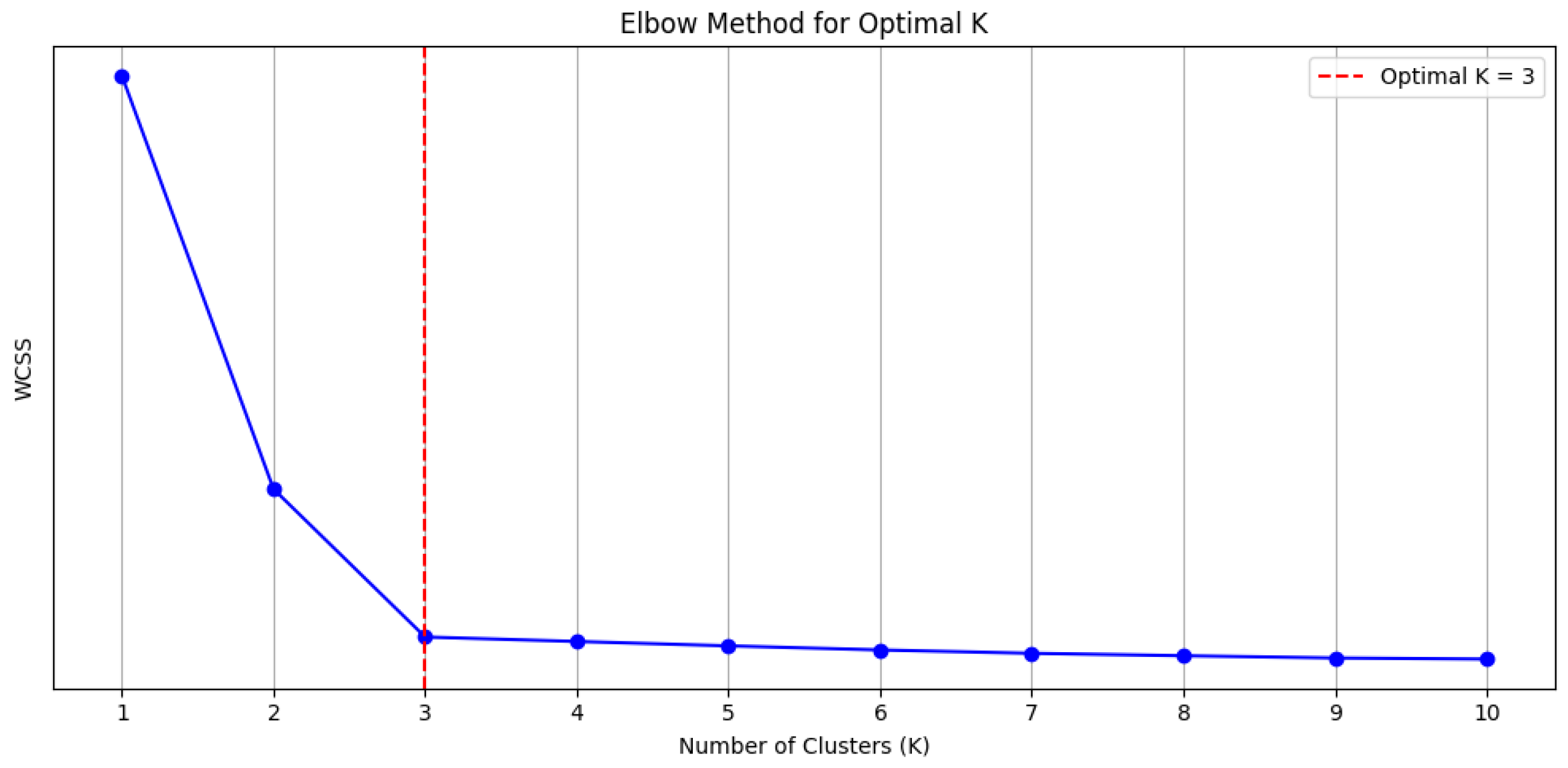
Scholars have developed a range of methods for determining the optimal cluster number (K), including the Dunn Index, Davies–Bouldin Index, Hubert’s Statistic, Elbow Method, Score Function, and Silhouette Plot [78]. The Elbow Method is renowned for its reliability [79], so this study adopts it to determine the K value. The specific steps are as follows.
First, for different K values, the degree of aggregation of each cluster is calculated and evaluated using the Within–Cluster Sum of Squares (WCSSs). A smaller WCSS value indicates better clustering performance, and the calculation formula is shown in Equation (13). Then, a line chart is plotted with the WCSS values corresponding to different K values. Generally, as the K value increases, the WCSS value decreases. Still, there will be an inflection point with a significantly slowed downward trend after a specific K value, which is the optimal K value. Finally, the Elbow Plot is observed, and the K value corresponding to the obvious inflection point on the curve is selected as the optimal K value:
W C S S = i = 1 k j = 1 n i x j ( i ) c i 2
where ci denotes the center of the i.th cluster, xj(i) is the j.th data point belonging to the i.th cluster, and ni is the number of samples in the i.th cluster.
(3)
Calculation of CSCD
First, based on the K-means clustering results, the non-dominated solution set is partitioned into multiple clusters. Then, within each cluster, the distance between neighboring individuals is calculated using Euclidean distance, based on their positions in the decision space. This method uses these distances to evaluate the “crowding degree” of each individual. For example, Figure 5 divides the eight individuals from PS1 and PS2 into three clusters: Cluster 1 (5, 6, 7, 8, 9), Cluster 2 (1, 2, 4), and Cluster 3 (3). Taking Individual(7) as an example, the calculation formula for CSCD7 is shown in Equation (14). Finally, for individuals within the same non-dominated rank, sorting is performed according to their CSCD values, with non-crowded solutions given priority in selection. Using CSCD as an auxiliary indicator enables effective differentiation among individuals with the same non-dominated rank, thereby preserving solution diversity.
C D 7 , x = ( x 6 , 1 x 8 , 1 / x 5 , 1 x 9 , 1 ) + ( x 6 , 2 x 8 , 2 / x 5 , 2 x 9 , 2 ) C D 7 , f = ( x 6 , 1 x 8 , 1 / x 1 , 1 x 9 , 1 ) + ( x 6 , 2 x 8 , 2 / x 1 , 2 x 9 , 2 ) C S C D 7 = max ( C D 7 , x , C D 7 , f ) , i f   C D 7 , x > C D a v g , x   o r   C D 7 , f > C D a v g , f min ( C D 7 , x , C D 7 , f ) ,   o t h e r w i s e
(4)
Efficiency Improvement and Computational Complexity
To further improve algorithm efficiency, this study integrates Fast Non-dominated Sorting with the CSCD method to propose the FNDS-CSCD method, and presents its pseudocode in Algorithm 1. The computational complexity of the traditional method is O(n3), whereas adopting Fast Non-dominated Sorting and CSCD reduces the overall complexity to O(n2). This improvement has great practical significance for solving large-scale problems and, at the same time, ensures the diversity and coverage of the optimization results.
Algorithm 1: FNDS-CSCD
Input: the population: P.
OUTPUT: the sorted population: P*.
1:
Fast non dominated sorting:
2:
for each p in P do
3:
  Sp= ø, Np= 0;
4:
  for each q in P do
5:
    if q dominates p then Sp = Sp ∪ {q};
6:
    if p dominates q then Np = Np + 1;
7:
  end
8:
  if Np = 0 then prank = 1, F1 = F1 ∪ {p};
9:
end
10:
i= 1;
11:
while Fi ≠ ø do
12
  Q = ø;
13:
  for each p in Fi do
14:
    for each q in Sp do Nq = Nq − 1;
15:
    if Nq = 0 then qrank = i + 1, Q = Q ∪ {q};
16:
  end
17:
  i = i + 1, Fi = Q
18:
end
19:
Calculating CSCD;
20:
num = |P|;
21:
for i: num do
22:
   k i = F i n // where |Fi| indicates the number of individuals in Fi, is an integer calculated by K-means algorithm
23:
  Compute CSCDi according to eq(14)
24:
end
25:
Sort the population P base on their non-dominated rankings and CSCD values to gen a new population P*

5. Case Study

5.1. Project Overview

An enterprise was awarded a high-rise building project, with a project duration of 580 days and a budget of 26.85 million yuan. The construction objectives cover high quality and durability, safety and comfort, economic feasibility, environmental protection, and industrial demonstration effect. It is necessary to establish a 10-member professional construction project management team, and the “rigid conditions” for each position are presented in Table 4. The human resources department provided 138 valid resumes, from which a basic dataset was constructed after preliminary screening. The dataset includes structured information (age, educational background, academic major, professional qualifications) and unstructured information (project experience, work experience). Meanwhile, the personality type data of the 138 candidates were collected through the MBTI personality test.
The enterprise’s human resources department has officially approved all resume data collected in this study. When candidates participated in the MBTI personality test, they were explicitly informed that the data would be used exclusively for academic research and team formation optimization. Only necessary information relevant to person–job matching was collected, with no sensitive personal information (e.g., religious beliefs, marital status) included. Meanwhile, measures for privacy protection and bias mitigation were adopted as follows.
  • Anonymization: Personal identifiable information, such as names and contact details, was removed from resumes, and candidates are identified using unique identification numbers instead.
  • Data minimization: Only core information related to job requirements was extracted from unstructured text, and redundant information was directly discarded.
  • Textual bias mitigation: Through text preprocessing, discriminatory expressions related to gender, region, and age (e.g., residual historical information such as “male preferred” and “local household registration”) were removed, leaving only competence-related semantic features.
  • Diversity assurance: A balanced sample proportion of candidates with different qualifications, professional backgrounds, and personality types was ensured during screening to prevent algorithmic output bias caused by dataset imbalance.

5.2. Model Solution and External Validation

5.2.1. Basic Model Solution

Following the calculation method of individual person–job fit degree in Section 4.1 and the quantification logic of team coordination degree in Section 4.2, the overall team person–job fit degree (F1) is calculated as the arithmetic mean of individual scores (with a value range of [0, 10]), and the overall team coordination degree (F2) is mapped to the [0, 10] interval through linear normalization to ensure the uniformity of the two objective dimensions. The algorithm parameters are set as follows: population size = 100, number of iterations = 300, mutation probability = 0.1, and the K value is determined as 3 via the Elbow Method in Section 4.3.2 (as shown in Figure 6).
Meanwhile, to address the randomness of the algorithm, it was run 30 times in Python 3.9.11, and the mean, variance, and coefficient of variation of the core indicators were statistically analyzed; the results are presented in Table 5. The data indicate that the CSCD-NSGA-II algorithm exhibits excellent stability across all runs: the objective functions F1, F2, and runtime all have low coefficients of variation, demonstrating that the algorithm’s outputs are reliable, with minimal random fluctuations and a relatively short running time.
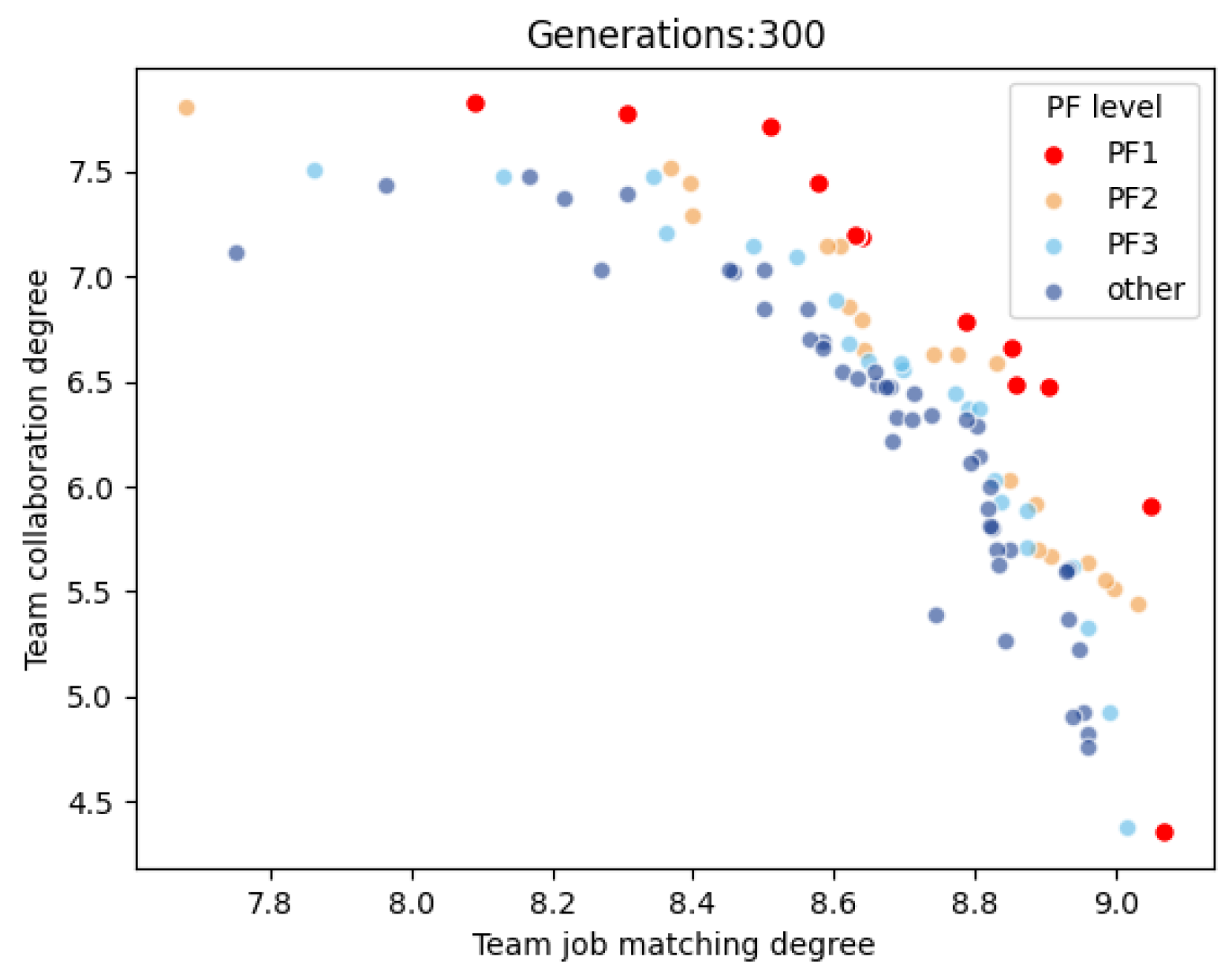
Taking the results of one run as an example (as shown in Figure 7), the algorithm generates 13 Pareto-optimal team formation plans, and we present details of some of them in Table 6. These plans cover three core scenarios: high fit–medium coordination, medium fit–high coordination, and balanced type, providing a selection space for project decision-making with different requirements.

5.2.2. Plan Selection

To select the actual team members, this study formulates three decision-priority principles for different project requirements based on the algorithm-generated plans.
  • Efficiency-first principle: Applicable to projects with tight schedules and high technical requirements. Plans with an overall person–job fit degree higher than the average are prioritized to accelerate project implementation and reduce technical risks.
  • Collaboration-first principle: Applicable to long-term cooperation projects with frequent cross-department collaboration. Plans with a team coordination degree above the average are prioritized to reduce team conflicts and improve long-term stability.
  • Balanced optimization principle: Applicable to comprehensive projects. The Pareto solutions are integrated and ranked, with weights of 0.5 for person–job fit degree and 0.5 for team coordination degree, and the plan with the highest comprehensive closeness degree is selected.

5.2.3. External Validation

(1)
Comparison of Team Formation Efficiency
We invited five experienced construction project managers and HR professionals engaged in the construction industry. They were informed of the basic project overview and asked to review 138 desensitized candidate resumes. To ensure the fairness of the comparison, the five participants were also required to propose 13 reference team formation plans for a new construction project management that meet the project requirements. Team members can be repeated across different plans, but the same candidate cannot be selected more than once in a single plan.
Finally, the five participants spent approximately 25 min on the preliminary review of the 138 candidate resumes, and an additional 40 min on formulating the 13 team formation plans. Although the program had automatically read the candidate resumes and calculated the person–job fit degrees before the algorithm ran, the algorithm-based method still consumed significantly less time than the manual team-formation method. Therefore, the method proposed in this study achieves higher team-formation efficiency in the scenario of establishing a new construction project management team and supports decision-making and real-time dynamic configuration in response to changes in projects and candidate pools.
(2)
Questionnaire Survey
To further evaluate the effectiveness of the team formation plans generated by the proposed method, this study invited practitioners in architectural engineering to conduct a quantitative evaluation of the algorithm-generated plans and perform statistical analysis to assess their pros and cons. Based on the three-dimensional framework of role diversity, collaboration feasibility, and task adaptability, this study developed a five-point Likert-scale questionnaire. This study presents the corresponding relationship between the question items and each dimension in the Table 7.
This study distributed the questionnaires via a blind evaluation method. The plans generated by CSCD-NSGA-II and the manual plans were labeled “Type A Plans” and “Type B Plans,” respectively, with 13 specific plans in each type. Core information about the particular plans was provided to each respondent, who was then required to conduct a comprehensive evaluation of each plan type rather than score individual plans.
After questionnaire collection, we excluded invalid questionnaires with incomplete responses or obviously regular answer patterns. Finally, 56 valid questionnaires were obtained, with an effective recovery rate of 93.3%. Among the respondents, 85.71% had more than 5 years of work experience, all of whom were engaged in construction project management or human resources work.
To ensure questionnaire data reliability, this study used Cronbach’s α to assess internal consistency and adopted the KMO test and Bartlett’s Test of Sphericity to determine validity. The results showed that the overall Cronbach’s α for the questionnaire was 0.703, and the coefficients for the three dimensions were 0.615, 0.637, and 0.621, respectively—all greater than 0.6, indicating good reliability. The KMO value was 0.856 (>0.6), and the p-value of Bartlett’s Test of Sphericity was less than 0.001, indicating that the questionnaire items were suitable for factor analysis and that the content validity met the standard.
Furthermore, this study calculated the mean values for the two plan types across each dimension and the overall score, and presents the results in Table 8. The overall score was converted to a ten-point scale by averaging the scores of all questionnaire items.
Based on the aforementioned data, Type A plans (generated by CSCD-NSGA-II) and Type B plans (generated by manual experience) exhibited comparable performance across the three evaluation dimensions. Yet the algorithm-generated plans also demonstrated clear advantages in key dimensions, with practical implications for management.
In the dimensions of role diversity and collaboration feasibility, the algorithm-generated plans achieved slightly higher scores. Manual plans rely on personal experience, which tends to prioritize core positions while neglecting supporting roles; moreover, they assess collaboration potential through subjective judgment, making it difficult to determine the quantitative compatibility of members’ backgrounds. In contrast, the algorithm-generated plans, based on person–job fit scores and collaboration degree evaluations derived from MBTI personality assessments, achieve a refined, balanced allocation of team roles without weakening core positions and can, to a certain extent, screen out team member combinations with lower collaboration risks.
In the task-adaptability dimension, the scores for the two types of plans were nearly identical, providing strong evidence of the algorithm’s effectiveness. The core advantage of manual plans lies in their close alignment with actual project requirements. In contrast, algorithm-generated plans can achieve the same level of task adaptability by precisely matching project characteristics, capability requirements, and member resumes.
In summary, the results of the team formation efficiency comparison and questionnaire data indicate that the new construction project management team formation method proposed in this study is not a case of “optimization for optimization’s sake”. Instead, on the premise of ensuring task adaptability, it achieves dual improvements in role allocation and collaboration, thereby avoiding the disconnection between algorithmic optimization and practical needs. Meanwhile, the algorithm’s automated processing mode and fixed quantitative model significantly enhance the efficiency and stability of team formation, enabling the stable generation of high-quality team configuration plans in different project scenarios. It is particularly suitable for large-scale, batch-wise team formation needs and can help prevent fluctuations in plan quality caused by variations in manual experience levels.

5.3. Algorithm Comparison Experiments

To further test the algorithm’s performance and improve the generalizability of the results, this section constructs a test case based on the previous case through simulation. The basic assumption of the case is to select 50 candidates from 300 to form a large-scale construction project management team, which meets the staffing requirements of large-scale engineering projects.

5.3.1. Basic Conditions of Experimental Design

(1)
Construction of Simulated Candidate Dataset
The principles of data generation are as follows. 1. Person–job fit degree (Objective Function F1): Randomly generated following a normal distribution within the interval [6, 9.5] (with a mean of 7.905 and a standard deviation of ±0.835), to simulate the distribution characteristics of real-world data, meet the absolute rigid conditions, and that no individual is ineligible for team selection due to non-compliance with them. 2. Candidate MBTI Types: Based on the reference data of MBTI personality proportion distribution in China, the MBTI personalities of 300 candidates are randomly assigned according to the corresponding weight proportions, to ensure the authenticity and objectivity of the data distribution.
(2)
Algorithm Parameter Settings
In this study, we select the Standard NSGA-II, MOPSO, SPEA2, and CSCD-NSGA-II algorithms for comparison, keeping all parameters consistent while retaining only their core logical differences. We set the initial population size to 200 and the number of iterations to 500, with the mutation probability of both CSCD-NSGA-II and NSGA-II fixed at 0.1. We set the K value of CSCD-NSGA-II to 3 based on previous content, and configure the auxiliary parameters of other algorithms according to conventional standards.
(3)
Selection of Performance Evaluation Metrics
Spacing (SP) (Distribution Metric): It measures the distribution uniformity of the solution set in the objective space. A smaller value indicates a more uniform distribution and better diversity.
Hypervolume (HV): It measures the comprehensive performance of the solution set in terms of convergence and diversity (reflecting both the degree to which the solution set approaches the Pareto Front and the range of solutions it covers). A larger value indicates better comprehensive performance (superior convergence and diversity). We set the reference point to (10, 10)—outside the optimal values of the two objectives—with the mapped HV value range falling between [0, 1].

5.3.2. Comparison Experiment Results

To eliminate randomness, we ran each algorithm independently 30 times and present the statistical results in the following Table 9.

5.3.3. Result Analysis

In terms of solution set quality, the CSCD-NSGA-II algorithm proposed in this study achieved an improvement of 0.57% in F1 compared with NSGA-II, 0.80% compared with MOPSO, and 1.48% compared with SPEA2; for F2, the upgrades were 0.61% compared with NSGA-II, 0.31% compared with MOPSO, and 1.02% compared with SPEA2. On the whole, it achieved a balance between person–job fit and team collaboration. Meanwhile, the standard deviations of F1 and F2 for CSCD-NSGA-II were at a medium level, indicating that the algorithm could produce high-quality solutions while maintaining consistent results.
In terms of diversity and convergence, CSCD-NSGA-II obtained the smallest SP value and the highest HV value. The SP value decreased by 10.81% compared with NSGA-II, 29.41% compared with MOPSO, and 24.57% compared with SPEA2; the HV value increased by 1.55% compared with NSGA-II, 3.15% compared with MOPSO, and 6.22% compared with SPEA2. In addition, the standard deviations of these indicators were within the normal range, indicating that the solution set had a uniform distribution and wide coverage, along with good solution diversity. It can provide a variety of alternative plans for 50-member teams with high adaptability and strong collaboration, meeting the decision-making needs of multi-plan comparisons for large-scale construction project management team formation.
In terms of algorithm efficiency, SPEA2 had the longest running time, which was significantly higher than that of the other three algorithms, because it maintains an archive set and calculates individual strength values, resulting in high computational complexity. In contrast, CSCD-NSGA-II involves K-means clustering and specialized crowding-distance calculation, so its running time was slightly higher than that of NSGA-II and MOPSO.
In addition, the comparison with the standard NSGA-II can also serve as an ablation experiment to isolate the CSCD module. The analysis shows that although implementing the CSCD module increases the algorithm’s computational cost, it can significantly improve the diversity and convergence of the solution set, a reasonable cost for improving algorithm performance. The clustering division and special crowding distance calculation can effectively address the shortcomings of the standard NSGA-II algorithm in handling the team formation scenario assumed in this study.

6. Conclusions and Limitations

This study focuses on the team formation issue in new-type construction project management and constructs a multidimensional research framework of “quantitative modeling-algorithm optimization-empirical validation”.
From a theoretical perspective, we establish a multi-objective optimization system for team formation tailored to the characteristics of the construction industry, addressing the limited adaptability to scenarios in existing research. Industry-specific demands, such as the application of BIM technology and green, low-carbon management, are incorporated into the person–job fit dimension. Integrating person–job fit and team coordination modeling enables overcoming the limitations of single-objective optimization. The proposed CSCD-NSGA-II algorithm alleviates the attenuation of solution set diversity in traditional NSGA-II under special constraints by combining K-means clustering with a specialized crowding distance. Experimental results show that its HV value is 1.55% higher than that of the standard NSGA-II and 3.15% higher than that of MOPSO, with a significant reduction in the SP value. This verifies improvements in algorithm optimization performance and provides a new algorithmic design idea for team formation problems in the construction industry.
From a practical perspective, the method proposed in this study shows a clear value in terms of decision-support capability and scheme-generation efficiency. The total time consumed to generate plans is much shorter than that of experience-based manual plans, which supports fast and real-time decision-making. In terms of decision quality, the generated plans avoid randomness and cover three types of scenarios, which can provide reliable references for different project scenarios. Meanwhile, the algorithm-generated plans outperform manual plans in the dimensions of role diversity and collaboration feasibility, with task adaptability basically on par. These results demonstrate that the proposed approach can achieve favorable optimization in team structure design and collaborative potential evaluation, and provide effective decision support for team configuration in new-type construction projects. It should be emphasized that these improvements are demonstrated at the scheme optimization and decision-support level, rather than representing verified enhancements in real-world construction project management effectiveness.
Despite specific theoretical and practical contributions, this study still has the following limitations: (1) The MBTI model has inherent psychometric limitations. Verification of the correlation between collaboration degree scores and actual project performance remains lacking in empirical cases, with the impact of cultural differences unaccounted for; (2) The research relies on a single project case, with limited candidate samples and team scales. Moreover, simulated data cannot fully replicate the data distribution characteristics of real scenarios, and direct validation against real project outcomes is not available; (3) The scalability of the algorithm in candidate pools of thousands of people remains to be verified, and there is insufficient sensitivity analysis of hyperparameters such as the K value; (4) The discussion on the ethical bias risks of algorithmic decision-making is not in-depth enough. The lack of an ethical review mechanism for algorithmic decision-making and unclear boundaries of human intervention in algorithm outputs pose potential ethical disputes in human resource management; (5) There is insufficient depth in management interpretation and decision support. The existing research provides only three types of reference principles for decision-making, and managers still need to rely on personal judgment. In addition, empirical validation between algorithm outputs and key project management performance metrics has not been conducted, and the evaluation based on cases and surveys remains indirect.
Future research can be advanced in the following aspects: (1) further refine the quantitative model of person–job fit degree, and train a BERT model based on text data from the construction industry to enhance its feature extraction capability for domain-specific terminology; (2) optimize the personality assessment system by incorporating the Big Five Personality Model or designing a hybrid model for quantifying team collaboration degree based on historical data, and validate the correlation with project performance; (3) expand diverse project cases and real datasets, incorporate complex constraints such as multi-role allocation and subcontracting collaboration, enhance algorithm scalability, and optimize the adaptive mechanism of hyperparameters; (4) establish a framework for algorithm bias detection and ethical governance, and clarify the boundaries of manual review; and (5) track the implementation effectiveness of the plans, establish direct empirical validation with real project outcomes and key performance indicators such as project duration and cost, and strengthen the practical management value by verifying the actual performance improvement in construction project management.

Author Contributions

Q.W.: Writing—review, Writing—original draft, Investigation, Formal analysis, Conceptualization. Z.W.: Writing—review, Supervision, Resources, Project administration. Z.C.: Supervision, Resources, Project administration. Y.L.: Writing—original draft, Investigation, Validation, Visualization. All authors have read and agreed to the published version of the manuscript.

Funding

The funding supports from the National Natural Science Foundation of China (Grant No. 72171237) and the Natural Science Foundation of Hunan Province (Grant No. 2023JJ30707).

Data Availability Statement

The data of this study (resume and project information) are available from the corresponding author upon request, restricted by personal privacy protection and research ethical norms.

Conflicts of Interest

The authors declare no conflicts of interest.

References

  1. Baduge, S.K.; Thilakarathna, S.; Perera, J.S.; Arashpour, M.; Sharafi, P.; Teodosio, B.; Shringi, A.; Mendis, P. Artificial intelligence and smart vision for building and construction 4.0: Machine and deep learning methods and applications. Autom. Constr. 2022, 141, 104440. [Google Scholar] [CrossRef]
  2. Pal, A.; Hsieh, S.-H. Deep-learning-based visual data analytics for smart construction management. Autom. Constr. 2021, 131, 103892. [Google Scholar] [CrossRef]
  3. Craveiro, F.; Duarte, J.P.; Bartolo, H.; Bartolo, P.J. Additive manufacturing as an enabling technology for digital construction: A perspective on Construction 4.0. Autom. Constr. 2019, 103, 251–267. [Google Scholar] [CrossRef]
  4. Li, Y.K.; Zhu, L.; Xue, R.; Han, Y.L. How Policy Diffusion Influences Regional BIM Innovation: An Empirical Study in China. J. Constr. Eng. Manag. 2023, 149, 05023008. [Google Scholar] [CrossRef]
  5. Turner, C.J.; Oyekan, O.; Stergioulas, L.; Griffin, D. Utilizing Industry 4.0 on the Construction Site: Challenges and Opportunities. IEEE Trans. Ind. Inform. 2021, 17, 746–756. [Google Scholar] [CrossRef]
  6. Guo, Z.X.; Wang, Q.E.; Cao, X.P.; Wang, Z. Navigating BIM Technological Innovations for Megaprojects: Insights from the TOCE Framework. J. Constr. Eng. Manag. 2026, 152, 04025235. [Google Scholar] [CrossRef]
  7. Zhang, L.; Wang, J.; Xia, Z.; Song, X. Physics-guided deep learning for generative design of large-diameter tunnels under existing metro lines. Autom. Constr. 2025, 170, 105901. [Google Scholar] [CrossRef]
  8. Brandín, R.; Abrishami, S. IoT-BIM and blockchain integration for enhanced data traceability in offsite manufacturing. Autom. Constr. 2024, 159, 105266. [Google Scholar] [CrossRef]
  9. Lin, Z.H.; Chen, A.L.Y.; Hsieh, S.H. Temporal image analytics for abnormal construction activity identification. Autom. Constr. 2021, 124, 103572. [Google Scholar] [CrossRef]
  10. Pan, Y.; Zhang, L.M. Roles of artificial intelligence in construction engineering and management: A critical review and future trends. Autom. Constr. 2021, 122, 103517. [Google Scholar] [CrossRef]
  11. Maslow, A.H. A Theory of Human Motivation. Psychol. Rev. 1943, 50, 370. [Google Scholar] [CrossRef]
  12. Harris, F.; McCaffer, R.; Baldwin, A.; Edum-Fotwe, F. Modern Construction Management; John Wiley & Sons: Hoboken, NJ, USA, 2020. [Google Scholar]
  13. Gunduz, M.; Almuajebh, M. Critical Success Factors for Sustainable Construction Project Management. Sustainability 2020, 12, 1990. [Google Scholar] [CrossRef]
  14. Guo, Z.X.; Wang, Q.E.; Jing, H.F.; Gao, Q.X. How to promote the technological innovation cooperation in mega construction projects at the project level? Eng. Constr. Archit. Manag. 2025. [Google Scholar] [CrossRef]
  15. Fewings, P.; Henjewele, C. Construction Project Management: An Integrated Approach; Routledge: Oxfordshire, UK, 2019. [Google Scholar]
  16. Wang, P.; Haron, N.A.; Law, T.H.; Alias, A.H.; Qi, Y. Unveiling the mechanisms between project manager leadership competencies and team performance: An empirical study. J. Eng. Des. Technol. 2024, 23, 1979–2004. [Google Scholar] [CrossRef]
  17. da Silva, L.B.P.; Soltovski, R.; Pontes, J.; Treinta, F.T.; Leitão, P.; Mosconi, E.; de Resende, L.M.M.; Yoshino, R.T. Human resources management 4.0: Literature review and trends. Comput. Ind. Eng. 2022, 168, 108111. [Google Scholar] [CrossRef]
  18. Zhang, D.; Gong, Z.; Yan, S.; Chen, Z. Satisfied and fair two-sided matching method considering dual-reference with linguistic preference. Eng. Appl. Artif. Intell. 2024, 133, 108600. [Google Scholar] [CrossRef]
  19. Jovanovic, B. Job matching and the theory of turnover. J. Polit. Econ. 1979, 87, 972–990. [Google Scholar] [CrossRef]
  20. Yan, R.; Le, R.; Song, Y.; Zhang, T.; Zhang, X.; Zhao, D. Interview choice reveals your preference on the market: To improve job-resume matching through profiling memories. In Proceedings of the 25th ACM SIGKDD International Conference on Knowledge Discovery & Data Mining, Anchorage, AK, USA, 4–8 August 2019; pp. 914–922. [Google Scholar]
  21. Hu, H.; Luo, Y.; Wen, Y.; Ong, Y.-S.; Zhang, X. How to find a perfect data scientist: A distance-metric learning approach. IEEE Access 2018, 6, 60380–60395. [Google Scholar] [CrossRef]
  22. Faliagka, E.; Ramantas, K.; Tsakalidis, A.; Tzimas, G. Application of learning algorithms to online recruitment systems. In Proceedings of the 7th International Conference on Internet and Web Applications and Services Application, Stuttgart, Germany, 27 May–1 June 2012. [Google Scholar]
  23. Martinez-Gil, J.; Freudenthaler, B.; Natschläger, T. Recommendation of job offers using random forests and support vector machines. In Proceedings of the of the EDBT/ICDT Joint Conference, Vienna, Austria, 26 March 2018. [Google Scholar]
  24. Valverde-Rebaza, J.C.; Puma, R.; Bustios, P.; Silva, N.C. Job Recommendation Based on Job Seeker Skills: An Empirical Study. In Proceedings of the First Workshop on Narrative Extraction from Text (Text2Story 2018) Co-Located with 40th European Conference on Information Retrieval (ECIR 2018), Grenoble, France, 26 March 2018; pp. 47–51. [Google Scholar]
  25. Guo, W.; Liu, X.; Wang, S.; Gao, H.; Sankar, A.; Yang, Z.; Guo, Q.; Zhang, L.; Long, B.; Chen, B.-C. Detext: A deep text ranking framework with bert. In Proceedings of the 29th ACM International Conference on Information & Knowledge Management, Virtual, 19–23 October 2020; Association for Computing Machinery: New York, NY, USA, 2020; pp. 2509–2516. [Google Scholar]
  26. He, M.; Zhu, Y.; Lv, N.; He, R. A feature fusion-based representation learning model for job recommendation. In Proceedings of the 2022 2nd International Conference on Consumer Electronics and Computer Engineering (ICCECE), Guangzhou, China, 14–16 January 2022; IEEE: New York, NY, USA, 2022; pp. 791–794. [Google Scholar]
  27. Gentry, W.A.; Mondore, S.P.; Cox, B.D. A study of managerial derailment characteristics and personality preferences. J. Manag. Dev. 2007, 26, 857–873. [Google Scholar] [CrossRef]
  28. McCrae, R.R.; Costa, P.T., Jr. Reinterpreting the Myers-Briggs Type Indicator from the perspective of the five-factor model of personality. J. Personal. 1989, 57, 17–40. [Google Scholar] [CrossRef]
  29. Furnham, A. The big five versus the big four: The relationship between the Myers-Briggs Type Indicator (MBTI) and NEO-PI five factor model of personality. Personal. Individ. Differ. 1996, 21, 303–307. [Google Scholar] [CrossRef]
  30. Cerkez, N.; Vrdoljak, B.; Skansi, S. A Method for MBTI Classification Based on Impact of Class Components. IEEE Access 2021, 9, 146550–146567. [Google Scholar] [CrossRef]
  31. Randall, K.; Isaacson, M.; Ciro, C. Validity and Reliability of the Myers-Briggs Personality Type Indicator A Systematic Review and Meta-analysis. J. Best Pract. Health Prof. Divers. 2017, 10, 1–27. [Google Scholar]
  32. Judge, T.A.; Bono, J.E. Five-factor model of personality and transformational leadership. J. Appl. Psychol. 2000, 85, 751–765. [Google Scholar] [CrossRef] [PubMed]
  33. Bidjerano, T.; Dai, D.Y. The relationship between the big-five model of personality and self-regulated learning strategies. Learn. Individ. Differ. 2007, 17, 69–81. [Google Scholar] [CrossRef]
  34. Boyle, G.J. Myers-Briggs Type Indicator (MBTI): Some psychometric limitations. Aust. Psychol. 1995, 30, 71–74. [Google Scholar] [CrossRef]
  35. Varvell, T.; Adams, S.G.; Pridie, S.J.; Ulloa, B.C.R. Team effectiveness and individual Myers-Briggs personality dimensions. J. Manag. Eng. 2004, 20, 141–146. [Google Scholar] [CrossRef]
  36. Montequín, V.R.; Fernández, J.M.M.; Balsera, J.V.; Nieto, A.G. Using MBTI for the success assessment of engineering teams in project-based learning. Int. J. Technol. Des. Educ. 2013, 23, 1127–1146. [Google Scholar] [CrossRef]
  37. Lazar, M.; Miron-Spektor, E.; Agarwal, R.; Erez, M.; Goldfarb, B.; Chen, G. Entrepreneurial team formation. Acad. Manag. Ann. 2020, 14, 29–59. [Google Scholar] [CrossRef]
  38. Napier, A.D.; Slemp, G.R.; Vella-Brodrick, D.A. Crafting one’s life and its relationship with psychological needs: A scoping review. Appl. Res. Qual. Life 2024, 19, 2063–2101. [Google Scholar] [CrossRef]
  39. Bandura, A.; Adams, N.E.; Beyer, J. Cognitive processes mediating behavioral change. J. Personal. Soc. Psychol. 1977, 35, 125. [Google Scholar] [CrossRef]
  40. Carter, W.R.; Nesbit, P.L.; Badham, R.J.; Parker, S.K.; Sung, L.-K. The effects of employee engagement and self-efficacy on job performance: A longitudinal field study. Int. J. Hum. Resour. Manag. 2018, 29, 2483–2502. [Google Scholar] [CrossRef]
  41. Wu, G.D.; Zhao, X.B.; Zuo, J.; Zillante, G. Effects of team diversity on project performance in construction projects. Eng. Constr. Archit. Manag. 2019, 26, 408–423. [Google Scholar] [CrossRef]
  42. Juárez, J.; Santos, C.; Brizuela, C.A. A comprehensive review and a taxonomy proposal of team formation problems. ACM Comput. Surv. 2021, 54, 153. [Google Scholar] [CrossRef]
  43. Muniz, M.; Flamand, T. A column generation approach for the team formation problem. Comput. Oper. Res. 2024, 161, 106406. [Google Scholar] [CrossRef]
  44. Guo, Y.Y.; Wang, H.; He, L.; Pedrycz, W.; Suganthan, P.N.; Xing, L.N.; Song, Y.J. A reinforcement learning-assisted genetic programming algorithm for team formation problem considering person-job matching. Neurocomputing 2025, 650, 130917. [Google Scholar] [CrossRef]
  45. Zhang, L.; Zhang, X. Multi-objective team formation optimization for new product development. Comput. Ind. Eng. 2013, 64, 804–811. [Google Scholar] [CrossRef]
  46. Akter, S.N.; Sinthia, A.K.; Roy, P.; Razzaque, M.A.; Hassan, M.M.; Pupo, F.; Fortino, G. Reputation aware optimal team formation for collaborative software crowdsourcing in industry 5.0. J. King Saud Univ. Comput. Inf. Sci. 2023, 35, 101710. [Google Scholar] [CrossRef]
  47. Das, A.; Gómez-Zará, D.; Contractor, N. Forming Diverse Teams Based on Members’ Social Networks: A Genetic Algorithm Approach. In Complex Networks & Their Applications IX; Benito, R.M., Cherifi, C., Cherifi, H., Moro, E., Rocha, L.M., Sales-Pardo, M., Eds.; Springer International Publishing: Cham, Switzerland, 2021; pp. 346–357. [Google Scholar]
  48. Pérez-Toledano, M.Á.; Rodriguez, F.J.; García-Rubio, J.; Ibañez, S.J. Players’ selection for basketball teams, through Performance Index Rating, using multiobjective evolutionary algorithms. PLoS ONE 2019, 14, e0221258. [Google Scholar] [CrossRef]
  49. Chen, L.; Ye, Y.; Zheng, A.; Xie, F.; Zheng, Z.; Lyu, M.R. Incorporating geographical location for team formation in social coding sites. World Wide Web 2020, 23, 153–174. [Google Scholar] [CrossRef]
  50. Juárez, J.; Brizuela, C.A. A multi-objective formulation of the team formation problem in social networks: Preliminary results. In Proceedings of the Genetic and Evolutionary Computation Conference, Kyoto, Japan, 15–19 July 2018; pp. 261–268. [Google Scholar]
  51. Moradi, S.; Kähkönen, K.; Aaltonen, K. Project Managers’ Competencies in Collaborative Construction Projects. Buildings 2020, 10, 50. [Google Scholar] [CrossRef]
  52. Rehan, A.; Thorpe, D.; Heravi, A. An Empirical Study on Project Manager’s Leadership Behavioral Practices Impacting Project Success—The Australian Construction Sector. Int. J. Constr. Educ. Res. 2025, 21, 164–188. [Google Scholar]
  53. Ahmed, R.; Philbin, S.P.; Paracha, O.S. Investigating the Impact of Task-Oriented, Relationship-Oriented, and Innovation-Oriented Leadership Competencies on Project Success in Pakistan: A Moderated Model of Multi-Dimensional Senior Management Support. Eng. Manag. J. 2024, 36, 42–65. [Google Scholar] [CrossRef]
  54. Chipulu, M.; Neoh, J.G.; Ojiako, U.; Williams, T. A Multidimensional Analysis of Project Manager Competences. IEEE Trans. Eng. Manag. 2013, 60, 506–517. [Google Scholar] [CrossRef]
  55. Sang, P.D.; Liu, J.J.; Zhang, L.; Zheng, L.Q.; Yao, H.N.; Wang, Y.J. Effects of Project Manager Competency on Green Construction Performance: The Chinese Context. Sustainability 2018, 10, 3406. [Google Scholar] [CrossRef]
  56. Chen, T.; Fu, M.Q.; Liu, R.; Xu, X.H.; Zhou, S.B.; Liu, B.S. How do project management competencies change within the project management career model in large Chinese construction companies? Int. J. Proj. Manag. 2019, 37, 485–500. [Google Scholar] [CrossRef]
  57. Ershadi, M.; Goodarzi, F. Core capabilities for achieving sustainable construction project management. Sustain. Prod. Consum. 2021, 28, 1396–1410. [Google Scholar] [CrossRef]
  58. Stanitsas, M.; Kirytopoulos, K.; Leopoulos, V. Integrating sustainability indicators into project management: The case of construction industry. J. Clean. Prod. 2021, 279, 123774. [Google Scholar] [CrossRef]
  59. van Heerden, A.; Jelodar, M.B.; Chawynski, G.; Ellison, S. A study of the soft skills possessed and required in the construction sector. Buildings 2023, 13, 522. [Google Scholar] [CrossRef]
  60. Montenegro, A.; Dobrota, M.; Todorovic, M.; Slavinski, T.; Obradovic, V. Impact of Construction Project Managers’ Emotional Intelligence on Project Success. Sustainability 2021, 13, 10804. [Google Scholar] [CrossRef]
  61. Parsamehr, M.; Perera, U.S.; Dodanwala, T.C.; Perera, P.; Ruparathna, R. A review of construction management challenges and BIM-based solutions: Perspectives from the schedule, cost, quality, and safety management. Asian J. Civ. Eng. 2023, 24, 353–389. [Google Scholar] [CrossRef]
  62. Zuo, J.; Zhao, X.B.; Nguyen, Q.B.M.; Ma, T.; Gao, S. Soft skills of construction project management professionals and project success factors: A structural equation model. Eng. Constr. Archit. Manag. 2018, 25, 425–442. [Google Scholar] [CrossRef]
  63. Kim, N.; Park, S.; Uhm, M.; Ahn, C.R.; Kim, H. Enhancing Construction Managers’ Risk Perception and Lowering Risk Tolerance toward Unsafe Behaviors Through Experiential Safety Training. J. Manag. Eng. 2025, 41, 04024067. [Google Scholar] [CrossRef]
  64. Chakravarthy, P.K.; Suganya, R.; Nivedhitha, M.; Parthiban, A.; Sivaganesan, S. Barriers and project management practices in green buildings. Mater. Today Proc. 2022, 52, 1131–1134. [Google Scholar] [CrossRef]
  65. Devlin, J.; Chang, M.-W.; Lee, K.; Toutanova, K. BERT: Pre-training of Deep Bidirectional Transformers for Language Understanding. In Proceedings of the 2019 Conference of the North American Chapter of the Association for Computational Linguistics: Human Language Technologies, Volume 1 (Long and Short Papers); Burstein, J., Doran, C., Solorio, T., Eds.; Association for Computational Linguistics: Stroudsburg, PA, USA, 2019; pp. 4171–4186. [Google Scholar]
  66. Park, K.; Hong, J.S.; Kim, W. A Methodology Combining Cosine Similarity with Classifier for Text Classification. Appl. Artif. Intell. 2020, 34, 396–411. [Google Scholar] [CrossRef]
  67. Steck, H.; Ekanadham, C.; Kallus, N. Is Cosine-Similarity of Embeddings Really About Similarity? In Proceedings of the Companion Proceedings of the ACM Web Conference 2024, Singapore, 13–17 May 2024; Association for Computing Machinery: New York, NY, USA, 2024; pp. 887–890. [Google Scholar]
  68. Chen, S.J.; Lin, L. Modeling team member characteristics for the formation of a multifunctional team in concurrent engineering. IEEE Trans. Eng. Manag. 2004, 51, 111–124. [Google Scholar] [CrossRef]
  69. Chen, S.-J. An integrated methodological framework for project task coordination and team organization in concurrent engineering. Concurr. Eng. 2005, 13, 185–197. [Google Scholar] [CrossRef]
  70. Xu, Y.; Ma, J.; Guo, X. Modeling researchers’ characteristics for the formation of research team. In Proceedings of the Proceedings—Pacific Asia Conference on Information Systems, PACIS 2012, Ho Chi Minh City, Vietnam, 11–15 July 2012. [Google Scholar]
  71. Abdelsalam, H.M.E. Multi-objective Team Forming Optimization for Integrated Product Development Projects. In Foundations of Computational Intelligence Volume 3: Global Optimization; Abraham, A., Hassanien, A.-E., Siarry, P., Engelbrecht, A., Eds.; Springer: Berlin, Heidelberg, 2009; pp. 461–478. [Google Scholar]
  72. Deb, K.; Pratap, A.; Agarwal, S.; Meyarivan, T. A fast and elitist multiobjective genetic algorithm: NSGA-II. IEEE Trans. Evol. Comput. 2002, 6, 182–197. [Google Scholar] [CrossRef]
  73. Deb, K. Advances in evolutionary multi-objective optimization. In Proceedings of the Search Based Software Engineering: 4th International Symposium, SSBSE 2012, Riva del Garda, Italy, 28–30 September 2012; Proceedings 4; Springer: Berlin/Heidelberg, Germany, 2012; pp. 1–26. [Google Scholar]
  74. Liu, Y.; Ishibuchi, H.; Nojima, Y.; Masuyama, N.; Han, Y. Searching for local Pareto optimal solutions: A case study on polygon-based problems. In Proceedings of the 2019 IEEE Congress on Evolutionary Computation (CEC); IEEE: New York, NY, USA, 2019; pp. 896–903. [Google Scholar]
  75. Hu, Y.; Wang, J.; Liang, J.; Yu, K.; Song, H.; Guo, Q.; Yue, C.; Wang, Y. A self-organizing multimodal multi-objective pigeon-inspired optimization algorithm. Sci. China Inf. Sci. 2019, 62, 70206. [Google Scholar] [CrossRef]
  76. Liang, J.; Qiao, K.; Yue, C.; Yu, K.; Qu, B.; Xu, R.; Li, Z.; Hu, Y. A clustering-based differential evolution algorithm for solving multimodal multi-objective optimization problems. Swarm Evol. Comput. 2021, 60, 100788. [Google Scholar] [CrossRef]
  77. Ostrovsky, R.; Rabani, Y.; Schulman, L.J.; Swamy, C. The Effectiveness of Lloyd-Type Methods for the k-Means Problem. J. ACM 2012, 59, 28. [Google Scholar] [CrossRef]
  78. Sai, G.S.P.; Sanayei, M.; Ian, F.C.S. Model-Class Selection Using Clustering and Classification for Structural Identification and Prediction. J. Comput. Civ. Eng. 2021, 35, 04020051. [Google Scholar] [CrossRef]
  79. Yuan, C.; Yang, H. Research on K-Value Selection Method of K-Means Clustering Algorithm. J 2019, 2, 226–235. [Google Scholar] [CrossRef]
Figure 1. A competency model for new-type construction project management personnel.
Buildings 16 00816 g001
Figure 2. Relations between different combinations of personality types.
Buildings 16 00816 g002
Figure 3. Flowchart of the CSCD-NSGA-II algorithm process.
Buildings 16 00816 g003
Figure 4. Schematic diagram of chromosome individual encoding.
Buildings 16 00816 g004
Figure 5. The distribution of a group of individuals in the decision space (a); the objective space (b). In subfigure (a), pentagons represent individuals in PS1 and circles represent individuals in PS2. The numbers in all figures denote the IDs of individuals.
Buildings 16 00816 g005
Figure 6. Elbow diagram.
Buildings 16 00816 g006
Figure 7. Single generation results.
Buildings 16 00816 g007
Table 1. Summary of research related to team building.
AuthorObjectiveConstraintsOptimization MethodsApplication Field
Megan Muniz [43](1a) Maximize the minimum team value after member exchanges and retentions
(2a) Maximizes the minimum team value across all teams
(1b) A member may be assigned to at most one team
(2b) Team members per position within bounds
(3b) Total team members ≤ upper limit
Column generation (CG) approachCooperative multi-team formation problem
Guo [44](1a) Person–Job matching
(2a) Team members’ willingness to communicate
(1b) Exactly one person per position
(2b) Team meets skill headcount requirements
(3b) Satisfy team skill quantity constraints
Reinforcement learning-assisted genetic programmingNew team formation based on skill requirements
Zhang [45](1a) Members’ comprehensive capabilities
(2a) Interpersonal relationships
(1b) Selected headcount = Department requirements
(2b) Department-selected headcount meets NPD team requirements
Multi-objective Particle Swarm Optimization
(MOPSO)
Manufacturer of construction machinery
Akter [46](1a) Members’ competency
(2a) Members’ performance
(1b) Worker performance ≥ minimum requirements
(2b) Worker technical competency ≥ minimum competency requirements
(3b) Complete by deadline
(4b) Below task budget
AI-based meta-heuristic particle swarm optimizationCollaborative software crowdsourcing
Archan Das [47](1a) Communication Cost
(2a) Diversity Metric
(1b) One student per team only
(2b) One student per course only
NSGA-IIDiverse teams based on students’ social networks
Miguel
[48]
(1a) Financial cost of team formation
(2a) Members’ Expected performance
(1b) Team roster cost ≤ €3 million
(2b) 12 players per team
(3b) Max 2 non-EU players per team
NSGA-IIBasketball team formation
Table 3. MBTI personality measurement scale.
ESTJESTPESFJESFPENTJENTPENFJENFPISTJISTPISFJISFPINTJINTPINFJINFP
ESTJ0.67
ESTP0.330.67
ESFJ0.830.500.67
ESFP0.500.830.330.67
ENTJ0.830.501.000.670.67
ENTP0.500.830.671.000.330.67
ENFJ1.000.670.830.500.830.500.67
ENFP0.671.000.500.830.500.830.330.67
ISTJ0.550.170.670.330.670.330.830.500.33
ISTP0.170.500.330.670.330.670.500.830.000.33
ISFJ0.670.330.500.170.830.500.670.330.500.170.33
ISFP0.330.670.170.500.500.830.330.670.170.500.000.33
INTJ0.670.330.830.500.500.170.670.330.500.170.670.330.33
INTP0.330.670.500.830.170.500.330.670.170.500.330.670.000.33
INFJ0.830.500.670.330.670.330.500.170.670.330.500.170.500.170.33
INFP0.500.830.330.670.330.670.170.330.330.670.170.500.170.500.000.33
Table 4. “Rigid conditions” for positions in the new-type construction project management team.
Basic Conditions
Absolute RigidMajorEngineering Management or related disciplines
QualificationsRegistered Supervisory Engineer or Grade II Constructor (or above)
Relative RigidAgeUnder 50 years old
EducationBachelor’s degree or higher
Table 5. Results statistics.
IndicatorMeanVarianceCoefficient of Variation (CV)
Person–job fit (F1)8.7380.2125.269%
Team coordination (F2)6.7110.2487.421%
Runtime (s)46.6131.9754.236%
Table 6. Specific information of the plan.
Solution NumberCandidate NumberF1F2Adaptation Scenario
8[42, 65, 40, 89, 51, 21, 109, 9, 75, 105]9.0485.907High Fit–Moderate Collaboration
6[36, 80, 30, 115, 40, 56, 33, 89, 71, 108]8.3067.776Moderate Fit–High Collaboration
13[15, 52, 82, 65, 58, 26, 13, 73, 96, 94]8.6297.202Balanced Type
Table 7. Content of each questionnaire item.
Evaluation DimensionItem NumberItem Description
Role DiversityR1The skill structure of the team can fully cover the core requirements of the entire process of construction project management.
R2The distribution of team qualification levels is reasonable and can adapt to the needs of different stages of the project.
R3The team’s professional background and strengths complement each other, without any homogenization issues.
Collaborative FeasibilityC1The high adaptability of team members’ work backgrounds can effectively reduce the risk of collaboration conflicts.
C2Team members have extensive experience in cross-departmental collaboration and are familiar with the tripartite communication process.
C3Core members with conflict resolution capabilities exist to ensure collaborative efficiency.
Task AdaptabilityT1Team members’ past project experience matches this case.
T2The team can meet the requirements for achieving the core goals of the project.
T3The certification rate of core positions in the team meets the standard and complies with project compliance requirements.
Table 8. Score for different plans.
Evaluation DimensionSolution Set ASolution Set BMean Difference
Role Diversity8.448.28+0.16
Collaborative Feasibility8.538.39+0.14
Task Adaptability8.548.56−0.02
Table 9. Algorithm running results.
AlgorithmF1F2SPHVRuntime (s)
CSCD-NSGA-II8.622 ± 0.2036.722 ± 0.2340.132 ± 0.0150.785 ± 0.018645.2 ± 22.874
NAGA-II8.573 ± 0.1896.681 ± 0.2450.148 ± 0.0170.773 ± 0.014593.3 ± 19.415
MOPSO8.554 ± 0.1976.701 ± 0.2130.187 ± 0.0310.761 ± 0.026632.5 ± 20.987
SPEA28.496 ± 0.2216.654 ± 0.1940.175 ± 0.0240.739 ± 0.017819.3 ± 28.216
Disclaimer/Publisher’s Note: The statements, opinions and data contained in all publications are solely those of the individual author(s) and contributor(s) and not of MDPI and/or the editor(s). MDPI and/or the editor(s) disclaim responsibility for any injury to people or property resulting from any ideas, methods, instructions or products referred to in the content.