1. Introduction
Tall, slender, reinforced concrete structures are often used in the construction of towers, masts, power line supports, and building facades [
1]. Reinforced concrete is a sufficiently strong and durable material resistant to aggressive external influences [
2]. However, the weight of reinforced concrete structures and high material costs encourage the search for innovative ways to lighten and reduce the dimensions of structures [
3]. With the emergence of new structural materials and manufacturing technologies, the search for new structural forms and systems for vertical reinforced concrete elements (columns) is becoming increasingly relevant. The load-bearing capacity of slender elements subjected to axial force and bending moment depends on their stability [
4]. The loss of stability in slender elements is determined by rapidly increasing secondary moments and displacements due to high deformability. This leads to the sudden failure of a slender element before reaching the load-bearing capacity determined by the strength condition of the cross-section [
5,
6].
Moreover, when designing structures, it is important to consider the properties of constructions exposed to outdoor conditions and the long-term durability of the material [
7,
8,
9,
10,
11]. Reinforced concrete is a material capable of withstanding environmental impacts such as rain, snow, ice, salty seawater, or other chemical compounds over a long service life [
12,
13]. It does not require periodic maintenance or regular structural renewal. In the long term, this significantly reduces the operating costs of such constructions [
14]. Good concrete characteristics can be achieved not only by changing the material composition but also by modifying the manufacturing process. When reinforced concrete structures are spun, the concrete is pressed eccentrically against the walls of rotating steel formworks. As a result, the external surfaces of the structure, which are most exposed to atmospheric effects, become very dense [
15]. Spun reinforced concrete columns are particularly resistant to local mechanical impacts and environmental effects, and they exhibit very low water absorption [
16]. Elements produced using this method, like conventional reinforced concrete elements, demonstrate strong resistance to elevated temperatures [
17].
It should be noted that vertical load-bearing structures must be designed as light as possible, thereby reducing the weight of the structure itself and the wind load on its surface [
18]. One of the ways to increase the load-bearing capacity of such type of structural elements, and thus of the entire structure, is the use of prestressed stayed beam–column systems. Prestressed stayed beam–columns with a spun reinforced concrete core can provide a relatively lightweight, modern, and durable structural solution [
19].
Existing and conventionally designed steel structures of prestressed stayed beam–column systems consist of a core, cross-arm, and tension ties connected into a single integrated system [
20,
21]. By adding cross-arm and pre-stressed ties to the core, the calculated compressive length of the core can be significantly reduced, which decreases structural displacements and increases the overall load-bearing capacity of the element [
22,
23].
A considerable amount of research has been devoted to the analysis and stability of prestressed stayed column systems. Among these, studies employing numerical methods should be mentioned [
24,
25]. Noteworthy is publication [
26], in which the buckling behavior of prestressed stayed columns with one and three cross-arms was investigated using a nonlinear finite element method. Research has also been published on the behavior of columns with bonded and unbonded cable stays and their post-buckling analysis [
27]. The serviceability performance of such structures has likewise been examined, particularly with respect to creep effects [
28]. There are also studies in which machine learning methods have been applied to analyse the behavior of stayed columns [
29]. Recent works address the problem of optimal prestressing of stayed columns by varying the values of key parameters [
30], or by applying genetic algorithms for optimization [
31]. Experimental investigations of stayed columns have also been carried out [
32], assessing the applicability of existing analytical and design methods. Most studies focus solely on stayed columns subjected to axial compressive loading. However, some works also consider the effect of transverse loading acting on the core [
33]. Nevertheless, it should be noted that there is a lack of studies addressing preliminary design issues.
It should be mentioned that other innovative structural sections, such as a steel tubular composite element with a concrete-filled hollow section or one reinforced with fiber-reinforced polymer (FRP) bars, fit very well as the core element in this structural system [
33,
34].
A point to note is that materials traditionally used for constructing prestressed stayed beam–column structures are steel or timber, while the usage of reinforced concrete elements in such types of structures has been little studied.
The development of new and rational load-bearing structures is greatly influenced by the stage of creating the building concept, which requires the ability to quickly perform preliminary analytical calculations of the structure [
35]. Typically, the design of such systems involves numerous iterations to refine the structural concept so that it meets the functional and economic requirements of the building [
36]. Analytical calculations in the design of this type of structure allow for the rapid verification and selection of the initial geometric parameters of the element, which can later be analyzed in detail using FEM methods, without the need for repeated calculations in the search for a rational structural form [
37].
This article discusses a new prestressed stayed beam–column structure with a spun circular cross-section core, which can be applied in the construction of towers, masts, power line supports, or building facade structures. An approximate theoretical calculation of internal forces and displacements in the prestressed stayed beam–column structure is proposed. The rational parameters of composing elements of such a prestressed stayed beam–column structure are discussed, and expressions are provided for calculating the rational bending moments of the core. The obtained solutions allow for the preliminary selection of the cross-sections of the core and ties, as well as the required prestressing, without applying FEM at the initial stage.
3. Theoretical Calculation of Internal Forces and Displacements of a Prestressed Stayed Beam–Column
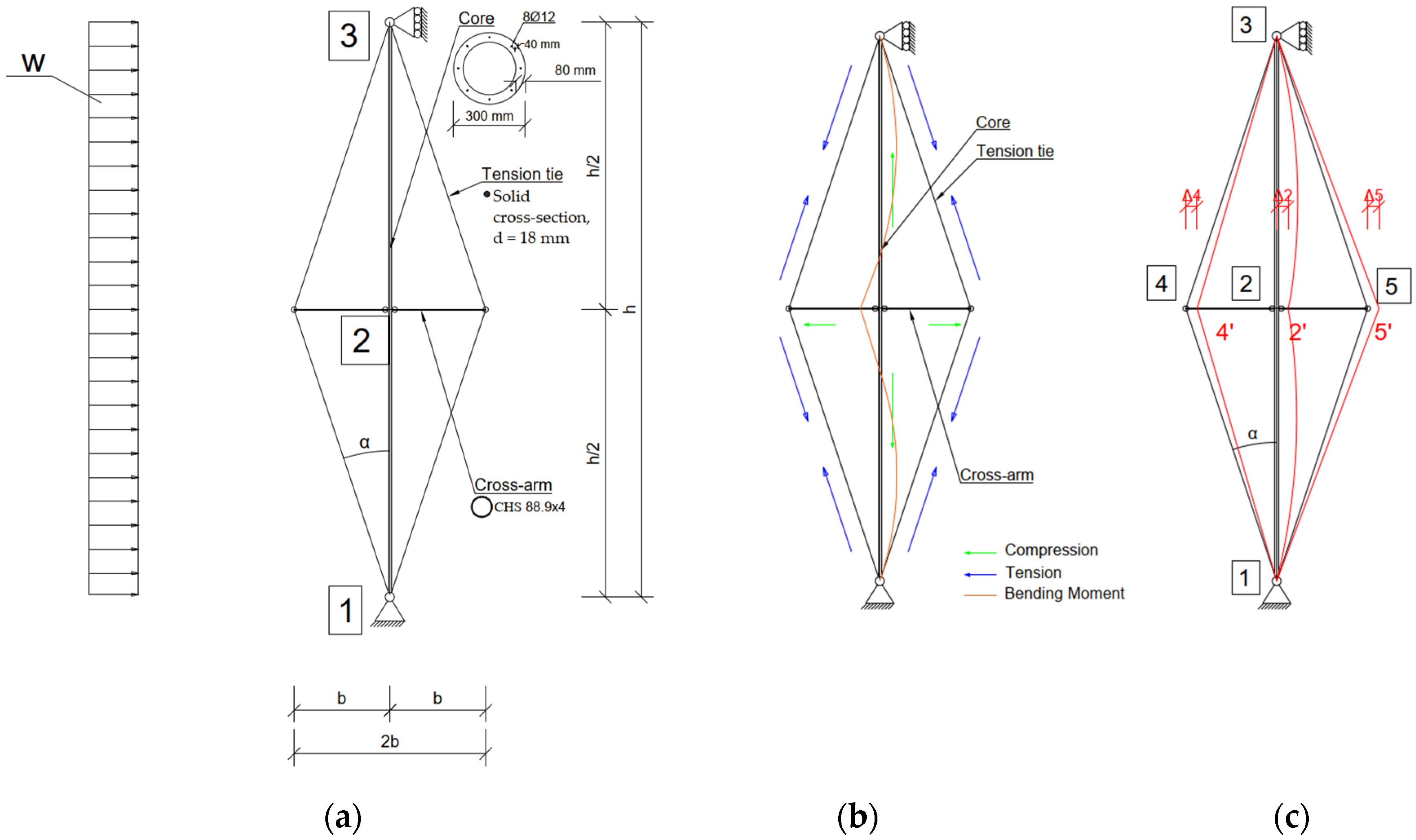
The aim of the preliminary design, taking into account the acting loads, is to calculate the internal forces of the elements of the prestressed stayed beam–column, to determine the displacements of the characteristic joints of the structure, and to select rational parameters for its compositional elements (structural width, axial stiffness of the tension ties, and initial prestressing of the tension ties). For simplicity and clarity, the structure will be analyzed as a geometrically linear and elastic structure. The deformations of the element axes (shortening) and their self-weight will also not be considered. The calculation diagram is presented in
Figure 2. It will be assumed that the wind load
is uniformly distributed along the entire height of the structure.
The following assumptions are applied in the preliminary design methodology:
The structural material is elastic, and all structural elements behave elastically;
Long-term effects of the concrete core are not considered: shrinkage and creep;
Possible deformation (shortening) of the core and the cross-arm is neglected;
Geometric nonlinearity is disregarded when calculating internal forces and displacements in the structure;
The initial prestress level in the tension ties under loading is sufficient, and they remain functional throughout the design service life (they are subjected only to tension);
Prestressing reinforcement in spun concrete elements is not considered;
The wind load is assumed to be uniformly distributed along the entire height of the core;
The wind effect on the tension ties is not considered;
The prestressed stayed column is flexibly (pinned) supported both at the foundation and at the upper support.
3.1. Elastic Behaviour of a Reinforced Concrete Core
The preliminary design methodology we propose is based on the elastic behavior of the material. In reinforced concrete structures, elements subjected to bending deform within the elastic stage when the applied load is not large in value, typically about 15–20% (1) of the total load-bearing capacity of the structure. This corresponds to the stage before the first cracks begin to form in the reinforcement concrete element, and the
value is reached.
The proposed structure is subjected not only to bending moments but also to axial force. Due to its unique structural shape, the core in this structure could be compressed both by the external prestressing of the tension ties and by prestressing reinforcement in the spun concrete core element. This introduces an additional axial force into the core, which increases the value of Mcr, and this postpones the appearance of the first crack and extends the core behaviour within the elastic stage.
Therefore, for the reinforced concrete core to deform only within the elastic stage, it is well-reasoned to apply the required rational axial force
in the core.
When applying core compression exceeding Nrac, which can be achieved either through external prestressing of the tension ties or through the technologically required prestressing of the spun concrete reinforcement, the spun concrete core will not reach the bending moments at which the first cracks would normally form. Therefore, considering this condition, the preliminary design expressions we have provided are regarded as acceptable within the context of the stated analytical assumptions.
3.2. The Influence of Geometric Nonlinearity on the Behaviour of the Structure
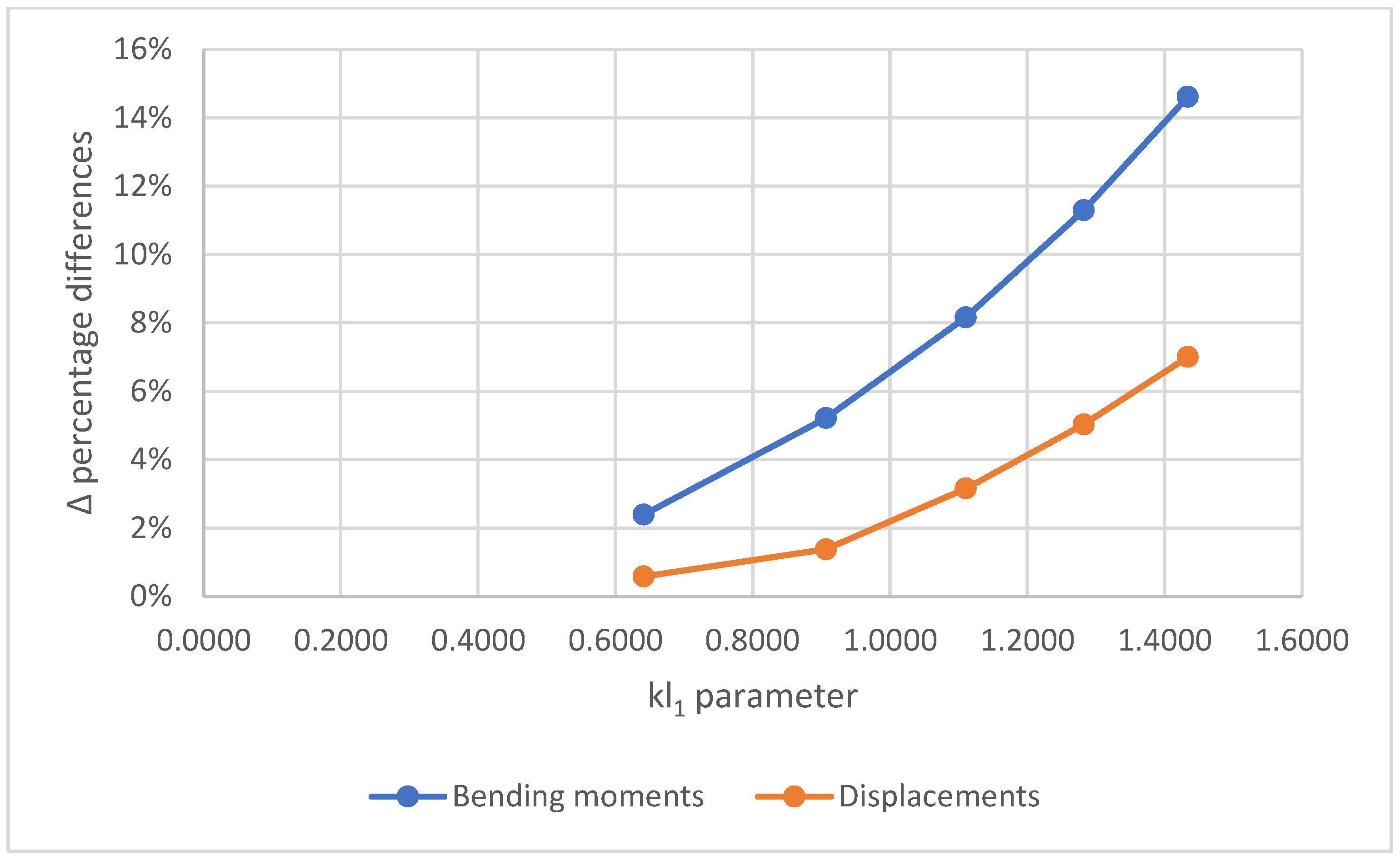
When analysing elements subjected to axial force and transverse load (in this case, the core of prestress stayed column), it is necessary to evaluate their deformed state, i.e., to account for geometric nonlinearity. However, to simplify the preliminary design process, it was decided to present the main expressions used for calculating internal forces and displacements, and simultaneously for determining the rational parameters of the new structure, without second-order analysis. The applicability limits (and resulting inaccuracies) of such linear calculations can be defined using the dimensionless slenderness parameter
. This parameter characterises the axial force in the core, its bending stiffness, and the core length.
here
is the design core length;
is the axial force of the core;
is the bending stiffness of the core.
It is important to note that when determining the (percentage) differences between linear and geometrically nonlinear analyses, the comparison was made between the rational bending moments of the core and its rational displacements obtained from both the linear and nonlinear analyses.
From the provided graph in
Figure 2, it is clearly seen that the differences between the rational bending moment values calculated linearly and geometrically nonlinearly do not exceed 10% when the slenderness parameter does not reach 1.2 (
< 1.2). This allows the preliminary design of the considered structure to be carried out with sufficient accuracy and, at the same time, enables the rational parameters of the prestressed stayed column system to be determined without difficulty.
The graph also shows that even when the slenderness parameter reaches = 1.4, the percentage differences of linear calculation are still acceptable for preliminary design (percentage differences of about 15%).
Naturally, once the preliminary rational parameters of the prestressed stayed column system are selected, it is necessary to proceed to a precise analysis of this structure, but that would be the next detailed stage of the actual design process. It is generally performed in compliance with the country’s national standards.
In the calculations, it is assumed that cross-arms 2–4 and 2–5, subjected to axial forces, do not deform. Therefore, the displacement of joint “2” is equal to the displacement of joint “5” and joint “4”:
The displacement at point “2,” when the core 1–2–3 is subjected to wind load
and the resultant force of cross-arms 2–5 and 2–4, is calculated as follows:
where
is the displacement of joint “2” of the core under wind load
. It is calculated as follows:
here
is the flexural stiffness of the core;
is the length (height) of the core of the prestressed stayed beam–column.
Displacement of joint “2” of the core
under the axial force of cross-arms “2–5” (
) and “2–4”
) is determined according to a known expression:
here
.
Assuming that the displacements of the joints are equal (see condition (1)), the resultant of the cross-arm internal forces is obtained as follows:
From (8), it is evident that the acting resultant depends not only on the wind load , but also on the flexural stiffness of the core and the displacement .
The bending moment in the core at point “2” can be calculated as follows:
here
is the shear force at core node ‘1’
In that case, the bending moment at point “2” will be equal to the following:
The bending moment at the midpoint of the segment “1–2” (x = h/4) will be equal to the following:
Or, after rearrangement, we obtain the following:
The axial force in the tension tie member ‘1–5’ can be calculated from the equilibrium condition at node ‘5’:
Due to the deformation of the tension ties, the displacement at joint “5” will be equal to the following:
The axial force in the core (1–2) is calculated taking into account the internal force acting in the tension ties:
To account for the effect of the core’s self-weight on the axial force at the bottom support, Equation (14) can be rearranged as follows:
where
is the core cross-sectional area;
is the density of the reinforced concrete of the core.
For the windward tension ties to be effective, they must be prestressed. The minimum required value of the prestressing force
in the ties must satisfy the following condition:
here
is the compressive force in the windward tension tie (according to the
Figure 1, nodes 1–4 and 4–3);
(recommended).
3.3. Analysis of the Impact of Cross-Arm Length
One of the main parameters influencing the behavior of the prestressed stayed beam–column is the length of its cross-arm “b” (see
Figure 1). This value also determines the angle α of the intersection between the tension ties and the core. According to design requirements, the maximum possible value of parameter “b” should be adopted immediately:
. Based on the formulas in
Section 3, it can be seen that the cross-arm length “b” affects the internal forces in the tension ties and in the core, as well as the displacement of joint “2.” By increasing the length of parameter “b,” these internal forces and the displacement decrease proportionally. Thus, by changing the value of the cross-arm length, it is possible to control not only the displacement of the core joints but also their bending moment
(see Formula (11)). It is evident that the tension ties act as an elastically flexible support for the core at joint “2.” The greater the value of “b,” the greater the stiffness of the elastically flexible support.
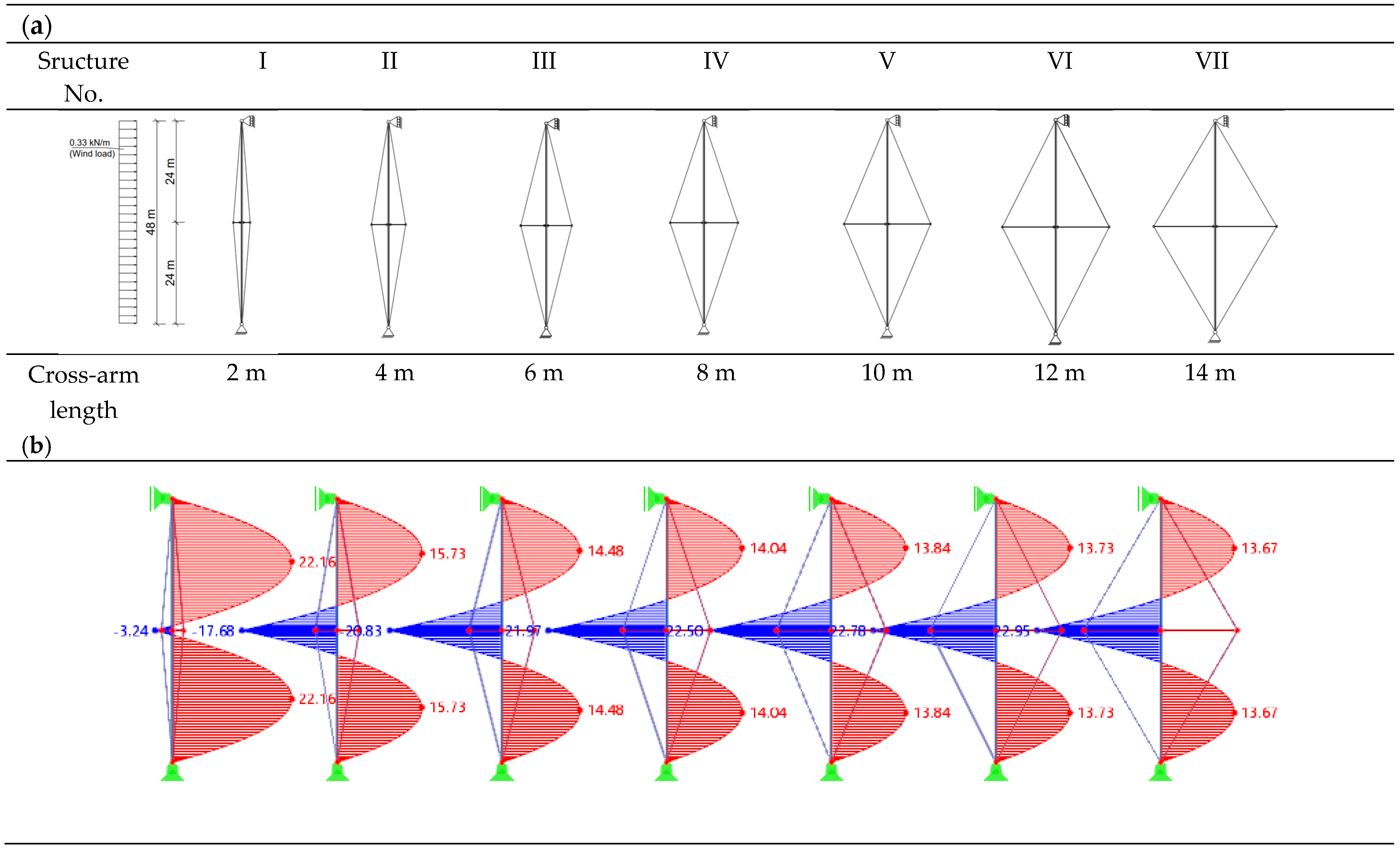
To investigate the impact of cross-arm length on the internal forces of the core, a numerical experiment was carried out using the FEM program (Dlubal RFEM 6). Seven specimens with different cross-arm lengths were modeled. The height of the system under consideration is 48 m. The width “b” varied from 2 to 14 m (see
Figure 2). The characteristics of the cross-sections of the structure are presented in
Table 1. The core was loaded with a uniformly distributed wind load of 0.33 kN/m, constant along the entire height of the core (see
Figure 3).
The obtained distribution of bending moments in the core, depending on the value of parameter “b,” is presented in
Figure 3. From the given diagrams, it can be seen that, with the minimum cross-arm length (b = h/24 = 2 m), the largest moments occur in the spans of the core (+22.15 kNm), while when the cross-arm length reaches its maximum value (b = h/3.43 = 14 m), the largest moment occurs at the cross-arm (−22.95 kNm). The presented diagrams of the core’s bending moments allow us to reasonably state that, at a certain rational cross-arm length, a rational distribution of moments in the core can be achieved. The graphs in
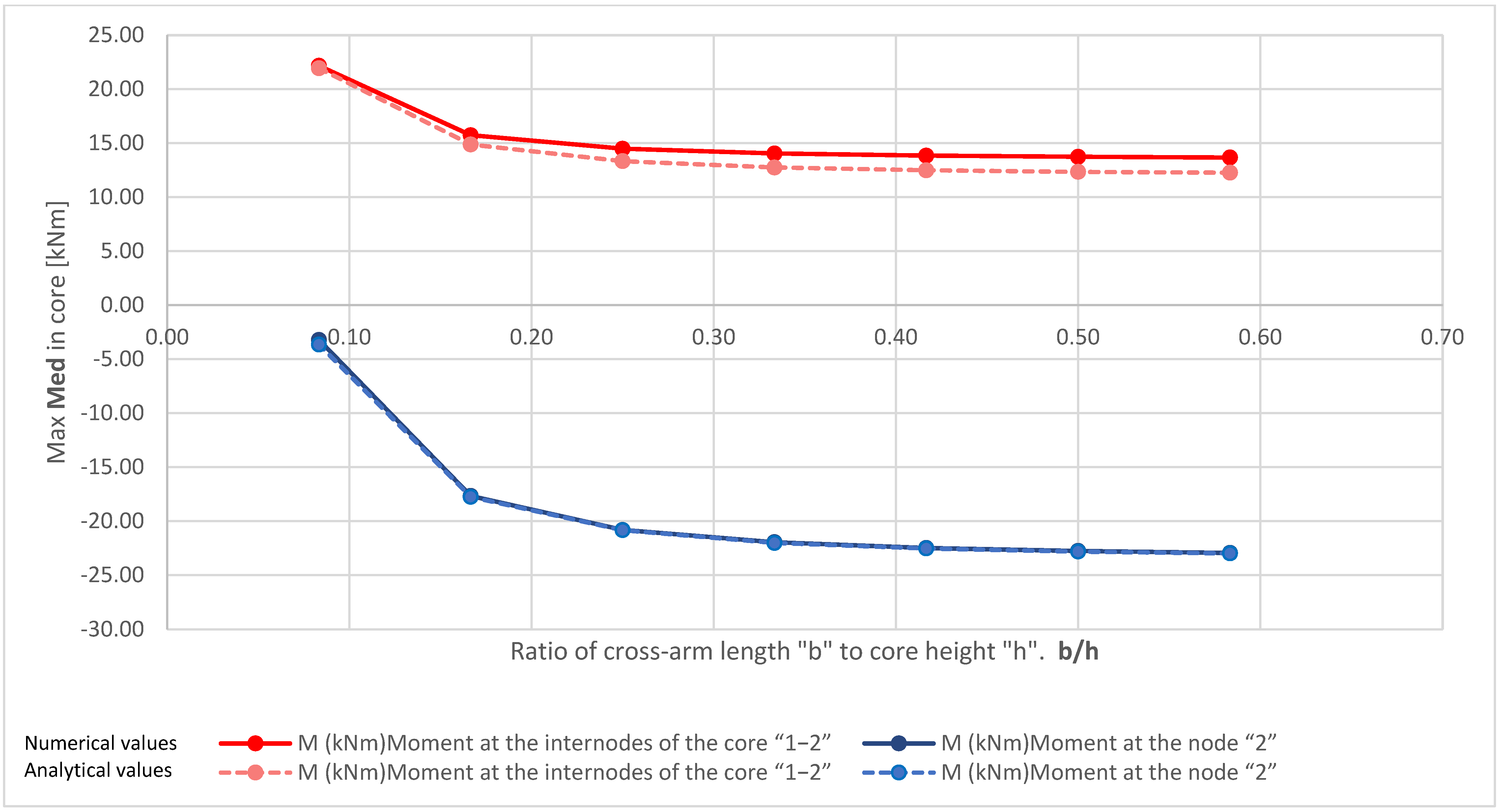
Figure 4 show the results of both analytical and FEM calculations. It should be noted that the differences between these calculations do not exceed 4%, which confirms the sufficient accuracy of the presented analytical calculation. This minor discrepancy resulted from the analytical assumptions adopted in the calculation and from the approximate evaluation of displacements. Increasing the cross-arm length makes it possible to reduce not only the acting bending moments in the reinforced concrete core but also the cross-section of the core itself. From both aesthetic and structural points of view, the cross-arm length should be limited to
.
3.4. Influence of Initial Prestressing on the Behavior of the Stayed Beam–Column
The behavior of the prestressed stayed beam–column is significantly influenced by the initial prestressing of the tension ties. The prestressing force is selected such that no compressive stresses develop in the windward tension ties. This implies that, in such a preliminary calculation, neither the potential reduction of the initial prestress in the tension ties nor their possible complete relaxation is taken into account. This enables the ties to resist wind loads without buckling and increases the overall stiffness of the prestressed stayed beam–column; in other words, it enhances the stiffness of the stay as an elastically flexible support. Put differently, the initial prestressing of the tension ties allows for the regulation of the stiffness of the elastically flexible supports. This, in turn, enables the adjustment of the bending moments acting in the core so that the absolute values of the moments in critical sections become equal.
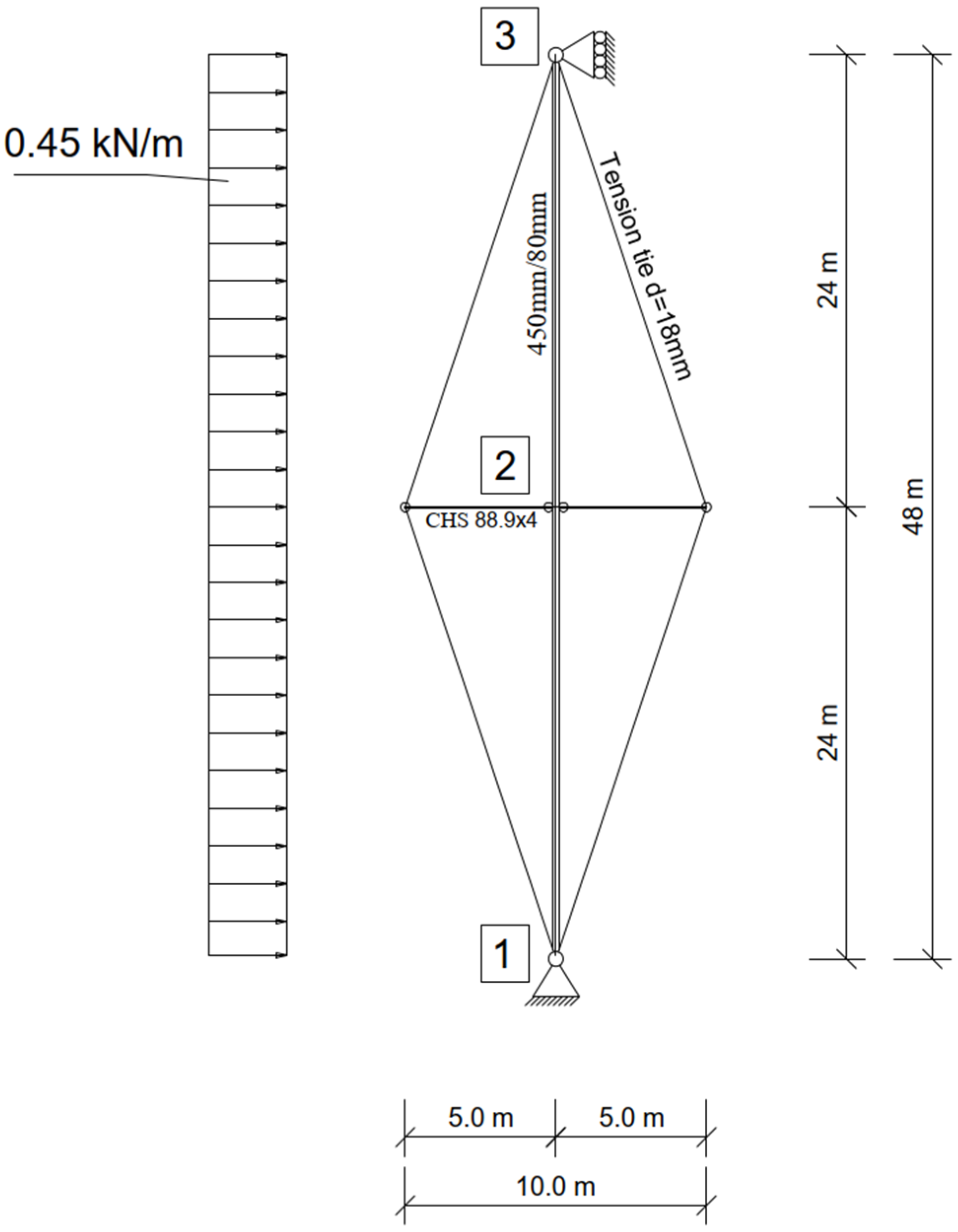
To investigate the impact of initial prestressing on the behavior of the new prestressed stayed beam–column, a numerical experiment was conducted. In this experiment, the initial prestressing force in the tension ties varied from 0 to 20 kN. The structural scheme of the prestressed stayed beam–column is shown in
Figure 5. The cross-sections and materials of the system elements are analogous to those used in the numerical experiment in
Section 3.1 (see
Figure 3), with the only differences being the outer diameter of the core (d = 410 mm) and the magnitude of the wind load (w = 0.45 kN/m). Cross-arm length was assumed to be constant and equal to 5 m.
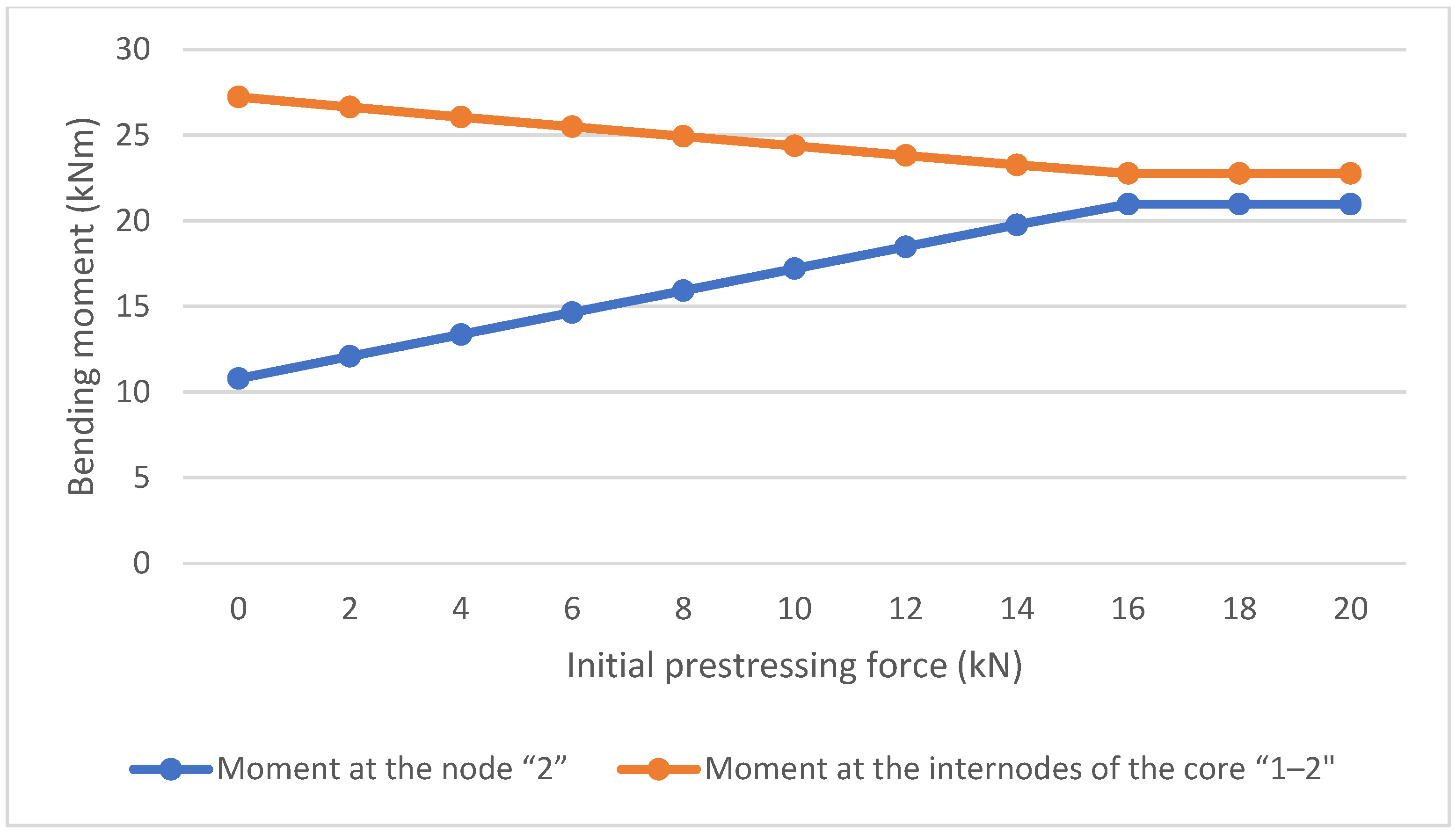
The calculation results demonstrating the influence of initial prestressing on the bending moments in the core are presented in
Figure 6. Two core bending moments of the largest magnitude are examined here: the moment at the cross-arm–core connection (node ‘2’) and the moment in the core segment between nodes ‘1–2’. The distribution pattern of these moments is analogous to that shown in
Figure 3. The first moment (blue) attains negative values, whereas the second moment (orange) is positive. However, for clarity in assessing their variation, these moments are presented in
Figure 6 in absolute values. From the graph, it is evident that at low initial prestressing forces (
kN), the moment in the internodes of the core “1–2” is greater in absolute value than the moment at the cross-arm (node “2”), with a difference of approximately 22–17%. As
increases from 8 to 14 kN, the bending moment at the cross-arm (node “2”) gradually decreases, while the moment in the internodes of the core “1–2” decreases accordingly. When
kN, the absolute values of these bending moments become similar (closely matching values), with a difference of only about 9%. The graph also shows that once the initial prestressing force exceeds
kN, its impact on the distribution of moments in the core becomes negligible, meaning that further increasing the prestressing force becomes irrational.
It should be noted that the effect of initial prestressing on the bending moments in the core is analogous to increasing the cross-arm length (see
Figure 3). By selecting an appropriate value of initial prestressing, the difference between the max bending moments at the cross-arm (node “2”) and in the internodes of the core “1–2” can be reduced by about 30%. Thus, by properly coordinating the values of initial prestress in the tension ties, it is possible to achieve the minimum (rational) bending-moment values, and consequently, the minimum stresses in the core can be achieved. This enables the materials of the entire prestressed stayed beam–column structure to be utilized rationally.
3.5. Influence of Core and Tension Ties Stiffness on the Behavior of the Prestressed Stayed Beam–Column System
The studied prestressed stayed beam–column structure consists of the core, cross-arms, and tension ties. Their stiffnesses (
,
) primarily affect the stresses (bending moments) and displacements of the main element: the core. Considering the bending stiffness of the core (
) and the selected cross-arm lengths “b”, the axial stiffness of the tension ties (
) determines the displacement of node “2” in the core. As mentioned earlier, the tension ties act as elastically flexible supports at node “2”. The smaller the cross-sectional area
of the ties, the greater their elastic deformations will be, and consequently, the larger the displacement of node “2” (see Formulas (12) and (13)). However, as shown in
Section 3.4, under external wind load, the windward ties may be subjected to compression. To ensure their effectiveness (i.e., to prevent buckling), only the tension case of the ties will be considered (see
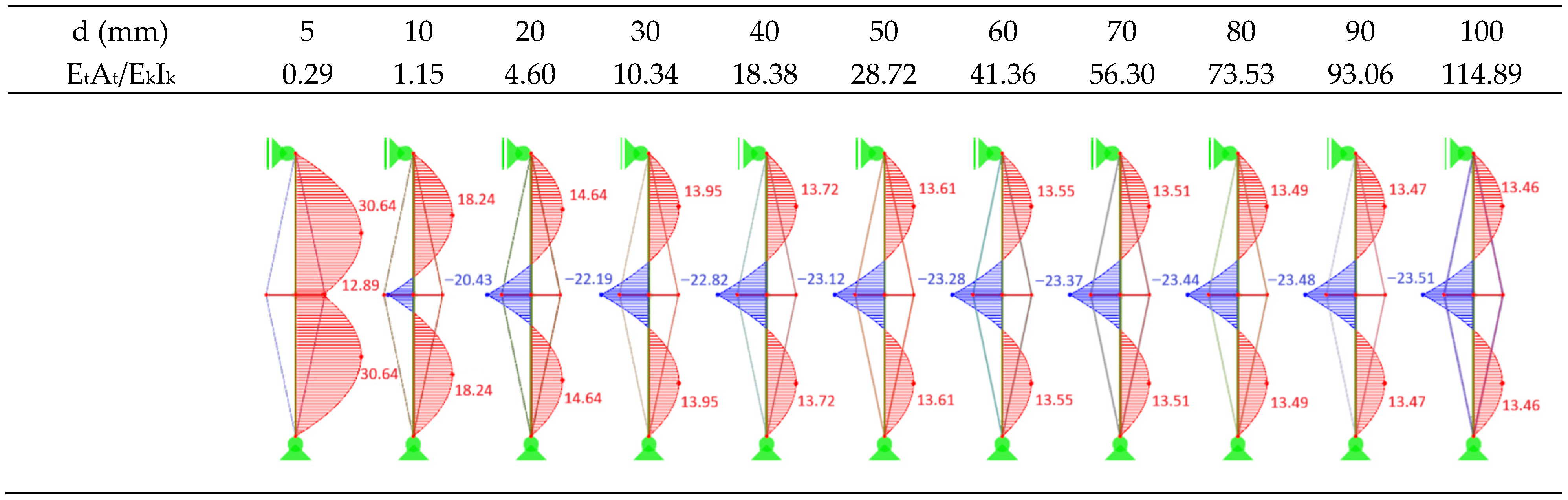
Section 3.4). Tension ties are usually made of high-strength steel. Nevertheless, when their cross-sectional area is relatively small, the displacements of the core (node “2” displacements) may reach values such that the bending moments in its spans (see
Figure 7) become relatively large.
To determine the impact of the axial stiffness of the tension ties (
) on the stresses and displacements of the core, a numerical experiment was carried out. The studied prestressed stayed beam–column structure and its dimensions are shown in
Figure 4, with the only difference being that the cross-arm length here equals 6 m. The parameters of the cross-sections are presented in
Figure 7. The diameter of the tension ties was varied from 5 mm to 100 mm.
From the calculation results presented in
Figure 7, it can be seen that as the ratio of the axial stiffness of the tension tie to the bending stiffness of the core (
) increases, the bending moment at node “2” (the cross-arm connection node) increases, while correspondingly the bending moments in the spans of the core decrease.
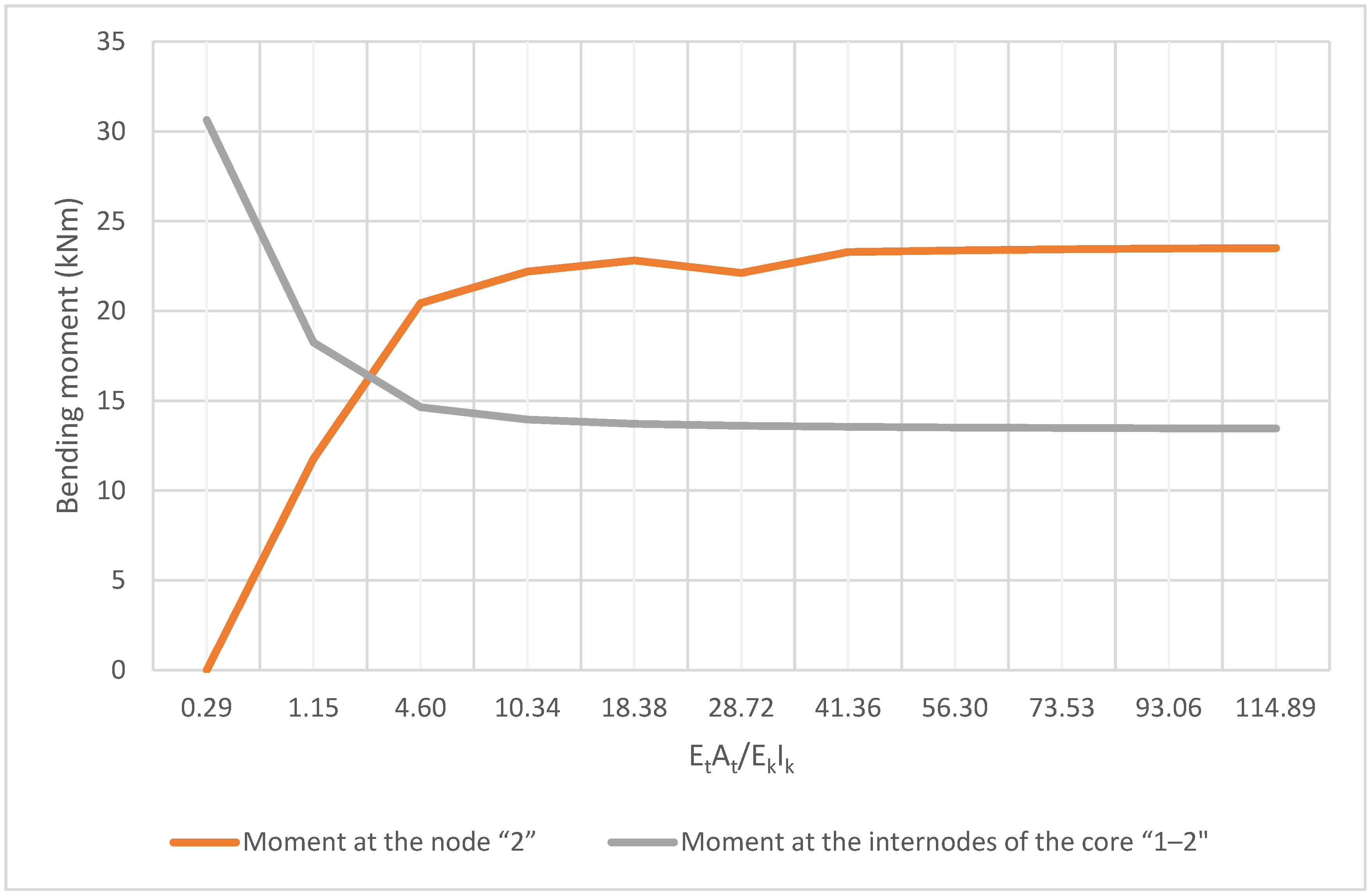
Figure 8 presents the graphs of the variation of bending moments in the core. These graphs clearly show that, for certain values of the stiffness ratio between the tension tie and the core (
), the bending moments at the cross-arm node and in the core span approach each other in absolute magnitude, and when
, they may become equal. With a further increase in the ratio of
, the moment at node “2” changes very little and always exceeds the span moment by about 70% in absolute value. It is evident that only at minimal bending moment values can a rational cross-section of the core be designed.
4. Rational Composite Parameters and Bending Moments
As mentioned in
Section 4, when designing prestressed stayed beam–columns, it is important to preliminarily select rational parameters to obtain, under certain applied loads, a rational distribution of bending moments in the core, and only then to specify a rational cross-section of the core. In other words, unlike conventional engineering practice, this methodology makes it possible, already at the initial (conceptual) stage and given the input data, to compute rational bending-moment values even before the core cross-section has been selected. Only thereafter can the rational displacement of the core be calculated and the rational cross-section of the tension ties and their rational prestressing force be designed. The calculation of rational parameters is performed using the same assumptions as in
Section 3.
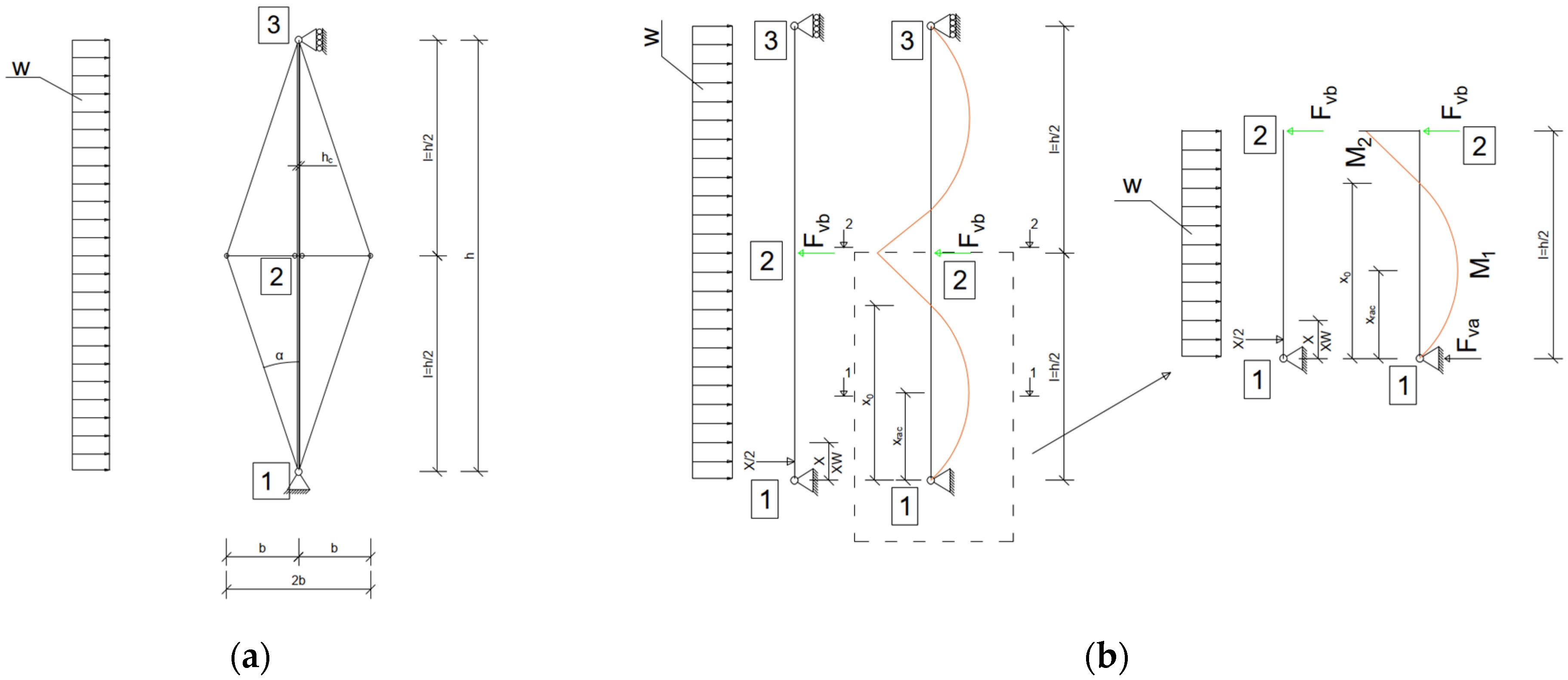
The calculation scheme of the prestressed stayed beam–column is presented in
Figure 9a. Due to the symmetry of this structure and the uniform action of loads, only half of the column is analyzed (see
Figure 9b).
When calculating the rational distribution of bending moments in the spun core, we preliminarily assume that it is designed from an elastic material, with a constant cross-section height along its entire length, i.e.,
The other assumptions adopted are the same as those applied in
Section 3.1. Furthermore, the absolute values of the bending moments at the characteristic sections (points) of the core are considered equal:
here
is the bending moment of the core at a section “1-1”;
is the bending moment of the core at a section “2-2” (see
Figure 9b).
The equation of the bending moment distribution in the span “1–2” can be written as follows:
here
is the support reaction at point “1” (see
Figure 9b);
is the acting wind load.
The support reactions at nodes “1” and “2” are calculated as follows:
where
(
Figure 9).
Then Equation (18) can be rewritten as follows:
From Equation (21), it is evident that
According to expression (22), we can calculate the bending moment at section “2–2,” i.e., at point “2.” The problem is to determine the value of the maximum moment between points “1” and “3.” For this purpose, it is necessary to calculate the distance
to the maximum moment
. Since the bending moment curve is a quadratic parabola, we can reasonably state that
(see
Figure 9b). The distance
will be calculated from Equation (22), assuming that
:
Then, taking into account (23), we obtain the following:
Knowing the position
of the maximum and rational moment
, by employing Equations (17), (18), and (22), we can obtain the formula for calculating the value of the rational support reaction
:
or, after rearrangement, we obtain the following well-known solution [
38]:
It should be noted that the rational support reaction for the entire core (see
Figure 8) will be equal to
When the rational support reaction at the elastically movable pinned support “2” (cross-arms fastening node) is known, the values of the rational bending moments at sections “1–1” and “2–2” can be calculated from Equation (18):
It is important to note that Formula (26), in the case of a single intermediate support (with one cross-arm), gives identical values of the rational moment [
39].
Speaking about the rational regulation of moments in the prestressed stayed beam–column system (see
Figure 9), it should be noted that when the bending stiffness of the core
is known, it is also necessary to determine the rational displacement of the elastic pinned support (node “2”),
. This value is calculated from the displacements caused by the external load
and the rational support reaction at the cross-arm
:
By substituting into Formula (27) the expression of the rational support reaction
from (25), we obtain the following:
Or, after rearrangement, the formula of the rational displacement (28) takes the following form:
We know that is the criterion for determining the required cross-sectional area of the tension ties in the prestressed stayed beam–column system and their necessary prestressing.
Assuming that the tension ties are not prestressed, and the value of the rational displacement
is known, by employing Formula (13) from
Section 3, we obtain the required cross-sectional area of the tension ties:
where
is calculated according to Formula (13) from
Section 3, substituting the rational value of the support reaction
in place of
.
If all tension ties are prestressed, the tension tie cross-sectional area is calculated as follows:
where
is the axial force in the tension tie, considering the applied prestressing.
Therefore, given the known load and the selected geometric parameters of the prestressed stayed structure (structure height, location, and length of the cross-arm), the designer can always preliminarily calculate the rational bending moments of the core. Based on the acting internal forces , a preliminary core cross-section is selected. Then it remains only to select the tension tie cross-section that ensures the aforementioned rational distribution of moments. All this the designer performs “manually” without even using the FEM software package. The sequence of preliminary design is presented below:
The initial conditions are determined (or should be known): geometry, loads, materials (h, α, w, Et, Eb, etc.);
The rational bending moment of the core is calculated directly using Equation (26);
The rational support reactions are calculated according to expressions (20) or (25);
The axial force in the tension tie is calculated using expression (13);
The prestressing level of the tension tie is selected according to condition (16);
The axial force in the core is determined using Equation (15);
Considering the acting internal forces (Mrac and N1-2), the core cross-section is selected (designed) according to EC2 requirements, and Eb Ab and Eb Ib are obtained.
The rational displacement of the joint is calculated according to expression (28);
The required cross-sectional area of the tendons is calculated using Equation (30);
The ultimate limit state conditions (load-bearing capacities) of the core, the cross-arm, and the tension tie are verified in accordance with EC2 and EC3 requirements.
At the end of the preliminary design, the FEM package can be used to verify the obtained calculation results and finally check the load-bearing capacity of all elements of the prestressed stayed structure. In other words, in the later stages of design, once the initial structural geometry and the preliminary cross-sections of its elements are known, it becomes possible to carry out detailed design calculations in accordance with the applicable EC2 and EC3 standards.
In this work, material and geometric nonlinearities were not examined, although they have a significant influence on the overall structural behavior. Therefore, in future works, it is important to recognize and understand the effect of nonlinearity on the performance of the prestressed stayed structure. It should be borne in mind that the main element of the prestressed stayed structure is the core, formed from a spun reinforced concrete element, whose deformability changes non-uniformly as the load increases and cracks appear.