


Abstract
The rapid expansion of China’s immersed tunnel construction has resulted in substantial consumption of reinforced concrete and construction energy, thereby generating considerable greenhouse gas (GHG) emissions during the construction stage. Unlike conventional tunnels, immersed tunnels require large cross-sectional dimensions, complicated geological conditions (e.g., varying seabed burial depth and settlement grade requirements), and unique structural parameters, leading to distinct emission characteristics that are currently insufficiently understood. To address this gap, this study aims to quantify construction-stage GHG emissions of immersed-tube segments, identify key influencing factors linking construction parameters and material input with GHG emissions, and develop simplified predictive models for design-stage estimation. A total of 51 immersed-tube segments from three representative cross-sea tunnel projects in China were examined. Under a unified system boundary and functional unit (covering material production and processing, material transportation, and on-site construction energy consumption), the life-cycle assessment (LCA) framework was applied to quantify the construction-stage emissions of each immersed-tube segment. The construction-stage GHG emissions of a single segment range from 1.56 × 10⁴ to 2.71 × 10⁴ t CO2 eq (mean ≈ 2.40 × 10⁴ t CO2 eq). Correlation and partial correlation analyses demonstrated that the total mass of construction materials exhibits the strongest correlation with GHG emissions, followed by the element volume, concrete cross-sectional area, settlement grade, and burial depth. The results further indicate that material intensity is the dominant determinant of GHG emissions for immersed tubes, while the effects of seabed and settlement conditions mainly operate through structural scale and material demand. Finally, two linear regression models were developed, and the model based on total material mass provides the most accurate prediction of construction-stage emissions. The immersed-tube volume can be used to estimate approximate GHG emissions at the design stage, whereas the total material mass serves as a better predictor when detailed material input data are available. This study is based on segment-level data from three Chinese projects and focuses on the construction stage; therefore, transferability requires further validation. Material intensity is the dominant determinant, and the total-material-mass model is the most accurate predictor.
1. Introduction
The intensifying challenge of global climate change indicates the urgent need for carbon emission mitigation across all industrial sectors. According to the Global Carbon Budget [1], fossil fuel-related emissions reached a record 37 billion tons in 2018. Rapid industrialization and the surging global energy demand have partially impacted decarbonization efforts, with China remaining the world’s largest emitter due to its high reliance on coal and growing demand for electricity, steel, and building materials [2,3]. In response, China announced its “dual-carbon” commitment in 2020—aiming to peak CO2 emissions by 2030 and achieve carbon neutrality by 2060—establishing a clear timetable for national energy transition and emission reduction [4,5,6]. Globally, the momentum toward carbon neutrality has accelerated. By 2022, 136 countries had pledged net-zero targets, collectively accounting for 88% of global carbon emissions, 90% of GDP, and 85% of the world’s population [7]. Based on these international trends, organizations such as the World Green Building Council have set goals for net-zero carbon buildings by 2050 [8], and major economies have released stringent decarbonization policies, from the United States’ net-zero public building initiative [9] to Japan’s near-zero energy strategies and the United Kingdom’s transition to renewable-dominated electricity generation [10]. Within this global and national context, the construction industry, one of the three largest contributors to global energy consumption and carbon emissions, has become a critical focus for emission prediction and reduction.
China’s continuous investment in large-scale marine and cross-sea infrastructure has driven the rapid development of immersed tunnel construction, a technologically intensive and resource-consuming sector. In recent years, a series of world-class immersed tunnel projects have been completed or are under construction, including the Hong Kong–Zhuhai–Macao Bridge [11], the Shenzhen–Zhongshan Link [12], Shunde Tunnel, Dalian Bay Undersea Tunnel [13], etc. Immersed tunnel projects are mega projects that contribute to substantial GHG emissions that should be monitored and analyzed. Under China’s “dual-carbon” targets, there is a growing need to quantify and compare construction-stage emissions at the early design stage, because key design/site decisions (e.g., cross-sectional dimensions, burial depth, and settlement-control criteria) largely determine the demand for reinforced concrete, marine transportation intensity, and foundation-treatment requirements. Therefore, identifying dominant influencing factors and establishing practical predictive methods are essential for carbon-aware scheme comparison and decision-making in China’s rapidly expanding cross-sea immersed tunnel program. However, the greenhouse effect of the Chinese immersed tunnel industry remains unclear. Compared with drill-and-blast or shield tunnels, immersed tunnels follow a distinct “prefabrication–marine transport–immersion–jointing” process chain and are strongly constrained by seabed conditions and settlement-control requirements, which can markedly alter material demand and offshore construction activities. Hence, this study selects immersed tunnel construction as the study subject to develop a segment-level, design-oriented emission quantification and prediction approach for early scheme comparison under China’s rapidly expanding cross-sea program.
Life-cycle assessment (LCA) is a powerful analytical tool for quantifying energy and material inputs, together with waste and emission outputs, across the life cycle of products and construction [14,15,16]. In recent years, LCA studies predominantly concentrated on residential buildings [17,18,19,20], and very limited research has been undertaken in tunnel construction. Miliutenko et al. [21] reported that tunnels exhibited the highest energy and material intensities among all types of transport infrastructure. Huang et al. [22] conducted an LCA of a standard Norwegian road tunnel and showed that greenhouse gas emissions from the construction phase exceeded those during the operation phase. The LCA of a high-speed railway tunnel by Damián and Zamorano [23] showed that support, lining, and infrastructure works were responsible for over 70% of the environmental impacts across all categories, with concrete, diesel, and steel contributing 89.3–99.9% of the total burden. Similarly, Rodríguez and Pérez [24] used a simplified calculation model, validated by data from an actual tunnel, and subsequently applied it to multiple tunnel cases to assess CO2 emissions and identify key influencing factors, revealing that concrete production for tunnel support and lining dominates the emissions profile, accounting, on average, for approximately 80% of the total CO2 output. In addition, several studies have shown that ventilation and lighting systems in highway tunnels during the operational phase account for a substantial share of life-cycle GHG emissions [25,26,27].
Overall, existing tunnel-related LCA studies consistently show that material production—particularly concrete and steel—dominates life-cycle impacts, while operational systems (e.g., ventilation and lighting) can be important for extra-long tunnels. However, most evidence is derived from conventional tunnel types, and differences in system boundaries, inventory granularity, and project contexts limit cross-study comparability. Moreover, prediction efforts reported in the literature often rely on detailed bills of quantities or construction records, which are not always available at the early design stage and may not transfer well to immersed tunnels with distinct prefabrication, marine transport, and immersion installation processes. Therefore, a segment-level dataset and a unified accounting boundary are needed to (i) clarify the main drivers of construction-stage emissions in immersed tunnels and (ii) develop simple, design-oriented predictive models with readily obtainable inputs [28,29,30].
Beyond LCA-based accounting, several prediction-oriented approaches have been applied to tunnel construction emissions. These include simplified calculation tools based on emission factors and activity data, parametric/statistical models that relate emissions to key quantities (e.g., material inputs and geometric parameters), and data-driven methods such as neural network models. However, many existing models require detailed bill-of-quantities, equipment shift records, or consistent project-specific inventories, which are often unavailable at the early design stage and reduce model transferability across projects and tunnel types. Moreover, prediction studies have mainly focused on conventional highway or shield tunnels, while the unique structural scale and underwater construction features of immersed tunnels make direct application uncertain. These gaps motivate the development of a segment-level, design-oriented prediction method under a unified boundary.
Reviews on LCA for linear transport infrastructure (e.g., roads, railways, bridges, and tunnels) repeatedly show that reported emission levels are highly sensitive to methodological settings, especially the definition of system boundaries and functional units, and how maintenance and end-of-life are treated. They also point out the trade-off between process-based LCA (transparent and design-inventory-driven, but potentially truncated) and input–output or hybrid approaches (broader coverage, but often coarser resolution and more demanding data requirements for project-level applications). In this context, it is necessary to explicitly position the method adopted in this study and clarify why a construction-stage, segment-level accounting approach is appropriate for immersed-tube tunnel projects.
Recent studies have demonstrated that material production accounts for a large portion of life-cycle GHG emissions in tunnel construction, and concrete typically represents the dominant contributor among all construction materials [24]. In immersed tunnel projects, the concrete shell of each immersed-tube element constitutes the primary structural system, indicating that construction emissions are highly sensitive to concrete volume. Previous research on GHG emission assessment has primarily concentrated on conventional tunnels. In contrast, studies on immersed tunnel construction remain limited, largely due to the extensive system boundaries involved and the challenges associated with comprehensive life-cycle inventory data collection. In addition, emission drivers and predictive variables developed for drill-and-blast or shield tunnels may not be directly transferable to immersed tunnels, which feature a distinct “prefabrication–marine transport–immersion–jointing” process chain and strong constraints from seabed/settlement conditions. This gap motivates a China-based investigation of the key factors and simplified prediction approaches for immersed tunnel segments. Accordingly, the aim of this study is to quantify construction-stage GHG emissions of immersed-tube segments, identify the key factors driving emission variability, and develop efficient design-stage predictive models for practical early decision-making. Therefore, using the same construction-stage system boundary and the same functional unit (one immersed-tube segment; see Section 2.3), this study focuses on the following two questions for immersed tunnel construction:
- (1)
- To what extent do some key factors (such as structural conditions, construction conditions, and concrete materials) determine GHG emissions of immersed tunnel segments?
- (2)
- How can construction-stage GHG emissions of immersed tunnel segments be efficiently predicted during the design phase of cross-sea immersed tunnel projects in China?
The contributions of this study lie in three parts. First, it establishes—based on actual immersed-tube segment data—the emission characteristics of immersed tunnel construction under different geometric configurations and seabed conditions, providing reference ranges for future cross-sea immersed tunnel projects. Second, it reveals the dominant role of reinforced concrete in determining construction-stage emissions of immersed tunnel segments, thereby identifying material-related reduction potentials that are often ignored in underwater infrastructures. Third, this study proposes a simplified prediction approach based on segment-scale indicators such as total concrete material mass and immersed-tube volume, enabling engineers and planners to rapidly estimate construction-stage emissions at the preliminary design stage without complicated LCA.
Nevertheless, three gaps remain in the existing studies/literature on immersed-tube tunnels: (1) construction-stage GHG inventories for immersed-tube tunnels are rarely reported at the segment level under a transparent and consistent system boundary; (2) the relative importance of design-, material-, and geotechnical-related factors has not been quantitatively clarified; and (3) design-stage predictive tools with readily obtainable inputs are still limited for immersed-tube segments. Therefore, this study aims to (i) establish a construction-stage LCA framework at the segment level, (ii) quantify segment-level GHG emissions and their sub-stage contributions, (iii) identify the key influencing factors using correlation/partial correlation analyses, and (iv) develop regression-based models for design-stage emission estimation and scheme comparison.
These issues are directly relevant to current practice because project teams often need comparable carbon information at the preliminary design stage for option screening and reporting, while a full, detailed LCA is time-consuming and data-intensive. Therefore, the segment-level emission ranges and simplified prediction models provided in this study can be used for rapid carbon-aware scheme comparison and early identification of material-related reduction priorities.
2. Methods
The research method used in this study comprises three steps [1]: (1) proposing and defining the potential factors influencing GHG emissions from immersed tunnels; (2) developing a calculation method for GHG emissions from immersed tunnel construction based on a synthesis of existing approaches for other tunnel types; and (3) applying statistical data-analysis methods to identify the main influencing factors and establish a prediction model [31].
2.1. Selection and Definition of Candidate Influencing Factors
As the first step of the method, this subsection defines the candidate influencing factors to be examined in the subsequent correlation/regression analyses and design-stage prediction modeling. The immersed-tube tunnel is an underwater infrastructure system that integrates onshore facilities, marine transportation, and submerged installation, enabling efficient construction of cross-water transport corridors through industrialized prefabrication and precise underwater assembly. Structurally, an immersed-tube tunnel typically consists of a segmented box-type structure, flexible joints, and an elastic foundation. Previous research has shown that settlement grading for immersed-tube tunnels can convert joint deformation and water-tightness safety risks induced by differential settlement into measurable, early-warning thresholds and hierarchical action criteria [32]. Case studies on the immersed tunnel of the Hong Kong–Zhuhai–Macao Bridge further indicate that the maximum longitudinal gradient is a key control index that should be specified in the early design stage of underwater highway tunnels, as it directly influences tunnel scale, compatibility with traffic composition, in-tunnel air quality, and the rational design of longitudinal gradient combinations [33]. These findings suggest that design control indices for immersed-tube tunnels warrant careful consideration in both design and assessment. In practice, such indices and geometric parameters are expected to affect construction-stage GHG emissions, mainly by shaping segment-level/material demand and the intensity of associated marine and geotechnical construction activities.
In this study, the elevation of the tube bottom, cross-sectional area, longitudinal slope, segment volume, settlement grade, and seabed burial depth are selected as potential factors affecting GHG emissions during immersed tunnel construction. These indicators can be readily obtained from surveys and design documents and are closely related to the construction process. It should be noted that the values of the above factors were compiled at the segment level based on project survey/design documents and drawing/BOQ-based material quantity records, while the literature review was used only to identify and justify the candidate factors. Previous studies have confirmed a significant positive correlation between the carbon emissions of tunnel projects and the total mass of construction materials during the material production and on-site construction stages of their life cycle [31,34,35]. Therefore, the total mass of construction materials is included as a key material-input indicator, and its driving effect on construction-stage GHG emissions is quantified together with the above design/site parameters. The definitions and types of the potential influencing factors are summarized in Table 1.
Table 1.
Definitions of potential influencing factors.
This section describes the case-project selection and the construction of the segment-level dataset used in this study. Three representative immersed-tube tunnel projects were selected based on data availability and typicality of structural and geotechnical conditions. For each project, the continuous immersed-tube alignment was decomposed into independent segments (n = 51), each corresponding to a consistent set of design parameters and geological/working-condition attributes, which serve as the input inventory for the construction-stage LCA (Section 2.3) and the subsequent statistical analysis and prediction modeling (Section 2.4). The geological and construction parameters of each segment are summarized in Table S1 in the Supplementary Materials.
2.2. Case Projects and Segment-Level Data Preparation
On the basis of the above potential influencing factors, three typical immersed tunnels are selected as sample projects: the Hong Kong–Zhuhai–Macao Bridge, the Dalian Bay Undersea Tunnel and the Shunde-Jinsha Tunnel are typical examples of technological breakthroughs and low-carbon practices of immersed tunnels in China [32]. The basic parameters of the three selected immersed tunnel projects are summarized in Table 2.
Table 2.
Basic parameters of three immersed tunnels.
In the study of immersed tunnel engineering, this study takes the differentiated segment structure of three representative projects as the basic unit and decomposes the continuous lining section of a single tunnel into several independent segments, and each section corresponds to a set of matching schemes of geological section and lining design parameters. These segment-level datasets provide the basis for compiling the life-cycle inventory and performing correlation/regression analyses in the following sections.
2.3. Calculation Method of GHG Emissions During Tunnel Construction
GHG emissions were quantified using the emission factor method recommended by the IPCC, in the form of “activity data × emission factors”. In the material production and processing sub-stage, the energy consumption of building materials and related production processes was multiplied by the corresponding emission factors, and the recycling substitution effect was deducted, assuming a 90% steel recovery rate. In the material transportation sub-stage, emissions were calculated according to “transported mass × distance × emission factor of the transport mode”, while considering the material loss rate and the vehicle empty-driving coefficient (β = 1.67); emissions from round-trip transportation were included. In the construction implementation sub-stage, fuel and electricity consumption were converted based on the working time or number of shifts in machinery and equipment, and then multiplied by the corresponding energy emission factors to obtain emissions. In this study, emission factors for cement, steel, aggregates and other construction materials were mainly taken from the current national GHG emission factor database and related literature on low-carbon materials in China, while the emission factors for electricity and diesel were adopted from the IPCC Guidelines and national energy statistics. Finally, the construction-stage GHG emissions within the defined system boundary were obtained by summing the results of the above sub-stages.
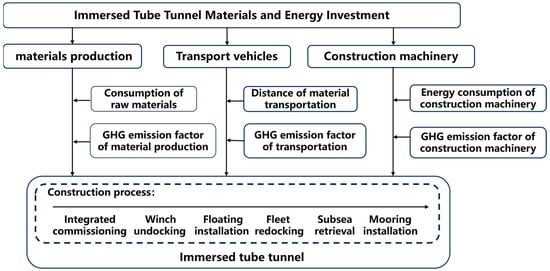
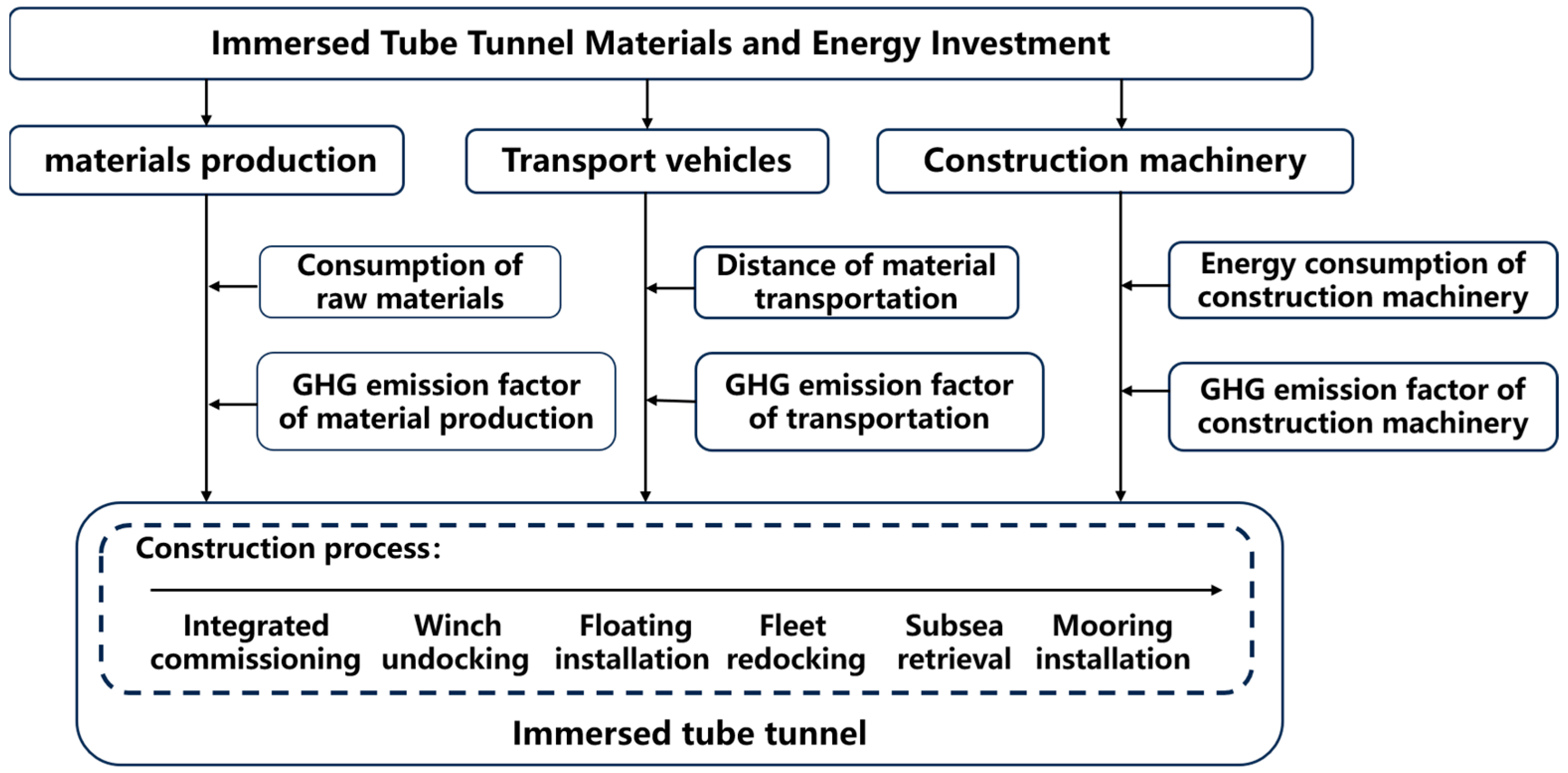
Based on the immersed-tube construction process and the “precast–transport–floating/sinking–jointing” process chain of immersed-tube tunnels, we establish a construction-stage LCA framework. The functional unit (FU) is defined as the construction activities required to deliver one immersed-tube segment (section/element) in the three representative projects. To ensure comparability among segments and projects, we adopt a unified system boundary, meaning that the same construction-stage boundary is applied to all cases. Specifically, the boundary includes (i) material production and processing, (ii) material transportation, and (iii) on-site construction implementation and energy consumption, as illustrated in Figure 1. Emissions from operation, maintenance, and end-of-life stages are outside the scope of this paper [31,34]. Under the framework of LCA, the emission of a single pipe section during construction is divided into three parts: material production and processing, material transportation, and energy consumption on the construction site. According to the construction drawing design, the bill of quantities and the relevant budget quota, the amount of reinforced concrete and other main building materials consumed by a single pipe section [36,37], the transportation distance and turnover corresponding to various transportation modes are counted, as well as the shifts and electricity consumption of prefabricated yards and waterborne construction machinery to form a list of materials and energy; the emission factor method is then used to multiply the inventory data item by item with the emission factors for material production [38], transportation, and energy consumption, and to convert different greenhouse gases to t CO2 eq by GWP100. The total carbon emissions and the emission intensity per unit length of a single section of immersed tunnel in the construction stage can be obtained by adding the emissions of the above three sub-stages; it provides a unified accounting basis for the comparative analysis between different projects and the subsequent identification of influencing factors and the construction of prediction models. As shown in Figure 1, this study adopts a unified construction-stage system boundary and a functional unit of one immersed-tube segment. The boundary is limited to the construction-stage and includes (i) material production and processing, (ii) material transportation, and (iii) on-site construction energy consumption. For each segment (functional unit: one immersed-tube segment), GHG emissions are calculated by combining activity data (e.g., material quantities, transport distances, and fuel/electricity use) with corresponding emission factors. The operational and end-of-life stages are excluded because this study focuses on construction-stage emissions and design-phase prediction [39].
Figure 1.
System boundary of GHG calculation for immersed tunnel.
To facilitate replication, the underlying segment-level dataset and calculation outputs are provided in the Supplementary Materials. Table S1 lists the geological and construction parameters of each immersed-tube segment, Table S2 reports the corresponding material inputs, and Table S3 presents the resulting construction-stage GHG emissions (together with the total mass of materials). Using the same functional unit and system boundary (Figure 1), other researchers can reproduce the calculations by combining the activity data in Table S2 with the emission factors and key coefficients specified in this section, and then summing the three sub-stages described above.
The present accounting focuses on the construction-stage within the system boundary defined in Figure 1 and adopts one immersed-tube segment as the functional unit; therefore, the results do not represent the full life cycle (e.g., operation and end-of-life). Segment-level activity data were compiled from project drawings and BOQ/quota records, and the analysis relies on the availability and accuracy of these records. Emission factors were mainly taken from the current national GHG emission factor database and authoritative references (e.g., IPCC Guidelines and national energy statistics), which may not fully capture temporal or regional variability. Furthermore, the dataset is limited to three representative Chinese cross-sea immersed tunnel projects; thus, the applicability of the results and models to other regions, structural forms, material supply chains, or construction practices should be validated in future studies.
2.4. Methods of Data Analysis
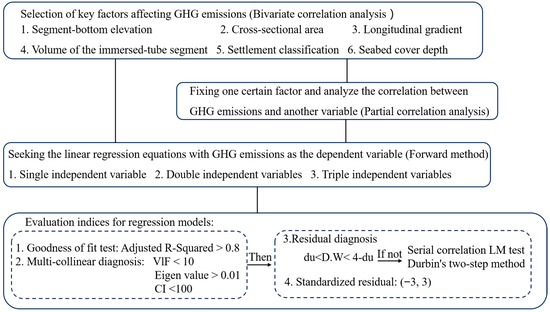
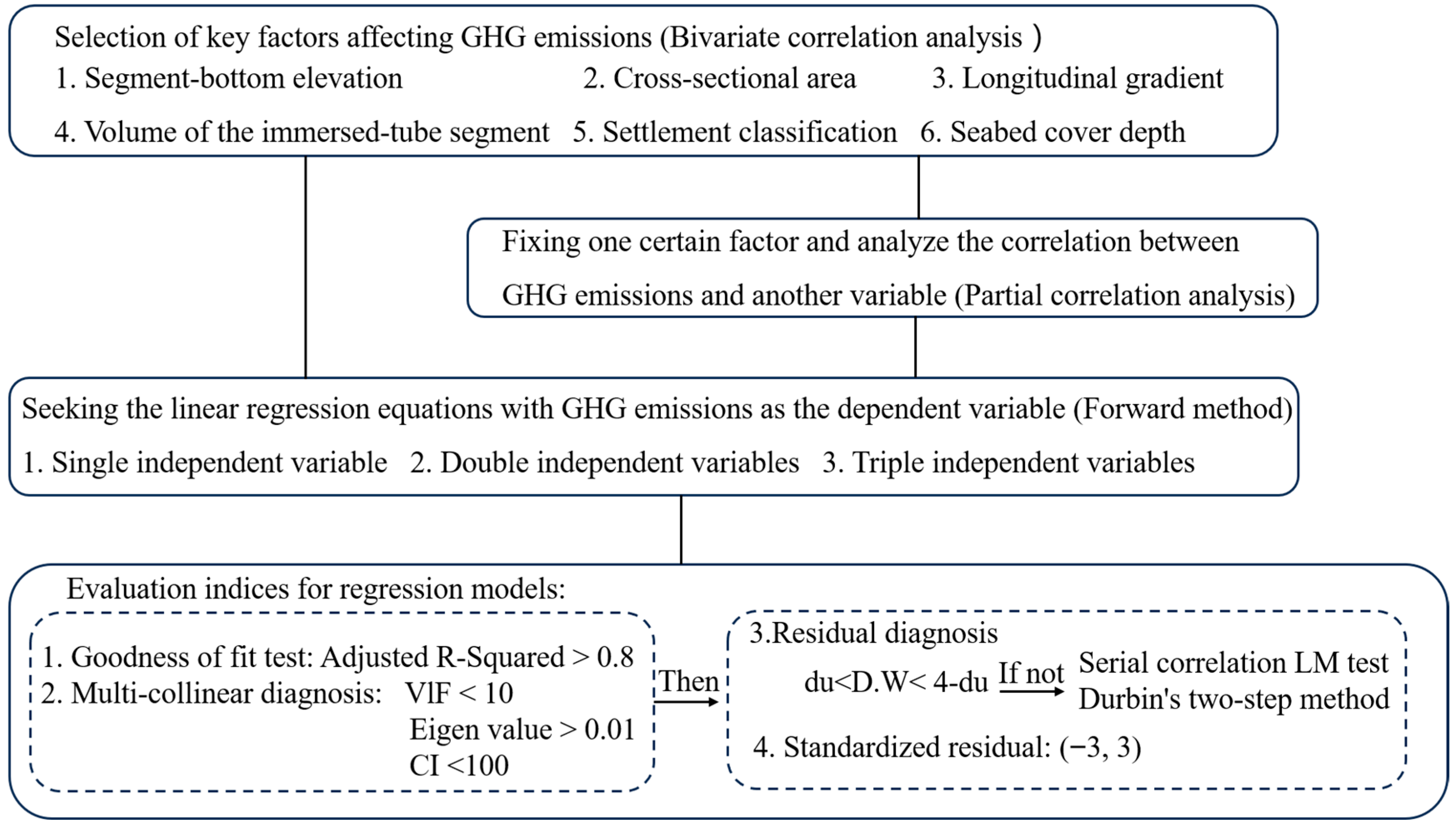
In this study, correlation analysis and regression analysis were used to identify the key influencing factors of GHG during the construction period of the immersed tunnel, and a prediction model was established. All statistical analyses were conducted in IBM SPSS Statistics 27.0. Further diagnosis and correction of the correlation of residual sequences were performed in EViews 10.0. The overall data analysis process is shown in Figure 2.
Figure 2.
Workflow for segment-level data analysis and design-stage GHG emission prediction.
Firstly, the data of 51 pipe sections of three projects are cleaned, and the missing values and obvious input errors are checked and processed. The classification variables, such as settlement grade and seabed depth, are coded according to Table 3. Then, the Bivariate Correlation Test was carried out to reveal the association structure between GHG and candidate explanatory variables, and the Pearson product–moment correlation coefficient or the Spearman’s rank correlation coefficient was used for continuous variables such as total material mass, segment volume, and cross-sectional area, and the Spearman’s rank correlation coefficient was used for all categorical variables. At the significance level, an uppercase p < 0.05 was used as the screening threshold to eliminate the explanatory variables with weak linear independence to GHG.
Table 3.
Value assignment of different parameters.
To improve clarity, Figure 2 summarizes the analytical workflow adopted in this study, which is implemented in the same order as described in this subsection.
The following paragraphs describe each step in Figure 2 in sequence, including correlation/partial correlation analyses and the development and evaluation of regression-based prediction models.
On this basis, partial correlation analysis was further used to examine the independent role of various factors. Taking the characteristic variables such as settlement grade or seabed depth as the control variables, the correlation changes between the geometric parameters and the total material mass of the pipe and the GHG are analyzed under the condition of fixing these factors, in order to judge whether the settlement grade and submarine burial depth still have a significant influence on the construction discharge of a single immersed tunnel, so as to identify its independent contribution.
Finally, a multiple linear regression model is constructed by taking the GHG of the construction period of a single segment as the dependent variable and the screened geometric parameters and total material mass as the independent variables, and the model is systematically diagnosed and screened. Candidate regression equations were selected using a “Two-stage” process. In the first stage, high goodness-of-fit and no severe multicollinearity were used as constraints, and the adjusted determination coefficient Adj. To avoid severe multicollinearity among the explanatory variables, variance inflation factors (VIFs) and condition indices (CIs) were used to diagnose each candidate regression model. In general, multicollinearity is considered not serious when all VIF values are below 10, and the maximum condition index is smaller than 30. Based on these criteria, only the regression equations that satisfied the above thresholds were retained for subsequent analysis. In the second stage, the randomness and independence of the regression residuals are tested, and the Durbin–Watson statistic is preferentially used to discriminate the first-order autocorrelation. When the DW test does not pass or indicates the existence of a higher-order correlation, the first-order autocorrelation is determined by the Durbin–Watson statistic, implementing the Lagrange multiplier tests in EViews 10.0, and correcting serial correlations using the Durbin two-step method. The observations with the absolute value of standardized residuals greater than 3 are regarded as outliers and are eliminated to re-estimate the model. Finally, the regression equation with high fitting accuracy, weak collinearity and no significant autocorrelation of residuals is selected as the prediction model of GHG during the construction period of an immersed tunnel.
The collinearity diagnostics in SPSS also showed no very small eigenvalues for the retained models, which is consistent with the VIF and CI results.
3. Results
3.1. GHG Emissions of Tunnel Construction
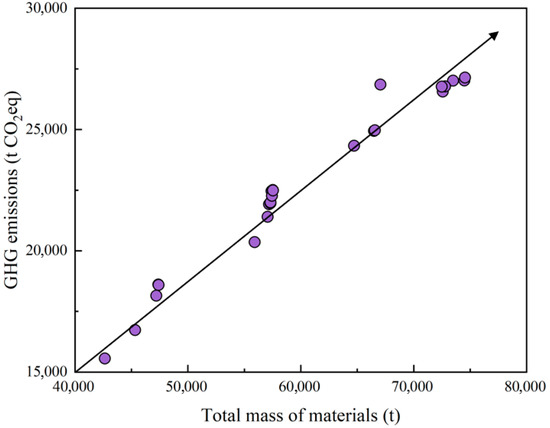
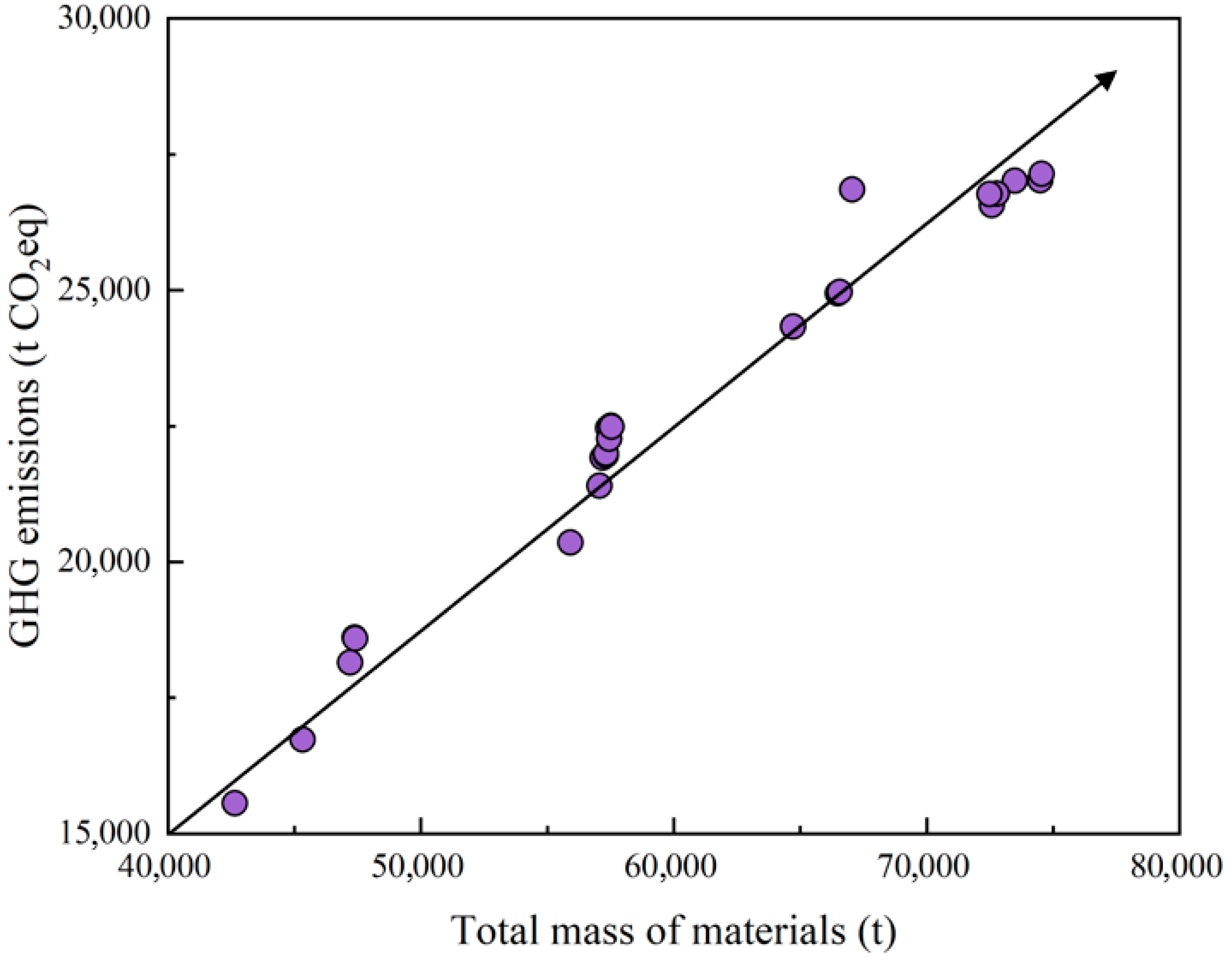
Based on the methodology described in Section 2.3, the GHG emissions of 51 immersed-tube segments were calculated, and their overall distribution is summarized as follows. Table S2 lists the material and energy inputs for all 51 immersed-tube segments. Using the inventory data in Table S2, the GHG emissions during the construction stage of each segment were obtained, as reported in Table S3. The emissions range was from 15,561.721 to 27,140.678 t CO2 eq, with an average value of 23,995.011 t CO2 eq. Figure 3 illustrates the GHG emissions from the construction of a single segment under different total masses of materials. As the material input increases, the GHG emissions per segment exhibit a clear increasing trend.
Figure 3.
GHG emissions of total mass of different materials.
3.2. Factors Influencing GHG Emissions from Tunnel Construction
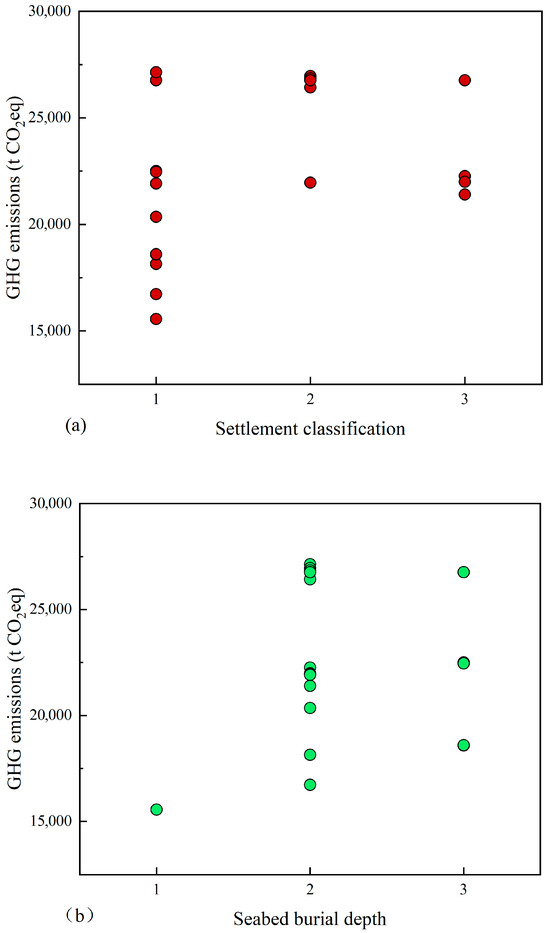
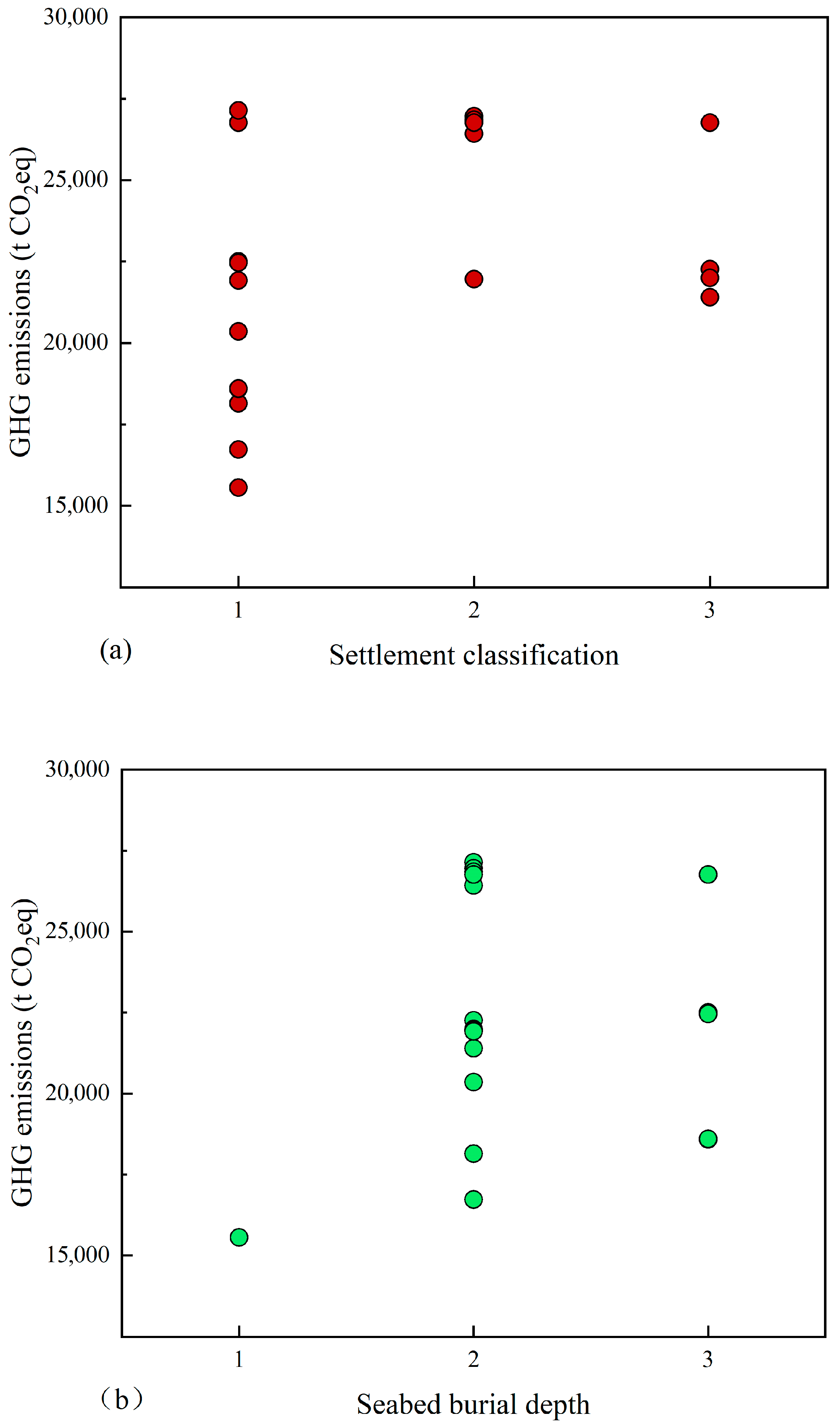
The correlation between each factor and GHG is analyzed, as shown in Table 4. The altitude of the pipe section bottom, concrete section area, segment volume, settlement grade, seabed depth and total material mass are all significantly correlated with GHG. Among them, the correlation coefficient with the total mass of the material is the highest, reaching 0.936. The second is segment volume and section area [36,37]. In addition to the above factors, the settlement grade and seabed depth are classified as indices. The tunnel emissions for these two sub-categories are shown in Figure 4.
Table 4.
Correlation between potential influencing factors and GHG.
Figure 4.
GHG emissions with different classifications. (a) Settlement classification, and (b) buried depth below the seabed.
As can be seen from Table 5, from low to high sedimentation levels, the average value of GHG shows a gradual decrease, while the standard deviation and standard error increase slightly, indicating that the more stringent the control requirements are, the lower the emission level is, but the dispersion is slightly larger.
Table 5.
Comparison of mean GHG of different settlement grades and sea bottom depths.
This study further analyzed the partial correlation characteristics of these factors and compared the correlation between other influencing factors and GHG with settlement grade and seabed depth as control variables, and the results are shown in Table 6. Except for settlement grade and seabed depth, the other influencing factors are significantly correlated with GHG. Further analysis shows that there is a significant correlation between the settlement grade and the seabed depth, and the correlation coefficient is 0.393.
Table 6.
Partial correlation analysis of the correlated factors.
3.3. Regression Analysis of GHG Emissions from Tunnel Construction
To address Research Question (2), this section develops simplified regression-based prediction models for construction-stage GHG emissions of immersed-tube segments using readily obtainable segment-scale indicators. The candidate univariate and bivariate equations and their fitting performance are summarized in Table 7.
Table 7.
Regression equations for the GHG emissions from tunnel construction.
The regression equations were evaluated for goodness of fit and multicollinearity according to the data analysis method shown in Figure 2.
As can be seen from Table 7, Equation (1) was the best, and its adjusted determination coefficient Adj. R2 = 0.961, which shows that the model has high explanatory power and can accurately reflect the linear relationship between GHG and material input during tunnel construction. Equation (3) had the worst fitting effect (Adj. R2 = 0.958), indicating that the explanatory power of the model was not significantly improved after introducing multiple variables. The Adj. R2 values of the remaining equations are between 0.958 and 0.960, indicating that each model has a high fitting accuracy.
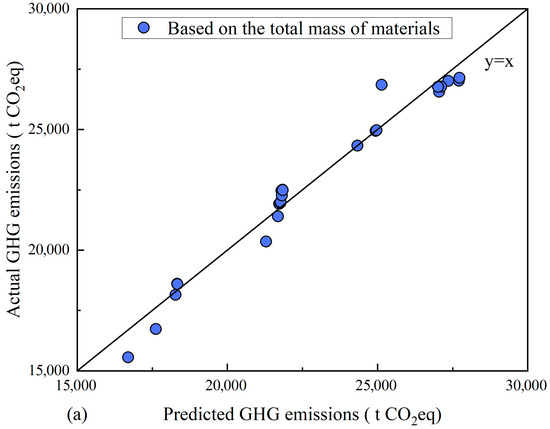
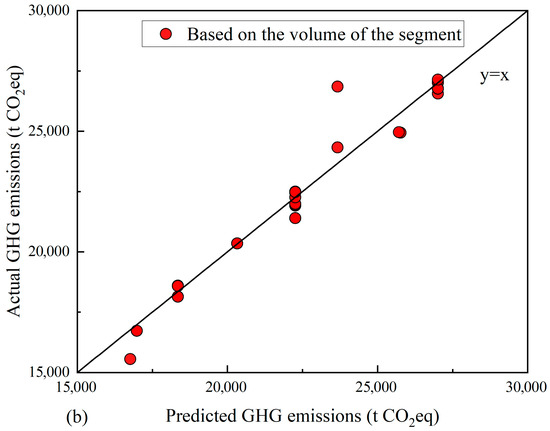
As can be seen from Table 7, the univariate model using total material mass provides the best balance between accuracy and data availability (GHG = 0.346M + 1937.143, Adj. R2 = 0.961), while the volume-based model also performs well when material quantities are not yet available (GHG = 1.019V + 271.210, Adj. R2 = 0.959). Therefore, these two equations are recommended as design-stage prediction formulas for rapid estimation of construction-stage GHG emissions of immersed-tube segments.
In terms of the number of variables, Equations (4) and (5) included two independent variables, but their fitting effect was not significantly better than that of the univariate model. This shows that when the geometric parameters or environmental parameters of the immersed tunnel are used as predictors, although the explanatory power of the model can be improved to a certain extent, the main influencing factor is still the material input. This is consistent with the correlation analysis in Section 3.2.
According to the collinearity diagnostic indices, all VIF values of the regression equations are smaller than 10, and the maximum condition indices are below 30, indicating that there is no serious multicollinearity and that each explanatory variable makes an independent contribution to the model.
In addition to the above equations, there may be more regression equations for independent variables. The contribution of non-collinear variables to GHG fitting was analyzed, and the elevation, cross-sectional area, immersed pipe volume, total material mass and settlement grade were included in the regression equation. The regression coefficients and t-test data are shown in Table 8. Only the regression coefficient of the total mass of the material was significant.
Table 8.
Regression coefficients and significance levels.
Based on the fitting accuracy and stability of each model, it can be considered that the single-factor model based on the total mass of construction materials m and the volume of immersed-tube section V performs best in GHG prediction, and it is suitable for the rapid estimation of carbon emissions during the construction-stage and the emission assessment during the preliminary design stage of the project. The fitting performance of the recommended models is shown in Figure 5.
Figure 5.
Fitting effect of new regression equation for tunnel construction GHG: (a) Total material mass as independent variable; and (b) segment volume as independent variable.
The results from this study are consistent with prior tunnel LCA research [31], and existing evidence indicates that construction-stage GHG emissions are primarily governed by material intensity and geometric scale, while geological and construction parameters act as indirect drivers through their effects on lining demand and excavation size. In particular, highway-tunnel case studies have demonstrated that the total mass of construction materials is the dominant factor of emissions, followed by excavation/sectional area, rock mass grade, burial depth, and construction method, and that simplified linear models based on material mass or geometric indicators can achieve high predictive accuracy. These conclusions, derived from multi-project datasets under unified system boundaries, provide a methodological benchmark for infrastructure-scale emission modeling.
4. Discussion
4.1. Carbon Emission Level of Immersed Tunnel During Construction Period and Its Engineering Significance
Based on 51 immersed tubes of three typical projects, the GHG of a single immersed tube during construction is quantified [22,40]. The results show that the emission of a single pipe section is between 15,561.721 and 27,140.678 t CO2 eq, and the average value is 23,995.011 t CO2 eq; the emission differences mainly reflect the comprehensive differences in the cross-section size, structural layout and construction organization of different projects. Compared with the research results of existing highway tunnels and shield tunnels [41,42,43], the emission level of a single-section structure of an immersed tunnel is generally at a similar order of magnitude [44,45], but due to the long process chain of “Land system, water transportation and sinking connection”, the emission level of a single-section structure of an immersed tunnel is higher than that of an existing highway tunnel and shield tunnel [30,43], the energy consumption of material transportation and over-water construction machinery accounts for a higher proportion of total emissions, which indicates that when promoting low-carbon construction of cross-sea immersed-tube projects, attention should be paid not only to the reduction in traditional building materials, but also to the energy-saving optimization of construction technology and equipment [31,35,46,47].
As further indicated by the grouped comparison results (Table 5), construction-stage emissions show measurable differences across the settlement-grade and seabed-burial-depth classes. Specifically, the average GHG emissions decrease from the low settlement-grade class (≈2.63 × 10⁴ t CO2 eq) to the high settlement-grade class (≈2.17 × 10⁴ t CO2 eq), corresponding to an overall reduction of about 17% from low to high grades. In addition, the medium-buried class exhibits a higher average emission level (≈2.53 × 10⁴ t CO2 eq) than the shallow-buried class (≈2.25 × 10⁴ t CO2 eq), suggesting the additional material demand and construction effort associated with thicker overburden and ground-improvement requirements. It should be noted that the deep-buried class contains only one segment in the current dataset; therefore, the above quantitative comparisons are mainly representative of the shallow and medium burial-depth classes and should be interpreted with caution.
From the perspective of emission composition, the material production stage of building materials and the energy consumption of on-site construction are still the main sources of carbon emissions during the construction of an immersed tunnel [46,48]. Among them, the amount of reinforced concrete occupies the dominant position in the total emissions, and the direct fuel consumption of transportation and waterborne construction machinery constitutes the second important source [24]. In contrast, the contribution of some auxiliary materials and small machines is relatively small, which can be appropriately simplified in the macro emission accounting and prediction [31,35,42,47].
4.2. Engineering Interpretation of Key Influencing Factors
The results of correlation analysis showed that the correlation coefficient between the total mass of construction materials and GHG was as high as 0.936, and the correlation coefficients of immersed-tube volume and concrete cross-sectional area also reached 0.912 and 0.704, respectively; the results show that the structural dimension and material input are the primary factors for determining the construction emission level of a single immersed tube [46]. These correlation results are in line with the study by Xu et al. [31], who confirmed that the total material mass from the highway tunnel construction demonstrated the strongest correlation with GHG emissions. This study also has a clear physical meaning in engineering: on the premise that the emission factor is basically fixed, the total amount of high-carbon materials, such as steel bars and cement, directly determines the carbon footprint of the physical and chemical stage [36,49], and the larger section area and segment volume means thicker enclosure structure and a longer construction process, which leads to higher material consumption and mechanical energy consumption.
There is a significant negative correlation between the altitude at the bottom of the pipe and the discharge, while the submarine burial depth is positively correlated with the discharge to a moderate extent [50]. This “Positive and negative opposite” statistical feature is related to the overall linear and geological conditions of the immersed-tube project: on the one hand, the bottom of the tube near the artificial island or coastline is relatively high in altitude; however, the complex foundation reinforcement and connection structure are often superimposed, resulting in large discharge per unit pipe section [51]. On the other hand, the bottom of the pipe section in the center of the main channel is lower in altitude and deeper in burial depth; however, constrained by the unified design and standardized prefabrication of the structure, it presents a more stable and less dispersed emission level.
As categorical variables, settlement grade and seabed depth are significantly different from GHG in simple group comparison, as they show that the complexity of foundation treatment and the condition of covering soil do indirectly affect the carbon emission by affecting the structure size, foundation reinforcement and the strength of the construction process [52]. However, the partial correlation analysis shows that after controlling the volume of the pipe section and the total mass of the material, the correlation between the settlement grade and the seabed depth and the discharge is obviously weakened, and there is a certain degree of correlation between the two. This means that the settlement grade and seabed depth are more suitable to be used as “Background indicators” to constrain the size and material input of the structure, rather than directly used as the dominant variables for emission prediction.
In contrast to many tunnel-related carbon/LCA assessments that are reported at an aggregated (project or whole-tunnel) level, this study provides construction-stage GHG emission characteristics at the segment-level for immersed-tube tunnels, enabling geometry-specific benchmarking and more direct support for scheme comparison. While material production is widely recognized as a key emission source, the present work further quantifies—through correlation and partial correlation analyses—that total material mass is the dominant determinant across segments, whereas seabed depth and settlement grade mainly influence emissions indirectly by altering structural scale and material demand. Moreover, the regression models developed with readily available segment-scale indicators support rapid preliminary design-stage estimation without relying on a fully detailed process inventory.
4.3. More Discussions on Low-Carbon Design and Construction of Immersed Tunnels
Total material mass is the primary driver of emissions. Structural optimization, the use of high-performance materials and high-strength reinforcement, as well as the adoption of low-clinker cements and supplementary cementitious material substitutions, can substantially reduce construction-stage carbon emissions while maintaining structural safety and durability. Although settlement criteria and seabed burial depth do not directly determine emissions, they indirectly influence emission levels by affecting ground-improvement requirements and structural dimensions. During alignment planning and the formulation of settlement-control standards, alternative route options should be systematically compared in terms of material demand, construction complexity, and long-term operational costs, thereby avoiding excessive conservatism in safety margins that leads to unnecessary material consumption and energy use.
As is known to all, immersed tunnel construction is characterized by centralized prefabrication and repetitive operations, creating favorable conditions for mechanized and intelligent construction and the substitution of cleaner energy sources. Optimizing prefabrication yard layouts and logistics organization, using high-efficiency and low-emission lifting vessels and tugboats, and rationally scheduling immersion windows and navigation management can significantly reduce fuel consumption associated with transportation and marine operations.
4.4. Applicability and Limitations of the Forecasting Models
After discussing the above practical implications, this subsection further clarifies the applicability and limitations of the proposed forecasting models. To distinguish the following recommendations from general engineering experience, it should be emphasized that they are directly derived from the empirical results of this study, particularly the strong association between GHG emissions and material-scale variables (e.g., r = 0.936 for total material mass) and the high explanatory power of the recommended univariate models (Adj. R2 = 0.961 and 0.959).
Regression analysis yielded five candidate regression equations, among which the two univariate models with the total mass of the material M and the immersed-tube volume V as the independent variables showed the most prominent performance, with adjusted coefficients of determination of 0.961 and 0.959, respectively, and there was no significant multicollinearity problem. The fitting effect of the model GHG = 0.346M + 1937.143 with M as the independent variable was slightly better than that of the model GHG = 1.019V + 271.210 with V as the independent variable, and the regression coefficient significance level was higher, indicating that under the existing sample conditions, the total mass of materials was the most concise and effective scale parameter to describe GHG during the construction period.
The equation containing two independent variables does not have a significant advantage over the univariate model in fitting accuracy, and its adjustment determination coefficient is only slightly improved, while the model complexity is significantly increased. Furthermore, the regression coefficient of the total mass of the material is statistically significant when the volume of the segment, the total mass of the material, the cross-sectional area, the settlement grade and the elevation of the bottom of the segment are unified into multiple regression; the marginal effect of other variables is not significant. This result confirms that in the prediction of carbon emissions from immersed tunnel construction, the material scale variables have highly integrated the combined effects of geometric and geological conditions, and although the introduction of other parameters can improve the fitting effect locally, it may bring collinearity risk and redundancy in interpretation.
From the perspective of application, the single-factor model based on M or V has the advantages of easy access to input data, clear meaning of parameters and simple calculation, etc., and it is suitable for rapid estimation and sensitivity analysis in the phase of engineering scheme comparison and selection. Especially in the early stage, when the details of the geological survey and construction organization are not sufficient, the magnitude of carbon emissions during the construction of a single tube section can be obtained only by preliminary section design and material quantity estimation, which provide quantitative basis for low-carbon scheme optimization. Of course, in projects with highly complex construction organization or unconventional materials and processes, such linear models may underestimate the impact of process differences and need to be modified with more detailed process accounting.
Beyond the model-specific issues discussed above, several study-level factors may influence the interpretation and transferability of the findings. First, the accounting scope is limited to the construction stage under the system boundary defined in Figure 1 with one immersed-tube segment as the functional unit; therefore, the results that do not represent full life-cycle emissions and comparisons across studies should be made under consistent boundaries and functional units. Second, uncertainty may arise from activity data quality and parameter assumptions, including material loss, transport conditions, and the conversion of equipment working time/shifts into energy consumption. Third, although emission factors adopted from national databases and IPCC-related references ensure consistency, they may not fully capture project-specific supply chains or temporal changes in the energy mix and material production technologies. Finally, the empirical basis of this study covers 51 segments from three representative Chinese cross-sea immersed tunnel projects; consequently, applying the regression models to projects with substantially different geometries, seabed treatment requirements, construction logistics, or material supply chains should be undertaken with caution.
Moreover, local technological conditions may materially affect the transferability of the quantitative benchmarks and the prediction equations, including differences in material supply chains and plant efficiencies, regional electricity and fuel mixes, marine transportation modes/distances, equipment fleets, and ground-improvement technologies. Therefore, the results reported in this study are not universally applicable; they are most suitable for cross-sea immersed-tube projects operating under comparable system boundaries and process chains. For projects with substantially different regional/technical contexts, recalibration using local emission factors and representative segment samples is recommended.
5. Conclusions
5.1. Main Conclusions
Based on the data of 51 segments of three representative immersed tunnel projects, this study develops an LCA–based framework for quantifying construction-stage GHG emissions at the level of individual immersed-tube segments and systematically investigates the associated influencing factors and predictive models. The main conclusions are as follows:
- (1)
- The construction period of a single immersed-tube has a high and discrete carbon emission level. Under the existing engineering conditions, the GHG of the single segment is 1.56 × 10⁴~2.71 × 10⁴ t CO2 eq. The average is about 2.40 × 10⁴ t CO2 eq. The material production stage and energy consumption of construction machinery are the main sources of emissions. Therefore, emission reduction should prioritize material-related mitigation and the energy efficiency of major construction equipment and processes.
- (2)
- The total mass of materials is the dominant factor driving the construction emission of a single pipe section. Correlation and partial correlation analysis showed that the correlation coefficient between the total mass of construction materials and GHG was the highest (0.936), followed by the volume and cross-sectional area of the immersed tube, while the longitudinal slope had no significant effect on the emission. Settlement grade and seabed depth indirectly affect the discharge by affecting the structure size and foundation reinforcement, but their independent contributions are limited after controlling for the material scale variable. Therefore, low-carbon design and construction should focus on reducing material input through structural optimization and adopting low-carbon materials and supply chains.
- (3)
- For design-stage prediction, the linear model based on the total mass of material and the volume of pipe section can predict the emission during construction with high accuracy. The adjusted coefficients of determination of GHG = 0.346M + 1937.143 and GHG = 1.019V + 271.210 of the univariate regression equations reach 0.961 and 0.959, respectively, and there is no significant multicollinearity. In contrast, the multivariate model with variables such as altitude and subsidence level has limited improvement in fitting accuracy and complex parameter interpretation. Therefore, the above univariate equations are recommended for rapid estimation and scheme comparison at the early design stage.
- (4)
- The recommended univariate models have good simplicity and operability, and they can support rapid screening of alternative segment designs and construction schemes, as well as preliminary target-setting and control of construction-stage carbon emissions in immersed-tube projects.
- (5)
- The above prediction equations are calibrated using segment-level data from three Chinese cross-sea immersed-tube tunnel projects under similar process chains and boundary definitions. Therefore, direct transfer to projects with substantially different structural configurations, materials, or construction approaches should be performed with caution, and recalibration with additional local samples is suggested to improve generalizability.
5.2. Limitations
The limitations of this study are summarized as follows:
- (1)
- The sample sources are mainly concentrated in the three immersed-tube tunnel projects in China, and the regionality, design specifications and construction organization models are relatively close, and they cannot fully represent the immersed-tube projects in different countries and different standard systems. In the future, it is necessary to expand the sample range and introduce more marine environments and structural types.
- (2)
- The emission factors mainly use the current database and standard recommended values, and the time evolution factors, such as material production technology progress and energy structure changes, are not dynamically corrected. With the promotion of low-carbon cement, new energy ships and electric construction machinery, the existing factors may underestimate the potential of future emission reduction, and dynamic LCA research needs to be carried out in combination with scenario analysis.
- (3)
- This study only conducted detailed accounting and modeling for the construction stage, and did not systematically include emissions in the operation, maintenance and end-of-life stages. Long-term operating infrastructure, such as cross-sea immersed tunnels, traffic organization and energy consumption of electromechanical systems during the operation period, is also a key source of carbon emissions, which needs to be integrated with emissions during the construction period in follow-up work.
- (4)
- The resulting prediction model adopts linear assumptions and does not explicitly consider the nonlinear effects of extreme working conditions and process innovation. In the future, piecewise linear, nonlinear regression or machine learning methods can be tried to improve prediction accuracy under complex processes and unconventional design conditions on the basis of larger samples.
5.3. Prospects
In general, an accounting and prediction framework was established in this study for carbon emissions during the construction of immersed tunnels on the scale of a single segment, revealing the dominant role of material input on emissions, and providing quantitative support for segment-level, construction-stage low-carbon design and scheme comparison of cross-sea immersed-tube projects. It provides quantifiable technical support for the low-carbon design and construction of cross-sea immersed-tube projects. With the accumulation of more engineering data and the application of low-carbon technologies, it is expected to further improve the life-cycle carbon emission evaluation system of immersed tunnels and provide a decision-making basis for achieving the “Dual Carbon” goal in the field of transportation infrastructure.
Practically, the proposed regression models enable engineers and planners to estimate construction-stage emissions using readily available segment-scale indicators (e.g., total material mass and immersed-tube volume) at the preliminary design stage, facilitating rapid scheme comparison and prioritization of material-oriented mitigation measures for immersed-tube segments.
Future research could further validate the proposed models using a larger dataset covering more projects, regions, and structural types, and examine their transferability under different construction practices and emission-factor databases. In addition, extending the boundary to other life-cycle stages and introducing uncertainty analysis would improve the robustness of carbon-aware decision-making for immersed-tube tunnels.
Supplementary Materials
The following supporting information can be downloaded at https://www.mdpi.com/article/10.3390/buildings16040757/s1.
Author Contributions
L.Z. (Liang Zhang): Writing—original draft and conceptualization. X.L.: Writing—original draft and methodology. L.K.: Data curation. L.W. (Liqiang Wang): Resources and visualization. Y.L.: Formal analysis and methodology. Z.W.: Writing—review and editing, visualization, and data curation. L.W. (Ling Wang): Data curation and project administration. Y.Y.: Writing—review and editing, and investigation. L.Z. (Lei Zhang): Writing—review and editing, and supervision. All authors have read and agreed to the published version of the manuscript.
Funding
This research received no external funding.
Data Availability Statement
The original contributions presented in this study are included in the article and Supplementary Materials. Further inquiries can be directed to the corresponding author.
Acknowledgments
The authors would like to acknowledge the support provided by CCCC Tianjin Port Engineering Design & Consulting Company Ltd. regarding the data for the immersed tunnel projects described in this study. This research received no external funding.
Conflicts of Interest
Authors Liang Zhang, Xiaohui Liu, Lingchen Kong, Liqiang Wang, Yi Liu and Zhennan Wang were employed by the company CCCC First Harbor Engineering Company Ltd., CCCC Tianjin Port Engineering Design & Consulting Company Ltd. The remaining authors declare that the research was conducted in the absence of any commercial or financial relationships that could be construed as a potential conflict of interest.
References
- Friedlingstein, P.; Jones, M.W.; O’sullivan, M.; Andrew, R.M.; Hauck, J.; Peters, G.P.; Peters, W.; Pongratz, J.; Sitch, S.; Le Quéré, C. Global carbon budget 2019. Earth Syst. Sci. Data 2019, 11, 1783–1838. [Google Scholar] [CrossRef] [Scilit]
- Liu, Q.; Yin, Y. Strategies for emission reduction in construction: The role of China’s carbon trading market. J. Knowl. Econ. 2025, 16, 3000–3029. [Google Scholar] [CrossRef] [Scilit]
- Wang, Y.; Yi, H.; Tang, X.; Wang, Y.; An, H.; Liu, J. Historical trend and decarbonization pathway of China’s cement industry: A literature review. Sci. Total Environ. 2023, 891, 164580. [Google Scholar] [CrossRef] [Scilit] [PubMed]
- Abergel, T.; Dean, B.; Dulac, J. Towards a Zero-Emission, Efficient, and Resilient Buildings and Construction Sector: Global Status Report 2017; UN Environment and International Energy Agency: Paris, France, 2017; Volume 22. [Google Scholar]
- Xi, J. Speech at the general debate of the 75th UN General Assembly. People’s Daily, 23 September 2020; p. 23.
- Xu, A.; Zhu, Y.; Wang, Z.; Zhao, Y. Carbon emission calculation of prefabricated concrete composite slabs during the production and construction stages. J. Build. Eng. 2023, 80, 107936. [Google Scholar] [CrossRef] [Scilit]
- Zhang, C.; Luo, H. Research on carbon emission peak prediction and path of China’s public buildings: Scenario analysis based on LEAP model. Energy Build. 2023, 289, 113053. [Google Scholar] [CrossRef] [Scilit]
- He, B.-J.; Prasad, D. Delivering a net zero carbon built environment–Targets and Pathways. In Proceedings of the IOP Conference Series: Earth and Environmental Science; IOP Publishing: Bristol, UK, 2022; p. 012001. [Google Scholar]
- Zhang, D.; Ding, Y.; Wang, Y.; Fan, L. Towards ultra-low energy consumption buildings: Implementation path strategy based on practical effects in China. Energy Sustain. Dev. 2022, 70, 537–548. [Google Scholar] [CrossRef] [Scilit]
- MacLeay, I. Digest of United Kingdom Energy Statistics 2010; The Stationery Office: Norwich, UK, 2010. [Google Scholar]
- Zhu, Y.; Lin, M.; Meng, F.; Liu, X.; Lin, W. The Hong Kong–Zhuhai–Macao Bridge. Engineering 2019, 5, 10–14. [Google Scholar] [CrossRef] [Scilit]
- Deng, B.; Huang, Q.; Liu, J.; Liu, M.; Jin, W.; Ji, H. Mechanical properties of asymmetric composite welds in the steel shell of immersed final joints along Shen-Zhong link. In Advances in Traffic Transportation and Civil Architecture; CRC Press: Boca Raton, FL, USA, 2023; pp. 489–501. [Google Scholar]
- Sun, Y.; Song, S.; Yu, H.; Ma, H.; Xu, Y.; Zu, G.; Ruan, Y. Experimental Study on the Strength and Durability of Manufactured Sand HPC in the Dalian Bay Undersea Immersed Tube Tunnel and Its Engineering Application. Materials 2024, 17, 5003. [Google Scholar] [CrossRef] [Scilit] [PubMed]
- Kul, A.; Ozel, B.F.; Ozcelikci, E.; Gunal, M.F.; Ulugol, H.; Yildirim, G.; Sahmaran, M. Characterization and life cycle assessment of geopolymer mortars with masonry units and recycled concrete aggregates assorted from construction and demolition waste. J. Build. Eng. 2023, 78, 107546. [Google Scholar] [CrossRef] [Scilit]
- Mesa, J.A.; Fúquene-Retamoso, C.; Maury-Ramírez, A. Life cycle assessment on construction and demolition waste: A systematic literature review. Sustainability 2021, 13, 7676. [Google Scholar] [CrossRef] [Scilit]
- Mouton, L.; Allacker, K.; Röck, M. Bio-based building material solutions for environmental benefits over conventional construction products–Life cycle assessment of regenerative design strategies (1/2). Energy Build. 2023, 282, 112767. [Google Scholar] [CrossRef] [Scilit]
- Liu, Y.; Zhang, J.; Xu, J.; Wang, Y.; Li, B.; Zhang, S. Carbon emission-based life cycle assessment of rural residential buildings constructed with engineering bamboo: A case study in China. J. Build. Eng. 2023, 76, 107182. [Google Scholar] [CrossRef] [Scilit]
- Rinne, R.; Ilgın, H.E.; Karjalainen, M. Comparative study on life-cycle assessment and carbon footprint of hybrid, concrete and timber apartment buildings in Finland. Int. J. Environ. Res. Public Health 2022, 19, 774. [Google Scholar] [CrossRef] [Scilit]
- Ansah, M.K.; Chen, X.; Yang, H.; Lu, L.; Lam, P.T. Developing an automated BIM-based life cycle assessment approach for modularly designed high-rise buildings. Environ. Impact Assess. Rev. 2021, 90, 106618. [Google Scholar] [CrossRef] [Scilit]
- Andersen, J.H.; Rasmussen, N.L.; Ryberg, M.W. Comparative life cycle assessment of cross laminated timber building and concrete building with special focus on biogenic carbon. Energy Build. 2022, 254, 111604. [Google Scholar] [CrossRef] [Scilit]
- Miliutenko, S.; Åkerman, J.; Björklund, A. Energy use and greenhouse gas emissions during the Life Cycle stages of a road tunnel-the Swedish case norra länken. Eur. J. Transp. Infrastruct. Res. 2012, 12, 39–62. [Google Scholar] [CrossRef] [Scilit]
- Huang, L.; Bohne, R.A.; Bruland, A.; Jakobsen, P.D.; Lohne, J. Life cycle assessment of Norwegian road tunnel. Int. J. Life Cycle Assess. 2015, 20, 174–184. [Google Scholar] [CrossRef] [Scilit]
- Damián, R.; Zamorano, C.I. Environmental impact assessment of high-speed railway tunnel construction: A case study for five different rock mass rating classes. Transp. Geotech. 2022, 36, 100817. [Google Scholar] [CrossRef] [Scilit]
- Rodríguez, R.; Pérez, F. Carbon foot print evaluation in tunneling construction using conventional methods. Tunn. Undergr. Space Technol. 2021, 108, 103704. [Google Scholar] [CrossRef] [Scilit]
- Guo, C.; Wang, M.; Yang, L.; Sun, Z.; Zhang, Y.; Xu, J. A review of energy consumption and saving in extra-long tunnel operation ventilation in China. Renew. Sustain. Energy Rev. 2016, 53, 1558–1569. [Google Scholar] [CrossRef] [Scilit]
- Guo, C.; Xu, J.; Yang, L.; Guo, X.; Zhang, Y.; Wang, M. Energy-saving network ventilation technology of extra-long tunnel in climate separation zone. Appl. Sci. 2017, 7, 454. [Google Scholar] [CrossRef] [Scilit]
- Moretti, L.; Cantisani, G.; Di Mascio, P. Management of road tunnels: Construction, maintenance and lighting costs. Tunn. Undergr. Space Technol. 2016, 51, 84–89. [Google Scholar] [CrossRef] [Scilit]
- Wu, H.; Zhou, W.; Bao, Z.; Long, W.; Chen, K.; Liu, K. Life cycle assessment of carbon emissions for cross-sea tunnel: A case study of Shenzhen-Zhongshan Bridge and Tunnel in China. Case Stud. Constr. Mater. 2024, 21, e03502. [Google Scholar] [CrossRef] [Scilit]
- Liu, T.; Zhu, H.; Shen, Y.; Li, T.; Liu, A. Embodied carbon assessment on road tunnels using integrated digital model: Methodology and case-study insights. Tunn. Undergr. Space Technol. 2024, 143, 105485. [Google Scholar] [CrossRef] [Scilit]
- Guo, Y.; Dong, C.; Chen, Z.; Zhao, S.; Sun, W.; He, W.; Zhang, L.; Wang, Y.; Hu, N.; Guo, C. Evaluation of greenhouse gas emissions in subway tunnel construction. Undergr. Space 2025, 22, 263–279. [Google Scholar] [CrossRef] [Scilit]
- Xu, J.; Guo, C.; Yu, L. Factors influencing and methods of predicting greenhouse gas emissions from highway tunnel construction in southwestern China. J. Clean. Prod. 2019, 229, 337–349. [Google Scholar] [CrossRef] [Scilit]
- Quanke, S.; Yongling, Z.; Yue, C.; Lei, F.; Yu, Y.; Zongxian, S.; de Wit, H.; Ying, L. Hong Kong Zhuhai Macao Bridge-Tunnel project immersed tunnel and artificial islands–From an Owners’ perspective. Tunn. Undergr. Space Technol. 2022, 121, 104308. [Google Scholar] [CrossRef] [Scilit]
- Lin, W.; Lin, M.; Liu, X.; Yin, H.; Gao, J. Novelties in the islands and tunnel project of the Hong Kong–Zhuhai–Macao Bridge. Tunn. Undergr. Space Technol. 2022, 120, 104287. [Google Scholar] [CrossRef] [Scilit]
- Guo, C.; Xu, J. Carbon Emission Calculation Methods for Highway Tunnel Construction; Springer: Berlin/Heidelberg, Germany, 2022. [Google Scholar]
- Guo, C.; Xu, J.; Yang, L.; Guo, X.; Liao, J.; Zheng, X.; Zhang, Z.; Chen, X.; Yang, K.; Wang, M. Life cycle evaluation of greenhouse gas emissions of a highway tunnel: A case study in China. J. Clean. Prod. 2019, 211, 972–980. [Google Scholar] [CrossRef] [Scilit]
- Barbhuiya, S.; Kanavaris, F.; Das, B.B.; Idrees, M. Decarbonising cement and concrete production: Strategies, challenges and pathways for sustainable development. J. Build. Eng. 2024, 86, 108861. [Google Scholar] [CrossRef] [Scilit]
- Guo, X.; Li, Y.; Shi, H.; She, A.; Guo, Y.; Su, Q.; Ren, B.; Liu, Z.; Tao, C. Carbon reduction in cement industry-An indigenized questionnaire on environmental impacts and key parameters of life cycle assessment (LCA) in China. J. Clean. Prod. 2023, 426, 139022. [Google Scholar] [CrossRef] [Scilit]
- Geng, Y.; Wang, Z.; Shen, L.; Zhao, J. Calculating of CO2 emission factors for Chinese cement production based on inorganic carbon and organic carbon. J. Clean. Prod. 2019, 217, 503–509. [Google Scholar] [CrossRef] [Scilit]
- Hongyang, L.; Zhang, M.; Wei, W.; Baolin, C.; Anmin, W.; Yue, W.V.; Hehua, Z. A Carbon Emission Calculation Model and Evaluation Method for Drill-and-Blast Tunnel Construction Machinery. Clean. Eng. Technol. 2025, 29, 101105. [Google Scholar]
- Song, Y.; Zhu, H.; Shen, Y.; Yan, Z.; Feng, S. Zero-carbon tunnel: Concept, methodology and application in the built environment. J. Clean. Prod. 2024, 479, 144031. [Google Scholar] [CrossRef] [Scilit]
- Li, W.; Kou, L.; He, X.; Wang, Y.; Shi, X.; Liang, H. Investigation of carbon emission in slurry shield tunnel construction based on modified process analysis method. Low-Carbon Mater. Green Constr. 2023, 1, 18. [Google Scholar] [CrossRef] [Scilit]
- Mei, Y.; Zhou, D.; Wang, H.; Ke, X.; Liu, Z.; Tian, X.; Wang, Z. Study on carbon emission calculation during the materialization phase of subway stations and comparative analysis of carbon emissions from various construction methods. Case Stud. Constr. Mater. 2024, 21, e03923. [Google Scholar] [CrossRef] [Scilit]
- Wu, H.; Yang, K.; Chen, K.; Zhou, W.; Yu, T.; Wang, K. GHG emission quantification and reduction pathway of subway shield tunnel engineering: A case study on Guangzhou Metro, China. Environ. Sci. Pollut. Res. 2024, 31, 54768–54784. [Google Scholar] [CrossRef] [Scilit]
- Kaewunruen, S.; Sresakoolchai, J.; Yu, S. Global warming potentials due to railway tunnel construction and maintenance. Appl. Sci. 2020, 10, 6459. [Google Scholar] [CrossRef] [Scilit]
- Zhang, T.; Yang, Y.; Jiang, R.; Wu, Y.; Luo, Z.; Lin, Y. Life Cycle Carbon Emission Estimation for Railway Tunnel Construction. In Proceedings of the International Conference on Environmental Pollution and Governance; Springer: Berlin/Heidelberg, Germany, 2023; pp. 1215–1223. [Google Scholar]
- Guo, Y.; Wen, S.; Guo, Z.; Tan, X.; Wang, Y.; Hu, N.; Jia, P.; Su, K.; Guo, C. Rising carbon emissions from expanding highway tunnels and reduction pathways in China. npj Sustain. Mobil. Transp. 2025, 2, 46. [Google Scholar] [CrossRef] [Scilit]
- Wang, G.; Lu, D.; Ji, G.; Liang, X.; Lin, Q.; Lv, J.; Du, X. A lifecycle carbon emission evaluation model for urban underground highway tunnel facilities. Undergr. Space 2025, 24, 352–370. [Google Scholar] [CrossRef] [Scilit]
- Rodríguez, R.; Bascompta, M.; García, H. Carbon footprint evaluation in tunnels excavated in rock using tunnel boring machine (TBM). Int. J. Civ. Eng. 2024, 22, 995–1009. [Google Scholar] [CrossRef] [Scilit]
- Andrew, R.M. Global CO2 emissions from cement production, 1928–2018. Earth Syst. Sci. Data 2019, 11, 1675–1710. [Google Scholar] [CrossRef] [Scilit]
- Chaudhury, R.; Sharma, U.; Thapliyal, P.; Singh, L. Low-CO2 emission strategies to achieve net zero target in cement sector. J. Clean. Prod. 2023, 417, 137466. [Google Scholar] [CrossRef] [Scilit]
- Antunes, M.; Santos, R.L.; Pereira, J.; Rocha, P.; Horta, R.B.; Colaço, R. Alternative clinker technologies for reducing carbon emissions in cement industry: A critical review. Materials 2021, 15, 209. [Google Scholar] [CrossRef] [Scilit] [PubMed]
- Williams, F.; Yang, A. Potential of reducing CO2 emissions in cement production through altering clinker compositions. Ind. Eng. Chem. Res. 2024, 63, 17158–17167. [Google Scholar] [CrossRef] [Scilit]

Disclaimer/Publisher’s Note: The statements, opinions and data contained in all publications are solely those of the individual author(s) and contributor(s) and not of MDPI and/or the editor(s). MDPI and/or the editor(s) disclaim responsibility for any injury to people or property resulting from any ideas, methods, instructions or products referred to in the content. |
© 2026 by the authors. Licensee MDPI, Basel, Switzerland. This article is an open access article distributed under the terms and conditions of the Creative Commons Attribution (CC BY) license.