Next Article in Journal
Coupling Effect and Structural Response of Ancient Chinese Timber Structures with High-Platform
Previous Article in Journal
Wind-Induced Dynamic Performance and Fatigue Life of a Flat-Jib Tower Crane Across Various Operating Conditions
 
 
Due to scheduled maintenance work on our servers, there may be short service disruptions on this website between 11:00 and 12:00 CEST on March 28th.
Article

Supply–Demand Matching and Optimization of Elderly Care Facilities in Daxing District, Beijing: A Living Circle Perspective


1
School of Urban Economics and Management, Beijing University of Civil Engineering and Architecture, Beijing 100044, China
2
School of Humanities and Social Sciences, Beijing University of Civil Engineering and Architecture, Beijing 100044, China
3
School of Geomatics and Urban Spatial Informatics, Beijing University of Civil Engineering and Architecture, Beijing 100044, China
*
Author to whom correspondence should be addressed.
Buildings 2026, 16(4), 742; https://doi.org/10.3390/buildings16040742
Submission received: 13 January 2026 / Revised: 2 February 2026 / Accepted: 10 February 2026 / Published: 12 February 2026
(This article belongs to the Section Architectural Design, Urban Science, and Real Estate)

Abstract

Population ageing is intensifying pressure on elderly-care provision in megacity suburbs, but spatially explicit evidence on who benefits and where gaps persist remains limited. Using Daxing District, Beijing, as a case study, under the 15-min community living circle framework, we integrate cleaned elderly-care facility POIs from the municipal government portal (209 points), census-calibrated age-stratified WorldPop 100 m grids, and an OpenStreetMap road network to evaluate walking-based supply–demand matching. Kernel density estimation (KDE) characterizes facility agglomeration; the Gaussian Two-Step Floating Catchment Area (Ga2SFCA) method (1 km threshold) measures accessibility for two cohorts (60–80 and 80+); and global Moran’s I with bivariate LISA identifies spatial coupling between accessibility and elderly population density. The results indicate the following: (1) pronounced spatial imbalance—facilities are concentrated in the northwest and east but remain sparse in central and southern areas, while elderly population density follows a center–periphery gradient, peaking at 12,000 persons/km2 in core areas (e.g., Jiugong and Huangcun); (2) clear accessibility stratification—overall accessibility is low and spatially clustered, yet the 80+ cohort (13.6% of the elderly population) exhibits markedly higher accessibility than the 60–80 cohort; and (3) differentiated coupling types—global bivariate Moran’s I = 0.773143 (p < 0.01), with LISA dominated by low-demand–low-accessibility (LL) areas and additional high-demand–low-accessibility (HL) shortage zones and low-demand–high-accessibility (LH) potential redundancy zones, while HH areas are scarce. These diagnostics support zone-specific gap filling to mitigate spatial inequities and age–structural mismatches.

1. Introduction

China is currently undergoing the most extensive and rapid population aging process in the world, characterized by increasing severity and complexities. In 2021, the proportion of the population aged 65 and above reached 14.2%, marking China’s entry into a society with a moderately aging population. By 2024, the share of those aged 60 and above had exceeded 20%. By the end of 2025, the population aged 65 and above had reached 223.65 million (15.9% of the total population), indicating a further deepening of population aging. According to the National Bureau of Statistics, the elderly population aged 60 and above is projected to surpass 400 million around 2035, signaling a transition into a severely aging stage. This demographic shift presents three critical challenges. First, “aging before affluence”, where population aging outpaces economic development [1]; second, structural imbalances reflected in pronounced high-ageization, empty-nesting, and disability dependency, coupled with a significantly higher proportion of female elderly [2]; and third, marked regional disparities including an uneven urban–rural aging distribution of the elderly and weakened traditional family support functions due to shrinking household sizes [3]. Against the backdrop of evolving social attitudes and family structures, preferences of the elderly have shifted substantially toward home and community-based care. However, existing elderly care facilities remain inadequate in quantity, quality, and spatial coverage, calling for systematic planning to expand service provision and address emerging demands. Current domestic research reveals severe spatial inequality and supply–demand mismatch in the distribution of elderly care facilities. On the one hand, “center–periphery” disparities are prominent, with intensifying urban–suburban contradictions. In major cities such as Nanjing, Tianjin, and Chengdu, facilities exhibit a “strong core, weak periphery” pattern [4], where accessibility declines rapidly from central urban areas toward the outskirts [5]. While central districts demonstrate relatively balanced supply–demand matching, substantial service gaps persist in suburban areas, as indicated by widespread low-accessibility zones in Chengdu’s remote suburbs and pronounced core–periphery and south–north disparities in Tianjin’s supply–demand matching [6,7]. On the other hand, the fairness of facility allocation is undermined by socioeconomic stratification and demand heterogeneity. Studies adopting a social stratification perspective reveal accessibility disparities across different socioeconomic groups [8], highlighting inequities in resource allocation. At the same time, scholars emphasize the need for demand-tailored resource distribution that accounts for the heterogeneous needs of the elderly [9,10]. Furthermore, structural contradictions remain prevalent: most Chinese cities suffer from an insufficient number of facilities, low spatial density and an imbalanced bed supply–demand ratio.
To address these challenges, China has been actively exploring innovative theories and models. The “embedded elderly care model”, piloted in cities such as Guangzhou [11] and Xi’an [12], integrates institutional, community, and home-based care resources to optimize spatial layouts and service efficiency. By repurposing underutilized spaces within residential areas, this model emphasizes community-based attributes and leverages advantages in proximity and cost-efficiency, thereby facilitating a shift toward universally accessible community-based care [13]. In urban planning practice, the “life circle” theory has been widely adopted to enhance equity and precision of facility allocation. The 15-Min Community Living Circle concept prioritizes people-oriented principles, aiming to improve functional completeness, urban livability, daily convenience, and residents’ overall well-being [14]. This approach effectively responds to the mobility constraints of the elderly and enables more accurate matching of facilities with local demands [15]. Cities such as Guiyang [14], Shanghai [16], Fuzhou [17], and Urumqi [18] have implemented this theory, with measurable outcomes—for example, Urumqi achieved a 24.68% growth in average facility coverage after optimization.
Despite these advances, several critical gaps remain. First, research on elderly care facilities in rural and suburban areas is underdeveloped. Most existing studies focus on urban areas, neglecting issues of rural–urban equity in the configuration of life circle facilities [19,20]. Second, spatiotemporal dynamics are inadequately captured in current analysis. Real-time monitoring is required to track temporal changes in resource allocation, environmental factors, and evolving contextual conditions [21]. Third, policy implementation continues to lag behind theoretical innovation. Scholars have proposed four optimization pathways: establishing standardized planning systems [22]; fostering cross-departmental coordination (e.g., integrating health/cultural resources); tailoring services to diverse elderly subgroups; and strengthened supervision and standardization of service quality [23].
Globally, addressing the challenges of advanced aging represents a shared imperative among developed nations. International research provides substantial theoretical and practical insights. Japan—both the birthplace of life circle theory and a hyper-aged society—has developed an integrated approach that combines hierarchical life circles with smart eldercare solutions. This system delineates three spatial levels: the settlement circle, centered on commercial districts for regional facilities; the residential circle, anchored by service nodes for integrated medical and commercial services; and the neighborhood circle, emphasizing walkable areas for basic facilities [24,25]. Information and Communication Technologies (ICTs) enable remote health monitoring and smart service delivery within this framework. South Korea, another hyper-aged society, has implemented a dual-scale life circles for regional facilities in Seoul. This framework comprises five large-scale life circles responsible for regional facilities such as nursing homes and specialty hospitals, alongside 120 small-scale life circles serving as community hubs that provide health stations and compact service centers. These circles are strategically arranged along urban development axes [26], with a clear prioritization of accessibility and spatial equity in facility distribution. In European contexts, Artmann et al. employed GIS network analysis combined with questionnaire surveys to reveal a false equilibrium in green space supply and demand within Austrian elderly care facilities. Their research demonstrated significant disparities between potential and actual urban green space accessibility for institutionalized elderly populations [27]. Similarly, Guida et al. utilized the Two-Step Floating Catchment Area method to measure spatial accessibility to urban services for Milan’s elderly residents. Their study not only identified healthcare-deficient areas from an aging perspective [28] but also evaluated optimal locations for transportation and health facilities to improve accessibility in underserved zones [29]. At the policy level, the European Union’s Ambient Assisted Living Joint Program has been instrumental in promoting smart home technologies within community care contexts. This initiative has helped establish embedded life circle hierarchies that address both physiological monitoring needs and social inclusion gaps through user-centered design approaches [30,31].
Spatial accessibility assessment plays a crucial role in evaluating the matching relationship between service supply and population demand. The Two-Step Floating Catchment Area (2SFCA) method has been widely employed to quantify accessibility by integrating facility capacity, population demand scale and distance decay effects [32,33]. However, as its application relies on Euclidean distance measurements, it fails to account for real-world impediment, including road networks and travel costs. To address this limitation, the enhanced Gaussian 2SFCA (Ga2SFCA) method has been developed. It is widely adopted for public facility studies due to its computational efficiency and intuitive output [34,35], effectively overcoming the challenges of spatial heterogeneity and cross-boundary interactions between supply and demand [36,37].
Elderly care facilities, as critical-aging-response infrastructure, lack a definitional consensus. According to China’s industry standard Code for Design of Buildings for Elderly Care Facilities (JGJ 450-2018) [38], such facilities are defined as “public buildings providing centralized care services”. This classification encompasses full-day facilities (e.g., nursing homes, welfare institutions) and daytime care centers (e.g., daycare facilities), while excluding non-centralized venues (e.g., senior universities). In contrast, academic studies often adopt broader definitions; for example, Li Bin incorporates residential structures into the scope of elderly care facilities. This study defines elderly care facilities as comprehensive service providers that address core needs—including the daily care, health management, and social engagement—of individuals aged 60 and above. They operate through a multi-stakeholder framework involving government leadership, market participation and social coordination. These facilities comprise both institutional and community-based services, delivered through a hybrid provision model that combines welfare-oriented objectives with market-based operations and social coordination.
As a pivotal component of Beijing, Daxing District exemplifies the challenge of accelerated population aging within a context of rapid suburban development. Its dual identity—both as a southeastern suburb and an emerging new town—makes it an ideal laboratory for studying the coordination between urban growth and the allocation of elderly care resources. By leveraging Point of Interest (POI) data, this study systematically examines the spatial distribution, agglomeration patterns, accessibility, and supply-demand matching of elderly care facilities in Daxing. The findings provide an empirical reference to support the scientific regulation of resource allocation not only in Beijing but also in other metropolitan suburbs and newly developed urban areas facing similar aging transitions.

2. Research Area and Data

2.1. Study Area Overview

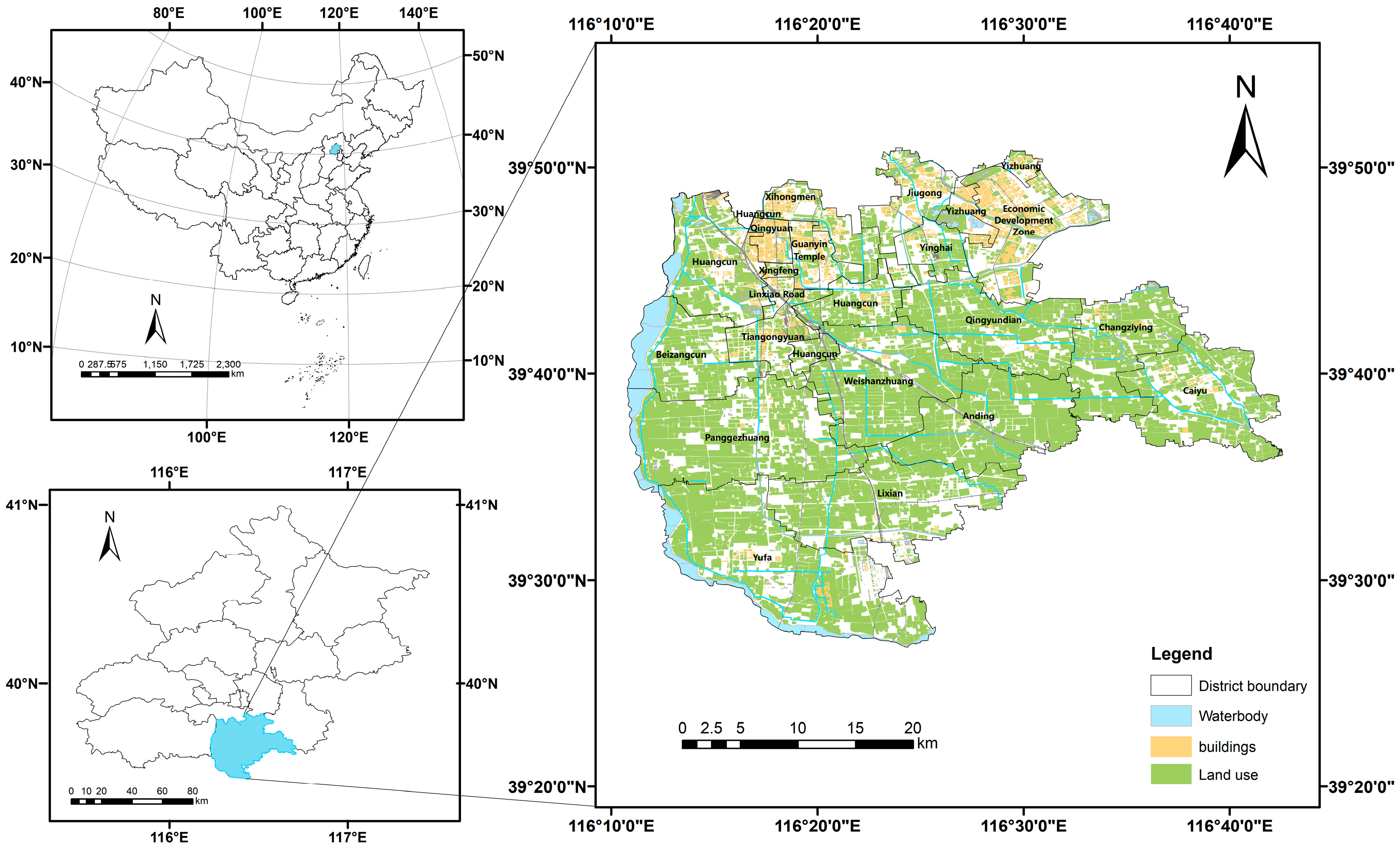
Daxing District, located in southern Beijing, serves as a pivotal node and demonstration zone for the Beijing–Tianjin–Hebei coordinated development strategy. It plays a bridging role in the relocation of non-capital functions and the promotion of regional synergy. As indicated by the Seventh National Census, Daxing District has 299,208 residents aged 60 and above, accounting for 15.0% of its permanent population—a sign that it has entered a phase of moderate aging. As an area undergoing rapid urbanization, Daxing is leveraging the “Daxing New Town” initiative to address accelerated population aging while establishing a four-tier elderly care system. This system is composed of district demonstration centers, town/street service centers, community/village stations and home-based care beds, with the aim of achieving full coverage within a 15-Min Community Living Circle. This study selects Daxing District as the research area (Figure 1). Geographically, Daxing District extends from 39°26′ to 39°51′ N and from 116°13′ to 116°43′ E. It covers an administrative area of 1036.33 km2, stretching 42.7 km from north to south and 45 km from east to west.

2.2. Data Sources and Preprocessing

The POI (Point of Interest) data for this study were collected from the Beijing Municipal Government Portal. Their spatial accuracy was verified by cross-referencing with the boundary map of the study area. Facilities with duplicate locations, those no longer in operation, or those with unverifiable qualifications were rigorously excluded from the dataset. After this screening process, 209 valid elderly care facilities were retained, forming the foundational dataset for spatial distribution analysis in Daxing District. In accordance with the classification framework provided by the Beijing Municipal Government Portal and guided by the principles of data representativeness, the facilities were categorized into two primary types:
(1)
Community-based home care facilities (144 units): This category encompasses elderly service centers, care centers, integrated centers, and community stations.
(2)
Institutional care facilities (65 units): This type comprises nursing homes, senior apartments, service centers, care centers, and social welfare institutions.
Spatial visualization was conducted using ArcGIS 10.8. All 209 POI samples underwent coordinate transformation (from WGS84 to CGCS2000) and projection (using the Albers Conical Equal Area) to generate the facility distribution map.
Population data were obtained from WorldPop, specifically utilizing 100 m resolution demographic grid datasets, which provide estimates of China’s 2020 total population and age structure for 2020. These raster datasets were calibrated using the Seventh National Population Census Bulletin of Beijing (No. 2) and its Daxing District counterpart to enhance demographic accuracy.
Road network data were acquired from OpenStreetMap (OSM). Processing steps included: (1) extracting walkable road and path features (e.g., residential, tertiary/secondary, unclassified, service, living_street, pedestrian, footway/path/steps) and excluding non-walkable or access-restricted classes (e.g., motorway/trunk and their links); (2) clipping the network to the Daxing District boundary; (3) topological reconstruction by merging contiguous segments with consistent attributes and splitting at intersections to ensure node-edge connectivity; and (4) building a topologically valid network dataset for subsequent walking-based accessibility analysis.

3. Methods

This study integrates kernel density analysis, the Gaussian Two-Step Floating Catchment Area (Ga2SFCA) method, and Moran’s index clustering to construct a spatial evaluation framework, which forms an analytical system of “spatial pattern identification–accessibility quantification–supply–demand coupling diagnostics”. Within this framework, KDE is employed as an exploratory spatial diagnostic tool to characterize the agglomeration pattern of point-based elderly care facilities at the district scale. As a non-parametric approach, KDE generates a continuous density surface to capture the spatial clustering of point features, thereby providing an intuitive depiction of the spatial distribution and macro-scale concentration of elderly care facilities [38]. KDE is implemented using the Kernel Density tool in the ArcGIS Spatial Analyst extension: facility location information is converted into point features, and a smoothed raster surface is produced to visualize facility density and the degree of spatial concentration or dispersion. Importantly, KDE in this study primarily reflects the morphological characteristics of facility supply and does not directly represent service accessibility or supply–demand performance. Accordingly, Ga2SFCA and spatial autocorrelation methods are subsequently introduced to quantify “effective coverage” and diagnose “supply–demand coupling”, thereby avoiding an oversimplified interpretation that equates density patterns with service attainment. The Ga2SFCA method addresses the boundary discontinuity inherent in the conventional 2SFCA approach [39]. By replacing binary catchment membership with a continuous distance-decay weighting scheme, Ga2SFCA quantifies elderly-care accessibility while jointly accounting for supply-side service capacity and demand-side population size, and it further reveals age-stratified disparities in service coverage. In terms of parameterization, consistent with the 15 min living circle concept, we set a 1 km walking threshold and apply a Gaussian distance–decay function to simulate the attenuation of walking willingness with increasing distance. This threshold is supported by explicit policy and planning guidance: Beijing’s standards for community-based elderly-care provision generally specify that service radii should not exceed 1 km. Relevant documents include the Notice of the Beijing Municipal Civil Affairs Bureau on issuing the “Design and Service Standards (Trial) for Community Elderly-Care Service Stations” (Jingmin Fufa [2016] No. 392) [40] and the “Opinions on Further Strengthening Meal Assistance and Delivery Services for Older Adults” (4 January 2019), both of which embody the principle of an approximately 1 km service radius. Therefore, a 1 km catchment is used to construct the search domain and conduct accessibility measurement, ensuring that parameter settings align with local service standards and enhancing the planning interpretability and policy relevance of the results. Moran’s-I-based clustering is then used to test the overall spatial pattern of supply–demand matching and its statistical significance using global Moran’s I and to further delineate local heterogeneity through bivariate Local Indicators of Spatial Association (LISA). Based on the LISA results, four zone types are identified, thereby enabling precise localization of “pain points” in supply–demand mismatch and providing spatial targets for differentiated resource-allocation strategies.

3.1. Kernel Density Analysis

Kernel Density Estimation (KDE) is a non-parametric statistical method used to estimate the probability density distribution of point features in spatial analysis. By generating a continuous density surface directly from sampled point data, KDE avoids prior assumptions regarding the underlying data distribution, thereby providing a visual representation of spatial agglomeration intensity. In the resulting output, higher density values correspond to stronger spatial concentration, whereas lower values indicate dispersion [41,42,43]. In this study, the Kernel Density tool of the ArcGIS Spatial Analyst module was employed to analyze the locations of elderly care facilities in Beijing. Point features were created from facility coordinates, and density values were computed across the study area to generate a smoothed raster surface. This output visually delineates spatial patterns of distribution density, highlighting areas of clustering versus dispersion and enabling the direct spatial visualization of agglomeration characteristics. The kernel density function is defined as follows:
D ( x i , y i ) = 1 u r i = 1 u k d r
where D ( x i , y i ) denotes the kernel density value at spatial coordinates ( x i , y i ) ; r represents the bandwidth (distance decay threshold); u indicates the number of point features within distance r from location ( x i , y i ) ; k is the spatial weighting function (kernel type); and d is the Euclidean distance between the current point and ( x i , y i ) .

3.2. Gaussian Two-Step Floating Catchment Area (Ga2SFCA)

The two-step floating catchment area (2SFCA) method simultaneously accounts for both supply- and demand-side factors, enabling a comprehensive and accurate assessment of accessibility to elderly care facilities. Considering older adults’ sensitivity to walking distance when selecting facilities, this study incorporates a Gaussian distance-decay function and applies the Gaussian 2SFCA (Ga2SFCA) method to evaluate the accessibility of elderly care facilities in Daxing District. The procedure consists of two steps:
Step 1: Taking an elderly care facilities j as the center, a catchment is delineated using the walking-distance threshold for older adults, with a radius of d0 = 1 km. The population at demand points within the catchment is discounted and weighted using the Gaussian function, and the supply–demand ratio within the catchment is computed as:
R j = S j i d i j d 0 G d i j , d 0 P i
where S j denotes the service capacity of facility j . The number of beds is used as the evaluation metric for elderly care facilities, and resource allocation is benchmarked by the covered population. d i j is the travel distance from demand point i to facility j . P i represents the population at demand point i within the catchment (measured using fishnet population counts). R j is the supply–demand ratio of facility j , reflecting its effective service capacity. G d i j , d 0 is the Gaussian distance–decay function, defined as:
G d i j , d 0 = e 1 2 × d i j d 0 2 e 1 2 1 e 1 2 d i j d 0 0 d i j d 0
Step 2: Taking each demand point i as the center, a catchment is similarly constructed with radius d 0 = 1 km. All elderly care facilities j within the catchment are identified, and their supply–demand ratios are aggregated using Gaussian distance–decay weights to obtain the accessibility of elderly care facilities for the corresponding age group. A larger value indicates higher accessibility:
A i = j d i j d 0 G d i j , d 0 R j
where Ai denotes the spatial accessibility of elderly care facilities at demand point i (larger values indicate better accessibility); Rj is the facility-to-population ratio of facility j within the catchment ( d i j d 0 ); and d i j is the travel distance between demand point i and facility j .

3.3. Moran’s I Clustering Analysis

Moran’s I, a statistical metric for quantifying spatial autocorrelation proposed by Australian statistician Patrick Alfred Pierce Moran in 1950, evaluates spatial distribution patterns (clustered, dispersed, or random) by measuring attribute similarity between spatial units and their neighbors. This index comprises global Moran’s I and local Moran’s I variants. For multivariate correlation analysis, scholars extended it to bivariate spatial autocorrelation [44]. This study employs ArcGis 10.8 for univariate Moran’s I analysis to identify the clustering characteristics of elderly care facility accessibility. It then utilizes GeoDa 1.18.0 to conduct bivariate spatial autocorrelation analysis at both street and grid scales. This approach examines spatial matching between facility supply capacity (composite accessibility aggregated from community-based and institutional facilities) and elderly demand intensity (population counts per grid). Moran’s I ranges from −1 to 1, where positive values indicate positive spatial correlation between variables, negative values signify negative correlation, and absolute values approaching 1 denote stronger spatial dependence. Conversely, values near 0 imply spatial randomness without significant spatial association. The global Moran’s I is calculated as:
I a p = N i = 1 N j i N W i j z i a z j p N 1 i = 1 N j i N W i j
where N is the total spatial units, W i j is the spatial weight matrix, z i a is the z-score of facility accessibility at unit i , and z j p is the standardized elderly population density at unit j .
The local bivariate Moran’s index assesses the spatial clustering characteristics of geographical units, with LISA (Local Indicators of Spatial Association) maps providing intuitive insights into spatial heterogeneity within the study area [45]. These maps categorize the relationship between the average accessibility of elderly care facilities at a given location and the mean accessibility of neighboring elderly populations into four archetypal patterns: two positive spatial autocorrelation clusters (high–high (HH) and low–low (LL)) alongside two negative spatial autocorrelation clusters (low–high (LH) and high–low (HL)). Through bivariate spatial autocorrelation analysis, the supply–demand equilibrium between elderly care facility capacity and elderly population demand intensity is quantified; this diagnostic framework identifies dominant factors influencing supply-demand balance across different regions by examining supply-side constraints, demand-side pressures, and transportation infrastructure limitations, thereby generating spatially targeted recommendations for optimizing facility allocation strategies across heterogeneous urban–rural contexts.

4. Results

4.1. Elderly Population Characteristics

4.1.1. Elderly Population Demographic Characteristics

According to the Seventh National Population Census of Daxing District (2020), the population aged 60 and above reached 299,208 (Table 1), accounting for 16.5% of the district’s total population—a share that classifies the district as an aging society. Compared with the results of the Sixth Census, the elderly population increased by 169,974 persons, representing a rise of 42.5% in the aging rate. Spatially, the elderly population exhibits a “central concentration–peripheral dispersion” pattern. Central subdistricts, such as Qingyuan, Xingfeng, and Linxiaolu, have elderly population shares exceeding 20%. In contrast, outlying towns such as Caiyu and Lixian, while containing relatively smaller elderly populations in absolute terms, face pronounced aging-related challenges, including a high prevalence of empty-nesting households.

4.1.2. Demand Heterogeneity Analysis

The elderly population exhibits multi-tiered and differentiated needs: individuals aged 80 and above show substantial reliance on basic living assistance, including meal support, bathing aid, and household services; those aged 70–79 demonstrate pronounced demand for chronic disease management and rehabilitative healthcare; while the “young-old” cohort (60–69 years) prioritizes social engagement through community activities and senior education [46,47,48]. Daxing District displays three critical tensions within its elderly demand structure: (1) a spatial mismatch between concentrated demand in peripheral areas and insufficient facility supply, which undermines service accessibility; (2) service homogenization, with an over-reliance on basic care and a notable shortage of specialized services such as psychological support and smart-eldercare solutions; and (3) information asymmetry, where less than 40% of older adults are aware of available community services, resulting in “unmet demand due to access barriers”.

4.1.3. Demographic Structure and Spatial Distribution

Data from 2023 indicate that the elderly population (aged 60 and above) in Daxing reached 223,000, accounting for 19.6% of the district’s total population—a proportion that exceeds the average for Beijing as a whole. This population exhibits pronounced age stratification: 54.3% are classified as the “young-old” (60–69 years), 32.1% as the “middle-old” (70–79 years), and 13.6% as the “oldest old” (80 years and above). A significant gender imbalance is also present, with females comprising 58.7% of the elderly population, resulting in a female-to-male ratio of 1.42:1.
Spatially, the distribution follows three distinct patterns:
(1)
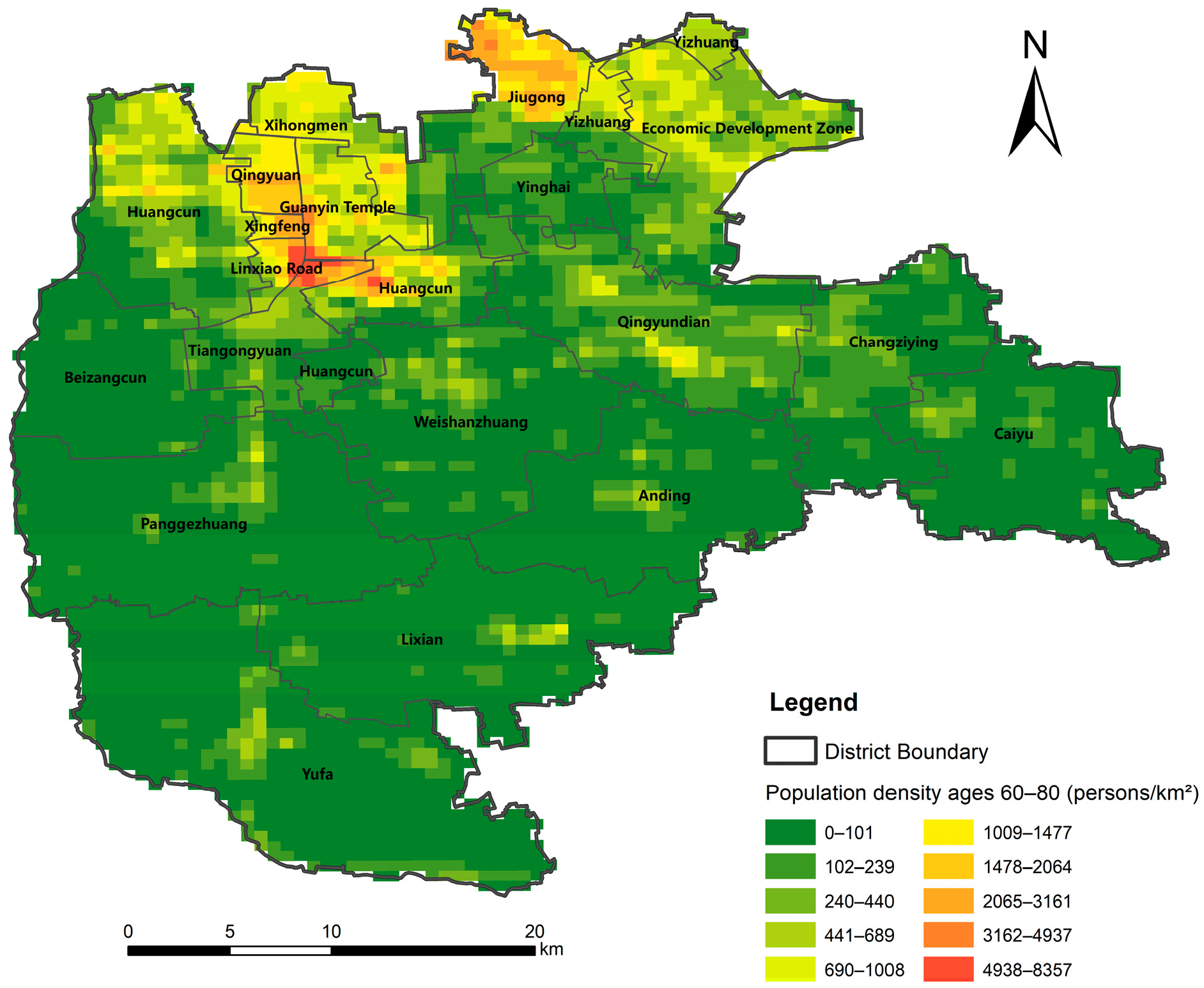
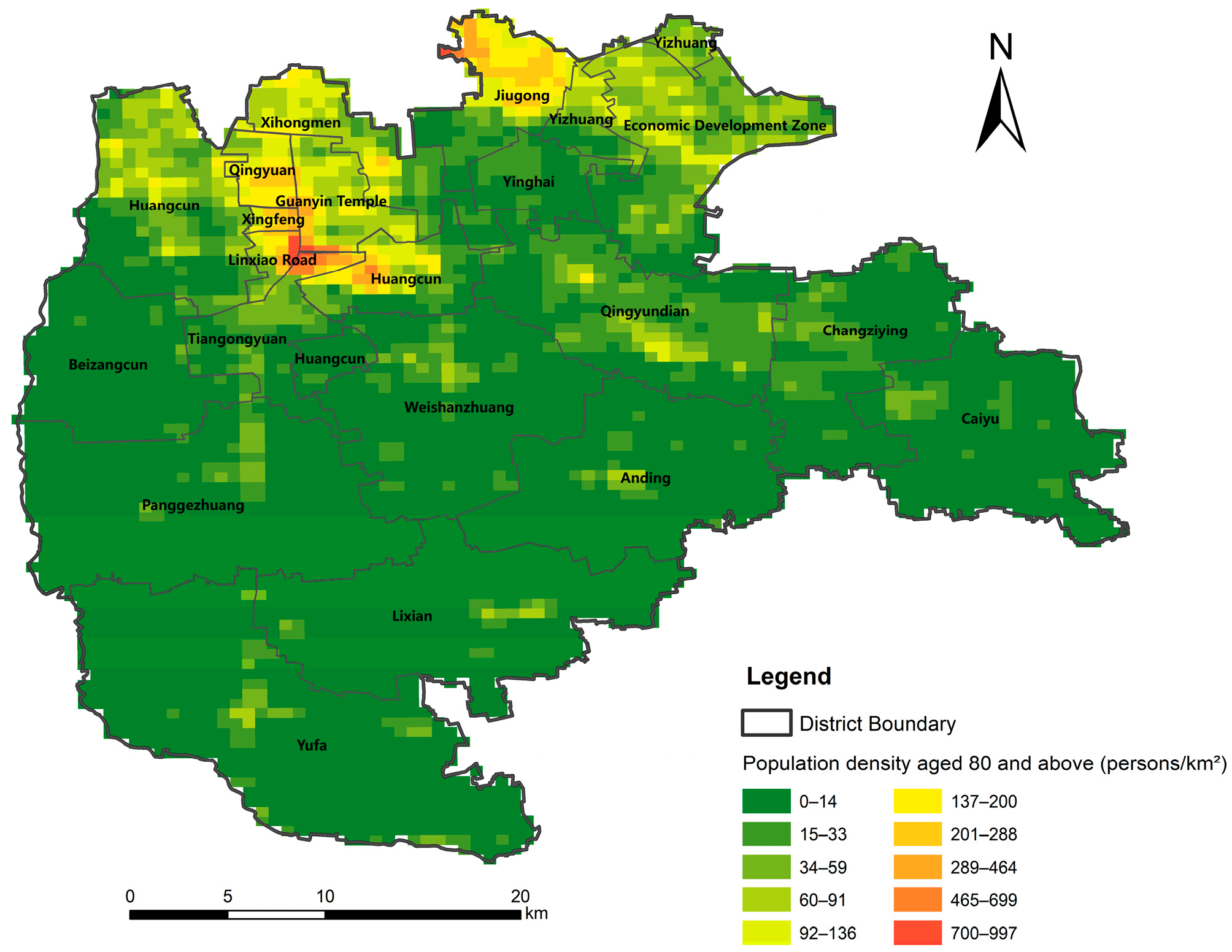
Concentric Zonation: Core urban areas, such as Jiugong and Huangcun, demonstrate high elderly population densities, reaching up to 12,000 persons per square kilometer. Spatial cluster analysis (see Figure 2 and Figure 3) further reveals a pronounced concentration of the oldest-old population (80+) within these zones.
(2)
Urban–Rural Disparity: While individuals with urban hukou constitute 67.4% of the elderly population, rural areas exhibit higher rates of population aging.
(3)
Household Structure: Empty-nesting affects 41.2% of all elderly households. Notably, 38,000 seniors live alone, over half of whom reside in resettlement communities in Yinghai.
Key socioeconomic attributes include:
(1)
Income Stratification: The average monthly pension is ¥4320, below the Beijing municipal average, while 4.3% of elderly residents rely on subsistence allowances.
(2)
Health Challenges: Chronic diseases are prevalent, affecting 82.4% of the elderly population. Additionally, 32,000 seniors—14.3% of the total—are partially or fully disabled.
(3)
Educational Gaps: 68.7% of older adults have attained a junior high school education or lower, a factor that exacerbates the digital divide in service access and utilization.

4.2. Spatial Distribution Characteristics of Elderly Care

4.2.1. Basic Profile of Elderly Care Facilities

As of April 2025, the integrated calculations of this study indicate that Daxing District has established a total of 209 elderly care facilities. These include 144 community-based facilities—such as care stations, senior service centers, and daycare centers—and 65 institutional facilities, including nursing homes, geriatric care institutions, senior apartments, and social welfare organizations. In terms of supply capacity, institutional facilities provide 15,026 beds, while community-based care centers serve a registered population of 154,130 individuals. Together, they offer an aggregate service capacity of 169,156, as reported in Table 2. Overall, the provision system is predominantly composed of government-operated providers, with supplementary involvement from market-oriented entities, and services remain concentrated on basic functions such as daytime care, health monitoring, and cultural activities. Consistent with the evolving elderly care landscape and the prevailing emphasis on the “aging-in-place” paradigm, community-based facilities constitute the dominant service front in Daxing District, not only outnumbering institutional facilities but also exhibiting a clear advantage in coverage-related service capacity. Notably, only 12% of facilities operate under integrated medical-care models, suggesting that medical coordination and specialized care provision remain relatively limited and that there is room to strengthen professionalized and continuous care support.

4.2.2. Spatial Distribution Patterns

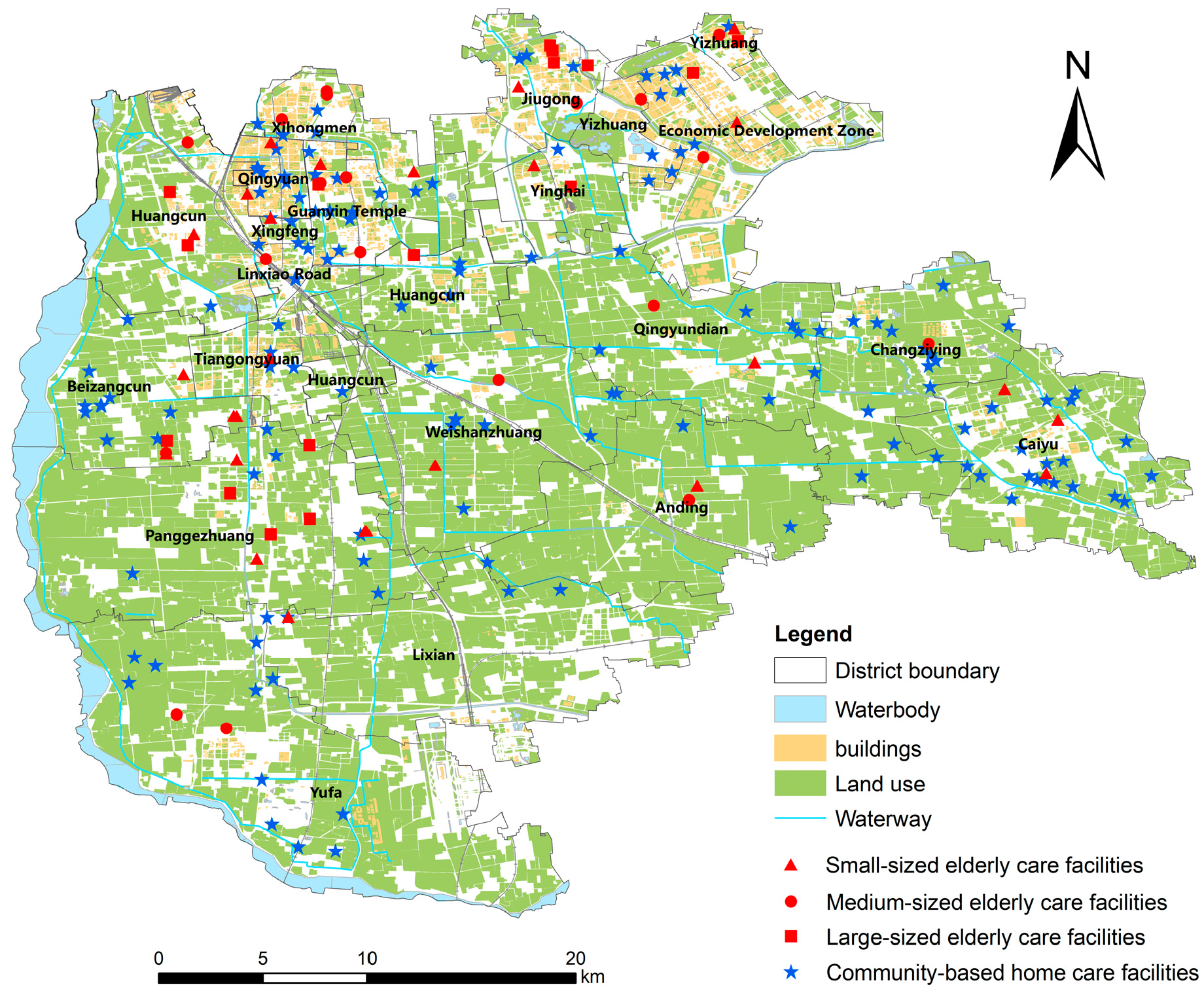
Currently, the distribution of elderly care facilities in Daxing District exhibits significant spatial disparity, characterized by a high concentration in the northern and eastern regions and limited availability in the central and southern areas. This pattern reflects a pronounced “core–periphery” structure, where service density sharply decreases from urban cores toward outlying zones. To enhance the precision and granularity of the analysis, this study classifies social elderly care institutions into large, medium, and small types according to their service capacity. Community-based home care centers are treated as a separate category. The spatial distribution of different types of elderly care facilities in Daxing District is presented in Figure 4.
The high-density areas of elderly care facilities in Daxing District largely correspond to zones with continuous built-up development and strong concentrations of population and residential communities. Clustering is particularly evident in areas that maintain close functional ties with central Beijing and benefit from relatively well-established public services and transport corridors, such as Qingyuan Subdistrict, Xingfeng Subdistrict, and Jiugong Town. By contrast, parts of southern Daxing exhibit low-density and even discontinuous distributions of facilities, due to more dispersed settlements, enlarged service catchments, and comparatively weaker support in public transport and facility-carrying conditions. In these areas, Lixian Town and Anding Town show the most pronounced supply shortfalls. Overall, this spatial divergence suggests that facility allocation does not follow a uniform, administratively even pattern; rather, it is jointly shaped by the urbanization gradient, the intensity of population agglomeration, and transport accessibility.
Qingyuan Subdistrict and Xingfeng Subdistrict constitute the core living circle, with an average of 2.3 elderly care stations per square kilometer. Service coverage in this zone extends to a radius of ≤500 m, reflecting a high density of facility distribution. The expanded living circle, which includes Huangcun Town and Xihongmen Town, exhibits a wider service radius of 1–2 km. However, this area currently faces severe bed shortages, with waiting periods extending up to three months. In contrast, towns such as Caiyu and Yufa, classified within the outer living circle, suffer from an insufficient number of elderly care stations, and some administrative villages remain entirely without facility coverage. As a result, elderly residents in these areas are often compelled to travel to neighboring towns or subdistricts for essential services such as medical care and shopping. This spatial pattern reveals two core issues in the allocation of elderly care facilities in Daxing District. First, resource redundancy is evident in central urban areas, where overlapping service catchment areas lead to low utilization rates—below 60% in some stations. Second, poor transport accessibility persists, particularly in peripheral towns, where sparse public bus routes force elderly residents to walk an average of 25 min to reach the nearest service facility.

4.2.3. Elderly Care Facility Spatial Distribution Characteristics

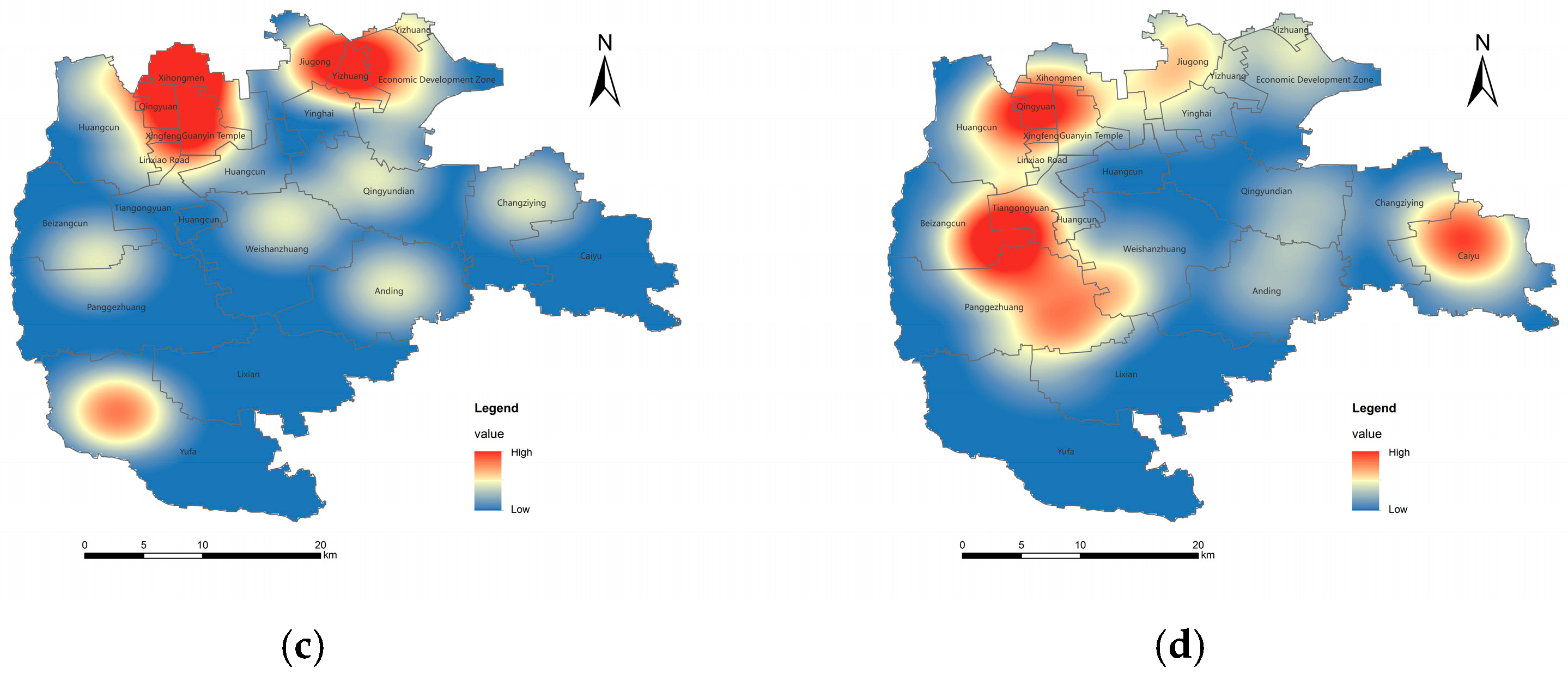
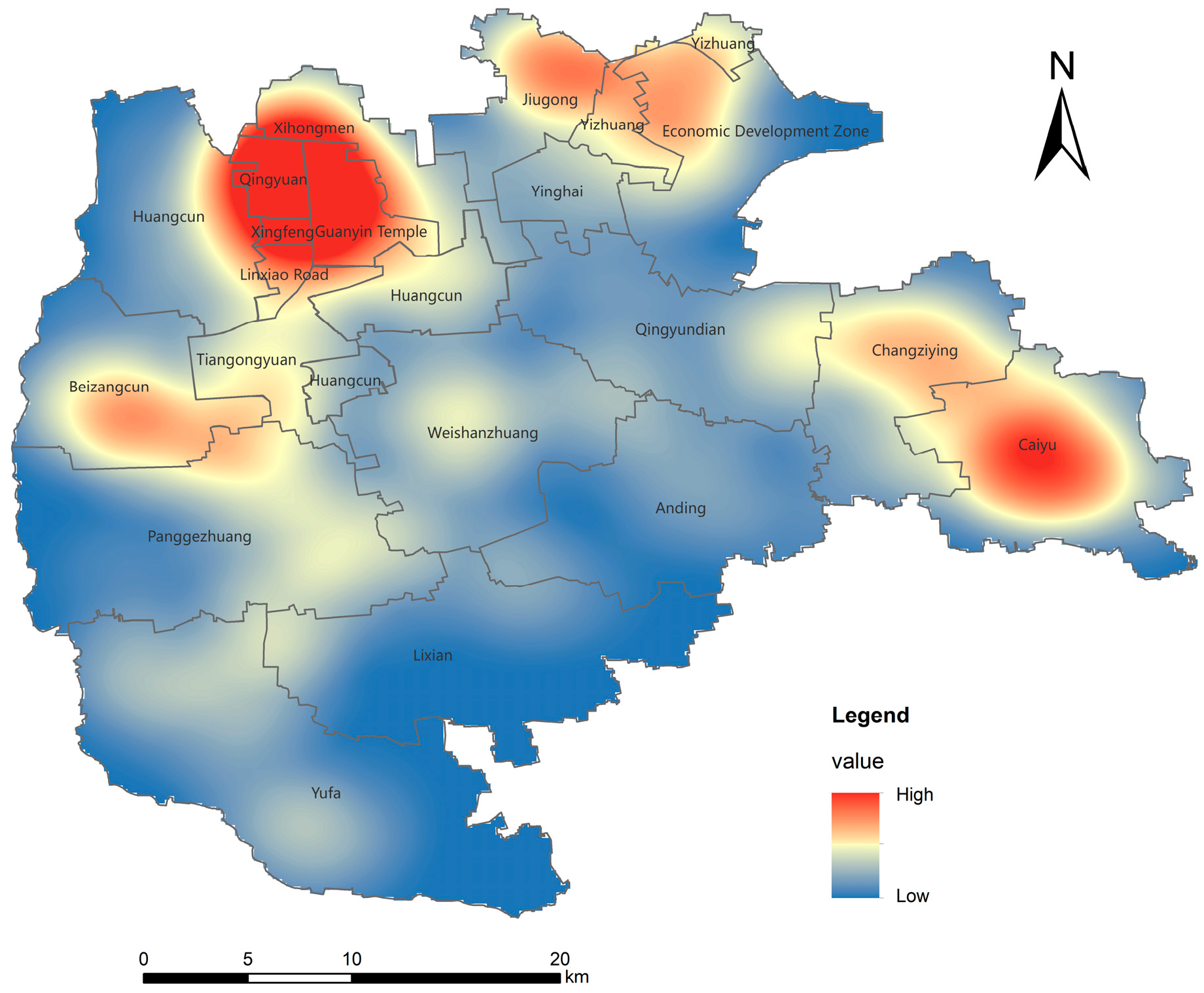
Kernel Density Estimation was conducted to examine the spatial distribution characteristics of elderly care facilities in Daxing District. The results indicate a pronounced polycentric agglomeration pattern, characterized by high concentration in the northwest and east and low density in the central and southern regions, as shown in Figure 5. High-value cores are primarily concentrated in the built-up area of the northwest, while a secondary agglomeration patch has formed in the east, represented by Caiyu Town and Changziying Town; in addition, several smaller-scale agglomeration units can be identified in the northeastern and western parts of the district. This spatial structure is consistent with the demand-side distribution and the broader development pattern: agglomeration areas tend to coincide with places where the elderly population is relatively large and functional activities are more concentrated, and facility clustering is therefore more likely to occur. Overall, polycentric agglomeration does not necessarily imply a balanced distribution of services; high-density deployment in core areas may entail risks of overlapping service catchments and efficiency disparities, whereas low-density belts in peripheral areas are more likely to correspond to potential shortfalls in service coverage and constrained accessibility.
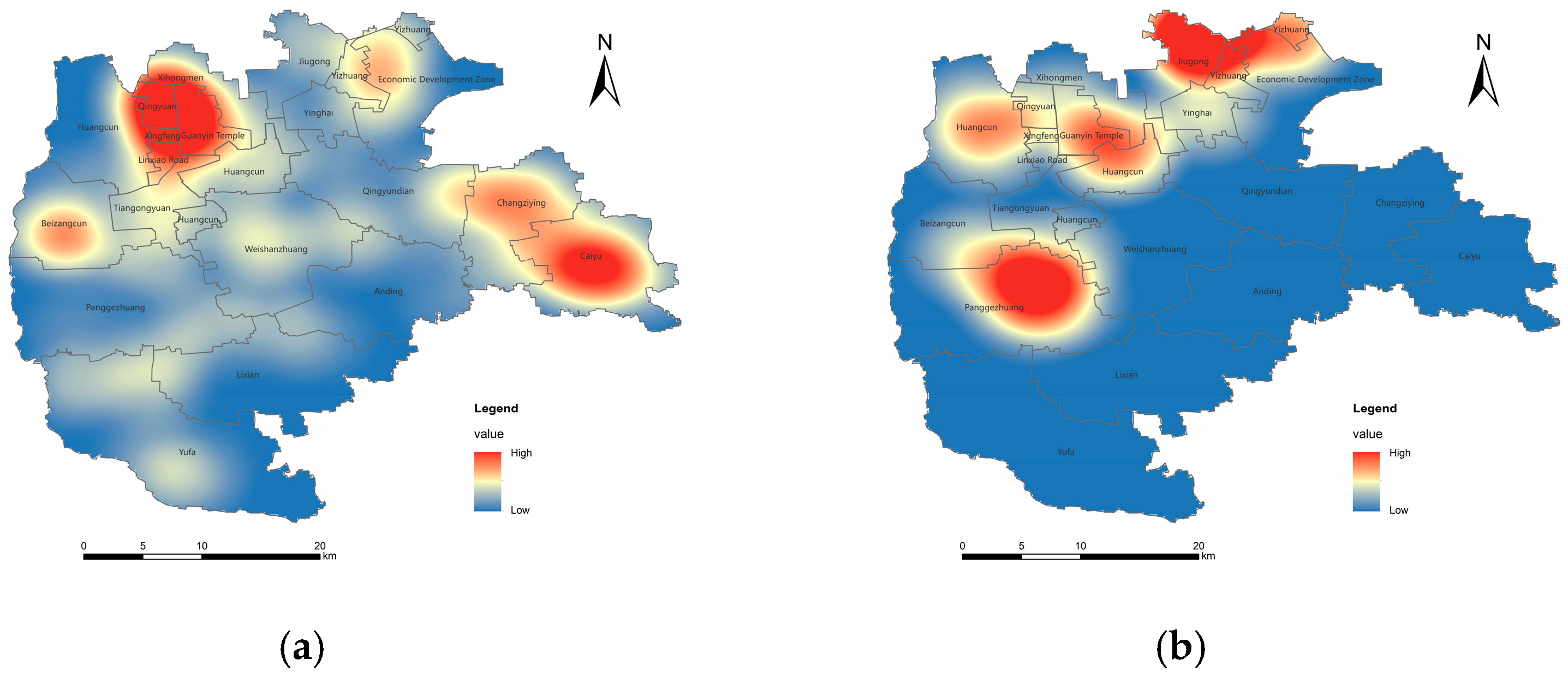
Disaggregating by facility type, community-based facilities exhibit a relatively continuous, network-like pattern and form stable hotspots in both the core built-up area and the eastern towns, reflecting their emphasis on high-frequency, short-distance services and their reliance on community embedding and continuous coverage. Institutional facilities display more pronounced nodal characteristics and hierarchical differentiation (Figure 6a). Large institutional facilities are fewer in number but show stronger agglomeration intensity, indicating a greater dependence on land conditions and comprehensive carrying capacity (Figure 6b). Medium institutional facilities exhibit a higher degree of spatial diffusion, combining high-density clustering in the core area with multi-point support across the district (Figure 6c). Small institutional facilities are more dispersed and show a more multi-nodal hotspot pattern (Figure 6d); they are more likely to rely on available stock space to form supplementary service nodes, and their distribution is largely shaped by the interaction between space availability and localized supply–demand gaps.

4.3. Spatial Accessibility Analysis of Elderly Care Facilities

4.3.1. Accessibility Analysis at Grid Scale

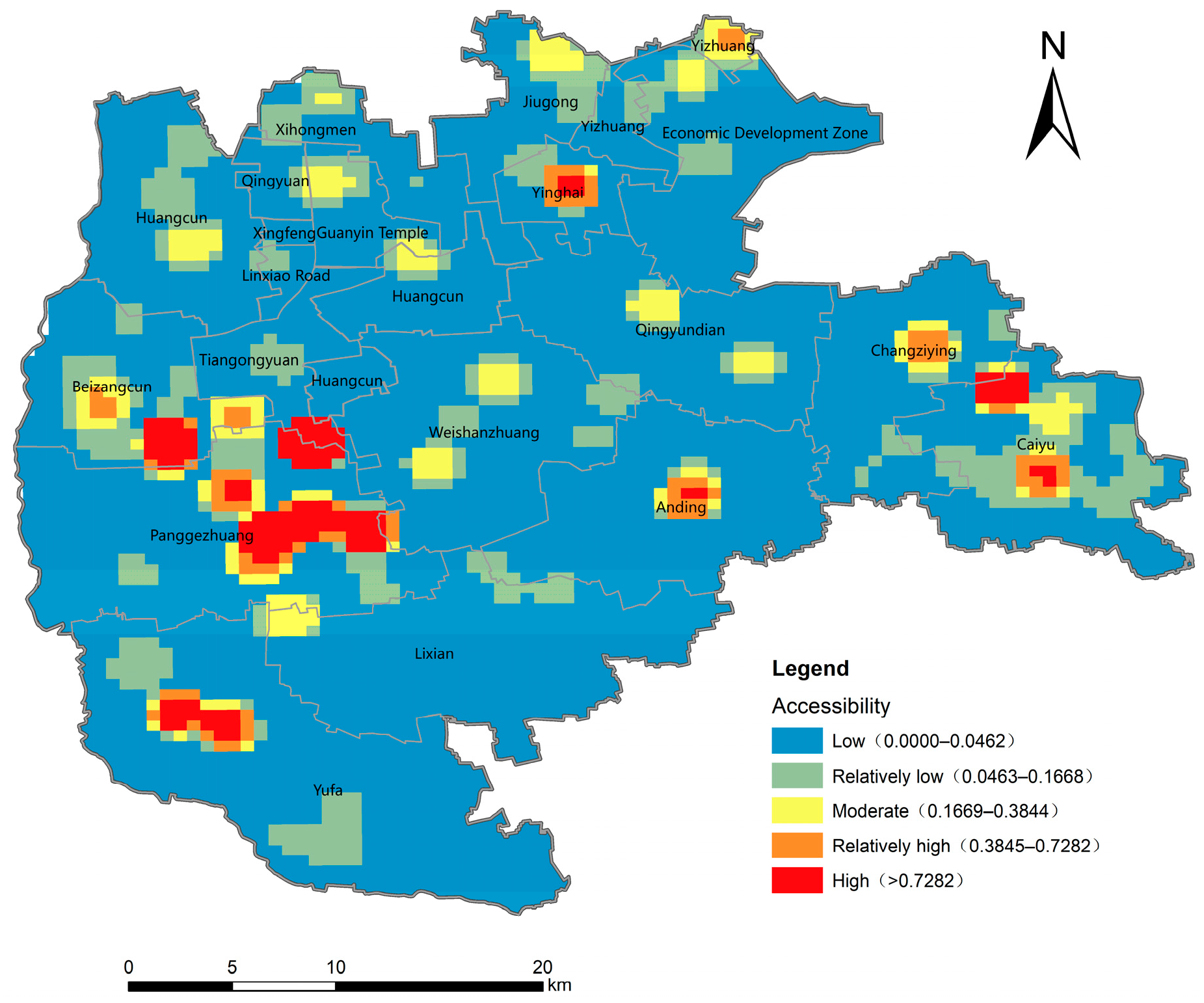
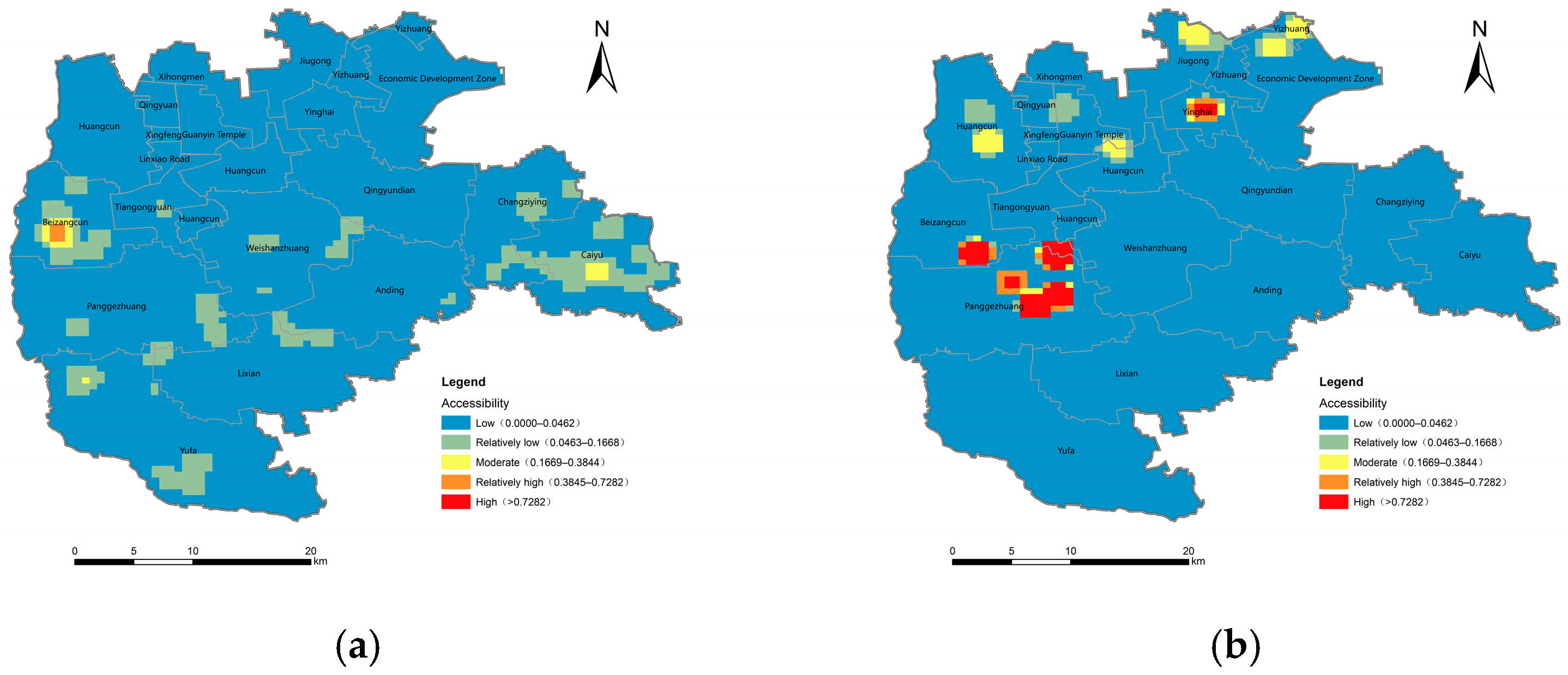
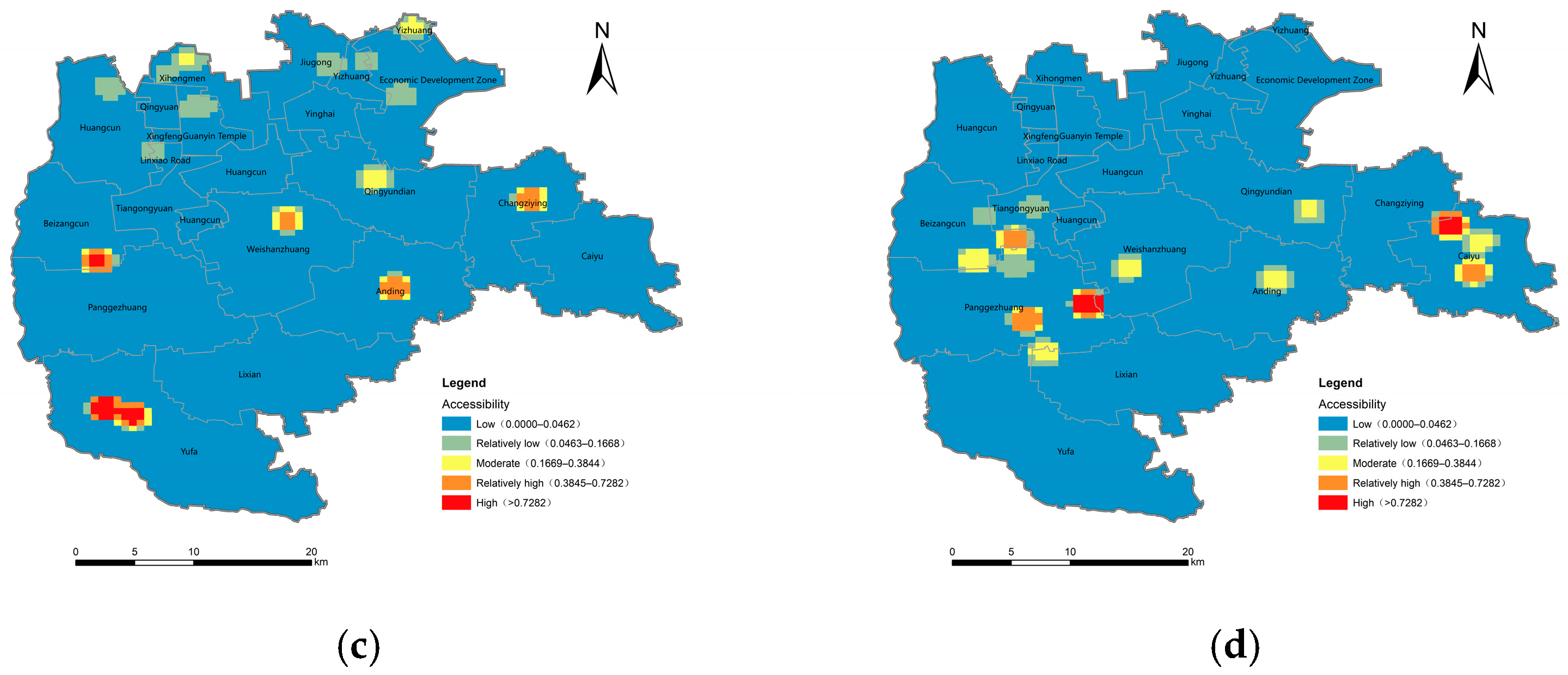
To examine spatial heterogeneity in population distribution across Daxing District, a 500 m × 500 m grid was employed, with population counts computed for each cell. The interpolated accessibility values were subsequently classified into five levels using the Jenks natural breaks method to facilitate visual representation. Figure 7 presents the overall spatial accessibility of elderly care facilities for the population aged 60 years and above in Daxing District. Figure 8 and Figure 9, respectively, illustrate accessibility levels for the 60–80 and 80+ age cohorts across different types of facilities. In these maps, red indicates the highest accessibility tier (values > 0.7238), blue represents the lowest tier (0 < values < 0.0462), and intermediate tiers follow a sequential color gradient in which warmer hues correspond to better accessibility and cooler hues denote poorer accessibility.
Based on the overall accessibility analysis of elderly care facilities for individuals aged 60 and above (Figure 7), low-value grid cells are widely distributed across most towns and sub-districts in Daxing District, especially outside the core urban areas. This indicates that, in the majority of demand grid cells, elderly care facilities are not effectively covered. Even in the relatively dense facilities of the central urban areas, the service coverage is still compressed due to the concentration of demand, resulting in large areas of low-accessibility zones. High-value grid cells exhibit a scattered distribution, primarily concentrated in more peripheral areas such as Panggezhuang Town and Caiyu Town. These areas have lower population densities, with facilities more concentrated, thus better meeting the needs of the local elderly population. However, these high-value zones do not form continuous coverage but appear as isolated hotspots, reflecting the imbalance in the overall supply distribution. Overall, the spatial layout of elderly care facilities in Daxing District presents a mismatch between supply and demand. While some regions have a relatively high supply, the elderly population’s needs in high-demand areas remain inadequately met.
As shown in Figure 8, accessibility for those aged 60–80 is lower than the overall level for those aged 60 and above, indicating a more pronounced mismatch between supply intensity and demand scale for this cohort. Because those aged 60–80 form a larger and more spatially continuous group than those aged 80 and above, higher demand density dilutes effective supply per unit demand, making high-accessibility areas difficult to develop into contiguous patches and leaving high values largely as scattered hotspots.
In particular, community-based facilities do not form the highest-level grid cells, with relatively higher values occurring only in localized areas such as Beizangcun Town and Caiyu Town, reflecting their role in nearby, high-frequency support that is readily diluted under broad, high-demand coverage. By contrast, institutional facilities show stronger differentiation, with point-like clusters of high accessibility. Large institutional facilities produce sharp local peaks through scale-based bed capacity but are constrained by capacity and turnover, limiting spatial spillover. Medium institutional facilities display a more dispersed pattern and broader coverage, functioning as multi-point support, while small institutional facilities mainly act as supplementary nodes that improve accessibility locally but do not substantially alter the extensive low-accessibility background in peripheral areas. Overall, the key shortfall for those aged 60–80 lies in insufficient effective coverage under dense demand conditions rather than a complete absence of facilities.
As shown in the accessibility grid map (Figure 9), the accessibility values of various types of elderly care facilities for individuals aged 80 and above are significantly higher than those for the 60–80 age group. Because the 80+ cohort accounts for a relatively small proportion of the total elderly population at 13.6%, its demand scale is comparatively limited, which makes the effective service supply available per unit of demand more likely to appear as higher accessibility levels. Within this age group, community-based home care service centers (Figure 9a) exhibit accessibility that is markedly better than that of other types of elderly care facilities, indicating stronger spatial fit. This suggests that, with recent shifts in elderly care preferences and the development of aging-in-place and community-based care models, community-based elderly care services targeting individuals aged 80 and above have been effectively implemented.
However, for individuals aged 80 and above, the accessibility of social elderly care institutions (Figure 9b–d) is lower than that of community-based home care service centers, and it displays relatively pronounced spatial heterogeneity. Specifically, a small number of areas with moderate or relatively low accessibility are observed surrounding areas of high accessibility. This pattern is mainly attributable to the relatively sparse spatial distribution of institutional facilities and the fact that service supply capacity, such as beds, is highly concentrated in a limited number of node facilities, thereby confining accessibility gains largely to localized areas in the immediate vicinity of these facilities.

4.3.2. Street-Level Accessibility Analysis

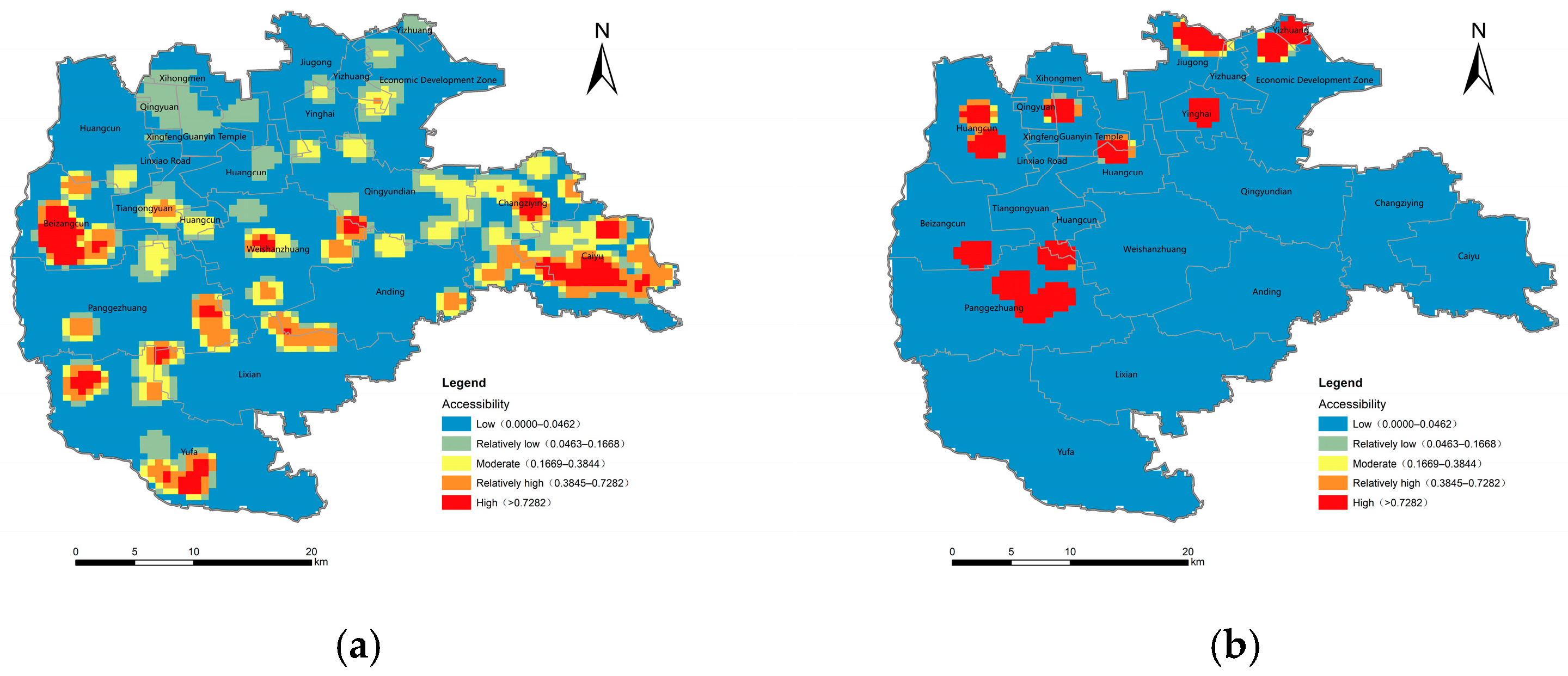
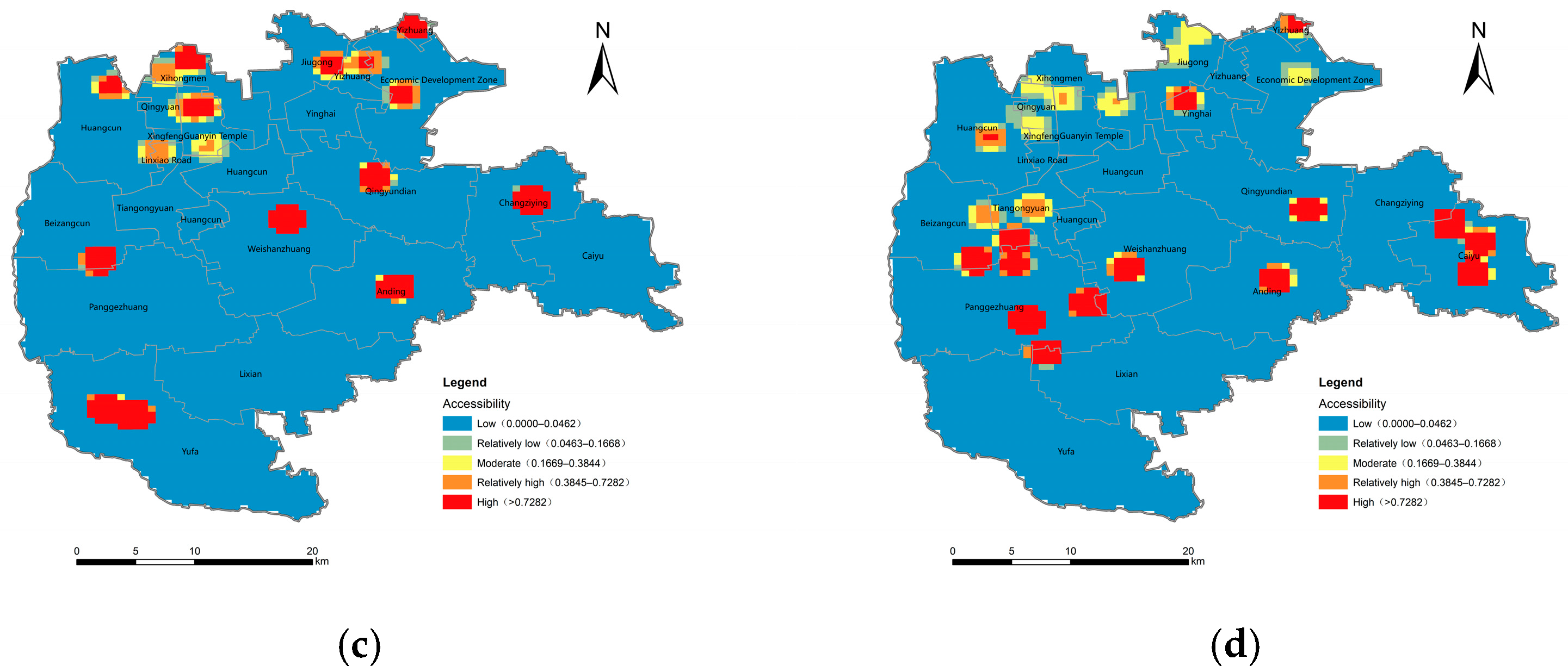
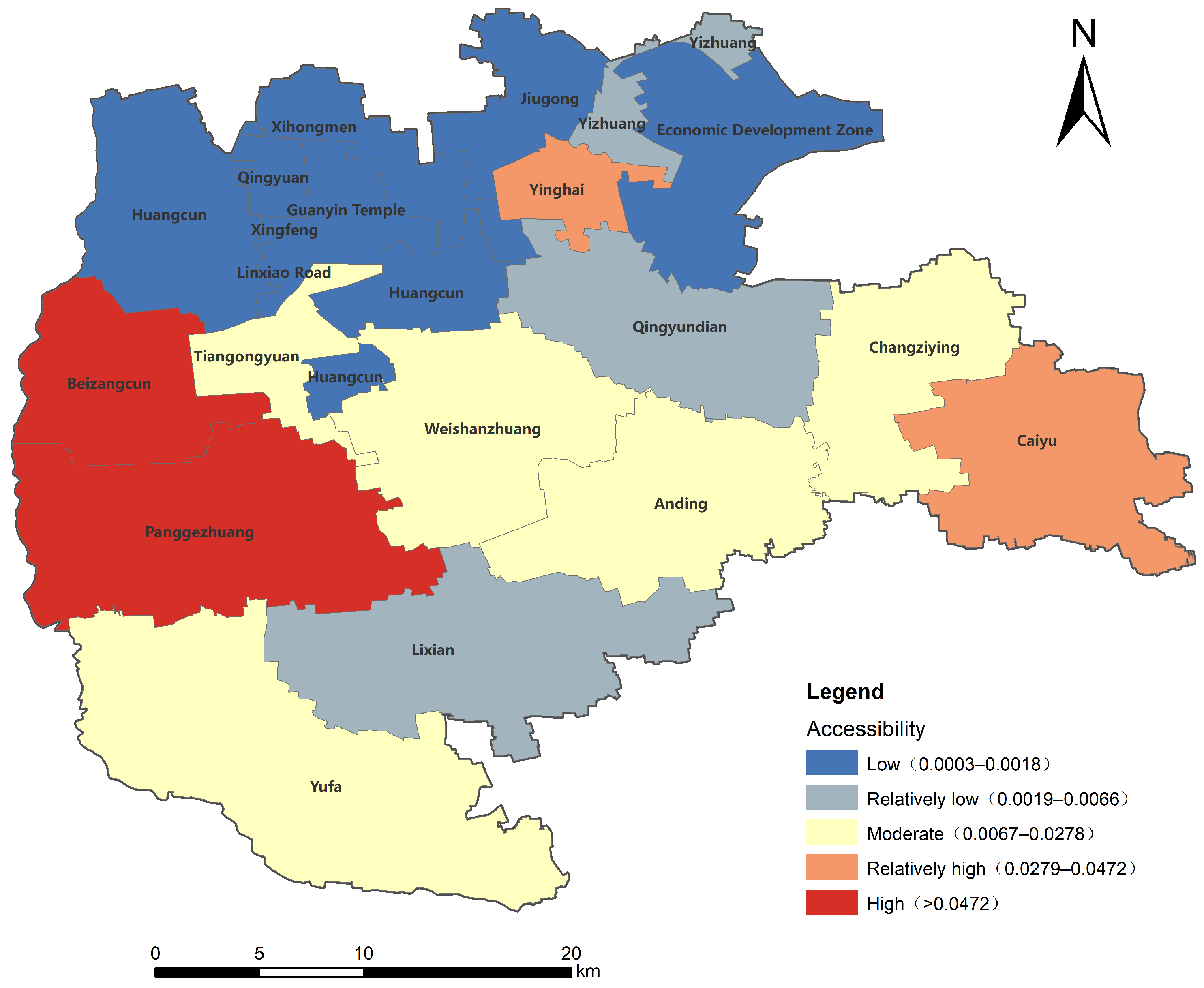
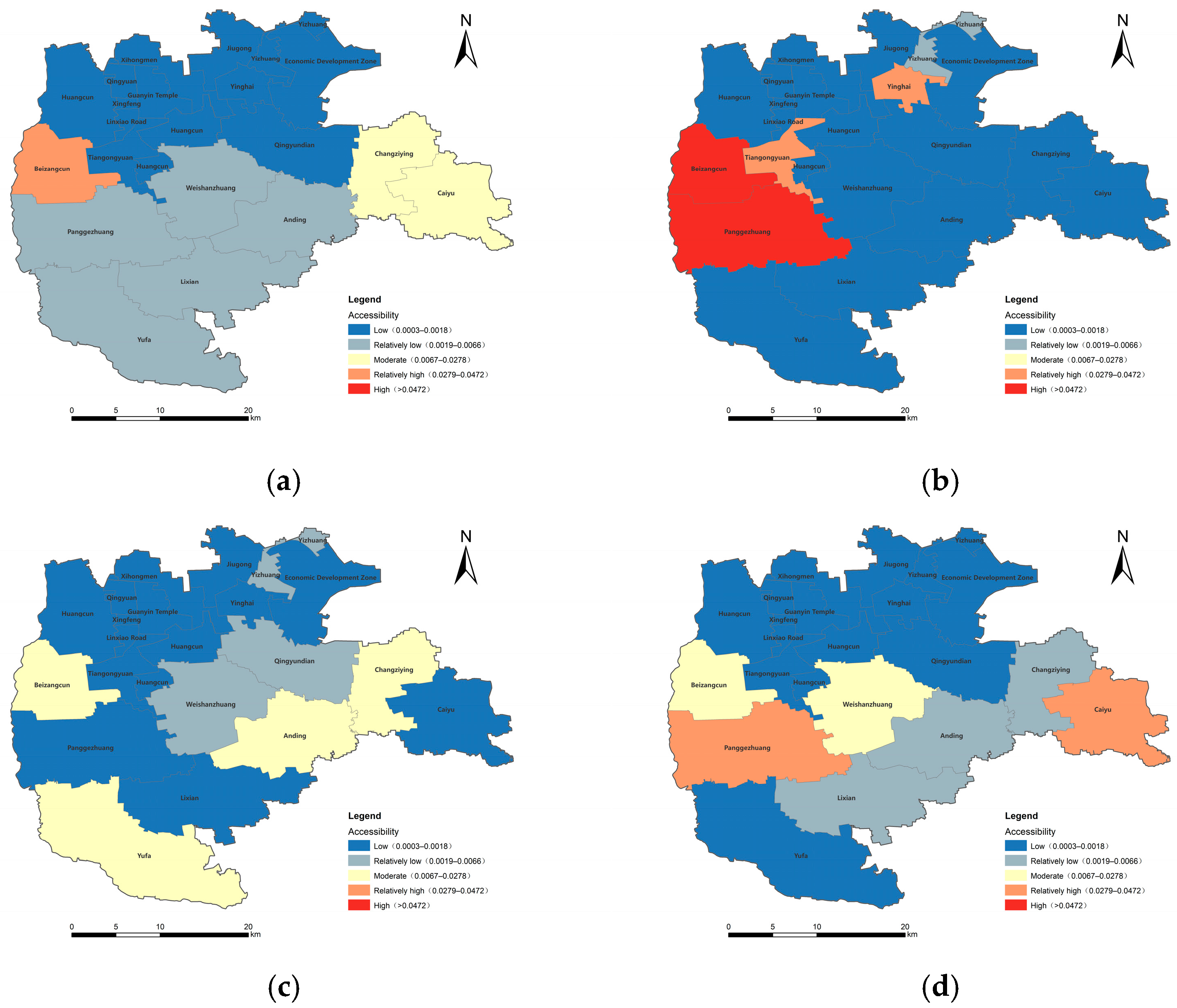
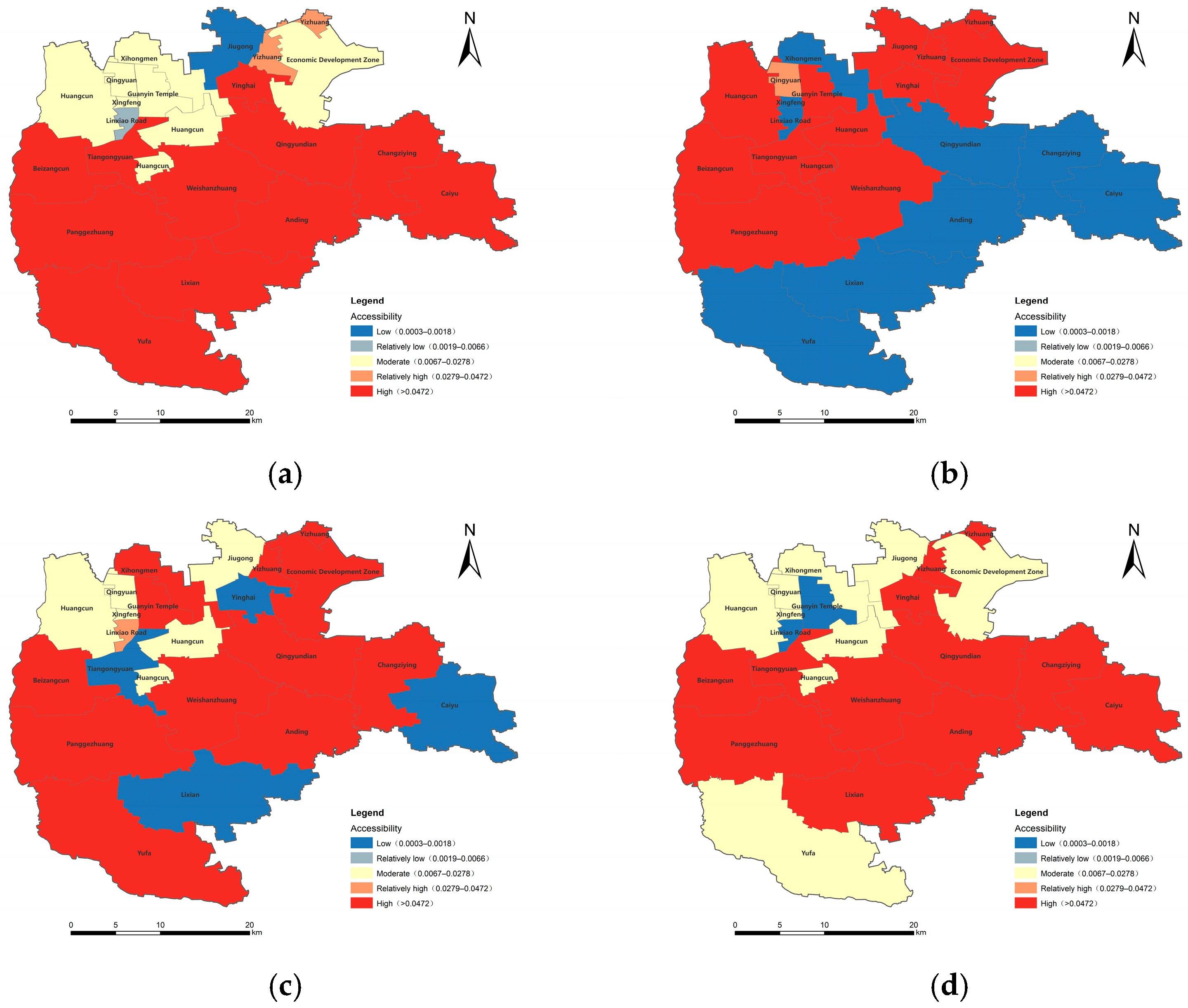
The calculated accessibility values were classified into five ascending levels to facilitate the visual analysis of elderly care facility accessibility across towns and subdistricts in Daxing District. Figure 10 presents the overall accessibility map of elderly care facilities for the population aged 60 and above across towns and subdistricts in Daxing District. Figure 11 and Figure 12 illustrate the accessibility of various elderly care facilities for the 60–80 age group and the 80-and-above age group, respectively. Regarding the accessibility of elderly care services for the population aged 60 and above in Daxing District at the town and subdistrict scale (Figure 10), the results reveal a distinct spatial structure characterized by a western high-accessibility core, a continuous belt of low accessibility in the north, and a localized uplift in the east.
Figure 11a shows that community-based home care facilities are foundational in nature and relatively dispersed in their spatial arrangement. However, for the population aged 60–80, their accessibility remains overall low, manifested as a low-accessibility cluster within the northern subdistrict group, alongside localized uplift areas in the eastern and southwestern parts of the district. Observing Figure 11b, the accessibility of large-scale elderly care institutions varies markedly across towns and subdistricts, with low-accessibility areas covering a wide extent, indicating an uneven spatial configuration. This pattern suggests that supply nodes are highly concentrated and that balanced, district-wide coverage is difficult to achieve. In comparison, medium-sized elderly care institutions exhibit a relatively more convergent pattern of accessibility across towns and subdistricts, yet the overall level remains generally low (Figure 11c). By contrast, the configuration of small-scale elderly care institutions is relatively more reasonable: low-accessibility areas are limited in extent, and a larger share of elderly residents can effectively obtain services.
For the population aged 80 and above, the accessibility of community-based home care services increases substantially, driven by reduced demand scale and targeted resource allocation. As shown in Figure 12a, the coverage of high-accessibility areas expands markedly, although moderate- and low-accessibility patches persist in the northern part of the district. Figure 12b further shows that the accessibility of large institutional facilities presents a pronounced diagonal differentiation between high and low values, indicating a spatially imbalanced configuration. For medium institutional facilities, higher-accessibility areas shift relatively southward, and the extent of low-accessibility areas contracts (Figure 12c). Among all facility types, small institutional facilities demonstrate the most favorable overall accessibility and a more balanced spatial pattern, indicating that they are more suitable as a nearby institutional-care supplement for the oldest-old population (Figure 12d).

4.4. Spatial Autocorrelation Analysis

Based on the bivariate spatial autocorrelation approach, this study examines the spatial matching relationship between the accessibility of elderly care facilities and elderly population density in Daxing District [29]. This method identifies both spatial coupling and mismatch between the two variables, and the local bivariate autocorrelation outcomes can be classified into four spatial relationship types: high–high, high–low, low–low, and low–high.
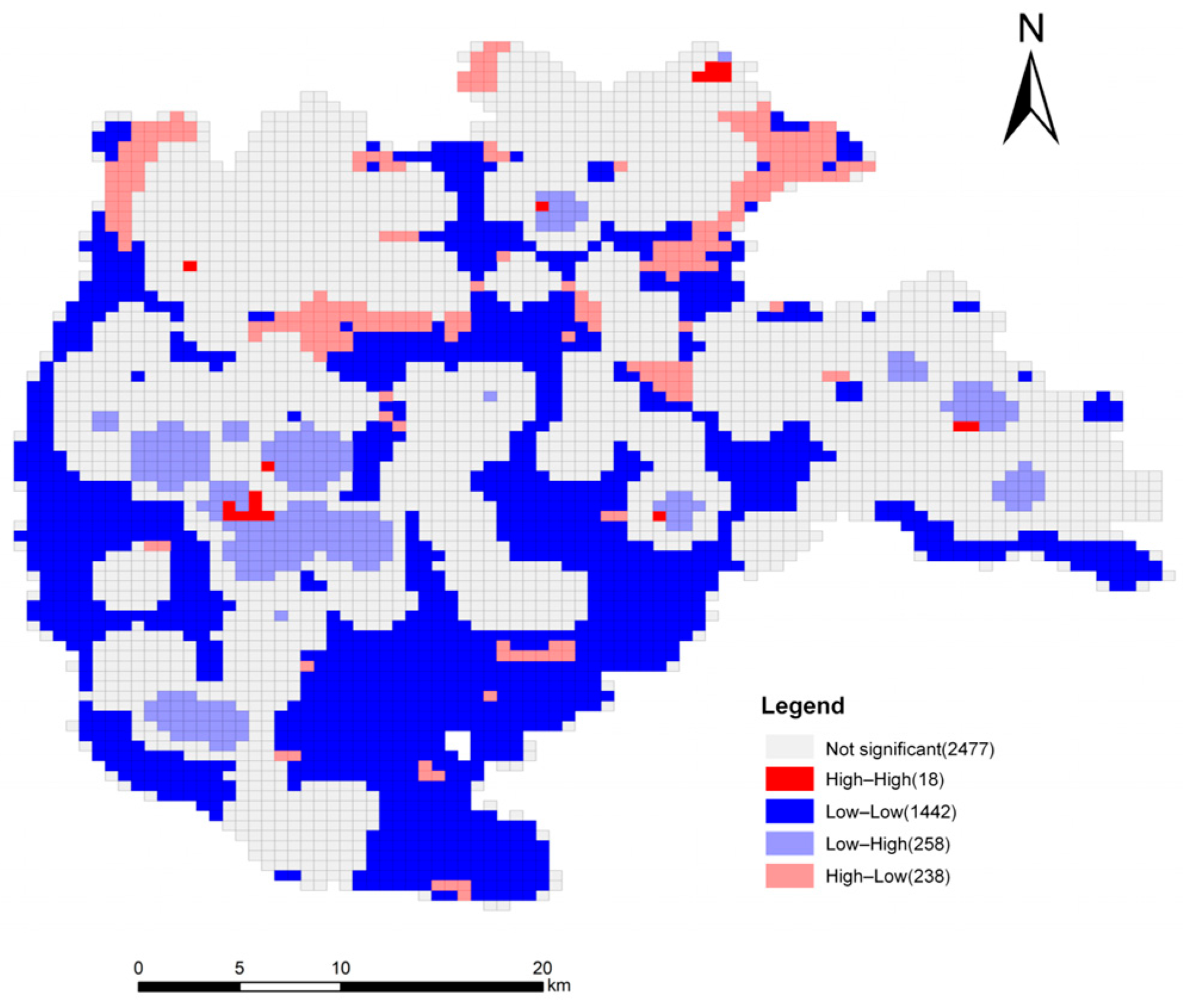
The global bivariate Moran’s I is 0.773143, indicating a statistically significant positive spatial co-variation between elderly care facility accessibility and elderly population density, i.e., the two variables exhibit a consistent co-clustering tendency in space. To further locate supply–demand matching and mismatch at the living-circle scale, this study applies local bivariate LISA to classify grid units. Spatial weights are specified using first-order Queen contiguity, significance is assessed with 999 permutations, and p ≤ 0.05 is used as the threshold. The results show that non-significant grids dominate, totaling 2477 (Figure 13).
Among significant grids, the low–low type is most prevalent, totaling 1442, and forms contiguous patches in the southern and peripheral areas, reflecting the co-clustering of low demand and low accessibility. This pattern is consistent with Daxing District’s spatial structure of “high-density built-up areas in the north and a low-density periphery in the south”, suggesting that, under the specified walking threshold, dispersed low-density settlement patterns combined with relatively sparse facility locations jointly produce a weak coupling characterized by “low demand–low accessibility” in peripheral areas. High–high grids are rare, totaling 18, and appear as scattered patches mainly in the northern built-up core and adjacent areas. These locations are characterized by relatively high concentrations of elderly residents and correspondingly high demand for services; meanwhile, accessibility remains relatively high, reflecting localized coupling between high demand and high accessibility. Of greater planning diagnostic significance are the two negative-association types. High–low grids total 238 and are mainly distributed along the northern population-concentrated belt and its edges, representing a shortage-driven mismatch in which demand is high but neighborhood accessibility is low. This indicates spatial asynchrony between facility coverage and the distribution of demand, resulting in unmet needs and an inefficient allocation of service resources; these are as should be prioritized for facility infill and network densification. Low–high grids total 258 and occur mostly as point-like clusters in some town centers or areas with relatively concentrated facilities, indicating a configuration deviation in which demand is comparatively low but accessibility is relatively high. This suggests that optimization should focus on consolidating existing resources and improving service efficiency, rather than blindly expanding new facilities.

5. Discussion

5.1. Contributions

The contribution of this study lies primarily in the policy-oriented operationalization of the living circle scale, the deepened diagnosis enabled by age-stratified demand, and its contextual value for optimizing elderly-care provision in megacity suburbs. Taking the living circle as the basic interpretive and evaluative unit, we move beyond describing accessibility differences at the grid and town/street scales and explicitly relate the observed patterns to planning questions such as whether services fall within a walkable catchment, whether coverage is continuous, and whether the service network requires facility infill and network densification or, alternatively, structural adjustment. On the demand side, we differentiate elderly age cohorts (e.g., 60–80 and 80+) and compare cohort-specific accessibility patterns and supply–demand mismatch types within a unified analytical framework, thereby revealing age-structural disparities and imbalances that can be obscured under aggregated statistics and strengthening the explanatory basis for tiered provision, facility-type configuration, and spatially targeted interventions. Finally, by grounding the analysis in a typical megacity suburban context—characterized by cross-jurisdiction commuting expansion, a more dispersed spatial form, and uneven service supply—the living-circle evaluative logic and the age-stratified diagnostic pathway developed here offer a transferable analytical reference for other metropolitan suburbs seeking to improve community-based elderly-care networks, remedy peripheral service gaps, and enhance allocation efficiency.

5.2. Limitations and Future Directions

This study presents several limitations that merit attention and suggest directions for future research. First, the current framework emphasizes potential spatial reach and does not fully capture effective access because facility quality, service scope, staffing capacity, and integrated medical care capability are not explicitly modeled. Second, the accessibility assessment is largely based on static cross-sectional inputs and therefore cannot reflect temporal variation in demand distribution, mobility conditions, or facility operation, which may lead to gaps between modeled accessibility and real-world service reach. Third, the study focuses on a single suburban district, so the transferability of the identified coupling patterns and the recommended strategies across different urban forms and policy contexts remains to be verified.
To improve on these limitations and build on the empirical findings, future research should focus on a small set of feasible extensions. One priority is dynamic accessibility assessment that incorporates time varying demand proxies and time sensitive travel impedance to better reflect spatiotemporal changes. A second priority is integrating service quality and capacity heterogeneity into the accessibility framework by differentiating facility tiers and using measurable indicators such as staffing, bed availability, service scope, and medical care integration, so that accessibility moves from potential reach to effective access. A third priority is comparative validation across multiple districts or cities to test the robustness of the coupling typology and to identify context dependent implementation conditions for suburban elderly care planning. Together, these extensions will strengthen the empirical basis and policy relevance of accessibility research and provide a more systematic and forward-looking analytical framework for elderly care planning and governance within China’s modernization agenda.

6. Conclusions

As a global demographic megatrend, population aging has intensified concerns over the equitable spatial allocation of elderly care resources. As the world’s largest developing country, China is proactively responding to the multifaceted challenges brought by an aging society. Nevertheless, ensuring fairness in the distribution of care resources remains a pressing policy issue. In megacities such as Beijing—the national capital—strategic spatial planning is essential, particularly in optimizing the provision and accessibility of elderly care services while harnessing demographic scale for sustainable development. Guided by the “living circle” framework, this study constructs a supply–demand matching evaluation system for elderly care facilities by integrating kernel density analysis, the Gaussian two-step floating catchment area (2SFCA) method, and Moran’s I index. Furthermore, Point of Interest (POI) data for elderly care facilities and road networks were collected through web crawling, enabling a spatially explicit assessment of service accessibility in Beijing’s Daxing District. The key findings are as follows:
(1)
While Daxing District has made progress in expanding elderly-care provision, our results indicate that equity challenges persist because walkable accessibility is unevenly aligned with elderly population concentration at the livingcircle scale. This mismatch is associated with unequal opportunities for timely care and health support. Accordingly, planning actions can be prioritized in a results-to-planning manner: (i) strategically expand facility coverage through targeted infill in living circles where high elderly density coincides with low accessibility; (ii) improve walkable and public-transport connectivity to reduce last-mile barriers and enhance continuous service coverage; and (iii) strengthen evidence-based spatial planning and service upgrading by coordinating facility types and service capacity with local demand profiles, thereby improving accessibility and potential service effectiveness.
(2)
The spatial distribution of elderly care facilities in Daxing reveals pronounced polarization, characterized by a “high concentration in the northwest and east, and low density in the central and southern regions.” This pattern results in a mismatch between the density of the elderly population and the location of facilities. Resources are disproportionately concentrated in certain zones, creating clustered service hotspots, while services for middle-aged and younger residents remain homogenized and undifferentiated. Spatially, Huangcun stands out as an “anomalous hotspot” with dense facility agglomeration, whereas emerging development zones lag significantly in service provision. The urban–rural transition zone exhibits a “gradient leap” in service coverage; the suburban ring zone demonstrates transitional and fragmented characteristics; and remote rural townships are distributed in isolated, “island-like” patterns, further exacerbating spatial inequity in care accessibility.
(3)
Trend Analysis of Accessibility Dynamics: Overall accessibility for elderly populations has improved substantially, with particularly notable gains observed among the oldest-old cohort (aged 80 and above). A marked urban–rural disparity persists, however: townships such as Yufa and Panggezhuang generally exhibit higher accessibility values compared to urban subdistricts such as Xingfeng. This pattern may be attributed to larger geographic areas, lower population densities, and consequently higher per capita facility resources in townships. In Daxing District, the supply–demand profile of elderly care facilities reflects a dual structure characterized by “priority allocation toward the elderly and pronounced urban–rural differentiation”. While core towns demonstrate high facility concentration, urban areas and several emerging zones—such as the National Independent Innovation Demonstration Zone—face significant supply shortages. This reveals the co-existence of a “center–periphery” gradient decline in service intensity alongside age-structured contradictions in resource targeting.
Moving forward, policy and planning efforts should prioritize enhancing overall spatial balance through refined, evidence-based planning, with particular attention to improving service coverage for elderly-dense urban neighborhoods and underserved emerging growth areas.

Author Contributions

Conceptualization, S.D.; data curation, X.L.; methodology, X.L. and M.Z.; supervision, P.N.; writing—original draft, X.L.; writing—review and editing, S.D. and P.N. All authors have read and agreed to the published version of the manuscript.

Funding

This research was funded by: (1) National Office for Philosophy and Social Sciences, Grant No. 24BJY098; (2) China Association of Higher Education, 2022 Planned Research Project on Higher Education Studies, Grant No. 22CJRH0404.

Data Availability Statement

The raw data supporting the conclusions of this article will be made available by the authors on request.

Conflicts of Interest

The authors declare no conflicts of interest.

References

  1. Asian Development Bank. The Challenges of Population Aging in the People’s Republic of China; Asian Development Bank: Mandaluyong City, Philippines, 2021. [Google Scholar] [CrossRef]
  2. Bao, J.; Tang, Q.; Chen, Y. Individual Nursing Care for the Elderly among China’s Aging Population. Biosci. Trends 2017, 11, 694–696. [Google Scholar] [CrossRef]
  3. Wang, X.; Hong, J.; Fan, P.; Xu, S.; Chai, Z.; Zhuo, Y. Is China’s Urban–Rural Difference in Population Aging Rational? An International Comparison with Key Indicators. Growth Change 2021, 52, 1866–1891. [Google Scholar] [CrossRef]
  4. Lee, S.; Ham, Y. Probabilistic Framework for Assessing the Vulnerability of Power Distribution Infrastructures under Extreme Wind Conditions. Sustain. Cities Soc. 2021, 65, 102587. [Google Scholar] [CrossRef]
  5. Wu, W.; Divigalpitiya, P. Availability and Adequacy of Facilities in 15 Minute Community Life Circle Located in Old and New Communities. Smart Cities 2023, 6, 2176–2195. [Google Scholar] [CrossRef]
  6. Li, M.; Peng, P.; Zhu, H.; Ao, Y.; Zhou, Z. Exploring the equitable spatial planning on the accessibility of institutional elderly care in megacity: A study based on Chengdu, China. Sustain. Cities Soc. 2024, 117, 105998. [Google Scholar] [CrossRef]
  7. Cheng, T.; Liu, C.; Yang, H.; Wang, N.; Liu, Y. From Service Capacity to Spatial Equity: Exploring a Multi-Stage Decision-Making Approach for Optimizing Elderly-Care Facility Distribution in the City Centre of Tianjin, China. Sustain. Cities Soc. 2022, 85, 104076. [Google Scholar] [CrossRef]
  8. Liu, B.; Qiu, N.; Zhang, T. Accessibility of Elderly Care Facilities Based on Social Stratification: A Case Study in Tianjin, China. Sustainability 2023, 15, 1507. [Google Scholar] [CrossRef]
  9. Rong, D.; Biscaya, S. Exploration of Supply–Demand Gaps of Urban Community-Based Elderly Care Facilities in Shanghai. City Built Environ. 2025, 3, 10. [Google Scholar] [CrossRef]
  10. Zhou, Y.; Tian, X.; Tang, Y.; Peng, P.; Deng, D. Exploring Supply and Demand Imbalance of Community-Based Older Adult Care: An Observational Study in Chongqing, China. Front. Public Health 2025, 13, 1581039. [Google Scholar] [CrossRef]
  11. Li, J.; Chen, N.; Yuan, Y.; Chen, Y. Research on the Planning of Elderly Care Facilities in Large Cities under the Context of Active Aging: A Case Study of the Planning of Community-Embedded Elderly Care Service Institutions in Guangzhou. Shanghai Urban Plan. 2024, 6, 55–61. [Google Scholar]
  12. Xing, Z.; Ni, X.; Hu, L. Research on the Spatial Coordination of Urban Elderly Care Facilities: A Case Study of Beilin District, Xi’an. Archit. J. 2024, S01, 204–209. [Google Scholar]
  13. Zhang, P.; Du, P.; Yu, Z.; Yang, S. Service Extension and Stock Integration: Spatial Allocation and Renovation Model Analysis of Embedded Community Elderly Care Facilities. Archit. J. 2023, S01, 14–19. [Google Scholar]
  14. Xie, Q.; Zhao, C. Measurement of the convenience of living circles in Guiyang City based on POI and AOI data. J. West. Hum. Settl. 2024, 39, 133–138. [Google Scholar]
  15. Wei, W.; Pan, X.; Xie, B. Research on the Planning and Configuration of Community Elderly Care Facilities Based on the “Urban People” Theory: A Case Study of Wuhan City’s Main Urban Area. Mod. Urban Res. 2022, 1, 30–37. [Google Scholar] [CrossRef]
  16. Chen, J.; Yan, L.; Wang, D.; Zhang, S.; Feng, G.; Wu, J. Precise Evaluation of the Quality of Supply and Demand Matching in Shanghai’s 15-Minute Community Living Circle. Shanghai Urban Plan. 2024, 6, 30–37. [Google Scholar]
  17. Xie, H.; Wang, X.; Wang, Z.; Shi, Z.; Hu, X.; Lin, H.; Xie, X.; Liu, X. Mismatch between infrastructure supply and demand within a 15-min living circle evaluation in Fuzhou, China. Heliyon 2023, 9, e20130. [Google Scholar] [CrossRef] [PubMed]
  18. Tang, Y.; Du, H. Spatial Optimization of Basic Public Facilities from the Perspective of a 15-Minute Walking Life Circle: A Case Study of Urumqi City. Hum. Geogr. 2025, 40, 154–161. [Google Scholar] [CrossRef]
  19. Li, Y.; Ran, Q.; Yao, S.; Ding, L. Evaluation and Optimization of the Layout of Community Public Service Facilities for the Elderly: A Case Study of Hangzhou. Land 2023, 12, 629. [Google Scholar] [CrossRef]
  20. Huang, X.; Gong, P.; White, M. Study on Spatial Distribution Equilibrium of Elderly Care Facilities in Downtown Shanghai. Int. J. Environ. Res. Public Health 2022, 19, 7929. [Google Scholar] [CrossRef]
  21. Li, Q.; Tian, Q. Spatial Distribution of Pension Institutions in Shanghai Based on the Perspective of Wisdom Grade. ISPRS Int. J. Geo-Inf. 2023, 12, 265. [Google Scholar] [CrossRef]
  22. Bai, S.; Di, D.; Yun, Y.; Song, Y. Visualization Analysis of Current Domestic Research Progress on Living Circles. Shanghai Urban Plan. 2024, 6, 123–130. [Google Scholar]
  23. Wei, L.; Zhang, L.; Fang, Y. Progress in the Application of Spatial Statistical Methods in Research on the Allocation of Elderly Care Resources in China. Chin. J. Gerontol. 2025, 45, 493–497. [Google Scholar]
  24. Nishino, T.; Amemiya, M. Case Study and Discussion Related to Actual Conditions of the Elderly’s Living Areas in the Small Local City and Appropriateness of Establishing an Official Senior Care Service Area. J. Archit. Plan. (Trans. AIJ) 2017, 82, 2489–2499. [Google Scholar] [CrossRef]
  25. Wang, N.; Ma, W. Evaluation Study on the Layout of Community Senior Living Facilities in the Main Area of Shanghai from the Perspective of Senior Life Circle. Sustainability 2023, 15, 10362. [Google Scholar] [CrossRef]
  26. Lee, J.Y. Assessing Happiness Policies in Seoul: Citizen Participation in Urban Planning. Plan. Pract. Res. 2023, 38, 464–475. [Google Scholar] [CrossRef]
  27. Artmann, M.; Mueller, C.; Goetzlich, L.; Hof, A. Supply and Demand Concerning Urban Green Spaces for Recreation by Elderlies Living in Care Facilities: The Role of Accessibility in an Explorative Case Study in Austria. Front. Environ. Sci. 2019, 7, 136. [Google Scholar] [CrossRef]
  28. Yang, C.; Xin, L.; Ma, D.; Jia, S.; Chen, C. Measurement Methods and Analysis of Influencing Factors for Community Living Circles Based on Location Service Data. J. Tongji Univ. (Nat. Sci. Ed.) 2024, 52, 232–240. [Google Scholar]
  29. Carmen, G.; Gerardo, C.; Houshmand, M. Measuring spatial accessibility to urban services for older adults: An application to healthcare facilities in Milan. Eur. Transp. Res. Rev. 2022, 14, 23. [Google Scholar] [CrossRef]
  30. Van Grootven, B.; van Achterberg, T. The European Union’s Ambient and Assisted Living Joint Programme: An Evaluation of Its Impact on Population Health and Well-Being. Health Inform. J. 2016, 25, 27–40. [Google Scholar] [CrossRef]
  31. Guo, S.; Dong, S. Research and Innovation of a Community Intelligent Pension Service System: Taking Longhua District, Shenzhen, China, as an Example. J. Comput. Sci. Technol. Stud. 2024, 6, 71–75. [Google Scholar] [CrossRef]
  32. Yu, B.; Cui, X.; Liu, X.; Chen, Y. A Study on the Spatial Distribution Pattern and Accessibility of Elderly Care Facilities in Chengdu City: Based on the Two-Step Travel Search Method (2SFCA). Cent. China Archit. 2022, 40, 83–87. [Google Scholar]
  33. Li, B. Spatial Distribution Characteristics and Accessibility Analysis of Medical Facilities in Dalian City Based on the Two-Step Travel Search Method. Surv. Spat. Inf. 2024, 47, 87–89. [Google Scholar]
  34. Li, M.; Yang, L.; Wei, Y.; Gao, S. A Model Study of the Two-Step Moving Search Method: A Case Study of Green Space Accessibility in Shanghai. Adv. Geogr. 2016, 35, 990–996. [Google Scholar]
  35. Ren, J.; Wang, Y. Analysis of the Spatial Accessibility of Parks and Green Spaces in Huangpu District, Shanghai, Based on an Improved Two-Step Travel Search Method. Prog. Geogr. 2021, 40, 774–783. [Google Scholar] [CrossRef]
  36. Zhao, D.; Hang, Z.; Wang, L.; Du, P.; Fu, J. A Study on the Accessibility of Urban Home-Based Elderly Care Facilities Based on the Two-Step Travel Search Method: A Case Study of Low-Age Elderly in Shahekou District, Dalian City. Reg. Res. Dev. 2014, 33, 27–32. [Google Scholar]
  37. Wang, Z.; Lin, R.; Yang, Y.; Liu, Q.; Jiang, J. Spatial Distribution and Accessibility of Institutional Elderly Care Facilities in Chengdu. Surv. Mapp. Sci. 2023, 48, 236–244+276. [Google Scholar] [CrossRef]
  38. JGJ 450-2018; Code for Design of Buildings for Elderly Care Facilities. China Architecture & Building Press: Beijing, China, 2018.
  39. Li, B.; Long, J.; Li, Y. Geospatial Analysis of Healthcare and Elderly Care Institutions in Wuhan: A Multi-Method Approach to Assessing Spatial Equity. Front. Public Health 2025, 13, 1580630. [Google Scholar]
  40. Jingmin Fufa [2016] No. 392; Design and Service Standards (Trial) for Community Elderly-Care Service Stations. Beijing Municipal Civil Affairs Bureau: Beijing, China, 2016.
  41. Zhang, D.; Ma, S.; Fan, J.; Xie, D.; Jiang, H.; Wang, G. Assessing Spatial Equity in Urban Park Accessibility: An Improve Two-Step Catchment Area Method from the Perspective of 15-Mintue City Concept. Sustain. Cities Soc. 2023, 98, 104824. [Google Scholar] [CrossRef]
  42. Natarajan, N.; Latif, S. Nonparametric versus Parametric (Both Unimodal and Mixed) Probability Distribution in Hourly Wind Speed Modelling for Some Regions of Tamil Nadu State in India. Stoch. Environ. Res. Risk Assess. 2023, 38, 535–569. [Google Scholar] [CrossRef]
  43. Węglarczyk, S. Kernel Density Estimation and Its Application. ITM Web Conf. 2018, 23, 00037. [Google Scholar] [CrossRef]
  44. Xiong, Y.; Bingham, D.; Braun, W.J.; Hu, X.J. Moran’sIStatistic-Based Nonparametric Test with Spatio-Temporal Observations. J. Nonparametr. Stat. 2018, 31, 244–267. [Google Scholar] [CrossRef]
  45. Huang, J.; Shen, S.; Cheng, C.; Song, C. Prefecture-Level Health Risk Assessment for Hot Extremes in China. Int. J. Disaster Risk Reduct. 2024, 108, 104561. [Google Scholar] [CrossRef]
  46. Saputro, D.R.S.; Widyaningsih, Y.; Widyaningsih, P.; Widiastuti, S. Spatio-Temporal Patterns of Dengue Hemorrhagic Fever (DHF) Cases with Local Indicator of Spatial Association (LISA) and Cluster Map at Areas Risk in Java-Bali Indonesia. AIP Conf. Proc. 2021, 2326, 020027. [Google Scholar] [CrossRef]
  47. Meng, W. Research on Optimization Strategies of Community Home-Based Elderly Care Service System in My Country. Front. Sci. Eng. 2025, 5, 163–170. [Google Scholar] [CrossRef]
  48. Gruzieva, T.S.; Diachuk, M.D.; Inshakova, H.V.; Soroka, I.M.; Dufynets, V.A. Health of the Elderly People as the Basis for Formation of Medical and Social Needs. Wiad. Lek. 2021, 74, 658–664. [Google Scholar] [CrossRef]
Figure 1. Overview of the study area.
Buildings 16 00742 g001
Figure 2. Population density ages 60–80 in Daxing District.
Buildings 16 00742 g002
Figure 3. Population density aged 80 and above in Daxing District.
Buildings 16 00742 g003
Figure 4. Distribution map of elderly care facilities in Daxing District.
Buildings 16 00742 g004
Figure 5. Kernel density of elderly care facilities in Daxing District.
Buildings 16 00742 g005
Figure 6. (a) Kernel density of community-based facilities; (b) Kernel density of large institutional facilities. (c) Kernel density of medium institutional facilities; (d) Kernel density of small institutional facilities.
Buildings 16 00742 g006aBuildings 16 00742 g006b
Figure 7. Grid showing accessibility of elderly care facilities for people aged 60 and above.
Buildings 16 00742 g007
Figure 8. (a) Accessibility grid for community-based home care for people aged 60–80; (b) Accessibility grid for large institutional facilities for people aged 60–80; (c) Accessibility grid for medium institutional facilities for people aged 60–80; (d) Accessibility grid for small institutional facilities for people aged 60–80.
Buildings 16 00742 g008aBuildings 16 00742 g008b
Figure 9. (a) Accessibility grid for community-based home care for people aged 80 and above; (b) Accessibility grid for large institutional facilities for people aged 80 and above; (c) Accessibility grid for medium institutional facilities for people aged 80 and above; (d) Accessibility grid for small institutional facilities for people aged 80 and above.
Buildings 16 00742 g009aBuildings 16 00742 g009b
Figure 10. Accessibility of elderly care facilities for people aged 60 and above in townships and sub-districts in Daxing District.
Buildings 16 00742 g010
Figure 11. (a) Accessibility of community-based home care for people aged 60–80 within township boundaries; (b) Accessibility of large institutional facilities for people aged 60–80 within township boundaries; (c) Accessibility of medium institutional facilities for people aged 60–80 within township boundaries; (d) Accessibility of small institutional facilities for people aged 60–80 within township boundaries.
Buildings 16 00742 g011
Figure 12. (a) Accessibility of community-based home care for people aged 80 and above within township boundaries; (b) Accessibility of large institutional facilities for people aged 80 and above within township boundaries; (c) Accessibility of medium institutional facilities for people aged 80 and above within township boundaries; (d) Accessibility of small institutional facilities for people aged 80 and above within township boundaries.
Buildings 16 00742 g012
Figure 13. Local bivariate LISA map of elderly population density and elderly care facility accessibility in Daxing District.
Buildings 16 00742 g013
Table 1. Elderly population data in Daxing District.
Age CohortManFemaleTotal
60–6552,52453,157105,681
65–7040,87743,74084,617
70–7521,81025,46047,270
75–8012,03114,93126,962
80+15,17919,49934,678
Total142,421156,787299,208
Table 2. Overview of elderly care facilities in Daxing District.
Types of Elderly Care FacilitiesTotal Number of FacilitiesService Capacity (Number of Beds/Beds, Population Coverage/Person)
Institutional nursing homes6515,026
Community care centers144154,130
Total209169,156
Data source: Compiled based on information provided by the Beijing Elderly Care Service Network.
Disclaimer/Publisher’s Note: The statements, opinions and data contained in all publications are solely those of the individual author(s) and contributor(s) and not of MDPI and/or the editor(s). MDPI and/or the editor(s) disclaim responsibility for any injury to people or property resulting from any ideas, methods, instructions or products referred to in the content.