Review

Advanced Sensing and Digital Monitoring Technologies for Structural Health Assessment of Civil Infrastructure

by
Arvindan Sivasuriyan
1,
Dhanasingh Sivalinga Vijayan
2,
Anna Piętocha
1,
Wojciech Górski
1,
Łukasz Wodzyński
1 and
Eugeniusz Koda
1,*
1
Institute of Civil Engineering, Warsaw University of Life Sciences, 159 Nowoursynowska St., 02-776 Warsaw, Poland
2
SRM Institute of Science and Technology, Vadapalani Campus, Chennai 600026, Tamil Nadu, India
*
Author to whom correspondence should be addressed.
Buildings 2026, 16(3), 656; https://doi.org/10.3390/buildings16030656
Submission received: 2 December 2025 / Revised: 19 January 2026 / Accepted: 3 February 2026 / Published: 5 February 2026

Abstract

Structural health monitoring (SHM) has evolved into an indispensable component for ensuring the safety, durability, and life-cycle efficiency of civil infrastructure. Over the past five years, significant technological advancements have been made in innovative sensing systems, facilitating real-time assessment of structural performance and the early detection of deterioration. This comprehensive review presents recent developments in smart sensor-based SHM, with particular emphasis on the convergence of the Internet of Things (IoT), artificial intelligence (AI), and digital twin (DT) frameworks. Our review critically examines advances in fiber-optic, piezoelectric, MEMS-based, vision-based, acoustic, and environmental sensors, as well as emerging multi-sensor fusion architectures. In addition, bibliometric insights highlight the significant rise in global research activity and influential thematic clusters in SHM between 2020 and 2025. The discussion underscores how AI-integrated data analytics, IoT-enabled wireless networks, and DT-driven virtual replicas enable intelligent, autonomous, and predictive monitoring of bridges, buildings, tunnels, and other large-scale civil infrastructure. Field deployments and case studies are analyzed to bridge the gap between laboratory-scale demonstrations and real-world implementation. Finally, key scientific and practical challenges—including the durability of embedded sensors, the interoperability of heterogeneous data, cybersecurity in connected systems, and the explainability of AI models—are outlined to guide future research. Overall, this review positions contemporary SHM as a transition from traditional damage detection to comprehensive life-cycle management of infrastructure through self-diagnosing, data-centric, and sustainability-driven monitoring ecosystems.

1. Introduction

Modern societies are supported by civil infrastructure (bridges, high-rise buildings, tunnels, dams, etc.), the safe and reliable functioning of which is the key to the economic growth and well-being of citizens. SHM is an indispensable discipline given the growing needs of services, the aging of structures, the transformation of loading plans, and sustainability issues. SHM can be defined as a systematic combination of sensing technology, data acquisition protocols, and analysis techniques used to conduct continuous monitoring of civil structures and ensure that timely maintenance interventions are implemented, life-cycle costs are optimized, and the structures become more resilient. Consequently, SHM has transformed from an intermittent inspection program into an extensive data-driven asset tracking protocol. The evolution of SHM over the last decade can be divided into three general phases. The initial phase, also known as the inspection age, was characterized by manual visual inspection with occasional reinforcement of instrumentation. The next stage was the age of instrumentation, where special sensors (e.g., strain gauges and accelerometers) were installed in structures, and data were collected periodically. The present generation, occasionally referred to as the digital age, is marked by ubiquitous surveillance, sensory intelligence, networked information streams, and algorithmic decoding. This tendency is best illustrated in contemporary surveys, which outline the development of SHM from reactive maintenance methods to predictive and prescriptive methods [1]. The current situation in the field of sensor technology, connectivity, and analytics is very promising due to a powerful convergence in 2020–2025, which has been empirically evidenced [2].
A significant catalyst in this paradigm shift is the substantial improvement in sensing technology. The cost and physical size of sensors have significantly decreased, while their robustness and accuracy have increased. Fiber Bragg Gratings (FBGs) and distributed fiber sensors have been reviewed in the literature and are widely used in civil engineering applications due to their immunity to electromagnetic interference, long-term stability, and ability to provide distributed measurements over kilometer scales [3]. At the same time, MEMS accelerometers, low-power wireless platforms, and camera-based vision systems have reached a high level of technological maturity. For example, the MEMS-based method can enable large-scale sensor networks, while vision techniques using uncrewed aerial vehicles and high-resolution cameras can enable non-contact detection of crack progression, displacements, and surface degradation [4,5].
As a result, the sensing landscape has expanded, a direct consequence of the temporal focus of this review (from 2020 to 2025). However, sensing is not enough; connectivity and data architecture are necessary aspects of SHM. Thanks to the ubiquitous presence of the Internet of Things (IoT), cloud computing, edge computing, and other technologies, sensor networks can transmit data in real time, be dynamically reconfigured, and be used for remote diagnostics. Recently, a scientometric analysis demonstrated a significant upward trend in IoT-enabled SHM-related research over the past decade, reflecting a shift toward integrated sensor networks over isolated sensors [6]. In particular, when applied to civil infrastructure in seismic or high-traffic areas, the installation of wireless low-latency monitoring systems integrated with emergency management systems is of great interest. High-rise and ultra-tall buildings have been placed under pressure from rapid urbanization, rising energy needs, and climate change demands; consequently, multi-criteria sustainability evaluation and digital technologies like IoT and digital twins are increasingly considered as essential means for enhancing operational effectiveness and environmental performance for these structures [7,8].
The integration of analytics—specifically, artificial intelligence and machine learning—has shifted the concept of monitoring from simple data recording to a complex decision support system. Increasingly, algorithmic methodologies for anomaly detection, useful-life estimation, and prognostication are used in place of conventional modal-analytic, threshold-based rule frameworks. Recent surveys on deep learning methods for SHM have showcased the use of convolutional neural networks, recurrent architectures, and hybrid physics–data synergistic approaches operating at the scale of monitoring data to improve the autonomy and scalability of SHM [9]. For instance, feature learning is now widely used, replacing manual feature extraction in most current image-based fault detection frameworks to achieve better in situ damage detection accuracy [10]. Additionally, the rise of digital twin (DT) technologies enables the fusion of monitoring systems, sensor networks, and analysis routines into a unifying platform: a DT can represent physical assets, ingest real-time sensor data, and model future behavior, allowing SHM to be embedded into an end-to-end life-cycle decision-making framework [11].
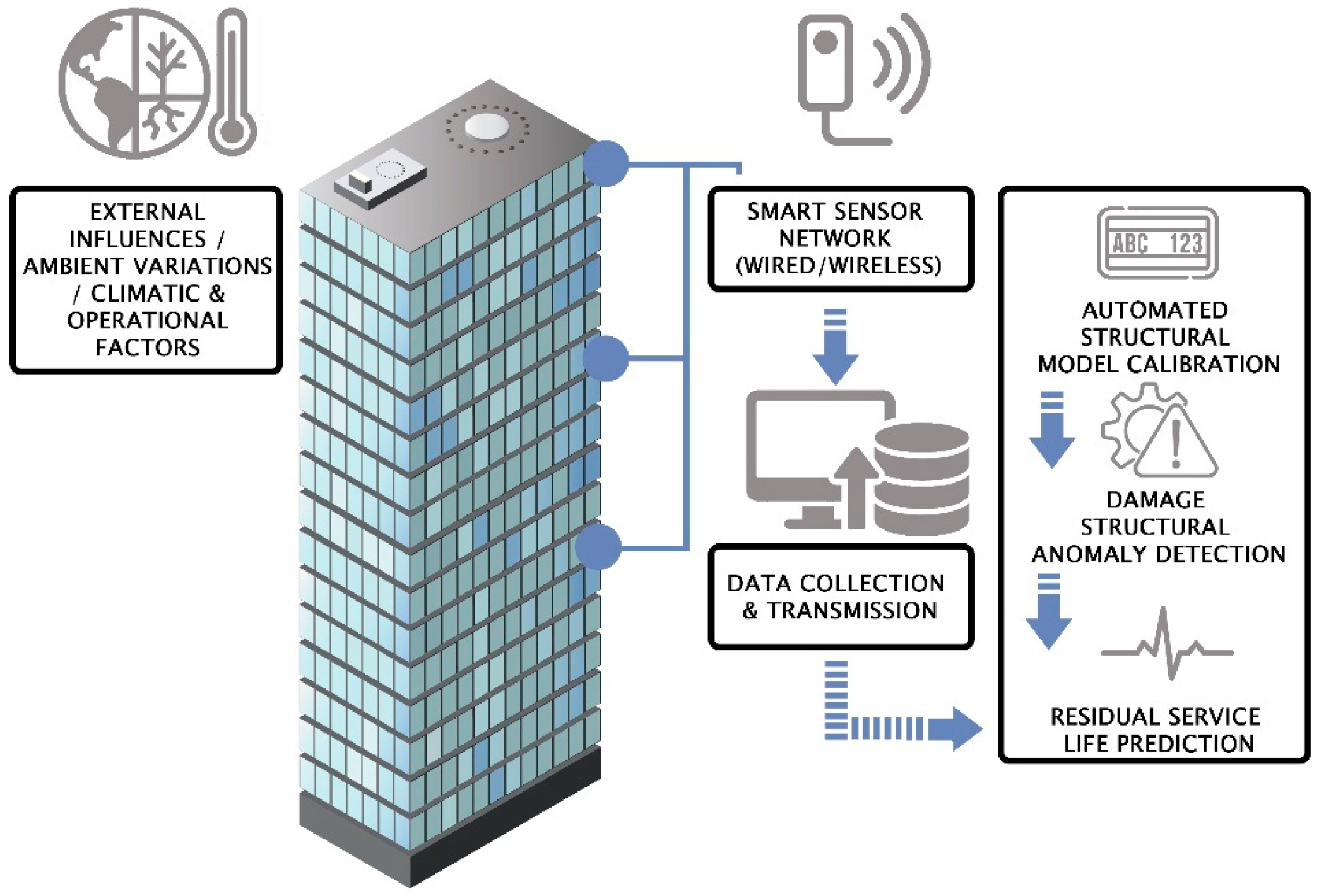
Sustainability issues are equally important. Empirical evidence shows that SHM systems must be integrated into environmental, economic, and social sustainability goals, as shown in Figure 1, e.g., minimizing the embodied energy of sensors, optimizing inspection scheduling, prioritizing data-driven deployment over blind replacement, and maximizing user safety and service continuity [12]. An implementation framework for sustainable SHM illustrates the high levels of interdependence between technical, organizational, and social factors. Sensor scheduling and data transmission strategies are a key part of the cost-versus-environmental impact [13]. In countries like India, where significant infrastructure portfolios are combined with limited fiscal resources, the salience of these dimensions of sustainability has significantly increased [14,15].
There are several benefits to focusing on the 2020–2025 period for high-impact review articles. It can facilitate detailed treatment of the fast-maturing and -consolidating sensor connectivity–analytics ecosystems, document the shift toward integrated SHM solutions rather than isolated parts, and align with global infrastructure initiatives focused on resilience and sustainability. This review aims to chart emerging trends in sensing technologies and their adoption in SHM systems for civil structures; to review applications of the Internet of Things (IoT), artificial intelligence (AI), and digital twin frameworks; and to highlight existing gaps in research and practice. Unlike many previous reviews that only cover a single sensor family or technique, the present work highlights cross-modality comparison, system-level integration, real-world deployments, and sustainability perspectives [16].
Overall, SHM is at a very important inflection point: sophisticated sensing hardware is easily accessible, connectivity is everywhere, and data analytics have become sufficiently sophisticated. These convergences show that it is possible to build smart infrastructure capable of self-monitoring, reporting anomalies, predicting a failure, and encouraging optimized maintenance decision-making. However, there are still notable issues, namely how to make sensor networks resilient to extreme environmental factors, how to process large volumes of data and large-scale structures, how to balance procurement and operational costs with sustainability, and how to incorporate the SHM functionality into current asset management procedures. As the demand for resilient infrastructure increases at an alarming rate—particularly in the emerging economies—this review is well timed and useful in guiding scholars and practitioners in this field to come up with a new generation of SHM systems.

1.1. Overview of SHM Sensor Systems

The key paradigm for intelligent infrastructure management is the implementation of SHM systems, which convert the physical behavior of structural components into accurate signals for evaluation and decision-making.
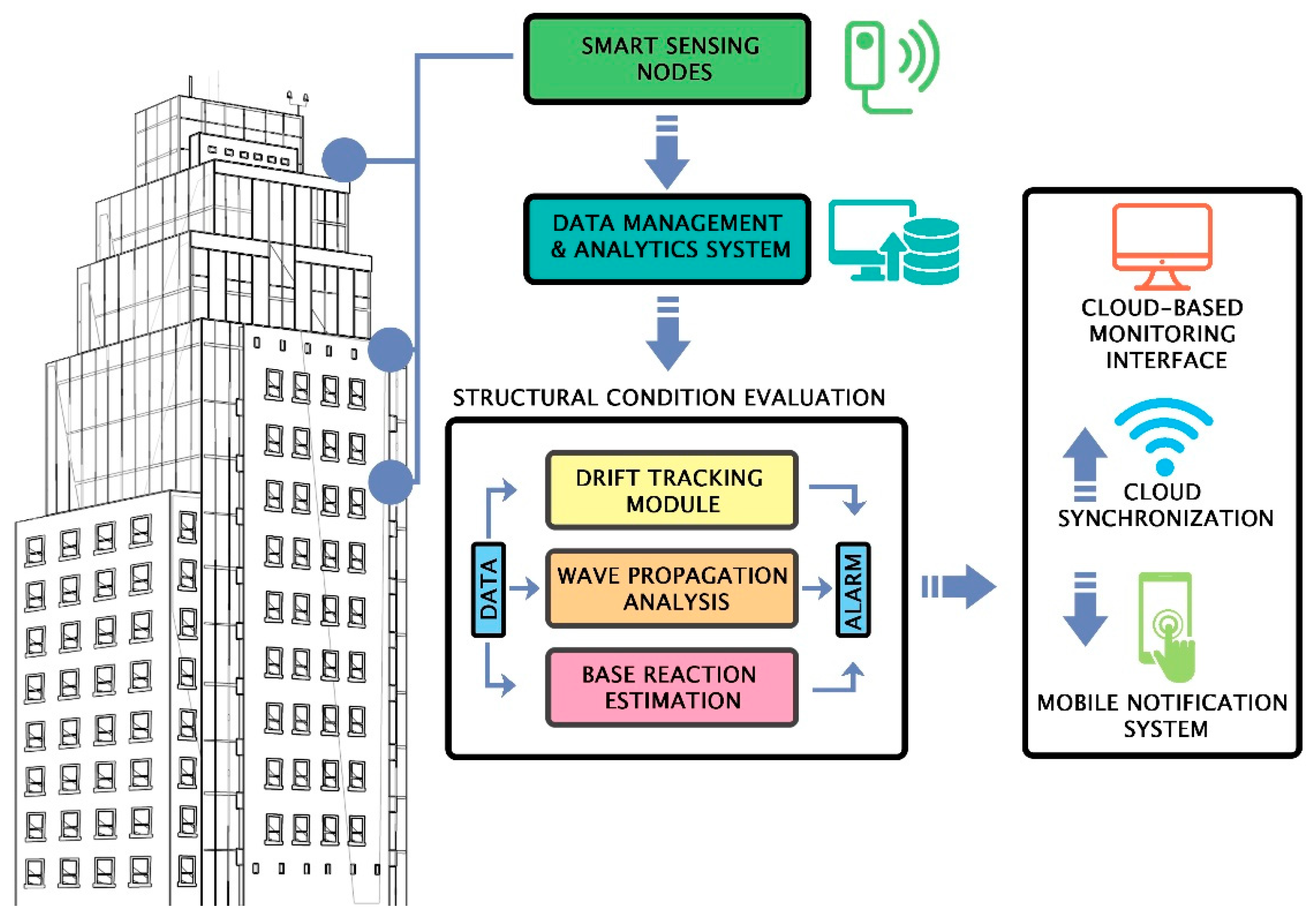
Modern SHM systems integrate many sensing principles to capture a range of parameters (such as strain, displacement, vibration, temperature, and corrosion activity), acting as a comprehensive description of structural integrity. The sensitivity and miniaturization of these sensors have advanced dramatically in the past five years and are easy to add to concrete, steel, and composite structures in a broad spectrum of environmental conditions. Widely adopted configurations include fiber-optic sensors for distributed strain and temperature measurement; piezoelectric and smart material sensors for stress wave detection; MEMS-based sensors for vibration monitoring; vision-based systems for deformation and crack mapping; and acoustic or ultrasonic sensors for the identification of subsurface flaws. Complementary electrical and environmental sensors monitor corrosion potential, humidity, and pH to determine material durability. The recent combination of these sensing modalities with Internet of Things-enabled wireless networks has advanced large-scale, real-time monitoring capabilities, as shown in Figure 2. Supported by data fusion and digital twin integration, these multi-sensor architectures are redefining the evaluation of structural performance and thus represent a decisive step towards predictive and sustainable infrastructure management.

1.2. Bibliometric Overview of Recent SHM Sensor Research (2020–2025)

A detailed bibliometric study was conducted to analyze the current research trends in SHM sensors worldwide from 2020 to 2025. We used the Scopus and Web of Science (WoS) databases to cover the relevant literature in engineering and materials science.
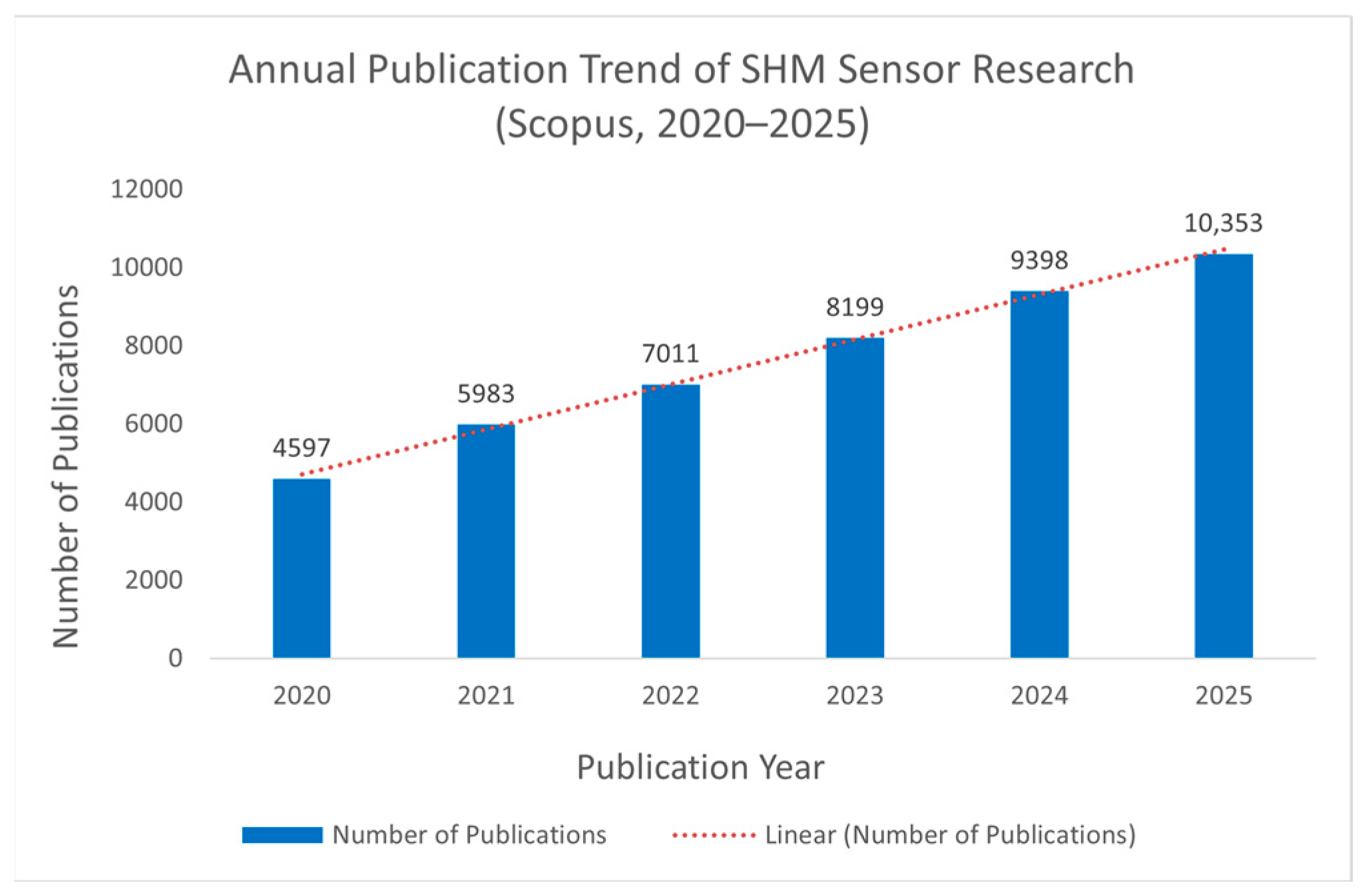
A search in Scopus yielded 45,541 publications that met the search criteria, limited to the subject areas of engineering and materials science. The search was conducted using the Boolean query (“structural health monitoring” AND “sensor”), applied consistently across both databases. As shown in Figure 3, the annual output increased gradually from 4597 in 2020 to 10,353 in 2025, indicating sustained growth over the considered period. This continuous growth is a global trend towards new sensing modalities—specifically, MEMS, FOS, PZT, and vision-based systems—and their combination with IoT-enabled platforms and digital twin architectures. The growing interdisciplinary interest reflects the development of SHM from traditional monitoring towards intelligent, automated, and data-driven infrastructure management.
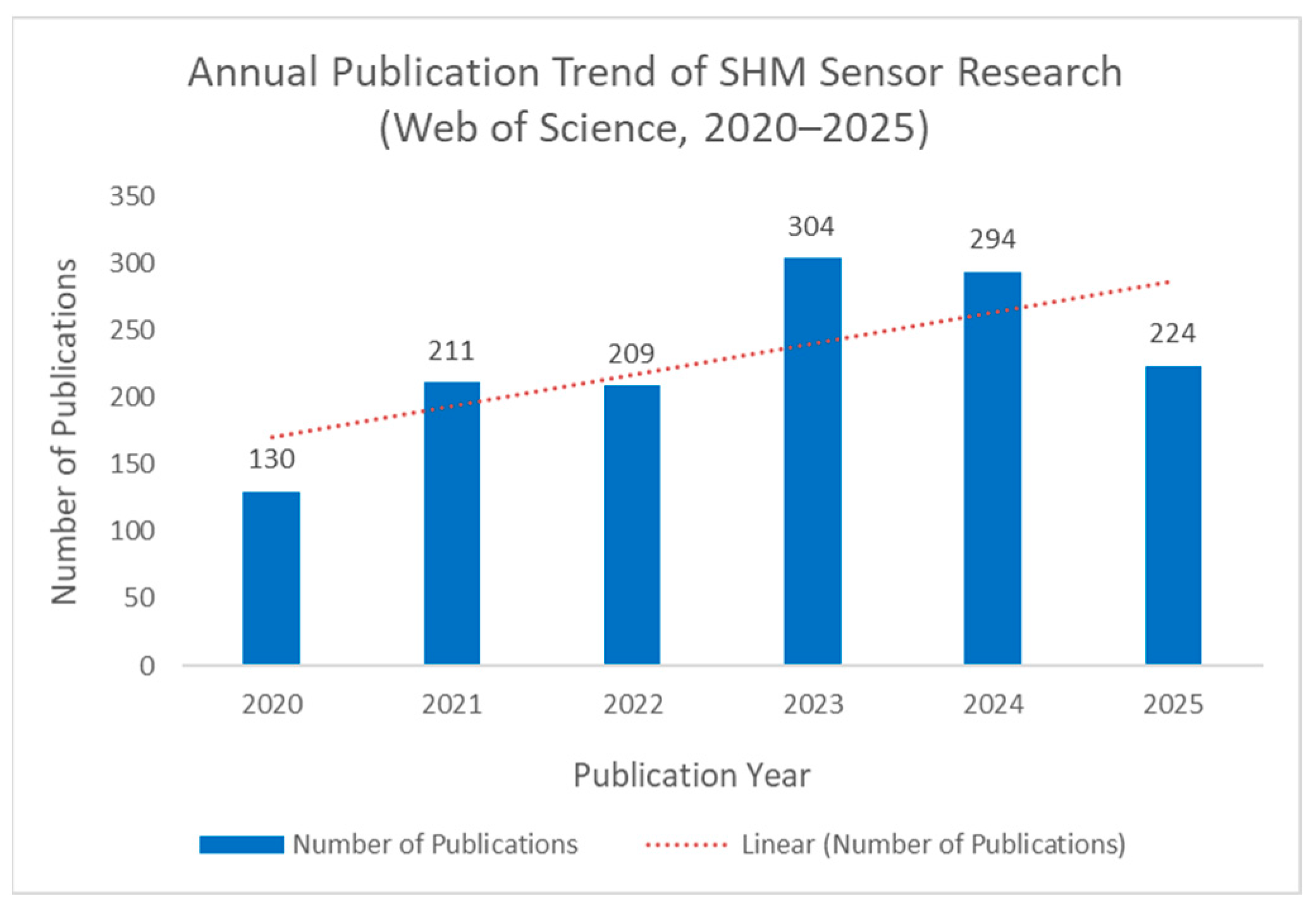
To validate these findings, a second analysis was conducted using the Web of Science Core Collection in the civil engineering category. The WoS dataset included 1372 records, and we used the same up-research trend as for Scopus on a smaller level. Figure 4 shows that the number of publications increased from 130 in 2020 to 304 in 2023 and 224 in 2025. This tendency suggests that early-stage sensor innovation involved the integration of AI-based diagnostics, IoT connectivity, and predictive maintenance based on digital twins. The publication activity in these years indicates a persistent interest in SHM sensor studies and increasing interaction between civil, materials, and computational engineering disciplines. The Scopus and WoS results underscore a strong, worldwide dedication to the development of new sensing technologies and their incorporation into sustainable, resilient, and adaptable infrastructure systems.
Despite the bibliometric analysis showing that research output on SHM sensors has been growing steadily, this does not necessarily imply that the main technical and practical issues have been resolved. A vast majority of the published literature remains dedicated to laboratory-scale verification, short-term testing, and proof-of-concept demonstrations. Limited attention is devoted to long-term field performance, sensor longevity, or serviceability. Furthermore, the evaluation protocols, data availability, and reporting standards are inconsistent, making comparisons across studies unfeasible. These shortcomings underscore that the rapid growth of SHM-related publications has yet to be translated into standardized, robust, and deployable monitoring solutions.

1.3. Review Methodology

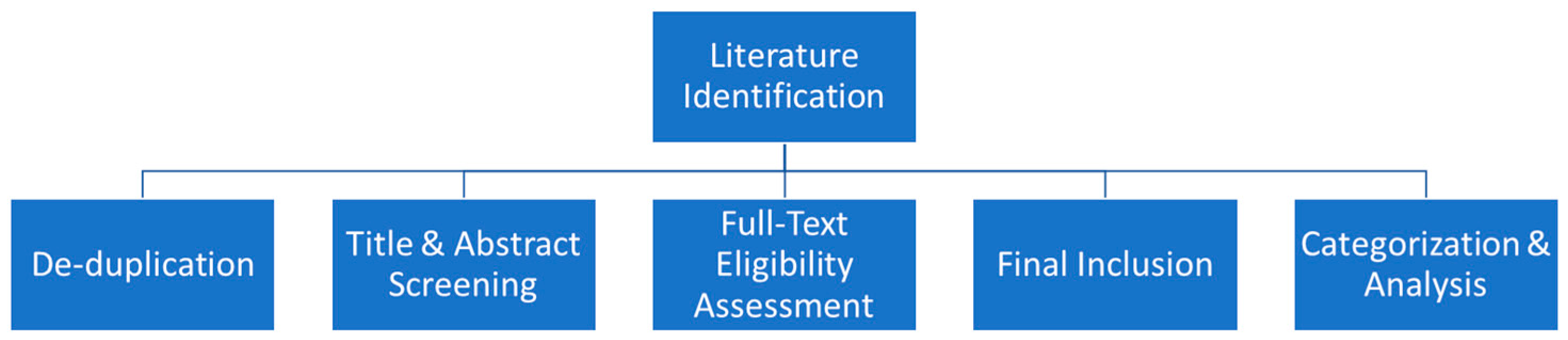
Figure 5 demonstrates that the literature review was conducted using a structured, transparent selection process to facilitate reproducibility. After identifying the databases, the records were filtered in several steps of de-duplication, title and abstract screening, and full-text eligibility screening. Articles were retained when covering sensing technologies, IoT-enabled systems, artificial intelligence, or digital twin applications for structural health monitoring of civil infrastructure.
We excluded research on non-civil engineering fields and entirely theoretical signal processing techniques that do not apply to SHM or are not related to infrastructure monitoring. The last corpus of articles was subsequently classified by sensing modality, degree of system integration, and field of application to facilitate qualitative synthesis and bibliometric interpretation. This procedure adhered to the PRISMA-based screening rationale, focusing on transparency in the selection of studies, rather than on statistical meta-analysis.

2. Advanced Sensing Technologies for SHM

2.1. Fiber-Optic Sensors (FBG, DOFS)

Fiber-optic sensing (FOS) technologies have gained substantial attention in recent years because of their ability to enable the distributed, high-accuracy, and robust monitoring of civil infrastructure. In particular, FBGs and Distributed Fiber-Optic Sensors (DFOSs) can provide strain, temperature, and deformation information in real time with high spatial resolution, making them invaluable for SHM applications, especially for long-term monitoring.
Recent studies report that using DFOS techniques with data-driven models has significant potential in tracing the progression of damage under controlled experimental situations. A combination of DFOS-derived strain and temperature data and a kernel-adaptive network–Transformer (KAN-Transformer) fusion architecture was used to pre-predict freeze–thaw-induced damage in asphalt concrete beams Zhang et al. [17]. The model had a very high coefficient of determination (R2 > 0.99) and a low prediction error in laboratory-scale freeze–thaw experiments, implying that it has the ability to reflect complex time-dependent variations in DFOS measurements. However, the authors noted that the validation was performed under controlled circumstances, and the performance of the model was determined by the quality of the data, the method of integrating the sensors, and the experimental setup. The findings demonstrate the possibilities of applying optical sensing to deep learning in the context of intelligent SHM, indicating that any performance metrics reported must be considered in the context of the specific testing setup and data properties. Additionally, Li et al. [18] used optical frequency-domain reflectometry (OFDR)-based DFOS to monitor FPC cylinders on a full-scale pipe. The system demonstrated the ability to obtain strain profiles with a spatial resolution of 1 cm, with a close match to cracks detected visually. These results validate DFOS as a reliable technique for early-stage crack detection in large water pipeline networks. Consequently, innovation efforts have also been focused on material durability.
For this reason, innovation activities have also focused on studies of material durability. Tariq et al. [19] developed a ratiometric fiber-optic fluorescent pH sensor based on a HydroMedTM D4 polymer optode doped with Naphth-Alkyl-OMe and quantum dot nanostructures; this showed stable readouts in a pH range of 10–12.5 over 75 days. These optodes are characterized by high stability and accuracy, enabling reliable tracking of alkalinity development in cementitious materials. Fan et al. (2021) performed an extensive review of corrosion monitoring in reinforced concrete using FBG, LPG, and DFOS systems, concluding that fiber-optic sensors offer high precision and long-term stability, but further field validation is still needed [20].
Field applications have emphasized both embedded and externally mounted applications. Becks et al. (2025) tested bonded fiber sensors (extFOSs) under external monotonic and fatigue loading, and they were able to detect microcrack initiation before visual failure [21]. Wang et al. (2024) employed Brillouin Optical Frequency-Domain Analysis (BOFDA) to record strain evolution in concrete slabs from the casting to corrosion stages, confirming high accuracy and robustness [22]. In an earlier study, Ye et al. [23] combined FBG sensing with Brillouin optical time-domain reflectometry (OTDR) to continuously monitor prestressed bridge elements for 2.5 years. The study demonstrated the effectiveness of this combined optical interrogation approach for accurately monitoring long-term reductions in prestress, with the empirical prestress loss curves closely matching the degradation predictions developed in both Eurocode 2 and the American Association of State Highway and Transportation Officials (AASHTO) Lightweight Research Facility Design (LRFD) guidelines. The versatility of DFOS in a wide variety of structural configurations has been proven. Bai et al. (2022) used the pulse pre-pump Brillouin optical time-domain analysis (PPP-BOTDA) method to measure the flexural response of steel–concrete composite slabs and detect microcracks and interfacial slip during deformation [24]. Liao et al. (2020) used DFOS with a Fabry–Perot inclinometer to measure thermal curling in concrete pavement, reporting a strong correlation between the temperature gradient and slab deflection [25]. Tan et al. (2021) demonstrated the effectiveness of OFDR-based DFOS for high-performance, fiber-reinforced concrete beams by recording full-field strain and crack evolution, findings that were consistent with visual inspections [26]. Recent advances have been made in early-age effects and shrinkage. Poorghasem et al. [27] monitored early-age shrinkage in admixture-modified concretes using OFDR-based DFOS, which yielded a spatial resolution of 0.65 mm and stable output within 12 h after casting. Becks et al. [28] proposed a two-dimensional FOS (2D-FOS) configuration for fatigue-loaded reinforced concrete, which was shown to detect crack incipience before failure. Corrosion-related monitoring was further improved by Fan et al. (2020), who wrapped a DFOS helix around steel reinforcements to measure large strains under accelerated corrosion, in good agreement with electrochemical measurements [29]. Likewise, Tan et al. (2024) used distributed fiber-optic sensing (DFOS) in ultra-high-performance concrete prisms and rings to measure restrained shrinkage and microcracking; this resulted in shrinkage reduction from 809 microstrain to 245 microstrain with fiber and admixture modification [30]. Overall, the literature between 2020 and 2025 provides evidence that fiber-optic sensing, particularly DFOS and FBG-based systems, offers unprecedented capabilities in the distributed, high-resolution, and real-time monitoring of structural and durability parameters. These sensors are now moving from laboratory trials to large-scale field deployment, backed by a combination of hybrid modeling and AI-assisted interpretation. Thus, they are a cornerstone technology for next-generation SHM in civil infrastructure.

2.2. Piezoelectric and Smart Material Sensors

Piezoelectric sensors combined with novel materials have become an indispensable part of modern SHM systems, owing to their dual function as actuator and sensor, thereby enabling a fast, highly sensitive, and non-destructive assessment of damage and material degradation. Within this domain, lead zirconate titanate (PZT) ceramics and piezoelectric smart aggregate (SA) constructs have been the most widely studied due to their versatility for generating stress waves, localizing damage, and electromechanical impedance (EMI)-based sensing. Fu et al. [31] designed an embedded PZT-5H sensor to detect crack propagation in reinforced concrete beams under cyclic loading using wavelet packet energy decomposition. A fluctuation-based index was used to measure crack depth and position precisely, further verifying the sensor’s excellent sensitivity and stability. In a similar context, Sun et al. (2023) proposed a new type of piezoelectric module (SPM) made of PZT ceramics for crack evaluation using the wave propagation energy dissipation principle, thus exhibiting linearity and real-time precision after calibration in the laboratory [32]. To expand the functional capabilities of structural sensing systems, Pan et al. [33] conducted a comparative study of the EMI response of piezoelectric cement (PEC) and conventional piezoelectric transducers (PZTs). In their research, PEC demonstrated greater stability and a broader frequency spectrum for stress–strain monitoring. Chen et al. [34] adopted a material-centric approach by creating a composite “smart concrete” comprising polyvinylidene fluoride (PVDF) and carbon fibers. The resulting material exhibited increased electromechanical coupling and sensitivity, highlighting its potential as a multifunctional structural element capable of self-sensing. Regarding the characterization of early-age concrete, Jiang et al. [35] used embedded stress probe micro-devices (SPMs) based on wave propagation techniques to monitor the strength evolution of mortar and concrete. The resulting Wave Modulus of Elasticity (WMoE) showed a good correlation with compressive strength, providing a possible in situ strength prediction methodology. Complementary investigations carried out by Wang et al. [36] and Wang et al. [37] demonstrated the feasibility of piezoelectric transducer (PZT)-based monitoring systems for prestressed concrete cylinder pipes (PCCPs). They detected wire discontinuities using frequency-domain analysis and the Rayleigh wave response to detect crack initiation and propagation, achieving enhanced sensitivity at 20 kHz.
The integration of artificial intelligence has further improved piezoelectric-based monitoring techniques. Han et al. (2025) used a one-dimensional convolution neural network to analyze electromagnetic interference signatures obtained from over 100 sensors, achieving an R2 of 0.96 in predicting concrete strength [38]. Likewise, Jena et al. (2025) combined non-bonded piezoelectric sensors (NBPSs) with a deep learning model (CNN-BiLSTM) for early-age strength estimation, achieving an R2 of 0.988 and establishing the synergy between piezoelectric sensing and data-driven intelligence [39]. Piezoelectric smart aggregates have also shown their effectiveness in complex composite systems. Qian et al. [40] monitored interfacial debonding in composite concrete beams using wavelet packet decomposition of SA signals and detected the initiation and propagation of damage, in agreement with digital image correlation (DIC) results. Liao et al. (2024) developed a deep learning-improved PZT active-sensing system using a continuous wavelet transform to detect freeze–thaw damage with an accuracy of more than 99% [41]. Zhang et al. (2024) used the EMI technique to estimate the freeze–thaw deterioration of tunnel lining concrete, and the d31 vibration mode was identified as the most reliable indicator (R ~ 0.95) [42].
Durability and corrosion detection remain a critical front in structural health monitoring. Ahmadi et al. (2021) presented multi-orientation PZT sensors for corrosion monitoring based on electromagnetic induction (EMI) to precisely identify the onset and development of corrosion [43]. Gomasa et al. (2025) extended the use of EMI to determine chloride-induced degradation in blended concretes, in which embedded piezoelectric sensors were used to assess material performance and validate the enhanced resistance of PSC-C [44]. In a similar vein, Sonker et al. (2025) assessed fiber-reinforced concrete damage using EMI indices such as root-mean-square deviation (RMSD) and mean absolute percent deviation (MAPD), providing validation for the accurate quantification of cracks [45]. Recent developments in smart piezoelectric composites have expanded the number of available materials. Zhu et al. [46] prepared binders made of Ca(OH)2-Mg(OH)2 embedded with piezoelectric PZT particles with the best balance between mechanical strength and piezoelectric coefficient (d33) by optimized compaction and polarization protocols. These composite materials have a dual structural and sensing functionality, which fosters sustainable integration in SHM frameworks.
Collectively, the literature published from 2020 to 2025 confirms the highly responsive, multifunctional, and scalable solutions offered by piezoelectric and smart material sensors for monitoring stress, cracking, durability, and the temporal evolution of strength in concrete and composite structures. When combined with advanced signal processing methods and deep learning algorithms, such systems offer precise, real-time, and intelligent assessments and have cemented their place as a mainstay technology for SHM in the next generation.

2.3. MEMS and Wireless Sensor Networks

Micro- and nanotechnologies, MEMS, and wireless sensor networks (WSNs) have become key components in next-generation SHM due to their small form factors, cost-effectiveness, and ability to enable distributed, real-time data acquisition. These miniature sensors, often embedded in IoT systems, enable continuous monitoring of vibration, humidity, temperature, and strain while significantly lowering instrumentation complexity. Lara, H., Alshawa et al. [47] created a cost-effective approach to estimate the static elastic modulus of early-age concrete using smartphone-integrated MEMS microphones. In this approach, conventional accelerometers were replaced in impact resonance tests, and using bespoke filtering algorithms, the system achieved frequency–response accuracy within ±2% of standard instruments, validating MEMS microphones as practical tools for field-based modulus assessment. Likewise, Li et al. [48] created an IoT-equipped MEMS accelerometer network to record pavement dynamics caused by moving vehicles. Embedded sensors sent real-time vibration data to a cloud platform, demonstrating that amplitude and dominant frequency increased with traffic speed and decreased with sensor depth, indicating the effectiveness of MEMS-IoT frameworks for pavement health evaluation.
Khan et al. [49] advocated low-cost accessibility using MEMS accelerometers coupled with an Arduino-based data acquisition unit to detect damage in reinforced concrete beams. Fast Fourier Transform (FFT) analysis of the resulting vibration signals showed a deviation of less than 3% compared with commercial sensors and a high correlation with finite-element predictions, validating MEMS sensing as a robust and economical SHM strategy.
Liew et al. [50] expanded the functional scope beyond vibration by incorporating humidity sensors (RFID-MEMS) into 3D-printed spacers to detect steel–concrete interfaces. The sensors showed an accuracy of ±2% up to a relative humidity of 90%, providing a wireless, non-intrusive solution for assessing corrosion risk in reinforced concrete. IoT integration further extends the range of monitoring. Komary et al. [51] implemented a Wi-Fi-based system that connects DHT22 MEMS sensors to NodeMCU microcontrollers to measure temperature and humidity in real time during concrete curing. The readings were within ±0.3 °C of those obtained by thermocouples and were thus able to capture thermal gradients with hydration, as reported in reference. Complementing these developments, Sivasuriyan et al. [52] used MEMS accelerometers in combination with an artificial neural network (ANN) model to predict beam displacement under static loading. The mean prediction error of the trained ANN was 1.04%, proving the reliability of MEMS–AI hybrid frameworks for the intelligent monitoring of displacements.
Recent experimental studies—particularly Ham et al. [53]—have demonstrated the feasibility of non-contact evaluation using MEMS microphones for vibration resonance, impact echo, and MASW setups. These air-coupled MEMS sensors provide high signal-to-noise ratios and accurate modal identification without any surface coupling, enabling the development of entirely non-intrusive concrete evaluation schemes. Studies emphasize the benefits of MEMS and wireless sensor technologies for enabling scalable, real-time, cost-effective SHM for concrete infrastructure. Integration with the IoT and artificial intelligence analytics enables MEMS-based networks to serve as the backbone of autonomous monitoring systems that perform continuous condition monitoring, making them particularly well suited for deployment at scale in the field and for data-driven infrastructure management.

2.4. Vision-Based and Image Processing Sensors

Using AI, vision-based and image processing technologies have rapidly developed into indispensable non-contact tools for SHM, with high spatial resolution, automation, and interpretation. Recent studies show that they have broad applicability, from crack detection and vibration quality control to bridge deformation and durability assessment. Zhao et al. [54] proposed a UAV-to-BIM registration method for dam inspection using contour-based matching, combining canny edge detection and Generalized Hough Transform. This methodology confirms the precise localization and geometric alignment of cracks, confirming the use of UAV–vision integration as a powerful BIM-linked SHM tool. Tavasoli et al. [55] used nano-aerial vehicles (NAVs) with deep learning detectors (YOLOv3-tiny plus DeepLabv3+) for indoor reinforced concrete inspections with 25 cm localization accuracy, demonstrating autonomous vision sensing in confined environments. Complementing these efforts, Mellios et al. [56] created a computer vision fatigue warning system using thermal imaging and thermocouples, showing that thermal vision identified fatigue onset more quickly and reliably than point sensors in twenty-one cyclic tests.
Field-scale applications further support the effectiveness of camera-based monitoring. Micozzi et al. (2024) used a low-cost video system for dynamic bridge response analysis, achieving subpixel accuracy with displacement errors below 2% [57]. Rui et al. (2020) used digital image correlation (DIC) to visualize crack initiation in concrete sleepers with good agreement with manual readings [58], while Narazaki et al. (2022) combined UAV-based semantic segmentation and 3D recognition to inspect viaducts after earthquakes at centimeter precision [59].
Advances in deep learning have improved both automation and accuracy. Ren et al. (2023) used StyleGAN2-augmented datasets with a semi-supervised Co-MixMatch + SE-ResNet50 model to evaluate concrete vibration quality with 96% accuracy [60]. Vincens et al. (2024) used a combination of DIC and marker tracking with deep learning segmentation to measure RC crack opening and sliding within + ±2 pixels [61]. Li et al. (2025) combined computer vision and large language model reasoning (EfficientNetV2 + DistilGPT-2) to classify vibration uniformity, achieving 94.45% accuracy [62]. Jiang et al. [63] introduced a machine vision framework with an attention mechanism to improve the functionality of YOLOv8 and SENet50 in monitoring robotic concrete vibrations, wherein the degree of vibration completion was predicted using features extracted from surface images. An R2 of 0.9925 was achieved in both controlled experimental and on-site deployment scenarios, using a camera system mounted on a robot and an annotated image dataset. Although the outcomes reveal good predictiveness in the evaluation of vibration completion, the model’s performance is still dependent on image quality, lighting, the position of the camera, and the representativeness of the data, suggesting that these measures must be considered within the framework of the operational and data acquisition setting. In addition to defect detection, vision systems are used to support evaluations of material durability and quality. A CNN-based image segmentation was used by Giulietti et al. (2021) to determine carbonation depth in phenolphthalein-treated concrete, achieving an R2 of 0.96, and the results were compared with those of EN 13295 [64,65]. Schack et al. (2024) proposed a “Digital Slump Flow” technique using photogrammetry and CNN segmentation, achieving good correlation with the Visual Stability Index [66]. Pozzer et al. (2022) compared visible, infrared, and fused images for CNN crack detection, where fused IR–visible information increased accuracy by combining surface and subsurface information [67].
Modern structures consider sophisticated geometric and operational issues. Tian et al. (2025) proposed a non-contact displacement measurement system for large-span bridges under occlusion that combined U2-Net, ZITS, and YOLOv8-CBAM, reducing displacement errors from 4% to 0% [68]. Fang et al. (2025) proposed a monocular vision system for precast-girder pose estimation based on YOLOv11n combined with GAN-based deblurring, achieving a real-time reprojection error of 0.113 pixels [69]. Fan (2024) used CNN-FCN models on 2000 RC images, achieving more than 95% accuracy in crack, spalling, and exposed steel classification and segmentation [70]. Lightweight AI models have become even more practical to use in the field.
Meng et al. (2023) developed a hybrid S-MobileNet+SM-UNet network that achieved an accuracy of 96.22% with a crack measurement error of less than 5% [71]. In addition to surface damage detection and inspection, recent studies have demonstrated the applicability of vision-based techniques for displacement and vibration measurement in structural health monitoring. Han et al. [72] proposed a vision-based displacement measurement method using supporting UAVs and a stationary laser spot as a reference point, facilitating accurate displacement estimation and mitigating the effect of UAV motion. This technique was tested on a two-story frame and a suspension bridge and found to be in good agreement with laser displacement sensors and stationary cameras. Shao et al. (2021) presented a binocular-vision-based system that freely measures three-dimensional vibration displacement of the target, using deep learning-assisted keypoint detection; this showed good consistency with traditional displacement sensors [73]. Later, Shao et al. (2023) proposed a monocular vision-based system that uses deep neural networks to estimate scene depth and, therefore, three-dimensional vibration displacement measurements, with fewer complex systems and greater practical utility [74]. From 2020 to 2025, the literature shows that vision-based and image processing sensors can deliver accurate, automated, and scalable SHM solutions for inspection, durability assessment, and construction quality monitoring. The convergence of deep learning, UAVs, and IoT architectures is revolutionizing vision systems, from diagnostic products to autonomous data-driven agents for intelligent infrastructure management. Although vision-based sensing has several benefits, practical issues influence its real-world application in SHM. These involve the stability of camera calibration over long monitoring periods, the dependability of scale recovery in the field, responsiveness to changes in lighting, and the effects of occlusion in complex structural settings. Moreover, camera vibration, exposure to environmental conditions, and the need for periodic recalibration may affect measurement accuracy. These problems demonstrate that vision-based techniques should be carefully implemented and verified when using these systems in real-life SHM.

2.5. Acoustic and Ultrasonic Sensors

Acoustic and ultrasonic sensing have established themselves as essential techniques for non-destructive SHM owing to their remarkable sensitivity to micro-damage, corrosion, material inhomogeneity, etc. These sensors can detect the propagation of stress waves and energy absorption to characterize crack initiation, stiffness degradation, and moisture effects in concrete. Liu et al. [75] examined damage caused by abrasive water jet action on concrete using acoustic emission (AE) sensing and power spectral density analysis. AE analysis helped to discriminate impact signals from fracture signals, and ultrasonic velocity measurement confirmed the development of erosion zones. Habbaba et al. [76] combined ultrasonic guided waves (UGWs) and FBG sensors to achieve early detection of corrosion in reinforced concrete. Their methodology was able to correctly establish initiation and propagation stages by measuring wave energy attenuation. In addition, Song et al. (2021) monitored fatigue cracking in Brazilian disk concrete specimens using AE and P-wave analysis; increases in AE energy and corresponding decreases in wave velocity were used to indicate the formation of microcracks [77].
Material and environmental influences also have a considerable impact on acoustic responses. Li et al. (2023) showed that, with increasing moisture content, P- and S-wave velocities increased while AE intensity decreased, explaining the effect of humidity on fracture mode [78]. Lv et al. (2021) used AE clustering and Weibull modeling on diatomite-modified concrete and found that it delays crack initiation and increases damage resistance [79]. Song et al. (2022) developed a contact-free system based on MEMS microwave-based Rayleigh wave imaging to quantitatively evaluate alkali–silica reaction (ASR) deterioration using scattering energy indices [80].
Ultrasonic resonance is a practical methodology for assessing long-term durability. Buffet et al. (2021) used linear and nonlinear resonant ultrasound spectroscopy, along with AE methods, to track the formation of delayed ettringite, finding that linearity did not change with respect to material expansion [81]. A modeling review by Darmon et al. in 2025 emphasized the crucial roles of the interfacial transition zone (ITZ) and porosity in ultrasonic velocity and attenuation, and they suggested a three-dimensional simulation to achieve accurate ultrasonic inspection [82]. Chen et al. [83] combined ultrasonic pulse and AE measurements to assess thermal damage at up to 1200 °C. The VS/VP ratio showed a good correlation (R2 > 0.87) with the loss of stiffness and toughness, providing a reliable index for post-fire degradation. Advances in embedded and hybrid sensors have also increased the applicability of ultrasonic methods.
Yang et al. (2024) developed concrete-implantable cube (CIC) AE sensors with probabilistic localization, achieving an impact detection accuracy of 0.98 [84]. Guo et al. (2024) created cement-based AE sensors to monitor corrosion using a low–high-frequency ratio to describe stages of degradation [85]. Ye et al. (2025) encapsulated piezoelectric ultrasonic transducers in epoxy–mortar composites to investigate the dynamic modulus of asphalt concrete; the correlation between ultrasonic velocity and complex modulus E* reduced the corresponding error to below 9% [86]. Likewise, Xie et al. (2020) developed a surface acoustic wave (SAW) corrosion sensor with amplitude and phase shift sensitivities (0.24 dB and 10.4° per 1% corrosion, respectively) that quantitatively monitored corrosion in reinforced concrete [87].
Novel transducer materials and hybrid solutions have been used to increase robustness. Zhang et al. (2021) embedded PZT ceramics with cement/epoxy/tungsten composite ultrasonic transducers to monitor hydration; stable signals confirmed their suitability for early-age hardening analysis [88]. In reactive-powder concrete, Dourado et al. (2022) proved that linear frequency-modulated pulses enhanced the precision of ultrasonic inspection (error ≤ 2.7%) compared with pure tones [89]. Finally, Wang et al. (2022) used Tafel extrapolation and SAW techniques on PCCP spigots and reported that an excitation frequency of 20 kHz was most sensitive to early corrosion in a sulfate-containing environment [90]. All these investigations have confirmed that acoustic and ultrasonic sensing, mainly AE, UGW, and SAW techniques, are capable of accurate, in situ, and non-destructive assessment of cracking, corrosion, and thermal degradation in concrete. The combination of MEMS, hybrid transducers, and numerical modeling is steadily improving detection sensitivity and robustness, making acoustic and ultrasonic sensors an integral part of a complete SHM approach to modern infrastructure.

2.6. Electrical, Corrosion, and Environmental Sensors

Electrical, corrosion, and environmental sensors are increasingly being used in SHM frameworks to quantify deterioration processes such as chloride ingress, carbonation, and rebar corrosion. These sensing systems—ranging from electrochemical and resistivity-based probes to machine learning-based integrated corrosion models—facilitate the continuous and non-destructive monitoring of durability performance in reinforced and prestressed concrete. Jia et al. [91] examined the feasibility of using machine learning (ML) algorithms to predict corrosion progression in reinforced concrete (RC). Using datasets based on environmental exposure parameters, the authors compared Artificial Neural Networks (ANNs), Support Vector Machines (SVMs), and Ensemble Learning models with traditional regression methods. ML-based models demonstrated a better ability to capture nonlinear and time-dependent corrosion patterns, supporting their use in predictive SHM under dynamic environmental conditions. Morwal et al. [92] reviewed the electromechanical impedance (EMI) technique using piezoelectric (PZT) sensors for the detection of chloride-induced corrosion in RC and prestressed concrete (PC). Their analysis of surface-bonded, embedded, and composite configurations showed that variations in conductance spectra can effectively represent the initiation of corrosion, establishing EMI as a sensitive and real-time diagnostic tool.
Recent advances in optical sensing have provided cost-effective alternatives for detecting corrosion. Ramani and Kuang [93] presented a lens-based plastic optical fiber (LPOF) sensor comprising an emitter, a receiver, and a ball lens for strain detection due to corrosion. In accelerated corrosion experiments, changes in optical intensity were closely correlated with the expansion of steel, demonstrating the high sensitivity and durability of the LPOF system under harsh exposure conditions. On the modeling front, Wang et al. [94] modeled macro-cell corrosion behavior in reinforced concrete (RC) using pseudo-concrete electrolytes and a coupled DuCOM-PHREEQC model. Their results identified the migration of Ca2+ and OH2− ions as key parameters controlling the corrosion rate, demonstrating that multi-ion transport modeling can be a good approach for predicting electrochemical degradation mechanisms.
Hybrid sensing techniques that combine acoustic and electrochemical principles are widely considered to be important. Kawasaki et al. [95] combined AE and electrochemical noise (EN) methods to monitor rebar corrosion under accelerated current conditions. AE data were used to detect crack propagation and oxide film detachment, while EN was used to identify localized pitting, together providing a comprehensive real-time analysis of corrosion. In addition, Lin et al. [96] proposed a capacitive sensing method in which rebar is modeled as a parallel plate capacitor. The measured capacitance was proportional to the depth of corrosion, as confirmed by an accelerated corrosion test, demonstrating a quantitative relationship between charge storage and metal loss.
Spatial and probabilistic analyses are used to improve the assessment of structural reliability. Pedrosa and Andrade [97] conducted spatial mapping of electrical resistivity (r) and corrosion rate (Icorr) in chloride-contaminated reinforced concrete slabs, finding that Icorr exhibited greater variability than resistivity. Their findings highlighted the need to include spatial heterogeneity in probabilistic life-cycle models. In another investigation, Rocío Porras et al. [98] investigated low-cost sensing approaches for monitoring temperature and humidity in fresh and early-age concrete, highlighting the limitations of high-precision sensors due to cost and fragility in construction environments. Their Arduino-based wireless system effectively captured curing-related thermal and moisture variations in laboratory and industrial settings. It indicated that the placement of embedded sensors can influence tensile strength in small specimens.
Contemporary progress in electrochemical sensing highlights the importance of long-term stability and accuracy. Du et al. (2022) developed an all-solid-state chloride sensor containing Ag/AgCl and Mn/MnO2 electrodes that exhibits a stable Nernstian response of −54 mV/decade and facilitates reliable monitoring of chloride ingress during capillary absorption [99]. Luan et al. (2025) used the Anode-Ladder-System to track corrosion depth continuously, finding that a critical value for the initiation of rebar cracking was 13.5 μm [100]. Bansal et al. (2022) used EMI-based PZT sensors to assess ternary blended concrete (LC3) under combined mechanical and environmental stress loads; LC3 exhibited lower stiffness loss and greater resistance than OPC, demonstrating the usefulness of EMI in benchmarking sustainable concretes [101]. Magnetic and electromagnetic techniques continue to provide complementary information for corrosion monitoring in reinforced concrete structures. Fu et al. [102] designed an externally fixed electromagnetic sensor to measure steel corrosion by monitoring variations in magnetic flux density with the mass loss of the enclosed reinforcement. According to accelerated corrosion experiments and corresponding FEM simulations, the mass loss of steel was strongly correlated with a change in magnetic flux, with a reported coefficient of determination of R2 = 0.9971. Note that this correlation was determined under controlled laboratory conditions using uniformly corroded samples created by impressed current. The authors also showed that the measured response is sensitive to sensor positioning, steel geometry, concrete cover thickness, and magnetic field strength, suggesting that the reported performance depends on the experimental configuration and calibration. The results indicate that EM sensing is a viable solution for non-contact quantification of corrosion, but caution should be exercised when interpreting performance indicators when scaling up such methods to field-scale and under non-uniform corrosion conditions. Kevin et al. (2025) combined electrical resistivity, concrete cover, and crack width and proposed a hybrid machine learning model using Gaussian Process Regression (R2 = 0.95), proving that the data-driven fusion of electrical and geometrical parameters improves corrosion prediction accuracy [103].
Recent advances in imaging-based and ultrasonic–electrical fusion systems have provided new opportunities for corrosion mapping. Kuchipudi et al. [104] used Dry Point Contact (DPC) transducers to excite shear horizontal waves and used the Total Focusing Method (TFM) for corrosion imaging in reinforced concrete. The k-means clustering algorithm classified corrosion severity well, and lower reflection amplitudes were associated with higher degradation levels. These results show that the combination of ultrasonic imaging and computational clustering provides a powerful, non-destructive corrosion evaluation approach. Summarizing the results of the projects carried out during the 2020–2025 period, we can assert that predictions have been significantly improved by the integration of electrical, corrosion, and environmental sensors along with advanced modeling methods and artificial intelligence. Taken together, these technologies—including electromagnetic interference-based piezoelectric (PZT) sensors, fiber-optic sensors, and machine learning-based diagnostics—form a complete framework for real-time quantitative and sustainable corrosion monitoring in modern concrete infrastructures.

2.7. Hybrid and Multi-Sensor Fusion Systems

Hybrid and multi-sensor fusion systems are a critical frontier in SHM, enabling the integration of different types of sensing modalities such as acoustic, optical, electromagnetic, and vision-based methods to provide more robust and intelligent diagnostic capability.
Recent developments suggest that the simultaneous integration of multiple data sources, often based on artificial intelligence (AI) and digital twin methodologies, dramatically improves the accuracy of damage detection and predictive performance in concrete infrastructure. Wang et al. [105] performed a numerical–experimental study of macro-cell corrosion in reinforced concrete based on a DuCOM-PHREEQC-coupled model. The framework associated multi-ion transport and electrochemical polarization processes with the reproduction of field-like deterioration, and laboratory validation established the predictive precision of the framework, thus demonstrating the joint role of ion migration and polarization in governing corrosion kinetics in real RC environments. Malepati et al. [106] introduced a multi-modality vision–Transformer (ViT) fusion model (MMSFormer) for concrete damage segmentation of both surface and subsurface damage using both RGB and infrared (IR) imagery. A registration algorithm based on epipolar constraints guaranteed the spatial alignment, with an intersection over union (IoU) of 67.26%. This supports the use of early RGB-IR fusion in the detection of cracks, spalling, and delamination.
Self-sensing and wireless composites are responsible for the progress in fusion-based SHM. Lee et al. [107] designed a LoRa-based cementitious sensor with multi-walled carbon nanotubes (MWCNTs) for railway concrete monitoring. The resulting cementitious network had a gauge factor of 1.19, similar to that of traditional wired systems, validating that wireless cementitious composites can provide accurate long-term data transmission. In addition, Yu et al. [108] proposed a deep stacked autoencoder (DSAE) model using multiple sensor inputs for jack-arch beam diagnostics. Using principal component analysis (PCA) as a feature extraction method and Dempster–Shafer evidence theory as a decision fusion method, their EWOA-based framework achieved an accuracy of greater than 97%, confirming the effectiveness of AI-based multi-sensor fusion.
Hybrid approaches have also been developed to improve the detection of corrosion and environmental factors. Li et al. [109] combined an electromagnetic monitoring apparatus (EMMA) with digital image correlation (DIC) to simultaneously monitor internal corrosion and surface deformation. DIC measured strain due to expansion, and EMMA recorded magnetic field changes; hence, full characterization of material degradation was obtained. Wan et al. [110] developed a multi-agent system (MAS) in the McBIM digital twin framework to bridge embedded wireless sensor networks (WSNs) and Building Information Modeling (BIM). The MAS was capable of processing the environmental parameters of temperature, humidity, and stress via autonomous communication and energy management and thus proved to be effective for continuous intelligent SHM. Hybrid sensors based on the properties of materials have also attracted more and more scholarly attention. Huang et al. [111] experimentally measured the creep Poisson ratio (CPR) of hydraulic concrete under the multi-age loading–unloading cycles by combining strain gauges with S-G-filtered data. The results showed that the effective CPR varies with stress orientation, which was used to develop hybrid rheological models. Biondi et al. [112] fabricated geopolymer-based moisture sensors (GMSs) using low-calcium fly-ash binders in combination with stainless-steel electrodes. Electrochemical impedance spectroscopy (EIS) tests validated their outstanding accuracy and stability, proving that FA-GP materials are robust dual-mode moisture–temperature-sensing materials for durability evaluations of RC structures.
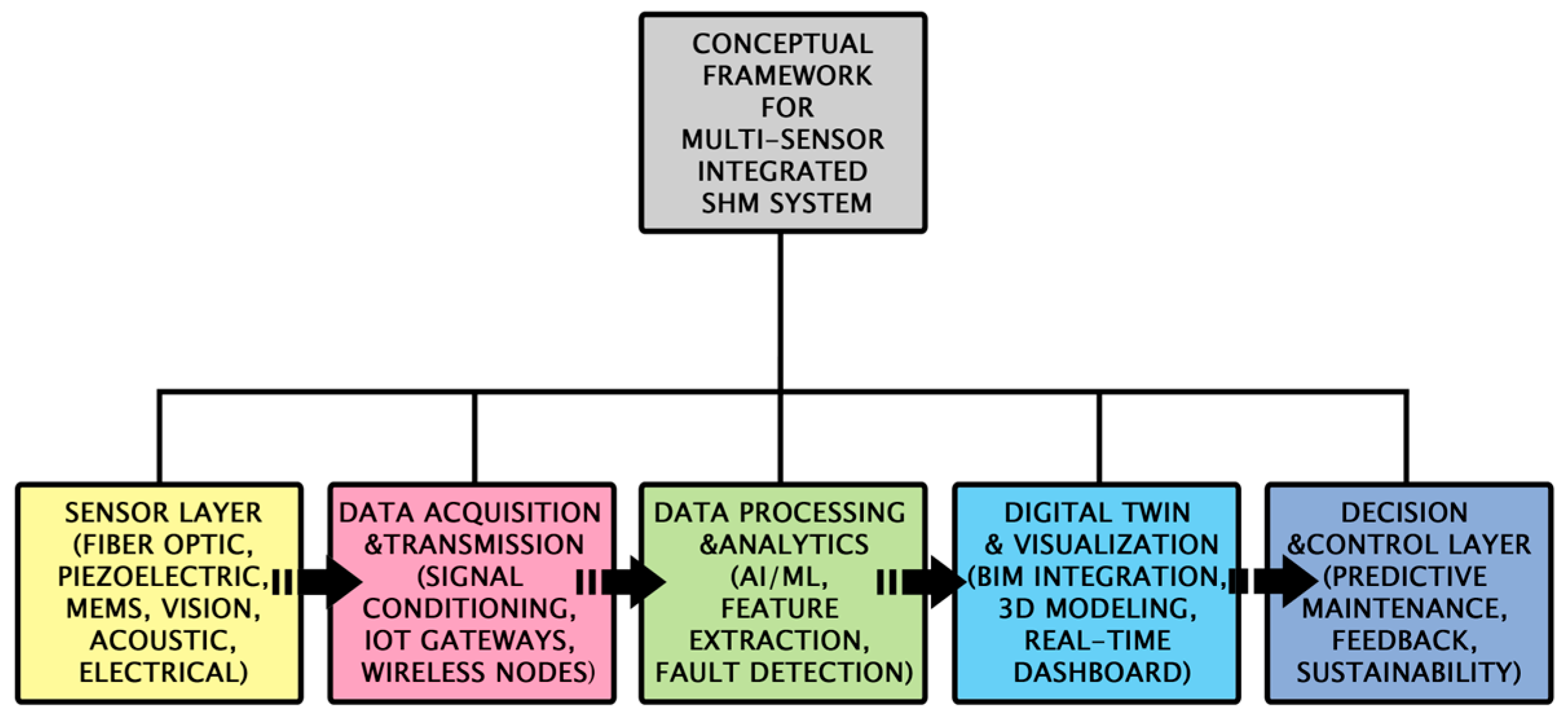
Recent developments in AI-driven fusion show significant improvements in efficiency and accuracy. Wang and colleagues [113] proposed EfficientSegNet, a novel lightweight segmentation network designed for drone-based inspection that incorporates spatial attention and multi-scale feature fusion modules. Evaluated on the CrackCB dataset, the network achieved an mIoU of 80.81% and throughput of 60.82 FPS with only 0.57 M parameters, verifying its suitability for real-time crack detection. Ramani and Kuang [114] described a sacrificial metal–foil (SMF) optical imaging probe that can image chloride-induced corrosion. By using pixel-intensity analysis, the probe was able to quantify the onset of corrosion before visible cracking, providing a low-cost, non-electrochemical, diagnostic alternative. Hybrid machine vision and AI fusion has also been investigated for construction stage monitoring. Li et al. [115] used a temporal fusion strategy with an improved EfficientNetV2 backbone to classify the quality of concrete vibration. The addition of a temporal context stabilized the decision outputs, which resulted in an accuracy of 96.47% and allowed for automated quality control during casting. Wei et al. [116] refined the method by creating an LSTM–Kalman Filter–k-means hybrid model to predict the deformation of concrete dams. The Kalman Filter addressed noise, which enhanced the sequential accuracy, and the LSTM accounted for spatiotemporal dependencies. Their model improved R2 by 11% and decreased RMSE and MAE by almost 45%, confirming their ability to accurately and interpretably forecast dam safety. The overall interaction between sensor networks, data analytics, and decision-making modules is illustrated in Figure 6, which presents the conceptual framework for a multi-sensor integrated SHM system.
Overall, modern studies show that hybrid and multi-sensor fusion systems (mechanical, optical, electromagnetic, and AI-based information) significantly improve the reliability of structural health monitoring. The convergence of digital twin platforms, edge computing, and lightweight deep learning architectures has enabled fully integrated, autonomous monitoring solutions that perform real-time analytics and long-term durability assessment for complex civil infrastructure. Table 1 provides a summary of the major sensor technologies presented in Section 2.1, Section 2.2, Section 2.3, Section 2.4, Section 2.5, Section 2.6 and Section 2.7 concerning the measured parameters, benefits, weaknesses, and representative SHM applications presented from 2020 to 2025.
The reviewed studies indicate that various sensing technologies are suitable in different SHM scenarios, but they are not universal. Fiber-optic sensing systems are used primarily in long-span and linear structures, where distributed strain and durability monitoring are needed over large distances. Piezoelectric-based sensors are mainly used for the detection of localized damage, early-age strength measurements, and corrosion monitoring in reinforced concrete elements. Wireless sensor networks using MEMS are typically used in large-scale or cost-sensitive applications of vibration and environmental monitoring. Vision-based systems are primarily used to inspect surface damage and evaluate construction-level quality. By contrast, acoustic and ultrasonic systems are more commonly used to detect internal damage mechanisms (microcracking and fatigue). There is a growing body of research on the use of hybrid and multi-sensor systems in complex structures, where complementary sensing is needed to enhance diagnostic reliability. This summary indicates that the choice of sensors in SHM is necessarily application-based.

3. IoT and Digital Twin Integration in SHM

The convergence of the IoT and DT technologies is transforming SHM by enabling real-time, data-driven, and predictive infrastructure management. Through the seamless integration of sensors, communication protocols, and BIM, modern DT systems provide dynamic virtual representations that reflect the behavior of physical assets under varying environmental and loading conditions. When it comes to SHM, it is necessary to draw a line between the actual implementation of DT and the visualization systems based on BIM. Although the main feature of BIM-based platforms is the ability to provide static or periodically updated geometric and informational models of structures, a real DT is defined by a process of constant data exchange between the physical and virtual worlds through real-time sensing and analytics. SHM applications involve combining sensor data, analytical models, and update mechanisms in response to changes in the structural state of DTs. By comparison, BIM-based visualization systems do not update dynamically with models and are mainly used to provide data visualization and information management.
Recent studies highlight the rapid adoption of IoT- and DT-based frameworks across fields, such as bridges, tunnels, modular buildings, and smart cities. Nguyen et al. [117] developed an integrative DT framework that uses BIM, IoT, and Geographic Information Systems (GISs) for the facility management (FM) of Relocatable Modular Buildings (RMBs). Their DT-enabling facility management system (DT-FMS) was used to connect the physical, digital, and service layers, enabling real-time data synchronization. Validation of a modular school project in South Korea identified improvements in data accessibility, reuse planning, and life-cycle decision-making. Chacón et al., [118] designed and implemented digital twinning in reinforced concrete (RC) construction by fusing IoT sensor networks, laser scanning, and knowledge graphs under the H2020 ASHVIN initiative. The system continuously monitored maturity, strain, and deflection and confirmed that DT-driven monitoring improves safety, quality control, and on-site decision support. Yeung et al. [119] proposed a hybrid digital twin construction (DTC) and agent-based simulation (ABS) model to facilitate adaptive production system design using real-time Lean Construction principles. Their Decision Support System (DSS) enhanced resource utilization and adaptability to changing conditions, demonstrating that DTC-ABS fusion is useful for dynamically optimizing construction workflows. In a systematic review of IoT–machine learning–DT convergence for smart building energy audits, Abidin et al. (2025) identified fragmentation in current systems and proposed an ISO 50000-inspired AIoT framework to improve real-time energy-efficiency monitoring [120,121]. In the context of civil infrastructure, Jeon et al. [122] proposed a prescriptive maintenance DT for prestressed concrete (PSC) bridges that combines real-time monitoring, physics-based models, and key performance indicators (KPIs) to support predictive decision-making. Their federated DT structure enabled data exchange between the component and bridge levels, resulting in better diagnostic accuracy and lifespan management. Kosse et al. [123] further developed a System Reference Architecture (SRA) for Semantic Digital Twins based on the Asset Administration Shell (AAS) and Information Container for Linked Document Delivery (ICDD), which was validated in precast concrete production. This semantic approach ensured interoperability, scalability, and life-cycle data integration. At the urban scale, Vitanova et al. [124] created an urban digital twin (UDT) using the Weather Research and Forecasting (WRF) model with 3D CityGML visualization. The UDT was used to reveal temperature gradients of up to 6 °C between urban and suburban areas in Sofia, Bulgaria, suggesting a role in sustainable city planning. Hu et al. [125] introduced an innovative BIM-powered DT system that integrates wireless IoT sensing, digital signal processing, and structural analysis to provide real-time structural health monitoring. Although the framework was shown to be highly frequency-sensitive (5 Hz) and capable of tracking deformations, it was tested only in controlled experimental settings. The quality of sensor signals, preprocessing methods, and interpolation assumptions based on structural mechanics has been shown to be very important to DT accuracy, implying a risk of misalignment when applied to complex, full-scale structures. In addition, the continuous communication of the IoT, real-time DSP, and BIM visualization entails significant computational load and necessitates parallel operation of physical sensing infrastructure and virtual models, which can limit scalability and long-term deployment.
Another area where DTs are used is in bridge infrastructure. Barreto et al. [126] combined drone photogrammetry and sensors with measurements in a three-dimensional DT model of a reinforced and prestressed concrete bridge, and the case studies of the Randselva and Kohnbrunke Bridges indicated an enhanced ability to detect deterioration and schedule maintenance. Nevertheless, the authors also noted practical limitations, including the integration of large amounts of heterogeneous data; interoperability and communication constraints between software tools (which may require further software development); and high costs for sensor deployment, software licensing, and specialized labor to implement DTs. Kosse et al. [127] applied the semantic DT paradigm of dynamic scheduling in precast concrete production by combining RDF/SPARQL-based Linked Data with the Sim4FJS simulation scheduling platform. Although the framework proved to offer more flexible and optimized production workflows in an Industry 4.0 environment, its validation was conducted at the scheduling performance level, not at the structural condition assessment level. The suggested semantic DT is based on unbroken synchronization between the physical production states and the digital knowledge model, creating the possibility of misalignment if the data are not updated in a timely or irregular manner. Moreover, maintaining semantic data structures, reasoning, simulation models, and physical production systems adds computational complexity, and maintenance doubles in long-term deployment. Iqbal et al. [128] proposed an IoT-BIM-integrated DT to monitor the early-age strength of concrete using wireless sensors to capture temperature and humidity data via Firebase. The system was used to calculate compressive strength values using the maturity method and to display the results in Autodesk Navisworks, thereby enhancing scheduling effectiveness and minimizing total costs. A layered DT architecture for smart tunnel maintenance was proposed by Khan [129] combining BIM and facility management (FM) with machine learning algorithms (Support Vector Machine and Artificial Neural Networks) for predictive condition assessment. The six-layer architecture was used to demonstrate the ability to pass data from acquisition to analytics seamlessly and to operate autonomously within the underground infrastructure.
At the same time, DT applications have emerged that are more sustainability-oriented. Liu et al. [130] built a Net-Zero Energy Building (NZEB) digital twin using BIM and the IoT to optimize environmental parameters via Arduino-InfluxDB connectivity. The Beijing University of Technology proved its efficiency in achieving zero-carbon operations through a series of experiments. Fawad et al. [131] developed an Immersive Bridge Digital Twin Platform (IBDTP), which is a fusion of Scan-to-BIM, IoT-based SHM, and Augmented Reality (AR). A Polish concrete arch bridge was inspected using real-time interaction and defect localization visualization developed in Unity 3D, improving inspection accuracy and user engagement. Collectively, these studies establish that the convergence of IoT and DT can serve as a foundational underpinning for next-generation SHM systems that connect physical assets to intelligent digital environments capable of self-diagnosing, predicting, and adaptively controlling themselves. With recent advances in AI, semantic interoperability, and immersive visualization, IoT-DT frameworks are leading the way toward fully autonomous, sustainable, and data-centric infrastructure management. The lack of unified data models and security baselines is directly associated with interoperability and cybersecurity issues observed in IoT-based SHM systems using IoT-DT. In this regard, commonly accepted standards such as the OGC SensorThings API, IFC/CityGML, OPC UA, and generic cybersecurity governance standards are increasingly cited as guiding principles. Still, their application in SHM deployments remains fragmented and situation-specific. In re-observed IoT-DT implementations, system-level performance factors such as data latency, synchronization reliability, communication stability, and data quality assurance are often cited as essential considerations during deployment. These indicators, however, are very application-specific and are frequently judged qualitatively or based on case-dependent validation rather than standard benchmarks, underscoring the importance of carefully interpreting SHM outputs and uncertainty-conscious deployment.

4. Comparative Analysis, Challenges, and Future Directions

Although considerable progress has been made through innovations in sensors, the integration of the Internet of Things and digital twins, and artificial intelligence-based analytics, several practical and scientific challenges are limiting large-scale implementation, as shown in the comparative analysis presented in Table 2. Addressing these issues is critical to ensuring the reliability, affordability, and sustainability of future SHM systems within real-world infrastructure.
Although sensor miniaturization, hybrid monitoring strategies, and the integration of IoT and DT technologies have been achieved, several practical and scientific challenges remain that prevent the deployment of SHM on a large scale and over the long term. Integrating heterogeneous data from optical, acoustic, MEMS, and vision-based systems remains challenging because a standardized data model and interoperability frameworks are not yet available. In many cases, information exchange between SHM platforms and BIM environments is fragmented. Additionally, massive IoT-based monitoring produces large datasets that are vulnerable to noise, sensor drift, and communication losses, requiring adaptive filtering and uncertainty quantification methods. Deployment trade-offs continue to exist between measurement accuracy, system complexity, durability, and cost, especially for fiber-optic and piezoelectric sensors, where installation and maintenance issues make them difficult to use in large areas. A lack of cybersecurity in interconnected monitoring systems and the poor explainability of data-driven and DT-based decision models are also obstacles in the implementation of reliable systems. These issues are consistently evident in the recent quantitative studies consulted here, in which reported accuracy, resolution, and reliability values are widely divergent across sensing modalities and deployment environments, underscoring the need to interpret performance indicators in their respective experimental and field contexts.

5. Conclusions

This review presented recent developments in smart sensor-based SHM for civil infrastructure, emphasizing advancements in sensing technologies, multi-modal fusion, and the emerging combination of IoT, AI, and digital twin environments. Significant progress has been reported in fiber-optic, piezoelectric, and MEMS-based sensing systems, which now enable higher-resolution measurements of strain, temperature, corrosion, and vibration, supporting long-term non-destructive monitoring in concrete structures. Imaging-assisted techniques—such as DIC, UAV-based inspection, and acoustic emission—together with deep learning models, have enhanced the detection of cracks, delamination, and structural anomalies.
Hybrid fusion models integrating optical, acoustic, electromagnetic, and AI-based analytics have shown clear benefits in improving diagnostic reliability. At the same time, IoT-connected SHM networks and BIM/DT platforms have enabled real-time data synchronization and life-cycle tracking for buildings and bridges. Bibliometric analysis demonstrates rising research interest in explainable AI, lightweight neural models, and sustainability-oriented SHM.
However, despite rapid progress, several uncertainties remain. Current frameworks still depend on the stability of communication networks, long-term sensor durability, calibration robustness, and the interpretability of AI-driven decisions. Digital twins and multi-sensor data fusion are promising, but they do not imply complete infrastructure autonomy; instead, they support engineers by improving diagnostic confidence and maintenance planning. Future work should focus on scalable deployment in real-world conditions, standardized data interoperability, cybersecurity protection, and cost-effective monitoring for aging infrastructure.

Author Contributions

Conceptualization, A.S. and E.K.; Methodology, A.S., D.S.V., A.P. and W.G.; Validation, W.G., Ł.W., A.P. and E.K.; Formal Analysis, D.S.V., E.K. and D.S.V.; Investigation, A.S., D.S.V. and E.K.; Data Curation, A.S., D.S.V., Ł.W. and W.G.; Writing—Original Draft Preparation, A.S., A.P. and E.K.; Writing—Review and Editing, D.S.V. and E.K.; Visualization, A.S., D.S.V. and A.P.; Supervision, E.K. All authors have read and agreed to the published version of the manuscript.

Funding

This research received no external funding.

Institutional Review Board Statement

Not applicable.

Informed Consent Statement

Not applicable.

Data Availability Statement

Data for the bibliometric analysis were obtained from Scopus and Web of Science. The processed data are available from the corresponding author upon request.

Acknowledgments

The research outcomes of the manuscript were supported by the Institute of Civil Engineering, Warsaw University of Life Sciences (SGGW), Poland, and the SRM Institute of Science and Technology (SRMIST), Chennai. We would also like to extend our thanks to the authors from SRMIST for providing the necessary technical support.

Conflicts of Interest

The authors declare no conflicts of interest.

References

  1. Deng, Z.; Huang, M.; Wan, N.; Zhang, J. The Current Development of Structural Health Monitoring for Bridges: A Review. Buildings 2023, 13, 1360. [Google Scholar] [CrossRef]
  2. Farrar, C.R.; Dervilis, N.; Worden, K. The Past, Present and Future of Structural Health Monitoring: An Overview of Three Ages. Strain 2025, 61, e12495. [Google Scholar] [CrossRef]
  3. Wang, G.; Ke, J. Literature Review on the Structural Health Monitoring (SHM) of Sustainable Civil Infrastructure: An Analysis of Influencing Factors in the Implementation. Buildings 2024, 14, 402. [Google Scholar] [CrossRef]
  4. Plevris, V.; Papazafeiropoulos, G. AI in Structural Health Monitoring for Infrastructure Maintenance and Safety. Infrastructures 2024, 9, 225. [Google Scholar] [CrossRef]
  5. Sivasuriyan, A.; Vijayan, D.S.; Devarajan, P.; Stefańska, A.; Dixit, S.; Podlasek, A.; Sitek, W.; Koda, E. Emerging Trends in the Integration of Smart Sensor Technologies in Structural Health Monitoring: A Contemporary Perspective. Sensors 2024, 24, 8161. [Google Scholar] [CrossRef]
  6. Yu, X.; Fu, Y.; Li, J.; Mao, J.; Hoang, T.; Wang, H. Recent Advances in Wireless Sensor Networks for Structural Health Monitoring of Civil Infrastructure. J. Infrastruct. Intell. Resil. 2024, 3, 100066. [Google Scholar] [CrossRef]
  7. Piętocha, A.; Koda, E. Sustainable Design and Energy Efficiency in Supertall and Megatall Buildings: Challenges of Multi-Criteria Certification Implementation. Energies 2025, 19, 133. [Google Scholar] [CrossRef]
  8. Piętocha, A.; Li, W.; Koda, E. The Vertical City Paradigm as Sustainable Response to Urban Densification and Energy Challenges: Case Studies from Asian Megacities. Energies 2025, 18, 5278. [Google Scholar] [CrossRef]
  9. Azanaw, G.M. Application of Digital Twin in Structural Health Monitoring of Civil Structures: A Systematic Literature Review Based on PRISMA. J. Mech. Constr. Eng. 2024, 4, 1–10. [Google Scholar] [CrossRef]
  10. Wang, Q.; Huang, B.; Gao, Y.; Jiao, C. Current Status and Prospects of Digital Twin Approaches in Structural Health Monitoring. Buildings 2025, 15, 1021. [Google Scholar] [CrossRef]
  11. Mardanshahi, A.; Sreekumar, A.; Yang, X.; Barman, S.K.; Chronopoulos, D. Sensing Techniques for Structural Health Monitoring: A State-of-the-Art Review on Performance Criteria and New-Generation Technologies. Sensors 2025, 25, 1424. [Google Scholar] [CrossRef]
  12. Ma, Z.; Choi, J.; Sohn, H. Structural Displacement Sensing Techniques for Civil Infrastructure: A Review. J. Infrastruct. Intell. Resil. 2023, 2, 100041. [Google Scholar] [CrossRef]
  13. Li, D.; Li, B.; Wang, T.; Zhang, J. Lightweight Structural Health Monitoring and Safety Evaluation: Review and Case Studies. Adv. Struct. Eng. 2025, 28, 2157–2179. [Google Scholar] [CrossRef]
  14. Bhatta, S.; Dang, J. Use of IoT for Structural Health Monitoring of Civil Engineering Structures: A State-of-the-Art Review. Urban Lifeline 2024, 2, 17. [Google Scholar] [CrossRef]
  15. Vijaya Sundravel, K.; Jagadeesan, R.; Dhanush, A.; Sanjay Kumar, A. A Review of Innovations, Challenges, and Future Directions in Structural Health Monitoring Using Smart Materials. J. Environ. Nanotechnol. 2025, 14, 464–478. [Google Scholar] [CrossRef]
  16. Pozo, F.; Tibaduiza, D.A.; Vidal, Y. Sensors for Structural Health Monitoring and Condition Monitoring. Sensors 2021, 21, 1558. [Google Scholar] [CrossRef]
  17. Zhang, X.; Wang, J.; Liu, L.; Cao, J.; Quan, Y.; Xie, X.; Xiang, P. Prediction of Freeze-Thaw Damage of Asphalt Concrete Based on Distributed Fiber Optic Sensors and KAN-Transformer Fusion Model. Opt. Fiber Technol. 2025, 94, 104304. [Google Scholar] [CrossRef]
  18. Li, K.; Li, Y.; Dong, P.; Wang, Z.; Dou, T.; Ning, J.; Dong, X.; Si, Z. Pressure Test of a Prestressed Concrete Cylinder Pipe Using Distributed Fiber Optic Sensors: Instrumentation and Results. Eng. Struct. 2022, 270, 114835. [Google Scholar] [CrossRef]
  19. Tariq, A.; Ghasemi, R.; Lefevre, J.P.; Mongin, C.; Dauzères, A.; Leray, I. Ratiometric Fiber Optic Fluorescent PH Sensor for Hydroxide Diffusion Measurements in Concrete. Sens. Actuators B Chem. 2024, 405, 135297. [Google Scholar] [CrossRef]
  20. Fan, L.; Bao, Y. Review of Fiber Optic Sensors for Corrosion Monitoring in Reinforced Concrete. Cem. Concr. Compos. 2021, 120, 104029. [Google Scholar] [CrossRef]
  21. Becks, H.; Högemann, M.; Hegger, J.; Classen, M. Assessing Crack Formation and Strain Distribution in Concrete Structures Using Externally Installed Fiber Optic Sensors. Case Stud. Constr. Mater. 2025, 22, e04744. [Google Scholar] [CrossRef]
  22. Wang, S.; Yang, Z.; Mohanty, L.; Zhao, C.; Han, C.; Li, B.; Yang, Y. Distributed Fiber Optic Sensing for Internal Strain Monitoring in Full Life Cycle of Concrete Slabs with BOFDA Technology. Eng. Struct. 2024, 305, 117798. [Google Scholar] [CrossRef]
  23. Ye, C.; Butler, L.J.; Elshafie, M.Z.E.B.; Middleton, C.R. Evaluating Prestress Losses in a Prestressed Concrete Girder Railway Bridge Using Distributed and Discrete Fibre Optic Sensors. Constr. Build. Mater. 2020, 247, 118518. [Google Scholar] [CrossRef]
  24. Bai, H.; Guo, D.; Wang, W.; Tan, X.; Yan, M.; Chen, G.; Bao, Y. Experimental Investigation on Flexural Behavior of Steel-Concrete Composite Floor Slabs with Distributed Fiber Optic Sensors. J. Build. Eng. 2022, 54, 104668. [Google Scholar] [CrossRef]
  25. Liao, W.; Zhuang, Y.; Zeng, C.; Deng, W.; Huang, J.; Ma, H. Fiber Optic Sensors Enabled Monitoring of Thermal Curling of Concrete Pavement Slab: Temperature, Strain and Inclination. Measurement 2020, 165, 108203. [Google Scholar] [CrossRef]
  26. Tan, X.; Abu-Obeidah, A.; Bao, Y.; Nassif, H.; Nasreddine, W. Measurement and Visualization of Strains and Cracks in CFRP Post-Tensioned Fiber Reinforced Concrete Beams Using Distributed Fiber Optic Sensors. Autom. Constr. 2021, 124, 103604. [Google Scholar] [CrossRef]
  27. Poorghasem, S.; Shah, H.A.; Meng, W.; Bao, Y. Measuring Early-Age Shrinkage of Concrete Incorporating Shrinkage Reducing Admixtures Using Distributed Fiber Optic Sensors. Measurement 2025, 246, 116763. [Google Scholar] [CrossRef]
  28. Becks, H.; Hegger, J.; Classen, M. Measuring Strain and Crack Evolution in Reinforced Concrete under Monotonic and Fatigue Tension Using Fiber Optic Sensors. Procedia Struct. Integr. 2024, 64, 1279–1286. [Google Scholar] [CrossRef]
  29. Fan, L.; Tan, X.; Zhang, Q.; Meng, W.; Chen, G.; Bao, Y. Monitoring Corrosion of Steel Bars in Reinforced Concrete Based on Helix Strains Measured from a Distributed Fiber Optic Sensor. Eng. Struct. 2020, 204, 110039. [Google Scholar] [CrossRef]
  30. Tan, X.; Du, J.; Zhang, Q.; Meng, W.; Bao, Y. Monitoring Restrained Shrinkage and Cracks of Ultra-High-Performance Concrete (UHPC) Using Distributed Fiber Optic Sensors. Constr. Build. Mater. 2024, 422, 135789. [Google Scholar] [CrossRef]
  31. Fu, B.; Li, P.; Zhang, Y.; Wang, X.; Zheng, S.; Wang, Y. Research on Damage Recognition of Concrete Beams Based on Embedded Piezoelectric Sensors. Case Stud. Constr. Mater. 2025, 22, e04769. [Google Scholar] [CrossRef]
  32. Sun, W.; Du, J.; Qiao, P.; Qi, B.; Yan, S.; Tan, H. Smart Piezoelectric Module-Based Wave Energy Measurement for Crack Damage Evaluation of Concrete Beams. Measurement 2023, 221, 113463. [Google Scholar] [CrossRef]
  33. Pan, H.H.; Guan, J.C. Stress and Strain Behavior Monitoring of Concrete through Electromechanical Impedance Using Piezoelectric Cement Sensor and PZT Sensor. Constr. Build. Mater. 2022, 324, 126685. [Google Scholar] [CrossRef]
  34. Chen, X.; Zhang, Z.; Zhu, R.; Huang, H.; Ran, Q.; Wang, Z. Dynamic/Static Sensing Based on Piezoelectric/Piezoresistive Smart Sensing Concrete. Sens. Actuators A Phys. 2025, 393, 116786. [Google Scholar] [CrossRef]
  35. Jiang, S.; Yang, J.; Hu, J.; Lu, G. Early-Age Mortar and Concrete Strength Monitoring Using Embedded Smart Piezoelectric Module Based on Wave Propagation Technique. Measurement 2025, 247, 116789. [Google Scholar] [CrossRef]
  36. Wang, X.; Hu, S.; Li, W.; Hu, Y. Rayleigh Wave-Based Monitoring of Mortar Coating and Concrete Core Cracking on Prestressed Concrete Cylinder Pipe under External Pressure Using Piezoelectric Lead Zirconate Titanate. Tunn. Undergr. Space Technol. 2025, 155, 106220. [Google Scholar] [CrossRef]
  37. Wang, X.; Ye, Y.; Lei, W. Experimental Study on Identifying the Number of Wire Breaks in Prestressed Concrete Cylinder Pipe Based on Piezoelectric Sensing Technology. Constr. Build. Mater. 2024, 422, 135762. [Google Scholar] [CrossRef]
  38. Han, G.; Su, Y.F.; Huang, C.; Lu, N.; Feng, Y. Field-Validated Deep Learning Model for Piezoelectric-Based In-Situ Concrete Strength Sensing. Mech. Syst. Signal Process 2025, 232, 112768. [Google Scholar] [CrossRef]
  39. Jena, T.; Saravanan, T.J.; Bansal, T. Deep Learning-Based Data-Driven Technique for Early-Age Concrete Strength Monitoring Using the Non-Bonded Piezoelectric Sensor System. Measurement 2025, 256, 118346. [Google Scholar] [CrossRef]
  40. Qian, H.; Guo, Y.; Li, F.; Zhang, Y.; Wang, X. Monitoring the Interfacial Debonding Damage of Composite Concrete Beams Using Piezoelectric Smart Aggregates. Structures 2025, 79, 109337. [Google Scholar] [CrossRef]
  41. Liao, X.; Yan, Q.; Su, L.; Qiu, Y.; Ren, J.; Zhang, C. Automatic Assessment of Freeze-Thaw Damage in Concrete Structures Using Piezoelectric-Based Active Sensing Approach and Deep Learning Technique. Eng. Struct. 2024, 302, 117453. [Google Scholar] [CrossRef]
  42. Zhang, C.; Yan, Q.; Xiong, Z.; Ren, J.; Prasad Panda, G.; Wang, P. Diagnosis and Assessment of Cyclic Freeze–Thaw Damage in Tunnel Lining Concrete Using Piezoelectric-Based Electromechanical Impedance Technique. Measurement 2024, 238, 115370. [Google Scholar] [CrossRef]
  43. Ahmadi, J.; Feirahi, M.H.; Farahmand-Tabar, S.; Keshvari Fard, A.H. A Novel Approach for Non-Destructive EMI-Based Corrosion Monitoring of Concrete-Embedded Reinforcements Using Multi-Orientation Piezoelectric Sensors. Constr. Build. Mater. 2021, 273, 121689. [Google Scholar] [CrossRef]
  44. Gomasa, R.; Talakokula, V.; Jyosyula, S.K.R.; Bansal, T. Chloride-Induced Degradation in Blended Concrete Systems: A Comparative Study under Ideal and Combined Exposure Conditions Using Embedded Piezo Sensors. Constr. Build. Mater. 2025, 475, 141114. [Google Scholar] [CrossRef]
  45. Sonker, M.; Shanker, R. Advanced EMI-Based Evaluation of Structural Damage in Composite Fibre Concrete with Integrated Piezoelectric Sensors. Procedia Struct. Integr. 2025, 59, 477–484. [Google Scholar] [CrossRef]
  46. Zhu, Z.; Huang, H.; Liu, Z.; Wang, F. Development of High-Performance Piezoelectric Composites for Concrete Construction through Carbonation of Calcium and Magnesium-Based Binder. Constr. Build. Mater. 2024, 449, 138359. [Google Scholar] [CrossRef]
  47. Lara, C.A.; De la Mora Gálvez, J.F.; Cascante, G.; Pandey, M.D. Static Elastic Modulus Prediction at Early Ages Using a Modified Resonant Test for Concrete Cylinders Using Mems Microphones. Case Stud. Constr. Mater. 2024, 20, e02864. [Google Scholar] [CrossRef]
  48. Li, P.; Ye, Z.; Yang, S.; Yang, B.; Wang, L. An Experimental Study on Dynamic Response of Cement Concrete Pavement under Vehicle Load Using IoT MEMS Acceleration Sensor Network. Measurement 2024, 229, 114502. [Google Scholar] [CrossRef]
  49. Khan, S.M.; Hanif, M.U.; Khan, A.; Hassan, M.U.; Javanmardi, A.; Ahmad, A. Damage Assessment of Reinforced Concrete Beams Using Cost-Effective MEMS Accelerometers. Structures 2022, 41, 602–618. [Google Scholar] [CrossRef]
  50. Liew, J.X.; Wong, H. Developing a Novel Non-Destructive Method to Monitor Relative Humidity at the Steel-Concrete Interface Using RFID-MEMS Sensors. Results Eng. 2025, 26, 105286. [Google Scholar] [CrossRef]
  51. Komary, M.; Bajić, P.; Tošić, N.; De La Fuente, A.; Turmo, J. Development of a Low-Cost IoT-Based Sensor for Early-Stage Concrete Monitoring. Procedia Struct. Integr. 2024, 64, 1311–1317. [Google Scholar] [CrossRef]
  52. Sivasuriyan, A.; Vijayan, D.S. Prediction of Displacement in Reinforced Concrete Based on Artificial Neural Networks Using Sensors. Meas. Sens. 2023, 27, 100764. [Google Scholar] [CrossRef]
  53. Ham, S.; Popovics, J.S. Application of Micro-Electro-Mechanical Sensors Contactless NDT of Concrete Structures. Sensors 2015, 15, 9078–9096. [Google Scholar] [CrossRef]
  54. Zhao, S.; Kang, F.; Li, J.; Gong, J.; Yang, M.; Xie, L. Precision UAV Image-to-BIM Registration through Contour-Based Matching for Concrete Dam Structural Health Monitoring. Autom. Constr. 2025, 180, 106536. [Google Scholar] [CrossRef]
  55. Tavasoli, S.; Pan, X.; Yang, T.Y. Real-Time Autonomous Indoor Navigation and Vision-Based Damage Assessment of Reinforced Concrete Structures Using Low-Cost Nano Aerial Vehicles. J. Build. Eng. 2023, 68, 106193. [Google Scholar] [CrossRef]
  56. Mellios, N.; Ahmad, M.; Rousakis, T.; Spyridis, P. Smart Sensing and Automated Fatigue Warning in Concrete Anchorages Using Thermocouples and Thermal Imaging. Dev. Built Environ. 2025, 24, 100778. [Google Scholar] [CrossRef]
  57. Micozzi, F.; Morici, M.; Zona, A.; Dall’Asta, A. Vision-Based Dynamic Monitoring of a Post-Tensioned Concrete Bridge under Vehicular Traffic. Procedia Struct. Integr. 2024, 62, 848–855. [Google Scholar] [CrossRef]
  58. Rui, L.; Zappa, E.; Collina, A. Vision-Based Measurement of Crack Generation and Evolution during Static Testing of Concrete Sleepers. Eng. Fract. Mech. 2020, 224, 106715. [Google Scholar] [CrossRef]
  59. Narazaki, Y.; Hoskere, V.; Chowdhary, G.; Spencer, B.F. Vision-Based Navigation Planning for Autonomous Post-Earthquake Inspection of Reinforced Concrete Railway Viaducts Using Unmanned Aerial Vehicles. Autom. Constr. 2022, 137, 104214. [Google Scholar] [CrossRef]
  60. Ren, B.; Wang, H.; Wang, D.; Guan, T.; Zheng, X. Vision Method Based on Deep Learning for Detecting Concrete Vibration Quality. Case Stud. Constr. Mater. 2023, 18, e02132. [Google Scholar] [CrossRef]
  61. Vincens, B.; Corres, E.; Muttoni, A. Image-Based Techniques for Initial and Long-Term Characterization of Crack Kinematics in Reinforced Concrete Structures. Eng. Struct. 2024, 317, 118492. [Google Scholar] [CrossRef]
  62. Li, T.; Wang, H.; Tan, J.; Kong, L.; Zhang, H.; Pan, D.; Zhao, Z. Intelligent Quality Assessment of Concrete Vibration Using Computer Vision and Large Language Models. Autom. Constr. 2025, 180, 106507. [Google Scholar] [CrossRef]
  63. Jiang, D.; Kong, L.; Wang, H.; Pan, D.; Li, T.; Tan, J. Precise Control Mode for Concrete Vibration Time Based on Attention-Enhanced Machine Vision. Autom. Constr. 2024, 158, 105232. [Google Scholar] [CrossRef]
  64. Giulietti, N.; Chiariotti, P.; Cosoli, G.; Mobili, A.; Pandarese, G.; Tittarelli, F.; Revel, G.M. Automated Measurement System for Detecting Carbonation Depth: Image-Processing Based Technique Applied to Concrete Sprayed with Phenolphthalein. Measurement 2021, 175, 109142. [Google Scholar] [CrossRef]
  65. EN 13295:2004; Products and Systems for the Protection and Repair of Concrete Structures—Test Methods—Determination of Resistance to Carbonation. British Standards Institution: London, UK, 2004.
  66. Schack, T.; Coenen, M.; Haist, M. Digital Slump Flow: Image-Based Assessment of Fresh Concrete Homogeneity as Part of the Slump Flow Test. Case Stud. Constr. Mater. 2024, 21, e03973. [Google Scholar] [CrossRef]
  67. Pozzer, S.; De Souza, M.P.V.; Hena, B.; Hesam, S.; Rezayiye, R.K.; Rezazadeh Azar, E.; Lopez, F.; Maldague, X. Effect of Different Imaging Modalities on the Performance of a CNN: An Experimental Study on Damage Segmentation in Infrared, Visible, and Fused Images of Concrete Structures. NDT E Int. 2022, 132, 102709. [Google Scholar] [CrossRef]
  68. Tian, Y.; Huang, Y.; Zhang, J.; Shao, J.; Zhan, Y. Noncontact Vision-Based Deformation Measurement of a Large-Span Prestressed Concrete Rigid-Frame Bridge under Object Occlusion. Mech. Syst. Signal Process 2025, 232, 112774. [Google Scholar] [CrossRef]
  69. Fang, W.; Geng, G.; Zhang, G.; Love, P.E.D. Autonomous Launching Gantry: Improved Monocular Vision Approach for Real-Time Pose Estimation of Precast Concrete Girders. Autom. Constr. 2025, 180, 106534. [Google Scholar] [CrossRef]
  70. Fan, C.L. Deep Neural Networks for Automated Damage Classification in Image-Based Visual Data of Reinforced Concrete Structures. Heliyon 2024, 10, e38104. [Google Scholar] [CrossRef]
  71. Meng, Q.; Hu, L.; Wan, D.; Li, M.; Wu, H.; Qi, X.; Tian, Y. Image-Based Concrete Cracks Identification under Complex Background with Lightweight Convolutional Neural Network. KSCE J. Civil Eng. 2023, 27, 5231–5242. [Google Scholar] [CrossRef]
  72. Han, Y.; Wu, G.; Feng, D. Vision-based Displacement Measurement Using an Unmanned Aerial Vehicle. Struct. Control Health Monit. 2022, 29, e3025. [Google Scholar] [CrossRef]
  73. Shao, Y.; Li, L.; Li, J.; An, S.; Hao, H. Computer Vision Based Target-Free 3D Vibration Displacement Measurement of Structures. Eng. Struct. 2021, 246, 113040. [Google Scholar] [CrossRef]
  74. Shao, Y.; Li, L.; Li, J.; Li, Q.; An, S.; Hao, H. Monocular Vision Based 3D Vibration Displacement Measurement for Civil Engineering Structures. Eng. Struct. 2023, 293, 116661. [Google Scholar] [CrossRef]
  75. Liu, J.; Du, S.; Xue, Y. Study on the Breaking Process and Damage Characteristics of Abrasive Water Jet Impacting Concrete Based on Acoustic Emission. Constr. Build. Mater. 2020, 262, 120085. [Google Scholar] [CrossRef]
  76. Habbaba, N.; Mustapha, S.; Lu, Y. Early Detection of Corrosion in Reinforced Concrete Using Ultrasonic Guided Wave Technique Correlated with Embedded Fiber Bragg Grating Strain Sensors. Ultrasonics 2025, 154, 107701. [Google Scholar] [CrossRef]
  77. Song, Z.; Frühwirt, T.; Konietzky, H. Fatigue Characteristics of Concrete Subjected to Indirect Cyclic Tensile Loading: Insights from Deformation Behavior, Acoustic Emissions and Ultrasonic Wave Propagation. Constr. Build. Mater. 2021, 302, 124386. [Google Scholar] [CrossRef]
  78. Li, H.; Meng, S.; Shi, D.; Wei, Q.; Xu, Z.; Zhao, W. Influence of Moisture on Ultrasonic Propagation, Acoustic Emission Activity, and Failure Mechanism in Concrete Media. Constr. Build. Mater. 2023, 386, 131499. [Google Scholar] [CrossRef]
  79. Lv, Z.; Jiang, A.; Jin, J. Influence of Ultrafine Diatomite on Cracking Behavior of Concrete: An Acoustic Emission Analysis. Constr. Build. Mater. 2021, 308, 124993. [Google Scholar] [CrossRef]
  80. Song, H.; Feldman, S.B.; Popovics, J.S. In Situ Detection and Characterization of Alkali-Silica Reaction Damage in Concrete Using Contactless Ultrasonic Wavefield Imaging. Cem. Concr. Compos. 2022, 133, 104661. [Google Scholar] [CrossRef]
  81. Ouvrier-Buffet, F.; Eiras, J.N.; Garnier, V.; Payan, C.; Ranaivomanana, N.; Durville, B.; Marquie, C. Linear and Nonlinear Resonant Ultrasonic Techniques Applied to Assess Delayed Ettringite Formation on Concrete Samples. Constr. Build. Mater. 2021, 275, 121545. [Google Scholar] [CrossRef]
  82. Darmon, M.; Khalid, N.; Ramaniraka, M.; Dorval, V.; Henault, J.M.; Chaix, J.F. Modeling of Ultrasonic Velocity and Attenuation for Concrete Inspection: A Review. Ultrasonics 2025, 154, 107690. [Google Scholar] [CrossRef]
  83. Chen, W.C.; Chen, L.H.; Lin, C.H.; Lei, M.Y.; Wang, T.C.; Ke, C.Y. Quantitative Evaluation of Thermal Damage in Concrete via Integrated Ultrasonic Pulse and Acoustic Emission Techniques. J. Build. Eng. 2025, 111, 113555. [Google Scholar] [CrossRef]
  84. Yang, Z.; Chen, Q.; Li, X.; Yang, X.; Gao, W.; Kong, Q. A Combined Technique of Implantable Sensors and Probabilistic Localization Method for Monitoring Acoustic Events on Concrete Slab. Mech. Syst. Signal Process 2024, 213, 111355. [Google Scholar] [CrossRef]
  85. Guo, R.; Zhang, X.; Lin, X.; Huang, S. Active and Passive Monitoring of Corrosion State of Reinforced Concrete Based on Embedded Cement-Based Acoustic Emission Sensor. J. Build. Eng. 2024, 89, 109276. [Google Scholar] [CrossRef]
  86. Ye, F.; Ding, X.; Ma, T.; Ye, Z.; Su, Z.; Zhang, S. Application Research of Epoxy Resin Mortar Composite Encapsulated Piezoelectric Ultrasonic Sensors in Monitoring Dynamic Modulus of Asphalt Concrete. Measurement 2025, 246, 116642. [Google Scholar] [CrossRef]
  87. Xie, L.; Zhu, X.; Liu, Z.; Liu, X.; Wang, T.; Xing, J. A Rebar Corrosion Sensor Embedded in Concrete Based on Surface Acoustic Wave. Measurement 2020, 165, 108118. [Google Scholar] [CrossRef]
  88. Zhang, S.; Cao, R.; Jia, Z.; Xiong, Y.; Chen, C.; Zhang, Y. Cement/Epoxy-Based Embedded Ultrasonic Transducers for Concrete Structure Applications. J. Mater. Res. Technol. 2021, 14, 242–254. [Google Scholar] [CrossRef]
  89. Dourado, T.C.; Costa-Félix, R.P.B.; Peters, F.C.; Mansur, W.J. Comparison between Linear Frequency-Modulated Ultrasonic Excitation Signals and Pure Tones for Concrete Applications. Appl. Acoust. 2022, 198, 108977. [Google Scholar] [CrossRef]
  90. Wang, X.; Hu, S.; Li, W.; Hu, Y. Corrosion Monitoring for Prestressed Concrete Cylinder Pipe Spigot with Combined Use of Tafel Extrapolation and Surface Acoustic Wave Methods. Constr. Build. Mater. 2022, 337, 127572. [Google Scholar] [CrossRef]
  91. Jia, H.; Qiao, G.; Han, P. Machine Learning Algorithms in the Environmental Corrosion Evaluation of Reinforced Concrete Structures—A Review. Cem. Concr. Compos. 2022, 133, 104725. [Google Scholar] [CrossRef]
  92. Morwal, T.; Bansal, T.; Azam, A.; Talakokula, V. Monitoring Chloride-Induced Corrosion in Metallic and Reinforced/Prestressed Concrete Structures Using Piezo Sensors-Based Electro-Mechanical Impedance Technique: A Review. Measurement 2023, 218, 113102. [Google Scholar] [CrossRef]
  93. Ramani, V.; Kuang, K.S.C. Monitoring of Rebar Corrosion in Concrete Structures Using a Lens-Based Plastic Optical Fiber (LPOF) Sensor. Constr. Build. Mater. 2021, 276, 122129. [Google Scholar] [CrossRef]
  94. Wang, Z.; Maekawa, K.; Takeda, H.; Gong, F. Multi-Ion Kinetics in Pseudo-Concrete Electrolyte Associated with Macro-Cell Corrosion. Cem. Concr. Compos. 2022, 133, 104690. [Google Scholar] [CrossRef]
  95. Kawasaki, Y.; Fukui, S.; Fukuyama, T. Phenomenological Process of Rebar Corrosion in Reinforced Concrete Evaluated by Acoustic Emission and Electrochemical Noise. Constr. Build. Mater. 2022, 352, 128829. [Google Scholar] [CrossRef]
  96. Lin, X.; Wang, P.; Han, X.; Wang, P.; Wang, S.; Yin, C. Quantitative Detection of Steel Bar Corrosion in Concrete by Using Capacitive Sensor. Sens. Actuators A Phys. 2025, 388, 116518. [Google Scholar] [CrossRef]
  97. Pedrosa, F.; Andrade, C. Spatial Variability of Concrete Electrical Resistivity and Corrosion Rate in Laboratory Conditions. Constr. Build. Mater. 2021, 306, 124777. [Google Scholar] [CrossRef]
  98. Porras, R.; Mobaraki, B.; Liu, Z.; Muñoz, T.; Lozano, F.; Lozano, J.A. Assessment of Low-Cost Sensors in Early-Age Concrete: Laboratory Testing and Industrial Applications. Appl. Sci. 2025, 15, 8701. [Google Scholar] [CrossRef]
  99. Du, Z.; Tian, L.; Wang, P.; Chen, Z.; Cui, D.; Jin, Z.; Zhang, H. All-Solid-State Chloride Sensor for in-Situ Monitoring of Chloride Penetration in Concrete. Constr. Build. Mater. 2022, 357, 129345. [Google Scholar] [CrossRef]
  100. Luan, H.; Fan, Y.; Zhao, L.; Ju, X.; Shah, S.P. Corrosion Characteristics and Critical Corrosion Depth Model of Reinforcement at Concrete Cover Cracking in an Electrochemical Accelerated Corrosion Environment. Case Stud. Constr. Mater. 2025, 22, e04628. [Google Scholar] [CrossRef]
  101. Bansal, T.; Talakokula, V.; Sathujoda, P. Durability Aspects of Blended Concrete Systems Subjected to Combined Mechanical and Environmental Loading Using Piezo Sensor. Constr. Build. Mater. 2022, 348, 128613. [Google Scholar] [CrossRef]
  102. Fu, C.; Huang, J.; Dong, Z.; Yan, W.; Gu, X.L. Experimental and Numerical Study of an Electromagnetic Sensor for Non-Destructive Evaluation of Steel Corrosion in Concrete. Sens. Actuators A Phys. 2020, 315, 112371. [Google Scholar] [CrossRef]
  103. Kevin, K.P.; Yee, J.J.; Gucunski, N.; Kee, S.H. Hybrid Data-Driven Machine Learning Approach for Evaluating Steel Corrosion in Concrete Using Electrical Resistivity and Documented Concrete Performance Indicators. Constr. Build. Mater. 2025, 489, 142154. [Google Scholar] [CrossRef]
  104. Kuchipudi, S.T.; Ghosh, D.; Ganguli, A. Imaging-Based Detection and Classification of Corrosion Damages in Reinforced Concrete Using Ultrasonic Shear Waves. J. Build. Eng. 2025, 105, 112490. [Google Scholar] [CrossRef]
  105. Wang, Z.; Maekawa, K.; Takeda, H.; Gong, F. Numerical Simulation and Experiment on the Coupled Effects of Macro-Cell Corrosion and Multi-Ion Equilibrium with Pseudo Structural Concrete. Cem. Concr. Compos. 2021, 123, 104181. [Google Scholar] [CrossRef]
  106. Malepati, L.; Hoskere, V.; Ganapathy, N.; Prakash, S.S. Segmentation of Surface and Subsurface Damages in Concrete Structures through Fusion of Multi-Modal Images Using Vision Transformer. Autom. Constr. 2025, 179, 106469. [Google Scholar] [CrossRef]
  107. Lee, S.J.; Ahn, D.; You, I.; Yoo, D.Y.; Kang, Y.S. Wireless Cement-Based Sensor for Self-Monitoring of Railway Concrete Infrastructures. Autom. Constr. 2020, 119, 103323. [Google Scholar] [CrossRef]
  108. Yu, Y.; Li, J.; Li, J.; Xia, Y.; Ding, Z.; Samali, B. Automated Damage Diagnosis of Concrete Jack Arch Beam Using Optimized Deep Stacked Autoencoders and Multi-Sensor Fusion. Dev. Built Environ. 2023, 14, 100128. [Google Scholar] [CrossRef]
  109. Li, Z.; Jin, Z.; Gao, Y.; Zhao, T.; Wang, P.; Li, Z. Coupled Application of Innovative Electromagnetic Sensors and Digital Image Correlation Technique to Monitor Corrosion Process of Reinforced Bars in Concrete. Cem. Concr. Compos. 2020, 113, 103730. [Google Scholar] [CrossRef]
  110. Wan, H.; David, M.; Derigent, W. Design of a Multi-Agent System for Exploiting the Communicating Concrete in a SHM/BIM Context. IFAC-PapersOnLine 2020, 53, 372–379. [Google Scholar] [CrossRef]
  111. Huang, Y.; Xie, T.; Xu, X.; Ding, Q. Experimental Study of Creep Poisson Ratio of Hydraulic Concrete under Multi-Age Loading-Unloading Conditions. Constr. Build. Mater. 2021, 310, 125269. [Google Scholar] [CrossRef]
  112. Biondi, L.; Perry, M.; McAlorum, J.; Vlachakis, C.; Hamilton, A. Geopolymer-Based Moisture Sensors for Reinforced Concrete Health Monitoring. Sens. Actuators B Chem. 2020, 309, 127775. [Google Scholar] [CrossRef]
  113. Wang, Y.; Li, S.; Zhang, Y.; Li, Y. Lightweight Concrete Crack Segmentation Network for Drone Image with Complex Backgrounds Using Multi-Scale Feature Fusion and Optimized Architecture. Constr. Build. Mater. 2025, 495, 143667. [Google Scholar] [CrossRef]
  114. Ramani, V.; Kuang, K.S.C. Monitoring Chloride Ingress in Concrete Using an Imaging Probe Sensor with Sacrificial Metal Foil. Autom. Constr. 2020, 117, 103260. [Google Scholar] [CrossRef]
  115. Li, T.; Wang, H.; Pan, D.; Tan, J.; Hou, J.; Kong, L.; Liu, J. A Machine Vision Approach with Temporal Fusion Strategy for Concrete Vibration Quality Monitoring. Appl. Soft Comput. 2024, 160, 111684. [Google Scholar] [CrossRef]
  116. Wei, H.; Liu, X.; Wang, F.; Ai, X. An Integrated Deep Learning Model for Predicting Concrete Dam Deformation with Multi-Point Spatiotemporal Correlation. Measurement 2025, 256, 118546. [Google Scholar] [CrossRef]
  117. Nguyen, T.D.H.N.; Ly, D.H.; Jang, H.; Dinh, H.N.N.; Ahn, Y. Digital Twin Framework to Enhance Facility Management for Relocatable Modular Buildings. Autom. Constr. 2025, 176, 106249. [Google Scholar] [CrossRef]
  118. Chacón, R.; Posada, H.; Ramonell, C.; Jungmann, M.; Hartmann, T.; Khan, R.; Tomar, R. Digital Twinning of Building Construction Processes. Case Study: A Reinforced Concrete Cast-in Structure. J. Build. Eng. 2024, 84, 108522. [Google Scholar] [CrossRef]
  119. Yeung, T.; Martinez, J.G.; Schlenger, J.; Borrmann, A.; Sacks, R. Integrating Digital Twin and Agent-Based Simulation to Support Adaptive Production System Design in Building Projects. Autom. Constr. 2025, 180, 106550. [Google Scholar] [CrossRef]
  120. Abidin, A.Z.; Enriko, I.K.A.; Pramudita, A.A. Leveraging IoT, Digital Twin and Machine Learning for Smart Energy Audit in Office Building: A Systematic Literature Review and Recommendations. e-Prime—Adv. Electr. Eng. Electron. Energy 2025, 14, 101124. [Google Scholar] [CrossRef]
  121. ISO 50001; Energy Management Systems — Requirements with Guidance for Use. International Organization for Standardization (ISO): Geneva, Switzerland, 2018.
  122. Jeon, C.H.; Shim, C.S.; Lee, Y.H.; Schooling, J. Prescriptive Maintenance of Prestressed Concrete Bridges Considering Digital Twin and Key Performance Indicator. Eng. Struct. 2024, 302, 117383. [Google Scholar] [CrossRef]
  123. Kosse, S.; Hagedorn, P.; König, M. Semantic Digital Twins in Construction: Developing a Modular System Reference Architecture Based on Information Containers. Adv. Eng. Inform. 2025, 67, 103483. [Google Scholar] [CrossRef]
  124. Vitanova, L.; Petrova-Antonova, D.; Shirinyan, E. Urban Digital Twin for Assessing and Understanding Urban Heat Island Impacts. Urban. Clim. 2025, 62, 102530. [Google Scholar] [CrossRef]
  125. Hu, X.; Olgun, G.; Assaad, R.H. An Intelligent BIM-Enabled Digital Twin Framework for Real-Time Structural Health Monitoring Using Wireless IoT Sensing, Digital Signal Processing, and Structural Analysis. Expert. Syst. Appl. 2024, 252, 124204. [Google Scholar] [CrossRef]
  126. Barreto, L.M.; Alves Salvador Filho, J.A. Applications of Digital Twins in Reinforced and Prestressed Concrete Bridge Infrastructure. Procedia Struct. Integr. 2024, 64, 1168–1175. [Google Scholar] [CrossRef]
  127. Kosse, S.; Betker, V.; Hagedorn, P.; König, M.; Schmidt, T. A Semantic Digital Twin for the Dynamic Scheduling of Industry 4.0-Based Production of Precast Concrete Elements. Adv. Eng. Inform. 2024, 62, 102677. [Google Scholar] [CrossRef]
  128. Iqbal, F.; Ahmed, S.; Tariq, M.A.B.; Waqas, H.A.; Al-Ammar, E.A.; Wabaidur, S.M.; Fawad, M. BIM-IoT Integration for Remote Real-Time Concrete Compressive Strength Monitoring. Ain Shams Eng. J. 2024, 15, 102863. [Google Scholar] [CrossRef]
  129. Khan, M.S. Data-Driven Digital Twin-Based Smart Tunnel Maintenance System. Intell. Geoengin. 2025, 2, 165–183. [Google Scholar] [CrossRef]
  130. Liu, Z.; Li, M.; Ji, W. Development and Application of a Digital Twin Model for Net Zero Energy Building Operation and Maintenance Utilizing BIM-IoT Integration. Energy Build. 2025, 328, 115170. [Google Scholar] [CrossRef]
  131. Fawad, M.; Salamak, M.; Chen, Q.; Uscilowski, M.; Koris, K.; Jasinski, M.; Lazinski, P.; Piotrowski, D. Development of Immersive Bridge Digital Twin Platform to Facilitate Bridge Damage Assessment and Asset Model Updates. Comput. Ind. 2025, 164, 104189. [Google Scholar] [CrossRef]
Figure 1. An overview of an innovative SHM system integrating sensor networks, data transmission, and automated damage assessment under environmental influences.
Buildings 16 00656 g001
Figure 2. Smart sensing framework showing sensor nodes, data analytics, and cloud-based monitoring system.
Buildings 16 00656 g002
Figure 3. Annual publication trend of SHM sensor research in Scopus during the period 2020–2025, indicating a consistent increase in scholarly output related to sensing technologies for civil structures.
Buildings 16 00656 g003
Figure 4. Annual publication trend of SHM sensor research in Web of Science during the period 2020–2025, showing publication activity in the civil engineering domain.
Buildings 16 00656 g004
Figure 5. PRISMA flowchart of the literature selection process used in this review.
Buildings 16 00656 g005
Figure 6. Conceptual framework for multi-sensor integrated SHM architecture.
Buildings 16 00656 g006
Table 1. Overview of major sensor technologies for SHM (2020–2025).
Sensor TypeMeasured ParametersKey StrengthsTypical LimitationsRepresentative Uses
Fiber-Optic (FBG, DFOS)Strain, temperature, corrosionHigh precision, distributed monitoring, durableCostly setup, signal lossCrack and corrosion tracking in RC and UHPC
Piezoelectric (PZT)Stress, stiffness, crackingHigh sensitivity, dual sensing–actuationBrittle ceramics, protection neededEarly-age strength and chloride damage monitoring
MEMS/WirelessVibration, temperature, humidityLow cost, IoT compatible, compactBattery limits, noise, calibration driftPavement vibration and displacement sensing
Vision-Based/ImagingCrack width, surface defectsNon-contact, AI-driven automationLight and occlusion sensitivityUAV inspection and concrete defect detection
Acoustic/UltrasonicMicrocracks, fatigue, corrosionInternal flaw detection, real-time sensingSignal interference, environment-dependentFire and fatigue damage evaluation
Electrical/CorrosionChloride ingress, resistivity, and moistureDirect deterioration quantificationElectrode corrosion, driftIn situ corrosion and resistivity mapping
Hybrid/Multi-Sensor FusionMulti-parameter behaviorComprehensive diagnostics, data fusion accuracyIntegration complexityEM–AE fusion and FBG–PZT hybrid systems
Table 2. Comparative summary of major SHM sensor technologies and identified challenges.
Sensor TypeKey Applications (2020–2025)Advantages ObservedChallenges/LimitationsFuture Research Focus
Fiber-Optic Sensors (FBG, DFOS)Strain, temperature, corrosion, and shrinkage monitoringHigh spatial resolution, real-time sensing, and durabilityHigh cost, installation complexity, signal attenuationCost reduction, AI-based data interpretation, and hybrid FOS integration
Piezoelectric & Smart Material Sensors (PZT, EMI)Crack detection, stress–strain analysis, early-age strength, corrosion monitoringHigh sensitivity, real-time EMI data, dual actuator–sensor functionFragile ceramic elements, limited long-term stabilityDurable encapsulation, multi-parameter EMI sensing, data-driven calibration
MEMS & Wireless Sensor NetworksVibration and acceleration monitoring, pavement response, humidity, and temperature mappingLow cost, wireless operation, IoT compatibilityLimited battery life, noise susceptibility, synchronization issuesEnergy harvesting, improved calibration, AI–IoT integration
Vision-Based & Image Processing SensorsCrack detection, surface damage, vibration quality, and carbonation depthNon-contact measurement, AI-based automation, UAV/robot integrationLighting sensitivity, occlusion effects, and high computational demandReal-time adaptive models, data fusion with acoustic and fiber sensors
Acoustic & Ultrasonic SensorsCrack initiation, corrosion, ASR, and DEF detection, fatigue analysisEffective for internal damage, high sensitivity to microcracksSignal interference, calibration complexity, and environmental noiseHybrid AE–ultrasonic fusion, deep learning-based signal classification
Electrical, Corrosion, & Environmental SensorsChloride ingress, corrosion depth, moisture variation, and resistivity mappingDirect quantification of deterioration parametersSensor drift, corrosion of electrodes, and environmental instabilityML-driven predictive modeling, long-term field validation
Hybrid and Multi-Sensor SystemsData fusion, corrosion mapping, smart concrete, BIM–SHM integrationComprehensive structural diagnostics, higher accuracyComplex calibration, lack of unified protocolsStandardized data models, real-time fusion algorithms
IoT and Digital Twin IntegrationLife-cycle monitoring, predictive maintenance, and real-time visualizationIntelligent decision-making, remote accessibilityCybersecurity risks, interoperability gapsBlockchain security, semantic interoperability, explainable AI
Disclaimer/Publisher’s Note: The statements, opinions and data contained in all publications are solely those of the individual author(s) and contributor(s) and not of MDPI and/or the editor(s). MDPI and/or the editor(s) disclaim responsibility for any injury to people or property resulting from any ideas, methods, instructions or products referred to in the content.