1. Introduction
Despite continuous improvements in safety management regulations and technologies, the construction industry remains a sector with a relatively high incidence of occupational accidents. Construction sites are characterized by complex work environments, concurrent operations, and the involvement of multiple workers, which contributes to the persistent presence of safety hazards [
1]. Owing to these characteristics, construction safety management has long emphasized proactive risk recognition and prevention rather than post-accident responses [
2,
3].
Within this context, risk assessment practices—aimed at identifying, evaluating, and sharing potential hazards prior to task execution—have become a core component of construction safety management. However, conventional risk assessment practices have frequently been criticized for being document-oriented and procedural, often failing to meaningfully engage workers or to be reflected in their safety-related perceptions and practices. Such limitations have been identified as factors undermining the practical effectiveness of risk assessment in construction sites [
4].
In response to these challenges, digitalized risk assessment systems have recently been introduced as an alternative approach. These systems are designed to provide structured and visualized hazard information prior to work execution, automate checklist-based procedures, and present guidance on appropriate safety measures in relation to specific site conditions [
5]. From the perspective of theoretical frameworks on safety cognition–attitude–behavior relationships, tools that systematically deliver task-specific risk information before work begins may be associated with differences in workers’ safety consciousness and safety attitudes, which in turn may be related to safety-related behaviors [
6,
7,
8].
From a proactive safety management perspective, recent studies emphasize that safety performance should be understood not solely through accident outcomes, but also through integrated patterns of workers’ safety-related cognition, evaluative orientations, and daily practices. Within this view, safety consciousness, safety attitude, and safety behavior function as complementary leading indicators that collectively reflect the maturity of safety management environments, rather than as isolated or independent measures [
9,
10].
Nevertheless, empirical evidence regarding whether risk assessment systems are associated with observable differences in workers’ safety-related cognition and practices in real construction settings remains limited. In particular, relatively few studies have directly compared safety consciousness, safety attitude, and safety behavior between workers who utilize risk assessment systems and those who do not. Existing research has largely focused on regulatory compliance, organizational safety culture, or theoretical discussions of safety management systems, while empirical group-level comparisons based on system utilization remain scarce.
Against this background, the present study aims to empirically examine whether differences exist in safety consciousness, safety attitude, and safety behavior between construction workers who use a risk assessment system and those who do not, using data collected from actual construction sites. Rather than treating these constructs as independent indicators, this study conceptualizes them as interrelated components within an integrated, safety-oriented framework relevant to preventive safety management in construction contexts. Rather than testing complex causal models or mediation effects, the study focuses on identifying the existence and magnitude of group-level differences associated with system utilization, which represents a fundamental and practically meaningful level of evidence for understanding how risk assessment systems are embedded in safety management environments.
The scope of this study is limited to construction sites where a risk assessment system has been implemented, and the study population consists of construction workers categorized according to their reported use of the system. The analytical focus is restricted to between-group comparisons based on system utilization, excluding within-group pre–post comparisons, causal inference analyses, or mediation modeling. This design allows for a clear examination of group-level differences while maintaining transparency regarding the study’s analytical boundaries.
To achieve these objectives, the study proceeds as follows. First, relevant literature is reviewed to clarify the conceptual definitions of risk assessment systems, safety consciousness, safety attitude, and safety behavior and to establish hypotheses for group comparisons. Second, questionnaire survey data are collected from construction workers using measurement instruments adapted from prior studies with established reliability and validity. Third, descriptive analyses are conducted to examine sample characteristics and baseline group profiles. Fourth, independent sample comparisons are performed using Welch’s t-tests to evaluate differences between system users and non-users, with results reported alongside Hedges’ g effect sizes and 95% confidence intervals to facilitate interpretation of both statistical significance and effect magnitude. In addition, supplementary analyses explore how associations among safety consciousness, safety attitude, and safety behavior differ according to system utilization. Finally, the findings are synthesized to derive implications for worker-centered safety management and the digital transformation of construction safety practices.
2. Literature Review
2.1. Understanding Behavioral Change in Risk and Safety Contexts
Changing health- and safety-related behaviors has long been recognized as a critical task across industries, as such changes are closely linked to reductions in occupational injuries and fatalities and improvements in workers’ quality of life. In high-risk work environments such as construction sites, where hazards are constantly present, preventive approaches that encourage workers to recognize risks in advance and engage in preventive actions are considered far more important than post-accident responses. From this perspective, safety behavior should not be understood merely as compliance with rules but rather as a process through which workers perceive and interpret risks and translate such perceptions into actual work behaviors.
Research on behavioral change consistently suggests that providing information about risks alone is insufficient to induce meaningful behavioral change. Beyond simply recognizing the existence of hazards, individuals are more likely to develop motivation for behavioral change when they perceive risks as directly relevant to their own tasks and capable of leading to tangible negative outcomes. This implies the existence of a fundamental gap between information provision and actual behavior, which has been widely cited as a limitation of safety interventions that rely primarily on information delivery. Behavioral theories, including the Information–Motivation–Behavioral Skills (IMB) model, similarly emphasize that while information may be a necessary condition for behavioral change, it rarely leads to sustained behavioral outcomes unless motivational factors and conditions for action are addressed simultaneously.
Safety behavior in construction settings is therefore best understood as the result of an interaction between individual cognitive factors and broader organizational and environmental contexts. Griffin and Neal [
7] conceptually demonstrated that organizational-level safety climate shapes individuals’ safety perceptions and motivation, which in turn manifests as differences in safety behavior. Likewise, the Theory of Planned Behavior (TPB) [
6] posits that behavior is closely associated with individuals’ attitudes, perceptions of social norms, and perceived behavioral control, suggesting that safety behavior reflects evaluative and interpretive processes rather than mere possession of safety-related knowledge. Together, these theoretical perspectives provide a strong rationale for analytically distinguishing between safety consciousness, safety attitude, and safety behavior.
Empirical studies grounded in these conceptual frameworks have consistently reported that safety behavior is not determined by fixed personal traits but varies according to risk perception levels, exposure to safety-related information in the work environment, and organizational context. Kim et al. [
11] showed that the perceptual factors influencing safety behavior differ by role, indicating that safety behavior cannot be reduced to a single individual attribute but is shaped by perceptual structures and task contexts. Wang et al. [
8] analyzed the relationship between organizational safety climate and individual safety consciousness and behavior, demonstrating that the safety environment provided by organizations is associated with differences in workers’ perceptions and behaviors. Zhang et al. [
12] further highlighted the contextual nature of safety behavior by showing that safety climate can be perceived differently across project phases and group levels.
Several studies have also suggested that managerial perceptions and organizational environments are associated with workers’ safety behavior [
13,
14]. These findings indirectly indicate that the quality, delivery, and comprehensibility of risk-related information and safety messages encountered by workers may influence behavioral outcomes. Collectively, this body of research suggests that safety behavior is not simply a matter of rule compliance or individual disposition but is closely related to how workers understand risks and relate them to their own work activities.
In summary, behavioral change in risk and safety contexts is better understood as the combined outcome of risk perception, the formation of safety-related attitudes, and surrounding organizational and environmental conditions, rather than as the direct result of information provision alone. These theoretical and empirical insights provide a foundation for considering pre-task interventions such as risk assessment, which structurally deliver hazard information prior to work, as mechanisms that may be associated with differences in workers’ safety consciousness, safety attitudes, and ultimately safety behavior. Accordingly, the present study does not assess the effects of risk assessment system utilization using a single aggregated indicator, but instead adopts a multidimensional analytical framework that distinguishes among safety consciousness as an indicator of risk perception, safety attitude as an expression of evaluative orientation toward safety, and safety behavior as manifested in actual work practices. This approach enables a more nuanced examination of how pre-task information provision may be reflected in differences at the cognitive, attitudinal, and behavioral levels.
Accordingly, these perspectives suggest that pre-task interventions capable of structuring and delivering risk information before work begins warrant closer examination as potential mechanisms influencing workers’ safety consciousness, safety attitudes, and safety behavior.
2.2. Effects of Risk Assessment and Pre-Task Information Provision on Behavioral Change
As discussed in the previous section, safety behavior in construction settings is shaped by workers’ risk perception, the formation of safety-related attitudes, and the broader organizational and environmental context in which work is performed. To gain a more concrete understanding of these behavioral change mechanisms, it is necessary to examine practical intervention tools that directly act on workers’ perceptions and behaviors. Accordingly, this section reviews prior studies that have investigated whether risk assessment and pre-task information provision can function as practical factors influencing safety behavior in construction sites.
Previous studies suggest that risk assessment can serve not merely as an administrative procedure but also as a cognitive intervention mechanism that stimulates risk perception by systematically providing hazard information to workers prior to task execution. In particular, research showing that workers’ recognition and comprehension of risk information vary depending on their mental and physical workload levels [
15] indicates that the effectiveness of information provision is highly dependent on workers’ operational conditions and the manner in which information is presented. These findings imply that the clarity, simplicity, and timing of information delivery are critical considerations for risk assessment to function effectively.
Other studies emphasize that the process of clearly identifying, classifying, and sharing site-specific hazards can itself provide a foundation for promoting safety behavior [
16]. When task-related hazards are explicitly presented through risk assessment, workers are more likely to perceive such hazards as concrete and relevant issues, which may lead to differences in safety consciousness and attitude formation. Furthermore, the use of technology-based tools—such as drones and sensors—for real-time hazard information provision has been proposed to enhance the timeliness and contextual relevance of risk perception on construction sites [
17].
The effectiveness of risk assessment has also been reported to increase when it operates continuously within an organizational and system-level framework rather than as a one-time information delivery activity. Improved assessment schemes and occupational health and safety management systems (OHSMSs) have been shown to strengthen the persistence and credibility of risk information by linking assessment results with safety education, site management practices, and feedback mechanisms [
18,
19]. Such system-oriented approaches create conditions under which risk information is repeatedly encountered and reinforced throughout workers’ task experiences, rather than dissipating after a single exposure.
In addition, research on behavior-based safety (BBS) demonstrates that active participation elements—such as behavioral observation, feedback, and goal setting—are associated with safety behavior levels [
20]. These findings suggest that when workers are involved in the risk assessment process as participants rather than passive recipients, risk perception may become more deeply internalized, thereby enhancing the effects of pre-task information provision. Studies highlighting the close relationship between the execution level of site management and risk management practices and safety performance [
21] further support the notion that risk assessment can translate into behavioral differences when it is integrated with actual work management processes.
Taken together, the literature indicates that risk assessment can be understood as a key pre-task information provision mechanism that may be associated with differences in workers’ safety consciousness, safety attitudes, and ultimately safety behavior. However, its effects are likely to depend not simply on whether information is provided but also on factors such as the format and timing of information delivery, the degree of worker participation, and the organizational and system-level conditions that support its implementation. These insights provide a theoretical basis for expecting differences in safety-related perceptions and behaviors according to risk assessment system utilization and serve as a foundation for the hypotheses examined in this study.
3. Materials and Methods
3.1. Research Framework and Hypotheses
The objective of this study is to examine whether differences exist in safety consciousness, safety attitude, and safety behavior between construction workers who utilize a risk assessment system and those who do not. In this study, utilization of the risk assessment system is employed as the criterion for group classification. Importantly, the risk assessment system examined here is conceptualized not as a simple checklist-based inspection tool but as part of a broader safety information and management environment in which workers are exposed to task-specific risk information prior to work execution.
Through mobile applications and messaging-based platforms, the system delivers individualized risk-related information linked to specific work tasks and associated hazards while also supporting site-level safety management processes. From a research framework perspective, comparisons between system users and non-users are therefore intended to reflect differences in safety information exposure and safety management context, rather than the isolated presence or absence of a single technological tool.
Based on this framework, the following hypotheses are formulated to examine group-level differences in key safety-related variables:
H1: Construction workers who use a risk assessment system will exhibit higher levels of safety consciousness than those who do not.
H2: Construction workers who use a risk assessment system will exhibit more positive safety attitudes than those who do not.
H3: Construction workers who use a risk assessment system will exhibit higher levels of safety behavior than those who do not.
These hypotheses are not intended to test causal relationships or mediation mechanisms among variables. Rather, they focus on identifying whether statistically meaningful differences are observed between system users and non-users, thereby providing a foundational, comparative assessment of how safety-related perceptions, evaluative orientations, and practices may differ across contrasting safety management contexts in construction settings.
3.2. Design of the Survey Questionnaire
The key variables examined in this study consist of safety consciousness, safety attitude, and safety behavior. For each variable, measurement instruments that have been developed and validated in previous studies were adopted. The wording of survey items was partially modified to ensure consistency with the construction site context and the objectives of the present study.
Safety consciousness (SC) refers to the extent to which workers recognize safety as an important value during work processes, perceive task-related hazards, and continuously acknowledge the necessity of adopting safe responses to prevent such hazards. In this study, safety consciousness is not limited to a basic level of risk consciousness but is defined as a comprehensive construct encompassing consciousness related to compliance with safety rules, use of personal protective equipment, participation in safety activities, and voluntary efforts aimed at accident prevention.
Safety attitude (SA) represents workers’ cognitive and affective orientations toward safety rules and procedures, reflecting their evaluative judgments and willingness to prioritize safety during task execution. This construct includes the degree of agreement with the necessity of complying with safety rules, perceptions of the importance of accident prevention, and attitudes favoring safety over work performance outcomes.
Safety behavior (SB) refers to the actual actions undertaken by workers during task execution to comply with safety rules and procedures and to minimize risks. In this study, safety behavior encompasses not only individual compliance behaviors but also proactive actions such as assisting colleagues in performing work safely and voluntarily participating in activities aimed at improving site safety.
All survey items were measured using a seven-point Likert scale (1 = strongly disagree, 7 = strongly agree). The composition of the questionnaire and the specific content of each measurement item are presented in
Table 1. Rather than re-evaluating the reliability and validity of the measurement instruments, this study focuses on comparing group-level differences according to risk assessment system utilization based on measurement scales that have been validated in prior research
3.3. Data Collection and Analysis Method
The study population consisted of construction workers employed at active construction sites. Data was collected from sites where a risk assessment system had been implemented, and respondents were classified into system user and non-user groups based on their reported utilization of the risk assessment system.
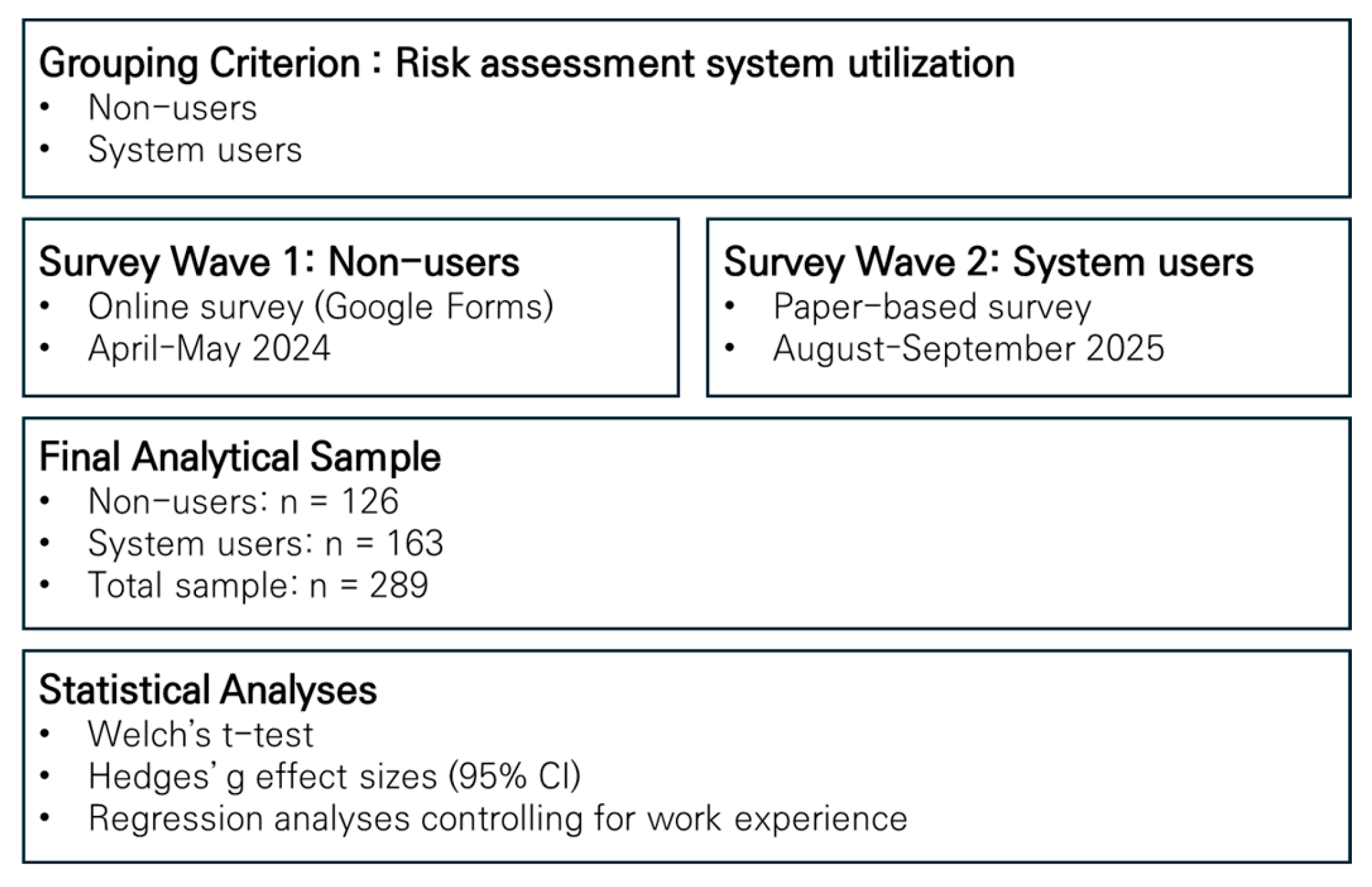
A questionnaire survey targeting non-users of the risk assessment system was conducted online using Google Forms between 16 April and 19 May 2024, yielding 126 valid responses. The average work experience of this group was approximately 11 years. In contrast, a survey targeting system users was administered in a paper-based format between August and September 2025, resulting in 163 valid responses, with an average work experience of approximately 15 years.
The overall data collection process—including survey timing, data collection formats, grouping criteria, and the final analytical sample—is summarized in
Figure 1.
Because data for the two groups were collected at different time points, the potential influence of external factors, such as changes in regulations, safety policies, or site conditions over time, cannot be fully excluded. Accordingly, the findings of this study were interpreted with explicit consideration of this temporal difference, and this limitation is addressed in the Results and Conclusions sections.
The internal consistency of the measurement scales was assessed using Cronbach’s α based on the current sample. All three constructs demonstrated high internal consistency (safety consciousness: α = 0.968; safety attitude: α = 0.977; safety behavior: α = 0.977).
To examine mean differences between system users and non-users, Welch’s
t-tests were employed. Welch’s
t-test does not require the assumption of equal variances between groups and has been shown to provide robust and reliable results when sample sizes and variances differ across groups [
22,
23].
In addition to statistical significance testing, Hedges’ g was calculated as an effect size measure to describe the magnitude of group differences. Hedges’ g corrects for potential bias arising from unequal sample sizes and is generally considered a more conservative estimator than Cohen’s d [
24,
25]. Effect sizes were interpreted with reference to established benchmarks, including extended classifications proposed in prior methodological studies [
26,
27], while avoiding emphasis on absolute magnitude alone.
Welch’s t-tests and effect size estimation (Hedges’ g) were conducted using Python 3.11.2 (pandas 2.2.3, NumPy 1.24.0, and SciPy 1.14.1), and regression analyses were performed using SPSS (version 21).
4. Results
4.1. Sample Characteristics and Descriptive Statistics
Descriptive statistical analysis indicated that construction workers who utilized the risk assessment system (n = 163) exhibited generally higher mean levels of safety consciousness (SC), safety attitude (SA), and safety behavior (SB) than those who did not utilize the system (n = 126), as summarized in
Table 2.
In particular, larger mean differences between the two groups were observed for safety consciousness and safety attitude, while safety behavior also showed higher average scores among system users. These descriptive patterns were subsequently subjected to formal statistical testing through group difference analyses corresponding to H1–H3, as reported in the following section.
4.2. Group Differences in Safety Consciousness, Safety Attitude, and Safety Behavior
This section examines Hypotheses H1–H3 by comparing mean levels of safety consciousness, safety attitude, and safety behavior between construction workers who utilized the risk assessment system and those who did not. Group comparisons were conducted using Welch’s t-tests, which do not require the assumption of equal variances between groups.
Prior to analysis, the distributions of the outcome variables were examined using graphical diagnostics (e.g., Q–Q plots and histograms). No severe departures from approximate normality were observed that would preclude the use of parametric group comparisons. Given the sample sizes of the two groups, Welch’s t-test was considered appropriate and robust for the present analyses.
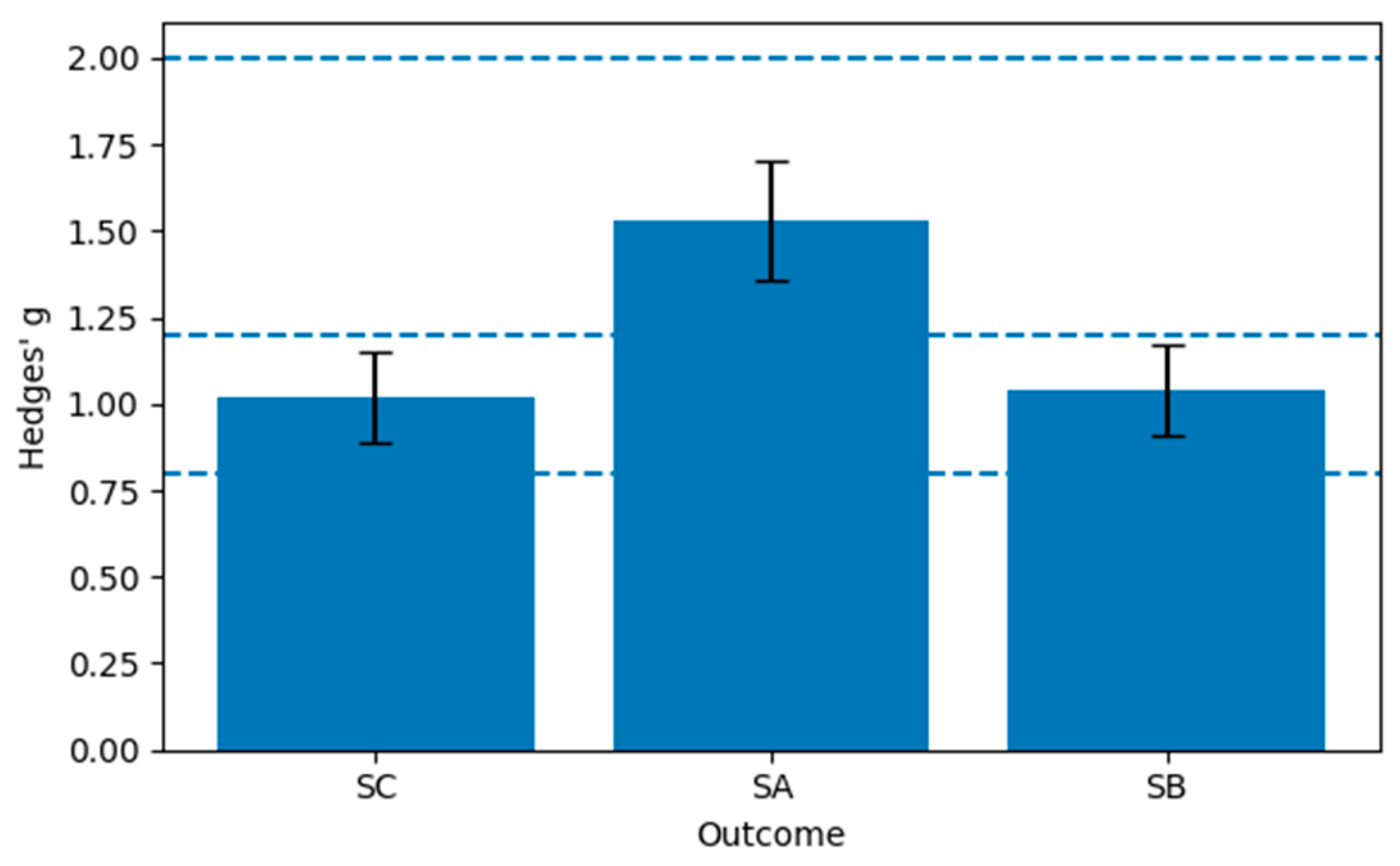
To complement statistical significance testing, standardized effect sizes (Hedges’ g) and corresponding 95% confidence intervals were calculated for each comparison to describe the magnitude of group differences. The numerical results are summarized in
Table 3, and a visual overview of the effect sizes with confidence intervals is provided in
Figure 2.
Differences in Safety Consciousness (H1): Construction workers who utilized the risk assessment system reported significantly higher levels of safety consciousness than non-users (Welch’s t (259.98) = 8.17, p < 0.001). The estimated effect size indicated a large difference between groups (Hedges’ g = 1.02, 95% CI [0.89, 1.15]). Thus, Hypothesis H1 was supported.
Differences in Safety Attitude (H2): System users also exhibited significantly higher safety attitude scores compared with non-users (Welch’s t (240.73) = 12.16, p < 0.001). The corresponding effect size suggested a large between-group difference (Hedges’ g = 1.53, 95% CI [1.36, 1.70]), supporting Hypothesis H2.
Differences in Safety Behavior (H3): With respect to safety behavior, construction workers who used the risk assessment system demonstrated significantly higher mean scores than those who did not (Welch’s t (247.84) = 8.28, p < 0.001). The estimated effect size likewise indicated a large group difference (Hedges’ g = 1.04, 95% CI [0.91, 1.17]). Accordingly, Hypothesis H3 was supported.
This subsection provides item-level comparisons between construction workers who utilized the risk assessment system and those who did not, offering a more detailed description of the observed group differences in safety consciousness, safety attitude, and safety behavior. For each item, mean differences between groups were examined using Welch’s t-tests, and the magnitude of differences was summarized using Hedges’ g.
Across all three constructs, system users generally reported higher mean scores than non-users at the item level, although the magnitude of differences varied across items. Within safety consciousness, larger differences were primarily observed for items related to compliance with safety rules, use of personal protective equipment, participation in safety education and activities, and sustained attention to hazard prevention. One item (SC7) showed a relatively small difference between groups, indicating that not all aspects of safety consciousness differed to the same extent. For safety attitude, item-level comparisons consistently indicated higher scores among system users across items, reflecting perceptions of the necessity of safety rules, the importance of accident prevention, and the prioritization of safety over work performance. Effect sizes for these items were generally larger than those observed for safety consciousness, suggesting more pronounced differences at the attitudinal level. With respect to safety behavior, system users also demonstrated higher mean scores than non-users across items capturing both compliance-related behaviors and participatory safety practices, such as assisting colleagues in hazardous situations and voluntarily engaging in safety improvement activities. As with the other constructs, the strength of differences varied across items, but the overall directional pattern remained consistent.
Detailed item-level statistics, including mean values, standard deviations, Welch’s
t-test results, and effect size estimates, are reported in
Table 4.
4.3. Group Differences in the Associations Between Safety Consciousness, Safety Attitude, and Safety Behavior
To supplement the hypothesis testing results, this subsection explores how safety consciousness and safety attitude are associated with safety behavior, and whether the patterns of these associations differ according to risk assessment system utilization. Separate regression analyses were conducted for system users and non-users to examine group-specific association patterns (see
Table 5).
The results indicate that both safety consciousness and safety attitude were significantly associated with safety behavior in both groups. However, differences were observed in the relative magnitude and structure of these associations between system users and non-users.
Among construction workers who utilized the risk assessment system, safety consciousness (B = 0.441, p < 0.001) and safety attitude (B = 0.429, p < 0.001) showed associations of similar magnitude with safety behavior, jointly explaining a substantial proportion of variance in safety behavior (R2 = 0.674). This pattern indicates that, within the system user group, safety behavior was comparably associated with both safety consciousness and safety attitude. In contrast, among non-users, safety consciousness exhibited a relatively stronger association with safety behavior (B = 0.598, p < 0.001), whereas the association between safety attitude and safety behavior was notably weaker (B = 0.211, p = 0.012). The explanatory power of the model for this group was R2 = 0.581. These results indicate that the association between safety-related cognition and behavior differed between system users and non-users.
Following the group-wise regression analyses examining differences in the associations among safety consciousness, safety attitude, and safety behavior, an additional regression analysis was conducted to examine whether the observed group differences could be explained by differences in work experience.
As shown in
Table 6, system use was consistently associated with safety-related outcomes across all three models (
p < 0.001), whereas work experience was not statistically significant in any model. These findings suggest that differences between system users and non-users persist even when work experience is considered.
4.4. Implications
The findings of this study indicate that construction workers in sites where a risk assessment system has been implemented differ from those in non-implemented sites with respect to safety consciousness, safety attitude, and safety behavior. These differences were consistently observed across both composite measures and item-level analyses. Rather than emphasizing the magnitude of these differences, the results are more appropriately interpreted in terms of how safety-related cognition, evaluative orientations, and practices are configured under different safety management contexts.
From a behavioral perspective, the observed pattern aligns with theoretical views that conceptualize safety behavior as the outcome of multi-stage processes involving cognitive awareness and evaluative orientation. In this regard, the results suggest that group differences are more pronounced at the level of safety-related cognition and attitudes than at the level of observable behavior. This pattern supports an interpretation in which structured safety management practices—such as formalized risk assessment procedures—are more closely associated with how workers perceive and evaluate safety, rather than directly translating into immediate behavioral change.
Importantly, the risk assessment system examined in this study functions not merely as a periodic evaluation tool but also as a mechanism for delivering individualized, task-specific risk information to workers immediately prior to task execution through mobile- and messaging-based platforms. From this perspective, the more pronounced differences observed in safety consciousness and safety attitude are plausibly understood as reflecting differences in informational and managerial environments, rather than direct behavioral effects attributable to system utilization alone.
The item-level analysis further clarifies the nature of these differences. Rather than treating safety consciousness, safety attitude, and safety behavior as homogeneous constructs, the results indicate that certain aspects of safety-related perception and practice contribute more strongly to overall group differences than others. Across most items, workers in system-implemented sites reported higher levels than those in non-implemented sites, although the degree of differentiation varied depending on item content.
Within safety consciousness, larger differences were observed for items related to engagement with safety education, sustained attentiveness during task execution, and awareness of preventive measures. In contrast, items reflecting proactive interpersonal safety initiatives showed comparatively smaller differentiation, suggesting that such behaviors may be shaped more strongly by organizational culture, communication norms, or leadership practices than by the presence of a risk assessment system alone.
For safety attitude, differences were most evident in value-oriented orientations toward safety and the perceived importance of accident prevention, rather than in basic knowledge of safety rules. This finding suggests that workers in system-implemented sites may differ not only in their understanding of safety requirements but also in the extent to which safety is internalized as a guiding principle in work-related decision-making.
With respect to safety behavior, workers in system-implemented sites reported higher levels across both compliance-oriented actions and participatory safety practices. However, given the cross-sectional nature of the data, these differences should not be interpreted as evidence of behavioral change attributable to system utilization. Instead, they are more appropriately understood as reflecting broader differences in safety management environments in which expectations, norms, and monitoring practices related to safety behavior vary across sites.
Additional regression analyses controlling work experience indicated that the observed group differences were not fully explained by individual-level experience factors alone. This finding supports an interpretation that emphasizes contextual characteristics of the work environment while underscoring the need to situate the results within a broader organizational and managerial framework rather than attributing them to the isolated use of a specific technological tool.
Exploratory group-wise regression analyses further suggested that the relational patterns among safety consciousness, safety attitude, and safety behavior differ depending on whether a risk assessment system is implemented. These patterns should be interpreted as indicative of differing safety cognition–behavior linkages across contexts, rather than as evidence of structural or causal mechanisms.
From a proactive safety management perspective, the findings can be interpreted in terms of leading indicators rather than outcome-based safety measures. Safety consciousness, safety attitude, and safety behavior represent workers’ ongoing risk awareness, evaluative orientations, and daily practices, which collectively reflect the maturity of safety management environments. In this sense, the observed relational patterns support an integrated, safety-oriented understanding of safety performance, consistent with recent preventive safety management frameworks.
Overall, the implications of this study lie not in demonstrating the effectiveness of a specific risk assessment system but in highlighting how safety-related cognition, attitudes, and behaviors may be configured differently across contrasting safety management contexts. Given the exploratory nature of the analyses, differences in data collection timing, site characteristics, and survey administration procedures, the findings should be interpreted with appropriate caution. Nonetheless, the results provide an empirical basis for further discussion on the role of integrated safety management practices in shaping safety-related perceptions and practices in construction settings.
5. Conclusions
This study examined whether construction workers in sites where a risk assessment system has been implemented differ from those in non-implemented sites with respect to safety consciousness, safety attitude, and safety behavior. Rather than aiming to establish causal effects, the study adopted a group-comparison approach to explore how safety-related perceptions, evaluative orientations, and practices may be configured differently across contrasting safety management contexts.
The findings indicate that consistent differences exist between system users and non-users across multiple safety-related dimensions. Importantly, these differences were observed not only at the level of reported safety behavior but also in safety consciousness and safety attitude, suggesting that distinctions between the two groups are more clearly reflected in how workers perceive and evaluate safety than in behavior alone. This pattern highlights the importance of considering safety-related cognition and attitudes as integral components of construction safety management environments.
Additional analyses examining the associations among safety consciousness, safety attitude, and safety behavior further suggest that the relationships between these constructs differ depending on whether a risk assessment system is implemented. Among system users, safety behavior was consistent with associations involving both cognitive awareness and evaluative orientations toward safety, whereas among non-users, safety behavior was more closely linked to situational risk recognition. These patterns should be interpreted as indicative of differing safety cognition–behavior linkages across contexts, rather than as evidence of structural or causal mechanisms.
From an academic perspective, the contribution of this study lies in demonstrating that meaningful group-level differences in safety-related constructs can be identified using a transparent classification criterion based on risk assessment system utilization without relying on complex causal or mediation models. By analytically distinguishing safety consciousness, safety attitude, and safety behavior while acknowledging their conceptual interrelatedness, the study provides empirical insight into how pre-task safety information environments may be associated with multiple layers of safety-related perception and practice.
From a practical perspective, the findings underscore the relevance of considering how safety information is delivered and contextualized at the point of work. Rather than emphasizing compliance with static documentation, the findings point to the relevance of safety management approaches that situate risk information within specific task contexts in relation to workers’ safety-related awareness and evaluative orientations. These observations may inform the design and implementation of integrated safety management practices in construction settings.
Several limitations should be acknowledged. The study relied on cross-sectional, self-reported data, which limits the ability to draw causal inferences and raises the possibility of response bias. Differences in data collection timing, survey administration procedures, and site characteristics between system users and non-users may also have influenced the observed patterns. In addition, because the analysis focused on specific construction sites and a particular risk assessment system, the findings should not be directly generalized to other contexts, system designs, or regulatory environments. Accordingly, the findings should be interpreted with appropriate caution.
Future research could build on this work by employing longitudinal designs to examine changes in safety-related perceptions and behaviors before and after the introduction of risk assessment systems. Further studies may also incorporate more detailed controls for job roles, task characteristics, and organizational factors, examine a broader range of risk assessment system types and implementation strategies, and apply alternative analytical approaches to better understand how safety-related cognition and attitudes are linked to behavior over time.