Article

Studying the Method to Identify Backward Erosion Piping Based on 3D Geostatistical Electrical Resistivity Tomography

1
Department of National Engineering Research Center for Inland Waterway Regulation, Chongqing Jiaotong University, Chongqing 400074, China
2
CCCC-FHDI Engineering Co., Ltd., Guangzhou 510230, China
3
School of Hydraulic Engineering, Zhejiang University of Water Resources and Electric Power, Hangzhou 310018, China
*
Authors to whom correspondence should be addressed.
Buildings 2026, 16(3), 546; https://doi.org/10.3390/buildings16030546
Submission received: 23 December 2025 / Revised: 22 January 2026 / Accepted: 23 January 2026 / Published: 28 January 2026
(This article belongs to the Section Construction Management, and Computers & Digitization)

Abstract

Levees with double-layered foundations are characterized by a weakly permeable upper layer and a highly permeable sand layer beneath, which makes them susceptible to internal erosion, particularly backward erosion piping (BEP). Therefore, locating BEP channels before the failure of a levee is crucial for ensuring the safety of levee projects. In this study, a novel method is proposed for detecting BEP channels efficiently. This method involves applying the successive linear estimator (SLE) to fuse multipoint measured voltage to characterize the inner levee structure. Therefore, the BEP channels can be recognized from the details of the levee structure. This method is named three-dimensional geostatistical electrical resistivity tomography (3D GERT) in this study. To validate the performance of GERT, a custom-developed indoor sandbox device was used for physical BEP conductivity detection tests, and the results were analyzed via the SLE to assess the accuracy of channel engraving. The tests revealed that the surface sand was initially expelled from the piping exit, followed by the formation of a concentrated piping channel that extended upstream. The erosion depth at the piping exit was observed to be deeper than that of the main channel. This study demonstrated that 3D GERT, when the SLE was used as the inversion algorithm, detected BEP channels and achieved an internal erosion dimension deviation of less than 25.5% and a positional erosion dimension deviation within 16.5%. The accuracy of the SLE in mapping BEP channels improved with the use of a more comprehensive electrode distribution and an increased number of electrodes, thus yielding a more precise representation of the channel scale and pattern. The coefficient of determination (R2) between the acquired data and the simulated data generated by 3D GERT was greater than 0.85, demonstrating the capability of the simulated values to track and reproduce the variation trends observed in the acquired data. Thus, the SLE, when used as the inversion algorithm for 3D GERT, reliably represents BEP channels.

1. Introduction

Levees are widely implemented and highly effective constructions for mitigating flood disasters; they effectively protect lives and property in flood-prone coastal areas. Double-layered foundations are highly susceptible to backward erosion piping (BEP) under certain water pressure differences [1]. BEP is a progressive bottom-up internal erosion failure mode. When the hydraulic gradient induced by seepage at the exit exceeds the critical value for particle initiation, fine particles are transported by seepage, and the erosion channel subsequently propagates upstream. If not promptly detected and addressed, backward erosion may progress, leading to an abrupt loss of soil strength, thus compromising the structural integrity of the levee and potentially causing dam failure. For example, piping incidents occurred at the Zhengzhou Changzhuang Reservoir and Xinxiang Communist Drainage Canal in 2021 [2]; in 2022, similar issues arose in the Datangwei section of the Beijiang River, Guangdong; and in 2024, several levees at Dongting Lake collapsed due to piping. Piping issues in levees are widespread and pose significant threats not only in China but also in countries such as the United States, the Netherlands, and France [3]. The earth dam located in Bastrop State Park was overtopped by floodwater, which resulted in piping and internal erosion of the dam body [4]. In the Netherlands, severe BEP downstream of the Zerlaert Dam caused partial dam failure and extensive waterlogging in downstream areas. Similarly, BEP at the Poitiers levee in France destabilized the levee. BEP has been a primary focus of seepage research due to its concealed nature, frequent occurrence, and hazardous effects [5,6,7]. Thus, characterizing the location, size, and development patterns of BEP channels is of both theoretical and practical importance.
Currently, various levees utilize data monitoring and physical exploration to infer the location and dimensions of piping channels. Traditional approaches, such as manual drilling and cone penetration grouting [8], suffer from low efficiency and a high risk of missed detection. Scholars have employed the Sellmeijer model to characterize BEP channels [9,10], yet under the single-point convergent flow conditions commonly encountered in practical engineering applications, the two-dimensional model may overestimate the critical head [11]. Wang et al. [12] utilized a dual random lattice modeling method to simulate BEP, but this method entails high computational costs and significant data requirements. Geophysical exploration and tracer technologies have become mainstream in piping detection due to their efficiency, accuracy, and nondestructive nature [13,14,15,16]. Given the high technical demands of reservoir and dam leakage detection, the combination of one or more methods often improves the accuracy of anomaly localization. Zhang et al. [17] integrated geomagnetic, high-density electrical, and micro-motion methods to detect levee leakage areas comprehensively and precisely. Zhao et al. [18] used the parallel electrical method to determine the seepage channel direction in dams and combined it with the transient electromagnetic method to investigate dam shoulder issues. Qiu et al. [19] used temperature, natural, and sodium chloride tracer tests to detect seepage areas within dams.
However, hydrological and geological heterogeneity complicates distinguishing whether stratal differences stem from heterogeneity or hidden hazards during physical and tracer exploration. Traditional geophysical methods are exemplified by electrical resistivity tomography (ERT). ERT involves the use of mathematical inversion algorithms to characterize the spatial distribution of conductivity [20]. Yet, solving geophysical inverse problems involves more than fitting observed data mathematically, owing to their inherent ill-posedness, measurement noise, model parameterization uncertainties, and subsurface heterogeneity. To address non-uniqueness in ERT, stochastic approaches have been adopted to incorporate prior information [21,22]. Building upon this foundation, Günther and Rücker [23] further developed a joint inversion approach integrating multi-physical datasets (e.g., DC resistivity and seismic refraction) via Bayesian principles to constrain subsurface structures. In the field of hydrogeophysics, Linde et al. [24] inverted DC resistivity and ground-penetrating radar travel time data using a regularized least-squares approach and used stochastic regularization operators based on geostatistical models to constrain the solution. Galetti et al. [25] introduced a transdimensional stochastic inversion framework that employed the reversible-jump Markov chain Monte Carlo algorithm and Voronoi cells parameterization to adaptively determine model complexity and improve flexibility in characterizing heterogeneous resistivity distributions, though it relies heavily on extensive prior knowledge to constrain uncertainties. For three-dimensional (3D) model construction, the “multisource data–3D model–fragility assessment” paradigm proposed by Ayer et al. [26] sets a methodological benchmark for the refined characterization and 3D geometric representation of hydrogeological aquifers. Recent advances in machine learning, especially convolutional neural networks (CNNs), have driven breakthroughs in ERT inversion: Jiang et al. [27] developed a CNN-based method enabling rapid, accurate resistivity distribution reconstruction with reduced computation time and enhanced inversion stability. Nonetheless, CNN-based ERT inversion faces challenges, including high demand for training data (with high computational costs), unclear physical interpretation of results, and performance degradation in high-noise environments.
In this study, we propose the geostatistical electrical resistivity tomography (GERT) method [28,29], which differs from conventional ERT primarily in three main aspects. First, GERT conceptualizes electrical conductivity and voltage fields as random fields. It then employs the successive linear estimator (SLE) [30,31,32] to solve the inverse problem. SLE is a stochastic analysis method. Although stochastic analysis methods have been applied to ERT, the mainstream ERT inversion approach is the OCCAM algorithm or its variants. Second, whereas conventional ERT typically derives a conductivity field that minimizes the discrepancy between simulated and observed apparent resistivities, GERT seeks to recover a conductivity field that minimizes the difference between simulated and measured voltages. This distinction necessitates the use of a sensitivity matrix in GERT to describe the nonlinear relationship between voltage and conductivity. Finally, unlike the regularization constraints commonly used in ERT [33], GERT employs covariance functions to impose stochastic constraints on the inversion results and updates the conductivity field based on cross correlations between parameters [34]. With the help of SLE, GERT leverages the concept of conditional variance, and its inverse model quantifies the uncertainty in the estimates resulting from spatial variability and measurement errors [35,36]. The GERT framework has been rigorously tested theoretically [29], validated through laboratory experiments [34,37], and subsequently applied by Wang et al. [38] to characterize subsurface heterogeneity at the basin scale. However, its applicability in characterizing seepage erosion channels remains to be explored.
Therefore, the objective of this study is to evaluate the feasibility of using GERT to characterize BEP through laboratory experiments. In Section 3, we first describe the materials, equipment, and procedures used in the laboratory experiments. Then, in Section 4, we analyze the laboratory test results and the data collected by the electrodes. This is followed by a comparative discussion of the experimental results and inversion outcomes in Section 5. Finally, in Section 6, we discuss the impact that the number of monitoring electrodes has on the inversion and briefly compare the inversion principles and effectiveness of the SLE algorithm and the OCCAM algorithm.

2. Three-Dimensional Geostatistical Electrical Resistivity Tomography

GERT is a geophysical method that integrates geostatistical data with electrical resistivity tomography. It employs inversion techniques such as the conditional covariance function and the Levenberg–Marquardt algorithm to infer geological structures by measuring the differences in electrical resistivity between subsurface media. With the aid of the SLE [28,29,39], geostatistical information (mean, variance, and correlation scale) is incorporated into a conditional covariance function model to more accurately estimate the uncertainty of the electrical conductivity distribution, thereby enhancing the inversion accuracy in characterizing the BEP channels. Owing to the incorporation of nonlinear relationships between physical quantities by the SLE, it can more effectively interpret the electrical source–receiver data.
The SLE for the case of estimating conductivity from voltage values under steady DC field conditions has the following form:
  f ^   r + 1 x m =   f ^   r x m + j 1 N h ω mj ( r ) φ j * x j φ j r x j =   f ^   r x m + j 1 N h ω mj r h j * x j + H x j h j r x j + H x j =   f ^   r x m + j 1 N h ω mj r h j * x j h j r x j
where f ^ r x m represents the estimated value of the r-th iteration at point xm, and the superscript r represents the number of iterations; φ j x j represents the observed potential at xj; φ j r x j represents the potential calculated based on the current estimate f ^ r x m ; H x j represents the mean value of the calculated potential, which is derived from the unconditional mean conductivity; h j x j and h j r x j denote the perturbations in the observed and calculated potentials, respectively; and ω m j r represents the weight of the difference between the observed and estimated values at xj, which affects the estimated value of f at xm during the r-th iteration.
This linear estimation must meet the minimum mean-squared error criterion.
E f x m f ^ r x m 2 = min
Substituting Equation (1) into Equation (2) and expanding the resulting expression yields the following:
E f x m f ^ r x m 2 = ε f f r x m , x m j = 1 N h ω m j r ε f h r x m , x j j = 1 N h ω m j r ε h j r x j , x m + j = 1 N h k = 1 N h ω m j r ε h h r x j , x k
where ε f f x m , x m represents the conditional covariance of f at xm with itself; ε f h x m , x j denotes the conditional mutual covariance (CMC) between f at xm and h at xj; and ε h h x j , x k represents the CMC between h at xj and h at xk. It is defined as follows:
ε hh = a v e + v a r e x j x k l x 2 + y j y k l y 2 + z j z k l z 2
where ave represents the prescribed mean; var denotes the prescribed variance; xjxk, yjyk, zjzk indicates the spatial distance between two points; and lx, ly, lz correspond to the correlation scales in respective directions.
To minimize the weight in Equation (3), it is differentiated with respect to ωmj and set to zero.
k = 1 N h ω m k r ε h h r x j , x k = ε f h r x m , x j
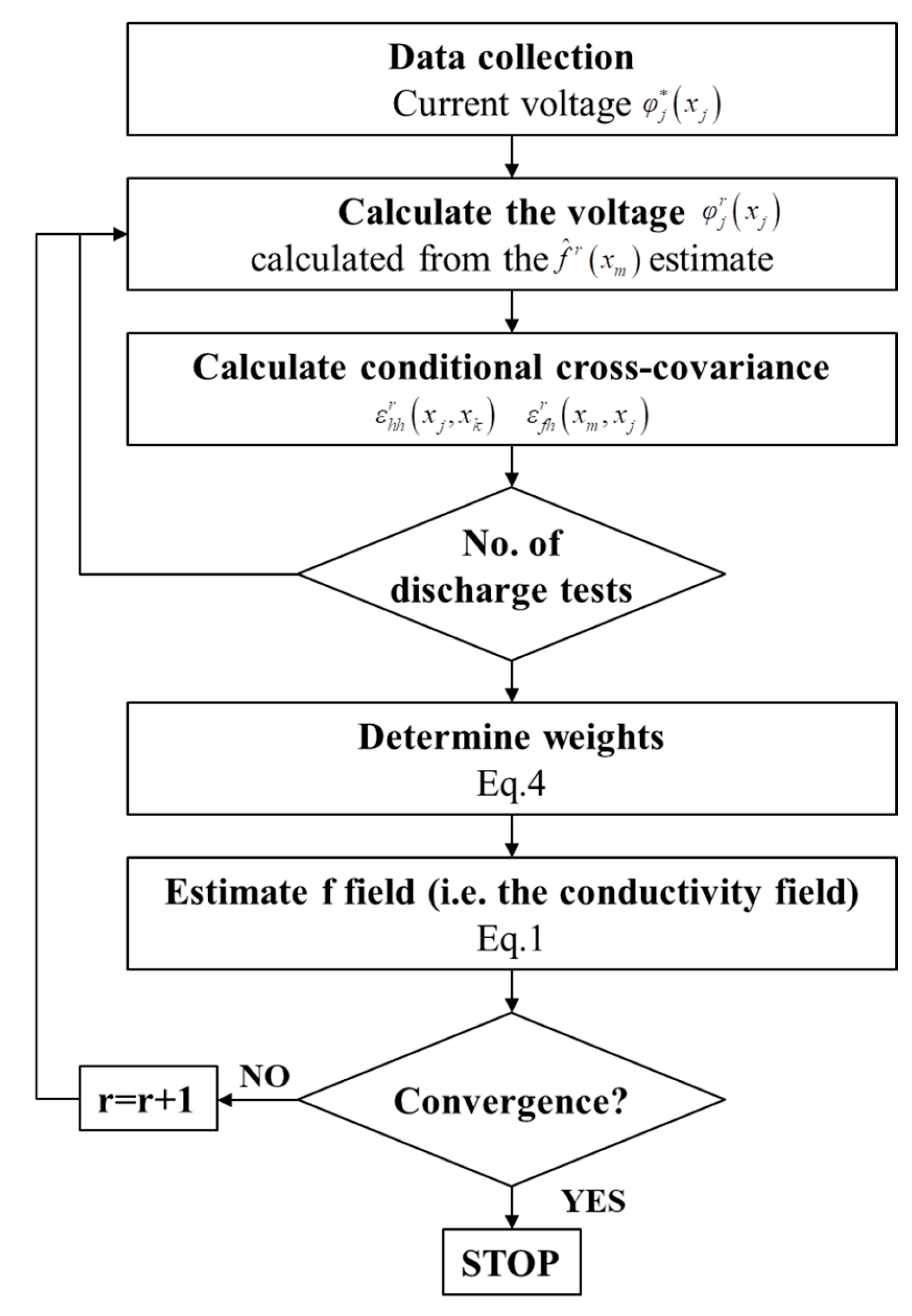
Solving Equation (5) yields the weight ω m k r , which is then used in Equation (1) to obtain a new estimate f ^ r + 1 x m . Similarly, weights ω i j r for other positions are sequentially obtained to estimate the entire f ^ r + 1 x m -field. Figure 1 presents a flow chart of the SLE algorithm.
The new h r + 1 x -field can then be calculated from the conditional mean flow equation, which, under steady-state conditions and defined boundaries, is expressed as
ρ e e f f φ c = 0
where ρ e e f f represents the inverse logarithm of the ln ρ e r + 1 field; the subscript c denotes “conditional”; and the superscript eff indicates a valid parameter. The operations in Equations (1)–(6) are repeated until Δ h j r + 1 x j = h j x j h j r + 1 x j is smaller than a specified error for all values of j, or until the variance of the f ^ r + 1 x -field stabilizes.
Based on the theoretical approach above, tomographic scanning is used to estimate the conductive properties of eroding dams. This method leverages the nonlinear relationship between the system parameter (conductivity σ) and the system measured voltage (h), which enables a more precise characterization of conductivity heterogeneity in eroding dams.

3. Indoor Test Design

3.1. Test Material

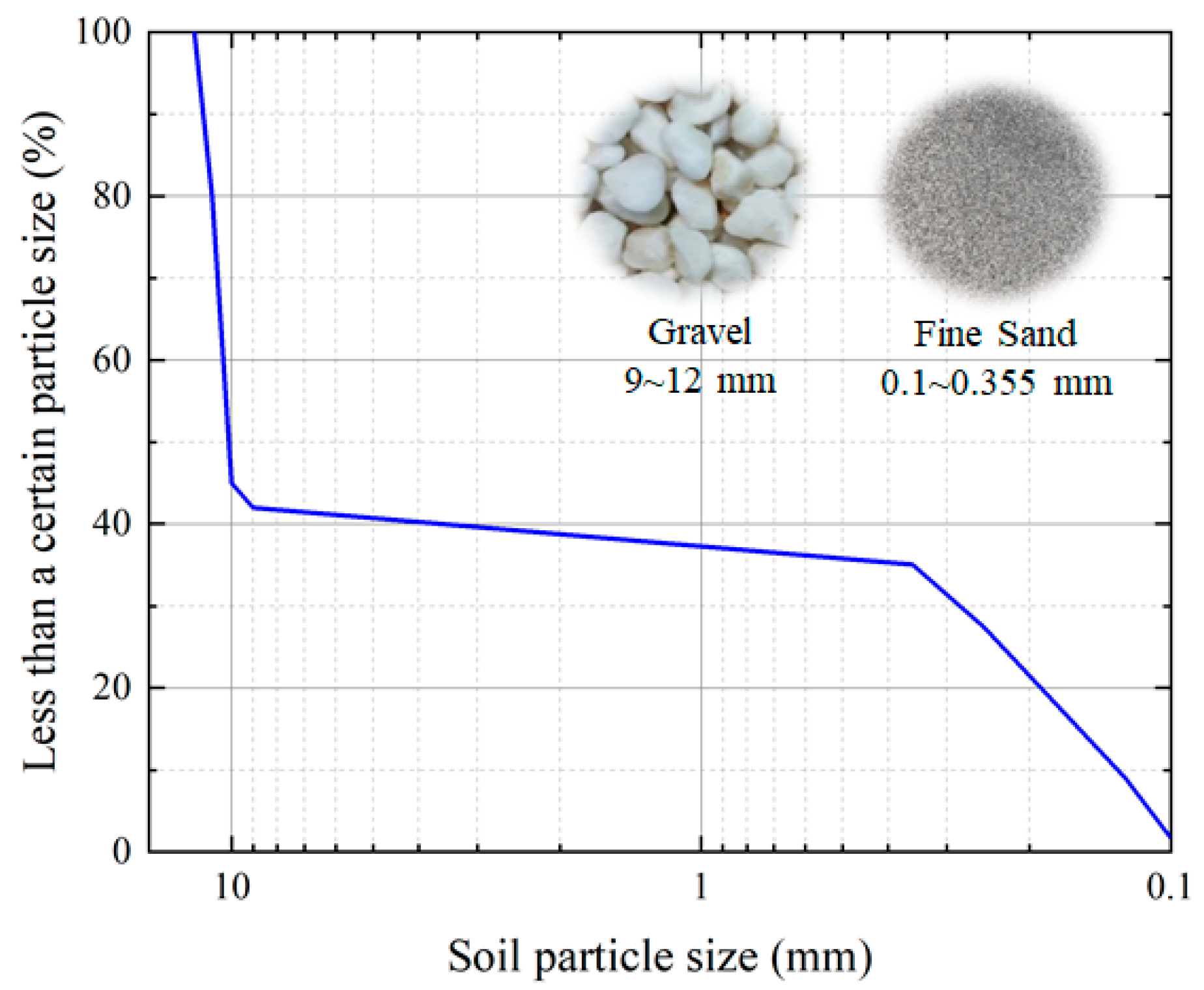
In this study, the test samples consisted of 9–12 mm (Nanjing Wucai Stone Industry Co., Ltd., Nanjing, China) gravel and 0.1–0.355 mm fine sand (Xiamen ISO Standard Sand Co., Ltd., Xiamen, China) which were mixed at a specific ratio with 500 g each of gravel and sand. The particle composition of the sieved sample is shown in Figure 2. The physical parameters of the samples are shown in Table 1. A curvature coefficient Cc = d302/(d10 × d60) < 1 indicates a discontinuous soil gradation, which is consistent with the selected material being a gap-graded sand. On the basis of the China Institute of Water Conservancy and Hydropower Research (CIWHR) guidelines for classifying seepage failure in non-cohesive soils, a value of Cu > 10 qualifies the sand sample as piping soil. Istomina [40] suggested that the coefficient of uniformity, Cu (d60/d10), is a crucial indicator for assessing soil piping. It was suggested that Cu < 10 corresponds to fluid soil, whereas Cu > 20 corresponds to piping soil. Similarly, Kenney and Lau [41] used the minimum ratio (H/F)min to assess internal instability, in which H is the mass fraction of particles between any size d and 4d, and F is the mass fraction of particles of size d. According to the above criteria, the materials used in this study were internally unstable.

3.2. Sample Resistivity Determination

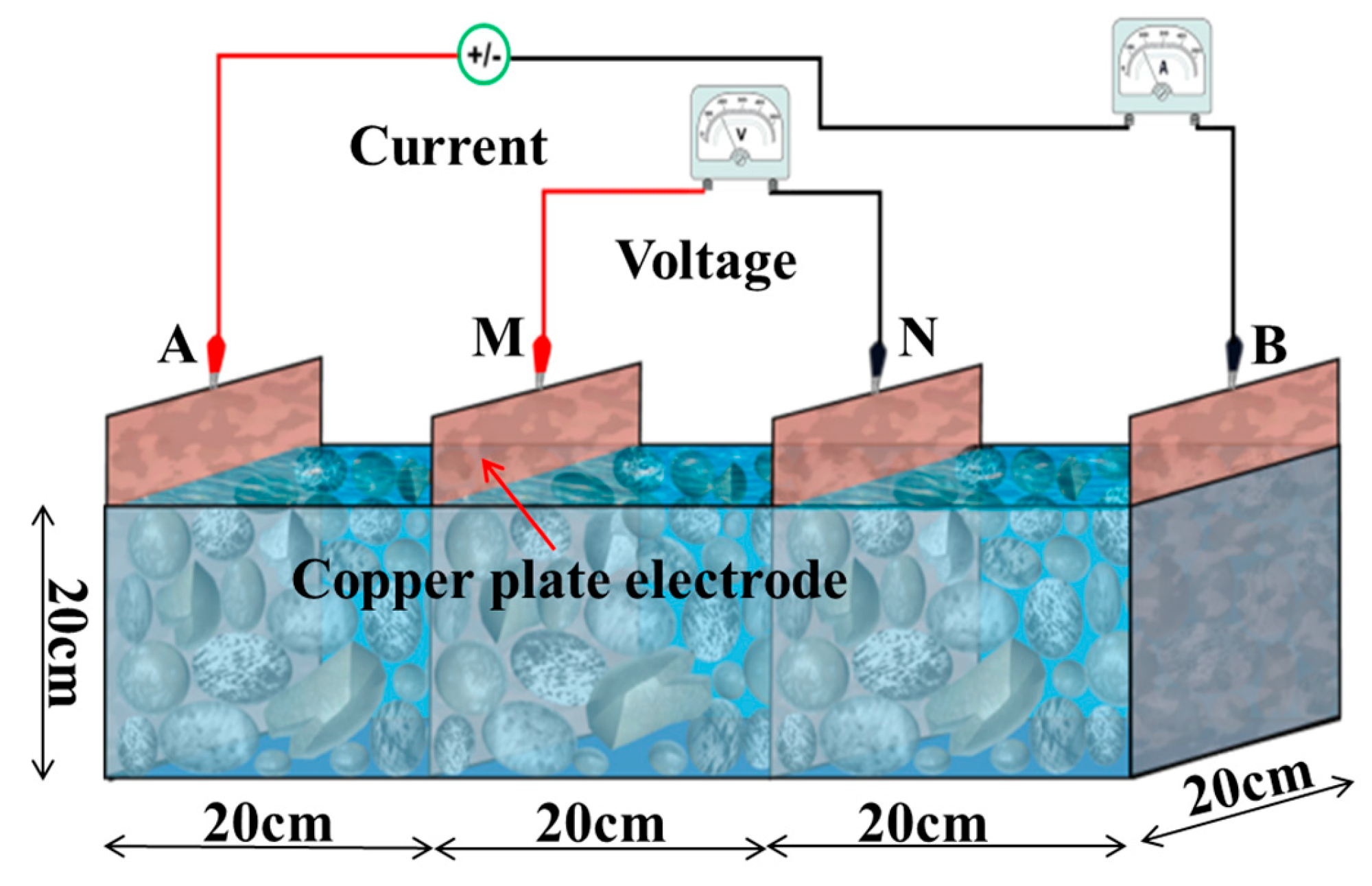
The resistance of the sample was measured using the four-electrode method, as illustrated in Figure 3. Copper sheets were selected as the electrodes, with a resistance of 0.1 Ω, which is negligible compared to the resistance encountered in underwater tests. The test tank was fabricated from transparent acrylic plates, with dimensions of 60 cm in length, 20 cm in width, and 20 cm in height. A constant current was applied between electrodes A and B, and the electrical resistivity of the sample was calculated by measuring the voltage between electrodes M and N [42].
By varying the percentage of sample content, the resistivity was measured at six voltage levels (10 V, 20 V, 30 V, and up to 60 V). The average resistivity value was taken as the final resistivity for each sample composition. The maximum mean resistivity of 317.08 Ω·m was observed at 100% sample content (i.e., uneroded condition), while the resistivity under fully eroded conditions was 113.31 Ω·m. The resistivity at the erosion damage boundary was determined to be 158.15 Ω·m.

3.3. Test Equipment

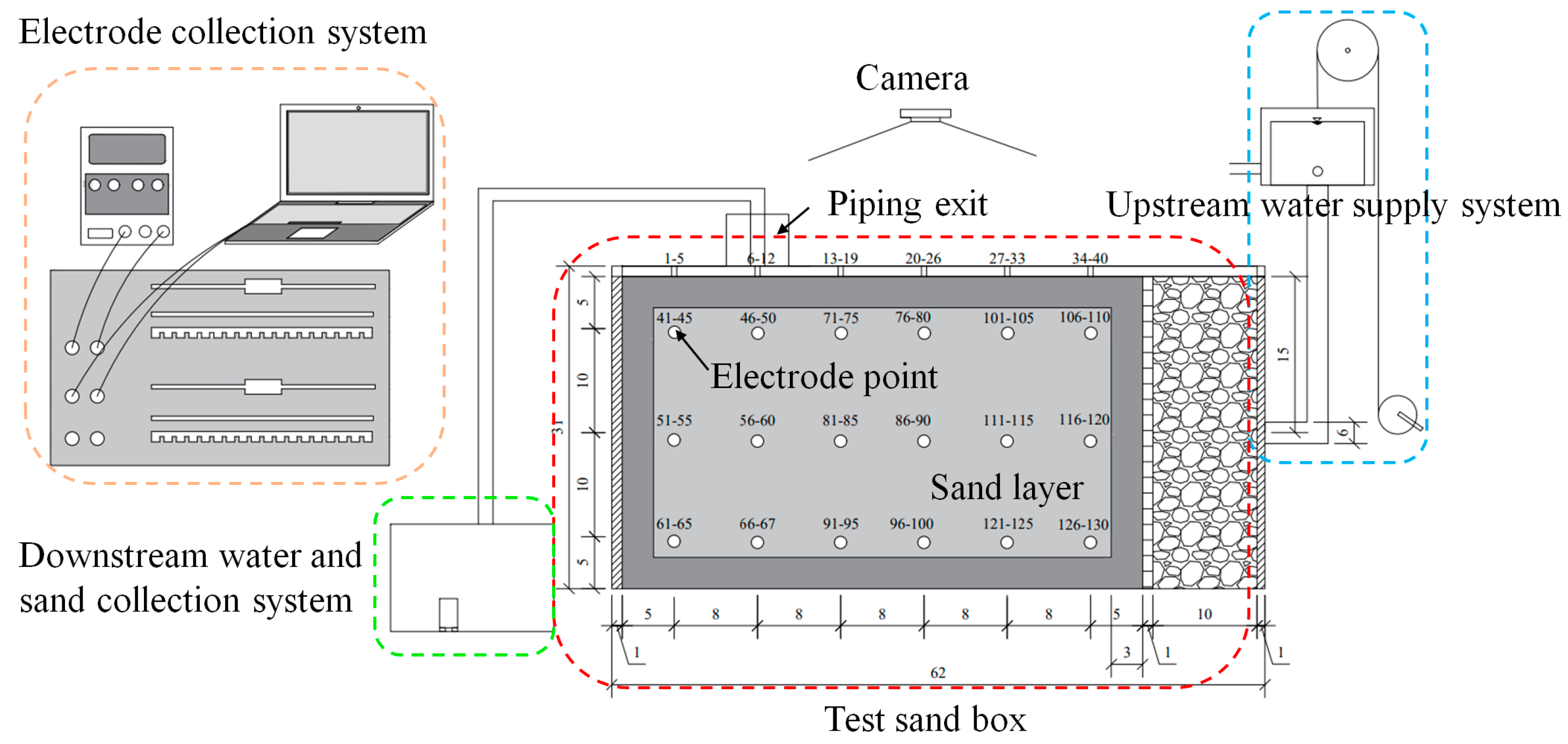
Based on previous design experience [43,44,45,46,47], a custom BEP generation device was developed, as shown in Figure 4. The test setup included four main components: a test sandbox, an upstream water supply system, a downstream water and sand collection system, and an electrode collection system.
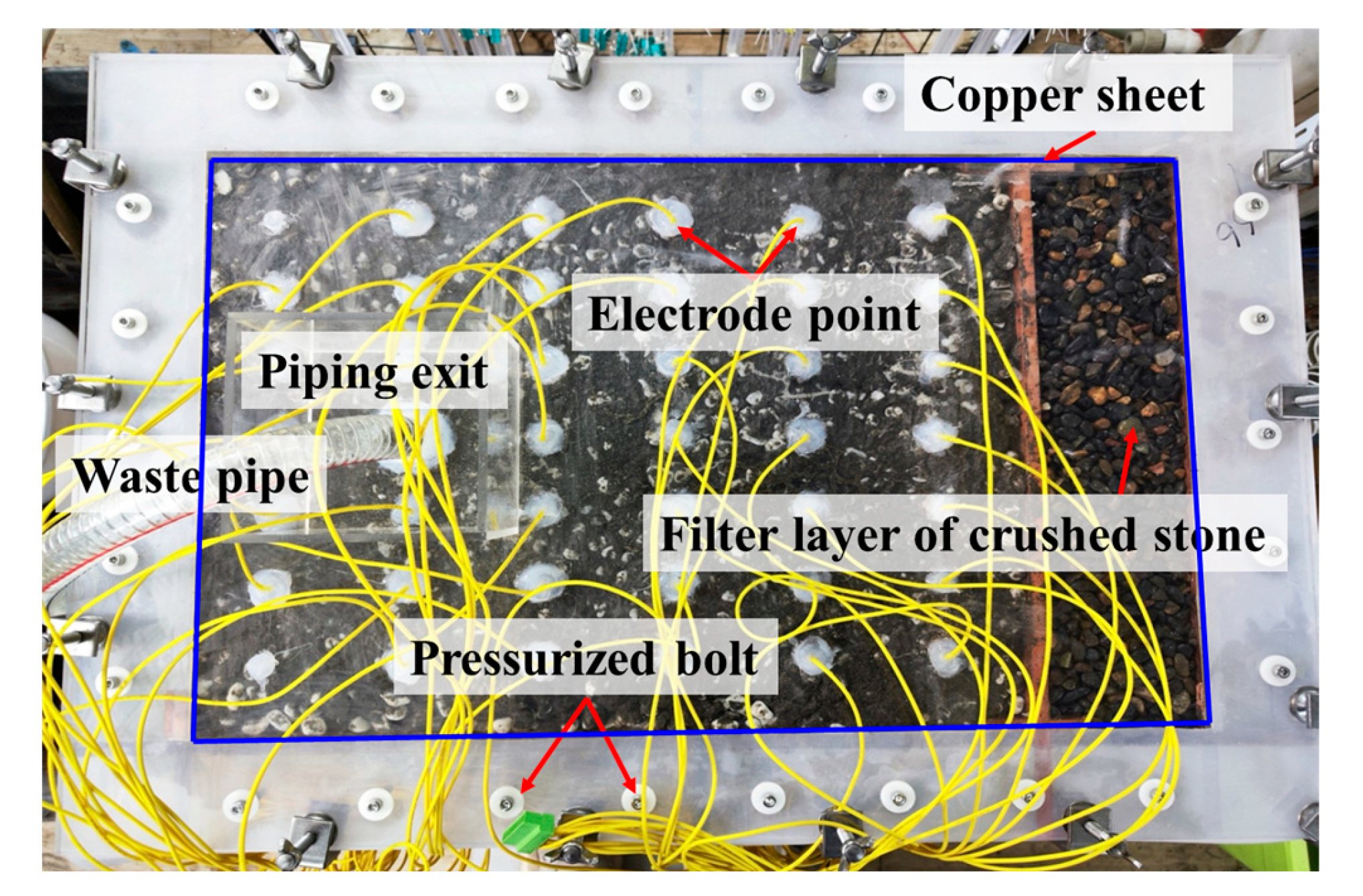
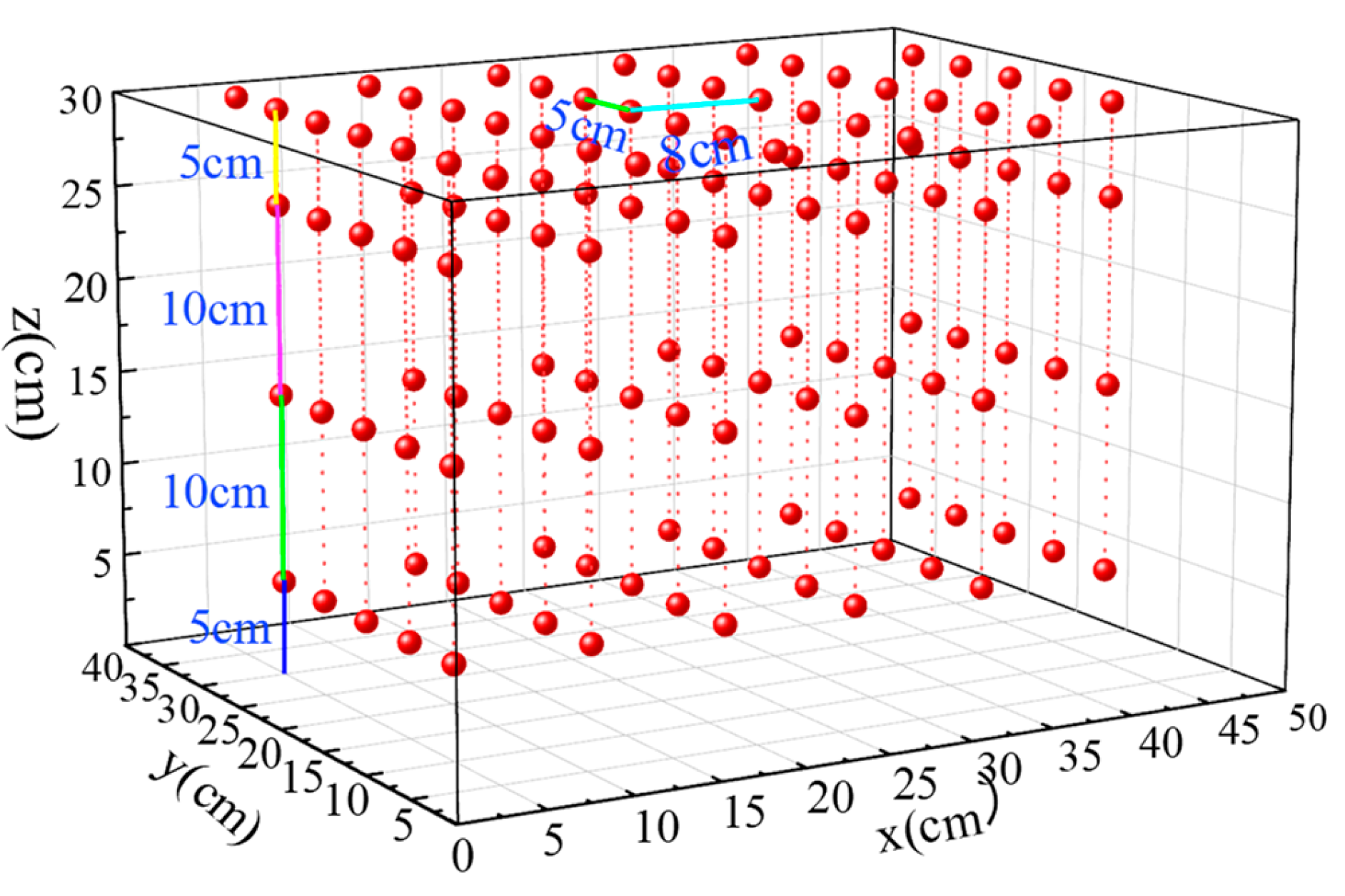
The test sandbox was used to simulate piping seepage failures and measured 60 cm × 40 cm × 30 cm × 1 cm (length × width × height × thickness). The top cover measured 75 cm × 54 cm × 1 cm, with a preset piping exit of 3 cm in diameter at coordinates (37, 20, 30) (Figure 5). The upstream water supply device simulated upstream flow and included an inner box (25 cm × 25 cm × 25 cm) within an outer box (30 cm × 30 cm × 30 cm), along with a 2 cm diameter overflow piping exit. The downstream water and sand collection system measured 100 cm × 30 cm × 50 cm. The electrode collection system comprises two main components: the electrode array and the data acquisition system. As illustrated in Figure 6, the electrode array consists of 130 electrodes distributed across four cross-sectional profiles at heights of 30 cm (on the top cover plate), 25 cm, 15 cm, and 5 cm within the sand tank. The inter-electrode lateral separation is 8 cm. Electrodes on the cover plate are implemented using copper nuts slightly longer than the plate thickness, while electrodes within the sand tank are constructed as 2 mm diameter copper rings. All electrodes are connected to the 3D tomography detection system via copper core wires with a cross-sectional area of 0.1 mm2. The data acquisition system includes an AC-to-DC power supply (0–60 V) (Dongguan Maisheng Electronic Technology Co., Ltd., Dongguan, China), a 3D tomography detection system and dedicated data acquisition software for 3D tomography (Independently developed by the team, ET-V2.0). GERT consists of an automated type of electrical profiling. With the 130 electrodes deployed in this experiment, a maximum of 130 × 129/2 datasets can be obtained. Compared with conventional electrical methods, this represents a data volume increase of one to two orders of magnitude.

3.4. Test Procedures

Before the test commenced, inspection and calibration of the test apparatus were necessary to ensure the smooth progress of the trial. The first step of the test was to fill and saturate the materials. The sample particles were layered in 5 cm increments, with each layer compacted to the specified density. The upstream water supply tank was ensured to be level with the top of the sandbox, and the sandbox was filled with water to saturate the sample for more than 24 h to remove air from the water column.
The second step involved increasing the pressure through incremental layering. The winch was adjusted to raise the water tank, and the upstream water level was increased by 3~6 cm at each stage. If the particles in the sandbox began to move with the water flow, the increase was paused until the system stabilized. The process was repeated until either channel development upstream ceased or erosion reached a specified extent.
The third step involved tomography detection. The 130 three-dimensionally distributed electrodes on the setup are connected to the 3D tomography detection system. The input terminals are linked to the corresponding terminals of the AC-to-DC power supply (0~60 V), while the output terminals are connected to a computer USB port via an adapter. The injection voltage was set to 12 V, with an injection duration of 1 s and a power-off interval of 0.5 s to eliminate polarization effects. (For instance, with Electrode 15 designated as the current positive (A), a direct current is injected for a duration of 1 s. Simultaneously, the voltage is measured at Electrode 1, which serves as the potential positive (M). The current injection is then halted for an interval of 0.5 s. Subsequently, current is again injected at Electrode 15 (A), and the voltage is measured at Electrode 2 (M). This sequence is repeated successively to cycle through all 129 measurement electrodes. Following this, a different electrode is selected as the current positive (A), and the entire voltage measurement procedure is repeated for the remaining electrodes).
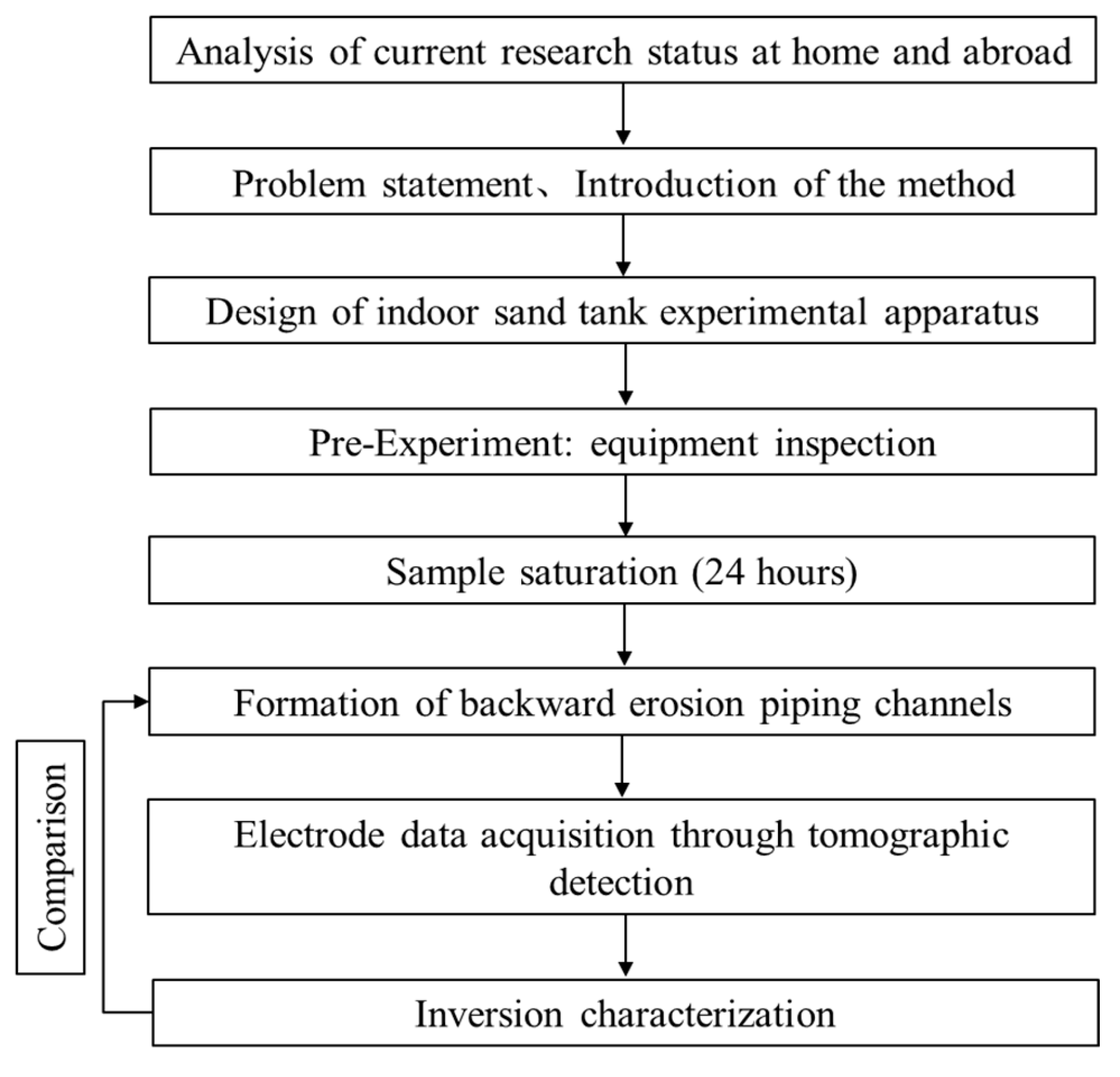
Before conducting tomography detection, the current negative (B) and the potential negative (N) were connected together. This configuration ensures that the N electrode remains at approximately zero potential, allowing the M electrode to measure the absolute voltage at its location during the current injection from A. Furthermore, the combined B–N connection was linked to a copper sheet at the boundary of the sand tank to create an artificial zero-potential surface (Figure 5), followed by a continuity check. To minimize issues such as electrode polarization, poor contact, and disconnection, which may cause acquisition errors during tomography imaging, a diagnostic procedure was implemented by selecting a single electrode as the current injection point and monitoring the measured voltage at all other electrodes to identify malfunctioning units. This process helped identify faulty electrodes and eliminate issues. A flowchart of the test procedure is shown in Figure 7.

4. Test Results and Analysis

4.1. Analysis of Apparent Characteristics of BEP

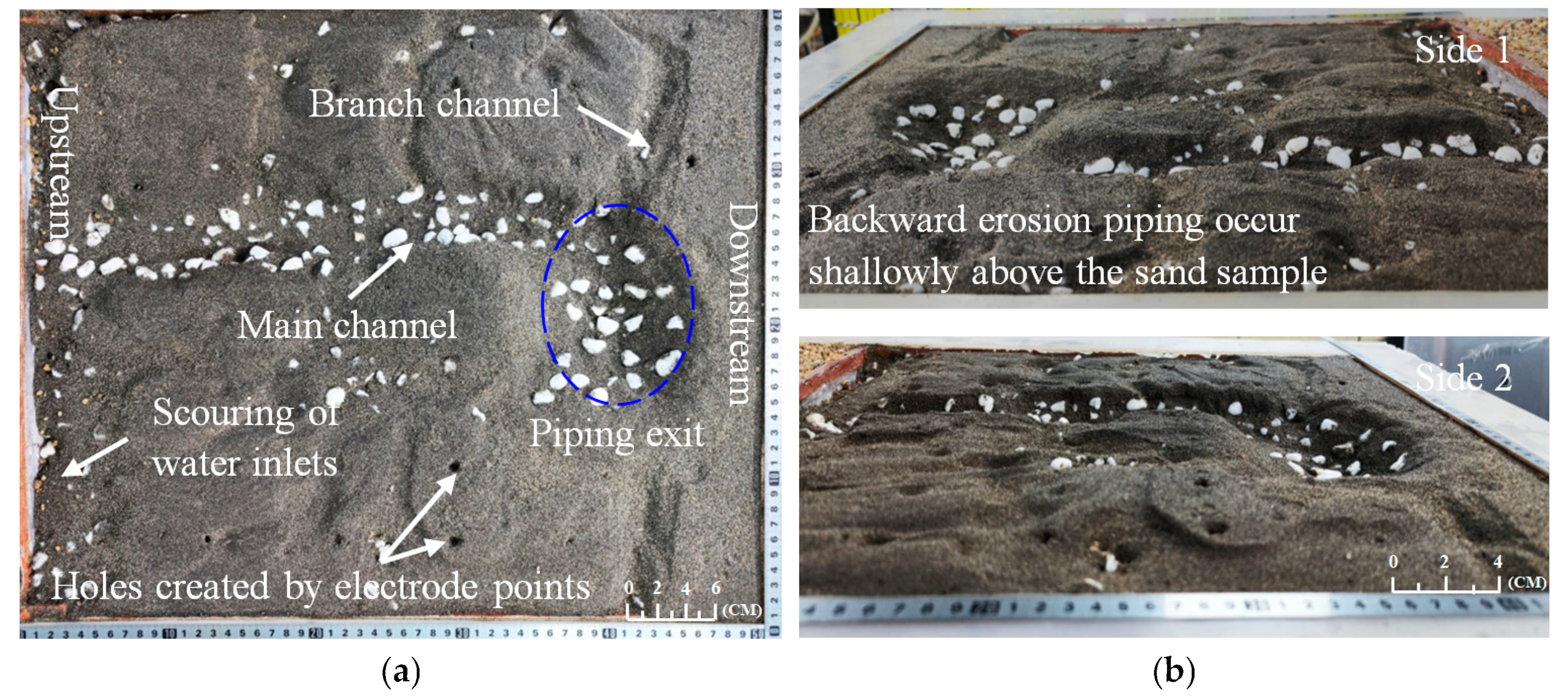
For BEP, seepage failure initially occurred in the overburden layer, with sand particles starting to move from a surge point. The preset piping ports on the test cover facilitated the erosion initiation phase, with constant loading of the upper head. The head difference between the upstream and downstream layers was supported by the lower layer, which caused surface sand particles to be displaced and flow through the piping opening and eventually form a concentrated erosion channel upstream. As shown in Figure 8a, an oval-shaped hollowing pit formed at the piping mouth. The main erosion channel extended from the piping mouth upstream, with several shallow branch channels exhibiting minor scouring. Significant scouring near the upstream inlet resulted from the high hydraulic gradient and pore flow rate, which caused initial sand particle displacement. The black round holes on the surface were caused by electrode insertion damage. As shown in the side view in Figure 8b, BEP damage was concentrated in the upper shallow layer of the sand samples, with the main channel showing greater erosion depth than the branch channels. The erosion depth at the piping exit was also deeper than that of the main channel.
To better quantify the erosion characteristics of the main piping channel, the erosion dimensions were recorded, as shown in Table 2. The average depth at the piping exit was 4.1 cm; the depth of the main channel averaged 3.6 cm; and depths at the inlet end and in each branch channel were less than 1 cm.

4.2. Potential Response Analysis of the Electrode Acquisition Data

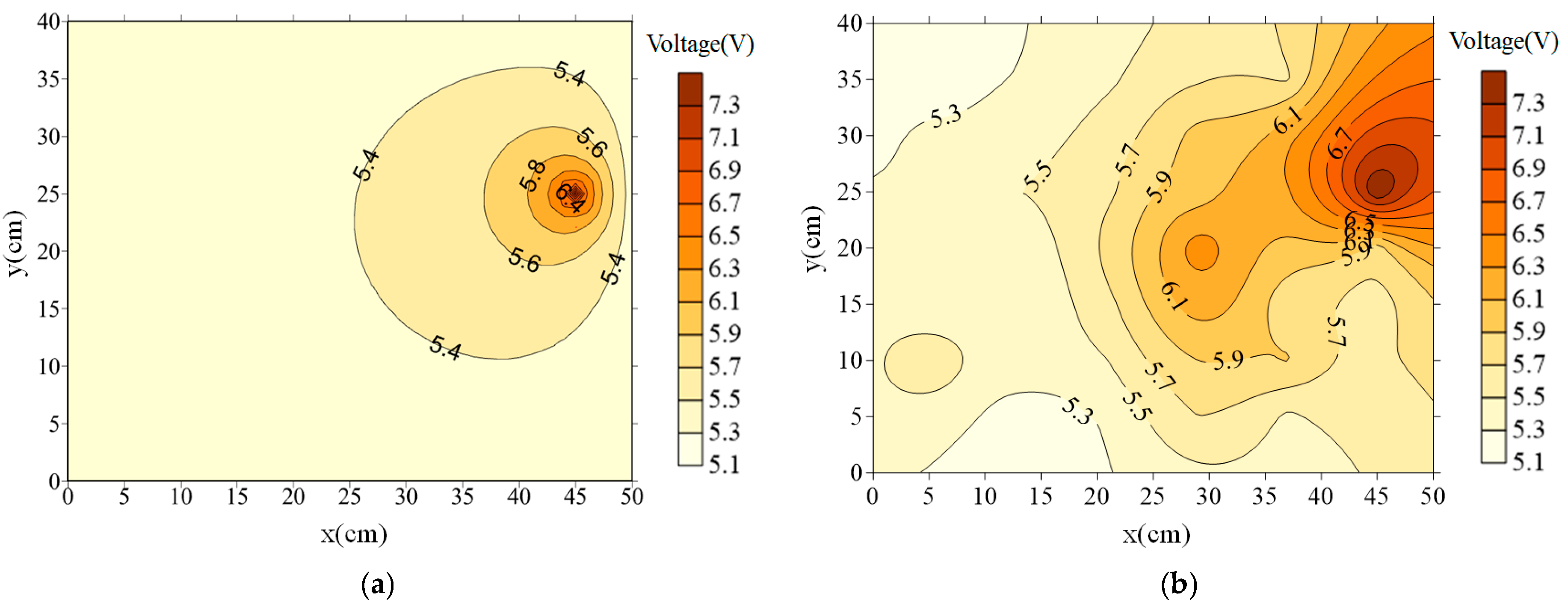
To demonstrate that the acquired data better reflect the BEP channel and to achieve precise inversion results, a potential response analysis was necessary. As the BEP channel formed primarily in the shallow sand layer, the measured voltage at Z = 30 cm was analyzed using a randomly selected Electrode 2. As shown in Figure 9a, the potential distribution before the test decreased symmetrically outward from the electrode point, thus indicating the homogeneity of the material prior to the test. As shown in Figure 9b, where BEP was present, the potential around the current electrode was greater, and it propagated quickly along the main channel and piping exit, thus indicating regional heterogeneity; this aligns with the increased conductivity in eroded areas. Thus, data acquired during the current is injected via the current electrode and can be incorporated into the SLE for inversion. However, the potential distribution in Figure 9b spreads in the opposite direction to the y-axis, which differs slightly from the piping channel erosion direction observed in the test. This finding may originate from an electrode potential error exceeding 5%, coupled with an inadequately measured voltage along the primary channel direction. Therefore, a potential response analysis of electrode points in the piping channel was needed before inversion to exclude points with weaker measured voltage along the main channel to produce more accurate inversion results.

5. Analysis and Validation of 3D GERT Inversion Results

5.1. Analysis of 3D GERT Inversion Results

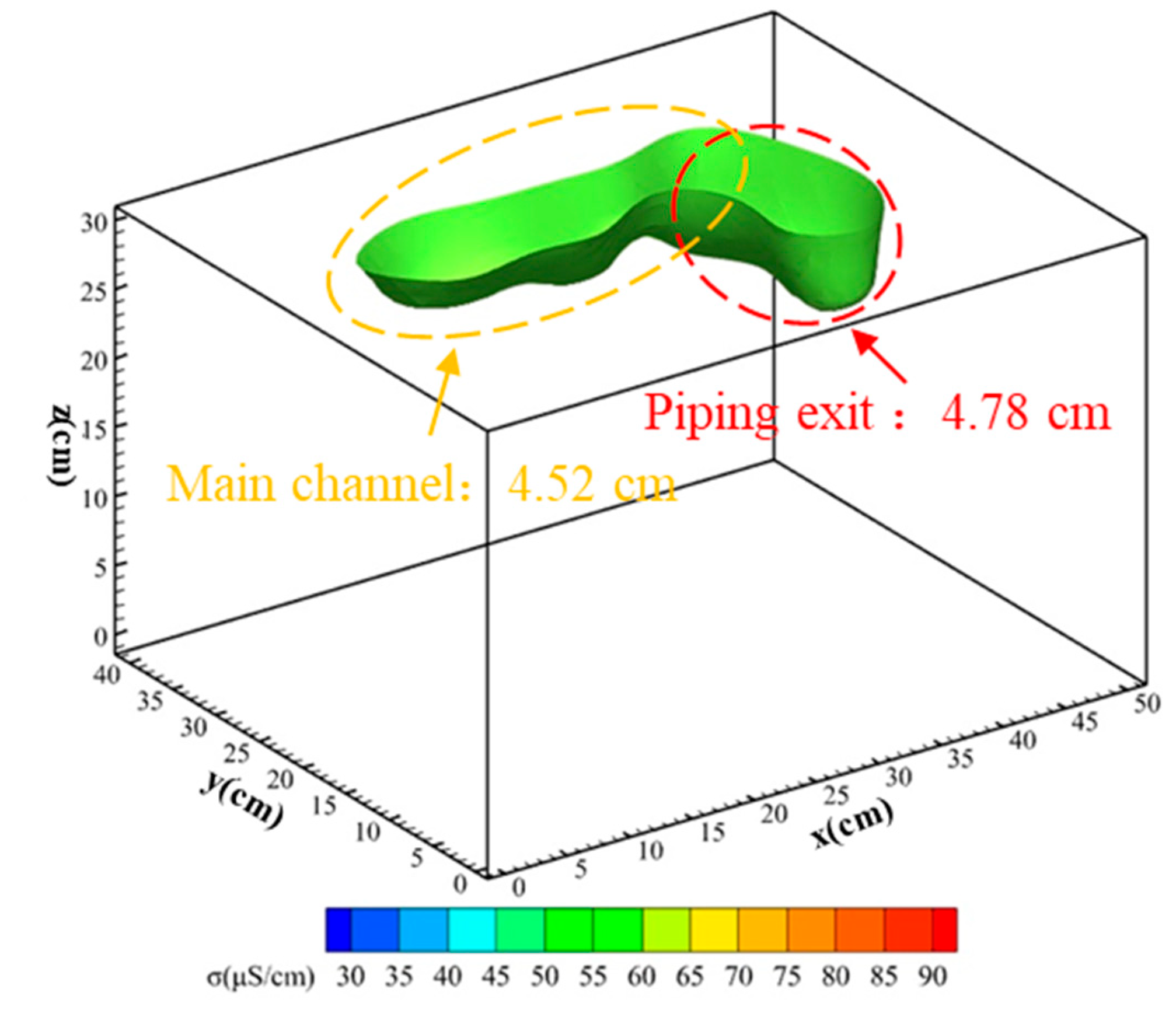
The four-electrode method revealed that the actual electrical resistivity of the saturated sand sample was 317.08 Ω·m without erosion, 113.31 Ω·m with complete erosion damage, and 158.15 Ω·m at the erosion boundary. After conducting the potential response analysis of the electrodes in the erosion channel as described in Section 4.2, eight electrodes (3, 4, 8, 9, 10, 15, 22, and 29) were selected as current electrodes, while all remaining electrodes except the defective ones were used as measuring electrodes and data were 3D tomography detection system. Following the removal of extreme values, the source–receiver data were entered into the SLE for inversion calculation. The initial inversion value was set to 317.05 Ω·m. As the correlation scales in the GERT framework are soft constraints, they are fused with observational data and automatically updated in each iteration; thus, the results are not strictly governed by the initial guess [24,34,38,48]. Based on a preliminary estimation of the shape of the leakage pathway, the correlation scales in the x-(length), y-(width), and z-(depth) directions are set to 10, 4, and 1, respectively. The final result, which shows the piping channel, is visualized in Figure 10 and Figure 11.
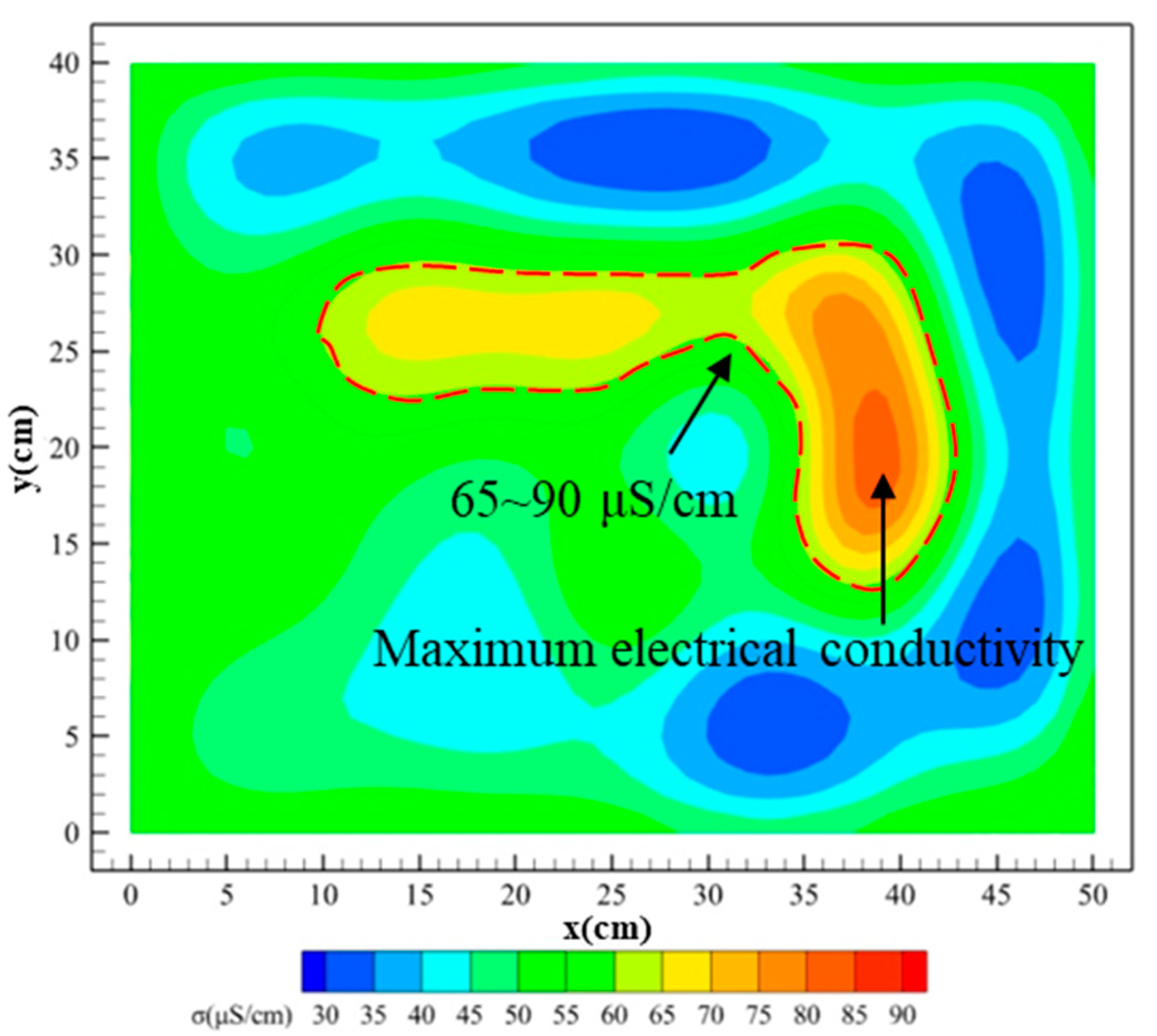
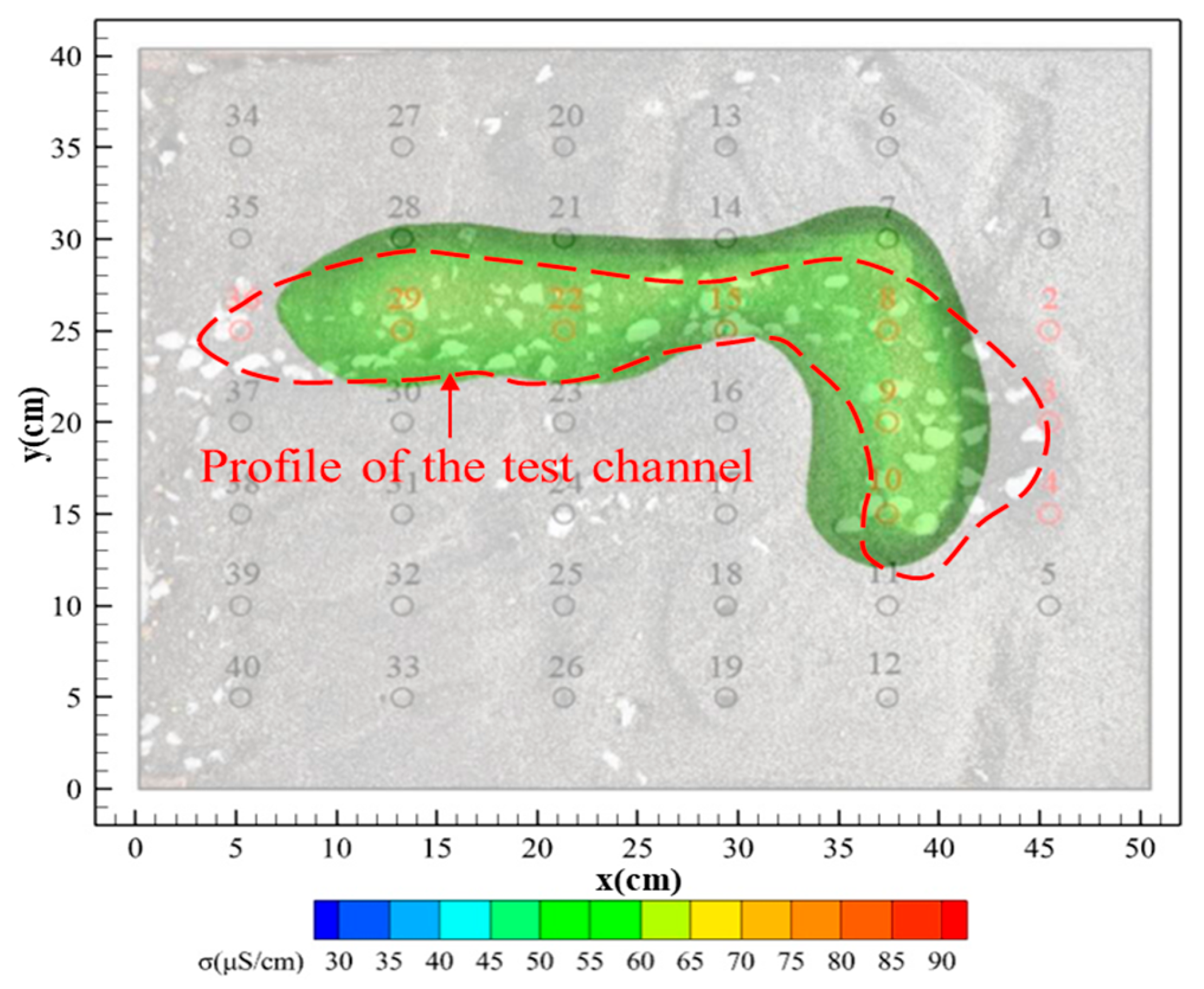
Figure 10 presents a top-view conductivity map in which the high-conductivity zones are clearly predominantly located along the piping channels, which is consistent with the actual situation. The electrical resistivity range for piping erosion is approximately 111–153 Ω·m, which closely matches the actual resistivity range of 113–158 Ω·m. Notably, the maximum electrical resistivity of 111 Ω·m is located at the piping exit, which is correlated with the deeper scour observed there. The channel obtained by selecting a resistivity value of 159 Ω·m to delineate the channel interface is shown in Figure 11. The overall size and location of the piping channel obtained through inversion characterization closely match those of the actual test channel, thus demonstrating high accuracy. The inversion results obtained using the SLE algorithm as the inversion algorithm accurately reflect the piping erosion potential of the levees.
To better quantify the extent of reverse erosion in the piping channel, the dimensions obtained from the 3D GERT model were compared with the actual erosion measurements (Figure 12 and Table 3). The experimental data indicated that the scour region of the piping exit spanned x: 34.9–45.3 cm, y: 11.5–29.0 cm, with an average depth (z) of 4.1 cm, whereas the 3D GERT inversion yielded dimensions of x: 33.63–43.54 cm, y: 12.10–32.34 cm, and an average depth (z) of 4.78 cm. The relative deviations between the measured and inverted dimensions were approximately 4.7% in the x-direction (length), 15.6% in the y-direction (width), and 16.5% in the z-direction (depth). For the main channel, deviations reached 16.5% (x), 29.6% (y), and 25.5% (z). The larger errors in depth may be attributed to the limited coverage of vertical electrodes. In conclusion, 3D GERT effectively characterizes the approximate position, scale, and developmental morphology of piping channels, with scour extents closely aligned with empirical observations.
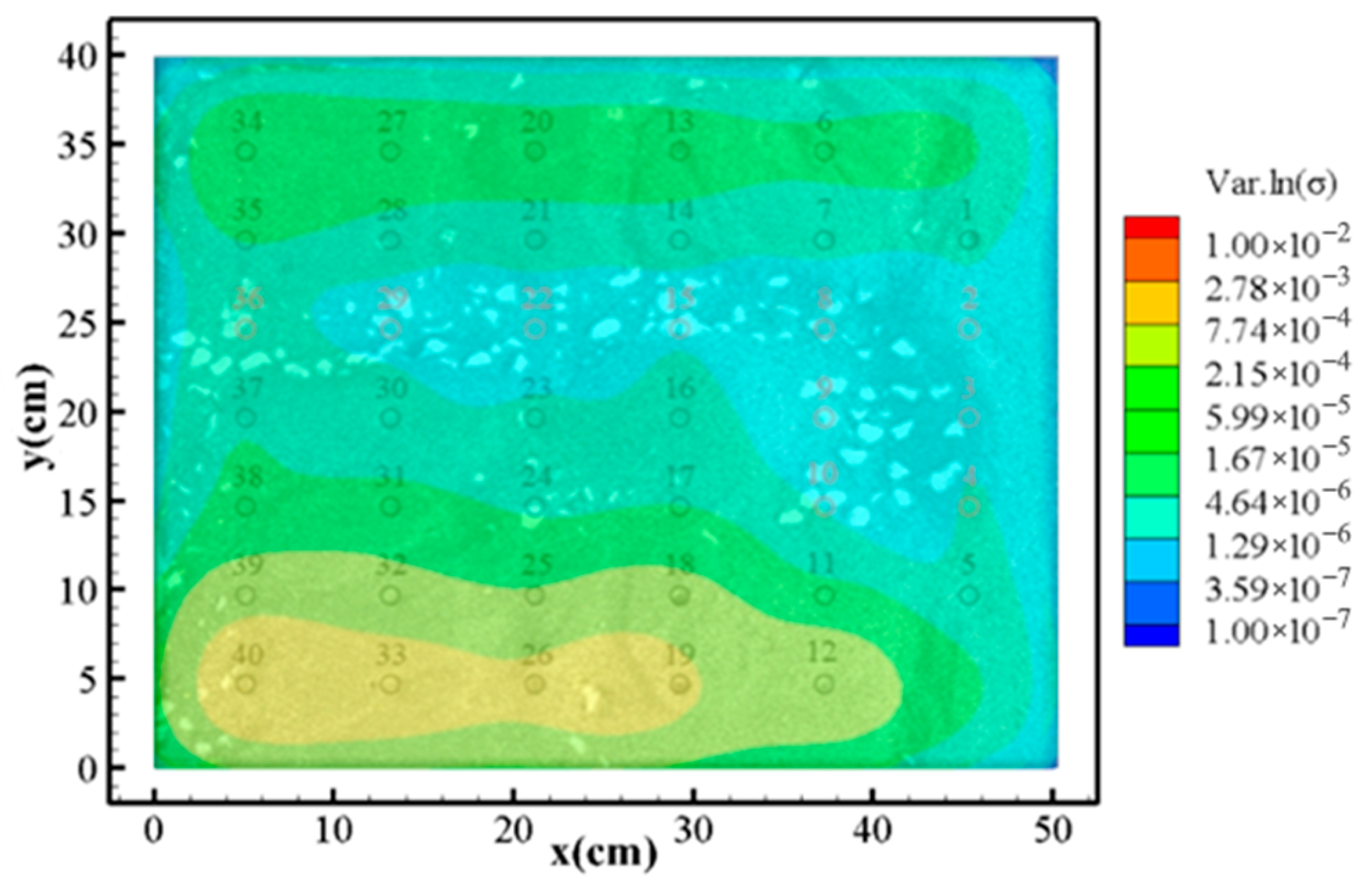
Finally, the uncertainty analysis of the inversion results was carried out using the posterior uncertainty method. Eight electrodes (3, 4, 8, 9, 10, 15, 22, and 29) were selected as current electrodes. As shown in Figure 13, the areas surrounding these current electrodes are located within blue zones, indicating relatively low uncertainty and higher data reliability. In contrast, the lower-right corner exhibits relatively high uncertainty, suggesting that the subtle resistivity variations observed in this region may not hold geological significance. The uncertainty analysis confirms the effectiveness of GERT in monitoring potential erosion areas and indicates that increasing the number of current injections is beneficial for improving the inversion results.

5.2. Validation Analysis of 3D GERT Inversion Results

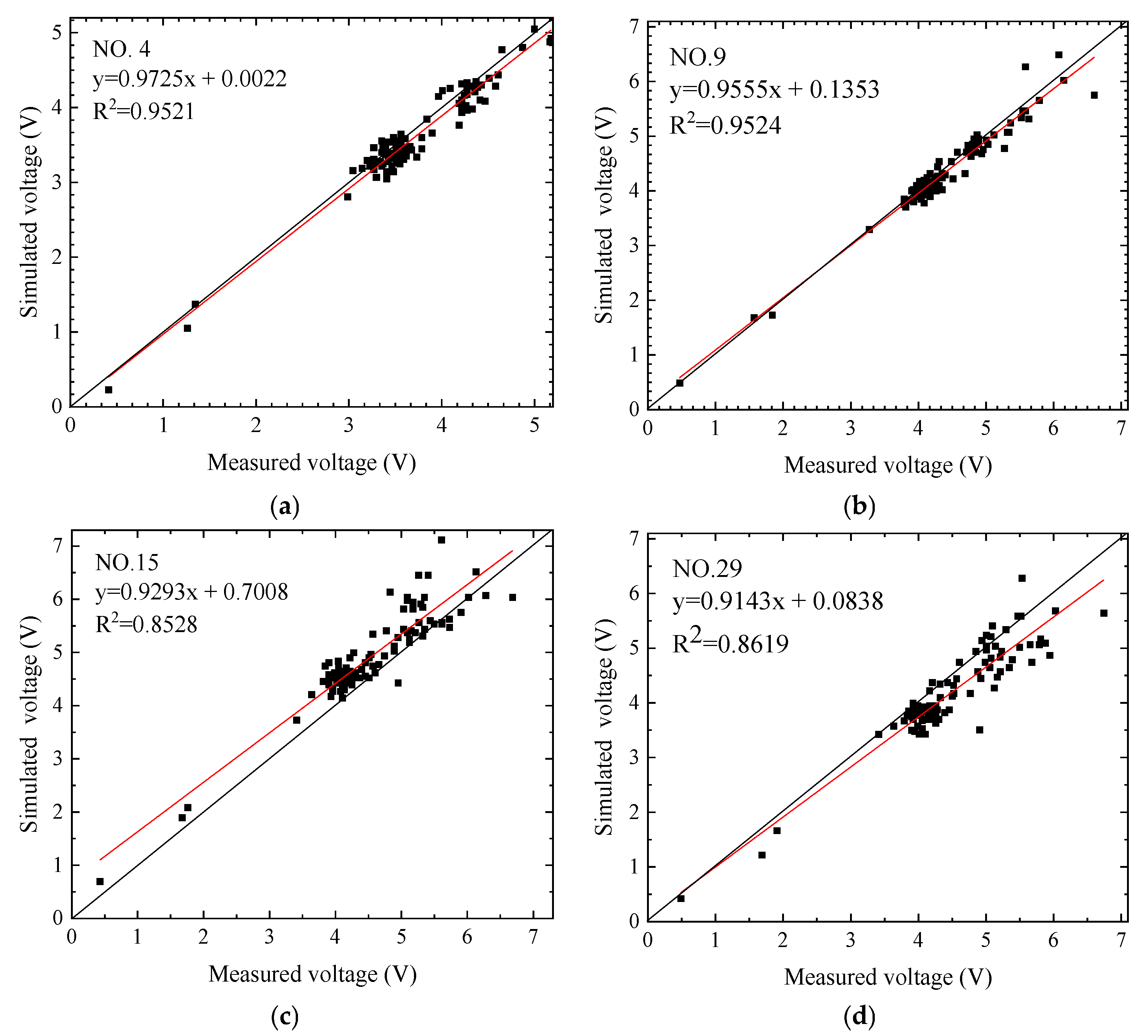
To validate whether 3D GERT can effectively reproduce the macroscopic electrical response characteristics induced by piping channels, four electrodes (4, 9, 15, and 29) were randomly selected as current electrodes within the erosion channel, while the remaining electrodes served as observation points. The measured voltages were then fitted to the conductivity field data generated via inversion, and the results are shown in Figure 14. In the linear fitting graph, the coefficients of determination (R2) between the measured and inverted potential values for Electrodes 4, 9, 15, and 29 are 0.9521, 0.9524, 0.8528, and 0.8619, respectively. The collective R2 demonstrates the capability of the simulated values to track and reproduce the variation trends in the acquired data, thus confirming a high degree of accuracy in potential matching, which verifies that 3D GERT can effectively reproduce the macroscopic electrical response characteristics induced by piping channels. Additionally, Electrodes 4 and 9, positioned at the piping exit, showed slightly better fits (Figure 14a,b) than Electrodes 15 and 29 in the main channel (Figure 14c,d), which aligns with the 3D GERT inversion results.

6. Discussion

6.1. Effect of Electrode Number on Channel Characterization

In the previous section, the feasibility of 3D GERT for locating and depicting the scale of BEP channels was demonstrated. However, in real hazard scenarios, the hidden nature of piping channels makes predicting their locations and development trends impossible; this raises the following question: how can electrode points be strategically deployed to obtain effective source–receiver data for inversion in practical exploration scenarios? To address this question, the effects of the locations and number of observation electrodes on the inversion accuracy were examined in this study, with a focus on a curved BEP channel.
Table 4 presents the parameters obtained by comparing the forward and inverse results of observation electrodes placed at different positions and in varying numbers. With the same number of iterations, the R2 of the four numerical tests reached 0.99, thus indicating a close match between the forward and simulated data. The mean absolute error was on the order of 1 × 10⁻⁴, and the mean-squared error was on the order of 1 × 10⁻⁷, both of which indicate low error values and high testing effectiveness. Thus, both single and multiple layers of observation electrodes can generate adequate source–receiver data to achieve high accuracy via the SLE.
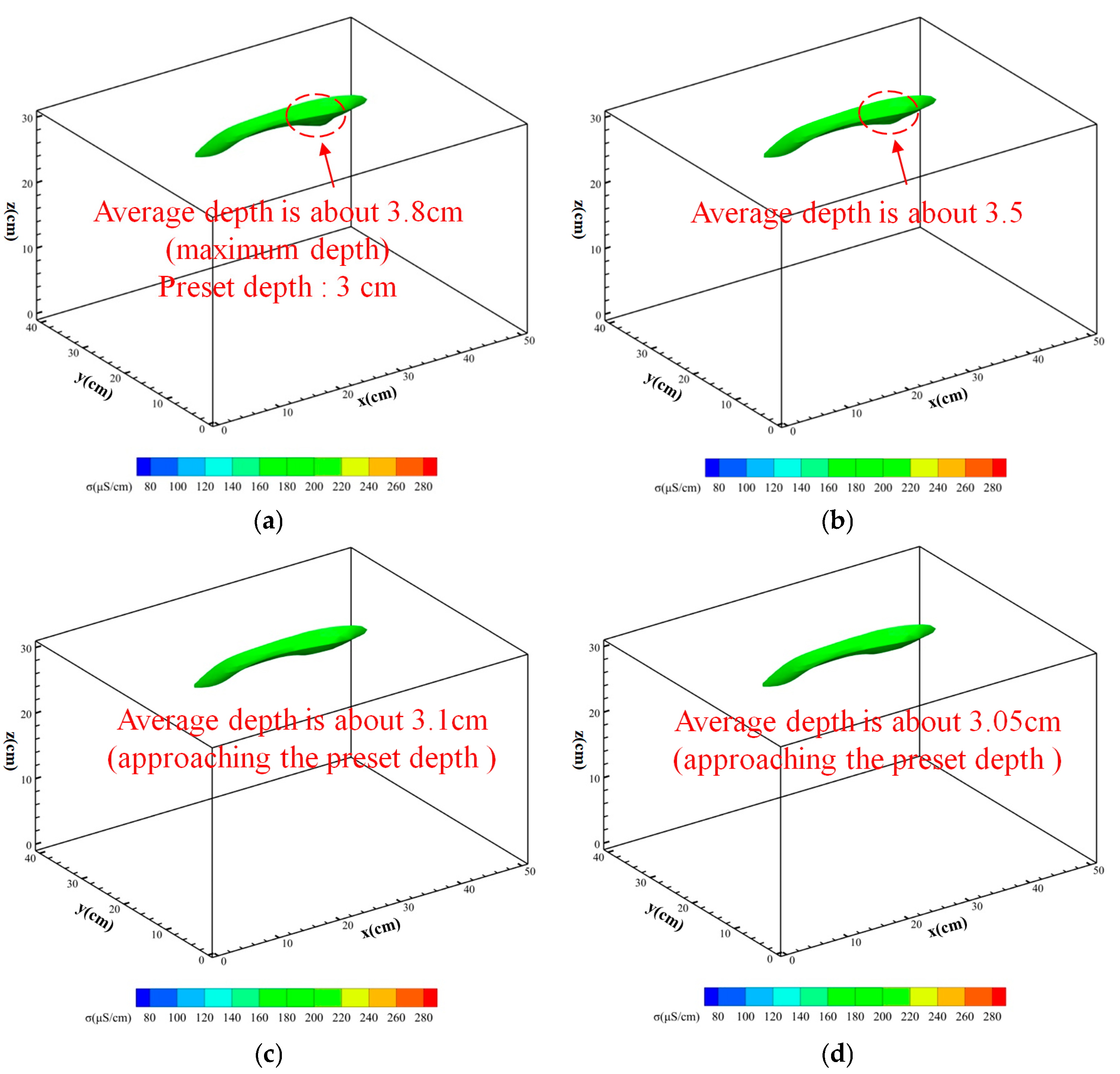
Figure 15 shows the inversion channels with various positions and numbers of observation electrodes, with the positions, sizes, morphologies, and interface conductivity values of the four experimental curved piping channel groups showing general consistency. Given that the average depth of the preset channels was approximately 3 cm, increasing the number of observation electrodes and adjusting their positions downward resulted in Figure 15c,d, aligning more closely with the preset channel depths. In contrast, the channels shown in Figure 15a,b are deeper, which led to errors in depth representation. In summary, for a given stimulus source, a denser and more evenly distributed arrangement of observation electrodes across the detection area improves inversion accuracy, thereby resulting in a more precise inverted channel size pattern.

6.2. Uncertainties in GERT

Uncertainty is inherent in all scientific disciplines and is highly dependent on the scales of observation, interest, analysis, and processes, along with many other factors, as elucidated by Yeh et al. [49]. Therefore, they emphasize and promote stochastic approaches, such as GERT. Data acquired from GERT surveys typically involves significant uncertainties. In GERT, equipment often generates errors in electrical data acquisition due to factors such as electrode polarization and poor contact. To improve the accuracy of BEP channel characterization, during the data acquisition stage, a random electrode was selected for discharging while the voltage reception was monitored at other points to identify faulty electrodes, thereby eliminating data errors that could have affected the experimental results. Saturation changes may also influence electrical conductivity data, potentially leading to false positives. Notably, saturation-induced high-conductivity anomalies could occur under other experimental configurations. We recommend that future work integrate multivariate analyses to disentangle these confounding factors. Additionally, all electrodes were ensured to maintain full contact with the soil at equal insertion depths. Conductive copper sheets were embedded in the sandbox of the experimental setup to establish an artificial zero-potential boundary, which mitigated systematic errors caused by contact resistance and boundary effects. In the initial phase of the experiment, we also analyzed the initial simulated values by measuring the actual resistivity of the samples. We found that the closer the order of magnitude of the initial simulated values was to that of the actual values, the greater the likelihood of convergence and the faster the convergence speed, thus resulting in more accurate delineation of piping channels. To further improve our ability to delineate BEP channels, new data processing and analysis strategies can maximize the reduction in initial condition uncertainties in GERT surveys [50]. In practical surveys, the non-negligible size of electrodes can induce shunting effects, leading to deviations from forward modeling responses. This phenomenon causes non-uniform current distribution at the electrode–ground interface and current concentration at electrode edges. When electrode dimensions become comparable to inter-electrode spacing, this effect significantly distorts potential measurements and compromises resistivity inversion accuracy. However, in this study, the electrode diameter of 2 mm and spacing of 8 cm yield a sufficiently low dimension–spacing ratio, resulting in minimal impact on acquired data and effectively avoiding artifacts in the inversion model [51]. Additionally, the use of stronger injected current (e.g., lightning) can increase the signal-to-noise ratio and cover a larger area [52]. We conducted a comparative analysis between 3D GERT and conventional methods (e.g., high-density electrical resistivity surveying). Under identical conditions (20 monitoring points), the high-density method yielded only approximately 57 valid data points, whereas the 20-node 3D GERT system synchronously acquired over 190 three-dimensional data points, demonstrating a significant enhancement in data collection efficiency. In this study, the 3D GERT method for BEP was validated through laboratory experiments. However, under controlled experimental conditions, the power supply electrodes were screened based on the voltage response characteristics. This was primarily aimed at improving the quality of excitation sources, measurement points, and enhancing inversion stability, rather than artificially reinforcing the geometric characteristics of the pathway. Moreover, the study was confined to sand–gravel mixtures; its applicability to stratified natural levees containing fines, exhibiting cohesion, or showing anisotropy is unverified. Future work will, therefore, incorporate heterogeneous structures (such as clay lenses and organic interlayers) to more faithfully replicate natural levee conditions. The experimental design will be optimized through methods such as “blind selection” of electrodes, and field validation will be undertaken to assess the real-world applicability of the approach.

6.3. Comparative Analysis of the SLE and OCCAM

Both conventional OCCAM inversion (exemplified by deGroot-Hedlin and Constable [53]) and our proposed SLE, grounded in a Bayesian framework, can be formulated as inverse problems aimed at minimizing an objective function. The whole inversion procedure does not invoke probabilistic interpretations of the model or data noise. A key distinction between the two methods lies in the dynamism of the constraint term during the iteration process. In classical OCCAM inversion, the roughness matrix is typically static and predetermined, rendering the results sensitive to both its specific form and the chosen regularization parameter. Conversely, in the SLE algorithm, the effective constraint weighting is adaptively updated throughout iterations. This feature reduces the sensitivity of the inversion outcome to the absolute values of initially specified hyperparameters (e.g., variances and correlation lengths), thereby enhancing the robustness of the inversion process.
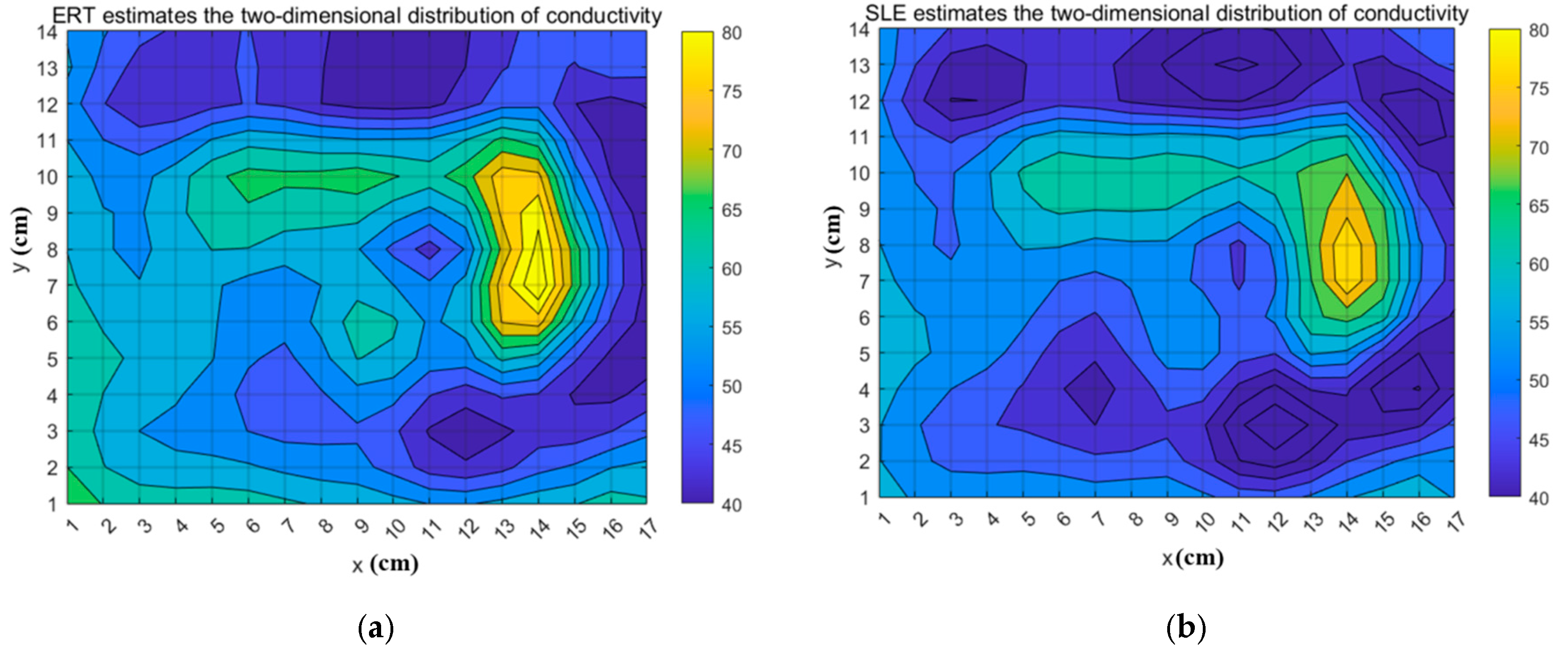
We conducted simplified two-dimensional simulations of both methods under identical conditions, because the OCCAM inversion used a self-developed program based on the implementation from deGroot-Hedlin and Constable, which does not yet support full three-dimensional inversion. It is not our intention to assert the superiority of either method; rather, we aim to illustrate their distinct inversion processes when applied to the same random field, with consistent correlation lengths (set to one), an identical sensitivity calculation approach (the perturbation method), and the same objective function minimization approach (generalized inverse matrix). The forward modeling equations were solved using a straightforward finite difference scheme. For the OCCAM algorithm, the regularization parameter was allowed to be adjusted multiple times, whereas the regularization term was directly eliminated in the tomography (i.e., λ = 0).
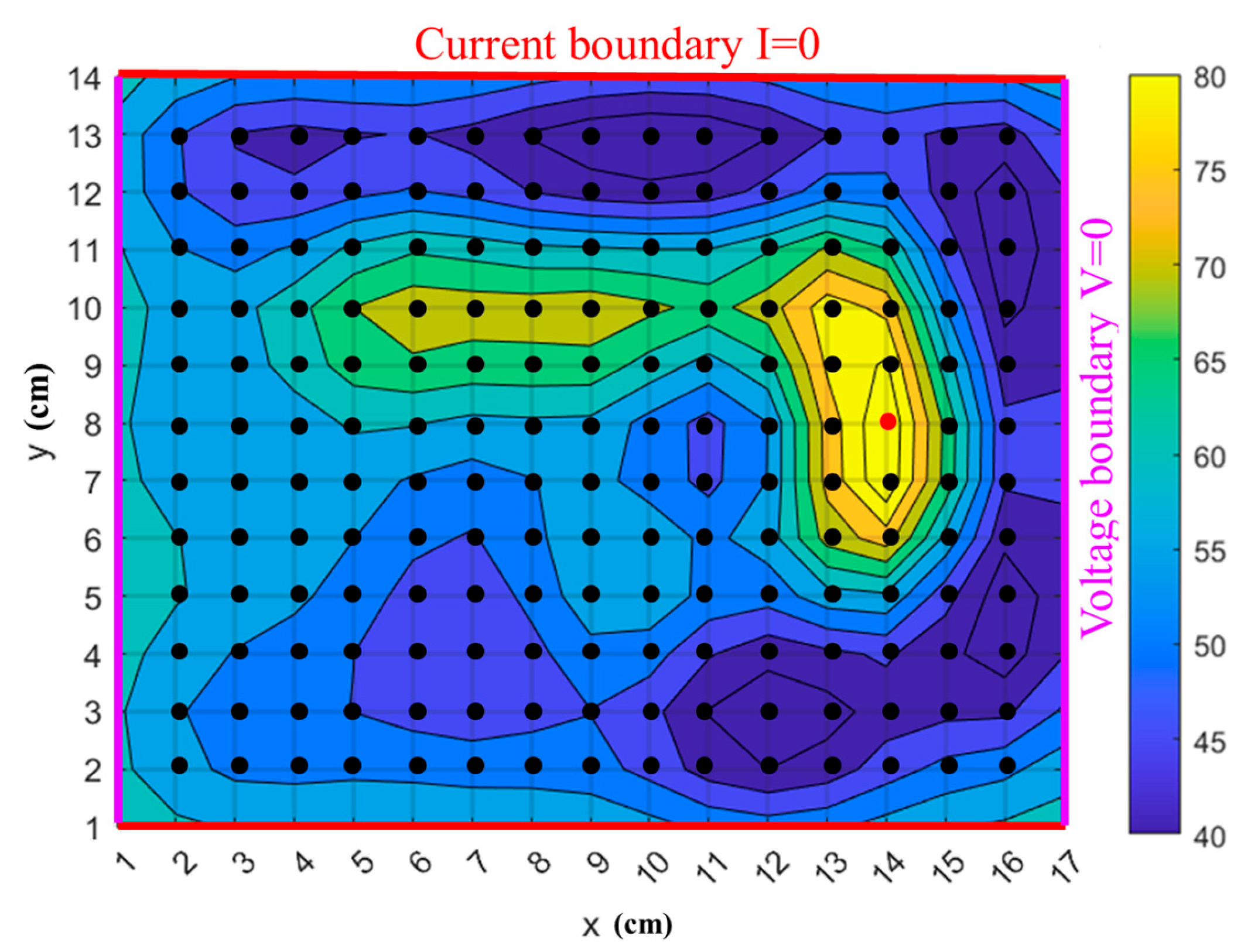
A random conductivity field was generated with a mean value of 0.002 S/m and a variance of 0.0007 S2/m2. Conductivity values were stored in 208 grid cells, while voltage values were recorded at 238 nodes. The left and right boundaries of the model (marked by purple solid lines in the figure) were set as zero-voltage boundaries, and the top and bottom boundaries (marked by red solid lines) were defined as insulated boundaries. A total of 179 voltage monitoring points (black dots in the figure) were deployed to collect voltage data when a 2 A current was injected at the red dots, as illustrated in Figure 16.
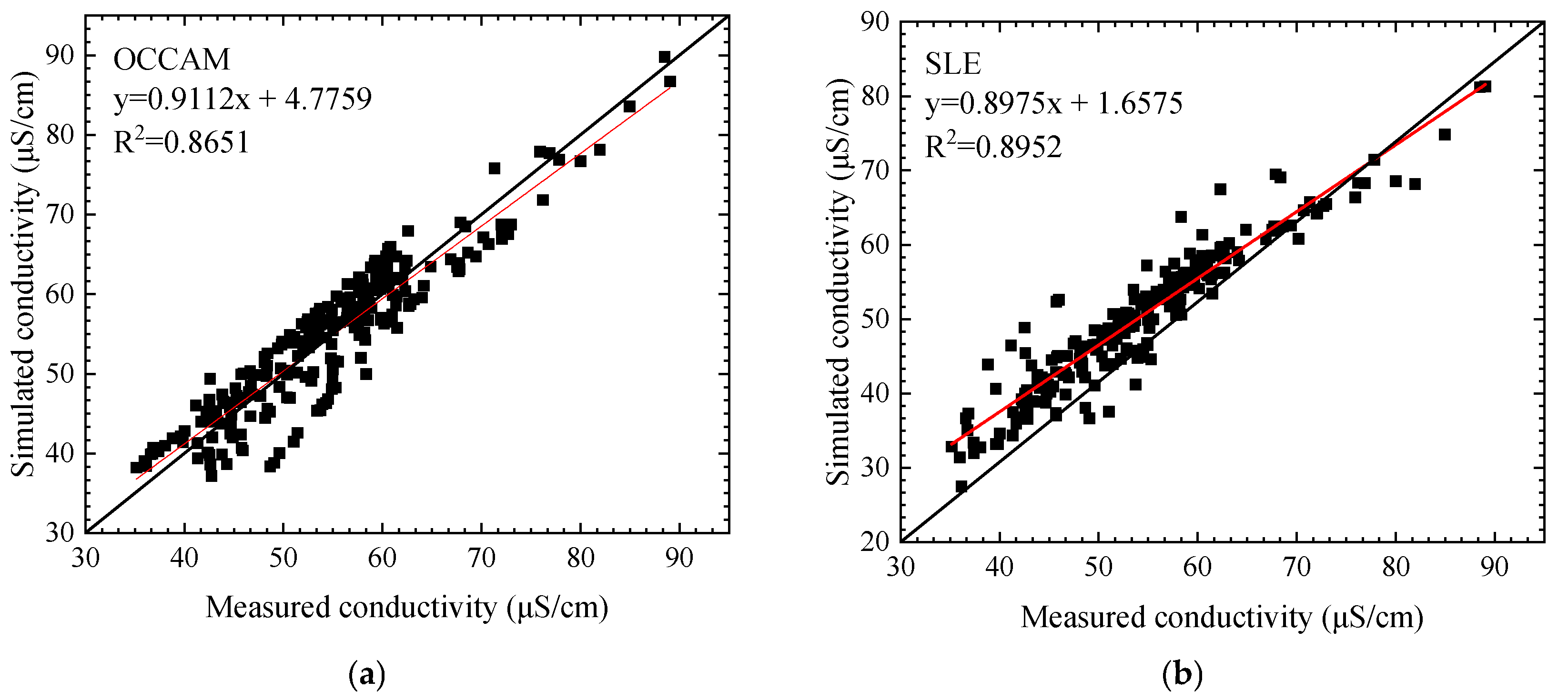
A regularization parameter of 0.1 × 10⁻⁶ (its optimal value) and an initial value of 54 were adopted for the OCCAM. In the SLE algorithm, the variance was set to one, and the mean value was fifty-four. The inversion results of both OCCAM and SLE after three iterations are presented in Figure 17. Overall, both approaches generally capture the spatial distribution pattern of true conductivity. At the piping exit with high electrical conductivity, the ERT results derived from the OCCAM algorithm show better agreement with the true conductivity distribution. A comparison between the measured and simulated conductivity for the two methods is shown in Figure 18. The coefficient of determination increases steadily during the iterations and reaches a high value for both schemes; for SLE, the final R2 is 0.8952, which demonstrates strong overall estimation stability under conditions of random heterogeneous media. Moreover, since each iteration of SLE requires the construction and solution of a large system of equations, it is computationally slower and demands more memory than the OCCAM algorithm.
Finally, we discuss the contributions of this study below. Although theoretical research and experimental validation of GERT have been conducted in numerous studies, few have investigated the delineation of BEP channels via GERT. Additionally, we demonstrated that the arrangement and number of electrodes have an influence on the inversion accuracy. The more uniformly the electrodes are distributed throughout the entire detection area, the more accurate the inversion results are, and the more precise the delineated channel scale and morphology. However, the optimal number of electrodes requires further investigation. Finally, a brief comparison between the OCCAM and SLE methods is presented.

7. Results

In this study, an indoor sandbox test setup for BEP was independently developed based on a double-layer levee foundation prototype. With this setup, a BEP test was conducted, in which electrical source–receiver data were collected during erosion, and dimensional data were collected from the BEP channel to support the application of 3D GERT in this study. The main conclusions are summarized as follows:
(1)
In the BEP test, infiltration damage began with the emergence of gushing sand from the overburden layer. The surface sand was the first to flow out of the piping exit, which was followed by the formation of a centralized surge channel that extended upstream. An elliptical scouring pit formed at the mouth of the piping, with several erosion branch channels developing on both sides of the main channel. The entire sample surface layer experienced slight scouring damage. The average depth of the piping exit within the channel was 4.1 cm, and the average depth of the main channel was 3.6 cm.
(2)
With the SLE employed as the inversion estimator, 3D GERT can detect BEP channels, achieving an internal erosion dimension deviation of less than 25.5% and a positional erosion dimension deviation within 16.5%. This estimator can assess the extent of erosion and evaluate the potential effects of piping on the levee.
(3)
The 3D GERT results are intuitive and clear, allowing for multi-directional analysis that enhances the interpretation of inversion outcomes. Increasing both the density and coverage of observation electrodes across the detection area improves the accuracy of the SLE in characterizing the BEP channel, thereby resulting in a more precise inversion of the channel size and pattern.
(4)
The measured voltage three-electrical resistivity detection aligned well with the simulated conductivity field data, with all instances of R2 exceeding 0.85, indicating a strong linear fit. This confirms that the inversion model can effectively reproduce the macroscopic electrical response characteristics induced by piping channels. Together with the limited mismatch in internal-erosion dimensions, this corroborates the reliability of SLE as a 3D GERT inversion algorithm for BEP channel characterization.
Although GERT effectively characterizes backward-erosion piping, the attribution of resistivity anomalies by SLE remains non-unique under complex geological conditions. These uncertainties degrade the accuracy of backward-erosion piping identification. The applicability of the proposed method to layered natural levees with fines, cohesion, or anisotropy requires further validation. Future improvements may include the use of other test materials, more effective current injection methods, optimized data analysis strategies, and enhanced detection equipment.

Author Contributions

T.Y.: Data curation, Writing—original draft. Y.L.: Conceptualization, Funding acquisition, Project administration, Methodology, Supervision. Z.Z.: Investigation, Software. B.X.: Formal analysis, Funding acquisition, Writing—review and editing. R.X.: Data curation and Software. X.Y.: Investigation. L.W.: Writing—review and editing. All authors have read and agreed to the published version of the manuscript.

Funding

This work was supported by the National Natural Science Foundation of China (Funder: Y.L. Grant No. 52379097; Funder: B.X. Grant No. 52509138), the Guangxi Science and Technology Program (Funder: Y.L. Grant No. GuiKe AA23062023), the Chongqing Water Conservancy Technology Project (Funder: B.X. Grant No. CQSLK-2024005), the Graduate Research and Innovation Project, Chongqing Jiaotong University (Funder: T.Y. Grant No. CYS240474), the Research Launch Project of Chongqing Jiaotong University (Funder: B.X. Grant No. F1250081), and the Science and Technology Research Program of Chongqing Municipal Education Commission (Funder: B.X. Grant No. KJQN202300744). Moreover, the authors gratefully thank the editors’ and anonymous reviewers’ suggestions and comments.

Data Availability Statement

The date presented in this study are available on request from the corresponding author (Yue Liang, Email: liangyue2560@163.com; Bin Xu, Email: geotechnicale2016@163.com) due to laboratory confidentiality policies and to prevent the data from being “scooped” before publication, the datasets have not been made publicly available.

Conflicts of Interest

The author Zhuoyue Zhao was employed by the company CCCC-FHDI Engineering Co., Ltd. The remaining authors declare that the research was conducted in the absence of any commercial or financial relationships that could be construed as potential conflicts of interest.

References

  1. Liang, Y.; Yeh, T.C.J.; Wang, Y.L.; Liu, M.; Wang, J.; Hao, Y. Numerical simulation of backward erosion piping in heterogeneous fields. Water Resour. Res. 2017, 53, 3246–3261. [Google Scholar] [CrossRef]
  2. Wu, A.; Wu, Q. Evolution mechanism of embankment danger and rapid detection of hidden danger and emergency rescue technology and equipment. J. Geotech. Eng. 2022, 44, 1310–1328. (In Chinese) [Google Scholar] [CrossRef]
  3. Foster, M.; Fell, R.; Spannagle, M. The statistics of embankment dam failures and accidents. Can. Geotech. J. 2000, 37, 1000–1024. [Google Scholar] [CrossRef]
  4. Sasanakul, I.; Gassman, S.L.; Pierce, C.E.; Ovalle-Villamil, W.; Starcher, R.; Gheibi, E.; Rahman, M. Geotechnical observations of dams failed during the 2015 historic flooding in South Carolina. ISSMGE Int. J. Geoengin. Case Hist. 2019, 5, 93–117. [Google Scholar] [CrossRef]
  5. Jibhakate, S.M.; Timbadiya, P.V.; Patel, P.L. Dam-break flood hazard and risk assessment of large dam for emergency preparedness: A study of Ukai Dam, India. J. Hydrol. 2024, 640, 131659. [Google Scholar] [CrossRef]
  6. Ma, Z.; Wang, X.; Shang, N.; Zhang, Q. A new numerical method to evaluate the stability of dike slope considering the influence of backward erosion piping. Water 2024, 16, 1706. [Google Scholar] [CrossRef]
  7. Wang, L.; Wang, Y.; Saskia, K.; Artemi, C.; Ma, B.; Wu, F. Effect of soil management on soil erosion on sloping farmland during crop growth stages under a large—Scale rainfall simulation experiment. J. Arid. Land 2018, 10, 921–931. [Google Scholar] [CrossRef]
  8. Deal, P.T.; Sabatini, D.A. Utilizing indicator kriging to identify suitable zones for manual drilling in weathered crystalline basement aquifers. Groundw. Sustain. Dev. 2020, 11, 100402. [Google Scholar] [CrossRef]
  9. Van Beek, V.; Knoeff, H.; Sellmeijer, H. Observations on the process of backward erosion piping in small-, medium- and full-scale experiments. Eur. J. Environ. Civ. Eng. 2011, 15, 1115–1137. [Google Scholar] [CrossRef]
  10. Chi, F.; Carvajal, C.; Breul, P.; Peyras, L. Reliability analysis of backward erosion piping in an embankment dam considering the spatial variability of soil properties. Sci. Rep. 2025, 15, 23974. [Google Scholar] [CrossRef]
  11. Van Beek, V.; Robbins, B.; Rosenbrand, E.; van Esch, J. 3D modelling of backward erosion piping experiments. Geomech. Energy Environ. 2022, 31, 100375. [Google Scholar] [CrossRef]
  12. Wang, Z.; Oskay, C.; Fascetti, A. Three-dimensional numerical modeling of the temporal evolution of backward erosion piping. Comput. Geotech. 2024, 171, 106381. [Google Scholar] [CrossRef]
  13. Zhang, A.; Cheng, L.; Cao, B.; Yang, J. Temperature tracing test and numerical simulation study during leakage of earth-rock dam. Int. J. Therm. Sci. 2023, 192, 108449. [Google Scholar] [CrossRef]
  14. Liu, S.; Wang, X.; Lu, Q.; Li, H.; Wang, Y.; Deng, L. Dam leakage detection by borehole radar: A case-history study. Remote Sens. 2019, 11, 969. [Google Scholar] [CrossRef]
  15. Radzicki, K.; Stoliński, M. Seepage monitoring and leaks detection along an earth dam with a multi—Sensor thermal—Active system. Bull. Eng. Geol. Environ. 2024, 83, 362. [Google Scholar] [CrossRef]
  16. Zhou, H.; Wu, A.; Xiao, G.; Song, J.; Zhou, L.; Tang, X. Weak magnetic field signal detection technology for embankment piping Channels. J. Yangtze River Acad. Sci. 2023, 40, 112–119. (In Chinese) [Google Scholar] [CrossRef]
  17. Zhang, J.; Xu, L.; Li, P.; Ma, S.; Xiao, L. Experimental study of integrated physical exploration technology in dam leakage detection. Prog. Geophys. 2018, 33, 432–440. (In Chinese) [Google Scholar] [CrossRef]
  18. Zhao, H.; Jiang, X.; Han, J.; Tan, L. Experimental study of integrated physical exploration methods in joint diagnosis of seepage in earth and rock dams. Prog. Geophys. 2021, 36, 1341–1348. (In Chinese) [Google Scholar] [CrossRef]
  19. Qiu, H.; Hu, R.; Huang, Y.; Gwenzi, W. Detection and quantification of dam leakages based on tracer tests: A field case study. Water 2022, 14, 1448. [Google Scholar] [CrossRef]
  20. Parsekian, A.D.; Singha, K.; Minsley, B.J.; Holbrook, W.S.; Slater, L. Multiscale geophysical imaging of the critical zone. Rev. Geophys. 2015, 53, 1–26. [Google Scholar] [CrossRef]
  21. Kaipio, J.P.; Kolehmainen, V.; Somersalo, E.; Vauhkonen, M. Statistical inversion and Monte Carlo sampling methods in electrical impedance tomography. Inverse Probl. 2000, 16, 1487. [Google Scholar] [CrossRef]
  22. Ramirez, A.L.; Nitao, J.J.; Hanley, W.G.; Aines, R.; Glaser, R.E.; Sengupta, S.K.; Dyer, K.M.; Hickling, T.L.; Daily, W.D. Stochastic inversion of electrical resistivity changes using a Markov Chain Monte Carlo approach. J. Geophys. Res. 2005, 110, B02101. [Google Scholar] [CrossRef]
  23. Gunther, T.; Rucker, C. A new joint inversion approach applied to the combined tomography of DC resistivity and seismic refraction data. In Symposium on the Application of Geophysics to Engineering and Environmental Problems; Society of Exploration Geophysicists: Houston, TX, USA, 2006; pp. 1196–1202. [Google Scholar] [CrossRef]
  24. Linde, N.; Binley, A.; Tryggvason, A.; Pedersen, L.B.; Revil, A. Improved hydrogeophysical characterization using joint inversion of cross-hole electrical resistance and ground-penetrating radar traveltime data. Water Resour. Res. 2006, 42, W12404. [Google Scholar] [CrossRef]
  25. Galetti, E.; Curtis, A. Transdimensional electrical resistivity tomography. J. Geophys. Res. Solid Earth 2018, 123, 6347–6377. [Google Scholar] [CrossRef]
  26. Ayer, J.E.B.; Lämmle, L.; Mincato, R.L.; Donadio, C.; Avramidis, P.; Pereira, S.Y. Three-dimensional model and environmental fragility in the Guarani Aquifer system, SE-Brazil. Groundw. Sustain. Dev. 2024, 26, 101285. [Google Scholar] [CrossRef]
  27. Jiang, P.; Qiao, S.; Pang, Y.; Zhang, Y.; Liu, Z. Smoothing objective function for 3D electrical resistivity inversion by CNNs regularizer. IEEE Sens. Lett. 2025, 9, 7001504. [Google Scholar] [CrossRef]
  28. Liang, Y.; Xia, R.; Yeh, T.C.J.; Sun, Z.; Zhang, H.; Xu, B. Characterizing preferential infiltration of loess using geostatistical electrical resistivity tomography. Eng. Geol. 2024, 340, 107692. [Google Scholar] [CrossRef]
  29. Yeh, T.C.J.; Liu, S.; Glass, R.J.; Baker, K.; Brainard, J.R.; Alumbaugh, D.; LaBrecque, D. A geostatistically based inverse model for electrical resistivity surveys and its applications to vadose zone hydrology. Water Resour. Res. 2002, 38, 14-1–14-13. [Google Scholar] [CrossRef]
  30. Yeh, T.C.J.; Liu, S. Hydraulic tomography: Development of a new aquifer test method. Water Resour. Res. 2000, 36, 2095–2105. [Google Scholar] [CrossRef]
  31. Yeh, T.C.J.; Jin, M.; Hanna, S. An iterative stochastic inverse method: Conditional effective transmissivity and hydraulic head fields. Water Resour. Res. 1996, 32, 85–92. [Google Scholar] [CrossRef]
  32. Yeh, T.C.J.; Zhang, J. A geostatistical inverse method for variably saturated flow in the vadose zone. Water Resour. Res. 1996, 32, 2757–2766. [Google Scholar] [CrossRef]
  33. Loke, M.H.; Dahlin, T.; Rucker, D.F. Smoothness—Constrained time—Lapse inversion of data from 3D resistivity surveys. Near Surf. Geophys. 2014, 12, 5–24. [Google Scholar] [CrossRef]
  34. Xu, D.; Sun, R.; Yeh, T.C.J.; Wang, Y.; Momayez, M.; Hao, Y.; Lee, C.H.; Hu, X. Mapping soil layers using electrical resistivity tomography and validation: Sandbox experiments. J. Hydrol. 2019, 575, 523–536. [Google Scholar] [CrossRef]
  35. Illman, W.A.; Liu, X.; Takeuchi, S.; Yeh, T.C.J.; Ando, K.; Saegusa, H. Hydraulic tomography in fractured granite: Mizunami underground research site, Japan. Water Resour. Res. 2009, 45, W10406. [Google Scholar] [CrossRef]
  36. Illman, W.A.; Berg, S.J.; Zhao, Z. Should hydraulic tomography data be interpreted using geostatistical inverse modeling? A laboratory sandbox investigation. Water Resour. Res. 2015, 51, 3219–3237. [Google Scholar] [CrossRef]
  37. Li, R.; Hu, X.; Xu, D.; Liu, Y.; Yu, N. Characterizing the 3D hydrogeological structure of a debris landslide using the transient electromagnetic method. J. Appl. Geophys. 2020, 175, 103991. [Google Scholar] [CrossRef]
  38. Wang, Y.L.; Yeh, T.C.J.; Liu, F.; Wen, J.C.; Wang, W.; Hao, H. Characterize basin-scale subsurface using rocket-triggered lightning. Geophys. Res. Lett. 2022, 49, e2022GL101278. [Google Scholar] [CrossRef]
  39. Zhang, B.; Liang, Y.; Wang, P.; Yeh, T.C.J.; Dai, L.; Xia, R.; Zhang, H.; Xu, B.; Zhang, S. Incorporating electrical sounding survey into geostatistical electrical resistivity tomography for high-resolution characterization of karst aquifer. J. Hydrol. 2025, 656, 133018. [Google Scholar] [CrossRef]
  40. Istomina, V.S. Filtration Stability of Soils; Gostroizdat: Moscow, Russia; Leningrad, Russia, 1957; p. 15. [Google Scholar]
  41. Kenney, T.C.; Lau, D. Internal stability of granular filters: Reply. Can. Geotech. J. 1986, 23, 420–423. [Google Scholar] [CrossRef]
  42. Liang, Y.; Zhang, H.; Xu, B.; Ma, S.; Xia, R.; Dai, L. Experimental study on electrical resistivity characteristics of underwater riprap. Hydro-Sci. Eng. 2024, 2, 100–107. (In Chinese) [Google Scholar] [CrossRef]
  43. Guo, H.; Ren, J.; Zhang, L.; Kang, J.; Nan, S.; Chen, K.; Sui, J.; Zhai, Y. Experimental study on backward erosion piping of a double-layer dike foundation under variable exit geometries. Transp. Geotech. 2024, 48, 101353. [Google Scholar] [CrossRef]
  44. Liang, Y.; Zeng, C.; Wang, J.J.; Liu, M.W.; Jim Yeh, T.C.; Zha, Y.Y. Constant gradient erosion apparatus for appraisal of piping behavior in upward seepage flow. Geotech. Test. J. 2017, 40, 630–642. [Google Scholar] [CrossRef]
  45. Peng, S.; Rice, J.D. Inverse analysis of laboratory data and observations for evaluation of backward erosion piping process. J. Rock Mech. Geotech. Eng. 2020, 12, 1080–1092. [Google Scholar] [CrossRef]
  46. Pol, J.C.; Kanning, W.; van Beek, V.M.; Robbins, B.A.; Jonkman, S.N. Temporal evolution of backward erosion piping in small-scale experiments. Acta Geotech. 2022, 17, 4555–4576. [Google Scholar] [CrossRef]
  47. Robbins, B.A.; Stephens, I.J.; Leavell, D.A.; López-Soto, J.F.; Montalvo-Bartolomei, A.M. Laboratory piping tests on fine gravel. Can. Geotech. J. 2018, 55, 1552–1563. [Google Scholar] [CrossRef]
  48. Michael Tso, C.H.; Zha, Y.; Jim Yeh, T.C.; Wen, J.C. The relative importance of head, flux, and prior information in hydraulic tomography analysis. Water Resour. Res. 2016, 52, 3–20. [Google Scholar] [CrossRef]
  49. Yeh, T.C.J.; Khaleel, R.; Carroll, K.C. Flow Through Heterogeneous Geologic Media; Cambridge University Press: Cambridge, UK, 2015. [Google Scholar] [CrossRef]
  50. Luo, N.; Illman, W.A.; Zha, Y.; Park, Y.; Berg, S.J. Three-dimensional hydraulic tomography analysis of long-term municipal wellfield operations: Validation with synthetic flow and solute transport data. J. Hydrol. 2020, 590, 125438. [Google Scholar] [CrossRef]
  51. Ciani, L.; Patrizi, G.; Innocenti, A.; Fanti, R.; Pazzi, V. Considerations on the electrode-spacing-to-electrode-diameter ratio in electrical resistivity tomography (ERT): An operational approach. IEEE Trans. Instrum. Meas. 2024, 73, 1–12. [Google Scholar] [CrossRef]
  52. Wang, Y.L.; Yeh, T.C.J.; Xu, D.; Li, K.; Wen, J.C.; Huang, S.Y.; Wang, W.; Hao, Y. Stochastic analysis of oscillatory hydraulic tomography. J. Hydrol. 2021, 596, 126105. [Google Scholar] [CrossRef]
  53. DeGroot-Hedlin, C.; Constable, S. Occam’s inversion to generate smooth, two-dimensional models from magnetotelluric data. Geophysics 1990, 55, 1613–1624. [Google Scholar] [CrossRef]
Figure 1. Flowchart of the SLE algorithm.
Buildings 16 00546 g001
Figure 2. Gradation curve for a mixture of 9–12 mm gravel and 0.1–0.355 mm fine sand.
Buildings 16 00546 g002
Figure 3. Schematic diagram of the electrical resistivity measurement experimental setup, consisting of a test tank, copper plate electrodes, an AC-to-DC power supply, and a voltmeter.
Buildings 16 00546 g003
Figure 4. Design drawing of the test setup (main view).
Buildings 16 00546 g004
Figure 5. Sand box test device cover diagram (top view).
Buildings 16 00546 g005
Figure 6. Spatial distribution of 130 electrodes.
Buildings 16 00546 g006
Figure 7. Flowchart of the test procedure.
Buildings 16 00546 g007
Figure 8. BEP test result maps. (a) Top view of sand sample erosion; (b) side view of sand sample erosion.
Buildings 16 00546 g008
Figure 9. Potential distribution of Electrode 2 in the Z = 30 cm section. (a) Potential response before the test; (b) potential response after the test.
Buildings 16 00546 g009
Figure 10. Three-dimensional GERT top-view cloud image: the range of piping erosion corresponds to a value of 65–90 μS/cm, and the maximum electrical conductivity is located at the piping outlet.
Buildings 16 00546 g010
Figure 11. Inversion results of 3D GERT for actual BEP channels.
Buildings 16 00546 g011
Figure 12. Comparison of 3D GERT results with the test channel.
Buildings 16 00546 g012
Figure 13. Uncertainty analysis of the inversion results (areas surrounding the current electrodes exhibit lower standard deviation and reduced uncertainty).
Buildings 16 00546 g013
Figure 14. Validation plot of 3D GERT inversion results. The black line represents the 45° line, and the red line represents the data fitting line. (a) No. 4 electrode point fitting diagram; (b) No. 9 electrode point fitting diagram; (c) No. 15 electrode point fitting diagram; (d) No. 29 electrode point fitting diagram.
Buildings 16 00546 g014
Figure 15. Comparison of inversion maps for channels (3 cm average depth) under different observation electrodes. The figure shows (a) 39 observation electrodes; (b) 69 observation electrodes; (c) 99 observation electrodes; and (d) 129 observation electrodes.
Buildings 16 00546 g015
Figure 16. Actual conductivity field distribution.
Buildings 16 00546 g016
Figure 17. Comparing the true conductivity distribution with the SLE and OCCAM inversion results after the three iterations. (a) Conductivity distribution obtained from OCCAM inversion; (b) conductivity distribution obtained from SLE inversion.
Buildings 16 00546 g017
Figure 18. Comparing the measured vs. simulated voltage fits for OCCAM and SLE after the three iterations. The black line represents the 45° line, and the red line represents the data fitting line. (a) Measured and simulated conductivity fit for OCCAM; (b) measured and simulated conductivity fit for SLE.
Buildings 16 00546 g018
Table 1. Physical properties of the test soil.
d10 (mm)d30 (mm)d60 (mm)CuCc
0.0860.1910.92126.970.038
Table 2. BEP channel size.
ItemPositionExtent of Erosion (cm)Erosion Dimensions (cm)
Piping exitx34.9–45.310.4
y11.5–29.017.5
Average depth/4.1
Main channelx3.0–34.931.9
y22.0–29.77.7
Average depth/3.6
Table 3. Comparison between the 3D GERT inversion results and the physically measured dimensions of the erosion channel.
ItemPositionTrue Scope (cm)Inversion Scope (cm)Actual Erosion Dimensions (cm)Inverse Erosion Dimensions (cm)Percentage (%)
Piping exitx34.9–45.333.63–43.5410.49.914.7
y11.5~29.012.10–32.3417.520.2415.6
Average depth//4.14.7816.5
Main channelx3.0–34.97.01–33.6331.926.6216.5
y22.0–29.720.66–30.647.79.9829.6
Average depth//3.64.5225.5
Center pointx40.038.87Offset: 1.25 cm
y20.019.46
Table 4. Evaluation of the inversion accuracy with various numbers of observation electrodes.
GroupObservation Electrode PositionNumber of Observation ElectrodesR2Mean Absolute ErrorMean-Squared ErrorNumber of Iterations
AZ = 30390.993.83 × 10−44.61 × 10−79
BZ = 30, 25690.993.79 × 10−44.49 × 10−79
CZ = 30, 25, 15990.993.74 × 10−43.64 × 10−79
DZ = 30, 25, 15, 51290.993.74 × 10−43.64 × 10−79
Disclaimer/Publisher’s Note: The statements, opinions and data contained in all publications are solely those of the individual author(s) and contributor(s) and not of MDPI and/or the editor(s). MDPI and/or the editor(s) disclaim responsibility for any injury to people or property resulting from any ideas, methods, instructions or products referred to in the content.