A Systematic Review on the Organizational Learning Potential of Building Information Modelling: Theoretical Foundations and Future Directions

Abstract
1. Introduction
2. Literature Review
2.1. Organizational Learning
2.2. BIM as a Socio-Technical Learning Platform
3. Methodology
3.1. Review Design and Protocol
3.2. Research Question
3.3. Search Process
3.4. Selection Process
3.4.1. Inclusion Criteria
3.4.2. Exclusion Criteria
3.5. Quality Assessment
3.6. Data Collection
- The publication source (journal or conference).
- Publication years.
- The principal subject area, focusing on BIM’s role in organizational learning and knowledge management.
- An assessment of the study’s quality.
- Confirmation of the study’s validation within an industry context and its application in real-world scenarios.
3.7. Data Analysis
3.8. Bibliometric Analysis
3.9. Thematic Analysis
3.10. Thematic Saturation
4. Results
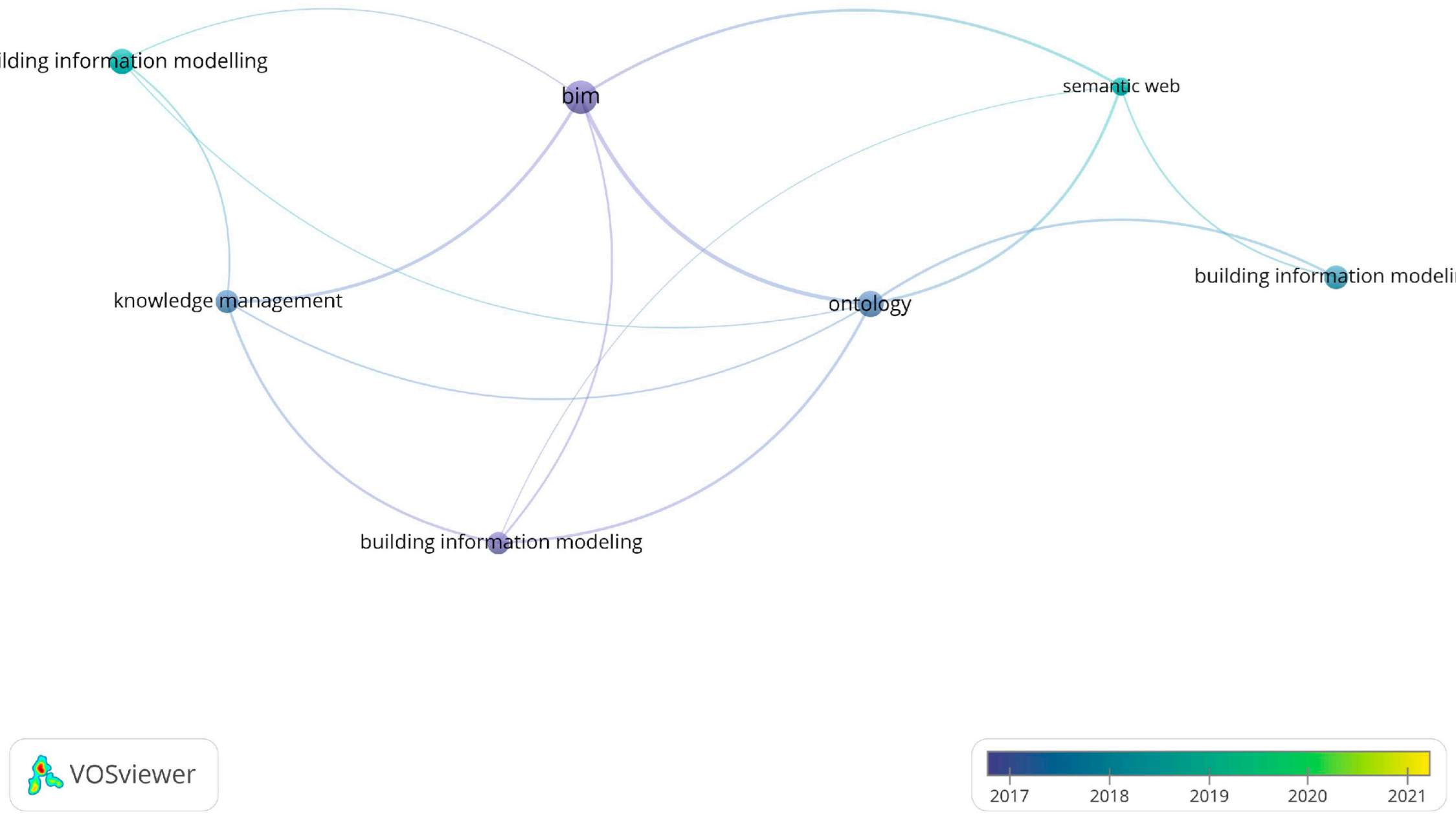
4.1. The Results of the Bibliometric Analysis
4.2. Thematic Analysis
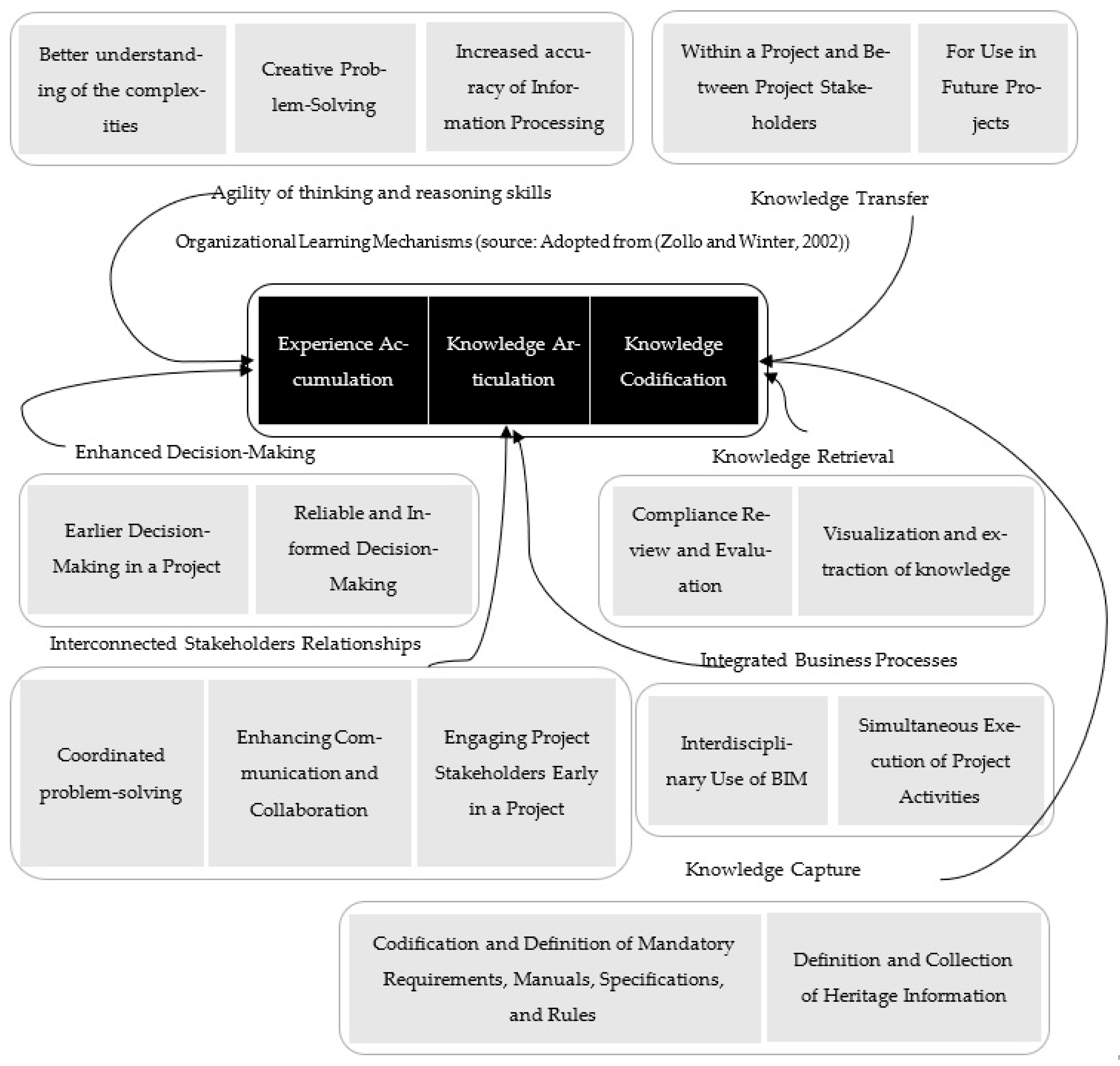
4.2.1. Theme 1—Agility of Thinking and Reasoning Skills
Sub-Themes Identified
- ▪
- Better understanding of project processes;
- ▪
- Creative problem-solving;
- ▪
- Increased accuracy of information processing.
4.2.2. Theme 2—Enhanced Decision-Making
Sub-Themes Identified
- ▪
- Reliable and informed decision-making;
- ▪
- Facilitation of early decision-making.
4.2.3. Theme 3—Integrated Business Processes
Sub-Themes Identified
- ▪
- Interdisciplinary use of BIM;
- ▪
- Simultaneous execution of project activities.
4.2.4. Theme 4—Interconnected Stakeholders Relationships
Sub-Themes Identified
- ▪
- Coordinated problem-solving;
- ▪
- Enhanced communication;
- ▪
- Early stakeholder involvement.
Evidence from Literature
- ▪
- A total of 13 studies highlighted coordinated problem-solving enabled by BIM-centric collaboration.
- ▪
- A total of 3 studies emphasized the early involvement of AEC-FM stakeholders in BIM-enabled projects, contrasting with traditional sequential processes.
- ▪
- A total of 12 studies discussed improved communication and collaboration for knowledge sharing among project stakeholders.
4.2.5. Theme 5—BIM-Facilitated Project Knowledge Retention
Sub-Themes Identified
- ▪
- Codification of mandatory requirements, manuals, specifications, and rules (Reported in 40 studies): BIM tools and databases store essential project guidelines and regulatory information, enabling rule-checking and supporting inspection tasks during construction and operation.
- ▪
- Definition and collection of heritage information (Recognized in 12 studies): BIM facilitates the structured capture of heritage-related data for conservation, renovation, and long-term asset management.
4.2.6. Theme 6—BIM-Facilitated Project Knowledge Sharing
Sub-Themes Identified
- ▪
- Transfer within an ongoing project among active stakeholders (Highlighted in 20 studies);
- ▪
- Transfer for use in future projects (Mentioned in 5 studies).
4.2.7. Theme 7—BIM-Supported Project Knowledge Extraction
Sub-Themes Identified
- ▪
- Compliance review and evaluation
- ▪
- Visualization and extraction of domain-specific knowledge
5. Discussion
5.1. Theoretical Contributions
“The agility of thinking fostered by BIM can transform organizational learning toward iterative processes, extending Zollo and Winters’s concept of dynamic capabilities.”
“The ability to make reliable decisions can significantly impact innovation within AEC-FM organizations, thereby enhancing their capacity for experience accumulation.”
“Interconnected stakeholder relationships and integrated business processes in BIM projects facilitate the assimilation of knowledge among AEC-FM organizations.”
“By converting informal, experience-based understanding into accessible, standardized documentation, BIM ensures that valuable knowledge is preserved beyond individual team members and can be reused consistently across projects.”
5.2. Practical Implications
6. Limitations of the Study and Future Research Directions
7. Conclusions
Supplementary Materials
Author Contributions
Funding
Data Availability Statement
Acknowledgments
Conflicts of Interest
Abbreviations
| AEC-FM | Architecture, engineering, construction, and facilities management |
| BIM | Building information modelling |
| CE | Concurrent engineering |
| DL | Deep learning |
| DT | Digital twins |
| MR | Mixed reality |
| RFI | Requests for information |
| QA | Quality assessment |
| SLR | Systematic literature review |
Appendix A
| No. | Authors | Year | Title | Journal/Conference/Book Chapter |
| 1 | [89] | 2025 | Documenting the existing building through BIM: a structured information management system for facility management and energy efficiency. | 2025 IEEE International Workshop on Metrology for Living Environment. |
| 2 | [63] | 2025 | Towards automated BIM conflict resolution using reinforcement learning. | EG-ICE 2025: International Workshop on Intelligent Computing in Engineering. |
| 3 | [81] | 2025 | Digital transformation and organizational readiness: evidence from Chinese construction smes with a dynamic managerial capabilities’ lens. | Engineering, Construction and Architectural Management Journal. |
| 4 | [90] | 2024 | Colleagues or friends? Comparing communication and advice networks for building information modeling (BIM) implementation in construction projects. | Project Management Journal |
| 5 | [91] | 2024 | Formalizing virtual construction safety training: a schematic data framework enabling real-world hazard simulations using BIM and location tracking. | Journal of Information Technology in Construction |
| 6 | [92] | 2024 | An ontology for automated fault detection & diagnostics of HVAC using BIM and machine learning concepts. | Science and Technology for the Built Environment |
| 7 | [93] | 2024 | An occupational safety risk management system for coastal construction projects. | IEEE Transactions on Engineering Management |
| 8 | [94] | 2024 | A comprehensive heritage BIM methodology for digital modelling and conservation of built heritage: application to Ghiqa historical market, Saudi Arabia. | Remote Sensing |
| 9 | [10] | 2024 | BIM-supported knowledge collaboration: a case study of a highway project in China. | Sustainability |
| 10 | [95] | 2024 | Towards digital-twin-enabled facility management: the natural language processing model for managing facilities in buildings. | Intelligent Buildings International |
| 11 | [96] | 2024 | Integration of 4D BIM, PtD and databases to improve OHS and knowledge management in construction. | International Conference on Civil, Structural and Transportation Engineering |
| 12 | [97] | 2023 | Space–time–workforce visualization and conditional capacity synthesis in uncertainty. | Journal of Management in Engineering |
| 13 | [98] | 2023 | Building performance optimization throughout the design–decision process with a holistic approach. | Journal of Architectural Engineering |
| 14 | [99] | 2023 | A Design for Safety (DFS) Framework for Automated Inspection Risks in Metro Stations by Integrating a Knowledge Base and Building Information Modeling. | International Journal of Environmental Research and Public Health |
| 15 | [100] | 2023 | BIM and ontology-based knowledge management for dam safety monitoring. | Automation in Construction |
| 16 | [101] | 2023 | A blockchain-based parametric model library for knowledge sharing in building information modeling collaboration. | Journal of Construction Engineering and Management |
| 17 | [102] | 2023 | Integrating knowledge management and BIM for safety risk identification of deep foundation pit construction. | Engineering, Construction and Architectural Management |
| 18 | [103] | 2023 | Facilitating knowledge transfer during code compliance checking using conceptual graphs. | Journal of Computing in Civil Engineering |
| 19 | [104] | 2022 | A hybrid hierarchical agent-based simulation approach for buildings indoor layout evaluation based on the post-earthquake evacuation. | Advanced Engineering Informatics |
| 29 | [105] | 2022 | Investigating the role of BIM in stakeholder management: evidence from a metro-rail project. | Journal of Management in Engineering |
| 21 | [106] | 2022 | Toward artificially intelligent cloud-based building information modelling for collaborative multidisciplinary design. | Advanced Engineering Informatics |
| 22 | [107] | 2022 | Modeling and analyzing dynamic social networks for behavioral pattern discovery in collaborative design. | Advanced Engineering Informatics |
| 23 | [108] | 2022 | Automated rule checking for MEP systems based on BIM and KBMS. | Buildings |
| 24 | [109] | 2022 | BIM-based construction safety risk library. | Automation in Construction |
| 25 | [110] | 2022 | The concept of digital twin for construction safety. | Conference: Construction Research Congress 2022: Computer Applications, Automation, and Data Analytics–Selected Papers from Construction Research Congress 2022 |
| 26 | [111] | 2022 | BIM-enabled semantic web for automated safety checks in subway construction | Automation in Construction |
| 27 | [112] | 2022 | Optimizing H-BIM workflow for interventions on historical building elements. | Sustainability |
| 28 | [113] | 2021 | Ontology based anamnesis and diagnosis of natural stone damage for retrofitting. | Conference: LDAC2021, the 9th Linked Data in Architecture and Construction Workshop |
| 29 | [76] | 2021 | Possible applications for a digital ground model in infrastructure construction. | Geomechanik und Tunnelbau Journal |
| 30 | [34] | 2021 | Network analytics and social BIM for managing project unstructured data. | Automation in Construction |
| 31 | [73] | 2021 | Proposal for the application of ICE and BIM sessions to increase productivity in construction. | Journal of Physics: Conference Series |
| 32 | [114] | 2021 | An AI-based dss for preventive conservation of museum collections in historic buildings. | Journal of Archaeological Science: Reports |
| 33 | [115] | 2021 | Robot—based facade spatial assembly optimization | Journal of Building Engineering |
| 34 | [116] | 2021 | Application of knowledge management and BIM technology for maintenance management of concrete structures. | Conference Proceedings: EASEC16 Proceedings of the 16th East Asian-Pacific Conference on Structural Engineering and Construction, 2019. |
| 35 | [117] | 2021 | Towards automated design: knowledge-based engineering in facades. | Book section—Book Title: Rethinking Building Skins |
| 36 | [118] | 2020 | SCAN-TO-BIM for the management of heritage buildings: the case study of the castle of Maredolce (Palermo, Italy). | Heritage Journal |
| 37 | [119] | 2020 | Knowledge modeling for heritage conservation process: from survey to HBIM implementation. | The International Archives of the Photogrammetry, Remote Sensing and Spatial Information Sciences |
| 38 | [120] | 2020 | Information integrated management of prefabricated project based on BIM and knowledge flow-based ontology. | Book title: Construction Research Congress 2020 |
| 39 | [121] | 2020 | BIM-tool development enhancing collaborative scheduling for pre-construction. | Journal of Information technology in Construction |
| 40 | [53] | 2020 | Real-time interaction and cost estimating within immersive virtual environments. | Journal of Construction Engineering and Management |
| 41 | [122] | 2020 | Hybrid genetic algorithm and constraint-based simulation framework for building construction project planning and control. | Journal of Construction Engineering and Management |
| 42 | [29] | 2020 | A conceptual framework for managing higher dimension knowledge in BIM environment. | Malaysian construction research Journal (MCRJ) |
| 43 | [123] | 2020 | E-maintenance platform design for public infrastructure maintenance based on IFC ontology and Semantic Web services. | Concurrency and Computation: Practice and Experience |
| 44 | [124] | 2020 | Ontology-based data integration and sharing for facility maintenance management. | Book section—Book title: Construction Research Congress 2020 |
| 45 | [125] | 2019 | Study on the evaluation method of green construction based on ontology and BIM. | Advances in Civil Engineering |
| 46 | [126] | 2019 | Modeling and representation of built cultural heritage data using semantic web technologies and building information model. | Computational and Mathematical Organization Theory |
| 47 | [127] | 2019 | Cultural heritage sites holistic documentation through semantic web technologies. | Conference: Transdisciplinary Multispectral Modelling and Cooperation for the Preservation of Cultural Heritage |
| 48 | [128] | 2019 | BIM semantic-enrichment for built heritage representation. | Automation in Construction |
| 49 | [129] | 2019 | A framework for data-driven informatization of the construction company. | Advanced Engineering Informatics |
| 50 | [130] | 2019 | A cloud model-based knowledge mapping method for historic building maintenance based on building information modelling and ontology. | KSCE Journal of Civil Engineering |
| 51 | [131] | 2019 | Experiences learned from an international BIM contest: software use and information workflow analysis. | Journal of Building Engineering |
| 52 | [132] | 2019 | The 4d CAD in project planning and budgeting of the new urban infrastructure for the Phitsanulok central park, Thailand. | Geographia Technica journal |
| 53 | [133] | 2019 | Evolutionary optimization of building facade form for energy and comfort in urban environment through BIM and algorithmic modeling. | Proceedings of the Blucher Design Proceedings, Porto, Portugal, 2019 |
| 54 | [66] | 2019 | Evaluating social housing retrofit options to support clients’ decision making—simpler BIM protocol. | Sustainability Journal |
| 55 | [71] | 2019 | Enabling sustainable built heritage revitalization from a social and technical perspective. | Renewable and Sustainable Energy Reviews |
| 56 | [134] | 2019 | HBIM modeling from the surface mesh and its extended capability of knowledge representation. | ISPRS International Journal of Geo-Information |
| 57 | [135] | 2019 | Implementation of construction safety knowledge management via building information model. | Conference: GCEC 2017 |
| 58 | [136] | 2018 | Ontology-based framework for building environmental monitoring and compliance checking under BIM environment. | Building and Environment |
| 59 | [137] | 2018 | RenoBIM: Collaboration platform based on open BIM workflows for energy renovation of buildings using timber prefabricated products. | Conference: eWork and eBusiness in Architecture, Engineering and Construction—Proceedings of the 12th European Conference on Product and Process Modelling, ECPPM 2018 |
| 60 | [138] | 2018 | Integration of lessons learned knowledge in building information modeling. | Journal of Construction Engineering and Management |
| 61 | [139] | 2018 | The BIM towards the Cadastre of the Future enhanced through the Use of Technology. | Diségno |
| 62 | [140] | 2018 | Framework for using building information modeling to create a building energy model. | Journal of Architectural Engineering |
| 63 | [141] | 2018 | BIM-based decision-making framework for scaffolding planning. | Journal of Management in Engineering |
| 64 | [142] | 2018 | 4d-BIM dynamic time–space conflict detection and quantification system for building construction projects. | Journal of Construction Engineering and Management |
| 65 | [143] | 2018 | Building conditions assessment of built heritage in historic building information modeling. | Building Information Systems in the Construction Industry |
| 66 | [144] | 2018 | Information integration and semantic interpretation for building energy system operation and maintenance. | Conference: IECON 2018–44th Annual Conference of the IEEE Industrial Electronics Society |
| 67 | [145] | 2017 | Cultural heritage sites holistic documentation through semantic web technologies. | 34th International Symposium on Automation and Robotics in Construction (ISARC 2017) |
| 68 | [146] | 2017 | A shared ontology approach to semantic representation of BIM data | Automation in Construction |
| 69 | [147] | 2017 | A semi-automated approach to generate 4d/5d BIM models for evaluating different offshore oil and gas platform decommissioning options. | Visualization in Engineering Journal |
| 70 | [148] | 2017 | Constructing a MEP BIM model under different maintenance scenarios a case study of air conditioning. | 34th International Symposium on Automation and Robotics in Construction (ISARC 2017) |
| 71 | [54] | 2017 | Building information modelling to cut disruption in housing retrofit. | Proceedings of the Institution of Civil Engineers—Engineering Sustainability |
| 72 | [149] | 2016 | Application of ontology in emergency plan management of metro operation. | Procedia Engineering: Creative Construction Conference 2016, CCC 2016, 25–28 June 2016 |
| 73 | [150] | 2016 | An ontology-based approach for developing data exchange requirements and model views of building information modeling. | Advanced Engineering Informatics |
| 74 | [151] | 2016 | A financial decision making framework for construction projects based on 5d building information modeling (BIM). | International journal of Project Management |
| 75 | [51] | 2016 | Building performance modelling for sustainable building design. | International Journal of Sustainable Built Environment |
| 76 | [77] | 2016 | Concurrency in BIM-based project implementation: an exploratory study of Chongqing Jiangbei international airport’s terminal 3a. | Conference Proceeding: Cooperative Design, Visualization, and Engineering |
| 77 | [152] | 2016 | knowledge management in construction using a SocioBIM platform: A case study of AYO smart home project. | Procedia Engineering |
| 78 | [153] | 2016 | A linked data system framework for sharing construction defect information using ontologies and BIM environments | Automation in Construction |
| 79 | [154] | 2016 | BIM-based risk identification system in tunnel construction. | Journal of Civil Engineering and Management |
| 80 | [155] | 2016 | Construction risk knowledge management in BIM using ontology and semantic web technology. | Safety Science |
| 81 | [156] | 2016 | Process knowledge capture in BIM-Based mechanical, electrical, and plumbing design coordination meetings. | Journal of Computing in Civil Engineering |
| 82 | [157] | 2015 | Ontology-based semantic modeling of construction safety knowledge: Towards automated safety planning for job hazard analysis (JHA). | Automation in Construction |
| 83 | [158] | 2015 | towards multi-objective optimization for sustainable buildings with both quantifiable and non-quantifiable design objectives | Sustainable Human–Building Ecosystems |
| 84 | [159] | 2015 | Integrating distributed sources of information for construction cost estimating using Semantic Web and Semantic Web Service technologies. | Automation in Construction |
| 85 | [160] | 2015 | Intensive big room process for co-creating value in legacy construction projects. | Journal of Information Technology in Construction |
| 86 | [161] | 2015 | A Semantic Web Approach for Built Heritage Representation. | Conference: Computer-Aided Architectural Design Futures. The Next City—New Technologies and the Future of the Built Environment |
| 87 | [162] | 2015 | Case-based reasoning and BIM systems for asset management. | Built Environment Project and Asset Management |
| 88 | [163] | 2015 | Architectural knowledge modeling: ontology-based modeling of architectural topology with the assistance of an architectural case library. | Computer-Aided Design and Applications |
| 89 | [42] | 2014 | Knowledge-based building information modeling (K-BIM) for facilities management. | Conference: ISARC. Proceedings of the International Symposium on Automation and Robotics in Construction |
| 90 | [164] | 2014 | Knowledge-assisted BIM-based visual analytics for failure root cause detection in facilities management. | Automation in Construction |
| 91 | [165] | 2014 | Life cycle assessment of thermal insulating building materials using building information modelling. | ARPN Journal of Engineering and Applied Sciences |
| 92 | [166] | 2014 | A BIM extension for sustainability appraisal of conceptual structural design of steel-framed buildings. | COMPUTING IN CIVIL AND BUILDING ENGINEERING |
| 93 | [167] | 2014 | Parallel vs. sequential cascading MEP coordination strategies: a pharmaceutical building case study. | Automation in Construction |
| 94 | [74] | 2014 | Working together in a knot: the simultaneity and pulsation of collaboration in an early phase of building design. | Proceedings of the 30th Annual ARCOM Conference |
| 95 | [85] | 2014 | A framework for a BIM-based knowledge management system. | Procedia Engineering: Creative Construction Conference 2014 |
| 96 | [41] | 2013 | A knowledge-based BIM system for building maintenance. | Automation in Construction |
| 97 | [168] | 2013 | Enhancing knowledge sharing management using BIM technology in construction. | The Scientific World Journal |
| 98 | [169] | 2013 | Ontology-Based building information modeling. | Book section—Book title: Computing in Civil Engineering (2013) |
| 99 | [170] | 2012 | User-centric knowledge representations based on ontology for AEC design collaboration. | Computer-Aided Design |
| 100 | [171] | 2012 | An application of lean design of structural floor system using structural building information modeling(S-BIM). | Advance Science Letters |
| 101 | [172] | 2012 | An object library approach for managing construction safety components based on BIM. | ISARC. Proceedings of the International Symposium on Automation and Robotics in Construction |
| 102 | [52] | 2011 | Decision-making tools for evaluating the impact of materials selection on the carbon footprint of buildings. | Carbon Management Journal |
| 103 | [173] | 2010 | Design team stories exploring interdisciplinary use of 3d object models in practice. | Automation in Construction |
| 104 | [72] | 2009 | Collaborative BIM case study—process and results. | Computing in Civil Engineering |
References
- Hari, S.; Egbu, C.; Kumar, B. A knowledge capture awareness tool. Eng. Constr. Archit. Manag. 2005, 12, 533–567. [Google Scholar] [CrossRef] [Scilit]
- Loforte Ribeiro, F.; Leitão Tomásio Ferreira, V. Using knowledge to improve preparation of construction projects. Bus. Process Manag. J. 2010, 16, 361–376. [Google Scholar] [CrossRef] [Scilit]
- Liao, S.-h. Knowledge management technologies and applications—Literature review from 1995 to 2002. Expert Syst. Appl. 2003, 25, 155–164. [Google Scholar] [CrossRef] [Scilit]
- Chan, D.W.M.; Sarvari, H.; Golestanizadeh, M.; Saka, A. Evaluating the impact of organizational learning on organizational performance through organizational innovation as a mediating variable: Evidence from Iranian construction companies. Int. J. Constr. Manag. 2024, 24, 921–934. [Google Scholar] [CrossRef] [Scilit]
- Crossan, M.M.; Berdrow, I. Organizational learning and strategic renewal. Strateg. Manag. J. 2003, 24, 1087–1105. [Google Scholar] [CrossRef] [Scilit]
- Ahankoob, A.; Manley, K.; Hon, C.; Drogemuller, R. The influence of building information modelling on the absorptive capacity of project-based organisations. Archit. Eng. Des. Manag. 2023, 19, 1–21. [Google Scholar] [CrossRef] [Scilit]
- Bartsch, V.; Ebers, M.; Maurer, I. Learning in project-based organizations: The role of project teams’ social capital for overcoming barriers to learning. Int. J. Proj. Manag. 2013, 31, 239–251. [Google Scholar] [CrossRef] [Scilit]
- Zhang, L.; Yuan, J.; Ning, Y.; Xia, N.; Zhang, G. Enhancing the impacts of absorptive capacity on interorganizational collaboration in BIM-enabled construction projects—An SLT perspective. Eng. Constr. Archit. Manag. 2021, 29, 4215–4240. [Google Scholar] [CrossRef] [Scilit]
- Rotimi, E.O.O.; Rotimi, F.E.; Silva, C.W.C.; Aigwi, I.E. BIM knowledge transfer in construction industry: A partial least square analysis. J. Eng. Des. Technol. 2024, 22, 1393–1411. [Google Scholar] [CrossRef] [Scilit]
- Miao, C.; Wang, H.; Meng, X.; Hou, X.; Yan, Y.; Liu, S.; He, Y. BIM-Supported Knowledge Collaboration: A Case Study of a Highway Project in China. Sustainability 2024, 16, 9074. [Google Scholar] [CrossRef] [Scilit]
- Sackey, E.; Tuuli, M.; Dainty, A. Sociotechnical Systems Approach to BIM Implementation in a Multidisciplinary Construction Context. J. Manag. Eng. 2015, 31, A4014005. [Google Scholar] [CrossRef] [Scilit]
- Wang, H.; Meng, X. Transformation from IT-based knowledge management into BIM-supported knowledge management: A literature review. Expert Syst. Appl. 2019, 121, 170–187. [Google Scholar] [CrossRef] [Scilit]
- Cheng, J.; Huang, L.; Jiang, L.; Chen, J.; Chen, W.; He, Y. Fostering Knowledge Collaboration in Construction Projects: The Role of BIM Application. Buildings 2023, 13, 812. [Google Scholar] [CrossRef] [Scilit]
- Drejer, A. Organisational learning and competence development. Learn. Organ. 2000, 7, 206–220. [Google Scholar] [CrossRef] [Scilit]
- Granerud, R.L.; Rocha, R.S. Organisational learning and continuous improvement of health and safety in certified manufacturers. Saf. Sci. 2011, 49, 1030–1039. [Google Scholar] [CrossRef] [Scilit]
- Vakola, M.; Rezgui, Y. Organisational learning and innovation in the construction industry. Learn. Organ. 2000, 7, 174–184. [Google Scholar] [CrossRef] [Scilit]
- Bierly, P.E.; Kessler, E.H.; Christensen, E.W. Organizational learning, knowledge and wisdom. J. Organ. Change Manag. 2000, 13, 595–618. [Google Scholar] [CrossRef] [Scilit]
- Fai Pun, K.; Nathai-Balkissoon, M. Integrating knowledge management into organisational learning: A review of concepts and models. Learn. Organ. Int. J. 2011, 18, 203–223. [Google Scholar] [CrossRef] [Scilit]
- Rowley, J. What do we need to know about wisdom? Manag. Decis. 2006, 44, 1246–1257. [Google Scholar] [CrossRef] [Scilit]
- Curado, C. Organisational learning and organisational design. Learn. Organ. Int. J. 2006, 13, 25–48. [Google Scholar] [CrossRef] [Scilit]
- Argote, L. Organizational Learning Creating, Retaining and Transferring Knowledge, 2nd ed.; Springer: New York, NY, USA, 2012. [Google Scholar]
- Levitt, B.; March, J.G. Organizational Learning. Annu. Rev. Sociol. 1988, 14, 319–338. [Google Scholar] [CrossRef]
- Ekung, S.; Opoku, A.; Okonkwo, C. Organisational learning and sustainability of service-based firms: A canonical correlation analysis. Int. J. Constr. Manag. 2023, 23, 2160–2170. [Google Scholar] [CrossRef] [Scilit]
- Zollo, M.; Winter, S.G. Deliberate Learning and the Evolution of Dynamic Capabilities. Organ. Sci. 2002, 13, 339–351. [Google Scholar] [CrossRef] [Scilit]
- Lin, Y.-C. Construction 3D BIM-based knowledge management system: A case study. J. Civ. Eng. Manag. 2014, 20, 186–200. [Google Scholar] [CrossRef] [Scilit]
- Anderson, A.R.; Benavides-Espinosa, M.d.M.; Mohedano-Suanes, A. Innovation in services through learning in a joint venture. Serv. Ind. J. 2011, 31, 2019–2032. [Google Scholar] [CrossRef] [Scilit]
- Holt, G.D.; Love, P.E.D.; Li, H. The learning organisation: Toward a paradigm for mutually beneficial strategic construction alliances. Int. J. Proj. Manag. 2000, 18, 415–421. [Google Scholar] [CrossRef] [Scilit]
- Wong, P.S.; Cheung, S.O.; Fan, K.L. Examining the Relationship between Organizational Learning Styles and Project Performance. J. Constr. Eng. Manag. 2009, 135, 497–507. [Google Scholar] [CrossRef] [Scilit]
- Li, Z.Q.; Tan, H.C.; Chia, F.C.; Wong, P.F. A Conceptual Framework for Managing Higher Dimension Knowledge in BIM Environment. Malays. Constr. Res. J. 2020, 9, 237. [Google Scholar]
- Shepherd, D.A.; Patzelt, H.; Williams, T.A.; Warnecke, D. How Does Project Termination Impact Project Team Members? Rapid Termination, ‘Creeping Death’, and Learning from Failure. J. Manag. Stud. 2014, 51, 513–546. [Google Scholar] [CrossRef] [Scilit]
- Sadhu, A.; Peplinski, J.E.; Mohammadkhorasani, A.; Moreu, F. A Review of Data Management and Visualization Techniques for Structural Health Monitoring Using BIM and Virtual or Augmented Reality. J. Struct. Eng. 2023, 149, 03122006. [Google Scholar] [CrossRef] [Scilit]
- Ahankoob, A.; Manley, K.; Abbasnejad, B. The role of contractors’ building information modelling (BIM) experience in realising the potential values of BIM. Int. J. Constr. Manag. 2019, 22, 588–599. [Google Scholar] [CrossRef] [Scilit]
- Pan, Y.; Zhang, L. A BIM-data mining integrated digital twin framework for advanced project management. Autom. Constr. 2021, 124, 103564. [Google Scholar] [CrossRef] [Scilit]
- Aragao, R.; El-Diraby, T.E. Network analytics and social BIM for managing project unstructured data. Autom. Constr. 2021, 122, 103512. [Google Scholar] [CrossRef] [Scilit]
- Trist, E.L.; Bamforth, K.W. Some Social and Psychological Consequences of the Longwall Method of Coal-Getting: An Examination of the Psychological Situation and Defences of a Work Group in Relation to the Social Structure and Technological Content of the Work System. Hum. Relat. 1951, 4, 3–38. [Google Scholar] [CrossRef] [Scilit]
- Leavitt, H. Applied Organizational Change in Industry: Structural, Technological and Humanistic Approaches. In Handbook of Organizations; Routledge: Abingdon, UK, 1964. [Google Scholar]
- Succar, B.; Sher, W.; Williams, A. Measuring BIM performance: Five metrics. Archit. Eng. Des. Manag. 2012, 8, 120–142. [Google Scholar] [CrossRef] [Scilit]
- Aranda-Mena, G.; Crawford, J.; Chevez, A.; Froese, T. Building information modelling demystified: Does it make business sense to adopt BIM? Int. J. Manag. Proj. Bus. 2009, 2, 419–434. [Google Scholar] [CrossRef] [Scilit]
- Alnajjar, O.; Atencio, E.; Turmo, J. Framework for Optimizing the Construction Process: The Integration of Lean Construction, Building Information Modeling (BIM), and Emerging Technologies. Appl. Sci. 2025, 15, 7253. [Google Scholar] [CrossRef] [Scilit]
- Čuš-Babič, N.; Rebolj, D.; Nekrep-Perc, M.; Podbreznik, P. Supply-chain transparency within industrialized construction projects. Comput. Ind. 2014, 65, 345–353. [Google Scholar] [CrossRef] [Scilit]
- Motawa, I.; Almarshad, A. A knowledge-based BIM system for building maintenance. Autom. Constr. 2013, 29, 173–182. [Google Scholar] [CrossRef] [Scilit]
- Charlesraj, V.P.C. Knowledge-based building information modeling (K-BIM) for facilities management. In Proceedings of the International Symposium on Automation and Robotics in Construction, Sydney, Australia, 9–11 July 2014. [Google Scholar]
- Page, M.J.; McKenzie, J.E.; Bossuyt, P.M.; Boutron, I.; Hoffmann, T.C.; Mulrow, C.D.; Shamseer, L.; Tetzlaff, J.M.; Akl, E.A.; Brennan, S.E.; et al. The PRISMA 2020 statement: An updated guideline for reporting systematic reviews. BMJ 2021, 372, n71. [Google Scholar] [CrossRef] [Scilit]
- Brereton, P.; Kitchenham, B.A.; Budgen, D.; Turner, M.; Khalil, M. Lessons from applying the systematic literature review process within the software engineering domain. J. Syst. Softw. 2007, 80, 571–583. [Google Scholar] [CrossRef] [Scilit]
- Kitchenham, B.; Pearl Brereton, O.; Budgen, D.; Turner, M.; Bailey, J.; Linkman, S. Systematic literature reviews in software engineering—A systematic literature review. Inf. Softw. Technol. 2009, 51, 7–15. [Google Scholar] [CrossRef] [Scilit]
- Hoe, S.L. Tacit knowledge, nonaka and takeuchi seci model and informal knowledge processes. Int. J. Organ. Theory Behav. 2006, 9, 490–502. [Google Scholar] [CrossRef] [Scilit]
- Aghaei Chadegani, A.; Salehi, H.; Yunus, M.M.; Farhadi, H.; Fooladi, M.; Farhadi, M.; Ale Ebrahim, N. A Comparison between Two Main Academic Literature Collections: Web of Science and Scopus Databases. Asian Soc. Sci. 2013, 9, 18–26. [Google Scholar] [CrossRef] [Scilit]
- Mascarenhas, C.; Marques, C.S.; Galvão, A.R.; Santos, G. Entrepreneurial university: Towards a better understanding of past trends and future directions. J. Enterprising Communities: People Places Glob. Econ. 2017, 11, 316–338. [Google Scholar] [CrossRef] [Scilit]
- Cobo, M.J.; López-Herrera, A.G.; Herrera-Viedma, E.; Herrera, F. Science mapping software tools: Review, analysis, and cooperative study among tools. J. Am. Soc. Inf. Sci. Technol. 2011, 62, 1382–1402. [Google Scholar] [CrossRef] [Scilit]
- Saldana, J. The Coding Manual for Qualitative Researchers; SAGE: Los Angeles, CA, USA, 2009. [Google Scholar]
- Oduyemi, O.; Okoroh, M. Building performance modelling for sustainable building design. Int. J. Sustain. Built Environ. 2016, 5, 461–469. [Google Scholar] [CrossRef] [Scilit]
- Bank, L.C.; Thompson, B.P.; McCarthy, M. Decision-making tools for evaluating the impact of materials selection on the carbon footprint of buildings. Carbon Manag. 2011, 2, 431–441. [Google Scholar] [CrossRef] [Scilit]
- Balali, V.; Zalavadia, A.; Heydarian, A. Real-Time Interaction and Cost Estimating within Immersive Virtual Environments. J. Constr. Eng. Manag. 2020, 146, 04019098. [Google Scholar] [CrossRef] [Scilit]
- Justin, C.F.; Patricia, T.; Torres, F.C.; Notariano, B.C. Building information modelling to cut disruption in housing retrofit. Proc. Inst. Civ. Eng. Eng. Sustain. 2017, 170, 322–333. [Google Scholar] [CrossRef] [Scilit]
- Hanna, A.; Boodai, F.; El Asmar, M. State of Practice of Building Information Modeling in Mechanical and Electrical Construction Industries. J. Constr. Eng. Manag. 2013, 139, 04013009. [Google Scholar] [CrossRef] [Scilit]
- Kriz, W.C. Transfer of Gaming: Designing Simulation Games as Models of Reality and Gaming Simulation to Design and Model Reality. In Transferring Gaming and Simulation Experience to the Real World; Kikkawa, T., Kriz, W.C., Sugiura, J., de Wijse-Van Heeswijk, M., Eds.; Springer Nature: Singapore, 2025; pp. 1–12. [Google Scholar]
- Olowa, T.; Witt, E.; Morganti, C.; Teittinen, T.; Lill, I. Defining a BIM-Enabled Learning Environment—An Adaptive Structuration Theory Perspective. Buildings 2022, 12, 292. [Google Scholar] [CrossRef] [Scilit]
- Chai, C.; Tang, J.T.; Chan, S.; Lee, C.; Goh, K. Bim Integration in Agile Scrum During the Desing Phase. J. Eng. Sci. Technol. 2022, 4, 302–316. [Google Scholar]
- De Meuse, K.P.; Dai, G.; Hallenbeck, G.S. Learning agility: A construct whose time has come. Consult. Psychol. J. Pract. Res. 2010, 62, 119–130. [Google Scholar] [CrossRef] [Scilit]
- Thompson, P. The Relationship between Unit Cost and Cumulative Quantity and the Evidence for Organizational Learning-by-Doing. J. Econ. Perspect. 2012, 26, 203–224. [Google Scholar] [CrossRef] [Scilit]
- Tripathi, A. Organizational Learning Culture and Firm Performance: The Mediating Role of Learning Agility. Vikalpa 2024, 49, 129–142. [Google Scholar] [CrossRef] [Scilit]
- Rui, H.; Cuervo-Cazurra, A.; Annique Un, C. Learning-by-doing in emerging market multinationals: Integration, trial and error, repetition, and extension. J. World Bus. 2016, 51, 686–699. [Google Scholar] [CrossRef] [Scilit]
- Jiang, Y.; Du, C.; Wu, J.; Nousias, S.; Borrmann, A. Towards automated BIM conflict resolution using reinforcement learning. In Proceedings of the EG-ICE 2025: International Workshop on Intelligent Computing in Engineering, Glasgow, UK, 1–3 July 2025. [Google Scholar]
- Lu, Y.; Li, Y.; Skibniewski, M.; Wu, Z.; Wang, R.; Le, Y. Information and Communication Technology Applications in Architecture, Engineering, and Construction Organizations: A 15-Year Review. J. Manag. Eng. 2015, 31, A4014010. [Google Scholar] [CrossRef] [Scilit]
- Ahn, Y.H.; Kwak, Y.H.; Suk, S.J. Contractors’ Transformation Strategies for Adopting Building Information Modeling. J. Manag. Eng. 2016, 32, 05015005. [Google Scholar] [CrossRef] [Scilit]
- Tzortzopoulos, P.; Ma, L.; Soliman Junior, J.; Koskela, L. Evaluating Social Housing Retrofit Options to Support Clients’ Decision Making—SIMPLER BIM Protocol. Sustainability 2019, 11, 2507. [Google Scholar] [CrossRef] [Scilit]
- Wu, S.; Hou, L.; Zhang, G.; Chen, H. Real-time mixed reality-based visual warning for construction workforce safety. Autom. Constr. 2022, 139, 104252. [Google Scholar] [CrossRef] [Scilit]
- Singh, P.J.; Power, D. Innovative knowledge sharing, supply chain integration and firm performance of Australian manufacturing firms. Int. J. Prod. Res. 2014, 52, 6416–6433. [Google Scholar] [CrossRef] [Scilit]
- Olatunji, O.A. Views on building information modelling, procurement and contract management. Proc. Inst. Civ. Eng.—Manag. Procure. Law 2014, 167, 117–126. [Google Scholar] [CrossRef] [Scilit]
- Jaradat, S.; Whyte, J.; Luck, R. Professionalism in digitally mediated project work. Build. Res. Inf. 2013, 41, 51–59. [Google Scholar] [CrossRef] [Scilit]
- Ho, D.; Hou, H. Enabling sustainable built heritage revitalisation from a social and technical perspective. Facilities 2019, 37, 704–722. [Google Scholar] [CrossRef] [Scilit]
- Kuprenas, J.A.; Mock, C.S. Collaborative BIM Modeling Case Study—Process and Results. In Computing in Civil Engineering; ASCE: Reston, VA, USA, 2009; pp. 431–441. [Google Scholar] [CrossRef] [Scilit]
- Quiso, E.; Rivera, J.; Farje, J. Proposal for the application of ICE and BIM sessions to increase productivity in construction. J. Phys. Conf. Ser. 2021, 1803, 012027. [Google Scholar] [CrossRef] [Scilit]
- Korpela, J.; Kerosuo, H. Working together in a knot: The simultaneity and pulsation of collaboration in an early phase of building design. In Proceedings of the 30th Annual ARCOM Conference, Portsmouth, UK, 1–3 September 2014; pp. 865–874. [Google Scholar]
- Khanzode, A.; Fischer, M.; Reed, D. Benefits and lessons learned of implementing building virtual design and construction (VDC) technologies for coordination of mechanical, electrical, and plumbing (MEP) systems on a large healthcare project. J. Inf. Technol. Constr. 2008, 13, 324–342. [Google Scholar]
- Gächter, W.; Exenberger, H.; Fasching, A.; Hillisch, S.; Mulitzer, G.; Seywald, M.; Rettenbacher, M.; Fleischmann, G.; Fröch, G.; Flora, M. Possible applications for a digital ground model in infrastructure construction. Geomech. Tunn. 2021, 14, 510–520. [Google Scholar] [CrossRef] [Scilit]
- Utiome, E.; Mohamed, S.; Panuwatwanich, K.; Lin, E.; Hou, L. Concurrency in BIM-Based Project Implementation: An Exploratory Study of Chongqing Jiangbei International Airport’s Terminal 3A; Springer International Publishing: Cham, Switzerland, 2016; pp. 257–262. [Google Scholar]
- Bosch-Sijtsema, P.M.; Henriksson, L.-H. Managing projects with distributed and embedded knowledge through interactions. Int. J. Proj. Manag. 2014, 32, 1432–1444. [Google Scholar] [CrossRef] [Scilit]
- Zhu, J.; Wang, X.; Chen, M.; Wu, P.; Kim, M.J. Integration of BIM and GIS: IFC geometry transformation to shapefile using enhanced open-source approach. Autom. Constr. 2019, 106, 102859. [Google Scholar] [CrossRef] [Scilit]
- Nepal, M.; Staub-French, S. Supporting knowledge-intensive construction management tasks in BIM. J. Inf. Technol. Constr. 2016, 21, 13–38. [Google Scholar]
- Wang, K.; Xu, X.; Mao, P.; Deng, X.; Cao, D. Digital transformation and organizational readiness: Evidence from Chinese construction SMEs with a dynamic managerial capabilities lens. Eng. Constr. Archit. Manag. 2025. ahead of print. [Google Scholar] [CrossRef] [Scilit]
- Hosamo, H.H.; Imran, A.; Cardenas-Cartagena, J.; Svennevig, P.R.; Svidt, K.; Nielsen, H.K. A Review of the Digital Twin Technology in the AEC-FM Industry. Adv. Civ. Eng. 2022, 2022, 2185170. [Google Scholar] [CrossRef] [Scilit]
- McGraw Hill. The Business Value of BIM in Australia and New Zealand; McGraw Hill Construction: Bedford, MA, USA, 2014. [Google Scholar]
- Meadati, P.; Irizarry, J. BIM–A knowledge repository. In Proceedings of the Proceedings of the 46th Annual International Conference of the Associated Schools of Construction, Boston, MA, USA, 7–10 April 2010. [Google Scholar]
- Deshpande, A.; Azhar, S.; Amireddy, S. A Framework for a BIM-based Knowledge Management System. Procedia Eng. 2014, 85, 113–122. [Google Scholar] [CrossRef] [Scilit]
- Van Riel, A.C.R.; Lemmink, J.; Ouwersloot, H. High-Technology Service Innovation Success: A Decision-Making Perspective. J. Prod. Innov. Manag. 2004, 21, 348–359. [Google Scholar] [CrossRef] [Scilit]
- Hassanain, M.A.; Hamida, M.B. AEC/FM performance in adaptive reuse projects: Investigation of challenges and development of practical guidelines. Facilities 2023, 41, 477–497. [Google Scholar] [CrossRef] [Scilit]
- Mohammed Alashwal, A.; Abdul-Rahman, H. Aspects of project learning in construction: A socio-technical model. Constr. Innov. 2014, 14, 229–244. [Google Scholar] [CrossRef] [Scilit]
- Maiezza, P. Documenting the Existing Building Through BIM: A Structured Information Management System for Facility Management and Energy Efficiency. In Proceedings of the 2025 IEEE International Workshop on Metrology for Living Environment (MetroLivEnv), Venice, Italy, 11–13 June 2025; pp. 1–5. [Google Scholar]
- Cao, D.; Shao, S. Colleagues or Friends? Comparing Communication and Advice Networks for Building Information Modeling (BIM) Implementation in Construction Projects. Proj. Manag. J. 2024, 55, 232–246. [Google Scholar] [CrossRef] [Scilit]
- Speiser, K.; Teizer, J. Formalizing virtual construction safety training: A schematic data framework enabling real-world hazard simulations using BIM and location tracking. J. Inf. Technol. Constr. 2024, 29, 980–1004. [Google Scholar] [CrossRef] [Scilit]
- Hosseini Gourabpasi, A.; Nik-Bakht, M. An ontology for automated fault detection & diagnostics of HVAC using BIM and machine learning concepts. Sci. Technol. Built Environ. 2024, 30, 972–988. [Google Scholar] [CrossRef] [Scilit]
- Yilmaz, D.I.; Artan, D. An Occupational Safety Risk Management System for Coastal Construction Projects. IEEE Trans. Eng. Manag. 2024, 71, 14387–14400. [Google Scholar] [CrossRef] [Scilit]
- Baik, A. A Comprehensive Heritage BIM Methodology for Digital Modelling and Conservation of Built Heritage: Application to Ghiqa Historical Market, Saudi Arabia. Remote Sens. 2024, 16, 2833. [Google Scholar] [CrossRef] [Scilit]
- Wang, L.; Chen, N. Towards digital-twin-enabled facility management: The natural language processing model for managing facilities in buildings. Intell. Build. Int. 2024, 16, 73–87. [Google Scholar] [CrossRef] [Scilit]
- Cajavilca, E.B.; Guevara, F.S.; Alvarez, G.A. Integration of 4D BIM, PtD and databases to improve OHS and knowledge management in construction; Avestia Publishing: Orleans, ON, Canada, 2024. [Google Scholar] [CrossRef] [Scilit]
- He, C.; Liu, M.; Zhang, Y.; Wang, Z.; Hsiang, S.M.; Chen, G.; Li, W.; Dai, G. Space–Time–Workforce Visualization and Conditional Capacity Synthesis in Uncertainty. J. Manag. Eng. 2023, 39, 04022071. [Google Scholar] [CrossRef] [Scilit]
- Utkucu, D.; Sözer, H. Building Performance Optimization throughout the Design–Decision Process with a Holistic Approach. J. Archit. Eng. 2023, 29, 04022034. [Google Scholar] [CrossRef] [Scilit]
- Liu, P.; Shang, Y.; Zhang, L. A Design for Safety (DFS) Framework for Automated Inspection Risks in Metro Stations by Integrating a Knowledge Base and Building Information Modeling. Int. J. Environ. Res. Public Health 2023, 20, 4765. [Google Scholar] [CrossRef] [Scilit] [PubMed]
- Zhou, Y.; Bao, T.; Shu, X.; Li, Y.; Li, Y. BIM and ontology-based knowledge management for dam safety monitoring. Autom. Constr. 2023, 145, 104649. [Google Scholar] [CrossRef] [Scilit]
- Hsu, C.-L.; Wang, J.-T.; Hou, H.-Y. A Blockchain-Based Parametric Model Library for Knowledge Sharing in Building Information Modeling Collaboration. J. Constr. Eng. Manag. 2023, 149, 04023107. [Google Scholar] [CrossRef] [Scilit]
- Chen, D.; Zhou, J.; Duan, P.; Zhang, J. Integrating knowledge management and BIM for safety risk identification of deep foundation pit construction. Eng. Constr. Archit. Manag. 2023, 30, 3242–3258. [Google Scholar] [CrossRef] [Scilit]
- Zhou, Y.; Solihin, W.; Yeoh, J.K.W. Facilitating Knowledge Transfer during Code Compliance Checking Using Conceptual Graphs. J. Comput. Civ. Eng. 2023, 37, 05023001. [Google Scholar] [CrossRef] [Scilit]
- Hassanpour, S.; Gonzalez, V.; Liu, J.; Zou, Y.; Cabrera-Guerrero, G. A hybrid hierarchical agent-based simulation approach for buildings indoor layout evaluation based on the post-earthquake evacuation. Adv. Eng. Inform. 2022, 51, 101531. [Google Scholar] [CrossRef] [Scilit]
- Gaur, S.; Tawalare, A. Investigating the Role of BIM in Stakeholder Management: Evidence from a Metro-Rail Project. J. Manag. Eng. 2022, 38, 05021013. [Google Scholar] [CrossRef] [Scilit]
- Sacks, R.; Wang, Z.; Ouyang, B.; Utkucu, D.; Chen, S. Toward artificially intelligent cloud-based building information modelling for collaborative multidisciplinary design. Adv. Eng. Inform. 2022, 53, 101711. [Google Scholar] [CrossRef] [Scilit]
- Pan, Y.; Zhang, L. Modeling and analyzing dynamic social networks for behavioral pattern discovery in collaborative design. Adv. Eng. Inform. 2022, 54, 101758. [Google Scholar] [CrossRef] [Scilit]
- Xie, X.; Zhou, J.; Fu, X.; Zhang, R.; Zhu, H.; Bao, Q. Automated Rule Checking for MEP Systems Based on BIM and KBMS. Buildings 2022, 12, 934. [Google Scholar] [CrossRef] [Scilit]
- Collinge, W.H.; Farghaly, K.; Mosleh, M.H.; Manu, P.; Cheung, C.M.; Osorio-Sandoval, C.A. BIM-based construction safety risk library. Autom. Constr. 2022, 141, 104391. [Google Scholar] [CrossRef] [Scilit]
- Teizer, J.; Johansen, K.W.; Schultz, C. The Concept of Digital Twin for Construction Safety. In Construction Research Congress 2022: Computer Applications, Automation, and Data Analytics—Selected Papers from Construction Research Congress 2022; American Society of Civil Engineers: Reston, VA, USA, 2022; pp. 1156–1165. [Google Scholar]
- Li, X.; Yang, D.; Yuan, J.; Donkers, A.; Liu, X. BIM-enabled semantic web for automated safety checks in subway construction. Autom. Constr. 2022, 141, 104454. [Google Scholar] [CrossRef] [Scilit]
- Guerra de Oliveira, S.; Biancardo, S.A.; Tibaut, A. Optimizing H-BIM Workflow for Interventions on Historical Building Elements. Sustainability 2022, 14, 9703. [Google Scholar] [CrossRef] [Scilit]
- Hamdan, A.-H.; Katranuschkov, P.; Scherer, R.J. Ontology based anamnesis and diagnosis of natural stone damage for retrofitting. In Proceedings of the LDAC2021, the 9th Linked Data in Architecture and Construction Workshop, Luxembourg, 11–13 October 2021. [Google Scholar]
- La Russa, F.M.; Santagati, C. An AI-based DSS for preventive conservation of museum collections in historic buildings. J. Archaeol. Sci. Rep. 2021, 35, 102735. [Google Scholar] [CrossRef] [Scilit]
- Ali, A.K.; Lee, O.J.; Song, H. Robot-based facade spatial assembly optimization. J. Build. Eng. 2021, 33, 101556. [Google Scholar] [CrossRef] [Scilit]
- Zhang, Y.F.; Yokota, H.; Miao, P.Y.; Zhu, Y.L. Application of Knowledge Management and BIM Technology for Maintenance Management of Concrete Structures; Springer: Singapore, 2021; pp. 2129–2138. [Google Scholar]
- Montali, J.; Sauchelli, M.; Overend, M. 16—Towards automated design: Knowledge-based engineering in facades. In Rethinking Building Skins; Gasparri, E., Brambilla, A., Lobaccaro, G., Goia, F., Andaloro, A., Sangiorgio, A., Eds.; Woodhead Publishing: Sawston, UK, 2022; pp. 403–423. [Google Scholar]
- Allegra, V.; Di Paola, F.; Lo Brutto, M.; Vinci, C. Scan-to-BIM for the management of heritage buildings: The case study of the castle of Maredolce (Palermo, Italy). Int. Arch. Photogramm. Remote Sens. Spatial Inf. Sci. 2020, 43, 1355–1362. [Google Scholar] [CrossRef] [Scilit]
- Di Stefano, F.; Gorreja, A.; Malinverni, E.S.; Mariotti, C. Knowledge modeling for heritage conservation process: From survey to HBIM implementation. Int. Arch. Photogramm. Remote Sens. Spat. Inf. Sci. 2020, 44, 19–26. [Google Scholar] [CrossRef] [Scilit]
- Liu, J.; Jianyong, S.; Zeyu, P.; Peizhi, C. Information Integrated Management of Prefabricated Project Based on BIM and Knowledge Flow Based Ontology; Construction Research Congress: Reston, VA, USA, 2020; pp. 249–258. [Google Scholar]
- Tallgren, M.V.; Roupé, M.; Johansson, M.; Bosch-Sijtsema, P. BIM tool development enhancing collaborative scheduling for pre-construction. J. Inf. Technol. Constr. 2020, 25, 374–397. [Google Scholar] [CrossRef] [Scilit]
- Mahdavian, A.; Shojaei, A. Hybrid Genetic Algorithm and Constraint-Based Simulation Framework for Building Construction Project Planning and Control. J. Constr. Eng. Manag. 2020, 146, 04020140. [Google Scholar] [CrossRef] [Scilit]
- Hu, M.; Liu, Y. E-maintenance platform design for public infrastructure maintenance based on IFC ontology and Semantic Web services. Concurr. Comput. Pract. Exp. 2020, 32, e5204. [Google Scholar] [CrossRef] [Scilit]
- Chen, W.; Das, M.; Chen, K.; Cheng, J.C.P. Ontology-Based Data Integration and Sharing for Facility Maintenance Management. In Construction Research Congress 2020; American Society of Civil Engineers: Reston, VA, USA, 2020; pp. 1353–1362. [Google Scholar]
- Zhao, X.; Wang, X.; Zhou, W.; Yuan, J. Study on the Evaluation Method of Green Construction Based on Ontology and BIM. Adv. Civ. Eng. 2019, 2019, 20. [Google Scholar] [CrossRef] [Scilit]
- Noor, S.; Shah, L.; Adil, M.; Gohar, N.; Saman, G.E.; Jamil, S.; Qayum, F. Modeling and representation of built cultural heritage data using semantic web technologies and building information model. Comput. Math. Organ. Theory 2019, 25, 247–270. [Google Scholar] [CrossRef] [Scilit]
- Ziri, A.E.; Bonsma, P.; Bonsma, I.; Iadanza, E.; Maietti, F.; Medici, M.; Ferrari, F.; Martín Lerones, P. Cultural Heritage Sites Holistic Documentation Through Semantic Web Technologies. In Transdisciplinary Multispectral Modeling and Cooperation for the Preservation of Cultural Heritage; Springer International Publishing: Cham, Switzerland, 12–15 December 2019; pp. 347–358. [Google Scholar]
- Simeone, D.; Cursi, S.; Acierno, M. BIM semantic-enrichment for built heritage representation. Autom. Constr. 2019, 97, 122–137. [Google Scholar] [CrossRef] [Scilit]
- You, Z.; Wu, C. A framework for data-driven informatization of the construction company. Adv. Eng. Inform. 2019, 39, 269–277. [Google Scholar] [CrossRef] [Scilit]
- Lee, P.-C.; Xie, W.; Lo, T.-P.; Long, D.; Tang, X. A Cloud Model-based Knowledge Mapping Method for Historic Building Maintenance based on Building Information Modelling and Ontology. KSCE J. Civ. Eng. 2019, 23, 3285–3296. [Google Scholar] [CrossRef] [Scilit]
- Bellido-Montesinos, P.; Lozano-Galant, F.; Castilla, F.J.; Lozano-Galant, J.A. Experiences learned from an international BIM contest: Software use and information workflow analysis to be published in: Journal of Building Engineering. J. Build. Eng. 2019, 21, 149–157. [Google Scholar] [CrossRef] [Scilit]
- Subsomboon, K.; Tantanee, B.; Saratai, S.; Buranajarukorn, P. The 4DCAD in project planning and budgeting of the new urban infrastructure for the Phitsanulok Central Park, Thailand. Geogr. Tech. 2019, 14, 47–55. [Google Scholar] [CrossRef] [Scilit]
- Santiago, P. Evolutionary Optimization of Building Facade Form for Energy and Comfort in Urban Environment through BIM and Algorithmic Modeling. Archit. Age 4th Ind. Revolut. 2019, 2, 153–160. [Google Scholar]
- Yang, X.; Lu, Y.-C.; Murtiyoso, A.; Koehl, M.; Grussenmeyer, P. HBIM Modeling from the Surface Mesh and Its Extended Capability of Knowledge Representation. ISPRS Int. J. Geo-Inf. 2019, 8, 301. [Google Scholar] [CrossRef] [Scilit]
- Chunko, K.; Benjaoran, V. Implementation of Construction Safety Knowledge Management via Building Information Model; Springer: Singapore, 2019; pp. 431–437. [Google Scholar]
- Zhong, B.; Gan, C.; Luo, H.; Xing, X. Ontology-based framework for building environmental monitoring and compliance checking under BIM environment. Build. Environ. 2018, 141, 127–142. [Google Scholar] [CrossRef] [Scilit]
- Mediavilla, A.; Arenaza, X.; Sánchez, V.; Sebesi, Y.; Philipps, P. RenoBIM: Collaboration platform based on open BIM workflows for energy renovation of buildings using timber prefabricated products. In eWork and eBusiness in Architecture, Engineering and Construction; CRC Press: Boca Raton, FL, USA, 2018; pp. 281–288. [Google Scholar]
- Oti, A.H.; Tah, J.H.M.; Abanda, F.H. Integration of Lessons Learned Knowledge in Building Information Modeling. J. Constr. Eng. Manag. 2018, 144, 04018081. [Google Scholar] [CrossRef] [Scilit]
- Osello, A.; Ugliotti, F.M.; De Luca, D. The BIM towards the Cadastre of the Future enhanced through the Use of Technology. diségno 2018, 135–146. Available online: https://disegno.unioneitalianadisegno.it/index.php/disegno/article/download/98/117 (accessed on 11 January 2026).
- Farzaneh, A.; Carriere, J.; Forgues, D.; Monfet, D. Framework for Using Building Information Modeling to Create a Building Energy Model. J. Archit. Eng. 2018, 24, 05018001. [Google Scholar] [CrossRef] [Scilit]
- Kim, K.; Cho, Y.K.; Kim, K. BIM-Based Decision-Making Framework for Scaffolding Planning. J. Manag. Eng. 2018, 34, 04018046. [Google Scholar] [CrossRef] [Scilit]
- Mirzaei, A.; Nasirzadeh, F.; Jalal, M.P.; Zamani, Y. 4D-BIM Dynamic Time–Space Conflict Detection and Quantification System for Building Construction Projects. J. Constr. Eng. Manag. 2018, 144, 04018056. [Google Scholar] [CrossRef] [Scilit]
- Bruno, S.; Fatiguso, F. Building conditions assessment of built heritage in historic building information modeling. In Building Information Systems in the Construction Industry; WIT Press: Southampton, UK, 2018; p. 37. [Google Scholar]
- Pruvost, H.; Enge-Rosenblatt, O.; Haufe, J. Information Integration and Semantic Interpretation for Building Energy System Operation and Maintenance. In Proceedings of the IECON 2018—44th Annual Conference of the IEEE Industrial Electronics Society, Washington, DC, USA, 21–23 October 2018; pp. 813–818. [Google Scholar]
- Pan, W.; Langosch, K.; Bock, T. Development of the Process Information Modelling in the Construction Project: A Case Study of the ZERO-PLUS Project; IAARC Publications: Waterloo, ON, Canada, 2017; pp. 1–8. [Google Scholar]
- Niknam, M.; Karshenas, S. A shared ontology approach to semantic representation of BIM data. Autom. Constr. 2017, 80, 22–36. [Google Scholar] [CrossRef] [Scilit]
- Cheng, J.C.P.; Tan, Y.; Song, Y.; Liu, X.; Wang, X. A semi-automated approach to generate 4D/5D BIM models for evaluating different offshore oil and gas platform decommissioning options. Vis. Eng. 2017, 5, 12. [Google Scholar] [CrossRef] [Scilit]
- Feng, C.W.; Wu, P.C. Constructing a MEP BIM Model Under Different Maintenance Scenarios-A Case Study of Air Conditioning; IAARC Publications: Waterloo, ON, Canada, 2017; pp. 1–10. [Google Scholar]
- Luo, H.; Peng, X.; Zhong, B. Application of Ontology in Emergency Plan Management of Metro Operation. Procedia Eng. 2016, 164, 158–165. [Google Scholar] [CrossRef] [Scilit]
- Lee, Y.-C.; Eastman, C.M.; Solihin, W. An ontology-based approach for developing data exchange requirements and model views of building information modeling. Adv. Eng. Inform. 2016, 30, 354–367. [Google Scholar] [CrossRef] [Scilit]
- Lu, Q.; Won, J.; Cheng, J.C.P. A financial decision making framework for construction projects based on 5D Building Information Modeling (BIM). Int. J. Proj. Manag. 2016, 34, 3–21. [Google Scholar] [CrossRef] [Scilit]
- Grover, R.; Froese, T.M. Knowledge Management in Construction Using a SocioBIM Platform: A Case Study of AYO Smart Home Project. Procedia Eng. 2016, 145, 1283–1290. [Google Scholar] [CrossRef] [Scilit]
- Lee, D.-Y.; Chi, H.-l.; Wang, J.; Wang, X.; Park, C.-S. A linked data system framework for sharing construction defect information using ontologies and BIM environments. Autom. Constr. 2016, 68, 102–113. [Google Scholar] [CrossRef] [Scilit]
- Zhang, L.; Wu, X.; Ding, L.; Skibniewski, M.J.; Lu, Y. Bim-Based Risk Identification System in tunnel construction. J. Civ. Eng. Manag. 2016, 22, 529–539. [Google Scholar] [CrossRef] [Scilit]
- Ding, L.Y.; Zhong, B.T.; Wu, S.; Luo, H.B. Construction risk knowledge management in BIM using ontology and semantic web technology. Saf. Sci. 2016, 87, 202–213. [Google Scholar] [CrossRef] [Scilit]
- Wang, L.; Leite, F. Process Knowledge Capture in BIM-Based Mechanical, Electrical, and Plumbing Design Coordination Meetings. J. Comput. Civ. Eng. 2016, 30, 04015017. [Google Scholar] [CrossRef] [Scilit]
- Zhang, S.; Boukamp, F.; Teizer, J. Ontology-based semantic modeling of construction safety knowledge: Towards automated safety planning for job hazard analysis (JHA). Autom. Constr. 2015, 52, 29–41. [Google Scholar] [CrossRef] [Scilit]
- Yan, W.; Asl, M.R.; Su, Z.; Altabtabai, J. Towards Multi-Objective Optimization for Sustainable Buildings with Both Quantifiable and Non-Quantifiable Design Objectives. In Sustainable Human–Building Ecosystems; American Society of Civil Engineers: Reston, VA, USA, 2015; pp. 223–230. [Google Scholar]
- Niknam, M.; Karshenas, S. Integrating distributed sources of information for construction cost estimating using Semantic Web and Semantic Web Service technologies. Autom. Constr. 2015, 57, 222–238. [Google Scholar] [CrossRef] [Scilit]
- Alhava, O.; Laine, E.; Kiviniemi, A. Intensive big room process for co-creating value in legacy construction projects. J. Inf. Technol. Constr. 2015, 20, 146–158. [Google Scholar]
- Cursi, S.; Simeone, D.; Toldo, I. A Semantic Web Approach for Built Heritage Representation; Springer: Berlin/Heidelberg, Germany, 2015; pp. 383–401. [Google Scholar]
- Motawa, I.; Almarshad, A. Case-based reasoning and BIM systems for asset management. Built Environ. Proj. Asset Manag. 2015, 5, 233–247. [Google Scholar] [CrossRef] [Scilit]
- Lin, C.-J. Architectural Knowledge Modeling: Ontology-Based Modeling of Architectural Topology with the Assistance of an Architectural Case Library. Comput. Aided Des. Appl. 2015, 12, 497–506. [Google Scholar] [CrossRef] [Scilit]
- Motamedi, A.; Hammad, A.; Asen, Y. Knowledge-assisted BIM-based visual analytics for failure root cause detection in facilities management. Autom. Constr. 2014, 43, 73–83. [Google Scholar] [CrossRef] [Scilit]
- Jagruthi, K.; Ciddarth, N.; Kannan, M.R. Life cycle assessment of thermal insulating building materials using building information modelling. ARPN J. Eng. Appl. Sci. 2014, 9, 223–232. [Google Scholar]
- Oti, A.H.; Tizani, W.; Zada, A.J. A BIM Extension for Sustainability Appraisal of Conceptual Structural Design of Steel-Framed Buildings. In Computing in Civil and Building Engineering; American Society of Civil Engineers: Reston, VA, USA, 2014; pp. 219–226. [Google Scholar]
- Lee, G.; Kim, J.W. Parallel vs. Sequential Cascading MEP Coordination Strategies: A Pharmaceutical Building Case Study. Autom. Constr. 2014, 43, 170–179. [Google Scholar] [CrossRef] [Scilit]
- Ho, S.-P.; Tserng, H.-P.; Jan, S.-H. Enhancing Knowledge Sharing Management Using BIM Technology in Construction. Sci. World J. 2013, 2013, 170498. [Google Scholar] [CrossRef] [Scilit]
- Karshenas, S.; Niknam, M. Ontology-Based Building Information Modeling. In Computing in Civil Engineering (2013); American Society of Civil Engineer: Reston, VA, USA, 2013; pp. 476–483. [Google Scholar]
- Lee, J.; Jeong, Y. User-centric knowledge representations based on ontology for AEC design collaboration. Comput. Aided Des. 2012, 44, 735–748. [Google Scholar] [CrossRef] [Scilit]
- Lee, S.I.; Cho, Y.S. An Application of Lean Design of Structural Floor System Using Structural Building Information Modeling (S-BIM). Adv. Sci. Lett. 2012, 13, 158–164. [Google Scholar] [CrossRef] [Scilit]
- Li, J.; Hua, Z. An Object Library Approach for Managing Construction Safety Components Based on BIM: [1]; IAARC Publications: Waterloo, ON, Canada, 2012; pp. 1–6. [Google Scholar]
- Moum, A. Design team stories: Exploring interdisciplinary use of 3D object models in practice. Autom. Constr. 2010, 19, 554–569. [Google Scholar] [CrossRef] [Scilit]



| Extracted from Literature | Initial Coding | Sub-Themes | Themes (Final Coding) | Reference |
|---|---|---|---|---|
| “With the help of BIM, designers can foresee and envisage the likely errors in design and subsequently adjust the designs early in order to reduce the possibility of project failure.” | BIM supports decision-making in the early stage of a project | Early decision making in a project | Enhanced Decision-making | Oduyemi and Okoroh [51] |
| “One means of using BIM to improve decision making in building design is simply to reduce the amount of work involved in evaluating multiple options early in the design process.” | BIM improves decision-making at the beginning of the design process | Early decision making in a project | Bank, et al. [52] | |
| “As shown inFigure 8, the interactive environment provides a visualization of the space similar to the physical world while providing a more realistic impression than a two-dimensional computer screen of how the finishing material collocation plans.” | BIM visualization provides a more realistic impression of the finishing materials | Better understanding of project processes (i.e., improved comprehensibility) | Agility of Thinking and Reasoning Skills | Balali, et al. [53] |
| “The results indicate that the development of such models supports a better understanding of the retrofit process on site.” | BIM visualization provides a better understanding of project activities and processes | Better understanding of project processes (i.e., improved comprehensibility) | Justin, et al. [54] |
| Type of Document | No. |
|---|---|
| Journal Article | 77 |
| Conference paper | 25 |
| Book Chapter | 2 |
| Journal Title | Relevant Published Articles | % of Total Publications |
|---|---|---|
| Automation in Construction | 16 | 15% |
| Advanced Engineering Informatics | 5 | 5% |
| Journal of Construction Engineering and Management | 5 | 5% |
| Journal of Management in Engineering | 3 | 3% |
| Journal of Information Technology in Construction | 3 | 3% |
| Cluster ID | Top Terms | No. of Items in Each Cluster |
|---|---|---|
| 1 | Approach; construction; construction industry; data; domain; information; management; ontology; research; rule; stakeholder; use; | 12 |
| 2 | BIM environment; case study; challenge; information modelling; integration; knowledge; knowledge management; system; technology; tool; | 10 |
| 3 | Analysis; BIM; building information modelling; collaboration; construction project; decision; decision-making; framework; process; project; | 10 |
| No. | Themes | Sub-Themes | No. of Articles | Relevant Organizational Learning Mechanism |
|---|---|---|---|---|
| 1 | Agility of Thinking and Reasoning Skills | Better understanding of the complexities of project processes (i.e., improved comprehensibility) | 10 | Experience Accumulation |
| Creative problem-solving | 24 | |||
| Increased accuracy of information processing | 9 | |||
| 2 | Enhanced Decision-Making | Reliable and informed decision-making | 19 | |
| Early decision-making in a project | 10 | |||
| 3 | Integrated Business Processes | Interdisciplinary use of BIM | 10 | Knowledge Articulation |
| Simultaneous execution of project activities | 7 | |||
| 4 | Interconnected stakeholders’ relationships | Coordinated problem-solving | 13 | |
| Early involvement of AEC-FM stakeholders in the project | 3 | |||
| Enhanced AEC-FM stakeholders communication and collaboration for knowledge sharing | 12 | |||
| 5 | BIM-facilitated Project Knowledge Retention | Codification and definition of mandatory requirements, terms, manuals, specifications, and rules to perform a task | 40 | Knowledge Codification |
| The definition and collection of heritage knowledge | 12 | |||
| 6 | BIM-facilitated project knowledge sharing | Transferring project knowledge and lessons learned among project stakeholders in a project | 20 | |
| Classifying and Transferring Project knowledge, information, and lessons learned for future use in a new project | 5 | |||
| 7 | BIM-supported project knowledge extraction | Compliance review and evaluation | 14 | |
| Visualization and extraction of knowledge | 46 |
Disclaimer/Publisher’s Note: The statements, opinions and data contained in all publications are solely those of the individual author(s) and contributor(s) and not of MDPI and/or the editor(s). MDPI and/or the editor(s) disclaim responsibility for any injury to people or property resulting from any ideas, methods, instructions or products referred to in the content. |
© 2026 by the authors. Licensee MDPI, Basel, Switzerland. This article is an open access article distributed under the terms and conditions of the Creative Commons Attribution (CC BY) license.
Share and Cite
Ahankoob, A.; Abbasnejad, B.; Wong, P.S.P. A Systematic Review on the Organizational Learning Potential of Building Information Modelling: Theoretical Foundations and Future Directions. Buildings 2026, 16, 378. https://doi.org/10.3390/buildings16020378
Ahankoob A, Abbasnejad B, Wong PSP. A Systematic Review on the Organizational Learning Potential of Building Information Modelling: Theoretical Foundations and Future Directions. Buildings. 2026; 16(2):378. https://doi.org/10.3390/buildings16020378
Chicago/Turabian StyleAhankoob, Alireza, Behzad Abbasnejad, and Peter S. P. Wong. 2026. "A Systematic Review on the Organizational Learning Potential of Building Information Modelling: Theoretical Foundations and Future Directions" Buildings 16, no. 2: 378. https://doi.org/10.3390/buildings16020378
APA StyleAhankoob, A., Abbasnejad, B., & Wong, P. S. P. (2026). A Systematic Review on the Organizational Learning Potential of Building Information Modelling: Theoretical Foundations and Future Directions. Buildings, 16(2), 378. https://doi.org/10.3390/buildings16020378