Article

Portfolio Asset Allocation Strategy for US Unlisted Sector-Specific Real Estate Across Interest Rate Cycles

1
School of Built Environment, University of New South Wales, Sydney, NSW 2052, Australia
2
School of Business, Western Sydney University, Penrith, NSW 2751, Australia
*
Author to whom correspondence should be addressed.
Buildings 2026, 16(2), 308; https://doi.org/10.3390/buildings16020308
Submission received: 14 December 2025 / Revised: 6 January 2026 / Accepted: 7 January 2026 / Published: 11 January 2026
(This article belongs to the Section Architectural Design, Urban Science, and Real Estate)

Abstract

Real estate constitutes a core segment of the global building and built environment industry, absorbing substantial volumes of international institutional investment capital. Unlisted real estate has featured prominently in the portfolios of global institutional investors. In recent years, global real estate markets have been significantly impacted by rising interest rates, posing a real and significant risk to investors. In response, more tactical asset allocation strategies have been adopted. Investment fund managers and institutional investors seek to rebalance through sector selections and sectoral portfolio diversification when tactical asset allocation strategy may be insufficient in phases of heightened rate volatility. By deploying MSCI US unlisted sector-specific real estate quarterly total returns between March 1999 and June 2024, this research assesses portfolio asset allocation strategy for unlisted sector-specific real estate over both rate-easing and rate-tightening phases to investigate how the structural change shapes portfolio asset allocation strategy resulting from the rising interest rates. Overall, the findings show that unlisted sector-specific real estate played a substantial role in the US institutional mixed-asset portfolios during rate-hike phases in the period before the COVID-19 recession. The allocation to unlisted sector-specific real estate was close to the maximum 10% cap, averaging 9.5% during rate-easing phases but decreasing to 7.5% during rate-tightening phases. At a sector level, unlisted office real estate allocations were higher across constrained mixed-asset and real estate portfolios in rate-tightening phases relative to those in rate-easing phases, while portfolio asset allocations to unlisted real estate sectors were lower in rate-easing phases relative to those in rate-tightening phases. These empirical findings provide real estate investment stakeholders with practical and crucial insights into rebalancing portfolios’ tactical asset allocation strategies for unlisted sector-specific real estate responding to interest rate phases and macro-financial markets, albeit static asset allocation strategies being insufficient in phases of heightened rate volatility. The investment implications of empirical outcomes are identified and further discussed.

1. Introduction

Rate hikes have been a key concern for real estate investment stakeholders globally. In the shadow of the COVID-19 pandemic, the US capital markets have been saturated with government debt, leading to US inflation peaking at 9.0% year-on-year in June 2022 [1,2,3]. The Federal Reserve’s monetary policy consequently turned increasingly hawkish and aggressively raised the federal funds rate by 525 basis points since the first rate hike in March 2022 [4]. As a core segment of the building and built environment industry, the real estate sector was significantly affected by this series of rapid rate hikes, which pushed both capitalization and discount rates upward and, in turn, led to a decline in asset values [5,6,7,8]. Between March 2022 and June 2024, the fastest rate-tightening phase in the past 35 years, the asset values of the US commercial real estate across retail, residential, industrial, and office markets decreased by −1.4%, −12.6%, −3.7%, and −29.2%, respectively, pushing asset values down to their early 2021 levels [9]. By 2024, US institutional investors were 50 basis points underneath their target allocations to real estate [3].
In June 2024, the US inflation stabilized from the peak in June 2022 and further declined to 3.0% year-on-year [4]. As a reaction, the Federal Reserve mandated the first rate-cut of 50 basis points in September 2024, succeeded by an additional 25-basis point reduction each in November and December 2024, respectively [4]. In light of the Federal Reserve’s tightening monetary policy marching into a turning point, US commercial real estate recorded a positive quarterly total return of 0.9% in September 2024, the first positive quarter since December 2022 [9]. The 2025 industry survey by ANREV highlights that over a third of international institutional investors intend to invest more in real estate by 2027 [10]. The 2025 industry survey by Nuveen also expects that 2025 offers a strategic opportunity for institutional investors to align with investment objectives by realigning and rebalancing their real estate allocations [3]. These property investment conditions reflect the strong linkage between interest rate dynamics and US commercial real estate performance, especially in asset value appreciation and capital returns, even though income returns have remained relatively stable [1,2]. The 2025 real estate investor survey conducted by ANREV, INREV, and PREA also shows that interest rates remain the key issue shaping investment sentiment among international institutional investors with exposures in real estate [10].
In the domain of international real estate investment, unlisted real estate continues to serve as a key investment vehicle for institutional investors such as government institutions (5%), sovereign wealth funds (7%), insurance companies (19%), and pension funds (43%), collectively representing USD 3.7 trillion in global investment capital in 2024, as reported by the INREV (2025) industry survey [11]. Unlisted real estate investment offers investors a range of investment channels, including unlisted real estate funds (57% of total global capital raised in 2024), separate accounts (22%), joint ventures (11%), unlisted debt products (8%), and multi-managers (2%), coupled with investment flexibility regarding capital requirement, level of control, access to diversified portfolios [11]. Thus, understanding the sensitivity of the portfolio asset allocation strategy for unlisted sector-specific real estate to interest rate phases is vital not only for financial stability but also for achieving sustainability objectives and maintaining the flow of capital towards low-carbon, resilient, and socially inclusive real estate assets via the unlisted investment vehicle.
The US commercial real estate market size is reported to be USD 12 trillion, accounting for 32% of the global commercial real estate market capitalization, and was ranked as the largest market globally [12]. Precisely, the US represented a significant segment of the global unlisted real estate market, accounting for more than 40% of the total unlisted real estate by asset under management [11]. As shown in Table 1, the IPE 2024 industry report lists the top US real estate investors by asset under management, namely California Public Employees Retirement System (CalPERS), California State Teachers Retirement System (CalSTRS), Washington State Investment Board, Teacher Retirement System of Texas, and New York State Common Retirement Fund (NYSCRF). Of particular interest is the stronger appetite for real estate exposure among institutional investors in the US. The US institutional investors allocated to real estate at a rate of 10.5%, compared with their counterparts in EMEA (10.3%) and Asia-Pacific (9.3%) [3]. This indicates that there will be significant capital inflows into real estate, and unlisted real estate is expected to be the biggest beneficiary, given that it is the preferred vehicle for institutional portfolios to achieve exposure to quality real estate assets.
At a sector level, numerous pathways are available for real estate investors seeking sector-specific exposure through unlisted real estate investment in both core (retail, residential, industrial, office) and alternative (healthcare, hospitality, student accommodation, data centers, etc.) real estate sectors. Sector-specific exposure via unlisted real estate investment is perceived to provide stronger control, particularly amongst sophisticated institutional investors who intend to actively mandate sectoral portfolio asset allocation strategy and decisions themselves. Effective unlisted sector-specific real estate management requires management efficiency, operational effectiveness, and specialized skill, which would not be attainable through generalist fund managers [11,13]. Table 2 shows prominent US investment fund managers by real estate sector. Top US office real estate investment fund managers include JP Morgan Asset Management (USD 17.4 billion), Nuveen Real Estate (USD 20.4 billion), Hines (USD 25.9 billion), Tishman Speyer (USD 34.9 billion), and Brookfield Asset Management (USD 50.0 billion). Top US retail real estate investment fund managers include JP Morgan Asset Management (USD 9.2 billion), PGIM Real Estate (USD 9.3 billion), New York Life Real Estate Investors (USD 10.1 billion), Nuveen Real Estate (USD 15.4 billion), and Brookfield Asset Management (USD 55.0 billion). Top US industrial real estate investment fund managers are BentallGreenOak (BGO), Principal Real Estate, PGIM Real Estate, Clarion Partners, and Prologis. Top US residential real estate investment fund managers are Nuveen Real Estate (USD 25.5 billion), Berkshire Residential Investments (USD 27.5 billion), Starwood Capital Group (USD 36.9 billion), Greystar Real Estate Partners (USD 41.9 billion), and PGIM Real Estate (USD 57.8 billion).
Table 1. Major US real estate investors: 2024.
Real Estate InvestorsReal Estate AUM (USD Billion)Real Estate % of
Total Assets
California Public Employees Retirement System (CalPERS)53.710.9%
California State Teachers Retirement System (CalSTRS)48.414.9%
Washington State Investment Board32.816.6%
Teacher Retirement System of Texas30.615.7%
New York State Common Retirement Fund (NYSCRF)25.010.0%
New York State Teachers’ Retirement System (NYSTRS)24.017.5%
Florida State Board of Administration21.311.2%
Teachers Insurance and Annuity Association of America-College Retirement Equities Fund (TIAA)14.24.8%
Oregon Public Employees Retirement Fund (Oregon PERF)13.513.7%
MetLife Investment Management13.31.9%
Source: [14].
Table 2. Major American unlisted real estate investment fund managers: 2024.
Office
Brookfield Asset Management (USD 50.0 billion)PIMCO Real Estate (USD 15.6 billion)
Tishman Speyer (USD 34.9 billion)New York Life Real Estate Investors (USD 15.3 billion)
Hines (USD 25.9 billion)PGIM Real Estate (USD 14.4 billion)
Nuveen Real Estate (USD 20.4 billion)CBRE Investment Management (USD 12.6 billion)
JP Morgan Asset Management (USD 17.4 billion)Affinius Capital (USD 10.6 billion)
Retail
Brookfield Asset Management (USD 55.0 billion)Principal Real Estate (USD 8.1 billion)
Nuveen Real Estate (USD 15.4 billion)Heitman (USD 6.8B)
New York Life Real Estate Investors (USD 10.1 billion)Oxford Properties (USD 5.4 billion)
PGIM Real Estate (USD 9.3 billion)Clarion Partners (USD 5.1 billion)
JP Morgan Asset Management (USD 9.2 billion)BentallGreenOak (BGO) (USD 4.0 billion)
Industrial
PrologisNuveen Real Estate
Clarion PartnersAres Management
PGIM Real EstateEQT Exeter
Principal Real Estate New York Life Real Estate Investors
BentallGreenOak (BGO)CBRE Investment Management
Residential
PGIM Real Estate (USD 57.8 billion)Bridge Investment Group (USD 25.1 billion)
Greystar Real Estate Partners (USD 41.9 billion)Brookfield Asset Management (USD 21.7 billion)
Starwood Capital Group (USD 36.9 billion)JP Morgan Asset Management (USD 20.2 billion)
Berkshire Residential Investments (USD 27.5 billion)New York Life Real Estate Investors (USD 16.4 billion)
Nuveen Real Estate (USD 25.5 billion)Principal Real Estate (USD 15.9 billion)
Source: [14].
While these prominent investment fund managers play a key role in channeling investors’ capital into unlisted, sector-specific real estate across a diverse range of sectors, existing studies have not examined the tactical asset allocation (TAA) strategies for rebalancing portfolios in US unlisted sector-specific real estate under heterogeneous interest rate conditions. This is despite the acknowledgement of the sectoral effect [15,16,17] and varying interest rate sensitivity of real estate sectors [18,19]. In particular, interest rate risk is an essential factor in the global real estate investment sector [20,21,22,23]. Additionally, the lack of reliable data on unlisted real estate has prevented comprehensive research into its investment performance, particularly at the aggregate and sector levels over limited timeframes [13,24,25,26]. Therefore, these raise an overarching research question: What are the portfolio asset-allocation dynamics of US unlisted sector-specific real estate across heterogeneous rate phases, particularly when employing a mean–downside risk portfolio framework to account for the heightened market fluctuations inherent in investment risk, such as rate hike phases?
This study contributes to the literature by assessing the effects of sectoral effects and interest rates on the TAA strategies for a rebalancing portfolio in the US unlisted real estate sector across heterogeneous rate phases. To address these research objectives, this study articulates three research questions (RQs) as follows.
RQ1. How does the performance of the US unlisted sector-specific real estate respond to heterogeneous interest rate phases?
RQ2. How does the US unlisted sector-specific real estate contribute to mixed-asset portfolio asset allocation under heterogeneous interest rate phases?
RQ3. How do portfolio asset allocation strategies for the US unlisted sector-specific real estate portfolios respond to heterogeneous interest rate phases, specifically during the post-2022 tightening phase?
The study addresses the identified research questions and contributes to the literature in numerous ways. First, the study provides evidence-based portfolio asset allocation strategies for the US unlisted sector-specific real estate derived from a comprehensive portfolio analysis. This is despite the fact that previous studies have largely examined unlisted real estate using portfolio theory at an aggregate or market-wide level. Also, a few studies examined the sectoral effect on unlisted real estate in Europe by using simple performance analysis [13,26,27]. Departing from the existing unlisted real estate literature, this study contributes to extending the literature beyond the simplicity of investment performance by deploying a portfolio theory in the US unlisted real estate and mixed-asset portfolios. Furthermore, this paper focuses explicitly on the sectoral effects on portfolio asset allocation strategy for unlisted real estate. This aspect has yet to receive empirical attention despite its practical deployment to the sectoral portfolio asset allocation strategy for investment fund managers and institutional investors. The findings are expected to offer a rebalancing portfolio’s TAA strategies for unlisted sector-specific real estate across rate-easing and rate-tightening phases, thereby advancing a comprehensive understanding of their roles within real estate and mixed-asset portfolios for investment fund managers and institutional investors. Second, this study extends existing research by examining how the sectoral effect influences portfolio asset allocation strategy for unlisted sector-specific real estate that evolves across heterogeneous interest rate phases. In contrast to prior studies primarily investigating the interest rate effect on listed real estate, this paper empirically validates the interest rate sensitivity of unlisted real estate at a sector level from the dimension of portfolio asset allocation strategy, recognizing that interest rate risk has continued as one of the most critical determinants of real estate investment outcomes [18,19,22,23,28]. Third, this paper utilizes a downside risk framework to assess the portfolio asset allocation strategy for unlisted sector-specific real estate across heterogeneous interest rate phases. In particular, the downside risk specification reveals risk asymmetries (e.g., non-normality, negative skewness, and fat tails) that are not captured by conventional mean–variance analysis [29,30,31,32]. This methodology choice enables a more precise evaluation of hedging potential and risk exposure, particularly in the phases of rate-tightening. Last, the study’s analysis period spans over seven distinct rate phases across the past 25 years, including the latest post-2022 rate-tightening phase, which remains unexplored in existing research. While pension funds commonly position real estate as a strategic asset class for long-term return stability, inflation hedging, and diversification [33,34], empirical evidence assessing whether the allocation behavior of the composite unlisted real estate is consistent with these strategic claims across full investment cycles remains limited. By analyzing allocation dynamics over 25 years, this study explicitly tests whether unlisted sector-specific real estate allocations exhibit strategic persistence or instead respond pro-cyclically to market conditions. The outcomes are expected to offer dynamic and timely insights into the interest rate effect on sectoral portfolio asset allocation strategy for the US unlisted real estate as the US interest rate phase marches into new turning points. While fund rate decisions are a core instrument of monetary policy, which objectively depend upon various exogenous factors (e.g., the real gross domestic product (GDP) growth, the core inflation rate, and the unemployment rate), this study does not seek to evaluate monetary policy effectiveness. Instead, interest rate phases are employed as an exogenous macro-financial scheme through which changing financial market conditions, capitalization rates, and income risks are transmitted to unlisted sector-specific real estate. In essence, theoretical and practical contributions are formulated in this paper. The subsequent literature review section examines existing studies to construct the conceptual frameworks of this paper.

2. Literature Review

The scarcity of unlisted real estate research is derived from the unique industry attributes, such as market illiquidity and opacity. Therefore, researchers have analyzed unlisted real estate with limited and proprietary industry indices with thin dataset timeframes. Most of the unlisted real estate studies started recently. Subsequently, these have impeded the advancement of robust modeling by accurately examining the performance characteristics of unlisted real estate relative to major asset classes. The subsequent sections review key studies in the two dimensions: (1) Unlisted Sector-Specific Real Estate Investment and (2) how interest rates affect such investments.

2.1. Unlisted Sector-Specific Real Estate Investment

In the literature on unlisted real estate investment, the composite unlisted real estate has attracted the main attention, particularly on distinctions in investment strategy/style of the funds. Across the US, opportunity and value-add funds with higher leverage slightly outperformed core unlisted real estate funds [35,36,37,38]. Across Europe, value-added funds were discovered to parallel the pattern in the US [39]. Across Japan, value-add funds were validated to play a great role in the mixed-asset portfolios [24]. Across China, opportunity funds were reported to post fewer returns relative to bonds and stocks [25]. Importantly, core funds were unlisted in the comparisons within most of the previously cited research analyses due to the thinness of data availability. In addition, the unlisted real estate investment traits were also detailed by earlier studies, including market exposure, leverage level, and fund size. Precisely, fund size and leverage level were validated with significantly positive explanatory power in returns, while fees served with negative impacts [40,41,42]. The effects of GDP growth on the composite unlisted real estate were also documented by [43].
One critical limitation is the sectoral effect, which was unaccounted for in the above-cited research. These studies did not discriminate against risk-return attributes distinctions across real estate sectors, albeit acknowledging the sectoral effect [15,16,17,19]. Unlike unlisted real estate, the sectoral effect acknowledged has been raised by listed real estate research stemming from in-depth data availability for Real Estate Operating Companies (REOCs) and Real Estate Investment Trusts (REITs) [17,19]. For the sectoral specialization value, recent studies by [17,19] validate the sectoral specialization value in listed sector-specific real estate. However, earlier studies by [44,45] report contrasting findings. To date, no clear consensus on the sectoral specialization value, assessing whether sector-specific real estate outperforms diversified real estate, has been established in either listed or unlisted real estate.
Studies on unlisted sector-specific real estate remain limited, even though the investment avenue attracts interest amongst sophisticated investment fund managers and institutional investors seeking to rebalance portfolios through targeted sector selection and diversification strategies. As for earlier notes, data series of unlisted real estate are often too thin to undertake systematic empirical analyses, restricting data robustness and the effectiveness of the assessment of unlisted real estate. The current body of research reveals that no study contributes to assessing the impacts of the sectoral effect on unlisted real estate from the dimension of sectoral portfolio asset allocation strategy, precisely examining how unlisted sector-specific real estate contributes to unlisted real estate and mixed-asset portfolios, paralleling the fact that global institutional investors practically mandate cross-sector real estate portfolios to expose sectoral diversification effectiveness. This is despite the simple investment performance analysis on unlisted real estate being undertaken to estimate the impact of sectoral strategy on unlisted real estate with limited timeframes in Europe [13,26,27] and the US [46,47,48]. In particular, the sector specialization failed to assure outperformance for European unlisted real estate [13,26,27]. This may reflect the tendency that European unlisted sector-specific real estate was deficient in mandating sectoral diversification and hence implementing alternative investment strategies, including deleveraging, tenant mix maximization, and exposure to geographical diversification.
This study is the first to empirically assess the impacts of the sectoral effect and interest rates on portfolio asset allocation strategy for unlisted real estate across heterogeneous rate phases at a sector level. A major contribution of this study is the provision of the first empirical analysis on portfolio asset allocations to unlisted sector-specific real estate with the use of a mean-downside risk optimization framework, applied within the extremely fluctuating investment conditions across heterogeneous rate phases. The subsequent sections will apply a mean-downside risk optimization framework to examine unlisted sector-specific real estate in the US. Table 3 exhibits the literature review summary in this section.

2.2. Interest Rates’ Impact on Unlisted Sector-Specific Real Estate Investment

Since the first rate hike in March 2022, the Federal Reserve has raised the fund rate by 525 basis points, increasing from 0% in March 2022 to 5.25% in June 2024 [4]. From March 2022 to June 2024, the asset value of the US real estate markets accordingly decreased by −14.2% [9]. The significant impact of interest rates on real estate investment is well-documented in the literature. In brief, interest rate increases push up the cost of debt financing in real estate investment, resulting in upward pressure on capitalization rates. This leads to a devaluation in real estate capital values, impacting lease term structures and tenant occupational demand, thereby potentially causing oversupply in the real estate submarkets [6,7,49,50,51,52].
The interest rate effect on real estate has mainly been documented in the listed real estate literature, owing to in-depth data availability for listed real estate. At a sector level, refs. [18,19] explore the interest rate sensitivity of listed retail, residential, industrial, office, and alternative subsectors globally. In the domain of unlisted real estate literature, the most comparable study is by [23], where global unlisted office real estate was assessed across heterogeneous rate phases. However, no prior study has addressed and bridged the issue, in addition to accounting for the sectoral effect on the field of portfolio asset allocation strategy for unlisted real estate. This stands in contrast to the fact that different real estate demonstrates distinct risk-return characteristics [15,16,17,53,54]. Table 4 exhibits the literature review summary in this section.

2.3. Hypotheses Development and Theoretical Framework

Real estate performance has historically demonstrated strong cyclical behavior, closely linked to changes in monetary policy [55]. During rate-tightening phases, the contractionary environment reduces leverage opportunities and compresses asset values, while during rate-easing phases, improved liquidity and cheaper capital enhance investment performance. Nevertheless, these effects vary across property sectors due to differences in economic sensitivity and capital structure [18,19].
Drawing on the monetary transmission mechanism theory [56], changes in policy rates influence asset prices through financing costs, credit conditions, and yield adjustments. Real estate, being capital-intensive and leverage-dependent, is particularly responsive to these channels. Consequently, sector-specific performance is expected to vary systematically across rate phases. For example, office assets are typically more cyclical, reflecting their dependence on employment and business sentiment [57], while industrial assets tend to exhibit resilience during tightening phases due to structural e-commerce demand after the GFC [18,19,58]. By contrast, residential and retail assets are more sensitive to consumer income and financing conditions [18,19,49,59]. As interest rate risk has substantially affected real estate lease structures, variation in interest rate sensitivity across real estate sectors can be linked to the distinctive lease structures of each real estate sector [50,51]. Precisely, office, retail, and industrial assets have long-term leases compared with residential assets with short-term leases [18,19,57,58]. Additionally, retail assets characterize percentage rent in leases and are therefore more turbulent than office and industrial assets [18,19,49]. Thus, to address RQ1, the first hypothesis (H1) is formulated and focuses on sectoral performance variations under distinct monetary conditions:
H1a. 
The performance of the US unlisted sector-specific real estate sector is stable across rate cycles. If rejected, apply to the following:
H1b. 
Risk-adjusted returns of the US unlisted sector-specific real estate are higher during rate-easing phases than during rate-tightening phases. If rejected, apply to the following:
H1c. 
Risk-adjusted returns of the US unlisted sector-specific real estate are lower during rate-easing phases than during rate-tightening phases.
The second hypothesis (H2) pertains to the fact that unlisted sector-specific real estate plays a strategic role in the US mixed-asset portfolios across heterogeneous rate climates. Unlisted sector-specific real estate typically exhibits low correlations with bonds and stocks, offering diversification benefits that improve portfolio efficiency [24,36]. However, these benefits are state-dependent. During monetary tightening, correlations between real estate and stocks often rise as both are negatively affected by higher discount rates and reduced liquidity [43]. Conversely, in easing phases, real estate returns often recover more quickly, thereby improving portfolio-level risk–return efficiency. Recognizing the asymmetric risk profile of real estate returns, a mean–downside risk optimization framework is employed. This research employs a mean–downside risk framework, which better reflects the asymmetric risk profile of unlisted real estate returns and the skewed nature of returns observed in fluctuating interest rate environments [23,60]. Precisely, the downside risk framework appears as a more accurate indicator of risk in most investment contexts, particularly in relevant periods of heightened uncertainty, such as during interest rate-tightening phases, when downside volatility poses a greater threat to investment performance, and this risk measure better aligns with investors’ risk preferences, as they tend to exhibit heightened sensitivity to downside market movements compared to upside potential [23,56]. Accordingly, to address RQ2, H2 is formulated as follows:
H2a. 
The constrained portfolio asset allocation to each US unlisted sector-specific real estate in mixed-asset portfolios is stable irrespective of rate phases. If rejected, apply to the following:
H2b. 
The constrained portfolio asset allocation to each US unlisted sector-specific real estate in mixed-asset portfolios is higher during rate-easing phases than during rate-tightening phases. If rejected, apply to the following:
H2c. 
The constrained portfolio asset allocation to each US unlisted sector-specific real estate in mixed-asset portfolios is lower during rate-easing phases than during rate-tightening phases.
Institutional investors commonly adjust real estate exposure across sectors as macro-financial conditions evolve [19,61]. During tightening phases, investors often prioritize defensive sectors, such as office assets, with stable leases, high-credit tenants, and predictable income streams [23]. In contrast, during rate-easing phases, capital tends to shift towards more cyclical or growth-oriented sectors, such as retail, industrial, and residential assets, benefiting from improved financing conditions and consumer recovery [18,19]. This is in line with the real estate phase theory [62], which suggests that real estate performance follows cyclical patterns in response to macroeconomic and financial conditions. As interest rates rise or fall, sectoral performance and capital allocation align with the phase of the broader real estate market. The Financial Accelerator [63] further suggests that credit constraints intensify cyclical effects, prompting investment fund managers and institutional investors to tactically rebalance sectoral allocation towards defensive sectors during rate-tightening and cyclical sectors during rate-easing phases [2,3,19]. Accordingly, to address RQ3, the third hypothesis (H3) formalizes these expected reallocation effects:
H3a. 
Institutional investors’ portfolio allocations across the US unlisted sector-specific real estate are stable irrespective of the rate phases. If rejected, apply to the following:
H3b. 
During rate-easing phases, institutional investors allocate a higher proportion to unlisted retail, industrial, and residential real estate than during rate-tightening phases. If rejected, apply to the following:
H3c. 
During rate-tightening phases, institutional investors allocate a higher proportion to unlisted office real estate than during rate-easing phases.
Collectively, these three hypotheses (H1–H3b) form the empirical framework for addressing respective research questions and testing the cyclical behavior of unlisted sector-specific real estate performance and portfolio asset allocation strategies. The subsequent section outlines the data, model specification, and empirical approach used to evaluate these three hypotheses.

3. Methodology

This study used the MSCI/PREA US All Funds—Open-end (AFOE) indices as the principal dataset for the US underlying sector-specific real estate for unlisted real estate funds. The MSCI/PREA AFOE index comprised 38 funds from over 29 US real estate fund managers, with USD 369.8 billion in gross asset value (GAV) as of December 2024. These real estate funds include both core and added-value unlisted real estate funds in closed- and open-ended vehicles [64]. This highlights the role and scope of the MSCI/PREA AFOE index coverage in unlisted real estate research in the US. The source is therefore preferred for analyzing portfolio asset allocation strategy for the US unlisted sector-specific real estate across heterogeneous interest rate phases.

3.1. Descriptions of Data

Table 5 provides an overview of the datasets underpinning the empirical evaluation, detailing the data series and the variables derived for analytical purposes. Quarterly total returns of unlisted sector-specific real estate, stocks, and bonds were measured from March 1999 to June 2024. Precisely, the AFOE quarterly index is a Net Asset Value (NAV)-weighted total return index. In 2024, the average gearing level across constituents (unlisted funds) was 29.7%. The major real estate fund managers contributing to the AFOE index include AEW Asset Management, BlackRock, Clarion Partners, Heitman, and MetLife Investment Management. The inclusion criteria for the AFOE index are as follows [64].
Fund’s GAV is greater than USD 150 m, or that of the ninth decile of the current index sample;
≥95% of the fund’s GAV is invested in assets within the US;
≥85% of the fund’s GAV is invested in real estate;
≥70% of the fund’s GAV is invested in unlisted equity real estate assets.
Importantly, the AFOE quarterly asset-level index offers sector-specific indices for retail, residential, industrial, and office real estate that are unlevered and independent of fund-level management effects, including performance fees and cash holdings. The US cash, bond, and stock were estimated using the MSCI 3-month interbank rate, the 10-year government bond yield, and the stock market index.

3.1.1. MSCI Unlisted Sector-Specific Real Estate Indices

The MSCI unlisted sector-specific real estate index series, including retail, residential, industrial, and office real estate sectors, is a valuation-based total return index constituted by the estimation of valuation-based NAV on individual unlisted funds’ underlying real estate assets. This method finds valuation-based unlisted sector-specific real estate indices characterizing the structures with valuation-smoothed and lagged, and further causing statistical discrepancies between actual transaction prices and estimated/appraised valuations. These statistical irregularities in smoothed real estate returns may produce unrealistically high risk-adjusted returns and overestimate diversification benefits [65,66].

3.1.2. De-Smoothing Filtering Methodology

Studies in unlisted real estate have extensively deployed the de-smoothing filtering specification and a de-smoothing parameter of α = 0.5 to balance and correct the risk of amplifying noise in lagged unlisted real estate valuations, according to the arithmetic de-smoothing filtering specification by [67].
This research, hence, utilized a de-smoothing parameter of α = 0.5, which is based on [63] arithmetic de-smoothing filtering specification to restructure the US unlisted sector-specific real estate quarterly total return series on a higher solution basis. The standardization procedure of the de-smoothing filtering specification consumed one quarter of the de-smoothed unlisted sector-specific real estate quarterly total return indices between March 1999 and June 2024, with the 25-year analysis period. Nevertheless, the US transaction-based index series for stocks, bonds, and cash were not applied by the de-smoothing procedure.

3.2. Monetary Policy Rates

This study used the Bry-Boschan dating algorithm by [68] to identify the turning points of the US interest rate phases. Table 6 presents the US rate-easing and rate-tightening phases, using the Federal Reserve fund rates on a quarter-end basis. The turning points of rate phases in the US were approximated using the [68] Bry-Boschan methodology, which statistically identifies the expansion and contraction phases of rate phases. Rate-easing phases are nominated as peak-to-trough (PT), and rate-tightening phases are nominated as trough-to-peak (TP). Between March 1999 and June 2024, the average length of rate-easing phases in the US was 18.7 quarters, while the average length of rate-tightening phases was 12.0 quarters.
The findings statistically validate that three rate-easing phases in the US appeared in (1) December 2000–March 2004, (2) June 2007–September 2015, and (3) June 2019–December 2021. Conversely, the four rate-tightening phases in the US are validated to appear in (1) March 1999–September 2000, (2) June 2004–March 2007, (3) December 2015–March 2019, and (4) March 2022–June 2024. Importantly, the US three-rate-easing phases were highly aligned with major global economic disruptions, such as the dot-com bubble (March 2001–November 2001), the Global Financial Crisis (GFC) (September 2007–September 2009), and the COVID-19 pandemic recession (approximately April 2020).

3.3. Total Return Analysis

Quarterly total returns were deployed to estimate the performance of assets across heterogeneous rate-easing and tightening phases based on changes in the quarterly total return index of each asset. These assets include the US unlisted sector-specific real estate (retail, residential, industrial, and office) and major asset classes (bonds and stocks). The measurement evaluates the performance of an asset over the estimation period.
T R t = T R I T T R I T 1 T R I T 1 × 100 %
where
T R I T = the value of the total return index at time T;
T R T = the percentage of quarterly total returns at time T.

3.4. Downside Risk Analysis

An analysis of a mean-downside risk optimization framework was used to measure portfolio asset allocation weights to the US unlisted sector-specific real estate across seven heterogeneous rate phases. Compared with standard deviation, in which downward and upward risk are accounted for, downside risk precisely evaluates negative deviations derived from the mean as the value of a minimum acceptable return (MAR), reflecting the worst-case scenario where investors aim to avoid negative returns. This choice aligns with the objective of examining risk-averse investment fund managers and institutional investors who prioritize protecting capital during extreme market events, such as rapid rate-tightening phases, where downside losses are particularly relevant. This makes the downside risk measurement a more precise measure of risk in the majority of investment climates [29,30,31,32,60]. This is particularly applicable in phases of increased uncertainty, such as in phases of rate-tightening, when downside volatility is seen as an intense threat to investment performance [17,19,58,69]. The following downside risk formula is a MAR that assesses negative deviations derived from the mean.
D R i = f o r   a l l   R x , T     U x N R x , T U x ,       0 2 N
where
N = the number of samples where R x , T is below U i ;
R x , T = the annual total returns of asset x at time T;
D R x = the downside deviation of asset x;
U x = the average annual total returns of asset x.

3.5. Downside Risk-Adjusted Return Analysis

The Sortino ratio was utilized to estimate the downside risk-adjusted return measurement of assets across heterogeneous rate-easing and tightening phases. The difference between the Sortino ratio and the Sharpe ratio is that the Sortino ratio captures downside deviation rather than standard deviation, which comprises both downside and upside volatilities [17,23,69].
S R x = R x R f D R x
where
D x = the downside deviation of asset x;
R f = the average annual total returns of the risk-free rate;
R x = the average annual total returns of asset x;
S R x = the Sortino ratio of asset x.

3.6. Downside Risk Portfolio Asset Allocation Analysis

This study extended the downside risk analysis to the use of a mean–downside risk optimization framework to assess portfolio asset allocation strategy for the US unlisted sector-specific real estate. The methodology enables a more precise and robust measurement of the negative impacts associated with highly fluctuating market climates, outperforming conventional mean–variance methods. This is given that the analysis period of this study covers rate-tightening phases and major global economic disruptions, namely the dot-com bubble, the GFC, and the COVID-19 pandemic recession, which led to pronounced volatility across the US financial and real estate markets. Collectively, these factors support the adoption of a downside-risk portfolio framework, which provides a more accurate measurement of the negative impacts associated with extreme market volatility than conventional mean–variance methods. In addition, the downside-risk optimization is a more accurate and realistic measurement to reflect the effect of non-normal return distributions or tail events in most investment contexts compared with the traditional mean-variance framework, which considers upside and downside volatility equally, thereby understating the true extent of downside risk [29,30,31,32,60]. The methodology is consistent with prior research on portfolio asset allocations involving both composite real estate (e.g., [31,70]) and listed sector-specific real estate (e.g., [17,19,58]), providing an alignment analysis for measuring investment performance and asset allocation for various asset classes and market climates. Hence, this study deploys the downside-risk optimization to assess portfolio asset allocation strategy for unlisted sector-specific real estate in the fluctuating market volatility of rate-tightening phases. Precisely, this study used the methodological approach based on quarterly total return indices over multiple rate-easing and rate-tightening phases. Across each sub-period of the rate-easing and rate-tightening phases, the annualized average total quarterly returns, the corresponding annual downside deviation (or risk), and Sortino ratios (downside risk-adjusted returns) were calculated separately for the US unlisted sector-specific real estate, stocks, and bonds.
This study designates two scenarios on the mean-downside risk portfolio asset allocation analyses: (1) Scenario 1—the US mixed-asset portfolios: portfolio asset allocations to the US unlisted sector-specific real estate were constrained at 10%, which more accurately reflects how real estate allocations are implemented in practice. (2) Scenario 2—the US unlisted real estate portfolios: the optimized portfolio analysis aims to reflect the actual implementation by investment fund managers and institutional investors to tactically rebalance sectoral allocation strategies for unlisted real estate across rate-easing and rate-tightening phases. Scenario 1 aims to estimate how unlisted sector-specific real estate contributes to the US mixed-asset portfolios with the inclusion of bonds and stocks across various rate phases. As one of the major vehicles in the private real estate markets, the portfolio allocation weights to real estate in multi-asset portfolios for institutional real estate investors are often opaque due to confidentiality and interest conflicts. The rationale for the 10% real estate cap in the study’s multi-asset portfolio analysis was drawn from three prominent global industry surveys: [3,10,14]. The ANREV 2024 Industry Survey was administered by ANREV, INREV, and PREA, with participation from 114 global institutional real estate investors and investment managers, including Blackstone, Brookfield Asset Management, PGIM Real Estate, and Nuveen Real Estate [10]. In addition, the study cited the Nuveen 2025 industry report, which surveyed 186 global institutional real estate investors and investment managers with US$1.4 trillion in real estate [3]. The IPE 2024 industry survey reported that major US institutional investors allocated approximately 10% of their total assets to real estate, as shown in Table 1 [14]. These results revealed that the actual real estate allocation for these US institutional investors and investment managers was approximately 10%. Asset allocation diagrams exhibited the estimations of portfolio asset allocations to unlisted sector-specific real estate across the various risk–return spectrums. Within the two scenarios, short-selling of bonds and stocks is not allowed.
E ( T R p , T ) = x = 1 N W x × E ( T R x , T )
where
N = number of assets;
W x = weight of asset x;
T R x , T = quarterly total returns of asset x;
E ( T R p , T ) = expected average annual total returns of a mixed-asset portfolio p.
D p = x = 1 n y = 1 n W x W y r x , y D x D y
where
r x , y = downside correlation coefficient between assets x and y;
W x and W y = weights of assets x and y in the mixed-asset portfolio ( W x , W y   0 );
D x and D y = downside deviations of assets x and y;
D p = expected portfolio risk (downside deviation).

4. Performance Analysis

To address RQ1 and examine Hypothesis 1, this section assesses total returns, downside risk, and Sortino ratios of the US unlisted sector-specific real estate relative to the US stocks and bonds across heterogeneous rate phases.

4.1. Rate-Easing Phases

Panel B in Table 7, Table 8 and Table 9 exhibits average annual total returns, annual downside risk, and Sortino ratios of US unlisted sector-specific real estate, bonds, and stocks over three rate-easing phases: (1) December 2000–March 2004, (2) June 2007–September 2015, and (3) June 2019–December 2021.

4.1.1. Total Return Analysis

Over the first and second rate-easing phases, average annual total returns of unlisted sector-specific real estate were higher relative to bonds and stocks. The only exception was the office, with annual total returns of 3.71% over the first rate-easing phase and 5.22% over the second rate-easing phase. Subsequent to the COVID-19-induced recession (the third rate-easing phase), industrial had the greatest average annual total returns (25.26%) amongst all assets. It was the only real estate sub-sector outperforming stocks (23.35%), followed by residential (10.45%), office (4.02%), and retail (−2.01%).

4.1.2. Downside Risk Analysis

Unlisted sector-specific real estate showed lower volatility relative to stocks but higher volatility relative to bonds across all three rate-easing phases. Among unlisted sector-specific real estate, office (2.15%, 2.12%) had the lowest volatility after bonds over the first and third rate-easing phases, respectively. Meanwhile, retail (6.69%) was the least volatile over the second rate-easing phase.

4.1.3. Downside Risk-Adjusted Return Analysis

Based on Sortino ratios measuring downside risk-adjusted returns, unlisted sector-specific real estate generally outperformed stocks but underperformed bonds over the first and second rate-easing phases, contributed mainly by the low risk levels. Subsequent to the COVID-19-induced recession (the third rate-easing phase), unlisted sector-specific real estate, in particular, outperformed stocks (1.40) and bonds (1.02). These include industrial (4.38), residential (2.60), and office (1.64), except for retail (−0.50).

4.2. Rate-Tightening Phases

The Panel A in Table 7, Table 8 and Table 9 exhibits average annual total returns, annual downside risk, and Sortino ratios of US unlisted sector-specific real estate, bonds, and stocks over four rate-tightening phases: (1) March 1999–September 2000, (2) June 2004–March 2007, (3) December 2015–March 2019, and (4) March 2022–June 2024.

4.2.1. Total Return Analysis

Over the first and second rate-tightening phases before the GFC, unlisted sector-specific real estate generated higher average annual total returns relative to bonds and stocks. The only exception was retail, which had an average annual return of 9.3% over the first rate-tightening phase. During the third rate-tightening phase, unlisted sector-specific real estate featured lower average annual total returns relative to stocks but higher average annual total returns relative to bonds. Subsequent to the fiscal stimulus package in response to the COVID-19 recession (the fourth rate-tightening phase), unlisted sector-specific real estate recorded lower average annual total returns compared to both bonds and stocks.

4.2.2. Downside Risk Analysis

Unlisted sector-specific real estate offered lower volatility relative to stocks and higher volatility relative to bonds over all four rate-tightening phases. Amongst unlisted sector-specific real estate, retail generally had higher volatility compared to other sub-sectors over rate-tightening phases. The only exception was the fourth rate-tightening phase. Retail recorded the lowest volatility (2.98%), followed by office (5.58%), industrial (5.99%), and residential (6.11%).

4.2.3. Downside Risk-Adjusted Return Analysis

Based on Sortino ratios measuring downside risk-adjusted returns, unlisted sector-specific real estate outperformed bonds and stocks over the first three rate-tightening phases. The only exception was the period subsequent to the fiscal stimulus package in response to the COVID-19 recession (the fourth rate-tightening phase); unlisted sector-specific real estate underperformed stocks (0.18) and bonds (−0.38), with industrial (−0.81), retail (−1.01), residential (−1.23), and office (−3.30) underperforming.
In brief, unlisted sector-specific real estate generally offered higher average annual total returns comparable to stocks before the third rate-tightening phase (December 2015–March 2019). Industrial was the only real estate sub-sector that delivered comparatively higher average annual total returns after the third rate-tightening phase. However, unlisted sector-specific real estate had lower annual downside risk compared to stocks across all seven rate phases in the US. This reflects the attractive characteristics of commercial real estate, which generates long-term and consistent income returns for investment fund managers and institutional investors.
Notably, unlisted sector-specific real estate mostly achieved stronger downside risk-adjusted returns relative to bonds and stocks across the heterogeneous rate phases. The only exception was subsequent to the fiscal stimulus package in response to the COVID-19 recession (the fourth rate-tightening phase). In contrast, unlisted sector-specific real estate generally recorded superior downside risk-adjusted returns relative to bonds during rate-tightening phases but inferior downside risk-adjusted returns during rate-easing phases. The exception was subsequent to the COVID-19-induced recession (the third rate-easing phase). This can be linked to the Federal Reserve’s fund rate dropping to 0.75%, the lowest level over the past 2.5 decades. Also, the exception during the rate-tightening phases was subsequent to the fiscal stimulus package (the fourth rate-tightening phase). This may be attributed to this period being the fastest rate-tightening phase over the last 3.5 decades, with an increase of 500 bps over 10 quarters [4].

5. Downside Risk Portfolio Analysis

5.1. Mixed-Asset Portfolios in the US

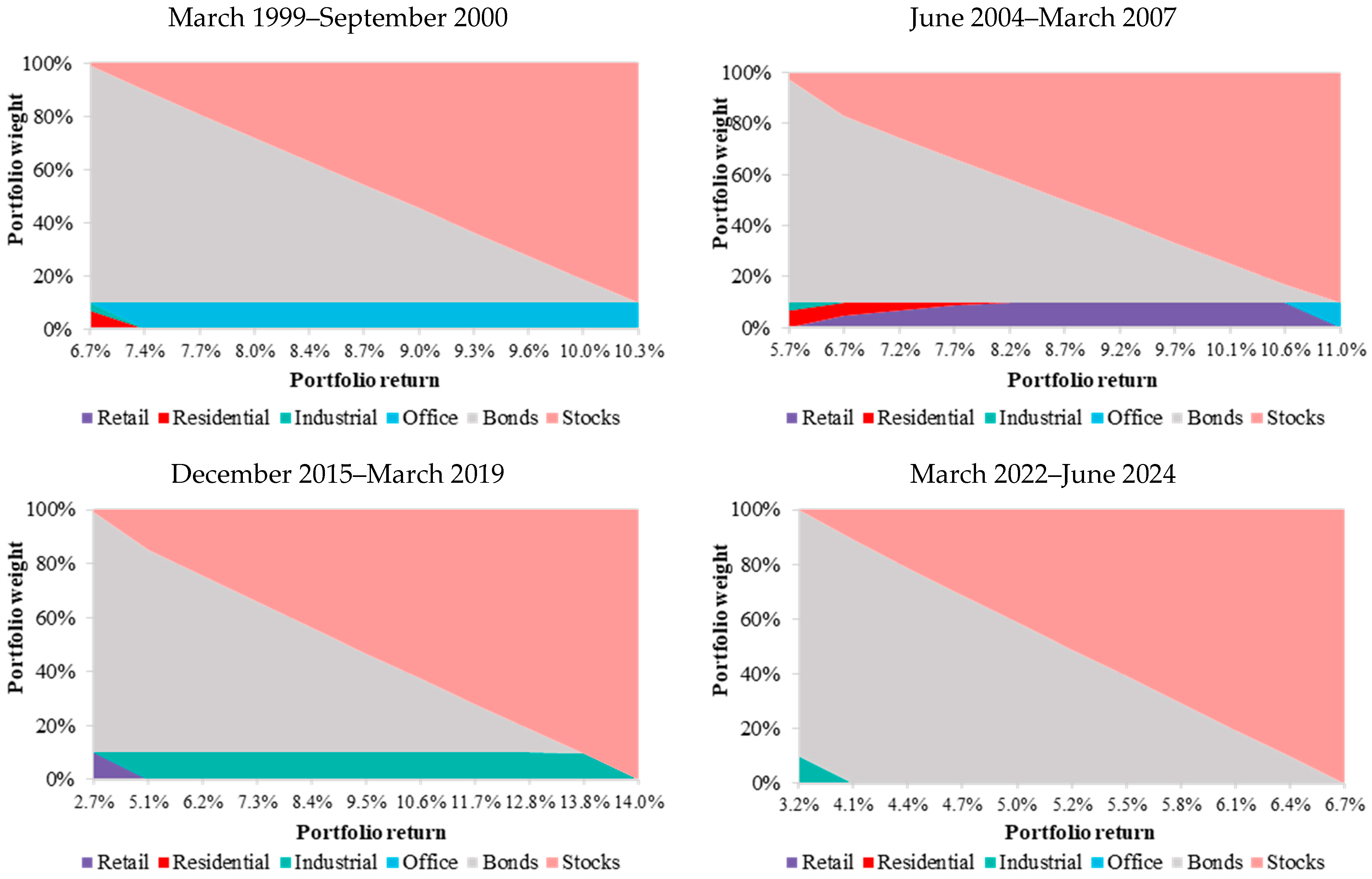
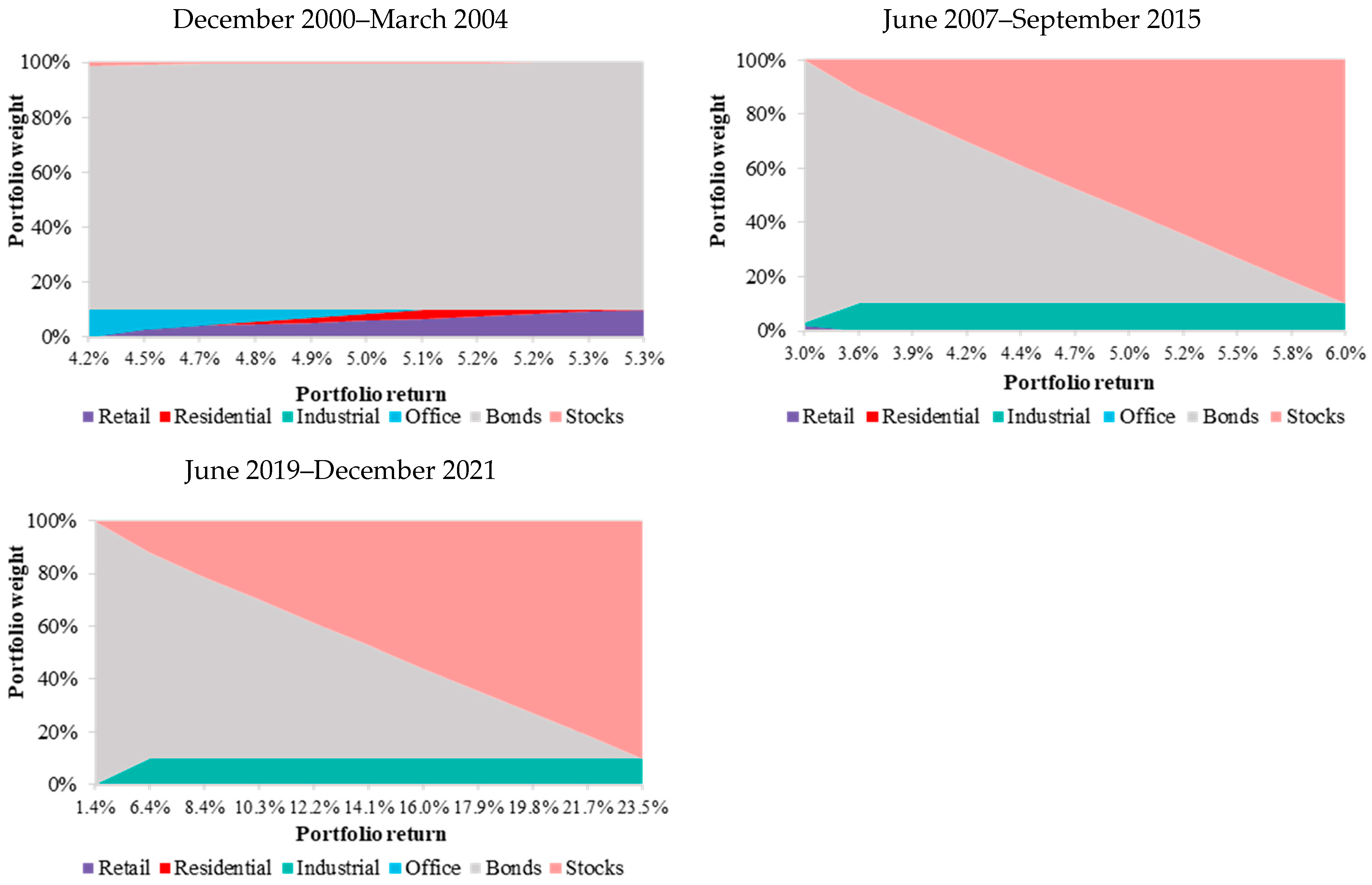
The strong downside risk-adjusted returns of unlisted sector-specific real estate suggest its potential for strategic inclusion in the US institutionalized mixed-asset portfolios. To address RQ2 and examine Hypothesis 2, a constrained asset allocation analysis (Scenario 1) was performed, limiting each unlisted sector-specific real estate allocation to a maximum of 10%. Scenario 1 employed a mixed-asset portfolio analysis to evaluate the added-value contributions of each US unlisted sector-specific real estate sector to a mixed-asset portfolio comprising bonds and stocks. The 10% capped real estate allocations align with prevailing institutional practice, where real estate commonly is allocated approximately 10% within institutionalized mixed-asset portfolios [3,10,14].

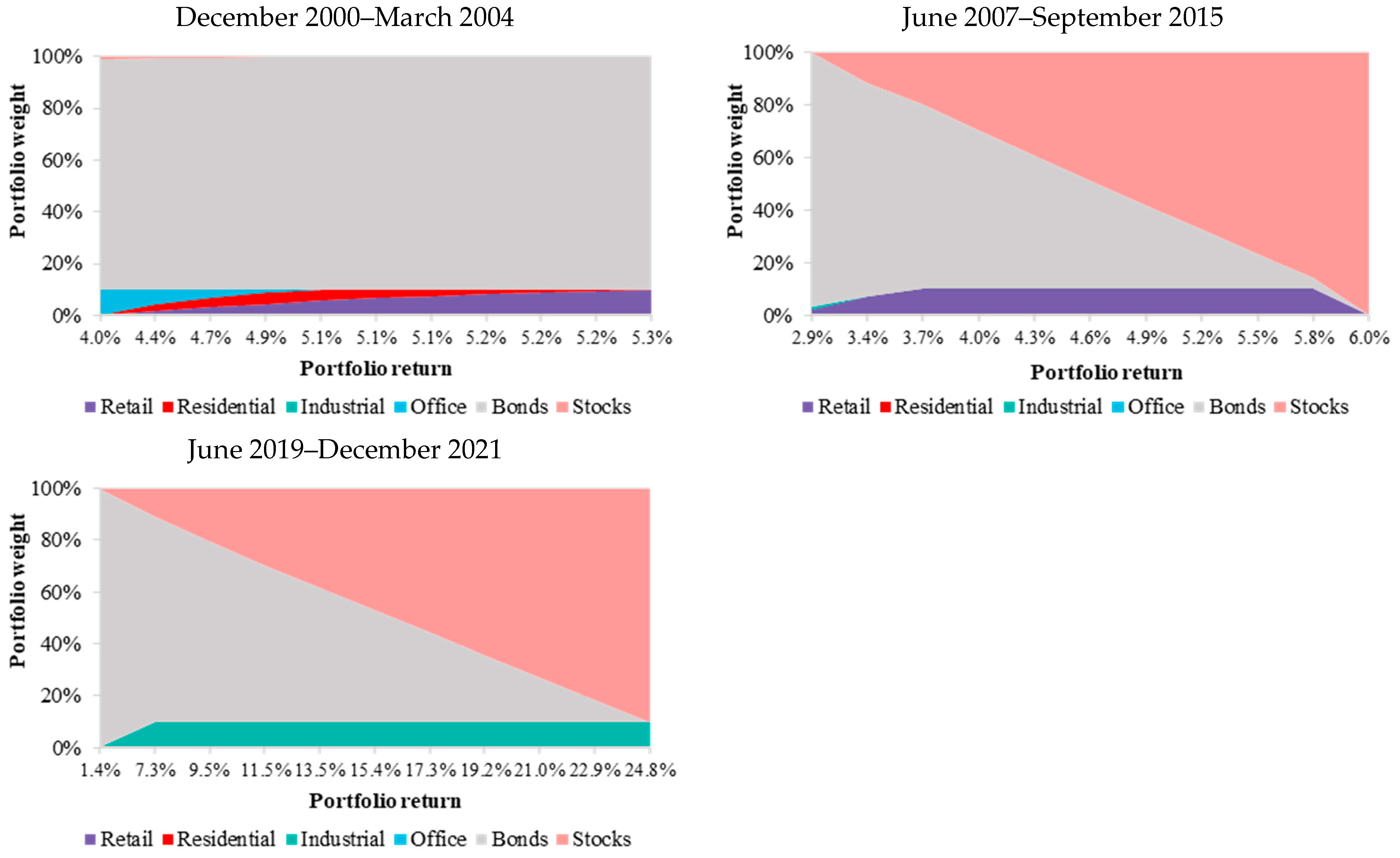
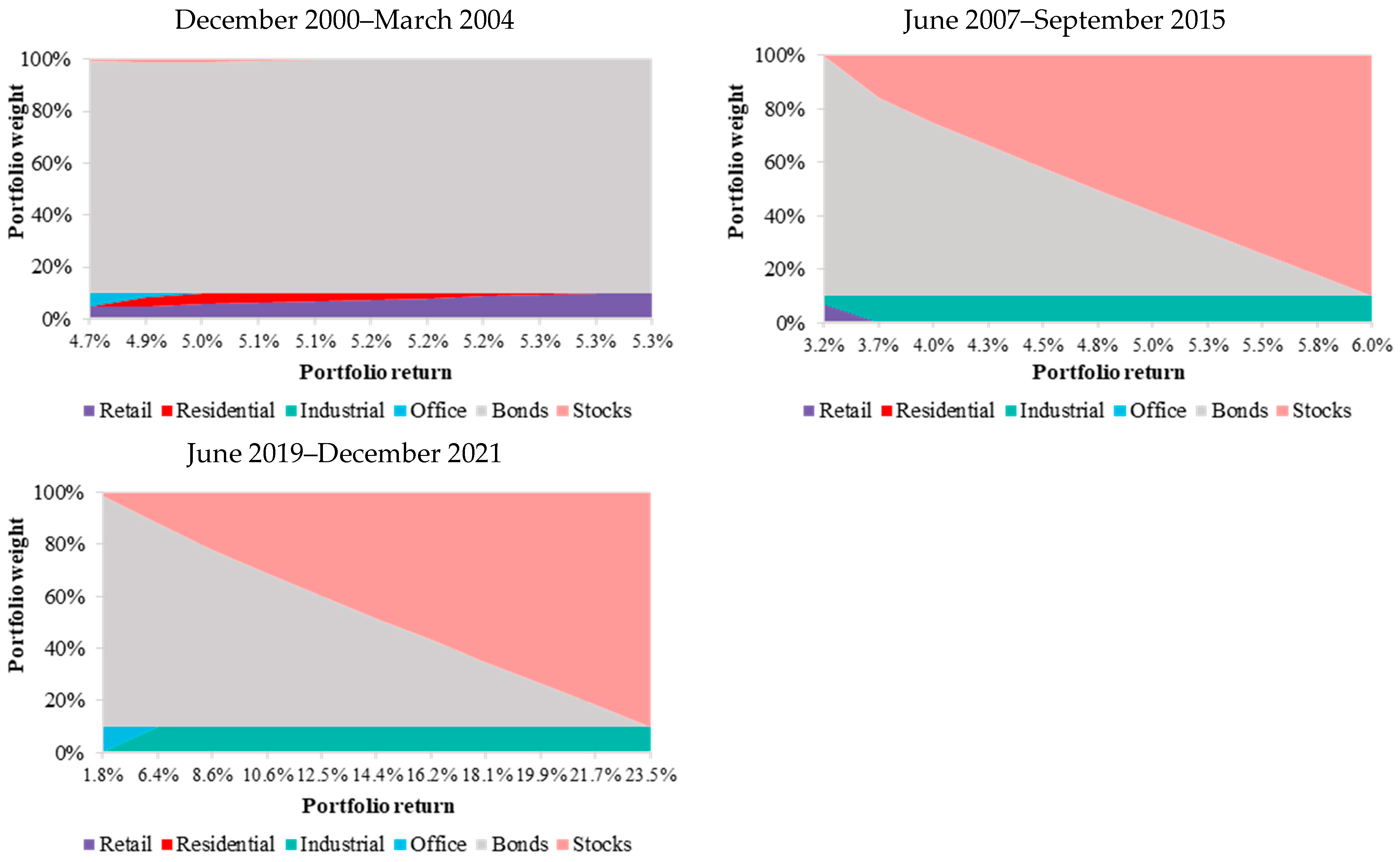
5.1.1. Rate-Easing Phases

Figure 1 illustrates the findings of unlisted sector-specific real estate in the US across three rate-easing phases: (1) December 2000–March 2004, (2) June 2007–September 2015, and (3) June 2019–December 2021. Industrial, with an average allocation of 6.1% and comparatively superior downside risk-adjusted returns relative to other sector-specific counterparts, consistently played a prominent role within the overall real estate allocations, with 10% capped across the risk–return range during all three rate-easing periods, followed by retail (2.0%), office (1.0%), and residential (0.4%). However, during the first rate-easing phase, industrial was replaced by retail in the upper end of the portfolio risk-return range and by office in the lower segment. This shift can be explained by retail offering stronger downside risk-adjusted returns (Sortino ratio = 2.54) and stronger diversification effectiveness with bonds (r = −0.28) compared to industrial. This sees office providing the strongest portfolio diversification benefits, recording notably low correlations with major asset classes, such as stocks (r = −0.08) and bonds (r = −0.58).

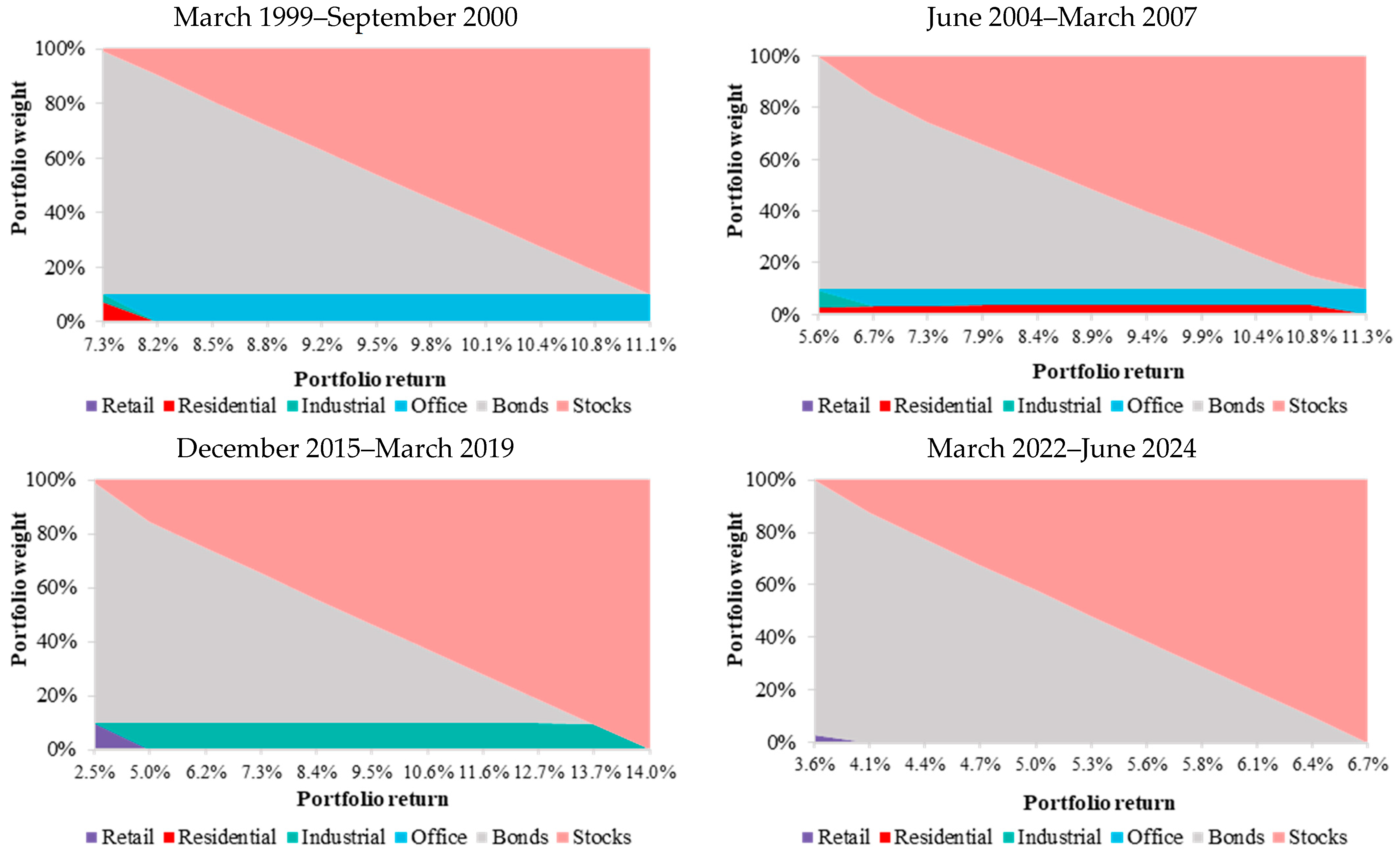
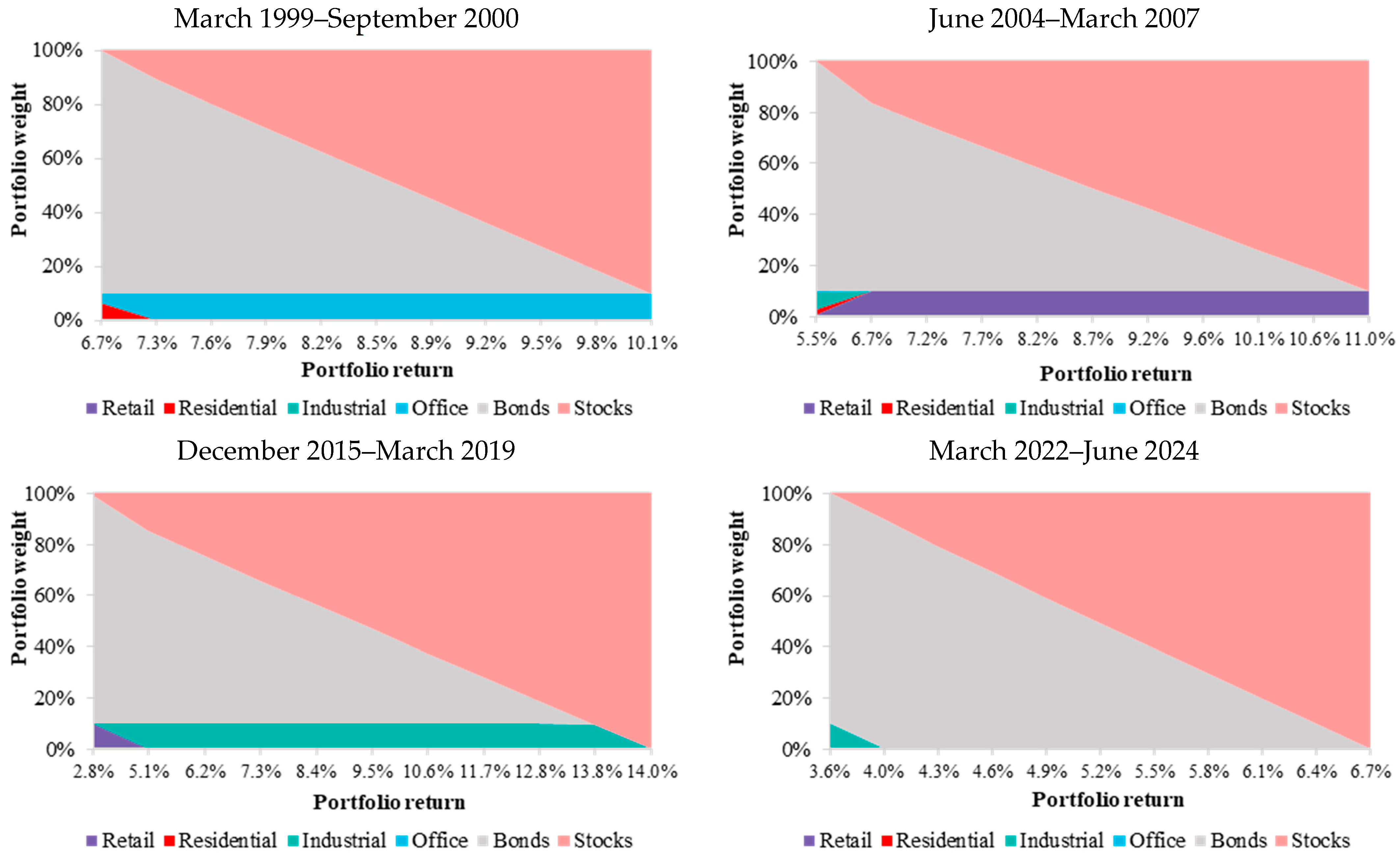
5.1.2. Rate-Tightening Phases

Figure 2 presents the findings of unlisted sector-specific real estate in the US over four rate-tightening phases: (1) March 1999–September 2000, (2) June 2004–March 2007, (3) December 2015–March 2019, and (4) March 2022–June 2024. Compared to rate-easing phases (average allocation = 9.5%), the average allocation to unlisted sector-specific real estate decreased to 7.5% during rate-tightening phases. Office, with an average allocation of 5.0%, consistently appeared across the portfolio risk-return range over the first and second rate-tightening phases before the GFC, reflecting its superior downside risk-adjusted returns compared to other sub-sectors during these periods. Over the third rate-tightening phase, industry played a dominant role, with an average allocation of 8.1% in the constrained real estate exposure of 10%. This aligns with the analysis of [58], where industrial real estate’s strong performance was driven by the e-commerce trends after the GFC. Over the fourth rate-tightening phase after the fiscal stimulus package in response to the COVID-19 recession, industry maintained a minor allocation (average = 0.9%) in the lower end of the portfolio risk–return range, while other unlisted sector-specific real estate sectors received no portfolio weight simultaneously.

5.2. Unlisted Real Estate Portfolios in the US

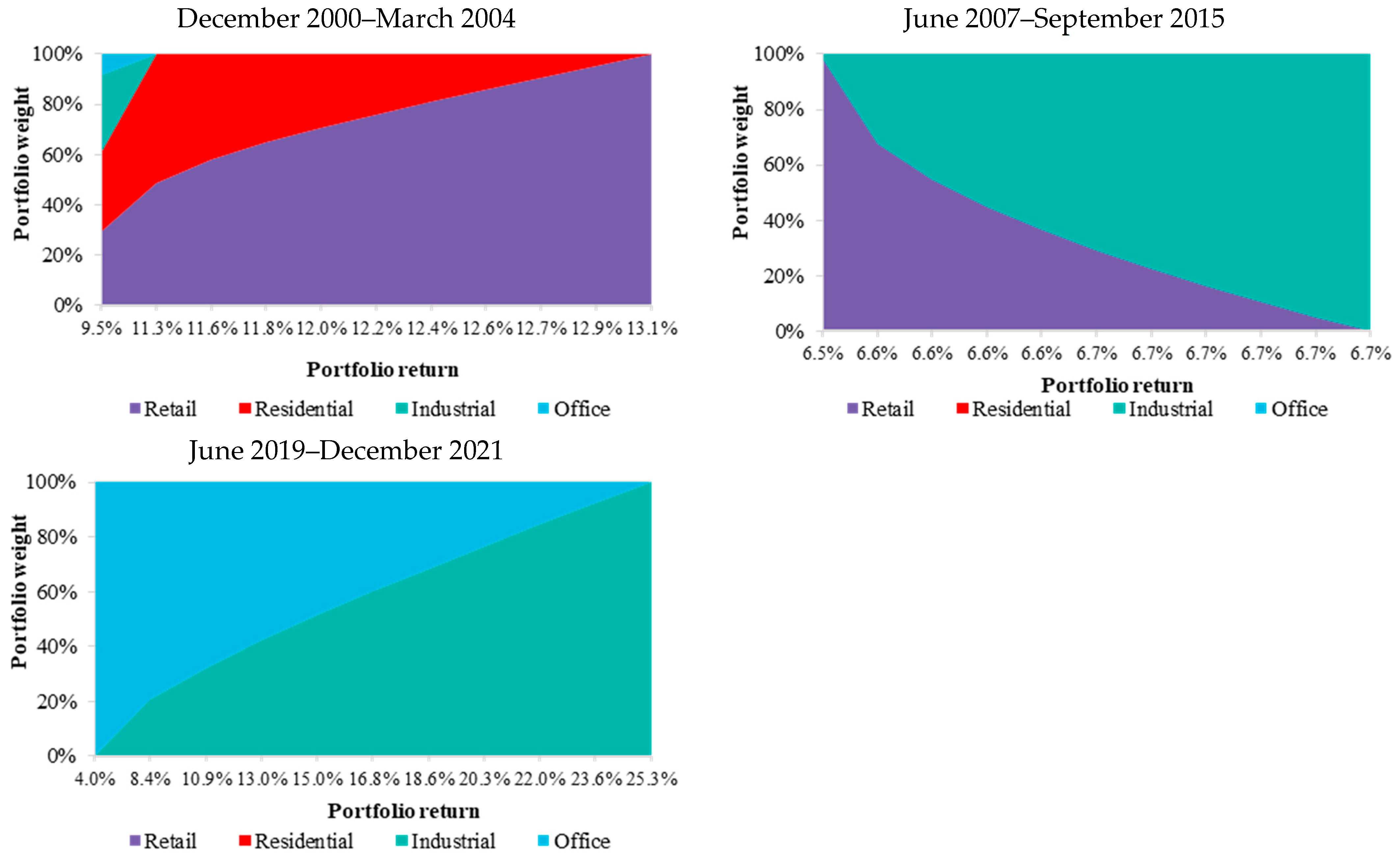
To address RQ3 and examine Hypothesis 3, Scenario 2, deploying the unlisted real estate portfolio framework, was tailored to provide institutional investors with insights on tactically rebalancing sectoral allocations to US unlisted sector-specific real estate across rate-easing and rate-tightening phases. This aims to offer insightful and practical implications for institutional investors to tactically rebalance sectoral allocations to US unlisted real estate across heterogeneous rate phases.

5.2.1. Rate-Easing Phases

Figure 3 shows the findings of the optimized real estate portfolio examination on unlisted sector-specific real estate in the US during three rate-easing phases: (1) December 2000–March 2004, (2) June 2007–September 2015, and (3) June 2019–December 2021. Retail played a dominant role (average allocation = 72.7%) across the portfolio risk-return range over the first rate-easing phase. However, following structural portfolio changes among global industrial investment fund managers after the GFC [58], industrial dominated (average allocation = 61.0%) during the rate-easing phases over the second and third rate-easing phases, followed by office (21.4%), retail (17.6%), and residential (0.0%). Notably, retail and office appeared in the lower end of the portfolio risk-return range over the second and third rate-easing phases, respectively.

5.2.2. Rate-Tightening Phases

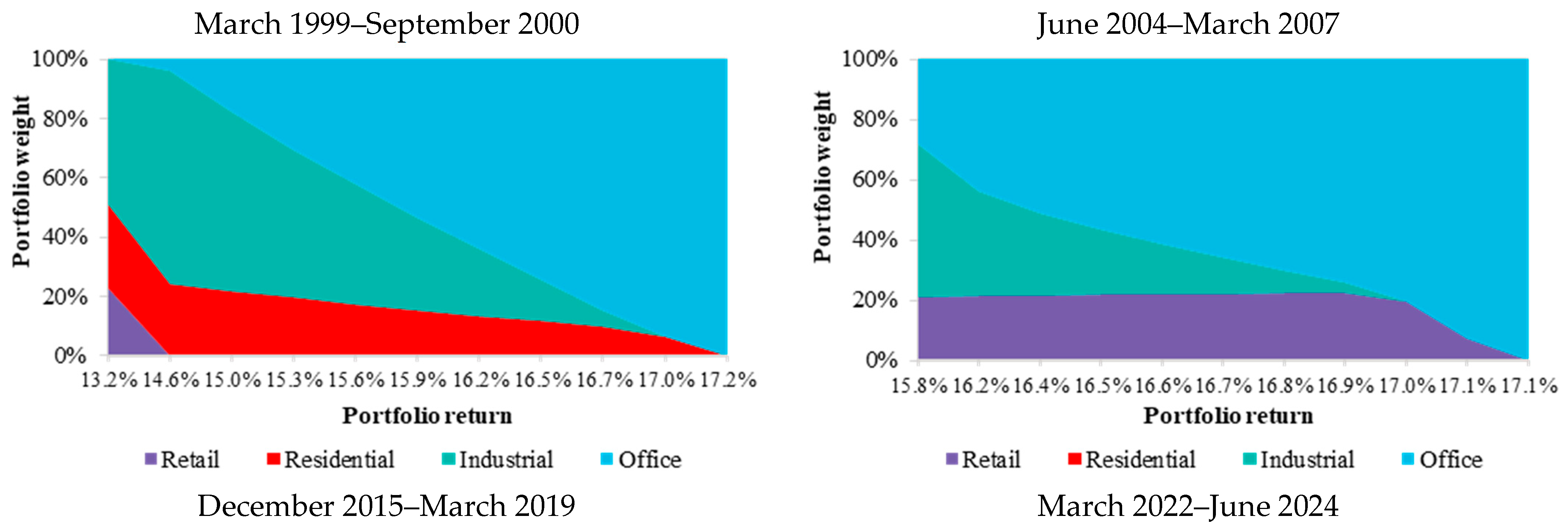
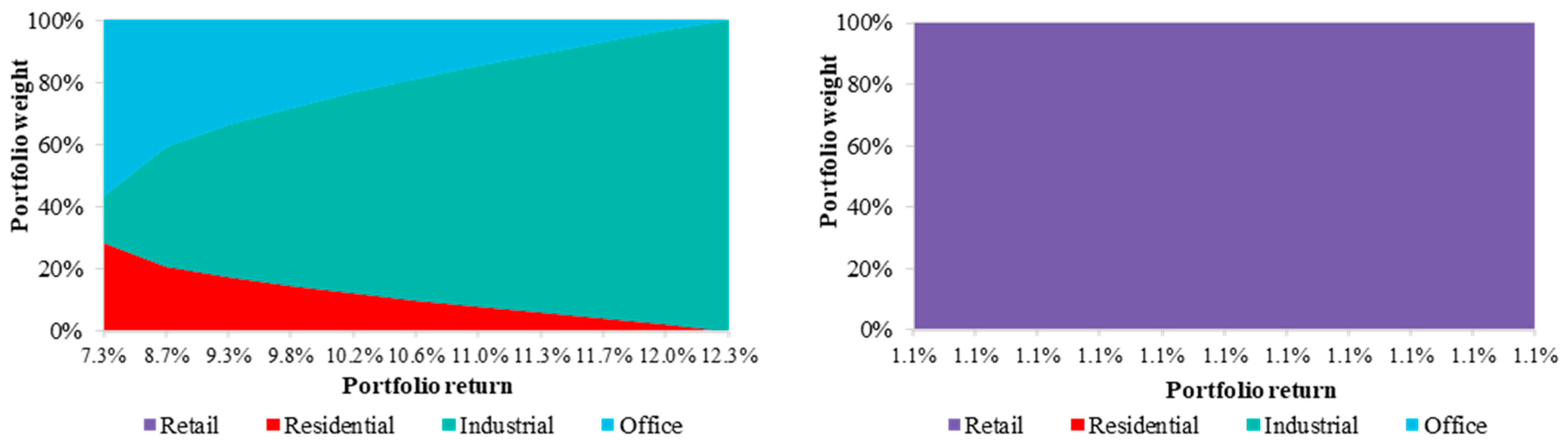
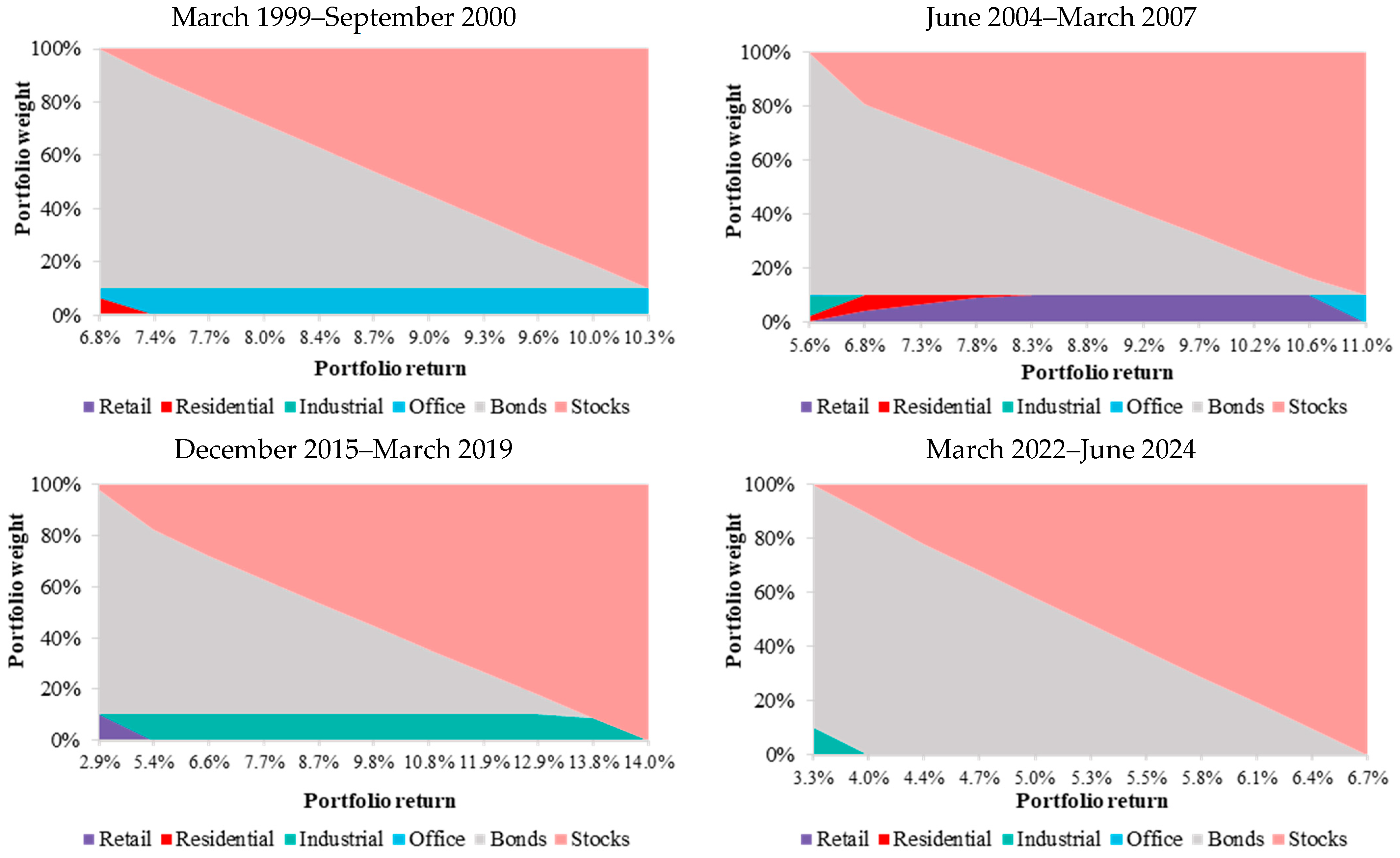
Figure 4 depicts the findings of the optimized real estate portfolio examination on unlisted sector-specific real estate over four rate-tightening phases: (1) March 1999–September 2000, (2) June 2004–March 2007, (3) December 2015–March 2019, and (4) March 2022–June 2024. Compared to rate-easing phases, the office more than doubled its average allocation across the portfolio risk-return range (average allocation increased to 34.7% from 14.5%). Average allocations to industrial decreased (from 41.6% to 28.6%), as did those to retail (from 35.9% to 30.1%) and residential (from 7.9% to 6.6%).
Specifically, the office had significant allocations in the upper end of the portfolio risk-return range over the first (average allocation = 51.4%) and second (65.8%) rate-tightening phases, while appearing in the lower end of the portfolio risk-return range over the third rate-tightening phase (21.6%). In contrast, industrial appeared in the lower end of the portfolio risk-return range over the first (31.2%) and second (15.8%) rate-tightening phases but shifted to the upper end of the portfolio risk-return range over the third rate-tightening phase (67.2%). These allocation patterns align with structural changes in portfolio strategies amongst global industrial real estate managers after the GFC [54] and the significant impacts of hybrid working strategies on global office markets [3]. This sees the US CBD office vacancy rate increase to 18.4% in June 2024 from 13.5% at the onset of the COVID-19-induced recession in March 2020 [71].
Over the fourth rate-tightening phase, 100% of the portfolio was allocated to retail after the fiscal stimulus package in response to the COVID-19 recession. This was because retail was the only real estate sub-sector achieving an average annual return of 1.13% simultaneously. This can be explained by the fact that retail real estate income returns are often CPI-linked [72]. The high inflation occurred in the US during this period, driven by aggressive monetary policies, and the balance sheet of the Federal Reserve expanded by 125% between 2020 (USD 4 trillion) and 2022 (USD 9 trillion) [4].

6. Robustness Checks

6.1. Sensitivity Analysis—De-Smoothing Parameters

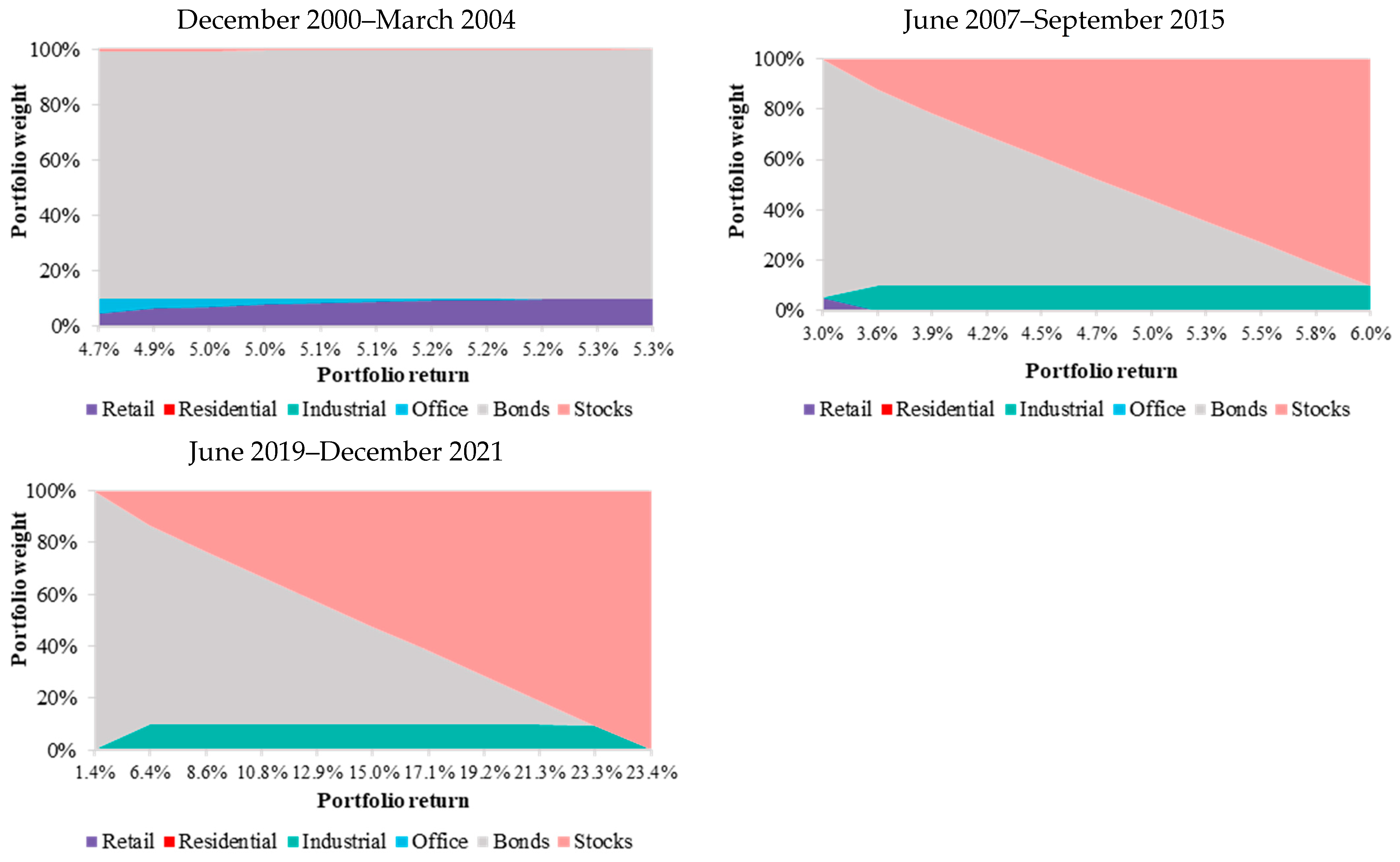
This study used the de-smoothing specification by [67] with a de-smoothing parameter of 0.5, recognizing that the underestimated actual risk of unlisted real estate was led by smoothing returns of unlisted real estate [65,66]. However, alternative de-smoothing specifications are expected to be undertaken to reinforce that the baseline findings are robust.
Hence, this research conducted stress tests by employing alternative de-smoothing specifications, with parameters of α = 0.2 and α = 0.7. As reiterated by the findings of [55], which were built on the analyses of [73,74], a de-smoothing parameter value of 0.2 implies a four-quarter lag in private real estate markets. Additionally, the stress test on a de-smoothing parameter value of 0.7 was examined. Appendix A Figure A1 and Figure A2 exhibit the findings of de-smoothing parameters α = 0.2 across rate-easing and hike phases, respectively. Also, Appendix A Figure A3 and Figure A4 show the findings of a de-smoothing parameter of α = 0.7 across rate-easing and hike regimes, respectively. These findings broadly align with the baseline findings, showing that unlisted sector-specific real estate featured a more pronounced role during rate-easing phases than during rate-tightening phases. At a sector level, office preferred to constitute in rate-tightening phases, while retail, industrial, and residential featured a stronger role in rate-easing phases than in rate-tightening phases. These indicate that the conclusion remains unchanged as the baseline findings are stable and reliable to variations in the alternative de-smoothing specifications.

6.2. Sensitivity Analysis—Minimum Acceptable Return (MAR)

To evaluate the stability and robustness of the baseline outcomes, an alternative MAR specification was used, set to 0, capturing the expected shortfall relative to a MAR over the study sub-periods. Appendix A Figure A5 exhibits the findings of an alternative MAR value = 0 in rate-easing phases. In addition, Appendix A, Figure A6, presents the conclusions of the rate-tightening phases. In general, the findings align with the baseline outcomes, in which unlisted sector-specific real estate played a more pivotal role in rate-easing phases than in rate-tightening phases. At a sector level, retail, industrial, and residential sectors played a more prominent role in rate-easing phases than in rate-tightening phases. By contrast, the office sector preferred an essential role in rate-tightening phases. These reflect the stability and reliability of the baseline outcomes to changes in the alternative MAR specification.

6.3. Sensitivity Analysis—Effective Federal Funds Rate (EFFR)

To enhance the robustness of our results, this study used an alternative rate measurement—the Federal Reserve EFFR. The results show that the lengths of EFFR expansion and contraction phases were mainly consistent with interest rate phases empirically defined based on the Federal Reserve fund rates on a quarter-end basis. The subtle differences are (1) the rate-easing phase: June 2007–March 2015, and (2) the rate-tightening phase: June 2015–March 2019, which are different from the baseline interest rate phases: (1) the rate-easing phase: June 2007–September 2015, and (2) the rate-tightening phase: December 2015–March 2019. Importantly, these results are mainly consistent with the baseline results. This implies the alternative use of the Federal Reserve EFFR did not alter the conclusion of this study.

7. Discussions

This study examined portfolio asset allocation strategy for US unlisted sector-specific real estate across seven distinct rate phases to address the research questions (RQ1-RQ3) under a mean-downside risk optimization framework to assess the impacts of extremely fluctuating market climates throughout these phases. In particular, the starting points of the US rate-easing phases corresponded to major cyclical and structural changes in the global and US economies, such as the dot-com bubble (March 2001–November 2001), the Global Financial Crisis (GFC) (September 2007–September 2009), and the COVID-19-induced recession (February 2020–April 2020).
By mandating these empirical analyses, this study contributes to the extensions on existing literature on the investment space of unlisted real estate in several dimensions: (1) this study empirically validates the impacts of the sectoral effect and interest rates on portfolio asset allocation strategies for the US unlisted sector-specific real estate, (2) this paper offers comprehensive and evidence-based insights on tactically rebalancing sectoral portfolio asset allocation strategies for the US unlisted sector-specific real estate across heterogeneous rate phases with the application of the Scenario 1 portfolio analysis, (3) this study provides empirically driven TAA strategies for each unlisted sector-specific real estate sector in the US institutionalized mixed-asset portfolios, tailored to heterogeneous rate phases with the use of the Scenario 2 portfolio analysis, (4) the study empirically identifies TAA strategies for sector selection and sectoral diversification in US unlisted real estate portfolios across distinct interest rate phases, as well as (5) this paper distributes dynamic and timely insights into the interest rate and sectoral effects on portfolio asset allocation strategy for the US unlisted real estate as the US interest rate phase march into new turning points. Particularly, the analysis timeframe of this paper explicitly encompasses seven rate phases over the past 2.5 decades, including the latest 2022 rate-tightening phase, which has yet to be accounted for in the existing literature.
A number of key insights emerge from the analysis. First, the analysis outcomes empirically validate unlisted sector-specific real estate as an added-value role in the mixed-asset portfolios for the US institutional investors across rate-easing and rate-tightening phases. The outcome can stem from the stronger downside risk-adjusted returns of US unlisted sector-specific real estate relative to bonds and stocks, due to their low risk levels. Besides, the effectiveness of portfolio diversification offered by the unlisted sector-specific real estate was attractive for institutional investors with substantial existing asset allocations to bonds and stocks. The only exception was the rate-tightening phase from March 2022 to June 2024, when no asset allocation to unlisted sector-specific real estate was observed. This can originate from the rate-tightening phase being the fastest rate-tightening phase in the last 35 years, with an increase of 500 bps in 10 quarters [4]. The sharp increase in interest rates since March 2022 led to substantial devaluations across all real estate sectors [1,2,3,9].
Second, the findings empirically validate that portfolio asset allocations to unlisted sector-specific real estate constituted an average of 9.5% in the rate-easing phases but declined by 2% to 7.5% in the rate-tightening phases. At a sector level, office allocations were higher in constrained mixed-asset and real estate portfolios in the rate-tightening phases than in the rate-easing phases. However, the office had no allocations in constrained mixed-asset and optimal unlisted real estate portfolios during the rate-tightening phase between March 2022 and June 2024. This may be linked to the office market structural changes in the US, driven by hybrid working strategies [1,3,75]. Meanwhile, portfolio asset allocations to unlisted retail, industrial, and residential were lower in the rate-tightening phases than in the rate-easing phases. The findings can be explained by the empirical sensitivity of retail and residential sectors to interest rate phases in the US, as empirically validated in listed studies by [18,19].
Third, the results show that sectoral diversification among unlisted sector-specific real estate sectors proved more effective in rate-tightening phases than in rate-cutting phases. Specifically, sectoral allocations to each real estate sector were more balanced in rate-tightening phases than in rate-cut phases, as echoed by listed real estate evidence [18,23]. This can be attributed to the fact that sectoral diversification has more significant risk management benefits in economic downturns [26].
Last, tactically rebalancing sectoral allocation strategies for US unlisted sector-specific real estate was empirically formulated by the study. The interest rate effects on institutional portfolio asset allocation strategies may translate into upward pressure on capitalization rates and a devaluation in real estate capital values [8]. Specifically, rate hikes heighten the financing costs in real estate transactions, management, and development; potentially trigger oversupply in submarkets; substantially affect the term structure of tenant leases; and further decline tenant occupational demand [49,50]. However, sectoral allocation rebalancing in unlisted real estate portfolios remains constrained, as investment fund managers and institutional investors face illiquidity and organizational inertia in response to interest rate changes [76]. Reallocation lags in the US unlisted real estate portfolios may arise from (1) appraisal-based valuation and delayed price discovery that smooth and lag measured performance returns [77], (2) fund-structure liquidity constraints, including redemption queues and gating in open-end core funds during stress incidents [78], and (3) institutional governance frictions and portfolio inertia that slow implementation [79].

8. Conclusions

This paper contributes several practical real estate investment implications concerning sector selection and sectoral portfolio diversification strategies across interest rate phases for investment fund managers and institutional investors. These valuable research insights are significant for investment fund managers and institutional investors to tactically rebalance sectoral allocation strategies for US unlisted sector-specific real estate when the US rate phases enter a turning point, as voiced by [2,3,19]. First, investment fund managers and institutional investors should recognize the distinct investment characteristics of unlisted real estate across sectors. More precisely, each real estate sector’s contribution to real estate and mixed-asset portfolio optimizations changed materially as monetary conditions evolved. This implies that static asset allocation (SAA) strategies may be insufficient in phases of heightened rate volatility. Second, portfolio rebalancing is a well-established investment practice among institutional investors in the fluctuating financial markets. However, its effectiveness remains uncertain in the unlisted sector-specific real estate in the rate-tightening phases, where investment conditions are particularly constrained. Accordingly, this study primarily focuses on portfolio asset allocations to each unlisted sector-specific real estate sector across heterogeneous rate phases. Hence, institutional investors with significant unlisted real estate exposure, namely sovereign wealth funds, pension funds, insurance companies, government institutions, and real estate investment fund managers, can benefit from these tactical and valuable insights into sectoral portfolio asset allocation strategies for the US unlisted sector-specific real estate across various rate phases. Third, this research offers practical and valuable insights for investment fund managers and institutional investors by deepening their comprehension of how monetary policy influences sectoral allocations to unlisted real estate investment. It also demonstrates the effectiveness of US unlisted real estate portfolios in supporting a rebalancing portfolio’s TAA strategies through sector selection and diversification across heterogeneous rate phases. The impacts of the asymmetric risk on investment fund managers and institutional investors’ portfolio asset allocation strategies may stem from low real estate market efficiency. Last, this research empirically validates unlisted sector-specific real estate as an effective real estate investment channel for investment fund managers and institutional investors to leverage distinctive investment performance and roles of the US real estate sub-sectors in the US mixed-asset portfolios and unlisted real estate portfolios across heterogeneous rate phases.
Whilst this research delivers investment fund managers and institutional investors with tactical and perceptive sectoral portfolio asset allocation strategies for US unlisted sector-specific real estate in the US unlisted real estate and mixed-asset portfolios across heterogeneous rate phases, the limitations and assumptions in this paper should be noted and documented. First, the use of a de-smoothing technique lost one-quarter of the data and therefore decreased the size of the effective sample. Second, it is essential to acknowledge that the investment data on private real estate in this research is often constrained. It is due to this that private real estate characterizes a less transparent nature and is traded infrequently, thus often limiting the robustness of the analysis on private real estate markets. This is despite the 25-year analysis period across real estate sub-sectors used in this study. Third, this research used the federal fund rate as the determinant for the US heterogeneous interest rate phases. The Federal Reserve monetary policy decisions are expected to objectively rely on various factors, such as the real GDP growth, the core inflation rate for the consumer price index (CPI), and the unemployment rate [80]. These factors have yet to be empirically measured in this study and, therefore, are one of the research limitations. Last, the empirical findings based on historical data may not ensure future performance and should therefore be interpreted as economically significant portfolio allocation patterns rather than as formal statistical tests of differences across heterogeneous rate phases. However, insightful practical investment implications for the unlisted sector-specific real estate are highlighted in this research.
Future research is suggested to explore the effects of highly turbulent investment climates, namely the Russia–Ukraine war and the COVID-19 pandemic, on portfolio asset allocation strategies for unlisted sector-specific real estate. In addition, the MAR framework, which incorporates policy-relevant targets (e.g., an actuarial or inflation-linked target), may be extended to tailor portfolio construction to specific institutional investors’ investment objectives.


Author Contributions

Conceptualization, Y.-C.L. and C.L.L.; data and methodology, Y.-C.L. and J.M.; formal analysis, Y.-C.L. and J.M.; writing—original draft preparation, Y.-C.L.; writing—conclusion, reviewing, and editing, Y.-C.L., C.L.L. and J.M. All authors have read and agreed to the published version of the manuscript.

Funding

This research received no external funding.

Data Availability Statement

Restrictions apply to the availability of these data. Data were obtained from Refinitiv Eikon (formerly known as Thomson Reuters DataStream) and MSCI and are available from the authors with the permission of Refinitiv Eikon (formerly known as Thomson Reuters DataStream) and MSCI.

Conflicts of Interest

The authors declare no conflicts of interest.

Appendix A

Figure A1. US mixed-asset portfolio asset allocation diagram across rate-easing phases: de-smoothing parameter α = 0.2.
Buildings 16 00308 g0a1
Figure A2. US mixed-asset portfolio asset allocation diagram across rate-tightening phases: de-smoothing parameter α = 0.2.
Buildings 16 00308 g0a2
Figure A3. US mixed-asset portfolio asset allocation diagram across rate-easing phases: de-smoothing parameter α = 0.7.
Buildings 16 00308 g0a3
Figure A4. US mixed-asset portfolio asset allocation diagram across rate-tightening phases: de-smoothing parameter α = 0.7.
Buildings 16 00308 g0a4
Figure A5. US mixed-asset portfolio asset allocation diagram across rate-easing phases: MAR value = 0.
Buildings 16 00308 g0a5
Figure A6. US mixed-asset portfolio asset allocation diagram across rate-tightening phases: MAR value = 0.
Buildings 16 00308 g0a6

References

  1. PGIM. United States: 2025 Real Estate Outlook; PGIM Real Estate: New York, NY, USA, 2024. [Google Scholar]
  2. DWS. Global Real Estate Strategic Outlook; DWS Asset Management: London, UK, 2025. [Google Scholar]
  3. Nuveen. Global Trends and Tactics: Real Estate Opportunities and Risks in the Current Environment; Nuveen Real Estate: New York, NY, USA, 2025. [Google Scholar]
  4. Federal Reserve. Federal Reserve Press Release: December 2024; Federal Reserve: New York, NY, USA, 2024. [Google Scholar]
  5. Conner, P.; Liang, Y. The complex interaction between real estate cap rates and interest rates. Brief. Real Estate Financ. 2004, 4, 185–197. [Google Scholar] [CrossRef]
  6. Hollies, R. International Variation in Office Yields: A Panel Approach. J. Prop. Invest. Financ. 2007, 25, 370–387. [Google Scholar] [CrossRef]
  7. Tsolacos, S.; Kim, K.M.; Peng, R. Panel Modelling of Retail Yields in Asia-Pacific Cities. J. Prop. Invest. Financ. 2009, 27, 224–237. [Google Scholar] [CrossRef]
  8. French, N. Property Investment: Gearing and the Equity Rate of Return. J. Prop. Invest. Financ. 2019, 37, 323–328. [Google Scholar] [CrossRef]
  9. MSCI. MSCI Quarterly Property Index; MSCI: New York, NY, USA, 2024. [Google Scholar]
  10. ANREV. Investment Intention Survey; Asian Association for Investors in Non-Listed Real Estate Vehicles (ANREV): Singapore, 2025. [Google Scholar]
  11. INREV. Fund Manager Survey 2025; European Association for Investors in Non-listed Real Estate Vehicles (INREV): Amsterdam, The Netherlands, 2025. [Google Scholar]
  12. EPRA. Global Real Estate Total Markets Table; European Public Real Estate Association: Brussels, Belgium, 2024. [Google Scholar]
  13. Fuerst, F.; Mansley, N.; Wang, Z. Do Specialist Funds Outperform? Evidence from European Non-listed Real Estate Funds. Res. Int. Bus. Financ. 2021, 58, 101434. [Google Scholar] [CrossRef]
  14. IPE. Top 150 Real Estate Investment Managers; IPE Real Assets: London, UK, 2024. [Google Scholar]
  15. Hoesli, M.; Oikarinen, E. Are REITs Real Estate? Evidence from International Sector Level Data. J. Int. Money Financ. 2012, 31, 1823–1850. [Google Scholar] [CrossRef]
  16. Geltner, D.; Miller, N.; Clayton, J.; Eichholtz, P. Commercial Real Estate Analysis and Investments, 3rd ed.; South-Western: Cincinnati, OH, USA, 2014. [Google Scholar]
  17. Lin, Y.C.; Cho, H.; Lee, C.L. The Value-Added Role of Sector-Specific REITs in Australia. Pac. Rim Prop. Res. J. 2019, 25, 49–72. [Google Scholar] [CrossRef]
  18. Lin, Y.C.; Lee, C.L.; Newell, G. Varying Interest Rate Sensitivity of Different Property Sectors: Cross-Country Evidence from REITs. J. Prop. Invest. Financ. 2022, 40, 68–98. [Google Scholar] [CrossRef]
  19. Lin, Y.C.; Marzuki, M. Varying Interest Rate Sensitivity of Different Property Sectors: Global Listed Real Estate Evidence; European Public Real Estate Association (EPRA): Brussels, Belgium, 2024. [Google Scholar]
  20. Liow, K.H.; Huang, Q. Interest rate risk and time-varying excess returns for Asian property stocks. J. Prop. Invest. Financ. 2006, 24, 188–210. [Google Scholar] [CrossRef]
  21. Liow, K.H.; Ooi, J.; Wang, L.K. Interest rate sensitivity and risk premium of property stocks. J. Prop. Res. 2003, 20, 117–132. [Google Scholar] [CrossRef]
  22. Akimov, A.; Lee, C.L.; Stevenson, S. Interest Rate Sensitivity in European Public Real Estate Markets. J. Real Estate Portf. Manag. 2020, 25, 138–150. [Google Scholar] [CrossRef]
  23. Lin, Y.C.; Marzuki, M.; Lee, C.L. Portfolio Construction Strategy for Global Non-Listed Office Real Estate Investment in Interest Rate Cycles. Buildings 2025, 15, 3570. [Google Scholar] [CrossRef]
  24. Hoesli, M.; Newell, G.; Marzuki, M.; Lai, R.N. The Performance and Diversification Potential of Non-listed Value-Add Real Estate Funds in Japan. J. Risk Financ. Manag. 2022, 15, 198. [Google Scholar] [CrossRef]
  25. Newell, G.; Marzuki, M.; Hoesli, M.; Lai, R.N. The Performance of Non-listed Opportunity Real Estate Funds in China. J. Prop. Invest. Financ. 2023, 41, 583–600. [Google Scholar] [CrossRef]
  26. Hilders, B.; Marx, S.; Tsolacos, S. The Effect of Sector Specialisation on Unlisted Real Estate Fund Performance amid Economic Downturns. J. Asset Manag. 2024, 26, 15–29. [Google Scholar] [CrossRef]
  27. Delfim, J.C.; Hoesli, M. Risk Factors of European Non-listed Real Estate Fund Returns. J. Prop. Res. 2016, 33, 190–213. [Google Scholar] [CrossRef]
  28. Stevenson, S.; Wilson, P.J.; Zurbruegg, R. Assessing the Time-Varying Interest Rate Sensitivity of Real Estate Securities. Eur. J. Financ. 2007, 13, 705–715. [Google Scholar] [CrossRef]
  29. Sortino, F.A.; Van Der Meer, R. Downside Risk. J. Portf. Manag. 1991, 17, 27. [Google Scholar] [CrossRef]
  30. Stevenson, S. Emerging Markets, Downside Risk and the Asset Allocation Decision. Emerg. Mark. Rev. 2001, 2, 50–66. [Google Scholar] [CrossRef]
  31. Sing, T.; Ong, S. Asset Allocation in a Downside Risk Framework. J. Real Estate Portf. Manag. 2000, 6, 213–223. [Google Scholar] [CrossRef]
  32. Lee, C.L.; Robinson, J.; Reed, R. Downside beta and the cross-sectional determinants of listed property trust returns. J. Real Estate Portf. Manag. 2008, 14, 49–62. [Google Scholar] [CrossRef]
  33. Hoesli, M.; Lizieri, C.; MacGregor, B. The inflation hedging characteristics of US and UK investments: A multi-factor error correction approach. J. Real Estate Financ. Econ. 2008, 36, 183–206. [Google Scholar] [CrossRef]
  34. Lee, C.L.; Lee, M.L. Do European real estate stocks hedge inflation? Evidence from developed and emerging markets. Int. J. Strateg. Prop. Manag. 2014, 18, 178–197. [Google Scholar] [CrossRef]
  35. Hahn, T.C.; Geltner, D.; Gerardo-Lietz, N. Real Estate Opportunity Funds: Past Fund Performance as an Indicator of Subsequent Fund Performance. J. Portf. Manag. 2005, 31, 143–153. [Google Scholar] [CrossRef]
  36. Case, B. What Have 25 Years of Performance Data Taught Us about Private Equity Real Estate? J. Real Estate Portf. Manag. 2015, 21, 1–20. [Google Scholar] [CrossRef]
  37. Pagliari, J. Real Estate Returns by Strategy: Have Value-Added and Opportunistic Funds Pulled Their Weight? Real Estate Econ. 2017, 48, 89–134. [Google Scholar] [CrossRef]
  38. Bollinger, A.; Pagliari, J. Another Look at Private Real Estate Returns by Strategy. J. Portf. Manag. 2019, 45, 95–112. [Google Scholar] [CrossRef]
  39. Kiehelä, S.; Falkenbach, H. Performance of Non-Core Private Equity Real Estate Funds: A European View. J. Portf. Manag. 2015, 41, 62–72. [Google Scholar] [CrossRef]
  40. Alcock, J.; Baum, A.; Colley, N.; Steiner, E. The Role of Financial Leverage in the Performance of Private Equity Real Estate Funds. J. Portf. Manag. 2013, 39, 99–110. [Google Scholar] [CrossRef]
  41. Fuerst, F.; Matysiak, G. Analysing the Performance of Non-listed Real Estate Funds: A Panel Data Analysis. Appl. Econ. 2013, 45, 1777–1788. [Google Scholar] [CrossRef]
  42. Morri, G.; Perini, U.; Anconetani, R. Performance Determinants of European Private Equity Real Estate Funds. J. Eur. Real Estate Res. 2021, 14, 207–226. [Google Scholar] [CrossRef]
  43. Arnold, T.R.; Ling, D.C.; Naranjo, A. Private Equity Real Estate Funds: Returns, Risk Exposures, and Persistence. J. Portf. Manag. 2019, 45, 24–42. [Google Scholar] [CrossRef]
  44. Ro, S.; Ziobrowski, A. Does Focus Really Matter? Specialised vs. Diversified REITs. J. Real Estate Financ. Econ. 2011, 42, 68–83. [Google Scholar] [CrossRef]
  45. Benefield, J.D.; Anderson, R.I.; Zumpano, L.V. Performance differences in property-type diversified versus specialised real estate investment trusts (REITs). Rev. Financ. Econ. 2009, 18, 70–79. [Google Scholar] [CrossRef]
  46. Farrelly, K.; Stevenson, S. Performance Drivers of Private Real Estate Funds. J. Prop. Res. 2016, 33, 214–235. [Google Scholar] [CrossRef]
  47. Fisher, L.M.; Hartzell, D.J. Class Differences in Real Estate Private Equity Fund Performance. J. Real Estate Financ. Econ. 2016, 52, 327–346. [Google Scholar] [CrossRef]
  48. Mueller, G.; Mueller, A. Investable Real Estate Allocations in a Mixed Asset Portfolio; both Long Term and During Different Cycles. J. Real Estate Portf. Manag. 2023, 30, 91–102. [Google Scholar] [CrossRef]
  49. Crosby, N.; Gibson, V.; Murdoch, S. UK Commercial Property Lease Structures: Landlord and Tenant Mismatch. Urban Stud. 2003, 40, 1487–1516. [Google Scholar] [CrossRef]
  50. Ambrose, B.; Yildirim, Y. Credit Risk and the Term Structure of Lease Rates: A Reduced Form Approach. J. Real Estate Financ. Econ. 2008, 37, 281–298. [Google Scholar] [CrossRef]
  51. Agarwal, S.; Ambrose, B.W.; Huang, H.; Yildirim, Y. The Term Structure of Lease Rates with Endogenous Default Triggers and Tenant Capital Structure: Theory and Evidence. J. Financ. Quant. Anal. 2011, 46, 553–584. [Google Scholar] [CrossRef]
  52. Hromada, E.; Heralová, R.S.; Čermáková, K.; Piecha, M.; Kadeřábková, B. Impacts of Crisis on the Real Estate Market Depending on the Development of the Region. Buildings 2023, 13, 896. [Google Scholar] [CrossRef]
  53. Yavas, A.; Yildirim, Y. Price Discovery in Real Estate Markets: A Dynamic Analysis. J. Real Estate Financ. Econ. 2011, 42, 1–29. [Google Scholar] [CrossRef]
  54. Newell, G.; Marzuki, M. The Increasing Importance of the Alternate Real Estate Sectors for Institutional Investors. J. Gen. Manag. 2023, 49, 46–64. [Google Scholar] [CrossRef]
  55. Lee, C.L.; Stevenson, S.; Cho, H. Listed Real Estate Futures Trading, Market Efficiency, and Direct Real Estate Linkages: International Evidence. J. Int. Money Financ. 2022, 127, 102693. [Google Scholar] [CrossRef]
  56. Bernanke, B.S.; Gertler, M. Inside the Black Box: The Credit Channel of Monetary Policy Transmission. J. Econ. Perspect. 1995, 9, 27–48. [Google Scholar] [CrossRef]
  57. Miles, M.; McCue, T. Historic Returns and Institutional Real Estate Portfolios. Real Estate Econ. 1982, 10, 184–199. [Google Scholar] [CrossRef]
  58. Lin, Y.C.; Lee, C.L.; Newell, G. The Added-Value Role of Industrial and Logistics REITs in the Pacific Rim Region. J. Prop. Invest. Financ. 2020, 38, 597–616. [Google Scholar] [CrossRef]
  59. Aalbers, M.B. Financial Geography II: Financial Geographies of Housing and Real Estate. Prog. Hum. Geogr. 2019, 43, 376–387. [Google Scholar] [CrossRef]
  60. Ang, A.; Chen, J.; Xing, Y. Downside risk. Rev. Financ. Stud. 2006, 19, 1191–1239. [Google Scholar] [CrossRef]
  61. ANREV. Global Market Insights; Asian Association for Investors in Non-Listed Real Estate Vehicles (ANREV): Singapore, 2025. [Google Scholar]
  62. Mueller, G. Real Estate Rental Growth Rates at Different Points in the Physical Market Cycle. J. Real Estate Res. 1999, 18, 131–150. [Google Scholar] [CrossRef]
  63. Bernanke, B.S.; Gertler, M.; Gilchrist, S. The Financial Accelerator in a Quantitative Business Cycle Framework. In Handbook of Macroeconomics; Elsevier: Amsterdam, The Netherlands, 1999; Volume 1, pp. 1341–1393. [Google Scholar]
  64. MSCI. MSCI/PREA U.S. AFOE Quarterly Property Fund Index (Unfrozen) Methodology: December 2024; MSCI: New York, NY, USA, 2024. [Google Scholar]
  65. Newell, G.; MacFarlane, J. Improved Rish Estimation Using Appraisal Smoothed Real Estate Returns. J. Real Estate Portf. Manag. 1995, 1, 51–57. [Google Scholar] [CrossRef]
  66. Newell, G.; Webb, J. Assessing Risk for International Real Estate Investments. J. Real Estate Res. 1996, 11, 103–115. [Google Scholar] [CrossRef]
  67. Geltner, D. Estimating market values from appraised values without assuming an efficient market. J. Real Estate Res. 1993, 8, 325–345. [Google Scholar] [CrossRef]
  68. Harding, D.; Pagan, A. Dissecting the Cycle: A Methodological Investigation. J. Monet. Econ. 2002, 49, 365–381. [Google Scholar] [CrossRef]
  69. Lin, Y.C.; Lee, C.L.; Newell, G. The Significance of Residential REITs in Japan as an Institutionalised Property Sector. J. Prop. Invest. Financ. 2019, 37, 363–379. [Google Scholar] [CrossRef]
  70. Fizkenzeller, K.; Dechant, T.; Schafers, W. Infrastructure: A New Dimension of Real Estate? An Asset Allocation Analysis. J. Prop. Invest. Financ. 2010, 28, 263–274. [Google Scholar] [CrossRef]
  71. Moody’s CRE. A New Working Order: Reimagining Offices in a Hybrid World; Moody’s CRE: New York, NY, USA, 2024. [Google Scholar]
  72. Brooks, C.; Tsolacos, S. Forecasting Models of Retail Rents. Environ. Plan. A 2000, 32, 1825–1839. [Google Scholar] [CrossRef]
  73. Fisher, J.D.; Geltner, D.M. De-lagging the NCREIF Index: Transaction Prices and Reverse-Engineering. J. Real Estate Financ. Econ. 2000, 17, 7–22. [Google Scholar]
  74. Bond, S.A.; Hwang, S.A. Measure of Fundamental Volatility in the Commercial Property Market. Real Estate Financ. 2003, 31, 577–600. [Google Scholar] [CrossRef]
  75. Hoesli, M.; Malle, R. Commercial real estate prices and COVID-19. J. Eur. Real Estate Res. 2022, 15, 295–306. [Google Scholar] [CrossRef]
  76. Couts, S.J. How do Non-Core Allocations Affect the Risk and Returns of Private Real Estate Funds? J. Real Estate Financ. Econ. 2024, 68, 715–748. [Google Scholar] [CrossRef]
  77. Geltner, D.; MacGregor, B.D.; Schwann, G.M. Appraisal smoothing and price discovery in real estate markets. Urban Stud. 2003, 40, 1047–1064. [Google Scholar] [CrossRef]
  78. PREA. Closing the Gap: Perspectives on Values, Redemption Queues, and Pathways Forward; Pension Real Estate Association (PREA): Hartford, CT, USA, 2024. [Google Scholar]
  79. PREA. Negative Fundraising: Redemption Queues in Open-End Commingled Funds; Pension Real Estate Association (PREA): Hartford, CT, USA, 2024. [Google Scholar]
  80. Blinder, A.S. Landings, soft and hard: The Federal Reserve, 1965–2022. J. Econ. Perspect. 2023, 37, 101–120. [Google Scholar] [CrossRef]
Figure 1. US mixed-asset portfolio asset allocation diagram across rate-easing phases.
Buildings 16 00308 g001
Figure 2. US mixed-asset portfolio asset allocation diagram across rate-tightening phases.
Buildings 16 00308 g002
Figure 3. US unlisted real estate asset allocation diagram across rate-easing phases.
Buildings 16 00308 g003
Figure 4. US unlisted real estate asset allocation diagram across rate-tightening phases.
Buildings 16 00308 g004aBuildings 16 00308 g004b
Table 3. Literature review summary of Unlisted Sector-Specific Real Estate Investment.
ConclusionsReferences
1. In the US, the composite opportunity and value-add funds with higher leverage slightly outperformed core unlisted real estate funds.[35,36,37,38]
2. In Europe, the composite value-added funds were discovered to parallel the pattern in the US.[39]
3. In Japan, the composite value-added funds were validated to play a great role in the mixed-asset portfolios.[22]
4. In China, the composite opportunity funds were reported to post lower returns relative to bonds and stocks.[25]
5. Fund size and leverage level were validated with significantly positive explanatory power in the composite fund returns, while fees had negative impacts.[40,41,42]
6. The effects of GDP growth on the composite unlisted real estate.[43]
7. Existing unlisted real estate studies did not discriminate against risk-return attribute distinctions across real estate sectors, albeit acknowledging the sectoral effect.[15,16]
8. The sectoral specialization value was validated in the listed sector-specific real estate. However, earlier studies reported contrasting findings.[17,19,44,45]
9. The simple investment performance analysis on unlisted real estate was undertaken to estimate the impact of sectoral strategy on unlisted real estate with limited timeframes in Europe and the US. [13,26,27,46,47]
10. The sector specialization failed to assure outperformance for European unlisted real estate by the simple investment performance analysis. [13,26,27]
Source: Compiled from [9] by the authors.
Table 4. Literature review summary of interest rates’ impacts on Unlisted Sector-Specific Real Estate Investment.
ConclusionsReferences
1. Since the first rate hike in March 2022, the Federal Reserve raised the federal funds rate by 525 basis points, increasing from 0% in March 2022 to 5.25% in June 2024. [4]
2. From March 2022 to June 2024, the asset values of US real estate across office, retail, industrial, and residential markets accordingly decreased by −3.5%, −3.0%, 0.6%, and −31.6%, respectively.[9]
3. Interest rate increases push up the cost of debt financing in real estate investment, resulting in upward pressure on capitalization rates. This leads to a devaluation in real estate capital values, impacting lease term structures and tenant occupational demand, thereby potentially causing oversupply in the real estate submarkets. [6,7,49,50,51,52]
4. The existing listed real estate studies explored the interest rate sensitivity of listed retail, residential, industrial, office, and alternative subsectors globally at a sector level. [18,19]
5. The most comparable unlisted real estate study explored global unlisted office real estate across heterogeneous rate phases.[23]
Source: Compiled from [9] by the authors.
Table 5. Data series descriptions.
AssetsData Series
Unlisted retail real estateMSCI/PREA US AFOE retail index
Unlisted residential real estateMSCI/PREA US AFOE residential index
Unlisted industrial real estateMSCI/PREA US AFOE industrial index
Unlisted office real estateMSCI/PREA US AFOE office index
CashThree-month interbank rate
BondsUS benchmark 10-year government bond yield
StocksMSCI US Index
Source: Compiled from [64] by the authors.
Table 6. US interest rate phases between March 1999 and June 2024.
Mean Duration (Quarters)
TP12.000
PT18.667
Mean Amplitude (%)
TP2.351
PT−2.406
Cumulation (%)
TP20.039
PT−41.652
Excess (%)
TP41.708
PT54.991
Sources: Compiled and analyzed by authors.
Table 7. US unlisted sector-specific real estate average annual total returns across various rate phases.
USRetailResidentialIndustrialOfficeBondsStocks
Panel A: Rate-tightening phases
March 1999–September 20009.30%13.65%14.74%17.22%5.88%9.51%
June 2004–March 200716.87%15.59%14.57%17.09%4.50%10.38%
December 2015–March 20195.27%5.57%12.31%6.83%2.34%13.98%
March 2022–June 20241.13%−3.40%−0.73%−14.28%3.72%6.70%
Panel B: Rate-easing phases
December 2000–March 200413.06%9.58%7.78%3.71%4.43%−5.75%
June 2007–September 20156.48%6.34%6.74%5.22%2.84%5.96%
June 2019–December 2021−2.01%10.45%25.26%4.02%1.34%23.35%
Source: Compiled and analyzed by authors. Note: US dollars and the selection of a de-smoothing parameter α = 0.5 were empirically validated by the Breusch–Godfrey LM test. The findings were not reported for brevity but are available upon request from the authors.
Table 8. US unlisted sector-specific real estate annual downside risk across various rate phases.
USRetailResidentialIndustrialOfficeBondsStocks
Panel A: Rate-tightening phases
March 1999–September 20002.93%3.94%2.18%2.90%0.54%9.54%
June 2004–March 20072.41%3.24%1.52%1.63%0.47%4.65%
December 2015–March 20190.97%0.70%0.60%0.46%0.70%9.78%
March 2022–June 20242.98%6.11%5.99%5.58%1.07%14.11%
Panel B: Rate-easing phases
December 2000–March 20044.35%3.11%2.47%2.15%0.94%15.12%
June 2007–September 20156.69%7.70%7.08%8.47%1.12%13.33%
June 2019–December 20215.10%3.81%5.64%2.12%0.77%16.34%
Source: Compiled and analyzed by authors. Note: US dollars.
Table 9. US unlisted sector-specific real estate Sortino ratios across various rate phases.
USRetailResidentialIndustrialOfficeBondsStocks
Panel A: Rate-tightening phases
March 1999–September 20001.402.144.374.141.260.45
June 2004–March 20075.543.737.288.322.091.47
December 2015–March 20194.226.3018.7012.271.701.31
March 2022–June 2024−1.01−1.23−0.81−3.30−0.380.18
Panel B: Rate-easing phases
December 2000–March 20042.542.432.340.792.57−0.51
June 2007–September 20150.890.760.880.562.071.40
June 2019–December 2021−0.502.604.381.641.021.40
Source: Compiled and analyzed by authors. Note: US dollars.
Disclaimer/Publisher’s Note: The statements, opinions and data contained in all publications are solely those of the individual author(s) and contributor(s) and not of MDPI and/or the editor(s). MDPI and/or the editor(s) disclaim responsibility for any injury to people or property resulting from any ideas, methods, instructions or products referred to in the content.