Effect of Vibratory Mixing on the Quasi-Static and Dynamic Compressive Properties of a Sustainable Concrete for Transmission Tower Foundations

Abstract
1. Introduction
2. Specimen Preparation and Experimental Principles
2.1. Mix Proportions of Raw Materials and Mixing Methods
2.2. Specimen Preparation
- (1)
- Mixing stage: All dry materials, including cement, aggregates, rubber particles were added to the mixer. The mixing motor was turned on, and the materials were mixed for about 2 min to ensure an initial uniform distribution.
- (2)
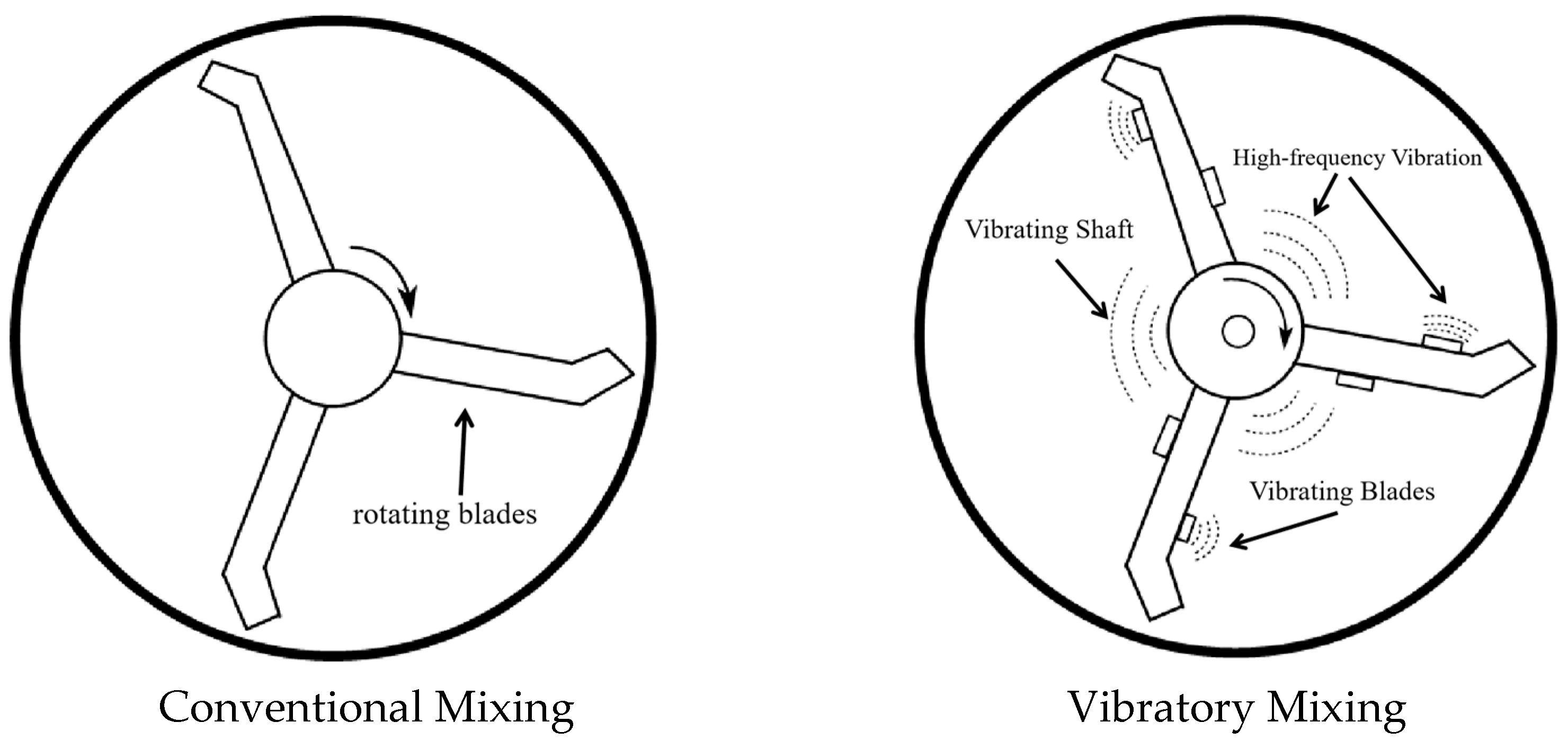
- Water-adding and mixing stage: The predetermined amount of water was added slowly. For the CM group, only the mixing motor was turned on. For the VM group, the high-frequency vibratory motor was also activated. Mixing continued for 2 min until the cement paste formed a uniform slurry.
- (3)
- Casting stage: The well-mixed rubberized concrete was poured into molds that had been coated with a release agent.
- (4)
- Vibratory stage: The molds filled with fresh concrete were placed on a vibrating table and vibrated for 60 s to remove air bubbles and improve compactness.
- (5)
- Surface finishing and pre-curing preparation: The surface of the specimen was leveled with a trowel and then covered with a plastic film to prevent moisture loss.
2.3. Experimental Program
2.3.1. Quasi-Static Compression Test
2.3.2. Dynamic Compression Test
3. Results and Analysis of the Quasi-Static Compression Test
3.1. Failure Modes
3.2. Quasi-Static Compressive Strength
3.3. Stress–Strain Relationship
4. Results and Analysis of the Dynamic Compression Test
4.1. Failure Modes
4.2. Stress–Strain Relationship
- (1)
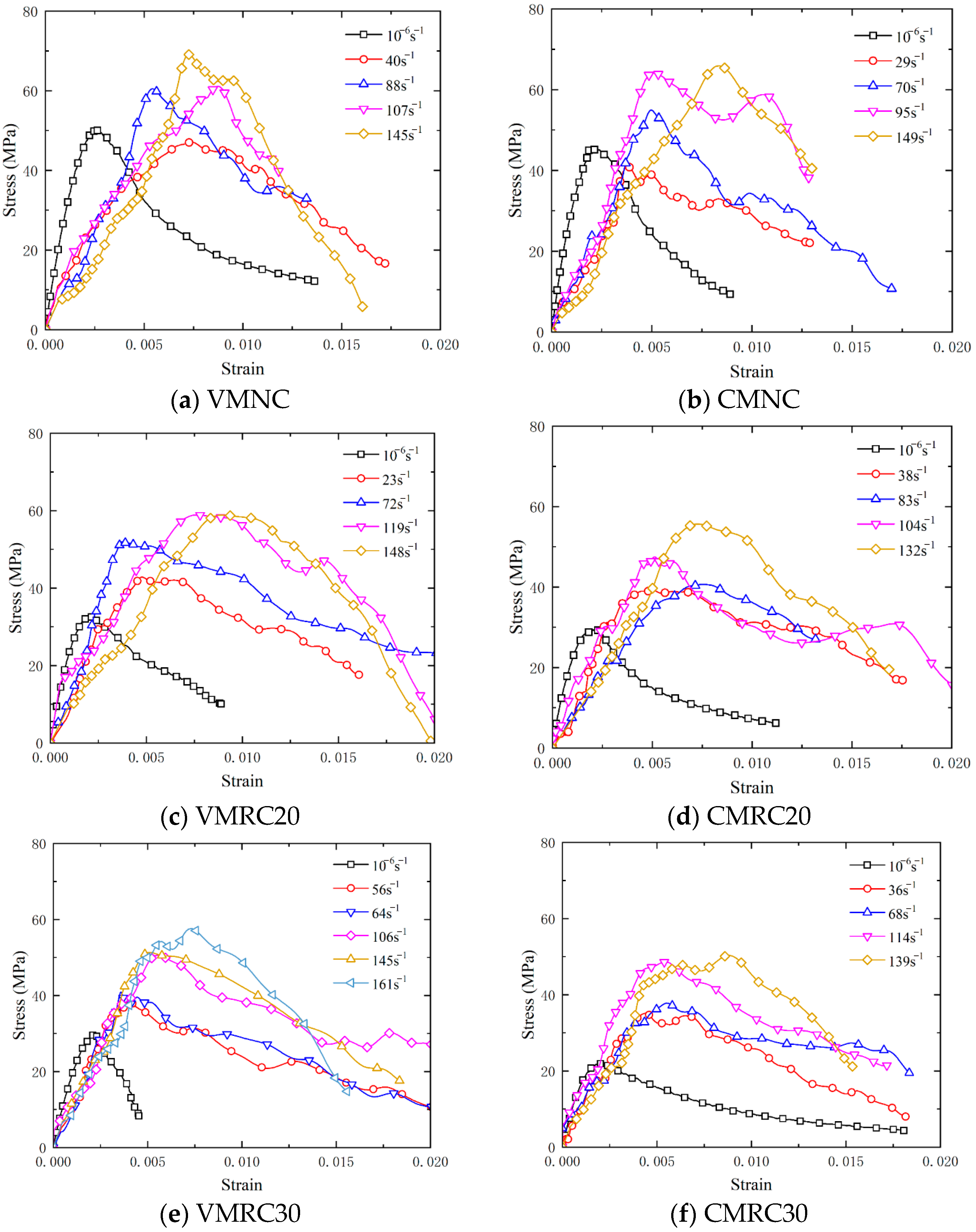
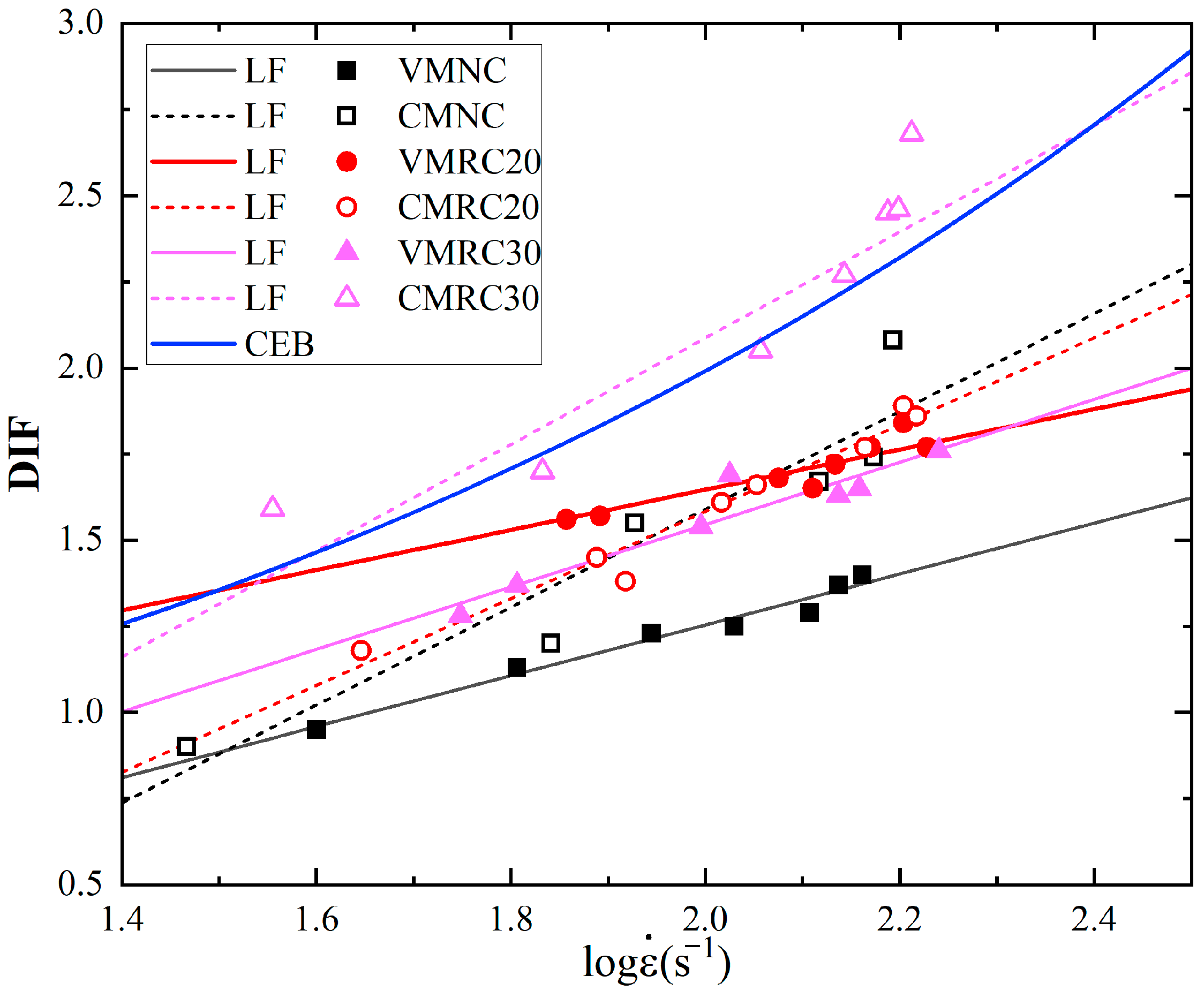
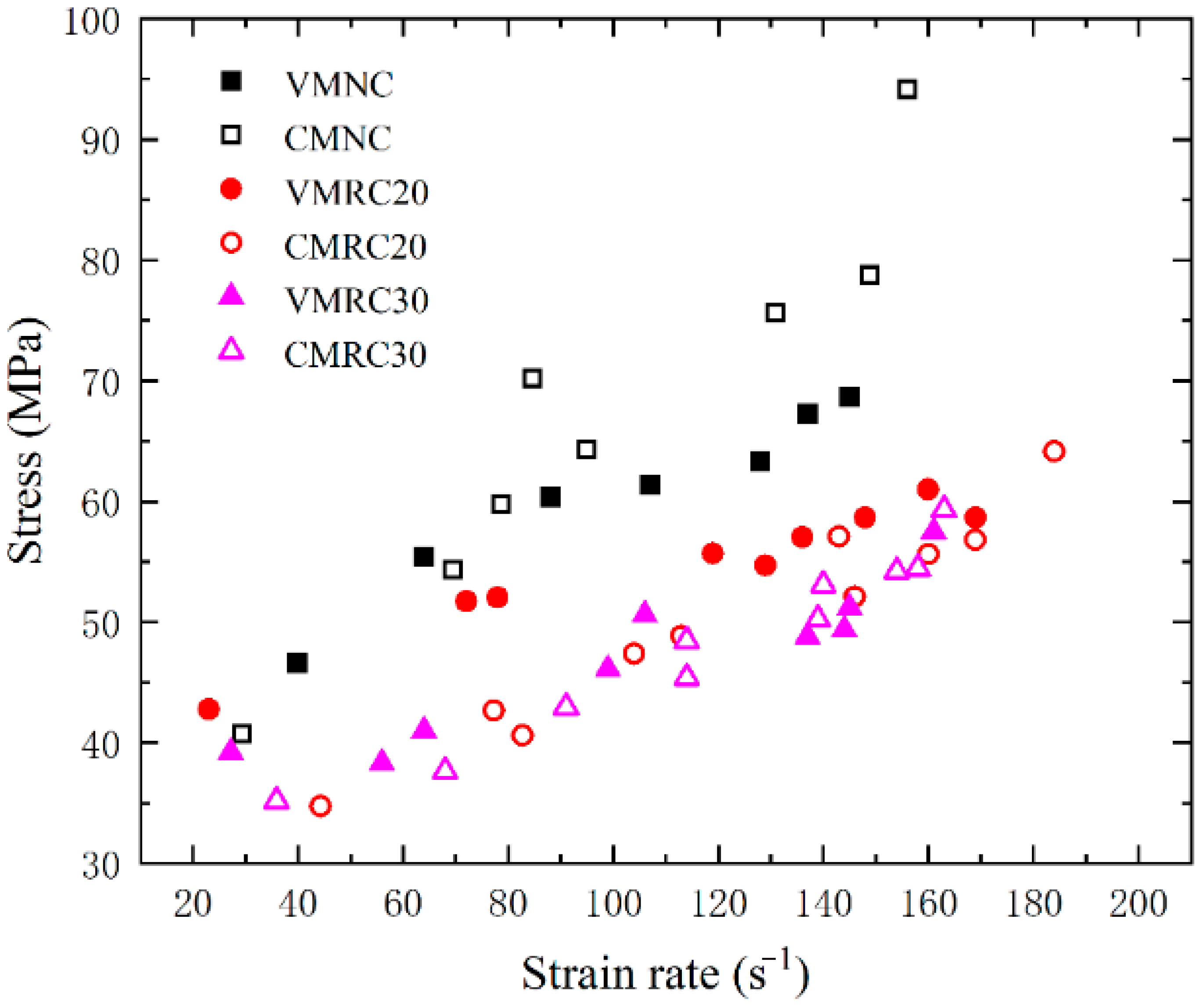
- As the strain rate increased, the dynamic compressive strength of all concrete groups increased and was much higher than the corresponding quasi-static strength, showing clear strain rate sensitivity and a positive correlation effect.
- (2)
- The incorporation of rubber significantly enhanced the strain rate sensitivity of the concrete, resulting in a greater increase in strength at high strain rates. This effect was especially pronounced under vibratory mixing, where the peak stress of vibratory mixing was noticeably higher than that of conventional mixing. The enhancement became more significant as the rubber content increased, indicating that vibratory mixing can effectively mitigate the negative influence of rubber on concrete strength.
- (3)
- Although vibratory mixing improved the dynamic strength of the concrete, it had only a minor influence on the overall shape of the dynamic stress–strain curve and did not change the basic strain response characteristics of rubberized concrete.
4.3. Impact Toughness
- (1)
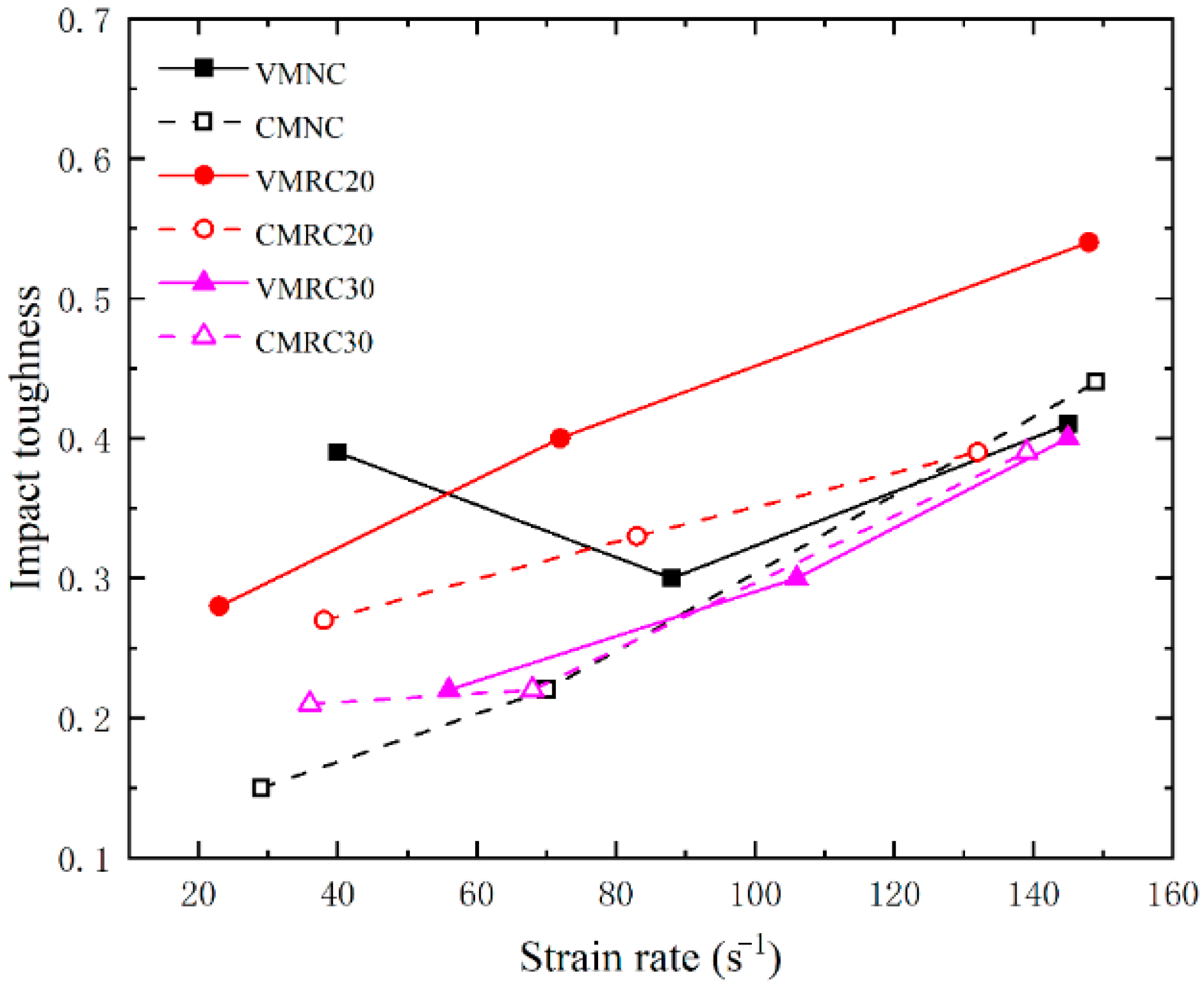
- Compared with conventional mixing, vibratory mixing increased the impact toughness by approximately 15–35%. The improvement was most significant at a rubber content of 20% (RC20), reaching about 30%. At rubber contents of 0% and 30%, the increases were approximately 15–20% and 10–18%, respectively. These results indicate that vibratory mixing enhances the bonding between the paste, aggregates, and rubber, enabling greater energy absorption under impact loading.
- (2)
- Regardless of the mixing method, the impact toughness increased first and then decreased as the rubber content increased. Using each NC specimen as a reference, RC20 showed the highest impact toughness. The improvement was about 20–25% in the CM group and about 35–45% in the VM group. However, the improvement of RC30 decreased significantly and could even be slightly lower than that of RC20.
4.4. Strain Rate Effect
5. Microstructural Analysis
6. Conclusions
- (1)
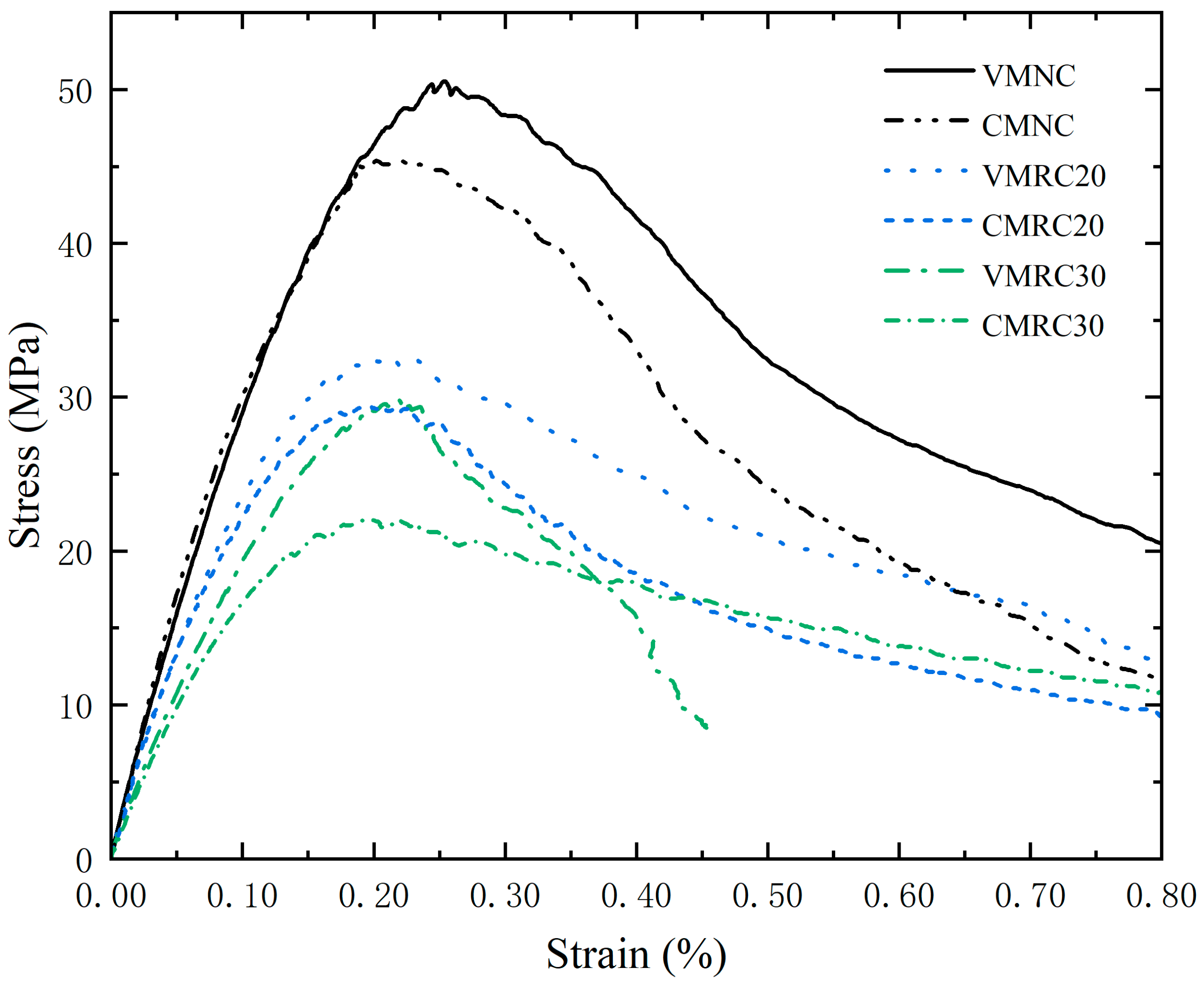
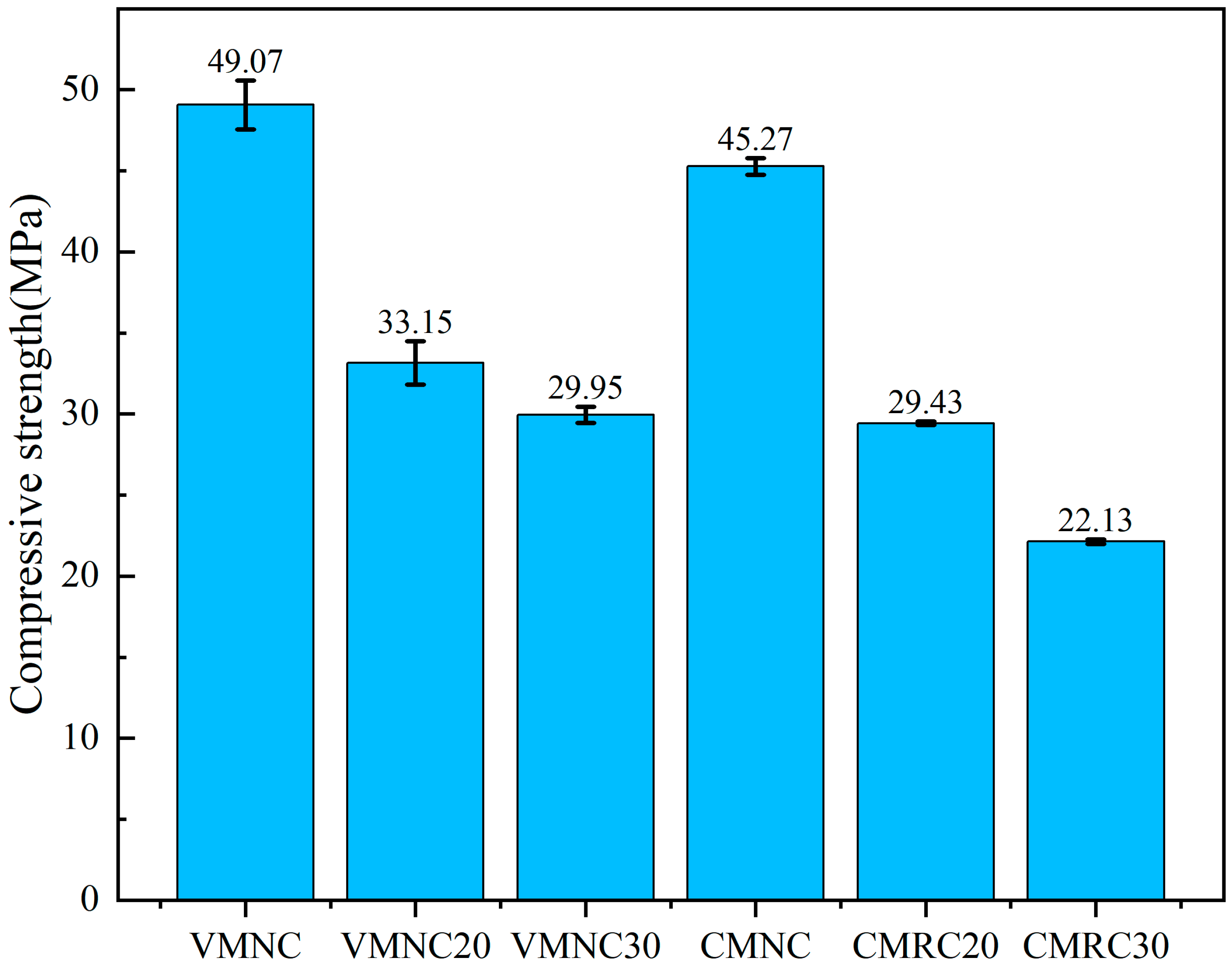
- Vibratory mixing significantly improved the static load-bearing capacity of rubberized concrete. Compared with conventional mixing, compressive strength increased by 8.4–30.0% at the same rubber content. At 30% rubber content, the compressive strength increased from 22.13 MPa to 29.94 MPa, and the corresponding strength loss rate was reduced from 51.12% to 38.98%.
- (2)
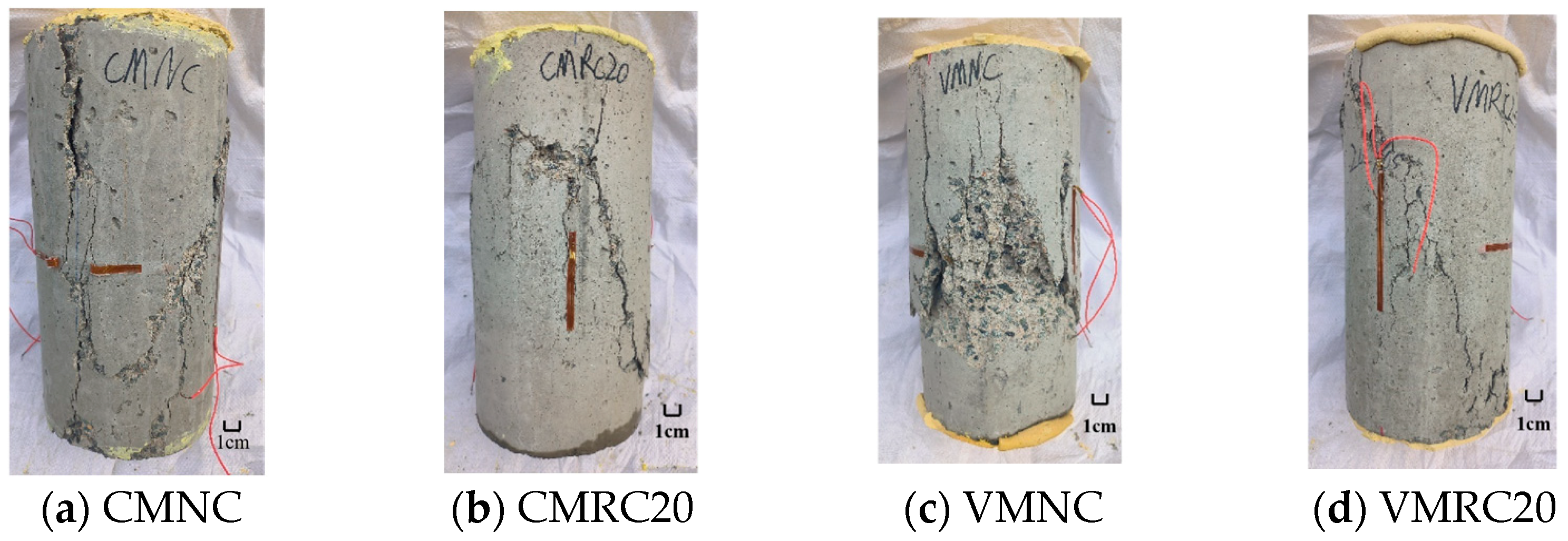
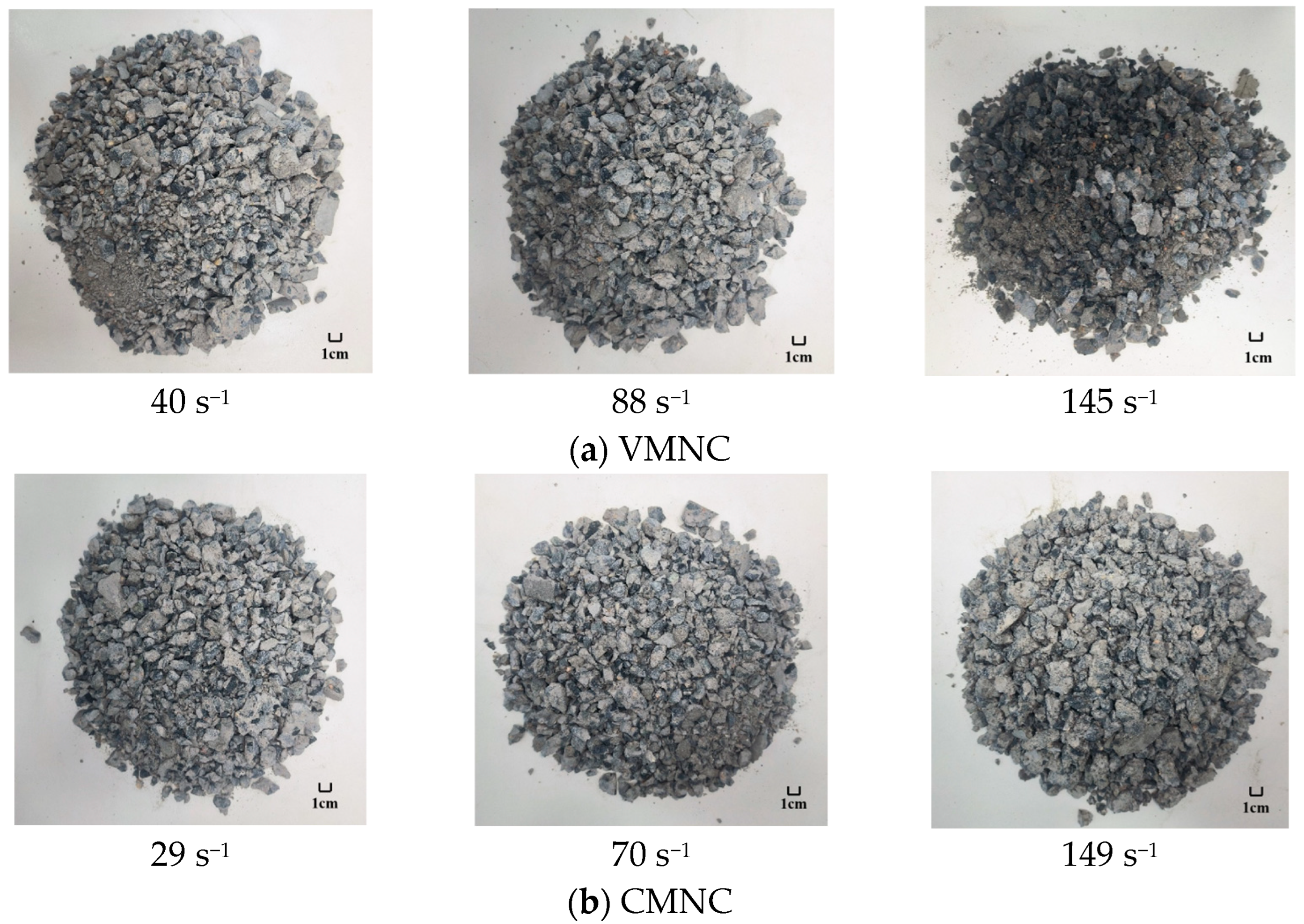
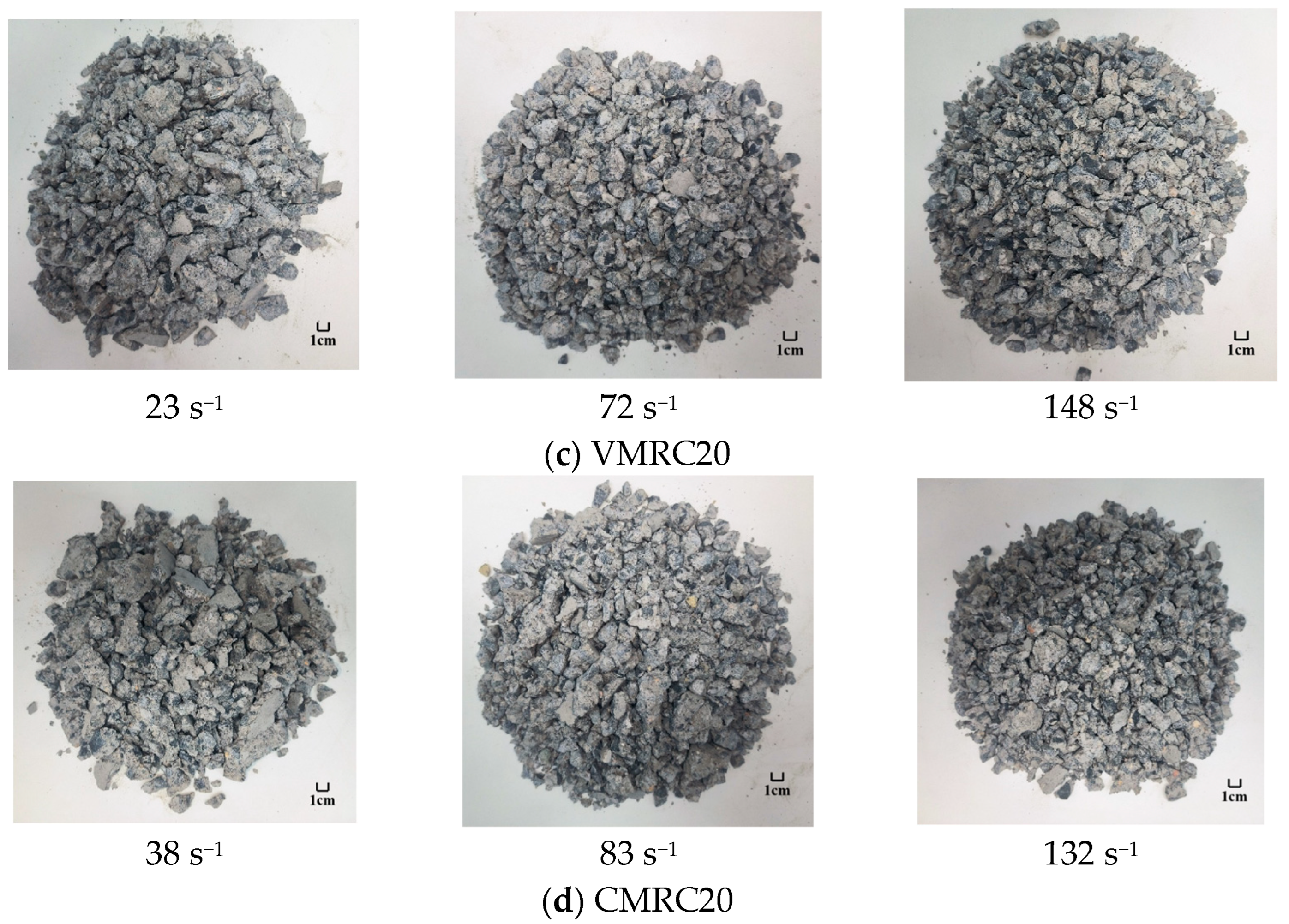
- Under quasi-static loading, rubber incorporation altered the failure characteristics, while vibratory mixing resulted in a more uniform crack distribution. Under dynamic loading, at comparable strain rates, rubber incorporation led to smaller concrete fragment sizes, whereas vibratory mixed specimens exhibited larger fragments, indicating reduced damage severity.
- (3)
- Vibratory mixing significantly enhanced the dynamic compressive strength and energy absorption capacity of concrete. The improvement was most pronounced at a rubber content of 20%, with impact toughness increasing by approximately 15–35%.
- (4)
- Among the investigated mixtures, rubberized concrete with 20% rubber content prepared by vibratory mixing showed the most balanced overall performance in terms of strength, toughness, and strain rate stability, demonstrating its potential for impact-resistant pile foundation applications.
Author Contributions
Funding
Data Availability Statement
Acknowledgments
Conflicts of Interest
References
- Guo, X.; Li, H.-N.; Zhang, H. Multi-Hazard Failure Analysis and Performance Evaluation of Transmission Towers Utilizing Data-Driven Probabilistic Models Subject to Combined Wind and Earthquake. Structures 2025, 77, 109196. [Google Scholar] [CrossRef]
- Wang, F.; Zhang, G.; Li, W.; Nie, H. Numerical Investigation into the Effects of Controlled Tunnel Blast on Dynamic Responses of the Transmission Tower. Adv. Civ. Eng. 2023, 2023, 6021465. [Google Scholar] [CrossRef]
- Khademalrasoul, A.; Goudarzi, E.; Labibzadeh, M. Underwater Blast Response and Pile Failure Analysis of Submerged Reinforced Concrete Piles and Pile Group Foundations. Ocean Eng. 2022, 248, 110788. [Google Scholar] [CrossRef]
- Zhu, X.; Chen, X.; Tian, H.; Ning, Y. Experimental and Numerical Investigation on Fracture Characteristics of Self-Compacting Concrete Mixed with Waste Rubber Particles. J. Clean. Prod. 2023, 412, 137386. [Google Scholar] [CrossRef]
- Feng, L.-Y.; Chen, A.-J.; Liu, H.-D. Stress–Strain Behavior and Constitutive Relation of Rubberized Plastic Concrete under Uniaxial and Triaxial Compression. Struct. Concr. 2023, 24, 6436–6450. [Google Scholar] [CrossRef]
- Du, T.; Yang, Y.; Cao, H.; Si, N.; Kordestani, H.; Sktani, Z.D.I.; Arab, A.; Zhang, C. Rubberized Concrete: Effect of the Rubber Size and Content on Static and Dynamic Behavior. Buildings 2024, 14, 1541. [Google Scholar] [CrossRef]
- He, S.; Jiang, Z.; Chen, H.; Chen, Z.; Ding, J.; Deng, H.; Mosallam, A.S. Mechanical Properties, Durability, and Structural Applications of Rubber Concrete: A State-of-the-Art-Review. Sustainability 2023, 15, 8541. [Google Scholar] [CrossRef]
- Li, X.; Zhao, Y.; Yao, W.; Wu, B.; Xia, K. Dynamic Fracture Behaviors of Rubberized Mortars with Various Rubber Powder Sizes and Volume Percentages. Eng. Fract. Mech. 2022, 269, 108553. [Google Scholar] [CrossRef]
- Li, Y.; Chai, J.; Wang, R.; Zhou, Y.; Tong, X. A Review of the Durability-Related Features of Waste Tyre Rubber as a Partial Substitute for Natural Aggregate in Concrete. Buildings 2022, 12, 1975. [Google Scholar] [CrossRef]
- Chen, J.; Zhuang, J.; Shen, S.; Dong, S. Experimental Investigation on the Impact Resistance of Rubber Self-Compacting Concrete. Structures 2022, 39, 691–704. [Google Scholar] [CrossRef]
- Kumar, R.; Dev, N. Assessment of Mechanical and Impact Resistance Properties of Rubberized Concrete After Surface Modification of Rubber Crumb. Iran. J. Sci. Technol. Trans. Civ. Eng. 2022, 46, 2855–2871. [Google Scholar] [CrossRef]
- Yu, Y.; Jin, Z.; Zhu, H.; Song, H. Effect of Rubber Particles on Impact Resistance of Concrete at a Temperature of −20 °C. Arch. Civ. Mech. Eng. 2021, 21, 107. [Google Scholar] [CrossRef]
- Yang, F.; Wu, J.; Li, J.; Liang, Y.; Chen, S.; Feng, W.; Li, H.; Wu, J. Effects of Strain Rate, Age and Rubber Content on the Dynamic Mechanical Properties of Ultra-Early-Strength Unsaturated Polyester Resin Concrete. Constr. Build. Mater. 2025, 493, 143253. [Google Scholar] [CrossRef]
- Taghizadeh, K.; Steeb, H.; Luding, S.; Magnanimo, V. Elastic Waves in Particulate Glass-Rubber Mixtures. Proc. R. Soc. A-Math. Phys. Eng. Sci. 2021, 477, 20200834. [Google Scholar] [CrossRef]
- Yu, S.; Cao, M.; Liu, C.; Jin, H. Damage Characteristics of Uniaxial Compressed Concrete Embedded Different Aging Rubber by 3D Mesoscale Model. Adv. Civ. Eng. 2022, 2022, 9533618. [Google Scholar] [CrossRef]
- Zhai, S.; Liu, C.; Liu, G.; Pang, B.; Zhang, L.; Liu, Z.; Liu, L.; Zhang, Y. Effect of Modified Rubber Powder on the Mechanical Properties of Cement-Based Materials. J. Mater. Res. Technol. 2022, 19, 4141–4153. [Google Scholar] [CrossRef]
- Zhai, S.; Zhang, Y.; Liu, L. Investigation on Recycling Application of Waste Rubber Tyres in Concrete. In Proceedings of the 17th East Asian-Pacific Conference on Structural Engineering and Construction, Singapore, 27–30 June 2022; Geng, G., Qian, X., Poh, L.H., Pang, S.D., Eds.; Springer Nature: Singapore, 2023; pp. 1539–1552. [Google Scholar]
- Abbas, S.; Fatima, A.; Kazmi, S.M.S.; Munir, M.J.; Ali, S.; Rizvi, M.A. Effect of Particle Sizes and Dosages of Rubber Waste on the Mechanical Properties of Rubberized Concrete Composite. Appl. Sci. 2022, 12, 8460. [Google Scholar] [CrossRef]
- Chong, B.W.; Othman, R.; Ramadhansyah, P.J.; Doh, S.I.; Li, X. Mathematical Modelling of Concrete Compressive Strength with Waste Tire Rubber as Fine Aggregate. J. Mech. Eng. Sci. 2021, 15, 8344–8355. [Google Scholar] [CrossRef]
- Bu, C.; Zhu, D.; Lu, X.; Liu, L.; Sun, Y.; Yu, L.; Xiao, T.; Zhang, W. Modification of Rubberized Concrete: A Review. Buildings 2022, 12, 999. [Google Scholar] [CrossRef]
- Ahmad, J.; Zhou, Z.; Majdi, A.; Alqurashi, M.; Deifalla, A.F. Overview of Concrete Performance Made with Waste Rubber Tires: A Step toward Sustainable Concrete. Materials 2022, 15, 5518. [Google Scholar] [CrossRef]
- Hasan, A.; Ahmed, S.; Ahsan, R. Effect of Waste Tire Rubber Particles on the Properties of Rubberized Concrete. Civ. Eng. J. 2025, 11. [Google Scholar] [CrossRef]
- Yang, F.; Yao, Y.; Wang, X.; Jin, W.; Feng, Z. Preparation of Recycled and Multi-Recycled Coarse Aggregates Concrete with the Vibration Mixing Process. Buildings 2022, 12, 1369. [Google Scholar] [CrossRef]
- Zhang, C.; Sun, Y.; Xu, J.; Wang, B. The Effect of Vibration Mixing on the Mechanical Properties of Steel Fiber Concrete with Different Mix Ratios. Materials 2021, 14, 3669. [Google Scholar] [CrossRef] [PubMed]
- Zheng, Y.; Zhou, Y.; Huang, X.; Min, Y.; Luo, H.; Chen, Y.; Li, W. Study on Performance Improvement of Ultra-High Performance Concrete by Vibration Mixing. Constr. Build. Mater. 2022, 327, 126823. [Google Scholar] [CrossRef]
- Zhou, L.; Yin, J.; Wang, W.; Liu, F.; Xiao, M.; Yang, Y.; Cui, H. Effect of Vibration Mixing on the Mechanical Properties of Carbon Nanotube-Reinforced Ultra-High-Performance Concrete. Buildings 2024, 14, 2545. [Google Scholar] [CrossRef]
- Zheng, Y.; Zhou, Y.; Nie, F.; Luo, H.; Huang, X. Effect of a Novel Vibration Mixing on the Fiber Distribution and Mechanical Properties of Ultra-High Performance Concrete. Sustainability 2022, 14, 7920. [Google Scholar] [CrossRef]
- Xiong, G.; Wang, C.; Zhou, S.; Jia, X.; Luo, W.; Liu, J.; Peng, X. Preparation of High Strength Lightweight Aggregate Concrete with the Vibration Mixing Process. Constr. Build. Mater. 2019, 229, 116936. [Google Scholar] [CrossRef]
- Zheng, Y.; Wu, X.; He, G.; Shang, Q.; Xu, J.; Sun, Y. Mechanical Properties of Steel Fiber-Reinforced Concrete by Vibratory Mixing Technology. Adv. Civ. Eng. 2018, 2018, 9025715. [Google Scholar] [CrossRef]
- Song, D.; Mai, S.; Liu, X.; Hu, N.; Shi, W.; Wang, E.; Yang, Y. Real-Time High-Temperature SHPB Experimental Investigation on Dynamic Mechanical Properties and Fracture Characteristics of Surrounding Rock in Tunnel Fire Explosion. Eng. Fract. Mech. 2025, 329, 111596. [Google Scholar] [CrossRef]
- Xiao, H.; Gao, G.; Xu, Y.; Wang, P.; Wu, N.; Huang, X. Influence of Axial Prestress and Loading Rate on Dynamic Fracture of Pre-Faulted Granite. Eng. Fract. Mech. 2025, 328, 111535. [Google Scholar] [CrossRef]
- Dong, L.; Wang, J.; Li, X.; Peng, K. Dynamic Stability Analysis of Rockmass: A Review. Adv. Civ. Eng. 2018, 2018, 4270187. [Google Scholar] [CrossRef]
- Mei, D.; Wei, X.; Luo, Y.; Chen, S.; Li, X.; Huang, J.; Yang, C. Dynamic Characteristics and Energy Dissipation Laws of Reinforced Porous Coral Reef Limestone. Rock Mech. Rock Eng. 2025, 58, 10417–10437. [Google Scholar] [CrossRef]
- Zhao, K.; Zhao, L.; Hou, J.; Zhang, X.; Feng, Z.; Yang, S. Effect of Vibratory Mixing on the Slump, Compressive Strength, and Density of Concrete with the Different Mix Proportions. J. Mater. Res. Technol. 2021, 15, 4208–4219. [Google Scholar] [CrossRef]
- Feng, W.; Liu, F.; Yang, F.; Jing, L.; Li, L.; Li, H.; Chen, L. Compressive Behaviour and Fragment Size Distribution Model for Failure Mode Prediction of Rubber Concrete under Impact Loads. Constr. Build. Mater. 2021, 273, 121767. [Google Scholar] [CrossRef]
- Khaloo, A.R.; Dehestani, M.; Rahmatabadi, P. Mechanical Properties of Concrete Containing a High Volume of Tire–Rubber Particles. Waste Manag. 2008, 28, 2472–2482. [Google Scholar] [CrossRef]
- Liu, Z.; Chen, X.; Wang, X.; Diao, H. Investigation on the Dynamic Compressive Behavior of Waste Tires Rubber-Modified Self-Compacting Concrete under Multiple Impacts Loading. J. Clean. Prod. 2022, 336, 130289. [Google Scholar] [CrossRef]
- Pham, T.M.; Renaud, N.; Pang, V.-L.; Shi, F.; Hao, H.; Chen, W. Effect of Rubber Aggregate Size on Static and Dynamic Compressive Properties of Rubberized Concrete. Struct. Concr. 2022, 23, 2510–2522. [Google Scholar] [CrossRef]
- Hao, Y.; Hao, H.; Jiang, G.P.; Zhou, Y. Experimental Confirmation of Some Factors Influencing Dynamic Concrete Compressive Strengths in High-Speed Impact Tests. Cem. Concr. Res. 2013, 52, 63–70. [Google Scholar] [CrossRef]











| Capacity (L) | Mixing Motor Power (kW) | Vibration Motor Power (kW) | Vibration Acceleration (g) | Mixing Speed (r/min) |
|---|---|---|---|---|
| 60 | 4 | 3 | 3 | 55 |
| ID | Cement | Water | Sand | Coarse Aggregate | Rubber Particles |
|---|---|---|---|---|---|
| VMNC | 398 | 210 | 609 | 1183 | 0 |
| CMNC | |||||
| VMRC20 | 398 | 210 | 487 | 1183 | 54 |
| CMRC20 | |||||
| VMRC30 | 398 | 210 | 426 | 1183 | 81 |
| CMRC30 |
| ID | Compressive Strength (MPa) | Young’s Modulus (GPa) | Poisson’s Ratio | Strength Loss (%) |
|---|---|---|---|---|
| VMNC | 49.07 | 30.0 | 0.211 | 0 |
| VMRC20 | 33.15 | 24.2 | 0.199 | 32.44 |
| VMRC30 | 29.94 | 20.7 | 0.198 | 38.98 |
| CMNC | 45.27 | 32.9 | 0.213 | 0 |
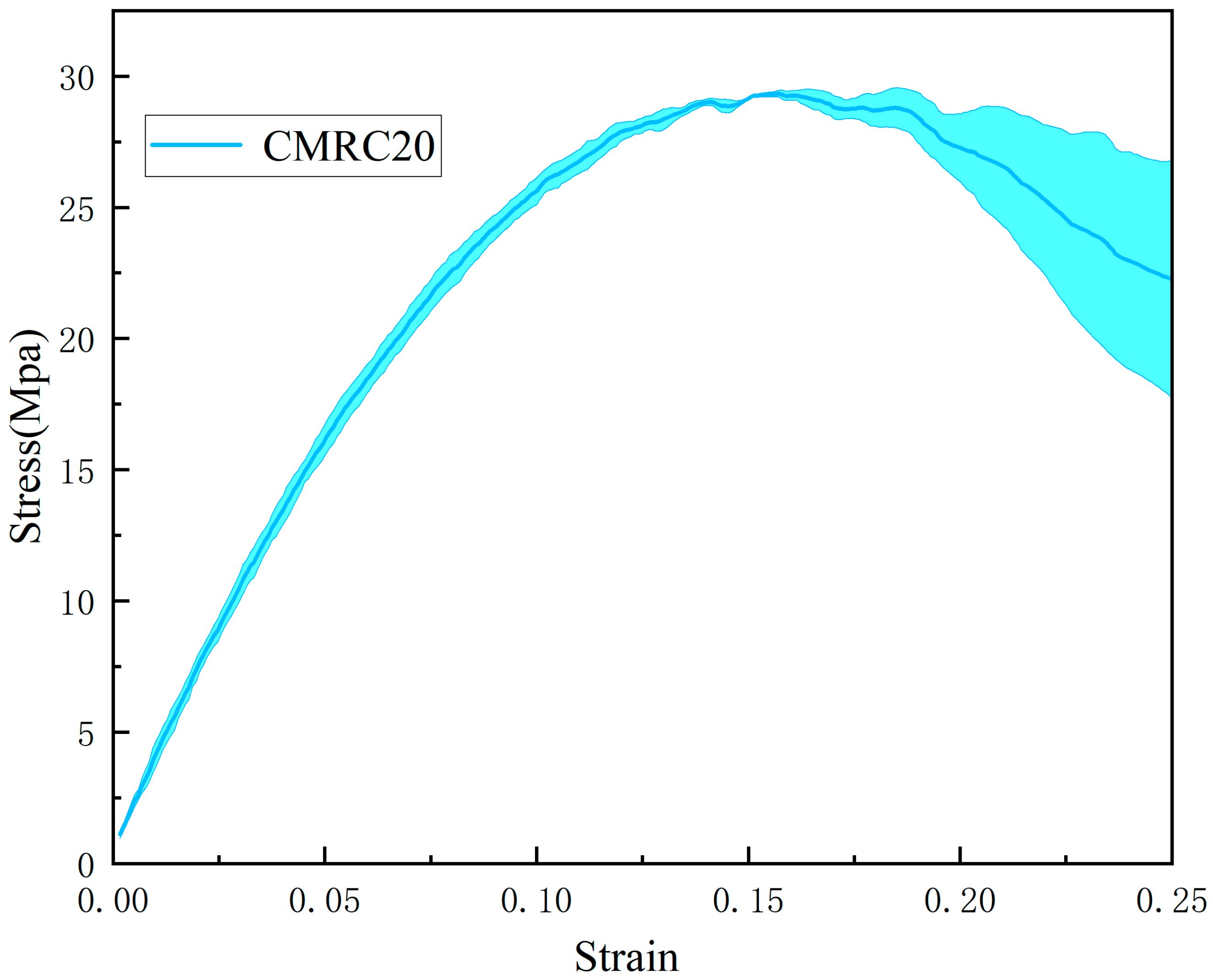
| CMRC20 | 29.43 | 25.1 | 0.204 | 34.99 |
| CMRC30 | 22.13 | 19.7 | 0.203 | 51.12 |
| ID | a | b | SE(a) | SE(b) | R2 |
|---|---|---|---|---|---|
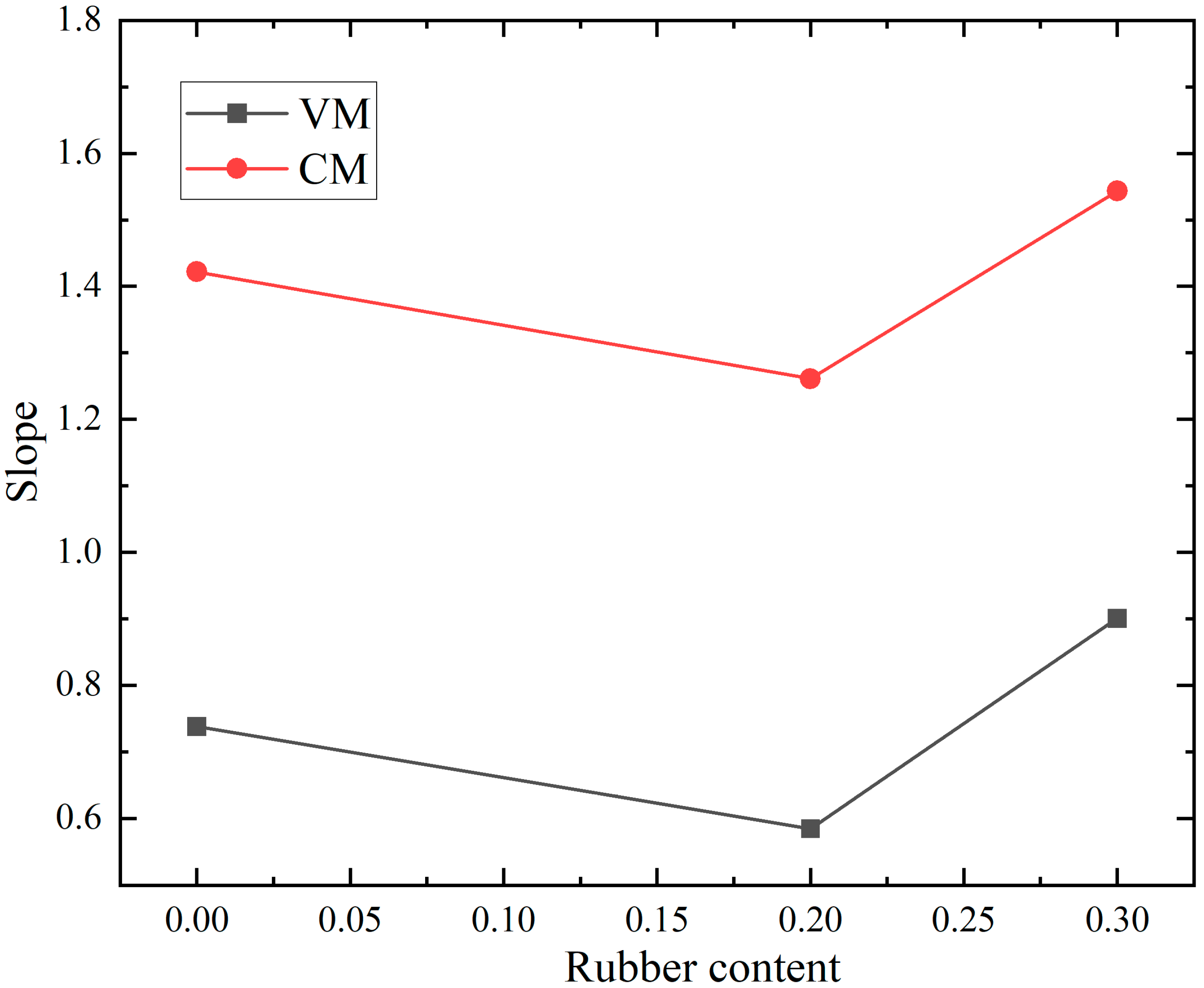
| VMNC | 0.73805 | −0.22208 | 0.0276 | 0.0558 | 0.97 |
| CMNC | 1.42184 | −1.25393 | 0.0580 | 0.1172 | 0.89 |
| VMRC20 | 0.58469 | 0.47847 | 0.0454 | 0.0927 | 0.95 |
| CMRC20 | 1.26162 | −0.94037 | 0.1383 | 0.2797 | 0.97 |
| VMRC30 | 0.90636 | −0.26709 | 0.0634 | 0.1299 | 0.90 |
| CMRC30 | 1.54309 | −0.86397 | 0.2738 | 0.5584 | 0.86 |
Disclaimer/Publisher’s Note: The statements, opinions and data contained in all publications are solely those of the individual author(s) and contributor(s) and not of MDPI and/or the editor(s). MDPI and/or the editor(s) disclaim responsibility for any injury to people or property resulting from any ideas, methods, instructions or products referred to in the content. |
© 2026 by the authors. Licensee MDPI, Basel, Switzerland. This article is an open access article distributed under the terms and conditions of the Creative Commons Attribution (CC BY) license.
Share and Cite
Sun, G.; Chen, X.; Yang, F.; Wang, X.; Feng, W.; Li, H. Effect of Vibratory Mixing on the Quasi-Static and Dynamic Compressive Properties of a Sustainable Concrete for Transmission Tower Foundations. Buildings 2026, 16, 310. https://doi.org/10.3390/buildings16020310
Sun G, Chen X, Yang F, Wang X, Feng W, Li H. Effect of Vibratory Mixing on the Quasi-Static and Dynamic Compressive Properties of a Sustainable Concrete for Transmission Tower Foundations. Buildings. 2026; 16(2):310. https://doi.org/10.3390/buildings16020310
Chicago/Turabian StyleSun, Guangtong, Xingliang Chen, Fei Yang, Xinri Wang, Wanhui Feng, and Hongzhong Li. 2026. "Effect of Vibratory Mixing on the Quasi-Static and Dynamic Compressive Properties of a Sustainable Concrete for Transmission Tower Foundations" Buildings 16, no. 2: 310. https://doi.org/10.3390/buildings16020310
APA StyleSun, G., Chen, X., Yang, F., Wang, X., Feng, W., & Li, H. (2026). Effect of Vibratory Mixing on the Quasi-Static and Dynamic Compressive Properties of a Sustainable Concrete for Transmission Tower Foundations. Buildings, 16(2), 310. https://doi.org/10.3390/buildings16020310