Review

A Comprehensive Review on Dual-Pathway Utilization of Coal Gangue Concrete: Aggregate Substitution, Cementitious Activity Activation, and Performance Optimization

School of Civil Engineering and Architecture, Xi’an University of Technology, Xi’an 710048, China
*
Author to whom correspondence should be addressed.
Buildings 2026, 16(2), 302; https://doi.org/10.3390/buildings16020302 (registering DOI)
Submission received: 8 December 2025 / Revised: 7 January 2026 / Accepted: 9 January 2026 / Published: 11 January 2026
(This article belongs to the Section Building Materials, and Repair & Renovation)

Abstract

Coal gangue, as a predominant solid byproduct of the global coal industry, poses severe environmental challenges because of its massive accumulation and low utilization rate. This review systematically synthesizes and analyzes published experimental and analytical studies on the dual-pathway utilization of coal gangue in concrete, including Pathway 1 (aggregate substitution) and Pathway 2 (cementitious activity activation). While the application of coal gangue aggregates is traditionally limited by their inherent high porosity and lower mechanical strength than those of natural aggregates, this review demonstrates that performance barriers can be effectively overcome. Through multiscale modification strategies—including surface densification, biological mineralization (MICP), and matrix synergy—the interfacial defects are significantly mitigated, allowing for feasible substitution in structural concrete. Conversely, for the mineral admixture pathway, controlled thermal activation is identified as a key process to optimize the phase transformation of kaolinite, thereby significantly enhancing pozzolanic reactivity and long-term durability. According to reported studies, the partial replacement of natural aggregates or cement with coal gangue can reduce CO2 emissions by approximately tens to several hundreds of kilograms per ton of coal gangue utilized, depending on the substitution level and activation strategy, highlighting its considerable potential for carbon reduction in the construction sector. Nevertheless, challenges related to energy-intensive activation processes and variability in raw gangue composition remain. These limitations indicate the need for future research focusing on low-carbon activation technologies, standardized classification of coal gangue resources, and long-term performance validation under realistic service environments. Based on the synthesized literature, this review discusses hierarchical utilization concepts and low-carbon activation approaches as promising directions for promoting the sustainable transformation of coal gangue from an environmental liability into a carbon-reduction asset in the construction industry.

1. Introduction

1.1. Global Inventory Scale and Environmental Load of Coal Gangue

Coal gangue (CG), as the main solid byproduct of coal mining and washing processes, has a cumulative scale that is positively correlated with global coal production. In 2023, global coal production reached a historic high, close to 9 billion tons, with China being the world’s largest coal producer, contributing approximately 50% of the total output. This high-intensity mining activity has led to a sharp increase in coal gangue stockpiles. In China alone, the cumulative stockpile has exceeded 7 billion tons and continues to grow at a rate of approximately 500 million tons per year [1]. Notably, there are significant regional differences in the utilization efficiency of coal gangue: in developed regions such as Europe and the United States, the comprehensive utilization rate generally exceeds 90%, whereas in China, it is only approximately 60–70%. This large gap between high output and low disposal continues to exacerbate environmental management pressures.
The large-scale accumulation of coal gangue often results in significant surface features known as “gangue hills,” resulting in multiple environmental risks. First, the land occupation effect is evident, with large amounts of high-quality land being occupied for extended periods, particularly in the areas surrounding mining zones, leading to a waste of land resources. Second, because coal gangue contains residual carbon components, prolonged outdoor stockpiling is highly prone to spontaneous combustion. This slow combustion process continuously releases large amounts of greenhouse gases, particulate matter, and toxic gases (such as CO, H2S, and SO2) [2], posing a serious source of air pollution. A more far-reaching impact is the leaching pollution caused by rainfall percolation. During natural weathering processes, toxic substances in gangue (especially heavy metals such as arsenic, lead, cadmium, and chromium) are leached out and spread through surface runoff and groundwater systems, resulting in long-term ecological damage and potential health risks [3]. These compound environmental burdens highlight the urgency and strategic necessity of utilizing coal gangue resources.

1.2. Dual Value of Coal Gangue in Carbon Neutrality: Environmental Benefits and Low-Carbon Building Materials

Under the strong drive of carbon neutrality, the utilization of coal gangue has increased from a purely environmental management issue to a strategic cornerstone of national low-carbon transformation, demonstrating its dual value in environmental risk mitigation and the low-carbon transformation of building materials. The construction and building sector, as one of the largest sources of global greenhouse gas emissions, contributes approximately 37% of global emissions, with cement production being the primary source, accounting for approximately 8% of global emissions [4]. In this context, coal gangue, as a supplementary cementitious material (SCM), replaces high-carbon cement clinker, creating a quantifiable carbon reduction pathway: the carbon footprint of traditional Portland cement production is approximately 0.8 tons of CO2 per ton, whereas the carbon footprint of activated coal gangue powder is significantly reduced to less than 0.3 tons of CO2 per ton [5].
This strategy creates a unique collaborative value chain: on the one hand, it provides large-scale environmental risk disposal solutions for the mining industry; on the other hand, it offers high-demand, low-carbon raw materials for decarbonizing the cement industry while alleviating pressure on the construction industry due to the shortage of natural aggregate resources [6]. However, this transformation faces the complexity of strategic choices. The utilization path of coal gangue presents “branch risk”: high-carbon coal gangue is often directed toward energy utilization (e.g., power generation), which results in waste disposal but significant CO2 emissions, whereas low-carbon coal gangue is more suitable for building material utilization, achieving better net carbon benefits through long-term carbon sequestration [7]. Therefore, the resource utilization of coal gangue is not merely waste disposal but also requires systematic evaluation from a lifecycle perspective, selecting the technological path that minimizes net carbon emissions and environmental pollution [8], thus truly serving the national “carbon neutrality” strategic goal.
In recent years, extensive research efforts have been devoted to the utilization of coal gangue in concrete, driven by both environmental considerations and the growing demand for alternative construction materials. Zhou et al. systematically investigated the effects of coal gangue coarse aggregate substitution on the mechanical performance of concrete by varying replacement ratios and curing ages [9]. Their results indicated that, when the replacement ratio is maintained within a moderate range, coal gangue aggregates can partially replace natural aggregates without causing significant deterioration in compressive strength. This behavior was attributed to the relatively stable skeletal role of coarse gangue particles and their acceptable load-bearing capacity after appropriate processing, although excessive replacement was found to increase porosity and weaken the interfacial transition zone (ITZ).
Building on this work, Gao et al. provided a comprehensive review of coal gangue aggregates in green concrete systems, emphasizing not only their mechanical feasibility but also their long-term durability performance [10]. Their analysis revealed that while coal gangue aggregates contribute to resource conservation and solid-waste recycling, challenges remain with respect to higher water absorption, potential alkali–silica reactivity, and reduced resistance to freeze–thaw cycles and sulfate attack under high substitution levels. These findings underscore the importance of optimizing mix design parameters, such as water-to-binder ratio and surface treatment of gangue aggregates, to mitigate durability-related risks.
In parallel, increasing attention has been paid to the utilization of coal gangue as a supplementary cementitious material (SCM). Zhang and Ling systematically reviewed the activation mechanisms of coal gangue and demonstrated that thermal activation can effectively transform inert crystalline phases (e.g., kaolinite) into amorphous aluminosilicate structures with pronounced pozzolanic activity [1]. The incorporation of thermally activated coal gangue was shown to enhance later-age strength through secondary hydration reactions, particularly the formation of additional calcium silicate hydrate (C–S–H) and calcium aluminosilicate hydrate (C–A–S–H) gels.
Furthermore, Wang et al. elucidated the microstructural mechanisms underlying the performance enhancement induced by thermal activation using advanced characterization techniques such as XRD, SEM, and mercury intrusion porosimetry [5]. Their results confirmed that activated coal gangue refines pore structure, reduces capillary porosity, and improves matrix densification, thereby strengthening the ITZ and enhancing long-term mechanical properties. However, they also noted that the energy consumption associated with high-temperature activation remains a critical limitation, necessitating further optimization or the exploration of low-energy activation strategies.
Overall, existing studies demonstrate that coal gangue can be effectively utilized in concrete through aggregate substitution and cementitious activation pathways. Nevertheless, the balance between mechanical performance, durability, and energy efficiency remains a key challenge that warrants further systematic investigation.

1.3. Core Contradiction: Conflict Between Scalable Mitigation and High-Performance Concrete Requirements

The scientific challenge of coal gangue resource utilization stems from a fundamental conflict: the persistent tension between the large-scale disposal demands required by environmental management and the high-performance concrete requirements needed in civil engineering applications. This conflict is reflected in the inherent limitations of two main technical routes. Route one (aggregate substitution) involves directly using crushed coal gangue as a replacement for natural aggregates, which, in theory, can achieve a high disposal ratio [9]. However, this approach is strictly constrained by the intrinsic physical defects of coal gangue—its high porosity (3–5 times greater than that of natural aggregates), high water absorption (5–9%), and low strength (crushing value 16–23%) lead to significant reductions in concrete workability, mechanical performance degradation, and severe deterioration of critical durability properties such as frost resistance [10]. Therefore, to maintain basic performance, the recommended engineering dosage is limited to coarse aggregate ≤45% and fine aggregate ≤20%, which greatly reduces its waste disposal potential [11].
In contrast, Route Two (mineral admixtures) involves activating coal gangue powder (CGP) to partially replace cement, significantly improving the long-term performance and durability of concrete. However, this high-value utilization route faces two constraints: optimal performance is only achieved at low dosages (≤20%), and the high-energy thermal activation process—typically conducted at calcination temperatures of approximately 550–750 °C, with heating rates of about 5–10 °C/min and holding times of 1–3 h—significantly increases both economic and environmental costs [12]. This “low dosage, high performance” versus “high dosage, low performance” binary dilemma has led to a distinct “low-value” characteristic in the current utilization of coal gangue—approximately 70% of its applications are concentrated in low-tech areas such as backfilling, roadbed construction, and nonstructural masonry blocks [13].
Existing studies on aggregate substitution mainly focus on strength variation and basic durability indicators [9,10], while studies on activated coal gangue primarily emphasize reactivity and microstructural evolution [1,5]. However, a unified framework that comparatively evaluates these two routes in terms of scalability, performance boundaries, and carbon efficiency is still lacking.
A deeper contradiction lies in the inconsistency between the goals of materials science and environmental engineering: environmental management aims to maximize waste throughput, whereas structural material design requires strict performance boundaries. The highly variable chemical and mineral composition of coal gangue (SiO2 content 39–60%, Al2O3 content 15–36%) further exacerbates this contradiction, making quality control extremely challenging [14]. Therefore, breaking through this core contradiction requires moving beyond traditional “disposal-oriented” thinking and shifting to a refined control strategy based on the intrinsic properties of the material—scientifically balancing environmental benefits and engineering performance in specific application scenarios, thus achieving a strategic transformation from “waste treatment” to “resource products.”

1.4. Review Objective: Performance, Optimization, and Application Boundaries of Coal Gangue (Aggregates/Admixtures)

Faced with the core contradiction between the large-scale disposal demand and high-performance requirements, this review aims to systematically analyze the two technical pathways for the application of coal gangue in concrete, reveal their intrinsic performance mechanisms, evaluate the effectiveness of optimization strategies, and clarify their respective application boundaries. Specifically, this work will (1) analyze the relationship between the intrinsic characteristics of coal gangue (chemical, mineral phase, and physical) and the macroscopic performance of concrete; (2) explore in depth the performance degradation mechanisms in Pathway 1 (as an aggregate), particularly the durability nonlinear responses induced by high porosity, and systematically evaluate the applicability and effectiveness limits of multiscale enhancement techniques (aggregate modification, matrix reinforcement, and biomineralization); (3) elucidate the critical mechanisms of activation in Pathway 2 (as a mineral admixture), analyze the kinetics of pozzolanic reactions, and discuss their contribution to microstructure optimization and durability improvement; and (4) objectively assess the gap between current engineering applications and high-performance research, proposing a technological pathway to transition from “low-value disposal” to “high-value resource utilization.” Through this systematic review, this article aims to provide a theoretical basis for the scientific design and engineering application of coal gangue concrete, promote the collaborative optimization of environmental benefits and engineering performance under the “carbon neutrality” strategy, and ultimately serve the national demand for solid waste resource utilization.
Previous studies have explored the utilization of coal gangue in concrete primarily through two approaches: its use as a partial replacement for natural aggregates and its application as a supplementary cementitious material after activation. These studies have demonstrated the feasibility of improving certain mechanical or durability properties; however, most investigations remain fragmented, focusing on individual modification techniques, specific material forms, or isolated performance indicators. As a result, a systematic understanding that links material characteristics, activation mechanisms, and application scenarios is still lacking.

2. Intrinsic Properties of Coal Gangue Materials and Their Restrictive Mechanisms on Concrete Performance

2.1. Composition Variability: Effects of SiO2–Al2O3 Main Phases and Carbon/Sulfur/Heavy Metal Impurities

Coal gangue is essentially a complex aluminosilicate rock, and its chemical composition exhibits significant regional variability, which fundamentally limits the performance of concrete. In general, silicon dioxide (SiO2) and aluminum oxide (Al2O3) constitute the main chemical components, typically accounting for more than 70% of the total mass. A representative analysis revealed that the SiO2 content in typical coal gangue samples ranges from 57% to 58.5%, whereas the Al2O3 content varies between 25% and 31.7%. However, this “typicality” masks its inherent high variability: analysis of coal gangue samples from 16 different locations worldwide (including China, Spain, and the United States) revealed that the SiO2 content fluctuates between 39% and 60% [15,16,17]. This high variability in chemical composition arises from multiple factors, including differences in the geological origin of the parent coal seam, changes in the depositional environment, and the specific mining locations of the coal fields. These factors directly lead to the unpredictability of material properties, making quality control in engineering applications a significant challenge.
Coal gangue typically contains kaolinite as the dominant aluminosilicate mineral phase, and the thermal transformation behavior of this phase plays a decisive role in governing its pozzolanic reactivity when used as a supplementary cementitious material. Upon thermal activation within the temperature range of approximately 550–750 °C, kaolinite [Al2Si2O5(OH)4] undergoes an endothermic dehydroxylation process, during which structurally bound hydroxyl groups are removed and the layered crystalline structure collapses to form metakaolinite. This transformation results in an amorphous aluminosilicate phase characterized by a highly disordered atomic structure and increased surface reactivity. Previous studies have demonstrated that metakaolinite exhibits substantially higher chemical activity than its parent kaolinite due to the breakdown of long-range order and the generation of coordinatively unsaturated Al and Si sites [1,18].
The formation of metakaolinite significantly enhances the availability of reactive SiO2 and Al2O3 species, which can readily participate in secondary pozzolanic reactions with calcium hydroxide released during cement hydration. These reactions lead to the progressive formation of additional calcium silicate hydrate (C–S–H) and calcium aluminosilicate hydrate (C–A–S–H) gels, contributing to matrix densification and refinement of the pore structure. As a result, thermally activated coal gangue has been shown to improve later-age compressive strength, reduce capillary porosity, and enhance durability-related properties such as resistance to sulfate attack and chloride penetration [19,20].
Kinetic studies further indicate that the transformation rate of kaolinite to metakaolinite is strongly dependent on activation temperature, residence time, heating rate, and the intrinsic chemical composition of coal gangue. In particular, insufficient activation temperatures (<550 °C) result in incomplete dehydroxylation and limited reactivity, whereas excessive temperatures (>800 °C) may induce recrystallization into mullite-like phases, leading to a decline in pozzolanic activity [18]. Optimal activation conditions therefore require a careful balance between temperature and holding time to maximize amorphization while avoiding structural reorganization.
Moreover, variations in the SiO2/Al2O3 ratio among coal gangue sources exert a pronounced influence on activation efficiency and subsequent hydration behavior. A higher SiO2/Al2O3 ratio generally promotes the formation of polymerized silicate chains in secondary hydration products, while increased Al2O3 content enhances the incorporation of Al into C–A–S–H gels, modifying gel chemistry and stability. These compositional differences directly affect the degree of structural disorder achieved during activation, the density of reactive sites, and the kinetics of pozzolanic reactions, ultimately leading to distinct differences in strength evolution, pore-size distribution, and microstructural refinement across coal gangue-derived materials [21]. Overall, the pozzolanic performance of thermally activated coal gangue is governed by a coupled effect of mineralogical composition and activation parameters, highlighting the necessity for source-specific characterization and process optimization in practical engineering applications.
In addition to primary oxides, several minor components have a particularly critical impact on concrete performance. The first is the carbon content, characterized by the loss on ignition (LOI), which varies from low-carbon (<4–6%) to high-carbon (>20%) types. A high carbon content not only reduces the pozzolanic activity of the material but also interferes with the cement hydration process and hinders the action of air-entraining agents, significantly reducing the frost resistance of the concrete [22]. Thermogravimetric analysis (TGA) studies have quantified the effects of varying carbon content in coal gangue on cement hydration. The results show that as carbon content increases (especially >10% LOI), the onset of C-S-H gel formation is delayed, which in turn affects the early compressive strength of concrete [20]. Specifically, TGA measurements indicate a reduction in calcium hydroxide (Ca(OH)2) consumption, which is crucial for C-S-H gel formation, leading to delayed hydration kinetics in the presence of higher carbon fractions. Additionally, the carbonation process and its interaction with the cement matrix can also influence the overall hydration process. This highlights the necessity of accounting for the carbon content when evaluating the pozzolanic activity of coal gangue, particularly in terms of early-age strength development. Another critical element is sulfur, which typically exists in the form of pyrite (FeS2), with a content of approximately 0.29–0.72% SO3. In the highly alkaline environment of concrete, these sulfides gradually oxidize to produce sulfate ions, which then react with hydration products to form expansive compounds such as ettringite and gypsum. This leads to internal sulfate attack, causing cracking and durability failure of the structure [23].
From a hydration-mechanism perspective, the role of sulfur in coal gangue is time-dependent and should be distinguished between early-age and later-age stages. At early hydration ages, limited amounts of sulfate ions released from sulfur-bearing phases may participate in the regulation of aluminate reactions, stabilizing ettringite formation and indirectly influencing the kinetics of C–S–H gel precipitation. Under such conditions, sulfur does not necessarily inhibit hydration and may even contribute to a more controlled early reaction process [24].
However, when sulfur is present in excessive amounts or is continuously released through the gradual oxidation of pyrite, the sulfate balance of the system can be disrupted. Excessive sulfate availability may retard the dissolution of clinker phases and interfere with the nucleation and growth of C–S–H gel, resulting in delayed hydration kinetics and reduced early-age strength development. Thermodynamic and microstructural studies have shown that sulfate-rich environments can modify the morphology and connectivity of C–S–H, leading to a less compact gel structure during early hydration [25].
At later ages, the influence of sulfur becomes more detrimental, as the sustained generation of sulfate ions promotes the formation of expansive phases such as secondary ettringite and gypsum. This process induces internal sulfate attack, causing microcracking and deterioration of the hardened matrix. In this stage, strength loss is governed primarily by damage accumulation rather than direct inhibition of pozzolanic reactions. Even though thermally activated coal gangue may continue to consume Ca(OH)2 and form secondary C–S–H and C–A–S–H gels, the beneficial effects of pozzolanic activity can be offset or masked by sulfate-induced expansion and cracking [26].
Therefore, sulfur-bearing impurities in coal gangue influence concrete performance through a dual mechanism, affecting hydration and strength development differently at early and later stages. This highlights the necessity of controlling sulfur content and evaluating sulfate release potential when assessing the pozzolanic reactivity and long-term durability of coal gangue-based cementitious systems.
A more complex issue is the presence of heavy metals. Coal gangue commonly contains toxic heavy metals such as lead, chromium, cadmium, and arsenic. Although these elements are mostly encapsulated within mineral lattices and are relatively stable in their original state, they may leach and migrate under the alkaline conditions of concrete or long-term environmental weathering, especially when the pH levels fluctuate. This can pose a potential risk of secondary pollution [27]. The potential leaching of metals like arsenic (As) and cadmium (Cd) is particularly significant when there are changes in the surrounding concrete environment’s pH. Leaching tests, such as the Toxicity Characteristic Leaching Procedure (TCLP), have been used to assess the release of these metals under different pH conditions. These tests provide valuable insights into the environmental risk posed by these heavy metals, which can lead to secondary contamination in nearby ecosystems, especially in applications involving drinking water structures or in ecologically sensitive areas. Detailed studies on leaching behaviors of specific metals under varying pH conditions are important to fully evaluate the environmental impact of coal gangue-based concrete [28]. This environmental risk cannot be overlooked, especially in applications involving drinking water structures or ecologically sensitive areas.
Table 1 summarizes the chemical composition variability of coal gangue from different sources, clearly demonstrating the wide range of compositional fluctuations. This chemical heterogeneity directly determines the complexity of subsequent processing techniques. Samples with high SiO2-Al2O3 contents (especially those present in the form of kaolinite) are more suitable for the thermally activated preparation of high-performance supplementary cementitious materials, whereas samples with high iron and carbon contents may be more suitable for direct use as aggregates or for energy recovery. Therefore, understanding and managing this chemical variability is a prerequisite for achieving high-value and standardized application of coal gangue in concrete. The inherent uncertainty of this material forms the chemical basis of the core conflict between large-scale consumption and high-performance requirements.

2.2. Mineral-Phase Nature: Kaolinite—Potential for Transformation to Halloysite and the Activation Threshold

Coal gangue is a complex rock composite, and its mineral phase composition directly determines its potential and limitations in concrete applications. X-ray diffraction (XRD) analysis revealed that coal gangue primarily consists of kaolinite (Al2O3·2SiO2·2H2O) and quartz (SiO2), along with secondary minerals such as illite, mica, feldspar, calcite, dolomite, and pyrite [29]. This mineralogical characteristic reveals the intrinsic duality of the material: in its original mined state, crystalline kaolinite, owing to its highly stable crystal structure, is chemically inert, rendering its value as a pozzolanic material almost negligible [30].
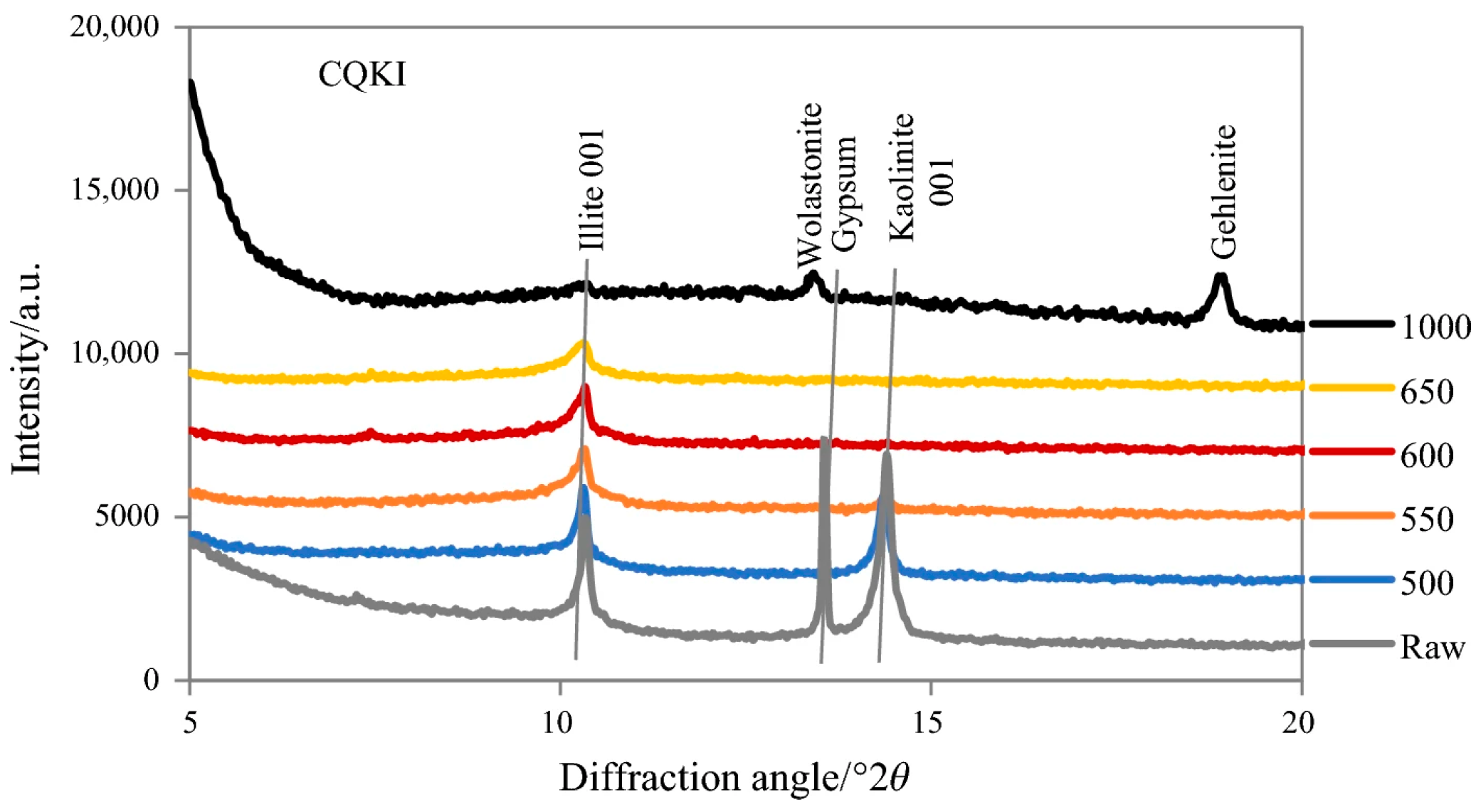
However, this seemingly disadvantageous kaolinite phase is the only scientific basis for the high-value utilization of coal gangue; it is the direct precursor to the formation of metakaolin, which is recognized as one of the most effective pozzolanic materials in high-performance concrete. Therefore, the scientific core of coal gangue resource utilization lies in the process of converting this stable crystalline phase into a highly reactive amorphous phase, which defines the activation threshold of the material [31]. Thermal activation is the mainstream technological path to achieve this transformation, with the core mechanism being the dehydroxylation reaction of kaolinite: when heated to a specific temperature threshold, the structural water (hydroxyl groups) in the kaolinite lattice is driven off, causing the ordered crystal structure to collapse and form highly reactive amorphous metakaolin [32]. For reproducibility, the literature commonly reports heating rates of 5–10 °C/min and holding times of 1–3 h within the 550–750 °C activation window to ensure sufficient dehydroxylation and structural disordering of kaolinite-derived phases. Temperatures below this window may lead to incomplete activation, whereas excessive temperatures and/or prolonged residence times increase the risk of recrystallization and irreversible loss of pozzolanic activity. However, when the temperature exceeds 900–1000 °C, the amorphous metakaolin begins to recrystallize. Importantly, this recrystallization phase is highly dependent on the chemical composition of the raw coal gangue. While low-calcium gangue typically forms the thermodynamically stable mullite phase (3Al2O3·2SiO2), gangue samples rich in calcium impurities (e.g., calcite or gypsum) exhibit different transformation pathways. After calcination at 1000 °C, the mineral phases transform into calcium aluminosilicates such as gehlenite and wollastonite rather than into pure mullite. This finding indicates that the impurity content plays a critical role in determining the final mineralogy of the overburned products, permanently altering their pozzolanic activity.
This recrystallization process is governed by distinct kinetics. The transformation from metastable metakaolinite to thermodynamically stable mullite is not instantaneous; its rate is strongly dependent on both temperature and residence time. Prolonged exposure at elevated temperatures (e.g., >900 °C) accelerates the nucleation and growth of mullite crystals, leading to a rapid reduction in reactive surface area [18]. Furthermore, the presence of impurities such as calcite (CaCO3) or iron oxides can alter the reaction pathway, promoting the formation of alternative crystalline phases like gehlenite (Ca2Al2SiO7) or anorthite (CaAl2Si2O8) instead of pure mullite, as illustrated in Figure 1. The free silica (quartz) content in the raw gangue also influences the kinetics, where excess SiO2 may facilitate cristobalite formation and react with metakaolinite to form secondary mullite, further depleting the active aluminosilicate fraction. Therefore, avoiding over-activation requires precise control not only of the peak temperature but also of the heating rate and holding duration—a significant challenge for consistent industrial-scale processing.
This phase transition process exhibits strong temperature dependence and a critical window feature. The dehydroxylation reaction begins in the temperature range of 515–612 °C, marking the starting point of the conversion from inert to active [34]. The pozzolanic activity reaches its optimal level within the 550–750 °C range, with several studies accurately determining the best temperature range between 700 and 750 °C [35]. Under these conditions, the XRD pattern shows the complete disappearance of kaolinite characteristic peaks, and the FTIR analysis confirms the disorder-induced reconstruction of the Al–O and Si–O bonds. However, when the temperature exceeds 900–1000 °C, the amorphous halloysite begins to recrystallize, forming the thermodynamically stable mullite phase (3Al2O3·2SiO2) [36], a process that irreversibly and permanently results in the loss of pozzolanic activity. This narrow activation temperature window (approximately 200 °C range) explains the two major technical challenges in the coal gangue activation process: high energy consumption and instability in quality.
To overcome the limitations of single thermal activation, researchers have developed various synergistic activation strategies. Mechanical activation, through methods such as high-energy ball milling, reduces the particle size to the micron level (<0.074 mm), increases the specific surface area, and induces lattice defects [37], partially activating the material, but its effect is limited. Reported mechanical activation conditions typically involve planetary/vibration milling for 30–120 min at approximately 200–400 rpm (or equivalent specific energy input), often targeting a D50 reduction to the tens-of-microns scale and a notable increase in specific surface area. Several studies also specify ball-to-powder ratios (commonly 5:1–15:1) and intermittent milling modes to mitigate excessive temperature rise and particle agglomeration. Composite activation combines the synergistic effects of thermal treatment and mechanical grinding. A representative composite route reported in the literature is calcination at ~700 °C (5–10 °C/min; 1–2 h holding) followed by milling for 60–90 min, which maximizes the reactive amorphous fraction while exposing fresh surfaces for subsequent pozzolanic reactions [1]. First, phase transformation is achieved through thermal treatment, followed by mechanical grinding to maximize the active surface area, significantly enhancing the reaction efficiency [38]. Table 2 summarizes the mechanisms and effectiveness comparisons of different activation methods. Kaolin–metakaolin transformation, a fundamental mineralogical process, not only determines the application boundaries of coal gangue in concrete but also serves as a key scientific bridge connecting environmental disposal and performance optimization, providing a fundamental explanation for the performance differences in the subsequent two application pathways.

2.3. Physical Drawbacks: Porosity, Water Absorption, and Strength

The core physical challenge of using coal gangue as an aggregate stems from its microstructural characteristics, with high internal porosity being the root cause of all performance defects. Compared with dense natural rock aggregates, coal gangue has “porous, microcracked” structural characteristics, with its internal pore volume being 3–5 times greater than that of natural aggregates [39]. This fundamental microstructural difference directly leads to a series of unfavorable macroscopic physical performance issues, which can be clearly revealed through a systematic comparison with natural aggregates.
The water absorption rate is a key indicator of the material’s pore connectivity. The water absorption rate of coal gangue aggregates reaches 5.0% to 9.0%, which is 6 to 8 times greater than that of natural aggregates (0.5–1.35%) [40]. The review highlights the high porosity, high water absorption, and low mechanical strength of coal gangue. These properties severely affect the concrete’s workability, strength, and durability. Coal gangue behaves like a sponge, absorbing large amounts of water, which leads to imbalances in the water-to-cement ratio and impairs interface formation between the cement paste and aggregates. Capacity makes it act as a “sponge” during the concrete mixing process, rapidly absorbing free water from the paste. This not only causes a sharp loss in the slump of freshly mixed concrete but also leads to a local imbalance in the water-to-cement ratio, further affecting the quality of the interface transition zone (ITZ) formation.
To address these challenges, surface modification techniques and calcination have been widely explored to improve the interfacial bonding between coal gangue aggregates and the cement paste. One effective surface modification approach is silica coating, which can significantly enhance the surface characteristics of coal gangue aggregates by reducing water absorption and improving interfacial adhesion with the cement matrix [41]. The introduction of a silica-rich layer promotes better chemical compatibility at the aggregate–paste interface, leading to a denser interfacial transition zone (ITZ) and mitigating the brittleness commonly associated with coal gangue aggregates.
Besides traditional surface treatments, the incorporation of nanomaterials has emerged as a high-efficiency modification strategy. Specifically, graphene oxide (GO) has been proven to enhance both the microstructure and durability of cementitious systems. The addition of GO not only accelerates the hydration kinetics and improves the macro-mechanical properties of the cement matrix, but also acts as a potent corrosion inhibitor for embedded steel reinforcement in aggressive chloride environments [42,43]. This multi-functional enhancement is attributed to the pore-refining effect and the torture path created by the nanomaterial, which effectively hinders the ingress of harmful ions.
Another promising strategy is calcination, which not only enhances the pozzolanic reactivity of coal gangue but also alters its physical structure. Calcination at appropriate temperatures, typically in the range of 550–750 °C, induces mineralogical transformation and partial pore restructuring, resulting in reduced internal porosity, increased surface reactivity, and improved bonding with cementitious materials. These physicochemical modifications contribute to more effective stress transfer across the ITZ [20].
Overall, the combined effects of surface modification and calcination can substantially improve both the mechanical performance and durability of coal gangue-based concrete. By alleviating the adverse effects of inherent brittleness and weak interfacial bonding, these treatments enhance matrix densification, crack resistance, and long-term structural integrity, thereby expanding the feasibility of coal gangue utilization in high-performance concrete applications.
From the perspective of cement hydration, the high porosity and water absorption capacity of coal gangue aggregates can significantly influence early-age hydration kinetics. Rapid water uptake by porous gangue particles reduces the effective free water available for cement hydration, leading to localized water redistribution and delayed hydration reactions in the cement matrix. Recent quantitative studies have demonstrated that such water adsorption and absorption behaviors directly affect early hydration rates, workability retention, and early compressive strength development. Advanced characterization techniques, including water adsorption analysis and time-resolved calorimetry, have been employed to elucidate these mechanisms, confirming that the pore structure and absorption characteristics of coal gangue aggregates play a critical role in governing early hydration behavior and interfacial development.
In terms of mechanical strength, coal gangue aggregate is highly brittle. Its crushing value (an indicator of the resistance of the aggregate to crushing) is much greater than the benchmark value for high-quality natural aggregates [44,45,46]. This difference reveals the brittle nature of coal gangue under loading, which directly limits its application potential in load-bearing structures. When coal gangue is used as coarse aggregate, this “strong matrix–weak aggregate” mismatch becomes a controlling factor for the overall strength of concrete, causing the strength to monotonically decrease as the substitution ratio increases [47].
The density characteristics also reflect differences in material compactness. The apparent density of coal gangue ranges from 2.4 to 2.8 g/cm3, which is slightly lower than the 2.72 g/cm3 density of natural aggregates [10,48]; its bulk density ranges from 1400 to 1800 kg/m3, indicating a large variation, whereas that of natural aggregates is approximately 1560 kg/m3 [49,50]. These differences in density parameters not only affect the unit weight of the concrete but also indirectly reflect the complexity of the internal pore structure of the material. Table 3 systematically compares the key physical performance parameters of coal gangue aggregate and natural aggregate, clearly showing the order-of-magnitude differences between the two.
These physical defects do not exist in isolation but instead form a performance degradation chain from the microscopic to the macroscopic level: high porosity → high water absorption → uneven water distribution → ITZ weakening → overall strength reduction → durability impairment [51]. Notably, this degradation is highly sensitive to environmental factors such as freeze-thaw cycles, as the expansion pressure generated by the internal pore water of the aggregate during freezing accelerates the propagation of microcracks [52]. Therefore, understanding and quantifying these fundamental physical properties is the scientific foundation for developing targeted enhancement techniques (such as prewetting, surface coating, or calcination), as well as the theoretical basis for accurately predicting the long-term performance of coal gangue concrete [53].

2.4. Logical Mapping from Raw Material Defects to Concrete Performance Degradation

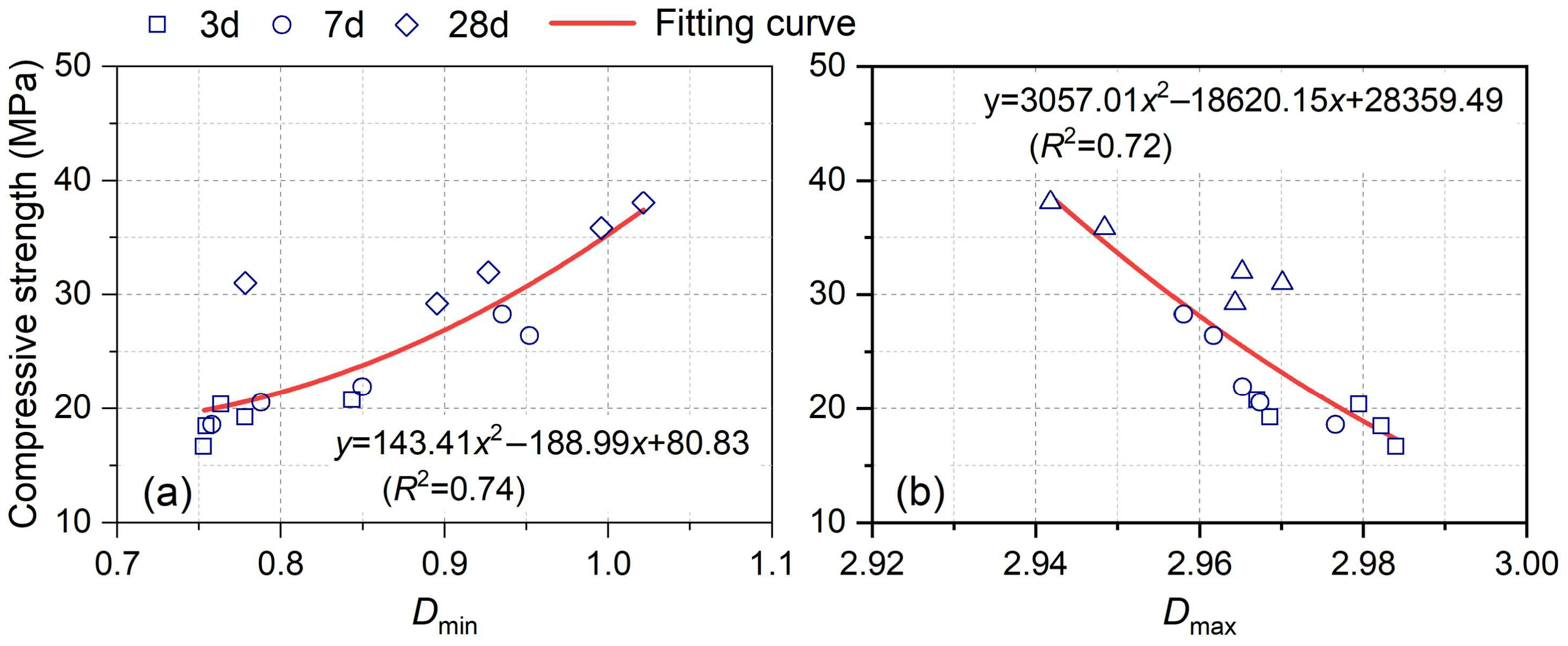
There is a clear causal chain between the intrinsic properties of coal gangue and the performance issues it induces in concrete. Understanding this mapping relationship is crucial for developing precise optimization strategies. This mapping results in a complete degradation pathway from the microscopic to the macroscopic level. To quantitatively verify this correlation, Figure 2 presents the statistical relationship between the pore structure parameters (represented by fractal dimensions Dmin and Dmax) and the compressive strength of coal gangue concrete. The strong correlation observed in the fitting curves confirms that the complexity of the pore structure directly dictates the macroscopic mechanical performance, providing mathematical evidence for the material’s degradation mechanism.
The high variability in the chemical composition of coal gangue (SiO2: 39–60%, Al2O3: 15–36%) is the primary cause of performance fluctuations. A high carbon content (LOI > 15%) not only interferes with the cement hydration process but also significantly reduces the efficiency of air-entraining agents, resulting in a severe reduction in frost resistance. Sulfides (such as 0.72% SO3) gradually oxidize in the high-alkalinity environment of concrete, producing sulfate ions, which react with hydration products to form expansive ettringite, leading to internal sulfate attack. Additionally, heavy metals (such as As, Pb, Cd, and Cr) may leach out under fluctuating pH conditions, posing long-term environmental risks [55]. These chemical instabilities make quality control of coal gangue concrete a major obstacle for its engineering applications.
Mineral phase characteristics constitute another key degradation pathway. In its unactivated state, crystalline kaolinite is chemically inert because of its “highly stable lattice structure,” preventing it from effectively participating in pozzolanic reactions. As a result, when coal gangue powder directly replaces cement, the early strength significantly decreases [56]. Only through precise thermal activation (550–750 °C) can kaolinite be transformed into highly reactive metakaolin. This transformation process is highly temperature sensitive: underactivation (<550 °C) results in the retention of a large amount of inert phases, whereas overactivation (>900 °C) leads to recrystallization into mullite, resulting in the permanent loss of pozzolanic activity. This narrow activation window not only increases process energy consumption but also results in high uncertainty in performance output, manifested in poor cementing efficiency and abnormal strength development in practice.
Physical structural defects affect the performance of concrete in multiple dimensions. The porosity of coal gangue aggregates, which is 3–5 times greater than that of natural aggregates, is the microscopic root cause of the degradation of all physical properties [57]. In the fresh mix stage, the high water absorption rate causes the aggregates to rapidly absorb free water like a “sponge,” resulting in a sharp loss of slump. This often forces an increase in the water-to-binder ratio, resulting in a vicious cycle of performance deterioration. In terms of mechanical properties, a high crushing value causes a “strong matrix–weak aggregate” structural mismatch, leading to a monotonic decrease in strength as the coarse aggregate replacement ratio increases. Fine aggregates, when used in low amounts, may enhance strength due to microfilling effects and secondary hydration at the surface. However, beyond a threshold, physical defects dominate the performance degradation. The durability performance is even more complex, exhibiting a typical nonlinear response: high porosity significantly accelerates CO2 penetration and freeze-thaw damage (pore water expansion drives microcrack propagation). However, chloride ion penetration may exhibit “anomalous advantages,” stemming from the high water absorption of aggregates, which reduces the water-to-binder ratio in the interfacial transition zone and forms a dense gel by reacting with Ca(OH)2 through a dual mechanism [58].
This systematic mapping indicates that the performance issues of coal gangue concrete are not isolated phenomena but rather inevitable manifestations of the intrinsic properties of the material at multiple scales. Table 4 comprehensively summarizes the mapping relationship between coal gangue material defects and concrete performance degradation, revealing the scientific nature of performance degradation. Therefore, any effective optimization strategy must target specific defect chains for precise intervention rather than simply improving the final performance indicators. This understanding provides a key theoretical basis for the differentiated optimization strategies of the aggregate pathway and mineral admixture pathway and lays a scientific foundation for understanding the complexity of coal gangue concrete performance regulation.

3. Path 1: Performance Degradation Mechanism and Multiscale Enhancement Strategy with Coal Gangue as the Aggregate

3.1. Performance Impact Law

The impact of coal gangue aggregate on concrete performance is not a single-dimensional factor but rather has complex nonlinear characteristics with variations in particle size, dosage, and environmental conditions. A deep understanding of these patterns is a prerequisite for developing precise enhancement strategies.

3.1.1. Coarse Aggregate: Strength Monotonically Decreases with a “Strong Matrix–Weak Aggregate” System

When coal gangue is used as a coarse aggregate (coal gangue aggregate (CGA)) in concrete, the mechanical properties of the concrete exhibit significant dose-dependent degradation characteristics. The compressive strength continuously decreases as the CGA substitution rate increases. This degradation mechanism stems from the inherent “strong matrix–weak aggregate” structural mismatch. The crushing value of coal gangue coarse aggregate is much greater than that of natural aggregates [59], indicating that coal gangue coarse aggregate is more prone to brittle fracture under loading. Microscopic structural analysis reveals that this mechanical mismatch causes stress concentration at the interface. When an external force is applied, cracks preferentially initiate and propagate inside the coal gangue aggregate or at the aggregate-paste interface [60].
Experimental studies have shown that, without any enhancement measures, the compressive strength at 28 days decreases with increasing CGA substitution rate [61]. To maintain structural integrity, the substitution rate of coarse aggregates is typically limited to 40–45% in engineering practice. This limitation significantly weakens the potential of coal gangue for large-scale disposal, highlighting the inherent contradiction between performance and disposal volume. Notably, this degradation trend is more pronounced at early ages (7 days), but it alleviates at later ages (90 days), suggesting that the secondary hydration at the interface that may occur over time helps partially compensate for the strength loss but cannot fully reverse this trend.
Previous experimental studies consistently indicate a clear dose-dependent reduction in compressive strength with increasing coal gangue aggregate substitution, and this trend has been widely reported across different mix designs, curing regimes, and coal gangue sources [9]. At this dosage, the adverse influence of coal gangue’s higher water absorption is relatively limited and can, to some extent, be offset by a mild internal curing effect, whereby water stored in the porous aggregate is gradually released and contributes to continued cement hydration in the surrounding paste.
When the replacement rate increases to around 20%, the negative effects become more pronounced. At this stage, the high porosity and water absorption capacity of coal gangue aggregates (typically 5–9%) begin to dominate the system behavior, leading to significant redistribution of mixing water, local reductions in the effective water-to-binder ratio, and deterioration of the interfacial transition zone (ITZ). Microstructural observations frequently show increased ITZ porosity and microcracking, which weaken stress transfer between the cement matrix and the aggregate [62].
At higher substitution levels, typically around 30% or above, the reduction in compressive strength often exceeds 20–30%, and in some cases becomes even more severe. This marked degradation reflects a fundamental shift in the governing failure mechanism from matrix-controlled behavior to a “strong matrix–weak aggregate” system. Under loading, cracks preferentially initiate and propagate within the coal gangue aggregates or along the aggregate–paste interface, with aggregate crushing and interfacial debonding becoming the dominant damage modes [63]. As a result, further increases in substitution rate lead to disproportionately large strength losses.
Overall, these quantitative trends demonstrate that the influence of coal gangue water absorption on concrete strength is not merely a qualitative or secondary effect but a key controlling parameter that governs the extent of mechanical degradation. This dose-dependent behavior provides a quantitative basis for the commonly reported engineering limits on coal gangue aggregate replacement and highlights the necessity of targeted modification or matrix compensation strategies when higher substitution ratios are desired.

3.1.2. Fine Aggregate: At Low Substitution Levels, the Microfilling Effect and Secondary Hydration Contribute to Strength Enhancement

Compared with coarse aggregates, coal gangue fine aggregates (CGFs) exhibit distinctly nonlinear performance characteristics when used in concrete, following a unique pattern of “initial enhancement followed by reduction.” Numerous experimental studies indicate that when the replacement rate of coal gangue fine aggregate is very low, the 28-day compressive strength of concrete can significantly increase. This enhancement is primarily attributed to the higher specific surface area of fine particles, which facilitates improved physical packing and enhances interfacial bonding with the cement matrix. The increased contact area between fine particles and hydration products promotes stronger mechanical interlocking and contributes to a more compact and robust interfacial transition zone (ITZ) [64]. As a result, stress transfer across the aggregate–paste interface is improved, leading to enhanced mechanical performance.
Moreover, the presence of finer particles induces a pronounced microfilling effect by occupying voids between cement grains, thereby optimizing particle-size distribution and increasing the packing density of the cement paste. This refinement of the pore structure reduces capillary porosity and promotes the formation of a denser microstructure. Such microstructural advantages are particularly significant at low replacement levels, where fine particles efficiently fill small voids within the cement matrix without excessively disturbing the overall water demand or hydration kinetics [65]. Consequently, the combined effects of enhanced packing, microfilling, and improved interfacial bonding lead to a more homogeneous and compact concrete matrix, which explains the frequently reported strength enhancement or strength retention observed at low fine aggregate replacement ratios.
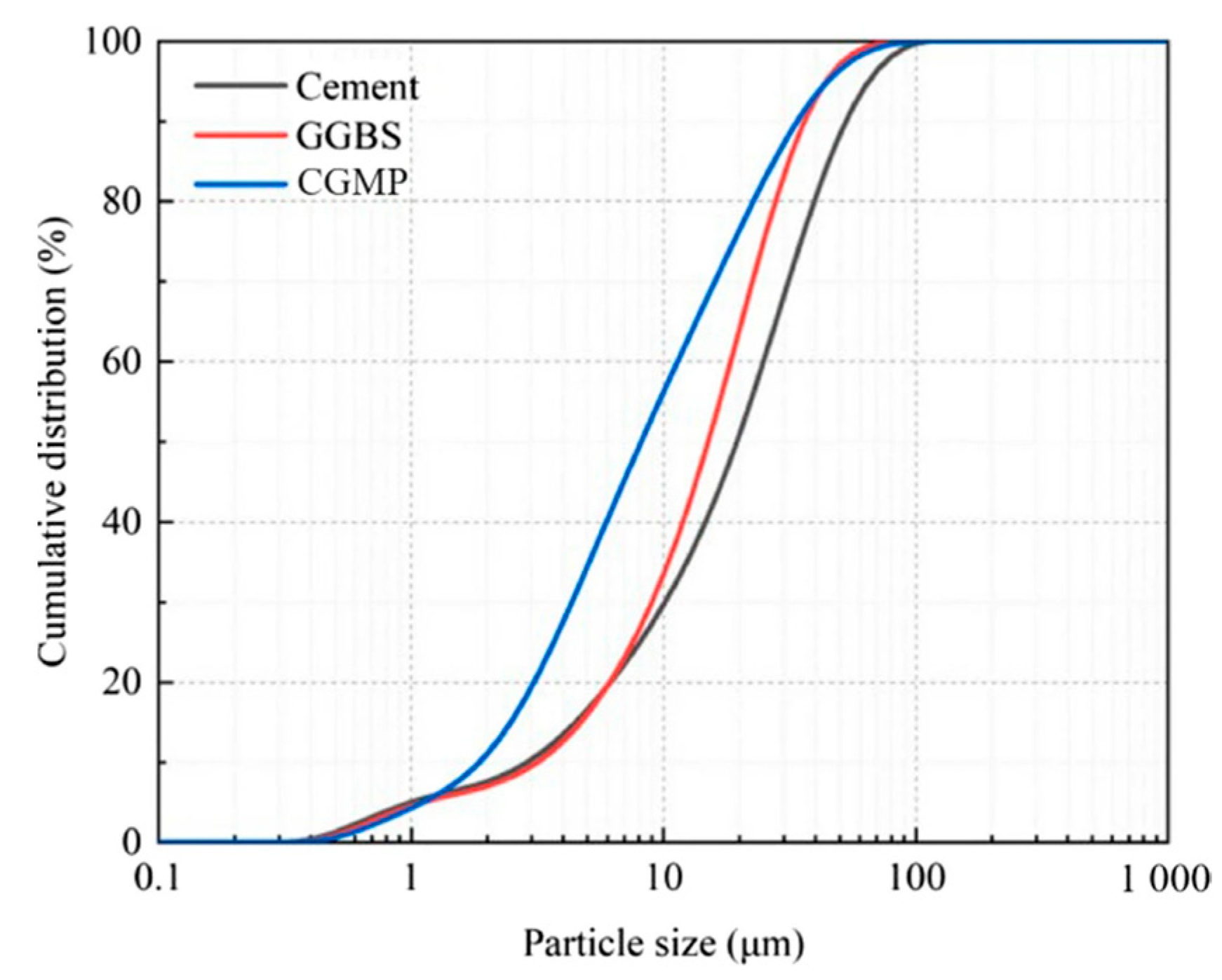
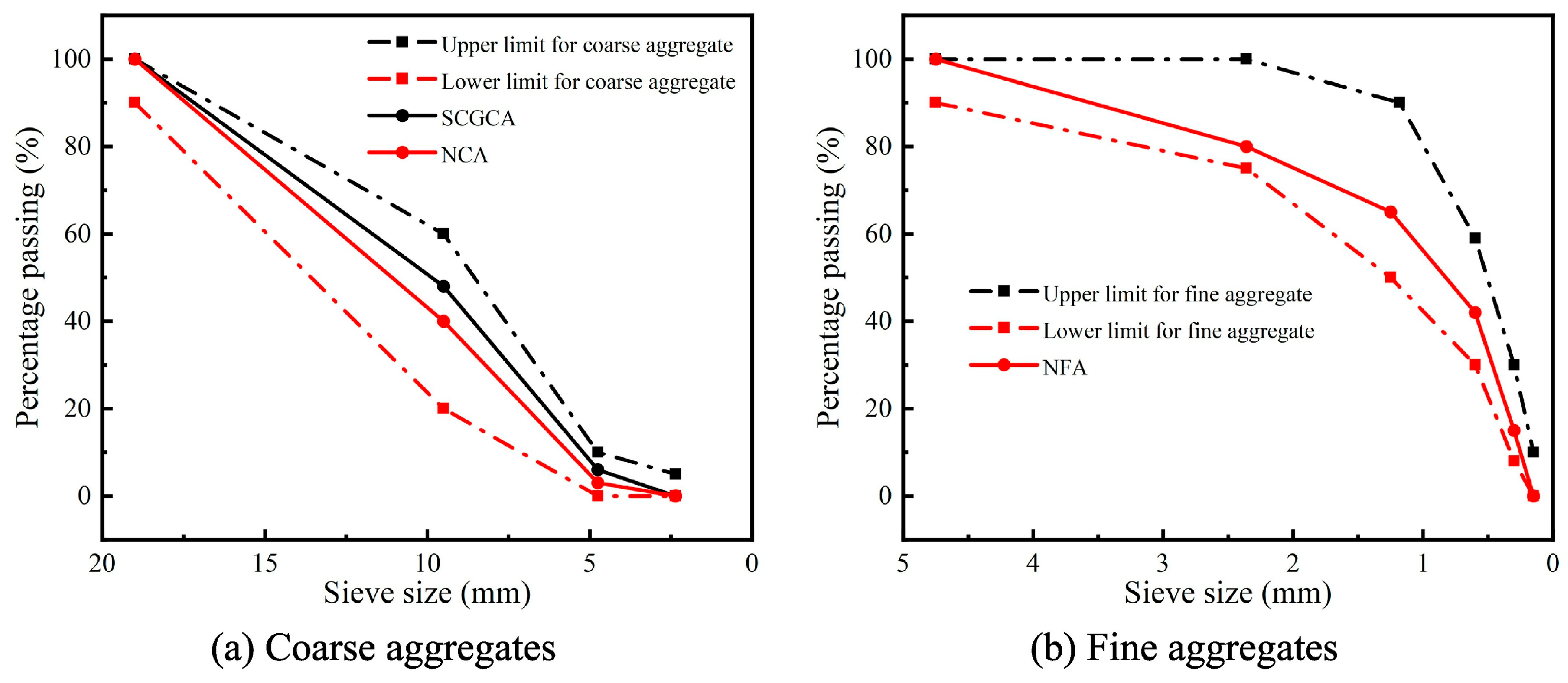
However, as the replacement ratio increases, the strength gain rapidly diminishes and eventually decreases. This anomalous phenomenon is attributed to a dual enhancement mechanism of coal gangue fine particles under low dosage conditions, which can be visually verified through the gradation characteristics of the aggregates. Figure 3 shows the particle size distribution curves of the coarse and fine aggregates. These particles, which have a high specific surface area, provide a significant microfilling effect, effectively fill the microscopic voids between cement particles, optimize the overall particle gradation, and greatly enhance the compactness of the cement paste. At the chemical level, even without specialized activation treatment, the active SiO2 and Al2O3 components exposed on the surface of coal gangue fine particles can undergo mild secondary hydration reactions, with Ca(OH)2 produced during the hydration process of the cement, generating additional C-S-H gel in situ. This significantly reinforces the microstructure of the interfacial transition zone between the aggregate and the paste [63]. This reaction contributes to further bonding between the fine aggregate and the cement paste, increasing the overall mechanical strength.
However, this positive effect has a clear threshold limit. When the replacement rate exceeds 20%, the inherent physical defects of coal gangue, such as high water absorption and high porosity, begin to dominate, leading to local imbalances in the W/C ratio, a dramatic decrease in the flowability of the paste, and increased heterogeneity of the microstructure, ultimately resulting in deterioration of the overall mechanical performance [66]. Therefore, the optimal application window for coal gangue fine aggregate in concrete is very narrow, with the best replacement rates typically being strictly controlled below 20% in engineering practice. This advantage of low dosage essentially reflects the inherent limitations of the application pathway of fine aggregates as a “low-tech version” of mineral admixtures, providing a micromechanistic explanation for understanding the performance boundaries of coal gangue in different application forms.
Figure 3. Particle size distributions of coarse and fine aggregates [67]; 2024, Elsevier.
Buildings 16 00302 g003
From a quantitative engineering perspective, when the replacement rate of coal gangue fine aggregate is controlled at approximately 10%, strength enhancement is most evident; at around 20%, the compressive strength generally remains comparable to or slightly lower than that of the reference concrete; whereas at replacement levels of 30% or higher, the negative effects of water absorption and porosity dominate, leading to a rapid decline in strength.

3.1.3. Fresh Property Degradation: High Water Absorption Leads to Slump Loss

The negative impact of coal gangue aggregate on the fresh properties of concrete is both direct and significant, primarily manifested by a sharp decline in workability and slump loss. The core mechanism of this phenomenon lies in the aggregate’s “high water absorption capacity”—its water absorption rate of 5.0–9.0% is 6–8 times greater than that of natural aggregates (0.5–1.35%) [68]. During the mixing process, the porous coal gangue aggregate, which acts as a “sponge,” rapidly absorbs free water, leading to two key issues: loss of fluidity and the reduction in effective free water in the cement paste, which leads to an increase in paste viscosity, causing a significant decrease in slump. Local water-to-cement ratio imbalance: A low water-to-cement ratio region forms around the aggregate, whereas areas farther from the aggregate have a higher water-to-cement ratio, resulting in microstructural heterogeneity.
A more complex challenge lies in the time-dependent water absorption process of coal gangue—it initially absorbs water quickly (within 5–10 min) and continues to absorb water slowly, leading to ongoing slump loss during transportation and pouring. This deterioration in fresh concrete properties not only increases construction difficulty but also directly affects the formation of the microstructure, laying hidden risks for subsequent mechanical and durability issues. Therefore, controlling fresh concrete performance is regarded as the primary technical hurdle for the application of coal gangue aggregate concrete.

3.2. Durability Nonlinear Response

The influence of coal gangue aggregate on concrete durability exhibits significant nonlinear characteristics—under different deterioration mechanisms, both the direction and magnitude of performance changes vary. This complex response arises from the interaction between the microstructural properties of the aggregate and multiple environmental action mechanisms rather than a simple linear relationship, such as “more porous = lower durability.” Accurately understanding this nonlinearity is crucial for the scientific design of coal gangue concrete.

3.2.1. Significant Deterioration in Frost Resistance: Pore Water Freezing Expansion Drives the Propagation of Microcracks

The frost resistance of coal gangue concrete is generally lower than that of traditional concrete, and it tends to accelerate deterioration as the substitution rate increases. The core mechanism behind this performance degradation is the “pore water freezing expansion” effect. The internal porosity of coal gangue aggregate, which is 3–5 times greater than that of natural aggregate, allows it to adsorb and store a significant amount of freezeable water. When the temperature decreases below the freezing point, the pore water freezes and expands, generating internal stresses as high as 200 MPa. Owing to the relatively low strength of coal gangue itself, this freezing expansion pressure easily induces microcracks within the aggregate and at the aggregate-paste interface.
Experimental studies have shown that this deterioration exhibits obvious dose-dependent and time-accumulation characteristics. Moreover, freeze-thaw damage exhibits self-accelerating characteristics: initial microcracks expand the moisture penetration channels, allowing more water to enter the material during subsequent cycles, leading to an exponential increase in the degree of damage. To maintain acceptable frost resistance, the substitution rate of coal gangue coarse aggregates is generally limited to less than 30%, or reinforcement measures (such as air-entraining agents, fiber toughening, or aggregate pretreatment) must be employed [69]. This significant deterioration in frost resistance has become the main technical barrier limiting the application of coal gangue aggregates in cold regions.

3.2.2. Carbonation Acceleration: Permeable Pores Facilitate CO2 Penetration

The carbonation depth of coal gangue concrete is systematically greater than that of natural aggregate concrete with the same mix ratio, and it increases approximately linearly with the substitution rate [57,70]. This accelerated carbonation phenomenon arises from the low-resistance CO2 diffusion channels created by the interconnected pore network of the aggregates, allowing carbon dioxide gas to rapidly penetrate the concrete body.
The carbonation process poses a dual threat to the structural safety of concrete: first, it reduces the pH value of the pore solution, damaging the passive film on the surface of the reinforcement and promoting steel corrosion; second, the carbonation reaction products (mainly CaCO3) have a smaller volume than the original hydration products do, leading to microstructural shrinkage and cracking. This tendency of coal gangue concrete to carbonize easily, combined with its deterioration in frost resistance, constitutes the primary limiting factor for its application in harsh environments. Notably, this performance flaw is highly sensitive to the water-to-binder (w/b) ratio [71]. This phenomenon suggests that optimizing the matrix density can partially compensate for the inherent defects of the aggregate but cannot completely eliminate its negative effects.

3.2.3. The “Anomalous Advantage” of Chloride Ion Penetration: A Dual Physical-Chemical Barrier Mechanism of Dense ITZ

Unlike frost resistance and carbonation resistance, coal gangue concrete often exhibits an “anomalous advantage” in resisting chloride ion penetration—under appropriate mix proportions, its performance can even surpass that of ordinary concrete. This nonlinear response results from the competing and balancing effects of physical defects and the chemical reactivity of the aggregate [72]. This phenomenon has been confirmed by multiple studies.
This positive effect stems from the unexpected densification of the interfacial transition zone (ITZ), and its mechanism involves both physical and chemical processes:
High water absorption (5–9%) coal gangue aggregates absorb free water from the surrounding cement paste during the mixing stage, leading to a significant reduction in the local water-to-binder ratio in the ITZ region. SEM-EDS analysis confirmed that the ITZ within a 15–30 μm range around the coal gangue aggregates has a lower porosity than the matrix does, forming a physical barrier [73,74,75].
The unactivated active SiO2 and Al2O3 components on the surface of the aggregates (even without calcination) undergo mild secondary reactions with the cement hydration product Ca(OH)2, generating additional C-S-H gel, which further blocks the pore channels. XRD and FTIR analyses revealed a reduction in the Ca(OH)2 content in the ITZ region, whereas the C-S-H gel content correspondingly increased [76,77,78].
This dual densification effect transforms the ITZ—traditionally a “high-speed channel” for chloride ion transport in concrete—into the region with the highest resistance to penetration. However, this mechanism provides a limited barrier effect against gas molecules (CO2) and ice expansion pressure, explaining the nonlinear phenomenon where chloride ion permeability decreases while carbonation and freeze-thaw performance deteriorate in the same system. This anomalous advantage provides a scientific basis for the application of coal gangue aggregates in marine environments or conditions exposed to deicing salts, highlighting the high complexity and environment-specific nature of durability responses.

3.3. Performance Enhancement Technology System

To address the inherent physical defects of coal gangue aggregates, researchers have developed a multiscale enhancement technology system. These technologies can be systematically classified into three complementary strategies: (1) aggregate body modification, (2) biomineralization treatment, and (3) matrix synergistic reinforcement. Each strategy targets specific stages of performance degradation for precise intervention, and their effectiveness has been verified in numerous experiments.

3.3.1. Aggregate Body Modification: Pre-Wetting (Internal Curing), Calcination (Surface Activation), and Sodium Silicate Coating (Pore Sealing)

The aggregate body modification strategy directly addresses the fundamental defects of the porous structure of coal gangue aggregates, improving both their surface and internal properties through physical or chemical methods. Pre-wetting technology is the most direct method for addressing high water absorption rates. Presaturating the aggregate pores effectively prevents the aggregate from “robbing” the free water of the cement paste during mixing, significantly reducing slump loss and restoring workability. More importantly, this simple treatment creates an “internal curing” mechanism: the water stored in the aggregates is slowly released during the hardening process, promoting the continuous hydration of the interfacial transition zone (ITZ) and enhancing the integrity of the microstructure.
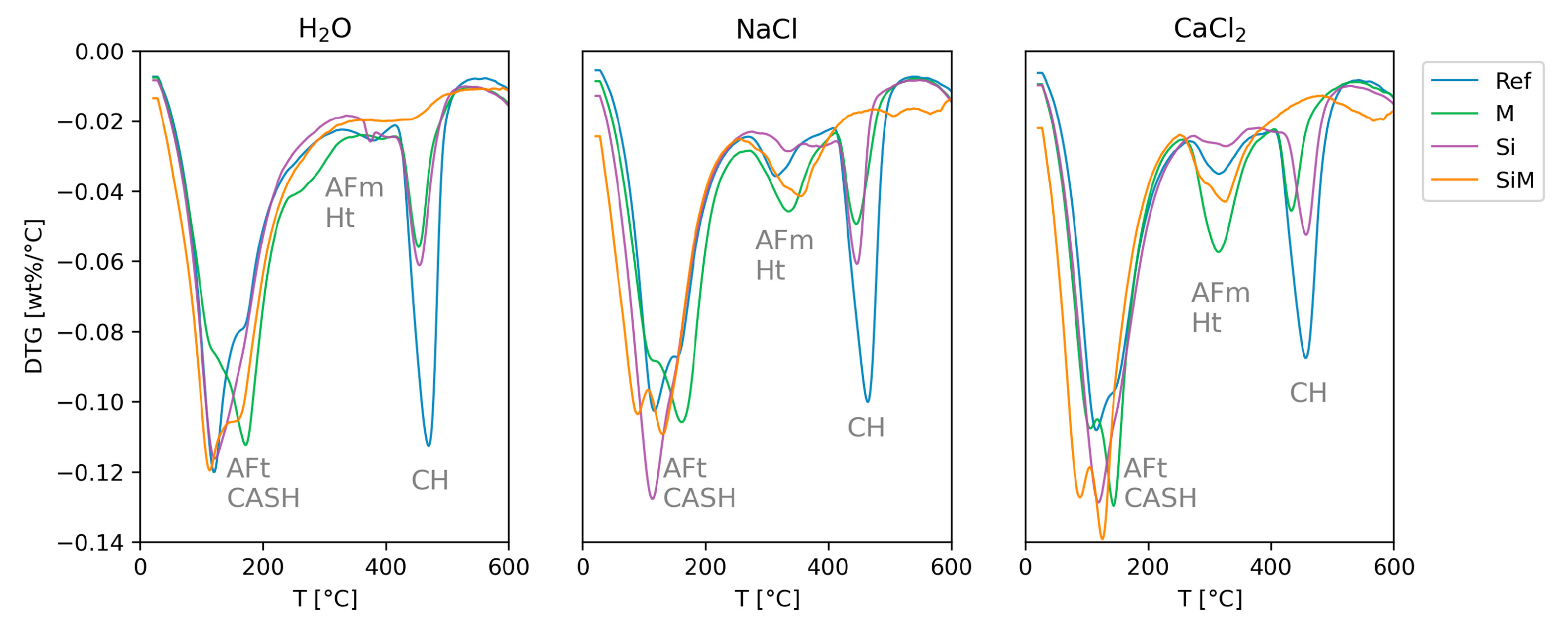
Calcination activation achieves dual modification through heat treatment (600–800 °C). Typically, high temperatures drive off internal moisture and volatile substances, induce particle surface sintering, and increase the strength of the aggregate, reducing the crushing index [79]. Chemically, calcination transforms the inert kaolinite on the aggregate surface into active metakaolin, which can react with cement hydration products, particularly Ca(OH)2. As illustrated in Figure 4 (DTG curves in the 50 °C to 600 °C range for the Ref, M, Si and SiM binder’s pastes exposed to water (H2O), or NaCl or CaCl2 solutions with a 2 mol/L chloride concentration), the mass-loss peak corresponding to Ca(OH)2 in metakaolin-containing pastes (M group) is significantly weakened compared with the reference group (Ref), which intuitively verifies the consumption of Ca(OH)2 by the pozzolanic reaction of metakaolin. In the interfacial transition zone (ITZ), this reaction generates C-S-H gel in situ, enabling chemical bonding between the aggregate and the cement paste. This interface reinforcement mechanism transforms the originally weak “weak aggregate-strong matrix” interface into a synergistic working system, significantly improving both the mechanical performance and durability.
Sodium silicate (Na2SiO3) coatings represent a more refined pore-blocking technology. When aggregates are immersed in sodium silicate solution, the solution infiltrates the surface pores and microcracks, and in the presence of CO2, it forms a silica gel that “chemically bonds to the pore walls and microcracks [81].” This in situ gel filling not only physically blocks pore channels but also strengthens the aggregate skeleton through chemical bonding [82]. This multimechanism synergistic aggregate modification lays the material foundation for subsequent concrete performance optimization.

3.3.2. Biomineralization (MICP): CaCO3 Precipitation Fills Pores and Immobilizes Heavy Metals

Microbial-induced carbonate precipitation (MICP) is an emerging green modification technique that uses microbial metabolic activity to precisely deposit calcium carbonate (CaCO3) within the pores of coal gangue aggregates. This process typically employs strains of the genus Bacillus, which catalyze the reaction in a nutrient solution containing urea and calcium ions to generate carbonate ions that combine with calcium ions in the solution to form CaCO3 precipitates. The unique advantage of this biological process lies in its self-directed nature—microbes and their metabolic products can actively infiltrate the micropores and fissures within the aggregate, filling regions that are difficult to reach with traditional physicochemical methods.
MICP modification has a dual-functional effect. First, at the physical level, the deposited CaCO3 crystals effectively fill the internal pore network of the aggregate, reducing the interconnected porosity, which lowers the water absorption rate and decreases the crushing index, significantly improving the mechanical properties and water stability of the aggregate [83]. Reported studies on porous aggregates indicate that MICP treatment can induce CaCO3 precipitation on the order of several weight percent relative to the aggregate mass, which is sufficient to cause measurable reductions in water absorption and corresponding improvements in compressive strength and freeze–thaw resistance. For example, MICP treatment of coal gangue aggregates has led to an increase in compressive strength by up to 20%, and a reduction in water absorption by 12–15%. The resulting CaCO3 precipitation typically ranges from 8% to 13% of the aggregate mass, which substantially improves the material’s overall mechanical properties [84].
Second, at the environmental level, carbonate ions (CO32-) react with potentially toxic heavy metal ions (such as Pb2+, Cd2+, and Cr3+) in coal gangue, forming stable carbonate minerals and achieving “heavy metal immobilization.” This process not only stabilizes the heavy metals but also reduces their leachability. Studies have demonstrated that MICP treatment can reduce the leachability of heavy metals like Pb2+ and Cd2+ by up to 80%, stabilizing them as insoluble carbonate forms. This provides an effective solution for reducing the environmental risks associated with the use of coal gangue in construction materials [85].
However, despite its technical efficacy, the large-scale engineering application of MICP faces a critical “cost-value mismatch.” The current cultivation of Bacillus strains relies heavily on expensive laboratory-grade nutrients (e.g., yeast extract and peptone). The cost of these biological agents often exceeds the economic value of the coal gangue aggregates themselves, creating a value inversion that is difficult to justify in low-margin construction projects. Furthermore, the compatibility between microorganisms and the cementitious environment remains a challenge; the highly alkaline pore solution (pH > 12) of concrete can inhibit bacterial activity or spore germination, potentially compromising the long-term effectiveness of the modification.
To overcome these limitations, future research should shift the focus from merely proving “feasibility” to ensuring “economic viability.” This can be achieved by exploring low-cost nutrient sources such as corn steep liquor or industrial wastewater, and by developing alkali-tolerant mutant strains that can thrive in the highly alkaline environment of cement-based materials. Some studies have already demonstrated that Bacillus strains can be genetically modified to increase their resistance to high pH conditions, which could significantly improve the scalability of MICP treatment for industrial applications.

3.3.3. Matrix Synergistic Reinforcement: SCM Densification + Fiber Toughening System Compensation Strategy

When aggregate modification is insufficient to completely compensate for the inherent defects of coal gangue, the matrix synergistic reinforcement strategy “embraces” the weak aggregate by designing a high-performance cement matrix, thus constructing a systematic compensation mechanism. The core of this strategy lies in accepting the inherent limitations of the material and focusing on optimizing the overall system behavior. This is achieved through two main technical paths:
The incorporation of supplementary cementitious materials (SCMs), such as silica fume (SF), fly ash (FA), or slag, into the mixture promotes the densification of the cement matrix through their “microfiller effect” and “pozzolanic effect.” Silica fume (with a particle size of 0.1–0.2 μm) effectively fills the voids between cement particles, whereas reactive metakaolin and fly ash contribute to the formation of additional C–S–H gel by consuming Ca(OH)2, thereby enhancing the interfacial transition zone (ITZ) [86]. This dual-mechanism synergy significantly reduces the permeability of the matrix and offsets the adverse effects of aggregate porosity.
The incorporation of steel fibers, basalt fibers, or polypropylene fibers (with a volume fraction of 0.5–1.5%) enhances the overall toughness of the material through crack bridging and energy dissipation mechanisms. The fibers form a three-dimensional network within the concrete, effectively preventing the propagation of microcracks that originate from weak aggregates and dissipating internal stresses generated during freeze-thaw cycles. Particularly in resisting freeze-thaw damage, the fiber toughening mechanism can improve the dynamic modulus of elasticity retention, significantly extending the service life of the structure [87].
The synergistic integration of fibers and SCMs creates a multi-scale defense mechanism that is particularly effective against durability threats like freeze-thaw cycling. Experimental studies on hybrid systems combining polypropylene fibers (0.5–1.0% by volume) with fly ash (15–20% by mass) confirm that this approach significantly enhances the freeze–thaw resistance of coal gangue concrete [88]. The mechanism operates on two complementary levels: the SCMs densify the matrix and refine the pore structure through pozzolanic reactions, thereby reducing the total volume of freezable water and limiting ice formation; simultaneously, the fibers form a three-dimensional network that bridges microcracks initiated by ice expansion pressures, dissipating energy and preventing crack propagation. Quantitative crack analysis confirms this synergy, demonstrating that such hybrid systems can substantially reduce average crack widths under loading compared to non-fiber-reinforced coal gangue concrete [89]. Consequently, the combined use of fibers and SCMs not only compensates for the inherent weaknesses of coal gangue aggregates but can enable higher substitution ratios (up to 40–45%) while meeting standard durability requirements for structural applications in cold environments.
These two technologies are often applied synergistically to form a “dense-tough” composite system: the SCM provides microstructural densification, reducing permeability, whereas fibers offer macroscopic-scale toughening, enhancing damage tolerance. Importantly, the effectiveness of this strategy does not arise from a simple superposition of individual improvements, but from a true synergistic mechanism in which matrix densification suppresses crack initiation while fiber bridging limits crack propagation, jointly enhancing freeze–thaw durability and damage tolerance. This matrix synergistic reinforcement not only compensates for the physical defects of coal gangue aggregates but also has the potential for performance that exceeds that of benchmark concrete [90]. The mechanisms of action and actual enhancement effects of these technologies can be visually compared in Table 5. This “system design” approach represents the highest-level strategy for optimizing the performance of coal gangue aggregate concrete, providing technical feasibility for large-scale engineering applications.

4. Path 2: Activation Mechanism of Coal Gangue as a Mineral Additive and Its Performance Enhancement

4.1. Core of the Activation Transformation: The Thermal Activation Window of Kaolinite → Metakaolinite (550–750 °C) and the Risk of Over-Burning (>900 °C)

Unactivated coal gangue is essentially a chemically inert material, and its pozzolanic activity is negligible. Coal gangue in its mined state mainly consists of kaolinite (Al2O3·2SiO2·2H2O) and quartz, with kaolinite exhibiting very low reactivity due to its highly stable crystal structure. To unlock its enormous potential as a supplementary cementitious material, this structural limitation must be overcome by transforming it into a highly reactive amorphous phase. The core of this transformation process is the dehydroxylation reaction of kaolinite, which is achieved through precise thermal activation control.
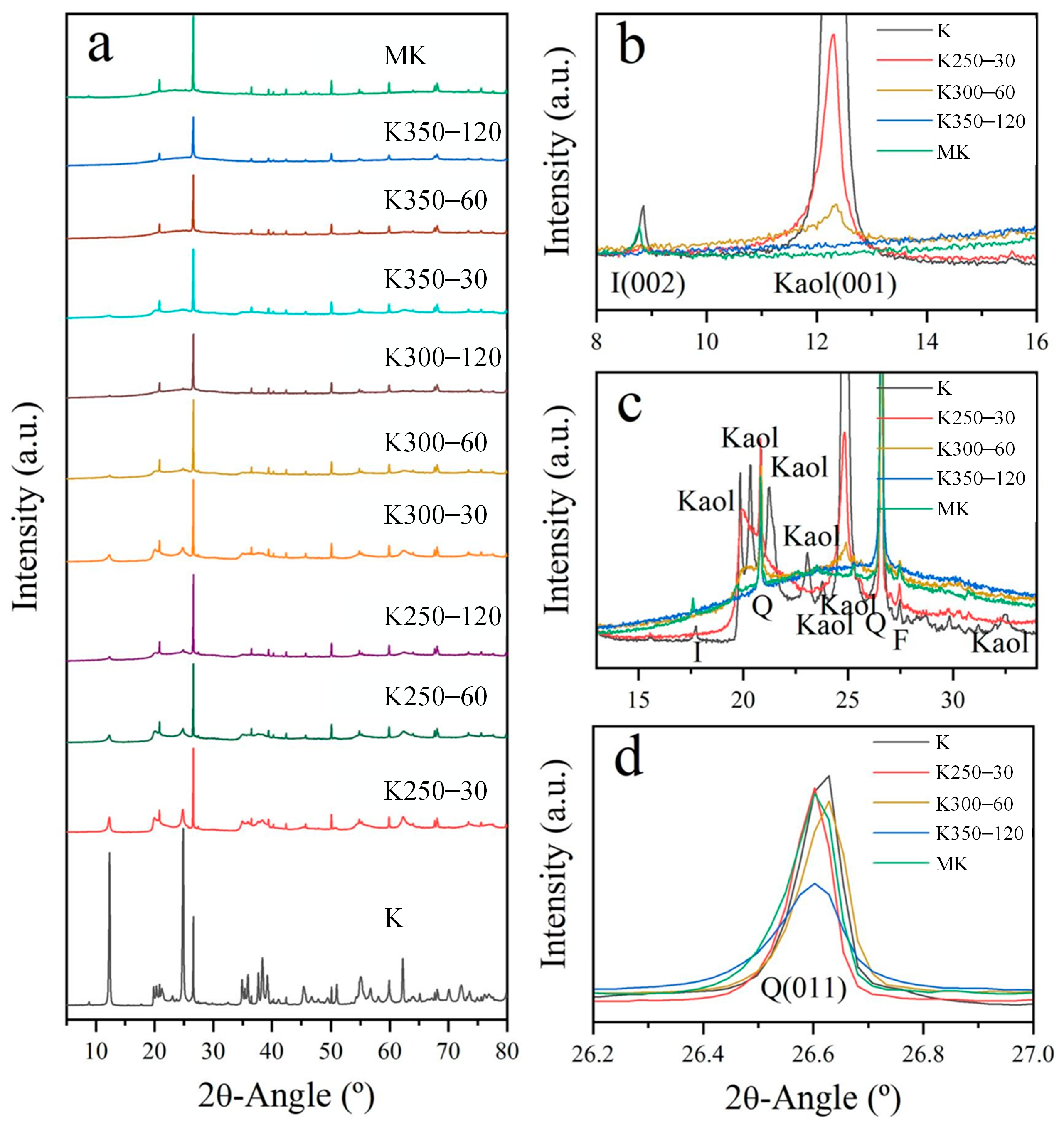
Thermal activation is currently one of the most effective and widely used activation techniques and is based on the phase transition process of kaolinite under heating conditions. This phase transformation process exhibits a strong temperature dependence and gradual structural evolution. Figure 5 shows the X-ray diffraction patterns of clays during the thermal treatment process. As observed in the detailed spectra (b and c), under lower temperature treatments (e.g., K250–K350 series), the characteristic peaks of kaolinite are still visible, indicating that dehydroxylation is incomplete at these stages. However, complete transformation is achieved in the fully activated metakaolin (MK) sample, where the sharp diffraction peaks of kaolinite completely disappear and are replaced by a broad hump characteristic of an amorphous structure. This contrast visually confirms that reaching the critical temperature threshold (typically > 550 °C) is essential for fully breaking down the crystalline structure to obtain high reactivity. When the temperature increases to a specific threshold, the structural water (hydroxyl) in the kaolinite lattice is expelled, leading to the collapse of its ordered lattice and the formation of highly reactive amorphous metakaolin (Al2O3·2SiO2) [91]. This process strongly depends on temperature, resulting in three key temperature ranges. In the initial activation range of 515–612 °C, dehydroxylation reactions begin, causing the kaolinite crystal structure to loosen and its reactivity to exhibit preliminary characteristics. In the optimal activity window of 550–750 °C, volcanic ash activity reaches a peak, with multiple studies accurately determining the optimal temperature point to be within the range of 700–750 °C. Within this temperature range, the XRD patterns indicate the complete disappearance of the characteristic peaks of kaolinite, whereas the FTIR analysis confirms the disorderly reconstruction of the Al–O and Si–O bonds [92], resulting in the formation of an amorphous structure with maximum reactivity. When the temperature exceeds 900–1000 °C, it enters the danger zone of overburning, where amorphous metakaolin begins to recrystallize, producing the thermodynamically stable mullite phase (3Al2O3·2SiO2). This process irreversibly results in the permanent loss of volcanic ash activity. The efficacy of thermal activation within this critical window is quantitatively reflected in the pozzolanic activity index (PAI). Standard tests (e.g., ASTM C311 or equivalent) measuring the strength activity index of blended mortars consistently show that the PAI of coal gangue undergoes a dramatic increase upon reaching the optimal activation range [1]. For typical kaolinite-rich gangue, the PAI may rise from a negligible value in the raw state (often below 75%) to exceed 90–95% of the reference Portland cement mortar strength after activation at 700–750 °C. This enhancement directly correlates with the degree of dehydroxylation and amorphization, as confirmed by techniques like thermogravimetric analysis (TGA) and NMR spectroscopy [18]. Such quantitative indices provide a clear, standardized metric for comparing the reactivity of coal gangue from different sources and under various calcination conditions, forming a crucial link between process parameters and potential performance in concrete.
This permanent deactivation due to over-burning fundamentally undermines the material’s role in cement hydration. Once transformed into stable crystalline phases such as mullite, coal gangue powder ceases to function as a pozzolanic material and behaves instead as an inert filler. Within the cement paste, over-activated particles cannot participate in the secondary (pozzolanic) reaction with portlandite (Ca(OH)2) released during cement hydration. This leads to two critical consequences: first, the Ca(OH)2 in the system remains unconsumed, which not only hinders the densification of the paste matrix but may also lead to localized accumulation of portlandite crystals, weakening the microstructure of the interfacial transition zone (ITZ). Second, the absence of additional C-S-H/C-A-S-H gel formation eliminates the potential for long-term strength gain and durability enhancement (e.g., sulfate resistance, chloride impermeability). Moreover, a high proportion of inert particles can dilute the cement clinker content, potentially retarding early-age hydration kinetics and compromising early strength development. Hence, precise avoidance of this over-burning window is essential to ensure that coal gangue acts as a performance-enhancing mineral admixture rather than a performance-degrading inert component [18].
In addition to thermal activation, alternative or supplementary activation strategies have been developed. Mechanical activation involves high-energy ball milling to grind coal gangue to the micron level, increasing the specific surface area and inducing lattice defects and Si-O bond cleavage, which partially activate the material. However, purely mechanical activation is unable to achieve the deep structural transformation provided by thermal activation, so the increase in activity is limited. Composite activation combines the synergistic effects of thermal treatment and mechanical grinding. The process first achieves phase transformation through thermal treatment (600–750 °C) and then maximizes the active surface area through mechanical grinding [94].
The narrow activation temperature window (approximately 200 °C) is the main challenge faced by this technological pathway. This window not only requires precise temperature control but is also influenced by the variability in the original composition of coal gangue. Coal gangue from different sources can have optimal activation temperature points ranging from 30 to 50 °C, which poses a challenge for maintaining quality consistency in large-scale industrial production. Additionally, the high-temperature calcination process itself is energy intensive (calcination at 750 °C), which conflicts with the goal of “carbon neutrality.” Table 6 systematically compares the temperature parameters, energy consumption characteristics, and activity gains of different activation methods, revealing the inherent tension between performance and sustainability in thermal activation. Precisely controlling the thermal activation window to avoid overburning risk is the technological core for realizing the high-value utilization of coal gangue as a mineral additive. This activation efficacy is ultimately validated by the macroscopic performance of the resulting composites. As illustrated in Figure 6, the incorporation of CCG influences not only the mechanical variation but also the thermal properties of the phosphogypsum-based composite matrix. Specifically, in this multi-solid waste system, while the compressive strength responds to the pozzolanic reaction degree, the thermal conductivity exhibits a distinct trend. This can be attributed to the combined effect of the porous microstructure of calcined particles and the phase evolution of the gypsum-rich matrix. This highlights the potential of CCG to balance structural integrity with thermal insulation benefits. It also serves as a critical scientific bridge connecting environmental disposal requirements with the performance demands of high-performance concrete [95].

4.2. Volcanic Ash Reaction Kinetics: Secondary Hydration Consumes Ca(OH)2, Generating A C-S-H/C-A-S-H Gel with Pore Optimization Effects

The core value of coal gangue powder (CGP) as a mineral admixture lies in its pozzolanic reaction kinetics, which fundamentally restructure the microstructure of concrete. Unlike the primary products generated by the hydration of ordinary Portland cement, the reaction of CGP is secondary, delayed, and ongoing, exhibiting unique time-space evolution characteristics. After thermal activation, CGP is rich in amorphous SiO2 and Al2O3. Its pozzolanic reaction strictly follows a two-stage kinetic model: the initial induction period (0–7 days) behaves similarly to the hydration pattern of ordinary cement paste; the acceleration reaction period (7–90 days) reveals its characteristics [97]. The activated metakaolin phase undergoes an interface reaction with the cement hydration byproduct Ca(OH)2, and this process can be described precisely as follows:
k A l 2 O 3 S i O 2 + m C a ( O H ) 2 + n H 2 O C ( m ) S ( 1 ) H ( n ) + C ( p ) A ( q ) S ( r ) H ( s )
where the main products of this reaction include calcium silicate hydrate (C-S-H), calcium aluminosilicate hydrate (C-A-S-H), and calcium aluminate hydrate (C-A-H) in various gel phases. This reaction not only consumes Ca(OH)2 crystals but also, more importantly, reconstructs the topological structure of the pore system [98,99]. The in situ formed C-S-H and, particularly, aluminum-incorporated C-A-S-H gels possess a lower Ca/Si ratio and a finer, more densely packed morphology compared to the primary C-S-H from cement hydration. This secondary gel phase preferentially deposits within capillary pores and at the interfacial transition zone (ITZ), effectively reducing average pore diameter, decreasing pore connectivity, and enhancing the physical density of the matrix. This microstructural refinement is the fundamental mechanism underpinning the improved durability of CGP-modified concrete [100]. This pore grading optimization directly results from the dual mechanism of the pozzolanic reaction: by consuming Ca(OH)2, CGP reduces the content of the phases in the system that are prone to corrosion, effectively eliminating the reactive substrate for sulfate attack. The in situ-generated C-S-H/C-A-S-H gel has a shorter Ca/Si ratio and greater aluminum incorporation, forming a dense interface reinforcement layer with a micro/nanocomposite structure.
The directional optimization of this pore structure has a nonlinear effect on the macroscopic performance: the early strength (7 days) is slightly reduced because of the delayed reaction, but the later strength (90 days) can exceed that of the baseline sample. More importantly, the decrease in porosity and optimization of the pore size distribution together contribute to outstanding durability [101]. This micro- and macroperformance correlation mechanism provides a solid theoretical foundation for the scientific application of coal gangue powder as a mineral admixture and explains why the optimal performance balance can be achieved only at low dosages.

4.3. Performance

4.3.1. Mechanical Properties: Late Strength Compensation Achieved with a Low Dosage (≤20%)

The mechanical performance of coal gangue powder (CGP) as a supplementary cementitious material exhibits distinct time dependence and dosage sensitivity. Experimental studies consistently show that its optimal application window is strictly limited to a low dosage range (≤20%), and this limitation is a scientific necessity to balance performance and sustainability.
In the early hydration stage (7 days), the strength of CGP-modified concrete is typically slightly lower than that of the baseline sample, a phenomenon directly resulting from the delayed nature of the pozzolanic reaction. As a secondary reaction, the active SiO2 and Al2O3 in CGP need to wait for sufficient Ca(OH)2 produced by the primary hydration of the cement before it can be fully activated. However, this early disadvantage is significantly compensated for in later stages: when the dosage is controlled within the range of 15–20%, the compressive strength at 90 days can surpass that of the baseline concrete [102]. This strength evolution aligns closely with the measured pozzolanic activity indices of the incorporated coal gangue powder. Experimental studies often report a strong positive correlation between the PAI of the activated gangue and the long-term compressive strength of the resulting concrete. Under-activated material (PAI < 80%) typically leads to a more pronounced early strength deficit and a diminished late-strength contribution [103]. Therefore, the pozzolanic activity index serves not only as a quality control metric for the activation process but also as a reliable predictor of the mechanical performance enhancement achievable in concrete, substantiating the argument for coal gangue as a viable, performance-enhancing SCM.
The dose-response relationship also reveals a nonlinear characteristic. Below the 20% substitution threshold, the strength increases approximately linearly with the CGP replacement rate; however, beyond this threshold, the strength gain rapidly diminishes or even reverses. This phenomenon is governed primarily by two factors: (1) the high specific surface area of the CGP particles, which significantly increases the system’s water demand, leading to an increase in the effective water-to-binder ratio; (2) excessive CGP dilutes the cement clinker content, delaying the overall hydration process. Therefore, in engineering practice, the CGP substitution rate is generally limited to 20% to ensure that the strength exceeds 95% of the baseline cement strength [104]. This “low dosage, high performance” characteristic reflects both material science principles and the concrete manifestation of the conflict between large-scale demand absorption and high-performance requirements.

4.3.2. Comprehensive Improvement in Durability: Mechanisms and Environmental Specificity

Beyond the mechanical compensation effect, the high-value proposition of utilizing activated coal gangue powder (CGP) as a supplementary cementitious material lies in its ability to systematically and profoundly enhance the durability of concrete. These improvements are not generic but are rooted in specific chemical and microstructural alterations induced by the pozzolanic reaction, as detailed in Section 4.2. The following analysis delineates how the hydration products derived from CGP directly combat the primary degradation mechanisms in various aggressive environments.
(1)
Sulfate Attack Resistance: Chemical Depletion and Pore Refinement
The enhanced resistance to sulfate attack is fundamentally a consequence of the pozzolanic reaction’s dual action. Chemically, the efficient consumption of portlandite (Ca(OH)2) removes the primary reactant necessary for the expansive formation of ettringite (3CaO·Al2O3·3CaSO4·32H2O) and gypsum (CaSO4·2H2O) upon ingress of sulfate ions (SO42−). Physically, the in situ generation of secondary C-S-H and, more importantly, aluminum-rich C-A-S-H gel leads to significant pore refinement [105]. This densified microstructure with reduced permeability and connectivity impedes the inward diffusion of sulfate ions, thereby delaying and mitigating the destructive internal stress caused by expansive phases. Consequently, CGP-modified concrete exhibits markedly reduced expansion and strength loss in sulfate-laden environments, such as marine subsoils or foundations exposed to groundwater containing sulfates.
(2)
Chloride Ion Ingress and Corrosion Inhibition: A Coupled Physico-Chemical Barrier
In terms of chloride ion penetration resistance, the mechanism of CGP involves a more complex chemical-physical coupling effect. The physical blockage mechanism is fundamental, where the C-S-H gel generated by secondary hydration reactions effectively blocks the chloride ion penetration path and reduces pore connectivity. The chemical fixation mechanism provides an additional protective layer, where the activated aluminum sites on the surface of CGP specifically adsorb chloride ions. This ability stems from the complexing effect of the aluminosilicate gel on chloride ions [106]. Furthermore, when blended with fly ash to form a binary system, the charge transfer resistance can increase, and the chloride ion diffusion coefficient decreases, demonstrating a synergistic protective advantage beyond that of a single material. This multimechanism synergistic protective system enables CGP-modified concrete to exhibit excellent long-term durability in marine environments and under deicing salt exposure conditions. From microscopic reactions to macroscopic performance improvements, this is the core advantage of using coal gangue as a mineral admixture for high-value applications, providing a scientifically feasible technological pathway for high-durability concrete structures.
(3)
Carbonation Resistance: Stabilization of the Hydrate Phase Assemblage
Resistance to carbonation is enhanced by the pozzolanic reaction’s modification of the cement paste’s chemical composition. The direct consumption of Ca(OH)2 diminishes the reservoir of this highly vulnerable phase that readily reacts with atmospheric CO2 to form CaCO3. More critically, the secondary C-(A)-S-H gel formed possesses a lower Ca/Si ratio and greater intrinsic stability compared to the primary C-S-H from OPC hydration [107]. These gels are more resistant to decalcification—the process where calcium is leached from C-S-H by carbonic acid, leading to softening, increased porosity, and a drop in pH. By preserving the structural integrity of the binding phase and maintaining a high-pH environment around the steel for longer, CGP incorporation significantly slows carbonation front progression.
(4)
Performance in Freeze–Thaw Cycles: Indirect Benefits through Microstructure
While not a primary air-entraining agent, CGP can contribute to improved freeze–thaw durability indirectly. The refined pore structure reduces the volume of large, interconnected capillary pores that can hold freezable water. A finer pore system promotes a more uniform distribution of stresses during freezing and can enhance the effectiveness of intentionally entrained air voids. However, this benefit is contingent on proper air-entrainment being maintained, as the high surface area of CGP may necessitate adjustments in admixture dosage [108].
In summary, the durability enhancements conferred by activated CGP are direct, mechanistic outcomes of its pozzolanic reactivity. By transforming the cement paste’s nano- and microstructure—through targeted chemical reaction, pore system refinement, and the formation of stable, multi-functional gel phases—CGP elevates concrete’s resilience across a spectrum of environmental threats. This mechanistic understanding not only validates its role as a viable SCM but also provides a scientific basis for its optimized use in specific exposure conditions, moving beyond empirical mix design towards performance-based engineering.

4.4. Activation Path Expansion: Energy Efficiency Optimization Potential of Mechanical Activation and Composite Activation (Heat + Grinding)

The thermal activation of coal gangue to enhance pozzolanic reactivity is a widely studied method. However, the energy consumption associated with this process has been relatively underexplored. A more detailed energy balance should be presented to quantify the energy required for activation and the corresponding improvement in mechanical properties. This would provide a clearer understanding of the trade-off between energy input and performance enhancement [5]. Moreover, exploring alternative activation techniques, such as mechanical activation or hybrid thermo-mechanical activation, could help reduce the energy consumption of the activation process while maintaining or improving pozzolanic reactivity. Mechanical activation, for instance, utilizes high-energy ball milling to enhance reactivity by increasing the specific surface area and introducing lattice defects. Combined with thermal activation, this approach could offer a more energy-efficient solution. Additionally, low-temperature activation techniques combined with chemical activators might offer further reduction in energy input while still achieving high pozzolanic reactivity.
Mechanical activation grinds coal gangue to a micron level (<0.074 mm) through high-energy ball milling. As shown in Figure 7, after activation, the particle size of coal gangue is concentrated in the <0.074 mm range, with the distribution curve shifting left and narrowing. This process primarily stimulates material reactivity through three mechanisms: significantly increasing the specific surface area, exposing more reaction sites, and inducing lattice defects that disrupt the stability of kaolinite crystals; it also fractures Si-O bonds, releasing potential reactivity [109]. Notably, this process does not require thermal energy input, thereby avoiding carbon emissions associated with calcination at the source. However, mechanical activation alone cannot achieve the full phase transformation from kaolinite to metakaolin, which limits its ability to reach the high reactivity typical of thermally activated materials. To overcome this limitation, combining mechanical activation with thermal activation can offer a more energy-efficient solution. The synergy of both methods could optimize energy efficiency while ensuring that the full reactivity potential of coal gangue is harnessed [110]. Additionally, low-temperature activation combined with chemical activators such as sodium silicate or sodium hydroxide could further reduce the energy input while still achieving significant pozzolanic reactivity.
The composite activation strategy organically combines thermal treatment with mechanical grinding, achieving an optimal balance between performance and energy consumption through the “heat first, grind later” process sequence. The scientific basis of this approach lies in the temporal synergy of two mechanisms: the first stage involves preliminary thermal activation under relatively mild temperature conditions (600–700 °C, lower than the traditional 750 °C), leading to the dehydroxylation of kaolinite and the formation of a primary amorphous structure. In the second stage, the preactivated material is finely ground, further disrupting the residual crystalline structure, significantly increasing the active surface area and exposing new fracture surfaces. The active gain resulting from this synergistic effect significantly exceeds the simple addition of individual activation methods [111,112,113].
The energy efficiency advantages of composite activation can be quantitatively assessed through the energy density and the activity gain ratio (EER). The optimal application window for composite activation is controlled by the original characteristics of the coal gangue. For samples with kaolinite content >40%, the 650 °C + fine grinding process achieves the best performance-energy consumption balance, whereas for samples with a higher quartz content, the thermal treatment temperature needs to be increased to 700 °C to ensure full activation. This material dependency calls for the development of customized activation protocols based on chemical composition to maximize resource utilization efficiency.
To further reduce the energy intensity of the activation process, cutting-edge research explores multidimensional innovations. In terms of process optimization, gradient temperature calcination (e.g., 500 °C → 650 °C) combined with intermittent grinding can reduce total energy consumption by 15–20%. In terms of energy substitution, microwave activation technology, which uses the principle of molecular resonance heating, can achieve equivalent activation at lower temperatures (550–650 °C), reducing energy consumption by 25–30% [114]. In terms of chemical assistance, the addition of small amounts of alkaline activators (e.g., NaOH or Na2SiO3) can lower the thermal activation temperature threshold, forming a “low-temperature heat + chemical” synergistic system [115]. Table 7 summarizes the energy efficiency characteristics and environmental impacts of different activation paths, revealing the comprehensive advantages of composite activation in balancing performance, cost, and carbon emissions. This energy efficiency optimization is not only a technological advancement but also a key pathway for achieving the resource utilization of coal gangue and aligning with the “carbon neutrality” strategy. Future research must go beyond optimizing a single performance factor and establish an integrated “performance-cost-carbon emission” evaluation system for activation processes, providing sustainable technical support for the high-value utilization of coal gangue.
The pursuit of energy-efficient activation pathways for coal gangue ultimately requires evaluation within a broader context that includes established supplementary cementitious materials (SCMs), primarily fly ash (FA) and ground granulated blast furnace slag (GGBS). These conventional SCMs present a significant benchmark, as their pozzolanic or latent hydraulic properties require minimal to no additional activation energy, in stark contrast to the thermal processes central to most coal gangue activation routes. A direct comparison of process energy inevitably places traditionally calcined coal gangue at a disadvantage. However, a fair assessment must extend to a comprehensive life-cycle perspective that accounts for systemic benefits beyond direct energy input. The environmental rationale for coal gangue utilization is twofold: it reduces the carbon footprint of concrete by replacing clinker, while simultaneously mitigating the substantial environmental burdens associated with gangue disposal—such as land occupation, spontaneous combustion emissions, and leaching risks. Preliminary life-cycle assessments suggest that when these avoided impacts are credited, the net carbon footprint of activated coal gangue can become competitive [116]. Its competitiveness is highly context-dependent, influenced by local factors such as the availability and quality of conventional SCMs, the energy source for activation, transportation distances, and the severity of local gangue disposal problems. Therefore, the innovation in low-carbon activation technologies detailed in this section is not merely about reducing a process energy penalty, but about enhancing the overall life-cycle viability of coal gangue as a sustainable material [117]. Future research must prioritize standardized, comparative life-cycle assessments to quantify the specific conditions under which coal gangue concrete delivers a net positive environmental outcome, thereby providing a robust foundation for its strategic role in the transition towards low-carbon construction.

5. Current Status of Engineering Applications and Challenges in High-Value Transformation

5.1. Current Mainstream Applications: Backfill, Subgrade, and Nonstructural Masonry Blocks—Low-Value, Disposal-Oriented Models

There is a significant gap between the practical application of coal gangue in engineering and the high-performance potential demonstrated in laboratory research, presenting a clear “low-value, disposal-oriented’’ characteristic. A systematic analysis of global engineering practices revealed that approximately 70% of coal gangue utilization is concentrated in three low-tech threshold areas. While these applications can achieve large-scale disposal, they have failed to fully tap into the high-value potential of the material [118].
Mine backfilling constitutes the largest-scale application scenario and is considered a ‘’key technology for green coal mining’’ [119]. By preparing coal gangue as a cemented paste or solid filling material for backfilling mined-out areas, it can effectively control ground subsidence and ensure the safety of sensitive structures above mining areas, such as buildings, railways, and water bodies. This in situ disposal strategy prioritizes space reduction over material performance optimization and usually does not require fine classification or activation treatment of the coal gangue.
Subgrade and embankment construction is the second-largest application field, with coal gangue widely used as a bulk filling material in road bases and embankment fillings. In this application scenario, its physical properties (such as strength and stability) are of concern, but the standard requirements are far lower than those for structural concrete, and long-term durability is usually not considered. This application model essentially treats coal gangue as a “soil-like material”, with its chemical reactivity almost completely ignored.
Nonstructural building material products represent the third largest application category and include coal gangue-based cement bricks, nonfired bricks, and various concrete blocks. Although this path is more technically demanding than the previous two paths, the products are still focused on low load-bearing requirements and less stringent durability standards for enclosing structures and do not fully demonstrate the potential of coal gangue as a pozzolanic material in high-performance concrete.
Table 8 compares the application characteristics of coal gangue in laboratory research and engineering practice, clearly revealing the significant gap between the two. The core logic of current engineering applications is “maximizing disposal volume”—seeking the lowest cost per ton for large-scale disposal rather than “maximizing value.” While this model addresses environmental pressure in the short term, from the perspective of resource efficiency, high-value components (such as kaolinite) are downgraded for use, leading to significant resource waste [120]. More critically, this low-tech application model cannot support the establishment of a strict quality control system and industry standards, further hindering the technological transformation for high-performance applications [121]. Therefore, the shift from a “disposal-oriented” approach to a “resource-oriented” approach is not only a technical upgrade issue but also a strategic challenge for the restructuring of the entire industry value chain.

5.2. Disconnection Between High-Performance Research and Engineering Implementation: Lack of Cost, Standards, and Scalability Adaptation

There is a significant “value gap” between laboratory research outcomes and practical engineering applications, and this disconnection has become the core obstacle to the high-value utilization of coal gangue. Although academic research has systematically revealed the great potential of coal gangue in high-performance concrete, engineering practice still remains in low-value-added fields. The root cause lies in three interrelated structural barriers. The primary constraint is the high cost barrier. While thermally activated coal gangue powder (CGP) can significantly enhance the performance of concrete, the energy cost of its 750 °C calcination process is too high [122].
The lack of standardization is the second major obstacle. The inherent chemical variability of coal gangue (SiO2: 39–60%, Al2O3: 15–36%) fundamentally contradicts the need for performance consistency in engineering applications [123]. Currently, there is no dedicated standard system for coal gangue concrete in industry: there is no unified raw material grading standard, making it impossible to scientifically classify raw coal gangue on the basis of key parameters such as kaolinite content and carbon content; there are no activation process specifications, and the optimal thermal activation temperature window (550–750 °C) is influenced by the composition of raw materials, making it difficult to establish universal control parameters; and there is a lack of mix design guidelines, with laboratory-optimized proportions being difficult to adapt to different engineering environmental conditions. This standardization vacuum leads to difficulties in quality control, and engineering acceptance often faces the dilemma of having “no basis for reference” [124].
Insufficient scalability adaptation constitutes the third major obstacle. Laboratory-optimized performance enhancement technologies (such as sodium silicate coating and MICP biological treatment) face severe challenges during scaling up [125]. Aggregate modification techniques struggle to ensure uniformity during batch processing, leading to performance fluctuations. The matrix synergy strengthening strategy faces issues of material dispersion and cost doubling in large-scale engineering projects. The storage and transportation stability of activated CGP has not been fully verified, and there is significant quality degradation during bulk supply. This scaling effect causes the performance gains achieved in the laboratory to often diminish drastically in engineering applications. More critically, the current application model generally adopts a “simple substitution” approach—directly replacing natural materials without adjusting the overall mix design and overlooking the unique performance characteristics of coal gangue, which results in frequent engineering failure cases and further undermines industry confidence.
This disconnection essentially reflects the fundamental divergence between “scientific research logic” and “engineering logic”: the former pursues the limits of performance, whereas the latter demands cost control, stable quality, and ease of construction. Table 9 clearly reveals the value depreciation chain from the laboratory to the engineering site. Bridging this gap requires going beyond mere technical optimization and establishing an integrated “performance-cost-reliability” engineering adaptation system. Only when coal gangue concrete, while maintaining its basic performance, achieves cost control, simple processes, and stable quality, can it truly transition from the laboratory to large-scale engineering applications, realizing a strategic transformation from “low-value disposal” to “high-value resource utilization.” The construction of this system is not only a technological upgrade but also a key link in the restructuring of the industrial ecosystem. It is crucial for enabling coal gangue resource utilization to cross the “valley of death” and significantly impact industry.

5.3. Strategic Demand for Transition from “Waste Utilization” to “Resource Products”

The current utilization model of coal gangue is essentially a “disposal-dominated” paradigm, where the core logic focuses on “large-scale disposal with minimal cost,” rather than “maximizing value through resource transformation.” Although this model has temporarily alleviated environmental pressure, it has failed to unleash the true potential of coal gangue as a strategic resource, resulting in significant resource value loss. Achieving a strategic shift from “waste utilization” to “resource products” has become an inevitable choice for overcoming industry bottlenecks and supporting the national “carbon neutrality” goals. This requires systematic restructuring of the entire value chain.
Reconstructing value positioning is the primary prerequisite for transformation. Coal gangue should not be simply viewed as a waste burden that needs to be disposed of but should be redefined as a high-value resource in the “urban mine.” In particular, low-carbon coal gangue with a high kaolinite content has the chemical foundation to be transformed into high-performance supplementary cementitious materials [126]. Achieving this value requires the establishment of a scientific hierarchical utilization system: high-carbon coal gangue should be directed toward energy recovery, medium-carbon gangue should be used for aggregate production, and low-carbon kaolinitic gangue should be exclusively used for the production of high-activity supplementary cementitious materials. This refined stratified strategy can increase the average added value of each ton of coal gangue, fundamentally reshaping the industry’s economic model and value logic.
Upgrading the technical path is the core support for transformation. While low-value applications (such as subgrades and backfills) have a low technical threshold, they cannot support industry upgrades. Strategic transformation requires the development of two complementary high-tech paths: for the aggregate application path, the focus should be on developing low-cost pretreatment technologies, such as optimizing the sodium silicate coating process and large-scale microbial-induced calcium carbonate precipitation (MICP) biotreatment technology. The goal is to significantly enhance performance at an acceptable cost increase, expanding its application range to concrete structures with strengths above C40. For the mineral additive path, overcoming the high-energy consumption bottleneck of thermal activation and developing innovative technologies such as composite activation or microwave activation are urgently needed.
Standardization and quality systems are indispensable institutional guarantees for transformation. Currently, the application of coal gangue lacks unified quality control standards, which leads to difficulties in project acceptance and low market confidence. The strategic transformation must establish a comprehensive chain-wide standard system, covering raw materials to finished products. This should include scientific grading standards for raw materials on the basis of chemical composition (kaolinite content, carbon content, harmful element content) and physical properties (water absorption, strength); process control specifications for different applications, such as the best activation parameters, modification processes, and mix ratio design guidelines; and a performance evaluation system specifically for coal gangue concrete, with product certification standards focusing on long-term durability indicators. This standard system provides the technical specifications and market confidence necessary for moving coal gangue from the laboratory to engineering applications. It is a fundamental institutional arrangement for the healthy development of the industry.
Maximizing the system value represents the ultimate goal of transformation. Single-technology optimization alone cannot achieve a true strategic transformation; it is necessary to construct an integrated evaluation framework that incorporates “performance-cost-carbon emissions” as a unified approach [127]. Specifically, recent comparative assessments [128] have quantified these impacts using five publicly available LCA tools: the Slag Cement Association (SCA) calculator, OpenConcrete, ZGF Concrete, the Global Cement and Concrete Association (GCCA) EPD tool, and the GreenConcrete LCA webtool. As shown in Figure 8, the comparison results of the global warming potential (GWP) of different concrete mixtures visually confirm this conclusion. This means that high-value transformation is not only a technological upgrade but also a system-wide value reconstruction: integrating environmental benefits (carbon reduction), economic benefits (cost savings), and performance benefits (enhanced durability) into a unified value proposition. When coal gangue shifts from being an “environmental liability” to a “carbon reduction asset,” and from “disposal costs” to “value creation,” it can truly contribute to the national “carbon neutrality” strategy and resource recycling goals, achieving a win-win situation for both environmental and economic benefits. This shift in positioning is not only the core premise for the industrialization of coal gangue concrete but also a strategic pivot for the green, low-carbon transformation of China’s building materials industry. This marked a historic leap from quantitative to qualitative changes in the resource utilization of solid waste.

6. Future Research Directions

6.1. Low-Carbon Activation Technology Innovation: Microwave, Chemical, and Biological Activation as Alternatives to Traditional High-Energy Consumption Calcination

Traditional thermal activation technologies (550–750 °C) can effectively stimulate the pozzolanic activity of coal gangue, but their high energy consumption, particularly the 750 °C calcination process, has become a core bottleneck limiting the large-scale application of this technology. This conflicts with the “carbon neutrality” strategy. Overcoming this limitation and developing low-carbon activation technologies has become the primary research direction for the high-value utilization of coal gangue. Current cutting-edge research focuses on three innovative pathways—microwave activation, chemical activation, and biological activation—aiming to achieve equivalent or even better activity conversion with lower energy input.
Microwave activation technology utilizes the resonance effect between electromagnetic waves and the molecules of a material to achieve selective, endogenous heating. Compared with traditional conductive heating, microwave energy directly affects the polar molecules and ions in coal gangue, especially the interlayer water and hydroxyl groups in kaolinite, accelerating the dehydroxylation process [129]. This nonequilibrium heating mechanism also creates a unique microstructure: selective heating forms a microtemperature gradient within the particles, inducing more uniform lattice disorder, which increases the activity index. However, microwave activation faces technical barriers for large-scale production, including the design of large microwave cavities, the control of energy distribution uniformity, and the development of continuous production processes. These challenges need to be addressed through collaborative efforts among industry, academia, and research.
Chemical activation technology lowers the dehydroxylation reaction energy barrier by adding activators (such as NaOH, Na2SiO3, and Ca(OH)2), enabling activation conversion at low temperatures (400–500 °C). The core mechanism involves alkali metal ions (Na+, K+) infiltrating the kaolinite lattice, destabilizing the Si-O-Al bonds, and promoting structural collapse and reorganization [130]. A more innovative direction is “nontothermal chemical activation”—treating with strong alkaline solutions at room temperature to directly dissolve the silica-alumina components on the kaolinite surface, forming an immediately available active gel [131]. While this technique has extremely low energy consumption, it faces new challenges, such as activator recovery and wastewater treatment. A closed-loop recycling system needs to be developed to ensure environmental sustainability.
Biological activation technology represents one of the most innovative low-carbon pathways, utilizing microbial metabolites (organic acids, extracellular polymers) or enzymatic catalysis to modify the surface of coal gangue at near-environmental temperatures. Specific strains (such as Acidithiobacillus ferrooxidans) secrete organic acids to dissolve the aluminum ions on the kaolinite surface, creating micro/nanoetched structures that increase the number of reaction active sites. Other microorganisms (such as Bacillus species) produce carbonic anhydrase through metabolism, accelerating the CO2 hydration reaction, promoting carbonate mineralization, and fixing heavy metals [132,133]. However, this technology has a long reaction cycle, weak environmental adaptability of the strains, and complex process control, making it currently suitable only for small-scale, high-value application scenarios [134].
The composite low-carbon activation system may represent a development direction with high engineering practical value. By integrating the advantages of multiple activation mechanisms, a multistage collaborative system of “low-temperature heat treatment + chemical assistance + mechanical activation” can be constructed, and its complete technical route can be visually presented through a research flowchart. The optimization of parameters in the chemical assistance stage is crucial for enhancing performance. As shown in Figure 9, the compressive strength of coal gangue-based materials (CGSS) regularly varies with adjustments in the content of chemical components, such as sodium silicate (Na2SiO3), confirming that reasonable control of the ratio of chemical additives can effectively strengthen the mechanical properties of the materials. The core of this composite activation strategy is “precise energy delivery”—applying the minimum necessary energy at critical points of material phase change to avoid energy wastage typical of traditional thermal activation methods.
Table 10 compares the energy efficiency characteristics and maturity of different low-carbon activation technologies, revealing the technological development path. Currently, composite activation technology holds the most promising application potential in terms of the performance-cost-carbon emission balance. In the medium to long term, breakthroughs in microwave activation and biological activation may reshape the industrial landscape. Establishing a multiobjective optimization evaluation system of “activity-energy consumption-carbon emissions” is the core methodology for guiding the innovation of low-carbon activation technologies. Future research must go beyond single performance indicators and, through a lifecycle approach, systematically assess the full-chain carbon footprint from raw materials to products, ensuring that the resource utilization of coal gangue truly becomes a technological support point for the “carbon neutrality” strategy rather than a new source of emissions.

6.2. High-Value Product Development: Geopolymers, Functional Adsorbent Materials, and Specialty Concrete

In addition to traditional aggregate substitution or low-dosage mineral admixture applications, the high-value utilization of coal gangue requires a fundamental paradigm shift in research—from ‘waste disposal’ to ‘resource product’ design. Owing to its rich SiO2-Al2O3 chemical composition and tunable physical structure, coal gangue can be developed as a strategic raw material for various high-value-added products, significantly increasing its economic value and environmental benefits and achieving a transformative shift from disposal costs to a profit center.
Alkali-activated geopolymers represent the most promising path for high-value utilization, transforming coal gangue from an auxiliary admixture into a primary binder phase. Geopolymers are inorganic polymers formed through alkali activation (NaOH/Na2SiO3) of aluminum silicate-rich raw materials, resulting in a three-dimensional network structure. The kaolinite content in coal gangue (typically 30–40%) is transformed into metakaolin through calcination at 550–750 °C, making it an ideal precursor for geopolymers. Compared with traditional concrete, coal gangue-based geopolymers present unique performance advantages: rapid early strength development, excellent acid resistance, and a very low carbon footprint [136]. More importantly, geopolymer systems can incorporate more than 80% coal gangue, fundamentally solving the core conflict between large-scale consumption and high performance. Current research focuses on optimizing alkali activation parameters (modulus, concentration, curing conditions) and synergistic effects of composite minerals (e.g., adding slag to improve workability) to balance reaction rates and microstructure development, providing high-performance material solutions for industrial floors, corrosion-resistant structures, and precast components.
Functional adsorbent materials utilize the porous structure and surface activity of coal gangue, enabling a shift from structural materials to environmentally functional materials. After appropriate heat treatment (400–600 °C), coal gangue retains its microporous structure while increasing the density of surface hydroxyl groups, resulting in a significant adsorption capacity for heavy metal ions (Pb2+, Cd2+, and Cu2+) [137,138]. Further functionalization treatment expands its application dimensions: acid activation (HCl treatment) dissolves the carbonate phase, exposing more active sites, increasing the adsorption efficiency for methylene blue dye; thermal-biological coactivation combining calcination and microbial mineralization simultaneously achieves pore expansion and surface functional group enrichment; magnetic functionalization introduces Fe3O4 nanoparticles to prepare recoverable magnetic adsorbents, solving the separation issue common in traditional adsorbent materials. This high-value utilization pathway extends coal gangue from the traditional building materials sector to water treatment and environmental remediation markets while addressing critical bottlenecks in environmental governance and providing efficient, low-cost technical solutions for polluted water bodies and soil remediation.
In addition to structural applications, coal gangue is also ideal for producing green wall materials. Autoclaved aerated concrete (AAC) represents a key direction for lightweight energy-saving products. By utilizing the self-combustion characteristics and silicon-aluminum composition of coal gangue, self-combustion coal gangue AAC (SCGAAC) can be produced without external fuel. As shown in Figure 10, the compressive strength of SCGAAC blocks with varying sizes (250–320 mm) meets the requirements for nonload-bearing wall materials. Although its strength is lower than that of structural concrete, it offers excellent thermal insulation and waste utilization efficiency, providing a sustainable solution for the prefabricated construction industry. Table 11 summarizes the performance characteristics and market potential of high-value coal gangue products, revealing a transformation pathway from “disposal costs” to “profit centers.” This value has relied not only on breakthroughs in materials science but also on collaborative efforts across the industrial chain: establishing a coal gangue characteristics database to guide raw material grading, developing modular activation technologies to meet different product demands, and constructing a product standard system to streamline market channels. When coal gangue transitions from an engineering filler to a high-value functional material, its resource potential will be fully unleashed, truly realizing the national strategic goal of solid waste resource utilization and providing technological support for the green and low-carbon transition of the building materials industry.

6.3. Intelligent Quality Control: AI-Assisted Mix Design and Process Optimization Frameworks

The inherent chemical variability of coal gangue (SiO2: 39–60%, Al2O3: 15–36%) presents a fundamental contradiction with the consistency required for engineering applications. Traditional “trial-and-error” design methods are inefficient and struggle to decouple the complex nonlinear relationships between complex material heterogeneity and concrete performance. Consequently, the current lack of high-quality, standardized datasets has become the most significant barrier to the widespread application of intelligent technologies. Moving forward, the industry must transition from fragmented algorithm testing to a systematic “Data-Algorithm-Control” closed-loop framework [140].
The foundation of intelligent quality control lies not in the algorithm itself but in the standardization of material data. Currently, data on coal gangue are often isolated or lack critical metadata, leading to significant uncertainties in resource utilization. Ideally, the establishment of a Coal Gangue Fingerprint Database is a prerequisite. This system should go beyond basic chemical composition to include multidimensional “fingerprint” features: mineralogical phases (e.g., kaolinite/quartz ratio), micromorphology metrics, and activation responsiveness. Advanced sorting technologies serve as the data entry points for this system [141]. Recent studies on deep learning-based sorting have demonstrated the feasibility of efficiently identifying and classifying gangue types from major mining regions. By integrating these sorting systems with real-time characterization, specific raw materials can be tagged with a digital ID, transforming the extensive management of raw materials into a precise, data-traceable inventory [142].
Once supported by a standardized database, AI can shift the mix design paradigm from “verification” to “inverse design.” Instead of predicting the performance of a given mixture, deep neural networks (DNNs) trained on historical databases can generate optimal mix proportions on the basis of target performance criteria [143]. Crucially, these models can address the adaptability issues typical in concrete research. By using machine learning approaches, the design process can be dynamically optimized in response to raw material fluctuations—for example, automatically adjusting the dosage of activators when the system detects a batch of gangue with specific mineralogical characteristics—thereby ensuring performance consistency and reducing the reliance on repetitive laboratory trials [144].
To bridge the gap between laboratory design and engineering implementation, the final tier of this framework is the construction of a digital twin of the production process. By deploying multimodal sensor networks to monitor parameters such as hydration heat and rheology, the physical state of the concrete can be mapped to a virtual model in real time [145]. Recent advancements in AI-driven monitoring indicate that such systems can effectively predict early strength development and trigger dynamic quality feedback loops [146]. This intelligent framework is particularly vital for multisolid waste collaborative systems. AI algorithms can navigate the complex chemical interactions between different waste streams (e.g., coal gangue, fly ash, and slag), balancing the triple objectives of mechanical performance, cost efficiency, and carbon reduction [147]. For example, algorithms can determine the optimal substitution ratio of high-calcium components to compensate for the low early activity of coal gangue, achieving a comprehensive utilization benefit that significantly exceeds traditional empirical designs [148].
In summary, while challenges remain in data standardization and system integration, the shift from “experience-driven” to “data-driven” quality control represents a significant future direction. These intelligent technologies, once mature, could provide the scientific bridge necessary for transitioning coal gangue concrete from laboratory research to reliable engineering products. Table 12 summarizes the key components and benefits of the intelligent quality control system, and furthermore, this paradigm shift underpins the promotion of such concrete from laboratory studies to large-scale engineering applications, in turn offering robust technical support for the national strategy of solid waste resource utilization.

7. Conclusions

This review systematically establishes a “dual-pathway” technical framework for utilizing coal gangue in concrete, positioning it as a strategic asset for carbon neutrality. The analysis demonstrated that Pathway 1 (Aggregate Substitution) can overcome inherent physical defects through multiscale modifications, making it viable for general structural applications. Conversely, Pathway 2 (mineral mixture) relies on precise thermal activation to significantly enhance the durability and mechanical properties of high-performance concrete.
The industry is currently at a turning point, shifting from low-value disposal to high-value resourceization through a standardized graded utilization strategy. To bridge the gap between laboratory research and large-scale engineering applications, future efforts must focus on three critical dimensions: developing low-carbon activation technologies to break energy bottlenecks, expanding product systems into functional geopolymers, and implementing AI-driven quality control for intelligent mix design.
Ultimately, the industrialization of coal gangue concrete represents a systemic innovation. By adopting an integrated “performance-cost-carbon” evaluation system over single-performance indicators, coal gangue can be definitively transformed from an environmental burden into an irreplaceable strategic resource, fulfilling a vital mission in the advancement of ecological civilization.

Author Contributions

Y.W.: Writing—original draft, Formal analysis, Data curation. L.Z.: Writing—review and editing, Conceptualization. Y.X.: Conceptualization, Writing—review and editing. All authors have read and agreed to the published version of the manuscript.

Funding

This work was supported by the School-Enterprise Collaborative Innovation Fund for Graduate Students of Xi’an University of Technology (No. XQ202616).

Data Availability Statement

No new data were created or analyzed in this study. Data sharing is not applicable to this article.

Conflicts of Interest

The authors declare that they have no known competing financial interests or personal relationships that could have appeared to influence the work reported in this paper.

References

  1. Zhang, Y.; Ling, T.C. Reactivity activation of waste coal gangue and its impact on the properties of cement-based materials–A review. Constr. Build. Mater. 2020, 234, 117424. [Google Scholar] [CrossRef]
  2. Wang, C.; Xin, H.; Wang, D.; Qi, Z.; Zhang, K.; Zhang, W.; Hou, Z. Study on the secondary oxidation behavior and microscopic characteristics of oxidized coal gangue. Environ. Sci. Pollut. Res. 2024, 31, 33867–33884. [Google Scholar] [CrossRef]
  3. Hua, C.; Zhou, G.; Yin, X.; Wang, C.; Chi, B.; Cao, Y.; Li, R. Assessment of heavy metal in coal gangue: Distribution, leaching characteristic and potential ecological risk. Environ. Sci. Pollut. Res. 2018, 25, 32321–32331. [Google Scholar] [CrossRef] [PubMed]
  4. Chaudhury, R.; Sharma, U.; Thapliyal, P.C.; Singh, L.P. Low-CO2 emission strategies to achieve net zero target in cement sector. J. Clean. Prod. 2023, 417, 137466. [Google Scholar] [CrossRef]
  5. Wang, A.; Liu, P.; Mo, L.; Liu, K.; Ma, R.; Guan, Y.; Sun, D. Mechanism of thermal activation on granular coal gangue and its impact on the performance of cement mortars. J. Build. Eng. 2022, 45, 103616. [Google Scholar] [CrossRef]
  6. Li, Z.; Zhang, J.; Li, S.; Lin, C.; Gao, Y.; Liu, C. Feasibility of preparing red mud-based cementitious materials: Synergistic utilization of industrial solid waste, waste heat, and tail gas. J. Clean. Prod. 2021, 285, 124896. [Google Scholar] [CrossRef]
  7. Zheng, Q.; Zhou, Y.; Liu, X.; Liu, M.; Liao, L.; Lv, G. Environmental hazards and comprehensive utilization of solid waste coal gangue. Prog. Nat. Sci. Mater. Int. 2024, 34, 223–239. [Google Scholar] [CrossRef]
  8. Ren, L.; Ding, L.; Guo, Q.; Gong, Y.; Yu, G.; Wang, F. Characterization, carbon-ash separation and resource utilization of coal gasification fine slag: A comprehensive review. J. Clean. Prod. 2023, 398, 136554. [Google Scholar] [CrossRef]
  9. Zhou, M.; Dou, Y.; Zhang, Y.; Zhang, Y.; Zhang, B. Effects of the variety and content of coal gangue coarse aggregate on the mechanical properties of concrete. Constr. Build. Mater. 2019, 220, 386–395. [Google Scholar] [CrossRef]
  10. Gao, S.; Zhang, S.; Guo, L. Application of coal gangue as a coarse aggregate in green concrete production: A review. Materials 2021, 14, 6803. [Google Scholar] [CrossRef]
  11. Wang, A.; Pan, Y.; Zhao, J.; Liu, P.; Wang, Y.; Chu, Y.; Sun, D. Research progress of resourceful and efficient utilization of coal gangue in the field of building materials. J. Build. Eng. 2025, 99, 111526. [Google Scholar] [CrossRef]
  12. Tian, Y.; Luo, Q.; Feng, Q.; Xing, F.; Liu, J.; Gu, Q.; Zeng, X.; Mao, Z.; Zhu, H. Integrated use of Bayer red mud and electrolytic manganese residue in limestone calcined clay cement (LC3) via thermal treatment activation. J. Build. Eng. 2024, 94, 109974. [Google Scholar] [CrossRef]
  13. Feng, Y.; Shi, L.; Ma, D.; Chai, X.; Lin, C.; Zhang, F. Road performance evaluation of unburned coal gangue in cold regions. Sustainability 2023, 15, 13915. [Google Scholar] [CrossRef]
  14. Fan, W.; Chen, Y.; Zhang, R.; Chen, X.; Li, J.; Gu, Z.; Wang, J. Impacts of Thermal Activation on Physical Properties of Coal Gangue: Integration of Microstructural and Leaching Data. Buildings 2025, 15, 159. [Google Scholar] [CrossRef]
  15. Snehasree, N.; Nuruddin, M.; Moghal, A.A.B. Critical Appraisal of Coal Gangue and Activated Coal Gangue for Sustainable Engineering Applications. Appl. Sci. 2025, 15, 9649. [Google Scholar] [CrossRef]
  16. Kang, C.; Yang, S.; Qiao, J.; Zhao, Y.; Dong, S.; Wang, Y.; Duan, C.; Liu, J. Extraction of valuable critical metals from coal gangue by roasting activation-sulfuric acid leaching. Int. J. Coal Prep. Util. 2024, 44, 1810–1827. [Google Scholar] [CrossRef]
  17. Sepehrian, M.; Yazdi, F.; Anbia, M. Extraction and green template-free synthesis of high-value mesoporous γ-Al2O3 and SiO2 powders from coal gangue. Powder Technol. 2024, 444, 120023. [Google Scholar] [CrossRef]
  18. He, C.; Osbaeck, B.; Makovicky, E. Pozzolanic reactions of six principal clay minerals: Activation, reactivity assessments and technological effects. Cem. Concr. Res. 1995, 25, 1691–1702. [Google Scholar] [CrossRef]
  19. Sui, S.; Kong, X.; Li, S.; Wang, H.; Liu, D.; Gao, S.; Geng, Y.; Chen, J.; Chen, X. Impact of Low-Activity Coal Gangue on the Mechanical Properties and Microstructure Evolution of Cement-Based Materials. Buildings 2025, 15, 3073. [Google Scholar] [CrossRef]
  20. Cao, Z.; Cao, Y.; Dong, H.; Zhang, J.; Sun, C. Effect of calcination condition on the microstructure and pozzolanic activity of calcined coal gangue. Int. J. Miner. Process. 2016, 146, 23–28. [Google Scholar] [CrossRef]
  21. Duxson, P.; Fernández-Jiménez, A.; Provis, J.L.; Lukey, G.C.; Palomo, A.; van Deventer, J.S. Geopolymer technology: The current state of the art. J. Mater. Sci. 2007, 42, 2917–2933. [Google Scholar] [CrossRef]
  22. Iqbal, A.; Ojala, T.; Al-Neshawy, F.; Punkki, J. Effect of Slag Content and Carbonation/Ageing on Freeze-Thaw Resistance of Concrete. Nord. Concr. Res. 2024, 71, 47–67. [Google Scholar] [CrossRef]
  23. Tixier, R.; Mobasher, B. Modeling of damage in cement-based materials subjected to external sulfate attack. II: Comparison with experiments. J. Mater. Civ. Eng. 2003, 15, 314–322. [Google Scholar] [CrossRef]
  24. Quennoz, A.; Scrivener, K.L. Interactions between alite and C3A-gypsum hydrations in model cements. Cem. Concr. Res. 2013, 44, 46–54. [Google Scholar] [CrossRef]
  25. Liu, X.; Feng, P.; Li, W.; Geng, G.; Huang, J.; Gao, Y.; Mu, S.; Hong, J. Effects of pH on the nano/micro structure of calcium silicate hydrate (CSH) under sulfate attack. Cem. Concr. Res. 2021, 140, 106306. [Google Scholar] [CrossRef]
  26. Capraro, A.P.B.; Braga, V.; de Medeiros, M.H.F.; Hoppe Filho, J.; Bragança, M.O.; Portella, K.F.; de Oliveira, I.C. Internal attack by sulphates in cement pastes and mortars dosed with different levels of pyrite. J. Build. Pathol. Rehabil. 2017, 2, 7. [Google Scholar] [CrossRef]
  27. Štulović, M.; Radovanović, D.; Kamberović, Ž.; Korać, M.; Anđić, Z. Assessment of leaching characteristics of solidified products containing secondary alkaline lead slag. Int. J. Environ. Res. Public Health 2019, 16, 2005. [Google Scholar] [CrossRef]
  28. Li, X.D.; Poon, C.S.; Sun, H.; Lo, I.M.C.; Kirk, D.W. Heavy metal speciation and leaching behaviors in cement based solidified/stabilized waste materials. J. Hazard. Mater. 2001, 82, 215–230. [Google Scholar] [CrossRef] [PubMed]
  29. Lieberman, R.N.; Knop, Y.; Querol, X.; Moreno, N.; Muñoz-Quirós, C.; Mastai, Y.; Anker, Y.; Cohen, H. Environmental impact and potential use of coal fly ash and sub-economical quarry fine aggregates in concrete. J. Hazard. Mater. 2018, 344, 1043–1056. [Google Scholar] [CrossRef]
  30. Tironi, A.; Trezza, M.A.; Irassar, E.F.; Scian, A.N. Thermal treatment of kaolin: Effect on the pozzolanic activity. Procedia Mater. Sci. 2012, 1, 343–350. [Google Scholar] [CrossRef]
  31. Zhang, W.; Dong, C.; Huang, P.; Sun, Q.; Li, M.; Chai, J. Experimental study on the characteristics of activated coal gangue and coal gangue-based geopolymer. Energies 2020, 13, 2504. [Google Scholar] [CrossRef]
  32. Kosmidi, D.; Panagiotopoulou, C.; Angelopoulos, P.; Taxiarchou, M. Thermal activation of kaolin: Effect of kaolin mineralogy on the activation process. Mater. Proc. 2021, 5, 18. [Google Scholar]
  33. Keppert, M.; Pommer, V.; Šádková, K.; Krejsová, J.; Vejmelková, E.; Černý, R.; Koňáková, D. Thermal activation of illitic-kaolinitic mixed clays. J. Therm. Anal. Calorim. 2024, 149, 10533–10544. [Google Scholar] [CrossRef]
  34. Emmerich, K. Spontaneous rehydroxylation of a dehydroxylated cis-vacant montmorillonite. Clays Clay Miner. 2000, 48, 405–408. [Google Scholar] [CrossRef]
  35. Guo, Z.; Xu, J.; Xu, Z.; Gao, J.; Zhu, X. Performance of cement-based materials containing calcined coal gangue with different calcination regimes. J. Build. Eng. 2022, 56, 104821. [Google Scholar] [CrossRef]
  36. Lee, S.; Kim, Y.J.; Moon, H.S. Phase transformation sequence from kaolinite to mullite investigated by an energy-filtering transmission electron microscope. J. Am. Ceram. Soc. 1999, 82, 2841–2848. [Google Scholar] [CrossRef]
  37. Zhu, L.; Liu, C.; Duan, G.; Liu, Z.; Jin, L.; Zhou, Y.; Fang, K. Research on the Mechanical Activation Mechanism of Coal Gangue and Its CO2 Mineralization Effect. Sustainability 2025, 17, 2364. [Google Scholar] [CrossRef]
  38. Li, C.; Wan, J.; Sun, H.; Li, L. Investigation on the activation of coal gangue by a new compound method. J. Hazard. Mater. 2010, 179, 515–520. [Google Scholar] [CrossRef]
  39. Cui, Y. Influence and Mechanism of Coal Gangue Sand on the Properties and Microstructure of Shotcrete Mortar. Materials 2025, 18, 1940. [Google Scholar] [CrossRef]
  40. Zhang, R.; Wu, K.; Jiang, Z.; Wang, J. Bacterially induced CaCO3 precipitation for the enhancement of quality of coal gangue. Constr. Build. Mater. 2022, 319, 126102. [Google Scholar] [CrossRef]
  41. Choi, H.; Choi, H.; Lim, M.; Inoue, M.; Kitagaki, R.; Noguchi, T. Evaluation on the mechanical performance of low-quality recycled aggregate through interface enhancement between cement matrix and coarse aggregate by surface modification technology. Int. J. Concr. Struct. Mater. 2016, 10, 87–97. [Google Scholar] [CrossRef]
  42. Djenaoucine, L.; Argiz, C.; Picazo, Á.; Moragues, A.; Gálvez, J.C. The corrosion-inhibitory influence of graphene oxide on steel reinforcement embedded in concrete exposed to a 3.5M NaCl solution. Cem. Concr. Compos. 2025, 155, 105835. [Google Scholar] [CrossRef]
  43. Djenaoucine, L.; Picazo, A.; de la Rubia, M.A.; Gálvez, J.C.; Moragues, A. Effect of graphene oxide on the hydration process and macro-mechanical properties of cement. Boletín La Soc. Española Cerámica Y Vidr. 2024, 63, 294–303. [Google Scholar] [CrossRef]
  44. Jiao, Y.; Qiao, J.; Jia, R.; Wei, P.; Li, Y.; Ke, G. The influence of carbon imperfections on the physicochemical characteristics of coal gangue aggregates. Constr. Build. Mater. 2023, 409, 133965. [Google Scholar] [CrossRef]
  45. Luo, Y.; Zhao, X.; Zhang, K. Coal gangue in asphalt pavement: A review of applications and performance influence. Case Stud. Constr. Mater. 2024, 20, e03282. [Google Scholar] [CrossRef]
  46. Li, X.; Zhao, Y.; Luo, Y.; Ding, C.; Hu, B. Investigations on mineralogical characteristics and feasibility of coal gangue as a concrete aggregate from guizhou province, China. Sci. Rep. 2024, 14, 31230. [Google Scholar] [CrossRef]
  47. Xin, C.; Yang, Y.; Yang, M.; Di, J.; Sun, Y.; Liang, P.; Wang, Y. Multi-scale analysis of the damage evolution of coal gangue coarse aggregate concrete after freeze–thaw cycle based on CT technology. Materials 2024, 17, 975. [Google Scholar] [CrossRef] [PubMed]
  48. Zhang, J.X.; Chen, W.L.; Yang, R.J. Experimental study on basic properties of coal gangue aggregate. J. Build. Mater. 2010, 13, 739–743. [Google Scholar]
  49. Wang, C.Q.; Duan, D.Y.; Huang, D.M.; Chen, Q.; Tu, M.J.; Wu, K.; Wang, D. Lightweight ceramsite made of recycled waste coal gangue & municipal sludge: Particular heavy metals, physical performance and human health. J. Clean. Prod. 2022, 376, 134309. [Google Scholar] [CrossRef]
  50. Tan, W.F.; Wang, L.A.; Huang, C. Environmental effects of coal gangue and its utilization. Energy Sources Part A Recovery Util. Environ. Eff. 2016, 38, 3716–3721. [Google Scholar] [CrossRef]
  51. Martínez-García, R.; de Rojas, M.S.; Jagadesh, P.; López-Gayarre, F.; Morán-del-Pozo, J.M.; Juan-Valdes, A. Effect of pores on the mechanical and durability properties on high strength recycled fine aggregate mortar. Case Stud. Constr. Mater. 2022, 16, e01050. [Google Scholar] [CrossRef]
  52. Sanfilippo, D.; Garcia-Hernández, A.; Alexiadis, A.; Ghiassi, B. Effect of freeze–thaw cycles on the void topologies and mechanical properties of asphalt. Constr. Build. Mater. 2022, 344, 128085. [Google Scholar] [CrossRef]
  53. Zhang, S.; Cao, M.; Zhang, K.; Yuan, J.; Wang, Y. Wrapped coal gangue aggregate enhancement ITZ and mechanical property of concrete suitable for large-scale industrial use. J. Build. Eng. 2023, 72, 106649. [Google Scholar] [CrossRef]
  54. Hao, S.; Xu, W.; May, B.M.; Zhang, Z.; Zhang, Y. Experimental study on the micro-mechanism and compressive strength of concrete with calcined coal gangue coarse aggregate. Case Stud. Constr. Mater. 2025, 22, e04680. [Google Scholar] [CrossRef]
  55. Wang, D.; Wang, Q. Clarifying and quantifying the immobilization capacity of cement pastes on heavy metals. Cem. Concr. Res. 2022, 161, 106945. [Google Scholar] [CrossRef]
  56. Sun, T.; Ge, K.; Wang, G.; Geng, H.; Shui, Z.; Cheng, S.; Chen, M. Comparing pozzolanic activity from thermal-activated water-washed and coal-series kaolin in Portland cement mortar. Constr. Build. Mater. 2019, 227, 117092. [Google Scholar] [CrossRef]
  57. Hao, Y.; Guo, X.; Yao, X.; Han, R.; Li, L.; Zhang, M. Using Chinese coal gangue as an ecological aggregate and its modification: A review. Materials 2022, 15, 4495. [Google Scholar] [CrossRef] [PubMed]
  58. Wang, J.; Zhang, J.; Cao, D. Pore characteristics of recycled aggregate concrete and its relationship with durability under complex environmental factors. Constr. Build. Mater. 2021, 272, 121642. [Google Scholar] [CrossRef]
  59. Liu, H.; Bai, G.; Yan, F.; Gu, Y.; Zhu, K. Effects of coal gangue coarse aggregate on seismic behavior of columns under cyclic loading. Buildings 2022, 12, 1170. [Google Scholar] [CrossRef]
  60. Hou, J.; Guo, Z.; Liu, W.; Zhang, Y. Mechanical properties and meso-structure response of cemented gangue-fly ash backfill with cracks under seepage-stress coupling. Constr. Build. Mater. 2020, 250, 118863. [Google Scholar] [CrossRef]
  61. Noshin, S.; Aslam, M.S.; Kanwal, H.; Khan, M.A.; Ahmad, A. Effects on compressive and tensile strength of concrete by replacement of natural aggregates with various percentages of recycled aggregates. Mehran Univ. Res. J. Eng. Technol. 2022, 41, 195–201. [Google Scholar] [CrossRef]
  62. Wang, A.; Pan, Y.; Yu, L.; Liu, P.; Wang, Y.; Liu, K.; Zhang, G.; Sun, D. Probe into the mechanism of water absorption-disintegration of coal gangue aggregates and its influence on concrete properties. J. Build. Eng. 2025, 104, 112321. [Google Scholar] [CrossRef]
  63. Yu, L.; Xia, J.; Xia, Z.; Chen, M.; Wang, J.; Zhang, Y. Study on the mechanical behavior and micro-mechanism of concrete with coal gangue fine and coarse aggregate. Constr. Build. Mater. 2022, 338, 127626. [Google Scholar] [CrossRef]
  64. Scrivener, K.L.; Crumbie, A.K.; Laugesen, P. The interfacial transition zone (ITZ) between cement paste and aggregate in concrete. Interface Sci. 2004, 12, 411–421. [Google Scholar] [CrossRef]
  65. Mehdipour, I.; Khayat, K.H. Understanding the role of particle packing characteristics in rheo-physical properties of cementitious suspensions: A literature review. Constr. Build. Mater. 2018, 161, 340–353. [Google Scholar] [CrossRef]
  66. Zhu, Z.; Lian, X.; Zhai, X.; Li, X.; Guan, M.; Wang, X. Mechanical properties of ultra-high performance concrete with coal gasification coarse slag as river sand replacement. Materials 2022, 15, 7552. [Google Scholar] [CrossRef]
  67. Wang, J.; Duan, Y.; Lyu, X.; Yu, Y.; Xiao, J. Axial compression behavior of coal gangue coarse aggregate concrete-filled steel tube stub columns. J. Constr. Steel Res. 2024, 215, 108534. [Google Scholar] [CrossRef]
  68. Kaabeche, S.; Belaoura, M.; Kahlouche, R. The effects of the quality of recycled aggregates on the mechanical properties of roller compacted concrete. Res. Eng. Struct. Mater. 2025, 11, 587–605. [Google Scholar] [CrossRef]
  69. Qiu, J.; Zhang, R.; Guan, X.; Cheng, K.; Gao, Y.; Xiao, Z. Deterioration characteristics of coal gangue concrete under the combined action of cyclic loading and freeze-thaw cycles. J. Build. Eng. 2022, 60, 105165. [Google Scholar] [CrossRef]
  70. Ankur, N.; Singh, N. An investigation on optimizing the carbonation resistance of coal bottom ash concrete with its carbon footprints and eco-costs. Res. Eng. Struct. Mater. 2023, 10, 135–164. [Google Scholar] [CrossRef]
  71. Hussain, S.; Bhunia, D.; Singh, S.B.; Aggrawal, M. Mechanical strength and durability of mineral admixture concrete subjected to accelerated carbonation. J. Struct. Integr. Maint. 2018, 3, 44–51. [Google Scholar] [CrossRef]
  72. Wu, H.; Gao, M.; Chen, S.; Ren, H.; Hu, Z.; Li, M.; Guo, C.; Guo, Z. Study on the degradation mechanism and performance improvement of coal gangue-based shotcrete under high-salt dry-wet cycling conditions in underground mining environments. Sci. Prog. 2025, 108, 00368504251387231. [Google Scholar] [CrossRef]
  73. Wang, X.; Li, X.; Zhong, Y.; Li, H.; Wang, J. Properties and microstructure of an interfacial transition zone enhanced by silica fume in concrete prepared with coal gangue as an aggregate. ACS Omega 2023, 9, 1870–1880. [Google Scholar] [CrossRef]
  74. Su, Z.; Li, X.; Zhang, Q. Influence of thermally activated coal gangue powder on the structure of the interfacial transition zone in concrete. J. Clean. Prod. 2022, 363, 132408. [Google Scholar] [CrossRef]
  75. Ollivier, J.P.; Maso, J.C.; Bourdette, B. Interfacial transition zone in concrete. Adv. Cem. Based Mater. 1995, 2, 30–38. [Google Scholar] [CrossRef]
  76. Zhao, H.; Li, W.; Gan, Y.; Wang, K.; Luo, Z. Nano/microcharacterization and image analysis on bonding behaviour of ITZs in recycled concrete enhanced with waste glass powder. Constr. Build. Mater. 2023, 392, 131904. [Google Scholar] [CrossRef]
  77. Yu, P.; Kirkpatrick, R.J.; Poe, B.; McMillan, P.F.; Cong, X. Structure of calcium silicate hydrate (C-S-H): Near-, Mid-, and Far-infrared spectroscopy. J. Am. Ceram. Soc. 1999, 82, 742–748. [Google Scholar] [CrossRef]
  78. San Nicolas, R.; Provis, J.L. The interfacial transition zone in alkali-activated slag mortars. Front. Mater. 2015, 2, 70. [Google Scholar] [CrossRef]
  79. Fei, E.; Zhang, X.; Su, L.; Liu, B.; Li, B.; Li, W. Analysis of calcination activation modified coal gangue and its acid activation mechanism. J. Build. Eng. 2024, 95, 109916. [Google Scholar] [CrossRef]
  80. Babaahmadi, A.; Machner, A.; Kunther, W.; Figueira, J.; Hemstad, P.; De Weerdt, K. Chloride binding in Portland composite cements containing metakaolin and silica fume. Cem. Concr. Res. 2022, 161, 106924. [Google Scholar] [CrossRef]
  81. Wang, X.; Liu, F.; Pan, Z.; Chen, W.; Muhammad, F.; Zhang, B.; Li, L. Geopolymerization of coal gangue via alkali-activation: Dependence of mechanical properties on alkali activators. Buildings 2024, 14, 787. [Google Scholar] [CrossRef]
  82. Qiu, J.; Cheng, K.; Zhang, R.; Gao, Y.; Guan, X. Study on the influence mechanism of activated coal gangue powder on the properties of filling body. Constr. Build. Mater. 2022, 345, 128071. [Google Scholar] [CrossRef]
  83. Wang, R.; Jin, P.; Ding, Z.; Zhang, W. Surface modification of recycled coarse aggregate based on Microbial Induced Carbonate Precipitation. J. Clean. Prod. 2021, 328, 129537. [Google Scholar] [CrossRef]
  84. Wang, Z.; Zhang, J.; Li, M.; Guo, S.; Zhang, J.; Zhu, G. Experimental study of microorganism-induced calcium carbonate precipitation to solidify coal gangue as backfill materials: Mechanical properties and microstructure. Environ. Sci. Pollut. Res. Int. 2022, 29, 45774–45782. [Google Scholar] [CrossRef] [PubMed]
  85. Liu, Y.; Hu, K.; Pan, M.; Dong, W.; Wang, X.; Zhu, X. Research and Application of Green Technology Based on Microbially Induced Carbonate Precipitation (MICP) in Mining: A Review. Sustainability 2025, 17, 7587. [Google Scholar] [CrossRef]
  86. Golewski, G.L. Concrete composites based on quaternary blended cements with a reduced width of initial microcracks. Appl. Sci. 2023, 13, 7338. [Google Scholar] [CrossRef]
  87. Lei, T.; Bai, H.; Li, L. Research on the Resistance Performance and Damage Deterioration Model of Fiber-Reinforced Gobi Aggregate Concrete. Materials 2024, 17, 2291. [Google Scholar] [CrossRef]
  88. Luo, D.; Wang, Y.; Zhang, S.; Niu, D.; Song, Z. Frost resistance of coal gangue aggregate concrete modified by steel fiber and slag powder. Appl. Sci. 2020, 10, 3229. [Google Scholar] [CrossRef]
  89. Zhao, J.; Wang, A.; Zhang, Z.; Dai, J.-G.; Liu, K.; Wang, Y.; Chu, Y.; Sun, D. Hybrid fiber reinforced ultra-high performance coal gangue geopolymer concrete (UHPGC): Mechanical properties, enhancement mechanism, carbon emission and economic analysis. J. Build. Eng. 2024, 96, 110428. [Google Scholar] [CrossRef]
  90. Wu, C.; Zhang, C.; Li, J.; Wang, X.; Jiang, W.; Yang, S.; Wang, W. A sustainable low-carbon pervious concrete using modified coal gangue aggregates based on ITZ enhancement. J. Clean. Prod. 2022, 377, 134310. [Google Scholar] [CrossRef]
  91. Sperinck, S.; Raiteri, P.; Marks, N.; Wright, K. Dehydroxylation of kaolinite to metakaolin—A molecular dynamics study. J. Mater. Chem. 2011, 21, 2118–2125. [Google Scholar] [CrossRef]
  92. Król, M.; Rożek, P. The effect of calcination temperature on metakaolin structure for the synthesis of zeolites. Clay Miner. 2018, 53, 657–663. [Google Scholar] [CrossRef]
  93. Manosa, J.; Calvo-de la Rosa, J.; Silvello, A.; Maldonado-Alameda, A.; Chimenos, J.M. Kaolinite structural modifications induced by mechanical activation. Appl. Clay Sci. 2023, 238, 106918. [Google Scholar] [CrossRef]
  94. Hazarika, A.; Huang, L.; Babaahmadi, A. Characterisation, activation, and reactivity of heterogenous natural clays. Mater. Struct. 2024, 57, 68. [Google Scholar] [CrossRef]
  95. Zhang, M.; Li, L.; Yang, F.; Zhang, S.; Zhang, H.; An, J. Thermal activation and mechanical properties of high alumina coal gangue as auxiliary cementitious admixture. Mater. Res. Express 2024, 11, 025201. [Google Scholar] [CrossRef]
  96. Ren, H.; Mao, R.; Wu, H.; Liang, X.; Zhou, J.; Zhang, Z. Preparation and properties of phosphogypsum-based calcined coal gangue composite cementitious materials. Case Stud. Constr. Mater. 2024, 21, e03963. [Google Scholar] [CrossRef]
  97. Zajac, M.; Song, J.; Ullrich, P.; Skocek, J.; Haha, M.B.; Skibsted, J. High early pozzolanic reactivity of alumina-silica gel: A study of the hydration of composite cements with carbonated recycled concrete paste. Cem. Concr. Res. 2024, 175, 107345. [Google Scholar] [CrossRef]
  98. Yuan, Y.; He, Z.; Niu, K.; Tian, B.; Chen, L.; Bai, W.; Zheng, S.; Yu, G. Analyzing Pore Evolution Characteristics in Cementitious Materials Using a Plane Distribution Model. Coatings 2023, 13, 2023. [Google Scholar] [CrossRef]
  99. Wu, D.; Chen, T.; Hou, D.; Zhang, X.; Wang, M.; Wang, X. Utilization of coal gangue powder to improve the sustainability of ultra-high performance concrete. Constr. Build. Mater. 2023, 385, 131482. [Google Scholar] [CrossRef]
  100. Garcia-Lodeiro, I.; Palomo, A.; Fernández-Jiménez, A. An overview of the chemistry of alkali-activated cement-based binders. In Handbook of Alkali-Activated Cements, Mortars and Concretes; Elsevier: Amsterdam, The Netherlands, 2015; pp. 19–47. [Google Scholar]
  101. Yang, J.; Ye, C.; Wen, L.; Yu, B.; Tao, W.; Yang, Z.; Yuan, S. Study on the microscale structure and sulfate attack resistance of cement mortars containing graphene oxide nanoplatelets. J. Build. Eng. 2023, 78, 107727. [Google Scholar] [CrossRef]
  102. Yahyaee, T.; Elize, H.S. A comprehensive study on mechanical properties, durability, and environmental impact of fiber-reinforced concrete incorporating ground granulated blast furnace slag. Case Stud. Constr. Mater. 2024, 20, e03190. [Google Scholar] [CrossRef]
  103. Dong, Z.; Xia, J.; Fan, C.; Cao, J. Activity of calcined coal gangue fine aggregate and its effect on the mechanical behavior of cement mortar. Constr. Build. Mater. 2015, 100, 63–69. [Google Scholar] [CrossRef]
  104. El-Nadoury, W.W. Eco-friendly concrete using by-products as partial replacement of cement. Front. Mater. 2022, 9, 1043037. [Google Scholar] [CrossRef]
  105. Zhang, Z.; Zhou, J.; Yang, J.; Zou, Y.; Wang, Z. Understanding of the deterioration characteristic of concrete exposed to external sulfate attack: Insight into mesoscopic pore structures. Constr. Build. Mater. 2020, 260, 119932. [Google Scholar] [CrossRef]
  106. Chen, P.; Ma, B.; Tan, H.; Liu, X.; Zhang, T.; Qi, H.; Peng, Y.; Wang, J. Effects of amorphous aluminum hydroxide on chloride immobilization in cement-based materials. Constr. Build. Mater. 2020, 231, 117171. [Google Scholar] [CrossRef]
  107. Zhang, D.; Cai, X.; Jaworska, B. Effect of pre-carbonation hydration on long-term hydration of carbonation-cured cement-based materials. Constr. Build. Mater. 2020, 231, 117122. [Google Scholar] [CrossRef]
  108. Mi, L.; Mao, J.; Li, L.; Shi, Q.; Fang, K.; Li, S.; Deng, X.; Li, G. Microstructural damage and durability of plateau concrete: Insights into freeze-thaw resistance and improvement strategies. Structures 2024, 60, 105888. [Google Scholar] [CrossRef]
  109. Hao, R.; Li, X.; Xu, P.; Liu, Q. Thermal activation and structural transformation mechanism of kaolinitic coal gangue from Jungar coalfield, Inner Mongolia, China. Appl. Clay Sci. 2022, 223, 106508. [Google Scholar] [CrossRef]
  110. Chen, J.; Guan, X.; Zhu, M.; Gao, J. Mechanism on activation of coal gangue admixture. Adv. Civ. Eng. 2021, 2021, 5436482. [Google Scholar] [CrossRef]
  111. Zhang, H.; Jiu, S.; Gao, Q.; Zhao, S.; Chen, Y.; Cheng, F.; Han, D.; Shi, R.; Yuan, K.; Li, J.; et al. Activation of Low-Quality Coal Gangue Using Suspension Calcination for the Preparation of High-Performance Low-Carbon Cementitious Materials: A Pilot Study. Processes 2024, 12, 550. [Google Scholar] [CrossRef]
  112. Hu, Y.; Han, X.; Sun, Z.; Jin, P.; Li, K.; Wang, F.; Gong, J. Study on the reactivity activation of coal gangue for efficient utilization. Materials 2023, 16, 6321. [Google Scholar] [CrossRef]
  113. Zhu, H.; Ma, Y.; Zhang, D.; Mao, M.; Li, J. Development of sustainable pervious concrete: Effects of coal gangue and GGBS on strength, frost resistance, and carbon efficiency. Low-Carbon Mater. Green Constr. 2025, 3, 25. [Google Scholar] [CrossRef]
  114. Mischinenko, V.; Vasilchenko, A.; Lazorenko, G. Effect of waste concrete powder content and microwave heating parameters on the properties of porous alkali-activated materials from coal gangue. Materials 2024, 17, 5670. [Google Scholar] [CrossRef]
  115. Zhao, J.; Wang, Y. Microstructure evaluation of fly ash geopolymers alkali-activated by binary composite activators. Minerals 2023, 13, 910. [Google Scholar] [CrossRef]
  116. Li, L.; Shao, X.; Ling, T.C. Life cycle assessment of coal gangue composite cements: From sole OPC towards low-carbon quaternary binder. J. Clean. Prod. 2023, 414, 137674. [Google Scholar] [CrossRef]
  117. UN Environment; Scrivener, K.L.; John, V.M.; Gartner, E.M. Eco-efficient cements: Potential economically viable solutions for a low-CO2 cement-based materials industry. Cem. Concr. Res. 2018, 114, 2–26. [Google Scholar] [CrossRef]
  118. Li, X.; Shao, J.; Zheng, J.; Bai, C.; Zhang, X.; Qiao, Y.; Colombo, P. Fabrication and application of porous materials made from coal gangue: A review. Int. J. Appl. Ceram. Technol. 2023, 20, 2099–2124. [Google Scholar] [CrossRef]
  119. Zhang, Q.; Zhang, J.; Wu, Z.; Chen, Y. Overview of solid backfilling technology based on coal-waste underground separation in China. Sustainability 2019, 11, 2118. [Google Scholar] [CrossRef]
  120. Wang, L.; Sun, N.; Tang, H.; Sun, W. A review on comprehensive utilization of red mud and prospect analysis. Minerals 2019, 9, 362. [Google Scholar] [CrossRef]
  121. Zhang, N.; Ye, J.; Zhong, Y.; Chen, Z. Digital transformation in the Chinese construction industry: Status, barriers, and impact. Buildings 2023, 13, 1092. [Google Scholar] [CrossRef]
  122. Zhang, W.; Long, H.; Zhu, D.; Pan, J.; Li, S.; Guo, Z. Preparation of high-activity mineral powder from coal gangue through thermal and chemical activation. Int. J. Chem. React. Eng. 2025, 22, 1423–1432. [Google Scholar] [CrossRef]
  123. Wang, L.; Zhao, P.; Li, G. Character of the Si and Al phases in coal gangue and its ash. Acta Geol. Sin.-Engl. Ed. 2009, 83, 1116–1121. [Google Scholar]
  124. Wen, P.; Wang, C.; Chen, M.; Chai, Z. Engineering property evaluation and multiobjective parameter optimization of argillaceous gangue–filled subgrade based on grey relational analysis. J. Mater. Civ. Eng. 2023, 35, 04023007. [Google Scholar] [CrossRef]
  125. Rahman, M.M.; Hora, R.N.; Ahenkorah, I.; Beecham, S.; Karim, M.R.; Iqbal, A. State-of-the-art review of microbial-induced calcite precipitation and its sustainability in engineering applications. Sustainability 2020, 12, 6281. [Google Scholar] [CrossRef]
  126. Zhang, C.; Yang, X.Y.; Li, Y.F. Mechanism and structural analysis of the thermal activation of coal-gangue. Adv. Mater. Res. 2012, 356, 1807–1812. [Google Scholar] [CrossRef]
  127. Wang, C.Q.; Duan, D.Y.; Li, X.; Bai, D.S. Safe and environmentally friendly use of coal gangue in C30 concrete. Sustain. Chem. Pharm. 2024, 38, 101502. [Google Scholar] [CrossRef]
  128. Witte, A.; Garg, N. Quantifying the global warming potential of low carbon concrete mixes: Comparison of existing life cycle analysis tools. Case Stud. Constr. Mater. 2024, 20, e02832. [Google Scholar] [CrossRef]
  129. Al Bakain, R.Z.; Al-Degs, Y.S.; Issa, A.A.; Jawad, S.A.; Safieh, K.A.; Al-Ghouti, M.A. Activation of kaolin with minimum solvent consumption by microwave heating. Clay Miner. 2014, 49, 667–681. [Google Scholar] [CrossRef]
  130. Kása, E.; Baán, K.; Kása, Z.; Kónya, Z.; Kukovecz, Á.; Pálinkó, I.; Sipos, P.; Szabados, M. The effect of mechanical and thermal treatments on the dissolution kinetics of kaolinite in alkaline sodium aluminate solution under conditions typical to Bayer desilication. Appl. Clay Sci. 2022, 229, 106671. [Google Scholar] [CrossRef]
  131. Guo, X.; Shi, H.; Dick, W.A. Compressive strength and microstructural characteristics of class C fly ash geopolymer. Cem. Concr. Compos. 2010, 32, 142–147. [Google Scholar] [CrossRef]
  132. Guo, S.; Zhang, J.; Li, M.; Zhou, N.; Song, W.; Wang, Z.; Qi, S. A preliminary study of solid-waste coal gangue based biomineralization as eco-friendly underground backfill material: Material preparation and macro-micro analyses. Sci. Total Environ. 2021, 770, 145241. [Google Scholar] [CrossRef]
  133. Sajjadi, B.; Chen, W.Y.; Mattern, D.L.; Hammer, N.; Dorris, A. Low-temperature acoustic-based activation of biochar for enhanced removal of heavy metals. J. Water Process Eng. 2020, 34, 101166. [Google Scholar] [CrossRef]
  134. Ma, H.; Zhao, Y.; Yang, K.; Wang, Y.; Zhang, C.; Ji, M. Application oriented bioaugmentation processes: Mechanism, performance improvement and scale-up. Bioresource Technology 2022, 344, 126192. [Google Scholar] [CrossRef] [PubMed]
  135. Guo, S.; Zhang, H.; Yuan, C.; Bi, Y. Alkali-activated steel slag-coal gangue cementitious materials: Strength, hydration, and heavy metal immobilization. Case Stud. Constr. Mater. 2025, 23, e05120. [Google Scholar] [CrossRef]
  136. Li, T.; Feng, J.; He, R.; Chen, X.; Xu, C.; Liao, J.; Jiang, Q. Optimization of compressive strength and exploration of enhancement mechanism of coal gangue-based geopolymers using the Taguchi method. Mod. Phys. Lett. B 2025, 39, 2550216. [Google Scholar] [CrossRef]
  137. Guo, X.; Zhang, X.; Zhao, Z.; Dong, Y.; Fu, H.; Meng, F.; Sun, W. Study on the adsorption performance of coal gangue-loaded nano-FeOOH for the removal of Pb2+, Cu2+, and Cd2+ from acid mine drainage. RSC Adv. 2025, 15, 22161–22178. [Google Scholar] [CrossRef]
  138. Chang, Z.; Lu, C.; Bai, L.; Guo, N.; Xing, Z.; Yan, Y. Removal of Cd2+ and Pb2+ from an Aqueous Solution Using Modified Coal Gangue: Characterization, Performance, and Mechanisms. Processes 2024, 12, 2095. [Google Scholar] [CrossRef]
  139. Cong, X.; Tan, Y.; Lu, S.; Wang, Z.; Huang, T. Water absorptivity and frost resistance performance of self-ignition coal gangue autoclaved aerated concrete. J. Infrastruct. Preserv. Resil. 2021, 2, 15. [Google Scholar] [CrossRef]
  140. Vo, T.L.; Nash, W.; Del Galdo, M.; Rezania, M.; Crane, R.; Nezhad, M.M.; Ferrara, L. Coal mining wastes valorization as raw geomaterials in construction: A review with new perspectives. J. Clean. Prod. 2022, 336, 130213. [Google Scholar] [CrossRef]
  141. Zhang, K.; Wang, Z.; Zhang, Z.; Shi, Z.; Qi, Y.; Du, M.; Chen, Y.; Liu, T.; Chen, Y.; Yin, Z. Design and application of coal gangue sorting system based on deep learning. Sci. Rep. 2024, 14, 16508. [Google Scholar] [CrossRef]
  142. Veliz Reyes, A.; Olmez, D.; Grout, J.; Carr, A. Digital material passports in the AEC industry: A scoping review and conceptualisation of future research challenges. Archit. Eng. Des. Manag. 2025, 1–21. [Google Scholar] [CrossRef]
  143. Wang, S.; Xia, P.; Chen, K.; Gong, F.; Wang, H.; Wang, Q.; Zhao, Y.; Jin, W. Prediction and optimization model of sustainable concrete properties using machine learning, deep learning and swarm intelligence: A review. J. Build. Eng. 2023, 80, 108065. [Google Scholar] [CrossRef]
  144. Ziolkowski, P.; Niedostatkiewicz, M.; Kang, S.B. Model-based adaptive machine learning approach in concrete mix design. Materials 2021, 14, 1661. [Google Scholar] [CrossRef] [PubMed]
  145. Marchewka, A.; Ziolkowski, P.; García Galán, S. Real-time prediction of early concrete compressive strength using AI and hydration monitoring. Sci. Rep. 2025, 15, 15463. [Google Scholar] [CrossRef] [PubMed]
  146. Ding, S.; Dong, S.; Ashour, A.; Han, B. Development of sensing concrete: Principles, properties and its applications. J. Appl. Phys. 2019, 126, 241101. [Google Scholar] [CrossRef]
  147. Fang, B.; Yu, J.; Chen, Z.; Osman, A.I.; Farghali, M.; Ihara, I.; Hamza, E.H.; Rooney, D.W.; Yap, P.S. Artificial intelligence for waste management in smart cities: A review. Environ. Chem. Lett. 2023, 21, 1959–1989. [Google Scholar] [CrossRef]
  148. Li, M.; Zhang, J.; Li, A.; Zhou, N. Reutilisation of coal gangue and fly ash as underground backfill materials for surface subsidence control. J. Clean. Prod. 2020, 254, 120113. [Google Scholar] [CrossRef]
Figure 1. X-ray diffractograms of CQIK clays calcined at a given temperature [33]; 2024, Springer.
Buildings 16 00302 g001
Figure 2. Correlations between fractal dimensions ((a) Dmin and (b) Dmax) and the compressive strength of CCGC [54]; 2025, Elsevier.
Buildings 16 00302 g002
Figure 4. DTG curves of binder pastes exposed to water and chloride solutions (NaCl, CaCl2) [80]; 2022, Elsevier.
Buildings 16 00302 g004
Figure 5. X-ray powder diffractograms in the 2θ° regions between (a) 5–80°, (b) 8–16°, (c) 14–34° and (d) 26.2–27.0° for K, K250–30, K300–60, K350–120 and MK. I = illite, Kaol = kaolinite, Q = quartz, F = K-feldspar [93]; 2023, Elsevier.
Buildings 16 00302 g005
Figure 6. Effect of CCG substitution ratio on compressive strength and thermal conductivity of the matrix [96]; 2024, Elsevier.
Buildings 16 00302 g006
Figure 7. Particle size distributions of the raw materials [109]; 2025, Springer.
Buildings 16 00302 g007
Figure 8. Global warming potential (GWP) of each concrete mixture evaluated via a variety of environmental impact tools [128]; 2024, Elsevier.
Buildings 16 00302 g008
Figure 9. Compressive strength of CGSS samples with different: (a) Steel Slag (SS) contents; and (b) Sodium Silicate contents [135]; 2025, Elsevier.
Buildings 16 00302 g009
Figure 10. Compressive strength of SCGAAC [139]; 2021, Springer.
Buildings 16 00302 g010
Table 1. Chemical composition variation in coal gangue from different sources (mass percentage %).
Origin/Sample TypeSiO2Al2O3Fe2O3CaOMgOSO3LOIMain Mineral Phases
Typical Samples from North China57.831.74.20.80.90.583.2Kaolinite and Quartz
Typical Samples from Southwest China58.525.38.71.21.10.724.1Kaolinite and Pyrite
Spanish Samples48.636.25.12.31.50.455.8Kaolinite and Illite
Appalachian Samples from the United States52.428.97.33.81.70.635.2Kaolinite and Calcite
Global Range of Variability39–6015–362–150.5–8.00.5–3.00.29–0.72<4−20+-
Range of Applicability for High Activity45–5530–38<8<3<2<0.6<6Mainly Kaolinite
Table 2. Mechanistic characteristics and effectiveness comparison of coal gangue activation methods.
Activation MethodsMechanism of ActionOptimal
Parameters
Activity GainLimitation
Thermal ActivationDehydroxylation and Lattice Disorder550–750 °CHigh (significant activity enhancement)High energy consumption, narrow temperature window, risk of overburning
Mechanical ActivationLattice Defects and Increase in Specific Surface AreaGrind to a size of <0.074 mmModerate (limited activation)High energy consumption, limited improvement in activity
Composite ActivationThermally Induced Phase Transition + Mechanical Milling Synergy700 °C with fine grindingMaximum (synergistic effect)Complex process, high cost
Table 3. Comparison of the Physical Properties of Coal Gangue and Natural Aggregates.
ParameterCoal Gangue Aggregate (CG)Natural Aggregate (NA)
Water Absorption (%)5.0–9.00.5–1.35
Crushing Value (%)16.0–23.0~11.2
Porosity3–5 times higher than NABaseline
Apparent Density (g/cm3)2.4–2.8~2.72
Bulk Density (kg/m3)1400–1800~1560
Table 4. Mapping relationship from coal gangue material defects to concrete performance degradation.
Material Defect CategorySpecific CharacteristicsMechanism of ActionImpact on Concrete Performance
Chemical VariabilityHigh Carbon Content (>15% LOI)Interfering with Hydration, Reducing Air-Entrainment EfficiencyPoor Workability, Significantly Reduced Freeze Resistance
High Sulfur Content (0.29–0.72% SO3)Sulfate Formation through Oxidation in Alkaline EnvironmentInternal Sulfate Attack, Leading to Expansion and Cracking
Heavy Metals (As, Pb, Cd, Cr)Leaching Risk under pH VariationLong-term Environmental Safety Concerns
Mineralogical CharacteristicsUnactivated KaoliniteLattice Structure Stability, Chemical InertnessLow Volcanic Ash Activity, Insufficient Early Strength
Improper Activation Temperature<550 °C: Under-activation; >900 °C: RecrystallizationInsufficient Activity or Permanent Deactivation
Physical Structural DefectsHigh PorosityUneven Water Absorption and DistributionSlump Loss, Local Water-to-Cement Ratio Imbalance
Low Strength“Strong Matrix—Weak Aggregate” MismatchThe compressive strength decreases monotonically with the replacement ratio.
Connected Pore NetworkIncreased CO2 Penetration PathwayThe carbonation depth increases.
Pore Water Freezing ExpansionFreeze Expansion StressMicrocrack propagation, rapid decrease in dynamic elastic modulus.
High Water Absorption + Surface ActivityITZ Water-to-Cement Ratio Reduction + Secondary HydrationChloride ion permeability “abnormally decreases”.
Table 5. Comparison of Mechanisms and Effects of Aggregate Performance Enhancement Technologies.
Technology CategoryRepresentative MethodsMechanism of ActionLimitation
Aggregate Substrate ModificationPre-wettingPore saturation, internal curingShort timeliness, requires precise control of pre-wetting degree
Calcination (600–800 °C)Aggregate sintering + surface activationHigh energy consumption, which may increase CO2 emissions
Sodium silicate coatingFormation of silica gel within the poresComplex process, higher cost
Biological TreatmentMICPMicrobial-induced CaCO3 precipitationLong processing cycle, challenges in strain stability
Matrix ReinforcementSCM (Supplementary Cementitious Materials)Microfilling + Volcanic Ash ReactionNeed to optimize the dosage to avoid loss of workability
Fiber ReinforcedCrack Bridging + Energy DissipationCost increase, challenges in dispersibility
Table 6. Comparison of the temperature parameters and effectiveness of coal gangue activation methods.
Activation MethodsOptimal Temperature/
Parameters
Increase in Activity IndexEnergy Consumption LevelKey Limitation
Thermal Activation550–750 °CHigh (Up to 95%+ of the reference cement)HighNarrow temperature window, high risk of overburning (>900 °C)
Mechanical ActivationGrind to < 0.074 mmModerate (Limited Activation)Medium-HighLimited activity improvement, difficult to meet high-performance requirements
Composite Activation700 °C + Fine GrindingHighest (Synergistic Enhancement)HighComplex process, high cost, and difficulty in quality control
Table 7. Comparison of energy efficiency characteristics and environmental impacts of coal gangue activation paths.
Activation MethodsEnergy Density (kJ/kg)Activity Index (%)Implicit Carbon (ton CO2/ton)Process ComplexityApplicable Conditions
Conventional thermal activation (750 °C)85092–950.32LowKaolinite content > 35%
Mechanical activation (fine grinding)38075–800.15MiddleLow activation requirement applications
Composite activation (650 °C + grinding)62096–980.23HighHigh-performance requirement applications
Microwave activation (600 °C)49090–930.18HighChallenges of scaled production
Table 8. Comparison of Coal Gangue Characteristics in Laboratory Research and Engineering Applications.
Application DimensionsLaboratory Research FocusCurrent Status of Engineering Practice
Technical PathHigh-Performance Aggregate Modification, Precise Thermal Activation, Composite ReinforcementDirect use of raw materials, simple crushing treatment
Performance StandardsMechanical Properties, Durability, and Long-Term StabilityBasic physical properties, short-term stability
Value PositioningCement/aggregate substitutes, high value-added building materialsFiller materials, low-cost disposal solutions
Mixing ProportionPrecision optimization (aggregate ≤ 45%, SCM ≤ 20%)The higher, the better (usually >60%)
Quality ControlStrict grading, activation parameter controlExtensive management, lack of standards
Table 9. Key Differences between Laboratory Research and Engineering Applications.
Evaluation DimensionsLaboratory Research CharacteristicsPractical Reality of Engineering ApplicationsCause of the Gap
Cost StructureFocusing on Performance Optimization While Ignoring Scale-up CostsStrict Cost Control, Material Cost Proportion > 30%High Activation Energy Consumption, Increased Technological Complexity
Quality ControlStrict Raw Material Selection with Small-Batch Precision ControlHigh Variability in Raw Materials, Uncontrollable Site ConditionsLack of Classification Standards and Quality Control Systems
Performance GoalsPursuit of Maximizing Single Performance (e.g., Strength, Impermeability)Meet Minimum Specification Requirements, Focus on Construction ConvenienceBalance and Trade-off Between Performance, Cost, and Timeline
Technical ComplexityAdopting Multi-Level Optimization Strategies (Aggregate Modification + Matrix Reinforcement)Prioritize Simple and Direct Solutions (Direct Substitution)Adaptability of Construction Techniques and Worker Skill Limitations
Verification CycleShort-term (28–90 days) performance testReliability Requirements for the Entire Lifecycle (25–50 Years)Lack of Long-term Durability Data and Risk Mitigation
Table 10. Comparison of energy efficiency characteristics and application prospects of low-carbon activation technologies.
Activation TechnologyOptimal Temperature/ConditionsTechnology MaturityMain Challenges
Traditional thermal activation (benchmark)750 °C, 60 minHigh (industrialization)High energy consumption, large carbon footprint
Microwave activation550–650 °C, 10–15 minPilot scale (laboratory to pilot scale)Scaled equipment, energy uniformity
Chemical activation (alkali-assisted)500 °C + 5%NaOHPilot scaleReagent recovery, wastewater treatment
Non-thermal chemical activationRoom temperature + 8 M NaOHLaboratory scaleReagent cost, environmental impact
Biological activation30 °C, 7–14 DaysLow (Proof of concept)Long cycle, complex process control
Composite activation (thermal + chemical + mechanical)400 °C + 2% Na2SiO3 + grindingMedium-high (Demonstration project)Process integration, quality control
Table 11. Comparison of the characteristics and market value of high-value coal gangue products.
Product TypeCore ValuePerformance AdvantagesCoal Gangue Utilization RateApplication Scenarios
Alkaline-Activated GeopolymerMain Cementing PhaseEarly Strength
Acid Resistance
Low Carbon
>80%Industrial Flooring, Corrosion-Resistant Structures, Prefabricated Components
Functional Adsorption MaterialsEnvironmental Remediation AgentHigh Adsorption Capacity
Renewable
100%(Powder)Wastewater Treatment, Soil Remediation, Emergency Pollution Removal
Corrosion-Resistant ConcreteDurability EnhancementSulfate Resistance
Low Permeability
35–45% (Aggregates + Powder)Marine Engineering, Chemical Facilities, Underground Structures
Radiation Shielding ConcreteFunctional FillerNeutron Moderation
Structural Stability
30–35%Medical Facilities, Nuclear Waste Disposal, Laboratory
Table 12. Composition and implementation benefits of the intelligent quality control system.
System ModulesCore TechnologyFunction Implementation
Raw Material DatabaseBlockchain + Cloud StorageNational Standardization Classification of Coal Gang
AI Proportioning DesignDeep Neural Networks (DNNs)Performance-Oriented Precise Mix Ratio Generation
Process MonitoringMultimodal Sensing + Edge ComputingReal-time Quality Feedback and Dynamic Regulation
Collaborative OptimizationDigital Twin + Multi-Objective OptimizationPerformance-Cost-Carbon Balance of Multi-Waste System
Disclaimer/Publisher’s Note: The statements, opinions and data contained in all publications are solely those of the individual author(s) and contributor(s) and not of MDPI and/or the editor(s). MDPI and/or the editor(s) disclaim responsibility for any injury to people or property resulting from any ideas, methods, instructions or products referred to in the content.