


Abstract
Traditional villages are vital carriers of cultural heritage and key foundations for rural revitalization and sustainable development, yet rapid urbanization increasingly threatens their survival, making it necessary to clarify their spatial distribution and driving mechanisms to support effective conservation and rational utilization. Yunnan Province, home to 777 nationally recognized traditional villages and the highest number in China, offers a representative context for such analysis. Methodologically, this study uses a 12 km × 12 km geographic grid (3005 cells) rather than administrative units. The count of catalogued traditional villages in each cell is taken as the dependent variable, and nine indicators selected from five dimensions (traffic accessibility, natural topography, climatic conditions, socioeconomic factors, and historical and cultural factors) serve as explanatory variables. Assuming that relationships between villages and their environment are spatially nonstationary and operate at multiple spatial scales, we combine spatial autocorrelation analysis with a multiscale geographically weighted regression (MGWR) model to detect clustering patterns and estimate location-specific coefficients and bandwidths. The results indicate that: (1) traditional villages in Yunnan exhibit significant clustering, with over 60% concentrated in Dali, Baoshan, Honghe, and Lijiang; (2) the spatial pattern follows a “more in the northwest, fewer in the southeast, dense in mountainous areas” distribution, shaped by both natural and socioeconomic factors; (3) natural geographic factors show the strongest associations, with sunshine duration and water availability strongly promoting village presence, while slope exhibits regionally differentiated effects; (4) socioeconomic development and transportation accessibility are generally negatively associated with village distribution, but in tourism-driven areas such as Dali and Lijiang, road improvements have facilitated protection and revitalization; and (5) historical and cultural factors, particularly proximity to nationally protected cultural heritage sites, contribute to spatial clustering and long-term preservation. The MGWR model achieves strong explanatory power (R2 = 0.555, adjusted R2 = 0.495) and outperforms OLS and standard GWR, confirming its suitability for analyzing the spatial mechanisms of traditional villages. Finally, the study offers targeted recommendations for the conservation and sustainable development of traditional villages in Yunnan.
1. Introduction
Traditional villages represent an essential component of cultural heritage, referring to settlements established in earlier historical periods that are relatively well preserved and enriched with cultural traditions, customs, and natural resources [1]. They embody distinctive historical, architectural, aesthetic, and touristic value and serve as key vehicles for transmitting ethnic cultures [2]. In 2012, the term “traditional village” replaced “ancient village” to better emphasize heritage significance. In the same year, China’s Ministry of Housing and Urban–Rural Development issued the first official list, marking the start of institutionalized protection [3]. By 2023, six batches of national-level traditional villages had been listed, further formalizing the protection system.
Since the nationwide survey and identification program was launched in 2012, ministries led by the Ministry of Housing and Urban–Rural Development have organized provincial census and nomination processes, followed by expert evaluations under the Evaluation and Identification Index System for Traditional Villages (Trial), thereby forming the national catalogue. The index system has expanded from an early focus on material and cultural elements (e.g., architecture, site selection, spatial layout, and intangible heritage) toward a more multidimensional framework incorporating everyday production–living practices and village vitality, while consistently privileging villages with long histories, well-preserved built environments, and concentrated cultural heritage [4,5,6]. In addition, bonus criteria (e.g., cultural routes, minority areas, and old revolutionary or poverty-stricken regions) reinforce a preference for villages with strong historical symbolism and representativeness [5].
Importantly, the catalogue formation process entails institutional selectivity and potential spatial bias. Early batches were often drawn from already well-recognized heritage or tourism villages with stronger protection foundations and visibility, whereas some smaller settlements with vernacular value may have been omitted during nomination [5]. Moreover, inclusion depends on local governments’ willingness and capacity to apply, and regional differences in survey depth, documentation quality, and expert review can affect both the number of listed villages and their spatial pattern [4,6]. Consequently, the current Catalogue of Chinese Traditional Villages can be regarded as an “institutionally confirmed” sample rather than the full population of all potential traditional villages. The spatial pattern examined in this paper therefore pertains to catalogued traditional villages, and the findings should be interpreted within this institutional context. In other words, our analysis concerns the present-day distribution of catalogued traditional villages, which may reflect the joint effects of long-term settlement persistence and contemporary designation; accordingly, the results should be interpreted as associations with the current distribution of catalogued traditional villages rather than determinants of historical village emergence.
Against the backdrop of rapid urbanization and modernization, only a small proportion of traditional villages have been effectively protected, while many others face gradual decline and even disappearance [1]. Understanding their spatial distribution and associated drivers is therefore crucial for informing conservation, revitalization, and sustainable rural transformation [7,8].
Studies on traditional villages, rooted in settlement geography, have increasingly shifted from qualitative description to quantitative spatial–statistical analysis with the support of GIS and spatial methods [8,9,10]. Existing studies cover multiple scales (regional, national, provincial, and case-based village studies) and consider both natural and human geographical factors, including topography, climate, population, transportation, economy, and culture [1,3,11,12,13,14,15].
However, several gaps remain. Methodologically, many studies rely on GIS-based overlay to describe spatial coincidence between villages and potential drivers [8,9,10], but such approaches are limited in quantifying factor effects and isolating spatially varying relationships. Recent work has introduced more rigorous quantitative tools such as geographically weighted regression (GWR) [10,16] and the geographic detector model [12,13,17,18,19]. However, GWR imposes a single bandwidth across variables, which constrains its ability to capture multiscale effects and variable-specific spatial heterogeneity [20]. To address this limitation, multiscale geographically weighted regression (MGWR) allows each explanatory variable to have an independent bandwidth, enabling a more refined characterization of multiscale spatial effects [20,21]. Nevertheless, MGWR remains underused in traditional village studies, and systematic evidence on multiscale mechanisms is still scarce.
In addition, most studies adopt administrative divisions (e.g., provinces, prefectures, counties) as analytical units [7,8,22,23], whereas grid-based frameworks that can mitigate unit-related bias remain relatively uncommon. Moreover, compared with the well-studied eastern regions, research focusing on Yunnan, which is characterized by complex natural environments, rich ethnic diversity, and slower economic development, remains relatively limited and less context-sensitive [24], leaving open how multiscale natural, socioeconomic, and historical–cultural factors jointly shape the spatial pattern of its catalogued traditional villages.
Yunnan was chosen for this study due to its unique geographical and socioeconomic context. With 777 nationally recognized traditional villages, the highest number in China, Yunnan provides a significant and representative case for analyzing spatial distribution. The province’s diverse topography, ethnic richness, and uneven economic development, together with the coexistence of tourism-driven areas (such as Dali and Lijiang) and less-developed regions, create marked spatial contrasts. Rather than a homogeneous small area, Yunnan contains pronounced within-province gradients in terrain and climate, ranging from high-altitude plateaus and deep valleys to warmer lowlands, as well as strong contrasts in accessibility and development. At the same time, focusing on a single province reduces cross-regional differences in institutions and policies, allowing for spatially varying relationships to be examined under a broadly comparable administrative context. These factors make Yunnan an appropriate and informative setting for testing the multiscale effects captured by MGWR.
Accordingly, this study takes Yunnan Province as the study area and employs a geographic grid method to move beyond traditional administrative units. For each 12 km × 12 km grid cell, we extracted the number of catalogued traditional villages and the attribute values of relevant influencing factors to build a unified dataset. The study has three main objectives: (1) to use spatial statistical methods, including kernel density estimation, the imbalance index, and spatial autocorrelation analysis, to examine the spatial distribution characteristics of catalogued traditional villages; (2) to employ MGWR to analyze how different factors influence village distribution and how these effects vary across scales; and (3) to propose targeted recommendations for the conservation and sustainable development of traditional villages in Yunnan. By linking quantitative spatial modeling with actionable implications for the rural built environment and vernacular heritage conservation under rapid urbanization, this study fits well within the aims and scope of Buildings.
From a theoretical perspective, this study refines the spatial analysis of traditional villages by using a grid-based framework to reduce the modifiable areal unit problem and applying MGWR with variable-specific bandwidths to distinguish spatially stable effects from locally varying, context-dependent effects. It further demonstrates that the statistical significance and explanatory power of key factors (e.g., distance to county centers and elevation) can change when moving from global OLS to multiscale local modeling, underscoring the necessity and sensitivity of a grid-based MGWR approach. From a practical perspective, the findings provide evidence to support regionally differentiated conservation, revitalization, and sustainable development strategies in Yunnan and other regions with comparable settlement and heritage contexts.
2. Materials and Methods
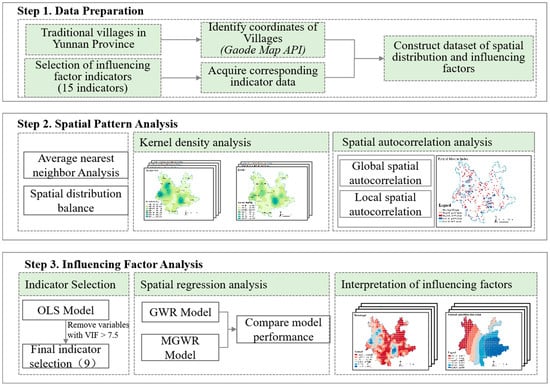
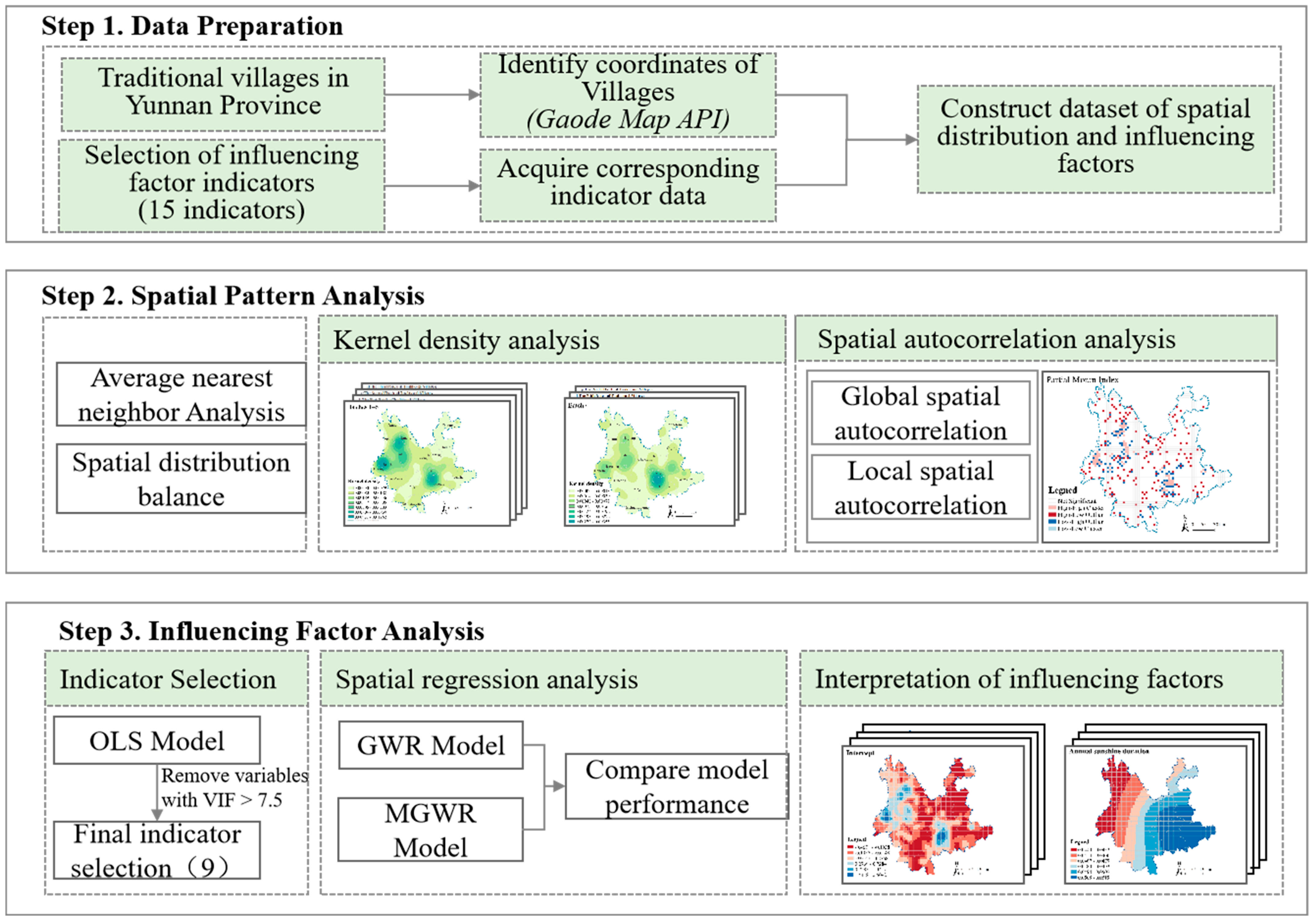
Figure 1 illustrates the overall study framework. First, relevant information on national-level traditional villages in Yunnan Province was collected from the Catalogue of Chinese Traditional Villages, and the spatial coordinates of these villages were obtained using the Gaode Open Platform API. Based on a review of previous studies, the key factors influencing the spatial distribution of traditional villages were identified, and corresponding data were sourced from official channels to construct a comprehensive dataset for analyzing their distribution and underlying drivers in Yunnan.
Figure 1.
Workflow summary.
Second, the spatial distribution patterns and the degree of spatial balance among traditional villages in Yunnan Province were analyzed. Spatial autocorrelation analysis was conducted to assess whether significant spatial clustering or dispersion exists. Subsequently, the Ordinary Least Squares (OLS) method was used for a preliminary examination of the relationships between potential influencing factors and the number of traditional villages within each grid cell. Building on this, the GWR and MGWR models were applied to conduct more detailed spatial regression analyses. By comparing the explanatory power of these models, the most suitable spatial regression model was selected to support an in-depth investigation of the underlying drivers and spatial heterogeneity associated with the distribution of traditional villages in Yunnan Province.
Finally, for those influencing factors that exhibited significant spatial heterogeneity, further detailed analysis and discussion were carried out.
2.1. Study Area
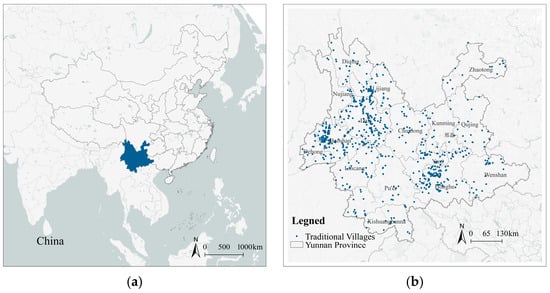
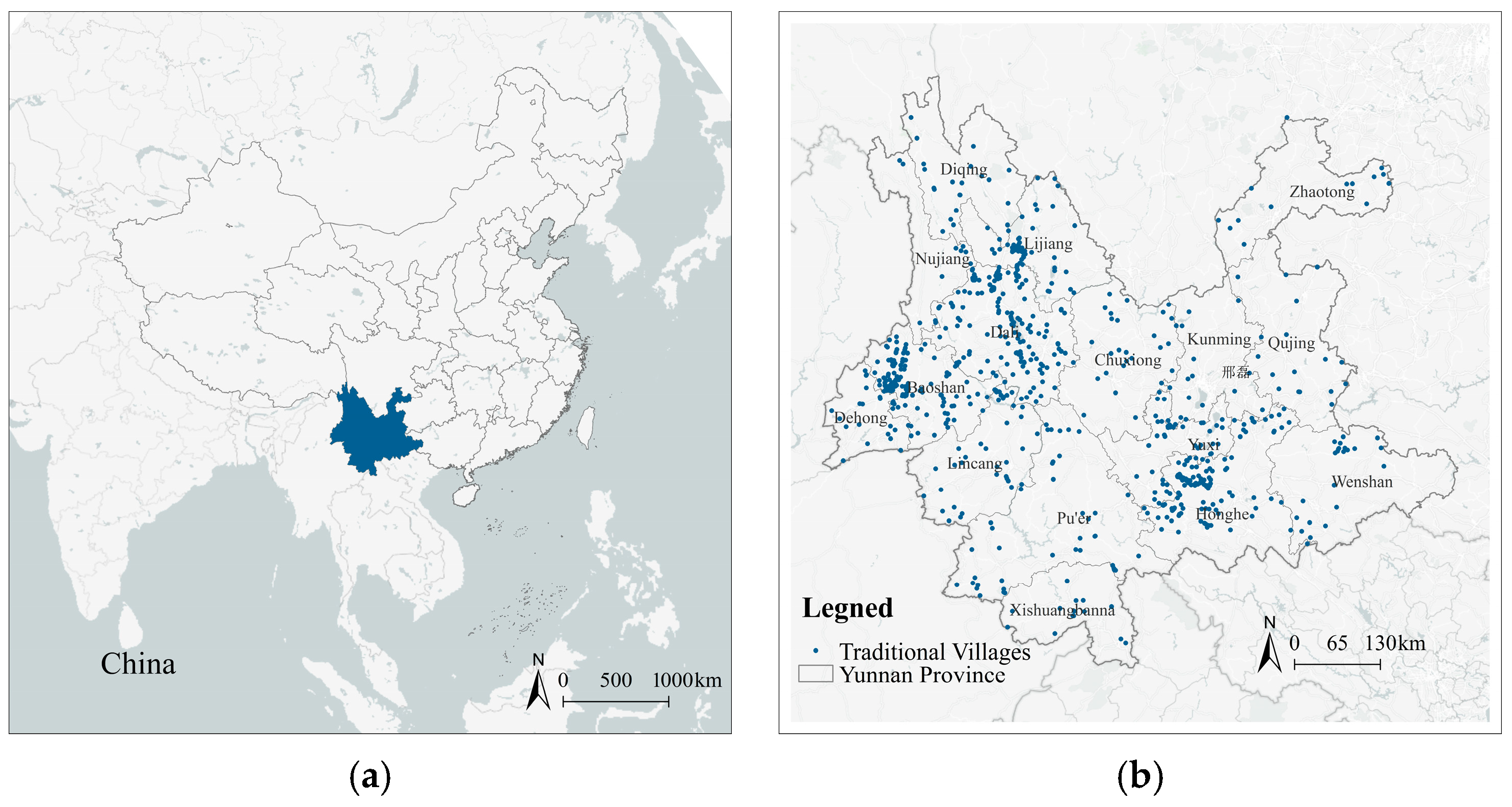
Yunnan Province is located in southwest China, on the southeastern edge of the Qinghai–Tibet Plateau. Its topography is highly diverse, encompassing plateaus, basins, gorges, and mountains. Administratively, Yunnan governs eight autonomous prefectures for ethnic minorities and eight municipal districts. The province is home to 24 ethnic groups, with a complex geographical environment and a rich cultural landscape that has fostered numerous traditional villages with distinct local characteristics (Figure 2).
Figure 2.
Study area (Yunnan Province, China). (a) Location of Yunnan Province in China; (b) Distribution of traditional villages in Yunnan Province. The base map images are from the China Ministry of Natural Resources (http://bzdt.ch.mnr.gov.cn/index.html, accessed on 9 November 2024). The drawing approval number is GS (2016)1593.
Currently, Yunnan hosts 777 national-level traditional villages, ranking first nationwide. Due to Yunnan’s unique geographical conditions, multi-ethnic cultural background, and uneven socioeconomic development, these villages exhibit pronounced regional differentiation. This is reflected in their spatial distribution, landscape forms, and cultural characteristics. These characteristics make Yunnan particularly suitable for in-depth spatial analysis using the MGWR model. Therefore, selecting Yunnan Province as the study area allows this study to uncover regional patterns and influencing factors associated with the spatial distribution of traditional villages.
2.2. Data Sources
The data used in this study primarily include information on traditional villages and a range of influencing factors. A total of 777 traditional villages from the first to the sixth batches of national-level traditional villages in Yunnan Province were selected. Their geographic coordinates were obtained by matching the village names and addresses retrieved from the Gaode Open Platform (https://lbs.amap.com/tools/picker, accessed on 11 December 2024), thereby constructing a spatial vector database of traditional villages in Yunnan.
Given the diversity of factors influencing the distribution of traditional villages, this study, drawing on previous studies [8,12,13,20,21,23], selected 15 variables across five dimensions: traffic accessibility, natural topography, climatic conditions, socioeconomic factors, and historical and cultural factors (Table 1). These variables serve as the independent variables in subsequent analyses to evaluate the degree and spatial heterogeneity of their influence on the distribution of traditional villages.
Table 1.
Data sources and definitions.
Specifically, the data sources for each indicator are as follows: locations of urban centers were obtained via the Gaode Open Platform API; road, railway, and water system data were sourced from OpenStreetMap (OSM); 20-m-resolution elevation data were acquired from the Geospatial Data Cloud; annual sunshine duration, average temperature, and precipitation data were derived from the China Meteorological Elements Annual Spatial Interpolation Dataset; gross domestic product (GDP) and population data were collected from the China GDP Spatial Distribution Kilometer Grid Dataset; ethnic minority population data were obtained from the Seventh National Population Census; and data on national intangible cultural heritage sites and nationally protected cultural heritage units were retrieved from the Global Change Research Data Publishing & Repository.
2.3. Methods
2.3.1. Geographic Grid Analysis
The geographic grid (fishnet) analysis is an effective method for describing, analyzing, and virtually partitioning regional geographic phenomena within a spatial coordinate system [10]. It enables the cross-integration of multi-source spatial data and provides a unified analytical unit and a comparable basis for examining the spatial distribution and driving mechanisms of point vector features such as traditional villages [21].
In this study, the Fishnet tool in ArcGIS was used to partition the administrative base map of Yunnan Province into 3005 square grid cells measuring 12 km × 12 km. Prior to gridding, four candidate resolutions were tested (8 km, 10 km, 12 km, and 15 km) and evaluated against four criteria: (1) average service hinterland and nearest-neighbor proximity of traditional villages; (2) granularity match with multi-source indicator data; (3) accuracy of identifying spatial clustering; and (4) model computational efficiency and convergence stability. The 12 km × 12 km grid was selected as the optimal unit size, balancing spatial heterogeneity representation with data-processing and runtime efficiency. Empirical tests also showed that, at this scale, the MGWR model achieved higher explanatory power and more stable parameter estimates.
2.3.2. Data Processing
During data extraction, this study used the number of nationally designated traditional villages within each grid cell as the dependent variable (count data reflecting spatial density). The independent variables were initially selected from 15 indicators across five dimensions: traffic accessibility, natural topography, climatic conditions, socioeconomic factors, and historical and cultural factors. After multicollinearity testing, 9 core variables were retained for modeling (see Section 3.2.1), namely: distance to the county center, road density, and distance to railway (traffic accessibility); elevation, water-system density, and slope (natural topography); annual sunshine duration (climatic conditions); density of nationally protected cultural heritage units (historical and cultural factors); and GDP (socioeconomic factors). All variables had variance inflation factors below 7.5, indicating no serious multicollinearity. This confirms that incorporating variables from these dimensions does not undermine model stability but instead provides a solid basis for the subsequent multiscale geographically weighted regression (MGWR) analysis.
For variable aggregation, different data types were processed accordingly. Raster data (e.g., elevation, slope, annual sunshine duration) were summarized with ArcGIS “Zonal Statistics as Table” to compute the mean value within each grid. Point and line vector data (e.g., roads, railways, water systems, nationally protected cultural heritage units) were handled using buffer analysis and “Spatial Join” to derive densities or nearest distances. Polygon or attribute data (e.g., GDP) were converted to the grid scale via vector clipping and area-weighted averaging before attribute extraction. To ensure comparability and stable parameter estimation, all variables were subjected to Z-score standardization prior to regression modeling.
2.3.3. Spatial Autocorrelation Analysis
According to the first law of geography, objects that are closer together are more strongly interconnected than those that are farther away [25]. Spatial autocorrelation measures the degree of association between spatial attribute values of different observation units and can be classified into global and local autocorrelation.
Global spatial autocorrelation, represented by Global Moran’s I, describes the overall spatial distribution characteristics of geographic attributes across the entire study area. By calculating the strength of association between spatial objects, it helps determine whether significant spatial distribution patterns exist. The formula is shown in Equation (1):
where represents the Global Moran’s index, is the total number of observation units, and are the numbers of traditional villages in regions and , respectively, is the mean number of villages, and is the element of the spatial weight matrix between regions and .
The value of Global Moran’s I ranges from −1 to 1. A significantly positive value (I > 0, p < 0.05) indicates positive spatial autocorrelation (clustering), whereas a significantly negative value (I < 0, p < 0.05) indicates negative spatial autocorrelation (pronounced heterogeneity). A value near zero suggests no spatial autocorrelation, implying a random distribution.
Local spatial autocorrelation, represented by local indicators of spatial association (LISA), identifies specific local patterns and reveals local distribution characteristics and spatial associations at a finer scale. The formula is shown in Equation (2):
where represents the local Moran’s for region , is the variance of the attribute values, and other symbols follow the definitions above.
2.3.4. Models for Interpreting the Spatial Distribution of Traditional Villages
To comprehensively analyze the factors influencing the spatial distribution of traditional villages in Yunnan Province, this study employed three regression models: OLS, GWR and MGWR.
OLS is a classical global linear regression technique used to explore relationships between dependent and independent variables by minimizing the sum of squared residuals. Its basic form is given in Equation (3):
where denotes the dependent variable of the -th region, represents the value of the -th independent variable for the i-th region, is the global regression coefficient to be estimated, and is the random error term. A fundamental assumption of the OLS model is that the effects of explanatory variables are spatially stationary, meaning that spatial location and distance do not significantly affect the regression parameters. However, many spatial variables exhibit spatial nonstationarity. If the Koenker (BP) test yields p < 0.05, further spatial regression modeling is warranted [26].
To address this limitation, GWR captures local spatial relationships by allowing regression coefficients to vary across space, thereby reflecting spatial nonstationarity more effectively [27]. Its basic form is given in Equation (4):
In the above formula, represents the dependent variable at spatial location , denotes the spatial coordinates of location , is the value of the -th independent variable at location , is the local regression coefficient for each variable, and is the error term. By locally estimating regression coefficients, the GWR model enables a more accurate depiction of spatial variations at a finer scale. Typically, GWR applies a fixed bandwidth to define the spatial neighborhood, assuming that all explanatory variables operate at the same spatial scale. In this study, the performance of different models was evaluated based on the corrected Akaike Information Criterion (AICc) and local R2 values to compare their goodness of fit and explanatory power.
Nevertheless, a major limitation of the GWR model is the assumption that all explanatory variables vary at the same spatial scale, which may not adequately reflect the reality where different variables exhibit heterogeneous spatial scale characteristics. To overcome this limitation, Fotheringham et al. subsequently proposed the MGWR model [28]. The MGWR model independently estimates a bandwidth parameter for each explanatory variable, enabling local estimations at each variable’s optimal spatial scale and providing a more nuanced understanding of multiscale effects. Its basic form is given in Equation (5):
where represents the independently estimated bandwidth for the -th variable, allowing each variable to be analyzed at its most appropriate spatial scale, while the other symbols have the same meanings as in the GWR model.
Additionally, MGWR typically adopts an adaptive kernel, adjusting the number of neighboring observations according to local spatial density to mitigate edge effects and non-uniform sampling [29]. As with GWR, MGWR was evaluated primarily by AICc, supplemented by (adjusted) R2. In our OLS results, the Koenker (BP) test yielded p < 0.01, indicating pronounced spatial nonstationarity. Comparing GWR and MGWR showed that MGWR achieved the lowest AICc and the highest adjusted R2; therefore, MGWR was selected as the primary analytical tool to reveal the multiscale spatial heterogeneity underlying traditional village distribution.
3. Results
3.1. Spatial Distribution Characteristics of Traditional Villages
3.1.1. Spatial Distribution Patterns
Since the release of the first batch of the Catalogue of Chinese Traditional Villages, the number of traditional villages in Yunnan Province has steadily increased with subsequent batches, accompanied by corresponding changes in spatial distribution patterns. We conducted a cumulative analysis of the first to the sixth batches of traditional villages and applied the average nearest-neighbor index to quantitatively assess their spatial distribution characteristics.
The results (Table 2) reveal that, as more villages were included, the nearest neighbor ratio (R) declined from 0.780622 for the first batch to 0.733429 for the sixth batch. All batches exhibited R < 1, indicating that the spatial distribution of traditional villages is clustered. Moreover, the Z-scores for each batch were negative, and their absolute values increased with the number of batches, corroborating an intensified clustering trend. All p-values were <0.001, suggesting that the clustering was highly significant rather than random.
Table 2.
Nearest-neighbor analysis results for traditional villages in Yunnan Province.
3.1.2. Spatial Distribution Balance
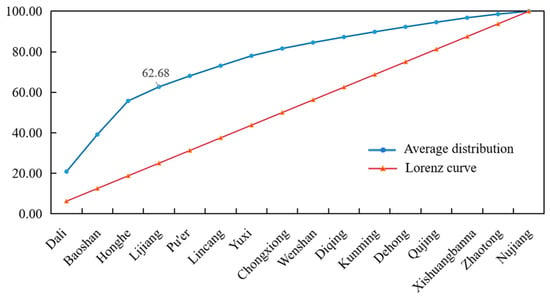
To evaluate the evenness of traditional village distribution across prefecture-level administrative units, we calculated the imbalance index. The value S = 0.497 suggests a relatively pronounced spatial imbalance across Yunnan Province.
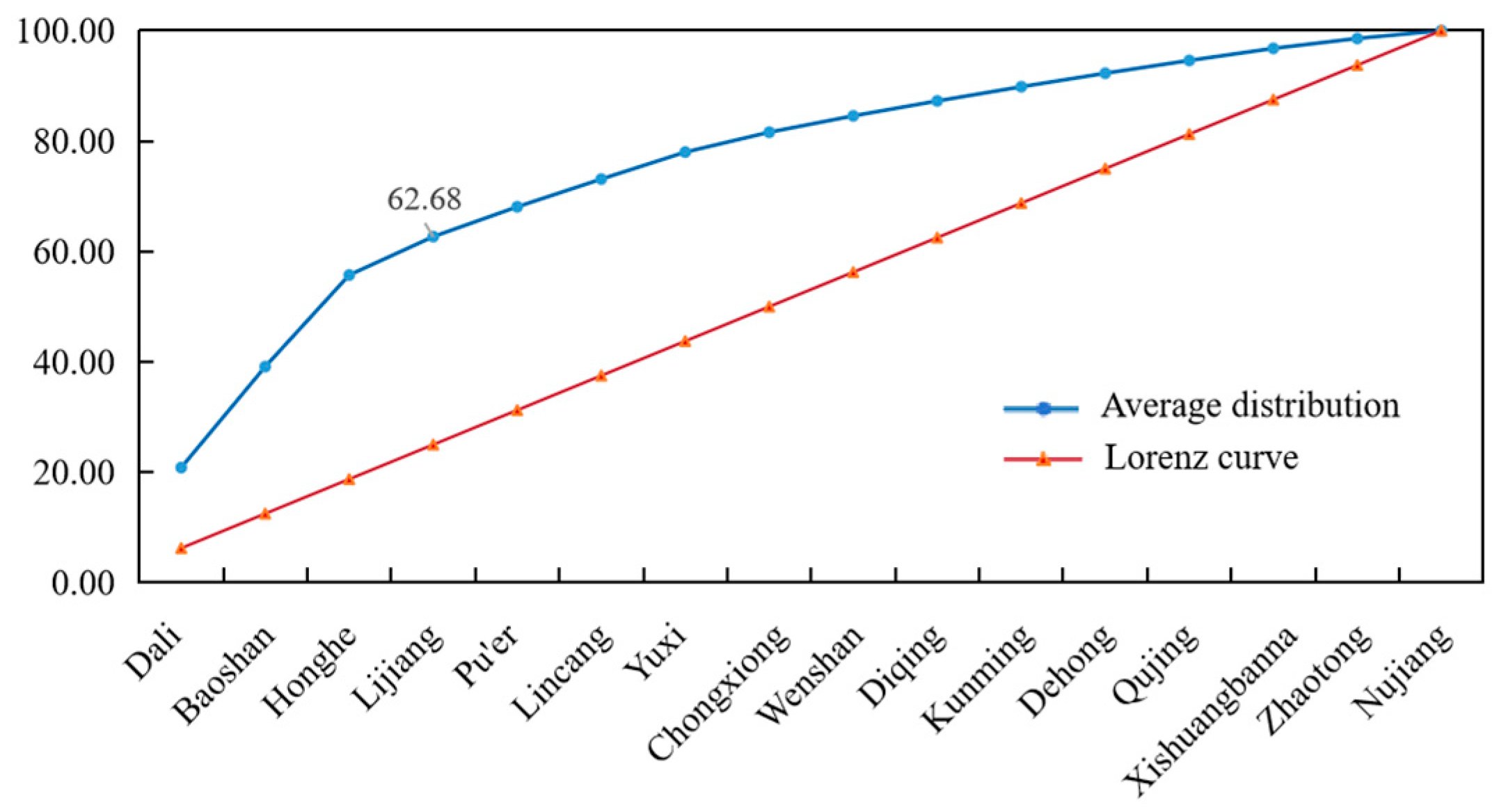
The spatial Lorenz curve further corroborates this conclusion: the actual distribution curve deviates markedly from the ideal average line, exhibiting substantial curvature (Figure 3). This indicates notable regional disparities. Villages are predominantly concentrated in Dali, Baoshan, Honghe, and Lijiang, with these four regions collectively accounting for 62.68% of the province’s total traditional villages. In contrast, other regions contain comparatively fewer villages, indicating a lack of spatial balance.
Figure 3.
The red oblique line in the figure represents the average cumulative distribution of traditional villages in prefecture-level cities of Yunnan Province under ideal conditions, while the blue curve represents the actual cumulative distribution of traditional villages in prefecture-level cities of Yunnan Province.
3.1.3. Spatial Density Characteristics
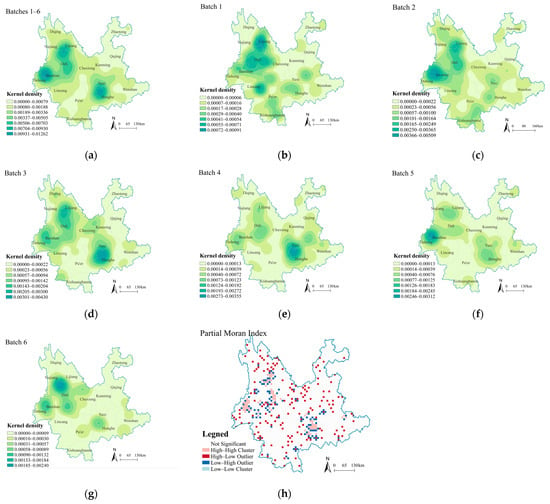
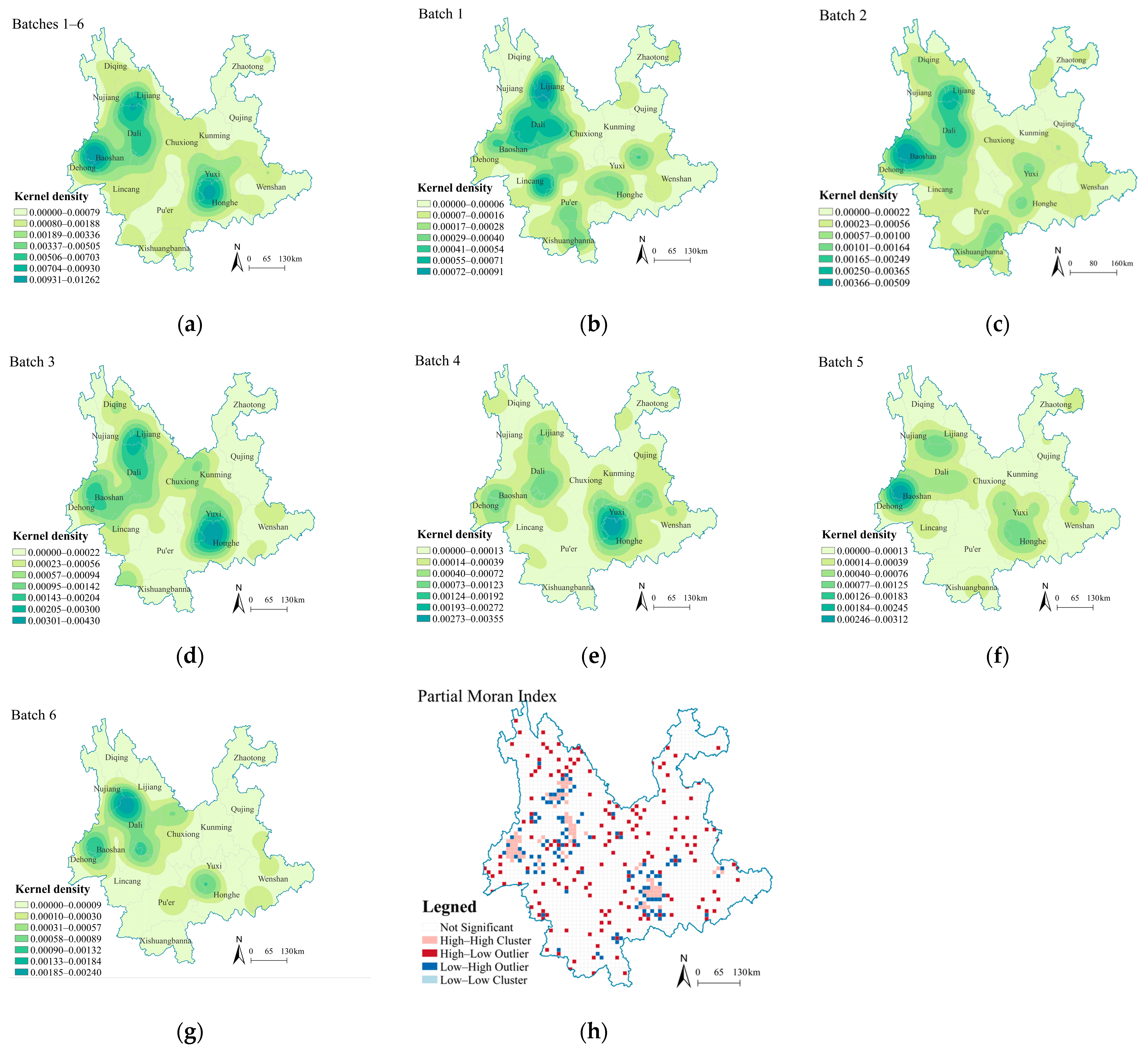
To further investigate spatial density characteristics, we conducted kernel density estimation with a radius of 80 km. The results (Figure 4a) indicate three distinct high-density regions in the northwest, west, and south of the province, while other areas appear more scattered and do not form significant clusters.
Figure 4.
Spatial distribution of traditional villages in Yunnan Province. (a–g) Kernel density distribution maps of the first to sixth batches of traditional villages; (h) LISA cluster and outlier map of traditional villages.
Across batches, several trends are evident. In the first batch, traditional villages were primarily concentrated in the northwest, forming three core clusters in Lijiang, Dali, and southeastern Lincang, with higher densities also observed in parts of Baoshan and Dehong (Figure 4b). In the second batch, beyond the existing clusters in Dali and Lijiang, a new prominent cluster emerged in western Baoshan, while aggregation in Lincang decreased (Figure 4c).
In the third batch, a core cluster further strengthened in northwestern Honghe, and secondary clusters in Dali, Lijiang, and western Baoshan became more prominent (Figure 4d). In the fourth batch, aggregation intensified at the border between Lijiang and Dali, as well as in Baoshan and Honghe, with new dense areas appearing in Yuxi and Wenshan (Figure 4e). The fifth batch showed a further increase in village density in Baoshan and Dehong (Figure 4f). In the sixth batch, Dali, Lijiang, Baoshan, and Dehong continued to maintain high densities, while densities in Pu’er and Yuxi also increased (Figure 4g).
Overall, the evolution of kernel density suggests a gradual expansion of heritage protection efforts. Work initially concentrated in core areas such as Dali, Lijiang, and Baoshan has progressively extended to peripheral areas including Pu’er, Yuxi, Wenshan, and Dehong. This evolution not only encompasses Yunnan’s major ethnic cultural areas but also reflects the ongoing expansion of cultural heritage protection across broader regions.
3.1.4. Results of Spatial Autocorrelation Analysis
To further explore clustering characteristics, we performed global spatial autocorrelation analysis in ArcGIS 10.8. The Global Moran’s I = 0.3108, with Z = 23.134 (p = 0.000), far exceeding the critical value of 2.58, indicating highly significant positive spatial autocorrelation; traditional villages tend to cluster rather than distribute randomly.
Based on the global results, we further plotted a local indicators of spatial association (LISA) cluster map (Figure 4h) to reveal local patterns. High–high clusters are mainly located in Dali, Lijiang, Baoshan, and western Honghe, where village density is well above the provincial average. Low–high clusters appear around the peripheries of these high–high areas. High–low clusters indicate local areas where village density is high but surrounded by relatively low-density regions. No significant low–low clusters were detected, suggesting that although some regions have relatively low village densities, there is no widespread pattern of low-density clustering; at the provincial scale, the distribution tends to exhibit continuity and aggregation.
3.2. Influencing Factors of Traditional Village Spatial Distribution
3.2.1. Variable Selection and Model Comparison
To investigate the relationships between the spatial distribution of traditional villages and potential drivers in Yunnan Province, we employed three regression models: OLS, GWR, and MGWR.
First, OLS was used for a preliminary regression between the number of traditional villages per grid cell and candidate indicators to screen significant variables. Variance inflation factors (VIFs) were then computed to diagnose multicollinearity; indicators with VIF > 7.5 were removed. Nine variables were retained for spatial regression: distance to the county center, road density, distance to railway, slope, elevation, annual sunshine duration, GDP, water system density, and density of nationally protected cultural heritage units.
In the refined OLS, all VIFs were below 7.5, indicating no serious multicollinearity. The Koenker (BP) test was significant (p < 0.001), suggesting heteroskedasticity and spatial nonstationarity. Residuals also exhibited strong spatial autocorrelation (Moran’s I = 0.244; Z = 7.97; p < 0.001), implying that OLS failed to capture spatial dependence and motivating spatial regression (Table 3).
Table 3.
Summary of OLS results (model variables).
GWR allows coefficients to vary by location and thus better reveals spatial heterogeneity, yielding a higher adjusted R2 than OLS. However, because GWR uses a single bandwidth for all variables, it cannot fully characterize multiscale processes. MGWR overcomes this by estimating an optimal bandwidth for each variable, allowing effects to operate at their own spatial scales and providing a finer depiction of spatial heterogeneity.
Model comparison (Table 4) shows that MGWR achieves the lowest AICc and highest (adjusted) R2, outperforming OLS and GWR. Considering explanatory power, spatial sensitivity, and multiscale adaptability, MGWR was selected as the primary analytical tool for this study.
Table 4.
Comparison of model performance.
Model comparison (Table 4) shows clear performance gains: MGWR increases R2 from 0.092 (OLS) and 0.255 (GWR) to 0.555, while reducing AICc from 7132.17 and 6989.96 to 6675.56. Importantly, MGWR does more than improve model fit; by estimating variable-specific bandwidths it separates drivers into global, regional, and local scales, providing a direct basis for zoning-based, regionally differentiated conservation strategies. These improvements indicate that allowing variable-specific spatial scales substantially enhances model sensitivity, so MGWR was adopted as the main analytical tool in this study.
3.2.2. Spatial Heterogeneity Analysis of Traditional Village Distribution
The results indicate that the effects of different factors on the spatial distribution of traditional villages are markedly heterogeneous. By assigning variable-specific bandwidths, the MGWR model gauges the spatial scale at which each indicator operates, thereby revealing how its influence varies spatially. In this context, bandwidth reflects the spatial extent of a variable’s effect: a larger bandwidth implies a more global, relatively uniform influence (weaker spatial heterogeneity), whereas a smaller bandwidth indicates localized effects with stronger spatial variation.
As shown in Table 5, bandwidths differ notably across variables. Distance to railway, annual sunshine duration, and GDP each have a bandwidth of 3005 (i.e., the total number of grid cells), indicating spatially uniform, global-scale influences with limited heterogeneity across Yunnan. In contrast, intercept, road density, slope, and density of nationally protected cultural heritage units exhibit much smaller bandwidths, reflecting pronounced spatial heterogeneity and location-varying effects. Water system density shows an intermediate bandwidth (1600), suggesting moderate regional heterogeneity.
Table 5.
Summary of MGWR model bandwidths.
Notably, although distance to the county center and elevation were statistically significant in the OLS model (p < 0.05), their local coefficients in MGWR were non-significant at all locations (share of significant locations = 0%). This indicates that, while these variables may exert a stable overall association, they lack meaningful spatial variation in their effects and therefore have no spatial explanatory power within the MGWR framework.
3.2.3. Influencing Factors Interpretation
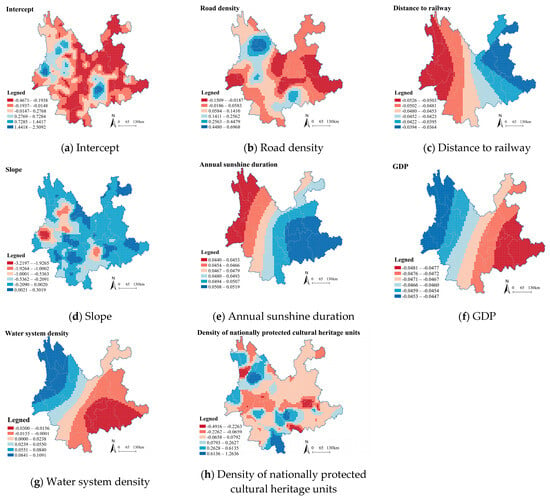
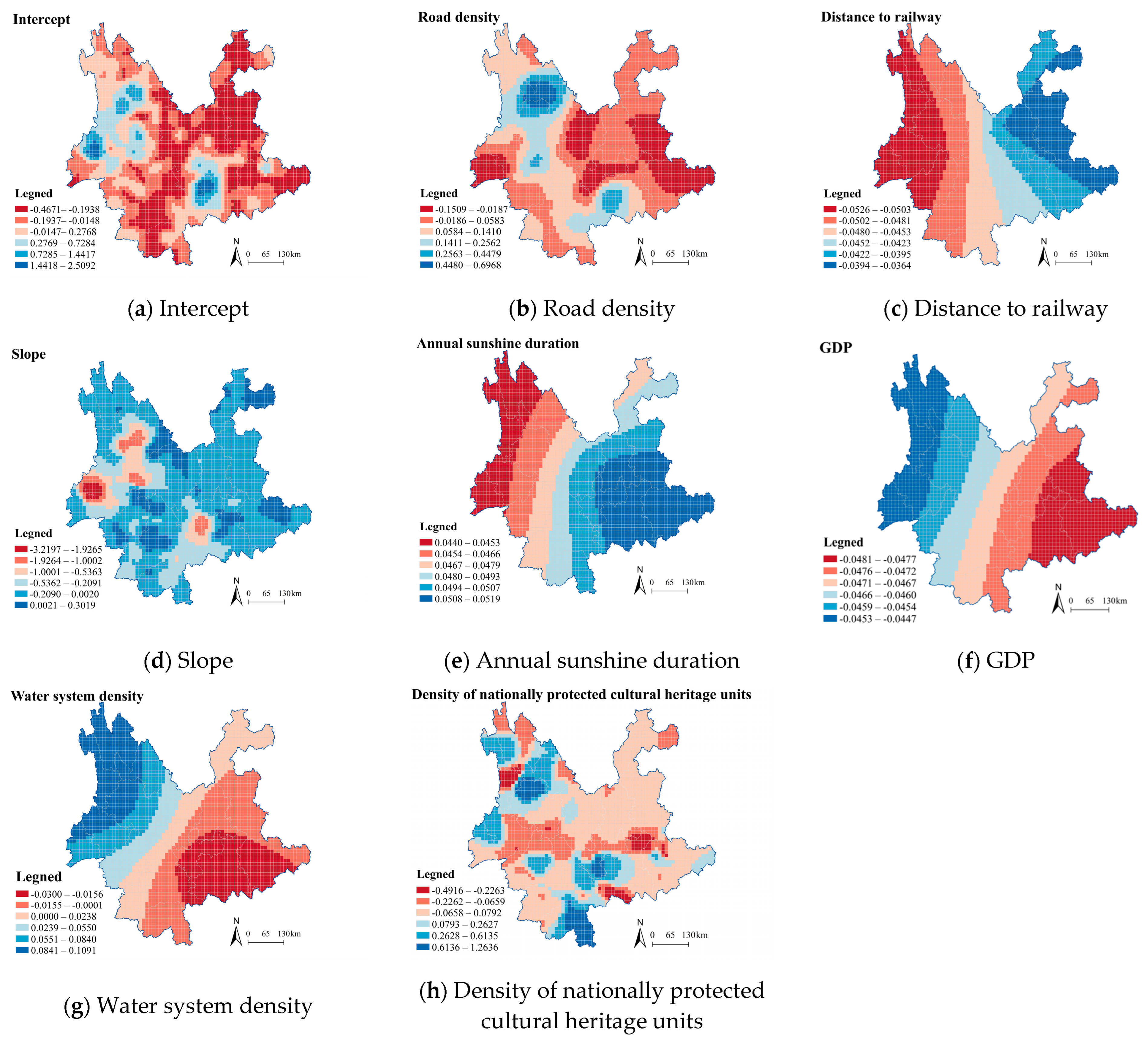
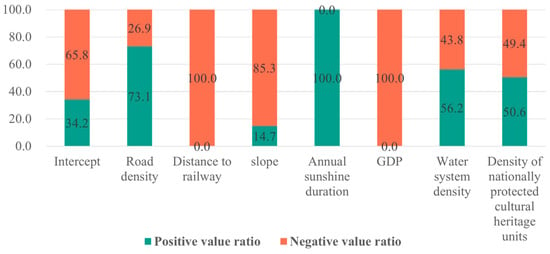
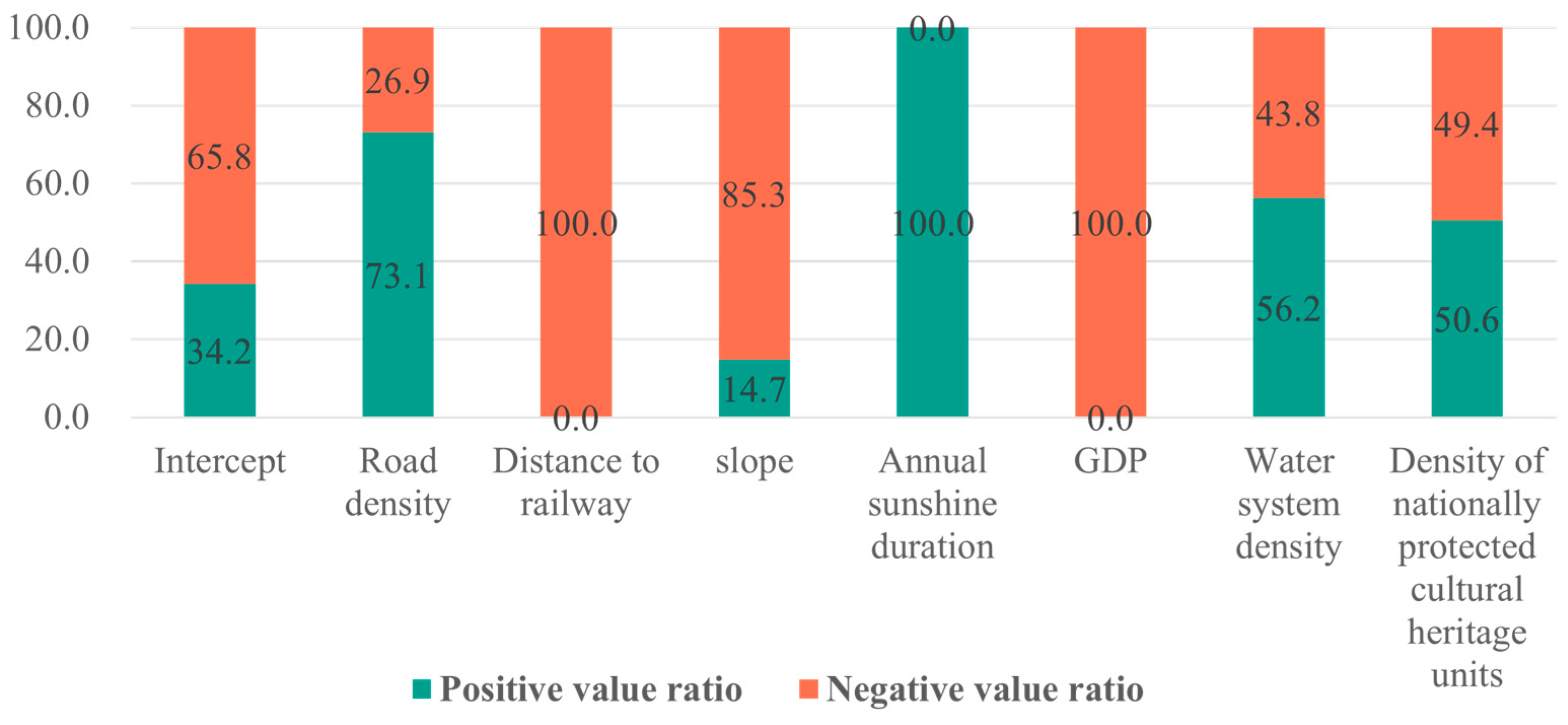
Spatial factor. In the MGWR model, the intercept term reflects the combined influence of underlying spatial factors. The spatial distribution of its regression coefficients is shown in Figure 5a. The results indicate that 65.8% of the grid cells exhibit negative intercept coefficients, while 34.2% exhibit positive coefficients (Figure 6). Positive areas are concentrated in Lijiang, Dali, Baoshan, and Honghe, broadly matching the high-density clusters identified by the kernel density analysis, suggesting that intrinsic spatial attributes in these regions favor the emergence and persistence of traditional villages. By contrast, the widely distributed negative areas indicate spatial conditions less conducive to village presence. Overall, the intercept surface shows clear provincial-scale differentiation in both direction and magnitude, revealing a tendency toward spatial polarization.
Figure 5.
Spatial distribution of regression coefficients for influencing factors based on the MGWR model.
Figure 6.
Proportion of positive and negative regression coefficients for influencing factors of traditional village spatial distribution in Yunnan Province.
Road density factor. As shown in Figure 5b, the impact of road elements on the spatial distribution of traditional villages exhibits significant spatial heterogeneity. Approximately 73.1% of the grid cells have positive regression coefficients, while 26.9% show negative coefficients (Figure 6). Negative coefficients are primarily concentrated in eastern and southern Yunnan, such as Kunming, Qujing, and Yuxi, where higher road density and improved transportation accessibility may have accelerated urbanization and land development processes, thereby negatively impacting the protection and continuity of traditional villages.
In contrast, positive coefficients are found in northwestern regions such as Dali, Lijiang, and Nujiang, indicating a positive correlation between road improvement and the number of traditional villages. This contrast suggests that while transportation convenience is generally associated with adverse effects on traditional village preservation [30], in areas dominated by cultural tourism, such as Dali and Lijiang, transportation improvements have instead facilitated the protection and revitalization of traditional villages. These regions have capitalized on their rich ethnic cultural resources by incorporating traditional villages into tourism and heritage conservation systems, thus forming a “protective development” model. Improvements in transportation infrastructure have improved the accessibility and economic vitality of these villages, contributing to the sustained preservation of their authentic cultural landscapes.
Distance to railway factor. Figure 5c shows uniformly negative railway coefficients across the province, implying that railway development generally suppresses traditional village distribution. Although spatial heterogeneity is modest, the magnitude of negative effects declines from west to east. These findings suggest that western concentration zones such as Dali and Baoshan experience stronger suppression, suggesting potential conflicts between railway-induced accessibility and village preservation. Likely mechanisms include land acquisition, population displacement, and rail-driven urban expansion, which together threaten protection and long-term sustainability [20].
Slope factor. Based on the spatial distribution of the regression coefficients for the slope element (Figure 5d), this study finds that the impact of slope on the distribution of traditional villages exhibits significant spatial heterogeneity. Only 14.7% of the grid cells show positive coefficients, while 85.3% show negative coefficients (Figure 6), indicating that in most regions, slope negatively affects the spatial distribution of traditional villages. Even in core concentration areas (Dali, Lijiang, Honghe), coefficients remain strongly negative, implying that villages preferentially occupy gentler micro-topographies, reflecting adaptive site selection to local terrain. This aligns with prior evidence that most traditional villages occur on slopes < 10°, with village counts declining as slopes steepen [18]. Slope thus emerges as a key topographic constraint: gentler terrain reduces construction costs and facilitates daily production and living, making it a preferred condition for siting [31].
Annual sunshine duration factor. Figure 5e maps the regression coefficients for annual sunshine duration. All coefficients are positive across Yunnan, indicating that longer sunshine generally promotes the distribution of traditional villages. Coefficients increase from northwest to southeast, implying greater sensitivity to sunshine in the southeast. By contrast, in northwestern cores such as Dali and Lijiang, where villages are most concentrated, sunshine coefficients are relatively lower, suggesting it is not the primary control on village distribution there. Although southeastern Yunnan has fewer villages overall, its higher coefficients indicate clear spatial heterogeneity in sunshine effects on siting. This likely relates to the southeast’s lower elevations, warm–humid climate, and ample insolation, which favor light-sensitive crops (e.g., rice, tea) and make sunlight a stronger siting consideration. In the high-elevation, rugged northwest, sunshine is generally adequate, but site selection appears more constrained by topographic factors such as water availability and slope, so sunlight plays a relatively weaker role.
GDP factor. Figure 5f shows negative coefficients province-wide, indicating that stronger economic development tends to suppress the distribution of traditional villages. The magnitude of this suppression intensifies toward the east and south (larger absolute values), where economic growth is higher. Likely mechanisms include accelerated urban construction, village demolition/modernization, out-migration, and land-use change, which together erode village sustainability. In contrast, although Dali and Lijiang are relatively developed, they have leveraged tourism and ethnic cultural resources to build protective mechanisms that mitigate GDP-related pressures on village survival and continuity.
Water system density factor. The spatial distribution of regression coefficients for the water system density element (Figure 5g) reveals significant regional variations in the influence of water resources on traditional village distribution. About 56.2% of the grid cells exhibit positive coefficients, while 43.8% show negative coefficients (Figure 6), indicating a dual role whereby water resources can both facilitate and inhibit village distribution. In northwestern Yunnan, higher positive coefficients suggest that stable water supplies have strongly supported agriculture and daily life, fostering population clustering and village development [13,32]. In the southeast, coefficients are lower or negative, indicating weaker or even suppressive effects. Complex terrain, uneven water availability, poor water quality, and intensive development near water bodies likely weaken the traditional relationship between water and settlement.
Density of nationally protected cultural heritage units factor. The spatial distribution of regression coefficients for the density of nationally protected cultural heritage units (Figure 5h) reveals significant spatial variation in their influence on the distribution of traditional villages. Approximately 50.6% of the grid cells exhibit positive coefficients, while 49.4% show negative coefficients (Figure 6), indicating a relatively balanced dual effect.
Negative coefficients occur where heritage-unit density is high, suggesting that tourism pressures, planning controls, or related activities may constrain the presence of traditional villages. In contrast, positive coefficients indicate that in areas with lower heritage-unit density, village distribution faces fewer constraints. This may reflect scattered heritage layouts, limited protection coverage, or a weaker spatial guidance effect that does not significantly promote clustering. Overall, although heritage units contribute positively to village distribution in certain regions, the aggregate effect remains uneven across areas. This highlights the need to strengthen protection intensity and enhance spatial linkages between heritage units and traditional villages.
4. Conclusions and Recommendations
4.1. Conclusions
Drawing on 777 national-level traditional villages in Yunnan Province, this study combined geographic grid analysis, spatial autocorrelation, and MGWR to characterize spatial patterns and identify their drivers. The main conclusions are detailed below.
- (1)
- Traditional villages display significant spatial clustering with a highly uneven distribution. Approximately 62.68% are concentrated in Dali, Baoshan, Honghe, and Lijiang, forming distinct high-density cores. Other regions are comparatively sparse, yielding a typical spatial pattern of “concentrated distribution with localized clustering”.
- (2)
- The spatial distribution shows strong positive spatial autocorrelation and an overall tendency of “more in the northwest, fewer in the southeast, dense in mountainous areas,” concentrated in northwestern Yunnan and plateau mountain regions. Clustering is not random but reflects the combined effects of natural geographic and socioeconomic factors, with marked spatial heterogeneity. MGWR further distinguishes variables with relatively stable, province-wide effects (distance to railway, annual sunshine duration, and GDP) from those with clearly local, context-dependent effects (road density, slope, water-system density, and the density of nationally protected cultural heritage units). By contrast, distance to the county center and elevation, which are often assumed to be key siting constraints, are significant in the global OLS model but show no spatially significant coefficients in the MGWR results, acting more as background conditions than as spatially differentiating drivers.
- (3)
- Natural geographic factors are the dominant associated factors of the spatial distribution of traditional villages in Yunnan. Comparing standardized regression coefficients indicates that sunshine duration and water availability exhibit stronger positive associations with village distribution, underscoring their leading roles in village presence. In particular, favorable sunshine conditions and water availability are strongly associated with a higher presence of traditional villages, providing supportive environmental foundations for settlement persistence [12]. Traditional villages are typically distributed along river systems [33], yet they usually maintain an appropriate distance from rivers to reduce flood risks while ensuring convenient access to water resources [13]. MGWR also reveals that the effect of slope is not spatially uniform: although slope is generally negatively associated with village presence across most of the province, small pockets of relatively level high-altitude areas (e.g., Dali and Lijiang) show positive slope coefficients, suggesting that the gently inclined highland terrain there is associated with higher village presence and long-term persistence of traditional villages [20].
- (4)
- Socioeconomic development and transportation factors exert secondary influences, generally displaying a negative correlation with traditional village distribution. Areas with higher levels of economic development and more convenient transportation tend to experience a decline in the number of traditional villages, largely due to the accelerated processes of urbanization and modernization [34]. Conversely, economically underdeveloped and less accessible areas, owing to lower external disturbances, are more favorable for the preservation of the authenticity and cultural heritage of traditional villages [13]. MGWR clarifies that this influence is spatially differentiated: distance to railway and GDP act as broadly suppressive factors at the provincial scale, whereas the impact of road density reverses from negative in many eastern and southern cells to positive in tourism-oriented regions such as Dali and Lijiang, where improved road access supports heritage-based revitalization rather than loss. This pattern highlights how local development models and policy orientations condition the relationship between infrastructure expansion and traditional village survival.
- (5)
- Historical and cultural factors, represented by the presence of nationally protected cultural heritage units, have a mixed but spatially structured effect on the distribution of traditional villages. Regions with dense clusters of heritage units tend, in some cases, to have fewer traditional villages, reflecting potential pressures from tourism development and planning controls, whereas in other areas, heritage units and villages co-cluster, indicating a positive guiding role of heritage protection policies. Overall, the MGWR results point to substantial regional variation in how heritage resources shape village patterns, suggesting that the strength and spatial reach of protection efforts still have room for improvement [30].
4.2. Recommendations
Based on the identified spatial patterns and driving forces of traditional village distribution in Yunnan, we propose the following targeted strategies for protection and development.
Firstly, establish a regionally classified and hierarchical protection mechanism. Given that approximately 62.68% of villages are concentrated in Dali, Baoshan, Honghe, and Lijiang, prepare comprehensive conservation plans for these high-density areas, set clear protection priorities, and build a cluster-based protection network [8]. For isolated and scattered villages, especially in southern Yunnan and other remote areas, adopt point-based strategies supported by preferential policies, dedicated funding, and scientifically guided planning to ensure effective safeguarding of cultural heritage [35,36].
Secondly, strengthen the integration and coordinated protection of traditional villages with surrounding cultural heritage resources. The results indicate that interactions between transportation and heritage resources significantly affect village distribution. Build regional collaborative protection systems such as traditional village corridors and cultural landscape belts, and leverage exhibitions, exchanges, and immersive activities to promote deep integration of culture and tourism and sustain living heritage practices [37].
Thirdly, formulate coordinated guidelines that align transportation development with cultural conservation. As transportation development is associated with village decline in certain areas, project design and construction should incorporate ecological safeguards and cultural sensitivity to avoid disrupting village spatial structures and landscapes. In tourism-driven regions such as Dali and Lijiang, improvements to transport facilities should be leveraged to support conservation and revitalization.
Fourthly, reinforce ecological protections that underpin village sustainability. Water sources, forests, and terraced fields are critical to village formation and development [8]. Expand ecological compensation policies, protect surrounding natural resources, and ensure that new rural construction and rural tourism jointly prioritize ecological safety and cultural conservation to achieve coordinated benefits across ecology, economy, and culture.
Fifthly, pursue diversified and sustainable development pathways, especially in economically underdeveloped and less accessible areas. Promote ecological agriculture, traditional handicrafts, rural homestays, and cultural tourism to increase household income. Encourage the transmission and innovation of local crafts and intangible cultural heritage to strengthen endogenous development capacity.
Finally, improve dynamic monitoring and management for village protection. Employ remote sensing, big data, and artificial intelligence to establish real-time monitoring and early-warning systems that enhance the precision and effectiveness of conservation measures [38,39]. Conduct timely surveys and recognition for historically and culturally valuable villages not yet included in national lists, expand the scope of protection, and prevent the loss of cultural resources.
In summary, the study objectives were achieved: spatial statistical analyses characterized the clustered distribution of catalogued traditional villages; MGWR captured the multiscale and spatially heterogeneous effects of key drivers; and the resulting evidence was translated into targeted recommendations for conservation and sustainable development.
4.3. Limitations
Institutional bias in sample selection. This study takes as its sample the 777 national-level traditional villages in Yunnan listed in the first six batches of the Catalogue of Chinese Traditional Villages. The catalogue is formed under a national evaluation index system combined with local government nomination, which tends to favor “representative” villages with strong historical and cultural symbolism, better conservation foundations, and higher public visibility. Some smaller settlements that possess vernacular value but have not yet been systematically identified may not be included. Therefore, the spatial pattern revealed in this paper reflects the distribution of traditional villages already included in the national catalogue rather than the complete distribution of all potential traditional villages. The MGWR estimates reported here should thus be interpreted as capturing the combined associations of long-term environmental suitability, village persistence, and institutional selection, rather than as a strict decomposition of these processes.
Limitations on external generalization. Yunnan exhibits pronounced regional particularities in terms of natural geography, multi-ethnic settlement patterns, and uneven economic development, and some of the mechanisms identified in this study are highly place-specific. When applying or generalizing these conclusions to other provinces or countries, it is necessary to fully consider local socio-cultural and institutional contexts and to avoid simple analogies.
4.4. Future Work
Future research could explicitly separate the mechanisms of environmental suitability, village persistence, and institutional selection by comparing nationally listed traditional villages with non-listed historical settlements. In addition, future work will explore the application of the same geographic grid-based MGWR framework to other provinces and larger regions, with grid size and indicator selection adjusted to local data conditions and settlement systems, in order to assess the transferability of the approach.
Supplementary Materials
The following supporting information can be downloaded at: https://www.mdpi.com/article/10.3390/buildings16020295/s1.
Author Contributions
Conceptualization, X.Y.; methodology, X.Y. and X.H.; software, S.H. and X.H.; validation, S.H. and X.H.; formal analysis, X.Y.; investigation, X.Y. and S.H.; resources, X.Y.; data curation, B.K.; writing—original draft preparation, X.Y.; writing—review and editing, B.K.; visualization, X.Y. and S.H.; supervision, B.K.; project administration, B.K.; funding acquisition, X.Y. All authors have read and agreed to the published version of the manuscript.
Funding
This study was funded by the Yunnan Fundamental Research Projects (Grant No. 202501AT070427).
Data Availability Statement
The data used in this study are publicly available from the Catalogue of Chinese Traditional Villages and other open platforms as cited. The dataset of the 777 traditional villages compiled/used in this study is provided in the Supplementary Materials. Further details are available from the corresponding author upon reasonable request.
Acknowledgments
The authors acknowledge the valuable contributions of all co-authors to the development, analysis, and writing of this manuscript.
Conflicts of Interest
The authors declare no conflicts of interest.
Abbreviations
The following abbreviations are used in this manuscript:
| MGWR | Multiscale geographically weighted regression |
| GWR | Geographically weighted regression |
| OLS | Ordinary Least Squares |
| GDP | Gross domestic product |
| OSM | OpenStreetMap |
| AICc | Corrected Akaike Information Criterion |
| LISA | Local Indicators of Spatial Association |
| VIF | Variance Inflation Factor |
References
- Wang, X.; Zhu, Q. Influencing Factors of Traditional Village Protection and Development from the Perspective of Resilience Theory. Land 2022, 11, 2314. [Google Scholar] [CrossRef] [Scilit]
- Wang, P.J.; Zhang, J.H.; Sun, F.; Cao, S.S.; Kan, Y.; Wang, C.; Xu, D. Spatial Distribution and Impact Mechanism of Traditional Villages in Southwest China. Econ. Geogr. 2021, 41, 204–213. [Google Scholar] [CrossRef]
- Lu, Y.; Ahmad, Y. Heritage Protection Perspective of Sustainable Development of Traditional Villages in Guangxi, China. Sustainability 2023, 15, 3387. [Google Scholar] [CrossRef] [Scilit]
- Cao, Y.; Zhang, Y. Appraisal and Selection of “Chinese Traditional Villages” and a Study on Their Spatial Distribution. Archit. J. 2013, 12, 44–49. [Google Scholar]
- Li, W.; Zhang, X.; Zhang, H. Value Orientation of Traditional Village Protection Reflected in the Selection Indicators of Chinese Traditional Villages. Urban Dev. Stud. 2024, 31, 82–90. [Google Scholar]
- Huang, T.W.; Zhang, D.Y. Research on the Evolution of Selection Indicators and Value Assessment of Chinese Traditional Villages. City Plan Rev. 2022, 46, 72–77. [Google Scholar]
- Ma, H.; Tong, Y. Spatial Differentiation of Traditional Villages Using ArcGIS and GeoDa: A Case Study of Southwest China. Ecol. Inform. 2022, 68, 101416. [Google Scholar] [CrossRef] [Scilit]
- Ma, Y.; Zhang, Q.; Huang, L. Spatial Distribution Characteristics and Influencing Factors of Traditional Villages in Fujian Province, China. Humanit. Soc. Sci. Commun. 2023, 10, 883. [Google Scholar] [CrossRef] [Scilit]
- Zhang, Y.; Han, N.; Zhang, B.; Lu, C.; Yang, M.; Zhai, F.; Li, H. Spatial and Temporal Distribution Characteristics and Evolution of Traditional Villages in the Qihe River Basin of China. Sci. Rep. 2025, 15, 10077. [Google Scholar] [CrossRef] [Scilit]
- Li, J.S.; Wang, X.R.; Li, X.J. Spatial Distribution Characteristics and Influencing Factors of Chinese Traditional Villages. Econ. Geogr. 2020, 40, 143–153. [Google Scholar] [CrossRef]
- Jiangcuo, T. Spatial Distribution Characteristics of Ethnic Traditional Villages Based on Schema Language. Acad. J. Humanit. Soc. Sci. 2022, 5, 45–49. [Google Scholar] [CrossRef] [Scilit]
- Yang, G.; Wu, L.; Xie, L.; Liu, Z.; Li, Z. Study on the Distribution Characteristics and Influencing Factors of Traditional Villages in the Yunnan, Guangxi, and Guizhou Rocky Desertification Area. Sustainability 2023, 15, 14902. [Google Scholar] [CrossRef] [Scilit]
- Su, H.; Wang, Y.; Zhang, Z.; Dong, W. Characteristics and Influencing Factors of Traditional Village Distribution in China. Land 2022, 11, 1631. [Google Scholar] [CrossRef] [Scilit]
- Zhang, C.; Xiong, W.; Shao, T.; Zhang, Y.; Zhang, Z.; Zhao, F. Analyses of the Spatial Morphology of Traditional Yunnan Villages Utilizing Unmanned Aerial Vehicle Remote Sensing. Land 2023, 12, 2011. [Google Scholar] [CrossRef] [Scilit]
- Zhang, J.; Zhang, R.; Li, Q.; Zhang, X.; He, X. Spatial Sifferentiation and Differentiated Development Paths of Traditional Villages in Yunnan Province. Land 2023, 12, 1663. [Google Scholar] [CrossRef] [Scilit]
- Tao, G.; Li, X.; Tian, S.; Li, H.; Song, Y. Influence of Human Settlements Factors on the Spatial Distribution Patterns of Traditional Villages in Liaoning Province. Humanit. Soc. Sci. Commun. 2024, 11, 1757. [Google Scholar] [CrossRef] [Scilit]
- Jin, J.; Yan, H. Analyzing the Causes of Spatial Differentiation of the Traditional Villages in Gansu Province, Western China. GEP 2020, 8, 12–25. [Google Scholar] [CrossRef]
- Liu, S.; Li, X.; Lin, Q.; Qiu, J. Spatial Distribution of Ethnic Villages in the Mountainous Region of Northwest Yunnan and Their Relationship with Natural Factors. Sustainability 2023, 15, 12307. [Google Scholar] [CrossRef] [Scilit]
- Yang, Y.; Hu, J.; Liu, D.J.; Li, Y.J.; Chen, Y.; Hu, S.L. Spatial Differentiation of Ethnic Traditional Villages in Guizhou Province and the Influencing Factors. J. Arid Land Resour. Environ. 2022, 36, 178–185. [Google Scholar] [CrossRef]
- Niu, Y.; Wang, Y. Spatial Differentiation Patterns of Traditional Villages in Taihang Mountain Area and Influencing Mechanisms: A MGWR Model Based Analysis. J. Arid Land Resour. Environ. 2024, 38, 87–96. [Google Scholar]
- He, X.Q.; Li, F.; Gao, J.B.; Leica, B. Spatial Distribution and Influencing Factors of Chinese Traditional Villages Based on Geographic Grid. Sci. Geogr. Sin. 2024, 44, 995–1004. [Google Scholar] [CrossRef]
- Zhang, L.; Sun, J.; Deng, L.; Luo, J.; Tian, Y. Characteristics of Multi-Scale Spatiotemporal Pattern and Influencing Factors of Chinese Traditional Villages. Res. Soil Water Conserv. 2025, 32, 321–330. [Google Scholar] [CrossRef]
- Fang, Y.; Lu, H.; Huang, Z.; Zhu, Z. Spatiotemporal Distribution of Chinese Traditional Villages and Its Influencing Factors. Econ. Geogr. 2023, 43, 187–196. [Google Scholar] [CrossRef]
- Ge, C.; Wang, Y.; Zhou, D. Research on the Spatial Distribution Characteristics and Influencing Factors of Traditional Villages in Yunnan Province. J. Guizhou Univ. (Nat. Sci.) 2022, 39, 97–104. [Google Scholar] [CrossRef]
- Tobler, W.R. A Computer Movie Simulating Urban Growth in the Detroit Region. Econ. Geogr. 1970, 46, 234–240. [Google Scholar] [CrossRef] [Scilit]
- Finley, A.O. Comparing Spatially-varying Coefficients Models for Analysis of Ecological Data with Non-stationary and Anisotropic Residual Dependence. Methods Ecol. Evol. 2011, 2, 143–154. [Google Scholar] [CrossRef] [Scilit]
- Brunsdon, C.; Fotheringham, A.S.; Charlton, M.E. Geographically Weighted Regression: A Method for Exploring Spatial Nonstationarity. Geogr. Anal. 1996, 28, 281–298. [Google Scholar] [CrossRef] [Scilit]
- Fotheringham, A.S.; Yang, W.; Kang, W. Multiscale Geographically Weighted Regression (MGWR). Ann. Am. Assoc. Geogr. 2017, 107, 1247–1265. [Google Scholar] [CrossRef] [Scilit]
- Han, X.; Wang, L.; He, J.; Jung, T. Restorative Perception of Urban Streets: Interpretation Using Deep Learning and MGWR Models. Front. Public Health 2023, 11, 1141630. [Google Scholar] [CrossRef] [Scilit]
- Bian, J.; Chen, W.; Zeng, J. Spatial Distribution Characteristics and Influencing Factors of Traditional Villages in China. Int. J. Environ. Res. Public Health 2022, 19, 4627. [Google Scholar] [CrossRef] [Scilit]
- Hu, J.L.; Teng, Y.B.; Fan, Y.M.; Li, L.P. Spatial Distribution and Influencing Factors of Traditional Villages in Guangxi Zhuang Autonomous Region. J. Guilin Univ. Technol. 2021, 41, 580–588. [Google Scholar]
- Gong, G. Analysis of the Spatial Distribution and Influencing Factors of China National Forest Villages. Environ. Monit. Assess. 2022, 194, 428. [Google Scholar] [CrossRef] [Scilit]
- Fang, Y.; Ceola, S.; Paik, K.; McGrath, G.; Rao, P.S.C.; Montanari, A.; Jawitz, J.W. Globally Universal Fractal Pattern of Human Settlements in River Networks. Earth’s Future 2018, 6, 1134–1145. [Google Scholar] [CrossRef] [Scilit]
- Yu, Z.; Zhao, S. Research on Spatial Characteristics and Influence Mechanism of Traditional Villages and Intangible Cultural Heritage in Southwest China. Areal Res. Dev. 2024, 43, 90–96. [Google Scholar]
- Xu, X.; Na, R.; Shen, Z.; Deng, X. Impact of Major Function-Oriented Zone Planning on Spatial and Temporal Evolution of “Three Zone Space” in China. Sustainability 2023, 15, 8312. [Google Scholar] [CrossRef] [Scilit]
- Fang, C.; Ma, H.; Bao, C.; Wang, Z.; Li, G.; Sun, S.; Fan, Y. Urban–Rural Human Settlements in China: Objective Evaluation and Subjective Well-Being. Humanit. Soc. Sci. Commun. 2022, 9, 395. [Google Scholar] [CrossRef] [Scilit]
- Gao, C.; Wu, Y.; Bian, C.; Gao, X. Spatial Characteristics and Influencing Factors of Chinese Traditional Villages in Eight Provinces the Yellow River Flows Through. River Res. Apps 2023, 39, 1255–1269. [Google Scholar] [CrossRef] [Scilit]
- Li, X.; Chen, D.; Xu, W.; Chen, H.; Li, J.; Mo, F. Explainable Dimensionality Reduction (XDR) to Unbox AI ‘Black Box’ Models: A Study of AI Perspectives on the Ethnic Styles of Village Dwellings. Humanit. Soc. Sci. Commun. 2023, 10, 35. [Google Scholar] [CrossRef] [Scilit]
- Yang, B.; Feldman, M.W.; Li, S. The Status of Family Resilience: Effects of Sustainable Livelihoods in Rural China. Soc. Indic. Res. 2021, 153, 1041–1064. [Google Scholar] [CrossRef] [Scilit]

Disclaimer/Publisher’s Note: The statements, opinions and data contained in all publications are solely those of the individual author(s) and contributor(s) and not of MDPI and/or the editor(s). MDPI and/or the editor(s) disclaim responsibility for any injury to people or property resulting from any ideas, methods, instructions or products referred to in the content. |
© 2026 by the authors. Licensee MDPI, Basel, Switzerland. This article is an open access article distributed under the terms and conditions of the Creative Commons Attribution (CC BY) license.