Impacts of Hydrogen Blending on High-Rise Building Gas Distribution Systems: Case Studies in Weifang, China
 , , ,
, , ,
Abstract
1. Introduction
2. Methodology
2.1. Gas Properties
2.2. Case Description
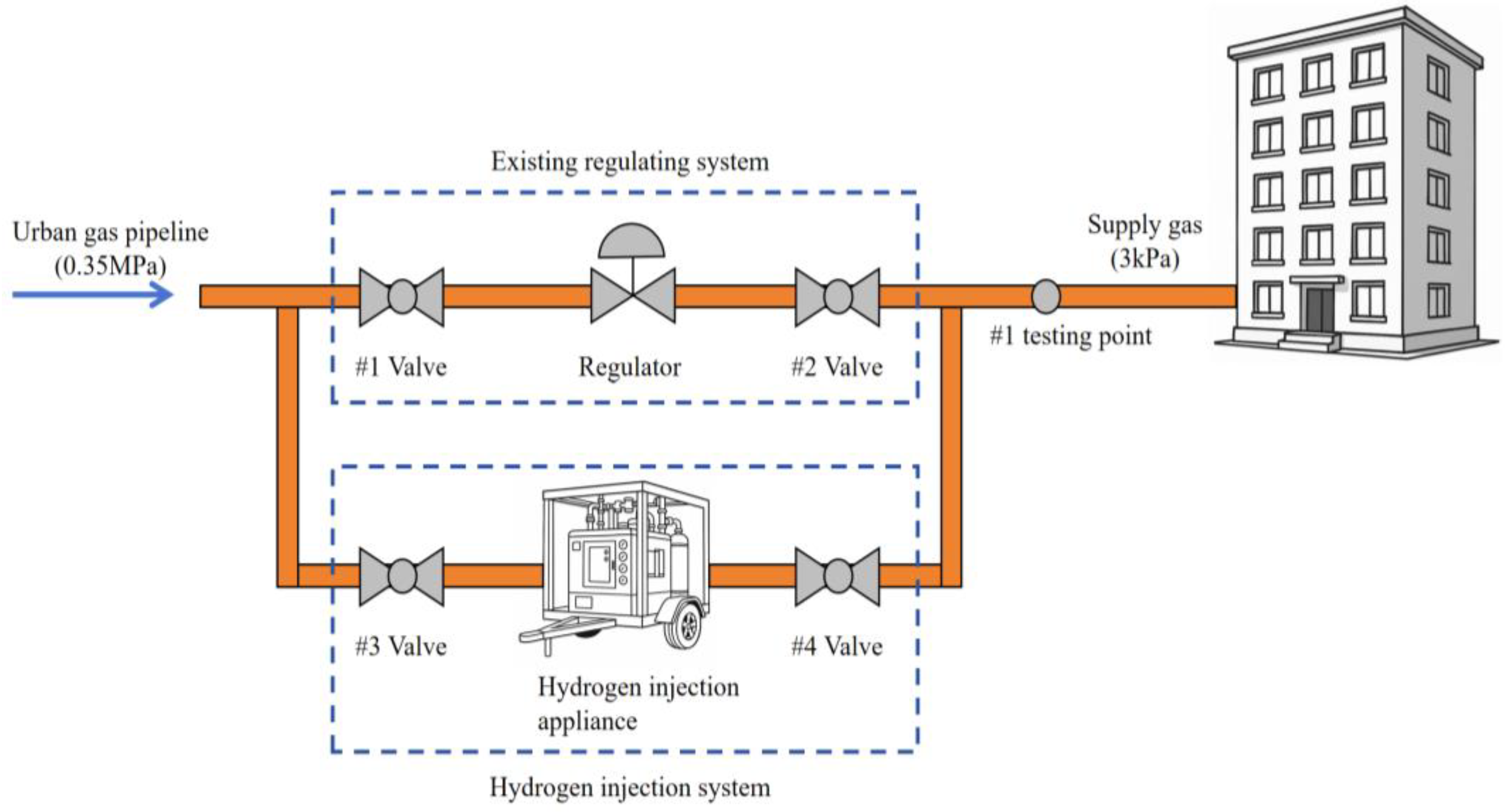
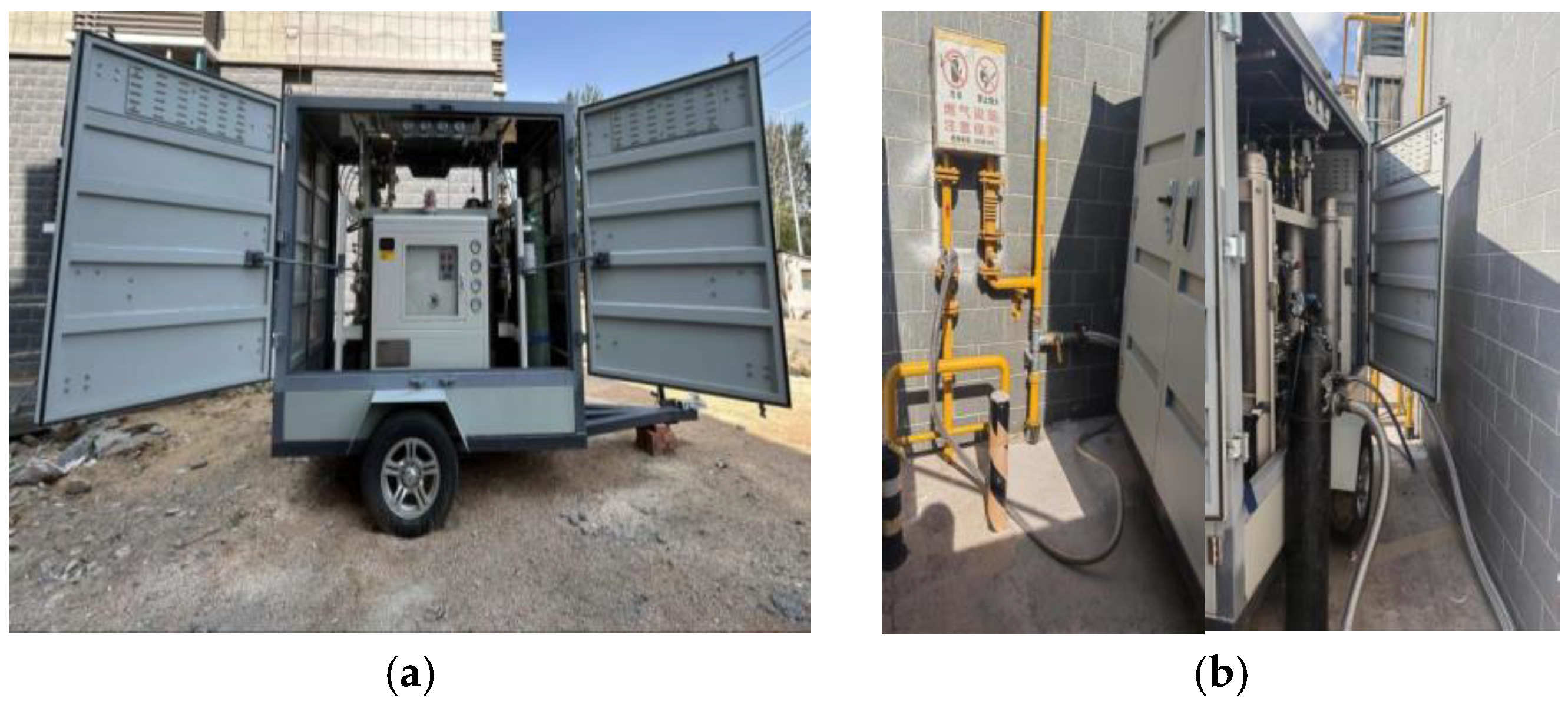
2.3. Gas Supply
2.4. Test Procedure
- Stratification in the gas riser
- (1)
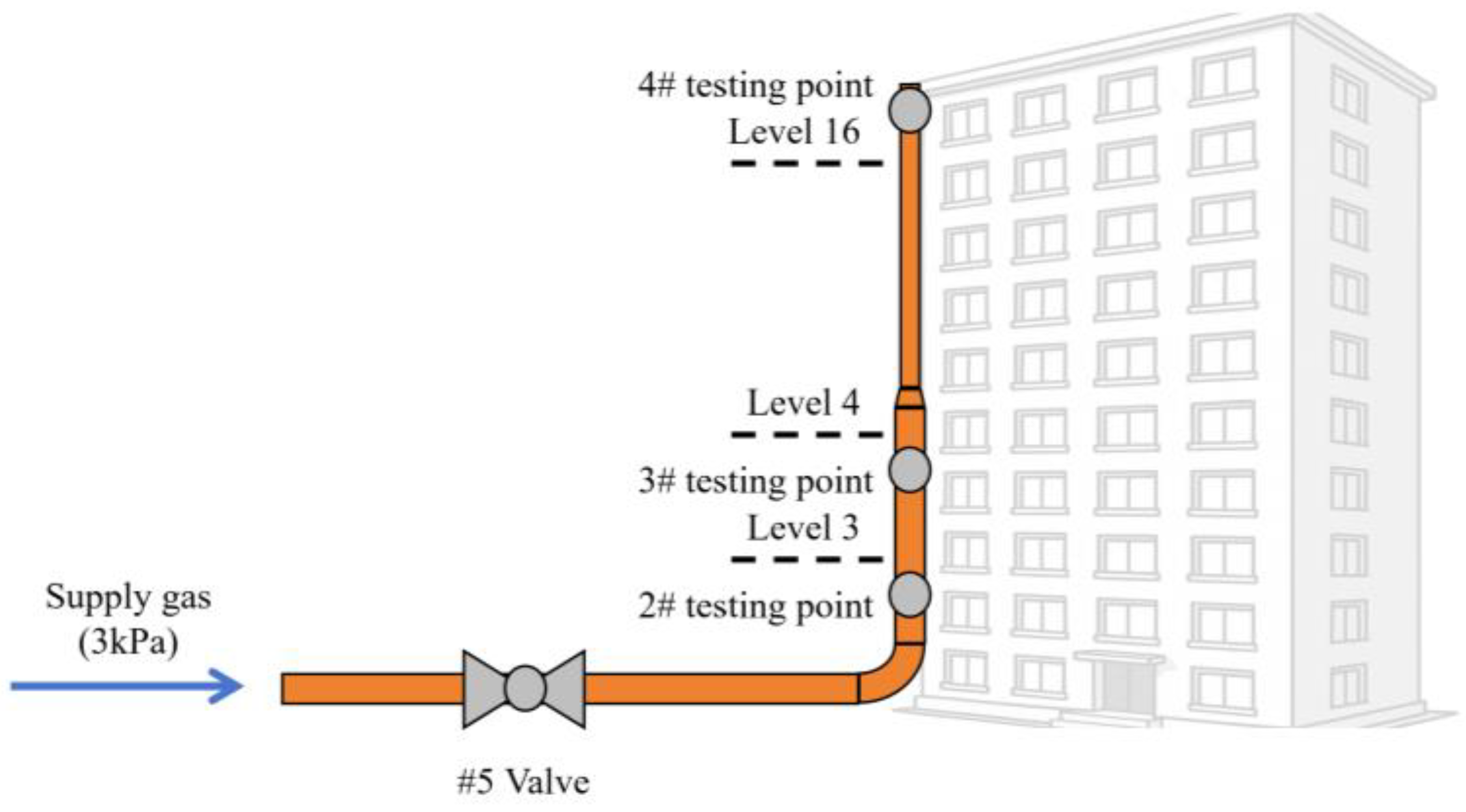
- Methane and hydrogen concentrations were initially measured at testing points #2 and #4 using the gas composition analyzer;
- (2)
- Valve #5 was then closed to isolate the riser and initiate the standing condition;
- (3)
- After a standing period exceeding 12 h, methane and hydrogen concentrations at the same testing points were measured again to evaluate potential stratification effects.
- 2.
- Additional pressure in the gas distribution system
- (1)
- The pressure at the 4th floor (#3 testing point in Figure 3) was measured using a micro-manometer;
- (2)
- The pressure at the 16th floor (#4 testing point in Figure 3) was subsequently measured under the same operating conditions;
- (3)
- The additional pressure per unit height was then calculated based on the measured pressure difference and the corresponding floor height:
- 3.
- Airtightness of indoor pipelines and appliances
- (1)
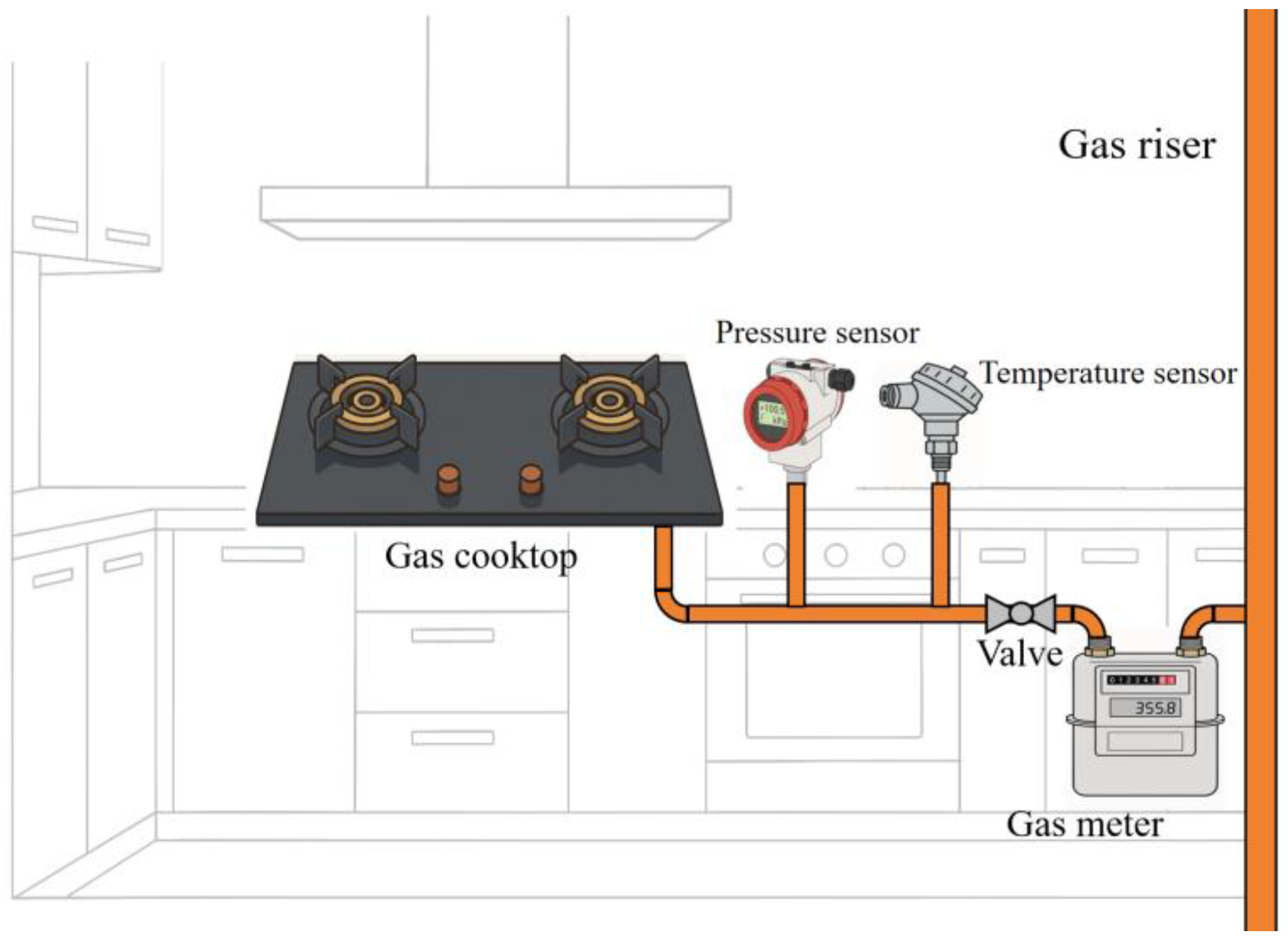
- A high-precision pressure sensor and a temperature sensor were installed on the downstream pipeline, as shown in Figure 4;
- (2)
- The gas valve was opened and the gas cooktop was briefly operated to ensure the system was fully filled with hydrogen-enriched natural gas;
- (3)
- The downstream valve of the gas meter was then closed to isolate the test section;
- (4)
- Gas pressure and temperature were continuously recorded for a period of 30 min.
- 4.
- Effectiveness of domestic gas alarms
3. Results and Discussion
3.1. Stratification in the Gas Riser
3.2. Additional Pressure in the Gas Distribution System
3.3. Airtightness of Indoor Pipelines and Appliances
3.4. Effectiveness of Domestic Gas Alarms
4. Conclusions
- (1)
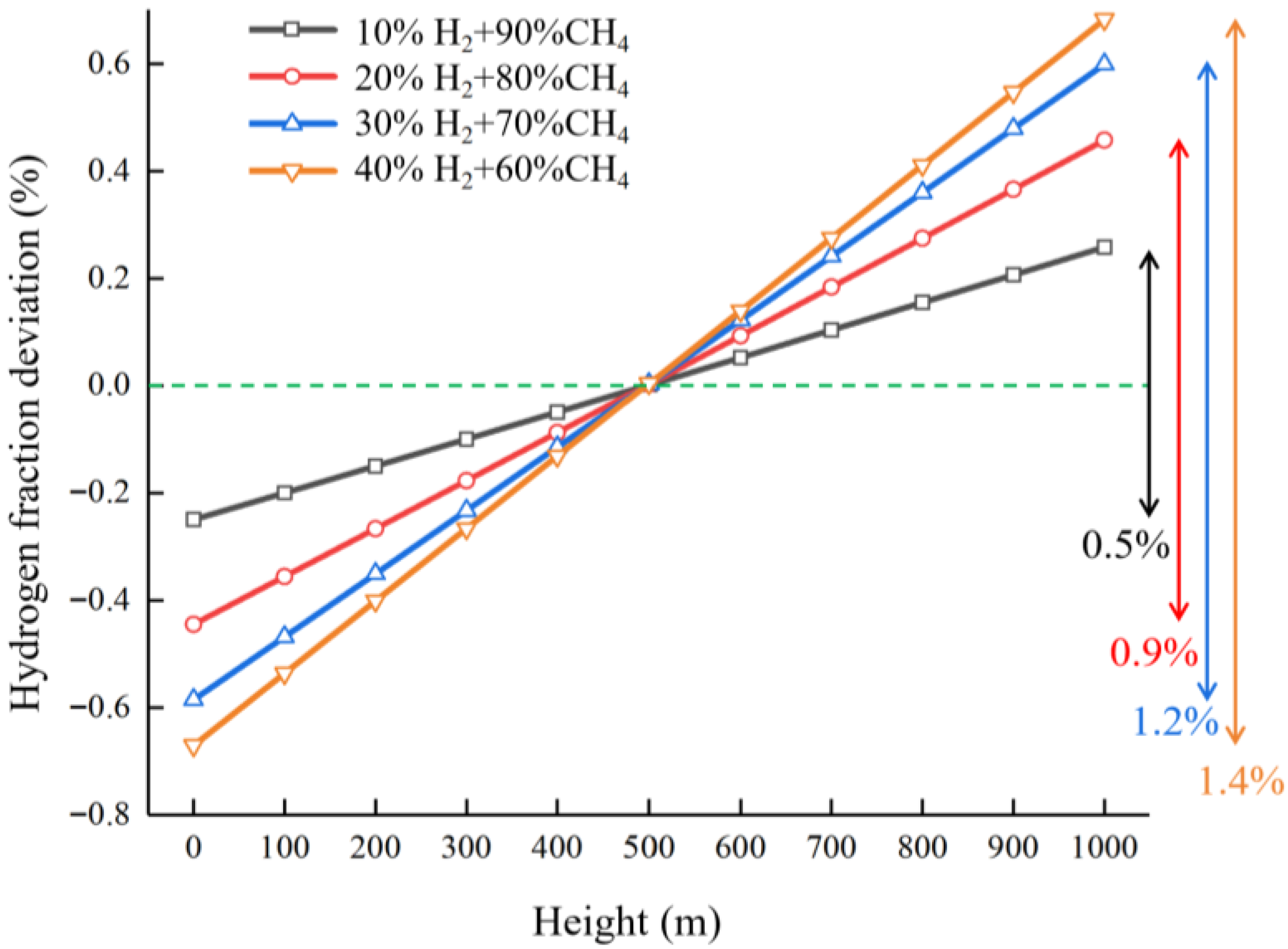
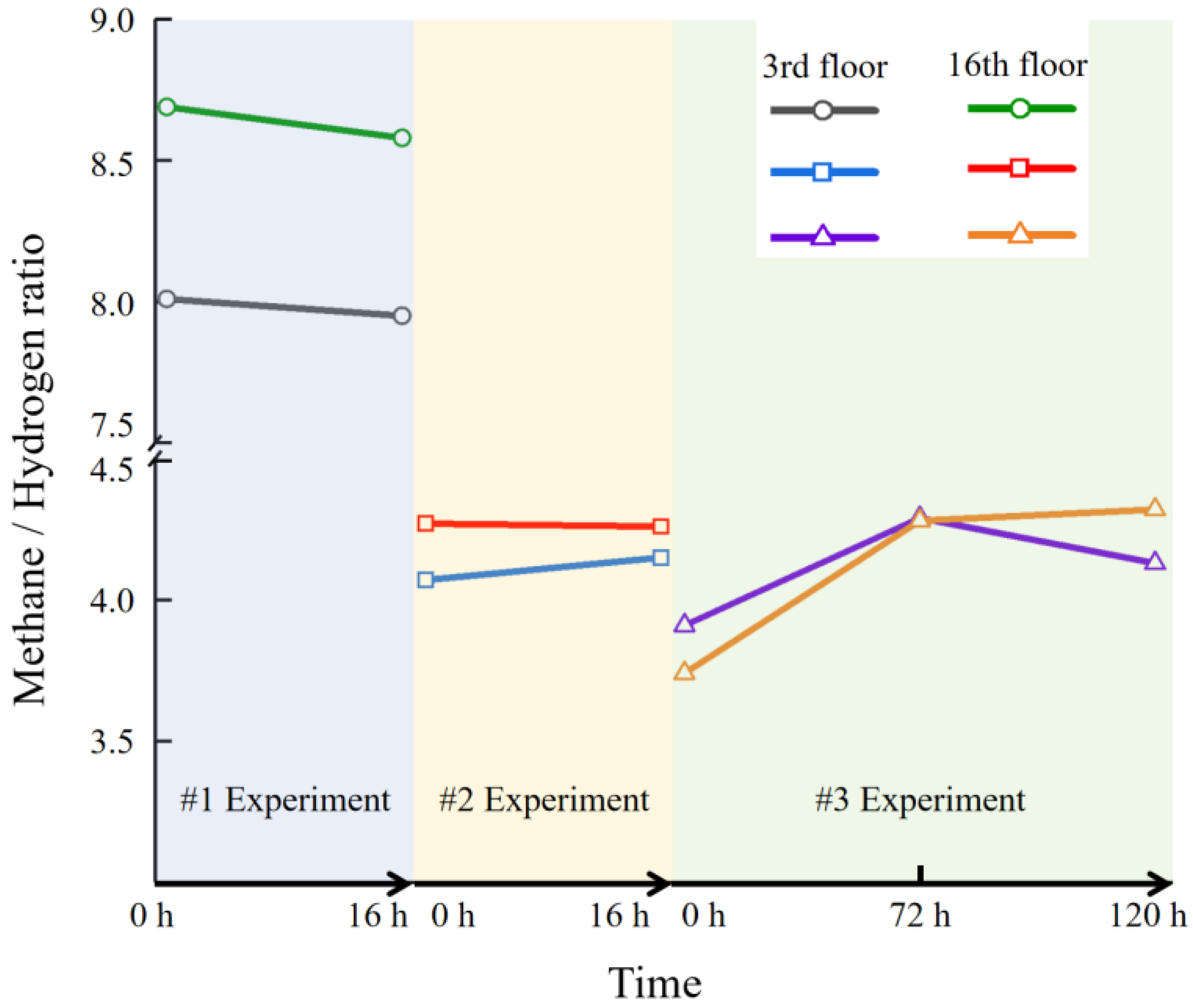
- Theoretical analysis shows that for building heights below 1000 m, the maximum hydrogen concentration deviation in the riser under 20% hydrogen ratio is less than 0.9%, and full equilibrium would require approximately 4.5 years. Experimental results also show hydrogen concentration deviations below 1%. Therefore, gas stratification in high-rise building distribution systems can be considered negligible.
- (2)
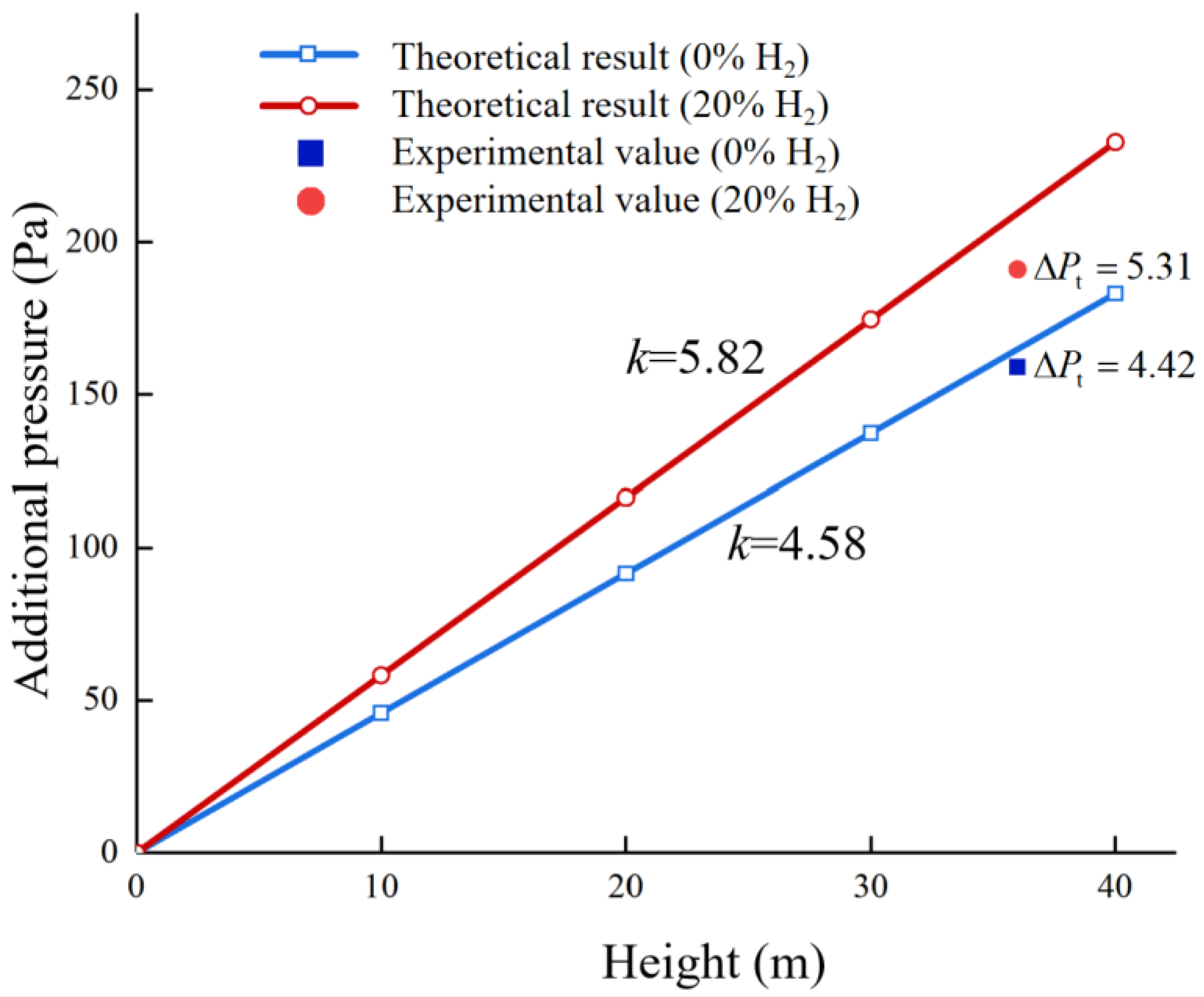
- Hydrogen blending increases the additional pressure in risers. Every 10% hydrogen blending results in approximately 0.56 Pa/m of extra additional pressure. Compared with appliance operating pressures and the normal allowable operating pressure fluctuation range, this extra additional pressure is relatively small.
- (3)
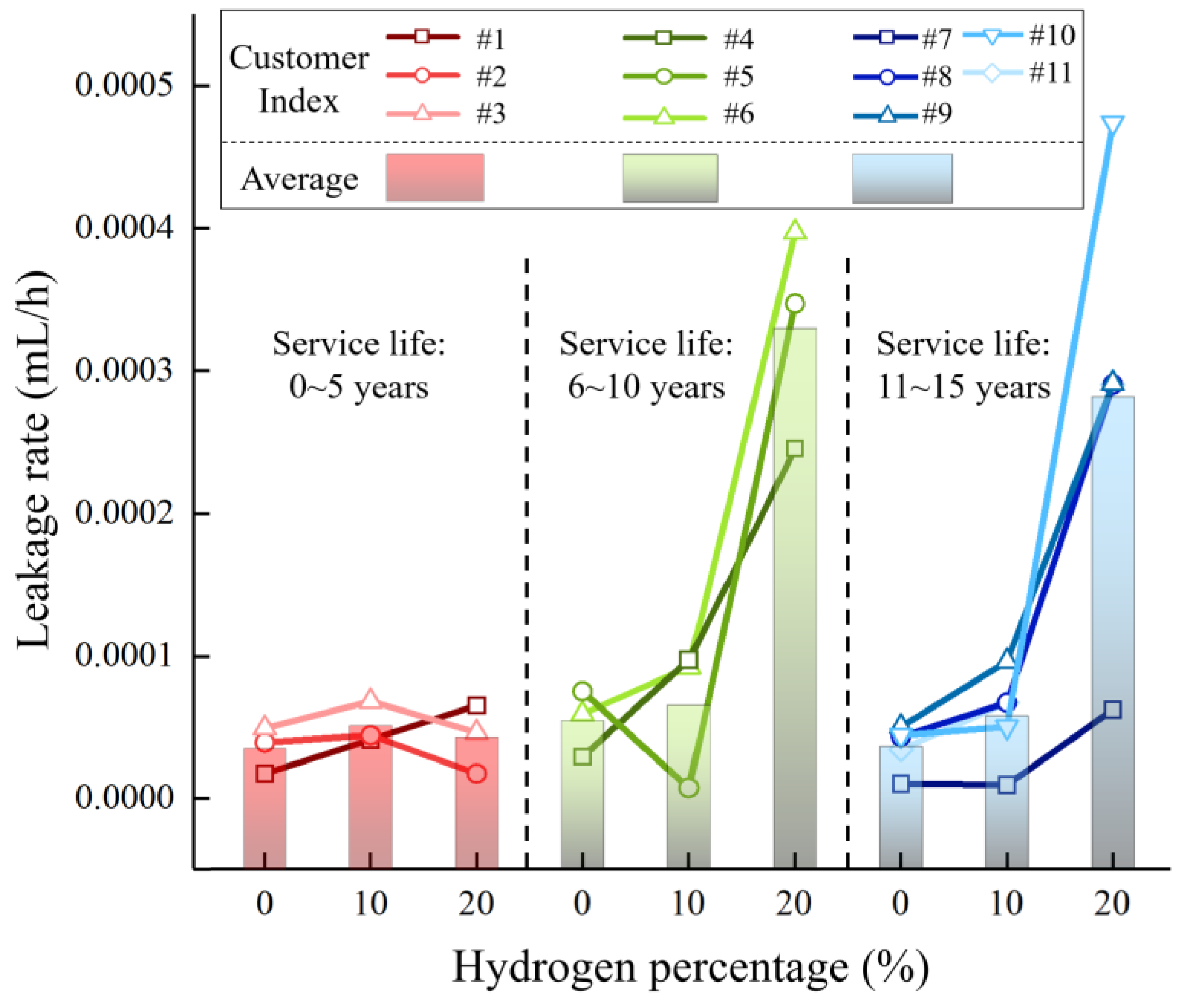
- Systems with appliances under five years of service maintain stable airtightness under hydrogen blending, whereas systems with longer service life exhibit increased leakage due to material aging and loosening at pipeline–appliance connections. Therefore, gas systems with long service-life appliances require focused inspection and maintenance in hydrogen blending projects. Gas meter leakage rates under 10% hydrogen blending are below 3 mL/h, satisfying safety requirements.
- (4)
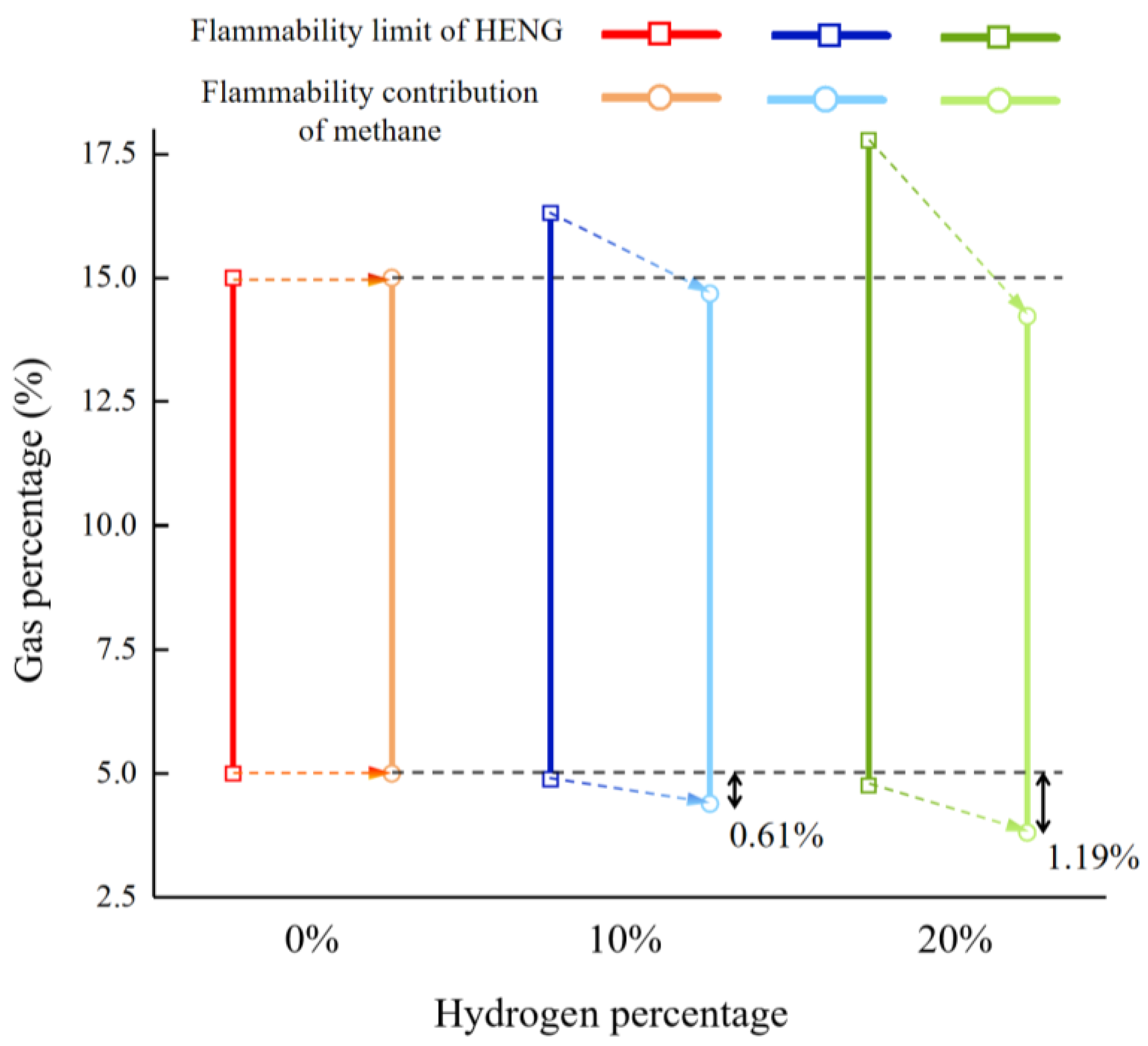
- Domestic gas alarms remained responsive and reliable under 0–20% hydrogen ratios. Although hydrogen alters the flammability range, alarm detection accuracy and response time remained within acceptable limits for residential safety.
Author Contributions
Funding
Data Availability Statement
Conflicts of Interest
Nomenclature
| d | diameter of the leak (m) |
| D | gas diffusion coefficient (m2/s) |
| f | friction factor |
| Fitot | volume fraction of gas i in the whole system |
| Fi(h) | distribution of volume fraction of gas i at height h |
| g | gravitational acceleration (m/s2) |
| h | height of gas (m) |
| hf | floor height (m) |
| H | maximum height of the pipe (m) |
| L | leak passageway (m) |
| mi | mass of the gas molecular (kg/mol) |
| M | molecular weight of the gas (g/mol) |
| ∆m | total gas leakage mass (kg) |
| n | number of floors |
| P | gas pressure (Pa) |
| Pt | pressure at the bottom of the riser (Pa) |
| Pb | pressure at the top of the riser (Pa) |
| P0 | standard pressure (Pa) |
| Pi(h) | partial pressure of gas i at height h (Pa) |
| Ptot | average pressure of the whole system (Pa) |
| ∆P | pressure drop across the leak (Pa) |
| ∆Pt | additional pressure per unit height (Pa/m) |
| ∆Pl | theoretical additional pressure per unit height (Pa/m) |
| Q | volumetric leakage rate at standard conditions (m3/s) |
| R | ideal gas constant |
| t | time required for diffusion (s) |
| T | gas temperature (K) |
| T0 | standard temperature (K) |
| V | pipeline volume (m3) |
| Vm | molar volume of gas (m3/mol) |
| τ | time interval between the initial and final measurements (s) |
| ρi(h) | normalized probability density of gas i at height h |
| ρair | density of air (kg/m3) |
| ρgas | density of the gas (kg/m3) |
| μ | dynamic viscosity (Pa·s) |
| concentration gradient (mol/m) |
References
- PBL Netherlands Environmental Assessment Agency. Trends in Global CO2 and Total Greenhouse Gas Emissions. Available online: https://www.pbl.nl/en/publications/trends-in-global-co2-and-total-greenhouse-gas-emissions-2020-report (accessed on 21 December 2020).
- Grams, C.M.; Beerli, R.; Pfenninger, S.; Staffell, I.; Wernli, H. Balancing Europe’s wind-power output through spatial deployment informed by weather regimes. Nat. Clim. Change 2017, 7, 557–562. [Google Scholar] [CrossRef]
- Midilli, A.; Dincer, I. Hydrogen as a renewable and sustainable solution in reducing global fossil fuel consumption. Int. J. Hydrogen Energy 2008, 33, 4209–4222. [Google Scholar] [CrossRef]
- Hydrogen Council. Hydrogen Scaling Up: A Sustainable Pathway for the Global Energy Transition. 2017. Available online: https://hydrogencouncil.com (accessed on 4 December 2025).
- Heid, B.; Linder, M.; Orthofer, A.; Wilthaner, M. Hydrogen: The Next Wave for Electric Vehicles. 2017. Available online: https://www.mckinsey.com/industries/automotive-and-assembly/our-insights/hydrogen-the-next-wave-for-electric-vehicles (accessed on 4 December 2025).
- Ruijven, B.V.; Vuuren, D.P.V.; Vries, B.D. The potential role of hydrogen in energy systems with and without climate policy. Int. J. Hydrogen Energy 2007, 32, 1655–1672. [Google Scholar] [CrossRef]
- Faye, O.; Szpunar, J.; Eduok, U. A critical review on the current technologies for the generation, storage, and transportation of hydrogen. Int. J. Hydrogen Energy 2022, 47, 13771–13802. [Google Scholar]
- Staffell, I. Zero carbon infinite COP heat from fuel cell CHP. Appl. Energy 2015, 147, 373–385. [Google Scholar] [CrossRef]
- Energy Research Partnership. Potential Role of Hydrogen in the UK Energy System. Available online: https://erpuk.org/wp-content/uploads/2017/01/ERP-hydrogen-report-oct-2016.pdf (accessed on 4 December 2025).
- Yang, C.; Ogden, J.M. Determining the lowest-cost hydrogen delivery mode. Int. J. Hydrogen Energy 2007, 32, 268–286. [Google Scholar] [CrossRef]
- Hart, D.J.; Howes, J.A.; Lehner, F.; Dodds, P.; Hughes, N.; Fais, B.; Sabio, N.; Crowther, M. Scenarios for Deployment of Hydrogen in Contributing to Meeting Carbon Budgets and the 2050 Target. 2015. Available online: https://www.semanticscholar.org/paper/Scenarios-for-deployment-of-hydrogen-in-to-meeting-Hart-Howes/7a94719c52fa0ea9672b8ac8e5721f38da76ce71 (accessed on 4 December 2025).
- Deymi-Dashtebayaz, M.; Ebrahimi-Moghandam, A.; Pishbin, S.I.; Pourramenzan, M. Investigating the effect of hydrogen injection on natural gas thermo-physical properties with various compositions. Energy 2019, 167, 235–245. [Google Scholar] [CrossRef]
- Vandewalle, J.; Bruninx, K.; Dhaeseleer, W. Effects of large-scale power to gas conversion on the power, gas and carbon sectors and their interactions. Energy Convers. Manag. 2015, 94, 28–39. [Google Scholar] [CrossRef]
- Qadrdan, M.; Abeysekera, M.; Chaudry, M.; Wu, J.; Jenkins, N. Role of power-to-gas in an integrated gas and electricity system in Great Britain. Int. J. Hydrogen Energy 2015, 40, 5763–5775. [Google Scholar] [CrossRef]
- Kippers, M.; De Laat, J.; Hermkens, R.; Overdiep, J.; Van Der Molen, A.; Van Erp, W.; Van Der Meer, A. Pilot project on hydrogen injection in natural gas on Island of Ameland in The Netherlands. Int. Gas. Union. Res. Conf. 2011, 2, 1163–1177. [Google Scholar]
- Cuadrado, D.; García, G.; Gata, P.; Bermejillo, F.J.; Velasco, I.; Silveira, E.; Esnal, A.; Álava, I.; Mesanza, M.; Gómez, M.R.; et al. Integrative assessment of hydrogen-natural gas mixtures in energy grids: An overview of the H2SAREA project experience. Int. J. Hydrogen Energy 2025, 142, 697–711. [Google Scholar] [CrossRef]
- Santoli, L.; Basso, G.L.; Bruschi, D. A small scale H2NG production plant in Italy: Techno-economic feasibility analysis and costs associated with carbon avoidance. Int. J. Hydrogen Energy 2014, 39, 6497–6517. [Google Scholar] [CrossRef]
- ATCO. Fort Saskatchewan Hydrogen Blending Project. 2020. Available online: https://www.atco.com/en-ca/projects/fort-saskatchewan-hydrogen-blending-project.html (accessed on 4 December 2025).
- Jaremko, G. Canadian Utilities Beginning Hydrogen Energy Field Tests. 2021. Available online: https://www.naturalgasintel.com/canadian-utilities-beginning-hydrogen-energy-field-tests/ (accessed on 4 December 2025).
- AGIG. Australia’s First Renewable Gas Blend Supplied to Existing Customers. 2021. Available online: https://www.agig.com.au/hydrogen-park-south-australia (accessed on 4 December 2025).
- AGIG. A Pathway to a Cleaner Energy Future. 2021. Available online: https://www.agig.com.au/hydrogen-park-gladstone (accessed on 4 December 2025).
- AGIG. A Globally Significant Decarbonisation Project. 2021. Available online: https://www.agig.com.au/hydrogen-park-murray-valley (accessed on 4 December 2025).
- Peng, S.Y.; He, Q.; Peng, D.; Ouyang, X. Equilibrium distribution and diffusion of mixed hydrogen-methane gas in gravity field. Fuel 2023, 358, 130193. [Google Scholar] [CrossRef]
- Azatyan, V.V.; Petukhov, V.A.; Prokopenko, V.M.; Timerbulatov, T.R. Possible gravitational stratification of components in mixtures of reaction gases. Russ. J. Phys. Chem. A 2019, 93, 986–987. [Google Scholar] [CrossRef]
- Pitts, W.; Yang, J.; Blais, M.; Jayce, A. Dispersion and burning behavior of hydrogen released in a full-scale residential garage in the presence and absence of conventional automobiles. Int. J. Hydrogen Energy 2012, 37, 17457–17469. [Google Scholar] [CrossRef]
- Badino, G. The legend of carbon dioxide heaviness. J. Cave Karst Stud. 2009, 71, 100–107. [Google Scholar]
- Liu, C.; Pei, Y.; Cui, Z.; Li, X.; Yang, H.; Xing, X.; Duan, P.; Li, L.; Li, Y. Study on the stratification of the blended gas in the pipeline with hydrogen into natural gas. Int. J. Hydrogen Energy 2023, 48, 5186–5196. [Google Scholar] [CrossRef]
- Marangon, A.; Carcassi, M. Hydrogen–methane mixtures: Dispersion and stratification studies. Int. J. Hydrogen Energy 2014, 39, 6160–6168. [Google Scholar] [CrossRef]
- Su, Y.; Li, J.; Yu, B.; Wang, X.; Pu, M.; Wang, W.; Zhang, B. Study of Hydrogen Stratification Phenomena in Hydrogen-Blended Natural Gas Pipelines. Renew. Energy 2025, 253, 123603. [Google Scholar] [CrossRef]
- Cen, K.; Su, L.; Wen, Y.; Song, B.; Zeng, Z.; Li, L.; Li, Q. Stratification characteristics of hydrogen-blended natural gas for gas risers inside residential users. Int. J. Green Energy 2024, 21, 3201–3217. [Google Scholar] [CrossRef]
- Islam, A.; Alam, T.; Sheibley, N.; Edmonson, K.; Burns, D.; Hernandez, M. Hydrogen blending in natural gas pipelines: A comprehensive review of material compatibility and safety considerations. Int. J. Hydrogen Energy 2024, 93, 1429–1461. [Google Scholar] [CrossRef]
- Mejia, H.A.; Brouwer, J.; Kinnon, M.M. Hydrogen leaks at the same rate as natural gas in typical low-pressure gas infrastructure. Int. J. Hydrogen Energy 2020, 45, 8810–8826. [Google Scholar] [CrossRef]
- Mejia, H. Experimental Investigation of Hydrogen and Hydrogen/Methane Mixture Leakage from Low-Pressure Natural Gas Infrastructure. 2019. Available online: https://www.proquest.com/openview/163d00dfc4dc32ef5ac1b42f51ddd193/1?pq-origsite=gscholar&cbl=18750&diss=y (accessed on 4 December 2025).
- Haeseldonckx, D.; D’haeseleer, W. The use of the natural-gas pipeline infrastructure for hydrogen transport in a changing market structure. Int. J. Hydrogen Energy 2007, 32, 1381–1386. [Google Scholar] [CrossRef]
- Wilkening, H.; Barald, D. CFD modelling of accidental hydrogen release from pipelines. Int. J. Hydrogen Energy 2007, 32, 2206–2215. [Google Scholar] [CrossRef]
- Xie, Y.; Qin, C.; Chen, Z.; Duan, P.; Guo, S. The impact of hydrogen addition to natural gas on flame stability. Int. J. Hydrogen Energy 2022, 47, 35851–35863. [Google Scholar] [CrossRef]
- Rao, A. Sustainable Energy Conversion for Electricity and Coproducts: Principles, Technologies, and Equipment; Jon Wiley & Sons: Hoboken, NJ, USA, 2015; Available online: https://onlinelibrary.wiley.com/doi/book/10.1002/9781119064190 (accessed on 4 December 2025).
- Glassman, I.; Yetter, R.A.; Glumac, N.G. Combustion; Academic press: Cambridge, MA, USA, 2014; Available online: https://www.sciencedirect.com/book/9780122858505/combustion (accessed on 4 December 2025).
- BS EN 437:2021; Test Gases-Test Pressures-Appliance Categories. BSI Standards Publication: London, UK, 2021. Available online: https://webstore.ansi.org/Standards/BSI/BSEN4372021 (accessed on 4 December 2025).
- Swain, M.; Swain, M.N. A comparison of H2, CH4 and C3H8 fuel leakage in residential settings. Int. J. Hydrogen Energy 1992, 17, 807–815. [Google Scholar] [CrossRef]
- Shashkov, A.G.; Zolotukhina, A.F.; Fokin, L.P.; Kalashnikov, A.N. Transfer properties of mixtures of rarefied neutral gases. Hydrogen–argon system. J. Eng. Phys. Thermophys. 2010, 83, 188–208. [Google Scholar] [CrossRef]
- Marrero, T.; Mason, E.A. Gaseous diffusion coefficients. J. Phys. Chem. Ref. Data 1972, 1, 3–118. [Google Scholar] [CrossRef]



| Composition | Methane | Ethane | Propane | n-Butane | Iso-Butane | n-Pentane | Iso-Pentane | Neo-Pentane |
|---|---|---|---|---|---|---|---|---|
| Formula | CH4 | C2H6 | C3H8 | n-C4H10 | i-C4H10 | n-C5H12 | i-C5H12 | NeoC5H12 |
| Volume percentage (%) | 94.3152 | 3.6051 | 1.3192 | 0.2864 | 0.3487 | 0.0238 | 0.0089 | 0.0025 |
| Methane | Hydrogen | Methane/Hydrogen Ratio | |
|---|---|---|---|
| Density (kg/m3) [36] | 0.648 | 0.0813 | 7.97 |
| Volumetric stoichiometric air requirement (m3/m3) | 9.52 | 2.38 | 4.00 |
| Low heating value (MJ/m3) [37] | 34.0 | 10.2 | 3.33 |
| High heating value (MJ/m3) [37] | 37.8 | 12.5 | 3.02 |
| Low flammability (%) [38] | 5 | 4 | 1.25 |
| High flammability (%) [38] | 15 | 75 | 0.20 |
| Wobbe index (MJ/m3) [39] | 51.9 | 48.5 | 1.07 |
| Diffusion coefficient [40] | 0.20 | 0.63 | 0.32 |
| No. | Metrics | Parameter |
|---|---|---|
| 1 | Dimensions | 2.6 × 1.5 × 2 m (L × W × H) |
| 2 | Hydrogen percentage | 0–30% |
| 3 | Accuracy | ±0.5% |
| 4 | Operating pressure | 0.08–0.18 MPa |
| 5 | Inlet pressure | 0.2–1.0 MPa |
| 6 | Outlet pressure | 0.2–0.3 MPa, 1–5 kPa |
| 7 | Relief pressure | 1.33 MPa |
| 8 | Output flow rate | 0–30 Nm3/h |
| No. | Floor | Hydrogen Concentration (ppm) | Methane Concentration (ppm) | Leakage Rate (mL/h) |
|---|---|---|---|---|
| 1 | 1 | 0.019 | 15.4 | 1.01 |
| 2 | 2 | 0.03 | 3.6 | 0.09 |
| 3 | 2 | 0.011 | 4 | 0.12 |
| 4 | 2 | 0.015 | 5.3 | 0.22 |
| 5 | 5 | 0.045 | 9.6 | 0.55 |
| 6 | 6 | 0.046 | 11.8 | 0.73 |
| 7 | 8 | 0.044 | 3.2 | 0.05 |
| 8 | 11 | 0.036 | 40 | 2.93 |
Disclaimer/Publisher’s Note: The statements, opinions and data contained in all publications are solely those of the individual author(s) and contributor(s) and not of MDPI and/or the editor(s). MDPI and/or the editor(s) disclaim responsibility for any injury to people or property resulting from any ideas, methods, instructions or products referred to in the content. |
© 2026 by the authors. Licensee MDPI, Basel, Switzerland. This article is an open access article distributed under the terms and conditions of the Creative Commons Attribution (CC BY) license.
Share and Cite
Xie, Y.; Huang, X.; Xu, H.; Zhang, G.; Wang, B.; Zhao, Y.; Pan, F. Impacts of Hydrogen Blending on High-Rise Building Gas Distribution Systems: Case Studies in Weifang, China. Buildings 2026, 16, 294. https://doi.org/10.3390/buildings16020294
Xie Y, Huang X, Xu H, Zhang G, Wang B, Zhao Y, Pan F. Impacts of Hydrogen Blending on High-Rise Building Gas Distribution Systems: Case Studies in Weifang, China. Buildings. 2026; 16(2):294. https://doi.org/10.3390/buildings16020294
Chicago/Turabian StyleXie, Yitong, Xiaomei Huang, Haidong Xu, Guohong Zhang, Binji Wang, Yilin Zhao, and Fengwen Pan. 2026. "Impacts of Hydrogen Blending on High-Rise Building Gas Distribution Systems: Case Studies in Weifang, China" Buildings 16, no. 2: 294. https://doi.org/10.3390/buildings16020294
APA StyleXie, Y., Huang, X., Xu, H., Zhang, G., Wang, B., Zhao, Y., & Pan, F. (2026). Impacts of Hydrogen Blending on High-Rise Building Gas Distribution Systems: Case Studies in Weifang, China. Buildings, 16(2), 294. https://doi.org/10.3390/buildings16020294