
Next Article in Journal
Driving Forces Behind Whole-Process Engineering Consulting Competitiveness Based on AHP-ISM Method
Previous Article in Journal
Analysis of Wind-Induced Response During the Lifting Construction of Super-Large-Span Heavy Steel Box Girders
error_outline You can access the new MDPI.com website here. Explore and share your feedback with us.
 
 
Article

Critiquing Spatial Justice: Morphological Characteristics and Inherent Differences in Government-Subsidized Rental Housing in Shanghai’s Five New Towns

College of Architecture and Urban Planning, Tongji University, Shanghai 200092, China
*
Author to whom correspondence should be addressed.
Buildings 2026, 16(2), 252; https://doi.org/10.3390/buildings16020252
Submission received: 13 November 2025 / Revised: 31 December 2025 / Accepted: 5 January 2026 / Published: 7 January 2026
(This article belongs to the Section Architectural Design, Urban Science, and Real Estate)

Abstract

In recent years, the rapid construction of government-subsidized rental housing (GRH) has partially alleviated housing pressures caused by the growing number of migrant workers and persistently high rental costs in Shanghai. However, its overriding emphasis on construction and allocation efficiency neglects the realization of spatial justice, particularly in underdeveloped urban areas. This study adopts a mixed-methods approach to examine all 25 GRHs completed and operational in Shanghai’s Five New Towns, employing morphological characteristics and inherent differences to analyze their impacts on spatial justice. First, this study integrates urban functions and spatial justice elements to establish a systematic classification framework and an evaluative system for GRH, and then assesses the achievement of spatial justice across existing projects. Subsequently, morphological analysis is employed to examine how GRHs shape the socio-spatial context of new towns, thereby assessing their role in reinforcing or undermining spatial justice. Finally, this study establishes data logic between typological factors and morphological characteristics and analyzes the inherent differences among various types of GRH by using Fisher’s exact test. The results reveal that although the existing GRHs are situated in different urban geospatial contexts, they exhibit a severe homogenization phenomenon in terms of construction modality, planning layout, and community boundary, with only the residential scale showing inherent differences. The research findings highlight a systematic neglect of spatial justice in the current GRH development paradigm and reveal the underlying causes. This study contributes to the discourse on spatial justice in GRH development by broadening its dimensions, and it provides valuable insights for promoting the realization of spatial justice through multi-tiered policy framework, place-making design strategy, and a joint operation model.

1. Introduction

Urban housing research has evolved into a global challenge under the pressures of population growth, urbanization, and migration. According to data from the United Nations, the global population is projected to rise gradually from 8.2 billion in 2024 to 10.3 billion in the mid-2080s as a peak [1]. Meanwhile, the urban population proportion will continue expanding along with the increase in the birth rate from 56% in 2021 to 68% in 205 [2]. The migration of the rural population to cities and inter-regional migration from less developed to more developed cities intensify pressure on urban housing systems [3,4,5]. These changes exacerbate affordability and spatial allocation challenges, highlighting the need not only for more adaptive policies for sustainable housing development but also for social justice and inclusivity in housing construction and design.
China’s situation exemplifies this tension, particularly in Shanghai’s Five New Towns, which are becoming the first stop for the migrant population entering Shanghai. Unlike typical suburban sprawl or organic growth, Shanghai’s Five New Towns are conceived as integrated and functionally independent cities within the Shanghai metropolitan area, with each new town planned to absorb approximately 1 million residents by 2035 [6]. In the policy dimension, they serve as key drivers for attracting investment, promoting economic growth, and recruiting high-level industrial talent for Shanghai. In the spatial dimension, through large-scale urban planning development and the construction of comprehensive complementary facilities, they aim to restructure the suburban space, adjust the layout of urban industrial functions, and alleviate the pressure on Shanghai’s high-density urban core. However, despite the promising policy vision, persistent challenges remain. At the current stage, new towns are still in a transitional phase, evolving from semi-independent satellite towns that are dependent on the urban core to self-balanced independent new towns. At the urban spatial level, new towns exhibit a spatially segregated pattern characterized by residential cores surrounded by peripheral industrial zones [7]. High-tech enterprises, such as Huawei Lianqiu Lake R&D Center and Tesla Gigafactory 3 Shanghai, are mostly located far from the living areas of new towns or exhibit low levels of functional integration. At the transportation level, the transportation hubs and road network densities are generally low [8]. In future construction, there is still a need to increase the development of attractive slow-mobility spaces, including walking paths and cycling paths. At the level of resident economic activity, a persistently high proportion of work commuting and daily mobility originating from certain new towns remains directed towards central Shanghai [9]. This pattern suggests underdeveloped local amenities, which fail to provide sufficient attraction for residents’ daily needs and employment.
In this urban development context, the emergence of GRH as a new form of social housing has played a crucial role in alleviating urban housing pressures. The concept of GRH first formally appeared in the 14th Five-Year Plan, released by the Chinese government in November 2020. With the improvement and development of policies, GHR was explicitly defined in 2021 as a housing solution “Primarily addressing the housing difficulties of eligible new urban residents, mainly consisting of small units with a floor area of no more than 70 square meters, and with rents lower than market levels of the same quality in the same area” [10]. As a form of social housing, GRH has been prioritized for extensive development in China’s megacities and accounts for a substantial proportion of the new housing supply. From 2021 to 2025, Beijing and Shenzhen plan to newly construct approximately 400,000 GRH units, while Guangzhou targets 600,000 units and Shanghai targets over 470,000 units [11,12,13,14]. Overall, GRH is projected to account for over 40% of total new housing construction, including commercial housing, across these four Chinese megacities. GRH has several characteristics: It is provided through physical rental, with rents slightly lower than market prices, usually at a 10% discount; it is supplied through diverse entities, including state-owned social housing enterprises, industrial parks, and other enterprises; it has flexible leasing terms, which have adaptable durations, a renewable clause, and no maximum leasing term; and residents can access fundamental public services, such as compulsory education for children.
While this study is grounded in the specific socio-political and urban development context of Shanghai, the challenges identified in this study resonate with those faced by numerous regions worldwide, particularly in East Asia and the Global South. Rapid urbanization and migration have similarly prompted state-led interventions in housing provision, often within strategic satellite towns or peripheral expansion frameworks. Examining GRHs in Shanghai’s Five New Towns thus offers a critical Chinese case that contributes to these wider global debates on equitable housing strategies and urban development.
This study addresses two core research questions by taking Shanghai’s Five New Towns as the research background and all 25 cases of GRH as the research objects. First, what morphological characteristics do GRHs exhibit, and what role do they play in the realization of spatial justice? Second, how are these characteristics interrelated with their surroundings, and to what extent do they reflect inherent differences based on their geospatial contexts? These investigations thereby facilitate further discussions and explorations of the policy formulation, design strategies, and operation mechanisms of GRHs.
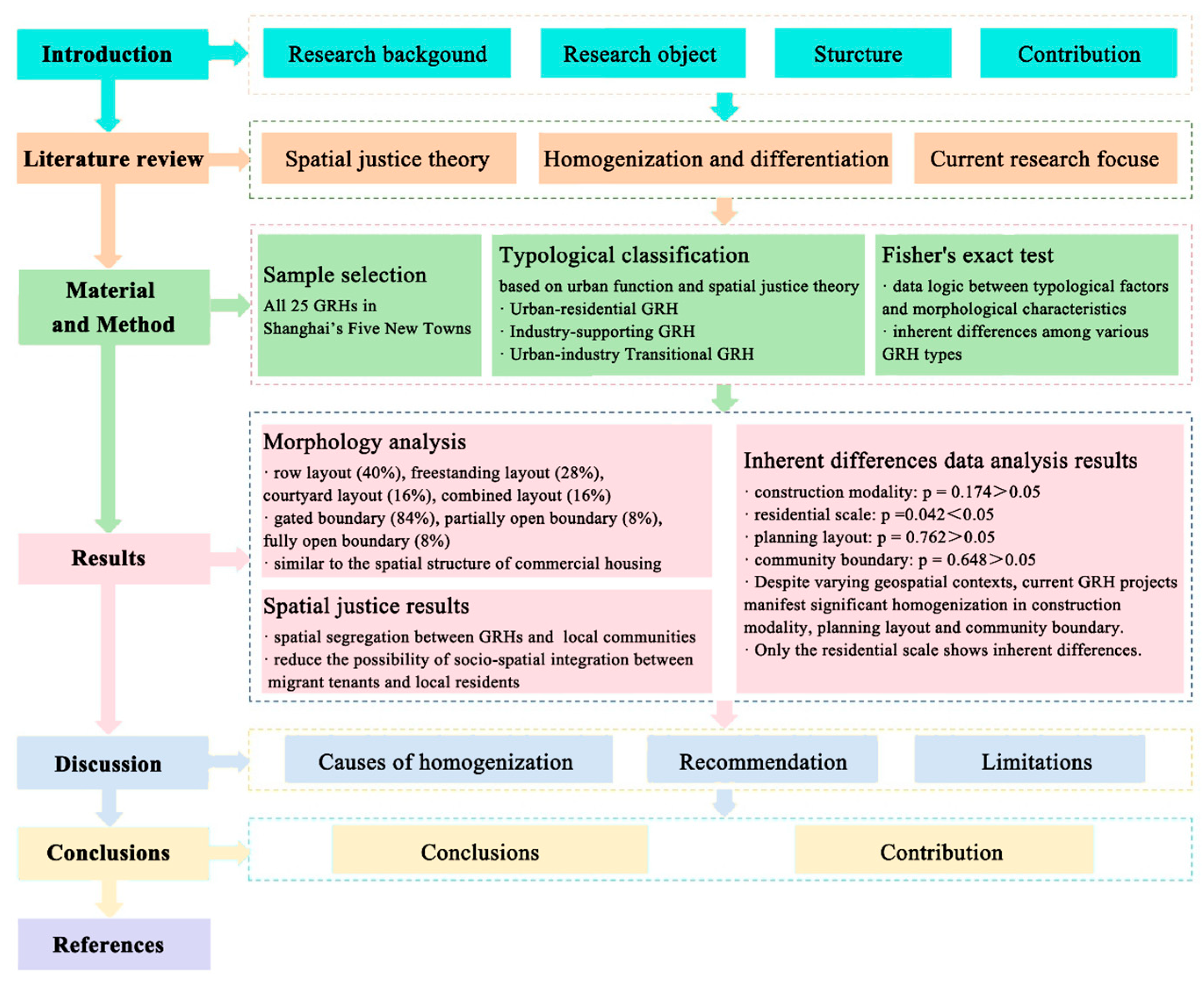
This paper is structured into seven sections (Figure 1). The Introduction contextualizes the study and outlines its primary objectives and contributions. The Literature Review explores three aspects, namely spatial justice theory, homogeneity, and differentiation in social housing, as well as the evolving perspectives in China and the research focuses and shifts in GRH since 2021. The Materials and Methods classifies all 25 GRH cases into three types based on the functional particularities of new towns and practical spatial justice theory. Meanwhile, it provides a detailed introduction to the mixed methodology adopted in this study, which integrates documentary analysis, typological analysis, morphological analysis, and data analysis techniques. The Results analyses the morphological characteristics and inherent differences in current GRH projects through morphological analysis and quantitative data analysis, as well as explores their impact on the realization of spatial justice. In the Discussion, this study further analyzes the underlying causes of the observed phenomena and puts forward corresponding recommendations. The Conclusion summarizes the key findings of this study, emphasizing the exploration and critique of GRH in Shanghai’s Five New Towns from the perspective of spatial justice. The References section provides the policy and bibliographic foundations supporting this research.
This study contributes to the theoretical discourse and practical architectural considerations of GRH as an emerging form of social housing and emphasizes the crucial role of practical spatial justice in the development and improvement of GRH.

2. Literature Review

2.1. From Social Justice to Spatial Justice Theory

The conceptual exploration of spatial justice can be traced back to its original concept—justice, which has been defined in markedly different ways by various schools of thought. Aristotle argued in Nicomachean Ethics that justice is a virtue: ‘the end of justice is that of complete virtue’. Under the influence of liberal thought, John Stuart Mill extended Jeremy Bentham’s utilitarian philosophy to develop a liberal theory of justice, which was designed to better resolve pervasive interest conflicts in society at that time. This justice theory has duality. Subjectively, it requires substantial alignment with citizens’ interests, while necessitating objective standards to mediate competing interests [15]. Subsequently, Rawls criticized utilitarianism for its neglect of minority needs. Integrating the social contract tradition, he reconceptualized justice as a tripartite conception comprising ‘liberty, equality, and rewards for services contributing to the common good’ [16]. These are specifically articulated as two principles. The first is the equal right compatible with liberty, which is the foundation of justice. The second principle articulates the justice conception in the context of social and economic inequalities, including the difference principle, which brings the greatest benefit to vulnerable groups, and the equal opportunity principle, which provides all citizens with the basic approaches to compete [17].
During the mid-to-late 20th century, Marxist theorists, geographers, and urban sociologists incorporated spatial dimensions into philosophical inquiries on justice, accompanied by the profound impacts of accelerated urbanization, intensifying spatial segregation, and urban spatial pathologies (e.g., slum formation). In Space, Knowledge and Power, Foucault contends that the birth of new technologies and new economic processes, such as railways, triggered behavioral transformations within people, thereby expanding spatial reflection ‘far beyond the disciplinary confines of urbanism and architecture’ [18]. Political power engenders entirely new problems in urban spatial interconnections, prompting the emergence of spatial justice as a critical theoretical perspective. Lefebvre advanced the concept of the right to the city, positing that space is not a neutral physical backdrop. Rather, it is not only sustained by social relations but also a product and reproducer of social relations of production [19]. He argues that space embodies capitalist inequality and homogenization, which leads to the exclusion of the most vulnerable groups [20]. David Harvey made definitive geographical contributions to justice theory. He followed Rawls’ ‘justice as fairness’ framework and rearticulated this distributive justice as ‘territorial justice’. He pointed out that this requires ‘a form of spatial organization that maximizes the prospects of the least fortunate region’ [21]. Building on previous studies, Iris Marion Young argued that justice should not be merely a matter of spatial distribution. Her conception of justice seeks to balance social differences while promoting universal values of self-determination and development [22]. Subsequent contributions by Pirie, Soja, Dikeç, and others propelled the discourse on spatial justice beyond its initial philosophical confines in the spatial dimension [23,24,25]. Spatial justice gradually emerged as a specialized research field, and the research focus simultaneously shifted from theoretical foundations to operational frameworks in urban practice.
Through a synthesis of the literature on the diverse perspectives of justice conception, this study synthesizes spatial justice definitions as issues of equity in the production, distribution, use, and governance of space. It is concerned not only with the spatial dimension of distributive justice but also with inclusive participation in spatial decision-making and the spatial self-determination of vulnerable communities.

2.2. Establishing Evaluation Criteria for Spatial Justice

This study establishes evaluation criteria for spatial justice that integrate insights from empirical analyses across various urban dimensions. These encompass planning, design, construction, and governance, ranging from the provision of housing to the management of social and natural resources within public space.
Inclusive research explores the broadest spectrum of equity issues in housing and housing policy. As such, it plays a significant role in advancing the achievement of spatial justice. Previous research demonstrates that inclusivity in housing catalyzes socio-economic mixing, promotes racial integration, enhances affordability, and reduces spatial segregation [26,27,28]. This study expands the practice of inclusive research in the affordability dimension to propose a tripartite framework for migrant populations, comprising affordable rent, transparent leasing information, and enhanced tenure security. This framework functions to safeguard residential rights and guarantee equitable access to GRH.
Academic attention to diversity has broadly concentrated on three key dimensions: housing policy, dwelling typology, and supply mechanisms. For instance, some scholars have examined the role of housing mix and typological diversity in fostering socially diverse neighborhoods in Amsterdam [29]. Some scholars have analyzed demographic diversity within social housing [30]. Some scholars have constructed a “diversity-affordability” analytical framework, integrating these two pivotal criteria of justice to examine how diversified housing supply impacts its affordability [31]. While the current scholarly perspective on diversity is broad in scale, the internal housing use remains a relatively neglected dimension. This study concentrates on the utilization of public space within GRH. It proposes three core dimensions derived from prior research: multi-group sharing, modular scheduling of space, and mixed-use methods.
Meanwhile, the realization of spatial justice within social housing is also inextricably linked to the psychological and behavioral well-being of its occupants [32,33]. A spatial justice framework analyzes living well-being through both internal and external aspects, including living space quality, accessibility of public space, and greenery. Several studies have explored the impact of indoor air quality and decorative material on the lifestyle well-being of residents [34]. Some scholars have examined the impact of outdoor spaces in marginalized communities on the youth populations’ well-being [35]. Some scholars have critically examined inequality phenomena in urban greenery among disadvantaged groups, thereby underscoring its pivotal role in achieving spatial justice [36].
Another vital criterion for evaluating spatial justice is the active participation of residents. This entails their active involvement across the entire project lifecycle: participatory decision-making in the initial phase, collaborative co-design with professionals during development, and shared responsibility in the post-completion management and governance. Brazilian researchers use visual and iconographic surveys to examine how participatory practices in social interest housing developments propel transformative urban socio-spatial restructuring in Diadema, São Paulo, Brazil [37]. Chinese scholarship examines vertical governance interfaces in community-scale urban regeneration contexts, analyzing synergistic state–society coordination mechanisms between institutional factors and grassroots stakeholders [38].
Beyond the active participation of residents in GRH projects, fostering interaction between migrant and local communities is crucial. Such interaction mitigates spatial segregation, creates a sense of belonging among migrant residents through community activities, and supports their personal interest development and skill enhancement [39,40,41]. We develop and define three key dimensions to extend the standard for spatial justice, encompassing the following: proximity to community boundaries, which measures the accessibility for interaction between migrant and local residents; adaptability to host events, focusing on the spatial capacity to accommodate diverse activities; and the presence of related activities, assessing the existence of on-site initiatives that promote social engagement within the GRHs.
The final criterion of spatial justice is ecological sustainability, which encompasses the sustainable use of urban resources and the natural environment throughout the construction and operational lifecycle of housing. The basic strategy most commonly refers to community landscaping and water systems. The technical strategy is also extensively applied, encompassing measures such as energy conservation and low-carbon methods [42,43]. Scholars have proposed the adoption of nature-based solutions as an innovative strategy in social housing, with specific applications including blue-green roofs, bee hotels, allotment gardens, etc. [44].
In summary, this study defines six criteria for spatial justice in GRHs. “Inclusivity” addresses the equitable access of migrants. “Diversity” focuses on the utilization of public space within GRHs. “Living Well-being” reflects how the housing helps uphold migrants’ dignity of residence. “Active Participation” refers to residents’ self-determination in the decision-making, design, and governance of communal spaces. “Interaction and Advancement” fosters social interaction among different socio-economic residents and supports their personal learning or professional development. “Ecological Sustainability” concerns the contribution of architectural outcomes to the surrounding environment.

2.3. Homogenization and Differentiation in Social Housing and Evolving Perspectives in China

Homogenization and differentiation are a pair of antonyms in comparative studies, and yet are mutually constitutive forces shaping urban socio-spatial configurations. Research perspective fundamentally mediates the perception of urban phenomena. The broader perspective obscures detailed differences while revealing structural commonalities, whereas the in-depth perspective highlights the differences between research objects and makes them the dominant feature [45].
Homogenization and convergence research on social housing predominantly engages institutional frameworks through policy and historical perspectives. Michael Harloe performed a comparative analysis of the history of social housing and argued that it shows a similar development pattern in the United States, the United Kingdom, France, Germany, Denmark, and the Netherlands [46]. He proposed two primary typologies of social housing: the residual model and the mass model. The residual model entails minimalist safety-net provision for the poorest populations, representing the standard form of social housing during normal periods. Conversely, the mass model signifies the provision of higher standards for ‘a range of lower- and middle-income groups, not just or even mainly the poor’, historically manifesting during periods of systemic crisis or socio-economic transformation. Ozer and Jacoby examine the impact of national policies and socio-economic development on the design of subsidized housing across different countries [47]. They argue that in European countries with low private homeownership rates, such as Austria, Finland, France, and Sweden, subsidized housing generally adopts universal design controls, which manifest as significant similarities between private housing and subsidized housing in form. In contrast, many non-European nations, such as Australia, Brazil, Canada, China, and Singapore, adopt differentiated design controls in response to the development challenges related to urban planning, social welfare, or construction industry. Consequently, greater difference exists between private housing and subsidized housing in these contexts.
As research perspectives deepen, studies on social housing differentiation mainly focus on the pursuit of social inclusion and population diversity. Some studies examine the inclusive capacity of social housing and the challenges it faces through the analysis of policies and practical projects [48,49]. Some Brazilian researchers have extended the differentiated research perspective into social housing policies, emphasizing the importance of open spaces for more vulnerable areas within social housing blocks and proposing the concept of ‘peripheral inclusion’ [50]. This concept aims to address the integration of populations and territories marginalized by socio-economic development and urbanization processes, such as low-income residents, informal settlers, economically disadvantaged areas, and urban peripheries. Research on the diversity of social housing populations includes aspects such as ethnicity, age, and income level. For instance, examining the housing needs of ethnic minorities in social housing to achieve residential diversity [51]. Furthermore, some scholars proposed conditionally providing affordable housing to college students or young professionals [52]. This approach requires recipients to co-organize and participate in community activities, thereby fostering encounters and interaction among socially diverse residents.
However, at the same time, some scholars have also raised concerns regarding the limitations of diversity approaches. France implemented social mixing policies, which once hoped to use the allocation of social housing to prevent potential gentrification and socio-spatial homogenization in urban areas. Nevertheless, Górczyńska used cluster analysis and entropy indices to investigate social mixing patterns in Paris, demonstrating that ‘The growing availability and diversification of social housing has neither created a greater social mix nor slowed down social upgrading, either in general or for social housing in particular.’ [53]. He critically contends that the artificial differentiated mixing of social housing and ordinary housing in the geographical dimension can hardly promote social interaction. Differentiated strategies should prioritize supporting upward social mobility rather than simplistic redistribution. Similarly, Algan and others found that ethnic diversity within social housing can lead to social anomie [54]. It manifested as destructive behaviors towards the built environment, which negatively impact social relations and housing quality.
The construction of social housing in China has experienced a trend from homogenization to differentiation. This progression can be categorized into three distinct phases.
The first stage is characterized by a unified policy framework and a single social housing typology. In 1990, as China’s housing system shifted from a universal welfare policy to a market economy, housing commercialization led to housing affordability challenges for some people. In response, the government introduced the first type of Chinese social housing: alleviation housing [55]. It is sourced from commercial housing completed each year, accounting for 5–10% of the total.
The second phase is characterized by dual security policies and a relatively homogeneous social housing typology. In 1998, with the implementation of the alleviation housing policy, the government introduced differentiated housing security policies targeting households across varying income levels [56,57,58]. Lowest-income households were allocated low-rent housing provided by the government or employers, most of which were vacated old public housing units from the earlier universal welfare period. Moderate- and low-income households purchased affordable housing, which was constructed with commercial housing standards. The government controlled the price of affordable housing to ensure the affordability.
The third stage is characterized by differentiated security policies and relatively differentiated social housing typologies. It has evolved from dual policies of low-rent housing and affordable housing into a multi-level system jointly guaranteed by low-rent housing, shared-ownership housing, public rental housing, and GRH. Shared-ownership housing was first launched as a pilot program by the government in 2007 and progressively replaced affordable housing [59,60]. Both models target moderate- and low-income families and are constructed with commercial housing standards. The difference is that residents of shared-ownership housing purchase a partial property right (over 50%) at market price and they jointly hold ownership with the government for a specified period (usually over 5 years). Subsequently, they can acquire full ownership or opt for government repurchase. This avoids problems such as misallocation or informal transactions that existed during the period of affordable housing supply. Meanwhile, the public rental housing policy was launched in 2010, with primary targets including newly employed workers, migrant workers, and other groups. Its application criteria are more flexible but come with stricter tenure limitations compared to low-rent housing [61,62]. Specifically, public rental housing offers a maximum tenancy of six years. Due to the ongoing housing commercialization, developers primarily targeted high-income groups, which led to socio-spatial homogenization within these communities [63]. To enhance socio-economic diversity within communities, the government encourages newly built commercial housing communities to allocate and construct a certain amount of public rental housing with subsidies, which has created the prevailing model of public rental housing dependent on commercial project integration [64,65]. This construction model makes public rental housing exhibit inclusiveness and diversity at the urban level. However, the architectural expression of which, including orientation, layout, boundary, and façade, has a strong homogeneity with adjacent commercial housing developments. During this period, some innovative public rental housing typologies also emerged, but they predominantly represented architectural experiments by designers rather than outcomes of systematic policy support [66].
Similar to the construction pattern of social housing in China, research on differentiation can be categorized into three dimensions: policy interventions, resident needs, and design innovation. Some scholars have examined differentiated housing policies to diversify housing supply, thereby facilitating the formation of diverse social housing typologies [67,68]. Certain scholars investigate the spatial manifestation of differentiated housing demands as key determinants on residential choices [69,70]. In terms of design, differentiated principles enable social housing to deliver needs-responsive residential solutions through tailored units, sharing communal spaces, and community landscapes that address heterogeneous user profiles [71,72]. These studies on differentiation also help mitigate the potential spatial exclusion and segregation inherent in social housing and its urban environments.

2.4. Current Research Focuses on Government-Subsidized Rental Housing

Since the term GRH was first introduced in the policy document in 2021, China National Knowledge Infrastructure (CNKI) has indexed 396 Chinese-language publications through the first half of 2025. Analysis of the top five research fields reveals the following distribution: 369 papers (93.2%) in the field of Macroeconomic Management and Sustainable Development, 99 papers (25.0%) in the field of Investment, 95 papers (24.0%) in Finance, and 78 papers (19.7%) in the field of Securities, while only 37 papers (9.3%) focus on Building Science and Engineering.
Prior to 2023, research on GRH was primarily in the early stages, which mainly focused on policy support analysis [73], institutional frameworks [74,75], and generalized demand–supply challenges with corresponding countermeasures [76,77,78]. During this period, as GRH projects were predominantly in the construction phase, academic inquiry into critical architectural dimensions, such as architectural urbanity, spatial configuration rationalization, or energy-efficient innovation given limited attention, reflecting a lag between project implementation and theoretical research. Several research studies analyzed international social housing cases through comparative examination, aiming to enhance the policy formulation and spatial design for China’s GRH development [79,80].
The listing of the first three of China’s GRH REITs on 31 August 2022 marked a watershed in social housing financialization. Subsequent academic research focused on financial risks, market challenges, and sustainability mechanisms of GRH REITs [81,82,83,84]. The emergence of innovative financial policies and the inherent timeliness of GRH construction are the reasons why Investment, Finance, and Securities are more popular research fields than Building Science and Engineering in the current academic field. Meanwhile, with the stabilization of GRH policies and financial mechanisms, research focus has shifted gradually toward transit-oriented site optimization for job–housing balance [85,86] and living preferences of different groups of people [87,88]. This transition signifies a paradigm shift in GRH research: from macro-policy analysis at the national level to spatial design of different urban-specific contexts.

3. Materials and Methods

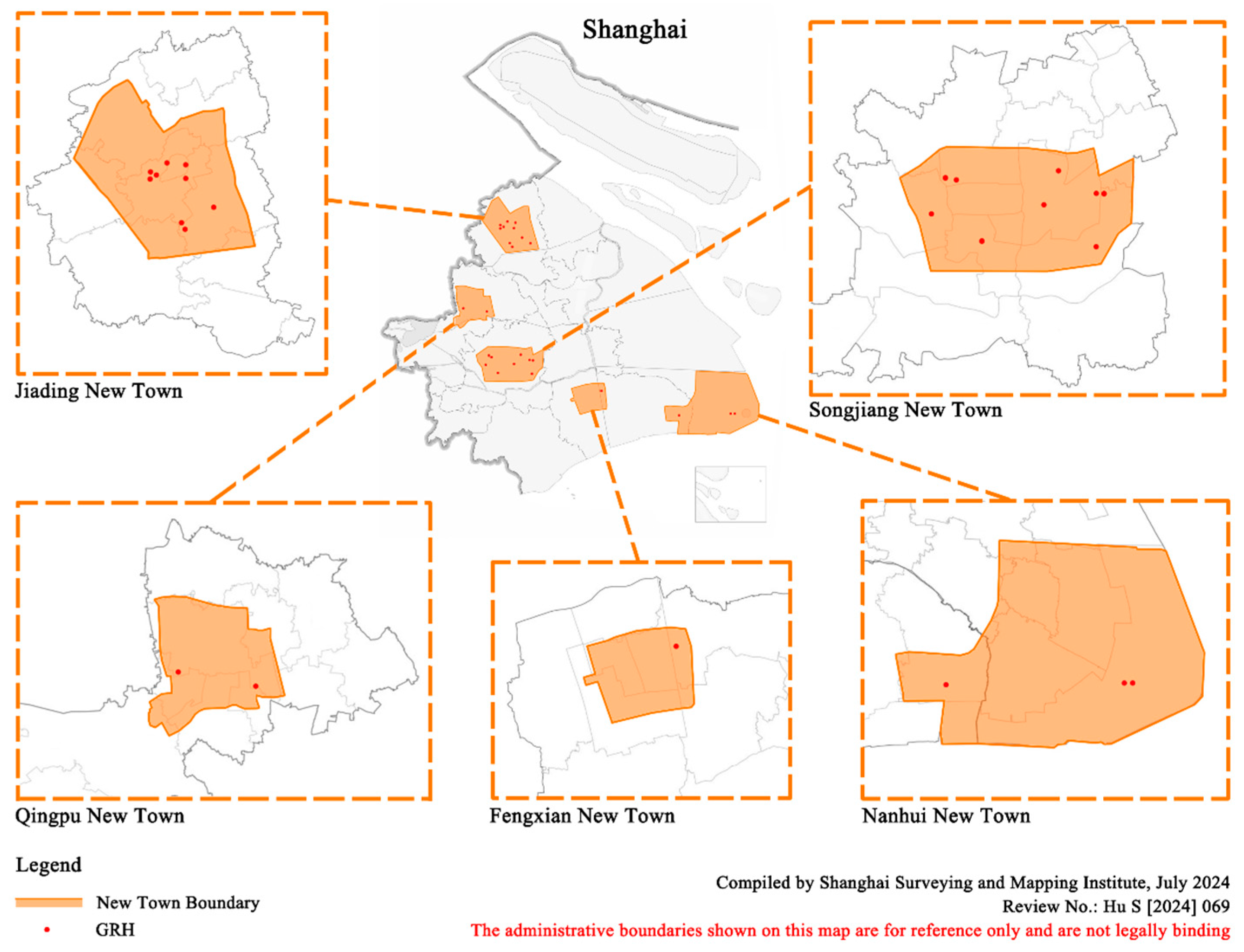
This study focuses on a total of 25 GRH projects across Shanghai’s Five New Towns as the research objects (Figure 2), employing a mixed-methods approach that integrates qualitative case studies and quantitative data analysis. The methodology centers on four key components: literature review, field investigations (including dialogs with operators and residents), morphological analysis, and difference analysis based on Fisher’s exact test. This study first characterizes the architectural features of GRH and how they shape the surrounding urban spaces and social dynamics, then evaluates their role in advancing or impeding spatial justice. Secondly, instead of discussing from macro policies or social development perspectives, this study takes the geographical and spatial context surrounding case sites to explore the inherent differences and underlying relationships among research subjects.

3.1. Case Studies and Typological Classification

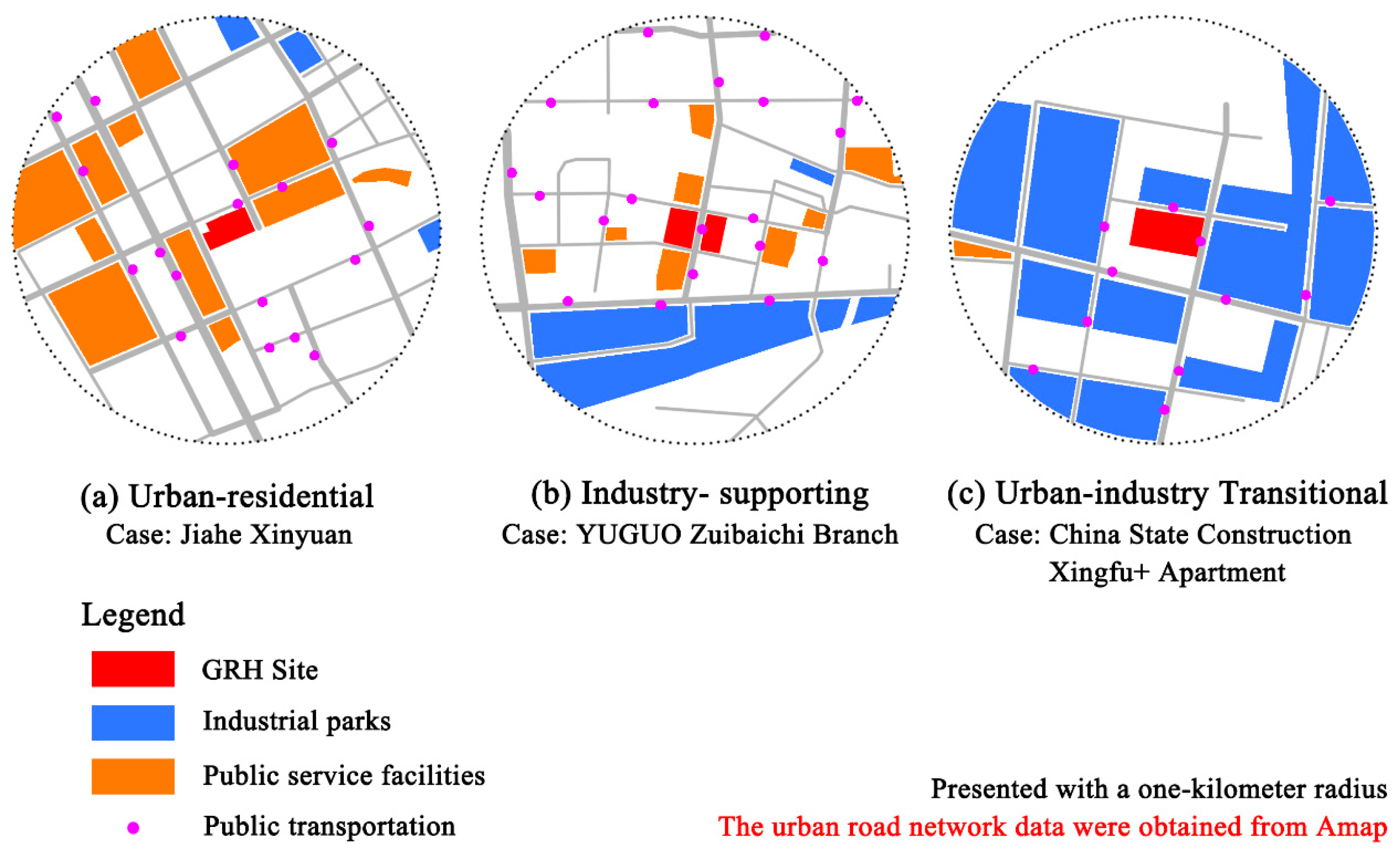
The fieldwork spanned over five months, with approximately one case study completed per week. Data collection involved documenting building information, supplemented by bicycle and pedestrian surveys to analyze the urban context within a 1–3 km radius of each site. To facilitate in-depth data gathering, the researcher conducted immersive stays of 1 to 7 days in or near GRHs, depending on its scale, enabling sustained observation and interviews with residents and community operators. Categorized based on industrial parks, public service facilities, and public transportation, this study identifies three representative typologies of GRH: Urban-residential, Industry-supporting, and Urban-industry Transitional. Concurrently, this study characterizes the geospatial features of GRH typologies through field investigations (Table 1).
The typological classification of GRH is informed by distinct spatial conditions of Shanghai’s Five New Towns, urban planning visions, and literature research on spatial justice. Industrial parks are the primary workplace for the majority of GRH residents in new towns. Their morphology and scale reflect current industrial status and future development vision [89]. Public service facilities, as defined by Shanghai’s standards, encompass eight aspects: administration, sports, commerce, culture, elderly care, education, healthcare, and green spaces [90]. These facilities not only ensure daily convenience for GRH residents but also conform to the 15 min community planning framework [91]. Public transportation reflects the connection between GRH residents, industrial parks, and public service facilities. Its accessibility level serves both as a key consideration in residents’ housing decisions and a criteria indicator of spatial justice. The representative geospatial characteristics of the three GRH typologies are illustrated in Figure 3.
It should be noted that the research focus—extending beyond the building’s physical form to encompass its performance in spatial justice, morphological characteristics, and inherent differences analysis—necessitated the selection of projects that were fully constructed and operational.

3.2. Adapted Multi-Attribute Value Theory

This paper proposes an assessment framework grounded in an adapted Multi-Attribute Value Theory (MAVT) to evaluate spatial justice in the GRH developments of Shanghai’s Five New Towns. The process was structured through a two-stage process involving problem structuring and implementation.
In this study, we first define six key indicators of spatial justice based on the theoretical criteria. Each indicator is assigned a standardized value on a 0–3 scale according to its underlying determinants, allowing for qualitative assessment while ensuring equal weighting—and thus equal importance—across all attributes. Unlike conventional MAVT approaches that yield a single composite score, we adapt the method to better capture the specific performance of each GRH project across all six indicators and to analyze inter-indicator relationships. Rather than aggregating results into the typical MAVT score range of 0–1, we calculate, report, and compare each indicator separately. The list of criteria and indicators is available in Table 2.
During implementation, distinct data collection and analysis methods are employed for different indicators. To assess the Inclusivity indicators (affordable rent, transparent leasing information, and enhanced tenure security), we analyze information transparency on public online platforms to evaluate compliance with the principle of equitable access. The realization of Diversity, Living Well-being, and Ecological Sustainability is evaluated through on-site surveys and observation. Concurrently, informal interviews with GRH residents and community workers during fieldwork provide deeper insights into their experiences regarding Active Participation, Interaction, and Advancement.

3.3. Fisher’s Exact Test

This study employs Fisher’s exact test to analyze categorical data and construct two-dimensional contingency tables to assess the statistical significance of associations between independent variables. This non-parametric test is particularly suitable for small sample sizes, which is consistent with the number of subjects in this study (n = 25). Meanwhile, it maintains robustness in cases of sparse contingency tables (expected cell counts <5). However, in such cases, asymptotic approximations are invalid, such as the Chi-square test. Statistical significance was determined at p = 0.05. The result of p ≤ 0.05 indicates that it has statistical significance, which means that GRH cases in Shanghai’s Five New Towns have inherent differences based on their geographical and spatial contexts. Conversely, the non-significant result of p > 0.05 indicates homogenization in the construction and development of GRH despite their geographical and spatial contexts. All computations were performed using the fisher.test() function in SPSS v26.0 (SPSS Foundation for Statistical Computing), with exact p-values reported to three decimal places.

4. Results

4.1. Evaluation of Spatial Justice as Manifested in the Case Studies

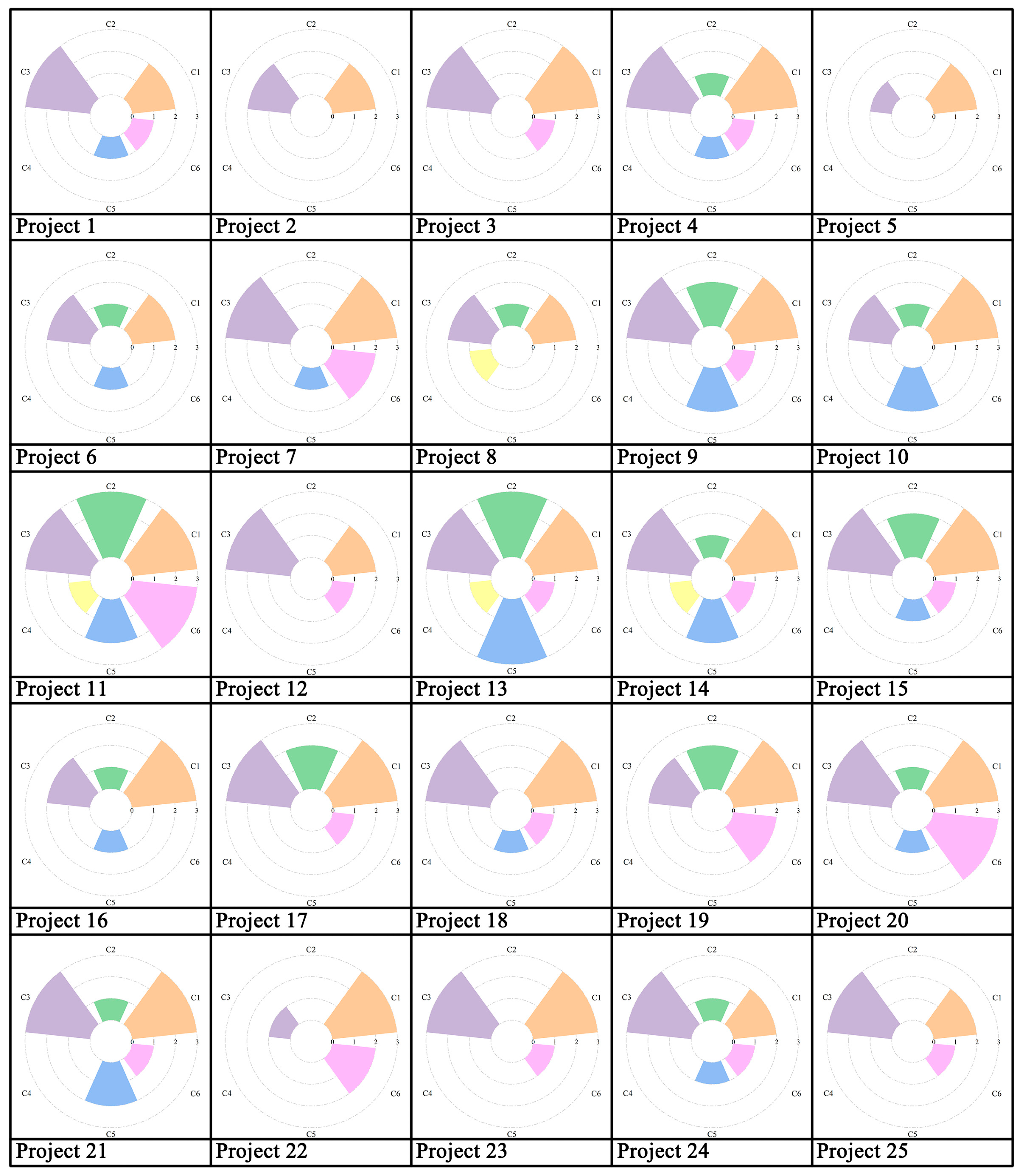
Through a field study involving interviews with GRH residents and operators, this research evaluated 25 GRH projects based on their performance against spatial justice indicators. The result reveals substantial disparities in the level of spatial justice achieved across Shanghai’s Five New Towns (Figure 4).
C1-Inclusivity was the most widely achieved criterion. All GRH projects adhered to the principles of affordable rent and enhanced tenure security, although a few lacked transparent online rental information, requiring in-person visits to obtain specific leasing details. Most projects demonstrated strong performance in C3-Living Well-being and C6-Ecological Sustainability. However, due to site constraints, some projects fell short in providing adequate public spaces and greenery landscape. Notably, very few projects addressed C4-Active Participation. Decision-making, design, and operational processes in most cases remained predominantly top-down, lacking mechanisms for equitable resident involvement. Performance in C2-Diversity and C5-Interaction and Advancement varied. Some projects prioritized diverse utilization strategies to mitigate the spatial segregation that was common in social housing. Others, despite their top-down management, deliberately allocated space for community activities and informal social events.

4.2. Analysis of Morphological Characteristics in the Case Studies

Analysis of 25 GRHs’ morphological expressions reveals prevalent design inclinations and preferences in current construction practices. The case studies demonstrate basic attributes (typological classification, construction modalities, and residential scale), as well as two critical morphological dimensions, namely planning layout and community boundaries (Table 3). These critical core morphological dimensions are associated with multiple dimensions of the spatial justice criteria. Planning layouts include freestanding layout, row layout, courtyard layout, combined layout, etc. The planning layout expresses how GRH, as an urban residential function, responds to the existing geographical and spatial structure of new towns. The morphological analysis of community boundaries focuses on the openness and permeability of GRH communities. This investigation addresses whether GRH, as a rental social housing typology targeting migrant residents, exhibits spatial segregation. Further, it demonstrates how it participates in the spatial reproduction of local social life within new towns.
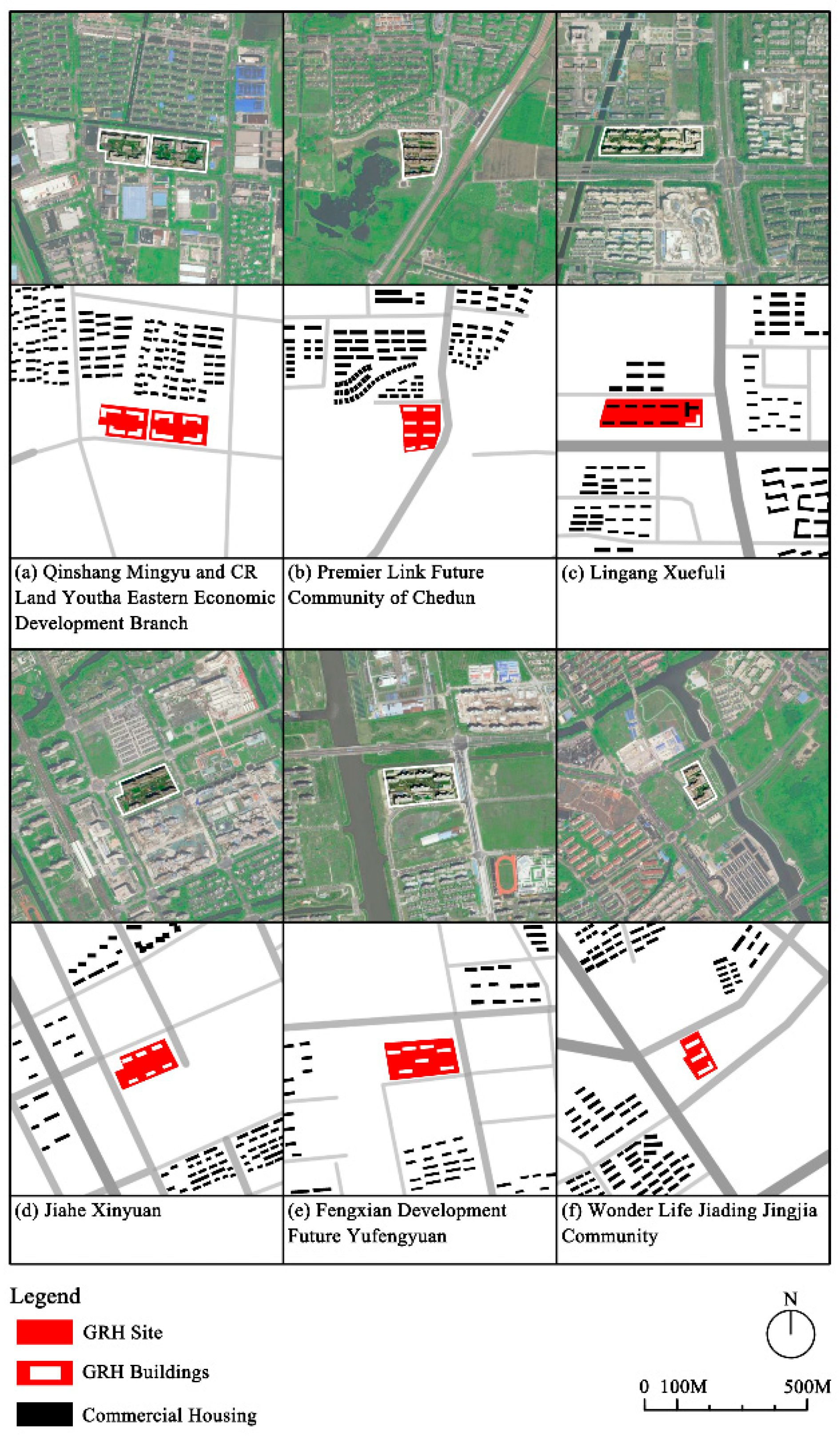
In terms of planning layouts, the dataset reveals that the row layout has the highest usage rate with a total of 10 cases, accounting for 40%, followed by freestanding layout (7 cases, 28%), courtyard layout (4 cases, 16%), and combined layout (4 cases, 16%). Furthermore, the analysis of the spatial structure and surrounding geography reveals that the row layout constitutes the most elementary response to the current new towns’ urban planning. This prevalence is due to its common use in the surrounding commercial housing communities and its demonstrated capacity to meet Living Well-being indicators while providing sufficient greenery to support Ecological Sustainability. Meanwhile, the row layout is highly adaptable to various residential scales, encompassing GRH projects ranging from a 96-unit mixed development community to large-scale rental complexes with over 2000 units. The situation of a freestanding layout is completely different. Due to its smaller residential scale, the renovation of existing buildings often pays more attention to the renewal of facade forms, such as materials, chromatic schemes, and solid–void relationship. The freestanding planning limitations of these GRH restrict the provision of enough public space, thereby hindering adaptability to host events and multi-group sharing among diverse resident groups. Consequently, it has little impact on the existing geographical and spatial structure of new towns. The courtyard layout and combined layout disrupt the repetitive row typical layout of commercial housing in new towns. By prioritizing communal courtyard spaces, these layouts establish more enclosed and independent communities while simultaneously injecting heterogeneous residential morphologies into the urban context. This also contributes to the realization of multiple spatial justice criteria, including Diversity, Living Well-being, Interaction and Advancement, and Ecological Sustainability. The spatial structure of selected GRHs’ planning layouts and their surrounding commercial housing contexts are illustrated in Figure 5.
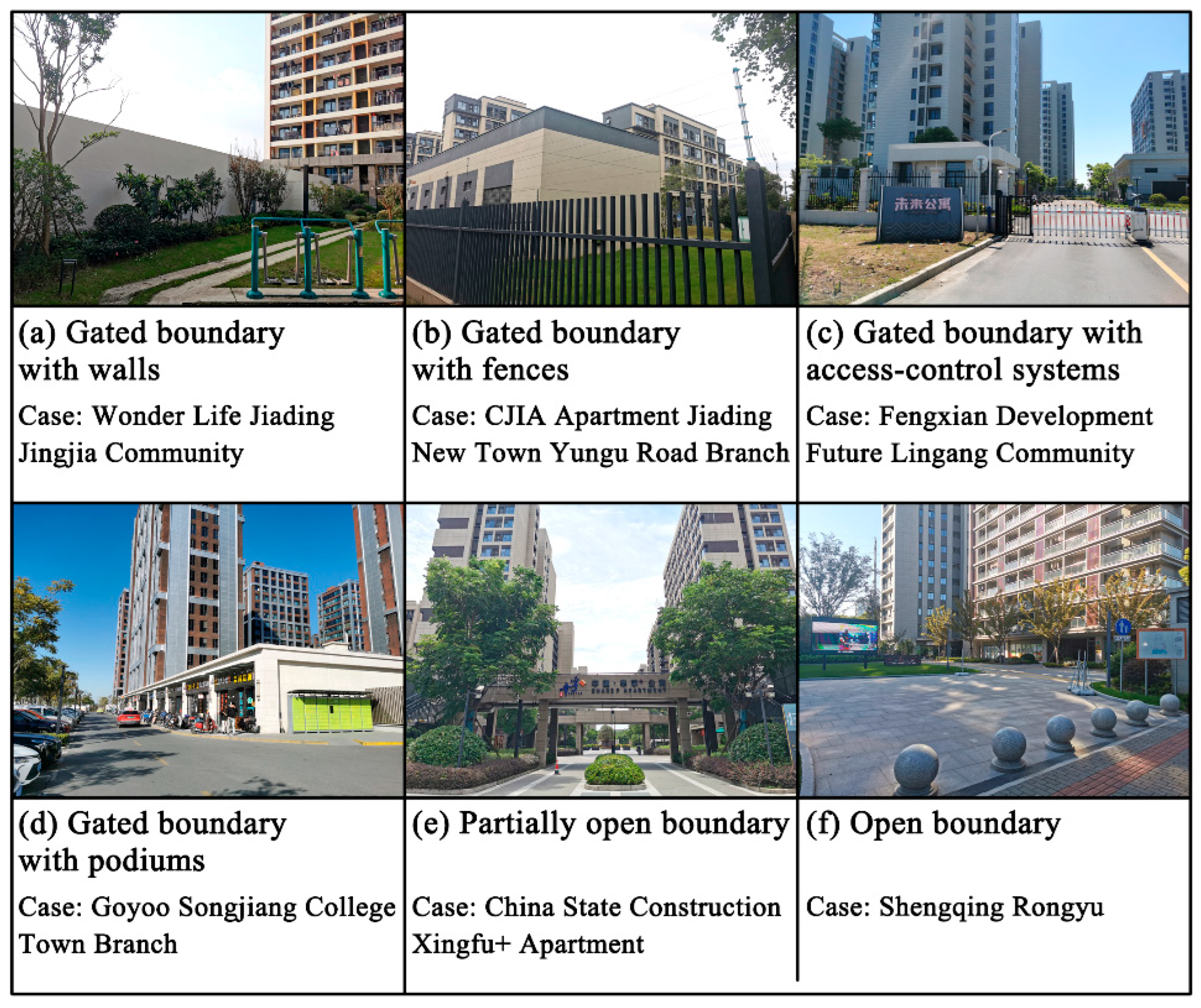
Regarding the community boundary, field investigations and analyses of 25 GRH cases reveal that the gated boundary form is dominant, as a total of 21 cases, accounting for 84%, while partially open and fully open boundary forms each constitute 2 cases (8%, respectively). The gated community boundary exhibits minimal openness and permeability, typically implemented through physical barriers such as walls (Figure 6a), fences (Figure 6b), access-control systems (Figure 6c), and podiums (Figure 6d). Notably, there are a number of projects in urban-residential contexts or mixed development modality where permeable boundaries could generate greater socio-spatial value for the urban spatial environment of new towns, such as Goyoo Songjiang College Town Branch, Creative Apartment Lingang Community, etc.
Meanwhile, field research reveals a paradoxical access policy that, although GRH, along with parks, museums, and stadiums, are publicly funded projects, GRH residential units and public spaces remain exclusively accessible to tenants and potential tenants with no public access rights granted. This current state of closure not only diminishes opportunities for unplanned interactions between migrant tenants and local residents, but also lacks contribution to the spatial reproduction of new towns. Public spaces and landscapes within gated GRH communities, accessible only to residents, serve as a barrier to informal socio-spatial exchange between migrants and local populations. The privatized nature of public space and landscape in gated communities restricts informal social interaction between migrants and local residents. This spatial exclusion is further compounded by a general lack of active participation in decision-making and governance processes, which systematically undermines the potential for multi-group engagement, even in areas with a predominant local population.
The two partially open GRH projects adopt the construction modality of new construction and mixed development (Figure 6e). By sharing commercial facilities, communal spaces, and public amenities with adjacent development projects, these GRH create potential for socio-spatial integration between migrant tenants and local residents despite their limited openness. The two open GRH projects feature a courtyard planning layout. Their permeable boundaries mitigate the enclosed nature of traditional courtyard residential buildings (Figure 6f). Although there is currently little observed by both migrant tenants and local residents in public spaces of the open GRH projects, these cases represent significant countermeasures against spatial segregation when contrasted with predominant gated boundary approaches. The morphological characteristics of selected GRH community boundaries are illustrated in Figure 6.

4.3. Results of Inherent Differences Analysis

On the basis of typological and morphological analysis derived from field investigations, this study further uses Fisher’s exact test to, respectively, construct the relationships between the typological classification of GRH projects and their architectural forms, including construction modality, residential scale, planning layout, and community boundary. Through this statistical method, the quantitative research reveals the aspects in which GRH projects in Shanghai’s Five New Towns exhibit inherent differences based on their surrounding geospatial characteristics, or alternatively, despite variations in spatial context, the current GRH projects present a homogenized pattern. The contingency table and the calculated p-value are presented in Table 4.
The data analysis reveals that the two core morphological characteristics—planning layout and community boundary—demonstrated high homogenization across different urban contexts. The basic element of construction modality also shows considerable homogenization, whereas only the residential scale exhibited significant differences across various typological classifications.
In terms of the construction modality, the statistical result is p = 0.174 > 0.05, which indicates a trend toward homogenization in current construction modalities across different geographical and spatial environments. Despite the relatively high reconstruction rate of industrial-supporting GRH (accounting for 50%), the statistical insignificance indicates that this characteristic does not translate into a statistically differentiated pattern at the data level. It suggests that the observed differences have not reached a systematic degree.
Due to the significant variations and wide range in residential scale data, with a minimum of 80 units and a maximum of 2730 units, the analysis employed categorization by intervals of 1000 units to enhance analytical clarity. The statistical result is p = 0.042 < 0.05, which indicates that the current residential scale of GRH exhibits significant differences across various typological classifications. The differences in the results are manifested as follows:
  • Urban-residential GRH is dominated by small-scale projects (<1000 units).
  • Industry-supporting GRH exhibits a bipolar distribution, consisting only of small-scale projects (<1000 units) and large-scale projects (≥2000 units), with small-scale projects being more numerous.
  • Urban-industry Transitional GRH is predominantly composed of small-scale projects (<1000 units) and medium-scale projects (1000–1999 units), with the number of medium-scale projects slightly exceeding that of small-scale ones.
In terms of the planning layout, the calculated result is p = 0.762 > 0.05. It is far greater than the significant p-value range, which indicates that GRH projects exhibit a severe homogenization phenomenon across different geographical and spatial environments in the current planning layout. The data reveals that both Urban-residential and Urban-industry Transitional GRH are dominated by row layout. Although a freestanding layout is more prevalent in industry-supporting GRH, this differentiation lacks statistical significance. In addition, courtyard layout and combined layout demonstrate identical distribution patterns across all three GRH typologies, thereby contributing significantly to the severe homogenization phenomenon observed in the current context.
In terms of the community boundary, the calculated result is p = 0.648 > 0.05, which indicates a severe homogenization phenomenon in the current community boundary across different geographical and spatial environments. This is specifically manifested in the fact that the community boundary of all three types of GRH is dominated by the gated form, while partially open and open forms remain notably lacking. Meanwhile, the scarcity of open boundary forms not only indicates prevalent spatial segregation—a manifestation of spatial injustice—in current GRH projects, but also reflects a pervasive homogenization trend in their design approaches.

5. Discussion

Guided by the evaluation criteria of spatial justice, this study conducts a morphological analysis of GRHs’ planning layouts and community boundaries, examining how these morphological characteristics either reinforce or constrain the attainment of spatial justice. After that, using Fisher’s exact test as the data analysis method, this study analyzes whether current GRH projects exhibit inherent differences based on their surrounding geospatial characteristics. This constitutes not only an exploration of Rawls’ difference principle in his theory of justice and other practical spatial justice concepts within the distinct context, but also a critical reflection on the rapid development of new towns and the extensive construction of GRH in contemporary Shanghai [16,17]. This section expands upon the empirical findings and attempts to elucidate the reasons behind the predominant morphological characteristics and homogenization phenomena in GRH at the current stage, while putting forward corresponding recommendations.

5.1. The Underlying Causes of Morphological Results and Homogenization Phenomenon

5.1.1. Policy and Regulatory: The Sunlight Access Standard

At present, social housing in China is still in short supply, and the current GRH policies prioritize the quantity of supply as the core goal [92]. In practical projects, there are often requirements to simplify the design logic, maximize land utilization, and conduct low-cost and rapid construction, while the construction process also aims to facilitate batch approval and construction supervision. These factors have indirectly led to the homogenization of morphological characteristics. This supply-oriented policy paradigm is also reflected in the design standards for GRH. The homogenization of individual projects originates from the changes in design standards, most notably through the sunlight access standards.
The sunlight access standard has undergone several significant changes. In 2011, Shanghai first proposed a relaxation of sunlight access standards for public rental housing, permitting up to 10% of dwelling units to be exempt from meeting the previously mandatory standards that had aligned public rental housing with commercial housing [93]. Although this was only a minor adjustment, it created greater possibilities for implementing innovative planning layouts such as courtyard layouts and combined layouts in social housing. Shanghai Longnan Garden Social Housing Estate stands as an exemplary case of a courtyard layout public rental housing project made feasible under these revised standards. The second major change occurred in 2017, when Shanghai’s building standards significantly relaxed the sunlight access standard from 90% to 50% [94]. This change aimed to promote courtyard layouts as a viable planning approach for rental housing, thereby breaking away from the row layout dominance characteristic of commercial housing and optimizing urban street spatial form. The last notable change took place in 2022. Along with the advancement of GRH construction, a striking reversal occurred in the sunlight access standard. The initially proposed 50% sunlight access standard in the draft guideline was abruptly replaced in the year-end official document, which states, ‘The building spacing and sunlight requirements for government-subsidized rental housing shall comply with the relevant regulations of Shanghai urban planning administration’ [95,96]. This regulatory reversal signifies a complete retraction of relaxed sunlight requirements for social housing construction, and the courtyard layouts and combined layouts have also been restricted due to the constraints imposed by sunlight access standards. This series of changes in the sunlight requirements and standards has substantially deterred designers from pursuing innovative planning layouts in GRH. Consequently, it leads to the current construction preference for row layouts and freestanding layouts.
Furthermore, as the spatial justice evaluation revealed, both row and freestanding layouts impose constraints on achieving spatial justice. While row layouts can support good living well-being, they typically fail to create the cohesive public spaces characteristic of courtyard layouts, which are crucial for meeting the diverse needs of multi-group sharing and interaction. Conversely, the freestanding model exhibits a more pronounced constraint; its common deficiency in ample public space and greenery impedes its ability to satisfy the living well-being criterion.

5.1.2. Design and Research: Inertial Thinking Process

At the design level, based on field investigations and interviews, this study finds that inertial thinking in the design process may be a key factor contributing to the homogenization phenomenon. As one of the government-led social housing projects, most GRH projects are designed and implemented by state-owned enterprises (SOEs). Large SOEs typically subcontract projects to smaller architectural teams with specialized experience in residential design. This has led to the frequent adoption of commercial residential housing design paradigms in GRH’s planning and design, such as row layouts and gated boundaries. While this approach effectively ensures living space quality, accessibility to public space, and greenery, it simultaneously curtails the potential to achieve other spatial justice criteria, notably Diversity, Active Participation, and Interaction and Advancement. Furthermore, as the function of Shanghai’s Five New Towns serves as industrial extensions rather than central urban districts, GRH projects currently have not engaged prestigious architectural firms to participate in design innovation due to considerations of cost savings and policy implementation efficiency, unlike some public rental housing projects in core urban locations.
At the research level, as revealed in the earlier literature review through an analysis of relevant publications indexed in academic databases from 2021 to the first half of 2025, current research on GRH predominantly concentrates on policy and financial dimensions. In contrast, only 37 publications (9.3%) focus on the Building Science and Engineering aspect. More researchers approach GRH as a policy term rather than an architectural entity in their studies. This has resulted in a lack of in-depth discussions on critical issues in current research, particularly Diversity, Active Participation, and Interaction and Advancement within social justice frameworks. Meanwhile, the limited number of design studies rooted in building science also focus on specialized subfields such as transit-oriented development or residential preferences, making it difficult to support in-depth design exploration of GRH itself and the shift in theoretical research. This research gap has contributed to the homogenization phenomenon observed in the current context.

5.1.3. Marketing and Operations: Implicit Commercial Constraints

As one of China’s largest metropolises and least affordable housing markets, Shanghai’s GRH siting strategies are influenced by implicit market considerations, particularly the imperative to minimize potential disruptions to the surrounding commercial housing market. Even in new towns characterized by relatively lower residential density, GRH projects still tend to be located along urban-rural fringes or adjacent to industrial parks. Since GRH projects in Shanghai’s Five New Towns are primarily targeted at migrant technical workers, gated boundaries help community management reduce administrative costs and avoid security disputes. While this spatial configuration enhances residential safety, it directly reinforces the spatial segregation between GRH and adjacent communities. Meanwhile, it restricts the integration of diverse functions, further contributing to the homogenization of morphological characteristics.
Due to the relatively low rental yield of GRH projects, after the launch of GRH REITs in 2022, financial institutions have focused more on the asset stability and cash flow predictability of these projects. Standardized morphological configurations facilitate asset valuation and reduce operational risks, while differentiated forms may introduce financial valuation complexities due to their unique characteristics. This could also be one of the reasons why developers tend to adopt similar design approaches.
Meanwhile, communications with the current operation teams and designers of GRH projects reveal that SOEs widely anticipate the potential future conversion of GRH to commercial housing when social security gradually becomes saturated [88]. This expectation mirrors the historical trajectory of China’s social housing in the early stages. Therefore, the planning layouts and boundary forms of GRH projects predominantly emulate those of commercial housing to maximize potential financial returns following future commercialization.

5.2. Recommendations for Enhancing Spatial Justice and Reducing Homogenization

5.2.1. Multi-Tiered Policy Framework

The design standards for GRH should prioritize regulatory stability to avoid frequent revisions, while actively encouraging multi-dimensional differentiated design approaches. This study proposes a multi-tiered framework that can be developed by taking standardized design specifications as the foundation and incorporating additional policy incentives. As the foundation, the standardized design specifications clarify the baseline requirements for safety, energy efficiency, fire protection, structural integrity, and other aspects. Policy incentives could provide targeted rewards to GRH projects featuring innovative typologies adapted to different urban contexts by expedited approval processes or additional subsidies. It is imperative to shift the policy logic away from standardized supply-oriented provision toward fostering mixed-use methods, sharing needs and social interaction of diverse groups, and active participation in spatial decision-making and self-determination. Meanwhile, as the current construction modality of GRH in Shanghai’s Five New Towns is dominated by new construction, reconstruction approaches account for merely 24% of the total projects. The government could implement supplementary policy incentives to facilitate the conversion of underutilized existing assets into GRH, such as old hotels. This approach not only meets the current priorities of accelerating construction, cost reduction, and streamlined development cycles but also leverages the unique spatial characteristics of these assets to provide a foundation for differentiated design.

5.2.2. Refined Place-Making Strategy

Design strategies should prioritize fostering a vibrant living environment through mixed-use and community-oriented amenities, such as convenience retail, cafes, bookstores, workshops, daycare centers, etc., within ground-floor spaces or ancillary facilities of residential complexes. Such a design not only meets the daily needs of GRH residents but also extends services to the surrounding communities. Furthermore, it fosters social interaction between migrant populations and local communities while enhancing urban public service provision, particularly for Industry-supporting GRH and Urban-industry Transitional GRH, which lack sufficient public service facilities. Public space design should prioritize meticulous planning to meet residents’ lifestyles and daily needs, including rooftop gardens, sharing kitchens, children’s play areas, pet-friendly spaces, etc. Meanwhile, such place-making strategies should integrate organically with the existing urban context of new towns through open layouts with small blocks and dense road networks. This approach not only promotes job–housing balance but also aligns with Shanghai’s planning objective of building 15 min communities [91].

5.2.3. Joint Operation

Due to the currently low rental yield of GRH projects, most SOEs are primarily motivated by the future commercialization for higher returns. This has led to homogenization in the current planning layout of GRH, which is dominated by row layouts and freestanding layouts, with widespread adoption of gated boundaries. This study proposes drawing on the co-management models of cohousing and collaborative housing in European social housing systems as a reference framework [97,98]. First, developers could integrate commercially operated amenities, such as retail, supermarkets, gyms, laundries, etc. These amenities could serve both tenants and the surrounding communities and generate operational revenues that partly offset construction and maintenance costs to establish a virtuous economic cycle. Second, since the target group of GRH consists of migrant technical workers, communities could implement rent subsidy schemes to incentivize them to leverage their professional expertise through participatory public space co-creation, equipment maintenance, or volunteer initiatives. This not only mitigates the financial burdens of migrant populations but also fosters community culture, enhances residents’ sense of identity, and further lowers operational costs. This could help address the morphological homogenization in GRH developments at the micro-scale. This measure aligns with the core criteria on resident active participation within the spatial justice framework, thereby mitigating the participation gap caused by the prevalent top-down governance in GRHs.

5.3. Limitations

This study has several limitations. The first limitation concerns the research perspective and sample size. As stated in the preceding literature review, research perspectives influence the interpretation of urban phenomena; appropriate research perspectives and classification frameworks are particularly important [45]. This paper lacks the analysis of micro-perspective GRH architectural elements, such as facade colors and materials, and their impacts on morphological characteristics and differentiation. Given the relatively limited sample size, the four core elements selected in this paper are constructed at the community level, including two basic characteristics (construction modality and residential scale) and two morphological characteristics (planning layout and community boundary). This macro-oriented research perspective may limit the statistical power of the research results. As the construction of GRH becomes more widespread and the total sample size expands, future studies could investigate and analyze from multi-dimensional perspectives, especially the micro-perspective, to validate and refine the preliminary findings presented in this study.
Second, Shanghai’s Five New Towns are currently in the construction phase, from semi-independent satellite towns to self-balanced independent new cities. To mitigate the adverse impacts of surrounding development on safety and sanitation within GRH communities, a gated boundary form may be the optimal choice for a limited number of industry-supporting and urban-industry transitional GRH projects. However, as peripheral urban blocks achieve functional diversification and infrastructural maturity, existing GRH projects may progressively transition toward open boundary forms. Building upon the analytical framework established in this study, future research could incorporate developmental variables, such as planned industrial parks, public service facilities, and public transportation systems in surrounding areas, to assess morphological evolution and internal differentiation patterns from the perspective of a complete building life-cycle.
A final research limitation concerns the exploratory nature of the causal analysis regarding the observed current patterns. Although this study explores three potential causes of the current morphological characteristics and homogenization patterns, some of the inferences about these causes are based on interviews and exchanges with experienced GRH architects and operators due to the scarcity of theoretical research on GRH in China. Consequently, some of the causal inferences remain tentative and need to be further verified through comprehensive empirical investigation and systematic analysis. This may lead to individual biases in the causal interpretations discussed in this study. Future research should build upon these preliminary findings to conduct more comprehensive investigations, so as to empirically quantify the relative contributions of the three causes to the morphological characteristics and homogenization of GRH projects.

6. Conclusions and Contribution

This study investigates and critically analyzes the morphological characteristics and inherent differences in GRH in Shanghai’s Five New Towns from the perspective of spatial justice. This study employs field research combining typological, morphological, and quantitative data analysis to examine GRH projects within their geospatial contexts. By correlating morphological features with contextual conditions, it establishes data relational patterns across typologies and interprets the underlying morphological mechanisms.
This study draws the following two main conclusions.
Regarding the first research question on morphological characteristics and their role in spatial justice, GRHs in the Five New Towns are predominantly characterized by row and freestanding layouts, resembling the spatial patterns of surrounding commercial housing. This results in the effective realization of spatial justice in terms of Inclusivity, Living Well-being, and Ecological Sustainability, while restricting its achievement in Diversity, Active Participation, and Interaction and Advancement among migrant populations. At the same time, the widespread use of gated boundaries creates physical and social segregation between GRH communities and local neighborhoods, which undermines socio-spatial integration and limits the realization of spatial justice for migrant populations.
Regarding the second research question on the interrelation with surroundings and geospatial differentiation, only the residential scale in GRHs exhibits significant differences across different urban contexts. The current GRH developments in Shanghai’s Five New Towns show significant homogenization in construction modality, planning layout, and community boundary. This reflects a supply-oriented policy paradigm with insufficient consideration for spatial justice and distinct urban contexts. This trend towards uniformity may systematically neglect the socio-spatial requirements of different migrant groups, potentially leading to new spatial inequality problems.
In addition, this study further discusses and identifies the underlying causes of the current phenomena, including quantity-oriented policy priorities, homogenized design standards, imitative design paradigms, disproportionate scholarly focus on GRH finance, speculative real estate development logic, and unrealistic commercialization expectations. To promote spatial justice and reduce homogenization, the following recommendations are proposed.
Policy and Regulation: Develop a tiered policy framework combining baseline design standards with incentives for innovative layouts, open communities, mixed-use methods, diverse social interaction, and active participation.
Design and Research: Shift from rapid supply to refined place-making strategies, emphasizing sharing amenities and accessible public spaces to foster interaction both among different migrant groups and with the established local communities.
Operations and Management: Introduce co-management models and rental subsidies to engage tenants in community services, thereby reducing costs and promoting active resident participation.
The contribution of this study lies firstly in integrating spatial justice with GRH typologies to develop evaluation criteria and subsequently applying these criteria to assess the performance of each project. Subsequently, this study then employs a mixed-methods approach to critically analyze the morphological characteristics and inherent differences in GRH in Shanghai’s Five New Towns. Fisher’s exact test can establish data logic between urban geospatial elements and GRH characteristics. This approach facilitates a systematic comprehension of the existing situation and the underlying causes of observed patterns, thereby providing evidence-based recommendations for policymakers, designers, and operators. The ultimate objective is to optimize the future development of GRH by maximizing social inclusion for the migrant rental population and advancing spatial justice within GRH communities.

Author Contributions

Conceptualization, C.X. and Z.L.; methodology, C.X.; software, C.X.; validation, C.X.; formal analysis, C.X.; investigation, C.X.; resources, C.X.; data curation, C.X.; writing—original draft preparation, C.X.; writing—review and editing, C.X. and Z.L.; visualization, C.X.; supervision, Z.L.; project administration, Z.L.; funding acquisition, C.X. and Z.L. All authors have read and agreed to the published version of the manuscript.

Funding

This research received no external funding.

Data Availability Statement

The anonymized survey data supporting the findings of this study are available from the corresponding author upon reasonable request due to privacy considerations and institutional restrictions. The map-based analysis was constructed with reference to Amap (Gaode) data.

Acknowledgments

The authors extend their gratitude to Architect Jiajing Zhang for sharing his professional experience in GRH projects and for his valuable insights regarding the current state of GRH development.

Conflicts of Interest

The authors declare no conflicts of interest.

Abbreviations

GRHGovernment-subsidized rental housing
REITReal estate investment trust
SOEState-owned enterprise

References

  1. UN-DESA. World Population Prospects 2024: Summary of Results. New York United Nations. 2024. Available online: https://desapublications.un.org/publications/world-population-prospects-2024-summary-results (accessed on 1 November 2025).
  2. UN-HABITAT. World Cities Report 2022: Envisaging the Future of Cities. New York United Nations. 2022. Available online: https://unhabitat.org/world-cities-report-2022-envisaging-the-future-of-cities (accessed on 1 November 2025).
  3. Bromhead, A.; Lyons, R. Social housing and the spread of population: Evidence from twentieth century Ireland. J. Urban Econ. 2023, 138, 103603. [Google Scholar] [CrossRef]
  4. Doyle, C. Housing in UK New Immigration Destinations: Planning, houses of multiple occupation and the challenges of uncertainty. J. Rural. Stud. 2018, 64, 276–288. [Google Scholar] [CrossRef]
  5. Zhang, Y.; Luo, F.; Dai, Y.; Zhang, C. Changing spatial inclusion of migrants in Chinese cities: How housing matters. Habitat Int. 2025, 157, 103319. [Google Scholar] [CrossRef]
  6. Shanghai Municipal Office of the Leading Group for Promoting the Planning and Construction of New Towns. Shanghai New Town Planning and Implementation Guideline. Shanghai Municipal Bureau of Planning and Natural Resources. 2021. Available online: http://files.in5.cn/guifan/202103/202103-上海市新城规划建设导则.pdf (accessed on 1 November 2025).
  7. Zeng, D.; Wu, X.; Wei, C. Spatial concentration and the social distance of migrants: Evidence from Shanghai. Chin. J. Sociol. 2023, 9, 72–94. [Google Scholar] [CrossRef]
  8. Xu, D.; Shen, W. Evolution Characteristics and Influencing Factors of City Networks in China: A Case Study of Cross-Regional Automobile Enterprises. ISPRS Int. J. Geo-Inf. 2024, 13, 145. [Google Scholar] [CrossRef]
  9. Wei, L.; Luo, Y.; Wang, M.; Cai, Y.; Su, S.; Li, B.; Ji, H. Multiscale identification of urban functional polycentricity for planning implications: An integrated approach using geo-big transport data and complex network modeling. Habitat Int. 2020, 97, 102134. [Google Scholar] [CrossRef]
  10. General Office of the State Council. Guiding Opinions of the General Office of the State Council on Accelerating the Development of Government-Subsidized Rental Housing. 2021. Available online: https://www.gov.cn/zhengce/content/2021-07/02/content_5622027.htm (accessed on 1 November 2025).
  11. General Office of the People’s Government of Beijing Municipality. Implementation Plan of Beijing Municipality on Accelerating the Development of Government-Subsidized Rental Housing. Beijing Municipal Government Gazette. 2022. Available online: https://www.beijing.gov.cn/zhengce/gfxwj/202203/t20220318_2634203.html (accessed on 1 November 2025).
  12. Shenzhen Municipal Housing and Construction Bureau. Shenzhen Housing Development 14th Five-Year Plan (2021–2025). 2022. Available online: https://zjj.sz.gov.cn/attachment/0/940/940604/9512985.pdf (accessed on 1 November 2025).
  13. Guangzhou Municipal Housing and Urban-Rural Development Bureau. Guangzhou Housing Development 14th Five-Year Plan (2021–2025). 2021. Available online: https://zfcj.gz.gov.cn/attachment/7/7524/7524221/7725112.pdf (accessed on 1 November 2025).
  14. General Office of the People’s Government of Shanghai Municipality. Implementation Opinions on Accelerating the Development of Government-Subsidized Rental Housing in Shanghai. 2021. Available online: https://www.shanghai.gov.cn/nw12344/20211123/da0fae1c47224e5c8f91b8c7276d2ea6.html (accessed on 1 November 2025).
  15. Clark, B.; Elliott, J. John Stuart Mill’s Theory of Justice. Rev. Soc. Econ. 2001, 59, 467–490. [Google Scholar] [CrossRef]
  16. Rawls, J. Justice as Fairness. Philos. Rev. 1958, 67, 164–194. [Google Scholar] [CrossRef]
  17. Rawls, J. A Theory of Justice: Revised Edition; Harvard University Press: Cambridge, MA, USA, 1999; pp. 228–292. [Google Scholar]
  18. Foucault, M. Space, Knowledge and Power. Rizzoli Communications, Inc. 1982. Available online: https://foucault.info/documents/foucault.spaceKnowledgePower/ (accessed on 1 November 2025).
  19. Lefebvre, H. The Production of Space; Blackwell: Oxford, UK, 1991; pp. 169–228. [Google Scholar]
  20. Lefebvre, H. The Right to the City. In Writings on Cities; Blackwell: Oxford, UK, 1996; pp. 147–159. [Google Scholar]
  21. Harvey, D. Social Justice and the City; University of Georgia Press: Athens, GA, USA, 1973; pp. 96–118. [Google Scholar]
  22. Young, I. Justice and the Politics of Difference; Princeton University Press: Princeton, NJ, USA, 1990; pp. 226–256. [Google Scholar]
  23. Pirie, G. On spatial justice. Environ. Plan. A 1983, 15, 465–473. [Google Scholar] [CrossRef]
  24. Soja, E. Seeking Spatial Justice; University of Minnesota Press: Minneapolis, MN, USA, 2010. [Google Scholar]
  25. Dikeç, M. Justice and the Spatial Imagination. Environ. Plan. A Econ. Space 2001, 33, 1785–1805. [Google Scholar] [CrossRef]
  26. Haycox, H.; Hill, E.; Finney, N.; Meer, N.; Rhodes, J.; Leahy, S. Housing governance and racialisation: ‘Inclusivity’ in housing access and experience. J. Ethn. Migr. Stud. 2024, 50, 4545–4562. [Google Scholar] [CrossRef]
  27. Lau, J. Spatial mismatch and the affordability of public transport for the poor in Singapore’s new towns. Cities 2011, 28, 230–237. [Google Scholar] [CrossRef]
  28. Jeanes, R.; Penney, D.; O’Connor, J.; Spaaij, R.; O’Hara, E.; Magee, J.; Lymbery, L. Spatial justice, informal sport and Australian community sports participation. Leis. Stud. 2022, 43, 946–960. [Google Scholar] [CrossRef]
  29. He, Z.; Zhang, Y. Connecting built form diversity and housing mix with refining diversity measurement under the general framework. Cities 2025, 166, 106243. [Google Scholar] [CrossRef]
  30. Jaupart, P. The elusive quest for social diversity: Public housing, diversity, and politics in France. Econ. Lett. 2020, 197, 109626. [Google Scholar] [CrossRef]
  31. McGreevy, M. Housing Diversity and Affordability: The Effects of 35 Years of Exclusionary Land Use Regulations on Housing Affordability in Adelaide, South Australia. Urban Policy Res. 2018, 36, 336–353. [Google Scholar] [CrossRef]
  32. Greenfield, E. Age-Friendly Initiatives, Social Inequalities, and Spatial Justice. Hastings Cent. Rep. 2018, 48, 41–45. [Google Scholar] [CrossRef]
  33. Israel, E.; Frenkel, A. Social justice and spatial inequality: Toward a conceptual framework. Prog. Hum. Geogr. 2018, 42, 647–665. [Google Scholar] [CrossRef]
  34. Bungau, C.C.; Bendea, C.; Bungau, T.; Radu, A.-F.; Prada, M.F.; Hanga-Farcas, I.F.; Vesa, C.M. The Relationship between the Parameters That Characterize a Built Living Space and the Health Status of Its Inhabitants. Sustainability 2024, 16, 1771. [Google Scholar] [CrossRef]
  35. Omar, K.; Omar, D.; Othman, S. Youth Well-being Index in the Neighbourhood Space: Outdoor VS Indoor Space. WIT Trans. Ecol. Environ. 2017, 214, 163–171. [Google Scholar] [CrossRef]
  36. Yang, W.; Yang, R.; Zhou, S. The spatial heterogeneity of urban green space inequity from a perspective of the vulnerable: A case study of Guangzhou, China. Cities 2022, 130, 103855. [Google Scholar] [CrossRef]
  37. de Sousa, F.G.; Alvim, A.T.B. The Right to the City in Practice: The Experience of Social Interest Housing Developments in Diadema, São Paulo, Brazil. Buildings 2025, 15, 2143. [Google Scholar] [CrossRef]
  38. Li, H. The lost and awaken of publicity: Street community renewal based on space justice. Planners 2018, 2, 25–30. [Google Scholar] [CrossRef]
  39. Pais, A.B.; Pais, A.C.; Elmisurati, G.; Park, S.H.; Miles, M.F.; Wolstenholme, J.T. A Novel Neighbor Housing Environment Enhances Social Interaction and Rescues Cognitive Deficits from Social Isolation in Adolescence. Brain Sci. 2019, 9, 336. [Google Scholar] [CrossRef] [PubMed]
  40. Maya-Jariego, I.; Santolaya, F.; Pastor-Alcayde, P. Multiple senses of community in central and peripheral neighborhoods of Seville: The fragmentation of personal networks in social housing estates. Soc. Netw. 2026, 85, 13–23. [Google Scholar] [CrossRef]
  41. Kim, J.Y.; Kim, Y.O. Residents’ Spatial-Usage Behavior and Interaction According to the Spatial Configuration of a Social Housing Complex: A Comparison between High-Rise Apartments and Perimeter Block Housing. Sustainability 2022, 14, 1138. [Google Scholar] [CrossRef]
  42. Cauvain, J.; Karvonen, A. Social housing providers as unlikely low-carbon innovators. Energy Build. 2018, 177, 394–401. [Google Scholar] [CrossRef]
  43. Desvallées, L. Low-carbon retrofits in social housing: Energy efficiency, multidimensional energy poverty, and domestic comfort strategies in southern Europe. Energy Res. Soc. Sci. 2022, 85, 102413. [Google Scholar] [CrossRef]
  44. Snep, R.; Klostermann, J.; Lehner, M.; Weppelman, I. Social housing as focus area for Nature-based Solutions to strengthen urban resilience and justice: Lessons from practice in the Netherlands. Environ. Sci. Policy 2023, 145, 164–174. [Google Scholar] [CrossRef]
  45. Malpass, P. Histories of Social Housing: A Comparative Approach. In Social Housing in Europe; Wiley Blackwell: Hoboken, NJ, USA, 2014; pp. 255–274. [Google Scholar] [CrossRef]
  46. Harloe, M. The People’s Home?: Social Rented Housing in Europe & America; Wiley Blackwell: Hoboken, NJ, USA, 1995. [Google Scholar] [CrossRef]
  47. Ozer, S.; Jacoby, S. The design of subsidized housing: Towards an interdisciplinary and cross-national research agenda. Hous. Stud. 2022, 1, 297–322. [Google Scholar] [CrossRef]
  48. Bresson, S.; Labit, A. How Does Collaborative Housing Address the Issue of Social Inclusion? A French Perspective. Hous. Theory Soc. 2019, 1, 118–138. [Google Scholar] [CrossRef]
  49. Turok, I.; Scheba, A.; Visagie, J. Can social housing help to integrate divided cities? Camb. J. Reg. Econ. Soc. 2022, 1, 93–116. [Google Scholar] [CrossRef]
  50. Donoso, V.G.; Queiroga, E.F. Social Landscape, Peripheral Inclusion and Un-Practice: Concepts for Understanding Social Housing Daily Life in Open Spaces. Sustainability 2023, 15, 12672. [Google Scholar] [CrossRef]
  51. Cameron, S. Ethnic Minority Housing Needs and Diversity in an Area of Low Housing Demand. Environ. Plan. A 2000, 8, 1427–1444. [Google Scholar] [CrossRef]
  52. Costarelli, I.; Melic, T. Housing motivated youth in low-income neighborhoods: How practitioners shape conditions for encounters across diversity in ‘intentional’ social mix programs in Milan and Paris. J. Urban Aff. 2021, 3, 397–415. [Google Scholar] [CrossRef]
  53. Górczyńska, M. Social and housing tenure mix in Paris intra-muros, 1990–2010. Hous. Stud. 2016, 32, 385–410. [Google Scholar] [CrossRef]
  54. Algan, Y.; Hémet, C.; Laitin, D.D. The social effects of ethnic diversity at the local level: A natural experiment with exogenous residential allocation. J. Political Econ. 2016, 3, 696–733. [Google Scholar] [CrossRef]
  55. Ministry of Construction; All-China Federation of Trade Unions. Proposals on Addressing the Housing Needs of Urban Households with Acute Housing Difficulties. 1990. Available online: http://www.reformdata.org/1990/0911/14471.shtml (accessed on 1 November 2025).
  56. State Council. Notice of the State Council Concerning Further Deepening the Reform of the Urban Housing System and Accelerating Housing Construction. 1998. Available online: https://www.beijing.gov.cn/zhengce/zhengcefagui/qtwj/201309/t20130924_776668.html (accessed on 1 November 2025).
  57. Zhou, J.; Ronald, R. Housing and Welfare Regimes: Examining the Changing Role of Public Housing in China. Hous. Theory Soc. 2016, 34, 253–276. [Google Scholar] [CrossRef]
  58. Chen, J.; Yang, Z.; Wang, Y.P. The New Chinese Model of Public Housing: A Step Forward or Backward? Hous. Stud. 2014, 29, 534–550. [Google Scholar] [CrossRef]
  59. Ye, J.P.; Wu, Z.H. Urban Housing Policy in China in the Macro-regulation Period 2004–2007. Urban Policy Res. 2008, 26, 283–295. [Google Scholar] [CrossRef]
  60. Jia, G.; Ma, S. Shared-ownership housing: A new approach to affordable housing. Urban Dev. 2007, 6, 36–38. [Google Scholar]
  61. Zhu, Y. Policy Networks and Policy Paradigm Shifts: Urban housing policy development in China. J. Contemp. China 2013, 22, 554–572. [Google Scholar] [CrossRef]
  62. Jiang, X.; Mai, Y. The social welfare housing project and its effects in China. J. Syst. Sci. Complex. 2015, 28, 393–408. [Google Scholar] [CrossRef]
  63. Xia, G.; Chen, J.; Xia, G. Diversification of the societal composition in communities. Mod. Urban Res. 2007, 12, 65–68. [Google Scholar] [CrossRef]
  64. Wang, X.; Yang, L.; Huang, T.; Jun, B.-K. A Comparative Study on Unit Plans of Public Rental Housing in China, Japan, and South Korea: Policy, Culture, and Spatial Insights for China’s Indemnificatory Housing Development. Buildings 2025, 15, 3068. [Google Scholar] [CrossRef]
  65. Lin, Y. An institutional and governance approach to understand large-scale social housing construction in China. Habitat Int. 2018, 78, 96–105. [Google Scholar] [CrossRef]
  66. Liu, K.; Leng, J. A Study of Sustainable Social Housing Community Design in Britain and China. KnE Soc. Sci. 2019, 3, 459–472. [Google Scholar] [CrossRef]
  67. Liu, J.; Dai, W.; Li, X.; Dong, Z.; Dong, J. The Differentiated Effect of Administrative Policy in China’s Housing Market—Based on the Heterogeneous Households Multi-Agent Model. J. Syst. Sci. Complex. 2020, 33, 167–195. [Google Scholar] [CrossRef]
  68. Hu, Z. Six types of government policies and housing prices in China. Econ. Model. 2022, 108, 105764. [Google Scholar] [CrossRef]
  69. Jiang, J.; Wang, Z.; Huang, W.; Wei, X. Migrant Workers’ Residential Choices and China’s Urbanization Path: Evidence from Northeastern China. J. Urban Plan. Dev. 2019, 145, 05019012. [Google Scholar] [CrossRef]
  70. Ding, W.; Liu, C.; Wu, Y.; Li, P.; Wu, Y.; Wang, S. Exploring the relationship between residential location and long-term settlement intentions: A study of migrant workers in urban China. Singap. Econ. Rev. 2025, 70, 1217–1245. [Google Scholar] [CrossRef]
  71. Hu, J. Diversified Exploration of Public Rental Housing Design Suitable for Youth Groups. Master’s Thesis, Shandong Jianzhu University, Jinan, China, 2013. [Google Scholar] [CrossRef]
  72. Li, B.; Zhang, G. Differentiation of residential space and public services: A study on urban residents’ sense of gain from public services. Theory J. 2018, 1, 99–108. [Google Scholar] [CrossRef]
  73. Ni, H. Develop fast government-subsidized rental housing and solve the prominent issue of housing in big cities. Adm. Reform 2021, 9, 44–49. [Google Scholar] [CrossRef]
  74. Tan, R. Providing land policy support for subsidized rental housing. China Land 2021, 9, 8–10. [Google Scholar] [CrossRef]
  75. Tan, Y. Research on policy-based housing finance supporting the development of government-subsidized rental housing. China Real Estate 2021, 21, 23–28. [Google Scholar] [CrossRef]
  76. Li, Q.; Zhou, W.; Sun, L. Research on the challenges and countermeasures of developing urban indemnificatory rental housing. Constr. Econ. 2021, 12, 13–19. [Google Scholar] [CrossRef]
  77. Jin, H.R. Positioning, foundation, difficulties and suggestions for government-subsidized rental housing. Unity 2021, 5, 14–17. [Google Scholar] [CrossRef]
  78. Wang, J.H. Government-subsidized rental housing: Challenges and countermeasures. China Real Estate 2022, 7, 28–32. [Google Scholar] [CrossRef]
  79. Ma, X. Affordable rental housing as intermediate renting: An international comparative perspective. Adm. Reform 2022, 7, 35–44. [Google Scholar] [CrossRef]
  80. Li, Q.; Zhang, M.; Liang, Y. Research on the development characteristics of affordable rental housing in London and reflection on Shanghai. Shanghai Urban Plan. Rev. 2023, 2, 81–86. [Google Scholar] [CrossRef]
  81. Kong, W.; Qu, F.; Hao, H. Financing risk assessment of REITs for government-subsidized rental housing construction on collectively owned commercial construction land. Times Econ. Trade 2022, 8, 69–71. [Google Scholar] [CrossRef]
  82. Fang, K.; Wu, Z. Analysis of potential challenges and countermeasures for developing REITs in government-subsidized rental housing. China Eng. Consult. 2022, 11, 38–42. [Google Scholar] [CrossRef]
  83. Li, Q.; Xu, Z.; Shan, F. Case study and development suggestions of public REITs for government-subsidized rental housing. Future City Des. Manag. 2023, 2, 52–58. [Google Scholar] [CrossRef]
  84. Liu, X. Research on the development of affordable rental housing REITs in Shanghai. Shanghai Urban Manag. 2023, 4, 84–91. [Google Scholar] [CrossRef]
  85. Chen, Y.; Li, Q. Research on the site selection of subsidized rental housing for front-line urban migrant workers. Shanghai Urban Manag. 2024, 1, 84–89. [Google Scholar] [CrossRef]
  86. Li, Z.; Gao, J. Location selection of affordable rental housing from the perspective of residents’ welfare: An empirical analysis based on Xi’an City, Shanxi Province. Reform Openning 2022, 3, 41–52. [Google Scholar] [CrossRef]
  87. Ren, R.; He, Z. Research on the development of government-subsidized rental housing—Based on the housing demand characteristics of the new citizens. Price Theory Pract. 2022, 11, 37–42. [Google Scholar] [CrossRef]
  88. Gao, X.; Wu, J.; Lang, J. A study on the development strategy of government-subsidized rental housing: Based on the housing demand characteristics of new citizens in Shenzhen. Constr. Econ. 2024, 2, 59–65. [Google Scholar] [CrossRef]
  89. Office of the Shanghai New City Planning and Construction Promotion Task Force. Shanghai New Town Planning and Implementation Guideline. Shanghai Municipal People’s Government. 2021. Available online: https://www.shanghai.gov.cn/nw12344/20210302/6c8561a91a67478899a5eb51aa612d78.html (accessed on 1 November 2025).
  90. Shanghai Planning and Natural Resources Bureau; Shanghai Urban Planning and Design Research Institute. Standard for Public Facilities of Urban Residential Area and District. Shanghai Urban and Rural Construction and Management Commission. 2018. Available online: http://www.moe.gov.cn/jyb_xwfb/xw_zt/moe_357/jyzt_2019n/2019_zt13/zcwj/201906/t20190606_384732.html (accessed on 1 November 2025).
  91. Shanghai Urban Planning and Land Resources Administration Bureau. Planning Guidance of 15-Minute Community-Life Circle. Shanghai Municipal People’s Government. 2025. Available online: https://ghzyj.sh.gov.cn/zcwj/zhl/20250424/6b3c0005731041fdb9310ccc3276045d.html (accessed on 1 November 2025).
  92. Li, Z.; Xu, C.; Lu, T. The Public Obligation and Design Reflections of Social Subsidized Housing. World Archit. 2022, 7, 4–11. [Google Scholar] [CrossRef]
  93. Shanghai Municipal Commission of Housing and Urban-Rural Development and Transport; Shanghai Municipal Administration of Housing Security and Housing Management. Shanghai Design Guidelines for Affordable Housing (Public Rental Housing) (For Trial Implementation). The People’s Government of Shanghai Municipality. 2011. Available online: https://www.shjx.org.cn/article-2390.aspx (accessed on 1 November 2025).
  94. Shanghai Municipal Commission of Housing and Urban-Rural Management; Shanghai Municipal Planning and Natural Resources Bureau; Shanghai Municipal Housing Administration. Notice on Clarifying the Construction Standards and Relevant Management Requirements for Self-owned Rental Housing in Shanghai. The People’s Government of Shanghai Municipality. 2017. Available online: https://www.shqp.gov.cn/housing/fdcjy/20180822/274718.html (accessed on 1 November 2025).
  95. Shanghai Municipal Commission of Housing and Urban-Rural Management. Shanghai Design Standard for Affordable Housing (New Construction of Government-subsidized Rental Housing) (Draft for Comment). The People’s Government of Shanghai Municipality. 2022. Available online: https://www.shanghai.gov.cn/gwk/search/content/2b07ca32c0a645af8b1d09187847037d (accessed on 1 November 2025).
  96. Shanghai TIANHUA Architecture Planning & Engineering Ltd.; Arcplus Group PLC. Shanghai Design Standard for Affordable Housing (New Construction of Government-subsidized Rental Housing). Tongji University Press. 2022. Available online: http://weboos.com.cn:8096/assets/basicStandard/std_1617830.pdf (accessed on 1 November 2025).
  97. Warner, E.; Sutton, E.; Andrews, F. Cohousing as a model for social health: A scoping review. Cities Health 2020, 8, 107–119. [Google Scholar] [CrossRef]
  98. Schikowitz, A.; Pohler, N. Varieties of alternativeness: Relational practices in collaborative housing in Vienna. Sociol. Rev. 2024, 72, 301–321. [Google Scholar] [CrossRef]
Figure 1. Research structure.
Buildings 16 00252 g001
Figure 2. Map of Shanghai’s Five New Towns and location of all 25 GRH cases.
Buildings 16 00252 g002
Figure 3. The representative geospatial characteristics of the three GRH typologies.
Buildings 16 00252 g003
Figure 4. Spatial justice results of all 25 GRH projects.
Buildings 16 00252 g004
Figure 5. Planning layout analysis: selected GRHs and surrounding commercial housing contexts.
Buildings 16 00252 g005
Figure 6. Community boundary analysis.
Buildings 16 00252 g006
Table 1. Geospatial features of GRH typologies.
TypologyIndustrial ParkPublic Service FacilityPublic Transportation
Urban-residentialDistant from major industrial parks Limited-scaleHigh diversity
High convenience
Multiple metro and bus routes
High accessibility
Industry-supportingAdjacent to high-density industrial parks
Large-scale
Low diversity
Low convenience
Limited bus routes
Low accessibility
Urban-industry TransitionalNon-adjacent to industrial parks
Mostly distributed on one side of GRH
Moderate diversity
Moderate convenience
Moderate bus routes
Moderate accessibility
Table 2. List of criteria and indicators of spatial justice in GRHs.
CriteriaIndicatorScore Definition
1InclusivityEquitable access elements for migrants: (i) affordable rent; (ii) transparent leasing information; and (iii) enhanced tenure security0—none of the above
1—one of the three elements
2—two out of three elements
3—all three elements
2DiversityTypology of diverse utilization strategies in GRHs: (i) multi-group sharing; (ii) modular scheduling of space; and (iii) mixed-use methods0—none of the above
1—one of the three strategies
2—two out of three strategies
3—all three strategies
3Living Well-beingBuilt environment elements that impact the quality of space: (i) living space quality; (ii) accessibility of public space; and (iii) landscape and greenery0—none of the above
1—one of the three elements
2—two out of three elements
3—all three elements
4Active ParticipationActive participation of residents in the following phases: (i) decision-making process; (ii) design process; and (iii) governance process0—none of the above
1—one of the three phases
2—two out of three phases
3—all three phases
5Interaction and AdvancementElements that facilitate the use of space for interaction and advancement: (i) proximity to community boundaries; (ii) adaptability to host events; and (iii) presence of related activities0—none of the above
1—one of the three elements
2—two out of three elements
3—all three elements
6Ecological SustainabilityTypology of ecological strategies in GRHs: (i) basic strategy (plants and water systems); (ii) technology strategy (energy conservation and low-carbon methods); and (iii) innovative strategy (blue-green roofs, bee hotels, allotment gardens, etc.)0—no strategy
1—basic strategy
2—technology strategy
3—innovative strategy
Table 3. Summary of all 25 GRHs’ basic attributes and morphological dimensions.
GRH ProjectsTypological
Classification
Construction
Modality
Residential Scale 1Planning
Layout
Community Boundary
Jiahe XinyuanUrban-residentialNew Construction1120RowGated
Jianju ApartmentUrban-residentialReconstruction80FreestandingGated
Wonder Life Jiading Jingjia CommunityUrban-industry TransitionalNew Construction469RowGated
CJIA Apartment Jiading New Town Yungu Road BranchUrban-residentialNew Construction456RowGated
Tiantian ApartmentIndustry-supportingReconstruction113FreestandingGated
Yi + International Community (Huancheng Road Branch)Urban-industry TransitionalReconstruction217FreestandingGated
Jiading Jingrui CommunityUrban-industry TransitionalNew Construction2582Combined (Row + Courtyard)Gated
Fangyang Qingying ApartmentIndustry-supportingReconstruction359FreestandingGated
Jiading Jingxin CommunityUrban-industry TransitionalNew Construction1312RowGated
Lujin Junyu (Jiading West Branch)Urban-residentialNew Construction624FreestandingGated
China State Construction Xingfu+ ApartmentIndustry-supportingNew Construction
Mixed Development
2730RowPartially Open
Qinshang MingyuUrban-industry TransitionalNew Construction826CourtyardOpen
Premier Link Future Community of ChedunUrban-industry TransitionalNew Construction1400RowGated
YUGUO Zuibaichi BranchUrban-industry TransitionalNew Construction1868Combined (Row + Courtyard)Gated
Umihome of Western Science and Technology ParkIndustry-supportingNew Construction2538CourtyardGated
The Idol Cat International Youth Community of Optics Valley UnionIndustry-supportingReconstruction727FreestandingGated
The Idol Cat International Youth Community of ShimaoUrban-industry TransitionalNew Construction
Mixed Development
300RowGated
CR Land Youtha Eastern Economic Development BranchUrban-industry TransitionalNew Construction1348CourtyardGated
Goyoo Songjiang College Town BranchIndustry-supportingNew Construction
Mixed Development
752Combined (Row + Perimeter)Gated
Fengxian Development Future YufengyuanUrban-industry TransitionalNew Construction1400RowGated
Shengqing RongyuUrban-residentialNew Construction745CourtyardOpen
Qingpu Smart ApartmentIndustry-supportingReconstruction449FreestandingGated
Creative Apartment Lingang CommunityUrban-residentialNew Construction
Mixed Development
96RowGated
Fengxian Development Future Lingang CommunityIndustry-supportingNew Construction2320RowGated
Lingang XuefuliUrban-residentialNew Construction
Mixed Development
189Combined (Row + Courtyard)Partially Open
1 This study employs dwelling units’ number as a quantitative proxy to estimate GRH population, because, due to the large number of GRH projects, the extended time frame of the fieldwork, and the high mobility of the migrant population, which together make real-time demographic data difficult to obtain.
Table 4. Inherent differences data analysis: contingency table and calculated p-value.
Urban-Residential
(n = 7)
Industry-Supporting
(n = 8)
Urban-Industry
Transitional (n = 10)
p Value
Construction Modality 0.174
New Construction649
Reconstruction141
Residential Scale 0.042
<1000654
1000–1999105
≥2000031
Planning Layout 0.762
Freestanding Layout241
Row Layout325
Courtyard Layout112
Combined Layout112
Community Boundary 0.648
Gated579
Partially Open110
Open101
Disclaimer/Publisher’s Note: The statements, opinions and data contained in all publications are solely those of the individual author(s) and contributor(s) and not of MDPI and/or the editor(s). MDPI and/or the editor(s) disclaim responsibility for any injury to people or property resulting from any ideas, methods, instructions or products referred to in the content.