1. Introduction
Interior design is an intellectual art form that combines both aesthetic and technical dimensions while simultaneously attempting to understand and guide human-space interactions. In this context, an interior designer must consider individuals’ bodily and perceptual relationships with spaces beyond the physical characteristics of a building. Maurice Merleau-Ponty [
1] states that perception is not solely a visual process but also encompasses tactile and other sensory dimensions. According to Merleau-Ponty [
2], p. 362, the perception of an object depends on the observer’s bodily position. This approach to body perception reveals that the body plays a central role as an experiential and sensory entity. Within this philosophical framework, spatial experience is not merely registered through optical stimuli but emerges through the body’s continuous negotiation with material, atmospheric, and affective conditions. This perspective has significantly influenced architectural and spatial-design discourse, inspiring scholars such as Pallasmaa, Seamon, Relph, Norberg-Schulz, and Zumthor.
On the other hand, VR technology creates new opportunities in interior design education by simulating spatial experience in a multisensory digital environment [
3], p. 743. Thanks to the opportunity for bodily experience in VR, spatial phenomena become better explained compared to traditional 2D architectural representation methods [
4]. Therefore, a detailed exploration of the overlap between Merleau-Ponty’s body-centered phenomenological approach and the interactive experience provided by VR could lead to positive transformations in interior design pedagogy. In this sense, examining how these two approaches can contribute holistically to interior design education offers the opportunity to develop an educational model that supports students in making meaningful design decisions by experiencing space on a deeper, more conscious, and more sensory basis.
The fundamental gap that necessitates this research is that, despite the extensive use of VR technology in interior design education, the phenomenological experience of space, particularly based on Merleau-Ponty’s body-centered approach, has not been adequately addressed. In particular, the degree to which VR can evoke embodied intentionality, sensory depth, and atmospheric awareness—core concerns in Merleau-Ponty’s account of perception—remains insufficiently theorized and empirically examined. While existing studies discuss the technical capabilities of VR, this study shifts its focus to how the body’s sensory, orientational, and perceptual relationship with the world unfolds in the VR environment. Because the goal of interior design is not only to design the physical layout of the space but also the user’s bodily experience, this approach raises critical awareness, particularly in design education.
Rather than proposing a pedagogical model, the study aims to delineate the extent to which VR can evoke perceptual, sensory, and atmospheric aspects of spatial experience that are central to body-centered phenomenology. In this sense, the study argues that VR has the capacity to support meaningful dimensions of spatial understanding and can serve as a productive medium for fostering phenomenological awareness in interior design education. However, it is acknowledged that VR may have limitations in some aspects, such as smell, atmosphere, material texture, or acoustics. Therefore, it is argued that VR can form a holistic learning component that supports, rather than completely replaces, bodily experience.
In this respect, the main research question of the study was set as follows: How can insights from Merleau-Ponty’s body-centered phenomenology inform interior design education, and what role can VR play in supporting such phenomenological awareness?
Accordingly, the following sub-questions were formulated to guide the study’s objectives:
How do interior design students perceive and experience space in physical environments based on Merleau-Ponty’s body-centered phenomenology?
How do students perceive and experience space in virtual environments, and to what extent does VR reproduce the bodily and multisensory dimensions of spatial experience?
What similarities and differences emerge between physical and virtual space experiences when evaluated through Relph’s “three components of place” model?
The research is limited to 22 students studying interior design at Cyprus International University. The findings are based solely on the experiences of this sample group and cannot be generalized to other demographic groups. In addition, the study focused on data collected over a specific time period, so long-term effects were not considered. Furthermore, because the research was conducted within the framework of current technological capabilities and educational infrastructure, the findings may differ in the future depending on technological advancements. Another limitation is the varying levels of prior experience with VR technology. All participants received a brief orientation to VR, both theoretical and experimental, before the experiment. However, differences in their familiarity with immersive environments may have influenced their comfort, navigation strategies, and perceptual responses. Although the virtual environments were constructed with careful attention to spatial accuracy, the models were not generated through photogrammetry. Consequently, slight divergences may exist between the physical and virtual spaces, particularly in material reflectance, lighting behavior, and fine-grained texture details. Furthermore, the absence of spatial audio and the simplified representation of certain elements such as steps or adjacent unmodeled rooms may have influenced the participants’ perceptual fidelity. These limitations should be considered when interpreting the results and highlight the need for future studies employing photogrammetry or high-fidelity rendering pipelines to further enhance realism.
2. Literature Review
This literature review was structured to establish a coherent theoretical framework for examining embodied spatial experience across physical and virtual environments. It begins with phenomenology to ground the study in an understanding of space as lived experience rather than abstract form, and then advances to Merleau-Ponty’s body-centered phenomenology to foreground the body as the primary medium of perception and meaning-making. Building on this foundation, the review examines the phenomenological effects of interior physical components in order to translate embodied experience into analyzable spatial and sensory dimensions. The discussion then situates these insights within broader design practice and learning contexts, briefly acknowledging interior design education as one domain in which embodied spatial understanding is particularly relevant. Finally, VR is introduced as an experiential medium whose spatial and pedagogical implications must be evaluated through phenomenological criteria such as bodily orientation, multisensory engagement, action, and meaning. Through this progression, the literature review establishes a clear conceptual logic that directly informs the analytical framework and comparative methodology of the study.
2.1. Phenomenology
Phenomenology is a philosophical approach that examines the fundamental nature of events and attempts to understand the essence of phenomena such as perception and consciousness [
5], p. 59. Based on Greek etymological roots, it is stated that the general meaning of phenomenology can be understood as “the science of phenomena” through the words phainomenon (apparent) and logos (science) [
6], p. 119. Within this perspective, everyday life consists of both concrete elements (such as people, nature, and objects) and abstract dimensions (such as emotions and moods), all of which are integral to human experience [
7], p. 6. In this direction, any object, event, situation or experience that a person can see, hear, touch, smell, taste, feel, intuit, know, understand or live falls within the scope of phenomenological research [
8], p. 3.
Edmund Husserl, as the founder of phenomenology [
9], p. 60, sought the basis of knowledge in consciousness and sought to reveal how thinking gives meaning to objects [
10], p. 64. Husserl argued that philosophical knowledge should be grounded in the investigation of pure conscious experience, free from presuppositions, in order to reach the essence of phenomena [
11], p. 66. In this vein, Husserl developed “transcendental phenomenology”, which aims to reach the essence of experiences and reveal the process of meaning production [
12], p. 12. While this approach was instrumental in establishing phenomenology as a method, its primary focus on mental acts and subjective consciousness offered limited engagement with the embodied and spatial dimensions of experience.
Subsequent developments in phenomenology expanded this perspective by sitting experience within the context of human existence. Martin Heidegger reshaped phenomenology around the notion of being-in-the-world [
13], p. 25, arguing that experience cannot be separated from the practical and existential conditions in which it unfolds [
13], p. 26. Heidegger developed interpretive phenomenology (hermeneutics) [
14], p. 1, arguing that experience should not only be described but also its meaning analyzed [
15], p. 1. He advocated for the inclusion of the researcher’s subjective experience in research, emphasizing the inevitability of the subject’s relationship with the phenomenon [
14], p. 2. This shift highlighted the relational nature of experience, yet the body itself remained only implicitly addressed.
Merleau-Ponty advanced phenomenology by explicitly placing the body at the center of perception and experience. For Merleau-Ponty, the body is not merely an object within the world but the primary subject through which the world is encountered and understood [
16], p. 2. He argues that perception is not a mental representation but a direct bodily relationship [
2], p. 303. From this perspective, space is experienced through bodily orientation, movement, and multisensory engagement, encompassing tactile, auditory, kinesthetic, and visual dimensions [
17], p. 630; [
18], p. 4. This body-centered approach challenges ocular-centric and purely cognitive models of perception by emphasizing that meaning emerges through lived bodily interaction with the world.
Consequently, phenomenology evolved from an initial focus on consciousness toward an embodied understanding of human experience, with Merleau-Ponty providing its most explicit theoretical articulation. His body-centered phenomenology reveals that experience is not merely a mental process but is constituted through the body’s sensory and existential engagement with the environment. This perspective offers a strong theoretical framework for examining spatial experience in architectural and interior design contexts, where space is understood not as an abstract container but as a lived, meaning-producing environment shaped through bodily perception and interaction.
2.2. Body-Centered Phenomenology and Spatial Experience
Merleau-Ponty’s body-centered phenomenology conceptualizes spatial experience as an emergent process grounded in bodily, sensory, and existential engagement rather than in detached visual or cognitive interpretation. Within this framework, space is not understood as a neutral physical container but as a lived and continuously constituted context in which the body actively interacts with the world and generates meaning [
2], p. 235. Spatial perception is therefore inseparable from bodily situatedness, movement, and multisensory integration, forming a foundational philosophical basis for experience-oriented approaches in architecture and interior design.
Building upon this phenomenological foundation, spatial theory gradually shifted toward an embodied understanding of architectural experience, emphasizing the primacy of sensory perception, movement, and atmosphere. Rather than treating space as a static visual object, this body-centered perspective foregrounds how architectural meaning arises through the body’s direct engagement with spatial conditions. Within this trajectory, critiques of ocularcentrism played a pivotal role in redefining spatial perception as a multisensory and corporeal phenomenon. Juhani Pallasmaa, for instance, challenges the dominance of vision in modern architectural discourse by arguing that space is experienced through the entire sensory apparatus of the body rather than through sight alone [
19], p. 45. By positioning the body as the primary subject of spatial experience, this approach reinforces Merleau-Ponty’s assertion that architectural meaning emerges through bodily presence and multisensory engagement [
19], p. 69.
Alongside sensory perception, bodily movement and habitual action became central analytical dimensions in embodied spatial theory. David Seamon extends the phenomenological understanding of space by focusing on bodily routines, movement patterns, and lived spatial habits as fundamental components of environmental experience. From this perspective, sensory and physical dimensions are inseparable, and spatial understanding is shaped through repeated bodily engagement with the environment [
18], p. 11; [
20]. Architecture is thus interpreted not merely as a formal construct but as a lived setting that influences cognitive, emotional, and behavioral processes through embodied interaction [
21], p. 247. This interpretation aligns closely with Merleau-Ponty’s conception of perception as an active, bodily process rather than a passive reception of spatial information.
The integration of embodiment into spatial meaning-making was further expanded through conceptual models addressing the emotional and existential dimensions of place. Edward Relph’s phenomenological analysis situates spatial experience along a continuum ranging from immediate, bodily felt engagement to abstract and reflective interpretation [
22], p. 9. His notion of “primitive space” highlights how early bodily movement and sensory orientation form the foundation of later spatial understanding, reinforcing the role of the body as the primary mediator of spatial meaning. This framework provides an important conceptual bridge between phenomenological philosophy and systematic spatial analysis.
In parallel, architectural theory increasingly emphasized the dynamic and processual nature of spatial experience. Bernard Tschumi reframes architectural meaning as emerging through the interaction between space, event, and bodily movement rather than through static form alone [
23], pp. 162–163. This perspective positions architecture as an experiential process continuously produced through bodily action, resonating strongly with Merleau-Ponty’s view of space as constituted through lived engagement.
Similarly, phenomenological approaches to place identity further reinforced the embodied nature of spatial experience. Christian Norberg-Schulz interprets architecture as a mediating structure through which individuals establish meaningful relationships with their environment, emphasizing embodied belonging and existential orientation [
7], p. 23; [
24], p. 19. In this view, spatial meaning arises through the body’s interaction with physical form, atmosphere, and context.
The sensory and atmospheric dimensions of embodied space were further articulated through discussions of materiality and affect. Peter Zumthor emphasizes that architectural experience is shaped by emotional and sensory impressions generated through material presence, sound, and light [
25], pp. 11–13. Luigi Moretti similarly conceptualizes architecture as a holistic experiential sequence emerging from the body’s perception of interconnected spatial elements [
26], p. 1. These approaches collectively reinforce Merleau-Ponty’s claim that spatial meaning is not cognitively imposed but arises from the body’s integrated and situated engagement with the environment.
Recent empirical studies further support this body-centered perspective by demonstrating that spatial experience is shaped by bodily movement capacity, sensory reciprocity, and embodied interaction with environmental conditions [
27], p. 13; [
28], p. 17. Together, these contributions converge on a shared theoretical position: space is experienced as an experiential totality constituted through bodily orientation, movement, and multisensory perception.
Taken as a whole, this body-centered phenomenological framework establishes the body not as a passive user of space but as a meaning-producing subject. This perspective provides a robust theoretical basis for examining how spatial experience may be mediated, altered, or reconfigured within contemporary representational environments, including virtual reality. Consequently, it underscores the necessity of analyzing interior spaces not only through their physical components but also through their phenomenological effects on embodied perception.
2.3. Phenomenological Effects of Interior Physical Components
Interior design, while historically embedded within architectural practice, has evolved into a distinct discipline concerned primarily with shaping lived interior environments. Beyond formal or functional considerations, interior space plays a decisive role in structuring everyday bodily experience. From a phenomenological perspective, interior environments cannot be reduced to visual composition alone; rather, they must be understood as multisensory and embodied settings that mediate perception, movement, and emotional response.
Consistent with this view, Zumthor emphasizes that meaningful interior design emerges through sensory and affective engagement, where material qualities, light, sound, and atmosphere shape how spaces are experienced [
29], p. 57. Similarly, Merleau-Ponty argues that perception is grounded in the body’s direct encounter with colors, sounds, textures, and spatial conditions, situating the individual immediately within the world [
2]. Seamon further reinforces this position by noting that atmosphere and lived experience are mutually constituted, suggesting that interior space functions as a dynamic field of bodily engagement rather than a static arrangement of forms [
21], p. 248. Within this framework, interior physical components become active agents in shaping embodied spatial experience.
The phenomenological character of interior space emerges from the integrated operation of physical components, each influencing bodily orientation, sensory perception, and emotional response. Spatial layout and plan configuration structure experience by organizing circulation, establishing spatial hierarchies, and guiding bodily movement through paths, thresholds, and transitions [
30], p. 2; [
31], p. 4. Doors and openings function as experiential thresholds, regulating privacy and anticipation while carrying symbolic and affective meaning through scale, materiality, and articulation [
32], p. 317; [
33], p. 26. Windows mediate the relationship between interior and exterior, shaping daylight conditions, perceived openness, and psychological well-being through orientation and proportion [
34], p. 302; [
35], p. 2283.
Floor surfaces and materials contribute to bodily awareness through tactile feedback and visual cues, directly affecting comfort, balance, and sensory orientation [
36], p. 146; [
37], p. 511. Ceiling height and enclosure modulate perceptions of openness or compression, influencing spatial depth, enclosure, and emotional tone [
38], p. 181; [
39], p. 12. Furniture, through its scale, form, and arrangement, structures movement patterns and behavioral affordances, shaping how bodies inhabit and navigate space [
40], p. 1075. Graphic elements and visual markers introduce communicative and atmospheric layers that orient users and influence mood through cultural and perceptual associations [
41], p. 2; [
42], p. 394.
Color, texture, acoustics, and lighting operate as critical multisensory mediators within interior space. Color affects perceived scale, depth, and emotional atmosphere [
43], p. 869; [
44], p. 1102, while texture enhances material realism by engaging visual, tactile, and auditory perception [
45], p. 541; [
46], p. 39. Acoustic conditions shape comfort and stress levels by controlling resonance, absorption, and sound diffusion [
47], p. 126; [
40], p. 1076. Both natural and artificial lighting play important roles in defining spatial atmosphere, circadian rhythm, and perceptual clarity, influencing both functional performance and emotional experience [
48], p. 51; [
49], p. 310.
Taken together, these components reveal interior space as a multisensory and embodied experiential field, where bodily perception is continuously shaped, negotiated, and transformed. In line with Merleau-Ponty’s body-centered phenomenology, interior environments gain meaning not through isolated elements but through the body’s integrated engagement with spatial, material, and sensory conditions. This understanding provides a critical theoretical basis for examining how interior physical components are experienced, interpreted, and potentially reconfigured within both physical and virtual environments.
2.4. Body-Centered Phenomenology and Interior Design Education
Contemporary interior design education aims not only to develop students’ technical competencies, but also to cultivate creative, reflective, and value-oriented modes of thinking that enable future designers to engage responsibly with social, cultural, and environmental challenges. Within this broader educational mission, learning is increasingly understood as a process that integrates knowledge, skills, and attitudes, supporting students’ capacity to contribute to inclusive and sustainable futures [
50], p. 87. In this context, phenomenology offers a critical pedagogical framework by foregrounding lived experience and deepening students’ sensitivity to spatial qualities beyond formal or representational concerns [
51], p. 195.
Body-centered educational approaches align closely with this phenomenological perspective by emphasizing that learning emerges through the dynamic interaction of bodily action, emotion, and environment [
50], p. 88. Empirical studies in design cognition demonstrate that design thinking is not a purely mental activity, but is enacted through bodily simulation, manipulation of objects, spatial movement, and analogical reasoning [
52], p. 42. Consequently, interior design education can be understood as a multisensory and corporeally grounded process in which students construct spatial understanding through embodied engagement rather than abstract representation alone [
53], p. 523. Perception, learning, and decision-making thus occur within a continuous feedback loop between the body and the spatial environment [
52], p. 42.
From this standpoint, on-site experience has traditionally played a central role in design pedagogy, enabling students to comprehend space holistically through direct sensory engagement, measurement, observation, and interaction with users [
54], p. 100. Such experiences support the development of bodily orientation, scale awareness, and atmospheric sensitivity, which are difficult to achieve through two-dimensional drawings or digital representations alone. However, access to physical sites is often constrained by logistical, temporal, or contextual limitations, prompting a growing interest in alternative pedagogical tools that can support embodied spatial learning.
Within this pedagogical landscape, Merleau-Ponty’s body-centered phenomenology provides a theoretical foundation for understanding interior design education as an experiential and meaning-producing process rooted in embodied perception. By emphasizing the body as the primary mediator of spatial understanding, this approach encourages students to engage in space through sensory awareness, movement, and intuitive judgment. Such an orientation fosters human-centered design thinking and supports the development of experiential sensitivity as a core design competence. Accordingly, integrating phenomenological insights with contemporary educational tools becomes increasingly significant, particularly as emerging technologies such as VR offer new possibilities for cultivating embodied spatial awareness within interior design education.
2.5. Virtual Reality and Interior Design Education
Interior design education, which inherently requires an advanced understanding of spatial, sensory, and bodily experience, has undergone a significant transformation with the integration of digital technologies, particularly VR. While Pallasmaa [
19], p. 14, critically notes that computer-based tools may distance designers from direct bodily engagement with space, he also emphasizes that meaningful design thinking emerges through sensory interaction, material awareness, and experiential involvement. Within this context, VR introduces a hybrid condition: although mediated by technology, it offers an experiential depth that exceeds conventional two-dimensional representations by enabling spatial immersion, movement, and interaction.
The conceptual foundations of contemporary VR systems can be traced back to World War II-era flight simulators, where real-time spatial feedback and embodied orientation first became operational concerns [
55], p. 22. A critical turning point occurred with the first technically functional head-tracked artificial environment, in which three-dimensional spatial data were transformed in real-time into perspective two-dimensional images responsive to the user’s head movements, shifting VR from representational visualization toward an interactive, bodily experienced understanding of space [
56], p. 758. This trajectory was further shaped by the convergence of Morton Heilig’s vision of multisensory immersion and Ivan Sutherland’s computer-based tracking and imaging techniques, which together laid the groundwork for contemporary extended reality (XR) technologies [
57], p. 307. In parallel, Myron Krueger’s definition of “artificial reality” in 1977 emphasized systems that perceived bodily movements, interpreted them contextually, and responded in real-time, reinforcing the role of the body as an active mediator of spatial experience [
58], p. 430. During the 1980s, VR re-emerged with a new generation of hardware and attracted widespread attention as a technology expected to transform multiple fields, including design education [
59], p. 1. Within this context, VR has been defined as an interactive virtual world that users enter and navigate through bodily movements, allowing real-time control over viewpoint and spatial perception, although by the mid-1990s, it was still regarded as an immature technology, largely confined to prototypes and demonstrations with limited practical application [
60], p. 16. More recently, digital twin approaches (closely linked to BIM) have been considered more reliable forms of digital representation in architectural and interior design contexts, as they reproduce not only the visual appearance of space but also its structural and semantic data [
61], p. 229. Nevertheless, despite advances in visual interaction, VR continues to face limitations in conveying tactile and somatosensory experience; multisensory integration remains partial, and spatial experience is often established through reconstructed and reflective bodily interaction rather than fully pre-reflective bodily immersion [
62], p. 112160. These historical developments and constraints form the conceptual background against which VR has been increasingly explored as a pedagogical tool in interior design education, particularly in relation to embodied spatial understanding rather than mere visual representation.
Recent studies demonstrate that VR environments, when combined with visual perception and interactive feedback, can generate a strong sense of spatial presence, allowing users to feel as if they are physically situated within an architectural space [
3], p. 743. This immersive quality positions VR as a pedagogically significant tool rather than a mere visualization aid. Empirical research in interior design education indicates that 360-degree panorama-based VR and virtual tours enhance students’ abilities to understand, perceive, and mentally construct spatial relationships, suggesting that VR can partially substitute for real-world spatial experience under certain conditions [
54], p. 111. Similarly, comparative studies show that traditional 2D visuals are insufficient in conveying spatial height, volume, and depth, whereas VR supports a more accurate and embodied comprehension of three-dimensional space [
63], p. 2769.
Beyond representational accuracy, VR contributes to design education by supporting iterative decision-making, rapid testing of design alternatives, and enhanced spatial judgment, thereby strengthening students’ readiness for professional practice [
64], p. 38. As an experiential medium, VR allows students to explore scale, proportion, lighting, and material effects from a first-person perspective, facilitating a deeper awareness of spatial qualities that are otherwise difficult to grasp through drawings or physical models alone. Research has shown, for instance, that VR photographs and videos in representing lighting conditions [
65], p. 16, and that photometrically accurate VR simulations can generate a high sense of presence comparable to real environments [
66], p. 222. Moreover, studies on scale perception suggest that VR can significantly reduce errors in spatial estimation, particularly for novice students, indicating its pedagogical value in early design education [
67].
From an educational standpoint, VR does not replace traditional methods but rather complements them by extending the range of experiential learning opportunities. By enabling bodily movement, visual immersion, and interactive exploration, VR supports a form of learning that aligns with phenomenological perspectives emphasizing embodied perception. It facilitates imagination and allows students to engage with spaces that are inaccessible due to physical, temporal, or contextual constraints, thereby expanding the scope of design education [
68], p. 229. Additionally, VR has been shown to enrich learning environments across different architectural subfields, including structural awareness, component assembly, and architectural history, where it promotes critical thinking and interactive engagement [
69], p. 507.
Nevertheless, while VR offers significant pedagogical advantages, its educational effectiveness depends on how it is integrated into the curriculum and framed within a broader experiential learning strategy. When used as a reflective and exploratory tool rather than a purely representational medium, VR has the potential to enhance students’ spatial awareness, creativity, and embodied understanding of interior space. In this sense, VR emerges not only as a technological innovation but as a pedagogical extension of body-centered approaches to design education, supporting the exploration of the body–space relationship in both virtual and physical contexts.
2.6. Virtual Reality as a Tool for Body-Centered Experience
Merleau-Ponty’s body-centered phenomenology posits that space is not merely a physical container, but a lived context constituted through bodily experience. Perception, in this view, emerges from the body’s active engagement with the world rather than from detached visual observation alone. To illustrate this embodied mode of perception, Merleau-Ponty [
2], p. 165, presents the well-known example of a blind person navigating with a cane. Over time, the cane ceases to be perceived as an external object and becomes an extension of the body itself, enabling the individual to perceive spatial conditions directly through bodily action. This example demonstrates how tools can be incorporated into the body schema and function as mediators of spatial experience.
From a phenomenological perspective, VR can be understood in a similar manner as a technological extension that has the potential to integrate into the user’s bodily perception. Through immersive interaction, VR allows users to move within space, explore spatial configurations, and engage with environmental properties in ways that approximate lived experience rather than abstract representation [
70]. Unlike conventional visual media, VR supports bodily orientation, movement, and first-person spatial exploration, enabling users to experience space through action as well as perception. Empirical studies further support this interpretation; for instance, research examining embodiment in virtual environments shows that participants can experience strong bodily identification and emotional resonance within VR scenarios, indicating that perception in virtual space is closely tied to bodily and affective processes [
71], p. 8.
Within Merleau-Ponty’s framework, space is always experienced through the convergence of multiple senses. Accordingly, VR’s capacity to provide visual, auditory, and, increasingly, tactile feedback enables a more holistic mode of spatial perception. In the context of interior design education, this multisensory engagement allows students to experience scale, light, acoustics, materiality, and spatial proportion directly rather than infer them from drawings or models. By navigating virtual environments, students do not merely observe spatial qualities but actively inhabit them, gaining embodied insight into how spatial configurations are perceived and lived. This aligns with Merleau-Ponty’s assertion that the unity of perception arises from the integration of the senses and the body’s situated presence in space.
Consequently, VR can be understood as a pedagogical tool that resonates strongly with body-centered phenomenological principles. While it does not replicate the full complexity of real-world experience, VR enables a form of embodied engagement that bridges the gap between abstract representation and lived spatial experience. By supporting bodily orientation, multisensory perception, and experiential interaction, VR offers a valuable platform for exploring how space is perceived, interpreted, and given meaning.
In summary, the literature reviewed in this section establishes a clear theoretical and pedagogical foundation for integrating Merleau-Ponty’s body-centered phenomenology with VR in interior design education. Phenomenology provides the conceptual lens through which spatial experience is understood as embodied and meaning-producing, while VR offers a technological medium capable of operationalizing this perspective in educational settings. This synthesis creates the groundwork for the methodological framework of the present study, which examines how embodied spatial experience is articulated, analyzed, and compared across physical and virtual environments.
2.7. Research Gaps
Recent empirical studies increasingly frame immersive VR and XR as environments that support embodied, experiential, and collaborative modes of learning in architectural and design education. Systematic and conceptual reviews demonstrate that immersive technologies can enhance spatial cognition, creative engagement, emotional resonance, and meaning-making across educational contexts [
72,
73,
74,
75]. Empirical investigations further show that XR-based learning environments can support full-scale experiential engagement, improve design decision-making, and foster collaborative knowledge construction when interaction is intentionally designed [
76,
77]. Related work in multimodal communication and literacy studies similarly emphasizes that VR foregrounds the body and sensorimotor action as central to learning and meaning-making while also revealing pedagogical and design challenges associated with immersive technologies [
78]. Collectively, this literature establishes the educational promise of VR and XR for embodied learning in design disciplines.
Nevertheless, several critical gaps remain evident. First, while Merleau-Ponty’s body-centered phenomenology is frequently invoked to theorize embodiment in immersive learning environments, its methodological operationalization within empirical design research remains limited, particularly in studies that compare physical and virtual environments. Many existing studies acknowledge embodiment at a conceptual level but lack systematic analytical frameworks that translate phenomenological principles into empirically traceable categories grounded in structured data collection and coding procedures.
Second, research on VR in design education continues to prioritize technological performance, visualization accuracy, and learning efficiency, often emphasizing visual realism and cognitive outcomes. Comparatively fewer studies have investigated immersive environments through an explicitly phenomenological lens that foregrounds lived bodily experience, multisensory perception, movement, and spatial meaning-making. As a result, experiential qualities of space such as orientation, atmosphere, emotional resonance, and bodily engagement are frequently underexplored or addressed descriptively rather than through rigorous analytical examination.
Third, although scholars have independently drawn on Merleau-Ponty’s theory of embodied perception and Relph’s conceptualization of place, limited research has attempted to integrate these frameworks into a unified analytical model. The absence of such integration constrains holistic examination of spatial experience across physical settings, activities, and meanings, particularly when investigating how place is constituted and interpreted within immersive virtual environments.
Finally, there remains a notable lack of comparative empirical studies that systematically examine how interior design students experience identical spatial conditions in both physical and VR-based settings using a consistent theoretical and methodological framework. Without such comparative approaches, it remains unclear as to what extent VR can support, transform, or constrain embodied spatial learning when measured against real-world experience, or whether it functions primarily as a supplementary representational medium.
Addressing these gaps, the present study proposes a dual analytical framework integrating Merleau-Ponty’s body-centered phenomenology with Relph’s components of place and applies it to a structured, interview-based comparative investigation. By operationalizing phenomenological concepts through a transparent and replicable coding matrix and systematically comparing physical and virtual spatial experiences, the study aims to contribute methodological clarity and pedagogical insight to the discourse on embodied learning in interior design education, advancing a more nuanced understanding of spatial experience in hybrid physical–virtual contexts.
3. Methodology
According to the phenomenological view, experience forms the basis of research methods and design [
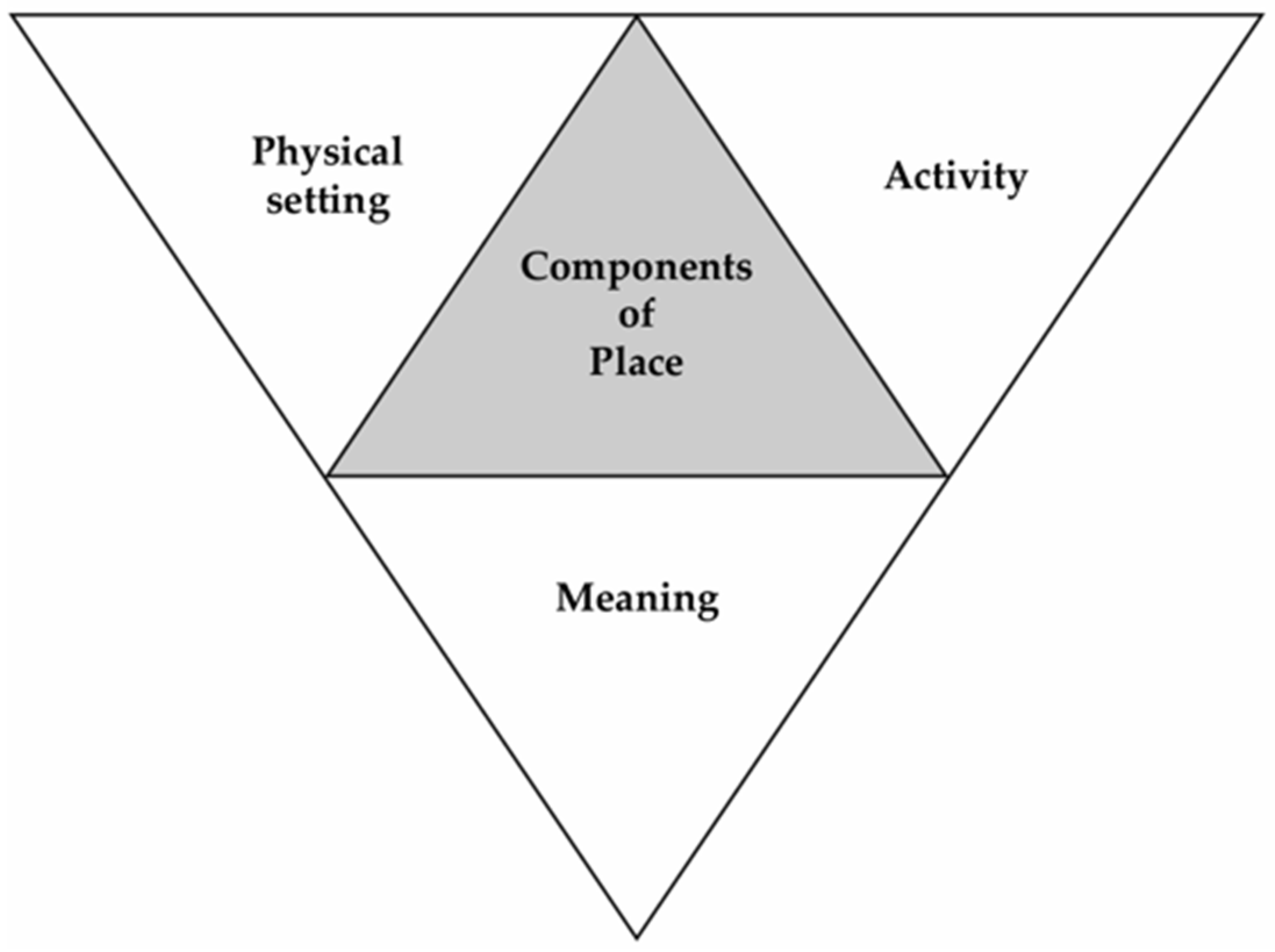
79], p. 498. Merleau-Ponty’s body-centered phenomenology addresses the center of the body when relating human experience to space. In this context, human perception and experience of space is based on the body’s sensory and perceptual abilities. Relph’s “three components of place” model explains how spatial experiences are shaped by the physical environment, activities, and individual/group meanings [
22], p. 45. In this context, Relph offers a framework used to understand the perceived and experienced characteristics of a place (
Figure 1).
Merleau-Ponty and Relph argue that space is not just a physical entity, but gains meaning through people’s experiences and perceptions. Therefore, Merleau-Ponty’s phenomenology and Relph’s model can be used together to deeply understand spatial perception and experiences. To operationalize the conceptual integration between Merleau-Ponty’s body-centered phenomenology and Relph’s three components of place, a two-level analytical framework was developed and applied during the coding process. First, Merleau-Ponty’s phenomenology was translated into four experiential categories:
- (a)
Lived bodily orientation,
- (b)
Multisensory perception,
- (c)
Motor intentionality and habitual movement,
- (d)
Intercorporeality and meaning-making.
These phenomenological dimensions were then systematically mapped onto Relph’s three components of place (physical setting, activity, and meaning) to generate a coherent coding structure. This mapping informed the construction of the codebook, whereby each Relphian component incorporates sub-codes derived directly from Merleau-Ponty’s experiential elements:
Physical setting = Sensory cues and bodily orientation,
Activity = Motor intentionality,
Meaning = Emotional resonance and inter-corporeal awareness.
Participant responses were coded using this dual framework, allowing both the content of the VR experience (physical qualities, actions, meanings) and the embodied qualities of perception (orientation, multisensory engagement, movement, atmospheric resonance) to be analyzed concurrently. In this way, Merleau-Ponty and Relph integration becomes methodologically operationalized through a structured, replicable coding matrix that grounds phenomenological interpretation in systematic thematic analysis (
Table 1).
This matrix structures the entire research design, including interview construction, thematic coding, percentage-based comparison, and mental map analysis, enabling embodied spatial experience to be examined in a replicable and comparative manner. By applying this framework across two distinct spatial typologies (a laboratory and a church) and two experiential conditions (physical and virtual), the study demonstrates how phenomenological theory can be methodologically operationalized to support systematic comparison between real-world and VR-mediated environments. In doing so, it advances qualitative design research by offering a transferable approach for analyzing embodied spatial experience that bridges philosophical rigor and empirical clarity.
3.1. Research Design
This study adopted a qualitative, phenomenologically informed research design to examine how interior design students perceive two interior spaces in both physical and VR settings. The aim was not to establish a pedagogical model, but to investigate the extent to which VR can evoke perceptual, sensory, and atmospheric aspects of embodied spatial experience. Data were collected through semi-structured interviews and mental mapping techniques, enabling a detailed exploration of students’ subjective and multisensory encounters with space. These methods capture both the descriptive characteristics of the environments and participants’ lived, affective, and perceptual responses.
Spatial experience data were gathered using phenomenologically informed qualitative methods, including interviews and mental mapping, and were interpreted through a hybrid analytical strategy that combines thematic analysis with quantitative techniques based on frequency and percentage weighting. This mixed analytical approach enables experiential patterns to be evaluated not only interpretively but also comparatively, allowing phenomenological insights to be articulated through systematic and replicable metrics.
Conceptually, the study intentionally brings together two theoretical traditions that are typically treated separately: Merleau-Ponty’s body-centered phenomenology and Relph’s theory of place. From Merleau-Ponty, the study derives operational experiential lenses such as lived body, multisensory perception, motor intentionality, and shared meaning not as abstract philosophical constructs, but as tools for examining how spatial experience unfolds. From Relph, it adopts the triadic structure of physical setting, activity, and meaning as analytical anchors that define what spatial experience is oriented toward. Rather than equating these frameworks, the study cross-maps them through an operationalization matrix, making phenomenological theory methodologically usable for comparative analysis across physical and virtual environments.
The analytical process was guided by a two-level coding framework detailed in
Table 1, this framework functioned as the structural basis for data interpretation by guiding the formulation of interview prompts, shaping the categories used to analyze sensory and experiential insights, and ensuring coherence between the theoretical constructs and the empirical procedures employed in the study.
3.1.1. Physical Environment
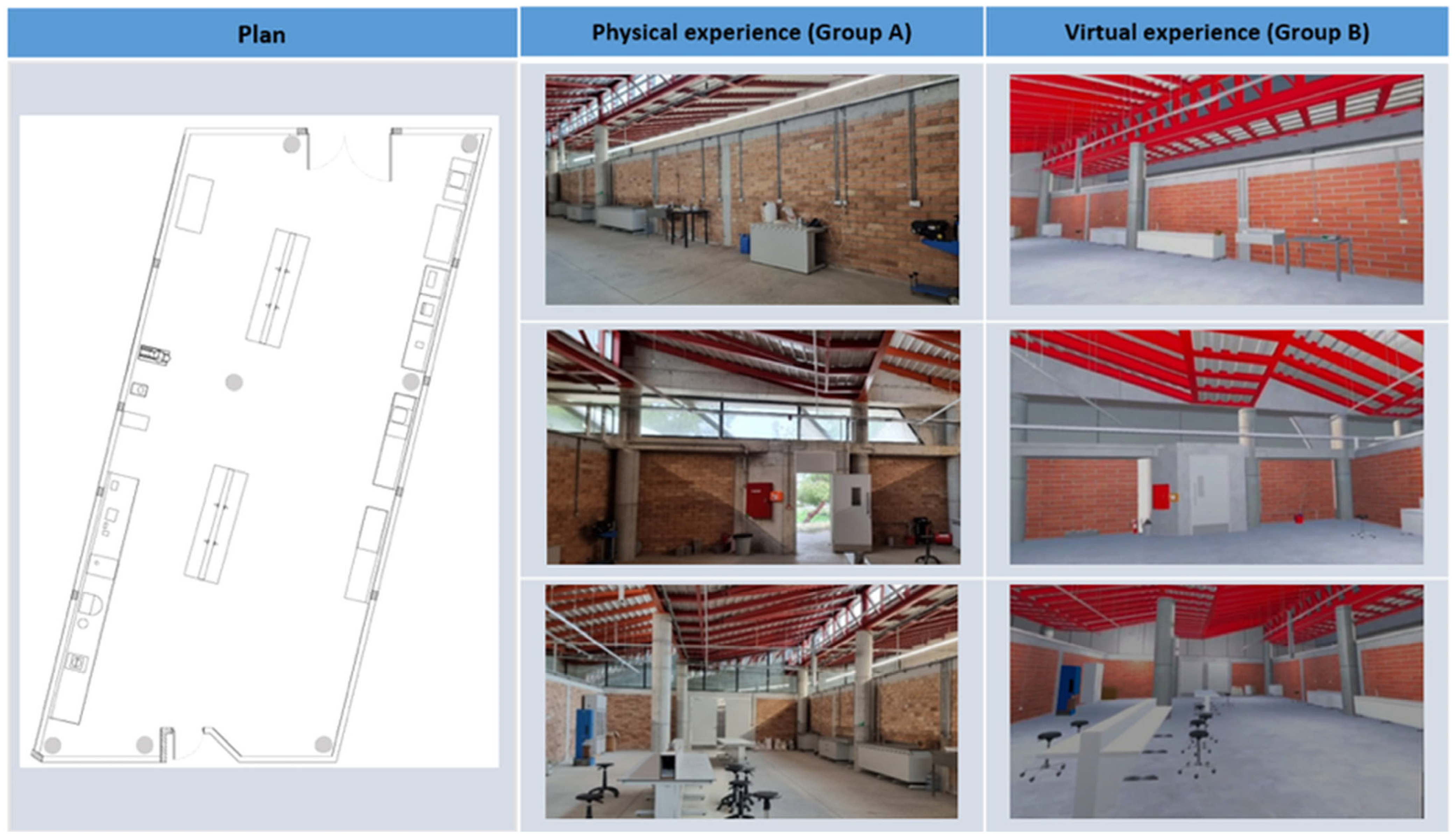
Two physical spaces selected for the study differed in enclosure, scale, lighting quality, and atmospheric character. The first of these was the Asphalt Laboratory within the Cyprus International University (
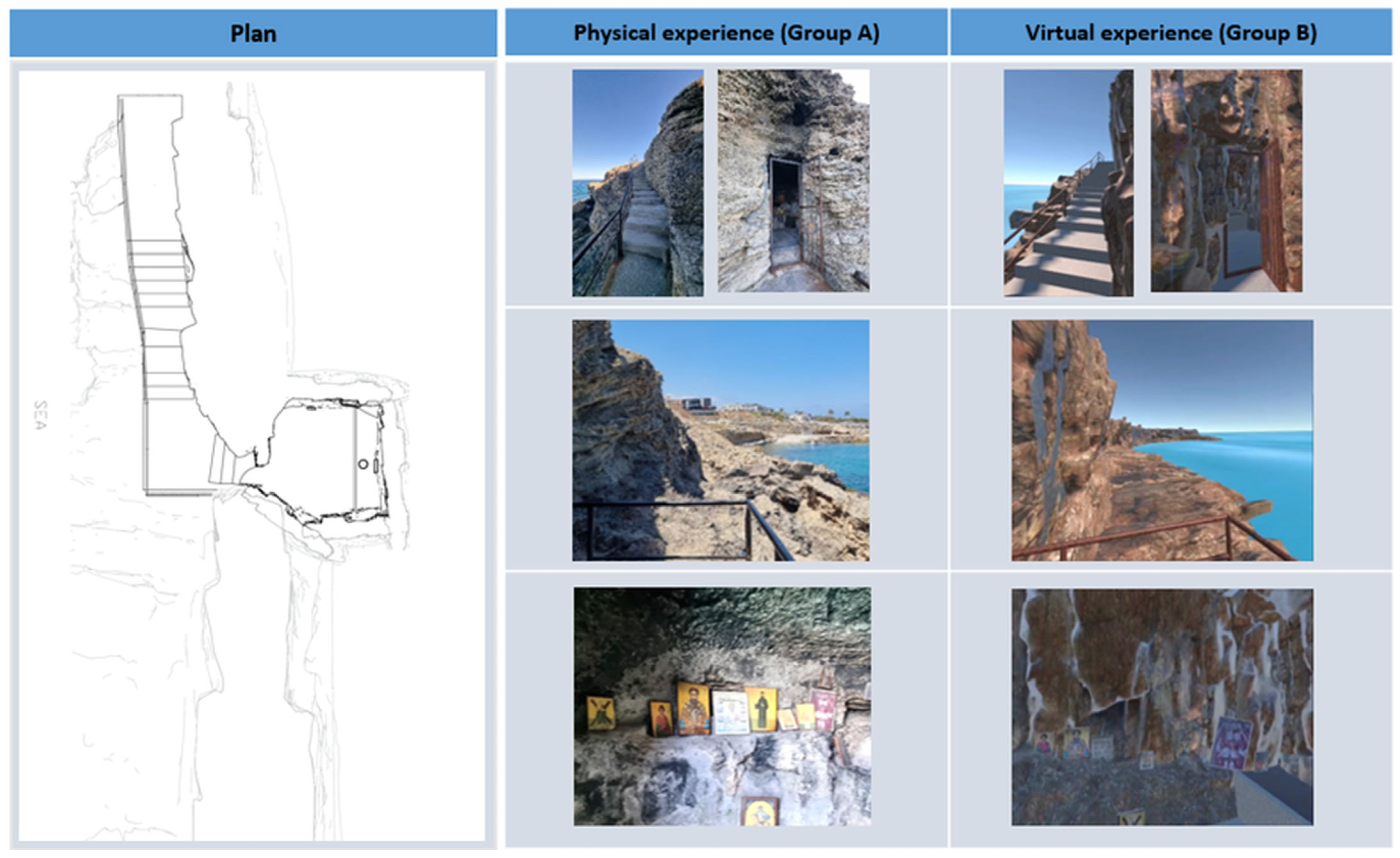
Figure 2). The other was the Saint Fanourios Church in Kyrenia, Cyprus (
Figure 3). Both were visited individually by students under consistent environmental conditions. During the visit, students were instructed to walk freely, pause, observe, and reflect on spatial characteristics, bodily sensations, and perceived atmosphere.
3.1.2. Participants
The study was conducted within the scope of the Sentiment/al-themed workshop organized by the Cyprus International University. A total of 22 undergraduate interior design students (aged 20–24) from the same university voluntarily participated in the study. Participants were recruited through convenience sampling during the fall semester studio period, and no compensation was provided. None of the participants had prior experience with either of the two selected spaces. In line with the comparative research design and to ensure balanced group composition, the participants were divided into two equal groups (n = 11), taking into account their academic level and spatial experience. The sample size of 22 participants was considered appropriate for the qualitative and comparative nature of the study. In line with phenomenological research approaches, the study aimed to achieve depth of embodied and experiential data rather than statistical generalization. Dividing the participants into two equal groups allowed for a balanced comparison between physical and virtual experiences while enabling detailed thematic analysis across participants. The participants consisted of:
Six second-year undergraduate students,
Six third-year undergraduate students,
Eight fourth-year undergraduate students, and
Two graduate students.
Participants were coded as Group A and Group B to indicate the type of spatial experience. For the asphalt laboratory, Group A experienced the space physically, while Group B experienced it virtually. In contrast, for the Saint Fanourios Church, Group A experienced the space virtually and Group B physically. Through this counterbalanced structure, each participant experienced two different spaces; one in a physical environment and the other in a virtual environment. Participants’ familiarity with VR was recorded at the beginning of the study. Fifteen students reported no previous VR experience, five had brief exposure once or twice, and two indicated moderate familiarity. Prior to entering the VR environment, all students completed a short two-three minute orientation session to learn basic navigation and establish comfort with the device.
3.1.3. Model Construction
To create the virtual versions of the selected physical spaces, detailed on-site measurements were first taken and supported with extensive photographic documentation. The architectural models were then reconstructed in SketchUp, where every effort was made to retain the spatial characteristics of the real environments. All dimensional properties including wall thicknesses, ceiling heights, door and window openings, and furniture placement were modeled according to the measured drawings to ensure accurate spatial proportions.
Software: SketchUp Pro 2023 and Unity 6, Universal Render Pipeline,
Scale calibration: 1 Unity unit = 1 m,
Spatial dimensions cross-checked with physical measurements,
Architecture reconstructed manually, following measured proportions.
3.1.4. Lighting and Textures
Material fidelity was achieved by analyzing each surface in the physical spaces and assigning visually similar textures in the simulations. Although real material samples were not digitally scanned, texture images were selected to approximate color, reflectance, and pattern as closely as possible. Likewise, lighting conditions were calibrated based on the real spaces: the orientation, size, and transparency of window openings were modeled in reference to the physical sites, while artificial lighting fixtures were positioned in the exact locations and configured with comparable color temperatures and intensities. After the geometrical modeling was completed, the SketchUp files were imported into Unity, where further refinement of the light settings was performed. The virtual environments were developed using Unity’s Universal Render Pipeline (URP) to balance visual performance and real-time rendering quality. Acoustics were not simulated, as the study focused primarily on visual-spatial and bodily perception.
Textures: Physically Based Rendering (PBR) materials (2K resolution);
Lighting: Mixed baked + real-time lighting;
Light intensity approximated using on-site lux measurements;
Ambient occlusion and soft shadows activated to approximate atmospheric depth.
3.1.5. Performance and Hardware
The Meta XR All-in-One SDK was installed to enable interaction in VR, and the scene was configured specifically for the Meta Quest 3 headset through manually adjusted settings (camera rig, hand tracking, virtual hands). The camera rig was placed at the center of each environment before the participants began the experience. Participants navigated the spaces through free locomotion, allowing real-time movement without teleportation constraints. This mode enabled bodily engagement through continuous walking and head-tracked exploration, which is critical for maintaining perceptual coherence in spatial comparison studies. Hand tracking provided users with virtual representations of their hands, enhancing proprioceptive awareness. The Meta Quest 3 headset offers an approximate field of view of 110°, and the VR environments operated at a stable 72–90 FPS during testing, with no noticeable latency or frame-rate drops.
Device: Meta Quest 3 headset.
Refresh rate: 90 Hz.
Resolution: 2064 × 2208 per eye.
FOV (approx.): 110°.
Latency: ~12–20 ms depending on scene complexity.
Frame rate: Stable 72–90 FPS.
Navigation: Smooth locomotion (walking), speed set to ~1.4 m/s.
Interaction: Collision boundaries active; no teleportation.
3.1.6. Limitations
Spatial audio was not implemented, meaning that sound cues did not contribute to the experience. While this ensured consistency across sessions, it also represents a limitation relative to the multisensory nature of physical environments. In the church environment, the main door remained open, consistent with real conditions. However, the two entry steps had only a visual presence in VR and did not require actual stepping, which may have slightly altered the embodied transition into the space. In the asphalt laboratory, participants started inside the main working area, and adjacent rooms were not included in the simulation. Therefore, closed doors were used to limit navigation to the intended study areas. Participants explored the environments freely, and all movements were tracked and updated in real-time.
3.1.7. Experimental Setup
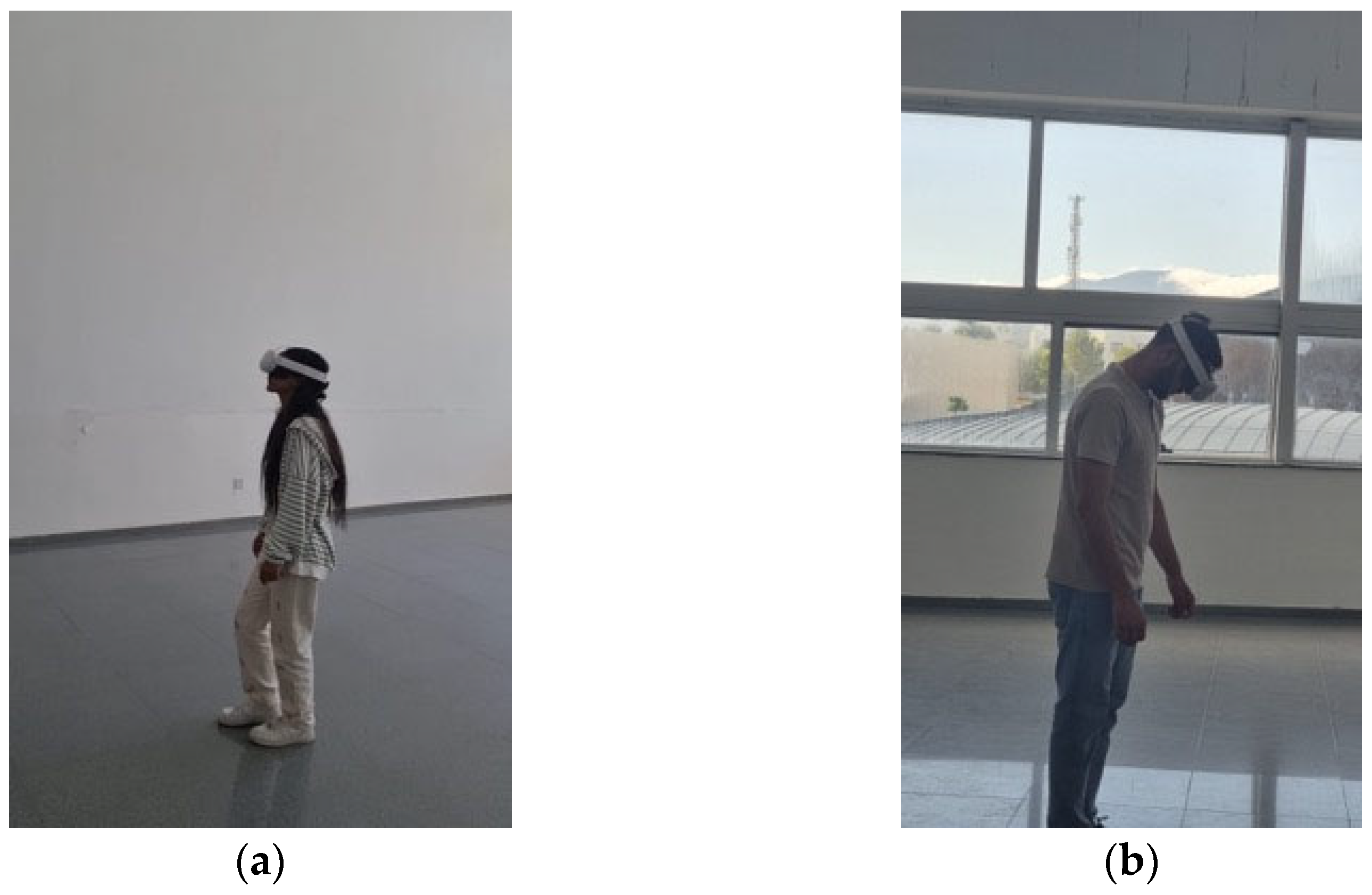
To ensure participants could move safely and seamlessly during the VR experience and to prevent distractions that might arise from potential physical obstacles, the VR experience area was set at 25 m
2. During the experiment, participants were physically isolated in a confined space, but the researchers supervised them from outside the experimental area. This aimed to minimize visual and auditory distractions from the external environment (
Figure 4).
3.2. Data Collection and Analysis Tools
Various tools were used to understand the students’ perception and experience of space.
3.2.1. Semi-Structured Interview
After each spatial encounter (physical and VR), the students participated in a one-on-one semi-structured interview lasting 10–15 min. The interview guide (full list provided in
Appendix A) was organized around Relph’s three components of place;
- (1)
Physical setting,
- (2)
Activity and spatial behavior,
- (3)
Meaning and atmosphere.
Questions invited students to describe sensory impressions, bodily orientation, atmospheric qualities, and perceived differences between the physical and VR spaces. After perceiving and experiencing the space, the participants answered the interview questions listed in
Table 1 to express their feelings, thoughts and impressions about the space. This table provides specific analytical frameworks for both groups, showing how Merleau-Ponty’s body-centered phenomenology and Relph’s model can be used together and how they can form a basis for in-depth analysis of spatial perceptions in interior design education. Semi-structured questions prepared with a focus on Relph’s “three components of place” model allowed participants to express their perceptions and experiences of spaces in depth and in a multidimensional manner. The questions were developed by the researchers based on the literature on physical components of interior space discussed in
Section 2.3 (plan, door, window, floor, ceiling, furniture, graphics, color, texture, acoustics, lighting) and Relph’s notion of “physical setting”.
3.2.2. Alignment of Interview Questions with the Analytical Framework
To ensure methodological coherence with the analytical matrix in
Table 1, each interview question was mapped onto the corresponding components of Relph’s “components of place” framework and Merleau-Ponty’s phenomenological foci. Questions 1–11 addressed the “physical setting” and were analyzed through the categories of lived bodily orientation and multisensory perception, capturing how spatial elements shaped sensory, perceptual, and embodied responses in both real and virtual environments. Question 12 aligned with the “activity” dimension and was examined through motor intentionality, eliciting the participants’ accounts of movement, navigation, and bodily engagement with spatial affordances. Question 13 corresponded to the “meaning” dimension and was interpreted through intercorporeality and meaning-making, revealing emotional, symbolic, and atmospheric aspects of spatial experience (
Table 2).
This structured alignment demonstrates that the interview protocol directly operationalizes the study’s conceptual foundations, enabling a systematic analysis of embodied spatial experience across physical and VR contexts. In addition to the questions listed in
Appendix A, the participants who experienced the spaces virtually were asked the question “How do you evaluate the space you experience through VR technology in a bodily and sensory context?” Thus, this question questioned the extent to which VR technology can reflect the bodily and sensory experience of space in the context of interior design. In this context, it was analyzed whether the participants’ perceptions of the spaces they experienced through VR were associated not only with the visual but also with the bodily dimensions of the space such as tactile, spatial orientation, scale and atmosphere.
3.2.3. Mental Mapping
In addition to the interview, at the end of the experience process, participants in both groups were asked to perceive the space they experienced and express their experiences visually. For this, the participants were given an opportunity to make a mental map. Participants produced hand-drawn mental maps immediately following each experience. Mental maps served to externalize the students’ internal representations of spatial organization, sequence, sensory focus, and emotional orientation. Since Relph’s model provides a comprehensive framework for comprehending space through three basic components, namely physical setting, activity and meaning, questions directed according to this structure allowed the students to reveal their experiences at both sensory, cognitive and emotional levels. Thus, the data visually represented in mental maps are supported by verbal narration, providing a more holistic and interpretable analysis opportunity. In this context, the mental mapping method is complementary to the semi-structured interview questions used in the study, allowing participants to reveal their spatial experiences not only through verbal expressions but also through visual and spatial representations.
3.2.4. Analyzing Data
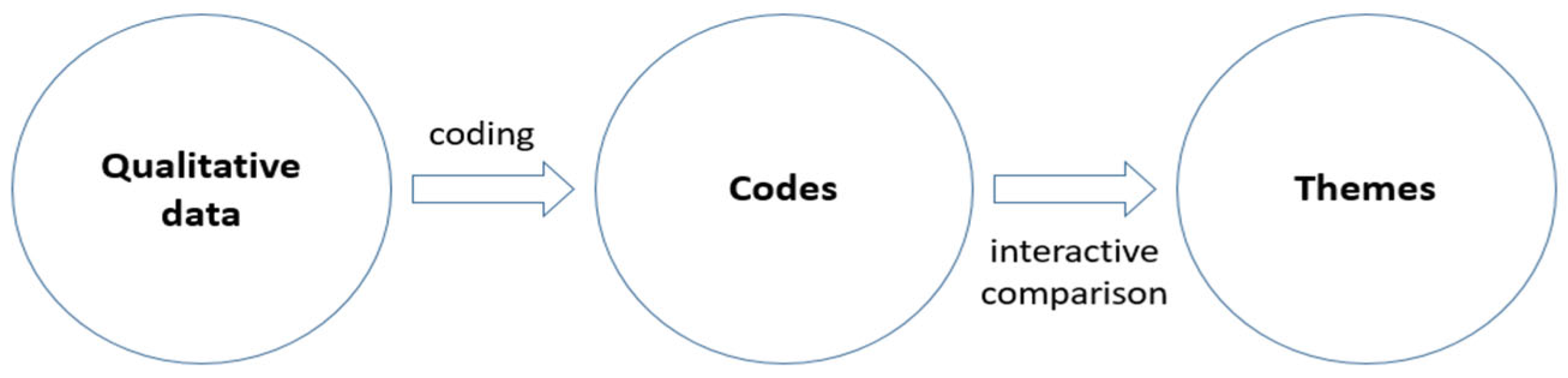
Structured in line with Relph’s three components of place model, the maps enable a holistic analysis of the perceptual differences, emotional ties to space, and intentionality stemming from students’ experiences in virtual and physical spaces. Thus, not only what is remembered but also how and why it is remembered becomes questionable, which provides a strong analytical ground for the spatial expression of sensory-cognitive body experience emphasized in Merleau-Ponty’s body-centered phenomenological approach. Furthermore, thematic analysis (TA), a flexible method used to identify, analyze and interpret patterns of meaning (themes) in qualitative data, was conducted (
Figure 5). This is a powerful and versatile method that helps to find patterns to understand the experiences, thoughts and behaviors of the participants [
80], p. 297.
3.2.5. Coding and Reliability Procedures
TA was conducted through a multi-stage coding procedure by the researchers. The interview transcripts and mental map annotations were analyzed using a reflexive thematic analysis approach based on Braun and Clarke’s six-phase framework [
81], p. 87. The analysis aimed to identify patterns related to embodied perception, sensory engagement, spatial understanding, and atmospheric qualities across both physical and VR experiences.
Familiarization with the Data: Both researchers independently read and reread all transcripts and associated mental maps to gain an overall understanding of the experiential content. Initial notes were taken regarding recurring sensory, spatial, and phenomenological descriptors, as recommended by Braun and Clarke.
Generating Initial Codes: Open coding was conducted by both researchers separately. At this stage, coding was data-driven rather than theory-driven to avoid imposing phenomenological constructs prematurely. Each meaningful unit of text such as descriptions of bodily orientation, spatial legibility, sensory impressions, affective responses, or environmental cues was labeled with a descriptive code.
Examples of early codes included enclosure, light gradient, bodily directionality, material texture recall, orientation difficulty, and atmospheric calmness. In the open coding phase, all semi-structured interview transcripts and mental map explanations were examined carefully, and meaningful expressions related to spatial perception were extracted. These codes were generated inductively from the participants’ own descriptions without using any predefined categories. For example, statements such as “The plan layout was understandable” and/or “The layout was easy to follow, with white corridors and signs that helped us move in the space” were coded as “easy navigation”, whereas expressions like “If the wall is changed I think the space will be more comfortable, and the effects of the color of the space will be more spacious” and/or “The ceiling was near my head. I felt compressed at certain moment but I got used to it” were grouped under the code “suffocated”.
After the initial coding process, the researchers met to compare codes and resolve discrepancies. The codebook included: Code labels; Operational definitions; Inclusion and exclusion criteria; and Illustrative quotations from the data. A focused coding stage was applied in which similar or overlapping codes were merged based on shared experiential meaning. This process helped authors eliminate redundancy and ensured that each code represented a distinct perceptual or emotional quality. In order to establish analytical consistency, a coding matrix was then created for each space experience to display the frequency of each retained code across all of the participants (
Table 3,
Table 4,
Table 5 and
Table 6). In doing so, only the codes retained for cross-case comparison were those that appeared in at least three different students. These matrices allowed for a systematic comparison of how often each experiential element was expressed, and by whom, enhancing the transparency and traceability of the analysis.
Codes that overlapped or showed conceptual proximity were merged (e.g., brightness contrast and light flow became lighting perception), while ambiguous codes were clarified or removed.
- 3.
Searching for Themes: Following refinement of the initial codes, the researchers grouped related codes into potential themes. This involved organizing clusters of codes related to bodily perception, sensory qualities, spatial comprehension, and atmospheric impressions. For example, Embodiment and bodily orientation; Multisensory spatial cues; Spatial organization and legibility; and Affective and atmospheric responses. The retained codes were grouped into higher-order themes by examining conceptual relationships between them, guided by Relph’s “three components of place” model. These themes provided a general phenomenological understanding of how students experienced both the physical and the virtual spaces.
This stage involved repeatedly moving between coded extracts and the broader dataset to ensure that emerging themes accurately captured the experiential patterns in participant narratives.
- 4.
Reviewing Themes: Themes were reviewed in relation to:
Internal coherence (whether coded extracts within a theme formed a meaningful cluster),
External distinction (whether themes were sufficiently differentiated from one another), and
Alignment with the entire dataset.
Some themes were expanded, combined, or subdivided based on researcher discussion. For example, sensory richness and materiality awareness were initially separate but were later combined under a broader theme of multisensory spatial cues. The iterative refinement of codes and themes ensured internal coherence and enhanced the methodological transparency and analytical rigor of the study.
- 5.
Defining and Naming Themes: Final themes were defined with clear conceptual boundaries and named to reflect their phenomenological significance. The refinement of theme definitions included writing analytical summaries that articulated how each theme contributed to understanding embodied spatial perception in both environments. These finalized themes formed the basis of the Findings and Discussion sections.
- 6.
Producing the Report: In the final stage, the developed themes were synthesized into an analytical narrative through the conscious cross-matching of Merleau-Ponty’s body-centered phenomenology and Relph’s “three components of place” framework. Rather than presenting the themes as isolated categories, this stage focused on interpreting how bodily experience, multisensory perception, motor intention, and meaning-making are reconstructed in physical and virtual environments. Representative quotations and mental map references were integrated to support this interpretive process. This analytical synthesis formed the basis of
Section 4.
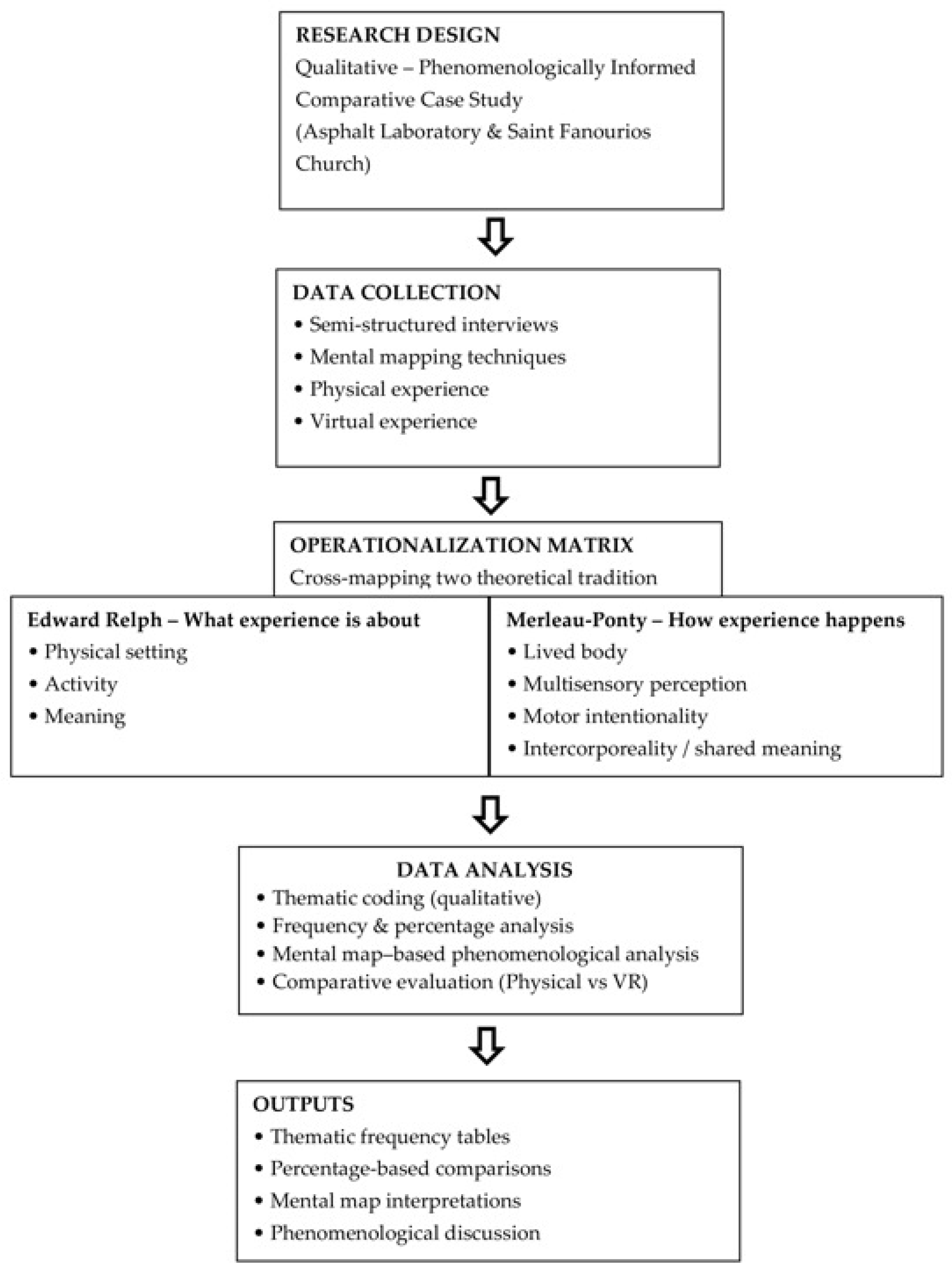
Four researchers participated in the coding process. Each case study was assigned a primary coder responsible for the initial analysis of interview transcripts. A third researcher analyzed visual, spatial, and symbolic codes derived from the mental maps across both contexts, focusing on representational strategies and spatial emphasis. An independent researcher conducted secondary coding of all interview and mental-map data to assess coding consistency, thematic coherence, and alignment with the operationalization matrix linking Merleau-Ponty’s body-centered phenomenology and Relph’s components of place. Discrepancies were resolved through discussion and re-coding where necessary. This multi-layered procedure ensured analytical rigor, cross-context consistency, and reliability. The overall methodological workflow is summarized in
Figure 6.
4. Findings and Discussions
4.1. Asphalt Laboratory
The findings regarding the experience of the asphalt laboratory in both physical and virtual environments revealed different dimensions of spatial perception. In both types of experiences, students evaluated the general plan scheme of the space as clear, understandable and accessible. The fact that the code “easy navigation” was repeated at a high frequency in both physical (
n = 9) and virtual (
n = 10) experiences shows that the space is resolved in a way that is convenient for orientation by the body. However, in the physical experience, sensory discomforts were expressed more in relation to acoustic, thermal and light conditions. Codes such as “discomfort”, “echo” and “lack of natural light” show that elements such as echo, coldness and lack of natural light in the space make it difficult to establish physical and emotional bonds (
Table 3).
4.1.1. Physical Experience of Asphalt Laboratory
A holistic analysis of the codes allows for the identification of the thematic categories presented below.
Ease of Way Finding and Flow: Most of the students described the plan scheme of the laboratory as clear and accessible (easy navigation = 9) as well as functional (n = 3). This shows that the space is easily grasped physically and there is no difficulty in orientation.
Perception of Spatial Identity and Purpose: On the other hand, the formal code emerged as dominant in almost all students (n = 10). The serious atmosphere combined with the entrance door, the use of materials and the lack of graphics emphasize that the space is a “work” space. This situation shows that the body approaches the space with a task discipline.
Discomfort, Stiffness and Isolation: Many students found the space partly disturbing in physical and sensory terms (discomfort = 26 times). Negative experiences such as echo (n = 6), coldness, lack of openness and limited natural light (n = 10) were determined as factors that reduce spatial comfort. These features are factors that distance the space and make it difficult to establish an emotional connection.
Perception of Spaciousness, Light and Silence: The high ceilings and occasional natural light penetrations in the space created a feeling of spaciousness and openness for many students (n = 9). However, this experience was not perceived equally by all students and varied according to individual sensitivities.
Aesthetics and Material Perception: The language of materials and the use of colors were described as neutral and industrial (n = 7), which gave the impression that the space was designed with a focus on function rather than warmth. The fact that colors were found to be “sensory ineffective” but “task-appropriate” for most students reveals that the atmosphere did not vary much in terms of perception.
Preliminary Interpretation (Physical Experience-Asphalt Laboratory): Considering the themes above, the overall theme for the physically experienced asphalt laboratory is “a space that feels quite functional, formal, and easy to use”. Furthermore, the experience also resulted in “a space that makes it difficult to establish emotional connections, provides poor audiovisual stimulation, and can cause physical discomfort”. The relationship between space and body was shaped within a context that is “generally task-oriented, disciplined, and neutral”.
4.1.2. Virtual Experience of Asphalt Laboratory
In the virtual environment, discomfort was expressed in terms of lack of sensory integrity in addition to a lack of natural light (
n = 6). Codes such as “lack of senses”, “unrealistic visualization” and “bodily limitation” reveal that the virtual experience is incomplete compared to the physical experience due to the body not being able to physically exist in the space and the senses not being actively used. In addition, significant differences were observed in the perception of material and atmosphere. While in the physical experience, material texture, ground stiffness and surface effect were felt directly in contact with the body, in the virtual experience, only the visual representation of these elements could be presented. This shows that while students interpreted their experiences more through senses with codes such as “material–atmosphere connection” in the physical space, they focused on visual reality such as “realistic visualization” in the virtual space. On the other hand, codes such as “physical–virtual connection” and “new” developed specifically for the virtual experience showed that students evaluated VR technology as an innovative and potential tool. Despite the lack of physical contact, the virtual experience was seen as a powerful tool, especially in terms of visualizing the space in advance and testing spatial decisions during the design process (
Table 4).
The analytical examination of the codes allowed for the derivation of the following themes.
Ease of Way Finding and Flow: The majority of students stated that the area had a clear and understandable layout that allowed for easy navigation (n = 10). The fact that the space was spacious and functional reinforced this positive experience. In particular, the furniture layout and open spaces stood out as elements that facilitated circulation (comfort = 10).
Perception of Spatial Identity and Purpose: Some participants directly defined the space as a “university place”, “laboratory” or “classroom” due to the regular table arrangements, limited furniture use and general simplicity. This situation reveals that the space has a functional (n = 5) identity not only with its physical components but also at a perceptual level. Participants evaluated the “empty” or “cold” atmosphere of the space not as an indicator of deprivation but as a reflection of the seriousness of the task carried by the space and its institutional structure.
Discomfort, Stiffness and Isolation: Some students found the space sensorially inadequate and the atmosphere dull and lifeless. The lack of natural light (n = 6), the monotonous color palette and the limited sense of interaction led to the perception of the space as “lifeless” and “isolated” (color–atmosphere connection = 4). Some students expressed that they felt suffocated (n = 5) or trapped, especially due to the ceiling and wall colors (discomfort = 16 times).
Perception of Spaciousness, Light and Silence: Most students described the space as spacious (n = 9) and easy to navigate. However, it was stated that this spaciousness remained at a visual level, and that the space still felt closed (lack of openness = 7) and somewhat isolated due to the lack of natural light. The fact that physical movements in the space did not provide any feedback in terms of sound was a factor that made the space feel “dead” for some students (bodily limitation = 6). Although the space was perceived as wide and high by most students, natural light was generally found to be insufficient.
Aesthetics and Material Perception: Students stated that materials such as concrete (n = 5) and brick supported the atmosphere of the space. While some students thought that the materials were suitable for the function of the space, the space gave the feeling of an “industrial” (n = 4) or “cold” environment to some students. However, in general, the harmony between material and space was found to be functional (material–atmosphere connection = 6).
Embodied Limitations in Virtual Spatial Experience: The virtual space experience created a strong sense of presence in the space in the students (physical–virtual connection = 9), and the vast majority described it as “satisfying.” However, the experience was found to be lacking due to the limited use of senses (touch, sound, smell) and the inability of the body to truly move in the space (bodily limitation = 6). When the virtual environment was compared to the physical environment, it was exciting (curiosity = 6, realistic visualization = 5) for some students and unrealistic (n = 5) for others. Despite this, most students evaluated VR positively as a tool for discovery and education (new = 6).
Preliminary Interpretation (Virtual Experience—Asphalt Laboratory): Looking at the themes above, the overall theme for the asphalt laboratory experienced in the virtual environment is “a highly functional and open space in terms of orientation and circulation”. However, due to the lack of natural light, limited color palette, and use of materials, many students perceived the space as “cramped, closed, and emotionally disturbing”. The materials and colors directly impacted the atmosphere of the space, creating a feeling of “discomfort and sensory deprivation” for some students.
4.1.3. Mental Maps of Asphalt Laboratory
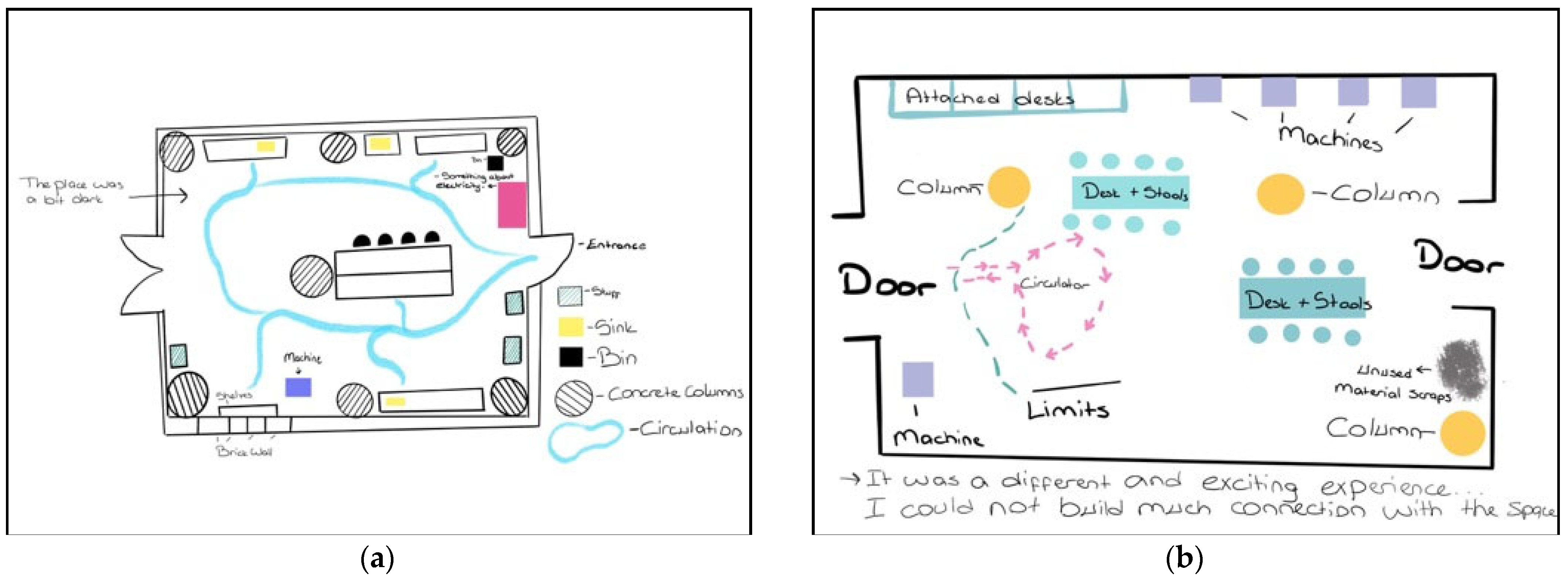
When the sample mental maps below are examined, the physical experience highlights elements such as physical order, ease of navigation, and aesthetic weaknesses, along with functional and sensory deficiencies. The virtual experience, however, confirms themes such as a lack of emotional connection, a lack of holistic experience, and limitations in sensory and physical engagement. There was no significant difference in the representation of spaces on the maps, and participants reflected a multidimensional perception of space by considering their experiences from different perspectives (
Figure 7).
Preliminary Interpretation (Mental Maps—Asphalt Laboratory): By holistically considering the thematic tendencies observed in the participants’ physical and virtual experiences of the asphalt laboratory, an initial comparative perspective can be established regarding how spatial perception is shaped across the two environments. At a general level, participants appeared to recognize the laboratory’s functional identity, legible plan organization, and industrial character in both physical and virtual conditions, suggesting a shared cognitive understanding of the space’s basic spatial structure.
However, beyond this overall consistency, notable differences emerged in how the space was experientially engaged. While the physical environment elicited responses related to multisensory bodily discomfort, such as coldness, echo, and tactile harshness, the virtual environment was more frequently described in terms of sensory incompleteness and cognitive distance, reflecting the absence or reduction of auditory, tactile, and full bodily feedback. These preliminary observations indicate that, although functional and organizational aspects of the space were similarly perceived, the nature of body, space interaction differed substantially between physical and virtual contexts.
The extent and distribution of these similarities and differences are examined in detail through the thematic frequency tables and percentage-based analyses presented in after the following sub-section, which systematically compare physical setting, activity, and meaning dimensions across both experiential conditions (
Table 7).
4.2. Saint Fanourios Church
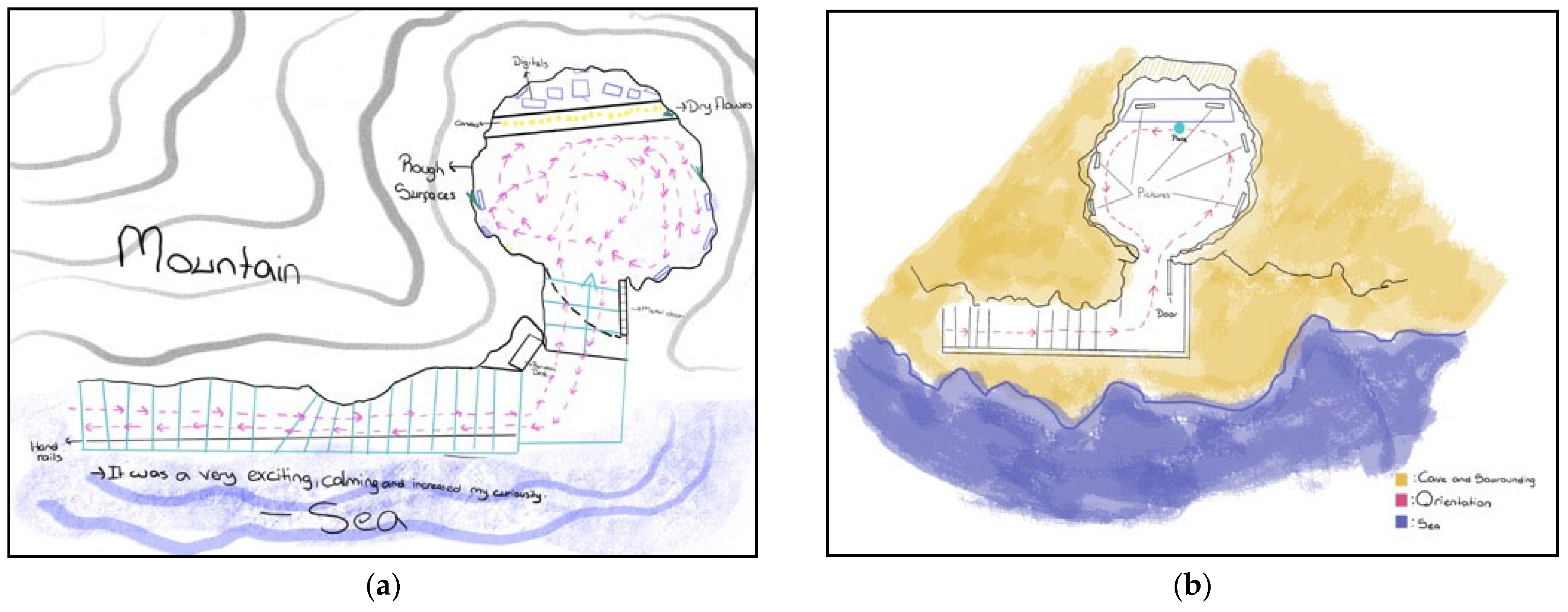
Experiencing Saint Fanourios Church in both physical and virtual environments revealed striking similarities and distinct differences in students’ perceptions of the space. The physical experience enabled students’ direct physical participation in the space, creating a high level of perception with intersensory integrity. The narrow, flat structure of the space, elements such as natural cave textures and candlelight created a strong inner intensity (
n = 10) and spiritual attention (
n = 8) along with a sense of physical restriction (
n = 11). Detachment from the outside world, integration with nature and the feeling of religious/cultural context deepened the experience on both cognitive and emotional levels. Multisensory stimuli, especially sound (sea), tactile perceptions (stiffness and roughness of the cave) and smell (candle, humidity, etc.), brought the students’ relationship with the space to the ground of bodily awareness (
Table 5).
4.2.1. Physical Experience of Saint Fanourios Church
A detailed examination of the codes revealed the following themes that structure the data in a meaningful way.
Sensory Calm and Spiritual Peace: The majority of students stated that they felt calm (relaxation = 39 times) in the space thanks to the natural (nature = 8) sounds (especially the sea waves), the warmth of the candlelight (n = 10) and the limited but effective entry of daylight (lack of light = 6, natural light = 11). These elements provided an unexpected spiritual peace despite the closed and natural rock formation of the cave, and triggered the serenity associated with worship in some students. Especially the flickering presence of the candlelight and the calming effect of nature (visual and auditory) created a meditative experience in the space. This situation shows that the anxiety created by the space at first glance transformed into inner peace over time (comfort = 11).
Physical Constraint and Spatial Pressure: Seven of the students who physically entered the space felt physically restricted due to the low ceiling, narrow entrance, low volume and limited movement space (bodily limitation= 7). This situation caused emotional reactions such as anxiety, claustrophobia and disorientation in some students (discomfort = 7). In particular, inadequately illuminated or inhomogeneous surfaces led to the definition of the spatial experience as “suffocating” (suffocated = 10). Although the sacred context of the space transforms these physical limitations into a spiritual experience, it is clearly seen that the space presents a structure “outside the comfort zone” in physical perception (hesitation = 5).
Spirituality, Worship and the Sense of Holiness: The interior layout of the church, orthodox iconographies (n = 11) placed on the walls, candles and the absence of any secular furniture transform the space into a true place of worship (worship area = 8). Students stated that this iconographic density may initially seem disturbing or alienating (colorful = 7), but over time it creates a sense of respect and sacredness. In particular, descriptions of the space such as “the feeling of the other world” or “transition to another level of reality” positioned the space not only as a physical volume but also as a ritual experience space (isolation = 8). Religious visuals and candles played both a guiding and meaning making role in the students’ experience.
Natural Texture, Material Perception and Rawness of Space: The rock formation of the cave-church structure, its carved and unprocessed surfaces were described by the students as natural, plain and even historical (material–atmosphere connection = 5). Some students saw this rawness of the material as a complement to the mystical or sacred atmosphere (mysterious = 3), while others expressed it as an element that created difficulties in terms of physical comfort. The material features in the space were associated with emotional and cultural meanings rather than aesthetics. The physical contact of the students with the space provided them with a realistic experience, far from abstraction, thanks to a direct connection established with the natural texture.
Simple Orientation and Perceptual Clarity: Students stated that it was easy to find their way due to the simplicity of the spatial plan (easy navigation = 5), and that thanks to this simplicity, they were directed directly to the area where the religious icons were located. This direction provides clues about both the sacred aspect of the space and the way the user experience was structured. For some students, the isolation of the space from the outside world meant a spiritual introspection, while for others, this situation was unsettling. However, for many students, this space was a completely new (n = 3) experience and was described as an “introspective journey” unlike their previous experiences.
Preliminary Interpretation (Physical Experience—Saint Fanourios Church): The themes above shows that students who physically experienced the Saint Fanourios Church described the space as “physically restrictive but sensorially and emotionally rich”. Although its narrow and low-ceilinged structure initially created a feeling of discomfort, the space gained “spiritual depth with the effect of natural light, the sound of the sea and religious elements”. Spatial components such as religious icons, candles and cave’s texture allowed students to establish a “multisensory relationship with the space”. As a result, the church was evaluated by the participants as a “holistic experience space with both physical and semantic layers”.
4.2.2. Virtual Experience of Saint Fanourios Church
On the other hand, Saint Fanourios Church experienced through VR technology created a strong representation of the conceptual and aesthetic characteristics of the space in students, and the spiritual effect of visual simplicity, symbolic density and spatial structure could be largely transferred in the virtual environment. In the VR experience, the space was evaluated by the students as a structure integrated with nature (
n = 9), with a strong spiritual meaning and culturally impressive. However, this experience was limited compared to the multisensory interaction capacity offered by the physical one. In particular, the lack of senses (
n = 9) such as sound, smell and tactility created significant gaps in the students’ physical placement in the space and in the formation of spatial memory. Nevertheless, despite these deficiencies, it can be seen that the students could make sense of the space at an intuitive level and that the visual elements are approaching a sufficient level in reflecting the architectural identity. While both forms of experience made the spiritual quality and symbolic load of the space apparent to the students, the physical experience offered a more in-depth perception process, especially in terms of bodily participation, sensory intensity and spatial memory. The virtual experience, on the other hand, was successful in comprehending the essence of the space thanks to its visual representational power, but it could only partially represent the phenomenological experience in which the body is directly involved as the perceiving subject (
Table 6). A systematic evaluation of the codes made it possible to identify the following themes.
Perception of Space Integrated with Nature: The majority of the students stated that the natural material structure of the space, the sea and the natural light that emerged provided an integrated wholeness with nature (n = 9). The dim but sufficient level of natural light (n = 9) supported the tranquility and naturalness of the space and created a sense of environmental continuity on the students. In this context, the church was not only a physical structure but also an atmosphere that supported body–mind balance as an extension of nature (material–atmosphere connection = 7).
Formation of Spiritual and Religious Atmosphere: Orthodox iconographies (n = 9), candles (n = 6), and worship order (n = 8) enabled students to perceive the space as a spiritual space. This sacred context, combined with the silence and simplicity of the space, created a sense of respect, introspection and deepening in the students (isolation = 6). It is understood from the students’ descriptions of the space as “sacred ground” or “respectful space” that it successfully reflects this religious atmosphere even in the virtual environment (physical–virtual connection = 6).
Emotional Comfort and Relaxation: Almost all of the students expressed that the space provided a calming, safe and peaceful atmosphere despite its small and simple structure (comfort = 10). The dim candlelight, the tactile aesthetics of the rock surfaces, the imagined effect of the sea sound and the softness of the colors made the space emotionally relaxing (relaxation = 6). This kind of comfort supported mental clarity and focus in the students; despite being physically narrow, it created an internally spacious experience. This feeling was successfully conveyed in the VR environment, but some sensory deficiencies prevented full satisfaction (realistic visualization = 10).
Spatial Orientation and Bodily Experience: While most of the students stated that they could easily find their way around the space (n = 7), some stated that they felt physically cramped or uneasy, especially due to narrow spaces, low ceilings and steps (suffocated = 8). It was emphasized that orientation was facilitated in the VR environment, but there were deficiencies in terms of real spatial awareness and bodily freedom (bodily limitation = 3). Comments such as feeling like falling while climbing the stairs and hesitating while taking a step indicate that the body’s interaction with the space is limited. This situation reveals that the habit-based connection established with the physical space cannot be fully established in the virtual environment.
Dynamics of Exploration and Curiosity: The historical and mysterious nature of the space created an intense curiosity (n = 4) and desire to explore in the students. This space, which was experienced for the first time in a virtual environment (new = 8), aroused feelings in the students such as “turning towards the unknown”, “solving hidden meanings” and establishing intuitive connections to the past of the space (mysterious = 5). This feeling shows the potential to establish a deep intellectual connection despite the visual and auditory simplicity of the space.
Sensory and Conceptual Impact of VR: Students found the VR experience to be largely impressive and visually sufficient, and the general lines, scale and order of the space were successfully reflected. However, the lack of senses such as touch, smell and sound (n = 8) made it difficult to fully internalize the space, which resulted in a fragmented perception of the experience (lack of sense = 9). Expressions such as “I felt like I was there, but not being able to touch anything was lacking” show that VR is a technology that still needs to be developed in terms of perceptual depth. Nevertheless, thanks to VR, students were able to access a physically inaccessible space and establish a meaningful connection with the space through this experience.
Preliminary Interpretation (Virtual Experience—Saint Fanourios Church): Considering these themes, it can be said that virtual experience of the Saint Fanourios Church created “multidimensional effects” such as spatial orientation, aesthetic perception, spiritual connection and curiosity in students. The natural texture, simplicity and religious atmosphere of the space were felt even in the virtual environment. However, the VR experience was insufficient in sensory elements such as tactility, sound and smell. This led to the “inability to fully achieve bodily integrity”. Despite this, the experience provided students with a “strong spatial representation and production of meaning”.
4.2.3. Mental Maps of Saint Fanourios Church
A comparison of the two sample mental maps prepared for the church below revealed clear similarities in the representation of spaces. However, the students’ experience of the space, which was physically experienced, appears to contain more emotional, sensory, and symbolic dimensions, conveying the spatial experience in a multilayered manner. In the virtual experience, the students analyzed the space in a more structured, simpler, and schematic manner, focusing on orientation and physical components but remaining limited in terms of establishing emotional connections (
Figure 8).
Preliminary Interpretation (Mental Maps–Saint Fanourios Church): At an overall level, the thematic patterns derived from the virtual experience of the Saint Fanourios Church indicate that the students were able to engage with the space across multiple experiential dimensions, including spatial orientation, aesthetic perception, symbolic recognition, and curiosity. Core architectural qualities such as the church’s simplicity, natural material character, and religious atmosphere were perceptible even within the virtual environment, suggesting that VR supported a coherent cognitive and symbolic representation of the sacred space.
Nevertheless, the virtual experience remained limited in terms of multisensory bodily engagement. The absence or reduction of tactile, auditory, and olfactory cues constrained the formation of full bodily integration, resulting in an experience that was primarily visual and interpretive rather than fully embodied. While this sensory limitation affected the depth of affective and corporeal immersion, the virtual environment still enabled students to construct meaning and understand spatial hierarchy and symbolism.
The degree to which these experiential dimensions converge or diverge from the physical church experience is systematically examined in the subsequent section through comparative thematic frequency tables and percentage-based analyses, allowing for a more detailed evaluation of bodily engagement, activity, and meaning across physical and virtual contexts.
The findings indicate that both the physical and virtual experiences of Saint Fanourios Church share common perceptual ground while diverging in terms of embodied engagement. In both contexts, the spatial character and symbolic qualities of the church were recognizable, demonstrating that virtual environments can convey core visual and conceptual attributes of sacred space. However, the nature of the experience differs in how bodily presence and sensory involvement are constituted. Physical experience supports deeper embodied and affective engagement, whereas virtual experience emphasizes cognitive understanding and spatial legibility. The extent to which these similarities and differences are reflected across experiential dimensions is examined in detail in the following subsection through systematic thematic and percentage-based comparisons (
Table 8).
4.3. Comparative Discussion on Physical and Virtual Spatial Experiences
This study advances a theoretically grounded understanding of physical and virtual spatial experience by intentionally cross-mapping Merleau-Ponty’s body-centered phenomenology with Relph’s triadic conception of place in the comparative analysis of the asphalt laboratory and Saint Fanourios Church cases. Rather than treating phenomenology as a purely descriptive philosophy, the findings demonstrate how core experiential dimensions (lived body, multisensory perception, motor intentionality, and shared meaning) become selectively reconfigured when spatial experience is mediated by VR. Interpreted through Relph’s structure of physical setting, activity, and meaning, the results show that embodiment in physical environments operates predominantly through prereflective sensory immersion, whereas virtual environments shift experience toward reflexive interpretation and conscious negotiation of movement and meaning.
4.3.1. Comparative Thematic Frequency Tables and Percentage-Based Analyses
The asphalt laboratory and Saint Fanourios Church cases (
Table 7 and
Table 8) demonstrates that physical and virtual environments mediate embodied spatial experience in systematically different ways depending on spatial typology and symbolic intensity. Interpreted through Relph’s components of place and Merleau-Ponty’s body-centered phenomenology, the findings confirm that VR reconfigures embodiment selectively rather than uniformly.
In both cases, physical environments were dominated by multisensory bodily engagement, reflected in the high proportion of physical setting-related themes. In the physical asphalt laboratory, this category accounted for 58.22% of the total experience, indicating that perception is grounded primarily in material, acoustic, and atmospheric conditions such as industrial character, surface qualities, and light. Similarly, in the physical Saint Fanourios Church, physical setting constituted 44.52%, emphasizing the role of natural light, silence, candles, and material–atmosphere connection in shaping embodied and affective experience. In both spaces, perception operated largely pre-reflectively through habitual sensory immersion, supporting Merleau-Ponty’s account of bodily perception as immediate and situated.
In contrast, virtual environments showed a clear shift toward Meaning and Activity, as evidenced by their increased total percentages. In the virtual asphalt laboratory, meaning-related themes rose to 41.87%, while in the virtual Saint Fanourios Church, they reached 57.92%, exceeding the corresponding physical values. This redistribution indicates that VR experience is primarily interpretive and evaluative, characterized by reflections on realism, comfort, novelty, and physical–virtual comparison. In Relph’s terms, place in VR is experienced more as representation than as existential presence.
The activity dimension further differentiates physical and virtual contexts. While activity-related themes remain limited in physical settings (around 11% in both cases), they increase notably in VR (20.20% in the asphalt laboratory and 12.74% in the Church). Themes such as easy navigation, bodily limitation, and hesitation reveal disrupted motor intentionality, where movement must be consciously negotiated rather than enacted habitually. This shift aligns with Merleau-Ponty’s view that when bodily routines are interrupted, perception becomes reflexive rather than immersive.
A key typological distinction emerged in the meaning component. In the asphalt laboratory, meaning in VR remained largely evaluative and comparative. In contrast, the Saint Fanourios Church exhibited a strong symbolic orientation; while sacred meaning is deeply embodied in the physical church, it becomes abstracted in VR, where spirituality is cognitively acknowledged but affectively attenuated. This finding suggests that the more atmospherically and symbolically dense a space is, the greater the experiential loss when multisensory embodiment is reduced in VR.
From a pedagogical perspective, these results indicate that VR is most effective for enhancing spatial cognition, movement awareness, and reflective interpretation, but remains limited in conveying multisensory and affective depth. Consequently, VR should be positioned as a complementary educational tool rather than a replacement for physical experience. While real environments remain essential for embodied, multisensory learning (particularly in symbolic spaces), VR contributes by supporting analytical reflection, spatial understanding, and phenomenological awareness in interior design education.
4.3.2. Analysis of Mental Maps
The mental map production was evaluated as a methodological component aligned with the operationalization matrix connecting Merleau-Ponty’s body-centered phenomenology and Relph’s three components of place. Mental maps enabled participants to externalize bodily perception, movement, and meaning attribution in a visual form that could be interpreted in parallel with thematic coding and percentage-based analyses, reinforcing methodological consistency across data types.
In the asphalt laboratory case, mental maps derived from physical experience foreground spatial order, ease of navigation, and functional organization, reflecting Relph’s physical setting and activity dimensions. Participants’ representations indicate habitual bodily engagement grounded in pragmatic interaction with space, alongside critical awareness of material and atmospheric deficiencies. In contrast, virtual experience maps are more schematic, emphasizing circulation and layout over sensory or affective qualities. Themes such as reduced emotional connection and limited sensory engagement dominate, indicating a shift from pre-reflective bodily immersion toward evaluative and interpretive perception. Despite these differences, the overall spatial configuration remains consistent across physical and virtual maps, confirming stable cognitive spatial comprehension. These patterns visually corroborate the thematic and percentage-based findings, demonstrating that VR alters embodied engagement without disrupting spatial understanding.
A similar but more pronounced distinction emerged in the Saint Fanourios Church. While both physical and virtual mental maps showed consistent spatial representation, the physical experience map contained richer emotional, sensory, and symbolic references, aligning with Merleau-Ponty’s lived body and Relph’s meaning dimension. The virtual map, in contrast, prioritized orientation and identifiable physical elements, with reduced affective and symbolic depth. This indicates that although VR supports spatial legibility, it constrains the embodied internalization of atmospheric and sacred meaning.
Overall, the mental maps confirm that VR maintains cognitive spatial structure while significantly reshaping bodily engagement and meaning-making. By integrating visual mapping into the Merleau-Ponty–Relph analytical framework, the study demonstrates that the differences between physical and virtual experience are not merely perceptual but structurally embedded in how embodiment, movement, and meaning are constituted across spatial contexts.
5. Conclusions
The novelty of this study lies in its systematic integration of Merleau-Ponty’s body-centered phenomenology with immersive VR not merely as a theoretical reference, but as an operational analytical framework. By systematically comparing physical and virtual spatial experiences through embodied thematic analysis, the research reveals how VR reconfigures bodily orientation, movement, and perceptual awareness in spatial experience. Rather than approaching VR primarily as a representational or technical tool, the study conceptualizes it as a phenomenological environment in which different embodied forms of spatial knowledge can emerge within interior design education.
Within this framework, the research examines how interior design students experience space in both physical and virtual environments by intentionally combining Merleau-Ponty’s body-centered phenomenology with Relph’s theory of place. Merleau-Ponty’s perspective is employed to investigate how spatial experience unfolds through bodily processes such as multisensory perception, bodily engagement, and intuitive awareness, while Relph’s “three components of place” (physical setting, activity, and meaning) structures what students orient toward in space. The cross-mapping of these two theoretical traditions enables phenomenological concepts to be applied in a systematic and methodologically explicit manner.
The findings indicate that Merleau-Ponty’s body-centered approach provides a coherent lens for understanding students’ spatial perceptions, particularly in physical environments where direct bodily involvement, intersensory integration, and pre-reflective awareness are prominent. Students construct spatial meaning through bodily engagement shaped by material texture, light, sound, and atmospheric conditions, reinforcing the phenomenological view of the body as a perceiving and meaning-producing subject. When these experiences are compared across physical and virtual contexts, the analysis demonstrates how phenomenological awareness is sustained, transformed, or constrained when spatial experience is mediated through VR.
The frequency-based thematic results further show that physical environments are dominated by themes related to physical setting, whereas virtual environments display a systematic shift toward meaning and activity. In virtual contexts, increased emphasis on navigation, bodily limitation, hesitation, and evaluative judgments suggests a more reflective and interpretive mode of perception. This redistribution indicates a disruption of habitual motor intentionality, supporting Merleau-Ponty’s proposition that when bodily routines are interrupted, perception becomes more reflexive. While spatial comprehension remains relatively stable across physical and virtual environments, the mode of embodiment, measured through the relative dominance of physical setting, activity, and meaning, changes in a consistent and observable manner.
Overall, the study suggests that although VR presents limitations in conveying full multisensory and bodily immersion, it provides a structured environment through which students can engage with spatial organization, scale, and conceptual meaning. When interpreted through a body-centered phenomenological perspective, VR can support certain dimensions of phenomenological awareness, particularly those related to spatial cognition and reflective interpretation. Future research may further develop pedagogical models that examine how physical and virtual experiences can be strategically integrated to support embodied learning in interior design education.
Author Contributions
Conceptualization, E.K. and S.K.; Methodology, E.K. and S.K.; Software, E.K.; Validation, E.K., S.K. and A.M.S.; Formal analysis, E.K.; Investigation, E.K., S.K. and A.M.S.; Resources, E.K., S.K. and A.M.S.; Data curation, E.K.; Writing—original draft, E.K.; Writing—review and editing, E.K., S.K. and A.M.S.; Visualization, E.K.; Supervision, S.K. All authors have read and agreed to the published version of the manuscript.
Funding
This research received no external funding.
Institutional Review Board Statement
The study was conducted in accordance with the Declaration of Helsinki. According to the ethical regulations of Cyprus International University, formal Institutional Review Board (IRB) approval was not required for this study as it involved minimal risk, the voluntary participation of adult students, and the collection of anonymized, non-sensitive data within an educational context.
Informed Consent Statement
Informed consent was obtained from all participants involved in the study. Participants were informed about the purpose of the study, procedures, voluntary nature of participation, anonymized use of data, and their right to withdraw at any time without penalty.
Data Availability Statement
The original contributions presented in this study are included in the article. Further inquiries can be directed to the corresponding author.
Acknowledgments
This article is derived from an ongoing thesis of Emre Kaylak under supervision of Sevinç Kurt. The authors would also like to thank the editor and the anonymous reviewers for their constructive comments and valuable suggestions.
Conflicts of Interest
The authors declare no potential conflicts of interest with respect to the research, authorship, and/or publication of this article.
Abbreviations
The following abbreviation is used in this manuscript:
| VR | Virtual reality |
| XR | Extended reality |
Appendix A
Q1—How does the plan layout of this space affect your movement and orientation in the space?
Q2—What kind of emotional or psychological impact did the doors of this space create when you moved to different areas? How did the design of the doors change the atmosphere you felt when you entered or exited?
Q3—How did the window sizes and view affect the perception of the space, the amount of light, and your mood?
Q4—How did the floor material shape your physical interaction with the space?
Q5—Did you feel whether the ceiling created a refreshing or constricting effect, and what kind of emotional experience it provided in the space?
Q6—How did the size and arrangement of the furniture in the space shape the perception of the interior? How did the form and placement of the furniture affect the flow and ease of use of the space?
Q7—How did the graphics in the space shape the atmosphere of the interior? How did the design of the graphics affect your mood?
Q8—How did you experience the effects of colors on the space’s scale and your mood?
Q9—How do you evaluate the effects of different texture types on the aesthetics and user experience of the space?
Q10—How do you evaluate the effects of sounds in this space on the user experience?
Q11—What are the effects of natural and artificial lighting used in a space on the perception and atmosphere of the space?
Q12—Describe what kind of experience your body lived during the activities you performed in the space.
Q13—What kind of personal and emotional meanings did you gain from your experiences in the space?
References
- Merleau-Ponty, M. Cezanne’s Doubt. In Sense and Non-Sense; Northwestern University Press: Evanston, IL, USA, 1964; pp. 9–25. [Google Scholar]
- Merleau-Ponty, M. Phenomenology of Perception; Routledge: London, UK, 1979. [Google Scholar]
- Hermund, A.; Klint, L.S.; Bundgaard, T.S.; Bjørnson-Langen, R.N. The Perception of Architectural Space in Reality, in Virtual Reality, and Through Plan and Section Drawings. In Proceedings of the 36th eCAADe Conference: Computing for a Better Tomorrow, Lodz, Poland, 19–21 September 2018. [Google Scholar]
- Kreutzberg, A. Visualising Architectural Lighting Concept with 360 Panoramas. In Proceedings of the 36th eCAADe Conference: Computing for a Better Tomorrow, Lodz, Poland, 19–21 September 2018. [Google Scholar]
- Merleau-Ponty, M.; Bannan, J.F. What is Phenomenology? CrossCurrents 1956, 6, 59–70. [Google Scholar]
- Schrag, C.O. Phenomenology, Ontology, and History in the Philosophy of Heidegger. Rev. Int. Philos. 1958, 12, 117–132. [Google Scholar]
- Norberg-Schulz, C. Genius Loci: Towards a Phenomenology of Architecture; Rizzoli: New York, NY, USA, 1979. [Google Scholar]
- Seamon, D. Phenomenology, Place, Environment, and Architecture: A Review of the Literature. Phenomenol. Online 2000, 36, 1–29. [Google Scholar]
- Moran, D. Introduction to Phenomenology; Routledge: London, UK, 2000. [Google Scholar]
- Giorgi, A. Concerning the Phenomenological Methods of Husserl and Heidegger and Their Application in Psychology. Collect. Cirp 2007, 1, 63–78. [Google Scholar]
- Husserl, E. Ideas for a Pure Phenomenology and Phenomenological Philosophy: First Book: General Introduction to Pure Phenomenology; Hackett Publishing: Indianapolis, IN, USA, 2014. [Google Scholar]
- Smith, D.W. Husserl; Routledge: New York, NY, USA, 2007. [Google Scholar]
- Heidegger, M. Being and Time; SUNY Press: Albany, NY, USA, 2010. [Google Scholar]
- Reiners, G.M. Understanding the Differences Between Husserl’s (Descriptive) and Heidegger’s (Interpretive) Phenomenological Research. J. Nurs. Care 2012, 1, 119. [Google Scholar] [CrossRef]
- Heotis, E. Phenomenological Research Methods: Extensions of Husserl and Heidegger. Int. J. Sch. Cogn. Psychol. 2020, 7, 221–231. [Google Scholar]
- Keat, R. Merleau-Ponty and the Phenomenology of the Body; University of Edinburgh: Edinburgh, UK, 1982. [Google Scholar]
- Carman, T. Merleau-Ponty and the Mystery of Perception. Philos. Compass 2009, 4, 630–638. [Google Scholar] [CrossRef]
- Seamon, D. Merleau-Ponty, Perception, and Environmental Embodiment: Implications for Architectural and Environmental Studies. In Carnal Echoes: Merleau-Ponty and the Flesh of Architecture; Routledge: New York, NY, USA, 2010; pp. 1–16. [Google Scholar]
- Pallasmaa, J. The Eyes of the Skin: Architecture and the Senses, 2nd ed.; Wiley: Chichester, UK, 2012. [Google Scholar]
- Seamon, D. A Geography of the Lifeworld: Movement, Rest and Encounter; Routledge: London, UK, 2015. [Google Scholar]
- Seamon, D. Architecture, Place, and Phenomenology: Lifeworlds, Atmospheres, and Environmental Wholes. In Place and Phenomenology; Bloomsbury Publishing PLC: London, UK, 2017; pp. 247–264. [Google Scholar]
- Relph, E. Place and Placelessness; Pion: London, UK, 1976. [Google Scholar]
- Tschumi, B. Architecture and Disjunction; MIT Press: Cambridge, MA, USA, 1996. [Google Scholar]
- Norberg-Schulz, C. The Concept of Dwelling: On the Way to Figurative Architecture; Rizzoli: New York, NY, USA, 1985. [Google Scholar]
- Zumthor, P. Atmospheres: Architectural Environments, Surroundings; Birkhäuser: Basel, Switzerland, 2006. [Google Scholar]
- Moretti, L. Strutture e sequenze di spazi. Spazio 1952, 7, 9–20. [Google Scholar]
- Declerck, G.; Lenay, C. Living in Space. A Phenomenological Account. In Mobility of Visually Impaired People: Fundamentals and ICT Assistive Technologies; Springer: Cham, Switzerland, 2017; pp. 3–52. [Google Scholar]
- Bigiotti, S.; Molinari, C. Space and Time in Narrative and Expositive Paths: The Corporeal Experience of Restored Ruins. In With (Out) Trace; Springer: Cham, Switzerland, 2019; pp. 17–29. [Google Scholar]
- Zumthor, P. Thinking Architecture; Birkhäuser: Basel, Switzerland, 1998. [Google Scholar]
- Aguiar, D. Elements of Topology in the Architectural Plan. In Proceedings of the 37th ANZASCA Conference, Sydney, Australia, 1–4 November 2003. [Google Scholar]
- Zhao, P. Exploring the Influence of Body Movements on Spatial Perception in Landscape and Interior Design. Mol. Cell. Biomech. 2024, 21, 434. [Google Scholar] [CrossRef]
- Augustin, S.J.; Apter, M.J. Designing for Motivation and Wellbeing: Reversal Theory, Doors, and Colors. In Proceedings of the 10th International Conference on Design & Emotion, Amsterdam, The Netherlands, 27–30 September 2016; pp. 315–321. [Google Scholar]
- Kaup, M.L. The Significance of the Door in Nursing Homes: A Symbol of Control in the Domestic Sphere. Home Cult. 2011, 8, 25–41. [Google Scholar] [CrossRef]
- Moscoso, C.; Matusiak, B.; Svensson, U.P. Impact of Window Size and Room Reflectance on the Perceived Quality of a Room. J. Archit. Plan. Res. 2015, 32, 294–306. [Google Scholar]
- Ozdemir, A. The Effect of Window Views’ Openness and Naturalness on the Perception of Rooms’ Spaciousness and Brightness. Sci. Res. Essays 2010, 5, 2275–2287. [Google Scholar]
- Yeh, M.C.; Tsai, Y.C.; Lin, Y.L.; Tseng, W.L.; Lin, Y.T. Investigation of Color Images and Visual Responses of Electroencephalograms to Wooden Flooring. Taiwan J. Sci. 2014, 29, 133–147. [Google Scholar]
- Li, K.W.; Yu, R.; Zhang, W. Roughness and Slipperiness of Floor Surface: Tactile Sensation and Perception. Saf. Sci. 2011, 49, 508–512. [Google Scholar] [CrossRef]
- Al-Zamil, F.A. The Impact of Design Elements on the Perception of Spaciousness in Interior Design. Int. Des. J. 2017, 7, 177–187. [Google Scholar] [CrossRef]
- Von Castell, C.; Hecht, H.; Oberfeld, D. Which Attribute of Ceiling Color Influences Perceived Room Height? Hum. Factors 2018, 60, 1228–1240. [Google Scholar] [CrossRef]
- Reddy, S.M.; Chakrabarti, D.; Karmakar, S. Emotion and Interior Space Design: An Ergonomic Perspective. Work 2012, 41, 1072–1078. [Google Scholar] [CrossRef]
- Pan, Z.; Pan, H.; Zhang, J. The Application of Graphic Language Personalized Emotion in Graphic Design. Heliyon 2024, 10, e30180. [Google Scholar] [CrossRef]
- Ergün, E. The Use of Graphic Design in Interior Spaces with the Effect of Maths. EURASIA J. Math. Sci. Technol. Educ. 2017, 14, 383–395. [Google Scholar] [CrossRef]
- Ćurĉić, A.; Kekovic, A.; Ranđelović, D.; Momcilovic-Petronijevic, A. Effects of Color in Interior Design. Zbornik Radova Građevinskog Fakulteta 2019, 35, 867–877. [Google Scholar]
- Dong, Z.L. A Research on Interior Color Design. Appl. Mech. Mater. 2014, 641, 1101–1104. [Google Scholar]
- Djonov, E.; Van Leeuwen, T. The Semiotics of Texture: From Tactile to Visual. Vis. Commun. 2011, 10, 541–564. [Google Scholar] [CrossRef]
- Yanagisawa, H.; Takatsuji, K. Effects of Visual Expectation on Perceived Tactile Perception: An Evaluation Method of Surface Texture with Expectation Effect. Int. J. Des. 2015, 9, 39–51. [Google Scholar]
- Mahmoud, N.S. Acoustics from Interior Designer Perspective. In Acoustics of Materials; IntechOpen: London, UK, 2019. [Google Scholar]
- Trajkova, A.; Namichev, P. Impact of New Lighting Technologies as an Important Element of the Interior. Nat. Resour. Technol. 2022, 16, 48–55. [Google Scholar] [CrossRef]
- Reinhart, C.F. Effects of Interior Design on the Daylight Availability in Open Plan Offices. In Proceedings of the 2002 ACEEE Summer Study on Energy Efficiency in Buildings, Pacific Grove, CA, USA, 18–23 August 2002; Volume 3, pp. 309–322. [Google Scholar]
- Medola, F.O.; Pavel, N.; Baleotti, L.R.; Santos, A.D.; Ferrari, A.L.; Figliolia, A.C. Phenomenological Approach to Product Design Pedagogy: A Study on Students’ Experiences in Interdisciplinary and Intercultural Settings. Des. Technol. Educ. 2021, 26, 86–100. [Google Scholar]
- Bognar, B. A Phenomenological Approach to Architecture and Its Teaching in the Design Studio. In Dwelling, Place and Environment: Towards a Phenomenology of Person and World; Springer: Dordrecht, The Netherlands, 1985. [Google Scholar]
- Poulsen, S.B.; Thøgersen, U. Embodied Design Thinking: A Phenomenological Perspective. CoDesign 2011, 7, 29–44. [Google Scholar] [CrossRef]
- Caner, Ç.Y.; Dinç, İ.U. Experiential Learning in Basic Design Studio: Body, Space and the Design Process. Int. J. Art Des. Educ. 2021, 40, 508–525. [Google Scholar] [CrossRef]
- Yi, Y.J.; Bhattacharjee, S. 3D Virtual site visit as an alternative to on-site experience in Interior design education. Des. Technol. Educ. 2023, 28, 100–113. [Google Scholar]
- Levy, R.M. The virtual reality revolution. In Virtual Reality—Human Computer Interaction; IntechOpen: London, UK, 2012. [Google Scholar]
- Sutherland, I.E. A head-mounted three dimensional display. In Proceedings of the Fall Joint Computer Conference, San Francisco, CA, USA, 9–11 December 1968; pp. 757–764. [Google Scholar]
- Abes, Z.; Fairchild, N.; Lin, S.; Wahba, M.; Xiao, K.; Fisher, S.S. The immersive archive. In Proceedings of the 2025 IEEE International Conference on Artificial Intelligence and eXtended and Virtual Reality (AIxVR), Lisbon, Portugal, 27–29 January 2025; pp. 307–312. [Google Scholar]
- Krueger, M.W. Responsive environments. In Proceedings of the National Computer Conference, Dallas, TX, USA, 13–16 June 1977; pp. 423–433. [Google Scholar]
- Slater, M.; Sanchez-Vives, M.V. Enhancing our lives with immersive virtual reality. Front. Robot. AI 2016, 3, 74. [Google Scholar] [CrossRef]
- Brooks, F.P. What’s real about virtual reality? IEEE Comput. Graph. Appl. 2005, 19, 16–27. [Google Scholar] [CrossRef]
- Dang, X.; Liu, W.; Hong, Q.; Wang, Y.; Chen, X. Digital twin applications on cultural world heritage sites in China: A state-of-the-art overview. J. Cult. Herit. 2023, 64, 228–243. [Google Scholar] [CrossRef]
- Wee, C.; Yap, K.M.; Lim, W.N. Haptic interfaces for virtual reality: Challenges and research directions. IEEE Access 2021, 9, 112145–112162. [Google Scholar] [CrossRef]
- Moussa, R.; Kandil, A. Evaluating Interior Space Perception Using Virtual Reality. Int. J. Innov. Sci. Res. Technol. 2024, 9, 2764–2770. [Google Scholar] [CrossRef]
- Wang, X. Research on the “Virtual–Physical Integration” Teaching Method for Interior Design Majors Empowered by Digital Technology. In Proceedings of the 9th International Conference on Education Technology, Management and Humanities (ETMHS 2025), Shenyang, China, 29–30 April 2025. [Google Scholar]
- Chen, Y.; Cui, Z.; Hao, L.J. Virtual Reality in Lighting Research: Comparing Physical and Virtual Lighting Environments. Light. Res. Technol. 2019, 51, 820–837. [Google Scholar] [CrossRef]
- Chamilothori, K.; Wienold, J.; Andersen, M. Adequacy of Immersive Virtual Reality for the Perception of Daylit Spaces: Comparison of Real and Virtual Environments. Leukos 2019, 15, 203–226. [Google Scholar] [CrossRef]
- Hou, N.; Nishina, D.; Sugita, S.; Jiang, R.; Kindaichi, S.; Oishi, H.; Shimizu, A. Virtual reality space in architectural design education: Learning effect of scale feeling. Build. Environ. 2024, 248, 111060. [Google Scholar] [CrossRef]
- Abdelhameed, W.A. Virtual Reality Use in Architectural Design Studios: A Case of Studying Structure and Construction. Procedia Comput. Sci. 2013, 25, 220–230. [Google Scholar] [CrossRef]
- Ibrahim, A.; Al-Rababah, A.I.; Bani Baker, Q. Integrating Virtual Reality Technology into Architecture Education: The Case of Architectural History Courses. Open House Int. 2021, 46, 498–509. [Google Scholar] [CrossRef]
- Freina, L.; Ott, M. A Literature Review on Immersive Virtual Reality in Education: State of the Art and Perspectives. In Proceedings of the International Scientific Conference Elearning and Software for Education, Bucharest, Romania, 23–24 April 2015. [Google Scholar]
- Hamilton-Giachritsis, C.; Banakou, D.; Garcia Quiroga, M.; Giachritsis, C.; Slater, M. Reducing Risk and Improving Maternal Perspective-Taking and Empathy Using Virtual Embodiment. Sci. Rep. 2018, 8, 2975. [Google Scholar] [CrossRef]
- Cosio, L.D.; Buruk, O.O.; Fernández, G.D.; Bosman, I.D.; Hamari, J. VR/AR for environmental sustainability. In Proceedings of the CHI 2023, Hamburg, Germany, 23–28 April 2023. [Google Scholar]
- Chatain, J.; Kapur, M.; Sumner, R.W. Embodied learning in VR. In Extended Abstracts of CHI 2023; Taylor & Francis: Hamburg, Germany, 2023. [Google Scholar]
- Lehrman, A.L. Embodied learning through immersive virtual reality: Theoretical perspectives for art and design education. Behav. Sci. 2025, 15, 917. [Google Scholar] [CrossRef]
- Palmieri, S.; Lotti, G.; Bisson, M.; D’Ascenzi, E.; Spinò, C. Fostering embodied and attitudinal change through immersive storytelling: A hybrid evaluation approach for sustainability education. Sustainability 2025, 17, 7885. [Google Scholar] [CrossRef]
- Lee, J.M. Embodied learning in architecture: A design studio model utilizing extended reality. Buildings 2025, 15, 2158. [Google Scholar] [CrossRef]
- Fortman, J.; Quintana, R. Fostering collaborative and embodied learning with extended reality: Special issue introduction. Int. J. Comput.-Support. Collab. Learn. 2023, 18, 145–152. [Google Scholar] [CrossRef]
- Mills, K.A.; Scholes, L.; Brown, A. Virtual reality and embodiment in multimodal meaning making. Writ. Commun. 2022, 39, 335–369. [Google Scholar] [CrossRef]
- Cilesiz, S. A Phenomenological Approach to Experiences with Technology: Current State, Promise, and Future Directions for Research. Educ. Technol. Res. Dev. 2011, 59, 487–510. [Google Scholar] [CrossRef]
- Clarke, V.; Braun, V. Thematic Analysis. J. Posit. Psychol. 2017, 12, 297–298. [Google Scholar] [CrossRef]
- Braun, V.; Clarke, V. Using Thematic Analysis in Psychology. Qual. Res. Psychol. 2006, 3, 77–101. [Google Scholar] [CrossRef]
| Disclaimer/Publisher’s Note: The statements, opinions and data contained in all publications are solely those of the individual author(s) and contributor(s) and not of MDPI and/or the editor(s). MDPI and/or the editor(s) disclaim responsibility for any injury to people or property resulting from any ideas, methods, instructions or products referred to in the content. |