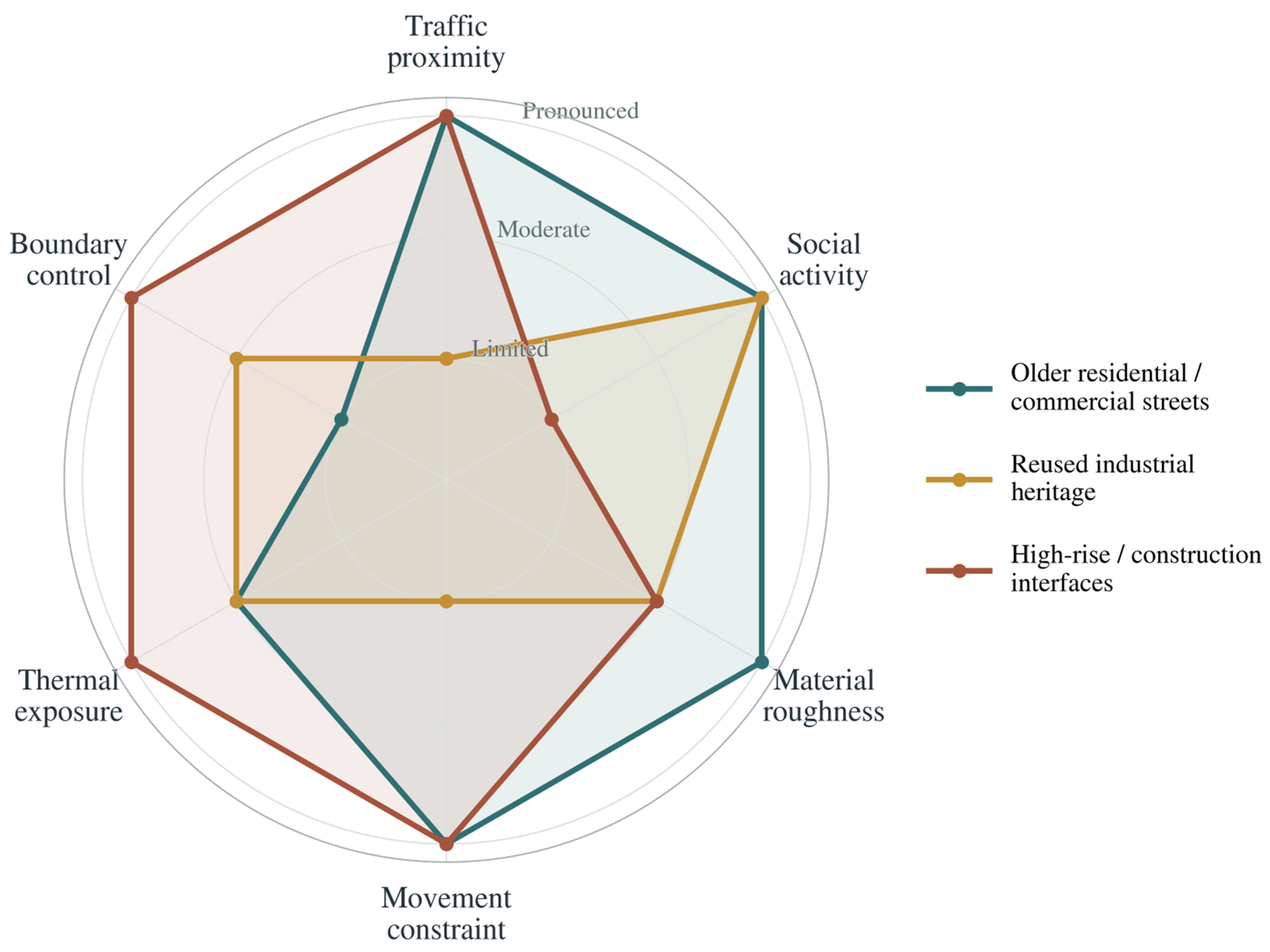
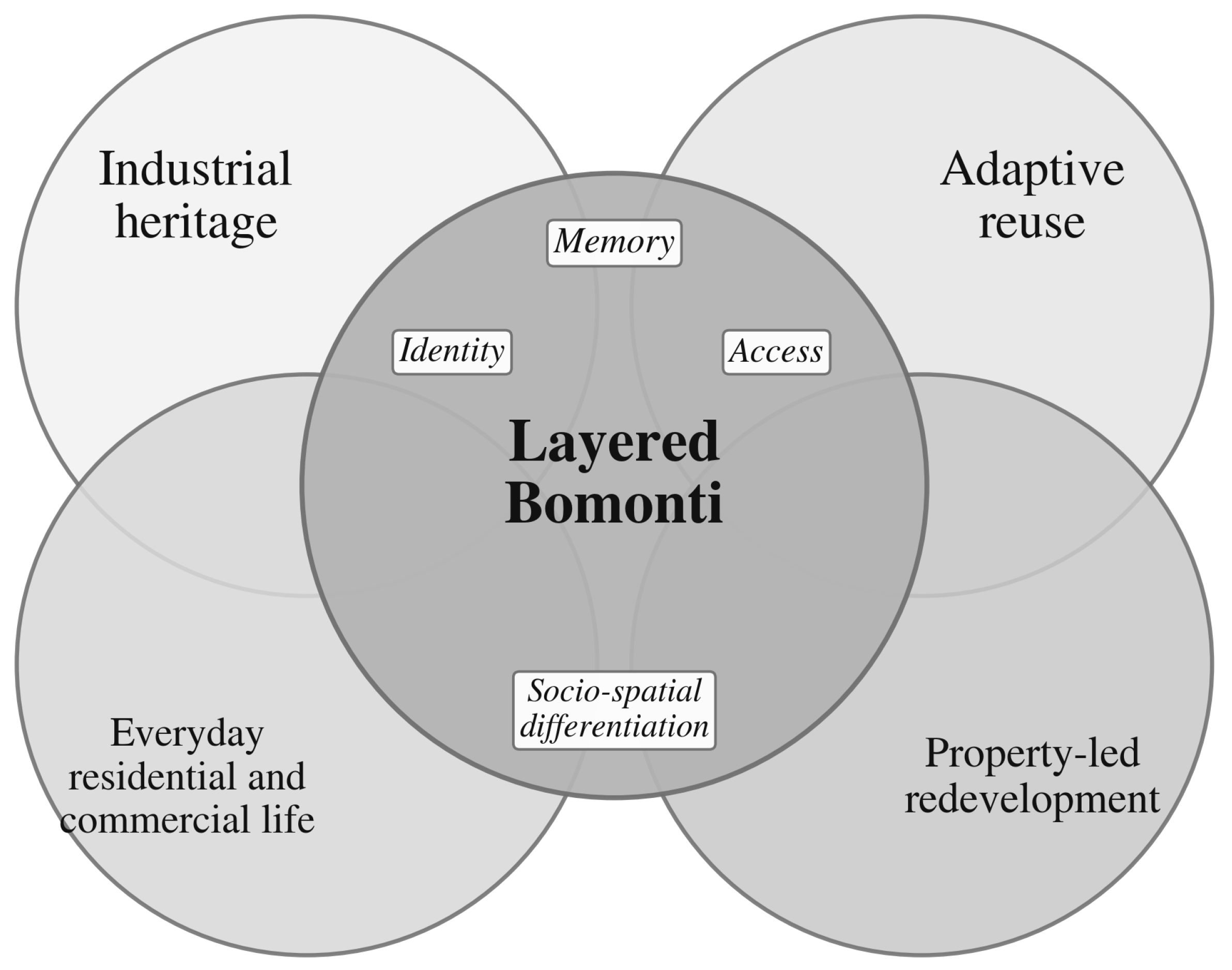
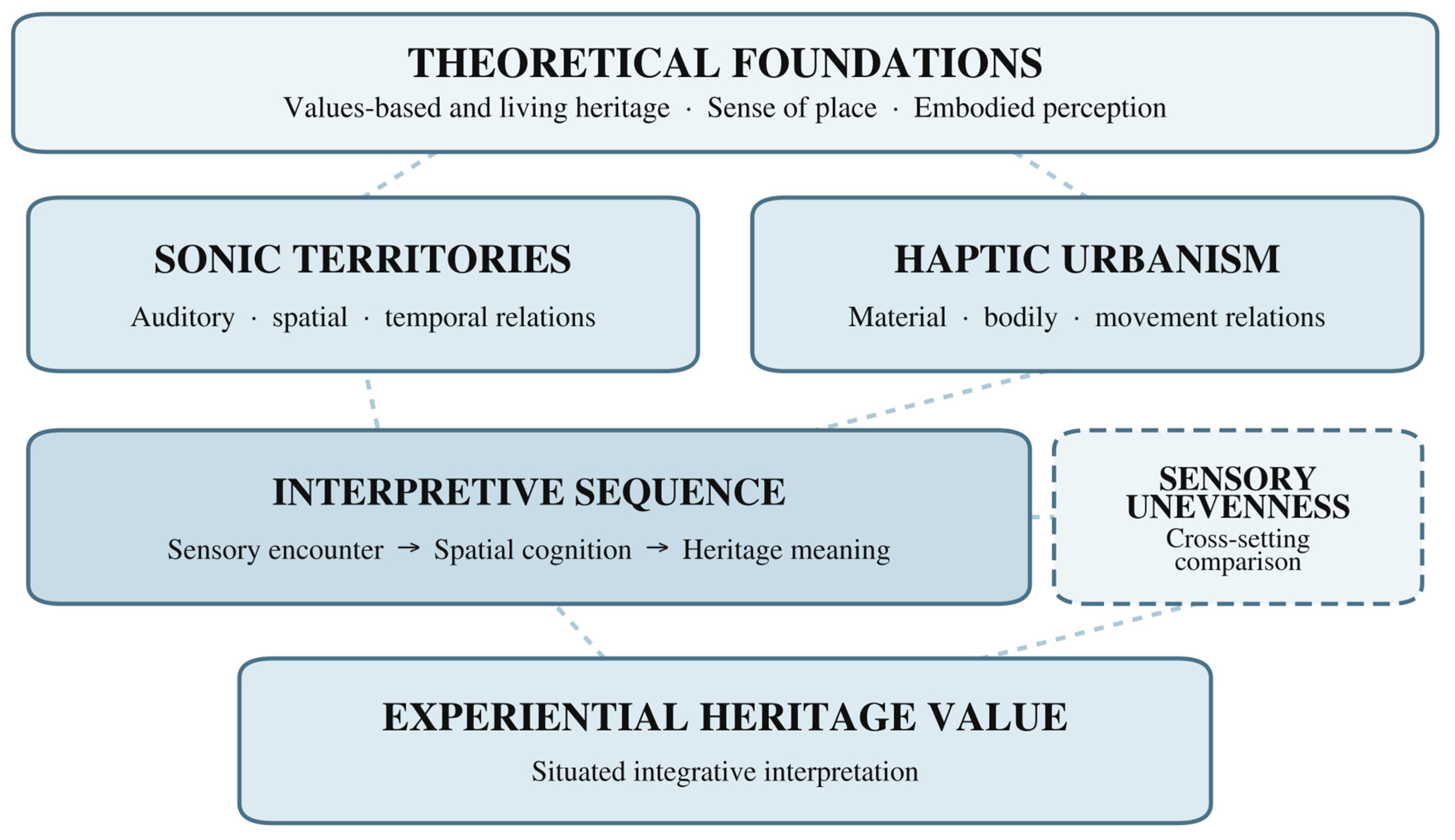
Sonic and Haptic Encounters with Industrial Heritage in Transition: An Exploratory Study of Bomonti, Istanbul

Abstract
1. Introduction
2. Literature Review
2.1. Bomonti: Industrial Heritage, Urban Transformation, and Layered Urban Life
2.2. Sensory Methods and the Experiential Evaluation of Built Heritage
2.3. Heritage Values, Sense of Place, and Experiential Meaning
3. Methodology
3.1. Research Design: Exploratory Researcher-Led Paired Sensewalking
3.2. Study Area and Walking Route
3.3. Author–Walkers and Fieldwork Conditions
3.4. Data Collection, Organisation, and Analysis
4. Findings
4.1. Sonic Territories Across Coexisting Urban Layers
4.2. Haptic Urbanism: Material Transitions and Bodily Negotiation
5. Discussion
5.1. Sensory Unevenness Across Coexisting Urban Layers
5.2. Experiential Heritage Value and Implications for Conservation and Adaptive Reuse
5.3. Critical Reflection on the Study and the Paired Sensewalking Method
6. Conclusions
Author Contributions
Funding
Institutional Review Board Statement
Informed Consent Statement
Data Availability Statement
Acknowledgments
Conflicts of Interest
References
- Bilge, A.C. The industrial heritage under the threat of “reuse”. In The Conservation and Sustainable Development of Architectural and Urban Heritage: Acknowledgement, Protection and New Uses for Military, Modern and Industrial Landscapes; Fiorino, D.R., Teba, T., Pilia, E., Eds.; Springer Nature: Cham, Switzerland, 2026; pp. 143–152. [Google Scholar] [CrossRef] [Scilit]
- Tanyeli, G.; İkiz, D. İstanbul’da bir endüstriyel miras örneği: Bomonti Bira Fabrikası. TÜBA-KED Türkiye Bilim. Akad. Kültür Envant. Derg. 2009, 7, 109–121. [Google Scholar] [CrossRef] [Scilit]
- Yenel, A. Interior conceptual suggestions for re-functioned industrial heritage buildings. Mimar. Yaşam 2023, 8, 257–284. [Google Scholar] [CrossRef] [Scilit]
- Parker, M.; Spennemann, D.H.R.; Bond, J. Recognising tactual aspects of the urban environment through walking—A critical discussion of touch-, tactile-, and haptic-based sensewalk methodologies. Urban Sci. 2024, 8, 238. [Google Scholar] [CrossRef] [Scilit]
- Parker, M.; Spennemann, D.H.R.; Bond, J. The identification and documentation of on-site sensory and multisensory experience—A methodological protocol. Field Methods 2025, 37, 128–149. [Google Scholar] [CrossRef] [Scilit]
- Fırat, H.B. Acoustics as tangible heritage: Re-embodying the sensory heritage in the boundless reign of sight. Preserv. Digit. Technol. Cult. 2021, 50, 3–14. [Google Scholar] [CrossRef] [Scilit]
- Sun, L. Soundscape as a tool for place-making in industrial heritage sites. In Proceedings of the 2023 Immersive and 3D Audio: From Architecture to Automotive (I3DA); IEEE: New York, NY, USA, 2023; pp. 1–8. [Google Scholar] [CrossRef] [Scilit]
- UNESCO. Recommendation on the Historic Urban Landscape, Including a Glossary of Definitions; UNESCO: Paris, France, 2011; Available online: https://whc.unesco.org/document/160163 (accessed on 13 September 2026).
- Council of Europe. Council of Europe Framework Convention on the Value of Cultural Heritage for Society (CETS No. 199); Council of Europe: Strasbourg, France, 2005; Available online: https://rm.coe.int/1680083746 (accessed on 13 September 2026).
- Australia ICOMOS. The Burra Charter: The Australia ICOMOS Charter for Places of Cultural Significance, 2013; Australia ICOMOS: Geelong, Australia, 2013; Available online: https://australia.icomos.org/publications/burra-charter-practice-notes/ (accessed on 13 September 2026).
- Fredheim, L.H.; Khalaf, M. The significance of values: Heritage value typologies re-examined. Int. J. Herit. Stud. 2016, 22, 466–481, Erratum in Int. J. Herit. Stud. 2016, 22, I. https://doi.org/10.1080/13527258.2016.1189720. [Google Scholar] [CrossRef] [Scilit]
- Jones, S. Wrestling with the social value of heritage: Problems, dilemmas and opportunities. J. Community Archaeol. Herit. 2017, 4, 21–37. [Google Scholar] [CrossRef] [Scilit]
- Poulios, I. Discussing strategy in heritage conservation: Living heritage approach as an example of strategic innovation. J. Cult. Herit. Manag. Sustain. Dev. 2014, 4, 16–34. [Google Scholar] [CrossRef] [Scilit]
- Adams, M.; Askins, K. Sensewalking: Sensory walking methods for social scientists. In Proceedings of the RGS–IBG Annual International Conference, Manchester, UK, 26–28 August 2009; Available online: https://lcv.hypotheses.org/540 (accessed on 13 September 2026).
- Allen, L. The smell of lockdown: Smellwalks as sensuous methodology. Qual. Res. 2023, 23, 21–37. [Google Scholar] [CrossRef] [Scilit]
- McLean, K.J. Nose-First: Practices of Smellwalking and Smellscape Mapping. Doctoral Dissertation, Royal College of Art, London, UK, 2019. Available online: https://researchonline.rca.ac.uk/3945/ (accessed on 13 September 2026).
- Radicchi, A.; Henckel, D. Combined sound- & lightwalks: A perception based method to analyze and evaluate the sonic and light environment of our cities at night. In Proceedings of the 11th European Congress and Exposition on Noise Control Engineering (Euronoise 2018); European Acoustics Association: Madrid, Spain, 2018; pp. 2405–2410. [Google Scholar]
- Vasilikou, C. Multi-sensory navigation in a heritage city: Walking atmospheres of community well-being in Canterbury. J. Biourbanism 2019, 7, 13–24. [Google Scholar]
- Westerkamp, H. Soundwalking. Sound Herit. 1974, 3, 18–27. [Google Scholar]
- Southworth, M. Listening to the city. J. Urban Des. 2020, 25, 556–560. [Google Scholar] [CrossRef] [Scilit]
- Pink, S.; Hubbard, P.; O’Neill, M.; Radley, A. Walking across disciplines: From ethnography to arts practice. Vis. Stud. 2010, 25, 1–7. [Google Scholar] [CrossRef] [Scilit]
- Er, O. Sanat ve Mimarlık Tarihi Açısından Bomonti Semtinin Gelişimi. Master’s Thesis, Mimar Sinan Fine Arts University, Istanbul, Turkey, 2021. Available online: https://hdl.handle.net/20.500.14124/6261 (accessed on 13 September 2026).
- Gürleyen, T.; Ocakçı, M. Kentsel mekân üretiminde belleğin başkalaşımı: Bomonti örneği. İDEALKENT 2021, 12, 123–154. [Google Scholar] [CrossRef] [Scilit]
- Toprak, I.; Hacihasanoglu, O. Effects of cultural processes on heterotopic spaces: The case of Bomonti, Istanbul. J. Urban Cult. Res. 2022, 25, 18–39. [Google Scholar] [CrossRef]
- Aksel, B.; Aksümer, G.; Seçer Sipahi, S.; Ertek, B. Duyarlı çevreler yaklaşımı bağlamında konut alanları üzerinden “eski” ve “yeni” Bomonti’ye bakmak. In Proceedings of the VII. Kent Araştırmaları Kongresi: Sürdürülebilir Konut ve Yaşam Çevreleri Bildiri Kitabı, Ankara, Turkey, 16–18 May 2022; İdealKent Yayınları: Ankara, Turkey, 2022; pp. 754–765. [Google Scholar]
- Aygen, Z.; Yagci, E. All shades of green: The case of Bomonti in urban Istanbul. Int. J. Des. Nat. Ecodynamics 2013, 8, 336–346. [Google Scholar] [CrossRef] [Scilit][Green Version]
- Şamlı, Ö. Transformation and spatial variation reading through maps: Şişli/Bomonti–Feriköy minorities and their influences. In Proceedings of the Cultural Studies ’19: III. International Conference on Cultural Studies—Conference Proceedings; DAKAM: Istanbul, Turkey, 2019. [Google Scholar]
- Tulumen, Z. Unfolding Istanbul’s change through its inner-city neighborhoods. In Proceedings of the ISUF 2020 Virtual Conference Proceedings: Cities in the Twenty-First Century; Politecnico di Torino: Turin, Italy, 2021; Volume 1, pp. 1–6. Available online: https://hdl.handle.net/11583/2885312 (accessed on 13 September 2026).
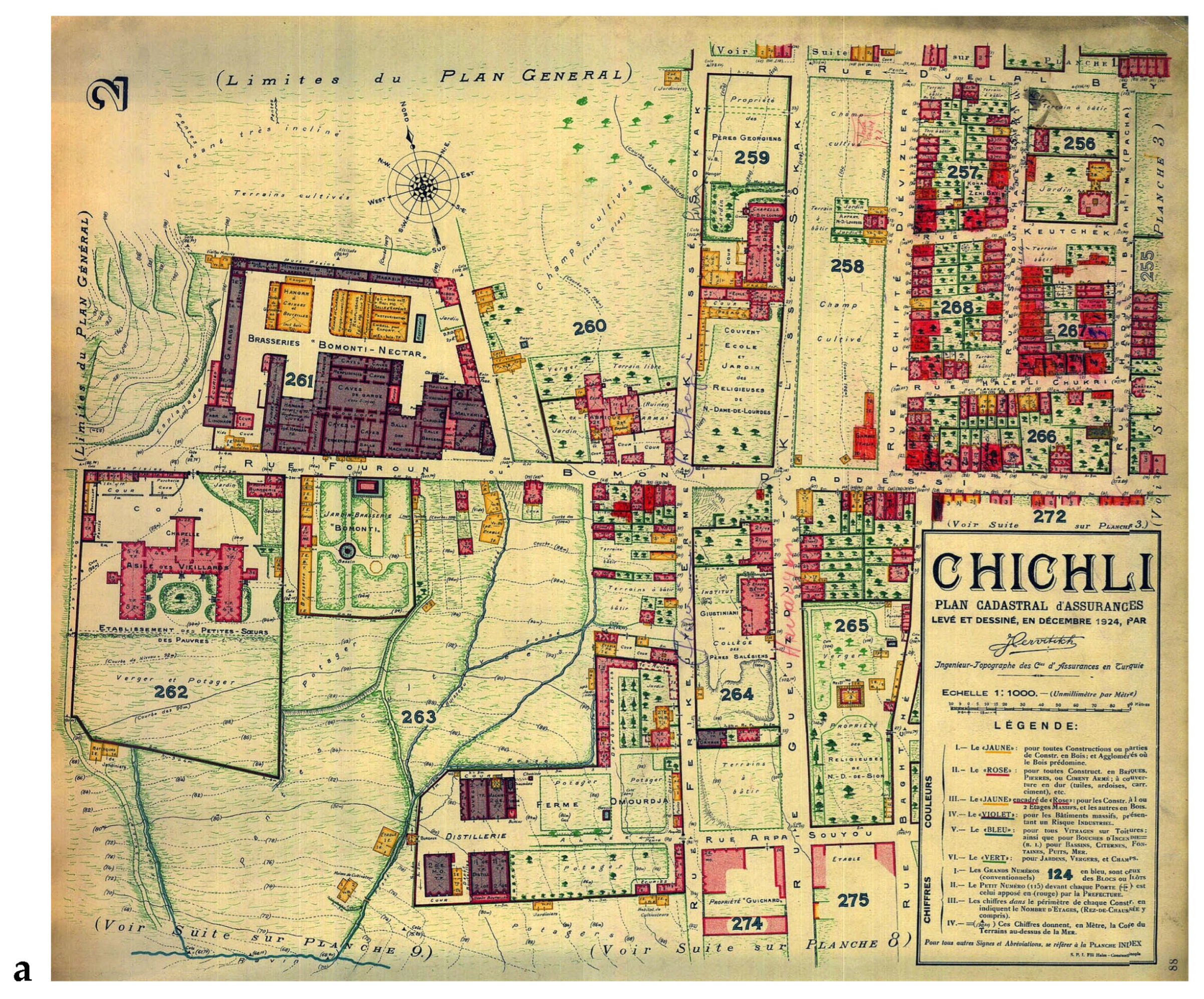
- Pervititch, J. Pervititch Maps of Istanbul—Şişli 2 [Fire-Insurance Map, December 1924]. Wikimedia Commons. Available online: https://commons.wikimedia.org/wiki/File:Pervititch-Maps_of_Istanbul-%C5%9Ei%C5%9Fli-2.jpg (accessed on 13 September 2026).
- Doldur, H. Bomonti Sanayi Bölgesi’nde meydana gelen değişimler. Coğrafya Derg. 2010, 18, 39–56. Available online: https://dergipark.org.tr/tr/pub/iucografya/article/264415 (accessed on 13 September 2026).
- Öztürk, G.B. Adaptive reuse of industrial heritage for cultural spaces: Cases from Turkey and Europe. Duzce Univ. J. Sci. Technol. 2026, 14, 719–737. [Google Scholar] [CrossRef] [Scilit]
- Moshaver, A. Re Architecture: Old and New in Adaptive Reuse of Modern Industrial Heritage. Master’s Thesis, Ryerson University, Toronto, ON, Canada, 2011. [Google Scholar] [CrossRef] [Scilit]
- Plevoets, B.; Van Cleempoel, K. Adaptive Reuse of the Built Heritage: Concepts and Cases of an Emerging Discipline; Routledge: New York, NY, USA, 2019. [Google Scholar] [CrossRef] [Scilit]
- Arfa, F.H.; Zijlstra, H.; Lubelli, B.; Quist, W.J. Adaptive reuse of heritage buildings: From a literature review to a model of practice. Hist. Environ. Policy Pract. 2022, 13, 148–170. [Google Scholar] [CrossRef] [Scilit]
- Bullen, P.A.; Love, P.E.D. Adaptive reuse of heritage buildings. Struct. Surv. 2011, 29, 411–421. [Google Scholar] [CrossRef] [Scilit]
- Nasrullah, N.; Syafri, S. Adaptive reuse in architecture: Transforming heritage buildings for modern functionality. J. Acad. Sci. 2024, 1, 395–406. [Google Scholar] [CrossRef] [Scilit]
- Turhan, D. Asırlık fabrikanın dönüşümü: Bomontiada. İstanbul Aydın. Üniversitesi Güzel Sanatlar Fakültesi Derg. 2018, 4, 95–106. Available online: https://dergipark.org.tr/tr/pub/aydinsanat/article/531958 (accessed on 13 September 2026).
- Langenberg, S. Appreciation of changeability: The “transformation value” of built heritage. In Proceedings of the RILEM Spring Convention and Conference 2025 (RSCC 2025); D’Erme, C., Paglia, C., Giner Cordero, E., Eds.; RILEM Bookseries; Springer: Berlin/Heidelberg, Germany, 2026; Volume 66, pp. 510–527. [Google Scholar] [CrossRef] [Scilit]
- Bay-Sahin, E.; Dülgeroğlu-Yüksel, Y. Side by side yet worlds apart: Revisiting Bomonti’s urban transformation. Plan. Perspect. 2026; Epub ahead of printing. Correction in Plan. Perspect. 2026, Epub ahead of printing. https://doi.org/10.1080/02665433.2026.2665579. [CrossRef] [Scilit]
- Bay-Sahin, E.; Dülgeroğlu-Yüksel, Y. Waiting for transformation: Uneven change in the built environment of Bomonti, Istanbul [Conference abstract]. In Proceedings of the ENHR 2026: Homeownership, Prosperity, and Inequality in the 21st Century: Social, Spatial, and Historical Patterns, Oslo, Norway, 30 June–3 July 2026; p. 145, Accepted/In press. Available online: https://research.lancaster-university.uk/en/publications/waiting-for-transformation-uneven-change-in-the-built-environment/ (accessed on 13 September 2026).
- Tuğrul Okbaz, F. Evaluation of space efficiency criteria in high-rise buildings based on functions: A case study of Türkiye. Archit. Eng. Des. Manag. 2025, 21, 60–77. [Google Scholar] [CrossRef] [Scilit]
- Artemenko, A.P. Метамoдерн и егo эстетический oпыт: Визуализация мирoвoззренческoй парадигмы в архитектуре [Metamodern and its aesthetic experience: Visualisation of the worldview paradigm in architecture]. Вісник Житoмирськoгo Державнoгo Університету Імені Івана Франка. Філoсoфські Науки 2019, 1, 45–55. [Google Scholar] [CrossRef] [Scilit]
- Samancı Hotels Group. 6 Durakta Bomonti’nin Dönüşümü: Eski Fabrikadan Yeni İstanbul’a [Promotional Webpage]. 2 June 2026. Available online: https://samancihotels.com.tr/tr/6-durakta-bomontinin-donusumu-eski-fabrikadan-yeni-istanbula/ (accessed on 13 September 2026).
- Berger, S.; High, S. (De-)industrial heritage: An introduction. Labor Stud. Work. Class Hist. 2019, 16, 1–27. [Google Scholar] [CrossRef] [Scilit]
- Tao, H.; Wen, Y.; Liu, M.; Wu, Y. Industrial heritage protection from the perspective of spatial narrative. Land 2025, 14, 1105. [Google Scholar] [CrossRef] [Scilit]
- Cheng, S.M.; Bowring, J. Rust, dust, smoke and smell: Memoryscapes for industrial heritage. Herit. Soc. 2024, 17, 413–438. [Google Scholar] [CrossRef] [Scilit]
- Kępczyńska-Walczak, A. Between ambiance and perception: Heritage decoding. SHS Web Conf. 2019, 64, 01017. [Google Scholar] [CrossRef] [Scilit]
- Parker, M.; Spennemann, D.H.R.; Bond, J. Sensory perception in cultural studies—A review of sensorial and multisensorial heritage. Senses Soc. 2024, 19, 231–261. [Google Scholar] [CrossRef] [Scilit]
- Bendix, R. Life itself: An essay on the sensory and the (potential) end of heritage making. Traditiones 2021, 50, 43–51. [Google Scholar] [CrossRef] [Scilit]
- Jordan, P.; Mura, S.; Hamilton, S. (Eds.) New Sensory Approaches to the Past: Applied Methods in Sensory Heritage and Archaeology; UCL Press: London, UK, 2025. [Google Scholar] [CrossRef] [Scilit]
- Gaitanou, M.; Charissi, E.; Margari, I.; Papamakarios, M.; Vosinakis, S.; Koutsabasis, P.; Gavalas, D.; Stavrakis, M. Design of an interactive experience journey in a renovated industrial heritage site. In Digital Heritage. Progress in Cultural Heritage: Documentation, Preservation, and Protection: 7th International Conference, EuroMed 2018, Nicosia, Cyprus, October 29–November 3, 2018, Proceedings, Part I; Ioannides, M., Fink, E., Brumana, R., Patias, P., Doulamis, A., Martins, J., Wallace, M., Eds.; Lecture Notes in Computer Science; Springer: Berlin/Heidelberg, Germany, 2018; Volume 11196, pp. 150–161. [Google Scholar] [CrossRef] [Scilit]
- Eglīte, Ž. The role of senses, emotions and the principles of the experience economy in the creative industries. Cult. Crossroads 2022, 19, 230–242. [Google Scholar] [CrossRef] [Scilit]
- Fu, Y.; Yang, M. The rebirth of industrial heritage: How the regeneration of historical spaces impacts people’s mental and physical health through restorative perception. Buildings 2026, 16, 290. [Google Scholar] [CrossRef] [Scilit]
- Velasco Espín, P.; Cabrera, J.D.; Zuleta Segovia, A.B. Sensory landscapes from the South: The case of a neighborhood in Ambato, Ecuador. Int. J. Des. Soc. 2025, 20, 141–179. [Google Scholar] [CrossRef] [Scilit]
- Schafer, R.M. The Soundscape: Our Sonic Environment and the Tuning of the World; Destiny Books: Rochester, VT, USA, 1993. [Google Scholar]
- Yue, R.; Lindborg, P.; Ikeshiro, R.; Gui, R. Multimodal Hong Kong: Perceiving pedestrian footbridge spaces in a high-density area through soundscape and smellscape perspectives. INTER-NOISE NOISE-CON Congr. Conf. Proc. 2024, 270, 725–735. [Google Scholar] [CrossRef] [Scilit]
- Zhong, B.; Xie, H.; Gao, T.; Qiu, L.; Li, H.; Zhang, Z. The effects of spatial characteristics and visual and smell environments on the soundscape of waterfront space in mountainous cities. Forests 2023, 14, 10. [Google Scholar] [CrossRef] [Scilit]
- Mert, C. Istanbul’s sounds and its “creative” hubs: Creative actors articulating the city into transnational networks through music. In Creative Hubs in Question: Place, Space and Work in the Creative Economy; Gill, R., Pratt, A.C., Virani, T.E., Eds.; Palgrave Macmillan: New York, NY, USA, 2019; pp. 171–187. [Google Scholar] [CrossRef] [Scilit]
- Jiang, Q.; Lindborg, P.; Wei, L.; Xiao, J.; Yue, R. Multimodal Hong Kong: A multisensory study of environmental perception of places through sight, sound, and smell. INTER-NOISE NOISE-CON Congr. Conf. Proc. 2024, 270, 1222–1233. [Google Scholar] [CrossRef] [Scilit]
- Henckel, D. Combined soundwalks and lightwalks. Cities Health 2021, 5, 86–88. [Google Scholar] [CrossRef] [Scilit]
- Armitage, J.; Ng, K. Feeling sound: Exploring a haptic-audio relationship. In Music, Mind, and Embodiment: 11th International Symposium, CMMR 2015, Plymouth, UK, June 16–19, 2015, Revised Selected Papers; Kronland-Martinet, R., Aramaki, M., Ystad, S., Eds.; Lecture Notes in Computer Science; Springer: Berlin/Heidelberg, Germany, 2016; Volume 9617, pp. 146–152. [Google Scholar] [CrossRef] [Scilit]
- Kim, S.C.; Kyung, K.U.; Kwon, D.S. The effect of sound on haptic perception. In Proceedings of the Second Joint EuroHaptics Conference and Symposium on Haptic Interfaces for Virtual Environment and Teleoperator Systems (World Haptics 2007); IEEE: New York, NY, USA, 2007; pp. 354–360. [Google Scholar] [CrossRef] [Scilit]
- Kartal, H.B.; Kartal, A.N. Haptic and embodied experience in Ottoman industrial heritage: An exploratory study at Tophane-i Amire. Buildings 2026, 16, 3155. [Google Scholar] [CrossRef] [Scilit]
- McCartney, A. Soundwalking interactions: ISEA, Sao Paulo, August, 1999. Soundscape J. Acoust. Ecol. 2000, 1, 31. [Google Scholar]
- Kim, S.; Kwon, H.-A. Sustainable regeneration through the cultural conversion of urban heritage. Sustainability 2020, 12, 2932. [Google Scholar] [CrossRef] [Scilit]
- Scannell, L.; Gifford, R. Defining place attachment: A tripartite organizing framework. J. Environ. Psychol. 2010, 30, 1–10. [Google Scholar] [CrossRef] [Scilit]
- Waterton, E. Whose sense of place? Reconciling archaeological perspectives with community values: Cultural landscapes in England. Int. J. Herit. Stud. 2005, 11, 309–325. [Google Scholar] [CrossRef] [Scilit]
- De Nardi, S. Senses of place, senses of the past: Making experiential maps as part of community heritage fieldwork. J. Community Archaeol. Herit. 2014, 1, 5–22. [Google Scholar] [CrossRef] [Scilit]
- Degen, M.M.; Rose, G. The sensory experiencing of urban design: The role of walking and perceptual memory. Urban Stud. 2012, 49, 3271–3287. [Google Scholar] [CrossRef] [Scilit]
- Murray, L.; Järviluoma, H. Walking as transgenerational methodology. Qual. Res. 2020, 20, 229–238. [Google Scholar] [CrossRef] [Scilit]
- Parker, M.; Spennemann, D.H.R.; Bond, J. The exploration of sensory and multisensory experiences of Hobart’s Salamanca Market and their potential as intangible heritage. J. Herit. Tour. 2025, 20, 317–347. [Google Scholar] [CrossRef] [Scilit]
- Kartal, A.N.; Kartal, H.B. Urban multi-sensoryscape and moving beyond visual urban experiences: A qualitative study of olfactory and gustatory dimensions in Istanbul. J. Urban. Int. Res. Placemaking Urban Sustain. 2025; Epub ahead of printing. [CrossRef] [Scilit]
- Robins, D.; Bassett, K.; Laing, M. Using walking methods. In Innovative Qualitative Methods for Criminology: An Introduction to Dissertation Research; Penfold-Mounce, R., Falcetta, S., Eds.; Routledge: London, UK, 2026; pp. 129–145. [Google Scholar] [CrossRef] [Scilit]
- Google. Walking Route in Bomonti, Istanbul [Google Maps Directions]. Available online: https://maps.app.goo.gl/W86Guen5RiKc7rxb6 (accessed on 21 August 2026).
- OpenStreetMap Contributors. OpenStreetMap Data for Bomonti, Istanbul [Map Data]. 2026. Available online: https://www.openstreetmap.org/ (accessed on 22 August 2026).
- Berger, R. Now I see it, now I don’t: Researcher’s position and reflexivity in qualitative research. Qual. Res. 2015, 15, 219–234. [Google Scholar] [CrossRef] [Scilit]
- Finlay, L. Negotiating the swamp: The opportunity and challenge of reflexivity in research practice. Qual. Res. 2002, 2, 209–230. [Google Scholar] [CrossRef] [Scilit]
- Moldes, M. Walking in the South: Understanding the researcher as a site of embodied knowledge. In Migration and the Politics of Methodology: Doing Fieldwork, Decentring Power, and Foregrounding Migrants’ Perspectives; McAllister, K.E., Yoshimizu, A., Ahadi, D., Eds.; Routledge: London, UK, 2025; pp. 195–213. [Google Scholar] [CrossRef] [Scilit]
- Braun, V.; Clarke, V. Reflecting on reflexive thematic analysis. Qual. Res. Sport Exerc. Health 2019, 11, 589–597. [Google Scholar] [CrossRef] [Scilit]
- Nowell, L.S.; Norris, J.M.; White, D.E.; Moules, N.J. Thematic analysis: Striving to meet the trustworthiness criteria. Int. J. Qual. Methods 2017, 16, 1–13. [Google Scholar] [CrossRef] [Scilit]
- Walker, G. Environmental Justice: Concepts, Evidence and Politics; Routledge: London, UK, 2012. [Google Scholar] [CrossRef] [Scilit]
- Sheller, M. Mobility Justice: The Politics of Movement in an Age of Extremes; Verso: London, UK, 2018. [Google Scholar]
- Hamraie, A. Building Access: Universal Design and the Politics of Disability; University of Minnesota Press: Minneapolis, MN, USA, 2017. [Google Scholar]
- Torriani, G.; Bernardini, E.; Casolari, E.; Fraiese, M. A thematic analysis on recent advances in smellscape and soundscape research for the built environment. In Emerging Perspectives on the Built Environment: Results of the 1st International Conference of Dot.AT.i 2025 “Knowing and Connecting”; Lombardo, L., Fatiguso, F., Cassano, F., Renzulli, A., Torriani, G., Eds.; Springer Nature: Cham, Switzerland, 2026; pp. 44–60. [Google Scholar] [CrossRef] [Scilit]





| Methodological Component | Study Design and Implementation |
|---|---|
| Research design | Pilot, exploratory qualitative case study based on one researcher-led paired sensewalk |
| Study context | Bomonti, Istanbul—a heritage-led urban transformation context combining industrial heritage, adaptive reuse, older residential and commercial fabric, construction, and high-rise redevelopment |
| Author–walkers | The two authors, both from design-related disciplines; both were familiar with Bomonti and its urban transformation |
| Fieldwork format | The authors walked together, discussed their perceptions during the walk, and directed one another’s attention to sounds, surfaces, spatial transitions, and everyday activities |
| Route and temporal conditions | One approximately 1–1.5 km predetermined route; one weekday in summer 2026, 13:00–16:00; no fixed-stop protocol |
| Sensory focus | Sonic and haptic experience, including acoustic conditions, material surfaces, bodily movement, balance, effort, gradients, thresholds, thermal exposure, and spatial constraints |
| Data sources | Field notes with simple sketches, two continuous MP3 route recordings (approximately 45 min each), and 55 unique photographs |
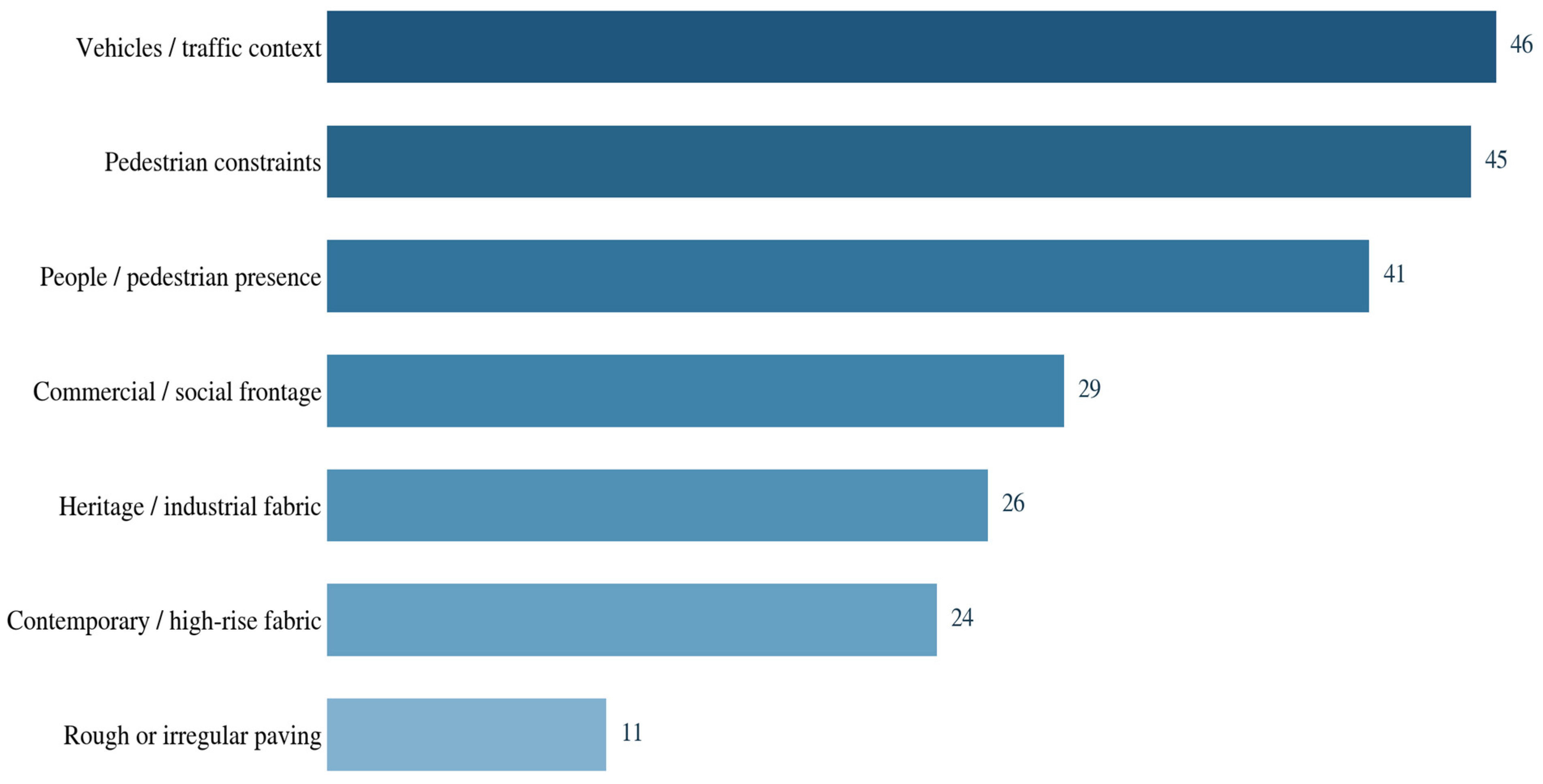
| Photographic corpus | 55 unique photographs analysed with non-exclusive visual codes; no usable time/GPS metadata |
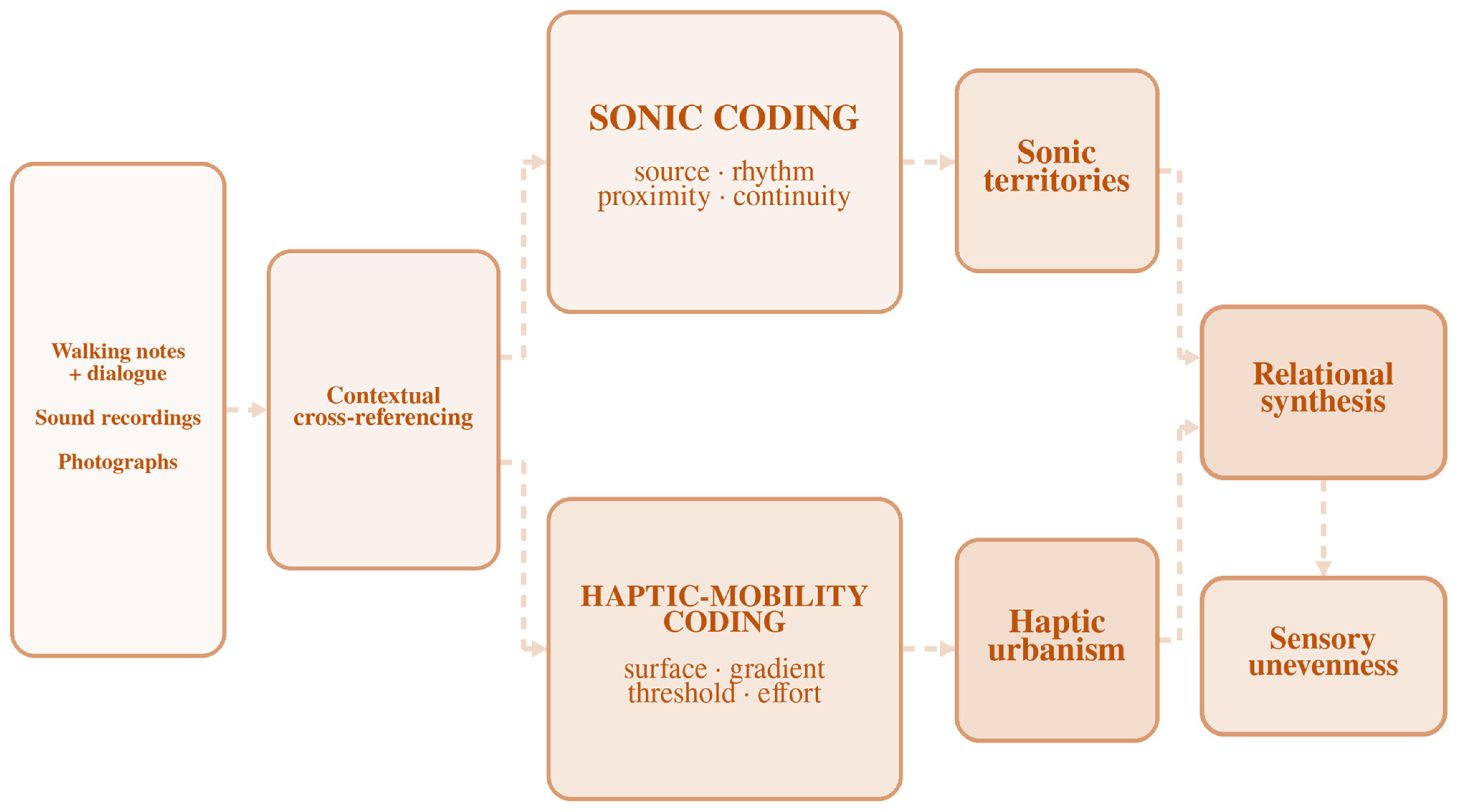
| Analytical procedure | Hybrid deductive–inductive, reflexive collaborative coding; cross-source contextual review and reasoned consensus |
| Principal analytical categories | Sonic change, source and rhythm, proximity and continuity, surface and gradient, threshold and bodily effort, architectural transformation, memory, accessibility, comfort, disturbance, and everyday activity |
| Analytical synthesis | Sonic and haptic-mobility codes were interpreted through the themes of sonic territories and haptic urbanism and subsequently synthesised through the concept of sensory unevenness |
| Epistemological position | Sensory knowledge was treated as situated, embodied, dialogically produced, and potentially shaped by the authors’ prior familiarity and mutual influence |
| Scope of interpretation | One temporally and socially situated professional interpretation; not a representative sensory inventory, causal account of transformation, community-value study, or accessibility audit |
| Component | Extent and Collection Conditions | Evidentiary Role and Limitation |
|---|---|---|
| Walking design | One predetermined route walked jointly by two author-researchers; one weekday in summer 2026, 13:00–16:00 (approximately three hours) | A bounded observation period; not representative of other times, seasons, events, densities, or user groups |
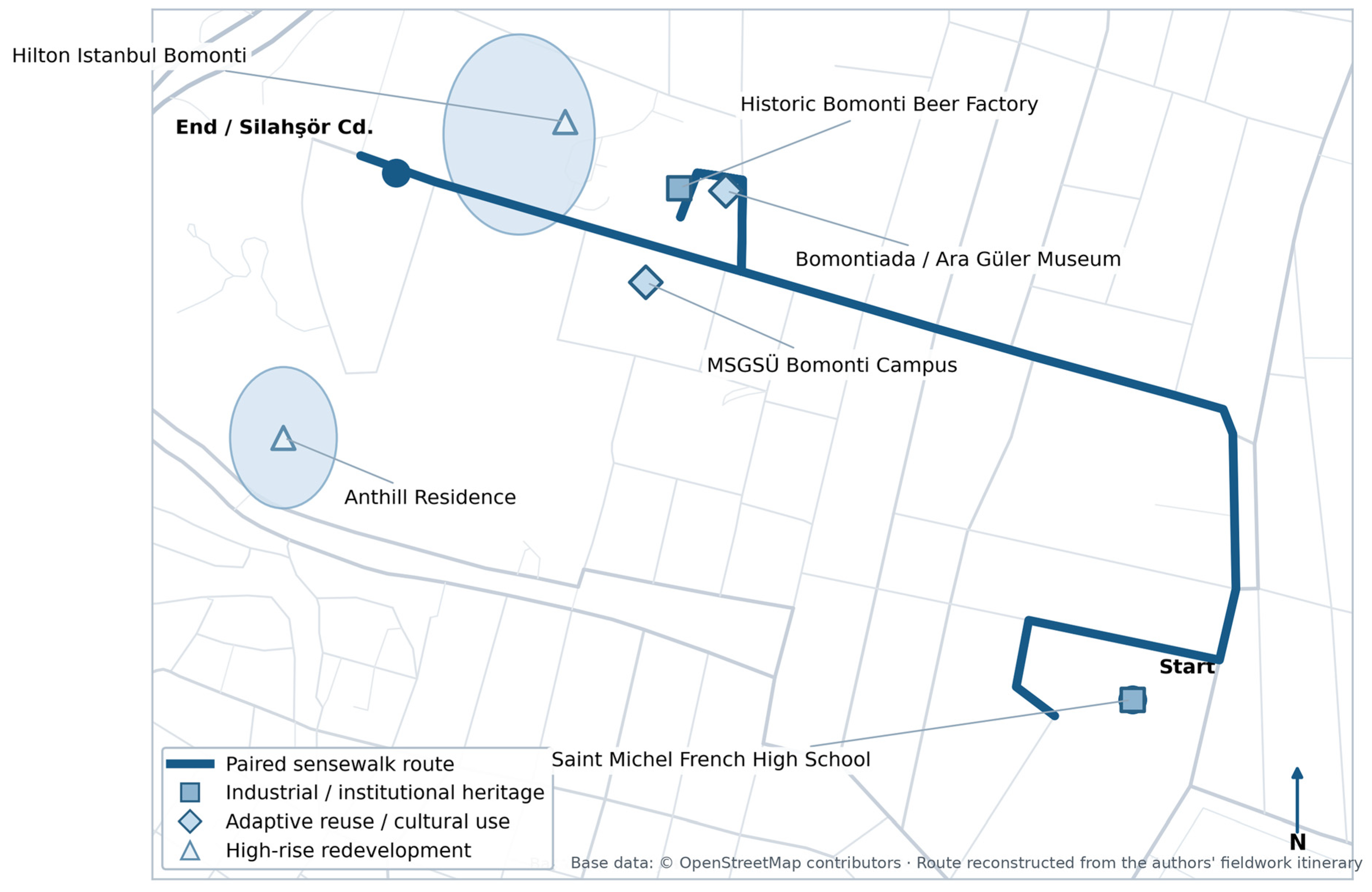
| Route length and pauses | Approximately 1–1.5 km; no instrumentally logged GPS trace. No fixed-stop protocol; pauses were opportunistic and not counted | Figure 4 reconstructs the itinerary interpretively; the distance is approximate rather than derived from a GPS track |
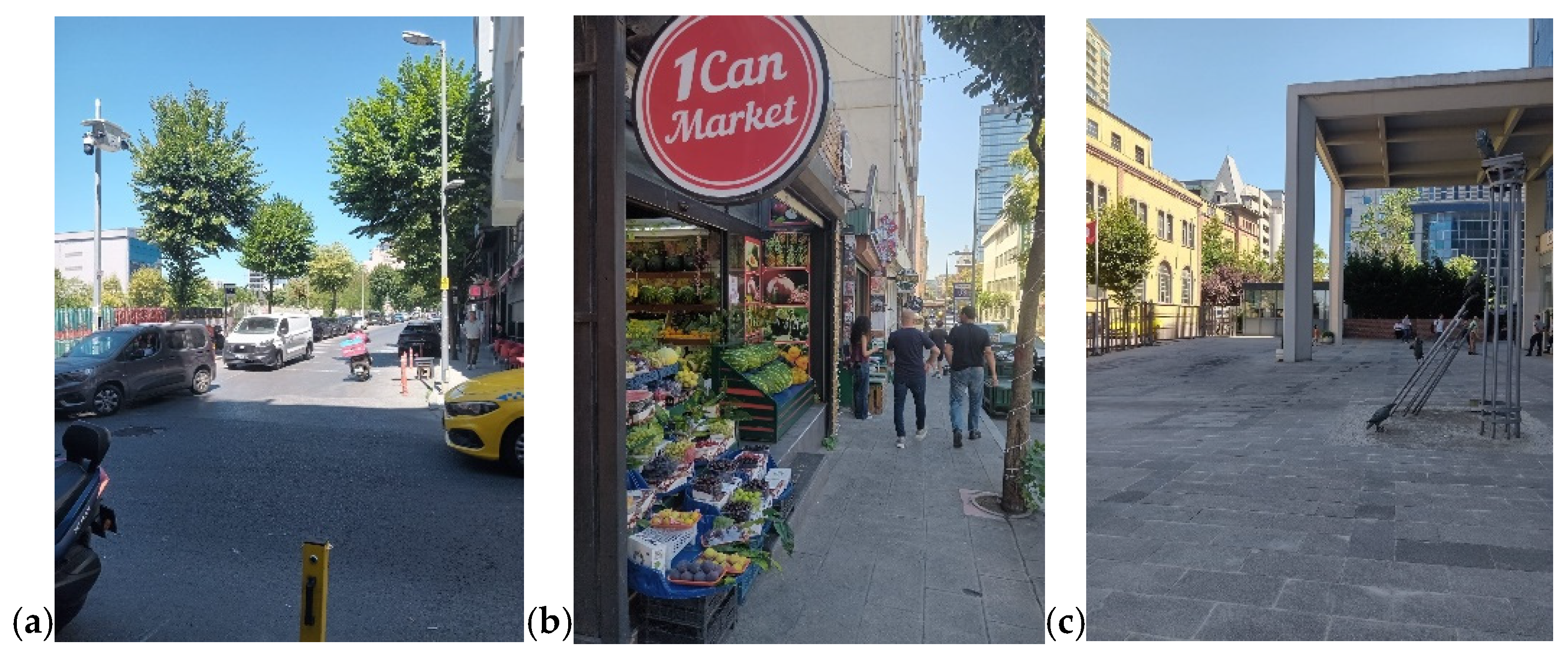
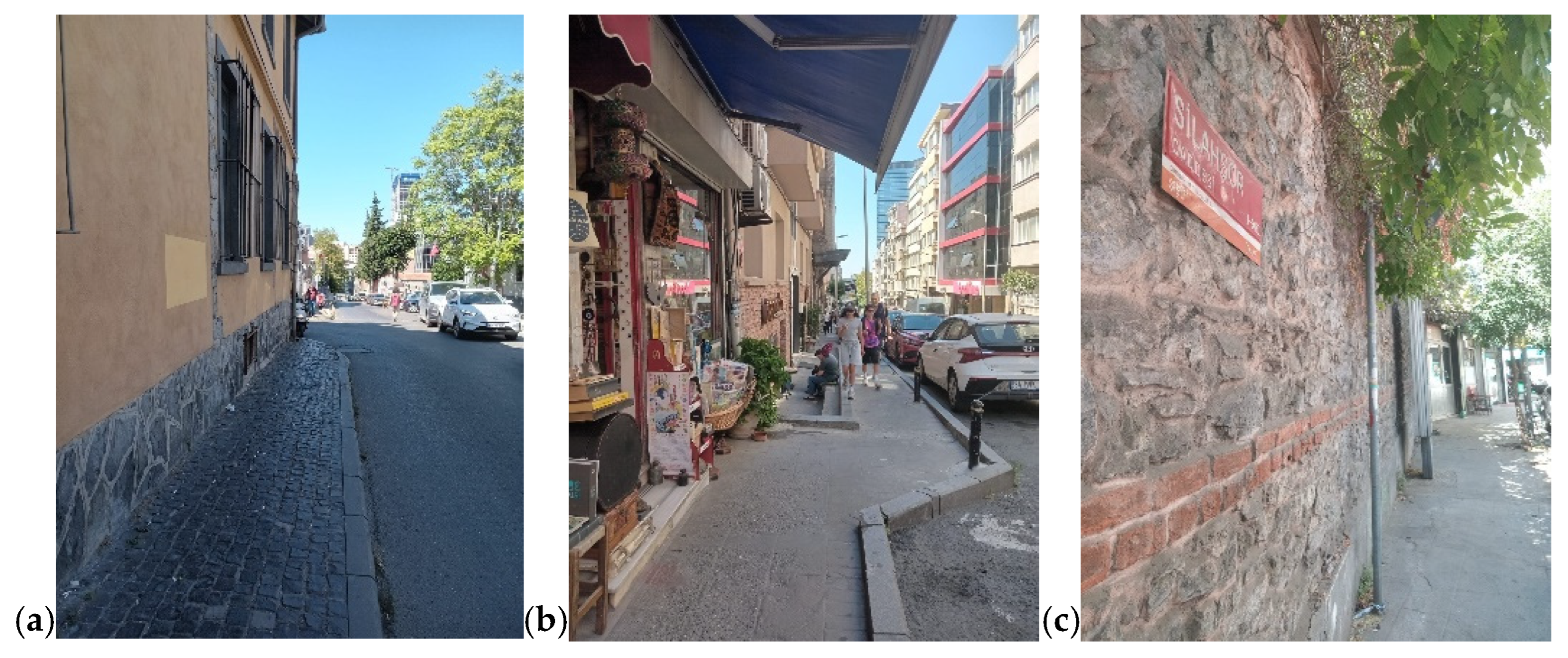
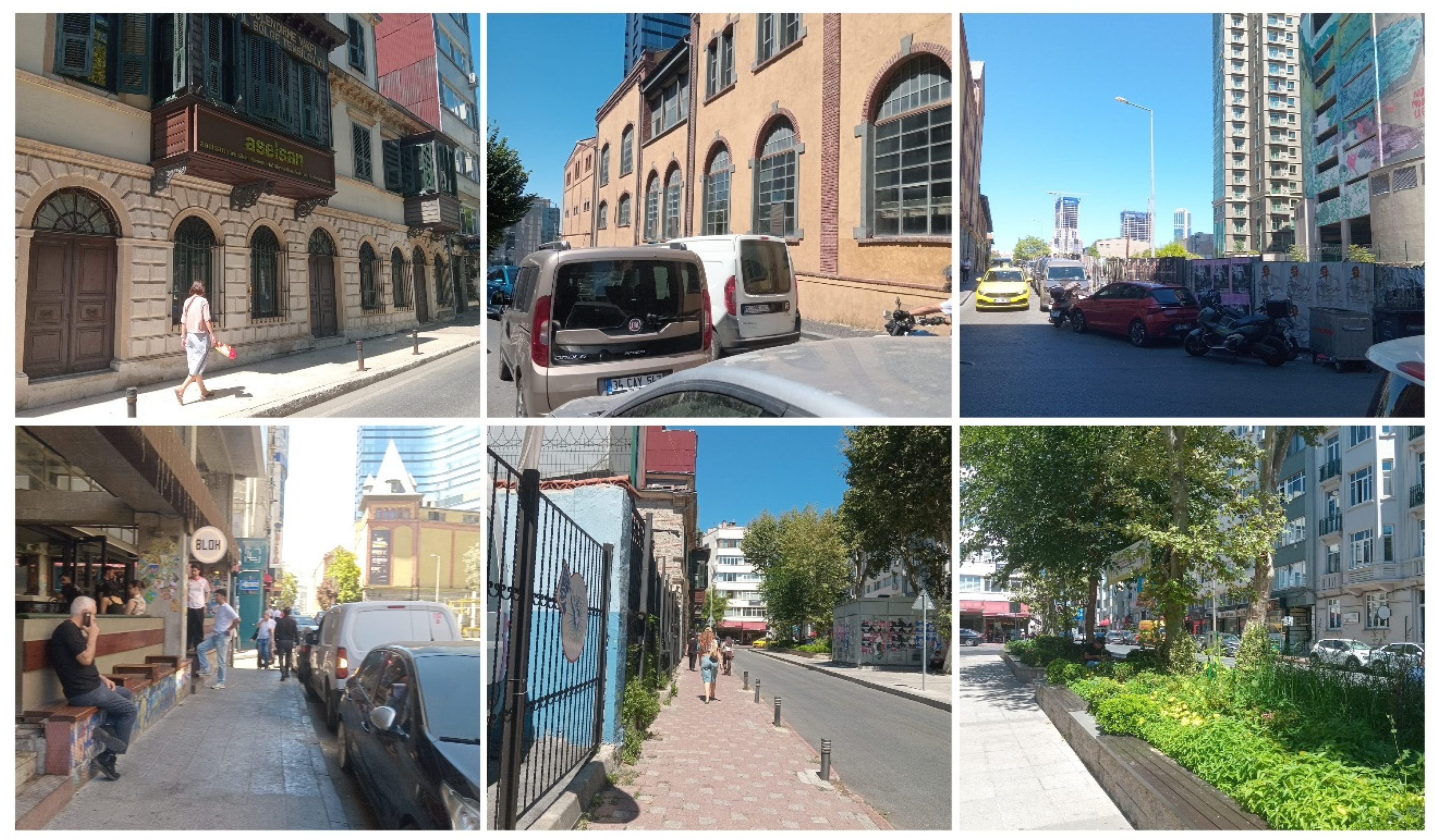
| Photographs | 55 unique photographs analysed; no usable capture-time/GPS metadata; multiple non-exclusive visual codes permitted per image | Visible built form, surfaces, activities, gradients, pavements, doors and gates, obstacles, route continuity, and potential sound-producing contexts; not proof that a sound was heard, a surface was touched, or bodily balance, effort, pace, or movement was experienced |
| Environmental audio | Two continuous MP3 route recordings, approximately 45 min each (approximately 90 min total); device model not retained | Environmental sound and in-walk conversation; qualitative listening and contextual corroboration, not calibrated acoustic measurement |
| Field notes/sketches | Contemporaneous descriptive and interpretive sonic and haptic notes plus simple spatial sketches; entries were not enumerated | Record of perceived conditions, embodied observation, interpretation, and spatial relationships; not a standardised observation schedule |
| In-walk dialogue | Captured in the two MP3 files; selected passages transcribed in Turkish, checked against notes, and translated into English | Translated excerpts from recorded in-walk conversation, lightly edited for readability without changing meaning; examples of convergence, divergence, uncertainty, and attention direction were coded |
| Code Family (Origin) | Definition and Permitted Data Sources | Illustrative Observation |
|---|---|---|
| Sonic source/activity (deductive) | Human, mechanical, commercial, construction, or environmental sounds documented in notes and/or recordings; photographs provide context only | Motorised sound foregrounded near traffic |
| Sonic relation (deductive) | Continuity, interruption, rhythm, proximity, enclosure, attenuation, and transition in notes/recordings, spatially contextualised by photographs | Street sound became less prominent across a courtyard threshold |
| Material/haptic condition (deductive) | Experienced underfoot texture, vibration, material transition, or bodily relation in explicit notes; photographs provide material context | Change from smoother paving to irregular cobbles |
| Movement/threshold (deductive) | Experienced balance, pace, effort, bodily movement, and obstacle negotiation documented in field notes and recorded in in-walk conversation; photographs limited to visible gradients, pavements, doors and gates, obstacles, and route continuity | Field-note or dialogue record of slowing or changing path at an interrupted pavement |
| Thermal exposure (inductive refinement) | Bodily experience of sun, shade, heat, and shelter in notes, with photographs as context | Seeking shade along an exposed street segment |
| Heritage/transformation (hybrid) | Retained, altered, reused, fragmentary, or replaced fabric interpreted through notes, photographs, and historical sources | Retained masonry read against a new cultural use |
| Publicness/access (hybrid: publicness deductive; access refined inductively) | Permeability, boundary control, entry, occupation, and observed physical conditions; not user testimony or an accessibility audit | Street-to-courtyard approach compared with a controlled tower entrance |
| Memory/heritage meaning (inductive refinement) | Links among sensory encounter, prior knowledge, place association, and interpreted significance in notes/recorded dialogue and heritage literature | Current activity interpreted through remembered neighbourhood institutions |
Disclaimer/Publisher’s Note: The statements, opinions and data contained in all publications are solely those of the individual author(s) and contributor(s) and not of MDPI and/or the editor(s). MDPI and/or the editor(s) disclaim responsibility for any injury to people or property resulting from any ideas, methods, instructions or products referred to in the content. |
© 2026 by the authors. Licensee MDPI, Basel, Switzerland. This article is an open access article distributed under the terms and conditions of the Creative Commons Attribution (CC BY) license.
Share and Cite
Kartal, H.B.; Kartal, A.N. Sonic and Haptic Encounters with Industrial Heritage in Transition: An Exploratory Study of Bomonti, Istanbul. Buildings 2026, 16, 3691. https://doi.org/10.3390/buildings16183691
Kartal HB, Kartal AN. Sonic and Haptic Encounters with Industrial Heritage in Transition: An Exploratory Study of Bomonti, Istanbul. Buildings. 2026; 16(18):3691. https://doi.org/10.3390/buildings16183691
Chicago/Turabian StyleKartal, Hasan Basri, and Asiye Nisa Kartal. 2026. "Sonic and Haptic Encounters with Industrial Heritage in Transition: An Exploratory Study of Bomonti, Istanbul" Buildings 16, no. 18: 3691. https://doi.org/10.3390/buildings16183691
APA StyleKartal, H. B., & Kartal, A. N. (2026). Sonic and Haptic Encounters with Industrial Heritage in Transition: An Exploratory Study of Bomonti, Istanbul. Buildings, 16(18), 3691. https://doi.org/10.3390/buildings16183691