Article

Physics-Generated Artificial Neural Network for Performance-Based Jet Grout Design in Soft to Medium Clays


by
Mehmet Mustafa Önal
and
Bilal Özaslan
*
Department of Civil Engineering, Kirsehir Ahi Evran University (KAEU), Kirsehir 40100, Türkiye
*
Author to whom correspondence should be addressed.
Buildings 2026, 16(18), 3624; https://doi.org/10.3390/buildings16183624

Submission received: 4 August 2026 / Revised: 2 September 2026 / Accepted: 5 September 2026 / Published: 11 September 2026
(This article belongs to the Section Building Structures)

Abstract

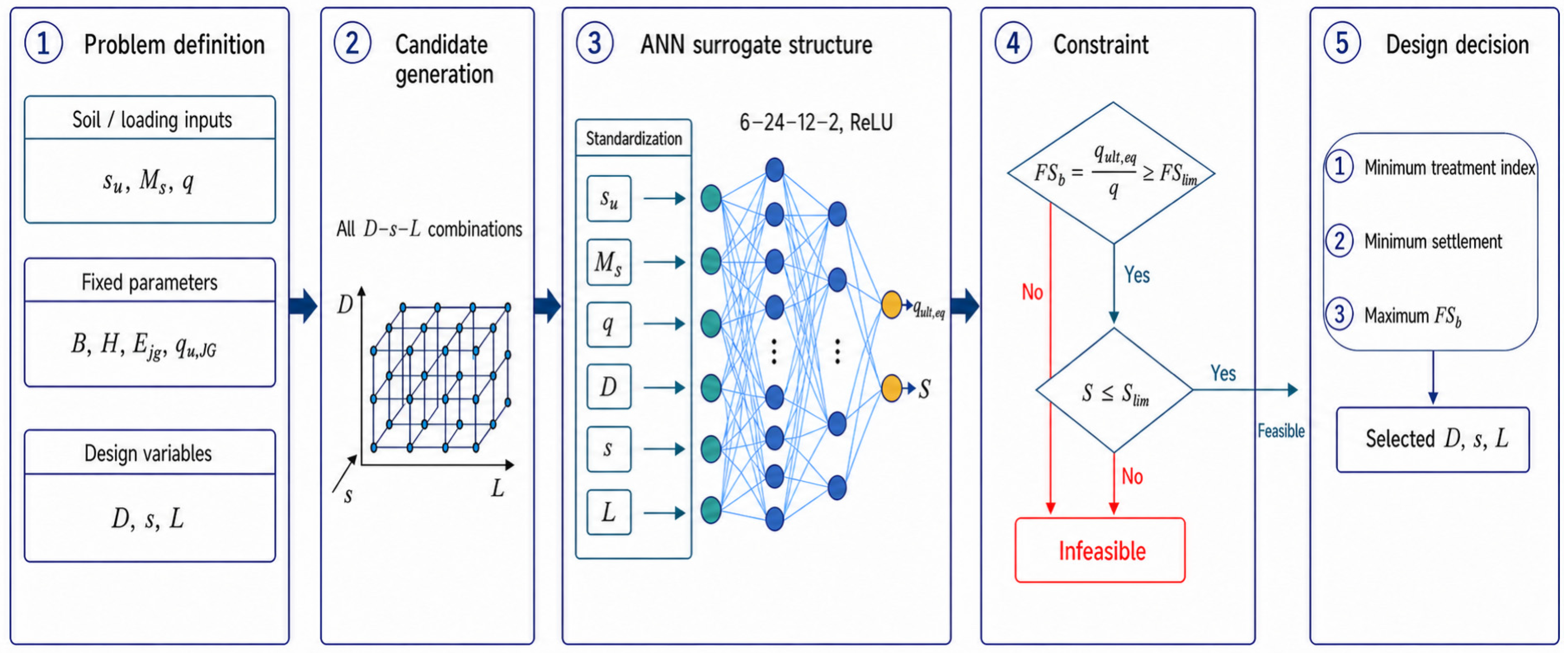
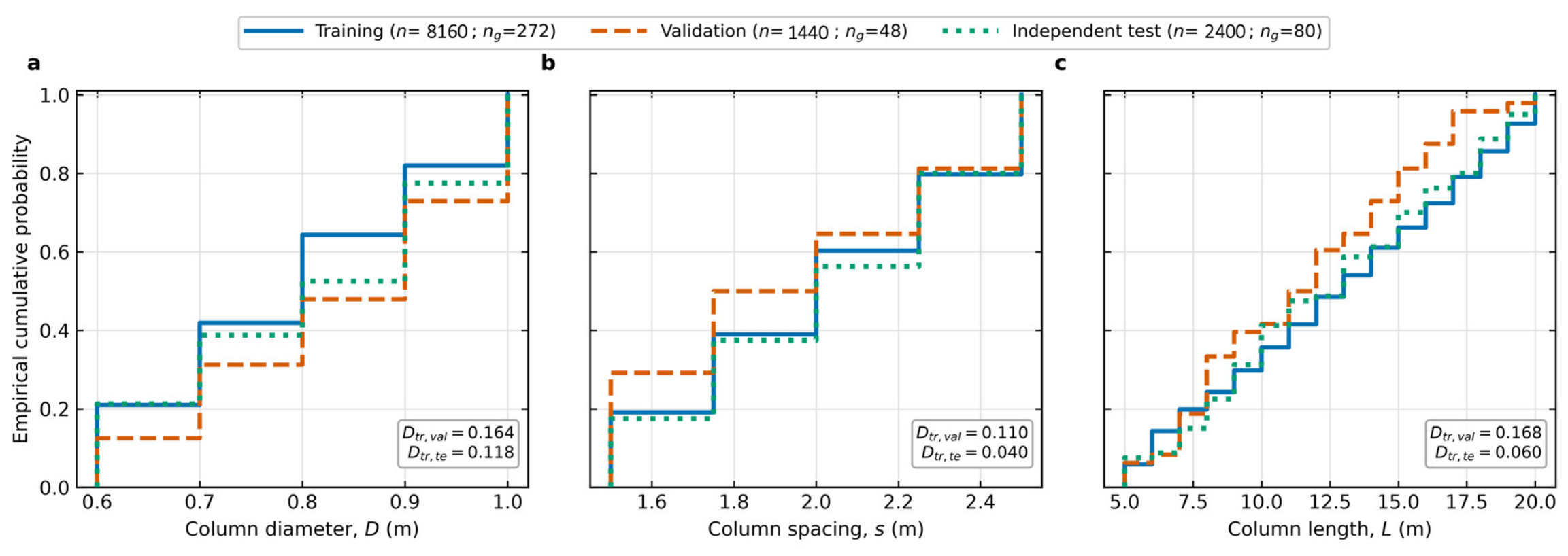
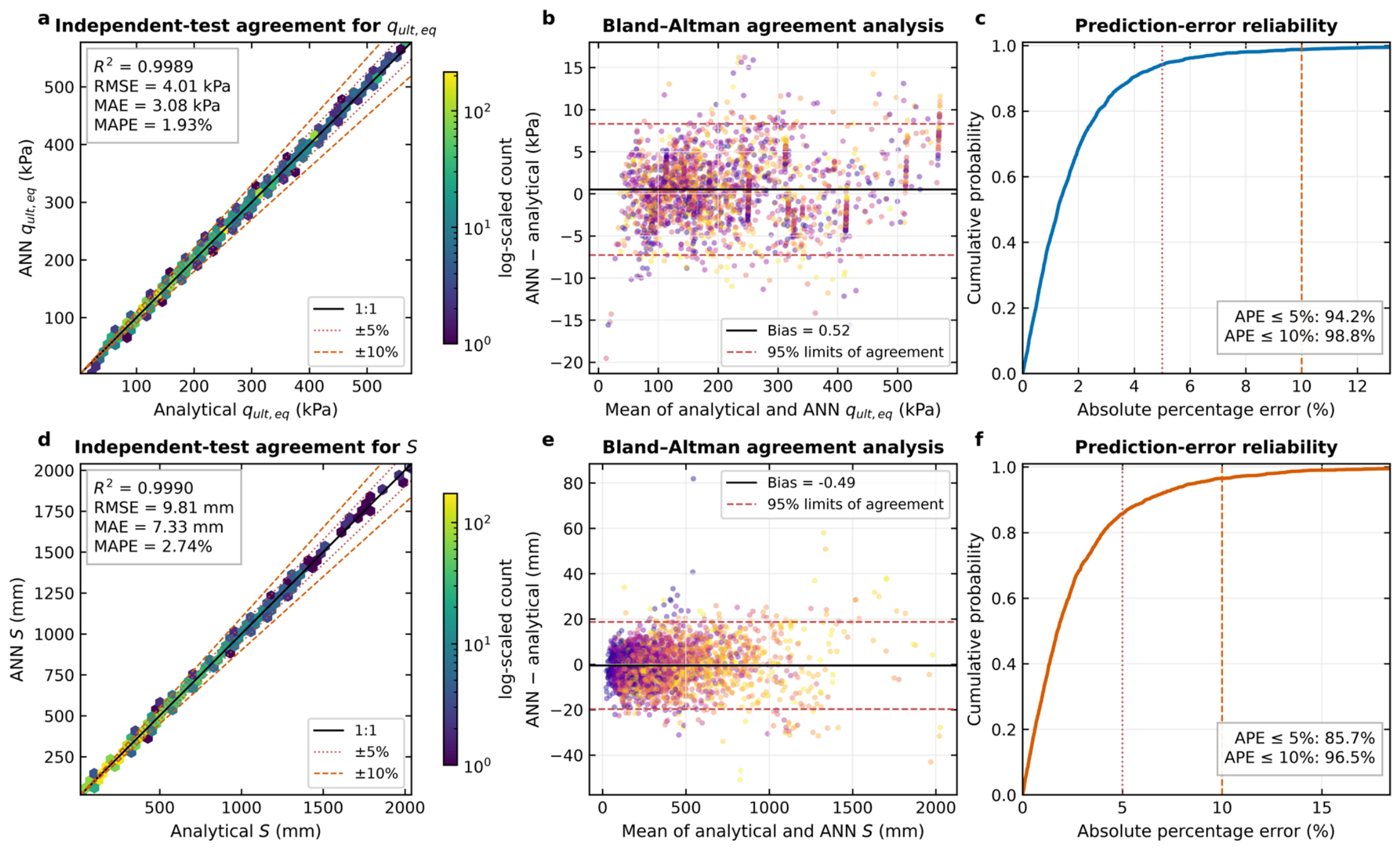
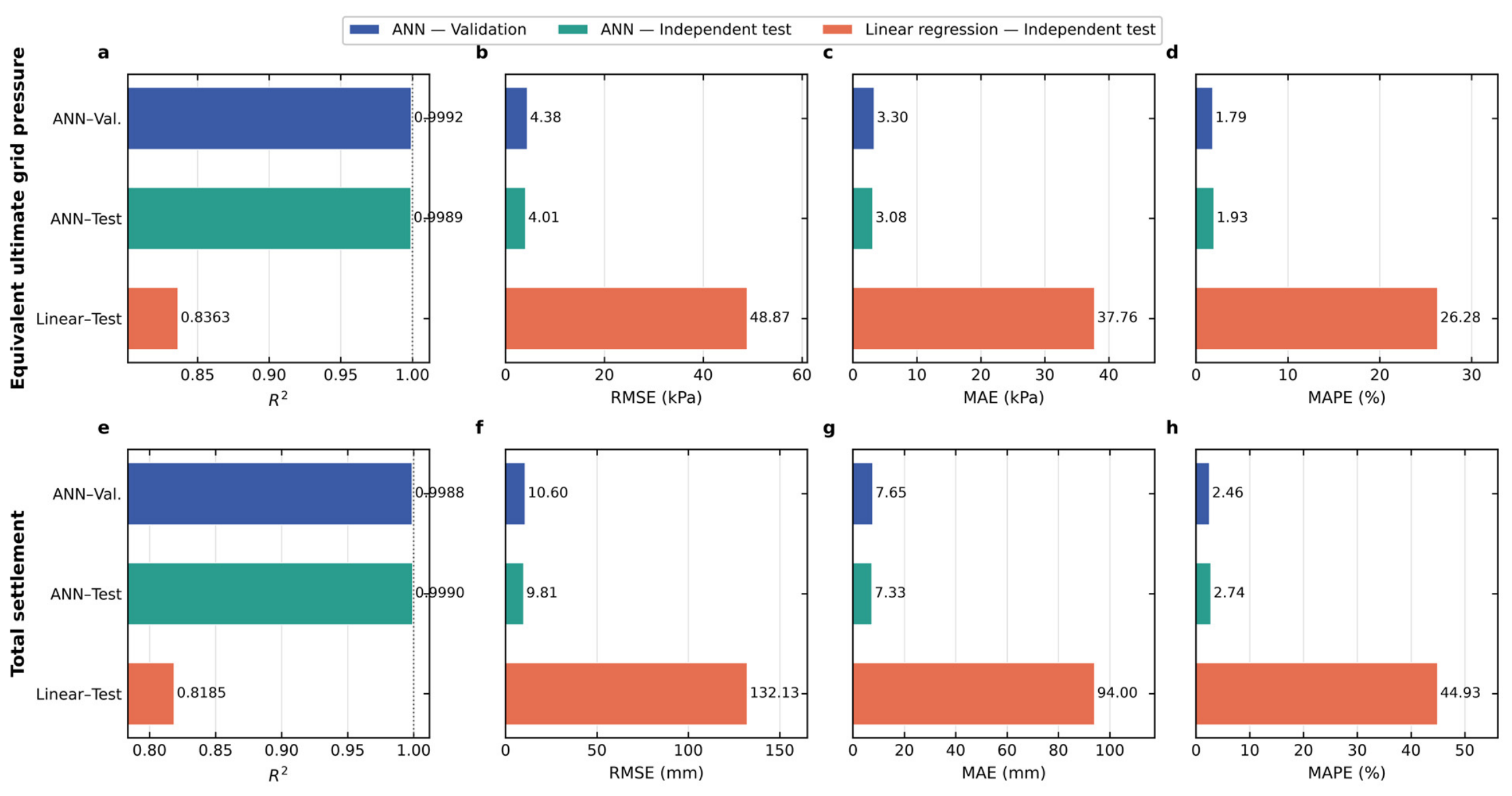
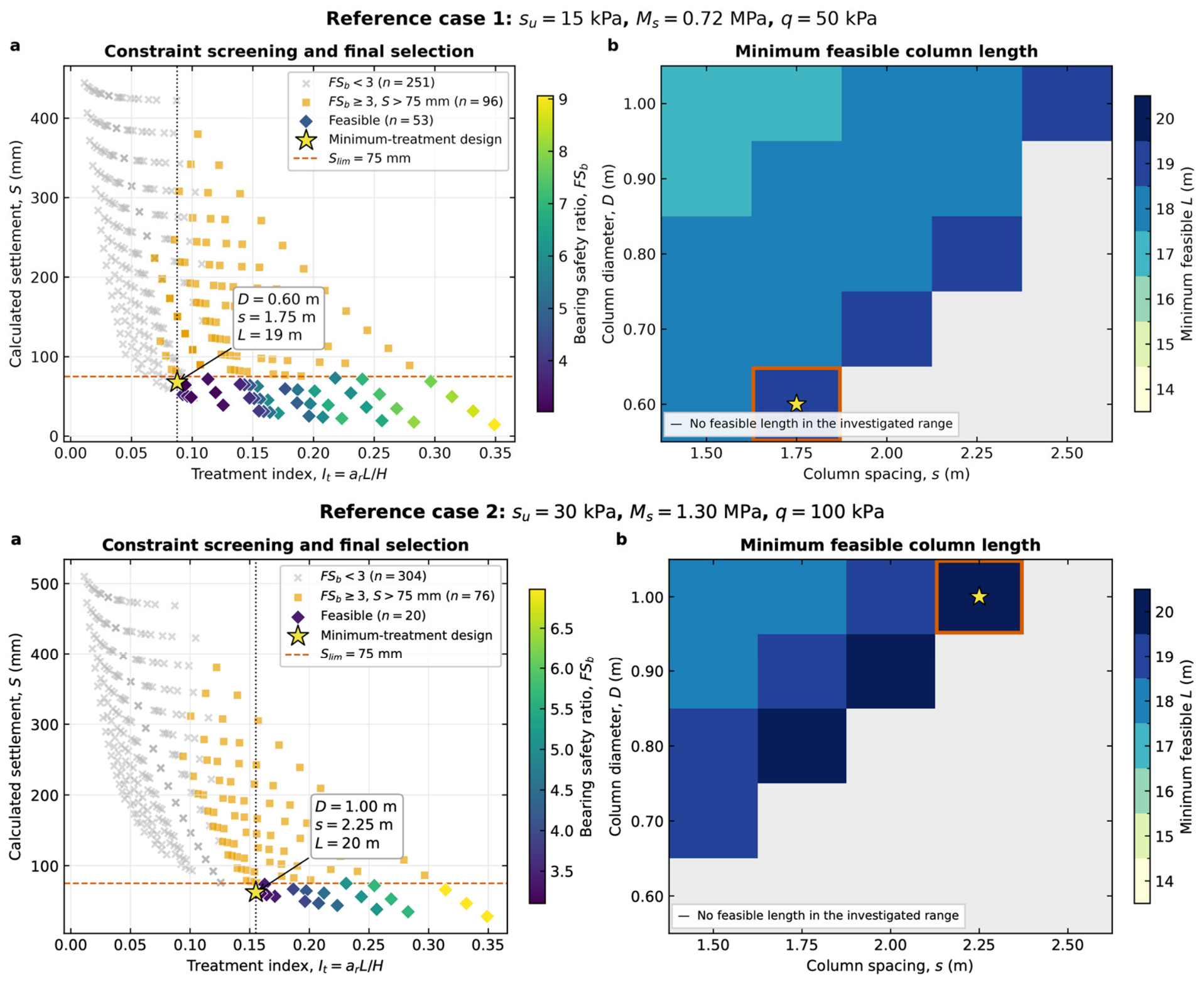
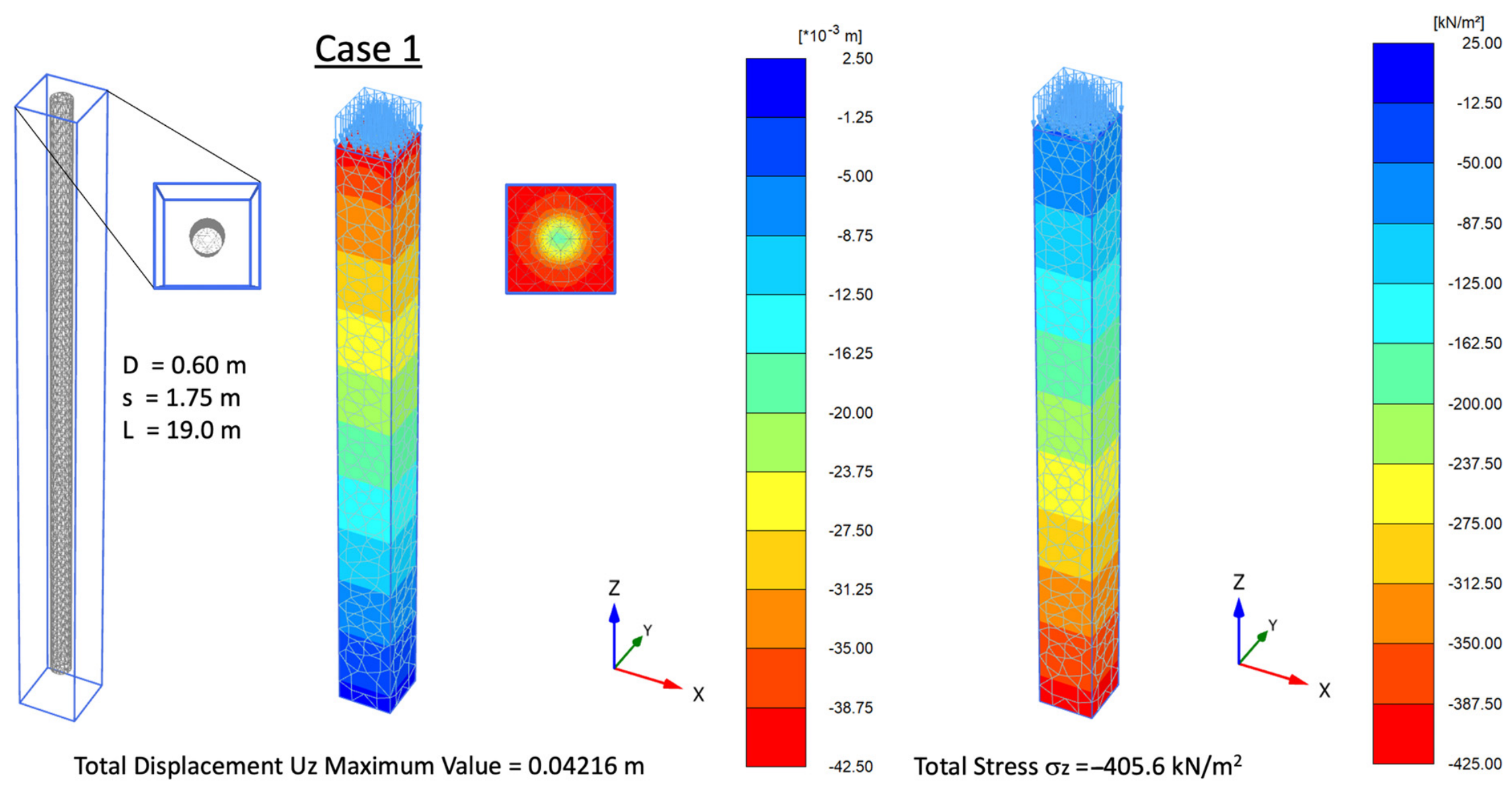
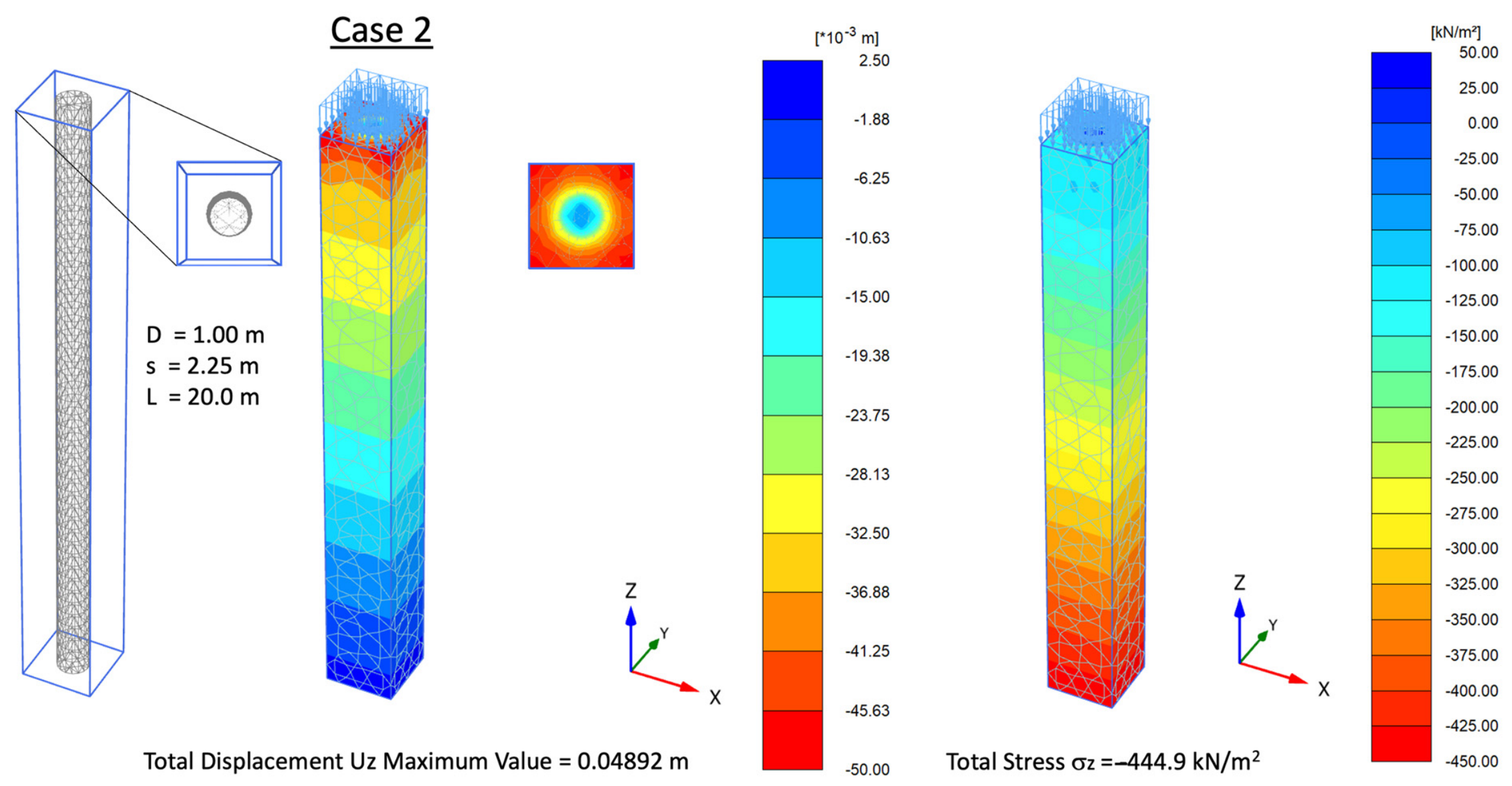
A jet grout design beneath raft foundations requires simultaneous selection of column geometry while satisfying bearing resistance and settlement criteria. This study develops a physics-generated artificial neural network (ANN) surrogate for performance-based screening of discrete jet grout configurations in soft to medium clays. Six engineering variables—undrained shear strength, constrained modulus, raft pressure, column diameter, spacing, and length—were used to generate 12,000 analytical cases representing 400 geometries. Equivalent ultimate column-grid pressure and settlement were calculated using established resistance formulations and an equal strain composite settlement model, respectively. Complete geometry groups were separated into training, validation, and independent test subsets to prevent information leakage, and a compact 6–24–12–2 ANN was trained to predict both responses simultaneously. For 2400 independent test cases representing 80 previously unseen geometries, the ANN achieved R2 values exceeding 0.95 for both outputs and identified the same minimum-intensity feasible configuration as the analytical procedure in the illustrative design application. Independent three-dimensional finite-element simulations provided a complementary numerical assessment of representative settlement responses. The proposed framework integrates source-traceable analytical formulations, multi-output surrogate prediction, and performance constraints into a transparent preliminary design methodology for rapid screening of jet grout configurations. More broadly, it demonstrates how physics-generated machine learning surrogates can support the transition towards data-driven geotechnical design by systematically linking multidimensional engineering inputs with performance-based design decisions.
Keywords: jet grouting; artificial neural network; performance-based design; ground improvement; physics-generated database jet grouting; artificial neural network; performance-based design; ground improvement; physics-generated database