This is an early access version, the complete PDF, HTML, and XML versions will be available soon.
Article

New Building Design in a Historic Environments and an Unconventional Example: Kaiserbad

by
Hayriye Oya Saf
Department of Architecture, Mersin University, Mersin 33343, Türkiye
Buildings 2026, 16(17), 3533; https://doi.org/10.3390/buildings16173533

Submission received: 5 August 2026 / Revised: 26 August 2026 / Accepted: 31 August 2026 / Published: 4 September 2026
(This article belongs to the Section Architectural Design, Urban Science, and Real Estate)

Abstract

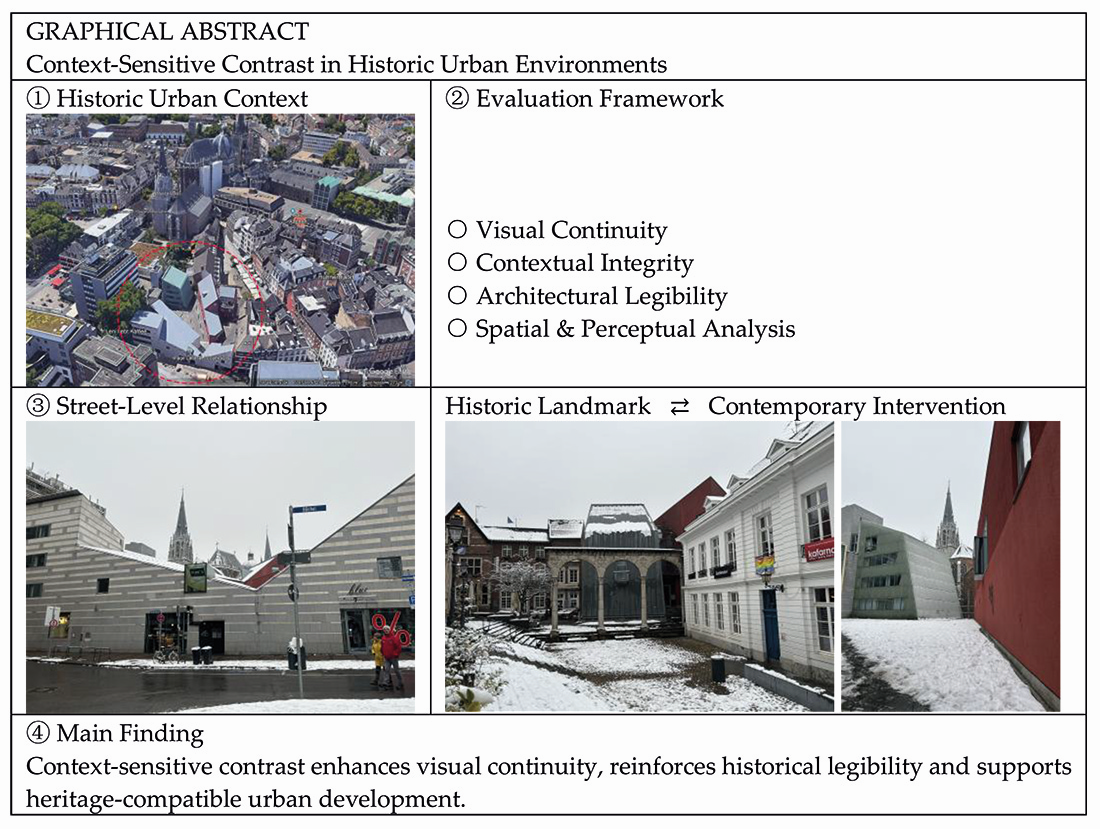
Designing new buildings in historical environments remains a critical challenge in balancing architectural innovation with the preservation of cultural heritage values. Four fundamental design approaches have been identified in the literature: imitation, emulation, respectful integration, and contrast. Despite extensive research on new architectural interventions in historical contexts, a conceptual gap remains regarding the relationship between architectural differentiation and contextual integration. This study addresses this gap by conceptualizing contrast not as the antithesis of contextual integration, but as a design strategy whose contribution can be evaluated across different dimensions of context. It investigates the conditions under which contrast can function as a context-responsive design strategy. A narrative literature review was conducted to thematically classify design approaches based on recurring concepts. The methodological contribution of the study lies in transforming a single case into a transferable analytical tool for theoretical testing. Qualitative evaluation techniques, including spatial, perceptual, and theoretical readings, were employed to assess the case against established criteria using architectural evidence such as plans, sections, elevations, and photographs. The analysis also considered the historical-cultural, social, and environmental dimensions of context. In this respect, the proposed model contributes to ongoing debates in architectural heritage conservation by offering an alternative evaluative tool for contemporary interventions in historic settings.
Keywords: historical environment; architectural design; design principle historical environment; architectural design; design principle
Graphical Abstract