1. Introduction
Industrialised building (IB) has long been promoted as a way to improve housing delivery through faster production, greater cost certainty, improved quality control and reduced reliance on site-based labour. Yet adoption remains modest despite sustained policy and industry support. Existing research commonly explains this gap through technical, regulatory, organisational and market barriers [
1,
2,
3]. This literature shows that limited adoption cannot be explained by technical readiness alone. What remains less clear is not simply which barriers exist, but who is expected to resolve them.
Many of the conditions required for IB adoption extend across organisational boundaries [
4,
5]. Workforce development involves educational institutions, employers, manufacturers and professional bodies. Certification and inspection involve regulators, certifiers, designers, suppliers and contractors. Design integration, industry coordination and market development also depend on actors with different forms of authority, expertise and resources [
6]. Responsibility for these functions is therefore distributed. However, distributed responsibility does not ensure that the necessary work will be coordinated, resourced or completed. A barrier may be widely recognised while responsibility for addressing it remains divided, repeatedly attributed to other actors or insufficiently connected through an accountable arrangement [
7,
8,
9].
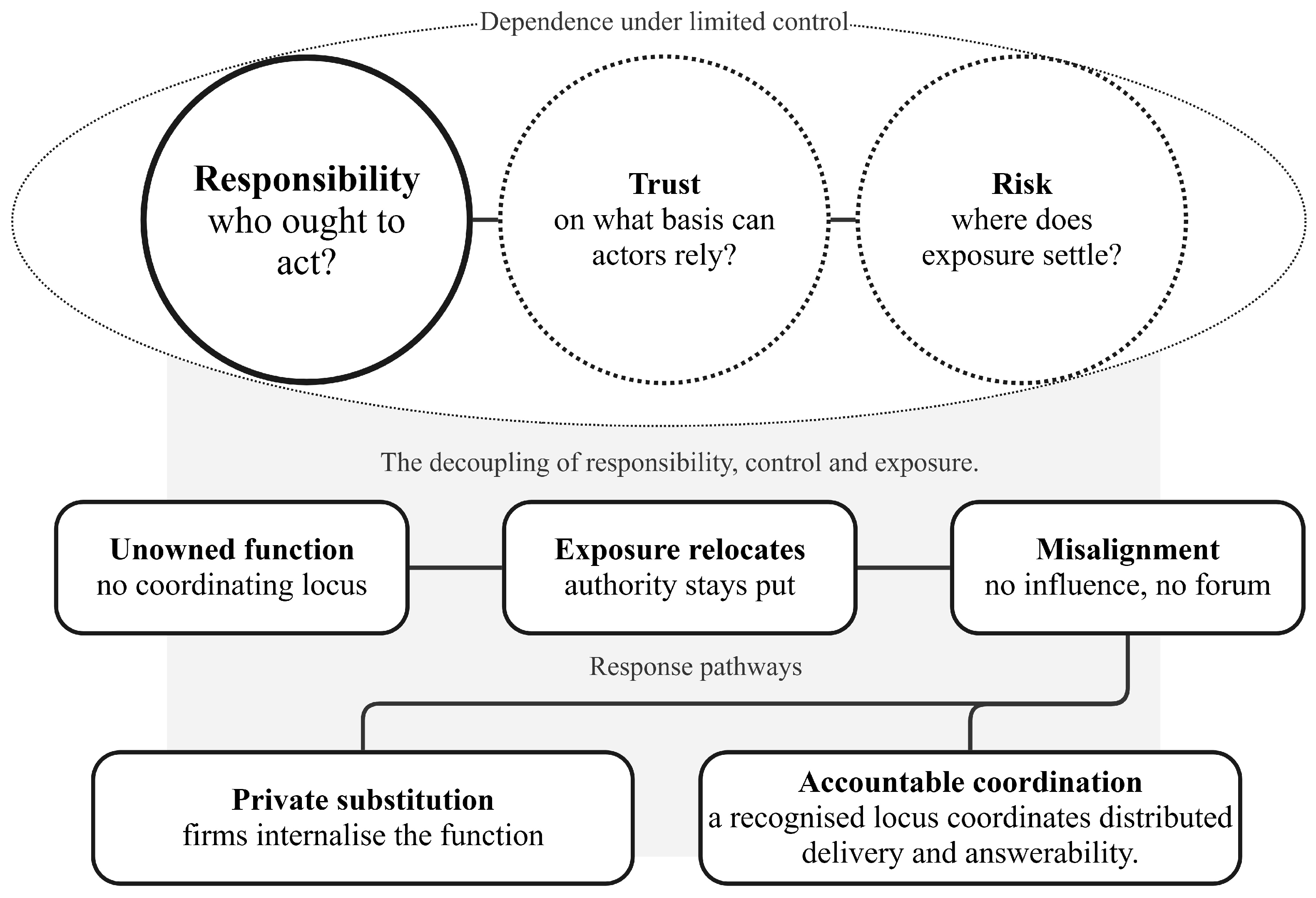
This paper examines the problem through three interrelated analytical dimensions: responsibility, trust and risk. Together, the three dimensions capture how IB intensifies dependence on actors and processes that no single organisation fully controls. IB relocates many consequential decisions upstream into factory processes and reduces their direct observability to downstream actors [
10,
11]. Judgements that conventional sequential construction exposes across multiple on-site stages may instead become embedded in components or assemblies before they reach site. Actors must commit to outcomes that they may be less able to verify directly, often within regulatory, contractual and liability arrangements developed around more conventional modes of construction [
12]. These dependencies raise distinct questions of obligation, reliance and exposure.
Responsibility concerns how obligations are allocated and who may be called to account when necessary functions are not performed [
7,
8,
9,
13]. Trust concerns the basis on which actors extend reliance to organisations whose conduct they cannot verify directly, typically through proxies such as standards, credentials and professional roles [
14,
15,
16,
17]. Risk here is treated distributionally rather than as the subjective vulnerability internal to trust: the question is where the consequences of failure ultimately settle, and whether they settle on the actors who controlled the decisions that produced them [
18].
So specified, the three dimensions are complementary and interact in ways that can be observed empirically. They can operate in partly compensatory ways: where formal responsibility is indeterminate, actors may fall back on trust in credentials and reputation; where trust is withheld, they may demand clearer allocation of obligations and contractual mechanisms for transferring or containing exposure. They can also come apart, and it is this separation that matters most here. Risk may be transferred without a corresponding transfer of responsibility or control, leaving exposure with actors who are neither accountable for the decisions that generated it nor positioned to influence them. Examining the three together therefore makes it possible to analyse not only how practitioners assign responsibility, justify reliance and manage exposure, but also where these arrangements become misaligned, how such misalignments are interpreted and what practitioners do when institutional arrangements are regarded as inadequate. Discourse is the site at which these expectations, dependencies and exposures are described, justified and contested.
Understanding how these arrangements are described in practice therefore requires close attention to the specific institutional actors named in practitioner accounts and the terms in which their roles are constructed. The paper thus focuses on how practitioners construct the roles of universities, employers, manufacturers, industry bodies, regulators, certifiers and government when explaining persistent barriers to IB adoption. The analysis attends closely to responsibility-void discourse, defined here as accounts in which a necessary function is represented as lacking clear ownership, capacity or coordination [
8]. The concept is used to analyse how practitioners describe institutional arrangements. It does not assume that no relevant activity exists outside the accounts examined.
The study also examines how organisations respond when the external arrangements on which they depend are represented as uncertain or poorly aligned with IB delivery. Particular attention is given to additional verification, direct oversight, established relationships and internal controls and to whether these responses address wider institutional problems or mainly enable individual organisations to work around them. The analysis further distinguishes between missing information, unequal access to information and difficulties transferring knowledge across organisational boundaries, rather than treating all information-related problems as a single awareness barrier.
Empirically, the study employs an interview-based critical discourse analysis, complemented by a secondary corpus of public online discourse used solely for illustrative interpretive comparison. The study adopts an abductive design in which responsibility, trust and risk served as sensitising concepts during initial coding, while more specific governance patterns emerged iteratively through engagement with the data. The primary corpus comprises 23 semi-structured interviews with practitioners across the Australian IB ecosystem. These interviews provide the principal empirical evidence for examining how responsibility for training, certification, industry coordination, design integration and information provision is allocated, displaced or represented as unclaimed. The secondary corpus comprises 18,204 English-language comments collected from 106 YouTube videos concerning modular, prefabricated, manufactured and related housing forms. This corpus provides an illustrative view of public-facing information and legitimacy concerns expressed by commenters positioned outside the documented supply chain. Because the corpora involve different actor positions, geographical boundaries and discursive settings, their relationship is treated as a bounded interpretive comparison rather than as equivalent evidence.
The study addresses the following research questions:
RQ1. How do Australian IB practitioners discursively allocate, displace or leave unclaimed responsibility for the shared institutional conditions required for adoption?
RQ2. How do practitioners discursively justify organisational responses to external institutional arrangements represented as uncertain or inadequate?
RQ3. Which information and legitimacy concerns are foregrounded in public online discourse, and how do they differ from those foregrounded in practitioner interviews?
The study is novel in shifting the unit of explanation from recurring barrier categories to the institutional allocation and coordination of responsibility for resolving them. Its scientific contribution is threefold. First, it develops a responsibility architecture that distinguishes fragmented responsibility, responsibility shifting and responsibility-void discourse. Second, it shows how misalignments among responsibility, control and exposure shape practitioners’ reliance on institutional assurances, additional verification and internal control. Third, it conceptualises ownership as accountable coordination rather than sole task performance, providing a basis for analysing shared functions whose delivery necessarily remains distributed. The illustrative public-discourse comparison introduces a perspective largely absent from IB adoption research and shows that outsider evaluations foreground distinct information and legitimacy concerns, underscoring the importance of incorporating public perspectives into future investigations.
2. Literature Review
2.1. IB Adoption and the Limits of Barrier Research
IB adoption has been examined through a large and increasingly mature body of research. Recurring barriers include fragmented regulation, uncertain demand, immature supply chains, limited organisational capability, skills shortages, conservative procurement and low market confidence [
1,
2,
3]. Collectively, these studies establish that technical feasibility alone does not explain uptake. IB can offer faster delivery, greater process control, reduced site labour and improved quality, yet those advantages do not translate automatically into routine use.
Social, relational and organisational conditions carry particular weight, and they recur across reviews and jurisdictions. Alhawamdeh and Lee [
2] identify limited skills and expertise, weak cooperation and resistance to change among the most frequently reported barriers to offsite construction. Soltani et al. [
3] similarly place collaboration, stakeholder engagement and perception among the largest barrier clusters. Steinhardt and Manley [
1] show that prefabrication firms actively manage persistent beliefs about quality and market acceptability, while Khan et al. [
19] identify cultural and stakeholder constraints as prominent obstacles to volumetric modular construction. Comparative work accordingly presents IB uptake as a systemic transition involving institutions, business models, supply relationships and professional practice rather than a discrete technology decision [
11].
Recent studies sharpen this systemic account. Olayiwola et al. [
20] identify political, regulatory, supply-chain, knowledge, skills and business-model constraints across a PESTEL synthesis of offsite-construction research, emphasising that adoption occurs through a fragmented network spanning design, approval, manufacturing, transport and installation. In Australia, Chan et al. [
12] identify policy, regulatory, standards and implementation deficiencies and propose a national policy framework with implementation guidance for modular construction. At the design-to-production interface, Yu et al. [
10] find that DfMA collaboration in Australia and New Zealand is constrained by uneven stakeholder understanding, communication, digital capability, industry readiness and tool interoperability. These studies confirm that contemporary adoption problems remain distributed across institutional and organisational boundaries.
What this synthesis also reveals is that most of the recurring conditions are not held by any single organisation. They are shared functions that cross professional and institutional boundaries. A skills shortage may involve universities, vocational providers, professional bodies, employers, manufacturers and government. Certification can depend on designers, suppliers, regulators, certifiers, contractors and authorities across several jurisdictions. Market confidence may draw on finance, insurance, warranty arrangements, procurement practice, public policy and consumer evaluation. Construction research has long recognised the interdependence created by project-based production and the division of work among specialised organisations [
4,
6]. The presence of many actors is not itself an indicator of failure, since complex delivery systems can operate effectively when obligations are linked through clear roles, coordination mechanisms, common standards and recognised forms of answerability.
Adoption studies nevertheless tend to move directly from a barrier to a general recommendation. Fragmentation prompts calls for collaboration, skills shortages generate recommendations for education and training, and regulatory inconsistency produces calls for harmonisation. Such responses identify a desirable direction without specifying who must convene, fund, maintain, enforce or review the proposed arrangement. Nor is collaboration a single thing. Cooperation, coordination and collaboration involve different levels of shared goals, task alignment, authority and resource commitment [
5]. Treating them as interchangeable conceals the institutional work required to sustain any response.
This is the limit of barrier research as an explanation of persistence. Barrier categories describe with considerable precision what is missing from the adoption environment, and they have been refined across successive reviews. They do not identify the mechanisms through which collective action fails when the missing condition is a shared function rather than a firm-level capability. A sector may contain many local initiatives while the wider function remains unstable, and a barrier may be recognised for years without any arrangement emerging that is capable of producing the condition it names. That gap between recognising a barrier and organising action to resolve it is the problem this paper addresses.
2.2. Responsibility, Distributed Action and Accountability
Where a required condition is produced by many organisations acting partially, responsibility itself becomes distributed. Each contributor holds a portion of the work, and the outcome depends on how those portions are connected rather than on the diligence of any one of them. Distribution is not a defect. It reflects the specialisation on which project-based production depends [
4,
6]. It does, however, change the analytical question, because responsibility for the connection between contributions is easily left unstated even where responsibility for each contribution is clear.
This condition has long been described as the problem of many hands [
7]. Outcomes arise through the contributions of multiple actors, which makes it difficult to locate responsibility for success, failure or omission. Although the formulation originated in the analysis of public office, subsequent work has restated it as a general diagnosis of distributed action, applying it to collective problems in which no participant individually produces the outcome, and no participant individually controls it [
13]. That restatement matters here, because IB adoption depends on organisations with different mandates, resources, time horizons and forms of authority, none of which can deliver the shared conditions alone.
Within distributed action, a further distinction is required. Braham and van Hees [
8] separate fragmented responsibility, in which partial responsibilities remain identifiable across several actors, from a responsibility void, in which the relevant responsibility is absent. Applied to IB, fragmentation may occur where universities develop curricula, employers provide workplace learning and professional bodies support continuing development, yet no recognised arrangement connects these contributions into a coherent capability system. A void claim is stronger and correspondingly harder to sustain, since it requires that an essential function remain unprovided and that effective responsibility for ensuring its provision cannot be located. The distinction guards against reading ordinary specialisation as institutional absence.
Responsibility shifting forms a separate discursive pattern. Actors may acknowledge that a problem requires action while transferring the obligation to government, industry, universities, regulators, clients or another party absent from the interaction. Shifting can coexist with fragmentation or with a wider void, and the same speaker may assign one component of a problem to a named institution while describing the coordination of the whole as unowned. The analytical task is therefore to identify the level at which responsibility is being discussed before classifying the pattern.
Accountability supplies the institutional mechanism through which responsibility becomes answerable. Bovens [
9] defines accountability as a relationship in which an actor is obliged to explain and justify conduct before a forum that can question, judge and impose consequences. This formulation makes explicit several elements that barrier research rarely states: a recognised actor, a defined obligation, a forum for review and some capacity to respond where provision is inadequate. The term is used in many looser senses as well, covering responsiveness, control, transparency and general institutional virtue, and Mulgan [
21] argues that these wider meanings should be distinguished from the core sense of answerability to an external forum. This paper uses the core sense throughout, since it is answerability rather than good intention that distinguishes a governable shared function from an aspirational one.
Ownership, as used in this paper, refers to accountable coordination in that sense. It does not imply that one organisation should perform every task. Training, certification, information provision and design integration will continue to depend on distributed expertise. An institutional owner provides a locus through which contributions are convened, responsibilities are clarified, resources are maintained, and the overall function can be reviewed. This meaning avoids an unrealistic search for a single actor while retaining a clear standard for judging whether a shared function is governable.
The distinction is also methodological. Practitioner accounts can reveal how responsibility is constructed, displaced or left unclear. They cannot independently establish that an institution has objectively failed, or that no relevant work exists anywhere in the sector. The construct examined empirically is therefore responsibility-void discourse: language through which actors represent an essential function as unowned, repeatedly displaced, inadequately resourced or lacking effective coordination. This keeps the claim at the level that discourse evidence can support. How Australian IB practitioners allocate, displace or leave unclaimed responsibility for the shared institutional conditions of adoption is what RQ1 asks.
2.3. Trust and Actor-Positioned Risk in Interdependent Delivery
Interdependent delivery obliges actors to commit before they can confirm the competence or conduct of parties they do not control. A designer specifies against a manufacturing capability not yet demonstrated, a manufacturer commits capital against an approval pathway not yet settled, and a client contracts against a supply chain whose internal processes remain unobservable. Luhmann [
16] treats trust as a mechanism for absorbing precisely this complexity, allowing action to proceed where full information is unavailable and verification would be prohibitively costly. Giddens [
14] extends the point to abstract and expert systems, whose workings lay actors and, in specialised domains, professional actors as well cannot personally inspect. Reliance in such systems rests less on knowing how the system works than on confidence that its arrangements will hold.
Much of that confidence is produced impersonally. Institution-based trust is generated through standards, certification, credentials, professional roles and contractual routine rather than through interpersonal familiarity or repeated dealing [
15,
17]. Standards and certification regimes function as portable assurance devices precisely because they allow parties who have never met to treat one another as competent within a defined scope [
22]. In the inter-organisational sense, trust is the acceptance of vulnerability under positive expectations of another party’s intentions or conduct [
23]. Where those impersonal assurances are reliable and recognised, actors need not re-verify each interface on every project, and the interpretive work required at organisational boundaries decreases. Where they are uncertain, incomplete or contested, the same work must be performed again, project by project.
Exposure to that uncertainty is not shared evenly. Risk in a distributed delivery system is not a single quantity held in common but a set of differently located liabilities. A manufacturer carries capital and pipeline exposure, since fixed production capacity must be matched to irregular demand. A developer or contractor carries compliance and approval exposure, where delay and rework attach to uncertain regulatory pathways. Designers, engineers and certifiers carry professional-liability exposure for judgements made about assemblies they may not be able to inspect at the conventional point. Actors outside the supply chain, including purchasers and residents, carry purchase and tenure exposure, which concerns the terms, durability and resale of what they acquire. Risk research has long held that risk is socially positioned and contested rather than objectively given, since what counts as a relevant hazard, and for whom, depends on the position from which it is assessed [
18]. Beck [
24] makes the complementary structural point that modern institutional arrangements distribute risk as well as produce it, so that the allocation of exposure is itself an institutional outcome rather than a natural fact.
Trust and risk therefore bear directly on how obligation is handled. Where assurance is uncertain, actors must decide how far to rely on external arrangements they cannot continuously verify, how to allocate obligation for what may go wrong, and how to respond to the residual exposure that remains. These decisions are not uniform across a delivery system, because positions differ in what they stand to lose, in what assurances are available to them, and in the response repertoires their resources and authority make possible. An analysis of responsibility in IB adoption consequently requires attention to which assurances actors treat as dependable, which they treat as unreliable, and how their position shapes the range of responses they can describe as available.
2.4. Legitimacy and Public Evaluation
Institutional assurance connects responsibility to legitimacy. Suchman [
25] distinguishes pragmatic legitimacy, grounded in perceived usefulness to an audience, from cognitive legitimacy, through which an activity becomes comprehensible and taken for granted. IB attracts strong pragmatic justification through claims about speed, productivity, quality, safety and housing supply. Cognitive legitimacy requires something different and less rhetorical: ordinary institutional routines through which the model can be specified, financed, insured, inspected, certified and procured without exceptional effort. Persistent uncertainty in those routines keeps IB institutionally exceptional even where its performance benefits are accepted.
Evaluation, moreover, generally proceeds under incomplete knowledge. Audiences judge usefulness, appropriateness and category fit without direct access to the underlying delivery system [
26], and individual judgement leans on prevailing social signals about what is already regarded as acceptable [
27]. This is a general property of legitimacy evaluation rather than a deficiency of any particular audience, and it applies to practitioners assessing an unfamiliar approval pathway as much as to households assessing an unfamiliar housing product.
Category meanings shape those judgements. Housing research shows that labels and second-hand associations influence how manufactured, modular and comparable housing forms are evaluated, and that residents and observers may reproduce, resist or negotiate the associated stigma [
28,
29,
30]. One methodological consequence follows directly and is retained throughout the analysis: the presence of a category keyword cannot establish delegitimation, because the same term may assert a stigma, reject it, or identify a category neutrally. Audiences positioned outside the supply chain also evaluate under different informational conditions from practitioners working inside it, encountering IB through promotional material, journalism, social media and familiar housing categories rather than through delivery experience. Which concerns become salient from that position, and how they differ from those raised by practitioners, is what RQ3 examines.
2.5. A Critical Discourse Perspective
Responsibility, trust, risk and legitimacy are not directly observable properties of an industry. They are constituted, contested and made durable in large part through language, which is why a discourse-analytic perspective is appropriate to them. Critical discourse analysis is best understood as a problem-oriented research programme rather than a single technique: it begins from a social problem and draws on whichever linguistic and social-theoretic resources illuminate it [
31]. Its shared premise is that language use participates in constituting social relations, obligations and positions rather than merely reporting them [
32,
33], and that texts can be read simultaneously as representations of the world, as enactments of relations between participants, and as the maintenance or disturbance of what a field treats as ordinary [
34]. On this view, an account of who should have done something is not a neutral description of an institutional arrangement but a move within it.
Each of the sensitising concepts [
35] leaves a discursive trace that can be examined. Responsibility becomes visible in whether actors are named, backgrounded or deleted from accounts of who acts, and the systematic description of social-actor representation, including inclusion and exclusion, nomination and functionalisation, and activation and passivation, gives analytic purchase on those choices [
36]. Obligation assignment is carried by modality, deontic expression and the grammar of necessity, which mark what a speaker treats as required, by whom and with what force [
34]. Responsibility shifting is traceable through transitivity and attribution, where an obligation is transferred to a party absent from the interaction and therefore unable to contest the allocation. These features allow the distinction between fragmented and unowned responsibility to be examined in the text rather than assumed from context.
Trust and risk leave comparable traces. Evaluative and epistemic language constructs which organisations, standards, credentials and institutional arrangements are treated as dependable and which are treated as unreliable or unknown, which is how reliance becomes observable in talk rather than inferred from behaviour. Framing of exposure and consequence performs a related function: how speakers position themselves and others as bearing or escaping particular losses makes actor-positioned risk analysable, because the same condition can be narrated as a threat by one position and as a routine cost by another.
Legitimacy is the most explicitly discursive of the four. Legitimation strategies, including authorisation by reference to authority or expertise, rationalisation by reference to goals and effects, moral evaluation by reference to values, and narrative accounts that carry their justification in their outcome, are the mechanism through which a course of action is presented as necessary or as the only one available [
37]. This is the analytic hinge on which the paper’s later account of how actors legitimate the responses they describe depends, since the question is not whether a response occurred but how it was warranted. Presupposition and naturalisation operate alongside these strategies, showing which institutional arrangements and category meanings are treated as given and which are opened to challenge, and it is this shared concern with evaluation that connects the practitioner and public material. Together, these features establish the analytical warrant for treating responsibility, trust, risk and legitimacy as discursively accessible;
Section 3 explains how the perspective was operationalised.
The concepts are operationalised in
Section 3: responsibility primarily informs RQ1, trust and risk support RQ2, and legitimacy orients RQ3.
3. Materials and Methods
3.1. Research Design and Differentiated Corpus Roles
This study uses critical discourse analysis (CDA) to examine how practitioners allocate responsibility for the shared institutional conditions of IB adoption and justify organisational responses to uncertain external arrangements [
31,
32,
34]. CDA treats these accounts as situated discursive practices through which actors assign obligations, describe institutional conditions, and justify courses of action [
32,
34]. CDA is understood here as a problem-oriented programme rather than a single fixed procedure [
31].
Section 3.4 explains how this approach was operationalised.
The analysis followed a theoretically informed abductive logic [
38]. Responsibility, trust, and risk served as sensitising concepts for the practitioner interviews, while legitimacy oriented the analysis of public online discourse. These concepts guided attention to obligations, reliance, exposure, and category evaluation without operating as fixed variables, hypotheses, or predetermined themes. Open familiarisation and iterative movement between the data and theoretical resources allowed categories outside the initial framework to emerge. In particular,
organisational control and the differentiation of information conditions were developed through engagement with the interview material rather than specified in advance. Their theoretical interpretation is developed in the Discussion.
The primary corpus comprises 23 semi-structured interviews originally conducted for a broader Australian study of MMC skills and capability needs. The present study involves a secondary qualitative analysis of those transcripts. Although the original interview guide did not focus specifically on responsibility, participants discussed training, certification, regulation, coordination, design integration, information exchange, and institutional roles extensively. The analysis is consequently limited to the responsibility arrangements made visible through those discussions.
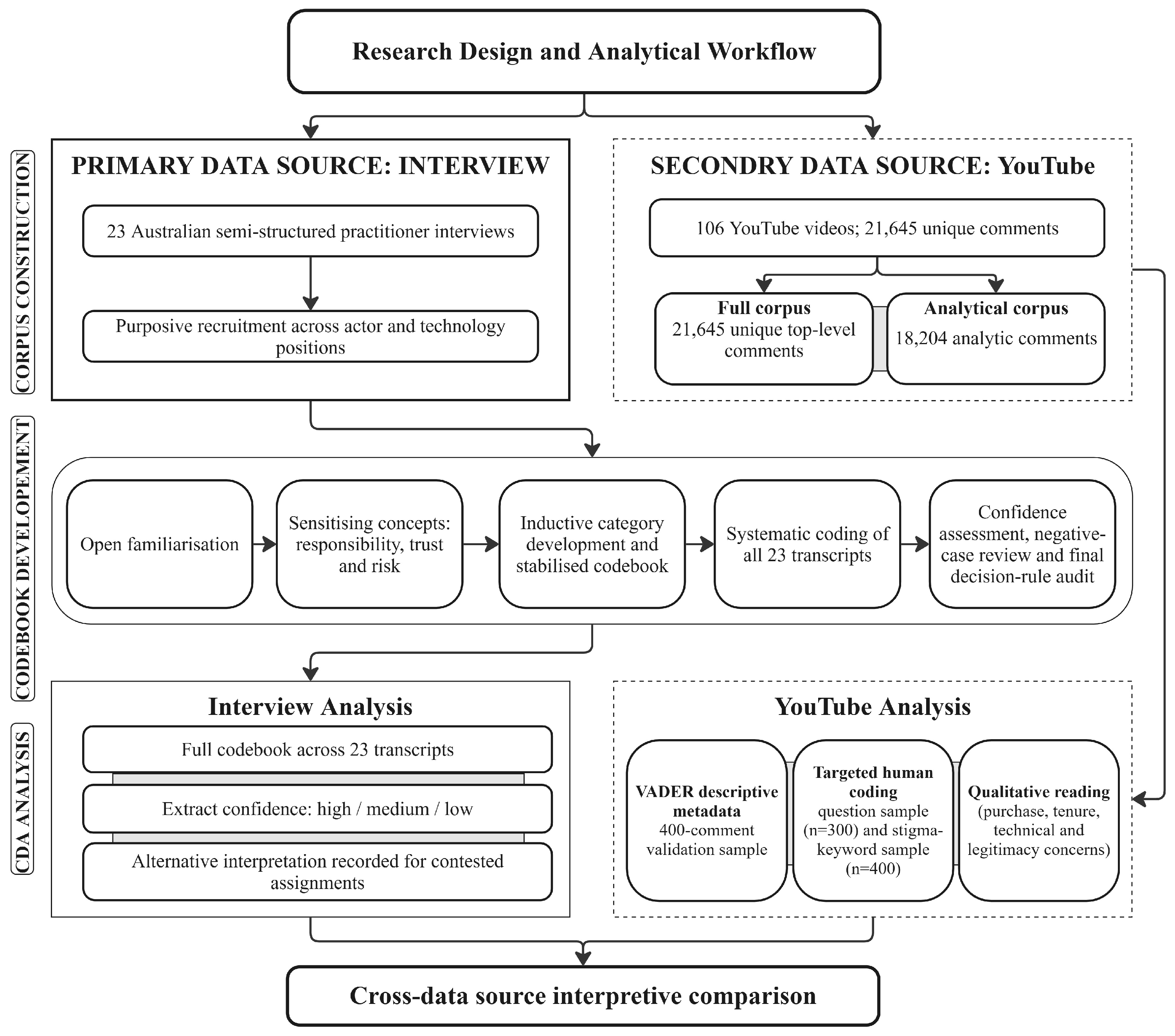
A secondary corpus contains public comments collected from 106 YouTube videos concerning modular, prefabricated, manufactured, and related housing forms. It provides a public-facing contrast focused on information needs, purchase conditions, and category legitimacy. The interviews supply the principal empirical evidence for RQ1 and RQ2, while the YouTube corpus provides bounded interpretive material for RQ3. Each corpus was first analysed within its own actor position and context. A cross-corpus synthesis followed the within-corpus analyses.
Figure 1 summarises the differentiated roles of the two corpora and the analytical workflow.
3.2. Interview Provenance, Recruitment, and Data Generation
The interviews were conducted between August and September 2025 as part of a broader Australian research project examining MMC skills and capability needs. Participants were recruited purposively through industry networks and direct invitations. Eligibility required current or recent professional involvement in MMC or associated industrialised design, manufacturing, or construction activities.
The final corpus comprised 23 practitioners working across manufacturing, architecture, engineering, construction, development, education and training, industry representation, technology supply, and design for manufacture and assembly advisory roles. Their experience encompassed volumetric modular construction, panelised and framing systems, precast products, additive construction, automated manufacturing, and related design and delivery processes. Recruitment sought breadth across actor positions and technology contexts; it was not intended to represent the Australian IB sector statistically or establish formal theoretical saturation.
The semi-structured interviews were conducted online or in person and lasted approximately 60 min. The interview guide addressed participants’ operations, business models, technology and delivery approaches, perceived performance and benefits, implementation challenges, and current and future skills needs. Participants could elaborate on related matters arising from their professional experience. These discussions generated substantial material concerning training provision, regulation, certification, coordination, design integration, and information exchange.
Interviews were audio-recorded. Otter generated the initial transcripts, which the research team manually checked for accuracy. The audio recordings were consulted where wording remained unclear or where reported extracts required additional verification. Corrections addressed transcription accuracy only. Participants were not offered transcripts for review or member checking.
Participants are identified by codes A–W. Organisational names, project names, and distinctive biographical details were removed or generalised. Actor position and technology focus were retained because they were necessary for examining differences across institutional and commercial positions.
Table 1 summarises the interview corpus.
3.3. YouTube Archival Contrast Corpus
The secondary dataset comprises comments collected from 106 YouTube videos spanning tours and showcases, explanatory material, build documentation, promotional content, critique, and journalism. Video metadata recorded content type, channel type, housing category, framing, and inferred national context. Geographic coding describes the context of the source video and does not identify commenter location.
Treating this material as data follows computer-mediated discourse analysis, which analyses digital language as social action performed under the conditions of a particular platform rather than as unmediated opinion [
39]. YouTube has an established use as a social-listening environment for housing research, where comment threads make lay evaluative repertoires observable at scale [
40]. Social-media discourse nevertheless has firm limits: commenters are self-selected, participation is shaped by platform dynamics such as recommendation, visibility, and engagement incentives, and the resulting material cannot be read as a population sample [
41]. The corpus is used accordingly, as a contrast case rather than a representative public.
The dataset was collected in May 2026 through the YouTube Data API v3 and is treated as an archival contrast corpus. Video discovery used six search strings: “modular homes”, “prefab housing”, “prefabricated houses”, “factory built homes”, “modular housing Australia”, and “offsite construction housing”. The API search requested English-language videos, used YouTube’s default relevance ordering, and applied no publication-date, region or video-duration filters. Results were deduplicated by video ID. Top-level comments were collected in plain-text format and in relevance order; replies were not collected. A 400-comment candidate sample was used in the targeted screening described in
Section 3.5.
The dataset contained 21,645 unique comments following upstream de-duplication. A Python 3.14.6 workflow excluded platform-flagged spam (), comments classified as non-English (), and a residual group written predominantly in non-Latin scripts (). The final analytic corpus comprised 18,204 English-language comments.
Usernames and channel-linked identifiers were excluded from analytical outputs. Illustrative YouTube comments were closely paraphrased to reduce search-based identification. Likes were recorded at the time of collection and interpreted as time-specific engagement indicators.
3.4. Coding and Analytical Process
To conduct the abductive CDA, the interview analysis proceeded through seven stages: (1) open familiarisation; (2) theoretically sensitised coding; (3) inductive category development; (4) systematic application of the stabilised codebook; (5) confidence judgement; (6) negative and boundary-case review; and (7) a final decision-rule audit of the codes carrying the manuscript’s principal claims. The stages were not strictly linear, since the abductive design required earlier material to be revisited whenever categories changed.
At the first stage, all 23 transcripts were read without applying codes. The purpose was to register the range of material present, including topics lying outside responsibility, trust, and risk, before any coding frame constrained what could be noticed. The second stage applied responsibility, trust, and risk as sensitising concepts in a first coding pass, attending to how obligations were assigned to actors, how reliance on external arrangements was described, and how exposure was located across positions in the supply chain.
The third stage constructed additional categories from patterns that recurred in the transcripts but were not captured by the sensitising concepts. The category of control discourse and the differentiation of information conditions into distinct mechanisms were both developed at this stage, from the material rather than from prior theory. Category definitions were drafted, applied to further extracts, and rewritten where extracts fitted poorly, until the definitions and their exclusions stabilised.
The fourth stage applied the stabilised codebook systematically across all 23 transcripts. Transcripts coded earlier were revisited and recoded, so that categories developed late in the process were applied consistently throughout the corpus rather than only to the transcripts read after they were formulated.
The fifth stage assigned every coded extract a High, Medium, or Low confidence judgement. High-confidence assignments met the code definition directly and admitted only weak alternatives. Medium-confidence assignments were supported but depended on contextual inference. Low-confidence assignments remained plausible but materially contestable. Borderline cases recorded an alternative interpretation alongside the assigned code. Confidence judgements applied to all codes in the codebook, including trust and the actor-specific risk categories, and not only to the codes that later became headline findings.
The sixth stage was a deliberate search for extracts that qualified or contradicted the emerging patterns. Counter-cases were retained rather than reconciled, including accounts that described the costs of internalisation and accounts that identified a clearly responsible institution. This stage also enforced the separation between criticism directed at an identifiable responsible actor and the construction of a function as unowned, which is an analytically distinct move.
The seventh stage applied a stricter decision-rule audit to the responsibility codes, the organisational control category, and the information categories. This additional audit was applied to those three because they had become the headline findings of the manuscript and therefore carry its principal claims; confidence judgements, by contrast, had already been applied to every code. Procedurally, the audit separated clear responsibility-void construction from fragmented responsibility, from responsibility shifting, from ordinary criticism of an identifiable institution, and from low-confidence material. It also divided the original single information-asymmetry code into strategic opacity, interoperability failure, and knowledge-infrastructure absence, and it reassessed each control-coded extract against the requirement that internalisation be linked to external uncertainty. The classifications resulting from this audit are reported in the Results. The pre-audit source-level distribution is retained in
Appendix A so that the effect of the audit remains inspectable.
Responsibility-related coding distinguished three conditions. Fragmented responsibility described accounts in which identifiable actors held partial obligations without effective coordination of the overall function. Responsibility shifting captured explicit attribution of an obligation or failure to another actor. Responsibility-void discourse applied where participants represented a necessary function as dispersed, inadequately resourced, repeatedly attributed elsewhere, or lacking an effective coordinating owner. Criticism of a clearly responsible actor did not qualify on its own. Coding was non-exclusive, because a passage could shift responsibility to a named actor while constructing the wider function as insufficiently coordinated.
Control discourse, the category developed inductively at the third stage, applied where participants justified the internalisation of labour, training, design, production, or compliance through concerns about variable, slow, or poorly aligned external arrangements. Routine descriptions of in-house organisation or efficiency were excluded unless the account connected internalisation to external uncertainty. Information-related extracts were likewise reviewed to distinguish strategic opacity, interoperability failure, and missing knowledge infrastructure, a distinction that was itself a product of the analysis rather than an input to it.
Close reading examined how participants constructed institutional roles and obligations through agency attribution, modal language, collective labels, presuppositions, blame attribution, comparisons with other jurisdictions, and claims of organisational necessity. The analysis also considered the naturalisation of institutional gaps, the deferral of responsibility, and the language used to justify internalisation. These features operationalise the critical discourse perspective set out in
Section 2, which supplies the theoretical warrant for treating them as analytically consequential; the procedure is described here rather than re-theorised. They guided the interpretation of relevant extracts and were not applied as a mechanical checklist to every passage.
Appendix A provides the code definitions, exclusions, confidence rules, audit tables, and privacy-preserving source-by-finding evidence map. Computational tools supported searching, evidence retrieval, and matrix construction. Researchers made all coding and interpretive decisions.
3.5. YouTube Comment Analysis
The YouTube corpus was examined through targeted human coding, qualitative reading, and limited computational description. Computational procedures supported corpus organisation and candidate identification. Discursive interpretation remained grounded in human review of comments and their source contexts.
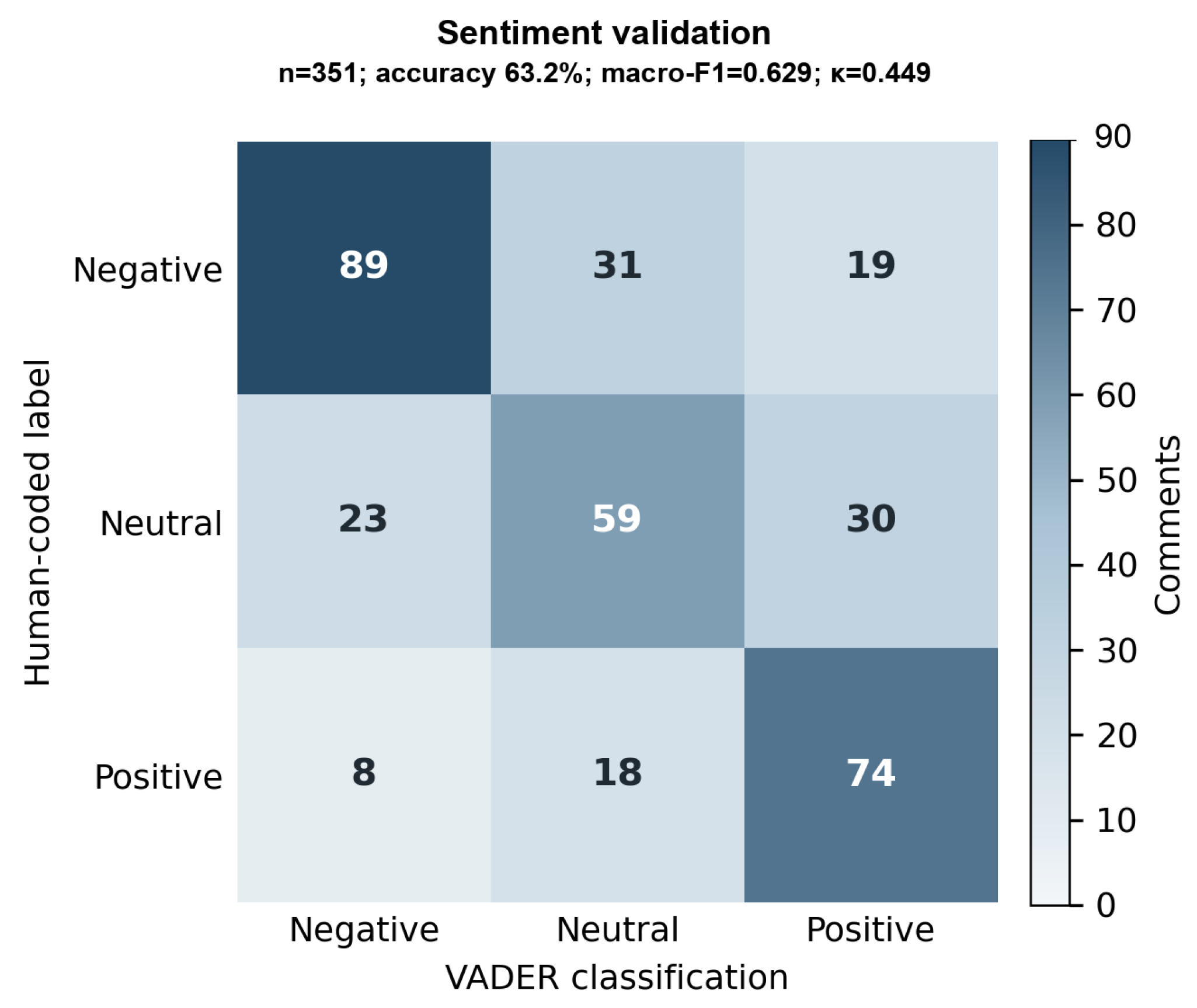
VADER generated descriptive sentiment metadata using conventional polarity thresholds. A blinded sample of 400 comments was assessed to evaluate its performance, of which 351 yielded codable human judgements. The automated classifications showed moderate agreement and were not used as direct evidence of legitimacy or stance.
Figure A1 in
Appendix B reports the validation procedure, confusion matrix, and agreement statistics.
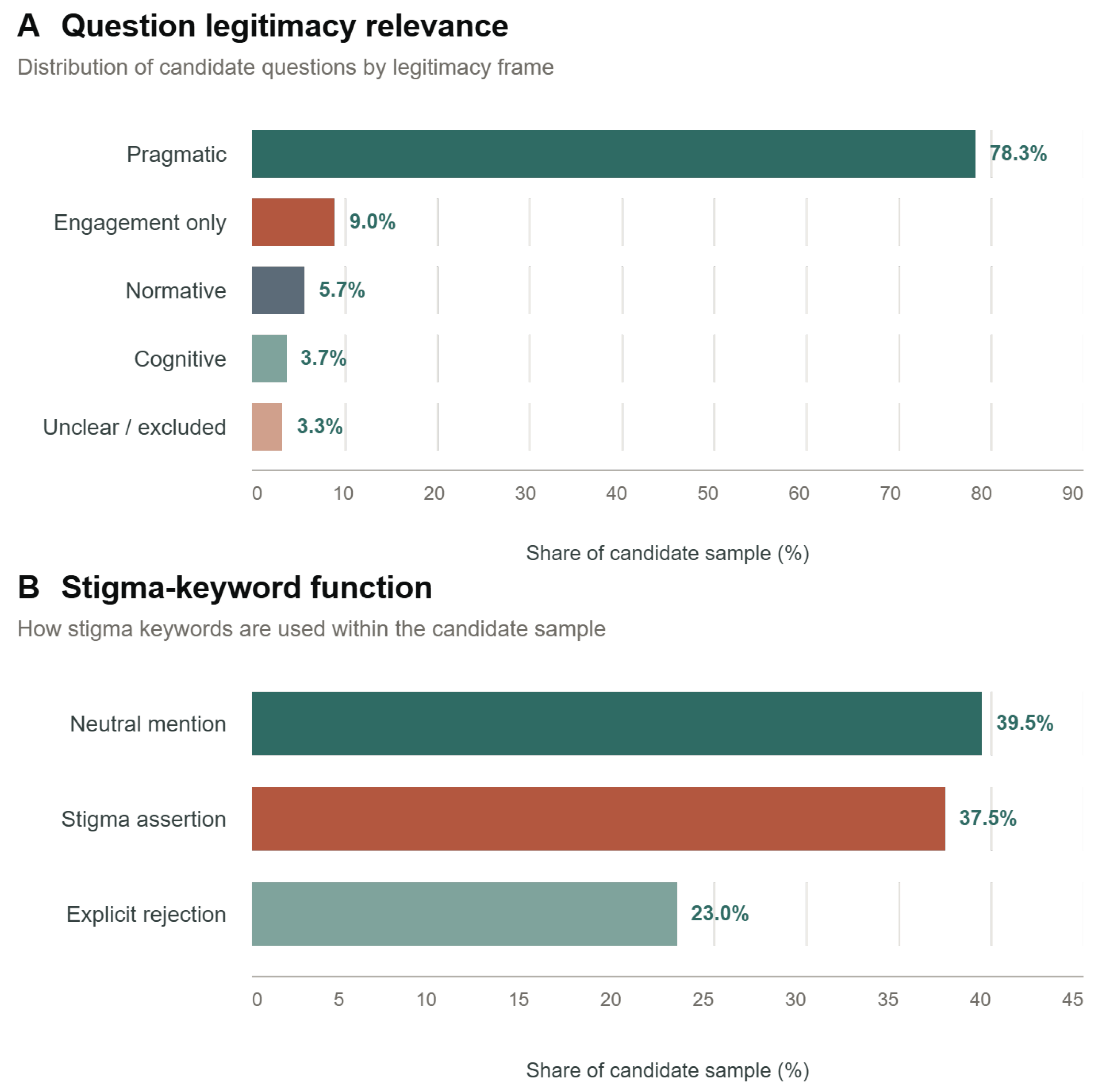
Two targeted samples examined the interpretive boundaries of candidate categories. A 300-comment sample drawn from a previously generated question-labelled pool was coded by question type, legitimacy relevance, and orientation. A separate 400-comment sample drawn from a broad stigma-keyword pool distinguished stigma assertion, explicit rejection, and neutral invocation. These analyses describe the composition of the candidate pools and do not estimate category prevalence across the full corpus.
Figure 2 presents the legitimacy-relevance and stigma-function distributions.
Comments concerning price, purchase scope, land tenure, technical performance, supplier credibility, and category legitimacy were then examined qualitatively. Illustrative material was selected to capture contrasting evaluative repertoires and remained linked to the context of the source video.
The analysis was conducted on the original comment text. Illustrative comments were paraphrased only when reported in the manuscript to reduce search-based identification. The public-corpus findings therefore concern evaluative repertoires and legitimacy categories rather than claims that depend on the exact grammar or lexical form of the published examples. The YouTube material is not treated as linguistically equivalent to the interview evidence.
An exploratory screen also identified comments potentially expressing responsibility-void discourse. Independent human adjudication of this candidate set was not completed, so the screen was not used to calculate prevalence or establish absence from the public corpus.
Python workflows implemented cleaning, language identification, sampling, sentiment scoring, and candidate matching. Random sampling used a fixed seed of 2026, and intermediate datasets and sample counts were retained.
3.6. Cross-Corpus Synthesis
Cross-corpus synthesis used a structured comparison matrix developed after the separate analyses. The matrix recorded the actor position, object of concern, attributed responsibility, form of uncertainty, information requirement, legitimacy implication, and type of risk associated with each principal pattern.
The comparison was used to identify concerns visible across both corpora through contextually different mechanisms, concerns foregrounded within one corpus, and questions that neither dataset could resolve. It compared the institutional and evaluative functions of these concerns without presuming a common jurisdictional source, direct transmission between the datasets, or empirical equivalence between actor groups. Because the corpora represented different actor positions and discursive settings, the analysis used cautious terms such as “foregrounded” and “not identified in the examined material” rather than treating differences as evidence of empirical absence.
3.7. Analytical Quality and Researcher Reflexivity
The lead author conducted the primary interview coding and interpretation. Co-authors reviewed the developing codebook, principal findings, and selected extracts through peer discussion. Review focused on code boundaries, interpretive plausibility, and alignment between claims and evidence. These discussions informed revisions to definitions, confidence judgements, and the presentation of findings.
Analytical quality, in the sense of auditability rather than measurement reliability, was supported by systematic application of the final codebook, confidence judgements, recorded alternative interpretations, negative-case review, cross-interview matrices, the final decision-rule audit, verbatim extracts from audio-verified transcripts, and a source-by-finding evidence map.
The research team’s knowledge of IB and MMC supported contextual interpretation of sector language and delivery arrangements, but also created a risk of importing established assumptions about adoption barriers and preferred reforms. Because the initial sensitising concepts could have narrowed analytical attention, open familiarisation, inductive category development, and negative-case review were used to identify material that did not fit the initial framework. Reflexive review continued throughout analysis and manuscript preparation. Particular care was taken when participants discussed institutions or groups absent from the sample. Claims concerning governments, regulators, educational institutions, industry bodies, and workforce organisations were treated as practitioner constructions of those actors and their roles.
4. Results
4.1. Overview of Principal Findings
Responsibility allocation formed the principal cross-interview finding. Trust and risk did not emerge as parallel themes of equivalent strength and are used as supporting interpretive lenses. Trust helps explain why some manufacturers represented internal control as preferable to reliance on external organisations, while risk clarifies how actors evaluated financial, regulatory, delivery and quality exposure from their respective positions.
Clear or well-supported responsibility-void discourse appeared in 14 interviews. Other accounts reflected fragmented responsibility, explicit shifting, boundary cases or insufficient evidence for a firm classification. Clear responsibility shifting appeared in Interviews B and Q. Organisational control was supported most strongly in Interviews A, E, G, V and W.
The information-related accounts contained three distinct mechanisms. Knowledge-infrastructure absence appeared across four interviews, while strategic opacity and interoperability failure each appeared in one clear case. The latter are treated as bounded analytical cases that clarify differences within the broader information finding, rather than as recurring corpus-level patterns.
Table 2 summarises the evidential reach of the principal findings. The full source-level distribution and responsibility-classification audit are reported in
Appendix A.
All indented interview extracts are verbatim apart from de-identification.
4.2. RQ1: Allocation, Fragmentation and Voids in Institutional Responsibility
The responsibility findings concerned shared functions required across organisational boundaries, including training, certification, inspection, industry representation, information provision and integration across design, manufacture and site delivery. Participants rarely described these functions through a single stable allocation of responsibility. Their accounts more often assembled a field of partial actors, absent coordinators and local substitutes.
4.2.1. Discursive Mechanisms
Five recurring discursive mechanisms shaped the allocation of responsibility. Collective labels such as “the industry”, “government” and “the universities” broadened the field of implicated actors while reducing institutional specificity. Expressions such as “nobody”, “no one” and “there is no role” deleted agency altogether. Reciprocal deflection appeared where adjacent institutions or levels of government attributed the obligation to one another. Necessity formulations, including descriptions of what firms “had to” create internally, linked institutional gaps with private substitution. International comparisons presented arrangements elsewhere as evidence that the Australian condition could be organised differently.
Table 3 summarises these mechanisms and their functions.
The mechanisms often co-occurred. Interview Q combined agency deletion and reciprocal deflection at the factory-to-site boundary:
A volumetric unit arrives on site. The factory supplier limits its responsibility to what is inside the unit, while the site trade does not know what is inside it. The connection between the two remains without an owner.
(Interview Q)
The extract first assigns agency to two identifiable actors, but neither is represented as acting on the interface between them. In the final clause, “the connection” becomes the grammatical subject and “without an owner” removes any actor answerable for it. This construction allows both parties to retain bounded accounts of responsibility while the system-critical interface remains unowned.
4.2.2. Training and Capability Provision
Training discourse contained several of the clearest void constructions. Interview D described leadership development as absent despite the availability of trade and technical training. The speaker located the gap at the project and organisational leadership level, where no formal sector-wide provision was identified:
Technical and trade programmes exist, yet construction leaders receive no formal development for managing this kind of work.
(Interview D)
The contrastive conjunction “yet” establishes a gap between visible technical provision and absent leadership preparation. In “receive no formal development”, construction leaders are positioned as recipients while the expected provider is omitted. The formulation broadens the issue from individual competence to institutional provision but leaves unresolved which organisation should design, fund and maintain that provision.
Manufacturers and technology providers described local substitutes for missing provision. Interview E presented the manufacturer as an educator of external actors. Interview G described a proprietary training portal and certification pathway developed after prolonged engagement with public training institutions. Interview M acknowledged that trainers were not consistently exposed to current factory practice and linked this gap to limited resources. Interview O described a compliance system that counted training hours without establishing the relevance or currency of the training delivered. Interview T identified the absence of national recognition for a multi-trades technical college programme.
Interviews C, N and P criticised university or professional education for producing graduates without modular, manufacturing or DfMA capability. These accounts identified an institutional field that participants regarded as responsible. They therefore supported a training gap and fragmented responsibility more securely than a strict claim that no owner existed.
Interview C provides a negative case that clarifies this boundary. The account used the collective label “universities”, which reduces differences among institutions and accreditation arrangements, but still identified a responsible institutional class. Unlike Interview Q, where the interface remained without an owner, the training criticism attributed inadequate performance to a recognisable provider. Institutional criticism alone was therefore not coded as a responsibility void.
4.2.3. Certification, Inspection and Jurisdictional Allocation
Certification and inspection accounts located responsibility at interfaces between systems designed for site-based construction and the requirements of manufactured delivery. Interview L described inspection protocols organised around progressive visual access to work on site. Enclosed manufactured assemblies disrupted this sequence because the relevant work was no longer visible at the conventional inspection point. The account attributed no personal failure to the certifier and instead constructed a mismatch between the inspection function and the delivery process.
Interview Q extended this issue to the connection between factory and site scopes. The account described two identifiable parties with partial responsibilities and no effective ownership of the interface joining them. This was the strongest responsibility-void case in the corpus and one of two clear responsibility-shifting cases.
Interview B supplied the other clear shifting pattern. State and federal levels were described as redirecting responsibility for licensing and insurance reform between jurisdictions. Each level retained a recognisable role, while the cross-jurisdictional function remained unresolved. Accounts of council variation and state-specific requirements in Interviews H and I further illustrated how multiple legitimate authorities can produce an uncoordinated institutional condition.
These findings represent practitioner constructions of regulatory and certification arrangements. Regulators and certifiers were not interviewed in their institutional capacity, so the accounts do not independently verify the attributed arrangements.
4.2.4. Industry Representation and Integrative Roles
Industry representation emerged as another shared function with unclear coordinating ownership. Interview A described manufacturing interests as insufficiently represented by bodies oriented towards conventional construction. Interview I made a parallel claim for electrical services, which the participant positioned outside principal MMC forums and protocols. These accounts construct representation gaps from distinct supply-chain positions and do not establish a complete map of industry-body membership.
Design and delivery participants also described a missing integrative role. Interview K provided the most direct formulation:
No existing role coordinates the MMC decisions connecting the designer, manufacturer and site contractor. That integrative position still has to be created.
(Interview K)
The absence construction “no existing role” represents coordination as structurally vacant without identifying who should currently perform it. The modal and passive phrase “has to be created” presents change as necessary while leaving the creator unspecified. Designers, manufacturers and contractors are positioned as specialised but incomplete participants, and an integrative role is presented as the means of connecting their partial responsibilities.
Interview J described the design knowledge required for cross-laminated timber connections as extending beyond the detail normally supplied, leaving remaining decisions to be resolved during delivery. Interview H identified a weak connection between engineering specification and manufactured-product knowledge. These accounts located the problem in the coordination of partial expertise. Participants described local responses, including informal knowledge sharing, commercial software and in-house design capacity, but no common arrangement connecting these functions across projects.
4.2.5. Distinct Information Conditions
The information-related accounts revealed three distinct mechanisms.
Strategic opacity appeared clearly in Interview I. The participant described electrical pricing knowledge as deliberately protected from manufacturers and developers because it conferred market advantage. This was the sole well-supported case in which one actor was represented as possessing consequential information and intentionally restricting access to it.
Interoperability failure was clearest in Interview G. The participant described repeated model reconstruction across the design-to-manufacture sequence:
The architect’s model does not transfer to the frame designer, and the frame designer’s model does not transfer to the factory, so each stage redraws the work.
(Interview G)
The models, rather than the organisations, are the grammatical subjects of “does not transfer”. This presents the failure as technical and leaves open whether it arises from software, contractual arrangements or organisational choices. The causal connector “so” then makes repeated redrawing appear as the practical consequence of fragmented delivery. Because the speaker also promoted a proprietary system, the account both described an interoperability problem and supported an integrated commercial response.
Knowledge-infrastructure absence appeared in Interviews F, H, N and P. Interview F contrasted the Australian market with an overseas supplier-information platform and described manufacturers absorbing the burden of educating developers and consultants. Interview H described a specifying engineer who lacked awareness of an available standard manufactured product. Interview N located DfMA coordination knowledge in an education-to-practice gap. Interview P described an architect-to-manufacturer knowledge gap served through private software. Across these accounts, relevant information was not collectively assembled, maintained or made readily discoverable.
A further information-related account in Interview R concerned a negative CLT project story circulating as general sector knowledge. Its mechanism involved second-hand amplification and was not classified as strategic opacity, interoperability failure or knowledge-infrastructure absence.
4.3. RQ2: Organisational Control as Private Substitution
Five high-confidence accounts linked the internalisation of labour, training, design, certification or production with uncertainty surrounding external capability and assurance. All five came from manufacturers or technology providers.
Table 4 summarises the functions internalised and the external uncertainties invoked.
Interview A described direct employment of tradespeople and designers for activities considered critical to the product:
Product-critical work is carried out by the firm’s own tradespeople and designers, limiting reliance on subcontractors.
(Interview A)
The passive phrase “is carried out” foregrounds the work arrangement rather than the decision to internalise it. “Product-critical” marks some functions as too consequential for external reliance, while “the firm’s own” contrasts internal capability with subcontracting. The extract therefore positions vertical integration as a prudent response to uncertain external assurance, while locating knowledge and control within the firm.
Interview E foregrounded control over production, quality and process through in-house fabrication and carpentry. Interview G embedded training and certification within a proprietary technology pathway. Interview V described automation as a means of reducing variability in production decisions. Interview W presented a large in-house design team as a means of controlling the interface from concept to manufactured delivery. Across these accounts, participants justified internalisation through concerns about external capability, process variability and loss of control across organisational interfaces.
Control was not a general characteristic of all IB practitioners. Interviews J, L and P described the financial exposure created by capital-intensive integration where demand remained irregular. These participants emphasised pipeline continuity, shared standards, role clarity and coordination across firms. Their accounts establish a substantive boundary to the control pattern: internalisation can reduce operational dependence while increasing fixed-cost and pipeline exposure.
A shorter factory-visit account in Interview U described a similar automation logic, although the evidence was insufficient for inclusion in the principal pattern. Interviews L and R also contained weaker control-related material.
Risk appeared as actor-positioned exposure. Manufacturers and technology providers foregrounded delivery, quality and process uncertainty and responded through internalisation. Interviews J, L and P foregrounded capital commitment and pipeline exposure and favoured shared standards and coordination between firms. The same organisational arrangement could therefore be described as reducing one form of exposure while creating another.
4.4. RQ3: Public-Facing Information and Legitimacy Concerns
The YouTube contrast corpus revealed a distinct public-facing field of evaluation. Commenters focused on whether housing offers were affordable, technically credible, clearly specified and acceptable within familiar housing categories. These concerns complemented the practitioner interviews by showing which aspects of IB became visible to audiences positioned outside the documented supply chain.
Within the 300-comment question sample, 88.0% of comments carried pragmatic, normative or cognitive legitimacy relevance, while 9.2% were classified as engagement only. Availability and purchase, cost and finance, technical performance, and design or layout were the most prominent question types. The comments therefore reflected active evaluation of the housing offer, including whether it could be purchased, what it included, how it would perform and whether it met practical expectations.
Cost-related comments frequently extended evaluation beyond an advertised unit price. Commenters raised delivery, site preparation, installation, utilities, finance and ongoing fees. One highly liked comment in the container-home material compared the acquisition price with the substantially larger total renovation cost. A highly liked manufactured-housing comment focused on non-ownership of land, escalating lot fees and exposure to sale of the underlying park. These examples show that public evaluation concerned the complete conditions of acquisition and occupation, including costs and obligations extending beyond the dwelling itself.
Technical and design questions formed another important evaluative strand. Commenters asked about structural performance, durability, insulation, utilities, dimensions, layouts and opportunities for modification. Such questions tested whether the housing offer was credible and suitable for use. They also show that apparent uncertainty cannot be reduced to general unfamiliarity with IB; commenters sought specific evidence relevant to purchase and occupation.
The stigma-keyword validation showed that category language performed several functions. Within the 400-comment candidate sample, 37.5% asserted a stigmatising association, 23.1% rejected or challenged such an association and 39.6% invoked the term without a clear delegitimating position. Public discourse therefore included category contestation as well as category rejection. Labels associated with trailers, containers, mobile homes or temporary housing could delegitimise an offering, defend it against stigma or simply identify the housing type under discussion.
Figure 2 shows that the question sample was dominated by pragmatic evaluation, while stigma terms were used to assert, reject or neutrally invoke category associations.
The question and stigma samples show that public legitimacy involved both material evaluation and category meaning. Commenters assessed price, purchase scope, tenure, performance and supplier credibility while also negotiating whether particular housing forms counted as desirable, permanent or socially acceptable housing. The public corpus therefore provides illustrative insight into evaluative concerns that practitioner interviews are poorly positioned to reveal.
The two corpora make different objects visible. Practitioners evaluated the delivery system, whether IB can be taught, specified, inspected, certified and coordinated through routine institutional arrangements. Commenters evaluated the offer, what is included in the price, what tenure attaches to it, how it will perform and whether the seller is credible. This difference in evaluative object, rather than any difference in the level of concern, is what the comparison establishes. It does not require the public corpus to be representative because the claim concerns what each position renders visible rather than how prevalent any concern is within it.
4.5. Cross-Corpus Comparison
The cross-corpus comparison identified different fields of visibility across the supply-chain and public corpora.
Table 5 summarises the principal contrasts.
The corpora made different uncertainties visible, consistent with their differing actor positions and contexts. Practitioner accounts foregrounded the institutional conditions needed to design, manufacture, certify and deliver IB. The sampled public comments foregrounded the information needed to understand, compare and evaluate a housing offer. The two corpora therefore illuminate different parts of the adoption environment.
Information was important in both corpora, although its function differed. Practitioner accounts concerned model transfer, product knowledge, professional capability and the governance of information across delivery organisations. Public comments concerned price scope, tenure, technical performance, supplier credibility and the conditions attached to purchase. The shared concern was not a single information deficit, but the need for information suited to the decisions faced by each actor position.
Risk also differed by position. Manufacturers and technology providers described delivery, quality and process exposure, while other practitioners described capital and pipeline exposure associated with integration. Public commenters described purchase, tenure, performance and recurring-cost exposure. These contrasts show why risk cannot be treated as one uniform adoption barrier.
Legitimacy operated across both corpora. Practitioner accounts concerned whether IB could be supported through routine training, certification, inspection and coordination arrangements. Public comments concerned whether the offer, seller and housing category appeared credible and acceptable. The comparison therefore links institutional normalisation inside the supply chain with evaluative clarity outside it, while preserving the distinction between the two settings.
The corpora do not document a causal sequence. The Australian interview findings cannot explain the international comments, and the comments do not validate the practitioner accounts. Their contribution lies in revealing complementary fields of visibility across internal delivery and external evaluation.
5. Discussion
Responsibility provided the strongest organising concept across the practitioner accounts, while trust and actor-positioned risk helped interpret differences in reliance, exposure and preferred responses. The findings indicate that IB’s reliance on distributed expertise becomes problematic when partial obligations remain weakly connected, and no effective arrangement coordinates provision, continuity and answerability.
5.1. From Barrier Inventories to Responsibility Architectures
IB adoption research has produced a detailed account of skills shortages, fragmented regulation, limited coordination, uncertain demand, market confidence and resistant industry cultures [
1,
2,
3,
19]. The present findings add a responsibility architecture to that barrier map. Training, certification, inspection, industry representation, product knowledge and design-to-delivery integration appeared as shared functions whose provision crossed institutional and organisational boundaries. Participants associated universities, employers, manufacturers, professional bodies, regulators, certifiers and governments with different parts of these functions. Responsibility-void discourse emerged where the connections among those partial obligations lacked an effective coordinating locus.
This interpretation distinguishes distributed responsibility from a responsibility void. Construction projects routinely involve interdependent organisations and divided project responsibilities [
4,
6]. Distribution alone provides weak evidence of dysfunction. Responsibility-void discourse appeared where participants constructed a necessary function as unowned, repeatedly displaced, inadequately resourced or left without effective coordination. Boundary cases showed that criticism of a university, regulator or industry body could identify a responsible actor without establishing a void. Responsibility shifting likewise required an observable transfer of obligation to another actor or institution.
These distinctions extend the “problem of many hands”, in which collective outcomes emerge from dispersed contributions that make responsibility difficult to locate [
7]. Braham and van Hees [
8] distinguish fragmentation, where partial responsibilities can still be identified, from a void, where the relevant responsibility is absent. The interview findings translate this distinction into an IB adoption setting. The strongest cases concerned functions located at interfaces, including factory-to-site scopes, inspection of enclosed manufactured assemblies and the coordination of education with current factory practice. These interfaces increased the number of participating actors while reducing the visibility of the function connecting their contributions.
Accountability adds an institutional dimension to this responsibility architecture. Bovens [
9] conceptualises accountability through obligations to explain and justify conduct before a forum capable of questioning and judgement. The practitioner accounts often lacked this form of answerability for shared ecosystem functions. Several actors could be associated with a training, certification or coordination problem, yet the discourse supplied no clear institution responsible for ensuring that the function was delivered across the sector. An “owner” therefore refers here to a recognised coordinating locus with authority, resources and answerability. Delivery may remain distributed among several organisations.
This perspective also clarifies why familiar adoption barriers may persist after repeated recognition. A skills shortage may attract new courses, employer training or project-level initiatives while the wider curriculum-to-practice connection remains unstable. Regulatory uncertainty may generate local approval solutions while inspection and interface problems recur across projects. Barrier identification describes the condition. Responsibility architecture indicates whether the institutions surrounding that condition can act coherently and sustain a response.
The data establish how practitioners constructed these arrangements. They do not independently verify that the institutions discussed failed to act or that the functions described were objectively ownerless. This boundary is especially important where participants attributed responsibility to governments, universities, regulators or industry bodies absent from the sample. Their constructions nevertheless shaped which responses appeared credible, necessary or available.
5.2. Institutional Normalisation and the Legitimacy of IB
The responsibility findings broaden the meaning of legitimacy in IB adoption. Existing research often locates legitimacy problems in stakeholder awareness, conservative attitudes and historical associations with inferior prefabricated housing. The interviews also locate cognitive legitimacy within institutional routines. A delivery model becomes ordinary when practitioners know how to teach it, specify it, inspect it, certify it, coordinate its interfaces and identify the actors answerable for those tasks.
Suchman’s distinction between pragmatic and cognitive legitimacy is useful here [
25]. Pragmatic legitimacy rests on the perceived value an activity provides to an immediate audience. Cognitive legitimacy rests on comprehensibility and taken-for-grantedness, where an activity no longer requires repeated justification. Participants frequently articulated pragmatic claims about speed, quality, safety, productivity and process control. At the same time, they described education, inspection, information and role systems that continued to assume conventional site-based delivery. IB can therefore demonstrate performance while remaining institutionally exceptional. International comparisons reinforced this interpretation by presenting training systems, product platforms or certification arrangements elsewhere as evidence that the Australian setting could be organised differently.
This finding helps explain the durability of social and attitudinal barriers identified in adoption reviews. Perceptions of maturity and trustworthiness are produced through repeated encounters with approval pathways, professional knowledge, interface responsibilities and market information. Inconsistent or locally improvised routines require each project to undertake additional legitimating work. This sustains the perception that IB requires exceptional handling even when its technical performance is accepted.
The concept of institutional non-accumulation captures this process cautiously. Participants described proprietary training, project-specific approval work, internal design capability and private knowledge platforms. These efforts created capability within particular organisations, while their transfer across firms, projects and jurisdictions remained uncertain. Cognitive legitimacy consequently depends on the accumulation of shared routines and accessible institutional capacity alongside successful individual projects.
5.3. Organisational Control as Private Institutional Substitution
A concentrated pattern among five manufacturers and technology providers concerned direct employment, in-house design, proprietary training, certification pathways and automation. These actors justified greater control through references to uncertain external capability, variable delivery quality or poorly aligned interfaces. Control discourse translated an ecosystem problem into an organisational response by bringing delivery-critical functions inside the firm.
These constructions also have implications for power. Broad references to “government”, “universities” or “the industry” disperse accountability across categories that cannot answer directly, while speakers can position their own organisations as practical problem-solvers. Where shared education, coordination or assurance is represented as inadequate, proprietary training, integrated delivery and commercial platforms can appear necessary and credible. These responses may address real delivery problems, but they can also concentrate knowledge and authority within firms rather than building transferable sector capacity.
Trust theory offers one interpretation of this pattern. System trust enables actors to rely on rules, standards, professional roles and institutional routines without renegotiating every uncertainty [
16,
17]. Such reliance is impersonal. Standards, certification schemes and professional credentials allow assurance to travel between organisations without requiring prior relationships [
15,
22]. The control accounts described situations in which participants were reluctant to rely on these external assurances. Internalisation reduced the number of interfaces and gave the firm direct authority over critical decisions. The interviews did not consistently name trust, so this remains a theoretically informed interpretation of the discourse.
Private substitution may be effective within an individual organisation. Proprietary training can build competent users, integrated design can reduce translation loss, and automation can stabilise selected production decisions. Capability developed in this way may remain tied to a specific platform, employer or commercial model. Its transfer across firms and contribution to wider sector capacity require further investigation.
The counterpositions in Interviews J, L and P expose another limit. Vertical integration creates fixed costs and increases dependence on a continuous pipeline. Control over production may reduce operational uncertainty while concentrating financial exposure within the firm. Control discourse was concentrated among manufacturers and technology providers, whose accounts foregrounded delivery and investment exposure. Advisers and professionals working across organisations more often proposed standards, integrative roles, education and coordination.
The findings therefore indicate two responses to uncertain institutional assurance. Firm-level control creates local capability, while reform-oriented accounts seek shared assurance across the ecosystem. Neither response automatically supplies the intermediate institutional layer connecting projects, firms, training systems, approval bodies and information arrangements. Vertically integrated exemplars may leave wider coordination problems unresolved when their capabilities remain proprietary. Calls for collaboration may also have limited effect where authority, resources and role boundaries remain unspecified. Research on inter-organisational collaboration similarly emphasises that cooperation, coordination and collaboration involve different arrangements [
5].
5.4. Information Problems Require Mechanism-Specific Responses
The information-related accounts point to three distinct mechanisms: strategic opacity, interoperability failure and knowledge-infrastructure absence. Strategic opacity appeared in one clear case and is therefore treated as a bounded analytical distinction. Interoperability failure also appeared in one clear case. Knowledge-infrastructure absence received broader support across four interviews. The value of the distinction lies in showing that apparently similar information barriers involve different relationships between information, actors and access.
Strategic opacity concerns consequential information that is deliberately guarded or selectively disclosed. Relevant responses concern transparency, incentives, commercial norms and disclosure obligations. Interoperability failure concerns information that exists but loses usability as it moves between software, disciplines or delivery stages. The repeated model reconstruction described in Interview G reflects a recognised BIM problem in which semantic and technical incompatibilities obstruct reuse [
42]. Shared data requirements, model standards, interface protocols and governance of system handovers address this mechanism more directly.
Knowledge-infrastructure absence operates at a different level. Participants described product capability, supplier knowledge, DfMA expertise and current practice as dispersed across firms or accessible through private mediation. Information infrastructure research treats infrastructure as an evolving arrangement of technologies, standards, practices, organisations and users [
43,
44]. A product register or guidance portal therefore depends on maintenance, governance, common classification, participation and integration with working practices. A database without these supporting arrangements may reproduce the discoverability problem in another form.
The distinction has direct implications for intervention design. Transparency initiatives cannot repair failed model transfer. Interoperability standards cannot compel actors to disclose commercially guarded information. A knowledge platform cannot resolve uncertainty over certification responsibility at a factory-to-site interface. The three mechanisms may interact, yet they require different governance responses.
The YouTube material reveals another information condition: incomplete or uncertain evaluation from the prospective buyer’s position. Commenters asked about price scope, delivery, site preparation, utilities, finance, land tenure, ongoing fees, technical performance and supplier credibility. These questions do not establish deliberate non-disclosure by sellers. They show the information required to judge a housing offer and the gaps perceived within the sampled discourse. Industry actors sought information for coordination and delivery, whereas public commenters sought information for evaluation and purchase decisions.
5.5. Public Legitimacy as a Distinct Field of Visibility
The public contrast corpus qualifies a simple communication-deficit account of IB acceptance. The question sample was dominated by practical evaluation, including purchase availability, total cost, technical performance and design. The stigma-keyword sample contained three discursive functions: assertion, rejection and neutral invocation. Public discourse in the sampled videos was therefore neither uniformly hostile nor reducible to unfamiliarity.
Legitimacy judgement theory helps explain this mix. Evaluators consider whether an offering serves their interests, fits normative expectations and belongs to a recognisable category [
26]. Questions about total cost and tenure involve material evaluations. Technical questions test credibility. Stigma assertions and rejections negotiate category membership and social acceptability. The public-facing adoption problem consequently includes substantive purchase conditions alongside contested cultural meanings.
Housing stigma research shows that category labels and second-hand associations can shape evaluations without direct residential experience, and that outsider judgements have received less attention than those of residents [
28,
29,
30,
45]. The commenters sampled here occupy that outsider position. The same category language could reproduce stigma, resist it or simply identify the object under discussion. Keyword counts alone would collapse these functions and overstate delegitimation.
The cross-corpus comparison reveals different fields of visibility. Practitioners foregrounded training, certification, model transfer, role ambiguity, capital exposure and institutional coordination. Public commenters foregrounded total purchase conditions, tenure, technical credibility and category evaluation. These patterns support separate research and intervention agendas.
A matched research design could examine relationships between institutional provision and public legitimacy more directly. Australian projects could be studied across policy, certification, design, manufacturing, sales and buyer or resident experience. Such research could test whether clearer institutional arrangements improve the credibility and evaluability of IB offers and whether public concerns differ across modular, panelised, manufactured and other housing categories.
5.6. Implications for Policy and Practice
The findings direct attention towards shared institutional functions and the arrangements that sustain them. A responsibility response begins by specifying the function, identifying the participating actors and designating a coordinating locus with sufficient authority, resources and answerability. This approach preserves distributed expertise while making the overall outcome governable.
For training and capability, coordination could connect current factory practice, professional curricula, vocational programmes, employer training, accreditation and continuing professional development. The task extends beyond adding isolated IB subjects. It requires a maintained mechanism through which changing industry practice informs recognised learning pathways and through which responsibility for curriculum currency can be reviewed.
For certification and inspection, policy development could map responsibility across factory production, transport, installation and site connection. Manufactured assemblies create visibility and timing conditions that differ from progressive site inspection. Clear evidence requirements, hold points, handover protocols and responsibility for interfaces could reduce dependence on project-specific negotiation. Cross-jurisdictional reforms also require a forum capable of resolving allocation across levels of government.
For information arrangements, shared product and capability registers, common terminology, model-transfer requirements and accessible guidance could reduce repeated search and translation. Their governance should specify who maintains the content, validates entries, funds updates, manages access and responds when information is incomplete. Demonstration projects can contribute by producing reusable standards, training assets, approval lessons and data protocols as explicit outputs.
Public-facing communication should disclose the scope and boundaries of housing offers, including site works, transport, installation, utilities, tenure arrangements, ongoing charges, warranties and the parties responsible for each component. Communication centred on speed, affordability or innovation alone leaves substantive evaluation questions unanswered. Transparent qualification of claims can support credibility and allow potential buyers to compare offers more consistently.
These implications are propositions derived from discourse patterns. The study did not evaluate their effectiveness, cost or political feasibility. Future policy trials should define the institutional function being addressed, document the allocation of responsibility and assess whether the intervention creates transferable capacity beyond participating firms and projects.
5.7. Limitations and Future Research
Several limitations bound the analysis. The purposive sample provides breadth across practitioner positions without statistically representing the Australian sector. Government agencies, regulators, certifiers, trade unions, financiers and consumers were discussed by participants but were not directly represented across the sample. Practitioner claims about these actors remain situated accounts.
Responsibility-void discourse records how participants constructed necessary functions and ownership arrangements. It does not establish an objective institutional void. The final audit retained clear or well-supported cases separately from fragmented responsibility, shifting and boundary cases.
The YouTube dataset cannot support population estimates, Australian consumer claims, corroboration of the practitioner accounts or causal linkage to the interview findings.
Future research should examine the responsibility architecture of specific institutional functions through multi-actor case studies. Interviews with regulators, certifiers, education providers, industry bodies, manufacturers, designers, contractors, clients and workers could test where their accounts converge and where obligations remain contested. Longitudinal studies could follow training reforms, certification pathways, shared information platforms or demonstration programmes to assess whether clearer coordination produces durable sector capacity. A separate Australian consumer study could investigate purchase evaluation, category legitimacy and trust across differentiated IB housing forms.
Drawing together the preceding discussion,
Figure 3 presents a proposed conceptual synthesis rather than an empirically tested causal model. It depicts potential misalignment among responsibility, authority and exposure, together with two alternative response pathways: private substitution and accountable coordination. The directional links are interpretive propositions rather than tested causal relationships.
6. Conclusions
The contribution of this paper is a change in how persistent problems of IB adoption are posed. Barrier research names what is missing from the adoption environment, but not the mechanisms through which collective action fails to supply it. Because most of the recurring conditions are shared functions that cross organisational and institutional boundaries, the question that matters is not which barriers exist but how responsibility for them is allocated and made answerable.
The broader theoretical contribution is a responsibility architecture for IB adoption: a vocabulary separating fragmented responsibility, where partial obligations remain identifiable but unconnected, from responsibility shifting, where an obligation is passed to a party absent from the interaction, and from responsibility-void discourse, where a necessary function is constructed as unowned, repeatedly displaced or without effective coordination. It pairs this with ownership understood as accountable coordination rather than sole performance, a recognised locus holding the authority, resources and answerability for a function whose delivery remains distributed. A generic diagnosis of fragmentation cannot make these separations, yet connecting existing obligations, contesting a displaced one and establishing an absent coordinating locus are different tasks. The claim remains discursive: the analysis shows how responsibility is constructed, displaced or left unstated in practitioner accounts, not that an institution has objectively failed to act.
Directly supported by the interviews, the central finding was that practitioners constructed training, certification, inspection, industry representation and design-to-delivery integration as shared functions lacking an effective coordinating locus. Trust and risk did not yield parallel findings: trust served as a lens for interpreting reluctance to rely on external assurance, while risk differentiated the forms of exposure described across practitioner positions. Organisational control as private substitution and the differentiation of information conditions emerged abductively from the interview analysis. These categories are offered as grounded analytical proposals.
Separately, the public corpus contributed an outsider evaluative perspective. In the sampled comments, purchase conditions, tenure and category credibility were prominent, whereas practitioner accounts foregrounded institutional delivery and coordination. This comparison extends the analysis from institutional delivery concerns to the conditions through which housing offers are evaluated.
Framed this way, adoption research can ask which shared functions a sector requires, which actors participate in them and whether an accountable coordinating locus exists, treating the answer as a matter of institutional design rather than of stakeholder attitude. Persistent adoption problems then appear less as a deficit of awareness or technical readiness than as a question of whether the institutions surrounding a recognised condition are organised to act on it and to answer for the result.