1. Introduction
Loess is a widely distributed aeolian deposit characterized by a loose structure, high porosity, and metastable particle arrangement. Owing to its strong sensitivity to water infiltration and external loading, loess often exhibits significant collapsibility, strength degradation, and deformation instability, which may threaten the safety and durability of infrastructure constructed in loess regions. Houston et al. [
1] investigated the collapse behavior of soils caused by wetting and emphasized the importance of controlling moisture-induced deformation. Derbyshire [
2] reviewed geological hazards associated with loess terrains and highlighted the engineering risks associated with the instability of loess deposits. Dijkstra et al. [
3] further analyzed the engineering properties and slope stability of Chinese loess, demonstrating the necessity of improving its mechanical performance for safe infrastructure construction.
Cement stabilization is one of the most widely used methods for improving the engineering properties of loess. Cement hydration generates calcium silicate hydrate (C-S-H), calcium aluminate hydrate (C-A-H), and calcium aluminosilicate hydrate (C-A-S-H), which enhance particle bonding and fill interparticle pores. Axel et al. [
4] demonstrated that the strength improvement of cement-stabilized loess was closely associated with increased particle bonding and reduced pore connectivity. Yuan et al. [
5] further related the evolution of mechanical properties to changes in the microstructure during cement hydration. Studies incorporating silica micropowder and other curing agents have also shown that additional reactive components can promote hydration or secondary reactions and refine the pore structure [
6,
7]. Nevertheless, increasing cement content does not necessarily provide a proportionate improvement in engineering performance and is accompanied by greater cement consumption and associated environmental burdens. These limitations have motivated the use of additional stabilizing materials and chemical modifiers.
Previous modification approaches can broadly be interpreted in terms of two complementary mechanisms: enhancement of cementitious reactions and regulation of the soil–binder microstructure. Pozzolanic materials such as rice husk ash and silica fume can consume calcium-bearing hydration products and generate additional cementitious phases, thereby contributing to pore refinement and strength development [
8,
9,
10]. In contrast, chemical and organic modifiers such as calcium lignosulfonate and lignin–lime systems can alter particle interactions, aggregation, and interparticle bonding [
11,
12]. Although these approaches have demonstrated improvements in strength or microstructure, their effectiveness depends strongly on additive chemistry, soil mineralogy, binder content, and curing conditions. More importantly, much of the existing work has focused on individual macroscopic or microscopic indicators; observations of strength enhancement or pore refinement alone do not fully identify the reaction products responsible for these changes or explain how hydration evolution is quantitatively associated with pore restructuring and mechanical development. Consequently, an integrated interpretation linking reaction chemistry, pore evolution, and macroscopic performance remains necessary for composite-stabilized loess.
Magnesium chloride (MgCl
2) has attracted attention as a potential chemical modifier because of its hygroscopicity, high solubility, and ability to alter ionic interactions within soils and cementitious systems. Previous studies, however, have examined MgCl
2 under substantially different material conditions. Soltani-Jigheh et al. [
13] reported improvements in highly plastic swelling clay associated with microstructural modification, whereas Siddiqua and Bigdeli [
14] showed that MgCl
2 treatment could reduce soil collapse potential by improving particle interactions. Yeganeh Rikhtehgar and Teymür [
15] further reported improved freeze–thaw behavior of treated clay. These findings demonstrate the potential of MgCl
2 for soil modification, but they primarily concern untreated or non-Portland-cement soil systems. Conversely, studies of cementitious materials have shown that Mg
2+ can directly interact with hydration products. Liu et al. [
16] demonstrated that magnesium exposure alters the chemical composition and stability of C-S-H, while Liu et al. [
17] reported that MgCl
2 affects the hydration and strength development of magnesium oxychloride cement-solidified soft clay. Thus, existing studies provide evidence for both soil-scale physicochemical modification and cement-scale hydration reactions, but the coupling of these effects in MgCl
2-modified Portland-cement-stabilized loess remains insufficiently understood.
Although MgCl
2 has shown potential for soil modification, its incorporation into Portland-cement-stabilized soil requires careful dosage control. Prolonged exposure of hardened cementitious materials to MgCl
2-containing environments can induce calcium leaching, destabilize C-S-H, and promote the formation of Mg-bearing phases such as M-S-H, ultimately resulting in microstructural deterioration and strength loss. Hara et al. [
18] investigated the strength reduction mechanism of cement-treated soil under seawater exposure and attributed the deterioration primarily to the transformation of C-S-H into M-S-H, providing direct evidence of the potentially detrimental effect of prolonged magnesium exposure on cement-treated soils. However, such long-term external chemical attack differs from the controlled incorporation of a limited MgCl
2 dosage during the preparation of a soil–cement composite. At an appropriate dosage, Mg
2+ may modify particle interactions and participate in Mg-bearing reaction products, while the associated microstructural changes may promote denser particle packing and pore refinement. In contrast, excessive Mg
2+ and Cl
− can alter the stability of calcium-bearing hydration phases and interfere with the normal development of cementitious products. Han et al. [
19] showed that MgCl
2 affects the early strength development of cement-treated soil, whereas studies of cementitious systems have demonstrated that prolonged magnesium exposure can destabilize C-S-H and alter its composition [
13,
18,
20]. Therefore, MgCl
2 was selected in the present study not on the assumption that its effect is uniformly beneficial, but because its dosage-dependent dual effect provides an opportunity to identify the transition between beneficial physicochemical modification and detrimental alteration of cement hydration products. However, previous investigations have generally considered either strength behavior, cement hydration chemistry, or soil microstructure separately. It therefore remains unclear how variations in MgCl
2 dosage simultaneously affect hydration products, pore-size redistribution, and strength development in cement-stabilized loess, and whether the observed optimum dosage can be explained by the competition between beneficial microstructural densification and unfavorable alteration of hydration products.
The use of chloride-containing additives also requires consideration of potential durability and environmental limitations. Because MgCl
2 is highly soluble, repeated water infiltration or long-term exposure to moisture may promote ionic migration or leaching, potentially reducing the persistence of salt-related modification effects. Moreover, prolonged exposure of Portland cementitious phases to Mg
2+ may promote C-S-H decalcification and the formation of Mg-bearing phases with different binding characteristics, which could adversely affect long-term mechanical stability [
13,
20]. From an environmental perspective, the mobility of chloride ions raises concerns regarding their transport into surrounding soils and water systems, particularly under conditions of substantial infiltration or runoff. Chloride-containing materials may also require additional attention where stabilized soils are used in proximity to reinforced concrete or metallic infrastructure because of the potential corrosion risk associated with chloride migration. Therefore, the engineering benefits of MgCl
2 should be evaluated together with dosage control, exposure conditions, long-term durability, and environmental compatibility. These issues also indicate that short-term strength improvement alone is insufficient for evaluating the broader applicability of MgCl
2-based stabilization.
The mechanical behavior of cement-stabilized soils is fundamentally governed by the combined evolution of hydration products and pore structure. Bernal et al. [
21] highlighted the importance of gel structure in controlling the mechanical performance of cementitious materials, while Glasser et al. [
20] emphasized the role of chemical reactions in the long-term degradation of cement-based materials. Scrivener et al. [
22] systematically described Portland cement hydration and its relationship with material properties, and Taylor [
23] established the fundamental characteristics of major cement hydration products. For cement-treated soils, Horpibulsuk et al. [
24,
25] and Muntohar further demonstrated that binder content and hydration development strongly influence strength evolution. These findings indicate that macroscopic strength cannot be interpreted independently of the evolution of cementitious phases and the resulting microstructural rearrangement.
Accordingly, complementary microstructural techniques are necessary to establish this relationship. SEM can directly characterize particle contacts, cementitious bonding, and local pore morphology, and quantitative image analysis can provide apparent pore-structure parameters [
26,
27]. However, two-dimensional SEM observations alone cannot represent the pore system of an entire specimen. Diamond [
28] similarly emphasized that individual pore-characterization techniques may introduce method-dependent limitations. Combining phase identification by X-ray diffraction (XRD), local morphological characterization by scanning electron microscopy (SEM), and whole-specimen pore characterization by nuclear magnetic resonance (NMR) therefore provides a more comprehensive basis for relating hydration products and pore evolution to macroscopic mechanical behavior.
Against this background, the present study investigates MgCl2–cement composite stabilization of Lanzhou loess with particular emphasis on the coupled relationship among hydration products, pore-structure evolution, and strength development. Unlike previous studies that have mainly considered these responses separately, compaction and unconfined compressive strength (UCS) tests are integrated with XRD, SEM, and NMR analyses to determine how MgCl2 dosage affects engineering properties, Mg-bearing reaction products, particle bonding, total porosity, and pore-size distribution. By comparing different cement contents and MgCl2 dosages, the study seeks to identify the dosage-dependent transition between beneficial modification and excessive-addition effects and to establish a hydration–pore structure–strength framework for explaining the resulting mechanical behavior. The results provide a mechanistic basis for optimizing MgCl2 dosage in cement-stabilized loess. Because the present investigation focuses primarily on curing-stage behavior up to 28 days, long-term durability, chloride leaching, and environmental compatibility remain important subjects for further investigation.
3. Results
3.1. Compaction Behavior of Stabilized Loess
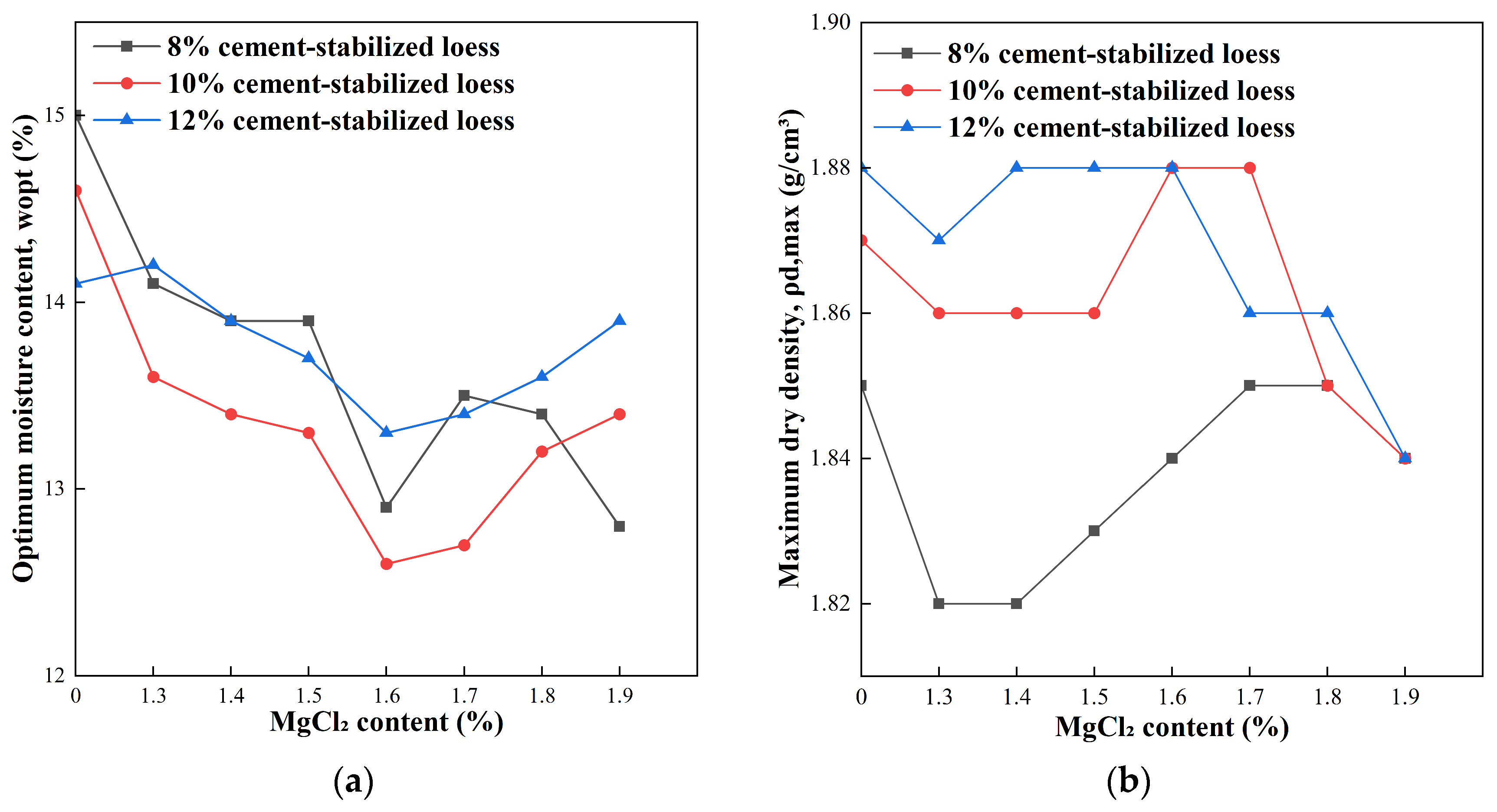
The test results for dry density and moisture content are shown in
Figure 1a,b. The incorporation of magnesium chloride increased the maximum dry density of the cement-stabilized loess and reduced its optimum moisture content. For the specimens with 8% cement, the maximum dry density increased from 1.80 to 1.85 g/cm
3 as the magnesium chloride content increased, whereas the optimum moisture content decreased from 14.10% to 12.80%. For the specimens with 10% cement, the maximum dry density generally ranged from 1.84 to 1.88 g/cm
3, and the optimum moisture content decreased from 13.30% to 12.60%. For the specimens with 12% cement, the maximum dry density varied between 1.84 and 1.88 g/cm
3, while the optimum moisture content decreased from 13.80% to 12.80%.
These results indicate that the combined incorporation of magnesium chloride and cement improved the compaction characteristics of loess to a certain extent. Compared with the 8% and 12% cement groups, the 10% cement group exhibited a relatively higher maximum dry density, a lower optimum moisture content, and more stable compaction behavior. Therefore, the 10% cement group showed better compaction performance than the 8% cement group and a more balanced compaction response than the 12% cement group.
3.2. Unconfined Compressive Strength of Stabilized Loess
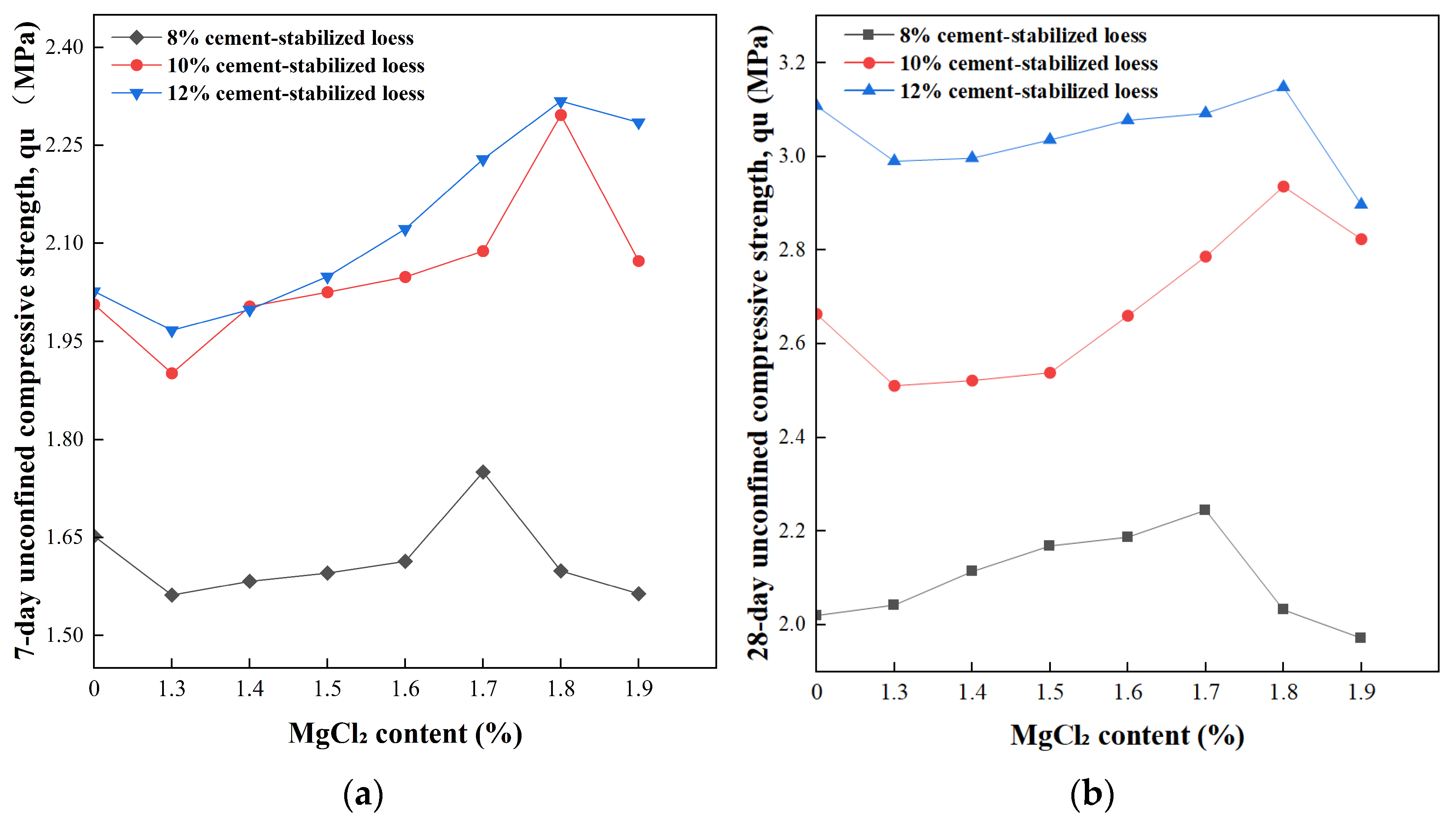
Figure 2a presents the 7-day unconfined compressive strengths of the specimens prepared with different mixture proportions. For the specimens containing 8%, 10%, and 12% cement, the strength generally followed a decrease–increase–decrease pattern as the magnesium chloride content increased. At a magnesium chloride content of 1.3%, all three groups showed lower strengths than the corresponding cement-stabilized specimens without magnesium chloride, suggesting that a small MgCl
2 addition was not sufficient to improve early-age strength. With a further increase in MgCl
2 content, the strength began to recover and then reached a peak within a certain dosage range. In the 8% cement group, the strength increased to 1.750 MPa at 1.7% MgCl
2, which was 7.362% higher than that of the corresponding specimen without magnesium chloride. For the 10% and 12% cement groups, the maximum strengths were both obtained at 1.8% MgCl
2, reaching 2.297 and 2.318 MPa, respectively, with increases of 14.449% and 14.345% compared with their magnesium-chloride-free counterparts. However, when the MgCl
2 content was further raised to 1.9%, the strength of each group decreased again. These results indicate that MgCl
2 improved the early strength of cement-stabilized loess only within an appropriate dosage interval, rather than producing a continuous strengthening effect with increasing dosage. Overall, the cement content still played the leading role in controlling the 7-day strength, while a suitable amount of MgCl
2 provided an additional improvement in early-age mechanical performance.
Figure 2b shows the 28-day unconfined compressive strength results for specimens with different mixture proportions. In comparison with the 7-day values, the 28-day strengths were generally higher, suggesting that the stabilized loess continued to gain strength during later curing. For the 10% and 12% cement groups, the strength response to magnesium chloride addition showed a similar decrease–increase–decrease pattern. The highest strengths in these two groups were both obtained at 1.8% magnesium chloride, reaching 2.936 and 3.148 MPa, respectively; these values were 10.210% and 1.271% greater than those of the corresponding specimens without magnesium chloride. The 8% cement group showed a slightly different behavior. Its strength increased with increasing magnesium chloride content before reaching 2.245 MPa at 1.7% magnesium chloride, which represented an increase of 11.139% relative to the magnesium-chloride-free specimen. Further addition of magnesium chloride then caused a decline in strength. Combining the 7-day and 28-day results, the suitable magnesium chloride content can be identified as 1.7% for the 8% cement group and 1.8% for the 10% and 12% cement groups. Among all mixtures, the specimen with 12% cement and 1.8% magnesium chloride produced the highest strength, indicating the best overall mechanical performance. Nevertheless, the mixture with 10% cement and 1.8% magnesium chloride also achieved a relatively high strength while reducing cement consumption. Although the 12% cement–1.8% MgCl
2 mixture achieved the highest strength, the 10% cement–1.8% MgCl
2 mixture maintained high strength with lower cement consumption.
For the 8% cement group, different strength development characteristics were observed at curing ages of 7 and 28 days. At 7 days, the early-age enhancement effect of magnesium chloride was unstable for specimens with a low cement content. Except for the specimen with 1.7% magnesium chloride, the strengths of the other magnesium chloride-treated specimens were lower than that of the specimen without magnesium chloride. The strength of the control specimen was 1.630 MPa, whereas the maximum strength of 1.750 MPa was obtained at a magnesium chloride content of 1.7%, corresponding to an increase of 7.362%. However, when the magnesium chloride content further increased to 1.8% and 1.9%, the strengths decreased to 1.598 and 1.563 MPa, respectively. This result indicates that, at an early curing age, the strength of 8% cement-stabilized loess could be improved only within an appropriate magnesium chloride dosage range. At 28 days, the adaptability of the 8% cement group to magnesium chloride was markedly improved. When the magnesium chloride content ranged from 1.3% to 1.8%, the strengths of the specimens were higher than that of the specimen without magnesium chloride, indicating that an appropriate magnesium chloride dosage provided a more stable contribution to the later-age strength of specimens with a low cement content. The maximum strength of 2.245 MPa was achieved at a magnesium chloride content of 1.7%, which was 11.139% higher than that of the control specimen, 2.020 MPa. However, when the magnesium chloride content increased to 1.9%, the strength decreased to 1.972 MPa, which was lower than that of the control specimen. This finding suggests that excessive magnesium chloride was unfavorable for further strength development at later curing ages. Overall, the 8% cement group showed only localized strength enhancement at the early curing age, whereas the strengthening effect of an appropriate magnesium chloride dosage became more pronounced after 28 days of curing.
From the comparison among different cement contents, the unconfined compressive strength increased markedly when the cement content increased from 8% to 10%. At 7 days, the average strength of the 10% cement group was approximately 0.443 MPa higher than that of the 8% cement group. At 28 days, the average difference further increased to approximately 0.583 MPa, indicating that the 10% cement group exhibited substantially better early- and later-age strength than the 8% cement group. However, when the cement content was further increased from 10% to 12%, the strength increment became less pronounced. At 7 days, the average strength of the 12% cement group was only approximately 0.069 MPa higher than that of the 10% cement group. At 1.8% magnesium chloride, the strength gap between the two groups was only 0.021 MPa. After 28 days of curing, the 12% cement group showed a more distinct strength advantage over the 10% cement group, and the average difference increased to approximately 0.363 MPa. Even so, this increase remained smaller than the strength gain obtained when the cement content was raised from 8% to 10%. Although the 12% cement–1.8% MgCl2 mixture achieved the highest strength, the 10% cement–1.8% MgCl2 mixture maintained relatively high mechanical performance with a lower cement content. Therefore, it may provide a more favorable balance between strength performance and cement consumption within the range of mixtures investigated in this study.
3.3. XRD Analysis and Phase Composition
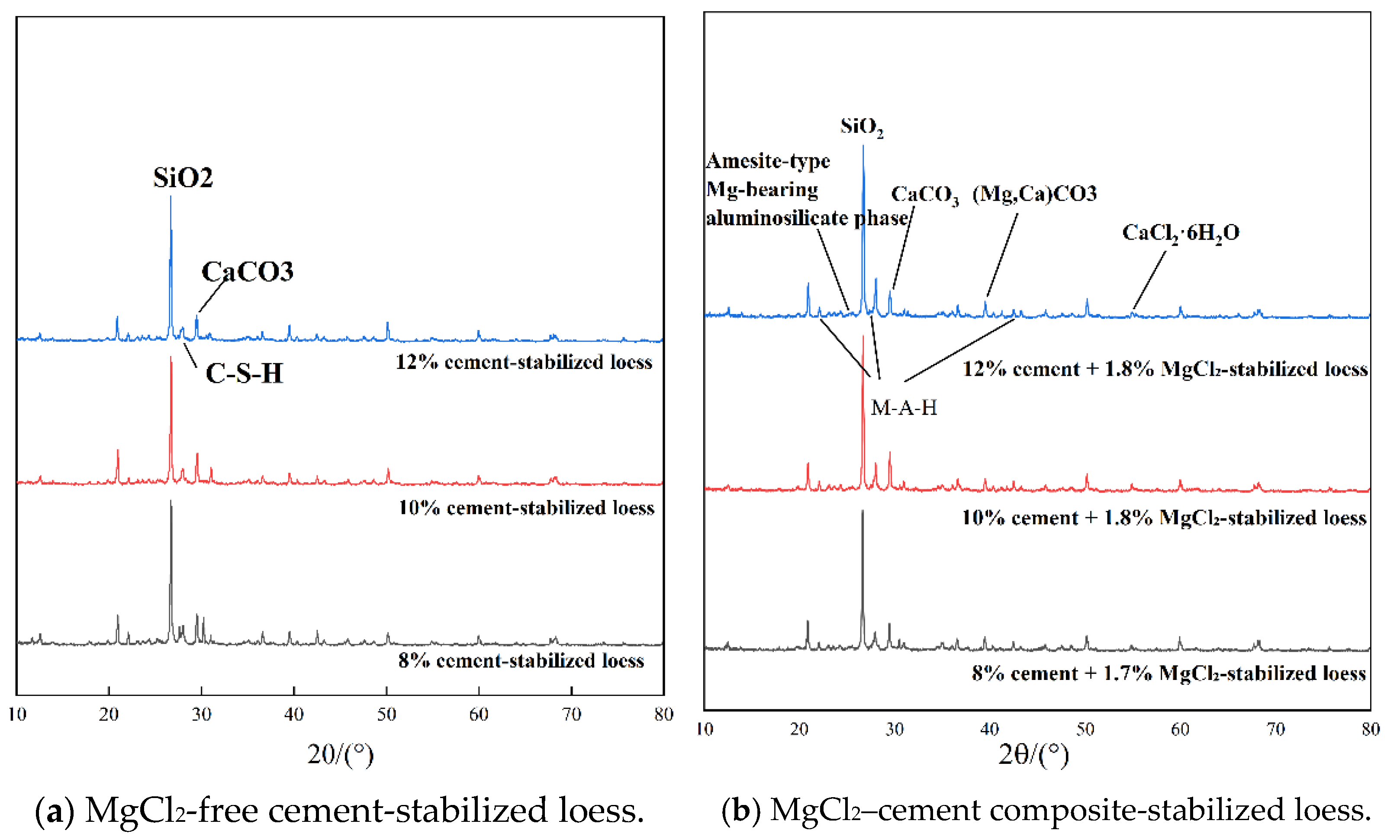
The X-ray diffraction patterns of the 28-day specimens are presented in
Figure 3. As shown in
Figure 3a, the cement-stabilized loess without MgCl
2 was dominated by quartz and calcite, together with diffraction features associated with cement hydration products such as C-S-H. Quartz was mainly inherited from the original loess and constituted the primary mineral framework, whereas calcite may originate from both indigenous carbonate minerals and carbonation of Ca-bearing hydration products during curing. After the incorporation of MgCl
2 (
Figure 3b), additional diffraction features assigned to Mg-bearing calcite, amesite-type Mg-bearing aluminosilicate phases, M-A-H-related phases, and CaCl
2·6H
2O were observed. Compared with the corresponding MgCl
2-free specimens, the occurrence of these Mg- and Cl-bearing phases suggests that MgCl
2-derived ions participated in the phase evolution of the cement–loess system rather than remaining solely in the pore solution. In particular, the diffraction features assigned to (Mg,Ca)CO
3 are consistent with the possible incorporation of Mg
2+ into carbonate-related phases, while the amesite-type and M-A-H-related features suggest possible interactions between Mg
2+ and Al- and Si-bearing constituents in the loess–cement matrix. The detection of CaCl
2·6H
2O further indicates that Cl
− may also participate in the formation of chloride-containing crystalline products.
From the perspective of phase evolution, the XRD results indicate that MgCl2-derived ions participated in the chemical evolution of the cement–loess system rather than remaining solely in the pore solution. Compared with the MgCl2-free specimens, the MgCl2-modified specimens exhibited additional diffraction features assigned to Mg-bearing calcite, amesite-type Mg-bearing aluminosilicate phases, M-A-H-related phases, and CaCl2·6H2O. These changes provide evidence for the chemical involvement of MgCl2 in the stabilized system.
According to Han et al. [
19], MgCl
2 can participate in reactions within cement-treated soil and promote the formation of Mg-bearing and chloride-containing products, including M-S-H, M-A-H, CaCl
2·6H
2O, Mg
2(OH)
3Cl·4H
2O, and C
3A·CaCl
2·12H
2O. These reactions were reported to produce a combined effect of alteration of existing cementitious phases and crystallization of newly formed products. In the present study, the diffraction features assigned to M-A-H-related phases and CaCl
2·6H
2O, together with Mg-bearing calcite and amesite-type Mg-bearing aluminosilicate phases, are consistent with this reaction framework. Therefore, the XRD results support the participation of MgCl
2-derived Mg
2+ and Cl
− in hydration-, carbonation-, and aluminosilicate-related phase evolution. Because some cement hydration products and Mg-bearing phases exhibit low crystallinity, broad diffraction features, and overlapping characteristic peaks, distinguishing structurally or chemically similar hydration phases by XRD alone may involve uncertainty. Therefore, the assignments of M-A-H-related, amesite-type Mg-bearing aluminosilicate, and other Mg-bearing phases in this study are interpreted qualitatively based on the overall diffraction patterns and reference PDF data rather than as definitive identification of individual hydration products. Nevertheless, the differences between the MgCl
2-free and MgCl
2-modified specimens support the chemical participation of MgCl
2-derived ions in the phase evolution of the cement–loess system.
The preceding test results showed that the unconfined compressive strength increased after an appropriate amount of MgCl2 was incorporated, and that more interparticle filling materials and cementitious products were observed in the SEM images. These findings, from both macroscopic mechanical and microscopic structural perspectives, further indicate that MgCl2 did not simply act as an inert external salt. Instead, it participated in the formation and evolution of the internal structure of the stabilized loess.
This finding indicates that magnesium chloride may exert a dual influence on cement-stabilized loess. When the magnesium chloride dosage is within an appropriate range, magnesium ions can improve the internal soil structure through ion exchange, promotion of particle flocculation, and crystallization within the pore spaces. These effects are favorable for forming a denser particle arrangement, reducing the proportion of large pores, lowering the overall porosity, and consequently increasing the strength of the stabilized loess. However, magnesium chloride does not always produce a positive effect in cement-based stabilization systems. When the magnesium chloride dosage is excessive, the increased concentration of magnesium ions may change the chemical environment of the pore solution, interfere with the stability of cementitious products, and further affect the continued hydration process during later curing. Therefore, the influence of magnesium chloride on cement-stabilized loess can be understood as a dosage-dependent effect, namely enhancement at a suitable dosage and deterioration when the dosage becomes excessive. This interpretation is also consistent with the unconfined compressive strength results, where the strength increased at first and then decreased as the magnesium chloride content continued to rise.
3.4. Microstructural Characteristics and Pore Evolution
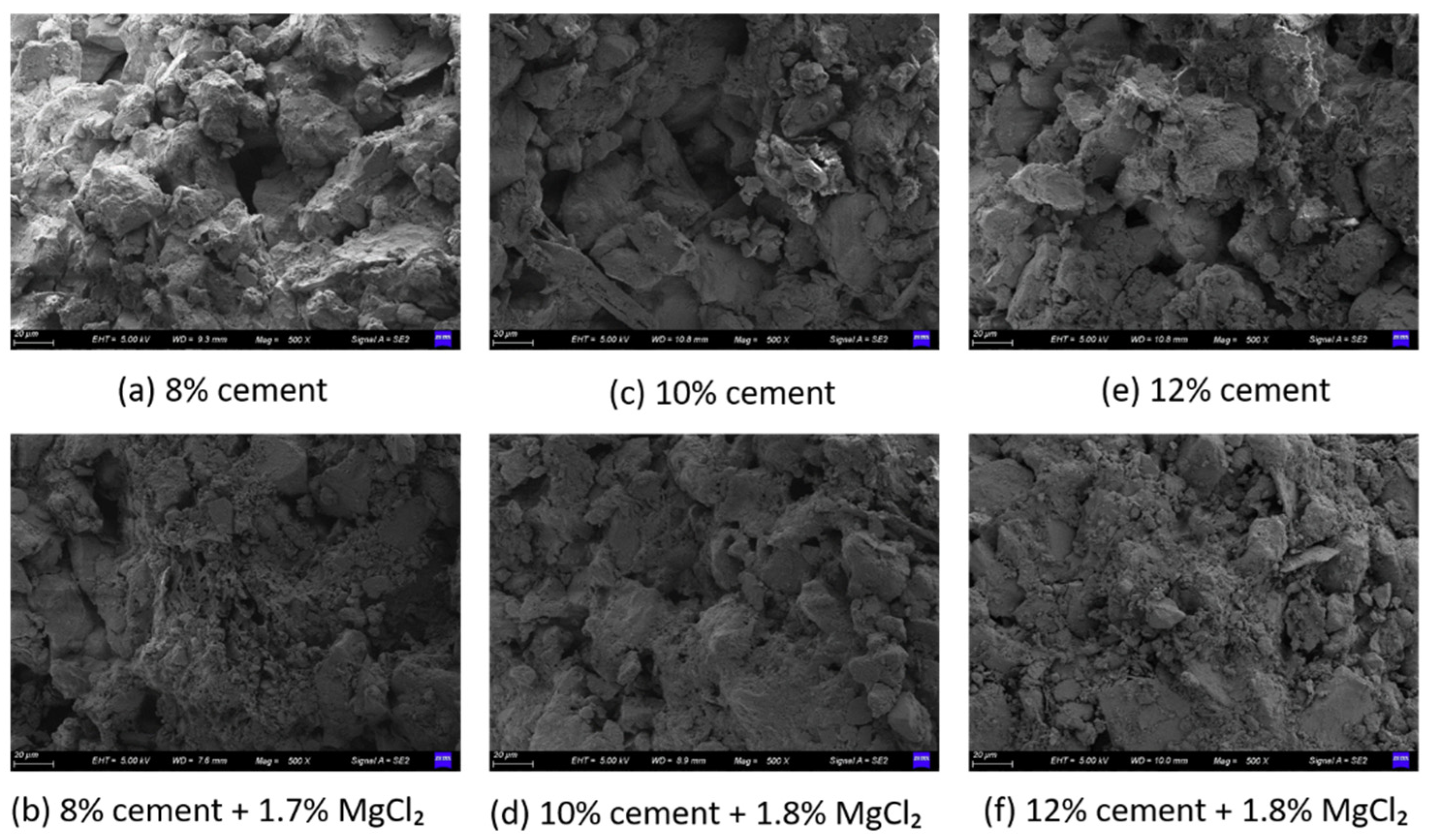
Figure 4 shows SEM images at 500× magnification for the specimens treated with 8% cement, 8% cement + 1.7% MgCl
2, 10% cement, 10% cement + 1.8% MgCl
2, 12% cement, and 12% cement + 1.8% MgCl
2. The SEM images show that the cement-only specimens still contained numerous irregular pores and locally unsupported structures. The particle boundaries were relatively distinct, and the overall structure remained comparatively loose. As the cement content increased from 8% to 12%, the amount of hydration products and filling materials attached to particle surfaces gradually increased, and the pore size decreased to some extent. This indicates that cement hydration products promoted interparticle bonding and pore filling. Compared with the cement-only specimens, the composite-stabilized specimens containing an appropriate amount of MgCl
2 exhibited a marked increase in fine particles and flocculent cementitious products on particle surfaces. Interparticle bridging was enhanced, large pores were subdivided and transformed into smaller pores, and the soil structure became significantly denser. Among the tested mixtures, the specimen containing 12% cement and 1.8% MgCl
2 exhibited the densest microstructure, followed by the specimen containing 10% cement and 1.8% MgCl
2. Although the specimen containing 8% cement and 1.7% MgCl
2 showed a clear improvement compared with the 8% cement-only specimen, some pores were still retained.
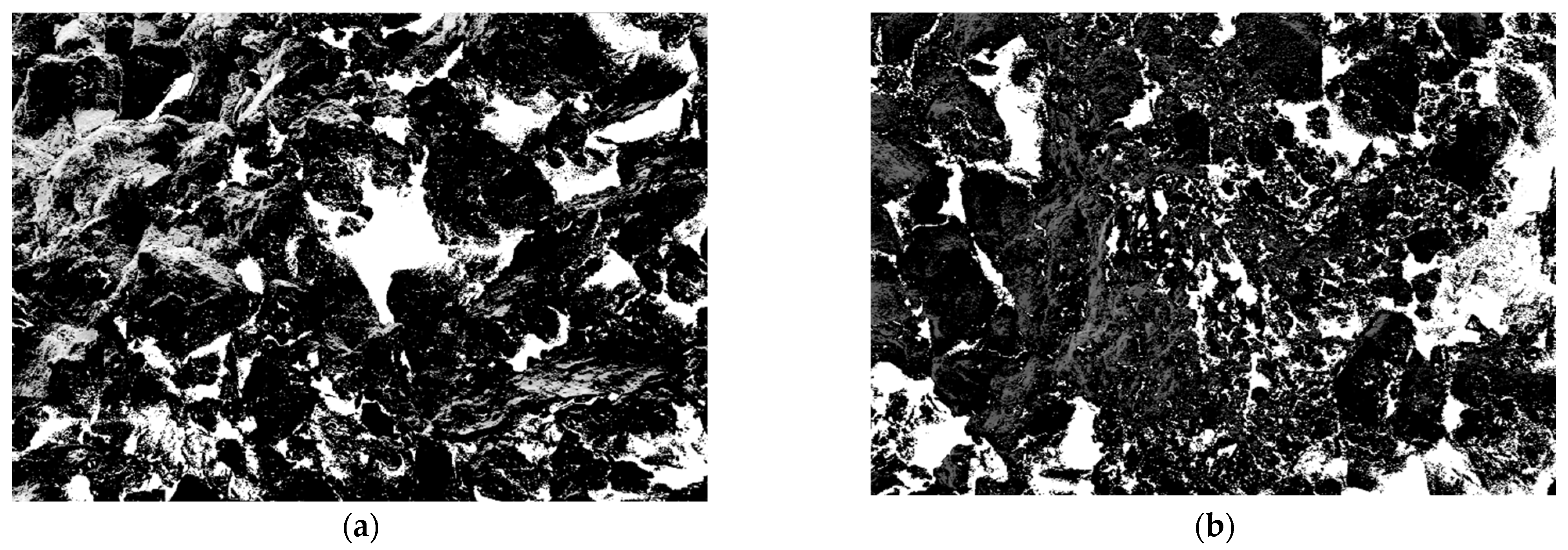
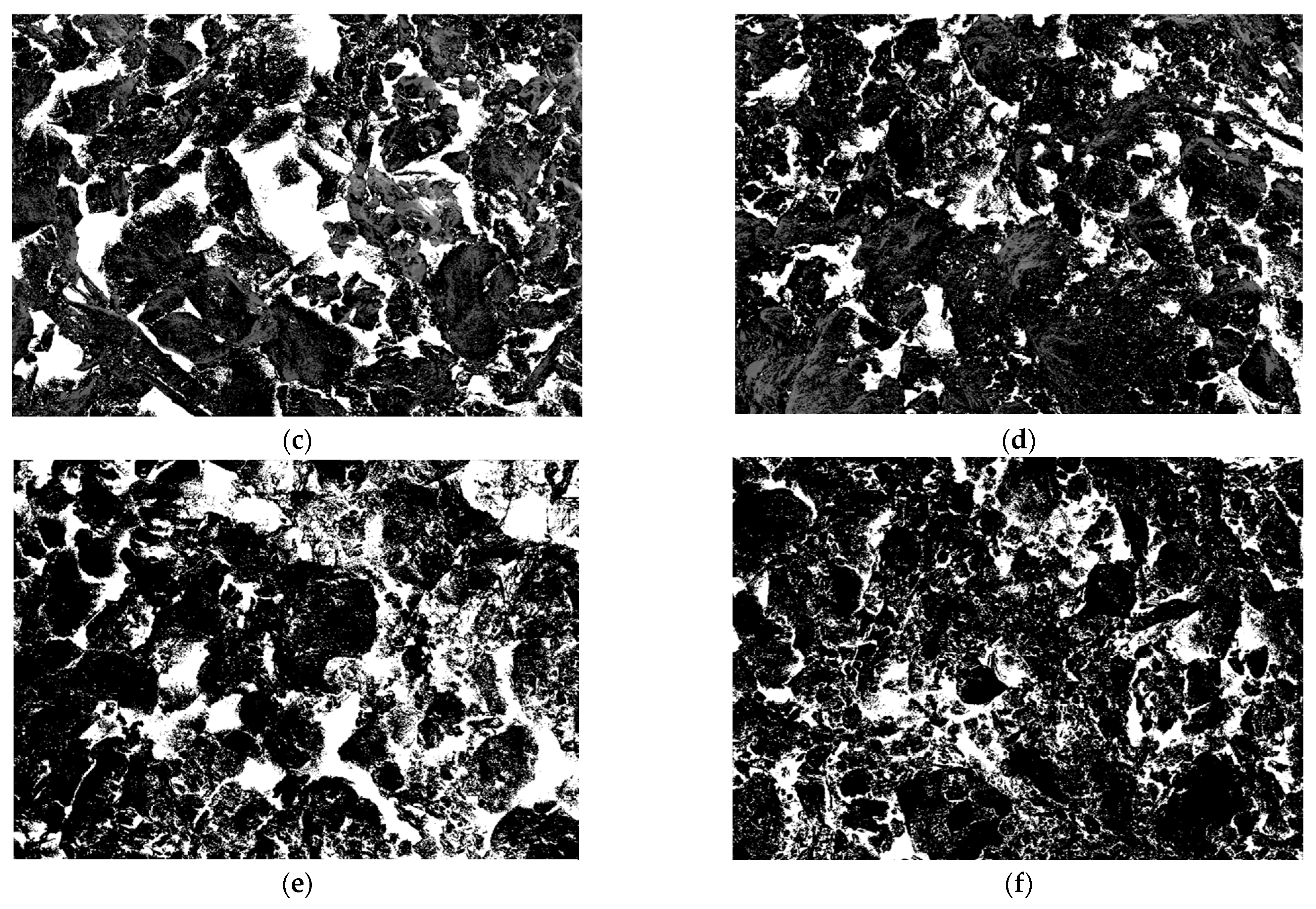
To describe the microstructural changes more quantitatively, the SEM images of each specimen were analyzed with Image-Pro Plus 6.0, and the pore number as well as the corresponding apparent pore-area ratio were calculated from the processed images. The micrographs were binarized according to the procedure proposed by Feng et al. [
27]. As shown in
Figure 5, the white regions in the binarized images denote pores, whereas the black regions correspond to soil particles. SEM images obtained at the same magnification were processed using Image-Pro Plus 6.0 following the binarization procedure proposed by Feng et al. After image segmentation, pore and surface-depression regions were represented in the binary images and their total projected area and number were quantified. The apparent pore-area ratio,
, was calculated as
, where
is the total projected area of the identified pore/depression regions and
is the total area of the analyzed SEM image. This parameter represents a two-dimensional surface-area characteristic derived from SEM images and should not be interpreted as the three-dimensional volumetric porosity of the specimen.
The pore number, pore area, and percentage of pore area obtained from these images are summarized in
Table 5. For the specimens stabilized only with cement, the porosities of the 8%, 10%, and 12% cement groups were 41.13%, 36.20%, and 31.92%, respectively, indicating that the pore volume decreased progressively as the cement content increased and that the internal structure became more compact. It should be noted that the 10% and 12% cement groups contained more pores than the 8% cement group, but their total porosities were obviously lower. This result suggests that the evolution of the pore system was not simply controlled by a decrease in pore number. Rather, some larger pores were gradually subdivided into a greater number of smaller pores, while the development of large pores and connected pores was effectively restricted, thereby improving the overall structural stability. After an appropriate amount of MgCl
2 was added, the porosities of the corresponding specimens further decreased to 38.51%, 34.47%, and 29.53%, respectively. This further confirms that the combined action of MgCl
2 and cement strengthened the filling, coating, and cementation among soil particles, allowing the pore structure to be further refined. Among all mixtures, the specimen containing 12% cement and 1.8% MgCl
2 had the lowest porosity and the densest microstructure, which agrees well with its highest unconfined compressive strength. The specimen containing 10% cement and 1.8% MgCl
2 showed the second-best pore refinement effect, suggesting that this mixture provides a more balanced choice in terms of microstructural densification and material economy. Overall, the incorporation of an appropriate amount of MgCl
2 not only reduced the total porosity of the stabilized loess but also promoted the transformation of large pores into smaller pores and improved the pore-size distribution. These microstructural improvements contributed to the increase in the overall strength of the stabilized loess.
3.5. Pore-Structure Characteristics Based on Nuclear Magnetic Resonance
The porosity and pore-size distribution of the entire specimens were determined by nuclear magnetic resonance tests for the cement-only specimens and the specimens treated with cement and the optimum MgCl
2 dosage. The porosity results are listed in
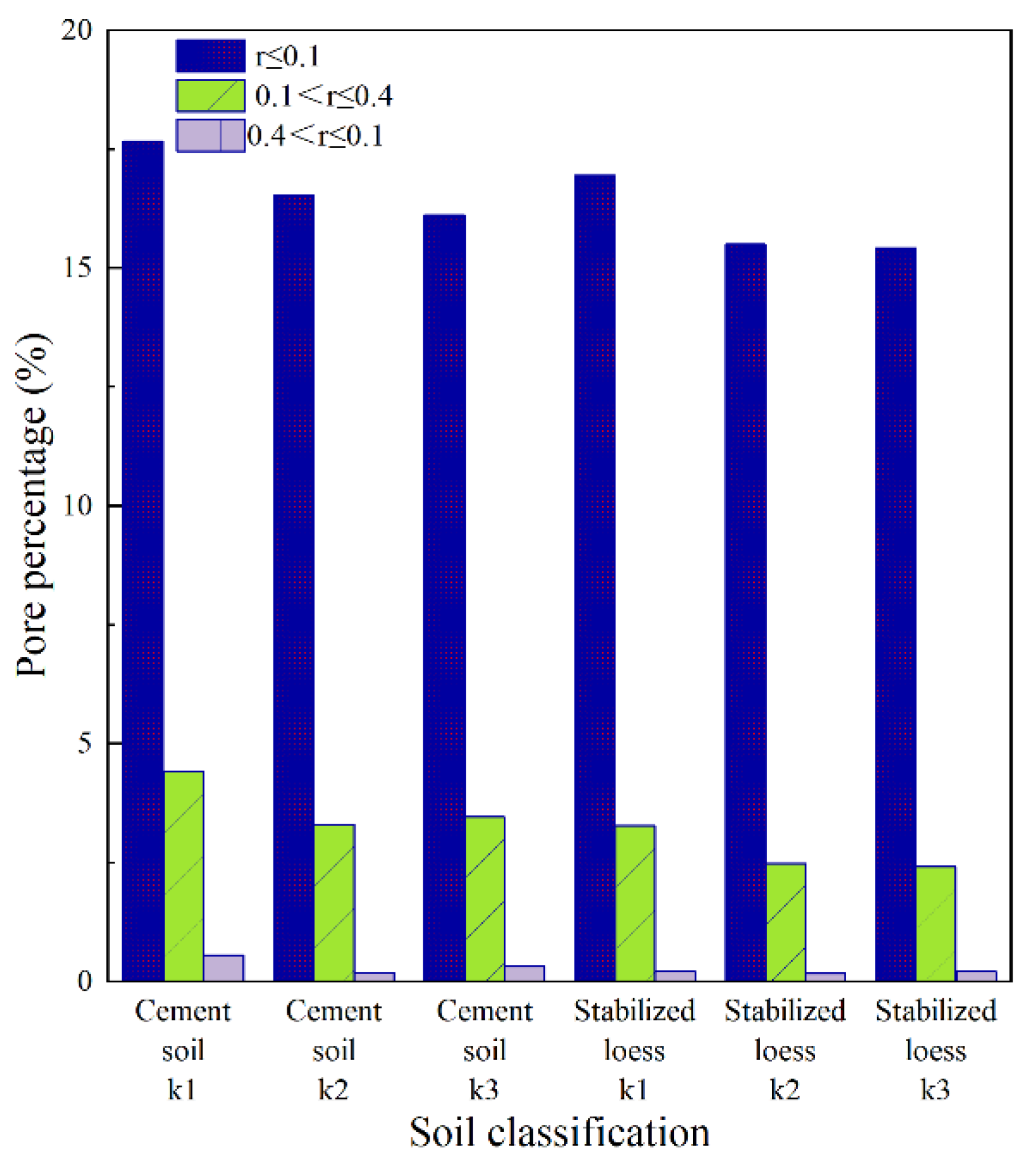
Table 3. The cumulative pore-radius distribution curves are shown in
Figure 6. In
Figure 6, the MgCl
2-treated specimens with the optimum mixture proportions are denoted as stabilized soils k1–k3, whereas the cement-only specimens without MgCl
2 are denoted as cement-stabilized soils k1–k3.
As shown in
Table 6 and
Figure 6, the pores in all specimens were dominated by small pores, followed by medium pores, whereas large pores accounted for the smallest proportion. This indicates that the pore structure of the stabilized loess was generally controlled by small pores.
For the cement-only specimens, the total porosities of the specimens with 8%, 10%, and 12% cement were 22.65%, 20.02%, and 19.89%, respectively. The 8% cement specimen exhibited the highest porosity, indicating that its internal pores were more developed and that its structure was relatively loose. When the cement content increased to 10%, the total porosity decreased markedly, suggesting that increasing the cement content was beneficial for improving the pore structure of the soil. When the cement content was further increased to 12%, the porosity decreased slightly to 19.89%. However, the difference between the 10% and 12% cement specimens was relatively small, indicating that the pore-reducing effect became less pronounced with a further increase in cement content.
After the optimum MgCl2 dosage was incorporated, the total porosity of all three specimen groups further decreased. The total porosities of the specimens containing 8% cement + 1.7% MgCl2, 10% cement + 1.8% MgCl2, and 12% cement + 1.8% MgCl2 were 20.45%, 18.15%, and 18.05%, respectively. Compared with the corresponding cement-only specimens, the porosity decreased by 2.200, 1.870, and 1.840 percentage points, corresponding to relative reductions of 9.713%, 9.341%, and 9.251%, respectively. These results indicate that an appropriate MgCl2 dosage further reduced the total porosity of the cement-stabilized loess and produced a denser specimen structure. Among the composite-stabilized specimens, the specimen containing 12% cement and 1.8% MgCl2had the lowest porosity, at 18.05%, indicating the densest microstructure. The specimen containing 10% cement and 1.8% MgCl2 had a porosity of 18.15%, which was only 0.100 percentage points higher than that of the 12% cement + 1.8% MgCl2 specimen. This small difference suggests that the incorporation of 1.8% MgCl2 under the 10% cement condition also achieved effective pore-structure optimization.
From the perspective of pore-size composition, the incorporation of MgCl2 not only reduced the total porosity but also decreased pores of different size classes to varying degrees. For the specimen with 8% cement, after 1.7% MgCl2 was added, the proportion of small pores decreased from 17.672% to 16.951%, medium pores decreased from 4.416% to 3.282%, and large pores decreased from 0.563% to 0.218%. Among these pore classes, the reduction in large pores was the most pronounced, indicating that MgCl2 had a stronger inhibitory effect on larger pores. For the specimen with 10% cement, after 1.8% MgCl2 was incorporated, the proportion of small pores decreased from 16.523% to 15.505%, medium pores decreased from 3.308% to 2.476%, and large pores decreased from 0.189% to 0.169%, indicating further refinement of the pore structure. For the specimen with 12% cement, after 1.8% MgCl2 was added, the proportion of small pores decreased from 16.109% to 15.422%, medium pores decreased from 3.457% to 2.418%, and large pores decreased from 0.324% to 0.210%. This result shows that medium and large pores were both effectively suppressed after composite stabilization.
Combined with the SEM observations, the cement-only specimens still contained a certain number of interparticle pores and locally unsupported structures, and the particle boundaries remained relatively distinct. This indicates that although cement hydration products provided partial filling and cementation effects, their improvement of the pore structure was still insufficient. After an appropriate amount of MgCl2 was incorporated, more surface attachments and flocculent cementitious products were observed on the particles, the interparticle connections became tighter, and pore connectivity was reduced. Consequently, the soil structure gradually transformed from a relatively loose state to a denser state. This result suggests that the combined action of MgCl2 and cement further enhanced interparticle cementation and pore-filling effects, thereby improving the internal pore distribution of the stabilized loess. Although the absolute pore-related values obtained from SEM image analysis and NMR were different, both methods exhibited a consistent tendency toward pore refinement with increasing cement content and the incorporation of an appropriate MgCl2 dosage. This difference in absolute values is mainly related to the distinct measurement scales and principles of the two techniques. SEM image analysis characterizes the projected area of pores and surface depressions within selected two-dimensional microscopic regions, whereas NMR evaluates the water-filled pore system of the entire saturated specimen based on the transverse relaxation behavior of pore water. Therefore, the SEM-derived apparent pore-area ratio should not be directly equated with the NMR-derived volumetric porosity. Rather, the two techniques provide complementary evidence of pore-structure evolution at local microscopic and whole-specimen scales.
3.6. Correlation Between Porosity and Strength
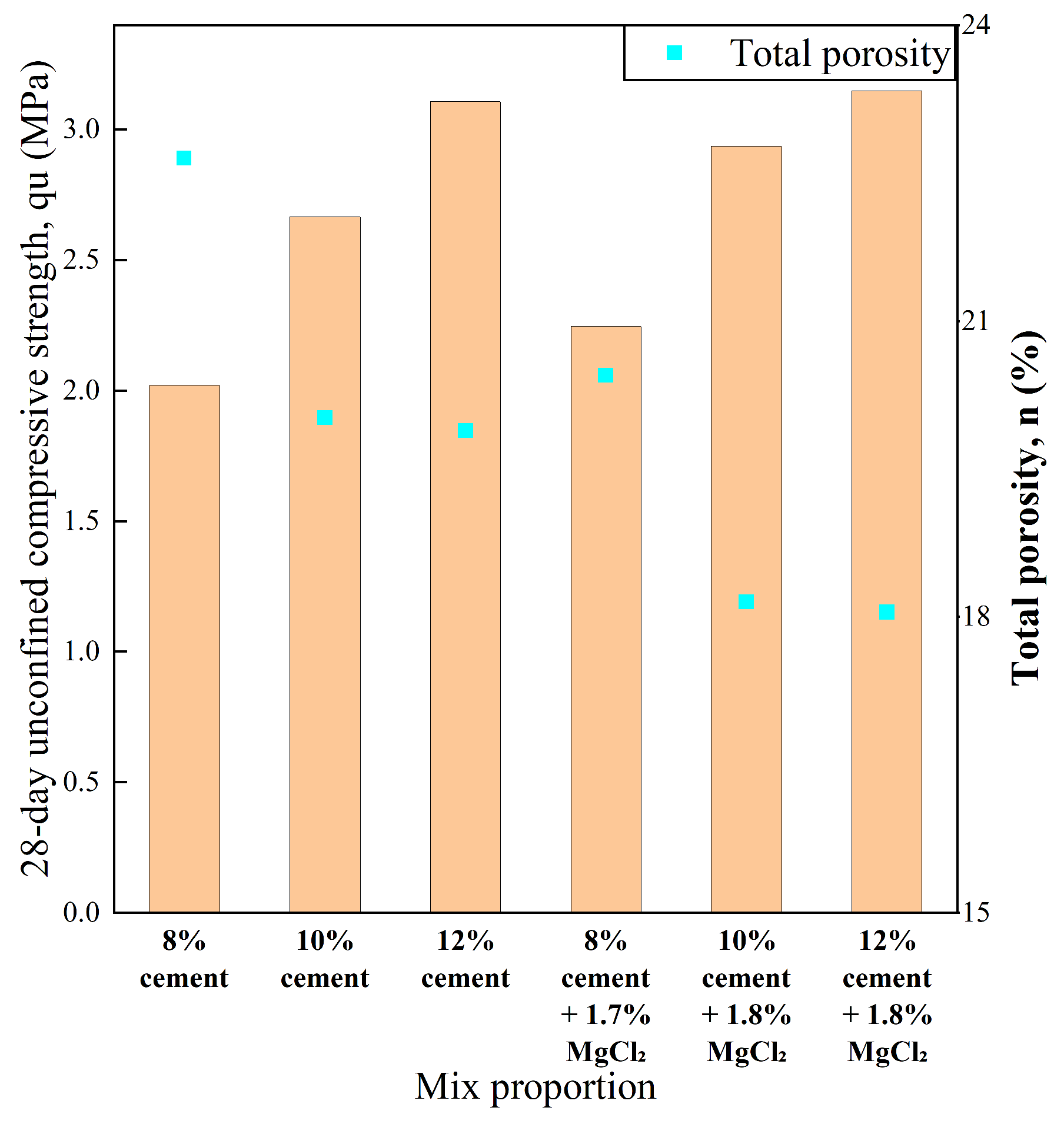
Figure 7 shows the relationship between total porosity and 28-day unconfined compressive strength. From left to right, the porosity values correspond to specimens treated with 8% cement, 10% cement, 12% cement, 8% cement + 1.7% MgCl
2, 10% cement + 1.8% MgCl
2, and 12% cement + 1.8% MgCl
2. A good correspondence was observed between total porosity and 28-day unconfined compressive strength. In general, lower porosity corresponded to higher strength, indicating that pore-structure improvement was one of the main reasons for strength enhancement. For the cement-only specimens, the specimen with 8% cement had the highest porosity and the lowest strength. As the cement content increased, the porosity decreased and the strength increased accordingly. After an appropriate amount of MgCl
2 was incorporated, the porosity of each specimen group further decreased, and the corresponding 28-day strength increased. This indicates that MgCl
2 further optimized the soil structure on the basis of cement stabilization. Among all specimens, the specimen containing 12% cement and 1.8% MgCl
2 had the lowest porosity and the highest strength, indicating that it had the densest internal structure. The porosity of the specimen containing 10% cement and 1.8% MgCl
2 was very close to that of the 12% cement + 1.8% MgCl
2 specimen, and its strength also remained at a relatively high level, suggesting that this mixture also achieved a favorable stabilization effect. In contrast, the specimens containing 8% cement and 8% cement + 1.7% MgCl
2 had relatively higher porosities and lower strengths, indicating that the degree of densification remained limited under the low cement content condition.
However, the strength development of the stabilized loess cannot be explained solely by changes in total porosity. The pore-size distribution also plays an important role in controlling the mechanical response. The NMR results showed that the incorporation of an appropriate MgCl2 dosage reduced the proportions of medium and large pores, with the reduction in larger pores being particularly evident in several mixtures. The decrease in these relatively large pore spaces may reduce local structural discontinuities and stress concentration within the soil matrix, thereby contributing to a more uniform load-transfer framework. Meanwhile, SEM observations revealed closer particle contacts, increased interparticle bridging, and a denser cementitious matrix after the incorporation of an appropriate MgCl2 dosage. These observations suggest that strength enhancement was associated not only with a reduction in total porosity but also with pore refinement and improved interparticle bonding. Therefore, the mechanical performance of the MgCl2–cement-stabilized loess should be interpreted as the combined result of total porosity, pore-size distribution, and the degree of interparticle cementation rather than as a simple function of total porosity alone.
4. Discussion
The experimental results indicate a clear dosage-dependent effect of MgCl2 on the mechanical performance and microstructural evolution of cement-stabilized loess. The UCS exhibited a non-monotonic response with increasing MgCl2 dosage, showing an initial decrease, followed by an increase and a subsequent decline. At the optimum MgCl2 dosage, NMR measurements showed reductions in total porosity and in the proportions of medium and large pores, while SEM observations revealed closer particle contacts, enhanced interparticle bridging, and a denser internal structure. In addition, the XRD patterns of the MgCl2-modified specimens exhibited diffraction features assigned to Mg-bearing calcite, amesite-type Mg-bearing aluminosilicate phases, M-A-H-related phases, and chloride-containing crystalline products. These experimentally observed changes were consistent with the corresponding variation in UCS.
Based on these observations and the reaction mechanisms reported in previous studies, the strength enhancement at an appropriate MgCl
2 dosage may result from the combined effects of particle-scale physicochemical interactions and phase evolution. Mg
2+ may promote particle aggregation through ion exchange and compression of the diffuse double layer, while Mg
2+ and Cl
− may also participate in reactions involving cement-derived Ca-, Si-, and Al-bearing constituents. According to Han et al. [
19], MgCl
2 can participate in reactions within cement-treated soil and promote the formation of Mg-bearing and chloride-containing reaction products. The Mg-bearing and chloride-containing diffraction features observed in the present study are consistent with such a reaction framework. These processes may contribute to enhanced interparticle bonding, pore filling, and pore refinement, thereby providing a plausible explanation for the observed strength increase.
At excessive MgCl2 dosages, the reduction in UCS may be associated with an unfavorable change in the chemical environment of the cementitious matrix. Previous studies have suggested that high Mg2+ concentrations may alter or destabilize Ca-bearing hydration products such as C-S-H and promote the formation of Mg-bearing phases with different binding characteristics. Excessive Mg2+ and Cl− may therefore disturb the normal evolution of the cementitious structure and reduce the beneficial effect of pore refinement. However, these specific reaction pathways were not directly quantified in the present study and should therefore be regarded as plausible mechanisms rather than experimentally confirmed reactions. Moreover, because some hydration products exhibit low crystallinity and overlapping diffraction peaks, the identification and evolution of individual Mg-bearing phases based on XRD remain qualitative.
The effect of MgCl2 was also dependent on the cement content, indicating an interaction between the availability of cementitious constituents and the MgCl2 dosage. For the 8% cement group, the optimum MgCl2 dosage was 1.7%, whereas the optimum shifted slightly to 1.8% for the 10% and 12% cement groups. One possible explanation is that increasing the cement content provides a larger amount of Ca-, Si-, and Al-bearing hydration products and reactive constituents within the stabilized matrix. Consequently, a slightly higher MgCl2 dosage can be accommodated because more cement-derived phases are available to interact with Mg2+ and Cl− and to participate in the evolution of Mg-bearing and chloride-containing products. At an appropriate dosage, these interactions may accompany enhanced interparticle bonding and pore filling, thereby contributing to pore refinement and strength development.
At the lower cement content of 8%, the amount of available cement hydration products is more limited, and the stabilized matrix is less developed. Under this condition, excessive MgCl2 may more readily disturb the balance of cement hydration and therefore the optimum dosage occurs at a slightly lower level. In contrast, the 10% and 12% cement mixtures contain a greater quantity of hydration products and a denser cementitious framework, allowing a slightly higher MgCl2 dosage before adverse effects become dominant. However, the additional benefit of MgCl2 becomes less pronounced at the highest cement content. For example, although the 12% cement–1.8% MgCl2 mixture exhibited the highest UCS and lowest total porosity, the relative 28-day strength increase caused by MgCl2 was substantially smaller than that observed for the 10% cement group. This suggests that once a relatively dense cementitious skeleton has already been established, further MgCl2-induced pore refinement produces a diminishing mechanical benefit. Therefore, the optimum MgCl2 dosage is controlled not only by the amount of MgCl2 itself but also by the availability of cement-derived reactive phases and the initial degree of pore refinement in the cement-stabilized matrix. Overall, although the 12% cement–1.8% MgCl2 mixture achieved the highest strength, the 10% cement–1.8% MgCl2 mixture provided a more favorable balance between mechanical performance and cement consumption.
From an engineering perspective, the findings provide evidence that MgCl2 can serve as an auxiliary modifier for cement-stabilized loess Compared with further increasing the cement content, the incorporation of an appropriate MgCl2 dosage may provide a means of maintaining favorable mechanical performance at a relatively lower cement content. Nevertheless, the long-term durability of MgCl2–cement-stabilized loess requires further consideration because MgCl2 introduces soluble Mg2+ and Cl− into the stabilized matrix. Under repeated wetting–drying conditions, these ions may migrate with pore water and undergo dissolution–redistribution–recrystallization processes, potentially leading to local salt accumulation and changes in the pore structure. Freeze–thaw exposure may further interact with salt migration by promoting moisture redistribution and repeated volumetric changes, which could gradually weaken the stabilized structure. In addition, prolonged exposure to Mg2+ may alter the stability of Ca-bearing hydration products, while mobile Cl− may present additional durability concerns when the stabilized soil is used adjacent to reinforced concrete or metallic facilities. Therefore, although the present results demonstrate favorable short-term mechanical and microstructural performance within the investigated 28-day curing period, the long-term durability of the MgCl2-containing system cannot be fully evaluated from the current tests. Future studies should systematically investigate strength retention, mass loss, chloride migration and leaching, pore-structure evolution, and phase changes under repeated wetting–drying and freeze–thaw cycles to establish the long-term applicability of MgCl2–cement stabilization.
5. Conclusions
(a) The combined stabilization of loess with MgCl2 and cement modified the compaction characteristics of the specimens. At the MgCl2 dosages identified as optimal from the UCS results, namely 1.7% for the 8% cement group and 1.8% for the 10% and 12% cement groups, the corresponding maximum dry densities were 1.85, 1.85, and 1.86 Mg/m3, respectively, while the optimum moisture contents were 13.5%, 13.2%, and 13.6%, respectively. These results indicate that the compaction response of MgCl2-modified cement-stabilized loess depends on both cement content and MgCl2 dosage.
(b) MgCl2 exhibited a distinct optimum-dosage effect on the unconfined compressive strength of cement-stabilized loess. At curing ages of 7 and 28 days, the strength of each specimen group generally decreased first, then increased, and finally decreased with increasing MgCl2 content. The preferred MgCl2 dosage for the 8% cement group was slightly lower than those for the 10% and 12% cement groups. In terms of strength performance, the combination of 12% cement and an appropriate MgCl2 dosage produced the highest unconfined compressive strength, whereas the combination of 10% cement and an appropriate MgCl2 dosage provided a more balanced performance in terms of strength improvement and material consumption. For the 8% cement group, only the specimen with 1.7% MgCl2 showed strength improvement at 7 days, whereas specimens with 1.3–1.8% MgCl2 exhibited enhanced strength at 28 days. This indicates that an appropriate MgCl2 dosage contributed more effectively to later-age strength development. However, a MgCl2 content of 1.9% caused strength reduction.
(c) The strength increased markedly when the cement content increased from 8% to 10%, whereas the strength increment became smaller when the cement content further increased from 10% to 12%. This indicates that the strengthening effect of cement exhibited a marginally decreasing tendency. Overall, the mixture containing 10% cement and an appropriate MgCl2 dosage maintained favorable strength performance while using less cement than the 12% cement mixture. At the optimum MgCl2 dosages, the 7-day UCS values of the 8%, 10%, and 12% cement groups increased by 7.36%, 14.45%, and 14.35%, respectively, compared with the corresponding MgCl2-free specimens, while the corresponding increases at 28 days were 11.14%, 10.21%, and 1.27%. These results indicate that the strengthening effect of MgCl2 depended on both cement content and curing age rather than increasing continuously with MgCl2 dosage.
(d) At the optimum MgCl2 dosages, the total porosity of the 8%, 10%, and 12% cement groups decreased by 9.713%, 9.341%, and 9.251%, respectively, compared with the corresponding cement-only specimens. Based on the grouped pore-size distribution, the approximate mean pore radii of the MgCl2-modified specimens were 0.089, 0.083, and 0.084 μm, respectively. The proportions of medium and large pores were also reduced, indicating an overall refinement of the pore structure. The conclusions of this study should be interpreted within the investigated experimental conditions. The results were obtained for the specific Lanzhou loess used in this study under controlled laboratory curing conditions, with cement contents of 8–12% and MgCl2 dosages of 0–1.9% of the cement mass. Therefore, the identified optimum MgCl2 dosages and the associated strength and pore-structure responses may vary for loess with different mineralogical compositions, initial properties, or environmental conditions. In addition, the present study was conducted at the laboratory scale and focused primarily on short-term mechanical and microstructural behavior. Future research should therefore investigate the long-term durability of MgCl2-modified cement-stabilized loess under representative environmental exposure conditions, including repeated wetting–drying, freeze–thaw cycles, and salt migration or leaching, with particular attention to the evolution of mechanical properties, pore structure, and hydration phases during prolonged exposure. Field-scale validation is also required to assess the effectiveness, durability, and applicability of the proposed stabilization system under actual construction and service conditions before the identified mixture proportions can be broadly applied in engineering practice.