Article

Rubber Aggregate Concrete with Enhanced Damping Performance for Mass Concrete Applications

1
Anhui and Huaihe River Institute of Hydraulic Research, Hongfeng Road 55, Gaoxin Region, Hefei 230088, China
2
Anhui Construction Engineering Quality Supervision and Inspection Station Co., Ltd., Hefei 230094, China
*
Author to whom correspondence should be addressed.
Buildings 2026, 16(15), 3133; https://doi.org/10.3390/buildings16153133
Submission received: 1 July 2026 / Revised: 27 July 2026 / Accepted: 5 August 2026 / Published: 6 August 2026
(This article belongs to the Special Issue Advanced Research on Concrete Materials in Construction)

Abstract

Mass concrete structures are subjected to long-term dynamic excitations, yet traditional concrete lacks the damping needed for effective vibration control. Rubber aggregate concrete has shown promise for vibration mitigation, but how rubber particle size and replacement ratio govern damping mechanisms and thermal performance in mass concrete remains unclear. Here we study rubber aggregate concrete with two particle sizes (40-mesh and 100-mesh) at 5%, 10%, and 20% sand replacement, combining mechanical, thermal, and dynamic testing with multi-scale microstructural characterization including FTIR, MIP, and nanoindentation. The damping ratio increased by up to 110% (from 1.43% to 3.01%), the adiabatic temperature rise decreased by 32%, and the linear expansion coefficient by 88%. Three damping mechanisms were identified: rubber viscoelasticity, interfacial friction at the weak rubber–mortar interface, and pore and micro-crack energy dissipation. Finer 100-mesh rubber outperformed coarser 40-mesh at higher replacement ratios due to a micro-filler effect that refined pore structure. RC-20-100 achieved 26.6 MPa at 90 days, adequate for non-primary structural elements. We recommend 20% fine rubber as the optimal balance of high damping, thermal crack mitigation, and adequate strength for vibration-controlled mass concrete applications.

1. Introduction

With the rapid advancement of industrialized construction and the continuous improvement of urban infrastructure systems, the service environments faced by building structures are becoming increasingly complex. External excitations—such as traffic loads, the operation of industrial equipment, and vibrations from the foundations of large machinery—exert long-term effects on structures. These not only may induce safety and durability issues, such as amplified dynamic responses and crack propagation, but also transmit vibrations and noise through the structure, affecting the work efficiency and quality of life of nearby residents [1,2,3]. Although traditional concrete possesses high load-bearing capacity and good engineering applicability, its low material damping and limited energy dissipation capacity result in significant shortcomings in vibration control [4]. When subjected to continuous or periodic dynamic loads, ordinary concrete primarily acts as a medium for vibration transmission and struggles to effectively dissipate the input energy; consequently, it fails to meet the comprehensive demands of modern buildings for vibration control, occupant comfort, and improved service performance.
Due to the incorporation of recycled rubber particles, rubber aggregate concrete exhibits more pronounced elastic deformation and energy dissipation mechanisms [5,6,7], a high damping ratio [8,9], excellent sound absorption and vibration damping properties [10], and strong vibration attenuation capabilities [11]. It shows broad application prospects in the field of structural vibration control [12,13]. Furthermore, the incorporation of rubber aggregate also contributes to the resource recovery of solid waste, such as scrap tires, aligning with the requirements of green building and sustainable development [14,15,16]. Therefore, researching the vibration-damping performance and underlying mechanisms of rubber aggregate concrete is of significant importance for promoting the application of vibration-damping materials in engineering.
Mechanical properties are the most important characteristics of rubber aggregate concrete and have been extensively studied by numerous researchers. Jokar et al. [17] and Li et al. [18] pointed out through experimental studies that as the rubber aggregate replacement rate increases, the compressive strength, tensile strength, and elastic modulus of the concrete gradually decrease. Pacheco-Torres et al. [19] and Noaman et al. [20] investigated the mechanical properties of rubber-aggregate concrete with different particle sizes. Their results indicate that the addition of rubber aggregate improves the concrete’s deformation capacity and fatigue resistance, shifting the failure mode from brittle to ductile. Some studies have shown that for every 1% vol increase in crumb rubber content, the compressive strength of crumb rubber-modified concrete decreases by 3% to 6%, while the corresponding decreases in flexural and shear strengths are approximately 1% [21,22,23]. Based on the results of Holmes et al., it has been shown that significant reductions in compressive strength can be avoided when the crumb rubber replacement level does not exceed 20% of the total aggregate content and is minimized to below 15% [24]. In addition, Güneyisi [25] proposed an optimum rubber particle content of 15% to achieve maximum concrete compressive strength. Currently, the decline in the mechanical properties of rubber aggregate concrete is primarily attributed to three factors. Firstly, rubber aggregate is a flexible material with both strength and elastic modulus lower than those of the cement matrix; when incorporated as aggregate, it struggles to function as a structural framework [26,27]. Secondly, the hydrophobic nature of rubber aggregates leads to the formation of numerous pores at the interface with the cement matrix. At the same time, rubber aggregates develop numerous internal defects during processing and have a relatively large specific surface area. After incorporation, the workability of the concrete is significantly reduced. Coupled with their low density, which causes them to float and leads to bleeding and segregation, this results in a marked decline in the mechanical properties of the concrete [28,29]. Finally, rubber aggregates and cementitious materials differ markedly in their properties, resulting in poor interfacial compatibility. This leads to insufficient bond strength at the interface, and under load, the interface zone is often the first to fail [30,31].
Compared with traditional mineral aggregates, rubber aggregates exhibit significant differences in microstructure. Their surfaces are generally smoother, they have lower chemical reactivity, and their bonding properties with the cement matrix are relatively poor, although this characteristic may have an adverse effect on the material’s static strength and interfacial bonding [32,33,34,35]. However, from the perspective of vibration damping, the flexible interface formed between the rubber and the cement paste, along with the material’s strong ability to coordinate deformation internally, may provide favorable conditions for the dissipation of vibrational energy. Contrary to the mechanical properties mentioned above, the energy dissipation capacity and damping ratio of rubber aggregate concrete increase with increasing rubber content and particle size [36,37,38]. Hassanali et al. [39] found that adding rubber particles to the concrete mix increases the damping ratio. Eltayeb et al. [40] discussed the improvement in damping capacity achieved by rubber particles during the elastic stage of foam concrete. The test results showed that the damping ratio increased by 21.1% and 17.3% when the rubber particle content was 17% and 47.8%, respectively. Lin et al. [41] analyzed the effect of different ages on the damping ratio of rubber-modified concrete. Mo et al. [42] demonstrated an increase in the damping ratio of concrete beams using crumb rubber.
The above studies indicate that rubber-aggregate concrete offers significant advantages in enhancing material damping performance and improving vibration attenuation capabilities; however, its weak interfacial bonding and vibration-damping mechanisms remain unclear. Existing research has largely focused on the effects of rubber content, particle size, and basic mechanical properties, while systematic studies on its dynamic response characteristics, damping evolution patterns, and internal energy dissipation mechanisms remain relatively scarce. Therefore, this study selected rubber particles of two different particle sizes and various replacement ratios. By combining tests of mechanical, thermal, and dynamic properties with multiscale microscopic characterization techniques, including FTIR, MIP, and nanoindentation, it systematically investigated the intrinsic relationship between the macroscopic performance evolution and microstructure of rubber-aggregate concrete. This study provides new insight into the damping enhancement mechanism of rubber-aggregate concrete and its potential for mass concrete applications.

2. Materials and Experimental Methods

2.1. Raw Materials

The cement used in this study was P·II 52.5 Portland cement, which conforms to the requirements of GB175-2023 [43]. Class I fly ash (Grade F) and S95 ground granulated blast furnace slag were employed as supplementary cementitious materials, complying with GB/T 1596-2017 [44] and GB/T 18046-2017 [45], respectively. Their chemical compositions are presented in Table 1.
The fine aggregate was natural river sand with a fineness modulus of 2.4, and the coarse aggregate was crushed stone with a continuous gradation of 5–25 mm. Both aggregates satisfied the requirements of JGJ 52-2006 [46]. A polycarboxylate superplasticizer (standard type) was used as the water-reducing admixture, meeting the specifications of GB 8076-2008 [47].
Two rubber particle aggregates (RPA) with different particle sizes were obtained from the same manufacturer and originated from waste tire rubber powder. According to the inspection report, the rubber powder had a bulk density of 314 kg/m3, an ash content of 8.75%, an iron content of 0.029%, a fiber content of 0%, and an impurity content of 0.014%. The rubber particles were sieved through 40-mesh and 100-mesh screens (nominal apertures of 425 µm and 150 µm, respectively), and were used to partially replace natural sand by mass. The particle size distribution curves of the aggregates are shown in Figure 1.

2.2. Experimental Design and Sample Notation

To investigate the effects of rubber particle size and replacement ratio on the static and dynamic properties of rubber concrete (RC), a reference C30 concrete mixture was first designed. Based on this reference, natural sand was replaced by 40-mesh or 100-mesh rubber particles at mass replacement ratios of 5%, 10%, and 20%. The water-to-binder ratio was kept constant at 0.45 for all mixtures. The detailed mix proportions are given in Table 2.
Cubic specimens (150 mm × 150 mm × 150 mm) and prismatic specimens (100 mm × 100 mm × 300 mm) were cast for each mixture. Three replicate specimens were prepared per group. After casting, all specimens were mechanically vibrated to achieve proper compaction, cured at room temperature for 24 h, demolded, and then transferred to a standard curing room at 20 ± 2 °C and ≥95% relative humidity for 60 or 90 days, in accordance with GB/T-50081 [48].
Fresh concrete properties such as slump and air content were not measured in this study. Nevertheless, the same mixing procedure and water-to-binder ratio were adopted for all mixtures, and the specimens were prepared under identical laboratory conditions to minimize variability in the fresh state. Therefore, the influence of fresh-state variability on the reported porosity results was assumed to be limited.

2.3. Testing Methods

2.3.1. Mechanical Properties Test

Compressive strength and static elastic modulus were determined using a 2000 kN universal testing machine according to GB/T 50081 [48]. Compressive strength tests were performed on 150 mm cubic specimens at a loading rate of 0.5 MPa/s, and the average of three specimens was reported. For static elastic modulus, prismatic specimens (100 mm × 100 mm × 300 mm) were pre-loaded three times up to one-third of the prismatic compressive strength, and deformations were measured with dial gauges; the final value was taken as the average of three specimens.
Splitting tensile strength was measured on 150 mm cubic specimens using the same testing machine with a splitting tensile jig, following GB/T 50081 [48]. The loading rate was 0.05 MPa/s, and the reported result was the average of three specimens.
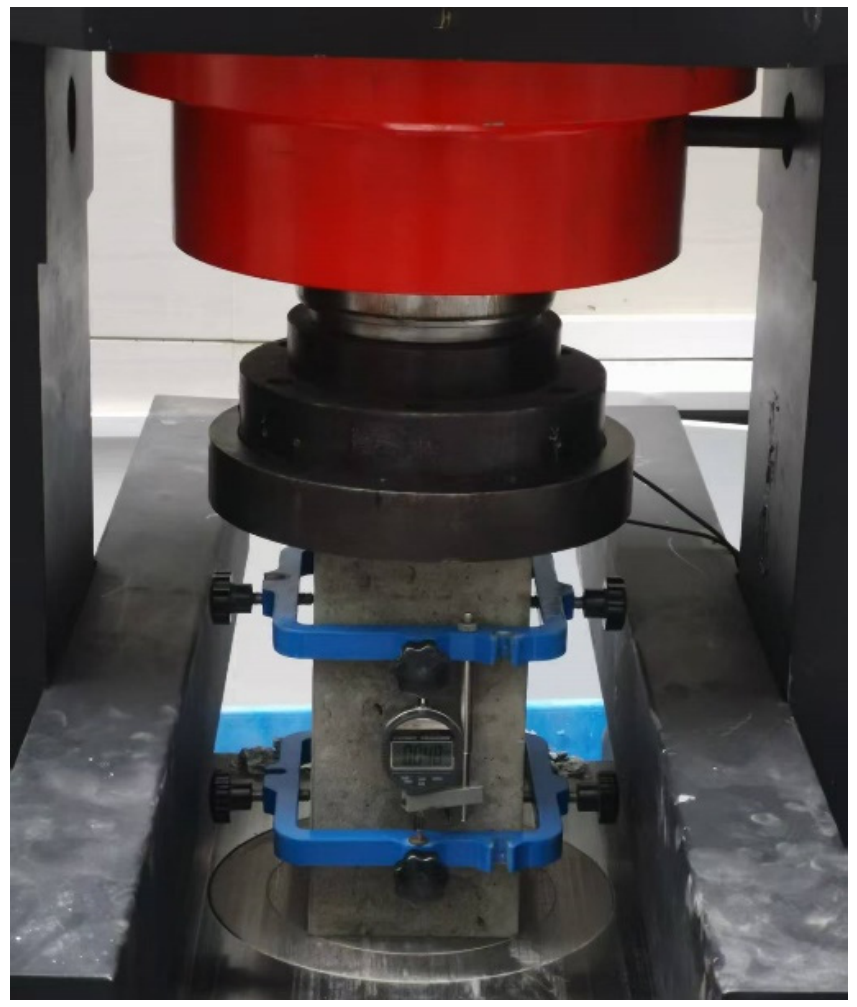
Poisson’s ratio was determined using a static strain testing system during the elastic modulus test, with longitudinal and transverse strains recorded by strain gauges attached to the mid-height of the prismatic specimens, as shown in Figure 2.

2.3.2. Dynamic Properties and Vibration Damping Performance Test

Dynamic elastic modulus was measured using a dynamic elastic modulus tester based on the resonance method, in accordance with GB/T 50082 [49]. Prismatic specimens (100 mm × 100 mm × 300 mm) were excited over a frequency range of 100–10,000 Hz, and the fundamental resonant frequency was identified. The dynamic modulus was calculated from the resonant frequency, specimen mass, and dimensions, and the average of three specimens was taken.
Shear wave velocity was obtained using a non-metal ultrasonic detector following SL/T 264-2020 [50]. Ultrasonic pulses were transmitted through the 150 mm cubic specimens, and the travel time was recorded. The shear wave velocity was calculated as the specimen length divided by the travel time, and the average of three measurements was reported.
Vibration acceleration response was tested using a digital vibration meter. A vibration source with a fixed frequency of 50 Hz [51] (simulating vehicle-induced vertical excitation) was applied to the top surface of the prismatic specimen, and the acceleration at the top center was recorded. The reported value was the average of three specimens.
The damping ratio was evaluated using the free decay method. The prismatic specimen was suspended from a steel frame by two nylon ropes, keeping the specimen parallel to the ground. To minimize the influence of restraint and swing induced by the suspension system, the length of each nylon rope on one side exceeded 2 m. A rubber hammer was used to apply an impact excitation to the specimen to induce free vibration. Three accelerometers were installed at the 1/4, 1/2, and 3/4 positions along one side of the specimen. The damping ratio was calculated using the logarithmic decrement method based on the peak amplitudes separated by 20 vibration cycles to improve the stability and reliability of the results:
ζ = 1 2 π j l n ( u i u i + j )
where j is the number of cycles; ui and ui+j are the peak amplitudes at cycles. The average damping ratio from three specimens was taken.

2.3.3. Thermal Properties Test

Adiabatic temperature rise was measured using an adiabatic temperature rise tester according to SL 352-2020 [52]. Concrete mixtures were placed in a 50 L adiabatic container, and the core temperature was recorded automatically every hour for 28 days. The initial temperature was set to 20 ± 1 °C. The reported temperature rise curves are the averages of two tests.
The linear expansion coefficient was determined using a concrete thermal properties tester following SL 352-2020 [52]. Prismatic specimens (100 mm × 100 mm × 300 mm) were subjected to a temperature range of 10–50 °C at a heating rate of 0.5 °C/min. The linear expansion coefficient was calculated from the measured length change and temperature difference, and the average of three specimens was reported.

2.3.4. Microstructural Analyses Test

Fourier transform infrared (FTIR) spectroscopy was performed using a Thermo Scientific Nicolet iS50 spectrometer (Thermo Fisher Scientific, Waltham, MA, USA) in the range of 4000–400 cm−1 with a resolution of 4 cm−1. Powdered samples were mixed with KBr and pressed into transparent discs. The spectra were used to identify functional groups and assess chemical interactions between rubber and the cementitious matrix. The intensities of the selected FTIR peaks were determined from the baseline-corrected peak heights, and the peak intensities were normalized to the reference band when necessary to facilitate comparison among different mixtures.
Mercury intrusion porosimetry (MIP) was conducted on a Micromeritics AutoPore IV 9500 mercury porosimeter (Micromeritics Instrument Corporation, Norcross, GA, USA). After the test specimens had been cured for 28 days, a small amount of material was taken from them for MIP testing. The samples were crushed into 3–6 mm particles and then immersed in acetone to halt the hydration reaction. Prior to the MIP test, the samples were vacuum-dried at 60 °C for 48 h and kept in the vacuum chamber until testing. The intrusion pressure ranged from 0.0036 to 227 MPa, corresponding to pore diameters between approximately 360 µm and 5 nm, based on the Washburn equation. Mercury surface tension and contact angle were taken as 0.485 N/m and 130°, respectively. Total porosity, average pore diameter, and most probable pore diameter were calculated from the intrusion data.
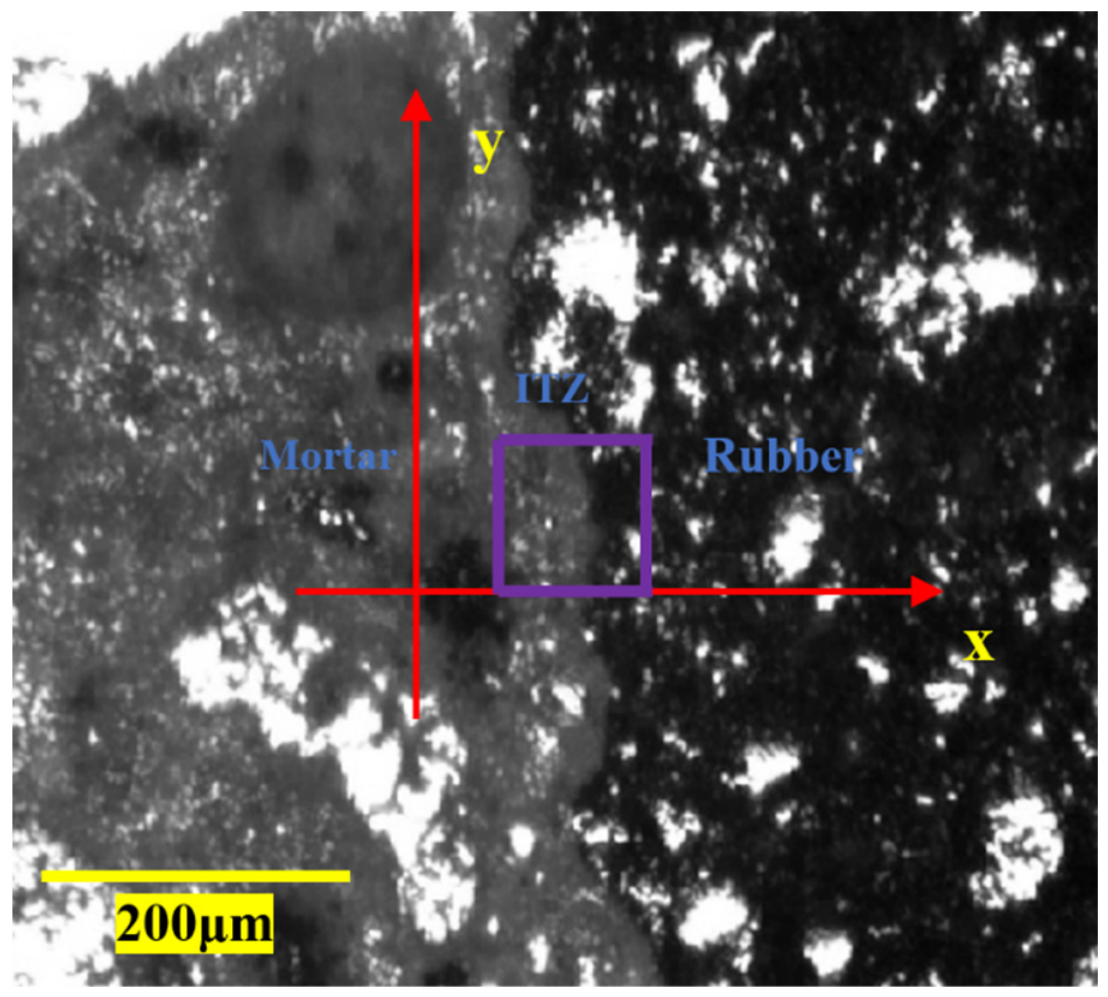
Nanoindentation tests were conducted using a Bruker Hysitron TI 980 nanoindenter (Bruker, Karlsruhe, Germany) with a Berkovich diamond tip, as shown in Figure 3. Specimens were polished to a surface roughness below 5 nm. A load-controlled indentation protocol was applied with a peak load of 2 mN, loading/unloading rate of 0.2 mN/s, and a 5 s hold at peak load. Linear indentation arrays were performed across the rubber–mortar and aggregate–mortar interfaces, with a spacing of 10 µm. A total of 30 indentation tests were conducted for each interface region. The elastic modulus and hardness were calculated using the Oliver-Pharr method [53].

3. Mechanical and Thermal Properties

3.1. Compressive and Splitting Tensile Strength

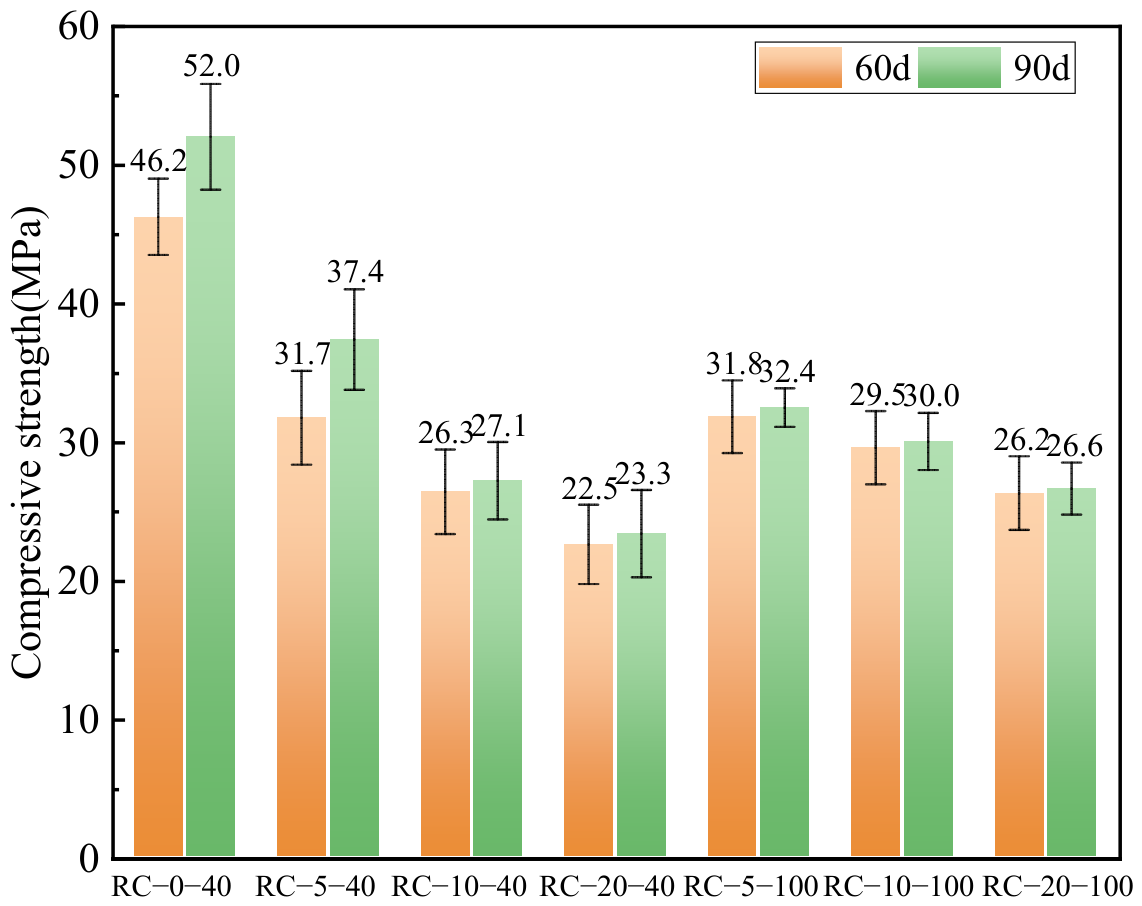
Figure 4 shows the compressive strength of rubber concrete (RC) mixtures at 60 and 90 days of curing. The reference concrete (RC-0-40) achieved 46.24 MPa at 60 days and 52.02 MPa at 90 days, meeting the C30 design requirement for mass concrete applications. The incorporation of rubber aggregate led to a progressive reduction in compressive strength with increasing rubber replacement ratio, regardless of particle size.
For the 40-mesh rubber series (RC-5-40, RC-10-40, RC-20-40), the 90-day compressive strengths were 37.36 MPa, 27.14 MPa, and 23.32 MPa, respectively, corresponding to reductions of 28.2%, 47.8%, and 55.2% compared to the reference. The 60-day values followed a similar decreasing trend: 31.70 MPa, 26.34 MPa, and 22.54 MPa, with reductions of 31.4%, 43.0%, and 51.2%, respectively.
In the 100-mesh rubber series (RC-5-100, RC-10-100, RC-20-100), the 90-day strengths were 32.43 MPa, 29.98 MPa, and 26.57 MPa, representing reductions of 37.7%, 42.4%, and 48.9% relative to the reference. The corresponding 60-day values were 31.77 MPa, 29.53 MPa, and 26.25 MPa, with reductions of 31.3%, 36.1%, and 43.2%.
A comparison between the two rubber sizes reveals an interesting non-monotonic trend. At a low replacement ratio (5%), the coarser rubber (40 mesh) yielded a higher 90-day strength (37.36 MPa) than the finer rubber (32.43 MPa). However, at 10% and 20% replacement, the finer rubber outperformed the coarse one: 29.98 MPa vs. 27.14 MPa at 10%, and 26.57 MPa vs. 23.32 MPa at 20%. This suggests that at higher substitution levels, finer rubber particles may achieve a more uniform dispersion and better packing within the cementitious matrix, partially mitigating the strength loss caused by the weak interfacial transition zone (ITZ). Conversely, at low replacement, the larger rubber particles act as discrete soft inclusions that are more easily debonded under load.
From 60 to 90 days, all mixtures exhibited further strength gain, but the relative increase diminished with higher rubber content. The reference concrete increased by 12.5%, while RC-20-40 and RC-20-100 increased by only 3.5% and 1.2%, respectively. This indicates that a high volume of rubber aggregate hinders long-term hydration and matrix densification, likely due to the hydrophobic nature of rubber and the accumulation of water-filled voids around rubber particles, as will be discussed in Section 5.
The observed strength reduction is consistent with previous studies on rubberized concrete and can be attributed to three main factors [36]: (i) the replacement of high-strength natural aggregates by soft, low-modulus rubber particles that bear little compressive load; (ii) the weak interfacial bond between hydrophobic rubber and cement paste, which promotes premature debonding and crack initiation; and (iii) increased porosity and micro-cracking around rubber aggregates, which act as stress concentrators under compression. Despite these reductions, all mixtures with 20% rubber replacement still achieved a 90-day compressive strength above 20 MPa, and those with 5% replacement met the C30 requirement. For mass concrete applications where thermal and damping properties are prioritized over high strength, rubber contents of 10–20% may be acceptable provided that strength criteria are appropriately adjusted.
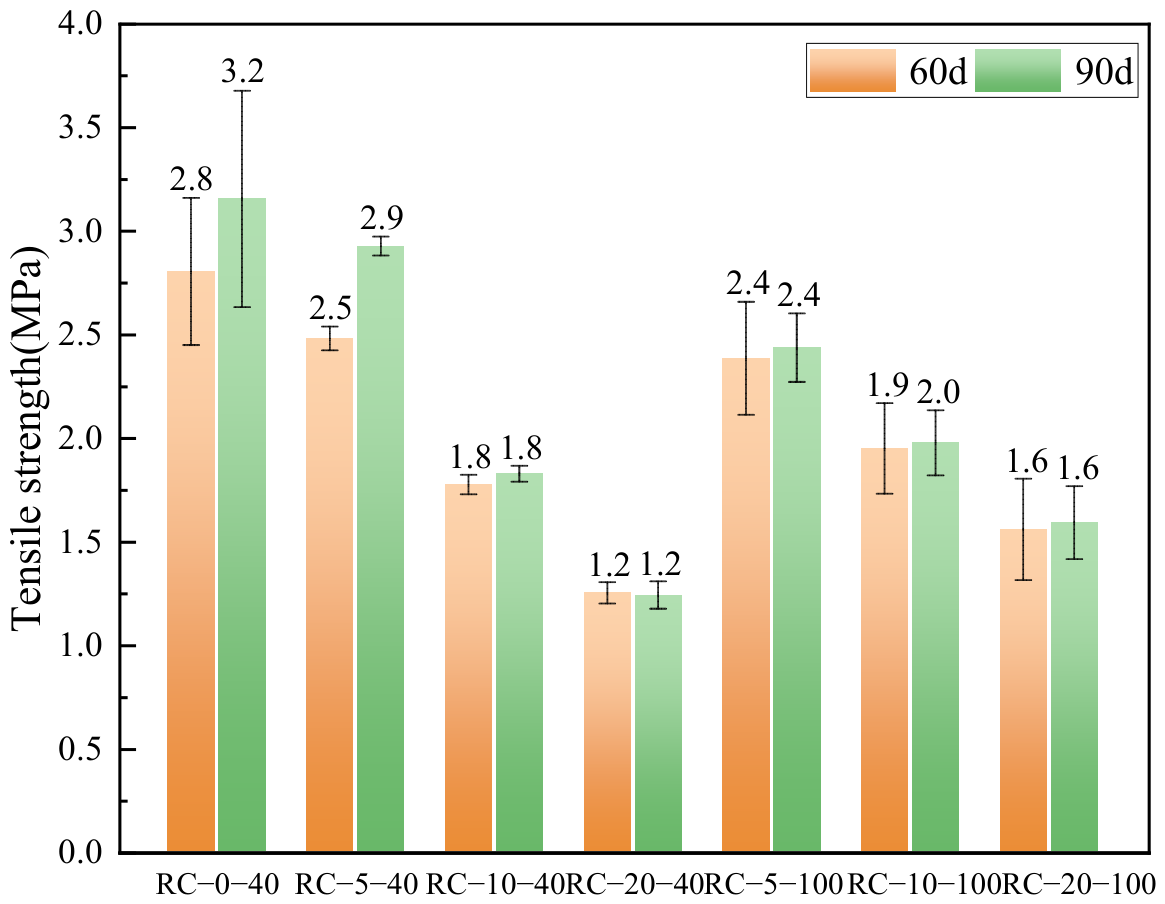
Figure 5 presents the splitting tensile strength of all RC mixtures at 60 and 90 days of curing. The reference concrete (RC-0-40) achieved 2.80 MPa at 60 days and 3.15 MPa at 90 days, exhibiting a typical tensile strength of approximately 6–7% of its compressive strength. Similar to the compressive strength, the incorporation of rubber aggregate led to a progressive reduction in splitting tensile strength with increasing rubber content.
For the 40-mesh rubber series, the 90-day splitting tensile strengths of RC-5-40, RC-10-40, and RC-20-40 were 2.92 MPa, 1.82 MPa, and 1.23 MPa, respectively, corresponding to reductions of 7.2%, 42.2%, and 60.8% compared to the reference. The 60-day values followed a similar trend: 2.48 MPa, 1.77 MPa and 1.25 MPa, with reductions of 11.6%, 36.8% and 55.5%, respectively.
In the 100-mesh rubber series, the 90-day splitting tensile strengths of RC-5-100, RC-10-100, and RC-20-100 were 2.43 MPa, 1.97 MPa, and 1.59 MPa, representing reductions of 22.8%, 37.5%, and 49.7% relative to the reference. The corresponding 60-day values were 2.38 MPa, 1.94 MPa, and 1.55 MPa, with reductions of 15.0%, 30.6%, and 44.6%.
Comparing the two particle sizes reveals that at 5% replacement, the coarser rubber (40 mesh) gave a higher splitting tensile strength (2.92 MPa) than the finer rubber (2.43 MPa). At 10% and 20% replacement, however, the finer rubber (100 mesh) consistently outperformed the coarse one: 1.97 MPa vs. 1.82 MPa at 10%, and 1.59 MPa vs. 1.23 MPa at 20%. This trend mirrors the pattern observed in compressive strength, further supporting the hypothesis that finer rubber particles achieve better dispersion and packing at higher substitution levels, thereby reducing the detrimental effect on tensile performance.
From 60 to 90 days, the reference concrete gained 12.5% in splitting tensile strength, while the rubberized mixtures showed limited or even negative growth. Notably, RC-20-40 exhibited a slight decrease from 1.25 MPa at 60 days to 1.23 MPa at 90 days, indicating that high rubber content not only reduces strength but may also hinder long-term tensile capacity development. This is likely due to the weak interfacial transition zone (ITZ) between rubber and cement paste, which becomes a preferential site for micro-crack initiation under tensile stress.
The reduction in splitting tensile strength is more severe than that in compressive strength at the same rubber content. For example, at 20% replacement with 40-mesh rubber, the compressive strength loss was 55.2%, while the tensile strength loss reached 60.8%. This indicates that the weak rubber–cement interface is even more critical under tension, where load transfer relies heavily on bond integrity. This finding is consistent with previous studies and suggests that tensile properties govern the design of rubberized concrete in applications where cracking resistance is important [36].
Despite these reductions, all mixtures with 5% rubber replacement still achieved a 90-day splitting tensile strength above 2.4 MPa, which is acceptable for many mass concrete applications. Even at 20% replacement with finer rubber (RC-20-100), the tensile strength remained 1.59 MPa, comparable to that of lower-grade structural concrete.

3.2. Static Elastic Modulus and Poisson’s Ratio

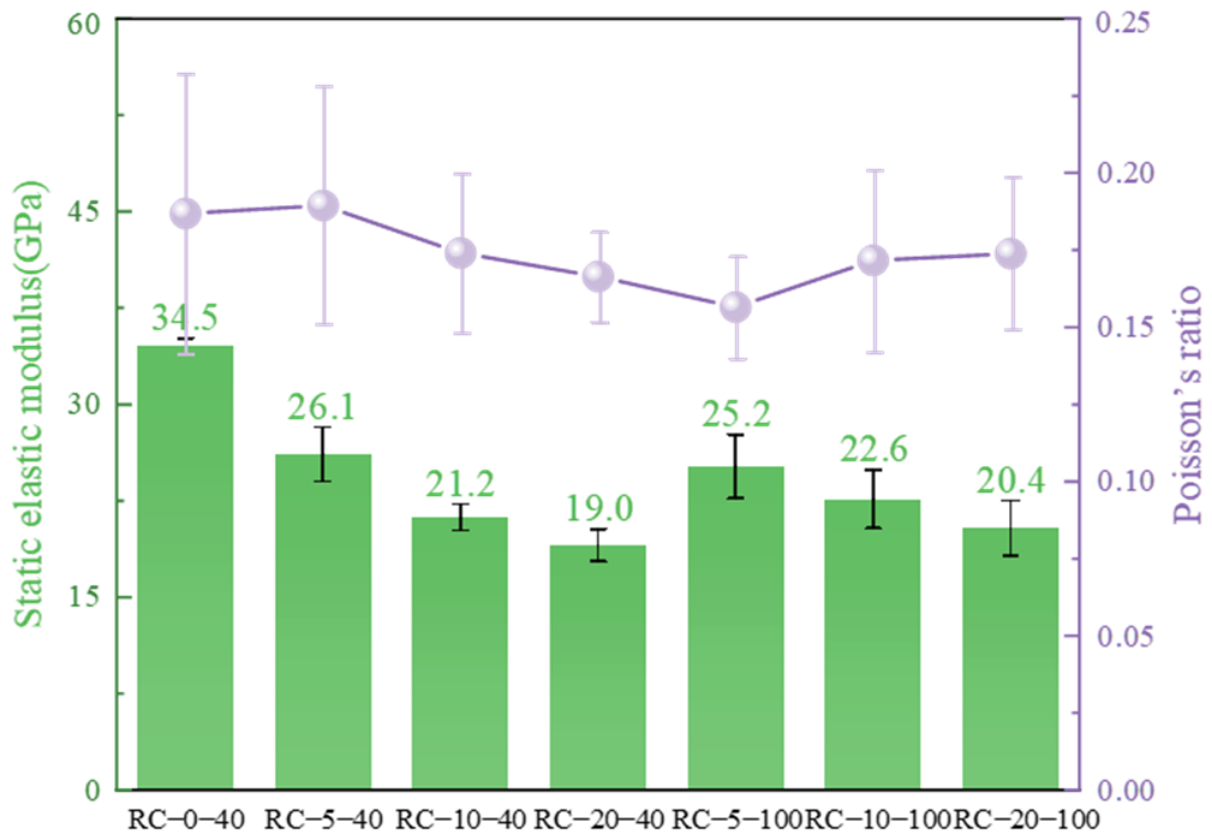
Figure 6 presents the static elastic modulus and Poisson’s ratio of all RC mixtures at 90 days of curing. The reference concrete (RC-0-40) exhibited a static elastic modulus of 34.50 GPa and a Poisson’s ratio of 0.187, which are typical values for C30 grade concrete.
With the incorporation of rubber aggregate, the static elastic modulus decreased progressively as the rubber content increased, regardless of particle size. For the 40-mesh rubber series, the elastic moduli of RC-5-40, RC-10-40, and RC-20-40 were 26.10 GPa, 21.19 GPa, and 19.05 GPa, corresponding to reductions of 24.4%, 38.6%, and 44.8% relative to the reference. In the 100-mesh series, the values were 25.16 GPa, 22.61 GPa, and 20.35 GPa, with reductions of 27.1%, 34.5%, and 41.0%, respectively. The reduction in elastic modulus is attributed to the low stiffness of rubber particles (approximately 0.01 GPa) and the weak interfacial transition zone (ITZ) around them, which increases overall deformability under load [30].
In contrast, Poisson’s ratio remained largely unaffected by the addition of rubber. As shown by the dashed line in Figure 6, the values for rubberized mixtures ranged from 0.157 to 0.190, with no systematic dependence on either rubber content or particle size. At 5% replacement, RC-5-40 gave 0.190, and RC-5-100 gave 0.157, both within the experimental scatter of the reference (0.187 ± 0.045). At higher replacement levels, Poisson’s ratio stayed in a narrow band of 0.166–0.174 for the 40-mesh series and 0.172–0.174 for the 100-mesh series. This observation aligns with previous findings that Poisson’s ratio is primarily governed by the cementitious matrix rather than the aggregate type, as long as the overall failure mechanism remains unchanged [32]. For practical design purposes, a Poisson’s ratio of 0.18 can be safely assumed for rubberized concrete with up to 20% rubber replacement.

3.3. Linear Expansion Coefficient

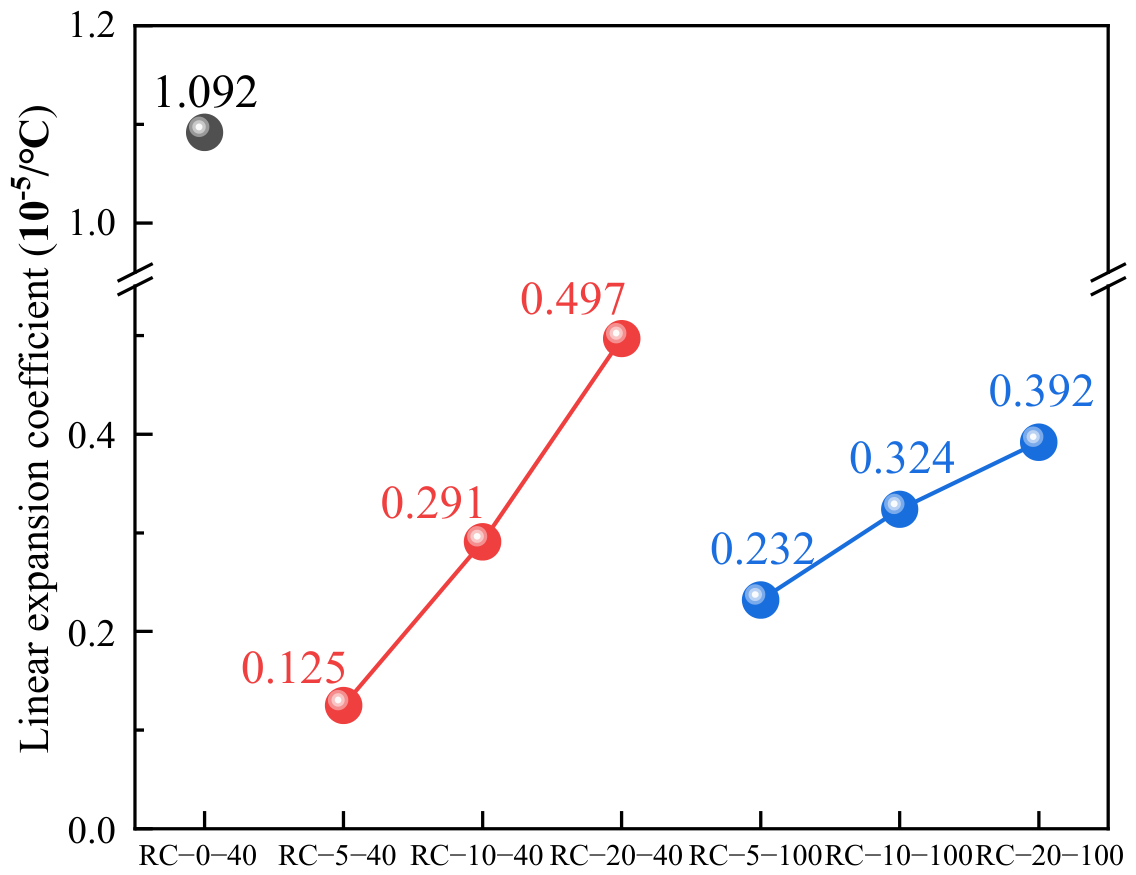
Figure 7 presents the linear expansion coefficient of all RC mixtures at 90 days of curing. It should be noted that, in the present study, only one specimen was tested for each mixture. Therefore, standard deviations and error bars are not available for this test. The results in Figure 7 should be regarded as preliminary measurements of the apparent linear expansion coefficient, and their statistical reliability requires further verification through repeated tests.
The reference concrete (RC-0-40) exhibited a linear expansion coefficient of 1.092 × 10⁻⁵/°C, which falls within the typical range for ordinary concrete (0.8–1.2 × 10⁻⁵/°C). Notably, the incorporation of rubber aggregate led to a dramatic reduction in the linear expansion coefficient, with values ranging from 0.125 to 0.497 × 10⁻⁵/°C across all rubberized mixtures. For the 40-mesh rubber series, the linear expansion coefficients of RC-5-40, RC-10-40, and RC-20-40 were 0.125, 0.291, and 0.497 × 10⁻⁵/°C, respectively, representing reductions of 88.6%, 73.4%, and 54.5% compared to the reference. In the 100-mesh series, the values were 0.232, 0.324, and 0.392 × 10⁻⁵/°C, with reductions of 78.8%, 70.3%, and 64.1%, respectively.
Based on the obtained data, both rubber particle size series showed an increasing tendency in the apparent linear expansion coefficient as the rubber replacement ratio increased. However, because repeated tests were not conducted, the statistical significance of the differences among mixtures cannot be evaluated. Therefore, this trend should be interpreted as an observation under the present testing conditions rather than a statistically confirmed general relationship.
An increasing trend with rubber content is observed for both series: as the rubber replacement ratio increased from 5% to 20%, the linear expansion coefficient increased monotonically, yet remained substantially lower than that of the reference concrete. This suggests that even a small amount of rubber (5%) drastically suppresses thermal expansion, while further addition gradually raises the coefficient but never returns to the level of plain concrete.
Comparing the two rubber sizes, the coarser rubber (40 mesh) yielded a lower coefficient than the finer rubber (100 mesh) at 5% replacement (0.125 vs. 0.232), but at 10% and 20%, the differences became smaller. At 20% replacement, the values were 0.497 (40 mesh) and 0.392 (100 mesh), indicating that finer rubber may lead to a slightly lower thermal expansion at high replacement levels.
The significant reduction in linear expansion coefficient due to rubber addition is counterintuitive at first glance, as rubber itself typically has a much higher coefficient of thermal expansion (≈60–80 × 10−5/°C) than cementitious materials. Several factors may explain this observation. First, the hydrophobic nature of rubber creates a weak ITZ with numerous micro-voids and gaps (as will be shown in Section 5), which may accommodate thermal expansion through internal void closure rather than transmitting strain to the bulk material. Second, the soft rubber particles act as compliant inclusions that can deform locally under thermal stress, dissipating expansion energy and reducing the overall macroscopic expansion. Third, the increased porosity within rubberized concrete, as revealed by MIP analysis in Section 5.2, provides additional space for thermal dilation without manifesting as external length change.
The preliminary results indicate that rubber aggregate may influence the apparent thermal deformation behavior of concrete. If confirmed by repeated measurements, such a reduction in the linear expansion coefficient could be beneficial for applications where thermal deformation is of concern. However, further systematic investigation is required before drawing firm conclusions regarding its engineering application in mass concrete.

3.4. Adiabatic Temperature Rise

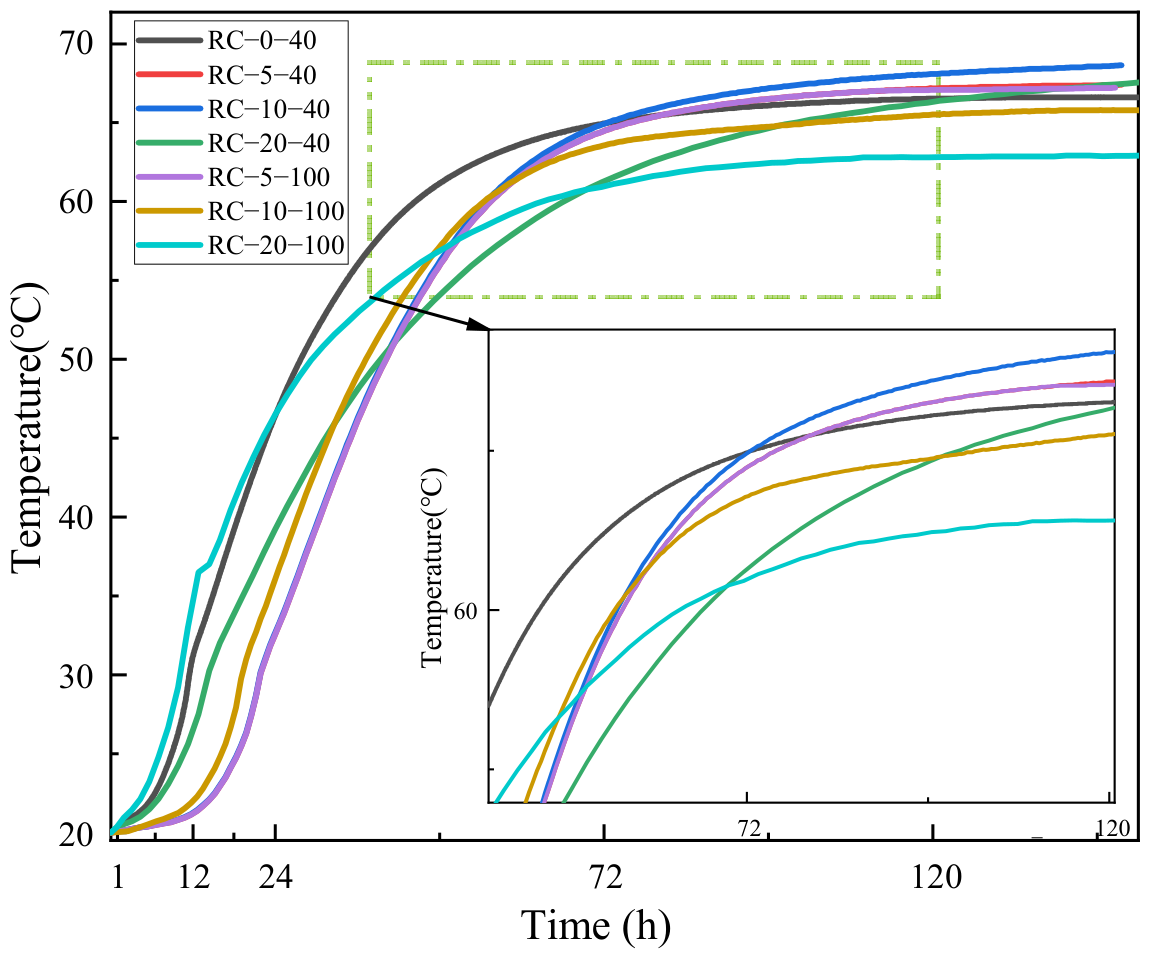
Figure 8 presents the adiabatic temperature rise curves of all RC mixtures measured over time. The reference concrete (RC-0-40) exhibited a typical adiabatic temperature rise pattern for a C30 mass concrete: starting from an initial temperature of 20 °C, the core temperature increased rapidly during the first 48 h, then gradually plateaued, reaching a peak of approximately 66.6 °C after about 67 h. The corresponding maximum temperature rise was 46.6 °C, which falls within the expected range for ordinary Portland cement-based concrete with a water-to-binder ratio of 0.45.
The incorporation of rubber aggregate significantly reduced both the peak temperature and the rate of temperature rise. For the 40-mesh rubber series, the peak temperature rises of RC-5-40, RC-10-40, and RC-20-40 were 42.1 °C, 38.5 °C, and 34.2 °C, respectively, reductions of 9.7%, 17.4%, and 26.6% compared to the reference. A similar trend was observed for the 100-mesh series, with the 5%, 10%, and 20% rubber mixes showing peak rises of 41.3 °C, 36.8 °C, and 31.5 °C, corresponding to reductions of 11.4%, 21.0%, and 32.4%. At the same rubber content, the finer rubber (100 mesh) consistently yielded a slightly lower temperature rise than the coarser rubber (40 mesh), indicating that a larger specific surface area of rubber particles may further suppress heat accumulation, likely due to enhanced interfacial thermal resistance.
The reduction in adiabatic temperature rise can be attributed to two main factors. First, the absolute cement content was the same across all mixes, the volume occupied by rubber replaces sand, thereby reducing the overall density and the amount of hydration heat generated per unit volume. Second, rubber acts as a thermal insulator (thermal conductivity approximately 0.1–0.2 W/m·K, compared to 1.5–2.0 W/m·K for natural aggregates) and introduces additional porosity, as will be shown in the MIP results (Section 5.2). These features slow down the transfer of hydration heat from the core to the surface, flattening the temperature profile.
The temperature rise rate, defined as the slope of the temperature–time curve during the first 24 h, also decreased with increasing rubber content. The maximum heating rate of RC-0-40 was approximately 0.55 °C/h, whereas those of RC-20-40 and RC-20-100 dropped to 0.32 °C/h and 0.28 °C/h, respectively—reductions of 42% and 49%. A lower heating rate is highly beneficial for mass concrete pours, as it reduces the risk of thermal cracking caused by steep temperature gradients between the hot core and the cooler surface. In addition, the time to reach the peak temperature was noticeably delayed in rubberized mixtures: from 67 h for the reference to 83 h for RC-20-40 and 91 h for RC-20-100. This delay is consistent with the low thermal diffusivity of rubber, which lengthens the thermal response time of the concrete mass.
From the perspective of mass concrete engineering (e.g., foundations, tunnel invert-fillings, and dam blocks), a lower adiabatic temperature rise and a slower heating rate are highly desirable because they directly reduce the maximum tensile stress induced by restrained thermal contraction during cooling. Combined with the dramatically reduced coefficient of linear expansion reported in Section 3.3 (up to 88% lower than the reference), rubberized concrete offers an exceptionally low risk of thermal cracking. Even at a 20% rubber replacement, the 90-day compressive strength remained above 23 MPa (for 40-mesh) and 26 MPa (for 100-mesh), which is sufficient for many non-primary structural mass concrete applications. Therefore, rubber aggregate can be considered an effective internal “thermal regulator” that simultaneously lowers the heat source (hydration) and the thermal response (expansion and heat transfer).

4. Dynamic Properties and Vibration Damping Performance

4.1. Dynamic Elastic Modulus and Shear Wave Velocity

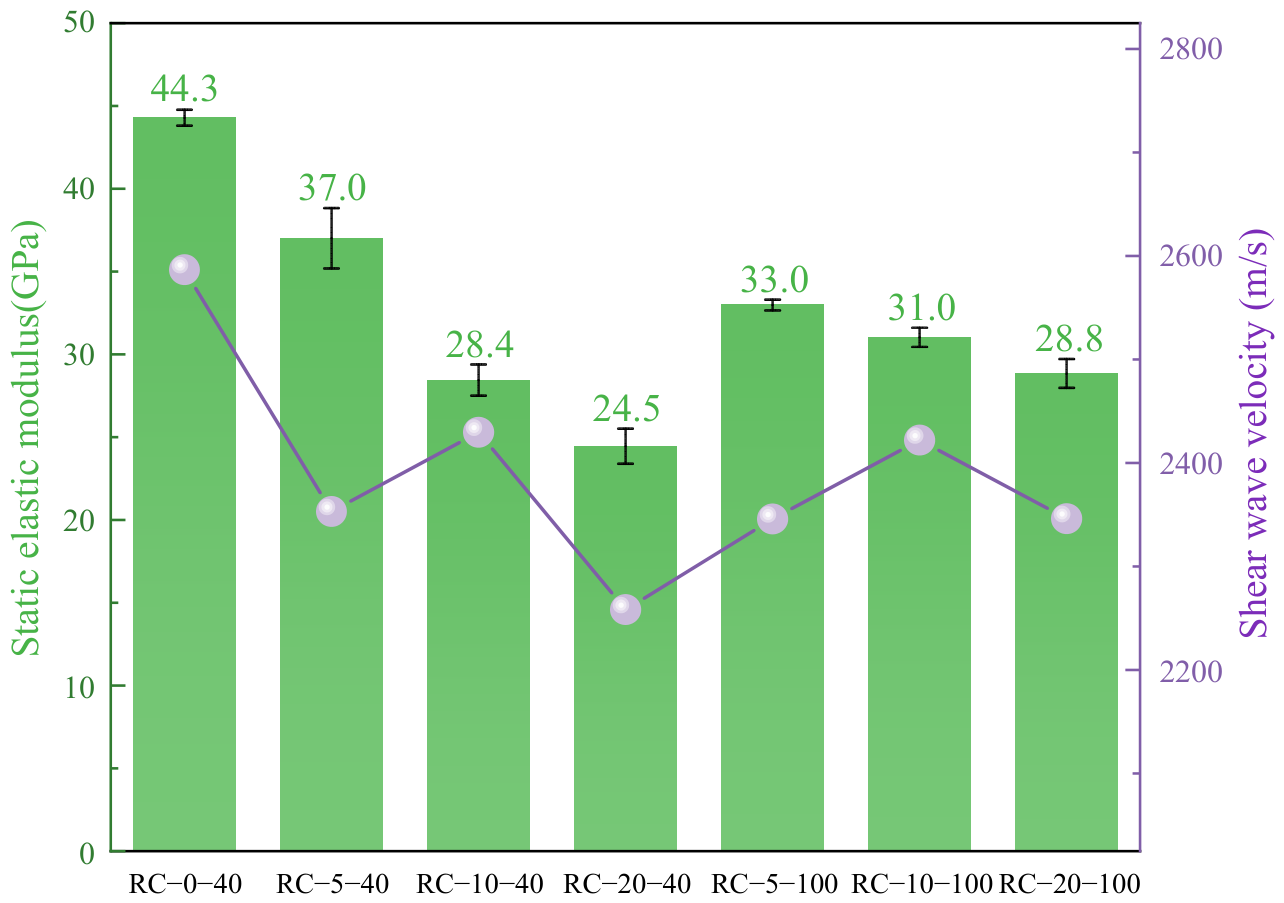
Figure 9 presents the dynamic elastic modulus and shear wave velocity of all RC mixtures at 28 days of curing. The reference concrete (RC-0-40) exhibited a dynamic elastic modulus of 44.3 GPa and a shear wave velocity of 2587 m/s, both within the typical ranges for ordinary concrete.
With the incorporation of rubber aggregate, both parameters decreased progressively with increasing rubber content, but the trends differed in detail. For the 40-mesh rubber series, the dynamic elastic moduli of RC-5-40, RC-10-40, and RC-20-40 were 37.0 GPa, 28.5 GPa, and 24.5 GPa, corresponding to reductions of 16.4%, 35.8%, and 44.8% relative to the reference. The corresponding shear wave velocities were 2353 m/s, 2430 m/s, and 2258 m/s, representing reductions of 9.0%, 6.1%, and 12.7%. Notably, at 10% replacement with 40-mesh rubber, the shear wave velocity increased slightly compared to 5% replacement, whereas the dynamic elastic modulus continued to decline. This anomaly suggests that shear wave velocity is less sensitive to rubber content at low to moderate replacement levels, possibly due to competing effects of reduced stiffness and reduced density.
In the 100-mesh rubber series, the dynamic elastic moduli of RC-5-100, RC-10-100, and RC-20-100 were 33.0 GPa, 31.0 GPa, and 28.8 GPa, with reductions of 25.5%, 30.0%, and 34.9%. The corresponding shear wave velocities were 2346 m/s, 2422 m/s, and 2347 m/s, showing reductions of 9.3%, 6.4%, and 9.3%. Again, the 10% replacement mix yielded a slightly higher shear wave velocity than the 5% mix, while the dynamic modulus continued to decrease.
Comparing the two rubber sizes, the finer rubber (100 mesh) consistently gave lower dynamic moduli than the coarser rubber at 5% replacement, but higher moduli at 20% replacement. The shear wave velocity followed a similar pattern: at 20% replacement, the finer rubber yielded a higher velocity (2347 m/s) than the coarser rubber (2258 m/s), indicating that finer particles produce a less severe reduction in both stiffness and wave transmission at high substitution levels.
The observed non-monotonic behavior of shear wave velocity—particularly the slight increase at 10% replacement—can be explained by the competing effects of rubber addition on the composite’s physical properties. While rubber reduces the dynamic modulus (which tends to lower wave velocity), it also reduces density (which tends to increase wave velocity for a given modulus). The interplay of these factors, along with changes in pore structure and micro-cracking, leads to a non-linear relationship between rubber content and shear wave velocity. In contrast, dynamic elastic modulus shows a more consistent decreasing trend because it is directly governed by the stiffness of the constituent materials.
From an engineering perspective, both reduced dynamic modulus and reduced shear wave velocity contribute to lower natural frequencies and slower stress wave propagation in rubberized concrete. This combination is beneficial for vibration isolation and energy dissipation in mass concrete structures, such as tunnel invert-fillings, machine foundations, and seismic buffer zones. The 10% replacement with 100-mesh rubber (RC-10-100) offers a balanced performance: a moderate reduction in dynamic modulus (30.0%) and shear wave velocity (6.4%), while maintaining acceptable compressive strength.

4.2. Vibration Acceleration Response and Damping Ratio

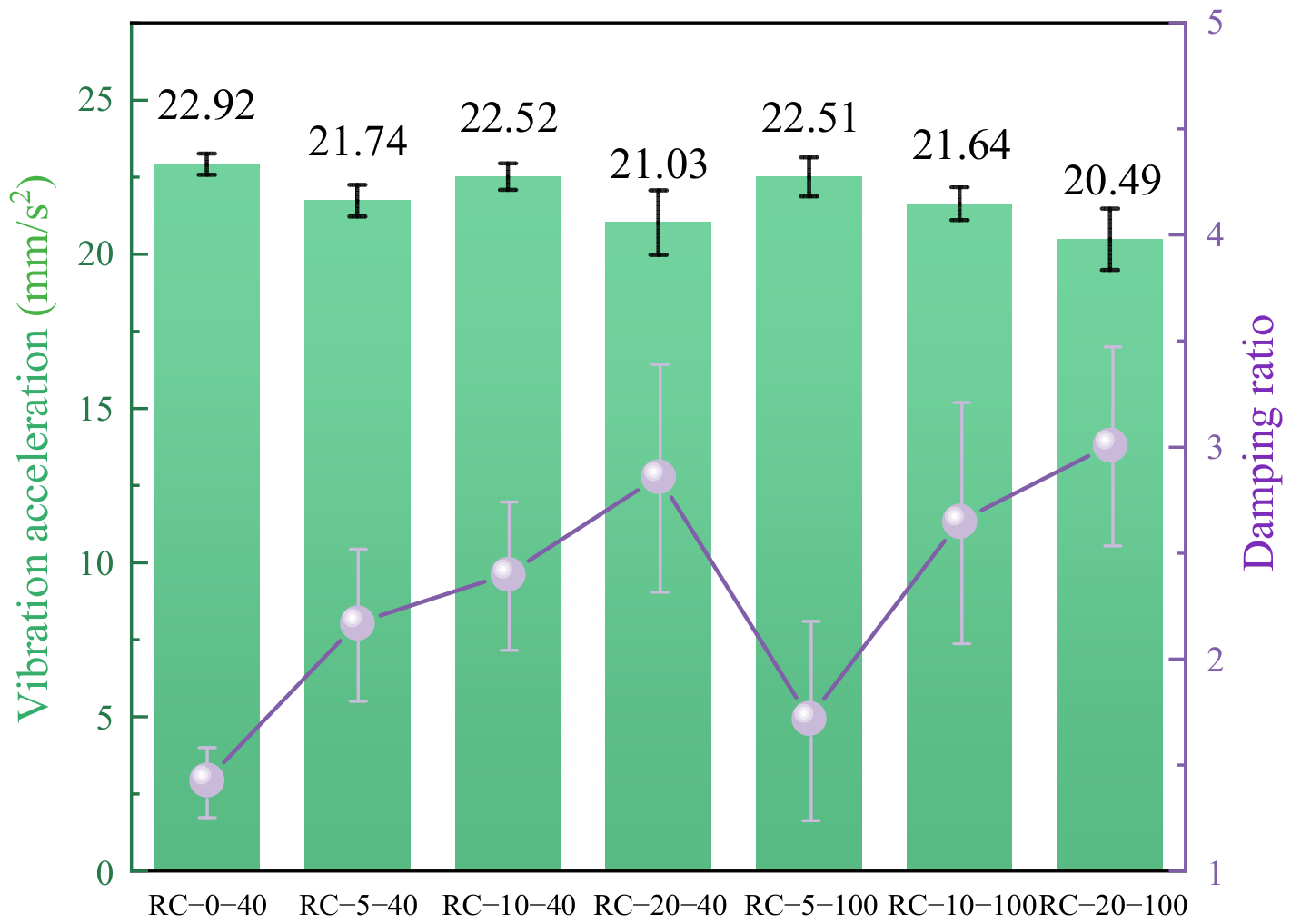
Figure 10 presents the vibration acceleration and damping ratio of all RC mixtures at 28 days of curing, measured using the free vibration decay method. The reference concrete (RC-0-40) exhibited a vibration acceleration of 22.92 mm/s2 and a damping ratio of 1.43%, which are typical for ordinary C30 concrete.
With the incorporation of rubber aggregate, the damping ratio increased significantly, while the vibration acceleration showed a general decreasing trend, indicating an enhanced capacity to dissipate vibrational energy. For the 40-mesh rubber series, the damping ratios of RC-5-40, RC-10-40, and RC-20-40 were 2.17%, 2.40%, and 2.86%, respectively, corresponding to increases of 51.7%, 67.8%, and 100% compared to the reference. The corresponding vibration accelerations were 21.7 mm/s2, 22.5 mm/s2, and 21.0 mm/s2. Compared to the reference, RC-5-40 and RC-20-40 showed reductions of 5.2% and 8.3%, respectively. However, RC-10-40 exhibited a slight increase of 1.7% relative to RC-5-40, and a value nearly identical to the reference.
This non-monotonic behavior can be explained by the competing effects of rubber content on the dynamic response. At low rubber content (5%), the soft rubber particles act as local dampers that reduce the transmitted acceleration. As the rubber content increases to 10%, two opposing mechanisms come into play: on one hand, the increased number of rubber–cement interfaces and higher porosity enhance energy dissipation, raising the damping ratio to 2.40%; on the other hand, the reduced stiffness of the composite (evidenced by the lower elastic modulus in Section 3.2) lowers the natural frequency, lead to a slight increase in the measured acceleration amplitude under the same impact excitation. In other words, a softer structure can exhibit larger displacement or acceleration at its resonant frequency even if damping is improved. The fact that RC-10-40 has a damping ratio of 2.40% (67.8% higher than the reference) yet shows an acceleration similar to the reference suggests that the damping enhancement is partially offset by the reduced stiffness. At 20% rubber content, the damping increase becomes sufficiently large (100% over reference) to overcome the stiffness reduction, resulting in a net decrease in acceleration.
For the 100-mesh rubber series, the damping ratios of RC-5-100, RC-10-100, and RC-20-100 were 1.72%, 2.65%, and 3.01%, representing increases of 20.3%, 85.3%, and 110% relative to the reference. The corresponding vibration accelerations were 22.5 mm/s2, 21.6 mm/s2, and 20.5 mm/s2, with reductions of 1.7%, 5.7%, and 10.5%. In this series, the finer rubber particles achieved a more uniform dispersion and a more gradual transition in stiffness, leading to a monotonic decrease in acceleration with increasing rubber content. At 20% replacement, the fine rubber (100 mesh) outperformed the coarse rubber (40 mesh) in both damping ratio and acceleration reduction.
Comparing the two particle sizes, the 100-mesh rubber gave slightly higher damping at 10% and 20% replacement, while at 5% replacement, the 40-mesh rubber gave a higher damping ratio. This non-monotonic trend is consistent with observations from compressive strength and elastic modulus analyses: at low rubber content, the coarser rubber creates a more defective interface that enhances damping; at higher content, the finer rubber provides better packing and a more uniform distribution of soft inclusions, further improving energy dissipation without excessively compromising structural integrity.
The improvement in damping ratio can be attributed to three factors: (i) the intrinsic viscoelasticity of rubber, which converts mechanical vibration into heat through molecular chain friction; (ii) the weak interfacial transition zone between rubber and cement paste, which introduces additional micro-slip and friction under cyclic loading; and (iii) the increased porosity and micro-cracking around rubber particles.
From an engineering perspective, a damping ratio of 3.01% (achieved by RC-20-100) represents a 110% improvement over conventional concrete, which typically has a damping ratio of 1–2%. This enhancement is substantial and can significantly reduce the dynamic response of structures under resonant conditions. Even at a moderate replacement of 10%, the damping ratio reached 2.65% (85% increase) with only a 5.7% reduction in vibration acceleration, offering a favorable trade-off between mechanical strength and dynamic performance.

5. Microstructural Analyses

5.1. Functional Groups and Chemical Interactions

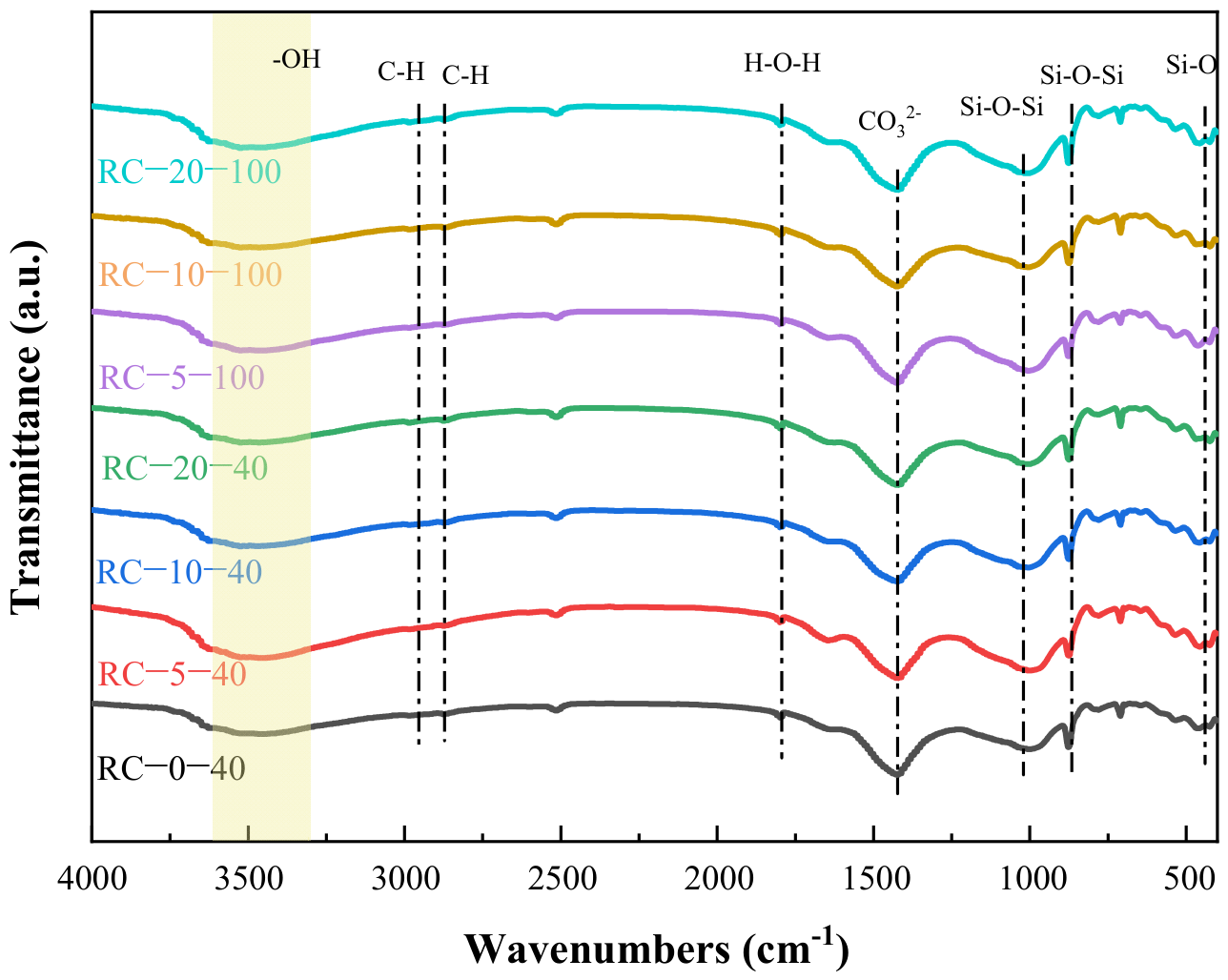
Figure 11 presents the Fourier transform infrared (FTIR) spectra of all RC mixtures at 28 days of curing, recorded in the range of 4000–400 cm−1. The spectra were used to identify the functional groups present and to assess the chemical interactions between the rubber aggregate and the cementitious matrix.
The reference concrete (RC-0-40) exhibited absorption bands characteristic of typical hydrated cement products. A broad and intense band centred at approximately 3400 cm−1 corresponds to O–H stretching vibrations of water molecules and calcium hydroxide (CH). The band observed around 1640 cm−1 is attributed to the H–O–H bending vibration of chemically bound water. An intense and complex absorption band in the region of 1000–1100 cm−1 is assigned to the asymmetric stretching vibrations of Si–O–Si bonds in calcium silicate hydrate (C–S–H) and silicate oligomers, which is the dominant feature of the cementitious matrix. Additional peaks near 1420 cm−1 and 870 cm−1 are characteristic of carbonate ions (CO32−).
With the incorporation of rubber aggregate, several notable changes in the FTIR spectra were observed across all rubberized mixtures. Most significantly, two additional weak but distinct bands appeared at approximately 2920 cm−1 and 2850 cm−1, corresponding to the asymmetric and symmetric stretching vibrations of aliphatic C–H bonds (–CH2– and –CH3) present in the polymer backbone of the rubber. These bands were absent in the reference concrete and were consistently observed in all rubber-containing mixtures (RC-5-40 through RC-20-100), confirming the successful incorporation of rubber particles into the concrete matrix. The intensity of these C–H bands increased with increasing rubber content, as expected. For example, at 20% replacement, the absorbance at 2920 cm−1 was noticeably higher than at 5% replacement for both particle size series.
Comparing the two rubber particle sizes, the 100-mesh (finer) rubber series exhibited slightly higher C–H band intensities than the 40-mesh (coarser) series at the same replacement level, particularly at 10% and 20%. This observation is attributed to the larger specific surface area of the finer rubber particles, which provides a greater number of exposed polymer chains per unit volume of concrete, leading to stronger infrared absorption from the rubber component.
Importantly, no significant shifts in the positions of the major cement-related bands (O–H, Si–O–Si, CO32−) were observed between the reference and rubberized mixtures. The main Si–O–Si band remained centred at approximately 1000–1010 cm−1 across all mixtures, suggesting that the silicate network structure of C–S–H was not chemically altered or disrupted by the introduction of rubber aggregates. Similarly, the position and width of the O–H stretching band showed no notable change, indicating that the hydrogen bonding environment within the cement paste remained largely unaffected. No new absorption bands indicative of covalent bonding between rubber and cement phases (e.g., C–O–Si or C–Si bonds) were detected in the spectra of any rubberized mixture.
A slight reduction in the intensity of the Si–O–Si band was observed with increasing rubber content, particularly at 20% replacement. For RC-20-40 and RC-20-100, the peak intensity decreased by approximately 8–12% compared to the reference. This reduction is primarily attributed to a dilution effect: replacing part of the natural fine aggregates with rubber reduces the absolute amount of cementitious material per unit volume, leading to a lower concentration of hydration products (C–S–H) in the composite. Additionally, the weak ITZ around rubber particles may locally hinder complete hydration.
Overall, the FTIR results indicate that no obvious chemical interaction between rubber aggregates and the cementitious matrix was detected under the present testing conditions. The spectra showed no new bands associated with chemical bonding, and the major cement-related peaks exhibited no notable changes. These findings suggest that the rubber–cement interaction is mainly physical in nature, although FTIR alone cannot completely rule out more subtle interfacial effects. This interpretation is consistent with the weak interfacial bond observed in the mechanical tests. Therefore, the beneficial effects of rubber on damping and vibration reduction are likely related to its mechanical properties and the physical characteristics of the interface, rather than to detectable chemical modification of the cementitious matrix.

5.2. Pore Structure Characteristics

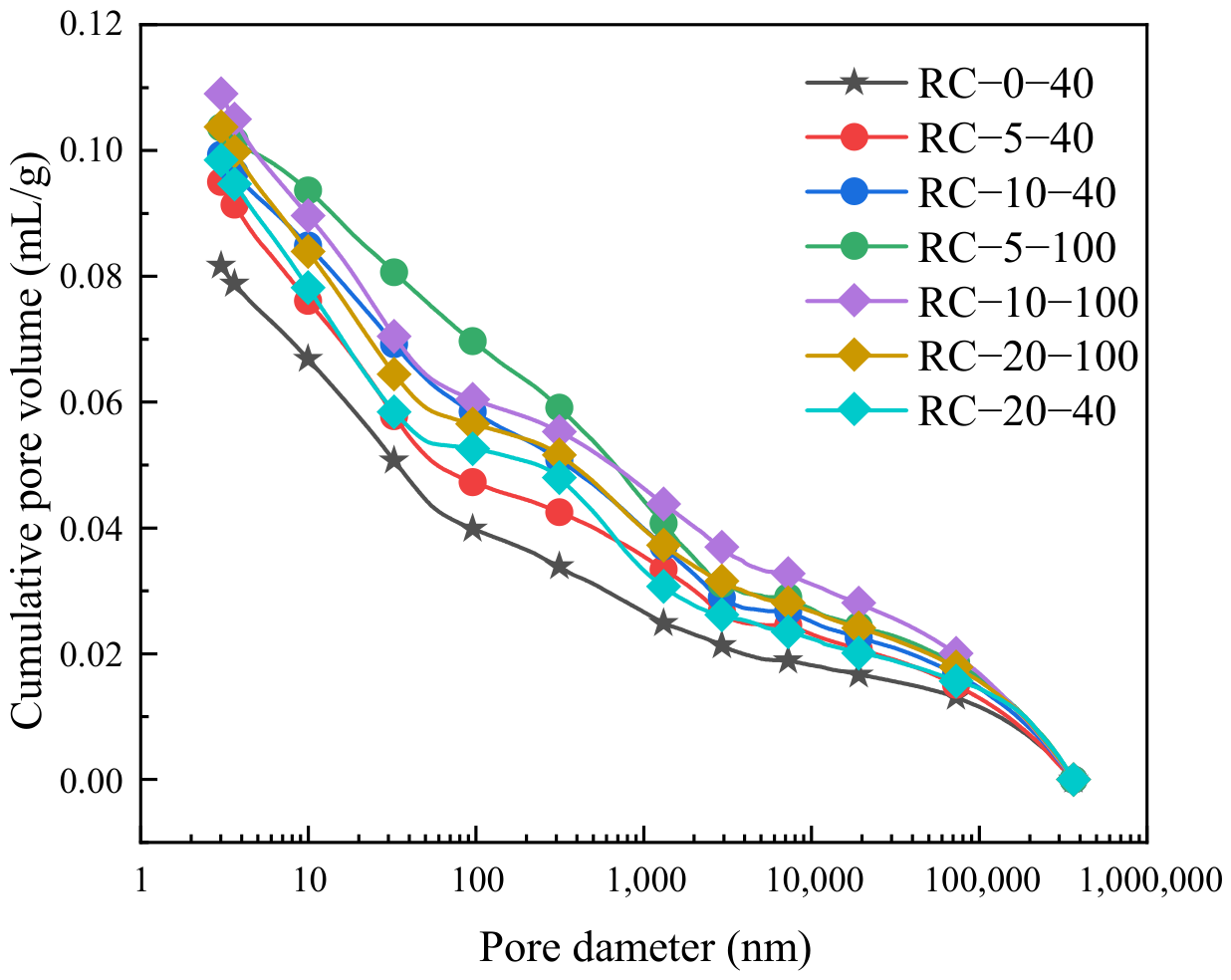
Figure 12 presents the cumulative mercury intrusion curves of all RC mixtures measured by mercury intrusion porosimetry (MIP), and Table 3 summarizes the derived pore structure parameters, including total porosity, average pore diameter, and the most probable pore diameter (corresponding to the maximum number of pores). The reference concrete (RC-0-40) exhibited a total porosity of 15.74%, an average pore diameter of 19.6 nm, and a most probable pore diameter of 32.6 nm, which are typical values for ordinary C30 concrete.
The incorporation of rubber aggregate markedly altered the pore structure, and the observed effects depended strongly on both rubber content and particle size. For the 40-mesh (coarser) rubber series, increasing the rubber replacement ratio from 0% to 20% led to a progressive increase in total porosity, from 15.74% to 17.58%, 18.62%, and 20.57% for RC-5-40, RC-10-40, and RC-20-40, respectively. The average pore diameter also increased monotonically, from 19.6 nm (reference) to 20.5 nm, 24.3 nm, and 27.5 nm. The most probable pore diameter, however, showed a slight decreasing trend, from 32.6 nm (reference) to 31.3 nm, 30.9 nm, and 30.6 nm. These observations suggest that the addition of coarse rubber particles tends to increase the overall porosity and may introduce more large capillary pores, while the dominant pore size shifts only marginally towards smaller values.
In contrast, the 100-mesh rubber series exhibited a distinctly different behavior. At 5% replacement (RC-5-100), the porosity increased to 19.33%, and the average pore diameter rose to 20.4 nm, both higher than the reference. However, as the rubber content increased further to 10% and 20%, both parameters decreased: porosity dropped to 18.50% and then to 17.46%, and average pore diameter decreased to 19.4 nm and 18.1 nm, respectively, the latter being even lower than that of the reference concrete. The most probable pore diameter also decreased systematically with increasing fine rubber content, from 32.6 nm (reference) to 24.6 nm, 19.9 nm, and 19.1 nm for RC-5-100, RC-10-100, and RC-20-100, respectively.
These contrasting trends can be explained by the competing roles of rubber particles in the pore structure. On the one hand, the hydrophobic nature of rubber may promote the formation of a relatively weak interfacial transition zone (ITZ) around rubber particles, possibly accompanied by microvoids, local defects, or enlarged pores. This effect may contribute to the increase in porosity, especially at low rubber contents regardless of particle size. On the other hand, finer rubber particles, such as 100-mesh rubber, have a much larger specific surface area and may act as a micro-filler when incorporated in sufficient quantity, partially filling inter-aggregate voids and refining the pore network. This possible filler effect appears to become more evident at higher replacement levels, particularly at 10% and 20% in the fine rubber series, resulting in a relatively denser pore structure with smaller average pores compared with the corresponding 5% mixture. By contrast, the 40-mesh rubber particles, owing to their larger size, are less likely to provide the same filler effect and are instead associated with a continuous increase in porosity and average pore diameter as their volume fraction increases.
From the perspective of vibration damping and energy dissipation, a more porous and heterogeneous microstructure may provide additional sites for local deformation and frictional energy dissipation under dynamic loading. Therefore, the continuously increasing porosity and average pore diameter in the 40-mesh rubber series may be related to its higher damping ratios, as observed in Section 4.2. For the fine rubber series, although the pore structure became more refined at higher replacement levels, the mixtures may still benefit from the intrinsic viscoelasticity of rubber and the presence of a relatively weak rubber–mortar ITZ. These factors may jointly contribute to the damping performance remaining higher than that of the reference concrete, even when the pore structure appears to be relatively densified.
From the perspective of vibration damping and energy dissipation, a more porous and coarser pore structure is generally beneficial because pore walls and micro-cracks provide additional friction sites under dynamic loading. The 40-mesh rubber series, with its continuously increasing porosity and pore size, would be expected to exhibit higher damping ratios, as indeed observed in Section 4.2. The fine rubber series, despite having a refined pore structure at higher contents, still benefits from the intrinsic viscoelasticity of the rubber and the weak ITZ, which may explain why its damping performance remains superior to the reference even when the pore structure appears densified.
Overall, the MIP results suggest that rubber aggregate modifies the pore structure in a non-linear manner depending on particle size and replacement level. The coarser rubber appears to be associated mainly with pore enlargement and increased porosity, whereas finer rubber may contribute to pore refinement when used above a certain replacement level. These microstructural observations, together with the nanoindentation results on the weakened rubber–mortar ITZ, provide a plausible mechanism for understanding the observed mechanical and dynamic behavior of rubberized concrete.

5.3. Nanoindentation

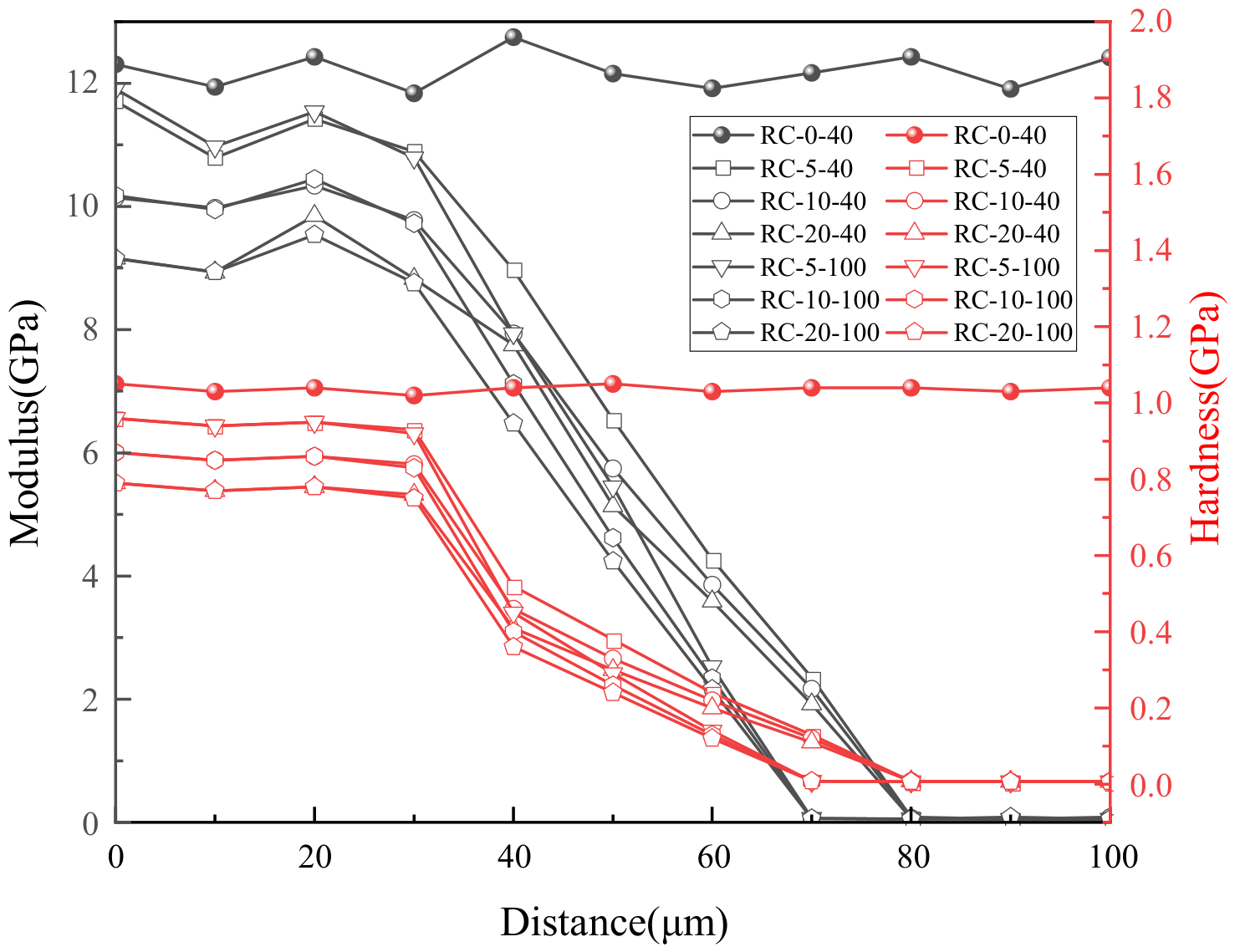
Figure 13 presents the elastic modulus and hardness profiles across the rubber–mortar interfacial transition zone (R-M ITZ) for all RC mixtures at 28 days, obtained from nanoindentation tests. The indentation was performed along a line perpendicular to the rubber–mortar interface, starting from the mortar matrix (0 µm) and moving towards the rubber particle (100 µm). The reference concrete (RC-0-40) exhibited nearly constant modulus (~12.2 GPa) and hardness (~1.04 GPa) across the entire scanning distance, confirming the absence of rubber and the homogeneity of the mortar matrix.
For rubberized mixtures, three distinct regions can be identified from the indentation profiles: the mortar matrix (0–30 µm), the R-M ITZ (approximately 40–70 µm), and the rubber particle (80–100 µm). In the mortar region, all rubberized mixtures showed slightly lower modulus and hardness than the reference, with values decreasing as rubber content increased, regardless of particle size. For instance, at 0 µm, the modulus of RC-5-40, RC-10-40, and RC-20-40 were 11.71, 10.14, and 9.16 GPa, respectively, corresponding to reductions of 5%, 18%, and 26% relative to RC-0-40 (12.31 GPa). A similar trend was observed for the 100-mesh series: 11.91, 10.18, and 9.15 GPa for RC-5-100, RC-10-100, and RC-20-100, respectively. The reduction in mortar modulus at higher rubber contents is attributed to the increased porosity and micro-cracking induced by the rubber particles, which affects even the nearby cementitious matrix.
Within the R-M ITZ (40–70 µm), both modulus and hardness dropped sharply. For the 40-mesh series at 50 µm, the modulus values were 6.54 GPa (RC-5-40), 5.75 GPa (RC-10-40), and 5.14 GPa (RC-20-40), while at 60 µm they further decreased to 4.27, 3.86, and 3.59 GPa, respectively. The 100-mesh series exhibited even lower values at the same positions: at 50 µm, 5.45, 4.62, and 4.24 GPa; at 60 µm, 2.53, 2.34, and 2.16 GPa. The hardness followed a similar decreasing pattern. The ITZ thickness, defined as the distance over which the modulus drops from ~80% of the mortar value to the rubber value, was approximately 30–50 µm for the 40-mesh series and 20–30 µm for the 100-mesh series. Finer rubber particles produced a thinner but more severely weakened ITZ, likely due to their larger specific surface area and more efficient packing, which locally concentrates defects.
Beyond 70 µm, the profiles entered the rubber phase. For the 40-mesh series, the modulus at 80 µm ranged from 0.084 to 0.066 GPa, while for the 100-mesh series it fell to 0.057–0.055 GPa. The rubber hardness was consistently around 0.007 GPa for all mixtures.
Quantitatively, the ratio of the ITZ modulus to the mortar modulus was calculated by averaging the values at 40–60 µm and comparing with the average mortar modulus at 0–30 µm. For the 40-mesh series, this ratio ranged from 38% to 52%, while for the 100-mesh series it ranged from 32% to 45%, depending on rubber content. These results are consistent with the nanoindentation findings reported in the literature [53], where R-M ITZ modulus was about 28–61% of the cement mortar. The lower ratios observed for the finer rubber indicate a more pronounced weakening of the interface, which correlates with the higher damping ratios and lower compressive strengths of the 100-mesh series at the same rubber content.
Notably, the presence of rubber particles did not significantly alter the thickness of the coarse aggregate–mortar ITZ (A-M ITZ), which remained around 30–50 µm with a modulus ratio of 70–85% of the mortar, similar to the reference. This observation suggests that the rubber particles mainly affect the local microstructure around themselves, while the bulk mortar and the aggregate–mortar interface are only indirectly influenced.
Overall, the nanoindentation results provide direct evidence that the incorporation of rubber particles creates a weak, porous, and micro-cracked ITZ with reduced modulus and hardness. The degree of weakening increases with rubber content and is more pronounced for finer rubber particles. These microstructural characteristics underpin the observed mechanical strength loss and the enhanced damping capacity of rubberized concrete.

6. Discussion

6.1. Influence of Rubber Aggregate on Mechanical and Thermal Properties

The experimental results presented in Section 3 clearly demonstrate that the incorporation of rubber aggregate, regardless of particle size, leads to a progressive reduction in compressive strength, splitting tensile strength, and static elastic modulus, while the Poisson’s ratio remains essentially unchanged. This trend is consistent with previous studies showing that higher rubber replacement ratios reduce compressive strength, and that the overall rubber replacement ratio is more influential than whether rubber replaces coarse or fine aggregate [21].
For the 40-mesh (coarser) rubber series, the mechanical properties decrease monotonically with increasing rubber content. At 20% replacement, the compressive strength, splitting tensile strength, and static elastic modulus drop by 55.2%, 60.8%, and 44.8%, respectively, relative to the reference. In contrast, the 100-mesh (finer) rubber series exhibit a different trend: at 5% replacement, the strength losses are comparable to or slightly higher than those of the coarser series, but at 10% and 20% replacement, the finer rubber outperforms the coarser one in all three mechanical indicators. This non-monotonic behavior is attributed to the dual role of rubber particles in the cementitious matrix. At low replacement levels, both rubber sizes introduce weak interfaces and porosity, causing strength reduction. However, at higher substitution levels, the finer rubber particles (100 mesh) have a much larger specific surface area and can act as micro-fillers, partially densifying the matrix and improving particle packing, as evidenced by the MIP results (Section 5.2), which show a decrease in porosity and average pore diameter for RC-10-100 and RC-20-100 compared to RC-5-100. The coarser rubber, lacking this filler effect, continuously degrades the pore structure.
The thermal properties of rubberized concrete show remarkable improvement. The linear expansion coefficient is reduced by up to 88% (RC-5-40), and the adiabatic temperature rise is reduced by up to 32% (RC-20-100). These enhancements are explained by three mechanisms: (i) the hydrophobic rubber–cement interface creates numerous micro-voids that can accommodate thermal expansion without transferring strain to the bulk material; (ii) the low thermal conductivity of rubber (0.1–0.2 W/m·K) slows heat transfer, flattening the temperature gradient; and (iii) the reduced cementitious material per unit volume (due to rubber’s lower density) lowers the total hydration heat. For mass concrete applications, the combination of low thermal expansion and low adiabatic temperature rise is highly desirable, as it directly mitigates the risk of thermal cracking—a common issue in large-volume pours such as foundations, tunnel linings, and dams.

6.2. Improvement Mechanisms of Vibration-Damping Performance

The dynamic property tests reveal that rubber aggregate significantly enhances the damping capacity of concrete, while moderately reducing dynamic elastic modulus and shear wave velocity. The damping ratio increases from 1.43% (reference) to 2.86% (RC-20-40) and 3.01% (RC-20-100. The finer rubber (100 mesh) achieves a higher damping ratio at 10% and 20% replacement, consistent with its larger interfacial area and more uniform distribution. This is consistent with the trend reported by Hassanli et al. [39] and Eltayeb et al. [40].
Three main mechanisms contribute to the enhanced damping performance:
(i)
Intrinsic viscoelasticity of rubber. Rubber is a typical viscoelastic material whose polymer chains undergo segmental motion and internal friction when subjected to cyclic loading. This converts mechanical vibration energy into heat, dissipating it from the concrete system. The effect is more pronounced at higher rubber contents and for finer particles, as the total rubber volume and exposed surface area increase.
(ii)
Interfacial friction and micro-slip. The weak rubber–cement interface, characterized by micro-cracks, gaps, and low adhesion (as confirmed by nanoindentation), provides numerous sites for frictional energy dissipation. Under dynamic loading, the relative slip between the rubber particle and the surrounding mortar generates additional damping. The finer rubber particles, with their larger specific surface area, create a higher density of such frictional interfaces, which explains the superior damping of the 100-mesh series at higher replacement levels.
(iii)
Porosity and micro-cracking. The MIP results (Section 5.2) show that rubber incorporation increases porosity, especially for the 40-mesh series (porosity up to 20.57% at 20% replacement). Pore walls and micro-cracks act as additional energy-dissipating sites during vibration, as they open and close cyclically, consuming energy. The 40-mesh series, with its coarser pore structure, exhibits a progressive increase in damping with rubber content, while the 100-mesh series, despite pore refinement at higher contents, still benefits from the abundant weak interfaces.
The vibration acceleration response, measured under fixed-frequency excitation, shows a general decreasing trend with rubber content, although a slight increase is observed for RC-10-40. This anomaly is explained by the competing effects of stiffness reduction and damping enhancement. At 10% replacement with 40-mesh rubber, the elastic modulus drops by 38.6%, which lowers the natural frequency of the specimen. Under the same excitation frequency, a softer structure can exhibit a larger acceleration amplitude even if damping is improved. At 20% replacement, the damping increase becomes sufficiently large to overcome the stiffness loss, resulting in a net acceleration reduction. In contrast, the 100-mesh series show a monotonic acceleration reduction because its stiffness loss is less severe (elastic modulus reduction of 30–37%) and its damping gain is more gradual.

6.3. Microstructure—Property Relationships: Why Rubber Aggregate Enhances Damping While Reducing Strength

The multi-scale characterization provides a clear microstructural basis for the observed mechanical and dynamic behavior.
Strength reduction mechanisms. The nanoindentation profiles (Figure 13) show that the rubber–mortar ITZ has an elastic modulus only 32–52% of the mortar matrix, and a hardness of 0.74 GPa or lower, compared to 2.17 GPa for the mortar. The ITZ thickness is 20–50 µm, with finer rubber producing a thinner but more severely weakened zone. The hydrophobic rubber surface repels water, leading to local accumulation of water-filled voids and incomplete hydration near the interface. These weak interfaces become preferential sites for crack initiation under compressive or tensile stress, as shown by the stereomicroscopy images (not presented in detail here, but summarised in Section 5.3). The MIP results further reveal that the coarser rubber series continuously increases total porosity and average pore diameter, which directly reduces strength. The finer rubber series, however, shows a pore-refining effect at high replacement levels due to micro-filler packing, partially offsetting the strength loss.
Damping enhancement mechanisms. The same microstructural features that weaken strength are beneficial for damping. The weak ITZ, with its micro-cracks and gaps, acts as a “damper” under cyclic loading: the relative displacement between rubber and mortar generates friction, dissipating energy. The increased porosity provides additional internal surfaces for energy dissipation through pore wall friction and air pumping. Moreover, the intrinsic viscoelasticity of rubber particles is activated under dynamic stress, converting mechanical energy into heat. The combination of these three mechanisms explains why rubberized concrete can simultaneously exhibit lower strength and higher damping—an unusual but valuable trade-off.
Particle size effect. The 100-mesh rubber particles, being finer, have a larger specific surface area, which intensifies both the adverse (weaker ITZ) and the beneficial (more frictional interfaces, better filler effect at high content) effects. At 5% replacement, the negative effects dominate, giving lower strength and only moderate damping. At 20% replacement, the positive effects (filler-induced pore refinement, high interfacial area, viscoelastic dissipation) become dominant, yielding a damping ratio of 3.01%—the highest among all mixtures—while maintaining a compressive strength of 26.6 MPa, which is still acceptable for many mass concrete applications. In contrast, the 40-mesh rubber, with its lower specific surface area, produces a less severe interface but also fewer damping sites, and its larger particle size cannot provide pore refinement; therefore, its strength continues to drop, and its damping increases more slowly.
Implications for design. The optimal rubber content and particle size depend on the performance requirements. For applications where strength is the primary concern (e.g., structural members), 5% fine rubber or 5–10% coarse rubber may be acceptable. For applications where vibration damping is critical (e.g., machine foundations, tunnel invert-fillings, seismic buffer zones), 20% fine rubber (100 mesh) offers the best damping performance (3.01% damping ratio) with sufficient strength (26.6 MPa). The exceptionally low thermal expansion and reduced adiabatic temperature rise further make rubberized concrete an attractive material for mass concrete structures where thermal cracking is a major risk. The results demonstrate that the trade-off between strength and damping can be rationally managed through appropriate selection of rubber particle size and replacement ratio.

7. Conclusions

This study has systematically investigated the mechanical, thermal, dynamic, and microstructural properties of rubber aggregate concrete (RC) designed for mass concrete applications, with two rubber particle sizes (40-mesh and 100-mesh) and three replacement ratios (5%, 10%, and 20% by mass of sand). Based on the experimental results and multi-scale analyses, the following conclusions can be drawn:
(1)
The incorporation of rubber aggregate reduces compressive strength, splitting tensile strength, and static elastic modulus, while Poisson’s ratio remains largely unchanged (0.157–0.190). The finer 100-mesh rubber, at 10% and 20% replacement, outperforms the coarser 40-mesh rubber at the same contents due to a micro-filler effect that refines the pore structure.
(2)
The damping ratio increases markedly with rubber content, reaching 3.01% for RC-20-100, which is 110% higher than that of the reference concrete (1.43%). The finer 100-mesh rubber exhibits higher damping than the coarser rubber at 10% and 20% replacement, attributed to its larger specific surface area and more uniform dispersion. The vibration acceleration generally decreases, except for RC-10-40, where a temporary increase occurs due to stiffness reduction, lowering the natural frequency.
(3)
FTIR analysis did not reveal any obvious new bands associated with chemical bonding between rubber and the cementitious matrix, indicating that the interaction is likely dominated by physical effects. MIP shows that 40-mesh rubber continuously increases porosity (from 15.7% to 20.6%), while 100-mesh rubber, at 10% and 20% replacement, decreases porosity to 17.5% and reduces the average pore diameter to 18.1 nm—even smaller than that of the reference concrete. Nanoindentation reveals that the rubber–mortar ITZ has a modulus of only 32–52% of the mortar matrix and a thickness of 20–50 µm; finer rubber produces a thinner but more severely weakened ITZ, which simultaneously explains the strength loss and the damping enhancement.
(4)
The enhanced damping originates from three factors: intrinsic viscoelasticity of rubber, micro-slip and friction at the weak ITZ, and additional energy-dissipating sites provided by pores and micro-cracks. The strength loss is caused by the replacement of high-strength aggregates by soft rubber particles, stress concentration at the weak interface, and increased porosity. This trade-off can be rationally managed by selecting the appropriate rubber particle size and replacement level.
(5)
For mass concrete applications where vibration control and thermal crack mitigation are priorities (e.g., tunnel invert-fillings, machine foundations, seismic buffer zones), 20% fine rubber (100 mesh) is recommended. RC-20-100 offers a damping ratio of 3.01% (110% increase), a 32% reduction in adiabatic temperature rise, a 64% reduction in linear expansion coefficient, and a 90-day compressive strength of 26.6 MPa—adequate for many non-primary structural elements. For higher strength requirements, 5% rubber replacement maintains C30 grade concrete while providing a 20–85% increase in damping ratio.
The present study has several limitations. First, only one water-to-binder ratio was considered, and the influence of different moisture contents was not investigated. Second, only one rubber source was used, so the effects of rubber origin and batch-to-batch variability remain unclear. Third, all experiments were conducted at laboratory scale, and further verification under field-scale conditions is needed. Fourth, the vibration response was evaluated at a single excitation frequency, and the dynamic behavior under other frequencies should be examined in future studies. Finally, the linear expansion coefficient was measured using only one specimen for each mixture, and the original deformation–temperature curves were not retained. Therefore, the thermal expansion results, especially the large apparent reduction observed in some rubberized mixtures, should be further confirmed by repeated tests with full deformation-temperature records.

Author Contributions

Methodology, Z.L.; investigation, Y.L. and X.D.; resources, Z.L.; writing—original draft, X.D. and Z.L.; writing—review & editing, Y.L.; supervision, Y.L.; funding acquisition, Y.L. All authors have read and agreed to the published version of the manuscript.

Funding

This research was funded by A Study on the Performance of Large-Volume Concrete Optimized with Micro-Vibration-Resistant Materials, grant number JCZKY2406.

Data Availability Statement

The original contributions presented in this study are included in the article. Further inquiries can be directed to the corresponding author.

Acknowledgments

We are grateful to the financial support from A Study on the Performance of Large-Volume Concrete Optimized with Micro-Vibration-Resistant Materials.

Conflicts of Interest

Authors Li Yanan, Dong Xianguo and Li Zejun were employed by the Anhui and Huaihe River Institute of Hydraulic Research. The authors declare that this study received funding from Anhui Construction Engineering Quality Supervision and Inspection Station Co., Ltd. The funder was not involved in the study design, collection, analysis, interpretation of data, the writing of this article or the decision to submit it for publication.

References

  1. Du, M. Study on the Mechanism of Structural Noise of Box Girder. Ph.D. Thesis, Lanzhou Jiaotong University, Lanzhou, China, 2025. [Google Scholar]
  2. Ahmad, Z.A.B.; Hui, K.H.; Lim, M.H.; Leong, M.S. Building floor vibration due to in-building speed bump. J. Perform. Constr. Facil. 2018, 32, 04018051. [Google Scholar] [CrossRef] [Scilit]
  3. Beskhyroun, S.; Navabian, N.; Wotherspoon, L.; Ma, Q. Dynamic behaviour of a 13-story reinforced concrete building under ambient vibration, forced vibration, and earthquake excitation. J. Build. Eng. 2020, 28, 101066. [Google Scholar] [CrossRef] [Scilit]
  4. Klyuyev, S.V.; Klyuyev, A.V.; Lesovik, R.V.; Netrebenko, A.V. High-strength fiber concrete for industrial and civil engineering. World Appl. Sci. J. 2013, 24, 1280–1285. [Google Scholar]
  5. Su, J.-Y.; Chen, G.; Pan, H.-S.; Lin, J.-X.; Zhang, J.; Zhuo, K.-X.; Chen, Z.-B.; Guo, Y.-C. Rubber modified high strength-high ductility concrete: Effect of rubber replacement ratio and fiber length. Constr. Build. Mater. 2023, 404, 133243. [Google Scholar] [CrossRef] [Scilit]
  6. Bompa, D.V.; Elghazouli, A.Y.; Xu, B.; Stafford, P.; Ruiz-Teran, A. Experimental assessment and constitutive modelling of rubberised concrete materials. Constr. Build. Mater. 2017, 137, 246–260. [Google Scholar] [CrossRef] [Scilit]
  7. Mei, X.; Cui, Z.; Sheng, Q.; Zhou, J.; Li, C. Application of the improved POA-RF model in predicting the strength and energy absorption property of a novel aseismic rubber-concrete material. Materials 2023, 16, 1286. [Google Scholar] [CrossRef] [Scilit] [PubMed]
  8. Xue, J.; Shinozuka, M. Rubberized concrete: A green structural material with enhanced energy-dissipation capability. Constr. Build. Mater. 2013, 42, 196–204. [Google Scholar] [CrossRef] [Scilit]
  9. Banaei, A.; Asadi, P.; Eftekhar, M.R. Mechanical and Vibration Properties of Self-compacting Rubberized Concrete Beams with Silica Fume Enhancement. Iran. J. Sci. Technol. Trans. Civ. Eng. 2025, 49, 3729–3741. [Google Scholar]
  10. Xu, L.; Zhang, Y.; Zhang, Z.; Ni, H.; Hu, M.; Sun, D. Optimization design of rubberized porous asphalt mixture based on noise reduction and pavement performance. Constr. Build. Mater. 2023, 389, 131551. [Google Scholar] [CrossRef] [Scilit]
  11. Assaggaf, R.A.; Ali, M.R.; Al-Dulaijan, S.U.; Maslehuddin, M. Properties of concrete with untreated and treated crumb rubber—A review. J. Mater. Res. Technol. 2021, 11, 1753–1798. [Google Scholar] [CrossRef] [Scilit]
  12. Liu, B.; Yang, S.; Li, W.; Zhang, M. Damping dissipation properties of rubberized concrete and its application in anti-collision of bridge piers. Constr. Build. Mater. 2020, 236, 117286. [Google Scholar] [CrossRef] [Scilit]
  13. Elchalakani, M.; Aly, T.; Abu-Aisheh, E. Mechanical properties of rubberised concrete for road side barriers. Aust. J. Civ. Eng. 2016, 14, 1–12. [Google Scholar] [CrossRef] [Scilit]
  14. Ghoniem, A.; Aboul Nour, L. Experimental investigation into the properties of crumb rubberized concrete incorporating corrugated round steel fibers. Arch. Civ. Mech. Eng. 2024, 24, 100. [Google Scholar] [CrossRef] [Scilit]
  15. Pelisser, F.; Zavarise, N.; Longo, T.A.; Bernardin, A.M. Concrete made with recycled tire rubber: Effect of alkaline activation and silica fume addition. J. Clean. Prod. 2011, 19, 757–763. [Google Scholar] [CrossRef] [Scilit]
  16. Wang, R.; Zhang, Y.X. Recycling fresh concrete waste: A review. Struct. Concr. 2018, 19, 1939–1955. [Google Scholar] [CrossRef] [Scilit]
  17. Jokar, F.; Khorram, M.; Karimi, G.; Hataf, N. Experimental investigation of mechanical properties of crumbed rubber concrete containing natural zeolite. Constr. Build. Mater. 2019, 208, 651–658. [Google Scholar] [CrossRef] [Scilit]
  18. Li, L.; Ruan, S.; Zeng, L. Mechanical properties and constitutive equations of concrete containing a low volume of tire rubber particles. Constr. Build. Mater. 2014, 70, 291–308. [Google Scholar] [CrossRef] [Scilit]
  19. Pacheco-Torres, R.; Cerro-Prada, E.; Escolano, F.; Varela, F. Fatigue performance of waste rubber concrete for rigid road pavements. Constr. Build. Mater. 2018, 176, 539–548. [Google Scholar] [CrossRef] [Scilit]
  20. Noaman, A.T.; Bakar, B.H.A.; Akil, H.M.; Alani, A. Fracture characteristics of plain and steel fibre reinforced rubberized concrete. Constr. Build. Mater. 2017, 152, 414–423. [Google Scholar] [CrossRef] [Scilit]
  21. Raffoul, S.; Garcia, R.; Pilakoutas, K.; Guadagnini, M.; Medina, N.F. Optimisation of rubberised concrete with high rubber content: An experimental investigation. Constr. Build. Mater. 2016, 124, 391–404. [Google Scholar] [CrossRef] [Scilit]
  22. Su, H.; Yang, J.; Ling, T.C.; Ghataora, G.S.; Dirar, S. Properties of concrete prepared with waste tyre rubber particles of uniform and varying sizes. J. Clean. Prod. 2015, 91, 288–296. [Google Scholar] [CrossRef] [Scilit]
  23. Shu, X.; Huang, B. Recycling of waste tire rubber in asphalt and portland cement concrete: An overview. Constr. Build. Mater. 2014, 67, 217–224. [Google Scholar] [CrossRef] [Scilit]
  24. Holmes, N.; Browne, A.; Montague, C. Acoustic properties of concrete panels with crumb rubber as a fine aggregate replacement. Constr. Build. Mater. 2014, 73, 195–204. [Google Scholar] [CrossRef] [Scilit]
  25. Güneyisi, E. Fresh properties of self-compacting rubberized concrete incorporated with fly ash. Mater. Struct. 2010, 43, 1037–1048. [Google Scholar] [CrossRef] [Scilit]
  26. Yang, L. Exploration on Microstructure and Structural Theory of Crumb Rubber Concrete. Ph.D. Thesis, Tianjin University, Tianjin, China, 2010. [Google Scholar]
  27. Jing, Y.; Zhang, C.; Lin, G.; Niu, Y.; Zhao, M.; Lin, Z. Enhancing rubber concrete with supercritical fluid-assisted Nano-SiO2 embedding and high-temperature stirred waste rubber. J. Build. Eng. 2024, 96, 110530. [Google Scholar] [CrossRef] [Scilit]
  28. Wang, R.; He, X.; Li, Y. Evaluation of microcracks in the interfacial transition zone of recycled rubber concrete. Struct. Concr. 2019, 20, 1684–1694. [Google Scholar] [CrossRef] [Scilit]
  29. Hu, P. Experimental Study on Permeability of Crumb Rubber Concrete. Master’s Thesis, Tianjin University, Tianjin, China, 2007. [Google Scholar]
  30. Wang, J.; Guo, Z.; Yuan, Q.; Zhang, P.; Fang, H. Effects of ages on the ITZ microstructure of crumb rubber concrete. Constr. Build. Mater. 2020, 254, 119329. [Google Scholar] [CrossRef] [Scilit]
  31. Najim, K.B.; Hall, M.R. Crumb rubber aggregate coatings/pre-treatments and their effects on interfacial bonding, air entrapment and fracture toughness in self-compacting rubberised concrete (SCRC). Mater. Struct. 2013, 46, 2029–2043. [Google Scholar] [CrossRef] [Scilit]
  32. Gupta, T.; Chaudhary, S.; Sharma, R.K. Assessment of mechanical and durability properties of concrete containing waste rubber tire as fine aggregate. Constr. Build. Mater. 2014, 73, 562–574. [Google Scholar] [CrossRef] [Scilit]
  33. Dehdezi, P.K.; Erdem, S.; Blankson, M.A. Physico-mechanical, microstructural and dynamic properties of newly developed artificial fly ash based lightweight aggregate–Rubber concrete composite. Compos. Part B Eng. 2015, 79, 451–455. [Google Scholar] [CrossRef] [Scilit]
  34. Guo, S.; Dai, Q.; Si, R.; Sun, X.; Lu, C. Evaluation of properties and performance of rubber-modified concrete for recycling of waste scrap tire. J. Clean. Prod. 2017, 148, 681–689. [Google Scholar] [CrossRef] [Scilit]
  35. Chen, Z.; Li, L.; Xiong, Z. Investigation on the interfacial behaviour between the rubber-cement matrix of the rubberized concrete. J. Clean. Prod. 2019, 209, 1354–1364. [Google Scholar] [CrossRef] [Scilit]
  36. Luhar, S.; Chaudhary, S.; Luhar, I. Development of rubberized geopolymer concrete: Strength and durability studies. Constr. Build. Mater. 2019, 204, 740–753. [Google Scholar] [CrossRef] [Scilit]
  37. Liang, C.; Fu, Y.; Wang, C.; Gao, Y.; Zhao, J. Damping of rubberized recycled aggregate concrete and damping estimation of its elements by finite element analysis. Compos. Struct. 2022, 281, 114967. [Google Scholar] [CrossRef] [Scilit]
  38. Chandran, V.; Nagarajan, L.; Thomas, M.R. Evaluation of vibration damping behavior of different sizes of waste tyre rubber in natural rubber composites. J. Compos. Mater. 2018, 52, 2493–2501. [Google Scholar] [CrossRef] [Scilit]
  39. Hassanli, R.; Youssf, O.; Mills, J.E. Experimental investigations of reinforced rubberized concrete structural members. J. Build. Eng. 2017, 10, 149–165. [Google Scholar] [CrossRef] [Scilit]
  40. Eltayeb, E.; Ma, X.; Zhuge, Y.; Youssf, O.; Mills, J.E. Influence of rubber particles on the properties of foam concrete. J. Build. Eng. 2020, 30, 101217. [Google Scholar] [CrossRef] [Scilit]
  41. Lin, C.Y.; Yao, G.C.; Lin, C.H. A study on the damping ratio of rubber concrete. J. Asian Archit. Build. Eng. 2010, 9, 423–429. [Google Scholar] [CrossRef] [Scilit]
  42. Mo, J.; Ren, F.; Feng, W.; Tian, S.; Guo, S.; Lu, H.; Lai, C.; Xiong, J.; Zhou, W. Enhancing of damping capacity in crumb rubber concrete at various damage levels: Effects of fly ash and ground granulated blast furnace slag. J. Build. Eng. 2024, 92, 109739. [Google Scholar] [CrossRef] [Scilit]
  43. GB175-2023; Common Portland Cement. Standardization Administration of the People’s Republic of China: Beijing, China, 2023.
  44. GB/T 1596-2017; Fly Ash Used for Cement and Concrete. Standardization Administration Committee: Beijing, China, 2017.
  45. GB/T 18046-2017; Ground Granulated Blast Furnace Slag Used for Cement, Mortar and Concrete. Standardization Administration of the People’s Republic of China: Beijing, China, 2017.
  46. JGJ 52-2006; Standard for Technical Requirements and Test Method of Sand and Crushed Stone (or Gravel) for Ordinary Concrete. Ministry of Housing and Urban-Rural Development of the People’s Republic of China: Beijing, China; Architecture and Building Press: Beijing, China, 2006.
  47. GB 8076-2008; Concrete Admixtures. Standardization Administration of China: Beijing, China; Standards Press of China: Beijing, China, 2008.
  48. GB/T-50081; Standard for Test Methods of Concrete Physical and Mechanical Properties. Standardization Administration of China: Beijing, China; Standards Press of China: Beijing, China, 2019.
  49. GB/T-50082; Standard for Test Methods of Long-Term Performance and Durability of Concrete. Standardization Administration of China: Beijing, China; Standards Press of China: Beijing, China, 2024.
  50. SL/T 264-2020; Code for Rock Tests in Water and Hydropower Projects. Ministry of Water Resources of the People’s Republic of China: Beijing, China; China Water and Power Press: Beijing, China, 2020.
  51. Shao, Z.; Bai, W.; Dai, J.; Sun, G. Measurement and analysis of vibration responses due to subway transit in residential areas. Structures 2024, 69, 107305. [Google Scholar] [CrossRef] [Scilit]
  52. SL 352-2020; Test Code for Hydraulic Concrete. Ministry of Water Resources of the People’s Republic of China: Beijing, China; China Water and Power Press: Beijing, China, 2020.
  53. Yang, G.; Qi, Y.; Ma, Z.; Xu, J. Quantitative characterization of crumb rubber concrete interfacial transition zone based on microscopic test method. Constr. Build. Mater. 2025, 505, 144689. [Google Scholar] [CrossRef] [Scilit]
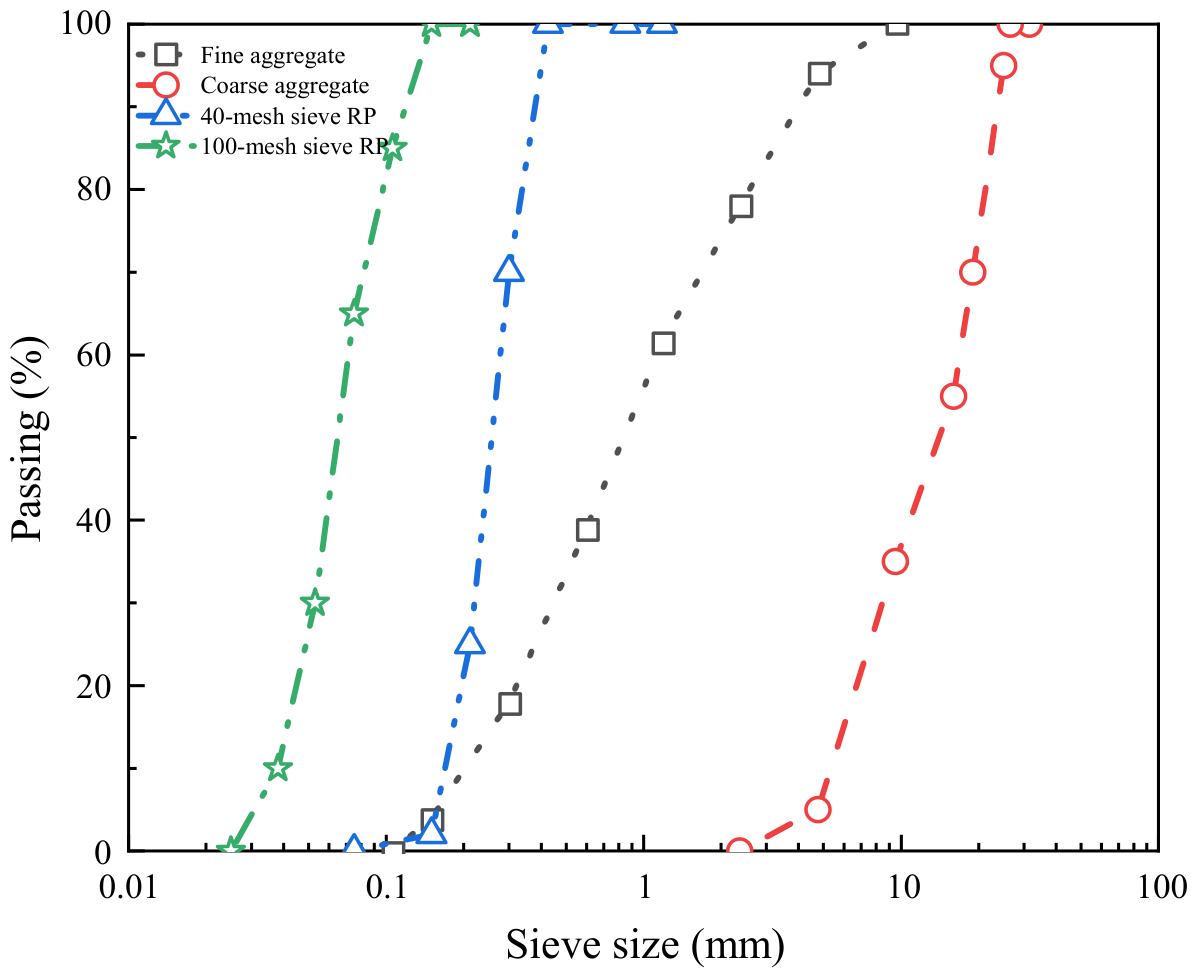
Figure 1. Particle size distribution curves of aggregates.
Buildings 16 03133 g001
Figure 2. Poisson’s ratio measurement setup.
Buildings 16 03133 g002
Figure 3. Schematic of the indentation area in ITZ.
Buildings 16 03133 g003
Figure 4. Compressive strength of RC mixtures.
Buildings 16 03133 g004
Figure 5. Splitting tensile strength of RC mixtures.
Buildings 16 03133 g005
Figure 6. Static elastic modulus and Poisson’s ratio of RC mixtures.
Buildings 16 03133 g006
Figure 7. Linear expansion coefficient of RC mixtures.
Buildings 16 03133 g007
Figure 8. Adiabatic temperature rise curves of RC mixtures.
Buildings 16 03133 g008
Figure 9. Dynamic elastic modulus and shear wave velocity of RC mixtures.
Buildings 16 03133 g009
Figure 10. Vibration acceleration and damping ratio of RC mixtures.
Buildings 16 03133 g010
Figure 11. FTIR spectra of RC mixtures.
Buildings 16 03133 g011
Figure 12. Cumulative mercury intrusion curves of RC mixture.
Buildings 16 03133 g012
Figure 13. Elastic modulus and hardness profiles across the rubber–mortar ITZ.
Buildings 16 03133 g013
Table 1. Chemical composition of cementitious material (wt.%).
MaterialsChemical CompositionLOI
CaOSiO2Fe2O3Al2O3MgOSO3Na2OK2OMnO
Cement61.1423.353.465.481.542.280.100.02-2.63
Fly ash8.5656.246.2421.771.271.770.540.03-3.58
Slag43.8229.240.5814.426.862.560.44-0.621.46
Table 2. RC mix proportion design.
LabelRs%Mix Proportions (kg/m3)
w/bCementSandGravelFly AshSlagWaterRPA (Mesh)
40100
RC-0-4000.4521081010309080116--
RC-5-4050.45210769.51030908017040.5-
RC-10-40100.452107291030908017081-
RC-20-40200.4521064810309080170162-
RC-5-10050.45210769.510309080170-40.5
RC-10-100100.4521072910309080170-81
RC-20-100200.4521064810309080170-162
Rs%: Rubber mass replacement rate.
Table 3. Pore structure parameters derived from MIP.
RC-0-40RC-5-40RC-10-40RC-20-40RC-5-100RC-10-100RC-20-100
Porosity (%)15.740617.582318.620820.572119.334718.498717.4582
Average pore diameter (nm)19.620.524.3127.5420.3819.3518.07
Maximum number of pore diameter (nm)32.631.330.8530.5824.619.9119.05
Disclaimer/Publisher’s Note: The statements, opinions and data contained in all publications are solely those of the individual author(s) and contributor(s) and not of MDPI and/or the editor(s). MDPI and/or the editor(s) disclaim responsibility for any injury to people or property resulting from any ideas, methods, instructions or products referred to in the content.