1. Introduction
The construction sector is under simultaneous pressure to expand the supply of buildings and to reduce the environmental burden created by material extraction, manufacture and use [
1]. Buildings and construction accounted for about 37 percent of global energy and process-related carbon dioxide emissions in 2022, while cement, steel and aluminum remained major sources of embodied emissions [
2]. The scale of projected urban growth makes material substitution more than a technical preference; it is becoming a central question of climate policy, resource security and housing delivery [
3].
Wood-based construction is often presented as part of this transition because responsibly sourced timber stores biogenic carbon and can displace materials with higher production emissions [
4]. Conventional timber, however, is constrained by variability, moisture sensitivity, biological decay, fire concerns and the structural limitations of many species. Recent research has therefore moved beyond traditional sawn timber toward engineered and functionalized wood systems that reorganize, densify or chemically modify the natural cellular structure of wood [
5,
6]. Cross-laminated timber, laminated veneer lumber and other mass timber systems have already demonstrated that wood can perform as a serious structural material when manufacturing quality, design standards and supply chains are aligned [
7,
8]. Augmented Wood is a proprietary term associated most closely with Woodoo and its STACK product family. European Union project reports describe a process in which part of the lignin is removed and replaced with a polymer system that strengthens and stabilizes the remaining cellulose structure [
9]. Company and project documentation reports strength, durability and carbon storage advantages, but these claims require careful distinction from independent peer-reviewed evidence and from the broader category of engineered wood. Commercial development has nonetheless advanced. In June 2025, Woodoo and Bouygues Construction announced a strategic partnership under which 10,000 cubic meters of STACK would be deployed following technical and certification approval [
10]. This development makes professional readiness, regulatory acceptance and local market conditions increasingly relevant research questions.
Nigeria provides a demanding context for such an innovation. The country must respond to rapid urban growth and a substantial housing shortfall while reducing dependence on carbon-intensive construction and addressing forest degradation [
11]. Official and multilateral assessments continue to identify a large national housing deficit and persistent pressure on urban infrastructure [
12,
13]. At the same time, forest accounts for Nigeria identify timber extraction and fuelwood demand among the economic forces contributing to forest loss [
14]. In South East Nigeria, the dominance of reinforced concrete, steel and blockwork is reinforced by familiar design practice, established supplier networks and client expectations. These conditions may protect conventional materials even where lower-carbon alternatives appear technically attractive. Construction professionals are important intermediaries in this transition because materials enter projects through specification, structural appraisal, cost evaluation, code approval and client persuasion. Research on mass timber and sustainable materials shows that awareness, professional knowledge, perceived risk, market access and regulation influence adoption as strongly as laboratory performance [
15,
16,
17]. Nigerian studies report similar constraints, including limited awareness, high initial cost, weak policy support and insufficient technical competence [
18,
19]. These studies provide a useful foundation, but they do not explain how professionals evaluate a molecularly modified wood material that is not yet routinely available in the domestic market.
The empirical gap is therefore both material-specific and context-specific. Existing research has examined engineered timber in Europe, North America and Australia and has assessed general barriers to sustainable materials in Nigeria and, more broadly, West Africa. In the region’s closest related precedent [
20], surveyed 54 built-environment professionals in Ghana on the use of vernacular and conventional wood-based materials (timber, bamboo and laterite) for green building delivery. That study, however, addressed familiar, non-proprietary vernacular materials rather than a molecularly modified, proprietary engineered wood product; to the best of our knowledge, no empirical study has yet examined professional awareness of or adoption disposition toward a proprietary advanced engineered wood product such as Augmented Wood in any West African professional market. Little is known about whether Nigerian architects and engineers have encountered Augmented Wood, how they interpret its claimed advantages, which risks dominate their judgment, or whether professional groups differ in their readiness to specify it. There is also a conceptual gap between individual adoption theories, which focus on knowledge and perceived attributes, and transition theories, which explain the institutional structures that support or block innovation (
Section 2.3 discusses where established individual-level acceptance models sit relative to the two theories used here). This study addresses these gaps by examining four questions. First, what is the level of professional awareness of Augmented Wood in South East Nigeria? Second, how are its potential benefits and risks perceived relative to familiar construction materials? Third, which market, regulatory, economic, technical and cultural barriers are most important? Fourth, do architects and engineers differ in their willingness to recommend or specify the material? Two hypotheses were tested. The first null hypothesis stated that the mean professional awareness score did not differ from the moderate benchmark of 3.00. The second null hypothesis stated that architects and engineers did not differ in their willingness to recommend Augmented Wood to clients.
The novelty and significance of this study lie in its combined treatment of professional cognition and the wider construction system. It provides an empirical baseline on Augmented Wood awareness and adoption disposition in a West African professional market that, as noted above, is narrower in scope but more specific in focus than the existing regional literature on vernacular wood materials; it clarifies the difference between favorable sustainability perceptions and actual specification readiness (
Section 3.4 defines this distinction precisely); and it uses interview evidence to explain why interest remains conditional. Its principal contribution to knowledge is APAWN, an inductively developed exploratory framework for Augmented Wood adoption in Nigeria. As
Section 5.6 and
Section 6.1 discuss in more detail, the framework is developed from the study findings themselves rather than tested as a predictive or causal model. It links awareness, perception and adoption disposition to the market, regulatory, economic and professional conditions that govern whether a new material can move from technical promise to routine practice.
2. Literature Review and Theoretical Framework
2.1. Augmented Wood and Advanced Wood Modification
Advanced wood modification draws on the hierarchical structure of natural wood rather than replacing it with a wholly synthetic matrix. Delignification, densification, resin infusion and cell wall engineering can improve strength, dimensional stability, durability and functional performance while retaining a renewable cellulose scaffold [
5,
6]. The term “Augmented Wood” is the proprietary trade name of the STACK product line manufactured by the French company Woodoo, produced through selective delignification of natural wood followed by infusion of a polymer system that strengthens and stabilizes the remaining cellulose structure [
9,
21]. Augmented Wood is a bioengineered material created by modifying natural wood at the molecular level, typically by removing lignin and replacing it with polymers, making it stronger, more durable, and sometimes translucent. It combines the sustainability of wood with enhanced mechanical and optical properties, allowing it to rival materials like concrete, steel, and glass in construction and design [
5]. Augmented Wood refers to natural wood that has been chemically restructured to improve its performance. The process involves delignification (removing lignin, the natural binder in wood) and replacing it with specialty polymers. This transformation yields wood that is as strong as concrete or metal; translucent like amber; durable, weatherproof, and fire-resistant; and touch-sensitive in some applications, enabling interactive surfaces [
21]. Augmented Wood is therefore treated in this study as one specific commercial instance of a broader technical category; an advanced or molecularly modified engineered wood that also includes cross-laminated timber, laminated veneer lumber, densified wood and other lignin- or resin-modified wood.
Experimental research has shown that low-density wood can be re-engineered into high-strength composites through the recovery and reuse of lignin-based constituents [
6]. These advances support a wider shift from viewing wood as a variable natural product toward treating it as a designed material platform. Augmented Wood occupies a distinct position within this field because it is a proprietary commercial system rather than a generic academic material class. CORDIS documentation describes selective lignin removal and polymer impregnation, while current product information presents facade and structural applications for STACK [
9,
21]. Such claims indicate commercial potential, but professional adoption in a new jurisdiction depends on independent testing, recognized design values, durability evidence, fire classification and quality assurance. The distinction between promising product information and locally accepted engineering evidence is central to the present study.
Research on cross-laminated timber and mass timber provides a useful comparison. Life cycle studies generally report lower embodied carbon than conventional reinforced concrete when wood is responsibly sourced and substitution effects are counted carefully [
7,
22]. Reviews also emphasize that environmental performance varies with forestry practice, transport distance, end-of-life treatment and the durability of the completed building [
8,
23]. These qualifications are especially important for Nigeria, where imported advanced materials could carry cost and transport burdens that differ from European production settings.
2.2. Professional Perception and Construction Material Adoption
New construction materials are not adopted solely because they perform well in controlled tests. Professionals interpret performance through prior training, professional responsibility, project experience and exposure to credible examples. Laguarda Mallo and Espinoza [
15] found that greater awareness of cross-laminated timber was associated with stronger willingness among architects to adopt it. Markström et al. [
16] similarly showed that Swedish architects valued the environmental and aesthetic advantages of engineered wood but remained concerned about cost, knowledge and technical uncertainty. Australian research identified code compliance, structural knowledge and cost uncertainty as major obstacles to multistorey timber construction [
24].
These findings reveal a recurring pattern. Relative advantage may create initial interest, but adoption requires compatibility with established design practice, manageable complexity, opportunities for trial and visible evidence of successful performance. In emerging material markets, professional confidence is also shaped by whether products can be procured, whether suppliers provide technical support and whether statutory documents recognize the material. Adoption is therefore a relationship between the properties of the material and the capacity of the surrounding system to make those properties usable.
2.3. Individual Technology Acceptance Models: TAM, TPB and UTAUT
Three established individual-level models dominate the wider technology-adoption literature and merit explicit positioning here. The Technology Acceptance Model (TAM) explains system use through perceived usefulness and perceived ease of use [
25]. The Theory of Planned Behavior (TPB) explains intention through attitude toward the behavior, subjective norms and perceived behavioral control [
26]. The Unified Theory of Acceptance and Use of Technology (UTAUT) integrates these and related models into constructs of performance expectancy, effort expectancy, social influence and facilitating conditions [
27]. Elements of this tradition are already present in the present study’s measurement design even though it was not named as the guiding framework: the perceived-benefit and perceived-risk items in Table 4 and the eight-attribute comparative ratings in Table 5 operationalize judgments that are conceptually close to TAM’s perceived usefulness and to TPB’s attitude-toward-the-behavior construct. Similarly, the barrier items in Table 6 concern supplier support and procurement access parallel to UTAUT’s facilitating-conditions construct.
Diffusion of Innovations Theory and Sustainability Transition Theory were retained as the primary explanatory frameworks for three reasons. The first reason is the study’s central research problem spans both individual professional cognition and system-level regime conditions. TAM, TPB, and UTAUT explain individual cognition well. However, they do not represent system-level conditions, such as the absence of a national standard, the absence of local suppliers, and import cost and duty structures. This is because these models were developed mainly for organizational information-technology adoption by individual users. They are not designed for materials that must clear professional, regulatory, and supply-chain gateways before an individual can act on a favorable attitude.
The second reason is the Diffusion of Innovations Theory’s five perceived attributes align naturally with the comparative and barrier items already in the instrument. This alignment removes the need for a separate measurement model. The third reason is retaining two theories that operate at different levels (individual cognition and system regime) strengthens the inductive APAWN framework. This framework integrates both levels explicitly. Its contribution lies in this integration, rather than in claiming theoretical novelty over TAM, TPB, or UTAUT as models of individual technology acceptance.
2.4. Sustainable Material Adoption in Nigeria
The Nigerian construction sector continues to depend heavily on concrete, steel, masonry and conventional timber. Studies of sustainable material adoption consistently identify weak awareness, high initial cost, limited supplier networks and inadequate regulation as important constraints [
18,
28]. Mogaji et al. [
19] further demonstrate that innovative building materials face resource, perception, cultural and organizational barriers. These conditions mean that material innovation often remains at the level of academic interest rather than becoming a routine option in professional specifications. Regional practice also matters. Ezeokoli et al. [
29] found that construction professionals in South East Nigeria operate within a context of material supply limitations, uneven technical capacity and project management challenges. Such a setting may create demand for reliable alternatives, but it may also increase caution toward products that lack local standards, familiar suppliers and proven service records. The South East therefore provides a useful setting for examining how sustainability interest interacts with practical constraints.
2.5. Diffusion of Innovations Theory
The Diffusion of Innovations Theory explains adoption through the communication of an innovation within a social system over time [
30]. Five perceived attributes are especially influential. Relative advantage concerns whether the new option appears better than existing practice. Compatibility concerns alignment with values, skills and routines. Complexity concerns the perceived difficulty of understanding or using the innovation. Trialability concerns the possibility of limited experimentation. Observability concerns the visibility of results. The theory also distinguishes knowledge, persuasion, decision, implementation and confirmation as stages in the adoption process.
Applied to Augmented Wood, the theory suggests that low awareness will prevent professional evaluation from developing fully. Sustainability and strength claims may increase perceived relative advantage, but limited local availability reduces trialability, the absence of demonstration projects limits observability, and regulatory uncertainty reduces compatibility with professional responsibility. Diffusion theory therefore provides the individual and professional-level explanation for this study.
2.6. Sustainability Transition Theory
The Sustainability Transition Theory examines how new technologies move from protected niches into dominant systems of practice. The multi-level perspective distinguishes landscape pressures, established regimes and niche innovations [
31]. Landscape pressures include climate commitments, urban growth and material scarcity. The regime includes building codes, supply chains, professional education, procurement rules and client expectations. Niche innovations develop outside the regime and may expand when external pressures increase and regime structures become more receptive.
In Nigeria, Augmented Wood can be understood as a niche innovation confronting a regime organized around reinforced concrete, steel and blockwork. Carbon reduction and housing demand create landscape pressure, but the established regime remains stabilized by familiar codes, local suppliers, professional routines and client trust. Transition theory complements diffusion theory by showing why positive individual attitudes may not lead to adoption when system conditions remain unfavorable.
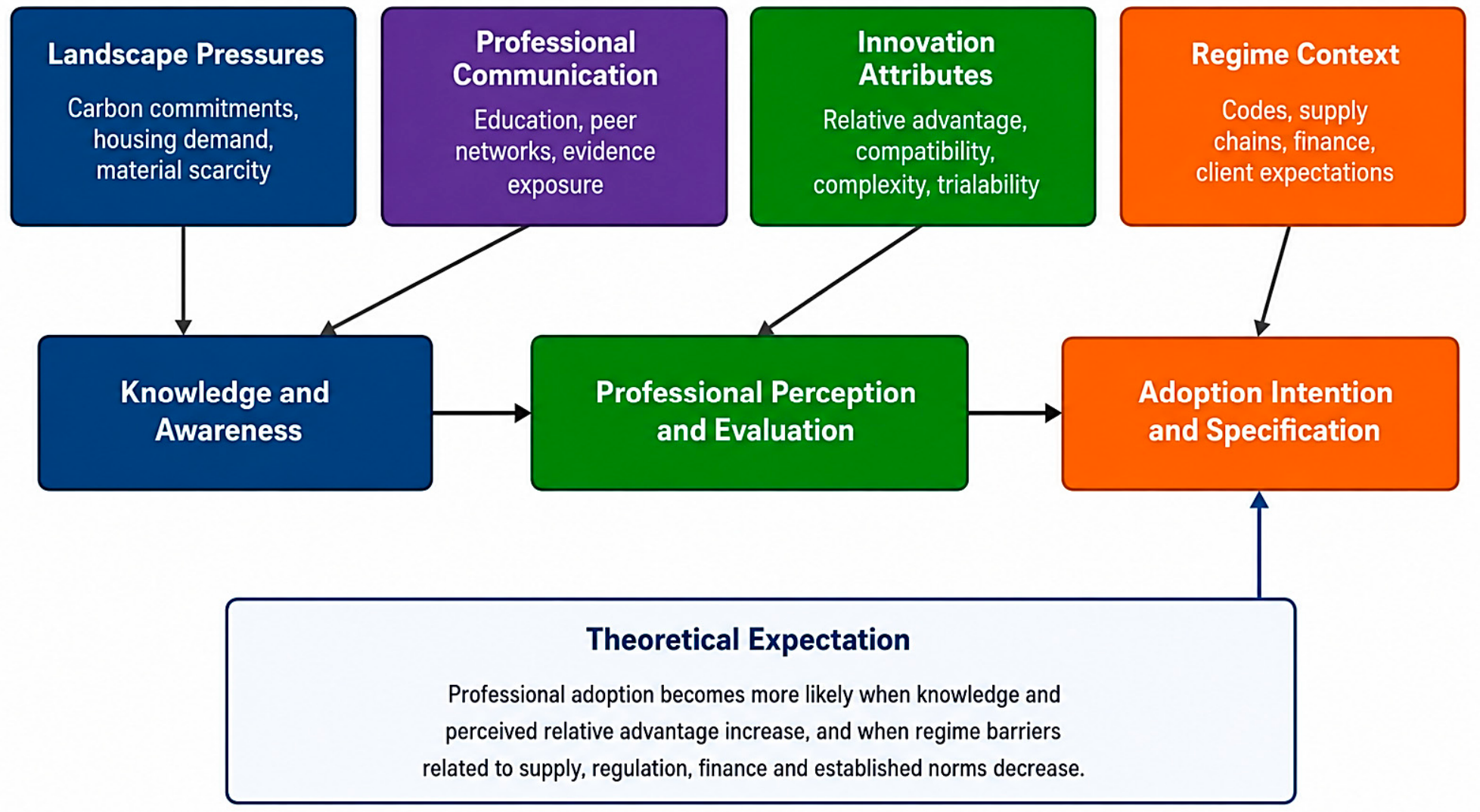
2.7. Integrated Conceptual Framework
Figure 1 integrates the two theories. Diffusion theory explains the movement from awareness to professional evaluation and adoption intention. Transition theory explains how landscape pressures, communication channels and regime conditions shape that movement. The framework proposes that professional adoption becomes more likely when knowledge and perceived advantage increase and when barriers associated with supply, regulation, finance and established norms decrease. The two hypotheses tested in this study are explicitly anchored to this pathway rather than treated as freestanding statistical tests. Hypothesis One tests the knowledge stage of Rogers’ adoption process at a system level. This is because the Diffusion of Innovations Theory holds that persuasion and decision cannot proceed until a social system has crossed a basic knowledge threshold. Hypothesis One asks whether professional awareness of Augmented Wood has reached the moderate benchmark that the theory would treat as marking that threshold. Hypothesis Two tests whether the theory’s relative-advantage and compatibility attributes differ between architects and engineers because of their different professional roles in specification and structural approval. This translates into a measurable difference in one behavioral indicator: willingness to recommend the material to clients.
The model in
Figure 1 arranges the two theoretical traditions into a single explanatory sequence rather than treating them as parallel but unconnected accounts. The lower row depicts the diffusion pathway through which an individual professional moves from knowledge and awareness, through perception and evaluation, to adoption intention and specification. The upper row depicts the transition theory elements that act on each stage from outside the individual: landscape pressures and professional communication channels shape the formation of awareness, innovation attributes shape professional evaluation, and regime context shapes the final translation of favorable perception into specification behavior. The diagram is theoretical rather than empirical, and it is presented before the results so that the quantitative and qualitative findings can later be read as a test of, and an elaboration on, the pathway it proposes. The theoretical expectation stated at the foot of the figure, that adoption becomes more likely as knowledge and perceived advantage rise and as regime barriers fall, is the proposition that the remainder of the study evaluates empirically.
3. Research Methodology
3.1. Research Design and Integration Strategy
This study used a quantitative dominant convergent mixed methods design. The survey and interview strands addressed the same substantive domains during the same field period, but each produced a different form of evidence. The survey estimated the distribution and strength of awareness, perceptions, barriers and adoption intentions. The interviews explained the professional reasoning behind those patterns. Integration occurred during interpretation through comparison of convergence, complementarity and tension between statistical results and interview accounts [
32]. A cross-sectional design was appropriate because this study sought a baseline assessment of a material that had not yet achieved routine market presence in Nigeria. The design does not measure actual long-term adoption, but it permits systematic comparison of professional groups and identifies the conditions that would need to change before adoption could occur.
3.2. Study Setting and Target Population
This study covered the five states in the South East geopolitical zone of Nigeria, namely Abia, Anambra, Ebonyi, Enugu and Imo. Three considerations informed this choice of study area. First, the South East geopolitical zone maintains state-level chapters of both the Nigerian Institute of Architects and the Nigerian Society of Engineers membership records that were sufficiently complete and accessible to support a stratified sampling frame for this study; this was a practical precondition for this study rather than an incidental convenience. Second, the zone combines high urban growth pressure with documented forest-loss pressure connected to timber extraction and fuelwood demand [
14], making it a plausible early market for a lower-carbon, wood-based structural substitute and a setting in which the tension between housing demand and material sustainability is unusually direct. Third, the Nigerian barrier studies already discussed in
Section 2.4 were conducted predominantly in other regions, so a South East focus addresses a specific regional gap in the domestic literature rather than duplicating existing coverage. The target population comprised architects and engineers registered through the relevant state professional chapters. Architects were drawn from Nigerian Institute of Architects records, while engineers were drawn from Nigerian Society of Engineers and associated state professional records. The combined accessible population was approximately 1100 professionals at the time of this study. The choice of architects and engineers reflected their complementary influence over material adoption. Architects shape material selection through concept development, performance briefs, aesthetic judgment and client advice. Engineers determine structural suitability, safety, code compliance and design values. Their combined assessments therefore provide a direct view of the professional gateway through which an unfamiliar structural material would need to pass.
Section 6.3 discusses explicitly how far these findings can be expected to generalize beyond this zone and these two professional groups.
3.3. Sample Size, Stratification and Survey Recruitment
The initial sample size was estimated using Cochran’s formula at a 95 percent confidence level, a 5 percent margin of error and maximum variability of 0.50 [
33]. The resulting value of 384 was adjusted for the finite population of approximately 1100, giving a target sample of 285. Proportional stratified sampling was applied first by state and then by profession. The allocation for each stratum followed n
h = (N
h/N) × n, where N
h represented the number of eligible professionals in the stratum. A total of 285 questionnaires were distributed through professional chapter contacts and established professional networks. Two hundred and seventy-one were returned, representing a return rate of 95.1 percent. Seventeen returned questionnaires contained substantial missing data or internally inconsistent response patterns and were excluded before analysis. The final valid sample was 254, representing 89.1 percent of the questionnaires distributed and 93.7 percent of the returned questionnaires.
3.4. Survey Instrument and Variable Measurement
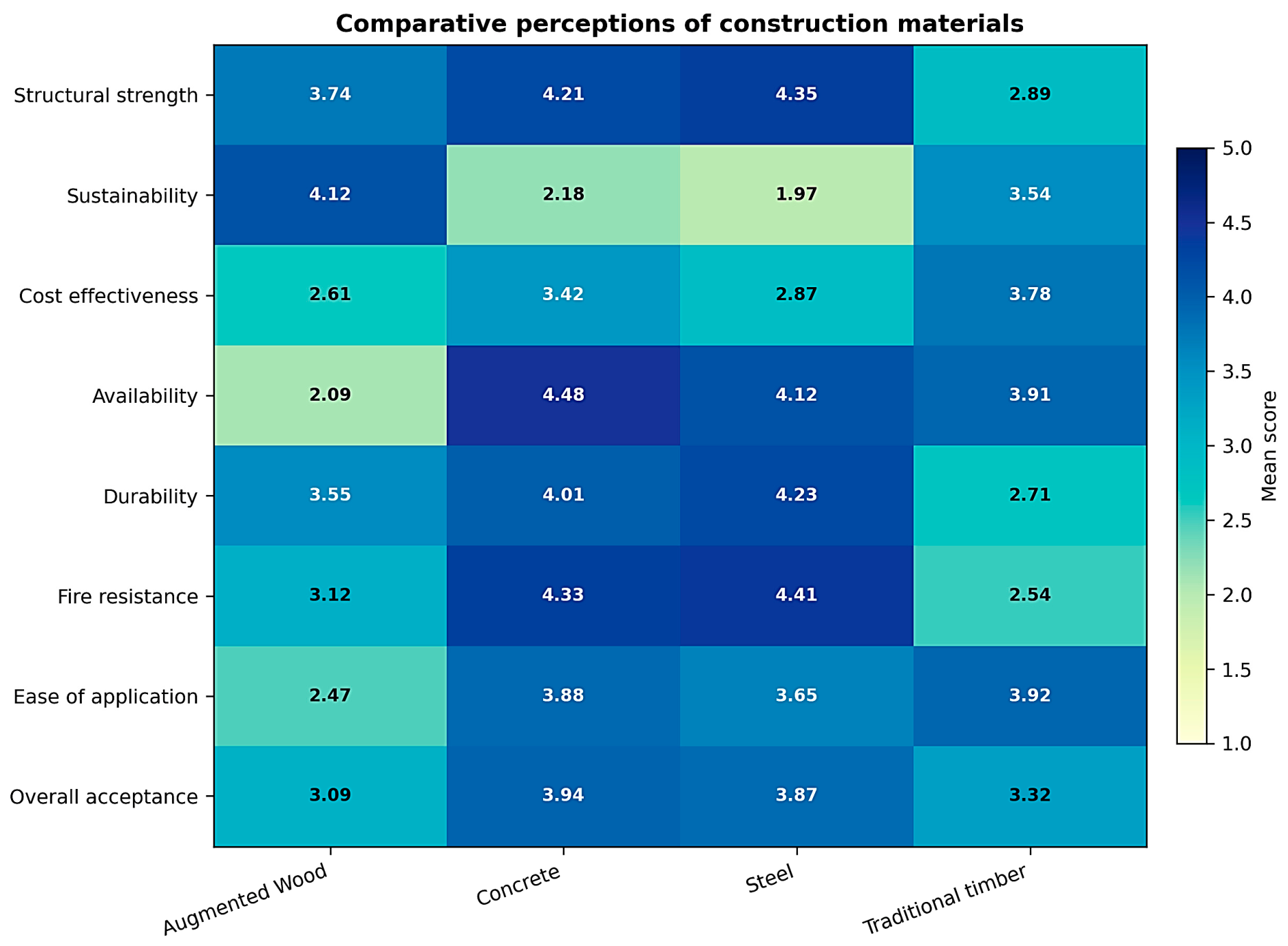
The questionnaire contained five sections. The first recorded profession, years of experience, state of practice and educational background. The second measured awareness using eight items covering recognition of the term, understanding of the modification process, knowledge of applications and prior exposure to engineered wood. The third assessed perceived benefits and risks. The fourth compared Augmented Wood with concrete, steel and traditional timber across eight attributes. The fifth measured barriers and future adoption potential.
All substantive items used a five-point response scale. Awareness items ranged from 1 (very low) to 5 (very high). Perception, barrier and adoption items ranged from 1 (strongly disagree) to 5 (strongly agree). Composite awareness was calculated as the arithmetic mean of the eight awareness items for each respondent. Descriptive interpretation used the following ranges: 1.00–1.49 very low; 1.50–2.49 low; 2.50–3.49 moderate; 3.50–4.49 high; and 4.50–5.00 very high. The midpoint value of 3.00 was used as the benchmark for the first hypothesis because it represents the scale position at which awareness becomes moderate rather than low. The questionnaire was reviewed by three academics with expertise in construction management, sustainable materials and materials science. A pilot test with 30 professionals outside the final sample examined clarity, sequence and internal consistency. The pilot produced a Cronbach alpha value of 0.84 for the multi-item scales, indicating acceptable reliability. Pilot participants were excluded from the main study.
3.5. Terminological Note: Adoption Potential, Intention, Disposition and Readiness
Because several closely related terms recur throughout the Results, Discussion and Conclusion, they are defined here and then applied consistently. Adoption potential is used as the umbrella term for the six-item composite scale reported in Tables 7 and 8, covering the full range of future-oriented adoption items. Adoption intention refers more narrowly to the Diffusion-of-Innovations-consistent construct of a stated plan to specify or recommend the material on a specific future project and operationalized here by the “likelihood of specifying in future projects” and “willingness to recommend to clients” items. Adoption disposition refers to the general favorable-or-unfavorable orientation expressed jointly across the perception items (Table 4), the comparative-material ratings (Table 5) and the barrier items (Table 6), independent of any near-term behavioral plan. Adoption readiness refers to the subset of disposition concerned specifically with institutional and professional preparedness to act and principally the “readiness to undertake training” and “inclination to trial in a pilot project” items, together with the supply, standards and training conditions discussed qualitatively in
Section 4.7.
3.6. Interview Selection, Procedure and Recording
The qualitative strand involved 24 semi-structured interviews, comprising 12 architects and 12 engineers. Participants were selected purposively from professionals who had completed the survey and agreed to further contact. Selection sought balance between professions and variation in state of practice and professional experience. This approach ensured that interview accounts reflected different positions within the material specification and approval process [
34]. The interview guide followed the survey domains but used open questions and probes. Participants were asked what they knew about Augmented Wood, how they judged the credibility of its performance claims, which project conditions would encourage or prevent specification, how clients might respond, and what evidence or institutional support would be necessary. Interviews were conducted in English between January and March 2024, lasted between 35 and 55 min, and were recorded with informed consent. Recordings were transcribed verbatim and checked against the audio before coding. Reporting of this strand follows the Consolidated Criteria for Reporting Qualitative Research (COREQ) checklist, covering research-team characteristics, the relationship between researchers and participants, and the coding and analysis procedure described in
Section 3.7 [
35].
3.7. Data Collection Procedure and Quality Control
Survey administration and interviews were completed during the same field period. Eligibility was confirmed before participation. Questionnaire screening was completed before data entry, and excluded cases were documented. Numeric responses were coded consistently, range checks were performed for every scale, and a sample of records was checked against the original questionnaires. Interview transcripts were anonymized, and identifying details about firms, clients and projects were removed. The convergent design required that the two strands remain analytically distinct until initial results had been produced. Quantitative patterns were therefore established before interview themes were used to explain them. A joint interpretation matrix was then prepared to compare each major survey finding with supporting, qualifying or contradictory interview evidence.
Data Quality Assurance for Ordinal Logistic Regression: Prior to the ordinal logistic regression analysis, we conducted preliminary data screening to ensure the assumptions of the proportional odds model were met. These included: (1) testing for multicollinearity among predictors using variance inflation factors (VIF), with all VIF values below 2.0, indicating no problematic multicollinearity; (2) examining the distribution of the dependent variable across predictor categories to ensure adequate cell sizes; (3) conducting the Brant test for the proportional odds assumption; and (4) checking for influential observations using Cook’s distance, with no cases exceeding the threshold of 4/n. All assumptions were met, supporting the appropriateness of the chosen analytic approach.
3.8. Quantitative Analysis
Quantitative analysis was completed in IBM SPSS Statistics version 26. Frequencies, percentages, means and standard deviations described the sample and item responses. The comparative material table was treated descriptively because all four materials were rated by the same respondents; this approach avoids the independence assumption problem that would arise from applying an ordinary one-way analysis of variance to repeated ratings. Two hypotheses were tested at the 5 percent significance level. For Hypothesis One, a one-sample t-test compared the composite awareness mean with the moderate benchmark of 3.00. The analysis reported the t statistic, confidence interval and Cohen’s d.
For Hypothesis Two, which examined whether architects and engineers differ in their willingness to recommend Augmented Wood to clients, we employed ordinal logistic regression (Proportional Odds Model). This multivariate approach was selected for four reasons: (1) the dependent variable (willingness to recommend) is measured on a 5-point ordinal scale, violating the interval-level assumption required for parametric t-tests; (2) the analysis must control for potential confounders including years of experience and state of practice to isolate the independent effect of profession; (3) ordinal logistic regression does not assume normality or equal intervals; and (4) it provides interpretable odds ratios with confidence intervals that respect the ordinal nature of the outcome.
The ordinal logistic regression model was specified as [
34]:
where Y represents the ordinal dependent variable (willingness to recommend, coded 1–5), j represents the cumulative logit thresholds (j = 1, 2, 3, 4), α_j are the threshold parameters, Profession is dichotomous (Architect = 0, Engineer = 1), Experience is categorical with four levels (<5 years, 5–10 years, 11–20 years, >20 years), and State is categorical with five levels (Abia, Anambra, Ebonyi, Enugu [reference], Imo). The proportional odds assumption was tested using the Brant test. For all analyses, 95% confidence intervals are reported for odds ratios and effect sizes [
35,
36].
The proportional odds model estimates the cumulative odds of being at or below a particular response category versus above that category. For a binary predictor (Profession), the odds ratio represents the multiplicative change in the odds of a higher response (greater willingness) for engineers relative to architects, holding other variables constant [
37,
38].
Qualitative Analysis
Interview transcripts were analyzed using the six-phase thematic process described by Braun and Clarke [
39]: familiarization, initial coding, theme development, theme review, theme definition and reporting. Coding combined deductive categories derived from the research questions with inductive codes that emerged from the transcripts. An audit trail recorded changes to the code structure.
Inter-Rater Reliability Assessment: To establish trustworthiness and rigor in the qualitative analysis, we implemented a systematic inter-rater reliability procedure. Two independent coders (the first author and a trained research assistant with experience in thematic analysis) coded 30% of the interview transcripts (n = 8, selected randomly) following the final coding framework. Inter-rater reliability was assessed using two complementary metrics:
Cohen’s kappa (κ): The primary measure of inter-rater agreement beyond chance. For the 24 coding categories, Cohen’s kappa was calculated using the formula [
40,
41]:
where P
0 is the observed proportion of agreement and P
e is the expected proportion of agreement by chance. The analysis yielded κ = 0.81 (95% CI: 0.74–0.88), indicating substantial to almost perfect agreement according to Landis and Koch’s [
42] benchmarks (0.81–1.00 = almost perfect agreement).
Percentage agreement: Simple percentage agreement between coders was 87.5% (210 out of 240 coding decisions matched), providing a supplementary metric that is more intuitive for readers [
35].
All disagreements between coders were resolved through consensus discussion, with the third author serving as arbitrator when necessary. The final coding framework was applied to all 24 transcripts by the first author, with ongoing peer debriefing sessions to maintain coding consistency.
Reporting Standards: The qualitative reporting follows the Consolidated Criteria for Reporting Qualitative Research (COREQ) 32-item checklist [
35]. This includes explicit reporting of researcher characteristics and reflexivity (academic background, prior relationship with participants, and assumptions about the material); study design (sampling strategy, interview setting, and data saturation); and analysis methods (coding procedures, participant validation, and trustworthiness measures).
Trustworthiness Enhancement: Beyond inter-rater reliability, we employed four additional strategies to enhance trustworthiness:
Member checking: Six participants reviewed the thematic summaries, and their feedback was used to clarify theme descriptions [
43].
Prolonged engagement: The first author spent six months building professional relationships before data collection [
40].
Thick description: Verbatim extracts are used extensively in the discussion to connect interpretation with professional accounts [
41].
3.9. Ethical Considerations
Ethical approval was obtained from the Research Ethics Committee of the University of Nigeria, Nsukka, before data collection. Participation was voluntary and based on informed consent. Participants could decline any question or withdraw without consequence. Survey records and transcripts were anonymized, stored securely and used only for research purposes. No organization, client or project is identifiable in the reported interview extracts.
5. Discussion
5.1. Awareness as the First Adoption Bottleneck
The awareness result provides the clearest starting point for interpreting this study. The composite score was not only descriptively low but significantly below the moderate benchmark, with a moderate effect size. This confirms that Augmented Wood has not entered the routine professional information channels of South East Nigeria. The interview statement “We hear very little about this in our professional circles” identifies the communication failure behind the statistic. Professional associations, technical journals, university curricula and continuing education have not yet created repeated exposure to the material.
This finding is consistent with research on cross-laminated timber, where awareness and prior exposure were associated with adoption willingness [
15]. It also aligns with Nigerian evidence that limited knowledge constrains sustainable material uptake [
18,
19]. Diffusion theory predicts that the adoption process cannot progress from knowledge to persuasion when professionals lack basic information about the innovation [
30]. The moderate familiarity with engineered wood in general offers an entry point, but as
Section 2.1 and
Section 4.2 both note, it should not be mistaken for knowledge of the specific product, process or design requirements that the awareness items on Augmented Wood/STACK specifically were designed to capture.
5.2. Environmental Promise and Technical Caution
The findings reveal a productive tension rather than a simple positive or negative perception. Respondents recognized sustainability, strength relative to conventional timber and moisture resistance as potential benefits. Augmented Wood also received the strongest sustainability rating in the material comparison. These responses suggest that the environmental argument is understandable and attractive to professionals, even where direct product knowledge is weak. Confidence weakened when respondents considered fire performance, tropical service conditions and structural use. One interview participant captured this position directly: “The strength claims are interesting. We need local testing data.” This statement is important because it separates curiosity from professional approval. Architects and engineers carry responsibility for safety and performance, so caution is rational when published design values, certification and long-term local evidence are unavailable. The result supports a central argument of this paper: commercial claims can stimulate interest, but they cannot substitute for locally recognized evidence.
The pattern also clarifies the relationship between independent literature and proprietary information. Research on engineered and modified wood demonstrates that major performance improvements are scientifically plausible [
5,
6]. CORDIS and company documentation report specific advantages for the Woodoo process [
9,
21]. The adoption question, however, depends on whether those advantages are translated into standards, test certificates and design procedures that Nigerian professionals can defend in practice; the definitional distinction drawn in
Section 2.1 between the proprietary product and the broader material category is precisely what allows this separation to be stated clearly.
5.3. Market, Regulatory and Economic Barriers as a Connected System
The barrier ranking shows that adoption is constrained most strongly by the surrounding system rather than by outright hostility to the material. Product unavailability ranked first, followed by regulatory absence and procurement cost, and as
Table 6 now shows explicitly, the 95% confidence intervals around these three leading barriers do not overlap with the interval around the lowest-ranked barrier, indicating a reliable separation between the top and bottom of the ranking. The interview declaration “You cannot specify what you cannot procure locally,” expresses the practical force of the market result: a professional may hold a favorable opinion yet remain unable to include the material in tender documents, obtain quotations or guarantee delivery. Regulation produces a second form of constraint. “There is no Nigerian standard covering this material class,” one participant observed. This concern is consistent with Sustainability Transition Theory because the established construction regime protects conventional materials through codes, approval procedures and accumulated experience [
31,
44]; the lack of a recognized pathway for structural evaluation creates liability and approval risk, particularly for engineers. Market access and regulation are therefore mutually reinforcing: suppliers are unlikely to invest without a credible approval pathway, while regulators have limited incentive to develop guidance for a product with no local market presence.
Cost is the third gate. The comment that “Import duties alone would price this out of most projects” shows how exchange rates, logistics and taxation enter professional judgment. The result parallels Nigerian studies in which initial cost and resource constraints limit sustainable material adoption [
18,
28]. It also suggests that early demonstration projects may require partnership finance or public procurement support because ordinary project budgets will not absorb the cost of market creation.
5.4. Professional Differences and the Strategic Value of Training
Architects demonstrated greater willingness than engineers to recommend the material to clients, even after controlling for years of experience and state of practice. The ordinal logistic regression analysis showed that engineers had approximately 38% lower odds of reporting higher willingness compared to architects (OR = 0.618, 95% CI: 0.444–0.861,
p = 0.004), representing a small-to-moderate effect size. This independent professional effect suggests that the difference is specifically attributable to professional training, role responsibilities, and disciplinary norms rather than to variations in career stage or geographic location. Architects may respond more readily to aesthetic possibility, material expression and sustainability narratives, while engineers may require more formal evidence of structural behavior and code compliance. Similar disciplinary differences have been observed in research on engineered wood adoption [
16]. The absence of significant effects for experience and location (all
p > 0.15) further strengthens this interpretation, indicating that the professional divide is consistent across different career stages and regional contexts.
The more strategically important result is the convergence on training. Both groups rated readiness to undertake training above the high threshold (architects: mean = 4.01; engineers: mean = 3.89). The interview statement “With training and demonstration projects, I would consider it,” connects this willingness to a practical adoption route. Joint professional education can therefore serve as the first shared intervention, but its content must go beyond promotion. Effective programs should include material science, fire and durability evidence, structural design values, quality assurance, procurement requirements and case-based specification exercises.
5.5. Mixed Methods Interpretation of Conditional Adoption
The integrated evidence changes the meaning of the quantitative results. Low awareness does not indicate resistance, and moderate adoption scores do not indicate readiness. Professionals are interested but unable to move confidently from interest to action. The benefit ratings show perceived relative advantage, while the barrier scores show weak compatibility, trialability and observability. The interview narratives explain that professionals want evidence they can inspect, standards they can cite, suppliers they can contact and projects they can visit.
This conditional pattern is especially important for policy. A campaign that presents Augmented Wood as a superior product may increase familiarity but may also deepen skepticism if it is not accompanied by independent testing and transparent documentation. Conversely, a standards program without professional communication may produce guidance that few practitioners use. The findings therefore support coordinated rather than isolated intervention.
5.6. The Apawn Analytical Framework as an Outcome of This Study
APAWN is an inductively developed heuristic derived from the cross-sectional descriptive statistics and qualitative thematic summaries reported above, not a predictive or causal model. It has not been tested through predictive modeling, path analysis or structural equation modeling, and its stages and gates should be read as an organizing device for the present findings and a set of testable propositions for future confirmatory research, rather than as a validated causal model—a qualification we state here explicitly in response to reviewer comment, and one that also governs how the Conclusion (
Section 6.1) and Limitations (
Section 6.3) describe the framework’s status.
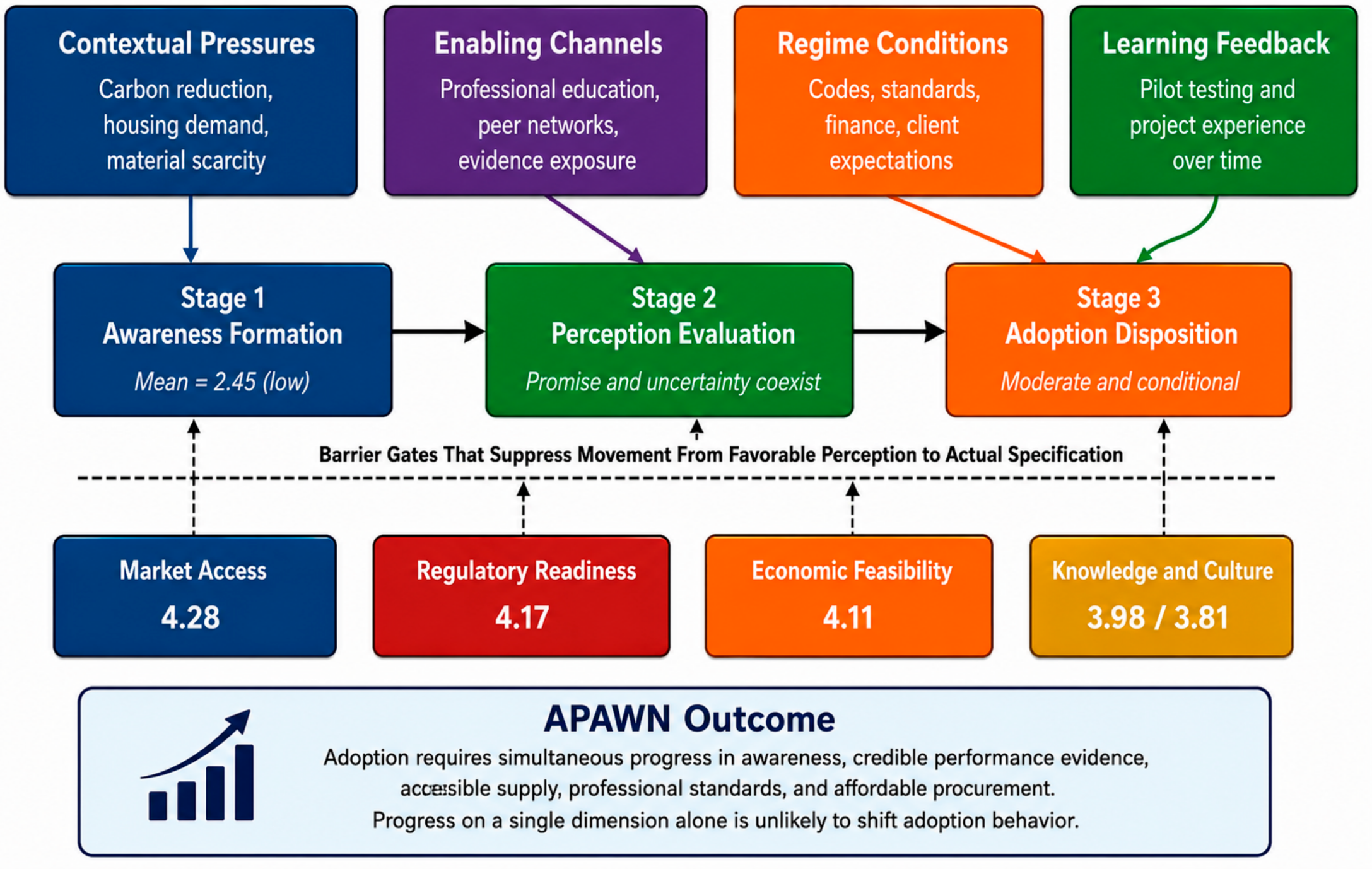
With that qualification in place, the framework in
Figure 3 is developed from the empirical results rather than imposed as a theoretical model in the literature review. It retains the sequential logic of awareness, perception and adoption but shows that movement between these stages is controlled by barrier gates. Stage One is awareness formation, which is currently weak, as shown by the mean of 2.45 and the significant result for Hypothesis One. Stage Two is perception evaluation, where sustainability and structural promise coexist with uncertainty about evidence and local performance. Stage Three is adoption disposition, which is moderate and differs modestly between professional groups in the bivariate comparison.
Four barrier gates explain why favorable perception does not progress automatically to specification. Market access is represented by the leading barrier score of 4.28. Regulatory readiness is represented by 4.17. Economic feasibility is represented by 4.11. Knowledge and cultural acceptance are represented by the high scores for professional awareness limitations and client resistance. The framework also includes a learning feedback loop because pilot projects and local testing can increase awareness, improve perception accuracy and reduce professional uncertainty over time. The contribution of APAWN is exploratory and practical rather than analytical in the causal sense: exploratively, it organizes the professional cognition described by the Diffusion of Innovations Theory alongside the system conditions described by the Sustainability Transition Theory into a single heuristic (see
Section 2.3 for its relationship to TAM, TPB and UTAUT); practically, it proposes an intervention sequence in which awareness building is followed by local evidence and demonstration, while supply, regulation and finance develop in parallel. Testing these propositions with a design capable of supporting causal or structural claims, discussed further in
Section 6.3, is left to future research.