Article

Particle Diffusion and Resident Satisfaction with External Fire Kangs for Winter Heating in Northwest Arid Rural China: A Case Study in Baoji

1
Manchester Business School, University of Manchester, Manchester M13 9PL, UK
2
College of Architecture and Energy Engineering, Wenzhou University of Technology, Wenzhou 325000, China
3
Shandong Key Laboratory of Intelligent Manufacturing Technology for Advanced Power Equipment, Weifang University, Weifang 261061, China
4
School of Machinery and Automation, Weifang University, Weifang 261000, China
*
Authors to whom correspondence should be addressed.
Buildings 2026, 16(14), 2866; https://doi.org/10.3390/buildings16142866
Submission received: 23 June 2026 / Revised: 13 July 2026 / Accepted: 16 July 2026 / Published: 18 July 2026
(This article belongs to the Special Issue Advanced Study on Urban Environment by Big Data Analytics)

Abstract

In the context of rural construction, studying particle diffusion alongside residents’ satisfaction with rural external heated kangs provides important support for upgrading heating facilities and improving domestic infrastructure in the northwest arid regions of China. This study takes a single rural household equipped with an external fire kang in Baoji as the research object. From the perspectives of operational and service management in human settlements, the spatio-temporal diffusion characteristics of particulate matter in the outdoor combustion port, living room, and bedroom during the winter heating period are continuously monitored, and data on resident satisfaction are collected through a questionnaire. The results show that, during the external kang’s heating period, the spatial concentrations of particulate matter decrease in the following order: combustion port > living room > bedroom. Concentrated morning and evening kang heating creates a typical bimodal distribution of outdoor particulate matter concentration, with peaks at 8:00 am and 8:00 pm. During the ignition period, coarse particles (PM10) are mostly released, while the proportion of fine particles (PM2.5, PM1.0) increases during the stable combustion period. During the sealing period, the concentration of fine particles doubles. After extinguishing, PM10 decays rapidly due to gravity deposition, while PM1.0 shows a longer environmental retention time due to its slow diffusion. The core diffusion process of the particulate matter mainly occurs within a distance of 5–15 m from the combustion port. The resident satisfaction survey shows moderate comprehensive satisfaction with external heated kangs, at 3.10 points on a 5-point scale. Addressing existing problems and proposing relevant strategies, this study provides a theoretical basis and technical support for the rational transformation of external heated kangs in the arid areas of Northwest China.

1. Introduction

Due to the rapid promotion of China’s rural revitalization strategy, rural infrastructure renovation and optimization of livelihood services have become key grassroots projects [1,2]. Rural areas in the northern and northwestern arid regions are constrained by their geographical climate, economic conditions, and living habits [3]. The traditional heated kang is still one of the most common methods for heating local residential buildings in China during the winter [4]. As a passive heating facility with a long history in northern residential areas, a fire kang fulfills heating, heat storage, and residential comfort and utility functions. It has a simple structure, low cost, uses local fuels [5,6,7], and has been widely used in North, Northeast, and Northwest China, among other regions, for a long time [8].
At present, the energy structure in rural areas is undergoing a gradual transformation, with clean fuels and energy-saving heating equipment coming to the fore [9]. However, due to constraints associated with their economic level, energy supply, residential form, and traditional lifestyle, most rural areas in the vast northwest arid region still face challenges and, thus, traditional fuels mainly consisting of biomass such as straw, tree branches, tree bark, and agricultural waste are predominantly used [10]. Some regions are gradually transitioning to fossil fuels such as loose coal, honeycomb coal, and coal gangue, while some have also begun to utilize low-pollution fuels such as biomass-based fuels and clean coal [11]. This change in fuel structure directly affects the combustion efficiency, heat output characteristics, and pollutant emission levels of the heated kang [12]. However, the winter climate in the arid northwest region of China is extremely cold and dry, and the rural energy structure has a relatively singular focus. Currently, a variety of traditional fuels such as wheat stalks, corn stalks, leaves, and branches are still utilized for heating [13].
For this reason, domestic scholars have conducted extensive thermal testing, structural optimization, fuel characteristic analyses, and other related research on heated kangs via actual measurement and simulation [14,15,16], focusing on the thermal conductivity, surface temperature distribution, heat dissipation efficiency, and thermal inertia of adobe kang and brick kang materials [14]. As energy-saving concepts in buildings continue to improve, research is gradually shifting towards optimizing the structure of kang bodies [15]; for example, combining a fire kang with fire walls and fire floors for heating purposes can improve the overall indoor thermal environment. Phase change materials and insulation structures have been used to enhance the thermal storage and night-time insulation capabilities of kang bodies [16]. Regarding the traditional built-in heated kang, the academic community has focused on safety and environmental issues such as indoor smoke leakage, carbon monoxide poisoning, and excessive indoor particulate matter [17,18]. However, the existing research has obvious shortcomings. Firstly, there is no differentiation between the management needs of internal and external fire kangs. Secondly, there is a lack of quantitative analysis on the diffusion of particulate matter and spatial pollution range around outdoor heated kangs. Thirdly, there is a complete lack of analysis of facility usage, operation and maintenance, renovation, supervision, and other issues in conjunction with management dimensions. In addition, incomplete combustion in a heated kang can produce a large number of ultrafine particles, such as PM1.0, which poses a greater threat to human health [19,20,21].
As a common form of renovation in areas such as Baoji in Northwest China, the external fire kang is set up such that fuel addition, combustion, and ash cleaning processes are performed outdoors, thus reducing indoor smoke pollution by design. It is a small-scale facility renovation enhancement that is typically independently performed in rural areas [22]. This separate outdoor combustion structure is fundamentally different from the traditional integrated heated kang widely adopted in northern rural China. A conventional integrated kang involves a stove and combustion chamber arranged inside the building, with all fuel combustion activities taking place indoors, leading to frequent problems such as indoor smoke leakage, excessive indoor particulate concentration, and carbon monoxide accumulation. In contrast, in the external heated kang studied in this paper, the entire combustion system is completely located outside the exterior wall of the residential building; as such, all related processes, including fuel feeding, open-flame combustion, and ash removal, are conducted outdoors. This forms a targeted renovation design specially developed to fundamentally mitigate the primary indoor pollution associated with traditional kangs. However, as evidenced by subsequent tests, this source control design does not completely eliminate indoor particulate pollution due to cross-room air convection and internal flue leakage defects. At present, such facilities lack standardized design, standardized operation, and systematic management, and problems such as outdoor particulate matter diffusion, poor indoor heating performance, and disorderly facility operation and maintenance are becoming increasingly prominent. Virtually all local external heated kangs are self-constructed by rural residents relying on long-term practical experience, without unified construction drawings, standardized flue size parameters, or unified sealing requirements. This self-built mode leads to highly differentiated structural layouts among different households, where the position of the outdoor combustion port is arbitrarily arranged without considering downwind pedestrian activity zones; flue elbows and connecting joints lack uniform refractory mud sealing treatment; and the thickness and porosity of the adobe kang slabs vary greatly from household to household. These non-standardized construction defects further aggravate flue smoke leakage, uneven indoor temperature distribution, and excessive dryness, which are the core underlying factors restricting residents’ overall satisfaction with external heated kangs. Such issues not only affect the quality of the rural living environment but also reduce residents’ satisfaction, thus becoming a weak link in rural infrastructure management [23].
From the perspective of rural construction, the renovation and upgrading of external fire kangs, daily operation and maintenance management, pollution control, and optimization of livelihood services fall within the scope of rural micro-infrastructure projects and public service management [24]. The current small-scale infrastructure in rural areas, such as that for heating and water supply, is characterized by fragmented and inclusive livelihood projects with a typical single-point scale, a wide distribution range, a large audience base, dispersed operation and maintenance entities, limited capital investment, and heavy use over management in the later stage [25]. Additionally, there are problems related to the homogenization of renovation plans, inconsistent construction standards, lack of post-operation and maintenance responsibilities, absence of effectiveness evaluation mechanisms, and insufficient resident participation [26]. Domestic research on heated kangs has mainly focused on engineering concerns such as thermal performance, fluid diffusion, and building construction [14,15,16]. Systematic research combining project management and operation and maintenance management perspectives is relatively scarce, and there is a lack of analysis on effectiveness evaluation, making it difficult to support the standardized management and large-scale renovation of similar rural facilities.
In addition, there is a lack of quantitative measurements of the outdoor emissions, courtyard diffusion, and downwind transport processes associated with external heated kangs in the existing literature and, in particular, there is a lack of synchronous monitoring and spatial distribution analysis of PM1.0, PM2.5, and PM10. The external heated kang has the following core features [27]: fuel addition, combustion, and ash cleaning are all carried out outdoors, reducing indoor pollution; it is common practice to burn the kang twice a day (in the morning and at night), with little burning during the day [7]; and the thermal environment is determined by both the temperature of the kang body and the indoor temperature and humidity. This structure results in better indoor air quality, but outdoor particulate matter dispersion is prominent.
The extremely low indoor relative humidity in the dry climate of Northwest China reduces residents’ comfort [28]. In addition, problems such as night-time temperature decay and early morning coldness affect sleep continuity. To date, satisfaction evaluations have mainly focused on overall thermal comfort, with less emphasis on sub-item analyses of perceived outdoor smoke and dust, indoor dryness, temperature uniformity of the heated kang, and air quality, making it difficult to accurately identify the real pain points associated with external heated kangs. Furthermore, most previous research has focused on traditional fire kangs with indoor integrated stove and kang combustion ports, with particular emphasis on indoor smoke leakage, CO poisoning risk, and indoor PM2.5 exceeding standards [29]. In the context of the unique external heated kangs in the arid northwest region, research on their particle emission and diffusion patterns, as well as residents’ overall satisfaction, is still relatively weak.
Based on the prominent issues mentioned above, this study selects a typical rural residence in Baoji with an external heated kang as an example, allowing for analysis of the diffusion law of pollutants and resident satisfaction during the external heated kang’s combustion period. The dual effects of external structures on indoor pollution reduction and local outdoor pollution are clarified, and a coupled analysis that considers both particle diffusion and resident satisfaction is established to enrich the theoretical environmental and comfort understanding of traditional heating systems in northern rural areas. It also provides interdisciplinary research ideas for the study of traditional facilities in similar rural areas.

2. Methods

2.1. Survey Object and Testing Content

A typical rural residential building in Baoji City with an external heated kang is used as an example. The testing site is shown in Figure 1. Distinct from a traditional indoor integrated kang with a built-in stove and an internal combustion chamber, the external heated kang selected in this study adopts a fully separated combustion layout; in particular, the combustion port and combustion chamber are arranged outside the building’s exterior wall, ensuring full outdoor operation of fuel addition, combustion, and ash cleaning and, thus, reducing indoor smoke pollution. The fixed heating operation mode of the studied kang involves concentrated burning from 6:00 to 8:00 in the morning and from 18:00 to 20:00 in the evening, with straw and firewood used as the primary combustion fuels. Notably, this unified outdoor combustion process facilitates the dual daily functions of space heating and food cooking for local residents; all morning and evening cooking procedures are completed using the open flame at the kang combustion port, resulting in complete time overlap between cooking activities and concentrated kang heating periods.
The target rural household was selected according to four unified screening criteria, ensuring its representativeness of local mainstream external fire kang facilities. (1) Heating facility condition: The residence is equipped with a fully separated outdoor combustion external fire kang, self-built by villagers with local clay, bricks, and straw without standardized industrial prefabrication, consistent with the mainstream self-built transformation mode in local villages. (2) Fuel and operation habit: Residents rely on locally sourced crop straw and fruit tree pruning firewood as daily heating fuels, with fixed concentrated combustion periods in the morning and evening, matching the universal heating schedule of Baoji rural households. (3) Building form: The building is a typical single-story courtyard rural residence with ordinary wooden doors and aluminum alloy windows without special airtight renovation, representing the general rural residential envelope structure in arid northwest areas. (4) Household population characteristic: The residence is populated by a three-person permanent family with regular daily indoor activity rhythm, avoiding extreme long-term vacant or overcrowded living conditions that would interfere with normal kang usage. Preliminary village-wide field surveys showed that over 80% of external fire kang-renovated households within the research area adopt an identical structural layout, fuel combination, and heating operation mode. Thus, the spatial–temporal pollutant variation rules and resident satisfaction data obtained from this single case reflect the typical operating characteristics of regional rural external fire kang systems.
The sampling points were arranged according to the testing requirements of the ASHRAE55-2020 standard [30]. The monitoring locations were near the outdoor combustion port, in the center of the courtyard, in the center of the bedroom, and in open outdoor areas. Gradient measuring points were set up along the downwind direction of the combustion port at 0–5 m, 5–15 m, and 15–25 m. The open outdoor monitoring point shown in Figure 2 was located in an open vacant lot more than 25 m downwind from the target external heated kang, designed to represent the village-scale regional atmospheric background concentration. This point avoids direct near-source particulate interference from the studied kang, yet it cannot be completely isolated from the cumulative pollution generated by dozens of other households across the whole village. Three points were taken from each group. Each one was tested for 5 min, and the average value was used for data analysis. Figure 1 shows the spatial positions of all fixed indoor and outdoor monitoring stations, providing a basis for subsequent analysis of particulate transmission routes from the outdoor combustion port to the living room and bedroom via air convection and structural leakage from the kang. Survey questionnaires were distributed for environmental satisfaction research and, based on a statistical analysis of subjective survey results, the response rate of the subjects was determined. The testing and research took place from 15 December 2024 to 10 January 2025, with 24 h continuous daily monitoring.
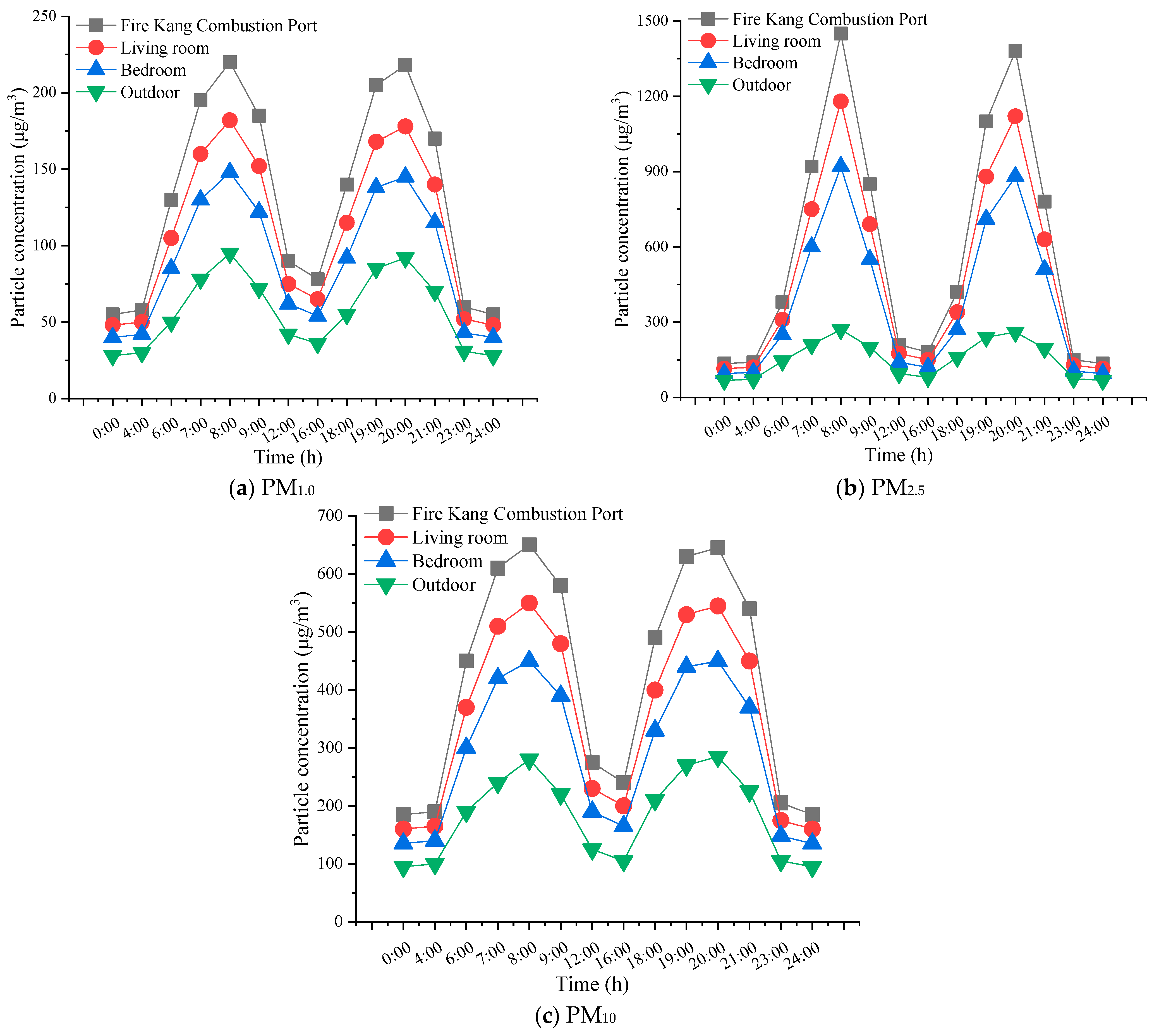
Figure 2. Changes in particulate matter concentration at different times. Note: The “Outdoor” curve corresponds to village regional atmospheric background monitoring data collected at a location over 25 m away from the tested external heated kang, separate from the near-source gradient sampling points described in Section 3.3. Synchronous concentration peaks arise from collective heating emissions of all village households, rather than direct pollution from the measured kang. The outdoor curve represents the village-wide regional background PM concentration; its values exceeding the limits in Table 1 can be attributed to the fact that the listed standards are indoor-specific and not designed for outdoor ambient air evaluation.
Buildings 16 02866 g002
Table 1. Standard parameter limits.
Standard NameIndexRequireNotes
Standards for indoor air quality
(GB/T 18883-2022) [31]
Temperature (°C)16~24Winter
Relative humidity (%)30~60Winter
Wind speed (m/s)≤0.2Winter
PM10 (mg/m3)≤0.1024 h average
PM2.5 (mg/m3)≤0.0524 h average
Note: All limit values in this table are derived from the GB/T 18883-2022 Standards for indoor air quality, which apply exclusively to enclosed indoor residential spaces. These thresholds are not suitable for judging the compliance of outdoor village atmospheric particulate concentrations.
To ensure the accuracy, stability, and reproducibility of field-monitoring data, standardized sampling and quality control procedures were strictly implemented throughout the entire monitoring campaign.
First, all particulate monitoring instruments were subjected to zero and span calibration one day before field deployment. Instrument sensitivity and sampling consistency were checked to eliminate systematic measurement errors.
Second, all indoor and outdoor monitoring probes were fixed 1.2–1.5 m above the ground, conforming to the standard human breathing height for residential environmental monitoring. All probes were kept away from direct fire sources, wall surfaces and sheltered corners to avoid local interference.
Third, the monitoring interval was set to record real-time PM1.0, PM2.5, and PM10 concentrations at 1 min resolution throughout the 24 h continuous test period. Effective continuous recording was guaranteed without artificial interruption during the whole experiment.
Fourth, strict data quality control was performed after data collection. Abnormal instantaneous values caused by occasional equipment jitter and human interference were eliminated, and continuous valid data sequences were retained for subsequent temporal and spatial distribution analysis.
The entire test period maintained stable and uniform meteorological conditions: average ambient temperature 2.1 °C, average wind speed merely 0.72 m/s, persistent northeast gentle breeze and frequent temperature inversion, eliminating large-scale wind and temperature fluctuations that could randomly interfere with particulate spatial distribution differences. Furthermore, PM1.0, PM2.5 and PM10 at all monitoring locations presented highly synchronized bimodal diurnal fluctuation patterns; the consistent spatial gradient order (combustion port > living room > bedroom > outdoor background) across three particle sizes acts as internal cross-verification, confirming that the observed concentration disparities are driven by kang combustion emission rules rather than random measurement errors.
In addition, the unified monitoring time window, fixed kang combustion schedule, consistent fuel type, and stable on-site meteorological conditions ensured the stability and comparability of the obtained monitoring results.
A total of 74 questionnaires were initially distributed to eligible rural households within the monitoring coverage area. Strict screening criteria were applied to respondents: only long-term residents owning an external heated kang with more than three consecutive heating seasons of usage were included; migrant vacant households, families with a newly installed external kang (less than one year), or a reconstructed indoor integrated kang were excluded. Three questionnaires were discarded as invalid due to missing core evaluation items, contradictory scoring, and incomplete filling, yielding 71 fully valid samples with an effective response rate of 95.9%.
Methodological and statistical justifications confirmed that the sample size of 71 is statistically adequate for this study. First, the investigation adopted a saturation sampling principle; after collecting around 65 valid questionnaires, no new distinctive complaints, usage pain points, or divergent subjective feedback emerged from additional respondents, indicating information saturation, and extra questionnaires would only generate repetitive information without enriching the research findings, proving the sample adequately captures the core subjective perceptions of local residents and avoids random sampling bias that would weaken the reliability of comparative satisfaction results. Second, according to common standards for micro built-environment satisfaction research published in Buildings, Building and Environment, and similar journals, a sample size greater than 50 meets the basic requirement for reliable descriptive statistics and Pearson correlation analysis. Based on the central limit theorem, the sample distribution approximates normality when N ≥ 50, satisfying the prerequisites of the correlation analysis performed in this study. Post hoc statistical power analysis further verified that, with an expected medium correlation effect size (r = 0.5), α = 0.05, and a two-tailed test, the statistical power with N = 71 reaches 0.92, exceeding the widely accepted threshold of 0.8 in social and architectural environmental research, which effectively reduces the risk of Type II error.
In addition, this study focuses on coupled analysis of fixed-site continuous particulate monitoring data and nearby residents’ subjective satisfaction, rather than large-scale cross-regional population inference. All questionnaires were collected from households within the particle concentration gradient monitoring layout, and the total number of qualified target households in the case village was less than 90. The 71 valid samples cover most qualified research subjects in the monitoring scope, and thus can be considered to accurately reflect the overall subjective experience of local residents with external heated kangs, providing sufficient support for the satisfaction analysis and correlation discussions in this paper. The limitations regarding single-village sampling and limited sample coverage across multiple regions are clearly stated in Section 4, and expanded multi-village sampling will be carried out in follow-up research to improve the universality of the conclusions.
The schematic in Figure 1 showcases the spatial topological relationship between the outdoor pollution source, indoor kang structure, residential functional spaces, and ambient outdoor zone for the analysis of multi-path smoke and particulate dispersion pathways. This schematic only displays monitoring positions related to the kang heating system. No separate cooking stove is presented, as all cooking activities are performed using the same outdoor kang combustion port without independent cooking flue equipment.

2.2. Test Instrument

A GRIMM1.109 portable aerosol particle size spectrometer was used to test the mass concentration of particulate matter, supplied by Beijing Saak-Mar Environmental Instrument Ltd., Beijing, China. It has a measurement range of 0.1–100,000 μg/m3, with a repeatability of 5%. The TSI7545 indoor air quality-measuring instrument was used to measure the test temperature and humidity, supplied by TSI Instrument Beijing Co., Ltd, Beijing, China, with a temperature measurement range of 0–60 °C (accuracy ± 0.6 °C, resolution 0.1 °C) and relative humidity measurement range of 5–95% (accuracy ± 3%, resolution 0.1%).

2.3. Evaluation Criteria

The standard limit values are shown in Table 1 [31].
We conducted a subjective survey in the form of a questionnaire, referring to the relevant literature using the voting scale method [32] to characterize residents’ subjective feelings about their environment based on their reported satisfaction. Table 2 summarizes the responses on the satisfaction rating scale.
Table 2. Satisfaction rating scale.
SatisfactionVery DissatisfiedDissatisfiedModerateSatisfiedVery Satisfied
S12345
Note: This unified five-point satisfaction voting scale was applied consistently to quantify four independent evaluation dimensions of residents’ experiences of external heated kangs, including thermal comfort, air quality, dry feeling, and overall comprehensive satisfaction, while all specific items were newly customized for Baoji’s external fire kangs after a pilot survey with local villagers to optimize wording. All mean satisfaction values and standard deviations summarized in Table 3 were calculated based on scoring results using this scale.
Table 3. Satisfaction ratings for residents with external heated kangs (5-point scale).
Evaluation
Dimension
DefinitionAssignment BasisAverageStandard
Deviation
Thermal comfort (TC)Core requirementsThe heated kang has a good heating effect and uniform temperature, but there is a problem of dryness.3.650.82
Air quality (AQ)Health impactThere is no obvious smoke smell outside the combustion port, but the concentration of particulate matter is high, potentially
causing breathing difficulties.
2.81.15
Dry feeling (DR)Physical discomfortLow air humidity and discomfort in the
mucous membranes of the mouth and nose are persistent negative experiences.
2.10.98
Comprehensive
satisfaction (CS)
Overall evaluationBased on the above three factors, it is
determined that thermal comfort will increase the score, while pollution and dryness will decrease the score.
3.10.95

3. Results and Discussion

All the monitoring and satisfaction data below were derived from a single typical rural household in Baoji, which reflects the typical pollution and comfort characteristics of local self-built external fire kangs rather than universal quantitative standards for all rural heating facilities.

3.1. Emission Characteristics of Particulate Matter Concentration over Time

The diffusion characteristics of particulate matter generated by combustion in the external heated kang over time are shown in Figure 2.
The daily average meteorological conditions during the field test are summarized as follows: average ambient temperature, 2.1 °C; daily temperature range, −1.3 to 6.5 °C; Average relative humidity, 76.4%; average wind speed, 0.72 m/s; dominant wind direction, northeast. Figure 2 shows the 24 h temporal variation characteristics of PM1.0, PM2.5, and PM10 concentrations at different locations around the external heated kang during winter. Overall, the concentrations of the three particle sizes exhibit a typical bimodal distribution in the morning and evening, with peaks occurring at 8:00 am and 8:00 pm, respectively, which is consistent with the results of existing research [33] and verifies the findings presented in this paper. Notably, the outdoor background concentration curve presents a similar bimodal distribution that is synchronized with indoor spaces, which can be explained by the village-wide collective heating behavior. All rural households in the village perform concentrated kang combustion during the same (morning and evening) time windows. Under winter weather conditions, characterized by calm wind and temperature inversion, particulate emissions from numerous scattered kang facilities accumulate within the village airspace, forming a regional pollution load that simultaneously elevates the background outdoor PM concentration. Nevertheless, the outdoor background maintains the lowest particulate concentration level among all monitoring locations throughout the 24 h cycle, which confirms its validity as a regional baseline reference for evaluating the pollution contribution derived from the single tested external heated kang. The concentration rapidly increases from 6:00 to 8:00 and from 18:00 to 20:00, gradually decreases after stopping combustion, and returns to baseline levels at night (23:00 to 6:00 the next day). From a management perspective, farmers lack scientific guidance for kang use, and the concentrated combustion period occurs under stable winter weather conditions. As a result of this lack of management of usage behavior, particulate matter is prone to accumulate and spread. Concentrated emissions in the morning and evening form regional short-term air pollution, increasing the pressure on rural living environment control [34]. At all times, the concentration of particulate matter showed the following gradient: combustion port of the heated kang > living room > bedroom > outdoor. The combustion port of the heated kang was the peak concentration point, where the peak PM2.5 concentration reached 1450 μg/m3; the concentration in the living room ranked second, being significantly higher than that in the bedroom; and the concentration in the bedroom was still higher than that outdoors (representing the atmospheric background level of the region). The temporal trends of the three types of particulate matter were highly consistent; only the concentration levels differed. Among them, the peak PM2.5 concentrations were the most prominent.
These results can be explained by the fact that the combustion port of the heated kang is a direct emission source, where open flame combustion and fuel pyrolysis occur in a concentrated manner, resulting in the highest particulate concentrations at all times. In addition, the living room has strong connectivity with the courtyard. Under calm and stable winter weather conditions [35], particulate matter generated by combustion is prone to accumulate in the courtyard. However, the living room is connected to the courtyard by doors and windows, through which particulate matter may enter via air convection, making it the area with the second-highest concentration. The bedroom is relatively enclosed, with a longer physical distance from the pollution source and fewer smoke transmission paths, making diffusion more difficult and resulting in a slightly lower concentration. The outdoor location is far away from the combustion port and is only affected by the regional atmospheric environment; it is not directly affected by local emissions, resulting in the lowest concentration. Its concentration emissions are also related to the heating behavior of farmers [36]. In rural daily routines, the two concentrated kang-burning periods fully coincide with morning and evening meal preparation by residents. At 08:00 and 20:00, farmers simultaneously carry out kang heating and cooking using the shared outdoor combustion port, which greatly increases both the fuel combustion intensity and pollutant release rate. The synchronized cooking and heating behaviors generate periodic changes in combustion load, which directly drive the obvious bimodal fluctuation characteristics of outdoor and indoor particulate matter concentrations. After the kang is turned off at night, there were no new emissions and particulate matter gradually decreased under diffusion, ultimately showing consistency with outdoor fluctuations. In addition, the higher proportion of PM2.5 indicates that the external heated kang mainly emits fine particulate matter, which is more likely to diffuse into indoor spaces with airflow and is considered a key health risk-related pollutant during the winter rural heating period [37]. Therefore, while the use of an external heated kang can significantly reduce particulate matter pollution inside the bedroom, concentrated burning of the kang in the morning and evening leads to a clear dual peak structure of outdoor PM concentrations.
In addition, considering the 24 h average concentration limits for indoor PM10 (0.10 mg/m3; i.e., 100 μg/m3) and PM2.5 (0.05 mg/m3; i.e., 50 μg/m3) in the standard [31], the 24 h average concentrations of PM10 in the heated kang combustion port, living room, and bedroom (420 μg/m3, 352 μg/m3, and 290 μg/m3, respectively) are 4.20 times, 3.52 times, and 2.90 times the standard limit, respectively. At the same time, the 24 h average PM2.5 levels of the heated kang burner, living room, and bedroom reached 588 μg/m3, 479 μg/m3, and 382 μg/m3, which are 11.76 times, 9.58 times, and 7.64 times the standard limit values, respectively. Compared with a traditional indoor integrated kang, this separated outdoor combustion structure significantly lowers the baseline indoor particulate concentration; however, due to the dual pollution transmission paths of courtyard smoke infiltration via doors/windows and fine particle leakage through kang flue gaps, persistent indoor particulate concentrations exceeding standard limits are still observed. All inter-zone concentration gradients (combustion port > living room > bedroom > outdoor background) remained unchanged throughout all heating hours, and the multiple-fold over-limit multiples of indoor PM2.5/PM10 showed stable proportional differences between functional spaces, indicating the observed spatial disparities are persistent structural pollution characteristics of external fire kangs rather than temporary accidental fluctuations during individual heating cycles.
Therefore, although the external fire kang’s combustion port is located outdoors, the smoke can still enter the room through doors and windows. In addition to particulate infiltration through doors and windows under air convection, structural airtightness defects of the kang and its flue system constitute another stable indoor smoke leakage pathway, which has been verified through field investigations. The self-built external heated kang lacks standardized sealing construction: long-term thermal expansion, contraction, and dry shrinkage produce micro-cracks on adobe and brick kang slabs, mortar joints between flue pipelines, and elbow connections, and the junction of the outdoor combustion port and indoor flue may not be fully filled with refractory mud, leaving persistent tiny gaps. During kang combustion—particularly the oxygen-deficient sealing stage—high concentrations of fine particles (PM2.5, PM1.0) accumulate inside the flue. Driven by the pressure difference between flue interior and indoor space, these ultrafine particles continuously seep into the bedroom through structural gaps. Unlike intermittent smoke intrusion via doors and windows, which only peaks in the morning and evening heating hours, kang flue leakage serves as a persistent all-day indoor pollution source. The superposition of these two transmission channels eventually leads to long-term excessive particulate concentration in the relatively enclosed bedroom, and fine particles with slow sedimentation characteristics continuously accumulate indoors, resulting in the bedroom PM2.5 concentration reaching 7.64 times the standard threshold. External heated kang combustion is the core source of indoor particulate matter pollution in rural areas during winter, and the pollution level, cumulative effect, and health risks of fine particulate matter (PM2.5) are much higher than those of coarse particulate matter (PM10); as such, this type of combustion has become a key factor restricting the achievement of indoor air quality standards in rural areas. Further optimization of and improvements in facility-sealing and smoke-guiding structural design are needed.

3.2. Changes in Particulate Matter Concentration During Combustion Cycle

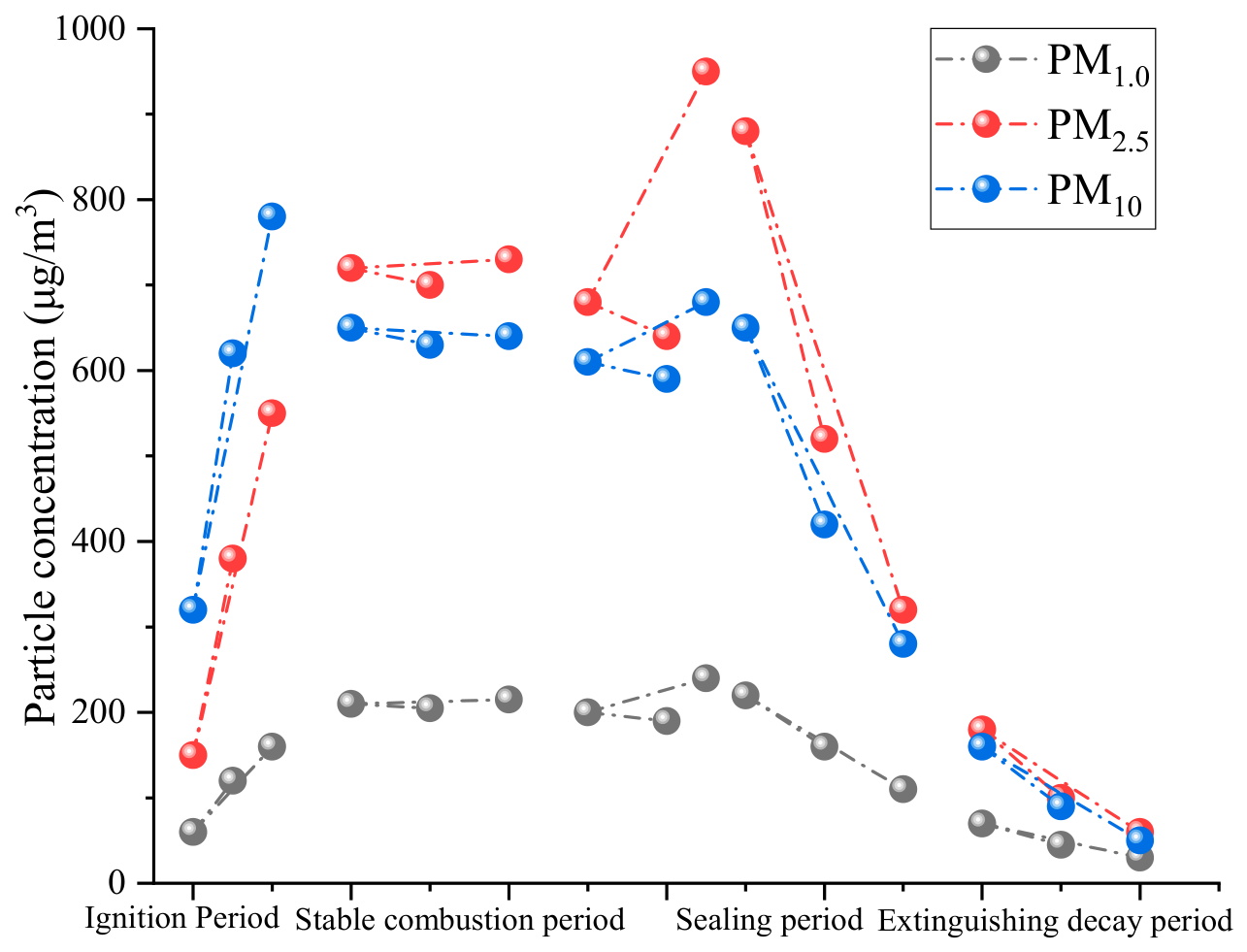
The changes in particulate matter during the different external heated kang combustion stages are shown in Figure 3.
The complete combustion cycle of a heated kang is divided into the ignition period, stable combustion period, sealing period, and extinguishing decay period, and significant differences in particle composition are reported at different stages. Figure 3 shows that, during the ignition period (0–10 min)—that is, the stage of rapid release of particulate matter—the concentrations of PM1.0, PM2.5, and PM10 all sharply increase, with PM10 showing the most prominent increase, rising from 320 μg/m3 to 780 μg/m3, and so fly ash pollution is prominent. PM2.5 and PM1.0 increase synchronously, but relatively gently. During the stable combustion period (10–60 min), the fluctuation of particulate matter concentration significantly narrowed and remained at a relatively high level overall. The proportions of PM1.0 and PM2.5 increased, with concentrations stabilizing at 190–215 μg/m3 and 640–730 μg/m3, respectively. PM10 slightly decreased to 590–650 μg/m3. During the sealing period (60–70 min), the concentration of fine particulate matter surged again, with PM1.0 and PM2.5 reaching 220–240 μg/m3 and 880–950 μg/m3, respectively, with a significantly higher increase than PM10, resulting in an increased pollution risk. During the extinguishing decay period (70–120 min), the particulate matter concentrations all gradually decreased. PM10 decayed the fastest, from 650 μg/m3 to 50 μg/m3, while PM1.0 decayed the slowest, indicating a long-term impact on the surrounding environment. Ultimately, it remained at 30 μg/m3, reflecting differences in the diffusion and sedimentation of particles of different sizes.
The main reason for these increases is that farmers lack standardized operation training and rely solely on personal experience with regard to the ignition process, sealing, and addition of materials. Unreasonable operations exacerbate pollutant emissions, and the indiscriminate stacking of fuel, excessive addition of materials, and improper sealing operations further exacerbate the pollution problem [38]. During the ignition period, the fuel is in an incomplete combustion state and volatile matter quickly precipitates, accompanied by the release of a large amount of coarse particulate fly ash (such as fuel debris and ash) [39], resulting in a sharp increase in the PM10 concentration. At the same time, the generation of aromatic hydrocarbons and other precursors under low-temperature combustion promotes a synchronous increase in PM2.5 and PM1.0. During the stable combustion period, the fuel is in full contact with oxygen, resulting in improved combustion efficiency, reduced release of coarse particulate fly ash, and a stable concentration of PM10. The high-temperature cracking and homogeneous nucleation processes are enhanced, promoting the generation of ultrafine particles (PM1.0) and condensed fine particles (PM2.5), resulting in a significant increase in the proportion of fine particles. During the sealing period, oxygen in the furnace is rapidly consumed, forming a strong reducing and oxygen-deficient environment. Fuel pyrolysis intensifies and a large number of nanoscale particles and organic aerosols are generated [40], resulting in a secondary increase in PM1.0 and PM2.5 concentrations. The increase in coarse particles is limited by insufficient oxygen supply. The decrease in particulate matter concentrations during the decay period after flameout is dominated by both diffusion and deposition [41]: coarse particles (PM10) have the fastest decay rate due to strong gravitational deposition and weak diffusion ability, whereas fine particulate matter (PM2.5) and ultrafine particulate matter (PM1.0) exhibit delayed attenuation due to their small aerodynamic diameter, long suspension time, slow diffusion, and weak settling. Ultimately, PM1.0 shows the slowest attenuation rate as it is more easily transported over long distances with the airflow.
According to existing studies, the staged combustion of crop straw and firewood in rural kang systems involves oxygen-deficient combustion and fuel pyrolysis processes. In the ignition stage, incomplete combustion caused by insufficient oxygen supply generally produces abundant coarse particles, whereas the relatively stable combustion conditions in the later stage may facilitate fine particle nucleation and gradual deposition, which is consistent with the particulate variation trends observed in our field measurements.
It is necessary to clearly state that all the above mechanistic interpretations are derived from the published literature and are only used to assist in understanding the measured phenomena. No targeted mechanism experiments or chemical tests were performed in the present study to verify these microscopic processes. The core results and conclusions of this manuscript are entirely based on 24 h continuous field-monitoring data, which objectively reflect the actual temporal and spatial variation characteristics of particulate pollutants of external heated kangs in actual rural operating scenarios.

3.3. Changes in Particle Concentration Under Spatial Distribution

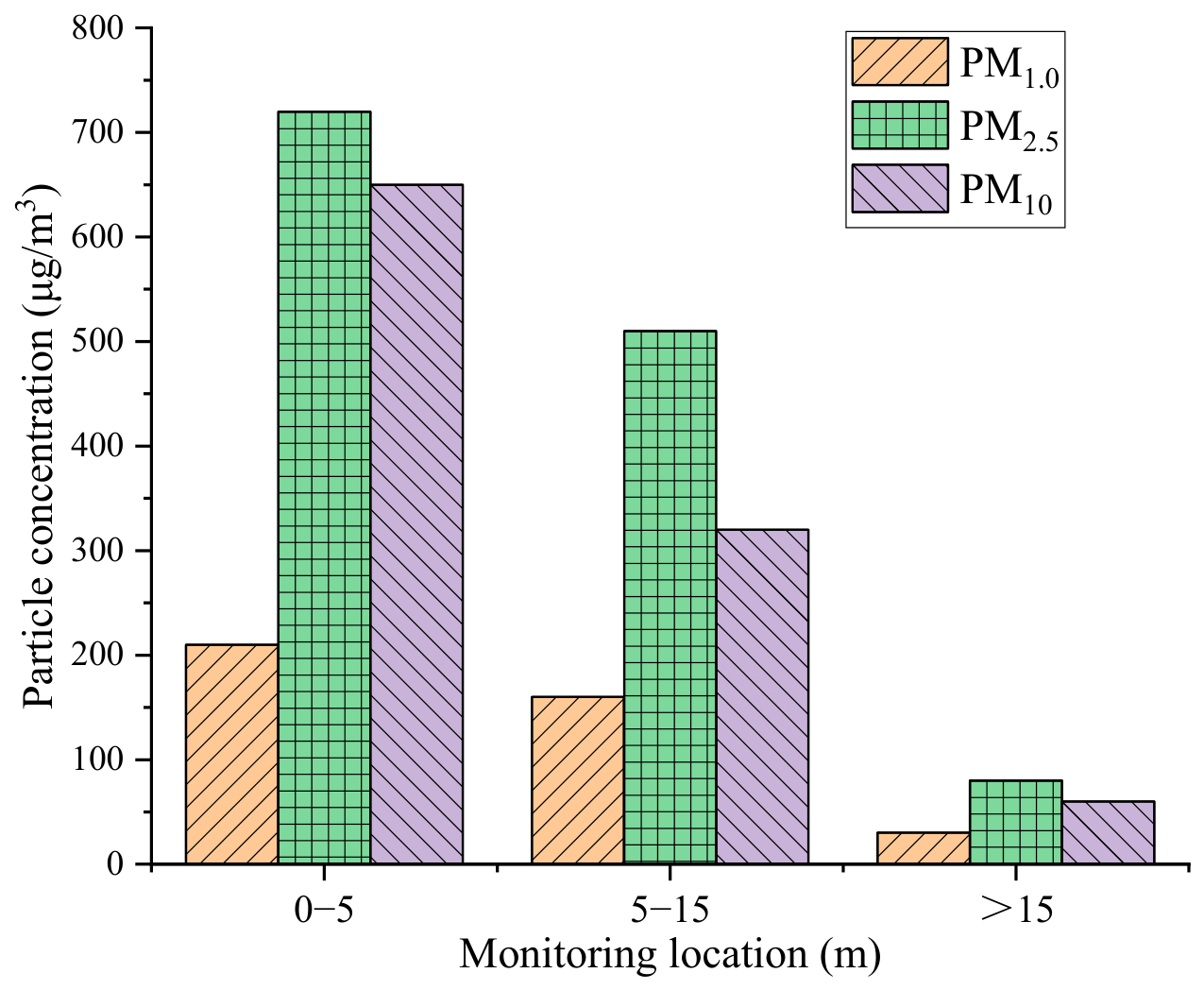
The spatial distribution of changes in particulate matter with respect to distance from the external heated kang is shown in Figure 4.
Figure 4 shows that, during the stable combustion stage of the external heated kang, the different particulate concentrations (PM1.0, PM2.5, and PM10) exhibited significant gradient decay characteristics with spatial distance. The concentration of particulate matter gradually decreased with an increase in distance from the combustion port. The 0–5 m region is the high concentration core area, the 5–15 m region is the main diffusion attenuation area, and the concentration in the >15 m region is close to the atmospheric level. The attenuation of PM10 is most severe, rapidly decreasing from 650 μg/m3 at 0–5 m to 320 μg/m3 at 5–15 m, with only 60 μg/m3 remaining above 15 m. The attenuation amplitude of PM2.5 comes second, decreasing from 720 μg/m3 to 510 μg/m3, while it is still maintained at 80 μg/m3 in areas greater than 15 m. The attenuation of PM1.0 is relatively gentle, decreasing from 210 μg/m3 to 160 μg/m3. When it is greater than 15 m, there is still a measurable quantity of 30 μg/m3, indicating stronger long-range diffusion ability. The results indicate that the core diffusion process of particulate matter generated by combustion in the heated kang mainly occurs within the range of 5–15 m, and the concentration gradually approaches the regional atmospheric background at distances greater than 15 m. This is because PM10, as coarse particulate matter, has a large aerodynamic diameter, significant gravity-settling effect, strong inertia, and weak diffusion ability [41]. After combustion and emission, it mainly accumulates in the 0–5 m range of the source area and rapidly settles with increasing distance. Therefore, the concentration decays significantly in the 5–15 m range and almost completely settles or diffuses to the background level after >15 m. PM2.5, as a fine particulate matter, is lightweight, has a slow settling speed, and is more prone to horizontal and vertical diffusion with airflow. Therefore, it maintains a high concentration within the range of 5–15 m and significantly higher concentrations than the background can still be detected in areas greater than 15 m, reflecting a longer transmission distance and environmental retention time. PM1.0, as an ultrafine particle, has the smallest particle size, intense Brownian motion, and is largely unaffected by gravity settling. It has the strongest diffusion ability and can be transported over long distances with airflow. Therefore, its spatial attenuation amplitude is the smallest and it retains a certain concentration at distances greater than 15 m. Therefore, regarding the particulate matter emitted by the external heated kang, coarse particles (PM10) mainly cause near-source pollution, while fine particles (PM2.5, PM1.0) can spread to a farther range, with a more lasting impact on both the surrounding outdoor areas and indoor environment. They are the key contributing components of air pollution in rural winter heating periods.
In addition, there is no unified planning for the layout of rural courtyards and kang combustion outlets are often adjacent to doors, windows, and pedestrian walkways, directly affecting residential activity areas. There is no designated pollution control area, and no regional isolation or protective measures; therefore, it is necessary to further manage the layout and spatial protection of such sites.

3.4. Personnel Satisfaction Survey

In this work, 24 h continuous particulate monitoring was adopted to objectively quantify the temporal and spatial diffusion characteristics of pollutants generated by an external heated kang. In addition, a standardized questionnaire survey was conducted to collect residents’ subjective evaluations on heating comfort, indoor air quality, and comprehensive usage satisfaction. A total of 74 questionnaires were distributed; of these, 71 were effectively collected. Evaluation was conducted based on four dimensions: thermal comfort, air quality, environmental perception, and comprehensive satisfaction. The overall Cronbach’s α of the full questionnaire scale = 0.84, far higher than the widely accepted acceptable threshold of 0.7; Dimension-wise Cronbach’s α: Thermal comfort (0.81), Air quality (0.79), Dry feeling (0.83), Comprehensive satisfaction (0.86). All dimensional α coefficients exceed 0.7, which verifies strong internal consistency among items within each evaluation dimension. This result confirms that our questionnaire has stable measurement logic and reliable unified judgment standards for residents’ subjective satisfaction, greatly strengthening the robustness of subsequent satisfaction scoring and correlation analysis. The results are summarized in Table 3.
Table 3 shows that the comprehensive satisfaction score of rural residents in Baoji City regarding external heated kangs is 3.10 points, which is generally at a moderate level; as such, the comprehensive service quality of facilities needs to be improved. The scores of each individual dimension show significant hierarchical differentiation; in particular, thermal comfort satisfaction was rated significantly higher than the other dimensions. The heating effect of the kang was recognized by residents as the core advantage of the facility. Satisfaction with air quality ranked second, just above the passing line, as particle pollution and smoke odor negatively affect their experience with external kangs. Satisfaction with dryness was rated the lowest, falling within the unsatisfactory range, as a high-temperature, low-humidity winter environment causes physical discomfort. Correlation analysis revealed that comprehensive satisfaction is strongly positively correlated with thermal comfort (r = 0.78, p < 0.01), moderately positively correlated with air quality (r = 0.65, p < 0.01), moderately negatively correlated with dryness (r = −0.52, p < 0.05), and moderately negatively correlated with thermal comfort and dryness (r = −0.45, p < 0.05). All significant correlation coefficients passed the 0.01 or 0.05 significance level test, and the directional correlation relationships (strong positive correlation between comprehensive satisfaction and thermal comfort, moderate negative correlation between comprehensive satisfaction and dry feeling) are logically consistent with the measured indoor hygrothermal and particulate environment conditions. The prominent score gap between dry feeling (2.10, unsatisfactory range) and thermal comfort (3.65, satisfactory range) is not caused by random respondent bias; field interviews with participants uniformly cited persistent nasal and oral mucosal dryness as their most prominent discomfort, which repeatedly corroborates the low dryness satisfaction score and strengthens the credibility of the inter-dimension satisfaction differences presented in Table 3.
The high satisfaction with thermal comfort is a result of the efficient radiation heating characteristics of external heated kangs [42], with the uniform surface temperature of the kang meeting the core winter heating needs in rural areas, thus becoming the dominant factor in improving the comprehensive evaluation score. In contrast, satisfaction with air quality showed a polarized balance. On one hand, the external combustion port effectively avoids indoor open flames and thick smoke, achieving “no odor” status and enhancing subjective perception; on the other hand, the fine particulate matter (PM2.5, PM1.0) produced by combustion can spread to the living room and bedroom through airflow, causing difficulty in breathing and other forms of discomfort, thus creating a mismatch between objective pollution and subjective feelings, ultimately lowering the rating. In addition, the high-temperature radiation heating of the heated kang leads to a significant decrease in indoor relative humidity, coupled with the dry background of the northern atmosphere in winter, forming a microenvironment of “high temperature and low humidity” which directly causes discomfort in the oral and nasal mucosa and affects sleep uniformity and comfort. The moderate level of overall satisfaction with external heated kangs can be attributed to various factors.
In this study, continuous high-frequency monitoring data were collected throughout the entire combustion cycle. Descriptive statistical analysis and comparative analysis of temporal and spatial differences were adopted as the main analytical methods to characterize the stage-based particulate emission rules and spatial diffusion characteristics of external heated kangs. Meanwhile, Pearson correlation analysis was applied to explore the correlations between different residential satisfaction indicators. The existing data analysis methods are sufficient to support the core research conclusions regarding pollutant distribution laws and resident satisfaction performance within the scope of the current research. However, it is necessary to clarify that the present study only conducted objective environmental monitoring of particulate temporal and spatial distribution rules and a subjective resident heating satisfaction evaluation. This investigation did not include personal exposure monitoring, individual exposure dose assessment, or quantitative health risk analysis for residents.
In arid northwest rural areas, external heated kangs are mostly built by farmers themselves relying on their personal experience, without unified standardized design specifications and construction technical guidelines. This self-built mode can lead to an unreasonable layout of combustion port positions, irregular flue pipeline sizes, and incomplete sealing treatment of kang slabs and joints, resulting in inherent long-term particulate diffusion and leakage hazards. No environmental impact assessment was conducted in the early stage, and the location of combustion facilities was not planned in conjunction with local meteorological conditions and courtyard layouts. Furthermore, without unified usage standards, farmers operate arbitrarily; this means that ignition, sealing, and fuel use are not performed scientifically, exacerbating pollution and energy consumption. Disorderly stacking of fuel and open-air storage of straw and firewood pose fire safety and secondary pollution hazards, and issues may arise as a result of the failure to establish a regular survey, tracking, and rectification mechanism for residents’ satisfaction, resulting in an inability to address residents’ demands in a timely manner. Only focusing on the basic function of heating leads to the neglect of secondary needs such as air humidity and air quality, and the service system should be improved. Supervision of the rural living environment remains focused on large-scale pollution sources, neglecting practical problems such as scattered small-scale pollution sources such as heated kangs, leading to obvious blind spots.
In the future, various improvements can be made. For example, installing a smoke hood and chimney on an external combustion port can lift the smoke and reduce near-ground pollution. It is recommended to avoid combustion during periods of calm wind and temperature inversion, and concentrated burning of the kang at night should be encouraged. Moreover, standardized sealing renovation for kang bodies and full flue pipelines should be implemented, including filling slab cracks and pipe joints with high-temperature refractory mud, installing sealed expansion joints at flue elbows, and repairing loose kang surface gaps to block long-term fine particle leakage channels inside the building envelope. The use of molded biomass and clean coal should be promoted to reduce PM emissions and black smoke. It should be clarified that this optimization measure is only proposed as a forward-looking improvement suggestion, rather than a conclusion supported by the self-conducted comparative field tests detailed in this study. The core research scope of this study focuses on investigating the spatio-temporal diffusion characteristics of particulate pollutants from an unmodified external heated kang and evaluating residents’ satisfaction with existing heating facilities. Targeted monitoring experiments to quantify the PM reduction effect of smoke hoods and heightened chimneys are not included in our current field measurement scheme. This proposed strategy is summarized and referenced based on the existing literature and practical rural renovation engineering cases, which have verified that such facilities can reduce the low-level horizontal diffusion of outdoor particulate matter to a certain degree. However, our study does not provide measured data proving that this single intervention alone can reduce indoor PM2.5 concentrations to meet the safety limits of GB/T 18883-2022. Corresponding controlled variable field tests focused on this renovation measure will be arranged in our follow-up research, in order to obtain quantitative data on its indoor particulate mitigation performance. The layout of the flue inside the kang body should be optimized and the temperature difference between the kang head and the kang tail should be reduced. It is recommended to strengthen the sealing of doors and windows to reduce the infiltration of cold air and trace particles, and to adopt multi-type low-cost passive humidification and local moisturizing measures to address issues associated with severe indoor dryness. The proposed passive humidification schemes are all zero-energy/low-cost solutions adapted to economically disadvantaged rural households in arid northwest regions, with specific implementable measures as follows. (1) Indoor natural water evaporation humidification: Place idle open earthen jars, large plastic basins, and water tanks near the kang body and indoor heat sources; radiant heat from the heated kang accelerates the natural evaporation of water to steadily increase indoor relative humidity, requiring no additional procurement costs. (2) Plant transpiration humidification: Plant water-tolerant edible vegetables (spinach, Chinese cabbage) and foliage green plants on indoor windowsills and courtyard marginal land; daily watering triggers continuous plant transpiration to mitigate air dryness and, as an additional benefit, the vegetables can supplement the household daily diet. (3) Porous clay wall moisture-retention renovation: Smear local free clay–straw mixed mortar on partial indoor walls facing the kang; light daily water spraying enables the porous wall layer to store moisture and release water vapor slowly under kang heat throughout the day for long-term humidity regulation. All the above measures are economically accessible for rural low-income residents: the water container and planting schemes achieve near-zero cash investment by reusing household idle supplies and free courtyard land; the clay and straw for wall renovation are self-sourced local raw materials without commercial material costs, and residents can complete construction independently without labor expenses. Furthermore, all passive humidification modes rely on natural evaporation and transpiration requiring zero electricity or fuel consumption, producing no recurring daily operational expenditures, which avoids long-term economic pressure on rural families. The amount of fuel added should also be standardized, alongside the duration of heating, in order to improve the stability of heat storage. In addition, closing the window on the windward side of the bedroom during the heated kang’s combustion period can reduce the backflow of smoke.

4. Limitations and Future Research Directions

The present study adopts a single typical rural household as the monitoring case, which generates clear limitations that readers should fully consider when judging the generalizability of observed particulate concentration differences and resident satisfaction gaps. Firstly, fuel types, courtyard layout and building envelope airtightness vary across villages in the Baoji arid rural region; the quantitative concentration multiple values of PM1.0/PM2.5/PM10 obtained in this case cannot be directly generalized as universal regional thresholds, although the qualitative spatial–temporal diffusion patterns are representative for over 80% local self-built external kang households. Secondly, there are significant subjective feelings and individual differences among residents, which may lead to biased satisfaction evaluations. The third issue is that monitoring was only focused on the winter heating period, thus lacking multi-seasonal and long-term continuous observation data. Limited by the current monitoring conditions, we did not separately quantify the particle contribution ratio of flue structural leakage and door–window infiltration in this study. In the future, further research can be conducted to address the above shortcomings. This may involve expanding the research area, comparing combustion and emission tests under different fuels and different housing types, thus improving the universality of the conclusions; combining objective monitoring and subjective evaluation to construct a more comprehensive evaluation system and reduce the impact of individual differences; and carrying out long-term monitoring across multiple seasons and years to further reveal the spatio-temporal variation patterns of external heated kang-associated pollution and develop adaptive pollution control and thermal comfort optimization technologies. It is necessary to conduct more in-depth research on the management of micro-livelihood projects in rural areas and form a replicable and promotable management system for the renovation of old rural facilities. In follow-up controlled comparison tests, we will set up contrast groups with fully sealed kang flues and closed doors/windows to quantitatively distinguish the pollution contributions of the two transmission channels, in order to provide more targeted sealing transformation parameters for rural external kang renovation.
In addition, the pollution control suggestions proposed in Section 3.4, including smoke hood installation and chimney heightening, are only prospective improvement paths drawn from the existing literature and practical projects, without corresponding supporting test data obtained from the field monitoring performed in this study. Subsequent research will design comparative experimental groups to independently monitor the indoor and outdoor particulate concentration changes before and after installing smoke hoods and raising chimneys, and further explore the effect of combining these measures with kang body and flue sealing renovation to form targeted quantitative pollution control technical schemes for external heated kangs, with the overall aim of meeting relevant air quality standards. Moreover, this study only suggests targeted passive humidification improvement strategies based on rural building characteristics and residents’ economic conditions, without conducting synchronous humidity monitoring tests of different humidification combinations during the heating period. Subsequent field-controlled tests will be performed to quantitatively compare the indoor humidity-increasing effects of single and combined passive humidification measures, thus informing low-cost, operable humidity adjustment schemes which are suitable for rural dwellings in arid northwest areas using external heated kangs.

5. Conclusions

This study focused on the use of outdoor heated kangs in the arid rural areas of northwest Baoji and systematically revealed the spatio-temporal diffusion characteristics of particulate matter during the winter heating period; furthermore, through a subjective questionnaire, the core issues relating to residents’ satisfaction with heating were identified. The following conclusions were drawn:
  • During the heating period of the external heated kang, the particulate matter emissions show a decreasing pattern of combustion port > living room > bedroom, and the combustion emissions are mainly composed of fine particulate matter (i.e., PM1.0 and PM2.5). Due to the influence of the morning and evening concentrated heating mode, the outdoor particulate matter concentration forms a bimodal distribution with peaks at 8:00 in the morning and 20:00 in the evening.
  • Incomplete combustion during the ignition period leads to the release of a large amount of coarse particulate matter (PM10), while the improved combustion efficiency during the stable combustion period significantly increases the proportion of fine particulate matter. The anaerobic pyrolysis environment during the sealing period causes a secondary surge in the concentration of fine particulate matter. The differences in the attenuation rates of particles of different sizes after extinguishing are determined by their diffusion and settling characteristics. PM10 decays rapidly due to gravity settling, while PM1.0 exhibits the longest environmental retention time due to its strong diffusion ability and weak settling effect.
  • The diffusion process of particulate matter emitted from the external heated kang is concentrated within the distance range of 5–15 m. There are significant differences in the diffusion abilities of particles of different sizes. The coarse particles (PM10) mainly cause near-source pollution in the range of 0–5 m from the combustion port, while fine particles (PM1.0 and PM2.5) can achieve long-distance transmission and have a lasting impact on both the surrounding outdoor area and indoor environment.
  • The comprehensive satisfaction of rural residents from local rural households in Baoji with external heated kangs is at a moderate level, with heating comfort as the main positive evaluation dimension, while indoor air dryness, thermal comfort uniformity, and outdoor smoke environment are the main negative evaluation dimensions, where air dryness was associated with the lowest satisfaction level. Comprehensive satisfaction was strongly positively correlated with thermal comfort and moderately negatively correlated with dryness.
The optimization and renovation of external heated kangs should be performed with the aim of balancing pollution control and thermal comfort improvement, thus achieving healthy and comfortable upgrading of traditional heating facilities. Further comparative experiments involving multiple fuel types and diverse research areas can be carried out in the future, combined with long-term continuous monitoring to improve understanding of the diffusion law of particulate matter emissions. Integrated pollution control and thermal comfort optimization technologies should also be developed, in order to enhance the universality and application value of the presented research conclusions.

Author Contributions

Conceptualization, X.Z.; methodology, X.Z. and H.T.; investigation, J.Z.; data curation, J.Z.; writing—original draft preparation, H.T. and X.Z.; writing—review and editing, X.Z. All authors have read and agreed to the published version of the manuscript.

Funding

This study was supported by the Opening Foundation of Shandong Key Laboratory of Intelligent Manufacturing Technology for Advanced Power Equipment, Weifang University, China: No. SKLOIMTFAPE26007, and the Shaanxi Provincial Department of Education Service Local Special Plan Project (No. 24JC050).

Institutional Review Board Statement

The study did not involve written informed consent. According to the authors, all participants were informed of the study objectives, data usage, anonymity, and privacy protection measures before participation, and voluntary verbal informed consent was obtained from all participants. The questionnaire was fully anonymous, and no personally identifiable information was collected.

Informed Consent Statement

Verbal informed consent was obtained from all subjects involved in the study. Written informed consent was not obtained because the survey was conducted anonymously and did not collect any personally identifiable information. The participants were informed of the purpose of the study, data usage, and privacy protection measures before participating.

Data Availability Statement

The data presented in this study are available from the corresponding authors upon request.

Conflicts of Interest

The authors declare no conflicts of interest.

References

  1. Geng, Y.; Yang, X.; Zhang, N.; Li, J.; Yan, Y. Sustainable rural development: Differentiated paths to achieve rural revitalization with case of Western China. Sci. Rep. 2024, 14, 31507. [Google Scholar] [CrossRef] [PubMed]
  2. He, D.; Zhang, Y. Revitalization of Traditional Villages Oriented to SDGs: Identification of Sustainable Livelihoods and Differentiated Management Strategies. Buildings 2025, 15, 1127. [Google Scholar] [CrossRef]
  3. Chen, Y.; Zhang, X.; Fang, G.; Li, Z.; Wang, F.; Qin, J.; Sun, F. Potential risks and challenges of climate change in the arid region of northwestern China. Reg. Sustain. 2020, 1, 20–30. [Google Scholar] [CrossRef]
  4. Yu, K.; Tan, Y.; Zhang, T.; Zhang, J.; Wang, X. The traditional Chinese kang and its improvement: A review. Energy Build. 2020, 218, 110051. [Google Scholar] [CrossRef]
  5. Zhang, T.; Shen, Z.; Zeng, Y.; Cheng, C.; Wang, D.; Zhang, Q.; Lai, Y.; Zhang, Y.; Sun, J.; Xu, H.; et al. Light absorption properties and molecular profiles of HULIS in PM2. 5 emitted from biomass burning in traditional “Heated Kang” in Northwest China. Sci. Total Environ. 2021, 776, 146014. [Google Scholar] [CrossRef] [PubMed]
  6. Duanmu, L.; Yuan, P.; Wang, Z.; Xu, C. Heat transfer model of hot-wall Kang based on the non-uniform Kang surface temperature in Chinese rural residences. Build. Simul. 2021, 10, 145–163. [Google Scholar]
  7. Zhuang, Z.; Li, Y.; Chen, B.; Guo, J. Chinese kang as a domestic heating system in rural northern China—A review. Energy Build. 2009, 41, 111–119. [Google Scholar] [CrossRef]
  8. Chen, B.; Zhuang, Z.; Chen, X.; Jia, X. Field survey on indoor thermal environment of rural residences with coupled Chinese kang and passive solar collecting wall heating in Northeast China. Sol. Energy 2007, 81, 781–790. [Google Scholar] [CrossRef]
  9. Zhang, X.; Xu, K.; He, M.; Wang, J. A review on the rural household energy in China from 1990s—Transition, regional heterogeneity, emissions, energy-saving, and policy. Front. Energy Res. 2022, 10, 907803. [Google Scholar] [CrossRef]
  10. Wang, J.; Zhou, C.; Tang, Q.; Zhao, W.; Hao, M.; Chai, Y. Element partitioning, emissions, and relative risk during disposal processes of diverse litters, fruit tree branches, and crop straws: Dry distillation, incomplete combustion, and sufficient combustion. Environ. Sci. Pollut. Res. 2022, 29, 33737–33750. [Google Scholar] [CrossRef]
  11. Saarikoski, S.; Järvinen, A.; Markkula, L.; Aurela, M.; Kuittinen, N.; Hoivala, J.; Barreira, L.; Aakko-Saksa, P.; Lepistö, T.; Marjanen, P.; et al. Towards zero pollution vehicles by advanced fuels and exhaust aftertreatment technologies. Environ. Pollut. 2024, 347, 123665. [Google Scholar] [CrossRef] [PubMed]
  12. Chen, J.; Shan, M.; Xia, J.; Jiang, Y. Effects of space heating on the pollutant emission intensities in “2+ 26” cities. Build. Environ. 2020, 175, 106817. [Google Scholar] [CrossRef]
  13. Puițel, A.C.; Suditu, G.D.; Danu, M.; Ailiesei, G.L.; Nechita, M.T. An experimental study on the hot alkali extraction of xylan-based hemicelluloses from wheat straw and corn stalks and optimization methods. Polymers 2022, 14, 1662. [Google Scholar] [CrossRef] [PubMed]
  14. Zhang, M.; Shang, Z.; Luo, K.; Xie, K. New Insights into Traditional Construction Behind Sibe Dwellings with Swastika Kang for Space Heating in North China. Buildings 2025, 15, 795. [Google Scholar] [CrossRef]
  15. Yang, S.S.; Jung, W.G.; Kang, Y.J. Microstructural design of rigid porous materials using a Bayesian optimization method. J. Mech. Sci. Technol. 2024, 38, 2265–2275. [Google Scholar] [CrossRef]
  16. Zhang, Y.; Zhou, C.; Liu, M.; Li, X.; Liu, T.; Liu, Z. Thermal insulation performance of buildings with phase-change energy-storage wall structures. J. Clean. Prod. 2024, 438, 140749. [Google Scholar] [CrossRef]
  17. Tao, S.; Shen, G.; Cheng, H.; Ma, J. Toward clean residential energy: Challenges and priorities in research. Environ. Sci. Technol. 2021, 55, 13602–13613. [Google Scholar] [CrossRef] [PubMed]
  18. González-Pedraza, K.; Figueroa-Montaño, A.; Orozco-Medina, M.; Lozano-Kasten, F.; Davydova Belitskaya, V. Implications of traditional cooking on air quality and female health: An in-depth analysis of particulate matter, carbon monoxide, and carbon dioxide exposure in a rural community. Atmosphere 2024, 15, 1232. [Google Scholar] [CrossRef]
  19. Saju, J.A.; Bari, Q.H.; Mohiuddin, K.A.; Strezov, V. Measurement of ambient particulate matter (PM1.0, PM2.5 and PM10) in Khulna City of Bangladesh and their implications for human health. Environ. Syst. Res. 2023, 12, 42. [Google Scholar] [CrossRef]
  20. Wang, W.; Ruan, J.; Wang, Q. Spatiotemporal Variations and Health Assessment of Heavy Metals and Polycyclic Aromatic Hydrocarbons (PAHs) in Ambient Fine Particles (PM1.1) of a Typical Copper-Processing Area, China. Atmosphere 2025, 16, 674. [Google Scholar] [CrossRef]
  21. Lv, Y.; Xiong, Y.; Luo, S.; Ye, Z.; Liu, Y. Particulate Matter and Associated PAHs within the Fumes Emitted from Heat-Cooking Rapeseed Oils: Focus on the Refining Level and Trace Components of Rapeseed Oil. J. Agric. Food Chem. 2025, 73, 14961–14972. [Google Scholar] [CrossRef] [PubMed]
  22. Li, A.; Gao, X.; Yang, L. Field measurements, assessments and improvement of Kang: Case study in rural northwest China. Energy Build. 2016, 111, 497–506. [Google Scholar] [CrossRef]
  23. Pang, Y.; Zhang, W.; Jiang, H. A socio-spatial exploration of rural livability satisfaction in megacity Beijing, China. Ecol. Indic. 2024, 158, 111368. [Google Scholar] [CrossRef]
  24. Yajuan, Z.H.A.N.G.; Yanlong, Y.A.N.G.; Hang, Y.A.N.G.; Chang, H.E. Improving the Living Environment of Traditional Peri-urban Villages in the Context of Rural Revitalization: A Case Study of Siqing Village in Baqiao District, Xi’an, China. J. Resour. Ecol. 2026, 17, 246–256. [Google Scholar] [CrossRef]
  25. Li, C.; Guo, G. The influence of large-scale agricultural land management on the modernization of agricultural product circulation: Based on field investigation and empirical study. Sustainability 2022, 14, 13967. [Google Scholar] [CrossRef]
  26. Kim, M.; Kim, T.; Yeo, I.H.; Lee, D.; Cho, H.; Kang, K.I. Improvement of standards on fire safety performance of externally insulated high-rise buildings: Focusing on the case in Korea. J. Build. Eng. 2021, 35, 101990. [Google Scholar] [CrossRef]
  27. Kang, H.; Zhang, K.; Hu, Y.; Zhou, X.; Zheng, W.; Xu, J.; Li, M. A Novel Method with Periodic Heat Excitation to Improve Self-Heating Fuel Layers. Energy 2026, 344, 140110. [Google Scholar] [CrossRef]
  28. Dang, X.; Chen, X.; Chen, H.; Zhao, Y.; An, G. Impact of wintertime indoor hygrothermal conditions and adaptation behavior on dry eye syndrome. J. Build. Eng. 2025, 117, 114756. [Google Scholar] [CrossRef]
  29. Close, R.M.; Iqbal, N.; Jones, S.J.; Kibble, A.; Flanagan, R.J.; Crabbe, H.; Leonardi, G.S. Fatal unintentional non-fire related carbon monoxide poisoning: Data from narrative verdicts in England and Wales, 1998–2019. Int. J. Environ. Res. Public Health 2022, 19, 4099. [Google Scholar] [CrossRef] [PubMed]
  30. ASHRAE Standard 55-2020; Thermal Environmental Conditions for Human Occupancy. ASHRAE: Atlanta, GA, USA, 2020.
  31. GB/T18883-2022; Standards for Indoor Air Quality. State Administration for Market Regulation, Standardization Administration of the People’s Republic of China: Beijing, China, 2022.
  32. Song, W.; Calautit, J.K. Inclusive comfort: A review of techniques for monitoring thermal comfort among individuals with the inability to provide accurate subjective feedback. Build. Environ. 2024, 257, 111463. [Google Scholar] [CrossRef]
  33. Magini, R.; Boniforti, M.A.; Guercio, R. Multiscale Stochastic Characterisation of Residential Water Demand for Sustainable Network Design. Sustainability 2026, 18, 571. [Google Scholar] [CrossRef]
  34. Xie, X.; Ai, H.; Deng, Z. Impacts of the scattered coal consumption on PM2. 5 pollution in China. J. Clean. Prod. 2020, 245, 118922. [Google Scholar] [CrossRef]
  35. Hlisnikovský, L.; Menšík, L.; Barłóg, P.; Kunzová, E. How weather and fertilization affected grain yield and stability of winter wheat in a long-term trial in the South Moravian Region, Czech Republic. Agronomy 2023, 13, 2293. [Google Scholar] [CrossRef]
  36. Ren, Z.; Shahbaz, M.; Zhong, K. Social networks, Internet use, and farmers’ participation in clean heating. Energy 2025, 320, 135300. [Google Scholar] [CrossRef]
  37. Xie, G.; Chen, H.; Zhang, F.; Shang, X.; Zhan, B.; Zeng, L.; Mu, Y.; Mellouki, A.; Tang, X.; Chen, J. Compositions, sources, and potential health risks of volatile organic compounds in the heavily polluted rural North China Plain during the heating season. Sci. Total Environ. 2021, 789, 147956. [Google Scholar] [CrossRef] [PubMed]
  38. Sims, B.; Kienzle, J. Sustainable agricultural mechanization for smallholders: What is it and how can we implement it? Agriculture 2017, 7, 50. [Google Scholar] [CrossRef]
  39. Li, W.; Chen, J.; Yang, S.; Ren, Q. Study on the synergistic melting combustion characteristics of municipal solid waste incineration fly ash and circulating fluidized bed gasification fly ash. Fuel 2026, 415, 138479. [Google Scholar] [CrossRef]
  40. Wang, X.; Li, Y.; Bai, S.; Jin, Q.; Mikulčić, H.; Tan, H.; Vujanović, M. Nano-scale soot particle formation during the high-temperature pyrolysis of waste plastics in an entrained flow reactor. Waste Biomass Valorization 2019, 10, 3857–3866. [Google Scholar]
  41. Duan, L.; Xia, Z.; Feng, Y.; Chen, B.; Ma, L.; Hu, J. Transient flameout process of boron-magnesium agglomerates during combustion in oxygen-rich atmospheres. Particuology 2024, 88, 290–301. [Google Scholar] [CrossRef]
  42. Kang, E.; Lee, R.; Yoon, J.; Cho, H.; Kim, D. Uncertainty assessment of mean radiant temperature estimation for indoor thermal comfort based on clustering analysis of reduced-input surfaces. Buildings 2023, 13, 342. [Google Scholar] [CrossRef]
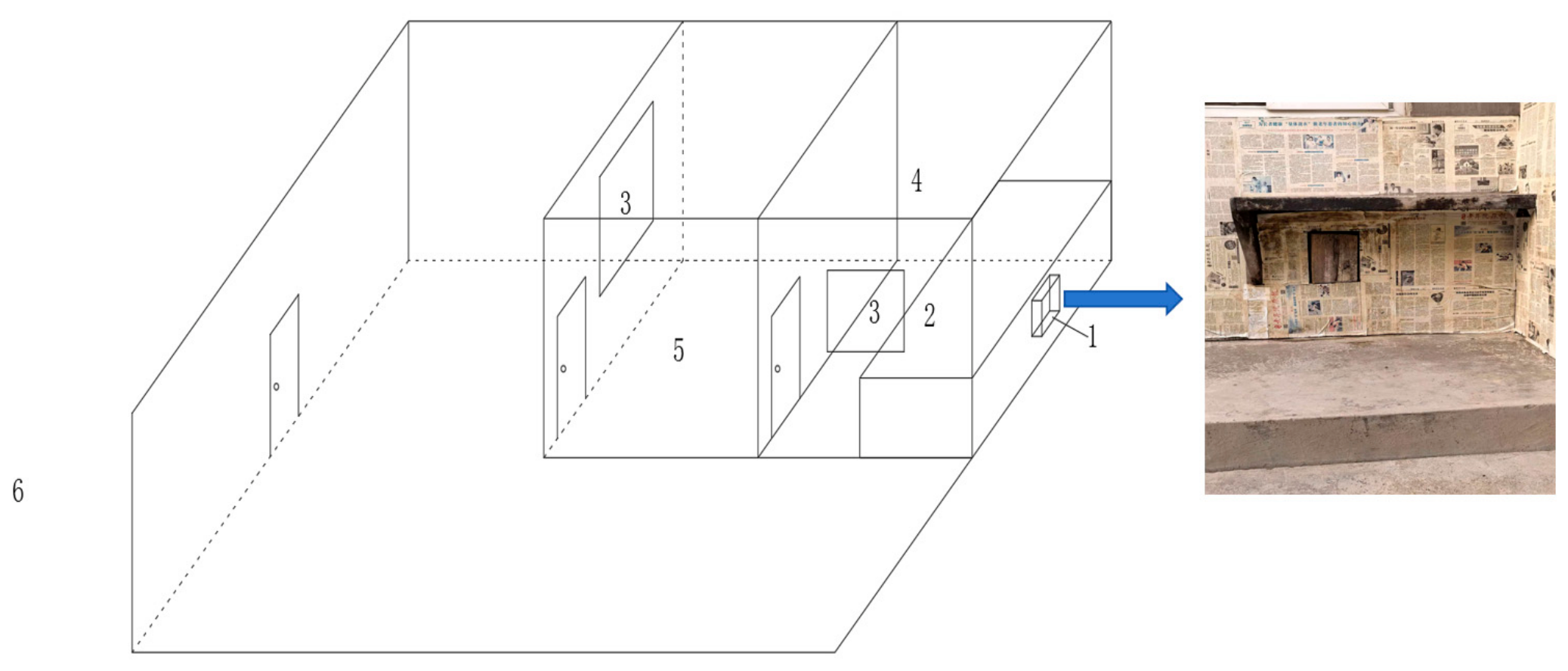
Figure 1. Schematic diagram of particulate monitoring layout. Notes: 1. Fire Kang Combustion Port (fully separated outdoor combustion unit, structurally distinguished from the built-in indoor stove of traditional integrated kang, serving as the primary outdoor particulate emission source); 2. Fire Kang (indoor heat storage structure with potential internal flue leakage channels); 3. Window (main air convection channel for outdoor particulate infiltration into indoor spaces); 4. Bedroom (closed indoor living area for monitoring long-term accumulated particulate pollution); 5. Living room (semi-open transitional space connecting courtyard and bedroom to capture intermediate smoke migration concentration); 6. Outdoor (open background atmospheric monitoring area reflecting regional baseline particulate concentration).
Buildings 16 02866 g001
Figure 3. Changes in particulate matter concentration during different combustion stages.
Buildings 16 02866 g003
Figure 4. Changes in particulate matter concentration at different distances from the external hated kang’s combustion port.
Buildings 16 02866 g004
Disclaimer/Publisher’s Note: The statements, opinions and data contained in all publications are solely those of the individual author(s) and contributor(s) and not of MDPI and/or the editor(s). MDPI and/or the editor(s) disclaim responsibility for any injury to people or property resulting from any ideas, methods, instructions or products referred to in the content.