Article

Study on the Mechanical Behavior of the Bamboo Scrimber Dowel-Bearing Under Sustained Loading Based on SICD Method

1
State Key Laboratory of Bridge Intelligent and Green Construction, Southwest Jiaotong University, Chengdu 611756, China
2
School of Civil Engineering, Southwest Jiaotong University, Chengdu 611756, China
*
Author to whom correspondence should be addressed.
Buildings 2026, 16(14), 2720; https://doi.org/10.3390/buildings16142720
Submission received: 28 May 2026 / Revised: 24 June 2026 / Accepted: 7 July 2026 / Published: 8 July 2026

Abstract

The mechanical behavior of bamboo scrimber dowel-bearing under sustained loading was investigated via the Stepped Isothermal Creep Deformation (SICD) method using a 30-ton multi-field coupling system, with the test conducted over a duration of 51.5 h. Experimental results revealed three typical failure modes: material failure, local compression failure, and crushing failure. The damage degree increased linearly with stress level. SEM microstructural analysis further indicated that failure originated from progressive fracture and bending of fiber bundles, as well as layer compression and cracking induced by mechanical loading. The deformation process of bamboo scrimber dowel-bearing under sustained loading comprises four distinct stages, namely short-term deformation, initial creep, stable creep, and divergent creep. The divergent creep stage manifests exclusively at stress levels of SL = 0.6, while at lower-stress levels, SL = 0.2 and SL = 0.4, only the first three stages are observed within the 51.5 h test duration. In addition, a preliminary analysis was conducted on the stiffness and strength reduction in bamboo scrimber dowel-bearing under sustained loading. These research findings elucidate the mechanical behavior of bamboo scrimber dowel-bearing under sustained loading, providing preliminary insights to inform future durability assessment and design methodology development for bamboo scrimber joint connections.

1. Introduction

In civil engineering, concrete, steel, timber, and bamboo are widely used as construction materials. Compared to concrete and steel, wood and bamboo offer eco-friendly, low-carbon, and renewable advantages. Bamboo, in particular, stands out as a typical representative of gramineae plants due to their short growth cycle (generally 3–5 years), sustainable harvesting (eliminating the need for annual replanting), excellent mechanical properties, and natural biodegradability. With advancements and optimization in processing technology, raw bamboo can now be transformed into engineering bamboo. This process significantly enhances its bio-durability, flame resistance, physical characteristics, and mechanical performance, unlocking its immense potential for civil engineering applications, especially in the construction industry [1,2,3,4,5].
To leverage these material advantages in load-bearing structures, modern bamboo and timber buildings rely heavily on joints, whose performance governs the overall structural strength, safety, and serviceability. Bolted connections are favored in practice due to their simplicity, reliability, and ease of assembly. However, the predominant failure modes (namely bolt bending and dowel-bearing failure of the bamboo substrate) pose significant challenges. As a viscoelastic material, engineered bamboo is susceptible to creep deformation under sustained loads. This phenomenon leads to reduced joint stiffness and load-bearing capacity, ultimately compromising the safety and durability of the structure. Accurate prediction of this long-term behavior is therefore critical for design.
Predicting the long-term mechanical behavior of bamboo materials typically relies on conventional creep tests conducted under ambient conditions [6,7,8,9,10,11,12,13,14]. However, these methods face a critical time-scale gap: laboratory durations (<5 years) are insufficient to represent the 50–100-year service life of civil structures [15]. While empirical models (e.g., the Burgers model) can extrapolate data, their accuracy diminishes over decades due to environmental variability.
To observe equivalent creep effects corresponding to long-term loading within a short period, researchers have explored the Stepped Isothermal Creep Deformation (SICD) method. Based on the time–temperature equivalence principle, SICD utilizes stepwise temperature increments to accelerate molecular motion, thereby simulating long-term creep behavior within a feasible laboratory timeframe [16,17,18,19]. Given that both glued laminated bamboo and bamboo scrimber are polymer–matrix composites reinforced by bamboo fibers, they share similar thermo-viscoelastic properties. Leveraging this capability, the method has been effectively applied to glued laminated bamboo (a material sharing a similar phenolic resin matrix and viscoelastic nature with bamboo scrimber) to predict long-term creep behavior under tension, bending, and compression. These studies have successfully forecasted 50-year creep development, showing minimal deviation from conventional long-term test results [20,21,22].
Despite continuous advancements in research, bamboo scrimber, as a novel engineered bamboo material, currently lacks both long-term load field measurement data under natural environmental conditions and systematic exploration using the SICD method. To progressively apply the SICD method to the connection of bamboo scrimber dowel-bearing, which involves a complex stress state, it is first necessary to clarify its accelerated creep deformation response and the associated failure mechanisms.
Therefore, given the common thermo-viscoelastic properties of these polymer–matrix composites, this study applies the SICD method for the first time to bamboo scrimber dowel-bearing to preliminarily investigate its mechanical performance under accelerated creep and sustained loading. The experiment was performed using a 30-ton multi-field coupling system, yielding accelerated creep deformation-load duration data within 51.5 h. The macroscopic failure mode of bamboo scrimber dowel-bearing is obtained. Subsequently, for the first time, microscopic changes in the bamboo scrimber dowel-bearing body were analyzed using a tungsten filament scanning electron microscope. Finally, this study offers a first-ever preliminary examination of the degradation patterns of both stiffness and strength in bamboo scrimber dowel-bearing under sustained loading, offering preliminary observational data to inform future investigation of long-term performance in bamboo connections.

2. Experimental Program

2.1. Materials and Specimen Preparation

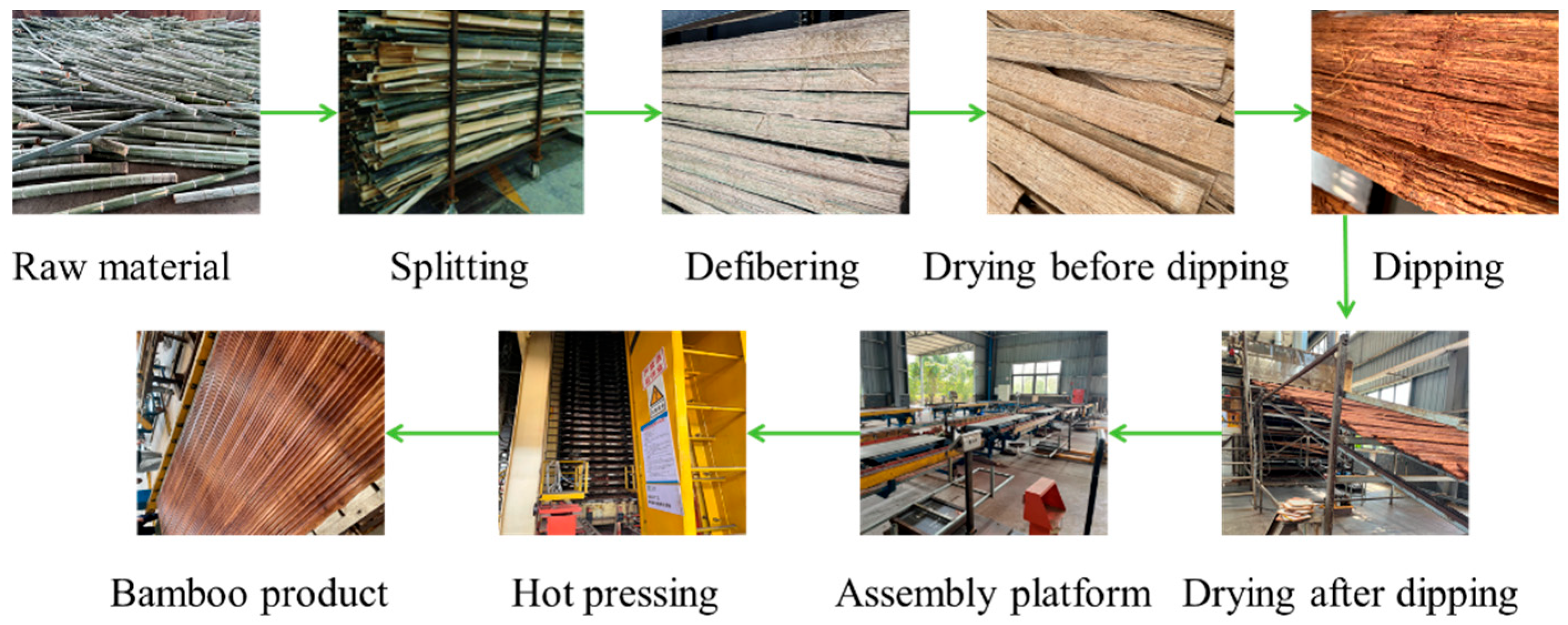
The experimental bamboo scrimber was manufactured from 3- to 4-year-old Neosinocalamus affinis bamboo (supplied by Hongya Bamboo Era Technology Co., Ltd., Meishan, China). The production process began with bamboo tube splitting and strip debonding. The separated strips were impregnated with phenol-formaldehyde resin (supplied by Dynea (Guangdong) Co., Ltd., Zhaoqing, China), then dried and formed into mats. These mats were hot-pressed at 20 MPa and 110 °C for 50 min to produce panels with thickness up to 31.5 mm. These panels were subsequently processed into standard base plates measuring 2500 × 1250 mm through precision machining operations including end trimming, edge jointing, sequential fine sanding, machine polishing, and surface cleaning, with final thicknesses customizable to any dimension below 30 mm. For specialized applications requiring non-standard dimensions, thicknesses exceeding 30 mm were achieved through secondary bonding using polyurethane reactive adhesive (PUR), while lengths beyond 2500 mm were obtained by implementing engineered finger joints with structural adhesives, as shown in Figure 1. The bamboo scrimber, with a manufacturer-certified density of 1.14 g/cm3 and moisture content of 8.9%, is vacuum-sealed in protective film to ensure moisture stability during storage and transportation, and all materials undergo controlled-environment conditioning prior to testing to guarantee consistency in quality and performance.
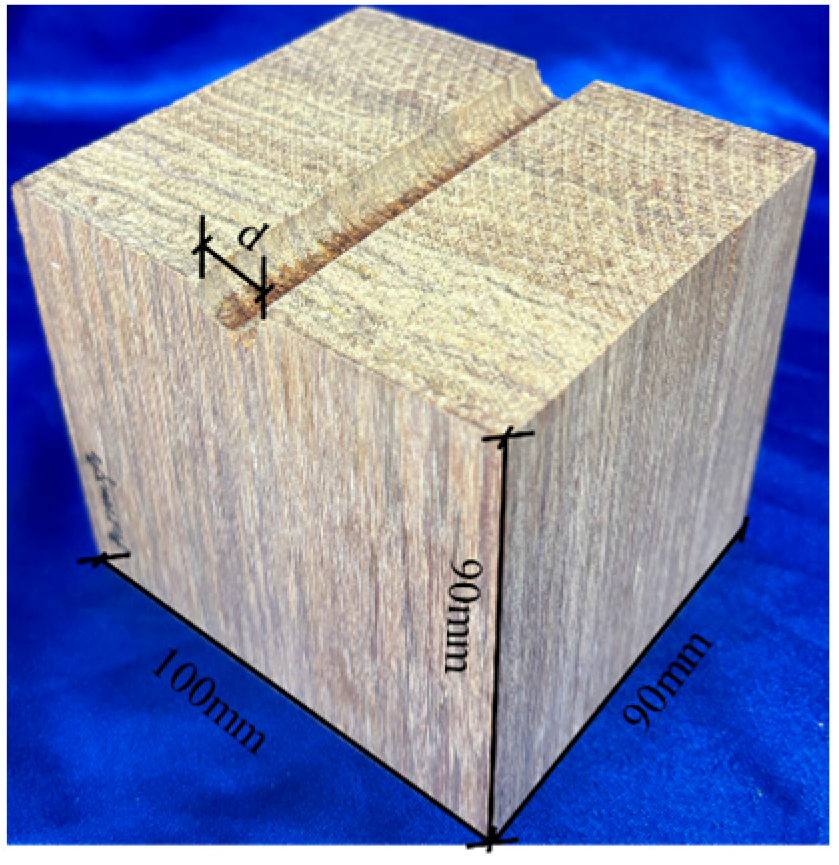
Bamboo scrimber dowel-bearing, an emerging engineered bamboo material in recent years, currently lacks specific standards for specimen dimension design and mechanical performance testing, leading most researchers to refer to timber structure codes [23,24,25]; according to ASTM D5764 standard [26], the dowel-bearing specimens used in this study measured 100 mm (length) × 90 mm (width) × 90 mm (thickness) and were configured with parallel-to-grain fiber orientation to optimize bearing performance, as shown in Figure 2, and the dowels used in this test are made of Q235 steel with diameters of 10 mm, 14 mm, and 18 mm, respectively.

2.2. Test Setup

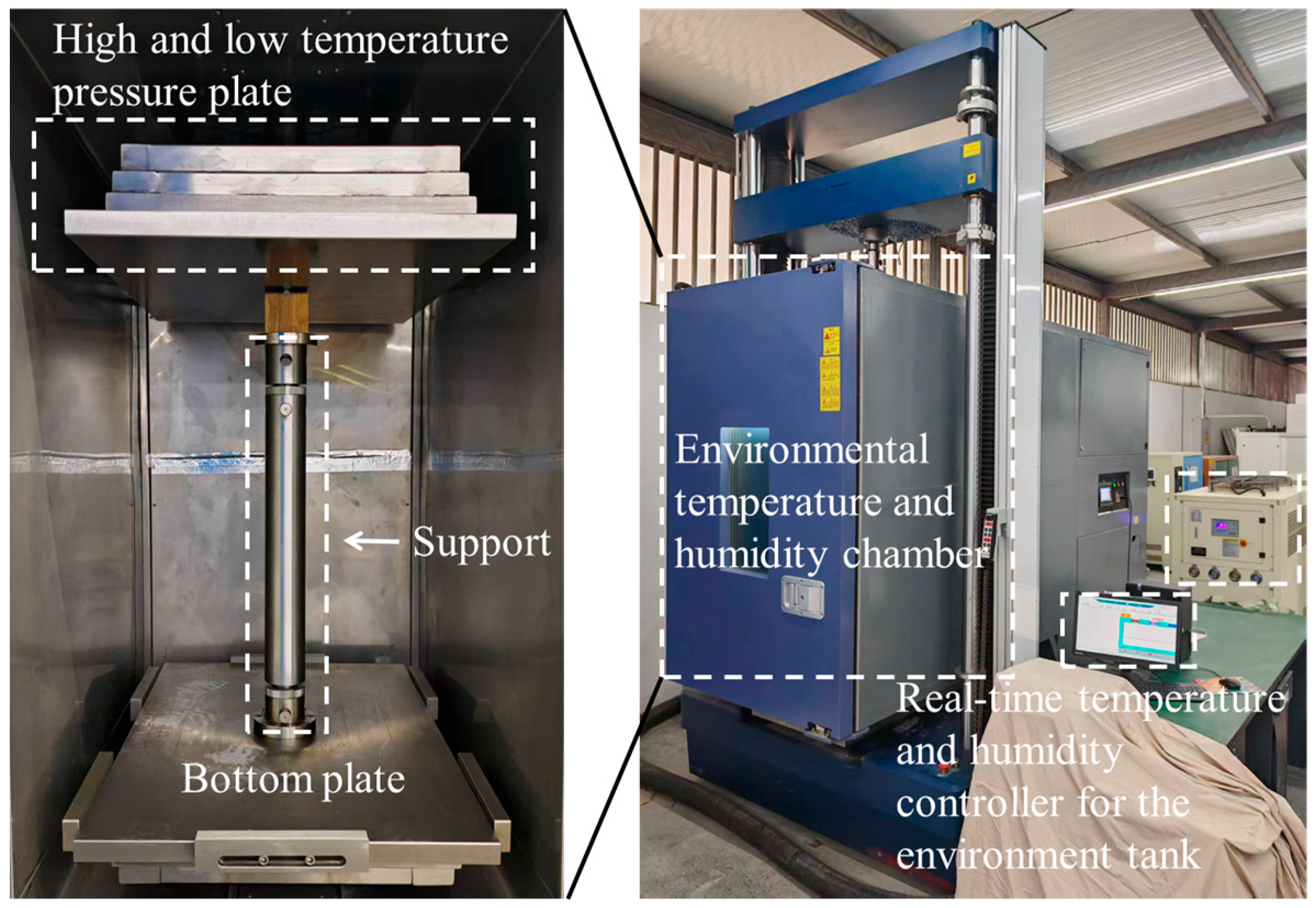
The test was carried out in the National Experimental Teaching Demonstration Center of Civil Engineering of Southwest Jiaotong University, using a 30-ton multi-field coupling system (Shenzhen Sansi Zongheng Technology Co., Ltd., Shenzhen, Guangdong, China) as the test loading device, as shown in Figure 3. The system comprises an environmental temperature and humidity chamber, a real-time–temperature/humidity controller, and an industrial chiller. It operates within −70 °C to 150 °C and 0–100% relative humidity. The high-precision load cell has an accuracy class of 0.5. The indication errors for test force, displacement, and deformation are all within ±0.5% of the indicated value, and the displacement control rate accuracy is also within ±0.5%. This setup enables accurate real-time monitoring and recording of creep behavior.

2.3. Test Methods

This study utilizes the SICD method that integrates three fundamental principles of time–temperature equivalence, Boltzmann superposition, and the Arrhenius equation to establish equivalence between accelerated creep deformation data and long-term creep deformation through stepwise heating under constant load. Bamboo scrimber’s viscoelastic and polymer-like properties align with ASTM D6992-16 [27] criteria, and the method’s validity is further supported by successful applications in glued laminated bamboo testing (tension, bending, compression) [20,21,22]. Consequently, accelerated creep tests were conducted on bamboo scrimber dowel-bearing components following the ASTM D6992-16 framework.
All tests were conducted in a 30-ton multi-field coupling system under a constant temperature and humidity environment (23 ± 1 °C, 55 ± 5% relative humidity), with a designed temperature differential gradient of 7 °C and a cyclic heat treatment protocol consisting of 5 h isothermal phases and 10 min transition intervals. These parameters were selected to satisfy SICD master curve requirements. First, the temperature range (23–86 °C) lies below the glass transition temperature of amorphous hemicellulose in unsoftened bamboo (120 °C, decreasing to 90 °C after softening [28]) to avoid thermal degradation. Second, the 7 °C gradient follows ASTM D6992-16 [27] to balance acceleration and data resolution. Third, the 5 h isothermal hold provides practical stabilization, although complete thermal equilibrium is not achieved due to finite diffusivity; residual disequilibrium is corrected as described in Section 3.2. The 10 min transition intervals allow environmental chamber stabilization and prevent transient thermal shocks. Collectively, these parameters maintain the thermo-viscoelastic linearity essential for reliable time–temperature superposition and prediction curve generation.
The experimental program comprised four components: (1) creep evaluation of three dowel diameters (10, 14, 18 mm) subjected to varying stress levels (SL = 0.2, 0.4, 0.6, determined by Equation (1)), with duplicate specimens tested for each parameter combination; (2) thermal expansion characteristics of dowel holes and dowel pins with the same configuration as in test (1) were characterized under conditions of negligible mechanical loading (SL < 0.1; the recorded thermal expansion deformation arises from the coupled response of the bamboo block, steel dowel, and interfacial clearance, not from free bamboo expansion alone; thus, the thermal expansion deformation varies among the three dowel diameters, and dedicated testing is required for each diameter; and (3) thermal expansion impacts assessment through controlled temperature elevation in the absence of mechanical loading to evaluate thermal contribution to failure mechanisms. Initial observations revealed significant thermal expansion effects on creep measurements, highlighting the necessity for thorough thermal characterization; (4) for bamboo scrimber dowel-bearing specimens that did not undergo crushing failure after testing using the SICD method, a universal testing machine was used to obtain their load–displacement curves to analyze the variation in their initial stiffness and yield strength. Table 1 systematically lists the complete test protocol and experimental conditions. The deformation data (accelerated creep deformation and thermal expansion deformation) collection involved in the testing process was completed by the system’s built-in deformation acquisition function, with deformation data sampled at a frequency of 1 Hz.
S L = σ apply f u
where σ apply is the long-term stress being applied (MPa), fu is the average ultimate strength of bamboo scrimber dowel-bearing determined from prior experimental studies (MPa) [29].

3. Test Results and Analysis

3.1. Failure Mode Analysis

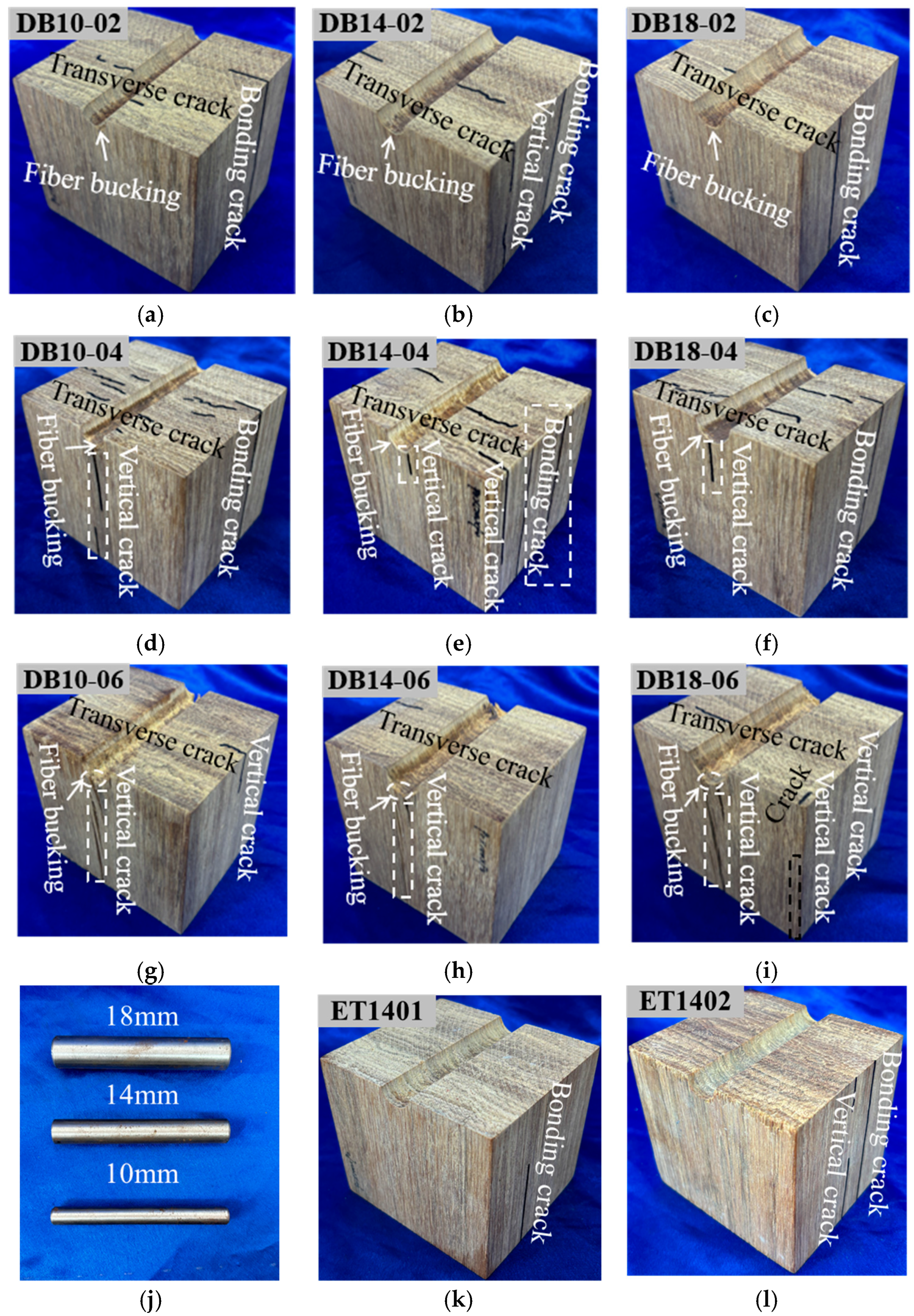
Post-test examination of the dowel-bearing specimens demonstrated full compliance with ASTM D5764 [26] requirements for uniform compressive load distribution, with no significant dowel deformation observed across all test conditions (Figure 4j). Systematic analysis revealed that all cracks observed in the specimens emerged during the creep deformation stage. Under varying stress levels, transverse cracks consistently appeared at the top of the specimens, oriented perpendicular to the dowel-bearing direction (Figure 4a–i). For a given diameter, damage severity increased with stress level. At SL = 0.2, only isolated fiber buckling occurred at the hole base. At SL = 0.4, fiber buckling combined with deep vertical cracks. At SL = 0.6, buckling was accompanied by visible vertical cracks. This trend confirms a positive correlation between stress level and damage severity. Detailed side surface examination identified secondary bonding interface cracks in all SL = 0.2 and 0.4 specimens regardless of diameter, contrasting with SL = 0.6 specimens where vertical cracks replaced bonding interface failures. Control experiments using ET14-01 and ET14-02 specimens confirmed the occurrence of secondary bonding cracks under zero mechanical stress conditions, conclusively identifying thermal effects as the primary driver for both bonding interface fractures and vertical side cracking phenomena (Figure 4k,l).
Three distinct failure modes emerged from comprehensive evaluation: Type I (material failure) presents as fiber buckling at dowel-bearing hole bases with minor transverse top cracks and predominant adhesive failure with occasional vertical side cracks, maintaining structural functionality; Type II (local compression failure) combines fiber buckling with non-penetrating vertical cracks at hole bases, extensive transverse top cracking, and adhesive-dominated failure with limited vertical side cracks while preserving structural integrity; Type III (crushing failure) features complete hole base crushing with minimal transverse top cracks and vertical side cracking in the absence of adhesive failure, representing terminal structural collapse. This classification system effectively captures the progressive failure mechanisms in bamboo scrimber dowel-bearing connections under combined mechanical and thermal loading conditions.
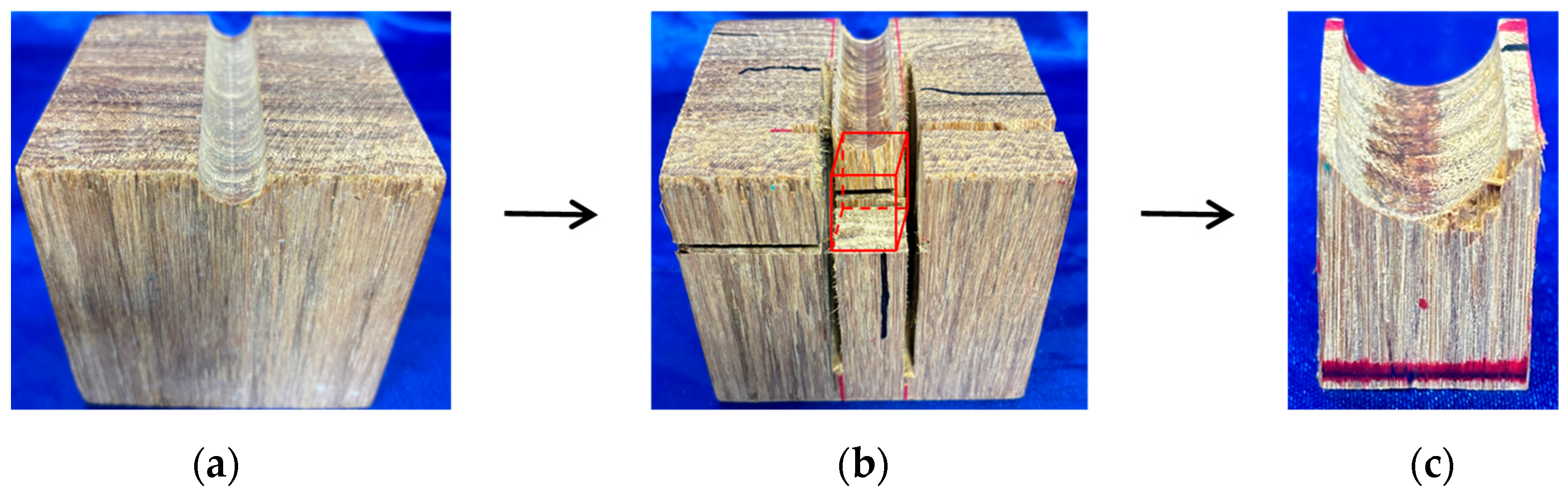
To reveal the microstructural nature of the aforementioned macroscopic failure modes, the research team extracted cubic specimens with edge lengths of 2–3 mm from the dowel-bearing region in accordance with the preparation procedure illustrated in Figure 5. This process involved sequential precision cutting steps, yielding cubic specimens that not only retained the key failure features of the dowel-bearing zone intact but also avoided introducing additional damage during the cutting process. The cubic specimens obtained through precision cutting are suitable for high-resolution imaging and microscale material performance analysis.
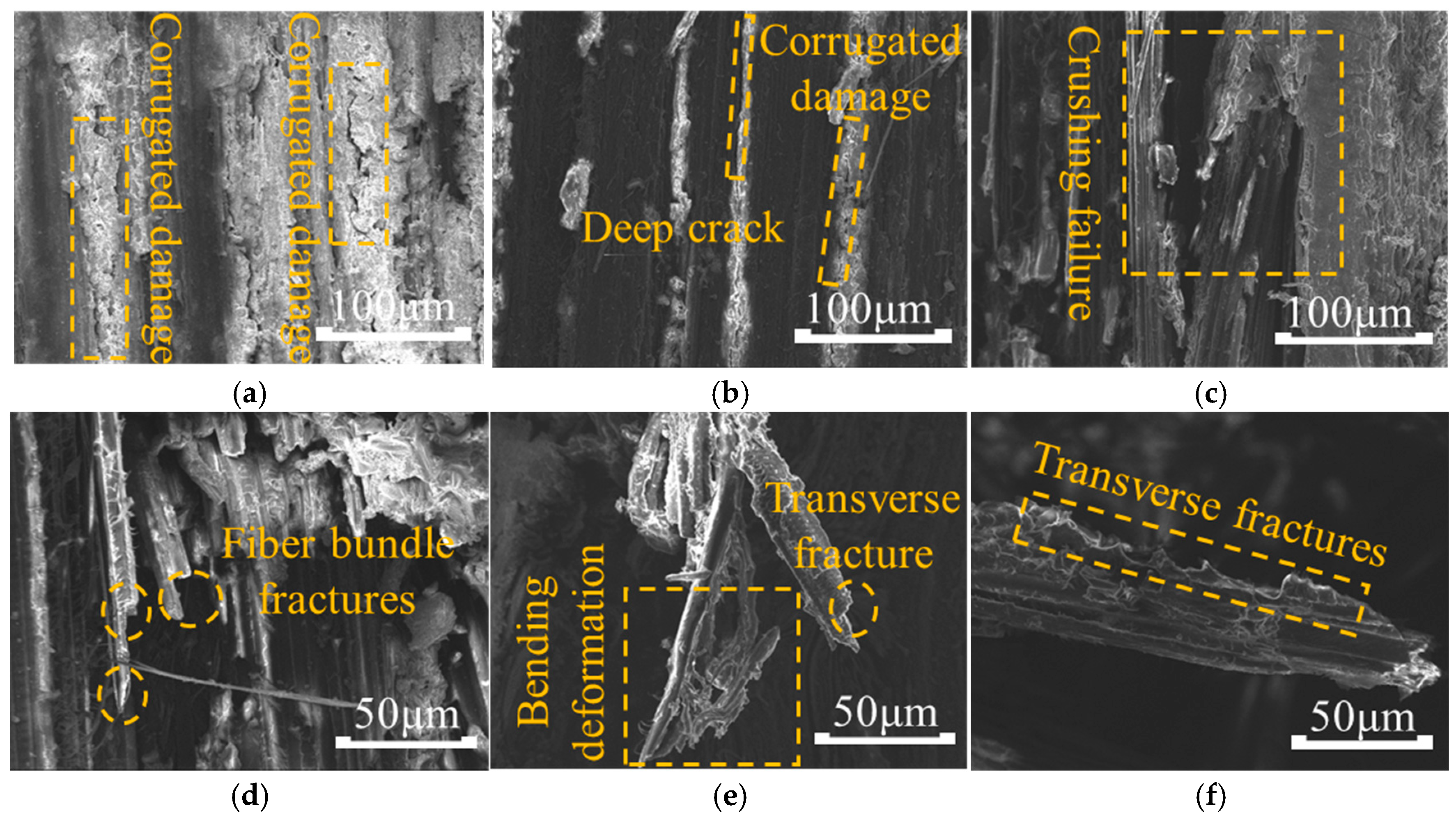
The research team conducted microscopic observations using a tungsten filament scanning electron microscope (JEOL Ltd., Akishima, Tokyo, Japan) on precision-cut cubic specimens obtained from dowel-bearing specimens of identical diameter subjected to different loading conditions, capturing critical failure features through multi-magnification imaging. Figure 6 presents SEM images corresponding to specific loading conditions (SL = 0.2, 0.4, and 0.6) and failure modes (Types I–III), which provide a complete visual record of damage development. The selected micrographs highlight distinctive fracture characteristics, including fiber fracture form, matrix cracking propagation, and bamboo layer interface separation, thereby helping to reveal the microstructural nature underlying the macroscopic failure.
SEM analysis revealed distinct microstructural failure patterns in bamboo scrimber dowel-bearing connections under varying stress levels. At SL = 0.2, stress concentration between adjacent bamboo laminates under compressive loading initiated interfacial microcracks that propagated as corrugated patterns parallel to the fiber orientation (Figure 6a), while the dowel hole base exhibited only surface-level fiber bundle fractures without internal delamination (Figure 6d), corresponding to the minimally damaged Type I failure observed macroscopically.
At SL = 0.4, the specimen developed multi-scale cracking patterns (Figure 6b) comprising smooth deep cracks from mechanical loading and residual corrugated damage, with bamboo fiber bundles showing pronounced transverse fractures and bending deformation (Figure 6e), indicating enhanced stress transfer through the composite structure and explaining the macroscopic Type II failure characterized by combined buckling and cracking.
At SL = 0.6, fiber bundles underwent extensive non-bending fractures with widespread transverse failures (Figure 6c,f) in the absence of corrugated cracks, demonstrating complete mechanical-driven damage that microscopically elucidates the macroscopic Type III crushing failure through fiber bundle fracture and layer compression and cracking.
Microstructural analysis identifies two primary failure origins: (1) fiber bundle fracture/bending, (2) layer compression and cracking due to mechanical loading. These mechanisms collectively highlight the biomaterial characteristics of bamboo scrimber, where fiber bundles serve as primary load carriers requiring higher failure energy. The stress-dependent crack evolution provides fundamental insights into failure mode transitions in this engineered bamboo composite system.

3.2. Relationship of Deformation and Loading Duration

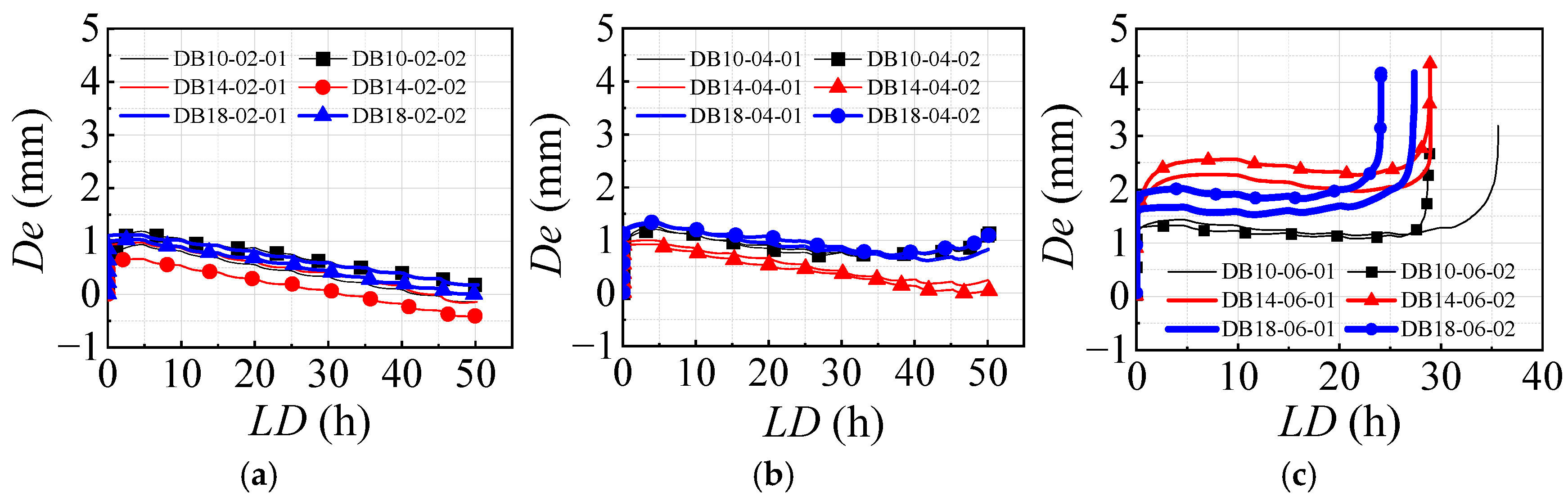
Analysis of the deformation curve obtained through the SICD method (Figure 7) reveals intermittent declines during specific test intervals, contrasting with the expected monotonic increase predicted by theoretical creep behavior. Previous studies employing the SICD method on stressed components have documented comparable anomalies, consistently linking them to thermal expansion phenomena. Cross referencing these observations with thermal expansion contraction theory and SICD test parameters suggests that the observed curve reductions originate from thermally induced expansion resulting from the temperature difference between the specimen interior and the ambient test temperature during heating.
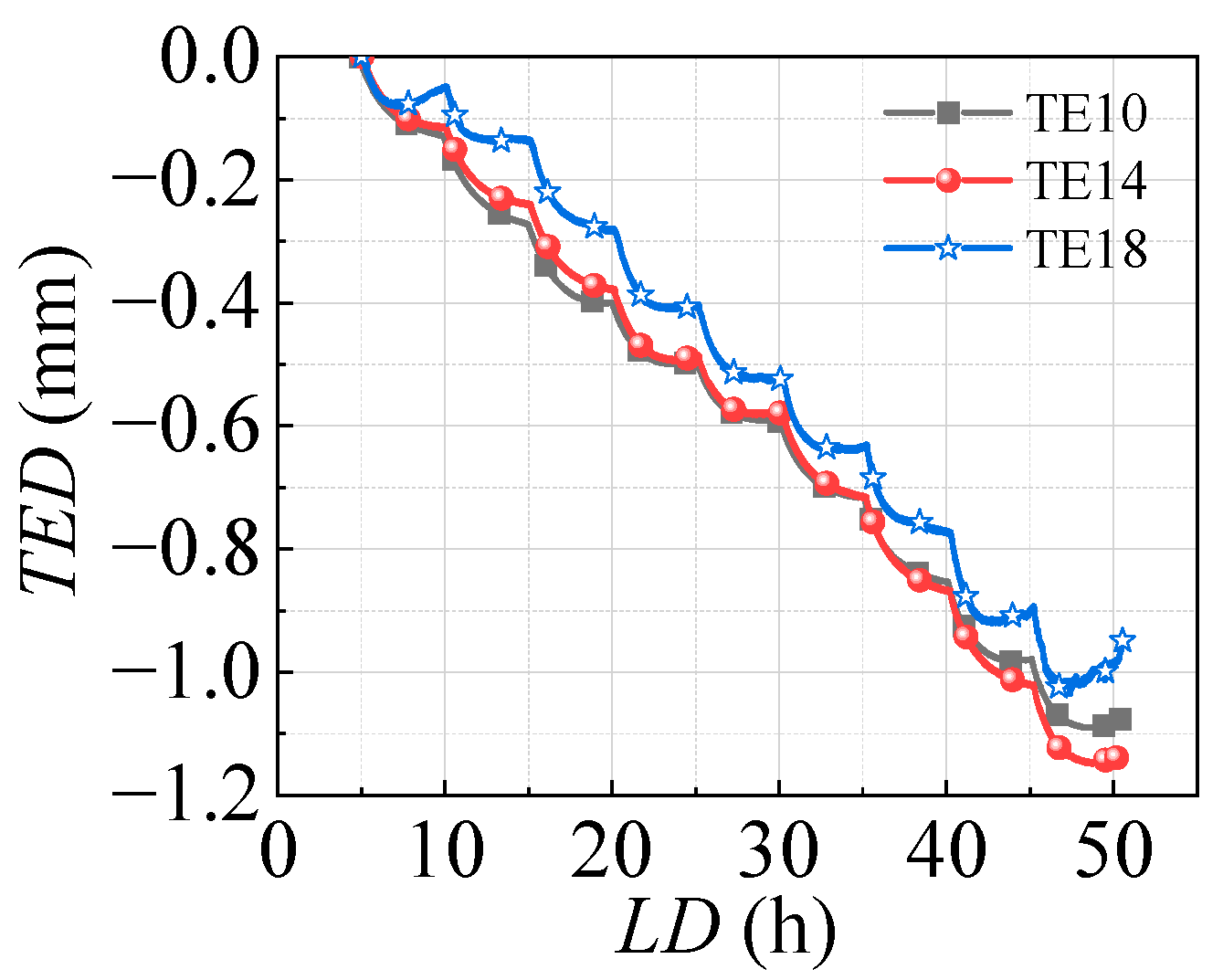
This temperature difference arises from the finite thermal diffusivity of bamboo scrimber, which prevents the specimen interior from fully reaching thermal equilibrium during the initial part of each 5 h isothermal hold, thereby causing the downward fluctuations. To verify this and to enable correction, dedicated thermal expansion tests (TE series) were conducted under the identical temperature profile and negligible load. The recorded thermal expansion (Figure 8) captures the same non equilibrium response. Subtracting it from the raw data removes the thermal contribution regardless of equilibrium status.
However, the measured thermal expansion curve is not purely thermal because even under very low stress, creep contributes to the deformation [30]. Therefore, the thermal term cannot be completely decoupled from viscoelastic response. Consequently, Equation (2) yields a “creep-dominated” deformation after thermal correction, rather than pure creep. Thus, the thermal expansion term cannot be completely isolated from concurrent viscoelastic response at low stress levels. While this approach does not eliminate all thermodynamic contributions, it substantially removes the dominant thermal expansion effects and provides a consistent basis for comparative analysis across specimens. As a result, the 5 h hold is sufficient not because it guarantees perfect equilibrium, but because the thermal correction accounts for any residual disequilibrium, and the corrected creep-dominated deformation provides a reliable basis for the subsequent analysis.
d co ( t ) = d to ( t ) d te ( t )
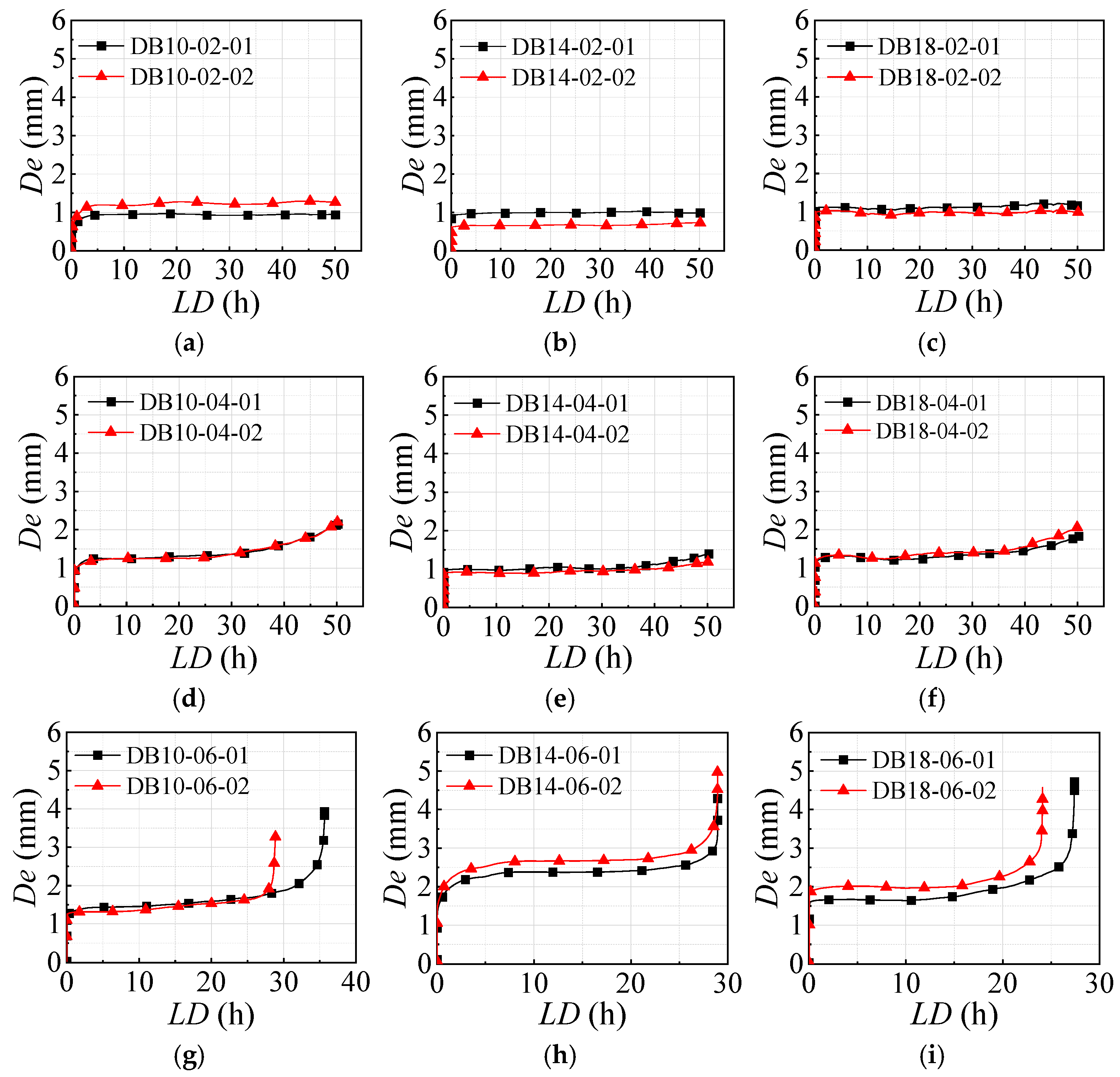
where d co ( t ) represents the corrected creep-dominated deformation value at time t, as shown in Figure 9. d to ( t ) is the total deformation measured in Figure 7 at time t, and d te ( t ) is the measured thermal expansion deformation (contaminated by minor creep) for the dowel diameter at time t.
Figure 9 illustrates the creep-dominated deformation curves after thermal correction, which exhibit a predominantly upward trajectory interspersed with minor intermittent fluctuations stemming from residual thermal expansion effects that were not fully compensated during measurements. Based on the evolution of the average deformation rate calculated over consecutive time intervals, the deformation process under sustained load is systematically partitioned into four distinct stages: short-term deformation, initial creep, stable creep, and divergent creep. Specifically, the short-term deformation corresponds to the instantaneous elastic–plastic response occurring immediately upon load application. Subsequently, the initial creep phase is defined as the period during which the average deformation rate decreases significantly from this initial peak. Following this, the stable creep phase is identified as the linear segment where the average deformation rate remains relatively constant. Finally, the onset of the divergent creep phase is determined by detecting a substantial increase, such as a doubling of the average slope compared to the stable period, which indicates imminent structural failure.
At SL = 0.2 and 0.4, the long-term deformation comprises only the first three stages—short-term deformation, initial creep, and stable creep. In contrast, at higher stress levels (SL = 0.6), the deformation progresses through all four stages. This behavior indicates that a specific stress threshold governs the transition to divergent creep. Based on the current dataset, this threshold is definitively bounded within the range of 0.4   <   S L   <   0.6 . Pinpointing this critical threshold requires a finer stress gradient (e.g., increments of 0.05) coupled with a substantially larger statistical sample size to capture the stochastic nature of biomaterial failure. Future research will build upon this foundation to conduct deeper investigations into this phenomenon.
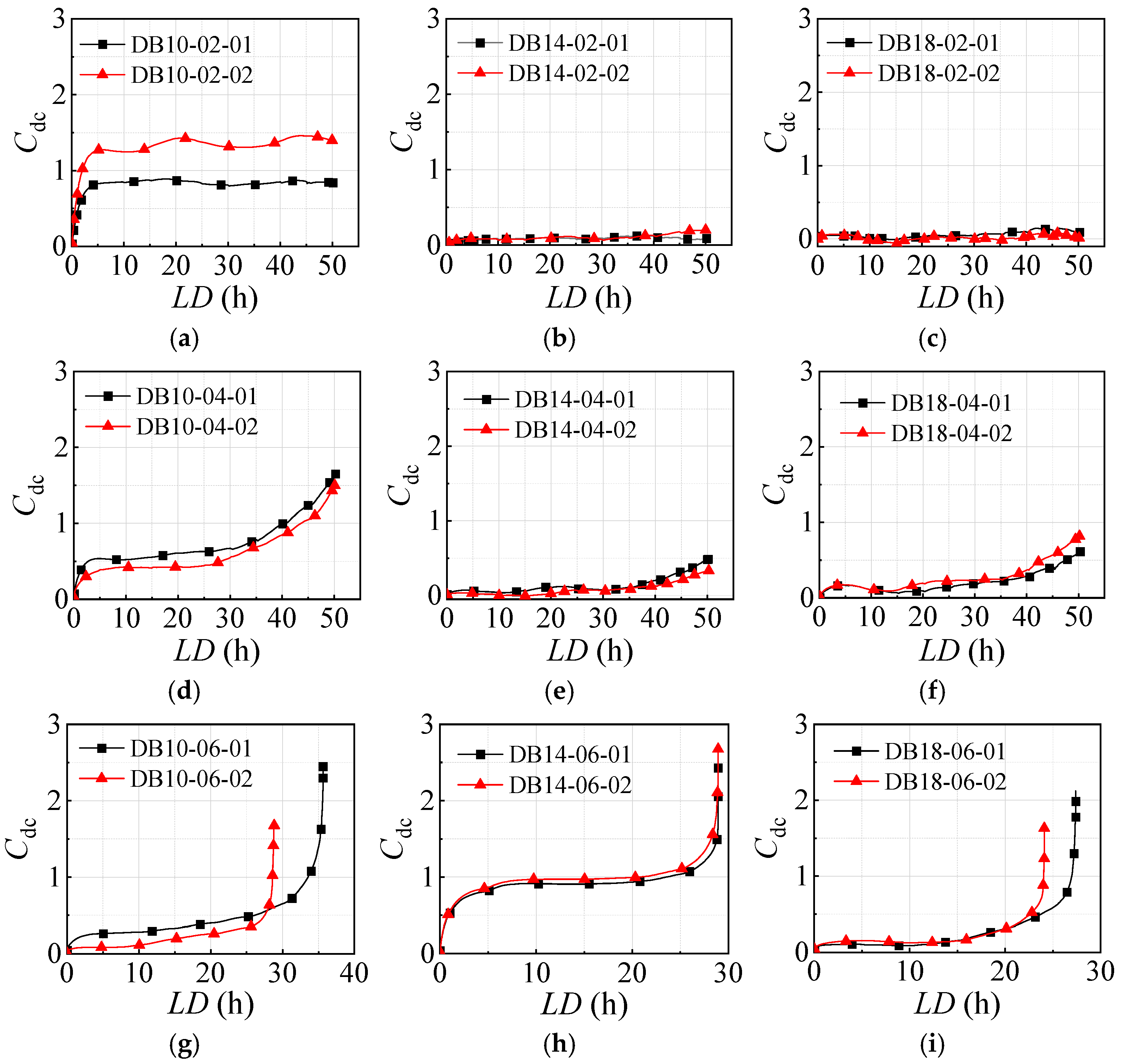
To quantify the relative magnitude of creep deformation compared to initial deformation under sustained loading, a creep deformation coefficient is introduced and can be calculated using Equation (3).
C dc = ( μ t μ i ) μ i
where Cdc is the creep deformation coefficient, μt is the total deformation of the bamboo scrimber dowel-bearing at time t, and μi is the instantaneous elastic deformation under initial loading. This dimensionless parameter provides a quantitative measure for evaluating the relative significance of time-dependent deformation compared to immediate structural response.
Figure 10 illustrates the creep deformation coefficient curves derived from Equation (3), highlighting the distinct influence of loading duration and stress level. At SL = 0.2 and 0.4, the curve exhibits no divergent creep stage even after 51.5 h of loading. In contrast, at SL = 0.6, the divergent creep stage emerges within 40 h, appearing earlier and more prominently with increasing stress levels. This demonstrates the significant role of stress level in governing creep behavior, with the SL0.6-14 group exhibiting the highest relative contribution to creep deformation.
At SL = 0.2, the creep deformation coefficient fluctuated before stabilizing with prolonged loading; at SL = 0.4, it showed a steady upward trend; while at SL = 0.6, it exhibited a steady increase in the early stage followed by a sharp rise in the later stage, with intermittent decreases due to residual thermal expansion effects. Notably, under higher stress levels, the curve slope accelerated sharply in the later stages of testing, and the growth rate of the creep deformation coefficient intensified with increasing stress levels, and this phenomenon was verified across all diameters.
Regarding material property dispersion, Figure 10 reveals that under identical stress levels and diameters, specimen variability within each group remains relatively consistent, except at SL = 0.2, where the difference reaches approximately 21%. This discrepancy can be attributed to the fact that at lower-stress levels, the generated creep deformation is relatively small, making the thermal expansion effect more significant as it exceeds the creep deformation.

4. Stiffness and Strength Reduction in Bamboo Scrimber Dowel-Bearing Under Sustained Loading

After 51.5 h of stepwise heating and sustained loading, all specimens at SL = 0.2 and 0.4 sustained damage but retained partial load-bearing capacity. To preliminarily investigate the variation patterns of stiffness and strength of bamboo scrimber dowel-bearing under sustained loading, one specimen under each working condition was subsequently selected from the surviving samples. A universal testing machine was used to obtain the load–displacement curve of each specimen, and the 5% of dowel diameter (d) offset method [26] was employed to determine its initial stiffness and yield strength.
It was found that under sustained loading, the bamboo scrimber dowel-bearing not only produces creep deformation behavior, but also contains stiffness–strength decay, as shown in Table 2, where short-term strength reference values are quoted from previous systematic studies [29]. The data show that under long-term load, both stiffness and strength have attenuation problems, and the stiffness and strength after attenuation are consistent with previous research results [31]. As the diameter increases, the stiffness increases and the strength decreases. According to the strength after attenuation, the attenuation rate under various working conditions is calculated. It is found that when d = 10 mm, the stiffness attenuation rate is 29.51–34.60%, the strength attenuation rate is 3.14–11.28%; when d = 14 mm, the stiffness attenuation rate is 33.43–34.14%, the strength attenuation rate is 17.18–19.16%; and when d = 18 mm, the stiffness attenuation rate is 44.22–44.76%, the strength attenuation rate is 2.06–22.04%. With the increase in diameter, the stiffness degradation rate presents an increasing trend, while the strength loss rate presents a non-monotonic fluctuation, and it is worth noting that the stiffness decay rate is significant. This study focuses on clarifying the dual degradation mechanism of material bearing capacity under sustained loading. The deep mechanism of stiffness and strength degradation will be analyzed systematically by increasing sample size in subsequent studies.
Two seemingly counter-intuitive observations are noted in Table 2. First, for the 10 mm dowel diameter, the residual strength after creep at SL = 0.4 (124.95 MPa) is higher than that at SL = 0.2 (114.45 MPa). Second, for the 18 mm diameter, the stiffness reduction rate at SL = 0.4 (44.22%) is slightly lower than that at SL = 0.2 (44.76%). These phenomena can be rationalized by considering the competing mechanisms of damage due to creep and densification or post-curing due to stress. At the moderate stress level of 0.4, the combined action of sustained load and stepwise heating (up to 86 °C) may promote additional cross-linking of the phenolic resin (post-curing) and cause plastic rearrangement of bamboo fiber bundles, leading to localized compaction hardening. This hardening effect can partially offset or even exceed the damage accumulation, resulting in a residual strength comparable to or higher than that after lower-stress (0.2) creep.
For the 18 mm diameter specimens, the stiffness reduction rate differs by only 0.54 percentage points between SL = 0.2 (44.76%) and SL = 0.4 (44.22%). While this marginal difference suggests qualitatively similar degradation behavior, no definitive conclusion can be drawn due to the single-specimen basis of the residual tests. Moreover, at SL = 0.2, the lower load may not fully engage the entire hole–wall contact area, potentially causing localized stress concentrations, whereas at SL = 0.4 more uniform contact may be achieved, promoting a more homogeneous stiffness response.
These observations highlight that the relationship between stress level and post-creep residual performance is not simply monotonic but involves competing damage and densification mechanisms.
A limitation of the present study lies in the post-SICD residual property characterization. Due to specimen attrition during the SICD tests and the preliminary nature of this investigation, stiffness and strength degradation rates were determined from a single surviving specimen per working condition rather than from replicated measurements. Accordingly, the quantitative values reported in Table 2 represent indicative trends rather than statistically robust averages. Nevertheless, the consistent degradation hierarchy observed across all groups, specifically that stiffness reduction (up to 44.76%) is significantly more pronounced than strength loss, provides a physically plausible mechanistic insight that warrants further investigation with expanded sample sizes in future studies.

5. Conclusions

Utilizing the SICD method and a 30-ton multi-field coupling system for temperature, humidity, and force, the mechanical behavior of bamboo scrimber dowel-bearing under sustained loading was studied, which included failure modes, creep deformation, the reduction in stiffness and strength. Based on these analysis, the following conclusions can be drawn.
(1)
Through a coupled macro–micro analysis approach, this study reveals that bamboo scrimber dowel-bearing under sustained loading exhibit three distinct macroscopic failure modes: material failure, local compression failure, and crushing failure, with the extent of damage showing a positive linear correlation with stress levels. Based on the SEM image analysis, these failure modes result from the fracture/bending of bamboo fiber bundles and interlayer compressive cracking induced by mechanical loading.
(2)
The deformation process of bamboo scrimber dowel-bearing under sustained loading comprises four distinct stages, namely short-term deformation, initial creep, stable creep, and divergent creep. The divergent creep stage manifests exclusively at stress levels of SL = 0.6, while at lower-stress levels, SL = 0.2 and SL = 0.4, only the first three stages are observed within the 51.5 h test duration. A critical stress threshold governing the transition to divergent creep is identified within the range of 0.4   <   S L   <   0.6 .
(3)
Bamboo scrimber dowel-bearing exhibit stiffness and strength reduction issues under sustained loading, with the stiffness reduction issue being more pronounced.
(4)
A limitation of the present study lies in the thermal correction methodology. The reference thermal expansion curves, measured under nominally zero mechanical load, inevitably contain a minor creep component due to the viscoelastic nature of bamboo scrimber. Future studies will explore more rigorous decoupling methodologies to achieve effective separation of creep deformation and thermal expansion deformation.
(5)
Beyond the methodological refinement noted above, it should be noted that the present study represents a preliminary investigation based on 51.5 h SICD tests with a limited stress gradient and sample size. While the observed deformation stages and degradation trends provide a useful starting point, definitive long-term durability predictions and design recommendations require extended validation through conventional long-term creep tests and broader statistical characterization.

Author Contributions

Conceptualization, M.Z. and G.W.; Methodology, M.Z. and G.W.; Software, M.Z., G.W. and H.M.; Validation, M.Z., G.W., H.M. and D.X.; Formal analysis, M.Z.; Investigation, M.Z. and G.W.; Resources, M.Z.; Data curation, H.W.; Writing—original draft, M.Z. and G.W.; Writing—review and editing, M.Z. and G.W.; Visualization, W.S.; Supervision, M.Z. and W.S.; Project administration, M.Z.; Funding acquisition, M.Z. All authors have read and agreed to the published version of the manuscript.

Funding

This work was supported by the National Natural Science Foundation of China (Grant No. 52578250).

Data Availability Statement

The original contributions presented in this study are included in the article; further inquiries can be directed to the corresponding author.

Acknowledgments

The authors would like to thank the Structural Engineering Laboratory of Southwest Jiaotong University and Hongya Bamboo Era Technology Co, Ltd. for their support during the experiment, as well as the team led by Huang Dongsheng of Nanjing Forestry University for their help.

Conflicts of Interest

The authors declare no conflicts of interest.

Abbreviations

The following abbreviations are used in this manuscript:
SICDStepped isothermal creep deformation
SLStress level
DBDowel-bearing compression deformation tests
DeDeformation
LDLoading duration
TEThermal expansion
TEDThermal expansion deformation
CdcCreep deformation coefficient
μtTotal deformation
μiInstantaneous elastic deformation
fuUltimate strength
fhYield strength

References

  1. Li, X.; Li, L.; Li, N.; Bao, M.; Bao, Y.; Wu, Z.; Wang, J.; Rao, F.; Chen, Y. Sustainable production of engineered bamboo scrimber composites for construction and flooring applications. Constr. Build. Mater. 2022, 347, 128615. [Google Scholar] [CrossRef]
  2. Madhushan, S.; Buddika, S.; Bandara, S.; Navaratnam, S.; Abeysuriya, N. Uses of Bamboo for Sustainable Construction—A Structural and Durability Perspective—A Review. Sustainability 2023, 15, 11137. [Google Scholar] [CrossRef]
  3. Sharma, B.; Gatóo, A.; Bock, M.; Ramage, M. Engineered bamboo for structural applications. Constr. Build. Mater. 2015, 81, 66–73. [Google Scholar] [CrossRef]
  4. Li, H.; Xue, X.; Xiong, Z.; Ashraf, M.; Lorenzo, R.; Shuchi, S. Application case of laminated bamboo lumber structure—Building of Sentai Bamboo Research Center. Sustain. Struct. 2024, 4, 43. [Google Scholar] [CrossRef]
  5. Li, H.; Feng, Z.; Shen, X.; Wang, Y.; Xue, X.; Lorenzo, R.; Ashraf, M.; Xiong, Z.; Zhou, C.; Chen, N.; et al. Engineered bamboo bridge structure—Report on 3rd International Collaboration on Bamboo Construction. Sustain. Struct. 2024, 4, 62. [Google Scholar] [CrossRef]
  6. Liu, Y.; Bian, Y.; He, D.; Liu, J.; Zhou, A. Temperature and Stress Effects on the Compressive Creep Behavior of Parallel Strand Bamboo. Adv. Civ. Eng. 2021, 2021, 6637572. [Google Scholar] [CrossRef]
  7. Wei, Y.; Zhao, K.; Hang, C.; Chen, S.; Ding, M. Experimental Study on the Creep Behavior of Recombinant Bamboo. J. Renew. Mater. 2020, 8, 251–273. [Google Scholar] [CrossRef]
  8. Li, Y.; Zhang, X.; Wu, P.; Zhang, J.; Zhao, Z. Creep Behavior of Bamboo Scrimber under Long-Term Load. J. Build. Mater. 2019, 22, 65–71. [Google Scholar] [CrossRef]
  9. Ma, X.; Liu, X.; Jiang, Z.; Fei, B.; Wang, G. Flexural creep behavior of bamboo culm (Phyllostachys pubescens) in its radial direction. J. Wood Sci. 2016, 62, 487–491. [Google Scholar] [CrossRef][Green Version]
  10. Xiao, Y.; Li, L.; Yang, R. Long-Term Loading Behavior of a Full-Scale Glubam Bridge Model. J. Bridge Eng. 2014, 19, 04014027. [Google Scholar] [CrossRef]
  11. Zhong, Z.; Zhou, X.; He, Z.; Wang, J. Creep behavior of full-culm Moso bamboo under long-term bending. J. Build. Eng. 2022, 46, 103710. [Google Scholar] [CrossRef]
  12. Ma, X.; Shi, S.Q.; Wang, G.; Fei, B.; Jiang, Z. Long creep-recovery behavior of bamboo-based products. J. Wood Sci. 2018, 64, 119–125. [Google Scholar] [CrossRef]
  13. Zhao, K.; Wei, Y.; Chen, S.; Hang, C.; Zhao, K. Experimental investigation of the long-term behavior of reconstituted bamboo beams with various loading levels. J. Build. Eng. 2021, 36, 102107. [Google Scholar] [CrossRef]
  14. Chen, S.; Wei, Y.; Zhao, K.; Hang, C.; Zhao, K. Creep performance and prediction model of bamboo scrimber under compression. Acta Mater. Compos. Sin. 2021, 38, 944–952. [Google Scholar] [CrossRef]
  15. GB 55001-2021; General Specifications for Engineering Structures. China Architecture & Building Press & Media Co., Ltd.: Beijing, China, 2022.
  16. Alwis, K.G.N.C.; Burgoyne, C.J. Accelerated creep testing for aramid fibres using the stepped isothermal method. J. Mater. Sci. 2008, 43, 4789–4800. [Google Scholar] [CrossRef]
  17. Hua, Y.; Jin, R. Polymer Physics; Chemical Industry Press: Beijing, China, 2019. [Google Scholar]
  18. Hsiehl, C.W.; Lee, K.; Yoo, H.K.; Jeon, H. Tensile creep behavior of polyester geogrids by conventional and accelerated test methods. Fibers Polym. 2008, 9, 476–480. [Google Scholar] [CrossRef]
  19. Achereiner, F.; Engelsing, K.; Bastian, M.; Heidemeyer, P. Accelerated creep testing of polymers using the stepped isothermal method. Polym. Test. 2013, 32, 447–454. [Google Scholar] [CrossRef]
  20. Liu, Y.; Sheng, B.; Huang, D.; Wang, W.; Zhang, K. Accelerated creep testing of tensile properties of glued laminated bamboo. Acta Mater. Compos. Sin. 2024, 41, 990–1000. [Google Scholar] [CrossRef]
  21. Liu, Y.; Huang, D.; Sheng, B.; Wang, W. Prediction of the long-term flexural behavior of glued laminated bamboo using accelerated creep test. Wood Sci. Technol. 2023, 57, 1139–1155. [Google Scholar] [CrossRef]
  22. Liu, Y.; Huang, Z.; Sheng, B.; Wang, W.; Zhang, K. Experimental characterization of creep behavior of laminated bamboo composites based on stepped isothermal method. Polym. Compos. 2023, 44, 4551–4564. [Google Scholar] [CrossRef]
  23. Luo, Y.; Li, H.; Tian, Y.; Lorenzo, R.; Zhou, C. Dowel bearing behavior of bamboo scrimber under different load-to-face grain angle. Cellulose 2024, 31, 10517–10529. [Google Scholar] [CrossRef]
  24. Ji, S.; Mou, Q.; Yuan, G.; Ren, H.; Li, X. Dowel–bearing behavior of bamboo scrimber for bolted–type joint. Ind. Crops Prod. 2023, 193, 116178. [Google Scholar] [CrossRef]
  25. Li, X.; Mou, Q.; Ren, H.; Li, X.; Zhong, Y. Effects of moisture content and load orientation on dowel-bearing behavior of bamboo scrimber. Constr. Build. Mater. 2020, 262, 120864. [Google Scholar] [CrossRef]
  26. ASTM D5764; Standard Test Method for Evaluating Dowel-Bearing Strength of Wood and Wood-Based Products. American Society for Testing and Materials: West Conshohocken, PA, USA, 2018.
  27. ASTMD6992-16; Standard Test Method for Accelerated Tensile Creep and Creep-Rupture of Geosynthetic Materials Based on Time-Temperature Superposition Using the Stepped Isothermal Method. American Society for Testing and Materials: West Conshohocken, PA, USA, 2016.
  28. Wang, D. Long Term Deformation Prediction Model for Laminated Bamboo Based on Acceleratetd Creep Method. Master’s Thesis, Nanjing Forestry University, Nanjing, China, 2023. [Google Scholar]
  29. Wu, H.; Wang, G.; Ma, H.; Zhang, M.; Zhao, S.; Yu, Z.; Chen, S.; Chen, K.; Zhang, X.; Yang, S. Experimental Study on the Dowel-Bearing Properties of Bamboo Scrimber. Ind. Constr. 2025, 55, 31–43. [Google Scholar] [CrossRef]
  30. Zhu, E.; Pan, J. Discussion on Problems in Wooden Structure Design; China Architecture & Building Press: Beijing, China, 2017. [Google Scholar]
  31. Zhang, M.; Fan, H.; Li, W.; Wu, H.; Yu, Z.; Zhao, S.; Zhou, Q.; Chen, S.; Behnejad, A.; Parke, G. Experimental investigation on the dowel-bearing properties of neosinocalamus affinis-based bamboo scrimber. Eng. Struct. 2024, 304, 117618. [Google Scholar] [CrossRef]
Figure 1. Production process for bamboo scrimber.
Buildings 16 02720 g001
Figure 2. Size of specimens.
Buildings 16 02720 g002
Figure 3. A 30-ton multi-field coupling system for temperature, humidity and force.
Buildings 16 02720 g003
Figure 4. Macroscopic failure pattern: (a) DB10-02; (b) DB14-02; (c) DB18-02; (d) DB10-04; (e) DB14-04; (f) DB18-04; (g) DB10-06; (h) DB14-06; (i) DB18-06; (j) post-test condition of dowel pins; (k) ET14-01 and (l) ET14-02. Note: The coding system employs ‘ET’ to designate test specimens subjected solely to temperature effects without any applied load. The first two digits in the code represent the dowel diameter, followed by two digits indicating the specimen number, providing a systematic identification method for experimental specimens.
Buildings 16 02720 g004
Figure 5. Specimen preparation workflow for microscopic analysis: (a) Original specimen. (b) Specimen after initial cutting. (c) Final prepared specimen.
Buildings 16 02720 g005
Figure 6. Microscopic alterations in bamboo scrimber dowel-bearing specimens at different stress levels: (a) DB10-02; (b) DB10-04; (c) DB10-06; (d) DB10-02; (e) DB10-04; and (f) DB10-06.
Buildings 16 02720 g006
Figure 7. Evolution of compression deformation with loading duration: (a) SL = 0.2; (b) SL = 0.4 and (c) SL = 0.6. Note: The compression deformation behavior of bamboo scrimber dowel-bearings with different configurations was systematically classified using the designation DBXX-XX-XX. In this coding system, DB denotes dowel-bearing compression deformation tests, where the first two-digit variable represents the dowel diameter (mm), the middle variable indicates the applied stress level expressed as a ratio (calculated using Equation (1)), and the final variable identifies the specimen number within the test series. This standardized nomenclature ensures clear identification and comparison of test specimens across varying experimental conditions. De represents deformation (mm). LD represents loading duration (h).
Buildings 16 02720 g007
Figure 8. Thermal expansion curves. Note: TE-XX, TE represents thermal expansion test. TED represents thermal expansion deformation (mm). The final variable identifies the dowel diameter (mm). The thermal expansion deformation recorded by the testing apparatus reflects the combined dimensional changes in the bamboo block, the steel dowel, and the interfacial gap, rather than the free thermal expansion of the bamboo material alone. Consequently, the measured thermal expansion deformation varies among the three dowel diameters, and dedicated testing is required for each diameter.
Buildings 16 02720 g008
Figure 9. Creep-dominated deformation curves after thermal expansion correction: (a) SL0.2-10; (b) SL0.2-14; (c) SL0.2-18; (d) SL0.4-10; (e) SL0.4-14; (f) SL0.4-18; (g) SL0.6-10; (h) SL0.6-14 and (i) SL0.6-18. Note: To systematically distinguish between different loading conditions and dowel diameters, specimens were designated using the coding format SLXX-XX. The first two-digit variable (SLXX) indicates the applied stress level, while the second two-digit variable denotes the dowel diameter in millimeters.
Buildings 16 02720 g009
Figure 10. Variation in creep deformation coefficient in bamboo scrimber dowel-bearing under different configurations and stress levels: (a) SL0.2-10; (b) SL0.2-14; (c) SL0.2-18; (d) SL0.4-10; (e) SL0.4-14; (f) SL0.4-18; (g) SL0.6-10; (h) SL0.6-14 and (i) SL0.6-18.
Buildings 16 02720 g010
Table 1. Test loading scheme for creep deformation behavior of bamboo scrimber in dowel-bearing.
Dowel
d (mm)
SLNumberTemperature Gradient (°C)Loading Duration (h)
100.2223, 30, 37, 44, 51, 58, 65, 72, 79, 8651.5
0.4223, 30, 37, 44, 51, 58, 65, 72, 79, 8651.5
0.6223, 30, 37, 44, 51, 58, 65, 72, 79, 8651.5
140.2223, 30, 37, 44, 51, 58, 65, 72, 79, 8651.5
0.4223, 30, 37, 44, 51, 58, 65, 72, 79, 8651.5
0.6223, 30, 37, 44, 51, 58, 65, 72, 79, 8651.5
180.2223, 30, 37, 44, 51, 58, 65, 72, 79, 8651.5
0.4223, 30, 37, 44, 51, 58, 65, 72, 79, 8651.5
0.6223, 30, 37, 44, 51, 58, 65, 72, 79, 8651.5
Table 2. Table of mechanical reduction behavior.
Specimen NumberKe
(kN/mm)
Ke
Reduction Rate (%)
fh
(MPa)
fh
Reduction Rate (%)
DB10-0280.9229.51114.4511.28
DB10-0475.0834.60124.953.14
DB10114.8-129-
DB14-0291.8633.43106.0117.18
DB14-0490.8934.14103.4719.16
DB14138-128-
DB18-0292.7444.76105.092.06
DB18-0493.6644.2283.6522.04
DB18167.9-107.3-
Note: Ke represents embedded initial stiffness (kN/mm), and fh represents the dowel-bearing yield strength (MPa).
Disclaimer/Publisher’s Note: The statements, opinions and data contained in all publications are solely those of the individual author(s) and contributor(s) and not of MDPI and/or the editor(s). MDPI and/or the editor(s) disclaim responsibility for any injury to people or property resulting from any ideas, methods, instructions or products referred to in the content.