1. Introduction
Inter-organizational construction projects have become an important organizational form for creating complex value in the building, engineering, and infrastructure sectors. Such projects typically involve clients, contractors, subcontractors, designers, suppliers, and consultants who jointly engage in information exchange, resource integration, interface coordination, and collective action around a specific delivery objective. Because construction projects are temporary, fragmented, and multi-actor arrangements, participants often find it difficult to establish stable collaboration routines and shared governance structures within a limited time frame [
1,
2]. Under these conditions, information asymmetry, unclear responsibility attribution, and fragmented process evidence may weaken trust foundations and further amplify opportunism concerns, coordination frictions, and transaction costs [
3,
4,
5].
Trust therefore becomes a critical governance resource in inter-organizational construction projects. However, trust is not a single construct; it has a clear level structure. Prior research distinguishes interpersonal trust from inter-organizational trust: the former refers to the trust that boundary spanners, such as project managers, building information modeling (BIM) coordinators, site engineers, and contract administrators place in key individuals from partner organizations, whereas the latter refers to organizational members’ judgments about the reliability, integrity, and fulfillment capability of a partner organization as a whole [
6]. This distinction is particularly important in construction projects because day-to-day collaboration is enacted through specific individuals, while its consequences affect organization-level resource commitment, contract execution, and cooperative engagement. Since temporary projects often lack sufficient prior collaboration experience and strong expectations of continued collaboration, participants may find it difficult to develop stable trust through traditional relational foundations [
5]. In such circumstances, project governance may shift toward defensive contractual control and intensive monitoring, thereby increasing transaction costs and reducing collaboration efficiency [
7].
To address trust and collaboration challenges in inter-organizational construction projects, blockchain technology has received growing attention in construction management and project governance research. Through distributed ledgers, consensus mechanisms, cryptographic verification, and smart contracts, blockchain can provide a relatively consistent, verifiable, and tamper-resistant record base for multi-party transactions and collaborative activities, while also supporting automated rule execution under certain conditions. Existing studies have discussed various applications of blockchain in construction projects, including BIM data traceability, contract and payment management, compliance auditing, responsibility tracking, and supply-chain collaboration [
8,
9]. These studies demonstrate that blockchain has the potential to enhance informational governance in construction projects, thereby reducing information asymmetry, minimizing disputes, and improving collaboration efficiency.
However, an important gap remains. Many discussions tend to portray the blockchain as a “trustless” infrastructure that can automatically solve trust problems, which may lead to technological optimism. The mere deployment of blockchain does not necessarily create trust, nor can it automatically replace interpersonal or inter-organizational trust. Recent experimental evidence suggests that blockchain-based automatic execution does not necessarily crowd out interpersonal trust; under certain conditions, it may strengthen trustworthy behavior by improving rule consistency and behavioral predictability [
10]. Therefore, the more relevant research question is not whether the blockchain eliminates trust, but through what informational governance mechanisms blockchain changes trust formation and collaboration processes.
Against this background, this study conceptualizes blockchain as an informational governance mechanism for construction project collaboration. The governance value of blockchain does not primarily arise from the technical features themselves, but from the perceptible informational attributes that these features confer on project transaction records and collaborative information. This study focuses on four core informational attributes: security, fidelity/authenticity, transparency, and procedural consistency. These attributes provide an evidentiary basis through which project participants assess partner trustworthiness and may further influence interpersonal trust, inter-organizational trust, and inter-organizational collaboration.
Building on this logic, this study proposes a trust-based mechanism framework for construction project collaboration governance. The framework first treats blockchain informational attributes as mechanism carriers of trust formation. It then distinguishes interpersonal trust from inter-organizational trust to avoid level conflation in trust research. Finally, it conceptualizes inter-organizational collaboration as a process structure consisting of coordination and cooperation. Coordination emphasizes information exchange, process alignment, task linkage, and interface management, whereas cooperation emphasizes shared goals, resource commitment, commitment fulfillment, and joint action. Accordingly, the study develops a mechanism chain linking blockchain informational attributes, dual-level trust, coordination, and cooperation.
This study addresses the following research questions:
- (1)
Through which blockchain-enabled informational attributes is trust formed in inter-organizational construction projects?
- (2)
In a dual-level trust structure where interpersonal trust and inter-organizational trust coexist, how are the effects of blockchain informational attributes transmitted across trust levels?
- (3)
How do blockchain-enabled informational governance conditions and trust structures further promote inter-organizational coordination and cooperation?
This study makes three main contributions. First, it advances blockchain research in construction from technology adoption and application-scenario description toward an informational governance explanation, clarifying how blockchain-enabled informational attributes may shape collaboration governance in construction projects. Second, it extends dual-level trust logic into blockchain-enabled construction project governance by distinguishing interpersonal trust from inter-organizational trust and explaining how blockchain-enabled informational conditions may affect trust formation across different governance levels. Third, it applies the coordination–cooperation process logic to explain how blockchain-enabled informational attributes may first support inter-organizational coordination and then create conditions for deeper cooperation. In doing so, the study helps unpack the process through which blockchain-enabled informational governance may influence inter-organizational collaboration. Importantly, the study does not treat blockchain as a universally beneficial governance technology, but positions it as a conditional and complementary mechanism whose value depends on project complexity, evidentiary sensitivity, and collaborative structure.
The remainder of the paper is organized as follows.
Section 2 reviews research on blockchain in construction project governance and inter-organizational collaboration and identifies the research gap.
Section 3 explains the conceptual theory-building approach.
Section 4 develops the theoretical framework and hypotheses.
Section 5 discusses theoretical contributions, governance implications, limitations and future research directions, and boundary conditions.
Section 6 concludes the paper.
2. Literature Review and Research Gap
2.1. Inter-Organizational Collaboration in Construction Projects
Construction projects are typically delivered by multiple organizations, including clients, contractors, subcontractors, designers, suppliers, consultants, and regulatory actors. Unlike projects carried out within a single organization, construction project delivery depends heavily on cross-organizational information exchange, resource integration, task linkage, and interface coordination. Because such projects are temporary, complex, and multi-actor arrangements, participating organizations need to establish collaboration rules, shared information bases, and problem-solving mechanisms within a limited project duration [
1,
2]. Construction projects therefore provide a typical setting for examining inter-organizational collaboration governance.
Collaboration in construction projects is not merely an expression of cooperative intention; it is an ongoing governance process. On the one hand, coordination concerns the alignment of tasks, processes, interfaces, schedules, and information flows across organizations. On the other hand, cooperation concerns shared goals, resource commitment, commitment fulfillment, and joint problem-solving [
11,
12]. Without effective coordination, cooperative intentions may fail to become workable joint action because of unclear responsibility boundaries, asynchronous information, interface failures, and delayed dispute handling. Therefore, inter-organizational collaboration in construction projects involves both whether actors are able to align their actions and whether they are willing to commit resources and act jointly.
Prior construction management research suggests that project governance depends not only on contractual arrangements and technical capabilities, but also on information sharing, responsibility allocation, and collaboration mechanisms among participating organizations [
3]. Under multi-tier subcontracting, design–construction separation, fragmented supply chains, and discontinuous lifecycle data, information asymmetry, fragmented process evidence, and difficulties in responsibility tracing may increase coordination frictions and dispute costs. Thus, the central governance issue in inter-organizational construction projects is not simply how to deploy digital technologies, but how more reliable informational governance conditions can support coordination, trust, and cooperation.
2.2. Trust in Inter-Organizational Construction Projects
Trust is a critical governance mechanism in inter-organizational construction projects. It can reduce concerns about opportunistic behavior, limit excessive monitoring and defensive contractual control, and support more open information exchange and problem-solving [
6,
13,
14]. However, trust should not be treated as a single construct. Research on inter-organizational relationships distinguishes interpersonal trust from inter-organizational trust. The former refers to the trust that boundary spanners from one organization place in specific individuals from partner organizations, whereas the latter refers to organizational members’ judgments about the reliability, integrity, and fulfillment capability of a partner organization as a whole [
6]. In construction projects, boundary spanners may include project managers, BIM coordinators, site engineers, and contract administrators who connect their home organizations with shared project processes and cross-organizational information interfaces.
This distinction is particularly important because day-to-day collaboration is enacted through individuals who perform different evidentiary and coordination functions. BIM coordinators review model versions, change-order provenance, and information exchanges within the common data environment; site engineers confirm whether completed work and inspection results correspond to approved designs and site conditions; contract administrators assess claims, approval records, and contractual payment conditions; and project managers integrate these inputs into coordination decisions, issue escalation, and internal reporting. Interpersonal trust develops through such repeated role-based interactions and directly shapes communication openness, problem disclosure, temporary coordination, and dispute handling. However, these individual experiences do not automatically constitute inter-organizational trust. They may inform organization-level judgments when they are documented, corroborated, and communicated through project meetings, formal records, and managerial reporting.
The temporary nature of construction projects further complicates trust formation. Many project participants lack sufficient prior collaboration experience and may not expect long-term repeated collaboration after project completion. As a result, traditional trust-building mechanisms based on relational history and reputation accumulation are constrained [
5]. Under such conditions, project actors may rely more heavily on contractual controls, supervision procedures, and ex post claims rather than proactive collaboration based on stable trust. This suggests that trust formation in construction projects depends not only on social relationships but also on observable, verifiable, and traceable project information. Improving informational governance conditions therefore provides an important entry point for understanding how digital technologies may influence construction project collaboration.
2.3. Blockchain-Enabled Informational Governance in Construction Projects
Blockchain technology has increasingly been discussed as a potential tool for improving informational governance in construction projects. Through distributed ledgers, consensus mechanisms, cryptographic verification, and smart contracts, blockchain can provide a consistent, verifiable, and tamper-resistant informational basis for multi-party transactions, process records, and rule execution [
15,
16,
17]. In construction projects, the value of blockchain should not be understood merely as data storage, platform deployment, or process automation. Rather, it lies in its ability to reshape collaborative information conditions, including record integrity, factual verifiability, process visibility, responsibility traceability, and consistency of rule execution.
Existing construction blockchain studies have demonstrated this informational governance potential across several project settings. In BIM and data governance, blockchain can support model version control, change-order provenance, and the auditability of clash-resolution records by anchoring hashes, timestamps, responsible actors, approval states, and critical status transitions [
8,
9]. The underlying BIM models, federated files, drawings, and issue attachments do not need to be stored directly on-chain. They may remain in a common data environment or cloud-based repository, while blockchain records cryptographic evidence and references that allow authorized participants to verify the integrity and provenance of the corresponding off-chain information [
18]. This selective architecture can help participants establish which model version was authoritative at a particular time, who initiated and approved a change order, and whether a detected clash was assigned, resolved, verified, and formally closed. BIM collaboration data can thereby provide more traceable cross-organizational evidence without positioning blockchain as a replacement for the common data environment.
In contract and payment management, smart contracts can translate selected contractual clauses into executable rules and trigger payment, acceptance, or notification processes when predefined conditions are met [
19,
20]. Effective smart-contract implementation in construction also depends on technological maturity, contract security, organizational support, and governance conditions [
21].
A similar informational governance logic can also be found in procurement, supply-chain, and dispute-related settings. Blockchain can record key nodes such as material origin, production, transportation, inspection, and installation, thereby improving supply-chain visibility and responsibility tracing [
22,
23]. A recent review shows that blockchain research in construction procurement is moving from general discussions of potential toward procurement processes, workflow coordination, and supply-chain integration [
24]. In addition, shared ledgers and tamper-resistant records can support compliance auditing, quality management, process evidence retention, and dispute resolution [
25,
26]. Blockchain may also be particularly relevant for construction products and materials, where transparent and traceable records of origin, production, transportation, inspection, and installation can support supply-chain accountability and reduce disputes over material provenance and compliance. For construction products and materials, blockchain-enabled traceability can establish a continuous evidentiary chain linking provenance, manufacturer and batch information, transportation and custody transfers, inspection and certification results, and installation locations. Such a chain can support compliance verification, quality accountability, defect tracing, and the resolution of disputes concerning material origin and conformity [
22,
23].
Overall, prior studies have demonstrated the application potential of blockchain in construction projects, but most remain focused on technical architectures, functional scenarios, implementation barriers, or cost–benefit considerations. Less attention has been paid to how blockchain changes trust formation and inter-organizational collaboration processes through specific informational attributes. This study therefore conceptualizes blockchain as an informational governance mechanism and further examines how the informational attributes it generates—security, fidelity/authenticity, transparency, and procedural consistency—enter trust and collaboration processes in construction projects.
2.4. Research Gap and Theoretical Positioning
The above literature provides an important foundation for understanding the application value of blockchain in construction projects. However, three gaps remain.
First, existing blockchain research in construction has mainly focused on application scenarios and technical functions, such as BIM data management, smart contract-based payment, procurement and supply-chain traceability, auditable records, and dispute management. These studies have explained which project processes blockchain can support, but they have paid less attention to why and how such applications are translated into improved inter-organizational collaboration. In other words, prior research has addressed the question of “where blockchain can be applied” more strongly than the question of “through what governance mechanisms blockchain affects collaborative relationships”.
Second, blockchain is often described as a “trustless” infrastructure, which may implicitly assume that blockchain can automatically substitute for trust. However, trust in construction projects is not a single-level construct; it involves both interpersonal trust among boundary spanners and inter-organizational trust toward partner organizations. Without distinguishing these two levels, it remains unclear whether blockchain affects trust judgments in frontline interactions, organization-level collaboration expectations, or how trust is transmitted between the two levels.
Third, inter-organizational collaboration is often treated as a general outcome variable, while its internal process structure receives less attention. In construction projects, coordination concerns task linkage, interface management, information synchronization, and process alignment, whereas cooperation concerns shared goals, resource commitment, commitment fulfillment, and joint action. Blockchain-enabled informational attributes may first improve the conditions for coordination and further create a basis for deeper cooperation, but this process mechanism remains insufficiently theorized.
In response to these gaps, this study is positioned as a conceptual theory-building study for construction project governance. It is not a blockchain adoption study, a technical architecture study, a smart contract implementation study, a BIM–blockchain review, or a project performance evaluation study. Instead, it is located at the intersection of construction project governance, blockchain-enabled informational governance, and trust-based inter-organizational collaboration mechanisms. Its purpose is to explain how blockchain-enabled informational attributes may influence trust formation and inter-organizational collaboration processes.
Specifically, this study develops a governance-oriented conceptual framework in which security, fidelity/authenticity, transparency, and procedural consistency are conceptualized as core informational attributes through which blockchain affects collaboration governance. It further explains how these informational attributes may influence coordination and cooperation through interpersonal trust and inter-organizational trust. Through this theoretical positioning, the study seeks to move blockchain research in construction from application-function description toward governance-mechanism explanation and to provide a conceptual basis and testable hypotheses for future empirical research.
4. Theoretical Framework and Hypotheses
4.1. Blockchain Informational Attributes
In the theoretical framework of this study, blockchain is not treated as a broad technological variable or as a technological device that automatically generates trust. Instead, its governance role is conceptualized through a set of informational attributes that project participants can perceive and use. These attributes arise from changes in how project transaction records and collaborative information are generated, verified, shared, and executed. In other words, the relevance of blockchain to inter-organizational construction collaboration lies not in technological features per se, but in how these features are translated into informational governance conditions that support judgment, coordination, and accountability [
17,
31].
Blockchain technological features, including distributed ledgers, consensus mechanisms, cryptographic verification, and smart contracts, provide a more consistent, verifiable, and tamper-resistant informational basis for multi-party transactions and collaborative records [
16,
17]. In construction projects, such an informational basis is particularly important because project participants need to establish shared facts around design changes, progress confirmations, quality records, payment triggers, responsibility attribution, and dispute resolution [
8]. Recent construction blockchain studies further show that blockchain has been applied to procurement coordination, automated contracting, payment triggering, and verifiable progress records, collectively indicating its governance potential in enhancing record verifiability, process transparency, and rule-execution consistency [
24,
32,
33]. Without reliable process records, project participants are more likely to encounter information asymmetry, responsibility disputes, and defensive control. The governance value of blockchain should therefore be understood at the level of informational attributes.
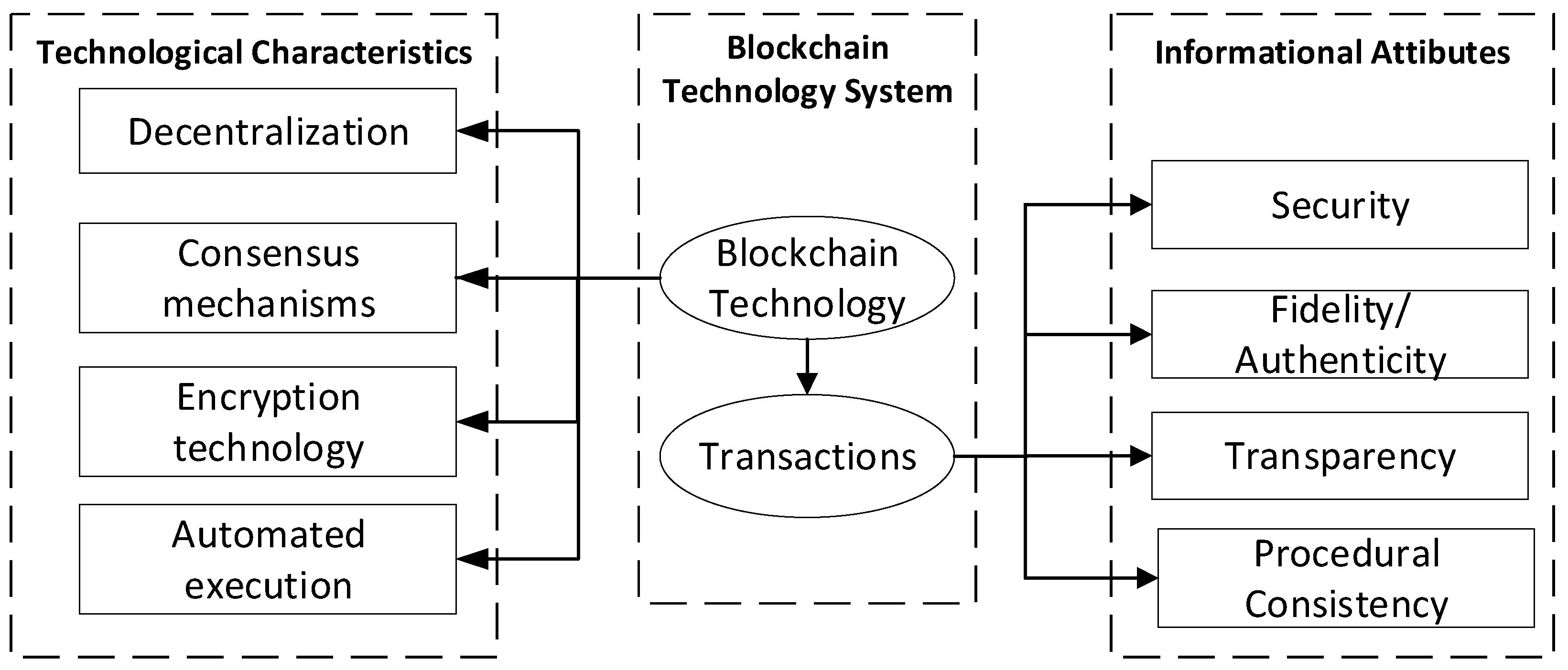
Figure 1 illustrates how blockchain technological features enable the informational attributes of project transaction records.
These informational attributes should not be understood as isolated technical functions, but as governance-relevant informational conditions perceived by project participants when evaluating transactional reliability, procedural predictability, and collaborative accountability.
Drawing on prior studies on blockchain governance and construction information management, this study identifies four blockchain-enabled informational attributes: security, fidelity/authenticity, transparency, and procedural consistency (as shown in
Figure 1). These attributes are not blockchain functions themselves, but governance-relevant qualities of project transaction information produced when blockchain technological features are embedded into project records. Security concerns resistance to manipulation; fidelity/authenticity concerns correspondence between records and actual project events; transparency concerns authorized visibility and verification across organizational boundaries; and procedural consistency concerns the stability, explainability, and non-arbitrariness of rule triggering, responsibility identification, and process execution.
First, security refers to the ability of blockchain-based transaction information to resist tampering, falsification, and unauthorized manipulation during storage, transmission, and access. In inter-organizational construction projects, security means that critical records such as approval documents, progress confirmations, quality inspections, and payment certificates are less likely to be selectively modified or manipulated by a single party after the fact. Security does not directly equate to trust, but it provides a more stable basis for data integrity and reduces governance risks arising from information manipulation.
Second, fidelity/authenticity refers to the extent to which blockchain records consistently reflect actual project transactions, events, or states. Many disputes in construction projects originate from inconsistent “versions of facts”, such as who submitted a change request, when acceptance was completed, or which party was responsible for delays. Through timestamps, hash records, and traceable chains, blockchain makes critical events easier to trace and verify, thereby helping participants establish shared records that more closely reflect actual events. Fidelity/authenticity therefore provides an informational basis for responsibility identification and factual confirmation.
Third, transparency refers to the ability of relevant participants to access, review, and verify key transaction states, process records, and responsibility chains under appropriate permission settings. In construction projects, transparency does not imply complete openness of all information; rather, it means that collaborators can obtain visible information relevant to collaborative tasks within authorized boundaries. Transparency helps reduce information asymmetry and supports participants in understanding project conditions and identifying potential problems in a timely manner.
Fourth, procedural consistency refers to the stability, explainability, and non-arbitrariness embedded in blockchain-based recording, rule triggering, and smart contract execution. Compared with the broader notion of “fairness”, procedural consistency more precisely captures the boundary of blockchain as an informational governance mechanism: blockchain does not directly guarantee fair outcome distribution, nor does it automatically eliminate all governance conflicts. Its more direct role is to make predefined rules, process records, and triggering conditions consistently executable and traceable. In construction projects, many disputes arise not only from outcome allocation, but also from concerns about whether procedures are transparent, whether rules are selectively enforced, and whether responsibilities are identified arbitrarily. Smart contracts can automate transactions according to predefined rules and verified conditions, thereby reducing-but not eliminating-the scope for discretionary intervention [
19,
20,
32,
33]. Through tamper-resistant records, auditable logs, and automated smart contract execution, blockchain can reduce room for unilateral manipulation and provide a more stable procedural basis for project governance [
31,
32,
33]. Consequently, this procedural consistency may be perceived by project participants as a form of “system-level procedural fairness”, allowing parties to place part of their collaborative confidence in the system’s execution logic rather than relying solely on individual discretion [
10,
31].
Procedural consistency can also be understood as the system-level manifestation of procedural justice in blockchain-enabled informational governance. Trust in project relationships depends not only on assessments of partner competence, integrity, and benevolence, but also on whether contractual and relational processes are experienced as fair [
13,
34]. In blockchain environments, such perceived fairness is not primarily derived from individual promises, but from system-level constraints on records, rules, and execution processes: critical transactions are continuously recorded, rule triggering is based on verifiable evidence, responsibility chains are traceable, and execution processes are less susceptible to unilateral alteration. Accordingly, this study defines procedural consistency as the informational basis of “system-level procedural fairness”, through which consistent, auditable, and non-arbitrary procedural conditions make it easier for project participants to believe that collaboration processes operate according to agreed rules.
However, enhanced procedural consistency may also involve governance tensions. Although blockchain-enabled informational governance can strengthen accountability and rule-execution consistency, it may simultaneously constrain certain forms of relational flexibility [
31]. For example, excessively transparent records may intensify surveillance concerns and encourage more defensive organizational behavior, while highly formalized and automated smart-contract execution may reduce the space for adaptive negotiation and informal adjustment under conditions of project uncertainty. Recent game-theoretic evidence likewise indicates that blockchain adoption does not uniformly improve contractor behavior; its effects on quality effort and pricing vary with operating costs and competitive conditions [
35]. In construction projects, many coordination activities still require contextual judgment, adaptive communication, and flexible problem-solving [
11,
12]. Blockchain-enabled informational governance therefore does not necessarily replace relational governance; rather, it may coexist with relational governance in a complementary yet tension-filled manner. In other words, blockchain-enabled informational governance may simultaneously enhance accountability while constraining relational flexibility.
Overall, the mechanism through which blockchain influences project governance can be understood as follows: blockchain technological features first shape the security, fidelity/authenticity, transparency, and procedural consistency of project transaction information; these informational attributes subsequently become the evidentiary basis upon which project participants make judgments, coordinate activities, assign accountability, and cooperate. Accordingly, this study treats these four informational attributes as the starting point of the subsequent theoretical framework explaining how blockchain-enabled informational governance influences trust formation and collaboration processes in inter-organizational construction projects.
4.2. Dual-Level Trust in Construction Projects
In the theoretical framework of this study, trust is conceptualized as a dual-level construct rather than a single variable. Collaboration in inter-organizational construction projects occurs both through daily interactions among boundary spanners and through organization-level contract fulfillment, resource commitment, and cooperative engagement. Without distinguishing the level and referent of trust, it becomes difficult to separate “trust in a partner’s representative” from “trust in a partner organization” [
6,
36].
This study distinguishes between interpersonal trust and inter-organizational trust in construction projects. Interpersonal trust refers to the trust that boundary spanners from one organization place in key individuals from a partner organization. It involves judgments about the counterpart’s ability, benevolence, integrity, and behavioral predictability [
6,
37]. Depending on the project structure, boundary spanners may include project managers, BIM coordinators or equivalent digital-information coordinators, site engineers, and contract administrators. These roles connect organizational boundaries by interpreting and communicating evidence concerning model changes, site conditions, inspections, approvals, claims, and payment conditions.
Their evidentiary functions are related but distinct. BIM coordinators verify model versions, change-order provenance, and the status of BIM-based coordination issues; site engineers compare recorded information with physical completion and inspection conditions; contract administrators assess whether claims, approvals, and payment conditions comply with agreed procedures; and project managers integrate these role-specific assessments into coordination decisions, issue escalation, and organizational reporting. Blockchain-enabled records do not replace the professional judgment exercised by these actors. Rather, security, fidelity/authenticity, transparency, and procedural consistency may provide them with a more stable and cross-verifiable informational basis for assessing the reliability of specific counterparts.
Inter-organizational trust refers to organizational members’ judgment of the trustworthiness of a partner organization as a whole. It concerns whether the partner organization is reliable, fulfills commitments, follows agreed rules, and demonstrates willingness to collaborate [
6]. Unlike interpersonal trust, the referent of inter-organizational trust is not a specific individual but the partner organization. In construction projects, inter-organizational trust more directly affects organization-level information sharing, resource commitment, joint decision-making, reduction in defensive control, and cooperative engagement.
Distinguishing these two forms of trust is important for the framework developed in this study. Blockchain-enabled informational attributes may influence both trust judgments in frontline interactions and organization-level expectations toward partner organizations. At the interpersonal level, role-specific records help boundary spanners assess whether particular counterparts provide accurate information, follow agreed procedures, and respond reliably to project issues. At the organizational level, recurrent and corroborated evidence of performance, compliance, and responsibility fulfillment may support judgments about a partner organization as a collective actor. Interpersonal interaction experiences may therefore inform, but do not automatically determine, inter-organizational trust when they are aggregated through project records, internal communication, managerial reporting, and organizational decision processes.
Based on this logic, this study adopts a dual-level trust structure to explain how blockchain informational attributes may affect collaboration governance in construction projects. This structure helps clarify whether blockchain-enabled informational governance influences trust in frontline interactions, organization-level trust, or both.
4.3. Coordination and Cooperation as Collaboration Processes
In the theoretical framework of this study, inter-organizational collaboration is not treated as a single and static outcome, but as a governance phenomenon composed of multiple interrelated processes. Construction projects typically involve specialization, task interdependence, interface linkage, and time constraints across organizations. Even when participants share common project goals, collaboration may still be undermined by asynchronous information, unclear responsibility boundaries, interface mismatches, and delayed dispute handling. Accordingly, this study distinguishes coordination and cooperation as two interrelated but conceptually distinct process dimensions of inter-organizational collaboration.
Coordination refers to the process through which participating organizations align and adjust tasks, processes, interfaces, schedules, and information flows. It emphasizes whether actions can be organized into a workable pattern of joint activity. In construction projects, coordination is reflected in activities such as scheduling, design change handling, site interface management, quality inspection, and multi-party communication. Effective coordination can reduce misunderstandings, rework, waiting, and responsibility disputes while supporting smoother linkage across organizational activities [
11,
12].
Cooperation refers to the process through which participating organizations undertake joint action based on shared goals, mutual commitment, and resource contribution. Compared with coordination, cooperation places greater emphasis on willingness, commitment, and collective engagement. It requires organizations not only to align tasks and processes, but also to share information, commit resources, assume risks, and jointly solve problems. In construction projects, cooperation is reflected in jointly responding to uncertainty, supporting counterpart performance, and maintaining problem-solving orientations during disputes.
Distinguishing coordination from cooperation is important for this study. Coordination concerns whether participants are able to align their actions, whereas cooperation concerns whether they are willing to commit resources and engage in joint action. The two are related but not interchangeable. A project may exhibit strong process coordination and contractual control without achieving high levels of cooperative commitment. Conversely, even when participants are willing to cooperate, collaboration may fail to become stable joint action if information synchronization, task linkage, and interface management remain ineffective.
This study further argues that coordination often creates the conditions for cooperation in inter-organizational construction projects. Because construction projects are temporary and fragmented arrangements, participants must complete complex task decomposition, role allocation, information exchange, and interface management within limited time frames. Under such conditions, cooperation cannot rely solely on goodwill, but must be supported by workable coordination arrangements. By stabilizing communication channels, aligning project processes, and reducing process uncertainty, coordination provides a basis for resource commitment, mutual commitment, and joint problem-solving [
11,
38].
Based on this logic, this study treats coordination and cooperation as two core process dimensions of inter-organizational collaboration and conceptualizes “coordination facilitating cooperation” as a key process relationship in the proposed theoretical framework.
4.4. Hypotheses Development
This paper posits that blockchain-enabled informational attributes can further influence trust formation and collaboration processes by improving informational governance conditions in inter-organizational construction projects. In contrast to viewing blockchain as a “trustless” technology that automatically replaces human trust, this study emphasizes that the governance role of blockchain lies in providing project participants with a more secure, authentic, transparent, and procedurally consistent informational foundation. Related research also indicates that blockchain’s automated execution does not necessarily crowd out interpersonal trust; rather, under specific conditions, it may support trustworthy behavior by enhancing rule consistency and behavioral predictability [
10].
The “procedural consistency” emphasized in this paper does not imply that blockchain automatically achieves absolute fairness in outcome distribution, but rather means that project rule triggering, approval workflows, and responsibility identification processes can be executed in a more consistent, verifiable, and non-arbitrary manner. This procedural stability helps project participants form more predictable collaborative expectations, thereby further supporting trust formation.
First, blockchain informational attributes may facilitate the formation of interpersonal trust. In construction projects, interpersonal trust primarily develops through daily interactions among boundary spanners. Because project participants often lack an extensive relational history, they may rely heavily on observable and verifiable information when judging the reliability of their counterparts. For example, BIM coordinators assess whether model versions and change records supplied by counterparts are complete and consistent; site engineers assess whether reported progress and inspection information correspond to site conditions; contract administrators assess whether claims and approvals follow agreed procedures; and project managers assess whether counterparts use shared evidence to address coordination problems in a timely and accountable manner. Blockchain-enabled informational attributes can reduce the scope for subsequent record manipulation, increase authorized process visibility, and improve factual verifiability. They do not generate interpersonal trust automatically, but may provide a more stable evidentiary context in which boundary spanners form expectations about counterpart reliability and behavioral predictability. These conditions may reduce defensive communication and responsibility disputes and support more open, problem-solving-oriented interaction. Thus, this study proposes:
H1. Blockchain informational attributes positively influence interpersonal trust in inter-organizational construction projects.
Second, blockchain informational attributes may also facilitate the formation of inter-organizational trust. Compared to interpersonal trust, inter-organizational trust focuses more on whether the collaborative organization as a whole is reliable, adheres to established procedures, and fulfills its commitments. Inter-organizational trust depends on how organizational members form judgments about a partner organization as a collective actor [
6,
36]. In traditional inter-organizational construction projects, information silos often limit the availability of verifiable cross-organizational records. Blockchain-enabled informational attributes, such as immutable consensus records and procedurally consistent smart contracts, can provide an institutionalized evidentiary basis across organizational boundaries [
17,
31]. By enhancing the security, fidelity/authenticity, and transparency of project records, blockchain makes it easier for participating organizations to form stable and predictable expectations regarding the performance of collaborative partners, thereby fostering inter-organizational trust [
6]. Thus, this study proposes:
H2. Blockchain informational attributes positively influence inter-organizational trust in inter-organizational construction projects.
Furthermore, interpersonal trust may contribute to the formation of inter-organizational trust. Inter-organizational construction collaboration is enacted through boundary spanners, but organization-level trust judgments are not simply the sum of individual impressions. Project managers, BIM coordinators, site engineers, and contract administrators generate role-specific interaction experiences concerning information accuracy, procedural compliance, responsiveness, and responsibility fulfillment. When these experiences are recurrent, corroborated by project records, and communicated through coordination meetings, issue logs, claims and approval records, internal reporting, and managerial review, they may be aggregated into broader assessments of the partner organization’s reliability and willingness to collaborate. Positive interpersonal trust experiences may therefore inform inter-organizational trust, provided that organizational communication and governance processes translate frontline evidence into collective judgments. Thus, this study proposes:
H3. Interpersonal trust positively influences inter-organizational trust in inter-organizational construction projects.
Moreover, trust is a critical governance condition promoting inter-organizational coordination and cooperation. Existing research shows that although interpersonal and inter-organizational trust are distinct, both can influence collaborative processes and performance in inter-organizational relationships [
6]. When participants perceive their collaborative counterparts as reliable, predictable, and willing to follow common rules, they are more likely to share information, synchronize tasks, expose problems, and participate in joint decision-making, thereby improving the coordination process. Simultaneously, trust facilitates deeper cooperation, including resource investment, joint problem-solving, and shared risk-bearing. In the absence of trust, organizations are more likely to adopt short-term and defensive behaviors; even if coordination arrangements exist, stable cooperation is difficult to achieve. Thus, this study proposes:
H4. Interpersonal trust positively influences inter-organizational coordination.
H5. Inter-organizational trust positively influences inter-organizational coordination.
H6. Interpersonal trust positively influences inter-organizational cooperation.
H7. Inter-organizational trust positively influences inter-organizational cooperation.
Finally, coordination typically creates the conditions for cooperation. Construction projects are characterized by a high degree of “fragmentation”, involving numerous specialized subcontractors and complex process handoffs [
3]. Collaboration research indicates that coordination and cooperation are two core dimensions of inter-organizational collaboration, where coordination manages interdependencies through action alignment, process linkage, and information sharing [
11,
12]. In construction projects, effective coordination (e.g., BIM interface alignment and real-time sharing of progress information) is a prerequisite for reducing transaction costs. Only when interface conflicts are minimized, information synchronization mechanisms are established, and daily coordination frictions are effectively controlled can participants move beyond defensive organizational boundaries and engage in deeper cooperation, such as joint problem-solving of engineering challenges, resource sharing, and risk allocation. Therefore, a stable and low-transaction-cost coordination process is an essential prerequisite for sustained deep cooperation. Thus, this study proposes:
H8. Inter-organizational coordination positively influences inter-organizational cooperation.
4.5. Proposed Theoretical Framework
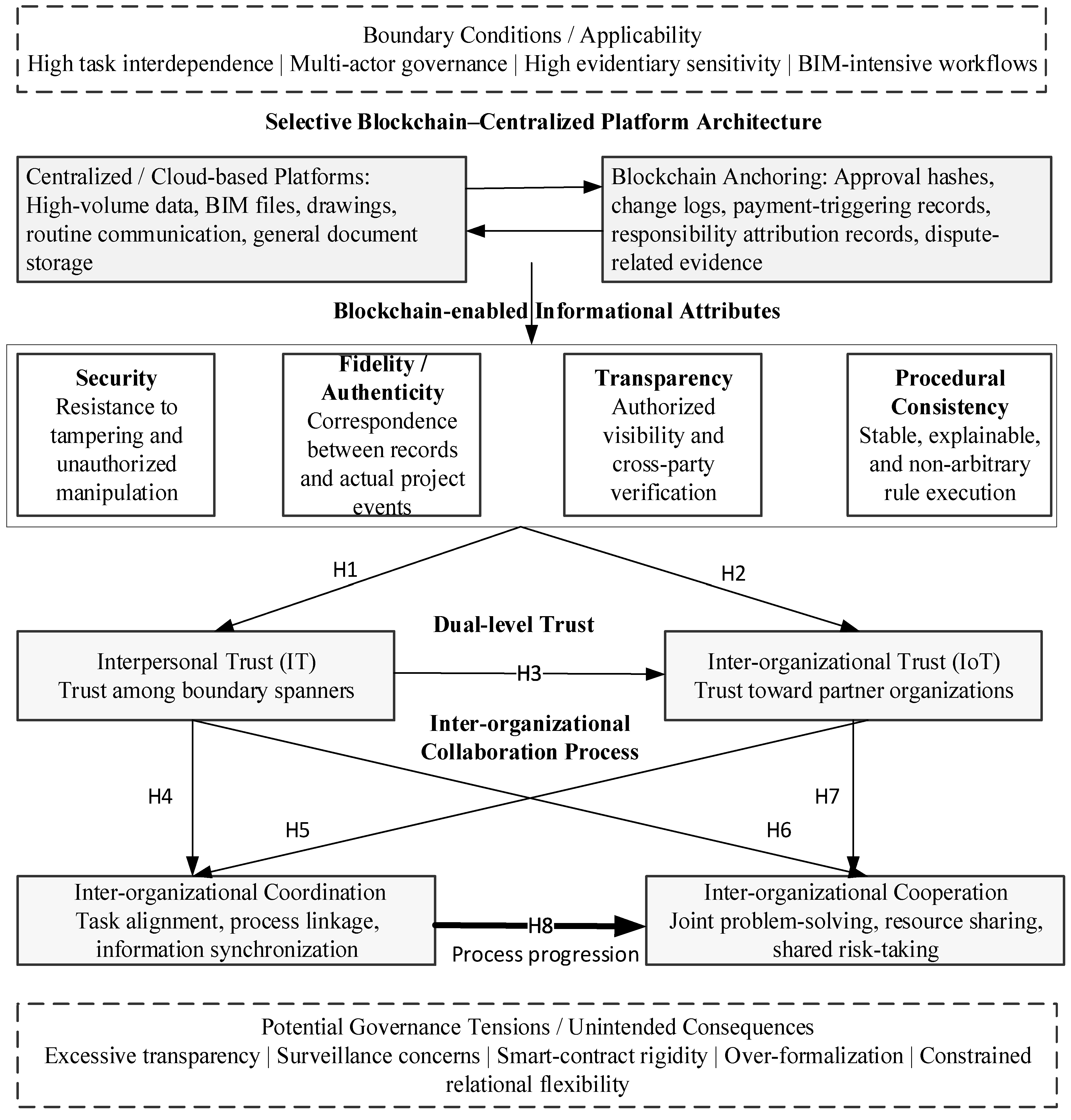
Figure 2 presents the conditional theoretical framework proposed in this study. The framework explains how blockchain-enabled informational governance may influence coordination and cooperation in inter-organizational construction projects through blockchain informational attributes and a dual-level trust structure. Unlike a simple linear technology-impact model, the framework emphasizes that blockchain’s governance role is conditional, selective, and embedded in specific construction project contexts.
The framework begins with the boundary conditions under which blockchain-enabled informational governance is most applicable. These conditions include high task interdependence, multi-actor governance, high evidentiary sensitivity, and BIM-intensive workflows. Under such conditions, blockchain is not expected to replace centralized or cloud-based project management platforms. Rather, it functions as a selective complement: centralized systems remain suitable for high-volume data, routine communication, and general document management, while blockchain can be used to anchor trust-sensitive records such as approval hashes, change logs, payment-triggering records, responsibility attribution records, and dispute-related evidence.
Within this selective governance architecture, blockchain-enabled informational governance shapes four informational attributes of project transaction records: security, fidelity/authenticity, transparency, and procedural consistency. These attributes provide project participants with more stable, verifiable, and traceable evidentiary conditions for judging counterpart reliability, procedural predictability, and collaborative accountability.
Based on this informational basis, project participants may form trust judgments at two levels: interpersonal trust among boundary spanners and inter-organizational trust toward partner organizations. Interpersonal trust may further influence inter-organizational trust through project interaction experiences, internal communication, and collaborative records. Dual-level trust then affects inter-organizational coordination and cooperation, while coordination creates conditions for deeper cooperation through task alignment, process linkage, and information synchronization.
At the same time, the framework acknowledges potential governance tensions. Blockchain-enabled informational governance may strengthen accountability and reduce evidentiary ambiguity, but excessive transparency, smart-contract rigidity, and highly formalized records may also constrain relational flexibility and informal coordination. Accordingly,
Figure 2 does not present blockchain as a universally beneficial governance technology, but as a conditional mechanism whose value depends on whether it is selectively embedded into collaboration processes with strong evidentiary and accountability needs.
4.6. Illustrative Scenario of Blockchain-Enabled Informational Governance in Construction Projects
To further elucidate how the proposed theoretical framework may operate in construction project practice, this section presents an illustrative scenario rather than an empirical case. Following construction blockchain research that uses use-case scenarios to clarify governance potential and operational mechanisms [
8], the scenario focuses on BIM-based design changes, progress confirmation, and smart-contract-enabled payment. These processes are suitable for illustration because they require multi-party factual verification, responsibility attribution, approval sequencing, payment triggering, and potential dispute resolution. Prior studies also show that blockchain can improve information traceability in prefabrication supply chains [
22,
23] and support the governance of construction procurement and payment processes through smart contracts [
24,
33].
Consider a complex construction project jointly delivered by an owner, design firm, general contractor, subcontractors, and supervisory consultants. During construction, a subcontractor submits a BIM-based design change request in response to changing site conditions. In a conventional arrangement, the change request, approval routing, revised model, site confirmation, responsibility attribution, and payment-triggering records may be dispersed across emails, paper-based documents, and the separate information systems of participating organizations. When the parties retain inconsistent versions of critical facts—such as who submitted the change and when, whether the completed work conforms to the revised model, whether the work has been inspected, and whether the payment milestone has been reached—the project may experience coordination friction, blame-shifting, and defensive behavior.
Suppose that the subcontractor subsequently submits a payment claim for the changed work. Under a selective blockchain–centralized platform architecture, the detailed BIM models, drawings, photographs, and supporting documents remain in the project’s common data environment (CDE), while the hashes, timestamps, approval states, inspection confirmations, and responsible-party records associated with the claim are anchored to the blockchain. The owner can then verify whether the agreed completion, inspection, and approval conditions have been satisfied without relying exclusively on the general contractor’s unilateral account. This arrangement does not by itself guarantee the accuracy of off-chain inputs; rather, it makes the submitted evidence and approval trail more traceable, cross-verifiable, and resistant to subsequent alteration.
Within the same workflow, the BIM–blockchain connection can be operationalized through three interrelated evidence chains. First, model version control can associate each formally issued BIM version with a model identifier, hash, timestamp, responsible author, and approval state, making it possible to verify which version governed a particular construction activity. Second, change-order provenance can record or anchor the sequence through which a change was initiated, technically reviewed, approved, communicated, and incorporated into the relevant model and work package. Third, clash-resolution records can preserve critical status transitions showing when a coordination issue was detected, assigned to a responsible party, responded to, resolved, independently verified, and closed. These records can also be connected to subsequent inspection, schedule, and payment decisions.
The detailed models, change documentation, clash reports, and supporting attachments remain off-chain in the CDE. Blockchain stores only the hashes, identifiers, timestamps, approval states, responsible-party references, and other critical metadata required to verify provenance and status. Authorized participants can therefore retrieve the corresponding CDE record and compare it with the anchored evidence without placing high-volume BIM data directly on-chain. Only events whose provenance, authorization, or closure status is important for cross-organizational accountability need to be anchored.
As shown in
Table 1, the scenario illustrates how blockchain-enabled informational governance may provide a verifiable evidentiary basis for dual-level trust formation and subsequent coordination and cooperation. The CDE continues to manage high-volume BIM models, drawings, issue attachments, supporting documents, and routine communication, whereas blockchain functions as an evidentiary layer for critical project events. These events may include formally issued model versions, change-order submissions and approvals, clash assignment and closure states, inspection confirmations, and payment-triggering records. By anchoring selected hashes, timestamps, responsible-party references, and status transitions, this arrangement allows participants to verify key facts and responsibility chains without requiring the underlying project data to be stored on-chain.
These informational conditions may support interpersonal trust by enabling boundary spanners to perform role-specific assessments on the basis of shared evidence. BIM coordinators can verify model versions and change-order provenance; site engineers can compare completion and inspection records with site conditions; contract administrators can assess the approval trail and contractual payment conditions associated with a claim; and project managers can use these inputs to coordinate decisions, escalate unresolved issues, and communicate with participating organizations. In the payment-claim example, the shared evidence base does not eliminate professional judgment or contractual authorization. Rather, it allows the relevant actors to discuss completion status, approval responsibility, and payment entitlement using records that are more traceable and resistant to subsequent alteration.
Repeated evidence-based interactions may support trust in specific counterparts. When the resulting assessments are documented through coordination records, issue logs, approval histories, and internal reports, they may also inform organization-level judgments about whether a partner consistently fulfills responsibilities and follows agreed procedures. The scenario therefore illustrates how boundary spanners can connect blockchain-enabled informational conditions with both interpersonal and inter-organizational trust without assuming that trust transfers automatically across levels.
This illustrative scenario demonstrates how the proposed framework may operate within a recognizable construction process. Blockchain informational attributes may first improve the evidentiary basis of coordination by supporting information synchronization, clearer responsibility boundaries, and more verifiable approval and payment conditions. More stable coordination may then create conditions for deeper cooperation, including joint problem-solving, resource sharing, and shared risk management. Accordingly, the scenario illustrates how the mechanism chain linking blockchain informational attributes, dual-level trust, coordination, and cooperation may unfold in construction project governance without treating the illustration as empirical validation.
5. Discussion
5.1. Theoretical Contributions
This study develops a governance-oriented explanatory framework. Its theoretical contribution lies not in claiming that blockchain inherently improves collaboration, but in specifying the informational mechanism, levels of trust, and collaboration process through which blockchain-enabled informational conditions may shape construction project governance under particular conditions. The framework makes three distinct theoretical contributions.
First, it advances blockchain research in construction from technology application and functional discussion toward an informational governance explanation. Existing studies have extensively discussed blockchain applications in BIM data management, smart contract-based payment, supply-chain traceability, and auditable records, but have paid less attention to how these applications are translated into governance effects. Rather than treating security, fidelity/authenticity, transparency, and procedural consistency as a list of technical functions, this study conceptualizes them as governance-relevant qualities of project records that inform accountability, trust, and collaboration judgments. This mechanism-based translation clarifies how blockchain technological features may enter inter-organizational governance processes. It also reveals an important tension: blockchain-enabled informational governance may strengthen accountability while constraining relational flexibility.
Second, this study extends dual-level trust logic into blockchain-enabled construction project governance. Its contribution is not merely to place interpersonal trust and inter-organizational trust in the same framework, but to distinguish their referents and specify how they may be connected. Interpersonal trust concerns judgments formed through frontline interactions among boundary spanners, whereas inter-organizational trust concerns judgments about a partner organization as a collective actor. By theorizing how verifiable interaction experiences, internal communication, and collaborative records may transmit trust judgments across these levels, the framework avoids level conflation and provides a more precise account of how informational governance becomes embedded in inter-organizational relationships.
Third, this study extends the coordination–cooperation process logic into blockchain-enabled informational governance in construction projects. Its contribution goes beyond treating collaboration as a single outcome or merely distinguishing coordination from cooperation. The framework specifies a process structure in which blockchain-enabled informational attributes and dual-level trust may support both collaboration processes, while coordination creates operational conditions for deeper cooperation through task alignment, process linkage, and information synchronization. This process view helps open the collaboration “black box” and explains how improved evidentiary conditions may be translated into joint problem-solving, resource commitment, and shared action.
Taken together, these contributions provide an integrative mechanism architecture linking blockchain-enabled informational attributes, dual-level trust, coordination, and cooperation. The theoretical value of the framework lies in connecting previously fragmented technological, trust, collaboration, and project-governance explanations while preserving the conditional and potentially tension-filled nature of blockchain-enabled governance. It thereby offers a set of explicit and testable relationships for subsequent empirical research without portraying blockchain as a universally beneficial governance technology.
5.2. Implications for Construction Project Governance
The proposed framework offers several implications for blockchain implementation in construction project governance. First, project managers should not focus only on whether blockchain is adopted, but on whether it actually improves informational governance conditions in project collaboration. The key issue is not the deployment of a technical platform itself, but whether informational attributes such as security, fidelity/authenticity, transparency, and procedural consistency are effectively activated in specific project processes. Project organizations therefore need to define both which project events require evidentiary anchoring and which data should remain in the common data environment. In BIM-intensive workflows, detailed models, federated files, drawings, issue attachments, photographs, and routine communications should generally remain in the CDE or cloud-based platform. Blockchain should selectively anchor model and version identifiers, hashes, timestamps, responsible actors, approval states, and critical status transitions associated with model version control, change-order provenance, clash-resolution records, inspections, payment milestones, claims, and responsibility attribution [
18,
39,
40]. This evidence schema makes the blockchain layer operationally selective and avoids unnecessary duplication of high-volume BIM information.
With reference to this evidence schema, blockchain should not be designed as a system that replaces centralized project management platforms. For large BIM models, drawings, site photos, video records, routine communication, and general document storage, centralized databases or cloud-based project management platforms usually offer higher efficiency, lower costs, and stronger data-processing capacity. Blockchain is more suitable for selective embedding in critical evidence nodes that are highly sensitive to trust, accountability, and dispute resolution, such as approval hashes, change logs, payment-triggering records, responsibility attribution records, acceptance evidence, and claim-related documents [
18]. A more realistic implementation pathway is therefore not “full on-chain storage”, but a selective blockchain–centralized platform architecture: centralized platforms manage high-volume data and routine collaboration, while blockchain anchors critical evidence, enhances verifiability, and strengthens procedural consistency. This division allows project organizations to use blockchain as an evidentiary layer for trust-sensitive events rather than as a universal data platform. In many construction projects, a lead organization, such as an owner or general contractor, may already operate a centralized project management platform to coordinate subcontractors and manage routine project information. The proposed framework does not deny the usefulness of such centralized arrangements. Rather, it suggests that blockchain is most useful when centralized information management needs to be complemented by tamper-resistant evidence anchoring for trust-sensitive events, such as approvals, payment triggers, responsibility attribution, and dispute-related records [
18,
40].
Second, blockchain implementation may initially support cross-organizational coordination rather than expecting immediate high-level cooperation. Coordination activities in construction projects are typically frequent, interface-intensive, and process-dependent, including task linkage, schedule synchronization, design change handling, site interface management, and payment confirmation. These activities depend directly on whether information is timely, accurate, visible, and traceable. Early blockchain applications may therefore focus on evidence retention at key process nodes, project state visibility, and responsibility traceability, so as to reduce coordination frictions and dispute costs. Once task processes, responsibility boundaries, and information states become clearer, participating organizations are more likely to engage in higher-commitment forms of cooperation, such as resource sharing, joint problem-solving, and shared risk-taking.
Third, procedural consistency should be treated as an explicit design objective in blockchain-enabled construction governance. Disputes in construction projects arise not only from outcome allocation, but also from concerns about whether procedures are transparent, rules are applied consistently, and responsibilities are identified fairly. Project managers may incorporate contract-critical clauses, design change procedures, acceptance records, payment-trigger conditions, claim documents, and dispute-handling evidence into an auditable information record system. Existing studies have shown that blockchain-enabled smart contracts can improve the timeliness, transparency, and verifiability of construction payments [
19,
20]. The purpose of such governance design is therefore not to replace contracts or trust with technology, but to improve the verifiability of rule execution and process records, reduce room for unilateral manipulation, and make it easier for participants to believe that partner organizations will act according to agreed procedures.
Fourth, project organizations should treat boundary spanners not only as communication intermediaries, but also as evidence interpreters and trust translators. Their functions should be differentiated according to the project information they are authorized and competent to assess. BIM coordinators can verify model versions, change-order provenance, and the status of digital coordination issues; site engineers can confirm physical completion, inspection results, and correspondence with approved project information; contract administrators can evaluate claims, approval trails, and payment-triggering conditions; and project managers can integrate these assessments into coordination decisions, issue escalation, partner evaluation, and internal reporting. Blockchain-enabled records can strengthen these functions by providing a shared and traceable evidence base, but they do not remove the need for professional judgment, contractual authority, or contextual interpretation.
Project organizations should therefore establish permission settings, evidence handover procedures, issue-recording protocols, and reporting routines that connect these role-specific assessments. Such arrangements allow frontline experiences with particular counterpart personnel to be documented and communicated without assuming that interpersonal trust automatically becomes trust in the partner organization. When repeated interaction evidence is corroborated and incorporated into organizational review and decision processes, boundary spanners may help translate project-level experience into more informed judgments of partner reliability and collaborative intent.
Overall, the value of blockchain in construction project governance does not lie in replacing existing project management platforms, but in whether it can be selectively embedded into critical collaboration processes and generate visible, verifiable, traceable, and procedurally consistent informational foundations. Only when these informational attributes are perceived and used by project participants in actual coordination and decision-making can blockchain meaningfully support trust formation and inter-organizational collaboration.
5.3. Limitations and Future Research Directions
This study has several limitations that delimit the claims that can be made from the proposed framework. First, it is a conceptual theory-building study, and the relationships represented by the eight hypotheses have not been empirically tested. The framework therefore identifies theoretically plausible mechanisms rather than demonstrated effects. Correspondingly, the scenario in
Section 4.6 is an analytical illustration rather than evidence that blockchain improves trust, coordination, cooperation, or project performance. Second, the framework abstracts from important implementation contingencies, including the accuracy and possible strategic manipulation of off-chain data inputs, power asymmetries among project participants, platform-governance arrangements, implementation and verification costs, legal enforceability, and differences among permissioning and consensus configurations. Third, the framework focuses primarily on inter-organizational collaboration during project delivery and does not claim equal applicability across all project phases, organizational forms, project scales, or levels of digital maturity.
These limitations define corresponding priorities for future research. Surveys, structural equation modeling, and scenario-based experiments can test the relationships among blockchain informational attributes, interpersonal trust, inter-organizational trust, coordination, and cooperation. Where construction participants have limited experience with actual blockchain implementation, carefully designed scenarios can hold the application context constant and examine how project managers, BIM coordinators, site engineers, and contract administrators respond to different informational conditions. Field studies should additionally compare perceived informational attributes with objective project records and outcomes so that the proposed mechanisms are not evaluated solely through self-reported perceptions.
Longitudinal and phase-based designs can examine the dynamic evolution of trust and collaboration. Construction projects involve distinct phases, including design, procurement, construction, acceptance, and operation, and the relevance of different informational attributes may change across them. Transparency and traceability may be particularly important for task alignment and responsibility clarification in earlier phases, whereas procedural consistency and auditable records may become more salient for payment confirmation, claims handling, and dispute resolution in later phases. Multi-wave surveys, longitudinal case studies, and event-sequence data can therefore assess whether the proposed mechanism changes over time.
Comparative research can further examine boundary conditions under different technological and governance configurations. The role of blockchain may depend on chain type, permissioning design, the depth of smart contract embedding, project complexity, task interdependence, implementation cost, competitive conditions, power asymmetry, and institutional environment [
35,
40]. Studies comparing consortium, private, and public blockchains, as well as blockchain-enabled and centralized-platform arrangements, can clarify how permission settings, consensus rules, data-sharing scopes, and governance authority shape trust formation and collaboration outcomes.
Future research can also extend the framework to specific BIM–blockchain workflows, project outcomes, and governance combinations. Relevant settings include BIM model version control, change-order provenance, clash-resolution management, material tracking, quality acceptance, payment certification, claims handling, and supply-chain collaboration. Relevant outcomes include project performance, dispute frequency, change-processing efficiency, claims costs, and supply-chain resilience. Research should also examine complementarity and substitution among blockchain-enabled informational governance, contractual governance, relational governance, and centralized information management. Finally, closer attention should be paid to unintended consequences such as excessive transparency, reduced informal coordination, smart-contract rigidity, defensive behavior induced by immutable records, and overreliance on system-generated evidence. Such work would provide a more balanced account of how digitally mediated governance both enables and constrains collaboration in construction projects.
5.4. Boundary Conditions and Applicability of Blockchain-Enabled Informational Governance
The blockchain-enabled informational governance mechanism proposed in this study is not universally applicable across project contexts; rather, its governance value is contingent upon organizational structures, collaboration complexity, evidentiary requirements, and levels of digital maturity [
40]. Blockchain is therefore positioned here as a complementary mechanism for specific governance contexts rather than as a wholesale substitute for centralized platforms.
In particular, blockchain-enabled informational governance appears more relevant under three interrelated project conditions. First, it is more suitable for project environments characterized by high task interdependence. Complex construction projects typically exhibit tight inter-organizational coupling, frequent interface interactions, and cross-phase coordination demands, in which design changes, progress confirmation, quality documentation, and payment triggers entail multi-party coordination and responsibility attribution. In such settings, shared records, traceable logs, and procedural consistency can provide a more stable informational foundation for high-frequency cross-organizational exchanges.
Second, it is more relevant in multi-actor governance contexts characterized by high evidentiary sensitivity. Large infrastructure projects, prefabricated construction, and BIM-intensive workflows commonly involve owners, main contractors, subcontractors, designers, suppliers, and third-party regulators [
23], their complex accountability chains make governance highly dependent on verifiable process evidence, while blockchain’s informational properties can support responsibility traceability, process verification, and dispute resolution. In construction product and material supply chains, evidentiary sensitivity is particularly high because provenance, batch identity, compliance certificates, custody transfers, and installation records are generated across multiple organizations; linking these records through a shared traceability layer can strengthen accountability across organizational boundaries [
22,
23].
Third, it may be particularly useful in BIM-intensive collaborative workflows. Model revisions, approval records, and collaboration states in BIM environments are inherently dynamic and require cross-organizational sharing, and prior studies indicate that blockchain–BIM integration can strengthen the verifiability of model change records and the credibility of collaborative evidence [
18,
39].
These scope conditions can be illustrated by contrasting two stylized project settings. A large infrastructure public–private partnership (PPP) involving multiple subcontracting tiers, frequent design changes, BIM-intensive coordination, claim-sensitive payment processes, and regulatory oversight is more likely to justify a selective blockchain evidentiary layer. In such a setting, critical records are generated, reviewed, and retained by different organizations, while coordination and dispute resolution may depend on reconstructing cross-organizational trails of model revisions, change approvals, inspections, responsibility attribution, and payment conditions. Blockchain anchoring may therefore provide incremental governance value by stabilizing evidence that cannot be adequately controlled or verified by any single participant.
By contrast, a small building project delivered by a single main contractor, with few subcontractors, limited organizational interfaces, stable working relationships, and an effective centralized information system, is less likely to derive sufficient incremental value from blockchain to justify its additional implementation and governance costs. In such a setting, a conventional cloud-based platform may already provide adequate document control, information visibility, and process coordination. Blockchain would add limited value unless a specific process—such as material provenance, payment certification, or regulatory compliance—remained unusually evidence-sensitive.
These contrasting examples should not be interpreted as establishing a simple project-size rule. Project scale alone does not determine blockchain applicability; the more relevant issue is the combined presence of actor multiplicity, task interdependence, evidentiary sensitivity, fragmented information control, and sufficient digital readiness. A relatively small project may still justify selective blockchain anchoring when material provenance, regulatory compliance, or payment evidence is highly sensitive. Conversely, even a large project may derive limited incremental value where governance is strongly integrated, trusted centralized controls are effective, and critical evidence is already reliably shared. Blockchain is therefore not categorically superior to centralized platforms. For projects characterized by stable organizational relationships, limited coordination demands, or insufficient digital maturity, conventional databases and cloud-based project management platforms may already meet information-management needs [
40,
41]. In long-term cooperative relationships, established relational governance and pre-existing trust may also partly substitute for the verifiability and procedural consistency provided by blockchain.
In sum, blockchain-enabled informational governance is best embedded within project processes marked by high cross-organizational complexity, elevated coordination costs, fragmented control over critical records, and pronounced evidentiary sensitivity, rather than deployed as a general-purpose solution. The framework therefore predicts greater governance value in settings resembling the large infrastructure PPP example and lower incremental value in settings resembling the small single-contractor example. Its governance value derives less from decentralization itself than from its capacity to stabilize evidentiary conditions for inter-organizational coordination, accountability, and collaborative decision-making where conventional centralized arrangements cannot provide sufficiently credible cross-organizational evidence.
6. Conclusions
This study focuses on trust and collaboration governance in inter-organizational construction projects and develops a conceptual theory-building framework to explain the role of blockchain-enabled informational governance. While existing studies have largely focused on blockchain application scenarios, adoption behavior, or system functions, less attention has been paid to how blockchain influences trust and collaboration through governance mechanisms. This study therefore conceptualizes blockchain’s governance role as an informational governance mechanism rather than merely a technical deployment.
In response to the first research question, this study argues that blockchain influences trust formation by reshaping the informational basis of project collaboration. Through security, fidelity/authenticity, transparency, and procedural consistency, blockchain-enabled records may provide project participants with more verifiable, traceable, and procedurally stable evidence for evaluating partner behavior. In response to the second research question, the framework further suggests that such informational attributes may affect trust at two levels: interpersonal trust among boundary spanners and inter-organizational trust toward partner organizations. Interpersonal trust may also contribute to inter-organizational trust when project interaction experiences and verifiable collaboration records are translated into broader organizational judgments.
In response to the third research question, this study explains that blockchain-enabled informational governance may support inter-organizational collaboration by improving both coordination and cooperation. More reliable process records, clearer responsibility boundaries, and more verifiable payment or approval conditions can reduce coordination friction and support task alignment, process linkage, and information synchronization. More stable coordination may then create conditions for deeper cooperation, including joint problem-solving, resource sharing, and shared risk management.
Overall, the governance value of blockchain in inter-organizational construction projects does not lie simply in its adoption as a new technology, but in whether it can be selectively embedded into critical collaboration processes. This study does not assume that blockchain replaces centralized project management platforms or universally improves collaboration. Rather, blockchain-enabled informational governance is most relevant when high task interdependence, multi-actor governance, evidentiary sensitivity, fragmented control over critical records, and BIM-intensive workflows create a need for verifiable and procedurally consistent evidence. A large infrastructure public–private partnership involving multiple subcontracting tiers, frequent change orders, claim-sensitive payment processes, and cross-organizational accountability provides an example of such a context. By contrast, a small project delivered by a single main contractor, with limited interfaces, stable relationships, and an adequate centralized information system, may not generate sufficient incremental governance value to justify the additional costs and complexity of blockchain.
In BIM-intensive workflows, a selective architecture allows high-volume models, drawings, and supporting files to remain in the common data environment, while blockchain anchors evidence concerning model versions, change-order provenance, and critical clash-resolution states. At the same time, blockchain may enhance accountability while constraining relational flexibility, suggesting that its governance value should be understood as conditional and complementary rather than universal. Future research may empirically examine the proposed mechanism relationships and scope conditions through surveys, longitudinal case studies, scenario-based experiments, comparative project studies, or BIM–blockchain integrated project data.